EP1835429A2 - Gerät zur Bestimmung von Parametern für Anti-Wurm-Massnahmen. Gerät zur Bestimmung und zur Begrenzung der Anzahl der Knoten und Computerprodukt - Google Patents
Gerät zur Bestimmung von Parametern für Anti-Wurm-Massnahmen. Gerät zur Bestimmung und zur Begrenzung der Anzahl der Knoten und Computerprodukt Download PDFInfo
- Publication number
- EP1835429A2 EP1835429A2 EP06253601A EP06253601A EP1835429A2 EP 1835429 A2 EP1835429 A2 EP 1835429A2 EP 06253601 A EP06253601 A EP 06253601A EP 06253601 A EP06253601 A EP 06253601A EP 1835429 A2 EP1835429 A2 EP 1835429A2
- Authority
- EP
- European Patent Office
- Prior art keywords
- worm
- nodes
- packets
- measure
- network
- Prior art date
- Legal status (The legal status is an assumption and is not a legal conclusion. Google has not performed a legal analysis and makes no representation as to the accuracy of the status listed.)
- Withdrawn
Links
Images







Classifications
-
- H—ELECTRICITY
- H04—ELECTRIC COMMUNICATION TECHNIQUE
- H04L—TRANSMISSION OF DIGITAL INFORMATION, e.g. TELEGRAPHIC COMMUNICATION
- H04L63/00—Network architectures or network communication protocols for network security
- H04L63/14—Network architectures or network communication protocols for network security for detecting or protecting against malicious traffic
- H04L63/1441—Countermeasures against malicious traffic
- H04L63/145—Countermeasures against malicious traffic the attack involving the propagation of malware through the network, e.g. viruses, trojans or worms
-
- G—PHYSICS
- G06—COMPUTING OR CALCULATING; COUNTING
- G06F—ELECTRIC DIGITAL DATA PROCESSING
- G06F21/00—Security arrangements for protecting computers, components thereof, programs or data against unauthorised activity
- G06F21/50—Monitoring users, programs or devices to maintain the integrity of platforms, e.g. of processors, firmware or operating systems
- G06F21/55—Detecting local intrusion or implementing counter-measures
- G06F21/56—Computer malware detection or handling, e.g. anti-virus arrangements
Definitions
- the present invention relates to a technology for preventing an unknown worm from spreading using an anti-worm-measure means.
- the anti-worm-measure program is created to detect and block unknown worms in addition to the known worms.
- Detection of unknown worms is performed by, for example, monitoring fluctuation in a quantity of flow of a specific kind of packets in network traffic (see, for example, Japanese Patent Application Laid-Open No. 2005-134974 ).
- a certain degree of period is necessary from the time when a certain sign of communication by an unknown worm is detected in certain communication until the time when it is determined that the communication is communication by the worm and the communication is blocked.
- a computer-readable recording medium stores therein a computer program for determining parameters for controlling timing for an anti-worm-measure means to start blocking of a communication by a worm in a network, for preventing a spread of the worm.
- the computer program causes a computer to execute calculating infectivity of the worm based on number of nodes connected to the network; and estimating an expected value of number of infected nodes at a time when the worm transmits a predetermined number of packets, based on the infectivity calculated at the calculating.
- An anti-worm-measure parameter determining apparatus determines parameters for controlling timing for an anti-worm-measure means to start blocking of a communication by a worm in a network, for preventing a spread of the worm.
- the anti-worm-measure parameter determining apparatus includes an infectivity calculating unit that calculates infectivity of the worm based on number of nodes connected to the network; and a number-of-infected-nodes estimating unit that estimates an expected value of number of infected nodes at a time when the worm transmits a predetermined number of packets, based on the infectivity calculated by the infectivity calculating unit.
- a computer-readable recording medium stores therein a computer program for determining number of nodes connectable to a network when an anti-worm-measure means is set to start blocking of a communication by a worm at predetermined timing, for preventing a spread of the worm.
- the computer program causes a computer to execute calculating number of packets that can be leaked from packets transmitted from one infection source until the anti-worm-measure means completes the blocking of the communication by the worm; estimating, based on infectivity of the worm calculated based on the number of nodes connected to the network and the number of packets calculated at the calculating, an expected value of number of nodes infected by the worm until the anti-worm-measure means completes the blocking of the communication by the worm; and deriving, as an upper limit of number of nodes connectable to the network, number of nodes at a time when the expected value of the number of infected nodes estimated at the estimating becomes an finite maximum value when it is assumed that some number of packets have been transmitted by the worm.
- a number-of-nodes determining apparatus determines number of nodes connectable to a network when an anti-worm-measure means is set to start blocking of a communication by a worm at predetermined timing, for preventing a spread of the worm.
- the number-of-nodes limiting system includes a limit-value-of-leaked-packets calculating unit that calculates number of packets that can be leaked from packets transmitted from one infection source until the anti-worm-measure means completes the blocking of the communication by the worm; a number-of-infected-nodes estimating unit that estimates, based on infectivity of the worm calculated based on the number of nodes connected to the network and the number of packets calculated by the limit-number-of-leaked-packets calculating unit, an expected value of number of nodes infected by the worm until the anti-worm-measure means completes the blocking of the communication by the worm; and a limit-number-of-nodes deriving unit that derives, as an upper limit of number of nodes connectable to the network, number of nodes at a time when the expected value of the number of infected nodes estimated by the number-of-infected-nodes estimating unit becomes an finite maximum value
- a number-of-nodes limiting system limits number of nodes connectable to a network when an anti-worm-measure means is set to start blocking of a communication by a worm at predetermined timing, for preventing a spread of the worm.
- the number-of-nodes limiting system includes a limit-value-of-leaked-packets calculating unit that calculates number of packets that can be leaked from packets transmitted from one infection source until the anti-worm-measure means completes the blocking of the communication by the worm; a number-of-infected-nodes estimating unit that estimates, based on infectivity of the worm calculated based on the number of nodes connected to the network and the number of packets calculated by the limit-number-of-leaked-packets calculating unit, an expected value of number of nodes infected by the worm until the anti-worm-measure means completes the blocking of the communication by the worm; a limit-number-of-nodes deriving unit that derives, as an upper limit of number of nodes connectable to the network, number of nodes at a time when the expected value of the number of infected nodes estimated by the number-of-infected-nodes estimating unit becomes an finite maximum value when
- the anti-worm-measure parameters are the number of worm packets allowed to be leaked in a period from the time when anti-worm-measure means such as an anti-worm-measure program or a firewall program detects a sign of communication by an unknown worm until the time when the anti-worm-measure means determines that the communication is communication by the unknown worm and starts blocking, a time from the time when the anti-worm-measure means detects the sign of the communication of the unknown worm until the time when the anti-worm-measure means completes the blocking, and the like.
- the worm packet means a packet that the worm transmits for autosynthesis.
- Equation (2-1) is for calculating a probability that, when the worm selects a certain infection destination for autosynthesis, infection actually spreads to the selected destination.
- a worm selects an IP address of an infection destination with an IP address of a node infected with the worm as a reference to increase infectivity rather than selecting an infection destination at random.
- IP Internet Protocol
- the worm selects a node belonging to a network 24 of A.B.C.* (* is an integer of 0 to 255) as an infection destination at a fixed probability, selects a node belonging to a network 23 of A.B.*.* as an infection destination at a fixed probability, selects a node belonging to a network 22 of A.*.*.* as an infection destination at a fixed probability, and selects a node belonging to a network 21 of *.*.*.* as an infection destination at a fixed probability.
- IP Internet Protocol
- the network 24 of A.B.C.* is often a management unit of a sub-network in a company and the like. Therefore, when one of nodes belonging to the network 24 of A.B.C.* is selected to transmit a packet, although it is highly likely that a packet reaches the node selected, an area in which the worm spreads is small.
- the network 21 of *.*.*.* means an entire IP network. When one of nodes belonging to this network to transmit a packet, although an area in which the worm spreads is large, it is less likely that the packet reaches the node selected.
- the network 23 of A.B.*.* and the network 22 of A.*.*.* have an intermediate characteristic of the characteristics of these networks.
- the worm often selects nodes belonging to the network 24 of A.B.C.*, the network 23 of A.B.*.*, the network 22 of A.*.*.*, and the network 21 of *.*.*.* as infection destinations at fixed probabilities, respectively, to transmits the worm packet.
- Equation (2-1) the probability that the worm selects a node belonging to the network 24 of A.B.C.* as an infection destination is set as P c , the probability that the worm selects a node belonging to the network 23 of A.B.*.* as an infection destination is set as P b , the probability that the worm selects a node belonging to the network 22 of A.*.*.* as an infection destination is set as P a , and the probability that the worm selects a node belonging to the network 21 of *.*.*.* as an infection destination is set as P.
- the number of nodes belonging to the network 24 of A.B.C.* is set as n c
- the number of nodes belonging to the network 23 of A.B.*.* is set as n b
- the number of nodes belonging to the network 22 of A*.*.* is set as n a
- the number of nodes belonging to the network 21 of *.*.*.* is set as n.
- Equation (3-1) is for calculating the infectivity p at the time when it is assumed that the worm simultaneously selects one node belonging to the network 24 of A.B.C.*, one node belonging to the network 23 of A.B.*.*, one node belonging to the network 22 of A.*.*.*, and one node belonging to the network 21 of *.*.*.* as infection destinations, respectively, and transmits four worm packets thereto.
- the number of nodes excluding nodes for which measures for preventing infection of the worm such as installation of a patch for anti-worm measures and closure of ports used by the worm for infection are taken may be set.
- the nodes for which the measures are taken may be excluded by multiplying the inputted number of nodes by a ratio of nodes for which the measures are not taken. This is because it is considered that the nodes for which the measures are taken are unlikely to be infected with the worm even if the worm packets reaches.
- Equation (4-1) is for calculating the infectivity p of a worm infecting the infected node 10 included in a network K at the time when a network is delimited to a network 1 to the network K as shown in Fig. 1B such that a network X includes a network (X+1).
- n x indicates the number of nodes connected to the network X
- N x indicates a maximum value of the number of nodes connectable to the network X
- P x indicates a probability that the worm selects a node connected to the network X as an infection destination.
- Equation 1 It is possible to more specifically express E(p,T,w) in Equation 1 using various formula models such as a discrete mathematics model, a continuous mathematics model, and a probability model.
- Equation (5) expresses an expected value of the number of infected nodes considering that infection of the worm spreads according to n-th order infection (n is a positive integer) from one infection source.
- the worm has a characteristic that an infection source of the worm is not limited to one infection node but a newly infected node also becomes an infection source to spread infection to other nodes. The characteristic is taken into account in this equation.
- i means i-th order infection and a unit of the time T is a period required for the worm to infect from a certain node to the other nodes.
- E 1 (p,T,w) of the number of infected nodes taking only primary infection into account is expressed by the following equation.
- Equation (6) when T is larger than w, the number of infected nodes is derived depending on w and without depending on T.
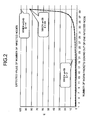
- a graph representing a relation between the number of worm packets w of worm packets transmitted from one infected node and the expected value E of the number of infected nodes at the time when the infectivity p is set to 0.02534 and the time T is set sufficiently large is shown in Fig. 2.
- the expected value E of the number of infected nodes indicated in the equation is an expected value calculated by using Equation 7.
- the expected value E of the number of infected nodes is 2. This means that, if blocking of communication by the worm is completed at a stage when nineteen worm packets are transmitted from an infected node, it is possible to limit the number of nodes infected with the worm with the infected node as an origin to one.
- the expected value E of the number of infected nodes is 85.
- the expected value E of the number of infected nodes diverges.
- 39 is a limit number of leaked packets, that is, the number of worm packets allowed to be leaked until the anti-worm-measure means completes blocking of communication by an unknown worm and, if the blocking of the communication by the worm is completed at a stage when thirty-nine worm packets are transmitted from an infected node, it is possible to prevent the worm from spreading with the infected node as an origin.
- anti-worm-measure means are installed in all the nodes connected to the networks and the respective anti-worm-measure means set anti-worm-measure parameters to allow leakage of worm packets with a limit set at the limit number of leaked packets in the respective networks, it is possible to prevent spread of the worm to the entire networks.
- Fig. 3A is a diagram of an example in which an anti-worm-measure parameter is calculated as the number of packets allowed to be leaked until start f blocking.
- the anti-worm-measure means determines that specific communication is communication by a worm and starts blocking of the communication, there is a slight time lag until the blocking is completed. It is possible to calculate the number of worm packets transmitted from one infection source and leaked in this period by multiplying length of this period (hereinafter, "blocking time”) by the number of worm packets that the worm transmits in a fixed time (hereinafter, “spreading speed").
- This value is the number of packets, which are the same as a packet considered to be transmitted in communication by an unknown worm, to be allowed to be leaked from an identical transmission source from the time when the anti-worm-measure means detects the packet considered to be transmitted in communication by the unknown worm until the time when the anti-worm-measure means determines that the communication is communication by the unknown worm to start blocking of the communication.
- Fig. 3B is a diagram of an example in which the anti-worm-measure parameter is calculated as a blocking limit time, that is, a time from the time when the anti-worm-measure means detects a packet considered to be transmitted in communication by an unknown worm until the time when the anti-worm-measure means completes blocking.
- a blocking limit time that is, a time from the time when the anti-worm-measure means detects a packet considered to be transmitted in communication by an unknown worm until the time when the anti-worm-measure means completes blocking.
- the blocking limit time by dividing the limit number of leaked packets by spreading speed.
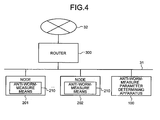
- Fig. 4 is a schematic of an example of arranging an anti-worm-measure parameter determining apparatus 100 according to a first embodiment of the present invention.
- the anti-worm-measure parameter determining apparatus 100 shown in the figure determines anti-worm-measure parameters using the anti-worm-measure parameter determining method explained already.
- the anti-worm-measure parameter determining apparatus 100 is connected to a network 31.
- Nodes 201 to 202 and a router 300 for connecting the network 31 to a network 32 are also connected to the network 31.
- Anti-worm-measure means 210 such as an anti-worm-measure program or a firewall program, which is means for preventing infection of worms from other nodes to the own nodes and infection of worms from the own nodes to the other nodes, is installed in the nodes 201 to 202. According to the first embodiment, it is assumed that the anti-worm-measure means 210 are installed in all the nodes connected to the networks in the same manner.
- the anti-worm-measure parameter determining apparatus 100 is used for determining parameters for the anti-worm-measure means 210 to detect and block the worms.
- the anti-worm-measure parameter determining apparatus 100 does not always have to be connected to the network 31.
- the anti-worm-measure parameter determining apparatus 100 may determine anti-worm-measure parameters off line. It is also possible to install the anti-worm-measure parameter determining apparatus 100 or a program having the same function as the anti-worm-measure parameter determining apparatus 100 in the nodes 201 to 202 and the router 300.
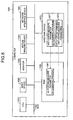
- Fig. 5 is a block diagram of the anti-worm-measure parameter determining apparatus 100 according to the first embodiment.
- the anti-worm-measure parameter determining apparatus 100 is an apparatus with the number of nodes as an input and anti-worm-measure parameters as an output.
- the anti-worm-measure parameter determining apparatus 100 includes a control unit 110 and a storing unit 120.
- the control unit 110 controls the anti-worm-measure parameter determining apparatus 100.
- the control unit 110 includes an infectivity calculating unit 111, a limit-number-of-leaked-packets deriving unit 112, a number-of-infected-nodes estimating unit 113, and a measure-parameter calculating unit 114.
- the infectivity calculating unit 111 calculates the infectivity p using Equation (2-1).
- the infectivity calculating unit 111 acquires infection-destination-selection probabilities P, P a , P b , and P c necessary for calculation of the infectivity p from worm characteristic information 121 of the storing unit 120 and applies the number of nodes inputted as numbers of nodes n, n a , n b , and n c .
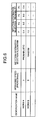
- Fig. 6 is a table of an example of data structure of the worm characteristic information.
- an identification name, spreading speed, an infection-destination-selection algorithm, and the infection-destination-selection probabilities P, P a , P b , and P c are registered in advance for each of types of worms.
- the identification name is an identification name indicating a type of a worm.
- the spreading speed represents the number of worm packets that the worm transmits in a fixed time.
- the infection-destination-selection algorithm takes a value of "probabilistic” or "random”.
- the infection-destination-selection algorithm is "probabilistic" this means that the worm is a worm that selects, as described already, nodes belonging to the network 24 of A.B.C.*, the network 23 of A.B.*.*, the network 22 of A.*.*.*, and the network 21 of *.*.*.* as infection destinations at fixed probabilities, respectively.
- the infection-destination-selection algorithm is "random" this means that the worm is a worm that selects an infection destination regardless of an IP address of a node infected with the worm.
- the infection-destination-selection algorithm is "random”, only P is set as the infection-destination-selection probability.
- the infection-destination-selection probabilities P, P a , P b , and P c represent probabilities that the worm selects a node belonging to the network 21 of *.*.*.*, a node belonging to the network 22 of A.*.*.*, a node belonging to the network 23 of A.B.*.*, and a node belonging to the network 24 of A.B.C.* as infection destinations, respectively.
- the infectivity calculating unit 111 estimates an infection-destination-selection probability of an unknown worm from information stored in the worm characteristic information 121 to calculate infectivity of the unknown worm. This estimation is performed by, for example, calculating a maximum value, a minimum value, or an average for each of P, P a , P b , and P c . It is also possible to assume that all P, P a , P b , and P c are 1.0.
- the numbers of nodes n, na, nb, and nc that the infectivity calculating unit 11 uses to calculate infectivity of an unknown worm may be inputted by a not-shown inputting unit such as a keyboard.
- the numbers of nodes may be inputted through the network or may be stored in the storing unit 120 in advance.
- the infectivity calculating unit 111 or a dedicated processing unit may inquire a system management apparatus or the like, which manages a constitution of the network, about the number of nodes and acquire the number of nodes.
- the infectivity calculating unit 11 or the dedicated processing unit itself may count the number of nodes connected to the network using PING or the like
- the limit-number-of-leaked-packets deriving unit 112 causes the number-of-infected-nodes estimating unit 113 to calculate the expected value E of the number of infected nodes and derives a limit number of leaked packets.
- the number-of-infected-nodes estimating unit 113 applies a value designated by the limit-number-of-leaked packets deriving unit 112 to Equation 7 to calculate the expected value E of the number of infected nodes.
- the limit-number-of-leaked-packets deriving unit 112 designates two values and causes the number-of-infected-nodes estimating unit 113 to calculate the expected value E of the number of infected nodes.
- One of the values is the infectivity p calculated by the infectivity calculating unit 111 and another is the number of worm packets w of worm packets transmitted from one infected node.
- the limit-number-of-leaked-packets deriving unit 112 causes the number-of-infected-nodes estimating unit 113 to calculate the expected value E of the number of infected nodes while sequentially incrementing w by one and sets a value of w immediately before the expected value E changes to ⁇ as the limit number of leaked packets.
- the measure-parameter calculating unit 114 calculates necessary anti-worm-measure parameters based on the limit number of leaked packets derived by the limit-number-of-leaked-packets deriving unit 112 and outputs the anti-worm-measure parameters. Specifically, the measure-parameter calculating unit 114 calculates the number of packets allowed to be leaked until the start of the blocking shown in Fig. 3A, the blocking limit time shown in Fig. 3B, and the like.
- the measure-parameter calculating unit 114 acquires information on the spreading speed from the worm characteristic information 121 of the storing unit 120. If a blocking time of the anti-worm-measure means is necessary, the measure-parameter calculating unit 114 acquires information on the blocking time from anti-worm-measure-means performance information 122 of the storing unit 120.
- the storing unit 120 stores various kinds of information.
- the storing unit 120 stores the worm characteristic information 121 and the anti-worm-measure-means performance information 122.
- the worm characteristic information 121 is, as explained already, information in which characteristics of various worms are registered in advance.
- the anti-worm-measure-means performance information 122 is information in which information on performance of various anti-worm-measure means such as a blocking time is registered in advance.
- Fig. 7 is a flowchart of a processing procedure of the anti-worm-measure parameter determining apparatus 100 according to the first embodiment.
- the anti-worm-measure parameter determining apparatus 100 receives an input of the number of nodes of a network for which anti-worm-measure parameters are determined (step S101).
- the infectivity calculating unit 111 calculates the infectivity p based on the number of nodes inputted (step S102).
- the limit-number-of-leaked packets deriving unit 112 initializes the number of worm packets w of worm packets transmitted from one infected node to 1 (step S103).
- the limit-number-of-leaked packets deriving unit 112 designates p and w and causes the number-of-infected-nodes estimating unit 113 to calculate the expected value E of the number of infected nodes at the time when the time T is sufficiently large (step S104).
- the limit-number-of-leaked-packets deriving unit 112 adds 1 to w (step S106), returns to step S104, and causes the number-of-infected-nodes estimating unit 113 to calculate the expected value E of the number of infected nodes.
- the limit-number-of-leaked-packets deriving unit 112 sets a value obtained by subtracting 1 from w as the limit number of leaked packets (step S107).
- the measure-parameter calculating unit 114 acquires spreading speed of a worm and a blocking time of the anti-worm-measure means from the storing unit 120 (step S108) and calculates anti-worm-measure parameters based on these values and the limit number of leaked packets calculated by the limit-number-of-leaked-packets deriving unit 112 (step S109).
- Fig. 8 is a block diagram of a computer 1000 that executes an anti-worm-measure parameter determining program 1071 according to the first embodiment.
- the computer 1000 is constituted by connecting, via a bus 1080, a central processing unit (CPU) 1010 that executes various kinds of arithmetic processing, an input device 1020 that receives an input of data from a user, a monitor 1030 that displays various kinds of information, a medium reading device 1040 that reads a program and the like from a recording medium having various programs and the like recorded therein, a network interface device 1050 that performs exchange of data between the computer 1000 and other computers, a random access memory (RAM) 1060 that temporarily stores various kinds of information, and a hard disk device 1070.
- CPU central processing unit
- RAM random access memory
- the anti-worm-measure parameter determining program 1071 having the same functions as the control unit 110 shown in Fig. 5 and data for determining anti-worm-measure parameters 1072 corresponding to the various data stored in the storing unit 120 shown in Fig. 5 are stored in the hard disk device 1070. It is also possible to appropriately disperse and store the data for determining anti-worm-measure parameters 1072 in the other computers connected via the network.
- the CPU 1010 reads out the anti-worm-measure parameter determining program 1071 from the hard disk device 1070 and expands the program in the RAM 1060. Consequently, the anti-worm-measure parameter determining program 1071 functions as an anti-worm-measure parameter determining process 1061.
- the anti-worm-measure parameter determining process 1061 appropriately expands the information and the like read out from the data for determining anti-worm-measure parameters 1072 in an area allocated to the process on the RAM 1060.
- the anti-worm-measure parameter determining process 1061 executes various kinds of data processing based on the data and the like expanded.
- the anti-worm-measure parameter determining program 1071 does not always have to be stored in the hard disk device 1070.
- the computer 1000 may read out and execute this program stored in a storing medium such as a CD-ROM. It is also possible that this program is stored in other computers (or servers) and the like connected to the computer 1000 via a public line, the Internet, a local area network (LAN), a wide area network (WAN), and the like and the computer 1000 reads out and executes the program from the other computers (or servers) and the like.
- the anti-worm-measure means sets the number of packets allowed to be leaked. Thus, it is possible to set parameters for anti-worm measures to prevent the worm from being spread.
- the anti-worm-measure means may be installed in a transmission apparatus such as a router.
- the anti-worm-measure parameter determining apparatus 100 can calculate anti-worm-measure parameters for the anti-worm-measure means installed in the transmission apparatus such as a router.
- the anti-worm-measure parameter determining method and operations of the anti-worm-measure parameter determining apparatus 100 are explained with reference to an example in which anti-worm measures are installed in a router.
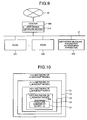
- Fig. 9 is a schematic of an example of arranging the anti-worm-measure parameter determining apparatus 100 according to the second embodiment.
- the anti-worm-measure parameter determining apparatus 100 is connected to the network 31.
- a router for connecting the nodes 201 to 202 and the network 31 to the network 32 and the like is also connected to the network 31.
- An anti-worm-measure means 310 such as an anti-worm-measure program or a firewall program is installed in the nodes 201 to 202 to prevent infection of worms between networks. According to the second embodiment, it is assumed that the anti-worm-measure means 310 are installed in all the routers connected to the networks.
- the anti-worm-measure parameter determining apparatus 100 is used for determining parameters for the anti-worm-measure means 310 to detect and block the worms.
- the anti-worm-measure parameter determining apparatus 100 does not always have to be connected to the network 31.
- the anti-worm-measure parameter determining apparatus 100 may determine anti-worm-measure parameters off line. It is also possible to install the anti-worm-measure parameter determining apparatus 100 or a program having the same function as the anti-worm-measure parameter determining apparatus 100 in the nodes 201 to 202 and the router 300.
- the infectivity p of a worm is explained.
- the anti-worm-measure means 310 when the anti-worm-measure means 310 is installed in the router 300, the anti-worm-measure means 310 functions to prevent infection of the worm between the networks.
- the anti-worm-measure means 310 when the worm is infected from the node 201 to the node 202, the anti-worm-measure means 310 does not function to prevent infection of the worm from spreading in a network subordinate to the router 300.
- Equation (2-2) calculates a probability that, when a worm infecting any one of nodes belonging to the network 31 subordinate to the router 300 selects a certain infection destination for autosynthesis, infection spreads to other networks beyond the router 300.
- P, P a , P b , and P c are a probability that the worm selects a node belonging to the network 21 of *.*.*.* as an infection destination, a probability that the worm selects a node belonging to the network 22 of A.*.*.* as an infection destination, a probability that the worm selects a node belonging to the network 23 of A.B.*.* as an infection destination, and a probability that the worm selects a node belonging to the network 24 of A.B.C.* as an infection destination, respectively.
- n, n a , n b , and n c are the number of nodes belonging to the network 21 of *.*.*.*, the number of nodes belonging to the network 22 of A.*.*.*, the number of nodes belonging to the network 23 of A.B.*.*, and the number of nodes belonging to the network 24 of A.B.C.*. Further, m is the number of nodes belonging to the network 31 subordinate to the router 300.
- Equation (3-2) is for calculating the infectivity p at the time when it is assumed that the worm simultaneously selects one node belonging to the network 24 of A.B.C.*, one node belonging to the network 23 of A.B.*.*, one node belonging to the network 22 of A.*.*.*, and one node belonging to the network 21 of *.*.*.* as infection destinations, respectively, and transmits four worm packets thereto.
- the number of nodes excluding nodes for which measures for preventing infection of the worm such as installation of a patch for anti-worm measures and closure of ports used by the worm for infection are taken may be set.
- the nodes for which the measures are taken may be excluded by multiplying the inputted number of nodes by a ratio of nodes for which the measures are not taken.
- Equation (4-2) is for calculating the infectivity p of a worm at the time when a network is delimited to a network 1 to the network K such that a network X includes a network (X+1). It is assumed that the network K includes a router and a network subordinate to the router.
- n x indicates the number of nodes connected to the network X
- N x indicates a maximum value of the number of nodes connectable to the network X
- P x indicates a probability that the worm selects a node connected to the network X as an infection destination
- m indicates the number of nodes connected to the network subordinate to the router.
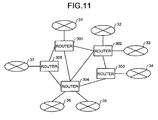
- a limit number of leaked packets w is explained. For example, it is assumed that a structure of an entire network in a company is as shown in Fig. 11. In the example shown in the figure, five routers 301 to 305 are connected in mesh.
- the network 31 is present subordinately under the router 301, the networks 31 and 32 are present under the router 302, a network 34 is present under the router 303, networks 35 and 36 are present under the router 304, and a network 37 is present under the router 305.
- the anti-worm-measure means are installed in the routers 301 to 305, respectively, and the anti-worm-measure means are not installed in separate nodes belonging to the networks 31 to 37.
- the anti-worm-measure means are not installed in separate nodes belonging to the networks 31 to 37.
- infection of the worm spreads to all the nodes belonging to the network 37.
- the anti-worm-measure means is installed only in the routers connecting the networks in this way, at least one node belonging to a network subordinate to a certain router is infected with a worm, the worm spreads to networks subordinate to the router.
- the anti-worm-measure parameter determining apparatus 100 can determine anti-worm-measure parameters according to the same method as the method described in the first embodiment.
- Fig. 12 is a flowchart of a processing procedure of the anti-worm-measure parameter determining apparatus 100 according to the second embodiment
- the anti-worm-measure parameter determining apparatus 100 receives an input of the number of nodes of a network for which anti-worm-measure parameters are determined (S201).
- the infectivity calculating unit 111 calculates the infectivity p based on the number of nodes inputted (step S202). In the calculation of the infectivity p, as indicated by Equation (2-2), the number of nodes subordinate to the routers is subtracted from the number of nodes connected to the respective networks to be infected.
- the limit-number-of-leaked-packets deriving unit 112 initializes the number of worm packets w of worm packets transmitted from one infected node to 1 (step S203).
- the limit-number-of-leaked-packets deriving unit 112 designates p and w and causes the number-of-infected-nodes estimating unit 113 to calculate the expected value E of the number of infected nodes at the time when the time T is sufficiently large (step S204).
- the limit-number-of-leaked-packets deriving unit 112 adds 1 to w (step S206), returns to step S204, and causes the number-of-infected-nodes estimating unit 113 to calculate the expected value E of the number of infected nodes.
- the predetermined upper limit value is a value obtained by subtracting 1 corresponding to a network of an infection source from a total number of networks subordinate to the respective routers. It is possible to register the predetermined upper limit value in the anti-worm-measure parameter determining apparatus 100 in advance or input the predetermined upper limit value together with the number of nodes at step S201.
- the limit-number-of-leaked-packets deriving unit 112 sets a value obtained by subtracting 1 from w as the limit number of leaked packets (step S207).
- the measure-parameter calculating unit 114 acquires spreading speed of a worm and a blocking time of the anti-worm-measure means from the storing unit 120 (step S208) and calculates anti-worm-measure parameters based on these values and the limit number of leaked packets calculated by the limit-number-of-leaked-packets deriving unit 112 (step S209).
- the anti-worm-measure parameter determining apparatus 100 can also calculate anti-worm-measure parameters for the anti-worm-measure means installed in transmission apparatuses such as the routers.
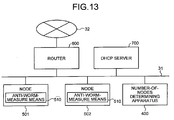
- Fig. 13 is a schematic of an example of arranging a number-of-nodes determining apparatus 400 according to the third embodiment.
- the number-of-nodes determining apparatus 400 determines the number of nodes, with which it is possible to prevent spread of a worm, with anti-worm-measure parameters as an input by applying the anti-worm-measure parameters.
- the number-of-nodes determining apparatus 400 is connected to the network 31.
- Nodes 501 to 502, a router 600 for connecting the network 31 to the network 32, and a dynamic host configuration protocol (DHCP) server 700 that allocates IP addresses to the nodes 501 to 502 are also connected to the network 31.
- DHCP dynamic host configuration protocol
- An anti-worm-measure means 510 such as an anti-worm-measure program or a firewall program, which is means for preventing infection of worms from other nodes to the own nodes and infection of worms from the own nodes to the other nodes, is installed in the nodes 501 to 502. According to the third embodiment, it is assumed that the anti-worm-measure means 510 are installed in all the nodes connected to the networks in the same manner.
- a blocking limit time s is designated as an anti-worm-measure parameter.
- This blocking limit time s is a minimum time that is set taking into account performance of the anti-worm-measure means 510 (e.g., a blocking time, that is, time from start of blocking of a worm until completion of the blocking, etc.). It is assumed that the blocking time cannot be set shorter than the blocking limit time s.
- the number-of-nodes determining apparatus 400 calculates an upper limit value of the number of nodes, with which it is possible to prevent spread of an unknown worm when a blocking limit time is s, and instructs the DHCP server 700 not to allocate IP addresses exceeding that number.
- the number-of-nodes determining apparatus 400 does not always have to be connected to the network 31.
- the number-of-nodes determining apparatus 400 may calculate the number of nodes off line. It is also possible to install the number-of-nodes determining apparatus 400 or a program having the same function as the number-of-nodes determining apparatus 400 in the router 600 or the DHCP server 700. It is also possible to use means other than the DHCP server 700 to prevent nodes exceeding an upper limit value calculated by the number-of-nodes determining apparatus 400 from being connected to the network.
- Fig. 14 is a block diagram of the number-of-nodes determining apparatus 400 according to the third embodiment.
- the number-of-nodes determining apparatus 400 is an apparatus with anti-worm-measure parameters such as a blocking limit time and the number of nodes other than n c as an input and with the number of nodes n c as an output.
- the number-of-nodes determining apparatus 400 includes a control unit 410 and a storing unit 420.
- the control unit 410 controls the number-of-nodes determining apparatus 400.
- the control unit 410 includes a limit-number-of-leaked-packets calculating unit 411, a limit-number-of-nodes deriving unit 412, the infectivity calculating unit 111, and the number-of-infected-nodes estimating unit 113.
- the infectivity calculating unit 111 and the number-of-infected-nodes estimating unit 113 are the same processing units as the infectivity calculating unit 111 and the number-of-infected-nodes estimating unit 113 shown in Fig. 5.
- the limit-number-of-leaked-packets calculating unit 411 calculates the limit number of leaked packets based on anti-worm-measure parameters inputted. Specifically, the limit-number-of-leaked packets calculating unit 411 calculates the limit number of leaked packets w based on the number of packets allowed to be leaked until the start of blocking shown in Fig. 3A, the blocking limit time shown in Fig. 3B, and the like.
- the limit-number-of-leaked-packets calculating unit 411 acquires information on the spreading speed from the worm characteristic information 121 of the storing unit 420. If a blocking time of anti-worm-measure means is necessary, the limit-number-of-leaked-packets calculating unit 411 acquires information on the blocking time from the anti-worm-measure-means performance information 122 of the storing unit 420.
- the limit-number-of-nodes deriving unit 412 derives an upper limit number of n c for preventing a worm from spreading based on the limit number of leaked packets calculated by the limit-number-of-leaked-packets calculating unit 411 and the number of nodes other than n c inputted.
- the limit-number-of-nodes deriving unit 412 designates provisional n c together with the number of other nodes while sequentially incrementing the provisional n c by one from 1 and causes the infectivity calculating unit 111 to calculate the infectivity p.
- the limit-number-of-nodes deriving unit 412 designates the infectivity p calculated by the limit-number-of-nodes deriving unit 412 and the limit number of leaked packets w calculated by the limit-number-of-leaked-packets calculating unit 411 and causes the number-of-infected-nodes estimating unit 133 to calculate an expected value of the number of infected nodes.
- the limit-number-of-nodes deriving unit 412 sets a value of the provisional n c immediately before the expected value E changes to ⁇ as an upper limit number of n c for preventing the worm from spreading.
- the storing unit 420 stores various kinds of information.
- the storing unit 420 stores the worm characteristic information 121 and the anti-worm-measure-means performance information 122.
- the worm characteristic information 121 and the anti-worm-measure-means performance information 122 are the same information as the worm characteristic information 121 and the anti-worm-measure-means-performance information 122 shown in Fig. 5.
- the anti-worm-measure parameters and the number of nodes other than n c which the limit-number-of-leaked-packets calculating unit 411 and the like use for processing, may be inputted by an inputting unit such as a not-shown keyboard, may be inputted through the network, or may be stored in the storing unit 420 in advance.
- the example in which the anti-worm-measure parameters and the number of nodes other than n c are set as an input and the upper limit number of n c for preventing a worm from spreading is set as an output is explained.
- n c in an input and output an upper limit value of n a or n b for preventing a worm from spreading.
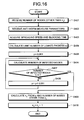
- Fig. 15 is a flowchart of a processing procedure of the number-of-nodes determining apparatus 400 according to the third embodiment.
- the number-of-nodes determining apparatus 400 receives an input of the number of nodes other than n c (step S301). Moreover, the number-of-nodes determining apparatus 400 receives an input of anti-worm-measure parameters (step S302).
- the limit-number-of-leaked-packets calculating unit 411 acquires spreading speed of a worm and a blocking time of the anti-worm-measure means from the storing unit 120 (step S303) and calculates the limit number of leaked packets w based on these values and the values inputted (step S304).
- the limit-number-of-nodes deriving unit 412 initializes provisional n c to 1 (step S305).
- the limit-number-of-nodes deriving unit 412 designates the number of nodes inputted and the provisional n c and causes the infectivity calculating unit 111 to calculate the infectivity p (step S306).
- the limit-number-of-nodes deriving unit 412 designates the infectivity p and the limit number of leaked packets w calculated and causes the number-of-infected-nodes estimating unit 113 to calculate the expected value E of the number of infected nodes at the time when the time T is sufficiently large (step S307).
- the limit-number-of-nodes deriving unit 412 adds 1 to the provisional n c (step S309), returns to step S306, and executes the calculation of the infectivity p and the expected value E of the number of infected nodes again. If the expected value E of the number of infected nodes is ⁇ ("Yes" at step S308), the limit-number-of-nodes deriving unit 412 sets a value obtained by subtracting 1 from the provisional n c as an upper limit number of n c (step S310).
- the number-of-nodes determining apparatus 400 receives an input of the number of nodes other than n c (step S401). Moreover, the number-of-nodes determining apparatus 400 receives an input of anti-worm-measure parameters (step S402).
- the limit-number-of-leaked-packets calculating unit 411 acquires spreading speed of a worm and a blocking time of the anti-worm-measure means from the storing unit 120 (step S403) and calculates the limit number of leaked packets w based on these values and the values inputted (step S404).
- the limit-number-of-nodes deriving unit 412 initializes provisional infectivity p to 0.001 (step S405).
- the limit-number-of-nodes deriving unit 412 designates the provisional infectivity p and the limit number of leaked packets w and causes the number-of-infected-nodes estimating unit 113 to calculate the expected value E of the number of infected nodes at the time when the time T is sufficiently large (step S406).
- the limit-number-of-nodes deriving unit 412 adds 0.001 to the provisional infectivity p (step S408), returns to step S406, and executes the calculation of the number of infected nodes and the expected value E of the number of infected nodes again.
- the limit-number-of-nodes deriving unit 412 designates the provisional infectivity p and the number of nodes other than n c and causes the infectivity calculating unit 111 to calculate n c backward (step S409) and sets a value obtained by subtracting 1 from nc calculated as an upper limit number of n c (step S410)
- the provisional infectivity p is increased by 0.001 at a time.
- an interval of the increase is not limited to this.
- an upper limit of the number of nodes, with which a worm does not spread is calculated based on the setting and the like of the anti-worm-measure apparatus.
- infectivity of the worm is calculated based on the number of nodes connected by the network and an expected value indicating how many nodes are infected with the worm when the worm transmits how many packets is calculated based on this infectivity.
- infectivity of the worm is calculated taking into account the logic for selecting an infection destination of the worm.
- infectivity of the worm is calculated taking into account the logic for selecting an infection destination of the worm.
- the number of packets transmitted by the worm that causes the spread of the worm is calculated and anti-worm-measure parameters are set to complete blocking before the worm transmits the number of packets.
- the anti-worm-measure means sets the number of packets allowed to be leaked taking into account the limit of prevention of the spread of the worm.
- the anti-worm-measure means sets time until blocking of communication by the worm taking into account the limit of prevention of the spread of the worm.
- the anti-worm-measure means sets the number of packets allowed to be leaked considering that the infection of the worm does not spread exceeding the predetermined upper limit number.
- the upper limit of the number of nodes to which the worm does not spread is calculated based on the setting and the like of the anti-worm-measure apparatus.
Landscapes
- Engineering & Computer Science (AREA)
- Computer Security & Cryptography (AREA)
- Computer Hardware Design (AREA)
- General Engineering & Computer Science (AREA)
- Theoretical Computer Science (AREA)
- General Health & Medical Sciences (AREA)
- Virology (AREA)
- Software Systems (AREA)
- Health & Medical Sciences (AREA)
- Physics & Mathematics (AREA)
- General Physics & Mathematics (AREA)
- Computing Systems (AREA)
- Computer Networks & Wireless Communication (AREA)
- Signal Processing (AREA)
- Data Exchanges In Wide-Area Networks (AREA)
- Small-Scale Networks (AREA)
- Computer And Data Communications (AREA)
Applications Claiming Priority (1)
| Application Number | Priority Date | Filing Date | Title |
|---|---|---|---|
| JP2006071791A JP2007249579A (ja) | 2006-03-15 | 2006-03-15 | ワーム対策パラメータ決定プログラム、ワーム対策パラメータ決定装置、ノード数決定プログラム、ノード数決定装置およびノード数制限システム |
Publications (2)
| Publication Number | Publication Date |
|---|---|
| EP1835429A2 true EP1835429A2 (de) | 2007-09-19 |
| EP1835429A3 EP1835429A3 (de) | 2010-11-24 |
Family
ID=37232955
Family Applications (1)
| Application Number | Title | Priority Date | Filing Date |
|---|---|---|---|
| EP06253601A Withdrawn EP1835429A3 (de) | 2006-03-15 | 2006-07-10 | Gerät zur Bestimmung von Parametern für Anti-Wurm-Massnahmen. Gerät zur Bestimmung und zur Begrenzung der Anzahl der Knoten und Computerprodukt |
Country Status (3)
| Country | Link |
|---|---|
| US (2) | US7926110B2 (de) |
| EP (1) | EP1835429A3 (de) |
| JP (1) | JP2007249579A (de) |
Cited By (7)
| Publication number | Priority date | Publication date | Assignee | Title |
|---|---|---|---|---|
| EP2309408A1 (de) * | 2009-10-01 | 2011-04-13 | Kaspersky Lab Zao | Verfahren und System zur Erkennung und Vorhersage einer computervirusbezogenen Epidemie |
| GB2574093A (en) * | 2018-03-25 | 2019-11-27 | British Telecomm | Malware barrier |
| US11470109B2 (en) | 2018-03-25 | 2022-10-11 | British Telecommunications Public Limited Company | Malware barrier |
| US11533333B2 (en) * | 2018-03-25 | 2022-12-20 | British Telecommunications Public Limited Company | Malware infection prediction |
| US12273376B2 (en) | 2020-12-31 | 2025-04-08 | British Telecommunications Public Limited Company | Identifying computer systems for malware infection mitigation |
| US12511386B2 (en) | 2020-02-17 | 2025-12-30 | British Telecommunications Public Limited Company | Malware propagation forecasting |
| US12526309B2 (en) | 2020-02-17 | 2026-01-13 | British Telecommunications Public Limited Company | Real-time malware propagation forecasting |
Families Citing this family (8)
| Publication number | Priority date | Publication date | Assignee | Title |
|---|---|---|---|---|
| US8272061B1 (en) * | 2002-10-01 | 2012-09-18 | Skyobox security Inc. | Method for evaluating a network |
| US8407798B1 (en) | 2002-10-01 | 2013-03-26 | Skybox Secutiry Inc. | Method for simulation aided security event management |
| US8073384B2 (en) * | 2006-12-14 | 2011-12-06 | Elster Electricity, Llc | Optimization of redundancy and throughput in an automated meter data collection system using a wireless network |
| WO2009082761A1 (en) | 2007-12-26 | 2009-07-02 | Elster Electricity, Llc. | Optimized data collection in a wireless fixed network metering system |
| US8289884B1 (en) * | 2008-01-14 | 2012-10-16 | Dulles Research LLC | System and method for identification of unknown illicit networks |
| KR101283565B1 (ko) * | 2011-12-14 | 2013-07-08 | 서울대학교산학협력단 | 웜 전파 모델 시뮬레이션 방법 |
| JP6834768B2 (ja) * | 2017-05-17 | 2021-02-24 | 富士通株式会社 | 攻撃検知方法、攻撃検知プログラムおよび中継装置 |
| JP2020071645A (ja) * | 2018-10-31 | 2020-05-07 | 日本電信電話株式会社 | 感染確率算出装置、感染確率算出方法、および、感染確率算出プログラム |
Family Cites Families (14)
| Publication number | Priority date | Publication date | Assignee | Title |
|---|---|---|---|---|
| US6088804A (en) * | 1998-01-12 | 2000-07-11 | Motorola, Inc. | Adaptive system and method for responding to computer network security attacks |
| US6205552B1 (en) * | 1998-12-31 | 2001-03-20 | Mci Worldcom, Inc. | Method and apparatus for checking security vulnerability of networked devices |
| US7418729B2 (en) * | 2002-07-19 | 2008-08-26 | Symantec Corporation | Heuristic detection of malicious computer code by page tracking |
| US7308716B2 (en) * | 2003-05-20 | 2007-12-11 | International Business Machines Corporation | Applying blocking measures progressively to malicious network traffic |
| US7287278B2 (en) * | 2003-08-29 | 2007-10-23 | Trend Micro, Inc. | Innoculation of computing devices against a selected computer virus |
| JP4051020B2 (ja) | 2003-10-28 | 2008-02-20 | 富士通株式会社 | ワーム判定プログラム、ワーム判定プログラムを記憶したコンピュータ読み取り可能な記憶媒体、ワーム判定方法およびワーム判定装置 |
| US7434297B1 (en) * | 2003-11-17 | 2008-10-14 | Symantec Corporation | Tracking computer infections |
| NO321340B1 (no) * | 2003-12-30 | 2006-05-02 | Telenor Asa | Fremgangsmate for a administrere nettverk ved analyse av konnektivitet |
| US7607021B2 (en) * | 2004-03-09 | 2009-10-20 | Cisco Technology, Inc. | Isolation approach for network users associated with elevated risk |
| US7441272B2 (en) * | 2004-06-09 | 2008-10-21 | Intel Corporation | Techniques for self-isolation of networked devices |
| US7603715B2 (en) * | 2004-07-21 | 2009-10-13 | Microsoft Corporation | Containment of worms |
| US7797749B2 (en) * | 2004-11-03 | 2010-09-14 | Intel Corporation | Defending against worm or virus attacks on networks |
| US7490355B2 (en) * | 2005-06-16 | 2009-02-10 | Chung Shan Institute Of Science And Technology | Method of detecting network worms |
| JP2007013343A (ja) * | 2005-06-28 | 2007-01-18 | Fujitsu Ltd | ワーム検出パラメータ設定プログラム及びワーム検出パラメータ設定装置 |
-
2006
- 2006-03-15 JP JP2006071791A patent/JP2007249579A/ja active Pending
- 2006-07-10 EP EP06253601A patent/EP1835429A3/de not_active Withdrawn
- 2006-07-13 US US11/485,807 patent/US7926110B2/en not_active Expired - Fee Related
-
2011
- 2011-03-07 US US13/041,961 patent/US20110162071A1/en not_active Abandoned
Non-Patent Citations (4)
| Title |
|---|
| Nicholas Weaver, Stuart Staniford, Vern Paxson: "Very Fast Containment of Scanning Worms" 27 July 2004 (2004-07-27), pages 1-16, XP002604814 Retrieved from the Internet: URL:http://www.icsi.berkeley.edu/~nweaver/containment/containment.pdf [retrieved on 2010-10-11] * |
| SELLKE S ET AL: "Modeling and Automated Containment of Worms" DEPENDABLE SYSTEMS AND NETWORKS, 2005. DSN 2005. PROCEEDINGS. INTERNAT IONAL CONFERENCE ON YOKOHAMA, JAPAN 28-01 JUNE 2005, PISCATAWAY, NJ, USA,IEEE LNKD- DOI:10.1109/DSN.2005.66, 28 June 2005 (2005-06-28), pages 528-537, XP010817829 ISBN: 978-0-7695-2282-1 * |
| Stuart Staniford: "Containment of Scanning Worms in Enterprise Networks" 7 October 2003 (2003-10-07), pages 1-23, XP002604815 Retrieved from the Internet: URL:http://www.its.bth.se/staff/apo/courses/telesystem/literature/paper_F9_1.pdf [retrieved on 2010-10-11] * |
| ZESHENG CHEN ET AL: "Importance-scanning worm using vulnerable-host distribution" GLOBAL TELECOMMUNICATIONS CONFERENCE, 2005. GLOBECOM '05. IEEE ST. LOIUS, MO, USA 28 NOV.-2 DEC. 2005, PISCATAWAY, NJ, USA,IEEE LNKD- DOI:10.1109/GLOCOM.2005.1577955, vol. 3, 28 November 2005 (2005-11-28), pages 1779-1784, XP010880364 ISBN: 978-0-7803-9414-8 * |
Cited By (8)
| Publication number | Priority date | Publication date | Assignee | Title |
|---|---|---|---|---|
| EP2309408A1 (de) * | 2009-10-01 | 2011-04-13 | Kaspersky Lab Zao | Verfahren und System zur Erkennung und Vorhersage einer computervirusbezogenen Epidemie |
| GB2574093A (en) * | 2018-03-25 | 2019-11-27 | British Telecomm | Malware barrier |
| GB2574093B (en) * | 2018-03-25 | 2020-10-07 | British Telecomm | Malware barrier |
| US11470109B2 (en) | 2018-03-25 | 2022-10-11 | British Telecommunications Public Limited Company | Malware barrier |
| US11533333B2 (en) * | 2018-03-25 | 2022-12-20 | British Telecommunications Public Limited Company | Malware infection prediction |
| US12511386B2 (en) | 2020-02-17 | 2025-12-30 | British Telecommunications Public Limited Company | Malware propagation forecasting |
| US12526309B2 (en) | 2020-02-17 | 2026-01-13 | British Telecommunications Public Limited Company | Real-time malware propagation forecasting |
| US12273376B2 (en) | 2020-12-31 | 2025-04-08 | British Telecommunications Public Limited Company | Identifying computer systems for malware infection mitigation |
Also Published As
| Publication number | Publication date |
|---|---|
| EP1835429A3 (de) | 2010-11-24 |
| JP2007249579A (ja) | 2007-09-27 |
| US7926110B2 (en) | 2011-04-12 |
| US20070220606A1 (en) | 2007-09-20 |
| US20110162071A1 (en) | 2011-06-30 |
Similar Documents
| Publication | Publication Date | Title |
|---|---|---|
| US20110162071A1 (en) | Anit-worm-measure parameter determining apparatus, number-of-nodes determining apparatus, number-of-nodes limiting system, and computer product | |
| JP5050781B2 (ja) | マルウエア検出装置、監視装置、マルウエア検出プログラム、およびマルウエア検出方法 | |
| Chatzikokolakis et al. | Statistical measurement of information leakage | |
| JP4547342B2 (ja) | ネットワーク制御装置と制御システム並びに制御方法 | |
| US20040157556A1 (en) | System for intrusion detection | |
| US20050289649A1 (en) | Malicious access-detecting apparatus, malicious access-detecting method, malicious access-detecting program, and distributed denial-of-service attack-detecting apparatus | |
| US11470109B2 (en) | Malware barrier | |
| Kadloor et al. | Mitigating timing based information leakage in shared schedulers | |
| JP4769609B2 (ja) | スイッチ装置 | |
| JP3868939B2 (ja) | 通信ネットワークの障害を検出する装置 | |
| US20110141899A1 (en) | Network access apparatus and method for monitoring and controlling traffic using operation, administration, and maintenance (oam) packet in internet protocol (ip) network | |
| CN108322454B (zh) | 一种网络安全检测方法及装置 | |
| US20120210125A1 (en) | Encrypted traffic test system | |
| JP5655049B2 (ja) | 判定装置、判定方法および判定プログラム | |
| RU2635256C1 (ru) | Способ защиты информационно-вычислительной сети от несанкционированных воздействий | |
| JP2007019981A (ja) | ネットワーク監視システム | |
| JP5547019B2 (ja) | NAT(NetworkAddressTranslation)におけるアドレス・ポート数推定方法及び装置及びプログラム | |
| Lawniczak et al. | DDoS attack detection using entropy of packet traffic in CA like data communication network model. | |
| Beitollahi et al. | A four-steptechnique fortackling DDoS attacks | |
| JP2020031394A (ja) | 推定方法、推定装置および推定プログラム | |
| CN113812119A (zh) | 用于性能测量的网络节点 | |
| Koo et al. | Evaluation of network blocking algorithm based on ARP spoofing and its application | |
| CN117914810A (zh) | 一种针对多优先级sdn交换机隐私参数的推断分析方法 | |
| KR20100071763A (ko) | 분산서비스거부 공격 탐지 장치 및 그 방법 | |
| Halagan et al. | Modification of TCP SYN flood (DoS) attack detection algorithm |
Legal Events
| Date | Code | Title | Description |
|---|---|---|---|
| PUAI | Public reference made under article 153(3) epc to a published international application that has entered the european phase |
Free format text: ORIGINAL CODE: 0009012 |
|
| AK | Designated contracting states |
Kind code of ref document: A2 Designated state(s): AT BE BG CH CY CZ DE DK EE ES FI FR GB GR HU IE IS IT LI LT LU LV MC NL PL PT RO SE SI SK TR |
|
| AX | Request for extension of the european patent |
Extension state: AL BA HR MK YU |
|
| PUAL | Search report despatched |
Free format text: ORIGINAL CODE: 0009013 |
|
| RIC1 | Information provided on ipc code assigned before grant |
Ipc: H04L 29/06 20060101ALI20101014BHEP Ipc: G06F 21/00 20060101AFI20061110BHEP |
|
| AK | Designated contracting states |
Kind code of ref document: A3 Designated state(s): AT BE BG CH CY CZ DE DK EE ES FI FR GB GR HU IE IS IT LI LT LU LV MC NL PL PT RO SE SI SK TR |
|
| AX | Request for extension of the european patent |
Extension state: AL BA HR MK RS |
|
| REG | Reference to a national code |
Ref country code: DE Ref legal event code: R108 |
|
| AKY | No designation fees paid | ||
| REG | Reference to a national code |
Ref country code: DE Ref legal event code: R108 Effective date: 20110720 |
|
| STAA | Information on the status of an ep patent application or granted ep patent |
Free format text: STATUS: THE APPLICATION IS DEEMED TO BE WITHDRAWN |
|
| 18D | Application deemed to be withdrawn |
Effective date: 20110525 |