EP1829566A1 - Biofilm formation inhibitor and treatment device - Google Patents
Biofilm formation inhibitor and treatment device Download PDFInfo
- Publication number
- EP1829566A1 EP1829566A1 EP05807021A EP05807021A EP1829566A1 EP 1829566 A1 EP1829566 A1 EP 1829566A1 EP 05807021 A EP05807021 A EP 05807021A EP 05807021 A EP05807021 A EP 05807021A EP 1829566 A1 EP1829566 A1 EP 1829566A1
- Authority
- EP
- European Patent Office
- Prior art keywords
- catechin
- biofilm formation
- treatment device
- egcg
- coli
- Prior art date
- Legal status (The legal status is an assumption and is not a legal conclusion. Google has not performed a legal analysis and makes no representation as to the accuracy of the status listed.)
- Ceased
Links
Images


Classifications
-
- A—HUMAN NECESSITIES
- A01—AGRICULTURE; FORESTRY; ANIMAL HUSBANDRY; HUNTING; TRAPPING; FISHING
- A01N—PRESERVATION OF BODIES OF HUMANS OR ANIMALS OR PLANTS OR PARTS THEREOF; BIOCIDES, e.g. AS DISINFECTANTS, AS PESTICIDES OR AS HERBICIDES; PEST REPELLANTS OR ATTRACTANTS; PLANT GROWTH REGULATORS
- A01N25/00—Biocides, pest repellants or attractants, or plant growth regulators, characterised by their forms, or by their non-active ingredients or by their methods of application, e.g. seed treatment or sequential application; Substances for reducing the noxious effect of the active ingredients to organisms other than pests
- A01N25/08—Biocides, pest repellants or attractants, or plant growth regulators, characterised by their forms, or by their non-active ingredients or by their methods of application, e.g. seed treatment or sequential application; Substances for reducing the noxious effect of the active ingredients to organisms other than pests containing solids as carriers or diluents
- A01N25/10—Macromolecular compounds
-
- A—HUMAN NECESSITIES
- A01—AGRICULTURE; FORESTRY; ANIMAL HUSBANDRY; HUNTING; TRAPPING; FISHING
- A01N—PRESERVATION OF BODIES OF HUMANS OR ANIMALS OR PLANTS OR PARTS THEREOF; BIOCIDES, e.g. AS DISINFECTANTS, AS PESTICIDES OR AS HERBICIDES; PEST REPELLANTS OR ATTRACTANTS; PLANT GROWTH REGULATORS
- A01N43/00—Biocides, pest repellants or attractants, or plant growth regulators containing heterocyclic compounds
- A01N43/02—Biocides, pest repellants or attractants, or plant growth regulators containing heterocyclic compounds having rings with one or more oxygen or sulfur atoms as the only ring hetero atoms
- A01N43/04—Biocides, pest repellants or attractants, or plant growth regulators containing heterocyclic compounds having rings with one or more oxygen or sulfur atoms as the only ring hetero atoms with one hetero atom
- A01N43/14—Biocides, pest repellants or attractants, or plant growth regulators containing heterocyclic compounds having rings with one or more oxygen or sulfur atoms as the only ring hetero atoms with one hetero atom six-membered rings
- A01N43/16—Biocides, pest repellants or attractants, or plant growth regulators containing heterocyclic compounds having rings with one or more oxygen or sulfur atoms as the only ring hetero atoms with one hetero atom six-membered rings with oxygen as the ring hetero atom
-
- A—HUMAN NECESSITIES
- A01—AGRICULTURE; FORESTRY; ANIMAL HUSBANDRY; HUNTING; TRAPPING; FISHING
- A01N—PRESERVATION OF BODIES OF HUMANS OR ANIMALS OR PLANTS OR PARTS THEREOF; BIOCIDES, e.g. AS DISINFECTANTS, AS PESTICIDES OR AS HERBICIDES; PEST REPELLANTS OR ATTRACTANTS; PLANT GROWTH REGULATORS
- A01N65/00—Biocides, pest repellants or attractants, or plant growth regulators containing material from algae, lichens, bryophyta, multi-cellular fungi or plants, or extracts thereof
- A01N65/08—Magnoliopsida [dicotyledons]
-
- A—HUMAN NECESSITIES
- A61—MEDICAL OR VETERINARY SCIENCE; HYGIENE
- A61L—METHODS OR APPARATUS FOR STERILISING MATERIALS OR OBJECTS IN GENERAL; DISINFECTION, STERILISATION OR DEODORISATION OF AIR; CHEMICAL ASPECTS OF BANDAGES, DRESSINGS, ABSORBENT PADS OR SURGICAL ARTICLES; MATERIALS FOR BANDAGES, DRESSINGS, ABSORBENT PADS OR SURGICAL ARTICLES
- A61L31/00—Materials for other surgical articles, e.g. stents, stent-grafts, shunts, surgical drapes, guide wires, materials for adhesion prevention, occluding devices, surgical gloves, tissue fixation devices
- A61L31/14—Materials characterised by their function or physical properties, e.g. injectable or lubricating compositions, shape-memory materials, surface modified materials
- A61L31/16—Biologically active materials, e.g. therapeutic substances
-
- A—HUMAN NECESSITIES
- A61—MEDICAL OR VETERINARY SCIENCE; HYGIENE
- A61P—SPECIFIC THERAPEUTIC ACTIVITY OF CHEMICAL COMPOUNDS OR MEDICINAL PREPARATIONS
- A61P31/00—Antiinfectives, i.e. antibiotics, antiseptics, chemotherapeutics
- A61P31/04—Antibacterial agents
-
- A—HUMAN NECESSITIES
- A61—MEDICAL OR VETERINARY SCIENCE; HYGIENE
- A61L—METHODS OR APPARATUS FOR STERILISING MATERIALS OR OBJECTS IN GENERAL; DISINFECTION, STERILISATION OR DEODORISATION OF AIR; CHEMICAL ASPECTS OF BANDAGES, DRESSINGS, ABSORBENT PADS OR SURGICAL ARTICLES; MATERIALS FOR BANDAGES, DRESSINGS, ABSORBENT PADS OR SURGICAL ARTICLES
- A61L2300/00—Biologically active materials used in bandages, wound dressings, absorbent pads or medical devices
- A61L2300/40—Biologically active materials used in bandages, wound dressings, absorbent pads or medical devices characterised by a specific therapeutic activity or mode of action
- A61L2300/404—Biocides, antimicrobial agents, antiseptic agents
Definitions
- the present invention is related to a biofilm formation inhibitor and a treatment device using thereof.
- pancreatic carcinoma and cholangioma are known for their extreme difficulties in diagnosis and treatment and as so-called intractable cancers.
- pancreas and bile duct are surrounded by other organs such as the stomach, duodenum, small intestine, large intestine, liver, gall bladder, spleen, etc., it is difficult to detect cancer, and also manifestations that are characteristic to cancer are not found in the early stages. Therefore, early detection is difficult, and when it is diagnosed as a carcinoma, it is often too late to treat it.
- obstructive jaundice a symptom of the body turning yellow
- the first step of treating a progressive pancreatic carcinoma / bile duct cancer is to improve this obstructive jaundice.
- a biliary stent is used as a means to improve this obstructive jaundice.
- This biliary stent is a plastic or metal tubular (stent), that allows the bile to drain by enlarging the section of the bile duct that became narrow, by being placed into the bile duct via the duodenal papilla like an endoscope.
- the biliary stent lumen is blocked 3 months after operation. Thus it needs to be replaced with a new biliary stent.
- the life expectancy, for example, of a pancreatic carcinoma patient is only about 6 months, repeated operations lessen the quality of life for the patient as well as creating a large economic burden.
- a biofilm formed on a biological surface may cause infectious diseases such as chronic bronchitis and chronic osteomyelitis.
- infectious diseases such as chronic bronchitis and chronic osteomyelitis.
- a biofilm is formed on a prosthetic substrate surface, such as prosthetic heart valve, prosthetic joint, and urethral catheter, etc., sepsis may accompany it, and in the worse case may lead to death.
- biliary stents with a coating of a highly hydrophilic surface polymer (Product name: Hydromer) and stents formed by fluoropolymers (PFA; perfluoroalkoxy PTFE) which is reported to have little adhesion with animal cells, have also been developed.
- PFA perfluoroalkoxy PTFE
- these materials cannot suppress bacterial growth. Therefore, if a small amount of bacteria with a high proliferating ability (the doubling time of the E. coli is 30 minutes) adheres on their surfaces, they cannot prevent the bacteria's growth, and thus they are unable to inhibit biofilm formation.
- the present invention was made in view of these problems, and it aims to provide a treatment device such as biliary stent capable of effectively and continuously inhibiting biofilm formation, and a biofilm formation inhibitor suitable for coating on the treatment device by killing all bacteria including E. coli and by suppressing the growth of these bacteria.
- another object of the present invention is to provide a treatment device such as a biliary stent and a biofilm formation inhibitor that is suitable for coating on the treatment device, which are capable of continuously preventing biofilm formation and are safe and effective for the human body.
- a biofilm formation inhibitor having an effective amount of catechin for inhibiting biofilm formation and a carrier that is suitable for the adhesion of said catechin to a treatment device to be placed in the living body, are provided.
- Catechin is a type of "polyphenol", a main constituent that gives the taste of green tea (bitterness), which is reported to possess antibacterial action ( Yoda Y. et al., J Infect Chemother. 2004 10(1):55-58 ), antitumor action ( Tachibana H. et al., A receptor for green tea polyphenol EGCG. Nat Struct Mol Biol. 2004; 11(4): 380-381 . Epub 2004), reactive oxygen scavenging activity/antioxidative effect ( Kondo K., et al., Mechanistic studies of catechins as antioxidants against radical oxidation.
- biofilm formation inhibitor of the present invention biofilm formation on a target medical device can be effectively inhibited by extermination and growth suppression of all bacteria including E. Coli.
- biofilm formation inhibitor of the present invention since catechins used in the biofilm formation inhibitor of the present invention are excreted via the duodenum, small intestine, and large intestine to the outside, it is believed that the risk to the living body for a long-term administration is small, compared to the above-mentioned drugs that have been used in the prior art.
- epigallocatechin gallate which effects were demonstrated in one of the examples of the present invention, no side effect has been reported, and a recent study has proved the safety of epigallocatechin gallate to the human body for a high dosage long-term oral administration.
- biofilm formation is completely inhibited by exterminating or suppressing the growth of bacteria adhered to the surfaces of various medical devices such as biliary stent, thus offering safe and effective treatment materials for the human body.
- the above-mentioned catechin is contained in said carrier in an amount such that a sustained release of catechin per day is at least 0.22 mg/cm 2 .
- a sustained release amount can be controlled.
- this sustained release amount can be selected depending on the mode used for the above-mentioned treatment materials and various factors of the application targets.
- the carrier is a hydrophilic biodegradable polymer.
- the hydrophilic biodegradable polymer has a high water content rate, and is subjected to hydrolytic degradation right away, thus facilitating catechin's sustained release and surface erosion. Furthermore, since the hydrophilic biodegradable polymer is liquid and easily photocurable by the irradiation of ultraviolet light, it is easily coated to the surface of a treatment subtrate.
- a treatment device to be placed in a living body, wherein an effective amount of a catechin for inhibiting biofilm formation is coated on the surface thereon. According to such configuration, it becomes possible to manufacture a treatment device capable of inhibiting biofilm formation, by exterminating all bacteria including E. coli and by suppressing their growth.
- the treatment device obtained as described above is a biliary stent (although it is not limited to this), and it becomes possible to improve and treat obstructive jaundice that accompanies an advancing pancreatic carcinoma/bile duct cancer.
- the present invention provides a biofilm formation inhibitor which inhibits biofilm formation on a target treatment device by exterminating bacteria including E. Coli and supressing their growth and a treatment device using thereof.
- the catechins of the present invention include catechin, epicatechin, gallo catechin, epigallocatechin, catechin gallate, epi-catechin gallate, gallocatechin gallate, epigallocatechin gallate, etc. (which are shown by Formulas (a) - (h) in Fig. 1), and among them, epigallocatechin gallate (EGCg) is especially preferable, which has the strongest antibacterial action, that is, it has the smallest minimal inhibitory concentration against E. coli.
- catechins are included in a carrier suitable for coating on target treatment devices.
- a carrier suitable for coating on target treatment devices.
- a carrier there is no special limitation as long as it is a biodegradable or non-biodegradable material which can be applied as a solvent and form a film by evaporation, and does not show toxicity.
- polylactide, poly(2-hydroxy ethyl methacrylate) and polyethyleneglycol copolymer that form hydrophilic gel, and as hydrophobic materials, polyethylene terephthalate, polylactide, and acetylcellulose are preferable.
- hydrophilic biodegradable polymers are most preferable because the rate of their water content is high, and thus they are subjected to hydrolytic degradation immediately, facilitating the sustained release of catechins and surface erosion.
- hydrophilic polymer or oligomer is soluble in water, the irradiation of ultraviolet light result in photocrosslinking, producing water-swellable polymers, thus they can facilitate the coating on the surface of a treatment material according to the present invention.
- biofilm formation inhibitor of the present invention is not limited to a specific method, and it can be performed using a known art
- it can be manufactured by mixing epigallocatechin gallate which has been dissolved in acetone with a liquid-state biodegradable polymer.
- a biofilm formation inhibitor of the present invention there is no particular limitation as long as it is for inhibiting biofilm formation by catechins.
- it can be applied to biliary stents to improve obstructive jaundice that accompanies an advancing pancreatic carcinoma/bile duct cancer.
- bacteria adhered on the surface of the biliary stent are exterminated, and thus biofilm formation is completely inhibited, making it possible to develop a biliary stent that can be placed in the living body for a long period of time.
- biliary stents can be used for other various treatment devices.
- it can be used for a urethral catheter, a drainage tube for surgical operation, a central venous catheter, and a mesh for hernioplasty.
- the catechins used in the present invention are known to have various effects beside the above-mentioned antibacterial action.
- the above mentioned treatment material can be used for growth suppression (antitumor effect by catechins) of malignant tumors (pancreatic carcinoma, bile duct cancer, etc.) that are in contact with the outer surface of a biliary stent; and for the suppression of gallstone formation in the biliary stent lumen (reactive oxygen scavenging action by the catechin).
- a treatment device of the present invention is provided by coating a biofilm formation inhibitor of the present invention to the above-mentioned target devices.
- the manufacturing method of such treatment device is not limited to a particular method, and can be manufactured using a publicly known technology.
- a tube-shaped plastic material polyurethane which forms the subtrate of the stent is soaked in a catechin loaded liquid polymer, and after being coated on its surface therewith, it is irradiated with UV ray to be hardened. While being hardened (approx.
- the subtrate is rotated around the axis of the stent lumen, thereby obtaining a biliary stent in which the above-mentioned biofilm inhibitor is coated inside.
- stent substrate a subtrate made of metal can also be used in addition to the above-mentioned subtrate made of plastic, and the above-mentioned biofilm formation inhibitor may be applied to the metal stent subtrate as well.
- a metal stent is a mesh-shaped self-expandable stent, and an occlusion is caused mainly by the aberrations of tumors.
- the biofilm is often not a cause of the occlusion. Therefore, a catechin-loaded surface-erodible polymer according to the present invention is considered effective mainly as a coating agent for a plastic stent with a narrow interior diameter.
- the one with least amount of sustained releasing of catechin is the one in which 20 wt % of epigallocatechin gallate (EGCg) is incorporated in a biodegradable polymer (TMC/PEG200). Since the sustained release amount of catechin in the first 24 hours was 0.22 mg/cm 2 , it is preferable that the above-mentioned catechin is included in a carrier in an amount such that the sustained release amount of catechin would be at least 0.22 mg/cm 2 per day. Moreover, by changing a carrier and the content of catechin in a carrier, the amount of sustained release can be controlled. Thus this amount of sustained release can be selected according to the embodiments in which the above-mentioned treatment materials are used and various factors of the application targets.
- E. coli 8mm diameter disc shaped polyurethanes were cultured with an E. coli suspension (2x10 3 CFU/ml) which was mixed with various concentrations of epigallocatechin gallate (EGCg) (0-0.2 mM) under a static condition at 37 degrees Celsius for 24 hours in a culture plate. After incubations, the polyurethane discs were taken out, and having been washed in a phosphate buffer gently, they were moved to a 2 ml phosphate buffer, where they were sonicated to detach the adhered E. coli. Viable E. coli cell counts in the liquid were calculated by the plate count method.
- epigallocatechin gallate (EGCg) was proved to inhibit biofilm formation significantly at the concentration of 0.12 mM (0.055 mg/ml) and more, and to inhibit completely at the concentration of 0.15 mM (0.069 mg/ml) and more.
- Epigallocatechin gallate (EGCg, Sigma- Aldrich, Inc., St. Louis, MO: shown in Fig. 3) dissolved in acetone (Sigma - Aldrich) was mixed with three kinds of biodegradable polymers (TMC/LL/PEG1k, TMC/PEG200, TMC/TMP: shown in Fig.5 (a)-(c)) to make 20 wt %(wt %: weight percent).
- Fig.6 (a) shows that weights of EGCg increased in all polymer samples with time, and that EGCg was released over the period of 4 days.
- LL/TMC/PEG1k which has the highest hydrophilic (wettability toward water) property and biodegradability had the highest sustained release amount and TMC/PEG200 was the second and then TMC/TMP, in that order.
- TMC/LL/PEG1k in which different degrees of EGCg were loaded, it was recognized that the higher the loading of EGCg the higher the amount of sustained release.
- EGCg dissolved in acetone was mixed with three kinds of liquid biodegradable polymers (TMC/LL/PEG1k, TMC/PEG200, and TMC/TMP: shown in the FIG. 5 (a) - (c)) to make 0, 5, 10, and 20 wt % (wt %: weight percent).
- TMC/LL/PEG1k liquid biodegradable polymers
- TMC/PEG200 liquid biodegradable polymers
- biofilm formation on the surface of the catechin-loaded polymer EGCG/(TMC/LL/PEGlk) was observed with a confocal laser microscope.
- disk shaped polyurethanes (8mm diameter), on which 0 and 20wt % EGCg loaded TMC/LL/PEG1k was coated were incubated with a suspension of E. coli which was transformed to express green fluorescence protein (2x10 3 CFU/ml) at 37 degrees Celsius for 24 hours under a static condition. After having washed the polymer surfaces on which biofilms were formed with a phosphate buffer gently, they were observed with a confocal laser microscope (Radiance2000, BioRed, Hercules, CA). As shown in FIG.
- This experiment used a Modified Robbins device (Tyler Co., Edmonton, Canada) shown in FIG 10. Samples with 8 mm diameter that were made similarly to the one in Example 3 were glued to a sample port using a silicon glue. After passing E. coli suspension (2x10 5 CFU/ml) through the flow path at 1 ml/min for one hour, followed by the passing of the bacteria free LB medium for 23 hours, E. coli adhesion was determined by a method similar to Example 2.
- Biofilms were formed on polyurethane surfaces after incubating 8 nun diameter polyurethane discs placed in a culture plate with an E. coli suspension (2x10 3 CFU/ml) under a static condition at 37 degrees Celsius for 24 hours. After adding solutions with various degrees of epigallocatechin gallate (EGCg) concentration (0 - 50 mM) to the biofilm surfaces that were formed, they were exposed for another 24 hours. After the polyurethane discs were taken out, and washed with a phosphate buffer solution gently, they were moved to a 2 ml phosphate buffer solution and sonicated to detach adhered E. coli. Viable E. coli cell count in this liquid was counted by the plate count method. As shown in the graph of FIG.
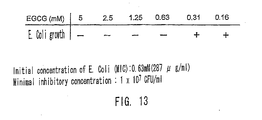
- E. coli suspensions (1x10 7 CFU/ml), in which gradually diluted (0.16, 0.31, 0.63, 1.25, 2.5, 5.0 mM) epigallocatechin gallate (EGCg) solutions were mixed, were placed in a culture plate and incubated at 37 degrees Celsius for 24 hours under a static condition.
- Minimal inhibitory concentration (MIC) was defined as the smallest EGCg concentration in which no bacteria growth is recognized macroscopically. As shown in FIG. 13, the minimal inhibitory concentration (MIC) was 0.63 mM (287 ⁇ g/ml).
- the one with the least amount of sustained releasing of catechin is the one in which 20 wt % of epigallocatechin gallate (EGCg) was incorporated in TMC/PEG200. Furthermore, since the sustained release amount of catechin from this polymer is 0.22mg/ cm 2 in the initial 24 hours, it is suggested that the catechin is preferably included in a carrier in an amount such that the sustained release of catechin per day is at least 0.22mg/ cm 2 .
Landscapes
- Health & Medical Sciences (AREA)
- Life Sciences & Earth Sciences (AREA)
- General Health & Medical Sciences (AREA)
- Engineering & Computer Science (AREA)
- Environmental Sciences (AREA)
- Zoology (AREA)
- Wood Science & Technology (AREA)
- Dentistry (AREA)
- Plant Pathology (AREA)
- Agronomy & Crop Science (AREA)
- Pest Control & Pesticides (AREA)
- Medicinal Chemistry (AREA)
- Animal Behavior & Ethology (AREA)
- Public Health (AREA)
- Veterinary Medicine (AREA)
- Chemical & Material Sciences (AREA)
- Biotechnology (AREA)
- Molecular Biology (AREA)
- Biomedical Technology (AREA)
- Microbiology (AREA)
- Mycology (AREA)
- Heart & Thoracic Surgery (AREA)
- Surgery (AREA)
- Natural Medicines & Medicinal Plants (AREA)
- Vascular Medicine (AREA)
- Epidemiology (AREA)
- Toxicology (AREA)
- Pharmacology & Pharmacy (AREA)
- Organic Chemistry (AREA)
- Nuclear Medicine, Radiotherapy & Molecular Imaging (AREA)
- General Chemical & Material Sciences (AREA)
- Chemical Kinetics & Catalysis (AREA)
- Oncology (AREA)
- Communicable Diseases (AREA)
- Pharmaceuticals Containing Other Organic And Inorganic Compounds (AREA)
- Materials For Medical Uses (AREA)
- Medicinal Preparation (AREA)
Abstract
Description
- This application claims priority under Article 87 EPC based upon
Japanese Patent Application Serial No. 2004-337604, filed on Nov. 22, 2004 - The present invention is related to a biofilm formation inhibitor and a treatment device using thereof.
- Progressive pancreatic carcinoma and cholangioma are known for their extreme difficulties in diagnosis and treatment and as so-called intractable cancers. In other words, because the pancreas and bile duct are surrounded by other organs such as the stomach, duodenum, small intestine, large intestine, liver, gall bladder, spleen, etc., it is difficult to detect cancer, and also manifestations that are characteristic to cancer are not found in the early stages. Therefore, early detection is difficult, and when it is diagnosed as a carcinoma, it is often too late to treat it.
- On the other hand, there is obstructive jaundice (a symptom of the body turning yellow), which is a symptom related in some degree to these carcinomas. This is caused when the bile duct at the head of the pancreas that runs from the liver to the duodenum (that is, a pipe that drains bile created in the liver to the alimentary canal) is obstructed by a carcinoma, stopping the discharging of the bile. Generally, the first step of treating a progressive pancreatic carcinoma / bile duct cancer is to improve this obstructive jaundice.
- As a means to improve this obstructive jaundice, a biliary stent is used. This biliary stent is a plastic or metal tubular (stent), that allows the bile to drain by enlarging the section of the bile duct that became narrow, by being placed into the bile duct via the duodenal papilla like an endoscope.
- However, because the bile drainage of this biliary stent is exposed to the duodenum, duodenal juice flows back into the stent lumen. As a result, various kinds of Enterobacteriacae (Escherichia coli bacteria, etc.) present in the duodenal juice adhere to the surface of the stent lumen, where they multiply, and form so-called biofilm by producing exobacterial materials (polysaccharide) to build a complex three-dimensional structure. Once a biofilm is formed, on its surface, gallstones (calcium bilirubinate is the main component, and the enzymes produced by the bacteria and free radicals that accompany infection contribute to formation) are deposited, which in turn closes the stent lumen.
- Because of this biofilm formation, the biliary stent lumen is blocked 3 months after operation. Thus it needs to be replaced with a new biliary stent. However, because the life expectancy, for example, of a pancreatic carcinoma patient, is only about 6 months, repeated operations lessen the quality of life for the patient as well as creating a large economic burden.
- Moreover, a biofilm formed on a biological surface may cause infectious diseases such as chronic bronchitis and chronic osteomyelitis. Also, when a biofilm is formed on a prosthetic substrate surface, such as prosthetic heart valve, prosthetic joint, and urethral catheter, etc., sepsis may accompany it, and in the worse case may lead to death.
- Currently, in order to prevent biofilm formation in biliary stents, various antibiotics (local administration, blood administration are used (Is prophylactic ciprofloxacin effective in delaying biliary stent blockage?, Gastrointest Endosc 52:175-182). However, long-term administration of antibiotics has a high probability of causing antibiotic-resistant bacteria to emerge. Thus the period of administration is at most one week. Once a biofilm is formed, it shows strong resistance to drugs. Thus currently there is no effective drug for it.
- Moreover, in order to suppress bacterial adhesion to stent surfaces, biliary stents with a coating of a highly hydrophilic surface polymer (Product name: Hydromer) and stents formed by fluoropolymers (PFA; perfluoroalkoxy PTFE) which is reported to have little adhesion with animal cells, have also been developed. However, these materials cannot suppress bacterial growth. Therefore, if a small amount of bacteria with a high proliferating ability (the doubling time of the E. coli is 30 minutes) adheres on their surfaces, they cannot prevent the bacteria's growth, and thus they are unable to inhibit biofilm formation.
- Also, in order to suppress bacterial growth, drug-eluting polymers using antibiotic and silver ion have been developed, which showed effectiveness at the experimental level. However, toxicity and effects on the living body pose problems, Thus, they have not been put to practical use for the human body.
- As mentioned above, conventionally, the administering of antibiotics and the coating of a fluoropolymer have been used in order to prevent biofilm formation on the biliary stent lumen. However, neither of them is practical in terms of efficacy and safety.
- The present invention was made in view of these problems, and it aims to provide a treatment device such as biliary stent capable of effectively and continuously inhibiting biofilm formation, and a biofilm formation inhibitor suitable for coating on the treatment device by killing all bacteria including E. coli and by suppressing the growth of these bacteria.
- Furthermore, another object of the present invention is to provide a treatment device such as a biliary stent and a biofilm formation inhibitor that is suitable for coating on the treatment device, which are capable of continuously preventing biofilm formation and are safe and effective for the human body.
- This invention was achieved to solve the above-mentioned problems, and according to the first aspect of the invention, a biofilm formation inhibitor having an effective amount of catechin for inhibiting biofilm formation and a carrier that is suitable for the adhesion of said catechin to a treatment device to be placed in the living body, are provided.
- Catechin is a type of "polyphenol", a main constituent that gives the taste of green tea (bitterness), which is reported to possess antibacterial action (Yoda Y. et al., J Infect Chemother. 2004 10(1):55-58), antitumor action (Tachibana H. et al., A receptor for green tea polyphenol EGCG. Nat Struct Mol Biol. 2004; 11(4): 380-381. Epub 2004), reactive oxygen scavenging activity/antioxidative effect (Kondo K., et al., Mechanistic studies of catechins as antioxidants against radical oxidation. Arch Biochem Biophys 1999 362:79-86), anti-cavity action, odor eliminating action, cholesterol lowering effects, blood sugar surge suppression effects, blood pressure surge suppression effects, anti-allergy effects, and platelet aggregation inhibition action. However, catechin's effect on biofilm formation was not known before the present invention.
- The inventors of the present invention focused attention to catechins' bactericidal action which damages the cell membrane of all bacteria including E. coli, and gained a new understanding that catechins have effects on inhibiting biofilm formation. Based on this understanding, through serious examination and repeated experiments they have achieved the present invention. In other words, according to the biofilm formation inhibitor of the present invention, biofilm formation on a target medical device can be effectively inhibited by extermination and growth suppression of all bacteria including E. Coli.
- Also, since catechins used in the biofilm formation inhibitor of the present invention are excreted via the duodenum, small intestine, and large intestine to the outside, it is believed that the risk to the living body for a long-term administration is small, compared to the above-mentioned drugs that have been used in the prior art. Especially, as for epigallocatechin gallate which effects were demonstrated in one of the examples of the present invention, no side effect has been reported, and a recent study has proved the safety of epigallocatechin gallate to the human body for a high dosage long-term oral administration. Thus, according to such configuration, biofilm formation is completely inhibited by exterminating or suppressing the growth of bacteria adhered to the surfaces of various medical devices such as biliary stent, thus offering safe and effective treatment materials for the human body.
- Moreover, according to one embodiment of the present invention, in order to inhibit biofilm formation effectively, it is preferable that the above-mentioned catechin is contained in said carrier in an amount such that a sustained release of catechin per day is at least 0.22 mg/cm2. Moreover, by modifying the content of a catechin in a carrier a sustained release amount can be controlled. Thus this sustained release amount can be selected depending on the mode used for the above-mentioned treatment materials and various factors of the application targets.
- Furthermore, according to another embodiment of the present invention, the carrier is a hydrophilic biodegradable polymer. The hydrophilic biodegradable polymer has a high water content rate, and is subjected to hydrolytic degradation right away, thus facilitating catechin's sustained release and surface erosion. Furthermore, since the hydrophilic biodegradable polymer is liquid and easily photocurable by the irradiation of ultraviolet light, it is easily coated to the surface of a treatment subtrate.
- Furthermore, according to the second aspect of the present invention, there is provided a treatment device to be placed in a living body, wherein an effective amount of a catechin for inhibiting biofilm formation is coated on the surface thereon. According to such configuration, it becomes possible to manufacture a treatment device capable of inhibiting biofilm formation, by exterminating all bacteria including E. coli and by suppressing their growth.
- According to one embodiment of the present invention, the treatment device obtained as described above is a biliary stent (although it is not limited to this), and it becomes possible to improve and treat obstructive jaundice that accompanies an advancing pancreatic carcinoma/bile duct cancer.
- Further characteristics and prominent effects of this invention become clear for a person skilled in the art from the following descriptions.
-
- Fig. 1 shows the structure formulas of catechins.
- Fig. 2 shows the inhibitory effect of EGCg on biofilm formation.
- Fig. 3 shows the structure formula of epigallocatechin gallate (EGCg).
- Fig. 4 shows the inhibitory effect ofEGCg on the adhesion of E.coli.
- Fig. 5 shows structure formulas of biodegradable liquid polymers (TMC/LL/PEG1k, TMC/PEG200, TMC/TMP) used in the present invention.
- Fig. 6 shows sustained release amounts of catechin from the catechin-loadedpolymers used in the present invention (polymer types: FIG. 6 (a), EGCg's loaded levels: FIG. 6 (b)).
- Fig. 7 shows the effect of non-EGCg loaded polymers (TMC/LL/PEG1k, TMC/PEG200, TMC/TMP) on the adhesion of E. coli under static conditions.
- Fig. 8 shows the effect of EGCg-loaded biodegradable polymers (TMC/LL/PEG1k, TMC/PEG200, and TMC/TMP) on the adhesion of E. coli of EGCg loaded (0, 5, 10, and 20 wt %, wt %: weight percent) under static conditions.
- Fig.9 shows the condition of biofilm formation on catechin-loaded polymers))) EGCg/ (TMC/LL/PEGlk) surface using confocal laser microphotographs.
- Fig. 10 shows a Modified Robbins device and an experimental procedure.
- Fig. 11 shows the effect of catechin-loaded polymers EGCg/ (TMC/LL/PEG1k) on the adhesion of E. coli under dynamic conditions.
- Fig. 12 shows the effect of EGCg on living microbes within biofilm after formation of the biofilm.
- Fig. 13 shows the analysis of (drug) sensitivity of E. coli to EGCg.
- As mentioned earlier, the present invention provides a biofilm formation inhibitor which inhibits biofilm formation on a target treatment device by exterminating bacteria including E. Coli and supressing their growth and a treatment device using thereof.
- Although not limited to the following, the catechins of the present invention include catechin, epicatechin, gallo catechin, epigallocatechin, catechin gallate, epi-catechin gallate, gallocatechin gallate, epigallocatechin gallate, etc. (which are shown by Formulas (a) - (h) in Fig. 1), and among them, epigallocatechin gallate (EGCg) is especially preferable, which has the strongest antibacterial action, that is, it has the smallest minimal inhibitory concentration against E. coli.
- The above-mentioned catechins are included in a carrier suitable for coating on target treatment devices. For such a carrier, there is no special limitation as long as it is a biodegradable or non-biodegradable material which can be applied as a solvent and form a film by evaporation, and does not show toxicity. For example, polylactide, poly(2-hydroxy ethyl methacrylate) and polyethyleneglycol copolymer that form hydrophilic gel, and as hydrophobic materials, polyethylene terephthalate, polylactide, and acetylcellulose are preferable. Among them, hydrophilic biodegradable polymers are most preferable because the rate of their water content is high, and thus they are subjected to hydrolytic degradation immediately, facilitating the sustained release of catechins and surface erosion. When hydrophilic polymer or oligomer is soluble in water, the irradiation of ultraviolet light result in photocrosslinking, producing water-swellable polymers, thus they can facilitate the coating on the surface of a treatment material according to the present invention.
- The manufacturing method of biofilm formation inhibitor of the present invention is not limited to a specific method, and it can be performed using a known art For example, according to one example of the present invention, it can be manufactured by mixing epigallocatechin gallate which has been dissolved in acetone with a liquid-state biodegradable polymer.
- As for the way to apply a biofilm formation inhibitor of the present invention, there is no particular limitation as long as it is for inhibiting biofilm formation by catechins. According to one example of the present invention, it can be applied to biliary stents to improve obstructive jaundice that accompanies an advancing pancreatic carcinoma/bile duct cancer. In other words, when using a biliary stent coated with a catechin-loaded polymer, that is one of the above-mentioned treatment materials, bacteria adhered on the surface of the biliary stent are exterminated, and thus biofilm formation is completely inhibited, making it possible to develop a biliary stent that can be placed in the living body for a long period of time. However, its target application is not limited to biliary stents, but can be used for other various treatment devices. For example, it can be used for a urethral catheter, a drainage tube for surgical operation, a central venous catheter, and a mesh for hernioplasty.
- Moreover, the catechins used in the present invention are known to have various effects beside the above-mentioned antibacterial action. Thus, in addition to the inhibition of biofilm formation, the above mentioned treatment material can be used for growth suppression (antitumor effect by catechins) of malignant tumors (pancreatic carcinoma, bile duct cancer, etc.) that are in contact with the outer surface of a biliary stent; and for the suppression of gallstone formation in the biliary stent lumen (reactive oxygen scavenging action by the catechin).
- Also, a treatment device of the present invention is provided by coating a biofilm formation inhibitor of the present invention to the above-mentioned target devices. The manufacturing method of such treatment device is not limited to a particular method, and can be manufactured using a publicly known technology. For example, when a treatment device is a biliary stent, a tube-shaped plastic material (polyurethane) which forms the subtrate of the stent is soaked in a catechin loaded liquid polymer, and after being coated on its surface therewith, it is irradiated with UV ray to be hardened. While being hardened (approx. 5 min.), in order to avoid deviations in the thickness of the coating, the subtrate is rotated around the axis of the stent lumen, thereby obtaining a biliary stent in which the above-mentioned biofilm inhibitor is coated inside.
- Note that as for stent substrate, a subtrate made of metal can also be used in addition to the above-mentioned subtrate made of plastic, and the above-mentioned biofilm formation inhibitor may be applied to the metal stent subtrate as well. However, a metal stent is a mesh-shaped self-expandable stent, and an occlusion is caused mainly by the aberrations of tumors. Thus, the biofilm is often not a cause of the occlusion. Therefore, a catechin-loaded surface-erodible polymer according to the present invention is considered effective mainly as a coating agent for a plastic stent with a narrow interior diameter.
- In the examples explained next, among the polymers in which biofilm formation is significantly suppressed, the one with least amount of sustained releasing of catechin is the one in which 20 wt % of epigallocatechin gallate (EGCg) is incorporated in a biodegradable polymer (TMC/PEG200). Since the sustained release amount of catechin in the first 24 hours was 0.22 mg/cm2, it is preferable that the above-mentioned catechin is included in a carrier in an amount such that the sustained release amount of catechin would be at least 0.22 mg/cm2 per day. Moreover, by changing a carrier and the content of catechin in a carrier, the amount of sustained release can be controlled. Thus this amount of sustained release can be selected according to the embodiments in which the above-mentioned treatment materials are used and various factors of the application targets.
- Next, the effect of the present invention is explained using examples. However, the present invention is not limited to the embodiments described below.
- 8mm diameter disc shaped polyurethanes were cultured with an E. coli suspension (2x10³ CFU/ml) which was mixed with various concentrations of epigallocatechin gallate (EGCg) (0-0.2 mM) under a static condition at 37 degrees Celsius for 24 hours in a culture plate. After incubations, the polyurethane discs were taken out, and having been washed in a phosphate buffer gently, they were moved to a 2 ml phosphate buffer, where they were sonicated to detach the adhered E. coli. Viable E. coli cell counts in the liquid were calculated by the plate count method.
- As shown in FIG. 3 and FIG. 4, epigallocatechin gallate (EGCg) was proved to inhibit biofilm formation significantly at the concentration of 0.12 mM (0.055 mg/ml) and more, and to inhibit completely at the concentration of 0.15 mM (0.069 mg/ml) and more.
- Epigallocatechin gallate (EGCg, Sigma- Aldrich, Inc., St. Louis, MO: shown in Fig. 3) dissolved in acetone (Sigma - Aldrich) was mixed with three kinds of biodegradable polymers (TMC/LL/PEG1k, TMC/PEG200, TMC/TMP: shown in Fig.5 (a)-(c)) to make 20 wt %(wt %: weight percent). After acetone was volatilized in a low pressure tank over 24 hours, 250 mg of polymer was coated at the bottom (surface area 1.1 cm2) of a glass bottle, and it was photocured by irradiating with ultraviolet light (SP - V, Ushio, Inc., Yokohama, Japan) for five minutes. 1 ml of phosphate buffer solution (Nissui Pharmaceutical Co., Ltd., Tokyo, Japan) was poured into the glass bottle and stoppered tightly, and kept at 37 degrees Celsius under static conditions for sustained release of EGCg. 100 µl of the solution in the glass bottle was taken out after one, two, and four days, and EGCg levels were calculated by the Folin - Ciocalteu method. As for TMC/LL/PEG1k, similar experiments were performed with EGCg concentrations of 5 and 10 wt %.
- The results were shown in Fig.6 (a) and (b) with sustainedly released EGCg weight (mg/ cm2) per polymer surface area. Fig.6 (a) shows that weights of EGCg increased in all polymer samples with time, and that EGCg was released over the period of 4 days. Compared among the polymers, LL/TMC/PEG1k which has the highest hydrophilic (wettability toward water) property and biodegradability had the highest sustained release amount and TMC/PEG200 was the second and then TMC/TMP, in that order. Also, as shown in FIG. 6 (b), with TMC/LL/PEG1k in which different degrees of EGCg were loaded, it was recognized that the higher the loading of EGCg the higher the amount of sustained release.
- EGCg dissolved in acetone was mixed with three kinds of liquid biodegradable polymers (TMC/LL/PEG1k, TMC/PEG200, and TMC/TMP: shown in the FIG. 5 (a) - (c)) to make 0, 5, 10, and 20 wt % (wt %: weight percent). These polymers were spin-coated on polyurethane surfaces, and after having been irradiated with UV for five minutes, and solidified, and 8 mm diameter disc samples were punched out by a belt punch. These samples were incubated at 37 degrees Celsius with an E. coli suspension (2x10³ CFU/ml) in a culture plate for 24 hours. After incubation, the samples were taken out and washed in a phosphate buffer gently, and then they were moved to 2 ml of phosphate buffer solution where they are sonicated to detach the adhered E. coli. Viable E. coli cell count in this liquid was calculated by the plate count method.
- These results were shown in FIG. 7 and FIG. 8. According to Fig. 7, concerning the adhesion of E. coli, no significant difference was recognized among the non-EGCg loaded polymers of TMC/LL/PEG1k, TMC/PEG200, and TMC/TMP. According to Fig. 8, 10 and 20 wt % EGCg loaded TMC/LL/PEG1k and 20 wt % EGCg loaded TMC/PEG200 inhibited E. coli adhesion significantly as compared with the polymers having no EGCg (0 wt %). In particular, with the 20 wt % EGCg loaded TMC/LL/PEG1k, E. coli adhesion was completely obstructed. These results are proportional to the catechin release amounts in Example 2. Thus it is suggested that the adhesion of E. coli is obstructed according to the amount of catechin release. Note that an E. coli adhesion (%) was converted with the value being 100% for the 0 wt % loaded EGCg concentration for the respective polymers.
- Furthermore, biofilm formation on the surface of the catechin-loaded polymer EGCG/(TMC/LL/PEGlk) was observed with a confocal laser microscope. As explained above, disk shaped polyurethanes (8mm diameter), on which 0 and 20wt % EGCg loaded TMC/LL/PEG1k was coated, were incubated with a suspension of E. coli which was transformed to express green fluorescence protein (2x10³ CFU/ml) at 37 degrees Celsius for 24 hours under a static condition. After having washed the polymer surfaces on which biofilms were formed with a phosphate buffer gently, they were observed with a confocal laser microscope (Radiance2000, BioRed, Hercules, CA). As shown in FIG. 9, while E. coli which expressed GFR grew and formed biofilms on the polymer surfaces in no EGCg loaded TMC/LL/PEG1k (0 wt %), no biofilm formation was recognized on the 20 wt % EGCg loaded TMC/LL/PEG1k. The biofilm inhibiting effect of catechin-loaded polymers was proven from image findings as well.
- This experiment used a Modified Robbins device (Tyler Co., Edmonton, Canada) shown in FIG 10. Samples with 8 mm diameter that were made similarly to the one in Example 3 were glued to a sample port using a silicon glue. After passing E. coli suspension (2x10⁵ CFU/ml) through the flow path at 1 ml/min for one hour, followed by the passing of the bacteria free LB medium for 23 hours, E. coli adhesion was determined by a method similar to Example 2.
- As results, 5 and 20 wt % EGCg loaded TMC/LL/PEG1k showed significant inhibition of E. coli adhesion as compared to the no EGCg loaded polymer (0 wt %) (Figure 11). Because adhesion was not inhibited in the 5 wt % EGCg loaded TMC/LL/PEG1k under the static condition of Example 2, it is suggested that under a dynamic condition, biofilm formation is inhibited with a smaller concentration of EGCg in the polymer.
- Biofilms were formed on polyurethane surfaces after incubating 8 nun diameter polyurethane discs placed in a culture plate with an E. coli suspension (2x10³ CFU/ml) under a static condition at 37 degrees Celsius for 24 hours. After adding solutions with various degrees of epigallocatechin gallate (EGCg) concentration (0 - 50 mM) to the biofilm surfaces that were formed, they were exposed for another 24 hours. After the polyurethane discs were taken out, and washed with a phosphate buffer solution gently, they were moved to a 2 ml phosphate buffer solution and sonicated to detach adhered E. coli. Viable E. coli cell count in this liquid was counted by the plate count method. As shown in the graph of FIG. 12, it was proved that, when the concentration of epigallocatechin gallate (EGCg) was 8 mM (3.7 mg/ml) and more, viable cell counts decreased significantly, and at 50 mM (23 mg/ml) E. coli in biofilm were exterminated completely. These levels of concentration are much higher compared to the Example 1 where catechin was placed from the beginning of incubation. Thus this shows that once a biofilm is formed, E. coli therein shows resistance to catechin.
- Sensitivity of E. coli to EGCg was examined by a general sensibility test method (dilution method). E. coli suspensions (1x10⁷ CFU/ml), in which gradually diluted (0.16, 0.31, 0.63, 1.25, 2.5, 5.0 mM) epigallocatechin gallate (EGCg) solutions were mixed, were placed in a culture plate and incubated at 37 degrees Celsius for 24 hours under a static condition. Minimal inhibitory concentration (MIC) was defined as the smallest EGCg concentration in which no bacteria growth is recognized macroscopically. As shown in FIG. 13, the minimal inhibitory concentration (MIC) was 0.63 mM (287 µg/ml).
- From the results of FIG. 7 and FIG. 8, among the polymers in which biofilm formation is significantly suppressed, the one with the least amount of sustained releasing of catechin is the one in which 20 wt % of epigallocatechin gallate (EGCg) was incorporated in TMC/PEG200. Furthermore, since the sustained release amount of catechin from this polymer is 0.22mg/ cm2 in the initial 24 hours, it is suggested that the catechin is preferably included in a carrier in an amount such that the sustained release of catechin per day is at least 0.22mg/ cm2.
Claims (8)
- A biofilm formation inhibitor characterized by an effective amount of a catechin for inhibiting biofilm formation; and a carrier that is suitable for adhesion of the catechin to a treatment device to be placed in a living body.
- The biofilm formation inhibitor of Claim 1, wherein the catechin is epigallocatechin gallate.
- The biofilm formation inhibitor of Claim 1, wherein the carrier is a hydrophilic biodegradable polymer
- The biofilm formation inhibitor of Claim 1, wherein the catechin is contained in the carrier in an amount such that a sustained release of the catechin per day is at least 0.22 mg/cm2.
- A treatment device to be placed in a living body, wherein an effective amount of catechin for inhibiting biofilm formation is coated on the surface thereon.
- The treatment device of Claim 5, wherein the treatment device is a biliary stent having an inner surface that is coated with the catechin.
- The treatment device of Claim 6, wherein the treatment device is a plastic stent of a non-self-expandable type.
- The treatment device of Claim 5, wherein the catechin is coated thereon as contained in a carrier in an amount such that a sustained release of the catechin per day is at least 0.22 mg/cm2.
Applications Claiming Priority (2)
| Application Number | Priority Date | Filing Date | Title |
|---|---|---|---|
| JP2004337604A JP5028605B2 (en) | 2004-11-22 | 2004-11-22 | Biofilm formation inhibitor and therapeutic device |
| PCT/JP2005/021017 WO2006054584A1 (en) | 2004-11-22 | 2005-11-16 | Biofilm formation inhibitor and treatment device |
Publications (2)
| Publication Number | Publication Date |
|---|---|
| EP1829566A1 true EP1829566A1 (en) | 2007-09-05 |
| EP1829566A4 EP1829566A4 (en) | 2012-02-15 |
Family
ID=36407125
Family Applications (1)
| Application Number | Title | Priority Date | Filing Date |
|---|---|---|---|
| EP05807021A Ceased EP1829566A4 (en) | 2004-11-22 | 2005-11-16 | BIOFILM FORMATION AND TREATMENT DEVICE |
Country Status (6)
| Country | Link |
|---|---|
| US (1) | US8540766B2 (en) |
| EP (1) | EP1829566A4 (en) |
| JP (1) | JP5028605B2 (en) |
| KR (1) | KR100872824B1 (en) |
| CN (1) | CN101060867B (en) |
| WO (1) | WO2006054584A1 (en) |
Cited By (3)
| Publication number | Priority date | Publication date | Assignee | Title |
|---|---|---|---|---|
| WO2007133479A3 (en) * | 2006-05-10 | 2008-04-24 | Cook Inc | Delivery of elastin-stabilizing compound within a body lumen |
| WO2014197768A1 (en) * | 2013-06-07 | 2014-12-11 | Baxter International Inc. | Immobilization of an active agent on a substrate using compounds including trihydroxyphenyl groups |
| US9642949B2 (en) | 2013-03-15 | 2017-05-09 | Baxter International Inc. | Immobilization of an active agent on a substrate |
Families Citing this family (12)
| Publication number | Priority date | Publication date | Assignee | Title |
|---|---|---|---|---|
| US7147661B2 (en) | 2001-12-20 | 2006-12-12 | Boston Scientific Santa Rosa Corp. | Radially expandable stent |
| DE102009027696A1 (en) * | 2009-07-14 | 2011-02-10 | Westfälische-Wilhelms Universität Münster | Use of proanthocyanidins for the preparation of an anti-adhesive preparation |
| WO2011063394A2 (en) * | 2009-11-23 | 2011-05-26 | Olmstead Stephen F | Compositions and methods comprising serratia peptidase for inhibition and treatment of biofilms related to certain conditions |
| JP2012036106A (en) * | 2010-08-04 | 2012-02-23 | Yoshiaki Tsutsumi | Biofilm formation inhibitor |
| US8999236B2 (en) | 2011-01-22 | 2015-04-07 | Az Co., Ltd. | Disinfection method and disinfection device |
| JP6431528B2 (en) * | 2013-04-10 | 2018-11-28 | マサチューセッツ インスチテュート オブ テクノロジーMassachusetts Institute Of Technology | Local drug delivery device and method for cancer treatment |
| CN112469371B (en) | 2018-07-29 | 2024-08-16 | Bvw控股公司 | Biliary stent |
| CN110089519B (en) * | 2019-05-08 | 2022-02-11 | 东北大学 | Microbial corrosion inhibitor and method of using the same |
| CN113289073A (en) * | 2020-02-24 | 2021-08-24 | 张建强 | Degradable drug stent for preventing or treating intimal hyperplasia after interventional operation and preparation method thereof |
| CN114601822A (en) * | 2020-12-09 | 2022-06-10 | 润佳(苏州)医药科技有限公司 | Pharmaceutical applications of fused-ring phenolic compounds |
| IL312842A (en) | 2021-11-17 | 2024-07-01 | Panther Therapeutics Inc | Implantable and biodegradable drug delivery devices and methods of use thereof |
| WO2024107532A1 (en) | 2022-11-17 | 2024-05-23 | PanTher Therapeutics, Inc. | Methods of treating pancreatic cancer |
Family Cites Families (11)
| Publication number | Priority date | Publication date | Assignee | Title |
|---|---|---|---|---|
| US5772640A (en) * | 1996-01-05 | 1998-06-30 | The Trustees Of Columbia University Of The City Of New York | Triclosan-containing medical devices |
| JP3040498U (en) * | 1997-02-13 | 1997-08-19 | 有限会社上野屋美香園 | Wet tissue |
| JPH11139462A (en) * | 1997-11-06 | 1999-05-25 | Kao Corp | Wrapping film and film container |
| US6267897B1 (en) * | 2000-05-04 | 2001-07-31 | Nalco Chemical Company | Method of inhibiting biofilm formation in commercial and industrial water systems |
| JP2002085549A (en) | 2000-09-18 | 2002-03-26 | Terumo Corp | Material for intravascular treatment and appliance for intravascular treatment |
| CN1216528C (en) * | 2001-02-27 | 2005-08-31 | 梅建华 | Coating liquid for resisting bacteria and influenza virus and its preparing process |
| US6887270B2 (en) * | 2002-02-08 | 2005-05-03 | Boston Scientific Scimed, Inc. | Implantable or insertable medical device resistant to microbial growth and biofilm formation |
| DE60303705T2 (en) | 2002-05-14 | 2006-10-19 | Terumo K.K. | Coated stent for the release of active substances |
| NL1021843C2 (en) * | 2002-11-05 | 2004-05-07 | Univ Twente | Biomedical structures of poly (1,3-trimethylene carbonate) (poly (TMC)). |
| FI116030B (en) * | 2002-11-06 | 2005-09-15 | Kemira Oyj | Inhibition of biofilm formation of thermophilic microbes in paper and cardboard machines |
| JP4371653B2 (en) * | 2002-11-25 | 2009-11-25 | テルモ株式会社 | Implantable medical device |
-
2004
- 2004-11-22 JP JP2004337604A patent/JP5028605B2/en not_active Expired - Lifetime
-
2005
- 2005-11-16 WO PCT/JP2005/021017 patent/WO2006054584A1/en not_active Ceased
- 2005-11-16 US US11/719,819 patent/US8540766B2/en not_active Expired - Fee Related
- 2005-11-16 CN CN200580039685XA patent/CN101060867B/en not_active Expired - Fee Related
- 2005-11-16 KR KR20077010450A patent/KR100872824B1/en not_active Expired - Fee Related
- 2005-11-16 EP EP05807021A patent/EP1829566A4/en not_active Ceased
Cited By (7)
| Publication number | Priority date | Publication date | Assignee | Title |
|---|---|---|---|---|
| WO2007133479A3 (en) * | 2006-05-10 | 2008-04-24 | Cook Inc | Delivery of elastin-stabilizing compound within a body lumen |
| US9642949B2 (en) | 2013-03-15 | 2017-05-09 | Baxter International Inc. | Immobilization of an active agent on a substrate |
| US9895468B2 (en) | 2013-03-15 | 2018-02-20 | Baxter International Inc. | Immobilization of an active agent on a substrate |
| WO2014197768A1 (en) * | 2013-06-07 | 2014-12-11 | Baxter International Inc. | Immobilization of an active agent on a substrate using compounds including trihydroxyphenyl groups |
| US9655917B2 (en) | 2013-06-07 | 2017-05-23 | Baxter International Inc. | Immobilization of an active agent on a substrate using compounds including trihydroxyphenyl groups |
| CN105377315B (en) * | 2013-06-07 | 2018-11-09 | 巴克斯特国际公司 | Activating agent is fixed on base material using the compound including trihydroxy phenyl |
| US10428200B2 (en) | 2013-06-07 | 2019-10-01 | Baxter International Inc. | Immobilization of an active agent on a substrate using compounds including trihydroxyphenyl groups |
Also Published As
| Publication number | Publication date |
|---|---|
| EP1829566A4 (en) | 2012-02-15 |
| JP5028605B2 (en) | 2012-09-19 |
| KR100872824B1 (en) | 2008-12-09 |
| US8540766B2 (en) | 2013-09-24 |
| CN101060867A (en) | 2007-10-24 |
| US20090099646A1 (en) | 2009-04-16 |
| KR20070064361A (en) | 2007-06-20 |
| JP2006141794A (en) | 2006-06-08 |
| CN101060867B (en) | 2012-09-05 |
| WO2006054584A1 (en) | 2006-05-26 |
Similar Documents
| Publication | Publication Date | Title |
|---|---|---|
| US8540766B2 (en) | Biofilm formation inhibitor and treatment device thereof | |
| Desai et al. | Silver or nitrofurazone impregnation of urinary catheters has a minimal effect on uropathogen adherence | |
| Schmidt-Braekling et al. | Silver-coated megaprostheses: review of the literature | |
| Ramasamy et al. | Recent nanotechnology approaches for prevention and treatment of biofilm‐associated infections on medical devices | |
| JP5837960B2 (en) | Medical implant with improved drug eluting element | |
| Zarghami et al. | Melittin antimicrobial peptide thin layer on bone implant chitosan-antibiotic coatings and their bactericidal properties | |
| Li et al. | One step antimicrobial coatings for medical device applications based on low fouling polymers containing selenium nanoparticles | |
| JP2005530561A (en) | Silicone mixtures and composites for drug delivery | |
| Wang et al. | A modified biodegradable mesh ureteral stent for treating ureteral stricture disease | |
| Maeyama et al. | Novel bactericidal surface: catechin‐loaded surface‐erodible polymer prevents biofilm formation | |
| US20140356901A1 (en) | Method and Device for Detecting Device Colonization | |
| CN115038471B (en) | Compositions for clinical complications associated with devices implanted in the urinary tract | |
| JP2008529667A (en) | Medical device | |
| WO2013169494A1 (en) | Improved method of treating vascular lesions | |
| Shukla et al. | Sustained release of a purified tannin component of Terminalia chebula from a titanium implant surface prevents biofilm formation by Staphylococcus aureus | |
| US20070003591A1 (en) | Use of a propolis as a coating material for medical implants | |
| JP2010047764A (en) | Biocompatible polymer | |
| Bouloussa et al. | Implant Surface Technologies to Prevent Surgical Site Infections in Spine Surgery | |
| JP2012110744A (en) | Biofilm formation inhibitor and treatment appliance | |
| JP2026509886A (en) | Method for imparting antimicrobial properties to a synthetic substrate | |
| US9217042B2 (en) | Method of reducing MACE in diabetic patients subsequent to stent placement | |
| US20130123715A1 (en) | Indwelling catheter probe incorporating proanthocyanidines | |
| ES2951010T3 (en) | Implantable health products, procedure for their preparation and use thereof | |
| CN116763999B (en) | Urinary system catheter using propolis alcohol extract as coating and preparation method thereof | |
| RU2816023C1 (en) | Antibacterial coating on orthopaedic implant from titanium and alloys thereof and method for production thereof (embodiments) |
Legal Events
| Date | Code | Title | Description |
|---|---|---|---|
| PUAI | Public reference made under article 153(3) epc to a published international application that has entered the european phase |
Free format text: ORIGINAL CODE: 0009012 |
|
| 17P | Request for examination filed |
Effective date: 20070620 |
|
| AK | Designated contracting states |
Kind code of ref document: A1 Designated state(s): DE FR GB IE |
|
| DAX | Request for extension of the european patent (deleted) | ||
| RBV | Designated contracting states (corrected) |
Designated state(s): DE FR GB IE |
|
| RBV | Designated contracting states (corrected) |
Designated state(s): DE FR GB IE |
|
| A4 | Supplementary search report drawn up and despatched |
Effective date: 20120118 |
|
| RIC1 | Information provided on ipc code assigned before grant |
Ipc: A61L 31/00 20060101AFI20120112BHEP |
|
| 17Q | First examination report despatched |
Effective date: 20120919 |
|
| REG | Reference to a national code |
Ref country code: DE Ref legal event code: R003 |
|
| STAA | Information on the status of an ep patent application or granted ep patent |
Free format text: STATUS: THE APPLICATION HAS BEEN REFUSED |
|
| 18R | Application refused |
Effective date: 20180124 |