EP1827023A1 - Method and apparatus for packet loss detection and virtual packet generation at SVC decoders - Google Patents
Method and apparatus for packet loss detection and virtual packet generation at SVC decoders Download PDFInfo
- Publication number
- EP1827023A1 EP1827023A1 EP06300164A EP06300164A EP1827023A1 EP 1827023 A1 EP1827023 A1 EP 1827023A1 EP 06300164 A EP06300164 A EP 06300164A EP 06300164 A EP06300164 A EP 06300164A EP 1827023 A1 EP1827023 A1 EP 1827023A1
- Authority
- EP
- European Patent Office
- Prior art keywords
- frame
- frames
- gop
- poc
- layer
- Prior art date
- Legal status (The legal status is an assumption and is not a legal conclusion. Google has not performed a legal analysis and makes no representation as to the accuracy of the status listed.)
- Withdrawn
Links
- 238000000034 method Methods 0.000 title claims abstract description 35
- 238000001514 detection method Methods 0.000 title description 17
- 230000002123 temporal effect Effects 0.000 claims abstract description 51
- 102100037812 Medium-wave-sensitive opsin 1 Human genes 0.000 claims 4
- 230000002159 abnormal effect Effects 0.000 description 17
- 238000010276 construction Methods 0.000 description 5
- 238000003780 insertion Methods 0.000 description 2
- 230000037431 insertion Effects 0.000 description 2
- 230000005540 biological transmission Effects 0.000 description 1
- 239000000872 buffer Substances 0.000 description 1
- 230000001419 dependent effect Effects 0.000 description 1
- 230000008685 targeting Effects 0.000 description 1
Images

Classifications
-
- H—ELECTRICITY
- H04—ELECTRIC COMMUNICATION TECHNIQUE
- H04N—PICTORIAL COMMUNICATION, e.g. TELEVISION
- H04N19/00—Methods or arrangements for coding, decoding, compressing or decompressing digital video signals
- H04N19/85—Methods or arrangements for coding, decoding, compressing or decompressing digital video signals using pre-processing or post-processing specially adapted for video compression
- H04N19/89—Methods or arrangements for coding, decoding, compressing or decompressing digital video signals using pre-processing or post-processing specially adapted for video compression involving methods or arrangements for detection of transmission errors at the decoder
- H04N19/895—Methods or arrangements for coding, decoding, compressing or decompressing digital video signals using pre-processing or post-processing specially adapted for video compression involving methods or arrangements for detection of transmission errors at the decoder in combination with error concealment
-
- H—ELECTRICITY
- H04—ELECTRIC COMMUNICATION TECHNIQUE
- H04N—PICTORIAL COMMUNICATION, e.g. TELEVISION
- H04N19/00—Methods or arrangements for coding, decoding, compressing or decompressing digital video signals
- H04N19/30—Methods or arrangements for coding, decoding, compressing or decompressing digital video signals using hierarchical techniques, e.g. scalability
-
- H—ELECTRICITY
- H04—ELECTRIC COMMUNICATION TECHNIQUE
- H04N—PICTORIAL COMMUNICATION, e.g. TELEVISION
- H04N19/00—Methods or arrangements for coding, decoding, compressing or decompressing digital video signals
- H04N19/46—Embedding additional information in the video signal during the compression process
-
- H—ELECTRICITY
- H04—ELECTRIC COMMUNICATION TECHNIQUE
- H04N—PICTORIAL COMMUNICATION, e.g. TELEVISION
- H04N19/00—Methods or arrangements for coding, decoding, compressing or decompressing digital video signals
- H04N19/60—Methods or arrangements for coding, decoding, compressing or decompressing digital video signals using transform coding
- H04N19/61—Methods or arrangements for coding, decoding, compressing or decompressing digital video signals using transform coding in combination with predictive coding
-
- H—ELECTRICITY
- H04—ELECTRIC COMMUNICATION TECHNIQUE
- H04N—PICTORIAL COMMUNICATION, e.g. TELEVISION
- H04N19/00—Methods or arrangements for coding, decoding, compressing or decompressing digital video signals
- H04N19/70—Methods or arrangements for coding, decoding, compressing or decompressing digital video signals characterised by syntax aspects related to video coding, e.g. related to compression standards
-
- H—ELECTRICITY
- H04—ELECTRIC COMMUNICATION TECHNIQUE
- H04N—PICTORIAL COMMUNICATION, e.g. TELEVISION
- H04N19/00—Methods or arrangements for coding, decoding, compressing or decompressing digital video signals
- H04N19/85—Methods or arrangements for coding, decoding, compressing or decompressing digital video signals using pre-processing or post-processing specially adapted for video compression
- H04N19/89—Methods or arrangements for coding, decoding, compressing or decompressing digital video signals using pre-processing or post-processing specially adapted for video compression involving methods or arrangements for detection of transmission errors at the decoder
Definitions
- the invention relates to scalable video coding (SVC).
- SVC scalable video coding
- the invention relates to a method and an apparatus for packet loss detection and virtual packet generation at decoders for SVC bit-streams.
- Error concealment methods have been introduced for JSVM4 1 . Exemplarily, four methods are described in JVT-Q046 2 .
- This known solution for error concealment is targeting on fixed GOP (group-of-pictures) size, where the base-layer is H.264 compliant with spatial and FGS (Fine Grain Scalability) scalable layers.
- Temporal scalability in SVC is supported by a hierarchical B frame GOP structure. In this structure, bi-directionally predicted frames (B frames) within a GOP have different temporal levels according to a defined scheme.
- B frames bi-directionally predicted frames within a GOP have different temporal levels according to a defined scheme.
- there is a need to further improve the robustness and correctness of error concealment.
- supporting error concealment for any kind of scalability and combined scalability is desirable.
- the invention provides a method for detecting errors in received packetized video data, wherein the video data contain a spatial or spatio-temporal base-layer (BL) and at least one enhancement-layer (EL), and each layer is organized in frames or slices with a respective header and a GOP structure, and different temporal levels exist within layers.
- BL spatial or spatio-temporal base-layer
- EL enhancement-layer
- each layer is organized in frames or slices with a respective header and a GOP structure, and different temporal levels exist within layers.
- a packet is assumed to contain a frame or a slice.
- the method according to the invention comprises the steps of reading/extracting header information relating to a layer, generating from the header information a scheme, the scheme comprising at least display order number (that is picture order count, POC), number of reference frames (that is frame_num) and temporal level for the frames within a complete GOP of the respective layer, extracting from received video data frames parameters including POC number, frame_num and temporal level, and detecting that one or more frames or packets are missing, wherein the received parameters are compared with the parameters of expected frames according to said scheme and a missing packet or frame is determined by a mismatch between received and expected parameters.
- a scheme comprising at least display order number (that is picture order count, POC), number of reference frames (that is frame_num) and temporal level for the frames within a complete GOP of the respective layer
- POC picture order count
- frame_num number of reference frames
- temporal level for the frames within a complete GOP of the respective layer
- predefined schemes may be stored, or generated on-the-fly using an appropriate algorithm.
- the method further comprises the steps of generating for each missing packet or frame a default packet, wherein each default packet gets the display order number (POC), number of reference frames (frame_num) and temporal level of the respective expected packet, and inserting for each missing packet the generated default packet into the data stream before the data stream is parsed.
- POC display order number
- frame_num number of reference frames
- the GOP structure contains a plurality of complete GOPs and not more than one incomplete GOP (that is a GOP with less pictures/frames than the others), and the method according to the invention further comprises the step of determining for a missing frame if it belongs to a complete GOP or to the incomplete GOP. In one embodiment said inserting of default packets is only performed for missing frames that belong to complete GOPs.
- the step of determining for a missing frame if it belongs to a complete GOP or to the incomplete GOP in the previous embodiment can be further specified in comprising the steps of estimating the maximum GOP size for the incomplete GOP, and not generating or suppressing default packets for the incomplete GOP for display order numbers (POC) that are above the estimated GOP size.
- POC display order numbers
- the method according to the invention can be further specified in that said header information contains an indication of the difference between the POC numbers of successive frames of a defined spatio-temporal or spatial layer.
- the previous embodiment can be further specified in that said defined spatio-temporal or spatial layer is the BL.
- said indication is the logarithm to the basis two (log 2 ) of said difference.
- the invention provides a signal containing packetized video data, wherein the video data are organized in frames or slices and have a respective header and a group-of-picture (GOP) structure containing a plurality of GOPs, and wherein each video frame or slice comprises at least an indication of its POC number, and wherein said header contains an indication (log2_min_poc_increase) of the difference between the display order numbers (POC) of successive frames.
- GOP group-of-picture
- the video signal can be further specified in that it has a spatial or spatio-temporal base-layer and at least one enhancement-layer, and the indication of the difference between the display order numbers (POC) of successive frames refers to the frames of one defined layer of these layers.
- POC display order numbers
- the invention provides an apparatus for generating such signal.
- An apparatus for detecting errors in received packetized video data wherein the video data contain a base-layer and at least one enhancement-layer and each layer is organized in frames or slices with a respective header and a group-of-picture (GOP) structure, comprises means for reading and extracting header information relating to a layer, means for generating from the extracted header information a scheme, or means for selecting a predefined scheme according to the extracted header information (SEI), the scheme comprising at least display order number (POC), number of reference frames (frame_num) and temporal level for the frames within a complete GOP of the respective layer, means for extracting from received video data frames parameters including POC number, frame_num and temporal level, and means for detecting that one or more frames or packets are missing, wherein the received parameters are compared with the parameters of expected frames according to said scheme and a missing packet or frame is determined by a mismatch between received and expected parameters.
- SEI extracting header information relating to a layer
- SEI extracting at least display order number (POC), number of
- the apparatus further comprises means for generating for each missing packet or frame a default packet, wherein each default packet gets the display order number (POC), number of reference frames (frame_num) and temporal level of the respective expected packet, and means for inserting for each missing packet the generated default packet into the data stream before the data stream is parsed.
- POC display order number
- frame_num number of reference frames
- temporal level of the respective expected packet means for inserting for each missing packet the generated default packet into the data stream before the data stream is parsed.
- the apparatus further comprises means for determining for a missing frame if it belongs to a complete GOP or to the incomplete GOP, and means for performing said inserting of default packets only for missing frames that belong to complete GOPs.
- Fig.1 shows the NAL (network abstraction layer) packet structure of an SVC bit-stream.
- the sequence of packets contains Supplementary Enhancement Information (SEI), sequence parameter set (SPS), sequence parameter sets in scalable extension (SPS_S), picture parameter sets (PPS), picture parameter sets in scalable extension (PPS_S), coded slice of an IDR picture (SLICE_IDR) and coded slice of an IDR picture in scalable extension (SLICE_IDR_S).
- SEI Supplementary Enhancement Information
- SPS sequence parameter set
- SPS_S sequence parameter sets in scalable extension
- PPS picture parameter sets
- PPS_S picture parameter sets in scalable extension
- coded slice of an IDR picture SLICE_IDR
- SLICE_IDR_S coded slice of an IDR picture
- SLICE_IDR_S coded slice of an IDR picture in scalable extension
- GOPs groups of pictures
- Pictures are either normal non-IDR pictures (SLICE_NOIDR) or non-IDR pictures in scalable extension (SLICE_NOIDR_S).
- SLICE_NOIDR normal non-IDR pictures
- SLICE_NOIDR_S scalable extension
- the bit stream has two spatial layers and the GOP size is 16, so that one line (16 BL packets + 16 EL packets) makes a complete GOP.
- the number of complete GOPs in a stream may be very large, e.g. several thousands.
- the last picture in each GOP is an I- or P-frame (intra-coded or predicted) serving as key picture, while the others are B-frames (bi-directionally predicted).
- Fig.2 shows temporal levels within hierarchical B frame GOPs of different size.
- the frames on the lowest temporal level TL0 are called key pictures and are either I or P frames, and one of them (denoted as 0) belongs actually to the previous GOP.
- frames on higher temporal levels than TL0 are bi-directionally predicted from two or more reference frames.
- Reference frames can be frames on lower temporal levels or (for frames that are not on the highest temporal level) previously decoded frames of the same temporal level.
- Temporal levels are decoded in increasing order, i.e. first TL0, then TL1, then TL2 etc.
- the invention provides packet loss detection and virtual frame generation, in particular for packets with non-IDR pictures (denoted Slice_NOIDR/Slice_NOIDR_S in Fig.1).
- the transmission of packets belonging to SEI Message, SPS, PPS and the first IDR picture is assumed to be guaranteed.
- a first phase of packet loss detection is followed by lost packet analysis, virtual packet generation and insertion, parsing and decoding.
- the packet loss detection uses the picture_order_count (POC) values, frame_num values and temporal level values.
- POC is an enumeration of the frames in display order, as used in Fig.2 a)-d).
- frame_num is a parameter of a frame that indicates the number of (potential) reference frames that it has.
- POC_Increase We usually assume for the highest spatial layer a POC_Increase of 1, i.e. all frames are displayed. However, sometimes this is not true. E.g. if the input frame rate is 30 fps and a spatial base-layer is encoded with only 15 fps, then the base-layer POC_Increase is 2, since only every second picture is encoded.
- the POC_Increase is not known from the SEI message, which will cause problems for the packet loss detection. Initially the parser may detect that every second packet is lost. Although after some parsing it may be recognized that no packets with odd POC values were found and thus it might be concluded that the POC_Increase is 2, it may be too late: buffers may overflow and other problems may occur. This is not an optimal solution.
- one aspect of the present invention is to add an indication log2_min_poc_increase of the minimum POC_Increase to the SEI message, as exemplarily shown in Tab.1 and described in the following.
- the POC_Increase is 2 log2_min_poc_increase for the spatial layer with the maximum MTL (MTL max ).
- MTL max the maximum temporal_level of MTL Layer
- a virtual packet can be generated for the parser and the decoder. This is done in the decoder and before the real parsing. Always when a packet is sent to the parser, no matter if it is a correctly received packet or a virtual packet, the number of decoded pictures (decoded_index) will be incremented. Therefore it is advantageous to insert the virtual packets before the parser, so that the numbering of subsequent packets is correct.
- the temporal_level of each layer is defined in the SVC Scalability Information SEI message syntax (see JVT_Q201).
- MTL the maximum temporal_level of all the layers belonging to the same dependency level (spatial resolution layer)
- GopSize 2 MTL .
- the relative POCs in a GOP are constructed using the hierarchical B frame structure.
- the relative POC, relative frame_num and temporal level values are listed by decoding order in the following tables, cf. Fig.2 a)-d). They can be easily generated for a specific GOP size.
- the real frame_num actually might be modified by modulus operation with the maximum frame number in real applications.
- the first frame in the decoding order actually is not exactly with an order of 0. Instead, it is usually more accurate for this frame to have a decoding order value of -(GopSize-1), because it has been coded at the beginning of the previous GOP.
- Frames or frame information can be ordered by various criteria, e.g. by POC, by decoding order, by frame_num etc. This feature is helpful for packet loss detection and virtual packet generation.
- the POC increase of two successive displayed frames might be 1 or 2, or even 2 n when the number of spatial scalable layers is more than two and each layer has a different frame rate.
- the frame_num should be increased by 1 (except for the frames at the highest temporal level). If the value POC / POC_Increase is odd, the frame will not cause frame_num to increase; we call it odd frame here. Usually, in a normal GOP, these odd frames will have the highest temporal level. If there are more spatial layers and the input frame rates for the different layers are not the same, the POC_Increase may be larger; generally it is 2 n , where n is the difference between MTL of the current layer and the MTL of the highest temporal layer. Usually the highest (spatial/spatio-temporal) layer will have the maximum number of temporal levels.
- the BL can have half the frame rate of the EL.
- the MTL of the BL is 5.
- the GOP sizes for BL and EL are 2 5 and 2 6 respectively.
- the POC is actually POC / POC_Increase . After packet loss detection and at the last step of packet virtualization, the POC value will then be mapped back by multiplication with POC_Increase.
- each spatial or FGS layer will be composed by GopSize ⁇ n+d packets.
- n complete GOPs There are n complete GOPs and then maybe an incomplete GOP with a size d , where d is less than GopSize.
- "Incomplete” however refers only to the fact that it contains fewer frames than "complete" GOPs, while an "incomplete" GOP is syntactically correct and the properties (see below) for each frame are adapted to the actual GOP size.
- A can be ordered by decoding order, by POC, by frame_num, or even first ordered by temporal_level and then within the same temporal_level by POC.
- the elements in A are updated, usually with a POC increase of GopSize and a frame_num increase of GopSize/2.
- f' f ( decoded_index%GopSize )+1 when A is ordered by decoding order.
- f' is equal to f c , i.e. the received packet is equal to the expected packet, no packet was lost and decoded_index is incremented by 1. Else one or more packets must have been lost.
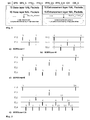
- these are ⁇ 1,3,5,7,9,11,13, 15 ⁇ , which matches the subsequently expected packets of the GOP. Therefore it can be concluded that we are in a normal GOP, and only two packets are missing, namely 6 and 10. As shown in Fig.3b, these packets are then replaced by virtual packets i1,i2.
- abnormal GOP process Once a packet loss in an abnormal GOP is detected, the following "abnormal GOP process" may be entered.
- the iterative algorithm to follow is to start from the difference in frame_num between f ''' and f c with both the same POC number, and decrease the value for each frame in A that has higher POC number but lower temporal_level than the current frame f c until the value is zero.
- the POC number of the last frame gives an upper bound for the GOP size:
- GopSize abn,max f i-1poc (i.e. the POC value of the frame i-1)
- Gopsize abn,max is the upper bound of GOP size of the abnormal GOP of the current spatial layer.
- f c frame_num means: frame_num of frame f c
- each spatial layer may have its own list of elements A .
- the frame_num values in A are updated.
- the updated A we give a new order for A : it is first ordered by temporal level, and within the same temporal level it is ordered by POC.
- frame_num frame_num % Max_Frame_Num
- the GopSize of the truncated A may be stored for the next process of packet loss detection and packet virtualization.
- decoded_index we can always find an element in A if it is ordered by decoding order: f decoded_index+1 . If the f c is equal to f decoded_index+1 , no packet is lost and the current received packet is sent to the parser. Else a virtual packet is constructed using f decoded_index+1 . In both cases decoded_index is increased by 1.
- MMCO memory management control operation
- RPLR and reference index numbers need to be handled. Conventionally only the key picture needs to add RPLR commands, forcing the key picture to refer to the previous key picture.
- the BL packet values of num_ref_idx_10_active_minusl and num_ref_idx_11_active_minus1 are set for the spatial EL packet.
- match means that if we have the same ref_idx_lx values of list_X in the BL and EL, the corresponding reference pictures of the BL and EL will have the same display time (or POC).
- the conventional JSVM encoder guarantees this by using RPLR for BL, and the initialisation of reference lists construction to match the BL at the EL. So it is not necessary to generate RPLR commands for lost non-key pictures, but we still need to generate RPLR for key pictures.
- the invention provides the following advantages.
- Any packet loss can be handled, except for the packets belonging to SEI Message, SPS, PPS and IDR.
- Each resolution can have one or more FGS layers.
- An FGS layer will be intentionally dropped if its corresponding lower quality level packet (with the same dependence level and temporal level) is lost or has been intentionally dropped.
- Insertion of default packets before the parser has the advantage that the parser needs not handle packet loss situations, which e.g. may require packet renumbering, so that conventional simple parsers can be used.
- the payload content of such packets is not relevant.
- the disclosed concept of the invention can also be used in cases where packets contain more than one frame or slice.
- the invention can be used for video decoding products or for video encoding products, particularly if a base-layer and at least one enhancement-layer are included and have a plurality of temporal levels defined.
- the spatial layers may have different frame rates.
Landscapes
- Engineering & Computer Science (AREA)
- Multimedia (AREA)
- Signal Processing (AREA)
- Compression Or Coding Systems Of Tv Signals (AREA)
- Compression, Expansion, Code Conversion, And Decoders (AREA)
Priority Applications (6)
| Application Number | Priority Date | Filing Date | Title |
|---|---|---|---|
| EP06300164A EP1827023A1 (en) | 2006-02-27 | 2006-02-27 | Method and apparatus for packet loss detection and virtual packet generation at SVC decoders |
| JP2008555755A JP5227193B2 (ja) | 2006-02-27 | 2007-02-14 | Svcデコーダにおけるパケットロス検出および仮想パケット生成のための方法および装置 |
| EP07704585A EP1989884A1 (en) | 2006-02-27 | 2007-02-14 | Method and apparatus for packet loss detection and virtual packet generation at svc decoders |
| US12/224,239 US8249170B2 (en) | 2006-02-27 | 2007-02-14 | Method and apparatus for packet loss detection and virtual packet generation at SVC decoders |
| CN2007800067870A CN101390400B (zh) | 2006-02-27 | 2007-02-14 | Svc解码器上的分组丢失检测和虚拟分组产生的方法和设备 |
| PCT/EP2007/051451 WO2007096288A1 (en) | 2006-02-27 | 2007-02-14 | Method and apparatus for packet loss detection and virtual packet generation at svc decoders |
Applications Claiming Priority (1)
| Application Number | Priority Date | Filing Date | Title |
|---|---|---|---|
| EP06300164A EP1827023A1 (en) | 2006-02-27 | 2006-02-27 | Method and apparatus for packet loss detection and virtual packet generation at SVC decoders |
Publications (1)
| Publication Number | Publication Date |
|---|---|
| EP1827023A1 true EP1827023A1 (en) | 2007-08-29 |
Family
ID=37735133
Family Applications (2)
| Application Number | Title | Priority Date | Filing Date |
|---|---|---|---|
| EP06300164A Withdrawn EP1827023A1 (en) | 2006-02-27 | 2006-02-27 | Method and apparatus for packet loss detection and virtual packet generation at SVC decoders |
| EP07704585A Ceased EP1989884A1 (en) | 2006-02-27 | 2007-02-14 | Method and apparatus for packet loss detection and virtual packet generation at svc decoders |
Family Applications After (1)
| Application Number | Title | Priority Date | Filing Date |
|---|---|---|---|
| EP07704585A Ceased EP1989884A1 (en) | 2006-02-27 | 2007-02-14 | Method and apparatus for packet loss detection and virtual packet generation at svc decoders |
Country Status (5)
| Country | Link |
|---|---|
| US (1) | US8249170B2 (enExample) |
| EP (2) | EP1827023A1 (enExample) |
| JP (1) | JP5227193B2 (enExample) |
| CN (1) | CN101390400B (enExample) |
| WO (1) | WO2007096288A1 (enExample) |
Cited By (4)
| Publication number | Priority date | Publication date | Assignee | Title |
|---|---|---|---|---|
| FR2942095A1 (fr) * | 2009-02-09 | 2010-08-13 | Canon Kk | Procede et dispositif d'identification de pertes de donnees video |
| KR101105445B1 (ko) * | 2009-11-16 | 2012-01-17 | 한국항공대학교산학협력단 | 스케일러블 비디오의 패킷 손실 오류를 축소하기 위한 적응 장치 및 그 방법 |
| GB2505344B (en) * | 2011-04-26 | 2017-11-15 | Lg Electronics Inc | Method for managing a reference picture list, and apparatus using same |
| EP3244615A4 (en) * | 2015-01-09 | 2018-06-20 | Sony Corporation | Image processing device, image processing method, and program, and recording medium |
Families Citing this family (20)
| Publication number | Priority date | Publication date | Assignee | Title |
|---|---|---|---|---|
| JP4460011B2 (ja) | 2008-05-27 | 2010-05-12 | 国立大学法人広島大学 | 動画像配信システム、動画像配信方法、動画像配信システムにおけるサーバおよび動画像配信システムにおけるユーザ端末 |
| JP5357255B2 (ja) * | 2008-07-22 | 2013-12-04 | トムソン ライセンシング | スケーラブルビデオ符号化(svc)復号化におけるエンハンスメントレイヤパケットの消失によるエラー隠蔽方法 |
| CN101511029B (zh) * | 2009-03-25 | 2012-08-08 | 无锡中星微电子有限公司 | 一种图像处理系统中的数据纠错的方法和装置 |
| CA2782562A1 (en) * | 2009-12-04 | 2011-06-09 | Bob Poniatowski | Multifunction multimedia device |
| CN102907096A (zh) * | 2010-05-10 | 2013-01-30 | 三星电子株式会社 | 用于发送和接收分层编码视频的方法和设备 |
| US9041765B2 (en) | 2010-05-12 | 2015-05-26 | Blue Jeans Network | Systems and methods for security and privacy controls for videoconferencing |
| US9124757B2 (en) * | 2010-10-04 | 2015-09-01 | Blue Jeans Networks, Inc. | Systems and methods for error resilient scheme for low latency H.264 video coding |
| US9300705B2 (en) | 2011-05-11 | 2016-03-29 | Blue Jeans Network | Methods and systems for interfacing heterogeneous endpoints and web-based media sources in a video conference |
| US9369673B2 (en) | 2011-05-11 | 2016-06-14 | Blue Jeans Network | Methods and systems for using a mobile device to join a video conference endpoint into a video conference |
| US20130094774A1 (en) * | 2011-10-13 | 2013-04-18 | Sharp Laboratories Of America, Inc. | Tracking a reference picture based on a designated picture on an electronic device |
| US8768079B2 (en) | 2011-10-13 | 2014-07-01 | Sharp Laboratories Of America, Inc. | Tracking a reference picture on an electronic device |
| KR102047492B1 (ko) * | 2012-03-12 | 2019-11-22 | 삼성전자주식회사 | 스케일러블 비디오 부호화 방법 및 장치, 스케일러블 비디오 복호화 방법 및 장치 |
| KR20130116782A (ko) | 2012-04-16 | 2013-10-24 | 한국전자통신연구원 | 계층적 비디오 부호화에서의 계층정보 표현방식 |
| CN102752670B (zh) * | 2012-06-13 | 2015-11-25 | 广东威创视讯科技股份有限公司 | 减少网络视频传输中马赛克现象的方法、装置及系统 |
| US11438609B2 (en) | 2013-04-08 | 2022-09-06 | Qualcomm Incorporated | Inter-layer picture signaling and related processes |
| CN106416250B (zh) * | 2013-12-02 | 2020-12-04 | 诺基亚技术有限公司 | 视频编码和解码 |
| US20150266356A1 (en) * | 2014-03-19 | 2015-09-24 | Ford Global Technologies, Llc | Method and system to enable commands on a vehicle computer based on user created rules |
| US11445223B2 (en) | 2016-09-09 | 2022-09-13 | Microsoft Technology Licensing, Llc | Loss detection for encoded video transmission |
| US10122642B2 (en) * | 2016-09-29 | 2018-11-06 | Intel IP Corporation | Managing a data stream in a multicore system |
| CN112153413B (zh) * | 2020-08-25 | 2022-08-12 | 广州市保伦电子有限公司 | 一种同屏广播处理花屏的方法和服务器 |
Citations (2)
| Publication number | Priority date | Publication date | Assignee | Title |
|---|---|---|---|---|
| US5247363A (en) * | 1992-03-02 | 1993-09-21 | Rca Thomson Licensing Corporation | Error concealment apparatus for hdtv receivers |
| US20020152440A1 (en) * | 2000-10-27 | 2002-10-17 | Ilan Yona | Apparatus and method for improving the quality of video communication over a packet-based network |
Family Cites Families (25)
| Publication number | Priority date | Publication date | Assignee | Title |
|---|---|---|---|---|
| US5217460A (en) * | 1991-03-22 | 1993-06-08 | Knoepfler Dennis J | Multiple purpose forceps |
| US5300068A (en) * | 1992-04-21 | 1994-04-05 | St. Jude Medical, Inc. | Electrosurgical apparatus |
| US5542916A (en) * | 1992-08-12 | 1996-08-06 | Vidamed, Inc. | Dual-channel RF power delivery system |
| US5507743A (en) * | 1993-11-08 | 1996-04-16 | Zomed International | Coiled RF electrode treatment apparatus |
| US6035238A (en) * | 1997-08-13 | 2000-03-07 | Surx, Inc. | Noninvasive devices, methods, and systems for shrinking of tissues |
| USRE40279E1 (en) * | 1997-06-26 | 2008-04-29 | Sherwood Services Ag | Method and system for neural tissue modification |
| US6228084B1 (en) * | 1999-04-06 | 2001-05-08 | Kirwan Surgical Products, Inc. | Electro-surgical forceps having recessed irrigation channel |
| US6358273B1 (en) * | 1999-04-09 | 2002-03-19 | Oratec Inventions, Inc. | Soft tissue heating apparatus with independent, cooperative heating sources |
| US20050273111A1 (en) * | 1999-10-08 | 2005-12-08 | Ferree Bret A | Methods and apparatus for intervertebral disc removal and endplate preparation |
| US6773409B2 (en) * | 2001-09-19 | 2004-08-10 | Surgrx Llc | Surgical system for applying ultrasonic energy to tissue |
| US6944222B2 (en) * | 2002-03-04 | 2005-09-13 | Koninklijke Philips Electronics N.V. | Efficiency FGST framework employing higher quality reference frames |
| GB2386275B (en) * | 2002-03-05 | 2004-03-17 | Motorola Inc | Scalable video transmissions |
| US20040030330A1 (en) * | 2002-04-18 | 2004-02-12 | Brassell James L. | Electrosurgery systems |
| CN1679340A (zh) * | 2002-05-31 | 2005-10-05 | 皇家飞利浦电子股份有限公司 | 不可伸缩到可伸缩视频转换方法,可伸缩到不可伸缩视频转换方法 |
| WO2006046476A1 (ja) * | 2004-10-29 | 2006-05-04 | Sharp Kabushiki Kaisha | 動画像復号装置および動画像復号方法 |
| US7720350B2 (en) * | 2004-11-30 | 2010-05-18 | General Instrument Corporation | Methods and systems for controlling trick mode play speeds |
| US7291414B2 (en) * | 2004-12-10 | 2007-11-06 | General Motors Corporation | Reactant feed for nested stamped plates for a compact fuel cell |
| US20060161149A1 (en) * | 2005-01-18 | 2006-07-20 | Salvatore Privitera | Surgical ablation device |
| AU2006223287C1 (en) * | 2005-03-10 | 2010-10-21 | Qualcomm Incorporated | A decoder architecture for optimized error management in streaming multimedia |
| US8197472B2 (en) * | 2005-03-25 | 2012-06-12 | Maquet Cardiovascular, Llc | Tissue welding and cutting apparatus and method |
| JP4261508B2 (ja) * | 2005-04-11 | 2009-04-30 | 株式会社東芝 | 動画像復号装置 |
| US9049449B2 (en) * | 2005-04-13 | 2015-06-02 | Nokia Corporation | Coding of frame number in scalable video coding |
| WO2007080223A1 (en) * | 2006-01-10 | 2007-07-19 | Nokia Corporation | Buffering of decoded reference pictures |
| WO2007118153A2 (en) * | 2006-04-06 | 2007-10-18 | Baylor College Of Medicine | Method and apparatus for the detachment of catheters or puncturing of membranes and intraluminal devices within the body |
| US8187270B2 (en) * | 2007-11-07 | 2012-05-29 | Mirabilis Medica Inc. | Hemostatic spark erosion tissue tunnel generator with integral treatment providing variable volumetric necrotization of tissue |
-
2006
- 2006-02-27 EP EP06300164A patent/EP1827023A1/en not_active Withdrawn
-
2007
- 2007-02-14 WO PCT/EP2007/051451 patent/WO2007096288A1/en not_active Ceased
- 2007-02-14 CN CN2007800067870A patent/CN101390400B/zh not_active Expired - Fee Related
- 2007-02-14 JP JP2008555755A patent/JP5227193B2/ja not_active Expired - Fee Related
- 2007-02-14 US US12/224,239 patent/US8249170B2/en not_active Expired - Fee Related
- 2007-02-14 EP EP07704585A patent/EP1989884A1/en not_active Ceased
Patent Citations (2)
| Publication number | Priority date | Publication date | Assignee | Title |
|---|---|---|---|---|
| US5247363A (en) * | 1992-03-02 | 1993-09-21 | Rca Thomson Licensing Corporation | Error concealment apparatus for hdtv receivers |
| US20020152440A1 (en) * | 2000-10-27 | 2002-10-17 | Ilan Yona | Apparatus and method for improving the quality of video communication over a packet-based network |
Non-Patent Citations (4)
| Title |
|---|
| ARNOLD J F ET AL: "Error resilience in the MPEG-2 video coding standard for cell based networks - A review - Image Communication", SIGNAL PROCESSING. IMAGE COMMUNICATION, ELSEVIER SCIENCE PUBLISHERS, AMSTERDAM, NL, vol. 14, no. 6-8, May 1999 (1999-05-01), pages 607 - 633, XP004165399, ISSN: 0923-5965 * |
| CHEN YING, GILL BOYCE, XIE KAI: "Frame Loss Error Concealment for SVC", JOINT VIDEO TEAM (JVT) OF ISO/IEC MPEG & ITU-T VCEG (ISO/IEC JTC1/SC29/WG11 AND ITU-T SG16 Q6), no. JVT-Q046, 12 October 2005 (2005-10-12), 17th Meeting, Nice, FR, 14-21 October, 2005, pages 1 - 17, XP002422831, Retrieved from the Internet <URL:http://ftp3.itu.int/av-arch/jvt-site/2005_10_Nice/JVT-Q046.zip> [retrieved on 20070301] * |
| J. REICHEL, H. SCHWARZ, M. WIEN (EDS.): "Draft of Joint Scalable Video Model JSVM-4 Annex G", JOINT VIDEO TEAM (JVT) OF ISO/IEC MPEG & ITU-T VCEG (ISO/IEC JTC1/SC29/WG11 AND ITU-T SG16 Q6), no. JVT-Q202, 21 October 2005 (2005-10-21), 17th Meeting, Nice, FR, 14-21 October, 2005, pages 1 - 165, XP002422832, Retrieved from the Internet <URL:http://ftp3.itu.int/av-arch/jvt-site/2005_10_Nice/JVT-Q202.zip> [retrieved on 20070301] * |
| KHAN E ET AL: "ITERATIVE ERROR DETECTION AND CORRECTION OF H.263 CODED VIDEO FOR WIRELESS NETWORKS", IEEE TRANSACTIONS ON CIRCUITS AND SYSTEMS FOR VIDEO TECHNOLOGY, IEEE SERVICE CENTER, PISCATAWAY, NJ, US, vol. 14, no. 12, December 2004 (2004-12-01), pages 1294 - 1307, XP001211155, ISSN: 1051-8215 * |
Cited By (6)
| Publication number | Priority date | Publication date | Assignee | Title |
|---|---|---|---|---|
| FR2942095A1 (fr) * | 2009-02-09 | 2010-08-13 | Canon Kk | Procede et dispositif d'identification de pertes de donnees video |
| US8392803B2 (en) | 2009-02-09 | 2013-03-05 | Canon Kabushiki Kaisha | Method and device for identifying video data losses |
| KR101105445B1 (ko) * | 2009-11-16 | 2012-01-17 | 한국항공대학교산학협력단 | 스케일러블 비디오의 패킷 손실 오류를 축소하기 위한 적응 장치 및 그 방법 |
| GB2505344B (en) * | 2011-04-26 | 2017-11-15 | Lg Electronics Inc | Method for managing a reference picture list, and apparatus using same |
| EP3244615A4 (en) * | 2015-01-09 | 2018-06-20 | Sony Corporation | Image processing device, image processing method, and program, and recording medium |
| US10390047B2 (en) | 2015-01-09 | 2019-08-20 | Sony Corporation | Image processing apparatus and image processing method for controlling the granularity in trick play |
Also Published As
| Publication number | Publication date |
|---|---|
| US8249170B2 (en) | 2012-08-21 |
| CN101390400A (zh) | 2009-03-18 |
| JP5227193B2 (ja) | 2013-07-03 |
| CN101390400B (zh) | 2012-02-29 |
| EP1989884A1 (en) | 2008-11-12 |
| US20090016447A1 (en) | 2009-01-15 |
| JP2009528715A (ja) | 2009-08-06 |
| WO2007096288A1 (en) | 2007-08-30 |
Similar Documents
| Publication | Publication Date | Title |
|---|---|---|
| US8249170B2 (en) | Method and apparatus for packet loss detection and virtual packet generation at SVC decoders | |
| US10893288B2 (en) | Decoders and methods thereof for managing pictures in video decoding process | |
| CN101356822B (zh) | 用于构造可伸缩视频的参考图像列表的方法和设备 | |
| KR100929558B1 (ko) | 비디오 부호화 방법, 복호화 방법, 부호화기, 복호기, 무선 통신 장치 및 멀티미디어 터미널 장치 | |
| Sjoberg et al. | Overview of HEVC high-level syntax and reference picture management | |
| EP1535467B1 (en) | Method for error concealment in video sequences | |
| EP3902258B1 (en) | Reference picture signaling | |
| CA2408726C (en) | Video coding | |
| FI115589B (fi) | Redundanttien kuvien koodaaminen ja dekoodaaminen | |
| EP1773063A1 (en) | Method and apparatus for encoding video data, and method and apparatus for decoding video data | |
| US20020021761A1 (en) | Systems and methods with error resilience in enhancement layer bitstream of scalable video coding | |
| US20090279612A1 (en) | Methods and apparatus for multi-view video encoding and decoding | |
| CN101326828B (zh) | 分层视频编码的方法及使用该方法的编解码器 | |
| WO2003094496A2 (en) | Video coding | |
| KR20140057533A (ko) | 랜덤 액세스 픽처를 청정하게 하기 위해 가장 낮은 계층 식별을 할당하기 위한 인코더 및 방법 | |
| US20090296826A1 (en) | Methods and apparatus for video error correction in multi-view coded video | |
| CN103843342A (zh) | 图像解码方法及使用其的装置 | |
| US8767840B2 (en) | Method for detecting errors and recovering video data | |
| US20170324966A1 (en) | Arrangements and methods thereof for processing video | |
| WO2024213697A1 (en) | Identification of post-filter input pictures | |
| HK1079938B (en) | Method and device of encoding/decoding video signal and corresponding radio telecommunications device |
Legal Events
| Date | Code | Title | Description |
|---|---|---|---|
| PUAI | Public reference made under article 153(3) epc to a published international application that has entered the european phase |
Free format text: ORIGINAL CODE: 0009012 |
|
| AK | Designated contracting states |
Kind code of ref document: A1 Designated state(s): AT BE BG CH CY CZ DE DK EE ES FI FR GB GR HU IE IS IT LI LT LU LV MC NL PL PT RO SE SI SK TR |
|
| AX | Request for extension of the european patent |
Extension state: AL BA HR MK YU |
|
| AKX | Designation fees paid | ||
| STAA | Information on the status of an ep patent application or granted ep patent |
Free format text: STATUS: THE APPLICATION IS DEEMED TO BE WITHDRAWN |
|
| 18D | Application deemed to be withdrawn |
Effective date: 20080301 |
|
| REG | Reference to a national code |
Ref country code: DE Ref legal event code: 8566 |