EP1826187A1 - Glass for semiconductor sealing, sheath tube for semiconductor sealing and semiconductor electronic part - Google Patents
Glass for semiconductor sealing, sheath tube for semiconductor sealing and semiconductor electronic part Download PDFInfo
- Publication number
- EP1826187A1 EP1826187A1 EP05788095A EP05788095A EP1826187A1 EP 1826187 A1 EP1826187 A1 EP 1826187A1 EP 05788095 A EP05788095 A EP 05788095A EP 05788095 A EP05788095 A EP 05788095A EP 1826187 A1 EP1826187 A1 EP 1826187A1
- Authority
- EP
- European Patent Office
- Prior art keywords
- glass
- amount
- temperature
- semiconductor
- dpa
- Prior art date
- Legal status (The legal status is an assumption and is not a legal conclusion. Google has not performed a legal analysis and makes no representation as to the accuracy of the status listed.)
- Withdrawn
Links
Images

Classifications
-
- C—CHEMISTRY; METALLURGY
- C03—GLASS; MINERAL OR SLAG WOOL
- C03C—CHEMICAL COMPOSITION OF GLASSES, GLAZES OR VITREOUS ENAMELS; SURFACE TREATMENT OF GLASS; SURFACE TREATMENT OF FIBRES OR FILAMENTS MADE FROM GLASS, MINERALS OR SLAGS; JOINING GLASS TO GLASS OR OTHER MATERIALS
- C03C3/00—Glass compositions
- C03C3/04—Glass compositions containing silica
- C03C3/076—Glass compositions containing silica with 40% to 90% silica, by weight
- C03C3/083—Glass compositions containing silica with 40% to 90% silica, by weight containing aluminium oxide or an iron compound
- C03C3/085—Glass compositions containing silica with 40% to 90% silica, by weight containing aluminium oxide or an iron compound containing an oxide of a divalent metal
-
- C—CHEMISTRY; METALLURGY
- C03—GLASS; MINERAL OR SLAG WOOL
- C03C—CHEMICAL COMPOSITION OF GLASSES, GLAZES OR VITREOUS ENAMELS; SURFACE TREATMENT OF GLASS; SURFACE TREATMENT OF FIBRES OR FILAMENTS MADE FROM GLASS, MINERALS OR SLAGS; JOINING GLASS TO GLASS OR OTHER MATERIALS
- C03C3/00—Glass compositions
- C03C3/04—Glass compositions containing silica
- C03C3/076—Glass compositions containing silica with 40% to 90% silica, by weight
- C03C3/097—Glass compositions containing silica with 40% to 90% silica, by weight containing phosphorus, niobium or tantalum
-
- C—CHEMISTRY; METALLURGY
- C03—GLASS; MINERAL OR SLAG WOOL
- C03C—CHEMICAL COMPOSITION OF GLASSES, GLAZES OR VITREOUS ENAMELS; SURFACE TREATMENT OF GLASS; SURFACE TREATMENT OF FIBRES OR FILAMENTS MADE FROM GLASS, MINERALS OR SLAGS; JOINING GLASS TO GLASS OR OTHER MATERIALS
- C03C3/00—Glass compositions
- C03C3/04—Glass compositions containing silica
- C03C3/076—Glass compositions containing silica with 40% to 90% silica, by weight
- C03C3/083—Glass compositions containing silica with 40% to 90% silica, by weight containing aluminium oxide or an iron compound
- C03C3/085—Glass compositions containing silica with 40% to 90% silica, by weight containing aluminium oxide or an iron compound containing an oxide of a divalent metal
- C03C3/087—Glass compositions containing silica with 40% to 90% silica, by weight containing aluminium oxide or an iron compound containing an oxide of a divalent metal containing calcium oxide, e.g. common sheet or container glass
-
- C—CHEMISTRY; METALLURGY
- C03—GLASS; MINERAL OR SLAG WOOL
- C03C—CHEMICAL COMPOSITION OF GLASSES, GLAZES OR VITREOUS ENAMELS; SURFACE TREATMENT OF GLASS; SURFACE TREATMENT OF FIBRES OR FILAMENTS MADE FROM GLASS, MINERALS OR SLAGS; JOINING GLASS TO GLASS OR OTHER MATERIALS
- C03C3/00—Glass compositions
- C03C3/04—Glass compositions containing silica
- C03C3/076—Glass compositions containing silica with 40% to 90% silica, by weight
- C03C3/089—Glass compositions containing silica with 40% to 90% silica, by weight containing boron
- C03C3/091—Glass compositions containing silica with 40% to 90% silica, by weight containing boron containing aluminium
-
- C—CHEMISTRY; METALLURGY
- C03—GLASS; MINERAL OR SLAG WOOL
- C03C—CHEMICAL COMPOSITION OF GLASSES, GLAZES OR VITREOUS ENAMELS; SURFACE TREATMENT OF GLASS; SURFACE TREATMENT OF FIBRES OR FILAMENTS MADE FROM GLASS, MINERALS OR SLAGS; JOINING GLASS TO GLASS OR OTHER MATERIALS
- C03C3/00—Glass compositions
- C03C3/04—Glass compositions containing silica
- C03C3/076—Glass compositions containing silica with 40% to 90% silica, by weight
- C03C3/089—Glass compositions containing silica with 40% to 90% silica, by weight containing boron
- C03C3/091—Glass compositions containing silica with 40% to 90% silica, by weight containing boron containing aluminium
- C03C3/093—Glass compositions containing silica with 40% to 90% silica, by weight containing boron containing aluminium containing zinc or zirconium
-
- H—ELECTRICITY
- H01—ELECTRIC ELEMENTS
- H01C—RESISTORS
- H01C1/00—Details
- H01C1/02—Housing; Enclosing; Embedding; Filling the housing or enclosure
- H01C1/028—Housing; Enclosing; Embedding; Filling the housing or enclosure the resistive element being embedded in insulation with outer enclosing sheath
-
- H—ELECTRICITY
- H01—ELECTRIC ELEMENTS
- H01C—RESISTORS
- H01C7/00—Non-adjustable resistors formed as one or more layers or coatings; Non-adjustable resistors made from powdered conducting material or powdered semi-conducting material with or without insulating material
- H01C7/008—Thermistors
-
- H—ELECTRICITY
- H10—SEMICONDUCTOR DEVICES; ELECTRIC SOLID-STATE DEVICES NOT OTHERWISE PROVIDED FOR
- H10W—GENERIC PACKAGES, INTERCONNECTIONS, CONNECTORS OR OTHER CONSTRUCTIONAL DETAILS OF DEVICES COVERED BY CLASS H10
- H10W72/00—Interconnections or connectors in packages
-
- H—ELECTRICITY
- H10—SEMICONDUCTOR DEVICES; ELECTRIC SOLID-STATE DEVICES NOT OTHERWISE PROVIDED FOR
- H10W—GENERIC PACKAGES, INTERCONNECTIONS, CONNECTORS OR OTHER CONSTRUCTIONAL DETAILS OF DEVICES COVERED BY CLASS H10
- H10W74/00—Encapsulations, e.g. protective coatings
- H10W74/40—Encapsulations, e.g. protective coatings characterised by their materials
- H10W74/43—Encapsulations, e.g. protective coatings characterised by their materials comprising oxides, nitrides or carbides, e.g. ceramics or glasses
Definitions
- the present invention relates to glass for semiconductor encapsulation to be used for encapsulating a semiconductor to prevent its deterioration, particularly glass for semiconductor encapsulation for encapsulating a semiconductor usable at a high temperature and an outer tube for semiconductor encapsulation, and semiconductor electronic parts.
- a thermistor is one of semiconductor electronic parts and is known as a semiconductor electronic parts, which can determine temperature by measuring electric resistance utilizing a property (having a negative or positive temperature coefficient) that electric resistance of the semiconductor changes depending on increase in temperature.
- a thermistor 10 called a bead thermistor or a glass thermistor includes, as shown in FIG. 1, a semiconductor (thermistor chip) 1, a wire lead 2, and glass for semiconductor encapsulation 3 and the thermistor chip 1 and part of the wire lead 2 are covered and encapsulated by the glass for semiconductor encapsulation (glass for thermistor chip encapsulation) 3, the thermistor can be used at a high temperature and under an oxidative atmosphere.
- the thermistor chip 1 there are oxide-based materials and at least one non-oxide-based material selected from the group consisting of nitride, carbide, boride and silicide, but oxide-based materials have been widely used mainly in view of properties and price.
- oxide-based materials have been widely used mainly in view of properties and price.
- wire lead 2 Dumet wire (Ni-Fe alloy covered with Cu), platinum wire, and the like have been widely used.
- the following are required: (1) to have a sufficiently high volume resistivity in the operating temperature range so as not to influence electric resistance property of the thermistor chip; (2) to match a thermal expansion coefficient of the glass with those of the wire lead and the thermistor chip so that cracks do not generate at the time when the wire lead and the thermistor chip are encapsulated; (3) to be able to achieve encapsulation at a temperature lower than heat-resistant temperature of the wire lead and the thermistor chip.
- Patent Document 1 In recent years, environmental pollution by harmful ingredients, such as lead, cadmium, and arsenic, has been at issue. Thus, it has been required that industrial products be free of these harmful ingredients. Therefore, the glass described in Patent Document 1 cannot be employed from an environmental viewpoint since it contains a harmful ingredient, lead oxide in a large amount.
- the present invention has been achieved in consideration of the above circumstances and an object thereof is to provide glass for semiconductor encapsulation and an outer tube for semiconductor encapsulation which are friendly to environment and allow semiconductor electronic parts to have a heat resistance of 700°C or higher as normal maximum temperature, and semiconductor electronic parts.
- the glass for semiconductor encapsulation of the invention contains essentially no lead and the temperature at which viscosity reaches 10 10 dPa ⁇ s is 700°C or higher.
- the glass contains essentially no lead, no harmful ingredients are discharged in the production of the outer tube for semiconductor encapsulation and in the production of the semiconductor electronic parts and thus the glass is friendly to environment.
- the temperature at which viscosity reaches 10 10 dPa ⁇ s is 700°C or higher, a semiconductor electronic parts using the same, such as a bead thermistor has a heat resistance of 700°C or higher as normal maximum temperature.
- the heat resistance of the bead thermistor depends on the heat resistance of the glass for encapsulation and the heat resistance can be evaluated with the temperature at which viscosity reaches 10 10 dPa ⁇ s.
- the temperature at which viscosity reaches 10 10 dPa ⁇ s is a temperature at which glass is deformed only when an external force is imparted. Even when the glass is held at the temperature for a long period of time, edges of the glass are slightly softened and deformed but the shape can be maintained and the glass hardly reacts with the wire lead or the thermistor chip. Therefore, the temperature at which viscosity reaches 10 10 dPa ⁇ s is about the same as normal maximum temperature of the bead thermistor.
- the temperature at which viscosity reaches 10 10 dPa ⁇ s is 800°C or higher, a semiconductor electronic parts such as a bead thermistor using the same has a heat resistance of 800°C or higher as normal maximum temperature.
- a softening point (Ts) is preferably 800°C or higher.
- the semiconductor electronic parts such as a bead thermistor using the same can have a heat resistance of 800°C or higher as maximum operating temperature.
- the softening point is a temperature at which glass is slightly softened and deformed.
- the softening point is 900°C or higher, the semiconductor electronic parts such as a bead thermistor using the same has a heat resistance of 900°C or higher as maximum operating temperature.
- the above-mentioned normal maximum temperature means a maximum temperature at which the properties are hardly deteriorated even when the thermistor is continued to use and the maximum operating temperature means a maximum temperature at which the thermistor is durable for use when the use is only for a short period of time.
- a strain point (Ps) is preferably 570°C or higher.
- the strain point is preferably 750°C or lower.
- stress generated at the interface between the glass for encapsulation and the wire lead or the semiconductor such as the thermistor chip is proportional to the product of the difference in thermal expansion coefficient therebetween and the difference between the strain point and room temperature. Accordingly, the larger the difference between the strain point and room temperature is, the larger the above stress is. Therefore, when the strain point exceeds 750°C, an allowable difference in thermal expansion coefficient between the glass for encapsulation and the wire lead or the semiconductor such as the thermistor chip decreases.
- the strain point is more preferably 710°C or lower.
- the temperature at which viscosity reaches 10 11 dPa ⁇ s is 650°C or higher, preferably 750°C or higher.
- difference between the temperature at which the viscosity reaches 10 4 dPa ⁇ s (T(10 4 )) and the strain point (Ps) (T(10 4 )-Ps) is preferably 350°C or more.
- a preferable range of (T(10 4 )-Ps) is from 500 to 830°C.
- time required for solidification of the glass to such an extent that it does not deform is too much and hence production efficiency becomes worse, so that the case is not preferred.
- an average thermal expansion coefficient in the temperature range of 30 to 380°C is preferably from 60 ⁇ 10 -7 to 100 ⁇ 10 -7 /°C.
- the thermal expansion coefficient of the semiconductor such as thermistor chip or the wire lead becomes cross to that of the glass for encapsulation and hence cracks are hardly generated and thus the glass is hardly broken when the wire lead and the semiconductor such as thermistor chip are encapsulated.
- a preferable range of the average thermal expansion coefficient is from 70 ⁇ 10 -7 to 90 ⁇ 10 -7 /°C.
- volume resistivity ( ⁇ cm) at 500°C is preferably 5 or more in terms of Log ⁇ .
- volume resistivity of the glass does not influence electric properties of the semiconductor such as thermistor chip. Namely, when volume resistivity ( ⁇ cm) of the glass at 500°C is lower than 5 in terms of Log p, electric current may slightly flow between the wire leads at the place where the semiconductor such as thermistor chip is not present and thus a circuit having a resistor is generated parallel to the semiconductor, thereby properties of the semiconductor electronic parts being changed.
- the glass for encapsulation is preferably a highly acid-resistant glass which is not clouded on its surface after 1 hour of immersion in a 50% by mass aqueous sulfuric acid solution at 80°C and has a weight reduction of 0.05 mg/cm 2 or less as compared with the weight before immersion.
- the temperature at which viscosity reaches 10 2.5 dPa ⁇ s is preferably 1600°C or lower.
- melting temperature is not high, a large amount of combustion energy is not consumed, life of a melting furnace is lengthened, and also melting efficiency does not decrease.
- the temperature at which viscosity reaches 10 4 dPa ⁇ s is preferably 1400°C or lower.
- encapsulation temperature is not higher than heat-resistant temperature of the wire lead (e.g., platinum wire, Ni-plated Dumet wire, Fe-Ni alloy wire, or the like) and also efficiency of processing for encapsulation does not decrease.
- the glass wherein the temperature at which viscosity reaches 10 4 dPa ⁇ s is 1400°C or lower has a tendency that the temperature at which viscosity reaches 10 10 dPa ⁇ s is 900°C or lower and the softening point is 1000°C or lower, so that it is possible for a bead thermistor to have heat resistance of 900°C or lower as normal maximum temperature and of 1000°C or lower as maximum operating temperature.
- liquid phase viscosity is preferably higher than 10 4-3 dPa ⁇ s, more preferably higher than 10 5.0 dPa ⁇ s.
- the glass for semiconductor encapsulation of the invention comprises: SiO 2 in an amount of from 40 to 80%; Al 2 O 3 in an amount of from 1 to 20%; B 2 O 3 in an amount of from 0 to 13%; MgO in an amount of from 0 to 10%; CaO in an amount of from 0 to 10%; SrO in an amount of from 0 to 20%; BaO in an amount of from 0 to 20%; ZnO in an amount of from 0 to 10%; Na 2 O in an amount of from 0 to 8%; K 2 O in an amount of from 0 to 18%; and at least one member selected from the group consisting of ZrO 2 , Nb 2 O 5 , WO 3 and Ta 2 O 5 in an amount of from 0 to 20%, said glass containing Na 2 O and K 2 O in a total amount of from 3 to 15% and at least one member selected from the group consisting of MgO, CaO, SrO, BaO and ZnO in an amount of from 0 to 40%,
- the glass for semiconductor encapsulation of the invention comprises: SiO 2 in an amount of from 50 to 80%; Al 2 O 3 in an amount of from 1 to 20%; B 2 O 3 in an amount of from 0 to 10%; MgO in an amount of from 0 to 8%; CaO in an amount of from 0 to 8%; SrO in an amount of from 0 to 20%; BaO in an amount of from 0 to 10%; ZnO in an amount of from 0 to 5%; Na 2 O in an amount of from 0 to 4%; and K 2 O in an amount of from 0 to 18%, said glass containing Na 2 O and K 2 O in a total amount of from 3 to 15%, at least one member selected from the group consisting of MgO, CaO, SrO, BaO and ZnO in an amount of from 0 to 40%, and at least one member selected from the group consisting of ZrO 2 , Nb 2 O 5 , WO 3 and Ta 2 O 5 in an amount of from from 0 to
- the glass for semiconductor encapsulation of the invention comprises: SiO 2 in an amount of from 50 to 70%; Al 2 O 3 in an amount of from 1 to 10%; B 2 O 3 in an amount of from 0 to 3%; MgO in an amount of from 0 to 8%; CaO in an amount of from 0 to 8%; SrO in an amount of from 4 to 20%; BaO in an amount of from 0 to 6%; ZnO in an amount of from 0 to 3%; Na 2 O in an amount of from 0 to 4%; and K 2 O in an amount of from 3 to 14%; said glass containing Na 2 O and K 2 O in a total amount of from 3 to 15%, at least one member selected from the group consisting of ZrO 2 , Nb 2 O 5 , WO 3 and Ta 2 O 5 in an amount of from 3 to 20%, and at least one member selected from the group consisting of MgO, CaO and SrO in an amount of from 4 to 20%, in terms of % by
- SiO 2 is a network former and a component increasing the temperature at which viscosity reaches 10 10 dPa ⁇ s and the strain point.
- the content thereof is from 40 to 80%, preferably from 50 to 80%, further preferably from 50 to 70%.
- the content of SiO 2 is 40% or more, the glass is excellent in chemical resistance, particularly acid resistance.
- the content of SiO 2 is 80% or less, high-temperature viscosity is not too high and the thermal expansion coefficient of the glass matches with that of the wire lead or semiconductor, so that a good sealing can be achieved.
- the content of SiO 2 is 50% or more, the temperature at which viscosity reaches 10 10 dPa ⁇ s is hardly lowered from 700°C and the strain point of the glass is hardly lowered from 570°C and the glass is excellent in heat resistance, so that the case is preferred.
- the content of SiO 2 is 70% or less, meltability is improved and also the glass is hardly devitrified and liquidus viscosity is improved, so that the case is preferred.
- Al 2 O 3 is a component increasing the temperature at which viscosity reaches 10 10 dPa ⁇ s and the strain point and improving chemical resistance.
- the content thereof is from 1 to 20%, preferably from 1 to 10%.
- the temperature at which viscosity reaches 10 10 dPa ⁇ s tends to be 700°C or higher and the strain point of the glass tends to be 570°C or higher and the glass is excellent in heat resistance, the glass is not deformed nor eroded even at a high temperature and under an acidic atmosphere and thus excellent in heat resistance and acid resistance, so that the case is preferred.
- the content of Al 2 O 3 is 20% or less, the high-temperature viscosity of the glass hardly increases and solubility is improved.
- the content of Al 2 O 3 is 10% or less, the glass is hardly devitrified at the production of the outer tube, so that the case is preferred.
- B 2 O 3 has effects of lowering the high-temperature viscosity to enhance formability and meltability of the glass and increasing volume resistivity.
- the content thereof is 13% or less, preferably 10% or less, further preferably 3% or less, and particularly preferably, the glass does not essentially contain the same.
- the strain point tends to be lowered from 570°C, so that the case is not preferred.
- the content of B 2 O 3 is 10% or less, the temperature at which viscosity reaches 10 10 dPa ⁇ s is hardly lowered from 700°C and the value of T(10 4 )-Ps is hardly lowered from 350°C, so that the case is preferred.
- the content of B 2 O 3 is 3% or less, the glass is not deformed nor eroded even at a high temperature and under an acidic atmosphere such as exhaust gas, so that the case is preferred.
- MgO and CaO are components which lower the high-temperature viscosity to enhance formability and meltability of the glass and elevate the temperature at which viscosity reaches 10 10 dPa ⁇ s and the strain point.
- the content of each of them is from 0 to 10%, preferably from 0 to 8%.
- liquidus temperature is hardly elevated (liquidus viscosity is hardly lowered) and hence the production of the outer tube is facilitated.
- chemical resistance is more improved, so that the case is particularly preferred.
- SrO enhances formability and meltability of the glass with hardly lowering the temperature at which viscosity reaches 10 10 dPa ⁇ s and the strain point. Moreover, it is a component allowing the glass to be hardly devitrified as compared with MgO and CaO. Particularly, when the glass contains ZrO 2 in an amount of 5% or more, there is an effect of suppressing deposition of crystals containing ZrO 2 (effect of lowering liquidus temperature) at forming, so that it is more preferred to incorporate SrO so that SrO/ZrO 2 becomes 1 or more.
- the content thereof is from 0 to 20%, preferably from 4 to 20%.
- BaO is a component which lowers the high-temperature viscosity to enhance formability and meltability of the glass and allows the glass to be hardly devitrified as compared with MgO and CaO and also is a component which lowers the temperature at which viscosity reaches 10 10 dPa ⁇ s and the strain point.
- the content thereof is from 0 to 20%, preferably from 0 to 10%, more preferably from 0 to 6%.
- the content of BaO is 20% or less, the glass is hardly devitrified and thereby forming is facilitated and a glass formed article having a high dimensional accuracy is obtained, so that the case is preferred.
- the content of BaO is 10% or less, the temperature at which viscosity reaches 10 10 dPa ⁇ s is hardly lowered from 700°C and the strain point is hardly lowered from 570°C, so that the case is preferred.
- ZnO is a component which lowers viscosity of the glass to enhance formability and meltability of the glass.
- the content of ZnO is from 0 to 10%, preferably from 0 to 5%, further preferably from 0 to 3%.
- the content of ZnO is 10% or less, the glass is hardly devitrified and when the content of ZnO is 5% or less, the strain point of the glass is hardly lowered from 570°C, so that the case is preferred.
- the content of ZnO is 3% or less, the temperature at which viscosity reaches 10 10 dPa ⁇ s is hardly lowered from 700°C, so that the case is preferred.
- Na 2 O is a component which enhances thermal expansion coefficient of the glass and also enhances meltability of the glass, lowers encapsulation temperature, and improves processing ability since Na 2 O lowers viscosity of the glass.
- the content of Na 2 O is from 0 to 8%, preferably from 0 to 4%. When the content of Na 2 O is 8% or less, the strain point of the glass is hardly lowered from 570°C, so that the case is preferred. Furthermore, when the content of Na 2 O is 4% or less, the volume resistivity ( ⁇ cm) at 500°C tends to be 5 or more in terms of Log p, so that the case is preferred.
- K 2 O is a component which enhances thermal expansion coefficient of the glass and also lowers viscosity of the glass although the lowering degree is not so much as in the case of Na 2 O
- K 2 O has a characteristic that it does not so much lower the volume resistivity as compared with Na 2 O.
- the content thereof is from 0 to 18%, preferably from 3 to 14%.
- the content of K 2 O is 18% or less, the temperature at which viscosity reaches 10 10 dPa ⁇ s is hardly lowered from 700°C and the strain point of the glass is hardly lowered from 570°C.
- the content of K 2 O is 3% or more, the high-temperature viscosity is lowered and the meltability is enhanced, so that the case is preferred.
- the content of K 2 O is 14% or less, chemical resistance of the glass is hardly lowered, so that the case is preferred.
- ZrO 2 , Nb 2 O 5 , WO 3 and Ta 2 O 5 elevate the temperature at which viscosity reaches 10 10 dpa ⁇ s and the strain point and also lower high-temperature viscosity of the glass to enhance the meltability.
- ZrO 2 is a component which enhances chemical resistance of the glass.
- the content of at least member selected from the group consisting of ZrO 2 , Nb 2 O 5 , WO 3 and Ta 2 O 5 is from 0 to 20%. When the content of at least one member selected from the group consisting of ZrO 2 , Nb 2 O 5 , WO 3 and Ta 2 O 5 is 20% or less, the glass is hardly devitrified, so that the case is preferred.
- a preferable range of the content of at least one member selected from the group consisting of ZrO 2 , Nb 2 O 5 , WO 3 and Ta 2 O 5 is from 0.01 to 20%, more preferably from 3 to 20%, and particularly preferably from 6 to 11%.
- the content thereof is 0.01% or more, the temperature at which viscosity reaches 10 10 dPa ⁇ s is hardly lowered from 700°C and the strain point of the glass is hardly lowered from 570°C, so that the case is preferred.
- the content thereof is 6% or more, the heat resistance is particularly high.
- a more preferable range of the content of ZrO 2 is from 3 to 20% and further preferably from 6 to 11%.
- P 2 O 5 has an effect of suppressing devitrification of the glass.
- the content thereof is from 0 to 3% and a preferable range is from 0.01 to 1%.
- the content of P 2 O 5 exceeds 3%, the glass generates phase separation and becomes opaque in the encapsulation step and thus it becomes difficult to find out defects in encapsulation at inspection of semiconductor electronic parts, so that the case is not preferred.
- acid resistance of the glass tends to be lowered owing to the phase separation, so that the case is not preferred.
- Na 2 O or K 2 O which is an alkali metal oxide is an essential component for facilitating glass melting, lowering encapsulation temperature, and maintaining the thermal expansion coefficient at a high level. Therefore, the total amount of Na 2 O and K 2 O is preferably from 3 to 15%. Namely, when the total amount thereof is less than 3%, the thermal expansion coefficient is lowered from 60 ⁇ 10 -7 /°C, so that the case is not preferred. Moreover, when the total amount thereof is more than 15%, the chemical resistance and electric insulating ability tend to become worse and the temperature at which viscosity reaches 10 10 dPa ⁇ s tends to be lowered from 700°C and the strain point of the glass tends to be lowered from 570°C, so that the case is not preferred.
- Li 2 O may be incorporated in an amount of 5% or less.
- the glass more preferably contains essentially no Li 2 O.
- MgO, CaO, SrO, BaO and ZnO elevate the thermal expansion coefficient and lower the high-temperature viscosity, they are components capable of increasing meltability of the glass, lowering encapsulation temperature, and facilitating processing for encapsulation.
- the content of at least one member selected from the group consisting of MgO, CaO, SrO, BaO and ZnO is preferably from 0 to 40%.
- the thermal expansion coefficient is hardly enhanced from 90 ⁇ 10 -7 /°C, so that the case is preferred.
- MgO, CaO, and SrO are components which elevate the temperature at which viscosity reaches 10 10 dPa ⁇ s and the strain point of the glass.
- the content of at least one member selected from the group consisting of MgO, CaO and SrO is 4% or more, the temperature at which viscosity reaches 10 10 dPa ⁇ s is hardly lowered from 700°C and the strain point of the glass is hardly lowered from 570°C, so that the case is preferred.
- the content thereof is 20% or less, the glass is hardly devitrified and forming is facilitated, so that the case is also preferred.
- Al 2 O 3 /(Na 2 O + K 2 O) is preferably 0.35 or more in terms of % by mass.
- Al 2 O 3 is a component increasing the temperature at which viscosity reaches 10 10 dPa ⁇ s and the strain point and improving acid resistance.
- Na 2 O and K 2 O are components lowering the temperature at which viscosity reaches 10 10 dPa ⁇ s and the strain point and deteriorating acid resistance.
- Al 2 O 3 /(Na 2 O + K 2 O) is 0.35 or more, the temperature at which viscosity of the glass for encapsulation reaches 10 10 dPa ⁇ s tends to be 700°C or higher, the strain point of the glass tends to be 570°C or higher, and acid resistance is hardly lowered, so that the case is preferred.
- a preferable range of Al 2 O 3 /(Na 2 O + K 2 O) is from 0.4 to 6.
- the content of Fe 2 O 3 is preferably 2% or less and particularly, Fe 2+ /total Fe (mass ratio) is preferably 0.4 or less. In order to control Fe 2+ /total Fe (mass ratio) to 0.4 or less, it is convenient to melt the glass in an oxidative atmosphere.
- the outer tube for semiconductor encapsulation of the invention comprises the glass for semiconductor encapsulation possessing any constitution as mentioned above.
- Such an outer tube for semiconductor encapsulation is friendly to the environment and a semiconductor electronic parts produced using the same can have heat resistance of 700°C or higher as normal maximum temperature. Furthermore, since acid resistance and volume resistivity of the glass are high and matching in thermal expansion coefficient with the wire lead and semiconductor is excellent, an excellent high-temperature type thermistor can be produced, which is capable of measuring a temperature of 700°C or higher in common use.
- the semiconductor electronic parts of the invention comprises a semiconductor, a wire lead, and glass for semiconductor encapsulation for covering and encapsulating the semiconductor and part of the wire lead, wherein the glass for semiconductor encapsulation comprises the glass for semiconductor encapsulation possessing any constitution as mentioned above.
- Such a semiconductor electronic parts is friendly to the environment and can have heat resistance of 700°C or higher as normal maximum temperature. Furthermore, since acid resistance and volume resistivity of the glass are high and matching in thermal expansion coefficient with the wire lead and semiconductor is excellent, the parts may be an excellent high-temperature type thermistor, which is capable of measuring a temperature of 700°C or higher in common use.
- the process for producing the outer tube in an industrial scale includes a mixing and blending step wherein minerals and purified crystal powders containing components forming the glass are measured and mixed and raw materials to be charged into a furnace are blended, a melting step wherein the raw materials are melted and vitrified, a forming step wherein the melted glass is formed into a tube shape, and a processing step wherein the tube is cut into a predetermined size.
- the raw materials include minerals containing a plurality of components such as oxides and carbonates and impurities. They may be blended in consideration of analytical data and the raw materials are not restricted. These are weighted and mixed in an appropriate mixer according to a scale, such as a V mixer, a rocking mixer, a mixer fitted with mixing blades, to obtain a charging raw material.
- a scale such as a V mixer, a rocking mixer, a mixer fitted with mixing blades
- the melting furnace includes a melter tank for melting and vitrifying the glass raw material, a refiner for removing bubbles in the glass, and a feeder for lowering viscosity of the refined glass to an appropriate degree for forming and feeding it into a forming apparatus.
- a furnace inside of which is covered with refractory or platinum is used, which is heated by burner or by electrification into the glass.
- the charged raw material is vitrified in a melter usually at 1300°C to 1600°C and then is transferred into a refiner at 1400°C to 1600°C.
- the bubbles in the glass are allowed to come to the surface to remove the bubbles.
- the glass discharged from the refiner is cooled during the transfer into the forming apparatus through the feeder and its viscosity becomes 10 4 to 10 6 dPa ⁇ s which is suitable for forming the glass.
- the glass is formed into a tubular form by a forming apparatus.
- forming methods Danner method, Vello method, Down-Draw method, and Up-Draw method are applicable.
- an outer tube for semiconductor encapsulation can be obtained by cutting the glass tube into a predetermined size.
- a diamond cutter for cutting processing of the glass tube, it is possible to cut the tube one by one with a diamond cutter but, as a suitable method for mass production, there is commonly used a method of bonding a large number of the glass tubes into one article and cutting it with a diamond wheel cutter to cut a large number of the glass tubes at once.
- electrode materials such as Dumet wires or platinum wires are set using a jig so that a semiconductor element are held between the materials from both sides in the outer tube. Thereafter, the whole is heated at a temperature of 1400°C or lower to soften and deform the outer tube, whereby the element is air-tightly encapsulated. In such a manner, a small-size electronic parts such as silicon diode, light-emitting diode, or thermistor can be produced.
- the glass for semiconductor encapsulation in addition to the use as a glass tube, can be pulverized to form a paste and a semiconductor element can be encapsulated by sintering the glass with wrapping the paste around the semiconductor element.
- the glass for semiconductor encapsulation of the invention contains essentially no lead and the temperature at which viscosity reaches 10 10 dPa ⁇ s is 700°C or higher, it is friendly to the environment and the semiconductor electronic parts produced using the same can have a heat resistance of 700°C or higher as normal maximum temperature.
- Table 1 shows Examples 1 to 5 of the invention
- Table 2 shows Examples 6 to 9
- Table 3 shows Examples 10 to 14
- Table 4 shows Examples 15 to 19
- Table 5 shows Examples 20 to 23 and Comparative Example.
- stone powder, aluminum oxide, boric acid, magnesium oxide, calcium carbonate, strontium carbonate, barium carbonate, zinc oxide, lithium carbonate, sodium carbonate, potassium carbonate, potassium nitrate, zirconium oxide, niobium oxide, tungsten oxide, tantalum oxide, phosphate salts, sodium chloride, sodium sulfate, antimony oxide, and stannic oxide were blended so as to be predetermined ratios in consideration of yield ratios and amounts of impurities, followed by thorough mixing in a mixer.
- the resulting raw material was melted in a glassmelting furnace at 1500°C to 1600°C and formed into a tubular form by Down-Draw method. Thereafter, it was cut and a glass tube having an appropriate length (e.g., 1 m) was obtained.
- inner diameter of the tube is from 0.6 to 2.1 mm and the thickness is from 0.2 to 0.8 mm.
- the inner diameter and thickness of the tube was controlled by falling speed of the glass, air pressure, and drawing speed. Then, several hundreds to several thousands of the above-mentioned glass tubes were bound at once with a resin and collectively cut into a length of 1 mm to 4 mm. Finally, the resin was removed and the tubes were separated into pieces to obtain glass outer tubes.
- the thermal expansion coefficient, the density, the strain point, the temperatures at which viscosity reaches 10 10 dPa ⁇ s, 10 4 dPa ⁇ s and 10 2.5 dPa ⁇ s, the softening point, the temperature subtracting strain point from temperature at which the viscosity reaches 10 4 dPa ⁇ s, (T(10 4 )-Ps), and the volume resistivity at 500°C were measured.
- Example 1 Example 2
- Example 3 Example 4
- Example 5 SiO 2 64.2 55.8 62.7 60.0 62.1 Al 2 O 3 8.0 6.9 7.2 7.0 7.4
- the strain point was 570°C or higher and the temperature at which viscosity reaches 10 10 dPa ⁇ s was 700°C or higher, so that the products were excellent in heat resistance and were suitable for a 700°C heat-resistant high-temperature type thermistor. Furthermore, the thermal expansion coefficient, the softening point, the temperature at which the viscosity reaches 10 4 dPa ⁇ s, the temperature at which the viscosity reaches 10 2.5 dPa ⁇ s, T(10 4 ) -Ps, and the volume resistivity at 500°C satisfied required properties. In this connection, in each Example and Comparative Example, the content of Fe 2 O 3 was from 150 to 250 ppm.
- glass raw materials were first blended so as to be the composition shown in Table and melted in the range of 1500°C to 1600°C for 6 hours using a platinum crucible. Then, the melt was formed and processed into a predetermined shape, which was then subjected to each evaluation.
- thermal expansion coefficient after the glass is processed into a cylinder having a diameter of about 5 mm and a length of about 20 mm, an average thermal expansion coefficient in the temperature range of 30 to 380°C is measured on an automatic differential dilatometer.
- the density was measured by Archimedes method.
- the strain point, the temperatures at which the viscosity reaches 10 10 dPa ⁇ s, the softening point, the temperatures at which the viscosity reach 10 4 dPa ⁇ s and 10 2.5 dPa ⁇ s were determined as follows. First, the strain point and the softening point were measured by a fiber method in accordance with ASTM C338 and the temperatures at which the viscosity reaches 10 4 dPa ⁇ s and 10 2.5 dPa ⁇ s were measured by a platinum-ball pulling-up method. Then, these temperatures and the value of viscosity were applied to Fullcher equation to calculate the temperature at which the viscosity reaches 10 10 dPa ⁇ s and the temperature at which the viscosity reaches 10 11 dpa ⁇ s.
- the glass pulverized into particles having a particle diameter of about 0.1 mm was placed in a boat-shape platinum vessel and was held in a temperature-gradient furnace for 24 hours. Thereafter, the glass was taken out and observed on a microscope and temperature at which an initial phase of crystals was generated was determined as the temperature. In this connection, in Examples 15 to 19, no crystals were observed and thus it is impossible to measure the liquidus temperature (liquidus viscosity).
- the liquidus viscosity was calculated based on the above viscosity of the glass and the liquidus temperature.
- the volume resistivity at 500°C was measured by the method in accordance with ASTM C657.
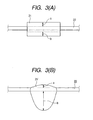
- a platinum wire 22 having a diameter of 0.5 mm ⁇ was put through an inner hole of a cylindrical glass 21 having an outer diameter of 2 mm ⁇ , an inner diameter of 0.8 mm ⁇ , and a length of 5 mm; the glass was held at almost central part 22a of the platinum wire 22 deformed as shown in FIG. 2; both ends 22b of the platinum wire 22 were placed on protruded parts 23a of a refractory 23, and the whole was charged into an electric furnace at 800°C and subjected to thermal treatment for 1 hour. Since the cylindrical glass 21 before thermal treatment is even in thickness as shown in FIG. 3A, a/b equals 1.0. However, when subjected to thermal treatment, as shown in FIG.
- the glass for semiconductor encapsulation according to the invention is friendly to the environment and the semiconductor electronic parts has a heat resistance of 700°C or higher as normal maximum temperature, it is suitable for a thermistor, especially a high-temperature type thermistor.
- the semiconductor electronic parts of the invention is friendly to the environment and has a heat resistance of 700°C or higher as normal maximum temperature, it can be suitably used as a thermistor for measuring temperature of engines of automobiles and the like, boilers, and the like.
Landscapes
- Chemical & Material Sciences (AREA)
- Engineering & Computer Science (AREA)
- Materials Engineering (AREA)
- Life Sciences & Earth Sciences (AREA)
- Chemical Kinetics & Catalysis (AREA)
- General Chemical & Material Sciences (AREA)
- Geochemistry & Mineralogy (AREA)
- Organic Chemistry (AREA)
- Microelectronics & Electronic Packaging (AREA)
- Electromagnetism (AREA)
- Physics & Mathematics (AREA)
- Ceramic Engineering (AREA)
- Glass Compositions (AREA)
- Structures Or Materials For Encapsulating Or Coating Semiconductor Devices Or Solid State Devices (AREA)
- Thermistors And Varistors (AREA)
Abstract
An object of the invention is to provide glass for semiconductor encapsulation and an outer tube for semiconductor encapsulation which are friendly to environment and allow semiconductor electronic parts to have a heat resistance of 700°C or higher as normal maximum temperature, and semiconductor electronic parts. The glass for semiconductor encapsulation according to the invention contains essentially no lead and the temperature at which viscosity reaches 1010 dPa·s is 700°C or higher. According to such a constitution, since the glass contains essentially no lead, no harmful ingredients are discharged in the production of the outer tube for semiconductor encapsulation and in the production of the semiconductor electronic parts and thus the glass is friendly to environment. Moreover, since the temperature at which viscosity reaches 1010 dPa·s is 700°C or higher, semiconductor electronic parts such as a bead thermistor using the same has a heat resistance of 700°C or higher as normal maximum temperature.
Description
- The present invention relates to glass for semiconductor encapsulation to be used for encapsulating a semiconductor to prevent its deterioration, particularly glass for semiconductor encapsulation for encapsulating a semiconductor usable at a high temperature and an outer tube for semiconductor encapsulation, and semiconductor electronic parts.
- A thermistor is one of semiconductor electronic parts and is known as a semiconductor electronic parts, which can determine temperature by measuring electric resistance utilizing a property (having a negative or positive temperature coefficient) that electric resistance of the semiconductor changes depending on increase in temperature.
- Particularly, a
thermistor 10 called a bead thermistor or a glass thermistor includes, as shown in FIG. 1, a semiconductor (thermistor chip) 1, awire lead 2, and glass for semiconductor encapsulation 3 and thethermistor chip 1 and part of thewire lead 2 are covered and encapsulated by the glass for semiconductor encapsulation (glass for thermistor chip encapsulation) 3, the thermistor can be used at a high temperature and under an oxidative atmosphere. In this connection, as thethermistor chip 1, there are oxide-based materials and at least one non-oxide-based material selected from the group consisting of nitride, carbide, boride and silicide, but oxide-based materials have been widely used mainly in view of properties and price. Moreover, as thewire lead 2, Dumet wire (Ni-Fe alloy covered with Cu), platinum wire, and the like have been widely used. - For such glass for thermistor chip encapsulation, the following are required: (1) to have a sufficiently high volume resistivity in the operating temperature range so as not to influence electric resistance property of the thermistor chip; (2) to match a thermal expansion coefficient of the glass with those of the wire lead and the thermistor chip so that cracks do not generate at the time when the wire lead and the thermistor chip are encapsulated; (3) to be able to achieve encapsulation at a temperature lower than heat-resistant temperature of the wire lead and the thermistor chip.
- Hitherto, as glass for thermistor chip encapsulation which satisfies such requirements, there have been proposed PbO-SiO2-B2O3-K2O-based high-lead-content glass (e.g., see Patent Document 1) and alkali borosilicate glass (e.g., see Patent Document 2).
- Patent Document 1:
JP-A-8-67534 - Patent Document 2:
JP-A-2002-37641 - In recent years, environmental pollution by harmful ingredients, such as lead, cadmium, and arsenic, has been at issue. Thus, it has been required that industrial products be free of these harmful ingredients. Therefore, the glass described in
Patent Document 1 cannot be employed from an environmental viewpoint since it contains a harmful ingredient, lead oxide in a large amount. - Moreover, from a standpoint of environmental measures for carbon dioxide reduction and acid rain prevention, it is required to maintain heat sources and combustion systems of power plants at an optimum operation state in order to minimize generation of CO2 and NOx. For maintaining optimum combustion state of gas, oil or the like of the heat sources and combustion systems, it is necessary to directly monitor and automatically control temperature of the combustion atmosphere. However, since the glass thermistor using the glass described in
Patent Documents - The present invention has been achieved in consideration of the above circumstances and an object thereof is to provide glass for semiconductor encapsulation and an outer tube for semiconductor encapsulation which are friendly to environment and allow semiconductor electronic parts to have a heat resistance of 700°C or higher as normal maximum temperature, and semiconductor electronic parts.
- The glass for semiconductor encapsulation of the invention contains essentially no lead and the temperature at which viscosity reaches 1010 dPa·s is 700°C or higher.
- According to such a constitution, since the glass contains essentially no lead, no harmful ingredients are discharged in the production of the outer tube for semiconductor encapsulation and in the production of the semiconductor electronic parts and thus the glass is friendly to environment. Moreover, since the temperature at which viscosity reaches 1010 dPa·s is 700°C or higher, a semiconductor electronic parts using the same, such as a bead thermistor has a heat resistance of 700°C or higher as normal maximum temperature.
- In this case, the heat resistance of the bead thermistor depends on the heat resistance of the glass for encapsulation and the heat resistance can be evaluated with the temperature at which viscosity reaches 1010 dPa·s. Namely, the temperature at which viscosity reaches 1010 dPa·s is a temperature at which glass is deformed only when an external force is imparted. Even when the glass is held at the temperature for a long period of time, edges of the glass are slightly softened and deformed but the shape can be maintained and the glass hardly reacts with the wire lead or the thermistor chip. Therefore, the temperature at which viscosity reaches 1010 dPa·s is about the same as normal maximum temperature of the bead thermistor. When the temperature at which viscosity reaches 1010 dPa·s is 800°C or higher, a semiconductor electronic parts such as a bead thermistor using the same has a heat resistance of 800°C or higher as normal maximum temperature.
- Moreover, in the above constitution, a softening point (Ts) is preferably 800°C or higher.
- In this case, the semiconductor electronic parts such as a bead thermistor using the same can have a heat resistance of 800°C or higher as maximum operating temperature.
- Namely, the softening point is a temperature at which glass is slightly softened and deformed. When the glass is held at the temperature for a short period of time, edges of the glass are slightly softened and deformed but the shape can be maintained. When it is held at the temperature for a long period of time, thickness of the glass changes with change in shape of the glass, so that thermistor properties may be sometimes influenced. Therefore, the softening point is about the same as maximum operating temperature of the bead thermistor. When the softening point is 900°C or higher, the semiconductor electronic parts such as a bead thermistor using the same has a heat resistance of 900°C or higher as maximum operating temperature.
- In this connection, the above-mentioned normal maximum temperature means a maximum temperature at which the properties are hardly deteriorated even when the thermistor is continued to use and the maximum operating temperature means a maximum temperature at which the thermistor is durable for use when the use is only for a short period of time.
- In the above constitution, a strain point (Ps) is preferably 570°C or higher.
- In such a constitution, it is easy to obtain glass wherein the temperature at which viscosity reaches 1010 dPa·s is 700°C or higher. Moreover, when the strain point is 640°C or higher, it is easy to obtain glass wherein the temperature at which viscosity reaches 1010 dPa·s is 800°C or higher, so that the case is more preferred.
- In this case, the strain point is preferably 750°C or lower. Namely, stress generated at the interface between the glass for encapsulation and the wire lead or the semiconductor such as the thermistor chip is proportional to the product of the difference in thermal expansion coefficient therebetween and the difference between the strain point and room temperature. Accordingly, the larger the difference between the strain point and room temperature is, the larger the above stress is. Therefore, when the strain point exceeds 750°C, an allowable difference in thermal expansion coefficient between the glass for encapsulation and the wire lead or the semiconductor such as the thermistor chip decreases. The strain point is more preferably 710°C or lower.
- In the above constitution, it is preferable that the temperature at which viscosity reaches 1011 dPa·s is 650°C or higher, preferably 750°C or higher.
- In the above constitution, difference between the temperature at which the viscosity reaches 104 dPa·s (T(104)) and the strain point (Ps) (T(104)-Ps) is preferably 350°C or more.
- In such a constitution, as methods for preparing an outer tube for encapsulation using the glass for semiconductor encapsulation, Danner method, Vello method, Down-Draw method, and Up-Draw method are suitable. In these methods, the production of an outer tube for encapsulation is facilitated. Namely, in the glass for semiconductor encapsulation, when (T(104)-Ps) is smaller than 350°C, viscosity of the glass widely changes in the case where the variation of forming temperature becomes large. Accordingly, it is difficult to produce an outer tube having a desired shape and as a result, there is a possibility that a yield ratio may decrease.
- Moreover, in the case of producing a thermistor using the outer tube, when (T(104)-Ps) is 350°C or more in the glass for semiconductor encapsulation, processing for encapsulation is facilitated in the semiconductor electronic parts such as a thermistor. Namely, in the glass for semiconductor encapsulation, when (T(104)-Ps) is smaller than 350°C, viscosity of the glass widely changes in the case where the variation of encapsulation temperature becomes large. Therefore, when a semiconductor such as a thermistor chip is melt-encapsulated by softening the outer tube, the shape of the glass for encapsulation tends to change. When thickness of the glass covering the semiconductor such as a thermistor chip is uneven, heat conduction also varies. Accordingly, properties of semiconductor electronic parts such as thermistor also varies and as a result, a yield ratio of the semiconductor electronic parts such as thermistor decreases. In particular, when (T(104)-Ps) is 500°C or more, it becomes possible to increase index of processing for encapsulation (production amount per unit time) since the glass for encapsulation can be processed at a constant shape without deformation of the glass even when the variation of encapsulation temperature becomes large in the case that encapsulation temperature is raised to shorten encapsulation time. In this connection, a preferable range of (T(104)-Ps) is from 500 to 830°C. When (T(104)-Ps) exceeds 830°C, time required for solidification of the glass to such an extent that it does not deform is too much and hence production efficiency becomes worse, so that the case is not preferred.
- Also, in the above constitution, an average thermal expansion coefficient in the temperature range of 30 to 380°C is preferably from 60 × 10-7 to 100 × 10-7/°C.
- In such a constitution, the thermal expansion coefficient of the semiconductor such as thermistor chip or the wire lead becomes cross to that of the glass for encapsulation and hence cracks are hardly generated and thus the glass is hardly broken when the wire lead and the semiconductor such as thermistor chip are encapsulated. Moreover, in the case that the glass is not broken at the time of encapsulation, a strong strain may result in and there is a possibility of breakage when impact is applied during its use. A preferable range of the average thermal expansion coefficient is from 70 × 10-7 to 90 × 10-7/°C.
- In the above constitution, volume resistivity (Ωcm) at 500°C is preferably 5 or more in terms of Log ρ.
- In such a constitution, volume resistivity of the glass does not influence electric properties of the semiconductor such as thermistor chip. Namely, when volume resistivity (Ωcm) of the glass at 500°C is lower than 5 in terms of Log p, electric current may slightly flow between the wire leads at the place where the semiconductor such as thermistor chip is not present and thus a circuit having a resistor is generated parallel to the semiconductor, thereby properties of the semiconductor electronic parts being changed.
- Moreover, in the above constitution, the glass for encapsulation is preferably a highly acid-resistant glass which is not clouded on its surface after 1 hour of immersion in a 50% by mass aqueous sulfuric acid solution at 80°C and has a weight reduction of 0.05 mg/cm2 or less as compared with the weight before immersion.
- In such a constitution, even when a thermistor using the same is used in a combustion atmosphere, the glass is hardly eroded by NOx or SOx gas and thus deterioration of the thermistor is not observed.
- Furthermore, in the above constitution, the temperature at which viscosity reaches 102.5 dPa·s is preferably 1600°C or lower.
- In such a constitution, melting temperature is not high, a large amount of combustion energy is not consumed, life of a melting furnace is lengthened, and also melting efficiency does not decrease.
- Moreover, in the above constitution, the temperature at which viscosity reaches 104 dPa·s is preferably 1400°C or lower.
- In such a constitution, encapsulation temperature is not higher than heat-resistant temperature of the wire lead (e.g., platinum wire, Ni-plated Dumet wire, Fe-Ni alloy wire, or the like) and also efficiency of processing for encapsulation does not decrease. Moreover, the glass wherein the temperature at which viscosity reaches 104 dPa·s is 1400°C or lower has a tendency that the temperature at which viscosity reaches 1010 dPa·s is 900°C or lower and the softening point is 1000°C or lower, so that it is possible for a bead thermistor to have heat resistance of 900°C or lower as normal maximum temperature and of 1000°C or lower as maximum operating temperature.
- Furthermore, in the above constitution, liquid phase viscosity is preferably higher than 104-3 dPa·s, more preferably higher than 105.0 dPa·s.
- In such a constitution, at the time when an outer tube for encapsulation is produced using Danner method, Vello method, Down-Draw method, or Up-Draw method, crystals are hardly deposited (hardly devitrified), so that the case is preferred. Namely, when crystals are deposited, viscosity of neighboring glass increases and dimensional accuracy of the outer tube tends to become worse.
- Specifically, It is preferred that the glass for semiconductor encapsulation of the invention comprises: SiO2 in an amount of from 40 to 80%; Al2O3 in an amount of from 1 to 20%; B2O3 in an amount of from 0 to 13%; MgO in an amount of from 0 to 10%; CaO in an amount of from 0 to 10%; SrO in an amount of from 0 to 20%; BaO in an amount of from 0 to 20%; ZnO in an amount of from 0 to 10%; Na2O in an amount of from 0 to 8%; K2O in an amount of from 0 to 18%; and at least one member selected from the group consisting of ZrO2, Nb2O5, WO3 and Ta2O5 in an amount of from 0 to 20%, said glass containing Na2O and K2O in a total amount of from 3 to 15% and at least one member selected from the group consisting of MgO, CaO, SrO, BaO and ZnO in an amount of from 0 to 40%, in terms of % by mass.
- Moreover, it is more preferred that the glass for semiconductor encapsulation of the invention comprises: SiO2 in an amount of from 50 to 80%; Al2O3 in an amount of from 1 to 20%; B2O3 in an amount of from 0 to 10%; MgO in an amount of from 0 to 8%; CaO in an amount of from 0 to 8%; SrO in an amount of from 0 to 20%; BaO in an amount of from 0 to 10%; ZnO in an amount of from 0 to 5%; Na2O in an amount of from 0 to 4%; and K2O in an amount of from 0 to 18%, said glass containing Na2O and K2O in a total amount of from 3 to 15%, at least one member selected from the group consisting of MgO, CaO, SrO, BaO and ZnO in an amount of from 0 to 40%, and at least one member selected from the group consisting of ZrO2, Nb2O5, WO3 and Ta2O5 in an amount of from 0.1 to 20%, in terms of % by mass.
- In addition, it is further preferred that the glass for semiconductor encapsulation of the invention comprises: SiO2 in an amount of from 50 to 70%; Al2O3 in an amount of from 1 to 10%; B2O3 in an amount of from 0 to 3%; MgO in an amount of from 0 to 8%; CaO in an amount of from 0 to 8%; SrO in an amount of from 4 to 20%; BaO in an amount of from 0 to 6%; ZnO in an amount of from 0 to 3%; Na2O in an amount of from 0 to 4%; and K2O in an amount of from 3 to 14%; said glass containing Na2O and K2O in a total amount of from 3 to 15%, at least one member selected from the group consisting of ZrO2, Nb2O5, WO3 and Ta2O5 in an amount of from 3 to 20%, and at least one member selected from the group consisting of MgO, CaO and SrO in an amount of from 4 to 20%, in terms of % by mass.
- The reasons for restricting the content of each component as mentioned above are as follows.
- SiO2 is a network former and a component increasing the temperature at which viscosity reaches 1010 dPa·s and the strain point. The content thereof is from 40 to 80%, preferably from 50 to 80%, further preferably from 50 to 70%. When the content of SiO2 is 40% or more, the glass is excellent in chemical resistance, particularly acid resistance. Moreover, when the content of SiO2 is 80% or less, high-temperature viscosity is not too high and the thermal expansion coefficient of the glass matches with that of the wire lead or semiconductor, so that a good sealing can be achieved. Furthermore, when the content of SiO2 is 50% or more, the temperature at which viscosity reaches 1010 dPa·s is hardly lowered from 700°C and the strain point of the glass is hardly lowered from 570°C and the glass is excellent in heat resistance, so that the case is preferred. When the content of SiO2 is 70% or less, meltability is improved and also the glass is hardly devitrified and liquidus viscosity is improved, so that the case is preferred.
- Al2O3 is a component increasing the temperature at which viscosity reaches 1010 dPa·s and the strain point and improving chemical resistance. The content thereof is from 1 to 20%, preferably from 1 to 10%. When the content of Al2O3 is 1% or more, the temperature at which viscosity reaches 1010 dPa·s tends to be 700°C or higher and the strain point of the glass tends to be 570°C or higher and the glass is excellent in heat resistance, the glass is not deformed nor eroded even at a high temperature and under an acidic atmosphere and thus excellent in heat resistance and acid resistance, so that the case is preferred. When the content of Al2O3 is 20% or less, the high-temperature viscosity of the glass hardly increases and solubility is improved. In particular, when the content of Al2O3 is 10% or less, the glass is hardly devitrified at the production of the outer tube, so that the case is preferred.
- B2O3 has effects of lowering the high-temperature viscosity to enhance formability and meltability of the glass and increasing volume resistivity. The content thereof is 13% or less, preferably 10% or less, further preferably 3% or less, and particularly preferably, the glass does not essentially contain the same. When the content of B2O3 exceeds 13%, the strain point tends to be lowered from 570°C, so that the case is not preferred. When the content of B2O3 is 10% or less, the temperature at which viscosity reaches 1010 dPa·s is hardly lowered from 700°C and the value of T(104)-Ps is hardly lowered from 350°C, so that the case is preferred. Furthermore, when the content of B2O3 is 3% or less, the glass is not deformed nor eroded even at a high temperature and under an acidic atmosphere such as exhaust gas, so that the case is preferred.
- MgO and CaO are components which lower the high-temperature viscosity to enhance formability and meltability of the glass and elevate the temperature at which viscosity reaches 1010 dPa·s and the strain point. The content of each of them is from 0 to 10%, preferably from 0 to 8%. When the content of MgO or CaO is 10% or less, liquidus temperature is hardly elevated (liquidus viscosity is hardly lowered) and hence the production of the outer tube is facilitated. Moreover, when the content of MgO or CaO is 8% or less, chemical resistance is more improved, so that the case is particularly preferred.
- SrO enhances formability and meltability of the glass with hardly lowering the temperature at which viscosity reaches 1010 dPa·s and the strain point. Moreover, it is a component allowing the glass to be hardly devitrified as compared with MgO and CaO. Particularly, when the glass contains ZrO2 in an amount of 5% or more, there is an effect of suppressing deposition of crystals containing ZrO2 (effect of lowering liquidus temperature) at forming, so that it is more preferred to incorporate SrO so that SrO/ZrO2 becomes 1 or more. The content thereof is from 0 to 20%, preferably from 4 to 20%. When the content of SrO is 20% or less, the liquidus temperature is hardly elevated (liquidus viscosity is hardly lowered). Furthermore, when the content of SrO is 4% or more, the high-temperature viscosity is lowered and an effect of enhancing meltability is enhanced, so that the case is preferred.
- BaO is a component which lowers the high-temperature viscosity to enhance formability and meltability of the glass and allows the glass to be hardly devitrified as compared with MgO and CaO and also is a component which lowers the temperature at which viscosity reaches 1010 dPa·s and the strain point. The content thereof is from 0 to 20%, preferably from 0 to 10%, more preferably from 0 to 6%. When the content of BaO is 20% or less, the glass is hardly devitrified and thereby forming is facilitated and a glass formed article having a high dimensional accuracy is obtained, so that the case is preferred. Moreover, when the content of BaO is 10% or less, the temperature at which viscosity reaches 1010 dPa·s is hardly lowered from 700°C and the strain point is hardly lowered from 570°C, so that the case is preferred.
- ZnO is a component which lowers viscosity of the glass to enhance formability and meltability of the glass. The content of ZnO is from 0 to 10%, preferably from 0 to 5%, further preferably from 0 to 3%. When the content of ZnO is 10% or less, the glass is hardly devitrified and when the content of ZnO is 5% or less, the strain point of the glass is hardly lowered from 570°C, so that the case is preferred. Furthermore, when the content of ZnO is 3% or less, the temperature at which viscosity reaches 1010 dPa·s is hardly lowered from 700°C, so that the case is preferred.
- Na2O is a component which enhances thermal expansion coefficient of the glass and also enhances meltability of the glass, lowers encapsulation temperature, and improves processing ability since Na2O lowers viscosity of the glass. The content of Na2O is from 0 to 8%, preferably from 0 to 4%. When the content of Na2O is 8% or less, the strain point of the glass is hardly lowered from 570°C, so that the case is preferred. Furthermore, when the content of Na2O is 4% or less, the volume resistivity (Ωcm) at 500°C tends to be 5 or more in terms of Log p, so that the case is preferred.
- K2O is a component which enhances thermal expansion coefficient of the glass and also lowers viscosity of the glass although the lowering degree is not so much as in the case of Na2O In addition, K2O has a characteristic that it does not so much lower the volume resistivity as compared with Na2O. The content thereof is from 0 to 18%, preferably from 3 to 14%. When the content of K2O is 18% or less, the temperature at which viscosity reaches 1010 dPa·s is hardly lowered from 700°C and the strain point of the glass is hardly lowered from 570°C. Furthermore, when the content of K2O is 3% or more, the high-temperature viscosity is lowered and the meltability is enhanced, so that the case is preferred. When the content of K2O is 14% or less, chemical resistance of the glass is hardly lowered, so that the case is preferred.
- ZrO2, Nb2O5, WO3 and Ta2O5 elevate the temperature at which viscosity reaches 1010 dpa·s and the strain point and also lower high-temperature viscosity of the glass to enhance the meltability. Particularly, ZrO2 is a component which enhances chemical resistance of the glass. The content of at least member selected from the group consisting of ZrO2, Nb2O5, WO3 and Ta2O5 is from 0 to 20%. When the content of at least one member selected from the group consisting of ZrO2, Nb2O5, WO3 and Ta2O5 is 20% or less, the glass is hardly devitrified, so that the case is preferred. Moreover, a preferable range of the content of at least one member selected from the group consisting of ZrO2, Nb2O5, WO3 and Ta2O5 is from 0.01 to 20%, more preferably from 3 to 20%, and particularly preferably from 6 to 11%. When the content thereof is 0.01% or more, the temperature at which viscosity reaches 1010 dPa·s is hardly lowered from 700°C and the strain point of the glass is hardly lowered from 570°C, so that the case is preferred. When the content thereof is 6% or more, the heat resistance is particularly high. A more preferable range of the content of ZrO2 is from 3 to 20% and further preferably from 6 to 11%.
- P2O5 has an effect of suppressing devitrification of the glass. The content thereof is from 0 to 3% and a preferable range is from 0.01 to 1%. When the content of P2O5 exceeds 3%, the glass generates phase separation and becomes opaque in the encapsulation step and thus it becomes difficult to find out defects in encapsulation at inspection of semiconductor electronic parts, so that the case is not preferred. Also, acid resistance of the glass tends to be lowered owing to the phase separation, so that the case is not preferred.
- Moreover, Na2O or K2O which is an alkali metal oxide is an essential component for facilitating glass melting, lowering encapsulation temperature, and maintaining the thermal expansion coefficient at a high level. Therefore, the total amount of Na2O and K2O is preferably from 3 to 15%. Namely, when the total amount thereof is less than 3%, the thermal expansion coefficient is lowered from 60 × 10-7/°C, so that the case is not preferred. Moreover, when the total amount thereof is more than 15%, the chemical resistance and electric insulating ability tend to become worse and the temperature at which viscosity reaches 1010 dPa·s tends to be lowered from 700°C and the strain point of the glass tends to be lowered from 570°C, so that the case is not preferred. In this connection, Li2O may be incorporated in an amount of 5% or less. However, since the above effects are higher as compared with the cases of Na2O and K2O but it tends to deteriorate the chemical resistance and electric insulating ability, the glass more preferably contains essentially no Li2O.
- Furthermore, since MgO, CaO, SrO, BaO and ZnO elevate the thermal expansion coefficient and lower the high-temperature viscosity, they are components capable of increasing meltability of the glass, lowering encapsulation temperature, and facilitating processing for encapsulation. The content of at least one member selected from the group consisting of MgO, CaO, SrO, BaO and ZnO is preferably from 0 to 40%. When the content of at least one member selected from the group consisting of MgO, CaO, SrO, BaO and ZnO is 40% or less, the thermal expansion coefficient is hardly enhanced from 90 × 10-7/°C, so that the case is preferred. Particularly, MgO, CaO, and SrO are components which elevate the temperature at which viscosity reaches 1010 dPa·s and the strain point of the glass. When the content of at least one member selected from the group consisting of MgO, CaO and SrO is 4% or more, the temperature at which viscosity reaches 1010 dPa·s is hardly lowered from 700°C and the strain point of the glass is hardly lowered from 570°C, so that the case is preferred. When the content thereof is 20% or less, the glass is hardly devitrified and forming is facilitated, so that the case is also preferred.
- In addition, Al2O3/(Na2O + K2O) is preferably 0.35 or more in terms of % by mass. As mentioned above, Al2O3 is a component increasing the temperature at which viscosity reaches 1010 dPa·s and the strain point and improving acid resistance. To the contrary, Na2O and K2O are components lowering the temperature at which viscosity reaches 1010 dPa·s and the strain point and deteriorating acid resistance. Therefore, when Al2O3/(Na2O + K2O) is 0.35 or more, the temperature at which viscosity of the glass for encapsulation reaches 1010 dPa·s tends to be 700°C or higher, the strain point of the glass tends to be 570°C or higher, and acid resistance is hardly lowered, so that the case is preferred. A preferable range of Al2O3/(Na2O + K2O) is from 0.4 to 6.
- Moreover, other than the above, for the purpose of controlling viscosity of the glass and improving chemical resistance, meltability, refining ability, and the like, it is possible to add components such as SnO2 SO3, Sb2O3, F and Cl each in an amount of 3% or less in terms of oxide. In this connection, As2O3 also has a refining effect but its addition is not preferred from an environmental viewpoint. TiO2 is a component enhancing chemical resistance and may be incorporated in an amount of 10% or less.
- Furthermore, when an Fe2+ ion increases in the glass, the glass tends to absorb an infrared ray and temperature of the glass is needlessly elevated, so that the temperature cannot be correctly measured and thus the case is not preferred. For such a reason, the content of Fe2O3 is preferably 2% or less and particularly, Fe2+/total Fe (mass ratio) is preferably 0.4 or less. In order to control Fe 2+/total Fe (mass ratio) to 0.4 or less, it is convenient to melt the glass in an oxidative atmosphere.
- In addition, the outer tube for semiconductor encapsulation of the invention comprises the glass for semiconductor encapsulation possessing any constitution as mentioned above.
- Such an outer tube for semiconductor encapsulation is friendly to the environment and a semiconductor electronic parts produced using the same can have heat resistance of 700°C or higher as normal maximum temperature. Furthermore, since acid resistance and volume resistivity of the glass are high and matching in thermal expansion coefficient with the wire lead and semiconductor is excellent, an excellent high-temperature type thermistor can be produced, which is capable of measuring a temperature of 700°C or higher in common use.
- Moreover, the semiconductor electronic parts of the invention comprises a semiconductor, a wire lead, and glass for semiconductor encapsulation for covering and encapsulating the semiconductor and part of the wire lead, wherein the glass for semiconductor encapsulation comprises the glass for semiconductor encapsulation possessing any constitution as mentioned above.
- Such a semiconductor electronic parts is friendly to the environment and can have heat resistance of 700°C or higher as normal maximum temperature. Furthermore, since acid resistance and volume resistivity of the glass are high and matching in thermal expansion coefficient with the wire lead and semiconductor is excellent, the parts may be an excellent high-temperature type thermistor, which is capable of measuring a temperature of 700°C or higher in common use.
- The following will describe a process for producing the outer tube for semiconductor encapsulation comprising the glass for semiconductor encapsulation according to the invention.
- The process for producing the outer tube in an industrial scale includes a mixing and blending step wherein minerals and purified crystal powders containing components forming the glass are measured and mixed and raw materials to be charged into a furnace are blended, a melting step wherein the raw materials are melted and vitrified, a forming step wherein the melted glass is formed into a tube shape, and a processing step wherein the tube is cut into a predetermined size.
- First, glass raw materials are blended. The raw materials include minerals containing a plurality of components such as oxides and carbonates and impurities. They may be blended in consideration of analytical data and the raw materials are not restricted. These are weighted and mixed in an appropriate mixer according to a scale, such as a V mixer, a rocking mixer, a mixer fitted with mixing blades, to obtain a charging raw material.
- Then, the raw material is charged into a glassmelting furnace and vitrified. The melting furnace includes a melter tank for melting and vitrifying the glass raw material, a refiner for removing bubbles in the glass, and a feeder for lowering viscosity of the refined glass to an appropriate degree for forming and feeding it into a forming apparatus. As the melting furnace, a furnace inside of which is covered with refractory or platinum is used, which is heated by burner or by electrification into the glass. The charged raw material is vitrified in a melter usually at 1300°C to 1600°C and then is transferred into a refiner at 1400°C to 1600°C. In the refiner, the bubbles in the glass are allowed to come to the surface to remove the bubbles. The glass discharged from the refiner is cooled during the transfer into the forming apparatus through the feeder and its viscosity becomes 104 to 106 dPa·s which is suitable for forming the glass.
- Then, the glass is formed into a tubular form by a forming apparatus. As forming methods, Danner method, Vello method, Down-Draw method, and Up-Draw method are applicable.
- Thereafter, an outer tube for semiconductor encapsulation can be obtained by cutting the glass tube into a predetermined size. For cutting processing of the glass tube, it is possible to cut the tube one by one with a diamond cutter but, as a suitable method for mass production, there is commonly used a method of bonding a large number of the glass tubes into one article and cutting it with a diamond wheel cutter to cut a large number of the glass tubes at once.
- The following will describe a method of encapsulating a semiconductor element using the outer tube comprising the glass of the invention.
- First, electrode materials such as Dumet wires or platinum wires are set using a jig so that a semiconductor element are held between the materials from both sides in the outer tube. Thereafter, the whole is heated at a temperature of 1400°C or lower to soften and deform the outer tube, whereby the element is air-tightly encapsulated. In such a manner, a small-size electronic parts such as silicon diode, light-emitting diode, or thermistor can be produced.
- In this connection, in addition to the use as a glass tube, the glass for semiconductor encapsulation can be pulverized to form a paste and a semiconductor element can be encapsulated by sintering the glass with wrapping the paste around the semiconductor element.
- As mentioned above, since the glass for semiconductor encapsulation of the invention contains essentially no lead and the temperature at which viscosity reaches 1010 dPa·s is 700°C or higher, it is friendly to the environment and the semiconductor electronic parts produced using the same can have a heat resistance of 700°C or higher as normal maximum temperature.
-
- FIG. 1 is an explanatory drawing showing conventional and inventive thermistor.
- FIG. 2 is a schematic explanatory drawing of a heat resistance-evaluating method.
- FIG. 3 shows shapes of a glass in the heat resistance-evaluating method, (A) showing a shape of the glass before thermal treatment and (B) showing a shape of the glass after thermal treatment.
-
- 1 semiconductor (thermistor chip)
- 2 wire lead
- 3 glass for semiconductor encapsulation (glass for thermistor chip encapsulation)
- 10 thermistor
- 21 cylindrical glass
- 21' glass after thermal treatment
- 22 platinum wire
- 23 refractory
- The following will explain the invention in detail with reference to Examples.
- Table 1 shows Examples 1 to 5 of the invention, Table 2 shows Examples 6 to 9, Table 3 shows Examples 10 to 14, Table 4 shows Examples 15 to 19, and Table 5 shows Examples 20 to 23 and Comparative Example.
- First, stone powder, aluminum oxide, boric acid, magnesium oxide, calcium carbonate, strontium carbonate, barium carbonate, zinc oxide, lithium carbonate, sodium carbonate, potassium carbonate, potassium nitrate, zirconium oxide, niobium oxide, tungsten oxide, tantalum oxide, phosphate salts, sodium chloride, sodium sulfate, antimony oxide, and stannic oxide were blended so as to be predetermined ratios in consideration of yield ratios and amounts of impurities, followed by thorough mixing in a mixer.
- The resulting raw material was melted in a glassmelting furnace at 1500°C to 1600°C and formed into a tubular form by Down-Draw method. Thereafter, it was cut and a glass tube having an appropriate length (e.g., 1 m) was obtained. In the case of an outer tube for a bead thermistor, inner diameter of the tube is from 0.6 to 2.1 mm and the thickness is from 0.2 to 0.8 mm. The inner diameter and thickness of the tube was controlled by falling speed of the glass, air pressure, and drawing speed. Then, several hundreds to several thousands of the above-mentioned glass tubes were bound at once with a resin and collectively cut into a length of 1 mm to 4 mm. Finally, the resin was removed and the tubes were separated into pieces to obtain glass outer tubes.
- Moreover, on each sample, the thermal expansion coefficient, the density, the strain point, the temperatures at which viscosity reaches 1010 dPa·s, 104 dPa·s and 102.5 dPa·s, the softening point, the temperature subtracting strain point from temperature at which the viscosity reaches 104 dPa·s, (T(104)-Ps), and the volume resistivity at 500°C were measured. These results are shown in each table.
Table 1 (% by mass) Example 1 Example 2 Example 3 Example 4 Example 5 SiO2 64.2 55.8 62.7 60.0 62.1 Al2O3 8.0 6.9 7.2 7.0 7.4 B2O3 - - - 3.0 - MgO 3.7 3.4 - - 1.2 CaO 3.3 4.1 3.9 4.1 2.8 SrO 6.7 8.0 9.7 9.7 7.7 BaO 2.6 5.0 0.1 0.2 0.3 ZnO - 2.0 - - - Na2O 0.7 3.5 0.5 0.5 0.3 K2O 7.0 8.0 10.5 10.3 9.5 ZrO2 3.5 3.0 5.0 4.8 8.0 P2O5 0.1 0.1 0.2 0.2 0.5 Cl - 0.1 - - - SO3 0.2 0.1 0.1 0.1 - Sb2O3 - - 0.1 - 0.2 SnO2 - - - 0.1 - Na2O+K2O 7.7 11.5 11.0 10.8 9.8 MgO+CaO+SrO+BaO+ZnO 16.3 22.5 13.7 14.0 12.0 MgO+CaO+SrO 13.7 15.5 13.6 13.8 11.7 Al2O3/(Na2O+K2O) 1.04 0.60 0.65 0.65 0.76 Theremal expansion coefficient (×10-7/°C) 60.5 82.3 70.9 69.9 62.2 Density (g/cm3) 2.612 2.720 2.634 2.632 2.650 Strain point (°C) 678 596 668 631 703 Temperature at which viscosity reaches 1011 dPa·s (°C) 786 704 788 755 818 Temperature at which viscosity reaches 1010 dPa·s (°C) 826 741 829 798 858 Softening point (°C) 952 851 944 927 980 Temperature at which viscosity reaches 104 dPa·s (°C) 1310 1131 1295 1250 1350 Temperature at which viscosity reaches 102.5 dPa·s (°C) 1590 1498 1574 1544 1594 T(104)-Ps (°C) 632 535 627 619 647 Liquidus temperature (°C) 1193 1043 1180 1125 1244 Log liquidus viscosity 4.9 4.8 4.9 5.1 4.8 Volume resistivity Log ρ (500°C) 5.4 No Data No Data No Data No Data Heat resistance O O O O O Acid resistance O No Data No Data No Data O Table 2 (% by mass) Example 6 Example 7 Example 8 Example 9 SiO2 64.3 69.0 75.8 60.7 Al2O3 5.8 11.0 4.8 6.9 B2O3 - - - - MgO 1.8 - - 3.7 CaO 2.3 - - 3.3 SrO 4.7 4.6 3.1 6.7 BaO 5.6 - 2.2 2.6 ZnO 5.0 - - - Na2O 4.7 4.9 - 0.7 K2O 5.6 9.6 13.4 11.5 ZrO2 - - 0.5 3.5 P2O5 - 0.7 - 0.2 SO3 0.2 - - - Sb2O3 - - 0.2 0.1 SnO2 - 0.2 - 0.1 Na2O+K2O 10.3 14.5 13.4 12.2 MgO+CaO+SrO+BaO+ZnO 19.4 4.6 5.3 16.3 MgO+CaO+SrO 8.8 4.6 3.1 13.7 Al2O3/(Na2O+K2O) 0.56 0.76 0.36 0.57 Theremal expansion coefficient (×10-7/°C) 72-1 74.4 63.9 75.4 Density (g/cm3) 2.585 2.448 2.382 2.633 Strain point (°C) 571 575 587 642 Temperature at which viscosity reaches 1011 dPa·s (°C) 705 724 734 766 Temperature at which viscosity reaches 1010 dPa·s (°C) 737 780 792 805 Softening point (°C) 865 950 971 922 Temperature at which viscosity reaches 104 dPa·s (°C) 1187 1324 1383 1253 Temperature at which viscosity reaches 102.5 dPa·s (°C) 1502 1540 1588 1537 T(104)-Ps (°C) 616 749 796 611 Liquidus temperature (°C) No Data 1226 1265 1094 Log liquidus viscosity No Data 4.8 4.9 5.3 Volume resistivity Log ρ (500°C) No Data No Data No Data 6.1 Heat resistance O O O O Acid resistance No Data O O O Table 3 (% by mass) Example 10 Example 11 Example 12 Example 13 Example 14 SiO2 61.9 57.1 54.1 61.4 59.9 Al2O3 6.9 6.9 6.9 6.9 6.9 B2O3 - - 3.0 - - MgO 5.7 - - 3.7 3.7 CaO 3.3 6.3 6.3 3.3 3.3 SrO 6.7 9.7 9.7 6.7 6.7 BaO 0.6 0.1 0.1 2.6 2.6 ZnO - - - - 2.0 Na2O 0.7 0.7 0.7 0.7 0.7 K2O 10.5 10.5 10.5 10.5 10.5 ZrO2 3.5 8.5 8.5 3.5 3.5 P2O5 - - - 0.5 - Cl - 0.1 - - SO3 0.2 0.1 - - - Sb2O3 - - 0.2 0.1 0.1 SnO2 - - - 0.1 0.1 Na2O+K2O 11.2 11.2 11.2 11.2 11.2 MgO+CaO+SrO+BaO+ZnO 16.3 16.1 16.1 16.3 18.3 MgO+CaO+SrO 15.7 16.1 16.0 13.7 13.7 Al2O3/(Na2O+K2O) 0.62 0.62 0.62 0.62 0.62 Theremal expansion coefficient (× 10-7/°C) 71.4 74.5 73.8 72.6 73.5 Density (g/cm3) 2.609 2.744 2.742 2.628 2.670 Strain point (°C) 652 695 658 649 641 Temperature at which viscosity reaches 1011 dPa·s (°C) 772 810 771 772 762 Temperature at which viscosity reaches 1010 dPa·s (°C) 812 846 808 813 800 Softening point (°C) 926 950 911 931 917 Temperature at which viscosity reaches 104 dPa·s (°C) 1248 1247 1202 1262 1239 Temperature at which viscosity reaches 1025 dPa·s (°C) 1530 1508 1453 1557 1518 T(104)-Ps (°C) 596 552 544 613 599 Liquidus temperature (°C) 1165 1189 1142 1110 1121 Log liquidus viscosity 4.7 4.5 4.5 5.3 5.0 Volume resistivity Log ρ (500°C) No Data No Data No Data No Data No Data Heat resistance O O O O O Acid resistance No Data No Data No Data O No Data Table 4 (% by mass) Example 15 Example 16 Example 17 Example 18 Example 19 SiO2 56.7 56.7 54.7 55.8 55.7 Al2O3 6.9 8.9 6.9 6.9 6.9 MgO 2.0 2.0 2.0 2.0 2-0 CaO - - - - - SrO 10.7 10.7 10.7 10.7 10.7 BaO 2.6 2.6 2.6 2.6 2.6 ZnO - - - - - Na2O 0.7 0.7 0.7 0.7 0.7 K2O 11.5 11.5 11.5 11.5 11.5 ZrO2 8.5 6.5 8.5 8.5 8.5 P2O5 0.2 0.2 0.2 0.2 0.2 Nb2O5 - - 2.0 - - WO3 - - - 1.0 - Ta2O5 - - - - 1.0 Cl - - - - 0.1 SO3 - - 0.2 0.1 0.1 Sb2O3 - 0.2 - - SnO2 0.2 - - - - Na2O+K2O 12.2 12.2 12.2 12.2 12.2 MgO+CaO+SrO+BaO+ZnO 15.3 15.3 15.3 15.3 15.3 MgO+CaO+SrO 12.7 12.7 12.7 12.7 12.7 Al2O3/(Na2O+K2O) 0.57 0.73 0.57 0.57 0.57 Theremal expansion coefficient (× 10-7/°C) 73.8 74.7 74.0 73.5 73.2 Density (g/cm3) 2.748 2.715 2.790 2.773 2.778 Strain point (°C) 691 686 697 694 696 Temperature at which viscosity reaches 1011 dPa·s (°C) 815 812 819 816 821 Temperature at which viscosity reaches 1010 dPa·s (°C) 856 853 858 857 862 Softening point (°C) 971 971 968 971 976 Temperature at which viscosity reaches 104 dPa·s (°C) 1291 1303 1274 1282 1288 Temperature at which viscosity reaches 1025 dPa·s (°C) 1564 1586 1530 1542 1550 T(104)-Ps (°C) 600 617 577 588 592 Liquidus temperature (°C) impossible to measure impossible to measure impossible to measure impossible to measure impossible to measure Log liquidus viscosity impossible to measure impossible to measure impossible to measure impossible to measure impossible to measure Volume resistivity Log ρ (500°C) 6.4 No Data No Data No Data No Data Heat resistance O O O O O Acid resistance O No Data No Data No Data No Data Table 5 (% by mass) Example 20 Example 21 Example 22 Example 23 Comparative Example SiO2 56.7 66.5 62.8 54.5 43.1 Al2O3 6.9 3.7 7.9 7.1 3.0 B2O3 - - - - 15.0 MgO 2.0 6.5 3.6 1.9 2.5 CaO 0.1 2.5 2.1 - SrO 10.7 13.2 6.5 8.9 5.6 BaO 2.6 0.1 0.1 8.5 11.0 ZnO - - - - 5.5 Li2O - - - - 3.4 Na2O 0.7 3.2 2.4 5.3 - K2O 11.5 6.0 12.5 7.0 10.6 ZrO2 - 0.5 0.5 4.6 - P2O5 0.2 - 1.0 - - Ta2O5 8.5 - - - - Cl - 0.1 - - - SO3 - 0.1 0.2 0.1 - Sb2O3 0.2 - - - 0.3 Na2O+K2O 12.2 9.2 14.9 12.3 10.6 MgO+CaO+SrO+BaO+ZnO 15.3 19.9 12.7 21.4 24.6 MgO+CaO+SrO 12.7 19.8 12.6 12.9 8.1 Al2O3/(Na2O+K2O) 0.57 0.40 0.53 0.58 0.28 Theremal expansion coefficient (×10-7/°C) 77.2 73.1 84.7 87.9 88.0 Density (g/cm3) 2.782 2.626 2.533 2.830 2.858 Strain point (°C) 641 588 591 572 475 Temperature at which viscosity reaches 1011 dPa·s (°C) 763 700 711 680 530 Temperature at which viscosity reaches 1010 dPa·s (°C) 803 738 753 717 559 Softening point (°C) 918 850 880 825 628 Temperature at which viscosity reaches 104 dPa·s (°C) 1255 1181 1227 1132 794 Temperature at which viscosity reaches 102.5 dPa·s (°C) 1547 1487 1555 1408 947 T(104)-Ps (°C) 614 593 636 560 319 Liquidus temperature (°C) 1164 1050 1136 1010 822 Log liquidus viscosity 4.7 5.1 4.7 5.1 3.7 Volume resistivity Log ρ (500°C) No Data No Data No Data No Data No Data Heat resistance O O O O × Acid resistance No Data No Data No Data No Data × - As is apparent from Tables, in each of Examples 1 to 23 of the invention, the strain point was 570°C or higher and the temperature at which viscosity reaches 1010 dPa·s was 700°C or higher, so that the products were excellent in heat resistance and were suitable for a 700°C heat-resistant high-temperature type thermistor. Furthermore, the thermal expansion coefficient, the softening point, the temperature at which the viscosity reaches 104 dPa·s, the temperature at which the viscosity reaches 102.5 dPa·s, T(104) -Ps, and the volume resistivity at 500°C satisfied required properties. In this connection, in each Example and Comparative Example, the content of Fe2O3 was from 150 to 250 ppm.
- On the other hand, in Comparative Example, the thermal expansion coefficient and the temperatures at which the viscosity reaches 104 dPa·s and 102.5 dPa·s satisfied required properties but the acid resistance was low and the temperature at which the viscosity reaches 1010 dPa·s and the strain point were low and thus heat resistance was poor, so that it was confirmed that the case was not suitable for a 700°C heat-resistant high-temperature type thermistor.
- In this connection, at the evaluation of properties on each sample, glass raw materials were first blended so as to be the composition shown in Table and melted in the range of 1500°C to 1600°C for 6 hours using a platinum crucible. Then, the melt was formed and processed into a predetermined shape, which was then subjected to each evaluation.
- With regard to the thermal expansion coefficient, after the glass is processed into a cylinder having a diameter of about 5 mm and a length of about 20 mm, an average thermal expansion coefficient in the temperature range of 30 to 380°C is measured on an automatic differential dilatometer.
- The density was measured by Archimedes method.
- The strain point, the temperatures at which the viscosity reaches 1010 dPa·s, the softening point, the temperatures at which the viscosity reach 104 dPa·s and 102.5 dPa·s were determined as follows. First, the strain point and the softening point were measured by a fiber method in accordance with ASTM C338 and the temperatures at which the viscosity reaches 104 dPa·s and 102.5 dPa·s were measured by a platinum-ball pulling-up method. Then, these temperatures and the value of viscosity were applied to Fullcher equation to calculate the temperature at which the viscosity reaches 1010 dPa·s and the temperature at which the viscosity reaches 1011 dpa·s.
- With regard to the liquidus temperature, the glass pulverized into particles having a particle diameter of about 0.1 mm was placed in a boat-shape platinum vessel and was held in a temperature-gradient furnace for 24 hours. Thereafter, the glass was taken out and observed on a microscope and temperature at which an initial phase of crystals was generated was determined as the temperature. In this connection, in Examples 15 to 19, no crystals were observed and thus it is impossible to measure the liquidus temperature (liquidus viscosity).
- The liquidus viscosity was calculated based on the above viscosity of the glass and the liquidus temperature.
- The volume resistivity at 500°C was measured by the method in accordance with ASTM C657.
- With regard to the heat resistance, a
platinum wire 22 having a diameter of 0.5 mmφ was put through an inner hole of acylindrical glass 21 having an outer diameter of 2 mmφ, an inner diameter of 0.8 mmφ, and a length of 5 mm; the glass was held at almostcentral part 22a of theplatinum wire 22 deformed as shown in FIG. 2; both ends 22b of theplatinum wire 22 were placed on protrudedparts 23a of a refractory 23, and the whole was charged into an electric furnace at 800°C and subjected to thermal treatment for 1 hour. Since thecylindrical glass 21 before thermal treatment is even in thickness as shown in FIG. 3A, a/b equals 1.0. However, when subjected to thermal treatment, as shown in FIG. 3B, it is softened and deformed and a maximum thickness b attached to a lower part of theplatinum wire 22 becomes larger than a maximum thickness a attached to an upper part of theplatinum wire 22. In the glass 21' after thermal treatment under the above conditions, the case of a/b ≥ 0.7 was represented by "O" where the heat resistance was excellent and the case of a/b < 0.7 was represented by "×" where the heat resistance was poor. - With regard to the acid resistance, after the outer tube for encapsulation was immersed in a 50% by mass aqueous sulfuric acid solution at 80°C for 1 hour, the case that the surface was not at all clouded and mass reduction was 0.05 mg/cm2 or less as compared with the mass before immersion was represented by "O" where acid resistance was evaluated to be excellent and the case that cloudiness was generated on the surface or cloudiness was not generated on the surface but mass reduction exceeded 0.05 mg/cm2 as compared with the mass before immersion was represented by "×" where acid resistance was evaluated to be poor.
- As mentioned above, since the glass for semiconductor encapsulation according to the invention is friendly to the environment and the semiconductor electronic parts has a heat resistance of 700°C or higher as normal maximum temperature, it is suitable for a thermistor, especially a high-temperature type thermistor.
- Moreover, since the semiconductor electronic parts of the invention is friendly to the environment and has a heat resistance of 700°C or higher as normal maximum temperature, it can be suitably used as a thermistor for measuring temperature of engines of automobiles and the like, boilers, and the like.
Claims (15)
- A glass for semiconductor encapsulation, which contains essentially no lead, wherein a temperature at which viscosity reaches 1010 dPa·s is 700°C or higher.
- The glass for semiconductor encapsulation according to claim 1, which has a softening point (Ts) of 800°C or higher.
- The glass for semiconductor encapsulation according to claim 1 or 2, which has a strain point (Ps) of 570°C or higher.
- The glass for semiconductor encapsulation according to any one of claims 1 to 3, wherein the difference between a temperature at which viscosity reaches 104 dPa·s and the strain point (T(104)-Ps) is 350°C or more.
- The glass for semiconductor encapsulation according to any one of claims 1 to 4, which has an average thermal expansion coefficient in the temperature range of 30 to 380°C of from 60 × 10-7 to 100 × 10-7/°C.
- The glass for semiconductor encapsulation according to any one of claims 1 to 5, which has an average thermal expansion coefficient in the temperature range of 30 to 380°C of from 70 × 10-7 to 90 × 10-7/°C .
- The glass for semiconductor encapsulation according to any one of claims 1 to 6, which has a volume resistivity (Ωcm) at 500°C of 5 or more in terms of Log ρ.
- The glass for semiconductor encapsulation according to any one of claims 1 to 7, comprising:SiO2 in an amount of from 40 to 80%;Al2O3 in an amount of from 1 to 20%;B2O3 in an amount of from 0 to 13%;MgO in an amount of from 0 to 10%;CaO in an amount of from 0 to 10%;SrO in an amount of from 0 to 20%;BaO in an amount of from 0 to 20%;ZnO in an amount of from 0 to 10%;Na2O in an amount of from 0 to 8%;K2O in an amount of from 0 to 18%; andat least one member selected from the group consisting of ZrO2, Nb2O5, WO3 and Ta2O5 in an amount of from 0 to 20%,said glass containing Na2O and K2O in a total amount of from 3 to 15% and at least one member selected from the group consisting of MgO, CaO, SrO, BaO and ZnO in an amount of from 0 to 40%, in terms of % by mass.
- The glass for semiconductor encapsulation according to claim 8, which contains at least one member selected from the group consisting of ZrO2, Nb2O5, WO3 and Ta2O5 in an amount of from 0.01 to 20% in terms of % by mass.
- The glass for semiconductor encapsulation according to claim 8 or 9, comprising:SiO2 in an amount of from 50 to 80%;Al2O3 in an amount of from 1 to 20%;B2O3 in an amount of from 0 to 10%;MgO in an amount of from 0 to 8%;CaO in an amount of from 0 to 8%;SrO in an amount of from 0 to 20%;BaO in an amount of from 0 to 10%;ZnO in an amount of from 0 to 5%;Na2O in an amount of from 0 to 4%; andK2O in an amount of from 0 to 18%,said glass containing Na2O and K2O in a total amount of from 3 to 15%, at least one member selected from the group consisting of MgO, CaO, SrO, BaO and ZnO in an amount of from 0 to 40%, and at least one member selected from the group consisting of ZrO2, Nb2O5, WO3 and Ta2O5 in an amount of from 0.1 to 20%, in terms of % by mass.
- The glass for semiconductor encapsulation according to any one of claims 8 to 10, comprising:SiO2 in an amount of from 50 to 70%;Al2O3 in an amount of from 1 to 10%;B2O3 in an amount of from 0 to 3%;MgO in an amount of from 0 to 8%;CaO in an amount of from 0 to 8%;SrO in an amount of from 4 to 20%;BaO in an amount of from 0 to 6%;ZnO in an amount of from 0 to 3%;Na2O in an amount of from 0 to 4%; andK2O in an amount of from 3 to 14%,said glass containing Na2O and K2O in a total amount of from 3 to 15%, at least one member selected from the group consisting of ZrO2, Nb2O5, WO3 and Ta2O5 in an amount of from 3 to 20%, and at least one member selected from the group consisting of MgO, CaO and SrO in an amount of from 4 to 20%, in terms of % by mass.
- The glass for semiconductor encapsulation according to any one of claims 8 to 11, wherein Al2O3/(Na2O + K2O) is 0.35 or more in terms of % by mass.
- An outer tube for semiconductor encapsulation comprising the glass for semiconductor encapsulation according to any one of claims 1 to 12.
- A semiconductor electronic parts comprising:a semiconductor;a wire lead; anda glass for semiconductor encapsulation for covering and encapsulating a part of the semiconductor and the wire lead, said glass comprising the glass for semiconductor encapsulation according to any one of claims 1 to 13.
- The semiconductor electronic parts according to claim 14, wherein the semiconductor is a high-temperature type thermistor chip capable of measuring a temperature of 700°C or higher.
Applications Claiming Priority (2)
| Application Number | Priority Date | Filing Date | Title |
|---|---|---|---|
| JP2004285065 | 2004-09-29 | ||
| PCT/JP2005/017972 WO2006035882A1 (en) | 2004-09-29 | 2005-09-29 | Glass for semiconductor sealing, sheath tube for semiconductor sealing and semiconductor electronic part |
Publications (1)
| Publication Number | Publication Date |
|---|---|
| EP1826187A1 true EP1826187A1 (en) | 2007-08-29 |
Family
ID=36119028
Family Applications (1)
| Application Number | Title | Priority Date | Filing Date |
|---|---|---|---|
| EP05788095A Withdrawn EP1826187A1 (en) | 2004-09-29 | 2005-09-29 | Glass for semiconductor sealing, sheath tube for semiconductor sealing and semiconductor electronic part |
Country Status (6)
| Country | Link |
|---|---|
| US (1) | US7470999B2 (en) |
| EP (1) | EP1826187A1 (en) |
| JP (1) | JP5029014B2 (en) |
| KR (1) | KR20070083838A (en) |
| CN (1) | CN101031518B (en) |
| WO (1) | WO2006035882A1 (en) |
Cited By (1)
| Publication number | Priority date | Publication date | Assignee | Title |
|---|---|---|---|---|
| WO2014179140A3 (en) * | 2013-04-29 | 2014-12-24 | Corning Incorporated | Photovoltaic module package |
Families Citing this family (48)
| Publication number | Priority date | Publication date | Assignee | Title |
|---|---|---|---|---|
| CN101443284B (en) * | 2006-05-10 | 2013-06-12 | 旭硝子株式会社 | Float glass for display substrate and manufacturing method thereof |
| JP5354445B2 (en) | 2008-06-25 | 2013-11-27 | 日本電気硝子株式会社 | Glass for metal coating and semiconductor sealing material |
| DE102008047280A1 (en) * | 2008-09-16 | 2010-04-01 | Schott Ag | Glass and use of a glass for glass-metal connections |
| US9637408B2 (en) * | 2009-05-29 | 2017-05-02 | Corsam Technologies Llc | Fusion formable sodium containing glass |
| US9371247B2 (en) * | 2009-05-29 | 2016-06-21 | Corsam Technologies Llc | Fusion formable sodium free glass |
| JP5642363B2 (en) * | 2009-08-14 | 2014-12-17 | 日本板硝子株式会社 | Glass substrate |
| ES2358656B1 (en) * | 2009-10-28 | 2012-01-13 | Abengoa Solar New Technologies, S.A. | NEW GLASS COMPOSITIONS AND PROCEDURE TO MAKE A GLASS-METAL UNION. |
| JP5471353B2 (en) * | 2009-11-24 | 2014-04-16 | 旭硝子株式会社 | Glass substrate for information recording medium and magnetic disk |
| CN102741185B (en) * | 2010-01-28 | 2015-11-25 | 日本电气硝子株式会社 | Glass for covering semiconductor and material for covering semiconductor using the glass |
| AR083739A1 (en) * | 2010-10-27 | 2013-03-20 | Asahi Glass Co Ltd | GLASS PLATE AND PROCESS FOR PRODUCTION |
| MX366947B (en) | 2011-10-25 | 2019-07-30 | Corning Inc | Alkaline earth alumino-silicate glass compositions with improved chemical and mechanical durability. |
| US11707408B2 (en) | 2011-10-25 | 2023-07-25 | Corning Incorporated | Delamination resistant pharmaceutical glass containers containing active pharmaceutical ingredients |
| US9517966B2 (en) | 2011-10-25 | 2016-12-13 | Corning Incorporated | Glass compositions with improved chemical and mechanical durability |
| EP3305737B1 (en) | 2011-10-25 | 2020-02-12 | Corning Incorporated | Glass compositions with improved chemical and mechanical durability |
| US10350139B2 (en) | 2011-10-25 | 2019-07-16 | Corning Incorporated | Pharmaceutical glass packaging assuring pharmaceutical sterility |
| US11497681B2 (en) | 2012-02-28 | 2022-11-15 | Corning Incorporated | Glass articles with low-friction coatings |
| BR112014021321B1 (en) | 2012-02-28 | 2021-05-25 | Corning Incorporated | glassware with low friction coating |
| US10737973B2 (en) | 2012-02-28 | 2020-08-11 | Corning Incorporated | Pharmaceutical glass coating for achieving particle reduction |
| US10273048B2 (en) | 2012-06-07 | 2019-04-30 | Corning Incorporated | Delamination resistant glass containers with heat-tolerant coatings |
| US9034442B2 (en) | 2012-11-30 | 2015-05-19 | Corning Incorporated | Strengthened borosilicate glass containers with improved damage tolerance |
| US10117806B2 (en) | 2012-11-30 | 2018-11-06 | Corning Incorporated | Strengthened glass containers resistant to delamination and damage |
| US9707155B2 (en) | 2013-04-24 | 2017-07-18 | Corning Incorporated | Delamination resistant pharmaceutical glass containers containing active pharmaceutical ingredients |
| US9707153B2 (en) | 2013-04-24 | 2017-07-18 | Corning Incorporated | Delamination resistant pharmaceutical glass containers containing active pharmaceutical ingredients |
| US9717649B2 (en) | 2013-04-24 | 2017-08-01 | Corning Incorporated | Delamination resistant pharmaceutical glass containers containing active pharmaceutical ingredients |
| US9839579B2 (en) | 2013-04-24 | 2017-12-12 | Corning Incorporated | Delamination resistant pharmaceutical glass containers containing active pharmaceutical ingredients |
| US9603775B2 (en) | 2013-04-24 | 2017-03-28 | Corning Incorporated | Delamination resistant pharmaceutical glass containers containing active pharmaceutical ingredients |
| US9717648B2 (en) | 2013-04-24 | 2017-08-01 | Corning Incorporated | Delamination resistant pharmaceutical glass containers containing active pharmaceutical ingredients |
| US9700485B2 (en) | 2013-04-24 | 2017-07-11 | Corning Incorporated | Delamination resistant pharmaceutical glass containers containing active pharmaceutical ingredients |
| US9713572B2 (en) | 2013-04-24 | 2017-07-25 | Corning Incorporated | Delamination resistant pharmaceutical glass containers containing active pharmaceutical ingredients |
| US9849066B2 (en) | 2013-04-24 | 2017-12-26 | Corning Incorporated | Delamination resistant pharmaceutical glass containers containing active pharmaceutical ingredients |
| US9700486B2 (en) | 2013-04-24 | 2017-07-11 | Corning Incorporated | Delamination resistant pharmaceutical glass containers containing active pharmaceutical ingredients |
| US9707154B2 (en) | 2013-04-24 | 2017-07-18 | Corning Incorporated | Delamination resistant pharmaceutical glass containers containing active pharmaceutical ingredients |
| MX2017002898A (en) | 2014-09-05 | 2017-10-11 | Corning Inc | Glass articles and methods for improving the reliability of glass articles. |
| US10065884B2 (en) | 2014-11-26 | 2018-09-04 | Corning Incorporated | Methods for producing strengthened and durable glass containers |
| EP3150564B1 (en) | 2015-09-30 | 2018-12-05 | Corning Incorporated | Halogenated polyimide siloxane chemical compositions and glass articles with halogenated polylmide siloxane low-friction coatings |
| TWI825443B (en) | 2015-10-30 | 2023-12-11 | 美商康寧公司 | Glass articles with mixed polymer and metal oxide coatings |
| CN109153595B (en) * | 2016-04-28 | 2022-08-09 | 日本电气硝子株式会社 | Glass tube for metal sealing and glass for metal sealing |
| US20170362119A1 (en) | 2016-06-17 | 2017-12-21 | Corning Incorporated | Transparent, near infrared-shielding glass ceramic |
| US10246371B1 (en) | 2017-12-13 | 2019-04-02 | Corning Incorporated | Articles including glass and/or glass-ceramics and methods of making the same |
| US12552704B2 (en) | 2017-10-23 | 2026-02-17 | Corning Incorporated | Glass-ceramics and glasses |
| US10450220B2 (en) | 2017-12-13 | 2019-10-22 | Corning Incorporated | Glass-ceramics and glasses |
| CN108017277A (en) * | 2017-12-27 | 2018-05-11 | 安徽凤阳亚欧玻璃工艺品有限公司 | A kind of abrasion-proof corrosion-proof impact resistance glass |
| US11525739B2 (en) * | 2018-05-08 | 2022-12-13 | Texas Instruments Incorporated | Thermistor die-based thermal probe |
| CN110794442B (en) * | 2019-10-31 | 2021-08-31 | 西北核技术研究院 | A high-precision calorimeter for measuring high-energy x-ray energy and method of making the same |
| JP7822561B2 (en) | 2020-09-04 | 2026-03-03 | コーニング インコーポレイテッド | Coated pharmaceutical packaging that blocks ultraviolet light |
| DE102020126833A1 (en) * | 2020-10-13 | 2022-04-14 | Tdk Electronics Ag | Sensor arrangement and method for manufacturing a sensor arrangement |
| CN114213000A (en) * | 2021-12-27 | 2022-03-22 | 中建材蚌埠玻璃工业设计研究院有限公司 | Sealing glass blank for electric connector and preparation method thereof |
| CN121135135A (en) * | 2025-11-18 | 2025-12-16 | 上海华伽电子有限公司 | A method for preparing glass and glass tube for packaging a single-ended thermistor |
Family Cites Families (6)
| Publication number | Priority date | Publication date | Assignee | Title |
|---|---|---|---|---|
| JPH0297435A (en) * | 1988-10-03 | 1990-04-10 | Tdk Corp | High temperature glass sealed thermistor element |
| JPH0878208A (en) | 1994-06-30 | 1996-03-22 | Tdk Corp | Glass sealed type thermistor element and its manufacture |
| JPH0867534A (en) | 1994-08-30 | 1996-03-12 | Nippon Electric Glass Co Ltd | Semiconductor-encapsulating glass |
| FR2758550B1 (en) * | 1997-01-17 | 1999-02-12 | Saint Gobain Vitrage | SILICO-SODO-CALCIUM GLASS COMPOSITIONS AND THEIR APPLICATIONS |
| JP4789052B2 (en) | 2000-05-16 | 2011-10-05 | 日本電気硝子株式会社 | Semiconductor encapsulation glass, semiconductor encapsulation envelope, and semiconductor element encapsulation method |
| US6534346B2 (en) * | 2000-05-16 | 2003-03-18 | Nippon Electric Glass Co., Ltd. | Glass and glass tube for encapsulating semiconductors |
-
2005
- 2005-09-29 KR KR1020077009660A patent/KR20070083838A/en not_active Withdrawn
- 2005-09-29 EP EP05788095A patent/EP1826187A1/en not_active Withdrawn
- 2005-09-29 WO PCT/JP2005/017972 patent/WO2006035882A1/en not_active Ceased
- 2005-09-29 CN CN2005800329874A patent/CN101031518B/en not_active Expired - Fee Related
- 2005-09-29 JP JP2006537810A patent/JP5029014B2/en not_active Expired - Fee Related
- 2005-09-29 US US11/663,953 patent/US7470999B2/en not_active Expired - Lifetime
Non-Patent Citations (1)
| Title |
|---|
| See references of WO2006035882A1 * |
Cited By (3)
| Publication number | Priority date | Publication date | Assignee | Title |
|---|---|---|---|---|
| WO2014179140A3 (en) * | 2013-04-29 | 2014-12-24 | Corning Incorporated | Photovoltaic module package |
| US9701567B2 (en) | 2013-04-29 | 2017-07-11 | Corning Incorporated | Photovoltaic module package |
| US10407338B2 (en) | 2013-04-29 | 2019-09-10 | Corning Incorporated | Photovoltaic module package |
Also Published As
| Publication number | Publication date |
|---|---|
| CN101031518A (en) | 2007-09-05 |
| JP5029014B2 (en) | 2012-09-19 |
| JPWO2006035882A1 (en) | 2008-05-15 |
| WO2006035882A1 (en) | 2006-04-06 |
| US7470999B2 (en) | 2008-12-30 |
| US20080128923A1 (en) | 2008-06-05 |
| KR20070083838A (en) | 2007-08-24 |
| CN101031518B (en) | 2012-07-25 |
Similar Documents
| Publication | Publication Date | Title |
|---|---|---|
| US7470999B2 (en) | Glass for semiconductor encapsulation and outer tube for semiconductor encapsulation, and semiconductor electronic parts | |
| US7968380B2 (en) | Semiconductor encapsulation material and method for encapsulating semiconductor using the same | |
| EP1156020B1 (en) | Glass and glass tube for encapsulating semiconductors | |
| US9230872B2 (en) | Lead-free glass for semiconductor encapsulation | |
| CN103282320A (en) | Lead-free glass for semiconductor packaging and outer sleeve for semiconductor packaging | |
| JP4789052B2 (en) | Semiconductor encapsulation glass, semiconductor encapsulation envelope, and semiconductor element encapsulation method | |
| JP5088914B2 (en) | Glass for semiconductor encapsulation and outer tube for semiconductor encapsulation | |
| CN109153595B (en) | Glass tube for metal sealing and glass for metal sealing | |
| EP3395772A1 (en) | Mixed material for silicate glass and method for manufacturing tube glass using same | |
| US20130345042A1 (en) | Lead-free glass for semiconductor encapsulation and encapsulator for semiconductor encapsulation | |
| EP1219572B1 (en) | Glass for encapsulating semiconductor and overcoat tube for encapsulating semiconductor using the same | |
| TW201429912A (en) | Semiconductor encapsulating glass and semiconductor casing for outer casing | |
| JP5026121B2 (en) | Antimony phosphate glass composition | |
| JP2008120648A (en) | Semiconductor sealing glass, semiconductor electronic component and semiconductor sealing glass ceramic | |
| JP2011116578A (en) | Glass for sealing semiconductor, sheath tube for sealing semiconductor, and method for sealing semiconductor element | |
| JP2011184216A (en) | Glass for sealing semiconductor, mantle tube for sealing semiconductor and semiconductor electronic component | |
| JP2025170848A (en) | Lead-free glass for semiconductor encapsulation and semiconductor encapsulation jacket tube | |
| HU201282B (en) | Process for producing new borosilicate glasses first of all for metal-glass bond | |
| JP2013121889A (en) | Glass composition for illumination, and overcoat container for fluorescent lamp |
Legal Events
| Date | Code | Title | Description |
|---|---|---|---|
| PUAI | Public reference made under article 153(3) epc to a published international application that has entered the european phase |
Free format text: ORIGINAL CODE: 0009012 |
|
| 17P | Request for examination filed |
Effective date: 20070327 |
|
| AK | Designated contracting states |
Kind code of ref document: A1 Designated state(s): DE |
|
| RIN1 | Information on inventor provided before grant (corrected) |
Inventor name: HIKATA, HAJIME Inventor name: SAITO, KAZUYA C/O NIPPON ELECTRIC GLASS |
|
| DAX | Request for extension of the european patent (deleted) | ||
| RBV | Designated contracting states (corrected) |
Designated state(s): DE |
|
| STAA | Information on the status of an ep patent application or granted ep patent |
Free format text: STATUS: THE APPLICATION HAS BEEN WITHDRAWN |
|
| 18W | Application withdrawn |
Effective date: 20090703 |