EP1820884A1 - Solution and process to treat surfaces of copper alloys in order to improve the adhesion between the metal surface and the bonded polymeric material - Google Patents
Solution and process to treat surfaces of copper alloys in order to improve the adhesion between the metal surface and the bonded polymeric material Download PDFInfo
- Publication number
- EP1820884A1 EP1820884A1 EP06003278A EP06003278A EP1820884A1 EP 1820884 A1 EP1820884 A1 EP 1820884A1 EP 06003278 A EP06003278 A EP 06003278A EP 06003278 A EP06003278 A EP 06003278A EP 1820884 A1 EP1820884 A1 EP 1820884A1
- Authority
- EP
- European Patent Office
- Prior art keywords
- group
- solution according
- alkyl
- phenyl
- solution
- Prior art date
- Legal status (The legal status is an assumption and is not a legal conclusion. Google has not performed a legal analysis and makes no representation as to the accuracy of the status listed.)
- Granted
Links
Classifications
-
- C—CHEMISTRY; METALLURGY
- C23—COATING METALLIC MATERIAL; COATING MATERIAL WITH METALLIC MATERIAL; CHEMICAL SURFACE TREATMENT; DIFFUSION TREATMENT OF METALLIC MATERIAL; COATING BY VACUUM EVAPORATION, BY SPUTTERING, BY ION IMPLANTATION OR BY CHEMICAL VAPOUR DEPOSITION, IN GENERAL; INHIBITING CORROSION OF METALLIC MATERIAL OR INCRUSTATION IN GENERAL
- C23F—NON-MECHANICAL REMOVAL OF METALLIC MATERIAL FROM SURFACE; INHIBITING CORROSION OF METALLIC MATERIAL OR INCRUSTATION IN GENERAL; MULTI-STEP PROCESSES FOR SURFACE TREATMENT OF METALLIC MATERIAL INVOLVING AT LEAST ONE PROCESS PROVIDED FOR IN CLASS C23 AND AT LEAST ONE PROCESS COVERED BY SUBCLASS C21D OR C22F OR CLASS C25
- C23F1/00—Etching metallic material by chemical means
- C23F1/10—Etching compositions
- C23F1/14—Aqueous compositions
- C23F1/16—Acidic compositions
- C23F1/18—Acidic compositions for etching copper or alloys thereof
-
- C—CHEMISTRY; METALLURGY
- C23—COATING METALLIC MATERIAL; COATING MATERIAL WITH METALLIC MATERIAL; CHEMICAL SURFACE TREATMENT; DIFFUSION TREATMENT OF METALLIC MATERIAL; COATING BY VACUUM EVAPORATION, BY SPUTTERING, BY ION IMPLANTATION OR BY CHEMICAL VAPOUR DEPOSITION, IN GENERAL; INHIBITING CORROSION OF METALLIC MATERIAL OR INCRUSTATION IN GENERAL
- C23F—NON-MECHANICAL REMOVAL OF METALLIC MATERIAL FROM SURFACE; INHIBITING CORROSION OF METALLIC MATERIAL OR INCRUSTATION IN GENERAL; MULTI-STEP PROCESSES FOR SURFACE TREATMENT OF METALLIC MATERIAL INVOLVING AT LEAST ONE PROCESS PROVIDED FOR IN CLASS C23 AND AT LEAST ONE PROCESS COVERED BY SUBCLASS C21D OR C22F OR CLASS C25
- C23F1/00—Etching metallic material by chemical means
- C23F1/44—Compositions for etching metallic material from a metallic material substrate of different composition
-
- H—ELECTRICITY
- H05—ELECTRIC TECHNIQUES NOT OTHERWISE PROVIDED FOR
- H05K—PRINTED CIRCUITS; CASINGS OR CONSTRUCTIONAL DETAILS OF ELECTRIC APPARATUS; MANUFACTURE OF ASSEMBLAGES OF ELECTRICAL COMPONENTS
- H05K3/00—Apparatus or processes for manufacturing printed circuits
- H05K3/38—Improvement of the adhesion between the insulating substrate and the metal
- H05K3/382—Improvement of the adhesion between the insulating substrate and the metal by special treatment of the metal
- H05K3/383—Improvement of the adhesion between the insulating substrate and the metal by special treatment of the metal by microetching
-
- H—ELECTRICITY
- H05—ELECTRIC TECHNIQUES NOT OTHERWISE PROVIDED FOR
- H05K—PRINTED CIRCUITS; CASINGS OR CONSTRUCTIONAL DETAILS OF ELECTRIC APPARATUS; MANUFACTURE OF ASSEMBLAGES OF ELECTRICAL COMPONENTS
- H05K2203/00—Indexing scheme relating to apparatus or processes for manufacturing printed circuits covered by H05K3/00
- H05K2203/12—Using specific substances
- H05K2203/122—Organic non-polymeric compounds, e.g. oil, wax or thiol
- H05K2203/124—Heterocyclic organic compounds, e.g. azole, furan
Definitions
- the invention concerns a solution and a process to treat copper alloy surfaces so that a tight bond can be subsequently formed between the treated copper surfaces and polymeric material.
- the solution preferably serves to treat surfaces of lead frames made of copper alloys containing alloying elements selected from the group of Si, Ni, Fe, Zr, P, Sn.
- Microetching solutions have long been used in the production of printed circuit boards and contain for example sulfuric acid solutions of hydrogen peroxide or sodium peroxodisulfate.
- the above-cited problem is solved by reducing the oxide layer surface before lamination.
- the reduced black oxide is more stable than normal black oxide against chemicals used in plating the through-holes.
- the additional reduction step costs a great deal, however.
- the chemicals used for reduction are not very resistant to oxidation from air, so that the useful life of the baths and storage life of the supplementary chemicals are limited.
- An attempt to eliminate this problem is made in JP A 08097559 .
- the reduced copper oxide layers are provided with a protective layer by treating them with an aqueous solution containing an aminothiazole and/or aminobenzothiazole compound.
- the problems of expensive reduction chemicals, their low resistance to oxidation and the layer's sensitivity to acid are not completely eliminated.
- Another option for promoting adhesion is to treat the copper surfaces with an aqueous or alcoholic solution of an azole compound. Such a procedure is e.g. presented in WO 96/19097 A1 .
- the copper surfaces are treated with a solution that contains 0.1-20 weight percent hydrogen peroxide, an inorganic acid (e.g. sulfuric acid), an organic corrosion inhibitor (e.g. benzotrizole), and a wetting agent.
- the hydrogen peroxide etches the copper surface to produce microrough surfaces.
- US 5,869,130 describes a process for treating metal surfaces with a composition comprising an oxidizer, an acid, a corrosion inhibitor, a source of halide ions and optionally a water soluble polymer in order to increase the adhesion of polymeric materials to the metal surface.
- US 6,562,149 B1 discloses processes and solutions for the preliminary treatment of copper surfaces which are subsequently to be firmly bonded to organic substrates.
- the solution is used, in particular, for firmly bonding laminated multilayered printed circuit boards and for firmly bonding resists to the copper surfaces of printed circuit boards.
- the solutions contain (a) hydrogen peroxide; (b) at least one acid; (c) at least one nitrogen-containing, five-membered heterocyclic compound which does not contain any sulphur, selenium or tellurium atom in the heterocycle; and (d) at least one adhesive compound from the group consisting of sulfinic acids, seleninic acids, tellurinic acids, heterocyclic compounds containing at least one sulphur, selenium and/or tellurium atom in the heterocycle, and sulfonium, selenonium and telluronium salts.
- the common metallic substrates used for lead frames are copper alloys with a certain, relatively low amount of alloying elements, required to achieve the mechanical and electrical properties sought.
- the present invention is therefore based on the problem of avoiding the disadvantages of the state of the art and finding a treatment solution and a process that can create a tight bond between the copper alloy surfaces and polymeric material surfaces and is at the same time suitable to treat a wide range of different copper alloy compositions.
- the process should be simple, easy to use, and inexpensive. It is also important that treatment with the solutions produce a material bond that is not problematic (no smut formation, decomposition of the pre-treatment solution etc.).
- the used treatment solutions should therefore be particularly suitable for manufacturing lead frames.
- the solution according to the invention is for treating copper alloy surfaces to allow a tight bond to be formed with plastic materials, and it comprises:
- Adhesion-enhancing compounds are to be selected that are sufficiently soluble in the acidic, preferably sulfuric acid solution.
- the process according to the invention is carried out by bringing the copper alloy surfaces into contact with the solution.
- the solution is also suitable for treatment of copper alloy surfaces, thereafter depositing a second metal layer on the such treated copper alloy surface and finally bond a polymeric material thereto.
- the second metal layer can for example be a deposit of Ni-Pd-Au or Ag, forming a solderable layer.
- Preferred embodiments of the invention are the subject-matter of dependent claims 2-22.
- adhesion-enhancing compounds selected from the group consisting of triazoles, benzotriazoles, imidazoles, tetrazoles, purines and mixtures thereof may be used. These compounds react with the copper alloy surfaces to form a protective complex layer.
- Preferred tetrazole compounds are 5-aminotetrazole and 5-phenyltetrazole.
- a preferred imidazole compound may be benzimidazole.
- 5-aminotetrazole, 5-phenyltetrazole, benzotriazole, methylbenzotriazole and ethylbenzotriazole are preferred compounds given their favorable solubility in the treatment solution and their availability.
- Preferred combinations are benzotriazole, methylbenzotriazole, ethylbenzotriazole, 5-aminotetrazole and 5-phenyltetrazole as the nitrogen-containing, heterocyclic compounds with aminothiophene carboxylic acids, their esters and amides, aminothiazoles and substituted aminothiazoles as the heterocyclic compounds.
- Preferred sulfinic acids are compounds of chemical formula B: wherein R 4 , R 5 and R 6 are selected from the group consisting of hydrogen, alkyl, substituted alkyl, phenyl, substituted phenyl and R 7 -(CO)- wherein R 7 is hydrogen, alkyl, substituted alkyl, phenyl or substituted phenyl, where R 4 , R 5 and R 6 can be the same or different.
- the solution prefferably contains formamidine sulfinic acid.
- aromatic sulfinic acids are benzene sulfinic acid, toluene sulfinic acids, chlorobenzene sulfinic acids, nitrobenzene sulfinic acids and carboxybenzene sulfinic acids.
- adhesion-promoting heterocyclic compounds are thiophene, thiazole, isothiazole, thiadiazole and thiatriazole.
- Suitable thiophenes are compounds of chemical formula C: wherein R 8 , R 9 , R 10 , R 11 are selected from the group consisting of hydrogen, alkyl, substituted alkyl, phenyl, substituted phenyl, halogen, amino, alkylamino, dialkylamino, hydroxy, alkoxy, carboxy, carboxyalkyl, alkoxycarbonyl, aminocarbonyl and R 12 -CONH- wherein R 12 is hydrogen, alkyl, substituted alkyl, phenyl or substituted phenyl, where R 8 , R 9 , R 10 and R 11 can be the same or different and can be a part of the homo- or heterocyclic ring condensed onto the thiophene ring.
- Particularly preferred thiophenes are aminothiophene carboxylic acids, their esters and amides.
- 3-aminothiophene-2-carboxylic acid methyl ester can be advantageously used.
- Suitable thiazoles are compounds of chemical formula D: wherein R 13 , R 14 , R 15 are selected from the group consisting of hydrogen, alkyl, substituted alkyl, phenyl, substituted phenyl, halogen, amino, alkylamino, dialkylamino, hydroxy, alkoxy, carboxy, carboxyalkyl, alkoxycarbonyl, aminocarbonyl and R 16 -CONH- wherein R 16 is hydrogen, alkyl, substituted alkyl, phenyl or substituted phenyl, where R 13 , R 14 and R 15 can be the same or different and can be a part of the homo- or heterocyclic ring condensed onto the thiazole ring.
- Particularly suitable thiazoles are aminothiazole and substituted aminothiazole.
- thiadiazole adhesion-promoting compounds are from the group consisting of aminothiadiazoles and substituted aminothiadiazoles.
- the preferred sulfonium salts are salts of trimethylsulfonium, triphenylsulfonium, methionine alkylsulfonium and methionine benzylsulfonium.
- the nitrogen-containing, five-member heterocyclic compounds that do not contain any sulfur, selenium or tellurium atom in the heterocycle can be monocyclic and polycyclic condensed ring systems.
- the compounds can contain an anellated benzene, naphthalene or pyrimidine ring provided that they are sufficiently soluble in the acid solution. It is preferable for the solution to contain triazoles, tetrazoles, imidazoles, pyrazoles and purines or their derivatives.
- the solution contains triazoles of chemical formula E1: wherein R 17 , R 18 are selected from the group consisting of hydrogen, alkyl, substituted alkyl, amino, phenyl, substituted phenyl and carboxyalkyl, where R 17 and R 18 can be the same or different and can be a part of the homo- or heterocyclic ring condensed onto the triazole ring.
- Benzotriazole, methylbenzotriazole, ethylbenzotriazole and dimethylbenzotriazole are particularly preferable.
- the solution can contain tetrazoles of chemical formula E2: wherein R 19 is selected from the group consisting of hydrogen, alkyl, substituted alkyl, halogenalkyl, amino, phenyl, substituted phenyl, benzyl, carboxy, carboxyalkyl, alkoxycarbonyl, aminocarbonyl and R 20 -CONH wherein R 20 is hydrogen, alkyl, substituted alkyl, phenyl or substituted phenyl.
- Preferred tetrazole compounds are 5-aminotetrazole and 5-phenyltetrazole.
- a preferred imidazole compound may be benzimidazole.
- 5-aminotetrazole, 5-phenyltetrazole, benzotriazole, methylbenzotriazole and ethylbenzotriazole are preferred compounds given their favorable solubility in the treatment solution and their availability.
- Preferred combinations are benzotriazole, methylbenzotriazole, ethylbenzotriazole, 5-aminotetrazole and 5-phenyltetrazole as the nitrogen-containing, heterocyclic compounds with aminothiophene carboxylic acids, their esters and amides, aminothiazoles and substituted aminothiazoles as the heterocyclic compounds.
- the process according to the invention is an extremely easy way to treat copper alloy surfaces to allow them to tightly bond with polymeric materials. Basically one step is necessary, i.e., treating the copper or copper alloy surface with the solution according to the invention to allow them to bond with polymeric materials. The adhesion does not decrease even after a long time. Particularly preferred solutions are the subject-matter of claim 7.
- lead frame alloy surfaces become more and more important as a result of the lead free soldering applications for the electronic industry.
- Lead free soldering generates higher temperatures to the electronic components. Because of higher soldering temperatures the risk of the "popcorn effect" rises. This effect arises, when humidity penetrates the device and the water evaporates explosively upon heating during the post-treatment steps and destroys the bond between the polymeric material and the metal surface. This effect destroys electronic devices. A good adhesion of the polymeric material to the metal substrate minimizes the risk of the "popcorn effect" to occur.
- the fluoride ion amount additionally affects the etch rate of the metal surface.
- increase in the fluoride ion concentration results in an increased etch rate.
- Applying the solution according to Example 1 with a sodium fluoride concentration of 2.5 g/I results in an etch rate of 1,0 ⁇ m/min. If the solution contains 5.0 g/l sodium fluoride the etch rate is increased to 1,6 ⁇ m/min. Thereafter, further increasing the fluoride ion concentration does not affect the etch rate significantly. It has to be pointed out that the optimum amount of fluoride ions for a given metal depends on its composition and can be determined individually by standard measurement methods.
- the solution according to the present invention also comprises chloride ions in an amount of 5 to 40 mg per litre. It was discovered that the chloride ions have a beneficial effect on the roughness of the surface to which the solution according to the present invention is applied. Particularly good results are obtained when the concentration of chloride ions is in the range of 15 to 25 mg per litre.
- the adhesion between the alloy substrate and the polymeric material is measured quantitatively in values N/mm 2 .
- the peel strength was measured by pushing "Mold tablets” after curing and hardening, with a contact area to the test surface of 10 mm 2 with a Dage 4000 equipment, using a shear speed of 0,2 mm/s. The test was performed at 20°C.
- Si-containing alloy In the production of lead frames, an important and widely used Si-containing alloy is C7025. Besides Cu and Ni it contains up to 1.2% of silicon.
- C194 Another alloy which is particularly preferred for use in the present invention is C194. It contains 97% of Cu, 2.3% of Fe and 0.1 % of Mn. Like the above mentioned C7025 alloy, C194 is used in the production of lead frames.
- the copper alloy surfaces should first be cleaned to ensure that the treatment is effective. Any conventional cleaning solution can be used. Normally, wetting agents and sometimes complexing agents (such as triethanol-amine)-containing aqueous solutions are used.
- the cleaned copper alloy surfaces After the cleaned copper alloy surfaces are rinsed, they can be brought into contact with a so-called predipping solution that contains one of the five-membered heterocyclic compounds dissolved in water, preferably at a concentration of 0.1-10 g/l, and especially 0.5-2 g/l.
- This treatment helps the adhesion-promoting layer to be formed in the subsequent treatment step. In particular, any delays in the formation of the layer are avoided.
- the layer starts forming directly when the surface contacts the solution of the invention.
- the surfaces are then treated with the solution according to the invention without being rinsed beforehand.
- the microetching by the oxidant, preferably hydrogen peroxide in connection with the acid yields microrough copper alloy surfaces. Since this increases the surface area, the subsequent adhesion of the copper alloy surfaces to the polymeric material also increases. The change in color of the surface during treatment is caused by a thin copper oxide layer.
- the acid in the solution according to the invention to be an inorganic acid, and especially sulfuric acid. Other acids can of course be used.
- the treatment is preferably carried out at 20-60°C.
- the treatment time is preferably 10-600 sec.
- the treatment times can hence even be much shorter. From a practical standpoint, a preferable average temperature would be 35-45°C to better control the reaction. Average treatment times are 20-90 sec.
- a top temperature limit may have to be set due to possible incompatibilities between certain solution components at high temperatures, e.g., wetting agents that have difficulty dissolving at high temperatures.
- the preferable concentration ranges in the solution are: Sulfuric acid, conc. 10-250 g/l Hydrogen peroxide, 30 weight percent 1-100 g/l
- Adhesion-enhancing compound triazoles, benzotriazoles, imidazoles, tetrazoles and mixtures thereof 0.5-50 g/l purines 0.5-50 g/l
- Sulfinic, selenic and/or telluric acid 0.05-10 g/l
- Adhesion-promoting heterocyclic compound 0.05-20 g/l
- Sulfonium, selenonium and/or telluronium salts 0.01-10 g/l fluoride ions preferred 1-10 g/l, most preferred 2-5 g/l 0.2-25 g/l, more Chloride ions 5-40 mg/l, preferably 15-25 mg/l
- the copper surfaces are rinsed. Then they are dried, e.g. with hot air.
- the workpieces for example lead frames, with the copper or copper alloy surfaces can be treated in conventional dipping systems.
- aqueous solution was created by mixing the following components: Sulfuric acid, 96 weight percent 50 ml Hydrogen peroxide, 40 ml 30 weight percent in water Benzotriazole 10 g Formamidine sulfinic acid 0.5 g Sodium fluoride 5.0 g Sodium chloride 33 mg Deionized water added to 1 l.
- the solution was heated to 40°C, and a copper alloy surface (lead frame C7025) containing Cu, Ni (2,2 - 4,2%), Si (0,25 - 1,2%) and small amounts of Mg and Zn was dipped in the solution for 60 sec. After being treated, the alloy was rinsed with deionized water and finally dried. Thereafter as polymeric material a commercially available mold (KMC-289, Shinetsu) was applied to such treated alloy surface, dried and hardened at a temperature of 175°C. The peel strength of the lead frame was measured by a button shear test. An adhesion value of 18,5 N / mm 2 was found. The measured roughness, expressed in RSAI (Relative Surface Area Increase) was 44% ⁇ 3% (absolute).
- RSAI Relative Surface Area Increase
- Example 1 was repeated with a solution that did not contain sodium fluoride.
- the lead frame surface shows black smut which can easily be taken away by finger wiping.
- a peel adhesion value of only 9,1 N / mm 2 was obtained.
- the measured roughness was 42% ⁇ 3% (absolute).
- Example 1 was repeated with a solution that did not contain sodium chloride.
- the lead frame surface shows not black smut, but the roughness was reduced to lower than 12% RSAI.
- the peel adhesion value was always below 5 N/mm 2 .
- aqueous solution was created by mixing the following components: Sulfuric acid, 96 weight percent 50 ml Hydrogen peroxide, 30 weight percent in water 40 ml Benzotriazole 10 g Formamidine sulfinic acid 0.5 g Sodium fluoride 5.0 g Sodium chloride Deionized water added to 1 l. 33 mg
- the solution was heated to 40°C, and a copper alloy surface (lead frame C7025) containing Cu, Ni (2,2 - 4,2%), Si (0,25 - 1,2%) and small amounts of Mg and Zn was dipped in the solution for 60 sec. After being treated, the alloy was rinsed with deionized water and finally dried. Thereafter, a layer of Ni-Pd-Au was deposited on the treated copper alloy surface utilizing a commercially available metallization process (Atotech Deutschland GmbH). Soak cleaner Rinsing 50°C 3min Cath.
- Degreaser Rinsing 40°C 60sec 5 % H2SO4 Nickel sulphamat HS Rinsing 60°C 40sec (thickness of deposited Ni-layer ⁇ 0,7 ⁇ m) Pallacor PPF Rinsing 35°C 2sec (thickness of deposited Pd-layer ⁇ 0,03 ⁇ m) Aurocor PPF Rinsing, drying 35°C 1 sec (thickness of deposited Au- layer - 0,005 ⁇ m)
- Example 4 was repeated but with a solution that did not contain sodium fluoride.
- the lead frame surfaces shows smut residues and had therefore to be cleaned in an additional post treatment step utilizing 50 ml/l H 2 SO 4 96%, 20 g/l sodium peroxodisulfate and 4 g/l sodium fluoride instead of 5% H 2 SO 4 prior to metallization with Ni-Pd-Au. As a result only a poor peel adhesion value was obtained.
Landscapes
- Chemical & Material Sciences (AREA)
- Engineering & Computer Science (AREA)
- Chemical Kinetics & Catalysis (AREA)
- General Chemical & Material Sciences (AREA)
- Materials Engineering (AREA)
- Mechanical Engineering (AREA)
- Metallurgy (AREA)
- Organic Chemistry (AREA)
- Manufacturing & Machinery (AREA)
- Microelectronics & Electronic Packaging (AREA)
- ing And Chemical Polishing (AREA)
- Chemical Treatment Of Metals (AREA)
- Adhesives Or Adhesive Processes (AREA)
- Cleaning And De-Greasing Of Metallic Materials By Chemical Methods (AREA)
- Manufacturing Of Printed Wiring (AREA)
- Laminated Bodies (AREA)
- Structures Or Materials For Encapsulating Or Coating Semiconductor Devices Or Solid State Devices (AREA)
- Weting (AREA)
Abstract
Description
- The invention concerns a solution and a process to treat copper alloy surfaces so that a tight bond can be subsequently formed between the treated copper surfaces and polymeric material. The solution preferably serves to treat surfaces of lead frames made of copper alloys containing alloying elements selected from the group of Si, Ni, Fe, Zr, P, Sn.
- In manufacturing lead frames and printed circuit boards alike, various steps are carried out in which copper surfaces must be tightly bonded to an organic substrate. In some cases, the required adhesion of the formed bonds must be ensured over a long period. In other cases, a tight bond only has to exist for a short period, e.g. when a polymeric material only remains on the copper or copper alloy surfaces during manufacture of the workpiece.
- The easiest way to increase the adhesion is to etch and hence roughen the copper surfaces before forming the bond. Microetching solutions have long been used in the production of printed circuit boards and contain for example sulfuric acid solutions of hydrogen peroxide or sodium peroxodisulfate.
- Another procedure is described in
U.S. Pat. No. 3,645,772 . A treatment solution is used for the copper surfaces that e.g. contains 5-aminotetrazole. - Long-term stability is especially necessary when encapsulating molding compounds (polymeric material) into lead frames.
- Various procedures for pretreating printed circuit boards have been developed. Commonly, before lamination an oxide layer on the copper surfaces is formed. In this process, known as the brown or black oxide process, very aggressive reaction conditions are used to form the oxide. A disadvantage of this procedure is that the oxide layer used for enhancing adhesion to the polymeric material is not very resistant to acid and especially to hydrochloric treatment solutions. They are hence attacked in subsequent processes for plating the through-holes in the boards. The adhesive bond is eliminated, and delamination occurs at the attacked sites (pink ring: An externally-visible attack on the black oxide layer directly next to a hole in printed circuit boards with the discoloration of the originally black oxide layer.
- The above-cited problem is solved by reducing the oxide layer surface before lamination. The reduced black oxide is more stable than normal black oxide against chemicals used in plating the through-holes. The additional reduction step costs a great deal, however. In addition, the chemicals used for reduction are not very resistant to oxidation from air, so that the useful life of the baths and storage life of the supplementary chemicals are limited. An attempt to eliminate this problem is made in
JP A 08097559 - Another option for promoting adhesion is to treat the copper surfaces with an aqueous or alcoholic solution of an azole compound. Such a procedure is e.g. presented in
WO 96/19097 A1 -
US 5,869,130 describes a process for treating metal surfaces with a composition comprising an oxidizer, an acid, a corrosion inhibitor, a source of halide ions and optionally a water soluble polymer in order to increase the adhesion of polymeric materials to the metal surface. -
US 6,562,149 B1 discloses processes and solutions for the preliminary treatment of copper surfaces which are subsequently to be firmly bonded to organic substrates. The solution is used, in particular, for firmly bonding laminated multilayered printed circuit boards and for firmly bonding resists to the copper surfaces of printed circuit boards. The solutions contain (a) hydrogen peroxide; (b) at least one acid; (c) at least one nitrogen-containing, five-membered heterocyclic compound which does not contain any sulphur, selenium or tellurium atom in the heterocycle; and (d) at least one adhesive compound from the group consisting of sulfinic acids, seleninic acids, tellurinic acids, heterocyclic compounds containing at least one sulphur, selenium and/or tellurium atom in the heterocycle, and sulfonium, selenonium and telluronium salts. - However, as compared to the printed circuit board production the common metallic substrates used for lead frames are copper alloys with a certain, relatively low amount of alloying elements, required to achieve the mechanical and electrical properties sought.
- Some alloys, however, are only partially attacked or with a reduced reaction rate. This leads to unsatisfactory roughness or insoluble residues or smut on the alloy surface. The result in both cases in a non optimized adhesion improvement achieved by the process.
- The present invention is therefore based on the problem of avoiding the disadvantages of the state of the art and finding a treatment solution and a process that can create a tight bond between the copper alloy surfaces and polymeric material surfaces and is at the same time suitable to treat a wide range of different copper alloy compositions. The process should be simple, easy to use, and inexpensive. It is also important that treatment with the solutions produce a material bond that is not problematic (no smut formation, decomposition of the pre-treatment solution etc.). The used treatment solutions should therefore be particularly suitable for manufacturing lead frames.
- This problem is solved by the solution cited in claim 1 and the treatment process cited in claim 23.
- The solution according to the invention is for treating copper alloy surfaces to allow a tight bond to be formed with plastic materials, and it comprises:
- a) an oxidant
- b) at least one acid
- c) at least one adhesion-enhancing compound
- d) fluoride ions in an amount of more than 100 mg per litre
- e) chloride ions in an amount of 5 to 40 mg per litre.
- Adhesion-enhancing compounds are to be selected that are sufficiently soluble in the acidic, preferably sulfuric acid solution.
- The process according to the invention is carried out by bringing the copper alloy surfaces into contact with the solution.
- The solution is also suitable for treatment of copper alloy surfaces, thereafter depositing a second metal layer on the such treated copper alloy surface and finally bond a polymeric material thereto. The second metal layer can for example be a deposit of Ni-Pd-Au or Ag, forming a solderable layer.
By roughening the copper alloy surface with a treatment solution according to claim 1, the adhesion properties of the polymeric material to the second metal layer are also greatly enhanced, which can be seen from the Example 4. - Preferred embodiments of the invention are the subject-matter of dependent claims 2-22.
- For example adhesion-enhancing compounds selected from the group consisting of triazoles, benzotriazoles, imidazoles, tetrazoles, purines and mixtures thereof may be used. These compounds react with the copper alloy surfaces to form a protective complex layer.
Preferred tetrazole compounds are 5-aminotetrazole and 5-phenyltetrazole. A preferred imidazole compound may be benzimidazole. 5-aminotetrazole, 5-phenyltetrazole, benzotriazole, methylbenzotriazole and ethylbenzotriazole are preferred compounds given their favorable solubility in the treatment solution and their availability.
Preferred combinations are benzotriazole, methylbenzotriazole, ethylbenzotriazole, 5-aminotetrazole and 5-phenyltetrazole as the nitrogen-containing, heterocyclic compounds with aminothiophene carboxylic acids, their esters and amides, aminothiazoles and substituted aminothiazoles as the heterocyclic compounds. - In order to improve the long-term stability of the bond between the metal surface and the polymeric material, a mixture of at least one nitrogen-containing, five-membered heterocyclic compound that does not contain sulfur, selenium or tellurium atoms in the heterocycle and at least one adhesion-promoting compound selected from the group consisting of sulfinic acids, selenic acids, telluric acids, heterocyclic compounds that contain at least one sulfur, selenium and/or tellurium atom in the heterocycle, as well as sulfonium, selenonium and telluronium salts, where the sulfonium, selenonium and telluronium salts are compounds of general formula A:

- Preferred sulfinic acids are compounds of chemical formula B:
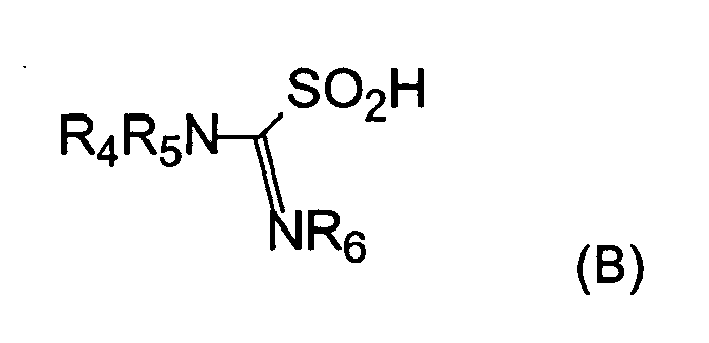
- It is preferable for the solution to contain formamidine sulfinic acid. Preferable aromatic sulfinic acids are benzene sulfinic acid, toluene sulfinic acids, chlorobenzene sulfinic acids, nitrobenzene sulfinic acids and carboxybenzene sulfinic acids.
- Other preferable adhesion-promoting heterocyclic compounds are thiophene, thiazole, isothiazole, thiadiazole and thiatriazole.
- Suitable thiophenes are compounds of chemical formula C:

- Particularly preferred thiophenes are aminothiophene carboxylic acids, their esters and amides. For example, 3-aminothiophene-2-carboxylic acid methyl ester can be advantageously used.
- Suitable thiazoles are compounds of chemical formula D:

- Particularly suitable thiazoles are aminothiazole and substituted aminothiazole.
- Other preferred thiadiazole adhesion-promoting compounds are from the group consisting of aminothiadiazoles and substituted aminothiadiazoles.
- In addition, the preferred sulfonium salts are salts of trimethylsulfonium, triphenylsulfonium, methionine alkylsulfonium and methionine benzylsulfonium.
- The nitrogen-containing, five-member heterocyclic compounds that do not contain any sulfur, selenium or tellurium atom in the heterocycle can be monocyclic and polycyclic condensed ring systems. For example, the compounds can contain an anellated benzene, naphthalene or pyrimidine ring provided that they are sufficiently soluble in the acid solution. It is preferable for the solution to contain triazoles, tetrazoles, imidazoles, pyrazoles and purines or their derivatives.
- In particular, the solution contains triazoles of chemical formula E1:

- Benzotriazole, methylbenzotriazole, ethylbenzotriazole and dimethylbenzotriazole are particularly preferable.
- In addition, the solution can contain tetrazoles of chemical formula E2:

- Preferred tetrazole compounds are 5-aminotetrazole and 5-phenyltetrazole. A preferred imidazole compound may be benzimidazole. 5-aminotetrazole, 5-phenyltetrazole, benzotriazole, methylbenzotriazole and ethylbenzotriazole are preferred compounds given their favorable solubility in the treatment solution and their availability.
- Preferred combinations are benzotriazole, methylbenzotriazole, ethylbenzotriazole, 5-aminotetrazole and 5-phenyltetrazole as the nitrogen-containing, heterocyclic compounds with aminothiophene carboxylic acids, their esters and amides, aminothiazoles and substituted aminothiazoles as the heterocyclic compounds.
- The process according to the invention is an extremely easy way to treat copper alloy surfaces to allow them to tightly bond with polymeric materials. Basically one step is necessary, i.e., treating the copper or copper alloy surface with the solution according to the invention to allow them to bond with polymeric materials. The adhesion does not decrease even after a long time. Particularly preferred solutions are the subject-matter of claim 7.
- The advantageous effect of the solution according to the invention was surprising since it was found that relatively small amounts of chloride and bromide of 50 mg/l and above already strongly reduce the functionality of the etching solution. Applying such solutions is disclosed in the prior art (
US 5,869,130 ) for treating copper surfaces but is not suitable to etch copper alloy surfaces which is the subject of the present invention. - In contrast, the addition of fluoride improves the complete attack onto these alloys and leads to the desired roughness properties of the copper alloy surface. Alloys containing Si in particular, are most effectively treated, as the Si smut on the surface as well as in the solution is removed within the etching solution itself. Without the addition of fluoride, insoluble residues are formed, which lead to low adhesion values and uneven appearance, not acceptable in lead frame manufacturing. Furthermore the alloying elements often result in a decrease of the stability of the treatment solution. Dissolved iron for example catalyses the decomposition of hydrogen peroxide. Surprisingly, addition of fluoride prevents such decomposition while in contrast chloride and bromide do not reduce the decomposition rate of the treatment solution.
- The properties of lead frame alloy surfaces become more and more important as a result of the lead free soldering applications for the electronic industry. Lead free soldering generates higher temperatures to the electronic components. Because of higher soldering temperatures the risk of the "popcorn effect" rises. This effect arises, when humidity penetrates the device and the water evaporates explosively upon heating during the post-treatment steps and destroys the bond between the polymeric material and the metal surface. This effect destroys electronic devices. A good adhesion of the polymeric material to the metal substrate minimizes the risk of the "popcorn effect" to occur.
- As a result of the good adhesion gained by applying the solution according to the present invention, no air moisture can penetrate into the interface polymeric material/metal substrate.
- The fluoride ion amount additionally affects the etch rate of the metal surface. In a certain range increase in the fluoride ion concentration results in an increased etch rate. Applying the solution according to Example 1 with a sodium fluoride concentration of 2.5 g/I results in an etch rate of 1,0 µm/min. If the solution contains 5.0 g/l sodium fluoride the etch rate is increased to 1,6 µm/min. Thereafter, further increasing the fluoride ion concentration does not affect the etch rate significantly. It has to be pointed out that the optimum amount of fluoride ions for a given metal depends on its composition and can be determined individually by standard measurement methods.
- As mentioned above, the solution according to the present invention also comprises chloride ions in an amount of 5 to 40 mg per litre. It was discovered that the chloride ions have a beneficial effect on the roughness of the surface to which the solution according to the present invention is applied. Particularly good results are obtained when the concentration of chloride ions is in the range of 15 to 25 mg per litre.
- In the present invention the adhesion between the alloy substrate and the polymeric material is measured quantitatively in values N/mm2.
- The peel strength was measured by pushing "Mold tablets" after curing and hardening, with a contact area to the test surface of 10 mm2 with a Dage 4000 equipment, using a shear speed of 0,2 mm/s. The test was performed at 20°C.
- In the production of lead frames, an important and widely used Si-containing alloy is C7025. Besides Cu and Ni it contains up to 1.2% of silicon.
- Another alloy which is particularly preferred for use in the present invention is C194. It contains 97% of Cu, 2.3% of Fe and 0.1 % of Mn. Like the above mentioned C7025 alloy, C194 is used in the production of lead frames.
- The copper alloy surfaces should first be cleaned to ensure that the treatment is effective. Any conventional cleaning solution can be used. Normally, wetting agents and sometimes complexing agents (such as triethanol-amine)-containing aqueous solutions are used.
- After the cleaned copper alloy surfaces are rinsed, they can be brought into contact with a so-called predipping solution that contains one of the five-membered heterocyclic compounds dissolved in water, preferably at a concentration of 0.1-10 g/l, and especially 0.5-2 g/l. This treatment helps the adhesion-promoting layer to be formed in the subsequent treatment step. In particular, any delays in the formation of the layer are avoided. The layer starts forming directly when the surface contacts the solution of the invention.
- The surfaces are then treated with the solution according to the invention without being rinsed beforehand.
- The microetching by the oxidant, preferably hydrogen peroxide in connection with the acid yields microrough copper alloy surfaces. Since this increases the surface area, the subsequent adhesion of the copper alloy surfaces to the polymeric material also increases. The change in color of the surface during treatment is caused by a thin copper oxide layer. It is preferable for the acid in the solution according to the invention to be an inorganic acid, and especially sulfuric acid. Other acids can of course be used.
- The treatment is preferably carried out at 20-60°C. The treatment time is preferably 10-600 sec. The higher the temperature, the faster-acting the solution. The treatment times can hence even be much shorter. From a practical standpoint, a preferable average temperature would be 35-45°C to better control the reaction. Average treatment times are 20-90 sec. In addition, a top temperature limit may have to be set due to possible incompatibilities between certain solution components at high temperatures, e.g., wetting agents that have difficulty dissolving at high temperatures.
- The preferable concentration ranges in the solution are:
Sulfuric acid, conc. 10-250 g/l Hydrogen peroxide, 30 weight percent 1-100 g/l Adhesion-enhancing compound: triazoles, benzotriazoles, imidazoles, tetrazoles and mixtures thereof 0.5-50 g/l purines 0.5-50 g/l - Further components:
Sulfinic, selenic and/or telluric acid 0.05-10 g/l Adhesion-promoting heterocyclic compound 0.05-20 g/l Sulfonium, selenonium and/or telluronium salts 0.01-10 g/l fluoride ions preferred 1-10 g/l, most preferred 2-5 g/l 0.2-25 g/l, more Chloride ions 5-40 mg/l, preferably 15-25 mg/l - After they are treated with the solution according to the invention, the copper surfaces are rinsed. Then they are dried, e.g. with hot air.
- The workpieces, for example lead frames, with the copper or copper alloy surfaces can be treated in conventional dipping systems.
- The following examples serve further to clarify the invention:
- An aqueous solution was created by mixing the following components:
Sulfuric acid, 96 weight percent 50 ml Hydrogen peroxide, 40 ml 30 weight percent in water Benzotriazole 10 g Formamidine sulfinic acid 0.5 g Sodium fluoride 5.0 g Sodium chloride 33 mg Deionized water added to 1 l. - The solution was heated to 40°C, and a copper alloy surface (lead frame C7025) containing Cu, Ni (2,2 - 4,2%), Si (0,25 - 1,2%) and small amounts of Mg and Zn was dipped in the solution for 60 sec. After being treated, the alloy was rinsed with deionized water and finally dried.
Thereafter as polymeric material a commercially available mold (KMC-289, Shinetsu) was applied to such treated alloy surface, dried and hardened at a temperature of 175°C.
The peel strength of the lead frame was measured by a button shear test. An adhesion value of 18,5 N / mm2 was found. The measured roughness, expressed in RSAI (Relative Surface Area Increase) was 44% ± 3% (absolute). - Example 1 was repeated with a solution that did not contain sodium fluoride.
- The lead frame surface shows black smut which can easily be taken away by finger wiping. On this sample a peel adhesion value of only 9,1 N / mm2 was obtained. The measured roughness was 42% ± 3% (absolute).
- Example 1 was repeated with a solution that did not contain sodium chloride.
- The lead frame surface shows not black smut, but the roughness was reduced to lower than 12% RSAI. The peel adhesion value was always below 5 N/mm2.
- An aqueous solution was created by mixing the following components:
Sulfuric acid, 96 weight percent 50 ml Hydrogen peroxide, 30 weight percent in water 40 ml Benzotriazole 10 g Formamidine sulfinic acid 0.5 g Sodium fluoride 5.0 g Sodium chloride Deionized water added to 1 l. 33 mg - The solution was heated to 40°C, and a copper alloy surface (lead frame C7025) containing Cu, Ni (2,2 - 4,2%), Si (0,25 - 1,2%) and small amounts of Mg and Zn was dipped in the solution for 60 sec. After being treated, the alloy was rinsed with deionized water and finally dried.
Thereafter, a layer of Ni-Pd-Au was deposited on the treated copper alloy surface utilizing a commercially available metallization process (Atotech Deutschland GmbH).Soak cleaner Rinsing 50°C 3min Cath. Degreaser Rinsing 40°C 60sec 5 % H2SO4 Nickel sulphamat HS Rinsing 60°C 40sec (thickness of deposited Ni-layer ~ 0,7 µm) Pallacor PPF Rinsing 35°C 2sec (thickness of deposited Pd-layer~ 0,03 µm) Aurocor PPF Rinsing, drying 35°C 1 sec (thickness of deposited Au- layer - 0,005 µm) - Finally, as polymeric material a commercially available mold (KMC-289, Shinetsu) was applied to such treated alloy surface, dried and hardened at a temperature of 150°C.
An adhesion value was achieved which is slightly smaller than that according to Example 1. - Example 4 was repeated but with a solution that did not contain sodium fluoride.
- The lead frame surfaces shows smut residues and had therefore to be cleaned in an additional post treatment step utilizing 50 ml/l H2SO4 96%, 20 g/l sodium peroxodisulfate and 4 g/l sodium fluoride instead of 5% H2SO4 prior to metallization with Ni-Pd-Au. As a result only a poor peel adhesion value was obtained.
Claims (25)
- A solution for treating a surface of copper alloys to improve adhesion of polymeric materials thereto, comprisinga) an oxidantb) at least one acidc) at least one adhesion-enhancing compound
characterized in that the solution additionally contains:d) fluoride ions in an amount of at least 100 mg per litre,e) chloride ions in an amount of 5 to 40 mg per litre. - The solution according to claim 1, characterized in that the adhesion-enhancing compound is selected from the group consisting of triazoles, benzotriazoles, imidazoles, tetrazoles and purines.
- The solution according to claim 2, characterized in that the triazole has the following chemical formula E1:

- The solution according to claim 2, characterized in that the triazole is selected from the group consisting of benzotriazole, methylbenzotriazole, ethyl benzotriazole and dimethylbenzotriazole.
- The solution according to claim 2, characterized in that the tetrazole has the following chemical formula E2:

- The solution according to claim 5, characterized in that the tetrazole is selected from the group consisting of 5-aminotetrazole and 5-phenyltetrazole.
- The solution according to claim 1, characterized in that the adhesion-enhancing compound is a mixture of at least one nitrogen-containing, five-membered heterocyclic compound that does not contain sulfur, selenium or tellurium atoms in the heterocycle and at least one compound selected from the group consisting of sulfinic acids, selenic acids, telluric acids, heterocyclic compounds that contain at least one sulfur, selenium and/or tellurium atom in the heterocycle, as well as sulfonium, selenonium and telluronium salts, where the sulfonium, selenonium and telluronium salts are compounds of general formula A:

- The solution according to claim 7, characterized in that it contains sulfinic acids selected from the group consisting of aromatic sulfinic acids and compounds of chemical formula B:

- The solution according to claims 7 and 8 characterized in that it contains formamidine sulfinic acid.
- The solution according to claims 7 and 8, characterized in that it contains aromatic sulfinic acids selected from the group consisting of benzene sulfinic acid, toluene sulfinic acids, chlorobenzene sulfinic acids, nitrobenzene sulfinic acids and carboxybenzene sulfinic acids.
- The solution according to claims 7 - 10, characterized in that it contains at least one heterocyclic compound selected from the group consisting of thiophenes, thiazoles, isothiazoles, thiadiazoles and thiatriazoles.
- The solution according to claim 11, characterized in that it contains at least one thiophene selected from the group consisting of compounds of chemical formula C:

- The solution according to claims 11 and 12, characterized in that it contains at least one thiophene selected from the group consisting of aminothiophene carboxylic acids, their esters and amides.
- The solution according to claims 11 - 13, characterized in that the thiazole is selected from the group consisting of compounds of chemical formula D:

- The solution according to claims 11 - 14, characterized in that the thiazole is selected from the group consisting of aminothiazoles and substituted aminothiazoles.
- The solution according to claims 11 - 15, characterized in that the thiadiazole is selected from the group consisting of aminothiadiazoles and substituted aminothiadiazoles.
- The solution according to claims 7 - 16, characterized in that the sulfonium salt is selected from the group consisting of trimethylsulfonium salts, triphenylsulfonium salts, methionine alkyl sulfonium salts and methionine benzyl sulfonium salts.
- The solution according to claims 7 - 17, characterized in that the nitrogen-containing, five-membered heterocyclic compound selected from the group consisting of triazoles, tetrazoles, imidazoles, pyrazoles and purines.
- A solution according to one of the preceding claims wherein the amount of fluoride ions is at least 0.5 g/I, preferably at least 2.0 g/l.
- A solution according to one of the preceding claims characterized in that the fluoride ions are from a source selected from the group consisting of sodium fluoride, potassium fluoride, ammonium fluoride and tetrafluoro boric acid.
- The solution according to one of the preceding claims characterized in that sulfuric acid is selected to be the acid for component b) in the solution.
- The solution according to one of the preceding claims characterized in that the amount of chloride ions is 15 to 25 mg per litre.
- A process to pretreat copper alloy surfaces to allow a tight bond to be subsequently formed between the copper alloy surfaces and polymeric material in which the copper surfaces are brought into contact with the solution according to one of the preceding claims.
- A process to pretreat copper alloy surfaces according to claim 23 characterized in that the copper alloy contains at least one alloying element selected from the group consisting of Si, Ni, Fe, Zr, P, Sn and Zn.
- A process according to claim 24 wherein the copper alloy surface is on a lead frame and pretreated to create a tight bond between the copper alloy layers and moulding compounds.
Priority Applications (13)
| Application Number | Priority Date | Filing Date | Title |
|---|---|---|---|
| AT06003278T ATE445031T1 (en) | 2006-02-17 | 2006-02-17 | COMPOSITION AND METHOD FOR TREATING THE SURFACES OF COPPER ALLOYS TO IMPROVE THE ADHESION BETWEEN THE METAL SURFACE AND THE BONDED POLYMERIC MATERIAL |
| DE602006009614T DE602006009614D1 (en) | 2006-02-17 | 2006-02-17 | Composition and method of treating the surfaces of copper alloys to improve the adhesion between the metal surface and the bonded polymeric material |
| EP06003278A EP1820884B1 (en) | 2006-02-17 | 2006-02-17 | Solution and process to treat surfaces of copper alloys in order to improve the adhesion between the metal surface and the bonded polymeric material |
| TW096100950A TWI495759B (en) | 2006-02-17 | 2007-01-10 | Solution and method for treating copper alloy surface to improve adhesion between metal surface and polymer material bonded thereto |
| TW104111778A TW201529889A (en) | 2006-02-17 | 2007-01-10 | Solution and method for treating copper alloy surface to improve adhesion between metal surface and polymer material bonded thereto |
| PCT/EP2007/000826 WO2007093284A1 (en) | 2006-02-17 | 2007-01-31 | Solution and process to treat surfaces of copper alloys in order to improve the adhesion between the metal surface and the bonded polymeric material |
| JP2008554623A JP5300135B2 (en) | 2006-02-17 | 2007-01-31 | Solution and method for treating the surface of a copper alloy to improve adhesion between a metal surface and a bonded polymeric material |
| CN2007800044722A CN101379220B (en) | 2006-02-17 | 2007-01-31 | Solution and process to treat surfaces of copper alloys in order to improve the adhesion between the metal surface and the bonded polymeric material |
| US12/224,016 US20100288731A1 (en) | 2006-02-17 | 2007-01-31 | Solution and Process to Treat Surfaces of Copper Alloys in Order to Improve the Adhesion Between the Metal Surface and the Bonded Polymeric Material |
| MYPI20083112A MY144294A (en) | 2006-02-17 | 2008-08-15 | Solution and process to treat surfaces of copper alloys in order to improve the adhesion between the metal surface and the bonded polymeric material |
| JP2013057660A JP5710670B2 (en) | 2006-02-17 | 2013-03-21 | Solution and method for treating the surface of a copper alloy to improve adhesion between a metal surface and a bonded polymeric material |
| US15/041,840 US20160168722A1 (en) | 2006-02-17 | 2016-02-11 | Solution and process to treat surfaces of copper alloys in order to improve the adhesion between the metal surface and the bonded polymeric material |
| US15/095,645 US20160222523A1 (en) | 2006-02-17 | 2016-04-11 | Solution and process to treat surfaces of copper alloys in order to improve the adhesion between the metal surface and the bonded polymeric material |
Applications Claiming Priority (1)
| Application Number | Priority Date | Filing Date | Title |
|---|---|---|---|
| EP06003278A EP1820884B1 (en) | 2006-02-17 | 2006-02-17 | Solution and process to treat surfaces of copper alloys in order to improve the adhesion between the metal surface and the bonded polymeric material |
Publications (2)
| Publication Number | Publication Date |
|---|---|
| EP1820884A1 true EP1820884A1 (en) | 2007-08-22 |
| EP1820884B1 EP1820884B1 (en) | 2009-10-07 |
Family
ID=36636657
Family Applications (1)
| Application Number | Title | Priority Date | Filing Date |
|---|---|---|---|
| EP06003278A Expired - Lifetime EP1820884B1 (en) | 2006-02-17 | 2006-02-17 | Solution and process to treat surfaces of copper alloys in order to improve the adhesion between the metal surface and the bonded polymeric material |
Country Status (9)
| Country | Link |
|---|---|
| US (3) | US20100288731A1 (en) |
| EP (1) | EP1820884B1 (en) |
| JP (2) | JP5300135B2 (en) |
| CN (1) | CN101379220B (en) |
| AT (1) | ATE445031T1 (en) |
| DE (1) | DE602006009614D1 (en) |
| MY (1) | MY144294A (en) |
| TW (2) | TWI495759B (en) |
| WO (1) | WO2007093284A1 (en) |
Cited By (3)
| Publication number | Priority date | Publication date | Assignee | Title |
|---|---|---|---|---|
| EP2175049A1 (en) | 2008-10-13 | 2010-04-14 | Atotech Deutschland Gmbh | Method for improving the adhesion between silver surfaces and resin materials |
| WO2017153590A1 (en) | 2016-03-11 | 2017-09-14 | Atotech Deutschland Gmbh | Lead-frame structure, lead-frame, surface mount electronic device and methods of producing same |
| EP4279634A1 (en) * | 2022-05-17 | 2023-11-22 | Atotech Deutschland GmbH & Co. KG | Method for nano etching of copper and copper alloy surfaces |
Families Citing this family (16)
| Publication number | Priority date | Publication date | Assignee | Title |
|---|---|---|---|---|
| JP2009059910A (en) * | 2007-08-31 | 2009-03-19 | Panasonic Corp | Lead, wiring member, package component, resin-coated metal component, resin-encapsulated semiconductor device, and manufacturing method thereof |
| EP2546387A1 (en) † | 2008-03-21 | 2013-01-16 | Enthone, Inc. | Adhesion promotion of metal to laminate with a multi-functional compound |
| JP2009245960A (en) * | 2008-03-28 | 2009-10-22 | Panasonic Corp | Package for semiconductor device, semiconductor device, and method for manufacturing thereof |
| KR101560000B1 (en) | 2009-02-06 | 2015-10-13 | 동우 화인켐 주식회사 | Manufacturing method of an array substrate for liquid crystal display |
| JP5443863B2 (en) * | 2009-07-09 | 2014-03-19 | 株式会社Adeka | Etching composition for copper-containing material and method for etching copper-containing material |
| US20130071658A1 (en) * | 2010-03-24 | 2013-03-21 | Sekisui Chemical Co., Ltd. | Adhesive composition, adhesive tape, method for processing semiconductor wafer and method for producing tsv wafer |
| KR101822118B1 (en) * | 2010-07-06 | 2018-01-25 | 아토테크 도이칠란드 게엠베하 | Methods of treating metal surfaces and devices formed thereby |
| KR101366938B1 (en) * | 2012-01-06 | 2014-02-25 | 삼성전기주식회사 | Etching solution and method for preparing a print wiring substrate using the same |
| JP5219008B1 (en) | 2012-07-24 | 2013-06-26 | メック株式会社 | Copper microetching agent, replenisher thereof, and method for manufacturing wiring board |
| CN104674222A (en) * | 2013-11-27 | 2015-06-03 | 芝普企业股份有限公司 | Etching solution that can effectively slow down the Giavani effect |
| JP5792336B2 (en) * | 2014-02-28 | 2015-10-07 | 芝普企業股▲分▼有限公司 | Etching solution that can effectively reduce the galvano effect |
| EP3159432B1 (en) * | 2015-10-23 | 2020-08-05 | ATOTECH Deutschland GmbH | Surface treatment agent for copper and copper alloy surfaces |
| JP6354086B1 (en) | 2017-01-21 | 2018-07-11 | メック株式会社 | Film-forming composition, method for producing surface-treated metal member, and method for producing metal-resin composite |
| JP6387543B1 (en) | 2017-05-11 | 2018-09-12 | メック株式会社 | Film-forming composition, method for producing surface-treated metal member, and method for producing metal-resin composite |
| TWI749287B (en) * | 2019-01-22 | 2021-12-11 | 達興材料股份有限公司 | Composition of acidic hydrogen peroxide aqueous solution |
| JP7363105B2 (en) | 2019-05-31 | 2023-10-18 | 株式会社レゾナック | Photosensitive resin composition, photosensitive resin film, printed wiring board and semiconductor package, and method for producing printed wiring board |
Citations (13)
| Publication number | Priority date | Publication date | Assignee | Title |
|---|---|---|---|---|
| US3645772A (en) | 1970-06-30 | 1972-02-29 | Du Pont | Process for improving bonding of a photoresist to copper |
| US3770530A (en) * | 1971-04-26 | 1973-11-06 | Tokai Electro Chemical Co | Method of etching copper and alloys thereof |
| JPH0897559A (en) | 1994-09-26 | 1996-04-12 | Okuno Chem Ind Co Ltd | Method and solution for treating copper foil of circuit board for inner layer of multilayer printed wiring board |
| WO1996019097A1 (en) | 1994-12-12 | 1996-06-20 | Alpha Fry Ltd. | Copper coating |
| US5869130A (en) | 1997-06-12 | 1999-02-09 | Mac Dermid, Incorporated | Process for improving the adhesion of polymeric materials to metal surfaces |
| EP1031644A1 (en) * | 1999-02-25 | 2000-08-30 | Shipley Company LLC | Thiazole-and thiocarbamide-based chemicals for use with oxidative etchant solutions |
| US6162366A (en) * | 1997-12-25 | 2000-12-19 | Canon Kabushiki Kaisha | Etching process |
| US20030006215A1 (en) * | 1996-07-29 | 2003-01-09 | Yoshihiko Morikawa | Etchant, method for roughening copper surface and method for producing printed wiring board |
| US6562149B1 (en) | 1998-02-03 | 2003-05-13 | Atotech Deutschland Gmbh | Solution and process to pretreat copper surfaces |
| EP1331287A2 (en) * | 2002-01-24 | 2003-07-30 | Shipley Co. L.L.C. | Treating metal surfaces with a modified oxide replacement composition |
| US6666987B1 (en) * | 1998-06-09 | 2003-12-23 | Ebara Densan Ltd. | Liquid etchant and method for roughening copper surface |
| US20040262569A1 (en) * | 2003-06-24 | 2004-12-30 | Lg.Philips Lcd Co., Ltd. | Etchant for etching double-layered copper structure and method of forming array substrate having double-layered copper structures |
| US20050067378A1 (en) * | 2003-09-30 | 2005-03-31 | Harry Fuerhaupter | Method for micro-roughening treatment of copper and mixed-metal circuitry |
Family Cites Families (4)
| Publication number | Priority date | Publication date | Assignee | Title |
|---|---|---|---|---|
| JP3361680B2 (en) * | 1995-12-27 | 2003-01-07 | 日本パーオキサイド株式会社 | Surface treatment solution for copper or copper alloy |
| TW470785B (en) * | 1998-02-03 | 2002-01-01 | Atotech Deutschland Gmbh | Process for preliminary treatment of copper surfaces |
| DE10066028C2 (en) * | 2000-07-07 | 2003-04-24 | Atotech Deutschland Gmbh | Copper substrate with roughened surfaces |
| JP4309602B2 (en) * | 2001-04-25 | 2009-08-05 | メック株式会社 | Method for improving adhesion between copper or copper alloy and resin, and laminate |
-
2006
- 2006-02-17 AT AT06003278T patent/ATE445031T1/en active
- 2006-02-17 DE DE602006009614T patent/DE602006009614D1/en not_active Expired - Lifetime
- 2006-02-17 EP EP06003278A patent/EP1820884B1/en not_active Expired - Lifetime
-
2007
- 2007-01-10 TW TW096100950A patent/TWI495759B/en active
- 2007-01-10 TW TW104111778A patent/TW201529889A/en unknown
- 2007-01-31 US US12/224,016 patent/US20100288731A1/en not_active Abandoned
- 2007-01-31 CN CN2007800044722A patent/CN101379220B/en active Active
- 2007-01-31 WO PCT/EP2007/000826 patent/WO2007093284A1/en not_active Ceased
- 2007-01-31 JP JP2008554623A patent/JP5300135B2/en not_active Expired - Fee Related
-
2008
- 2008-08-15 MY MYPI20083112A patent/MY144294A/en unknown
-
2013
- 2013-03-21 JP JP2013057660A patent/JP5710670B2/en not_active Expired - Fee Related
-
2016
- 2016-02-11 US US15/041,840 patent/US20160168722A1/en not_active Abandoned
- 2016-04-11 US US15/095,645 patent/US20160222523A1/en not_active Abandoned
Patent Citations (13)
| Publication number | Priority date | Publication date | Assignee | Title |
|---|---|---|---|---|
| US3645772A (en) | 1970-06-30 | 1972-02-29 | Du Pont | Process for improving bonding of a photoresist to copper |
| US3770530A (en) * | 1971-04-26 | 1973-11-06 | Tokai Electro Chemical Co | Method of etching copper and alloys thereof |
| JPH0897559A (en) | 1994-09-26 | 1996-04-12 | Okuno Chem Ind Co Ltd | Method and solution for treating copper foil of circuit board for inner layer of multilayer printed wiring board |
| WO1996019097A1 (en) | 1994-12-12 | 1996-06-20 | Alpha Fry Ltd. | Copper coating |
| US20030006215A1 (en) * | 1996-07-29 | 2003-01-09 | Yoshihiko Morikawa | Etchant, method for roughening copper surface and method for producing printed wiring board |
| US5869130A (en) | 1997-06-12 | 1999-02-09 | Mac Dermid, Incorporated | Process for improving the adhesion of polymeric materials to metal surfaces |
| US6162366A (en) * | 1997-12-25 | 2000-12-19 | Canon Kabushiki Kaisha | Etching process |
| US6562149B1 (en) | 1998-02-03 | 2003-05-13 | Atotech Deutschland Gmbh | Solution and process to pretreat copper surfaces |
| US6666987B1 (en) * | 1998-06-09 | 2003-12-23 | Ebara Densan Ltd. | Liquid etchant and method for roughening copper surface |
| EP1031644A1 (en) * | 1999-02-25 | 2000-08-30 | Shipley Company LLC | Thiazole-and thiocarbamide-based chemicals for use with oxidative etchant solutions |
| EP1331287A2 (en) * | 2002-01-24 | 2003-07-30 | Shipley Co. L.L.C. | Treating metal surfaces with a modified oxide replacement composition |
| US20040262569A1 (en) * | 2003-06-24 | 2004-12-30 | Lg.Philips Lcd Co., Ltd. | Etchant for etching double-layered copper structure and method of forming array substrate having double-layered copper structures |
| US20050067378A1 (en) * | 2003-09-30 | 2005-03-31 | Harry Fuerhaupter | Method for micro-roughening treatment of copper and mixed-metal circuitry |
Cited By (8)
| Publication number | Priority date | Publication date | Assignee | Title |
|---|---|---|---|---|
| EP2175049A1 (en) | 2008-10-13 | 2010-04-14 | Atotech Deutschland Gmbh | Method for improving the adhesion between silver surfaces and resin materials |
| WO2010043291A1 (en) * | 2008-10-13 | 2010-04-22 | Atotech Deutschland Gmbh | Method for improving the adhesion between silver surfaces and resin materials |
| CN102232127A (en) * | 2008-10-13 | 2011-11-02 | 安美特德国有限公司 | Method for improving the adhesion between silver surfaces and resin materials |
| CN102232127B (en) * | 2008-10-13 | 2013-08-14 | 安美特德国有限公司 | Method for improving the adhesion between silver surfaces and resin materials |
| US8819930B2 (en) | 2008-10-13 | 2014-09-02 | Atotech Deutschland Gmbh | Method for improving the adhesion between silver surfaces and resin materials |
| WO2017153590A1 (en) | 2016-03-11 | 2017-09-14 | Atotech Deutschland Gmbh | Lead-frame structure, lead-frame, surface mount electronic device and methods of producing same |
| EP4279634A1 (en) * | 2022-05-17 | 2023-11-22 | Atotech Deutschland GmbH & Co. KG | Method for nano etching of copper and copper alloy surfaces |
| WO2023222701A1 (en) * | 2022-05-17 | 2023-11-23 | Atotech Deutschland GmbH & Co. KG | Method for nano etching of copper and copper alloy surfaces |
Also Published As
| Publication number | Publication date |
|---|---|
| WO2007093284A1 (en) | 2007-08-23 |
| JP5300135B2 (en) | 2013-09-25 |
| TW200745379A (en) | 2007-12-16 |
| JP2013151757A (en) | 2013-08-08 |
| CN101379220B (en) | 2011-05-11 |
| CN101379220A (en) | 2009-03-04 |
| US20160222523A1 (en) | 2016-08-04 |
| TW201529889A (en) | 2015-08-01 |
| EP1820884B1 (en) | 2009-10-07 |
| ATE445031T1 (en) | 2009-10-15 |
| TWI495759B (en) | 2015-08-11 |
| US20100288731A1 (en) | 2010-11-18 |
| JP5710670B2 (en) | 2015-04-30 |
| MY144294A (en) | 2011-08-29 |
| US20160168722A1 (en) | 2016-06-16 |
| DE602006009614D1 (en) | 2009-11-19 |
| JP2009526909A (en) | 2009-07-23 |
Similar Documents
| Publication | Publication Date | Title |
|---|---|---|
| US20100288731A1 (en) | Solution and Process to Treat Surfaces of Copper Alloys in Order to Improve the Adhesion Between the Metal Surface and the Bonded Polymeric Material | |
| EP1668967B1 (en) | Improved method for micro-roughening treatment of copper and mixed-metal circuitry | |
| EP3680363B1 (en) | Microetching agent for copper, copper surface roughening method and wiring board production method | |
| CN101668627B (en) | Metal surface treatment composition | |
| EP1299575B1 (en) | Acidic treatment liquid and method of treating copper surfaces | |
| JP4644365B2 (en) | Solution and method for pretreating copper surfaces | |
| US6444140B2 (en) | Micro-etch solution for producing metal surface topography | |
| US7186305B2 (en) | Process for improving the adhesion of polymeric materials to metal surfaces | |
| CN103703164A (en) | Method for providing organic resist adhesion to a copper or copper alloy surface | |
| US6723385B1 (en) | Process for the preliminary treatment of copper surfaces | |
| JP4836365B2 (en) | Composition for circuit board manufacture | |
| EP2453041B1 (en) | Solution and process for the pre-treatment of copper surfaces using an N-alkoxylated adhesion-promoting compound | |
| US20090120534A1 (en) | Preflux Composition | |
| KR100635847B1 (en) | Process to pretreat copper surfaces | |
| KR100587241B1 (en) | Solution and process to pretreat copper surfaces | |
| HK1051712B (en) | Acidic treatment liquid and method of treating copper surfaces |
Legal Events
| Date | Code | Title | Description |
|---|---|---|---|
| PUAI | Public reference made under article 153(3) epc to a published international application that has entered the european phase |
Free format text: ORIGINAL CODE: 0009012 |
|
| AK | Designated contracting states |
Kind code of ref document: A1 Designated state(s): AT BE BG CH CY CZ DE DK EE ES FI FR GB GR HU IE IS IT LI LT LU LV MC NL PL PT RO SE SI SK TR |
|
| AX | Request for extension of the european patent |
Extension state: AL BA HR MK YU |
|
| 17P | Request for examination filed |
Effective date: 20070720 |
|
| AKX | Designation fees paid |
Designated state(s): AT BE BG CH CY CZ DE DK EE ES FI FR GB GR HU IE IS IT LI LT LU LV MC NL PL PT RO SE SI SK TR |
|
| 17Q | First examination report despatched |
Effective date: 20080521 |
|
| GRAP | Despatch of communication of intention to grant a patent |
Free format text: ORIGINAL CODE: EPIDOSNIGR1 |
|
| GRAS | Grant fee paid |
Free format text: ORIGINAL CODE: EPIDOSNIGR3 |
|
| GRAA | (expected) grant |
Free format text: ORIGINAL CODE: 0009210 |
|
| AK | Designated contracting states |
Kind code of ref document: B1 Designated state(s): AT BE BG CH CY CZ DE DK EE ES FI FR GB GR HU IE IS IT LI LT LU LV MC NL PL PT RO SE SI SK TR |
|
| REG | Reference to a national code |
Ref country code: GB Ref legal event code: FG4D |
|
| REG | Reference to a national code |
Ref country code: CH Ref legal event code: EP |
|
| REG | Reference to a national code |
Ref country code: IE Ref legal event code: FG4D |
|
| REF | Corresponds to: |
Ref document number: 602006009614 Country of ref document: DE Date of ref document: 20091119 Kind code of ref document: P |
|
| PG25 | Lapsed in a contracting state [announced via postgrant information from national office to epo] |
Ref country code: SI Free format text: LAPSE BECAUSE OF FAILURE TO SUBMIT A TRANSLATION OF THE DESCRIPTION OR TO PAY THE FEE WITHIN THE PRESCRIBED TIME-LIMIT Effective date: 20091007 |
|
| NLV1 | Nl: lapsed or annulled due to failure to fulfill the requirements of art. 29p and 29m of the patents act | ||
| LTIE | Lt: invalidation of european patent or patent extension |
Effective date: 20091007 |
|
| PG25 | Lapsed in a contracting state [announced via postgrant information from national office to epo] |
Ref country code: IS Free format text: LAPSE BECAUSE OF FAILURE TO SUBMIT A TRANSLATION OF THE DESCRIPTION OR TO PAY THE FEE WITHIN THE PRESCRIBED TIME-LIMIT Effective date: 20100207 Ref country code: FI Free format text: LAPSE BECAUSE OF FAILURE TO SUBMIT A TRANSLATION OF THE DESCRIPTION OR TO PAY THE FEE WITHIN THE PRESCRIBED TIME-LIMIT Effective date: 20091007 Ref country code: LT Free format text: LAPSE BECAUSE OF FAILURE TO SUBMIT A TRANSLATION OF THE DESCRIPTION OR TO PAY THE FEE WITHIN THE PRESCRIBED TIME-LIMIT Effective date: 20091007 Ref country code: SE Free format text: LAPSE BECAUSE OF FAILURE TO SUBMIT A TRANSLATION OF THE DESCRIPTION OR TO PAY THE FEE WITHIN THE PRESCRIBED TIME-LIMIT Effective date: 20091007 Ref country code: ES Free format text: LAPSE BECAUSE OF FAILURE TO SUBMIT A TRANSLATION OF THE DESCRIPTION OR TO PAY THE FEE WITHIN THE PRESCRIBED TIME-LIMIT Effective date: 20100118 Ref country code: PT Free format text: LAPSE BECAUSE OF FAILURE TO SUBMIT A TRANSLATION OF THE DESCRIPTION OR TO PAY THE FEE WITHIN THE PRESCRIBED TIME-LIMIT Effective date: 20100208 |
|
| PG25 | Lapsed in a contracting state [announced via postgrant information from national office to epo] |
Ref country code: LV Free format text: LAPSE BECAUSE OF FAILURE TO SUBMIT A TRANSLATION OF THE DESCRIPTION OR TO PAY THE FEE WITHIN THE PRESCRIBED TIME-LIMIT Effective date: 20091007 Ref country code: PL Free format text: LAPSE BECAUSE OF FAILURE TO SUBMIT A TRANSLATION OF THE DESCRIPTION OR TO PAY THE FEE WITHIN THE PRESCRIBED TIME-LIMIT Effective date: 20091007 |
|
| PG25 | Lapsed in a contracting state [announced via postgrant information from national office to epo] |
Ref country code: BE Free format text: LAPSE BECAUSE OF FAILURE TO SUBMIT A TRANSLATION OF THE DESCRIPTION OR TO PAY THE FEE WITHIN THE PRESCRIBED TIME-LIMIT Effective date: 20091007 |
|
| PG25 | Lapsed in a contracting state [announced via postgrant information from national office to epo] |
Ref country code: RO Free format text: LAPSE BECAUSE OF FAILURE TO SUBMIT A TRANSLATION OF THE DESCRIPTION OR TO PAY THE FEE WITHIN THE PRESCRIBED TIME-LIMIT Effective date: 20091007 Ref country code: NL Free format text: LAPSE BECAUSE OF FAILURE TO SUBMIT A TRANSLATION OF THE DESCRIPTION OR TO PAY THE FEE WITHIN THE PRESCRIBED TIME-LIMIT Effective date: 20091007 Ref country code: BG Free format text: LAPSE BECAUSE OF FAILURE TO SUBMIT A TRANSLATION OF THE DESCRIPTION OR TO PAY THE FEE WITHIN THE PRESCRIBED TIME-LIMIT Effective date: 20100107 Ref country code: EE Free format text: LAPSE BECAUSE OF FAILURE TO SUBMIT A TRANSLATION OF THE DESCRIPTION OR TO PAY THE FEE WITHIN THE PRESCRIBED TIME-LIMIT Effective date: 20091007 Ref country code: DK Free format text: LAPSE BECAUSE OF FAILURE TO SUBMIT A TRANSLATION OF THE DESCRIPTION OR TO PAY THE FEE WITHIN THE PRESCRIBED TIME-LIMIT Effective date: 20091007 |
|
| PLBE | No opposition filed within time limit |
Free format text: ORIGINAL CODE: 0009261 |
|
| STAA | Information on the status of an ep patent application or granted ep patent |
Free format text: STATUS: NO OPPOSITION FILED WITHIN TIME LIMIT |
|
| PG25 | Lapsed in a contracting state [announced via postgrant information from national office to epo] |
Ref country code: CZ Free format text: LAPSE BECAUSE OF FAILURE TO SUBMIT A TRANSLATION OF THE DESCRIPTION OR TO PAY THE FEE WITHIN THE PRESCRIBED TIME-LIMIT Effective date: 20091007 Ref country code: SK Free format text: LAPSE BECAUSE OF FAILURE TO SUBMIT A TRANSLATION OF THE DESCRIPTION OR TO PAY THE FEE WITHIN THE PRESCRIBED TIME-LIMIT Effective date: 20091007 |
|
| 26N | No opposition filed |
Effective date: 20100708 |
|
| REG | Reference to a national code |
Ref country code: CH Ref legal event code: PL |
|
| GBPC | Gb: european patent ceased through non-payment of renewal fee |
Effective date: 20100217 |
|
| PG25 | Lapsed in a contracting state [announced via postgrant information from national office to epo] |
Ref country code: CH Free format text: LAPSE BECAUSE OF NON-PAYMENT OF DUE FEES Effective date: 20100228 Ref country code: MC Free format text: LAPSE BECAUSE OF NON-PAYMENT OF DUE FEES Effective date: 20100301 Ref country code: LI Free format text: LAPSE BECAUSE OF NON-PAYMENT OF DUE FEES Effective date: 20100228 Ref country code: GR Free format text: LAPSE BECAUSE OF FAILURE TO SUBMIT A TRANSLATION OF THE DESCRIPTION OR TO PAY THE FEE WITHIN THE PRESCRIBED TIME-LIMIT Effective date: 20100108 |
|
| PG25 | Lapsed in a contracting state [announced via postgrant information from national office to epo] |
Ref country code: IE Free format text: LAPSE BECAUSE OF NON-PAYMENT OF DUE FEES Effective date: 20100217 |
|
| PG25 | Lapsed in a contracting state [announced via postgrant information from national office to epo] |
Ref country code: GB Free format text: LAPSE BECAUSE OF NON-PAYMENT OF DUE FEES Effective date: 20100217 |
|
| PG25 | Lapsed in a contracting state [announced via postgrant information from national office to epo] |
Ref country code: CY Free format text: LAPSE BECAUSE OF FAILURE TO SUBMIT A TRANSLATION OF THE DESCRIPTION OR TO PAY THE FEE WITHIN THE PRESCRIBED TIME-LIMIT Effective date: 20091007 |
|
| PG25 | Lapsed in a contracting state [announced via postgrant information from national office to epo] |
Ref country code: LU Free format text: LAPSE BECAUSE OF NON-PAYMENT OF DUE FEES Effective date: 20100217 Ref country code: HU Free format text: LAPSE BECAUSE OF FAILURE TO SUBMIT A TRANSLATION OF THE DESCRIPTION OR TO PAY THE FEE WITHIN THE PRESCRIBED TIME-LIMIT Effective date: 20100408 |
|
| PG25 | Lapsed in a contracting state [announced via postgrant information from national office to epo] |
Ref country code: TR Free format text: LAPSE BECAUSE OF FAILURE TO SUBMIT A TRANSLATION OF THE DESCRIPTION OR TO PAY THE FEE WITHIN THE PRESCRIBED TIME-LIMIT Effective date: 20091007 |
|
| PGFP | Annual fee paid to national office [announced via postgrant information from national office to epo] |
Ref country code: AT Payment date: 20130213 Year of fee payment: 8 |
|
| REG | Reference to a national code |
Ref country code: AT Ref legal event code: MM01 Ref document number: 445031 Country of ref document: AT Kind code of ref document: T Effective date: 20140217 |
|
| PG25 | Lapsed in a contracting state [announced via postgrant information from national office to epo] |
Ref country code: AT Free format text: LAPSE BECAUSE OF NON-PAYMENT OF DUE FEES Effective date: 20140217 |
|
| REG | Reference to a national code |
Ref country code: FR Ref legal event code: PLFP Year of fee payment: 11 |
|
| REG | Reference to a national code |
Ref country code: FR Ref legal event code: PLFP Year of fee payment: 12 |
|
| REG | Reference to a national code |
Ref country code: FR Ref legal event code: PLFP Year of fee payment: 13 |
|
| PGFP | Annual fee paid to national office [announced via postgrant information from national office to epo] |
Ref country code: IT Payment date: 20220218 Year of fee payment: 17 Ref country code: FR Payment date: 20220216 Year of fee payment: 17 |
|
| PGFP | Annual fee paid to national office [announced via postgrant information from national office to epo] |
Ref country code: DE Payment date: 20230216 Year of fee payment: 18 |
|
| PG25 | Lapsed in a contracting state [announced via postgrant information from national office to epo] |
Ref country code: IT Free format text: LAPSE BECAUSE OF NON-PAYMENT OF DUE FEES Effective date: 20230217 Ref country code: FR Free format text: LAPSE BECAUSE OF NON-PAYMENT OF DUE FEES Effective date: 20230228 |
|
| REG | Reference to a national code |
Ref country code: DE Ref legal event code: R119 Ref document number: 602006009614 Country of ref document: DE |
|
| PG25 | Lapsed in a contracting state [announced via postgrant information from national office to epo] |
Ref country code: DE Free format text: LAPSE BECAUSE OF NON-PAYMENT OF DUE FEES Effective date: 20240903 |
|
| PG25 | Lapsed in a contracting state [announced via postgrant information from national office to epo] |
Ref country code: DE Free format text: LAPSE BECAUSE OF NON-PAYMENT OF DUE FEES Effective date: 20240903 |