EP1819635B1 - Chemical process and production unit - Google Patents
Chemical process and production unit Download PDFInfo
- Publication number
- EP1819635B1 EP1819635B1 EP05803700A EP05803700A EP1819635B1 EP 1819635 B1 EP1819635 B1 EP 1819635B1 EP 05803700 A EP05803700 A EP 05803700A EP 05803700 A EP05803700 A EP 05803700A EP 1819635 B1 EP1819635 B1 EP 1819635B1
- Authority
- EP
- European Patent Office
- Prior art keywords
- product stream
- reactor
- acid
- diluted product
- eductor
- Prior art date
- Legal status (The legal status is an assumption and is not a legal conclusion. Google has not performed a legal analysis and makes no representation as to the accuracy of the status listed.)
- Expired - Lifetime
Links
Images
Classifications
-
- C—CHEMISTRY; METALLURGY
- C01—INORGANIC CHEMISTRY
- C01B—NON-METALLIC ELEMENTS; COMPOUNDS THEREOF; METALLOIDS OR COMPOUNDS THEREOF NOT COVERED BY SUBCLASS C01C
- C01B11/00—Oxides or oxyacids of halogens; Salts thereof
- C01B11/02—Oxides of chlorine
- C01B11/022—Chlorine dioxide (ClO2)
- C01B11/023—Preparation from chlorites or chlorates
- C01B11/025—Preparation from chlorites or chlorates from chlorates without any other reaction reducing agent than chloride ions
-
- C—CHEMISTRY; METALLURGY
- C01—INORGANIC CHEMISTRY
- C01B—NON-METALLIC ELEMENTS; COMPOUNDS THEREOF; METALLOIDS OR COMPOUNDS THEREOF NOT COVERED BY SUBCLASS C01C
- C01B11/00—Oxides or oxyacids of halogens; Salts thereof
- C01B11/02—Oxides of chlorine
- C01B11/022—Chlorine dioxide (ClO2)
- C01B11/023—Preparation from chlorites or chlorates
-
- C—CHEMISTRY; METALLURGY
- C01—INORGANIC CHEMISTRY
- C01B—NON-METALLIC ELEMENTS; COMPOUNDS THEREOF; METALLOIDS OR COMPOUNDS THEREOF NOT COVERED BY SUBCLASS C01C
- C01B11/00—Oxides or oxyacids of halogens; Salts thereof
- C01B11/02—Oxides of chlorine
- C01B11/022—Chlorine dioxide (ClO2)
- C01B11/023—Preparation from chlorites or chlorates
- C01B11/026—Preparation from chlorites or chlorates from chlorate ions in the presence of a peroxidic compound, e.g. hydrogen peroxide, ozone, peroxysulfates
-
- C—CHEMISTRY; METALLURGY
- C01—INORGANIC CHEMISTRY
- C01B—NON-METALLIC ELEMENTS; COMPOUNDS THEREOF; METALLOIDS OR COMPOUNDS THEREOF NOT COVERED BY SUBCLASS C01C
- C01B11/00—Oxides or oxyacids of halogens; Salts thereof
- C01B11/02—Oxides of chlorine
- C01B11/022—Chlorine dioxide (ClO2)
- C01B11/023—Preparation from chlorites or chlorates
- C01B11/027—Preparation from chlorites or chlorates from chlorate ions in the presence of a nitrogen compound selected from nitrogen dioxide, nitrate or nitrite ions, nitrosylchloride, hydrazine or hydrazine compounds
-
- C—CHEMISTRY; METALLURGY
- C01—INORGANIC CHEMISTRY
- C01B—NON-METALLIC ELEMENTS; COMPOUNDS THEREOF; METALLOIDS OR COMPOUNDS THEREOF NOT COVERED BY SUBCLASS C01C
- C01B11/00—Oxides or oxyacids of halogens; Salts thereof
- C01B11/02—Oxides of chlorine
- C01B11/022—Chlorine dioxide (ClO2)
- C01B11/028—Separation; Purification
Definitions
- the present invention relates to a process, and a production unit for the production of an aqueous solution comprising chlorine dioxide.
- Chlorine dioxide is used in various applications such as pulp bleaching, fat bleaching, water purification and removal of organic materials from industrial wastes. Since chlorine dioxide is not storage stable, it is generally produced on-site.
- chlorine dioxide is usually produced by reacting alkali metal chlorate with a reducing agent in an aqueous reaction medium. Chlorine dioxide may be withdrawn from the reaction medium as a gas, as in the processes described in e.g. US patents 5091166 , 5091167 and EP patent 612686 . Normally, the chlorine dioxide gas is then absorbed into water to form an aqueous solution thereof.
- the reactor and the eductor can be operated as described in the earlier mentioned documents US patents 2833624 , 4534952 , 5895638 , 6387344 , 6790427 and US patent application Publ. No. 2004/0175322 and Publ. No. 2003/0031621 .
- the alkali metal chlorate is suitably fed to the reactor as an aqueous solution.
- the alkali metal may, for example, be sodium, potassium or mixtures thereof, of which sodium is most preferred.
- the acid is preferably a mineral acid such as sulfuric acid, hydrochloric acid, nitric acid, perchloric acid or mixtures thereof, of which sulfuric acid is most preferred.
- the molar ratio H 2 O 2 to ClO 3 - fed to the reactor is suitably from 0.2:1 to 2:1, preferably from 0.5:1 to 1.5:1, most preferably from 0.5:1 to 1:1.
- Alkali metal chlorate always contains some chloride as an impurity, but it is fully possible also to feed more chloride to the reactor, such as metal chloride or hydrochloric acid.
- the amount of chloride ions fed to the reactor low, suitably below 1 mole %, preferably below 0.1 mole %, more preferably less than 0.05 mole %, most preferably less than 0.02 mole % Cl - of the ClO 3 - (including chloride as an impurity in the chlorate and optionally extra added chloride).
- sulfuric acid In the case sulfuric acid is used as a feed to the reactor, it preferably has a concentration from 60 to 98 wt%, most preferably from about 70 to about 85 wt% and preferably a temperature from 0 to 80°C, most preferably from 20 to 60°C. Preferably from 2 to 7 kg H 2 SO 4 , most preferably from 3 to 5 kg H 2 SO 4 is fed per kg ClO 2 produced.
- a dilution and cooling scheme as described in US patent application Publ. No. 2004/0175322 is preferably applied.
- alkali metal chlorate and hydrogen peroxide is fed to the reactor in the form of a premixed aqueous solution, for example a composition as described in US 6387344 .
- a composition may be an aqueous solution comprising from 1 to 6.5 moles/litre, preferably from 3 to 6 moles/litre of alkali metal chlorate, from 1 to 7 moles/litre, preferably from 3 to 5 moles/litre of hydrogen peroxide and at least one of a protective colloid, a radical scavenger or a phosphonic acid based complexing agent, wherein the pH of the aqueous solution suitably is from 0.5 to 4, preferably from 1 to 3.5, most preferably from 1.5 to 3.
- At least one phosphonic acid based complexing agent is present, preferably in an amount from 0.1 to 5 mmoles/litre, most preferably from 0.5 to 3 mmoles/litre.
- a protective colloid is present, its concentration is preferably from about 0.001 to about 0.5 moles/litre, most preferably from 0.02 to 0.05 moles/litre.
- a radical scavenger is present, its concentration is preferably from 0.01 to 1 moles/litre, most preferably from 0.02 to 0.2 moles/litre.
- compositions comprise at least one phosphonic acid based complexing agent selected from the group consisting of 1-hydroxyethylidene-1,1-diphosphonic acid, 1-aminoethane-1,1-diphosphonic acid, aminotri (methylenephosphonic acid), ethylene diamine tetra (methylenephosphonic acid), hexamethylene diamine tetra (methylenephosphonic acid), diethylenetriamine penta (methylenephosphonic acid), diethylenetriamine hexa (methylenephosphonic acid), 1-aminoalkane-1,1-diphosphonic acids (such as morpholinomethane diphosphonic acid, N,N-dimethyl aminodimethyl diphosphonic acid, aminomethyl diphosphonic acid), reaction products and salts thereof, preferably sodium salts.
- phosphonic acid based complexing agent selected from the group consisting of 1-hydroxyethylidene-1,1-diphosphonic acid, 1-aminoethane-1,1-diphosphonic acid, aminotri (methylenephosphonic
- Useful protective colloids include tin compounds, such as alkali metal stannate, particularly sodium stannate (Na2(Sn(OH)6).
- Useful radical scavengers include pyridine carboxylic acids, such as 2,6-pyridine dicarboxylic acid.
- the amount of chloride ions is below about 300 mmoles/litre, preferably below 50 mmoles/litre, more preferably below 5 mmoles/litre, most preferably below 0.5 mmoles/litre.
- the temperature in the reactor is suitably maintained below the boiling point of the reactants and the product stream at the prevailing pressure, preferably from 20 to 80°C, most preferably from 30 to 60°C.
- the pressure maintained within the reactor is suitably slightly subatmospheric, preferably from 30 to 100 kPa absolute, most preferably from 65 to 95 kPa absolute.
- the reactor may comprise one or several vessels, for example arranged vertically, horizontally or inclined.
- the reactants may be fed directly to the reactor or via a separate mixing device.
- the reactor is a preferably substantially tubular through-flow vessel or pipe, most preferably comprising means for mixing the reactants in a substantially uniform manner.
- means for mixing are described in e.g. US 6790427 and US patent application Publ. No. 2004/0175322 .
- the length (in the main flow direction) of the reactor used is preferably from 150 to 1500 mm, most preferably from 300 to 900 mm. It has been found favourable to use a substantially tubular reactor with an inner diameter from 25 to 300 mm, preferably from 50 to 150 mm. It is particularly favourable to use a substantially tubular reactor having a preferred ratio of the length to the inner diameter from 12:1 to 1:1, most preferably from 8:1 to 4:1. A suitable average residence time in the reactor is in most cases from 1 to 60 seconds, preferably from 3 to 20 seconds.
- alkali metal chlorate, acid and hydrogen peroxide results in the formation of a product stream in the reactor, normally comprising both liquid and foam, and containing chlorine dioxide, oxygen, alkali metal salt of the acid and, in most cases, some remaining unreacted feed chemicals. Chlorine dioxide and oxygen may be present both as dissolved in the liquid and as gas bubbles. If sulphuric acid is used the alkali metal salt is a sulphate salt. It has been found possible to achieve a conversion degree of alkali metal chlorate to chlorine dioxide from 75% to 100%, preferably from 80 to 100%, most preferably from 95 to 100%.
- the feed chemicals including acid, alkali metal chlorate and reducing agent, are preferably fed close to one end of the reactor and the product stream is preferably withdrawn at the other end of the reactor.
- the product stream withdrawn from the reactor, including any liquid, foam and gas therein, is brought to the eductor, preferably by a suction force created by the eductor.
- the product stream is then mixed with motive water fed to the eductor to form a diluted product stream.
- Any kind of eductor may be used, although it is particularly preferred to use an eductor where the motive water is brought to flow in an at least partially spiral or helical manner as described in US 6790427 .
- the diluted product stream obtained from the eductor still comprises chlorine dioxide, oxygen and alkali metal salt of the acid.
- At least some of the oxygen should be removed by any suitable means, for example a cyclone separator with an air vent, a large diameter pipe with an air vent valve, a separator with a level control and an automatic vent valve or any other existing means for separating inert gasses like air from liquid streams.
- the diluted product stream is brought to a vented tank where it is held at a time sufficient for at least some of the oxygen to disengage from the liquid.
- the temperature in the tank is preferably maintained from 1 to 20°C, most preferably from 4 to 10°C.
- Part of the diluted product stream preferably from 10 to 90%, most preferably from 20 to 80%, particularly most preferably from 30 to 70%, is withdrawn and constitutes the actual product from the process, i.e. an aqueous solution comprising chlorine dioxide, preferably in a concentration above 4 grams/litre. This may be done before, during or after the removal of oxygen. If oxygen is removed in a vented tank, it is preferred to withdraw from the same tank the part of the diluted product stream that should constitute the actual product.
- Water is added to the non-withdrawn part of the diluted product stream to form a recycle stream, preferably in an amount to give a concentration of chlorine dioxide in the recycle stream from 2 to 12 grams/litre, most preferably from 3 to 6 grams/litre.
- the added water preferably has a temperature sufficiently low to give a temperature of the recycle stream below 20°C, preferably below 15°C, most preferably below 10°C, particularly most preferably below 5°C. It is also possible to use other cooling means such as heat exchangers or the like. There is no lower temperature limit as long as it does not go below the freezing point.
- the recycle stream is then fed to the eductor as motive water and mixed therein with the product stream from the reactor.
- the process of the invention is particularly suitable for production of chlorine dioxide in small-scale, for example from 0.5 to 250 kg ClO 2 /hr, preferably from 10 to 150 kg ClO 2 /hr. Unlike other chlorate based processes operated without a separate absorption tower the process of the invention enables production of chlorine dioxide solutions of high concentration, for example from 4 to 10 grams/litre or more.
- a typical small-scale production unit of the invention normally includes only one reactor, although it is possible to arrange several, for example up to 15 or more reactors in parallel, for example as a bundle of tubes.
- the invention further concerns a production unit for the production of an aqueous solution comprising chlorine dioxide, said unit comprising:
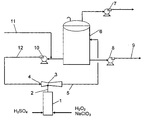
- the Figure schematically shows a process scheme of the invention.
- sulfuric acid and a pre-mixed aqueous solution of sodium chlorate and hydrogen peroxide are fed to a vertical through-flow tubular reactor 1 and reacted therein to form a product stream 2 of liquid and foam comprising chlorine dioxide, oxygen, sodium sulfate and some remaining sulfuric acid and sodium chlorate.
- An eductor 3 is supplied with motive water 4 and generates a slightly subatmospheric pressure bringing the product stream out from the reactor 1 into the eductor 3 where it is mixed with the motive water to form a diluted product stream 5, which is brought to a tank 6.
- a part of the diluted product stream is withdrawn from the tank by a pump 8 as a final product 9, i.e.
- the tank 6 is provided with a fan 7 venting out oxygen that goes off from the diluted product stream therein.
- the non-withdrawn part of the diluted product solution is brought out from the tank 6 by the pump 10 and mixed with cold water 11, e.g. having a temperature from 1 to 20°C, preferably from 4 to 10°C, to form a recycle stream 12.
- the gas vented out from the tank 6 may also contain some chlorine dioxide and to minimize the losses thereof it is possible to scrub the gas with water to absorb most of the chlorine dioxide (not shown in the Figure) and return it to the diluted product stream or the recycle stream.
- the recycle stream 12 is returned to the eductor and fed thereto as motive water 4.
- the process equipment including the reactor 1, the eductor 3 and the tank 6, are suitably made from materials resistant to the chemicals they are in contact with, such as one or more of hydrogen peroxide, sodium chlorate, sulfuric acid and chlorine dioxide.
- materials include, for example, glass, tantalum, titanium, fiberglass reinforced plastic, fluoro plastics like PVDF (polyvinylidene fluoride) CPVC (chlorinated polyvinyl chloride), PTFE (polytetrafluoro ethylene), PFA (perfluoro alkoxy polymer), ECTFE (ethylene chlorotrifluoro ethylene) or FEP (fluorinated ethylene propylene), or the use of these materials as a liner material to a structural material like steel or stainless steel.
- Suitable fluoro plastics are sold under the trademarks Kynar®, Teflon® or Hafar®.
- EXAMPLE Chlorine dioxide was produced from sulfuric acid and a mixture of sodium chlorate and hydrogen peroxide in a plant as described in the Figure. One hour after start the following conditions were observed: Operating rate: 45 kg/hr ClO 2 Concentration of product solution (9): 5.9 g/l ClO 2 Flow of product solution (9): 7 m 3 /hr Flow of recycle stream (12): 26 m 3 /hr Flow of cold water (11): 7.5 m 3 /hr Temperature of cold water (11): 10°C Temperature in tank (6): 14°C
Landscapes
- Chemical & Material Sciences (AREA)
- Organic Chemistry (AREA)
- Inorganic Chemistry (AREA)
- Life Sciences & Earth Sciences (AREA)
- General Life Sciences & Earth Sciences (AREA)
- Geology (AREA)
- Organic Low-Molecular-Weight Compounds And Preparation Thereof (AREA)
- Inorganic Compounds Of Heavy Metals (AREA)
- Agricultural Chemicals And Associated Chemicals (AREA)
- Low-Molecular Organic Synthesis Reactions Using Catalysts (AREA)
Abstract
Description
- The present invention relates to a process, and a production unit for the production of an aqueous solution comprising chlorine dioxide.
- Chlorine dioxide is used in various applications such as pulp bleaching, fat bleaching, water purification and removal of organic materials from industrial wastes. Since chlorine dioxide is not storage stable, it is generally produced on-site.
- In large scale processes chlorine dioxide is usually produced by reacting alkali metal chlorate with a reducing agent in an aqueous reaction medium. Chlorine dioxide may be withdrawn from the reaction medium as a gas, as in the processes described in e.g.
US patents 5091166 ,5091167 andEP patent 612686 - For the production of chlorine dioxide in small-scale units, such as for water purification applications or small bleaching plants, it is favourable not to separate chlorine dioxide from the reaction medium but to withdraw a chlorine dioxide containing solution directly from the reactor, optionally after dilution with water. Such processes have in recent years become commercial and are described in e.g.
US patents 2833624 ,4534952 ,5895638 ,6387344 ,6790427 and inUS patent applications Publ. No. 2004/0175322 and Publ. No.2003/0031621 . The required process equipment and instrumentation are considerably less extensive than in the large-scale processes described above. However, there is still a need for further improvements. - In the processes based on alkali metal chlorate where a chlorine dioxide containing solution is withdrawn directly from the reactor, it has been difficult to obtain solutions with such a high concentration of chlorine dioxide as desired for many applications, like recycle paper bleaching, bagasse bleaching, or small-scale pulp bleaching.
- It is an object of the invention to provide a simple process enabling direct production of chlorine dioxide in an aqueous solution of high concentrations.
- It is another object of the invention to provide a production unit for performing the process.
- It has surprisingly been found possible to meet these objects by providing a continuous process for producing chlorine dioxide comprising the steps of continuously:
- a) feeding to a reactor an acid, hydrogen peroxide and alkali metal chlorate;
- b) reacting the alkali metal chlorate with the acid and the hydrogen peroxide to form a product stream containing chlorine dioxide, oxygen and alkali metal salt of the acid,
- c) bringing the product stream from the reactor to an eductor and mixing it with motive water fed to the eductor and thereby forming a diluted product stream;
- d) removing oxygen from the diluted product stream;
- e) withdrawing part of the diluted product stream, before, during or after the step of removing oxygen;
- f) adding water to the non-withdrawn part of the diluted product stream to form a recycle stream; and,
- g) bringing the recycle stream to the eductor and feeding it thereto as motive water.
- The reactor and the eductor can be operated as described in the earlier mentioned documents
US patents 2833624 ,4534952 ,5895638 ,6387344 ,6790427 andUS patent application Publ. No. 2004/0175322 and Publ. No.2003/0031621 . - The alkali metal chlorate is suitably fed to the reactor as an aqueous solution. The alkali metal may, for example, be sodium, potassium or mixtures thereof, of which sodium is most preferred. The acid is preferably a mineral acid such as sulfuric acid, hydrochloric acid, nitric acid, perchloric acid or mixtures thereof, of which sulfuric acid is most preferred. The molar ratio H2O2 to ClO3 - fed to the reactor is suitably from 0.2:1 to 2:1, preferably from 0.5:1 to 1.5:1, most preferably from 0.5:1 to 1:1. Alkali metal chlorate always contains some chloride as an impurity, but it is fully possible also to feed more chloride to the reactor, such as metal chloride or hydrochloric acid. However, in order to minimize the formation of chlorine it is preferred to keep the amount of chloride ions fed to the reactor low, suitably below 1 mole %, preferably below 0.1 mole %, more preferably less than 0.05 mole %, most preferably less than 0.02 mole % Cl- of the ClO3 - (including chloride as an impurity in the chlorate and optionally extra added chloride).
- In the case sulfuric acid is used as a feed to the reactor, it preferably has a concentration from 60 to 98 wt%, most preferably from about 70 to about 85 wt% and preferably a temperature from 0 to 80°C, most preferably from 20 to 60°C. Preferably from 2 to 7 kg H2SO4, most preferably from 3 to 5 kg H2SO4 is fed per kg ClO2 produced. In order to use sulphuric acid of high concentration, a dilution and cooling scheme as described in
US patent application Publ. No. 2004/0175322 is preferably applied. - In a particularly preferred embodiment alkali metal chlorate and hydrogen peroxide is fed to the reactor in the form of a premixed aqueous solution, for example a composition as described in
US 6387344 . Such a composition may be an aqueous solution comprising from 1 to 6.5 moles/litre, preferably from 3 to 6 moles/litre of alkali metal chlorate, from 1 to 7 moles/litre, preferably from 3 to 5 moles/litre of hydrogen peroxide and at least one of a protective colloid, a radical scavenger or a phosphonic acid based complexing agent, wherein the pH of the aqueous solution suitably is from 0.5 to 4, preferably from 1 to 3.5, most preferably from 1.5 to 3. Preferably, at least one phosphonic acid based complexing agent is present, preferably in an amount from 0.1 to 5 mmoles/litre, most preferably from 0.5 to 3 mmoles/litre. If a protective colloid is present, its concentration is preferably from about 0.001 to about 0.5 moles/litre, most preferably from 0.02 to 0.05 moles/litre. If a radical scavenger is present, its concentration is preferably from 0.01 to 1 moles/litre, most preferably from 0.02 to 0.2 moles/litre. Particularly preferred compositions comprise at least one phosphonic acid based complexing agent selected from the group consisting of 1-hydroxyethylidene-1,1-diphosphonic acid, 1-aminoethane-1,1-diphosphonic acid, aminotri (methylenephosphonic acid), ethylene diamine tetra (methylenephosphonic acid), hexamethylene diamine tetra (methylenephosphonic acid), diethylenetriamine penta (methylenephosphonic acid), diethylenetriamine hexa (methylenephosphonic acid), 1-aminoalkane-1,1-diphosphonic acids (such as morpholinomethane diphosphonic acid, N,N-dimethyl aminodimethyl diphosphonic acid, aminomethyl diphosphonic acid), reaction products and salts thereof, preferably sodium salts. Useful protective colloids include tin compounds, such as alkali metal stannate, particularly sodium stannate (Na2(Sn(OH)6). Useful radical scavengers include pyridine carboxylic acids, such as 2,6-pyridine dicarboxylic acid. Suitably the amount of chloride ions is below about 300 mmoles/litre, preferably below 50 mmoles/litre, more preferably below 5 mmoles/litre, most preferably below 0.5 mmoles/litre. - The temperature in the reactor is suitably maintained below the boiling point of the reactants and the product stream at the prevailing pressure, preferably from 20 to 80°C, most preferably from 30 to 60°C. The pressure maintained within the reactor is suitably slightly subatmospheric, preferably from 30 to 100 kPa absolute, most preferably from 65 to 95 kPa absolute.
- The reactor may comprise one or several vessels, for example arranged vertically, horizontally or inclined. The reactants may be fed directly to the reactor or via a separate mixing device. Suitably the reactor is a preferably substantially tubular through-flow vessel or pipe, most preferably comprising means for mixing the reactants in a substantially uniform manner. Such means for mixing are described in e.g.
US 6790427 andUS patent application Publ. No. 2004/0175322 . - The length (in the main flow direction) of the reactor used is preferably from 150 to 1500 mm, most preferably from 300 to 900 mm. It has been found favourable to use a substantially tubular reactor with an inner diameter from 25 to 300 mm, preferably from 50 to 150 mm. It is particularly favourable to use a substantially tubular reactor having a preferred ratio of the length to the inner diameter from 12:1 to 1:1, most preferably from 8:1 to 4:1. A suitable average residence time in the reactor is in most cases from 1 to 60 seconds, preferably from 3 to 20 seconds.
- The reaction of alkali metal chlorate, acid and hydrogen peroxide results in the formation of a product stream in the reactor, normally comprising both liquid and foam, and containing chlorine dioxide, oxygen, alkali metal salt of the acid and, in most cases, some remaining unreacted feed chemicals. Chlorine dioxide and oxygen may be present both as dissolved in the liquid and as gas bubbles. If sulphuric acid is used the alkali metal salt is a sulphate salt. It has been found possible to achieve a conversion degree of alkali metal chlorate to chlorine dioxide from 75% to 100%, preferably from 80 to 100%, most preferably from 95 to 100%.
- The feed chemicals, including acid, alkali metal chlorate and reducing agent, are preferably fed close to one end of the reactor and the product stream is preferably withdrawn at the other end of the reactor.
- The product stream withdrawn from the reactor, including any liquid, foam and gas therein, is brought to the eductor, preferably by a suction force created by the eductor. The product stream is then mixed with motive water fed to the eductor to form a diluted product stream. Any kind of eductor may be used, although it is particularly preferred to use an eductor where the motive water is brought to flow in an at least partially spiral or helical manner as described in
US 6790427 . - The diluted product stream obtained from the eductor still comprises chlorine dioxide, oxygen and alkali metal salt of the acid. At least some of the oxygen should be removed by any suitable means, for example a cyclone separator with an air vent, a large diameter pipe with an air vent valve, a separator with a level control and an automatic vent valve or any other existing means for separating inert gasses like air from liquid streams. In a preferred embodiment the diluted product stream is brought to a vented tank where it is held at a time sufficient for at least some of the oxygen to disengage from the liquid. In order to minimise the loss of chlorine dioxide the temperature in the tank is preferably maintained from 1 to 20°C, most preferably from 4 to 10°C.
- Part of the diluted product stream, preferably from 10 to 90%, most preferably from 20 to 80%, particularly most preferably from 30 to 70%, is withdrawn and constitutes the actual product from the process, i.e. an aqueous solution comprising chlorine dioxide, preferably in a concentration above 4 grams/litre. This may be done before, during or after the removal of oxygen. If oxygen is removed in a vented tank, it is preferred to withdraw from the same tank the part of the diluted product stream that should constitute the actual product.
- Water is added to the non-withdrawn part of the diluted product stream to form a recycle stream, preferably in an amount to give a concentration of chlorine dioxide in the recycle stream from 2 to 12 grams/litre, most preferably from 3 to 6 grams/litre. The added water preferably has a temperature sufficiently low to give a temperature of the recycle stream below 20°C, preferably below 15°C, most preferably below 10°C, particularly most preferably below 5°C. It is also possible to use other cooling means such as heat exchangers or the like. There is no lower temperature limit as long as it does not go below the freezing point. The recycle stream is then fed to the eductor as motive water and mixed therein with the product stream from the reactor.
- The process of the invention is particularly suitable for production of chlorine dioxide in small-scale, for example from 0.5 to 250 kg ClO2/hr, preferably from 10 to 150 kg ClO2/hr. Unlike other chlorate based processes operated without a separate absorption tower the process of the invention enables production of chlorine dioxide solutions of high concentration, for example from 4 to 10 grams/litre or more.
- A typical small-scale production unit of the invention normally includes only one reactor, although it is possible to arrange several, for example up to 15 or more reactors in parallel, for example as a bundle of tubes.
- The invention further concerns a production unit for the production of an aqueous solution comprising chlorine dioxide, said unit comprising:
- a) a reactor provided with one or more feed inlets for acid, hydrogen peroxide and alkali metal chlorate;
- b) an eductor connected to the reactor and provided with an inlet for motive water and means for mixing a product stream from the reactor with motive water to obtain a diluted product stream;
- c) means for removing oxygen from a diluted product stream obtained from the eductor;
- d) means for withdrawing part of the diluted product stream;
- e) means for adding water to the non-withdrawn part of the diluted product stream to obtain a recycle stream; and,
- f) means for feeding the recycle stream as motive water to the eductor.
- An embodiment of the invention will now be described with reference to the enclosed drawing. The scope of the invention is, however, not limited to this embodiment
- The Figure schematically shows a process scheme of the invention.
- Referring to the Figure, sulfuric acid and a pre-mixed aqueous solution of sodium chlorate and hydrogen peroxide are fed to a vertical through-flow tubular reactor 1 and reacted therein to form a
product stream 2 of liquid and foam comprising chlorine dioxide, oxygen, sodium sulfate and some remaining sulfuric acid and sodium chlorate. An eductor 3 is supplied with motive water 4 and generates a slightly subatmospheric pressure bringing the product stream out from the reactor 1 into the eductor 3 where it is mixed with the motive water to form adiluted product stream 5, which is brought to a tank 6. A part of the diluted product stream is withdrawn from the tank by a pump 8 as afinal product 9, i.e. an aqueous solution comprising chlorine dioxide. The tank 6 is provided with a fan 7 venting out oxygen that goes off from the diluted product stream therein. The non-withdrawn part of the diluted product solution is brought out from the tank 6 by thepump 10 and mixed withcold water 11, e.g. having a temperature from 1 to 20°C, preferably from 4 to 10°C, to form arecycle stream 12. The gas vented out from the tank 6 may also contain some chlorine dioxide and to minimize the losses thereof it is possible to scrub the gas with water to absorb most of the chlorine dioxide (not shown in the Figure) and return it to the diluted product stream or the recycle stream. Therecycle stream 12 is returned to the eductor and fed thereto as motive water 4. In a process producing a 6 grams ClO2 /litre product solution 9 it may be suitable to add enough water to obtain arecycle stream 12 comprising from 3 to 4.5 grams ClO2 per litre, depending on how efficient the eductor is. In order to produce a 10 grams ClO2 /litre product solution 9 it may be suitable to add enough water to obtain arecycle stream 12 comprising 7 grams ClO2 per litre. - The process equipment, including the reactor 1, the eductor 3 and the tank 6, are suitably made from materials resistant to the chemicals they are in contact with, such as one or more of hydrogen peroxide, sodium chlorate, sulfuric acid and chlorine dioxide. Such materials include, for example, glass, tantalum, titanium, fiberglass reinforced plastic, fluoro plastics like PVDF (polyvinylidene fluoride) CPVC (chlorinated polyvinyl chloride), PTFE (polytetrafluoro ethylene), PFA (perfluoro alkoxy polymer), ECTFE (ethylene chlorotrifluoro ethylene) or FEP (fluorinated ethylene propylene), or the use of these materials as a liner material to a structural material like steel or stainless steel. Suitable fluoro plastics are sold under the trademarks Kynar®, Teflon® or Hafar®.
- The invention will be further illustrated through the following example which, however, is not intended to limit the scope thereof. Unless otherwise stated, all parts and percentages refer to parts and percent by weight.
- EXAMPLE: Chlorine dioxide was produced from sulfuric acid and a mixture of sodium chlorate and hydrogen peroxide in a plant as described in the Figure. One hour after start the following conditions were observed:
Operating rate: 45 kg/hr ClO2 Concentration of product solution (9): 5.9 g/l ClO2 Flow of product solution (9): 7 m3/hr Flow of recycle stream (12): 26 m3/hr Flow of cold water (11): 7.5 m3/hr Temperature of cold water (11): 10°C Temperature in tank (6): 14°C
Claims (12)
- A process for the production of an aqueous solution comprising chlorine dioxide, said process comprising the steps of continuously:(a) feeding to a reactor an acid, hydrogen peroxide and alkali metal chlorate;(b) reacting the alkali metal chlorate with the acid and the hydrogen peroxide to form a product stream containing chlorine dioxide, oxygen and alkali metal salt of the acid;(c) bringing the product stream from the reactor to an eductor and mixing it with motive water fed to the eductor and thereby forming a diluted product stream;(d) removing oxygen from the diluted product stream;(e) withdrawing part of the diluted product stream, before, during or after the step of removing oxygen;(f) adding water to the non-withdrawn part of the diluted product stream to form a recycle stream; and,(g) bringing the recycle stream to the eductor and feeding it thereto as motive water.
- A process as claimed in claim 1, wherein the water added to form the recycle stream has a temperature sufficiently low to give a temperature of the recycle stream below 20°C.
- A process as claimed in any one of the claims 1-2, wherein the water added to form the recycle stream is added in an amount to give a concentration of chlorine dioxide in the recycle stream from 2 grams/litre to 12 grams/litre.
- A process as claimed in any one of the claims 1-3, wherein the diluted product stream is brought to a vented tank where it is held at a time sufficient for at least some of the oxygen to go off.
- A process as claimed in claim 4, wherein the part of the diluted product stream withdrawn in step (e) is withdrawn from the vented tank.
- A process as claimed in any one of the claims 4-5, wherein the temperature in the vented tank is maintained from to 20°C.
- A process as claimed in any one of the claims 1-6, wherein from about 10 to about 90% of the diluted product stream is withdrawn in step (e).
- A process as claimed in any one of the claims 1-7, wherein the diluted product stream contains more than 4 grams/litre of chlorine dioxide.
- A process as claimed in any one of the claims 1-8, wherein the acid is sulfuric acid.
- A process as claimed in any one of the claims 1-9, wherein the reactor is a through-flow vessel or a pipe.
- A process as claimed in any one of the claims 1-10, wherein the acid, the alkali metal chlorate and the hydrogen peroxide are fed close to one end of the reactor while the product stream is withdrawn at the other end of the reactor.
- Production unit for the production of an aqueous solution comprising chlorine dioxide, said unit comprising:(a) a reactor provided with one or more feed inlets for acid, hydrogen peroxide and alkali metal chlorate;(b) an eductor connected to the reactor and provided with an inlet for motive water and means for mixing a product stream from the reactor with motive water to obtain a diluted product stream;(c) means for removing oxygen from a diluted product stream obtained from the eductor;(d) means for withdrawing part of the diluted product stream;(e) means for adding water to the non-withdrawn part of the diluted product stream to obtain a recycle stream; and,(f) means for feeding the recycle stream as motive water to the eductor.
Priority Applications (1)
| Application Number | Priority Date | Filing Date | Title |
|---|---|---|---|
| EP05803700A EP1819635B1 (en) | 2004-12-06 | 2005-11-11 | Chemical process and production unit |
Applications Claiming Priority (4)
| Application Number | Priority Date | Filing Date | Title |
|---|---|---|---|
| US63313004P | 2004-12-06 | 2004-12-06 | |
| EP05100143 | 2005-01-12 | ||
| EP05803700A EP1819635B1 (en) | 2004-12-06 | 2005-11-11 | Chemical process and production unit |
| PCT/SE2005/001703 WO2006062456A1 (en) | 2004-12-06 | 2005-11-11 | Chemical process and production unit |
Publications (2)
| Publication Number | Publication Date |
|---|---|
| EP1819635A1 EP1819635A1 (en) | 2007-08-22 |
| EP1819635B1 true EP1819635B1 (en) | 2010-03-03 |
Family
ID=34938506
Family Applications (1)
| Application Number | Title | Priority Date | Filing Date |
|---|---|---|---|
| EP05803700A Expired - Lifetime EP1819635B1 (en) | 2004-12-06 | 2005-11-11 | Chemical process and production unit |
Country Status (9)
| Country | Link |
|---|---|
| EP (1) | EP1819635B1 (en) |
| JP (1) | JP4637916B2 (en) |
| AT (1) | ATE459574T1 (en) |
| AU (1) | AU2005312379B2 (en) |
| BR (1) | BRPI0518029B1 (en) |
| CA (1) | CA2589721C (en) |
| ES (1) | ES2341980T3 (en) |
| MX (1) | MX2007003242A (en) |
| WO (1) | WO2006062456A1 (en) |
Families Citing this family (5)
| Publication number | Priority date | Publication date | Assignee | Title |
|---|---|---|---|---|
| HUP0600735A2 (en) | 2006-09-21 | 2009-04-28 | Zoltan Dr Noszticzius | Permeation method and apparatus for preparing fluids containing high-purity chlorine dioxide |
| TWI447065B (en) * | 2007-07-13 | 2014-08-01 | Akzo Nobel Nv | Process for the production of chlorine dioxide |
| WO2009077213A1 (en) * | 2007-12-19 | 2009-06-25 | Infracor Gmbh | Method for the treatment of water with chorine dioxide |
| DE102010027840A1 (en) * | 2010-04-16 | 2011-10-20 | Infracor Gmbh | diving reactor |
| TWI702185B (en) * | 2017-05-04 | 2020-08-21 | 優尼克生技股份有限公司 | Chlorine dioxide aqueous solution production equipment |
Family Cites Families (10)
| Publication number | Priority date | Publication date | Assignee | Title |
|---|---|---|---|---|
| US4744956A (en) * | 1986-02-12 | 1988-05-17 | Quantum Technologies, Inc. | Continuous reaction of gases with liquids |
| JPH1192104A (en) * | 1997-09-16 | 1999-04-06 | Chisso Corp | High-purity chlorine dioxide aqueous composition, its production and producing device |
| US20030031621A1 (en) * | 2001-05-29 | 2003-02-13 | Alan Gravitt | Process and apparatus for the generation of chlorine dioxide using a replenished foam system |
| ES2345185T3 (en) * | 2001-06-25 | 2010-09-17 | Akzo Nobel N.V. | PROCESS TO PRODUCE CHLORINE DIOXIDE. |
| US6790427B2 (en) * | 2001-06-25 | 2004-09-14 | Eka Chemicals, Inc. | Process for producing chlorine dioxide |
| US20040175322A1 (en) * | 2003-03-03 | 2004-09-09 | Woodruff Thomas E. | Process for producing chlorine dioxide |
| MXPA05012437A (en) * | 2003-05-19 | 2006-01-30 | Procter & Gamble | Compositions, devices and methods for stabilizing and increasing the efficacy of halogen dioxide solutions. |
| TW200510245A (en) * | 2003-07-11 | 2005-03-16 | Du Pont | Apparatus and process therewith |
| UA83287C2 (en) * | 2004-02-23 | 2008-06-25 | Акцо Нобель Н.В. | Process for preparation of chlorine dioxide, device for preparation thereof and chlorine dioxide aqueous solution |
| BRPI0516016B1 (en) * | 2004-09-24 | 2018-11-21 | Akzo Nobel Chemicals Int Bv | a process for the production of chlorine dioxide |
-
2005
- 2005-11-11 JP JP2007545411A patent/JP4637916B2/en not_active Expired - Fee Related
- 2005-11-11 ES ES05803700T patent/ES2341980T3/en not_active Expired - Lifetime
- 2005-11-11 WO PCT/SE2005/001703 patent/WO2006062456A1/en not_active Ceased
- 2005-11-11 AU AU2005312379A patent/AU2005312379B2/en not_active Expired
- 2005-11-11 BR BRPI0518029A patent/BRPI0518029B1/en active IP Right Grant
- 2005-11-11 AT AT05803700T patent/ATE459574T1/en not_active IP Right Cessation
- 2005-11-11 EP EP05803700A patent/EP1819635B1/en not_active Expired - Lifetime
- 2005-11-11 CA CA2589721A patent/CA2589721C/en not_active Expired - Lifetime
- 2005-11-11 MX MX2007003242A patent/MX2007003242A/en active IP Right Grant
Also Published As
| Publication number | Publication date |
|---|---|
| EP1819635A1 (en) | 2007-08-22 |
| WO2006062456A1 (en) | 2006-06-15 |
| ATE459574T1 (en) | 2010-03-15 |
| MX2007003242A (en) | 2007-05-23 |
| CA2589721A1 (en) | 2006-06-15 |
| BRPI0518029A (en) | 2008-11-04 |
| JP4637916B2 (en) | 2011-02-23 |
| BRPI0518029B1 (en) | 2016-11-22 |
| CA2589721C (en) | 2010-05-04 |
| AU2005312379A1 (en) | 2006-06-15 |
| ES2341980T3 (en) | 2010-06-30 |
| AU2005312379B2 (en) | 2009-02-19 |
| JP2008522941A (en) | 2008-07-03 |
Similar Documents
| Publication | Publication Date | Title |
|---|---|---|
| EP1599416B1 (en) | Process for producing chlorine dioxide | |
| US6790427B2 (en) | Process for producing chlorine dioxide | |
| JP4006019B2 (en) | Chlorine dioxide production method | |
| US7682592B2 (en) | Chemical process and production unit | |
| US20070237708A1 (en) | Process for the production of chlorine dioxide | |
| US20070116637A1 (en) | Process for production of chlorine dioxide | |
| US20050186131A1 (en) | Process for production of chlorine dioxide | |
| CA2589721C (en) | Chemical process and production unit | |
| EP2004545B1 (en) | Process for the production of chlorine dioxide | |
| EP1720797B1 (en) | Process for production of chlorine dioxide | |
| CN100562488C (en) | Production method and equipment for aqueous solution containing chlorine dioxide | |
| EP1945566B1 (en) | Process for production of chlorine dioxide |
Legal Events
| Date | Code | Title | Description |
|---|---|---|---|
| PUAI | Public reference made under article 153(3) epc to a published international application that has entered the european phase |
Free format text: ORIGINAL CODE: 0009012 |
|
| 17P | Request for examination filed |
Effective date: 20070301 |
|
| AK | Designated contracting states |
Kind code of ref document: A1 Designated state(s): AT BE BG CH CY CZ DE DK EE ES FI FR GB GR HU IE IS IT LI LT LU LV MC NL PL PT RO SE SI SK TR |
|
| DAX | Request for extension of the european patent (deleted) | ||
| GRAP | Despatch of communication of intention to grant a patent |
Free format text: ORIGINAL CODE: EPIDOSNIGR1 |
|
| GRAS | Grant fee paid |
Free format text: ORIGINAL CODE: EPIDOSNIGR3 |
|
| GRAA | (expected) grant |
Free format text: ORIGINAL CODE: 0009210 |
|
| AK | Designated contracting states |
Kind code of ref document: B1 Designated state(s): AT BE BG CH CY CZ DE DK EE ES FI FR GB GR HU IE IS IT LI LT LU LV MC NL PL PT RO SE SI SK TR |
|
| REG | Reference to a national code |
Ref country code: GB Ref legal event code: FG4D |
|
| REG | Reference to a national code |
Ref country code: CH Ref legal event code: EP |
|
| REG | Reference to a national code |
Ref country code: IE Ref legal event code: FG4D |
|
| REF | Corresponds to: |
Ref document number: 602005019778 Country of ref document: DE Date of ref document: 20100415 Kind code of ref document: P |
|
| REG | Reference to a national code |
Ref country code: NL Ref legal event code: VDEP Effective date: 20100303 Ref country code: ES Ref legal event code: FG2A Ref document number: 2341980 Country of ref document: ES Kind code of ref document: T3 |
|
| PG25 | Lapsed in a contracting state [announced via postgrant information from national office to epo] |
Ref country code: LT Free format text: LAPSE BECAUSE OF FAILURE TO SUBMIT A TRANSLATION OF THE DESCRIPTION OR TO PAY THE FEE WITHIN THE PRESCRIBED TIME-LIMIT Effective date: 20100303 |
|
| LTIE | Lt: invalidation of european patent or patent extension |
Effective date: 20100303 |
|
| PG25 | Lapsed in a contracting state [announced via postgrant information from national office to epo] |
Ref country code: FI Free format text: LAPSE BECAUSE OF FAILURE TO SUBMIT A TRANSLATION OF THE DESCRIPTION OR TO PAY THE FEE WITHIN THE PRESCRIBED TIME-LIMIT Effective date: 20100303 Ref country code: SI Free format text: LAPSE BECAUSE OF FAILURE TO SUBMIT A TRANSLATION OF THE DESCRIPTION OR TO PAY THE FEE WITHIN THE PRESCRIBED TIME-LIMIT Effective date: 20100303 Ref country code: PL Free format text: LAPSE BECAUSE OF FAILURE TO SUBMIT A TRANSLATION OF THE DESCRIPTION OR TO PAY THE FEE WITHIN THE PRESCRIBED TIME-LIMIT Effective date: 20100303 Ref country code: LV Free format text: LAPSE BECAUSE OF FAILURE TO SUBMIT A TRANSLATION OF THE DESCRIPTION OR TO PAY THE FEE WITHIN THE PRESCRIBED TIME-LIMIT Effective date: 20100303 Ref country code: AT Free format text: LAPSE BECAUSE OF FAILURE TO SUBMIT A TRANSLATION OF THE DESCRIPTION OR TO PAY THE FEE WITHIN THE PRESCRIBED TIME-LIMIT Effective date: 20100303 |
|
| PG25 | Lapsed in a contracting state [announced via postgrant information from national office to epo] |
Ref country code: SE Free format text: LAPSE BECAUSE OF FAILURE TO SUBMIT A TRANSLATION OF THE DESCRIPTION OR TO PAY THE FEE WITHIN THE PRESCRIBED TIME-LIMIT Effective date: 20100303 Ref country code: GR Free format text: LAPSE BECAUSE OF FAILURE TO SUBMIT A TRANSLATION OF THE DESCRIPTION OR TO PAY THE FEE WITHIN THE PRESCRIBED TIME-LIMIT Effective date: 20100604 Ref country code: CY Free format text: LAPSE BECAUSE OF FAILURE TO SUBMIT A TRANSLATION OF THE DESCRIPTION OR TO PAY THE FEE WITHIN THE PRESCRIBED TIME-LIMIT Effective date: 20100303 Ref country code: BE Free format text: LAPSE BECAUSE OF FAILURE TO SUBMIT A TRANSLATION OF THE DESCRIPTION OR TO PAY THE FEE WITHIN THE PRESCRIBED TIME-LIMIT Effective date: 20100303 Ref country code: EE Free format text: LAPSE BECAUSE OF FAILURE TO SUBMIT A TRANSLATION OF THE DESCRIPTION OR TO PAY THE FEE WITHIN THE PRESCRIBED TIME-LIMIT Effective date: 20100303 Ref country code: NL Free format text: LAPSE BECAUSE OF FAILURE TO SUBMIT A TRANSLATION OF THE DESCRIPTION OR TO PAY THE FEE WITHIN THE PRESCRIBED TIME-LIMIT Effective date: 20100303 Ref country code: RO Free format text: LAPSE BECAUSE OF FAILURE TO SUBMIT A TRANSLATION OF THE DESCRIPTION OR TO PAY THE FEE WITHIN THE PRESCRIBED TIME-LIMIT Effective date: 20100303 |
|
| PG25 | Lapsed in a contracting state [announced via postgrant information from national office to epo] |
Ref country code: SK Free format text: LAPSE BECAUSE OF FAILURE TO SUBMIT A TRANSLATION OF THE DESCRIPTION OR TO PAY THE FEE WITHIN THE PRESCRIBED TIME-LIMIT Effective date: 20100303 Ref country code: IS Free format text: LAPSE BECAUSE OF FAILURE TO SUBMIT A TRANSLATION OF THE DESCRIPTION OR TO PAY THE FEE WITHIN THE PRESCRIBED TIME-LIMIT Effective date: 20100703 Ref country code: CZ Free format text: LAPSE BECAUSE OF FAILURE TO SUBMIT A TRANSLATION OF THE DESCRIPTION OR TO PAY THE FEE WITHIN THE PRESCRIBED TIME-LIMIT Effective date: 20100303 Ref country code: BG Free format text: LAPSE BECAUSE OF FAILURE TO SUBMIT A TRANSLATION OF THE DESCRIPTION OR TO PAY THE FEE WITHIN THE PRESCRIBED TIME-LIMIT Effective date: 20100603 |
|
| PLBE | No opposition filed within time limit |
Free format text: ORIGINAL CODE: 0009261 |
|
| STAA | Information on the status of an ep patent application or granted ep patent |
Free format text: STATUS: NO OPPOSITION FILED WITHIN TIME LIMIT |
|
| PG25 | Lapsed in a contracting state [announced via postgrant information from national office to epo] |
Ref country code: PT Free format text: LAPSE BECAUSE OF FAILURE TO SUBMIT A TRANSLATION OF THE DESCRIPTION OR TO PAY THE FEE WITHIN THE PRESCRIBED TIME-LIMIT Effective date: 20100705 Ref country code: DK Free format text: LAPSE BECAUSE OF FAILURE TO SUBMIT A TRANSLATION OF THE DESCRIPTION OR TO PAY THE FEE WITHIN THE PRESCRIBED TIME-LIMIT Effective date: 20100303 |
|
| 26N | No opposition filed |
Effective date: 20101206 |
|
| PG25 | Lapsed in a contracting state [announced via postgrant information from national office to epo] |
Ref country code: IT Free format text: LAPSE BECAUSE OF FAILURE TO SUBMIT A TRANSLATION OF THE DESCRIPTION OR TO PAY THE FEE WITHIN THE PRESCRIBED TIME-LIMIT Effective date: 20100303 |
|
| REG | Reference to a national code |
Ref country code: HU Ref legal event code: AG4A Ref document number: E010035 Country of ref document: HU |
|
| PG25 | Lapsed in a contracting state [announced via postgrant information from national office to epo] |
Ref country code: MC Free format text: LAPSE BECAUSE OF NON-PAYMENT OF DUE FEES Effective date: 20101130 |
|
| REG | Reference to a national code |
Ref country code: CH Ref legal event code: PL |
|
| GBPC | Gb: european patent ceased through non-payment of renewal fee |
Effective date: 20101111 |
|
| PG25 | Lapsed in a contracting state [announced via postgrant information from national office to epo] |
Ref country code: LI Free format text: LAPSE BECAUSE OF NON-PAYMENT OF DUE FEES Effective date: 20101130 Ref country code: CH Free format text: LAPSE BECAUSE OF NON-PAYMENT OF DUE FEES Effective date: 20101130 |
|
| PG25 | Lapsed in a contracting state [announced via postgrant information from national office to epo] |
Ref country code: IE Free format text: LAPSE BECAUSE OF NON-PAYMENT OF DUE FEES Effective date: 20101111 |
|
| PG25 | Lapsed in a contracting state [announced via postgrant information from national office to epo] |
Ref country code: GB Free format text: LAPSE BECAUSE OF NON-PAYMENT OF DUE FEES Effective date: 20101111 |
|
| PG25 | Lapsed in a contracting state [announced via postgrant information from national office to epo] |
Ref country code: LU Free format text: LAPSE BECAUSE OF NON-PAYMENT OF DUE FEES Effective date: 20101111 |
|
| PG25 | Lapsed in a contracting state [announced via postgrant information from national office to epo] |
Ref country code: TR Free format text: LAPSE BECAUSE OF FAILURE TO SUBMIT A TRANSLATION OF THE DESCRIPTION OR TO PAY THE FEE WITHIN THE PRESCRIBED TIME-LIMIT Effective date: 20100303 |
|
| REG | Reference to a national code |
Ref country code: FR Ref legal event code: PLFP Year of fee payment: 11 |
|
| REG | Reference to a national code |
Ref country code: FR Ref legal event code: PLFP Year of fee payment: 12 |
|
| REG | Reference to a national code |
Ref country code: FR Ref legal event code: PLFP Year of fee payment: 13 |
|
| REG | Reference to a national code |
Ref country code: FR Ref legal event code: PLFP Year of fee payment: 14 |
|
| PGFP | Annual fee paid to national office [announced via postgrant information from national office to epo] |
Ref country code: FR Payment date: 20240909 Year of fee payment: 20 |
|
| PGFP | Annual fee paid to national office [announced via postgrant information from national office to epo] |
Ref country code: HU Payment date: 20241015 Year of fee payment: 20 |
|
| PGFP | Annual fee paid to national office [announced via postgrant information from national office to epo] |
Ref country code: DE Payment date: 20240925 Year of fee payment: 20 |
|
| PGFP | Annual fee paid to national office [announced via postgrant information from national office to epo] |
Ref country code: ES Payment date: 20241209 Year of fee payment: 20 |
|
| REG | Reference to a national code |
Ref country code: DE Ref legal event code: R071 Ref document number: 602005019778 Country of ref document: DE |
|
| REG | Reference to a national code |
Ref country code: ES Ref legal event code: FD2A Effective date: 20251126 |
|
| PG25 | Lapsed in a contracting state [announced via postgrant information from national office to epo] |
Ref country code: ES Free format text: LAPSE BECAUSE OF EXPIRATION OF PROTECTION Effective date: 20251112 |