EP1813239A1 - Absorptive article - Google Patents
Absorptive article Download PDFInfo
- Publication number
- EP1813239A1 EP1813239A1 EP04788416A EP04788416A EP1813239A1 EP 1813239 A1 EP1813239 A1 EP 1813239A1 EP 04788416 A EP04788416 A EP 04788416A EP 04788416 A EP04788416 A EP 04788416A EP 1813239 A1 EP1813239 A1 EP 1813239A1
- Authority
- EP
- European Patent Office
- Prior art keywords
- absorptive article
- absorbing
- embosses
- thermally adhesive
- absorbing body
- Prior art date
- Legal status (The legal status is an assumption and is not a legal conclusion. Google has not performed a legal analysis and makes no representation as to the accuracy of the status listed.)
- Granted
Links
Images




Classifications
-
- A—HUMAN NECESSITIES
- A61—MEDICAL OR VETERINARY SCIENCE; HYGIENE
- A61F—FILTERS IMPLANTABLE INTO BLOOD VESSELS; PROSTHESES; DEVICES PROVIDING PATENCY TO, OR PREVENTING COLLAPSING OF, TUBULAR STRUCTURES OF THE BODY, e.g. STENTS; ORTHOPAEDIC, NURSING OR CONTRACEPTIVE DEVICES; FOMENTATION; TREATMENT OR PROTECTION OF EYES OR EARS; BANDAGES, DRESSINGS OR ABSORBENT PADS; FIRST-AID KITS
- A61F13/00—Bandages or dressings; Absorbent pads
- A61F13/15—Absorbent pads, e.g. sanitary towels, swabs or tampons for external or internal application to the body; Supporting or fastening means therefor; Tampon applicators
- A61F13/53—Absorbent pads, e.g. sanitary towels, swabs or tampons for external or internal application to the body; Supporting or fastening means therefor; Tampon applicators characterised by the absorbing medium
- A61F13/534—Absorbent pads, e.g. sanitary towels, swabs or tampons for external or internal application to the body; Supporting or fastening means therefor; Tampon applicators characterised by the absorbing medium having an inhomogeneous composition through the thickness of the pad
- A61F13/53409—Absorbent pads, e.g. sanitary towels, swabs or tampons for external or internal application to the body; Supporting or fastening means therefor; Tampon applicators characterised by the absorbing medium having an inhomogeneous composition through the thickness of the pad having a folded core
- A61F13/53418—Absorbent pads, e.g. sanitary towels, swabs or tampons for external or internal application to the body; Supporting or fastening means therefor; Tampon applicators characterised by the absorbing medium having an inhomogeneous composition through the thickness of the pad having a folded core having a C-folded cross-section
-
- A—HUMAN NECESSITIES
- A61—MEDICAL OR VETERINARY SCIENCE; HYGIENE
- A61F—FILTERS IMPLANTABLE INTO BLOOD VESSELS; PROSTHESES; DEVICES PROVIDING PATENCY TO, OR PREVENTING COLLAPSING OF, TUBULAR STRUCTURES OF THE BODY, e.g. STENTS; ORTHOPAEDIC, NURSING OR CONTRACEPTIVE DEVICES; FOMENTATION; TREATMENT OR PROTECTION OF EYES OR EARS; BANDAGES, DRESSINGS OR ABSORBENT PADS; FIRST-AID KITS
- A61F13/00—Bandages or dressings; Absorbent pads
- A61F13/15—Absorbent pads, e.g. sanitary towels, swabs or tampons for external or internal application to the body; Supporting or fastening means therefor; Tampon applicators
- A61F13/45—Absorbent pads, e.g. sanitary towels, swabs or tampons for external or internal application to the body; Supporting or fastening means therefor; Tampon applicators characterised by the shape
- A61F13/47—Sanitary towels, incontinence pads or napkins
- A61F13/475—Sanitary towels, incontinence pads or napkins characterised by edge leakage prevention means
- A61F13/4751—Sanitary towels, incontinence pads or napkins characterised by edge leakage prevention means the means preventing fluid flow in a transversal direction
- A61F13/4756—Sanitary towels, incontinence pads or napkins characterised by edge leakage prevention means the means preventing fluid flow in a transversal direction the means consisting of grooves, e.g. channels, depressions or embossments, resulting in a heterogeneous surface level
-
- A—HUMAN NECESSITIES
- A61—MEDICAL OR VETERINARY SCIENCE; HYGIENE
- A61F—FILTERS IMPLANTABLE INTO BLOOD VESSELS; PROSTHESES; DEVICES PROVIDING PATENCY TO, OR PREVENTING COLLAPSING OF, TUBULAR STRUCTURES OF THE BODY, e.g. STENTS; ORTHOPAEDIC, NURSING OR CONTRACEPTIVE DEVICES; FOMENTATION; TREATMENT OR PROTECTION OF EYES OR EARS; BANDAGES, DRESSINGS OR ABSORBENT PADS; FIRST-AID KITS
- A61F13/00—Bandages or dressings; Absorbent pads
- A61F13/15—Absorbent pads, e.g. sanitary towels, swabs or tampons for external or internal application to the body; Supporting or fastening means therefor; Tampon applicators
- A61F13/53—Absorbent pads, e.g. sanitary towels, swabs or tampons for external or internal application to the body; Supporting or fastening means therefor; Tampon applicators characterised by the absorbing medium
- A61F13/531—Absorbent pads, e.g. sanitary towels, swabs or tampons for external or internal application to the body; Supporting or fastening means therefor; Tampon applicators characterised by the absorbing medium having a homogeneous composition through the thickness of the pad
- A61F13/532—Absorbent pads, e.g. sanitary towels, swabs or tampons for external or internal application to the body; Supporting or fastening means therefor; Tampon applicators characterised by the absorbing medium having a homogeneous composition through the thickness of the pad inhomogeneous in the plane of the pad
- A61F13/5323—Absorbent pads, e.g. sanitary towels, swabs or tampons for external or internal application to the body; Supporting or fastening means therefor; Tampon applicators characterised by the absorbing medium having a homogeneous composition through the thickness of the pad inhomogeneous in the plane of the pad having absorbent material located in discrete regions, e.g. pockets
Definitions
- the present invention relates to an absorptive article to be mainly used as a sanitary napkin, a vaginal discharge sheet, an incontinence pad, a medical pad or a toiletry and, more particularly, to an absorptive article for providing softness to a skin and for preventing the cellulose wadding of the absorptive article from being displaced or cracked even in the case where an absorbing body is thin.
- an absorptive article such as a panty liner, a sanitary napkin or an incontinence pad, in which an absorbing body made of a cellulose wadding (containing a highly water-absorptive resin mixed therein) of pulverized pulp or the like is interposed between a liquid impermeable rear surface sheet such as a polyethylene sheet or a polyethylene sheet laminate nonwoven fabric and a liquid permeable front surface sheet such as a nonwoven fabric or a liquid permeable plastic sheet.
- a liquid impermeable rear surface sheet such as a polyethylene sheet or a polyethylene sheet laminate nonwoven fabric
- a liquid permeable front surface sheet such as a nonwoven fabric or a liquid permeable plastic sheet.
- the absorptive article (or the pulverized pulp) thinned by pressing it has its density raised so extremely the wearer feels stiffness of the absorptive article.
- the cellulose wadding restores an increased thickness after produced, and the absorbing body is thin and contains a highly water-absorptive resin in a large quantity, so that it is troubled by an easy displacement or cracking of the cellulose wadding.
- the absorbing body is highly densified so that the bodily liquid is seriously diffused by the capillarity. As a result, there arises a problem that a feeling of anxiety is given to the transverse leakage of the absorbing body in the short side direction (or the transverse direction).
- a major object of the invention is to provide an absorptive article, which can provide softness to a skin when the absorptive article is put thereon, thereby to give a satisfactory wear feeling, and to prevent the cellulose wadding of the absorptive article from being displaced or cracked even in the thin absorptive article liable to become hard while suppressing the dispersion of a bodily liquid in the widthwise direction thereof.
- an absorptive article comprising absorbing bodies interposed between a liquid permeable front surface sheet and a liquid impermeable rear surface sheet, characterized in that thermally adhesive fabric layers are individually disposed on the upper and lower surface sides of said absorbing bodies, and in that embosses are added to join the thermally adhesive fabric layer disposed on the upper surface side of the absorbing bodies and the thermally adhesive fabric layer disposed on the lower surface side of the absorbing bodies to each other.
- the thermally adhesive fabric layers are disposed individually on the upper and lower surface sides of the absorbing bodies, and the embosses are added to join the thermally adhesive fabric layer on the upper surface side of the absorbing bodies and the thermally adhesive fabric layer on the lower surface side to each other.
- the presence of the thermally adhesive fabric layers gives the softness and the cushioning properties to the skin touching side and the side surface.
- the wear feeling is improved, and the positional displacement of the absorbing body is prevented by the join between the thermally adhesive fabric layers thereby to prevent the displacement and the cracking of the cellulose wadding.
- the shielding properties can be improved by the thermally adhesive fabric layers arranged on the skin untouching side, thereby to make the menstrual blood or the like neutral.
- an absorptive article as set forth in claim 1, wherein said embosses are a plurality of lines of linear embosses added to the absorptive article in a direction along the approximately longitudinal direction of said absorptive article.
- the embosses are the plural lines of linear embosses added to the absorptive article in the direction along the approximately longitudinal direction of the absorptive article.
- an absorptive article as set forth in claim 3, wherein said plural lines of linear embosses have a spacing of 1 to 30 mm, and wherein the embosses have a bottom groove width of 0.05 to 5 mm.
- the linear embosses are desirably added within the numerical range so as to give the softness to the skin, when the absorptive article is worn, to improve the wear feeling, and to prevent the displacement and cracking of the cellulose wadding of the absorptive article.
- an absorptive article as set forth in any of claims 1 to 3, wherein said plural lines of linear embosses reach wholly or mostly the peripheral edge of the absorbing body at the front and rear end portions of the absorbing body, while drawing curves in the directions to leave the longitudinal center line gradually. It is desired that the linear embosses are aligned with the extending direction of the shorts. Our tests have revealed that the linear embosses are desired to have draw such patterns at the front and rear end portions of the absorbing body that they reach the peripheral edge of the absorbing body while drawing curves in the directions to leave the longitudinal center line gradually outward.
- an absorptive article as set forth in any of claims 1 to 4, wherein a nonwoven fabric is disposed as said thermally adhesive fabric layers, and wherein said absorbing body is peripherally wrapped by a single sheet.
- an absorptive article as set forth in any of claims 1 to 6, wherein the absorbing body, in which the thermally adhesive fabric layers disposed individually on said upper and lower surfaces are embossed and joined, has a WC value (or a compression energy) of 0.8 gf ⁇ cm/cm 2 or larger by a KES compression tester and a tensile strength of 0.4 N or higher at the wet time.
- a WC value or a compression energy
- the aforementioned numerical range is desired so that the sanitary napkin of the invention may make the softness to the skin and the prevention of the displacement and cracking of the cellulose wadding of the absorptive article compatible in a well-balanced manner.
- an absorptive article which can provide softness to a skin when the absorptive article is put on, thereby to give a satisfactory wear feeling, and to prevent the cellulose wadding of the absorptive article from being displaced or cracked even in the thin absorptive article liable to become hard while suppressing the dispersion of a bodily liquid in the widthwise direction thereof.
- FIG. 1 is a partially broken perspective view of a thin sanitary napkin 1 according to the invention.
- This thin sanitary napkin 1 is made available mainly for application to a panty liner, a sanitary napkin, a vaginal discharge sheet or an incontinence pad.
- absorbing bodies 4 are interposed between a liquid impermeable rear surface sheet 2 and a liquid permeable front surface sheet 3, and thermally adhesive fabric layers 6 and 6 are individually disposed on the upper and lower surface sides and embossed to join the thermally adhesive fabric layer 6 disposed on the upper surface side of the absorbing bodies and the thermally adhesive fabric layer 6 disposed on the lower surface side of the absorbing bodies.
- adhesive means such as a hot melt adhesive.
- the liquid impermeable rear surface sheet 2 is made of a sheet material having at least water-repellent properties such as polyethylene or polypropylene, and may also be made of a nonwoven fabric sheet (in this case, the liquid impermeable rear surface sheet is composed of a waterproof film and a nonwoven fabric) or the like while keeping the liquid impermeable properties substantially by interposing a waterproof film.
- a moisture permeable material it is a tendency to use a moisture permeable material.
- These water-repellent/moisture-permeable sheet materials are preferably made of porous sheets, which are obtained by melting and blending an inorganic filler in an olefin resin such as polyethylene or polypropylene to form a sheet and then by orienting the sheet uniaxially or biaxially.
- the liquid permeable front surface sheet 3 is preferably made of a non-porous or porous nonwoven fabric or a porous plastic sheet.
- the material fibers composing the nonwoven fabric can be synthetic fibers of an olefin family of polyethylene or polypropylene, a polyester family or a polyamide family, regenerated fibers such as rayon or cupro-ammonium rayon, or natural fibers such as cotton.
- Other material fibers can also be composite fibers such as core-sheath fibers made of cores of fibers having a high melting point and sheaths of fibers having a low melting point, side-by-side fibers, or split type fibers.
- the nonwoven fabric can also be worked by a suitable method such as a spun-lace method, a spun-bond method, a thermal-bond method, a melt-brown method, a needle-punch method or an air-laid method.
- a suitable method such as a spun-lace method, a spun-bond method, a thermal-bond method, a melt-brown method, a needle-punch method or an air-laid method.
- the spun-lace method is excellent for a product having rich draping properties
- the thermal-bond method is excellent for a bulky and soft product.
- the absorbing bodies 4 interposed between the liquid impermeable rear surface sheet 2 and the liquid permeable front surface sheet 3 are prepared, for example, by mixing a high water-absorptive resin into pulp, or by mixing not only chemical fibers but also a high water-absorptive resin into pulp.
- the absorbing bodies 4 can also be enclosed by (not-shown) crepe paper so as to hold the shape, to diffuse menstrual blood promptly, and to prevent the backward flow of the menstrual blood once absorbed.
- the absorbing bodies 4 are thinned by pressing them.
- the target thickness of the absorbing bodies 4 in the bodily liquid discharging portion (including the case, in which a high center portion is formed) is set to 8 mm or less, preferably 5 mm or less, or more preferably 3 mm or less.
- the top plan shape of the absorbing bodies 4 may be an oval shape, as shown, or a fit-cut shape (or a gourd shape) so as to provide softness to a crotch.
- the pulp is made of chemical pulp obtained from wood, such as molten pulp, mechanical pulp, paper making pulp, dissolved pulp or synthetic pulp, cellulose fibers such as chemical fibers, or artificial cellulose fibers such as rayon or acetate.
- Conifer pulp having longer fibers than hose of hard wood pulp is preferably used in the aspects of functions and price.
- the high water-absorptive resin can be exemplified by a saponifier of crosslinked polyacrylate, self-crosslinked polyacrylate or copolymer of acrylic-ester-vinylacetate, crosslinked isobutylene/maleic-anhydride, crosslinked polysulfonate, or partially crosslinked water-growing polymer such as polyethylene oxide or polyacryl amide.
- the acrylic acid or acrylate family is preferred because it is excellent in its water absorptivity and water absorbing rate.
- the highly water-absorptive resin having the water absorbing performance can be adjusted in its production process on the water absorptivity and the water absorbing rate by adjusting the crosslinked density and the crosslinked density gradient.
- the content of the highly water-absorptive resin is desired to be 10 to 60 %. A sufficient absorptivity cannot be given, in case the content of the highly water-absorptive resin is less than 10 %. In case the content is more than 60 %, the interlace between the pulp fibers disappears so that the sheet intensity drops to invite breakage and cracking easily.
- the thermally adhesive fabric layers 6 and 6, as individually disposed between the liquid permeable front surface sheet 3 and the absorbing bodies 4 and between the liquid impermeable rear surface sheet 2 and the absorbing bodies 4, can be preferably made of the nonwoven fabric.
- the two separate nonwoven fabrics 6 and 6 may also be individually disposed between the liquid permeable front surface sheet 3 and the absorbing body 4 and between the liquid impermeable rear surface sheet 2 and the absorbing body 4. It is, however, desired that the two nonwoven fabrics 6 and 6 are arranged to enclose the periphery of the absorbing bodies 4, as shown in Fig. 3.
- Fig. 3(A) is a transverse section of the case, in which the nonwoven fabric 6 wraps the absorbing body 4 with its end portions being overlapped on the upper surface side
- Fig. 3(B) is a transverse section of the case, in which the nonwoven fabric 6 wraps the absorbing body 4 with its end portions being overlapped on the lower surface side.
- the two nonwoven fabrics are overlapped on the skin surface side so that they can provide higher softness.
- the shielding properties on the skin untouching side can be better improved.
- the nonwoven fabric 6 is given the hydrophilic properties either by using the regenerated fibers of rayon or cupro-ammonium rayon, or natural fibers such as cotton thereby to use the material having the hydrophilic properties by itself, or by using the fibers which are prepared by treating synthetic resins of the olefin family such as polyethylene or polypropylene, the polyester family or the polyamide family on their surfaces with a hydrophilic agent thereby to give the hydrophilic properties.
- the nonwoven fabric 6, as disposed between the liquid impermeable rear surface sheet 2 and the absorbing body 4 may be either hydrophilic or hydrophobic, but is preferred to be hydrophobic.
- the sheet for the skin surface side is treated to have the hydrophilic properties whereas the sheet for the skin untouching side is treated to have the hydrophobic properties.
- the area on the skin untouching side is treated to have the water repellent properties, in case the material itself has the hydrophilic properties, and the area on the skin surface side is treated to have the hydrophilic properties, in case the material itself has the water-repellent properties, thereby to give the skin side area and the skin untouching side area the different properties.
- nonwoven fabric although made different physical properties by the preparing method, as gives, when worn, the skin touching side and/or the skin untouching side the softness (or the soft feeling) thereby to make the wear feeling good and to enhance the shielding properties on the skin untouching side.
- the nonwoven fabric satisfying that condition may be exemplified by an air-through nonwoven fabric.
- the air-through nonwoven fabric is enabled, by its bulkiness, to improve the cushioning properties and, by its retention of the distance from the outer surface side, to improve the shielding properties.
- the nonwoven fabric has a Metsuke of 10 g/m 2 or higher, preferably 15 g/m 2 or higher, or more preferably 20 g/m 2 or higher.
- the nonwoven fabric 6 and the absorbing body 4 are desirably joined by a hot-melt adhesive, but may also be given the later-described embosses 7 while being not joined.
- the embossing treatment is performed to join the thermally adhesive fabric layer 6 disposed on the upper surface side of the absorbing body 4 and the thermally adhesive fabric layer 6 disposed on the lower surface side of the absorbing body 4 to each other, so that the cellulose wadding of the absorbing article 4 can be prevented from being displaced or cracked while suppressing the diffusion of the bodily liquid in the widthwise directions of the absorbing body.
- the embosses 7 are desirably formed in the stress directions of the absorbing bodies 4 thereby not to generate such a component force as to cause the cellulose wadding.
- the embosses are desirably formed along the direction, in which the underwear extends, or in which the absorbing body is liable to be cracked.
- a plurality of lines of linear embosses 7 and 7 are added to the sanitary napkin 1 in a direction along the approximately longitudinal direction thereof.
- the linear embosses 7 and 7 are desired to have a spacing P of 1 to 30 mm, preferably 2 to 15 mm.
- the spacing P of the linear embosses 7 and 7 is less than 1 mm, the absorbing bodies 4 are made too hard to satisfy the softness by the linear embosses 7 and 7.
- the spacing P of the linear embosses 7 and 7 is more than 30 mm, on the other hand, it is impossible to prevent the cellulose wadding from being displaced or cracked.
- the linear emboss 7 is desired to have a bottom groove width M of 0.05 to 5 mm, preferably 0.03 to 3 mm.
- the groove width M is more than 5 mm, the space portion of the groove is felt to deteriorate the wear feeling, and much pulverized pulp is interposed in the emboss portion between the upper and lower thermally adhesive fabric layers thereby to make it difficult to join the upper and lower thermally adhesive fabric layers to each other.
- the groove width is less than 0.05 mm, the groove width is so small that the thermally adhesive fabric layers (or the nonwoven fabric 6) are cut.
- absorbing portions 4a sandwiched between the linear embosses 7 and 7 are confined in the bag-shaped spaces of the nonwoven fabrics 6 and 6, so that the cellulose wadding of the absorbing bodies 4 can be prevented from being displaced or cracked.
- the nonwoven fabrics 6 and 6 are joined by the linear embosses 7 and 7 so that the pulp can also be prevented from being restored to increase its thickness.
- the bodily liquid to diffuse sideways penetrates into the absorbing bodies 4.
- the bodily liquid reaches the joined portions (or the emboss portions 7 and 7), it is prevented, in case the nonwoven fabrics 6 and 6 are substantially directly joined, from diffusing any more sideways.
- the pulp of the absorbing bodies 4 is highly densified at the emboss portions, the bodily liquid diffuses along the highly densified emboss lines so that it is prevented from diffusing sideways.
- the individual linear embosses 7 and 7 act as hinge points so that the absorbing bodies 4 become easily deformable. As a result, their touches on the roots of the legs become weak so that the uncomfortable feeling is reduced to improve the wear feeling.
- an emboss roll 8 having multiple lines of ridges 8a circumferentially continuing on the roll surface and an anvil roll 9 having ridges 9a at positions corresponding to the ridges 8a are disposed to confront each other, as shown in Fig. 5.
- An absorbing strip 4' wrapped by the nonwoven fabric 6 is passed between the two rolls 8 and 9 so that the linear embosses 7 and 7 are continuously formed on the absorbing strip 4'.
- the direction of the linear embosses 7 and 7 is identical to the extending direction of the shorts.
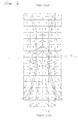
- the arrows in Fig. 6 indicate vectors having the "direction” and the "quantity”. It is found from Fig. 6 that the vector lines are directed so individually outward at the front and rear end portions of a blood discharge portion H that they draw curves in directions to leave a longitudinal center line L gradually. As shown in Fig.
- the linear embosses 7 and 7 are desired to have such patterns at the front and rear end portions of the absorbing body 4 that they draw patterns, in which they reach wholly or mostly the peripheral edge of the absorbing body 4 while drawing curves in the directions to leave the longitudinal center line L gradually outward.
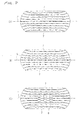
- Fig. 7 (A) shows an example, in which the linear embosses 7 are continuous lines
- Fig. 7(B) shows an example, in which the linear embosses are intermittent lines
- Fig. 7(C) shows an example, in which the honeycomb embosses 8 are applied to the vicinity of the blood discharge portion whereas the linear embosses 7 are applied to the remaining areas.
- the index for the softness to the skin e.g., the WC value (or compression energy) by the KES compression tester is 0.8 gf ⁇ cm/cm 2 or higher, preferably 1.0 gf ⁇ cm/cm 2 or higher, or more preferably 1.2 gf ⁇ cm/cm 2 or higher, and that the index for the prevention of the displacement and cracking of the cellulose wadding of the absorptive article, e.g., the tensile strength at the wet time is 0.4 N or higher, or preferably 0.6 N or higher.
- the widthwise tensile strength of the absorbing body at the wet time is 0.4 N or higher, or preferably 0.6 N or higher, and the longitudinal tensile strength of the absorbing body at the wet time is 1.0 N or higher, or preferably 2.0 N or higher.
- the KES compression tester [KATO TECH CO., LTD.] is a tester for simulating the feeling at the time when an object is touched by the finger of a person, and can measure the compression energy, the compression hardness, the compression recovery and so on.
- the sample is compressed under the conditions of a speed: 0.1 cm/sec, the compression area: 2 cm 2 , the SENS: 2 (200g/10v by the power meter), the DEF sensitivity: 5, and the compression load: 50 gf/cm 2
- the LC the compression hardness
- the WC the compression energy
- the RC the compression recovery
- the LC (the compression hardness) is indicated as [the area of a + b]/[the area of a triangle ABC] in the correlation diagram of the pressure and the deformation, as shown in Fig. 8(B), and it is evaluated that the compression hardness is higher as the value comes closer to 1.
- the WC (or the compression energy) is indicated by [the area of a + b], and it is evaluated that the compression is easier for a higher value.
- the last RC (the compression recovery) is indicated by [the area of b]/[the area of a + b], and it is evaluated that the recovery is higher as the value comes closer to 100 %.
- the softness employs the WC (the compression energy) as the index.
- Tensilon RTC-1210A (ORIENTEC Co., LTD.) is used, and the maximum load value is adopted as the tensile strength by tensing a specimen having a length size of 40 mm and a width size of 20 mm at a tensing speed: 500 mm/min. in opposite directions.
- Specimens having various embosses are prepared and measured on softness by using the WC value (the compression energy) as the index, and the hardness of displacement of the cellulose wadding is measured by using the tensile strength test as the index.
- the results are shown in the graph of Fig. 9.
- the softness to the skin is higher in the rightward direction, and the displacement of the cellulose wadding is more difficult to occur in the upward direction.
- the four specimens, as exemplified in the embodiment satisfy the conditions of the WC value (the compression energy) of 0.8 gf ⁇ cm/cm 2 or higher by the KES compression tester and the tensile strength at the wet time of 0.4 N or higher. It is found to satisfy the softness to the skin and the prevention of the displacement and the cracking of the cellulose wadding of the absorbing body in a well-balanced manner.
Landscapes
- Health & Medical Sciences (AREA)
- Epidemiology (AREA)
- Engineering & Computer Science (AREA)
- Biomedical Technology (AREA)
- Heart & Thoracic Surgery (AREA)
- Vascular Medicine (AREA)
- Life Sciences & Earth Sciences (AREA)
- Animal Behavior & Ethology (AREA)
- General Health & Medical Sciences (AREA)
- Public Health (AREA)
- Veterinary Medicine (AREA)
- Physics & Mathematics (AREA)
- Fluid Mechanics (AREA)
- Absorbent Articles And Supports Therefor (AREA)
Abstract
Description
- The present invention relates to an absorptive article to be mainly used as a sanitary napkin, a vaginal discharge sheet, an incontinence pad, a medical pad or a toiletry and, more particularly, to an absorptive article for providing softness to a skin and for preventing the cellulose wadding of the absorptive article from being displaced or cracked even in the case where an absorbing body is thin.
- In the prior art, there is known an absorptive article such as a panty liner, a sanitary napkin or an incontinence pad, in which an absorbing body made of a cellulose wadding (containing a highly water-absorptive resin mixed therein) of pulverized pulp or the like is interposed between a liquid impermeable rear surface sheet such as a polyethylene sheet or a polyethylene sheet laminate nonwoven fabric and a liquid permeable front surface sheet such as a nonwoven fabric or a liquid permeable plastic sheet.
- In recent years, the case of a relatively bulky absorptive article raises a problem that the article is inconvenient to carry or poor in accommodation. From the requirement for efficient physical distribution and for conservation of natural resources, moreover, it is the tendency to prefer a thin absorptive article, in which the absorbing body in the bodily liquid discharging portion has a thickness of 8 mm or less, preferably 5 mm or less. At the time of thinning the absorptive article, it is impossible to reduce the water absorption cannot be lowered even the article is made thin and compact. It is, therefore, necessarily frequent to increase the content of a highly water-absorptive resin and to use a polymer sheet. At the same time, the absorptive article is thinned by pressing it severely (as referred to
Parent Documents 1 and 2). - Patent Document 1:
JP-A-2003-38552 - Patent Document 2:
JP-A-2003-38574 - However, the absorptive article (or the pulverized pulp) thinned by pressing it has its density raised so extremely the wearer feels stiffness of the absorptive article. Moreover, the cellulose wadding restores an increased thickness after produced, and the absorbing body is thin and contains a highly water-absorptive resin in a large quantity, so that it is troubled by an easy displacement or cracking of the cellulose wadding. Still moreover, the absorbing body is highly densified so that the bodily liquid is seriously diffused by the capillarity. As a result, there arises a problem that a feeling of anxiety is given to the transverse leakage of the absorbing body in the short side direction (or the transverse direction).
- It is, therefore, a major object of the invention is to provide an absorptive article, which can provide softness to a skin when the absorptive article is put thereon, thereby to give a satisfactory wear feeling, and to prevent the cellulose wadding of the absorptive article from being displaced or cracked even in the thin absorptive article liable to become hard while suppressing the dispersion of a bodily liquid in the widthwise direction thereof.
- In order to solve the problems, according to the invention of
claim 1, there is provided an absorptive article comprising absorbing bodies interposed between a liquid permeable front surface sheet and a liquid impermeable rear surface sheet,
characterized in that thermally adhesive fabric layers are individually disposed on the upper and lower surface sides of said absorbing bodies, and in that embosses are added to join the thermally adhesive fabric layer disposed on the upper surface side of the absorbing bodies and the thermally adhesive fabric layer disposed on the lower surface side of the absorbing bodies to each other. - In the invention of
claim 1, in order to soften the feeling of the relatively thin but hard, the thermally adhesive fabric layers are disposed individually on the upper and lower surface sides of the absorbing bodies, and the embosses are added to join the thermally adhesive fabric layer on the upper surface side of the absorbing bodies and the thermally adhesive fabric layer on the lower surface side to each other. As a result, the presence of the thermally adhesive fabric layers gives the softness and the cushioning properties to the skin touching side and the side surface. As a result, the wear feeling is improved, and the positional displacement of the absorbing body is prevented by the join between the thermally adhesive fabric layers thereby to prevent the displacement and the cracking of the cellulose wadding. At the same time, it is also possible to prevent the pulp from being restored to increase the thickness. As an accompanying advantage, moreover, the shielding properties can be improved by the thermally adhesive fabric layers arranged on the skin untouching side, thereby to make the menstrual blood or the like neutral. - In the invention of
claim 2, there is provided an absorptive article as set forth inclaim 1, wherein said embosses are a plurality of lines of linear embosses added to the absorptive article in a direction along the approximately longitudinal direction of said absorptive article. The embosses are the plural lines of linear embosses added to the absorptive article in the direction along the approximately longitudinal direction of the absorptive article. By these linear embosses, the bodily liquid is prevented from being diffused in the widthwise direction, and the linear embosses act as hinge points so that the absorbing bodies become deformable. As a result, the linear embosses touches on the roots of the legs become weak so that the uncomfortable feeling is reduced to improve the wear feeling. Here, the linear embosses may be continuous lines or intermittent lines. - In the invention of
claim 3, there is provided an absorptive article as set forth inclaim 3, wherein said plural lines of linear embosses have a spacing of 1 to 30 mm, and wherein the embosses have a bottom groove width of 0.05 to 5 mm. The linear embosses are desirably added within the numerical range so as to give the softness to the skin, when the absorptive article is worn, to improve the wear feeling, and to prevent the displacement and cracking of the cellulose wadding of the absorptive article. - In the invention of
claim 4, there is provided an absorptive article as set forth in any ofclaims 1 to 3, wherein said plural lines of linear embosses reach wholly or mostly the peripheral edge of the absorbing body at the front and rear end portions of the absorbing body, while drawing curves in the directions to leave the longitudinal center line gradually. It is desired that the linear embosses are aligned with the extending direction of the shorts. Our tests have revealed that the linear embosses are desired to have draw such patterns at the front and rear end portions of the absorbing body that they reach the peripheral edge of the absorbing body while drawing curves in the directions to leave the longitudinal center line gradually outward. - In the invention of
claim 5, there is provided an absorptive article as set forth in any ofclaims 1 to 4, wherein a nonwoven fabric is disposed as said thermally adhesive fabric layers, and wherein said absorbing body is peripherally wrapped by a single sheet. - In the invention of
claim 6, there is provided an absorptive article as set forth in any ofclaims 1 to 5, wherein the pulp of the absorbing body is highly densified at said joined portions. - In the invention of
claim 7, there is provided an absorptive article as set forth in any ofclaims 1 to 6, wherein the absorbing body, in which the thermally adhesive fabric layers disposed individually on said upper and lower surfaces are embossed and joined, has a WC value (or a compression energy) of 0.8 gf · cm/cm2 or larger by a KES compression tester and a tensile strength of 0.4 N or higher at the wet time. The aforementioned numerical range is desired so that the sanitary napkin of the invention may make the softness to the skin and the prevention of the displacement and cracking of the cellulose wadding of the absorptive article compatible in a well-balanced manner. - According to the invention, as has been described in detail hereinbefore, it is possible to provide an absorptive article, which can provide softness to a skin when the absorptive article is put on, thereby to give a satisfactory wear feeling, and to prevent the cellulose wadding of the absorptive article from being displaced or cracked even in the thin absorptive article liable to become hard while suppressing the dispersion of a bodily liquid in the widthwise direction thereof.
- A mode of embodiment of the invention is described in detail in the following with reference to the accompanying drawings. Fig. 1 is a partially broken perspective view of a thin
sanitary napkin 1 according to the invention. - This thin
sanitary napkin 1 is made available mainly for application to a panty liner, a sanitary napkin, a vaginal discharge sheet or an incontinence pad. As shown in Fig. 1, for example, absorbingbodies 4 are interposed between a liquid impermeablerear surface sheet 2 and a liquid permeablefront surface sheet 3, and thermallyadhesive fabric layers adhesive fabric layer 6 disposed on the upper surface side of the absorbing bodies and the thermallyadhesive fabric layer 6 disposed on the lower surface side of the absorbing bodies. Around the absorbingbodies 4, the liquid impermeablerear surface sheet 2 and the liquid permeablefront surface sheet 3 are joined by adhesive means such as a hot melt adhesive. - The liquid impermeable
rear surface sheet 2 is made of a sheet material having at least water-repellent properties such as polyethylene or polypropylene, and may also be made of a nonwoven fabric sheet (in this case, the liquid impermeable rear surface sheet is composed of a waterproof film and a nonwoven fabric) or the like while keeping the liquid impermeable properties substantially by interposing a waterproof film. In recent years, from the viewpoint of preventing stuffiness, it is a tendency to use a moisture permeable material. These water-repellent/moisture-permeable sheet materials are preferably made of porous sheets, which are obtained by melting and blending an inorganic filler in an olefin resin such as polyethylene or polypropylene to form a sheet and then by orienting the sheet uniaxially or biaxially. - The liquid permeable
front surface sheet 3 is preferably made of a non-porous or porous nonwoven fabric or a porous plastic sheet. The material fibers composing the nonwoven fabric can be synthetic fibers of an olefin family of polyethylene or polypropylene, a polyester family or a polyamide family, regenerated fibers such as rayon or cupro-ammonium rayon, or natural fibers such as cotton. Other material fibers can also be composite fibers such as core-sheath fibers made of cores of fibers having a high melting point and sheaths of fibers having a low melting point, side-by-side fibers, or split type fibers. - The nonwoven fabric can also be worked by a suitable method such as a spun-lace method, a spun-bond method, a thermal-bond method, a melt-brown method, a needle-punch method or an air-laid method. Of these working methods, the spun-lace method is excellent for a product having rich draping properties, and the thermal-bond method is excellent for a bulky and soft product.
- The absorbing
bodies 4 interposed between the liquid impermeablerear surface sheet 2 and the liquid permeablefront surface sheet 3 are prepared, for example, by mixing a high water-absorptive resin into pulp, or by mixing not only chemical fibers but also a high water-absorptive resin into pulp. The absorbingbodies 4 can also be enclosed by (not-shown) crepe paper so as to hold the shape, to diffuse menstrual blood promptly, and to prevent the backward flow of the menstrual blood once absorbed. - Especially in the case of the thin
sanitary napkin 1 of the invention, the absorbingbodies 4 are thinned by pressing them. The target thickness of the absorbingbodies 4 in the bodily liquid discharging portion (including the case, in which a high center portion is formed) is set to 8 mm or less, preferably 5 mm or less, or more preferably 3 mm or less. The top plan shape of the absorbingbodies 4 may be an oval shape, as shown, or a fit-cut shape (or a gourd shape) so as to provide softness to a crotch. - The pulp is made of chemical pulp obtained from wood, such as molten pulp, mechanical pulp, paper making pulp, dissolved pulp or synthetic pulp, cellulose fibers such as chemical fibers, or artificial cellulose fibers such as rayon or acetate. Conifer pulp having longer fibers than hose of hard wood pulp is preferably used in the aspects of functions and price.
- The high water-absorptive resin can be exemplified by a saponifier of crosslinked polyacrylate, self-crosslinked polyacrylate or copolymer of acrylic-ester-vinylacetate, crosslinked isobutylene/maleic-anhydride, crosslinked polysulfonate, or partially crosslinked water-growing polymer such as polyethylene oxide or polyacryl amide. Of these, the acrylic acid or acrylate family is preferred because it is excellent in its water absorptivity and water absorbing rate. The highly water-absorptive resin having the water absorbing performance can be adjusted in its production process on the water absorptivity and the water absorbing rate by adjusting the crosslinked density and the crosslinked density gradient. The content of the highly water-absorptive resin is desired to be 10 to 60 %. A sufficient absorptivity cannot be given, in case the content of the highly water-absorptive resin is less than 10 %. In case the content is more than 60 %, the interlace between the pulp fibers disappears so that the sheet intensity drops to invite breakage and cracking easily.
- The thermally
adhesive fabric layers front surface sheet 3 and the absorbingbodies 4 and between the liquid impermeablerear surface sheet 2 and the absorbingbodies 4, can be preferably made of the nonwoven fabric. - In another mode of disposing the
nonwoven fabrics nonwoven fabrics front surface sheet 3 and the absorbingbody 4 and between the liquid impermeablerear surface sheet 2 and the absorbingbody 4. It is, however, desired that the twononwoven fabrics bodies 4, as shown in Fig. 3. Fig. 3(A) is a transverse section of the case, in which thenonwoven fabric 6 wraps the absorbingbody 4 with its end portions being overlapped on the upper surface side, and Fig. 3(B) is a transverse section of the case, in which thenonwoven fabric 6 wraps the absorbingbody 4 with its end portions being overlapped on the lower surface side. In the case of the upper wrapping case, the two nonwoven fabrics are overlapped on the skin surface side so that they can provide higher softness. In the case of the lower wrapping case, on the other hand, the shielding properties on the skin untouching side can be better improved. - The
nonwoven fabric 6 is given the hydrophilic properties either by using the regenerated fibers of rayon or cupro-ammonium rayon, or natural fibers such as cotton thereby to use the material having the hydrophilic properties by itself, or by using the fibers which are prepared by treating synthetic resins of the olefin family such as polyethylene or polypropylene, the polyester family or the polyamide family on their surfaces with a hydrophilic agent thereby to give the hydrophilic properties. Moreover, thenonwoven fabric 6, as disposed between the liquid impermeablerear surface sheet 2 and the absorbingbody 4, may be either hydrophilic or hydrophobic, but is preferred to be hydrophobic. In case the absorbingbody 4 is wrapped by a single sheet, as described above, it is desired that the sheet for the skin surface side is treated to have the hydrophilic properties whereas the sheet for the skin untouching side is treated to have the hydrophobic properties. In other words, the area on the skin untouching side is treated to have the water repellent properties, in case the material itself has the hydrophilic properties, and the area on the skin surface side is treated to have the hydrophilic properties, in case the material itself has the water-repellent properties, thereby to give the skin side area and the skin untouching side area the different properties. - It is desired to use such a nonwoven fabric, although made different physical properties by the preparing method, as gives, when worn, the skin touching side and/or the skin untouching side the softness (or the soft feeling) thereby to make the wear feeling good and to enhance the shielding properties on the skin untouching side. The nonwoven fabric satisfying that condition may be exemplified by an air-through nonwoven fabric. The air-through nonwoven fabric is enabled, by its bulkiness, to improve the cushioning properties and, by its retention of the distance from the outer surface side, to improve the shielding properties. In order to provide the softness to the skin, moreover, it is desired that the nonwoven fabric has a Metsuke of 10 g/m2 or higher, preferably 15 g/m2 or higher, or more preferably 20 g/m2 or higher. Here, the
nonwoven fabric 6 and the absorbingbody 4 are desirably joined by a hot-melt adhesive, but may also be given the later-describedembosses 7 while being not joined. - In the present
absorbing body 4, the embossing treatment is performed to join the thermallyadhesive fabric layer 6 disposed on the upper surface side of the absorbingbody 4 and the thermallyadhesive fabric layer 6 disposed on the lower surface side of the absorbingbody 4 to each other, so that the cellulose wadding of the absorbingarticle 4 can be prevented from being displaced or cracked while suppressing the diffusion of the bodily liquid in the widthwise directions of the absorbing body. - The
embosses 7 are desirably formed in the stress directions of the absorbingbodies 4 thereby not to generate such a component force as to cause the cellulose wadding. In other words, the embosses are desirably formed along the direction, in which the underwear extends, or in which the absorbing body is liable to be cracked. In the example of thesanitary napkin 1 shown in Fig. 1, therefore, a plurality of lines oflinear embosses sanitary napkin 1 in a direction along the approximately longitudinal direction thereof. The linear embosses 7 and 7 are desired to have a spacing P of 1 to 30 mm, preferably 2 to 15 mm. In case, the spacing P of thelinear embosses bodies 4 are made too hard to satisfy the softness by thelinear embosses linear embosses linear emboss 7 is desired to have a bottom groove width M of 0.05 to 5 mm, preferably 0.03 to 3 mm. In case the groove width M is more than 5 mm, the space portion of the groove is felt to deteriorate the wear feeling, and much pulverized pulp is interposed in the emboss portion between the upper and lower thermally adhesive fabric layers thereby to make it difficult to join the upper and lower thermally adhesive fabric layers to each other. In case the groove width is less than 0.05 mm, the groove width is so small that the thermally adhesive fabric layers (or the nonwoven fabric 6) are cut. - As schematically shown in the transverse section of Fig. 2, absorbing
portions 4a sandwiched between thelinear embosses nonwoven fabrics bodies 4 can be prevented from being displaced or cracked. Moreover, thenonwoven fabrics linear embosses - At the same time, moreover, the bodily liquid to diffuse sideways penetrates into the absorbing
bodies 4. When the bodily liquid reaches the joined portions (or theemboss portions 7 and 7), it is prevented, in case thenonwoven fabrics bodies 4 is highly densified at the emboss portions, the bodily liquid diffuses along the highly densified emboss lines so that it is prevented from diffusing sideways. - Moreover, the individual
linear embosses bodies 4 become easily deformable. As a result, their touches on the roots of the legs become weak so that the uncomfortable feeling is reduced to improve the wear feeling. - When the
linear embosses body 4, anemboss roll 8 having multiple lines of ridges 8a circumferentially continuing on the roll surface and ananvil roll 9 havingridges 9a at positions corresponding to the ridges 8a are disposed to confront each other, as shown in Fig. 5. An absorbing strip 4' wrapped by thenonwoven fabric 6 is passed between the tworolls linear embosses - Incidentally, it is desired, as has been described hereinbefore, that the direction of the
linear embosses linear embosses body 4 that they draw patterns, in which they reach wholly or mostly the peripheral edge of the absorbingbody 4 while drawing curves in the directions to leave the longitudinal center line L gradually outward. Fig. 7 (A) shows an example, in which thelinear embosses 7 are continuous lines; Fig. 7(B) shows an example, in which the linear embosses are intermittent lines; and Fig. 7(C) shows an example, in which the honeycomb embosses 8 are applied to the vicinity of the blood discharge portion whereas thelinear embosses 7 are applied to the remaining areas. - In order that the
sanitary napkin 1 of the invention may make the softness to the skin and the prevention of the displacement and cracking of the cellulose wadding of the absorptive article compatible in a well-balanced manner, it is desired that the index for the softness to the skin, e.g., the WC value (or compression energy) by the KES compression tester is 0.8 gf · cm/cm2 or higher, preferably 1.0 gf · cm/cm2 or higher, or more preferably 1.2 gf · cm/cm2 or higher, and that the index for the prevention of the displacement and cracking of the cellulose wadding of the absorptive article, e.g., the tensile strength at the wet time is 0.4 N or higher, or preferably 0.6 N or higher. As to the latter tensile strength at the wet time, the widthwise tensile strength of the absorbing body at the wet time is 0.4 N or higher, or preferably 0.6 N or higher, and the longitudinal tensile strength of the absorbing body at the wet time is 1.0 N or higher, or preferably 2.0 N or higher. - The KES compression tester [KATO TECH CO., LTD.] is a tester for simulating the feeling at the time when an object is touched by the finger of a person, and can measure the compression energy, the compression hardness, the compression recovery and so on. In the measurements, as shown in Fig. 8 (A), the sample is compressed under the conditions of a speed: 0.1 cm/sec, the compression area: 2 cm2, the SENS: 2 (200g/10v by the power meter), the DEF sensitivity: 5, and the compression load: 50 gf/cm2, and the LC (the compression hardness), the WC (the compression energy) and the RC (the compression recovery) are calculated from the correlation diagrams between the pressure and the deformation.
- The LC (the compression hardness) is indicated as [the area of a + b]/[the area of a triangle ABC] in the correlation diagram of the pressure and the deformation, as shown in Fig. 8(B), and it is evaluated that the compression hardness is higher as the value comes closer to 1. The WC (or the compression energy) is indicated by [the area of a + b], and it is evaluated that the compression is easier for a higher value. The last RC (the compression recovery) is indicated by [the area of b]/[the area of a + b], and it is evaluated that the recovery is higher as the value comes closer to 100 %. Of these test items, the softness, as found by the sensory evaluation, employs the WC (the compression energy) as the index.
- For the tests of the tensile strength, on the other hand, Tensilon RTC-1210A (ORIENTEC Co., LTD.) is used, and the maximum load value is adopted as the tensile strength by tensing a specimen having a length size of 40 mm and a width size of 20 mm at a tensing speed: 500 mm/min. in opposite directions.
- Specimens having various embosses are prepared and measured on softness by using the WC value (the compression energy) as the index, and the hardness of displacement of the cellulose wadding is measured by using the tensile strength test as the index. The results are shown in the graph of Fig. 9. In Fig. 9, the softness to the skin is higher in the rightward direction, and the displacement of the cellulose wadding is more difficult to occur in the upward direction. The four specimens, as exemplified in the embodiment, satisfy the conditions of the WC value (the compression energy) of 0.8 gf · cm/cm2 or higher by the KES compression tester and the tensile strength at the wet time of 0.4 N or higher. It is found to satisfy the softness to the skin and the prevention of the displacement and the cracking of the cellulose wadding of the absorbing body in a well-balanced manner.
-
- (1) In the thin
sanitary napkin 1 shown in Fig. 1, it is arbitrary to dispose the hydrophilic fiber layer as the so-called "second sheet" so partially as to limit the area such as a blood discharge portion, or to dispose the same all over the absorbingbody 4. -
- [Fig. 1] A partially broken perspective view of a thin
sanitary napkin 1 according to the invention. - [Fig. 2] A partially enlarged transverse section of the same.
- [Fig. 3] Both (A) and (B) diagrams showing modes of arrangement of a
nonwoven fabric 6. - [Fig. 4] A transverse section showing another mode of the
nonwoven fabric 6. - [Fig. 5] A diagram for applying
linear embosses 7. - [Fig. 6] A vector diagram showing the extending state of an underwear when worn.
- [Fig. 7] All (A) to (C) top plan views showing examples of other
linear embosses - [Fig. 8] (A) a testing procedure by a KES compression tester, and (B) a correlation diagram showing the KES compression test results between the pressure and the deformation.
- [Fig. 9] A correlation diagram of individual napkins in case the abscissa indicates softness whereas the ordinate indicates the hardness of displacement of cellulose wadding.
- 1 ... Thin Sanitary Napkin, 2 ... Liquid Impermeable Rear Surface Sheet, 3 ... Liquid Permeable Front Surface Sheet, 4... Absorbing Body, 6 ... Thermally Adhesive Fabric Layer (Nonwoven Fabric), and 7 ... Linear Embosses.
Claims (7)
- An absorptive article comprising absorbing bodies interposed between a liquid permeable front surface sheet and a liquid impermeable rear surface sheet,
characterized in that thermally adhesive fabric layers are disposed individually on the upper and lower surface sides of said absorbing bodies, and in that embosses are added to join the thermally adhesive fabric layer disposed on the upper surface side of the absorbing bodies and the thermally adhesive fabric layer disposed on the lower surface side of the absorbing bodies to each other. - An absorptive article as set forth in claim 1, wherein said embosses are a plurality of lines of linear embosses added to said absorptive article in a direction along the approximately longitudinal direction of said absorptive article.
- An absorptive article as set forth in claim 2, wherein said plural lines of linear embosses have a spacing of 1 to 30 mm, and wherein the embosses have a bottom groove width of 0.05 to 5 mm.
- An absorptive article as set forth in claim 2 or 3, wherein said plural lines of linear embosses reach wholly or mostly the peripheral edge of the absorbing body at the front and rear end portions of the absorbing body, while drawing curves in the directions to leave the longitudinal center line gradually.
- An absorptive article as set forth in any of claims 1 to 4, wherein a nonwoven fabric is disposed as said thermally adhesive fabric layers, and wherein said absorbing body is peripherally wrapped by a single sheet.
- An absorptive article as set forth in any of claims 1 to 5, wherein the pulp of the absorbing body is highly densified at said joined portions.
- An absorptive article as set forth in any of claims 1 to 6, wherein the absorbing body, in which the thermally adhesive fabric layers disposed individually on said upper and lower surfaces are embossed and joined, has a WC value (or a compression energy) of 0.8 gf · cm/cm2 or larger by a KES compression tester and a tensile strength of 0.4 N or higher at the wet time.
Applications Claiming Priority (1)
| Application Number | Priority Date | Filing Date | Title |
|---|---|---|---|
| PCT/JP2004/014388 WO2006038264A1 (en) | 2004-09-30 | 2004-09-30 | Absorptive article |
Publications (4)
| Publication Number | Publication Date |
|---|---|
| EP1813239A1 true EP1813239A1 (en) | 2007-08-01 |
| EP1813239A4 EP1813239A4 (en) | 2011-09-07 |
| EP1813239B1 EP1813239B1 (en) | 2014-05-07 |
| EP1813239B2 EP1813239B2 (en) | 2017-08-30 |
Family
ID=36142355
Family Applications (1)
| Application Number | Title | Priority Date | Filing Date |
|---|---|---|---|
| EP04788416.8A Expired - Lifetime EP1813239B2 (en) | 2004-09-30 | 2004-09-30 | Absorptive article |
Country Status (5)
| Country | Link |
|---|---|
| US (1) | US20080021427A1 (en) |
| EP (1) | EP1813239B2 (en) |
| CN (1) | CN101027028B (en) |
| BR (1) | BRPI0419072B8 (en) |
| WO (1) | WO2006038264A1 (en) |
Cited By (1)
| Publication number | Priority date | Publication date | Assignee | Title |
|---|---|---|---|---|
| WO2015177096A1 (en) * | 2014-05-19 | 2015-11-26 | Papierwerk Sundern Gmbh | Method for producing at least one suction insert, and a suction insert |
Families Citing this family (7)
| Publication number | Priority date | Publication date | Assignee | Title |
|---|---|---|---|---|
| JP5623828B2 (en) * | 2010-08-31 | 2014-11-12 | 大王製紙株式会社 | Absorbent articles |
| JP5839685B2 (en) * | 2012-01-19 | 2016-01-06 | ユニ・チャーム株式会社 | Disposable absorbent article |
| JP6116809B2 (en) * | 2012-03-22 | 2017-04-19 | 大王製紙株式会社 | Disposable paper diapers |
| CN104027202A (en) * | 2014-06-25 | 2014-09-10 | 湖南康程护理用品有限公司 | Absorbing core for treating excrement and manufacturing method for absorbing core |
| MX377934B (en) | 2015-10-30 | 2025-03-11 | Kimberly Clark Co | ABSORBENT ARTICLE WITH CHANNELS AND ELASTIC CONFORMING MEMBERS. |
| JP6701555B2 (en) * | 2016-01-25 | 2020-05-27 | 日本製紙クレシア株式会社 | Absorbent article |
| US12115052B2 (en) | 2021-10-08 | 2024-10-15 | The Procter & Gamble Company | Feminine hygiene pad with advantageous lateral gathering features |
Family Cites Families (17)
| Publication number | Priority date | Publication date | Assignee | Title |
|---|---|---|---|---|
| US4055180A (en) * | 1976-04-23 | 1977-10-25 | Colgate-Palmolive Company | Absorbent article with retained hydrocolloid material |
| JPS5925369Y2 (en) * | 1978-11-15 | 1984-07-25 | 日本バイリ−ン株式会社 | Liquid-absorbing articles |
| JPS5735001A (en) * | 1980-08-01 | 1982-02-25 | Kao Corp | Absorbing article |
| GR75722B (en) * | 1981-06-11 | 1984-08-02 | Johnson & Johnson Baby Prod | |
| JPH0423645Y2 (en) * | 1985-06-14 | 1992-06-02 | ||
| US5514120A (en) † | 1991-12-18 | 1996-05-07 | Minnesota Mining And Manufacturing Company | Liquid management member for absorbent articles |
| NZ250889A (en) * | 1993-02-22 | 1996-05-28 | Mcneil Ppc Inc | Absorbent pad: double layer with embossed garment facing layer |
| CA2123329C (en) † | 1993-12-17 | 2005-01-11 | Mary Eva Garvie Weber | Liquid absorbent material for personal care absorbent articles and the like |
| US5938650A (en) * | 1995-08-09 | 1999-08-17 | Fibertech Group, Inc. | Absorbent core for absorbing body liquids and method |
| JP3675601B2 (en) * | 1996-09-12 | 2005-07-27 | ユニ・チャーム株式会社 | Absorber |
| AU751367B2 (en) * | 1999-05-25 | 2002-08-15 | Bki Holding Corporation | Multifunctional fibrous material with improved edge seal |
| US6878433B2 (en) * | 1999-12-21 | 2005-04-12 | The Procter & Gamble Company | Applications for laminate web |
| US20020102392A1 (en) * | 2000-12-28 | 2002-08-01 | Kimberly-Clark Worldwide, Inc. | Flexible laminate structures having enclosed discrete regions of a material |
| CN2527254Y (en) † | 2002-02-04 | 2002-12-25 | 福建恒安集团有限公司 | Disposable absorbent article with diffusible flow-guiding groove |
| CN2548609Y (en) † | 2002-04-16 | 2003-05-07 | 福建恒安集团有限公司 | Side-leakageproof sanitary towel |
| JP4061148B2 (en) * | 2002-07-23 | 2008-03-12 | 大王製紙株式会社 | Absorbent articles |
| JP3890313B2 (en) * | 2003-03-31 | 2007-03-07 | 大王製紙株式会社 | Absorbent articles |
-
2004
- 2004-09-30 US US11/664,338 patent/US20080021427A1/en not_active Abandoned
- 2004-09-30 CN CN2004800441136A patent/CN101027028B/en not_active Expired - Fee Related
- 2004-09-30 BR BRPI0419072A patent/BRPI0419072B8/en not_active IP Right Cessation
- 2004-09-30 EP EP04788416.8A patent/EP1813239B2/en not_active Expired - Lifetime
- 2004-09-30 WO PCT/JP2004/014388 patent/WO2006038264A1/en not_active Ceased
Cited By (1)
| Publication number | Priority date | Publication date | Assignee | Title |
|---|---|---|---|---|
| WO2015177096A1 (en) * | 2014-05-19 | 2015-11-26 | Papierwerk Sundern Gmbh | Method for producing at least one suction insert, and a suction insert |
Also Published As
| Publication number | Publication date |
|---|---|
| WO2006038264A1 (en) | 2006-04-13 |
| EP1813239B2 (en) | 2017-08-30 |
| BRPI0419072B8 (en) | 2021-06-22 |
| CN101027028B (en) | 2010-06-16 |
| EP1813239A4 (en) | 2011-09-07 |
| EP1813239B1 (en) | 2014-05-07 |
| US20080021427A1 (en) | 2008-01-24 |
| BRPI0419072B1 (en) | 2015-01-27 |
| CN101027028A (en) | 2007-08-29 |
| BRPI0419072A (en) | 2007-12-11 |
Similar Documents
| Publication | Publication Date | Title |
|---|---|---|
| EP3470034B1 (en) | Absorbent article | |
| JP2008073396A (en) | Absorptive article | |
| AU2003248449A1 (en) | Thin comfortable sanitary napkin having reduced bunching | |
| WO2005120411A1 (en) | Absorptive article | |
| WO2014112590A1 (en) | Absorbent article | |
| JP2008229032A (en) | Absorbent articles | |
| JP2001340382A (en) | Absorbent articles | |
| US11273085B2 (en) | Absorbent article | |
| AU2015224442A1 (en) | Absorbent article demonstrating controlled deformation and longitudinal fluid distribution | |
| JP2007143698A (en) | Absorbent article and method for producing the same | |
| EP1813239B2 (en) | Absorptive article | |
| JP4050536B2 (en) | Absorbent articles | |
| AU2015224433A1 (en) | Absorbent article demonstrating controlled deformation and longitudinal fluid distribution | |
| KR102642080B1 (en) | absorbent article | |
| JP4275128B2 (en) | Absorbent articles | |
| JP2007089819A (en) | Absorbent articles | |
| JP3890313B2 (en) | Absorbent articles | |
| JP4834529B2 (en) | Absorbent articles | |
| JP3806669B2 (en) | Absorbent articles | |
| AU2015224434B2 (en) | Absorbent article demonstrating controlled deformation and longitudinal fluid distribution | |
| JP4540087B2 (en) | Absorbent articles | |
| RU2359650C2 (en) | Absorbing product | |
| JP3243208U (en) | sanitary goods | |
| JP4061148B2 (en) | Absorbent articles | |
| JP7424848B2 (en) | absorbent articles |
Legal Events
| Date | Code | Title | Description |
|---|---|---|---|
| PUAI | Public reference made under article 153(3) epc to a published international application that has entered the european phase |
Free format text: ORIGINAL CODE: 0009012 |
|
| 17P | Request for examination filed |
Effective date: 20070327 |
|
| AK | Designated contracting states |
Kind code of ref document: A1 Designated state(s): AT BE BG CH CY CZ DE DK EE ES FI FR GB GR HU IE IT LI LU MC NL PL PT RO SE SI SK TR |
|
| DAX | Request for extension of the european patent (deleted) | ||
| A4 | Supplementary search report drawn up and despatched |
Effective date: 20110810 |
|
| RIC1 | Information provided on ipc code assigned before grant |
Ipc: A61F 13/536 20060101AFI20110804BHEP |
|
| 17Q | First examination report despatched |
Effective date: 20120403 |
|
| REG | Reference to a national code |
Ref country code: DE Ref legal event code: R079 Ref document number: 602004045066 Country of ref document: DE Free format text: PREVIOUS MAIN CLASS: A61F0013536000 Ipc: A61F0013475000 |
|
| GRAP | Despatch of communication of intention to grant a patent |
Free format text: ORIGINAL CODE: EPIDOSNIGR1 |
|
| RIC1 | Information provided on ipc code assigned before grant |
Ipc: A61F 13/534 20060101ALI20131008BHEP Ipc: A61F 13/536 20060101ALI20131008BHEP Ipc: A61F 13/532 20060101ALI20131008BHEP Ipc: A61F 13/475 20060101AFI20131008BHEP |
|
| INTG | Intention to grant announced |
Effective date: 20131112 |
|
| GRAS | Grant fee paid |
Free format text: ORIGINAL CODE: EPIDOSNIGR3 |
|
| GRAA | (expected) grant |
Free format text: ORIGINAL CODE: 0009210 |
|
| AK | Designated contracting states |
Kind code of ref document: B1 Designated state(s): AT BE BG CH CY CZ DE DK EE ES FI FR GB GR HU IE IT LI LU MC NL PL PT RO SE SI SK TR |
|
| REG | Reference to a national code |
Ref country code: GB Ref legal event code: FG4D |
|
| REG | Reference to a national code |
Ref country code: AT Ref legal event code: REF Ref document number: 666025 Country of ref document: AT Kind code of ref document: T Effective date: 20140515 |
|
| REG | Reference to a national code |
Ref country code: IE Ref legal event code: FG4D |
|
| REG | Reference to a national code |
Ref country code: DE Ref legal event code: R096 Ref document number: 602004045066 Country of ref document: DE Effective date: 20140626 |
|
| REG | Reference to a national code |
Ref country code: AT Ref legal event code: MK05 Ref document number: 666025 Country of ref document: AT Kind code of ref document: T Effective date: 20140507 |
|
| REG | Reference to a national code |
Ref country code: NL Ref legal event code: VDEP Effective date: 20140507 |
|
| PG25 | Lapsed in a contracting state [announced via postgrant information from national office to epo] |
Ref country code: CY Free format text: LAPSE BECAUSE OF FAILURE TO SUBMIT A TRANSLATION OF THE DESCRIPTION OR TO PAY THE FEE WITHIN THE PRESCRIBED TIME-LIMIT Effective date: 20140507 Ref country code: GR Free format text: LAPSE BECAUSE OF FAILURE TO SUBMIT A TRANSLATION OF THE DESCRIPTION OR TO PAY THE FEE WITHIN THE PRESCRIBED TIME-LIMIT Effective date: 20140808 Ref country code: FI Free format text: LAPSE BECAUSE OF FAILURE TO SUBMIT A TRANSLATION OF THE DESCRIPTION OR TO PAY THE FEE WITHIN THE PRESCRIBED TIME-LIMIT Effective date: 20140507 |
|
| PG25 | Lapsed in a contracting state [announced via postgrant information from national office to epo] |
Ref country code: ES Free format text: LAPSE BECAUSE OF FAILURE TO SUBMIT A TRANSLATION OF THE DESCRIPTION OR TO PAY THE FEE WITHIN THE PRESCRIBED TIME-LIMIT Effective date: 20140507 Ref country code: AT Free format text: LAPSE BECAUSE OF FAILURE TO SUBMIT A TRANSLATION OF THE DESCRIPTION OR TO PAY THE FEE WITHIN THE PRESCRIBED TIME-LIMIT Effective date: 20140507 Ref country code: PL Free format text: LAPSE BECAUSE OF FAILURE TO SUBMIT A TRANSLATION OF THE DESCRIPTION OR TO PAY THE FEE WITHIN THE PRESCRIBED TIME-LIMIT Effective date: 20140507 Ref country code: SE Free format text: LAPSE BECAUSE OF FAILURE TO SUBMIT A TRANSLATION OF THE DESCRIPTION OR TO PAY THE FEE WITHIN THE PRESCRIBED TIME-LIMIT Effective date: 20140507 |
|
| PG25 | Lapsed in a contracting state [announced via postgrant information from national office to epo] |
Ref country code: PT Free format text: LAPSE BECAUSE OF FAILURE TO SUBMIT A TRANSLATION OF THE DESCRIPTION OR TO PAY THE FEE WITHIN THE PRESCRIBED TIME-LIMIT Effective date: 20140908 |
|
| PG25 | Lapsed in a contracting state [announced via postgrant information from national office to epo] |
Ref country code: CZ Free format text: LAPSE BECAUSE OF FAILURE TO SUBMIT A TRANSLATION OF THE DESCRIPTION OR TO PAY THE FEE WITHIN THE PRESCRIBED TIME-LIMIT Effective date: 20140507 Ref country code: BE Free format text: LAPSE BECAUSE OF FAILURE TO SUBMIT A TRANSLATION OF THE DESCRIPTION OR TO PAY THE FEE WITHIN THE PRESCRIBED TIME-LIMIT Effective date: 20140507 Ref country code: SK Free format text: LAPSE BECAUSE OF FAILURE TO SUBMIT A TRANSLATION OF THE DESCRIPTION OR TO PAY THE FEE WITHIN THE PRESCRIBED TIME-LIMIT Effective date: 20140507 Ref country code: EE Free format text: LAPSE BECAUSE OF FAILURE TO SUBMIT A TRANSLATION OF THE DESCRIPTION OR TO PAY THE FEE WITHIN THE PRESCRIBED TIME-LIMIT Effective date: 20140507 Ref country code: RO Free format text: LAPSE BECAUSE OF FAILURE TO SUBMIT A TRANSLATION OF THE DESCRIPTION OR TO PAY THE FEE WITHIN THE PRESCRIBED TIME-LIMIT Effective date: 20140507 Ref country code: DK Free format text: LAPSE BECAUSE OF FAILURE TO SUBMIT A TRANSLATION OF THE DESCRIPTION OR TO PAY THE FEE WITHIN THE PRESCRIBED TIME-LIMIT Effective date: 20140507 |
|
| REG | Reference to a national code |
Ref country code: DE Ref legal event code: R026 Ref document number: 602004045066 Country of ref document: DE |
|
| PLBI | Opposition filed |
Free format text: ORIGINAL CODE: 0009260 |
|
| PG25 | Lapsed in a contracting state [announced via postgrant information from national office to epo] |
Ref country code: NL Free format text: LAPSE BECAUSE OF FAILURE TO SUBMIT A TRANSLATION OF THE DESCRIPTION OR TO PAY THE FEE WITHIN THE PRESCRIBED TIME-LIMIT Effective date: 20140507 |
|
| PLAX | Notice of opposition and request to file observation + time limit sent |
Free format text: ORIGINAL CODE: EPIDOSNOBS2 |
|
| 26 | Opposition filed |
Opponent name: KIMBERLY-CLARK WORLDWIDE, INC. Effective date: 20150206 |
|
| REG | Reference to a national code |
Ref country code: DE Ref legal event code: R026 Ref document number: 602004045066 Country of ref document: DE Effective date: 20150206 |
|
| PG25 | Lapsed in a contracting state [announced via postgrant information from national office to epo] |
Ref country code: MC Free format text: LAPSE BECAUSE OF FAILURE TO SUBMIT A TRANSLATION OF THE DESCRIPTION OR TO PAY THE FEE WITHIN THE PRESCRIBED TIME-LIMIT Effective date: 20140507 Ref country code: IT Free format text: LAPSE BECAUSE OF FAILURE TO SUBMIT A TRANSLATION OF THE DESCRIPTION OR TO PAY THE FEE WITHIN THE PRESCRIBED TIME-LIMIT Effective date: 20140507 Ref country code: LU Free format text: LAPSE BECAUSE OF FAILURE TO SUBMIT A TRANSLATION OF THE DESCRIPTION OR TO PAY THE FEE WITHIN THE PRESCRIBED TIME-LIMIT Effective date: 20140930 |
|
| REG | Reference to a national code |
Ref country code: CH Ref legal event code: PL |
|
| REG | Reference to a national code |
Ref country code: IE Ref legal event code: MM4A |
|
| PG25 | Lapsed in a contracting state [announced via postgrant information from national office to epo] |
Ref country code: SI Free format text: LAPSE BECAUSE OF FAILURE TO SUBMIT A TRANSLATION OF THE DESCRIPTION OR TO PAY THE FEE WITHIN THE PRESCRIBED TIME-LIMIT Effective date: 20140507 Ref country code: CH Free format text: LAPSE BECAUSE OF NON-PAYMENT OF DUE FEES Effective date: 20140930 Ref country code: LI Free format text: LAPSE BECAUSE OF NON-PAYMENT OF DUE FEES Effective date: 20140930 |
|
| PLAF | Information modified related to communication of a notice of opposition and request to file observations + time limit |
Free format text: ORIGINAL CODE: EPIDOSCOBS2 |
|
| PG25 | Lapsed in a contracting state [announced via postgrant information from national office to epo] |
Ref country code: IE Free format text: LAPSE BECAUSE OF NON-PAYMENT OF DUE FEES Effective date: 20140930 |
|
| PLBB | Reply of patent proprietor to notice(s) of opposition received |
Free format text: ORIGINAL CODE: EPIDOSNOBS3 |
|
| PG25 | Lapsed in a contracting state [announced via postgrant information from national office to epo] |
Ref country code: BG Free format text: LAPSE BECAUSE OF FAILURE TO SUBMIT A TRANSLATION OF THE DESCRIPTION OR TO PAY THE FEE WITHIN THE PRESCRIBED TIME-LIMIT Effective date: 20140507 |
|
| PG25 | Lapsed in a contracting state [announced via postgrant information from national office to epo] |
Ref country code: TR Free format text: LAPSE BECAUSE OF FAILURE TO SUBMIT A TRANSLATION OF THE DESCRIPTION OR TO PAY THE FEE WITHIN THE PRESCRIBED TIME-LIMIT Effective date: 20140507 Ref country code: HU Free format text: LAPSE BECAUSE OF FAILURE TO SUBMIT A TRANSLATION OF THE DESCRIPTION OR TO PAY THE FEE WITHIN THE PRESCRIBED TIME-LIMIT; INVALID AB INITIO Effective date: 20040930 |
|
| REG | Reference to a national code |
Ref country code: FR Ref legal event code: PLFP Year of fee payment: 13 |
|
| PUAH | Patent maintained in amended form |
Free format text: ORIGINAL CODE: 0009272 |
|
| STAA | Information on the status of an ep patent application or granted ep patent |
Free format text: STATUS: PATENT MAINTAINED AS AMENDED |
|
| REG | Reference to a national code |
Ref country code: FR Ref legal event code: PLFP Year of fee payment: 14 |
|
| 27A | Patent maintained in amended form |
Effective date: 20170830 |
|
| AK | Designated contracting states |
Kind code of ref document: B2 Designated state(s): AT BE BG CH CY CZ DE DK EE ES FI FR GB GR HU IE IT LI LU MC NL PL PT RO SE SI SK TR |
|
| REG | Reference to a national code |
Ref country code: DE Ref legal event code: R102 Ref document number: 602004045066 Country of ref document: DE |
|
| REG | Reference to a national code |
Ref country code: FR Ref legal event code: PLFP Year of fee payment: 15 |
|
| PGFP | Annual fee paid to national office [announced via postgrant information from national office to epo] |
Ref country code: GB Payment date: 20220811 Year of fee payment: 19 Ref country code: DE Payment date: 20220809 Year of fee payment: 19 |
|
| PGFP | Annual fee paid to national office [announced via postgrant information from national office to epo] |
Ref country code: FR Payment date: 20220808 Year of fee payment: 19 |
|
| REG | Reference to a national code |
Ref country code: DE Ref legal event code: R119 Ref document number: 602004045066 Country of ref document: DE |
|
| GBPC | Gb: european patent ceased through non-payment of renewal fee |
Effective date: 20230930 |
|
| PG25 | Lapsed in a contracting state [announced via postgrant information from national office to epo] |
Ref country code: GB Free format text: LAPSE BECAUSE OF NON-PAYMENT OF DUE FEES Effective date: 20230930 |
|
| PG25 | Lapsed in a contracting state [announced via postgrant information from national office to epo] |
Ref country code: GB Free format text: LAPSE BECAUSE OF NON-PAYMENT OF DUE FEES Effective date: 20230930 Ref country code: FR Free format text: LAPSE BECAUSE OF NON-PAYMENT OF DUE FEES Effective date: 20230930 Ref country code: DE Free format text: LAPSE BECAUSE OF NON-PAYMENT OF DUE FEES Effective date: 20240403 |