EP1812446B1 - Pharmaceutical compounds - Google Patents
Pharmaceutical compounds Download PDFInfo
- Publication number
- EP1812446B1 EP1812446B1 EP05798278.7A EP05798278A EP1812446B1 EP 1812446 B1 EP1812446 B1 EP 1812446B1 EP 05798278 A EP05798278 A EP 05798278A EP 1812446 B1 EP1812446 B1 EP 1812446B1
- Authority
- EP
- European Patent Office
- Prior art keywords
- morpholin
- thieno
- pyrimidin
- ylmethyl
- group
- Prior art date
- Legal status (The legal status is an assumption and is not a legal conclusion. Google has not performed a legal analysis and makes no representation as to the accuracy of the status listed.)
- Expired - Lifetime
Links
- 0 *C(CCC1)CCc2c1c(*)nc(*)n2 Chemical compound *C(CCC1)CCc2c1c(*)nc(*)n2 0.000 description 3
Classifications
-
- C—CHEMISTRY; METALLURGY
- C07—ORGANIC CHEMISTRY
- C07D—HETEROCYCLIC COMPOUNDS
- C07D495/00—Heterocyclic compounds containing in the condensed system at least one hetero ring having sulfur atoms as the only ring hetero atoms
- C07D495/02—Heterocyclic compounds containing in the condensed system at least one hetero ring having sulfur atoms as the only ring hetero atoms in which the condensed system contains two hetero rings
- C07D495/04—Ortho-condensed systems
-
- A—HUMAN NECESSITIES
- A61—MEDICAL OR VETERINARY SCIENCE; HYGIENE
- A61K—PREPARATIONS FOR MEDICAL, DENTAL OR TOILETRY PURPOSES
- A61K31/00—Medicinal preparations containing organic active ingredients
- A61K31/33—Heterocyclic compounds
- A61K31/395—Heterocyclic compounds having nitrogen as a ring hetero atom, e.g. guanethidine or rifamycins
- A61K31/495—Heterocyclic compounds having nitrogen as a ring hetero atom, e.g. guanethidine or rifamycins having six-membered rings with two or more nitrogen atoms as the only ring heteroatoms, e.g. piperazine or tetrazines
- A61K31/505—Pyrimidines; Hydrogenated pyrimidines, e.g. trimethoprim
- A61K31/519—Pyrimidines; Hydrogenated pyrimidines, e.g. trimethoprim ortho- or peri-condensed with heterocyclic rings
-
- A—HUMAN NECESSITIES
- A61—MEDICAL OR VETERINARY SCIENCE; HYGIENE
- A61P—SPECIFIC THERAPEUTIC ACTIVITY OF CHEMICAL COMPOUNDS OR MEDICINAL PREPARATIONS
- A61P25/00—Drugs for disorders of the nervous system
-
- A—HUMAN NECESSITIES
- A61—MEDICAL OR VETERINARY SCIENCE; HYGIENE
- A61P—SPECIFIC THERAPEUTIC ACTIVITY OF CHEMICAL COMPOUNDS OR MEDICINAL PREPARATIONS
- A61P29/00—Non-central analgesic, antipyretic or antiinflammatory agents, e.g. antirheumatic agents; Non-steroidal antiinflammatory drugs [NSAID]
-
- A—HUMAN NECESSITIES
- A61—MEDICAL OR VETERINARY SCIENCE; HYGIENE
- A61P—SPECIFIC THERAPEUTIC ACTIVITY OF CHEMICAL COMPOUNDS OR MEDICINAL PREPARATIONS
- A61P3/00—Drugs for disorders of the metabolism
-
- A—HUMAN NECESSITIES
- A61—MEDICAL OR VETERINARY SCIENCE; HYGIENE
- A61P—SPECIFIC THERAPEUTIC ACTIVITY OF CHEMICAL COMPOUNDS OR MEDICINAL PREPARATIONS
- A61P3/00—Drugs for disorders of the metabolism
- A61P3/04—Anorexiants; Antiobesity agents
-
- A—HUMAN NECESSITIES
- A61—MEDICAL OR VETERINARY SCIENCE; HYGIENE
- A61P—SPECIFIC THERAPEUTIC ACTIVITY OF CHEMICAL COMPOUNDS OR MEDICINAL PREPARATIONS
- A61P3/00—Drugs for disorders of the metabolism
- A61P3/08—Drugs for disorders of the metabolism for glucose homeostasis
- A61P3/10—Drugs for disorders of the metabolism for glucose homeostasis for hyperglycaemia, e.g. antidiabetics
-
- A—HUMAN NECESSITIES
- A61—MEDICAL OR VETERINARY SCIENCE; HYGIENE
- A61P—SPECIFIC THERAPEUTIC ACTIVITY OF CHEMICAL COMPOUNDS OR MEDICINAL PREPARATIONS
- A61P31/00—Antiinfectives, i.e. antibiotics, antiseptics, chemotherapeutics
- A61P31/12—Antivirals
-
- A—HUMAN NECESSITIES
- A61—MEDICAL OR VETERINARY SCIENCE; HYGIENE
- A61P—SPECIFIC THERAPEUTIC ACTIVITY OF CHEMICAL COMPOUNDS OR MEDICINAL PREPARATIONS
- A61P35/00—Antineoplastic agents
-
- A—HUMAN NECESSITIES
- A61—MEDICAL OR VETERINARY SCIENCE; HYGIENE
- A61P—SPECIFIC THERAPEUTIC ACTIVITY OF CHEMICAL COMPOUNDS OR MEDICINAL PREPARATIONS
- A61P35/00—Antineoplastic agents
- A61P35/02—Antineoplastic agents specific for leukemia
-
- A—HUMAN NECESSITIES
- A61—MEDICAL OR VETERINARY SCIENCE; HYGIENE
- A61P—SPECIFIC THERAPEUTIC ACTIVITY OF CHEMICAL COMPOUNDS OR MEDICINAL PREPARATIONS
- A61P37/00—Drugs for immunological or allergic disorders
-
- A—HUMAN NECESSITIES
- A61—MEDICAL OR VETERINARY SCIENCE; HYGIENE
- A61P—SPECIFIC THERAPEUTIC ACTIVITY OF CHEMICAL COMPOUNDS OR MEDICINAL PREPARATIONS
- A61P37/00—Drugs for immunological or allergic disorders
- A61P37/02—Immunomodulators
-
- A—HUMAN NECESSITIES
- A61—MEDICAL OR VETERINARY SCIENCE; HYGIENE
- A61P—SPECIFIC THERAPEUTIC ACTIVITY OF CHEMICAL COMPOUNDS OR MEDICINAL PREPARATIONS
- A61P43/00—Drugs for specific purposes, not provided for in groups A61P1/00-A61P41/00
-
- A—HUMAN NECESSITIES
- A61—MEDICAL OR VETERINARY SCIENCE; HYGIENE
- A61P—SPECIFIC THERAPEUTIC ACTIVITY OF CHEMICAL COMPOUNDS OR MEDICINAL PREPARATIONS
- A61P5/00—Drugs for disorders of the endocrine system
-
- A—HUMAN NECESSITIES
- A61—MEDICAL OR VETERINARY SCIENCE; HYGIENE
- A61P—SPECIFIC THERAPEUTIC ACTIVITY OF CHEMICAL COMPOUNDS OR MEDICINAL PREPARATIONS
- A61P9/00—Drugs for disorders of the cardiovascular system
-
- C—CHEMISTRY; METALLURGY
- C07—ORGANIC CHEMISTRY
- C07D—HETEROCYCLIC COMPOUNDS
- C07D491/00—Heterocyclic compounds containing in the condensed ring system both one or more rings having oxygen atoms as the only ring hetero atoms and one or more rings having nitrogen atoms as the only ring hetero atoms, not provided for by groups C07D451/00 - C07D459/00, C07D463/00, C07D477/00 or C07D489/00
- C07D491/02—Heterocyclic compounds containing in the condensed ring system both one or more rings having oxygen atoms as the only ring hetero atoms and one or more rings having nitrogen atoms as the only ring hetero atoms, not provided for by groups C07D451/00 - C07D459/00, C07D463/00, C07D477/00 or C07D489/00 in which the condensed system contains two hetero rings
- C07D491/04—Ortho-condensed systems
Definitions
- the present invention relates to pyrimidine derivatives and their use as inhibitors of phosphatidylinositol 3-kinase (PI3K).
- PI3K phosphatidylinositol 3-kinase
- Phosphatidylinositol (hereinafter abbreviated as "PI") is one of a number of phospholipids found in cell membranes. In recent years it has become clear that PI plays an important role in intracellular signal transduction. In the late 1980s, a PI3 kinase (PI3K) was found to be an enzyme which phosphorylates the 3-position of the inositol ring of phosphatidylinositol ( D. Whitman et al, 1988, Nature, 332, 664 ).
- PI3K was originally considered to be a single enzyme, but it has now been clarified that a plurality of subtypes are present in PI3K. Each subtype has its own mechanism for regulating activity.
- Three major classes of PI3Ks have been identified on the basis of their in vitro substrate specificity ( B. Vanhaesebroeck,1997, Trend in Biol. Sci, 22, 267 ).
- Substrates for class I PI3Ks are PI, PI 4-phosphate (PI4P) and PI 4,5-biphosphate (PI (4,5)P2).
- Class I PI3Ks are further divided into two groups, class Ia and class Ib, in terms of their activation mechanism.
- Class Ia PI3Ks include PI3K p110 ⁇ , p110 ⁇ and p110 ⁇ subtypes, which transmit signals from tyrosine kinase-coupled receptors.
- Class Ib PI3K includes a p110 ⁇ subtype activated by a G protein-coupled receptor.
- PI and PI(4)P are known as substrates for class II PI3Ks.
- Class II PI3Ks include PI3K C2 ⁇ , C2 ⁇ and C2 ⁇ subtypes, which are characterized by containing C2 domains at the C terminus.
- the substrate for class III PI3Ks is PI only.
- the class Ia subtype has been most extensively investigated to date.
- the three subtypes of class Ia are heterodimers of a catalytic 110 kDa subunit and regulatory subunits of 85 kDa or 55 kDa.
- the regulatory subunits contain SH2 domains and bind to tyrosine residues phosphorylated by growth factor receptors with a tyrosine kinase activity or oncogene products, thereby inducing the PI3K activity of the p110 catalytic subunit which phosphorylates its lipid substrate.
- the class Ia subtypes are considered to be associated with cell proliferation and carcinogenesis.
- WO 01/083456 describes a series of condensed heteroaryl derivatives which have activity as inhibitors of PI3 K and which suppress cancer cell growth.
- US 6187777 describes fused bicyclic heteroaryl compounds that have activity in modulating feeding behaviour and a variety of clinical conditions including cancer.
- US 2003/0220365 describes a wide range of bicyclic heteroaryl compounds, including thienopyridines, that are useful for treating inflammation.
- the present invention provides a compound which is a fused pyrimidine of formula (I): wherein A represents a thiophene or furan ring; n is 1 or 2; R 1 is a group of formula: wherein m is 0 or 1; R 30 is H or C 1 -C 6 alkyl; R 4 and R 5 form, together with the N atom to which they are attached, a 5- or 6-membered saturated N-containing heterocyclic group which includes 0 or 1 additional heteroatoms selected from N, S and O, which may be fused to a benzene ring and which is unsubstituted or substituted by one or more substituents selected from alkyl which is unsubstituted or substituted, alkoxy which is unsubstituted or substituted, -NR 2 , -N(R"')-alk-OR, -alk-OR, -O-alk-OR, -alk-C(O)NR 2 , -C(I)
- the thiophene or furan ring A in formula (I) adopts either of the two available regiochemical orientations.
- Formula (I) thus covers the thieno[3,2-d]pyrimidines and furano[3,2-d]pyrimidines of the following formula (Ia) as well as the thieno[2,3-d]pyrimidines and furano[2,3-d]pyrimidines of the following formula (Ib): wherein each of R 1 to R 3 and n is as defined above and X is S or O.
- the group or groups R 1 which are the same or different in a given compound when n is 2, may be bonded to either or both of the two available ring positions on the thiophene or furan ring A. Referring to structures (Ia) and (Ib) above, therefore, when n is 1 the furan or thiophene ring is mono-substituted by R 1 at the 2-position or the 3-position. When n is 2, the thiophene or furan ring is disubstituted by R 1 at positions 2 and 3.
- an alkyl group is a straight or branched chain saturated hydrocarbon radical which is unsubstituted or substituted.
- it is C 1 -C 20 alkyl, for instance C 1 -C 10 alkyl, such as C 1 -C 6 alkyl or C 1 -C 4 alkyl, for example methyl, ethyl, i-propyl, n-propyl, t-butyl, s-butyl or n-butyl. It may also be pentyl, hexyl, heptyl, octyl and the various branched chain isomers thereof.
- R 20 selected from halogen, alkoxy, carbocyclyl, a 5- or 6-membered saturated N-containing heterocyclic group as defined above, OH, SR, CN, nitro, NR 2 , -COOR, - C(O)R, S(O) m R and -CONR 2 , wherein each R is H, unsubstituted alkyl or C 3 -C 10 cycloalkyl and m is 1 or 2.
- haloalkyl group or a group -alk-N(R 4 )(R 5 ) wherein alk is an alkylene chain and R 4 and R 5 form, together with the N atom to which they are attached, a 5- or 6-membered saturated N-containing heterocyclic group which includes 0 or 1 additional heteroatoms selected from N, S and O, which may be fused to a benzene ring and which is unsubstituted or substituted.
- R 20 is selected from halogen, alkoxy, carbocyclyl, a 5- or 6-membered saturated N-containing heterocyclic group as defined above, OH, CN, NR 2 , -COOR and -CONR 2 , wherein each R is H or unsubstituted alkyl as defined above. It is, for instance, a haloalkyl group or a group -alk-N(R 6 )(R 5 ) wherein alk is an alkylene chain and R 4 and R 5 form, together with the N atom to which they are attached, a 5- or 6-membered saturated N-containing heterocyclic group as defined above.
- An alkylene group is unsubstituted or substituted, straight or branched chain saturated divalent hydrocarbon group. Typically it is C 1 -C 8 alkylene, for instance C 1 -C 6 alkylene. Preferably it is C 1 -C 4 alkylene, for example C 2 -C 4 alkylene, such as methylene, ethylene, i-propylene, n-propylene, t-butylene, s-butylene or n-butylene. It may also be pentylene, hexylene, heptylene, octylene and the various branched chain isomers thereof. When the alkylene group is substituted it is typically substituted by a group R 20 as defined above.
- alkenyl group is an unsubstituted or substituted, straight or branched chain hydrocarbon radical having one or more double bonds. Typically it is C 2 -C 8 alkenyl, for instance C 2 -C 6 alkenyl, such as allyl, butenyl, butadienyl, pentenyl or hexenyl.
- alkenyl group is substituted it is typically substituted by a group R 20 as defined above or by alkyl which is unsubstituted or substituted by a group R 20 as defined above.
- alkynyl group is an unsubstituted or substituted, straight or branched chain hydrocarbon radical having one or more triple bonds. Typically it is C 2 -C 8 alkynyl, for instance C 2 -C 6 alkynyl, such as ethynyl, propynyl or butynyl.
- alkynyl group is substituted it is typically substituted by a group R 20 as defined above or by alkyl which is unsubstituted or substituted by a group R 20 as defined above.
- a haloalkyl group is an alkyl group as defined above, substituted by one or more halogen atoms. It can be a perhaloalkyl group, for instance trifluoromethyl or perfluorohexyl.
- a halogen is chlorine, fluorine, bromine or iodine. It is typically bromine or iodine.
- An alkoxy group is typically C 1 -C 6 alkoxy, for instance C 1 -C 4 alkoxy, such as methoxy, ethoxy, i-propoxy, n-propoxy, t-butoxy, n-butoxy or s-butoxy. It is unsubstituted or substituted, for instance by a group R 20 as defined above or by alkyl which is unsubstituted or substituted by a group R 20 as defined above or by alkyl which is unsubstituted or substituted by a group R 20 as defined above.. Typically it is substituted by carbocyclyl, morpholino, OH, CN, NR 2 , -COOR or -CONR 2 , wherein each R is H or unsubstituted alkyl as defined above.
- a carbocyclyl group is a non-aromatic saturated or unsaturated monocyclic hydrocarbon ring, typically having from 3 to 10 carbon atoms. It may be a C 3 -C 8 cycloalkyl group, or C 5 -C 10 cycloalkyl group, for instance cyclopropyl, cyclobutyl, cyclopentyl, cyclohexyl, cycloheptyl or cyclooctyl.
- cycloalkenyl group typically C 4 -C 8 cycloalkenyl, for instance cylcopentenyl, cyclohexenyl, cyclohexadienyl, cycloheptenyl, cyclohepadienyl, cyclooctenyl or cyclooctadienyl.
- a carbocyclyl group may be unsubstituted or substituted, for instance by a group R 20 as defined above or by alkyl which is unsubstituted or substituted by a group R 20 as defined above.. Typically it is substituted by alkoxy, morpholino, OH, CN, NR 2 , -COOR and -CONR 2 , wherein each R is H or unsubstituted alkyl as defined above.
- a 5- or 6-membered saturated N-containing heterocyclic group which includes 0 or 1 additional heteroatoms selected from N, S and O, which may be fused to a benzene ring and which is unsubstituted or substituted is typically selected from morpholine, piperidine, piperazine, pyrrolidine, thiomorpholine, quinoline, isoquinoline, diazepane, oxazepane and thiazepane.
- substituents are selected from alkyl which is unsubstituted or substituted, alkoxy which is unsubstituted or substituted, -NR 2 , -N(R"')-alk-OR, -alk-OR, -O-alk-OR, -alk-C(O)NR 2 , -C(O)NR 2 , -alk-Het, -N(R)-Het, -O-Het, -N(R)-C(O)-alk-OR, -C(O)-N(R)-alk-OR, -alk-S(O) 2 R, -N(R)-alk-OR, -alk-NR'R", -N(R"')-S
- a 5-, 6- or 7-membered saturated heterocyclic group which contains 1 or 2 heteroatoms selected from N, S and O and which is unsubstituted or substituted is typically selected from tetrahydropyran, tetrahydrothiopyran, tetrahydrofuran and tetrahydrothiofuran.
- a heteroaryl group is a heteroaryl group which contains 1, 2 3 or 4 ring nitrogen atoms and 0, 1 or 2 additional heteroatoms selected from O, N and S, which group is monocyclic or bicyclic and which is unsubstituted or substituted. It is typically a 5- to 12-membered ring.
- heteroaryl group examples include pyrrole, pyrazole, triazole, tetrazole, indazole, thiazole, isothiazole, oxazole, isooxazole, indole, isoindole, 1,3-dihydro-indol-2-one, pyridine-2-one, pyridine, pyridin-3-ol, imidazole, 1,3-dihydro-benzimidazolone, benzimidazole, benzothiazole, benzothiadiazole, quinoline, isoquinoline, quinoxaline, pyrazolopyridine, aminopyrazolinone, imidazopyridine, pyrimidine, pyridazine, pyrazine and isatin groups.
- Preferred examples include indazole, indole, pyrazole and tetrazole groups. These groups may be unsubstituted or substituted, for instance by a group R 20 as specified above or by alkyl which is unsubstituted or substituted by a group R 20 as defined above.
- a 5- or 6-membered N containing heteroaryl group which may be fused to a benzene ring is typically selected from pyrrole, pyrazole, triazole, tetrazole, indazole, thiazole, isothiazole, oxazole, isooxazole, indole, isoindole, 1,3-dihydro-indol-2-one, pyridine-2-one, pyridine, pyridin-3-ol, imidazole, 1,3-dihydro-benzimidazolone, benzimidazole, benzothiazole, benzothiadiazole, quinoline, isoquinoline, quinoxaline, pyrazolopyridine, aminopyrazolinone, imidazopyridine, pyrimidine, pyridazine and pyrazine.
- a heteroaryl group When such a heteroaryl group is substituted it may be substituted by a group R 20
- R 1 m is 0 or 1, typically 1.
- R 30 is typically H.
- R 4 and R 5 typically form, together with the N atom to which they are attached, a saturated N-containing heterocyclic group selected from morpholine, thiomorpholine, piperidine, piperazine, pyrrolidine, quinoline, isoquinoline, diazepane, oxazepane and thiazepane.
- the heterocylic group formed by R 4 and R 5 is unsubstituted or substituted, for instance by the examples of substituent groups listed above, such as a group R 20 as defined above or by alkyl which is unsubstituted or substituted by a group R 20 as defined above.
- the ring formed by R 6 and R 7 is typically morpholine which is unsubstituted or substituted, for instance by a group R 20 as specified above or by alkyl which is unsubstituted or substituted by a group R 20 as defined above.
- It may alternatively be a group selected from tetrahydropyran, tetrahydrothiopyran, tetrahydrofuran and tetrahydrothiofuran, each of which is unsubstituted or substituted, for instance, for instance by a group R 20 as specified above or by alkyl which is unsubstituted or substituted by a group R 20 as defined above.
- the ring formed by R 6 and R 7 When the ring formed by R 6 and R 7 is substituted it may be substituted on either a ring heteroatom or a ring carbon atom, for instance by a group R 20 as defined above.
- the phenyl ring B is unsubstituted (apart from group Z) or substituted.
- the group Z is the sole substituent.
- it is substituted comprises, in addition to group Z, one or more substituents selected from halo, alkyl, alkenyl, alkynyl, CN, NO 2 , OR', SR', NR' 2 , C(O)R', SOR', SO 2 R', SO 2 NR' 2 , NC(O)R' and CO 2 R', wherein each R' is independently H or C 1 -C 6 alkyl.
- Group Z is bonded to any available ring position on the phenyl ring B. Thus it may be situated at the 2-, 3-, 4-, 5- or 6- position of the phenyl ring. Typically it is bonded at position 3 or 4. Z is most typically other than H, such that moiety -BZ is a substituted phenyl ring.
- a typical example of Z is a group OR as defined above, in particular OH. In this embodiment the OR group, or OH group, is typically bonded at ring position 3 or 4 of phenyl ring B.
- -BZ is a 3-hydroxyphenyl or 4-hydroxyphenyl group, or an isostere thereof, other than an indole or indazole group which is unsubstituted or substituted.
- An isostere as used herein is a functional group which possesses binding properties which are the same as, or similar to, the 3-hydroxyphenyl or 4-hydroxyphenyl group in the context of the structure of formula (I). Isosteres of 3-hydroxyphenyl and 4-hydroxyphenyl groups are encompassed within definitions (b) and (c) above for R 3 .
- R 3 the benzene ring is unsubstituted or substituted. If it is substituted it is substituted by one or more substituents selected from a group Z , R 20 as defined above, alkyl which is unsubstituted or substituted by R 20 as defined above, and any of the groups specified above as an additional substituent on the phenyl ring B.
- both the benzene ring and the heteroaryl group are unsubstituted.
- Examples of the groups included in definitions (b) and (c) for R 3 include pyrrole, pyrazole, triazole, tetrazole, thiazole, isothiazole, oxazole, isooxazole, isoindole, 1,3-dihydro-indol-2-one, pyridine-2-one, pyridine, pyridin-3-ol, imidazole, 1,3-dihydro-benzimidazolone, benzimidazole, benzothiazole, benzothiadiazole, quinoline, isoquinoline, quinoxaline, pyrazolopyridine, aminopyrazolinone, imidazopyridine, pyrimidine, pyridazine, pyrazine and isatin groups.
- Preferred examples include pyrazole and tetrazole groups. These groups may be unsubstituted or substituted, for instance by a group Z , R 20 or alkyl which is unsubstituted or substituted by a group R 20 as defined above. Typically these groups are isosteres.
- groups included in definitions (b) and (c) for R 3 as defined above include the following structures, which are typically isosteres as defined above: wherein each R 10 is independently selected from H, C 1 -C 6 alkyl, C 1 -C 6 alkoxy, C 1 -C 6 acyl, -C(O)NR'R", -S(O) t NR'R", aryl, heteroaryl, sulphonyl and halogen, whrein R' and R" are each independently H or C 1 -C 6 alkyl and t is 1 or 2; each R 11 is independently selected from -OR 10 and -N(R 10 ) 2 , wherein R 10 is as defined above; each R 12 is independently H, F or CF 3 ; each W is independently selected from CR 10 and N, wherein R 10 is as defined above; and W' is selected from O, S and NR 12 wherein R 12 is as defined above. with the proviso that formulae (1i) and (1ii
- the compounds of formula (I) may exist in the form of geometrical isomers or tautomers depending on the kinds of substituent groups, and these isomers in separated forms or mixtures thereof may be used in the present invention. Where the compounds have asymmetric carbon atoms, optical isomer forms may exist based on such carbon atoms. All of the mixtures and the isolated forms of these optical isomers may be used in the present invention.
- a suitable synthetic strategy for producing compounds of formula (I) in which m is 1 employs the precursor carboxaldehyde of formula (II): wherein A and R 2 are as defined above. Starting from this precursor the synthesis comprises performing, in either order, a palladium-mediated (Suzuki-type) cross-coupling reaction and a reductive amination.
- the present invention therefore further provides a process for producing a compound of formula (I) as defined above in which m is 1, which process comprises:
- the palladium catalyst may be any that is typically used for Suzuki-type cross-couplings, such as PdCl 2 (PPh 3 ) 2 .
- the reducing agent is typically a borohydride, for instance NaBH(OAc) 3 , NaBH 4 or NaCNBH 4 , in particular NaBH(OAc) 3 .
- the invention further provides a process for producing a compound of formula (I) in which m is 1 and R 3 is a 3- or 4-hydroxyphenyl group, which process comprises:
- the reducing agent is typically a borohydride, for instance as specified above.
- hydroxy protecting groups are known in the art, for instance as described in " Protective Groups for Organic Chemistry", Third Edition, T.W. Greene and P.G.M. Wuts, John Wiley & Sons, 1999 .
- a hydroxy group can be protected as an acetal, a substituted acetal, an ester, a xanthate, an ether or a silyl ether.
- the acetal is preferably tetrahydropyran.
- the silyl ether is preferably trimethylsilyl ether, t-butyl dimethylsilyl ether, triiso-propylsilyl ether or t-butyldiphenyl-silyl ether.
- a compound of formula (V) as defined above may be produced by a process which comprises treating a compound of formula (VI): wherein A, R 2 and R' are as defined above, with a lithiating agent followed by N,N'-dimethylformamide (DMF).
- the reaction is typically conducted by adding a solution of the lithiating agent in a non-polar organic solvent, for instance a hydrocarbon solvent such as hexane, to a suspension of the compound of formula (VI) in an organic solvent such as tetrahydrofuran (THF). If THF is used the addition takes place at a low temperature, of about -78°C.
- the lithiating agent is typically an alkyllithium, for instance n-butyllithium.
- a compound of formula (VI) as defined above may be produced by a process which comprises treating a compound of formula (VII): wherein A and R 2 are as defined above, with a boronic acid of formula (VIII): wherein R' and R 15 are as defined above, in the presence of a palladium catalyst.
- the reaction is conducted under conventional conditions for a Suzuki-type cross-coupling reaction, for instance as described above.
- a compound of formula (II) as defined above wherein R 2 is -NR 6 R 7 maybe prepared by a process which comprises treating a compound of formula (IX): wherein A, R 6 and R 7 are as defined above, with a lithiating agent followed by N,N'-dimethylformamide (DMF). The reaction is typically carried out as described above for the production of a compound of formula (V).
- a compound of formula (IX) as defined above may be produced by a process which comprises treating a compound of formula (X): with an amine of formula NHR 6 R 7 , wherein R 6 and R 7 are as defined above, in an organic solvent.
- the solvent is typically an alcohol, such as methanol.
- the reaction is generally conducted at room temperature.
- a compound of formula (X) may be prepared by the process described in Reference Example 1 for the preparation of 2,4-dichloro-thieno[3,2-d]pyrimidine, or by analogy with such a process.
- a compound of formula (II) as defined above wherein R 2 is of formula may be prepared by a process which comprises submitting a compound of formula (XI): wherein A and R 3 are as defined above, to palladium-mediated cross-coupling with a compound of formula (XII): wherein L is H or a group selected from halo, -OSO 2 CF 3 , -B(OR) 2 , -Sn(R) 3 and-Si(R) 3 wherein R is H or alkyl as defined above, followed by reduction, to yield a compound of the following formula (XIII): wherein A, R 3 and Y are as defined above.
- the compound of formula (XIII) may be converted to the corresponding carboxaldehyde by treatment with a lithiating agent followed by N,N'-dimethylformamide (DMF), for instance under the conditions described above for the conversion of a compound of formula (VI) to a compound of formula (V).
- the lithiating agent is typically as defined above.
- the resulting carboxaldehyde may then be converted into a desired final compound of formula (I) as defined above, in which m is 1, by treatment with an amine of formula NHR 4 R 5 in which R 4 and R 5 are as defined above, in the presence of a suitable reducing agent, for instance a borohydride as specified above, in particular NaBH(OAc) 3 .
- a compound of formula (I) as defined above in which m is 0 may be prepared by a Buchwald-type palladium-mediated nitrogen insertion reaction. Such a process may comprise treating a compound of formula (XIV): wherein A, R 2 and R 3 are as defined above and W is a halo group selected from Br and I, with an amine of formula NHR 4 R 5 in which R 4 and R 5 are as defined above, in the presence of a palladium catalyst.
- a compound of formula (XIV) may be produced by treating a compound of formula (XV): wherein A, R 2 and R 3 are as defined above, with a lithiating agent and a halogen selected from bromine and iodine.
- the lithiating agent is typically an alkyllithium, for instance butyllithium.
- the halogen is typically iodine, which gives rise to a compound of formula (XIV) in which W is I.
- a compound of formula (I) as defined above in which m is 0 may also be prepared by an SNAr displacement reaction, for instance under the conditions described by D. Prim and G. Kirsch in Tetrahedron 55 (21), 6511-6526, 1999 .
- Such a process comprises treating a compound of formula (XIV) as defined above in which W is Br with an amine of formula NHR 4 R 5 in which R 4 and R 5 are as defined above in H 2 O under reflux for 12 hours.
- a compound of formula (I) as defined above in which m is 0 may alternatively be prepared by treating a compound of formula (XIV) as defined above in which W is I with an amine of formula NHR 4 R 5 in which R 4 and R 5 are as defined above in 1,4-dioxane in the presence of CuI/En and K 3 PO 4 .
- the reaction is conducted at about 110°C for 24 hours. This procedure is described by Kang S-K et al in Synlett, (3), 427-430, 2002 .
- a fused pyrimidine of formula (I) may be converted into a pharmaceutically acceptable salt, and a salts may be converted into the free compound, by conventional methods.
- pharmaceutically acceptable salts include acid addition salts with inorganic acids such as hydrochloric acid, hydrobromic acid, hydroiodic acid, sulphuric acid, nitric acid and phosphoric acid; and organic acids such as formic acid, acetic acid, trifluoroacetic acid, propionic acid, oxalic acid, malonic acid, succinic acid, fumaric acid, maleic acid, lactic acid, malic acid, tartaric acid, citric acid, methanesulfonic acid, ethanesulfonic acid, aspartic acid and glutamic acid.
- inorganic acids such as hydrochloric acid, hydrobromic acid, hydroiodic acid, sulphuric acid, nitric acid and phosphoric acid
- organic acids such as formic acid, acetic acid, trifluoroace
- the salts include the salts of alkali and alkaline earth metals and ammonium, for instance the salts of sodium, potassium, magnesium, calcium and ammonium.
- the latter are prepared by treating the free fused pyrimidine of formula (I), or an acid addition salt thereof, with the corresponding metal base or ammonia.
- the compounds of formula (I) and their salts may exist as hydrates or solvates.
- Compound of the present invention have been found in biological tests to be inhibitors of PI3 kinase.
- the compounds are selective for class Ia PI3 kinases over class Ib and typically exhibit at least a 20-fold selectivity for class Ia over class Ib PI3 kinases.
- the compounds are selective for the p110 ⁇ isoform.
- a compound of the present invention may thus be used as an inhibitor of PI3 kinase, in particular of a class Ia PI3 kinase. Accordingly, a compound of the present invention can be used to treat a disease or disorder arising from abnormal cell growth, function or behaviour associated with PI3 kinase. Examples of such diseases and disorders are discussed by Drees et al in Expert Opin. Ther. Patents (2004) 14(5):703 - 732 . These include cancer, immune disorders, cardiovascular disease, viral infection, inflammation, metabolism/endocrine disorders and neurological disorders. Exampes of metabolism/endocrine disorders include diabetes and obesity. Examples of cancers which the present compounds can be used to treat include leukaemia, brain tumours, renal cancer, gastric cancer and cancer of the skin, bladder, breast, uterus, lung, colon, prostate, ovary and pancreas.
- a human or animal patient suffering from an immune disorder, cancer, cardiovascular disease, viral infection, inflammation, a metabolism/endocrine disorder or a neurological disorders may thus be treated by a method comprising the administration thereto of a compound of the present invention as defined above.
- the condition of the patient may thereby be improved or ameliorated.
- the compounds of the invention exhibit physicochemical and pharmacokinetic properties which make them particularly well adapted for drug use. This is shown for instance in the results of the biological assays described in Example 11, which follows.
- the compounds possess high aqueous solubility at physiological pH; many have a solubility of at least 40 ⁇ M and a significant number have a solubility of greater than 100 ⁇ M. High solubility at physiological pH is desirable since it promotes bioavailability.
- the compounds also possess high metabolic stability, as shown in particular by the hepatocyte clearance assay described in Example 11 in which most of the tested compounds were shown to have low hepatocyte clearance. Low hepatocyte clearance correlates with a low rate of liver metabolism. It can therefore be seen that the compounds of the present invention possess improved physicochemical and pharmacokinetic properties whilst retaining biochemical potency as inhibitors of PI3 kinase.
- a compound of the present invention can be administered in a variety of dosage forms, for example orally such as in the form of tablets, capsules, sugar- or film-coated tablets, liquid solutions or suspensions or parenterally, for example intramuscularly, intravenously or subcutaneously.
- the compound may therefore be given by injection or infusion.
- the dosage depends on a variety of factors including the age, weight and condition of the patient and the route of administration. Daily dosages can vary within wide limits and will be adjusted to the individual requirements in each particular case. Typically, however, the dosage adopted for each route of administration when a compound is administered alone to adult humans is 0.0001 to 50 mg/kg, most commonly in the range of 0.001 to 10 mg/kg, body weight, for instance 0.01 to 1 mg/kg. Such a dosage may be given, for example, from 1 to 5 times daily. For intravenous injection a suitable daily dose is from 0.0001 to 1 mg/kg body weight, preferably from 0.0001 to 0.1 mg/kg body weight. A daily dosage can be administered as a single dosage or according to a divided dose schedule.
- a compound is formulated for use as a pharmaceutical or veterinary composition also comprising a pharmaceutically or veterinarily acceptable carrier or diluent.
- the compositions are typically prepared following conventional methods and are administered in a pharmaceutically or veterinarily suitable form.
- the compound may be administered in any conventional form, for instance as follows:
- Tablets contain the active ingredient in admixture with non-toxic pharmaceutically acceptable excipients which are suitable for the manufacture of tablets.
- excipients may be for example, inert diluents, such as calcium carbonate, sodium carbonate, lactose, dextrose, saccharose, cellulose, corn starch, potato starch, calcium phosphate or sodium phosphate; granulating and disintegrating agents, for example, maize starch, alginic acid, alginates or sodium starch glycolate; binding agents, for example starch, gelatin or acacia; lubricating agents, for example silica, magnesium or calcium stearate, stearic acid or talc; effervescing mixtures; dyestuffs, sweeteners, wetting agents such as lecithin, polysorbates or lauryl sulphate.
- inert diluents such as calcium carbonate, sodium carbonate, lactose, dextrose, saccharose, cellulose
- the tablets may be uncoated or they may be coated by known techniques to delay disintegration and adsorption in the gastrointestinal tract and thereby provide a sustained action over a longer period.
- a time delay material such as glyceryl monostearate or glyceryl distearate may be employed.
- Such preparations may be manufactured in a known manner, for example by means of mixing, granulating, tableting, sugar coating or film coating processes.
- Formulations for oral use may also be presented as hard gelatin capsules wherein the active ingredient is mixed with an inert solid diluent, for example, calcium carbonate, calcium phosphate or kaolin, or as soft gelatin capsules wherein the active ingredient is present as such, or mixed with water or an oil medium, for example, peanut oil, liquid paraffin, or olive oil.
- an inert solid diluent for example, calcium carbonate, calcium phosphate or kaolin
- water or an oil medium for example, peanut oil, liquid paraffin, or olive oil.
- Aqueous suspensions contain the active materials in admixture with excipients suitable for the manufacture of aqueous suspensions.
- excipients are suspending agents, for example, sodium carboxymethylcellulose, methylcellulose, hydroxypropylmethyl-cellulose, sodium alginate, polyvinylpyrrolidone gum tragacanth and gum acacia; dispersing or wetting agents may be naturally-occurring phosphatides, for example lecithin, or condensation products of an alkylene oxide with fatty acids, for example polyoxyethylene stearate, or condensation products of ethylene oxide with long chain aliphatic alcohols, for example heptadecaethyleneoxycetanol, or condensation products of ethylene oxide with partial esters derived from fatty acids and a hexitol such as polyoxyethylene sorbitol monooleate, or condensation products of ethylene oxide with partial esters derived from fatty acids and hexitol anhydrides for example polyoxyethylene sorbitan monooleate.
- the said aqueous suspensions may also contain one or more preservatives, for example, ethyl or n-propyl p-hydroxybenzoate, one or more colouring agents, such as sucrose or saccharin.
- preservatives for example, ethyl or n-propyl p-hydroxybenzoate
- colouring agents such as sucrose or saccharin.
- Oily suspension may be formulated by suspending the active ingredient in a vegetable oil, for example arachis oil, olive oil, sesame oil or coconut oil, or in a mineral oil such as liquid paraffin.
- the oily suspensions may contain a thickening agent, for example beeswax, hard paraffin or cetyl alcohol.
- Sweetening agents such as those set forth above, and flavouring agents may be added to provide a palatable oral preparation. These compositions may be preserved by this addition of an antioxidant such as ascorbic acid.
- Dispersible powders and granules suitable for preparation of an aqueous suspension by the addition of water provide the active ingredient in admixture with a dispersing or wetting agent, a suspending agent and one or more preservatives. Suitable dispersing or wetting agents and suspending agents are exemplified by those already mentioned above. Additional excipients, for example sweetening, flavouring and colouring agents, may also be present.
- the pharmaceutical compositions of the invention may also be in the form of oil-in-water emulsions.
- the oily phase may be a vegetable oil, for example olive oil or arachis oils, or a mineral oil, for example liquid paraffin or mixtures of these.
- Suitable emulsifying agents may be naturally-occurring gums, for example gum acacia or gum tragacanth, naturally occuring phosphatides, for example soy bean lecithin, and esters or partial esters derived from fatty acids an hexitol anhydrides, for example sorbitan mono-oleate, and condensation products of the said partial esters with ethylene oxide, for example polyoxyethylene sorbitan monooleate.
- the emulsion may also contain sweetening and flavouring agents.
- Syrups and elixirs may be formulated with sweetening agents, for example glycerol, sorbitol or sucrose.
- a syrup for diabetic patients can contain as carriers only products, for example sorbitol, which do not metabolise to glucose or which only metabolise a very small amount to glucose.
- Such formulations may also contain a demulcent, a preservative and flavouring and coloring agents;
- This suspension may be formulated according to the known art using those suitable dispersing of wetting agents and suspending agents which have been mentioned above.
- the sterile injectable preparation may also be a sterile injectable solution or suspension in a non-toxic paternally-acceptable diluent or solvent, for example as a solution in 1,3-butane diol.
- Suitable vehicles and solvents that may be employed are water, Ringer's solution and isotonic sodium chloride solution.
- sterile, fixed oils are conventionally employed as a solvent or suspending medium.
- any bland fixed oil may be employed including synthetic mono- or diglycerides.
- fatty acids such as oleic acid find use in the preparation of injectables;
- a suitable non-irritating excipient which is solid at ordinary temperature but liquid at the rectal temperature and will therefore melt in the rectum to release the drug.
- Such materials are cocoa butter and poly-ethylene glycols
- Ammoniacal methanol was prepared by bubbling ammonia (30- 32g) through methanol (190mL) cooled in ice-water. To the solution was added 3-(3-methoxy-benzoylamino)-thiophene-2-carboxylic acid methyl ester (18.00g, 61.8mmol) and the mixture heated at 90°C for 44 hours in a steel bomb at 50psi. The solvent was then removed in vacuo and isopropanol (300mL) added followed by 2M aqueous sodium hydroxide (4.0eq., 124mL). The solution was heated under reflux for 15 hours and then cooled in ice-water.
- reaction mixture was then quenched with aqueous sodium bicarbonate solution, extracted exhaustively with chloroform, dried (MgSO 4 ), and the solvent removed in vacuo to yield a yellow oil.
- This was purified using flash chromatography (silica, ethyl acetate to ethyl acetate/methanol) to yield 6-(4-methyl-piperazin-1-ylmethyl)-4-morpholin-4-yl-2-[3-(1,1,2,2-tetramethyl-propylsilanyloxy)-phenyl]-thieno[3,2-d]pyrimidine (6.95 g, 88%).
- reaction mixture was quenched with silica, evaporated in vacuo and purified by chromatography to give ⁇ 1-[2-(3-hydroxy-phenyl)-4-morpholin-4-yl-thieno[3,2-d]pyrimidin-6-ylmethyl]-piperidin-4-yl ⁇ -carbamic acid tert -butyl ester as a white solid (179 mg, 88%).
- PI3K Compound inhibition of PI3K was determined in a radiometric assay using purified, recombinant enzyme and ATP at a concentration of 1uM. All compounds were serially diluted in 100% DMSO. The kinase reaction was incubated for 1 hour at room temperature, and the reaction was terminated by the addition of PBS. IC 50 values were subsequently determined using sigmoidal dose-response curve fit (variable slope). All of the compounds exemplified had an IC 50 against PI3K of 50uM or less.
- EC 50 values were calculated using a sigmoidal dose response curve fit. All the compounds tested had an EC 50 s of 50uM or less in the range of cell lines utilized.
- Suspensions of cryopreserved human hepatocytes were used. Incubations were performed at compound concentration of 1mM or 3 ⁇ M at a cell density of 0.5 x 10 6 viable cells/mL. The final DMSO concentration in the incubation was 0.25%. Control incubations were also performed in the absence of cells to reveal any non-enzymatic degradation. Duplicate samples (50 ⁇ L) were removed from the incubation mixture at 0, 5, 10, 20, 40 and 60 minutes (control sample at 60 minutes only) and added to methanol - containing internal standard (100 ⁇ L) - to terminate the reaction. Tolbutamide, 7-hydroxycoumarin, and testosterone were used as control compounds.
- test compound 5um, 0.5% final DMSO concentration
- a 96 well HT dialysis plate was assembled so that each well was divided in two by a semi-permeable cellulose membrane.
- the buffer solution was added to one side of the membrane and the plasma solution to the other side; incubations were then conducted at 37°C over 2 hours in triplicate.
- the cells were subsequently emptied, and the solutions for each batch of compounds were combined into two groups (plasma-free and plasma-containing) then analysed by LC-MSMS using two sets of calibration standards for plasma-free (6 points) and plasma-containing solutions (7 points).
- Compounds of the invention were evaluated for their ability to modulate rubidium efflux from HEK-294 cells stably expressing hERG potassium channels using established flux methodology.
- Cells were prepared in medium containing RbCl and were plated into 96-well plates and grown overnight to form monolayers.
- the efflux experiment was initiated by aspirating the media and washing each well with 3 x 100 ⁇ L of pre-incubation buffer (containing low [K + ]) at room temperature. Following the final aspiration, 50 ⁇ L of working stock (2x) compound was added to each well and incubated at room temperature for 10 minutes. 50 ⁇ L of stimulation buffer (containing high [K+]) was then added to each well giving the final test compound concentrations.
- the active compound, lactose and half of the corn starch were mixed. The mixture was then forced through a sieve 0.5 mm mesh size. Corn starch (10 g) is suspended in warm water (90 ml). The resulting paste was used to granulate the powder. The granulate was dried and broken up into small fragments on a sieve of 1.4 mm mesh size. The remaining quantity of starch, talc and magnesium was added, carefully mixed and processed into tablets.
- the compound of the invention was dissolved in most of the water (35° 40° C) and the pH adjusted to between 4.0 and 7.0 with the hydrochloric acid or the sodium hydroxide as appropriate. The batch was then made up to volume with water and filtered through a sterile micropore filter into a sterile 10 ml amber glass vial (type 1) and sealed with sterile closures and overseals.
- Formulation B Active Compound 125 mg Sterile, Pyrogen-free, pH 7 Phosphate Buffer, q.s. to 25 ml Active compound 200 mg Benzyl Alcohol 0.10 g Glycofurol 75 1.45 g Water for injection q.s to 3.00 ml
- the active compound was dissolved in the glycofurol.
- the benzyl alcohol was then added and dissolved, and water added to 3 ml.
- the mixture was then filtered through a sterile micropore filter and sealed in sterile 3 ml glass vials (type 1).
- the compound of the invention was dissolved in a mixture of the glycerol and most of the purified water. An aqueous solution of the sodium benzoate was then added to the solution, followed by addition of the sorbital solution and finally the flavour. The volume was made up with purified water and mixed well.
Landscapes
- Health & Medical Sciences (AREA)
- Chemical & Material Sciences (AREA)
- Organic Chemistry (AREA)
- Life Sciences & Earth Sciences (AREA)
- Medicinal Chemistry (AREA)
- Veterinary Medicine (AREA)
- Public Health (AREA)
- General Health & Medical Sciences (AREA)
- Animal Behavior & Ethology (AREA)
- Pharmacology & Pharmacy (AREA)
- General Chemical & Material Sciences (AREA)
- Nuclear Medicine, Radiotherapy & Molecular Imaging (AREA)
- Chemical Kinetics & Catalysis (AREA)
- Bioinformatics & Cheminformatics (AREA)
- Engineering & Computer Science (AREA)
- Diabetes (AREA)
- Hematology (AREA)
- Obesity (AREA)
- Immunology (AREA)
- Endocrinology (AREA)
- Oncology (AREA)
- Neurology (AREA)
- Rheumatology (AREA)
- Heart & Thoracic Surgery (AREA)
- Virology (AREA)
- Communicable Diseases (AREA)
- Child & Adolescent Psychology (AREA)
- Emergency Medicine (AREA)
- Neurosurgery (AREA)
- Biomedical Technology (AREA)
- Pain & Pain Management (AREA)
- Cardiology (AREA)
- Epidemiology (AREA)
- Heterocyclic Carbon Compounds Containing A Hetero Ring Having Oxygen Or Sulfur (AREA)
- Pharmaceuticals Containing Other Organic And Inorganic Compounds (AREA)
- Low-Molecular Organic Synthesis Reactions Using Catalysts (AREA)
Description
- The present invention relates to pyrimidine derivatives and their use as inhibitors of phosphatidylinositol 3-kinase (PI3K).
- Phosphatidylinositol (hereinafter abbreviated as "PI") is one of a number of phospholipids found in cell membranes. In recent years it has become clear that PI plays an important role in intracellular signal transduction. In the late 1980s, a PI3 kinase (PI3K) was found to be an enzyme which phosphorylates the 3-position of the inositol ring of phosphatidylinositol (D. Whitman et al, 1988, Nature, 332, 664).
- PI3K was originally considered to be a single enzyme, but it has now been clarified that a plurality of subtypes are present in PI3K. Each subtype has its own mechanism for regulating activity. Three major classes of PI3Ks have been identified on the basis of their in vitro substrate specificity (B. Vanhaesebroeck,1997, Trend in Biol. Sci, 22, 267). Substrates for class I PI3Ks are PI, PI 4-phosphate (PI4P) and PI 4,5-biphosphate (PI (4,5)P2). Class I PI3Ks are further divided into two groups, class Ia and class Ib, in terms of their activation mechanism. Class Ia PI3Ks include PI3K p110α, p110β and p110δ subtypes, which transmit signals from tyrosine kinase-coupled receptors. Class Ib PI3K includes a p110γ subtype activated by a G protein-coupled receptor. PI and PI(4)P are known as substrates for class II PI3Ks. Class II PI3Ks include PI3K C2α, C2β and C2γ subtypes, which are characterized by containing C2 domains at the C terminus. The substrate for class III PI3Ks is PI only.
- In the PI3K subtypes, the class Ia subtype has been most extensively investigated to date. The three subtypes of class Ia are heterodimers of a catalytic 110 kDa subunit and regulatory subunits of 85 kDa or 55 kDa. The regulatory subunits contain SH2 domains and bind to tyrosine residues phosphorylated by growth factor receptors with a tyrosine kinase activity or oncogene products, thereby inducing the PI3K activity of the p110 catalytic subunit which phosphorylates its lipid substrate. Thus, the class Ia subtypes are considered to be associated with cell proliferation and carcinogenesis.
-
WO 01/083456 -
US 6187777 describes fused bicyclic heteroaryl compounds that have activity in modulating feeding behaviour and a variety of clinical conditions including cancer.US 2003/0220365 describes a wide range of bicyclic heteroaryl compounds, including thienopyridines, that are useful for treating inflammation. - It has now been found that a novel class of fused pyrimidine compounds are effective inhibitors of PI3K with drug-like physicochemical and pharmacokinetic properties. The compounds exhibit selectivity for class Ia PI3Ks over class Ib.
- Accordingly, the present invention provides a compound which is a fused pyrimidine of formula (I):

A represents a thiophene or furan ring;
n is 1 or 2;
R1 is a group of formula:
m is 0 or 1;
R30 is H or C1-C6 alkyl;
R4 and R5 form, together with the N atom to which they are attached, a 5- or 6-membered saturated N-containing heterocyclic group which includes 0 or 1 additional heteroatoms selected from N, S and O, which may be fused to a benzene ring and which is unsubstituted or substituted by one or more substituents selected from alkyl which is unsubstituted or substituted, alkoxy which is unsubstituted or substituted, -NR2, -N(R"')-alk-OR, -alk-OR, -O-alk-OR, -alk-C(O)NR2, -C(O)NR2,-alk-Het, -N(R)-Het, -O-Het, -N(R)-C(O)-alk-OR, C(O)-N(R)-alk-OR, -alk-S(O)2R,-N(R)-alk-OR, -alk-NR'R", -N(R"')-S(O)2R, S(O)2R'", -alk-N(R)-alk-OR, -S(O)2-alk-OR, a second 5- or 6-membered saturated N-containing heterocyclic group as defined above, a 5- or 6-membered N-containing heteroaryl group which is unsubstituted or substituted and which may be fused to a benzene ring, -COOR,-CONR2, oxo (=O), -SO2NR2, -SO2-alk-NR2 and -CO-alk-OR, wherein alk is an unsubstituted or substituted, straight or branched chain C1 - C8 alkylene chain; Het is a 5- or 6-membered N-containing heteroaryl group which is unsubstituted or substituted; R is H or alkyl, or when two groups R are bonded to N they may form, together with the N atom, a saturated 5- or 6-membered N-containing heterocyclic group which is unsubstituted or substituted; each of R' and R" is independently H, alkyl or alkoxy; and R'" is alkyl which is unsubstituted or substituted by CF3, NR2, OR, a 5- or 6-membered saturated N-containing heterocyclic group or a 5- or 6-membered N-containing heteroaryl group, the said heterocyclic and heteroaryl groups being unsubstituted or substituted ; or one of R4 and R5 is alkyl and the other is a 5- or 6-membered saturated N-containing heterocyclic group as defined above or an alkyl group which is substituted by a 5- or 6-membered saturated N-containing heterocyclic group as defined above;
R2 is
and R3 is selected from: - (a) a group of the following formula:

- (b) a heteroaryl group which contains 1, 2, 3 or 4 ring nitrogen atoms and 0, 1 or 2 additional heteroatoms selected from O and S, which group is monocyclic or bicyclic and which is unsubstituted or substituted by one or more substituents selected from a group Z as defined above, a group R20, alkyl which is unsubstituted or substituted by a group R20, one or more substituents selected from halo, alkyl, alkenyl, alkynyl, CN, NO2, OR', SR', NR'2, C(O)R', SOR', SO2R', SO2NR'2, NC(O)R' and CO2 R', wherein each R' is independently H or C1-C6 alkyl, and an oxo group (=O ; and
- (c) a group comprising a benzene ring which is unsubstituted or substituted as specified for the heteroaryl group in (b) above, and which is fused to a heteroaryl group as defined above;
and wherein, in the above definitions,- (i) R20 is selected from halogen, alkoxy, carbocyclyl, a 5- or 6-membered saturated N-containing heterocyclic group as defined above, OH, SR, CN, nitro, NR2, -COOR, -C(O)R, S(O)mR and -CONR2, wherein each R is H, unsubstituted alkyl or C3-C10 cycloalkyl and m is 1 or 2;
- (ii) "alkyl which is substituted" is an alkyl group which bears one or more substituents R20 as defined above;
- (iii) "alkoxy which is substituted" is an alkoxy group which is substituted by a group R20 as defined above or by alkyl which is unsubsstituted or substituted by a group R20 as defined above;
- (iv) a "5- or 6-membered heteroaryl group which is substituted" is a 5- or 6-membered heteroaryl group substituted by a group R20 as specified above or by alkyl which is unsubstituted or substituted by a group R20 as defined above;
- (v) a "saturated 5- or 6-membered N-containing heterocyclic group which is substituted" is a saturated 5- or 6-membered N-containing heterocyclic group substituted by by one or more substituents selected from alkyl which is unsubstituted or substituted as defined in (il) above, alkoxy which is unsubstituted or substituted as defined in (iii) above, -NR2, -N(R"')-alk-OR, -alk-OR, -O-alk-OR, -alk-C(O)NR2, -C(O)NR2, -alk-Het, -N(R)-Het, -O-Het, -N(R)-C(O)-alk-OR, -C(O)-N(R)-alk-OR,-alk-S(O)2R, -N(R)-alk-OR, -alk-NR'R" , -N(R"')-S(O)2R, S(O)2R'", -alk-N(R)-alk-OR, -S(O)2-alk-OR, a second 5- or 6-membered saturated N-containing heterocyclic group as defined above, and a 5- or 6-membered N-containing heteroaryl group which is unsubstituted or substituted as defined in (iv) above and which may be fused to a benzene ring, -COOR, -CONR2, oxo (=O), -SO2NR2 ,-SO2-alk-NR2 and -CO-alk-OR, wherein alk is an alkylene chain; Het is a 5- or 6-membered N-containing heteroaryl group which is unsubstituted or substituted as defined in (iii) above; R is H or alkyl, or when two groups R are bonded to N they may form, together with the N atom, a saturated 5- or 6-membered N-containing heterocyclic group; each of R' and R" is independently H, alkyl or alkoxy; and R"' is alkyl which is unsubstituted or substituted by CF3, NR2, OR, a 5- or 6-membered saturated N-containing heterocyclic group or a 5- or 6-membered N-containing heteroaryl group which is unsubstituted or substituted as defined in (iii) above; and (vi) a "5- to 12-membered heteroaryl group which is substituted" is a 5- to 12-membered heteroaryl group substituted by a group R20 as specified above or by alkyl which is unsubstituted or substituted by a group R20 as defined above;
- The thiophene or furan ring A in formula (I) adopts either of the two available regiochemical orientations. Formula (I) thus covers the thieno[3,2-d]pyrimidines and furano[3,2-d]pyrimidines of the following formula (Ia) as well as the thieno[2,3-d]pyrimidines and furano[2,3-d]pyrimidines of the following formula (Ib):

- In formula (I), the group or groups R1, which are the same or different in a given compound when n is 2, may be bonded to either or both of the two available ring positions on the thiophene or furan ring A. Referring to structures (Ia) and (Ib) above, therefore, when n is 1 the furan or thiophene ring is mono-substituted by R1 at the 2-position or the 3-position. When n is 2, the thiophene or furan ring is disubstituted by R1 at positions 2 and 3.
- As specified herein, an alkyl group is a straight or branched chain saturated hydrocarbon radical which is unsubstituted or substituted. Typically it is C1-C20 alkyl, for instance C1-C10 alkyl, such as C1-C6 alkyl or C1-C4 alkyl, for example methyl, ethyl, i-propyl, n-propyl, t-butyl, s-butyl or n-butyl. It may also be pentyl, hexyl, heptyl, octyl and the various branched chain isomers thereof.
- When an alkyl group is substituted it typically bears one or more substituents R20 selected from halogen, alkoxy, carbocyclyl, a 5- or 6-membered saturated N-containing heterocyclic group as defined above, OH, SR, CN, nitro, NR2, -COOR, - C(O)R, S(O)mR and -CONR2, wherein each R is H, unsubstituted alkyl or C3-C10 cycloalkyl and m is 1 or 2. It is, for instance, a haloalkyl group or a group -alk-N(R4)(R5) wherein alk is an alkylene chain and R4 and R5 form, together with the N atom to which they are attached, a 5- or 6-membered saturated N-containing heterocyclic group which includes 0 or 1 additional heteroatoms selected from N, S and O, which may be fused to a benzene ring and which is unsubstituted or substituted. Typically R20 is selected from halogen, alkoxy, carbocyclyl, a 5- or 6-membered saturated N-containing heterocyclic group as defined above, OH, CN, NR2, -COOR and -CONR2, wherein each R is H or unsubstituted alkyl as defined above. It is, for instance, a haloalkyl group or a group -alk-N(R6)(R5) wherein alk is an alkylene chain and R4 and R5 form, together with the N atom to which they are attached, a 5- or 6-membered saturated N-containing heterocyclic group as defined above.
- An alkylene group is unsubstituted or substituted, straight or branched chain saturated divalent hydrocarbon group. Typically it is C1-C8 alkylene, for instance C1-C6 alkylene. Preferably it is C1-C4 alkylene, for example C2-C4 alkylene, such as methylene, ethylene, i-propylene, n-propylene, t-butylene, s-butylene or n-butylene. It may also be pentylene, hexylene, heptylene, octylene and the various branched chain isomers thereof. When the alkylene group is substituted it is typically substituted by a group R20 as defined above.
- An alkenyl group is an unsubstituted or substituted, straight or branched chain hydrocarbon radical having one or more double bonds. Typically it is C2-C8 alkenyl, for instance C2-C6 alkenyl, such as allyl, butenyl, butadienyl, pentenyl or hexenyl. When the alkenyl group is substituted it is typically substituted by a group R20 as defined above or by alkyl which is unsubstituted or substituted by a group R20 as defined above.
- An alkynyl group is an unsubstituted or substituted, straight or branched chain hydrocarbon radical having one or more triple bonds. Typically it is C2-C8 alkynyl, for instance C2-C6 alkynyl, such as ethynyl, propynyl or butynyl. When the alkynyl group is substituted it is typically substituted by a group R20 as defined above or by alkyl which is unsubstituted or substituted by a group R20 as defined above..
- A haloalkyl group is an alkyl group as defined above, substituted by one or more halogen atoms. It can be a perhaloalkyl group, for instance trifluoromethyl or perfluorohexyl.
- A halogen is chlorine, fluorine, bromine or iodine. It is typically bromine or iodine.
- An alkoxy group is typically C1-C6 alkoxy, for instance C1-C4 alkoxy, such as methoxy, ethoxy, i-propoxy, n-propoxy, t-butoxy, n-butoxy or s-butoxy. It is unsubstituted or substituted, for instance by a group R20 as defined above or by alkyl which is unsubstituted or substituted by a group R20 as defined above or by alkyl which is unsubstituted or substituted by a group R20 as defined above.. Typically it is substituted by carbocyclyl, morpholino, OH, CN, NR2, -COOR or -CONR2, wherein each R is H or unsubstituted alkyl as defined above.
- A carbocyclyl group is a non-aromatic saturated or unsaturated monocyclic hydrocarbon ring, typically having from 3 to 10 carbon atoms. It may be a C3-C8 cycloalkyl group, or C5-C10 cycloalkyl group, for instance cyclopropyl, cyclobutyl, cyclopentyl, cyclohexyl, cycloheptyl or cyclooctyl. Alternatively it may be a cycloalkenyl group, typically C4-C8 cycloalkenyl, for instance cylcopentenyl, cyclohexenyl, cyclohexadienyl, cycloheptenyl, cyclohepadienyl, cyclooctenyl or cyclooctadienyl. A carbocyclyl group may be unsubstituted or substituted, for instance by a group R20 as defined above or by alkyl which is unsubstituted or substituted by a group R20 as defined above.. Typically it is substituted by alkoxy, morpholino, OH, CN, NR2, -COOR and -CONR2, wherein each R is H or unsubstituted alkyl as defined above.
- A 5- or 6-membered saturated N-containing heterocyclic group which includes 0 or 1 additional heteroatoms selected from N, S and O, which may be fused to a benzene ring and which is unsubstituted or substituted is typically selected from morpholine, piperidine, piperazine, pyrrolidine, thiomorpholine, quinoline, isoquinoline, diazepane, oxazepane and thiazepane.
- When a 5- or 6-membered saturated N-containing heterocyclic group as defined above is substituted it is typically substituted by one or more substituents, for instance 1, 2 or 3 substituents, typically by 1 or 2 substituents. Typically the substituents are selected from alkyl which is unsubstituted or substituted, alkoxy which is unsubstituted or substituted, -NR2, -N(R"')-alk-OR, -alk-OR, -O-alk-OR, -alk-C(O)NR2, -C(O)NR2, -alk-Het, -N(R)-Het, -O-Het, -N(R)-C(O)-alk-OR, -C(O)-N(R)-alk-OR, -alk-S(O)2R, -N(R)-alk-OR, -alk-NR'R", -N(R"')-S(O)2R, S(O)2R"', -alk-N(R)-alk-OR, -S(O)2-alk-OR, a second 5- or 6-membered saturated N-containing heterocyclic group as defined above, a 5- or 6-membered N-containing heteroaryl group which is unsubstituted or substituted and which may be fused to a benzene ring, -COOR, -CONR2, oxo (=O), -SO2NR2, -SO2-alk-NR2 and -CO-alk-OR, wherein: alk is an alkylene chain as defined above; Het is a 5- or 6-membered N-containing heteroaryl group as defined herein which is unsubstituted or substituted; R is H or alkyl, or when two groups R are bonded to N they may form, together with the N atom, a saturated 5- or 6-membered N-containing heterocyclic group as defined herein which is unsubstituted or substituted; each of R' and R" is independently H, alkyl or alkoxy; and R'" is alkyl which is unsubstituted or substituted, for instance by CF3, NR2, OR, a 5- or 6-membered saturated N-containing heterocyclic group as defined herein or a 5- or 6-membered N-containing heteroaryl group as defined herein, the said heterocyclic and heteroaryl groups being unsubstituted or substituted. It may be substituted by a group R20 as defined above or by alkyl which is unsubstituted or substituted by a group R20 as defined above.
- Typically a 5- or 6-membered saturated N-containing heterocyclic group as defined above is substituted by a group selected from alkyl which is unsubstituted or substituted, alkoxy which is unsubstituted or substituted, a second 5- or 6-membered saturated N-containing heterocyclic group as defined above, a 5- or 6-membered N-containing heteroaryl group which is unsubstituted or substituted and which may be fused to a benzene ring, -COOR, -CONR2, -CONR, oxo (=O), OH, -NSO2R,-SO2NR2 or -CO(CH2)nOR wherein R is H or alkyl, -NR'R" wherein each of R' and R" is independently H, alkyl or alkoxy, and -SO2R'" wherein R'" is alkyl which is unsubstituted or substituted, for instance by NR2 or a 5- or 6-membered saturated N-containing heterocyclic group as defined above.
- More typically a 5- or 6-membered saturated N-containing heterocyclic group is substituted by one or more substituents selected from alkyl as defined above which is unsubstituted or substituted (for instance by R20 as defined above), haloalkyl as defined above, alkoxy as defined above which is unsubstituted or substituted, halogen, hydroxy, CN, nitro, amino, oxo (=O), and -NR'R" wherein each of R' and R" is independently H or alkyl.
- A 5-, 6- or 7-membered saturated heterocyclic group which contains 1 or 2 heteroatoms selected from N, S and O and which is unsubstituted or substituted is typically selected from tetrahydropyran, tetrahydrothiopyran, tetrahydrofuran and tetrahydrothiofuran.
- When a 5-, 6- or 7-membered saturated heterocyclic group which contains 1 or 2 heteroatoms selected from N, S and O is substituted it may be substituted as specified above for a 5- or 6-membered saturated N-containing heterocyclic group.
- A heteroaryl group is a heteroaryl group which contains 1, 2 3 or 4 ring nitrogen atoms and 0, 1 or 2 additional heteroatoms selected from O, N and S, which group is monocyclic or bicyclic and which is unsubstituted or substituted. It is typically a 5- to 12-membered ring. Examples of a heteroaryl group include pyrrole, pyrazole, triazole, tetrazole, indazole, thiazole, isothiazole, oxazole, isooxazole, indole, isoindole, 1,3-dihydro-indol-2-one, pyridine-2-one, pyridine, pyridin-3-ol, imidazole, 1,3-dihydro-benzimidazolone, benzimidazole, benzothiazole, benzothiadiazole, quinoline, isoquinoline, quinoxaline, pyrazolopyridine, aminopyrazolinone, imidazopyridine, pyrimidine, pyridazine, pyrazine and isatin groups. Preferred examples include indazole, indole, pyrazole and tetrazole groups. These groups may be unsubstituted or substituted, for instance by a group R20 as specified above or by alkyl which is unsubstituted or substituted by a group R20 as defined above.
- A 5- or 6-membered N containing heteroaryl group which may be fused to a benzene ring is typically selected from pyrrole, pyrazole, triazole, tetrazole, indazole, thiazole, isothiazole, oxazole, isooxazole, indole, isoindole, 1,3-dihydro-indol-2-one, pyridine-2-one, pyridine, pyridin-3-ol, imidazole, 1,3-dihydro-benzimidazolone, benzimidazole, benzothiazole, benzothiadiazole, quinoline, isoquinoline, quinoxaline, pyrazolopyridine, aminopyrazolinone, imidazopyridine, pyrimidine, pyridazine and pyrazine. When such a heteroaryl group is substituted it may be substituted by a group R20 as defined above or by alkyl which is unsubstituted or substituted by a group R20 as defined above.
- In R1, m is 0 or 1, typically 1. R30 is typically H. R4 and R5 typically form, together with the N atom to which they are attached, a saturated N-containing heterocyclic group selected from morpholine, thiomorpholine, piperidine, piperazine, pyrrolidine, quinoline, isoquinoline, diazepane, oxazepane and thiazepane. The heterocylic group formed by R4 and R5 is unsubstituted or substituted, for instance by the examples of substituent groups listed above, such as a group R20 as defined above or by alkyl which is unsubstituted or substituted by a group R20 as defined above.
- In R2 the ring formed by R6 and R7 is typically morpholine which is unsubstituted or substituted, for instance by a group R20 as specified above or by alkyl which is unsubstituted or substituted by a group R20 as defined above.. It may alternatively be a group selected from tetrahydropyran, tetrahydrothiopyran, tetrahydrofuran and tetrahydrothiofuran, each of which is unsubstituted or substituted, for instance, for instance by a group R20 as specified above or by alkyl which is unsubstituted or substituted by a group R20 as defined above.. When the ring formed by R6 and R7 is substituted it may be substituted on either a ring heteroatom or a ring carbon atom, for instance by a group R20 as defined above.
- In the definition (a) for R3 the phenyl ring B is unsubstituted (apart from group Z) or substituted. When it is unsubstituted the group Z is the sole substituent. When it is substituted it comprises, in addition to group Z, one or more substituents selected from halo, alkyl, alkenyl, alkynyl, CN, NO2, OR', SR', NR'2, C(O)R', SOR', SO2 R', SO2NR'2, NC(O)R' and CO2 R', wherein each R' is independently H or C1-C6 alkyl.
- Group Z is bonded to any available ring position on the phenyl ring B. Thus it may be situated at the 2-, 3-, 4-, 5- or 6- position of the phenyl ring. Typically it is bonded at position 3 or 4. Z is most typically other than H, such that moiety -BZ is a substituted phenyl ring. A typical example of Z is a group OR as defined above, in particular OH. In this embodiment the OR group, or OH group, is typically bonded at ring position 3 or 4 of phenyl ring B. Typically -BZ is a 3-hydroxyphenyl or 4-hydroxyphenyl group, or an isostere thereof, other than an indole or indazole group which is unsubstituted or substituted.
- An isostere as used herein is a functional group which possesses binding properties which are the same as, or similar to, the 3-hydroxyphenyl or 4-hydroxyphenyl group in the context of the structure of formula (I). Isosteres of 3-hydroxyphenyl and 4-hydroxyphenyl groups are encompassed within definitions (b) and (c) above for R3.
- In definition (b) for R3 the heteroaryl group is unsubstituted or substituted. If it is substituted it is substituted by one or more substituents selected from a group Z, R20 as defined above, alkyl which is unsubstituted or substituted by a R20 as defined above, any group specified above as an additional substituent on the phenyl ring B, and an oxo group (=O). Typically, if substituted, the heteroaryl group is substituted by OH, NH2 or an oxo group. In one embodiment the heteroaryl group is unsubstituted.
- In definition (c) for R3 the benzene ring is unsubstituted or substituted. If it is substituted it is substituted by one or more substituents selected from a group Z , R20 as defined above, alkyl which is unsubstituted or substituted by R20 as defined above, and any of the groups specified above as an additional substituent on the phenyl ring B. The heteroaryl group to which the benzene ring is fused is itself unsubstituted or substituted, for instance by a group Z , R20 or alkyl which is unsubstituted or substituted by a group R20 as defined above; by any group specified above as an option for an additional substituent on the phenyl ring B; or by an oxo group (=O). In one embodiment both the benzene ring and the heteroaryl group are unsubstituted.
- Examples of the groups included in definitions (b) and (c) for R3 include pyrrole, pyrazole, triazole, tetrazole, thiazole, isothiazole, oxazole, isooxazole, isoindole, 1,3-dihydro-indol-2-one, pyridine-2-one, pyridine, pyridin-3-ol, imidazole, 1,3-dihydro-benzimidazolone, benzimidazole, benzothiazole, benzothiadiazole, quinoline, isoquinoline, quinoxaline, pyrazolopyridine, aminopyrazolinone, imidazopyridine, pyrimidine, pyridazine, pyrazine and isatin groups. Preferred examples include pyrazole and tetrazole groups. These groups may be unsubstituted or substituted, for instance by a group Z , R20 or alkyl which is unsubstituted or substituted by a group R20 as defined above. Typically these groups are isosteres.
- More specifically, groups included in definitions (b) and (c) for R3 as defined above include the following structures, which are typically isosteres as defined above:


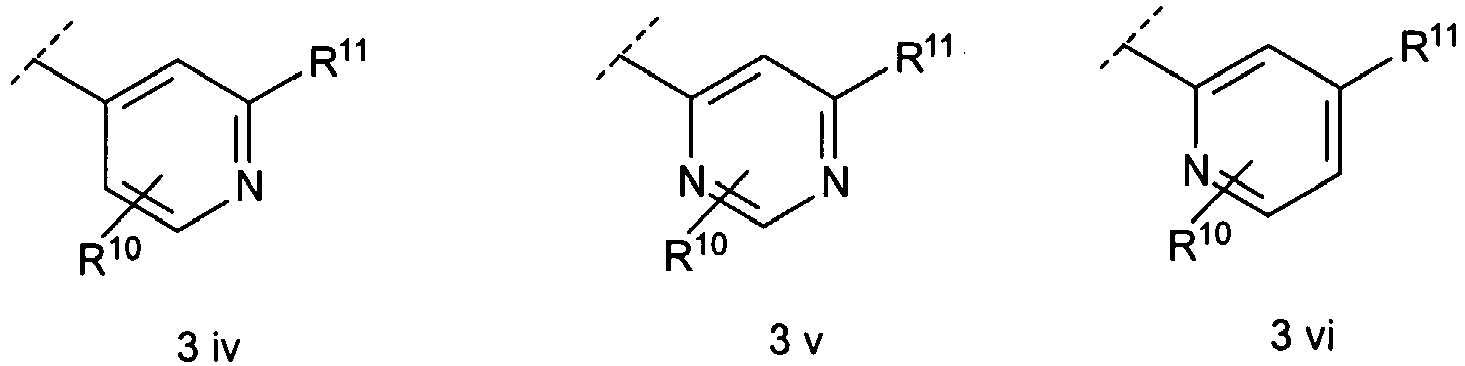


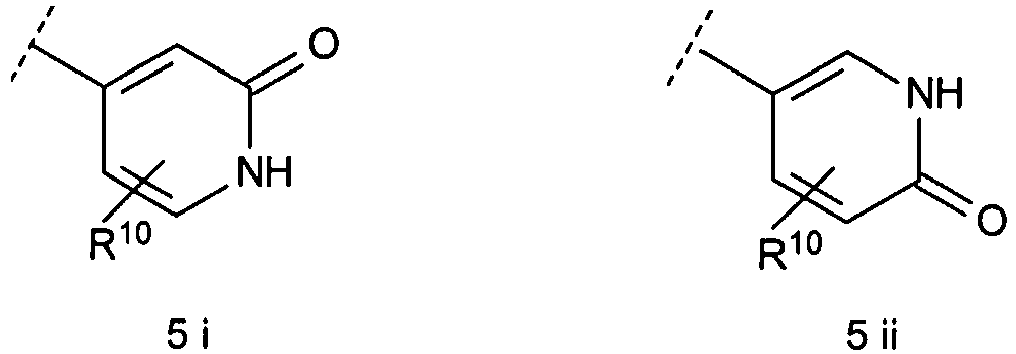


each R12 is independently H, F or CF3;
each W is independently selected from CR10 and N, wherein R10 is as defined above; and W' is selected from O, S and NR12 wherein R12 is as defined above.
with the proviso that formulae (1i) and (1ii) are other than indole and indazole. - Specific examples of compounds of the invention include:
- 3-(4-Morpholin-4-yl-6-morpholin-4-ylmethyl-thieno[3,2-d]pyrimidin-2-yl)-phenol;
- 3-(4-Morpholin-4-yl-6-pyrrolidin-1-ylmethyl-thieno[3,2-d]pyrimidin-2-yl)-phenol;
- 3-[6-(4-Methyl-piperazin-1-ylmethyl)-4-morpholin-4-yl-thieno[3,2-d]pyrimidin-2-yl]-phenol;
- 3-[6-(6,7-Dimethoxy-3,4-dihydro-1H-isoquinolin-2-ylmethyl)-4-morpholin-4-ylthieno[3,2-d]pyrimidin-2-yl]-phenol ;
- 3-(6-[1,4']Bipiperidinyl-1'-ylmethyl-4-morpholin-4-yl-thieno[3,2-d]pyrimidin-2-yl)-phenol;
- 3-[4-Morpholin-4-yl-6-(4-pyrimidin-2-yl-piperazin-1-ylmethyl)-thieno[3,2-d]pyrimidin-2-yl]-phenol;
- 3-[6-(4-Cyclohexylmethyl-piperazin-1-ylmethyl)-4-morpholin-4-yl-thieno[3,2-d]pyrimidin-2-yl]-phenol;
- 4-[2-(3-Hydroxy-phenyl)-4-morpholin-4-yl-thieno[3,2-d]pyrimidin-6-ylmethyl]-piperazine-1-carboxylic acid tert-butyl ester;
- 3-(4-Morpholin-4-yl-6-piperazin-1-ylmethyl-thieno[3,2-d]pyrimidin-2-yl)-phenol , trifluoroacetic acid salt;
- 3-{6-[4-(2-Methoxy-ethyl)-piperazin-1-ylmethyl]-4-morpholin-4-yl-thieno[3,2-d]pyrimidin-2-yl} -phenol;
- 3-[6-(4-Methyl-[1,4]diazepan-1-ylmethyl)-4-morpholin-4-yl-thieno[3,2-d]pyrimidin-2-yl]-phenol;
- {4-[2-(3-Hydroxy-phenyl)-4-morpholin- 4-yl-thieno[3,2-d]pyrimidin-6-ylmethyl]-piperazin-1-yl}-acetic acid ethyl ester;
- 1-{4-[2-(3-Hydroxy-phenyl)-4-morpholin-4-yl-thieno[3,2-d]pyrimidin-6-ylmethyl]-piperazin-1-yl}-ethanone;
- 3-{6-[4-(2-Hydroxy-ethyl)-piperazin-1-ylmethyl]-4-morpholin-4-yl-thieno[3,2-d]pyrimidin-2-yl}-phenol;
- 3-(4-Morpholin-4-yl-6-thiomorpholin-4-ylmethyl-thieno[3,2-d]pyrimidin-2-yl)-phenol;
- 3-[6-(4-Ethyl-piperazin-1-ylmethyl)-4-morpholin-4-yl-thieno[3,2-d]pyrimidin-2-yl]-phenol;
- 3-(6-{[Methyl-(1-methyl-piperidin-4-yl)-amino]-methyl}-4-morpholin-4-yl-thieno[3,2-d]pyrimidin-2-yl)-phenol;
- 3-[6-(4-Dimethylamino-piperidin-1-ylmethyl)-4-morpholin-4-yl-thieno[3,2-d]pyrimidin-2-yl]-phenol ;
- 4-[2-(3-Hydroxy-phenyl)-4-morpholin-4-yl-thieno[3,2-d]pyrimidin-6-ylmethyl]-piperazin-2-one;
- 3-[6-(4-Methanesulfonyl-piperazin-1-ylmethyl)-4-morpholin-4-yl-thieno[3,2-d]pyrimidin-2-yl]-phenol;
- {4-[2-(3-Hydroxy-phenyl)-4-morpholin-4-yl-thieno[3,2-d]pyrimidin-6-ylmethyl]-piperazin-1-yl}-acetonitrile;
- 3-[4-Morpholin-4-yl-6-(4-morpholin-4-yl-piperidin-1-ylmethyl)-thieno[3,2-d]pyrimidin-2-yl]-phenol;
- 3-[6-(4-Amino-piperidin-1-ylmethyl)-4-morpholin-4-yl-thieno[3,2-d]pyrimidin-2-yl]-phenol;
- 3-[6-(3-Dimethylamino-pyrrolidin-1-ylmethyl)-4-morpholin-4-yl-thieno[3,2-d]pyrimidin-2-yl]-phenol;
- 1-[2-(3-Hydroxy-phenyl)-4-morpholin-4-yl-thieno[3,2-d]pyrimidin-6-ylmethyl]-4-morpholin-4-ylmethyl-piperidin-4-ol;
- 4-[2-(3-Hydroxy-phenyl)-4-morpholin-4-yl-thieno[3,2-d]pyrimidin-6-ylmethyl]-piperazine-1-carboxylic acid ethylamide ;
- N-{1-[2-(3-Hydroxy-phenyl)-4-morpholin-4-yl-thieno[3,2-d]pyrimidin-6-ylmethyl]-piperidin-4-yl}-methanesulfonamide;
- 1-{4-[2-(3-Hydroxy-phenyl)-4-morpholin-4-yl-thieno[3,2-d]pyrimidin-6-ylmethyl]-piperazin-1-yl}-2-methoxy-ethanone;
- N-{1-[2-(3-Hydroxy-phenyl)-4-morpholin-4-yl-thieno[3,2-d]pyrimidin-6-ylmethyl]-piperidin-4-yl}-acetamide;
- 4-[2-(3-Hydroxy-phenyl)-4-morpholin-4-yl-thieno[3,2-d]pyrimidin-6-ylmethyl]-piperazine-1-carboxylic acid dimethylamide;
- 1-[2-(3-Hydroxy-phenyl)-4-morpholin-4-yl-thieno[3,2-d]pyrimidin-6-ylmethyl]-piperidin-4-ol;
- 3-[6-(1,1-Dioxo-1lambda*6*-thiomorpholin-4-ylmethyl)-4-morpholin-4-yl-thieno[3,2-d]pyrimidin-2-yl]-phenol;
- 4-[2-(3-Hydroxy-phenyl)-4-morpholin-4-yl-thieno[3,2-d]pyrimidin-6-ylmethyl]-piperazine-1-sulfonic acid dimethylamide;
- 3-(6-{4-[(2-Methoxy-ethyl)-methyl-amino]-piperidin-1-ylmethyl}-4-morpholin-4-yl-thieno[3,2-d]pyrimidin-2-yl)-phenol;
- 1-[2-(3-Hydroxy-phenyl)-4-morpholin-4-yl-thieno[3,2-d]pyrimidin-6-ylmethyl]-pyrrolidin-3-ol;
- (R,S)-3-[6-(2-Dimethylaminomethyl-pyrrolidin-1-ylmethyl)-4-morpholin-4-yl-thieno[3,2-d]pyrimidin-2-yl]-phenol;
- (R,S)-3-(6-{[Methyl-(1-methyl-pyrrolidin-2-ylmethyl)-amino]-methyl}-4-morpholin-4-yl-thieno[3,2-d]pyrimidin-2-yl)-phenol;
- 1-[2-(3-Hydroxy-phenyl)-4-morpholin-4-yl-thieno[3,2-d]pyrimidin-6-ylmethyl]-piperidine-4-carboxylic acid amide;
- 2-{4-[2-(3-Hydroxy-phenyl)-4-morpholin-4-yl-thieno[3,2-d]pyrimidin-6-ylmethyl]-piperazin-1-yl}-N,N-dimethyl-acetamide;
- 3-(6-{[Methyl-(1-methyl-pyrrolidin-3-yl)-amino]-methyl}-4-morpholin-4-yl-thieno[3,2-d]pyrimidin-2-yl)-phenol;
- 2-Dimethylamino-1-{4-[2-(3-hydroxy-phenyl)-4-morpholin-4-yl-thieno[3,2-d]pyrimidin-6-ylmethyl]-piperazin-1-yl}-ethanone;
- 3-[6-((3R,5S)-3,5-Dimethyl-piperazin-1-ylmethyl)-4-morpholin-4-yl-thieno[3,2-d]pyrimidin-2-yl]-phenol;
- 3-[6-((3R,5S)-4-Methanesulfonyl-3,5-dimethyl-piperazin-1-ylmethyl)-4-morpholin-4-yl-thieno[3,2-d]pyrimidin-2-yl]-phenol;
- 1-{(2R,6S)-4-[2-(3-Hydroxy-phenyl)-4-morpholin-4-yl-thieno[3,2-d]pyrimidin-6-ylmethyl]-2,6-dimethyl-piperazin-1-yl}-ethanone;
- 3-{6-[4-(3-Dimethylamino-propane-1-sulfonyl)-piperazin-1-ylmethyl]-4-morpholin-4-yl-thieno[3,2-d]pyrimidin-2-yl}-phenol;
- 3-[6-(4-Methoxy-piperidin-1-ylmethyl)-4-morpholin-4-yl-thieno[3,2-d]pyrimidin-2-yl]-phenol;
- 3-{4-Morpholin-4-yl-6-[4-(3-morpholin-4-yl-propane-1-sulfonyl)-piperazin-1-ylmethyl]-thieno[3,2-d]pyrimidin-2-yl}-phenol;
- {4-[2-(3-Hydroxy-phenyl)-4-morpholin-4-yl-thieno[3,2-d]pyrimidin-6-ylmethyl]-piperazin-1-yl}-morpholin-4-yl-methanone;
- 4-[2-(3-Hydroxy-phenyl)-4-morpholin-4-yl-thieno[3,2-d]pyrimidin-6-ylmethyl]-piperazine-1-carboxylic acid (2-methoxy-ethyl)-methyl-amide;
- 1-{3-[6-(4-Methyl-piperazin-1-ylmethyl)-4-morpholin-4-yl-thieno[3,2-d]pyrimidin-2-yl]-phenyl}-ethanol; .
- 3-[6-(4-Methyl-piperazin-1-ylmethyl)-4-morpholin-4-yl-thieno[3,2-d]pyrimidin-2-yl]-phenyl}-methanol;
- 2-Chloro-5-[6-(4-methyl-piperazin-l-ylmethyl)-4-morpholin-4-yl-thieno[3,2-d]pyrimidin-2-yl]-phenol;
- 2,3-Difluoro-5-[6-(4-methyl-piperazin-1-ylmethyl)-4-morpholin-4-yl-thieno[3,2-d]pyrimidin-2-yl]-phenol;
- 4-Fluoro-3-[6-(4-methyl-piperazin-1-ylmethyl)-4-morpholin-4-yl-thieno[3,2-d]pyrimidin-2-yl]-phenol;
- 2-(1H-Indazol-6-yl)-6-(4-methyl-piperazin-1-ylmethyl)-4-morpholin-4-yl-thieno[3,2-d]pyrimidin-2-yl]-phenol; and
- 6-(4-Methyl-piperazin-1-ylmethyl)-4-morpholin-4-yl-2-(1H-pyrazol-4-yl)-thieno[3,2-d]pyrimidine;
- The compounds of formula (I) may exist in the form of geometrical isomers or tautomers depending on the kinds of substituent groups, and these isomers in separated forms or mixtures thereof may be used in the present invention. Where the compounds have asymmetric carbon atoms, optical isomer forms may exist based on such carbon atoms. All of the mixtures and the isolated forms of these optical isomers may be used in the present invention.
- A suitable synthetic strategy for producing compounds of formula (I) in which m is 1 employs the precursor carboxaldehyde of formula (II):

- (a) treating a compound of formula (II):


- (b) treating a compound of formula (II) as defined above with an amine of formula NHR4R5 wherein R4 and R5 are as defined above, in the presence of a suitable reducing agent; and treating the resulting compound of formula (IV):

- Both the animation step and the Pd-mediated cross-coupling step take place under conventional conditions. The palladium catalyst may be any that is typically used for Suzuki-type cross-couplings, such as PdCl2(PPh3)2. The reducing agent is typically a borohydride, for instance NaBH(OAc)3, NaBH4 or NaCNBH4, in particular NaBH(OAc)3.
- The invention further provides a process for producing a compound of formula (I) in which m is 1 and R3 is a 3- or 4-hydroxyphenyl group, which process comprises:
- (a) treating a compound of formula (V):

- (b) removing the hydroxy protecting group.
- The reducing agent is typically a borohydride, for instance as specified above.
- Examples of hydroxy protecting groups are known in the art, for instance as described in "Protective Groups for Organic Chemistry", Third Edition, T.W. Greene and P.G.M. Wuts, John Wiley & Sons, 1999. For instance, a hydroxy group can be protected as an acetal, a substituted acetal, an ester, a xanthate, an ether or a silyl ether. The acetal is preferably tetrahydropyran. The silyl ether is preferably trimethylsilyl ether, t-butyl dimethylsilyl ether, triiso-propylsilyl ether or t-butyldiphenyl-silyl ether. These protecting groups are removed by conventional techniques.
- A compound of formula (V) as defined above may be produced by a process which comprises treating a compound of formula (VI):

- A compound of formula (VI) as defined above may be produced by a process which comprises treating a compound of formula (VII):


- A compound of formula (II) as defined above wherein R2 is -NR6R7 maybe prepared by a process which comprises treating a compound of formula (IX):

- A compound of formula (IX) as defined above may be produced by a process which comprises treating a compound of formula (X):

- A compound of formula (X) may be prepared by the process described in Reference Example 1 for the preparation of 2,4-dichloro-thieno[3,2-d]pyrimidine, or by analogy with such a process.
- A compound of formula (II) as defined above wherein R2 is of formula


- The compound of formula (XIII) may be converted to the corresponding carboxaldehyde by treatment with a lithiating agent followed by N,N'-dimethylformamide (DMF), for instance under the conditions described above for the conversion of a compound of formula (VI) to a compound of formula (V). The lithiating agent is typically as defined above. The resulting carboxaldehyde may then be converted into a desired final compound of formula (I) as defined above, in which m is 1, by treatment with an amine of formula NHR4R5 in which R4 and R5 are as defined above, in the presence of a suitable reducing agent, for instance a borohydride as specified above, in particular NaBH(OAc)3.
- A compound of formula (I) as defined above in which m is 0 may be prepared by a Buchwald-type palladium-mediated nitrogen insertion reaction. Such a process may comprise treating a compound of formula (XIV):
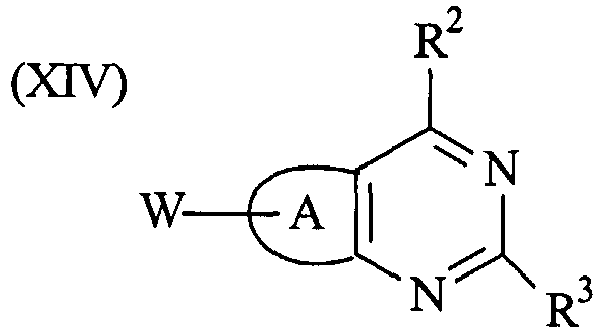
- A compound of formula (XIV) may be produced by treating a compound of formula (XV):

- A compound of formula (I) as defined above in which m is 0 may also be prepared by an SNAr displacement reaction, for instance under the conditions described by D. Prim and G. Kirsch in Tetrahedron 55 (21), 6511-6526, 1999. Such a process comprises treating a compound of formula (XIV) as defined above in which W is Br with an amine of formula NHR4R5 in which R4 and R5 are as defined above in H2O under reflux for 12 hours.
- A compound of formula (I) as defined above in which m is 0 may alternatively be prepared by treating a compound of formula (XIV) as defined above in which W is I with an amine of formula NHR4R5 in which R4 and R5 are as defined above in 1,4-dioxane in the presence of CuI/En and K3PO4. The reaction is conducted at about 110°C for 24 hours. This procedure is described by Kang S-K et al in Synlett, (3), 427-430, 2002.
- A fused pyrimidine of formula (I) may be converted into a pharmaceutically acceptable salt, and a salts may be converted into the free compound, by conventional methods. Examples of pharmaceutically acceptable salts include acid addition salts with inorganic acids such as hydrochloric acid, hydrobromic acid, hydroiodic acid, sulphuric acid, nitric acid and phosphoric acid; and organic acids such as formic acid, acetic acid, trifluoroacetic acid, propionic acid, oxalic acid, malonic acid, succinic acid, fumaric acid, maleic acid, lactic acid, malic acid, tartaric acid, citric acid, methanesulfonic acid, ethanesulfonic acid, aspartic acid and glutamic acid. In the case of compounds of the invention bearing a free carboxy substituent, the salts include the salts of alkali and alkaline earth metals and ammonium, for instance the salts of sodium, potassium, magnesium, calcium and ammonium. The latter are prepared by treating the free fused pyrimidine of formula (I), or an acid addition salt thereof, with the corresponding metal base or ammonia. The compounds of formula (I) and their salts may exist as hydrates or solvates.
- Compound of the present invention have been found in biological tests to be inhibitors of PI3 kinase. The compounds are selective for class Ia PI3 kinases over class Ib and typically exhibit at least a 20-fold selectivity for class Ia over class Ib PI3 kinases. In particular, the compounds are selective for the p110α isoform.
- A compound of the present invention may thus be used as an inhibitor of PI3 kinase, in particular of a class Ia PI3 kinase. Accordingly, a compound of the present invention can be used to treat a disease or disorder arising from abnormal cell growth, function or behaviour associated with PI3 kinase. Examples of such diseases and disorders are discussed by Drees et al in Expert Opin. Ther. Patents (2004) 14(5):703 - 732. These include cancer, immune disorders, cardiovascular disease, viral infection, inflammation, metabolism/endocrine disorders and neurological disorders. Exampes of metabolism/endocrine disorders include diabetes and obesity. Examples of cancers which the present compounds can be used to treat include leukaemia, brain tumours, renal cancer, gastric cancer and cancer of the skin, bladder, breast, uterus, lung, colon, prostate, ovary and pancreas.
- A human or animal patient suffering from an immune disorder, cancer, cardiovascular disease, viral infection, inflammation, a metabolism/endocrine disorder or a neurological disorders may thus be treated by a method comprising the administration thereto of a compound of the present invention as defined above. The condition of the patient may thereby be improved or ameliorated.
- In addition to possessing biochemical potency the compounds of the invention exhibit physicochemical and pharmacokinetic properties which make them particularly well adapted for drug use. This is shown for instance in the results of the biological assays described in Example 11, which follows. In particular the compounds possess high aqueous solubility at physiological pH; many have a solubility of at least 40 µM and a significant number have a solubility of greater than 100 µM. High solubility at physiological pH is desirable since it promotes bioavailability. The compounds also possess high metabolic stability, as shown in particular by the hepatocyte clearance assay described in Example 11 in which most of the tested compounds were shown to have low hepatocyte clearance. Low hepatocyte clearance correlates with a low rate of liver metabolism. It can therefore be seen that the compounds of the present invention possess improved physicochemical and pharmacokinetic properties whilst retaining biochemical potency as inhibitors of PI3 kinase.
- A compound of the present invention can be administered in a variety of dosage forms, for example orally such as in the form of tablets, capsules, sugar- or film-coated tablets, liquid solutions or suspensions or parenterally, for example intramuscularly, intravenously or subcutaneously. The compound may therefore be given by injection or infusion.
- The dosage depends on a variety of factors including the age, weight and condition of the patient and the route of administration. Daily dosages can vary within wide limits and will be adjusted to the individual requirements in each particular case. Typically, however, the dosage adopted for each route of administration when a compound is administered alone to adult humans is 0.0001 to 50 mg/kg, most commonly in the range of 0.001 to 10 mg/kg, body weight, for instance 0.01 to 1 mg/kg. Such a dosage may be given, for example, from 1 to 5 times daily. For intravenous injection a suitable daily dose is from 0.0001 to 1 mg/kg body weight, preferably from 0.0001 to 0.1 mg/kg body weight. A daily dosage can be administered as a single dosage or according to a divided dose schedule.
- A compound is formulated for use as a pharmaceutical or veterinary composition also comprising a pharmaceutically or veterinarily acceptable carrier or diluent. The compositions are typically prepared following conventional methods and are administered in a pharmaceutically or veterinarily suitable form. The compound may be administered in any conventional form, for instance as follows:
- A) Orally, for example, as tablets, coated tablets, dragees, troches, lozenges, aqueous or oily suspensions, liquid solutions, dispersible powders or granules, emulsions, hard or soft capsules, or syrups or elixirs. Compositions intended for oral use may be prepared according to any method known in the art for the manufacture of pharmaceutical compositions and such compositions may contain one or more agents selected from the group consisting of sweetening agents, flavouring agents, colouring agents and preserving agents in order to provide pharmaceutically elegant and palatable preparations.
- Tablets contain the active ingredient in admixture with non-toxic pharmaceutically acceptable excipients which are suitable for the manufacture of tablets. These excipients may be for example, inert diluents, such as calcium carbonate, sodium carbonate, lactose, dextrose, saccharose, cellulose, corn starch, potato starch, calcium phosphate or sodium phosphate; granulating and disintegrating agents, for example, maize starch, alginic acid, alginates or sodium starch glycolate; binding agents, for example starch, gelatin or acacia; lubricating agents, for example silica, magnesium or calcium stearate, stearic acid or talc; effervescing mixtures; dyestuffs, sweeteners, wetting agents such as lecithin, polysorbates or lauryl sulphate. The tablets may be uncoated or they may be coated by known techniques to delay disintegration and adsorption in the gastrointestinal tract and thereby provide a sustained action over a longer period. For example, a time delay material such as glyceryl monostearate or glyceryl distearate may be employed. Such preparations may be manufactured in a known manner, for example by means of mixing, granulating, tableting, sugar coating or film coating processes.
- Formulations for oral use may also be presented as hard gelatin capsules wherein the active ingredient is mixed with an inert solid diluent, for example, calcium carbonate, calcium phosphate or kaolin, or as soft gelatin capsules wherein the active ingredient is present as such, or mixed with water or an oil medium, for example, peanut oil, liquid paraffin, or olive oil.
- Aqueous suspensions contain the active materials in admixture with excipients suitable for the manufacture of aqueous suspensions. Such excipients are suspending agents, for example, sodium carboxymethylcellulose, methylcellulose, hydroxypropylmethyl-cellulose, sodium alginate, polyvinylpyrrolidone gum tragacanth and gum acacia; dispersing or wetting agents may be naturally-occurring phosphatides, for example lecithin, or condensation products of an alkylene oxide with fatty acids, for example polyoxyethylene stearate, or condensation products of ethylene oxide with long chain aliphatic alcohols, for example heptadecaethyleneoxycetanol, or condensation products of ethylene oxide with partial esters derived from fatty acids and a hexitol such as polyoxyethylene sorbitol monooleate, or condensation products of ethylene oxide with partial esters derived from fatty acids and hexitol anhydrides for example polyoxyethylene sorbitan monooleate.
- The said aqueous suspensions may also contain one or more preservatives, for example, ethyl or n-propyl p-hydroxybenzoate, one or more colouring agents, such as sucrose or saccharin.
- Oily suspension may be formulated by suspending the active ingredient in a vegetable oil, for example arachis oil, olive oil, sesame oil or coconut oil, or in a mineral oil such as liquid paraffin. The oily suspensions may contain a thickening agent, for example beeswax, hard paraffin or cetyl alcohol.
- Sweetening agents, such as those set forth above, and flavouring agents may be added to provide a palatable oral preparation. These compositions may be preserved by this addition of an antioxidant such as ascorbic acid. Dispersible powders and granules suitable for preparation of an aqueous suspension by the addition of water provide the active ingredient in admixture with a dispersing or wetting agent, a suspending agent and one or more preservatives. Suitable dispersing or wetting agents and suspending agents are exemplified by those already mentioned above. Additional excipients, for example sweetening, flavouring and colouring agents, may also be present.
- The pharmaceutical compositions of the invention may also be in the form of oil-in-water emulsions. The oily phase may be a vegetable oil, for example olive oil or arachis oils, or a mineral oil, for example liquid paraffin or mixtures of these. Suitable emulsifying agents may be naturally-occurring gums, for example gum acacia or gum tragacanth, naturally occuring phosphatides, for example soy bean lecithin, and esters or partial esters derived from fatty acids an hexitol anhydrides, for example sorbitan mono-oleate, and condensation products of the said partial esters with ethylene oxide, for example polyoxyethylene sorbitan monooleate. The emulsion may also contain sweetening and flavouring agents. Syrups and elixirs may be formulated with sweetening agents, for example glycerol, sorbitol or sucrose. In particular a syrup for diabetic patients can contain as carriers only products, for example sorbitol, which do not metabolise to glucose or which only metabolise a very small amount to glucose.
- Such formulations may also contain a demulcent, a preservative and flavouring and coloring agents;
B) Parenterally, either subcutaneously, or intravenously, or intramuscularly, or intrasternally, or by infusion techniques, in the form of sterile injectable aqueous or oleaginous suspensions. This suspension may be formulated according to the known art using those suitable dispersing of wetting agents and suspending agents which have been mentioned above. The sterile injectable preparation may also be a sterile injectable solution or suspension in a non-toxic paternally-acceptable diluent or solvent, for example as a solution in 1,3-butane diol. - Among the acceptable vehicles and solvents that may be employed are water, Ringer's solution and isotonic sodium chloride solution. In addition, sterile, fixed oils are conventionally employed as a solvent or suspending medium. For this purpose any bland fixed oil may be employed including synthetic mono- or diglycerides. In addition fatty acids such as oleic acid find use in the preparation of injectables;
C) By inhalation, in the form of aerosols or solutions for nebulizers;
D) Rectally, in the form of suppositories prepared by mixing the drug with a suitable non-irritating excipient which is solid at ordinary temperature but liquid at the rectal temperature and will therefore melt in the rectum to release the drug. Such materials are cocoa butter and poly-ethylene glycols;
E) Topically, in the form of creams, ointments, jellies, collyriums, solutions or suspesions. - The invention will be further described in the Examples which follow:
- The synthetic route to compound 9 is shown in the following scheme.


- To a solution of methyl-3-amino-2-thiophenecarboxylate (8.00g, 50.9mmol) in acetonitrile (100mL) was added potassium carbonate (1.1eq., 56.0mmol, 7.73g) followed by m-anisoyl chloride (1.05eq., 53.4mmol, 7.51mL) and the mixture heated under reflux for 1 hour. A white precipitate forms. The mixture was cooled in ice-water, diluted with water (100mL) and the white solid collected by filtration and dried to yield compound 1 (12.78 g). Upon standing, an additional quantity of product precipitated from the water-acetonitrile solution; this was collected in the same fashion. (Total yield: 14.08 g, 95%).
1H NMR (400 MHz, CDCl3) 3.89 (s, 3H), 3.93 (s, 3H), 7.12 (dd, 1H, J=2.2, 8.4), 7.42 (t, 1H, J=7.9), 7.54 (d,1H, J=5.5), 7.58 (m, 1H), 8.29 (d,1H, J=5.5), 11.17 (brs, 1H). - Ammoniacal methanol was prepared by bubbling ammonia (30- 32g) through methanol (190mL) cooled in ice-water. To the solution was added 3-(3-methoxy-benzoylamino)-thiophene-2-carboxylic acid methyl ester (18.00g, 61.8mmol) and the mixture heated at 90°C for 44 hours in a steel bomb at 50psi. The solvent was then removed in vacuo and isopropanol (300mL) added followed by 2M aqueous sodium hydroxide (4.0eq., 124mL). The solution was heated under reflux for 15 hours and then cooled in ice-water. The mixture was acidified to pH 1 by the addition of 4 M hydrochloric acid and the white precipitate collected by filtration, washed with water and dried to give compound 2 (15.20 g, 95%).
1H NMR (400 MHz, d 6-DMSO) 3.86 (s, 3H), 7.14 (dd, 1H, J=2.2, 8.2), 7.45 (m, 2H), 7.70 (s, 1H), 7.74 (d, 1H, J=7.8), 8.22 (d, 1H, J=5.2), 12.70 (brs, 1H), - To a suspension of 2-(3-methoxy-phenyl)-3H-thieno[3,2-d]pyrimidin-4-one (30.31g, 0.12 mol) in acetic acid (170mL) was added 48% aqueous hydrogen bromide (170mL) and the mixture heated under reflux for 48 hours. The mixture was then cooled in ice-water and diluted with water (200mL). The grey solid was collected by filtration, washed with water and dried to give compound 3 (28.58 g, 100%).
1H NMR (400 MHz, d 6-DMSO) 6.87 (m, 1H), 7.23 (t, 1H, J=8.0), 7.36 (d, 1H, J=5.2), 7.45 (m, 2H), 8.13 (d, 1H, J=5.2), 9.67 (brs, 1H), 12.52 (brs, 1H). - A mixture of 2-(3-hydroxy-phenyl)-3H-thieno[3,2-d]pyrimidin-4-one (28.58g, 0.12mol) and sodium acetate (1.1eq., 0.13mol, 10.56g) in acetic anhydride (280mL) was heated under reflux for 1.5 hours. The mixture was then cooled in ice-water and the grey solid collected by filtration, washed with water and dried to yield compound 4 (27.69 g, 82%).
1H NMR (400 MHz, d 6-DMSO) 2.32 (s, 3H), 7.36 (dd, 1H, J=2.0, 8.0), 7.47 (d, 1H, J=5.2), 7.59 (d, 1H, J=8.0), 7.93 (s, 1H), 8.04 (d, 1H, J=7.9), 8.22 (d, 1H, J=5.2), 12.75 (brs, 1H). - To the pyrimidone (26.65g, 93.1mmol) was added phosphorus oxychloride (130mL, 15eq.) and the dark mixture heated under reflux for 3 hours. Most of the phosphorus oxychloride was removed by distillation at reduced pressure and the residue transferred to a conical flask and cooled in ice-water. The mixture was quenched by the addition of ice-water and then saturated aqueous sodium hydrogen carbonate added (600mL). The solid was collected by filtration and re-suspended in aqueous sodium hydrogen carbonate, such that the pH was greater than 7. The solid was collected by filtration, washed thoroughly with water and dried to yield a mixture of the chloropyrimidines 5 in the ratio 1.5 : 1 (24.0 g). 3-(4-Chloro-thieno[3,2-d]pyrimidin-2-yl)-phenol: 1H NMR (400 MHz, d 6-DMSO) 6.94 (dd, 1H, J=1.6, 7.6). 7.35 (t, 1H, J=7.8), 7.76 (d, 1H, J=5.4), 7.87 (m, 2H), 8.58 (d, 1H, J=5.4), 9.67 (brs, 1H).
Acetic acid 3-(4-chloro-thieno[3,2-d]pyrimidin-2-yl)-phenyl ester: 1H NMR(400 MHz, CDCl3) 2.35 (s, 3H), 7.24 (m, 1H), 7.52 (t, 1H, J=8.0), 7.61 (d, 1H, J=5.4), 8.04 (d, 1H, J=5.4), 8.28 (t, 1H, J=2.0), 8.43 (dd, 1H, J=1.7, 7.9). - To a mixture of the chloropyrimidines (24.0g) in n-butanol, (220mL) was added morpholine (3.5eq., 0.33mol, 28.3mL) and the mixture heated at 100°C for 2 hours. The solvent was removed in vacuo and water added to the residue. The pale brown solid was collected by filtration and dried in a vacuum oven to give compound 6 as a pale brown solid (20.3 g, 70%).
1H NMR (400 MHz, d 6-DMSO) 3.81 (t, 4H, J=4.8), 4.01 (t, 4H, J=4.8), 6.86 (m, 1H), 7.27 (t, 1H, J=8.0), 7.51 (d, 1H, J=5.6), 7.86 (m, 2H), 8.25 (d, 1H, J=5.6), 9.46 (brs, 1H). - A mixture of 3-(4-morpholin-4-yl-thieno[3,2-d]pyrimidin-2-yl)-phenol (17.28g, 55.1mmol), imidazole (1.7eq., 93.7mmol, 6.38g) and tert-butyldimethylsilyl chloride (1.5eq., 82.7mmol. 12.47g) in DMF (45mL) was heated at 50°C for 5 hours. The reaction mixture was then cooled and partitioned between water (400mL) and ether (3 x 400mL). The combined organic layers were washed sequentially with saturated aqueous sodium hydrogen carbonate (300mL), brine (300mL), separated and dried (MgSO4). The crude product was evaporated onto silica and purified by chromatography (5%→20% ethyl acetate-petrol) to yield compound 7 as a white solid (19.60 g, 83%).
1H NMR (400 MHz, CDCl3) 0.15 (s, 6H), 0.92 (s, 9H), 3.80 (t, 4H, J=4.8), 3.98 (t, 4H, J=4.8), 6.83 (td, 1H, J=1.5, 8.3), 7.22 (t, 1H, J=7.9), 7.41 (d, 1H, J=5.5), 7.64 (d, 1H, J=5.5), 7.84 (t, 1H, J=2.0), 7.95 (d, 1H, J=7.8). - To a solution of 4-morpholin-4-yl-2-[3-(1,1,2,2-tetramethyl-propylsilanyloxy)-phenyl]-thieno[3,2-d]pyrimidine (2.26g, 5.29mmol) in dry THF (40mL) cooled to -78 °C was added nBuLi (2.5 M solution in hexanes, 2.75mL, 1.3eq.). After stirring for 20 minutes, dry N,N-dimethylformamide (617µL, 1.5eq.) was added, and the reaction mixture was stirred for 20 minutes at -78 °C and then warmed slowly to room temperature. After a further 30 minutes at room temperature the reaction mixture was quenched with ice/brine and then extracted exhaustively with chloroform. The combined organic extracts were dried (MgSO4) and the solvent removed in vacuo to yield compound 8 as a yellow solid (2.38g, 99%).
- A mixture of 4-morpholin-4-yl-2-[3-(1,1,2,2-tetramethyl-propylsilanyloxy)-phenyl]-thieno[3,2-d]pyrimidine-6-carbaldehyde (6.67g, 14.66mmol), N-methylpiperazine (2.11mL, 1.3 equivalents) and acetic acid (838µL, 1.0eq.) was stirred in 1,2-dichloroethane (70mL) at room temperature. To this was added sodium triacetoxyborohydride (3.42 g, 1.1 equivalents) and the reaction mixture was stirred for 3 days. The reaction mixture was then quenched with aqueous sodium bicarbonate solution, extracted exhaustively with chloroform, dried (MgSO4), and the solvent removed in vacuo to yield a yellow oil. This was purified using flash chromatography (silica, ethyl acetate to ethyl acetate/methanol) to yield 6-(4-methyl-piperazin-1-ylmethyl)-4-morpholin-4-yl-2-[3-(1,1,2,2-tetramethyl-propylsilanyloxy)-phenyl]-thieno[3,2-d]pyrimidine (6.95 g, 88%).
- To a solution of 6-(4-methyl-piperazin-1-ylmethyl)-4-morpholin-4-yl-2-[3-(1,1,2,2-tetramethyl-propylsilanyloxy)-phenyl]-thieno[3,2-d]pyrimidine (6.95g, 12.89mmol) in THF (100mL) cooled to 0 °C was added a 1.0 M solution of tetrabutyl ammonium fluoride in THF (14.2mL, 1.1eq.). After 30 minutes the solvent was removed in vacuo and the residue was purified using flash chromatography (silica, 8% methanol in dichloromethane) and then triturated using ethyl acetate/methanol to yield the title compound as a white solid (4.62g, 85%).
1H NMR (400 MHz, CDCl3) 2.27 (s, 3H, CH3), 2.49 (br s, 8H, 4 x CH2), 3.79 (s, 2H, CH2), 3.82-3.84 (m, 4H, 2 x CH2), 4.0-4.03 (m, 4H, 2 x CH2), 6.88-6.91 (m, H, ArH), 7.24-7.28 (m, 2H, 2 x ArH part under CDCl3), 7.69-7.70 (m, H, ArH), 7.81 (d, H, ArH, J=7.8Hz); MS (ESI+) 426(MH+). - The following compounds of the invention were prepared by analogy with the procedure described in Example 1, using the appropriate amine. The amines are commercially available compounds unless stated otherwise. Characterising data are also given for the compounds of the invention.
- 10: 3-(4-Morpholin-4-yl-6-morpholin-4-ylmethyl-thieno[3,2-d]pyrimidin-2-yl)-phenol was prepared using morpholine.
1H NMR (400 MHz, CDCl3) 2.55 (m, 4H), 3.75-3.79 (m, 4H), 3.82 (s, 2H), 3.93-3.96 (m, 4H), 4.04-4.00(m, 4H), 6.95 (d, 2H), 7.36-7.30 (m, 2H), 7.99-7.91 (m, 2H); MS (ESI+) 413 (MH+). - 11: 3-(4-Morpholin-4-yl-6-pyrrolidin-1-ylmethyl-thieno[3,2-d]pyrimidin-2-yl)-phenol was prepared using pyrrolidine.
1H NMR (400 MHz, CDCl3) 1.87-1.90 (m, 4H), 2.65-2.70 (m, 4H), 3.82-3.88 (m, 4H), 3.99 -4.03 (m, 6H), 6.95 (d, 2H), 7.30-7.36 (m, 2H), 7.80 (s, 1H), 7.99 (d, 1H); MS (ESI+) 397 (MH+). - 12: 3-[6-(6,7-Dimethoxy-3,4-dihydro-1H-isoquinolin-2-ylmethyl)-4-morpholin-4-yl-thieno[3,2-d]pyrimidin-2-yl]-phenol was prepared using 6,7-dimethoxy-1,2,3,4-tetrahydroisoquinoline.
1H NMR (400 MHz, CDCl3) 2.86-2.88 (m, 4H), 3.70 (s, 2H), 3.83 (s, 3H), 3.85-3.89 (m, 7H), 3.97-4.02 (m, 6H), 5.11 (br s, 1H), 6.51 (s, 1H), 6.60 (s, 1H), 6.95 (d, 1H), 7.35-7.30 (m, 2H), 7.92 (s, 1H), 8.01 (d, 1H); MS (ESI+) 519 (MH+). - 13: 3-(6-[1,4']Bipiperidinyl-1'-ylmethyl-4-morpholin-4-yl-thieno[3,2-d]pyrimidin-2-yl)-phenol was prepared using 4-piperidinopiperidine.
1H NMR (400 MHz, CDCl3) 1.42-1.48 (m, 2H), 1.54-1.68 (m, 6H), 1.82-1.84 (m, 2H), 2.01-2.05 (m, 2H), 2.28-2.30 (m, 1H), 2.48-2.52 (m, 4H), 2.97-2.99 (m, 2H), 3.79 (s, 2H), 3.85-3.89 (m, 4H), 3.99-4.02 (m, 4H), 6.90 (d, 1H), 7.29-7.38 (m, 2H), 7.90 (s, 1H), 7.99 (d, 1H); MS (ESI+) 494 (MH+). - 14: 3-[4-Morpholin-4-yl-6-(4-pyrimidin-2-yl-piperazin-1-ylmethyl)-thieno[3,2-d]pyrimidin-2-yl]-phenol was prepared using1-(2-pyrimidyl)piperazine.
1H NMR (400 MHz, CDCl3) 2.58-2.62 (m, 4H) 3.85-3.89 (m, 10H), 3.99-4.02 (m, 4H), 5.90 (br s, 1H), 6.48 (t, 1H), 6.90 (d, 1H), 7.29-7.38 (m, 2H), 7.90 (s, 1H), 7.99 (d, 1H), 8.30 (d, 2H); MS (ESI+) 490 (MH+). - 15: 3-[6-(4-Cyclohexylmethyl-piperazin-1-ylmethyl)-4-morpholin-4-yl-thieno[3,2-d]pyrimidin-2-yl]-phenol was prepared using 1-(cyclohexylmethyl)piperazine.
1H NMR (400 MHz, CDC13) 0.83-0.95 (2H, m), 1.17-1.26 (3H, m), 1.42-1.50 (1H, m), 1.68-1.77 (5H, m), 2.14 (2H, d, J=7.1Hz), 2.40-2.50 (4H, br m), 2.52-2.64 (4H, broad), 3.81 (2H, s), 3.87 (4H, t, J=4.6Hz), 4.03 (4H, t, J=4.6Hz), 5.23-5.28 (1H, broad, OH), 6.92-6.94 (1H, m), 7.31 (1H, s), 7.33 (1H, t, J=7.9Hz), 7.91 (1H, s), 8.00 (1H, d, J=7.8); MS (ESI+) 508.2 (MH+). - 16: 3-[6-(4-Isopropyl-piperazin-1-ylmethyl)-4-morpholin-4-yl-thieno[3,2-d]pyrimidin-2-yl]-phenol was prepared using 1-isopropylpiperazine.
1H NMR (400 MHz, d 6-DMSO) 0.99 (d, 6H), 2.65 (septet, 1H) 3.82-3.88 (m, 6H), 3.94-3.99 (m, 4H), 6.90 (d, 1H), 7.27-7.30 (m, 1H), 7.40 (s, 1H), 7.84-7.88 (m, 2H), 9.55 (1H,s), 8H hidden under DMSO peak @ 2.52; MS (ESI+) 454 (MH+). - 17: 4-[2-(3-Hydroxy-phenyl)-4-morpholin-4-yl-thieno[3,2-d]pyrimidin-6-ylmethyl]-piperazine-1-carboxylic acid tert-butyl ester was prepared using 1-BOC-piperazine.
1H NMR (400 MHz, CDCl3) 1.48 (s, 9H) 2.48-2.52 (m, 4H), 3.48-3.51 (m, 4H), 3.79 (s, 2H), 3.85-3.89 (m, 4H), 3.99-4.02 (m, 4H) 6.90 (d, 1H), 7.29-7.38 (m, 2H), 7.76-7.99 (m, 2H); MS (ESI+) 512 (MH+). - 19: 3-{6-[4-(2-Methoxy-ethyl)-piperazin-1-ylmethyl]-4-morpholin-4-yl-thieno[3,2-d]pyrimidin-2-yl}-phenol was prepared using 1-(2-methoxyethyl)piperazine.
1H NMR (400 MHz, CDCl3) 2.58-2.68 (m, 10H), 3.35 (s, 3H), 3.52 (t, 2H, J=5.6Hz), 3.82 (s, 2H), 3.87 (t, 4H, J=4.6Hz), 4.03 (t, 4H, J=4.6Hz), 5.60-5.68 (brs, 1H), 6.92-6.94 (m, 1H), 7.31 (s, 1H), 7.33 (t, 1H, J=7.9), 7.91 (s, 1H), 8.00 (d, 1H, J=7.8Hz). MS (ESI+) 470.1 (MH+). - 20: 3-[6-(4-Methyl-[1,4]diazepan-1-ylmethyl)-4-morpholin-4-yl-thieno[3,2-d]pyrimidin-2-yl]-phenol was prepared using 1-methylhomopiperazine.
1H NMR (400 MHz, CDCl3) 1.85-1.89 (m, 2H), 2.40 (s, 3H), 2.65-2.74 (m, 4H), 2.82-2.86 (m, 4H), 3.88 (t, 4H, J=4.6Hz), 3.95 (s, 2H), 4.04 (t, 4H, J=4.6Hz), 5.90-5.98 (br s, 1H), 6.92-6.94 (m, 1H), 7.31 (s, 1H), 7.33 (t, 1H, J=7.9Hz), 7.91 (s, 1H), 8.00 (d, 1H, J=7.8Hz); MS (ESI+) 440.1 (MH+). - 21: {4-[2-(3-Hydroxy-phenyl)-4-morpholin-4-yl-thieno[3,2-d]pyrimidin-6-ylmethyl]-piperazin-1-yl}-acetic acid ethyl ester was prepared from 1-ethoxycarbonylmethyl)piperazine.
1H NMR (400 MHz, CDCl3) 1.27 (t, 3H, J=7.1Hz), 2.60-2.69 (br, 8H), 3.23 (s, 2H), 3.83 (s, 2H), 3.89 (t, 4H, J=4.6Hz), 4.03 (t, 4H, J=4.6Hz), 4.20 (q, 2H, J=4.6Hz), 5.12 (brs, 1H), 6.92-6.94 (m, 1H), 7.31 (s, 1H), 7.33 (t, 1H, J=7.9), 7.91 (s, 1H), 8.00 (d, 1H, J=7.8Hz); MS (ESI+) 498.1 (MH+) - 22: 1-{4-[2-(3-Hydroxy-phenyl)-4-morpholin-4-yl-thieno[3,2-d]pyrimidin-6-ylmethyl]-piperazin-1-yl}-ethanone was prepared from 1-acetylpiperazine.
1H NMR (400 MHz, CDCl3) 2.09 (s, 3H, CH3), 2.52-2.55 (m, 4H, 2 x CH2), 3.49-3.51 (m, 2H, CH2), 3.66-3.68 (m, 2H, CH2), 3.83 (s, 2H, CH2), 3.86-3.90 (m, 4H, 2 x CH2), 4.03-4.06 (m, 4H, 2 x CH2), 5.88 (br s, H, OH), 6.94 (d, H, ArH, J=7.66Hz), 7.31-7.35 (m, 2H, 2 x ArH), 7.93 (s, H, ArH), 7.98 (d, H, ArH, J=7.77Hz); MS (ESI+) 454.0 (MH+). - 23: 3-{6-[4-(2-Hydroxy-ethyl)-piperazin-1-ylmethyl]-4-morpholin-4-yl-thieno[3,2-d]pyrimidin-2-yl}-phenol was prepared from N-(2-hydroxyethyl)piperazine.
1H NMR (400 MHz, CDCl3) 2.63 (br m, 10H, 2 x CH2), 3.65 (m, 2H, CH2), 3.84 (s, 2H, CH2), 3.87-3.90 (m, 4H, 2 x CH2), 4.04 -4.06 (m, 4H, 2 x CH2), 6.93 (d, H, ArH, J=10.0Hz), 7.32-7.36 (m, 2H, 2 x ArH), 7.91 (s, H, ArH), 8.01 (d, H, ArH, J=7.74Hz); MS (ESI+) 456.1 (MH+). - 24: 3-(4-Morpholin-4-yl-6-thiomorpholin-4-ylmethyl-thieno[3,2-d]pyrimidin-2-yl)-phenol was prepared from thiomorpholine.
1H NMR (400 MHz, CDCl3) 2.70-2.72 (m, 4H, 2 x CH2), 2.80-2.82 (m, 4H, 2 x CH2), 3.83 (s, 2H, CH2), 3.87-3.90 (m, 4H, 2 x CH2), 5.77 (sbr, H, OH), 6.93 (d, H, ArH, J=7.84Hz), 7.30-7.35 (m, 2H, 2 x ArH), 7.93 (s, H, ArH), 7.98 (d, H, ArH, J=7.84Hz); MS (ESI+) 429.2 (MH+). - 25: 3-[6-(4-Ethyl-piperazin-1-ylmethyl)-4-morpholin-4-yl-thieno[3,2-d]pyrimidin-2-yl]-phenol was prepared from 1-ethylpiperazine.
1H NMR (400 MHz, CDCl3) 1.11 (t, 3H, J=7.1Hz), 2.45-2.49 (br m, 2H), 2.49-2.72 (br, 8H), 3.83 (s, 2H), 3.88 (t, 4H, J=4.6Hz), 4.03 (t, 4H, J=4.6Hz), 6.24-6.32 (br, 1H), 6.91-6.94 (m, 1H), 7.28 (s, 1H), 7.33 (t, 1H, J=7.9Hz), 7.94 (s, 1H), 7.98 (d, 1H, J=7.8Hz); MS (ESI+) 440.2 (MH+). - 26: 3-(6-{[Methyl-(1-methyl-piperidin-4-yl)-amino]-methyl}-4-morpholin-4-yl-thieno[3,2-d]pyrimidin-2-yl)-phenol was prepared from 1-methyl-4-(methylamino)piperidine.
1H NMR (400 MHz, CDCl3) 1.80-1.88 (3H, br m), 1.97-2.08 (1H, br m), 2.17 (3H, s), 2.33 (3H, s), 2.33-2.39 (2H, br m), 2.48-2.56 (1H, br m), 2.99-3.10 (2H, br m), 3.83 (2H, s), 3.86-3.89 (4H, m), 4.02-4.04 (4H, m), 6.93 (1H, m), 7.21 (1H, s), 7.32 (1H, t, J=7.9), 7.93 (1H, s), 8.00 (1H, d, J=7.8); MS (ESI+) 454.1 (MH+). - 27: 3-[6-(4-Dimethylamino-piperidin-1-ylmethyl)-4-morpholin-4-yl-thieno[3,2-d]pyrimidin-2-yl]-phenol was prepared from 4-dimethylaminopiperidine.
1H NMR (400 MHz, CDCl3) 1.58-1.68 (br m, 2H), 1.87-1.95 (br m, 2H), 2.10 (br t, 2H, J=10.7Hz), 2.34 (br m, 1H), 2.37 (br s, 6H), 3.02 (br m, 2H), 3.80 (s, 2H), 3.87 (t, 4H, J=4.7Hz), 4.03 (t, 4H, J=4.9Hz), 6.92-6.94 (m, 1H), 7.31 (s,1H), 7.33 (t, 1H, J=7.9Hz), 7.91 (s, 1H), 8.00 (d, 1H, J=7.8Hz); MS (ESI+) 454.1 (MH+). - 28: 4-[2-(3-Hydroxy-phenyl)-4-morpholin-4-yl-thieno[3,2-d]pyrimidin-6-ylmethyl]-piperazin-2-one was prepared from piperazin-2-one.
1H NMR (400 MHz, CDCl3) 2.77 (t, 2H, J=5.3Hz), 3.39 (2H, s), 3.42 (br t, 2H), 3.89 (t, 4H, J=5.0Hz), 3.92 (s, 2H), 4.05 (t, 4H, J=5.0Hz), 5.48 (br s, 1H), 5.86 (bs,1H), 6.92-6.94 (m, 1H), 7.31 (s, 1H), 7.33 (t, 1H, J=7.9Hz), 7.91 (s, 1H), 8.00 (d, 1H, J=7.8Hz); MS (ESI+) 426.1 (MH+). - 29: 3-[6-(4-Methanesulfonyl-piperazin-1-ylmethyl)-4-morpholin-4-yl-thieno[3,2-d]pyrimidin-2-yl]-phenol was prepared from 1-methanesulfonylpiperazine hydrochloride. This in turn was prepared by reaction of N-BOC-piperazine with methane sulfonyl chloride in dichloromethane, followed by cleavage of the BOC protecting group using HCl (2M) in dichloromethane.
1H NMR (400 MHz, CDCl3) 2.59 (m, 4H, 2 x CH2), 2.72 (s, 3H, CH3), 3.20 (m, 4H, 2 x CH2), 3.80 (m, 6H, 3 x CH2), 3.94-3.97 (m, 4H, 2 x CH2), 6.87 (d, H, ArH, J=7.76Hz), 7.19-7.27 (m, 2H, 2 x ArH), 7.88 (m, 2H, 2 x ArH); MS (ESI+) 490.0 (MH+). - 30: {4-[2-(3-Hydroxy-phenyl)-4-morpholin-4-yl-thieno[3,2-d]pyrimidin-6-ylmethyl]-piperazin-1-yl}-acetonitrile was prepared from piperazin-1-yl-acetonitrile hydrochloride. This in turn was prepared from prepared by reaction of N-BOC-piperazine with bromoacetonitrile in MeCN, followed by cleavage of the BOC protecting group using HCl (2M) in dichloromethane.
1H NMR (400 MHz, CDCl3) 2.64-2.68 (m, 8H, 4 x CH2), 3.56 (s, 2H, CH2), 3.84 (s, 2H, CH2), 3.90-3.92 (m, 4H, 2 x CH2), 4.05-4.08 (m, 4H, 2 x CH2), 6.93-6.95 (m, H, ArH), 7.32-7.36 (m, 2H, 2 x ArH), 7.94 (s, H, ArH), 8.0 (d, H, ArH, J=7.8Hz). MS (ESI+) 451.1 (MH+). - 31: 3-[4-Morpholin-4-yl-6-(4-morpholin-4-yl-piperidin-1-ylmethyl)-thieno[3,2-d]pyrimidin-2-yl]-phenol was prepared from 4-morpholinopiperidine.
1H NMR (400 MHz, CDCl3)1.56-1.65 (m, 2H, CH2), 1.83-1.86 (m, 2H, CH3), 2.08-2.14 (m, 2H, CH2), 2.19-2.24 (m, H, CH), 2.55 (m, 4H, 2 x CH2), 3.02-3.05 (m, 2H, CH2), 3.72-3.74 (m, 4H, 2 x CH2), 3.79 (s, 2H, CH2), 3.85-3.88 (m, 4H, 2 x CH2), 4.0-4.03 (m, 4H, 2 x CH2), 6.52 (br s, H, OH), 6.91 (m, H, ArH), 7.29-7.34 (m, 2H, 2 x ArH), 7.91 (s, H, ArH), 7.98 (d, H, ArH, J=7.8Hz); MS (ESI+) 496.2 (MH+). - 33: 3-[6-(3-Dimethylamino-pyrrolidin-1-ylmethyl)-4-morpholin-4-yl-thieno[3,2-d]pyrimidin-2-yl]-phenol was prepared from 3-(dimethylamino) pyrrolidine.
1H NMR (400 MHz, d 6-DMSO) 9.52 (s,1H), 7.85 (m, 2H), 7.37 (s, 1H), 7.28 (t, 1H, J=7.6Hz), 6.87 (d, 1H), 3.96 (m, 6H), 3.82 (m, 4H), 2.89 (m, 2H), 2.79 (m, 1H), 2.68 (m, 1H), 2.24 (s, 6H), 1.95 (m, 1H), 1.74 (m, 1H); MS (ESI+) 440.1 (MH+). - 34: 1-[2-(3-Hydroxy-phenyl)-4-morpholin-4-yl-thieno[3,2-d]pyrimidin-6-ylmethyl]-4-morpholin-4-ylmethyl-piperidin-4-ol was prepared from 4-morpholin-4-ylmethyl-piperidin-4-ol dihydrochloride. This was prepared as follows: trimethylsulfoxonium iodide (1.0g 4.54mmol, 1.03eq.,) and sodium hydride (190 mg, 4.75mmol, 1.08eq.,) were stirred in dry DMSO (5mL) under nitrogen. After 30 min. a solution of t-butyl 4-oxo-1-piperidine carboxylate (875mg, 4.39mmol, 1eq.) in DMSO was added and the resultant heated at 60 °C under argon for 4 hours. The mixture was then cooled, diluted with water and extracted with EtOAc (3 x 30mL). The combined extracts were dried (Na2SO4) and purified by flash chromatography (silica gel, 20% EtOAc/Hexanes) to give 1-oxa-6-aza-spiro[2.5]octane-6-carboxylic acid tert-butyl ester as an off-white solid (661.6 mg, 71%).
1-Oxa-6-aza-spiro[2.5]octane-6-carboxylic acid tert-butyl ester (100mg, 0.47mmol) and morpholine (42µL, 0.48mmol, 1.03eq) were stirred in EtOH at RT overnight. Solvent was removed in vacuo and the residue purified by flash chromatography (silica gel, 4% MeOH/DCM) to give 4-hydroxy-4-morpholin-4-ylmethyl-piperidine-1-carboxylic acid tert-butyl ester as a white solid (91.4 mg, 67%).
To a solution of 4-hydroxy-4-morpholin-4-ylmethyl-piperidine-1-carboxylic acid tert-butyl ester (91.4mg, 0.32mmol) in MeOH (3mL) was added 2 M HCl in ether (480µL, 0.96mmol, 3eq.). The mixture was stirred at RT for 4 days then concentrated in vacuo to give a gum which was used without further purification.
1H NMR (400 MHz, CDCl3) 1.56-1.62 (m, 4H, 2 x CH2, part HOD), 2.35 (s, 2H, CH2), 2.51 (m, 2H, CH2), 2.61-2.64 (m, 4H, 2 x CH2), 2.74 (m, 2H, CH2), 3.12 (br s, H, OH), 3.69-3.71 (m, 4H, 2 x CH2), 3.84 (s, 2H, CH2), 3.87-3.89 (m, 4H, 2 x CH2), 4.02-4.05 (m, 4H, 2 x CH2), 5.2 (br s, H, OH), 6.94 (d, H, ArH, J=7.55Hz), 7.31 (s, H, ArH), 7.35 (t, H, ArH, J=7.9Hz), 7.9 (s, H, ArH), 8.02 (d, H, ArH, J=7.75Hz); MS (ES+) 526.2 (MH++OMe) - 35: 4-[2-(3-Hydroxy-phenyl)-4-morpholin-4-yl-thieno[3,2-d]pyrimidin-6-ylmethyl]-piperazine-1-carboxylic acid ethylamide was prepared from piperazine-1-carboxylic acid ethylamide. This in turn was prepared by reaction of N-BOC-piperazine with ethyl isocyanate in dichloromethane, followed by cleavage of the BOC protecting group using HCl (2M solution in ether) in dichloromethane.
1H NMR (400 MHz, CDCl3) 1.14 (t, 3H, J=7.3Hz), 2.55 (t, 4H, J=5.0Hz), 3.25-3.32 (m, 2H), 3.41 (t, 4H, J=5.0Hz), 3.84 (s, 2H), 3.89 (t, 4H, J=4.Hz), 4.05 (t, 4H, J=4.8Hz), 4.35 (t, 1H), 5.22-5.28 (br m, 1H), 6.92-6.94 (m, 1H), 7.31 (s, 1H), 7.33 (t, 1H, J=7.9Hz), 7.91 (s, 1H), 8.00 (d, 1H, J=7.8Hz); MS (ESI+) 483.1 (MH+). - 39: 4-[2-(3-Hydroxy-phenyl)-4-morpholin-4-yl-thieno[3,2-d]pyrimidin-6-ylmethyl]-piperazine-1-carboxylic acid dimethylamide was prepared from piperazine-1-carboxylic acid dimethylamide.
1H NMR (400 MHz, d 6-DMSO) 9.50 (1H, br s), 7.85-7.80 (2H, m), 7.38 (1H, s), 7.30-7.27 (1H, m), 6.85 (1H, d), 3.99-3.96 (4H, m), 3.90 (2H, s), 3.81-3.78 (4H, m), 3.17-3.15 (4H, m), 2.72 (6H, s), 2.55-2.52 (4H, m); MS (ESI+) 483 (MH+). - 40: 1-[2-(3-Hydroxy-phenyl)-4-morpholin-4-yl-thieno[3,2-d]pyrimidin-6-ylmethyl]-piperidin-4-ol was prepared from 4-hydroxypiperidine.
1H NMR (400 MHz, d 6-DMSO) 1.40-1.47 (m, 2H), 1.72-1.75 (m, 2H), 2.16-2.21 (m, 2H), 2.75-2.78 (m, 2H), 3.48-3.50 (m, 1H), 3.79-3.82 (m, 6H), 3.96-3.98 (m, 4H), 4.57 (d, 1H, J=4.1Hz), 6.85 (dd, 1H), 7.26 (t, 1H, J=8.1Hz), 7.35 (s, 1H), 7.83-7.85 (m, 2H), 9.48 (s, 1H); MS (ESI+) 427.1 (MH+). - 41: 3-[6-(1,1-Dioxo-thiomorpholin-4-ylmethyl)-4-morpholin-4-yl-thieno[3,2-d]pyrimidin-2-yl]-phenol was prepared from thiomorpholine 1,1-dioxide, which in turn was prepared according to the literature (Journal of Medicinal Chemistry, 1994, 37, 913-923).
1H NMR (400 MHz, d 6-DMSO) 9.50 (br s, 1H), 7.85-7.80 (m, 2H), 7.40 (1H,s), 7.30-7.27 (m, 1H), 6.85 (d, 1H), 4.08 (s, 2H), 4.00-3.95 (m, 4H),3.81-3.78 (m, 4H), 3.23-3.20 (m, 4H), 3.02-2.98 (m, 4H); MS (ESI+) 461 (MH+). - 42: 4-[2-(3-Hydroxy-phenyl)-4-morpholin-4-yl-thieno[3,2-d]pyrimidin-6-ylmethyl]-piperazine-1-sulfonic acid dimethylamide was prepared using piperazine-1-sulfonic acid dimethylamide.
1H NMR (400 MHz, d 6-DMSO) 9.50 (1H, br s), 7.85-7.80 (2H, m), 7.40 (1H, s), 7.30-7.27 (1H, m), 6.85 (1H,d), 4.02-3.98 (4H, m), 3.95 (2H, s), 3.81-3.78 (4H, m), 3.23-3.20 (4H, m), 2.75 (6H, s), 2.55-2.52 (4H, m); MS (ESI+) 519.4 (MH+). - 43: 3-(6-{4-[(2-Methoxy-ethyl)-methyl-amino]-piperidin-1-ylmethyl}-4-morpholin-4-yl-thieno[3,2-d]pyrimidin-2-yl)-phenol was prepared from (2-methoxy-ethyl)-methyl-piperidin-4-yl-amide. This in turn was prepared from tert-butyl-4-oxo-1-piperidine carboxylate and N-(2-methoxyethyl)methylamine via reductive amination, followed by cleavage of the BOC protecting group using HCl (2M solution in ether) in dichloromethane.
1H NMR (400 MHz, d 6-DMSO) 1.40-1.49 (m, 2H), 1.64-1.67 (m, 2H), 2.02-2.07 (m, 2H), 2.20 (s, 3H), 2.29-2.35 (m, 1H), 2.56 (t, 2H, J=6.2Hz), 2.93-2.96 (m, 2H), 3.23 (s, 3H), 3.36 (t, 2H, J=6.2Hz), 3.79-3.82 (m, 6H), 3.96-3.98 (m, 4H), 6.85 (dd, 1H), 7.26 (t, 1H, J=8.1Hz), 7.35 (s, 1H), 7.83-7.85 (m, 2H), 9.48 (s, 1H); MS (ES+) 498.2 (MH+) - 44: 1-[2-(3-Hydroxy-phenyl)-4-morpholin-4-yl-thieno[3,2-d]pyrimidin-6-ylmethyl]-pyrrolidin-3-ol was prepared from 3-pyrrolidinol.
1H NMR (400 MHz, d 6-DMSO) 1.59 (m, 1H), 2.00 (m, 1H), 2.45 (m, 1H), 2.50 (m, 1H), 2.69 (m, 1H), 2.84 (m, 1H), 3.80 (m, 4H), 3.96 (m, 6H), 4.24 (s, 1H), 4.74 (br s, 1H), 6.85 (m, 1H), 7.26 (t, 1H, J=7.9Hz), 7.34 (s, 1H), 7.83 (br s,2H), 9.45 (s, 1H); MS (ESI+) 413.1 (MH+). - 45: (R,S)-3-[6-(2-Dimethylaminomethyl-pyrrolidin-1-ylmethyl)-4-morpholin-4-yl-thieno[3,2-d]pyrimidin-2-yl]-phenol was prepared from (R, S)-Dimethyl-(1-methyl-pyrrolidin-2-ylmethyl)-amine, which was prepared by standard methods (J. Med. Chem. 2002, 45, 721).
1H NMR (400 MHz, CDCl3) 1.64-1.78 (m, 3H), 2.01 (m, 1H), 2.28 (s, 6H, & m, 1H), 2.34 (dd, 1H, J=12.3Hz, 7.3Hz), 2.53 (dd, 1H, J=12.3Hz, 4.7Hz), 3.10 (m, 1H), 2.70 (m, 1H), 3.71 (d, 1H, J=14.6Hz), 3.88 (t, 4H, J=4.8Hz), 4.03 (t, 4H, J=4.8Hz), 4.42 (d, 1H, J=14.7), 6.92 (dd, 1H, J=7.7Hz, 2.3Hz), 7.26 (s, 1H), 7.33 (t, 1H, J=7.9Hz), 7.91 (t, 1H, J=1.9Hz), 8.00 (d, 1H, J=7.8Hz); MS (ESI+) 454.4 (MH+). - 46: (R,S)-3-(6-{[Methyl-(1-methyl-pyrrolidin-2-ylmethyl)-amino]-methyl}-4-morpholin-4-yl-thieno[3,2-d]pyrimidin-2-yl)-phenol was prepared from (R,S)-methyl-(1-methyl-pyrrolidin-2-ylmethyl)-amine prepared in turn as follows: 1-methyl-2-pyrrolecarboxaldehyde (1.0g, 9.16mmol) was added to a solution of methyl amine in methanol (2.31g in 10mL) and the mixture stirred at room temperature for 3.5 hours. The solution was cooled in ice-water and sodium borohydride added (2.0eq., 18.3mmol, 693mg) and then stirred at room temperature for 17 hours. The solvent was evaporated and the residue partitioned between saturated aqueous sodium hydrogen carbonate (30mL) and dichloromethane (3 x 30mL). The combined organic layers were washed with brine, separated and dried (MgSO4). Hydrogenation over platinum oxide (Chem. Pharm. Bull., 1990, 38, 930-935) furnished the desired compound.
1H NMR (400 MHz, CDCl3) 1.59-1.76 (m, 3H), 1.97 (m, 1H), 2.17 (dd, 1H, J=17.4Hz, 9.5Hz), 2.23 (s, 3H), 2.34-2.40 (m, 2H), 2.40 (s, 3H), 2.65 (dd, 1H, J=11.5Hz, 4.1Hz), 3.05 (t, 1H, J=7.5Hz), 7.85 (d, 1H, J=7.9Hz), 3.72-3.77 (m, 6H), 3.89 (t, 4H, J=4.8Hz), 6.79 (dt, 1H, J=6.2Hz, 1.2Hz), 7.22 (m, 2H), 7.79 (t, 1H, J=1.9Hz); MS (ESI+) 454.4 (MH+). - 47: 1-[2-(3-Hydroxy-phenyl)-4-morpholin-4-yl-thieno[3,2-d]pyrimidin-6-ylmethyl]-piperidine-4-carboxylic acid amide was prepared from isonipecotamide. 1H NMR (400 MHz, d 6-DMSO) 1.55-1.71 (m, 4H), 2.03-2.10 (m, 3H), 2.91-2.94 (m, 2H), 3.79-3.83 (m, 6H), 3.96-3.99 (m, 4H), 6.73 (br s, 1H), 6.85 (d, 1H), 7.23-7.28 (m, 2H), 7.36 (s, 1H), 7.83-7.85 (m, 2H), 9.48 (s, 1H); MS (ESI+) 454.1 (MH+).
- 48: 2-{4-[2-(3-Hydroxy-phenyl)-4-morpholin-4-yl-thieno[3,2-d]pyrimidin-6-ylmethyl]-piperazin-1-yl}-N,N-dimethylacetamide was prepared from N,N-dimethyl-2-piperazin-1-yl-acetamide dihydrochloride. This in turn was prepared by reaction of N-BOC-piperazine with 2-chloro-N,N-dimethylacetamide in dichloromethane, followed by cleavage of the BOC protecting group using HCl (2M) in dichloromethane.
1H NMR (400 MHz, CDCl3) 2.61 (br s, 8H, 4 x CH2),2.94 (s, 3H, CH3), 3.07 (s, 3H, CH3), 3.19 (s, 2H, CH2), 3.81 (s, 2H, CH2), 3.86-3.88 (m, 4H, 2 x CH2), 4.02-4.04 (m, 4H, 2 x CH2), 5.61 (br s, H, OH), 6.92 (d, H, ArH, J=7.56Hz), 7.28 (s, H, ArH), 7.31 (t, H, ArH, J=6.9Hz), 7.9 (s, H, ArH), 7.98 (d, H, ArH, J=7.82Hz); MS (ESI+) 497.1 (MH+). - 49: 3-(6-{[Methyl-(1-methyl-pyrrolidin-3-yl)-amino]-methyl}-4-morpholin-4-yl-thieno[3,2-d]pyrimidin-2-yl)-phenol was prepared from N,N'-dimethyl-3-aminopyrrolidine.
1H NMR (400 MHz, d 6-DMSO) 1.72 (m, 1H), 1.94 (m, 1H), 2.19 (s, 3H), 2.25 (s, 3H), 2.42 (m, 1H), 2.58 (m, 2H), 3.18 (m, 2H), 3.79 (m, 4H), 3.86 (s, 2H), 3.96 (m, 4H), 6.85 (dd, 1H, J=6.9Hz), 7.26 (t, 1H, J=7.7Hz), 7.35 (s, 1H), 7.82 (s, 1H), 7.84 (s, 1H), 9.46 (s, 1H); MS (ESI+) 440.1 (MH+). - 50: 2-Dimethylamino-1-{4-[2-(3-hydroxy-phenyl)-4-morpholin-4-yl-thieno[3,2-d]pyrimidin-6-ylmethyl]-piperazin-1-yl}-ethanone was prepared from 2-dimethylamino-1-piperazin-1-yl-ethanone. This in turn was prepared from 1-BOC-piperazine and bromoacetyl bromide in dichloromethane, followed by reaction with dimethylamine hydrochloride and subsequent deprotection of the BOC-group using HCl (2M solution in ether) in dichloromethane.
1H NMR (400 MHz, CDCl3) 2.28 (s, 6H), 2.53-2.55 (m, 4H), 3.12 (s, 2H), 3.65-3.67 (4H, br m), 3.83 (2H, s), 3.87-3.90 (4H, m), 4.04-4.06 (4H, m), 6.92 (1H, m), 7.31 (1H, s), 7.33 (t, 1H, J=7.9Hz), 7.93 (s, 1H), 8.00 (d, 1H, J=7.8Hz); MS (ESI+) 497.1 (MH+). - 51: 3-[6-((3R,5S)-3,5-Dimethyl-piperazin-1-ylmethyl)-4-morpholin-4-yl-thieno[3,2-d]pyrimidin-2-yl]-phenol was prepared from 2,6-dimethylpiperazine.
1H NMR (400 MHz, d 6-DMSO) 0.97 (s, 6H), 1.74 (br m, 2H), 2.80-2.82 (br m, 2H), 2.90 (br m, 2H), 3.79-3.81 (m, 4H), 3.83 (s, 2H), 3.95-3.97 (m, 4H), 6.84-6.88 (m, 1H), 7.26 (t, 1H, J=8.0Hz), 7.37 (s, 1H), 7.82-7.85 (m, 2H), 9.46 (br s, 1H); MS (ESI+) 440.1 (MH+). - 54: 3-{6-[4-(3-Dimethylamino-propane-1-sulfonyl)-piperazin-1-ylmethyl]-4-morpholin-4-yl-thieno[3,2-d]pyrimidin-2-yl}-phenol was prepared from dimethyl-[3-(piperazine-1-sulfonyl)-propyl]-amine. This was prepared as follows: to a solution of N-BOC-piperazine (1.55g, 8.32mmol) in dry DCM was added triethylamine (1.28mL, 9.18mmol, 1.1eq.) then 3-chloropropane sulfonyl chloride (1.1mL, 9.05mmol, 1.09eq.). The mixture was stirred at rt overnight then diluted with CH2Cl2 and extracted washed with water (3 x 40mL). The CH2Cl2 was dried (Na2SO4) then purified by flash chromatography (silica gel, 4% MeOH/CH2Cl2) to yield 4-(3-chloro-propane-1-sulfonyl)-piperazine-1-carboxylic acid tert-butyl ester as a white solid (2.68g, 98%).
A mixture of 4-(3-chloro-propane-1-sulfonyl)-piperazine-1-carboxylic acid tert-butyl ester (152.6mg, 0.47mmol), dimethyamine hydrochloride (403.5 mg, 4.95 mmol, 10.6eq.), potassium carbonate (72.7mg, 0.53mmol, 1.13eq.) and triethylamine (690µL, 4.95mmol, 10.6eq) in acetonitrile (10mL) plus a catalytic amount of potassium iodide was heated at 80°C in a sealed tube overnight. The solvent was then removed in vacuo. The residue diluted with water and extracted with CH2Cl2 (3 x 20mL). The combined fractions were dried (Na2SO4) to yield 4-(3-dimethylamino-propane-1-sulfonyl)-piperazine-1-carboxylic acid tert-butyl ester as an orange solid (176 mg).
To a solution of 4-(3-dimethylamino-propane-1-sulfonyl)-piperazine-1-carboxylic acid tert-butyl ester (167mg, 0.5mmol) in dry CH2Cl2 (8mL)was added 2 M HCl in ether (8mL, 16mmol, 32eq.). The mixture was stirred at RT overnight. Solvent was then removed in vacuo and the residue used directly (163.5 mg, 100%). 1H NMR (400 MHz, CDCl3) 1.96-2.02 (m, 2H, 2 x CH2), 2.26 (s, 6H, 2 x CH3), 2.43 (t, 2H, CH2, J=6.8Hz), 2.54-2.56 (m, 4H, 2 x CH2), 2.95-2.99 (m, 2H, CH2), 3.26-3.28 (m, 4H, 2 x CH2), 3.74 (s, 2H, CH2), 3.80-.88 (m, 4H, 2 x CH2), 4.01-4.03 (m, 4H, 2 x CH2), 6.88 (d, H, ArH, J=7.74Hz), 7.24 (s, H, ArH), 7.30 (t, H, ArH, J=7.88Hz), 7.92 (m, H, ArH), 7.96 (d, H, ArH, J=7.82Hz); MS (ESI+) 561.1 (MH+). - 55: 3-[6-(4-Methoxy-piperidin-1-ylmethyl)-4-morpholin-4-yl-thieno[3,2-d]pyrimidin-2-yl]-phenol was prepared from 4-methoxypiperidine. This in turn was prepared by reaction of tert-butyl-4-hydroxy-1-piperidine carboxylate with methyl iodide, followed by cleavage of the BOC group using standard conditions;
1H NMR (400 MHz, d 6-DMSO) 1.47 (m, 2H), 1.83 (m, 2H), 2.25(m, 2H), 2.72 (m, 2H), 3.21 (s, 3H), 3.81 (m, 6H), 3.97 (m, 4H), 6.85 (m, 1 H), 7.26 (t, 1H, J=8.1Hz), 7.35 (s, 1H), 7.83 (m, 2H), 9.46 (s, 1H); MS (ESI+) 441.1 (MH+). - 58: 3-{4-Morpholin-4-yl-6-[4-(3-morpholin-4-yl-propane-1-sulfonyl)-piperazin-1-ylmethyl]-thieno[3,2-d]pyrimidin-2-yl}-phenol was prepared from 4-[3-(piperazine-1-sulfonyl)-propyl]-morpholine. This was prepared in an analogous manner to dimethyl-[3-(piperazine-1-sulfonyl)-propyl]-amine using morpholine as the amine.
1H NMR (400 MHz, CDCl3) 1.98-2.04 (m, 2H, CH2), 2.44-2.47 (m, 6H, 3 x CH2), 2.63-2.65 (m, 4H, 2 x CH2), 2.98-3.02 (m, 2H, CH2), 3.33-3.35 (m, 4H, 2 x CH2), 3.68-3.71 (m, 4H, 2 x CH2), 3.85 (s, 2H, CH2), 3.87-3.90 (m, 4H, 2 x CH2), 4.03-4.06 (m, 4H, 2 x CH2), 5.29 (br s, H, OH), 6.91-6.93 (m, H, ArH), 7.31-7.35 (m, 2H, 2 x ArH), 7.91-7.92 (m, H, ArH), 7.99-8.01 (m, H, ArH); MS (ESI+) 603.2 (MH+). - 57: {4-[2-(3-Hydroxy-phenyl)-4-morpholin-4-yl-thieno[3,2-d]pyrimidin-6-ylmethyl]-piperazin-1-yl}-morpholin-4-yl-methanone was prepared from morpholin-4-yl-piperazin-1-yl-methanone. This in turn was prepared by reaction of N-BOC-piperazine with 4-morpholino carbonyl chloride in acetonitrile, followed by cleavage of the BOC protecting group using HCl (2M) in dichloromethane.
1H NMR (400 MHz, CDCl3) 2.54-2.56 (m, 4H, 2 x CH2), 3.25-3.27 (m, 4H, 2 x CH2), 3.32-3.34 (m, 4H, 2 x CH2),3.66-3.68 (m, 4H, 2 x CH2), 3.83 (s, 2H, CH2), 3.87-3.89 (m, 4H, 2 x CH2), 4.03-4.05 (m, 4H, 2 x CH2), 5.33(br s, H, OH), 6.91-6.93 (m, H, ArH), 7.30-7.34 (m, 2H, 2 x ArH), 7.91-7.92 (m, H, ArH), 7.99-(d, H, ArH, J=7.82Hz); MS (ESI+) 525.1 (MH+). - 56: 4-[2-(3-Hydroxy-phenyl)-4-morpholin-4-yl-thieno[3,2-d]pyrimidin-6-ylmethyl]-piperazine-1-carboxylic acid (2-methoxy-ethyl)-methyl-amide was prepared from piperazine-1-carboxylic acid (2-methoxy-ethyl)-methyl-amide. This was prepared as follows:
- To 1-BOC-piperazine (500mg, 2.68mmol) in dichloromethane (5mL) and triethylamine (1.1eq., 410µL) was added 4-nitrophenylchloroformate (1eq., 541mg). After stirring at room temperature for 1 hour, the reaction mixture was diluted with dichloromethane, washed with brine, dried (MgS04), filtered and evaporated in vacuo to give piperazine-1,4-dicarboxylic acid tert-butyl ester 4-nitro-phenyl ester as a light-yellow solid (940mg, 100%).
- To piperazine-1,4-dicarboxylic acid tert-butyl ester 4-nitro-phenyl ester (500mg, 1.42mmol) in anhydrous THF (5mL) was added N-(2-methoxy-ethyl)methylamine (2eq., 254mg). The reaction mixture was refluxed overnight, then evaporated in vacuo and purified by chromatography to give 4-[(2-methoxyethyl)-methyl-carbamoyl]piperazine-1-carboxylic acid tert-butyl ester as a clear oil (304mg, 71%). To 4-[(2-methoxyethyl)-methyl-carbamoyl]piperazine-1-carboxylic acid tert-butyl ester (304mg, 1.01mmol) in dichloromethane (3mL) was added HCl (2M solution in ether), the reaction mixture stirred at rt overnight and then evaporated in vacuo to give piperazine-1-carboxylic acid (2-methoxy-ethyl)-methyl-amide as HCl salt (330 mg).
1H NMR (400 MHz, CDCl3) 2.55-2.57 (m, 4H), 2.90 (s, 3H), 3.29-3.31 (m, 4H), 3.34 (s, 3H), 3.38 (t, 2H, J=5.5Hz), 3.54 (t, 2H, J=5.5Hz), 3.83 (s, 2H), 3.88-3.90 (m, 4H), 4.04-4.06 (m, 4H), 5.37 (brs,1H),6.93 (dd, 1H, J=7.8Hz, 2.8Hz), 7.26-7.35 (m, 2H), 7.93 (s, 1H), 8.01 (d, 1H, J=7.8Hz); MS (ESI+) 527.3 (MH+).
- To a solution of 4-[2-(3-hydroxy-phenyl)-4-morpholin-4-yl-thieno[3,2-d]pyrimidin-6-ylmethyl]-piperazine-1-carboxylic acid tert-butyl ester (95mg) in dichloromethane (10mL) was added trifluoroacetic acid (2mL) After 3 hours the reaction mixture was concentrated in vacuo. Ether was added to the residue and the mixture was reduced in vacuo again to yield the title compound as a white foam.
1H NMR (400 MHz, d 6-DMSO) 2.70-2.75 (m, 4H), 3.10-3.15 (m, 4H), 3.82-3.86 (m, 4H), 3.98-4.02 (m, 6H), 6.91 (d, 1H), 7.31-7.33 (m, 1H), 7.48 (s, 1H), 7.79- 7.81 (m, 2H), 8.75 (br s, 2H), 9.60 (br s, 1H); MS (ESI+) 412 (MH+). - A mixture of 3-(4-morpholin-4-yl-6-piperazin-1-ylmethyl-thieno[3,2-d]pyrimidin-2-yl)-phenol, trifluoroacetic acid salt (50mg, 0.08mmol), dichloromethane (1mL), triethylamine (45µL) and methoxyacetyl chloride (19µL, 2.5eq.) was stirred at room temperature. After 3 hours the reaction mixture was diluted with dichloromethane, washed with sodium bicarbonate solution, dried (MgSO4) and the solvent removed in vacuo to yield a pale solid. This was stirred in a mixture of methanol and sodium carbonate overnight. This mixture was then diluted with chloroform, washed with brine, dried (MgSO4) and the solvent removed in vacuo to yield a gum which was purified using flash chromatography to yield the desired title compound (13mg)
1H NMR (400 MHz, CDCl3) 7.99 (1H, d), 7.90 (1H, s), 7.38-7.29 (2H, m), 6.90 (1H, d),5.20 (1H, br s), 4.10 (2H,s), 4.02-3.99 (4H,m), 3.89-3.85 (4H, m), 3.79 (2H, s), 3.75-3.73 (2H, m), 3.51-3.49 (2H, s), 3.40 (3H, s), 2.52-2.48 (4H, m); MS (ESI+) 484 (MH+). - To a solution of 2-[3-(tert-butyl-dimethyl-silanyloxy)-phenyl]-6-((3R,5S)-3,5-dimethyl-piperazin-1-ylmethyl)-4-morpholin-4-yl-thieno[3,2-d]pyrimidine (80mg, 0.14mmol) in dichloromethane (5mL) was added triethylamine (40 µL, 2.0 equivalents) followed by acetyl chloride (15µL, 1.5eq.). After stirring overnight, the reaction mixture was diluted with dichloromethane, washed with aqueous sodium carbonate solution, dried (MgSO4) and the solvent removed in vacuo to yield 1-((2R,6S)-4-{2-[3-(tert-butyl-dimethyl-silanyloxy)-phenyl]-4-morpholin-4-yl-thieno[3,2-d]pyrimidin-6-ylmethyl}-2,6-dimethyl-piperazin-1-yl)-ethanone (80mg) as a white solid. Removal of the tert-butyldimethylsilyl protecting group was performed as described above to yield the title compound.
1H NMR (400 MHz, d 6-DMSO; 373K) 1.29 (d, 6H), 1.99 (s, 3H), 2.28 (dd, 2H), 2.80 (d, 2H), 3.82-3.85 (m, 4H), 3.90 (s, 2H), 3.99-4.01 (m, 4H), 4.19-4.21 (m, 2H), 6.90 (d, 1H), 7.23-7.26 (m, 1H), 7.35 (s, 1H), 7.84-7.88 (m, 2H), 9.10 (brs, 1H).
MS (ESI+) 482.1 (MH+) - The title compound 52 was prepared by analogy with the process of Example 5, using methane sulfonyl chloride.
1H NMR (400 MHz, CDCl3/MeOD): 1.48 (s, 6H), 2.30 (br m, 2H), 2.76 (br m, 2H), 2.85 (s, 3H), 3.81 (s, 2H), 3.87 (br m, 4H), 4.04 (br m, 6H), 6.94 (br m, 1H), 7.26-7.29 (br m, 2H), 7.74 (br s, 1H), 7.86 (br m, 1H); MS (ESI+) 518.2 (MH+). - A mixture of (510mg, 1.12mmol), 4-(N-BOC-amino)piperidine (1.3eq., 292mg), acetic acid (1eq., 65µL) and sodium triacetoxyborohydride (1.5eq., 357mg) in 1,2-dichloroethane (7mL) was stirred at RT overnight. The reaction mixture was diluted with dichloromethane, washed with saturated solution of sodium hydrogen carbonate, brine, separated and dried (MgSO4). The crude product was evaporated in vacuo and purified by chromatography to give (1-{2-[3-(tert-butyl-dimethyl-silanyloxy)-phenyl]-4-morpholin-4-yl-thieno[3,2-d]pyrimidin-6-ylmethyl}-piperidin-4-yl)-carbamic acid tert-butyl ester (570 mg, 89%).
- (1-{2-[3-(Tert-butyl-dimethyl-silanyloxy)-phenyl]-4-morpholin-4-yl-thieno[3,2-d]pyrimidin-6-ylmethyl}-piperidin-4-yl)-carbamic acid tert-butyl ester (250 mg, 0.39 mmol) was dissolved in THF (4 mL), to this was added TBAF (1.4eq., 0.55mL). After 30 min. the reaction mixture was quenched with silica, evaporated in vacuo and purified by chromatography to give {1-[2-(3-hydroxy-phenyl)-4-morpholin-4-yl-thieno[3,2-d]pyrimidin-6-ylmethyl]-piperidin-4-yl}-carbamic acid tert-butyl ester as a white solid (179 mg, 88%).
- {1-[2-(3-Hydroxy-phenyl)-4-morpholin-4-yl-thieno[3,2-d]pyrimidin-6-ylmethyl]-piperidin-4-yl}-carbamic acid tert-butyl ester (179 mg, 0.34 mmol) was dissolved in dichloromethane (3mL), to this was added HCl (2M solution in ether, 1mL, excess). The reaction mixture stirred at room temperature for 1 hour and then evaporated in vacuo to give the title compound as di-HCl salt (197 mg).
1H NMR (400 MHz, d6 -DMSO) 1.98-2.04 (br m, 2H), 2.11-2.18 (br m, 2H), 3.04-3.13 (br m, 2H), 3.25-3.28 (br m, 1H), 3.50-3.54 (br m, 2H), 3.83-3.87 (br m, 4H), 4.05-4.07 (br m, 4H), 4.70 (br s, 2H), 6.96 (d, 1H), 7.34 (t, 1H, J=7.8Hz), 7.86 (1H, s), 7.88 (d, 1H), 7.95 (br s, 1H), 8.30 (br s, 3H), 9.70 (br s, 1H), 11.65 (br s, 1H); MS (ESI+) 426.1 (MH+). - To 3-[6-(4-Amino-piperidin-1-ylmethyl)-4-morpholin-4-yl-thieno[3,2-d]pyrimidin-2-yl]-phenol di-hydrochloride salt (60 mg, 0.12 mmol) in DMF (1mL) was added triethylamine (3eq., 50µL) and the reaction mixture stirred for 30 min. Next, methanesulfonic acid benzotriazol-1-yl ester (1.1eq., 28mg) was added and the mixture stirred at RT for 3 hours. Methanesulfonic acid benzotriazol-1-yl ester was prepared according to the procedure described in Tetrahedron Lett., 1999, 40, 117-120.
- The reaction mixture was diluted with dichloromethane, washed with brine, separated and dried (MgSO4). The crude product was evaporated in vacuo, purified by chromatography to give the title compound as a white solid (39mg, 80%).
1H NMR (400 MHz, d 6-DMSO) 1.47-1.51 (m, 2H), 1.81-1.85 (m, 2H), 2.12-2.20 (m, 2H), 2.83-2.87 (m, 2H), 2.91 (s, 3H), 3.12-3.15 (m, 1H), 3.79-3.83 (m, 6H), 4.04-4.06 (m, 4H), 6.85 (d, 1H), 7.04 (d, 1H), 7.26 (t, 1H, J=8.1Hz), 7.37 (s, 1H), 7.82-7.84 (m, 2H), 9.48 (s, 1H); MS (ESI+) 504.1 (MH+). - To 3-[6-(4-Amino-piperidin-1-ylmethyl)-4-morpholin-4-yl-thieno[3,2-d]pyrimidin-2-yl]-phenol di-hydrochloride salt (80mg, 0.16mmol) in dichloromethane (1.5mL) and triethylamine (5eq., 110µL) was added acetyl chloride (2.5eq., 29µL). After stirring at rt for 2 hours, the reaction mixture was diluted with dichloromethane, washed with brine, separated and dried (MgSO4). The crude product was evaporated in vacuo, re-dissolved in methanol (2mL), to this was added sodium carbonate. The reaction mixture was stirred at RT overnight, evaporated in vacuo, diluted with dichloromethane, washed with brine, separated and dried (MgSO4). The residue was purified by chromatography to give the title compound as a white solid (55 mg).
1H NMR (400 MHz, CDCl3) 1.45-1.54 (m, 2H), 1.94-1.97 (m, 2H), 1.97 (s, 3H), 2.22-2.27 (m, 2H), 2.90-2.93 (m, 2H), 3.79 (s, 2H), 3.80-3.83 (m, 1H), 3.85-3.90 (m, 4H), 4.04-4.06 (m, 4H), 5.31 (d, 1H), 6.92-6.94 (m, 1H), 7.31 (s, 1H), 7.33 (t, 1H, J=7.9Hz), 7.91 (s, 1H), 8.00 (d, 1H, J=7.8Hz); MS (ESI+) 468.1 (MH+). -

- A mixture of methyl 3-amino-2-thiophenecarboxylate (13.48 g, 85.85mmol) and urea (29.75g, 5eq.) was heated at 190°C for 2 hours. The hot reaction mixture was then poured onto sodium hydroxide solution and any insoluble material removed by filtration. The mixture was then acidified (HCl, 2N) to yield 1H-thieno [3,2-d]pyrimidine-2,4-dione (63) as a white precipitate, which was collected by filtration and air dried (9.49g, 66%).
1H NMR (400 MHz, d 6-DMSO) 6.90 (1H, d, J=5.2Hz), 8.10 (1H, d, J=5.2Hz), 11.60-11.10 (2H, br, s). - A mixture of 1H-thieno[3,2-d]pyrimidine-2,4-dione (9.49g, 56.49mmol) and phosphorous oxychloride (150mL) was heated at reflux for 6 hours. The reaction mixture was then cooled and poured onto ice/water with vigorous stirring yielding a precipitate. The mixture was then filtered to yield 2,4-dichloro-thieno[3,2-d]pyrimidine (64) as a white solid (8.68 g, 75%).
1H NMR (400 MHz, CDCl3) 7.56 (1H, d, J=5.5Hz).8.13 (1H, d, J=5.5Hz). -

- A mixture of 2,4-dichloro-thieno[3,2-d]pyrimidine (64), (8.68g, 42.34mmol), morpholine (8.11mL, 2.2eq.) and methanol (150mL) was stirred at room temperature for 1 hour. The reaction mixture was then filtered, washed with water and methanol, to yield the title compound as a white solid (11.04 g, 100%).
1H NMR (400 MHz, d 6-DMSO) 3.74 (4H, t, J=4.9Hz), 3.90 (4H, t, J=4.9Hz), 7.40 (1H, d, J=5.6Hz), 8.30 (1H, d, J=5.6Hz). -

- To a suspension of 2-chloro-4-morpholin-4-yl-thieno[3,2-d]pyrimidine (65) (1.75g, 6.85mmol) in dry THF (40mL) at -78°C was added a 2.5M solution of nBuLi in hexane (3.3mL, 1.2eq.). After stirring for 1 hour, dry N,N-dimethylformamide (796µL, 1.5eq.) was added. The reaction mixture was stirred for 1 hour at -78°C and then warmed slowly to room temperature. After a further 2 hours at room temperature the reaction mixture poured onto ice/water yielding a yellow precipitate. This was collected by filtration and air-dried to yield the title compound (1.50 g, 77%).
1H NMR (400 MHz, d 6-DMSO) 3.76 (4H, t, J=4.9Hz), 3.95 (4H, t, J=4.9Hz), 8.28 (1H, s), 10.20 (1H, s). -

- To a solution of 2-methyl-3-nitroaniline (2.27g, 14.91mmol) in acetic acid (60mL) was added a solution of sodium nitrite (1.13g, 1.1eq.) in water (5mL). After 2 hours, the deep red solution was poured onto ice/ water and the precipitate collected by filtration to yield 4-nitro-1H-indazole (67) (1.98g, 81%).
A mixture of 4-nitro-1H-indazole (760mg, 4.68 mmol), palladium on charcoal (10%, cat.) and ethanol (30mL) was stirred under a balloon of hydrogen for 4 hours. The reaction mixture was then filtered through celite, and the solvent removed in vacuo to yield 1H-indazol-4-ylamine (68) (631mg, 100%).
An aqueous solution of sodium nitrite (337mg, 4.89mmol) in water (2mL) was added dropwise to a suspension of 1H-indazol-4-ylamine (631mg, 4.74mmol) in 6M hydrochloric acid (7.2mL) at below 0°C. After stirring for 30 minutes sodium tetrafluorobrate (724mg) was added. The reaction mixture became very thick and was filtered and washed briefly with water to yield 1H-indazole-4-diazonium, tetrafluoroborate salt (69) (218mg, 20%) as a deep red solid.
Dry methanol (4mL) was purged with argon for 5 minutes. To this was added 1H-indazole-4-diazonium, tetrafluoroborate salt (218mg, 0.94mmol), bis-pinacolato diboron (239mg, 1.0eq.) and [1,1'-bis(diphenylphosphino)ferrocene]palladium (II) chloride (20mg). The reaction mixture was stirred for 5 hours and then filtered through celite. The residue was purified using flash chromatography to yield the desired title compound (70), (117mg). -

- A mixture of 2-chloro-4-morpholin-4-yl-thieno[3,2-d]pyrimidine-6-carbaldehyde (66) (100mg, 0.35mmol), 4-(4,4,5,5-tetramethyl-[1,3,2]dioxaborolan-2-yl)-1H-indazole (70) (95mg, 0.39mmol) and sodium carbonate (112mg) were suspended in toluene (2.5mL), ethanol (1.5mL) and water (0.7mL). To this was added bis(triphenylphosphine)palladium(II) chloride (13.5mg) and the reaction vessel was flushed with argon. The reaction mixture was microwaved at 120°C for 1 hour and then partitioned between dichloromethane and water, the organic layer was washed with brine, dried over magnesium sulfate, filtered and evaporated in vacuo. The resulting residue was purified using flash chromatography to yield the title compound 71 (97mg).
- To a mixture of 2-(1H-Indazol-4-yl)-4-morpholin-4-yl-thieno[3,2-d]pyrimidine-6-carbaldehyde (91mg, 0.26mmol), 1-methylpiperazine (34mg, 0.36mmol) and acetic acid (15uL) in 1,2-dichloroethane (2mL) was added sodium triacetoxyborohydride (60mg, 0.28mmol). The reaction mixture was stirred at room temperature overnight and then basified (NaHCO3, saturated), diluted with dichloromethane, washed with brine. Organic layer was separated, dried (MgSO4), filtered and evaporated in vacuo. The residue was purified using flash chromatography to give the title compound (33 mg).
- The following compounds were prepared by analogy with the procedure described above.
- 2-{4-[2-(1H-Indazol-4-yl)-4-morpholin-4-yl-thieno[3,2-d]pyrimidin-6-ylmethyl]-piperazin-1-yl}-ethanol using 1-(2-hydroxyethyl)piperazine.
1H NMR (400 MHz, d 6-DMSO) 2.40 (br m, 2H), 2.42-2.52 (b, 8H, under DMSO peak), 3.48 (q, 2H, J=6.0Hz), 3.82-3.86 (m, 6H), 3.98-4.01 (m, 4H), 4.34 (br s, 1H,), 7.44-7.48 (m, 2H), 7.65 (d, 1H, J=8.3Hz), 8.21 (d, 1H, J=6.8Hz), 8.87 (s, 1H), 13.15 (brs, 1H); MS (ESI+) 480.1 (MH+). - 4-[2-(1H-Indazol-4-yl)-4-morpholin-4-yl-thieno[3,2-d]pyrimidin-6-ylmethyl]-piperazine-1-sulfonic acid dimethylamide using piperazine-1-sulfonic acid dimethylamide.
1H NMR (400 MHz, CDCl3) 2.63-2.66 (m, 4H), 2.84 (s, 6H), 3.31-3.34 (m, 4H), 3.89 (s 2H), 3.92-3.94 (m, 4H), 4.08-4.11 (m, 4H), 7.39 (s, 1H), 7.51 (t, 1H, J=8.1Hz), 7.60 (d, 1H, J=8.1Hz), 8.28 (d, 1H, J=6.7Hz), 9.02 (s, 1 H), 10.12 (br s 1H); MS (ESI+) 543.1 (MH+). - The following compound were prepared by analogy with the procedure described in Reference Example 6:
- As for 59, except treatment of 3-[6-(4-methyl-piperazin-1-ylmethyl)-4-morpholin-4-yl-thieno[3,2-d]pyrimidin-2-yl]-benzaldehyde with methyl magnesium bromide in THF/ether yielded the title compound.
1H NMR (400MHz, CDCl3): 1.49 (d, J=6.5, 3H), 2.10 (d, J=1.7Hz, 1H), 2.25 (s, 3H), 2.46 (br s, 4H), 2.54 (s, br, 4H), 3.74 (s, 2H), 3.82 (t, J=4.8Hz, 4H), 3.98 (t, J=4.8, 4H), 4.94 (q, J=6.4Hz, 1H), 7.23 (s, 1H), 7.35-7.42 (m, 2H), 8.27 (m, 1H), 8.35 (s, 1H); MS (ESI+) 454.27 (MH+). - As for 59, except treatment of 3-[6-(4-methyl-piperazin-1-ylmethyl)-4-morpholin-4-yl-thieno[3,2-d]pyrimidin-2-yl]-benzaldehyde with sodium borohydride in ethanol at room temperature yielded the title compound.
1H NMR (400MHz, CDCl3): 2.25 (s, 3H), 2.47 (s, 4H), 2.54 (s, 4H), 3.75 (s, 2H), 3.80 (t, J=4.8Hz, 4H), 3.98 (t, J=4.8Hz, 4H), 4.71 (s, 2H), 7.23 (m, 1H), 7.38 (m, 2H), 8.28 (m, 1H), 8.34 (s, 1H); MS (ESI+) 440.23 (MH+). - As for compound 59.
1H NMR (400 MHz, d 6-DMSO): 2.15 (s, 3H), 2.41 (m, 8H), 3.77 (m, 4H), 3.85 (s, 2H), 3.92 (m, 4H), 7.26 (s, 1H), 8.31 (br s, 1H), 13.05 (br s, 1H); MS (ESI+) 400.21 (MH+). -

- To a mixture of 2-chloro-4-morpholin-4-yl-thieno[3,2-d]pyrimidine-6-carbaldehyde (66) (147mg, 0.52mmol), 1-methyl-piperazine (1.5eq., 87µL) and acetic acid (1.05eq., 32µL) in 1,2-dichloroethane (3mL) was added sodium triacetoxyborohydride (1.1eq., 121mg) and then stirred at room temperature overnight. The reaction mixture was diluted with dichloromethane, washed with a saturated solution of sodium hydrogen carbonate, brine, separated and dried (MgSO4). The crude product was evaporated in vacuo and purified by chromatography to give the title compound 72 as an off-white crystalline solid (51 mg, 45%).
- Compounds of the invention, prepared as described in the preceding Examples, were submitted to the following series of biological assays:
- Compound inhibition of PI3K was determined in a radiometric assay using purified, recombinant enzyme and ATP at a concentration of 1uM. All compounds were serially diluted in 100% DMSO. The kinase reaction was incubated for 1 hour at room temperature, and the reaction was terminated by the addition of PBS. IC50 values were subsequently determined using sigmoidal dose-response curve fit (variable slope). All of the compounds exemplified had an IC50 against PI3K of 50uM or less.
- Cells were seeded at optimal density in a 96 well plate and incubated for 4 days in the presence of test compound. Alamar Blue™ was subsequently added to the assay medium, and cells were incubated for 6 hours before reading at 544nm excitation, 590nm emission. EC50 values were calculated using a sigmoidal dose response curve fit. All the compounds tested had an EC50s of 50uM or less in the range of cell lines utilized.
- Caco-2 cells were seeded onto Millipore Multiscreen plates at 1 x 10⁵ cells/cm2, and were cultured for 20 days. Assessment of compound permeability was subsequently conducted. The compounds were applied to the apical surface (A) of cell monolayers and compound permeation into the basolateral (B) compartment was measured. This was performed in the reverse direction (B-A) to investigate active transport. A permeability coefficient value, Papp, for each compound, a measure of the rate of permeation of the compound across the membrane, was calculated. Compounds were grouped into low (Papp </= 1.0 x 106cm/s) or high (Papp >/= 1.0 x 106cm/s) absorption potential based on comparison with control compounds with established human absorption.
- For assessment of a compound's ability to undergo active efflux, the ratio of basolateral (B) to apical (A) transport compared with A to B was determined. Values of B-A/A-B >/= 1.0 indicated the occurrence of active cellular efflux. All of the compounds tested through the Caco-2 permeability screen had Papp values >/= 1.0 x 106cm/s. One compound assessed through the bidirectional assay, PI540, had an B-A/A-B asymmetry index of less than 1.0, indicating that the compound does not undergo active cellular efflux.
- Suspensions of cryopreserved human hepatocytes were used. Incubations were performed at compound concentration of 1mM or 3µM at a cell density of 0.5 x 10⁶ viable cells/mL. The final DMSO concentration in the incubation was 0.25%. Control incubations were also performed in the absence of cells to reveal any non-enzymatic degradation. Duplicate samples (50µL) were removed from the incubation mixture at 0, 5, 10, 20, 40 and 60 minutes (control sample at 60 minutes only) and added to methanol - containing internal standard (100µL) - to terminate the reaction. Tolbutamide, 7-hydroxycoumarin, and testosterone were used as control compounds. Samples were centrifuged and the supernatants at each time point pooled for analysis by LC-MSMS. From a plot of ln peak area ratio (parent compound peak area / internal standard peak area) against time, intrinsic clearance (CLint) was calculated as follows: CLint (µl/min/million cells) = V x k, where k is the elimination rate constant, obtained from the gradient of ln concentration plotted against time; V is a volume term derived from the incubation volume and is expressed as uL 106 cells-1.
- Compounds were classified with low (CL</= 4.6µL/min/106 cells), medium (CL >/= 4.6; </= 25.2 µl/min/106 cells) and high (>/= 25.2µl/min/106 cells) clearance. The majority of the tested compounds of the invention were determined to have low hepatocyte clearance.
- Compounds of the invention were screened against five CYP450 targets (1A2, 2C9, 2C19, 2D6, 3A4) at 10 concentrations in duplicate, with a top concentration of 100uM being used. Standard inhibitors (furafylline, sulfaphenazole, tranylcypromine, quinidine, ketoconazole) were used as controls. Plates were read using a BMG LabTechnologies PolarStar in fluorescence mode. The majority of the tested compounds assessed in this assay displayed weak activity (IC50 >/=5uM) against all isoforms of CYP450.
- Freshly isolated human hepatocytes from a single donor were cultured for 48 hours prior to addition of test compound at three concentrations and were incubated for 72 hours. Probe substrates for CYP3A4 and CYP1A2 were added for 30 minutes and 1 hour before the end of the incubation. At 72 hours, cells and media were removed and the extent of metabolism of each probe substrate quantified by LC-MS/MS. The experiment was controlled by using inducers of the individual P450s incubated at one concentration in triplicate. The compounds of the invention assessed in this assay showed negligible effects on induction of cytochrome P450 enzymes.
- Solutions of test compound (5um, 0.5% final DMSO concentration) were prepared in buffer and 10% plasma (v/v in buffer). A 96 well HT dialysis plate was assembled so that each well was divided in two by a semi-permeable cellulose membrane. The buffer solution was added to one side of the membrane and the plasma solution to the other side; incubations were then conducted at 37°C over 2 hours in triplicate. The cells were subsequently emptied, and the solutions for each batch of compounds were combined into two groups (plasma-free and plasma-containing) then analysed by LC-MSMS using two sets of calibration standards for plasma-free (6 points) and plasma-containing solutions (7 points). The fraction unbound value for each compound was calculated: highly protein bound compounds (>/=90% bound) had an Fu </=0.1. The compounds of the invention assessed in this assay had Fu values >/= 0.1.
- Compounds of the invention were evaluated for their ability to modulate rubidium efflux from HEK-294 cells stably expressing hERG potassium channels using established flux methodology. Cells were prepared in medium containing RbCl and were plated into 96-well plates and grown overnight to form monolayers. The efflux experiment was initiated by aspirating the media and washing each well with 3 x 100µL of pre-incubation buffer (containing low [K+]) at room temperature. Following the final aspiration, 50µL of working stock (2x) compound was added to each well and incubated at room temperature for 10 minutes. 50µL of stimulation buffer (containing high [K+]) was then added to each well giving the final test compound concentrations. Cell plates were then incubated at room temperature for a further 10 minutes. 80µL of supernatant from each well was then transferred to equivalent wells of a 96-well plate and analysed via atomic emission spectroscopy. Compounds were screened as 10pt duplicate IC50 curves, n=2, from a top concentration of 100µM.
- Tablets, each weighing 0.15 g and containing 25 mg of a compound of the invention were manufactured as follows:
- Composition for 10,000 tablets
- Active compound (250 g)
- Lactose (800 g)
- Corn starch (415g)
- Talc powder (30 g)
- Magnesium stearate (5 g)
- The active compound, lactose and half of the corn starch were mixed. The mixture was then forced through a sieve 0.5 mm mesh size. Corn starch (10 g) is suspended in warm water (90 ml). The resulting paste was used to granulate the powder. The granulate was dried and broken up into small fragments on a sieve of 1.4 mm mesh size. The remaining quantity of starch, talc and magnesium was added, carefully mixed and processed into tablets.
-
Formulation A Active compound 200 mg Hydrochloric Acid Solution 0.1M or Sodium Hydroxide Solution 0.1M q.s. to pH 4.0 to 7.0 Sterile water q.s. to 10 ml - The compound of the invention was dissolved in most of the water (35° 40° C) and the pH adjusted to between 4.0 and 7.0 with the hydrochloric acid or the sodium hydroxide as appropriate. The batch was then made up to volume with water and filtered through a sterile micropore filter into a sterile 10 ml amber glass vial (type 1) and sealed with sterile closures and overseals.
Formulation B Active Compound 125 mg Sterile, Pyrogen-free, pH 7 Phosphate Buffer, q.s. to 25 ml Active compound 200 mg Benzyl Alcohol 0.10 g Glycofurol 75 1.45 g Water for injection q.s to 3.00 ml - The active compound was dissolved in the glycofurol. The benzyl alcohol was then added and dissolved, and water added to 3 ml. The mixture was then filtered through a sterile micropore filter and sealed in sterile 3 ml glass vials (type 1).
-
Active compound 250 mg Sorbitol Solution 1.50 g Glycerol 2.00 g Sodium benzoate 0.005 g Flavour 0.0125 ml Purified Water q.s. to 5.00 ml - The compound of the invention was dissolved in a mixture of the glycerol and most of the purified water. An aqueous solution of the sodium benzoate was then added to the solution, followed by addition of the sorbital solution and finally the flavour. The volume was made up with purified water and mixed well.
provided that R3 is not an indole group or an indazole group, which group is unsubstituted or substituted, or a pharmaceutically acceptable salt thereof.
Claims (11)
- A compound which is a fused pyrimidine of formula (I):
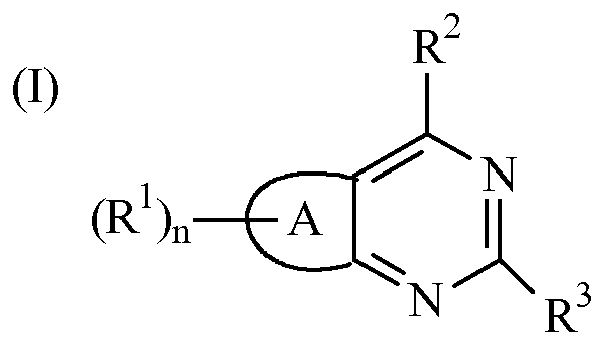
A represents a thiophene or furan ring;
n is 1 or 2;
R1 is a group of formula:
m is 0 or 1;
R30 is H or C1-C6 alkyl;
R4 and R5 form, together with the N atom to which they are attached, a 5- or 6-membered saturated N-containing heterocyclic group which includes 0 or 1 additional heteroatoms selected from N, S and O, which may be fused to a benzene ring and which is unsubstituted or substituted by one or more substituents selected from alkyl which is unsubstituted or substituted, alkoxy which is unsubstituted or substituted, -NR2, -N(R"')-alk-OR, -alk-OR, -O-alk-OR, -alk-C(O)NR2, -C(O)NR2, -alk-Het, -N(R)-Het, -O-Het, -N(R)-C(O)-alk-OR, C(O)-N(R)-alk-OR, -alk-S(O)2R, -N(R)-alk-OR, -alk-NR'R" , - N(R"')-S(O)2R, S(O)2R"', -alk-N(R)-alk-OR, -S(O)2-alk-OR, a second 5- or 6-membered saturated N-containing heterocyclic group as defined above, a 5- or 6-membered N-containing heteroaryl group which is unsubstituted or substituted and which may be fused to a benzene ring, -COOR, -CONR2, oxo (=O), -SO2NR2, -SO2-alk-NR2 and -CO-alk-OR, wherein alk is an unsubstituted or substituted, straight or branched chain C1 - C8 alkylene chain; Het is a 5- or 6-membered N-containing heteroaryl group which is unsubstituted or substituted; R is H or alkyl, or when two groups R are bonded to N they may form, together with the N atom, a saturated 5- or 6-membered N-containing heterocyclic group which is unsubstituted or substituted; each of R' and R" is independently H, alkyl or alkoxy; and R"' is alkyl which is unsubstituted or substituted by CF3, NR2, OR, a 5- or 6-membered saturated N-containing heterocyclic group or a 5- or 6-membered N-containing heteroaryl group, the said heterocyclic and heteroaryl groups being unsubstituted or substituted ; or one of R4 and R5 is alkyl and the other is a 5- or 6-membered saturated N-containing heterocyclic group as defined
above or an alkyl group which is substituted by a 5- or 6-membered saturated N-containing heterocyclic group as defined above;
R2 is
and R3 is selected from:(a) a group of the following formula: (b) a heteroaryl group which contains 1, 2, 3 or 4 ring nitrogen atoms and 0, 1 or 2 additional heteroatoms selected from O and S, which group is monocyclic or bicyclic and which is unsubstituted or substituted by one or more substituents selected from a group Z as defined above, a group R20, alkyl which is unsubstituted or substituted by a group R20, one or more substituents selected from halo, alkyl, alkenyl, alkynyl, CN, NO2, OR', SR', NR'2, C(O)R', SOR', SO2R', SO2NR'2, NC(O)R' and CO2R', wherein each R' is independently H or C1-C6 alkyl, and an oxo group (=O ; and(c) a group comprising a benzene ring which is unsubstituted or substituted as specified for the heteroaryl group in (b) above, and which is fused to a heteroaryl group as defined above;and wherein, in the above definitions,(i) R20 is selected from halogen, alkoxy, carbocyclyl, a 5- or 6-membered saturated N-containing heterocyclic group as defined above, OH, SR, CN, nitro, NR2, -COOR, -C(O)R, S(O)mR and -CONR2, wherein each R is H, unsubstituted alkyl or C3-C10 cycloalkyl and m is 1 or 2;(ii) "alkyl which is substituted" is an alkyl group which bears one or more substituents R20 as defined above;(iii) "alkoxy which is substituted" is an alkoxy group which is substituted by a group R20 as defined above or by alkyl which is unsubsstituted or substituted by a group R20 as defined above;(iv) a "5- or 6-membered heteroaryl group which is substituted" is a 5- or 6-membered heteroaryl group substituted by a group R20 as specified above or by alkyl which is unsubstituted or substituted by a group R20 as defined above;(v) a "saturated 5- or 6-membered N-containing heterocyclic group which is substituted" is a saturated 5- or 6-membered N-containing heterocyclic group substituted by by one or more substituents selected from alkyl which is unsubstituted or substituted as defined in (il) above, alkoxy which is unsubstituted or substituted as defined in (iii) above, -NR2, -N(R"')-alk-OR, -alk-OR, -O-alk-OR, -alk-C(O)NR2, -C(O)NR2, -alk-Het, -N(R)-Het, -O-Het, -N(R)-C(O)-alk-OR, -C(O)-N(R)-alk-OR, -alk-S(O)2R, -N(R)-alk-OR, -alk-NR'R" , -N(R"')-S(O)2R, S(O)2R"', -alk-N(R)-alk-OR, -S(O)2-alk-OR, a second 5- or 6-membered saturated N-containing heterocyclic group as defined above, and a 5- or 6-membered N-containing heteroaryl group which is unsubstituted or substituted as defined in (iv) above and which may be fused to a benzene ring, -COOR, -CONR2, oxo (=O), -SO2NR2, -SO2-alk-NR2 and -CO-alk-OR, wherein alk is an alkylene chain; Het is a 5- or 6-membered N-containing heteroaryl group which is unsubstituted or substituted as defined in (iii) above; R is H or alkyl, or when two groups R are bonded to N they may form, together with the N atom, a saturated 5- or 6-membered N-containing heterocyclic group; each of R' and R" is independently H, alkyl or alkoxy; and R'" is alkyl which is unsubstituted or substituted by CF3, NR2, OR, a 5- or 6-membered saturated N-containing heterocyclic group or a 5- or 6-membered N-containing heteroaryl group which is unsubstituted or substituted as defined in (iii) above; and(vi) a "5- to 12-membered heteroaryl group which is substituted" is a 5- to 12-membered heteroaryl group substituted by a group R20 as specified above or by alkyl which is unsubstituted or substituted by a group R20 as defined above;or a pharmaceutically acceptable salt thereof;
provided that R3 is not an indole group or an indazole group, which group is unsubstituted or substituted, or a pharmaceutically acceptable salt thereof. - A compound according to claim 1 wherein the fused pyrimidine is of formula (Ia):

- A compound according to claim 1 wherein the fused pyrimidine is of formula (Ib):

- A compound according to claim 1 which is selected from:3-(4-Morpholin-4-yl-6-morpholin-4-ylmethyl-thieno[3,2-d]pyrimidin-2-yl)-phenol;3-(4-Morpholin-4-yl-6-pyrrolidin-1-ylmethyl-thieno[3,2-d]pyrimidin-2-yl)-phenol;3-[6-(4-Methyl-piperazin-1-ylmethyl)-4-morpholin-4-yl-thieno[3,2-d]pyrimidin-2-yl]-phenol;3-[6-(6,7-Dimethoxy-3,4-dihydro-1H-isoquinolin-2-ylmethyl)-4-morpholin-4-yl-thieno[3,2-d]pyrimidin-2-yl]-phenol ;3-(6-[1,4']Bipiperidinyl-1'-ylmethyl-4-morpholin-4-yl-thieno[3,2-d]pyrimidin-2-yl)-phenol;3-[4-Morpholin-4-yl-6-(4-pyrimidin-2-yl-piperazin-1-ylmethyl)-thieno[3,2-d]pyrimidin-2-yl]-phenol;3-[6-(4-Cyclohexylmethyl-piperazin-1-ylmethyl)-4-morpholin-4-yl-thieno[3,2-d]pyrimidin-2-yl]-phenol;4-[2-(3-Hydroxy-phenyl)-4-morpholin-4-yl-thieno[3,2-d]pyrimidin-6-ylmethyl]-piperazine-1-carboxylic acid tert-butyl ester;3-(4-Morpholin-4-yl-6-piperazin-1-ylmethyl-thieno[3,2-d]pyrimidin-2-yl)-phenol ,trifluoroacetic acid salt;3-{6-[4-(2-Methoxy-ethyl)-piperazin-1-ylmethyl]-4-morpholin-4-yl-thieno[3,2-d]pyrimidin-2-yl}-phenol;3-[6-(4-ethyl-[1,4]diazepan-1-ylmethyl)-4-morpholin-4-yl-thieno[3,2-d]pyrimidin-2-yl]-phenol;{4-[2-(3-Hydroxy-phenyl)-4-morpholin-4-yl-thieno[3,2-d]pyrimidin-6-ylmethyl]-piperazin-1-yl}-acetic acid ethyl ester;1-{4-[2-(3-Hydroxy-phenyl)-4-morpholin-4-yl-thieno[3,2-d]pyrimidin-6-ylmethyl]-piperazin-1-yl}-ethanone;3-{6-[4-(2-Hydroxy-ethyl)-piperazin-1-ylmethyl]-4-morpholin-4-yl-thieno[3,2-d]pyrimidin-2-yl}-phenol;3-(4-Morpholin-4-yl-6-thiomorpholin-4-ylmethyl-thieno[3,2-d]pyrimidin-2-yl)-phenol;3-[6-(4-Ethyl-piperazin-1-ylmethyl)-4-morpholin-4-yl-thieno[3,2-d]pyrimidin-2-yl]-phenol;3-(6-{[Methyl-(1-methyl-piperidin-4-yl)-amino]-methyl}-4-morpholin-4-yl-thieno[3,2-d]pyrimidin-2-yl)-phenol;3-[6-(4-Dimethylamino-piperidin-1-ylmethyl)-4-morpholin-4-yl-thieno[3,2-d]pyrimidin-2-yl]-phenol;4-[2-(3-Hydroxy-phenyl)-4-morpholin-4-yl-thieno[3,2-d]pyrimidin-6-ylmethyl]-piperazin-2-one;3-[6-(4-Methanesulfonyl-piperazin-1-ylmethyl)-4-morpholin-4-yl-thieno[3,2-d]pyrimidin-2-yl]-phenol;{4-[2-(3-Hydroxy-phenyl)-4-morpholin-4-yl-thieno[3,2-d]pyrimidin-6-ylmethyl]-piperazin-1-yl}-acetonitrile;3-[4-Morpholin-4-yl-6-(4-morpholin-4-yl-piperidin-1-ylmethyl)-thieno[3,2-d]pyrimidin-2-yl]-phenol;3-[6-(4-Amino-piperidin-1-ylmethyl)-4-morpholin-4-yl-thieno[3,2-d]pyrimidin-2-yl]-phenol;3-[6-(3-Dimethylamino-pyrrolidin-1-ylmethyl)-4-morpholin-4-yl-thieno[3,2-d]pyrimidin-2-yl]-phenol;1-[2-(3-Hydroxy-phenyl)-4-morpholin-4-yl-thieno[3,2-d]pyrimidin-6-ylmethyl]-4-morpholin-4-ylmethyl-piperidin-4-ol;4-[2-(3-Hydroxy-phenyl)-4-morpholin-4-yl-thieno[3,2-d]pyrimidin-6-ylmethyl]-piperazine-1-carboxylic acid ethylamide ;N-{1-[2-(3-Hydroxy-phenyl)-4-morpholin-4-yl-thieno[3,2-d]pyrimidin-6-ylmethyl]-piperidin-4-yl}-methanesulfonamide;1-{4-[2-(3-Hydroxy-phenyl)-4-morpholin-4-yl-thieno[3,2-d]pyrimidin-6-ylmethyl]-piperazin-1-yl}-2-methoxy-ethanone;N-{1-[2-(3-Hydroxy-phenyl)-4-morpholin-4-yl-thieno[3,2-d]pyrimidin-6-ylmethyl]-piperidin-4-yl}-acetamide;4-[2-(3-Hydroxy-phenyl)-4-morpholin-4-yl-thieno[3,2-d]pyrimidin-6-ylmethyl]-piperazine-1-carboxylic acid dimethylamide;1-[2-(3-Hydroxy-phenyl)-4-morpholin-4-yl-thieno[3,2-d]pyrimidin-6-ylmethyl]-piperidin-4-ol;3-[6-(1,1-Dioxo-1lambda*6*-thiomorpholin-4-ylmethyl)-4-morpholin-4-yl-thieno[3,2-d]pyrimidin-2-yl]-phenol;4-[2-(3-Hydroxy-phenyl)-4-morpholin-4-yl-thieno[3,2-d]pyrimidin-6-ylmethyl]-piperazine-1-sulfonic acid dimethylamide;3-(6-{4-[(2-Methoxy-ethyl)-methyl-amino]-piperidin-1-ylmethyl}-4-morpholin-4-yl-thieno[3,2-d]pyrimidin-2-yl)-phenol;1-[2-(3-Hydroxy-phenyl)-4-morpholin-4-yl-thieno[3,2-d]pyrimidin-6-ylmethyl]-pyrrolidin-3-ol;(R,S)-3-[6-(2-Dimethylaminomethyl-pyrrolidin-1-ylmethyl)-4-morpholin-4-yl-thieno[3,2-d]pyrimidin-2-yl]-phenol;(R,S)-3-(6-{[Methyl-(1-methyl-pyrrolidin-2-ylmethyl)-amino]-methyl}-4-morpholin-4-yl-thieno[3,2-d]pyrimidin-2-yl)-phenol;1-[2-(3-Hydroxy-phenyl)-4-morpholin-4-yl-thieno[3,2-d]pyrimidin-6-ylmethyl]-piperidine-4-carboxylic acid amide;2-{4-[2-(3-Hydroxy-phenyl)-4-morpholin-4-yl-thieno[3,2-d]pyrimidin-6-ylmethyl]-piperazin-1-yl}-N,N-dimethyl-acetamide;3-(6-{[Methyl-(1-methyl-pyrrolidin-3-yl)-amino]-methyl}-4-morpholin-4-yl-thieno[3,2-d]pyrimidin-2-yl)-phenol;2-Dimethylamino-1-{4-[2-(3-hydroxy-phenyl)-4-morpholin-4-yl-thieno[3,2-d]pyrimidin-6-ylmethyl]-piperazin-1-yl}-ethanone;3-[6-((3R,5S)-3,5-Dimethyl-piperazin-1-ylmethyl)-4-morpholin-4-yl-thieno[3,2-d]pyrimidin-2-yl]-phenol;3-[6-((3R,5S)-4-Methanesulfonyl-3,5-dimethyl-piperazin-1-ylmethyl)-4-morpholin-4-yl-thieno[3,2-d]pyrimidin-2-yl]-phenol;1-{(2R,6S)-4-[2-(3-Hydroxy-phenyl)-4-morpholin-4-yl-thieno[3,2-d]pyrimidin-6-ylmethyl]-2,6-dimethyl-piperazin-1-yl}-ethanone;3-{6-[4-(3-Dimethylamino-propane-1-sulfonyl)-piperazin-1-ylmethyl]-4-morpholin-4-yl-thieno[3,2-d]pyrimidin-2-yl}-phenol;3-[6-(4-Methoxy-piperidin-1-ylmethyl)-4-morpholin-4-yl-thieno[3,2-d]pyrimidin-2-yl]-phenol;3-{4-Morpholin-4-yl-6-[4-(3-morpholin-4-yl-propane-1-sulfonyl)-piperazin-1-ylmethyl]-thieno[3,2-d]pyrimidin-2-yl}-phenol;{4-[2-(3-Hydroxy-phenyl)-4-morpholin-4-yl-thieno[3,2-d]pyrimidin-6-ylmethyl]-piperazin-1-yl}-morpholin-4-yl-methanone;4-[2-(3-Hydroxy-phenyl)-4-morpholin-4-yl-thieno[3,2-d]pyrimidin-6-ylmethyl]-piperazine-1-carboxylic acid (2-methoxy-ethyl)-methyl-amide;1-{3-[6-(4-Methyl-piperazin-1-ylmethyl)-4-morpholin-4-yl-thieno[3,2-d]pyrimidin-2-yl]-phenyl}-ethanol; .3-[6-(4-Methyl-piperazin-1-ylmethyl)-4-morpholin-4-yl-thieno[3,2-d]pyrimidin-2-yl]-phenyl}-methanol;2-Chloro-5-[6-(4-methyl-piperazin-1-ylmethyl)-4-morpholin-4-yl-thieno[3,2-d]pyrimidin-2-yl]-phenol;2,3-Difluoro-5-[6-(4-methyl-piperazin-1-ylmethyl)-4-morpholin-4-yl-thieno[3,2-d]pyrimidin-2-yl]-phenol;4-Fluoro-3-[6-(4-methyl-piperazin-1-ylmethyl)-4-morpholin-4-yl-thieno[3,2-d]pyrimidin-2-yl]-phenol;2-(1H-Indazol-6-yl)-6-(4-methyl-piperazin-1-ylmethyl)-4-morpholin-4-yl-thieno[3,2-d] pyrimidin-2-yl]-phenol; and6-(4-Methyl-piperazin-1-ylmethyl)-4-morpholin-4-yl-2-(1 H-pyrazol-4-yl)-thieno [3,2-d]pyrimidine;and the pharmaceutically acceptable salts of the above-mentioned free compounds.
- A process for producing a compound as defined in claim 1 wherein m is 1, which process comprises:(a) treating a compound of formula (II):

 (b) treating a compound of formula (II) as defined above with an amine of formula NHR4R5 wherein R4 and R5 are as defined above, in the presence of a suitable reducing agent; and treating the resulting compound of formula (IV):
- A process for producing a compound of formula (I) as defined in claim 1, in which m is 1 and R3 is a 3- or 4-hydroxyphenyl group, which process comprises:(a) treating a compound of formula (V):
 (b) removing the hydroxy protecting group.
 - A process for producing a compound as defined in claim 1 wherein m is 0, which process comprises treating a compound of formula (XIV):

- A process according to claim 5, 6 or 7 which further comprises converting the resulting compound of formula (I) into a pharmaceutically acceptable salt thereof.
- A pharmaceutical composition which comprises a pharmaceutically acceptable carrier or diluent and, as an active ingredient, a compound as claimed in any one of claims 1 to 4.
- A compound as defined in any one of claims 1 to 4 for use in a method of treatment of the human or animal body by therapy.
- A compound as defined in any one of claims 1 to 4 for use in treating a disease or disorder selected from cancer, immune disorders, cardiovascular disease, viral infection, inflammation, metabolism/endocrine disorders and neurological disorders.
Applications Claiming Priority (2)
| Application Number | Priority Date | Filing Date | Title |
|---|---|---|---|
| GBGB0423653.5A GB0423653D0 (en) | 2004-10-25 | 2004-10-25 | Pharmaceutical compounds |
| PCT/GB2005/004146 WO2006046040A1 (en) | 2004-10-25 | 2005-10-25 | Pharmaceutical compounds |
Publications (2)
| Publication Number | Publication Date |
|---|---|
| EP1812446A1 EP1812446A1 (en) | 2007-08-01 |
| EP1812446B1 true EP1812446B1 (en) | 2015-11-18 |
Family
ID=33485146
Family Applications (3)
| Application Number | Title | Priority Date | Filing Date |
|---|---|---|---|
| EP05797514.6A Expired - Lifetime EP1812445B1 (en) | 2004-10-25 | 2005-10-25 | Pharmaceutical compounds |
| EP05796680.6A Expired - Lifetime EP1812444B1 (en) | 2004-10-25 | 2005-10-25 | Pharmaceutical compounds |
| EP05798278.7A Expired - Lifetime EP1812446B1 (en) | 2004-10-25 | 2005-10-25 | Pharmaceutical compounds |
Family Applications Before (2)
| Application Number | Title | Priority Date | Filing Date |
|---|---|---|---|
| EP05797514.6A Expired - Lifetime EP1812445B1 (en) | 2004-10-25 | 2005-10-25 | Pharmaceutical compounds |
| EP05796680.6A Expired - Lifetime EP1812444B1 (en) | 2004-10-25 | 2005-10-25 | Pharmaceutical compounds |
Country Status (17)
| Country | Link |
|---|---|
| US (8) | US7776856B2 (en) |
| EP (3) | EP1812445B1 (en) |
| JP (3) | JP5048504B2 (en) |
| KR (3) | KR101466529B1 (en) |
| CN (2) | CN101087795B (en) |
| AU (2) | AU2005298408B2 (en) |
| BR (2) | BRPI0517019A (en) |
| CA (2) | CA2585089C (en) |
| ES (3) | ES2554689T3 (en) |
| GB (1) | GB0423653D0 (en) |
| IL (2) | IL182615A0 (en) |
| MX (2) | MX2007004868A (en) |
| NO (2) | NO20072115L (en) |
| NZ (2) | NZ554586A (en) |
| RU (2) | RU2422449C2 (en) |
| WO (3) | WO2006046031A1 (en) |
| ZA (2) | ZA200703311B (en) |
Families Citing this family (145)
| Publication number | Priority date | Publication date | Assignee | Title |
|---|---|---|---|---|
| DE69636466T2 (en) * | 1996-09-04 | 2007-08-09 | Intertrust Technologies Corp., Sunnyvale | TRUST INFRASTRUCTURE SUPPORT SYSTEMS, METHODS AND TECHNIQUES FOR SAFE ELECTRONIC TRADE, ELECTRONIC TRANSACTIONS, CONTROL AND AUTOMATION OF TRADING PROCEDURES, DISTRIBUTING DATA PROCESSING AND MANAGING RIGHTS |
| GB0423653D0 (en) | 2004-10-25 | 2004-11-24 | Piramed Ltd | Pharmaceutical compounds |
| RU2439074C2 (en) | 2006-04-26 | 2012-01-10 | Ф. Хоффманн-Ля Рош Аг | THIENO[3,2-d]PYRIMIDINE DERIVATIVE AS PHOSPHATIDYL INOSITOL-3-KINASE (PI3K) INHIBITOR |
| BRPI0710866A2 (en) * | 2006-04-26 | 2012-08-14 | Hoffmann La Roche | pharmaceutical compounds |
| JP5291616B2 (en) | 2006-04-26 | 2013-09-18 | ジェネンテック, インコーポレイテッド | Phosphoinositide 3-kinase inhibitor compounds and methods of use thereof |
| CN101479274B (en) | 2006-04-26 | 2013-06-12 | 霍夫曼-拉罗奇有限公司 | Pharmaceutical compounds |
| EP2024372B1 (en) * | 2006-04-26 | 2010-06-23 | F.Hoffmann-La Roche Ag | Thieno[3,2-d]pyrimidine derivative useful as pi3k inhibitor |
| GB0608820D0 (en) * | 2006-05-04 | 2006-06-14 | Piramed Ltd | Pharmaceutical compounds |
| GB0611152D0 (en) | 2006-06-06 | 2006-07-19 | Ucb Sa | Therapeutic agents |
| KR20090021218A (en) | 2006-06-12 | 2009-02-27 | 버텍스 파마슈티칼스 인코포레이티드 | Thienopyrimidine useful as a modulator of ion channels |
| GB0612630D0 (en) | 2006-06-26 | 2006-08-02 | Novartis Ag | Organic compounds |
| JP5313909B2 (en) * | 2006-11-13 | 2013-10-09 | アイコス コーポレイション | Thienopyrimidinone for the treatment of inflammatory diseases and cancer |
| WO2008070740A1 (en) * | 2006-12-07 | 2008-06-12 | F.Hoffmann-La Roche Ag | Phosphoinositide 3-kinase inhibitor compounds and methods of use |
| JP5500990B2 (en) | 2006-12-07 | 2014-05-21 | エフ・ホフマン−ラ・ロシュ・アクチェンゲゼルシャフト | Phosphoinositide 3-kinase inhibitor compounds and methods of use |
| CN101679456B (en) * | 2007-06-12 | 2012-09-05 | 霍夫曼-拉罗奇有限公司 | Thiazolopyrimidines and their use as inhibitors of phosphatidylinositol 3-kinase |
| WO2008152394A1 (en) * | 2007-06-12 | 2008-12-18 | F.Hoffmann-La Roche Ag | Pharmaceutical compounds |
| AU2008298948B2 (en) * | 2007-09-12 | 2014-09-04 | F. Hoffmann-La Roche Ag | Combinations of phosphoinositide 3-kinase inhibitor compounds and chemotherapeutic agents, and methods of use |
| ES2399774T3 (en) * | 2007-09-24 | 2013-04-03 | Genentech, Inc. | Thiazolopyrimidine compounds PI3K inhibitors and methods of use |
| EP2214675B1 (en) * | 2007-10-25 | 2013-11-20 | Genentech, Inc. | Process for making thienopyrimidine compounds |
| GB0721095D0 (en) * | 2007-10-26 | 2007-12-05 | Piramed Ltd | Pharmaceutical compounds |
| EP2215090B1 (en) * | 2007-10-26 | 2015-03-04 | F. Hoffmann-La Roche AG | Purine derivatives useful as pi3 kinase inhibitors |
| PE20091268A1 (en) | 2007-12-19 | 2009-09-19 | Amgen Inc | HETEROCYCLIC DERIVATIVES AS PI3 KINASE INHIBITORS |
| PE20131210A1 (en) | 2007-12-19 | 2013-10-31 | Genentech Inc | 5-ANILINOIMIDAZOPYRIDINE DERIVATIVES AS MEK INHIBITORS |
| ES2387707T3 (en) | 2007-12-21 | 2012-09-28 | Genentech, Inc. | Azaindolizines and use procedures |
| US9029411B2 (en) | 2008-01-25 | 2015-05-12 | Millennium Pharmaceuticals, Inc. | Thiophenes and uses thereof |
| NZ587706A (en) | 2008-03-18 | 2012-12-21 | Genentech Inc | Combinations of an anti-her2 antibody-drug conjugate and chemotherapeutic agents, and methods of use |
| AU2009248993C1 (en) * | 2008-05-23 | 2013-10-03 | Wyeth Llc | Triazine compounds as PI3 kinase and mTOR inhibitors |
| US8158624B2 (en) | 2008-05-30 | 2012-04-17 | Genetech, Inc. | Purine PI3K inhibitor compounds and methods of use |
| JP5599783B2 (en) | 2008-05-30 | 2014-10-01 | アムジエン・インコーポレーテツド | Inhibitors of PI3 kinase |
| EP2318377B1 (en) * | 2008-07-31 | 2013-08-21 | Genentech, Inc. | Pyrimidine compounds, compositions and methods of use |
| TWI378933B (en) | 2008-10-14 | 2012-12-11 | Daiichi Sankyo Co Ltd | Morpholinopurine derivatives |
| EP2385832B1 (en) | 2009-01-08 | 2015-07-15 | Curis, Inc. | Phosphoinositide 3-kinase inhibitors with a zinc binding moiety |
| US9090601B2 (en) | 2009-01-30 | 2015-07-28 | Millennium Pharmaceuticals, Inc. | Thiazole derivatives |
| US8796314B2 (en) | 2009-01-30 | 2014-08-05 | Millennium Pharmaceuticals, Inc. | Heteroaryls and uses thereof |
| US9139589B2 (en) | 2009-01-30 | 2015-09-22 | Millennium Pharmaceuticals, Inc. | Heteroaryls and uses thereof |
| CN102365021B (en) | 2009-02-05 | 2015-07-15 | 伊缪诺金公司 | Novel benzodiazepine derivatives |
| CN102369011A (en) | 2009-03-12 | 2012-03-07 | 健泰科生物技术公司 | Combinations of phosphoinositide 3-kinase inhibitor compounds and chemotherapeutic agents for the treatment of hematopoietic malignancies |
| CA2755285C (en) | 2009-03-20 | 2014-02-11 | Yunxin Y. Bo | Inhibitors of pi3 kinase |
| US8785651B2 (en) | 2009-03-24 | 2014-07-22 | Sumitomo Chemical Company, Limited | Method for manufacturing a boronic acid ester compound |
| AU2010229468A1 (en) | 2009-03-27 | 2011-10-13 | Vetdc, Inc. | Pyrimidinyl and 1,3,5-triazinyl benzimidazole sulfonamides and their use in cancer therapy |
| NZ596185A (en) | 2009-04-16 | 2013-01-25 | Ct Nac Investigaciones Oncologicas Cnio | Imidazopyrazines for use as kinase inhibitors |
| US8410095B2 (en) | 2009-05-20 | 2013-04-02 | Glaxosmithkline Llc | Thiazolopyrimidinone derivatives as PI3 kinase inhibitors |
| EP2451811A1 (en) * | 2009-05-27 | 2012-05-16 | F. Hoffmann-La Roche AG | Bicyclic indole-pyrimidine pi3k inhibitor compounds selective for p110 delta, and methods of use |
| SG175708A1 (en) * | 2009-05-27 | 2011-12-29 | Genentech Inc | Bicyclic pyrimidine pi3k inhibitor compounds selective for p110 delta, and methods of use |
| US20100331305A1 (en) * | 2009-06-24 | 2010-12-30 | Genentech, Inc. | Oxo-heterocycle fused pyrimidine compounds, compositions and methods of use |
| ES2432671T3 (en) * | 2009-07-02 | 2013-12-04 | Novartis Ag | 2-carboxamide cycloamine ureas useful as PI3K inhibitors |
| AU2010276160A1 (en) | 2009-07-21 | 2012-02-09 | Gilead Calistoga Llc | Treatment of liver disorders with PI3K inhibitors |
| AU2010286168B2 (en) | 2009-08-20 | 2014-05-15 | Karus Therapeutics Limited | Tricyclic heterocyclic compounds as phosphoinositide 3-kinase inhibitors |
| ES2557316T3 (en) | 2009-09-08 | 2016-01-25 | F. Hoffmann-La Roche Ag | 4-substituted pyridine-3-yl-carboxamide compounds and methods of use |
| AU2010299820A1 (en) | 2009-09-28 | 2012-04-19 | F. Hoffmann-La Roche Ag | Benzoxepin PI3K inhibitor compounds and methods of use |
| NZ599939A (en) * | 2009-10-12 | 2014-02-28 | Hoffmann La Roche | Combinations of a pi3k inhibitor and a mek inhibitor |
| WO2011049625A1 (en) | 2009-10-20 | 2011-04-28 | Mansour Samadpour | Method for aflatoxin screening of products |
| SG10201500895XA (en) | 2009-11-05 | 2015-04-29 | Rhizen Pharmaceuticals Sa | Chromen-4-one Derivatives As Kinase Modulators |
| CN102711766B (en) * | 2009-11-12 | 2014-06-04 | 霍夫曼-拉罗奇有限公司 | N-9-substituted purine compounds, compositions and methods of use |
| CN102712642B (en) * | 2009-11-12 | 2015-08-12 | 霍夫曼-拉罗奇有限公司 | The purine that N-7 replaces and Pyrazolopyrimidine compound, composition and using method |
| PH12012501361A1 (en) | 2009-12-31 | 2012-10-22 | Centro Nac De Investigaciones Oncologicas Cnio | Tricyclic compounds for use as kinase inhibitors |
| WO2011089400A1 (en) | 2010-01-22 | 2011-07-28 | Centro Nacional De Investigaciones Oncológicas (Cnio) | Inhibitors of pi3 kinase |
| SG183155A1 (en) | 2010-02-03 | 2012-09-27 | Signal Pharm Llc | Identification of lkb1 mutation as a predictive biomarker for sensitivity to tor kinase inhibitors |
| US9173961B2 (en) | 2010-02-10 | 2015-11-03 | Immunogen, Inc. | CD20 antibodies and uses thereof |
| CN102762565A (en) | 2010-02-22 | 2012-10-31 | 弗·哈夫曼-拉罗切有限公司 | Pyrido[3,2-d]pyrimidine PI3δ inhibitor compounds and methods of use |
| MX2012011887A (en) | 2010-04-16 | 2012-11-30 | Genentech Inc | Fox03a as predictive biomarker for pi3k/akt kinase pathway inhibitor efficacy. |
| WO2011141713A1 (en) | 2010-05-13 | 2011-11-17 | Centro Nacional De Investigaciones Oncologicas (Cnio) | New bicyclic compounds as pi3-k and mtor inhibitors |
| CN103003279B (en) | 2010-07-14 | 2015-09-23 | 弗·哈夫曼-拉罗切有限公司 | Purine compounds selective for PI3K P110δ and methods of use thereof |
| MA34797B1 (en) | 2010-08-11 | 2014-01-02 | Millennium Pharm Inc | HETEROARYLES AND THEIR USES |
| WO2012021611A1 (en) | 2010-08-11 | 2012-02-16 | Millennium Pharmaceuticals, Inc. | Heteroaryls and uses thereof |
| EP2603216A4 (en) | 2010-08-11 | 2013-12-18 | Millennium Pharm Inc | Heteroaryls and uses thereof |
| WO2012051410A2 (en) | 2010-10-13 | 2012-04-19 | Millennium Pharmaceuticals, Inc. | Heteroaryls and uses thereof |
| EP2444084A1 (en) | 2010-10-21 | 2012-04-25 | Centro Nacional de Investigaciones Oncológicas (CNIO) | Use of PI3K inibitors for the treatment of obesity |
| AU2011343712B2 (en) | 2010-12-16 | 2015-09-17 | Genentech, Inc. | Tricyclic PI3k inhibitor compounds and methods of use |
| WO2012088254A1 (en) | 2010-12-22 | 2012-06-28 | Genentech, Inc. | Autophagy inducer and inhibitor combination therapy for the treatment of neoplasms |
| WO2012098387A1 (en) | 2011-01-18 | 2012-07-26 | Centro Nacional De Investigaciones Oncológicas (Cnio) | 6, 7-ring-fused triazolo [4, 3 - b] pyridazine derivatives as pim inhibitors |
| RU2013138835A (en) | 2011-02-09 | 2015-03-20 | Ф. Хоффманн-Ля Рош Аг | HETEROCYCLIC COMPOUNDS AS PI3 KINASE INHIBITORS |
| KR20140010076A (en) | 2011-02-15 | 2014-01-23 | 이뮤노젠 아이엔씨 | Cytotoxic benzodiazepine derivatives |
| BR112013024122A2 (en) | 2011-03-21 | 2019-09-24 | Hoffmann La Roche | p110 delta pi3k selective benzoxazepine compounds and methods of use |
| DK3111938T3 (en) | 2011-04-01 | 2019-07-01 | Curis Inc | PHOSPHOINOSIDID 3-KINASE BRAKE WITH A ZINC-BINDING GROUP |
| RS58326B1 (en) | 2011-05-04 | 2019-03-29 | Rhizen Pharmaceuticals S A | Novel compounds as modulators of protein kinases |
| US20130158023A1 (en) | 2011-08-03 | 2013-06-20 | Signal Pharmaceuticals, Llc | Identification of gene expression as a predictive biomarker for lkb1 status |
| EP2573085A1 (en) | 2011-09-26 | 2013-03-27 | AiCuris GmbH & Co. KG | N-[5-(aminosulfonyl)-4methyl-1,3-thiazol-2-yl]-N-methyl-2-[4-(2-pyridinyl)phenyl] acetamide mesylate monohydrate having a specific particle size distribution range and a specific surface area range |
| EP2573086A1 (en) * | 2011-09-26 | 2013-03-27 | AiCuris GmbH & Co. KG | N-[5-(Aminosulfonyl)-4-methyl-1,3-thiazol-2-yl]-N-methyl-2-[4-(2-pyridinyl)phenyl]acetamide mesylate monohydrate |
| US20130096116A1 (en) | 2011-10-13 | 2013-04-18 | Genentech, Inc. | Treatment of pharmacological-induced hypochlorhydria |
| JP6117235B2 (en) | 2011-12-15 | 2017-04-19 | ノバルティス アーゲー | Use of inhibitors of PI3K activity or function |
| GB201204125D0 (en) | 2012-03-08 | 2012-04-25 | Karus Therapeutics Ltd | Compounds |
| EP2852661A1 (en) | 2012-05-23 | 2015-04-01 | F. Hoffmann-La Roche AG | Compositions and methods of obtaining and using endoderm and hepatocyte cells |
| KR101915942B1 (en) | 2012-06-08 | 2018-11-06 | 에프. 호프만-라 로슈 아게 | Mutant selectivity and combinations of a phosphoinositide 3 kinase inhibitor compound and chemotherapeutic agents for the treatment of cancer |
| CN109970742A (en) | 2012-07-04 | 2019-07-05 | 理森制药股份公司 | Selective PI3Kδ inhibitor |
| HK1211208A1 (en) | 2012-08-22 | 2016-05-20 | Immunogen, Inc. | Cytotoxic benzodiazepine derivative |
| CA2883513A1 (en) | 2012-10-10 | 2014-04-17 | F. Hoffmann-La Roche Ag | Process for making thienopyrimidine compounds |
| AU2013203714B2 (en) | 2012-10-18 | 2015-12-03 | Signal Pharmaceuticals, Llc | Inhibition of phosphorylation of PRAS40, GSK3-beta or P70S6K1 as a marker for TOR kinase inhibitory activity |
| IN2015DN03235A (en) | 2012-11-07 | 2015-10-02 | Karus Therapeutics Ltd | |
| HK1211218A1 (en) * | 2012-12-07 | 2016-05-20 | 综合医院公司 | Combinations of a pi3k/akt inhibitor compound with an her3/egfr inhibitor compound and use thereof in the treatment of a hyperproliferative disorder |
| CA2901126C (en) | 2013-02-25 | 2022-01-25 | Genentech, Inc. | Methods and compositions for detecting and treating drug resistant akt mutant |
| EP2961435B1 (en) | 2013-02-28 | 2019-05-01 | ImmunoGen, Inc. | Conjugates comprising cell-binding agents and cytotoxic agents |
| HK1219422A1 (en) | 2013-02-28 | 2017-04-07 | Immunogen, Inc. | Conjugates comprising cell-binding agents and cytotoxic agents |
| US9505764B2 (en) | 2013-04-17 | 2016-11-29 | Signal Pharmaceuticals, Llc | Treatment of cancer with dihydropyrazino-pyrazines |
| MX368286B (en) | 2013-04-17 | 2019-09-27 | Signal Pharm Llc | Combination therapy comprising a tor kinase inhibitor and a 5-substituted quinazolinone compound for treating cancer. |
| CA2908353C (en) | 2013-04-17 | 2021-11-02 | Signal Pharmaceuticals, Llc | Treatment of cancer with dihydropyrazino-pyrazines |
| CA2908957C (en) | 2013-04-17 | 2021-05-18 | Signal Pharmaceuticals, Llc | Combination therapy comprising a dihydropyrazino-pyrazine compound and an androgen receptor antagonist for treating prostate cancer |
| AU2014254059B2 (en) | 2013-04-17 | 2019-06-06 | Signal Pharmaceuticals, Llc | Combination therapy comprising a TOR kinase inhibitor and a cytidine analog for treating cancer |
| HK1221168A1 (en) | 2013-04-17 | 2017-05-26 | 西格诺药品有限公司 | Combination therapy comprising a tor kinase inhibitor and n-(3-(5-fluoro-2-(4-(2-methoxyethoxy)phenylamino)pyrimidin-4- ylamino)phenyl)acrylamide for treating cancer |
| EA030726B1 (en) | 2013-04-17 | 2018-09-28 | СИГНАЛ ФАРМАСЬЮТИКАЛЗ, ЭлЭлСи | PHARMACEUTICAL FORMULATIONS, PROCESSES, SOLID FORMS AND METHODS OF USE RELATING TO 1-ETHYL-7-(2-METHYL-6-(1H-1,2,4-TRIAZOL-3-YL)PYRIDIN-3-YL)-3,4-DIHYDROPYRAZINO[2,3-b]PYRAZIN-2(1H)-ONE |
| WO2014177915A1 (en) | 2013-05-01 | 2014-11-06 | Piramal Enterprises Limited | Cancer combination therapy using imidazo[4,5-c]quinoline derivatives |
| ES2688815T3 (en) | 2013-05-10 | 2018-11-07 | Karus Therapeutics Limited | Novel histone deacetylase inhibitors |
| DE102013008118A1 (en) | 2013-05-11 | 2014-11-13 | Merck Patent Gmbh | Arylchinazoline |
| HK1223286A1 (en) | 2013-05-29 | 2017-07-28 | 西格诺药品有限公司 | Pharmaceutical compositions of 7-(6-(2-hydroxypropan-2-yl)pyridin-3-yl)-1-((trans)-4-methoxycyclohexyl)-3,4-dihydropyrazino[2,3-b]pyrazin-2(1h)-one, a solid form thereof and methods of their use |
| WO2014194030A2 (en) | 2013-05-31 | 2014-12-04 | Immunogen, Inc. | Conjugates comprising cell-binding agents and cytotoxic agents |
| KR101648141B1 (en) * | 2013-06-11 | 2016-08-12 | 제일모직 주식회사 | Compound, organic optoelectric device, and display device |
| CN104418858B (en) | 2013-08-30 | 2018-12-11 | 浙江医药股份有限公司新昌制药厂 | Nitrogenous substituted purine derivative of 2,6- bis- and preparation method thereof and its pharmaceutical composition and application |
| JP6441910B2 (en) * | 2013-09-30 | 2018-12-19 | シャンハイ インリ ファーマシューティカル カンパニー リミティド | Fused pyrimidine compounds, intermediates, methods for their preparation, compositions and uses |
| FR3015483B1 (en) * | 2013-12-23 | 2016-01-01 | Servier Lab | NOVEL THIENOPYRIMIDINE DERIVATIVES, PROCESS FOR THEIR PREPARATION AND PHARMACEUTICAL COMPOSITIONS CONTAINING SAME |
| GB201402431D0 (en) | 2014-02-12 | 2014-03-26 | Karus Therapeutics Ltd | Compounds |
| AU2015228859A1 (en) | 2014-03-13 | 2016-07-07 | F. Hoffmann-La Roche Ag | Therapeutic combinations with estrogen receptor modulators |
| NZ714742A (en) | 2014-04-16 | 2017-04-28 | Signal Pharm Llc | Solid forms of 1-ethyl-7-(2-methyl-6-(1h-1,2,4-triazol-3-yl)pyridin-3-yl)-3,4-dihydropyrazino[2,3-b]pyrazin-2(1h)-one, compositions thereof and methods of their use |
| JP2017511367A (en) | 2014-04-16 | 2017-04-20 | シグナル ファーマシューティカルズ,エルエルシー | 1-ethyl-7- (2-methyl-6- (1H-1,2,4-triazol-3-yl) pyridin-3-yl) -3,4-dihydropyrazino [2,3-b] pyrazine-2 Solid forms comprising (1H) -one and coforms, compositions thereof and methods of use |
| RU2016148441A (en) | 2014-05-21 | 2018-06-22 | Ф. Хоффманн-Ля Рош Аг | METHOD FOR TREATING A PR-POSITIVE LUMINARY A-TYPE OF BREAST CANCER WITH PI3K PIKTILISIB INHIBITOR |
| GB201419228D0 (en) | 2014-10-29 | 2014-12-10 | Karus Therapeutics Ltd | Compounds |
| GB201419264D0 (en) | 2014-10-29 | 2014-12-10 | Karus Therapeutics Ltd | Compounds |
| AR104068A1 (en) | 2015-03-26 | 2017-06-21 | Hoffmann La Roche | COMBINATIONS OF A 3-KINASE PHOSFOINOSYTIDE INHIBITOR COMPOSITE AND A CDK4 / 6 INHIBITOR COMPOUND FOR CANCER TREATMENT |
| JP6698712B2 (en) | 2015-06-29 | 2020-05-27 | エフ・ホフマン−ラ・ロシュ・アクチェンゲゼルシャフト | Treatment method using TASELISB |
| TWI649326B (en) | 2015-07-02 | 2019-02-01 | 瑞士商赫孚孟拉羅股份公司 | Benzooxazole oxazolidinone compound and preparation method thereof |
| CN111848643A (en) | 2015-07-02 | 2020-10-30 | 豪夫迈·罗氏有限公司 | Benzoxazepine*oxazolidinone compounds and methods of using the same |
| ES2879434T3 (en) | 2015-07-23 | 2021-11-22 | Inst Curie | Use of a combination of Dbait molecule and PARP inhibitors for cancer treatment |
| GB201514758D0 (en) | 2015-08-19 | 2015-09-30 | Karus Therapeutics Ltd | Formulation |
| GB201514754D0 (en) | 2015-08-19 | 2015-09-30 | Karus Therapeutics Ltd | Compounds |
| GB201514751D0 (en) | 2015-08-19 | 2015-09-30 | Karus Therapeutics Ltd | Compounds |
| GB201514760D0 (en) | 2015-08-19 | 2015-09-30 | Karus Therapeutics Ltd | Compounds and method of use |
| GB201519573D0 (en) | 2015-11-05 | 2015-12-23 | King S College London | Combination |
| JP7114076B2 (en) | 2015-12-22 | 2022-08-08 | シャイ・セラピューティクス・エルエルシー | Compounds for the treatment of cancer and inflammatory diseases |
| KR101919189B1 (en) | 2016-02-18 | 2018-11-15 | 경북대학교 산학협력단 | Muti-substituted 4H-thiazolo[4,5-e][1,4]diazepine-5,8-dione derivatives and use thereof |
| WO2018045379A1 (en) | 2016-09-02 | 2018-03-08 | Dana-Farber Cancer Institute, Inc. | Composition and methods of treating b cell disorders |
| WO2018162439A1 (en) | 2017-03-08 | 2018-09-13 | Onxeo | New predictive biomarker for the sensitivity to a treatment of cancer with a dbait molecule |
| CA3066939A1 (en) | 2017-06-21 | 2018-12-27 | SHY Therapeutics LLC | Compounds that interact with the ras superfamily for the treatment of cancers, inflammatory diseases, rasopathies, and fibrotic disease |
| ES2959860T3 (en) | 2017-06-22 | 2024-02-28 | Celgene Corp | Treatment of hepatocellular carcinoma characterized by hepatitis B virus infection |
| IL276013B2 (en) * | 2018-01-17 | 2024-03-01 | Glaxosmithkline Ip Dev Ltd | PI4KIIIBETA inhibitors |
| KR20200130856A (en) | 2018-03-13 | 2020-11-20 | 옹쎄오 | Debate molecule for resistance acquired in cancer treatment |
| CN108997372B (en) * | 2018-07-31 | 2020-07-28 | 华中科技大学同济医学院附属协和医院 | Compound for positron imaging, intermediate thereof, preparation method and imaging agent |
| JP7467423B2 (en) | 2018-09-11 | 2024-04-15 | キュリス,インコーポレイテッド | Combination therapy with phosphoinositide 3-kinase inhibitors having zinc-binding moieties |
| EP3898609A1 (en) | 2018-12-19 | 2021-10-27 | Shy Therapeutics LLC | Compounds that interact with the ras superfamily for the treatment of cancers, inflammatory diseases, rasopathies, and fibrotic disease |
| IL285020B2 (en) | 2019-02-06 | 2025-11-01 | Venthera Inc | Topical phosphoinositide 3-kinase inhibitors |
| GB201909468D0 (en) | 2019-07-01 | 2019-08-14 | Karus Therapeutics Ltd | Compounds for treating cancer |
| WO2021148581A1 (en) | 2020-01-22 | 2021-07-29 | Onxeo | Novel dbait molecule and its use |
| CN112920199B (en) * | 2020-06-02 | 2023-02-03 | 四川大学 | Piperazinone substituent or derivative thereof, preparation method and application thereof, and pharmaceutical composition |
| CA3187759A1 (en) * | 2020-08-04 | 2022-02-10 | Agis Kydonieus | Formulations of phosphoinositide 3-kinase inhibitors |
| CN113045582B (en) * | 2021-02-05 | 2022-12-23 | 中国药科大学 | PARP-1/PI3K dual-target inhibitor or pharmaceutically acceptable salt thereof, preparation method and use thereof |
| EP4458810A4 (en) | 2021-12-28 | 2025-12-17 | Nippon Shinyaku Co Ltd | Indazole compound and pharmaceutical |
| CN121398822A (en) | 2023-06-21 | 2026-01-23 | 四方生物科学有限公司 | Combination comprising deoxycytidine derivatives and PARP inhibitors for use in a method of treating cancer with normal HR function |
Family Cites Families (21)
| Publication number | Priority date | Publication date | Assignee | Title |
|---|---|---|---|---|
| DE1470356A1 (en) * | 1964-01-15 | 1970-04-30 | Thomae Gmbh Dr K | New thieno [3,2-d] pyrimidines and process for their preparation |
| BE754606A (en) * | 1969-08-08 | 1971-02-08 | Thomae Gmbh Dr K | NEW 2-AMINOALCOYLAMINO-THIENO (3,2-D) PYRIMIDINES AND THEIR MANUFACTURING PROCESSES |
| BE759493A (en) * | 1969-11-26 | 1971-05-25 | Thomae Gmbh Dr K | NEWS 2- (5-NITRO-2-FURYL) -THIENO (3,2-D) PYRIMIDINES AND METHODS FOR MAKING THEM |
| US3763156A (en) * | 1970-01-28 | 1973-10-02 | Boehringer Sohn Ingelheim | 2-heterocyclic amino-4-morpholinothieno(3,2-d)pyrimidines |
| RO58039A (en) * | 1970-01-28 | 1975-07-15 | ||
| RO62428A (en) | 1971-05-04 | 1978-01-15 | Thomae Gmbh Dr K | PROCESS FOR THE PREPARATION OF THYENO- (3,2-D) -PYRIMIDINES |
| CH592668A5 (en) * | 1973-10-02 | 1977-10-31 | Delalande Sa | |
| GB1570494A (en) * | 1975-11-28 | 1980-07-02 | Ici Ltd | Thienopyrimidine derivatives and their use as pesticides |
| ZA782648B (en) * | 1977-05-23 | 1979-06-27 | Ici Australia Ltd | The prevention,control or eradication of infestations of ixodid ticks |
| WO1999024440A1 (en) * | 1997-11-11 | 1999-05-20 | Pfizer Products Inc. | Thienopyrimidine and thienopyridine derivatives useful as anticancer agents |
| US6187777B1 (en) * | 1998-02-06 | 2001-02-13 | Amgen Inc. | Compounds and methods which modulate feeding behavior and related diseases |
| US6232320B1 (en) * | 1998-06-04 | 2001-05-15 | Abbott Laboratories | Cell adhesion-inhibiting antiinflammatory compounds |
| AU5261001A (en) * | 2000-04-27 | 2001-11-12 | Imperial Cancer Research Technology Ltd | Condensed heteroaryl derivatives |
| US6608053B2 (en) * | 2000-04-27 | 2003-08-19 | Yamanouchi Pharmaceutical Co., Ltd. | Fused heteroaryl derivatives |
| WO2004017950A2 (en) * | 2002-08-22 | 2004-03-04 | Piramed Limited | Phosphadidylinositol 3,5-biphosphate inhibitors as anti-viral agents |
| CL2003002287A1 (en) * | 2002-11-25 | 2005-01-14 | Wyeth Corp | COMPOUNDS DERIVED FROM TIENO [3,2-b] -PIRIDINA-6-CARBONITRILOS AND TIENEO [2,3-b] -PIRIDINA-5-CARBONITRILS, PHARMACEUTICAL COMPOSITION, PROCEDURE OF PREPARATION AND INTERMEDIARY COMPOUNDS, AND THEIR USE IN THE TREATMENT OF CANCER, APOPLEJIA, OSTEOPOROSIS |
| ES2217956B1 (en) | 2003-01-23 | 2006-04-01 | Almirall Prodesfarma, S.A. | NEW DERIVATIVES OF 4-AMINOTIENE (2,3-D) PIRIMIDIN-6-CARBONITRILE. |
| GB0423653D0 (en) | 2004-10-25 | 2004-11-24 | Piramed Ltd | Pharmaceutical compounds |
| CN101479274B (en) | 2006-04-26 | 2013-06-12 | 霍夫曼-拉罗奇有限公司 | Pharmaceutical compounds |
| RU2439074C2 (en) * | 2006-04-26 | 2012-01-10 | Ф. Хоффманн-Ля Рош Аг | THIENO[3,2-d]PYRIMIDINE DERIVATIVE AS PHOSPHATIDYL INOSITOL-3-KINASE (PI3K) INHIBITOR |
| AU2008298948B2 (en) * | 2007-09-12 | 2014-09-04 | F. Hoffmann-La Roche Ag | Combinations of phosphoinositide 3-kinase inhibitor compounds and chemotherapeutic agents, and methods of use |
-
2004
- 2004-10-25 GB GBGB0423653.5A patent/GB0423653D0/en not_active Ceased
-
2005
- 2005-10-25 EP EP05797514.6A patent/EP1812445B1/en not_active Expired - Lifetime
- 2005-10-25 CN CN2005800446399A patent/CN101087795B/en not_active Expired - Fee Related
- 2005-10-25 ES ES05798278.7T patent/ES2554689T3/en not_active Expired - Lifetime
- 2005-10-25 MX MX2007004868A patent/MX2007004868A/en active IP Right Grant
- 2005-10-25 WO PCT/GB2005/004129 patent/WO2006046031A1/en not_active Ceased
- 2005-10-25 AU AU2005298408A patent/AU2005298408B2/en not_active Ceased
- 2005-10-25 JP JP2007537400A patent/JP5048504B2/en not_active Expired - Fee Related
- 2005-10-25 JP JP2007537399A patent/JP5078016B2/en not_active Expired - Fee Related
- 2005-10-25 JP JP2007537401A patent/JP5077946B2/en not_active Expired - Fee Related
- 2005-10-25 BR BRPI0517019-2A patent/BRPI0517019A/en active Search and Examination
- 2005-10-25 EP EP05796680.6A patent/EP1812444B1/en not_active Expired - Lifetime
- 2005-10-25 KR KR1020137013522A patent/KR101466529B1/en not_active Expired - Fee Related
- 2005-10-25 US US11/665,657 patent/US7776856B2/en not_active Expired - Fee Related
- 2005-10-25 NZ NZ554586A patent/NZ554586A/en not_active IP Right Cessation
- 2005-10-25 RU RU2007119373/04A patent/RU2422449C2/en not_active IP Right Cessation
- 2005-10-25 CA CA2585089A patent/CA2585089C/en not_active Expired - Fee Related
- 2005-10-25 WO PCT/GB2005/004137 patent/WO2006046035A1/en not_active Ceased
- 2005-10-25 KR KR1020077011637A patent/KR20070097422A/en not_active Ceased
- 2005-10-25 AU AU2005298404A patent/AU2005298404B2/en not_active Ceased
- 2005-10-25 EP EP05798278.7A patent/EP1812446B1/en not_active Expired - Lifetime
- 2005-10-25 KR KR1020077011635A patent/KR20070084474A/en not_active Withdrawn
- 2005-10-25 BR BRPI0517461-9A patent/BRPI0517461A/en not_active Application Discontinuation
- 2005-10-25 NZ NZ554585A patent/NZ554585A/en not_active IP Right Cessation
- 2005-10-25 RU RU2007119374/04A patent/RU2422448C2/en not_active IP Right Cessation
- 2005-10-25 MX MX2007004867A patent/MX2007004867A/en active IP Right Grant
- 2005-10-25 CN CN2005800446384A patent/CN101087794B/en not_active Expired - Fee Related
- 2005-10-25 ES ES05797514.6T patent/ES2558867T3/en not_active Expired - Lifetime
- 2005-10-25 ES ES05796680.6T patent/ES2547447T3/en not_active Expired - Lifetime
- 2005-10-25 CA CA2585112A patent/CA2585112C/en not_active Expired - Fee Related
- 2005-10-25 WO PCT/GB2005/004146 patent/WO2006046040A1/en not_active Ceased
-
2007
- 2007-04-17 IL IL182615A patent/IL182615A0/en unknown
- 2007-04-17 IL IL182614A patent/IL182614A/en not_active IP Right Cessation
- 2007-04-23 ZA ZA200703311A patent/ZA200703311B/en unknown
- 2007-04-23 ZA ZA200703312A patent/ZA200703312B/en unknown
- 2007-04-24 NO NO20072115A patent/NO20072115L/en not_active Application Discontinuation
- 2007-04-24 NO NO20072116A patent/NO20072116L/en not_active Application Discontinuation
- 2007-08-16 US US11/893,625 patent/US7872003B2/en not_active Expired - Fee Related
- 2007-08-16 US US11/893,414 patent/US7750002B2/en not_active Expired - Fee Related
-
2010
- 2010-05-28 US US12/789,773 patent/US8153629B2/en not_active Expired - Fee Related
- 2010-07-13 US US12/835,533 patent/US8101607B2/en not_active Expired - Fee Related
-
2012
- 2012-03-08 US US13/415,672 patent/US20120258966A1/en not_active Abandoned
-
2013
- 2013-07-25 US US13/950,966 patent/US20130317017A1/en not_active Abandoned
-
2014
- 2014-06-17 US US14/307,364 patent/US8946217B2/en not_active Expired - Fee Related
Also Published As
Similar Documents
| Publication | Publication Date | Title |
|---|---|---|
| US7872003B2 (en) | Pharmaceutical compounds | |
| JP5148597B2 (en) | Pharmaceutical compounds |
Legal Events
| Date | Code | Title | Description |
|---|---|---|---|
| PUAI | Public reference made under article 153(3) epc to a published international application that has entered the european phase |
Free format text: ORIGINAL CODE: 0009012 |
|
| 17P | Request for examination filed |
Effective date: 20070521 |
|
| AK | Designated contracting states |
Kind code of ref document: A1 Designated state(s): AT BE BG CH CY CZ DE DK EE ES FI FR GB GR HU IE IS IT LI LT LU LV MC NL PL PT RO SE SI SK TR |
|
| DAX | Request for extension of the european patent (deleted) | ||
| 17Q | First examination report despatched |
Effective date: 20140122 |
|
| GRAP | Despatch of communication of intention to grant a patent |
Free format text: ORIGINAL CODE: EPIDOSNIGR1 |
|
| INTG | Intention to grant announced |
Effective date: 20150602 |
|
| GRAS | Grant fee paid |
Free format text: ORIGINAL CODE: EPIDOSNIGR3 |
|
| GRAA | (expected) grant |
Free format text: ORIGINAL CODE: 0009210 |
|
| AK | Designated contracting states |
Kind code of ref document: B1 Designated state(s): AT BE BG CH CY CZ DE DK EE ES FI FR GB GR HU IE IS IT LI LT LU LV MC NL PL PT RO SE SI SK TR |
|
| REG | Reference to a national code |
Ref country code: GB Ref legal event code: FG4D |
|
| REG | Reference to a national code |
Ref country code: CH Ref legal event code: EP |
|
| REG | Reference to a national code |
Ref country code: AT Ref legal event code: REF Ref document number: 761514 Country of ref document: AT Kind code of ref document: T Effective date: 20151215 |
|
| REG | Reference to a national code |
Ref country code: IE Ref legal event code: FG4D |
|
| REG | Reference to a national code |
Ref country code: ES Ref legal event code: FG2A Ref document number: 2554689 Country of ref document: ES Kind code of ref document: T3 Effective date: 20151222 |
|
| REG | Reference to a national code |
Ref country code: DE Ref legal event code: R096 Ref document number: 602005047967 Country of ref document: DE |
|
| REG | Reference to a national code |
Ref country code: CH Ref legal event code: NV Representative=s name: OFFICE ERNEST T. FREYLINGER S.A., CH |
|
| REG | Reference to a national code |
Ref country code: NL Ref legal event code: MP Effective date: 20160218 |
|
| REG | Reference to a national code |
Ref country code: LT Ref legal event code: MG4D |
|
| REG | Reference to a national code |
Ref country code: AT Ref legal event code: MK05 Ref document number: 761514 Country of ref document: AT Kind code of ref document: T Effective date: 20151118 |
|
| PG25 | Lapsed in a contracting state [announced via postgrant information from national office to epo] |
Ref country code: NL Free format text: LAPSE BECAUSE OF FAILURE TO SUBMIT A TRANSLATION OF THE DESCRIPTION OR TO PAY THE FEE WITHIN THE PRESCRIBED TIME-LIMIT Effective date: 20151118 Ref country code: IS Free format text: LAPSE BECAUSE OF FAILURE TO SUBMIT A TRANSLATION OF THE DESCRIPTION OR TO PAY THE FEE WITHIN THE PRESCRIBED TIME-LIMIT Effective date: 20160318 Ref country code: LT Free format text: LAPSE BECAUSE OF FAILURE TO SUBMIT A TRANSLATION OF THE DESCRIPTION OR TO PAY THE FEE WITHIN THE PRESCRIBED TIME-LIMIT Effective date: 20151118 |
|
| PG25 | Lapsed in a contracting state [announced via postgrant information from national office to epo] |
Ref country code: PL Free format text: LAPSE BECAUSE OF FAILURE TO SUBMIT A TRANSLATION OF THE DESCRIPTION OR TO PAY THE FEE WITHIN THE PRESCRIBED TIME-LIMIT Effective date: 20151118 Ref country code: LV Free format text: LAPSE BECAUSE OF FAILURE TO SUBMIT A TRANSLATION OF THE DESCRIPTION OR TO PAY THE FEE WITHIN THE PRESCRIBED TIME-LIMIT Effective date: 20151118 Ref country code: PT Free format text: LAPSE BECAUSE OF FAILURE TO SUBMIT A TRANSLATION OF THE DESCRIPTION OR TO PAY THE FEE WITHIN THE PRESCRIBED TIME-LIMIT Effective date: 20160318 Ref country code: SE Free format text: LAPSE BECAUSE OF FAILURE TO SUBMIT A TRANSLATION OF THE DESCRIPTION OR TO PAY THE FEE WITHIN THE PRESCRIBED TIME-LIMIT Effective date: 20151118 Ref country code: GR Free format text: LAPSE BECAUSE OF FAILURE TO SUBMIT A TRANSLATION OF THE DESCRIPTION OR TO PAY THE FEE WITHIN THE PRESCRIBED TIME-LIMIT Effective date: 20160219 Ref country code: FI Free format text: LAPSE BECAUSE OF FAILURE TO SUBMIT A TRANSLATION OF THE DESCRIPTION OR TO PAY THE FEE WITHIN THE PRESCRIBED TIME-LIMIT Effective date: 20151118 Ref country code: AT Free format text: LAPSE BECAUSE OF FAILURE TO SUBMIT A TRANSLATION OF THE DESCRIPTION OR TO PAY THE FEE WITHIN THE PRESCRIBED TIME-LIMIT Effective date: 20151118 |
|
| PG25 | Lapsed in a contracting state [announced via postgrant information from national office to epo] |
Ref country code: CZ Free format text: LAPSE BECAUSE OF FAILURE TO SUBMIT A TRANSLATION OF THE DESCRIPTION OR TO PAY THE FEE WITHIN THE PRESCRIBED TIME-LIMIT Effective date: 20151118 |
|
| REG | Reference to a national code |
Ref country code: DE Ref legal event code: R097 Ref document number: 602005047967 Country of ref document: DE |
|
| PG25 | Lapsed in a contracting state [announced via postgrant information from national office to epo] |
Ref country code: RO Free format text: LAPSE BECAUSE OF FAILURE TO SUBMIT A TRANSLATION OF THE DESCRIPTION OR TO PAY THE FEE WITHIN THE PRESCRIBED TIME-LIMIT Effective date: 20151118 Ref country code: SK Free format text: LAPSE BECAUSE OF FAILURE TO SUBMIT A TRANSLATION OF THE DESCRIPTION OR TO PAY THE FEE WITHIN THE PRESCRIBED TIME-LIMIT Effective date: 20151118 Ref country code: DK Free format text: LAPSE BECAUSE OF FAILURE TO SUBMIT A TRANSLATION OF THE DESCRIPTION OR TO PAY THE FEE WITHIN THE PRESCRIBED TIME-LIMIT Effective date: 20151118 Ref country code: EE Free format text: LAPSE BECAUSE OF FAILURE TO SUBMIT A TRANSLATION OF THE DESCRIPTION OR TO PAY THE FEE WITHIN THE PRESCRIBED TIME-LIMIT Effective date: 20151118 |
|
| PLBE | No opposition filed within time limit |
Free format text: ORIGINAL CODE: 0009261 |
|
| STAA | Information on the status of an ep patent application or granted ep patent |
Free format text: STATUS: NO OPPOSITION FILED WITHIN TIME LIMIT |
|
| REG | Reference to a national code |
Ref country code: FR Ref legal event code: PLFP Year of fee payment: 12 |
|
| 26N | No opposition filed |
Effective date: 20160819 |
|
| PG25 | Lapsed in a contracting state [announced via postgrant information from national office to epo] |
Ref country code: SI Free format text: LAPSE BECAUSE OF FAILURE TO SUBMIT A TRANSLATION OF THE DESCRIPTION OR TO PAY THE FEE WITHIN THE PRESCRIBED TIME-LIMIT Effective date: 20151118 |
|
| PG25 | Lapsed in a contracting state [announced via postgrant information from national office to epo] |
Ref country code: BE Free format text: LAPSE BECAUSE OF FAILURE TO SUBMIT A TRANSLATION OF THE DESCRIPTION OR TO PAY THE FEE WITHIN THE PRESCRIBED TIME-LIMIT Effective date: 20151118 |
|
| PGFP | Annual fee paid to national office [announced via postgrant information from national office to epo] |
Ref country code: TR Payment date: 20160928 Year of fee payment: 12 |
|
| PG25 | Lapsed in a contracting state [announced via postgrant information from national office to epo] |
Ref country code: MC Free format text: LAPSE BECAUSE OF FAILURE TO SUBMIT A TRANSLATION OF THE DESCRIPTION OR TO PAY THE FEE WITHIN THE PRESCRIBED TIME-LIMIT Effective date: 20151118 |
|
| REG | Reference to a national code |
Ref country code: IE Ref legal event code: MM4A |
|
| PG25 | Lapsed in a contracting state [announced via postgrant information from national office to epo] |
Ref country code: LU Free format text: LAPSE BECAUSE OF NON-PAYMENT OF DUE FEES Effective date: 20161025 |
|
| REG | Reference to a national code |
Ref country code: FR Ref legal event code: PLFP Year of fee payment: 13 |
|
| PGFP | Annual fee paid to national office [announced via postgrant information from national office to epo] |
Ref country code: GB Payment date: 20170925 Year of fee payment: 13 Ref country code: FR Payment date: 20170922 Year of fee payment: 13 |
|
| PG25 | Lapsed in a contracting state [announced via postgrant information from national office to epo] |
Ref country code: IE Free format text: LAPSE BECAUSE OF NON-PAYMENT OF DUE FEES Effective date: 20161025 |
|
| PGFP | Annual fee paid to national office [announced via postgrant information from national office to epo] |
Ref country code: DE Payment date: 20171027 Year of fee payment: 13 |
|
| PGFP | Annual fee paid to national office [announced via postgrant information from national office to epo] |
Ref country code: IT Payment date: 20171018 Year of fee payment: 13 Ref country code: ES Payment date: 20171107 Year of fee payment: 13 Ref country code: CH Payment date: 20171025 Year of fee payment: 13 |
|
| PG25 | Lapsed in a contracting state [announced via postgrant information from national office to epo] |
Ref country code: CY Free format text: LAPSE BECAUSE OF FAILURE TO SUBMIT A TRANSLATION OF THE DESCRIPTION OR TO PAY THE FEE WITHIN THE PRESCRIBED TIME-LIMIT Effective date: 20151118 Ref country code: HU Free format text: LAPSE BECAUSE OF FAILURE TO SUBMIT A TRANSLATION OF THE DESCRIPTION OR TO PAY THE FEE WITHIN THE PRESCRIBED TIME-LIMIT; INVALID AB INITIO Effective date: 20051025 |
|
| PG25 | Lapsed in a contracting state [announced via postgrant information from national office to epo] |
Ref country code: BG Free format text: LAPSE BECAUSE OF FAILURE TO SUBMIT A TRANSLATION OF THE DESCRIPTION OR TO PAY THE FEE WITHIN THE PRESCRIBED TIME-LIMIT Effective date: 20151118 |
|
| REG | Reference to a national code |
Ref country code: DE Ref legal event code: R119 Ref document number: 602005047967 Country of ref document: DE |
|
| REG | Reference to a national code |
Ref country code: CH Ref legal event code: PL |
|
| GBPC | Gb: european patent ceased through non-payment of renewal fee |
Effective date: 20181025 |
|
| PG25 | Lapsed in a contracting state [announced via postgrant information from national office to epo] |
Ref country code: DE Free format text: LAPSE BECAUSE OF NON-PAYMENT OF DUE FEES Effective date: 20190501 |
|
| PG25 | Lapsed in a contracting state [announced via postgrant information from national office to epo] |
Ref country code: CH Free format text: LAPSE BECAUSE OF NON-PAYMENT OF DUE FEES Effective date: 20181031 Ref country code: LI Free format text: LAPSE BECAUSE OF NON-PAYMENT OF DUE FEES Effective date: 20181031 Ref country code: FR Free format text: LAPSE BECAUSE OF NON-PAYMENT OF DUE FEES Effective date: 20181031 |
|
| PG25 | Lapsed in a contracting state [announced via postgrant information from national office to epo] |
Ref country code: IT Free format text: LAPSE BECAUSE OF NON-PAYMENT OF DUE FEES Effective date: 20181025 Ref country code: GB Free format text: LAPSE BECAUSE OF NON-PAYMENT OF DUE FEES Effective date: 20181025 |
|
| REG | Reference to a national code |
Ref country code: ES Ref legal event code: FD2A Effective date: 20191204 |
|
| PG25 | Lapsed in a contracting state [announced via postgrant information from national office to epo] |
Ref country code: ES Free format text: LAPSE BECAUSE OF NON-PAYMENT OF DUE FEES Effective date: 20181026 |
|
| PG25 | Lapsed in a contracting state [announced via postgrant information from national office to epo] |
Ref country code: TR Free format text: LAPSE BECAUSE OF NON-PAYMENT OF DUE FEES Effective date: 20181025 |