EP1810605A1 - Washing method for dishwashing machines - Google Patents
Washing method for dishwashing machines Download PDFInfo
- Publication number
- EP1810605A1 EP1810605A1 EP06425018A EP06425018A EP1810605A1 EP 1810605 A1 EP1810605 A1 EP 1810605A1 EP 06425018 A EP06425018 A EP 06425018A EP 06425018 A EP06425018 A EP 06425018A EP 1810605 A1 EP1810605 A1 EP 1810605A1
- Authority
- EP
- European Patent Office
- Prior art keywords
- pulse
- duration
- pulses
- initial
- final
- Prior art date
- Legal status (The legal status is an assumption and is not a legal conclusion. Google has not performed a legal analysis and makes no representation as to the accuracy of the status listed.)
- Granted
Links
Images
Classifications
-
- A—HUMAN NECESSITIES
- A47—FURNITURE; DOMESTIC ARTICLES OR APPLIANCES; COFFEE MILLS; SPICE MILLS; SUCTION CLEANERS IN GENERAL
- A47L—DOMESTIC WASHING OR CLEANING; SUCTION CLEANERS IN GENERAL
- A47L15/00—Washing or rinsing machines for crockery or tableware
- A47L15/42—Details
- A47L15/4214—Water supply, recirculation or discharge arrangements; Devices therefor
- A47L15/4225—Arrangements or adaption of recirculation or discharge pumps
-
- A—HUMAN NECESSITIES
- A47—FURNITURE; DOMESTIC ARTICLES OR APPLIANCES; COFFEE MILLS; SPICE MILLS; SUCTION CLEANERS IN GENERAL
- A47L—DOMESTIC WASHING OR CLEANING; SUCTION CLEANERS IN GENERAL
- A47L15/00—Washing or rinsing machines for crockery or tableware
- A47L15/0018—Controlling processes, i.e. processes to control the operation of the machine characterised by the purpose or target of the control
- A47L15/0047—Energy or water consumption, e.g. by saving energy or water
-
- A—HUMAN NECESSITIES
- A47—FURNITURE; DOMESTIC ARTICLES OR APPLIANCES; COFFEE MILLS; SPICE MILLS; SUCTION CLEANERS IN GENERAL
- A47L—DOMESTIC WASHING OR CLEANING; SUCTION CLEANERS IN GENERAL
- A47L15/00—Washing or rinsing machines for crockery or tableware
- A47L15/0018—Controlling processes, i.e. processes to control the operation of the machine characterised by the purpose or target of the control
- A47L15/0052—Noise reduction
-
- A—HUMAN NECESSITIES
- A47—FURNITURE; DOMESTIC ARTICLES OR APPLIANCES; COFFEE MILLS; SPICE MILLS; SUCTION CLEANERS IN GENERAL
- A47L—DOMESTIC WASHING OR CLEANING; SUCTION CLEANERS IN GENERAL
- A47L2501/00—Output in controlling method of washing or rinsing machines for crockery or tableware, i.e. quantities or components controlled, or actions performed by the controlling device executing the controlling method
- A47L2501/05—Drain or recirculation pump, e.g. regulation of the pump rotational speed or flow direction
-
- Y—GENERAL TAGGING OF NEW TECHNOLOGICAL DEVELOPMENTS; GENERAL TAGGING OF CROSS-SECTIONAL TECHNOLOGIES SPANNING OVER SEVERAL SECTIONS OF THE IPC; TECHNICAL SUBJECTS COVERED BY FORMER USPC CROSS-REFERENCE ART COLLECTIONS [XRACs] AND DIGESTS
- Y02—TECHNOLOGIES OR APPLICATIONS FOR MITIGATION OR ADAPTATION AGAINST CLIMATE CHANGE
- Y02B—CLIMATE CHANGE MITIGATION TECHNOLOGIES RELATED TO BUILDINGS, e.g. HOUSING, HOUSE APPLIANCES OR RELATED END-USER APPLICATIONS
- Y02B40/00—Technologies aiming at improving the efficiency of home appliances, e.g. induction cooking or efficient technologies for refrigerators, freezers or dish washers
Definitions
- the present invention relates to a washing method suitable for dishwashing machines, which comprises at least one cycle in which the electrical motor driving the pump for the circulation of the washing liquid is supplied with voltage pulses.
- the pulsed supply to the electrical motor is effected for periods of time of predetermined fixed duration with the interposition of rest periods of predetermined duration having a value of the same order of magnitude as, although different from, that of the supply pulses.
- the pulsed electrical supply is one in which the duration of the voltage pulse at the motor is correlated with the time necessary for the washing liquid present in the collecting sump of the dishwashing machine to descend from the level it is at under static conditions to a level just above the suction mouth of the pump.
- the duration of the rest between one pulse and the next is as long as the time necessary for the washing liquid to descend from the tank to the collecting sump and assume the above-mentioned static level.
- the object of the present invention is to provide a washing method, suitable for dishwashing machines, which comprises at least one cycle in which the electrical motor of the pump for the circulation of the washing liquid is operated using a method of a succession of voltage pulses which are repeated periodically at intervals of time, so as to achieve not only a saving in energy but also a considerable reduction in the overall noise generated by the motor and the pump which it drives.
- a further object of the invention is to provide a washing method for dishwashing machines which, in a conventional machine for crockery and cutlery from 12-15 place settings, permits the use of a reduced amount of washing liquid compared with the amount conventionally required in machines having the same capacity.
- the machine is a dishwashing machine with a capacity for containing crockery and cutlery for 12 - 15 place settings.
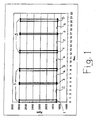
- the graph illustrated represents the pattern of the electrical pulsed supply given to the electrical motor.
- the supply voltage is applied for an initial period 1 of 0.5 seconds followed by an interval 2 of 4 seconds.
- This interval is followed by a further intermediate pulse 3 lasting 0.3 seconds which is in turn followed by a time interval 4 of 3 seconds.
- the initial 1, final 5 and intermediate 3 pulses with the associated intervals 2 and 4 make up a sequence of pulses which is generally indicated “S" and which is repeated with the same modalities at time intervals 6 whose duration is preferably 4 seconds which is equal to the duration of the interval 2, that is to say, the time interval between the initial pulse 1 and the intermediate pulse 3.
- the thickness of the covering material which, in a conventional manner, may be constituted by a layer of bitumen, can be reduced to 1.5 mm instead of the usual 4 mm for the same ambient noise which, in conventional machines, must be maintained at approximately 48 decibels.
- a covering material in the context of the present invention means any material provided with sound-damping, sound-insulating, sound-absorbing and also heat-insulating properties.
- the reduction in the amount of covering material also affords the advantage of a reduced environmental impact when the machine is disposed of at the end of its service life.
- the saving in terms of energy consumption achieved in the operation of the motor and the pump which is found to be approximately 120 - 130 watts/hour, can advantageously be used in the same machine, increasing, for example, the efficiency of the stage of drying the crockery by bringing the associated temperature from the conventional 65°C to 70°C.
Landscapes
- Engineering & Computer Science (AREA)
- Water Supply & Treatment (AREA)
- Washing And Drying Of Tableware (AREA)
- Control Of Ac Motors In General (AREA)
Abstract
Description
- The present invention relates to a washing method suitable for dishwashing machines, which comprises at least one cycle in which the electrical motor driving the pump for the circulation of the washing liquid is supplied with voltage pulses.
- According to a known technique the pulsed supply to the electrical motor is effected for periods of time of predetermined fixed duration with the interposition of rest periods of predetermined duration having a value of the same order of magnitude as, although different from, that of the supply pulses.
- An example of this technique for pulsed supply to an electrical motor in order to drive the pump for the circulation of the washing liquid of a dishwashing machine is illustrated in
DE 1 428 364 - According to another known type of technique, the pulsed electrical supply is one in which the duration of the voltage pulse at the motor is correlated with the time necessary for the washing liquid present in the collecting sump of the dishwashing machine to descend from the level it is at under static conditions to a level just above the suction mouth of the pump. On the other hand, the duration of the rest between one pulse and the next is as long as the time necessary for the washing liquid to descend from the tank to the collecting sump and assume the above-mentioned static level. An example of this technique is illustrated in
EP 0 659 381 - In practice, it has been found that the various known techniques for pulsed supply to the motor of the pump for the circulation of the washing liquid, while giving rise to savings in energy, nevertheless have little or no effect on the reduction in the overall noise of the machine whose structure, from the point of view of acoustic insulation, must therefore remain unaltered, with the costs which that entails.
- The object of the present invention is to provide a washing method, suitable for dishwashing machines, which comprises at least one cycle in which the electrical motor of the pump for the circulation of the washing liquid is operated using a method of a succession of voltage pulses which are repeated periodically at intervals of time, so as to achieve not only a saving in energy but also a considerable reduction in the overall noise generated by the motor and the pump which it drives.
- A further object of the invention is to provide a washing method for dishwashing machines which, in a conventional machine for crockery and cutlery from 12-15 place settings, permits the use of a reduced amount of washing liquid compared with the amount conventionally required in machines having the same capacity.
- Those and other objects, in accordance with the present invention, are achieved by the method having the features of
claim 1. - The features and advantages of the present invention will emerge more clearly from the detailed description of a practical embodiment illustrated by way of non-limiting example with reference to the graph given in the appended Figure 1 which illustrates the sequences of pulses applied to the electrical motor, the durations of each pulse and the durations of the time intervals between one pulse and the next.
- With reference to Figure 1, it can be seen that the times, expressed in seconds, are entered on the axis of abscissas while the revolutions of the electrical motor driving the pump for the circulation of the machine's washing liquid are entered on the axis of ordinates.
- The machine is a dishwashing machine with a capacity for containing crockery and cutlery for 12 - 15 place settings.
- The graph illustrated represents the pattern of the electrical pulsed supply given to the electrical motor.
- With reference to an initial time, in which it is considered that the motor is in inertial rotation at approximately 1,700 revolutions per minute (rpm), the supply voltage is applied for an
initial period 1 of 0.5 seconds followed by aninterval 2 of 4 seconds. - This interval is followed by a further
intermediate pulse 3 lasting 0.3 seconds which is in turn followed by atime interval 4 of 3 seconds. At the end of thisinterval 4, afinal pulse 5 lasting 0.5 seconds, which is equal to the duration of theinitial pulse 1, is applied. - The initial 1, final 5 and intermediate 3 pulses with the associated
intervals time intervals 6 whose duration is preferably 4 seconds which is equal to the duration of theinterval 2, that is to say, the time interval between theinitial pulse 1 and theintermediate pulse 3. - As can be seen from the graph of Figure 1, during the voltage pulses the revolutions per minute of the motor pass from approximately 1,700 rpm to approximately 2,800 rpm in order then to descend again to the value of approximately 1,700 rpm during the intervals between one pulse and the next.
- With the above-described sequence of pulses with intervals, which is repeated continuously within the context of a washing cycle of a dishwashing machine of the conventional type mentioned above, a considerable reduction is observed in the average noise emitted by the machine during operation.
- As a consequence of this reduction, the thickness of the covering material which, in a conventional manner, may be constituted by a layer of bitumen, can be reduced to 1.5 mm instead of the usual 4 mm for the same ambient noise which, in conventional machines, must be maintained at approximately 48 decibels.
- A covering material in the context of the present invention means any material provided with sound-damping, sound-insulating, sound-absorbing and also heat-insulating properties.
- In accordance with the pulsed supply sequence according to the invention, therefore, it is possible to obtain either the not inconsiderable economic advantage resulting from the reduction in the amount of covering material necessary to keep the noise emitted by the machine within the limits established for the corresponding commercial range of product or, for the same costs, a machine having enhanced quietness performance.
- Moreover, in the first hypothesis the reduction in the amount of covering material also affords the advantage of a reduced environmental impact when the machine is disposed of at the end of its service life.
- In addition, in accordance with the sequential pulsed supply according to the invention, the saving in terms of energy consumption achieved in the operation of the motor and the pump, which is found to be approximately 120 - 130 watts/hour, can advantageously be used in the same machine, increasing, for example, the efficiency of the stage of drying the crockery by bringing the associated temperature from the conventional 65°C to 70°C.
- One of the chief advantages of the pulsed sequential cycle of the invention also resides in the increased washing efficiency.
- For the height and intensity of the jets of washing liquid produced by the pump are subject to variation depending on the duration of the pulses with which the motor driving the pump is supplied and depending on the type of their sequence in time during the cycle.
- Consequently, unlike the situation in conventional machines, the jets strike the crockery in various positions and with various intensities, producing an efficient washing result.
Claims (7)
- A washing method suitable for dishwashing machines, which comprises at least one cycle in which the motor driving the pump for the washing liquid is supplied electrically with pulses of voltage, characterized in that the pulses are grouped in sequences (S) which are repeated periodically at predetermined time intervals (6), each sequence (S) comprising an initial pulse (1) and a final pulse (5) each having the same duration and being spaced from each other by an interval of predetermined duration, and also an intermediate pulse (3), which is active in said interval, having a duration shorter than that of the initial (1) and final (5) pulses.
- A washing method according to claim 1, characterized in that the duration of the time interval (2) between the initial pulse (1) and said intermediate pulse (3) is greater than the duration of the time interval (4) between said intermediate pulse (3) and said final pulse (5) of the sequence (S).
- A method according to claims 1 and 2, characterized in that the time intervals (6) with which said sequences (S) of pulses are repeated have a duration equal to that of the time interval (2) between said initial pulse (1) and said intermediate pulse (3).
- A method according to claims 1 to 3, characterized in that the duration of the initial pulse (1) and of the final pulse (5) of the sequence (S) is equal to 0.5 seconds.
- A method according to claims 1 to 4, characterized in that the duration of said intermediate pulse (3) is equal to 0.3 seconds.
- A method according to claims 1 to 5, characterized in that the duration of the time interval (2) between said initial pulse (1) and said intermediate pulse (3) is equal to 4 seconds.
- A method according to claims 1 to 6, characterized in that the duration of the time interval (4) between said intermediate pulse (3) and said final pulse (5) is equal to 3 seconds.
Priority Applications (3)
| Application Number | Priority Date | Filing Date | Title |
|---|---|---|---|
| DE602006008884T DE602006008884D1 (en) | 2006-01-18 | 2006-01-18 | Washing process for dishwashers |
| EP06425018A EP1810605B1 (en) | 2006-01-18 | 2006-01-18 | Washing method for dishwashing machines |
| ES06425018T ES2330559T3 (en) | 2006-01-18 | 2006-01-18 | WASHING PROCEDURE FOR DISHWASHING MACHINES. |
Applications Claiming Priority (1)
| Application Number | Priority Date | Filing Date | Title |
|---|---|---|---|
| EP06425018A EP1810605B1 (en) | 2006-01-18 | 2006-01-18 | Washing method for dishwashing machines |
Publications (2)
| Publication Number | Publication Date |
|---|---|
| EP1810605A1 true EP1810605A1 (en) | 2007-07-25 |
| EP1810605B1 EP1810605B1 (en) | 2009-09-02 |
Family
ID=36590215
Family Applications (1)
| Application Number | Title | Priority Date | Filing Date |
|---|---|---|---|
| EP06425018A Expired - Lifetime EP1810605B1 (en) | 2006-01-18 | 2006-01-18 | Washing method for dishwashing machines |
Country Status (3)
| Country | Link |
|---|---|
| EP (1) | EP1810605B1 (en) |
| DE (1) | DE602006008884D1 (en) |
| ES (1) | ES2330559T3 (en) |
Cited By (2)
| Publication number | Priority date | Publication date | Assignee | Title |
|---|---|---|---|---|
| DE102008020475A1 (en) * | 2008-04-23 | 2009-11-05 | Miele & Cie. Kg | Rinse cycle executing method for program-controlled household dishwasher, involves draining liquid from container at end of rinse cycle, and operating draining device and pump number of times alternatively during exchange |
| EP2740396A1 (en) * | 2012-12-10 | 2014-06-11 | Candy S.p.A. | Method of operating a dishwasher |
Citations (5)
| Publication number | Priority date | Publication date | Assignee | Title |
|---|---|---|---|---|
| DE1428364A1 (en) * | 1962-01-09 | 1969-04-03 | Constructa Werke Gmbh | Dishwasher with automatic control of the rinse water flow |
| EP0659381A1 (en) * | 1993-12-20 | 1995-06-28 | ELECTROLUX ZANUSSI ELETTRODOMESTICI S.p.A. | Operational process for a dishwashing machine |
| EP0829220A2 (en) * | 1996-09-12 | 1998-03-18 | ELECTROLUX ZANUSSI ELETTRODOMESTICI S.p.A. | Method for controlling the amount of water filled in a dishwashing machine |
| DE19845338A1 (en) * | 1998-10-02 | 2000-04-13 | Aeg Hausgeraete Gmbh | Method for operating a dish washer cleans items to be rinsed through applying a rinsing liquid during stages in a rinsing program for feeding in water |
| DE19951839A1 (en) * | 1999-10-28 | 2001-05-03 | Aeg Hausgeraete Gmbh | A dishwashing machine has a cleaning solution circulating pump operating between two different speeds with cycle times dependent on the output of an opacity monitor. |
-
2006
- 2006-01-18 DE DE602006008884T patent/DE602006008884D1/en not_active Expired - Lifetime
- 2006-01-18 EP EP06425018A patent/EP1810605B1/en not_active Expired - Lifetime
- 2006-01-18 ES ES06425018T patent/ES2330559T3/en not_active Expired - Lifetime
Patent Citations (5)
| Publication number | Priority date | Publication date | Assignee | Title |
|---|---|---|---|---|
| DE1428364A1 (en) * | 1962-01-09 | 1969-04-03 | Constructa Werke Gmbh | Dishwasher with automatic control of the rinse water flow |
| EP0659381A1 (en) * | 1993-12-20 | 1995-06-28 | ELECTROLUX ZANUSSI ELETTRODOMESTICI S.p.A. | Operational process for a dishwashing machine |
| EP0829220A2 (en) * | 1996-09-12 | 1998-03-18 | ELECTROLUX ZANUSSI ELETTRODOMESTICI S.p.A. | Method for controlling the amount of water filled in a dishwashing machine |
| DE19845338A1 (en) * | 1998-10-02 | 2000-04-13 | Aeg Hausgeraete Gmbh | Method for operating a dish washer cleans items to be rinsed through applying a rinsing liquid during stages in a rinsing program for feeding in water |
| DE19951839A1 (en) * | 1999-10-28 | 2001-05-03 | Aeg Hausgeraete Gmbh | A dishwashing machine has a cleaning solution circulating pump operating between two different speeds with cycle times dependent on the output of an opacity monitor. |
Cited By (2)
| Publication number | Priority date | Publication date | Assignee | Title |
|---|---|---|---|---|
| DE102008020475A1 (en) * | 2008-04-23 | 2009-11-05 | Miele & Cie. Kg | Rinse cycle executing method for program-controlled household dishwasher, involves draining liquid from container at end of rinse cycle, and operating draining device and pump number of times alternatively during exchange |
| EP2740396A1 (en) * | 2012-12-10 | 2014-06-11 | Candy S.p.A. | Method of operating a dishwasher |
Also Published As
| Publication number | Publication date |
|---|---|
| EP1810605B1 (en) | 2009-09-02 |
| DE602006008884D1 (en) | 2009-10-15 |
| ES2330559T3 (en) | 2009-12-11 |
Similar Documents
| Publication | Publication Date | Title |
|---|---|---|
| RU2339293C2 (en) | Dishwashing machine and methods of control | |
| KR101306717B1 (en) | Dish washer and Method for controlling dish washer | |
| KR101366262B1 (en) | Controlling method of dish washer | |
| US20100024851A1 (en) | Insulation Element For An Electrical Appliance Such As A Dishwasher | |
| EP1810605B1 (en) | Washing method for dishwashing machines | |
| CN102776749B (en) | Washing method for washing machine | |
| US9861249B2 (en) | Dishwasher and a method for controlling the same | |
| US20120006360A1 (en) | Method for operating a water conducting household device | |
| CN101176641A (en) | Dishwasher | |
| KR20090022895A (en) | How to control your dishwasher | |
| CN101077292A (en) | Dishwasher and controlling method | |
| EP0829220A3 (en) | Method for controlling the amount of water filled in a dishwashing machine | |
| JP4269236B2 (en) | Dishwasher | |
| KR101306731B1 (en) | Method for controlling dish washer | |
| CN109008862A (en) | The control method and dish-washing machine of dish-washing machine | |
| JP3867808B1 (en) | Dishwasher | |
| ITMI20060077A1 (en) | WASHING PROCEDURE FOR DISHWASHER MACHINES | |
| JP3985398B2 (en) | Dishwasher | |
| JP3867809B1 (en) | Dishwasher | |
| CN1857153A (en) | Dishware washer | |
| JP2001078948A (en) | Dishwasher | |
| JPH06121760A (en) | Dishwasher | |
| JP2007089655A (en) | Dishwasher | |
| JP2001104235A (en) | Dishwasher | |
| JP4650347B2 (en) | dishwasher |
Legal Events
| Date | Code | Title | Description |
|---|---|---|---|
| PUAI | Public reference made under article 153(3) epc to a published international application that has entered the european phase |
Free format text: ORIGINAL CODE: 0009012 |
|
| 17P | Request for examination filed |
Effective date: 20070612 |
|
| AK | Designated contracting states |
Kind code of ref document: A1 Designated state(s): AT BE BG CH CY CZ DE DK EE ES FI FR GB GR HU IE IS IT LI LT LU LV MC NL PL PT RO SE SI SK TR |
|
| AX | Request for extension of the european patent |
Extension state: AL BA HR MK YU |
|
| AKX | Designation fees paid |
Designated state(s): DE ES FR GB IT |
|
| GRAP | Despatch of communication of intention to grant a patent |
Free format text: ORIGINAL CODE: EPIDOSNIGR1 |
|
| GRAS | Grant fee paid |
Free format text: ORIGINAL CODE: EPIDOSNIGR3 |
|
| GRAA | (expected) grant |
Free format text: ORIGINAL CODE: 0009210 |
|
| AK | Designated contracting states |
Kind code of ref document: B1 Designated state(s): DE ES FR GB IT |
|
| REF | Corresponds to: |
Ref document number: 602006008884 Country of ref document: DE Date of ref document: 20091015 Kind code of ref document: P |
|
| REG | Reference to a national code |
Ref country code: ES Ref legal event code: FG2A Ref document number: 2330559 Country of ref document: ES Kind code of ref document: T3 |
|
| PLBE | No opposition filed within time limit |
Free format text: ORIGINAL CODE: 0009261 |
|
| STAA | Information on the status of an ep patent application or granted ep patent |
Free format text: STATUS: NO OPPOSITION FILED WITHIN TIME LIMIT |
|
| 26N | No opposition filed |
Effective date: 20100603 |
|
| REG | Reference to a national code |
Ref country code: DE Ref legal event code: R082 Ref document number: 602006008884 Country of ref document: DE Representative=s name: PATENTANWAELTE WEICKMANN & WEICKMANN, DE Ref country code: DE Ref legal event code: R082 Ref document number: 602006008884 Country of ref document: DE Representative=s name: WEICKMANN & WEICKMANN PATENTANWAELTE - RECHTSA, DE Ref country code: DE Ref legal event code: R082 Ref document number: 602006008884 Country of ref document: DE Representative=s name: WEICKMANN & WEICKMANN PATENT- UND RECHTSANWAEL, DE |
|
| REG | Reference to a national code |
Ref country code: FR Ref legal event code: PLFP Year of fee payment: 11 |
|
| REG | Reference to a national code |
Ref country code: FR Ref legal event code: PLFP Year of fee payment: 12 |
|
| REG | Reference to a national code |
Ref country code: FR Ref legal event code: PLFP Year of fee payment: 13 |
|
| PGFP | Annual fee paid to national office [announced via postgrant information from national office to epo] |
Ref country code: FR Payment date: 20230131 Year of fee payment: 18 Ref country code: ES Payment date: 20230201 Year of fee payment: 18 |
|
| PGFP | Annual fee paid to national office [announced via postgrant information from national office to epo] |
Ref country code: IT Payment date: 20230109 Year of fee payment: 18 Ref country code: GB Payment date: 20230119 Year of fee payment: 18 Ref country code: DE Payment date: 20230123 Year of fee payment: 18 |
|
| REG | Reference to a national code |
Ref country code: DE Ref legal event code: R119 Ref document number: 602006008884 Country of ref document: DE |
|
| GBPC | Gb: european patent ceased through non-payment of renewal fee |
Effective date: 20240118 |
|
| PG25 | Lapsed in a contracting state [announced via postgrant information from national office to epo] |
Ref country code: DE Free format text: LAPSE BECAUSE OF NON-PAYMENT OF DUE FEES Effective date: 20240801 |
|
| PG25 | Lapsed in a contracting state [announced via postgrant information from national office to epo] |
Ref country code: GB Free format text: LAPSE BECAUSE OF NON-PAYMENT OF DUE FEES Effective date: 20240118 |
|
| PG25 | Lapsed in a contracting state [announced via postgrant information from national office to epo] |
Ref country code: FR Free format text: LAPSE BECAUSE OF NON-PAYMENT OF DUE FEES Effective date: 20240131 |
|
| PG25 | Lapsed in a contracting state [announced via postgrant information from national office to epo] |
Ref country code: GB Free format text: LAPSE BECAUSE OF NON-PAYMENT OF DUE FEES Effective date: 20240118 Ref country code: FR Free format text: LAPSE BECAUSE OF NON-PAYMENT OF DUE FEES Effective date: 20240131 Ref country code: DE Free format text: LAPSE BECAUSE OF NON-PAYMENT OF DUE FEES Effective date: 20240801 |
|
| PG25 | Lapsed in a contracting state [announced via postgrant information from national office to epo] |
Ref country code: IT Free format text: LAPSE BECAUSE OF NON-PAYMENT OF DUE FEES Effective date: 20240118 |
|
| REG | Reference to a national code |
Ref country code: ES Ref legal event code: FD2A Effective date: 20250228 |
|
| PG25 | Lapsed in a contracting state [announced via postgrant information from national office to epo] |
Ref country code: ES Free format text: LAPSE BECAUSE OF NON-PAYMENT OF DUE FEES Effective date: 20240119 |