EP1808222A1 - Method for separation of components and separation unit - Google Patents
Method for separation of components and separation unit Download PDFInfo
- Publication number
- EP1808222A1 EP1808222A1 EP05770794A EP05770794A EP1808222A1 EP 1808222 A1 EP1808222 A1 EP 1808222A1 EP 05770794 A EP05770794 A EP 05770794A EP 05770794 A EP05770794 A EP 05770794A EP 1808222 A1 EP1808222 A1 EP 1808222A1
- Authority
- EP
- European Patent Office
- Prior art keywords
- zeolite
- vapor
- mixed composition
- zeolite crystal
- acid
- Prior art date
- Legal status (The legal status is an assumption and is not a legal conclusion. Google has not performed a legal analysis and makes no representation as to the accuracy of the status listed.)
- Withdrawn
Links
Images



Classifications
-
- B—PERFORMING OPERATIONS; TRANSPORTING
- B01—PHYSICAL OR CHEMICAL PROCESSES OR APPARATUS IN GENERAL
- B01D—SEPARATION
- B01D71/00—Semi-permeable membranes for separation processes or apparatus characterised by the material; Manufacturing processes specially adapted therefor
- B01D71/02—Inorganic material
- B01D71/028—Molecular sieves
- B01D71/0281—Zeolites
-
- B—PERFORMING OPERATIONS; TRANSPORTING
- B01—PHYSICAL OR CHEMICAL PROCESSES OR APPARATUS IN GENERAL
- B01D—SEPARATION
- B01D53/00—Separation of gases or vapours; Recovering vapours of volatile solvents from gases; Chemical or biological purification of waste gases, e.g. engine exhaust gases, smoke, fumes, flue gases, aerosols
- B01D53/02—Separation of gases or vapours; Recovering vapours of volatile solvents from gases; Chemical or biological purification of waste gases, e.g. engine exhaust gases, smoke, fumes, flue gases, aerosols by adsorption, e.g. preparative gas chromatography
-
- B—PERFORMING OPERATIONS; TRANSPORTING
- B01—PHYSICAL OR CHEMICAL PROCESSES OR APPARATUS IN GENERAL
- B01D—SEPARATION
- B01D53/00—Separation of gases or vapours; Recovering vapours of volatile solvents from gases; Chemical or biological purification of waste gases, e.g. engine exhaust gases, smoke, fumes, flue gases, aerosols
- B01D53/02—Separation of gases or vapours; Recovering vapours of volatile solvents from gases; Chemical or biological purification of waste gases, e.g. engine exhaust gases, smoke, fumes, flue gases, aerosols by adsorption, e.g. preparative gas chromatography
- B01D53/04—Separation of gases or vapours; Recovering vapours of volatile solvents from gases; Chemical or biological purification of waste gases, e.g. engine exhaust gases, smoke, fumes, flue gases, aerosols by adsorption, e.g. preparative gas chromatography with stationary adsorbents
- B01D53/0407—Constructional details of adsorbing systems
-
- B—PERFORMING OPERATIONS; TRANSPORTING
- B01—PHYSICAL OR CHEMICAL PROCESSES OR APPARATUS IN GENERAL
- B01D—SEPARATION
- B01D2253/00—Adsorbents used in seperation treatment of gases and vapours
- B01D2253/10—Inorganic adsorbents
- B01D2253/106—Silica or silicates
- B01D2253/108—Zeolites
-
- B—PERFORMING OPERATIONS; TRANSPORTING
- B01—PHYSICAL OR CHEMICAL PROCESSES OR APPARATUS IN GENERAL
- B01D—SEPARATION
- B01D2257/00—Components to be removed
- B01D2257/70—Organic compounds not provided for in groups B01D2257/00 - B01D2257/602
-
- B—PERFORMING OPERATIONS; TRANSPORTING
- B01—PHYSICAL OR CHEMICAL PROCESSES OR APPARATUS IN GENERAL
- B01D—SEPARATION
- B01D2311/00—Details relating to membrane separation process operations and control
- B01D2311/10—Temperature control
- B01D2311/103—Heating
-
- B—PERFORMING OPERATIONS; TRANSPORTING
- B01—PHYSICAL OR CHEMICAL PROCESSES OR APPARATUS IN GENERAL
- B01D—SEPARATION
- B01D2313/00—Details relating to membrane modules or apparatus
- B01D2313/22—Cooling or heating elements
- B01D2313/221—Heat exchangers
Definitions
- the present invention relates to a method for separating component and an apparatus for separating component, wherein a component is separated from a composition system which includes at least water and organic acid by using zeolite crystalline.
- Zeolites are crystalline material which has a skeletal structure of associated tetrahedrons, in each individual tetrahedron four oxygens being coordinated to a cation, and which bears minute pores of the order of angstroms.
- the method for separating one component from a mixture of two or more of components by using selective absorption property or molecular sieve property of the crystalline zeolite has been widely investigated.
- the molecular sieve method e.g., See, Patent Literature 1 where zeolite crystalline powder is used and separation operation is performed by an operation system which is referred to as "Pressure Swing Adsorption", or the vapor permeation method (e.g., See, Patent Literature 2) where zeolite crystalline membrane is used and separation operation is performed by providing vapor of the mixture and extracting the component which can pass through the membrane, and so on are known.
- Zeolite membrane where zeolite crystals are formed as a film onto the surface of a supporting member is effective for the separation of component, and it is superior to the macromolecular membranes with respect to the mechanical strength and thermal resistance.
- a process where the water-soluble organic substance is concentrated by separating water from the water-soluble organic substance is among the component separation processes using the zeolite crystal and which have been widely studied.
- a zeolite crystal which possesses a low Si/Al ratio, shows regular pore diameters, and enjoys a high hydrophilicity would be selected and used.
- a zeolite crystal for instance, A type zeolite, Y type zeolite, and X type zeolite, etc., of Na substituted type are enumerated. These zeolite crystals show a high separation performance in the separation of water/organic solvent system.
- Patent Literature 1 JP-10-216456A
- Patent Literature 2 JP-2003-093828A
- the water-soluble organic substance a biomass alcohol, i.e., alcohol derived from biomass such as agricultural products, is used, some acid ingredient might be contained in the mixture of the water-soluble organic substance and water.
- the zeolite crystal with high hydrophilicity as above mentioned is sensitive to acid in general, and thus, a disadvantage that the component separation can not be stably performed will appear when such a zeolite crystal is used for separating water from the water-soluble organic substance.
- This is because, for instance, in the case of the Na substituted type zeolite, Na is eluted by the acid and thus the hydrophilicity is lost, and particularly, in the case of one having a Si/Al ratio of not more than 5 such as the above mentioned A type, Y type, or X type zeolite, the crystalline skeletal structure is collapsed by the elution of Na or Al in the skeletal structure, and further the crystal itself is decomposed.
- the present invention aims to provide a method for separating component and apparatus for separating component, wherein the component separation using the zeolite crystal can be stably performed for a long term, while preventing the collapse of zeolite crystalline skeletal structure and the degression in the characteristics of the zeolite crystal.
- the method for separating component according to the present invention is a method for separating a component from a mixed composition which includes water and organic acid by using zeolite crystal and which is characterized in that the mixed composition is brought into vapor; and the vapor of the mixed composition is heated up to a temperature of not inducing capillary condensation of the vapor of the mixed composition when the vapor of the mixed composition comes into contact with the zeolite crystal.
- the effect of the present invention becomes remarkable.
- to heat the zeolite crystal up to a temperature of not inducing the capillary condensation of the vapor of the mixed composition can make sure that the vapor coming into contact with the zeolite crystal is heated to a desired temperature.
- the apparatus for separating component according to the present invention is an apparatus for separating a component of a mixed composition which includes water and organic acid by using zeolite crystal and which is characterized in that the zeolite crystal is membranous zeolite, and the apparatus comprises a membrane separation device which comprises the membranous zeolite and through which a component of the mixed composition selectively permeates to separate the component from the mixed composition; a vaporizing device by which the vapor of the mixed composition is produced; a vapor heating device by which the vapor of the mixed composition is heated up to a temperature of not inducing capillary condensation of the vapor of mixed composition when the vapor of the mixed composition comes in contact with the zeolite crystal.
- the apparatus for separating component it is possible to heat reliably the vapor coming into contact with the zeolite crystal to a desired temperature, when the vapor heating device heats the membranous zeolite.
- the process for separating component of the present invention water condensation at the surface of the zeolite crystal and capillary condensation can be prevented at least. Therefore, ionization of the organic acid included in the mixture can be prevented, and thus the collapse of zeolite crystalline skeletal structure by the organic acid can be prevented. As a result, it is possible to perform the separation of components from the mixed composition by using the zeolite crystal, while stably maintaining the characteristics of the zeolite crystal for a long term.
- the temperature inducing the capillary condensation becomes low, or the probability of occurrence of the capillary condensation becomes low because the crystals are closely adjoined mutually.
- the zeolite crystals are also subjected to heating, the temperature of the vapor falls when the vapor comes into contact with the crystals.
- the apparatus for separating component according to the present invention is an apparatus which embodies the above mentioned method for separating component, and thus it is possible to perform the separation of components from the mixed composition by using the zeolite crystal, while stably maintaining the characteristics of the zeolite crystal for a long term.
- the vapor heating device is designed so as to heat also the zeolite crystals, the temperature of the vapor falls when the vapor comes into contact with the crystals. Thus, it is possible to repress the occurrence of the capillary condensation.
- the method for separating component according to the present invention is a method for separating a component from a mixed composition which includes water and organic acid by using zeolite crystal and which is characterized in that the mixed composition is brought into vapor; and the vapor of the mixed composition is heated up to a temperature of not inducing the capillary condensation of the mixed composition when the vapor of the mixed composition comes into contact with the zeolite crystal.
- the capillary condensation will be illustrated as follows with reference to Figs. 1-4.
- various regions from a low absorptive amount region where the absorptive molecular layer is not more than a single molecular absorption to a high absorptive amount region where the presence of what is called "capillary condensation phase" is considerable are formed in the micro pores.
- the membranous zeolite has regular pores, and the surface of liquid in such a pore comes to be a curved one as shown in Fig. 1 where the meniscus of liquid surface in the capillary is illustrated. Then, iL is considered that the saturated vapor pressure behaved by the liquid depends on the curvature of the surface of the liquid by virtue of surface tension. Therefore, the saturated vapor pressure of the curved surface is differ from that of the flat surface. In such a pore, gas can be condensed and becomes liquid even when the gas is in the state of not reaching the saturated vapor pressure.
- the Formula 1 explains the thermodynamic penetration theory of capillary condensation mechanism.
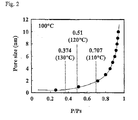
- Fig. 2 shows the relation between pore size ⁇ c and p/ps with respect to the capillary condensation of water vapor at 100 °C under normal pressure (1 atm).
- the vertical axis is the pore size (nm)
- the horizontal axis is the p/ps value.
- the side upper than a borderline shown in Fig. 2 is the range where the capillary condensation does not happen, while the side lower than the borderline is the range where the capillary condensation may happen.
- Fig. 2 is prepared with the assumption that the surface tension ⁇ is 58.84 mm ⁇ N/m, the liquid mole specific volume ⁇ L is 18 ml/mol, the gas constant R is 8.3143 J/mol ⁇ K, the absolute temperature T is 373 K, and cos ⁇ -1 because the contact angle ⁇ is 0°.
- a graph prepared by a calculation using Formula 1 is shown in Fig. 4.
- Fig. 4 shows the relation between pore size ⁇ c and p/ps with respect to the capillary condensation for the vapor of 50 wt.% acetic acid aqueous solution which is vaporized at 105 °C under normal pressure.
- the temperature condition and the pressure condition under which the capillary condensation does not take place are determined, and under such conditions the steam is brought to contact with the zeolite.
- the collapse of zeolite crystalline skeletal structure is repressed and Lhe degression in the characteristics of the zeolite crystal is prevented, and thus, it is possible to utilize the zeolite crystal to the separation of a component in a mixed composition which includes organic acid.
- the occurrence of capillary condensation is what the water vapor (gas) becomes water (liquid) on the zeolite crystal.
- the organic acid is dissolved in the condensed liquid water, and activated by causing ionization.
- the activated organic acid can easily collapse the skeletal structure of the zeolite crystal which possesses a low Si/Al, such as the A type zeolite.
- a graph of showing the relation between the pore size and the P/Ps such as Fig. 2 or Fig 4 is prepared by using the Kelvin equation (Formula 1) and setting the pressure condition at heating and the absolute temperature T at which the vaporization of the mixed composition is caused, to the individual values. Then, by using the prepared graph, the temperature at which the capillary condensation does not take place is determined for the pore size of the zeolite crystal.
- any zeolite known in the art can be used.
- the skeletal type of the zeolite crystal various skeletal types of the zeolite crystal such as the LTA type, the FAU type, the MFI type, Lhe AFI type, and the MOR type, etc. may be used. Among them, the LTA type and the FAU type, etc. are desirably used in this invention.
- the substitution type for the zeolite crystal As for the substitution type for the zeolite crystal, the Na (sodium) substitution type and the K (potassium) substitution type, etc. can be enumerated, and the substitution types in which the cation is in the range of about monovalent to trivalent may be used, although the substitution type of the zeolite crystal is not particularly limited thereto.
- zeolite crystal a membranous zeolite which is formed by binding to a porous support such as alumina etc.
- a porous support such as alumina etc.
- powdery zeolite may be used.
- membranous zeolite which is formed on a tubular porous support because the crystal grains are densely adjoined with each other in the membranous zeolite.
- the size of pores in the zeolite crystal depends on the kind and the type of the crystal, it is usually to be in the range of about 4 - 8 A (angstrom).
- this manufacturing method is a method for manufacturing a membranous zeolite in which slurry which includes seed crystals of zeolite is subjected to contact with a porous support in order Lo adhere the seed crystals to the porous support, and wherein the mode (most probable value) in the frequency distribution of particle size of the seed crystals is in the range of 1 nm - 1 ⁇ m, and 99 vol.% of the seed crystals have a particle diameter of not more than 5 ⁇ m.
- the membranous zeolite is also referred to as zeolite membrane.
- the mixed composition which includes water and organic acid may includes other components as far as it includes water and organic acid.
- water soluble organic material such as alcohols, ketons, and so on may be cited.
- a mixture of water and a biomass derived alcohol which is produced by fermenting sugar cane, tubers, cereals, or the like, may be enumerated.
- the containing ratio of water, organic acid, and other components is also not particularly limited.
- the mixed composition consists only of water and organic acid, to the extent that the water is in the range of about 5 - 50 % by weight and the organic acid is in the range of about 50 - 95 % by weight, the present invention can be preferably applied.
- the mixed composition consists of water, organic acid and water soluble organic material, to the extent that the water is in the range of about 5 - 50 % by weight, the organic is in the range of about 0 - 95 % by weight, and the water soluble organic material is in the range of 0 - 95 % by weight, the present invention can be preferably applied.
- the unit:"% by weight" may be also indicated as "wt.%”.
- the mixing component is a relatively strong acid of about pH1-3, the present invention is applicable.
- organic compounds which show the characteristics as acid such as carboxylic acids involving fatty acids, phenols, and sulfonic acids
- carboxylic acids involving fatty acids, phenols, and sulfonic acids can be cited.
- the component to be separated from the mixed composition is water.
- a component other than the water may be also separated.
- the boiling point of the mixed composition should be investigated, and then the mixed composition is subjected to heating, or pressure-reduction so as to generate the vapor.
- the temperature at which the capillary condensation of vapor does not occur can be defined as mentioned above with respect to the individual mixed composition system targeted for separation.
- the vapor itself can be heated.
- the zeolite crystal can be also heated while the vapor itself is heated.
- the apparatus 10 for separating composition which is shown in Fig. 5 is an apparatus 10 for separating a component of a mixed composition which includes water and organic acid by using zeolite crystal 11 and which is characterized in that the zeolite crystal 11 is membranous zeolite 11 where the crystal grains are densely adjoined to each other, and the apparatus comprises a membrane separation device 11 which comprises the membranous zeolite and through which a component of the mixed composition selectively permeates to separate the component from the mixed composition; a vaporizing device 17 by which the vapor 16 of the mixed composition is produced; a vapor heating device 13 by which the vapor 16 of the mixed composition is heated up to a temperature of not inducing the capillary condensation of the vapor 16 of mixed composition when the vapor of the mixed composition comes in contact with the zeolite crystal 11.
- the component separation apparatus 10 may comprise a zeolite membrane 11 as a membranous separation device, a tube 12 where the zeolite membrane 11 is stored, a ribbon heater 13 which functions as a vapor heating device and which surrounds the tube 12, and a thermo couple 14 which measures the temperature of the ribbon heater 13.
- the lower end of the zeolite membrane is sealed, and the upper end of thereof is connected to a vacuum pump (See, the numeral 15), in order to be capable of keeping the interior of the zeolite membrane 11 in a vacuum condition.
- the upper end of the tube 12 is sealed, and from the lower end of the tube 12 the vapor can be introduced into the tube. Further, the vapor 16 thus introduced in the tube 12 and the zeolite membrane 11 are allowed to be heated by the heating of ribbon heater 13.
- a vaporizing device 17 for vaporizing the mixed composition which includes water and organic acid is provided below the tube 12.
- the constitution of the apparatus for separating component according to the present invention is not limited to one which is shown in Fig. 5, and as far as it is provided with all of a membranous separation device, a vaporizing device, and a vapor heating device, it may take any other constitution.
- LTA type zeolite powder was pelletized.
- acetic acid aqueous solution of pH 4 was boiled under the normal pressure, and then, the generated vapor was allowed to contact with the obtained zeolite pellets, and the vapor and the zeolite pellets were heated up to 130°C which is the temperature of not inducing the capillary condensation of the solution.
- the LTA type zeolite pellets were used to a treatment for 20 hours, and this treatment was denoted as Example 1.
- Example 2 the LTA type zeolite pellets were used to a treatment for 100 hours in an analogous fashion, and this treatment was denoted as Example 2.
- the samples treated as above mentioned conditions were respectively taken out from individual sample tube, and dried for a night. After drying, the pellets were powdered, and the crystalline structure of the pellets were analyzed by XRD (X-ray diffraction). With respect to the original LTA type zeolite powder which was in advance of the above mentioned treatment, the crystalline structure was similarly analyzed by XRD. The obtained results are shown in Fig. 6 where the horizontal axis shows angle, and the perpendicular axis shows intensity. From Fig. 6, it is found that the pellet in Example 1 which was used to the treatment for 20 hours, and the pellet in Example 2 which was used to the treatment for 100 hours can maintain the same crystalline structure as that of the original LTA type zeolite before treatment.
- Fig. 7 shows the analysis result of Control. 1 that is after the boiling treatment
- Fig. 7(b) shows the analysis result of Example 1 that is in the case of treating at 130 °C for 20 hours.
- Fig. 7 it is observed that after the boiling treatment, the sharp peaks of the LTA type zeolite disappear, but a broadly spectrum throughout its angles is presented.
- a zeolite membrane that the LTA type zeolite crystals were densely formed on the tubular alumina porous support was prepared.
- this zeolite membrane was prepared as follows.
- a type zeolite particles (particle size of 100 nm) was added to water and then stirred in order to prepare a slurry of 0.5 wt. % in concentration.
- a tubular porous support made of ⁇ -alumina (mean pore size of 1.3 ⁇ m, 10mm in outside diameter, 6 mm in inside diameter, and 13cm in length) was immersed for three minutes, and then it was pulled out at the speed of about 0.2cm/s. Then, it was dried in a thermo-regulated chamber of 25°C for two hours, and additionally, dried in another thermo-regulated chamber of 70 °C for 16 hours.
- the thickness of the formed zeolite film is about 5 ⁇ m.
- the acetic acid vapor was generated by vaporizing a acetic acid aqueous solution which includes acetic acid and water each in the amount of 50 wt.%, pH 2.6, under the normal vapor condition. Since the condition that this solution did not cause the capillary condensation on the zeolite membrane 11 was 130 °C, the acetic acid vapor and the zeolite membrane 11 was heated to 130 °C (The temperature determined by the thermocouple 14 was 130 °C). Under this condition, the dewatering test using the LTA type zeolite membrane 11 and from the acetic acid vapor 16 was performed, and this test was denoted as Control 1.
- the substance which penetrated through the zeolite membrane 11 was collected by using a trapping tube under the temperature of liquid nitrogen. Then, the weight of the trapped liquid was determined in order to estimate the unit area of the zeolite membrane and the permeation rate per unit time, Q (kg/m 2 hr). In addition, the composition of the trapped liquid was examined by gas chromatography. The results are shown in Fig. 8. Incidentally, the permeation rate along the elapsed time Q is shown at the lower column of Fig. 8, and the acetic acid content by percentage (wt. %) in the permeated liquid is shown at the upper column of Fig.8.
- the permeation rate Q and the composition of the permeated liquid are stable during a long period. Further, in the composition of the permeated liquid, the ratio of the acetic acid is lowered, thus, the selective permeation of water is denoted. Incidentally, as shown in the upper column of Fig. 8, at the initial stage of the test, in the composition of the permeated liquid, the ratio of the acetic acid is temporarily high and thus instable. However, such a phenomenon will be ordinary caused in zeolite membrane.
- Example 3 The dewatering test as shown in Example 3 was repeated except that the zeolite membrane 13 was warmed at the level of the vapor temperature with the ribbon heater 13, and this test was denoted as Control 2. In this test, the temperature determined by the thermocouple 14 was 105 °C, and the temperature of the vapor was about 105 °C.
- the permeation rate Q and the composition of the trapped liquid were determined in the same manners as Example 3, and obtained results are shown in Fig. 9.
- the permeation rate along the elapsed time Q is shown at the lower column of Fig. 9, and the acetic acid content by percentage in the permeated liquid is shown at the upper column of Fig.9.
- the acetic acid concentration in the composition of the permeated liquid increased with the passage of time, and at last it became the same composition with the acetic acid vapor (i.e., water 50 wt.% and acetic acid 50 wt.%).
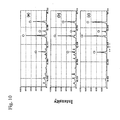
- Fig. 10 upper column (a) shows the structural analysis result for the zeolite membrane before the dewatering test
- Fig. 10 middle column shows the structural analysis result for the zeolite membrane after the dewatering test of Example 3
- Fig. 10 lower column (c) shows the structural analysis result for the zeolite membrane after the dewatering test of Control 2.
- the dewatering from the above mentioned mixed composition by using the zeolite crystal can be performed while maintaining the properties of the zeolite crystal stably for a long term.
- the organic acid component is not limited to the acetic acid.
- the present invention when the present invention is applied to the composition separation from the mixed composition of organic acid, water and an organic material, the function and effects of the present invention can show more effectively, because in such a case the deteriorating action to the properties of zeolite crystal becomes moderate as compared with that in the case of the mixed system of organic acid and water.
- this invention is not limited to the above mentioned embodiments.
- the above mentioned embodiments arc only for the purpose of illustration, and it should be noted that anything which has substantially same constitution with the technical idea claimed in the annexed Claims and provides substantially same functions and effects must be involved in the technical range of the present invention.
Landscapes
- Chemical & Material Sciences (AREA)
- Chemical Kinetics & Catalysis (AREA)
- Life Sciences & Earth Sciences (AREA)
- General Chemical & Material Sciences (AREA)
- Oil, Petroleum & Natural Gas (AREA)
- Analytical Chemistry (AREA)
- Engineering & Computer Science (AREA)
- Geology (AREA)
- Inorganic Chemistry (AREA)
- Separation Using Semi-Permeable Membranes (AREA)
- Silicates, Zeolites, And Molecular Sieves (AREA)
- Solid-Sorbent Or Filter-Aiding Compositions (AREA)
- Organic Low-Molecular-Weight Compounds And Preparation Thereof (AREA)
Abstract
Description
- The present invention relates to a method for separating component and an apparatus for separating component, wherein a component is separated from a composition system which includes at least water and organic acid by using zeolite crystalline.
- Zeolites are crystalline material which has a skeletal structure of associated tetrahedrons, in each individual tetrahedron four oxygens being coordinated to a cation, and which bears minute pores of the order of angstroms.
- The method for separating one component from a mixture of two or more of components by using selective absorption property or molecular sieve property of the crystalline zeolite has been widely investigated.
- As such a separation method, the molecular sieve method (e.g., See, Patent Literature 1) where zeolite crystalline powder is used and separation operation is performed by an operation system which is referred to as "Pressure Swing Adsorption", or the vapor permeation method (e.g., See, Patent Literature 2) where zeolite crystalline membrane is used and separation operation is performed by providing vapor of the mixture and extracting the component which can pass through the membrane, and so on are known. Zeolite membrane where zeolite crystals are formed as a film onto the surface of a supporting member is effective for the separation of component, and it is superior to the macromolecular membranes with respect to the mechanical strength and thermal resistance.
- A process where the water-soluble organic substance is concentrated by separating water from the water-soluble organic substance is among the component separation processes using the zeolite crystal and which have been widely studied. For such a process, a zeolite crystal which possesses a low Si/Al ratio, shows regular pore diameters, and enjoys a high hydrophilicity would be selected and used. As such a zeolite crystal, for instance, A type zeolite, Y type zeolite, and X type zeolite, etc., of Na substituted type are enumerated. These zeolite crystals show a high separation performance in the separation of water/organic solvent system.
Patent Literature 1:JP-10-216456A
Patent Literature 2:JP-2003-093828A - Here, when as the water-soluble organic substance a biomass alcohol, i.e., alcohol derived from biomass such as agricultural products, is used, some acid ingredient might be contained in the mixture of the water-soluble organic substance and water.
- However, the zeolite crystal with high hydrophilicity as above mentioned is sensitive to acid in general, and thus, a disadvantage that the component separation can not be stably performed will appear when such a zeolite crystal is used for separating water from the water-soluble organic substance. This is because, for instance, in the case of the Na substituted type zeolite, Na is eluted by the acid and thus the hydrophilicity is lost, and particularly, in the case of one having a Si/Al ratio of not more than 5 such as the above mentioned A type, Y type, or X type zeolite, the crystalline skeletal structure is collapsed by the elution of Na or Al in the skeletal structure, and further the crystal itself is decomposed.
- Therefore, it is in fact impossible to separate water from the mixture solution including the acid component by using the zeolite crystal of high hydrophilicity as above mentioned. Moreover, although as the means for solving this problem, a method where a zeolite of the type of having comparatively high acid-resistance is used, and a method of neutralizing the solution have been proposed, a method of optimizing the process condition in order to solve the problem has not been proposed.
- Accordingly, the present invention aims to provide a method for separating component and apparatus for separating component, wherein the component separation using the zeolite crystal can be stably performed for a long term, while preventing the collapse of zeolite crystalline skeletal structure and the degression in the characteristics of the zeolite crystal.
- The method for separating component according to the present invention is a method for separating a component from a mixed composition which includes water and organic acid by using zeolite crystal and which is characterized in that the mixed composition is brought into vapor; and the vapor of the mixed composition is heated up to a temperature of not inducing capillary condensation of the vapor of the mixed composition when the vapor of the mixed composition comes into contact with the zeolite crystal.
- In the method for separating component according to the present invention, when the above mentioned zeolite crystal is a membranous zeolite, the effect of the present invention becomes remarkable. Moreover, in the method for separating component according to the present invention, to heat the zeolite crystal up to a temperature of not inducing the capillary condensation of the vapor of the mixed composition can make sure that the vapor coming into contact with the zeolite crystal is heated to a desired temperature.
- The apparatus for separating component according to the present invention is an apparatus for separating a component of a mixed composition which includes water and organic acid by using zeolite crystal and which is characterized in that the zeolite crystal is membranous zeolite, and the apparatus comprises a membrane separation device which comprises the membranous zeolite and through which a component of the mixed composition selectively permeates to separate the component from the mixed composition; a vaporizing device by which the vapor of the mixed composition is produced; a vapor heating device by which the vapor of the mixed composition is heated up to a temperature of not inducing capillary condensation of the vapor of mixed composition when the vapor of the mixed composition comes in contact with the zeolite crystal.
- In the apparatus for separating component according to the present invention, it is possible to heat reliably the vapor coming into contact with the zeolite crystal to a desired temperature, when the vapor heating device heats the membranous zeolite.
- According to the process for separating component of the present invention, water condensation at the surface of the zeolite crystal and capillary condensation can be prevented at least. Therefore, ionization of the organic acid included in the mixture can be prevented, and thus the collapse of zeolite crystalline skeletal structure by the organic acid can be prevented. As a result, it is possible to perform the separation of components from the mixed composition by using the zeolite crystal, while stably maintaining the characteristics of the zeolite crystal for a long term.
- In the component separation method according to the present invention, when as the zeolite crystal a membranous zeolite is used, the temperature inducing the capillary condensation becomes low, or the probability of occurrence of the capillary condensation becomes low because the crystals are closely adjoined mutually. Thus, it is possible to perform the component separation stably for a long term. Moreover, in the component separation method according to the present invention, since the zeolite crystals are also subjected to heating, the temperature of the vapor falls when the vapor comes into contact with the crystals. Thus, it is possible to repress the occurrence of the capillary condensation.
- The apparatus for separating component according to the present invention is an apparatus which embodies the above mentioned method for separating component, and thus it is possible to perform the separation of components from the mixed composition by using the zeolite crystal, while stably maintaining the characteristics of the zeolite crystal for a long term.
- In the component separation apparatus according to the present invention, since the vapor heating device is designed so as to heat also the zeolite crystals, the temperature of the vapor falls when the vapor comes into contact with the crystals. Thus, it is possible to repress the occurrence of the capillary condensation.
-
- (Fig.1) is a diagram showing the meniscus of liquid surface in the capillary.
- (Fig. 2) is a graph showing the relation between pore size and p/ps with respect to the capillary condensation of water vapor.
- (Fig. 3) is a graph showing the relation between temperature and p/ps of vapor in the water vapor of 1 atm shown in Fig. 2.
- (Fig. 4) is a graph showing the relation between pore size and p/ps with respect to the capillary condensation of vapor of acetic acid solution.
- (Fig. 5) is a diagram showing an embodiment of the apparatus for separating component according to the present invention.
- (Fig. 6) is charts showing results of XRD analysis for LTA type zeolite powder before and after processing the vapor of acetic acid solution.
- (Fig.7) is a chart showing a result of XRD analysis for LTA type zeolite powder which is boiled in acetic acid solution.
- (Fig. 8) is graphs showing the ratio of acetic acid in the separated moiety and the penetration rate, respectively, versus the elapsed time, in the case that a part of components are separated from acetic acid solution by using the LTA type membranous zeolite in Example 3.
- (Fig. 9) is graphs showing the ratio of acetic acid in the separated moiety and the penetration rate, respectively, versus the elapsed time, in the case that a part of components are separated from acetic acid solution by using the LTA type membranous zeolite in
Control 2. - (Fig. 10) is charts showing results of XRD analysis for LTA type membranous zeolites of Example 3,
Control 2 and before treating. -
- 10
- Apparatus for separating component
- 11
- Membranous zeolite
- 12
- Tube part
- 13
- Ribbon heater
- 14
- Thermo couple
- 15
- Connecting to vacuum pump
- 16
- Acetic acid / water mixed vapor
- 17
- Vaporizing device
- On the separation of a part of components from the mixed composition which includes water and organic acid, by adapting a consideration for the capillary condensation while using zeolite crystal which is known in the art, we, the inventors, can achieve the present invention.
That is, the method for separating component according to the present invention is a method for separating a component from a mixed composition which includes water and organic acid by using zeolite crystal and which is characterized in that the mixed composition is brought into vapor; and the vapor of the mixed composition is heated up to a temperature of not inducing the capillary condensation of the mixed composition when the vapor of the mixed composition comes into contact with the zeolite crystal. - First, the capillary condensation will be illustrated as follows with reference to Figs. 1-4.
With respect to the absorptive porous solid possessing pores, various regions from a low absorptive amount region where the absorptive molecular layer is not more than a single molecular absorption to a high absorptive amount region where the presence of what is called "capillary condensation phase" is considerable are formed in the micro pores. - The membranous zeolite has regular pores, and the surface of liquid in such a pore comes to be a curved one as shown in Fig. 1 where the meniscus of liquid surface in the capillary is illustrated. Then, iL is considered that the saturated vapor pressure behaved by the liquid depends on the curvature of the surface of the liquid by virtue of surface tension. Therefore, the saturated vapor pressure of the curved surface is differ from that of the flat surface. In such a pore, gas can be condensed and becomes liquid even when the gas is in the state of not reaching the saturated vapor pressure. Critical pore radius γc where the capillary condensation phase is generated is given by the following Kelvin equation (It is also called the Kelvin's capillary condensation equation, or the Thomson's equation).
(Formula 1)
α: contact angle, ps: saturated vapor pressure,
R: gas constant, T: absolute temperature - The
Formula 1 explains the thermodynamic penetration theory of capillary condensation mechanism. - To begin with, regarding the water vapor, a graph prepared by a
calculation using Formula 1 is shown in Fig. 2. Fig. 2 shows the relation between pore size γc and p/ps with respect to the capillary condensation of water vapor at 100 °C under normal pressure (1 atm). In Fig. 2, the vertical axis is the pore size (nm), and the horizontal axis is the p/ps value. The side upper than a borderline shown in Fig. 2 is the range where the capillary condensation does not happen, while the side lower than the borderline is the range where the capillary condensation may happen. - Incidentally, Fig. 2 is prepared with the assumption that the surface tension σ is 58.84 mm·N/m, the liquid mole specific volume νL is 18 ml/mol, the gas constant R is 8.3143 J/mol·K, the absolute temperature T is 373 K, and cos α-1 because the contact angle α is 0°.
- As shown in Fig. 2, when the water vapor of 100°C under normal pressure (under the condition of p/ps=1) passes through pores of not more than 10 nm, the capillary condensation will result. On the other hand, when the steam and the pores are heated up to 110 °C under the normal pressure condition, the p/ps becomes 0.707, and it can be said that the capillary condensation does not take place at pores of not less than 2 nm in accordance with the curve in Fig. 2.
- In accordance with Fig. 2, the smaller the size of pore to be contact with the water vapor, the likelier the capillary condensation takes place. However, in a system where the pressure is maintained to a predetermined level, it is possible to lower the critical pore size γc to which the capillary condensation can take place, by increasing the temperature of the water vapor, which brings the saturated vapor pressure of the water vapor itself to heighten, and brings the p/ps value to decrease. In Fig. 3, the relation between temperature (°C ; horizontal axis) and p/ps (vertical axis) of vapor in the water vapor of 1 atm is shown.
- With respect to the acetic acid solution which is a mixed composition of water and the organic acid, it is also possible to make the calculation using the
Formula 1. - With respect to the acetic acid solution, a graph prepared by a
calculation using Formula 1 is shown in Fig. 4. Fig. 4 shows the relation between pore size γc and p/ps with respect to the capillary condensation for the vapor of 50 wt.% acetic acid aqueous solution which is vaporized at 105 °C under normal pressure. - Incidentally, Fig. 4 is prepared with the assumption that the surface tension σ is 26.6 mm·N/m, the liquid mole specific volume νL is 27.7 ml/mol, the gas constant R is 8.3143 J/mol·K, the absolute temperature T is 378 K, and cos α=1 because the contact angle α is 0°.
- As shown in Fig. 4, when the acetic acid vapor of 105°C under normal pressure (under the condition of p/ps-1) passes through pores of not more than 10 nm, the capillary condensation will result. On the other hand, when the steam and the pores are heated up to 130 °C under the normal pressure condition, the pIps becomes 0.398, and it can be said that the capillary condensation does not take place at pores of not less than 0.5 nm in accordance with the curve in Fig. 4.
- As in the case of water vapor, even in the case of the vapor of aqueous solution which includes the organic acid, it is possible to lower the pore size to which the capillary condensation can take place, by increasing the temperature of the vapor, which brings the p/ps value to decrease, in accordance with Fig. 4.
- Therefore, in the present invention, based on the result of calculation using the Kelvin equation (Formula 1), the temperature condition and the pressure condition under which the capillary condensation does not take place are determined, and under such conditions the steam is brought to contact with the zeolite. By such a procedure, the collapse of zeolite crystalline skeletal structure is repressed and Lhe degression in the characteristics of the zeolite crystal is prevented, and thus, it is possible to utilize the zeolite crystal to the separation of a component in a mixed composition which includes organic acid.
- Incidentally, the occurrence of capillary condensation is what the water vapor (gas) becomes water (liquid) on the zeolite crystal. When the capillary condensation takes place for the mixed composition in which water and organic acid are included, the organic acid is dissolved in the condensed liquid water, and activated by causing ionization. The activated organic acid can easily collapse the skeletal structure of the zeolite crystal which possesses a low Si/Al, such as the A type zeolite.
- With respect to the individual mixed composition to be applied to the component separation, in order to determine the temperature at which the capillary condensation does not take place, a graph of showing the relation between the pore size and the P/Ps such as Fig. 2 or Fig 4 is prepared by using the Kelvin equation (Formula 1) and setting the pressure condition at heating and the absolute temperature T at which the vaporization of the mixed composition is caused, to the individual values. Then, by using the prepared graph, the temperature at which the capillary condensation does not take place is determined for the pore size of the zeolite crystal.
- Next, constituents other than the capillary condensation in the component separation method according to the present invention will be described.
- As for the zeolite crystal to be used for the present invention, any zeolite known in the art can be used.
- As for the skeletal type of the zeolite crystal, various skeletal types of the zeolite crystal such as the LTA type, the FAU type, the MFI type, Lhe AFI type, and the MOR type, etc. may be used. Among them, the LTA type and the FAU type, etc. are desirably used in this invention.
- With respect to the zeolite crystal, owing to the Si/A ratio, the zeolite crystals are classified such as the A type (Si/Al ratio =1), the X type (1< Si/Al ratio <1.5), the Y type (1.5< Si/Al ratio <2), and the MFI type (Si/Al ratio ≥ 27), etc., and such various types of the zeolite crystal may be used. Although the Si/A ratio of the zeolite crystal is not particularly limited, high hydrophilic zeolite crystals in which Si/A ratio = about 1-5, more desirably, Si/A ratio - about 1-2, are useful because the method is mainly aimed to separate water.
- As for the substitution type for the zeolite crystal, the Na (sodium) substitution type and the K (potassium) substitution type, etc. can be enumerated, and the substitution types in which the cation is in the range of about monovalent to trivalent may be used, although the substitution type of the zeolite crystal is not particularly limited thereto.
- As the zeolite crystal, a membranous zeolite which is formed by binding to a porous support such as alumina etc., may be used. Alternatively, powdery zeolite may be used. However, when considering the use to separate a part of the components from the mixed composition, it is desirable to use the membranous zeolite which is formed on a tubular porous support, because the crystal grains are densely adjoined with each other in the membranous zeolite. Although the size of pores in the zeolite crystal depends on the kind and the type of the crystal, it is usually to be in the range of about 4 - 8 A (angstrom).
- When the membranous zeolite is used as the zeolite crystal, the method for manufacturing of the membranous zeolite is not particularly limited. However, It is desirable to use the method disclosed in
JP 2004-82008 A - The mixed composition which includes water and organic acid may includes other components as far as it includes water and organic acid. As the other components, water soluble organic material such as alcohols, ketons, and so on may be cited. As such mixed composition, a mixture of water and a biomass derived alcohol which is produced by fermenting sugar cane, tubers, cereals, or the like, may be enumerated.
- Further, the containing ratio of water, organic acid, and other components is also not particularly limited. In the case that the mixed composition consists only of water and organic acid, to the extent that the water is in the range of about 5 - 50 % by weight and the organic acid is in the range of about 50 - 95 % by weight, the present invention can be preferably applied. Alternatively, in the case that the mixed composition consists of water, organic acid and water soluble organic material, to the extent that the water is in the range of about 5 - 50 % by weight, the organic is in the range of about 0 - 95 % by weight, and the water soluble organic material is in the range of 0 - 95 % by weight, the present invention can be preferably applied. Incidentally, in this description, the unit:"% by weight" may be also indicated as "wt.%".
- Further, even if the mixing component is a relatively strong acid of about pH1-3, the present invention is applicable.
- As the organic acid, organic compounds which show the characteristics as acid, such as carboxylic acids involving fatty acids, phenols, and sulfonic acids can be cited. Concretely, for instance, formic acid, acetic acid, propionic acid, butyric acid, lactic acid, malic acid, tartaric acid, citric acid, sorbic acid, fumaric acid, malonic acid, succinic acid, oxalic acid , glycollic acid, maleic acid, ascorbic acid, phthalic acid, acetylsalicylic acid, benzoic acid, m-toluic acid, glutaric acid, adipic acid, and pimelic acid, etc. are enumerated as organic acid.
- In general, the component to be separated from the mixed composition is water. However, as far as the concentration of the mixed composition can be attained, there is a possibility that a component other than the water may be also separated.
- In order to generate the vapor of the mixed composition, the boiling point of the mixed composition should be investigated, and then the mixed composition is subjected to heating, or pressure-reduction so as to generate the vapor.
- The temperature at which the capillary condensation of vapor does not occur can be defined as mentioned above with respect to the individual mixed composition system targeted for separation.
- In the case that the vapor is heated, the vapor itself can be heated. Alternatively, the zeolite crystal can be also heated while the vapor itself is heated.
- Next, as for one embodiment of the apparatus for separating composition in which the aforementioned method for separating composition can be practiced will be described with reference to Fig. 5.
- The
apparatus 10 for separating composition which is shown in Fig. 5 is anapparatus 10 for separating a component of a mixed composition which includes water and organic acid by using zeolite crystal 11 and which is characterized in that the zeolite crystal 11 is membranous zeolite 11 where the crystal grains are densely adjoined to each other, and the apparatus comprises a membrane separation device 11 which comprises the membranous zeolite and through which a component of the mixed composition selectively permeates to separate the component from the mixed composition; a vaporizingdevice 17 by which thevapor 16 of the mixed composition is produced; avapor heating device 13 by which thevapor 16 of the mixed composition is heated up to a temperature of not inducing the capillary condensation of thevapor 16 of mixed composition when the vapor of the mixed composition comes in contact with the zeolite crystal 11. - Concretely, the
component separation apparatus 10 may comprise a zeolite membrane 11 as a membranous separation device, atube 12 where the zeolite membrane 11 is stored, aribbon heater 13 which functions as a vapor heating device and which surrounds thetube 12, and athermo couple 14 which measures the temperature of theribbon heater 13. The lower end of the zeolite membrane is sealed, and the upper end of thereof is connected to a vacuum pump (See, the numeral 15), in order to be capable of keeping the interior of the zeolite membrane 11 in a vacuum condition. The upper end of thetube 12 is sealed, and from the lower end of thetube 12 the vapor can be introduced into the tube. Further, thevapor 16 thus introduced in thetube 12 and the zeolite membrane 11 are allowed to be heated by the heating ofribbon heater 13. In addition, a vaporizingdevice 17 for vaporizing the mixed composition which includes water and organic acid is provided below thetube 12. - The constitution of the apparatus for separating component according to the present invention is not limited to one which is shown in Fig. 5, and as far as it is provided with all of a membranous separation device, a vaporizing device, and a vapor heating device, it may take any other constitution.
- Especially, although in the component separation apparatus shown in Fig. 5 it is aimed that the membranous zeolite itself is heated by the
ribbon heater 13 up to the temperature of not inducing the capillary condensation of the vapor, an alternate embodiment where the vaporizing device and the vapor heating device are fused in one whole, and by which device only the vapor is heated, is also adaptable. - With respect to the above mentioned zeolite crystal, the present invention will be described with referring to Examples and Controls.
- To begin with, LTA type zeolite powder was pelletized. Next, acetic acid aqueous solution of
pH 4 was boiled under the normal pressure, and then, the generated vapor was allowed to contact with the obtained zeolite pellets, and the vapor and the zeolite pellets were heated up to 130°C which is the temperature of not inducing the capillary condensation of the solution. Thereafter, at this temperature, the LTA type zeolite pellets were used to a treatment for 20 hours, and this treatment was denoted as Example 1. Separately, the LTA type zeolite pellets were used to a treatment for 100 hours in an analogous fashion, and this treatment was denoted as Example 2. - The samples treated as above mentioned conditions were respectively taken out from individual sample tube, and dried for a night. After drying, the pellets were powdered, and the crystalline structure of the pellets were analyzed by XRD (X-ray diffraction). With respect to the original LTA type zeolite powder which was in advance of the above mentioned treatment, the crystalline structure was similarly analyzed by XRD. The obtained results are shown in Fig. 6 where the horizontal axis shows angle, and the perpendicular axis shows intensity. From Fig. 6, it is found that the pellet in Example 1 which was used to the treatment for 20 hours, and the pellet in Example 2 which was used to the treatment for 100 hours can maintain the same crystalline structure as that of the original LTA type zeolite before treatment.
- For a comparison with Examples 1, 2, a verification experiment on whether the zeolite crystal were dissolved to acid was performed. To 950 g of water, 1g of the LTA type zeolite powder was added and stirred, and pH of the solution was adjusted to 10.2. To this solution, 10 wt.% acetic acid aqueous solution was added further in order to adjust pH to 4. Consequently, the solution was boiled with stirring for 1 hour, and this treatment was denoted as
Control 1. - After boiling, the remained solid were filtered out, and the collected solid was dried at the room temperature for a night. The structure change in the boiled LTA type zeolite powder was analyzed by XRD. The obtained result is shown in Fig. 7 where the horizontal axis shows angle, and the perpendicular axis shows intensity. Fig. 7 (a) shows the analysis result of Control. 1 that is after the boiling treatment, and Fig. 7(b) shows the analysis result of Example 1 that is in the case of treating at 130 °C for 20 hours. In Fig. 7, it is observed that after the boiling treatment, the sharp peaks of the LTA type zeolite disappear, but a broadly spectrum throughout its angles is presented. From this result, it can be found that the crystalline structure of the LTA type zeolite was destroyed, and transformed to amorphous phases. As mentioned above, it is obvious that the crystalline structure of the LTA type zeolite in the acetic acid aqueous solution,
pH 4, is changed by boiling. Incidentally, such results were equally observed both in the powdery LTA type zeolite and in the membranous LTA type zeolite. - A zeolite membrane that the LTA type zeolite crystals were densely formed on the tubular alumina porous support was prepared. In detail, this zeolite membrane was prepared as follows.
- To begin with, A type zeolite particles (particle size of 100 nm) was added to water and then stirred in order to prepare a slurry of 0.5 wt. % in concentration. To the slurry, a tubular porous support made of α-alumina (mean pore size of 1.3 µm, 10mm in outside diameter, 6 mm in inside diameter, and 13cm in length) was immersed for three minutes, and then it was pulled out at the speed of about 0.2cm/s. Then, it was dried in a thermo-regulated chamber of 25°C for two hours, and additionally, dried in another thermo-regulated chamber of 70 °C for 16 hours. Separately, sodium silicate, aluminum hydroxide, and distilled water were mixed so that mole ratio of the respective components satisfies the conditions of SiO2/Al2O3=2, Na2O/SiO2=1, and H2O/Na2O=75, in order to obtain a hydrothermal reaction solution. To this reaction solution, the aforementioned porous support on which the seed crystals had been attached was immersed, and left in the reaction solution at 100 °C for 4 hours. As a result, on the surface of the porous support, zeolite membrane was created. Consequently, on the tubular porous support, a crystal layer of the A type zeolite having a uniform film thickness was formed.
- The thickness of the formed zeolite film is about 5 µm. When a dewatering test (pervaporation test at 75°C) from the mixture solution of ethanol/water (ethanol : 90 wt.% and water: 10 wt.%) by using this zeolite film was performed, it was found that the permeation rate (Q) and the separation coefficient (α) which are indexes of the dewatering performance were Q=3.5kg/m2hr, and α-10000, respectively.
- In the testing apparatus shown as the above mentioned Fig. 5, as the zeolite membrane the above mentioned zeolite membrane formed on the tubular porous support was used, and the dewatering test of separating water from the acetic acid vapor was performed.
- In this test, the acetic acid vapor was generated by vaporizing a acetic acid aqueous solution which includes acetic acid and water each in the amount of 50 wt.%, pH 2.6, under the normal vapor condition. Since the condition that this solution did not cause the capillary condensation on the zeolite membrane 11 was 130 °C, the acetic acid vapor and the zeolite membrane 11 was heated to 130 °C (The temperature determined by the
thermocouple 14 was 130 °C). Under this condition, the dewatering test using the LTA type zeolite membrane 11 and from theacetic acid vapor 16 was performed, and this test was denoted asControl 1. - The substance which penetrated through the zeolite membrane 11 was collected by using a trapping tube under the temperature of liquid nitrogen. Then, the weight of the trapped liquid was determined in order to estimate the unit area of the zeolite membrane and the permeation rate per unit time, Q (kg/m2hr). In addition, the composition of the trapped liquid was examined by gas chromatography. The results are shown in Fig. 8. Incidentally, the permeation rate along the elapsed time Q is shown at the lower column of Fig. 8, and the acetic acid content by percentage (wt. %) in the permeated liquid is shown at the upper column of Fig.8.
- As shown in Fig. 8, in the dewatering test using the zeolite membrane and from the acetic acid vapor under the condition of not inducing the capillary condensation, the permeation rate Q and the composition of the permeated liquid are stable during a long period. Further, in the composition of the permeated liquid, the ratio of the acetic acid is lowered, thus, the selective permeation of water is denoted. Incidentally, as shown in the upper column of Fig. 8, at the initial stage of the test, in the composition of the permeated liquid, the ratio of the acetic acid is temporarily high and thus instable. However, such a phenomenon will be ordinary caused in zeolite membrane.
- The dewatering test as shown in Example 3 was repeated except that the
zeolite membrane 13 was warmed at the level of the vapor temperature with theribbon heater 13, and this test was denoted asControl 2. In this test, the temperature determined by thethermocouple 14 was 105 °C, and the temperature of the vapor was about 105 °C. - With respect to
Control 2, the permeation rate Q and the composition of the trapped liquid were determined in the same manners as Example 3, and obtained results are shown in Fig. 9. Incidentally, the permeation rate along the elapsed time Q is shown at the lower column of Fig. 9, and the acetic acid content by percentage in the permeated liquid is shown at the upper column of Fig.9. In this case, although the permeation rate Q was stable during a long period, the acetic acid concentration in the composition of the permeated liquid increased with the passage of time, and at last it became the same composition with the acetic acid vapor (i.e.,water 50 wt.% andacetic acid 50 wt.%). - In order to confirm the structural difference between the zeolite membranes used in Example 3 and
Control 2, the structural analysis by XRD was performed. The results are shown in Fig. 10. Fig. 10 upper column (a) shows the structural analysis result for the zeolite membrane before the dewatering test, Fig. 10 middle column (b) shows the structural analysis result for the zeolite membrane after the dewatering test of Example 3, and Fig. 10 lower column (c) shows the structural analysis result for the zeolite membrane after the dewatering test ofControl 2. - In Fig. 10, with respect to the zeolite membrane 11 of Example 3 which was used in the dewatering test under the condition of not inducing the capillary condensation by heating with the
ribbon heater 13, the clear diffraction peaks owing to the LTA type zeolite crystal were observed, and a XRD spectrogram similar with that of the zeolite membrane before using was obtained (See, Fig. 10 (a), (b)). From this result, it can be found that the crystalline structure of the LTA type zeolite does not destroyed even after the dewatering test of acetic acid vapor in Example 3. - In contrast to this, with respect to the case of
Control 2 where the dewatering test was performed without heating byribbon heater 13, it was observed that the clear diffraction peaks owing to the LTA type zeolite disappeared. From this result, it can be found that the crystalline structure of the zeolite crystal was destroyed by the dewatering test of acetic acid vapor inControl 2. Therefore, as shown in Fig. 9, it is considered that the water separation capability of the zeolite became low, and the composition of the permeated liquid in the dewatering test changed to be rich in acetic acid with the passage of time. - As described above, by contacting the acetic acid vapor with the zeolite crystal under the condition of not inducing the capillary condensation, it is possible to prevent the acid included in the mixed composition from ionizing, and then prevent the skeleton structure of the zeolite crystal from being destroyed by the acid. As a result, the dewatering from the above mentioned mixed composition by using the zeolite crystal can be performed while maintaining the properties of the zeolite crystal stably for a long term.
- Although the vaporizing test were made by using the mi xed composition of acetic acid and water in the above Examples, the organic acid component is not limited to the acetic acid. Further, when the present invention is applied to the composition separation from the mixed composition of organic acid, water and an organic material, the function and effects of the present invention can show more effectively, because in such a case the deteriorating action to the properties of zeolite crystal becomes moderate as compared with that in the case of the mixed system of organic acid and water.
- In addition, this invention is not limited to the above mentioned embodiments. The above mentioned embodiments arc only for the purpose of illustration, and it should be noted that anything which has substantially same constitution with the technical idea claimed in the annexed Claims and provides substantially same functions and effects must be involved in the technical range of the present invention.
Claims (6)
- A method for separating a component from a mixed composition which includes water and organic acid by using zeolite crystal,
which is characterized in that the mixed composition is brought into vapor; and the vapor of the mixed composition is heated up to a temperature of not inducing capillary condensation of the vapor of the mixed composition when the vapor of the mixed composition comes into contact with the zeolite crystal. - The method for separating component according to Claim 1, wherein the zeolite crystal is a membranous crystal.
- The method for separating component according to Claim 1, wherein the zeolite crystal is heated to the temperature of not inducing capillary condensation of the vapor of the mixed composition.
- The method for separating component according to Claim 2, wherein the zeolite crystal is heated to the temperature of not inducing capillary condensation of the vapor of the mixed composition.
- An apparatus for separating a component of a mixed composition which includes water and organic acid by using zeolite crystal,
which is characterized in that the zeolite crystal is membranous zeolite, and the apparatus comprises a membrane separation device which comprises the membranous zeolite and through which a component of the mixed composition selectively permeates to separate the component from the mixed composition; a vaporizing device by which the vapor of the mixed composition is produced; a vapor heating device by which the vapor of the mixed composition is heated up to a temperature of not inducing capillary condensation of the vapor of mixed composition when the vapor of the mixed composition comes in contact with the zeolite crystal. - The apparatus for separating component according to Claim 5, wherein the vapor heating device heats the membranous zeolite.
Applications Claiming Priority (2)
| Application Number | Priority Date | Filing Date | Title |
|---|---|---|---|
| JP2004291775A JP4548080B2 (en) | 2004-10-04 | 2004-10-04 | Component separation method and component separation apparatus |
| PCT/JP2005/014727 WO2006038377A1 (en) | 2004-10-04 | 2005-08-11 | Method for separation of components and separation unit |
Publications (2)
| Publication Number | Publication Date |
|---|---|
| EP1808222A1 true EP1808222A1 (en) | 2007-07-18 |
| EP1808222A4 EP1808222A4 (en) | 2008-09-17 |
Family
ID=36142462
Family Applications (1)
| Application Number | Title | Priority Date | Filing Date |
|---|---|---|---|
| EP05770794A Withdrawn EP1808222A4 (en) | 2004-10-04 | 2005-08-11 | METHOD FOR SEPARATING COMPONENTS AND SEPARATION UNIT |
Country Status (7)
| Country | Link |
|---|---|
| US (1) | US20070284307A1 (en) |
| EP (1) | EP1808222A4 (en) |
| JP (1) | JP4548080B2 (en) |
| KR (1) | KR20070065355A (en) |
| CN (1) | CN101035609A (en) |
| BR (1) | BRPI0517536A (en) |
| WO (1) | WO2006038377A1 (en) |
Families Citing this family (10)
| Publication number | Priority date | Publication date | Assignee | Title |
|---|---|---|---|---|
| CA2630493A1 (en) * | 2006-01-11 | 2007-07-19 | Ngk Insulators, Ltd. | Method of separating liquid mixture |
| KR100801114B1 (en) | 2006-08-01 | 2008-02-05 | 한국원자력연구원 | Manufacturing apparatus of nano-sized powder and method of the same |
| JP2008221176A (en) * | 2007-03-15 | 2008-09-25 | Mitsubishi Heavy Ind Ltd | Dewatering system and dewatering method |
| EP2251075B1 (en) | 2008-03-14 | 2013-12-25 | Mitsubishi Heavy Industries, Ltd. | Dehydration method |
| JP2009226374A (en) * | 2008-03-25 | 2009-10-08 | Hitachi Zosen Corp | Separation membrane module |
| JP2014198308A (en) * | 2013-03-29 | 2014-10-23 | 日本碍子株式会社 | Ceramic separation filter and dehydration method |
| JP6252249B2 (en) * | 2014-02-28 | 2017-12-27 | 日本ゼオン株式会社 | Membrane separation method |
| EP3132842A4 (en) | 2014-04-18 | 2017-04-05 | Mitsubishi Chemical Corporation | (porous support)-(zeolite film) complex, and method for producing (porous support)-(zeolite film) complex |
| JP6733093B1 (en) * | 2019-05-09 | 2020-07-29 | 株式会社三井E&Sマシナリー | Method for treating fluid to be treated for zeolite membrane |
| CN116042278A (en) * | 2023-02-24 | 2023-05-02 | 新疆八一钢铁股份有限公司 | A new gas purification device |
Family Cites Families (13)
| Publication number | Priority date | Publication date | Assignee | Title |
|---|---|---|---|---|
| US4373935A (en) * | 1981-05-01 | 1983-02-15 | Union Carbide Corporation | Adsorption separation cycle |
| CA1195258A (en) * | 1982-03-26 | 1985-10-15 | Desh R. Garg | Vapor phase adsorption process for concentration of ethanol from dilute aqueous mixtures thereof |
| JPH0889769A (en) * | 1994-09-19 | 1996-04-09 | Kyocera Corp | Gas separation structure and gas separation method using the same |
| US6054052A (en) * | 1995-12-14 | 2000-04-25 | Mobil Oil Corporation | Selective sorption of organics by metal-containing M41S |
| JPH10202072A (en) * | 1996-11-22 | 1998-08-04 | Sekiyu Sangyo Kasseika Center | Separation membrane for organic liquid mixture and separation method |
| TW429160B (en) * | 1997-02-03 | 2001-04-11 | Bayer Ag | Method for the separation of gas mixtures by pressure-swing adsorption in a two-bed adsorber system |
| JP2000237561A (en) * | 1998-01-08 | 2000-09-05 | Tosoh Corp | FER type zeolite membrane, method for producing the same, and method for concentrating organic acid using the same |
| JP3686262B2 (en) * | 1998-07-27 | 2005-08-24 | 三井造船株式会社 | Mixture separation membrane |
| JP3670852B2 (en) * | 1998-07-27 | 2005-07-13 | 三井造船株式会社 | Production method of mixture separation membrane |
| JP2003144871A (en) * | 2001-08-24 | 2003-05-20 | Tosoh Corp | Mordenite-type zeolite membrane composite, method for producing the same, and concentration method using the same |
| JP4721575B2 (en) * | 2001-08-29 | 2011-07-13 | 京セラ株式会社 | Exposure equipment |
| JP2003093828A (en) * | 2001-09-27 | 2003-04-02 | Mitsui Eng & Shipbuild Co Ltd | Distillation apparatus with separation membrane module and distillation column |
| DE10218916A1 (en) * | 2002-04-27 | 2003-11-06 | Degussa | Process for the production of acetals and ketals with the aid of multi-stage pervaporation or vapor permeation |
-
2004
- 2004-10-04 JP JP2004291775A patent/JP4548080B2/en not_active Expired - Lifetime
-
2005
- 2005-08-11 WO PCT/JP2005/014727 patent/WO2006038377A1/en not_active Ceased
- 2005-08-11 US US11/576,672 patent/US20070284307A1/en not_active Abandoned
- 2005-08-11 BR BRPI0517536-4A patent/BRPI0517536A/en not_active IP Right Cessation
- 2005-08-11 KR KR1020077007617A patent/KR20070065355A/en not_active Ceased
- 2005-08-11 EP EP05770794A patent/EP1808222A4/en not_active Withdrawn
- 2005-08-11 CN CNA2005800338055A patent/CN101035609A/en active Pending
Also Published As
| Publication number | Publication date |
|---|---|
| JP4548080B2 (en) | 2010-09-22 |
| JP2006102616A (en) | 2006-04-20 |
| US20070284307A1 (en) | 2007-12-13 |
| CN101035609A (en) | 2007-09-12 |
| WO2006038377A1 (en) | 2006-04-13 |
| BRPI0517536A (en) | 2008-10-14 |
| EP1808222A4 (en) | 2008-09-17 |
| KR20070065355A (en) | 2007-06-22 |
Similar Documents
| Publication | Publication Date | Title |
|---|---|---|
| Sommer et al. | Influence of operation parameters on the separation of mixtures by pervaporation and vapor permeation with inorganic membranes. Part 1: Dehydration of solvents | |
| Yan et al. | Preparation of highly selective zeolite ZSM-5 membranes by a post-synthetic coking treatment | |
| US8476180B2 (en) | Regenerating molecular sieve absorbents used for alcohol dehydration | |
| Jafar et al. | Enhancement of esterification reaction yield using zeolite A vapour permeation membrane | |
| CA2278995C (en) | A membrane for separating fluids | |
| US20070284307A1 (en) | Method for separating component and apparatus for separating component | |
| Zhang et al. | Dehydration of caprolactam–water mixtures through cross-linked PVA composite pervaporation membranes | |
| JPH0755287B2 (en) | Pervaporation method and film used therefor | |
| Kuhn et al. | Performance and stability of multi-channel MFI zeolite membranes detemplated by calcination and ozonication in ethanol/water pervaporation | |
| Toth et al. | Methanol removal from aqueous mixture with organophilic pervaporation: Experiments and modelling | |
| JP6252249B2 (en) | Membrane separation method | |
| Shahrestani et al. | High performance dehydration of ethyl acetate/water mixture by pervaporation using NaA zeolite membrane synthesized by vacuum seeding method | |
| EP3251738A1 (en) | Separation membrane and method for producing same | |
| JP6821911B2 (en) | How to reduce the alcohol content in alcoholic beverages | |
| Sommer et al. | Influence of operation parameters on the separation of mixtures by pervaporation and vapor permeation with inorganic membranes. Part 2: Purely organic systems | |
| Hilmioglu et al. | Separation of IPA/water mixtures by pervaporation: sorption and pervaporation results | |
| WO2017169195A1 (en) | Membrane separation method and membrane separation device | |
| CA2630493A1 (en) | Method of separating liquid mixture | |
| Zhu et al. | Study of pervaporation for dehydration of caprolactam through blend NaAlg–poly (vinyl pyrrolidone) membranes on PAN supports | |
| US7485233B2 (en) | Hydrophilic mixed matrix material having reversible water absorbing properties | |
| Wang et al. | The synthesis of super-hydrophilic and acid-proof Ge–ZSM-5 membranes by simultaneous incorporation of Ge and Al into a Silicalite-1 framework | |
| JP2003088734A (en) | Zeolite laminated composite and zeolite membrane reactor using the same | |
| Unlu | Concentration of aroma compounds by pervaporation process using polyvinyl chloride membrane | |
| EP1917364B1 (en) | System for water removal and solvent evaporation | |
| RU2190666C2 (en) | Method of preparing d-apiose from duck's-meat lemna minor polysaccharide |
Legal Events
| Date | Code | Title | Description |
|---|---|---|---|
| PUAI | Public reference made under article 153(3) epc to a published international application that has entered the european phase |
Free format text: ORIGINAL CODE: 0009012 |
|
| 17P | Request for examination filed |
Effective date: 20070404 |
|
| AK | Designated contracting states |
Kind code of ref document: A1 Designated state(s): AT BE BG CH CY CZ DE DK EE ES FI FR GB GR HU IE IS IT LI LT LU LV MC NL PL PT RO SE SI SK TR |
|
| DAX | Request for extension of the european patent (deleted) | ||
| A4 | Supplementary search report drawn up and despatched |
Effective date: 20080819 |
|
| RAP1 | Party data changed (applicant data changed or rights of an application transferred) |
Owner name: MITSUBISHI CHEMICAL CORPORATION |
|
| 17Q | First examination report despatched |
Effective date: 20090115 |
|
| STAA | Information on the status of an ep patent application or granted ep patent |
Free format text: STATUS: THE APPLICATION IS DEEMED TO BE WITHDRAWN |
|
| 18D | Application deemed to be withdrawn |
Effective date: 20090526 |