EP1808184A2 - Stabilisation of radiopharmaceutical compositions using a hydrophilic thioether or a hydrophilic 6-hydroxy chroman - Google Patents
Stabilisation of radiopharmaceutical compositions using a hydrophilic thioether or a hydrophilic 6-hydroxy chroman Download PDFInfo
- Publication number
- EP1808184A2 EP1808184A2 EP07102735A EP07102735A EP1808184A2 EP 1808184 A2 EP1808184 A2 EP 1808184A2 EP 07102735 A EP07102735 A EP 07102735A EP 07102735 A EP07102735 A EP 07102735A EP 1808184 A2 EP1808184 A2 EP 1808184A2
- Authority
- EP
- European Patent Office
- Prior art keywords
- amide
- hcy
- thr
- cyclo
- cpa
- Prior art date
- Legal status (The legal status is an assumption and is not a legal conclusion. Google has not performed a legal analysis and makes no representation as to the accuracy of the status listed.)
- Withdrawn
Links
- ITRUTHIRYPJJLE-UHFFFAOYSA-N NC(C(CS)NC(CNC(CNC(CNC(CN(c(ccc(OCc(cc1)ccc1C(N)=N)c1)c1C(N(CCC(O)=O)C1)=O)C1=O)=O)=O)=O)=O)=O Chemical compound NC(C(CS)NC(CNC(CNC(CNC(CN(c(ccc(OCc(cc1)ccc1C(N)=N)c1)c1C(N(CCC(O)=O)C1)=O)C1=O)=O)=O)=O)=O)=O ITRUTHIRYPJJLE-UHFFFAOYSA-N 0.000 description 1
Classifications
-
- A—HUMAN NECESSITIES
- A61—MEDICAL OR VETERINARY SCIENCE; HYGIENE
- A61K—PREPARATIONS FOR MEDICAL, DENTAL OR TOILETRY PURPOSES
- A61K51/00—Preparations containing radioactive substances for use in therapy or testing in vivo
- A61K51/12—Preparations containing radioactive substances for use in therapy or testing in vivo characterised by a special physical form, e.g. emulsion, microcapsules, liposomes, characterized by a special physical form, e.g. emulsions, dispersions, microcapsules
-
- A—HUMAN NECESSITIES
- A61—MEDICAL OR VETERINARY SCIENCE; HYGIENE
- A61P—SPECIFIC THERAPEUTIC ACTIVITY OF CHEMICAL COMPOUNDS OR MEDICINAL PREPARATIONS
- A61P43/00—Drugs for specific purposes, not provided for in groups A61P1/00-A61P41/00
Definitions
- the present invention relates to novel stabilizers of radiopharmaceutical compositions used for diagnosis and therapy.
- the invention relates to use of a hydrophilic thioether, a hydrophilic 6-hydroxy-chroman derivative, or a combination of a hydrophilic thioether with a hydrophilic 6-hydroxy-chroman derivative, to increase the shelf-life of diagnostic and therapeutic radiopharmaceuticals.
- radionuclides are routinely employed in nuclear medicine, both as diagnostic agents and as therapeutics.
- 99m Tc, 111 In, 18 F, and 201 T1 are employed as diagnostic imaging agents, and 131 I, 32 P, 89 Sr, and 153 Sm are in therapeutic use.
- nuclides such as 186 Re, 188 Re, 212 Bi, 213 Bi, 90 Y, 67 Cu, 192 Ir, 165 Dy, and 117m Sn have been proposed as potential therapeutic agents.
- Such radionuclides are administered in the form of radiopharmaceutical compositions, which generally include a chelator for the nuclide.
- Radiopharmaceuticals may additionally include a targeting molecule such as a monoclonal antibody, an antibody fragment, or a receptor ligand. The availability of radiopharmaceuticals has significantly advanced diagnosis and treatment of a variety of diseases.
- Chemical decomposition may limit a radiopharmaceutical's shelf life by decreasing the radiochemical purity of the agent over time.
- a radiopharmaceutical containing 99m Tc, 186 Re, or 188 Re may be susceptible to oxidation of the nuclide itself.
- the radiation emitted from a radionuclide can break chemical bonds of other components of the composition, thus causing autoradiolysis.
- Autoradiolysis is a particular problem when the radiopharmaceutical contains higher energy nuclides, such as ⁇ -emitters (e.g., 186 Re, 188 Re, 90 Y, 131 I) and ⁇ -emitters (e.g., 213 Bi, 212 Bi, 211 At, 225 Ac, 223 Ra).
- radiopharmaceuticals require stabilizers to maximize shelf life.
- Such stabilizers must be non-toxic and must be able to maintain the product's radiochemical purity for an acceptable shelf-life as well as during use.
- an acceptable radiopharmaceutical stabilizer must not interfere with delivery of the radionuclide to the target site.
- U.S.Pat.No. 5,384,113 discloses a method of preventing autoradiolysis ofpeptides radio labeled with 111 In using gentisic acid or gentisyl alcohol.
- the method of U.S.Pat.No. 5,384,113 is proposed to prevent autoradiolysis of peptides by 67 Ga, 169 Yb, 125 I, 121 I, and 201 T1.
- Two radiolabelled peptides, 111 In-DTPA-octreotide and 123 I-LHRH were tested for autoradiolysis prevention.
- a monoclonal antibody, NR-Lu-10, labeled with 186 Re was also specifically exemplified.
- the present inventors have found that that when added as a component in radiopharmaceutical kit formulations, gentisic acid decreases the radiochemical purity of some 99m Tc-labelled peptides, and thus is not useful as a stabilizer of some radiolabeled peptides.
- Methionine residues in proteins and polypeptides are known to oxidize to methionine sulfoxide.
- U.S.Pat.No. 5,272,135 discloses a method of inhibiting oxidation of a liquid or semi-liquid composition of a polypeptide containing at least one methionine residue by adding between 0.01% w/v to 0.3% w/v methionine to the composition.
- 5,272,135 teaches that the method disclosed therein is effective with a variety of polypeptides, including epidermal growth factor, insulin-like growth factor I, nerve growth factor, transforming growth factor alpha precursor, transforming growth factor beta precursor, transforming growth factor beta, fibroblast growth factor, vaccinia growth factor, platelet derived growth factor, or methionine containing biologically active fragments or precursors of such growth factors.
- the data presented in U.S.Pat.No. 5,272,135 are limited to addition of methionine to inhibit oxidation of methionine residues present in epidermal growth factor.
- Lam, et al. (1997) J. Pharm. Sci. 86, 1250-1255 disclose the use of methionine to stabilize the recombinant humanized monoclonal antibody rhuMAb HER2 in liquid formulations to prevent oxidation of methionine residues.
- U.S.Pat.No. 5,358,708 discloses a method for increasing the storage stability of an aqueous formulation of granulocyte-macrophage colony stimulating factor or an interleukin by addition of a stabilizing amount of methionine, histidine, or mixtures thereof.
- U.S.Pat.No. 5,358,708 also discloses that chemical differences among proteins causes different proteins to become inactivated during storage at different rates and under different conditions.
- U.S.Pat.No. 5,358,708 further discloses that the storage-prolonging effects of methionine and histidine are not equivalent with different proteins, and that mixtures of amino acids exhibit different effects as the ratio varies, as the identity of the protein is changed, and/or as concentrations are altered.
- WO 97/14430 discloses use of hydrophilic thioethers as antioxidants to prolong storage stability of aqueous formulations of proteins and peptides.
- the only data presented in WO 97/14430 relate to insulin-like growth factor I, a 70-amino acid peptide containing three disulfide bonds.
- WO 97/14430 further discloses that common antioxidants such as ascorbic acid, sodium thiosulfate, glutathione, or sodium bisulfite increased oxidation of IGF-1 or even precipitated the protein.
- U.S.Pat.Nos. 3,947,473 ; 4,003,919 ; 4,018,799 ; and 4,026,907 disclose a variety of antioxidant hydrophilic 6-hydroxy-chroman compounds as intermediates in preparation of optically active ⁇ -tocopherol.
- U.S.Pat.No. 4,511,685 discloses hydrophilic 6-hydroxy-chroman derivatives and use of such derivatives to stabilize polypropylene compositions.
- 4,847,267 and 4,970,216 disclose use of one such hydrophilic 6-hydroxy-chroman, hydrophilic 6-hydroxy-2,5,7,8-tetramethyl-2-carboxylic acid alone or in combination with sulfur compounds, including glutathione or cysteine, as a skin treatment composition to inhibit generation of free radicals in the skin.
- the radiolabelling efficiency and shelf-life of peptide and non-peptide radiopharmaceutical compositions may be significantly increased by addition of a stabilizing amount of a hydrophilic thioether, a stabilizing amount of a hydrophilic 6-hydroxy-chroman derivative, or a stabilizing amount of a mixture of a hydrophilic thioether and a hydrophilic 6-hydroxy-chroman.
- the radiolabelling efficiency and shelf life of the radiopharmaceutical compositions are increased by the addition of a hydrophilic thioether.
- the invention provides a composition comprising a radiopharmaceutical precursor and a stabilizing amount of a hydrophilic thioether.
- the invention provides a method of stabilizing a radiopharmaceutical comprising the steps of:
- the invention provides a kit comprising a sealed vial containing a predetermined quantity of a radiopharmaceutical precursor and a stabilizing amount of a hydrophilic thioether.
- the radiolabelling efficiency and shelf life of the radiopharmaceutical compositions are increased by the addition of a hydrophilic 6-hydroxy-chroman derivative.
- the invention provides a composition comprising a radiopharmaceutical precursor and a stabilizing amount of a hydrophilic 6-hydroxy-chorman derivative.
- the invention provides a method of stabilizing a radiopharmaceutical comprising the steps of:
- the invention provides a kit comprising a sealed vial containing a predetermined quantity of a radiopharmaceutical precursor and a stabilizing amount of a hydrophilic 6-hydroxy-chroman derivative.
- the radiolabelling efficiency and shelf life of the radiopharmaceutical compositions are increased by the addition of a hydrophilic thioether and a hydrophilic 6-hydroxy-chroman derivative.
- the invention provides a composition comprising a radiopharmaceutical precursor, a hydrophilic thioether, and a hydrophilic 6-hydroxy-chroman.
- the invention provides a method of stabilizing a radiopharmaceutical comprising the steps of:
- the invention provides a kit comprising a sealed vial containing a predetermined quantity of a radiopharmaceutical precursor and a stabilizing amount of a mixture of a hydrophilic thioether and a hydrophilic 6-hydroxy-chroman.
- a “radiopharmaceutical” or “radiopharmaceutical composition” comprises a radionuclide, a chelator, and optionally a targeting moiety or domain.
- a "precursor" of a radiopharmaceutical is defined as comprising an unlabelled, that is, non-radioactive, reagent which may be a chelator or a chelator covalently linked to a targeting moiety or domain.
- Targeting moieties or domains within the scope of the present invention include but are not limited to antibodies, antibody fragments such as Fab or F(ab)' 2 fragments, epitope binding complementarity determining regions derived from antibodies, peptides, growth factors or receptor binding fragments thereof, hormones, steroids, receptor binding nucleic acids, receptor binding carbohydrates including monosaccharides, disaccharides, and oligosaccharides, receptor-binding lipids, benzodiazepines, receptor binding antibiotics, and the like.
- a “stabilizing amount” is defined herein as that amount of hydrophilic thioether, hydrophilic 6-hydroxy-chroman or hydrophilic thioether/hydrophilic 6-hydroxy-chroman mixture sufficient to maintain the radiochemical purity, as measured by known methods such as those disclosed in the examples below, of a radiopharmaceutical composition relative to that of the radiopharmaceutical composition without the additive for at least 3 hours.
- a clinically acceptable radiochemical purity for a radiopharmaceutical is at least 80% of the labelled undegraded radiopharmaceutical. More preferably, a clinically acceptable radiochemical purity for a radiopharmaceutical is at least 85% of the labelled undegraded radiopharmaceutical. Most preferably, a clinically acceptable radiochemical purity for a radiopharmaceutical is at least 90% of the labelled undegraded radiopharmaceutical.
- a stabilizing amount of hydrophilic thioether is in the range of about 0.1 % (w/v) to about 1.5% (w/v). More preferably, a stabilizing amount of hydrophilic thioether is in the range of about 0.4% (w/v) to about 1.0% (w/v). More preferably, a stabilizing amount of hydrophilic thioether is in the range of about 0.5% (w/v) to about 1.0% (w/v).
- a “hydrophilic thioether” is defined in accordance with the present invention as a compound having the general structure: R-S-CH 2 C(R 1 R 2 R 3 ) wherein:
- a "hydrophilic 6-hydroxy-chroman derivative” is defined in accordance with the present invention as having a formula:
- Y is (CH 2 ) and Z is (CH 2 ).
- exemplary hydrophilic 6-hydroxy-chroman derivatives of the present invention include 6-hydroxy-2,5,7,8-tetramethylchroman-2-carboxylic acid (Trolox ® , available from Aldrich Chemical Co., (Milwaukee, Wisconsin, USA); 6-hydroxy-2,5,7,8-tetramethylchroman-2-carboxylic acid-4-sulfonic acid; 6-hydroxy-2,5,7,8-tetramethylchroman-3-hydroxy-2-carboxylic acid; 6-hydroxy-2,5,7,8-tetramethylchroman-2-glucosamine, having a structure: and 6-hydroxy-2,5,7,8-tetramethylchroman-2-(carboxy-seryl-seryl-serylamide), having the structure:
- the hydrophilic 6-hydroxy-chroman derivative of the present invention is a water soluble vitamin E derivative. More preferably, the hydrophilic 6-hydroxy-chroman derivative of the invention is a 6-hydroxy-2,5,7,8-tetramethyl-2-carboxylic acid derivative having -CH 2 at the 3- and 4- positions and a hydrophilic substituent at the 2-position. Most preferably, the hydrophilic 6-hydroxy-chroman derivative of the invention is 6-hydroxy-2,5,7,8-tetramethylchroman-2-carboxylic acid.
- radiopharmaceutical may be stabilized by addition of a hydrophilic thioether, a hydrophilic 6-hydroxy-chroman or a mixture of a hydrophilic thioether and a hydrophilic 6-hydroxy-chroman as taught herein.
- Ligand-type radiopharmaceuticals which do not comprise a targeting moiety or domain such as Tc 99m MAG3 (TechnoScan ® , Mallinkrodt Medical, Inc., St. Louis, Missouri, USA), may be stabilized in accordance with the present invention.
- radiopharmaceuticals comprising any kind of targeting moiety or domain may be stabilized in accordance with the present invention.
- radiopharmaceuticals which target a radiolabel to a particular tissue, disease site, or organ through a small receptor-specific molecule, which may be a peptide, a ⁇ -glucan, a benzodiazepine, or other small molecule.
- a small receptor-specific molecule which may be a peptide, a ⁇ -glucan, a benzodiazepine, or other small molecule.
- Such radiopharmaceuticals are disclosed and claimed, for example, in commonly assigned U.S.Pat.Nos.
- patent application numbers 08/236,402 ; 08/253,973 ; 08/721,443 ; and 09/553,494 These new agents comprise a chelator covalently linked to the receptor-specific targeting moiety or domain, and a radiolabel complexed with the chelator.
- a kit for making one such agent, ACUTECT ® has received approval in the U.S. for scintigraphic imaging of acute deep vein thrombosis.
- a second kit, NEOTECT ® has been approved in the U.S. for imaging malignant lung tumors.
- the stabilizers of the present invention are particularly suitable for use with radiopharmaceuticals which comprise chelators covalently linked to peptide, ⁇ -glucan, benzodiazepine, or other small targeting molecules as described in the commonly assigned patents and copending applications listed above.
- radiopharmaceuticals containing precursors in which a targeting moiety or domain is covalently linked to a monoamine, diamide, single thiol containing chelator such as those disclosed in commonly assigned copending U.S. patent application serial number 08/253,973 and in WO 95/33497 are stabilized using a hydrophilic thioether, a hydrophilic 6-hydroxy-chroman or a mixture of a hydrophilic thioether and a hydrophilic 6-hydroxy-chroman in accordance with this invention.
- radiopharmaceuticals containing precursors in which a targeting moiety or domain is covalently linked to a bisamine bisthiol (BAT) chelator such as those disclosed in commonly assigned U.S.Pat.Nos.
- the stabilizers of the present invention may also be used for radiopharmaceuticals comprising targeting molecules covalently linked to any chelator, such as the diamine monoamide thiol chelators and the triamine thiol chelators described in U.S.Pat.No. 5,688,485 and the triamide thiols disclosed in U.S.Pat.No. 5,091,514 .
- any chelator such as the diamine monoamide thiol chelators and the triamine thiol chelators described in U.S.Pat.No. 5,688,485 and the triamide thiols disclosed in U.S.Pat.No. 5,091,514 .
- the stabilizers of the invention are preferably employed to increase the shelf life of radiopharmaceuticals comprising a targeting moiety covalently linked to a peptide metal chelator having a formula C(pgp) S -(aa)-C(pgp) S wherein (pgp) S is H or a thiol protecting group and (aa) is an amino acid.
- a chelator are disclosed and claimed in commonly assigned U.S.Pat.Nos. 5,654,272 ; 5,681,541 ; 5,788,960 ; and 5,811,394 .
- the stabilizers of the invention may also be employed to increase the shelf life of radiopharmaceuticals comprising a targeting moiety covalently linked to a peptide metal chelator having a formula selected from the group consisting of:
- the stabilizers of the invention are used to increase the shelf life of radiopharmaceuticals comprising a targeting moiety covalently linked to a peptide metal chelator comprising a single thiol having a formula: A-CZ(B)-[CCR'R")] n -X
- Such chelators are disclosed and claimed in commonly assigned U.S. Pat. Nos. 5,443,815 ; 5,807,537 ; 5,814,297 ; and 5,866,097 .
- the carbonyl group of said moiety is covalently linked to a hydroxyl group, a NR 3 R 4 group, wherein each of R 3 and R 4 are independently H or lower (C 1 -C 4 ) alkyl, an amino acid or a peptide comprising 2 to 10 amino acids.
- a single thiol containing radiometal chelator stabilized in accordance with the present invention has a formula: Y-(amino acid) 2 -(amino acid) 1 -NHR 2 wherein Y is a thiol-containing moiety that is cysteine, homocysteine, isocysteine, penicillamine, 2-mercaptoacetate or 3-mercaptopropionate, (amino acid) 1 and (amino acid) 2 are each independently any primary ⁇ - or ⁇ -amino acid that does not comprise a thiol group, and R 2 is H or lower (C 1 -C 4 ) alkyl, an amino acid or a peptide comprising 2 to 10 amino acids.
- Y is cysteine, homocysteine, isocysteine or penicillamine
- the amino group of said moiety is covalently linked to -H, an amino acid or a peptide comprising 2 to 10 amino acids.
- Specific single thiol-containing radiometal chelators stabilized in accordance with the invention have a formula selected from the group consisting of: -Gly-Gly-Cys-, Cys-Gly-Gly-, -( ⁇ -Lys)-Gly-Cys-, ( ⁇ -Orn)-Gly-Cys-, -( ⁇ -Dab)-Gly-Cys-, -( ⁇ -Dap)-Lys-Cys-, and-( ⁇ -Dap)-Gly-Cys-.
- ⁇ -Lys represents a lysine residue in which the ⁇ -amino group, rather than the typical ⁇ -amino group, is covalently linked to the carboxyl group of the adjacent amino acid to form a peptide bond
- ⁇ -Orn represents an ornithine residue in which the ⁇ -amino group, rather than the typical ⁇ -amino group, is covalently linked to the carboxyl group of the adjacent amino acid to form a peptide bond
- ⁇ -Dab represents a 2,4-diaminobutyric acid residue in which the ⁇ -amino group is covalently linked to the carboxyl group of the adjacent amino acid to form a peptide bond
- ⁇ -Dap represents a 2,3-diaminopropionic acid residue in which the ⁇ -amino group is covalently linked to the carboxyl group of the adjacent amino acid to form a peptide bond.
- the stabilizers of the invention may be used to increase the shelf life of radiopharmaceuticals comprising a targeting moiety covalently linked to a monoamine, diamide, single thiol metal chelator such as those disclosed and claimed in commonly assigned copending U.S. patent application serial number 08/253,973 and in WO 95/33497 , and to increase the shelf life of radiopharmaceuticals comprising a targeting moiety covalently linked to a bisamide bisthiol metal chelator such as those disclosed and claimed in commonly assigned U.S. Pat. Nos. 5,780,007 ; 5,922,303 ; 6,086,849 ; and 6,093,383 .
- Exemplary monoamine, diamide, single thiol chelators stabilized by a mixture of a hydrophilic thioether and a hydrophilic 6-hydroxy chroman have general formulae selected from the group consisting of:
- the monoamine, diamide single thiol radiometal chelator stabilized in accordance with the invention may have a formula: wherein R 1 and R 2 are each independently H, lower alkyl, C 2 -C 4 hydroxyalkyl, or C 2 -C 4 alkoxyalkyl; R 3 , R 4 , R 5 and R 6 are independently H, substituted or unsubstituted lower alkyl or phenyl not comprising a thiol group; R 7 and R 8 are each independently H, lower alkyl, lower hydroxyalkyl or lower alkoxyalkyl; L is a bivalent linker group and Z is a targeting moiety.
- the monoamine, diamide single thiol radiometal chelator stabilized in accordance with the invention may alternatively have a formula: wherein R 1 and R 2 are each independently H, lower alkyl, C 2 -C 4 hydroxyalkyl, or C 2 -C 4 alkoxyalkyl; R 3 , R 4 , R 5 and R 6 are independently H, substituted lower alkyl, unsubstituted lower alkyl, phenyl, substituted phenyl not comprising a thiol group, and one of R 3 , R 4 , R 5 or R 6 is Z-L-HN(CH 2 ) n -, where L is a bivalent linker, Z is a targeting moiety, and n is an integer from 1 to 6; R 7 and R 8 are each independently H, lower alkyl, lower hydroxyalkyl, lower alkoxyalkyl; and X is an amino group, a substituted amino group or -NR 1 -Y, where Y is an amino
- the monoamine, diamide single thiol radiometal chelator stabilized in accordance with the invention may alternatively have a formula: wherein R 1 and R 2 are each independently H, lower alkyl, lower hydroxyalkyl, or lower alkenylalkyl; R 3 and R 4 are independently H, substituted or unsubstituted lower alkyl or phenyl not comprising a thiol group; n is an integer from 1 to 6; L is a bivalent linker; and Z is a targeting moiety.
- the monoamine, diamide single thiol radiometal chelator stabilized in accordance with the invention may alternatively have a formula: wherein L is a bivalent linker and Z is a targeting moiety.
- Bisamide bisthiol metal chelators stabilized in accordance with the present invention preferably have a formula selected from the group consisting of:
- the stabilizers of the invention may be used to increase the shelf life ofradiopharmaceuticals comprising the specific precursors set forth below:
- K represents covalent linkage to both amino groups of lysine.
- Hcy((7) represents covalent linkage to the sidechain sulfur atom of homocysteine.
- ( N -CH 3 )F represents N- ⁇ -methyl-phenylalanine.
- Underlining between groups e.g., as between the CH 2 CO. group and cysteine (C) in CH 2 CO.Y D RGDC) represents a cyclic sulfide.
- Underlining between amino acids e.g., as between the cysteines (C) in CNPRGDC ) represents a cyclic disulfide bond.
- cyclo before an underlined sequence means an N-terminus-to-C-terminus cyclic sequence.
- the subscript X D indicates the amino acid is in the D-configuration; all other subscripts refer to amino acid sidechain protecting groups.
- ⁇ -K, ⁇ -Orn, ⁇ -Dab, and ⁇ -Dap are defined as set forth above.
- Asu is 2-amino suberic acid, wherein the amino terminal amino acids of peptides containing an Asu residue are cyclized via an amide bond between the amino terminal amino group and the side chain carboxylic acid moiety of the Asu residue.
- BAT is N 6 , N 9 - bis (2-mercapto-2-methylpropyl)-6,9-diazanonanoic acid.
- a hydrophilic 6-hydroxy-chroman derivative may also be used to stabilize labelld radiopharmaceutical precursors comprising a benzodiazepine derivative, such as those described in U.S.Pat.No. 6,171,578.
- a hydrophilic 6-hydroxy-chroman derivative such as 6-hydroxy-2,5,7,8-tetramethylchroman-2-carboxylic acid is used to stabilize radiolabelled 1-[(carboxyglycyl-glycyl-glycyl-cysteinamide)methyl]-4-(2-carboxyethyl)-7-[(4-amidinophenyl)methyl]-3,4-dihydro-1H-1,4-benzodiazepine-2,5-dione trifluoroacetate.
- a hydrophilic thioether, or hydrophilic 6-hydroxy-chroman or a mixture of a hydrophilic thioether and a hydrophilic 6-hydroxychroman derivative may be used in accordance with the present invention to stabilize labelled radiopharmaceutical precursors comprising a targeting moiety or domain covalently linked to the known chelators 1,4,7,10-tetraazadodecanetetraacetic acid and derivatives thereof: where n is an integer that is 2 or 3 and where each R is independently H, C 1 to C 4 alkyl, or aryl and one R is covalently linked to the targeting moiety, and desferrioxamine.
- a radiopharmaceutical comprising any radionuclide or radiometal may be stabilized in accordance with the present invention.
- radiopharmaceuticals containing such nuclides as 125 I, 131 I, 211 At, 47 Sc, 67 Cu, 72 Ga, 90 Y, 153 Sm, 159 Gd, 166 Dy, 166 Ho, 175 Yb, 177 Lu, 186 Re, 188 Re, 212 Bi, 213 Bi, 68 Ga, 99m Tc, 111 In, and 123 I, and the like may be stabilized by addition of a hydrophilic thioether in accordance with the invention.
- the extent of stabilization of a particular radiopharmaceutical precursor when chelated to different radionuclides may vary. For example, a 99m Tc-labelled precursor may be stabilized to a greater extent than a 188 Re-labelled form of the same precursor.
- compositions of the invention are formulated as a sterile, pyrogen-free, parenterally acceptable aqueous solution which may optionally be supplied in lyophilized form and be reconstituted by the user.
- the compositions of the invention may be provided as components of kits which may include buffers, additional vials, instructions for use, and the like.
- compositions of the invention comprises a radiopharmaceutical precursor in combination with a stabilizing amount of a hydrophilic thioether, a hydrophilic 6-hydroxy-chroman or a mixture of a hydrophilic thioether and hydrophilic 6-hydroxy-chroman, optionally with a pharmaceutically acceptable diluent or a carrier such as species appropriate albumin.
- a pharmaceutically acceptable diluent or carrier may include any and all solvents, dispersion media, antibacterial and antifungal agents, isotonic agents, enzyme inhibitors, transfer ligands such as glucoheptonate, tartrate, citrate, or mannitol, and the like.
- radiopharmaceuticals are preferably administered intravenously in a single unit dose, either totally as a bolus or partly as a bolus followed by infusion over 1-2 hours.
- the amount of solution to be injected at unit dosage is from about 0.01 mL to about 10 mL, containing about 0.01 mCi to about 100 mCi of radioactivity, preferably from about 1 mCi to about 50 mCi.
- the amount of the radiopharmaceutical in the unit dose may range from about 0.1 to about 10 mg/kg body weight, After intravenous administration, the site is monitored, for example, by radioimaging in vivo if the radiopharmaceutical is a diagnostic agent.
- Gentisic acid was tested for its ability to stabilize the 99m Tc-labelled somatostatin receptor-binding peptide depreotide, which has the structure.
- This peptide is represented as:
- the lyophilized kits were radiolabelled with 99m Tc by reconstitution with 1.0 mL technetium 99m Tc sodium pertechnetate (Technelite® Molybdenum Mo99-Technetium Tc99m Generator, DuPont, Billerica, Massachusetts) containing approximately 50 mCi 99m Tc and heating in a boiling water bath for 10 minutes. Radiolabelling yield (RCP) results as measured by reversed phase HPLC are given in Table 2.
- RCP Radiolabelling yield
- Lyophilized kit vials were prepared containing depreotide, L-methionine (Met), and other components as described in Table 3. All formulations were adjusted to pH 7.4 prior to lyophilization.
- TABLE 3 Component Control Met I Met II Met III Met IV Met V
- the lyophilized kits were radiolabelled with 99m Tc by reconstitution with 1.0 mL technetium 99m Tc sodium pertechnetate (Technelite ® ) containing approximately 50 mCi 99m Tc and heating in a boiling water bath for 10 minutes. Some of the formulations were also radiolabelled in a room temperature preparation (allowed to stand at rom temperature 30 minutes following reconstitution). Radiolabelling yield (RCP) results as measured by reversed phase HPLC are given in Table 4.
- RCP Radiolabelling yield
- Lyophilized kits were prepared containing depreotide, L-methionine (Met), and other components as described in Table 5. All formulations were adjusted to pH 7.4 prior to lyophilization. The kits were stored for one week at 40°C. Some kits were also stored at -10°C as controls. TABLE 5 Component Control Met Depreotide 50 ⁇ g 50 ⁇ g Sodium Glucoheptonate Dihydrate 5 mg 5 mg Edetate Disodium Dihydrate 100 ⁇ g 100 ⁇ g Stannous Chloride Dihydrate 50 ⁇ g 50 ⁇ g L-Methionine USP - 5 mg
- L-methionine was tested for its ability to stabilize a 99m Tc-labelled glycoprotein IIb/IIIa receptor-binding benzodiazepinedione derivative 1-[(carboxyglycyl-glycyl-glycyl-cysteinamide)methyl]-4-(2-carboxyethyl)-7-[(4-amidinophenyl)methyl]-3,4-dihydro-1H-1,4-benzodiazepine-2,5-dione trifluoroacetate, having the structure.
- the lyophilized kits were radiolabelled with 99m Tc by reconstitution with 1.0 mL technetium 99m Tc sodium pertechnetate (Technelite ® ) containing approximately 50 mCi 99m Tc and heating in a boiling water bath for 10 minutes. Radiolabelling yield (RCP) results as measured by reversed phase HPLC are given in Table 8.
- L-methionine was tested for its ability to stabilize a 99m Tc-labelled glycoprotein IIb/IIIa receptor-binding peptide having the structure.
- This peptide is represented as:
- Lyophilized kit vials were prepared containing the peptide (50 ⁇ g), sodium glucoheptonate dihydrate (10 mg), stannous chloride dihydrate (50 ⁇ g), and edetate disodium dihydrate (100 ⁇ g). The formulation was adjusted to pH 7.4 prior to lyophilization.
- the lyophilized kits were radiolabelled with 99m Tc in the presence and absence of L-methionine.
- Met preparation was added 4 mg methionine (in 100 ⁇ L saline) and 100 ⁇ L ethanol.
- To the control preparation was added 100 ⁇ L ethanol and 100 ⁇ L saline to account for the additional saline or ethanol added with the L-methionine.
- Both vials were then reconstituted with 1.0 mL technetium 99m Tc sodium pertechnetate (Technelite ® ) containing approximately 50 mCi 99m Tc and allowed to incubate for 30 minutes at room temperature.
- Radiolabelling yield (RCP) results as measured by reversed phase HPLC are given in Table 9.
- TABLE 9 HPLC RCP (%) Preparation 0.5 hr 3.5 hr 6.5 hr Control 91.8 80.4 76.2 Methionine (4 mg) 96.7 96.9 96.2
- L-methionine was tested for its ability to stabilize a 99m Tc-labelled monoamine, diamide, single thiol peptide chelator having the structure.
- Lyophilized kit "placebo" vials were prepared containing sodium glucoheptonate dihydrate, edetate disodium dihydrate, and stannous chloride dihydrate at the concentrations set forth in Table 1 (control formulation).
- the peptide chelator was radiolabelled with 99m Tc in the presence and absence of L-methionine.
- the peptide chelator was dissolved in water at a concentration of 1 mg/mL, and 50 ⁇ g (50 ⁇ L) of the peptide was added to each of three placebo vials. Ethanol and L-methionine were added to the control and methionine preparations as described in Example 5. In addition, 100 ⁇ L phosphate buffered saline (PBS) was added to each preparation.
- PBS phosphate buffered saline
- L-methionine was tested for its ability to stabilize a 99m Tc-labelled non-peptide chelator (4-(butanoic acid)-2,2,9,9 tetramethyl-4,7-diaza-1,10-decanedithiol) having the structure.
- 2-(Ethylthio)ethylamine, methioninol, and 3-methylthio-1,2-propanediol are hydrophilic thioethers having the structures.
- Each hydrophilic thioether was dissolved in water made up at 40 mg/mL and adjusted to pH 7 with HCl or NaOH. Each hydrophilic thioether (4 mg in 100 ⁇ L) was added to a formulated kit vial containing the peptide ("control" formulation in Table 1). To the control vials were added 100 ⁇ L water. The vials were reconstituted with 1.0 mL 99m Tc sodium pertechnetate (Technelite ® ) containing approximately 50 mCi 99m Tc and heated in a boiling water bath for ten minutes. Radiolabelling yield (RCP) results as measured by reversed phase HPLC are given in Table 12.
- RCP Radiolabelling yield
- hydrophilic thioethers 2-(ethylthio)ethylamine, methioninol, and 3-methylthio-1,2-propanediol increase the radiolabelling yield and the stability of a 99m Tc-labelled peptide.
- Methionine sulfoxide, methionine sulfone, and 3-(methylthio)propionaldehyde had no effect on 99m Tc-labelled peptide radiolabelling yield or stability.
- the lyophilized kits were radiolabelled with 99m Tc by reconstitution with 1.0 mL technetium 99m Tc sodium pertechnetate (Technelite®) containing approximately 50 mCi 99m Tc and incubation at room temperature for 30 minutes following reconstitution. Some of the formulations were also radiolabelled in a heated preparation (heat in a boiling water bath for 10 minutes). Radiolabelling yield (RCP) results as measured by reversed phase HPLC are given in Table 14.
- the lyophilized kits were radiolabelled with 99m Tc by reconstitution with 1.0 mL technetium 99m Tc sodium pertechnetate (Technelite ® ) containing approximately 50 mCi 99m Tc and incubation either at room temperature (30 minutes) or in a boiling water bath (10 min). Radiolabelling yield (RCP) results as measured by reversed phase HPLC are given in Table 16.
- Trolox ® was tested for its ability to stabilize a 99m Tc-labelled glycoprotein IIb/IIIa receptor-binding peptide having the structure.
- This peptide is represented as:
- Lyophilized kit vials were prepared containing the peptide (50 ⁇ g), sodium glucoheptonate dihydrate (10 mg), stannous chloride dihydrate (50 ⁇ g), and edetate disodium dihydrate (100 ⁇ g). The formulation was adjusted to pH 7.4 prior to lyophilization.
- the lyophilized kits were radiolabelled with 99m Tc in the presence and absence of Trolox®.
- To the Trolox® preparation was added 2 mg Trolox ® in 100 ⁇ L ethanol and 100 ⁇ L saline. The ethanol was necessary to aid in the dissolution of the Trolox ® .
- To the control preparation was added 100 ⁇ L ethanol and 100 ⁇ L saline to account for the additional saline or ethanol added with the Trolox. Both vials were then reconstituted with 1.0 mL technetium 99m Tc sodium pertechnetate (Technelite ® ) containing approximately 50 mCi 99m Tc and allowed to incubate for 30 minutes at room temperature.
- Trolox ® was tested for its ability to stabilize a 99m Tc-labelled monoamine, diamide, single thiol peptide chelator having the structure.
- Lyophilized kit "placebo" vials were prepared containing sodium glucoheptonate dihydrate, edetate disodium dihydrate, and stannous chloride dihydrate at the concentrations set forth in Table 1 (control formulation).
- the peptide chelator was radiolabelled with 99m Tc in the presence and absence of Trolox ® .
- the peptide chelator was dissolved in water at a concentration of 1 mg/mL, and 50 ⁇ g (50 ⁇ L) of the peptide was added to each of three placebo vials.
- Ethanol and Trolox ® were added to the control and Trolox ® , preparations as described in Example 11.
- 100 ⁇ L phosphate buffered saline (PBS) was added to each preparation.
- the vials were reconstituted with 0.9-1.0 mL 99m Tc sodium pertechnetate (Technelite ® ) containing approximately 50 mCi 99m Tc, and heated in a boiling water bath for ten minutes.
- Radiolabelling yield (RCP) results as measured by reversed phase HPLC are given in Table 18.
- Table 18 HPLC RCP (%) Preparation 0.5 hr 3 hr 6 hr 9 hr Control 94.1 92.4 85.9 80.0 Trolox ® (2 mg) 95.3 95.4 91.5 86.4
- Trolox ® was tested for its ability to stabilize a 99m Tc-labelled non-peptide chelator (4-(butanoic acid)-2,2,9,9 tetramethyl-4,7-diaza-1,10-decanedithiol) having the structure.
- the lyophilized kits were radiolabelled with 99m Tc by reconstitution with 1.0 mL technetium 99m Tc sodium pertechnetate (Technelite ® ) containing approximately 50 mCi 99m Tc and incubation at room temperature for 30 minutes following reconstitution. Some of the formulations were also radiolabelled in a heated preparation (heat in a boiling water bath for 10 minutes). Radiolabelling yield (RCP) results as measured by reversed phase HPLC are given in Table 21.
- Lyophilized kits were prepared containing depreotide, L-methionine (Met) Trolox ® , and other components as described in Table 20. All formulations were adjusted to pH 7.4 prior to lyophilization. The kits were stored for one week at 40°C. Some kits were also stored at -10°C as controls. The lyophilized kits were radiolabelled with 99m Tc in heated preparations as set forth above. Radiolabelling yield (RCP) results as measured by reversed phase HPLC are given in Table 22.
- RCP Radiolabelling yield
- L-methionine and Trolox ® were tested for their ability to stabilize a glycoprotein IIb/IIIa receptor-binding benzodiazepinedione derivative 1-[(carboxyglycyl-glycyl-glycyl-cysteinamide)methyl]-4-(2-carboxyethyl)-7-[(4-amidinophenyl)methyl]-3,4-dihydro-1H-1,4-benzodiazepine-2,5-dione trifluoroacetate, having the structure.
- the lyophilized kits were radiolabelled with 99m Tc by reconstitution with 1.0 mL technetium 99m Tc sodium pertechnetate (Technelite ® ) containing approximately 50 mCi 99m Tc and heating in a boiling water bath for 10 minutes. Radiolabelling yield (RCP) results as measured by reversed phase HPLC are given in Table 24.
Landscapes
- Health & Medical Sciences (AREA)
- Chemical & Material Sciences (AREA)
- Veterinary Medicine (AREA)
- Animal Behavior & Ethology (AREA)
- Medicinal Chemistry (AREA)
- Public Health (AREA)
- Pharmacology & Pharmacy (AREA)
- General Health & Medical Sciences (AREA)
- Life Sciences & Earth Sciences (AREA)
- Epidemiology (AREA)
- Optics & Photonics (AREA)
- Dispersion Chemistry (AREA)
- Physics & Mathematics (AREA)
- Chemical Kinetics & Catalysis (AREA)
- Engineering & Computer Science (AREA)
- General Chemical & Material Sciences (AREA)
- Bioinformatics & Cheminformatics (AREA)
- Nuclear Medicine, Radiotherapy & Molecular Imaging (AREA)
- Organic Chemistry (AREA)
- Medicines That Contain Protein Lipid Enzymes And Other Medicines (AREA)
- Peptides Or Proteins (AREA)
- Pharmaceuticals Containing Other Organic And Inorganic Compounds (AREA)
- Medicinal Preparation (AREA)
- Medicines Containing Antibodies Or Antigens For Use As Internal Diagnostic Agents (AREA)
- Plural Heterocyclic Compounds (AREA)
- Cosmetics (AREA)
- Acyclic And Carbocyclic Compounds In Medicinal Compositions (AREA)
Abstract
Description
- The present invention relates to novel stabilizers of radiopharmaceutical compositions used for diagnosis and therapy. In particular, the invention relates to use of a hydrophilic thioether, a hydrophilic 6-hydroxy-chroman derivative, or a combination of a hydrophilic thioether with a hydrophilic 6-hydroxy-chroman derivative, to increase the shelf-life of diagnostic and therapeutic radiopharmaceuticals.
- A number of radionuclides are routinely employed in nuclear medicine, both as diagnostic agents and as therapeutics. For example, 99mTc, 111In, 18F, and 201T1 are employed as diagnostic imaging agents, and 131I, 32P, 89Sr, and 153Sm are in therapeutic use. In addition, nuclides such as 186Re, 188Re, 212Bi, 213Bi, 90Y, 67Cu, 192Ir, 165Dy, and 117mSn have been proposed as potential therapeutic agents. Such radionuclides are administered in the form of radiopharmaceutical compositions, which generally include a chelator for the nuclide. Radiopharmaceuticals may additionally include a targeting molecule such as a monoclonal antibody, an antibody fragment, or a receptor ligand. The availability of radiopharmaceuticals has significantly advanced diagnosis and treatment of a variety of diseases.
- Chemical decomposition may limit a radiopharmaceutical's shelf life by decreasing the radiochemical purity of the agent over time. For example, a radiopharmaceutical containing 99mTc, 186Re, or 188Re may be susceptible to oxidation of the nuclide itself. In addition, the radiation emitted from a radionuclide can break chemical bonds of other components of the composition, thus causing autoradiolysis. Autoradiolysis is a particular problem when the radiopharmaceutical contains higher energy nuclides, such as β-emitters (e.g., 186Re, 188Re, 90Y, 131I) and α-emitters (e.g., 213Bi, 212Bi, 211At, 225Ac, 223Ra).
- Thus many radiopharmaceuticals require stabilizers to maximize shelf life. Such stabilizers must be non-toxic and must be able to maintain the product's radiochemical purity for an acceptable shelf-life as well as during use. In addition, an acceptable radiopharmaceutical stabilizer must not interfere with delivery of the radionuclide to the target site.
- Methods for stabilizing radiopharmaceuticals by adding gentisates are disclosed, for example, in
U.S.Pat.Nos. 4,232,000 ;4,233,284 ;4,497,744 ;5,384,113 . Stabilization of radiopharmaceuticals using ascorbic acid is disclosed inU.S.Pat.Nos. 5,393,512 and5,011,676 , inWO 97/28181 WO 98/33531 U.S.Pat.No. 4,229,427 . Other compounds such as reductic acid, erythorbic acid, p-aminobenzoic acid, 4-hydroxybenzoic acid, nicotinic acid, nicotinamide, 2,5-dihydroxy-1,4-benzenedisulfonic acid, tartaric acid, inositol, and the like, have also been used to stabilize radiopharmaceutical compositions. -
U.S.Pat.No. 5,384,113 discloses a method of preventing autoradiolysis ofpeptides radio labeled with 111In using gentisic acid or gentisyl alcohol. In addition to preventing autoradiolysis of peptides by 111In, the method ofU.S.Pat.No. 5,384,113 is proposed to prevent autoradiolysis of peptides by 67Ga, 169Yb, 125I, 121I, and 201T1. Two radiolabelled peptides, 111In-DTPA-octreotide and 123I-LHRH, were tested for autoradiolysis prevention. A monoclonal antibody, NR-Lu-10, labeled with 186Re was also specifically exemplified. - As indicated in Example 1, infra, the present inventors have found that that when added as a component in radiopharmaceutical kit formulations, gentisic acid decreases the radiochemical purity of some 99mTc-labelled peptides, and thus is not useful as a stabilizer of some radiolabeled peptides. A need exists, therefore, for additional stabilizers of radiopharmaceuticals. A particular need exists for stabilizers of radiopharmaceuticals containing less than 70 amino acids linked by peptide bonds.
- Methionine residues in proteins and polypeptides are known to oxidize to methionine sulfoxide.
U.S.Pat.No. 5,272,135 discloses a method of inhibiting oxidation of a liquid or semi-liquid composition of a polypeptide containing at least one methionine residue by adding between 0.01% w/v to 0.3% w/v methionine to the composition.U.S.Pat.No. 5,272,135 teaches that the method disclosed therein is effective with a variety of polypeptides, including epidermal growth factor, insulin-like growth factor I, nerve growth factor, transforming growth factor alpha precursor, transforming growth factor beta precursor, transforming growth factor beta, fibroblast growth factor, vaccinia growth factor, platelet derived growth factor, or methionine containing biologically active fragments or precursors of such growth factors. However, the data presented inU.S.Pat.No. 5,272,135 are limited to addition of methionine to inhibit oxidation of methionine residues present in epidermal growth factor. Lam, et al. (1997) J. Pharm. Sci. 86, 1250-1255 disclose the use of methionine to stabilize the recombinant humanized monoclonal antibody rhuMAb HER2 in liquid formulations to prevent oxidation of methionine residues. -
U.S.Pat.No. 5,358,708 discloses a method for increasing the storage stability of an aqueous formulation of granulocyte-macrophage colony stimulating factor or an interleukin by addition of a stabilizing amount of methionine, histidine, or mixtures thereof.U.S.Pat.No. 5,358,708 also discloses that chemical differences among proteins causes different proteins to become inactivated during storage at different rates and under different conditions.U.S.Pat.No. 5,358,708 further discloses that the storage-prolonging effects of methionine and histidine are not equivalent with different proteins, and that mixtures of amino acids exhibit different effects as the ratio varies, as the identity of the protein is changed, and/or as concentrations are altered. -
WO 97/14430 WO 97/14430 WO 97/14430 -
U.S.Pat.Nos. 3,947,473 ;4,003,919 ;4,018,799 ; and4,026,907 disclose a variety of antioxidant hydrophilic 6-hydroxy-chroman compounds as intermediates in preparation of optically active α-tocopherol.U.S.Pat.No. 4,511,685 discloses hydrophilic 6-hydroxy-chroman derivatives and use of such derivatives to stabilize polypropylene compositions.U.S.Pat.Nos. 4,847,267 and4,970,216 disclose use of one such hydrophilic 6-hydroxy-chroman, hydrophilic 6-hydroxy-2,5,7,8-tetramethyl-2-carboxylic acid alone or in combination with sulfur compounds, including glutathione or cysteine, as a skin treatment composition to inhibit generation of free radicals in the skin. - It has now been surprisingly found that the radiolabelling efficiency and shelf-life of peptide and non-peptide radiopharmaceutical compositions may be significantly increased by addition of a stabilizing amount of a hydrophilic thioether, a stabilizing amount of a hydrophilic 6-hydroxy-chroman derivative, or a stabilizing amount of a mixture of a hydrophilic thioether and a hydrophilic 6-hydroxy-chroman.
- In the first aspect of this invention, the radiolabelling efficiency and shelf life of the radiopharmaceutical compositions are increased by the addition of a hydrophilic thioether.
- In one embodiment of this first aspect, the invention provides a composition comprising a radiopharmaceutical precursor and a stabilizing amount of a hydrophilic thioether.
- In another embodiment of this first aspect, the invention provides a method of stabilizing a radiopharmaceutical comprising the steps of:
- a) combining a precursor of said radiopharmaceutical with a stabilizing amount of a hydrophilic thioether in a container; and
- b) adding a radionuclide to the container.
- In another embodiment of this first aspect, the invention provides a kit comprising a sealed vial containing a predetermined quantity of a radiopharmaceutical precursor and a stabilizing amount of a hydrophilic thioether.
- In a second aspect of this invention, the radiolabelling efficiency and shelf life of the radiopharmaceutical compositions are increased by the addition of a hydrophilic 6-hydroxy-chroman derivative.
- In one embodiment of this second aspect, the invention provides a composition comprising a radiopharmaceutical precursor and a stabilizing amount of a hydrophilic 6-hydroxy-chorman derivative.
- In another embodiment of this second aspect, the invention provides a method of stabilizing a radiopharmaceutical comprising the steps of:
- a) combining a precursor of said radiopharmaceutical with a stabilizing amount of a hydrophilic 6-hydroxy-chroman derivative in a container; and
- b) adding a radionuclide to the container.
- In another embodiment of this second aspect, the invention provides a kit comprising a sealed vial containing a predetermined quantity of a radiopharmaceutical precursor and a stabilizing amount of a hydrophilic 6-hydroxy-chroman derivative.
- In the third aspect of this invention, the radiolabelling efficiency and shelf life of the radiopharmaceutical compositions are increased by the addition of a hydrophilic thioether and a hydrophilic 6-hydroxy-chroman derivative.
- In one embodiment of this third aspect, the invention provides a composition comprising a radiopharmaceutical precursor, a hydrophilic thioether, and a hydrophilic 6-hydroxy-chroman.
- In another embodiment of this third aspect, the invention provides a method of stabilizing a radiopharmaceutical comprising the steps of:
- a) combining a precursor of said radiopharmaceutical with a stabilizing amount of a mixture of a hydrophilic thioether and a hydrophilic 6-hydroxy-chroman in a container; and
- b) adding a radionuclide to the container.
- In another embodiment of this third aspect, the invention provides a kit comprising a sealed vial containing a predetermined quantity of a radiopharmaceutical precursor and a stabilizing amount of a mixture of a hydrophilic thioether and a hydrophilic 6-hydroxy-chroman.
- As defined herein, a "radiopharmaceutical" or "radiopharmaceutical composition" comprises a radionuclide, a chelator, and optionally a targeting moiety or domain.
- In accordance with the invention, a "precursor" of a radiopharmaceutical is defined as comprising an unlabelled, that is, non-radioactive, reagent which may be a chelator or a chelator covalently linked to a targeting moiety or domain.
- A "targeting moiety or domain" as defined herein as a moiety or domain capable of binding specifically to a site within a mammalian body such as a receptor on a cell surface. Targeting moieties or domains within the scope of the present invention include but are not limited to antibodies, antibody fragments such as Fab or F(ab)'2 fragments, epitope binding complementarity determining regions derived from antibodies, peptides, growth factors or receptor binding fragments thereof, hormones, steroids, receptor binding nucleic acids, receptor binding carbohydrates including monosaccharides, disaccharides, and oligosaccharides, receptor-binding lipids, benzodiazepines, receptor binding antibiotics, and the like.
- A "stabilizing amount" is defined herein as that amount of hydrophilic thioether, hydrophilic 6-hydroxy-chroman or hydrophilic thioether/hydrophilic 6-hydroxy-chroman mixture sufficient to maintain the radiochemical purity, as measured by known methods such as those disclosed in the examples below, of a radiopharmaceutical composition relative to that of the radiopharmaceutical composition without the additive for at least 3 hours. Preferably, a clinically acceptable radiochemical purity for a radiopharmaceutical is at least 80% of the labelled undegraded radiopharmaceutical. More preferably, a clinically acceptable radiochemical purity for a radiopharmaceutical is at least 85% of the labelled undegraded radiopharmaceutical. Most preferably, a clinically acceptable radiochemical purity for a radiopharmaceutical is at least 90% of the labelled undegraded radiopharmaceutical.
- Preferably, a stabilizing amount of hydrophilic thioether is in the range of about 0.1 % (w/v) to about 1.5% (w/v). More preferably, a stabilizing amount of hydrophilic thioether is in the range of about 0.4% (w/v) to about 1.0% (w/v). More preferably, a stabilizing amount of hydrophilic thioether is in the range of about 0.5% (w/v) to about 1.0% (w/v).
- A "hydrophilic thioether" is defined in accordance with the present invention as a compound having the general structure:
R-S-CH2C(R1R2R3)
wherein: - R is C1 to C4 alkyl or a C1 to C4 alkyl containing at least one hydrophilic group selected from -COOH, -NH2, -NHR4, -NR4 2, -OH, -SO2R4, -SOR4, -SO3H, -CONH2, -CONHR4, -CONR4 2, -COOR4, -OR4, -SR4, NO2, -SO2NH2, -SO2NHR4, and -SO2NR4 2, with the proviso that, when R is methyl, the hydrophilic group is not NH2, NHR4, NR4 2 or OH;
- R1, R2, and R3 are each independently selected from the group consisting of H, -COOH, NH2, NHR4, -NR4 2, -OH, -SO2R4, -SOR4, -SO3H, -CONH2, -CONHR4, -CONR4 2, -COOR4, -OR4, -SR4, NO2, -SO2NH2, -SO2NHR4, -SO2NR4 2, C1 to C4 alkyl, and a C1 to C3 alkyl containing at least one hydrophilic group selected from -COOH, -NH2, -NHR4, -NR4 2, -OH,-SO2; -SO3R4, -SO3H, -CONH2, -CONHR4, -CONR4 2, -COOR4, -OR4, -SR4, NO2, -SO2NH2, -SO2NHR4, and -SO2NR4 2,with the proviso that only one of R1, R2, and R3 is -NH2, NHR4, NR4 2 or OH; and
- R4 is selected from the group consisting of C1 to C3 alkyl; and with the further proviso that the hydrophilic thioether comprise at least one of said hydrophilic groups. Specific hydrophilic thioethers of the present invention include D-methionine, L-methionine, D-ethionine, L-ethionine, 3-methylthio-1,2-propanediol, methyl-3-(methylthio)propionate, 2-(ethylthio)ethylamine•HCl, 2-(methylthio)-ethanol, buthionine, S-methyl-L-cysteine, S-methyl-D-cysteine, D-methioninol, L-methioninol, and the like. Preferably, the hydrophilic thioether used in the compositions of the invention is methioninol, 2-(ethylthio)-ethylamine•HCl, 3-methythio-1,2-propanediol, or methionine. More preferably, the hydrophilic thioether used in the compositions of the invention is 2-(ethylthio)-ethylamine•HCl or methionine. Most preferably, the hydrophilic thioether used in the compositions of the invention is L-methionine.
- A "hydrophilic 6-hydroxy-chroman derivative" is defined in accordance with the present invention as having a formula:

- wherein one of Y and Z is selected from the group consisting of O, S, C=O, and (CHR3)n where n is an integer from 0-3, and the other of Y and Z is selected from the group consisting of C=O and (CHR3)n where n is an integer from 0 to 3;
- each R3 group is independently selected from the group consisting of H, alkyl, halogen, -OR4, -SO3H, -SO3R4, -S(O)mR4, -COOR4, -NO2, -CONHm(R4)2-m, -NHm(R4)2-m,-COR4, -CH2OR4,-COR5, -SO2NHm(R4)2-m, -R5, and -CH2R5, where m is an integer from 0 to 2;
- R4 is H or C1 to C3 alkyl; and
- R5 is selected from the group consisting of a mono-saccharide, a disaccharide, and a hydrophilic peptide sequence of up to 5 amino acids comprising at least one hydrophilic amino acid residue.
- Preferably, Y is (CH2) and Z is (CH2). Exemplary hydrophilic 6-hydroxy-chroman derivatives of the present invention include 6-hydroxy-2,5,7,8-tetramethylchroman-2-carboxylic acid (Trolox®, available from Aldrich Chemical Co., (Milwaukee, Wisconsin, USA); 6-hydroxy-2,5,7,8-tetramethylchroman-2-carboxylic acid-4-sulfonic acid; 6-hydroxy-2,5,7,8-tetramethylchroman-3-hydroxy-2-carboxylic acid; 6-hydroxy-2,5,7,8-tetramethylchroman-2-glucosamine, having a structure:


- Preferably, the hydrophilic 6-hydroxy-chroman derivative of the present invention is a water soluble vitamin E derivative. More preferably, the hydrophilic 6-hydroxy-chroman derivative of the invention is a 6-hydroxy-2,5,7,8-tetramethyl-2-carboxylic acid derivative having -CH2 at the 3- and 4- positions and a hydrophilic substituent at the 2-position. Most preferably, the hydrophilic 6-hydroxy-chroman derivative of the invention is 6-hydroxy-2,5,7,8-tetramethylchroman-2-carboxylic acid.
- Any radiopharmaceutical may be stabilized by addition of a hydrophilic thioether, a hydrophilic 6-hydroxy-chroman or a mixture of a hydrophilic thioether and a hydrophilic 6-hydroxy-chroman as taught herein. Ligand-type radiopharmaceuticals which do not comprise a targeting moiety or domain, such as Tc 99m MAG3 (TechnoScan®, Mallinkrodt Medical, Inc., St. Louis, Missouri, USA), may be stabilized in accordance with the present invention. In addition, radiopharmaceuticals comprising any kind of targeting moiety or domain may be stabilized in accordance with the present invention.
- Recently a new class of radiopharmaceuticals has been developed which target a radiolabel to a particular tissue, disease site, or organ through a small receptor-specific molecule, which may be a peptide, a β-glucan, a benzodiazepine, or other small molecule. Such radiopharmaceuticals are disclosed and claimed, for example, in commonly assigned
U.S.Pat.Nos. 5,508,020 ;5,225,180 ;5,405,597 ;5,443,815 ;5,552,525 ;5,561,220 ;5,620,675 ;5,645,815 ;5,654,272 ;5,681,541 ;5,711,931 ;5,714,579 ;5,716,596 ;5,736,122 ;5,770,179 ;5,783,170 ;5,788,960 ;5,807,537 ;5,807,538 ;5,811,394 ;5,814,297 ;5,814,298 ;5,814,299 ;5,820,845 ;5,820,846 ;5,830,856 ;5,833,942 ;5,843,401 ;5,843,403 ;5,849,260 ;5,849,261 ;5,851,509 ;5,866,097 ;5,871,711 ;5,932,189 ;5,951,964 ;5,955,426 ;5,976,496 ;5,997,844 ;6,007,792 ;6,017,509 ;6,017,512 ;6,028,056 ;6,051,206 ;6,074,627 ;6,086,850 ;6,171,178 and;6,241,960 ; and in commonly assigned copendingU.S. patent application numbers 08/236,402 ;08/253,973 ;08/721,443 ; and09/553,494 - In general, radiopharmaceuticals containing precursors in which a targeting moiety or domain is covalently linked to a monoamine, diamide, single thiol containing chelator such as those disclosed in commonly assigned copending
U.S. patent application serial number 08/253,973 and inWO 95/33497 U.S.Pat.Nos. 5,780,007 ;5,776,428 ;5,720,934 ;5,922,303 ;5,965,107 ;6,086,849 ; and6,093,383 and inWO 93/21962 - The stabilizers of the present invention may also be used for radiopharmaceuticals comprising targeting molecules covalently linked to any chelator, such as the diamine monoamide thiol chelators and the triamine thiol chelators described in
U.S.Pat.No. 5,688,485 and the triamide thiols disclosed inU.S.Pat.No. 5,091,514 . - The stabilizers of the invention are preferably employed to increase the shelf life of radiopharmaceuticals comprising a targeting moiety covalently linked to a peptide metal chelator having a formula
C(pgp)S-(aa)-C(pgp)S
wherein (pgp)S is H or a thiol protecting group and (aa) is an amino acid. Such chelators are disclosed and claimed in commonly assignedU.S.Pat.Nos. 5,654,272 ;5,681,541 ;5,788,960 ; and5,811,394 . - The stabilizers of the invention may also be employed to increase the shelf life of radiopharmaceuticals comprising a targeting moiety covalently linked to a peptide metal chelator having a formula selected from the group consisting of:

- wherein X is H or a protecting group;
- (amino acid) is any amino acid;
- wherein X is H or a protecting group;
- (amino acid) is any amino acid.
- More preferably, the stabilizers of the invention are used to increase the shelf life of radiopharmaceuticals comprising a targeting moiety covalently linked to a peptide metal chelator comprising a single thiol having a formula:
A-CZ(B)-[CCR'R")]n-X
- wherein A is H, HOOC, H2NOC, (peptide)-NHOC, (peptide)-OOC or R"";
- B is H, SH, -NHR"', -N(R"')-(peptide), or R"";
- X is H, SH, -NHR"', -N(R"')-(peptide) or R"";
- Z is H or R"";
- R', R", R"' and R"" are independently H or lower straight or branched chain or cyclic alkyl;
- n is 0, 1 or 2;
- and where B is -NHR"' or -N(R"')-(peptide), X is SH, and n is 1 or 2;
- where X is -NHR'" or -N(R"')-(peptide), B is SH, and n is 1 or 2;
- where B is H or R"", A is HOOC, H2NOC, (peptide)-NHOC, (peptide)-OOC, X is SH, and n is 0 or 1;
- where A is H or R"", then where B is SH, X is -NHR'" or -N(R"')-(peptide) and
- where X is SH, B is -NHR"' or -N(R"')-(peptide);
- where X is H or R"", A is HOOC, H2NOC, (peptide)-NHOC, (peptide)-OOC and B is SH;
- where Z is methyl, X is methyl, A is HOOC, H2NOC, (peptide)-NHOC, (peptide)-OOC, B is SH and n is 0.
- Such chelators are disclosed and claimed in commonly assigned
U.S. Pat. Nos. 5,443,815 ;5,807,537 ;5,814,297 ; and5,866,097 . - Specific embodiments of the single thiol containing radiometal chelator stabilized in accordance with the present invention are described and claimed in commonly assigned copending
U.S. patent application number 08/236,402 and inWO 95/29708
R1-CO-(amino acid)1-(amino acid)2-Z
wherein (amino acid)1 and (amino acid)2 are each independently any primary α- or β-amino acid that does not comprise a thiol group, Z is a thiol-containing moiety selected from the group consisting of cysteine, homocysteine, isocysteine, penicillamine, 2-mercaptoethylamine and 3-mercaptopropylamine, and R1 is lower (C1-C4) alkyl, an amino acid, or a peptide comprising 2 to 10 amino acids. When Z is cysteine, homocysteine, isocysteine or penicillamine, the carbonyl group of said moiety is covalently linked to a hydroxyl group, a NR3R4 group, wherein each of R3 and R4 are independently H or lower (C1-C4) alkyl, an amino acid or a peptide comprising 2 to 10 amino acids. - Alternatively, a single thiol containing radiometal chelator stabilized in accordance with the present invention has a formula:
Y-(amino acid)2-(amino acid)1-NHR2
wherein Y is a thiol-containing moiety that is cysteine, homocysteine, isocysteine, penicillamine, 2-mercaptoacetate or 3-mercaptopropionate, (amino acid)1 and (amino acid)2 are each independently any primary α- or β-amino acid that does not comprise a thiol group, and R2 is H or lower (C1-C4) alkyl, an amino acid or a peptide comprising 2 to 10 amino acids. When Y is cysteine, homocysteine, isocysteine or penicillamine, the amino group of said moiety is covalently linked to -H, an amino acid or a peptide comprising 2 to 10 amino acids. - Specific embodiments of the single thiol containing radiometal chelator are selected from the group consisting of:
- (amino acid)1-(amino acid)2-A-CZ(B)-{C(R1R2)}n-X},
- A-CZ(B)-{C(R1R2)}n-X}-(amino acid)1-(amino acid)2,
- (a primary α,ω- or β,ω-diamino acid)-(amino acid)1-A-CZ(B)-{C(R1R2)}n-X}, and
- A-CZ(B)-{C(R1R2)}n-X}-(amino acid)1-(a primary α,β- or α,ω-diamino acid) wherein the term "α,ω-diamino acid" represents an amino acid having an amine on the α carbon atom and an amine on the carbon atom most distal from the α carbon atom, the term "β,ω-diamino acid" represents an amino acid having an amine on the β carbon atom and an amine on the carbon atom most distal from the β carbon atom, and (amino acid)1 and (amino acid)2 are each independently any naturally-occurring, modified, substituted or altered α- or β-amino acid not containing a thiol group.
- Specific single thiol-containing radiometal chelators stabilized in accordance with the invention have a formula selected from the group consisting of: -Gly-Gly-Cys-, Cys-Gly-Gly-, -(ε-Lys)-Gly-Cys-, (δ-Orn)-Gly-Cys-, -(γ-Dab)-Gly-Cys-, -(β-Dap)-Lys-Cys-, and-(β-Dap)-Gly-Cys-. (In these formulae, ε-Lys represents a lysine residue in which the ε-amino group, rather than the typical α-amino group, is covalently linked to the carboxyl group of the adjacent amino acid to form a peptide bond; δ-Orn represents an ornithine residue in which the δ-amino group, rather than the typical α-amino group, is covalently linked to the carboxyl group of the adjacent amino acid to form a peptide bond; γ-Dab represents a 2,4-diaminobutyric acid residue in which the γ-amino group is covalently linked to the carboxyl group of the adjacent amino acid to form a peptide bond; and β-Dap represents a 2,3-diaminopropionic acid residue in which the β-amino group is covalently linked to the carboxyl group of the adjacent amino acid to form a peptide bond.)
- Most preferably, the stabilizers of the invention may be used to increase the shelf life of radiopharmaceuticals comprising a targeting moiety covalently linked to a monoamine, diamide, single thiol metal chelator such as those disclosed and claimed in commonly assigned copending
U.S. patent application serial number 08/253,973 and inWO 95/33497 U.S. Pat. Nos. 5,780,007 ;5,922,303 ;6,086,849 ; and6,093,383 . Exemplary monoamine, diamide, single thiol chelators stabilized by a mixture of a hydrophilic thioether and a hydrophilic 6-hydroxy chroman have general formulae selected from the group consisting of: - (i)

- (ii)

- In a specific embodiment, the monoamine, diamide single thiol radiometal chelator stabilized in accordance with the invention may have a formula:

- The monoamine, diamide single thiol radiometal chelator stabilized in accordance with the invention may alternatively have a formula:

- The monoamine, diamide single thiol radiometal chelator stabilized in accordance with the invention may alternatively have a formula:
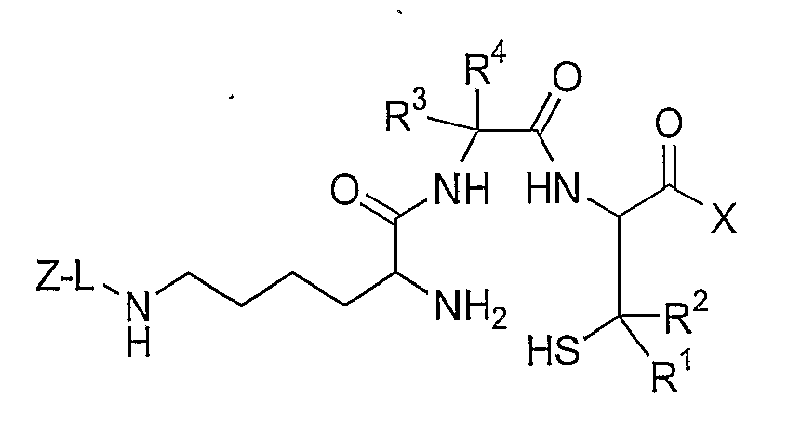
- The monoamine, diamide single thiol radiometal chelator stabilized in accordance with the invention may alternatively have a formula:

- Bisamide bisthiol metal chelators stabilized in accordance with the present invention preferably have a formula selected from the group consisting of:

- wherein each R is independently H, CH3 or C2H5;
- each (pgp)S is independently a thiol protecting group or H;
- m, n and p are independently 2 or 3;
- A is linear or cyclic lower alkyl, aryl, heterocyclyl, a combination
- thereof or a substituted derivative thereof;
- wherein each R is independently H, CH3 or C2H5;
- m, n and p are independently 2 or 3;
- A is linear or cyclic lower alkyl, aryl, heterocyclyl, a combination thereof or a substituted derivative thereof;
- V is H or -CO-peptide;
- R' is H or peptide;
- and wherein when V is H, R' is peptide; and when R' is H, V is -CO-peptide.
- For example, the stabilizers of the invention may be used to increase the shelf life ofradiopharmaceuticals comprising the specific precursors set forth below:
- GGCSIPPEVKFNKPFVYLI.amide (SEQ ID NO:1);
- GGCSIPPEVKFNKPFVYLI (SEQ ID NO:2);
- GGCGLF (SEQ ID NO:3);
- RGCSIPPEVKFNKPFVYLI.amide (SEQ ID NO:4);
- RGCGHRPLDKKREEAPSLRPAPPPISGGYR.amide (SEQ ID NO:5);
- GGCRPKPQQFFGLM.amide (SEQ ID NO:6);
- GGCFVYLI.amide (SEQ ID NO:7);
- (acetyl.TKPRGG)2K(ε-K)GC.amide;
- FDFYWDKTFT(ε-K)GC.amide;
- acetyl.FDFYWDKTFT(ε-K)GC.amide;
- acetyl.NalD.Cpa.YWDKTFT(ε-K)GCKK.amide;
- acetyl.FDFYWDKTFTGGG(ε-K)GC.amide;
- acetyl.FDFYWDKTFTGGG(ε-K)KC.amide;
- acetyl.KKKKK.NaD.Cpa.YWDKTFT(ε-K)GC.amide;
- acetyl.DDFD.Cpa.YWDKTFT(ε-K)GCKK.amide;
- acetyl.DDFD.Cpa.YWDKTC(ε-K)GCKK.amide;
- acetyl.KKKKK.NalD.Cpa.YWDKTFT(ε-K)GCKK.amide;
- acetyl.NalD.Cpa.YWDKTFT(ε-K)GCKK.amide;
- acetyl-DDD.NalD.Cpa.YWDKTFT(ε-K)GCKK.amide;
- acetyl.DDDFD.Cpa.YWDKTFT(ε-K)GCKK.amide;
- (DTPA).FDFYWDKTFT(ε-K)GC.amide;
- (DTPA).NalD.Cpa.YWDKT.Nal.T(ε-K.)GCKK.amide;
- (DTPA).(ε-K)GCFDFYWDKTFT.amide
- (DTPA).(ε-K)GCFD.Cpa..YWDKTFT.amide;
- (DTPA).FD.Cpa.YWDKTFT(ε-K)GC.amide;
- (DTPA).NalD.Cpa.YWDKTFT(ε-K)GC.amide;
- (DTPA).Aca.FD.Cpa.YWDKTFT(ε-K)GC.amide;
- (DTPA).NalD.Cpa.YWDKT.Nal.T(ε-K)GCKK.amide;
- (DTPA).NalD.Cpa.YWDKTFT(ε-K)GCKK.amide;
- CH 2 CO.FFW D KTFC(ε-K)GC.amide;
- CH 2 CO.FFW D KTFCKKKK(ε-K)GC.amide;
- CH 2 CO.FFW D KTGFC(ε-K)KKKKKGC.amide;
- AKCGGGFDFYWDKTFT.amide;
- AKCGGGFDYWDKTFT.amide;
- DDDD.NalD.Cpa.YWDKTFT(ε-K)GCKKKK.amide;
- DDD.NalD.Cpa.YWDKTFT(ε-K)GCKK.amide;
- NalD.Cpa.YWDKTFT(ε-K)GCKK.amide;
- Trc.NalD.Cpa.YWDKTFT(ε-K)GCKK.amide;
- Hca.NalD.Cpa.YWDKTFT(ε-K)GCKKK.amide;
- (Trc)2.NalD.Cpa.YWDKTFT(ε-K)GCKK.amide;
- KKKK.NalD.Cpa.YWDKTFT(ε-K)GCDDDD.amide;
- KD.NalD.Cpa.YWDKTFT(ε-K)GCD.amide;
- KDK.NalD.Cpa.YWDKTFT(ε-K)GCDD.amide;
- KDKK.NalD.Cpa.YWDKTFT(ε-K)GCDDD.amide;
- KDKK.NalD.Cpa.YWDKTFT(ε-K)GCDD.amide;
- KDKKK.NalD.Cpa.YWDKTFT(ε-K)GCDD.amide;
- KDKKK.NalD.Cpa.YWDKTFT(ε-K)GCKDKD.amide;
- KDKKKFD.Cpa.YWDKTF,Nal.(ε-K)GCDDDD.amide;
- K(BAT).NalD.CMeYWDKVCMeT.amide
- KDDKD.NalD.Cpa.YWDKTFT(ε-K)GCKDKD.amide;
- KDKD.NalD.Cpa.YWDKTFT(ε-K)GCKDKD.amide;
- FD.Cpa.YWDKTC(ε-K)GCKK.amide;
- FD.Cpa.YWDKTC(ε-K)GC.amide;
- FD.Cpa.YWDKTFT(ε-K)GCKK.amide;
- FD.Cpa.YWDK.Abu.Nal.T(ε-K)GC.amide;
- FD.Cpa.YWDKTFTGGG(ε-K)GC.amide;
- FD.Cpa.YWDKTFT(ε-K)GCR.amide;
- (Trc-imide).NalD.Cpa.YWDKTFT(ε-K)GCR.amide;
- Trc.(Trc-imide).K.NalD.Cpa.YWDKTFT(ε-K)GCRR.amide;
- (Trc-imide)2K.NalD.Cpa.YWDKTFT(ε-K)GCRR.amide;
- (Trc-imide)2K.NalD.Cpa.YWDKTFT(ε-K)GCR.amide;
- DDDFD.Cpa.YWDKTFT(ε-K)GCKK.amide;
- DDFD.Cpa.YWDKTFT(ε-K)GCKK.amide;
- FDFYWDKTFT(ε-K)GCKK.amide;
- AKCGGGFDYWDKTFT.amide;
- (2-ketogulonyl).NalD.Cpa.YWDKTFT(ε-K)GCKK.amide;
- (2-ketogulonyl).FD.Cpa.YWDKTFT(ε-K)GC.amide;
- cyclo- (N-CH 3 )FYW D KV.Hcy(CH2CO.GC.Dap.Dap.amide);
- cyclo- (N CH 3 )FYW D KV.Hcy(CH2CO.(γ-Dab)KCR.amide);
- cyclo-( N-CH 3 )FYW D KV.Hcy(CH2CO.KKKKK(ε-K)GC.amide);
- cyclo- (N-CH 3 )FYW D KV.Hcy(CH2CO).(ε-K)GCK.amide;
- cyclo-( N-CH 3 )FYW D KV.Hcy(CH2CO.(β-Dap)KCR.amide);
- cyclo-(N-CH 3 )FYW D KV.Hcy(CH2CO(β-Dap)KCK.amide);
- cyclo-( N-CH 3 )FYW D KV.Hcy(CH2CO.(δ-Orn)GCK.amide);
- cyclo-( N-CH 3 )FYW D KV.Hcy(CH2CO.(β-Dap)GCK.amide);
- cyclo-( N-CH 3 )FYW D KV.Hcy(CH2CO.K(ε-K)KCK.amide);
- cyclo- (N-CH 3 )FYW D KV.Hcy(CH2CO.(ε-K)GCKK.amide);
- cyclo- (N-CH 3 )FYW D KV.Hcy(CH2CO).K(ε-K)GC.amide;
- cyclo-( N-CH 3 )FYW D KV.Hcy(CH2CO).(ε-K)GC.amide;
- RGCQAPLYKKIIKKILLES (SEQ ID NO:8);
- acetyl.KK(ε-K)GCGCGGPLYKKIIKKLLES;
- acetyl.KKKKKK(ε-K)GCGGPLYKKIIKKLLES;
- (CH 2 CO.Y D .Amp.GDCKGCG.amide)2(CH2CO)2K(ε-K)GC.amide;
- CH 2 CO.Y D .Amp.GDCGGCAcmGCAcmGGC.amide)2(CH2CO)2K(ε-K)GC.amide;
- (CH 2 CO.Y D .Apc.GDCKGCG.amide)2(CH2CO)2K(ε-K)GC.amide;
- {(CH 2 CO.Y D .Apc.GDCGGCG.amide)(CH2CO)}2K(ε-K)GC.amide;
- (CH 2 CO.Y D .Apc.GDCKGG)2K(ε-K)GC.β-Ala.amide;
- (CH 2 CO.Y D .Apc.GDCKKG)2K(ε-K)GC.β-Ala.amide;
- {CH 2 ,CO.Y D .Apc.GDCG)2KG}2K(ε-K)GCG.amide;
- (CH 2 CO.Y D .Apc.GDC)2K(ε-K)GCG.amide;
- ({(CH 2 CO.Y D .Apc.GDCGGCAcmGCAcmGGC.amide)(CH2CO)}2.K)2K(ε-K)GCG.amide;
- {(CH 2 CO.Y D .Apc.GDCGGCAcmGCAcmGGC.amide)2(CH2CO)2K}2K(ε-K)GCG.amide;
- (CH 2 CO.Y D .Apc.GDCGGCAcmGCAcmGGC.amide)2(CH2CO)2K(ε-K)GC.amide;
- HSDAVFTDNYTRLRKQMAVKKYLNSILN(ε-K)GC.amide;
- HSDAVFTDNYTRLRKQMAVKKYLNSILNGGC.amide (SEQ ID NO:9);
- AGCHSDAVFTDNYTRLRKQMAVKKYLNSILN.amide (SEQ ID NO:10);
- HSDAVFTDNYTRLRKQMAVKKYLNSILNC(BAT).amide (SEQ ID NO:11);
- CH 2 CO.SNLST.HhcVLGKLSC(BAT)ELHKLQTYPRTNTGSGTP.amide (SEQ ID NO:12);
- CH 2 CO.SNLST.HhcVLGKLSQELHKLQTYPRTNTGSGTP(ε-K)GC.amide;
- CH 2 CO.SNLST.HhcVLGKLSC(CH2CO.GGCK.amide)ELHKLQTYPRTNTGSGTP.amide;
- CH 2 CO.SNLST.HhcVLGKLSC(CH2CO.(β-Dap)KCK.amide)ELHKLQTYPRTNTGSGTP.amide;
- CH 2 CO.SNLST.HhcVLGKLSC(CH2CO.(ε-K)GCE.amide)ELHKLQTYPRTNTGSGTP.amide;
- CH 2 CO.SNLST.HcyVLGKLSC(CH2CO.GGCK.amide)ELHKLQTYPRTNTGSGTP.amide;
- CH 2 CO.SNLST.HcyVLGKLSC(CH2CO.(β-Dap)KCK.amide)ELHKLQTYPRTNTGSGTP.amide;
- CH 2 CO.SNLST.HcyVLGKLSC(CH2CO.(ε-K)GCE.amide)ELHKLQTYPRTNTGSGTP.amide;
- CH 2 CO.SNLST.Cys.LGKSC(CH2CO.GGCK.amide)ELHKQTYPRTNTGSGTP.amide;
- CH 2 CO.SNLST.CYsVLGKLSC(CH2CO.(β-Dap)KCK.amide)ELHKLQTYPRTNTGSGTP.amide;
- CH 2 CO.SNLST.CysVLGKLSC(CH2CO.(ε-K)GCE.amide)ELHKLQTYPRTNTGSGTP.amide;
- SNLST.AsuVLGKLSC(CH2CO.(β-Dap)KCK.amide)ELHKLQTYPRTNTGSGTP.amide;
- SNLST.AsuVLGLGSC(CH2CO.(β-Dap)KCK.amide)ELHKLQTYPRTDVGAGTP.amide;
- cyclo- Tyr-D-Trp-Lys-Thr-Phe-(N-CH 3 )Hcy(CH2CO-β-Dap-Tyr-Cys-Thr(ol));
- cyclo- Tyr-D-Trp-Lys-Thr-Phe-(N-CH 3 )Hcy(CH2CO-β-Dap-Phe(4-F)-Cys-Thr(ol));
- cyclo- Tyr-D-Trp-Lys-Thr-Phe-(N-CH 3 )Hcy(CH2CO-β-Dap-Phe(4-NH2)-Cys-Thr-Ser);
- cyclo- Tyr-D-Trp-Lys-Thr-Phe-(N-CH 3 )Hcy(CH2CO-β-Dap-Dab-Cys-Thr);
- cyclo- Tyr-D-Trp-Lys-Thr-Phe-(N-CH 3 )Hcy(CH2CO-β-Dap-Phe(4-NH2)-Cys-Thr);
- cyclo- Tyr-D-Trp-Lys-Thr-Phe-(N-CH 3 )Hcy(CH2CO-β-Dap-Phe(4-NH2)-Cys-Thr(ol));
- cyclo- Tyr-D-Trp-Lys-Thr-Phe-(N-CH 3 )Hcy(CH2CO-β-Dap-His-Cys-Thr(ol));
- cyclo- Tyr-D-Trp-Lys-Thr-Phe-(N-CH 3 )Hcy(CH2CO-β-Dap-Arg-Cys-Thr(ol));
- cyclo- Tyr-D-Trp-Lys-Thr-Phe-(N-CH 3 )Hcy(CH2CO-β-Dap-Gly-Cys-Lys-NH2);
- cyclo- Tyr-D- Trp- Lys- Thr-Phe-(N-CH 3 )Hcy(CH2CO-β-Dap-Ser-Cys-Thr(ol));
- cyclo-Tyr-D-Trp-Lys-Thr-Phe-(N-CH 3 )Hcy(CH2CO-β-Dap-Dab-Cys-Thr(ol));
- cyclo-Tyr-D-Trp-Lys-Thr-Phe-(N-CH 3 )Hcy(CH2CO-β-Dap-Gly-Cys-Thr(ol));
- cyclo-Tyr-D-Trp-Lys-Thr-Phe-(N-CH 3 )Hcy(CH2CO-β-Dap-Dab-Cys-Ser(ol));
- cyclo-Tyr-D-Trp-Lys-Thr-Phe-(N-CH 3 )Hcy(CH2CO-Gly-Gly-Cys-Lys-NH2);
- cyclo- Tyr-D-Trp-Lys-Thr-Phe-(N-CH3)Hcy(CH2CO-Gly-Gly-Cys-Arg-NH2);
- cyclo-Tyr-D-Trp-Lys-Thr-Phe-(N-CH 3 )Hcy(CH2CO-Ser-Ser-Cys-Lys-NH2);
- cyclo- Tyr-D-Trp-Lys-Thr-Phe-(N-CH 3 )Hcy(CH2CO-Ser-Ser-Cys-Arg-NH2);
- cyclo- Tyr-D-Trp-Lys-Thr-Phe-(N-CH 3 )Hcy(CH2CO-Ser-Ser-Cys-Lys-Thr(ol));
- cyclo- Tyr-D- Trp-Lys-Thr-Phe-(N-CH 3 )Hcy(CH2CO-Ser-Ser-Cys-Dap-NH2);
- cyclo- Tyr-D- Trp-Lys-Thr-Phe-(N-CH 3 )Hcy(CH2CO-Ser-Ser-Cys-NH(CH2CH2O)2CH2CH2NH2);
- cyclo- Tyr-D-Trp-Lys-Thr-Phe-(N-CH 3 )Hcy (CH2CO-β-Dap-Ser-Cys-Thr-NH(CH2CH2O)2CH2CH2NH2);
- cyclo- Tyr-D-Trp-Lys-Thr-Phe-(N-CH 3 )Hcy(CH2CO-Gly-Lys-Cys-NH2);
- cyclo- Tyr-D-Trp-Lys-Thr-Phe-(N-CH 3 )Hcy(CH2CO-Ser-Lys-Cys-NH2);
- cyclo- Tyr-D-Trp-Lys-Thr-Phe-(N-CH3)Hcy(CH2CO-Lys-Gly-Cys-NH2);
- cyclo- Tyr-D-Trp-Lys-Thr-Phe-(N-CH 3 )Hcy(CH2CO-Ser-Dab-Cys-Ser(ol));
- cyclo-Tyr-D-Trp-Lys-Thr-Phe-(N-CH 3 )Hcy(CH2CO-Ser-Dap-Cys-NH2);
- cyclo-Tyr-D-Trp-Lys-Thr-Phe-( N-CH 3 )Hcy(CH2CO-Gly-Gly-Cys-His-NH2);
- cyclo- Tyr-D-Trp-Lys-Thr-Phe-( N-CH 3 )Hcy(CH2CO-Gly-Gly-Cys-Phe(4-NH2)-NH2);
- cyclo- Tyr-D-Trp-Lys-Thr-Phe-(N-CH 3 )Hcy(CH2CO-β-Dap-Om-Cys-Thr(ol));
- cyclo- Tyr-D-Trp-Lys-Thr-Phe-(N-CH 3 )Hcy(CH2CO-β-Dap-Dap-Cys-Thr(ol));
- cyclo- Tyr-D-Trp-Lys-Thr-Phe-(N-CH 3 )Hcy(CH2CO-β-Dap-Lys-Cys-Thr(ol));
- cyclo- Tyr-D-Trp-Lys-Thr-Phe-(N-CH 3 )Hcy(CH2CO-Ser-Ser-Cys-NHCH2CH2OCH2CH2NH2);
- cyclo- Tyr-D-Trp-Lys-Thr-Phe-(N-CH 3 )Hcy(CH2CO-β-Dap-Lys-Cys-NH2);
- cyclo-Tyr-D-Trp-Lys-Thr-Phe-(N-CH 3 )Hcy(CH2CO-δ-Om-Gly-Cys-NH2); and
- cyclo- Tyr-D-Trp-Lys-Thr-Phe-(N-CH 3 )Hcy(CH2CO-Thr-Gly-Gly-Cys-NH2).
- (Single-letter and three-letter abbreviations for amino acids can be found in G. Zubay, Biochemistry (2d. ed.), 1988 (MacMillan Publishing: New York) p.33; other abbreviations are as follows: Acm is acetamidomethyl; Mob is 4-methoxybenzyl; Abu is aminobutyric acid; FD is D-phenylalanine; WD is D-tryptophan; YD is D-tyrosine; Aca is 6-aminohexanoic acid; Apc is S-(3-aminopropyl)cysteine; Hcy is homocysteine; Nal is 2-naphthylalanine; Cpa is 4-chlorophenylalanine; KD is D-lysine; DD is D-aspartate; NalD is D-2-naphthylalanine; DTPA is diethylenetriaminepentaacetic acid; Trc is tricarballylic acid; Trc-imide is tricarballylic imide; and Hca is hexacarboxycyclohexane. (...)2K represents covalent linkage to both amino groups of lysine. Hcy(...) represents covalent linkage to the sidechain sulfur atom of homocysteine. (N-CH3)F represents N-α-methyl-phenylalanine. Underlining between groups (e.g., as between the CH2CO. group and cysteine (C) in CH 2 CO.Y D RGDC) represents a cyclic sulfide. Underlining between amino acids (e.g., as between the cysteines (C) in CNPRGDC) represents a cyclic disulfide bond. The term "cyclo" before an underlined sequence means an N-terminus-to-C-terminus cyclic sequence. The subscript XD indicates the amino acid is in the D-configuration; all other subscripts refer to amino acid sidechain protecting groups. ε-K, δ-Orn, γ-Dab, and β-Dap are defined as set forth above. Asu is 2-amino suberic acid, wherein the amino terminal amino acids of peptides containing an Asu residue are cyclized via an amide bond between the amino terminal amino group and the side chain carboxylic acid moiety of the Asu residue. BAT is N6, N9-bis(2-mercapto-2-methylpropyl)-6,9-diazanonanoic acid.
- In accordance with the present invention, a hydrophilic 6-hydroxy-chroman derivative may also be used to stabilize labelld radiopharmaceutical precursors comprising a benzodiazepine derivative, such as those described in U.S.Pat.No. 6,171,578. In a preferred embodiment, a hydrophilic 6-hydroxy-chroman derivative such as 6-hydroxy-2,5,7,8-tetramethylchroman-2-carboxylic acid is used to stabilize radiolabelled 1-[(carboxyglycyl-glycyl-glycyl-cysteinamide)methyl]-4-(2-carboxyethyl)-7-[(4-amidinophenyl)methyl]-3,4-dihydro-1H-1,4-benzodiazepine-2,5-dione trifluoroacetate.
- In addition, a hydrophilic thioether, or hydrophilic 6-hydroxy-chroman or a mixture of a hydrophilic thioether and a hydrophilic 6-hydroxychroman derivative may be used in accordance with the present invention to stabilize labelled radiopharmaceutical precursors comprising a targeting moiety or domain covalently linked to the known chelators 1,4,7,10-tetraazadodecanetetraacetic acid and derivatives thereof:

- A radiopharmaceutical comprising any radionuclide or radiometal may be stabilized in accordance with the present invention. For example, radiopharmaceuticals containing such nuclides as 125I, 131I, 211At, 47Sc, 67Cu, 72Ga, 90Y, 153Sm, 159Gd, 166Dy, 166Ho, 175Yb, 177Lu, 186Re, 188Re, 212Bi, 213Bi, 68Ga, 99mTc, 111In, and 123I, and the like may be stabilized by addition of a hydrophilic thioether in accordance with the invention. The extent of stabilization of a particular radiopharmaceutical precursor when chelated to different radionuclides may vary. For example, a 99mTc-labelled precursor may be stabilized to a greater extent than a 188Re-labelled form of the same precursor.
- The compositions of the invention are formulated as a sterile, pyrogen-free, parenterally acceptable aqueous solution which may optionally be supplied in lyophilized form and be reconstituted by the user. The compositions of the invention may be provided as components of kits which may include buffers, additional vials, instructions for use, and the like.
- The pharmaceutical compositions of the invention comprises a radiopharmaceutical precursor in combination with a stabilizing amount of a hydrophilic thioether, a hydrophilic 6-hydroxy-chroman or a mixture of a hydrophilic thioether and hydrophilic 6-hydroxy-chroman, optionally with a pharmaceutically acceptable diluent or a carrier such as species appropriate albumin. As used herein, a "pharmaceutically acceptable diluent or carrier" may include any and all solvents, dispersion media, antibacterial and antifungal agents, isotonic agents, enzyme inhibitors, transfer ligands such as glucoheptonate, tartrate, citrate, or mannitol, and the like. The use of such media and agents for pharmaceutically active substances is well known in the art. For example, Sodium Chloride Injection and Ringer's Injection are commonly used as diluents. The preparation of such parenterally acceptable solutions, having due regard to pH, isotonicity, stability, and the like, is within the skill in the art.
- In accordance with the method of this invention, radiopharmaceuticals are preferably administered intravenously in a single unit dose, either totally as a bolus or partly as a bolus followed by infusion over 1-2 hours. The amount of solution to be injected at unit dosage is from about 0.01 mL to about 10 mL, containing about 0.01 mCi to about 100 mCi of radioactivity, preferably from about 1 mCi to about 50 mCi. The amount of the radiopharmaceutical in the unit dose may range from about 0.1 to about 10 mg/kg body weight, After intravenous administration, the site is monitored, for example, by radioimaging in vivo if the radiopharmaceutical is a diagnostic agent.
- The following examples are shown by way of illustration and not be considered as limitations.
- Gentisic acid (GA) was tested for its ability to stabilize the 99mTc-labelled somatostatin receptor-binding peptide depreotide, which has the structure.

- cyclo( N-CH 3 )FYW D KV.Hcy.(CH2CO.(β-Dap)KCK.amide)
- Lyophilized kit vials were prepared containing depreotide, GA, and other components as described in Table 1. Formulations were adjusted to pH 7.4 or 8.5 (as noted) prior to lyophilization.
TABLE 1 Component Control GA I GAII GA III Depreotide 50 µg 50 µg 50 µg 50 µg Sodium Glucoheptonate Dihydrate1 25 mg 25 mg 5 mg 25 mg Edetate Disodium Dihydrate2 100 µg 100 µg 100 µg 100 µg Stannous Chloride Dihydrate3 50 µg 50 µg 50 µg 50 µg Gentisic Acid Sodium Salt Hydrate4 - 1 mg 1 mg 1 mg pH 7.4 7.4 7.4 8.5 1Pfanstiehl Laboratories, Waukegan, Illinois, USA.
2J.T. Baker, Phillipsburg, New Jersey, USA.
3Acros Organics/Fisher Scientific, Pittsburgh, Pennsylvania, USA.
4Sigma Chemical Co., St. Louis, Missouri, USA. - The lyophilized kits were radiolabelled with 99m Tc by reconstitution with 1.0 mL technetium 99m Tc sodium pertechnetate (Technelite® Molybdenum Mo99-Technetium Tc99m Generator, DuPont, Billerica, Massachusetts) containing approximately 50 mCi 99m Tc and heating in a boiling water bath for 10 minutes. Radiolabelling yield (RCP) results as measured by reversed phase HPLC are given in Table 2.
TABLE 2 HPLC RCP (%) Formulation 0.5 hr 3.5 hr 6.5 hr Control 94.5 88.3 86.4 94.2 92.1 90.8 94.5 91.7 90.1 (Average ± 1SD): (94.4 ± 0.2) (90.7 ± 2.1) (89.1 ± 2.4) GA I 82.4 79.4 77.2 GA II 29.1 25.1 20.5 GA III 0.9 0.7 0.6 - These results indicate that gentisic acid decreases the radiolabelling yield and the stability of99m Tc-depreotide when included in formulated kits.
- Lyophilized kit vials were prepared containing depreotide, L-methionine (Met), and other components as described in Table 3. All formulations were adjusted to pH 7.4 prior to lyophilization.
TABLE 3 Component Control Met I Met II Met III Met IV Met V Depreotide 50 µg 50 µg 50 µg 50 µg 50 µg 50 µg Sodium Glucoheptonate Dihydrate 5 mg 5 mg 5 mg 5 mg 5 mg 5 mg Edetate Disodium Dihydrate 100 µg 100 µg 100 µg 100 µg 100 µg 100 µg Stannous Chloride Dihydrate 50 µg 50 µg 50 µg 50 %g 50 µg 50 µg L-Methionine USP1 - 1 mg 2 mg 4 mg 5 mg 10 mg 1Sigma Chemical Co., St. Louis, Missouri, USA. - The lyophilized kits were radiolabelled with 99m Tc by reconstitution with 1.0 mL technetium 99m Tc sodium pertechnetate (Technelite®) containing approximately 50 mCi 99mTc and heating in a boiling water bath for 10 minutes. Some of the formulations were also radiolabelled in a room temperature preparation (allowed to stand at rom temperature 30 minutes following reconstitution). Radiolabelling yield (RCP) results as measured by reversed phase HPLC are given in Table 4.
TABLE 4 HPLC RCP (%) Formulation Prep Type 0.5 hr 3.5 hr 6.5 hr Control Heated 91.9 85.0 80.7 Heated - 81.6 79.3 (Average): (91.9) (83.3) (80.0) Rm Temp 94.8 87.6 78.2 Rm Temp 90.7 88.7 83.4 (Average): (92.8) (88.2) (80.8) Met I (1 mg) Heated 95.9 91.5 89.5 Met II (2 mg) Heated 95.2 93.2 90.5 Met III (4 mg) Heated 95.9 93.5 92.2 Heated 92.4 88.5 87.4 (Average): (94.2) (91.0) (89.8) Rm Temp 90.4 90.0 89.4 Rm Temp 89.9 89.9 89.7 Rm Temp 91.4 87.9 83.1 (Average ± 1SD): (90.6 ± 0.8) (89.3 ± 1.2) (87.4 ± 3.7) Met IV (5 mg) Heated 93.8 93.7 93.5 Heated - 92.5 92.7 (Average): (93.8) (93.1) (93.1) Met V (10mg) Heated 94.5 94.6 92.6 - These results indicate that L-methionine increases the radiolabelling yield and the stability of 99m Tc-depreotide prepared from formulated kits which have been stored under normal conditions (≤ -10°C).
- Lyophilized kits were prepared containing depreotide, L-methionine (Met), and other components as described in Table 5. All formulations were adjusted to pH 7.4 prior to lyophilization. The kits were stored for one week at 40°C. Some kits were also stored at -10°C as controls.
TABLE 5 Component Control Met Depreotide 50 µg 50 µg Sodium Glucoheptonate Dihydrate 5 mg 5 mg Edetate Disodium Dihydrate 100 µg 100 µg Stannous Chloride Dihydrate 50 µg 50 µg L-Methionine USP - 5 mg - The lyophilized kits were radiolabelled with 99m Tc by reconstitution with 1.0 mL technetium 99m Tc sodium pertechnetate (Technelite®) containing approximately 50 mCi 99m Tc and incubation in a boiling water bath (10 min). Radiolabelling yield (RCP) results as measured by reversed phase HPLC are given in Table 6.
TABLE 6 HPLC RCP (%) Formulation Storage Temp Prep Type 0.5 hr 3.5 hr 6.5 hr Control -10°C Heated - 82.6 77.8 40°C Heated - 82.6 79.0 Met 40°C Heated 76.5 78.0 77.6 - These results indicate that L-methionine does not stabilize 99mTc-depreotide in lyophilized kits which have been stored at 40°C prior to radiolabelling.
- L-methionine was tested for its ability to stabilize a 99mTc-labelled glycoprotein IIb/IIIa receptor-binding benzodiazepinedione derivative 1-[(carboxyglycyl-glycyl-glycyl-cysteinamide)methyl]-4-(2-carboxyethyl)-7-[(4-amidinophenyl)methyl]-3,4-dihydro-1H-1,4-benzodiazepine-2,5-dione trifluoroacetate, having the structure.

- Lyophilized kit vials were prepared containing the benzodiazepinedione derivative and components as described in Table 7. All formulations were adjusted to pH 7.4 prior to lyophilization.
TABLE 7 Component Control Met Derivative 40 µg 40 µg Sodium Glucoheptonate Dihydrate 25 mg 25 mg Edetate Disodium Dihydrate 100 µg 100 µg Stannous Chloride Dihydrate 50 µg 50 µg L-Methionine USP - 5 mg - The lyophilized kits were radiolabelled with 99mTc by reconstitution with 1.0 mL technetium 99mTc sodium pertechnetate (Technelite®) containing approximately 50 mCi 99m Tc and heating in a boiling water bath for 10 minutes. Radiolabelling yield (RCP) results as measured by reversed phase HPLC are given in Table 8.
TABLE 8 HPLC RCP (%) Formulation 0.5 hr 3.5 hr 6.5 hr Control 93.2 90.1 88.0 93.6 94.5 88.8 92.4 89.2 88.1 85.0 86.1 82.3 (Average ± 1SD): (91.0 ± 4.1) (90.0 ± 3.5) (86.8 ± 3.0) Met (5 mg) 92.5 91.1 91.4 93.9 92.5 91.9 94.3 92.4 91.0 90.5 91.2 91.9 (Average ± 1SD): (92.8 ± 1.7) (91.8 ± 0.8) (91.6 ± 0.4) - These results indicate that L-methionine increases the radiolabelling yield and the stability of the 99mTc-labelled benzodiazepinedione derivative prepared from formulated kits.
- L-methionine was tested for its ability to stabilize a 99mTc-labelled glycoprotein IIb/IIIa receptor-binding peptide having the structure.

- This peptide is represented as:
- (CH 2 CO.Y D .Amp.GDC.KGCG.amide)2(CH2CO)2K(ε-K)GC.amide
- Lyophilized kit vials were prepared containing the peptide (50 µg), sodium glucoheptonate dihydrate (10 mg), stannous chloride dihydrate (50 µg), and edetate disodium dihydrate (100 µg). The formulation was adjusted to pH 7.4 prior to lyophilization.
- The lyophilized kits were radiolabelled with 99mTc in the presence and absence of L-methionine. To the Met preparation was added 4 mg methionine (in 100 µL saline) and 100 µL ethanol. To the control preparation was added 100 µL ethanol and 100 µL saline to account for the additional saline or ethanol added with the L-methionine. Both vials were then reconstituted with 1.0 mL technetium 99mTc sodium pertechnetate (Technelite®) containing approximately 50 mCi 99mTc and allowed to incubate for 30 minutes at room temperature. Radiolabelling yield (RCP) results as measured by reversed phase HPLC are given in Table 9.
TABLE 9 HPLC RCP (%) Preparation 0.5 hr 3.5 hr 6.5 hr Control 91.8 80.4 76.2 Methionine (4 mg) 96.7 96.9 96.2 - These results show that L-methionine increases the radiolabelling yield and the stability of the 99mTc-peptide.
- L-methionine was tested for its ability to stabilize a 99mTc-labelled monoamine, diamide, single thiol peptide chelator having the structure.

- Lyophilized kit "placebo" vials were prepared containing sodium glucoheptonate dihydrate, edetate disodium dihydrate, and stannous chloride dihydrate at the concentrations set forth in Table 1 (control formulation).
- The peptide chelator was radiolabelled with 99mTc in the presence and absence of L-methionine. The peptide chelator was dissolved in water at a concentration of 1 mg/mL, and 50 µg (50 µL) of the peptide was added to each of three placebo vials. Ethanol and L-methionine were added to the control and methionine preparations as described in Example 5. In addition, 100 µL phosphate buffered saline (PBS) was added to each preparation. The vials were reconstituted with 0.9-1.0 mL 99mTc sodium pertechnetate (Technelite®) containing approximately 50 mCi 99mTc, and heated in a boiling water bath for ten minutes. Radiolabelling yield (RCP) results as measured by reversed phase HPLC are given in Table 10.
TABLE 10 HPLC RCP (%) Preparation 0.5 hr 3 hr 6 hr 9 hr Control 94.1 92.4 85.9 80.0 L-Methionine (4 mg) 98.4 97.2 95.5 92.8 - These results show that L-methionine increases the radiolabelling yield and the stability of a 99mTc-labelled peptide chelator.
- L-methionine was tested for its ability to stabilize a 99mTc-labelled non-peptide chelator (4-(butanoic acid)-2,2,9,9 tetramethyl-4,7-diaza-1,10-decanedithiol) having the structure.

- The non-peptide chelator was radiolabelled with 99mTc in the presence and absence of L-methionine using the placebo vial heated preparation procedure as described in Example 6. Radiolabelling yield (RCP) results as measured by reversed phase HPLC are given in Table 11.
TABLE 11 HPLC RCP (%) Preparation 0.5 hr 3 hr 6 hr 9 hr Control 48.5 56.5 54.0 52.9 Methionine (4mg) 66.7 70.0 70.8 70.4 - These results show that L-methionine increases the radiolabelling yield and the stability of a 99mTc-labelled non-peptide chelator.
- 2-(Ethylthio)ethylamine, methioninol, and 3-methylthio-1,2-propanediol are hydrophilic thioethers having the structures.


- These compounds and L-methionine were tested for their ability to stabilize 99mTc-labelled depreotide.
- Each hydrophilic thioether was dissolved in water made up at 40 mg/mL and adjusted to pH 7 with HCl or NaOH. Each hydrophilic thioether (4 mg in 100 µL) was added to a formulated kit vial containing the peptide ("control" formulation in Table 1). To the control vials were added 100 µL water. The vials were reconstituted with 1.0 mL 99mTc sodium pertechnetate (Technelite®) containing approximately 50 mCi 99mTc and heated in a boiling water bath for ten minutes. Radiolabelling yield (RCP) results as measured by reversed phase HPLC are given in Table 12.
TABLE 12 Additive I Initial RCP 3.5 hr RCP 6.5 hr RCP Day 1: None (Control 1) 89.8 82.9 79.4 Methionine 95.0 90.4 89.3 2-(Ethylthio)ethylamine 92.8 94.2 93.3 Day 2: None (Control 2) 89.9 78.0 74.4 Methioninol 94.1 93.9 90.7 3-Methylthio-1,2-propanediol 89.1 84.0 80.9 - These results show that the hydrophilic thioethers 2-(ethylthio)ethylamine, methioninol, and 3-methylthio-1,2-propanediol increase the radiolabelling yield and the stability of a 99mTc-labelled peptide. Methionine sulfoxide, methionine sulfone, and 3-(methylthio)propionaldehyde had no effect on 99mTc-labelled peptide radiolabelling yield or stability.
- Lyophilized kit vials were prepared containing depreotide, Trolox®, and other components as described in Table 13. All formulations were adjusted to pH 7.4 prior to lyophilization.
TABLE 13 Component Control Trolox I Trolox II Trolox III Trolox IV Depreotide 50 µg 50 µg 50 µg 50 µg 50 µg Sodium Glucoheptonate Dihydrate 5 mg 5 mg 5 mg 5 mg 5 mg Edetate Disodium Dihydrate 100 µg 100 µg 100 µg 100 µg 100 µg Stannous Chloride Dihydrate 50 µg 50 µg 50 µg 50 µg 50 µg Trolox - 0.6 mg 1 mg 2 mg 5 mg - The lyophilized kits were radiolabelled with 99m Tc by reconstitution with 1.0 mL technetium 99m Tc sodium pertechnetate (Technelite®) containing approximately 50 mCi 99mTc and incubation at room temperature for 30 minutes following reconstitution. Some of the formulations were also radiolabelled in a heated preparation (heat in a boiling water bath for 10 minutes). Radiolabelling yield (RCP) results as measured by reversed phase HPLC are given in Table 14.
Table 14 HPLC RCP (%) Formulation Prep Type 0.5 hr 3.5 hr 6.5 hr Control Heated 92.0 85.9 84.5 Heated 91.4 85.3 78.3 (Average): (91.7) (85.6) (81.5) Rm Temp 92.0 85.0 84.2 Rm Temp 92.6 85.2 80.7 Rm Temp 92.0 81.4 79.5 Rm Temp 89.5 82.8 - (Average ± 1SD): (91.5 ± 1.4) (83.6 ± 1.8) (81.5 ± 2.4) Trolox I (600 µg) Rm Temp 94.3 93.2 92.0 Rm Temp 91.8 88.6 89.1 (Average): (93.1) (90.9) (90.6) Trolox II (1 mg) Rm Temp 91.3 89.6 91.0 Rm Temp 92.9 91.8 92.5 Rm Temp 94.1 93.2 91.1 (Average ± 1SD): (92.8 ± 1.4) (91.5 ± 1.8) (91.5 ± 0.8) Trolox III (2 mg) Heated 94.9 91.1 85.6 Heated 95.3 92.9 88.7 (Average): (95.1) (92.0) (87.2) Rm Temp 95.4 94.8 95.4 Rm Temp 94.5 93.7 93.8 Rm Temp 95.5 - 92.2 Rm Temp 93.8 91.7 92.4 Rm Temp 94.8 92.4 93.0 Rm Temp - 94.6 93.5 (Average ± 1SD): (94.8 ± 0.7) (93.4 ± 1.4) (93.4 ± 1.2) Trolox IV (5 mg) Rm Temp 93.3 92.0 - Rm Temp 92.1 94.8 93.8 (Average): (92.7) (93.4) (93.8) - These results indicate that Trolox® increases the radiolabelling yield and the stability of 99mTc depreotide prepared from formulated kits.
- Lyophilized kits were prepared containing depreotide, Trolox®, and other components as described in Table 15. All formulations were adjusted to pH 7.4 prior to lyophilization. The kits were stored for one week at 40°C. Some kits were also stored at -10°C as controls.
TABLE 15 Component Control Trolox Depreotide 50 µg 50 µg Sodium Glucoheptonate Dihydrate 5 mg 5 mg Edetate Disodium Dihydrate 100 µg 100 µg Stannous Chloride Dihydrate 50 µg 50 µg Trolox® - 2 mg - The lyophilized kits were radiolabelled with 99mTc by reconstitution with 1.0 mL technetium 99mTc sodium pertechnetate (Technelite®) containing approximately 50 mCi 99mTc and incubation either at room temperature (30 minutes) or in a boiling water bath (10 min). Radiolabelling yield (RCP) results as measured by reversed phase HPLC are given in Table 16.
TABLE 16 HPLC RCP (%) Formulation Storage Temp Prep Type 0.5 hr 3.5 hr 6.5 hr Control -10°C Heated - 82.6 77.8 40°C Heated - 82.6 79.0 Trolox® -10°C Rm Temp 94.4 92.9 92.3 40°C Rm Temp 86.6 89.2 88.6 - These results indicate that the Trolox® stabilizes 99mTc-depreotide prepared from lyophilized kits which had been thermally stressed under conditions of accelerated temperature storage.
- Trolox® was tested for its ability to stabilize a 99mTc-labelled glycoprotein IIb/IIIa receptor-binding peptide having the structure.

- This peptide is represented as:
- (CH 2 CO.Y D .Amp.GDC.KGCG.amide)2(CH2CO)2K(ε-K)GC.amide
- Lyophilized kit vials were prepared containing the peptide (50 µg), sodium glucoheptonate dihydrate (10 mg), stannous chloride dihydrate (50 µg), and edetate disodium dihydrate (100 µg). The formulation was adjusted to pH 7.4 prior to lyophilization.
- The lyophilized kits were radiolabelled with 99mTc in the presence and absence of Trolox®. To the Trolox® preparation was added 2 mg Trolox® in 100 µL ethanol and 100 µL saline. The ethanol was necessary to aid in the dissolution of the Trolox®. To the control preparation was added 100 µL ethanol and 100 µL saline to account for the additional saline or ethanol added with the Trolox. Both vials were then reconstituted with 1.0 mL technetium 99mTc sodium pertechnetate (Technelite®) containing approximately 50 mCi 99mTc and allowed to incubate for 30 minutes at room temperature. Radiolabelling yield (RCP) results as measured by reversed phase HPLC are given in Table 17.
TABLE 17 HPLC RCP (%) Preparation 0.5 hr 3.5 hr 6.5 hr Control 91.8 80.4 76.2 Trolox® (2 mg) 89.5 91.9 92.9 - These results show that Trolox® increases the radiolabelling yield and the stability of 99m Tc-peptide.
- Trolox® was tested for its ability to stabilize a 99mTc-labelled monoamine, diamide, single thiol peptide chelator having the structure.
N-3-benzoyl-2,3-(S)-diaminopropionyl-L-lysinyl-L-cysteinyl-L-lysinyl amide - Lyophilized kit "placebo" vials were prepared containing sodium glucoheptonate dihydrate, edetate disodium dihydrate, and stannous chloride dihydrate at the concentrations set forth in Table 1 (control formulation).
- The peptide chelator was radiolabelled with 99mTc in the presence and absence of Trolox®. The peptide chelator was dissolved in water at a concentration of 1 mg/mL, and 50 µg (50 µL) of the peptide was added to each of three placebo vials. Ethanol and Trolox® were added to the control and Trolox®, preparations as described in Example 11. In addition, 100 µL phosphate buffered saline (PBS) was added to each preparation. The vials were reconstituted with 0.9-1.0 mL 99mTc sodium pertechnetate (Technelite®) containing approximately 50 mCi 99mTc, and heated in a boiling water bath for ten minutes. Radiolabelling yield (RCP) results as measured by reversed phase HPLC are given in Table 18.
TABLE 18 HPLC RCP (%) Preparation 0.5 hr 3 hr 6 hr 9 hr Control 94.1 92.4 85.9 80.0 Trolox® (2 mg) 95.3 95.4 91.5 86.4 - These results show that Trolox® increases the radiolabelling yield and the stability of a 99m Tc-labeled peptide chelator.
- Trolox® was tested for its ability to stabilize a 99mTc-labelled non-peptide chelator (4-(butanoic acid)-2,2,9,9 tetramethyl-4,7-diaza-1,10-decanedithiol) having the structure.

- The non-peptide chelator was radiolabelled with 99mTc in the presence and absence of Trolox® using the placebo vial heated preparation procedure as described in Example 11. Radiolabelling yield (RCP) results as measured by reversed phase HPLC are given in Table 19.
TABLE 19 HPLC RCP (%) Preparation 0.5 hr 3 hr 6 hr 9 hr Control 48.5 56.5 54.0 52.9 Trolox® (2 mg) 88.6 79.1 78.3 77.0 - These results show that Trolox® increases the radiolabelling yield and the stability of a 99mTc-labelled non-peptide chelator.
- Lyophilized kit vials were prepared containing depreotide, L-methionine (Met), Trolox®, and other components as described in Table 20. All formulations were adjusted to pH 7.4 prior to lyophilization.
TABLE 20 Component Control Trolox + Met Depreotide 50 µg 50 µg Sodium Glucoheptonate Dihydrate 5 mg 5 mg Edetate Disodium Dihydrate 100 µg 100 µg Stannous Chloride Dihydrate 50 µg 50 µg Trolox - 2 mg L-Methionine - 5 mg - The lyophilized kits were radiolabelled with 99mTc by reconstitution with 1.0 mL technetium 99mTc sodium pertechnetate (Technelite®) containing approximately 50 mCi 99mTc and incubation at room temperature for 30 minutes following reconstitution. Some of the formulations were also radiolabelled in a heated preparation (heat in a boiling water bath for 10 minutes). Radiolabelling yield (RCP) results as measured by reversed phase HPLC are given in Table 21.
TABLE 21 HPLC RCP (%) Formulation Prep Type 0.5 hr 3.5 hr 6.5 hr Control Heated 91.9 85.0 80.7 Rm Temp 94.8 87.6 78.2 Rm Temp 90.7 88.7 83.4 (Average): (92.8) (88.2) (80.8) Trolox (2 mg) + Met (5 mg) Heated 92.0 93.4 94.1 Heated 92.9 93.3 93.2 Heated 93.6 90.7 91.5 (Average ± 1SD): (92.8 ± 0.8) (92.5 ± 1.5) (92.9 ± 1.3) Rm Temp 85.1 78.6 83.2 - These results indicate that the combination ofL-methionine and Trolox® increases the radiolabelling yield and the stability of 99mTc depreotide prepared from formulated kits.
- Lyophilized kits were prepared containing depreotide, L-methionine (Met) Trolox®, and other components as described in Table 20. All formulations were adjusted to pH 7.4 prior to lyophilization. The kits were stored for one week at 40°C. Some kits were also stored at -10°C as controls. The lyophilized kits were radiolabelled with 99mTc in heated preparations as set forth above. Radiolabelling yield (RCP) results as measured by reversed phase HPLC are given in Table 22.
TABLE 22 HPLC RCP (%)1 Formulation Storage Temp Prep Type 0.5 hr 3.5 hr 6.5 hr Control -10°C Heated - 82.6 77.8 40°C Heated - 82.6 79.0 Trolox + Met 40°C Heated 86.1 86.5 87.0 - These results indicate that the combination of L-methionine and Trolox® stabilizes 99mTc-depreotide prepared from lyophilized kits which have been thermally stressed under conditions of accelerated temperature storage.
- L-methionine and Trolox® were tested for their ability to stabilize a glycoprotein IIb/IIIa receptor-binding benzodiazepinedione derivative 1-[(carboxyglycyl-glycyl-glycyl-cysteinamide)methyl]-4-(2-carboxyethyl)-7-[(4-amidinophenyl)methyl]-3,4-dihydro-1H-1,4-benzodiazepine-2,5-dione trifluoroacetate, having the structure.

- Lyophilized kit vials were prepared containing the benzodiazepinedione derivative and components as described in Table 23. All formulations were adjusted to pH 7.4 prior to lyophilization.
TABLE 23 Component Control Trolox + Met Derivative 40 µg 40 µg Sodium Glucoheptonate Dihydrate 25 mg 25 mg Edetate Disodium Dihydrate 100 µg 100 µg Stannous Chloride Dihydrate 50 µg 50 µg Trolox - 2 mg L-Methionne - 5 mg - The lyophilized kits were radiolabelled with 99mTc by reconstitution with 1.0 mL technetium 99mTc sodium pertechnetate (Technelite®) containing approximately 50 mCi 99mTc and heating in a boiling water bath for 10 minutes. Radiolabelling yield (RCP) results as measured by reversed phase HPLC are given in Table 24.
TABLE 24 HPLC RCP (%) Formulation 0.5 hr 3.5 hr 6.5 hr Control 93.2 90.1 88.0 93.6 94.5 88.8 92.4 89.2 88.1 85.0 86.1 82.3 (Average ± 1SD): (91.0 ± 4.1) (90.0 ± 3.5) (86.8 ± 3.0) Trolox (2 mg) + Met (5 mg) 92.5 92.9 90.3 93.9 93.9 93.0 94.1 93.6 90.9 (Average ± 1SD): (93.5 ± 0.9) (93.5 ± 0.5) (91.4 ± 1.4) - These results indicate that the combination of L-methionine and Trolox® increases the radiolabelling yield and the stability of the 99mTc-labelled benzodiazepinedione derivative prepared from formulated kits.
- It should be understood that the foregoing disclosure emphasizes certain specific embodiments of the invention and that all modifications or equivalents thereto are within the spirit and scope of the invention as set forth in the appended claims.


Claims (39)
- A composition comprising a radiopharmaceutical precursor and a stabilizing amount of a stabilizer selected from the group consisting of:(a) a hydrophilic 6-hydroxy-chroman derivative; and(b) a mixture of a hydrophilic thioether and said 6-hydroxy-chroman derivative.
- The composition of claim 1, wherein the thioether is selected from the group consisting of D-methionine, L-methionine, 3-(methylthio)propionaldehyde, D-ethionine, L-ethionine, 3-methylthio-1,2-propanediol, methyl-3-(methylthio)propionate, 2-(ethylthio)ethylamine, 2-(methylthio)-ethanol, buthionine, S-methyl-L-cysteine, S-methyl-D-cysteine, D-methioninol, and L-methioninol.
- The composition of claim 2, wherein the thioether is selected from the group consisting of D-methionine, L-methionine, 2-(ethylthio)ethylamine, D-methioninol, L-methioninol, and 3-methylthio-1,2-propanediol.
- The composition of claim 3, wherein the thioether is L-methionine.
- The composition of any of claims 1 through 4, wherein the hydrophilic 6-hydroxy-chroman is selected from the group consisting of 6-hydroxy-2,5,7,8-tetramethylchroman-2-carboxylic acid, 6-hydroxy-2,5,7,8-tetramethylchroman-2-carboxylic acid-4-sulfonic acid, 6-hydroxy-2,5,7,8-tetramethylchroman-3-hydroxy-2-carboxylic acid, 6-hydroxy-2,5,7,8-tetramethylchroman-2-glucosamine and 6-hydroxy-2,5,7,8-tetramethylchroman-2-(carboxy-seryl-seryl-serylamide).
- The composition of claim 5, wherein the hydrophilic 6-hydroxy-chroman is 6-hydroxy-2,5,7,8-tetramethyl-chroman-2-carboxylic acid.
- The composition of any of claims 1 through 6, wherein the precursor comprises a targeting moiety selected from the group consisting of an antibody, a Fab antibody fragment, a F(ab)'2 antibody fragment, an epitope binding complementarity determining region derived from an antibody, a peptide, a growth factor, a receptor binding fragment of a growth factor, a hormone, a steroid, a receptor binding nucleic acid, a receptor binding monosaccharide, a receptor binding disaccharide, a receptor binding oligosaccharide, a receptor-binding lipid, a receptor binding benzodiazepine derivative, and a receptor binding antibiotic.
- The composition of claim7, wherein the targeting moiety is a peptide.
- The composition of claim 7, wherein the targeting moiety is a glycoprotein IIb/IIIa receptor-binding benzodiazepine derivative.
- The composition of claim 7, wherein the targeting moiety is a receptor binding benzodiazepine derivative.
- The composition of any of claims 1 through 6, wherein the precursor comprises a peptide chelator.
- The composition of any of claims 1 through 6, wherein the precursor comprises a non-peptide chelator.
- The composition of any of claims 1 through 12, further comprising a radionuclide.
- The composition of claim 13, wherein the radionuclide is selected from the group consisting of 125I, 131I, 211At, 47Sc, 67Cu, 72Ga, 90Y, 153Sm, 159Gd, 165 Dy, 166HO, 175Yb, 177Lu, 212Bi, 213Bi, 68Ga, 99mTc, 111In, and 123I.
- A composition according to any of claims 1 through 8, wherein the targeting moiety is a peptide selected from the group consisting of:GGCSIPPEVKFNKPFVYLI.amide (SEQ ID NO:1);GGCSIPPEVKFNKPFVYLI (SEQ ID NO:2);GGCGLF (SEQ ID NO:3);RGCSIPPEVKFNKPFVYLI.amide (SEQ ID NO:4);RGCGHRPLDKKREEAPSLRPAPPPISGGYR.amide (SEQ ID NO:5);GGCRPKPQQFFGLM.amide (SEQ ID NO:6);GGCFVYLI.amide (SEQ ID NO:7);(acetyl.TKPRGG)2K(ε-K)GC.amide;FDFYWDKTFT(ε-K)GC.amide;acetyl.FDFYWDKTFT(ε-K)GC.amideacetyl.NalD.Cpa.YWDKTFT(ε-K)GCKK.amide;acetyl.FDFYWDKTFTGGG(ε-K)GC.amide;acetyl.FDFYWDKTFTGGG(ε-K)KC.amide;acetyl.KKKKK.NalD.Cpa.YWDKTFT(ε-K)GC.amide;acetyl.DDFD-Cpa.YWDKTFT(ε-K)GCKK.amide;acetyl.DDFD.Cpa.YWDKTC(ε-K)GCKK.amide;acetyl.KKKKK.NalD.Cpa.YWDKTFT(ε-K)GCKK.amide;acetyl.NalD.Cpa.YWDKTFT(ε-K)GCKK.amide;acetyl-DDD.NalD.Cpa.YWDKTFT(ε-K)GCKK.amide;acetyl.DDDFD.Cpa.YWDKTFT(ε-K)GCKK.amide;(DTPA).FDFYWDKTFT(ε-K)GC.amide;(DTPA).NalD.Cpa..YWDKT.Nal.T(ε-K)GCKK.amide;(DTPA).(ε-K)GCFDFYWDKTFT.amide;(DTPA).(e-K)GCFD.Cpa..YWDKTFT.amide;(DTPA).FD.Cpa.YWDKTFT(ε-K)GC.amide;(DTPA).NalD.Cpa.YWDKTFT(ε-K)GC.amide;(DTPA).Aca.FD.Cpa.YWDKTFT(ε-K)GC.amide;(DTPA).NalD.Cpa.YWDKT.Nal.T(ε-K)GCKK.amide;(DTPA).NalD.Cpa.YWDKTFT(ε-K)GCKK.amide;CH 2 CO.FFW D KTFC(ε-K)GC.amide;CH 2 CO.FFW D KTFCKKKKK(ε-K)GC.amide;CH 2 CO.FFW D KTFC(ε-K)KKKKKGC.amide;AKCGGGFDFYWDKTFT.amide;AKCGGGFDYWDKTFT.amide;DDDD.NalD.Cpa.YWDKTFT(ε-K)GCKKKK.amide;DDD.NalD.Cpa.YWDKTFT(ε-K)GCKK.amide;NalD.Cpa.YWDKTFT(ε-K)GCKK.amide;Trc.NalD.Cpa.YWDKTFT(ε-K)GCKK.amide;Hca.NalD.Cpa.YWDKTFT(ε-K)GCKK.amide;(Trc)2.NalD.Cpa.YWDKTFT(ε-K)GCKK.amide;KKKK.NalD.Cpa.YWDKTFT(ε-K)GCDDDD.amide;KD.NalD.Cpa.YWDKTFT(ε-K)GCD.amide;KDK.NalD.Cpa.YWDKTFT(ε-K)GCDD.amide;KDKK.NalD.Cpa.YWDKTFT(ε-K)GCDDD.amide;KDKK.NalD.Cpa.YWDKTFT(ε-K)GCDD.amide;KDKKK.NalD.Cpa.YWDKTFT(ε-K)GCDD.amide;KDKKK.NalD.Cpa.YWDKTFT(ε-K)GCKDKD.amide;KDKKKFD.Cpa.YWDKTF,Nal.(ε-K)GCDDDD.amide;K(BAT).NalD.CMeYWDKVCMeT.amideKDDKD.NalD.Cpa.YWDKTFT(ε-K)GCKDKD.amide;KDKD.NalD.Cpa.YWDKTFT(ε-K)GCKDKD.amide;FD.Cpa.YWDKTC(ε-K)GCKK.amide;FD.Cpa.YWDKTC(ε-K)GC.amide;FD.Cpa.YWDKTFT(ε-K)GCKK.amide;FD.Cpa.YWDK.Abu.Nal.T(ε-K)GC.amide;FD.Cpa.YWDKTFTGGG(ε-K)GC.amide;FD.Cpa.YWDKTFT(ε-K)GCR.amide;(Trc-imide).NalD.Cpa.YWDKTFT(ε-K)GCR.amide;Trc.(Trc-imide).K.NalD.Cpa.YWDKTFT(ε-K)GCRR.amide;(Trc-imide)2K.NalD.Cpa.YWDKTFT(ε-K)GCRR.amide;(Trc-imide)2K.NalD.Cpa.YWDKTFT(ε-K)GCR.amide;DDDFD.Cpa.YWDKTFT(ε-K)GCKK.amide;DDFD.Cpa.YWDKTFT(ε-K)GCKK.amide;FDFYWDKTFT(ε-K)GCKK.amide;AKCGGGFDYWDKTFT.amide;(2-ketogulonyl).NalD.Cpa.YWDKTFT(ε-K)GCKK.amide;(2-ketogulonyl).FD.Cpa.YWDKTFT(ε-K)GC.amide;cyclo-( N-CH 3 )FYW D KV.Hcy(CH2CO.GC.Dap.Dap.amide);cyclo-(N-CH 3 )FYW D KV.Hcy(CH2CO.(γ-Dab)KCR.amide);cyclo-(N-CH 3 )FYW D KV.Hcy(CH2CO.KKKKK(ε-K)GC.amide);cyclo-( N-CH 3 )FYW D KV.Hcy(CH 2 CO).(ε-K)GCK.amide;cyclo-( N-CH 3 )FYW D KV.Hcy(CH2CO.(β-Dap)KCR.amide);cyclo-( N CH 3 )FYW D KV.Hcy(CH2CO.(β-Dap)KCK.amide);cyclo-( N-CH 3 )FYW D KV.Hcy(CH2CO.(δ-Orn)GCK.amide);cyclo-(N -CH 3 )FYW D KV.Hcy(CH 2 CO.(β-Dap)GCK.amide);cyclo-( N-CH 3 )FYW D KV.Hcy(CH2CO.K(ε-K)KCK.amide);cyclo-(N-CH 3 )FYW D KV.Hcy(CH2CO.(ε-K)GCKK.amide);cyclo-( N-CH 3 )FYW D KV.Hcy(CH2CO).K(ε-K)GC.amide;cyclo-( N-CH 3 )FYW D KV.Hcy(CH2CO).(ε-K)GC.amide;RGCQAPLYKKIIKKLLES (SEQ ID NO:8);acetyl.KK(ε-K)GCGCGGPLYKKIIKKLLES;acetyl.KKKKKK(ε-K)GCGGPLYKKIIKKLLES;(CH 2 CO.Y D .Amp.GDCKGCG.amide)2(CH2CO)2K(ε-K)GC.amide;(CH 2 CO.Y D .Amp.GDCGGCAcmGCAcmGGC.amide)2(CH2CO)2K(ε-K)GC.amide;(CH 2 CO.Y D .Apc.GDCKGCG.amide)2(CH2CO)2K(ε-K)GC.amide;{(CH 2 CO.Y D .Apc.GDCGGCG.amide)(CH2CO)}2K(ε-K)GC.amide;(CH 2 CO.Y D .Apc.GDCKGG)2K(ε-K)GC.β-Ala.amide;(CH 2 CO.Y D .Apc.GDCKKG)2K(ε-K)GC.β-Ala.amide;{(CH 2 CO.Y D .Apc.GDCG)2KG}2K(ε-K)GCG.amide;(CH 2 CO.Y D .Apc.GDC)2K(ε-K)GCG.amide;({(CH 2 CO.Y D .Apc.GDCGGCAcmGCAcmGGC.amide)(CH2CO)}2.K)2K(ε-K)GCG.amide;{(CH 2 CO.Y D .Apc.GDCGGCAcmGCAcmGGC.amide)2(CH2CO)2K}2K(ε-K)GCG.amide;(CH 2 CO.Y D .Apc.GDCGGCAcmGCAcmGGC.amide)2(CH2CO)2K(ε-K)GC.amide;HSDAVFTDNYTRLRKQMAVKKYLNSILN(ε-K)GC.amide;HSDAVFTDNYTRLRKQMAVKKYLNSILNGGC.amide (SEQ ID NO:9);AGCHSDAVFTDNYTRLRKQMAVKKYLNSILN.amide (SEQ ID NO:10);HSDAVFTDNYTRLRKQMAVKKYLNSILNC(BAT).amide (SEQ ID NO:11);CH 2 CO.SNLST.HhcVLGKLSC(BAT)ELHKLQTYPRTNTGSGTP.amide (SEQ ID NO:12);CH 2 CO.SNLST.HhcVLGKLSQELHKLQTYPRTNTGSGTP(ε-K)GC.amide;CH 2 CO.SNLST.HhcVLGKLSC(CH2CO.GGCK.amide)ELHKLQTYPRTNTGSGTP.amide;CH 2 CO.SNLST.HhcVLGKLSC(CH2CO.(β-Dap)KCK.amide)ELHKLQTYPRTNTGSGTP.amide;CH 2 CO.SNLST.HhcVLGKLSC(CH2CO.(ε-K)GCE.amide)ELHKLQTYPRTNTGSGTP.amide;CH 2 CO.SNLST.HcyVLGKLSC(CH2CO.GGCK.amide)ELHKLQTYPRTNTGSGTP.amide;CH 2 CO.SNLST.HcyVLGKLSC(CH2CO.(β-Dap)KCK.amide)ELHKLQTYPRTNTGSGTP.amide;CH 2 CO.SNLST.HcyVLGKLSC(CH2CO.(ε-K)GCE.amide)ELHKLQTYPRTNTGSGTP.amide;CH 2 CO.SNLST.Cys.LGKLSC(CH2CO.GGCK.amide)ELHKLQTYPRTNTGSGTP.amide;CH 2 CO.SNLST.CysVLGKLSC(CH2CO.(β-Dap)KCK.amide)ELHKLQTYPRTNTGSGTP.amide;CH 2 CO.SNLST.CysVLGKLSC(CH2CO.(ε-K)GCE.amide)ELHKLQTYPRTNTGSGTP.amide;SNLST.AsuVLGKLSC(CH2CO.(β-Dap)KCK.amide)ELHKLQTYPRTNTGSGTP.amide;SNLST.AsuVLGKLSC(CH2CO.(β-Dap)KCK.amide)ELHKLQTYPRTDVGAGTP.amide;cyclo-Tyr-D-Trp-Lys-Thr-Phe-(N-CH 3 )Hcy(CH2CO-β-Dap-Tyr-Cys-Thr(ol));cyclo-Tyr-D-Trp-Lys-Thr-Phe-(N-CH 3 )Hcy(CH2CO-β-Dap-Phe(4-F)-Cys-Thr(ol));cyclo- Tyr-D-Trp-Lys-Thr-Phe-(N-CH 3 )Hcy(CH2CO-β-Dap-Phe(4-NH2)-Cys-Thr-Ser);cyclo- Tyr-D-Trp-Lys-Thr-Phe-(N-CH 3 )Hcy(CH2CO-β-Dap-Dab-Cys-Thr);cyclo-Tyr-D-Trp-Lys-Thr-Phe-(N-CH 3 )Hcy(CH2CO-β-Dap-Phe(4-NH3)-Cys-Thr);cyclo-Tyr-D-Trp-Lys-Thr-Phe-(N-CH 3 )Hcy(CH2CO-β-Dap-Phe(4-NH2)-Cys-Thr(ol));cyclo-Tyr-D-Trp-Lys-Thr-Phe-(N-CH 3 )Hcy(CH2CO-β-Dap-His-Cys-Thr(ol));cyclo-Tyr-D-Trp-Lys-Thr-Phe-(N-CH 3 )Hcy(CH2CO-β-Dap-Arg-Cys-Thr(ol));cyclo-Tyr-D-Trp-Lys-Thr-Phe-(N-CH 3 )Hcy(CH2CO-β-Dap-Gly-Cys-Lys-NH2);cyclo-Tyr-D-Trp-Lys-Thr-Phe-(N-CH 3 )Hcy(CH2CO-β-Dap-Ser-Cys-Thr(ol));cyclo-Tyr-D-Trp-Lys-Thr-Phe-(N-CH 3 )Hcy(CH2CO-β-Dap-Dab-Cys-Thr(ol));cyclo- Tyr-D-Trp-Lys-Thr-Phe-(N-CH 3 )Hcy(CH2CO-β-Dap-Gly-Cys-Thr(ol));cyclo- Tyr-D-Trp-Lys-Thr-Phe-(N-CH 3 )Hcy(CH2CO-β-Dap-Dab-Cys-Ser(ol));cyclo- Tyr-D-Trp-Lys-Thr-Phe-(N-CH 3 )Hcy(CH2CO-Gly-Gly-Cys-Lys-NH2);cyclo- Tyr-D-Trp-Lys-Thr-Phe-(N-CH 3 )Hcy(CH2CO-Gly-Gly-Cys-Arg-NH2);cyclo- Tyr-D-Trp-Lys-Thr-Phe-(N-CH 3 )Hcy(CH2CO-Ser-Ser-Cys-Lys-NH2);cyclo- Tyr-D-Trp-Lys-Thr-Phe-(N-CH 3 )Hcy(CH2CO-Ser-Ser-Cys-Arg-NH2);cyclo- Tyr-D-Trp-Lys-Thr-Phe-(N-CH 3 )Hcy(CH2CO-Ser-Ser-Cys-Lys-Thr(ol));cyclo- Tyr-D-Trp-Lys-Thr-Phe-(N-CH 3 )Hcy(CH2CO-Ser-Ser-Cys-Dap-NH2);cyclo- Tyr-D-Trp-Lys-Thr-Phe-(N-CH 3 )Hcy(CH2CO-Ser-Ser-Cys-NH(CH2CH2O)2CH2CH2NH2);cyclo-Tyr-D-Trp-Lys-Thr-Phe-(N-CH 3 )Hcy (CH2CO-β-Dap-Ser-Cys-Thr-NH(CH2CH2O)2CH2CH2NH2);cyclo- Tyr-D-Trp-Lys-Thr-Phe-(N-CH 3 )Hcy(CH2CO-Gly-Lys-Cys-NH2);cyclo-Tyr-D-TEp-Lys-Thr-Phe-(N-CH 3 )Hcy(CH2CO-Ser-Lys-Cys-NH2);cyclo- Tyr-D-Trp-Lys-Thr-Phe-(N-CH 3 )Hcy(CH2CO-Lys-Gly-Cys-NH2);cyclo- Tyr-D-Trp-Lys-Thr-Phe-(N-CH 3 )Hcy(CH2CO-Ser-Dab-Cys-Ser(ol));cyclo- Tyr-D-Trp-Lys-Thr-Phe-(N-CH 3 )Hcy(CH2CO-Ser-Dap-Cys-NH2);cyclo- Tyr-D-Trp-Lys-Thr-Phe-(N-CH 3 )Hcy(CH2CO-Gly-Gly-Cys-His-NH2);cyclo- Tyr-D-Trp-Lys-Thr-Phe-(N-CH 3 )Hcy(CH2CO-Gly-Gly-Cys-Phe(4-NH2)-NH2);cyclo-Tyr-D-Trp-Lys-Thr-Phe-(N-CH 3 )Hcy(CH2CO-β-Dap-Orn-Cys-Thr(ol));cyclo- Tyr-D-Trp-Lys-Thr-Phe-(N-CH 3 )Hcy(CH2CO-β-Dap-Dap-Cys-Thr(ol));cyclo-Tyr-D-Trp-Lys-Thr-Phe-(N-CH 3 )Hcy(CH2CO-β-Dap-Lys-Cys-Thr(ol));cyclo-Tyr-D-Trp-Lys-Thr-Phe-(N-CH 3 )Hcy(CH2CO-Ser-Ser-Cys-NHCH2CH2OCH2CH2NH2);cyclo-Tyr-D-Trp-Lys-Thr-Phe-(N-CH 3 )HCy(CH2CO-β-Dap-Lys-Cys-NH2);cyclo-Tyr-D-Trp-Lys-Thr-Phe-(N-CH 3 ,)Hcy(CH2CO-δ-Orn-Gly-Cys-NH2); andcyclo-Tyr-D-Trp-Lys-Thr-Phe-(N-CH 3 )Hcy(CH2CO-Thr-Gly-Gly-Cys-NH2).
- The composition of claim 15, wherein the stabilizer consists only of a 6-hydroxy-chroman derivative and said 6-hydroxy-chroman derivative is 6-hydroxy-2,5,7,8-tetramethylchroman-2-carboxylic acid.
- The composition of claim 16, wherein the peptide iscyclo- (N-CH 3 )FYW D KV.Hcy(CH2CO.(β-Dap)KCK.amide).
- The composition of claim 15, wherein the stabilizer is a mixture of methionine and 6-hydroxy-2,5,7,8-tetramethyl-chroman-2-carboxylic acid.
- The composition of claim 18, wherein the peptide iscyclo-( N-CH 3 )FYW D KV.Hcy(CH2CO.(β-Dap)KCK.amide).
- The composition of any of claims 15 through 19, further comprising a radionuclide.
- The composition of claim 20, wherein the radionuclide is 99mTc.cyclo-( N-CH 3 )FYW D KV.Hcy(CH 2 CO.(β-Dap)KCK.amide).
- A composition comprising a hydrophilic 6-hydroxy-chroman derivative and 1-[carboxyglycyl-glycyl-glycyl-cysteinamide)methyl]-4-(2-carboxyethyl)-7-[(4-amidinophenyl)methyl]-3,4-dihydro-1H-1,4-benzodiazepine-2,5-dione trifluoroacetate.
- The composition of claim 22, wherein the hydrophilic 6-hydroxy-chroman derivative is 6-hydroxy-2,5,7,8-tetramethylchroman-2-carboxylic acid.
- A composition comprising a hydrophilic thioether, a hydrophilic 6-hydroxy-chroman derivative, and a benzodiazepine derivative having a structure:

- The composition of claim 24, wherein the thioether is methionine and the hydrophilic 6-hydroxy-chroman derivative is 6-hydroxy-2,5,7,8-tetramethyl-chroman-2-carboxylic acid.
- The composition of any of claims 22 through 25, further comprising 99mTc.
- A method of stabilizing a radiopharmaceutical comprising the steps of:a) combining a precursor of said radiopharmaceutical with a stabilizing amount of a hydrophilic 6-hydroxy-chroman derivative in a container; andb) adding a radionuclide to the container.
- The method of claim 27, wherein the hydrophilic 6-hydroxy-chroman derivative is 6-hydroxy-2,5,7,8-tetramethylchroman-2-carboxylic acid.
- A method of stabilizing a radiopharmaceutical comprising the steps of:a) combining a precursor of said radiopharmaceutical with a stabilizing amount of a mixture of a hydrophilic thioether and a hydrophilic 6-hydroxy-chroman derivative in a container; andb) adding a radionuclide to the container.
- The method of claim 29, wherein the thioether is methionine and the hydrophilic 6-hydroxy-chroman derivative is 6-hydroxy-2,5,7,8-tetramethyl-chroman-2-carboxylic acid.
- The method of any of claims 27 through 30, wherein the radionuclide is 99mTc.
- A kit comprising a sealed vial containing a predetermined quantity of a radiopharmaceutical precursor and a stabilizing amount of a hydrophilic 6-hydroxy-chroman derivative.
- The kit of claim 32, wherein the hydrophilic 6-hydroxy-chroman derivative is 6-hydroxy-2,5,7,8-tetramethylchroman-2-carboxylic acid.
- The kit of claim 33, wherein the precursor iscyclo-( N-CH 3 )FYW D KV.Hcy(CH2CO.(β-Dap)KCK.amide).
- The kit of claim 33, wherein the precursor is:1-[(carboxyglycyl-glycyl-glycyl-cysteinamide)methyl]-4-(2-carboxyethyl)-7-[(4-amidinophenyl)methyl]-3,4-dihydro-1H-1,4-benzodiazepine-2,5-dione trifluoroacetate.
- A kit comprising a sealed vial containing a predetermined quantity of a radiopharmaceutical precursor and a stabilizing amount of a mixture of a hydrophilic thioether and a hydrophilic 6-hydroxy-chroman derivative.
- The kit of claim 36, wherein the thioether is methionine and the hydrophilic 6-hydroxy-chroman derivative is 6-hydroxy-2,5,7,8-tetramethyl-chroman-2-carboxylic acid.
- The kit of claim 37, wherein the precursor iscyclo(N-CH 3 )FYW D KV.Hcy.(CH2CO.(β-Dap)KCK.amide).
- The kit of claim 37, wherein the precursor is

Applications Claiming Priority (4)
| Application Number | Priority Date | Filing Date | Title |
|---|---|---|---|
| US69549400A | 2000-10-24 | 2000-10-24 | |
| US69499200A | 2000-10-24 | 2000-10-24 | |
| US69536000A | 2000-10-24 | 2000-10-24 | |
| EP01998107A EP1381397B1 (en) | 2000-10-24 | 2001-10-24 | Stabilisation of radiopharmaceutical compositions using a hydrophilic thioether or a hydrophilic 6-hydroxy chroman |
Related Parent Applications (1)
| Application Number | Title | Priority Date | Filing Date |
|---|---|---|---|
| EP01998107A Division EP1381397B1 (en) | 2000-10-24 | 2001-10-24 | Stabilisation of radiopharmaceutical compositions using a hydrophilic thioether or a hydrophilic 6-hydroxy chroman |
Publications (2)
| Publication Number | Publication Date |
|---|---|
| EP1808184A2 true EP1808184A2 (en) | 2007-07-18 |
| EP1808184A3 EP1808184A3 (en) | 2008-08-13 |
Family
ID=27418608
Family Applications (2)
| Application Number | Title | Priority Date | Filing Date |
|---|---|---|---|
| EP07102735A Withdrawn EP1808184A3 (en) | 2000-10-24 | 2001-10-24 | Stabilisation of radiopharmaceutical compositions using a hydrophilic thioether or a hydrophilic 6-hydroxy chroman |
| EP01998107A Expired - Lifetime EP1381397B1 (en) | 2000-10-24 | 2001-10-24 | Stabilisation of radiopharmaceutical compositions using a hydrophilic thioether or a hydrophilic 6-hydroxy chroman |
Family Applications After (1)
| Application Number | Title | Priority Date | Filing Date |
|---|---|---|---|
| EP01998107A Expired - Lifetime EP1381397B1 (en) | 2000-10-24 | 2001-10-24 | Stabilisation of radiopharmaceutical compositions using a hydrophilic thioether or a hydrophilic 6-hydroxy chroman |
Country Status (12)
| Country | Link |
|---|---|
| US (1) | US20040058984A1 (en) |
| EP (2) | EP1808184A3 (en) |
| JP (1) | JP4236468B2 (en) |
| AT (1) | ATE355087T1 (en) |
| AU (1) | AU2002249863A1 (en) |
| CA (1) | CA2426587A1 (en) |
| CY (1) | CY1106622T1 (en) |
| DE (1) | DE60126994T2 (en) |
| DK (1) | DK1381397T3 (en) |
| ES (1) | ES2282326T3 (en) |
| PT (1) | PT1381397E (en) |
| WO (1) | WO2002060491A2 (en) |
Families Citing this family (9)
| Publication number | Priority date | Publication date | Assignee | Title |
|---|---|---|---|---|
| US20050090551A1 (en) * | 2003-10-27 | 2005-04-28 | Board Of Trustees Of Southern Illinois University | Therapeutic use of methionine for the treatment or prevention of mucositis |
| EP3018122B1 (en) * | 2007-11-06 | 2018-10-10 | BioElectron Technology Corporation | 4-(p-quinonyl)-2-hydroxybutanamide derivatives for treatment of mitochondrial diseases |
| MX2011002372A (en) * | 2008-09-10 | 2011-04-04 | Genentech Inc | Compositions and methods for the prevention of oxidative degradation of proteins. |
| US20130217908A1 (en) * | 2010-10-28 | 2013-08-22 | Ge Healthcare Limited | Stabilisation of radiopharmaceutical precursors |
| DK2694095T3 (en) | 2011-04-05 | 2018-05-28 | Longevity Biotech Inc | COMPOSITIONS COMPREHENSIVE GLUCAGON ANALOGS AND METHODS FOR PREPARING AND USING THE SAME |
| WO2014145718A2 (en) | 2013-03-15 | 2014-09-18 | Longevity Biotech, Inc. | Peptides comprising non-natural amino acids and methods of making and using the same |
| MY171183A (en) | 2013-03-29 | 2019-09-30 | Glytech Inc | Polypeptide glycosylated with sialylated sugar chain |
| WO2018075564A1 (en) | 2016-10-17 | 2018-04-26 | University Of Maryland, College Park | Multispecific antibodies targeting human immunodeficiency virus and methods of using the same |
| WO2018101358A1 (en) * | 2016-11-29 | 2018-06-07 | Spiber株式会社 | Protein composition, method for producing same and method for improving heat stability |
Family Cites Families (14)
| Publication number | Priority date | Publication date | Assignee | Title |
|---|---|---|---|---|
| US3476772A (en) * | 1966-10-20 | 1969-11-04 | Eastman Kodak Co | Chroman derivatives of 2,5-dimethyl-2,4-hexadiene |
| US3986980A (en) * | 1974-04-29 | 1976-10-19 | Hoffmann-La Roche Inc. | Synergistic antioxidant composition comprising ascorbic acid and 6-hydroxy-2,5,7,8-tetramethylchroman-2- carboxylic acid |
| JPS6094976A (en) * | 1983-10-28 | 1985-05-28 | Sumitomo Chem Co Ltd | Chroman derivative and production thereof |
| US5393512A (en) * | 1985-01-14 | 1995-02-28 | Vanderheyden; Jean-Luc | Stable therapeutic radionuclide compositions and methods for preparation thereof |
| DE3722647A1 (en) * | 1987-07-09 | 1989-01-19 | Gerhard Ohlenschlaeger | GALENIC USE OF A TRIPEPTID AS A MEDICINAL PRODUCT |
| US6030950A (en) * | 1987-07-09 | 2000-02-29 | Ohlenschlaeger; Gerhard | Pharmaceutical therapeutic use of glutathione derivative |
| US5759515A (en) * | 1989-08-09 | 1998-06-02 | Rhomed Incorporated | Polyvalent peptide pharmaceutical applications |
| AU2541592A (en) * | 1991-08-01 | 1993-03-02 | Hybritech Incorporated | Improvements in or relating to modified haptens useful as imaging and therapeutic agents |
| JPH06228170A (en) * | 1993-02-04 | 1994-08-16 | Noda Sangyo Kagaku Kenkyusho | Phosphatidyl chromanol derivative, method for producing the same, antioxidant and emulsifier |
| JP3051591B2 (en) * | 1993-03-05 | 2000-06-12 | 日本メジフィジックス株式会社 | Anti-adhesion agent for thallium-201 container |
| JP3839071B2 (en) * | 1993-12-07 | 2006-11-01 | 有限会社ケムフィズ | Chroman derivatives |
| WO1999018154A1 (en) * | 1997-10-02 | 1999-04-15 | Yoshitomi Fine Chemicals, Ltd. | Stabilizer composition for organic polymeric materials containing 6-hydroxychroman compounds and organic polymeric material compositions |
| EP0955355A3 (en) * | 1998-04-28 | 2000-08-02 | Ciba SC Holding AG | Antioxidants for the stabilization of formulations comprising surfactants |
| US6171578B1 (en) * | 1999-04-14 | 2001-01-09 | Diatide, Inc. | Benzodiazepine derivatives for imaging thrombi |
-
2001
- 2001-10-24 JP JP2002560682A patent/JP4236468B2/en not_active Expired - Fee Related
- 2001-10-24 EP EP07102735A patent/EP1808184A3/en not_active Withdrawn
- 2001-10-24 CA CA002426587A patent/CA2426587A1/en not_active Abandoned
- 2001-10-24 WO PCT/US2001/050423 patent/WO2002060491A2/en not_active Ceased
- 2001-10-24 US US10/415,024 patent/US20040058984A1/en not_active Abandoned
- 2001-10-24 EP EP01998107A patent/EP1381397B1/en not_active Expired - Lifetime
- 2001-10-24 DE DE60126994T patent/DE60126994T2/en not_active Expired - Lifetime
- 2001-10-24 PT PT01998107T patent/PT1381397E/en unknown
- 2001-10-24 ES ES01998107T patent/ES2282326T3/en not_active Expired - Lifetime
- 2001-10-24 AU AU2002249863A patent/AU2002249863A1/en not_active Abandoned
- 2001-10-24 DK DK01998107T patent/DK1381397T3/en active
- 2001-10-24 AT AT01998107T patent/ATE355087T1/en not_active IP Right Cessation
-
2007
- 2007-05-25 CY CY20071100710T patent/CY1106622T1/en unknown
Also Published As
| Publication number | Publication date |
|---|---|
| EP1381397A2 (en) | 2004-01-21 |
| ES2282326T3 (en) | 2007-10-16 |
| DK1381397T3 (en) | 2007-06-18 |
| CA2426587A1 (en) | 2002-08-08 |
| CY1106622T1 (en) | 2012-01-25 |
| US20040058984A1 (en) | 2004-03-25 |
| WO2002060491A3 (en) | 2003-11-06 |
| ATE355087T1 (en) | 2006-03-15 |
| JP2005500982A (en) | 2005-01-13 |
| WO2002060491A2 (en) | 2002-08-08 |
| EP1808184A3 (en) | 2008-08-13 |
| EP1381397B1 (en) | 2007-02-28 |
| PT1381397E (en) | 2007-05-31 |
| AU2002249863A1 (en) | 2002-08-12 |
| DE60126994D1 (en) | 2007-04-12 |
| DE60126994T2 (en) | 2007-11-15 |
| JP4236468B2 (en) | 2009-03-11 |
Similar Documents
| Publication | Publication Date | Title |
|---|---|---|
| CA2113995C (en) | Use of gentisic acid or gentisyl alcohol for stabilising radiolabeled peptides and proteins | |
| US7238340B1 (en) | Monoamine, diamide, thiol-containing metal chelating agents | |
| US6261536B1 (en) | Post labeling stabilization of radiolabeled proteins and peptides | |
| CA2279349C (en) | Ascorbate-stabilized radiopharmaceutical method and composition | |
| WO2008009444A1 (en) | Use of ethanol for stabilizing a single-vial liquid formulation of a radiolabeled peptide | |
| US6989138B2 (en) | Stabilization of radiopharmaceutical compositions using hydrophilic thioethers and hydrophilic 6-hydroxy chromans | |
| US7351397B2 (en) | Stabilization of radiopharmaceutical compositions using hydrophilic 6-hydroxy chromans | |
| WO1997028181A9 (en) | Post-labeling stabilization of radiolabeled proteins and peptides | |
| EP1381397B1 (en) | Stabilisation of radiopharmaceutical compositions using a hydrophilic thioether or a hydrophilic 6-hydroxy chroman | |
| US6685912B2 (en) | Post-labeling stabilization of radiolabeled proteins and peptides | |
| EP0772459B1 (en) | TECHNETIUM-99m LABELED IMAGING AGENTS | |
| US6902718B2 (en) | Stabilization of radiopharmaceutical compositions using hydrophilic thioethers | |
| AU4243100A (en) | Benzodiazepine derivatives for imaging thrombi | |
| JP2025541803A (en) | Alpha-emitter-labeled somatostatin receptor antagonists | |
| AU2018372768A1 (en) | Pharmaceutical composition comprising tetrofosmin and pharmaceutically acceptable salts thereof | |
| AU707040B2 (en) | Monoamine, diamide, thiol-containing metal chelating agents |
Legal Events
| Date | Code | Title | Description |
|---|---|---|---|
| PUAI | Public reference made under article 153(3) epc to a published international application that has entered the european phase |
Free format text: ORIGINAL CODE: 0009012 |
|
| AC | Divisional application: reference to earlier application |
Ref document number: 1381397 Country of ref document: EP Kind code of ref document: P |
|
| AK | Designated contracting states |
Kind code of ref document: A2 Designated state(s): AT BE CH CY DE DK ES FI FR GB GR IE IT LI LU MC NL PT SE TR |
|
| RIN1 | Information on inventor provided before grant (corrected) |
Inventor name: PEARSON, DANIEL A. Inventor name: CYR, JOHN E. |
|
| PUAL | Search report despatched |
Free format text: ORIGINAL CODE: 0009013 |
|
| AK | Designated contracting states |
Kind code of ref document: A3 Designated state(s): AT BE CH CY DE DK ES FI FR GB GR IE IT LI LU MC NL PT SE TR |
|
| 17P | Request for examination filed |
Effective date: 20090203 |
|
| AKX | Designation fees paid |
Designated state(s): AT BE CH CY DE DK ES FI FR GB GR IE IT LI LU MC NL PT SE TR |
|
| 17Q | First examination report despatched |
Effective date: 20090424 |
|
| STAA | Information on the status of an ep patent application or granted ep patent |
Free format text: STATUS: THE APPLICATION IS DEEMED TO BE WITHDRAWN |
|
| 18D | Application deemed to be withdrawn |
Effective date: 20091105 |