EP1807401B1 - Process for the preparation of phenyl 2-pyrimidinyl ketones and their novel intermediates - Google Patents
Process for the preparation of phenyl 2-pyrimidinyl ketones and their novel intermediates Download PDFInfo
- Publication number
- EP1807401B1 EP1807401B1 EP05806519A EP05806519A EP1807401B1 EP 1807401 B1 EP1807401 B1 EP 1807401B1 EP 05806519 A EP05806519 A EP 05806519A EP 05806519 A EP05806519 A EP 05806519A EP 1807401 B1 EP1807401 B1 EP 1807401B1
- Authority
- EP
- European Patent Office
- Prior art keywords
- formula
- hydrogen peroxide
- compound
- acetic acid
- acid
- Prior art date
- Legal status (The legal status is an assumption and is not a legal conclusion. Google has not performed a legal analysis and makes no representation as to the accuracy of the status listed.)
- Expired - Lifetime
Links
- 0 COCc1c(*)c(C(c2nc(OC)cc(OC)n2)=O)ccc1 Chemical compound COCc1c(*)c(C(c2nc(OC)cc(OC)n2)=O)ccc1 0.000 description 2
- QIMLFPFAYRKHFB-UHFFFAOYSA-N COCc(cccc1C(c2nc(OC)cc(OC)n2)SC)c1N Chemical compound COCc(cccc1C(c2nc(OC)cc(OC)n2)SC)c1N QIMLFPFAYRKHFB-UHFFFAOYSA-N 0.000 description 1
Classifications
-
- C—CHEMISTRY; METALLURGY
- C07—ORGANIC CHEMISTRY
- C07D—HETEROCYCLIC COMPOUNDS
- C07D239/00—Heterocyclic compounds containing 1,3-diazine or hydrogenated 1,3-diazine rings
- C07D239/02—Heterocyclic compounds containing 1,3-diazine or hydrogenated 1,3-diazine rings not condensed with other rings
- C07D239/24—Heterocyclic compounds containing 1,3-diazine or hydrogenated 1,3-diazine rings not condensed with other rings having three or more double bonds between ring members or between ring members and non-ring members
- C07D239/28—Heterocyclic compounds containing 1,3-diazine or hydrogenated 1,3-diazine rings not condensed with other rings having three or more double bonds between ring members or between ring members and non-ring members with hetero atoms or with carbon atoms having three bonds to hetero atoms with at the most one bond to halogen, directly attached to ring carbon atoms
- C07D239/46—Two or more oxygen, sulphur or nitrogen atoms
- C07D239/52—Two oxygen atoms
-
- A—HUMAN NECESSITIES
- A61—MEDICAL OR VETERINARY SCIENCE; HYGIENE
- A61K—PREPARATIONS FOR MEDICAL, DENTAL OR TOILETRY PURPOSES
- A61K31/00—Medicinal preparations containing organic active ingredients
- A61K31/33—Heterocyclic compounds
- A61K31/395—Heterocyclic compounds having nitrogen as a ring hetero atom, e.g. guanethidine or rifamycins
- A61K31/41—Heterocyclic compounds having nitrogen as a ring hetero atom, e.g. guanethidine or rifamycins having five-membered rings with two or more ring hetero atoms, at least one of which being nitrogen, e.g. tetrazole
- A61K31/425—Thiazoles
- A61K31/427—Thiazoles not condensed and containing further heterocyclic rings
Definitions
- the present invention relates to the technical field of chemical processes. Particularly, the present invention relates to a process for the preparation of phenyl 2-pyrimidinyl ketones and their novel intermediates.
- the compounds of the formula (I) can be obtained with good, high yield by using the new compounds of the formula (II), in the presence of hydrogen peroxide and acetic acid that are industrially cheaply available.
- the process of the present invention is, therefore, very available for the production of the compounds of the above-mentioned formula (I) on an industrial scale. The process of the present invention is described in more detail below.
- the compounds of the formula (II), or salts thereof, used as the starting materials are new compounds that are not described in the existing literature yet.
- the compound of formula (II), in case that n represents 0 and R represents a hydrogen atom in the formula (II), namely, 2-[(4,6-dimethoxypyrimidinyl)-methylthiomethyl]-6-methoxymethylaniline represented by the formula (IIa), can be easily prepared by reacting 2-methoxymethylaniline with 2-methylthiomethyl-4,6-dimethoxypyrimidine or a salt thereof in the presence of tert-butyl hypochlorite according to the process described in WO 96/41799 .
- the above-mentioned 2-methoxymethylaniline per se is a known compound and can be easily prepared according to the process described in Tetrahedron Letters, Vol.30 (1), p.47-50, 1989 .
- the above-mentioned 2-methylthiomethyl-4,6-dimethoxypyrimidine per se is also a known compound and can be easily prepared according to the process described in WO 96/41799 .
- the compound of formula (II) or a salt thereof in case that n represents 0 and R represents difluoromethanesulfonyl in the aforementioned formula (II), namely, the compound represented by the following formula (IIb), can be easily prepared by reacting the compound of the aforementioned formula (IIa) or a salt thereof with difluoromethanesulfonyl chloride according to the process described in Japanese Laid-open Patent Publication No. 2000-44546 , Journal of Medicinal Chemistry, Vol.13 (1), p.137, 1970 .
- Hydrogen peroxide used in the process, according to the present invention, is a well known compound in the field of organic chemistry and it is preferable to use, for example, aqueous hydrogen peroxide. It is preferable to use hydrogen peroxide in the range of generally about 1 to about 5 moles, particularly about 1 to about 3 moles to 1 mole of the compounds of the aforementioned formula (II). For instance it is possible to use aqueous hydrogen peroxide having a content of 30 to 35 percent by weight hydrogen peroxide in aqueous solution. It is also possible to use aqueous hydrogen peroxide having a different water content, i. e. aqueous hydrogen peroxide having from 3% to 30% by weight hydrogen peroxide in aqueous solution.
- aqueous hydrogen peroxide with a higher content of hydrogen peroxide.
- 100% hydrogen peroxide can be used for introducing the reagent hydrogen peroxide into the reaction.
- aqueous hydrogen peroxide having a content of 30-35% by weight of hydrogen peroxide can be used.
- Acetic acid can be used in large excess and can play a role of a solvent at the same time in the process.
- Acetic acid can be introduced in the form of substantially anhydrous acetic acid (100 % acetic acid). It is also possible to use aqueous acetic acid having various content of water. Since hydrogen peroxide can be used as aqueous hydrogen peroxide the solvent will in such a case have some content of water even if 100 % acetic acid has been introduced. The possible content of water depends on the solvent property desired.
- glacial acetic acid (96 to 99,5 % aqueous acetic acid) or technical acetic acid (30 - 50 % aqueous acetic acid) or even more diluted aquous acetic acid.
- solvents are those which do not easily react with hydrogen peroxide.
- solvents such as halogenated aliphatic hydrocarbons such as dichloromethane or aliphatic alcohols such as ethanol can be used.
- the reaction in the process, according to the present invention can be conducted at temperatures in the range of generally about 15°C to about 120°C, preferably about 15°C to about 100°C.
- the reaction time depends upon the reaction temperature used, it can be usually about 1 to about 96 hours, preferably about 1 to about 48 hours.
- said reaction can be conducted usually under normal pressure, it can be conducted optionally also under elevated pressure or under reduced pressure.
- an objective compound of the formula (I) can be obtained by reacting about 1 to about 2.5 moles of aqueous hydrogen peroxide to 1 mole of a compound of the formula (II) in acetic acid at room temperature for about 1 to about 20 hours and further at about 40 to about 100°C for about 1 to about 10 hours.
- the compounds of the formula (I) and (II) can form salts by addition of a suitable inorganic or organic acid such as, for example, HCl, HBr, H 2 SO 4 or HNO 3 , or a mono- or bifunctional carboxylic acid or sulfonic acid, to the basic group such as, for example, amino or substituted amino, respectively, forming corresponding ammonium salts.
- a suitable inorganic or organic acid such as, for example, HCl, HBr, H 2 SO 4 or HNO 3
- a mono- or bifunctional carboxylic acid or sulfonic acid such as, for example, amino or substituted amino, respectively, forming corresponding ammonium salts.
- the salts are formally ammonium salts of compounds (I) or (II) with acids, for example hydrohalic acids, such as hydrochloric acid or hydrobromic acid, furthermore phosphoric acid, nitric acid, sulfuric acid, mono- or bifunctional carboxylic acids and hydroxycarboxylic acids, such as acetic acid, oxalic acid, maleic acid, succinic acid, fumaric acid, tartaric acid, citric acid, salicylic acid, sorbic acid or lactic acid, and also sulfonic acids, such as p-toluenesulfonic acid and 1,5-naphthalenedisulfonic acid.
- hydrohalic acids such as hydrochloric acid or hydrobromic acid
- phosphoric acid phosphoric acid
- nitric acid sulfuric acid
- sulfuric acid mono- or bifunctional carboxylic acids and hydroxycarboxylic acids
- acetic acid oxalic acid
- maleic acid succinic acid
- fumaric acid
- the acid addition compounds of the formula (I) or (II) can be obtained in a simple manner by the customary methods for forming salts, for example by dissolving a compound of the formula (I) in a suitable organic solvent, such as, for example, methanol, acetone, methylene chloride or benzene, and adding the acid at temperatures from 0 to 100°C.
- Salts and mixed salts of formula (I) can be formed in the course of the reaction according to the invention, especially if salts of compounds of formula (II) have been used as starting material. Salts can be can be isolated in a known manner, for example by filtration, and, if appropriate, purified by washing with an inert organic solvent.
- the work-up of the reaction mixture can be performed analogously to known methods, such as dilution with water followed by extraction with an organic solvent. Further purification methods can be followed such as chromatographic methods, distillation under reduced pressure or crystallization, optionally via a salt.
Landscapes
- Chemical & Material Sciences (AREA)
- Organic Chemistry (AREA)
- Health & Medical Sciences (AREA)
- General Health & Medical Sciences (AREA)
- Pharmacology & Pharmacy (AREA)
- Epidemiology (AREA)
- Life Sciences & Earth Sciences (AREA)
- Animal Behavior & Ethology (AREA)
- Medicinal Chemistry (AREA)
- Public Health (AREA)
- Veterinary Medicine (AREA)
- Plural Heterocyclic Compounds (AREA)
- Organic Low-Molecular-Weight Compounds And Preparation Thereof (AREA)
- Pharmaceuticals Containing Other Organic And Inorganic Compounds (AREA)
- Pyridine Compounds (AREA)
- Low-Molecular Organic Synthesis Reactions Using Catalysts (AREA)
Abstract
Description
- The present invention relates to the technical field of chemical processes. Particularly, the present invention relates to a process for the preparation of phenyl 2-pyrimidinyl ketones and their novel intermediates.
- Compounds of the formula (I) or salts thereof,

- R represents a hydrogen atom or difluoromethanesulfonyl,
- The known processes for preparation of the compounds of the formula (I) are not fully satisfactory, for instance, in terms of the number of reaction steps, preparation yield or safety. It has now been found that the compounds of the formula (I) or salts thereof can be obtained by a process, characterized in that a compound of the formula (II) or a salt thereof,

- wherein R has the same definition as aforementioned in formula (I), and
- n represents 0 or 1,
- According to the above-mentioned preparation process of the present invention, surprisingly, the compounds of the formula (I) can be obtained with good, high yield by using the new compounds of the formula (II), in the presence of hydrogen peroxide and acetic acid that are industrially cheaply available. The process of the present invention is, therefore, very available for the production of the compounds of the above-mentioned formula (I) on an industrial scale. The process of the present invention is described in more detail below.
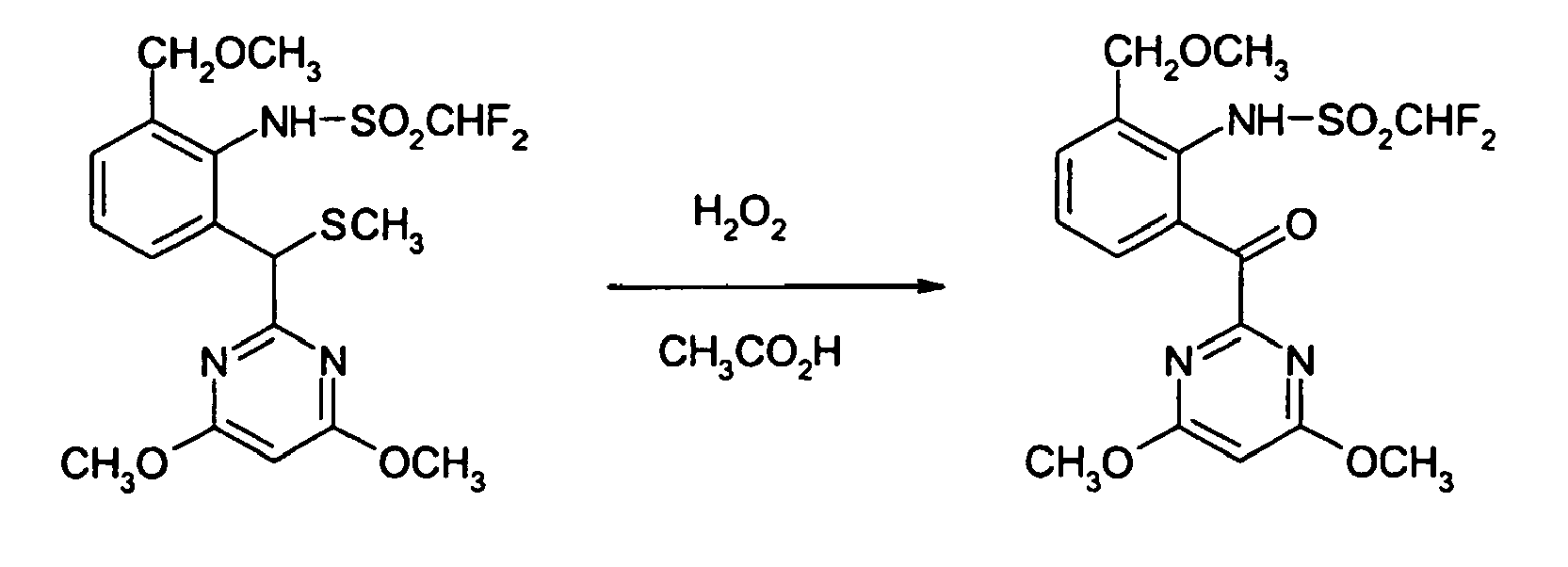
- The process can be illustrated by the following reaction scheme in case that, for example, 2-[1-(4,6-dimethoxypyrimidin-2-yl)-1-methylthiomethyl]-6-methoxymethyl-N-difluoro-methanesulfonanilide, hydrogen peroxide and acetic acid are used as the starting materials in the preparation process of the present invention:
- The compounds of the formula (II), or salts thereof, used as the starting materials are new compounds that are not described in the existing literature yet.
- The compound of formula (II), in case that n represents 0 and R represents a hydrogen atom in the formula (II), namely, 2-[(4,6-dimethoxypyrimidinyl)-methylthiomethyl]-6-methoxymethylaniline represented by the formula (IIa),

WO 96/41799 WO 96/41799 - The compound of formula (II) or a salt thereof, in case that n represents 0 and R represents difluoromethanesulfonyl in the aforementioned formula (II), namely, the compound represented by the following formula (IIb),

2000-44546 - The compounds of the formula (II) or their salts, in case that n represents 1 and R represents a hydrogen atom or difluoromethanesulfonyl in the aforementioned formula (II), namely, the compounds represented by the following formula (IIc),

- wherein R has the same definition as aforementioned,
- Hydrogen peroxide, used in the process, according to the the present invention, is a well known compound in the field of organic chemistry and it is preferable to use, for example, aqueous hydrogen peroxide. It is preferable to use hydrogen peroxide in the range of generally about 1 to about 5 moles, particularly about 1 to about 3 moles to 1 mole of the compounds of the aforementioned formula (II). For instance it is possible to use aqueous hydrogen peroxide having a content of 30 to 35 percent by weight hydrogen peroxide in aqueous solution. It is also possible to use aqueous hydrogen peroxide having a different water content, i. e. aqueous hydrogen peroxide having from 3% to 30% by weight hydrogen peroxide in aqueous solution. It is further possible to use aqueous hydrogen peroxide with a higher content of hydrogen peroxide. In principle 100% hydrogen peroxide can be used for introducing the reagent hydrogen peroxide into the reaction. For practical purposes, preferably commercially available aqueous hydrogen peroxide having a content of 30-35% by weight of hydrogen peroxide can be used.
- Acetic acid can be used in large excess and can play a role of a solvent at the same time in the process. Acetic acid can be introduced in the form of substantially anhydrous acetic acid (100 % acetic acid). It is also possible to use aqueous acetic acid having various content of water. Since hydrogen peroxide can be used as aqueous hydrogen peroxide the solvent will in such a case have some content of water even if 100 % acetic acid has been introduced. The possible content of water depends on the solvent property desired. So it is possible to use glacial acetic acid (96 to 99,5 % aqueous acetic acid) or technical acetic acid (30 - 50 % aqueous acetic acid) or even more diluted aquous acetic acid.
- While it is preferred to use the reagents described above without additional solvent (except some water) it is possible also to use some additional solvent if desired. Possible solvents are those which do not easily react with hydrogen peroxide. For example solvents such as halogenated aliphatic hydrocarbons such as dichloromethane or aliphatic alcohols such as ethanol can be used.
- The reaction in the process, according to the present invention can be conducted at temperatures in the range of generally about 15°C to about 120°C, preferably about 15°C to about 100°C. Though the reaction time depends upon the reaction temperature used, it can be usually about 1 to about 96 hours, preferably about 1 to about 48 hours. And though said reaction can be conducted usually under normal pressure, it can be conducted optionally also under elevated pressure or under reduced pressure.
- According to a preferred embodiment of the preparation process of the present invention, an objective compound of the formula (I) can be obtained by reacting about 1 to about 2.5 moles of aqueous hydrogen peroxide to 1 mole of a compound of the formula (II) in acetic acid at room temperature for about 1 to about 20 hours and further at about 40 to about 100°C for about 1 to about 10 hours.
- The compounds of the formula (I) and (II) can form salts by addition of a suitable inorganic or organic acid such as, for example, HCl, HBr, H2SO4 or HNO3, or a mono- or bifunctional carboxylic acid or sulfonic acid, to the basic group such as, for example, amino or substituted amino, respectively, forming corresponding ammonium salts. The salts are formally ammonium salts of compounds (I) or (II) with acids, for example hydrohalic acids, such as hydrochloric acid or hydrobromic acid, furthermore phosphoric acid, nitric acid, sulfuric acid, mono- or bifunctional carboxylic acids and hydroxycarboxylic acids, such as acetic acid, oxalic acid, maleic acid, succinic acid, fumaric acid, tartaric acid, citric acid, salicylic acid, sorbic acid or lactic acid, and also sulfonic acids, such as p-toluenesulfonic acid and 1,5-naphthalenedisulfonic acid.
The acid addition compounds of the formula (I) or (II) can be obtained in a simple manner by the customary methods for forming salts, for example by dissolving a compound of the formula (I) in a suitable organic solvent, such as, for example, methanol, acetone, methylene chloride or benzene, and adding the acid at temperatures from 0 to 100°C. Salts and mixed salts of formula (I) can be formed in the course of the reaction according to the invention, especially if salts of compounds of formula (II) have been used as starting material. Salts can be can be isolated in a known manner, for example by filtration, and, if appropriate, purified by washing with an inert organic solvent. - In an preferred embodiment, the reaction is carried out by using compounds of formula (II) and isolating compounds of formula (I) in the form of their free amino compound (R = hydrogen) or the sulfamide (R = difluoromethanesulfonyl).
- The work-up of the reaction mixture can be performed analogously to known methods, such as dilution with water followed by extraction with an organic solvent. Further purification methods can be followed such as chromatographic methods, distillation under reduced pressure or crystallization, optionally via a salt.
- Further specific examples of the preparation of the compounds of the present invention will be shown by the following examples. The present invention, however, should not be restricted only to them in any way. In the examples ratios of solvents are volume by volume; other ratios are by weight if not otherwise specifically defined. Glacial acetic acid was used as acetic acid having 99 % by weight acetic acid.
-

- 2-[(4,6-Dimethoxypyrimidin-2-yl)methylthiomethyl]-6-methoxymethylaniline (0.240g) was diluted with glacial acetic acid (2 ml) and 30 to 35 % aqueous hydrogen peroxide (0.080 ml) was added thereto at room temperature. The mixture was stirred at room temperature for 16 hours and then stirred at 40 to 50°C for further 5 hours. The reaction solution was brought back to room temperature, diluted with water and then ethyl acetate and a small amount of sodium sulfite were added. The organic layer was separated and dried with anhydrous magnesium sulfate. After distilling off ethyl acetate under reduced pressure, the obtained crude product was purified by silica gel column chromatography using 1:5 mixed solvent of ethyl acetate and hexane as eluent to obtain 2-[(4,6-dimethoxypyrimidin-2-yl)carbonyl]-6-methoxymethylaniline (0.178 g, yield 82 %);
1H NMR (CDCl3, 300MHz) δ [ppm] = 3.34 (3H, s), 3.96 (6H, s), 4.55 (2H, s), 6.11 (1H, s), 6.53 (1H, t), 7.13 (2H), 7.24 (1H, d), 7.37 (1H, d). -

- 2-[1-(4,6-Dimethoxypyrimidin-2-yl)-1-methylthiomethyl]-6-methoxymethyl-N-difluoromethanesulfonanilide (0.15 g, 0.33 mmol) was diluted with glacial acetic acid (3 ml) and 30-35 % aqueous hydrogen peroxide (0.032 ml) was added thereto at room temperature. The mixture was stirred at room temperature for 16 hours and then stirred at 80°C for further 3 hours.
The reaction solution was brought back to room temperature, diluted with water and then extracted three times with ethyl acetate. The organic layer was washed with water and dried. After distilling off ethyl acetate under reduced pressure, the obtained oily substance was purified by column chromatography using 1:2 mixed solvent of ethyl acetate and hexane as eluent to obtain 2-[(4,6-dimethoxypyrimidin-2-yl)carbonyl]-6-methoxymethyl-N-difluoromethanesulfonanilide (0.1 g, yield 83 %).
1H NMR (CDCl3, 300MHz) δ [ppm] = 3.44 (1H,s), 3.93 (6H,s), 4.74 (2H,s), 6.08-6.43 (1H, t), 6.18 (1H, s), 7.38-7.43 (1H, t, J = 9 Hz), 7.62-7.65 (1H, dd, J = 9 Hz, 3 Hz), 7.71-7.74 (1H, dd, J = 9 Hz, 3 Hz) -

- 2-Methoxymethylaniline (0.68 g, 4.96 mmol) was dissolved in dichloromethane (50 ml) and the solution was cooled to -70°C. To the cooled solution a solution of tert-butyl hypochlorite (0.54 g, 4.96 mmol) in dichloromethane (1 ml) was added dropwise and the solution was stirred at -70°C for 10 minutes. To the obtained reaction solution a solution of 2-methylthiomethyl-4,6-dimethoxypyrimidine (0.893 g, 4.46 mmol) in dichloromethane (5 ml) was added dropwise and the solution was stirred at -70°C for 30 minutes. To the obtained reaction solution a 28 % methanol solution of sodium methoxide (4 ml) was added and the solution was stirred until its temperature reached room temperature. Water was added to the reaction solution and the organic layer was separated. The water layer was further extracted twice with dichloromethane. The organic layer was washed with water and dried. Then dichloromethane was distilled off under reduced pressure and the obtained oily substance was purified by column chromatography using 1:6 mixed solvent of ethyl acetate and hexane as eluent to obtain 2-[(4,6-dimethoxypyrimidin-2-yl)-methylthiomethyl]-6-methoxymethylaniline (0.88 g, yield 53 %) as oily substance;
1H NMR (300 MHz, CDCl3) δ [ppm] = 2.03 (3H, s), 3.33 (3H, s), 3.92 (6H, s), 4.48 (3H, s), 5.08 (1H, br), 5.16 (1H, s), 5.89 (1H, s), 6.66-6.73 (1H, m), 6.99-7.02 (1H, m), 7.47-7.50 (1H, m). -
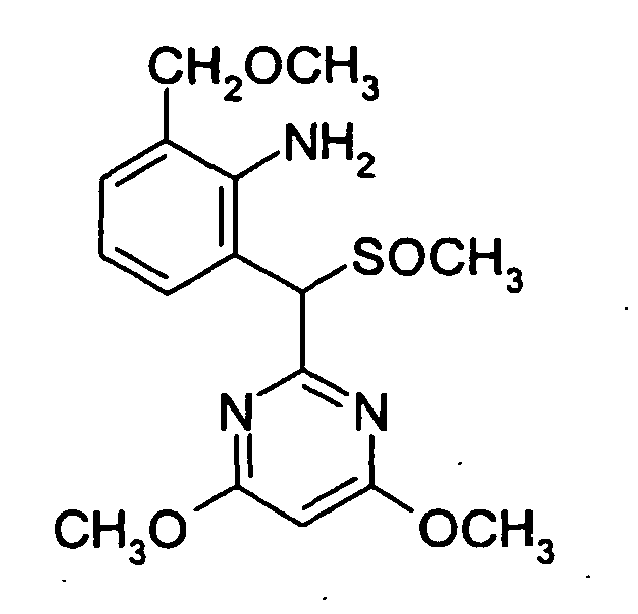
- To a solution of 2-methoxymethyl-6-[1-(4,6-dimethoxypyrimidin-2-yl)-1-(methylthio)methyl]-aniline (230 mg) in glacial acetic acid (2 ml) 30 to 35 % aqueous hydrogen peroxide (71 mg) was added at room temperature while stirring and the reaction solution was stirred at room temperature for 1 hour.
- After diluting the reaction solution with water it was extracted three times with ethyl acetate. The organic layer was washed with water and dried. Then ethyl acetate was distilled off under reduced pressure and the obtained oily substance was purified by column chromatography using 8:1 mixed solvent of methylene chloride and acetone as eluent to obtain 2-methoxymethyl-6-[1-(4,6-dimethoxypyrimidin-2-yl)-1-(methylsulfinyl)methyl]-aniline (200 mg, yield 82 %);
1H NMR (CDCl3, 300MHz) δ [ppm] = 2.55 (3H,s), 3.35 (3H,s), 3.95 (6H,s), 4.50 (2H), 5.1-5.3 (3H), 5.47 (1H,s), 5.96 (1H,s), 6.68 (1H,t), 7.14 (1H,d), 7.25(1H,d). -

- 2-[(4,6-Dimethoxypyrimidin-2-yl)methylthiomethyl]-6-methoxymethylaniline (0.36 g, 1.07 mmol) was dissolved in dichloromethane (2 ml) and pyridine (0.10 g, 1.29 mmol) was added thereto. The solution was cooled to -5°C and a solution of difluoromethanesulfonyl chloride (0.19 g, 1.29 mmol) in dichloromethane (1 ml) was added thereto. The reaction solution was stirred at room temperature for 4 days. Then water was added thereto and the mixture was extracted three times with dichloromethane.
The organic layer was washed with water and dried. Then dichloromethane was distilled off under reduced pressure and the obtained oily substance was purified by column chromatography using 1:6 mixed solvent of ethyl acetate and hexane as eluent to obtain 2-[(4,6-dimethoxypyrimidin-2-yl)-methylthiomethyl]-6-methoxymethyl-N-difluoromethanesulfonanilide (0.25 g, yield 52 %) as crystals;
1H NMR (300MHz, CDCl3) δ [ppm] = 2.04 (3H, s), 3.40 (3H, s), 3.94 (6H, s), 4.58 (1H, d, J = 12 Hz), 4.71 (1H, d, J = 12 Hz), 5.70 (1H, s), 5.89 (1H, s), 6.70 (1H, t), 7.35-7.46 (2H, m), 8.02-8.05 (1H, m). -

- To a solution of 2-[1-(4,6-dimethoxypyrimidin-2-yl)-1-methylthio]-6-methoxymethyl-N-difluoromethanesulfonanilide (0.50 g, 1.11 mmol) in glacial acetic acid (8 ml), 30 to 35 % aqueous hydrogen peroxide (0.14 g, 1.34 mmol)) was added at room temperature while stirring. The reaction solution was stirred at room temperature for 1.5 hours. The reaction solution was diluted with water and then extracted three times with ethyl acetate. The organic layer was washed with water and dried. After distilling off ethyl acetate under reduced pressure, the obtained oily substance was purified by column chromatography using 2:1 mixed solvent of ethyl acetate and hexane as eluent to obtain 2-[(4,6-dimethoxypyrimidin-2-yl)-1-methylsulfinylmethyl]-6-methoxymethyl-N-difluoromethanesulfonanilide (0.51 g, yield 98 %);
1H NMR (CDCl3, 300 MHz), 2.44 (1.2H,s), 2.74 (1.8H,s), 3.40 (3H,s), 3.91 (2.4H,s), 3.93 (3.6H,s), 4.62-4.76 (2H,m), 5.93 (0.6H,s), 6.02 (0.6H,s), 6.03 (0.4H,s), 6.33 (0.4H,s), 6.60 (0.6H,t), 6.71 (0.4H,t), 7.33-7.60 (3H,m);
the above-mentioned compound obtained was estimated from NMR as about 3:2 mixture of diastereomers.
Claims (12)
- A process for the preparation of a compound of the formula (I) or a salt thereof,
 R is a hydrogen atom or is difluoromethanesulfonyl,characterized in that a compound of the formula (II) or a salt thereof,
 wherein R is defined as in formula (I), and n is 0 or 1,is reacted in the presence of hydrogen peroxide and acetic acid.
 - A process according to claim 1, characterized in that R is hydrogen.
- A process according to claim 1, characterized in that R is difluoromethanesulfonyl.
- A process according to any one of claims 1 to 3, characterized in that aqueous hydrogen peroxide is used.
- A process according to any one of claims 1 to 4, characterized in that compound of formula (II) is in aqueous acetic acid having a content of 96 to 99,5 % acetic acid.
- A process according to any one of claims 1 to 5, characterized in that 1 to about 5 moles of hydrogen peroxide to 1 mole of a compound of the formula (II) is used.
- A process according to any one of claims 1 to 6, characterized in that the reaction in the process is conducted at temperatures in the range of 15°C to 120°C.
- A compound of the formula (II) or a salt thereof,

R represents a hydrogen atom or difluoromethanesulfonyl, and n represents 0 or 1. - A compound as claimed in claim 8, characterized in thatR is a hydrogen atom and n is zero.
- A compound as claimed in claim 8, characterized in thatR is a hydrogen atom and n is 1.
- A compound as claimed in claim 8, characterized in thatR is a difluoromethanesulfonyl and n is zero.
- A compound as claimed in claim 8, characterized in thatR is a difluoromethanesulfonyl and n is one.
Applications Claiming Priority (2)
| Application Number | Priority Date | Filing Date | Title |
|---|---|---|---|
| JP2004317222A JP2006124347A (en) | 2004-10-29 | 2004-10-29 | New method for producing phenyl 2-pyrimidinyl ketones and new intermediate therefor |
| PCT/EP2005/011531 WO2006045612A1 (en) | 2004-10-29 | 2005-10-28 | Process for the preparation of phenyl 2-pyrimidinyl ketones and their novel intermediates |
Publications (2)
| Publication Number | Publication Date |
|---|---|
| EP1807401A1 EP1807401A1 (en) | 2007-07-18 |
| EP1807401B1 true EP1807401B1 (en) | 2010-07-07 |
Family
ID=35447955
Family Applications (1)
| Application Number | Title | Priority Date | Filing Date |
|---|---|---|---|
| EP05806519A Expired - Lifetime EP1807401B1 (en) | 2004-10-29 | 2005-10-28 | Process for the preparation of phenyl 2-pyrimidinyl ketones and their novel intermediates |
Country Status (12)
| Country | Link |
|---|---|
| US (1) | US7772395B2 (en) |
| EP (1) | EP1807401B1 (en) |
| JP (2) | JP2006124347A (en) |
| KR (1) | KR101318092B1 (en) |
| CN (1) | CN101048387B (en) |
| AT (1) | ATE473213T1 (en) |
| BR (1) | BRPI0517388B1 (en) |
| DE (1) | DE602005022213D1 (en) |
| DK (1) | DK1807401T3 (en) |
| IL (1) | IL182557A0 (en) |
| MX (1) | MX2007005171A (en) |
| WO (1) | WO2006045612A1 (en) |
Families Citing this family (3)
| Publication number | Priority date | Publication date | Assignee | Title |
|---|---|---|---|---|
| US7700076B2 (en) * | 2002-10-25 | 2010-04-20 | Foamix, Ltd. | Penetrating pharmaceutical foam |
| AT515384B1 (en) * | 2014-02-05 | 2016-04-15 | Dietmar Dr Sonnleitner | Preconnected multilayer film for covering a bone defect site |
| AT515117B1 (en) * | 2014-04-15 | 2015-06-15 | Dietmar Dr Sonnleitner | Dental implant system |
Family Cites Families (4)
| Publication number | Priority date | Publication date | Assignee | Title |
|---|---|---|---|---|
| DE19521355A1 (en) * | 1995-06-12 | 1996-12-19 | Hoechst Schering Agrevo Gmbh | Sulfonamides, processes for their preparation and their use as herbicides and plant growth regulators |
| JP3632947B2 (en) * | 1998-07-29 | 2005-03-30 | クミアイ化学工業株式会社 | Difluoromethanesulfonylanilide derivative, process for producing the same, and herbicide containing the same as an active ingredient |
| UA56338C2 (en) * | 1998-07-29 | 2003-05-15 | Іхара Кемікал Індастрі Ко., Лтд. | Derivatives of di-or trifluorinesulfonilanilide, a method for preparing thereof and herbicides containing the mentioned derivatives as active ingredients |
| IL155486A (en) * | 2000-10-17 | 2009-09-22 | Ihara Chemical Ind Co | Process for producing substituted aniline compound |
-
2004
- 2004-10-29 JP JP2004317222A patent/JP2006124347A/en active Pending
-
2005
- 2005-10-28 EP EP05806519A patent/EP1807401B1/en not_active Expired - Lifetime
- 2005-10-28 US US11/666,496 patent/US7772395B2/en active Active
- 2005-10-28 KR KR1020077009735A patent/KR101318092B1/en not_active Expired - Lifetime
- 2005-10-28 AT AT05806519T patent/ATE473213T1/en not_active IP Right Cessation
- 2005-10-28 DK DK05806519.4T patent/DK1807401T3/en active
- 2005-10-28 CN CN2005800373256A patent/CN101048387B/en not_active Expired - Lifetime
- 2005-10-28 DE DE602005022213T patent/DE602005022213D1/en not_active Expired - Lifetime
- 2005-10-28 BR BRPI0517388-4B1A patent/BRPI0517388B1/en active IP Right Grant
- 2005-10-28 JP JP2007538335A patent/JP4879907B2/en not_active Expired - Lifetime
- 2005-10-28 WO PCT/EP2005/011531 patent/WO2006045612A1/en not_active Ceased
- 2005-10-28 MX MX2007005171A patent/MX2007005171A/en unknown
-
2007
- 2007-04-15 IL IL182557A patent/IL182557A0/en unknown
Also Published As
| Publication number | Publication date |
|---|---|
| CN101048387B (en) | 2010-05-05 |
| JP4879907B2 (en) | 2012-02-22 |
| JP2008517967A (en) | 2008-05-29 |
| US20080004444A1 (en) | 2008-01-03 |
| WO2006045612A1 (en) | 2006-05-04 |
| DK1807401T3 (en) | 2010-10-18 |
| BRPI0517388B1 (en) | 2013-12-24 |
| EP1807401A1 (en) | 2007-07-18 |
| US7772395B2 (en) | 2010-08-10 |
| IL182557A0 (en) | 2007-09-20 |
| ATE473213T1 (en) | 2010-07-15 |
| BRPI0517388A (en) | 2008-10-07 |
| DE602005022213D1 (en) | 2010-08-19 |
| MX2007005171A (en) | 2007-06-22 |
| KR20070070200A (en) | 2007-07-03 |
| JP2006124347A (en) | 2006-05-18 |
| CN101048387A (en) | 2007-10-03 |
| KR101318092B1 (en) | 2013-10-14 |
Similar Documents
| Publication | Publication Date | Title |
|---|---|---|
| CA2735921C (en) | Process for the synthesis of halogenated cyclic compounds | |
| AU4928999A (en) | Di- or tri-fluoromethanesulfonyl anilide derivatives, process for the preparation of them and herbicides containing them as the active ingredient | |
| CN102001979B (en) | Preparation method of 2-(2', 2'-difluoroethoxyl)-6-trifluoromethyl phenyl propyl sulfide | |
| EP1807401B1 (en) | Process for the preparation of phenyl 2-pyrimidinyl ketones and their novel intermediates | |
| KR101728443B1 (en) | Method for Producing Benzyl Ester 2-aminonicotinicotinate Derivative | |
| KR100574350B1 (en) | Method for preparing 2-aminopyridine derivative | |
| US6462195B1 (en) | Methods for highly selectively o-alkylating amide compounds with the use of copper salts | |
| WO2013037291A1 (en) | Process for the preparation of n-substituted pyrazole compounds | |
| EP1375485B1 (en) | Method for preparing 7-quinolinyl-3,5-dihydroxyhept-6-enoate | |
| JPS5840939B2 (en) | Method for producing cyclohexanedione derivatives | |
| JP3918468B2 (en) | 3,3-bis (alkoxycarbonyl-methylthio) propionitrile and process for producing the same | |
| KR20230155447A (en) | Method for producing 3-bromo-1-(3-chloropyridin-2-yl)-1H-pyrazole-5-carboxylic acid ester | |
| JPS6377844A (en) | Production of p-bromoanilines | |
| JP2007070270A (en) | Method for producing 3-aminomethyloxetane compound | |
| MX2008010140A (en) | Improved method for producing nitroisourea derivative | |
| JP2004244398A (en) | Preparation of benzylisonitrile | |
| JP2000053645A (en) | Production of hydrazine derivative, intermediate thereof and production the same | |
| HUP0003616A2 (en) | Process for the production of di-2-pyridyl ketone | |
| JPH0610198B2 (en) | Process for producing 4-acylaminopyridines | |
| JPH023630A (en) | 2,6-diethyl-4-iodoaniline and production thereof | |
| JPH06239791A (en) | Production of quinone derivative and intermediate therefor | |
| JPH05294931A (en) | Production of new intermediate and 2-chloro-5-@(3754/24)aminomethyl)pyridine | |
| JPH08143536A (en) | Substituted benzenecarboxylic acid derivative and its production | |
| JP2003183212A (en) | Method for producing 1-difluoromethoxy-2-hydroxy-4-substituted benzene | |
| KR20050020162A (en) | Method for the preparation of carboxyl benzotriazole alkyl ester |
Legal Events
| Date | Code | Title | Description |
|---|---|---|---|
| PUAI | Public reference made under article 153(3) epc to a published international application that has entered the european phase |
Free format text: ORIGINAL CODE: 0009012 |
|
| 17P | Request for examination filed |
Effective date: 20070529 |
|
| AK | Designated contracting states |
Kind code of ref document: A1 Designated state(s): AT BE BG CH CY CZ DE DK EE ES FI FR GB GR HU IE IS IT LI LT LU LV MC NL PL PT RO SE SI SK TR |
|
| DAX | Request for extension of the european patent (deleted) | ||
| RIN1 | Information on inventor provided before grant (corrected) |
Inventor name: FORD, MARK, JAMES Inventor name: SATO, YOSHITAKA Inventor name: ARAKI, KOICHI |
|
| GRAP | Despatch of communication of intention to grant a patent |
Free format text: ORIGINAL CODE: EPIDOSNIGR1 |
|
| GRAS | Grant fee paid |
Free format text: ORIGINAL CODE: EPIDOSNIGR3 |
|
| GRAA | (expected) grant |
Free format text: ORIGINAL CODE: 0009210 |
|
| AK | Designated contracting states |
Kind code of ref document: B1 Designated state(s): AT BE BG CH CY CZ DE DK EE ES FI FR GB GR HU IE IS IT LI LT LU LV MC NL PL PT RO SE SI SK TR |
|
| REG | Reference to a national code |
Ref country code: GB Ref legal event code: FG4D |
|
| REG | Reference to a national code |
Ref country code: CH Ref legal event code: EP |
|
| REG | Reference to a national code |
Ref country code: IE Ref legal event code: FG4D |
|
| REF | Corresponds to: |
Ref document number: 602005022213 Country of ref document: DE Date of ref document: 20100819 Kind code of ref document: P |
|
| REG | Reference to a national code |
Ref country code: DK Ref legal event code: T3 |
|
| REG | Reference to a national code |
Ref country code: NL Ref legal event code: T3 |
|
| PG25 | Lapsed in a contracting state [announced via postgrant information from national office to epo] |
Ref country code: SI Free format text: LAPSE BECAUSE OF FAILURE TO SUBMIT A TRANSLATION OF THE DESCRIPTION OR TO PAY THE FEE WITHIN THE PRESCRIBED TIME-LIMIT Effective date: 20100707 |
|
| LTIE | Lt: invalidation of european patent or patent extension |
Effective date: 20100707 |
|
| PG25 | Lapsed in a contracting state [announced via postgrant information from national office to epo] |
Ref country code: AT Free format text: LAPSE BECAUSE OF FAILURE TO SUBMIT A TRANSLATION OF THE DESCRIPTION OR TO PAY THE FEE WITHIN THE PRESCRIBED TIME-LIMIT Effective date: 20100707 Ref country code: LT Free format text: LAPSE BECAUSE OF FAILURE TO SUBMIT A TRANSLATION OF THE DESCRIPTION OR TO PAY THE FEE WITHIN THE PRESCRIBED TIME-LIMIT Effective date: 20100707 |
|
| PG25 | Lapsed in a contracting state [announced via postgrant information from national office to epo] |
Ref country code: PT Free format text: LAPSE BECAUSE OF FAILURE TO SUBMIT A TRANSLATION OF THE DESCRIPTION OR TO PAY THE FEE WITHIN THE PRESCRIBED TIME-LIMIT Effective date: 20101108 Ref country code: PL Free format text: LAPSE BECAUSE OF FAILURE TO SUBMIT A TRANSLATION OF THE DESCRIPTION OR TO PAY THE FEE WITHIN THE PRESCRIBED TIME-LIMIT Effective date: 20100707 Ref country code: CY Free format text: LAPSE BECAUSE OF FAILURE TO SUBMIT A TRANSLATION OF THE DESCRIPTION OR TO PAY THE FEE WITHIN THE PRESCRIBED TIME-LIMIT Effective date: 20100707 Ref country code: BG Free format text: LAPSE BECAUSE OF FAILURE TO SUBMIT A TRANSLATION OF THE DESCRIPTION OR TO PAY THE FEE WITHIN THE PRESCRIBED TIME-LIMIT Effective date: 20101007 Ref country code: IS Free format text: LAPSE BECAUSE OF FAILURE TO SUBMIT A TRANSLATION OF THE DESCRIPTION OR TO PAY THE FEE WITHIN THE PRESCRIBED TIME-LIMIT Effective date: 20101107 |
|
| PG25 | Lapsed in a contracting state [announced via postgrant information from national office to epo] |
Ref country code: LV Free format text: LAPSE BECAUSE OF FAILURE TO SUBMIT A TRANSLATION OF THE DESCRIPTION OR TO PAY THE FEE WITHIN THE PRESCRIBED TIME-LIMIT Effective date: 20100707 Ref country code: BE Free format text: LAPSE BECAUSE OF FAILURE TO SUBMIT A TRANSLATION OF THE DESCRIPTION OR TO PAY THE FEE WITHIN THE PRESCRIBED TIME-LIMIT Effective date: 20100707 Ref country code: GR Free format text: LAPSE BECAUSE OF FAILURE TO SUBMIT A TRANSLATION OF THE DESCRIPTION OR TO PAY THE FEE WITHIN THE PRESCRIBED TIME-LIMIT Effective date: 20101008 Ref country code: SE Free format text: LAPSE BECAUSE OF FAILURE TO SUBMIT A TRANSLATION OF THE DESCRIPTION OR TO PAY THE FEE WITHIN THE PRESCRIBED TIME-LIMIT Effective date: 20100707 |
|
| PLBE | No opposition filed within time limit |
Free format text: ORIGINAL CODE: 0009261 |
|
| STAA | Information on the status of an ep patent application or granted ep patent |
Free format text: STATUS: NO OPPOSITION FILED WITHIN TIME LIMIT |
|
| PG25 | Lapsed in a contracting state [announced via postgrant information from national office to epo] |
Ref country code: RO Free format text: LAPSE BECAUSE OF FAILURE TO SUBMIT A TRANSLATION OF THE DESCRIPTION OR TO PAY THE FEE WITHIN THE PRESCRIBED TIME-LIMIT Effective date: 20100707 Ref country code: EE Free format text: LAPSE BECAUSE OF FAILURE TO SUBMIT A TRANSLATION OF THE DESCRIPTION OR TO PAY THE FEE WITHIN THE PRESCRIBED TIME-LIMIT Effective date: 20100707 Ref country code: MC Free format text: LAPSE BECAUSE OF NON-PAYMENT OF DUE FEES Effective date: 20101031 Ref country code: SK Free format text: LAPSE BECAUSE OF FAILURE TO SUBMIT A TRANSLATION OF THE DESCRIPTION OR TO PAY THE FEE WITHIN THE PRESCRIBED TIME-LIMIT Effective date: 20100707 Ref country code: CZ Free format text: LAPSE BECAUSE OF FAILURE TO SUBMIT A TRANSLATION OF THE DESCRIPTION OR TO PAY THE FEE WITHIN THE PRESCRIBED TIME-LIMIT Effective date: 20100707 |
|
| 26N | No opposition filed |
Effective date: 20110408 |
|
| PG25 | Lapsed in a contracting state [announced via postgrant information from national office to epo] |
Ref country code: ES Free format text: LAPSE BECAUSE OF FAILURE TO SUBMIT A TRANSLATION OF THE DESCRIPTION OR TO PAY THE FEE WITHIN THE PRESCRIBED TIME-LIMIT Effective date: 20101018 |
|
| REG | Reference to a national code |
Ref country code: DE Ref legal event code: R097 Ref document number: 602005022213 Country of ref document: DE Effective date: 20110408 |
|
| PG25 | Lapsed in a contracting state [announced via postgrant information from national office to epo] |
Ref country code: IE Free format text: LAPSE BECAUSE OF NON-PAYMENT OF DUE FEES Effective date: 20101028 |
|
| PG25 | Lapsed in a contracting state [announced via postgrant information from national office to epo] |
Ref country code: LU Free format text: LAPSE BECAUSE OF NON-PAYMENT OF DUE FEES Effective date: 20101028 Ref country code: HU Free format text: LAPSE BECAUSE OF FAILURE TO SUBMIT A TRANSLATION OF THE DESCRIPTION OR TO PAY THE FEE WITHIN THE PRESCRIBED TIME-LIMIT Effective date: 20110108 |
|
| PG25 | Lapsed in a contracting state [announced via postgrant information from national office to epo] |
Ref country code: TR Free format text: LAPSE BECAUSE OF FAILURE TO SUBMIT A TRANSLATION OF THE DESCRIPTION OR TO PAY THE FEE WITHIN THE PRESCRIBED TIME-LIMIT Effective date: 20100707 |
|
| REG | Reference to a national code |
Ref country code: DE Ref legal event code: R081 Ref document number: 602005022213 Country of ref document: DE Owner name: BAYER INTELLECTUAL PROPERTY GMBH, DE Free format text: FORMER OWNER: BAYER CROPSCIENCE AG, 40789 MONHEIM, DE Effective date: 20141023 Ref country code: DE Ref legal event code: R081 Ref document number: 602005022213 Country of ref document: DE Owner name: BAYER CROPSCIENCE AKTIENGESELLSCHAFT, DE Free format text: FORMER OWNER: BAYER CROPSCIENCE AG, 40789 MONHEIM, DE Effective date: 20141023 |
|
| REG | Reference to a national code |
Ref country code: NL Ref legal event code: SD Effective date: 20150513 |
|
| REG | Reference to a national code |
Ref country code: FR Ref legal event code: TP Owner name: BAYER INTELLECTUAL PROPERTY GMBH, DE Effective date: 20150706 |
|
| REG | Reference to a national code |
Ref country code: CH Ref legal event code: PUE Owner name: BAYER INTELLECTUAL PROPERTY GMBH, DE Free format text: FORMER OWNER: BAYER CROPSCIENCE AG, DE |
|
| REG | Reference to a national code |
Ref country code: GB Ref legal event code: 732E Free format text: REGISTERED BETWEEN 20160107 AND 20160113 |
|
| REG | Reference to a national code |
Ref country code: FR Ref legal event code: PLFP Year of fee payment: 12 |
|
| REG | Reference to a national code |
Ref country code: FR Ref legal event code: PLFP Year of fee payment: 13 |
|
| REG | Reference to a national code |
Ref country code: DE Ref legal event code: R081 Ref document number: 602005022213 Country of ref document: DE Owner name: BAYER CROPSCIENCE AKTIENGESELLSCHAFT, DE Free format text: FORMER OWNER: BAYER INTELLECTUAL PROPERTY GMBH, 40789 MONHEIM, DE |
|
| REG | Reference to a national code |
Ref country code: FR Ref legal event code: PLFP Year of fee payment: 14 |
|
| REG | Reference to a national code |
Ref country code: NL Ref legal event code: PD Owner name: BAYER CROPSCIENCE AKTIENGESELLSCHAFT; DE Free format text: DETAILS ASSIGNMENT: CHANGE OF OWNER(S), ASSIGNMENT; FORMER OWNER NAME: BAYER INTELLECTUAL PROPERTY GMBH Effective date: 20230630 |
|
| REG | Reference to a national code |
Ref country code: GB Ref legal event code: 732E Free format text: REGISTERED BETWEEN 20230907 AND 20230913 |
|
| REG | Reference to a national code |
Ref country code: FI Ref legal event code: PCE Owner name: BAYER CROPSCIENCE AKTIENGESELLSCHAFT |
|
| PGFP | Annual fee paid to national office [announced via postgrant information from national office to epo] |
Ref country code: GB Payment date: 20240919 Year of fee payment: 20 |
|
| PGFP | Annual fee paid to national office [announced via postgrant information from national office to epo] |
Ref country code: FR Payment date: 20240923 Year of fee payment: 20 |
|
| PGFP | Annual fee paid to national office [announced via postgrant information from national office to epo] |
Ref country code: NL Payment date: 20240926 Year of fee payment: 20 |
|
| PGFP | Annual fee paid to national office [announced via postgrant information from national office to epo] |
Ref country code: IT Payment date: 20240926 Year of fee payment: 20 |
|
| PGFP | Annual fee paid to national office [announced via postgrant information from national office to epo] |
Ref country code: DE Payment date: 20240925 Year of fee payment: 20 |
|
| PGFP | Annual fee paid to national office [announced via postgrant information from national office to epo] |
Ref country code: DK Payment date: 20241011 Year of fee payment: 20 |
|
| PGFP | Annual fee paid to national office [announced via postgrant information from national office to epo] |
Ref country code: FI Payment date: 20241015 Year of fee payment: 20 |
|
| PGFP | Annual fee paid to national office [announced via postgrant information from national office to epo] |
Ref country code: CH Payment date: 20241101 Year of fee payment: 20 |
|
| REG | Reference to a national code |
Ref country code: CH Ref legal event code: H14 Free format text: ST27 STATUS EVENT CODE: U-0-0-H10-H14 (AS PROVIDED BY THE NATIONAL OFFICE) Effective date: 20251028 Ref country code: DE Ref legal event code: R071 Ref document number: 602005022213 Country of ref document: DE |
|
| REG | Reference to a national code |
Ref country code: NL Ref legal event code: MK Effective date: 20251027 |
|
| REG | Reference to a national code |
Ref country code: DK Ref legal event code: EUP Expiry date: 20251028 |
|
| REG | Reference to a national code |
Ref country code: GB Ref legal event code: PE20 Expiry date: 20251027 |