EP1807200B1 - Platinum alloy catalyst - Google Patents
Platinum alloy catalyst Download PDFInfo
- Publication number
- EP1807200B1 EP1807200B1 EP05763108A EP05763108A EP1807200B1 EP 1807200 B1 EP1807200 B1 EP 1807200B1 EP 05763108 A EP05763108 A EP 05763108A EP 05763108 A EP05763108 A EP 05763108A EP 1807200 B1 EP1807200 B1 EP 1807200B1
- Authority
- EP
- European Patent Office
- Prior art keywords
- catalyst
- alloy
- catalyst according
- amount
- ptaux
- Prior art date
- Legal status (The legal status is an assumption and is not a legal conclusion. Google has not performed a legal analysis and makes no representation as to the accuracy of the status listed.)
- Ceased
Links
Images

Classifications
-
- B—PERFORMING OPERATIONS; TRANSPORTING
- B01—PHYSICAL OR CHEMICAL PROCESSES OR APPARATUS IN GENERAL
- B01J—CHEMICAL OR PHYSICAL PROCESSES, e.g. CATALYSIS OR COLLOID CHEMISTRY; THEIR RELEVANT APPARATUS
- B01J37/00—Processes, in general, for preparing catalysts; Processes, in general, for activation of catalysts
- B01J37/34—Irradiation by, or application of, electric, magnetic or wave energy, e.g. ultrasonic waves ; Ionic sputtering; Flame or plasma spraying; Particle radiation
- B01J37/341—Irradiation by, or application of, electric, magnetic or wave energy, e.g. ultrasonic waves ; Ionic sputtering; Flame or plasma spraying; Particle radiation making use of electric or magnetic fields, wave energy or particle radiation
- B01J37/347—Ionic or cathodic spraying; Electric discharge
-
- B—PERFORMING OPERATIONS; TRANSPORTING
- B01—PHYSICAL OR CHEMICAL PROCESSES OR APPARATUS IN GENERAL
- B01J—CHEMICAL OR PHYSICAL PROCESSES, e.g. CATALYSIS OR COLLOID CHEMISTRY; THEIR RELEVANT APPARATUS
- B01J23/00—Catalysts comprising metals or metal oxides or hydroxides, not provided for in group B01J21/00
- B01J23/38—Catalysts comprising metals or metal oxides or hydroxides, not provided for in group B01J21/00 of noble metals
- B01J23/54—Catalysts comprising metals or metal oxides or hydroxides, not provided for in group B01J21/00 of noble metals combined with metals, oxides or hydroxides provided for in groups B01J23/02 - B01J23/36
- B01J23/56—Platinum group metals
- B01J23/64—Platinum group metals with arsenic, antimony, bismuth, vanadium, niobium, tantalum, polonium, chromium, molybdenum, tungsten, manganese, technetium or rhenium
- B01J23/652—Chromium, molybdenum or tungsten
-
- B—PERFORMING OPERATIONS; TRANSPORTING
- B01—PHYSICAL OR CHEMICAL PROCESSES OR APPARATUS IN GENERAL
- B01J—CHEMICAL OR PHYSICAL PROCESSES, e.g. CATALYSIS OR COLLOID CHEMISTRY; THEIR RELEVANT APPARATUS
- B01J23/00—Catalysts comprising metals or metal oxides or hydroxides, not provided for in group B01J21/00
- B01J23/38—Catalysts comprising metals or metal oxides or hydroxides, not provided for in group B01J21/00 of noble metals
- B01J23/40—Catalysts comprising metals or metal oxides or hydroxides, not provided for in group B01J21/00 of noble metals of the platinum group metals
- B01J23/42—Platinum
-
- B—PERFORMING OPERATIONS; TRANSPORTING
- B01—PHYSICAL OR CHEMICAL PROCESSES OR APPARATUS IN GENERAL
- B01J—CHEMICAL OR PHYSICAL PROCESSES, e.g. CATALYSIS OR COLLOID CHEMISTRY; THEIR RELEVANT APPARATUS
- B01J23/00—Catalysts comprising metals or metal oxides or hydroxides, not provided for in group B01J21/00
- B01J23/38—Catalysts comprising metals or metal oxides or hydroxides, not provided for in group B01J21/00 of noble metals
- B01J23/48—Silver or gold
- B01J23/52—Gold
-
- B—PERFORMING OPERATIONS; TRANSPORTING
- B01—PHYSICAL OR CHEMICAL PROCESSES OR APPARATUS IN GENERAL
- B01J—CHEMICAL OR PHYSICAL PROCESSES, e.g. CATALYSIS OR COLLOID CHEMISTRY; THEIR RELEVANT APPARATUS
- B01J23/00—Catalysts comprising metals or metal oxides or hydroxides, not provided for in group B01J21/00
- B01J23/38—Catalysts comprising metals or metal oxides or hydroxides, not provided for in group B01J21/00 of noble metals
- B01J23/54—Catalysts comprising metals or metal oxides or hydroxides, not provided for in group B01J21/00 of noble metals combined with metals, oxides or hydroxides provided for in groups B01J23/02 - B01J23/36
- B01J23/66—Silver or gold
- B01J23/68—Silver or gold with arsenic, antimony, bismuth, vanadium, niobium, tantalum, polonium, chromium, molybdenum, tungsten, manganese, technetium or rhenium
- B01J23/683—Silver or gold with arsenic, antimony, bismuth, vanadium, niobium, tantalum, polonium, chromium, molybdenum, tungsten, manganese, technetium or rhenium with chromium, molybdenum or tungsten
- B01J23/685—Silver or gold with arsenic, antimony, bismuth, vanadium, niobium, tantalum, polonium, chromium, molybdenum, tungsten, manganese, technetium or rhenium with chromium, molybdenum or tungsten with chromium
-
- C—CHEMISTRY; METALLURGY
- C22—METALLURGY; FERROUS OR NON-FERROUS ALLOYS; TREATMENT OF ALLOYS OR NON-FERROUS METALS
- C22C—ALLOYS
- C22C30/00—Alloys containing less than 50% by weight of each constituent
-
- C—CHEMISTRY; METALLURGY
- C22—METALLURGY; FERROUS OR NON-FERROUS ALLOYS; TREATMENT OF ALLOYS OR NON-FERROUS METALS
- C22C—ALLOYS
- C22C5/00—Alloys based on noble metals
- C22C5/04—Alloys based on a platinum group metal
-
- H—ELECTRICITY
- H01—ELECTRIC ELEMENTS
- H01M—PROCESSES OR MEANS, e.g. BATTERIES, FOR THE DIRECT CONVERSION OF CHEMICAL ENERGY INTO ELECTRICAL ENERGY
- H01M4/00—Electrodes
- H01M4/86—Inert electrodes with catalytic activity, e.g. for fuel cells
- H01M4/90—Selection of catalytic material
- H01M4/92—Metals of platinum group
- H01M4/921—Alloys or mixtures with metallic elements
-
- H—ELECTRICITY
- H01—ELECTRIC ELEMENTS
- H01M—PROCESSES OR MEANS, e.g. BATTERIES, FOR THE DIRECT CONVERSION OF CHEMICAL ENERGY INTO ELECTRICAL ENERGY
- H01M4/00—Electrodes
- H01M4/86—Inert electrodes with catalytic activity, e.g. for fuel cells
- H01M4/90—Selection of catalytic material
- H01M4/92—Metals of platinum group
- H01M4/925—Metals of platinum group supported on carriers, e.g. powder carriers
- H01M4/926—Metals of platinum group supported on carriers, e.g. powder carriers on carbon or graphite
-
- B—PERFORMING OPERATIONS; TRANSPORTING
- B01—PHYSICAL OR CHEMICAL PROCESSES OR APPARATUS IN GENERAL
- B01J—CHEMICAL OR PHYSICAL PROCESSES, e.g. CATALYSIS OR COLLOID CHEMISTRY; THEIR RELEVANT APPARATUS
- B01J23/00—Catalysts comprising metals or metal oxides or hydroxides, not provided for in group B01J21/00
- B01J23/38—Catalysts comprising metals or metal oxides or hydroxides, not provided for in group B01J21/00 of noble metals
- B01J23/54—Catalysts comprising metals or metal oxides or hydroxides, not provided for in group B01J21/00 of noble metals combined with metals, oxides or hydroxides provided for in groups B01J23/02 - B01J23/36
- B01J23/56—Platinum group metals
- B01J23/64—Platinum group metals with arsenic, antimony, bismuth, vanadium, niobium, tantalum, polonium, chromium, molybdenum, tungsten, manganese, technetium or rhenium
- B01J23/652—Chromium, molybdenum or tungsten
- B01J23/6522—Chromium
-
- H—ELECTRICITY
- H01—ELECTRIC ELEMENTS
- H01M—PROCESSES OR MEANS, e.g. BATTERIES, FOR THE DIRECT CONVERSION OF CHEMICAL ENERGY INTO ELECTRICAL ENERGY
- H01M8/00—Fuel cells; Manufacture thereof
- H01M8/10—Fuel cells with solid electrolytes
- H01M2008/1095—Fuel cells with polymeric electrolytes
-
- H—ELECTRICITY
- H01—ELECTRIC ELEMENTS
- H01M—PROCESSES OR MEANS, e.g. BATTERIES, FOR THE DIRECT CONVERSION OF CHEMICAL ENERGY INTO ELECTRICAL ENERGY
- H01M8/00—Fuel cells; Manufacture thereof
- H01M8/10—Fuel cells with solid electrolytes
- H01M8/1004—Fuel cells with solid electrolytes characterised by membrane-electrode assemblies [MEA]
-
- Y—GENERAL TAGGING OF NEW TECHNOLOGICAL DEVELOPMENTS; GENERAL TAGGING OF CROSS-SECTIONAL TECHNOLOGIES SPANNING OVER SEVERAL SECTIONS OF THE IPC; TECHNICAL SUBJECTS COVERED BY FORMER USPC CROSS-REFERENCE ART COLLECTIONS [XRACs] AND DIGESTS
- Y02—TECHNOLOGIES OR APPLICATIONS FOR MITIGATION OR ADAPTATION AGAINST CLIMATE CHANGE
- Y02E—REDUCTION OF GREENHOUSE GAS [GHG] EMISSIONS, RELATED TO ENERGY GENERATION, TRANSMISSION OR DISTRIBUTION
- Y02E60/00—Enabling technologies; Technologies with a potential or indirect contribution to GHG emissions mitigation
- Y02E60/30—Hydrogen technology
- Y02E60/50—Fuel cells
Definitions
- the present invention relates to a catalyst comprising a platinum alloy.
- the invention further relates to fuel cell components comprising the catalyst.
- a fuel cell is an electrochemical cell comprising two electrodes separated by an electrolyte.
- a fuel e.g. hydrogen or methanol
- an oxidant e.g. oxygen or air
- Electrochemical reactions occur at the electrodes, and the chemical energy of the fuel and the oxidant is converted to electrical energy and heat.
- Electrocatalysts are used to promote the electrochemical oxidation of the fuel at the anode and the electrochemical reduction of oxygen at the cathode.
- Electrocatalysts for oxygen reduction typically comprise platinum or platinum alloyed with one or more base metals.
- the platinum alloy can be used as a high surface area metal black (an unsupported catalyst) or can be deposited onto a conductive carbon substrate (a supported catalyst).
- EP 450 849 discloses binary and ternary platinum alloy catalysts and their use in fuel cells.
- EP 557 674 discloses fuel cell alloy catalysts comprising platinum, gold, and two or more metals chosen from nickel, cobalt and manganese.
- the amount of nickel, cobalt and/or manganese in the catalysts of EP 557 674 is preferably 23 atomic percent of each metal (if two of the metals are present) or 19 atomic percent of the first and second metals and 8 atomic percent of the third metal (if three of the metals are present). Further catalysts are disclosed in US 5 759 944 and GB1 047 933 .
- Platinum is an expensive metal, so it is desirable to increase the proportion of lower cost metals in the platinum alloy whilst maintaining or improving catalytic activity.
- the present inventors have sought to provide improved platinum alloy catalysts that have higher activity than known catalysts or that have similar activity but lower platinum content.
- the present invention provides a catalyst comprising a PtAuX alloy wherein X is one metal chosen from Cr and Ti, and wherein the alloy contains 40-97% Pt, 1-40% Au and 2-20% X.
- alloys of Pt, Au and X wherein the amounts of the metals are within the stated ranges have surprisingly high activity for the electrochemical reduction of oxygen.
- the % values for the PtAuX alloy are atomic percentages (i.e. they are based on the amounts of Pt, Au and X atoms).
- the PtAuX alloy contains only Pt, Au and X and does not contain any other metals.
- alloy we mean that there is at least some intimate mixing between the Pt, Au and X metals, but the intimate mixing is not necessarily uniform throughout the whole alloy particle.
- X is one metal chosen from Cr and Ti.
- Ternary PtAuX alloys are preferred compared to alloys containing four or five metals because the alloys are easier to prepare.
- the amount of Pt in the PtAuX alloy is 40-97%, preferably 40-90%, most preferably 50-80%.
- the amount of Au in the PtAuX alloy is 1-40%, preferably 5-40%, most preferably 9-40%.
- the amount of X in the PtAuX alloy is 2-20%, preferably 5-17% and most preferably about 10-15%.
- the preferred amount of the metals in the PtAuX alloy balances considerations of cost (favouring less Pt and more Au and X) and catalytic activity (favouring more Pt, less Au and about 10-15% X).
- the amount of X that provides the most active catalysts is considerably lower than the amounts of X in the catalysts disclosed in the examples of EP 557 674 .
- the catalyst of the invention can be used in a fuel cell as an unsupported catalyst (i.e. as a metal black) or as a supported catalyst (i.e. dispersed on a support material).
- a supported catalyst according to the present invention the PtAuX alloy is suitably dispersed on a conductive carbon material.
- the catalyst of the invention preferably consists essentially of the PtAuX alloy dispersed on a conductive carbon material. Suitable carbon support materials include furnace carbon blacks or acetylene blacks.
- the amount of the PtAuX alloy is 5-80wt% based on the total weight of the supported catalyst, preferably 10-60wt%.
- Catalysts according to the invention can be manufactured using known techniques.
- the inventors have manufactured unsupported catalysts using vapour deposition techniques.
- To prepare supported catalysts techniques such as those disclosed in EP 450 849 wherein carbon particles are slurried in an aqueous solution of metal salts, are appropriate.
- the present invention provides an electrode comprising a catalyst according to the invention deposited on an electronically conducting substrate.
- the catalyst can be deposited onto a substrate using well known techniques, such as those disclosed in EP 731 520 .
- the catalyst may be formulated into an ink, comprising an aqueous and/or organic solvent, optional polymeric binders and optional proton-conducting polymer.
- the ink may be deposited onto an electronically conducting substrate using techniques such as spraying, printing and doctor blade methods. Suitable substrates include carbon fibre papers and filled carbon fibre non-woven webs, such as those disclosed in EP 791 974 .
- Electrodes according to the invention are suitably used as the cathodes of fuel cells.
- the fuel cells may be acid electrolyte fuel cells such as PEM fuel cells or phosphoric acid fuel cells, or they may be alkaline electrolyte fuel cells.
- the electrolyte is a polymer electrolyte membrane. Electrocatalysts may be deposited onto one or both faces of the polymer electrolyte membrane to form a catalysed membrane.
- the present invention provides a catalysed membrane comprising a catalyst according to the invention deposited on a polymer electrolyte membrane.
- the catalyst can be deposited onto the membrane using well known techniques.
- the catalyst may be formulated into an ink and either directly deposited onto the membrane or deposited onto a decal blank for subsequent transfer to a membrane. Suitable membranes are well known to those skilled in the art and include perfluorinated sulphonic acid membranes such as Nafion®, Flemion® and Aciplex®.
- the polymer electrolyte membrane is interposed between two catalyst layers, and each catalyst layer is in contact with an electronically conducting substrate.
- This five-layer assembly is known as a membrane electrode assembly.
- the present invention provides a membrane electrode assembly comprising a catalyst according to the invention.
- the membrane electrode assembly may be prepared by a process wherein an electrode according to the invention is combined with a polymer electrolyte membrane.
- the membrane electrode assembly may be prepared by a process wherein a catalysed membrane according to the invention is combined with an electronically conducting substrate.
- the PtAuX catalyst is suitably located in the cathode of the membrane electrode assembly.
- H-PVD high throughput physical deposition method
- compositions of the alloys was obtained by energy dispersive X-ray spectrometry (EDS), and the activity of the alloys to reduce oxygen in HClO 4 electrolyte was measured using a fast high throughput electrochemical methodology. Measurements were made in O 2 saturated solutions in the potential range 0.7-0.9V SHE at 300K.
- a catalyst array was prepared using Pt, Au and Cr.
- the amount of the Pt ranged from 0-100%, the amount of Au ranged from 0-100% and the amount of Cr ranged from 0-100%.
- Figure 1 is a ternary diagram showing the activity of the different catalysts compared to the amounts of Pt, Au and Cr in the catalysts. It is clear from the figure that catalysts in a bottom right hand section of the plot have the best activity.
- the chromium content in the most active catalysts is in a reasonably narrow range centred around 10%, whereas the platinum content varies from around 90% down to 50% or 40% and the gold content varies from around 2% up to about 40%.
- a catalyst array was prepared using Pt, Au and Ti.
- the amount of the Pt ranged from 0-100%
- the amount of Au ranged from 0-100%
- the amount of Cr ranged from 0-100%.
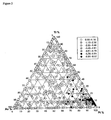
- Figure 2 is a ternary diagram showing the activity of the different catalysts compared to the amounts of Pt, Au and Ti in the catalysts. It is clear from the figure that catalysts in a bottom right hand section of the plot have the best activity.
- the titanium content in the most active catalysts is in a reasonably narrow range centred around 10%, whereas the platinum content varies from around 90% down to 50%, and the gold content varies from around 2% up to about 50%.
Landscapes
- Chemical & Material Sciences (AREA)
- Engineering & Computer Science (AREA)
- Materials Engineering (AREA)
- Organic Chemistry (AREA)
- Chemical Kinetics & Catalysis (AREA)
- Electrochemistry (AREA)
- Metallurgy (AREA)
- Physics & Mathematics (AREA)
- Mechanical Engineering (AREA)
- General Chemical & Material Sciences (AREA)
- Optics & Photonics (AREA)
- Health & Medical Sciences (AREA)
- Plasma & Fusion (AREA)
- Toxicology (AREA)
- Inert Electrodes (AREA)
- Catalysts (AREA)
Description
- The present invention relates to a catalyst comprising a platinum alloy. The invention further relates to fuel cell components comprising the catalyst.
- A fuel cell is an electrochemical cell comprising two electrodes separated by an electrolyte. A fuel, e.g. hydrogen or methanol, is supplied to the anode and an oxidant, e.g. oxygen or air, is supplied to the cathode. Electrochemical reactions occur at the electrodes, and the chemical energy of the fuel and the oxidant is converted to electrical energy and heat. Electrocatalysts are used to promote the electrochemical oxidation of the fuel at the anode and the electrochemical reduction of oxygen at the cathode.
- Electrocatalysts for oxygen reduction typically comprise platinum or platinum alloyed with one or more base metals. The platinum alloy can be used as a high surface area metal black (an unsupported catalyst) or can be deposited onto a conductive carbon substrate (a supported catalyst).
EP 450 849 EP 557 674 EP 557 674 US 5 759 944 andGB1 047 933 - Platinum is an expensive metal, so it is desirable to increase the proportion of lower cost metals in the platinum alloy whilst maintaining or improving catalytic activity. The present inventors have sought to provide improved platinum alloy catalysts that have higher activity than known catalysts or that have similar activity but lower platinum content.
- Accordingly, the present invention provides a catalyst comprising a PtAuX alloy wherein X is one metal chosen from Cr and Ti, and wherein the alloy contains 40-97% Pt, 1-40% Au and 2-20% X.
- The inventors have found that alloys of Pt, Au and X wherein the amounts of the metals are within the stated ranges have surprisingly high activity for the electrochemical reduction of oxygen. The % values for the PtAuX alloy are atomic percentages (i.e. they are based on the amounts of Pt, Au and X atoms). The PtAuX alloy contains only Pt, Au and X and does not contain any other metals. By the term "alloy" we mean that there is at least some intimate mixing between the Pt, Au and X metals, but the intimate mixing is not necessarily uniform throughout the whole alloy particle.
- X is one metal chosen from Cr and Ti. Ternary PtAuX alloys are preferred compared to alloys containing four or five metals because the alloys are easier to prepare.
- The amount of Pt in the PtAuX alloy is 40-97%, preferably 40-90%, most preferably 50-80%. The amount of Au in the PtAuX alloy is 1-40%, preferably 5-40%, most preferably 9-40%. The amount of X in the PtAuX alloy is 2-20%, preferably 5-17% and most preferably about 10-15%. The preferred amount of the metals in the PtAuX alloy balances considerations of cost (favouring less Pt and more Au and X) and catalytic activity (favouring more Pt, less Au and about 10-15% X). The amount of X that provides the most active catalysts is considerably lower than the amounts of X in the catalysts disclosed in the examples of
EP 557 674 - The catalyst of the invention can be used in a fuel cell as an unsupported catalyst (i.e. as a metal black) or as a supported catalyst (i.e. dispersed on a support material). In a supported catalyst according to the present invention the PtAuX alloy is suitably dispersed on a conductive carbon material. The catalyst of the invention preferably consists essentially of the PtAuX alloy dispersed on a conductive carbon material. Suitable carbon support materials include furnace carbon blacks or acetylene blacks. Suitably the amount of the PtAuX alloy is 5-80wt% based on the total weight of the supported catalyst, preferably 10-60wt%.
- Catalysts according to the invention can be manufactured using known techniques. The inventors have manufactured unsupported catalysts using vapour deposition techniques. To prepare supported catalysts, techniques such as those disclosed in
EP 450 849 - In a further aspect the present invention provides an electrode comprising a catalyst according to the invention deposited on an electronically conducting substrate. The catalyst can be deposited onto a substrate using well known techniques, such as those disclosed in
EP 731 520 EP 791 974 - In polymer electrolyte membrane (PEM) fuel cells, the electrolyte is a polymer electrolyte membrane. Electrocatalysts may be deposited onto one or both faces of the polymer electrolyte membrane to form a catalysed membrane. In a further aspect the present invention provides a catalysed membrane comprising a catalyst according to the invention deposited on a polymer electrolyte membrane. The catalyst can be deposited onto the membrane using well known techniques. The catalyst may be formulated into an ink and either directly deposited onto the membrane or deposited onto a decal blank for subsequent transfer to a membrane. Suitable membranes are well known to those skilled in the art and include perfluorinated sulphonic acid membranes such as Nafion®, Flemion® and Aciplex®.
- In PEM fuel cells, the polymer electrolyte membrane is interposed between two catalyst layers, and each catalyst layer is in contact with an electronically conducting substrate. This five-layer assembly is known as a membrane electrode assembly. In a yet further aspect the present invention provides a membrane electrode assembly comprising a catalyst according to the invention. The membrane electrode assembly may be prepared by a process wherein an electrode according to the invention is combined with a polymer electrolyte membrane. Alternatively, the membrane electrode assembly may be prepared by a process wherein a catalysed membrane according to the invention is combined with an electronically conducting substrate. In the membrane electrode assembly according to the invention, the PtAuX catalyst is suitably located in the cathode of the membrane electrode assembly.
- The invention will now be described by reference to Examples that are illustrative and not limiting of the invention:
- A high throughput physical deposition method (HT-PVD) was used to synthesise PtAuX alloys as thin film materials on micro-fabricated electrode arrays (this type of array is described in Guerin et al, J.Combinatorial Chemistry, 6 (2004) 149). Simultaneous deposition of the components at a substrate temperature of 300K prevented segregation and bulk phase formation.
- The compositions of the alloys was obtained by energy dispersive X-ray spectrometry (EDS), and the activity of the alloys to reduce oxygen in HClO4 electrolyte was measured using a fast high throughput electrochemical methodology. Measurements were made in O2 saturated solutions in the potential range 0.7-0.9VSHE at 300K.
- A catalyst array was prepared using Pt, Au and Cr. The amount of the Pt ranged from 0-100%, the amount of Au ranged from 0-100% and the amount of Cr ranged from 0-100%.
Figure 1 is a ternary diagram showing the activity of the different catalysts compared to the amounts of Pt, Au and Cr in the catalysts. It is clear from the figure that catalysts in a bottom right hand section of the plot have the best activity. The chromium content in the most active catalysts is in a reasonably narrow range centred around 10%, whereas the platinum content varies from around 90% down to 50% or 40% and the gold content varies from around 2% up to about 40%. - A catalyst array was prepared using Pt, Au and Ti. The amount of the Pt ranged from 0-100%, the amount of Au ranged from 0-100% and the amount of Cr ranged from 0-100%.
Figure 2 is a ternary diagram showing the activity of the different catalysts compared to the amounts of Pt, Au and Ti in the catalysts. It is clear from the figure that catalysts in a bottom right hand section of the plot have the best activity. The titanium content in the most active catalysts is in a reasonably narrow range centred around 10%, whereas the platinum content varies from around 90% down to 50%, and the gold content varies from around 2% up to about 50%.
Claims (12)
- A catalyst comprising a ternary PtAuX alloy wherein X is one metal chosen from Cr and Ti, and wherein the alloy contains 40-97 at% Pt, 1-40% at% Au and 2-20% at% X.
- A catalyst according to claim 1, wherein the amount of Pt in the PtAuX alloy is 40-90 at%.
- A catalyst according to claim 2, wherein the amount of Pt in the PtAuX alloy is 50-80 at%.
- A catalyst according to any preceding claim, wherein the amount of Au in the PtAuX alloy is 5-40 at%.
- A catalyst according to claim 4, wherein the amount of Au in the PtAuX alloy is 9-40 at%.
- A catalyst according to any preceding claim, wherein the amount of X in the PtAuX alloy is 5-17 at%.
- A catalyst according to claim 6, wherein the amount of X in the PtAuX alloy is about 10-15 at%.
- A catalyst according to any preceding claim, wherein the PtAuX alloy is dispersed on a conductive carbon material.
- An electrode comprising a catalyst according to any preceding claim deposited on an electronically conducting substrate.
- A catalysed membrane comprising a catalyst according to any one of claims 1 to 8 deposited on a polymer electrolyte membrane.
- A membrane electrode assembly comprising a catalyst according to any one of claims 1 to 8.
- A membrane electrode assembly according to claim 11, wherein the catalyst according to any one of claims 1 to 8 is incorporated in the cathode.
Applications Claiming Priority (2)
| Application Number | Priority Date | Filing Date | Title |
|---|---|---|---|
| GBGB0419062.5A GB0419062D0 (en) | 2004-08-27 | 2004-08-27 | Platinum alloy catalyst |
| PCT/GB2005/002957 WO2006021740A1 (en) | 2004-08-27 | 2005-07-27 | Platinum alloy catalyst |
Publications (2)
| Publication Number | Publication Date |
|---|---|
| EP1807200A1 EP1807200A1 (en) | 2007-07-18 |
| EP1807200B1 true EP1807200B1 (en) | 2012-10-03 |
Family
ID=33104684
Family Applications (1)
| Application Number | Title | Priority Date | Filing Date |
|---|---|---|---|
| EP05763108A Ceased EP1807200B1 (en) | 2004-08-27 | 2005-07-27 | Platinum alloy catalyst |
Country Status (8)
| Country | Link |
|---|---|
| US (1) | US7901835B2 (en) |
| EP (1) | EP1807200B1 (en) |
| JP (1) | JP4970264B2 (en) |
| KR (1) | KR101273314B1 (en) |
| CN (1) | CN100537024C (en) |
| CA (1) | CA2575806A1 (en) |
| GB (1) | GB0419062D0 (en) |
| WO (1) | WO2006021740A1 (en) |
Families Citing this family (19)
| Publication number | Priority date | Publication date | Assignee | Title |
|---|---|---|---|---|
| US7691522B2 (en) | 2006-03-09 | 2010-04-06 | Honda Motor Co., Ltd. | Platinum, titanium and copper, manganese and iron containing electrocatalysts |
| US7318977B2 (en) | 2006-01-06 | 2008-01-15 | Honda Motor Co., Ltd. | Platinum and titanium containing electrocatalysts |
| US7704628B2 (en) | 2006-05-08 | 2010-04-27 | Honda Motor Co., Ltd. | Platinum, titanium, cobalt and palladium containing electrocatalysts |
| JP5425472B2 (en) * | 2006-01-06 | 2014-02-26 | 本田技研工業株式会社 | Electrocatalysts containing platinum and titanium |
| US7740975B2 (en) | 2006-01-06 | 2010-06-22 | Honda Motor Co., Ltd. | Platinum and titanium containing electrocatalysts |
| JP5110557B2 (en) * | 2006-03-30 | 2012-12-26 | トヨタ自動車株式会社 | Performance evaluation method and search method for electrode catalyst for fuel cell |
| JP2008270181A (en) * | 2007-03-28 | 2008-11-06 | Univ Nagoya | Electrode, electrocatalyst composition and fuel cell |
| JP2008270180A (en) * | 2007-03-28 | 2008-11-06 | Univ Nagoya | Electrocatalyst composition, electrode and fuel cell |
| GB0714460D0 (en) | 2007-07-25 | 2007-09-05 | Johnson Matthey Plc | Catalyst |
| GB0902231D0 (en) * | 2009-02-11 | 2009-03-25 | Johnson Matthey Plc | Catayst |
| JP5519776B2 (en) * | 2009-04-23 | 2014-06-11 | スリーエム イノベイティブ プロパティズ カンパニー | Control of catalytic properties by intermixed inorganic materials |
| CN102439773B (en) * | 2009-04-23 | 2014-12-24 | 3M创新有限公司 | Catalyst particle size control with organic pigments |
| US8603400B2 (en) * | 2009-07-01 | 2013-12-10 | California Institute Of Technology | Nanostructured platinum alloys for use as catalyst materials |
| CN102947990B (en) | 2010-04-26 | 2016-09-14 | 3M创新有限公司 | Platinum Raney nickel alloy |
| WO2011145225A1 (en) * | 2010-05-18 | 2011-11-24 | トヨタ自動車株式会社 | Process for production of fuel cell-related catalyst |
| GB201012982D0 (en) * | 2010-08-03 | 2010-09-15 | Johnson Matthey Plc | Catalyst |
| CN102614891A (en) * | 2011-01-31 | 2012-08-01 | 河南师范大学 | Preparation method of precious metal modified binary alloys catalyst |
| EP3040790A1 (en) * | 2014-12-29 | 2016-07-06 | Montres Breguet S.A. | Timepiece or piece of jewellery made of a light titanium-based precious alloy |
| WO2019070817A1 (en) * | 2017-10-03 | 2019-04-11 | Northwestern University | Nanocatalysts for electrochemical hydrogen production and catalyst screening methods |
Family Cites Families (22)
| Publication number | Priority date | Publication date | Assignee | Title |
|---|---|---|---|---|
| GB1047933A (en) | 1962-09-12 | 1966-11-09 | Exxon Research Engineering Co | Catalysts |
| US5068161A (en) | 1990-03-30 | 1991-11-26 | Johnson Matthey Public Limited Company | Catalyst material |
| JPH04141236A (en) * | 1990-09-29 | 1992-05-14 | Stonehard Assoc Inc | Platinoid catalyst and its manufacturing process |
| JPH06124712A (en) * | 1992-10-12 | 1994-05-06 | Fuji Electric Co Ltd | Phosphoric acid fuel cell catalyst and method for producing the same |
| GB9308094D0 (en) | 1993-04-20 | 1993-06-02 | Johnson Matthey Plc | Improved catalyst material |
| US5759944A (en) * | 1993-04-20 | 1998-06-02 | Johnson Matthey Public Limited Company | Catalyst material |
| GB9504713D0 (en) | 1995-03-09 | 1995-04-26 | Johnson Matthey Plc | Improved electrocatalytic material |
| DE69701103T3 (en) | 1996-02-28 | 2006-02-02 | Johnson Matthey Plc | Catalytically active gas diffusion electrodes with fibrous substrate |
| US6498121B1 (en) * | 1999-02-26 | 2002-12-24 | Symyx Technologies, Inc. | Platinum-ruthenium-palladium alloys for use as a fuel cell catalyst |
| JP2002042825A (en) * | 2000-05-18 | 2002-02-08 | Matsushita Electric Ind Co Ltd | Electrode catalyst for fuel cell, method for producing the same, and fuel cell |
| EP1254711A1 (en) * | 2001-05-05 | 2002-11-06 | OMG AG & Co. KG | Supported noble metal catalyst and preparation process thereof |
| US6869712B2 (en) * | 2002-03-07 | 2005-03-22 | Hewlett-Packard Development Company, L.P. | Ion exchange system structure with a microtextured surface, method of manufacture, and method of use thereof |
| JP2004079244A (en) * | 2002-08-12 | 2004-03-11 | Toshiba Corp | Fuel cell catalyst and fuel cell |
| JP2004127814A (en) * | 2002-10-04 | 2004-04-22 | Toyota Motor Corp | Electrode catalyst for fuel cell and method for producing the same |
| JP2004172107A (en) * | 2002-11-05 | 2004-06-17 | Nissan Motor Co Ltd | Electrode catalyst for fuel cell and method for producing the same |
| KR100506091B1 (en) * | 2003-02-19 | 2005-08-04 | 삼성에스디아이 주식회사 | Catalyst for cathode of fuel cell |
| US7479343B2 (en) * | 2003-05-27 | 2009-01-20 | Symyx Technologies, Inc. | Platinum-indium-iron/tungsten/manganese fuel cell electrocatalyst |
| JP5095909B2 (en) * | 2003-06-24 | 2012-12-12 | ローム・アンド・ハース・エレクトロニック・マテリアルズ,エル.エル.シー. | Catalyst composition and deposition method |
| JP2005087989A (en) * | 2003-08-08 | 2005-04-07 | Hitachi Ltd | CATALYST MATERIAL, ITS MANUFACTURING METHOD, AND FUEL CELL USING THE SAME |
| KR100696463B1 (en) * | 2003-09-27 | 2007-03-19 | 삼성에스디아이 주식회사 | High concentration carbon supported catalyst, preparation method thereof, catalyst electrode using the catalyst and fuel cell using the same |
| US7713910B2 (en) * | 2004-10-29 | 2010-05-11 | Umicore Ag & Co Kg | Method for manufacture of noble metal alloy catalysts and catalysts prepared therewith |
| US7208439B2 (en) * | 2005-02-04 | 2007-04-24 | The Research Foundation Of State University Of New York | Gold-based alloy nanoparticles for use in fuel cell catalysts |
-
2004
- 2004-08-27 GB GBGB0419062.5A patent/GB0419062D0/en not_active Ceased
-
2005
- 2005-07-27 CN CNB200580028727XA patent/CN100537024C/en not_active Expired - Fee Related
- 2005-07-27 US US11/661,333 patent/US7901835B2/en active Active
- 2005-07-27 KR KR1020077003404A patent/KR101273314B1/en not_active Expired - Fee Related
- 2005-07-27 EP EP05763108A patent/EP1807200B1/en not_active Ceased
- 2005-07-27 WO PCT/GB2005/002957 patent/WO2006021740A1/en not_active Ceased
- 2005-07-27 JP JP2007528953A patent/JP4970264B2/en not_active Expired - Fee Related
- 2005-07-27 CA CA002575806A patent/CA2575806A1/en not_active Abandoned
Also Published As
| Publication number | Publication date |
|---|---|
| KR20070046112A (en) | 2007-05-02 |
| JP4970264B2 (en) | 2012-07-04 |
| KR101273314B1 (en) | 2013-06-12 |
| CN100537024C (en) | 2009-09-09 |
| WO2006021740A1 (en) | 2006-03-02 |
| CA2575806A1 (en) | 2006-03-02 |
| CN101014410A (en) | 2007-08-08 |
| US20080199762A1 (en) | 2008-08-21 |
| EP1807200A1 (en) | 2007-07-18 |
| JP2008510609A (en) | 2008-04-10 |
| US7901835B2 (en) | 2011-03-08 |
| GB0419062D0 (en) | 2004-09-29 |
Similar Documents
| Publication | Publication Date | Title |
|---|---|---|
| US7901835B2 (en) | Platinum alloy catalyst | |
| US9923210B2 (en) | Ternary platinum alloy catalyst | |
| EP0736921B1 (en) | Electrode comprising first and second catalytic component | |
| EP2170506B1 (en) | Pt/Metal alloy catalyst superficially Pt enriched | |
| Lee et al. | IrxCo1− x (x= 0.3–1.0) alloy electrocatalysts, catalytic activities, and methanol tolerance in oxygen reduction reaction | |
| US20020068213A1 (en) | Multiple layer electrode for improved performance | |
| WO1999053557A1 (en) | Improved composition of a selective oxidation catalyst for use in fuel cells | |
| JPH0652862A (en) | Porous electrode and its manufacture | |
| Alcaide et al. | Testing of carbon supported Pd–Pt electrocatalysts for methanol electrooxidation in direct methanol fuel cells | |
| EP2074672A1 (en) | Structures for gas diffusion electrodes | |
| EP1905113A1 (en) | Electrode catalyst with improved longevity properties and fuel cell using the same | |
| EP1825543A1 (en) | Electrode catalyst for fuel cell and fuel cell | |
| US9127182B2 (en) | Polymer dispersion and electrocatalyst ink | |
| EP1923940B1 (en) | Co tolerant multicomponent electrode catalyst for solid polymer fuel cell | |
| WO2007024489A2 (en) | Electrocatalysts containing platinum, tungsten, and nickel or zirconium | |
| Koh et al. | Fracture energy and crack growth in surface-treated YSZ for SOFCs | |
| WO2007031795A1 (en) | Electrocatalyst |
Legal Events
| Date | Code | Title | Description |
|---|---|---|---|
| PUAI | Public reference made under article 153(3) epc to a published international application that has entered the european phase |
Free format text: ORIGINAL CODE: 0009012 |
|
| 17P | Request for examination filed |
Effective date: 20070124 |
|
| AK | Designated contracting states |
Kind code of ref document: A1 Designated state(s): DE FR GB IT NL SE |
|
| DAX | Request for extension of the european patent (deleted) | ||
| RBV | Designated contracting states (corrected) |
Designated state(s): DE FR GB IT NL SE |
|
| 17Q | First examination report despatched |
Effective date: 20090417 |
|
| GRAP | Despatch of communication of intention to grant a patent |
Free format text: ORIGINAL CODE: EPIDOSNIGR1 |
|
| GRAS | Grant fee paid |
Free format text: ORIGINAL CODE: EPIDOSNIGR3 |
|
| GRAA | (expected) grant |
Free format text: ORIGINAL CODE: 0009210 |
|
| RAP1 | Party data changed (applicant data changed or rights of an application transferred) |
Owner name: JOHNSON MATTHEY FUEL CELLS LIMITED |
|
| AK | Designated contracting states |
Kind code of ref document: B1 Designated state(s): DE FR GB IT NL SE |
|
| REG | Reference to a national code |
Ref country code: GB Ref legal event code: FG4D |
|
| REG | Reference to a national code |
Ref country code: DE Ref legal event code: R096 Ref document number: 602005036396 Country of ref document: DE Effective date: 20121129 |
|
| REG | Reference to a national code |
Ref country code: NL Ref legal event code: VDEP Effective date: 20121003 |
|
| PG25 | Lapsed in a contracting state [announced via postgrant information from national office to epo] |
Ref country code: NL Free format text: LAPSE BECAUSE OF FAILURE TO SUBMIT A TRANSLATION OF THE DESCRIPTION OR TO PAY THE FEE WITHIN THE PRESCRIBED TIME-LIMIT Effective date: 20121003 Ref country code: SE Free format text: LAPSE BECAUSE OF FAILURE TO SUBMIT A TRANSLATION OF THE DESCRIPTION OR TO PAY THE FEE WITHIN THE PRESCRIBED TIME-LIMIT Effective date: 20121003 |
|
| PLBE | No opposition filed within time limit |
Free format text: ORIGINAL CODE: 0009261 |
|
| STAA | Information on the status of an ep patent application or granted ep patent |
Free format text: STATUS: NO OPPOSITION FILED WITHIN TIME LIMIT |
|
| PG25 | Lapsed in a contracting state [announced via postgrant information from national office to epo] |
Ref country code: IT Free format text: LAPSE BECAUSE OF FAILURE TO SUBMIT A TRANSLATION OF THE DESCRIPTION OR TO PAY THE FEE WITHIN THE PRESCRIBED TIME-LIMIT Effective date: 20121003 |
|
| 26N | No opposition filed |
Effective date: 20130704 |
|
| REG | Reference to a national code |
Ref country code: DE Ref legal event code: R097 Ref document number: 602005036396 Country of ref document: DE Effective date: 20130704 |
|
| REG | Reference to a national code |
Ref country code: DE Ref legal event code: R082 Ref document number: 602005036396 Country of ref document: DE Representative=s name: ANDRAE WESTENDORP PATENTANWAELTE PARTNERSCHAFT, DE |
|
| REG | Reference to a national code |
Ref country code: FR Ref legal event code: PLFP Year of fee payment: 12 |
|
| REG | Reference to a national code |
Ref country code: FR Ref legal event code: PLFP Year of fee payment: 13 |
|
| PGFP | Annual fee paid to national office [announced via postgrant information from national office to epo] |
Ref country code: CH Payment date: 20170525 Year of fee payment: 13 |
|
| REG | Reference to a national code |
Ref country code: DE Ref legal event code: R082 Ref document number: 602005036396 Country of ref document: DE Representative=s name: BARDEHLE PAGENBERG PARTNERSCHAFT MBB PATENTANW, DE Ref country code: DE Ref legal event code: R082 Ref document number: 602005036396 Country of ref document: DE |
|
| PG25 | Lapsed in a contracting state [announced via postgrant information from national office to epo] |
Ref country code: FR Free format text: LAPSE BECAUSE OF NON-PAYMENT OF DUE FEES Effective date: 20180731 |
|
| REG | Reference to a national code |
Ref country code: DE Ref legal event code: R082 Ref document number: 602005036396 Country of ref document: DE Representative=s name: BARDEHLE PAGENBERG PARTNERSCHAFT MBB PATENTANW, DE |
|
| REG | Reference to a national code |
Ref country code: DE Ref legal event code: R081 Ref document number: 602005036396 Country of ref document: DE Owner name: JOHNSON MATTHEY HYDROGEN TECHNOLOGIES LIMITED, GB Free format text: FORMER OWNER: JOHNSON MATTHEY FUEL CELLS LTD., LONDON, GB |
|
| P01 | Opt-out of the competence of the unified patent court (upc) registered |
Effective date: 20230526 |
|
| PGFP | Annual fee paid to national office [announced via postgrant information from national office to epo] |
Ref country code: GB Payment date: 20230620 Year of fee payment: 19 |
|
| PGFP | Annual fee paid to national office [announced via postgrant information from national office to epo] |
Ref country code: DE Payment date: 20230620 Year of fee payment: 19 |
|
| REG | Reference to a national code |
Ref country code: DE Ref legal event code: R119 Ref document number: 602005036396 Country of ref document: DE |
|
| GBPC | Gb: european patent ceased through non-payment of renewal fee |
Effective date: 20240727 |
|
| PG25 | Lapsed in a contracting state [announced via postgrant information from national office to epo] |
Ref country code: DE Free format text: LAPSE BECAUSE OF NON-PAYMENT OF DUE FEES Effective date: 20250201 |
|
| PG25 | Lapsed in a contracting state [announced via postgrant information from national office to epo] |
Ref country code: GB Free format text: LAPSE BECAUSE OF NON-PAYMENT OF DUE FEES Effective date: 20240727 |