EP1806806A1 - Non-aqueous electrolyte secondary battery and non-aqueous electrolyte - Google Patents
Non-aqueous electrolyte secondary battery and non-aqueous electrolyte Download PDFInfo
- Publication number
- EP1806806A1 EP1806806A1 EP05782093A EP05782093A EP1806806A1 EP 1806806 A1 EP1806806 A1 EP 1806806A1 EP 05782093 A EP05782093 A EP 05782093A EP 05782093 A EP05782093 A EP 05782093A EP 1806806 A1 EP1806806 A1 EP 1806806A1
- Authority
- EP
- European Patent Office
- Prior art keywords
- aqueous electrolyte
- negative electrode
- secondary battery
- carbonate
- active material
- Prior art date
- Legal status (The legal status is an assumption and is not a legal conclusion. Google has not performed a legal analysis and makes no representation as to the accuracy of the status listed.)
- Withdrawn
Links
Images
Classifications
-
- H—ELECTRICITY
- H01—ELECTRIC ELEMENTS
- H01M—PROCESSES OR MEANS, e.g. BATTERIES, FOR THE DIRECT CONVERSION OF CHEMICAL ENERGY INTO ELECTRICAL ENERGY
- H01M4/00—Electrodes
- H01M4/02—Electrodes composed of, or comprising, active material
- H01M4/36—Selection of substances as active materials, active masses, active liquids
- H01M4/38—Selection of substances as active materials, active masses, active liquids of elements or alloys
-
- H—ELECTRICITY
- H01—ELECTRIC ELEMENTS
- H01M—PROCESSES OR MEANS, e.g. BATTERIES, FOR THE DIRECT CONVERSION OF CHEMICAL ENERGY INTO ELECTRICAL ENERGY
- H01M10/00—Secondary cells; Manufacture thereof
- H01M10/05—Accumulators with non-aqueous electrolyte
- H01M10/056—Accumulators with non-aqueous electrolyte characterised by the materials used as electrolytes, e.g. mixed inorganic/organic electrolytes
- H01M10/0564—Accumulators with non-aqueous electrolyte characterised by the materials used as electrolytes, e.g. mixed inorganic/organic electrolytes the electrolyte being constituted of organic materials only
- H01M10/0566—Liquid materials
- H01M10/0569—Liquid materials characterised by the solvents
-
- H—ELECTRICITY
- H01—ELECTRIC ELEMENTS
- H01M—PROCESSES OR MEANS, e.g. BATTERIES, FOR THE DIRECT CONVERSION OF CHEMICAL ENERGY INTO ELECTRICAL ENERGY
- H01M10/00—Secondary cells; Manufacture thereof
- H01M10/05—Accumulators with non-aqueous electrolyte
-
- H—ELECTRICITY
- H01—ELECTRIC ELEMENTS
- H01M—PROCESSES OR MEANS, e.g. BATTERIES, FOR THE DIRECT CONVERSION OF CHEMICAL ENERGY INTO ELECTRICAL ENERGY
- H01M10/00—Secondary cells; Manufacture thereof
- H01M10/05—Accumulators with non-aqueous electrolyte
- H01M10/052—Li-accumulators
- H01M10/0525—Rocking-chair batteries, i.e. batteries with lithium insertion or intercalation in both electrodes; Lithium-ion batteries
-
- H—ELECTRICITY
- H01—ELECTRIC ELEMENTS
- H01M—PROCESSES OR MEANS, e.g. BATTERIES, FOR THE DIRECT CONVERSION OF CHEMICAL ENERGY INTO ELECTRICAL ENERGY
- H01M10/00—Secondary cells; Manufacture thereof
- H01M10/05—Accumulators with non-aqueous electrolyte
- H01M10/056—Accumulators with non-aqueous electrolyte characterised by the materials used as electrolytes, e.g. mixed inorganic/organic electrolytes
- H01M10/0564—Accumulators with non-aqueous electrolyte characterised by the materials used as electrolytes, e.g. mixed inorganic/organic electrolytes the electrolyte being constituted of organic materials only
- H01M10/0566—Liquid materials
- H01M10/0567—Liquid materials characterised by the additives
-
- H—ELECTRICITY
- H01—ELECTRIC ELEMENTS
- H01M—PROCESSES OR MEANS, e.g. BATTERIES, FOR THE DIRECT CONVERSION OF CHEMICAL ENERGY INTO ELECTRICAL ENERGY
- H01M4/00—Electrodes
- H01M4/02—Electrodes composed of, or comprising, active material
-
- H—ELECTRICITY
- H01—ELECTRIC ELEMENTS
- H01M—PROCESSES OR MEANS, e.g. BATTERIES, FOR THE DIRECT CONVERSION OF CHEMICAL ENERGY INTO ELECTRICAL ENERGY
- H01M4/00—Electrodes
- H01M4/02—Electrodes composed of, or comprising, active material
- H01M4/04—Processes of manufacture in general
-
- H—ELECTRICITY
- H01—ELECTRIC ELEMENTS
- H01M—PROCESSES OR MEANS, e.g. BATTERIES, FOR THE DIRECT CONVERSION OF CHEMICAL ENERGY INTO ELECTRICAL ENERGY
- H01M4/00—Electrodes
- H01M4/02—Electrodes composed of, or comprising, active material
- H01M4/13—Electrodes for accumulators with non-aqueous electrolyte, e.g. for lithium-accumulators; Processes of manufacture thereof
- H01M4/134—Electrodes based on metals, Si or alloys
-
- H—ELECTRICITY
- H01—ELECTRIC ELEMENTS
- H01M—PROCESSES OR MEANS, e.g. BATTERIES, FOR THE DIRECT CONVERSION OF CHEMICAL ENERGY INTO ELECTRICAL ENERGY
- H01M4/00—Electrodes
- H01M4/02—Electrodes composed of, or comprising, active material
- H01M4/36—Selection of substances as active materials, active masses, active liquids
- H01M4/38—Selection of substances as active materials, active masses, active liquids of elements or alloys
- H01M4/386—Silicon or alloys based on silicon
-
- H—ELECTRICITY
- H01—ELECTRIC ELEMENTS
- H01M—PROCESSES OR MEANS, e.g. BATTERIES, FOR THE DIRECT CONVERSION OF CHEMICAL ENERGY INTO ELECTRICAL ENERGY
- H01M4/00—Electrodes
- H01M4/02—Electrodes composed of, or comprising, active material
- H01M4/36—Selection of substances as active materials, active masses, active liquids
- H01M4/38—Selection of substances as active materials, active masses, active liquids of elements or alloys
- H01M4/387—Tin or alloys based on tin
-
- H—ELECTRICITY
- H01—ELECTRIC ELEMENTS
- H01M—PROCESSES OR MEANS, e.g. BATTERIES, FOR THE DIRECT CONVERSION OF CHEMICAL ENERGY INTO ELECTRICAL ENERGY
- H01M4/00—Electrodes
- H01M4/02—Electrodes composed of, or comprising, active material
- H01M4/64—Carriers or collectors
- H01M4/66—Selection of materials
- H01M4/661—Metal or alloys, e.g. alloy coatings
-
- H—ELECTRICITY
- H01—ELECTRIC ELEMENTS
- H01M—PROCESSES OR MEANS, e.g. BATTERIES, FOR THE DIRECT CONVERSION OF CHEMICAL ENERGY INTO ELECTRICAL ENERGY
- H01M4/00—Electrodes
- H01M4/02—Electrodes composed of, or comprising, active material
- H01M2004/026—Electrodes composed of, or comprising, active material characterised by the polarity
- H01M2004/027—Negative electrodes
-
- H—ELECTRICITY
- H01—ELECTRIC ELEMENTS
- H01M—PROCESSES OR MEANS, e.g. BATTERIES, FOR THE DIRECT CONVERSION OF CHEMICAL ENERGY INTO ELECTRICAL ENERGY
- H01M2300/00—Electrolytes
- H01M2300/0017—Non-aqueous electrolytes
- H01M2300/0025—Organic electrolyte
-
- Y—GENERAL TAGGING OF NEW TECHNOLOGICAL DEVELOPMENTS; GENERAL TAGGING OF CROSS-SECTIONAL TECHNOLOGIES SPANNING OVER SEVERAL SECTIONS OF THE IPC; TECHNICAL SUBJECTS COVERED BY FORMER USPC CROSS-REFERENCE ART COLLECTIONS [XRACs] AND DIGESTS
- Y02—TECHNOLOGIES OR APPLICATIONS FOR MITIGATION OR ADAPTATION AGAINST CLIMATE CHANGE
- Y02E—REDUCTION OF GREENHOUSE GAS [GHG] EMISSIONS, RELATED TO ENERGY GENERATION, TRANSMISSION OR DISTRIBUTION
- Y02E60/00—Enabling technologies; Technologies with a potential or indirect contribution to GHG emissions mitigation
- Y02E60/10—Energy storage using batteries
Definitions
- the present invention relates to a non-aqueous electrolyte secondary battery comprising a negative electrode containing a thin film of negative electrode active material including a metal capable of absorbing or releasing lithium formed on a current collector; a positive electrode containing a positive electrode active material capable of absorbing or releasing lithium; and a non-aqueous electrolyte prepared by dissolving lithium salt in a non-aqueous solvent; wherein said thin film of negative electrode active material is separated into columnar shape by slits formed in a thickness direction.
- a feature of the invention is to improve the non-aqueous electrolyte used in the non-aqueous electrolyte secondary battery to prevent degradation of the negative electrode caused by charge-discharge performances to produce the non-aqueous electrolyte secondary battery having excellent charge-discharge cycle performances.
- non-aqueous electrolyte secondary battery which comprises a non-aqueous electrolyte prepared by dissolving lithium salt in a non-aqueous solvent and utilizes oxidization and reduction of lithium for charge-discharge performances, has been widely used as a new type of secondary battery of light weight and high electromotive force.
- the positive electrode active material used for the positive electrode is lithium transition metal composite oxide such as lithium cobalt composite oxide, lithium nickel composite oxide and lithium manganese composite oxide.
- the negative electrode active material used for the negative electrode carbon material, such as, coke, artificial graphite and natural graphite, are used alone or in combination.
- the non-aqueous electrolyte is generally prepared by dissolving lithium salt, such as, LiPF 6 and LiBF 4 , in the non-aqueous solvent, such as, propylene carbonate and dimethyl carbonate.
- non-aqueous electrolyte secondary battery has a problem that the non-aqueous solvent in the non-aqueous electrolyte is reacted and decomposed on the surface of the negative electrode using carbon material, so that preservation characteristics and charge-discharge cycle performances of the non-aqueous electrolyte secondary battery are degraded.
- the negative electrode As a negative electrode using such a negative electrode active material, the negative electrode wherein a thin film of negative electrode active material, such as silicon thin film, tin thin film and the like, is formed on a current collector by CVD method, spattering method, vapor deposition method, thermal spraying method and plating method has been disclosed. It has also been shown that a great charge-discharge capacity and excellent charge-discharge cycle performances can be achieved by the use of such a negative electrode. The reason is believed as follows.
- the negative electrode mentioned above has a structure that the thin film of negative electrode active material is separated into columnar shape by slits formed in a thickness direction and a bottom of the column adheres to the current collector.
- a gap formed around the column makes it possible to reduce stress due to expansion and constriction of the thin film of negative electrode active material generated by the charge-discharge cycle and to prevent generation of stress peeling the thin film of negative electrode active material from the current collector.
- an excellent charge-discharge cycle performances can be obtained (e.g. see patent documents 4 and 5).
- the present invention is made to solve the above-mentioned various problems of a non-aqueous electrolyte secondary battery comprising a negative electrode containing a thin film of negative electrode active material including a metal capable of absorbing or releasing lithium formed on a current collector; a positive electrode containing a positive electrode active material capable of absorbing or releasing lithium; and a non-aqueous electrolyte prepared by dissolving lithium salt in a non-aqueous solvent; wherein the thin film of negative electrode active material is separated into columnar shape by slits formed in a thickness direction.
- the objectives of the present invention are to restrict degradation and expansion of the negative electrode active material caused by reaction of the negative electrode active material and the non-aqueous electrolyte and to attain excellent charge-discharge cycle performances.
- a non-aqueous electrolyte secondary battery of the present invention which is the non-aqueous electrolyte secondary battery comprising a negative electrode containing a thin film of negative electrode active material including a metal capable of absorbing or releasing lithium formed on a current collector; a positive electrode containing a positive electrode active material capable of absorbing or releasing lithium; and a non-aqueous electrolyte prepared by dissolving lithium salt in a non-aqueous solvent; wherein the thin film of negative electrode active material is separated into columnar shape by slits formed in a thickness direction, a compound expressed by a general formula (I) below is contained in the non-aqueous electrolyte.
- R 1 and R 2 are alkyl group containing non-substituents or various types of substituents. One or more fluorine is combined with either of R 1 or R 2 at least. R 1 and R 2 may be the same group or different from each other. Further, R 1 and R 2 may either be independent group or combined with each other wound in a ring.
- a non-aqueous electrolyte secondary battery having a great charge-discharge capacity as mentioned above can be obtained.
- non-aqueous electrolyte secondary battery of the present invention in a case where a non-aqueous electrolyte contains the compound expressed by the general formula (I) above, although the reason is not clear, it is believed that the effects as follows are obtained.
- a suitable thin film is formed on the surface of the negative electrode active material separated into columnar shape, degradation and expansion of the negative electrode active material caused by reaction of the negative electrode active material and the non-aqueous electrolyte are restricted, and charge-discharge cycle performances in the non-aqueous electrolyte secondary battery are greatly improved.
- non-aqueous electrolyte secondary battery and a non-aqueous electrolyte according to modes of the invention will be described in detail as follows. It is to be noted that the non-aqueous electrolyte secondary battery and the non-aqueous electrolyte of the invention is not limited by those illustrated in the following modes and may be practiced in modifications thereof as required so long as such modifications do not deviate from the scope of the invention.
- the negative electrode employed for the non-aqueous electrolyte secondary battery of the present invention comprises a thin film of negative electrode active material including a metal capable of absorbing or releasing lithium formed on a current collector, and the thin film of negative electrode active material is separated into columnar shape by slits formed in the thickness direction.
- the metal capable of absorbing or releasing lithium a metal having a high ability of absorbing or releasing lithium and ensuring a high volume theoretical capacity is preferably used.
- examples of usable metals include silicon, germanium, tin, lead, zinc, magnesium, sodium, aluminum, potassium, indium and so on.
- materials to be used for the current collector are not particularly limited if they have excellent adhesion to the thin film of negative electrode active material and comprise materials which do not alloy with lithium.
- examples of usable materials include copper, nickel, stainless steel, molybdenum, tungsten, tantalum and so on. In view of easiness of getting, copper or nickel is preferably used, and copper is more preferably used.
- the thickness of the current collector be 30 ⁇ m or less, and more preferably be 20 ⁇ m or less.
- the thickness of the current collector be not less than 1 ⁇ m, and more preferably be not less than 5 ⁇ m.
- the thin film of negative electrode active material on the current collector is formed as follows.
- the negative electrode active material is deposited on the current collector by CVD method, spattering method, vapor deposition method, thermal spraying method, plating method and the like.
- the thin film of negative electrode active material on the current collector is separated into columnar shape by the slits formed in the thickness direction as follows. For example, a current collector having unevenness surface is used and a thin film of negative electrode active material is formed thereon, then, the thin film of negative electrode active material is changed for its thickness along the unevenness of the current collector, and slits are formed on parts where the thickness becomes small. Thus, the thin film of negative electrode active material is separated into columnar shape. Further, in addition to formation of slits from the beginning, it may be possible to separate the thin film of negative electrode active material into columnar shape by the slits formed by charge-discharge performances.
- a thin film of negative electrode active material on a current collector by solidifying negative electrode active material powder like silicon powder with a binder and to separate the thin filmof negative electrode activematerial into columnar shape by slits formed in the thickness direction.
- a slurry of negative electrode composites containing the negative electrode active material powder like silicon powder and the binder is prepared, applied to the current collector having unevenness surface and sintered, thereby forming a negative electrode containing a thin film of negative electrode active material having a film thickness of 20 ⁇ m or less.
- the negative electrode thus fabricated is subjected to charge-discharge performances, so that the slits on the thin film of negative electrode active material is formed and the thin film of negative electrode active material is separated into columnar shape.
- a foil having roughen surface may be used as the current collector forming the unevenness shape on its surface.
- An example of such a foil is an electrolytic foil which may be obtained in the following manner. A drum made of a metal is soaked into an electrolyte having ion dissolved and is rotated allowing current to flow until the metal is deposited on the surface of the drum, and the deposited metal is peeled. Thus, the electrolytic foil may be obtained. Further, the surface of the electrolytic foil may be treated by surface roughening treatment and the like. In addition to such an electrolytic foil, a rolled foil having a surface on which a metal is deposited by electrolysis method and is roughened, may be used.
- surface roughness Ra be within a range of 0.01 ⁇ m to 1 ⁇ m, and more preferably be within a range of 0.1 ⁇ m to 0.5 ⁇ m.
- the surface roughness Ra is specified by the Japanese Industrial Standards (JISB 0601-1994) and can be measured with a surface roughness tester.
- the components of the current collector are stably diffused in the thin film of negative electrode active material separated into columnar shape by slits, in order to maintain a condition that the thin film of negative electrode active material is adhered on the current collector in columnar shape stably.
- the thin film using silicon is a film of amorphous material or microcrystal.
- a mixed layer of the components of the current collector and tin components of the negative electrode active material is formed between the current collector and the thin film of negative electrode active material.
- the mixed layer may be of the inter-metal compound of the components of the current collector and the tin components of the negative electrode active material or be a solid solution.
- Such a mixed layer is formed by heat-treatment. Requirements for heat-treatment depend on a type of the current collector.
- vacuum heat-treatment is carried out at a temperature which is preferably in a range of 100 °C to 240 °C and more preferably in a range of 160°C to 220 °C.
- lithium may be added in forming the thin film of negative electrode active material. Still further, after the thin film of negative electrode active material is formed, lithium may be absorbed or added to the thin film of negative electrode active material.
- any commonly-used known materials may be used as the positive electrode active material capable of absorbing or releasing lithium used for its positive electrode.
- lithium transition metal composite oxide such as lithium cobalt composite oxide, lithium nickel composite oxide, lithium manganese composite oxide, lithium vanadium composite oxide, lithium iron composite oxide, lithium chromium composite oxide, lithium titanium composite oxide and the like may be used alone or in combination of two or more.
- conventionally known methods may be used for fabrication of the positive electrode. Examples of such methods are as follows. A binding agent, a thickener, a conductive material, a solvent and the like are appropriately added to the positive electrode active material to give a slurry. The resultant slurry is applied to the current collector and dried. Thus, the positive electrode is fabricated. Further, a sheet-like positive electrode may be obtained by roll forming the positive electrode active material, and a pellet type positive electrode may be obtained by compression-molding the positive electrode active material. Still further, it may be possible to fabricate a positive electrode by depositing the positive electrode active material in thin film shape on a current collector by CVD method, spattering method, vapor deposition method, thermal spraying method and like.
- materials used for the binding agent are not particularly limited if they are stable to the solvent used for fabrication of the positive electrode, the non-aqueous electrolyte and the other materials used for the non-aqueous electrolyte secondary battery.
- examples of usable materials include polyvinylidene fluoride, polytetrafluoroethylene, styrene-butadiene rubber, isoprene rubber, butadiene rubber and the like.
- materials used for the thickener are not particularly limited if they are stable to the solvent used for fabrication of the positive electrode, the non-aqueous electrolyte and the other materials used for the non-aqueous electrolyte secondary battery.
- usable materials include carboxymethyl cellulose, methylcellulose, hydroxymethyl cellulose, ethyl cellulose, polyvinyl alcohol, starch oxide, phosphorylated starch, casein and the like.
- materials used for the conductive material are not particularly limited if they are stable to the solvent used for fabrication of the positive electrode, the non-aqueous electrolyte and the other materials used for the non-aqueous electrolyte secondary battery.
- examples of usable materials include metal materials, such as copper and nickel, and carbon material, such as graphite and carbon black.
- metals such as aluminum, titanium and tantalum may be used.
- aluminum foil is preferably used as the current collector because aluminum foil is easy to be processed to a thin film and is low cost.
- the non-aqueous electrolyte used for the non-aqueous electrolyte secondary battery according to the present invention the non-aqueous electrolyte dissolving lithium salt in the non-aqueous solvent and containing the compound expressed by the general formula (I) above is used.
- R 1 and R 2 are alkyl group containing non-substituents or various types of substituents. One or more fluorine is combined with either of R 1 or R 2 at least. R 1 and R 2 may be the same group or different from each other. Further, R 1 and R 2 may either be independent group or combined with each other wound in a ring.
- each of R 1 and R 2 is independent group
- an example of base alkyl group is chained alkyl group.
- saturated or unsaturated chained alkyl group having the number of carbon of within the range of 1 to 4.
- usable saturated chained alkyl group include methyl, ethyl, n-propyl, i-propyl, n-butyl, i-butyl, s-butyl and t-butyl.
- Examples of usable unsaturated chained alkyl group include vinyl, 1-propenyl, allyl, i-propenyl, 1-butenyl, 2-butenyl, 3-butenyl, 1-methyl-1-propenyl, 2-methyl-1-propenyl, 1-ethylvinyl, 1-methylallyl, 2-methylallyl, 1,2-propadienyl, 1,2-butadienyl, 1,3-butadienyl, 2,3-butadienyl, 1-vinylvinyl, ethynyl, 1-propenyl, 2-propenyl, 1-butynyl, 2-butynyl, 3-butynyl, and 2-penten-4-ynyl.
- alkyl group wherein one part of hydrogen is substituented by substituents which are not fluorine may be used.
- substituents which are not fluorine include halide group, such as chlorine, bromine, and iodine, alkoxy group, carbonic acid ester group, carboxylic acid ester group and amino group.
- halide group such as chlorine, bromine, and iodine
- alkoxy group alkoxy group
- carbonic acid ester group carboxylic acid ester group and amino group.
- alkyl group having no substituents which are not fluorine it is preferable to use alkyl group having no substituents which are not fluorine.
- R 1 and R 2 are independent groups
- usable group include methyl, fluoromethyl, trifluoromethyl, ethyl, 1-fluoroethyl, 2-fluoromethyl, 2,2-difluoromethyl, 2,2,2-trifluoroethyl, n-propyl, 1-fluoro-n-propyl, 2-fluoro-n-propyl, 3-fluoro-n-propyl, 3,3,3-trifluoro-n-propyl, i-propyl, and 1-fluoro-i-propyl.
- methyl group methyl group substituted by one or more fluorine, ethyl group, ethyl group substituted by one or more fluorine, n-propyl group and n-propyl group substituted by one or more fluorine.
- fluoromethyl group ethyl group, 1-fluoroethylgroup, 2-fluoroethylgroup, 2,2,2-trifluoroethyl group, n-propyl group, and 3-fluoro-n-propyl group.
- Examples of the compound expressed by the general formula (I) above wherein each of R 1 and R 2 is independent group include fluoromethyl methyl carbonate, 1-fluoroethylmethyl carbonate, 2-fluoroethyl methyl carbonate, 1-fluoro-n-propyl methyl carbonate, 3-fluoro-n-propyl methyl carbonate, ethyl fluoromethyl carbonate, ethyl-1-fluoroethyl carbonate, ethyl-2-fluoroethyl carbonate, ethyl-1-fluoro-n-propyl methyl carbonate, ethyl-3-fluoro-n-propyl methyl carbonate, bis(fluoromethyl)carbonate, bis(2-fluoroethyl)carbonate, 2-fluoroethyl fluoromethyl carbonate, bis(3-fluoro-n-propyl)carbonate, 2-fluoroethyl-3-fluoro-n-fluoroprop
- the wounded ring structure is stable and not opened easily.
- the group wherein the total number of carbon including carbon in substituents is within the range of 2 to 6, is preferably used. Further, it is preferable that the number of carbon of the part which constitutes the ring be 2 or 3.
- a suitable compound having the wound ring structure constituted by combination of R 1 and R 2 as mentioned above it is preferable to use compounds having a frame of saturated cyclic carbonate, such as, ethylene carbonate, trimethylene carbonate, propylene carbonate, 4-ethyl-1,3-dioxolane-2-one, 4,4-dimethyl-1,3-dioxolane-2-one, 4,5-dimethyl-1,3-dioxolane-2-one, 4-methyl-1,3-dioxane-2-one, 5-methyl-1,3-dioxane-2-one, 4-n-propyl-1,3-dioxolane-2-one, 4-i-propyl-1,3-dioxolane-2-one, 4-ethyl-4-methyl-1,3-dioxolane-2-one, 4-ethyl-5-methyl-1,3-dioxolane-2-one, 4-ethyl-1,3-dioxane-2-
- a suitable compound having the wound ring structure constituted by combination of R 1 and R 2 as mentioned above it is preferable to use compounds having a frame of unsaturated cyclic carbonate, such as, vinylene carbonate, methyl vinylene carbonate, dimethyl vinylene carbonate, ethyl vinylene carbonate, ethyl methyl vinylene carbonate, diethyl vinylene carbonate, n-propyl vinylene carbonate, i-propyl vinylene carbonate, n-butyl vinylene carbonate, i-butyl vinylene carbonate, s-butyl vinylene carbonate, t-butyl vinylene carbonate, n-propyl methyl vinylene carbonate, i-propyl methyl vinylene carbonate, 1,3-dioxine-2-one, 4-methyl-1,3-dioxine-2-one, 5-methyl-1,3-dioxine-2-one, 6-methyl-1,3
- R1 and R2 are combined with each other wound in the ring as described above, it may be possible that hydrogen in the combined R1 and R2 is substituted by substituents which are not fluorine.
- substituents which are not fluorine include halide group, such as chlorine, bromine and iodine, alkoxy group, carbonic acid ester group, carboxylic acid ester group and amino group.
- substituents which are not fluorine are not contained.
- examples of the compound expressed by the general formula (I) above include fluoroetylene carbonate, 4,4-difluoro-1,3-dioxolane-2-one, 4,5-difluoro-1,3-dioxolane-2-one, 4-fluoro-5-methyl-1,3-dioxolane-2-one, 4-(fluoromethyl)-1,3-dioxolane-2-one, 4-(trifluoromethyl)-1,3-dioxolane-2-one, 4-fluoro-5-(fluoromethyl)-1,3-dioxolane-2-one, 4-fluoro-5-(trifluoromethyl)-1,3-dioxolane-2-one, 4-fluoro-1,3-dioxole-2-one, 4,5-difluoro-1,3-dioxole-2-one, 4-fluoro-5-methyl-1,3
- fluoroetylene carbonate 4,4-difluoro-1,3-dioxolane-2-one, 4,5-difluoro-1,3-dioxolane-2-one, 4-(fluoromethyl)-1,3-dioxolane-2-one, 4-(trifluoromethyl)-1,3-dioxolane-2-one, and 4-fluoro-1,3-dioxole-2-one.
- the compound expressed by the general formula (I) above is properly dissolved in the non-aqueous electrolyte, it is preferable to use the compound having a molecular weight of 300 or less, and more preferably, 200 or less.
- the amount of the compound contained in the non-aqueous electrolyte is usually to be not less than 0.01 mass % with respect to a mass of the non-aqueous electrolyte excluding lithium salt, preferably be not less than 0.1 mass %, and more preferably be not less than 0.5 mass %.
- the compound expressed by the general formula (I) wherein each of R 1 and R 2 is independent group is used, the compound is generally combined with cyclic carbonate or other high permittivity solvent, therefore, the amount of the compound contained in the non-aqueous electrolyte is to be 90 mass % or less with respect to the mass of the non-aqueous electrolyte excluding lithium salt, preferably be 70 mass % or less.
- the compound expressed by the general formula (I) wherein R 1 and R 2 are combined with each other wound in the ring is used, the compound is generally combined with chained carbonate or other low viscosity solvent, therefore, the amount of the compound contained in the non-aqueous electrolyte is to be 20 mass % or less with respect to the mass of the non-aqueous electrolyte excluding lithium salt, preferably be 10 mass % or less.
- Examples of the compound expressed by the general formula (I) wherein one carbonate of R 1 and R 2 is combined with two or more fluorine include chained carbonate, such as, (2,2-difluoroethyl) methyl carbonate, ethyl (2,2-difluoroethyl) carbonate, (2,2,2-trifluoroetyl) methyl carbonate and ethyl (2,2,2-trifluoroetyl) carbonate, and cyclic carbonate, such as, 4,4-difluoro-1,3-dioxolane-2-one.
- chained carbonate such as, (2,2-difluoroethyl) methyl carbonate, ethyl (2,2-difluoroethyl) carbonate, (2,2,2-trifluoroetyl) methyl carbonate and ethyl (2,2,2-trifluoroetyl) carbonate
- cyclic carbonate such as, 4,4-di
- the additive amount of the compounds to the non-aqueous electrolyte be 20 mass % or less, more preferably be 10 mass % or less, and further more preferably be 5 mass % or less.
- examples of favorable non-aqueous solvent for the non-aqueous electrolyte include cyclic carbonate, chained carbonate, lactone compound (cyclic carboxylic acid ester), chained carboxylic acid ester, cyclic ether and chained ether, wherein each total number of carbon is in the range of 3 to 9. It may be possible that the aforesaid non-aqueous solvent be used alone or in combination of two or more.
- the total amount of the compound expressed by the general formula (I) above, and the non-aqueous solvent wherein each total number of carbon is in the range of 3 to 9, such as, cyclic carbonate, chained carbonate, lactone compound (cyclic carboxylic acid ester), chained carboxylic acid ester, cyclic ether and chained ether, is not less than 90 mass % with respect to the mass of the non-aqueous electrolyte excluding lithium salt, lithium ion conductivity and stability in the non-aqueous electrolyte are enhanced and battery characteristics are improved in the non-aqueous electrolyte secondary battery.
- non-aqueous solvent containing at least one type selected from the aforesaid chained carbonate wherein the total number of carbon is in the range of 3 to 9 and the compound expressed by the general formula (I) wherein each of R1 and R2 is independent group, and one or more solvent selected from a group of cyclic carbonate and lactone compound wherein the total number of carbon is in the range of 3 to 9.
- one or more solvent selected from the group of cyclic carbonate and lactone compound is contained in a ratio of not less than 20 mass %.
- non-aqueous solvent high permittivity solvent, cyclic carbonate and lactone compound wherein the total number of carbon is in the range of 3 to 9
- low permittivity solvent chained carbonate wherein the total number of carbon is in the range of 3 to 9
- the compound expressed by the general formula (I) wherein each of R1 and R2 is independent group and as a result, lithium ion conductivity and stability are improved and a non-aqueous electrolyte secondary battery having better-balanced battery characteristics may be obtained.
- Examples of usable cyclic carbonate wherein the total number of carbon is in the range of 3 to 9 include ethylene carbonate, propylene carbonate, butylene carbonate, vinylene carbonate and vinyl ethylene carbonate. Particularly, it is preferable to use ethylene carbonate and propylene carbonate.
- Examples of usable chained carbonate wherein the total number of carbon is in the range of 3 to 9 include dimethyl carbonate; diethyl carbonate, di-n-propyl carbonate, di-isopropyl carbonate, n-propyl isopropyl carbonate, di-n-butyl carbonate, di-i-propyl carbonate, di-t-butyl carbonate, n-butyl-i-butyl carbonate, n-butyl-t-butyl carbonate, i-butyl-t-butyl carbonate, ethyl methyl carbonate, methyl-n-propyl cabonate, n-butyl methyl carbonate, i-butyl methyl carbonate, t-butyl methyl carbonate, ethyl-n-propyl carbonate, n-butyl ethyl carbonate, i-butyl ethyl carbonate, t-butyl methyl carbonate,
- Examples of usable lactone compound wherein the total number of carbon is in the range of 3 to 9 include ⁇ -butyrolactone, ⁇ -valerolactone, and ⁇ -valerolactone may be used. Particularly, it is preferable to use ⁇ -butyrolactone.
- Examples of chained carboxylic acid ester wherein the total number of carbon is in the range of 3 to 9 include methyl acetate, ethyl acetate, n-propyl-acetate, i-propyl-acetate, n-butyl-acetate, i-butyl-acetate, t-butyl-acetate, methyl propionate, ethyl propionate, n-propyl-propionate, i-propyl-propionate, n-butyl-propionate, i-butyl-propionate, and t-butyl-propionate.
- Examples of usable chained ether wherein the total number of carbon is in the range of 3 to 9 include dimethoxymethane, dimethoxyethane, diethoxymethane, diethoxyethane, ethoxymethoxymethane and ethoxymethoxyethane. Particularly, it is preferable to use dimethoxyethane and diethoxyethane.
- lithium salt used for the non-aqueous electrolyte inorganic lithium salt or organic lithium salt generally used for a non-aqueous electrolyte may be used.
- Examples of usable inorganic lithium salt include inorganic fluoride salt, such as LiPF 6 , LiAsF 6 and LiAlF 4 , and perhalogenide, such as LiClO 4 , LiBrO 4 and LiIO 4 .
- organic lithium salt examples include the following: organic sulfonic acid, such as LiCF 3 SO 3 ; perfluoroalkylsulfonate imide salt, such as LiN(CF 3 SO 2 ) 2 , LiN(C 2 F 5 SO 2 ) 2 and LiN(CF 3 SO 2 ) (C 4 F 9 SO 2 ) ; perfluoroalkylsulfonate methide salt, such as LiC(CF 3 SO 2 ) 3 ; and organic lithium salt containing fluorine, which is prepared by substituting one part of fluorine atom in inorganic fluoride salt by perfluoroalkyl group, for example, LiPF 3 (CF 3 ) 3 , LiPF 2 (C 2 F 5 ) 4 , LiPF 3 (C 2 F 5 ) 3 , LiB(CF 3 ) 4 , LiBF(CF 3 ) 3 , LiBF 2 (CF 3 ) 2 , LiBF 3 (CF 3 ), LiB(C 2 F 5 ) 4 ,
- Such a type of lithium salt may be used alone or in combination of two or more.
- a lithium salt it is preferable to use LiPF 6 , LiN (CF 3 SO 2 ) 2 , LiN (C 2 F 5 SO 2 ) 2 , LiN (CF 3 SO 2 ) (C 4 F 9 SO 2 ), LiPF 3 (CF 3 ) 3 , LiPF 3 (C 2 F 5 ) 3 and LiBF 2 (C 2 F 5 ) 2 .
- LiBF 4 and LiPF 6 as lithium salt makes it possible to obtain an excellent non-aqueous electrolyte having high electrochemical stability and high electrical conductivity in a large temperature range. Further, in order to sufficiently obtain the above mentioned effects by the use of LiBF 4 and LiPF 6 , it is desirable that LiBF 4 and LiPF 6 is contained in a ratio of not less than 5mol %, preferably not less than 30 mol %, with respect to total lithium salt in the non-aqueous electrolyte.
- the concentration of lithium salt in the non-aqueous electrolyte is to be within a range of 0.5 to 3 mol/liter.
- additive agents for example, publicly known overcharge preventing agents, dehydrator and deoxidation agent, may be added to the non-aqueous electrolyte.
- additive agents for example, publicly known overcharge preventing agents, dehydrator and deoxidation agent.
- non-aqueous electrolyte secondary battery is not particularly limited. Any type of non-aqueous electrolyte secondary batteries may be used. Examples include a cylindrical-shaped non-aqueous electrolyte secondary battery wherein a sheet-shaped positive electrode and a sheet-shaped negative electrode are spirally coiled with a separator, a cylindrical-shaped non-aqueous electrolyte secondary battery having inside-out structure wherein a separator is interposed between a pellet-shaped positive electrode and a pellet-shaped negative electrode, and a coin-shaped non-aqueous electrolyte secondary battery wherein a separator is interposed between a pellet-shaped positive electrode and a pellet-shaped negative electrode.
- separator may be employed as the aforesaid separator.
- a separator having stability to the non-aqueous electrolyte and composed of materials having an excellent liquid retaining capability.
- the preferable separator include porous sheet and nonwoven fabric composed of polyolefin, such as polyethylene and polypropylene.
- non-aqueous electrolyte secondary battery according to the present invention examples will be specifically described of the non-aqueous electrolyte secondary battery according to the present invention, and it will be demonstrated by the comparison with comparative examples that the non-aqueous electrolyte secondary batteries in the examples are capable of improving charge-discharge cycle performances. It should be construed that the non-aqueous electrolyte secondary battery according to the present invention is not limited to those illustrated in the following examples, but various changes and modifications may be made unless such changes and variations depart from the scope of the invention as defined in the append claims.
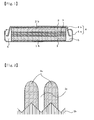
- Example 1 a flat coin-shaped non-aqueous electrolyte secondary battery illustrated in Fig.1 was fabricated by preparing a negative electrode and a positive electrode and adjusting a non-aqueous electrolyte in the following manner.
- the silicon thin film was an amorphous silicon thin film.
- the thin film of negative electrode active material consisting of amorphous silicon thin film formed on the negative electrode current collector by SEM (scanning transmission electron microscope)
- the thin film has structure shown in a typical figure of Fig. 2, the structure such that a thin film of negative electrode active material 2a was separated into columnar shape along unevenness of a negative electrode current collector 2b by slits 2c formed in the thickness direction.
- the negative electrode current collector of electrolytic copper foil wherein the thin film of negative electrode active material consisting of amorphous silicon thin film was formed was vacuum dried at 100 °C for 2 hours and punched into a disk form having a diameter of 10.0 mm to give the negative electrode.
- a positive electrode was prepared as follows. A powder of cobalt dioxide containing lithium LiCoO 2 (C5 commercially available from Nippon Chemical Industrial CO.,LTD.) was used as a positive electrode active material. Then, 85 parts by mass of that LiCoO 2 powder was mixed with 6 parts by mass of carbon black (Denka Black commercially available from DENKI KAGAKU KOGYO KABUSHIKI KAISHA) and 9 parts by mass of polyvinylidene fluoride (KF-1000 commercially available from KUREHA CHEMICAL INDUSTRY CO., LTD.), and N-methyl-2-pyrrolidone was added thereto in order to give a slurry.
- carbon black Denka Black commercially available from DENKI KAGAKU KOGYO KABUSHIKI KAISHA
- KF-1000 commercially available from KUREHA CHEMICAL INDUSTRY CO., LTD.
- the slurry was uniformly applied to an aluminum foil having a thickness of 20 ⁇ m as the positive electrode current collector, in a ratio of about 90 percent of a theoretical capacity for the negative electrode, and was dried at 100 °C for 12 hours, and punched into a disk form having a diameter of 10.0 mm, so as to give the positive electrode.
- a non-aqueous electrolyte was adjusted by dissolving lithium hexafluorophosphate, LiPF 6 , as a solute at a proportion of 1 mol/liter in a mixed solvent wherein ethylene carbonate and diethyl carbonate, which is a non-aqueous solvent, were mixed at a volume ratio of 3:7. Further, 2 mass % of fluoro ethylene carbonate, which is the compound expressed by the general formula (I), was added to the non-aqueous electrolyte. In such a case, the mass ratio of fluoro ethylene carbonate to the non-aqueous electrolyte excluding lithium salt was 2.2 mass %.
- a battery was fabricated as follows. As illustrated in Fig. 1, a separator 3 made of fine porous film of polypropylene wherein aforesaid non-aqueous electrolyte was impregnated was interposed between a positive electrode 1 and a negative electrode 2, which were prepared in the above-described manner, and these components were accommodated in a battery case 4 made of a positive electrode can 4a and a negative electrode can 4b which are made of stainless.
- the positive electrode 1 was connected to the positive electrode can 4a via a positive electrode current collector lb, while the negative electrode 2 was connected to the negative electrode can 4b via a negative electrode current collector 2b.
- Example 2 a non-aqueous electrolyte secondary battery of Example 2 was fabricated in the same manner as Example 1 except that the type of non-aqueous electrolyte was changed from that of Example 1.
- Example 2 took the same procedure as Example 1, except that 2 mass % of fluoromethyl methyl carbonate was added as the compound expressed by the general formula (I), in place of fluoro ethylene carbonate in Example 1, in preparation of the non-aqueous electrolyte.
- Example 3 a non-aqueous electrolyte secondary battery of Example 3 was fabricated in the same manner as Example 1 except that the type of non-aqueous electrolyte was changed from that of Example 1.
- Example 3 took the same procedure as Example 1, except that 2 mass % of 2-fluoroethyl methyl carbonate was added as the compound expressed by the general formula (I), in place of fluoro ethylene carbonate in Example 1, in preparation of the non-aqueous electrolyte.
- Example 4 a non-aqueous electrolyte secondary battery of Example 4 was fabricated in the same manner as Example 1 except that the type of non-aqueous electrolyte was changed from that of Example 1.
- Example 4 took the same procedure as Example 1, except that 2 mass % of ethyl-2-fluoroethyl carbonate was added as the compound expressed by the general formula (I), in place of fluoro ethylene carbonate in Example 1, in preparation of the non-aqueous electrolyte.
- Example 5 a non-aqueous electrolyte secondary battery of Example 5 was fabricated in the same manner as Example 1 except that the type of non-aqueous electrolyte was changed from that of Example 1.
- Example 5 took the same procedure as Example 1, except that 2 mass % of bis (2-fluoroethyl) carbonate was added as the compound expressed by the general formula (I), in place of fluoro ethylene carbonate in Example 1, in preparation of the non-aqueous electrolyte.
- Example 6 a non-aqueous electrolyte secondary battery of Example 6 was fabricated in the same manner as Example 1 except that the type of non-aqueous electrolyte was changed from that of Example 1.
- Example 6 took the same procedure as Example 1, except that 2 mass % of ethyl (2,2,2-trifluoroethyl) carbonate was added as the compound expressed by the general formula (I), in place of fluoro ethylene carbonate in Example 1, in preparation of the non-aqueous electrolyte.
- Example 7 a non-aqueous electrolyte secondary battery of Example 7 was fabricated in the same manner as Example 1 except that the type of non-aqueous electrolyte was changed from that of Example 1.
- Example 7 took the same procedure as Example 1, except that 2 mass % of bis (2,2,2-trifluoroethyl) carbonate was added as the compound expressed by the general formula (I), in place of fluoro ethylene carbonate in Example 1, in preparation of the non-aqueous electrolyte.
- Example 8 a non-aqueous electrolyte secondary battery of Example 8 was fabricated in the same manner as Example 1 except that the type of non-aqueous electrolyte was changed from that of Example 1.
- Example 8 took the same procedure as Example 1, except that 2 mass % of trifluoromethyl-1,3-dioxolane-2-one was added as the compound expressed by the general formula (I), in place of fluoro ethylene carbonate in Example 1, in preparation of the non-aqueous electrolyte.
- Example 9 a non-aqueous electrolyte secondary battery of Example 9 was fabricated in the same manner as Example 1 except that the type of non-aqueous electrolyte was changed from that of Example 1.
- Example 9 2 mass % of vinylene carbonate having no fluorine combined was added, in addition to 2 mass % of fluoro ethylene carbonate in Example 1, in preparation of the non-aqueous electrolyte.
- Example 10 a non-aqueous electrolyte secondary battery of Example 10 was fabricated in the same manner as Example 1 except that the type of non-aqueous electrolyte was changed from that of Example 1.
- Example 10 a non-aqueous electrolyte was prepared by dissolving lithium hexafluorophosphate, LiPF 6 , as a solute at a proportion of 1 mol/liter to a mixed solvent wherein ethylene carbonate which is a non-aqueous solvent and fluoromethyl methyl carbonate which is the compound expressed by the general formula (I) above were mixed at a volume ratio of 3:7.
- the mass ratio of fluoromethyl methyl carbonate to the non-aqueous electrolyte excluding lithium salt was 68.8 mass %.
- Example 11 a non-aqueous electrolyte secondary battery of Example 11 was fabricated in the same manner as Example 1 except that the type of non-aqueous electrolyte was changed from that of Example 1.
- Example 11 a non-aqueous electrolyte was prepared by dissolving lithium hexafluorophosphate LiPF 6 as a solute at a proportion of 1mol/liter in a mixed solvent wherein ethylene carbonate of non-aqueous solvent and 2-fluoroethyl methyl carbonate which is the compound expressed by the general formula (I) above were mixed at a volume ratio of 3:7.
- the mass ratio of 2-fluoroethyl methyl carbonate to the non-aqueous electrolyte excluding lithium salt was 67.9 mass %.
- Example 12 a non-aqueous electrolyte secondary battery of Example 12 was fabricated in the same manner as Example 1 except that the type of non-aqueous electrolyte was changed from that of Example 1.
- Example 12 a non-aqueous electrolyte was prepared by dissolving lithium hexafluorophosphate LiPF 6 as a solute at a proportion of 1 mol/liter in a mixed solvent wherein ethylene carbonate of non-aqueous solvent and ethyl-2-fluoroethyl carbonate which is the compound expressed by the general formula (I) above were mixed at a volume ratio of 3:7.
- the mass ratio of ethyl-2-fluoroethyl carbonate to the non-aqueous electrolyte excluding lithium salt was 66.6 mass %.
- Example 13 a non-aqueous electrolyte secondary battery of Example 13 was fabricated in the same manner as Example 1 except that the type of non-aqueous electrolyte was changed from that of Example 1.
- Example 13 a non-aqueous electrolyte was prepared by dissolving lithium hexafluorophosphate LiPF 6 as a solute at a proportion of 1 mol/liter to a mixed solvent wherein ethylene carbonate and diethyl carbonate of non-aqueous solvent were mixed with ethyl-2-fluoroethyl carbonate which is the compound expressed by the general formula (I) above.
- the mixed volume ratio of the mixed solvent was 3:3.5:3.5.
- the mass ratio of ethyl-2-fluoroethyl carbonate to the non-aqueous electrolyte excluding lithium salt was 34.9 mass %.
- Example 14 a non-aqueous electrolyte secondary battery of Example 14 was fabricated in the same manner as Example 1 except that the type of non-aqueous electrolyte was changed from that of Example 1.
- Example 14 a non-aqueous electrolyte was prepared by dissolving lithium hexafluorophosphate LiPF 6 as a solute at a proportion of 1 mol/liter to a mixed solvent wherein ethylene carbonate of non-aqueous solvent and 2-fluoroethyl methyl carbonate which is the compound expressed by the general formula (I) above were mixed at a volume ratio of 3: 7. Further, 2 mass % of fluoro ethylene carbonate which is the compound expressed by the general formula (I) above was added to the non-aqueous electrolyte.
- the mass ratio of 2-fluoroethyl methyl carbonate to the non-aqueous electrolyte excluding lithium salt was 66.5 mass % and that of fluoro ethylene carbonate was 2.2 mass %.
- the mass ratio of the compound expressed by the general formula (I) to the non-aqueous electrolyte excluding lithium salt was 68.7 mass % in total.
- Example 15 a non-aqueous electrolyte secondary battery of Example 15 was fabricated in the same manner as Example 1 except that the type of non-aqueous electrolyte was changed from that of Example 1.
- Example 15 a non-aqueous electrolyte was prepared by dissolving lithium hexafluorophosphate LiPF 6 as a solute at a proportion of 1 mol/liter in a mixed solvent wherein ethylene carbonate of non-aqueous solvent and 2-fluoroethyl methyl carbonate which is the compound expressed by the general formula (I) above were mixed at a volume ratio of 3:7. Further, 2 mass % of vinylene carbonate having no fluorine combined was added to the non-aqueous electrolyte. In such a case, the mass ratio of 2-fluoroethyl methyl carbonate to the non-aqueous electrolyte excluding lithium salt was 66.5 mass % and that of vinylene carbonate was 2.2 mass %.
- Comparative Example 1 a non-aqueous electrolyte secondary battery of Comparative Example 1 was fabricated in the same manner as Example 1 except that the type of non-aqueous electrolyte was changed from that of Example 1.
- a non-aqueous electrolyte was prepared by dissolving lithium hexafluorophosphate LiPF 6 as a solute at a proportion of 1 mol/liter in a mixed solvent wherein ethylene carbonate and diethyl carbonate of non-aqueous solvent were mixed at a volume ratio of 3:7.
- Comparative Example 2 a non-aqueous electrolyte secondary battery of Comparative Example 2 was fabricated in the same manner as Example 1 except that the type of non-aqueous electrolyte was changed from that of Example 1.
- a non-aqueous electrolyte was prepared by dissolving lithium hexafluorophosphate LiPF 6 as a solute at a proportion of 1 mol/liter in a mixed solvent wherein ethylene carbonate and diethyl carbonate of non-aqueous solvent were mixed at a volume ratio of 3:7. Further, 2 mass % of vinylene carbonate having no fluorine combined was added to the non-aqueous electrolyte. In such a case, the mass ratio of vinylene carbonate to the non-aqueous electrolyte excluding lithium salt was 2.2 mass %.
- each of the non-aqueous electrolyte secondary batteries of Examples 1 to 15 and Comparative Examples 1 and 2 was charged at a charge current of 1.2 mA until a battery voltage became 4.2V, charged at constant-voltage of 4.2 V until the charge current became 0.12 mA, and then discharged at a discharge current of 1.2 mA until a discharge stopping voltage became 2.5 V.
- This charging and discharging cycle was repeated 100 times.
- the charge-discharge cycle was repeated to obtain a discharging capacity Q 100 at the hundredth cycle.
- Table 1 The results were shown in table 1 below.
- each of the non-aqueous electrolyte secondary batteries of Examples 1 to 15 and Comparative Examples 1 and 2 was dismantled after finishing discharge of the first cycle and the hundredth cycle. Then, each of the non-aqueous electrolyte secondary batteries was measured for thickness of the negative electrode at the first cycle and the hundredth cycle by SEM (scanning transmission electron microscope), and there was calculated a magnification t 100 /t 1 of the thickness of the negative electrode at the hundredth cycle t 100 to the thickness of the negative electrode at the first cycle t 1 . The results were shown in Table 1 below.
- Example 1 [Table 1] Q 100 (mAh) t 100 /t 1 Example 1 1.50 3.2 Example 2 1.45 4.0 Example 3 1.30 4.1 Example 4 1.30 4.2 Example 5 1.20 4.0 Example 6 1.35 4.0 Example 7 1.45 3.0 Example 8 1.20 3.5 Example 9 1.85 3.0 Example 10 1.15 3.2 Example 11 1.20 2.0 Example 12 1.15 2.5 Example 13 1.15 2.5 Example 14 1.75 2.0 Example 15 1.59 2.0 Comparative Example 1 0.83 6.2 Comparative Example 2 1.59 5.0
Landscapes
- Chemical & Material Sciences (AREA)
- Chemical Kinetics & Catalysis (AREA)
- Electrochemistry (AREA)
- General Chemical & Material Sciences (AREA)
- Engineering & Computer Science (AREA)
- Manufacturing & Machinery (AREA)
- Materials Engineering (AREA)
- Physics & Mathematics (AREA)
- General Physics & Mathematics (AREA)
- Inorganic Chemistry (AREA)
- Condensed Matter Physics & Semiconductors (AREA)
- Secondary Cells (AREA)
- Battery Electrode And Active Subsutance (AREA)
Abstract
Description
- The present invention relates to a non-aqueous electrolyte secondary battery comprising a negative electrode containing a thin film of negative electrode active material including a metal capable of absorbing or releasing lithium formed on a current collector; a positive electrode containing a positive electrode active material capable of absorbing or releasing lithium; and a non-aqueous electrolyte prepared by dissolving lithium salt in a non-aqueous solvent; wherein said thin film of negative electrode active material is separated into columnar shape by slits formed in a thickness direction. More particularly, a feature of the invention is to improve the non-aqueous electrolyte used in the non-aqueous electrolyte secondary battery to prevent degradation of the negative electrode caused by charge-discharge performances to produce the non-aqueous electrolyte secondary battery having excellent charge-discharge cycle performances.
- In recent years, a non-aqueous electrolyte secondary battery, which comprises a non-aqueous electrolyte prepared by dissolving lithium salt in a non-aqueous solvent and utilizes oxidization and reduction of lithium for charge-discharge performances, has been widely used as a new type of secondary battery of light weight and high electromotive force.
- In this type of non-aqueous electrolyte secondary battery, the positive electrode active material used for the positive electrode is lithium transition metal composite oxide such as lithium cobalt composite oxide, lithium nickel composite oxide and lithium manganese composite oxide. As the negative electrode active material used for the negative electrode, carbon material, such as, coke, artificial graphite and natural graphite, are used alone or in combination. The non-aqueous electrolyte is generally prepared by dissolving lithium salt, such as, LiPF6 and LiBF4, in the non-aqueous solvent, such as, propylene carbonate and dimethyl carbonate.
- However, such a non-aqueous electrolyte secondary battery has a problem that the non-aqueous solvent in the non-aqueous electrolyte is reacted and decomposed on the surface of the negative electrode using carbon material, so that preservation characteristics and charge-discharge cycle performances of the non-aqueous electrolyte secondary battery are degraded.
- It has been conventionally known that, in a case where ethylene carbonate is used as the non-aqueous solvent in the non-aqueous electrolyte, the above-mentioned decomposition is kept at a low level and decomposed products produced by one part thereof forms a relatively excellent protective film on the surface of the negative electrode. Therefore, ethylene carbonate has been mainly used as the non-aqueous solvent in the non-aqueous electrolyte.
- However, a problem of main use of ethylene carbonate as the non-aqueous solvent has been that repeated charge-discharge performances gradually cause reaction and decomposition of the non-aqueous solvent, which results in degradation of preservation characteristics and charge-discharge cycle performances of the non-aqueous electrolyte secondary battery.
- In recent years, in order to solve such a problem, it has been proposed to add a small amount of protective film forming agents, for example, vinylene carbonate and the like, to the non-aqueous electrolyte to form an excellent protective film on the surface of the negative electrode using carbon material at a first stage of charge-discharge performances so that preservation characteristics and charge-discharge cycle performances of the non-aqueous electrolyte secondary battery are improved (For example, see
Patent documents 1 to 3). - On the other hand, in recent years, in order to improve charge-discharge capacity per unit mass and per unit volume of the non-aqueous electrolyte secondary battery, it has been proposed that a metal, for example, tin, silicon and the like or its oxide, which is capable of absorbing or releasing lithium, is used instead of the above mentioned carbon material as the negative electrode active material for the negative electrode (For example, see non-patent document 1).
- As a negative electrode using such a negative electrode active material, the negative electrode wherein a thin film of negative electrode active material, such as silicon thin film, tin thin film and the like, is formed on a current collector by CVD method, spattering method, vapor deposition method, thermal spraying method and plating method has been disclosed. It has also been shown that a great charge-discharge capacity and excellent charge-discharge cycle performances can be achieved by the use of such a negative electrode. The reason is believed as follows. The negative electrode mentioned above has a structure that the thin film of negative electrode active material is separated into columnar shape by slits formed in a thickness direction and a bottom of the column adheres to the current collector. In such a structure, a gap formed around the column makes it possible to reduce stress due to expansion and constriction of the thin film of negative electrode active material generated by the charge-discharge cycle and to prevent generation of stress peeling the thin film of negative electrode active material from the current collector. As a result, an excellent charge-discharge cycle performances can be obtained (e.g. see
patent documents 4 and 5). - Nevertheless, a problem in using a metal, such as tin, silicon and the like, and an alloy containing such metal elements, and its oxide as the negative electrode active material has been that a reactivity to lithium salt and the non-aqueous solvent in the non-aqueous electrolyte is extremely high compared with the case of using carbon material, and the negative electrode active material is degraded and expanded. Further, as the effect thereof, there has also been a problem that charge-discharge cycle performances of the non-aqueous electrolyte secondary battery are degraded.
- [Patent document 1]
Japanese Unexamined Patent Publication No.H6-52887 - [Patent document 2]
Japanese Unexamined Patent Publication No.H8-45545 - [Patent document 3]
Japanese Patent No.3059832 - [Non-patent document 1] Solid State Ionics.113-115.57 (1998)
- [Patent document 4]
Japanese Unexamined Patent Publication No.2002-83594 - [Patent document 5]
Japanese Unexamined Patent Publication No.2002-279972 - The present invention is made to solve the above-mentioned various problems of a non-aqueous electrolyte secondary battery comprising a negative electrode containing a thin film of negative electrode active material including a metal capable of absorbing or releasing lithium formed on a current collector; a positive electrode containing a positive electrode active material capable of absorbing or releasing lithium; and a non-aqueous electrolyte prepared by dissolving lithium salt in a non-aqueous solvent; wherein the thin film of negative electrode active material is separated into columnar shape by slits formed in a thickness direction.
Also, the objectives of the present invention are to restrict degradation and expansion of the negative electrode active material caused by reaction of the negative electrode active material and the non-aqueous electrolyte and to attain excellent charge-discharge cycle performances. - In order to solve the above-mentioned problems, according to a non-aqueous electrolyte secondary battery of the present invention, which is the non-aqueous electrolyte secondary battery comprising a negative electrode containing a thin film of negative electrode active material including a metal capable of absorbing or releasing lithium formed on a current collector; a positive electrode containing a positive electrode active material capable of absorbing or releasing lithium; and a non-aqueous electrolyte prepared by dissolving lithium salt in a non-aqueous solvent; wherein the thin film of negative electrode active material is separated into columnar shape by slits formed in a thickness direction, a compound expressed by a general formula (I) below is contained in the non-aqueous electrolyte.
-

- As in the present invention, in a case where a negative electrode containing a thin film of negative electrode active material including a metal capable of absorbing or releasing lithium formed on a current collector wherein the thin film of negative electrode activematerial is separated into columnar shape by slits formed in the thickness direction is used, a non-aqueous electrolyte secondary battery having a great charge-discharge capacity as mentioned above can be obtained.
- As in the non-aqueous electrolyte secondary battery of the present invention, in a case where a non-aqueous electrolyte contains the compound expressed by the general formula (I) above, although the reason is not clear, it is believed that the effects as follows are obtained. A suitable thin film is formed on the surface of the negative electrode active material separated into columnar shape, degradation and expansion of the negative electrode active material caused by reaction of the negative electrode active material and the non-aqueous electrolyte are restricted, and charge-discharge cycle performances in the non-aqueous electrolyte secondary battery are greatly improved.
- A non-aqueous electrolyte secondary battery and a non-aqueous electrolyte according to modes of the invention will be described in detail as follows. It is to be noted that the non-aqueous electrolyte secondary battery and the non-aqueous electrolyte of the invention is not limited by those illustrated in the following modes and may be practiced in modifications thereof as required so long as such modifications do not deviate from the scope of the invention.
- First, a negative electrode employed for the non-aqueous electrolyte secondary battery of the present invention will be described in detail.
- The negative electrode employed for the non-aqueous electrolyte secondary battery of the present invention comprises a thin film of negative electrode active material including a metal capable of absorbing or releasing lithium formed on a current collector, and the thin film of negative electrode active material is separated into columnar shape by slits formed in the thickness direction.
- As the metal capable of absorbing or releasing lithium, a metal having a high ability of absorbing or releasing lithium and ensuring a high volume theoretical capacity is preferably used. Examples of usable metals include silicon, germanium, tin, lead, zinc, magnesium, sodium, aluminum, potassium, indium and so on. Preferably, silicon, germanium, tin or aluminum, more preferably, silicon or tin is used.
- On the other hand, materials to be used for the current collector are not particularly limited if they have excellent adhesion to the thin film of negative electrode active material and comprise materials which do not alloy with lithium. Examples of usable materials include copper, nickel, stainless steel, molybdenum, tungsten, tantalum and so on. In view of easiness of getting, copper or nickel is preferably used, and copper is more preferably used.
- If the current collector has an excessive thickness, a capacity of a battery is decreased due to increase of the capacity of the current collector occupied therein. Therefore, it is preferable that the thickness of the current collector be 30 µm or less, and more preferably be 20 µm or less. On the other hand, if the thickness of the current collector is too small, intensity as an electrode is insufficient. Therefore, it is preferable that the thickness of the current collector be not less than 1µm, and more preferably be not less than 5 µm.
- The thin film of negative electrode active material on the current collector is formed as follows. The negative electrode active material is deposited on the current collector by CVD method, spattering method, vapor deposition method, thermal spraying method, plating method and the like.
- The thin film of negative electrode active material on the current collector is separated into columnar shape by the slits formed in the thickness direction as follows. For example, a current collector having unevenness surface is used and a thin film of negative electrode active material is formed thereon, then, the thin film of negative electrode active material is changed for its thickness along the unevenness of the current collector, and slits are formed on parts where the thickness becomes small. Thus, the thin film of negative electrode active material is separated into columnar shape. Further, in addition to formation of slits from the beginning, it may be possible to separate the thin film of negative electrode active material into columnar shape by the slits formed by charge-discharge performances.
- Further, in the present invention, it may be possible to form a thin film of negative electrode active material on a current collector by solidifying negative electrode active material powder like silicon powder with a binder and to separate the thin filmof negative electrode activematerial into columnar shape by slits formed in the thickness direction. For example, a slurry of negative electrode composites containing the negative electrode active material powder like silicon powder and the binder is prepared, applied to the current collector having unevenness surface and sintered, thereby forming a negative electrode containing a thin film of negative electrode active material having a film thickness of 20 µm or less. Then, the negative electrode thus fabricated is subjected to charge-discharge performances, so that the slits on the thin film of negative electrode active material is formed and the thin film of negative electrode active material is separated into columnar shape.
- As the current collector forming the unevenness shape on its surface, for example, a foil having roughen surface may be used. An example of such a foil is an electrolytic foil which may be obtained in the following manner. A drum made of a metal is soaked into an electrolyte having ion dissolved and is rotated allowing current to flow until the metal is deposited on the surface of the drum, and the deposited metal is peeled. Thus, the electrolytic foil may be obtained. Further, the surface of the electrolytic foil may be treated by surface roughening treatment and the like. In addition to such an electrolytic foil, a rolled foil having a surface on which a metal is deposited by electrolysis method and is roughened, may be used.
- In the current collector, it is preferable that surface roughness Ra be within a range of 0.01 µm to 1 µm, and more preferably be within a range of 0.1 µm to 0.5 µm. The surface roughness Ra is specified by the Japanese Industrial Standards (JISB 0601-1994) and can be measured with a surface roughness tester.
- It is preferable that the components of the current collector are stably diffused in the thin film of negative electrode active material separated into columnar shape by slits, in order to maintain a condition that the thin film of negative electrode active material is adhered on the current collector in columnar shape stably.
- In a case where silicon is used for the thin film of the negative electrode active material, in view of its physical properties, it is preferable that the components of the current collector diffused in the thin film of negative electrode active material form a solid solution and do not form an inter-metal compound with silicon. Therefore, it is preferable that the thin film using silicon is a film of amorphous material or microcrystal.
- In a case where tin is used for the thin film of negative electrode active material, it is preferable that a mixed layer of the components of the current collector and tin components of the negative electrode active material is formed between the current collector and the thin film of negative electrode active material. The mixed layer may be of the inter-metal compound of the components of the current collector and the tin components of the negative electrode active material or be a solid solution. Such a mixed layer is formed by heat-treatment. Requirements for heat-treatment depend on a type of the current collector. For example, in a case where a current collector composed of copper is used, vacuum heat-treatment is carried out at a temperature which is preferably in a range of 100 °C to 240 °C and more preferably in a range of 160°C to 220 °C.
- In formation of the thin film of negative electrode active material on the current collector as mentioned above, materials previously absorbing lithium may be used. Further, lithium may be added in forming the thin film of negative electrode active material. Still further, after the thin film of negative electrode active material is formed, lithium may be absorbed or added to the thin film of negative electrode active material.
- In the non-aqueous electrolyte secondary battery according to the present invention, any commonly-used known materials may be used as the positive electrode active material capable of absorbing or releasing lithium used for its positive electrode. For example, lithium transition metal composite oxide, such as lithium cobalt composite oxide, lithium nickel composite oxide, lithium manganese composite oxide, lithium vanadium composite oxide, lithium iron composite oxide, lithium chromium composite oxide, lithium titanium composite oxide and the like may be used alone or in combination of two or more.
- In addition, conventionally known methods may be used for fabrication of the positive electrode. Examples of such methods are as follows. A binding agent, a thickener, a conductive material, a solvent and the like are appropriately added to the positive electrode active material to give a slurry. The resultant slurry is applied to the current collector and dried. Thus, the positive electrode is fabricated. Further, a sheet-like positive electrode may be obtained by roll forming the positive electrode active material, and a pellet type positive electrode may be obtained by compression-molding the positive electrode active material. Still further, it may be possible to fabricate a positive electrode by depositing the positive electrode active material in thin film shape on a current collector by CVD method, spattering method, vapor deposition method, thermal spraying method and like.
- In using the binding agent for fabrication of the positive electrode as mentioned above, materials used for the binding agent are not particularly limited if they are stable to the solvent used for fabrication of the positive electrode, the non-aqueous electrolyte and the other materials used for the non-aqueous electrolyte secondary battery. Examples of usable materials include polyvinylidene fluoride, polytetrafluoroethylene, styrene-butadiene rubber, isoprene rubber, butadiene rubber and the like.
- In using the thickener for fabrication of the positive electrode, materials used for the thickener are not particularly limited if they are stable to the solvent used for fabrication of the positive electrode, the non-aqueous electrolyte and the other materials used for the non-aqueous electrolyte secondary battery. Examples of usable materials include carboxymethyl cellulose, methylcellulose, hydroxymethyl cellulose, ethyl cellulose, polyvinyl alcohol, starch oxide, phosphorylated starch, casein and the like.
- In using the conductive material for fabrication of the positive electrode, materials used for the conductive material are not particularly limited if they are stable to the solvent used for fabrication of the positive electrode, the non-aqueous electrolyte and the other materials used for the non-aqueous electrolyte secondary battery. Examples of usable materials include metal materials, such as copper and nickel, and carbon material, such as graphite and carbon black.
- In using the current collector for fabrication of the positive electrode, as materials used for the current collector, metals, such as aluminum, titanium and tantalum may be used. Particularly, aluminum foil is preferably used as the current collector because aluminum foil is easy to be processed to a thin film and is low cost.
- As the non-aqueous electrolyte used for the non-aqueous electrolyte secondary battery according to the present invention, the non-aqueous electrolyte dissolving lithium salt in the non-aqueous solvent and containing the compound expressed by the general formula (I) above is used.
- In the general formula (I), R1 and R2 are alkyl group containing non-substituents or various types of substituents. One or more fluorine is combined with either of R1 or R2 at least. R1 and R2 may be the same group or different from each other. Further, R1 and R2 may either be independent group or combined with each other wound in a ring.
- In a case where each of R1 and R2 is independent group, an example of base alkyl group is chained alkyl group.
- If a number of carbon forming chain alkyl group is too many, there is a risk of degradation of oxidation resistant property and inhibition of dissolution to the non-aqueous electrolyte, therefore, it is preferable to use saturated or unsaturated chained alkyl group having the number of carbon of within the range of 1 to 4. Examples of usable saturated chained alkyl group include methyl, ethyl, n-propyl, i-propyl, n-butyl, i-butyl, s-butyl and t-butyl. Examples of usable unsaturated chained alkyl group include vinyl, 1-propenyl, allyl, i-propenyl, 1-butenyl, 2-butenyl, 3-butenyl, 1-methyl-1-propenyl, 2-methyl-1-propenyl, 1-ethylvinyl, 1-methylallyl, 2-methylallyl, 1,2-propadienyl, 1,2-butadienyl, 1,3-butadienyl, 2,3-butadienyl, 1-vinylvinyl, ethynyl, 1-propenyl, 2-propenyl, 1-butynyl, 2-butynyl, 3-butynyl, and 2-penten-4-ynyl. More preferably, saturated or unsaturated chained alkyl group having the number of carbon of within the range of 1 to 3, such as, methyl group, ethyl group, n-propyl group, i-propyl group, vinyl group and allyl group, is used.
- In the case where each of R1 and R2 is independent group, alkyl group wherein one part of hydrogen is substituented by substituents which are not fluorine may be used. Examples of usable substituents include halide group, such as chlorine, bromine, and iodine, alkoxy group, carbonic acid ester group, carboxylic acid ester group and amino group. However, in view of oxidation resistant property, reducing property, dissolution property and preservation stability, it is preferable to use alkyl group having no substituents which are not fluorine.
- In the case where each of R1 and R2 is independent group, favorable examples of usable group include methyl, fluoromethyl, trifluoromethyl, ethyl, 1-fluoroethyl, 2-fluoromethyl, 2,2-difluoromethyl, 2,2,2-trifluoroethyl, n-propyl, 1-fluoro-n-propyl, 2-fluoro-n-propyl, 3-fluoro-n-propyl, 3,3,3-trifluoro-n-propyl, i-propyl, and 1-fluoro-i-propyl. In view of dissolution property and stability, it is preferable to use methyl group, methyl group substituted by one or more fluorine, ethyl group, ethyl group substituted by one or more fluorine, n-propyl group and n-propyl group substituted by one or more fluorine. Further, in view of productiveness, it is preferable to use methyl group, fluoromethyl group, ethyl group, 1-fluoroethylgroup, 2-fluoroethylgroup, 2,2,2-trifluoroethyl group, n-propyl group, and 3-fluoro-n-propyl group.
- Examples of the compound expressed by the general formula (I) above wherein each of R1 and R2 is independent group include fluoromethyl methyl carbonate, 1-fluoroethylmethyl carbonate, 2-fluoroethyl methyl carbonate, 1-fluoro-n-propyl methyl carbonate, 3-fluoro-n-propyl methyl carbonate, ethyl fluoromethyl carbonate, ethyl-1-fluoroethyl carbonate, ethyl-2-fluoroethyl carbonate, ethyl-1-fluoro-n-propyl methyl carbonate, ethyl-3-fluoro-n-propyl methyl carbonate, bis(fluoromethyl)carbonate, bis(2-fluoroethyl)carbonate, 2-fluoroethyl fluoromethyl carbonate, bis(3-fluoro-n-propyl)carbonate, 2-fluoroethyl-3-fluoro-n-fluoropropyl carbonate, (2,2-difluoroethyl)methyl carbonate, ethyl (2,2-difluoroethyl) carbonate, (2,2,2-trifluoroethyl)methyl carbonate, and ethyl(2,2,2-trifluoroethyl) carbonate.
- In a case where R1 and R2 are combined with each other wound in a ring, it is preferable that the wounded ring structure is stable and not opened easily. As a group constituted by combination of R1 and R2, the group wherein the total number of carbon including carbon in substituents is within the range of 2 to 6, is preferably used. Further, it is preferable that the number of carbon of the part which constitutes the ring be 2 or 3.
- As a suitable compound having the wound ring structure constituted by combination of R1 and R2 as mentioned above, it is preferable to use compounds having a frame of saturated cyclic carbonate, such as, ethylene carbonate, trimethylene carbonate, propylene carbonate, 4-ethyl-1,3-dioxolane-2-one, 4,4-dimethyl-1,3-dioxolane-2-one, 4,5-dimethyl-1,3-dioxolane-2-one, 4-methyl-1,3-dioxane-2-one, 5-methyl-1,3-dioxane-2-one, 4-n-propyl-1,3-dioxolane-2-one, 4-i-propyl-1,3-dioxolane-2-one, 4-ethyl-4-methyl-1,3-dioxolane-2-one, 4-ethyl-5-methyl-1,3-dioxolane-2-one, 4-ethyl-1,3-dioxane-2-one, 5-ethyl-2,3-dioxane-2-one, 4,4-dimethyl-2,3-dioxane-2-one, 4,5-dimethyl-2,3-dioxane-2-one, 4,6-dimethyl-2,3-dioxane-2-one, 5,5-dimethyl-2,3-dioxane-2-one, 4-n-butyl-1,3-dioxolane-2-one, 4-i-butyl-1,3-dioxolane-2-one, 4-s-butyl-1,3-dioxolane-2-one, 4-t-butyl-1,3-dioxolane-2-one, 4-n-propyl-4-methyl-1,3-dioxolane-2-one, 4-n-propyl-5-methyl-1,3-dioxolane-2-one, 4-i-propyl-4-methyl-1,3-dioxolane-2-one, 4-i-propyl-5-methyl-1,3-dioxolane-2-one, 4,4-diethyl-1,3-dioxolane-2-one, 4,5-diethyl-1,3-dioxolane-2-one, 4-n-propyl-1,3-dioxane-2-one, 4-i-propyl-1,3-dioxane-2-one, 5-n-propyl-1,3-dioxane-2-one, 5-i-propyl-1,3-dioxane-2-one, 4-ethyl-4-methyl-1,3-dioxane-2-one, 4-ethyl-5-methyl-1,3-dioxane-2-one, 4-ethyl-6-methyl-1,3-dioxane-2-one, 5-ethyl-4-methyl-1,3-dioxane-2-one, 5-ethyl-5-methyl-1,3-dioxane-2-one, 4,4,5-trimethyl-1,3-dioxane-2-one, 4,4,6-trimethyl-1,3-dioxane-2-one, 4,5,5-trimethyl-1,3-dioxane-2-one and 4,5,6-trimethyl-1,3-dioxane-2-one. In addition, as a suitable compound having the wound ring structure constituted by combination of R1 and R2 as mentioned above, it is preferable to use compounds having a frame of unsaturated cyclic carbonate, such as, vinylene carbonate, methyl vinylene carbonate, dimethyl vinylene carbonate, ethyl vinylene carbonate, ethyl methyl vinylene carbonate, diethyl vinylene carbonate, n-propyl vinylene carbonate, i-propyl vinylene carbonate, n-butyl vinylene carbonate, i-butyl vinylene carbonate, s-butyl vinylene carbonate, t-butyl vinylene carbonate, n-propyl methyl vinylene carbonate, i-propyl methyl vinylene carbonate, 1,3-dioxine-2-one, 4-methyl-1,3-dioxine-2-one, 5-methyl-1,3-dioxine-2-one, 6-methyl-1,3-dioxine-2-one, 4-ethyl-1,3-dioxine-2-one, 5-ethyl-1,3-dioxine-2-one, 6-ethyl-1,3-dioxine-2-one, 4,5-dimethyl-1,3-dioxine-2-one, 5,6-dimethyl-1,3-dioxine-2-one, 6,6-dimethyl-1,3-dioxine-2-one, 4-n-propyl-dimethyl-1,3-dioxine-2-one, 5-n-propyl-dimethyl-1,3-dioxine-2-one, 6-n-propyl-dimethyl-1,3-dioxine-2-one, 4-i-propyl-dimethyl-1,3-dioxine-2-one, 5-i-propyl-dimethyl-1,3-dioxine-2-one, 6-i-propyl-dimethyl-1,3-dioxine-2-one, 4-ethyl-5-methyl-1,3-dioxine-2-one, 4-ethyl-6-methyl-1,3-dioxine-2-one, 5-ethyl-4-methyl-1,3-dioxine-2-one, 5-ethyl-6-methyl-1,3-dioxine-2-one, 6-ethyl-6-methyl-1,3-dioxine-2-one, vinyl ethylene carbonate, 4-methyl-4-vinyl-1,3-dioxolane-2-one, 4-methyl-5-vinyl-1,3-dioxolane-2-one, 4-ethyl-4-vinyl-1,3-dioxolane-2-one, 4-ethyl-5-vinyl-1,3-dioxolane-2-one, 4,4-divinyl-1,3-dioxolane-2-one, 4,5-divinyl-1,3-dioxolane-2-one, 4-vinyl-1,3-dioxane-2-one, 5-vinyl-1,3-dioxane-2-one, 4-methyl-4-vinyl-1,3-dioxane-2-one, 4-methyl-5-vinyl-1,3-dioxane-2-one, 4-methyl-6-vinyl-1,3-dioxane-2-one, 5-methyl-4-vinyl-1,3-dioxane-2-one, 5-methyl-5-vinyl-1,3-dioxane-2-one, 4,4-divinyl-1,3-dioxane-2-one, 4,5-divinyl-1,3-dioxane-2-one, 4,6-divinyl-1,3-dioxane-2-one and 5,5-divinyl-1,3-dioxane-2-one.
Particularly, it is preferable to use the compounds having a frame of ethylene carbonate, propylene carbonate, vinylene carbonate, methyl vinylene carbonate and vinyl ethylene carbonate. - In the case where R1 and R2 are combined with each other wound in the ring as described above, it may be possible that hydrogen in the combined R1 and R2 is substituted by substituents which are not fluorine. Examples of usable substituents include halide group, such as chlorine, bromine and iodine, alkoxy group, carbonic acid ester group, carboxylic acid ester group and amino group. However, in view of oxidation resistant property, reducing property, dissolution property and preservation stability, it is preferable that substituents which are not fluorine are not contained.
- In the case where R1 and R2 are combined with each other wound in the ring, examples of the compound expressed by the general formula (I) above include fluoroetylene carbonate, 4,4-difluoro-1,3-dioxolane-2-one, 4,5-difluoro-1,3-dioxolane-2-one, 4-fluoro-5-methyl-1,3-dioxolane-2-one, 4-(fluoromethyl)-1,3-dioxolane-2-one, 4-(trifluoromethyl)-1,3-dioxolane-2-one, 4-fluoro-5-(fluoromethyl)-1,3-dioxolane-2-one, 4-fluoro-5-(trifluoromethyl)-1,3-dioxolane-2-one, 4-fluoro-1,3-dioxole-2-one, 4,5-difluoro-1,3-dioxole-2-one, 4-fluoro-5-methyl-1,3-dioxole-2-one, 4-(fluoromethyl)-1,3-dioxole-2-one, 4-fluoro-5-(fluoromethyl)-1,3-dioxole-2-one, 4-(1-fluorovinyl)-1,3-dioxolane-2-one, 4-(2-fluorovinyl)-1,3-dioxolane-2-one, and 4-fluoro-5-vinyl-1,3-dioxolane-2-one. Particularly, in view of dissolution property, stability and productiveness, it is preferable to use fluoroetylene carbonate, 4,4-difluoro-1,3-dioxolane-2-one, 4,5-difluoro-1,3-dioxolane-2-one, 4-(fluoromethyl)-1,3-dioxolane-2-one, 4-(trifluoromethyl)-1,3-dioxolane-2-one, and 4-fluoro-1,3-dioxole-2-one.
- In order that the compound expressed by the general formula (I) above is properly dissolved in the non-aqueous electrolyte, it is preferable to use the compound having a molecular weight of 300 or less, and more preferably, 200 or less.
- If the amount of the compound expressed by the general formula (I) above contained in the non-aqueous electrolyte is small, sufficient effect by the compound expressed by the general formula (I) above can not be obtained. Therefore, the amount of the compound contained in the non-aqueous electrolyte is usually to be not less than 0.01 mass % with respect to a mass of the non-aqueous electrolyte excluding lithium salt, preferably be not less than 0.1 mass %, and more preferably be not less than 0.5 mass %.
- On the other hand, in the case where the compound expressed by the general formula (I) wherein each of R1 and R2 is independent group is used, the compound is generally combined with cyclic carbonate or other high permittivity solvent, therefore, the amount of the compound contained in the non-aqueous electrolyte is to be 90 mass % or less with respect to the mass of the non-aqueous electrolyte excluding lithium salt, preferably be 70 mass % or less.
- In the case where the compound expressed by the general formula (I) wherein R1 and R2 are combined with each other wound in the ring is used, the compound is generally combined with chained carbonate or other low viscosity solvent, therefore, the amount of the compound contained in the non-aqueous electrolyte is to be 20 mass % or less with respect to the mass of the non-aqueous electrolyte excluding lithium salt, preferably be 10 mass % or less.
- Examples of the compound expressed by the general formula (I) wherein one carbonate of R1 and R2 is combined with two or more fluorine include chained carbonate, such as, (2,2-difluoroethyl) methyl carbonate, ethyl (2,2-difluoroethyl) carbonate, (2,2,2-trifluoroetyl) methyl carbonate and ethyl (2,2,2-trifluoroetyl) carbonate, and cyclic carbonate, such as, 4,4-difluoro-1,3-dioxolane-2-one.
In a case where the compound expressed by the general formula (I) wherein double bond is contained in R1 and R2, for example, 4-fluoro-1,3-dioxole-2-one and 4-fluoro-5-vinyl-1,3-dioxolane-2-one is used, because of its high reaction activity, if the additive amount is too large, a lot of decomposition occurs in the ordinary working of battery, and the battery performance is badly affected. Therefore, it is preferable that the additive amount of the compounds to the non-aqueous electrolyte be 20 mass % or less, more preferably be 10 mass % or less, and further more preferably be 5 mass % or less. - Further, in the present invention, examples of favorable non-aqueous solvent for the non-aqueous electrolyte include cyclic carbonate, chained carbonate, lactone compound (cyclic carboxylic acid ester), chained carboxylic acid ester, cyclic ether and chained ether, wherein each total number of carbon is in the range of 3 to 9. It may be possible that the aforesaid non-aqueous solvent be used alone or in combination of two or more.
- If the total amount of the compound expressed by the general formula (I) above, and the non-aqueous solvent wherein each total number of carbon is in the range of 3 to 9, such as, cyclic carbonate, chained carbonate, lactone compound (cyclic carboxylic acid ester), chained carboxylic acid ester, cyclic ether and chained ether, is not less than 90 mass % with respect to the mass of the non-aqueous electrolyte excluding lithium salt, lithium ion conductivity and stability in the non-aqueous electrolyte are enhanced and battery characteristics are improved in the non-aqueous electrolyte secondary battery.
- An example of favorable non-aqueous solvent is the non-aqueous solvent containing at least one type selected from the aforesaid chained carbonate wherein the total number of carbon is in the range of 3 to 9 and the compound expressed by the general formula (I) wherein each of R1 and R2 is independent group, and one or more solvent selected from a group of cyclic carbonate and lactone compound wherein the total number of carbon is in the range of 3 to 9. Particularly, it is preferable that one or more solvent selected from the group of cyclic carbonate and lactone compound is contained in a ratio of not less than 20 mass %. In such a non-aqueous solvent, high permittivity solvent, cyclic carbonate and lactone compound wherein the total number of carbon is in the range of 3 to 9, is combined with low permittivity solvent, chained carbonate wherein the total number of carbon is in the range of 3 to 9 and the compound expressed by the general formula (I) wherein each of R1 and R2 is independent group, and as a result, lithium ion conductivity and stability are improved and a non-aqueous electrolyte secondary battery having better-balanced battery characteristics may be obtained.
- Examples of usable cyclic carbonate wherein the total number of carbon is in the range of 3 to 9 include ethylene carbonate, propylene carbonate, butylene carbonate, vinylene carbonate and vinyl ethylene carbonate. Particularly, it is preferable to use ethylene carbonate and propylene carbonate.
- Examples of usable chained carbonate wherein the total number of carbon is in the range of 3 to 9 include dimethyl carbonate; diethyl carbonate, di-n-propyl carbonate, di-isopropyl carbonate, n-propyl isopropyl carbonate, di-n-butyl carbonate, di-i-propyl carbonate, di-t-butyl carbonate, n-butyl-i-butyl carbonate, n-butyl-t-butyl carbonate, i-butyl-t-butyl carbonate, ethyl methyl carbonate, methyl-n-propyl cabonate, n-butyl methyl carbonate, i-butyl methyl carbonate, t-butyl methyl carbonate, ethyl-n-propyl carbonate, n-butyl ethyl carbonate, i-butyl ethyl carbonate, t-butyl ethyl carbonate, n-butyl-n-propyl carbonate, i-butyl-n-propyl carbonate, t-butyl-n-propyl carbonate, n-butyl-i-propyl carbonate, i-butyl-i-propyl carbonate, and t-butyl-i-propyl carbonate. Particularly, it is preferable to use dimethyl carbonate, diethyl carbonate and ethyl methyl carbonate.
- Examples of usable lactone compound wherein the total number of carbon is in the range of 3 to 9 include γ -butyrolactone, γ-valerolactone, and δ-valerolactone may be used. Particularly, it is preferable to use γ-butyrolactone.
- Examples of chained carboxylic acid ester wherein the total number of carbon is in the range of 3 to 9 include methyl acetate, ethyl acetate, n-propyl-acetate, i-propyl-acetate, n-butyl-acetate, i-butyl-acetate, t-butyl-acetate, methyl propionate, ethyl propionate, n-propyl-propionate, i-propyl-propionate, n-butyl-propionate, i-butyl-propionate, and t-butyl-propionate. Particularly, it is preferable to use ethyl acetate, methyl propionate, and ethyl propionate.
- Examples of usable chained ether wherein the total number of carbon is in the range of 3 to 9 include dimethoxymethane, dimethoxyethane, diethoxymethane, diethoxyethane, ethoxymethoxymethane and ethoxymethoxyethane. Particularly, it is preferable to use dimethoxyethane and diethoxyethane.
- As lithium salt used for the non-aqueous electrolyte, inorganic lithium salt or organic lithium salt generally used for a non-aqueous electrolyte may be used.
- Examples of usable inorganic lithium salt include inorganic fluoride salt, such as LiPF6, LiAsF6 and LiAlF4, and perhalogenide, such as LiClO4, LiBrO4 and LiIO4. Examples of usable organic lithium salt include the following: organic sulfonic acid, such as LiCF3SO3; perfluoroalkylsulfonate imide salt, such as LiN(CF3SO2)2, LiN(C2F5SO2) 2 and LiN(CF3SO2) (C4F9SO2) ; perfluoroalkylsulfonate methide salt, such as LiC(CF3SO2)3; and organic lithium salt containing fluorine, which is prepared by substituting one part of fluorine atom in inorganic fluoride salt by perfluoroalkyl group, for example, LiPF3(CF3)3, LiPF2(C2F5)4, LiPF3(C2F5)3, LiB(CF3)4, LiBF(CF3)3, LiBF2(CF3)2, LiBF3(CF3), LiB(C2F5)4, LiBF(C2F5)3, LiBF2 (C2F5)2 and LiBF3(C2F5). Such a type of lithium salt may be used alone or in combination of two or more. As such a lithium salt, it is preferable to use LiPF6, LiN (CF3SO2)2, LiN (C2F5SO2)2, LiN (CF3SO2) (C4F9SO2), LiPF3 (CF3)3, LiPF3(C2F5)3 and LiBF2(C2F5)2.
- Particularly, the use of LiBF4 and LiPF6 as lithium salt makes it possible to obtain an excellent non-aqueous electrolyte having high electrochemical stability and high electrical conductivity in a large temperature range. Further, in order to sufficiently obtain the above mentioned effects by the use of LiBF4 and LiPF6, it is desirable that LiBF4 and LiPF6 is contained in a ratio of not less than 5mol %, preferably not less than 30 mol %, with respect to total lithium salt in the non-aqueous electrolyte.
- Further, if the concentration of lithium salt in the non-aqueous electrolyte is too low, electrical conductivity in the non-aqueous electrolyte is degraded. On the other hand, if the concentration is too high, viscosity is increased decreasing electrical conductivity, and there is a risk of deposit of lithium salt at a low temperature, which causes lowering of battery performances. Therefore, it is preferable that the concentration of lithium salt in the non-aqueous electrolyte is to be within a range of 0.5 to 3 mol/liter.
- Further, various types of additive agents, for example, publicly known overcharge preventing agents, dehydrator and deoxidation agent, may be added to the non-aqueous electrolyte. However, if an amount of additive is too large, the battery performance is badly affected because of decomposition of the additive agents. Therefore, an appropriate setting of the additive amount is necessary.
- It should be construed that form and structure of the non-aqueous electrolyte secondary battery according to the present invention are not particularly limited. Any type of non-aqueous electrolyte secondary batteries may be used. Examples include a cylindrical-shaped non-aqueous electrolyte secondary battery wherein a sheet-shaped positive electrode and a sheet-shaped negative electrode are spirally coiled with a separator, a cylindrical-shaped non-aqueous electrolyte secondary battery having inside-out structure wherein a separator is interposed between a pellet-shaped positive electrode and a pellet-shaped negative electrode, and a coin-shaped non-aqueous electrolyte secondary battery wherein a separator is interposed between a pellet-shaped positive electrode and a pellet-shaped negative electrode.
- Further, generally known separator may be employed as the aforesaid separator. Particularly preferable is a separator having stability to the non-aqueous electrolyte and composed of materials having an excellent liquid retaining capability. Examples of the preferable separator include porous sheet and nonwoven fabric composed of polyolefin, such as polyethylene and polypropylene.
- Hereinbelow, examples will be specifically described of the non-aqueous electrolyte secondary battery according to the present invention, and it will be demonstrated by the comparison with comparative examples that the non-aqueous electrolyte secondary batteries in the examples are capable of improving charge-discharge cycle performances. It should be construed that the non-aqueous electrolyte secondary battery according to the present invention is not limited to those illustrated in the following examples, but various changes and modifications may be made unless such changes and variations depart from the scope of the invention as defined in the append claims.
- In Example 1, a flat coin-shaped non-aqueous electrolyte secondary battery illustrated in Fig.1 was fabricated by preparing a negative electrode and a positive electrode and adjusting a non-aqueous electrolyte in the following manner.
- A negative electrode was prepared as follows. A thin film of negative electrode active material consisting of silicon thin film having a thickness of about 5 µm is formed on a negative electrode current collector consisting of an electrolyte copper foil (thickness=18 µm, surface roughness Ra=0.188µm) by an RF sputtering. The RF sputtering was carried out on the condition that a sputter gas flow Ar was 100 sccm, a substrate temperature was a room temperature (without heating), a reactive pressure was 0.133 Pa (1.0 x 10⁻³ Torr) and a high frequency electricity was 200 W.
- According to a result of analysis of the silicon thin film by Raman spectroscopy, the peak value near 480 cm-1 was detected, but the peak value near 520 cm-1 was not detected. This result means the silicon thin film was an amorphous silicon thin film. According to a result of observation of the thin film of negative electrode active material consisting of amorphous silicon thin film formed on the negative electrode current collector by SEM (scanning transmission electron microscope), the thin film has structure shown in a typical figure of Fig. 2, the structure such that a thin film of negative electrode
active material 2a was separated into columnar shape along unevenness of a negative electrodecurrent collector 2b byslits 2c formed in the thickness direction. - The negative electrode current collector of electrolytic copper foil wherein the thin film of negative electrode active material consisting of amorphous silicon thin film was formed was vacuum dried at 100 °C for 2 hours and punched into a disk form having a diameter of 10.0 mm to give the negative electrode.
- A positive electrode was prepared as follows. A powder of cobalt dioxide containing lithium LiCoO2 (C5 commercially available from Nippon Chemical Industrial CO.,LTD.) was used as a positive electrode active material. Then, 85 parts by mass of that LiCoO2 powder was mixed with 6 parts by mass of carbon black (Denka Black commercially available from DENKI KAGAKU KOGYO KABUSHIKI KAISHA) and 9 parts by mass of polyvinylidene fluoride (KF-1000 commercially available from KUREHA CHEMICAL INDUSTRY CO., LTD.), and N-methyl-2-pyrrolidone was added thereto in order to give a slurry. The slurry was uniformly applied to an aluminum foil having a thickness of 20 µm as the positive electrode current collector, in a ratio of about 90 percent of a theoretical capacity for the negative electrode, and was dried at 100 °C for 12 hours, and punched into a disk form having a diameter of 10.0 mm, so as to give the positive electrode.
- A non-aqueous electrolyte was adjusted by dissolving lithium hexafluorophosphate, LiPF6, as a solute at a proportion of 1 mol/liter in a mixed solvent wherein ethylene carbonate and diethyl carbonate, which is a non-aqueous solvent, were mixed at a volume ratio of 3:7. Further, 2 mass % of fluoro ethylene carbonate, which is the compound expressed by the general formula (I), was added to the non-aqueous electrolyte. In such a case, the mass ratio of fluoro ethylene carbonate to the non-aqueous electrolyte excluding lithium salt was 2.2 mass %.
- A battery was fabricated as follows. As illustrated in Fig. 1, a
separator 3 made of fine porous film of polypropylene wherein aforesaid non-aqueous electrolyte was impregnated was interposed between apositive electrode 1 and anegative electrode 2, which were prepared in the above-described manner, and these components were accommodated in abattery case 4 made of a positive electrode can 4a and a negative electrode can 4b which are made of stainless. Thepositive electrode 1 was connected to the positive electrode can 4a via a positive electrode current collector lb, while thenegative electrode 2 was connected to the negative electrode can 4b via a negative electrodecurrent collector 2b. Thereafter, an insulative packing 5 was placed between the positive electrode can 4a and the negative electrode can 4b, and the battery can 4 was sealed. The positive electrode can 4a and the negative electrode can 4b were electrically insulated and sealed with theinsulative packing 5. Thus, a non-aqueous electrolyte secondary battery having a design capacity of 3.4 mAh was obtained. - In Example 2, a non-aqueous electrolyte secondary battery of Example 2 was fabricated in the same manner as Example 1 except that the type of non-aqueous electrolyte was changed from that of Example 1.
- Example 2 took the same procedure as Example 1, except that 2 mass % of fluoromethyl methyl carbonate was added as the compound expressed by the general formula (I), in place of fluoro ethylene carbonate in Example 1, in preparation of the non-aqueous electrolyte.
- In Example 3, a non-aqueous electrolyte secondary battery of Example 3 was fabricated in the same manner as Example 1 except that the type of non-aqueous electrolyte was changed from that of Example 1.
- Example 3 took the same procedure as Example 1, except that 2 mass % of 2-fluoroethyl methyl carbonate was added as the compound expressed by the general formula (I), in place of fluoro ethylene carbonate in Example 1, in preparation of the non-aqueous electrolyte.
- In Example 4, a non-aqueous electrolyte secondary battery of Example 4 was fabricated in the same manner as Example 1 except that the type of non-aqueous electrolyte was changed from that of Example 1.
- Example 4 took the same procedure as Example 1, except that 2 mass % of ethyl-2-fluoroethyl carbonate was added as the compound expressed by the general formula (I), in place of fluoro ethylene carbonate in Example 1, in preparation of the non-aqueous electrolyte.
- In Example 5, a non-aqueous electrolyte secondary battery of Example 5 was fabricated in the same manner as Example 1 except that the type of non-aqueous electrolyte was changed from that of Example 1.
- Example 5 took the same procedure as Example 1, except that 2 mass % of bis (2-fluoroethyl) carbonate was added as the compound expressed by the general formula (I), in place of fluoro ethylene carbonate in Example 1, in preparation of the non-aqueous electrolyte.
- In Example 6, a non-aqueous electrolyte secondary battery of Example 6 was fabricated in the same manner as Example 1 except that the type of non-aqueous electrolyte was changed from that of Example 1.
- Example 6 took the same procedure as Example 1, except that 2 mass % of ethyl (2,2,2-trifluoroethyl) carbonate was added as the compound expressed by the general formula (I), in place of fluoro ethylene carbonate in Example 1, in preparation of the non-aqueous electrolyte.
- In Example 7, a non-aqueous electrolyte secondary battery of Example 7 was fabricated in the same manner as Example 1 except that the type of non-aqueous electrolyte was changed from that of Example 1.
- Example 7 took the same procedure as Example 1, except that 2 mass % of bis (2,2,2-trifluoroethyl) carbonate was added as the compound expressed by the general formula (I), in place of fluoro ethylene carbonate in Example 1, in preparation of the non-aqueous electrolyte.
- In Example 8, a non-aqueous electrolyte secondary battery of Example 8 was fabricated in the same manner as Example 1 except that the type of non-aqueous electrolyte was changed from that of Example 1.
- Example 8 took the same procedure as Example 1, except that 2 mass % of trifluoromethyl-1,3-dioxolane-2-one was added as the compound expressed by the general formula (I), in place of fluoro ethylene carbonate in Example 1, in preparation of the non-aqueous electrolyte.
- In Example 9, a non-aqueous electrolyte secondary battery of Example 9 was fabricated in the same manner as Example 1 except that the type of non-aqueous electrolyte was changed from that of Example 1.
- In Example 9, 2 mass % of vinylene carbonate having no fluorine combined was added, in addition to 2 mass % of fluoro ethylene carbonate in Example 1, in preparation of the non-aqueous electrolyte.
- In Example 10, a non-aqueous electrolyte secondary battery of Example 10 was fabricated in the same manner as Example 1 except that the type of non-aqueous electrolyte was changed from that of Example 1.
- In Example 10, a non-aqueous electrolyte was prepared by dissolving lithium hexafluorophosphate, LiPF6, as a solute at a proportion of 1 mol/liter to a mixed solvent wherein ethylene carbonate which is a non-aqueous solvent and fluoromethyl methyl carbonate which is the compound expressed by the general formula (I) above were mixed at a volume ratio of 3:7. In such a case, the mass ratio of fluoromethyl methyl carbonate to the non-aqueous electrolyte excluding lithium salt was 68.8 mass %.
- In Example 11, a non-aqueous electrolyte secondary battery of Example 11 was fabricated in the same manner as Example 1 except that the type of non-aqueous electrolyte was changed from that of Example 1.
- In Example 11, a non-aqueous electrolyte was prepared by dissolving lithium hexafluorophosphate LiPF6 as a solute at a proportion of 1mol/liter in a mixed solvent wherein ethylene carbonate of non-aqueous solvent and 2-fluoroethyl methyl carbonate which is the compound expressed by the general formula (I) above were mixed at a volume ratio of 3:7. In such a case, the mass ratio of 2-fluoroethyl methyl carbonate to the non-aqueous electrolyte excluding lithium salt was 67.9 mass %.
- In Example 12, a non-aqueous electrolyte secondary battery of Example 12 was fabricated in the same manner as Example 1 except that the type of non-aqueous electrolyte was changed from that of Example 1.
- In Example 12, a non-aqueous electrolyte was prepared by dissolving lithium hexafluorophosphate LiPF6 as a solute at a proportion of 1 mol/liter in a mixed solvent wherein ethylene carbonate of non-aqueous solvent and ethyl-2-fluoroethyl carbonate which is the compound expressed by the general formula (I) above were mixed at a volume ratio of 3:7. In such a case, the mass ratio of ethyl-2-fluoroethyl carbonate to the non-aqueous electrolyte excluding lithium salt was 66.6 mass %.
- In Example 13, a non-aqueous electrolyte secondary battery of Example 13 was fabricated in the same manner as Example 1 except that the type of non-aqueous electrolyte was changed from that of Example 1.
- In Example 13, a non-aqueous electrolyte was prepared by dissolving lithium hexafluorophosphate LiPF6 as a solute at a proportion of 1 mol/liter to a mixed solvent wherein ethylene carbonate and diethyl carbonate of non-aqueous solvent were mixed with ethyl-2-fluoroethyl carbonate which is the compound expressed by the general formula (I) above. The mixed volume ratio of the mixed solvent was 3:3.5:3.5. In such a case, the mass ratio of ethyl-2-fluoroethyl carbonate to the non-aqueous electrolyte excluding lithium salt was 34.9 mass %.
- In Example 14, a non-aqueous electrolyte secondary battery of Example 14 was fabricated in the same manner as Example 1 except that the type of non-aqueous electrolyte was changed from that of Example 1.
- In Example 14, a non-aqueous electrolyte was prepared by dissolving lithium hexafluorophosphate LiPF6 as a solute at a proportion of 1 mol/liter to a mixed solvent wherein ethylene carbonate of non-aqueous solvent and 2-fluoroethyl methyl carbonate which is the compound expressed by the general formula (I) above were mixed at a volume ratio of 3: 7. Further, 2 mass % of fluoro ethylene carbonate which is the compound expressed by the general formula (I) above was added to the non-aqueous electrolyte. In such a case, the mass ratio of 2-fluoroethyl methyl carbonate to the non-aqueous electrolyte excluding lithium salt was 66.5 mass % and that of fluoro ethylene carbonate was 2.2 mass %. As a result, the mass ratio of the compound expressed by the general formula (I) to the non-aqueous electrolyte excluding lithium salt was 68.7 mass % in total.
- In Example 15, a non-aqueous electrolyte secondary battery of Example 15 was fabricated in the same manner as Example 1 except that the type of non-aqueous electrolyte was changed from that of Example 1.
- In Example 15, a non-aqueous electrolyte was prepared by dissolving lithium hexafluorophosphate LiPF6 as a solute at a proportion of 1 mol/liter in a mixed solvent wherein ethylene carbonate of non-aqueous solvent and 2-fluoroethyl methyl carbonate which is the compound expressed by the general formula (I) above were mixed at a volume ratio of 3:7. Further, 2 mass % of vinylene carbonate having no fluorine combined was added to the non-aqueous electrolyte. In such a case, the mass ratio of 2-fluoroethyl methyl carbonate to the non-aqueous electrolyte excluding lithium salt was 66.5 mass % and that of vinylene carbonate was 2.2 mass %.
- In Comparative Example 1, a non-aqueous electrolyte secondary battery of Comparative Example 1 was fabricated in the same manner as Example 1 except that the type of non-aqueous electrolyte was changed from that of Example 1.
- In Comparative Example 1, a non-aqueous electrolyte was prepared by dissolving lithium hexafluorophosphate LiPF6 as a solute at a proportion of 1 mol/liter in a mixed solvent wherein ethylene carbonate and diethyl carbonate of non-aqueous solvent were mixed at a volume ratio of 3:7.
- In Comparative Example 2, a non-aqueous electrolyte secondary battery of Comparative Example 2 was fabricated in the same manner as Example 1 except that the type of non-aqueous electrolyte was changed from that of Example 1.
- In Comparative Example 2, a non-aqueous electrolyte was prepared by dissolving lithium hexafluorophosphate LiPF6 as a solute at a proportion of 1 mol/liter in a mixed solvent wherein ethylene carbonate and diethyl carbonate of non-aqueous solvent were mixed at a volume ratio of 3:7. Further, 2 mass % of vinylene carbonate having no fluorine combined was added to the non-aqueous electrolyte. In such a case, the mass ratio of vinylene carbonate to the non-aqueous electrolyte excluding lithium salt was 2.2 mass %.
- Next, under a temperature condition of 25 °C, each of the non-aqueous electrolyte secondary batteries of Examples 1 to 15 and Comparative Examples 1 and 2 was charged at a charge current of 1.2 mA until a battery voltage became 4.2V, charged at constant-voltage of 4.2 V until the charge current became 0.12 mA, and then discharged at a discharge current of 1.2 mA until a discharge stopping voltage became 2.5 V. This charging and discharging cycle was repeated 100 times. Then, the charge-discharge cycle was repeated to obtain a discharging capacity Q100 at the hundredth cycle. The results were shown in table 1 below.
- Each of the non-aqueous electrolyte secondary batteries of Examples 1 to 15 and Comparative Examples 1 and 2 was dismantled after finishing discharge of the first cycle and the hundredth cycle. Then, each of the non-aqueous electrolyte secondary batteries was measured for thickness of the negative electrode at the first cycle and the hundredth cycle by SEM (scanning transmission electron microscope), and there was calculated a magnification t100/t1 of the thickness of the negative electrode at the hundredth cycle t100 to the thickness of the negative electrode at the first cycle t1. The results were shown in Table 1 below.
-
[Table 1] Q100 (mAh) t100/t1 Example 1 1.50 3.2 Example 2 1.45 4.0 Example 3 1.30 4.1 Example 4 1.30 4.2 Example 5 1.20 4.0 Example 6 1.35 4.0 Example 7 1.45 3.0 Example 8 1.20 3.5 Example 9 1.85 3.0 Example 10 1.15 3.2 Example 11 1.20 2.0 Example 12 1.15 2.5 Example 13 1.15 2.5 Example 14 1.75 2.0 Example 15 1.59 2.0 Comparative Example 1 0.83 6.2 Comparative Example 2 1.59 5.0 - The results demonstrate that, in each of the non-aqueous electrolyte secondary batteries of Examples 1 to 15 comprising the non-aqueous electrolyte containing the compound expressed by the general formula (I), expansion of the negative electrode was more restricted than in each of the non-aqueous electrolyte secondary batteries of Comparative Examples 1 and 2 comprising the non-aqueous electrolyte wherein the compound expressed by the general formula (I) was not contained. Further, each of the non-aqueous electrolyte secondary batteries of Examples 1 to 15 showed a higher discharge capacity at the hundredth cycle Q100, and exhibited a remarkable improvement in charge-discharge cycle performances, as compared with the non-aqueous electrolyte secondary battery of Comparative Example 1.
-
- Fig. 1 is a typical view showing a condition of a negative electrode used in Examples 1 to 14 and Comparative Examples 1 and 2 of the invention; and
- Fig. 2 is a schematic cross-sectional view illustrating a non-aqueous electrolyte secondary battery fabricated in Examples 1 to 14 and Comparative Examples 1 and 2.
-
- 1
- positive electrode
- 1a
- positive electrode current collector
- 2
- negative electrode
- 2a
- negative electrode active material
- 2b
- negative electrode current collector
- 2c
- slits
- 3
- separator
- 4
- battery can
- 4a
- positive electrode can
- 4b
- negative electrode can
- 5
- insulative packing
Claims (19)
- A non-aqueous electrolyte secondary battery comprising
a negative electrode containing a thin film of negative electrode active material including a metal capable of absorbing or releasing lithium formed on a current collector;
a positive electrode containing a positive electrode active material capable of absorbing or releasing lithium; and
a non-aqueous electrolyte prepared by dissolving lithium salt in a non-aqueous solvent;
wherein the thin film of negative electrode active material is separated into columnar shape by slits formed in a thickness direction, and
wherein the non-aqueous electrolyte contains a compound expressed by a general formula (I) below.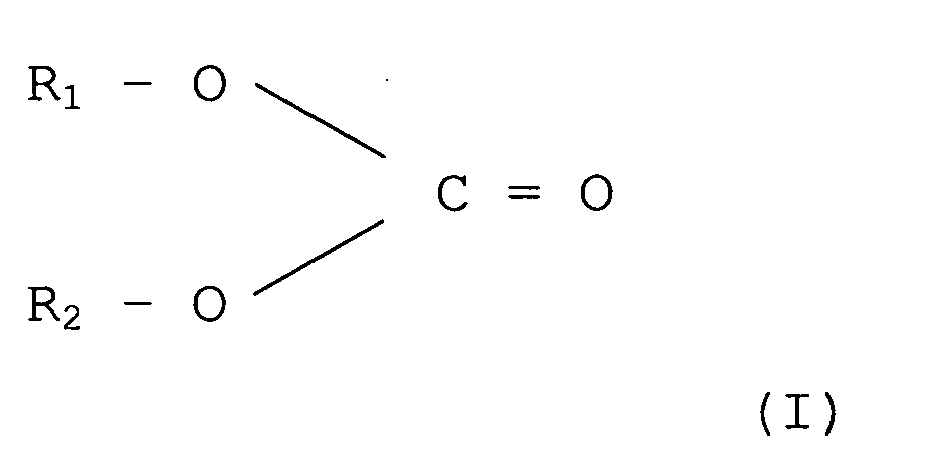
- The non-aqueous electrolyte secondary battery according to claim 1, wherein the thin film of negative electrode active material comprises materials selected from silicon and its alloy and tin and its alloy.
- The non-aqueous electrolyte secondary battery according to claim 1, wherein the slits formed in the thickness direction of the thin film of negative electrode active material is formed on and after a first time of charge-discharge performances.
- The non-aqueous electrolyte secondary battery according to claim 1, wherein R1 and R2 of the general formula (I) are combined with each other and alkylene fluoride group having a number of carbon in a range of 2 to 6 is formed.
- The non-aqueous electrolyte secondary battery according to claim 4, wherein a compound containing alkylene fluoride group wherein R1 and R2 of the general formula (I) are combined with each other is contained in a range of 0.1 to 10 mass % with respect to a mass of the non-aqueous electrolyte excluding lithium salt.
- The non-aqueous electrolyte secondary battery according to claim 4, wherein the compound containing alkylene fluoride group wherein R1 and R2 of the general formula (I) are combined with each other is fluoro ethylene carbonate.
- The non-aqueous electrolyte secondary battery according to claim 1, wherein R1 and R2 of the general formula (I) are independent group and at least one of R1 and R2 is chained alkyl fluoride group having a number of carbon in a range of 1 to 4.
- The non-aqueous electrolyte secondary battery according to claim 1, wherein one or more of solvent selected from a group of lactone compound, cyclic carbonate, chained carbonate, chained carboxylic acid ester, and ether wherein each total number of carbon is in a range of 3 to 9 is contained as the non-aqueous solvent in the non-aqueous electrolyte, and a total amount of the compound expressed by the general formula (I), said lactone compound, said cyclic carbonate, said chained carbonate, said chained carboxylic acid ester, and said ether is not less than 90 mass % with respect to the mass of the non-aqueous electrolyte excluding lithium salt.
- The non-aqueous electrolyte secondary battery according to claim 8, a total amount of the cyclic carbonate and the lactone compound is not less than 20 mass % with respect to the mass of the non-aqueous electrolyte excluding lithium salt.
- The non-aqueous electrolyte secondary battery according to claim 8, wherein said lactone compound is one or more selected from a group of γ-butyrolactone, γ-valerolactone, and δ-valerolactone, and said cyclic carbonate is one or more selected from a group of ethylene carbonate, propylene carbonate and butylene carbonate, and said chained carbonate is one or more selected from a group of dimethyl carbonate, diethyl carbonate and ethyl methyl carbonate.
- The non-aqueous electrolyte secondary battery according to claim 1, wherein one or more of lithium salt selected from LiBF4 and LiPF6 is contained as the lithium salt in a ratio of not less than 5 mol % with respect to total lithium salt in the non-aqueous electrolyte.
- The non-aqueous electrolyte secondary battery according to claim 1, wherein materials constituting the current collector in the negative electrode are at least one selected from copper, nickel, stainless steel, molybdenum, tungsten and tantalum.
- The non-aqueous electrolyte secondary battery according to claim 1, wherein the current collector in the negative electrode has a thickness of within a range of 1 µm to 30 µm.
- The non-aqueous electrolyte secondary battery according to claim 1, wherein the current collector in the negative electrode has surface roughness Ra of not less than 0.01 µm.
- The non-aqueous electrolyte secondary battery according to claim 1, wherein the current collector in the negative electrode comprises an electrolytic copper foil having a roughen surface.
- The non-aqueous electrolyte secondary battery according to claim 1, wherein components of the current collector are diffused in the thin film of negative electrode active material in the negative electrode.
- The non-aqueous electrolyte secondary battery according to claim 16, wherein the thin film of negative electrode active material consists of silicon and the components of the current collector diffused in the thin film of negative electrode active material forms a solid solution without forming an inter-metal compound with silicon.
- The non-aqueous electrolyte secondary battery according to claim 1, wherein the thin film of negative electrode active material comprises tin, and a mixed layer consisting of the components of the current collector and tin components of the thin film of negative electrode active material is formed between the thin film of negative electrode active material and the current collector.
- A non-aqueous electrolyte secondary battery comprising a negative electrode containing a thin film of negative electrode active material including a metal capable of absorbing or releasing lithium formed on a current collector; a positive electrode containing a positive electrode active material capable of absorbing or releasing lithium; and a non-aqueous electrolyte prepared by dissolving lithium salt in a non-aqueous solvent; wherein the thin film of negative electrode active material is separated into columnar shape by slits formed in a thickness direction, and wherein the non-aqueous electrolyte contains the compound expressed by the general formula (I) as claimed in claim 1.
Applications Claiming Priority (2)
| Application Number | Priority Date | Filing Date | Title |
|---|---|---|---|
| JP2004271042A JP4921702B2 (en) | 2004-09-17 | 2004-09-17 | Non-aqueous electrolyte secondary battery and non-aqueous electrolyte |
| PCT/JP2005/016484 WO2006030681A1 (en) | 2004-09-17 | 2005-09-08 | Non-aqueous electrolyte secondary battery and non-aqueous electrolyte |
Publications (2)
| Publication Number | Publication Date |
|---|---|
| EP1806806A1 true EP1806806A1 (en) | 2007-07-11 |
| EP1806806A4 EP1806806A4 (en) | 2011-05-18 |
Family
ID=36059934
Family Applications (1)
| Application Number | Title | Priority Date | Filing Date |
|---|---|---|---|
| EP05782093A Withdrawn EP1806806A4 (en) | 2004-09-17 | 2005-09-08 | NONAQUEOUS ELECTROLYTIC SECONDARY BATTERY AND NONAQUEOUS ELECTROLYTE |
Country Status (6)
| Country | Link |
|---|---|
| US (1) | US20070178379A1 (en) |
| EP (1) | EP1806806A4 (en) |
| JP (1) | JP4921702B2 (en) |
| KR (1) | KR101272434B1 (en) |
| CN (1) | CN100499244C (en) |
| WO (1) | WO2006030681A1 (en) |
Cited By (3)
| Publication number | Priority date | Publication date | Assignee | Title |
|---|---|---|---|---|
| EP1890357A4 (en) * | 2005-06-10 | 2009-12-30 | Mitsubishi Chem Corp | NON-ACID ELECTROLYTE SOLUTION, NON-ACID ELECTROLYTSECONDARY BATTERY AND CARBONATE COMPOUND |
| WO2010014387A3 (en) * | 2008-07-29 | 2010-05-06 | 3M Innovative Properties Company | Electrolyte composition, lithium-containing electrochemical cell, battery pack, and device including the same |
| WO2014177704A1 (en) * | 2013-05-02 | 2014-11-06 | Solvay Fluor Gmbh | Fluorinated carbonates as solvent for lithium sulfonimide-based electrolytes |
Families Citing this family (63)
| Publication number | Priority date | Publication date | Assignee | Title |
|---|---|---|---|---|
| US8021791B1 (en) * | 2004-01-27 | 2011-09-20 | The United States Of America As Represented By The Secretary Of The Army | Carbonate solvent for electrolytes in lithium and lithium ion cells |
| EP1630894A1 (en) * | 2004-08-27 | 2006-03-01 | Sanyo Component Europe GmbH | Lithium secondary battery |
| JP4940571B2 (en) * | 2005-04-08 | 2012-05-30 | ソニー株式会社 | Lithium ion secondary battery |
| JP5076283B2 (en) * | 2005-05-26 | 2012-11-21 | ソニー株式会社 | Non-aqueous secondary battery |
| JP4993159B2 (en) * | 2005-05-31 | 2012-08-08 | ソニー株式会社 | Secondary battery |
| JP4952074B2 (en) * | 2005-06-10 | 2012-06-13 | 三菱化学株式会社 | Non-aqueous electrolyte and non-aqueous electrolyte secondary battery |
| JP2007042329A (en) * | 2005-08-01 | 2007-02-15 | Mitsui Chemicals Inc | Lithium secondary battery |
| US20090253044A1 (en) * | 2005-10-12 | 2009-10-08 | Mitsui Chemicals, Inc. | Nonaqueous Electrolyte and Lithium ion Secondary Battery Using Same |
| JP5412705B2 (en) * | 2006-04-27 | 2014-02-12 | 三菱化学株式会社 | Non-aqueous electrolyte and non-aqueous electrolyte secondary battery using the same |
| JP5315593B2 (en) * | 2006-04-27 | 2013-10-16 | 三菱化学株式会社 | Non-aqueous electrolyte and non-aqueous electrolyte secondary battery using the same |
| EP3621141A1 (en) | 2006-04-27 | 2020-03-11 | Mitsubishi Chemical Corporation | Non-aqueous liquid electrolyte and non-aqueous liquid electrolyte secondary battery |
| EP2031689B1 (en) * | 2006-06-02 | 2013-10-09 | Mitsubishi Chemical Corporation | Nonaqueous electrolyte solution and nonaqueous electrolyte battery |
| JP5369391B2 (en) * | 2006-06-02 | 2013-12-18 | 三菱化学株式会社 | Non-aqueous electrolyte, non-aqueous electrolyte battery, and non-aqueous electrolyte secondary battery |
| JP5211446B2 (en) * | 2006-06-07 | 2013-06-12 | ソニー株式会社 | Non-aqueous electrolyte battery electrolyte and battery using the same |
| JP5219401B2 (en) * | 2006-06-14 | 2013-06-26 | 三洋電機株式会社 | Non-aqueous electrolyte for secondary battery and non-aqueous electrolyte secondary battery using the same |
| JP2008041366A (en) * | 2006-08-03 | 2008-02-21 | Sony Corp | battery |
| KR100916436B1 (en) * | 2006-09-14 | 2009-09-07 | 파나소닉 주식회사 | Cathode for lithium ion secondary battery and lithium ion secondary battery using same |
| CN101449408B (en) * | 2006-10-19 | 2011-04-13 | 松下电器产业株式会社 | Negative electrode for lithium secondary battery and lithium secondary battery containing the same |
| KR20160011227A (en) | 2006-12-06 | 2016-01-29 | 미쓰비시 가가꾸 가부시키가이샤 | Nonaqueous electrolyte solution and nonaqueous electrolyte secondary battery |
| US20090148778A1 (en) * | 2007-02-16 | 2009-06-11 | Sony Corporation | Anode, method of manufacturing it, and battery |
| JP5165258B2 (en) * | 2007-02-26 | 2013-03-21 | 日立マクセルエナジー株式会社 | Nonaqueous electrolyte secondary battery |
| JP5223395B2 (en) * | 2007-03-19 | 2013-06-26 | 三菱化学株式会社 | Non-aqueous electrolyte solution for non-aqueous electrolyte battery and non-aqueous electrolyte battery |
| WO2008123038A1 (en) * | 2007-03-19 | 2008-10-16 | Mitsubishi Chemical Corporation | Nonaqueous electrolyte solution and nonaqueous electrolyte battery |
| KR101340031B1 (en) | 2007-03-23 | 2013-12-10 | 삼성에스디아이 주식회사 | Electrolyte for lithium rechargeable battery and a lithium rechargeable battery comprising it |
| JP2008243717A (en) * | 2007-03-28 | 2008-10-09 | Mitsui Mining & Smelting Co Ltd | Nonaqueous electrolyte secondary battery and manufacturing method thereof |
| KR101844201B1 (en) * | 2007-04-05 | 2018-03-30 | 미쯔비시 케미컬 주식회사 | Nonaqueous electrolyte for rechargeable battery, and rechargeable battery with nonaqueous electrolyte |
| EP2158635B1 (en) | 2007-06-11 | 2013-07-31 | LG Chem, Ltd. | Non-aqueous electrolyte and secondary battery comprising the same |
| US9118062B2 (en) * | 2007-06-13 | 2015-08-25 | Sony Corporation | Anode and method of manufacturing the same, and battery and method of manufacturing the same |
| JP5239302B2 (en) * | 2007-11-14 | 2013-07-17 | ソニー株式会社 | Lithium ion secondary battery |
| JP4715848B2 (en) * | 2008-01-09 | 2011-07-06 | ソニー株式会社 | battery |
| JP2009231261A (en) | 2008-02-26 | 2009-10-08 | Sanyo Electric Co Ltd | Nonaqueous electrolyte secondary battery |
| CN102113161A (en) | 2008-08-20 | 2011-06-29 | 三洋电机株式会社 | Nonaqueous electrolyte secondary battery |
| JP2010108915A (en) * | 2008-09-30 | 2010-05-13 | Sanyo Electric Co Ltd | Nonaqueous electrolytic secondary battery |
| EP2454226B1 (en) * | 2009-07-16 | 2017-03-22 | Solvay Fluor GmbH | Process for the preparation of fluoroalkyl (fluoro)alkyl carbonates |
| WO2011027530A1 (en) * | 2009-09-02 | 2011-03-10 | パナソニック株式会社 | Nonaqueous solvent, nonaqueous electrolyte solution using same, and nonaqueous secondary battery |
| CN102668199B (en) * | 2009-11-11 | 2016-01-20 | 日立金属株式会社 | The aluminium foil of spread loads carbonaceous particles |
| JP5168593B2 (en) * | 2009-11-16 | 2013-03-21 | ソニー株式会社 | Lithium ion secondary battery |
| JP5463957B2 (en) | 2010-03-02 | 2014-04-09 | ソニー株式会社 | Non-aqueous electrolyte and battery |
| JP5533321B2 (en) | 2010-03-02 | 2014-06-25 | ソニー株式会社 | Nonaqueous electrolyte and nonaqueous electrolyte battery |
| CN106099191B (en) * | 2010-03-02 | 2020-05-08 | 株式会社村田制作所 | Nonaqueous electrolyte and nonaqueous electrolyte battery |
| US20130115520A1 (en) * | 2010-07-23 | 2013-05-09 | Ube Industries, Ltd. | Non-aqueous electrolytic solution, and electrochemical element utilizing same |
| CN102208682B (en) * | 2011-05-06 | 2013-05-01 | 北京理工大学 | Additive and solvent of lithium secondary battery electrolyte |
| JP5862853B2 (en) | 2011-05-11 | 2016-02-16 | ソニー株式会社 | Lithium ion secondary battery, electronic equipment, electric tool, electric vehicle, and power storage system |
| US9979050B2 (en) | 2011-09-02 | 2018-05-22 | Solvay Sa | Fluorinated electrolyte compositions |
| JP6178317B2 (en) | 2011-09-02 | 2017-08-09 | イー・アイ・デュポン・ドウ・ヌムール・アンド・カンパニーE.I.Du Pont De Nemours And Company | Lithium ion battery |
| CN102496737A (en) * | 2011-12-30 | 2012-06-13 | 天津力神电池股份有限公司 | Lithium ion battery electrolyte and lithium ion battery prepared therefrom |
| KR102064194B1 (en) | 2012-06-01 | 2020-01-09 | 솔베이(소시에떼아노님) | Lithium-ion battery |
| WO2013180783A1 (en) | 2012-06-01 | 2013-12-05 | E. I. Du Pont De Nemours And Company | Fluorinated electrolyte compositions |
| US20140050977A1 (en) * | 2012-08-20 | 2014-02-20 | Dainippon Screen Mfg. Co., Ltd. | Method of and apparatus for manufacturing electrode for lithium-ion secondary battery and electrode for lithium-ion secondary battery |
| EP2982002B1 (en) | 2013-04-04 | 2019-07-17 | Solvay Sa | Nonaqueous electrolyte compositions |
| JP6205889B2 (en) * | 2013-06-21 | 2017-10-04 | 株式会社豊田中央研究所 | Lithium secondary battery |
| US10587006B2 (en) | 2013-10-29 | 2020-03-10 | Samsung Sdi Co., Ltd. | Rechargeable lithium ion battery, and manufacturing method for rechargeable lithium ion battery |
| WO2015183598A1 (en) * | 2014-05-27 | 2015-12-03 | Dow Global Technologies Llc | Lithium battery electrolyte solution containing (2,2-difluoroethyl) ethyl carbonate |
| EP3235046B1 (en) * | 2014-12-18 | 2021-06-16 | Solvay SA | Electrolyte composition comprising fluorinated carbonate, and battery comprising the same |
| KR102411931B1 (en) * | 2015-02-06 | 2022-06-22 | 삼성에스디아이 주식회사 | Lithium secondary battery |
| KR102460967B1 (en) * | 2016-07-15 | 2022-11-01 | 솔베이(소시에떼아노님) | Non-aqueous electrolyte composition |
| CN106450170A (en) * | 2016-10-25 | 2017-02-22 | 东莞市联洲知识产权运营管理有限公司 | Production method of low-cost and high-quality lithium-ion battery |
| PL3544110T3 (en) | 2016-12-20 | 2024-05-06 | Daikin Industries, Ltd. | Electrolyte solution, electrochemical device, lithium ion secondary battery, and module |
| HUE064106T2 (en) | 2016-12-27 | 2024-02-28 | Daikin Ind Ltd | Electrolytic solution, electrochemical device, lithium-ion secondary cell, and module |
| PL3706230T3 (en) * | 2018-06-12 | 2024-04-02 | Lg Energy Solution, Ltd. | Electrolyte for lithium secondary battery and lithium secondary battery comprising same |
| KR102722661B1 (en) * | 2021-06-08 | 2024-10-29 | 주식회사 엘지에너지솔루션 | Electrolyte for lithium secondary battery |
| TW202318707A (en) * | 2021-09-10 | 2023-05-01 | 美商澤恩萊博能量股份有限公司 | Lithium ion cells with high rate electrolyte for cells with silicon oxide active material achieving high power discharge and long cycle life |
| CN121546155B (en) * | 2026-01-19 | 2026-06-02 | 浙江大学 | An electrolyte for low-temperature fast-charging lithium batteries and its application |
Family Cites Families (17)
| Publication number | Priority date | Publication date | Assignee | Title |
|---|---|---|---|---|
| US5714280A (en) * | 1994-11-09 | 1998-02-03 | Furukawa Denchi Kabushiki Kaisha | Lithium secondary battery |
| JP3368447B2 (en) * | 1994-11-10 | 2003-01-20 | 古河電池株式会社 | Lithium secondary battery |
| CA2212399C (en) * | 1996-08-07 | 2003-03-25 | Masahiro Taniuchi | Ionically conductive polymeric gel electrolyte and solid battery containing the same |
| JPH10189046A (en) * | 1996-11-11 | 1998-07-21 | Mitsui Chem Inc | Non-aqueous electrolyte and non-aqueous electrolyte secondary battery |
| JP4020561B2 (en) * | 2000-03-13 | 2007-12-12 | セントラル硝子株式会社 | Electrolyte for electrochemical devices |
| JP2001313075A (en) * | 2000-04-27 | 2001-11-09 | Sony Corp | Gel electrolyte and gel electrolyte battery |
| WO2002058182A1 (en) * | 2001-01-18 | 2002-07-25 | Sanyo Electric Co., Ltd. | Lithium secondary battery |
| JP4201509B2 (en) * | 2001-03-06 | 2008-12-24 | 三洋電機株式会社 | Electrode for lithium secondary battery and lithium secondary battery |
| JP2002279972A (en) * | 2001-03-21 | 2002-09-27 | Sanyo Electric Co Ltd | Electrode for lithium secondary battery and lithium secondary battery |
| JP4152086B2 (en) * | 2001-03-23 | 2008-09-17 | 三洋電機株式会社 | Electrode for lithium secondary battery and lithium secondary battery |
| US6887623B2 (en) * | 2001-04-09 | 2005-05-03 | Sanyo Electric Co., Ltd. | Electrode for rechargeable lithium battery and rechargeable lithium battery |
| JP2003007305A (en) * | 2001-04-19 | 2003-01-10 | Sanyo Electric Co Ltd | Electrode for lithium secondary battery and lithium secondary battery |
| JP4236390B2 (en) | 2001-04-19 | 2009-03-11 | 三洋電機株式会社 | Lithium secondary battery |
| JP4033074B2 (en) | 2002-08-29 | 2008-01-16 | 日本電気株式会社 | Secondary battery electrolyte and secondary battery using the same |
| EP1598895B1 (en) * | 2003-02-27 | 2011-01-19 | Mitsubishi Chemical Corporation | Nonaqueous electrolytic solution and lithium secondary battery |
| US20040231111A1 (en) * | 2003-05-23 | 2004-11-25 | Martinez Michael A. | Sealing clasp |
| JP4843936B2 (en) * | 2004-01-20 | 2011-12-21 | ソニー株式会社 | Secondary battery and charging / discharging method thereof |
-
2004
- 2004-09-17 JP JP2004271042A patent/JP4921702B2/en not_active Expired - Fee Related
-
2005
- 2005-09-08 CN CNB2005800225447A patent/CN100499244C/en not_active Expired - Fee Related
- 2005-09-08 US US11/570,454 patent/US20070178379A1/en not_active Abandoned
- 2005-09-08 EP EP05782093A patent/EP1806806A4/en not_active Withdrawn
- 2005-09-08 WO PCT/JP2005/016484 patent/WO2006030681A1/en not_active Ceased
- 2005-09-08 KR KR1020077002888A patent/KR101272434B1/en not_active Expired - Fee Related
Cited By (4)
| Publication number | Priority date | Publication date | Assignee | Title |
|---|---|---|---|---|
| EP1890357A4 (en) * | 2005-06-10 | 2009-12-30 | Mitsubishi Chem Corp | NON-ACID ELECTROLYTE SOLUTION, NON-ACID ELECTROLYTSECONDARY BATTERY AND CARBONATE COMPOUND |
| US8178246B2 (en) | 2005-06-10 | 2012-05-15 | Mitsubishi Chemical Corporation | Nonaqueous electrolyte solution, nonaqueous electrolyte secondary cell, and carbonate compounds |
| WO2010014387A3 (en) * | 2008-07-29 | 2010-05-06 | 3M Innovative Properties Company | Electrolyte composition, lithium-containing electrochemical cell, battery pack, and device including the same |
| WO2014177704A1 (en) * | 2013-05-02 | 2014-11-06 | Solvay Fluor Gmbh | Fluorinated carbonates as solvent for lithium sulfonimide-based electrolytes |
Also Published As
| Publication number | Publication date |
|---|---|
| CN100499244C (en) | 2009-06-10 |
| EP1806806A4 (en) | 2011-05-18 |
| JP2006086058A (en) | 2006-03-30 |
| CN1981406A (en) | 2007-06-13 |
| KR101272434B1 (en) | 2013-06-07 |
| JP4921702B2 (en) | 2012-04-25 |
| US20070178379A1 (en) | 2007-08-02 |
| KR20070054629A (en) | 2007-05-29 |
| WO2006030681A1 (en) | 2006-03-23 |
Similar Documents
| Publication | Publication Date | Title |
|---|---|---|
| US20070178379A1 (en) | Non-aqueous electrolyte secondary battery and non-aqueous electrolyte | |
| JP4248240B2 (en) | Lithium secondary battery | |
| US8673504B2 (en) | Non-aqueous electrolyte secondary battery and non-aqueous electrolyte | |
| JP4033074B2 (en) | Secondary battery electrolyte and secondary battery using the same | |
| US20060024586A1 (en) | Nonaqueous electrolyte solution for secondary battery and nonaqueous electrolyte secondary battery | |
| JP4320914B2 (en) | Non-aqueous electrolyte and lithium secondary battery using the same | |
| US20080070123A1 (en) | Nonaqueous electrolyte solution for secondary battery and nonaqueous electrolyte secondary battery | |
| KR100825820B1 (en) | Nonaqueous electrolyte for secondary battery and nonaqueous electrolyte secondary battery | |
| JP4465968B2 (en) | Secondary battery electrolyte and secondary battery using the same | |
| JP2009231261A (en) | Nonaqueous electrolyte secondary battery | |
| JP2001313072A (en) | Electrolyte for lithium secondary battery and lithium secondary battery using the same | |
| JP4968614B2 (en) | Secondary battery electrolyte and secondary battery using the same | |
| JP4304404B2 (en) | Non-aqueous electrolyte and lithium secondary battery using the same | |
| KR20030072765A (en) | Negative active material slurry composition for rechargeable lithium battery and method of preparing negative electrode for rechargeable lithium battery prepared using same | |
| JP2012038737A (en) | Nonaqueous electrolyte secondary battery and nonaqueous electrolyte | |
| US7635539B2 (en) | Non-aqueous electrolyte secondary battery | |
| JP2000208166A (en) | Non-aqueous electrolyte and lithium secondary battery using the same | |
| JP2009099536A (en) | Nonaqueous secondary battery |
Legal Events
| Date | Code | Title | Description |
|---|---|---|---|
| PUAI | Public reference made under article 153(3) epc to a published international application that has entered the european phase |
Free format text: ORIGINAL CODE: 0009012 |
|
| 17P | Request for examination filed |
Effective date: 20070308 |
|
| AK | Designated contracting states |
Kind code of ref document: A1 Designated state(s): DE FR GB |
|
| DAX | Request for extension of the european patent (deleted) | ||
| RBV | Designated contracting states (corrected) |
Designated state(s): DE FR GB |
|
| A4 | Supplementary search report drawn up and despatched |
Effective date: 20110418 |
|
| 17Q | First examination report despatched |
Effective date: 20120214 |
|
| RAP1 | Party data changed (applicant data changed or rights of an application transferred) |
Owner name: SANYO ELECTRIC CO., LTD. Owner name: MITSUBISHI CHEMICAL CORPORATION |
|
| GRAP | Despatch of communication of intention to grant a patent |
Free format text: ORIGINAL CODE: EPIDOSNIGR1 |
|
| RIC1 | Information provided on ipc code assigned before grant |
Ipc: H01M 4/66 20060101ALI20130912BHEP Ipc: H01M 4/04 20060101ALI20130912BHEP Ipc: H01M 4/134 20100101ALI20130912BHEP Ipc: H01M 10/0569 20100101ALI20130912BHEP Ipc: H01M 4/02 20060101AFI20130912BHEP Ipc: H01M 10/0525 20100101ALI20130912BHEP Ipc: H01M 4/38 20060101ALI20130912BHEP Ipc: H01M 10/0567 20100101ALI20130912BHEP |
|
| INTG | Intention to grant announced |
Effective date: 20131017 |
|
| RIN1 | Information on inventor provided before grant (corrected) |
Inventor name: KOTATO, MIWA Inventor name: TAMURA, NORIYUKI Inventor name: KAMINO, MARUO Inventor name: TAKEHARA, MASAHIRO |
|
| STAA | Information on the status of an ep patent application or granted ep patent |
Free format text: STATUS: THE APPLICATION IS DEEMED TO BE WITHDRAWN |
|
| 18D | Application deemed to be withdrawn |
Effective date: 20140228 |
|
| REG | Reference to a national code |
Ref country code: DE Ref legal event code: R079 Free format text: PREVIOUS MAIN CLASS: H01M0010400000 Ipc: H01M0010050000 |
|
| REG | Reference to a national code |
Ref country code: DE Ref legal event code: R079 Free format text: PREVIOUS MAIN CLASS: H01M0010400000 Ipc: H01M0010050000 Effective date: 20140908 |