EP1806391A1 - Waterproof grease composition and roller bearing for wheel support - Google Patents
Waterproof grease composition and roller bearing for wheel support Download PDFInfo
- Publication number
- EP1806391A1 EP1806391A1 EP05795825A EP05795825A EP1806391A1 EP 1806391 A1 EP1806391 A1 EP 1806391A1 EP 05795825 A EP05795825 A EP 05795825A EP 05795825 A EP05795825 A EP 05795825A EP 1806391 A1 EP1806391 A1 EP 1806391A1
- Authority
- EP
- European Patent Office
- Prior art keywords
- grease
- added
- grease composition
- mass
- waterproof
- Prior art date
- Legal status (The legal status is an assumption and is not a legal conclusion. Google has not performed a legal analysis and makes no representation as to the accuracy of the status listed.)
- Withdrawn
Links
- 239000004519 grease Substances 0.000 title claims abstract description 200
- 239000000203 mixture Substances 0.000 title claims abstract description 84
- XLYOFNOQVPJJNP-UHFFFAOYSA-N water Substances O XLYOFNOQVPJJNP-UHFFFAOYSA-N 0.000 claims abstract description 76
- 239000003795 chemical substances by application Substances 0.000 claims abstract description 45
- 239000003921 oil Substances 0.000 claims abstract description 30
- 239000000344 soap Substances 0.000 claims abstract description 27
- 229910002804 graphite Inorganic materials 0.000 claims abstract description 26
- 239000010439 graphite Substances 0.000 claims abstract description 26
- OKTJSMMVPCPJKN-UHFFFAOYSA-N Carbon Chemical compound [C] OKTJSMMVPCPJKN-UHFFFAOYSA-N 0.000 claims abstract description 25
- 239000002199 base oil Substances 0.000 claims abstract description 25
- 239000002480 mineral oil Substances 0.000 claims abstract description 25
- 235000010446 mineral oil Nutrition 0.000 claims abstract description 25
- 229910052751 metal Inorganic materials 0.000 claims abstract description 23
- 239000002184 metal Substances 0.000 claims abstract description 23
- 238000005096 rolling process Methods 0.000 claims abstract description 20
- 239000005871 repellent Substances 0.000 claims abstract description 19
- 230000002940 repellent Effects 0.000 claims abstract description 18
- 239000002562 thickening agent Substances 0.000 claims abstract description 18
- 230000002093 peripheral effect Effects 0.000 claims abstract description 17
- 229920000642 polymer Polymers 0.000 claims abstract description 17
- 239000004094 surface-active agent Substances 0.000 claims abstract description 14
- YCKRFDGAMUMZLT-UHFFFAOYSA-N Fluorine atom Chemical compound [F] YCKRFDGAMUMZLT-UHFFFAOYSA-N 0.000 claims abstract description 7
- 239000011737 fluorine Substances 0.000 claims abstract description 7
- 229910052731 fluorine Inorganic materials 0.000 claims abstract description 7
- -1 urea compound Chemical class 0.000 claims description 32
- 239000002736 nonionic surfactant Substances 0.000 claims description 13
- 239000003945 anionic surfactant Substances 0.000 claims description 9
- 239000003093 cationic surfactant Substances 0.000 claims description 6
- 239000002563 ionic surfactant Substances 0.000 claims description 6
- 239000004202 carbamide Substances 0.000 claims description 5
- 235000019198 oils Nutrition 0.000 description 28
- 239000001993 wax Substances 0.000 description 20
- 230000000052 comparative effect Effects 0.000 description 19
- RTZKZFJDLAIYFH-UHFFFAOYSA-N Diethyl ether Chemical compound CCOCC RTZKZFJDLAIYFH-UHFFFAOYSA-N 0.000 description 17
- WHXSMMKQMYFTQS-UHFFFAOYSA-N Lithium Chemical compound [Li] WHXSMMKQMYFTQS-UHFFFAOYSA-N 0.000 description 13
- 229910052744 lithium Inorganic materials 0.000 description 13
- 239000002131 composite material Substances 0.000 description 12
- 239000000654 additive Substances 0.000 description 10
- 239000003963 antioxidant agent Substances 0.000 description 10
- 230000003078 antioxidant effect Effects 0.000 description 10
- 238000005461 lubrication Methods 0.000 description 9
- 229920013639 polyalphaolefin Polymers 0.000 description 9
- 230000000937 inactivator Effects 0.000 description 8
- XMKLTEGSALONPH-UHFFFAOYSA-N 1,2,4,5-tetrazinane-3,6-dione Chemical class O=C1NNC(=O)NN1 XMKLTEGSALONPH-UHFFFAOYSA-N 0.000 description 7
- 239000006229 carbon black Substances 0.000 description 7
- 235000014113 dietary fatty acids Nutrition 0.000 description 7
- 230000000694 effects Effects 0.000 description 7
- 239000000194 fatty acid Substances 0.000 description 7
- 229930195729 fatty acid Natural products 0.000 description 7
- 239000002253 acid Substances 0.000 description 6
- 230000003247 decreasing effect Effects 0.000 description 6
- 239000002245 particle Substances 0.000 description 6
- 229920003171 Poly (ethylene oxide) Polymers 0.000 description 5
- 230000002730 additional effect Effects 0.000 description 5
- 230000000996 additive effect Effects 0.000 description 5
- 239000010696 ester oil Substances 0.000 description 5
- 229910052739 hydrogen Inorganic materials 0.000 description 5
- 239000001257 hydrogen Substances 0.000 description 5
- 239000000314 lubricant Substances 0.000 description 5
- 238000007789 sealing Methods 0.000 description 5
- AFFLGGQVNFXPEV-UHFFFAOYSA-N 1-decene Chemical compound CCCCCCCCC=C AFFLGGQVNFXPEV-UHFFFAOYSA-N 0.000 description 4
- ULQISTXYYBZJSJ-UHFFFAOYSA-N 12-hydroxyoctadecanoic acid Chemical compound CCCCCCC(O)CCCCCCCCCCC(O)=O ULQISTXYYBZJSJ-UHFFFAOYSA-N 0.000 description 4
- CJZGTCYPCWQAJB-UHFFFAOYSA-L calcium stearate Chemical compound [Ca+2].CCCCCCCCCCCCCCCCCC([O-])=O.CCCCCCCCCCCCCCCCCC([O-])=O CJZGTCYPCWQAJB-UHFFFAOYSA-L 0.000 description 4
- 239000008116 calcium stearate Substances 0.000 description 4
- 235000013539 calcium stearate Nutrition 0.000 description 4
- 150000002148 esters Chemical class 0.000 description 4
- 150000004665 fatty acids Chemical class 0.000 description 4
- 239000004615 ingredient Substances 0.000 description 4
- 230000001050 lubricating effect Effects 0.000 description 4
- BDJRBEYXGGNYIS-UHFFFAOYSA-N nonanedioic acid Chemical compound OC(=O)CCCCCCCC(O)=O BDJRBEYXGGNYIS-UHFFFAOYSA-N 0.000 description 4
- 239000000126 substance Substances 0.000 description 4
- WMFOQBRAJBCJND-UHFFFAOYSA-M Lithium hydroxide Chemical compound [Li+].[OH-] WMFOQBRAJBCJND-UHFFFAOYSA-M 0.000 description 3
- XQVWYOYUZDUNRW-UHFFFAOYSA-N N-Phenyl-1-naphthylamine Chemical compound C=1C=CC2=CC=CC=C2C=1NC1=CC=CC=C1 XQVWYOYUZDUNRW-UHFFFAOYSA-N 0.000 description 3
- REYJJPSVUYRZGE-UHFFFAOYSA-N Octadecylamine Chemical compound CCCCCCCCCCCCCCCCCCN REYJJPSVUYRZGE-UHFFFAOYSA-N 0.000 description 3
- QAPVYZRWKDXNDK-UHFFFAOYSA-N P,P-Dioctyldiphenylamine Chemical compound C1=CC(CCCCCCCC)=CC=C1NC1=CC=C(CCCCCCCC)C=C1 QAPVYZRWKDXNDK-UHFFFAOYSA-N 0.000 description 3
- XSQUKJJJFZCRTK-UHFFFAOYSA-N Urea Chemical compound NC(N)=O XSQUKJJJFZCRTK-UHFFFAOYSA-N 0.000 description 3
- HCHKCACWOHOZIP-UHFFFAOYSA-N Zinc Chemical compound [Zn] HCHKCACWOHOZIP-UHFFFAOYSA-N 0.000 description 3
- 239000000463 material Substances 0.000 description 3
- VNWKTOKETHGBQD-UHFFFAOYSA-N methane Chemical compound C VNWKTOKETHGBQD-UHFFFAOYSA-N 0.000 description 3
- 150000003839 salts Chemical class 0.000 description 3
- 229920002545 silicone oil Polymers 0.000 description 3
- 239000000725 suspension Substances 0.000 description 3
- 150000003672 ureas Chemical class 0.000 description 3
- 229910052725 zinc Inorganic materials 0.000 description 3
- 239000011701 zinc Substances 0.000 description 3
- ZORQXIQZAOLNGE-UHFFFAOYSA-N 1,1-difluorocyclohexane Chemical compound FC1(F)CCCCC1 ZORQXIQZAOLNGE-UHFFFAOYSA-N 0.000 description 2
- 229940114072 12-hydroxystearic acid Drugs 0.000 description 2
- KGRVJHAUYBGFFP-UHFFFAOYSA-N 2,2'-Methylenebis(4-methyl-6-tert-butylphenol) Chemical compound CC(C)(C)C1=CC(C)=CC(CC=2C(=C(C=C(C)C=2)C(C)(C)C)O)=C1O KGRVJHAUYBGFFP-UHFFFAOYSA-N 0.000 description 2
- UPMLOUAZCHDJJD-UHFFFAOYSA-N 4,4'-Diphenylmethane Diisocyanate Chemical compound C1=CC(N=C=O)=CC=C1CC1=CC=C(N=C=O)C=C1 UPMLOUAZCHDJJD-UHFFFAOYSA-N 0.000 description 2
- OYPRJOBELJOOCE-UHFFFAOYSA-N Calcium Chemical compound [Ca] OYPRJOBELJOOCE-UHFFFAOYSA-N 0.000 description 2
- 239000004215 Carbon black (E152) Substances 0.000 description 2
- WSFSSNUMVMOOMR-UHFFFAOYSA-N Formaldehyde Chemical compound O=C WSFSSNUMVMOOMR-UHFFFAOYSA-N 0.000 description 2
- UFHFLCQGNIYNRP-UHFFFAOYSA-N Hydrogen Chemical compound [H][H] UFHFLCQGNIYNRP-UHFFFAOYSA-N 0.000 description 2
- SIKJAQJRHWYJAI-UHFFFAOYSA-N Indole Chemical compound C1=CC=C2NC=CC2=C1 SIKJAQJRHWYJAI-UHFFFAOYSA-N 0.000 description 2
- KEQFTVQCIQJIQW-UHFFFAOYSA-N N-Phenyl-2-naphthylamine Chemical compound C=1C=C2C=CC=CC2=CC=1NC1=CC=CC=C1 KEQFTVQCIQJIQW-UHFFFAOYSA-N 0.000 description 2
- 239000004698 Polyethylene Substances 0.000 description 2
- 239000002202 Polyethylene glycol Substances 0.000 description 2
- 229920002367 Polyisobutene Polymers 0.000 description 2
- VYPSYNLAJGMNEJ-UHFFFAOYSA-N Silicium dioxide Chemical compound O=[Si]=O VYPSYNLAJGMNEJ-UHFFFAOYSA-N 0.000 description 2
- QAOWNCQODCNURD-UHFFFAOYSA-N Sulfuric acid Chemical compound OS(O)(=O)=O QAOWNCQODCNURD-UHFFFAOYSA-N 0.000 description 2
- YSMRWXYRXBRSND-UHFFFAOYSA-N TOTP Chemical compound CC1=CC=CC=C1OP(=O)(OC=1C(=CC=CC=1)C)OC1=CC=CC=C1C YSMRWXYRXBRSND-UHFFFAOYSA-N 0.000 description 2
- 150000007513 acids Chemical class 0.000 description 2
- 150000005215 alkyl ethers Chemical class 0.000 description 2
- 239000010692 aromatic oil Substances 0.000 description 2
- 229910021383 artificial graphite Inorganic materials 0.000 description 2
- 239000011575 calcium Substances 0.000 description 2
- 229910052791 calcium Inorganic materials 0.000 description 2
- 230000008859 change Effects 0.000 description 2
- DMBHHRLKUKUOEG-UHFFFAOYSA-N diphenylamine Chemical compound C=1C=CC=CC=1NC1=CC=CC=C1 DMBHHRLKUKUOEG-UHFFFAOYSA-N 0.000 description 2
- 239000006185 dispersion Substances 0.000 description 2
- 230000005611 electricity Effects 0.000 description 2
- 229930195733 hydrocarbon Natural products 0.000 description 2
- 150000002430 hydrocarbons Chemical class 0.000 description 2
- HQKMJHAJHXVSDF-UHFFFAOYSA-L magnesium stearate Chemical compound [Mg+2].CCCCCCCCCCCCCCCCCC([O-])=O.CCCCCCCCCCCCCCCCCC([O-])=O HQKMJHAJHXVSDF-UHFFFAOYSA-L 0.000 description 2
- 238000000034 method Methods 0.000 description 2
- 239000005078 molybdenum compound Substances 0.000 description 2
- 150000002752 molybdenum compounds Chemical class 0.000 description 2
- 229910021382 natural graphite Inorganic materials 0.000 description 2
- QIQXTHQIDYTFRH-UHFFFAOYSA-N octadecanoic acid Chemical compound CCCCCCCCCCCCCCCCCC(O)=O QIQXTHQIDYTFRH-UHFFFAOYSA-N 0.000 description 2
- ZQPPMHVWECSIRJ-KTKRTIGZSA-N oleic acid Chemical compound CCCCCCCC\C=C/CCCCCCCC(O)=O ZQPPMHVWECSIRJ-KTKRTIGZSA-N 0.000 description 2
- 239000010702 perfluoropolyether Substances 0.000 description 2
- 150000002989 phenols Chemical class 0.000 description 2
- 229920000573 polyethylene Polymers 0.000 description 2
- 229920001223 polyethylene glycol Polymers 0.000 description 2
- 229920001451 polypropylene glycol Polymers 0.000 description 2
- 229920001343 polytetrafluoroethylene Polymers 0.000 description 2
- 239000004810 polytetrafluoroethylene Substances 0.000 description 2
- 150000003242 quaternary ammonium salts Chemical class 0.000 description 2
- 230000002829 reductive effect Effects 0.000 description 2
- 238000010008 shearing Methods 0.000 description 2
- LPXPTNMVRIOKMN-UHFFFAOYSA-M sodium nitrite Chemical compound [Na+].[O-]N=O LPXPTNMVRIOKMN-UHFFFAOYSA-M 0.000 description 2
- 235000011069 sorbitan monooleate Nutrition 0.000 description 2
- 239000001593 sorbitan monooleate Substances 0.000 description 2
- 229940035049 sorbitan monooleate Drugs 0.000 description 2
- 230000003068 static effect Effects 0.000 description 2
- 150000005846 sugar alcohols Polymers 0.000 description 2
- WMYJOZQKDZZHAC-UHFFFAOYSA-H trizinc;dioxido-sulfanylidene-sulfido-$l^{5}-phosphane Chemical compound [Zn+2].[Zn+2].[Zn+2].[O-]P([O-])([S-])=S.[O-]P([O-])([S-])=S WMYJOZQKDZZHAC-UHFFFAOYSA-H 0.000 description 2
- ZJHHPAUQMCHPRB-UHFFFAOYSA-N urea urea Chemical compound NC(N)=O.NC(N)=O ZJHHPAUQMCHPRB-UHFFFAOYSA-N 0.000 description 2
- 238000005406 washing Methods 0.000 description 2
- JNYAEWCLZODPBN-JGWLITMVSA-N (2r,3r,4s)-2-[(1r)-1,2-dihydroxyethyl]oxolane-3,4-diol Chemical class OC[C@@H](O)[C@H]1OC[C@H](O)[C@H]1O JNYAEWCLZODPBN-JGWLITMVSA-N 0.000 description 1
- ALSTYHKOOCGGFT-KTKRTIGZSA-N (9Z)-octadecen-1-ol Chemical compound CCCCCCCC\C=C/CCCCCCCCO ALSTYHKOOCGGFT-KTKRTIGZSA-N 0.000 description 1
- WRIDQFICGBMAFQ-UHFFFAOYSA-N (E)-8-Octadecenoic acid Natural products CCCCCCCCCC=CCCCCCCC(O)=O WRIDQFICGBMAFQ-UHFFFAOYSA-N 0.000 description 1
- GEYOCULIXLDCMW-UHFFFAOYSA-N 1,2-phenylenediamine Chemical compound NC1=CC=CC=C1N GEYOCULIXLDCMW-UHFFFAOYSA-N 0.000 description 1
- FJLUATLTXUNBOT-UHFFFAOYSA-N 1-Hexadecylamine Chemical compound CCCCCCCCCCCCCCCCN FJLUATLTXUNBOT-UHFFFAOYSA-N 0.000 description 1
- YFMDXYVZWMHAHJ-UHFFFAOYSA-N 1-pentaphen-1-yloxypentaphene Chemical compound C1=CC=CC2=CC3=C(C=C4C(OC=5C6=CC7=C8C=C9C=CC=CC9=CC8=CC=C7C=C6C=CC=5)=CC=CC4=C4)C4=CC=C3C=C21 YFMDXYVZWMHAHJ-UHFFFAOYSA-N 0.000 description 1
- WJFKNYWRSNBZNX-UHFFFAOYSA-N 10H-phenothiazine Chemical compound C1=CC=C2NC3=CC=CC=C3SC2=C1 WJFKNYWRSNBZNX-UHFFFAOYSA-N 0.000 description 1
- HYZJCKYKOHLVJF-UHFFFAOYSA-N 1H-benzimidazole Chemical compound C1=CC=C2NC=NC2=C1 HYZJCKYKOHLVJF-UHFFFAOYSA-N 0.000 description 1
- JIEWQZNTUPWNMX-UHFFFAOYSA-N 2,6-ditert-butyl-4-phenylphenol Chemical compound CC(C)(C)C1=C(O)C(C(C)(C)C)=CC(C=2C=CC=CC=2)=C1 JIEWQZNTUPWNMX-UHFFFAOYSA-N 0.000 description 1
- LLEFDCACDRGBKD-UHFFFAOYSA-N 2-ethyl-2-(hydroxymethyl)propane-1,3-diol;nonanoic acid Chemical compound CCC(CO)(CO)CO.CCCCCCCCC(O)=O LLEFDCACDRGBKD-UHFFFAOYSA-N 0.000 description 1
- CWTQBXKJKDAOSQ-UHFFFAOYSA-N 2-ethyl-2-(hydroxymethyl)propane-1,3-diol;octanoic acid Chemical compound CCC(CO)(CO)CO.CCCCCCCC(O)=O CWTQBXKJKDAOSQ-UHFFFAOYSA-N 0.000 description 1
- HXIQYSLFEXIOAV-UHFFFAOYSA-N 2-tert-butyl-4-(5-tert-butyl-4-hydroxy-2-methylphenyl)sulfanyl-5-methylphenol Chemical compound CC1=CC(O)=C(C(C)(C)C)C=C1SC1=CC(C(C)(C)C)=C(O)C=C1C HXIQYSLFEXIOAV-UHFFFAOYSA-N 0.000 description 1
- PFANXOISJYKQRP-UHFFFAOYSA-N 2-tert-butyl-4-[1-(5-tert-butyl-4-hydroxy-2-methylphenyl)butyl]-5-methylphenol Chemical compound C=1C(C(C)(C)C)=C(O)C=C(C)C=1C(CCC)C1=CC(C(C)(C)C)=C(O)C=C1C PFANXOISJYKQRP-UHFFFAOYSA-N 0.000 description 1
- LQJBNNIYVWPHFW-UHFFFAOYSA-N 20:1omega9c fatty acid Natural products CCCCCCCCCCC=CCCCCCCCC(O)=O LQJBNNIYVWPHFW-UHFFFAOYSA-N 0.000 description 1
- ALKCLFLTXBBMMP-UHFFFAOYSA-N 3,7-dimethylocta-1,6-dien-3-yl hexanoate Chemical compound CCCCCC(=O)OC(C)(C=C)CCC=C(C)C ALKCLFLTXBBMMP-UHFFFAOYSA-N 0.000 description 1
- VSAWBBYYMBQKIK-UHFFFAOYSA-N 4-[[3,5-bis[(3,5-ditert-butyl-4-hydroxyphenyl)methyl]-2,4,6-trimethylphenyl]methyl]-2,6-ditert-butylphenol Chemical compound CC1=C(CC=2C=C(C(O)=C(C=2)C(C)(C)C)C(C)(C)C)C(C)=C(CC=2C=C(C(O)=C(C=2)C(C)(C)C)C(C)(C)C)C(C)=C1CC1=CC(C(C)(C)C)=C(O)C(C(C)(C)C)=C1 VSAWBBYYMBQKIK-UHFFFAOYSA-N 0.000 description 1
- CMGDVUCDZOBDNL-UHFFFAOYSA-N 4-methyl-2h-benzotriazole Chemical compound CC1=CC=CC2=NNN=C12 CMGDVUCDZOBDNL-UHFFFAOYSA-N 0.000 description 1
- DBOSBRHMHBENLP-UHFFFAOYSA-N 4-tert-Butylphenyl Salicylate Chemical compound C1=CC(C(C)(C)C)=CC=C1OC(=O)C1=CC=CC=C1O DBOSBRHMHBENLP-UHFFFAOYSA-N 0.000 description 1
- XZIIFPSPUDAGJM-UHFFFAOYSA-N 6-chloro-2-n,2-n-diethylpyrimidine-2,4-diamine Chemical compound CCN(CC)C1=NC(N)=CC(Cl)=N1 XZIIFPSPUDAGJM-UHFFFAOYSA-N 0.000 description 1
- QSBYPNXLFMSGKH-UHFFFAOYSA-N 9-Heptadecensaeure Natural products CCCCCCCC=CCCCCCCCC(O)=O QSBYPNXLFMSGKH-UHFFFAOYSA-N 0.000 description 1
- DJBVDAUKGXUPLO-QEMDMZNVSA-N C(C)C(C(=O)O)CCCC.C([C@H](O)[C@H](O)CO)O.C([C@H](O)[C@H](O)CO)O.C([C@H](O)[C@H](O)CO)O.C([C@H](O)[C@H](O)CO)O.C([C@H](O)[C@H](O)CO)O Chemical compound C(C)C(C(=O)O)CCCC.C([C@H](O)[C@H](O)CO)O.C([C@H](O)[C@H](O)CO)O.C([C@H](O)[C@H](O)CO)O.C([C@H](O)[C@H](O)CO)O.C([C@H](O)[C@H](O)CO)O DJBVDAUKGXUPLO-QEMDMZNVSA-N 0.000 description 1
- PYGXAGIECVVIOZ-UHFFFAOYSA-N Dibutyl decanedioate Chemical compound CCCCOC(=O)CCCCCCCCC(=O)OCCCC PYGXAGIECVVIOZ-UHFFFAOYSA-N 0.000 description 1
- VGGSQFUCUMXWEO-UHFFFAOYSA-N Ethene Chemical compound C=C VGGSQFUCUMXWEO-UHFFFAOYSA-N 0.000 description 1
- 239000005977 Ethylene Substances 0.000 description 1
- PEDCQBHIVMGVHV-UHFFFAOYSA-N Glycerol Natural products OCC(O)CO PEDCQBHIVMGVHV-UHFFFAOYSA-N 0.000 description 1
- DGAQECJNVWCQMB-PUAWFVPOSA-M Ilexoside XXIX Chemical compound C[C@@H]1CC[C@@]2(CC[C@@]3(C(=CC[C@H]4[C@]3(CC[C@@H]5[C@@]4(CC[C@@H](C5(C)C)OS(=O)(=O)[O-])C)C)[C@@H]2[C@]1(C)O)C)C(=O)O[C@H]6[C@@H]([C@H]([C@@H]([C@H](O6)CO)O)O)O.[Na+] DGAQECJNVWCQMB-PUAWFVPOSA-M 0.000 description 1
- 235000019738 Limestone Nutrition 0.000 description 1
- FYYHWMGAXLPEAU-UHFFFAOYSA-N Magnesium Chemical compound [Mg] FYYHWMGAXLPEAU-UHFFFAOYSA-N 0.000 description 1
- CERQOIWHTDAKMF-UHFFFAOYSA-M Methacrylate Chemical compound CC(=C)C([O-])=O CERQOIWHTDAKMF-UHFFFAOYSA-M 0.000 description 1
- 229920000459 Nitrile rubber Polymers 0.000 description 1
- 239000005642 Oleic acid Substances 0.000 description 1
- ZQPPMHVWECSIRJ-UHFFFAOYSA-N Oleic acid Natural products CCCCCCCCC=CCCCCCCCC(O)=O ZQPPMHVWECSIRJ-UHFFFAOYSA-N 0.000 description 1
- 229910019142 PO4 Inorganic materials 0.000 description 1
- 229920006197 POE laurate Polymers 0.000 description 1
- ABLZXFCXXLZCGV-UHFFFAOYSA-N Phosphorous acid Chemical class OP(O)=O ABLZXFCXXLZCGV-UHFFFAOYSA-N 0.000 description 1
- 239000004743 Polypropylene Substances 0.000 description 1
- 239000004147 Sorbitan trioleate Substances 0.000 description 1
- PRXRUNOAOLTIEF-ADSICKODSA-N Sorbitan trioleate Chemical compound CCCCCCCC\C=C/CCCCCCCC(=O)OC[C@@H](OC(=O)CCCCCCC\C=C/CCCCCCCC)[C@H]1OC[C@H](O)[C@H]1OC(=O)CCCCCCC\C=C/CCCCCCCC PRXRUNOAOLTIEF-ADSICKODSA-N 0.000 description 1
- 235000021355 Stearic acid Nutrition 0.000 description 1
- 229910000831 Steel Inorganic materials 0.000 description 1
- IJCWFDPJFXGQBN-RYNSOKOISA-N [(2R)-2-[(2R,3R,4S)-4-hydroxy-3-octadecanoyloxyoxolan-2-yl]-2-octadecanoyloxyethyl] octadecanoate Chemical compound CCCCCCCCCCCCCCCCCC(=O)OC[C@@H](OC(=O)CCCCCCCCCCCCCCCCC)[C@H]1OC[C@H](O)[C@H]1OC(=O)CCCCCCCCCCCCCCCCC IJCWFDPJFXGQBN-RYNSOKOISA-N 0.000 description 1
- URGQBRTWLCYCMR-UHFFFAOYSA-N [3-hydroxy-2,2-bis(hydroxymethyl)propyl] nonanoate Chemical compound CCCCCCCCC(=O)OCC(CO)(CO)CO URGQBRTWLCYCMR-UHFFFAOYSA-N 0.000 description 1
- 230000009471 action Effects 0.000 description 1
- 239000000853 adhesive Substances 0.000 description 1
- 230000001070 adhesive effect Effects 0.000 description 1
- 150000001298 alcohols Chemical class 0.000 description 1
- 150000003973 alkyl amines Chemical class 0.000 description 1
- 150000004996 alkyl benzenes Chemical class 0.000 description 1
- 125000005907 alkyl ester group Chemical group 0.000 description 1
- 239000004411 aluminium Substances 0.000 description 1
- 229910052782 aluminium Inorganic materials 0.000 description 1
- XAGFODPZIPBFFR-UHFFFAOYSA-N aluminium Chemical compound [Al] XAGFODPZIPBFFR-UHFFFAOYSA-N 0.000 description 1
- CEGOLXSVJUTHNZ-UHFFFAOYSA-K aluminium tristearate Chemical compound [Al+3].CCCCCCCCCCCCCCCCCC([O-])=O.CCCCCCCCCCCCCCCCCC([O-])=O.CCCCCCCCCCCCCCCCCC([O-])=O CEGOLXSVJUTHNZ-UHFFFAOYSA-K 0.000 description 1
- 150000001412 amines Chemical class 0.000 description 1
- 239000010775 animal oil Substances 0.000 description 1
- 150000001463 antimony compounds Chemical class 0.000 description 1
- QVGXLLKOCUKJST-UHFFFAOYSA-N atomic oxygen Chemical compound [O] QVGXLLKOCUKJST-UHFFFAOYSA-N 0.000 description 1
- 230000003190 augmentative effect Effects 0.000 description 1
- 229920005601 base polymer Polymers 0.000 description 1
- 229910000278 bentonite Inorganic materials 0.000 description 1
- 239000000440 bentonite Substances 0.000 description 1
- SVPXDRXYRYOSEX-UHFFFAOYSA-N bentoquatam Chemical compound O.O=[Si]=O.O=[Al]O[Al]=O SVPXDRXYRYOSEX-UHFFFAOYSA-N 0.000 description 1
- QRUDEWIWKLJBPS-UHFFFAOYSA-N benzotriazole Chemical compound C1=CC=C2N[N][N]C2=C1 QRUDEWIWKLJBPS-UHFFFAOYSA-N 0.000 description 1
- 239000012964 benzotriazole Substances 0.000 description 1
- 230000015572 biosynthetic process Effects 0.000 description 1
- ZFMQKOWCDKKBIF-UHFFFAOYSA-N bis(3,5-difluorophenyl)phosphane Chemical compound FC1=CC(F)=CC(PC=2C=C(F)C=C(F)C=2)=C1 ZFMQKOWCDKKBIF-UHFFFAOYSA-N 0.000 description 1
- OCWYEMOEOGEQAN-UHFFFAOYSA-N bumetrizole Chemical compound CC(C)(C)C1=CC(C)=CC(N2N=C3C=C(Cl)C=CC3=N2)=C1O OCWYEMOEOGEQAN-UHFFFAOYSA-N 0.000 description 1
- 150000001732 carboxylic acid derivatives Chemical class 0.000 description 1
- 239000004359 castor oil Substances 0.000 description 1
- 235000019438 castor oil Nutrition 0.000 description 1
- 238000004517 catalytic hydrocracking Methods 0.000 description 1
- 239000000919 ceramic Substances 0.000 description 1
- 238000006243 chemical reaction Methods 0.000 description 1
- 239000007795 chemical reaction product Substances 0.000 description 1
- 239000004927 clay Substances 0.000 description 1
- 239000011248 coating agent Substances 0.000 description 1
- 238000000576 coating method Methods 0.000 description 1
- 239000000571 coke Substances 0.000 description 1
- 239000004020 conductor Substances 0.000 description 1
- 238000005260 corrosion Methods 0.000 description 1
- 230000007797 corrosion Effects 0.000 description 1
- 150000005690 diesters Chemical class 0.000 description 1
- HBGGXOJOCNVPFY-UHFFFAOYSA-N diisononyl phthalate Chemical compound CC(C)CCCCCCOC(=O)C1=CC=CC=C1C(=O)OCCCCCCC(C)C HBGGXOJOCNVPFY-UHFFFAOYSA-N 0.000 description 1
- VJHINFRRDQUWOJ-UHFFFAOYSA-N dioctyl sebacate Chemical compound CCCCC(CC)COC(=O)CCCCCCCCC(=O)OCC(CC)CCCC VJHINFRRDQUWOJ-UHFFFAOYSA-N 0.000 description 1
- USIUVYZYUHIAEV-UHFFFAOYSA-N diphenyl ether Chemical compound C=1C=CC=CC=1OC1=CC=CC=C1 USIUVYZYUHIAEV-UHFFFAOYSA-N 0.000 description 1
- 238000004821 distillation Methods 0.000 description 1
- LZJUZSYHFSVIGJ-UHFFFAOYSA-N ditridecyl hexanedioate Chemical compound CCCCCCCCCCCCCOC(=O)CCCCC(=O)OCCCCCCCCCCCCC LZJUZSYHFSVIGJ-UHFFFAOYSA-N 0.000 description 1
- FVBSDVQDRFRKRF-UHFFFAOYSA-N ditridecyl pentanedioate Chemical compound CCCCCCCCCCCCCOC(=O)CCCC(=O)OCCCCCCCCCCCCC FVBSDVQDRFRKRF-UHFFFAOYSA-N 0.000 description 1
- LQZZUXJYWNFBMV-UHFFFAOYSA-N dodecan-1-ol Chemical compound CCCCCCCCCCCCO LQZZUXJYWNFBMV-UHFFFAOYSA-N 0.000 description 1
- 239000000428 dust Substances 0.000 description 1
- 239000013013 elastic material Substances 0.000 description 1
- 238000005868 electrolysis reaction Methods 0.000 description 1
- 238000010304 firing Methods 0.000 description 1
- 235000011187 glycerol Nutrition 0.000 description 1
- ZEMPKEQAKRGZGQ-XOQCFJPHSA-N glycerol triricinoleate Natural products CCCCCC[C@@H](O)CC=CCCCCCCCC(=O)OC[C@@H](COC(=O)CCCCCCCC=CC[C@@H](O)CCCCCC)OC(=O)CCCCCCCC=CC[C@H](O)CCCCCC ZEMPKEQAKRGZGQ-XOQCFJPHSA-N 0.000 description 1
- 238000000227 grinding Methods 0.000 description 1
- 238000010438 heat treatment Methods 0.000 description 1
- 229910001385 heavy metal Inorganic materials 0.000 description 1
- 150000004678 hydrides Chemical class 0.000 description 1
- 230000006872 improvement Effects 0.000 description 1
- 239000012535 impurity Substances 0.000 description 1
- PZOUSPYUWWUPPK-UHFFFAOYSA-N indole Natural products CC1=CC=CC2=C1C=CN2 PZOUSPYUWWUPPK-UHFFFAOYSA-N 0.000 description 1
- RKJUIXBNRJVNHR-UHFFFAOYSA-N indolenine Natural products C1=CC=C2CC=NC2=C1 RKJUIXBNRJVNHR-UHFFFAOYSA-N 0.000 description 1
- 150000002484 inorganic compounds Chemical class 0.000 description 1
- 229910010272 inorganic material Inorganic materials 0.000 description 1
- QXJSBBXBKPUZAA-UHFFFAOYSA-N isooleic acid Natural products CCCCCCCC=CCCCCCCCCC(O)=O QXJSBBXBKPUZAA-UHFFFAOYSA-N 0.000 description 1
- 239000006028 limestone Substances 0.000 description 1
- 239000011777 magnesium Substances 0.000 description 1
- 229910052749 magnesium Inorganic materials 0.000 description 1
- 159000000003 magnesium salts Chemical class 0.000 description 1
- 235000019359 magnesium stearate Nutrition 0.000 description 1
- 239000002905 metal composite material Substances 0.000 description 1
- LUWUUMIILWHUGD-UHFFFAOYSA-N methyl 4-acetylcinnoline-3-carboxylate Chemical compound C1=CC=CC2=C(C(C)=O)C(C(=O)OC)=NN=C21 LUWUUMIILWHUGD-UHFFFAOYSA-N 0.000 description 1
- 238000002156 mixing Methods 0.000 description 1
- 238000012986 modification Methods 0.000 description 1
- 230000004048 modification Effects 0.000 description 1
- 239000012170 montan wax Substances 0.000 description 1
- PSZYNBSKGUBXEH-UHFFFAOYSA-N naphthalene-1-sulfonic acid Chemical compound C1=CC=C2C(S(=O)(=O)O)=CC=CC2=C1 PSZYNBSKGUBXEH-UHFFFAOYSA-N 0.000 description 1
- OQCDKBAXFALNLD-UHFFFAOYSA-N octadecanoic acid Natural products CCCCCCCC(C)CCCCCCCCC(O)=O OQCDKBAXFALNLD-UHFFFAOYSA-N 0.000 description 1
- 229940049964 oleate Drugs 0.000 description 1
- 229940055577 oleyl alcohol Drugs 0.000 description 1
- XMLQWXUVTXCDDL-UHFFFAOYSA-N oleyl alcohol Natural products CCCCCCC=CCCCCCCCCCCO XMLQWXUVTXCDDL-UHFFFAOYSA-N 0.000 description 1
- 229920002601 oligoester Polymers 0.000 description 1
- 230000003287 optical effect Effects 0.000 description 1
- 239000007800 oxidant agent Substances 0.000 description 1
- 229910052760 oxygen Inorganic materials 0.000 description 1
- 239000001301 oxygen Substances 0.000 description 1
- NFHFRUOZVGFOOS-UHFFFAOYSA-N palladium;triphenylphosphane Chemical compound [Pd].C1=CC=CC=C1P(C=1C=CC=CC=1)C1=CC=CC=C1.C1=CC=CC=C1P(C=1C=CC=CC=1)C1=CC=CC=C1.C1=CC=CC=C1P(C=1C=CC=CC=1)C1=CC=CC=C1.C1=CC=CC=C1P(C=1C=CC=CC=1)C1=CC=CC=C1 NFHFRUOZVGFOOS-UHFFFAOYSA-N 0.000 description 1
- 239000012188 paraffin wax Substances 0.000 description 1
- 230000036961 partial effect Effects 0.000 description 1
- 230000035515 penetration Effects 0.000 description 1
- 229950000688 phenothiazine Drugs 0.000 description 1
- 235000021317 phosphate Nutrition 0.000 description 1
- 150000003013 phosphoric acid derivatives Chemical class 0.000 description 1
- 150000003018 phosphorus compounds Chemical class 0.000 description 1
- 229920001083 polybutene Polymers 0.000 description 1
- 229920000151 polyglycol Polymers 0.000 description 1
- 239000010695 polyglycol Substances 0.000 description 1
- 229920005862 polyol Polymers 0.000 description 1
- 229920000098 polyolefin Polymers 0.000 description 1
- 150000003077 polyols Chemical class 0.000 description 1
- 229920000259 polyoxyethylene lauryl ether Polymers 0.000 description 1
- 229920001155 polypropylene Polymers 0.000 description 1
- 239000000843 powder Substances 0.000 description 1
- 230000008569 process Effects 0.000 description 1
- 238000000746 purification Methods 0.000 description 1
- 230000009467 reduction Effects 0.000 description 1
- 238000007670 refining Methods 0.000 description 1
- 239000011347 resin Substances 0.000 description 1
- 229920005989 resin Polymers 0.000 description 1
- 230000000979 retarding effect Effects 0.000 description 1
- 239000011435 rock Substances 0.000 description 1
- 238000007127 saponification reaction Methods 0.000 description 1
- 229920006395 saturated elastomer Polymers 0.000 description 1
- 238000007493 shaping process Methods 0.000 description 1
- 238000004904 shortening Methods 0.000 description 1
- 239000000377 silicon dioxide Substances 0.000 description 1
- 239000011734 sodium Substances 0.000 description 1
- 229910052708 sodium Inorganic materials 0.000 description 1
- 235000010288 sodium nitrite Nutrition 0.000 description 1
- WSFQLUVWDKCYSW-UHFFFAOYSA-M sodium;2-hydroxy-3-morpholin-4-ylpropane-1-sulfonate Chemical compound [Na+].[O-]S(=O)(=O)CC(O)CN1CCOCC1 WSFQLUVWDKCYSW-UHFFFAOYSA-M 0.000 description 1
- 239000002904 solvent Substances 0.000 description 1
- 238000000638 solvent extraction Methods 0.000 description 1
- 229940035044 sorbitan monolaurate Drugs 0.000 description 1
- 235000019337 sorbitan trioleate Nutrition 0.000 description 1
- 229960000391 sorbitan trioleate Drugs 0.000 description 1
- 235000011078 sorbitan tristearate Nutrition 0.000 description 1
- 239000001589 sorbitan tristearate Substances 0.000 description 1
- 229960004129 sorbitan tristearate Drugs 0.000 description 1
- 229910001220 stainless steel Inorganic materials 0.000 description 1
- 239000010935 stainless steel Substances 0.000 description 1
- 239000008117 stearic acid Substances 0.000 description 1
- 239000010959 steel Substances 0.000 description 1
- KZNICNPSHKQLFF-UHFFFAOYSA-N succinimide Chemical class O=C1CCC(=O)N1 KZNICNPSHKQLFF-UHFFFAOYSA-N 0.000 description 1
- 150000003871 sulfonates Chemical class 0.000 description 1
- 150000003464 sulfur compounds Chemical class 0.000 description 1
- CTJJGIVJOBVMEO-UHFFFAOYSA-N tetraoctyl benzene-1,2,4,5-tetracarboxylate Chemical compound CCCCCCCCOC(=O)C1=CC(C(=O)OCCCCCCCC)=C(C(=O)OCCCCCCCC)C=C1C(=O)OCCCCCCCC CTJJGIVJOBVMEO-UHFFFAOYSA-N 0.000 description 1
- JNXDCMUUZNIWPQ-UHFFFAOYSA-N trioctyl benzene-1,2,4-tricarboxylate Chemical compound CCCCCCCCOC(=O)C1=CC=C(C(=O)OCCCCCCCC)C(C(=O)OCCCCCCCC)=C1 JNXDCMUUZNIWPQ-UHFFFAOYSA-N 0.000 description 1
- SMYKBXMWXCZOLU-UHFFFAOYSA-N tris-decyl benzene-1,2,4-tricarboxylate Chemical compound CCCCCCCCCCOC(=O)C1=CC=C(C(=O)OCCCCCCCCCC)C(C(=O)OCCCCCCCCCC)=C1 SMYKBXMWXCZOLU-UHFFFAOYSA-N 0.000 description 1
- 239000010723 turbine oil Substances 0.000 description 1
- 235000015112 vegetable and seed oil Nutrition 0.000 description 1
- 239000008158 vegetable oil Substances 0.000 description 1
- 239000003981 vehicle Substances 0.000 description 1
- XOOUIPVCVHRTMJ-UHFFFAOYSA-L zinc stearate Chemical compound [Zn+2].CCCCCCCCCCCCCCCCCC([O-])=O.CCCCCCCCCCCCCCCCCC([O-])=O XOOUIPVCVHRTMJ-UHFFFAOYSA-L 0.000 description 1
Images


Classifications
-
- C—CHEMISTRY; METALLURGY
- C10—PETROLEUM, GAS OR COKE INDUSTRIES; TECHNICAL GASES CONTAINING CARBON MONOXIDE; FUELS; LUBRICANTS; PEAT
- C10M—LUBRICATING COMPOSITIONS; USE OF CHEMICAL SUBSTANCES EITHER ALONE OR AS LUBRICATING INGREDIENTS IN A LUBRICATING COMPOSITION
- C10M169/00—Lubricating compositions characterised by containing as components a mixture of at least two types of ingredient selected from base-materials, thickeners or additives, covered by the preceding groups, each of these compounds being essential
- C10M169/06—Mixtures of thickeners and additives
-
- B—PERFORMING OPERATIONS; TRANSPORTING
- B60—VEHICLES IN GENERAL
- B60B—VEHICLE WHEELS; CASTORS; AXLES FOR WHEELS OR CASTORS; INCREASING WHEEL ADHESION
- B60B27/00—Hubs
-
- B—PERFORMING OPERATIONS; TRANSPORTING
- B60—VEHICLES IN GENERAL
- B60B—VEHICLE WHEELS; CASTORS; AXLES FOR WHEELS OR CASTORS; INCREASING WHEEL ADHESION
- B60B27/00—Hubs
- B60B27/0005—Hubs with ball bearings
-
- B—PERFORMING OPERATIONS; TRANSPORTING
- B60—VEHICLES IN GENERAL
- B60B—VEHICLE WHEELS; CASTORS; AXLES FOR WHEELS OR CASTORS; INCREASING WHEEL ADHESION
- B60B27/00—Hubs
- B60B27/0094—Hubs one or more of the bearing races are formed by the hub
-
- C—CHEMISTRY; METALLURGY
- C10—PETROLEUM, GAS OR COKE INDUSTRIES; TECHNICAL GASES CONTAINING CARBON MONOXIDE; FUELS; LUBRICANTS; PEAT
- C10M—LUBRICATING COMPOSITIONS; USE OF CHEMICAL SUBSTANCES EITHER ALONE OR AS LUBRICATING INGREDIENTS IN A LUBRICATING COMPOSITION
- C10M115/00—Lubricating compositions characterised by the thickener being a non-macromolecular organic compound other than a carboxylic acid or salt thereof
- C10M115/08—Lubricating compositions characterised by the thickener being a non-macromolecular organic compound other than a carboxylic acid or salt thereof containing nitrogen
-
- C—CHEMISTRY; METALLURGY
- C10—PETROLEUM, GAS OR COKE INDUSTRIES; TECHNICAL GASES CONTAINING CARBON MONOXIDE; FUELS; LUBRICANTS; PEAT
- C10M—LUBRICATING COMPOSITIONS; USE OF CHEMICAL SUBSTANCES EITHER ALONE OR AS LUBRICATING INGREDIENTS IN A LUBRICATING COMPOSITION
- C10M125/00—Lubricating compositions characterised by the additive being an inorganic material
- C10M125/02—Carbon; Graphite
-
- C—CHEMISTRY; METALLURGY
- C10—PETROLEUM, GAS OR COKE INDUSTRIES; TECHNICAL GASES CONTAINING CARBON MONOXIDE; FUELS; LUBRICANTS; PEAT
- C10M—LUBRICATING COMPOSITIONS; USE OF CHEMICAL SUBSTANCES EITHER ALONE OR AS LUBRICATING INGREDIENTS IN A LUBRICATING COMPOSITION
- C10M129/00—Lubricating compositions characterised by the additive being an organic non-macromolecular compound containing oxygen
- C10M129/02—Lubricating compositions characterised by the additive being an organic non-macromolecular compound containing oxygen having a carbon chain of less than 30 atoms
- C10M129/26—Carboxylic acids; Salts thereof
- C10M129/28—Carboxylic acids; Salts thereof having carboxyl groups bound to acyclic or cycloaliphatic carbon atoms
-
- C—CHEMISTRY; METALLURGY
- C10—PETROLEUM, GAS OR COKE INDUSTRIES; TECHNICAL GASES CONTAINING CARBON MONOXIDE; FUELS; LUBRICANTS; PEAT
- C10M—LUBRICATING COMPOSITIONS; USE OF CHEMICAL SUBSTANCES EITHER ALONE OR AS LUBRICATING INGREDIENTS IN A LUBRICATING COMPOSITION
- C10M147/00—Lubricating compositions characterised by the additive being a macromolecular compound containing halogen
-
- C—CHEMISTRY; METALLURGY
- C10—PETROLEUM, GAS OR COKE INDUSTRIES; TECHNICAL GASES CONTAINING CARBON MONOXIDE; FUELS; LUBRICANTS; PEAT
- C10M—LUBRICATING COMPOSITIONS; USE OF CHEMICAL SUBSTANCES EITHER ALONE OR AS LUBRICATING INGREDIENTS IN A LUBRICATING COMPOSITION
- C10M155/00—Lubricating compositions characterised by the additive being a macromolecular compound containing atoms of elements not provided for in groups C10M143/00 - C10M153/00
- C10M155/02—Monomer containing silicon
-
- C—CHEMISTRY; METALLURGY
- C10—PETROLEUM, GAS OR COKE INDUSTRIES; TECHNICAL GASES CONTAINING CARBON MONOXIDE; FUELS; LUBRICANTS; PEAT
- C10M—LUBRICATING COMPOSITIONS; USE OF CHEMICAL SUBSTANCES EITHER ALONE OR AS LUBRICATING INGREDIENTS IN A LUBRICATING COMPOSITION
- C10M159/00—Lubricating compositions characterised by the additive being of unknown or incompletely defined constitution
- C10M159/02—Natural products
- C10M159/06—Waxes, e.g. ozocerite, ceresine, petrolatum, slack-wax
-
- C—CHEMISTRY; METALLURGY
- C10—PETROLEUM, GAS OR COKE INDUSTRIES; TECHNICAL GASES CONTAINING CARBON MONOXIDE; FUELS; LUBRICANTS; PEAT
- C10M—LUBRICATING COMPOSITIONS; USE OF CHEMICAL SUBSTANCES EITHER ALONE OR AS LUBRICATING INGREDIENTS IN A LUBRICATING COMPOSITION
- C10M171/00—Lubricating compositions characterised by purely physical criteria, e.g. containing as base-material, thickener or additive, ingredients which are characterised exclusively by their numerically specified physical properties, i.e. containing ingredients which are physically well-defined but for which the chemical nature is either unspecified or only very vaguely indicated
- C10M171/02—Specified values of viscosity or viscosity index
-
- F—MECHANICAL ENGINEERING; LIGHTING; HEATING; WEAPONS; BLASTING
- F16—ENGINEERING ELEMENTS AND UNITS; GENERAL MEASURES FOR PRODUCING AND MAINTAINING EFFECTIVE FUNCTIONING OF MACHINES OR INSTALLATIONS; THERMAL INSULATION IN GENERAL
- F16C—SHAFTS; FLEXIBLE SHAFTS; ELEMENTS OR CRANKSHAFT MECHANISMS; ROTARY BODIES OTHER THAN GEARING ELEMENTS; BEARINGS
- F16C33/00—Parts of bearings; Special methods for making bearings or parts thereof
- F16C33/30—Parts of ball or roller bearings
- F16C33/66—Special parts or details in view of lubrication
- F16C33/6603—Special parts or details in view of lubrication with grease as lubricant
- F16C33/6633—Grease properties or compositions, e.g. rheological properties
-
- C—CHEMISTRY; METALLURGY
- C10—PETROLEUM, GAS OR COKE INDUSTRIES; TECHNICAL GASES CONTAINING CARBON MONOXIDE; FUELS; LUBRICANTS; PEAT
- C10M—LUBRICATING COMPOSITIONS; USE OF CHEMICAL SUBSTANCES EITHER ALONE OR AS LUBRICATING INGREDIENTS IN A LUBRICATING COMPOSITION
- C10M2201/00—Inorganic compounds or elements as ingredients in lubricant compositions
- C10M2201/04—Elements
- C10M2201/041—Carbon; Graphite; Carbon black
-
- C—CHEMISTRY; METALLURGY
- C10—PETROLEUM, GAS OR COKE INDUSTRIES; TECHNICAL GASES CONTAINING CARBON MONOXIDE; FUELS; LUBRICANTS; PEAT
- C10M—LUBRICATING COMPOSITIONS; USE OF CHEMICAL SUBSTANCES EITHER ALONE OR AS LUBRICATING INGREDIENTS IN A LUBRICATING COMPOSITION
- C10M2203/00—Organic non-macromolecular hydrocarbon compounds and hydrocarbon fractions as ingredients in lubricant compositions
- C10M2203/10—Petroleum or coal fractions, e.g. tars, solvents, bitumen
- C10M2203/1006—Petroleum or coal fractions, e.g. tars, solvents, bitumen used as base material
-
- C—CHEMISTRY; METALLURGY
- C10—PETROLEUM, GAS OR COKE INDUSTRIES; TECHNICAL GASES CONTAINING CARBON MONOXIDE; FUELS; LUBRICANTS; PEAT
- C10M—LUBRICATING COMPOSITIONS; USE OF CHEMICAL SUBSTANCES EITHER ALONE OR AS LUBRICATING INGREDIENTS IN A LUBRICATING COMPOSITION
- C10M2205/00—Organic macromolecular hydrocarbon compounds or fractions, whether or not modified by oxidation as ingredients in lubricant compositions
- C10M2205/02—Organic macromolecular hydrocarbon compounds or fractions, whether or not modified by oxidation as ingredients in lubricant compositions containing acyclic monomers
- C10M2205/028—Organic macromolecular hydrocarbon compounds or fractions, whether or not modified by oxidation as ingredients in lubricant compositions containing acyclic monomers containing aliphatic monomers having more than four carbon atoms
- C10M2205/0285—Organic macromolecular hydrocarbon compounds or fractions, whether or not modified by oxidation as ingredients in lubricant compositions containing acyclic monomers containing aliphatic monomers having more than four carbon atoms used as base material
-
- C—CHEMISTRY; METALLURGY
- C10—PETROLEUM, GAS OR COKE INDUSTRIES; TECHNICAL GASES CONTAINING CARBON MONOXIDE; FUELS; LUBRICANTS; PEAT
- C10M—LUBRICATING COMPOSITIONS; USE OF CHEMICAL SUBSTANCES EITHER ALONE OR AS LUBRICATING INGREDIENTS IN A LUBRICATING COMPOSITION
- C10M2207/00—Organic non-macromolecular hydrocarbon compounds containing hydrogen, carbon and oxygen as ingredients in lubricant compositions
- C10M2207/10—Carboxylix acids; Neutral salts thereof
- C10M2207/12—Carboxylix acids; Neutral salts thereof having carboxyl groups bound to acyclic or cycloaliphatic carbon atoms
-
- C—CHEMISTRY; METALLURGY
- C10—PETROLEUM, GAS OR COKE INDUSTRIES; TECHNICAL GASES CONTAINING CARBON MONOXIDE; FUELS; LUBRICANTS; PEAT
- C10M—LUBRICATING COMPOSITIONS; USE OF CHEMICAL SUBSTANCES EITHER ALONE OR AS LUBRICATING INGREDIENTS IN A LUBRICATING COMPOSITION
- C10M2207/00—Organic non-macromolecular hydrocarbon compounds containing hydrogen, carbon and oxygen as ingredients in lubricant compositions
- C10M2207/10—Carboxylix acids; Neutral salts thereof
- C10M2207/12—Carboxylix acids; Neutral salts thereof having carboxyl groups bound to acyclic or cycloaliphatic carbon atoms
- C10M2207/125—Carboxylix acids; Neutral salts thereof having carboxyl groups bound to acyclic or cycloaliphatic carbon atoms having hydrocarbon chains of eight up to twenty-nine carbon atoms, i.e. fatty acids
- C10M2207/126—Carboxylix acids; Neutral salts thereof having carboxyl groups bound to acyclic or cycloaliphatic carbon atoms having hydrocarbon chains of eight up to twenty-nine carbon atoms, i.e. fatty acids monocarboxylic
-
- C—CHEMISTRY; METALLURGY
- C10—PETROLEUM, GAS OR COKE INDUSTRIES; TECHNICAL GASES CONTAINING CARBON MONOXIDE; FUELS; LUBRICANTS; PEAT
- C10M—LUBRICATING COMPOSITIONS; USE OF CHEMICAL SUBSTANCES EITHER ALONE OR AS LUBRICATING INGREDIENTS IN A LUBRICATING COMPOSITION
- C10M2207/00—Organic non-macromolecular hydrocarbon compounds containing hydrogen, carbon and oxygen as ingredients in lubricant compositions
- C10M2207/28—Esters
- C10M2207/287—Partial esters
- C10M2207/289—Partial esters containing free hydroxy groups
-
- C—CHEMISTRY; METALLURGY
- C10—PETROLEUM, GAS OR COKE INDUSTRIES; TECHNICAL GASES CONTAINING CARBON MONOXIDE; FUELS; LUBRICANTS; PEAT
- C10M—LUBRICATING COMPOSITIONS; USE OF CHEMICAL SUBSTANCES EITHER ALONE OR AS LUBRICATING INGREDIENTS IN A LUBRICATING COMPOSITION
- C10M2209/00—Organic macromolecular compounds containing oxygen as ingredients in lubricant compositions
- C10M2209/10—Macromolecular compoundss obtained otherwise than by reactions only involving carbon-to-carbon unsaturated bonds
- C10M2209/103—Polyethers, i.e. containing di- or higher polyoxyalkylene groups
- C10M2209/104—Polyethers, i.e. containing di- or higher polyoxyalkylene groups of alkylene oxides containing two carbon atoms only
-
- C—CHEMISTRY; METALLURGY
- C10—PETROLEUM, GAS OR COKE INDUSTRIES; TECHNICAL GASES CONTAINING CARBON MONOXIDE; FUELS; LUBRICANTS; PEAT
- C10M—LUBRICATING COMPOSITIONS; USE OF CHEMICAL SUBSTANCES EITHER ALONE OR AS LUBRICATING INGREDIENTS IN A LUBRICATING COMPOSITION
- C10M2209/00—Organic macromolecular compounds containing oxygen as ingredients in lubricant compositions
- C10M2209/10—Macromolecular compoundss obtained otherwise than by reactions only involving carbon-to-carbon unsaturated bonds
- C10M2209/103—Polyethers, i.e. containing di- or higher polyoxyalkylene groups
- C10M2209/108—Polyethers, i.e. containing di- or higher polyoxyalkylene groups etherified
-
- C—CHEMISTRY; METALLURGY
- C10—PETROLEUM, GAS OR COKE INDUSTRIES; TECHNICAL GASES CONTAINING CARBON MONOXIDE; FUELS; LUBRICANTS; PEAT
- C10M—LUBRICATING COMPOSITIONS; USE OF CHEMICAL SUBSTANCES EITHER ALONE OR AS LUBRICATING INGREDIENTS IN A LUBRICATING COMPOSITION
- C10M2211/00—Organic non-macromolecular compounds containing halogen as ingredients in lubricant compositions
-
- C—CHEMISTRY; METALLURGY
- C10—PETROLEUM, GAS OR COKE INDUSTRIES; TECHNICAL GASES CONTAINING CARBON MONOXIDE; FUELS; LUBRICANTS; PEAT
- C10M—LUBRICATING COMPOSITIONS; USE OF CHEMICAL SUBSTANCES EITHER ALONE OR AS LUBRICATING INGREDIENTS IN A LUBRICATING COMPOSITION
- C10M2211/00—Organic non-macromolecular compounds containing halogen as ingredients in lubricant compositions
- C10M2211/06—Perfluorinated compounds
-
- C—CHEMISTRY; METALLURGY
- C10—PETROLEUM, GAS OR COKE INDUSTRIES; TECHNICAL GASES CONTAINING CARBON MONOXIDE; FUELS; LUBRICANTS; PEAT
- C10M—LUBRICATING COMPOSITIONS; USE OF CHEMICAL SUBSTANCES EITHER ALONE OR AS LUBRICATING INGREDIENTS IN A LUBRICATING COMPOSITION
- C10M2213/00—Organic macromolecular compounds containing halogen as ingredients in lubricant compositions
-
- C—CHEMISTRY; METALLURGY
- C10—PETROLEUM, GAS OR COKE INDUSTRIES; TECHNICAL GASES CONTAINING CARBON MONOXIDE; FUELS; LUBRICANTS; PEAT
- C10M—LUBRICATING COMPOSITIONS; USE OF CHEMICAL SUBSTANCES EITHER ALONE OR AS LUBRICATING INGREDIENTS IN A LUBRICATING COMPOSITION
- C10M2213/00—Organic macromolecular compounds containing halogen as ingredients in lubricant compositions
- C10M2213/04—Organic macromolecular compounds containing halogen as ingredients in lubricant compositions obtained from monomers containing carbon, hydrogen, halogen and oxygen
- C10M2213/043—Organic macromolecular compounds containing halogen as ingredients in lubricant compositions obtained from monomers containing carbon, hydrogen, halogen and oxygen used as base material
-
- C—CHEMISTRY; METALLURGY
- C10—PETROLEUM, GAS OR COKE INDUSTRIES; TECHNICAL GASES CONTAINING CARBON MONOXIDE; FUELS; LUBRICANTS; PEAT
- C10M—LUBRICATING COMPOSITIONS; USE OF CHEMICAL SUBSTANCES EITHER ALONE OR AS LUBRICATING INGREDIENTS IN A LUBRICATING COMPOSITION
- C10M2213/00—Organic macromolecular compounds containing halogen as ingredients in lubricant compositions
- C10M2213/06—Perfluoro polymers
-
- C—CHEMISTRY; METALLURGY
- C10—PETROLEUM, GAS OR COKE INDUSTRIES; TECHNICAL GASES CONTAINING CARBON MONOXIDE; FUELS; LUBRICANTS; PEAT
- C10M—LUBRICATING COMPOSITIONS; USE OF CHEMICAL SUBSTANCES EITHER ALONE OR AS LUBRICATING INGREDIENTS IN A LUBRICATING COMPOSITION
- C10M2215/00—Organic non-macromolecular compounds containing nitrogen as ingredients in lubricant Compositions
- C10M2215/02—Amines, e.g. polyalkylene polyamines; Quaternary amines
-
- C—CHEMISTRY; METALLURGY
- C10—PETROLEUM, GAS OR COKE INDUSTRIES; TECHNICAL GASES CONTAINING CARBON MONOXIDE; FUELS; LUBRICANTS; PEAT
- C10M—LUBRICATING COMPOSITIONS; USE OF CHEMICAL SUBSTANCES EITHER ALONE OR AS LUBRICATING INGREDIENTS IN A LUBRICATING COMPOSITION
- C10M2215/00—Organic non-macromolecular compounds containing nitrogen as ingredients in lubricant Compositions
- C10M2215/10—Amides of carbonic or haloformic acids
- C10M2215/102—Ureas; Semicarbazides; Allophanates
- C10M2215/1026—Ureas; Semicarbazides; Allophanates used as thickening material
-
- C—CHEMISTRY; METALLURGY
- C10—PETROLEUM, GAS OR COKE INDUSTRIES; TECHNICAL GASES CONTAINING CARBON MONOXIDE; FUELS; LUBRICANTS; PEAT
- C10M—LUBRICATING COMPOSITIONS; USE OF CHEMICAL SUBSTANCES EITHER ALONE OR AS LUBRICATING INGREDIENTS IN A LUBRICATING COMPOSITION
- C10M2215/00—Organic non-macromolecular compounds containing nitrogen as ingredients in lubricant Compositions
- C10M2215/22—Heterocyclic nitrogen compounds
- C10M2215/223—Five-membered rings containing nitrogen and carbon only
-
- C—CHEMISTRY; METALLURGY
- C10—PETROLEUM, GAS OR COKE INDUSTRIES; TECHNICAL GASES CONTAINING CARBON MONOXIDE; FUELS; LUBRICANTS; PEAT
- C10M—LUBRICATING COMPOSITIONS; USE OF CHEMICAL SUBSTANCES EITHER ALONE OR AS LUBRICATING INGREDIENTS IN A LUBRICATING COMPOSITION
- C10M2217/00—Organic macromolecular compounds containing nitrogen as ingredients in lubricant compositions
- C10M2217/04—Macromolecular compounds from nitrogen-containing monomers obtained otherwise than by reactions only involving carbon-to-carbon unsaturated bonds
- C10M2217/045—Polyureas; Polyurethanes
- C10M2217/0456—Polyureas; Polyurethanes used as thickening agents
-
- C—CHEMISTRY; METALLURGY
- C10—PETROLEUM, GAS OR COKE INDUSTRIES; TECHNICAL GASES CONTAINING CARBON MONOXIDE; FUELS; LUBRICANTS; PEAT
- C10M—LUBRICATING COMPOSITIONS; USE OF CHEMICAL SUBSTANCES EITHER ALONE OR AS LUBRICATING INGREDIENTS IN A LUBRICATING COMPOSITION
- C10M2219/00—Organic non-macromolecular compounds containing sulfur, selenium or tellurium as ingredients in lubricant compositions
- C10M2219/04—Organic non-macromolecular compounds containing sulfur, selenium or tellurium as ingredients in lubricant compositions containing sulfur-to-oxygen bonds, i.e. sulfones, sulfoxides
-
- C—CHEMISTRY; METALLURGY
- C10—PETROLEUM, GAS OR COKE INDUSTRIES; TECHNICAL GASES CONTAINING CARBON MONOXIDE; FUELS; LUBRICANTS; PEAT
- C10M—LUBRICATING COMPOSITIONS; USE OF CHEMICAL SUBSTANCES EITHER ALONE OR AS LUBRICATING INGREDIENTS IN A LUBRICATING COMPOSITION
- C10M2219/00—Organic non-macromolecular compounds containing sulfur, selenium or tellurium as ingredients in lubricant compositions
- C10M2219/04—Organic non-macromolecular compounds containing sulfur, selenium or tellurium as ingredients in lubricant compositions containing sulfur-to-oxygen bonds, i.e. sulfones, sulfoxides
- C10M2219/044—Sulfonic acids, Derivatives thereof, e.g. neutral salts
-
- C—CHEMISTRY; METALLURGY
- C10—PETROLEUM, GAS OR COKE INDUSTRIES; TECHNICAL GASES CONTAINING CARBON MONOXIDE; FUELS; LUBRICANTS; PEAT
- C10M—LUBRICATING COMPOSITIONS; USE OF CHEMICAL SUBSTANCES EITHER ALONE OR AS LUBRICATING INGREDIENTS IN A LUBRICATING COMPOSITION
- C10M2229/00—Organic macromolecular compounds containing atoms of elements not provided for in groups C10M2205/00, C10M2209/00, C10M2213/00, C10M2217/00, C10M2221/00 or C10M2225/00 as ingredients in lubricant compositions
- C10M2229/02—Unspecified siloxanes; Silicones
-
- C—CHEMISTRY; METALLURGY
- C10—PETROLEUM, GAS OR COKE INDUSTRIES; TECHNICAL GASES CONTAINING CARBON MONOXIDE; FUELS; LUBRICANTS; PEAT
- C10M—LUBRICATING COMPOSITIONS; USE OF CHEMICAL SUBSTANCES EITHER ALONE OR AS LUBRICATING INGREDIENTS IN A LUBRICATING COMPOSITION
- C10M2229/00—Organic macromolecular compounds containing atoms of elements not provided for in groups C10M2205/00, C10M2209/00, C10M2213/00, C10M2217/00, C10M2221/00 or C10M2225/00 as ingredients in lubricant compositions
- C10M2229/02—Unspecified siloxanes; Silicones
- C10M2229/025—Unspecified siloxanes; Silicones used as base material
-
- C—CHEMISTRY; METALLURGY
- C10—PETROLEUM, GAS OR COKE INDUSTRIES; TECHNICAL GASES CONTAINING CARBON MONOXIDE; FUELS; LUBRICANTS; PEAT
- C10M—LUBRICATING COMPOSITIONS; USE OF CHEMICAL SUBSTANCES EITHER ALONE OR AS LUBRICATING INGREDIENTS IN A LUBRICATING COMPOSITION
- C10M2229/00—Organic macromolecular compounds containing atoms of elements not provided for in groups C10M2205/00, C10M2209/00, C10M2213/00, C10M2217/00, C10M2221/00 or C10M2225/00 as ingredients in lubricant compositions
- C10M2229/04—Siloxanes with specific structure
- C10M2229/041—Siloxanes with specific structure containing aliphatic substituents
-
- C—CHEMISTRY; METALLURGY
- C10—PETROLEUM, GAS OR COKE INDUSTRIES; TECHNICAL GASES CONTAINING CARBON MONOXIDE; FUELS; LUBRICANTS; PEAT
- C10N—INDEXING SCHEME ASSOCIATED WITH SUBCLASS C10M RELATING TO LUBRICATING COMPOSITIONS
- C10N2010/00—Metal present as such or in compounds
- C10N2010/02—Groups 1 or 11
-
- C—CHEMISTRY; METALLURGY
- C10—PETROLEUM, GAS OR COKE INDUSTRIES; TECHNICAL GASES CONTAINING CARBON MONOXIDE; FUELS; LUBRICANTS; PEAT
- C10N—INDEXING SCHEME ASSOCIATED WITH SUBCLASS C10M RELATING TO LUBRICATING COMPOSITIONS
- C10N2010/00—Metal present as such or in compounds
- C10N2010/04—Groups 2 or 12
-
- C—CHEMISTRY; METALLURGY
- C10—PETROLEUM, GAS OR COKE INDUSTRIES; TECHNICAL GASES CONTAINING CARBON MONOXIDE; FUELS; LUBRICANTS; PEAT
- C10N—INDEXING SCHEME ASSOCIATED WITH SUBCLASS C10M RELATING TO LUBRICATING COMPOSITIONS
- C10N2020/00—Specified physical or chemical properties or characteristics, i.e. function, of component of lubricating compositions
- C10N2020/01—Physico-chemical properties
- C10N2020/02—Viscosity; Viscosity index
-
- C—CHEMISTRY; METALLURGY
- C10—PETROLEUM, GAS OR COKE INDUSTRIES; TECHNICAL GASES CONTAINING CARBON MONOXIDE; FUELS; LUBRICANTS; PEAT
- C10N—INDEXING SCHEME ASSOCIATED WITH SUBCLASS C10M RELATING TO LUBRICATING COMPOSITIONS
- C10N2030/00—Specified physical or chemical properties which is improved by the additive characterising the lubricating composition, e.g. multifunctional additives
- C10N2030/26—Waterproofing or water resistance
-
- C—CHEMISTRY; METALLURGY
- C10—PETROLEUM, GAS OR COKE INDUSTRIES; TECHNICAL GASES CONTAINING CARBON MONOXIDE; FUELS; LUBRICANTS; PEAT
- C10N—INDEXING SCHEME ASSOCIATED WITH SUBCLASS C10M RELATING TO LUBRICATING COMPOSITIONS
- C10N2040/00—Specified use or application for which the lubricating composition is intended
- C10N2040/02—Bearings
-
- C—CHEMISTRY; METALLURGY
- C10—PETROLEUM, GAS OR COKE INDUSTRIES; TECHNICAL GASES CONTAINING CARBON MONOXIDE; FUELS; LUBRICANTS; PEAT
- C10N—INDEXING SCHEME ASSOCIATED WITH SUBCLASS C10M RELATING TO LUBRICATING COMPOSITIONS
- C10N2050/00—Form in which the lubricant is applied to the material being lubricated
- C10N2050/10—Form in which the lubricant is applied to the material being lubricated semi-solid; greasy
-
- F—MECHANICAL ENGINEERING; LIGHTING; HEATING; WEAPONS; BLASTING
- F16—ENGINEERING ELEMENTS AND UNITS; GENERAL MEASURES FOR PRODUCING AND MAINTAINING EFFECTIVE FUNCTIONING OF MACHINES OR INSTALLATIONS; THERMAL INSULATION IN GENERAL
- F16C—SHAFTS; FLEXIBLE SHAFTS; ELEMENTS OR CRANKSHAFT MECHANISMS; ROTARY BODIES OTHER THAN GEARING ELEMENTS; BEARINGS
- F16C2326/00—Articles relating to transporting
- F16C2326/01—Parts of vehicles in general
- F16C2326/02—Wheel hubs or castors
Definitions
- the present invention relates to a waterproof grease composition, as well as to a wheel-supporting roller bearing that is for rotatably supporting a wheel to a suspension in motorcars, railroad cars, etc.
- a wheel-supporting roller bearing that is for rotatably supporting a wheel to a suspension.
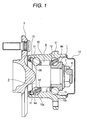
- a hub unit is much used as a wheel-supporting roller bearing, and Fig. 1 shows its one example.
- an outside flange 3 for fixing a wheel (not shown) is formed on the outer peripheral surface of the outer edge (the left-side edge in the drawing) of the hub 2 that constitutes an inner ring-corresponding part along with an inner ring element 1; and on the outer peripheral surface of the middle part, formed are an inner raceway 4a and a step 5.
- the inner ring element 1 with an inner raceway 4b similarly formed on its outer peripheral surface is outer-fitted and supported in such a condition that its outer edge surface (the left-side edge in the drawing) is kept butting against the step 5.
- a male screw 6 is formed adjacent to the inner edge of the hub 2, and a nut 7 is screwed to the top of the male screw 6, and tightly clamped, whereby the inner ring element 1 is fixed at the predetermined part of the outer peripheral surface of the hub 2. Further, on the outer peripheral surface of the middle part of the outer ring 8 disposed around the hub 2, provided is an outer flange-shaped fixer 9 for fixing the outer ring 8 to a suspension (not shown).
- outer raceways 10a and 10b that face the inner raceways 4a and 4b, respectively.
- plural rolling elements 11, 11 are provided thereby enabling the rotation of the hub 2 inside the outer ring 8.
- the rolling elements 11, 11 are individually rollably held by their holders 12, 12, respectively.
- a seal ring 13 formed of an elastic material such as a nitrile rubber composition; and the seal ring 13 seals up the outside edge opening 28 of a space 15 that exists between the inner peripheral surface of the outer ring 8 and the outer peripheral surface of the hub 2 and the inner ring element 1 and has the rolling elements 11, 11 provided therein.
- the inner end (the right-side end in the drawing) opening of the outer ring 8 is sealed up with a cover 14 for preventing impurities such as dust or rainwater from invading into the space 15 via the inner end opening and for preventing the grease (not shown) filled in the space 15 from leaking out.
- a multiple ball bearing unit as shown in the drawing is used; but in a large-sized vehicle, used is a multiple tapered roller bearing unit where a tapered roller is used as the rolling element 11 in Fig. 1.
- a multiple cylindrical roller bearing unit where a cylindrical roller is used as the rolling element 11, in addition to the similar multiple tapered roller bearing unit.
- a sealing grease is required to be waterproof, since a hub unit is brought into contact with rainwater or water in washing it.
- water When water is mixed in a sealing grease it may unevenly exist in the three-dimensional structure of the thickener in the grease, thereby breaking the structure with the result that the grease may be softened and the softened grease may flow out and its adhesiveness may lower, after all causing lubricity failure.
- large-size water droplets exist in the grease, then they may cut off the formed lubricant film, thereby augmenting the lubricity failure.
- Komura et al. report that, when 6 % water is mixed in a lubricant oil (#180 turbine oil), then a rolling fatigue life lowers to from one-severalth to 1/20 of that in a case with no water mixing ( Kyozaburo Komura, Shinichi Shirota, Kiyoshi Hirakawa; Regarding rolling fatigue at surface starting point and inner starting point, NSK Bearing Journal, No. 636, pp. 1-10, 1977 ).
- Schatzberg et al. report that, when only 100 ppm water is mixed in a lubricant oil, then its steel rolling strength lowers by from 32 to 48 % ( P.
- a lot of improved sealing greases are proposed.
- a grease with a passivate oxidizing agent such as sodium nitrite added thereto for example, see Patent Reference 2
- a grease with an organic antimony compound or an organic molybdenum compound added thereto for example, see Patent Reference 3
- a grease with an inorganic compound having a particle size of at most 2 ⁇ m added thereto for example, see Patent Reference 4
- Friction occurs between the tires of a car and a road surface and static electricity is generated between them; and water is electrolyzed by the static electricity to form hydrogen ions, thereby causing white structure peeling.
- a conductive material such as conductive carbon black or metal powder, or an organic metal salt is added to a grease thereby to make it conductive (for example, see Patent Reference 7 and Patent Reference 8).
- the conductive grease of the type may sufficiently exist on the contact surface between the raceway surface of the raceway and the rolling element of a roller bearing, and the conductivity between the raceway and the rolling element may be well ensured by the carbon black in the conductive grease; but with the lapse of time, the conductive grease may be expelled from the contact surface or the chain structure of the carbon black particles may be broken, thereby often producing a phenomenon that the conductivity of the grease lowers and the bearing resistance increases with time.
- the present invention is made in consideration of the situation as above, and its object is to provide a grease composition of excellent waterproofness, of which the adhesiveness does not lower even when water is mixed therein, which has excellent softening and flowing-out resistance and may keep a stable lubricant film and which may prevent peeling such as white structure peeling.
- another object of the invention is to provide a wheel-supporting roller bearing of excellent waterproofness, which contains the grease composition sealed therein.
- the invention provides the following waterproof grease composition and wheel-supporting roller bearing:
- the waterproof grease composition of the invention prevents peeling such as white structure peeling even when water is mixed in the site to which it is applied, and exhibits excellent durability.
- the wheel-supporting roller bearing of the invention has excellent waterproofness, as containing the waterproof grease composition sealed therein.
- the first to fifth waterproof grease compositions of the invention contain a specific waterproofness-imparting agent added to a base grease that comprises a base oil and a thickener.
- the base oil is selected from a mineral oil and a synthetic oil. Above all, preferred is a base oil having a kinematic viscosity at 40°C of from 10 to 400 mm 2 /sec, preferably from 20 to 250 mm 2 /sec, more preferably from 40 to 150 mm 2 /sec, for the purpose of evading noise generation in starting at low temperature and evading seizure to be caused by the difficulty in forming oily film at high temperature.
- the mineral oil includes paraffinic mineral oil and naphthenic mineral oil; and especially preferred are those purified through suitable combination of reduced-pressure distillation, oil deasphalting, solvent extraction, hydro-cracking, solvent dewaxing, sulfuric acid washing, white clay purification and hydro-refining.
- the synthetic oil includes hydrocarbon oils, aromatic oils, ester oils, ether oils.
- the hydrocarbon oils include poly- ⁇ -olefins or their hydrides such as normal paraffin, isoparaffin, polybutene, polyisobutylene, 1-decene oligomer, 1-decene/ethylene oligomer.
- the aromatic oils include alkylbenzenes such as monoalkylbenzenes, dialkylbenzenes; and alkylnaphthalenes such as monoalkylnaphthalenes, dialkylnaphthalenes, polyalkylnaphthalenes.
- the ester oils include diester oils such as dibutyl sebacate, di-2-ethylhexyl sebacate, dioctyl adipate, diisodecyl adipate, ditridecyl adipate, ditridecyl glutarate, methyl acetylcinnolate; aromatic ester oils such as trioctyl trimellitate, tridecyl trimellitate, tetraoctyl pyromellitate; polyol ester oils such as trimethylolpropane caprylate, trimethylolpropane pelargonate, pentaerythritol 2-ethylhexanoate, pentaerythritol pelargonate; complex ester oil, oligoester of polyalcohol and mixed fatty acid of dibasic acid/monobasic acid.
- diester oils such as dibutyl sebacate, di-2-ethylhexyl
- the ether oils include polyglycols such as polyethylene glycol, polypropylene glycol, polyethylene glycol monoether, polypropylene glycol monoether; phenyl ether oils such as monoalkyltriphenyl ether, alkyldiphenyl ether, dialkyldiphenyl ether, pentaphenyl ether, tetraphenyl ether, monoalkyltetraphenyl ether, dialkyltetraphenyl ether.
- Other synthetic oil-type lubricant oils are tricresyl phosphate, silicone oil, perfluoroalkyl ether.
- One or more these base oils may be used herein either singly or as combined; and they are specifically controlled to have the preferred kinematic viscosity as mentioned above.
- the thickener For the thickener, usable are organic and inorganic thickeners; but in consideration of their influence on the environment, preferred are those not containing a heavy metal.
- metal soaps such as lithium soap, calcium soap, aluminium soap, magnesium soap, sodium soap, and their composite soaps, urea compounds, bentonite, silica, carbon black.
- metal composite soaps and urea compounds In consideration of their heat resistance and sound characteristic, urea compounds are more preferred, and diurea compounds are even more preferred. These may be used either singly or as combined.
- the amount of the thickener may be any one capable of forming and maintaining a grease along with the above-mentioned base oil. Preferably, it is from 5 to 40 % by mass of the overall grease amount. When the amount of the thickener is less than 5 % by mass, then it could hardly maintain the grease property, and when it is more than 40 % by mass, then the grease may be too hard to fully exhibit a lubricated condition, and such is unfavorable.
- the first waterproof grease composition comprises a surfactant as the waterproofness-imparting agent, as added to the base grease.
- a surfactant usable is any of anionic surfactant, cationic surfactant, ampholytic surfactant and nonionic surfactant, and it amount varies depending on the type of the surfactant. Owing to the existence of the surfactant therein, water mixed in the composition may be uniformly dispersed in the grease as fine droplets having a size of 20 ⁇ m or so, and therefore an oily film may be well kept on a lubricated site and its lubrication performance may be stably kept as such for a long period of time. However, the ability of nonionic surfactant to catch water is not enough, and therefore the grease could not take water therein as fine droplets. Accordingly, the amount of the surfactant to be added must be specifically controlled.
- the anionic surfactant includes alkylsulfate ester salts, polyoxyethylene alkylether sulfate ester salts, alkylbenzenesulfonate salts, alkylnaphthalenesulfonic acids, alkylsulfonesuccinic acids, fatty acid salts, naphthalenesulfonic acid/formalin condensates;
- the cationic surfactant includes alkylamine salts, quaternary ammonium salts;
- the ampholytic surfactant includes alkylbetaines, alkylamine oxides.
- the amount of the surfactant to be added is from 0.1 to 10 % by mass of the overall grease amount.
- the amount of the surfactant to be added is preferably from 0.5 to 5 % by mass.
- the nonionic surfactant includes polyoxyethylene alkyl ethers, sorbitan fatty acid esters, glycerin fatty acid esters, polyoxyethylene-hardened castor oil. Its amount to be added is from 0.3 to 10 % by mass of the overall grease amount, preferably from 0.5 to 5 % by mass.
- the kinematic viscosity of the base oil at 40°C is preferably from 20 to 250 mm 2 /sec, more preferably from 90 to 185 mm 2 /sec.
- the second waterproof grease composition comprises at least one of metal soap, fluorine-containing water repellent and silicone-type water repellent as the waterproofness-imparting agent, as added to the base grease.
- the adhesiveness of the grease composition increases owing to the wax or polymer therein, and even when water is mixed in the composition, the composition is prevented from flowing out from the lubricated site and the lubricative film may be kept in a good condition for a long period of time.
- the metal soap includes aluminium stearate, calcium stearate, zinc stearate, magnesium stearate; and calcium stearate is preferred.
- the fluorine-containing water repellent includes polytetrafluoroethylene resin, perfluoropolyether oil.
- the silicone-type water repellent includes dimethylsilicone oil.
- the amount of the water repellent to be added is from 0.1 to 20 % by mass of the overall grease amount.
- the amount of the water repellent is less than 0.1 % by mass, then the water repellency is unsatisfactory and the composition could not prevent water from being mixed therein and would produce peeling.
- the amount of the water repellent added is more than 20 % by mass, it could not produce any additional effect and it is uneconomical, and in addition, the base oil amount may be relatively decreased to worsen the lubricating property of the composition. Taking these into consideration, the amount of the water repellent is preferably from 5 to 15 % by mass.
- the third waterproof grease composition comprises a pH-controlling agent as the waterproofness-imparting agent, as added to the base grease to thereby control the pH of the composition to be from 7 to 10. Having the pH level, the grease composition may prevent the mixed water from generating hydrogen ions and therefore may prevent peeling.
- the pH-controlling agent may be any one capable of making the grease have the pH level. Preferred for it are sulfonates, phenates, phosphonates and succinimides, from which a desired one may be selected so as to attain the intended pH level.
- the amount of the pH-controlling agent to be added is from 0.1 to 10 % by mass of the overall grease amount.
- the amount of the pH-controlling agent is less than 0.1 % by mass, then the composition could not have the above-mentioned pH, but when it is more than 10 % by mass, then the basicity of the composition is too high and may cause corrosion.
- the amount of the base oil may be relatively decreased to worsen the lubricating property of the composition. Taking these into consideration, the amount of the pH-controlling agent is preferably from 0.5 to 5 % by mass.
- the fourth waterproof grease composition comprises a wax or polymer as the waterproofness-imparting agent, as added to the base grease.
- the wax and polymer are not limited.
- the wax preferably used are montan wax (e.g., acid wax, ester wax, partially saponified wax), polyolefinwax (e.g., polyethylene wax, polyethylene oxide wax, polypropylene wax), fine powdery wax (e.g., polyethylene-type, polyethylene oxide-type, polypropylene-type, amide-modified, fluorine-modified), amide-type wax.
- the polymer preferably used are polyethylene-type, polypropylene-type, polystyrene-type, polyamide-type, polyimide-type and polyester-type polymers.
- the polymer also usable are polyalkyl methacrylate, polyisobutylene, olefin polymer and star-shaped polymer that are known as a viscosity index improver.
- the amount of the wax or polymer to be added is from 0.1 to 10 % by mass of the overall grease amount. When the amount is less than 0.1 % by mass, then it will be ineffective for increasing the adhesive power of the composition, and even when it is more than 10 % by mass, the increase could not produce any additional effect but rather the grease may be thereby too hard and the amount of the base oil may be relatively decreased to lower the lubrication performance. Taking these into consideration, the amount to be added is preferably from 0.5 to 5 % by mass.
- the fifth waterproof grease composition comprises graphite as the waterproofness-imparting agent, as added to the base grease.
- Graphite makes the grease composition conductive, therefore retarding the electrolysis of the mixed water, whereby hydrogen ions are prevented from being generated and white structure peeling hardly occurs.
- the type of graphite is not specifically defined, and various types of graphite such as flaky graphite or soil-like graphite are usable. One or more such different types of graphite may be used either singly or as combined. However, flaky and soil-like graphite (amorphous graphite) is the most preferred, and therefore, when two types of graphite are combined and used, then it is desirable that one of them is flaky or soil-like graphite.
- Soil-like graphite may be readily ground to have a reduced particle size, and therefore it facilitates accurate control of its content, and may be used at a low cost.
- flaky graphite has excellent lubricating capability. Any of natural or artificial graphite may be used herein with no problem. Natural graphite is preferably one obtained by purifying and grinding the graphite deposited in naturally-produced metamorphic rock (crystallized limestone or geniss). Artificial graphite is preferably one obtained by shaping pitch, coke or tar, then firing it at about 1200°C and graphitizing it at 2000 to 3000°C.
- the amount of graphite to be added is from 1 to 20 % by mass of the overall grease amount. When the amount is less than 1 % by mass, then the conductivity of the grease composition may be unsatisfactory and the composition could not have sufficient peeling resistance. On the other hand, even when the amount is more than 20 % by mass, the peeling resistance could not increase any more and the effect may be saturated, the cost may increase. Taking these into consideration, the amount is preferably from 5 to 15 % by mass.
- the kinematic viscosity of the base oil at 40°C is more preferably from 70 to 250 mm 2 /sec. When it is less than 70 mm 2 /sec (40°C), then the peeling resistance of the composition may lower when water is mixed therein; and when it is more than 250 mm 2 /sec (40°C), then the torque may increase.
- Various additive may be optionally added to the first to fifth waterproof grease compositions for further improving various properties of the composition.
- Especially preferred additives are antioxidant, rust-proofing agent, oil improver, extreme pressure agent, metal inactivator.
- antioxidant preferred are amine compounds, phenol compounds, sulfur compounds, zinc dithiophosphate.
- amine-type antioxidant examples of the amine-type antioxidant are phenyl-1-naphthylamine, phenyl-2-naphthylamine, diphenylamine, phenylenediamine, oleylamidamine, phenothiazine.
- phenol-type antioxidant examples include hindered phenols such as p-t-butylphenyl salicylate, 2,6-di-t-butyl p-phenylphenol, 2,2'-methylenebis(4-methyl-6-t-butylphenol), 4,4'-butylidenebis(6-t-butyl-m-cresol), tetrakis[methylene-3-(3',5'-di-t-butyl-4'-hydroxyphenyl)pr opionate]methane, 1,3,5-trimethyl-2,4,6-tris(3,5-di-t-butyl-4-hydroxybenzyl) benzene, n-octadecyl ⁇ -(4'-hydroxy-3',5'-di-t-butylphenyl)propionate, 2-n-octyl-thio-4,6-di(4'-hydroxy-3',5'-di-t-butyl)
- esters include partial esters of polybasic carboxylic acid and polyalcohol, for example, sorbitan esters such as sorbitan monolaurate, sorbitan tristearate, sorbitan monooleate, sorbitan trioleate; alkyl esters such as polyoxyethylene laurate, polyoxyethylene oleate, polyoxyethylene stearate.
- the oil improver includes fatty acids such as oleic acid, stearic acid; alcohols such as lauryl alcohol, oleyl alcohol; amines such as stearylamine, cetylamine; phosphates such as tricresyl phosphate; animal and vegetable oils.
- fatty acids such as oleic acid, stearic acid
- alcohols such as lauryl alcohol, oleyl alcohol
- amines such as stearylamine, cetylamine
- phosphates such as tricresyl phosphate
- animal and vegetable oils include fatty acids such as oleic acid, stearic acid; alcohols such as lauryl alcohol, oleyl alcohol; amines such as stearylamine, cetylamine; phosphates such as tricresyl phosphate; animal and vegetable oils.
- the extreme pressure agent includes phosphorus compounds, zinc dithiophosphate, organic molybdenum compounds.
- the metal inactivator includes benzotriazole, benzimidazole, indole, methylbenzotriazole.
- the additive amount is not limited so far as it is within a range not detracting the effect of the invention.
- the amount is from 0.1 to 20 % by mass of the overall grease amount. When the amount is less than 0.1 % by mass, then the effect of the additive is poor; but even when the amount is more than 20 % by mass, the increase could not produce any additional effect but rather the amount of the base oil may be thereby relatively decreased to lower the lubrication performance.
- a metal inactivator may form a passivate film on the metal surface of a bearing, and when water invades into the film, it may prevent the formation of a water film on the metal surface thereby improving the peeling resistance of the composition.
- the amount of the metal inactivator to be added is at least 0.5 % by mass of the overall grease amount. However, even when the amount is more than 10 % by mass, the increase could not produce any additional effect but rather the amount of the base oil may be thereby relatively decreased to lower the lubrication performance.
- the method for preparing grease is not specifically defined.
- a thickener is reacted in a base oil to prepare a base grease, then a predetermined amount of a waterproofness-imparting agent is added to it, and thereafter this is well kneaded and uniformly dispersed with a kneader or a roll mill. During the treatment, heating the system may be effective. It is desirable that the other additives are added along with the waterproofness-imparting agent in view of the process of preparing the grease composition.
- the consistency of the obtained grease is NLGI No. 1 to 3.
- the waterproof grease composition of the inventions have excellent waterproofness owing to the action of the waterproofness-imparting agent therein. Accordingly, the waterproof grease composition of the invention may make the site or apparatus to which it is applied, have excellent waterproofness; and it is especially favorably applied to a site or apparatus that may be brought into contact with water. Accordingly, the invention also provides a wheel-supporting roller bearing that contains the above-mentioned waterproof grease composition of the invention, as sealed therein.
- the wheel-supporting roller bearing is not specifically defined in point of the type and the structure of itself.
- its one example is a hub unit as in Fig. 1, and the above-mentioned waterproof grease composition of the invention may be sealed therein.
- the amount of the grease to be sealed in the device may be suitably from 30 to 50 % by volume of the inner space to be formed by the inner ring element 1, the outer ring 8 and the rolling element 11.
- the sealed amount is less than 30 % by volume, then the durability of the device may be insufficient owing to lubrication insufficiency; but when it is more than 50 % by volume, then the grease composition may leak out.
- An amine-mixed mineral oil is added to and reacted with a diisocyanate-mixed mineral oil, and stirred under heat to prepare a urea-type base grease.
- a surfactant is added to it (its amount is 1 % by mass of the overall grease amount in every case), as in Table 1, and stirred and defoamed to obtain a test grease.
- the consistency of the test grease is specifically controlled to be NLGI No. 1 to 3. Every test grease is tested according to a wet shell roll test mentioned below.
- test grease A with an anionic surfactant added thereto, the test grease B with a cationic surfactant added thereto and the test grease C with an ampholytic surfactant added thereto all could take water as fine droplets having a particle size of at most 20 ⁇ m and the water droplets are uniformly dispersed in them.
- the test grease E with a nonionic surfactant added thereto the water droplets are large as a whole (having a diameter of from 25 to 60 ⁇ m), and their dispersion condition is poor.
- test grease D with no surfactant small water droplets and large water droplets exist together and their dispersion condition is bad.
- test greases are prepared.
- the consistency of the test greases is specifically controlled to be NLGI No. 1 to 3. Every test grease is tested according to a bearing peeling test mentioned below.
- a test grease is sealed in a tapered roller bearing by NSK Ltd. (HR32017 (inner diameter 85 mm, outer diameter 130 mm, width 29 mm)), and the bearing is continuously rotated for 100 hours under a radial load of 35.8 kN and an axial load of 15.7 kN and at a revolution of 1500 rpm, with water being sealed in it from the outside at a rate of 1 % by mass/sec. After thus rotated, the bearing is dismantled and checked for the occurrence of peeling therein. The results are shown in Table 2.
- test greases F to H to which at least 0.1 % by mass of an anionic surfactant or nonionic surfactant and at least 0.5 % by mass of a metal inactivator are added, have excellent peeling resistance.
- the amount of the anionic surfactant or nonionic surfactant is less than 0.1% by mass or when the amount of the metal inactivator is less than 0.5 % by mass, then the samples could not have sufficient peeling resistance.
- test greases are prepared. To every test grease, added are phenylnaphthylamine (Vanderbit's "Vanlube 81”) as an antioxidant and zinc naphthenate (Nippon Chemical Industry's "Naphthex Zinc”) as a rust-proofing agent, each in an amount of 1.0 % by weight of the overall grease amount. Every test grease is tested according to a bearing waterproofness test mentioned below.
- a test grease is sealed in a tapered roller bearing by NSK Ltd. (HR32017 (inner diameter 85 mm, outer diameter 130 mm, width 29 mm)), and the bearing is continuously rotated for 100 hours under a radial load of 35.8 kN and an axial load of 15.7 kN and at a revolution of 1500 rpm, with water being sealed in it from the outside at a rate of 1 % by mass/sec. After thus rotated, the bearing is dismantled and checked for the occurrence of peeling therein. In addition, the water content and the consistency of the test grease are measured. The results are shown in Table 3.
- diurea reaction product of 4,4'-diphenylmethane diisocyanate and stearylamine
- mineral oil having a kinematic viscosity at 40°C of 98.3 mm 2 /sec.
- poly- ⁇ -olefin oil having a kinematic viscosity at 40°C of 98.7 mm 2 /sec.
- fluorine-containing oil perfluoropolyether oil (having a kinematic viscosity at 40°C of 95 mm 2 /sec).
- silicone oil dimethylsilicone oil (having a kinematic viscosity at 40°C of 100 mm 2 /sec).
- calcium stearate by Sakai Chemical.
- antioxidant Vanlube 81 by Vanderbit.
- rust-proofing agent Nippon Chemical Industry's Naphthex Zinc.
- kinematic viscosity of base oil kinematic viscosity at 40°C, unit mm 2 /sec.
- An amine-mixed mineral oil is added to and reacted with a diisocyanate-mixed mineral oil, and stirred under heat to prepare a urea-type base grease.
- various pH-controlling agents are added to it, and stirred and defoamed to obtain test greases having pH 2, pH 4, pH 6, pH 7, pH 8, pH 9 or pH 10.
- the amount of the pH-controlling agent added is 1 % by mass of the overall grease amount.
- the consistency of every test grease is specifically controlled to be NLGI No. 1 to 3. Every test grease is tested according to a bearing waterproofness test mentioned below.
- Each test grease is sealed in a tapered roller bearing by NSK Ltd. (HR32017 (inner diameter 85 mm, outer diameter 130 mm, width 29 mm)), and the bearing is continuously rotated under a radial load of 35.8 kN and an axial load of 15.7 kN and at a revolution of 1500 rpm, while water is introduced into the bearing from the outside at a rate of 20 mL/hr.
- the rotation is continued for 100 hours, and when the test bearing vibrated during the rotation time, then it is considered to mean peeling occurrence, and the rotation is stopped.
- test grease of the above urea-type base polymer alone (Comparative Example 1)
- test greases produced by adding the same wax (Comparative Example 2) or polymer (Comparative Example 3) as that in Examples
- a grease including, as a thickener, lithium soap obtained through saponification of fatty acid and lithium hydroxide is specifically controlled to be NLGI No. 1 to 3.
- the apparent viscosity of the urea grease, to which neither wax nor polymer is added, and the grease including lithium soap as a thickener and containing wax or polymer added thereto greatly lowered, but as opposed to these, the reduction in the apparent viscosity of the grease of the invention, as prepared by adding wax or polymer to the urea grease, is small; and it is understood that the grease of the invention may keep its adhesiveness even in the presence of water.
- Test greases are prepared, each having the composition as in Table 5.
- the test greases of Examples 1 to 4 each comprise a base oil including, as the essential ingredient thereof, at least one of mineral oil and poly- ⁇ -olefin oil; a thickener including diurea or lithium composite soap; and graphite, further containing antioxidant and rust-proofing agent as additives.
- test greases of Comparative Examples 1 to 3 are the same as the test greases of Examples 1 to 4 in that the former comprise a base oil including, as the essential ingredient thereof, at least one of mineral oil and poly- ⁇ -olefin oil, and a thickener that comprises diurea or lithium composite soap, further containing antioxidant and rust-proofing agent as additives; but they differ in that Comparative Example 1 does not contain graphite, and that Comparative Example 2 contains carbon black in place of graphite.
- Comparative Example 3 differs in that the amount of graphite therein is larger than the preferred range thereof and the amount of the base oil is smaller than the preferred range thereof.
- the mineral oil, poly- ⁇ -olefin oil, diurea, lithium composite soap, graphite, carbon black, antioxidant and rust-proofing agent used herein are mentioned below.
- Each test grease is sealed in a tapered roller bearing by NSK Ltd. (Bearing Number, HR32017, inner diameter 85 mm, outer diameter 130 mm, width 29 mm), and the bearing is rotated under a radial load of 35.8 kN and an axial load of 15.7 kN and at a revolution of 1500 rpm.
- water is continuously injected into the inner space of the bearing, in an amount of 1 % by mass of the sealed grease per second, and the rotation test is carried out under the condition. The time taken before the occurrence of peeling in the bearing is counted. However, when no peeling occurred after 300 hours in the rotation test, the test is stopped.
- the test results are shown in Table 5.
- the bearing including the test grease of Examples 1 to 4, as sealed therein, hardly peeled even when used in an environment where water could enter it, and its life is long, as compared with the bearing including the test grease of Comparative Example 1 or Comparative Example 2, as sealed therein.
- Comparative Example 3 the amount of the base oil in the test grease is small, and the sample could not be greasy but is powdery.
- test grease compositions have the same effect also for other various types of roller bearings.
- radial roller bearings such as deep groove ball bearings, angular ball bearings, self-aligning ball bearings, cylindrical roller bearings, needle roller bearings, self-aligning roller bearings; and thrust-type roller bearings such as thrust ball bearings, thrust roller bearings.
Landscapes
- Chemical & Material Sciences (AREA)
- Oil, Petroleum & Natural Gas (AREA)
- Chemical Kinetics & Catalysis (AREA)
- General Chemical & Material Sciences (AREA)
- Organic Chemistry (AREA)
- Engineering & Computer Science (AREA)
- Mechanical Engineering (AREA)
- General Engineering & Computer Science (AREA)
- Inorganic Chemistry (AREA)
- Lubricants (AREA)
- Rolling Contact Bearings (AREA)
Abstract
The waterproof grease composition of the present application comprises a base oil that comprises at least one of mineral oil and synthetic oil and having a kinematic viscosity of from 10 to 400 mm2/sec at 40°C, a thickener, and a waterproofness-imparting agent selected from surfactant, metal soap, fluorine-containing water repellent, silicone-type water repellent, pH-controlling agent, wax, polymer and graphite. Accordingly, it may prevent peeling such as white structure peeling even when water is mixed therein.
The wheel-supporting roller bearing of the invention comprises an inner member having a raceway surface in the outer peripheral surface thereof, an outer member having, in the inner peripheral surface thereof, a raceway surface that faces the raceway surface of the inner member and disposed outside the inner member, and plural rolling elements rollably disposed between the two raceway surfaces, and which contains the above waterproof grease composition sealed therein; and this has excellent waterproofness.
Description
- The present invention relates to a waterproof grease composition, as well as to a wheel-supporting roller bearing that is for rotatably supporting a wheel to a suspension in motorcars, railroad cars, etc.
- In motorcars and railroad cars, used is a wheel-supporting roller bearing that is for rotatably supporting a wheel to a suspension. A hub unit is much used as a wheel-supporting roller bearing, and Fig. 1 shows its one example. In this hub unit, an
outside flange 3 for fixing a wheel (not shown) is formed on the outer peripheral surface of the outer edge (the left-side edge in the drawing) of thehub 2 that constitutes an inner ring-corresponding part along with aninner ring element 1; and on the outer peripheral surface of the middle part, formed are aninner raceway 4a and astep 5. On the outer peripheral surface adjacent to the inner edge of the middle part of the hub 2 (the right side in the drawing), theinner ring element 1 with aninner raceway 4b similarly formed on its outer peripheral surface is outer-fitted and supported in such a condition that its outer edge surface (the left-side edge in the drawing) is kept butting against thestep 5. - A
male screw 6 is formed adjacent to the inner edge of thehub 2, and anut 7 is screwed to the top of themale screw 6, and tightly clamped, whereby theinner ring element 1 is fixed at the predetermined part of the outer peripheral surface of thehub 2. Further, on the outer peripheral surface of the middle part of the outer ring 8 disposed around thehub 2, provided is an outer flange-shaped fixer 9 for fixing the outer ring 8 to a suspension (not shown). - On the inner peripheral surface of the outer ring 8, formed are
outer raceways inner raceways inner raceways outer raceways elements hub 2 inside the outer ring 8. The rollingelements holders - Between the inner peripheral surface of the outer edge of the outer ring 8 and the outer peripheral surface of the
hub 2, disposed is aseal ring 13 formed of an elastic material such as a nitrile rubber composition; and theseal ring 13 seals up the outside edge opening 28 of aspace 15 that exists between the inner peripheral surface of the outer ring 8 and the outer peripheral surface of thehub 2 and theinner ring element 1 and has the rollingelements cover 14 for preventing impurities such as dust or rainwater from invading into thespace 15 via the inner end opening and for preventing the grease (not shown) filled in thespace 15 from leaking out. - In a passenger car, a multiple ball bearing unit as shown in the drawing is used; but in a large-sized vehicle, used is a multiple tapered roller bearing unit where a tapered roller is used as the rolling
element 11 in Fig. 1. In a railroad car, often used is a multiple cylindrical roller bearing unit where a cylindrical roller is used as the rollingelement 11, in addition to the similar multiple tapered roller bearing unit. - On the other hand, a sealing grease is required to be waterproof, since a hub unit is brought into contact with rainwater or water in washing it. When water is mixed in a sealing grease it may unevenly exist in the three-dimensional structure of the thickener in the grease, thereby breaking the structure with the result that the grease may be softened and the softened grease may flow out and its adhesiveness may lower, after all causing lubricity failure. Moreover, when large-size water droplets exist in the grease, then they may cut off the formed lubricant film, thereby augmenting the lubricity failure.
- As an improved grease so as not to soften and fluidize with water, proposed is a grease with a metal phenate or a metal stearate added thereto (for example, see Patent Reference 1). However, the grease of the type has poor dispersibility of water taken therein and there is room for improvement of its adhesiveness.
- When water is mixed in a sealing grease, then it is known that the grease greatly shortens a bearing life; and for example, Komura et al. report that, when 6 % water is mixed in a lubricant oil (#180 turbine oil), then a rolling fatigue life lowers to from one-severalth to 1/20 of that in a case with no water mixing (Kyozaburo Komura, Shinichi Shirota, Kiyoshi Hirakawa; Regarding rolling fatigue at surface starting point and inner starting point, NSK Bearing Journal, No. 636, pp. 1-10, 1977). Schatzberg et al. report that, when only 100 ppm water is mixed in a lubricant oil, then its steel rolling strength lowers by from 32 to 48 % (P. Schatzberg, I. M. Felsen: Effects of water and oxygen during rolling contact lubrication, Wear, 12, pp. 331-342, 1968). The shortening of life may be considered because hydrogen may be generated by the mixed water to act on a bearing material thereby causing metal peeling, often referred to as white structure peeling.
- For preventing such white structure peeling, a lot of improved sealing greases are proposed. For example, proposed are a grease with a passivate oxidizing agent such as sodium nitrite added thereto (for example, see Patent Reference 2); a grease with an organic antimony compound or an organic molybdenum compound added thereto (for example, see Patent Reference 3); and a grease with an inorganic compound having a particle size of at most 2 µm added thereto (for example, see Patent Reference 4). These form the additive-derived coating film around a rolling contact part to thereby prevent hydrogen from invading into a bearing material; but when a rolling element is slid as it is shaken or its speed is changed before the film is formed, then metal peeling may occur in the rolling contact part.
- In addition, when water is mixed in a grease, then the shearing stability of the grease may lower and the grease may flow out though a lubricated site. As a grease of which the shearing stability is improved when it contains water, proposed are a grease with a metal phenate added thereto (for example, see Patent Reference 5); and a grease with a calcium or magnesium salt of a fatty acid added thereto (for example, see Patent Reference 6). However, these greases have another problem in that their lubricating capability lowers.
- These greases are made to be repellent to water in order that they may hardly catch water. When a grease that is fluidized or stirred is brought into contact with water and when it is hydrophilic, then water may be taken in the grease as fine droplets therein. As opposed to it, when a grease is repellent to water, then water may be taken in the grease as large droplets therein, and further may exist unevenly therein. As a result, an oily film formed on the slide surface of a lubricated site may be partly removed, and lubrication failure may occur, starting from that part. In that manner, even when a water-repellent grease does not flow out from a lubricated site and a large amount of it exists in the site, such is not always advantageous for lubrication performance.
- Friction occurs between the tires of a car and a road surface and static electricity is generated between them; and water is electrolyzed by the static electricity to form hydrogen ions, thereby causing white structure peeling. Accordingly, a conductive material such as conductive carbon black or metal powder, or an organic metal salt is added to a grease thereby to make it conductive (for example, see
Patent Reference 7 and Patent Reference 8). At first, the conductive grease of the type may sufficiently exist on the contact surface between the raceway surface of the raceway and the rolling element of a roller bearing, and the conductivity between the raceway and the rolling element may be well ensured by the carbon black in the conductive grease; but with the lapse of time, the conductive grease may be expelled from the contact surface or the chain structure of the carbon black particles may be broken, thereby often producing a phenomenon that the conductivity of the grease lowers and the bearing resistance increases with time. - As measures except for the sealing grease, proposed are use of stainless steel for a bearing material (for example, see Patent Reference 9); and use of a rolling element formed of a ceramic (for example, see Patent Reference 10). However, those bearings are generally expensive.
-
- Patent Reference 1:
JP-B-2-8639 - Patent Reference 2:
Japanese Patent 2878749 - Patent Reference 3:
JP-A-6-803565 - Patent Reference 4:
JP-A-9-169989 - Patent Reference 5:
JP-B-2-8639 - Patent Reference 6:
JP-B-3-26717 - Patent Reference 7:
Japanese UM Registration 2559158 - Patent Reference 8:
JP-A-3-35091 - Patent Reference 9:
JP-A-3-173747 - Patent Reference 10:
JP-A-4-244624 - The present invention is made in consideration of the situation as above, and its object is to provide a grease composition of excellent waterproofness, of which the adhesiveness does not lower even when water is mixed therein, which has excellent softening and flowing-out resistance and may keep a stable lubricant film and which may prevent peeling such as white structure peeling. In addition, another object of the invention is to provide a wheel-supporting roller bearing of excellent waterproofness, which contains the grease composition sealed therein.
- To attain the above objects, the invention provides the following waterproof grease composition and wheel-supporting roller bearing:
- (1) A waterproof grease composition including:
- a base oil that includes at least one of mineral oil and synthetic oil and has a kinematic viscosity of from 10 to 400 mm2/sec at 40°C,
- a thickener, and
- a waterproofness-imparting agent to be added.
- (2) The waterproof grease composition of above (1), wherein
a surfactant is added as the waterproofness-imparting agent (this is hereinafter referred to as "the first waterproof grease composition"). - (3) The first waterproof grease composition, wherein
at least one of cationic surfactant, anionic surfactant and ampholytic surfactant is added in a ratio of from 0.1 to 10 % by mass of the overall grease amount, or
a nonionic surfactant is added in a ratio of from 0.3 to 10 % by mass of the overall grease amount. - (4) The waterproof grease composition of above (1), wherein
at lest one of metal soap, fluorine-containing water repellent and silicone-type water repellent is added as the waterproofness-imparting agent, in a ratio of from 0.1 to 20 % by mass of the overall grease amount (this is hereinafter referred to as "the second waterproof grease composition"). - (5) The waterproof grease composition of above (1), wherein
a pH-controlling agent is added as the waterproofness-imparting agent, in a ratio of from 0.1 to 10 % by mass of the overall grease amount (this is hereinafter referred to as "the third waterproof grease composition"). - (6) The third waterproof grease composition, having a pH of from 7 to 10.
- (7) The waterproof grease composition of above (1), wherein
a wax or polymer is added as the waterproofness-imparting agent, in a ratio of from 0.1 to 10 % by mass of the overall grease amount (this is hereinafter referred to as "the fourth waterproof grease composition"). - (8) The waterproof grease composition of above (1), wherein
graphite is added as the waterproofness-imparting agent, in a ratio of from 1 to 20 % by mass of the overall grease amount (this is hereinafter referred to as "the fifth waterproof grease composition"). - (9) The first to fifth waterproof grease composition, wherein
the thickener is a urea compound. - (10) A wheel-supporting roller bearing including:
- an inner member having a raceway surface in the outer peripheral surface thereof,
- an outer member having, in the inner peripheral surface thereof, a raceway surface that faces the raceway surface of the inner member and disposed outside the inner member, and
- plural rolling elements rollably disposed between the two raceway surfaces, wherein
- the above first to fifth waterproof grease composition is sealed therein.
- (11) The wheel-supporting roller bearing of above (10), which is a hub unit.
- Owing to the waterproofness-imparting agent added thereto, the waterproof grease composition of the invention prevents peeling such as white structure peeling even when water is mixed in the site to which it is applied, and exhibits excellent durability.
- The wheel-supporting roller bearing of the invention has excellent waterproofness, as containing the waterproof grease composition sealed therein.
-
- [Fig. 1]
Fig. 1 is a partly cut cross-sectional view showing one example of a hub unit bearing, as the wheel-supporting roller bearing. - [Fig. 2]
Fig. 2 is a picture, taken with a camera, of a condition of water in a test grease A in wet Shell Roll Test-1. - [Fig. 3]
Fig. 3 is a picture, taken with a camera, of a condition of water in a test grease B in wet Shell Roll Test-1. - [Fig. 4]
Fig. 4 is a picture, taken with a camera, of a condition of water in a test grease C in wet Shell Roll Test-1. - [Fig. 5]
Fig. 5 is a picture, taken with a camera, of a condition of water in a test grease D in wet Shell Roll Test-1. - [Fig. 6]
Fig. 6 is a picture, taken with a camera, of a condition of water in a test grease E in wet Shell Roll Test-1. - [Fig. 7]
Fig. 7 is a graph showing the relationship between the initial pH value and the peeling possibility in Test-3. -
- 1
- inner ring element
- 2
- hub
- 4a, 4b
- inner raceway
- 5
- step
- 6
- male screw
- 7
- nut
- 8
- outer ring
- 10a, 10b
- outer raceway
- 11
- rolling element
- 12
- holder
- 13
- seal ring
- The invention is described in detail hereinunder.
- The first to fifth waterproof grease compositions of the invention contain a specific waterproofness-imparting agent added to a base grease that comprises a base oil and a thickener.
- The base oil is selected from a mineral oil and a synthetic oil. Above all, preferred is a base oil having a kinematic viscosity at 40°C of from 10 to 400 mm2/sec, preferably from 20 to 250 mm2/sec, more preferably from 40 to 150 mm2/sec, for the purpose of evading noise generation in starting at low temperature and evading seizure to be caused by the difficulty in forming oily film at high temperature.
- The mineral oil includes paraffinic mineral oil and naphthenic mineral oil; and especially preferred are those purified through suitable combination of reduced-pressure distillation, oil deasphalting, solvent extraction, hydro-cracking, solvent dewaxing, sulfuric acid washing, white clay purification and hydro-refining.
- The synthetic oil includes hydrocarbon oils, aromatic oils, ester oils, ether oils. The hydrocarbon oils include poly-α-olefins or their hydrides such as normal paraffin, isoparaffin, polybutene, polyisobutylene, 1-decene oligomer, 1-decene/ethylene oligomer. The aromatic oils include alkylbenzenes such as monoalkylbenzenes, dialkylbenzenes; and alkylnaphthalenes such as monoalkylnaphthalenes, dialkylnaphthalenes, polyalkylnaphthalenes. The ester oils include diester oils such as dibutyl sebacate, di-2-ethylhexyl sebacate, dioctyl adipate, diisodecyl adipate, ditridecyl adipate, ditridecyl glutarate, methyl acetylcinnolate; aromatic ester oils such as trioctyl trimellitate, tridecyl trimellitate, tetraoctyl pyromellitate; polyol ester oils such as trimethylolpropane caprylate, trimethylolpropane pelargonate, pentaerythritol 2-ethylhexanoate, pentaerythritol pelargonate; complex ester oil, oligoester of polyalcohol and mixed fatty acid of dibasic acid/monobasic acid. The ether oils include polyglycols such as polyethylene glycol, polypropylene glycol, polyethylene glycol monoether, polypropylene glycol monoether; phenyl ether oils such as monoalkyltriphenyl ether, alkyldiphenyl ether, dialkyldiphenyl ether, pentaphenyl ether, tetraphenyl ether, monoalkyltetraphenyl ether, dialkyltetraphenyl ether. Other synthetic oil-type lubricant oils are tricresyl phosphate, silicone oil, perfluoroalkyl ether. One or more these base oils may be used herein either singly or as combined; and they are specifically controlled to have the preferred kinematic viscosity as mentioned above.
- For the thickener, usable are organic and inorganic thickeners; but in consideration of their influence on the environment, preferred are those not containing a heavy metal. For example, herein usable are metal soaps such as lithium soap, calcium soap, aluminium soap, magnesium soap, sodium soap, and their composite soaps, urea compounds, bentonite, silica, carbon black. Above all, preferred are metal composite soaps and urea compounds. In consideration of their heat resistance and sound characteristic, urea compounds are more preferred, and diurea compounds are even more preferred. These may be used either singly or as combined.
- Not limited, the amount of the thickener may be any one capable of forming and maintaining a grease along with the above-mentioned base oil. Preferably, it is from 5 to 40 % by mass of the overall grease amount. When the amount of the thickener is less than 5 % by mass, then it could hardly maintain the grease property, and when it is more than 40 % by mass, then the grease may be too hard to fully exhibit a lubricated condition, and such is unfavorable.
- The first waterproof grease composition comprises a surfactant as the waterproofness-imparting agent, as added to the base grease. As the surfactant, usable is any of anionic surfactant, cationic surfactant, ampholytic surfactant and nonionic surfactant, and it amount varies depending on the type of the surfactant. Owing to the existence of the surfactant therein, water mixed in the composition may be uniformly dispersed in the grease as fine droplets having a size of 20 µm or so, and therefore an oily film may be well kept on a lubricated site and its lubrication performance may be stably kept as such for a long period of time. However, the ability of nonionic surfactant to catch water is not enough, and therefore the grease could not take water therein as fine droplets. Accordingly, the amount of the surfactant to be added must be specifically controlled.
- The anionic surfactant includes alkylsulfate ester salts, polyoxyethylene alkylether sulfate ester salts, alkylbenzenesulfonate salts, alkylnaphthalenesulfonic acids, alkylsulfonesuccinic acids, fatty acid salts, naphthalenesulfonic acid/formalin condensates; the cationic surfactant includes alkylamine salts, quaternary ammonium salts; the ampholytic surfactant includes alkylbetaines, alkylamine oxides. The amount of the surfactant to be added is from 0.1 to 10 % by mass of the overall grease amount. When the amount is less that 0.1 % by mass, then the grease could not take water as fine droplets therein, and even when it is more than 10 % by mass, the increase could not produce any additional effect but rather the amount of the base oil may be thereby relatively decreased to lower the lubrication performance. Taking these into consideration, the amount of the surfactant to be added is preferably from 0.5 to 5 % by mass.
- The nonionic surfactant includes polyoxyethylene alkyl ethers, sorbitan fatty acid esters, glycerin fatty acid esters, polyoxyethylene-hardened castor oil. Its amount to be added is from 0.3 to 10 % by mass of the overall grease amount, preferably from 0.5 to 5 % by mass.
- When a nonionic surfactant is added to the composition, then the kinematic viscosity of the base oil at 40°C is preferably from 20 to 250 mm2/sec, more preferably from 90 to 185 mm2/sec.
- The second waterproof grease composition comprises at least one of metal soap, fluorine-containing water repellent and silicone-type water repellent as the waterproofness-imparting agent, as added to the base grease. The adhesiveness of the grease composition increases owing to the wax or polymer therein, and even when water is mixed in the composition, the composition is prevented from flowing out from the lubricated site and the lubricative film may be kept in a good condition for a long period of time. The metal soap includes aluminium stearate, calcium stearate, zinc stearate, magnesium stearate; and calcium stearate is preferred. The fluorine-containing water repellent includes polytetrafluoroethylene resin, perfluoropolyether oil. The silicone-type water repellent includes dimethylsilicone oil.
- The amount of the water repellent to be added is from 0.1 to 20 % by mass of the overall grease amount. When the amount of the water repellent is less than 0.1 % by mass, then the water repellency is unsatisfactory and the composition could not prevent water from being mixed therein and would produce peeling. Even when the amount of the water repellent added is more than 20 % by mass, it could not produce any additional effect and it is uneconomical, and in addition, the base oil amount may be relatively decreased to worsen the lubricating property of the composition. Taking these into consideration, the amount of the water repellent is preferably from 5 to 15 % by mass.
- The third waterproof grease composition comprises a pH-controlling agent as the waterproofness-imparting agent, as added to the base grease to thereby control the pH of the composition to be from 7 to 10. Having the pH level, the grease composition may prevent the mixed water from generating hydrogen ions and therefore may prevent peeling. Not limited, the pH-controlling agent may be any one capable of making the grease have the pH level. Preferred for it are sulfonates, phenates, phosphonates and succinimides, from which a desired one may be selected so as to attain the intended pH level.
- The amount of the pH-controlling agent to be added is from 0.1 to 10 % by mass of the overall grease amount. When the amount of the pH-controlling agent is less than 0.1 % by mass, then the composition could not have the above-mentioned pH, but when it is more than 10 % by mass, then the basicity of the composition is too high and may cause corrosion. In addition, the amount of the base oil may be relatively decreased to worsen the lubricating property of the composition. Taking these into consideration, the amount of the pH-controlling agent is preferably from 0.5 to 5 % by mass.
- The fourth waterproof grease composition comprises a wax or polymer as the waterproofness-imparting agent, as added to the base grease. The wax and polymer are not limited. As the wax, preferably used are montan wax (e.g., acid wax, ester wax, partially saponified wax), polyolefinwax (e.g., polyethylene wax, polyethylene oxide wax, polypropylene wax), fine powdery wax (e.g., polyethylene-type, polyethylene oxide-type, polypropylene-type, amide-modified, fluorine-modified), amide-type wax. As the polymer, preferably used are polyethylene-type, polypropylene-type, polystyrene-type, polyamide-type, polyimide-type and polyester-type polymers. As the polymer, also usable are polyalkyl methacrylate, polyisobutylene, olefin polymer and star-shaped polymer that are known as a viscosity index improver.
- The amount of the wax or polymer to be added is from 0.1 to 10 % by mass of the overall grease amount. When the amount is less than 0.1 % by mass, then it will be ineffective for increasing the adhesive power of the composition, and even when it is more than 10 % by mass, the increase could not produce any additional effect but rather the grease may be thereby too hard and the amount of the base oil may be relatively decreased to lower the lubrication performance. Taking these into consideration, the amount to be added is preferably from 0.5 to 5 % by mass.
- The fifth waterproof grease composition comprises graphite as the waterproofness-imparting agent, as added to the base grease. Graphite makes the grease composition conductive, therefore retarding the electrolysis of the mixed water, whereby hydrogen ions are prevented from being generated and white structure peeling hardly occurs. The type of graphite is not specifically defined, and various types of graphite such as flaky graphite or soil-like graphite are usable. One or more such different types of graphite may be used either singly or as combined. However, flaky and soil-like graphite (amorphous graphite) is the most preferred, and therefore, when two types of graphite are combined and used, then it is desirable that one of them is flaky or soil-like graphite. Soil-like graphite may be readily ground to have a reduced particle size, and therefore it facilitates accurate control of its content, and may be used at a low cost. On the other hand, flaky graphite has excellent lubricating capability. Any of natural or artificial graphite may be used herein with no problem. Natural graphite is preferably one obtained by purifying and grinding the graphite deposited in naturally-produced metamorphic rock (crystallized limestone or geniss). Artificial graphite is preferably one obtained by shaping pitch, coke or tar, then firing it at about 1200°C and graphitizing it at 2000 to 3000°C.
- The amount of graphite to be added is from 1 to 20 % by mass of the overall grease amount. When the amount is less than 1 % by mass, then the conductivity of the grease composition may be unsatisfactory and the composition could not have sufficient peeling resistance. On the other hand, even when the amount is more than 20 % by mass, the peeling resistance could not increase any more and the effect may be saturated, the cost may increase. Taking these into consideration, the amount is preferably from 5 to 15 % by mass.
- In the fifth waterproof grease composition, the kinematic viscosity of the base oil at 40°C is more preferably from 70 to 250 mm2/sec. When it is less than 70 mm2/sec (40°C), then the peeling resistance of the composition may lower when water is mixed therein; and when it is more than 250 mm2/sec (40°C), then the torque may increase.
- Various additive may be optionally added to the first to fifth waterproof grease compositions for further improving various properties of the composition. Especially preferred additives are antioxidant, rust-proofing agent, oil improver, extreme pressure agent, metal inactivator. As the antioxidant, preferred are amine compounds, phenol compounds, sulfur compounds, zinc dithiophosphate. Examples of the amine-type antioxidant are phenyl-1-naphthylamine, phenyl-2-naphthylamine, diphenylamine, phenylenediamine, oleylamidamine, phenothiazine. Examples of the phenol-type antioxidant are hindered phenols such as p-t-butylphenyl salicylate, 2,6-di-t-butyl p-phenylphenol, 2,2'-methylenebis(4-methyl-6-t-butylphenol), 4,4'-butylidenebis(6-t-butyl-m-cresol), tetrakis[methylene-3-(3',5'-di-t-butyl-4'-hydroxyphenyl)pr opionate]methane, 1,3,5-trimethyl-2,4,6-tris(3,5-di-t-butyl-4-hydroxybenzyl) benzene, n-octadecyl β-(4'-hydroxy-3',5'-di-t-butylphenyl)propionate, 2-n-octyl-thio-4,6-di(4'-hydroxy-3',5'-di-t-butyl)phenoxy-1,3,5-triazine, 4,4'-thiobis[6-t-butyl-m-cresol], 2-(2'-hydroxy-3'-t-butyl-5'-methylphenyl)-5-chlorobenzotri azole.
- As the rust-proofing agent, preferred are esters. The esters include partial esters of polybasic carboxylic acid and polyalcohol, for example, sorbitan esters such as sorbitan monolaurate, sorbitan tristearate, sorbitan monooleate, sorbitan trioleate; alkyl esters such as polyoxyethylene laurate, polyoxyethylene oleate, polyoxyethylene stearate.
- The oil improver includes fatty acids such as oleic acid, stearic acid; alcohols such as lauryl alcohol, oleyl alcohol; amines such as stearylamine, cetylamine; phosphates such as tricresyl phosphate; animal and vegetable oils.
- The extreme pressure agent includes phosphorus compounds, zinc dithiophosphate, organic molybdenum compounds.
- The metal inactivator includes benzotriazole, benzimidazole, indole, methylbenzotriazole.
- One or more these additives may be added either singly or as combined. The additive amount is not limited so far as it is within a range not detracting the effect of the invention. Preferably, the amount is from 0.1 to 20 % by mass of the overall grease amount. When the amount is less than 0.1 % by mass, then the effect of the additive is poor; but even when the amount is more than 20 % by mass, the increase could not produce any additional effect but rather the amount of the base oil may be thereby relatively decreased to lower the lubrication performance.
- When a nonionic surfactant is used in the first waterproof grease composition, then it is desirable to add a metal inactivator as the additive thereto. A metal inactivator may form a passivate film on the metal surface of a bearing, and when water invades into the film, it may prevent the formation of a water film on the metal surface thereby improving the peeling resistance of the composition. For sufficiently expressing the effect, the amount of the metal inactivator to be added is at least 0.5 % by mass of the overall grease amount. However, even when the amount is more than 10 % by mass, the increase could not produce any additional effect but rather the amount of the base oil may be thereby relatively decreased to lower the lubrication performance.
- The method for preparing grease is not specifically defined. For example, a thickener is reacted in a base oil to prepare a base grease, then a predetermined amount of a waterproofness-imparting agent is added to it, and thereafter this is well kneaded and uniformly dispersed with a kneader or a roll mill. During the treatment, heating the system may be effective. It is desirable that the other additives are added along with the waterproofness-imparting agent in view of the process of preparing the grease composition. Preferably, the consistency of the obtained grease is NLGI No. 1 to 3.
- The waterproof grease composition of the inventions have excellent waterproofness owing to the action of the waterproofness-imparting agent therein. Accordingly, the waterproof grease composition of the invention may make the site or apparatus to which it is applied, have excellent waterproofness; and it is especially favorably applied to a site or apparatus that may be brought into contact with water. Accordingly, the invention also provides a wheel-supporting roller bearing that contains the above-mentioned waterproof grease composition of the invention, as sealed therein.
- The wheel-supporting roller bearing is not specifically defined in point of the type and the structure of itself. For example, its one example is a hub unit as in Fig. 1, and the above-mentioned waterproof grease composition of the invention may be sealed therein. Not limited, the amount of the grease to be sealed in the device may be suitably from 30 to 50 % by volume of the inner space to be formed by the
inner ring element 1, the outer ring 8 and the rollingelement 11. When the sealed amount is less than 30 % by volume, then the durability of the device may be insufficient owing to lubrication insufficiency; but when it is more than 50 % by volume, then the grease composition may leak out. - The invention is further described with reference to the following Examples and Comparative Examples, to which, however, the invention should not be limited.
- An amine-mixed mineral oil is added to and reacted with a diisocyanate-mixed mineral oil, and stirred under heat to prepare a urea-type base grease. After gradually cooled, a surfactant is added to it (its amount is 1 % by mass of the overall grease amount in every case), as in Table 1, and stirred and defoamed to obtain a test grease. The consistency of the test grease is specifically controlled to be NLGI No. 1 to 3. Every test grease is tested according to a wet shell roll test mentioned below.
- 50 g of a test grease and 10 g of ion-exchanged water are put into a shell roll tester, and subjected to a wet shell roll test at a revolution of 165 rpm and at a temperature of 40°C for 2 hours. During this, the particle size of water in the grease is measured with an optical microscope. The results are shown in Table 1. In addition, photographic pictures of the condition of water in grease are in Fig. 2 to Fig. 6.
- [Table 1]
Table 1 Grease A Grease B Grease C Grease D Grease E Surfactant A B C - D Added Amount (mas%) 1 1 1 - 1 Particle Size of Water Droplets (µm) at most 20 at most 20 at most 20 5 to 60 25 to 60 Notes)
A: anionic surfactant (alkylbenzenesulfonate salt)
B: cationic surfactant (quaternary ammonium salt)
C: ampholytic surfactant (alkylbetaine)
D: nonionic surfactant (polyoxyethylene alkyl ether) - From Table 1 and Figs. 2 to 6, it is understood that the test grease A with an anionic surfactant added thereto, the test grease B with a cationic surfactant added thereto and the test grease C with an ampholytic surfactant added thereto all could take water as fine droplets having a particle size of at most 20 µm and the water droplets are uniformly dispersed in them. As opposed to these, in the test grease E with a nonionic surfactant added thereto, the water droplets are large as a whole (having a diameter of from 25 to 60 µm), and their dispersion condition is poor. On the other hand, in the test grease D with no surfactant, small water droplets and large water droplets exist together and their dispersion condition is bad.
- Formulated as in Table 2, test greases are prepared. The consistency of the test greases is specifically controlled to be NLGI No. 1 to 3. Every test grease is tested according to a bearing peeling test mentioned below.
- A test grease is sealed in a tapered roller bearing by NSK Ltd. (HR32017 (inner diameter 85 mm, outer diameter 130 mm, width 29 mm)), and the bearing is continuously rotated for 100 hours under a radial load of 35.8 kN and an axial load of 15.7 kN and at a revolution of 1500 rpm, with water being sealed in it from the outside at a rate of 1 % by mass/sec. After thus rotated, the bearing is dismantled and checked for the occurrence of peeling therein. The results are shown in Table 2.
- [Table 2]
Table 2 Grease F Grease G Grease H Grease I Grease J Grease K Thickener Li composite soap urea urea Li composite soap urea urea Base Oil mineral oil mineral oil poly-α-olefin mineral oil mineral oil mineral oil Kinematic Viscosity of Base Oil (mm2/sec@ 40°C) 130 100 80 130 130 130 Metal Inactivator type benzotriazole benzotriazole benzotriazole benzotriazole benzotriazole benzotriazole added amount (mas%) 0.5 5.0 10.0 0.2 0.2 3.0 Surfactant type E F G F F F added amount (mas%) 1.0 1.0 1.0 0.1 1.0 0.1 Result of Peeling Test not peeled not peeled not peeled peeled peeled peeled Notes)
E: anionic surfactant (dialkylsulfonesuccinic acid)
F: nonionic surfactant (polyoxyethylene lauryl ether)
G: nonionic surfactant (sorbitan monooleate) - From Table 2, it is understood that the test greases F to H, to which at least 0.1 % by mass of an anionic surfactant or nonionic surfactant and at least 0.5 % by mass of a metal inactivator are added, have excellent peeling resistance. As opposed to these, it is understood that, when the amount of the anionic surfactant or nonionic surfactant is less than 0.1% by mass or when the amount of the metal inactivator is less than 0.5 % by mass, then the samples could not have sufficient peeling resistance.
- Formulated as in Table 3, test greases are prepared. To every test grease, added are phenylnaphthylamine (Vanderbit's "Vanlube 81") as an antioxidant and zinc naphthenate (Nippon Chemical Industry's "Naphthex Zinc") as a rust-proofing agent, each in an amount of 1.0 % by weight of the overall grease amount. Every test grease is tested according to a bearing waterproofness test mentioned below.
- A test grease is sealed in a tapered roller bearing by NSK Ltd. (HR32017 (inner diameter 85 mm, outer diameter 130 mm, width 29 mm)), and the bearing is continuously rotated for 100 hours under a radial load of 35.8 kN and an axial load of 15.7 kN and at a revolution of 1500 rpm, with water being sealed in it from the outside at a rate of 1 % by mass/sec. After thus rotated, the bearing is dismantled and checked for the occurrence of peeling therein. In addition, the water content and the consistency of the test grease are measured. The results are shown in Table 3.
- [Table 3]
Table 3 Example 1 Example 2 Example 3 Example 4 Comparative Example 1 Comparative Example 2 Thickener diurea 12 12 13 15 lithium composite soap 12 12 Base Oil mineral oil 80 40 60 80 83 43 poly-α-olefin oil 35 20 40 kinematic viscosity 98.3 97.6 108.3 98.3 98.3 98.5 Water Repellent PTFE 6 fluorine-containing oil 11 silicone oil 6 calcium stearate 5 Antioxidant 1 1 1 1 1 1 Rust- Proofing Agent 1 1 1 1 1 1 Mixture Consistency 280 277 275 270 279 265 Bearing Waterproofness Test Peeling no no no no yes yes Water Content of Grease 800 ppm 960 ppm 1380 ppm 1160 ppm 8500 ppm immeasurable Mixture Consistency 303 300 295 305 367 grease softened Note 1) unit of constitutive ingredient: % by mass.
Note 2) diurea: reaction product of 4,4'-diphenylmethane diisocyanate and stearylamine
Note 3) lithium composite soap: lithium composite soap of 12-hydroxystearic acid/azelaic acid = 75 % by mass/25 % by mass.
Note 4) mineral oil: having a kinematic viscosity at 40°C of 98.3 mm2/sec.
Note 5) poly-α-olefin oil: having a kinematic viscosity at 40°C of 98.7 mm2/sec.
Note 6) fluorine-containing oil: perfluoropolyether oil (having a kinematic viscosity at 40°C of 95 mm2/sec).
Note 7) silicone oil: dimethylsilicone oil (having a kinematic viscosity at 40°C of 100 mm2/sec).
Note 8) calcium stearate: by Sakai Chemical.
Note 9) antioxidant: Vanlube 81 by Vanderbit.
Note 10) rust-proofing agent: Nippon Chemical Industry's Naphthex Zinc.
Note 11) kinematic viscosity of base oil: kinematic viscosity at 40°C, unit mm2/sec. - As shown in Table 3, when a test grease, to which a water repellent is added according to the invention, is sealed in, then the water penetration may be reduced and the peeling may be inhibited, and the roller bearing may have a long life.
- An amine-mixed mineral oil is added to and reacted with a diisocyanate-mixed mineral oil, and stirred under heat to prepare a urea-type base grease. After gradually cooled, various pH-controlling agents are added to it, and stirred and defoamed to obtain test
greases having pH 2,pH 4,pH 6,pH 7, pH 8, pH 9 orpH 10. In every test grease, the amount of the pH-controlling agent added is 1 % by mass of the overall grease amount. The consistency of every test grease is specifically controlled to be NLGI No. 1 to 3. Every test grease is tested according to a bearing waterproofness test mentioned below. - Each test grease is sealed in a tapered roller bearing by NSK Ltd. (HR32017 (inner diameter 85 mm, outer diameter 130 mm, width 29 mm)), and the bearing is continuously rotated under a radial load of 35.8 kN and an axial load of 15.7 kN and at a revolution of 1500 rpm, while water is introduced into the bearing from the outside at a rate of 20 mL/hr. The rotation is continued for 100 hours, and when the test bearing vibrated during the rotation time, then it is considered to mean peeling occurrence, and the rotation is stopped. When the bearing did not vibrate in 100 hours after the start of the rotation, then it is considered to mean peeling absence, and the rotation is stopped. Every test piece is tested 10 times, and the peeling possibility is computed according to the following formula:

- The results are graphed in Fig. 7, which indicates that, when a test grease having a pH of from 7 to 10 is sealed in, then it may effectively prevent peeling occurrence.
- An amine-mixed mineral oil is added to and reacted with a diisocyanate-mixed mineral oil, and stirred under heat to prepare a urea-type base grease. After gradually cooled, wax (Clariat's "LTCOWAX PE130") or polymer (Lubrizol's "Lubrizol 7070H") is added to it in an amount of 2 % by mass of the overall grease amount, as in Table 4, and stirred and defoamed to obtain test greases of Examples.
- For comparison, prepared are a test grease of the above urea-type base polymer alone (Comparative Example 1), and test greases produced by adding the same wax (Comparative Example 2) or polymer (Comparative Example 3) as that in Examples to a grease including, as a thickener, lithium soap obtained through saponification of fatty acid and lithium hydroxide. The mixture consistency of every test grease is specifically controlled to be NLGI No. 1 to 3.
- 50 g of a test grease and 10 g of ion-exchanged water are put into a shell roll tester, and subjected to a wet shell roll test at a revolution of 165 rpm and at a temperature of 40°C for 2 hours. The difference in the apparent viscosity before and after the test (apparent viscosity change) is obtained. The results are shown in Table 4.
- [Table 4]
Table 4 Example 1 Example 2 Comparative Example 1 Comparative Example 2 Comparative Example 3 Base Grease urea grease 98 98 100 lithium soap grease 98 98 Wax 2 2 Polymer 2 2 Apparent Viscosity before wet shell roll test (1/sec) 25 23 8.5 10.5 9.4 Apparent Viscosity after wet shell roll test (1/sec) 16 15 3.1 3.1 2.9 Apparent Viscosity Change (%) 36 35 64 71 70 Note) The constitutive ingredient is % by mass. - As in Table 4, the apparent viscosity of the urea grease, to which neither wax nor polymer is added, and the grease including lithium soap as a thickener and containing wax or polymer added thereto greatly lowered, but as opposed to these, the reduction in the apparent viscosity of the grease of the invention, as prepared by adding wax or polymer to the urea grease, is small; and it is understood that the grease of the invention may keep its adhesiveness even in the presence of water.
- Test greases are prepared, each having the composition as in Table 5. The test greases of Examples 1 to 4 each comprise a base oil including, as the essential ingredient thereof, at least one of mineral oil and poly-α-olefin oil; a thickener including diurea or lithium composite soap; and graphite, further containing antioxidant and rust-proofing agent as additives. The test greases of Comparative Examples 1 to 3 are the same as the test greases of Examples 1 to 4 in that the former comprise a base oil including, as the essential ingredient thereof, at least one of mineral oil and poly-α-olefin oil, and a thickener that comprises diurea or lithium composite soap, further containing antioxidant and rust-proofing agent as additives; but they differ in that Comparative Example 1 does not contain graphite, and that Comparative Example 2 contains carbon black in place of graphite. Comparative Example 3 differs in that the amount of graphite therein is larger than the preferred range thereof and the amount of the base oil is smaller than the preferred range thereof. The mineral oil, poly-α-olefin oil, diurea, lithium composite soap, graphite, carbon black, antioxidant and rust-proofing agent used herein are mentioned below.
- Mineral oil: having a kinematic viscosity at 40°C of 98. 3 mm2/sec.
- Poly-α-olefin oil: having a kinematic viscosity at 40°C of 98.7 mm2/sec.
- Diurea: obtained through reaction of 4,4'-diphenylmethane diisocyanate and stearylamine.
- Lithium composite soap: lithium composite soap of 12-hydroxystearic acid/azelaic acid in a ratio of 75/25 by mass.
- Graphite: CB150 by Nippon Graphite Industry.
- Carbon black: Ketchen Black EC by Lion-Akzo.
- Antioxidant: Vanderbilt's Vanlube 81.
- Rust-proofing agent: Nippon Chemical Industry's Naphthex Zinc
- Each test grease is sealed in a tapered roller bearing by NSK Ltd. (Bearing Number, HR32017, inner diameter 85 mm, outer diameter 130 mm, width 29 mm), and the bearing is rotated under a radial load of 35.8 kN and an axial load of 15.7 kN and at a revolution of 1500 rpm. During this, water is continuously injected into the inner space of the bearing, in an amount of 1 % by mass of the sealed grease per second, and the rotation test is carried out under the condition. The time taken before the occurrence of peeling in the bearing is counted. However, when no peeling occurred after 300 hours in the rotation test, the test is stopped.
- The test results are shown in Table 5. The bearing including the test grease of Examples 1 to 4, as sealed therein, hardly peeled even when used in an environment where water could enter it, and its life is long, as compared with the bearing including the test grease of Comparative Example 1 or Comparative Example 2, as sealed therein. In Comparative Example 3, the amount of the base oil in the test grease is small, and the sample could not be greasy but is powdery.
- [Table 5]
Table 5 Example 1 Example 2 Example 3 Example 4 Comparative Example 1 Comparative Example 2 Comparative Example 3 Mineral Oil 76 40 60 76 83 53 48 Poly-α-Olefin Oil - 34 17 - - 28 - Diurea 12 12 13 - 15 - 15 Lithium Composite Soap - - - 12 - 12 - Graphite 10 12 8 10 - - 35 Carbon Black - - - - - 5 - Antioxidant 1 1 1 1 1 1 1 Rust- Proofing Agent 1 1 1 1 1 1 1 Consistency 279 265 - Peeling Time (hr) 300 or more 300 or more 300 or more 300 or more 57 180 - *) The unit of the numeral except the consistency and the peeling time is % by mass. - In these Examples, a tapered roller bearing is used in the rotation test. However, the above-mentioned test grease compositions have the same effect also for other various types of roller bearings. For example, they are effective for radial roller bearings such as deep groove ball bearings, angular ball bearings, self-aligning ball bearings, cylindrical roller bearings, needle roller bearings, self-aligning roller bearings; and thrust-type roller bearings such as thrust ball bearings, thrust roller bearings.
- While the invention is described in detail and with reference to specific embodiments thereof, it will be apparent to one skilled in the art that various changes and modifications can be made therein without departing from the spirit and scope thereof.
- This application is based upon a
Japanese patent application filed on October 18, 2004 (No. 2004-303000 Japanese patent application filed on October 18, 2004 (No. 2004-303249 Japanese patent application filed on October 18, 2004 (No. 2004-302805 Japanese patent application filed on October 18, 2004 (No. 2004-302841 Japanese patent application filed on October 19, 2004 (No. 2004-304599
Claims (11)
- A waterproof grease composition comprising:a base oil that comprises at least one of mineral oil and synthetic oil and has a kinematic viscosity of from 10 to 400 mm2/sec at 40°C,a thickener, anda waterproofness-imparting agent to be added.
- The waterproof grease composition as claimed in claim 1, wherein
a surfactant is added as the waterproofness-imparting agent. - The waterproof grease composition as claimed in claim 2, wherein
at least one of cationic surfactant, anionic surfactant and ampholytic surfactant is added in a ratio of from 0.1 to 10 % by mass of the overall amount of the grease, or
a nonionic surfactant is added in a ratio of from 0.3 to 10 % by mass of the overall amount of the grease. - The waterproof grease composition as claimed in claim 1, wherein
at lest one of metal soap, fluorine-containing water repellent and silicone-type water repellent is added as the waterproofness-imparting agent, in a ratio of from 0.1 to 20 % by mass of the overall amount of the grease. - The waterproof grease composition as claimed in claim 1, wherein
a pH-controlling agent is added as the waterproofness-imparting agent, in a ratio of from 0.1 to 10 % by mass of the overall amount of the grease. - The waterproof grease composition as claimed in claim 6, having a pH of from 7 to 10.
- The waterproof grease composition as claimed in claim 1, wherein
a wax or polymer is added as the waterproofness-imparting agent, in a ratio of from 0.1 to 10 % by mass of the overall amount of the grease. - The waterproof grease composition as claimed in claim 1, wherein
graphite is added as the waterproofness-imparting agent, in a ratio of from 1 to 20 % by mass of the overall amount of the grease. - The waterproof grease composition as claimed in any one of claims 1 to 8, wherein
the thickener is a urea compound. - A wheel-supporting roller bearing comprising:an inner member having a raceway surface in the outer peripheral surface thereof,an outer member having, in the inner peripheral surface thereof, a raceway surface that faces the raceway surface of the inner member and disposed outside the inner member, andplural rolling elements rollably disposed between the two raceway surfaces, whereinthe waterproof grease composition of any one of claims 1 to 9 is sealed therein.
- The wheel-supporting roller bearing as claimed in claim 10, which is a hub unit.
Applications Claiming Priority (6)
| Application Number | Priority Date | Filing Date | Title |
|---|---|---|---|
| JP2004303249 | 2004-10-18 | ||
| JP2004302805 | 2004-10-18 | ||
| JP2004303000 | 2004-10-18 | ||
| JP2004302841 | 2004-10-18 | ||
| JP2004304599 | 2004-10-19 | ||
| PCT/JP2005/019143 WO2006043566A1 (en) | 2004-10-18 | 2005-10-18 | Waterproof grease composition and roller bearing for wheel support |
Publications (1)
| Publication Number | Publication Date |
|---|---|
| EP1806391A1 true EP1806391A1 (en) | 2007-07-11 |
Family
ID=36202981
Family Applications (1)
| Application Number | Title | Priority Date | Filing Date |
|---|---|---|---|
| EP05795825A Withdrawn EP1806391A1 (en) | 2004-10-18 | 2005-10-18 | Waterproof grease composition and roller bearing for wheel support |
Country Status (4)
| Country | Link |
|---|---|
| US (1) | US20080219610A1 (en) |
| EP (1) | EP1806391A1 (en) |
| JP (1) | JP5038719B2 (en) |
| WO (1) | WO2006043566A1 (en) |
Cited By (5)
| Publication number | Priority date | Publication date | Assignee | Title |
|---|---|---|---|---|
| EP1988147A4 (en) * | 2005-09-28 | 2010-10-20 | Ntn Toyo Bearing Co Ltd | Waterproof grease and hermetically filled with the grease, rolling bearing and hub bearing |
| EP2275699A4 (en) * | 2008-04-08 | 2011-10-26 | Ntn Toyo Bearing Co Ltd | BEARING COATED WITH GREASE FOR EXTERIOR RING ROTATION |
| WO2017125581A1 (en) * | 2016-01-22 | 2017-07-27 | Shell Internationale Research Maatschappij B.V. | Grease composition |
| CN107557125A (en) * | 2017-09-26 | 2018-01-09 | 中国石油化工股份有限公司 | A kind of PFPE type conductive grease and preparation method thereof |
| CN111500343A (en) * | 2020-04-21 | 2020-08-07 | 无锡中石油润滑脂有限责任公司 | Composite calcium sulfonate type railway wheel-rail lubricating grease and preparation method thereof |
Families Citing this family (30)
| Publication number | Priority date | Publication date | Assignee | Title |
|---|---|---|---|---|
| JP5086550B2 (en) * | 2006-03-17 | 2012-11-28 | Ntn株式会社 | Hub bearing |
| JP4942321B2 (en) * | 2005-09-28 | 2012-05-30 | Ntn株式会社 | Hub bearing |
| JP5044995B2 (en) * | 2006-05-30 | 2012-10-10 | 日本精工株式会社 | Automotive hub unit |
| JP4751809B2 (en) * | 2006-10-31 | 2011-08-17 | Ntn株式会社 | Rolling bearings for machine tools |
| JP4751807B2 (en) * | 2006-10-31 | 2011-08-17 | Ntn株式会社 | Spindle support device for wind power generation and double row self-aligning roller bearing used in the device |
| JP4751808B2 (en) * | 2006-10-31 | 2011-08-17 | Ntn株式会社 | Railway vehicle bearings |
| JP4751806B2 (en) * | 2006-10-31 | 2011-08-17 | Ntn株式会社 | Rolling bearings for automotive electrical equipment and accessories |
| JP5189273B2 (en) * | 2006-11-08 | 2013-04-24 | Ntn株式会社 | One-way clutch |
| CN102232151A (en) | 2008-12-01 | 2011-11-02 | Skf公司 | Rolling bearing and thrust bearing assembly comprising said rolling bearing |
| JP5604061B2 (en) * | 2009-06-22 | 2014-10-08 | 出光興産株式会社 | Grease composition |
| JP5593677B2 (en) * | 2009-10-29 | 2014-09-24 | 日本精工株式会社 | Grease composition for railway axle bearings and rolling bearings for railway axle support |
| JP5706883B2 (en) * | 2010-03-26 | 2015-04-22 | 出光興産株式会社 | Grease composition |
| FR2968670B1 (en) * | 2010-12-13 | 2013-01-04 | Total Raffinage Marketing | FAT COMPOSITION |
| JP5737004B2 (en) * | 2011-06-27 | 2015-06-17 | トヨタ自動車株式会社 | Plunger lubricant and manufacturing method thereof |
| WO2013031705A1 (en) * | 2011-08-26 | 2013-03-07 | 日本精工株式会社 | Grease composition and rolling device |
| US20150261260A1 (en) * | 2013-03-15 | 2015-09-17 | Royce J. Nicholas | Method of water-proofing electronic components |
| JP6164737B2 (en) * | 2013-08-28 | 2017-07-19 | 協同油脂株式会社 | Grease composition for image forming apparatus and image forming apparatus |
| JP6476738B2 (en) * | 2014-10-22 | 2019-03-06 | 協同油脂株式会社 | GREASE COMPOSITION FOR ROLLING BEARING AND ROLLING BEARING |
| WO2016152778A1 (en) * | 2015-03-20 | 2016-09-29 | 日立化成株式会社 | Method for forming molded article by press molding |
| CN108347911B (en) * | 2015-10-21 | 2019-10-08 | 纯钓日本公司 | Fishing line reel |
| JP2018090783A (en) * | 2016-11-30 | 2018-06-14 | ミネベアミツミ株式会社 | Grease composition and rolling bearing |
| WO2018101432A1 (en) * | 2016-11-30 | 2018-06-07 | ミネベアミツミ株式会社 | Grease composition and rolling bearing |
| JP6804156B2 (en) * | 2017-03-29 | 2020-12-23 | 日本製鉄株式会社 | Grease composition for rolling bearings |
| CN109161429A (en) * | 2018-10-15 | 2019-01-08 | 中昊(大连)化工研究设计院有限公司 | Environment-friendly shield tail sealing grease and preparation method thereof |
| WO2020095359A1 (en) * | 2018-11-06 | 2020-05-14 | 協同油脂株式会社 | Anti-strip agent and lubricant composition containing same |
| JP2021076137A (en) * | 2019-11-05 | 2021-05-20 | Ntn株式会社 | Hub bearing |
| JP7372213B2 (en) * | 2020-06-15 | 2023-10-31 | トヨタ自動車株式会社 | A vehicle that is charged to a positive potential and has a friction neutralization static elimination type lubrication mechanism. |
| JP7290612B2 (en) | 2020-07-20 | 2023-06-13 | トヨタ自動車株式会社 | sliding member |
| JP7339214B2 (en) | 2020-07-20 | 2023-09-05 | トヨタ自動車株式会社 | sliding member |
| JP7290611B2 (en) * | 2020-07-20 | 2023-06-13 | トヨタ自動車株式会社 | Automobile sliding member |
Family Cites Families (12)
| Publication number | Priority date | Publication date | Assignee | Title |
|---|---|---|---|---|
| JPS57111395A (en) * | 1980-12-29 | 1982-07-10 | Kyodo Yushi Kk | Water-resistant grease composition |
| JPS59131698A (en) * | 1983-01-19 | 1984-07-28 | Nippon Kouyu:Kk | Lithium soap grease composition |
| JPS6011591A (en) * | 1983-06-30 | 1985-01-21 | Kyodo Yushi Kk | Polyurea grease composition |
| JPS60149696A (en) * | 1984-01-13 | 1985-08-07 | Idemitsu Kosan Co Ltd | Grease composition |
| US5110490A (en) * | 1989-06-27 | 1992-05-05 | Exxon Research And Engineering Company | Water resistant grease composition |
| JPH0331394A (en) * | 1989-06-27 | 1991-02-12 | Nippon Sekiyu Kako Kk | Grease composition |
| JP2986850B2 (en) * | 1990-06-15 | 1999-12-06 | 昭和シェル石油株式会社 | Water resistant grease composition |
| JP3612713B2 (en) * | 1992-11-13 | 2005-01-19 | ダイキン工業株式会社 | Non-aqueous emulsion type surface treatment agent composition |
| CA2124497A1 (en) * | 1993-06-10 | 1994-12-11 | David Anthony Slack | Polymer enhanced grease compositions |
| JP3527093B2 (en) * | 1998-03-30 | 2004-05-17 | 日本精工株式会社 | Grease composition |
| JP2003301190A (en) * | 2002-02-06 | 2003-10-21 | Nsk Ltd | Grease composition and rolling device |
| JP2004269789A (en) * | 2003-03-11 | 2004-09-30 | Nsk Ltd | Grease composition and rolling device |
-
2005
- 2005-10-18 US US11/665,533 patent/US20080219610A1/en not_active Abandoned
- 2005-10-18 JP JP2006543017A patent/JP5038719B2/en not_active Expired - Lifetime
- 2005-10-18 WO PCT/JP2005/019143 patent/WO2006043566A1/en not_active Ceased
- 2005-10-18 EP EP05795825A patent/EP1806391A1/en not_active Withdrawn
Non-Patent Citations (1)
| Title |
|---|
| See references of WO2006043566A1 * |
Cited By (7)
| Publication number | Priority date | Publication date | Assignee | Title |
|---|---|---|---|---|
| EP1988147A4 (en) * | 2005-09-28 | 2010-10-20 | Ntn Toyo Bearing Co Ltd | Waterproof grease and hermetically filled with the grease, rolling bearing and hub bearing |
| EP2275699A4 (en) * | 2008-04-08 | 2011-10-26 | Ntn Toyo Bearing Co Ltd | BEARING COATED WITH GREASE FOR EXTERIOR RING ROTATION |
| US8334241B2 (en) | 2008-04-08 | 2012-12-18 | Ntn Corporation | Grease-sealed rolling bearing with rotary outer race |
| WO2017125581A1 (en) * | 2016-01-22 | 2017-07-27 | Shell Internationale Research Maatschappij B.V. | Grease composition |
| KR20180101405A (en) * | 2016-01-22 | 2018-09-12 | 쉘 인터내셔날 리써취 마트샤피지 비.브이. | Grease composition |
| CN107557125A (en) * | 2017-09-26 | 2018-01-09 | 中国石油化工股份有限公司 | A kind of PFPE type conductive grease and preparation method thereof |
| CN111500343A (en) * | 2020-04-21 | 2020-08-07 | 无锡中石油润滑脂有限责任公司 | Composite calcium sulfonate type railway wheel-rail lubricating grease and preparation method thereof |
Also Published As
| Publication number | Publication date |
|---|---|
| WO2006043566A1 (en) | 2006-04-27 |
| JP5038719B2 (en) | 2012-10-03 |
| JPWO2006043566A1 (en) | 2008-05-22 |
| US20080219610A1 (en) | 2008-09-11 |
Similar Documents
| Publication | Publication Date | Title |
|---|---|---|
| EP1806391A1 (en) | Waterproof grease composition and roller bearing for wheel support | |
| EP1847586B1 (en) | Grease composition for hub unit bearing, and hub unit bearing for vehicles | |
| EP2749631A1 (en) | Grease composition and rolling device | |
| EP3118287A1 (en) | Grease composition and grease-filled wheel bearing | |
| JP2006234093A (en) | Rolling bearing device for wheel support | |
| JP4461720B2 (en) | Lubricant composition | |
| JP5521320B2 (en) | Lubricant composition and rolling device | |
| JP5096703B2 (en) | Water-resistant grease composition and vehicle hub unit bearing | |
| CN101044232A (en) | Waterproof grease composition and roller bearing for wheel support | |
| JP2008088386A (en) | Grease composition and vehicle hub unit bearing | |
| JP2006124426A (en) | Grease composition, rolling bearing, and rolling bearing device for wheel support | |
| JP2009029876A (en) | Grease composition and rolling bearing | |
| JP2006161897A (en) | Rolling bearing | |
| JP3422347B2 (en) | Grease composition for rolling bearings | |
| JP2003042166A (en) | Rolling bearing | |
| JP2007177165A (en) | Lubricant composition and rolling device | |
| EP3960840A1 (en) | Grease composition for tapered roller bearing, and tapered roller bearing | |
| JP2008056840A (en) | Grease composition and vehicle hub unit bearing | |
| JP2008127404A (en) | Rolling bearing | |
| JP2007056938A (en) | Rolling bearing | |
| JP2007177141A (en) | Grease composition and rolling device | |
| CN121986154A (en) | Conductive composition comprising silicone oil and carbon nanotubes | |
| JP2008050525A (en) | Grease composition and vehicle hub unit bearing | |
| JP2006152082A (en) | Lubricant composition for rolling device and rolling device | |
| JP2005314497A (en) | Conductive grease and rolling device |
Legal Events
| Date | Code | Title | Description |
|---|---|---|---|
| PUAI | Public reference made under article 153(3) epc to a published international application that has entered the european phase |
Free format text: ORIGINAL CODE: 0009012 |
|
| 17P | Request for examination filed |
Effective date: 20070417 |
|
| AK | Designated contracting states |
Kind code of ref document: A1 Designated state(s): DE FR GB |
|
| DAX | Request for extension of the european patent (deleted) | ||
| RBV | Designated contracting states (corrected) |
Designated state(s): DE FR GB |
|
| STAA | Information on the status of an ep patent application or granted ep patent |
Free format text: STATUS: THE APPLICATION HAS BEEN WITHDRAWN |
|
| 18W | Application withdrawn |
Effective date: 20100809 |