EP1806344A1 - Optically active 4,4-disubstituted oxazolidine derivative and method for producing same - Google Patents
Optically active 4,4-disubstituted oxazolidine derivative and method for producing same Download PDFInfo
- Publication number
- EP1806344A1 EP1806344A1 EP05799393A EP05799393A EP1806344A1 EP 1806344 A1 EP1806344 A1 EP 1806344A1 EP 05799393 A EP05799393 A EP 05799393A EP 05799393 A EP05799393 A EP 05799393A EP 1806344 A1 EP1806344 A1 EP 1806344A1
- Authority
- EP
- European Patent Office
- Prior art keywords
- group
- methyl
- general formula
- compound
- substituted
- Prior art date
- Legal status (The legal status is an assumption and is not a legal conclusion. Google has not performed a legal analysis and makes no representation as to the accuracy of the status listed.)
- Withdrawn
Links
- -1 4,4-disubstituted oxazolidine Chemical class 0.000 title claims abstract description 235
- 238000004519 manufacturing process Methods 0.000 title description 10
- 238000000034 method Methods 0.000 claims abstract description 181
- 125000004169 (C1-C6) alkyl group Chemical group 0.000 claims abstract description 87
- 238000002360 preparation method Methods 0.000 claims abstract description 85
- 125000002252 acyl group Chemical group 0.000 claims abstract description 53
- 125000002496 methyl group Chemical group [H]C([H])([H])* 0.000 claims abstract description 40
- 125000000882 C2-C6 alkenyl group Chemical group 0.000 claims abstract description 28
- 125000004453 alkoxycarbonyl group Chemical group 0.000 claims abstract description 18
- 125000006376 (C3-C10) cycloalkyl group Chemical group 0.000 claims abstract description 17
- 229940053194 antiepileptics oxazolidine derivative Drugs 0.000 claims abstract description 13
- 125000002485 formyl group Chemical group [H]C(*)=O 0.000 claims abstract description 12
- 125000004029 hydroxymethyl group Chemical group [H]OC([H])([H])* 0.000 claims abstract description 5
- 150000001875 compounds Chemical class 0.000 claims description 347
- 125000000999 tert-butyl group Chemical group [H]C([H])([H])C(*)(C([H])([H])[H])C([H])([H])[H] 0.000 claims description 211
- 238000006243 chemical reaction Methods 0.000 claims description 157
- 125000001449 isopropyl group Chemical group [H]C([H])([H])C([H])(*)C([H])([H])[H] 0.000 claims description 136
- 125000001424 substituent group Chemical group 0.000 claims description 124
- 239000002904 solvent Substances 0.000 claims description 62
- 125000001584 benzyloxycarbonyl group Chemical group C(=O)(OCC1=CC=CC=C1)* 0.000 claims description 50
- 125000005843 halogen group Chemical group 0.000 claims description 50
- ZMXDDKWLCZADIW-UHFFFAOYSA-N N,N-Dimethylformamide Chemical compound CN(C)C=O ZMXDDKWLCZADIW-UHFFFAOYSA-N 0.000 claims description 46
- 239000003153 chemical reaction reagent Substances 0.000 claims description 46
- 239000000203 mixture Substances 0.000 claims description 44
- 125000001997 phenyl group Chemical group [H]C1=C([H])C([H])=C(*)C([H])=C1[H] 0.000 claims description 44
- 229910052757 nitrogen Inorganic materials 0.000 claims description 42
- WYURNTSHIVDZCO-UHFFFAOYSA-N Tetrahydrofuran Chemical compound C1CCOC1 WYURNTSHIVDZCO-UHFFFAOYSA-N 0.000 claims description 36
- 125000003545 alkoxy group Chemical group 0.000 claims description 30
- 125000004433 nitrogen atom Chemical group N* 0.000 claims description 25
- RWRDLPDLKQPQOW-UHFFFAOYSA-N Pyrrolidine Chemical compound C1CCNC1 RWRDLPDLKQPQOW-UHFFFAOYSA-N 0.000 claims description 24
- IAZDPXIOMUYVGZ-UHFFFAOYSA-N Dimethylsulphoxide Chemical compound CS(C)=O IAZDPXIOMUYVGZ-UHFFFAOYSA-N 0.000 claims description 22
- YLQBMQCUIZJEEH-UHFFFAOYSA-N tetrahydrofuran Natural products C=1C=COC=1 YLQBMQCUIZJEEH-UHFFFAOYSA-N 0.000 claims description 22
- SECXISVLQFMRJM-UHFFFAOYSA-N N-Methylpyrrolidone Chemical compound CN1CCCC1=O SECXISVLQFMRJM-UHFFFAOYSA-N 0.000 claims description 21
- 125000003236 benzoyl group Chemical group [H]C1=C([H])C([H])=C(C([H])=C1[H])C(*)=O 0.000 claims description 21
- 150000003839 salts Chemical class 0.000 claims description 21
- 125000004209 (C1-C8) alkyl group Chemical group 0.000 claims description 20
- 125000001495 ethyl group Chemical group [H]C([H])([H])C([H])([H])* 0.000 claims description 20
- 125000004435 hydrogen atom Chemical group [H]* 0.000 claims description 16
- 229910052717 sulfur Inorganic materials 0.000 claims description 16
- 125000003118 aryl group Chemical group 0.000 claims description 15
- 239000003638 chemical reducing agent Substances 0.000 claims description 14
- 125000004434 sulfur atom Chemical group 0.000 claims description 14
- 125000004093 cyano group Chemical group *C#N 0.000 claims description 13
- 125000005678 ethenylene group Chemical group [H]C([*:1])=C([H])[*:2] 0.000 claims description 13
- 125000000623 heterocyclic group Chemical group 0.000 claims description 13
- 125000001160 methoxycarbonyl group Chemical group [H]C([H])([H])OC(*)=O 0.000 claims description 13
- 125000002777 acetyl group Chemical group [H]C([H])([H])C(*)=O 0.000 claims description 12
- 125000001797 benzyl group Chemical group [H]C1=C([H])C([H])=C(C([H])=C1[H])C([H])([H])* 0.000 claims description 12
- KWGKDLIKAYFUFQ-UHFFFAOYSA-M lithium chloride Chemical compound [Li+].[Cl-] KWGKDLIKAYFUFQ-UHFFFAOYSA-M 0.000 claims description 12
- QJGQUHMNIGDVPM-UHFFFAOYSA-N nitrogen group Chemical group [N] QJGQUHMNIGDVPM-UHFFFAOYSA-N 0.000 claims description 12
- 125000004430 oxygen atom Chemical group O* 0.000 claims description 12
- LPNYRYFBWFDTMA-UHFFFAOYSA-N potassium tert-butoxide Chemical compound [K+].CC(C)(C)[O-] LPNYRYFBWFDTMA-UHFFFAOYSA-N 0.000 claims description 12
- ZCYVEMRRCGMTRW-UHFFFAOYSA-N 7553-56-2 Chemical group [I] ZCYVEMRRCGMTRW-UHFFFAOYSA-N 0.000 claims description 10
- XTHFKEDIFFGKHM-UHFFFAOYSA-N Dimethoxyethane Chemical compound COCCOC XTHFKEDIFFGKHM-UHFFFAOYSA-N 0.000 claims description 10
- FXHOOIRPVKKKFG-UHFFFAOYSA-N N,N-Dimethylacetamide Chemical compound CN(C)C(C)=O FXHOOIRPVKKKFG-UHFFFAOYSA-N 0.000 claims description 10
- 125000003754 ethoxycarbonyl group Chemical group C(=O)(OCC)* 0.000 claims description 10
- 229910052740 iodine Inorganic materials 0.000 claims description 10
- 239000007800 oxidant agent Substances 0.000 claims description 10
- JHJLBTNAGRQEKS-UHFFFAOYSA-M sodium bromide Chemical compound [Na+].[Br-] JHJLBTNAGRQEKS-UHFFFAOYSA-M 0.000 claims description 10
- 125000004916 (C1-C6) alkylcarbonyl group Chemical group 0.000 claims description 9
- ZLMJMSJWJFRBEC-UHFFFAOYSA-N Potassium Chemical compound [K] ZLMJMSJWJFRBEC-UHFFFAOYSA-N 0.000 claims description 8
- UIIMBOGNXHQVGW-UHFFFAOYSA-M Sodium bicarbonate Chemical compound [Na+].OC([O-])=O UIIMBOGNXHQVGW-UHFFFAOYSA-M 0.000 claims description 8
- 150000003008 phosphonic acid esters Chemical class 0.000 claims description 8
- 239000011591 potassium Substances 0.000 claims description 8
- 229910052700 potassium Inorganic materials 0.000 claims description 8
- 125000003808 silyl group Chemical group [H][Si]([H])([H])[*] 0.000 claims description 8
- ZUHZGEOKBKGPSW-UHFFFAOYSA-N tetraglyme Chemical compound COCCOCCOCCOCCOC ZUHZGEOKBKGPSW-UHFFFAOYSA-N 0.000 claims description 8
- YFNKIDBQEZZDLK-UHFFFAOYSA-N triglyme Chemical compound COCCOCCOCCOC YFNKIDBQEZZDLK-UHFFFAOYSA-N 0.000 claims description 8
- 125000000391 vinyl group Chemical group [H]C([*])=C([H])[H] 0.000 claims description 8
- JEDZLBFUGJTJGQ-UHFFFAOYSA-N [Na].COCCO[AlH]OCCOC Chemical compound [Na].COCCO[AlH]OCCOC JEDZLBFUGJTJGQ-UHFFFAOYSA-N 0.000 claims description 7
- 239000012419 sodium bis(2-methoxyethoxy)aluminum hydride Substances 0.000 claims description 7
- GDOPTJXRTPNYNR-UHFFFAOYSA-N methyl-cyclopentane Natural products CC1CCCC1 GDOPTJXRTPNYNR-UHFFFAOYSA-N 0.000 claims description 6
- 125000004414 alkyl thio group Chemical group 0.000 claims description 5
- 125000000113 cyclohexyl group Chemical group [H]C1([H])C([H])([H])C([H])([H])C([H])(*)C([H])([H])C1([H])[H] 0.000 claims description 5
- GUVUOGQBMYCBQP-UHFFFAOYSA-N dmpu Chemical compound CN1CCCN(C)C1=O GUVUOGQBMYCBQP-UHFFFAOYSA-N 0.000 claims description 5
- YNESATAKKCNGOF-UHFFFAOYSA-N lithium bis(trimethylsilyl)amide Chemical compound [Li+].C[Si](C)(C)[N-][Si](C)(C)C YNESATAKKCNGOF-UHFFFAOYSA-N 0.000 claims description 5
- 150000004714 phosphonium salts Chemical class 0.000 claims description 5
- IUBQJLUDMLPAGT-UHFFFAOYSA-N potassium bis(trimethylsilyl)amide Chemical compound C[Si](C)(C)N([K])[Si](C)(C)C IUBQJLUDMLPAGT-UHFFFAOYSA-N 0.000 claims description 5
- YZBBUYKPTHDZHF-KNVGNIICSA-N (3R)-7,2'-dihydroxy-4'-methoxyisoflavanol Chemical compound OC1=CC(OC)=CC=C1[C@H]1C(O)C2=CC=C(O)C=C2OC1 YZBBUYKPTHDZHF-KNVGNIICSA-N 0.000 claims description 4
- 125000004178 (C1-C4) alkyl group Chemical group 0.000 claims description 4
- RYHBNJHYFVUHQT-UHFFFAOYSA-N 1,4-Dioxane Chemical compound C1COCCO1 RYHBNJHYFVUHQT-UHFFFAOYSA-N 0.000 claims description 4
- 125000003903 2-propenyl group Chemical group [H]C([*])([H])C([H])=C([H])[H] 0.000 claims description 4
- WKBOTKDWSSQWDR-UHFFFAOYSA-N Bromine atom Chemical group [Br] WKBOTKDWSSQWDR-UHFFFAOYSA-N 0.000 claims description 4
- 125000005073 adamantyl group Chemical group C12(CC3CC(CC(C1)C3)C2)* 0.000 claims description 4
- SBZXBUIDTXKZTM-UHFFFAOYSA-N diglyme Chemical compound COCCOCCOC SBZXBUIDTXKZTM-UHFFFAOYSA-N 0.000 claims description 4
- 229910000030 sodium bicarbonate Inorganic materials 0.000 claims description 4
- 235000017557 sodium bicarbonate Nutrition 0.000 claims description 4
- SUKJFIGYRHOWBL-UHFFFAOYSA-N sodium hypochlorite Chemical compound [Na+].Cl[O-] SUKJFIGYRHOWBL-UHFFFAOYSA-N 0.000 claims description 4
- 125000001544 thienyl group Chemical group 0.000 claims description 4
- POXSDSRWVJZWCN-UHFFFAOYSA-N triphenylphosphanium;iodide Chemical group I.C1=CC=CC=C1P(C=1C=CC=CC=1)C1=CC=CC=C1 POXSDSRWVJZWCN-UHFFFAOYSA-N 0.000 claims description 4
- 125000006273 (C1-C3) alkyl group Chemical group 0.000 claims description 3
- XDAXRRCWLCBAEQ-UHFFFAOYSA-N 3-acetyl-2-tert-butyl-4-methyl-1,3-oxazolidine-4-carbaldehyde Chemical compound CC(=O)N1C(C(C)(C)C)OCC1(C)C=O XDAXRRCWLCBAEQ-UHFFFAOYSA-N 0.000 claims description 3
- CGYFDAMYNLKKIK-UHFFFAOYSA-N 3-benzoyl-2-tert-butyl-4-methyl-1,3-oxazolidine-4-carbaldehyde Chemical compound CC(C)(C)C1OCC(C)(C=O)N1C(=O)C1=CC=CC=C1 CGYFDAMYNLKKIK-UHFFFAOYSA-N 0.000 claims description 3
- AGMYFJOLEPZXEF-UHFFFAOYSA-N 3-o-benzyl 4-o-methyl 2-tert-butyl-4-methyl-1,3-oxazolidine-3,4-dicarboxylate Chemical compound COC(=O)C1(C)COC(C(C)(C)C)N1C(=O)OCC1=CC=CC=C1 AGMYFJOLEPZXEF-UHFFFAOYSA-N 0.000 claims description 3
- MMFUSLSIDRTQFN-UHFFFAOYSA-N 3-o-ethyl 4-o-methyl 2-tert-butyl-4-methyl-1,3-oxazolidine-3,4-dicarboxylate Chemical compound CCOC(=O)N1C(C(C)(C)C)OCC1(C)C(=O)OC MMFUSLSIDRTQFN-UHFFFAOYSA-N 0.000 claims description 3
- WSWUAAUWTZDWNH-UHFFFAOYSA-N 3-o-tert-butyl 4-o-methyl 2-tert-butyl-4-methyl-1,3-oxazolidine-3,4-dicarboxylate Chemical compound COC(=O)C1(C)COC(C(C)(C)C)N1C(=O)OC(C)(C)C WSWUAAUWTZDWNH-UHFFFAOYSA-N 0.000 claims description 3
- KXKLXNJELPTWDC-UHFFFAOYSA-N 4-o-methyl 3-o-phenyl 2-tert-butyl-4-methyl-1,3-oxazolidine-3,4-dicarboxylate Chemical compound COC(=O)C1(C)COC(C(C)(C)C)N1C(=O)OC1=CC=CC=C1 KXKLXNJELPTWDC-UHFFFAOYSA-N 0.000 claims description 3
- AFBKSRXVQLAQOX-UHFFFAOYSA-N [2-tert-butyl-4-(hydroxymethyl)-4-methyl-1,3-oxazolidin-3-yl]-phenylmethanone Chemical compound CC(C)(C)C1OCC(C)(CO)N1C(=O)C1=CC=CC=C1 AFBKSRXVQLAQOX-UHFFFAOYSA-N 0.000 claims description 3
- KZHHHHRFJHAQAK-UHFFFAOYSA-N [2-tert-butyl-4-methyl-4-[2-(1-methylpyrrol-2-yl)ethyl]-1,3-oxazolidin-3-yl]-phenylmethanone Chemical compound CN1C=CC=C1CCC1(C)N(C(=O)C=2C=CC=CC=2)C(C(C)(C)C)OC1 KZHHHHRFJHAQAK-UHFFFAOYSA-N 0.000 claims description 3
- 125000003342 alkenyl group Chemical group 0.000 claims description 3
- DBMNIAZZDSVXCG-UHFFFAOYSA-N benzyl 2-tert-butyl-4-(hydroxymethyl)-4-methyl-1,3-oxazolidine-3-carboxylate Chemical compound CC(C)(C)C1OCC(C)(CO)N1C(=O)OCC1=CC=CC=C1 DBMNIAZZDSVXCG-UHFFFAOYSA-N 0.000 claims description 3
- MXJKUZCLFMZVDA-UHFFFAOYSA-N benzyl 2-tert-butyl-4-formyl-4-methyl-1,3-oxazolidine-3-carboxylate Chemical compound CC(C)(C)C1OCC(C)(C=O)N1C(=O)OCC1=CC=CC=C1 MXJKUZCLFMZVDA-UHFFFAOYSA-N 0.000 claims description 3
- JMAROGCILQBOAR-UHFFFAOYSA-N benzyl 2-tert-butyl-4-methyl-4-[2-(1-methylpyrrol-2-yl)ethyl]-1,3-oxazolidine-3-carboxylate Chemical compound CN1C=CC=C1CCC1(C)N(C(=O)OCC=2C=CC=CC=2)C(C(C)(C)C)OC1 JMAROGCILQBOAR-UHFFFAOYSA-N 0.000 claims description 3
- IBPVJTJVLNKJBX-UHFFFAOYSA-N dimethyl 2-tert-butyl-4-methyl-1,3-oxazolidine-3,4-dicarboxylate Chemical compound COC(=O)N1C(C(C)(C)C)OCC1(C)C(=O)OC IBPVJTJVLNKJBX-UHFFFAOYSA-N 0.000 claims description 3
- UGGXITOZVDMUTF-UHFFFAOYSA-N ethyl 2-tert-butyl-4-(hydroxymethyl)-4-methyl-1,3-oxazolidine-3-carboxylate Chemical compound CCOC(=O)N1C(C(C)(C)C)OCC1(C)CO UGGXITOZVDMUTF-UHFFFAOYSA-N 0.000 claims description 3
- QCNHCCYGAJMWGO-UHFFFAOYSA-N ethyl 2-tert-butyl-4-formyl-4-methyl-1,3-oxazolidine-3-carboxylate Chemical compound CCOC(=O)N1C(C(C)(C)C)OCC1(C)C=O QCNHCCYGAJMWGO-UHFFFAOYSA-N 0.000 claims description 3
- UZGNCLSCGSUXOL-UHFFFAOYSA-N ethyl 2-tert-butyl-4-methyl-4-[2-(1-methylpyrrol-2-yl)ethyl]-1,3-oxazolidine-3-carboxylate Chemical compound CCOC(=O)N1C(C(C)(C)C)OCC1(C)CCC1=CC=CN1C UZGNCLSCGSUXOL-UHFFFAOYSA-N 0.000 claims description 3
- 238000005984 hydrogenation reaction Methods 0.000 claims description 3
- VXEHBDCCFOMPDJ-UHFFFAOYSA-N methyl 2-tert-butyl-4-(hydroxymethyl)-4-methyl-1,3-oxazolidine-3-carboxylate Chemical compound COC(=O)N1C(C(C)(C)C)OCC1(C)CO VXEHBDCCFOMPDJ-UHFFFAOYSA-N 0.000 claims description 3
- WTIIZPYVTPSMDT-UHFFFAOYSA-N methyl 2-tert-butyl-4-formyl-4-methyl-1,3-oxazolidine-3-carboxylate Chemical compound COC(=O)N1C(C(C)(C)C)OCC1(C)C=O WTIIZPYVTPSMDT-UHFFFAOYSA-N 0.000 claims description 3
- VJENOGCURYERPK-UHFFFAOYSA-N methyl 2-tert-butyl-4-methyl-4-[2-(1-methylpyrrol-2-yl)ethyl]-1,3-oxazolidine-3-carboxylate Chemical compound COC(=O)N1C(C(C)(C)C)OCC1(C)CCC1=CC=CN1C VJENOGCURYERPK-UHFFFAOYSA-N 0.000 claims description 3
- BGPIGFDVILORHZ-UHFFFAOYSA-N methyl 3-benzoyl-2-tert-butyl-4-methyl-1,3-oxazolidine-4-carboxylate Chemical compound COC(=O)C1(C)COC(C(C)(C)C)N1C(=O)C1=CC=CC=C1 BGPIGFDVILORHZ-UHFFFAOYSA-N 0.000 claims description 3
- RNKSPSMYLMEGNU-UHFFFAOYSA-N phenyl 2-tert-butyl-4-(hydroxymethyl)-4-methyl-1,3-oxazolidine-3-carboxylate Chemical compound CC(C)(C)C1OCC(C)(CO)N1C(=O)OC1=CC=CC=C1 RNKSPSMYLMEGNU-UHFFFAOYSA-N 0.000 claims description 3
- MCXLMRKOKMLOFZ-UHFFFAOYSA-N phenyl 2-tert-butyl-4-formyl-4-methyl-1,3-oxazolidine-3-carboxylate Chemical compound CC(C)(C)C1OCC(C)(C=O)N1C(=O)OC1=CC=CC=C1 MCXLMRKOKMLOFZ-UHFFFAOYSA-N 0.000 claims description 3
- CNMXABMVLCMUCF-UHFFFAOYSA-N phenyl 2-tert-butyl-4-methyl-4-[2-(1-methylpyrrol-2-yl)ethyl]-1,3-oxazolidine-3-carboxylate Chemical compound CN1C=CC=C1CCC1(C)N(C(=O)OC=2C=CC=CC=2)C(C(C)(C)C)OC1 CNMXABMVLCMUCF-UHFFFAOYSA-N 0.000 claims description 3
- WNXJIVFYUVYPPR-UHFFFAOYSA-N 1,3-dioxolane Chemical compound C1COCO1 WNXJIVFYUVYPPR-UHFFFAOYSA-N 0.000 claims description 2
- JAYUCPAKUAVLJP-UHFFFAOYSA-N 1-[2-tert-butyl-4-(hydroxymethyl)-4-methyl-1,3-oxazolidin-3-yl]ethanone Chemical compound CC(=O)N1C(C(C)(C)C)OCC1(C)CO JAYUCPAKUAVLJP-UHFFFAOYSA-N 0.000 claims description 2
- DVQBUSCTODVOLV-UHFFFAOYSA-N 1-[2-tert-butyl-4-methyl-4-[2-(1-methylpyrrol-2-yl)ethyl]-1,3-oxazolidin-3-yl]ethanone Chemical compound CC(=O)N1C(C(C)(C)C)OCC1(C)CCC1=CC=CN1C DVQBUSCTODVOLV-UHFFFAOYSA-N 0.000 claims description 2
- 125000004800 4-bromophenyl group Chemical group [H]C1=C([H])C(*)=C([H])C([H])=C1Br 0.000 claims description 2
- 125000006306 4-iodophenyl group Chemical group [H]C1=C([H])C(*)=C([H])C([H])=C1I 0.000 claims description 2
- 238000006482 condensation reaction Methods 0.000 claims description 2
- 125000002541 furyl group Chemical group 0.000 claims description 2
- CZFJUYVRPGJQPC-UHFFFAOYSA-N methyl 3-acetyl-2-tert-butyl-4-methyl-1,3-oxazolidine-4-carboxylate Chemical compound COC(=O)C1(C)COC(C(C)(C)C)N1C(C)=O CZFJUYVRPGJQPC-UHFFFAOYSA-N 0.000 claims description 2
- 125000003386 piperidinyl group Chemical group 0.000 claims description 2
- 101150065749 Churc1 gene Proteins 0.000 description 192
- 102100038239 Protein Churchill Human genes 0.000 description 192
- GVNVAWHJIKLAGL-UHFFFAOYSA-N 2-(cyclohexen-1-yl)cyclohexan-1-one Chemical compound O=C1CCCCC1C1=CCCCC1 GVNVAWHJIKLAGL-UHFFFAOYSA-N 0.000 description 191
- YXFVVABEGXRONW-UHFFFAOYSA-N Toluene Chemical compound CC1=CC=CC=C1 YXFVVABEGXRONW-UHFFFAOYSA-N 0.000 description 84
- VLKZOEOYAKHREP-UHFFFAOYSA-N n-Hexane Chemical compound CCCCCC VLKZOEOYAKHREP-UHFFFAOYSA-N 0.000 description 81
- 239000000460 chlorine Substances 0.000 description 68
- XEKOWRVHYACXOJ-UHFFFAOYSA-N Ethyl acetate Chemical compound CCOC(C)=O XEKOWRVHYACXOJ-UHFFFAOYSA-N 0.000 description 66
- 239000012043 crude product Substances 0.000 description 49
- RTZKZFJDLAIYFH-UHFFFAOYSA-N Diethyl ether Chemical compound CCOCC RTZKZFJDLAIYFH-UHFFFAOYSA-N 0.000 description 46
- WEVYAHXRMPXWCK-UHFFFAOYSA-N Acetonitrile Chemical compound CC#N WEVYAHXRMPXWCK-UHFFFAOYSA-N 0.000 description 45
- 238000003756 stirring Methods 0.000 description 37
- HEDRZPFGACZZDS-MICDWDOJSA-N Trichloro(2H)methane Chemical compound [2H]C(Cl)(Cl)Cl HEDRZPFGACZZDS-MICDWDOJSA-N 0.000 description 36
- 239000011541 reaction mixture Substances 0.000 description 35
- 239000012046 mixed solvent Substances 0.000 description 32
- 238000005160 1H NMR spectroscopy Methods 0.000 description 30
- OKKJLVBELUTLKV-UHFFFAOYSA-N Methanol Chemical compound OC OKKJLVBELUTLKV-UHFFFAOYSA-N 0.000 description 30
- XLYOFNOQVPJJNP-UHFFFAOYSA-N water Substances O XLYOFNOQVPJJNP-UHFFFAOYSA-N 0.000 description 27
- IAZDPXIOMUYVGZ-WFGJKAKNSA-N Dimethyl sulfoxide Chemical compound [2H]C([2H])([2H])S(=O)C([2H])([2H])[2H] IAZDPXIOMUYVGZ-WFGJKAKNSA-N 0.000 description 26
- LFQSCWFLJHTTHZ-UHFFFAOYSA-N Ethanol Chemical compound CCO LFQSCWFLJHTTHZ-UHFFFAOYSA-N 0.000 description 24
- 239000002585 base Substances 0.000 description 23
- 238000004992 fast atom bombardment mass spectroscopy Methods 0.000 description 22
- YMWUJEATGCHHMB-UHFFFAOYSA-N Dichloromethane Chemical compound ClCCl YMWUJEATGCHHMB-UHFFFAOYSA-N 0.000 description 21
- VYPSYNLAJGMNEJ-UHFFFAOYSA-N Silicium dioxide Chemical compound O=[Si]=O VYPSYNLAJGMNEJ-UHFFFAOYSA-N 0.000 description 21
- 239000003480 eluent Substances 0.000 description 21
- 239000012442 inert solvent Substances 0.000 description 21
- 239000000741 silica gel Substances 0.000 description 20
- 229910002027 silica gel Inorganic materials 0.000 description 20
- 239000007858 starting material Substances 0.000 description 20
- 230000008569 process Effects 0.000 description 18
- RIOQSEWOXXDEQQ-UHFFFAOYSA-N triphenylphosphine Chemical compound C1=CC=CC=C1P(C=1C=CC=CC=1)C1=CC=CC=C1 RIOQSEWOXXDEQQ-UHFFFAOYSA-N 0.000 description 18
- 238000004587 chromatography analysis Methods 0.000 description 17
- 150000002829 nitrogen Chemical group 0.000 description 17
- IMNFDUFMRHMDMM-UHFFFAOYSA-N N-Heptane Chemical compound CCCCCCC IMNFDUFMRHMDMM-UHFFFAOYSA-N 0.000 description 16
- ZMANZCXQSJIPKH-UHFFFAOYSA-N Triethylamine Chemical class CCN(CC)CC ZMANZCXQSJIPKH-UHFFFAOYSA-N 0.000 description 16
- 239000000543 intermediate Substances 0.000 description 15
- FVAUCKIRQBBSSJ-UHFFFAOYSA-M sodium iodide Chemical compound [Na+].[I-] FVAUCKIRQBBSSJ-UHFFFAOYSA-M 0.000 description 15
- 150000004945 aromatic hydrocarbons Chemical group 0.000 description 12
- 125000006239 protecting group Chemical group 0.000 description 12
- 239000003054 catalyst Substances 0.000 description 11
- 238000001816 cooling Methods 0.000 description 11
- 238000004128 high performance liquid chromatography Methods 0.000 description 11
- NQRYJNQNLNOLGT-UHFFFAOYSA-N Piperidine Chemical compound C1CCNCC1 NQRYJNQNLNOLGT-UHFFFAOYSA-N 0.000 description 10
- 239000012299 nitrogen atmosphere Substances 0.000 description 10
- 230000035484 reaction time Effects 0.000 description 10
- 0 C[C@@]1OC[C@@](*)N1* Chemical compound C[C@@]1OC[C@@](*)N1* 0.000 description 9
- RAXXELZNTBOGNW-UHFFFAOYSA-N imidazole Natural products C1=CNC=N1 RAXXELZNTBOGNW-UHFFFAOYSA-N 0.000 description 9
- 231100000989 no adverse effect Toxicity 0.000 description 9
- 238000001644 13C nuclear magnetic resonance spectroscopy Methods 0.000 description 8
- XYFCBTPGUUZFHI-UHFFFAOYSA-N Phosphine Chemical compound P XYFCBTPGUUZFHI-UHFFFAOYSA-N 0.000 description 8
- 150000001338 aliphatic hydrocarbons Chemical class 0.000 description 8
- 150000001408 amides Chemical class 0.000 description 8
- GDTBXPJZTBHREO-UHFFFAOYSA-N bromine Chemical compound BrBr GDTBXPJZTBHREO-UHFFFAOYSA-N 0.000 description 8
- 125000004491 isohexyl group Chemical group C(CCC(C)C)* 0.000 description 8
- AMXOYNBUYSYVKV-UHFFFAOYSA-M lithium bromide Chemical compound [Li+].[Br-] AMXOYNBUYSYVKV-UHFFFAOYSA-M 0.000 description 8
- ZCSHNCUQKCANBX-UHFFFAOYSA-N lithium diisopropylamide Chemical compound [Li+].CC(C)[N-]C(C)C ZCSHNCUQKCANBX-UHFFFAOYSA-N 0.000 description 8
- 229910052751 metal Inorganic materials 0.000 description 8
- 239000002184 metal Substances 0.000 description 8
- 239000000047 product Substances 0.000 description 8
- BDERNNFJNOPAEC-UHFFFAOYSA-N propan-1-ol Chemical compound CCCO BDERNNFJNOPAEC-UHFFFAOYSA-N 0.000 description 8
- 238000003786 synthesis reaction Methods 0.000 description 8
- BZLVMXJERCGZMT-UHFFFAOYSA-N Methyl tert-butyl ether Chemical compound COC(C)(C)C BZLVMXJERCGZMT-UHFFFAOYSA-N 0.000 description 7
- CTQNGGLPUBDAKN-UHFFFAOYSA-N O-Xylene Chemical compound CC1=CC=CC=C1C CTQNGGLPUBDAKN-UHFFFAOYSA-N 0.000 description 7
- 229910052783 alkali metal Inorganic materials 0.000 description 7
- 150000001370 alpha-amino acid derivatives Chemical class 0.000 description 7
- 230000015572 biosynthetic process Effects 0.000 description 7
- 229910052801 chlorine Inorganic materials 0.000 description 7
- 150000002148 esters Chemical class 0.000 description 7
- 125000000524 functional group Chemical group 0.000 description 7
- 150000008282 halocarbons Chemical class 0.000 description 7
- 239000008096 xylene Substances 0.000 description 7
- 125000004454 (C1-C6) alkoxycarbonyl group Chemical group 0.000 description 6
- WSLDOOZREJYCGB-UHFFFAOYSA-N 1,2-Dichloroethane Chemical compound ClCCCl WSLDOOZREJYCGB-UHFFFAOYSA-N 0.000 description 6
- YNAVUWVOSKDBBP-UHFFFAOYSA-N Morpholine Chemical compound C1COCCN1 YNAVUWVOSKDBBP-UHFFFAOYSA-N 0.000 description 6
- JUJWROOIHBZHMG-UHFFFAOYSA-N Pyridine Chemical compound C1=CC=NC=C1 JUJWROOIHBZHMG-UHFFFAOYSA-N 0.000 description 6
- XSQUKJJJFZCRTK-UHFFFAOYSA-N Urea Chemical compound NC(N)=O XSQUKJJJFZCRTK-UHFFFAOYSA-N 0.000 description 6
- GZUXJHMPEANEGY-UHFFFAOYSA-N bromomethane Chemical compound BrC GZUXJHMPEANEGY-UHFFFAOYSA-N 0.000 description 6
- 239000003795 chemical substances by application Substances 0.000 description 6
- 229960001760 dimethyl sulfoxide Drugs 0.000 description 6
- 125000004123 n-propyl group Chemical group [H]C([H])([H])C([H])([H])C([H])([H])* 0.000 description 6
- 125000002347 octyl group Chemical group [H]C([*])([H])C([H])([H])C([H])([H])C([H])([H])C([H])([H])C([H])([H])C([H])([H])C([H])([H])[H] 0.000 description 6
- NLKNQRATVPKPDG-UHFFFAOYSA-M potassium iodide Chemical compound [K+].[I-] NLKNQRATVPKPDG-UHFFFAOYSA-M 0.000 description 6
- 239000000725 suspension Substances 0.000 description 6
- KZBUYRJDOAKODT-UHFFFAOYSA-N Chlorine Chemical compound ClCl KZBUYRJDOAKODT-UHFFFAOYSA-N 0.000 description 5
- WETWJCDKMRHUPV-UHFFFAOYSA-N acetyl chloride Chemical compound CC(Cl)=O WETWJCDKMRHUPV-UHFFFAOYSA-N 0.000 description 5
- 239000012346 acetyl chloride Substances 0.000 description 5
- 230000008901 benefit Effects 0.000 description 5
- 125000000484 butyl group Chemical group [H]C([*])([H])C([H])([H])C([H])([H])C([H])([H])[H] 0.000 description 5
- 238000001914 filtration Methods 0.000 description 5
- 229910052731 fluorine Inorganic materials 0.000 description 5
- 125000005446 heptyloxy group Chemical group [H]C([H])([H])C([H])([H])C([H])([H])C([H])([H])C([H])([H])C([H])([H])C([H])([H])O* 0.000 description 5
- 125000002887 hydroxy group Chemical group [H]O* 0.000 description 5
- 239000002198 insoluble material Substances 0.000 description 5
- INQOMBQAUSQDDS-UHFFFAOYSA-N iodomethane Chemical compound IC INQOMBQAUSQDDS-UHFFFAOYSA-N 0.000 description 5
- 125000000959 isobutyl group Chemical group [H]C([H])([H])C([H])(C([H])([H])[H])C([H])([H])* 0.000 description 5
- HIQXJRBKNONWAH-UHFFFAOYSA-N methylidenephosphane Chemical class P=C HIQXJRBKNONWAH-UHFFFAOYSA-N 0.000 description 5
- 125000001436 propyl group Chemical group [H]C([*])([H])C([H])([H])C([H])([H])[H] 0.000 description 5
- 238000000746 purification Methods 0.000 description 5
- 238000004366 reverse phase liquid chromatography Methods 0.000 description 5
- 235000009518 sodium iodide Nutrition 0.000 description 5
- 150000003462 sulfoxides Chemical class 0.000 description 5
- GETQZCLCWQTVFV-UHFFFAOYSA-N trimethylamine Chemical compound CN(C)C GETQZCLCWQTVFV-UHFFFAOYSA-N 0.000 description 5
- 125000000026 trimethylsilyl group Chemical group [H]C([H])([H])[Si]([*])(C([H])([H])[H])C([H])([H])[H] 0.000 description 5
- 125000006176 2-ethylbutyl group Chemical group [H]C([H])([H])C([H])([H])C([H])(C([H])([H])*)C([H])([H])C([H])([H])[H] 0.000 description 4
- YYROPELSRYBVMQ-UHFFFAOYSA-N 4-toluenesulfonyl chloride Chemical compound CC1=CC=C(S(Cl)(=O)=O)C=C1 YYROPELSRYBVMQ-UHFFFAOYSA-N 0.000 description 4
- NLXLAEXVIDQMFP-UHFFFAOYSA-N Ammonia chloride Chemical compound [NH4+].[Cl-] NLXLAEXVIDQMFP-UHFFFAOYSA-N 0.000 description 4
- DKPFZGUDAPQIHT-UHFFFAOYSA-N Butyl acetate Natural products CCCCOC(C)=O DKPFZGUDAPQIHT-UHFFFAOYSA-N 0.000 description 4
- MYMOFIZGZYHOMD-UHFFFAOYSA-N Dioxygen Chemical compound O=O MYMOFIZGZYHOMD-UHFFFAOYSA-N 0.000 description 4
- PXGOKWXKJXAPGV-UHFFFAOYSA-N Fluorine Chemical compound FF PXGOKWXKJXAPGV-UHFFFAOYSA-N 0.000 description 4
- WHXSMMKQMYFTQS-UHFFFAOYSA-N Lithium Chemical compound [Li] WHXSMMKQMYFTQS-UHFFFAOYSA-N 0.000 description 4
- GLUUGHFHXGJENI-UHFFFAOYSA-N Piperazine Chemical compound C1CNCCN1 GLUUGHFHXGJENI-UHFFFAOYSA-N 0.000 description 4
- WQDUMFSSJAZKTM-UHFFFAOYSA-N Sodium methoxide Chemical compound [Na+].[O-]C WQDUMFSSJAZKTM-UHFFFAOYSA-N 0.000 description 4
- YTPLMLYBLZKORZ-UHFFFAOYSA-N Thiophene Chemical compound C=1C=CSC=1 YTPLMLYBLZKORZ-UHFFFAOYSA-N 0.000 description 4
- 125000005098 aryl alkoxy carbonyl group Chemical group 0.000 description 4
- 229910052794 bromium Inorganic materials 0.000 description 4
- 125000003178 carboxy group Chemical group [H]OC(*)=O 0.000 description 4
- 238000004440 column chromatography Methods 0.000 description 4
- MYFMDYQKTNJKBE-KCJUWKMLSA-N dimethyl (2r,4s)-4-methyl-2-propan-2-yl-1,3-oxazolidine-3,4-dicarboxylate Chemical compound COC(=O)N1[C@@H](C(C)C)OC[C@@]1(C)C(=O)OC MYFMDYQKTNJKBE-KCJUWKMLSA-N 0.000 description 4
- 239000000706 filtrate Substances 0.000 description 4
- 239000011737 fluorine Substances 0.000 description 4
- 230000002140 halogenating effect Effects 0.000 description 4
- FUZZWVXGSFPDMH-UHFFFAOYSA-N hexanoic acid Chemical compound CCCCCC(O)=O FUZZWVXGSFPDMH-UHFFFAOYSA-N 0.000 description 4
- 229940125721 immunosuppressive agent Drugs 0.000 description 4
- 239000003018 immunosuppressive agent Substances 0.000 description 4
- 125000001971 neopentyl group Chemical group [H]C([*])([H])C(C([H])([H])[H])(C([H])([H])[H])C([H])([H])[H] 0.000 description 4
- 230000003287 optical effect Effects 0.000 description 4
- 239000012044 organic layer Substances 0.000 description 4
- CTSLXHKWHWQRSH-UHFFFAOYSA-N oxalyl chloride Chemical compound ClC(=O)C(Cl)=O CTSLXHKWHWQRSH-UHFFFAOYSA-N 0.000 description 4
- 125000003538 pentan-3-yl group Chemical group [H]C([H])([H])C([H])([H])C([H])(*)C([H])([H])C([H])([H])[H] 0.000 description 4
- 229910000073 phosphorus hydride Inorganic materials 0.000 description 4
- BWHMMNNQKKPAPP-UHFFFAOYSA-L potassium carbonate Chemical compound [K+].[K+].[O-]C([O-])=O BWHMMNNQKKPAPP-UHFFFAOYSA-L 0.000 description 4
- 239000002244 precipitate Substances 0.000 description 4
- 150000003138 primary alcohols Chemical class 0.000 description 4
- 238000010791 quenching Methods 0.000 description 4
- 238000006722 reduction reaction Methods 0.000 description 4
- 125000002914 sec-butyl group Chemical group [H]C([H])([H])C([H])([H])C([H])(*)C([H])([H])[H] 0.000 description 4
- 239000012279 sodium borohydride Substances 0.000 description 4
- 229910000033 sodium borohydride Inorganic materials 0.000 description 4
- MFRIHAYPQRLWNB-UHFFFAOYSA-N sodium tert-butoxide Chemical compound [Na+].CC(C)(C)[O-] MFRIHAYPQRLWNB-UHFFFAOYSA-N 0.000 description 4
- ILMRJRBKQSSXGY-UHFFFAOYSA-N tert-butyl(dimethyl)silicon Chemical group C[Si](C)C(C)(C)C ILMRJRBKQSSXGY-UHFFFAOYSA-N 0.000 description 4
- 238000002054 transplantation Methods 0.000 description 4
- 125000005918 1,2-dimethylbutyl group Chemical group 0.000 description 3
- CYSGHNMQYZDMIA-UHFFFAOYSA-N 1,3-Dimethyl-2-imidazolidinon Chemical compound CN1CCN(C)C1=O CYSGHNMQYZDMIA-UHFFFAOYSA-N 0.000 description 3
- 125000005917 3-methylpentyl group Chemical group 0.000 description 3
- RVAJZVSMJWKYHD-YGRLFVJLSA-N 3-o-tert-butyl 4-o-methyl (2r,4s)-4-methyl-2-propan-2-yl-1,3-oxazolidine-3,4-dicarboxylate Chemical compound COC(=O)[C@]1(C)CO[C@H](C(C)C)N1C(=O)OC(C)(C)C RVAJZVSMJWKYHD-YGRLFVJLSA-N 0.000 description 3
- 125000006618 5- to 10-membered aromatic heterocyclic group Chemical group 0.000 description 3
- QTBSBXVTEAMEQO-UHFFFAOYSA-N Acetic acid Chemical compound CC(O)=O QTBSBXVTEAMEQO-UHFFFAOYSA-N 0.000 description 3
- WFDIJRYMOXRFFG-UHFFFAOYSA-N Acetic anhydride Chemical compound CC(=O)OC(C)=O WFDIJRYMOXRFFG-UHFFFAOYSA-N 0.000 description 3
- UHOVQNZJYSORNB-UHFFFAOYSA-N Benzene Chemical compound C1=CC=CC=C1 UHOVQNZJYSORNB-UHFFFAOYSA-N 0.000 description 3
- 125000005974 C6-C14 arylcarbonyl group Chemical group 0.000 description 3
- LYCAIKOWRPUZTN-UHFFFAOYSA-N Ethylene glycol Chemical compound OCCO LYCAIKOWRPUZTN-UHFFFAOYSA-N 0.000 description 3
- UFHFLCQGNIYNRP-UHFFFAOYSA-N Hydrogen Chemical compound [H][H] UFHFLCQGNIYNRP-UHFFFAOYSA-N 0.000 description 3
- 239000012448 Lithium borohydride Substances 0.000 description 3
- WMFOQBRAJBCJND-UHFFFAOYSA-M Lithium hydroxide Chemical compound [Li+].[OH-] WMFOQBRAJBCJND-UHFFFAOYSA-M 0.000 description 3
- KDLHZDBZIXYQEI-UHFFFAOYSA-N Palladium Chemical compound [Pd] KDLHZDBZIXYQEI-UHFFFAOYSA-N 0.000 description 3
- OAICVXFJPJFONN-UHFFFAOYSA-N Phosphorus Chemical compound [P] OAICVXFJPJFONN-UHFFFAOYSA-N 0.000 description 3
- KWYUFKZDYYNOTN-UHFFFAOYSA-M Potassium hydroxide Chemical compound [OH-].[K+] KWYUFKZDYYNOTN-UHFFFAOYSA-M 0.000 description 3
- HEMHJVSKTPXQMS-UHFFFAOYSA-M Sodium hydroxide Chemical compound [OH-].[Na+] HEMHJVSKTPXQMS-UHFFFAOYSA-M 0.000 description 3
- 238000007239 Wittig reaction Methods 0.000 description 3
- 239000002168 alkylating agent Substances 0.000 description 3
- 229940100198 alkylating agent Drugs 0.000 description 3
- AZDRQVAHHNSJOQ-UHFFFAOYSA-N alumane Chemical class [AlH3] AZDRQVAHHNSJOQ-UHFFFAOYSA-N 0.000 description 3
- PNEYBMLMFCGWSK-UHFFFAOYSA-N aluminium oxide Inorganic materials [O-2].[O-2].[O-2].[Al+3].[Al+3] PNEYBMLMFCGWSK-UHFFFAOYSA-N 0.000 description 3
- 150000001412 amines Chemical class 0.000 description 3
- 125000003277 amino group Chemical group 0.000 description 3
- 125000003710 aryl alkyl group Chemical group 0.000 description 3
- 239000012298 atmosphere Substances 0.000 description 3
- 210000004556 brain Anatomy 0.000 description 3
- 125000004063 butyryl group Chemical group O=C([*])C([H])([H])C([H])([H])C([H])([H])[H] 0.000 description 3
- 239000004202 carbamide Substances 0.000 description 3
- 150000001721 carbon Chemical group 0.000 description 3
- 229910052799 carbon Inorganic materials 0.000 description 3
- 125000002915 carbonyl group Chemical group [*:2]C([*:1])=O 0.000 description 3
- APRZGSAPCJGZOW-BGLCMPESSA-N dimethyl (2r,4s)-4-methyl-2-(2-methylbutyl)-1,3-oxazolidine-3,4-dicarboxylate Chemical compound CCC(C)C[C@H]1OC[C@@](C)(C(=O)OC)N1C(=O)OC APRZGSAPCJGZOW-BGLCMPESSA-N 0.000 description 3
- 206010015037 epilepsy Diseases 0.000 description 3
- 239000003825 glutamate receptor antagonist Substances 0.000 description 3
- 150000002430 hydrocarbons Chemical group 0.000 description 3
- 229910052739 hydrogen Inorganic materials 0.000 description 3
- 239000001257 hydrogen Substances 0.000 description 3
- 230000001506 immunosuppresive effect Effects 0.000 description 3
- 239000010410 layer Substances 0.000 description 3
- 229910052744 lithium Inorganic materials 0.000 description 3
- IRZAKWBDTMZHDF-PSASIEDQSA-N methyl (2r,4s)-4-formyl-4-methyl-2-propan-2-yl-1,3-oxazolidine-3-carboxylate Chemical compound COC(=O)N1[C@@H](C(C)C)OC[C@@]1(C)C=O IRZAKWBDTMZHDF-PSASIEDQSA-N 0.000 description 3
- RKRAHELTILVGTN-MGURRDGZSA-N methyl (4s)-2-(2-methylbutyl)-1,3-oxazolidine-4-carboxylate Chemical compound CCC(C)CC1N[C@H](C(=O)OC)CO1 RKRAHELTILVGTN-MGURRDGZSA-N 0.000 description 3
- 229940102396 methyl bromide Drugs 0.000 description 3
- 201000006417 multiple sclerosis Diseases 0.000 description 3
- 150000002825 nitriles Chemical class 0.000 description 3
- 125000000449 nitro group Chemical group [O-][N+](*)=O 0.000 description 3
- 125000002801 octanoyl group Chemical group C(CCCCCCC)(=O)* 0.000 description 3
- 230000003647 oxidation Effects 0.000 description 3
- 238000007254 oxidation reaction Methods 0.000 description 3
- UYWQUFXKFGHYNT-UHFFFAOYSA-N phenylmethyl ester of formic acid Natural products O=COCC1=CC=CC=C1 UYWQUFXKFGHYNT-UHFFFAOYSA-N 0.000 description 3
- 229910052698 phosphorus Inorganic materials 0.000 description 3
- 239000011574 phosphorus Substances 0.000 description 3
- 125000001501 propionyl group Chemical group O=C([*])C([H])([H])C([H])([H])[H] 0.000 description 3
- 125000002572 propoxy group Chemical group [*]OC([H])([H])C(C([H])([H])[H])([H])[H] 0.000 description 3
- 125000004742 propyloxycarbonyl group Chemical group 0.000 description 3
- UMJSCPRVCHMLSP-UHFFFAOYSA-N pyridine Natural products COC1=CC=CN=C1 UMJSCPRVCHMLSP-UHFFFAOYSA-N 0.000 description 3
- 238000001953 recrystallisation Methods 0.000 description 3
- 238000002560 therapeutic procedure Methods 0.000 description 3
- 238000011282 treatment Methods 0.000 description 3
- 125000002221 trityl group Chemical group [H]C1=C([H])C([H])=C([H])C([H])=C1C([*])(C1=C(C(=C(C(=C1[H])[H])[H])[H])[H])C1=C([H])C([H])=C([H])C([H])=C1[H] 0.000 description 3
- 238000005406 washing Methods 0.000 description 3
- 125000000008 (C1-C10) alkyl group Chemical group 0.000 description 2
- 125000006832 (C1-C10) alkylene group Chemical group 0.000 description 2
- 125000004738 (C1-C6) alkyl sulfinyl group Chemical group 0.000 description 2
- 125000004739 (C1-C6) alkylsulfonyl group Chemical group 0.000 description 2
- FCEHBMOGCRZNNI-UHFFFAOYSA-N 1-benzothiophene Chemical compound C1=CC=C2SC=CC2=C1 FCEHBMOGCRZNNI-UHFFFAOYSA-N 0.000 description 2
- CYNYIHKIEHGYOZ-UHFFFAOYSA-N 1-bromopropane Chemical compound CCCBr CYNYIHKIEHGYOZ-UHFFFAOYSA-N 0.000 description 2
- 125000001088 1-naphthoyl group Chemical group C1(=CC=CC2=CC=CC=C12)C(=O)* 0.000 description 2
- VUZNLSBZRVZGIK-UHFFFAOYSA-N 2,2,6,6-Tetramethyl-1-piperidinol Chemical compound CC1(C)CCCC(C)(C)N1O VUZNLSBZRVZGIK-UHFFFAOYSA-N 0.000 description 2
- GQHTUMJGOHRCHB-UHFFFAOYSA-N 2,3,4,6,7,8,9,10-octahydropyrimido[1,2-a]azepine Chemical compound C1CCCCN2CCCN=C21 GQHTUMJGOHRCHB-UHFFFAOYSA-N 0.000 description 2
- 125000004493 2-methylbut-1-yl group Chemical group CC(C*)CC 0.000 description 2
- 125000005916 2-methylpentyl group Chemical group 0.000 description 2
- LQIIEHBULBHJKX-UHFFFAOYSA-N 2-methylpropylalumane Chemical compound CC(C)C[AlH2] LQIIEHBULBHJKX-UHFFFAOYSA-N 0.000 description 2
- 125000001216 2-naphthoyl group Chemical group C1=C(C=CC2=CC=CC=C12)C(=O)* 0.000 description 2
- DRBAIIDDWUJYPM-GLXQMMQGSA-N 3-o-tert-butyl 4-o-methyl (2r,4s)-2-(2-methylbutyl)-1,3-oxazolidine-3,4-dicarboxylate Chemical compound CCC(C)C[C@H]1OC[C@@H](C(=O)OC)N1C(=O)OC(C)(C)C DRBAIIDDWUJYPM-GLXQMMQGSA-N 0.000 description 2
- LZSWBAFUXSVZRI-VHSXEESVSA-N 3-o-tert-butyl 4-o-methyl (2r,4s)-2-propan-2-yl-1,3-oxazolidine-3,4-dicarboxylate Chemical compound COC(=O)[C@@H]1CO[C@H](C(C)C)N1C(=O)OC(C)(C)C LZSWBAFUXSVZRI-VHSXEESVSA-N 0.000 description 2
- BOBMZJOHHYMCLP-KMQIDDJNSA-N 3-o-tert-butyl 4-o-methyl (2r,4s)-4-methyl-2-(2-methylbutyl)-1,3-oxazolidine-3,4-dicarboxylate Chemical compound CCC(C)C[C@H]1OC[C@@](C)(C(=O)OC)N1C(=O)OC(C)(C)C BOBMZJOHHYMCLP-KMQIDDJNSA-N 0.000 description 2
- 208000030507 AIDS Diseases 0.000 description 2
- 208000024827 Alzheimer disease Diseases 0.000 description 2
- 208000019901 Anxiety disease Diseases 0.000 description 2
- VEXZGXHMUGYJMC-UHFFFAOYSA-M Chloride anion Chemical compound [Cl-] VEXZGXHMUGYJMC-UHFFFAOYSA-M 0.000 description 2
- HEDRZPFGACZZDS-UHFFFAOYSA-N Chloroform Chemical compound ClC(Cl)Cl HEDRZPFGACZZDS-UHFFFAOYSA-N 0.000 description 2
- 206010012289 Dementia Diseases 0.000 description 2
- 102000018899 Glutamate Receptors Human genes 0.000 description 2
- 108010027915 Glutamate Receptors Proteins 0.000 description 2
- 206010019196 Head injury Diseases 0.000 description 2
- 208000023105 Huntington disease Diseases 0.000 description 2
- OAKJQQAXSVQMHS-UHFFFAOYSA-N Hydrazine Chemical compound NN OAKJQQAXSVQMHS-UHFFFAOYSA-N 0.000 description 2
- VEXZGXHMUGYJMC-UHFFFAOYSA-N Hydrochloric acid Chemical compound Cl VEXZGXHMUGYJMC-UHFFFAOYSA-N 0.000 description 2
- 206010021143 Hypoxia Diseases 0.000 description 2
- SIKJAQJRHWYJAI-UHFFFAOYSA-N Indole Chemical compound C1=CC=C2NC=CC2=C1 SIKJAQJRHWYJAI-UHFFFAOYSA-N 0.000 description 2
- AMIMRNSIRUDHCM-UHFFFAOYSA-N Isopropylaldehyde Chemical compound CC(C)C=O AMIMRNSIRUDHCM-UHFFFAOYSA-N 0.000 description 2
- 239000012359 Methanesulfonyl chloride Substances 0.000 description 2
- MZRVEZGGRBJDDB-UHFFFAOYSA-N N-Butyllithium Chemical compound [Li]CCCC MZRVEZGGRBJDDB-UHFFFAOYSA-N 0.000 description 2
- JRNVZBWKYDBUCA-UHFFFAOYSA-N N-chlorosuccinimide Chemical compound ClN1C(=O)CCC1=O JRNVZBWKYDBUCA-UHFFFAOYSA-N 0.000 description 2
- 229910002651 NO3 Inorganic materials 0.000 description 2
- 208000002193 Pain Diseases 0.000 description 2
- 208000018737 Parkinson disease Diseases 0.000 description 2
- KAESVJOAVNADME-UHFFFAOYSA-N Pyrrole Chemical compound C=1C=CNC=1 KAESVJOAVNADME-UHFFFAOYSA-N 0.000 description 2
- SMWDFEZZVXVKRB-UHFFFAOYSA-N Quinoline Chemical compound N1=CC=CC2=CC=CC=C21 SMWDFEZZVXVKRB-UHFFFAOYSA-N 0.000 description 2
- 208000017442 Retinal disease Diseases 0.000 description 2
- 206010038923 Retinopathy Diseases 0.000 description 2
- CDBYLPFSWZWCQE-UHFFFAOYSA-L Sodium Carbonate Chemical compound [Na+].[Na+].[O-]C([O-])=O CDBYLPFSWZWCQE-UHFFFAOYSA-L 0.000 description 2
- FAPWRFPIFSIZLT-UHFFFAOYSA-M Sodium chloride Chemical compound [Na+].[Cl-] FAPWRFPIFSIZLT-UHFFFAOYSA-M 0.000 description 2
- 239000005708 Sodium hypochlorite Substances 0.000 description 2
- NINIDFKCEFEMDL-UHFFFAOYSA-N Sulfur Chemical compound [S] NINIDFKCEFEMDL-UHFFFAOYSA-N 0.000 description 2
- QAOWNCQODCNURD-UHFFFAOYSA-N Sulfuric acid Chemical compound OS(O)(=O)=O QAOWNCQODCNURD-UHFFFAOYSA-N 0.000 description 2
- 229910021536 Zeolite Inorganic materials 0.000 description 2
- 125000004036 acetal group Chemical group 0.000 description 2
- 239000002253 acid Substances 0.000 description 2
- 150000001299 aldehydes Chemical class 0.000 description 2
- 229910000288 alkali metal carbonate Inorganic materials 0.000 description 2
- 150000008041 alkali metal carbonates Chemical class 0.000 description 2
- 125000005115 alkyl carbamoyl group Chemical group 0.000 description 2
- 125000000217 alkyl group Chemical group 0.000 description 2
- 235000019270 ammonium chloride Nutrition 0.000 description 2
- 230000003042 antagnostic effect Effects 0.000 description 2
- 230000036506 anxiety Effects 0.000 description 2
- 125000005099 aryl alkyl carbonyl group Chemical group 0.000 description 2
- 125000005116 aryl carbamoyl group Chemical group 0.000 description 2
- 125000005161 aryl oxy carbonyl group Chemical group 0.000 description 2
- 125000004391 aryl sulfonyl group Chemical group 0.000 description 2
- 125000004429 atom Chemical group 0.000 description 2
- RDHPKYGYEGBMSE-UHFFFAOYSA-N bromoethane Chemical compound CCBr RDHPKYGYEGBMSE-UHFFFAOYSA-N 0.000 description 2
- FJDQFPXHSGXQBY-UHFFFAOYSA-L caesium carbonate Chemical compound [Cs+].[Cs+].[O-]C([O-])=O FJDQFPXHSGXQBY-UHFFFAOYSA-L 0.000 description 2
- 229910000024 caesium carbonate Inorganic materials 0.000 description 2
- 125000003917 carbamoyl group Chemical group [H]N([H])C(*)=O 0.000 description 2
- 125000004432 carbon atom Chemical group C* 0.000 description 2
- 239000007795 chemical reaction product Substances 0.000 description 2
- 125000001309 chloro group Chemical group Cl* 0.000 description 2
- 238000011097 chromatography purification Methods 0.000 description 2
- 125000000753 cycloalkyl group Chemical group 0.000 description 2
- 230000006378 damage Effects 0.000 description 2
- LXCYSACZTOKNNS-UHFFFAOYSA-N diethoxy(oxo)phosphanium Chemical compound CCO[P+](=O)OCC LXCYSACZTOKNNS-UHFFFAOYSA-N 0.000 description 2
- NAMMRNCJXRIAAE-CBMCFHRWSA-N dimethyl (2r,4s)-2-(2-methylbutyl)-1,3-oxazolidine-3,4-dicarboxylate Chemical compound CCC(C)C[C@H]1OC[C@@H](C(=O)OC)N1C(=O)OC NAMMRNCJXRIAAE-CBMCFHRWSA-N 0.000 description 2
- RIBFIYIDOMNSLR-JGVFFNPUSA-N dimethyl (2r,4s)-2-propan-2-yl-1,3-oxazolidine-3,4-dicarboxylate Chemical compound COC(=O)[C@@H]1CO[C@H](C(C)C)N1C(=O)OC RIBFIYIDOMNSLR-JGVFFNPUSA-N 0.000 description 2
- IBPVJTJVLNKJBX-PELKAZGASA-N dimethyl (2r,4s)-2-tert-butyl-4-methyl-1,3-oxazolidine-3,4-dicarboxylate Chemical compound COC(=O)N1[C@@H](C(C)(C)C)OC[C@@]1(C)C(=O)OC IBPVJTJVLNKJBX-PELKAZGASA-N 0.000 description 2
- 229910001882 dioxygen Inorganic materials 0.000 description 2
- 229940079593 drug Drugs 0.000 description 2
- 239000003814 drug Substances 0.000 description 2
- 238000001704 evaporation Methods 0.000 description 2
- 230000008020 evaporation Effects 0.000 description 2
- 238000000605 extraction Methods 0.000 description 2
- 231100000040 eye damage Toxicity 0.000 description 2
- 230000026030 halogenation Effects 0.000 description 2
- 238000005658 halogenation reaction Methods 0.000 description 2
- 238000010438 heat treatment Methods 0.000 description 2
- 125000003187 heptyl group Chemical group [H]C([*])([H])C([H])([H])C([H])([H])C([H])([H])C([H])([H])C([H])([H])C([H])([H])[H] 0.000 description 2
- 125000005842 heteroatom Chemical group 0.000 description 2
- 125000004051 hexyl group Chemical group [H]C([H])([H])C([H])([H])C([H])([H])C([H])([H])C([H])([H])C([H])([H])* 0.000 description 2
- QWPPOHNGKGFGJK-UHFFFAOYSA-N hypochlorous acid Chemical compound ClO QWPPOHNGKGFGJK-UHFFFAOYSA-N 0.000 description 2
- 230000002218 hypoglycaemic effect Effects 0.000 description 2
- 230000007954 hypoxia Effects 0.000 description 2
- 230000006872 improvement Effects 0.000 description 2
- 230000000977 initiatory effect Effects 0.000 description 2
- HVTICUPFWKNHNG-UHFFFAOYSA-N iodoethane Chemical compound CCI HVTICUPFWKNHNG-UHFFFAOYSA-N 0.000 description 2
- 238000002955 isolation Methods 0.000 description 2
- 125000001972 isopentyl group Chemical group [H]C([H])([H])C([H])(C([H])([H])[H])C([H])([H])C([H])([H])* 0.000 description 2
- AWJUIBRHMBBTKR-UHFFFAOYSA-N isoquinoline Chemical compound C1=NC=CC2=CC=CC=C21 AWJUIBRHMBBTKR-UHFFFAOYSA-N 0.000 description 2
- 239000007788 liquid Substances 0.000 description 2
- 239000012280 lithium aluminium hydride Substances 0.000 description 2
- HSZCZNFXUDYRKD-UHFFFAOYSA-M lithium iodide Chemical compound [Li+].[I-] HSZCZNFXUDYRKD-UHFFFAOYSA-M 0.000 description 2
- 229910052987 metal hydride Inorganic materials 0.000 description 2
- 150000004681 metal hydrides Chemical class 0.000 description 2
- QARBMVPHQWIHKH-UHFFFAOYSA-N methanesulfonyl chloride Chemical compound CS(Cl)(=O)=O QARBMVPHQWIHKH-UHFFFAOYSA-N 0.000 description 2
- BDAGIHXWWSANSR-UHFFFAOYSA-N methanoic acid Natural products OC=O BDAGIHXWWSANSR-UHFFFAOYSA-N 0.000 description 2
- VJENOGCURYERPK-RHSMWYFYSA-N methyl (2r,4r)-2-tert-butyl-4-methyl-4-[2-(1-methylpyrrol-2-yl)ethyl]-1,3-oxazolidine-3-carboxylate Chemical compound COC(=O)N1[C@@H](C(C)(C)C)OC[C@@]1(C)CCC1=CC=CN1C VJENOGCURYERPK-RHSMWYFYSA-N 0.000 description 2
- NHWLIQHJBPOZSO-YWTFCRFGSA-N methyl (2r,4s)-4-(hydroxymethyl)-4-methyl-2-(2-methylbutyl)-1,3-oxazolidine-3-carboxylate Chemical compound CCC(C)C[C@H]1OC[C@](C)(CO)N1C(=O)OC NHWLIQHJBPOZSO-YWTFCRFGSA-N 0.000 description 2
- XSCZUFGZIQUFRJ-SCZZXKLOSA-N methyl (2r,4s)-4-(hydroxymethyl)-4-methyl-2-propan-2-yl-1,3-oxazolidine-3-carboxylate Chemical compound COC(=O)N1[C@@H](C(C)C)OC[C@]1(C)CO XSCZUFGZIQUFRJ-SCZZXKLOSA-N 0.000 description 2
- BCRZHKADIFNNNP-GTFYECCDSA-N methyl (2r,4s)-4-formyl-4-methyl-2-(2-methylbutyl)-1,3-oxazolidine-3-carboxylate Chemical compound CCC(C)C[C@H]1OC[C@@](C)(C=O)N1C(=O)OC BCRZHKADIFNNNP-GTFYECCDSA-N 0.000 description 2
- HMXHQHKLJLEOJM-PKPIPKONSA-N methyl (4s)-2-propan-2-yl-1,3-oxazolidine-4-carboxylate Chemical compound COC(=O)[C@@H]1COC(C(C)C)N1 HMXHQHKLJLEOJM-PKPIPKONSA-N 0.000 description 2
- 125000006216 methylsulfinyl group Chemical group [H]C([H])([H])S(*)=O 0.000 description 2
- 125000004170 methylsulfonyl group Chemical group [H]C([H])([H])S(*)(=O)=O 0.000 description 2
- 125000004108 n-butyl group Chemical group [H]C([H])([H])C([H])([H])C([H])([H])C([H])([H])* 0.000 description 2
- 125000001280 n-hexyl group Chemical group C(CCCCC)* 0.000 description 2
- 125000000740 n-pentyl group Chemical group [H]C([H])([H])C([H])([H])C([H])([H])C([H])([H])C([H])([H])* 0.000 description 2
- PVWOIHVRPOBWPI-UHFFFAOYSA-N n-propyl iodide Chemical compound CCCI PVWOIHVRPOBWPI-UHFFFAOYSA-N 0.000 description 2
- 230000004770 neurodegeneration Effects 0.000 description 2
- 208000015122 neurodegenerative disease Diseases 0.000 description 2
- 210000000056 organ Anatomy 0.000 description 2
- 150000007530 organic bases Chemical class 0.000 description 2
- 239000003960 organic solvent Substances 0.000 description 2
- 125000001181 organosilyl group Chemical group [SiH3]* 0.000 description 2
- 229910052760 oxygen Inorganic materials 0.000 description 2
- 239000001301 oxygen Substances 0.000 description 2
- 125000001147 pentyl group Chemical group C(CCCC)* 0.000 description 2
- 125000003170 phenylsulfonyl group Chemical group C1(=CC=CC=C1)S(=O)(=O)* 0.000 description 2
- UEZVMMHDMIWARA-UHFFFAOYSA-M phosphonate Chemical compound [O-]P(=O)=O UEZVMMHDMIWARA-UHFFFAOYSA-M 0.000 description 2
- XHXFXVLFKHQFAL-UHFFFAOYSA-N phosphoryl trichloride Chemical compound ClP(Cl)(Cl)=O XHXFXVLFKHQFAL-UHFFFAOYSA-N 0.000 description 2
- BASFCYQUMIYNBI-UHFFFAOYSA-N platinum Chemical compound [Pt] BASFCYQUMIYNBI-UHFFFAOYSA-N 0.000 description 2
- 229920000642 polymer Polymers 0.000 description 2
- 229910000027 potassium carbonate Inorganic materials 0.000 description 2
- 235000007715 potassium iodide Nutrition 0.000 description 2
- 230000009467 reduction Effects 0.000 description 2
- WRIKHQLVHPKCJU-UHFFFAOYSA-N sodium bis(trimethylsilyl)amide Chemical compound C[Si](C)(C)N([Na])[Si](C)(C)C WRIKHQLVHPKCJU-UHFFFAOYSA-N 0.000 description 2
- QDRKDTQENPPHOJ-UHFFFAOYSA-N sodium ethoxide Chemical compound [Na+].CC[O-] QDRKDTQENPPHOJ-UHFFFAOYSA-N 0.000 description 2
- 238000000638 solvent extraction Methods 0.000 description 2
- 208000020431 spinal cord injury Diseases 0.000 description 2
- 230000000707 stereoselective effect Effects 0.000 description 2
- 239000011593 sulfur Substances 0.000 description 2
- 238000001356 surgical procedure Methods 0.000 description 2
- DYHSDKLCOJIUFX-UHFFFAOYSA-N tert-butoxycarbonyl anhydride Chemical compound CC(C)(C)OC(=O)OC(=O)OC(C)(C)C DYHSDKLCOJIUFX-UHFFFAOYSA-N 0.000 description 2
- FPGGTKZVZWFYPV-UHFFFAOYSA-M tetrabutylammonium fluoride Chemical compound [F-].CCCC[N+](CCCC)(CCCC)CCCC FPGGTKZVZWFYPV-UHFFFAOYSA-M 0.000 description 2
- FYSNRJHAOHDILO-UHFFFAOYSA-N thionyl chloride Chemical compound ClS(Cl)=O FYSNRJHAOHDILO-UHFFFAOYSA-N 0.000 description 2
- 229930192474 thiophene Natural products 0.000 description 2
- VZCYOOQTPOCHFL-UHFFFAOYSA-N trans-butenedioic acid Natural products OC(=O)C=CC(O)=O VZCYOOQTPOCHFL-UHFFFAOYSA-N 0.000 description 2
- 229910052723 transition metal Inorganic materials 0.000 description 2
- 150000003624 transition metals Chemical class 0.000 description 2
- 125000002023 trifluoromethyl group Chemical group FC(F)(F)* 0.000 description 2
- YWWDBCBWQNCYNR-UHFFFAOYSA-N trimethylphosphine Chemical compound CP(C)C YWWDBCBWQNCYNR-UHFFFAOYSA-N 0.000 description 2
- CSRZQMIRAZTJOY-UHFFFAOYSA-N trimethylsilyl iodide Chemical compound C[Si](C)(C)I CSRZQMIRAZTJOY-UHFFFAOYSA-N 0.000 description 2
- AVCVDUDESCZFHJ-UHFFFAOYSA-N triphenylphosphane;hydrochloride Chemical compound [Cl-].C1=CC=CC=C1[PH+](C=1C=CC=CC=1)C1=CC=CC=C1 AVCVDUDESCZFHJ-UHFFFAOYSA-N 0.000 description 2
- 229920002554 vinyl polymer Polymers 0.000 description 2
- 239000010457 zeolite Substances 0.000 description 2
- VNDYJBBGRKZCSX-UHFFFAOYSA-L zinc bromide Chemical compound Br[Zn]Br VNDYJBBGRKZCSX-UHFFFAOYSA-L 0.000 description 2
- JIAARYAFYJHUJI-UHFFFAOYSA-L zinc dichloride Chemical compound [Cl-].[Cl-].[Zn+2] JIAARYAFYJHUJI-UHFFFAOYSA-L 0.000 description 2
- UAYWVJHJZHQCIE-UHFFFAOYSA-L zinc iodide Chemical compound I[Zn]I UAYWVJHJZHQCIE-UHFFFAOYSA-L 0.000 description 2
- PWCBYWJIDWUYOZ-UHFFFAOYSA-M (1-methylpyrrol-2-yl)methyl-triphenylphosphanium;chloride Chemical compound [Cl-].CN1C=CC=C1C[P+](C=1C=CC=CC=1)(C=1C=CC=CC=1)C1=CC=CC=C1 PWCBYWJIDWUYOZ-UHFFFAOYSA-M 0.000 description 1
- FGSISAPCNIXRDO-UHFFFAOYSA-M (1-methylpyrrol-2-yl)methyl-triphenylphosphanium;iodide Chemical compound [I-].CN1C=CC=C1C[P+](C=1C=CC=CC=1)(C=1C=CC=CC=1)C1=CC=CC=C1 FGSISAPCNIXRDO-UHFFFAOYSA-M 0.000 description 1
- MTCFGRXMJLQNBG-REOHCLBHSA-N (2S)-2-Amino-3-hydroxypropansäure Chemical compound OC[C@H](N)C(O)=O MTCFGRXMJLQNBG-REOHCLBHSA-N 0.000 description 1
- OVQVYSCGNLDWTK-UHFFFAOYSA-M (4-methoxyphenyl)methyl-triphenylphosphanium;iodide Chemical compound [I-].C1=CC(OC)=CC=C1C[P+](C=1C=CC=CC=1)(C=1C=CC=CC=1)C1=CC=CC=C1 OVQVYSCGNLDWTK-UHFFFAOYSA-M 0.000 description 1
- BPFGIBCXXXFAIJ-UHFFFAOYSA-M (5-methylfuran-2-yl)methyl-triphenylphosphanium;iodide Chemical compound [I-].O1C(C)=CC=C1C[P+](C=1C=CC=CC=1)(C=1C=CC=CC=1)C1=CC=CC=C1 BPFGIBCXXXFAIJ-UHFFFAOYSA-M 0.000 description 1
- 125000005913 (C3-C6) cycloalkyl group Chemical group 0.000 description 1
- UGUHFDPGDQDVGX-UHFFFAOYSA-N 1,2,3-thiadiazole Chemical compound C1=CSN=N1 UGUHFDPGDQDVGX-UHFFFAOYSA-N 0.000 description 1
- JYEUMXHLPRZUAT-UHFFFAOYSA-N 1,2,3-triazine Chemical compound C1=CN=NN=C1 JYEUMXHLPRZUAT-UHFFFAOYSA-N 0.000 description 1
- CSNIZNHTOVFARY-UHFFFAOYSA-N 1,2-benzothiazole Chemical compound C1=CC=C2C=NSC2=C1 CSNIZNHTOVFARY-UHFFFAOYSA-N 0.000 description 1
- KTZQTRPPVKQPFO-UHFFFAOYSA-N 1,2-benzoxazole Chemical compound C1=CC=C2C=NOC2=C1 KTZQTRPPVKQPFO-UHFFFAOYSA-N 0.000 description 1
- BCMCBBGGLRIHSE-UHFFFAOYSA-N 1,3-benzoxazole Chemical compound C1=CC=C2OC=NC2=C1 BCMCBBGGLRIHSE-UHFFFAOYSA-N 0.000 description 1
- VDFVNEFVBPFDSB-UHFFFAOYSA-N 1,3-dioxane Chemical compound C1COCOC1 VDFVNEFVBPFDSB-UHFFFAOYSA-N 0.000 description 1
- OGFAWKRXZLGJSK-UHFFFAOYSA-N 1-(2,4-dihydroxyphenyl)-2-(4-nitrophenyl)ethanone Chemical compound OC1=CC(O)=CC=C1C(=O)CC1=CC=C([N+]([O-])=O)C=C1 OGFAWKRXZLGJSK-UHFFFAOYSA-N 0.000 description 1
- IDQHTZTVPDNVRE-UHFFFAOYSA-N 1-[(1-methylpyrrol-2-yl)methyl]piperidine Chemical compound CN1C=CC=C1CN1CCCCC1 IDQHTZTVPDNVRE-UHFFFAOYSA-N 0.000 description 1
- ITSWOQFBVVYVPT-UHFFFAOYSA-N 1-[(4-methoxyphenyl)methyl]pyrrolidine Chemical compound C1=CC(OC)=CC=C1CN1CCCC1 ITSWOQFBVVYVPT-UHFFFAOYSA-N 0.000 description 1
- QLOKJRIVRGCVIM-UHFFFAOYSA-N 1-[(4-methylsulfanylphenyl)methyl]piperazine Chemical compound C1=CC(SC)=CC=C1CN1CCNCC1 QLOKJRIVRGCVIM-UHFFFAOYSA-N 0.000 description 1
- 125000004973 1-butenyl group Chemical group C(=CCC)* 0.000 description 1
- 125000006074 1-ethyl-2-butenyl group Chemical group 0.000 description 1
- 125000006075 1-ethyl-3-butenyl group Chemical group 0.000 description 1
- 125000006039 1-hexenyl group Chemical group 0.000 description 1
- RTYCZCFQHXCMGC-UHFFFAOYSA-N 1-methoxy-2-[2-[2-(2-methoxyethoxy)ethoxy]ethoxy]ethane Chemical compound COCCOCCOCCOCCOC.COCCOCCOCCOCCOC RTYCZCFQHXCMGC-UHFFFAOYSA-N 0.000 description 1
- 125000006025 1-methyl-1-butenyl group Chemical group 0.000 description 1
- 125000006019 1-methyl-1-propenyl group Chemical group 0.000 description 1
- MCTWTZJPVLRJOU-UHFFFAOYSA-N 1-methyl-1H-imidazole Chemical compound CN1C=CN=C1 MCTWTZJPVLRJOU-UHFFFAOYSA-N 0.000 description 1
- NASIBEVKLOXMPP-UHFFFAOYSA-N 1-methyl-2-(pyrrolidin-1-ylmethyl)pyrrole Chemical compound CN1C=CC=C1CN1CCCC1 NASIBEVKLOXMPP-UHFFFAOYSA-N 0.000 description 1
- 125000006028 1-methyl-2-butenyl group Chemical group 0.000 description 1
- 125000006048 1-methyl-2-pentenyl group Chemical group 0.000 description 1
- 125000006021 1-methyl-2-propenyl group Chemical group 0.000 description 1
- 125000006030 1-methyl-3-butenyl group Chemical group 0.000 description 1
- 125000006052 1-methyl-3-pentenyl group Chemical group 0.000 description 1
- 125000006055 1-methyl-4-pentenyl group Chemical group 0.000 description 1
- 125000006023 1-pentenyl group Chemical group 0.000 description 1
- XQQZRZQVBFHBHL-UHFFFAOYSA-N 12-crown-4 Chemical compound C1COCCOCCOCCO1 XQQZRZQVBFHBHL-UHFFFAOYSA-N 0.000 description 1
- VFTFKUDGYRBSAL-UHFFFAOYSA-N 15-crown-5 Chemical compound C1COCCOCCOCCOCCO1 VFTFKUDGYRBSAL-UHFFFAOYSA-N 0.000 description 1
- XEZNGIUYQVAUSS-UHFFFAOYSA-N 18-crown-6 Chemical compound C1COCCOCCOCCOCCOCCO1 XEZNGIUYQVAUSS-UHFFFAOYSA-N 0.000 description 1
- QWENRTYMTSOGBR-UHFFFAOYSA-N 1H-1,2,3-Triazole Chemical compound C=1C=NNN=1 QWENRTYMTSOGBR-UHFFFAOYSA-N 0.000 description 1
- HYZJCKYKOHLVJF-UHFFFAOYSA-N 1H-benzimidazole Chemical compound C1=CC=C2NC=NC2=C1 HYZJCKYKOHLVJF-UHFFFAOYSA-N 0.000 description 1
- BAXOFTOLAUCFNW-UHFFFAOYSA-N 1H-indazole Chemical compound C1=CC=C2C=NNC2=C1 BAXOFTOLAUCFNW-UHFFFAOYSA-N 0.000 description 1
- YQTCQNIPQMJNTI-UHFFFAOYSA-N 2,2-dimethylpropan-1-one Chemical group CC(C)(C)[C]=O YQTCQNIPQMJNTI-UHFFFAOYSA-N 0.000 description 1
- UXGVMFHEKMGWMA-UHFFFAOYSA-N 2-benzofuran Chemical compound C1=CC=CC2=COC=C21 UXGVMFHEKMGWMA-UHFFFAOYSA-N 0.000 description 1
- 125000004974 2-butenyl group Chemical group C(C=CC)* 0.000 description 1
- 125000006040 2-hexenyl group Chemical group 0.000 description 1
- 125000006020 2-methyl-1-propenyl group Chemical group 0.000 description 1
- 125000006049 2-methyl-2-pentenyl group Chemical group 0.000 description 1
- 125000006022 2-methyl-2-propenyl group Chemical group 0.000 description 1
- 125000006031 2-methyl-3-butenyl group Chemical group 0.000 description 1
- 125000006053 2-methyl-3-pentenyl group Chemical group 0.000 description 1
- 125000006056 2-methyl-4-pentenyl group Chemical group 0.000 description 1
- BYGQBDHUGHBGMD-UHFFFAOYSA-N 2-methylbutanal Chemical compound CCC(C)C=O BYGQBDHUGHBGMD-UHFFFAOYSA-N 0.000 description 1
- BSKHPKMHTQYZBB-UHFFFAOYSA-N 2-methylpyridine Chemical class CC1=CC=CC=N1 BSKHPKMHTQYZBB-UHFFFAOYSA-N 0.000 description 1
- 125000006024 2-pentenyl group Chemical group 0.000 description 1
- VHMICKWLTGFITH-UHFFFAOYSA-N 2H-isoindole Chemical compound C1=CC=CC2=CNC=C21 VHMICKWLTGFITH-UHFFFAOYSA-N 0.000 description 1
- 125000004189 3,4-dichlorophenyl group Chemical group [H]C1=C([H])C(Cl)=C(Cl)C([H])=C1* 0.000 description 1
- 125000004975 3-butenyl group Chemical group C(CC=C)* 0.000 description 1
- 125000006041 3-hexenyl group Chemical group 0.000 description 1
- OSWFIVFLDKOXQC-UHFFFAOYSA-N 4-(3-methoxyphenyl)aniline Chemical compound COC1=CC=CC(C=2C=CC(N)=CC=2)=C1 OSWFIVFLDKOXQC-UHFFFAOYSA-N 0.000 description 1
- 125000001255 4-fluorophenyl group Chemical group [H]C1=C([H])C(*)=C([H])C([H])=C1F 0.000 description 1
- 125000006042 4-hexenyl group Chemical group 0.000 description 1
- 125000006043 5-hexenyl group Chemical group 0.000 description 1
- QTBSBXVTEAMEQO-UHFFFAOYSA-M Acetate Chemical compound CC([O-])=O QTBSBXVTEAMEQO-UHFFFAOYSA-M 0.000 description 1
- 208000023275 Autoimmune disease Diseases 0.000 description 1
- 201000006474 Brain Ischemia Diseases 0.000 description 1
- CPELXLSAUQHCOX-UHFFFAOYSA-M Bromide Chemical compound [Br-] CPELXLSAUQHCOX-UHFFFAOYSA-M 0.000 description 1
- 125000004399 C1-C4 alkenyl group Chemical group 0.000 description 1
- 125000000041 C6-C10 aryl group Chemical group 0.000 description 1
- GLEITGUARGOFBC-UHFFFAOYSA-N CC1=CC=CC=C1OP(=O)OC1=CC=CC=C1C Chemical compound CC1=CC=CC=C1OP(=O)OC1=CC=CC=C1C GLEITGUARGOFBC-UHFFFAOYSA-N 0.000 description 1
- OKTJSMMVPCPJKN-UHFFFAOYSA-N Carbon Chemical group [C] OKTJSMMVPCPJKN-UHFFFAOYSA-N 0.000 description 1
- 239000004215 Carbon black (E152) Substances 0.000 description 1
- 206010008120 Cerebral ischaemia Diseases 0.000 description 1
- 229910004664 Cerium(III) chloride Inorganic materials 0.000 description 1
- KRKNYBCHXYNGOX-UHFFFAOYSA-K Citrate Chemical compound [O-]C(=O)CC(O)(CC([O-])=O)C([O-])=O KRKNYBCHXYNGOX-UHFFFAOYSA-K 0.000 description 1
- XDTMQSROBMDMFD-UHFFFAOYSA-N Cyclohexane Chemical compound C1CCCCC1 XDTMQSROBMDMFD-UHFFFAOYSA-N 0.000 description 1
- GSNUFIFRDBKVIE-UHFFFAOYSA-N DMF Natural products CC1=CC=C(C)O1 GSNUFIFRDBKVIE-UHFFFAOYSA-N 0.000 description 1
- 206010012438 Dermatitis atopic Diseases 0.000 description 1
- FEWJPZIEWOKRBE-JCYAYHJZSA-N Dextrotartaric acid Chemical compound OC(=O)[C@H](O)[C@@H](O)C(O)=O FEWJPZIEWOKRBE-JCYAYHJZSA-N 0.000 description 1
- XBPCUCUWBYBCDP-UHFFFAOYSA-N Dicyclohexylamine Chemical class C1CCCCC1NC1CCCCC1 XBPCUCUWBYBCDP-UHFFFAOYSA-N 0.000 description 1
- QOSSAOTZNIDXMA-UHFFFAOYSA-N Dicylcohexylcarbodiimide Chemical compound C1CCCCC1N=C=NC1CCCCC1 QOSSAOTZNIDXMA-UHFFFAOYSA-N 0.000 description 1
- BDAGIHXWWSANSR-UHFFFAOYSA-M Formate Chemical group [O-]C=O BDAGIHXWWSANSR-UHFFFAOYSA-M 0.000 description 1
- VZCYOOQTPOCHFL-OWOJBTEDSA-N Fumaric acid Chemical compound OC(=O)\C=C\C(O)=O VZCYOOQTPOCHFL-OWOJBTEDSA-N 0.000 description 1
- 206010018364 Glomerulonephritis Diseases 0.000 description 1
- 208000010496 Heart Arrest Diseases 0.000 description 1
- 206010019280 Heart failures Diseases 0.000 description 1
- CPELXLSAUQHCOX-UHFFFAOYSA-N Hydrogen bromide Chemical compound Br CPELXLSAUQHCOX-UHFFFAOYSA-N 0.000 description 1
- 208000013016 Hypoglycemia Diseases 0.000 description 1
- WRYCSMQKUKOKBP-UHFFFAOYSA-N Imidazolidine Chemical compound C1CNCN1 WRYCSMQKUKOKBP-UHFFFAOYSA-N 0.000 description 1
- 208000022559 Inflammatory bowel disease Diseases 0.000 description 1
- 206010022491 Insulin resistant diabetes Diseases 0.000 description 1
- FYYHWMGAXLPEAU-UHFFFAOYSA-N Magnesium Chemical compound [Mg] FYYHWMGAXLPEAU-UHFFFAOYSA-N 0.000 description 1
- AFVFQIVMOAPDHO-UHFFFAOYSA-N Methanesulfonic acid Chemical compound CS(O)(=O)=O AFVFQIVMOAPDHO-UHFFFAOYSA-N 0.000 description 1
- XOBKSJJDNFUZPF-UHFFFAOYSA-N Methoxyethane Chemical compound CCOC XOBKSJJDNFUZPF-UHFFFAOYSA-N 0.000 description 1
- PHSPJQZRQAJPPF-UHFFFAOYSA-N N-alpha-Methylhistamine Chemical compound CNCCC1=CN=CN1 PHSPJQZRQAJPPF-UHFFFAOYSA-N 0.000 description 1
- LFTLOKWAGJYHHR-UHFFFAOYSA-N N-methylmorpholine N-oxide Chemical compound CN1(=O)CCOCC1 LFTLOKWAGJYHHR-UHFFFAOYSA-N 0.000 description 1
- PXHVJJICTQNCMI-UHFFFAOYSA-N Nickel Chemical compound [Ni] PXHVJJICTQNCMI-UHFFFAOYSA-N 0.000 description 1
- NHNBFGGVMKEFGY-UHFFFAOYSA-N Nitrate Chemical compound [O-][N+]([O-])=O NHNBFGGVMKEFGY-UHFFFAOYSA-N 0.000 description 1
- MUBZPKHOEPUJKR-UHFFFAOYSA-N Oxalic acid Chemical compound OC(=O)C(O)=O MUBZPKHOEPUJKR-UHFFFAOYSA-N 0.000 description 1
- ZCQWOFVYLHDMMC-UHFFFAOYSA-N Oxazole Chemical compound C1=COC=N1 ZCQWOFVYLHDMMC-UHFFFAOYSA-N 0.000 description 1
- 229910019142 PO4 Inorganic materials 0.000 description 1
- 102100026466 POU domain, class 2, transcription factor 3 Human genes 0.000 description 1
- 101710084413 POU domain, class 2, transcription factor 3 Proteins 0.000 description 1
- 239000002202 Polyethylene glycol Substances 0.000 description 1
- XBDQKXXYIPTUBI-UHFFFAOYSA-M Propionate Chemical compound CCC([O-])=O XBDQKXXYIPTUBI-UHFFFAOYSA-M 0.000 description 1
- 201000004681 Psoriasis Diseases 0.000 description 1
- WTKZEGDFNFYCGP-UHFFFAOYSA-N Pyrazole Chemical compound C=1C=NNC=1 WTKZEGDFNFYCGP-UHFFFAOYSA-N 0.000 description 1
- CZPWVGJYEJSRLH-UHFFFAOYSA-N Pyrimidine Chemical compound C1=CN=CN=C1 CZPWVGJYEJSRLH-UHFFFAOYSA-N 0.000 description 1
- 239000007868 Raney catalyst Substances 0.000 description 1
- 229910000564 Raney nickel Inorganic materials 0.000 description 1
- 239000012327 Ruthenium complex Substances 0.000 description 1
- RJFAYQIBOAGBLC-BYPYZUCNSA-N Selenium-L-methionine Chemical compound C[Se]CC[C@H](N)C(O)=O RJFAYQIBOAGBLC-BYPYZUCNSA-N 0.000 description 1
- KEAYESYHFKHZAL-UHFFFAOYSA-N Sodium Chemical compound [Na] KEAYESYHFKHZAL-UHFFFAOYSA-N 0.000 description 1
- QAOWNCQODCNURD-UHFFFAOYSA-L Sulfate Chemical compound [O-]S([O-])(=O)=O QAOWNCQODCNURD-UHFFFAOYSA-L 0.000 description 1
- FZWLAAWBMGSTSO-UHFFFAOYSA-N Thiazole Chemical compound C1=CSC=N1 FZWLAAWBMGSTSO-UHFFFAOYSA-N 0.000 description 1
- GSEJCLTVZPLZKY-UHFFFAOYSA-N Triethanolamine Chemical class OCCN(CCO)CCO GSEJCLTVZPLZKY-UHFFFAOYSA-N 0.000 description 1
- DTQVDTLACAAQTR-UHFFFAOYSA-M Trifluoroacetate Chemical compound [O-]C(=O)C(F)(F)F DTQVDTLACAAQTR-UHFFFAOYSA-M 0.000 description 1
- 238000010521 absorption reaction Methods 0.000 description 1
- DHKHKXVYLBGOIT-UHFFFAOYSA-N acetaldehyde Diethyl Acetal Natural products CCOC(C)OCC DHKHKXVYLBGOIT-UHFFFAOYSA-N 0.000 description 1
- KXKVLQRXCPHEJC-UHFFFAOYSA-N acetic acid trimethyl ester Natural products COC(C)=O KXKVLQRXCPHEJC-UHFFFAOYSA-N 0.000 description 1
- 230000002378 acidificating effect Effects 0.000 description 1
- 230000009471 action Effects 0.000 description 1
- 229910000102 alkali metal hydride Inorganic materials 0.000 description 1
- 150000008046 alkali metal hydrides Chemical class 0.000 description 1
- 150000008044 alkali metal hydroxides Chemical class 0.000 description 1
- 229910052784 alkaline earth metal Inorganic materials 0.000 description 1
- 150000004791 alkyl magnesium halides Chemical class 0.000 description 1
- 230000002152 alkylating effect Effects 0.000 description 1
- 230000029936 alkylation Effects 0.000 description 1
- 238000005804 alkylation reaction Methods 0.000 description 1
- VOZYXUHNEBULJT-UHFFFAOYSA-N aluminum oxygen(2-) rhodium(3+) Chemical compound [O--].[O--].[O--].[Al+3].[Rh+3] VOZYXUHNEBULJT-UHFFFAOYSA-N 0.000 description 1
- 235000001014 amino acid Nutrition 0.000 description 1
- 229940024606 amino acid Drugs 0.000 description 1
- 150000001414 amino alcohols Chemical class 0.000 description 1
- 150000003863 ammonium salts Chemical class 0.000 description 1
- 150000008064 anhydrides Chemical class 0.000 description 1
- 201000008937 atopic dermatitis Diseases 0.000 description 1
- ZSIQJIWKELUFRJ-UHFFFAOYSA-N azepane Chemical compound C1CCCNCC1 ZSIQJIWKELUFRJ-UHFFFAOYSA-N 0.000 description 1
- HONIICLYMWZJFZ-UHFFFAOYSA-N azetidine Chemical compound C1CNC1 HONIICLYMWZJFZ-UHFFFAOYSA-N 0.000 description 1
- RQPZNWPYLFFXCP-UHFFFAOYSA-L barium dihydroxide Chemical compound [OH-].[OH-].[Ba+2] RQPZNWPYLFFXCP-UHFFFAOYSA-L 0.000 description 1
- 229910001863 barium hydroxide Inorganic materials 0.000 description 1
- RFRXIWQYSOIBDI-UHFFFAOYSA-N benzarone Chemical compound CCC=1OC2=CC=CC=C2C=1C(=O)C1=CC=C(O)C=C1 RFRXIWQYSOIBDI-UHFFFAOYSA-N 0.000 description 1
- QRUDEWIWKLJBPS-UHFFFAOYSA-N benzotriazole Chemical compound C1=CC=C2N[N][N]C2=C1 QRUDEWIWKLJBPS-UHFFFAOYSA-N 0.000 description 1
- ZRTSLXKVIFNEQO-UHFFFAOYSA-N bromo(tributyl)phosphanium Chemical compound CCCC[P+](Br)(CCCC)CCCC ZRTSLXKVIFNEQO-UHFFFAOYSA-N 0.000 description 1
- IYYIVELXUANFED-UHFFFAOYSA-N bromo(trimethyl)silane Chemical compound C[Si](C)(C)Br IYYIVELXUANFED-UHFFFAOYSA-N 0.000 description 1
- DKSMCEUSSQTGBK-UHFFFAOYSA-N bromous acid Chemical compound OBr=O DKSMCEUSSQTGBK-UHFFFAOYSA-N 0.000 description 1
- 159000000007 calcium salts Chemical class 0.000 description 1
- 230000003197 catalytic effect Effects 0.000 description 1
- 238000010531 catalytic reduction reaction Methods 0.000 description 1
- 206010008118 cerebral infarction Diseases 0.000 description 1
- VYLVYHXQOHJDJL-UHFFFAOYSA-K cerium trichloride Chemical compound Cl[Ce](Cl)Cl VYLVYHXQOHJDJL-UHFFFAOYSA-K 0.000 description 1
- 229920001429 chelating resin Polymers 0.000 description 1
- NEHMKBQYUWJMIP-NJFSPNSNSA-N chloro(114C)methane Chemical compound [14CH3]Cl NEHMKBQYUWJMIP-NJFSPNSNSA-N 0.000 description 1
- HRYZWHHZPQKTII-UHFFFAOYSA-N chloroethane Chemical compound CCCl HRYZWHHZPQKTII-UHFFFAOYSA-N 0.000 description 1
- KRVSOGSZCMJSLX-UHFFFAOYSA-L chromic acid Substances O[Cr](O)(=O)=O KRVSOGSZCMJSLX-UHFFFAOYSA-L 0.000 description 1
- 208000010877 cognitive disease Diseases 0.000 description 1
- 230000001149 cognitive effect Effects 0.000 description 1
- 238000009833 condensation Methods 0.000 description 1
- 230000005494 condensation Effects 0.000 description 1
- 238000007796 conventional method Methods 0.000 description 1
- 150000004699 copper complex Chemical class 0.000 description 1
- 150000003983 crown ethers Chemical class 0.000 description 1
- 238000002425 crystallisation Methods 0.000 description 1
- 230000008025 crystallization Effects 0.000 description 1
- 125000004122 cyclic group Chemical group 0.000 description 1
- 125000001995 cyclobutyl group Chemical group [H]C1([H])C([H])([H])C([H])(*)C1([H])[H] 0.000 description 1
- 125000000582 cycloheptyl group Chemical group [H]C1([H])C([H])([H])C([H])([H])C([H])([H])C([H])(*)C([H])([H])C1([H])[H] 0.000 description 1
- 125000006547 cyclononyl group Chemical group [H]C1([H])C([H])([H])C([H])([H])C([H])([H])C([H])([H])C([H])(*)C([H])([H])C([H])([H])C1([H])[H] 0.000 description 1
- 125000000640 cyclooctyl group Chemical group [H]C1([H])C([H])([H])C([H])([H])C([H])([H])C([H])(*)C([H])([H])C([H])([H])C1([H])[H] 0.000 description 1
- 125000001511 cyclopentyl group Chemical group [H]C1([H])C([H])([H])C([H])([H])C([H])(*)C1([H])[H] 0.000 description 1
- 125000001559 cyclopropyl group Chemical group [H]C1([H])C([H])([H])C1([H])* 0.000 description 1
- 230000007547 defect Effects 0.000 description 1
- 230000007812 deficiency Effects 0.000 description 1
- 230000006735 deficit Effects 0.000 description 1
- 238000011873 diastereoselective alkylation Methods 0.000 description 1
- ZBCBWPMODOFKDW-UHFFFAOYSA-N diethanolamine Chemical class OCCNCCO ZBCBWPMODOFKDW-UHFFFAOYSA-N 0.000 description 1
- FAMRKDQNMBBFBR-BQYQJAHWSA-N diethyl azodicarboxylate Substances CCOC(=O)\N=N\C(=O)OCC FAMRKDQNMBBFBR-BQYQJAHWSA-N 0.000 description 1
- DENRZWYUOJLTMF-UHFFFAOYSA-N diethyl sulfate Chemical compound CCOS(=O)(=O)OCC DENRZWYUOJLTMF-UHFFFAOYSA-N 0.000 description 1
- 229940008406 diethyl sulfate Drugs 0.000 description 1
- 125000006001 difluoroethyl group Chemical group 0.000 description 1
- 125000001028 difluoromethyl group Chemical group [H]C(F)(F)* 0.000 description 1
- NKRNGKIEDAVMHL-UHFFFAOYSA-L dihydroxy(dioxo)chromium;pyridine Chemical compound O[Cr](O)(=O)=O.C1=CC=NC=C1 NKRNGKIEDAVMHL-UHFFFAOYSA-L 0.000 description 1
- KPVWDKBJLIDKEP-UHFFFAOYSA-L dihydroxy(dioxo)chromium;sulfuric acid Chemical compound OS(O)(=O)=O.O[Cr](O)(=O)=O KPVWDKBJLIDKEP-UHFFFAOYSA-L 0.000 description 1
- YLFBFPXKTIQSSY-UHFFFAOYSA-N dimethoxy(oxo)phosphanium Chemical compound CO[P+](=O)OC YLFBFPXKTIQSSY-UHFFFAOYSA-N 0.000 description 1
- XUUMPOSHNXPPFE-IONNQARKSA-N dimethyl (2r,4s)-2-tert-butyl-1,3-oxazolidine-3,4-dicarboxylate Chemical compound COC(=O)[C@@H]1CO[C@H](C(C)(C)C)N1C(=O)OC XUUMPOSHNXPPFE-IONNQARKSA-N 0.000 description 1
- VAYGXNSJCAHWJZ-UHFFFAOYSA-N dimethyl sulfate Chemical compound COS(=O)(=O)OC VAYGXNSJCAHWJZ-UHFFFAOYSA-N 0.000 description 1
- YWEUIGNSBFLMFL-UHFFFAOYSA-N diphosphonate Chemical compound O=P(=O)OP(=O)=O YWEUIGNSBFLMFL-UHFFFAOYSA-N 0.000 description 1
- 238000004821 distillation Methods 0.000 description 1
- 230000032050 esterification Effects 0.000 description 1
- 238000005886 esterification reaction Methods 0.000 description 1
- 150000002169 ethanolamines Chemical class 0.000 description 1
- 125000005677 ethinylene group Chemical group [*:2]C#C[*:1] 0.000 description 1
- VRZVPALEJCLXPR-UHFFFAOYSA-N ethyl 4-methylbenzenesulfonate Chemical compound CCOS(=O)(=O)C1=CC=C(C)C=C1 VRZVPALEJCLXPR-UHFFFAOYSA-N 0.000 description 1
- 229960003750 ethyl chloride Drugs 0.000 description 1
- FAMRKDQNMBBFBR-UHFFFAOYSA-N ethyl n-ethoxycarbonyliminocarbamate Chemical compound CCOC(=O)N=NC(=O)OCC FAMRKDQNMBBFBR-UHFFFAOYSA-N 0.000 description 1
- UVECLJDRPFNRRQ-UHFFFAOYSA-N ethyl trifluoromethanesulfonate Chemical compound CCOS(=O)(=O)C(F)(F)F UVECLJDRPFNRRQ-UHFFFAOYSA-N 0.000 description 1
- 125000000816 ethylene group Chemical group [H]C([H])([*:1])C([H])([H])[*:2] 0.000 description 1
- NNMXSTWQJRPBJZ-UHFFFAOYSA-K europium(iii) chloride Chemical compound Cl[Eu](Cl)Cl NNMXSTWQJRPBJZ-UHFFFAOYSA-K 0.000 description 1
- 125000001153 fluoro group Chemical group F* 0.000 description 1
- 125000004216 fluoromethyl group Chemical group [H]C([H])(F)* 0.000 description 1
- 235000019253 formic acid Nutrition 0.000 description 1
- JKFAIQOWCVVSKC-UHFFFAOYSA-N furazan Chemical compound C=1C=NON=1 JKFAIQOWCVVSKC-UHFFFAOYSA-N 0.000 description 1
- 230000009931 harmful effect Effects 0.000 description 1
- 125000000268 heptanoyl group Chemical group O=C([*])C([H])([H])C([H])([H])C([H])([H])C([H])([H])C([H])([H])C([H])([H])[H] 0.000 description 1
- 125000003104 hexanoyl group Chemical group O=C([*])C([H])([H])C([H])([H])C([H])([H])C([H])([H])C([H])([H])[H] 0.000 description 1
- 125000005935 hexyloxycarbonyl group Chemical group 0.000 description 1
- 150000004677 hydrates Chemical class 0.000 description 1
- 229930195733 hydrocarbon Natural products 0.000 description 1
- 150000003840 hydrochlorides Chemical group 0.000 description 1
- PZOUSPYUWWUPPK-UHFFFAOYSA-N indole Natural products CC1=CC=CC2=C1C=CN2 PZOUSPYUWWUPPK-UHFFFAOYSA-N 0.000 description 1
- RKJUIXBNRJVNHR-UHFFFAOYSA-N indolenine Natural products C1=CC=C2CC=NC2=C1 RKJUIXBNRJVNHR-UHFFFAOYSA-N 0.000 description 1
- 239000011630 iodine Substances 0.000 description 1
- 238000004255 ion exchange chromatography Methods 0.000 description 1
- 230000000302 ischemic effect Effects 0.000 description 1
- ZLTPDFXIESTBQG-UHFFFAOYSA-N isothiazole Chemical compound C=1C=NSC=1 ZLTPDFXIESTBQG-UHFFFAOYSA-N 0.000 description 1
- CTAPFRYPJLPFDF-UHFFFAOYSA-N isoxazole Chemical compound C=1C=NOC=1 CTAPFRYPJLPFDF-UHFFFAOYSA-N 0.000 description 1
- 229910052747 lanthanoid Inorganic materials 0.000 description 1
- 150000002602 lanthanoids Chemical class 0.000 description 1
- 229910000103 lithium hydride Inorganic materials 0.000 description 1
- 206010025135 lupus erythematosus Diseases 0.000 description 1
- 239000011777 magnesium Substances 0.000 description 1
- 229910052749 magnesium Inorganic materials 0.000 description 1
- 159000000003 magnesium salts Chemical class 0.000 description 1
- LWLPYZUDBNFNAH-UHFFFAOYSA-M magnesium;butane;bromide Chemical compound [Mg+2].[Br-].CCC[CH2-] LWLPYZUDBNFNAH-UHFFFAOYSA-M 0.000 description 1
- 229940049920 malate Drugs 0.000 description 1
- VZCYOOQTPOCHFL-UPHRSURJSA-N maleic acid Chemical compound OC(=O)\C=C/C(O)=O VZCYOOQTPOCHFL-UPHRSURJSA-N 0.000 description 1
- BJEPYKJPYRNKOW-UHFFFAOYSA-N malic acid Chemical compound OC(=O)C(O)CC(O)=O BJEPYKJPYRNKOW-UHFFFAOYSA-N 0.000 description 1
- 239000000463 material Substances 0.000 description 1
- 230000010534 mechanism of action Effects 0.000 description 1
- 239000012528 membrane Substances 0.000 description 1
- AFCCDDWKHLHPDF-UHFFFAOYSA-M metam-sodium Chemical compound [Na+].CNC([S-])=S AFCCDDWKHLHPDF-UHFFFAOYSA-M 0.000 description 1
- VNWKTOKETHGBQD-UHFFFAOYSA-N methane Chemical class C VNWKTOKETHGBQD-UHFFFAOYSA-N 0.000 description 1
- VCRYGHPVKURQMM-UHFFFAOYSA-N methane;platinum Chemical compound C.[Pt] VCRYGHPVKURQMM-UHFFFAOYSA-N 0.000 description 1
- RPNNPZHFJPXFQS-UHFFFAOYSA-N methane;rhodium Chemical compound C.[Rh] RPNNPZHFJPXFQS-UHFFFAOYSA-N 0.000 description 1
- NCPHGZWGGANCAY-UHFFFAOYSA-N methane;ruthenium Chemical compound C.[Ru] NCPHGZWGGANCAY-UHFFFAOYSA-N 0.000 description 1
- JYNDNAQSQRJZQV-NBSGVIAVSA-N methyl (2r,4r)-4-methyl-2-(2-methylbutyl)-4-[2-(1-methylpyrrol-2-yl)ethyl]-1,3-oxazolidine-3-carboxylate Chemical compound COC(=O)N1[C@@H](CC(C)CC)OC[C@@]1(C)CCC1=CC=CN1C JYNDNAQSQRJZQV-NBSGVIAVSA-N 0.000 description 1
- JEZIBTWLVLXVGT-CZUORRHYSA-N methyl (2r,4r)-4-methyl-2-[2-(1-methylpyrrol-2-yl)ethyl]-2-propan-2-yl-1,3-oxazolidine-3-carboxylate Chemical compound COC(=O)N1[C@H](C)CO[C@@]1(C(C)C)CCC1=CC=CN1C JEZIBTWLVLXVGT-CZUORRHYSA-N 0.000 description 1
- VXEHBDCCFOMPDJ-KCJUWKMLSA-N methyl (2r,4s)-2-tert-butyl-4-(hydroxymethyl)-4-methyl-1,3-oxazolidine-3-carboxylate Chemical compound COC(=O)N1[C@@H](C(C)(C)C)OC[C@]1(C)CO VXEHBDCCFOMPDJ-KCJUWKMLSA-N 0.000 description 1
- WTIIZPYVTPSMDT-LDYMZIIASA-N methyl (2r,4s)-2-tert-butyl-4-formyl-4-methyl-1,3-oxazolidine-3-carboxylate Chemical compound COC(=O)N1[C@@H](C(C)(C)C)OC[C@@]1(C)C=O WTIIZPYVTPSMDT-LDYMZIIASA-N 0.000 description 1
- NDBQJIBNNUJNHA-DFWYDOINSA-N methyl (2s)-2-amino-3-hydroxypropanoate;hydrochloride Chemical compound Cl.COC(=O)[C@@H](N)CO NDBQJIBNNUJNHA-DFWYDOINSA-N 0.000 description 1
- XELZGAJCZANUQH-UHFFFAOYSA-N methyl 1-acetylthieno[3,2-c]pyrazole-5-carboxylate Chemical compound CC(=O)N1N=CC2=C1C=C(C(=O)OC)S2 XELZGAJCZANUQH-UHFFFAOYSA-N 0.000 description 1
- VUQUOGPMUUJORT-UHFFFAOYSA-N methyl 4-methylbenzenesulfonate Chemical compound COS(=O)(=O)C1=CC=C(C)C=C1 VUQUOGPMUUJORT-UHFFFAOYSA-N 0.000 description 1
- XMJHPCRAQCTCFT-UHFFFAOYSA-N methyl chloroformate Chemical compound COC(Cl)=O XMJHPCRAQCTCFT-UHFFFAOYSA-N 0.000 description 1
- OIRDBPQYVWXNSJ-UHFFFAOYSA-N methyl trifluoromethansulfonate Chemical compound COS(=O)(=O)C(F)(F)F OIRDBPQYVWXNSJ-UHFFFAOYSA-N 0.000 description 1
- JNMIXMFEVJHFNY-UHFFFAOYSA-M methyl(triphenyl)phosphanium;iodide Chemical group [I-].C=1C=CC=CC=1[P+](C=1C=CC=CC=1)(C)C1=CC=CC=C1 JNMIXMFEVJHFNY-UHFFFAOYSA-M 0.000 description 1
- 150000007522 mineralic acids Chemical class 0.000 description 1
- 239000003471 mutagenic agent Substances 0.000 description 1
- 231100000707 mutagenic chemical Toxicity 0.000 description 1
- 230000003505 mutagenic effect Effects 0.000 description 1
- ACTNHJDHMQSOGL-UHFFFAOYSA-N n',n'-dibenzylethane-1,2-diamine Chemical class C=1C=CC=CC=1CN(CCN)CC1=CC=CC=C1 ACTNHJDHMQSOGL-UHFFFAOYSA-N 0.000 description 1
- AQVCJKMGVKNXCB-UHFFFAOYSA-N n,n-dimethyl-1-(1-methylpyrrol-2-yl)methanamine Chemical compound CN(C)CC1=CC=CN1C AQVCJKMGVKNXCB-UHFFFAOYSA-N 0.000 description 1
- IYULRWBZWXMBGW-UHFFFAOYSA-N n,n-dimethyl-1-(5-methylfuran-2-yl)methanamine Chemical compound CN(C)CC1=CC=C(C)O1 IYULRWBZWXMBGW-UHFFFAOYSA-N 0.000 description 1
- DJQUVKALZASWTJ-UHFFFAOYSA-N n,n-dimethyl-1-thiophen-2-ylmethanamine Chemical compound CN(C)CC1=CC=CS1 DJQUVKALZASWTJ-UHFFFAOYSA-N 0.000 description 1
- TWXIGHIVYYXTJA-UHFFFAOYSA-N n-ethyl-n-[(1-methylpyrrol-2-yl)methyl]ethanamine Chemical compound CCN(CC)CC1=CC=CN1C TWXIGHIVYYXTJA-UHFFFAOYSA-N 0.000 description 1
- SNMVRZFUUCLYTO-UHFFFAOYSA-N n-propyl chloride Chemical compound CCCCl SNMVRZFUUCLYTO-UHFFFAOYSA-N 0.000 description 1
- 125000001624 naphthyl group Chemical group 0.000 description 1
- 201000008383 nephritis Diseases 0.000 description 1
- 238000006386 neutralization reaction Methods 0.000 description 1
- 229910000510 noble metal Inorganic materials 0.000 description 1
- 125000005447 octyloxy group Chemical group [H]C([H])([H])C([H])([H])C([H])([H])C([H])([H])C([H])([H])C([H])([H])C([H])([H])C([H])([H])O* 0.000 description 1
- 150000007524 organic acids Chemical class 0.000 description 1
- 150000002894 organic compounds Chemical class 0.000 description 1
- WCPAKWJPBJAGKN-UHFFFAOYSA-N oxadiazole Chemical compound C1=CON=N1 WCPAKWJPBJAGKN-UHFFFAOYSA-N 0.000 description 1
- CDXVUROVRIFQMV-UHFFFAOYSA-N oxo(diphenoxy)phosphanium Chemical compound C=1C=CC=CC=1O[P+](=O)OC1=CC=CC=C1 CDXVUROVRIFQMV-UHFFFAOYSA-N 0.000 description 1
- MUMZUERVLWJKNR-UHFFFAOYSA-N oxoplatinum Chemical compound [Pt]=O MUMZUERVLWJKNR-UHFFFAOYSA-N 0.000 description 1
- 125000003854 p-chlorophenyl group Chemical group [H]C1=C([H])C(*)=C([H])C([H])=C1Cl 0.000 description 1
- 125000001037 p-tolyl group Chemical group [H]C1=C([H])C(=C([H])C([H])=C1*)C([H])([H])[H] 0.000 description 1
- YJVFFLUZDVXJQI-UHFFFAOYSA-L palladium(ii) acetate Chemical compound [Pd+2].CC([O-])=O.CC([O-])=O YJVFFLUZDVXJQI-UHFFFAOYSA-L 0.000 description 1
- 238000005192 partition Methods 0.000 description 1
- 125000001148 pentyloxycarbonyl group Chemical group 0.000 description 1
- 125000006678 phenoxycarbonyl group Chemical group 0.000 description 1
- HKOOXMFOFWEVGF-UHFFFAOYSA-N phenylhydrazine Chemical compound NNC1=CC=CC=C1 HKOOXMFOFWEVGF-UHFFFAOYSA-N 0.000 description 1
- 229940067157 phenylhydrazine Drugs 0.000 description 1
- NBIIXXVUZAFLBC-UHFFFAOYSA-K phosphate Chemical compound [O-]P([O-])([O-])=O NBIIXXVUZAFLBC-UHFFFAOYSA-K 0.000 description 1
- 239000010452 phosphate Substances 0.000 description 1
- 125000005496 phosphonium group Chemical group 0.000 description 1
- UXCDUFKZSUBXGM-UHFFFAOYSA-N phosphoric tribromide Chemical compound BrP(Br)(Br)=O UXCDUFKZSUBXGM-UHFFFAOYSA-N 0.000 description 1
- UHZYTMXLRWXGPK-UHFFFAOYSA-N phosphorus pentachloride Chemical compound ClP(Cl)(Cl)(Cl)Cl UHZYTMXLRWXGPK-UHFFFAOYSA-N 0.000 description 1
- DLYUQMMRRRQYAE-UHFFFAOYSA-N phosphorus pentoxide Inorganic materials O1P(O2)(=O)OP3(=O)OP1(=O)OP2(=O)O3 DLYUQMMRRRQYAE-UHFFFAOYSA-N 0.000 description 1
- FAIAAWCVCHQXDN-UHFFFAOYSA-N phosphorus trichloride Chemical compound ClP(Cl)Cl FAIAAWCVCHQXDN-UHFFFAOYSA-N 0.000 description 1
- 125000000612 phthaloyl group Chemical group C(C=1C(C(=O)*)=CC=CC1)(=O)* 0.000 description 1
- 229910052697 platinum Inorganic materials 0.000 description 1
- 229910003446 platinum oxide Inorganic materials 0.000 description 1
- 229920001223 polyethylene glycol Polymers 0.000 description 1
- 239000011148 porous material Substances 0.000 description 1
- XAEFZNCEHLXOMS-UHFFFAOYSA-M potassium benzoate Chemical compound [K+].[O-]C(=O)C1=CC=CC=C1 XAEFZNCEHLXOMS-UHFFFAOYSA-M 0.000 description 1
- 125000001844 prenyl group Chemical group [H]C([*])([H])C([H])=C(C([H])([H])[H])C([H])([H])[H] 0.000 description 1
- RZWZRACFZGVKFM-UHFFFAOYSA-N propanoyl chloride Chemical compound CCC(Cl)=O RZWZRACFZGVKFM-UHFFFAOYSA-N 0.000 description 1
- FVSKHRXBFJPNKK-UHFFFAOYSA-N propionitrile Chemical compound CCC#N FVSKHRXBFJPNKK-UHFFFAOYSA-N 0.000 description 1
- JTTWNTXHFYNETH-UHFFFAOYSA-N propyl 4-methylbenzenesulfonate Chemical compound CCCOS(=O)(=O)C1=CC=C(C)C=C1 JTTWNTXHFYNETH-UHFFFAOYSA-N 0.000 description 1
- MJYCCJGURLWLGE-UHFFFAOYSA-N propyl trifluoromethanesulfonate Chemical compound CCCOS(=O)(=O)C(F)(F)F MJYCCJGURLWLGE-UHFFFAOYSA-N 0.000 description 1
- USPWKWBDZOARPV-UHFFFAOYSA-N pyrazolidine Chemical compound C1CNNC1 USPWKWBDZOARPV-UHFFFAOYSA-N 0.000 description 1
- PBMFSQRYOILNGV-UHFFFAOYSA-N pyridazine Chemical compound C1=CC=NN=C1 PBMFSQRYOILNGV-UHFFFAOYSA-N 0.000 description 1
- 150000003222 pyridines Chemical class 0.000 description 1
- 230000009257 reactivity Effects 0.000 description 1
- 238000001226 reprecipitation Methods 0.000 description 1
- 238000011160 research Methods 0.000 description 1
- 201000003068 rheumatic fever Diseases 0.000 description 1
- BHXBZLPMVFUQBQ-UHFFFAOYSA-K samarium(iii) chloride Chemical compound Cl[Sm](Cl)Cl BHXBZLPMVFUQBQ-UHFFFAOYSA-K 0.000 description 1
- 238000000926 separation method Methods 0.000 description 1
- 229910000029 sodium carbonate Inorganic materials 0.000 description 1
- 239000011780 sodium chloride Substances 0.000 description 1
- 239000012312 sodium hydride Substances 0.000 description 1
- 229910000104 sodium hydride Inorganic materials 0.000 description 1
- 159000000000 sodium salts Chemical class 0.000 description 1
- AKHNMLFCWUSKQB-UHFFFAOYSA-L sodium thiosulfate Chemical compound [Na+].[Na+].[O-]S([O-])(=O)=S AKHNMLFCWUSKQB-UHFFFAOYSA-L 0.000 description 1
- 235000019345 sodium thiosulphate Nutrition 0.000 description 1
- 239000000126 substance Substances 0.000 description 1
- KDYFGRWQOYBRFD-UHFFFAOYSA-L succinate(2-) Chemical compound [O-]C(=O)CCC([O-])=O KDYFGRWQOYBRFD-UHFFFAOYSA-L 0.000 description 1
- 125000000472 sulfonyl group Chemical group *S(*)(=O)=O 0.000 description 1
- 150000003461 sulfonyl halides Chemical class 0.000 description 1
- 238000005694 sulfonylation reaction Methods 0.000 description 1
- AKEJUJNQAAGONA-UHFFFAOYSA-N sulfur trioxide Inorganic materials O=S(=O)=O AKEJUJNQAAGONA-UHFFFAOYSA-N 0.000 description 1
- 230000001629 suppression Effects 0.000 description 1
- 208000024891 symptom Diseases 0.000 description 1
- FKHIFSZMMVMEQY-UHFFFAOYSA-N talc Chemical compound [Mg+2].[O-][Si]([O-])=O FKHIFSZMMVMEQY-UHFFFAOYSA-N 0.000 description 1
- 229940095064 tartrate Drugs 0.000 description 1
- BRNULMACUQOKMR-UHFFFAOYSA-N thiomorpholine Chemical compound C1CSCCN1 BRNULMACUQOKMR-UHFFFAOYSA-N 0.000 description 1
- HFRXJVQOXRXOPP-UHFFFAOYSA-N thionyl bromide Chemical compound BrS(Br)=O HFRXJVQOXRXOPP-UHFFFAOYSA-N 0.000 description 1
- JOXIMZWYDAKGHI-UHFFFAOYSA-N toluene-4-sulfonic acid Chemical compound CC1=CC=C(S(O)(=O)=O)C=C1 JOXIMZWYDAKGHI-UHFFFAOYSA-N 0.000 description 1
- 230000009466 transformation Effects 0.000 description 1
- 238000000844 transformation Methods 0.000 description 1
- MJRPMUINYAOXRW-UHFFFAOYSA-N tributylphosphane;hydrochloride Chemical compound [Cl-].CCCC[PH+](CCCC)CCCC MJRPMUINYAOXRW-UHFFFAOYSA-N 0.000 description 1
- UQBBFEVPQSECIV-UHFFFAOYSA-N tributylphosphane;hydroiodide Chemical compound [I-].CCCC[PH+](CCCC)CCCC UQBBFEVPQSECIV-UHFFFAOYSA-N 0.000 description 1
- TUQOTMZNTHZOKS-UHFFFAOYSA-N tributylphosphine Chemical compound CCCCP(CCCC)CCCC TUQOTMZNTHZOKS-UHFFFAOYSA-N 0.000 description 1
- FEQPHYCEZKWPNE-UHFFFAOYSA-K trichlororhodium;triphenylphosphane Chemical compound Cl[Rh](Cl)Cl.C1=CC=CC=C1P(C=1C=CC=CC=1)C1=CC=CC=C1 FEQPHYCEZKWPNE-UHFFFAOYSA-K 0.000 description 1
- PRYDGNPXVINHFJ-UHFFFAOYSA-N triethylphosphane;hydrobromide Chemical compound [Br-].CC[PH+](CC)CC PRYDGNPXVINHFJ-UHFFFAOYSA-N 0.000 description 1
- NXPYHCCOHHNZNF-UHFFFAOYSA-N triethylphosphane;hydrochloride Chemical compound [Cl-].CC[PH+](CC)CC NXPYHCCOHHNZNF-UHFFFAOYSA-N 0.000 description 1
- PXPRWLRPMCAHTF-UHFFFAOYSA-N triethylphosphanium;iodide Chemical compound [I-].CC[PH+](CC)CC PXPRWLRPMCAHTF-UHFFFAOYSA-N 0.000 description 1
- RXJKFRMDXUJTEX-UHFFFAOYSA-N triethylphosphine Chemical compound CCP(CC)CC RXJKFRMDXUJTEX-UHFFFAOYSA-N 0.000 description 1
- 125000004205 trifluoroethyl group Chemical group [H]C([H])(*)C(F)(F)F 0.000 description 1
- 125000000025 triisopropylsilyl group Chemical group C(C)(C)[Si](C(C)C)(C(C)C)* 0.000 description 1
- ZUBQQDQYKGOZGK-UHFFFAOYSA-N trimethylphosphane;hydrobromide Chemical compound [Br-].C[PH+](C)C ZUBQQDQYKGOZGK-UHFFFAOYSA-N 0.000 description 1
- QMGCGMCWRCSEPP-UHFFFAOYSA-N trimethylphosphane;hydrochloride Chemical compound [Cl-].C[PH+](C)C QMGCGMCWRCSEPP-UHFFFAOYSA-N 0.000 description 1
- CAKQUTGYRBUKKS-UHFFFAOYSA-N trimethylphosphanium;iodide Chemical compound [I-].C[PH+](C)C CAKQUTGYRBUKKS-UHFFFAOYSA-N 0.000 description 1
- ZWBOXXMALYHTJM-UHFFFAOYSA-M triphenyl(thiophen-2-ylmethyl)phosphanium;iodide Chemical compound [I-].C=1C=CC=CC=1[P+](C=1C=CC=CC=1)(C=1C=CC=CC=1)CC1=CC=CS1 ZWBOXXMALYHTJM-UHFFFAOYSA-M 0.000 description 1
- CMSYDJVRTHCWFP-UHFFFAOYSA-N triphenylphosphane;hydrobromide Chemical compound Br.C1=CC=CC=C1P(C=1C=CC=CC=1)C1=CC=CC=C1 CMSYDJVRTHCWFP-UHFFFAOYSA-N 0.000 description 1
- KCTAHLRCZMOTKM-UHFFFAOYSA-N tripropylphosphane Chemical compound CCCP(CCC)CCC KCTAHLRCZMOTKM-UHFFFAOYSA-N 0.000 description 1
- XDLFIHUKAYRZAC-UHFFFAOYSA-N tripropylphosphane;hydrobromide Chemical compound [Br-].CCC[PH+](CCC)CCC XDLFIHUKAYRZAC-UHFFFAOYSA-N 0.000 description 1
- YGKJREIBEBNZIZ-UHFFFAOYSA-N tripropylphosphanium;chloride Chemical compound [Cl-].CCC[PH+](CCC)CCC YGKJREIBEBNZIZ-UHFFFAOYSA-N 0.000 description 1
- CWABQGFVTWAIGE-UHFFFAOYSA-N tripropylphosphanium;iodide Chemical compound [I-].CCC[PH+](CCC)CCC CWABQGFVTWAIGE-UHFFFAOYSA-N 0.000 description 1
- 229940102001 zinc bromide Drugs 0.000 description 1
- 239000011592 zinc chloride Substances 0.000 description 1
- 235000005074 zinc chloride Nutrition 0.000 description 1
Classifications
-
- C—CHEMISTRY; METALLURGY
- C07—ORGANIC CHEMISTRY
- C07D—HETEROCYCLIC COMPOUNDS
- C07D263/00—Heterocyclic compounds containing 1,3-oxazole or hydrogenated 1,3-oxazole rings
- C07D263/02—Heterocyclic compounds containing 1,3-oxazole or hydrogenated 1,3-oxazole rings not condensed with other rings
- C07D263/04—Heterocyclic compounds containing 1,3-oxazole or hydrogenated 1,3-oxazole rings not condensed with other rings having no double bonds between ring members or between ring members and non-ring members
- C07D263/06—Heterocyclic compounds containing 1,3-oxazole or hydrogenated 1,3-oxazole rings not condensed with other rings having no double bonds between ring members or between ring members and non-ring members with hydrocarbon radicals, substituted by oxygen atoms, attached to ring carbon atoms
-
- C—CHEMISTRY; METALLURGY
- C07—ORGANIC CHEMISTRY
- C07D—HETEROCYCLIC COMPOUNDS
- C07D263/00—Heterocyclic compounds containing 1,3-oxazole or hydrogenated 1,3-oxazole rings
- C07D263/02—Heterocyclic compounds containing 1,3-oxazole or hydrogenated 1,3-oxazole rings not condensed with other rings
- C07D263/04—Heterocyclic compounds containing 1,3-oxazole or hydrogenated 1,3-oxazole rings not condensed with other rings having no double bonds between ring members or between ring members and non-ring members
-
- C—CHEMISTRY; METALLURGY
- C07—ORGANIC CHEMISTRY
- C07D—HETEROCYCLIC COMPOUNDS
- C07D413/00—Heterocyclic compounds containing two or more hetero rings, at least one ring having nitrogen and oxygen atoms as the only ring hetero atoms
- C07D413/02—Heterocyclic compounds containing two or more hetero rings, at least one ring having nitrogen and oxygen atoms as the only ring hetero atoms containing two hetero rings
- C07D413/06—Heterocyclic compounds containing two or more hetero rings, at least one ring having nitrogen and oxygen atoms as the only ring hetero atoms containing two hetero rings linked by a carbon chain containing only aliphatic carbon atoms
Definitions
- the present invention relates to optically active 4,4-di-substituted oxazolidine derivatives and procedures for their preparation.
- the optically active 4,4-di-substituted oxazolidine derivatives of the present invention have advantage as useful synthetic intermediates in new stereoselective industrial manufacturing methods of optically active ⁇ , ⁇ -di-substituted ⁇ -amino acid derivatives and optically active ⁇ , ⁇ -di-substituted ⁇ -amino alcohol derivatives.
- optically active ⁇ , ⁇ -di-substituted ⁇ -amino acid derivatives through optically active 4,4-di-substituted oxazolidine derivatives as a synthetic intermediate
- methods described by Dieter Seebach, et al. (refer to non-patent literature 1 and non-patent literature 2) and by Carlos Cativiela, et al. (refer to non-patent literature 3 and non-patent literature 4) have been known.
- the method described by Carlos Cativiela, et al. is a method that includes the processes of diastereoselective alkylation using an optically active cyano ester compound and Sharpless asymmetric oxidation, but in the former process, the low yield, low stereoselectivity and numerous reaction steps are a disadvantage, and in the latter process, the use of a peroxidized compound and numerous reaction steps are a disadvantage, and these procedures are also unsuitable for industrial large-scale synthesis.
- optically active 4,4-di-substituted oxazolidine derivatives have been used as a synthetic intermediate for the preparation of glutamate receptor antagonists, which are optically active ⁇ , ⁇ -di-substituted ⁇ -amino acid derivatives, and its usefulness have already been known.
- Glutamate receptor antagonists have been reported as effective against epilepsy, brain defects following heart pypass surgery and/or transplantation, attack, cerebral ischemia, pain, spinal cord injury, head trauma, hypoxia at birth, cardiac arrest and hypoglycemia-induced damage, anxiety, neurodegenerative diseases, Huntington's chorea, AIDS-induced dementia, eye damage, retinopathy, cognitive deficiency, Parkinson's disease, Alzheimer's disease, multiple sclerosis, or the like (refer to non-patent literature 5 to 7 and patent literature 1).
- optically active ⁇ , ⁇ -di-substituted ⁇ -amino alcohol derivatives exert an immunosuppressive activity based on a novel mechanism of action (refer to non-patent literatures 8 to 10 and patent literature 2), and the optically active 4,4-di-substituted oxazolidine derivatives of the present invention are considered to be useful synthetic intermediates for the preparation of the optically active ⁇ , ⁇ -di-substituted ⁇ -amino alcohol derivatives.
- the subject of the present invention is to provide less-expensive and more efficient stereoselective procedures for the preparation of optically active ⁇ , ⁇ -di-substituted ⁇ -amino acid derivatives and optically active ⁇ , ⁇ -di-substituted ⁇ -amino alcohol derivatives.
- glutamate receptor antagonists that are useful for therapy against epilepsy, brain deficit following epilepsy, heart bypass surgery, and transplantation of an organ, attack, ischemic brain, pain, spinal cord injury, head trauma, hypoxia at birth, cardiac failure and hypoglycemic damage, anxiety, neurodegenerative diseases, Huntington's disease, AIDS-induced dementia, eye damage, retinopathy, cognitive disorder, Parkinson's disease, Alzheimer's disease, or multiple sclerosis, or the like; or immunosuppressive agents that are useful for therapy against suppression of rejection symptoms caused by organ transplantation or skin transplantation, or for therapy against autoimmune diseases such as rheumatic arthritis, psoriasis, multiple sclerosis, inflammatory bowel disease, lupus erythematosus nephritis, glomerular nephritis, insulin resistant diabetes mellitus, atopic dermatitis, and the like.
- autoimmune diseases such as rheumatic arthritis, psoriasis, multiple sclerosis,
- the inventors of the present invention have diligently investigated for many years into various procedures for the preparation of ⁇ , ⁇ -di-substituted ⁇ -amino acid derivatives and optically active ⁇ , ⁇ -di-substituted ⁇ -amino alcohol derivatives in order to solve the subject described above, and discovered a synthetic procedure comprising processes through optically active 4,4-di-substituted oxazolidine derivatives shown below and furthermore a preparation procedure by which the substituted-methylenephosphonium salt which is useful as the intermediate can be obtained conveniently in high yield, and consequently, the inventors completed the present invention.
- the present invention provides
- the "C 1 -C 3 alkyl group" in the definition of R 1 can be, for example, a methyl, ethyl, 2-methylethyl or n-propyl group, and is preferably an ethyl group.
- the "C 2 -C 3 alkenyl group" in the definition of R 1 can be, for example, a vinyl, 2-methylvinyl or n-propenyl group, and is preferably a vinyl group.
- the "C 1 -C 6 alkyl group" in the definitions of R, R 2 and R 4 can be, for example, a methyl, ethyl, n-propyl, i-propyl, n-butyl, isobutyl, s-butyl, t-butyl, n-pentyl, diethylmethyl, 2-methylbutyl, neopentyl, 1-ethylpropyl, n-hexyl, isohexyl, 4-methylpentyl, 3-methylpentyl, 2-methylpentyl, 1-methylpentyl, 3,3-dimethylbutyl, 2,2-dimethylbutyl 1,1-dimethylbutyl, 1,2-dimethylbutyl, 1,3-dimethylbutyl, 2,3-dimethylbutyl or 2-ethylbutyl group, and is preferably a C 1 -C 4 alkyl group, and
- the "C 2 -C 6 alkenyl group" in the definitions of R and R 4 can be, for example, a vinyl, allyl, 1-methyl-2-propenyl, 1-methyl-1-propenyl, 2-methyl-1-propenyl, 2-methyl-2-propenyl, 2-ethyl-2-propenyl, 1-butenyl, 2-butenyl, 1-methyl-2-butenyl, 1-methyl-1-butenyl, 3-methyl-2-butenyl, 1-ethyl-2-butenyl, 3-butenyl, 1-methyl-3-butenyl, 2-methyl-3-butenyl, 1-ethyl-3-butenyl, 1-pentenyl, 2-pentenyl, 1-methyl-2-pentenyl, 2-methyl-2-pentenyl, 3-pentenyl, 1-methyl-3-pentenyl, 2-methyl-3-pentenyl, 4-pentenyl, 1-methyl-4-pentenyl, 2-methyl-4-pentenyl, 2-methyl-4-
- the "C 3 -C 10 cycloalkyl group" in the definition of R 2 can be, for example, a cyclopropyl, cyclobutyl, cyclopentyl, cyclohexyl, cycloheptyl, cyclooctyl, cyclononyl, cyclodecyl or adamantyl group, and is preferably a C 5 -C 10 cycloalkyl group and more preferably a cyclohexyl group or an adamantyl group.
- the "C 2 -C 6 alkanoyl group" in the definition of R 3 can be, for example, an acetyl, propionyl, isopropionyl, n-butanoyl, isobutanoyl, n-pentanoyl, isopentanoyl, 2-methylbutanoyl, pivaloyl, n-hexanoyl, 2-methylpentanoyl, 3-methylpentanoyl or hexanoyl group, and is preferably a C 2 -C 4 alkanoyl group and more preferably an acetyl group.
- the "C 1 -C 6 alkyloxycarbonyl group" in the definition of R 3 can be, for example, a methoxycarbonyl, ethoxycarbonyl, propyloxycarbonyl, n-butoxycarbonyl, t-butoxycarbonyl, pentyloxycarbonyl or hexyloxycarbonyl group, and is preferably a C 1 -C 4 alkyloxycarbonyl group and more preferably a methoxycarbonyl group.
- halogen atom in the definitions of Substituent groups A and Y can be, for example, a fluorine atom, a chlorine atom, a bromine atom or an iodine atom.
- the "C 1 -C 8 alkyl group" in the definitions of Substituent groups A and Y can be, for example, a group shown as the "C 1 -C 6 alkyl group” in the definitions described above, a heptyl group or an octyl group, and is preferably a C 6 -C 8 alkyl group and more preferably an octyl group.
- the "C 1 -C 8 alkoxyl group" in the definitions of Substituent groups A and Y can be, for example, a methoxy, ethoxy, n-propoxy, isopropoxy, n-butoxy, isobutoxy, s-butoxy, t-butoxy, n-pentyloxy, isopentyloxy, 2-methylbutoxy, neopentyloxy, 1-ethylpropoxy, n-hexyl, isohexyl, 4-methylpentyl, 3-methylpentyl, 2-methylpentyloxy, 1-methylpentyloxy, 3,3-dimethylbutoxy, 2,2-dimethylbutyl, 1,1-dimethylbutyl, 1,2-dimethylbutyl, 1,3-dimethylbutoxy, 2,3-dimethylbutoxy, 2-ethylbutoxy, heptyloxy or octyloxy group, and preferably a C
- the "C 2 -C 8 alkanoyl group" in the definitions of Substituent groups A and Y can be, for example, a group shown as the "C 2 -C 6 alkanoyl group” in the definitions described above, a heptanoyl group or an octanoyl group, and is preferably a C 6 -C 8 alkanoyl group and more preferably an octanoyl group.
- the "phosphonium salt" in the definition of W can be, for example, trimethylphosphonium chloride, trimethylphosphonium bromide, trimethylphosphonium iodide, triethylphosphonium chloride, triethylphosphonium bromide, triethylphosphonium iodide, tripropylphosphonium chloride, tripropylphosphonium bromide, tripropylphosphonium iodide, tributylphosphonium chloride, tributylphosphonium bromide, tributylphosphonium iodide, triphenylphosphonium chloride, triphenylphosphonium bromide or triphenylphosphonium iodide, and is preferably triphenylphosphonium chloride.
- the "phosphonic acid ester" in the definition of W can be, for example, dimethyl phosphonate, diethyl phosphonate, ditrifluoroethyl phosphonate, diphenyl phosphonate, or di-o-tolyl phosphonate, and is preferably diethyl phosphonate:
- the "C 1 -C 6 alkyl group" in the definition of X can be, for example, a methyl, ethyl, n-propyl, i-propyl, n-butyl, isobutyl, s-butyl, t-butyl, n-pentyl, diethylmethyl, 2-methylbutyl, neopentyl, 1-ethylpropyl, n-hexyl, isohexyl, 4-methylpentyl, 3-methylpentyl, 2-methylpentyl, 1-methylpentyl, 3,3-dimethylbutyl, 2,2-dimethylbutyl, 1,1-dimethylbutyl, 1,2-dimethylbutyl, 1,3-dimethylbutyl, 2,3-dimethylbutyl or 2-ethylbutyl group, and is preferably a C 1 -C 4 alkyl group, and more preferably a
- the "silyl group" in the definition of X can be, for example, a trimethylsilyl, triethylsilyl, isopropyldimethylsilyl, t-butyldimethylsilyl, methyldiisopropylsilyl, methyldi-t-butylsilyl, triisopropylsilyl, methyldiphenylsilyl, isopropyldiphenylsilyl, butyldiphenylsilyl or phenyldiisopropylsilyl group, and is preferably a trimethylsilyl, triethylsilyl, isopropyldimethylsilyl or t-butyldimethylsilyl group.
- the "acyl group" in the definition of X can be, for example, a formyl, carboxyl, carbamoyl, C 1 -C 6 alkylcarbonyl (for example, an acetyl, butanoyl, isobutanoyl or isopentanoyl group), C 1 -C 6 alkoxycarbonyl (for example, a methoxycarbonyl, ethoxycarbonyl, propoxycarbonyl or t-butoxycarbonyl group), C 6 -C 14 arylcarbonyl (for example, a benzoyl, 1-naphthoyl or 2-naphthoyl group), C 6 -C 14 aryloxycarbonyl (for example, a phenyloxycarbonyl or naphthyloxycarbonyl group), C 7 -C 13 aralkyloxycarbonyl (for example, a benzyloxycarbonyl or phenethyl)
- X is preferably a vinylene group, a sulfur atom or a nitrogen atom substituted with a C 1 -C 6 alkyl group and more preferably a vinylene group, a sulfur atom or a nitrogen atom substituted with a methyl group.
- Y is preferably a hydrogen atom, a halogen atom, a C 1 -C 8 alkyl group, a C 1 -C 8 alkoxyl group or a C 2 -C 8 alkanoyl group and more preferably a hydrogen atom, a halogen atom, a methyl group, an octyl group, a methoxyl group or a heptyloxy group.
- the "C 1 -C 6 alkyl group" of the "C 1 -C 6 alkyl group which may optionally be substituted with substituent(s) selected from Substituent group ⁇ " in the definitions of R 5 can be, for example, a methyl, ethyl, n-propyl, isopropyl, butyl, isobutyl, sec-butyl, t-butyl, pentyl, isopentyl, neopentyl, 1-ethylpropyl, hexyl, isohexyl, 1,1-dimethylbutyl, 2,2-dimethylbutyl, 3,3-dimethylbutyl or 2-ethylbutyl group, and is preferably a methyl, ethyl, propyl, isopropyl, butyl or isobutyl group, and more preferably a methyl or ethyl group.
- the "which may optionally be substituted with substituent(s) selected from Substituent group ⁇ " of the "C 1 -C 6 alkyl group which may optionally be substituted with substituent(s) selected from Substituent group ⁇ " described above means that substitutable positions of said C 1 -C 6 alkyl group may optionally be substituted with from 1 to 3 substituents selected from Substituent group ⁇ .
- the "5- to 10-membered aromatic ring" of the "5- to 10-membered aromatic group which may optionally be substituted with substituent(s) selected from Substituent group ⁇ " in the definition of R 5 shown above is, for example, a 5- to 10-membered aromatic hydrocarbon ring or a 5- to 10-membered aromatic heterocyclic ring.
- a 5- to 10-membered aromatic hydrocarbon ring is preferably a benzene ring or a naphthalene ring, and more preferably a benzene ring.
- a 5- to 10-membered aromatic heterocyclic ring is preferably a 5- to 10-membered aromatic heterocyclic ring which contains 1 to 4 heteroatoms selected from the group consisting of an oxygen, sulfur and nitrogen atom in addition to the carbon atoms as the ring-composing atoms, and is, for example, furan, thiophene, pyrrole, oxazole, isoxazole, thiazole, isothiazole, imidazole, pyrazole, 1,2,3-oxadiazole, furazan, 1,2,3-thiadiazole, 1,2,3-triazole, pyridine, pyridazine, pyrimidine, triazine, benzofuran, isobenzofuran, benzo[b]thiophene, indole, isoindole, 1H-indazole, benzimidazole, benzoxazole, 1,2-benzisoxazole, bonzothiazole, 1,2-
- the "4- to 8-membered nitrogen-containing heterocyclic group" of the " 4- to 8-membered nitrogen-containing heterocyclic group which may optionally be substituted with substituent(s) selected from Substituent group ⁇ " is, for example, azetidine, pyrrolidine, piperidine, azepan, morpholine or piperazine, and preferably pyrrolidine or piperidine.
- halogen atom is, for example, a fluorine, chlorine, bromine or iodine atom.
- C 1 -C 8 alkyl group is, for example, a methyl, ethyl, n-propyl, i-propyl, butyl, isobutyl, sec-butyl, t-butyl, pentyl, isopentyl, neopentyl, 1-ethylpropyl, hexyl, isohexyl, 1,1-dimethylbutyl, 2,2-dimethylbutyl, 3,3-dimethylbutyl, 2-ethylbutyl, heptyl or octyl group.
- the "C 1 -C 8 alkoxyl group” is a group wherein a terminal of the "C 1 -C 8 alkyl group” shown above is bound to an oxygen atom.
- the "C 1 -C 8 alkylthio group” is a group wherein a terminal of the "C 1 -C 8 alkyl group” shown above is bound to a sulfur atom.
- the "acyl group” can be, for example, a group of formula -COR 3' , -CO 2 R 3' , -SO 2 R 3' , -SOR 3' , -PO 3 R 3' R 4' , -CO-NR 3a R 4a or-CS-NR 3a R 4a [wherein, R 3' and R 4' are the same or different and each represents a hydrogen atom, a hydrocarbon group or a heterocyclic group and R 3a and R 4a groups are the same or different and each represents a hydrogen atom, a hydrocarbon group or a heterocyclic group, or R 3a and R 4a groups together with an adjacent nitrogen atom may form a nitrogen-containing heterocyclic ring].
- the "hydrocarbon group” described for R 3' , R 4' , R 3a or R 4a is a "C 1 -C 6 alkyl group", a "C 3 -C 6 cycloalkyl group", a "C 6 -C 10 aryl group” or a "C 7 -C 13 aralkyl group”.
- the "nitrogen-containing heterocyclic ring" formed by R 3a and R 4a groups together with an adjacent nitrogen atom is a 5- to 7-membered nitrogen-containing heterocyclic ring which may contain at least one nitrogen atom and 1 or 2 heteroatoms selected from the group consisting of an oxygen, sulfur and nitrogen atom in addition to the carbon atoms as the ring-composing atoms, and is preferably pyrrolidine, imidazolidine, pyrazolidine, piperidine, piperazine, morpholine or thiomorpholine.
- acyl group can be, for example, a formyl, carboxyl, carbamoyl, C 1 -C 6 alkylcarbonyl (for example, an acetyl, butanoyl, isobutanoyl or isopentanoyl group), C 1 -C 6 alkoxycarbonyl (for example, a methoxycarbonyl, ethoxycarbonyl, propoxycarbonyl or t-butoxycarbonyl group), C 6 -C 14 arylcarbonyl (for example, a benzoyl, 1-naphthoyl or 2-naphthoyl group), C 6 -C 14 aryloxycarbonyl (for example, a phenyloxycarbonyl or naphthyloxycarbonyl group), C 7 -C 13 aralkyloxycarbonyl (for example, a benzyloxycarbonyl or phenethyloxycarbonyl group), mono- or di-C
- the "C 1 -C 6 alkyl group" of the "C 1 -C 6 alkyl group which may optionally be substituted with substituent(s) selected from Substituent group ⁇ " and the "5- to 10-membered aromatic group” of the "5- to 10-membered aromatic group which may optionally be substituted with substituent(s) selected from Substituent group ⁇ " in the definition of R 6 described above have the same meanings as those indicated in the definition of R 5 described above.
- the "C 1 -C 6 alkoxyl group which may optionally be substituted with substituent(s) selected from Substituent group ⁇ " in the definition of R 6 described above is a group wherein a terminal of the "C 1 -C 6 alkyl group which may optionally be substituted with substituent(s) selected from Substituent group ⁇ " in the definition of R 5 described above is bound to an oxygen atom.
- the "5- to 10-membered aromatic-oxy group which may optionally be substituted with substituent(s) selected from Substituent group ⁇ " in the definition of R 6 described above is a group wherein a terminal of the "5- to 10-membered aromatic group which may optionally be substituted with substituent(s) selected from Substituent group ⁇ " in the definition of R 5 described above is bound to an oxygen atom.
- acyl group in the definition of R 7 described above has the same meaning as the "acyl group” indicated in the definition of Substituent group ⁇ , and is preferably a C 1 -C 6 alkylcarbonyl group (for example, an acetyl, butanoyl or isobutanoyl group).
- C 1 -C 6 alkyl group which may optionally be substituted with from 1 to 3 halogen atoms can be, for example, a fluoromethyl, difluoromethyl, trifluoromethyl, difluoroethyl or trifluoroethyl group, and preferably a trifluoromethyl group.
- phenyl group which may optionally be substituted with from 1 to 3 substituents selected from the group consisting of a halogen atom and a methyl group in the definition of R c described above can be, for example, a 4-fluorophenyl, 4-chlorophenyl, 3,4-dichlorophenyl, 4-methylphenyl or 3,4-dimethylphenyl group, and is preferably a 4-dimethylphenyl group.
- R 5 described above is preferably a C 1 -C 10 alkyl group which may optionally be substituted with substituent(s) selected from Substituent group ⁇ or a 4- to 8-membered nitrogen-containing heterocyclic group formed by two R 5 groups together with a nitrogen atom to which they are bound which may optionally be substituted with substituent(s) selected from Substituent group ⁇ , more preferably a C 1 -C 6 alkyl group, or pyrrolidine or piperidine formed by two R 1 groups together with a nitrogen atom to which two R 5 groups are bound, and still more preferably a methyl or ethyl group, or pyrrolidine or piperidine formed by two R 5 groups together with a nitrogen atom to which they are bound.
- R 6 described above is preferably a C 1 -C 6 alkyl group or a 5- to 10-membered aromatic ring group, and more preferably a phenyl group.
- R 7 described above is preferably a C 1 -C 6 alkylcarbonyl group, and more preferably an acetyl group.
- V described above is preferably a chlorine atom, a bromine atom or an iodine atom, and more preferably a chlorine or iodine atom.
- X described above is preferably a vinylene group, a sulfur atom or a nitrogen atom substituted with a C 1 -C 6 alkyl group, and more preferably a vinylene group, a sulfur atom or a nitrogen atom substituted with a methyl group.
- Y described above is preferably a hydrogen atom, a halogen atom, a C 1 -C 8 alkyl group, a C 1 -C 8 alkoxyl group or C 2 -C 8 alkanoyl group, and more preferably a hydrogen atom, a halogen atom, a methyl group, an octyl group, a methoxyl group or a heptyloxy group.
- Substituent group ⁇ described above is preferably a halogen atom, a C 1 -C 8 alkyl group, a C 1 -C 8 alkoxyl group or an acyl group, more preferably a C 1 -C 6 alkyl group or a C 1 -C 6 alkoxyl group, and particularly preferably a methyl group or a methoxyl group.
- Such a salt is, for example, an inorganic base salt, an organic base salt, an inorganic acid salt, an organic acid salt, or a basic or acidic amino acid salt.
- the inorganic base salt is preferably an alkali metal salt such as a sodium salt, potassium salt or the like; an alkaline earth metal salt such as a calcium salt, magnesium salt or the like; an aluminum salt; an ammonium salt or the like.
- the organic base salt is preferably a trimethylamine salt, triethylamine salt, pyridine salt, picoline salt, ethanolamine salt, diethanolamine salt, triethanolamine salt, dicyclohexylamine salt, N,N-dibenzylethylenediamine salt or the like.
- the inorganic acid salt is preferably a hydrochloride, a hydrobromide, a nitrate, a sulfate, a phosphate or the like.
- the organic acid salt is preferably a formate, an acetate, a trifluoroacetate, a fumarate, an oxalate, a tartrate, a maleate, a citrate, a succinate, a malate, methanesulfonate, benzenesufonate, p-toluenesulfonate or the like.
- the compounds having the general formulae (I), (Ia), (Ib), (Ic) and (Id) of the present invention have an asymmetric carbon atom in their structures, and can exist as optical isomers due to such asymmetric carbon atom.
- a single optical isomer and mixtures of optical isomers are represented as a single chemical formula (I), (Ia), (Ib), (Ic) or (Id), individually.
- the present invention encompasses both individual optical isomers and mixtures thereof in any ratio.
- preferred compounds are the compounds of Exemplification Compound Nos. 1-2, 7-8, 13-14, 19-20, 25-26, 31-32, 37-38, 43-44, 49-50, 55-56, 61-62, 67-68, 73-74, 79-80, 85-86, 91-92, 97-98, 103-104, 109-110, 115-116, 121-122, 127-128, 133-134, 139-140, 145-146, 151-152, 157-158, 163-164, 169-170, 175-176, 181-182, 187-188, 193-194, 199-200, 205-206.
- More preferred compounds are the compounds of Exemplification Compound Nos.1,7,13,19,25,31,37,43,49,55,61,67,73,79,85,91,97,103,109, 115,121,127,133,139,145,151,157,163,169,175,181,187,193,199,205.
- preferred compounds are the compounds of Exemplification Compound Nos. 1, 4, 7,10, 13, 16, 19,22,25,28,31,34,37,40, 43, 46, 49, 52, 55, 58, 61, 64, 67, 70, 73, 76, 79, 82, 85, 88, 91, 94, 97, 100, and 103.
- More preferred compounds are the compounds of Exemplification Compound Nos. 1, 4, 7, 10, 13, 16, 19, 22, 25, 28, 31, 34, 37, 40, 43, 46, 49, 52, 55, 58, and 61.
- More preferred compounds are the compounds of Exemplification Compound Nos.:
- the present invention is useful for providing the optically active 4,4-di-substituted oxazolidine derivatives and procedures for their preparation.
- the preparation procedures of the present invention have excellent advantages in the following respects, compared with the prior art: 1) increase in yield, 2) improvement in stereoselectivity, 3) extremely low-temperature reaction which is unsuitable for industrial large-scale synthesis is not necessary, and 4) column-chromatographic purification of intermediates is not needed in any step of these synthetic processes.
- the compounds having the general formula (Id), which are the optically active 4,4-di-substituted oxazolidine derivatives encompassed in the present invention are useful as synthetic intermediates in the preparation of optically active ⁇ , ⁇ -di-substituted ⁇ -amino acid derivatives having an excellent glutamate receptor antagonistic action or optically active ⁇ , ⁇ -di-substituted ⁇ -amino alcohol derivatives having new immunosuppressive action.
- an immunosuppressive agent having a new mode action can be synthesized from the compounds of the general formula (Id) of the present invention [wherein, R 2 and R 3 have the same meanings as those indicated hereinbefore, R 4 represents a methyl group, X represent a vinylene group, and Y represents a heptyloxy group] by removing R 2 and R 3 groups, both of which are protecting groups, by treatment with an acid, a base or the like according to conventional procedures.
- the substituted methylenephosphonium salt which is useful as a synthetic intermediate in the preparation of the compounds having the general formula (Id) and various kinds of medicines can be obtained conveniently in a high yield.
- the substituted methylenephosphonium salt having the general formula (IV'-b) or (IV'-c) prepared by the present invention is, for example, as shown in the following reaction scheme, useful as the intermediate in the preparation of immunosuppressive agents having the general formula (VI'-b) or (VI'-c) disclosed in W003/059880 .
- Y represents an ethylene group, a vinylene group, an ethynylene group, a group of formula -E-CH 2 - (wherein, E represents a carbonyl group, a group of formula -CH(OH)-, an oxygen atom, a sulfur atom or a group of formula - NH-), Z represents a single bond, a C 1 -C 10 alkylene group or a C 1 -C 10 alkylene group which has an oxygen atom or a sulfur atom in or at an end of the carbon chain, and R 5 represents a hydrogen atom, a cycloalkyl group, an aryl group or a heterocyclic group]
- the substituted methylenephosphonium salt having the general formula (IV'-d) prepared by the present invention is useful since the synthetic intermediate (VI-d) in the preparation of the compound having the general formula (VI'-d) disclosed in WO94/08943 , which is used as an immunosuppressive agent, can be prepared by reacting this invented compound (IV'-d) with a compound having a formula (D) described in Bioorganic and Medicinal Chemistry, 11 (2003) 2529-2539 .
- R c represents a C 1 -C 10 alkyl group or the like
- X represents a halogen atom
- the compounds of the present invention can be prepared according to the procedures described below.
- the compounds employed in the invented procedures are generally known compounds and can be prepared from known compounds according to known procedures, but some of them are commercially available.
- known procedures described above there are the procedures described, for example, in “ Organic Functional Group Preparation”, Second Edition, Academic Press, Inc., 1989 , and “ Comprehensive Organic Transformations”, VCH Publishers Inc., 1989 .
- Such functional group is, for example, a hydroxyl group, a carboxyl group, a hydroxyl group, a carbonyl group and an amino group
- protecting groups are found in Green and Wuts: "Protective Groups in Organic Synthesis", 3rd edition, John Willey and Sons, Inc., 1999, and a suitable protecting group for them can be used depending on the reaction conditions.
- the protecting group employed for the carboxyl group is, for example, a C 1 -C 6 alkyl (for example, a methyl, ethyl, propyl, isopropyl, butyl or t-butyl group), C 7 -C 10 aralkyl (for example, a benzyl group), phenyl, trityl, silyl (for example, a trimethylsilyl, triethylsilyl, dimethylphenylsilyl, t-butyldimethylsilyl or t-butyldiethylsilyl group), or C 2 -C 6 alkenyl group (for example, a 1-allyl group).
- a C 1 -C 6 alkyl for example, a methyl, ethyl, propyl, isopropyl, butyl or t-butyl group
- C 7 -C 10 aralkyl for example, a benzyl group
- These groups may optionally be substituted with from 1 to 3 halogen atoms (for example, a fluorine, chlorine, bromine or iodine atom), a C 1 -C 6 alkoxyl group (for example, a methoxy, ethoxy or propoxy group), or a nitro group.
- halogen atoms for example, a fluorine, chlorine, bromine or iodine atom
- C 1 -C 6 alkoxyl group for example, a methoxy, ethoxy or propoxy group
- the protecting group employed for the hydroxyl group is, for example, a C 1 -C 6 alkyl (for example, a methyl, ethyl, propyl, isopropyl, butyl or t-butyl group), phenyl, trityl, C 7 -C 11 aralkyl (for example, a benzyl group), formyl, C 1 -C 6 alkylcarbonyl (for example, an acetyl or propionyl group), benzoyl, C 7 -C 11 aralkylcarbonyl (for example, a benzylcarbonyl group), 2-tetrahydropyranyl, 2-tetrahydrofuranyl, silyl (for example, a trimethylsilyl, triethylsilyl, dimethylphenylsilyl, t-butyldimethylsilyl or t-butyldiethylsilyl group) or C 2 -C 6 alken
- These groups may optionally be substituted with from 1 to 3 halogen atoms (for example, a fluorine, chlorine, bromine or iodine atom), a C 1 -C 6 alkyl group (for example, a methyl, ethyl or n-propyl group), a C 1 -C 6 alkoxyl group (for example, a methoxy, ethoxy or propoxy group) or a nitro group.
- halogen atoms for example, a fluorine, chlorine, bromine or iodine atom
- a C 1 -C 6 alkyl group for example, a methyl, ethyl or n-propyl group
- a C 1 -C 6 alkoxyl group for example, a methoxy, ethoxy or propoxy group
- the protecting group employed for the carbonyl group is, for example, a cyclic acetal (for example, 1,3-dioxane) or non-cyclic acetal group (for example, di-C 1 -C 6 alkyl acetal group).
- the protecting group employed for the amino group is, for example, a formyl, C 1 -C 6 alkylcarbonyl (for example, an acetyl or propionyl group), C 1 -C 6 alkoxycarbonyl (for example, a methoxycarbonyl, ethoxycarbonyl or t-butoxycarbonyl group), benzoyl, C 7 -C 11 aralkylcarbonyl (for example, a benzylcarbonyl group), C 7 -C 14 aralkyloxycarbonyl (for example, a benzyloxycarbonyl or 9-fluorenylmethoxycarbonyl group), trityl, phthaloyl, N,N-dimethylaminomethylene, silyl (for example, a trimethylsilyl, triethylsilyl, dimethylphenylsilyl, t-butyldimethylsilyl or t-butyldiethylsilyl group)
- These groups may optionally be substituted with from 1 to 3 halogen atoms (for example, a fluorine, chlorine, bromine or iodine atom), a C 1 -C 6 alkoxyl group (for example, a methoxy, ethoxy or propoxy group) or a nitro group.
- halogen atoms for example, a fluorine, chlorine, bromine or iodine atom
- C 1 -C 6 alkoxyl group for example, a methoxy, ethoxy or propoxy group
- the removal of the protecting groups described above is carried out by known procedures such as procedures using an acid, a base, ultraviolet light, hydrazine, phenylhydrazine, sodium N-methyldithiocarbamate, tetrabutylammonium fluoride, palladium acetate or trialkylsilyl halide (for example, trimethylsilyl iodide or trimethylsilyl bromide) or a reduction procedure.
- the method A is a process for the preparation of a compound having the general formula (Ia).
- R, R 2 , R 3 and R 4 have the same meanings as those indicated hereinbefore.
- Step A1 the compound having the general formula (VIII) can be prepared by the esterification of (S)-serine (VII), in Step A2, the compound having the general formula (IX) can be prepared by protecting the amino alcohol compound having the general formula (VIII) obtained above with a R 2 -acetal group, and in Step A3, a compound having the general formula (II) can be prepared by protecting the nitrogen atom of the compound having the general formula (IX) obtained above with R 3 .
- Step A4 which is a reaction of the present invention, a compound having the general formula (Ia) can be prepared stereoselectively by reacting a compound having the general formula (II) with an alkylating agent in the presence of a coordinating reagent and a base and in the presence of an inert solvent or absence of a solvent.
- This process is a modified process of the method by Dieter Seebach et al., and is improved to enable this invented procedure to be applied to industrial large-scale manufacturing.
- the compound having the general formula (Ia) is synthesized by adding a base first to the compound of the general formula (II) in which R is a methyl group, R 2 is a t-butyl group and R 3 is a formyl group (this compound is different from the invented compound in respect that R 3 is a formyl group) and followed by addition of an alkylating agent to the resulting mixture, but the desired compound can be obtained only in the yield of about 40 to 70 %.
- the compound of the general formula (Ia) can be synthesized in a high yield by addition of each reagent under reaction conditions which are appropriate to the compound of general formula (II), for example, by the addition of an alkylating reagent and a coordinating reagent to the compound of general formula (II) first and followed by the addition of a base to the resulting mixture obtained.
- the present invention provides several advantages in respect that the extremely low-temperature reaction (about -78°C), which is an indispensable step in the conventional procedure and additionally unsuitable for the industrial large-scale manufacturing, can be avoided by selection of a suitable base and coordinating reagent, and a compound having the general formula (Ia) can be synthesized in a high yield even at an industrially applicable temperature, for example, at a temperature ranging from - 25°C to 10°C.
- the present process of the present invention is superior to the prior art in respect that the invented procedure is on an industrially utilizable level.
- the alkylating agent employed in the above reaction is not particularly restricted provided that it can be generally used in the alkylation of ester-enolates, and can be, for example, methyl chloride, methyl bromide, methyl iodide, methyl methanesusulfonate, methyl trifluoromethanesulfonate, methyl p-toluenesulfonate, dimethyl sulfate, ethyl chloride, ethyl bromide, ethyl iodide, ethyl methanesusulfonate, ethyl trifluoromethanesulfonate, ethyl p-toluenesulfonate, diethyl sulfate, propyl chloride, propyl bromide, propyl iodide, propyl methanesusulfonate, propyl trifluoromethanesulfonate, propyl
- the coordinating reagents employed in the above reactions can be, for example, a urea such as 1,3-diinethyl-3,4,5,6-tetrahydro-2(1H)-pyrimidinone (DMPU) or 1,3-dimethyl-2-imidazolidinone (DMI); an amide such as 1-methyl-2-pyrrolidinone (NMP), N,N-dimethylacetamide (DMAc) or N,N-dimethylformamide (DMF); a sulfoxide such as dimethyl sulfoxide (DMSO); a crown ether such as 12-crown-4, 15-crown-5 or 18-crown-6; or an ethylene glycol such as diethylene glycol dimethyl ether (diglyme), triethylene glycol dimethyl ether (triglyme), tetraethylene glycol dimethyl ether (tetraglyme) or polyethylene glycol, and is preferably DMPU, DMI, NMP, DMF, DMSO, t
- the base employed in the above reaction is not particularly restricted provided that it is a low-nucleophilic base, and can be, for example, an alkali metal amide such as lithium bis(trimethylsilyl)amide (LHMDS), lithium diisopropylamide (LDA), sodium bis(trimethylsilyl)amide (SHMDS) or potassium bis(trimethylsilyl)amide (KHMDS); or an alkali-metal alkoxide such as sodium t-butoxide or potassium t-butoxide, and is preferably potassium t-butoxide.
- an alkali metal amide such as lithium bis(trimethylsilyl)amide (LHMDS), lithium diisopropylamide (LDA), sodium bis(trimethylsilyl)amide (SHMDS) or potassium bis(trimethylsilyl)amide (KHMDS)
- an alkali-metal alkoxide such as sodium t-butoxide or potassium t-butoxide, and is preferably potassium t-butoxide.
- the inert solvent employed in the above reaction is not particularly restricted provided that it has no adverse effect on the reaction, and can be, for example, an ether such as tetrahydrofuran, diethyl ether, t-butylmethyl ether, 1,4-dioxane or dimethoxyethane; an aromatic hydrocarbon such as toluene or xylene; an aliphatic hydrocarbon such as hexane or heptane; or a mixed solvent thereof, and is preferably an ether, and more preferably tetrahydrofuran or methoxyethane.
- an ether such as tetrahydrofuran, diethyl ether, t-butylmethyl ether, 1,4-dioxane or dimethoxyethane
- an aromatic hydrocarbon such as toluene or xylene
- an aliphatic hydrocarbon such as hexane or heptane
- a mixed solvent thereof is preferably
- the reaction temperature employed in the above reaction is different depending on the starting material, the reagent used and the sort of solvent, but is generally between - 100°C and 30°C, preferably between -80°C and 10°C, and most preferably between - 25°C and 10°C.
- the reaction time employed in the above reaction is different depending on the reaction temperature, the starting material, the reagent and the sort of solvent employed, but is generally from 5 minutes to 24 hours, and preferably from 30 minutes to 5 hours.
- the desired compound of this reaction can be isolated from the reaction mixture by conventional treatments.
- the desired compound can be isolated, for example, by neutralization of the reaction mixture, if necessary, or filtration of the reaction mixture when insoluble material is present in the reaction mixture, extraction of the neutralized solution or the filtrate with an organic solvent immiscible with water such as toluene, washing the resulting organic layer with water, separation of the organic layer containing the desired compound, and then evaporation of the organic solvent under reduced pressure.
- the product thus obtained can be further isolated and purified by conventional treatments, for example, by recrystallization or reprecipitation, or by conventional procedures generally used in the isolation and purification of organic compounds (for example, absorption column chromatography using a carrier such as silica gel, alumina or Florisil consisting of magnesium and silica gel;partition column chromatography using Sephadex LH-20 (product of Pharmacia Co., Ltd.), Amberlite XAD-11 (product of Rohm & Hass Co., Ltd.) or Diaion HP-20 (product of Mitsubishi Chemicals Co., Ltd.); ion exchange chromatography; or normal phase or reversed phase column chromatography using silica gel or alkylated silica gel, and preferably by column chromatography using silica gel).
- a carrier such as silica gel, alumina or Florisil consisting of magnesium and silica gel
- Partition column chromatography using Sephadex LH-20 product of Pharmacia Co., Ltd.
- Amberlite XAD-11 product
- Step B1 is a process for the preparation of a compound having the general formula (Ib).
- R, R 2 , R 3 and R 4 have the same meanings as those indicated hereinbefore.
- a compound having the general formula (Ib) can be prepared by reacting a compound having the general formula (Ia) with a reducing agent in an inert solvent.
- the reducing agent employed in the above reaction is not particularly restricted provided that it is generally used in the reduction of an ester to a primary alcohol, and can be, for example, a metal salt ofborohydride such as lithium borohydride, sodium borohydride or potassium borohydride; a metal salt of aluminum hydride such as lithium aluminum hydride, sodium aluminum hydride or sodium bis(2-methoxyethoxy)aluminum hydride; or a metal hydride such as isobutylaluminum hydride, and these reducing agents described above can be also used as a combination with a lithium halogenide such as lithium chloride, lithium bromide or lithium iodide, or a lanthanide halogenide such as cerium trichloride, samarium trichloride or europium trichloride, and is preferably lithium borohydride, sodium borohydride, potassium borohydride or sodium bis(2-methoxyethoxy)aluminum hydride, or
- the inert solvent employed in the above reaction is different depending on the sort of reagents used, but is not particularly restricted provided that it has no adverse effect on the reaction, and can be, for example, an aliphatic hydrocarbon such as hexane or heptane; an aromatic hydrocarbon such as toluene or xylene; a halogenated hydrocarbon such as dichloromethane or 1,2-dichloroethane; an ether such as tetrahydrofuran, diethyl ether or t-butyl methyl ether; an alcohol such as methanol, ethanol or n-propanol; or a mixed solvent of these solvents, and is preferably an aromatic hydrocarbon, an ether or an alcohol, or a mixed solvent of these solvents, and more preferably tetrahydrofuran or toluene, or a mixed solvent of these solvents.
- an aliphatic hydrocarbon such as hexane or heptane
- aromatic hydrocarbon such
- the reaction temperature employed in the above reaction is different depending on the starting material, the reagent used and the sort of solvent, but is generally between - 80°C and 120°C, and preferably between -20°C and 50°C.
- the reaction time employed in the above reaction is different depending on the reaction temperature, the starting material, the reagent used and the sort of solvent employed, but is generally from 5 minutes to 48 hours, and preferably from 30 minutes to 10 hours.
- the desired compound of this reaction can be isolated from the reaction mixture and purified in the same manner as those described in the Method A.
- Step C1 is a process for the preparation of a compound having the general formula (Ic).
- R 2 , R 3 and R 4 have the same meanings as those indicated hereinbefore.
- a compound having the general formula (Ic) can be prepared by reacting a compound having the general formula (Ib) with an oxidizing agent in an inert solvent.
- the oxidizing agent employed in the above reaction is not particularly restricted provided that it is generally used in the oxidation of a primary alcohol to a corresponding aldehyde, and can be, for example, a chromic acid compound such as potassium chromate, chromic acid-sulfuric acid complex or chromic acid-pyridine complex; a combination of a co-oxidizing agent such as a salt of hypochlorous acid, a salt of bromous acid, N-chlorosuccinimide or molecular oxygen and a catalytic amount of 2,2,6,6-tetramethylpiperidinooxy, free radical (TEMPO) and another salt; a reagent used for DMSO oxidation (complex of dimethylsufoxide and dicyclohexylcarbodiimide, oxalyl chloride, acetic anhydride or phosphorus pentoxide, or a complex of pyridine-sulfuric anhydride); a combination of a transition metal catalyst such as a
- the inert solvent employed in the above reaction is different depending on the sort of reagents used, but is not particularly restricted provided that it has no adverse effect on the reaction, and when the combination of a salt of hypochlorous acid, TEMPO and other salts is used as the oxidizing agent, the inert solvent employed can be an aliphatic hydrocarbon such as hexane or heptane; an aromatic hydrocarbon such as toluene or xylene; a halogenated hydrocarbon such as dichloromethane or 1,2-dichloroethane; an ester such as ethyl acetate or butyl acetate; or a mixed solvent of the solvents described above and water, and is preferably a mixed solvent of toluene and water.
- an aliphatic hydrocarbon such as hexane or heptane
- an aromatic hydrocarbon such as toluene or xylene
- a halogenated hydrocarbon such as dichloromethane or 1,2-
- the reaction temperature employed in the above reaction is different depending on the starting material, the reagent used and the sort of solvent, but is generally between - 50°C and 100°C, and preferably between -10°C and 20°C.
- the reaction time employed in the above reaction is different depending on the reaction temperature, the starting material, the reagent used and the sort of solvent employed, but is generally from 5 minutes to 48 hours, and preferably from 30 minutes to 5 hours.
- the desired compound of this reaction can be isolated from the reaction mixture and purified in the same manner as those described in the Method A.
- Step D1 is an alternative procedure to Method C for the preparation of a compound having the general formula (Ic).
- R, R 2 , R 3 and R 4 have the same meanings as those indicated hereinbefore.
- a compound having the general formula (Ic) can be prepared in one step by reacting a compound having the general formula (Ia) with a reducing agent in an inert solvent without passing through a compound having the general formula (Ib).
- the reducing agent employed in the above reaction is not particularly restricted provided that it is generally used in a reduction reaction of an ester into an aldehyde, and can be, for example, a metal salt of borohydride such as lithium borohydride, sodium borohydride or potassium borohydride; a metal salt of aluminum hydride such as lithium aluminum hydride, sodium aluminum hydride or sodium bis(2-methoxyethoxy)aluminum hydride; or a metal hydride such as isobutylaluminum hydride, and these reducing agents described above can be also used as a combination with an organic amine such as pyrrolidine or morpholine, and is preferably sodium bis(2-methoxyethoxy)aluminum hydride or a combination thereof with an organic amine, and more preferably sodium bis(2-methoxyethoxy)aluminum hydride.
- borohydride such as lithium borohydride, sodium borohydride or potassium borohydride
- aluminum hydride
- the inert solvent employed in the above reaction is not particularly restricted provided that it has no adverse effect on the reaction, and can be, for example, an aliphatic hydrocarbon such as hexane or heptane; an aromatic hydrocarbon such as toluene or xylene; or a halogenated hydrocarbon such as dichloromethane or 1,2-dichloroethane, and is preferably toluene.
- the reaction temperature employed in the above reaction is different depending on the starting material, the reagent used and the sort of solvent, but is generally between - 100°C and 50°C, and preferably between -50°C and 20°C.
- the reaction time employed in the above reaction is different depending on the reaction temperature, the starting material, the reagent used and the sort of solvent employed, but is generally from 5 minutes to 48 hours, and preferably from 30 minutes to 10 hours.
- the desired compound of this reaction can be isolated from the reaction mixture and purified in the same manner as those described in the Method A.
- the method E is a method for the preparation of compounds having the general formulae (Id') and (Id).
- R, R 2 , R 3 , R 4 , W, X and Y have the same meanings as those indicated hereinbefore.
- Step E1 is a process for the preparation of a compound having the general formula (Id') by reacting a compound having the general formula (Ic) with a compound having the general formula (IV) in the presence of a base in an inert solvent.
- the base employed in the above reaction is not particularly restricted provided that it is generally used in the Wittig reaction, and can be, for example, an alkali metal carbonate such as sodium carbonate, potassium carbonate or cesium carbonate; an alkali metal hydride such as lithium hydride or sodium hydride; an alkali metal hydroxide such as sodium hydroxide, potassium hydroxide, barium hydroxide or lithium hydroxide; an alkali metal alkoxide such as sodium methoxide, sodium ethoxide, sodium tert-butoxide or potassium tert-butoxide; an organic base such as 1,8-diazabicyclo[5.4.0]undec-7-ene; an alkyllithium such as butyllithium or an alkylmagnesium halide such as butylmagnesium bromide; an alkali metal amide such as lithium diisopropylamide, lithium bis(trimethylsilyl)amide, sodium bis(trimethylsilyl)amide or potassium bis(trimethyls
- the inert solvent employed in the above reaction is not particularly restricted provided that it has no adverse effect on the reaction, and can be, for example, an ether such as tetrahydrofuran, diethyl ether, t-butylmethyl ether; a urea such as 1,3-dimethyl-3,4,5,6-tetrahydro-2(1H)-pyrimidinone or 1,3-dimethyl-2-imidazolidinone; an amide such as 1-methyl-2-pyrrolidinone, N,N-dimethylacetamide or N,N-dimethylformamide; a sulfoxide such as dimethyl sulfoxide; or an alkylnitrile such as acetonitrile, and preferably a urea or an amide, and more preferably N,N-dimethylformamide.
- an ether such as tetrahydrofuran, diethyl ether, t-butylmethyl ether
- a urea such as 1,3-
- the reaction temperature employed in the above reaction is different depending on the starting material, the reagent used and the sort of solvent, but is generally between - 80°C and 30°C, and preferably between -20°C and 10°C.
- the reaction time employed in the above reaction is different depending on the reaction temperature, the starting material, the reagent used and the sort of solvent employed, but is generally from 5 minutes to 48 hours, and preferably from 30 minutes to 5 hours.
- the desired compound of this reaction can be isolated from the reaction mixture and purified in the same manner as those described in the Method A.
- Step E2 is a process for the preparation of a compound having the general formula (Id) by reacting a compound having the general formula (Id') with a reducing agent in an inert solvent.
- the reduction reaction is preferably carried out with a metal catalyst in a hydrogen atmosphere.
- the metal catalyst employed in the above reaction is not particularly restricted provided that it can generally be used for catalytic reduction, and can be, for example, a heterogeneous palladium-type catalyst such as palladium-charcoal, palladium-alumina or palladium-zeolite; a nickel-type catalyst such as Raney nickel; a platinum catalyst such as platinum oxide or platinum-charcoal; a rhodium-type catalyst such as rhodium-aluminum oxide, rhodium-charcoal or triphenylphosphine- rhodium chloride; or a noble metal catalyst other than the catalysts described above such as ruthenium-charcoal, and preferably a heterogeneous palladium-type catalyst such as palladium-charcoal, palladium-alumina or palladium-zeolite.
- a heterogeneous palladium-type catalyst such as palladium-charcoal, palladium-alumina or palladium-zeolite
- the pressure of hydrogen employed in the above reaction is generally between 0.1 and 50 atmospheric pressures, and preferably between 1 and 10 atmospheric pressures.
- the inert solvent employed in the above reaction is not particularly restricted provided that it has no adverse effect on the reaction, and can be, for example, an aliphatic hydrocarbon such as hexane or heptane; an aromatic hydrocarbon such as toluene or xylene; a halogenated hydrocarbon such as dichloromethane or 1,2-dichloroethane; an ester such as ethyl acetate or butyl acetate; an ether such as tetrahydrofuran, diethyl ether or t-butyl methyl ether; an amide such as 1-methyl-2-pyrrolidinone, N,N-dimethylformamide or N,N-dimethylacetamide; an alcohol such as methanol, ethanol or n-propanol; an organic acid such as formic acid or acetic acid; an aqueous inorganic acid solution such as aqueous hydrochloric acid solution or aqueous sulfuric acid solution; or water; or
- the reaction temperature employed in the above reaction is different depending on the starting material, the reagent used and the sort of solvent, but is generally between - 20°C and 100°C, and preferably between 0°C and 50°C.
- the reaction time employed in the above reaction is different depending on the reaction temperature, the starting material, the reagent used and the sort of solvent employed, but is generally from 5 minutes to 48 hours, and preferably from 30 minutes to 5 hours.
- the desired compound of this reaction can be isolated from the reaction mixture and purified in the same manner as those described in the Method A.
- Method F is an alternative procedure to Method E for the preparation of a compound having the general formula (Id).
- Step F1 is a process for the preparation of a compound having the general formula (V') and achieved by reacting a compound having the general formula (Ib) with a halogenating agent or a sulfonylating agent in the presence or absence of a base in an inert solvent.
- the halogenating agent employed in the above reaction is not particularly restricted provided that it is generally used for the halogenation of a primary alcohol, and can be, for example, oxalyl chloride; a thionyl halide such as thionyl chloride or thionyl bromide; a phosphorus trihalogenide such as phosphorus trichloride or phosphorus tribromide; a phosphorus pentahalide such as phosphorus pentachloride or phosphorus pentabromide; a phosphorus oxyhalide such as phosphorus oxychloride or phosphorus oxybromide; a Vilsmeier type reagent such N,N-dimethylchloroforminium chloride or N,N-dimethylbromoforminium bromide; a combination of a phosphine such as triphenylphosphine and a halogen atom or a tetrahalogenated methane; or a
- the sulfonylating agent employed in the above reaction is not particularly restricted provided that it is generally used for sulfonylation reaction, and can be, for example, a sulfonyl halide such as methanesulfonyl chloride or p-toluenesulfonyl chloride, or a sulfonic anhydride, and is preferably methanesulfonyl chloride or p-toluenesulfonyl chloride.
- a sulfonyl halide such as methanesulfonyl chloride or p-toluenesulfonyl chloride
- a sulfonic anhydride is preferably methanesulfonyl chloride or p-toluenesulfonyl chloride.
- the base employed in the above reaction is different depending on the sort of reagents used, but is not particularly restricted, and can be, for example, an organic base such as imidazole, pyridine, triethylamine or N-methylimidazole, and is preferably as imidazole, pyridine or triethylamine.
- the inert solvent employed in the above reaction is different depending on the sort of reagents used, but is not particularly restricted provided that it has no adverse effect on the reaction, and can be, for example, an aliphatic hydrocarbon such as hexane or heptane; an aromatic hydrocarbon such as toluene or xylene; a halogenated hydrocarbon such as dichloromethane or 1,2-dichloroethane; an ester such as ethyl acetate or butyl acetate; an ether such as tetrahydrofuran, diethyl ether or t-butyl methyl ether; or an amide such as 1-methyl-2-pyrrolidinone, N,N-dimethylformamide or N,N-dimethylacetamide, and is preferably toluene.
- an aliphatic hydrocarbon such as hexane or heptane
- aromatic hydrocarbon such as toluene or xylene
- the reaction temperature employed in the above reaction is different depending on the starting material, the reagent used and the sort of solvent, but is generally between - 20°C and 120°C, and preferably between 0°C and 80°C.
- the reaction time employed in the above reaction is different depending on the reaction temperature, the starting material, the reagent used for the reaction and the sort of solvent employed, but is generally from 5 minutes to 48 hours, and preferably from 1 hour to 10 hours.
- the compound having the general formula (V') in which Z is a halogen group can be prepared by reacting a compound having the general formula (V') in which Z is a sulfonyl group with a halogenating agent in an inert solvent.
- the halogenating agent employed in the above reaction is not particularly restricted provided that it is generally used for halogenation of a compound in which a moiety of primary alcohol is sulfonylated, and can be, for example, a halogenated metal such as lithium chloride, lithium bromide, lithium bromide, sodium bromide, sodium iodide, potassium iodide, zinc chloride, zinc bromide or zinc iodide, and is preferably sodium iodide or potassium iodide.
- a halogenated metal such as lithium chloride, lithium bromide, lithium bromide, sodium bromide, sodium iodide, potassium iodide, zinc chloride, zinc bromide or zinc iodide, and is preferably sodium iodide or potassium iodide.
- the inert solvent employed in the above reaction is not particularly restricted provided that it has no adverse effect on the reaction, and can be, for example, an ether such as tetrahydrofuran, diethyl ether or t-butyl methyl ether; an amide such as 1-methyl-2-pyrrolidinone, N,N-dimethylformamide (DMF), or N,N-dimethylacetamide; an alcohol such as methanol, ethanol or n-propanol; or a sulfoxide such as dimethyl sulfoxide, and is preferably DMF.
- an ether such as tetrahydrofuran, diethyl ether or t-butyl methyl ether
- an amide such as 1-methyl-2-pyrrolidinone, N,N-dimethylformamide (DMF), or N,N-dimethylacetamide
- an alcohol such as methanol, ethanol or n-propanol
- a sulfoxide such as di
- the reaction temperature employed in the above reaction is different depending on the starting material, the reagent used and the sort of solvent, but is generally between - 20°C and 120°C, and preferably between 20°C and 100°C.
- the reaction time employed in the above reaction is different depending on the reaction temperature, the starting material, the reagent used for the reaction and the sort of solvent employed, but is generally from 30 minutes to 48 hours, and preferably from 1 hour to 10 hours.
- the desired compound of this reaction can be isolated from the reaction mixture and purified in the same manner as those described in the Method A.
- Step F2 is a process for the preparation of a compound having the general formula (V).
- This step is achieved by reacting a compound having the general formula (V') with a phosphine or a phosphonic acid ester in an inert solvent.
- the phosphine employed in the above reaction is not particularly restricted provided that it is generally used for the synthesis of a phosphonium salt, and can be, for example, trimethylphosphine, triethylphosphine, tripropylphosphine, tributylphosphine or triphenylphosphine, and is preferably triphenylphosphine.
- the phosphonic acid ester employed in the above reaction is not particularly restricted provided that it is generally used for the synthesis of the phosphonic acid ester, and can be, for example, a phosphonic acid ester indicated in the above-mentioned definition, and is preferably triethyl phosphonate.
- the inert solvent employed in the above reaction is not particularly restricted provided that it has no adverse effect on the reaction, and can be, for example, an aliphatic hydrocarbon such as hexane or heptane; an aromatic hydrocarbon such as toluene or xylene; a halogenated hydrocarbon such as dichloromethane or 1,2-dichloroethane; an ester such as ethyl acetate or butyl acetate; an ether such as tetrahydrofuran, diethyl ether or t-butyl methyl ether; an amide such as 1-methyl-2-pyrrolidinone, N,N-dimethylformamide (DMF) or N,N-dimethylacetamide; an alcohol such as methanol, ethanol or n-propanol; a sulfoxide such as dimethyl sulfoxide; a nitrile such as acetonitrile, but depending on the reagent employed, the above reaction can be
- the reaction temperature employed in the above reaction is different depending on the starting material, the reagent used and the sort of solvent, but is generally between - 20°C and 120°C, and preferably between 20°C and 100°C.
- the reaction time employed in the above reaction is different depending on the reaction temperature, the starting material, the reagent used for the reaction and the sort of solvent employed, but is generally from 5 minutes to 48 hours, and preferably from 30 minutes to 10 hours.
- the desired compound of this reaction can be isolated from the reaction mixture and purified in the same manner as those described in the Method A.
- Step F3 is a process for the preparation of a compound having the general formula (Id') by reacting a compound having the general formula (V) with a compound having the general formula (VI) in the presence of a base in an inert solvent. Step F3 can be carried out in the same manner as that described in Step E1 of the method E.
- Step F3 The compound having the general formula (Id') obtained in Step F3 can be converted into a compound having the general formula (Id) in the same manner as that described in Step E2 of the Method E.
- Method G is a process for the preparation of a compound having the general formula (IV') by reacting a compound having the general formula (IV") or salt thereof with a compound having the general formula (A) in the presence of a compound having the general formula (B) in a solvent.
- R 5 , R 6 , R 7 , V, X and Y have the same meanings as those indicated hereinbefore.
- the amount of the compound having the general formula (A) used is generally from 0.5 to 40.0 molar equivalents of the amount of the compound having the general formula (IV") or salt thereof used, and preferably from 1.0 to 10.0 molar equivalents.
- the amount of the compound having the general formula (B) used is generally from 0.5 to 40.0 molar equivalents of the amount of the compound having the general formula (IV") or salt thereof used, and preferably from 1.0 to 10.0 molar equivalents.
- the reaction of this Step is generally carried out in a solvent.
- the solvent employed in the above reaction can be, for example, an amide such as N,N-dimethylformamide, N,N-dimethylacetamide or N-methylpyrrolidone; a sulfoxide such as dimethyl sulfoxide; a halogenated hydrocarbon such as chloroform or dichloromethane; an aromatic hydrocarbon such as benzene or toluene; an aliphatic hydrocarbon such as hexane or cyclohexane; an ether such as tetrahydrofuran, dioxane, diethyl ether or dimethoxyethane; an ester such as methyl acetate or ethyl acetate; or a nitrile such as acetonitrile or propionitrile.
- These solvents may be used in the above reaction as mixtures containing at least two of them in any ratio.
- the solvent employed in the above reaction is preferably a mixed solvent of an aromatic hydrocarbon and a nitrile and more preferably a mixed solvent of toluene and acetonitrile.
- the reaction temperature employed in the above reaction is generally between -80°C and 150°C, and preferably between -20°C and 50°C.
- the reaction time employed in the above reaction is generally from 1 minute to 240 hours, and preferably from 10 minutes to 120 hours.
- the compound having the general formula (IV') or salt thereof thus obtained can be isolated and purified by any known procedures for isolation and purification, for example, through evaporation, concentration under reduced pressure, extraction with solvent, crystallization, recrystallization, partitioning between solvent systems, chromatography and the like.
- IR ⁇ max (Liquid Film): 3440, 2959, 2909, 2875, 1709, 1686, 1479, 1447, 1399, 1358, 1317,1281,1196,1172,1134,1112,1069,1047,960,805,759 cm -1 .
- IR ⁇ max (KBr): 2982, 2967, 2958, 2938, 2897, 2887, 1737, 1711, 1476, 1443, 1357, 1340, 1307, 1216, 1198, 1181, 1115, 1051, 995, 950, 937 cm -1 .
- Example 9 (i) Following the procedure mentioned in Example 9 (i), a similar reaction was carried out using (4S)-2-(2-ethylpropyl)-1,3-oxazolidine-4-carboxylic acid methyl ester (5.00 g, 24.8 mmol) synthesized according to the procedure described in Example 13(i) to afford the crude product of the title compound.
- the crude product thus obtained was purified by chromatography on a silica gel column (eluent: a mixed solvent of ethyl acetate and hexane) to afford the pure title compound (6.52 g, yield: 87 %).
- IR ⁇ max (KBr): 3036, 3005, 2962, 2882, 2854, 2787, 1610, 1584, 1512, 1439, 1254, 1178, 1112, 1030, 836, 740, 719, 688, 510 cm -1 .
- IR ⁇ max (KBr): 3065, 3046, 3004, 2986, 2867, 2829, 1585, 1484, 1435, 1161, 1109, 995, 860, 754, 742, 720, 690, 516, 498 cm -1 .
- IR ⁇ max (KBr): 3050, 3007, 2988, 2871, 2832, 2770, 1715, 1611, 1586, 1561, 1484, 1437, 1143, 1111, 1023, 996, 943, 799, 745, 732, 689, 522, 504, 485 cm -1 .
- the present invention is useful for providing optically active 4,4-di-substituted oxazolidine derivatives and procedures for their preparation.
- the preparation procedures of the present invention have excellent advantages in the following respects, compared with the prior art: 1) increase in yield, 2) improvement in stereoselectivity, 3) extremely low-temperature reaction which is unsuitable for industrial large-scale synthesis is not necessary, and 4) column-chromatographic purification of intermediates is not needed in any step of these synthetic processes.
- the compounds having the general formula (Id), which are optically active 4,4-di-substituted oxazolidine derivatives encompassed in the present invention are useful as the synthetic intermediates in the preparation of optically active ⁇ , ⁇ -di-substituted ⁇ -amino acid derivatives having an excellent glutamate receptor antagonistic action or optically active ⁇ , ⁇ -di-substituted amino alcohol derivatives having new immunosuppressive action.
- the substituted methylenephosphonium salt which is useful as a synthetic intermediate in the preparation of compounds having the general formula (Id) and various kinds of medicines can be obtained conveniently in a high yield.
Landscapes
- Chemical & Material Sciences (AREA)
- Organic Chemistry (AREA)
- Heterocyclic Carbon Compounds Containing A Hetero Ring Having Nitrogen And Oxygen As The Only Ring Hetero Atoms (AREA)
- Plural Heterocyclic Compounds (AREA)
- Low-Molecular Organic Synthesis Reactions Using Catalysts (AREA)
- Pharmaceuticals Containing Other Organic And Inorganic Compounds (AREA)
Abstract

R1 represents a formyl group, a hydroxymethyl group, a group of formula COOR, a halogenated methyl group, a phosphonium methyl group, or the like,
R represents a C1-C6 alkyl group, or the like,
R2 represents a C1-C6 alkyl group, a C3-C10 cycloalkyl group, or the like,
R3 represents a C2-C6 alkanoyl group, a C1-C6 alkyloxycarbonyl group, or the like, and
R4 represents a C1-C6 alkyl group or a C2-C6 alkenyl group].
Description
- The present invention relates to optically active 4,4-di-substituted oxazolidine derivatives and procedures for their preparation. The optically active 4,4-di-substituted oxazolidine derivatives of the present invention have advantage as useful synthetic intermediates in new stereoselective industrial manufacturing methods of optically active α,α-di-substituted α-amino acid derivatives and optically active α,α-di-substituted α-amino alcohol derivatives.
- As a method for the preparation of optically active α,α-di-substituted α-amino acid derivatives through optically active 4,4-di-substituted oxazolidine derivatives as a synthetic intermediate, for example, methods described by Dieter Seebach, et al. (refer to non-patent literature 1 and non-patent literature 2) and by Carlos Cativiela, et al. (refer to non-patent literature 3 and non-patent literature 4) have been known.
- The method described by Dieter Seebach, et al., however, is an unsuitable method for industrial large-scale synthesis because of the extremely low-temperature reaction conditions needed and, additionally, the yield is low.
- On the other hand, the method described by Carlos Cativiela, et al. is a method that includes the processes of diastereoselective alkylation using an optically active cyano ester compound and Sharpless asymmetric oxidation, but in the former process, the low yield, low stereoselectivity and numerous reaction steps are a disadvantage, and in the latter process, the use of a peroxidized compound and numerous reaction steps are a disadvantage, and these procedures are also unsuitable for industrial large-scale synthesis.
- Furthermore, optically active 4,4-di-substituted oxazolidine derivatives have been used as a synthetic intermediate for the preparation of glutamate receptor antagonists, which are optically active α,α-di-substituted α-amino acid derivatives, and its usefulness have already been known. Glutamate receptor antagonists have been reported as effective against epilepsy, brain defects following heart pypass surgery and/or transplantation, attack, cerebral ischemia, pain, spinal cord injury, head trauma, hypoxia at birth, cardiac arrest and hypoglycemia-induced damage, anxiety, neurodegenerative diseases, Huntington's chorea, AIDS-induced dementia, eye damage, retinopathy, cognitive deficiency, Parkinson's disease, Alzheimer's disease, multiple sclerosis, or the like (refer to non-patent literature 5 to 7 and patent literature 1).
- Additionally, several reports demonstrate that optically active α,α-di-substituted α-amino alcohol derivatives exert an immunosuppressive activity based on a novel mechanism of action (refer to non-patent literatures 8 to 10 and patent literature 2), and the optically active 4,4-di-substituted oxazolidine derivatives of the present invention are considered to be useful synthetic intermediates for the preparation of the optically active α,α-di-substituted α-amino alcohol derivatives.
- As the manufacturing method of the substituted methylenephosphonium salt disclosed in the patent literature 2, for example, the following procedure (non-patent literature 11) has been disclosed, and compound (IV'-a) is synthesized from the known compound (IV"-a) through the compound (V-a) as the synthetic intermediate, as shown in the following reaction scheme.

- However, this procedure has several disadvantages described below:
- (1) In Step 1, methyl iodide, which is a mutagen is used and harmful effects on operators and operational environment are a concern.
- (2) In Step 2, the heating condition is indispensable for the reaction to proceed, but the compound (V-a) is thermally unstable and, additionally, partially decomposed before initiation of the reaction and, consequently, low production yield and low purity of the compound (IV'-a) thus obtained are disadvantageous.
- (3) As Step 2 is an equilibrium reaction, it is necessary to remove out of the reaction system trimethylamine generated by the progress of the reaction for the reaction to proceed smoothly. Trimethylamine , however, is a malodorous material, and the necessity of special measures such as an amine trap is disadvantageous.
- (4) Additionally, in Step 2, long-period heating is needed, and an expensive manufacturing cost, when this method is applied to the industrial manufacturing, becomes a problem.
- [Non-patent literature 1] Tetrahedron Letters, vol. 25, 2545 (1984)
- [Non-patent literature 2] Helvetica Chimica Acta, vol. 70, 1194 (1987)
- [Non-patent literature 3] Tetrahedron, vol. 54, 14963 (1998)
- [Non-patent literature 4] Journal of Organic Chemistry, vol. 64, 8220 (1999)
- [Non-patent literature 5] Bioorganic Medicinal Chemistry Letters, vol. 8, 447 (1998)
- [Non-patent literature 6] Bioorganic Medicinal Chemistry Letters, vol. 8, 925 (1998)
- [Non-patent literature 7] Journal of Medicinal Chemistry, vol. 41, 1641 (1998)
- [Non-patent literature 8] Journal of Medicinal Chemistry, vol. 43, 2946 (2000)
- [Non-patent literature 9] Tetrahedron Letters, vol. 43, 8095 (2002)
- [Non-patent literature 10] Synthesis, 1667 (2003)
- [Non-patent literature 11] The Journal of Organic Chemistry, vol. 52, 19 (1987)
- [Patent literature 1]
United States Patent Number 5578593 Specification - [Patent literature 2]
Japanese Patent Publication (Kokai) Number 2003-4599 - The subject of the present invention is to provide less-expensive and more efficient stereoselective procedures for the preparation of optically active α,α-di-substituted α-amino acid derivatives and optically active α,α-di-substituted α-amino alcohol derivatives. Furthermore, by providing said manufacturing procedure of the present invention, it becomes possible to perform practical mass production of glutamate receptor antagonists that are useful for therapy against epilepsy, brain deficit following epilepsy, heart bypass surgery, and transplantation of an organ, attack, ischemic brain, pain, spinal cord injury, head trauma, hypoxia at birth, cardiac failure and hypoglycemic damage, anxiety, neurodegenerative diseases, Huntington's disease, AIDS-induced dementia, eye damage, retinopathy, cognitive disorder, Parkinson's disease, Alzheimer's disease, or multiple sclerosis, or the like; or immunosuppressive agents that are useful for therapy against suppression of rejection symptoms caused by organ transplantation or skin transplantation, or for therapy against autoimmune diseases such as rheumatic arthritis, psoriasis, multiple sclerosis, inflammatory bowel disease, lupus erythematosus nephritis, glomerular nephritis, insulin resistant diabetes mellitus, atopic dermatitis, and the like.
- The inventors of the present invention have diligently investigated for many years into various procedures for the preparation of α,α-di-substituted α-amino acid derivatives and optically active α,α-di-substituted α-amino alcohol derivatives in order to solve the subject described above, and discovered a synthetic procedure comprising processes through optically active 4,4-di-substituted oxazolidine derivatives shown below and furthermore a preparation procedure by which the substituted-methylenephosphonium salt which is useful as the intermediate can be obtained conveniently in high yield, and consequently, the inventors completed the present invention.

- The present invention provides
- (1) an optically active 4,4-di-substituted oxazolidine derivative having the general formula (I)

- R1 represents a C1-C3 alkyl group which is substituted with one substituent selected from Substituent group A, a C2-C3 alkenyl group which is substituted with one substituent selected from Substituent group A, a halogenated methyl group, a hydroxymethyl group, a formyl group, a group of formula COOR or a phosphonium methyl group,
- R represents a C1-C6 alkyl group, a C2-C6 alkenyl group, a phenyl group or a benzyl group,
- R2 represents a C1-C6 alkyl group, a C3-C10 cycloalkyl group or a phenyl group,
- R3 represents a C2-C6 alkanoyl group, a C1-C6 alkyloxycarbonyl group, a benzoyl group, a phenyloxycarbonyl group or a benzyloxycarbonyl group,
- R4 represents a C1-C6 alkyl group or a C2-C6 alkenyl group,
Substituent group A represents a phenyl group which may optionally be substituted with from 1 to 3 substituents selected from the group consisting of a halogen atom, a cyano group, a phenyl group, a C1-C8 alkyl group, a C1-C8 alkoxy group and a C2-C8 alkanoyl group, a thienyl group, a N-methylpyrrolyl group or a furanyl group], and preferably
- (2) an optically active 4,4-di-substituted oxazolidine derivative having the general formula (I) described in (1) wherein R1 represents a formyl group,
- (3) an optically active 4,4-di-substituted oxazolidine derivative having the general formula (I) described in (1) wherein R1 represents a hydroxymethyl group,
- (4) an optically active 4,4-di-substituted oxazolidine derivative having the general formula (I) described in (1) wherein R1 represents a group of formula COOR, and R represents a C1-C4 alkyl group, an allyl group, a phenyl group or a benzyl group,
- (5) an optically active 4,4-di-substituted oxazolidine derivative having the general formula (I) described in (1) wherein R1 represents a methoxycarbonyl group or an ethoxycarbonyl group,
- (6) an optically active 4,4-di-substituted oxazolidine derivative having the general formula (I) described in (1) wherein R1 represents a halogenated methyl group,
- (7) an optically active 4,4-di-substituted oxazolidine derivative having the general formula (I) described in (1) wherein R1 represents an iodinated methyl group,
- (8) an optically active 4,4-di-substituted oxazolidine derivative having the general formula (I) described in (1) wherein R1 represents a phosphonium methyl group,
- (9) an optically active 4,4-di-substituted oxazolidine derivative having the general formula (I) described in (1) wherein R1 represents a methyltriphenylphosphonium iodide,
- (10) an optically active 4,4-di-substituted oxazolidine derivative having the general formula (I) described in (1) wherein R1 represents an ethyl group or a vinyl group both of which are substituted with one substituent selected from the group consisting of a 4-bromophenyl group, a 4-iodophenyl group, a 4-octylphenyl group, a 4-heptyloxyphenyl group, a 4-octanoylphenyl group, a thienyl group and a N-methylpyrrolyl group,
- (11) an optically active 4,4-di-substituted oxazolidine derivative having the general formula (I) described in (1) wherein R1 represents an ethyl group or a vinyl group both of which are substituted with a N-methylpyrrolyl group,
- (12) an optically active 4,4-di-substituted oxazolidine derivative having the general formula (I) described in any one of (1) to (11) wherein R2 represents an isopropyl group, a t-butyl group, a diethylmethyl group, a cyclohexyl group or an adamantyl group,
- (13) an optically active 4,4-di-substituted oxazolidine derivative having the general formula (I) described in any one of (1) to (11) wherein R2 represents a t-butyl group,
- (14) an optically active 4,4-di-substituted oxazolidine derivative having the general formula (I) described in any one of (1) to (13) wherein R3 represents an acetyl group, a methoxycarbonyl group, an ethoxycarbonyl group, a t-butoxycarbonyl group, a phenyloxycarbonyl group or a benzyloxycarbonyl group,
- (15) an optically active 4,4-di-substituted oxazolidine derivative having the general formula (I) described in any one of (1) to (13) wherein R3 represents a methoxycarbonyl group,
- (16) an optically active 4,4-di-substituted oxazolidine derivative having the general formula (I) described in any one of (1) to (15) wherein R4 represents a methyl group, and
- (17) any one of optically active 4,4-di-substituted oxazolidine derivatives having the general formula (I) according to (1) selected from following compounds:
- 2-t-butyl-4-methyl-1,3-oxazolidine-3,4-dicarboxylic acid 3-t-butyl ester 4-methyl ester,
- 2-t-butyl-4-methyl-1,3-oxazolidine-3,4-dicarboxylic acid 3-benzyl ester 4-methyl ester,
- 2-t-butyl-4-methyl-1,3-oxazolidine-3,4-dicarboxylic acid dimethyl ester,
- 2-t-butyl-4-methyl-1,3-oxazolidine-3,4-dicarboxylic acid 3-ethyl ester 4-methyl ester,
- 3-acetyl-2-t-butyl-4-methyl-1,3-oxazolidine-4-carboxylic acid methyl ester,
- 2-t-butyl-4-methyl-1,3-oxazolidine-3,4-dicarboxylic acid 3-phenyl ester 4-methyl ester,
- 3-benzoyl-2-t-butyl-4-methyl-1,3-oxazolidine-4-carboxylic acid methyl ester,
- 2-t-butyl-4-hydroxymethyl-4-methyl-1,3-oxazolidine-3-carboxylic acid t-butyl ester,
- 2-t-butyl-4-hydroxymethyl-4-methyl-1,3-oxazolidine-3-carboxylic acid benzyl ester,
- 2-t-butyl-4-hydroxymethyl-4-methyl-1,3-oxazolidine-3-carboxylic acid methyl ester,
- 2-t-butyl-4-hydroxymethyl-4-methyl-1,3-oxazolidine-3-carboxylic acid ethyl ester,
- (3-acetyl-2-t-butyl-4-methyl-1,3-oxazolidin-4-yl)methanol,
- 2-t-butyl-4-hydroxymethyl-4-methyl-1,3-oxazolidine-3-carboxylic acid phenyl ester,
- (3-benzoyl-2-t-butyl-4-methyl-1,3-oxazolidin-4-yl)methanol,
- 2-t-butyl-4-formyl-4-methyl-1,3-oxazolidine-3-carboxylic acid t-butyl ester,
- 2-t-butyl-4-formyl-4-methyl-1,3-oxazolidine-3-carboxylic acid benzyl ester,
- 2-t-butyl-4-formyl-4-methyl-1,3-oxazolidine-3-carboxylic acid methyl ester,
- 2-t-butyl-4-formyl-4-methyl-1,3-oxazolidine-3-carboxylic acid ethyl ester,
- 3-acetyl-2-t-butyl-4-methyl-1,3-oxazolidine-4-carbaldehyde,
- 2-t-butyl-4-formyl-4-methyl-1,3-oxazolidine-3-carboxylic acid phenyl ester,
- 3-benzoyl-2-t-butyl-4-methyl-1,3-oxazolidine-4-carbaldehyde,
- 2-t-butyl-4-methyl-4-[2-(1-methyl-1H-pyrro1-2-yl)ethyl]-1,3-oxazolidine-3-carboxylic acid t-butyl ester,
- 2-t-butyl-4-methyl-4-[2-(1-methyl-1H-pyrrol-2-yl)ethyl]-1,3-oxazolidine-3-carboxylic acid benzyl ester,
- 2-t-butyl-4-methyl-4-[2-(1-methyl-1H-pyrrol-2-yl)ethyl]-1,3-oxazolidine-3-carboxylic acid methyl ester,
- 2-t-butyl-4-methyl-4-[2-(1-methyl-1H-pyrrol-2-yl)ethyl]-1,3-oxazolidine-3-carboxylic acid phenyl ester,
- 2-t-butyl-4-methyl-4-[2-(1-methyl-1H-pyrrol-2-yl)ethyl]-1,3-oxazolidine-3-carboxylic acid ethyl ester,
- 3-acetyl-2-t-butyl-4-methyl-4-[2-(1-methyl-1H-pyrrol-2-yl)ethyl]-1,3-oxazolidine, and
- 3-benzoyl-2-t-butyl-4-methyl-4-[2-(1-methyl-1H-pyrrol-2-yl)ethyl]-1,3-oxazolidine.
Furthermore, the present invention provides - (18) a procedure for the preparation of a compound having the general formula (Ia) shown below by reacting a compound having the general formula (II) shown below with a compound having the general formula (III) in the presence of a base and a coordinating reagent in the presence or absence of a solvent,

- R represents a C1-C6 alkyl group, a C2-C6 alkenyl group, a phenyl group or a benzyl group,
- R2 represents a C1-C6 alkyl group, a C3-C10 cycloalkyl group or a phenyl group,
- R3 represents a C2-C6 alkanoyl group, a C1-C6 alkyloxycarbonyl group, a benzoyl group, a phenyloxycarbonyl group or a benzyloxycarbonyl group]
R4-Z (III)
[wherein, - R4 represents a C1-C6 alkyl group or a C2-C6 alkenyl group,
- Z represents a halogen atom or a group having the general formula -O-S(O)2Rc, and
- Rc represents a methoxyl group, a C1-C6 alkyl group which may optionally be substituted with from 1 to 3 halogen atoms or a phenyl group which may optionally be substituted with from 1 to 3 substituents selected from the group consisting of a halogen atom and a methyl group]

- R, R2, R3 and R4 have the same meanings as those indicated hereinbefore],
- (19) a procedure for the preparation of a compound having the general formula (Ia) according to (18) wherein the halogen atom represents a bromine atom or an iodine atom,
- (20) a procedure for the preparation of a compound having the general formula (Ia) according to any one of (18) and (19) wherein the coordinating reagent employed is one reagent or at least two reagents selected from the group consisting of DMPU, DMI, NMP, DMAc, DMF, DMSO, diglyme, triglyme and tetraglyme,
- (21) a procedure for the preparation of a compound having the general formula (Ia) according to any one of (18) and (19) wherein the coordinating reagent employed is triglyme or tetraglyme,
- (22) a procedure for the preparation of a compound having the general formula (Ia) according to any one of (18) to (21) wherein the base employed is one base or at least two bases selected from the group consisting of LHMDS, LDA, SHMDS, KHMDS and potassium t-butoxide,
- (23) a procedure for the preparation of a compound having the general formula (Ia) according to any one of (18) to (21) wherein the base employed is potassium t-butoxide,
- (24) a procedure for the preparation of a compound having the general formula (Ia) according to any one of(18) to (23) wherein the solvent employed is one solvent or at least two solvents selected from the group consisting of tetrahydrofuran, 1,3-dioxolane, 1,4-dioxane and 1,2-dimethoxyethane,
- (25) a procedure for the preparation of a compound having the general formula (Ia) according to any one of (18) to (23) wherein the solvent employed is tetrahydrofuran or 1,2-dimethoxyethane,
- (26) a procedure for the preparation of a compound having the general formula (Ia) according to any one of (18) to (25) wherein the reaction temperature is between -25°C and 10°C,
- (27) a procedure for the preparation of a compound having the general formula (Ia) according to any one of (18) to (26) wherein the base is added to the resulting mixture prepared by addition of the coordinating reagent, the compound having the general formula (II) and the compound having the general formula (III) to the solvent,
- (28) a procedure for the preparation of a compound having the general formula (Ib) shown below by reacting a compound having the general formula (Ia) shown below with a reducing reagent in a solvent,

- R represents a C1-C6 alkyl group, a C2-C6 alkenyl group, a phenyl group or a benzyl group,
- R2 represents a C1-C6 alkyl group, a C3-C10 cycloalkyl group or a phenyl group,
- R3 represents a C2-C6 alkanoyl group, a C1-C6 alkyloxycarbonyl group, a benzoyl group, a phenyloxycarbonyl group or a benzyloxycarbonyl group, and
- R4 represents a C1-C6 alkyl group or a C2-C6 alkenyl group]

- R2, R3 and R4 have the same meanings as those indicated hereinbefore]
- (29) a procedure for the preparation of a compound having the general formula (Ib) according to (28) wherein the reducing agent employed is a combination of potassium borohydride and lithium chloride,
- (30) a procedure for the preparation of a compound having the general formula (Ic) shown below by reacting a compound having the general formula (Ib) shown below with an oxidizing agent in a solvent,

- R2 represents a C1-C6 alkyl group, a C3-C10 cycloalkyl group or a phenyl group,
- R3 represents a C2-C6 alkanoyl group, a C1-C6 alkyloxycarbonyl group, a benzoyl group, a phenyloxycarbonyl group or a benzyloxycarbonyl group, and
- R4 represents a C1-C6 alkyl group or a C2-C6 alkenyl group]

- R2, R3 and R4 have the same meanings as those indicated hereinbefore]
- (31) a procedure for the preparation of a compound having the general formula (Ic) according to (30) wherein the oxidizing agent employed is a combination of TEMPO, sodium bromide, sodium hypochloride and sodium hydrogencarbonate,
- (32) a procedure for the preparation of a compound having the general formula (Ic) shown below by reacting a compound having the general formula (Ia) shown below with a reducing agent in a solvent,
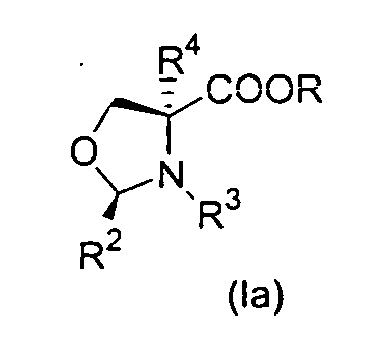
- R represents a C1-C6 alkyl group, a C2-C6 alkenyl group, a phenyl group or a benzyl group,
- R2 represents a C1-C6 alkyl group, a C3-C10 cycloalkyl group or a phenyl group,
- R3 represents a C2-C6 alkanoyl group, a C1-C6 alkyloxycarbonyl group, a benzoyl group, a phenyloxycarbonyl group or a benzyloxycarbonyl group, and
- R4 represents a C1-C6 alkyl group or a C2-C6 alkenyl group]

- R2, R3 and R4 have the same meanings as those indicated hereinbefore]
- (33) a procedure for the preparation of a compound having the general formula (Ic) according to (32) wherein the reducing agent employed is sodium bis(2-methoxyethoxy)aluminum hydride,
- (34) a procedure for the preparation of a compound having the general formula (Id) shown below by conducting a condensation reaction between a compound having the general formula (Ic) shown below and a compound having the general formula (IV) shown below in the presence of a base in a solvent, followed by hydrogenating the product thus obtained,

- R2 represents a C1-C6 alkyl group, a C3-C10 cycloalkyl group or a phenyl group,
- R3 represents a C2-C6 alkanoyl group, a C1-C6 alkyloxycarbonyl group, a benzoyl group, a phenyloxycarbonyl group or a benzyloxycarbonyl group, and
- R4 represents a C1-C6 alkyl group or a C2-C6 alkenyl group]

- W represents a phosphonium salt or a phosphonic acid ester,
- X represents a vinylene group, a sulfur atom, a nitrogen atom substituted with a methyl group and a C1-C6 alkyl group, a nitrogen atom substituted with a silyl group, a nitrogen atom substituted with an acyl group or an oxygen atom, and
- Y represents a hydrogen atom, a halogen atom, a cyano group, a C1-C8 alkyl group, a C1-C8 alkoxyl group or a C2-C8 alkanoyl group]

- R2, R3, R4, X and Y have the same meanings as those indicated hereinbefore]
- (35) a procedure for the preparation of a compound having the general formula (Id) according to (34) wherein W is triphenylphosphonium iodide,
- (36) a procedure for the preparation procedure of a compound having the general formula (Id) according to (34) or (35) wherein a base employed is potassium t-butoxide,
- (37) a procedure for the preparation of a compound having the general formula (Id) shown below by conducting successively a conversion of a compound having the general formula (Ib) shown into a compound having the general formula (V) shown below according to a conventional method, condensation of the product thus obtained with a compound having the general formula (VI) shown below in the presence of a base in a solvent, and the hydrogenation of the product thus obtained,

- R2 represents a C1-C6 alkyl group, a C3-C10 cycloalkyl group or a phenyl group,
- R3 represents a C2-C6 alkanoyl group, a C1-C6 alkyloxycarbonyl group, a benzoyl group, a phenyloxycarbonyl group or a benzyloxycarbonyl group, and
- R4 represents a C1-C6 alkyl group or a C2-C6 alkenyl group]

- R2, R3 and R4 have the same meanings as those indicated hereinbefore, and
- W represents a phosphonium salt or a phosphonic acid ester]

- X represents a vinylene group, a sulfur atom, a nitrogen atom substituted with a C1-C6 alkyl group, a nitrogen atom substituted with a silyl group, a nitrogen atom substituted with an acyl group or an oxygen atom, and
- Y represents a hydrogen atom, a halogen atom, a cyano group, a C1-C8 alkyl group, a C1-C8 alkoxyl group or a C2-C8 alkanoyl group]

- R2, R3, R4, X and Y have the same meanings as those indicated hereinbefore] and
- (38) a procedure for the preparation of a compound having the general formula (Id) according to (37) wherein W is triphenylphosphonium iodide.
Additionally, the present invention provides - (39) a procedure for the preparation of a compound having the general formula (IV') shown below which is characterized by reacting a compound having the general formula (IV") or a salt thereof with a compound having the general formula (A) in the presence of a compound having the general formula (B) in a solvent,

- R5 represents a C1-C6 alkyl group which may optionally be substituted with substituent(s) selected from Substituent group α or a 5- to 10-membered aromatic group which may optionally be substituted with substituent(s) selected from Substituent group α, or two R5 groups together with the nitrogen atom to which they are bound form a 4-to 8-membered nitrogen-containing heterocyclic group which may optionally be substituted with substituent(s) selected from Substituent group α,
- X represents a vinylene group, a sulfur atom, a nitrogen atom substituted with a C1-C6 alkyl group, a nitrogen atom substituted with a silyl group, a nitrogen atom substituted with an acyl group or an oxygen atom,
- Y represents a hydrogen atom, a halogen atom, a cyano group, a C1-C8 alkyl group, a C1-C8 alkoxyl group or a C2-C8 alkanoyl group, and
- Substituent group α represents a halogen atom, a cyano group, a C1-C8 alkyl group, a C1-C8 alkoxyl group, a C1-C8 alkylthio group and an acyl group]

- R6 represents a C1-C6 alkyl group which may optionally be substituted with substituent(s) selected from Substituent group α, a C1-C6 alkoxyl group which may optionally be substituted with substituent(s) selected from Substituent group α, a 5- to 10-membered aromatic group which may optionally be substituted with substituent(s) selected from Substituent group α, or a 5- to 10-membered aromatic-oxy group which may optionally be substituted with substituent(s) selected from Substituent group α, and Substituent group α has the same meaning as that described above]
R7-V (B)
[wherein, - R7 represents an acyl group,
- V represents a halogen atom or a group having the general formula -O-S(O)2Rc, and
- Rc represents a methoxyl group, a C1-C6 alkyl group which may optionally be substituted with from 1 to 3 halogen atoms or a phenyl group which may optionally be substituted with from 1 to 3 substituents selected from the group consisting of a halogen atom and a methyl group]

- R6, V, X and Y have the same meanings as those described above]
- (40) a procedure for the preparation of a compound having the general formula (IV') according to (39) wherein X represents a nitrogen atom substituted with a methyl group,
- (41) a procedure for the preparation of a compound having the general formula (IV') according to (39) or (40) wherein Y represents a hydrogen atom, a C1-C6 alkyl group or a C1-C6 alkoxyl group,
- (42) a procedure for the preparation procedure of a compound having the general formula (IV') according to any one of (39) to (41) wherein R5 represents a C1-C6 alkyl group or two R5 groups together with the nitrogen atom to which they are bound form a pyrrolidine or piperidine group,
- (43) a procedure for the preparation of a compound having the general formula (IV') according to any one of (39) to (42) wherein R6 represents a phenyl group,
- (44) a procedure for the preparation of a compound having the general formula (IV') according to any one of (39) to (43) wherein R7 represents a C1-C6 alkylcarbonyl group, and
- (45) a procedure for the preparation of a compound having the general formula (Id) by condensing a compound having the general formula (IV'), which is prepared by reacting a compound having the general formula (IV") or a salt thereof with a compound having the general formula (A) in the presence of a compound having the general formula (B) in a solvent, with a compound of the general formula (Ic) in the presence of a base in a solvent, followed by hydrogenation of the product thus obtained;

- R5 represents a C1-C6 alkyl group which may optionally be substituted with substituent(s) selected from Substituent group α or a 5- to 10-membered aromatic group which may optionally be substituted with substituent(s) selected from Substituent group α, or two R5 groups together with the nitrogen atom to which they are bound form a 4-to 8-membered nitrogen-containing heterocyclic group which may optionally be substituted with substituent(s) selected from Substituent group α,
- X represents a vinylene group, a sulfur atom, a nitrogen atom substituted with a C1-C6 alkyl group, a nitrogen atom substituted with a silyl group, a nitrogen atom substituted with an acyl group or an oxygen atom,
- Y represents a hydrogen atom, a halogen atom, a cyano group, a C1-C8 alkyl group, a C1-C8 alkoxyl group or a C2-C8 alkanoyl group, and
- Substituent group α represents a halogen atom, a cyano group, a C1-C8 alkyl group, a C1-C8 alkoxyl group, a C1-C8 alkylthio group and an acyl group]

- R6 represents a C1-C6-alkyl group which may optionally be substituted with substituent(s) selected from Substituent group α, a C1-C6 alkoxyl group which may optionally be substituted with substituent(s) selected from Substituent group α, a 5- to 10-membered aromatic group which may optionally be substituted with substituent(s) selected from Substituent group α, or a 5- to 10-membered aromatic-oxy group which may optionally be substituted with substituent(s) selected from Substituent group α, and Substituent group α has the same meaning as that described above]
R7-V (B)
[wherein, - R7 represents an acyl group,
- V represents a halogen atom or a group having the general formula -O-S(O)2Rc, and
- Rc represents a methoxyl group, a C1-C6 alkyl group which may optionally be substituted with from 1 to 3 halogen atoms or a phenyl group which may optionally be substituted with from 1 to 3 substituents selected from the group consisting of a halogen atom and a methyl group]

- R6, V, X and Y have the same meanings as those described above]

- R2 represents a C1-C6 alkyl group, a C3-C10 cycloalkyl group or a phenyl group,
- R3 represents a C2-C6 alkanoyl group, a C1-C6 alkyloxycarbonyl group, a benzoyl group, a phenyloxycarbonyl group or a benzyloxycarbonyl group, and
- R4 represents a C1-C6 alkyl group or a C2-C6 alkenyl group]

- R2, R3, R4, X and Y have the same meanings as those indicated hereinbefore].
- In the general formula (I), the "C1-C3 alkyl group" in the definition of R1 can be, for example, a methyl, ethyl, 2-methylethyl or n-propyl group, and is preferably an ethyl group.
- In the general formula (I), the "C2-C3 alkenyl group" in the definition of R1 can be, for example, a vinyl, 2-methylvinyl or n-propenyl group, and is preferably a vinyl group.
- In the general formula (I), the "C1-C6 alkyl group" in the definitions of R, R2 and R4 can be, for example, a methyl, ethyl, n-propyl, i-propyl, n-butyl, isobutyl, s-butyl, t-butyl, n-pentyl, diethylmethyl, 2-methylbutyl, neopentyl, 1-ethylpropyl, n-hexyl, isohexyl, 4-methylpentyl, 3-methylpentyl, 2-methylpentyl, 1-methylpentyl, 3,3-dimethylbutyl, 2,2-dimethylbutyl 1,1-dimethylbutyl, 1,2-dimethylbutyl, 1,3-dimethylbutyl, 2,3-dimethylbutyl or 2-ethylbutyl group, and is preferably a C1-C4 alkyl group, and more preferably R and R4 are a methyl group and R2 is a t-butyl group.
- In the general formula (I), the "C2-C6 alkenyl group" in the definitions of R and R4 can be, for example, a vinyl, allyl, 1-methyl-2-propenyl, 1-methyl-1-propenyl, 2-methyl-1-propenyl, 2-methyl-2-propenyl, 2-ethyl-2-propenyl, 1-butenyl, 2-butenyl, 1-methyl-2-butenyl, 1-methyl-1-butenyl, 3-methyl-2-butenyl, 1-ethyl-2-butenyl, 3-butenyl, 1-methyl-3-butenyl, 2-methyl-3-butenyl, 1-ethyl-3-butenyl, 1-pentenyl, 2-pentenyl, 1-methyl-2-pentenyl, 2-methyl-2-pentenyl, 3-pentenyl, 1-methyl-3-pentenyl, 2-methyl-3-pentenyl, 4-pentenyl, 1-methyl-4-pentenyl, 2-methyl-4-pentenyl, 1-hexenyl, 2-hexenyl, 3-hexenyl, 4-hexenyl or 5-hexenyl group, and is preferably a C1-C4 alkenyl group and more preferably a vinyl group or an allyl group.
- In the general formula (I), the "C3-C10 cycloalkyl group" in the definition of R2 can be, for example, a cyclopropyl, cyclobutyl, cyclopentyl, cyclohexyl, cycloheptyl, cyclooctyl, cyclononyl, cyclodecyl or adamantyl group, and is preferably a C5-C10 cycloalkyl group and more preferably a cyclohexyl group or an adamantyl group.
- In the general formula (I), the "C2-C6 alkanoyl group" in the definition of R3 can be, for example, an acetyl, propionyl, isopropionyl, n-butanoyl, isobutanoyl, n-pentanoyl, isopentanoyl, 2-methylbutanoyl, pivaloyl, n-hexanoyl, 2-methylpentanoyl, 3-methylpentanoyl or hexanoyl group, and is preferably a C2-C4 alkanoyl group and more preferably an acetyl group.
- In the general formula (I), the "C1-C6 alkyloxycarbonyl group" in the definition of R3 can be, for example, a methoxycarbonyl, ethoxycarbonyl, propyloxycarbonyl, n-butoxycarbonyl, t-butoxycarbonyl, pentyloxycarbonyl or hexyloxycarbonyl group, and is preferably a C1-C4 alkyloxycarbonyl group and more preferably a methoxycarbonyl group.
- In the formulae shown above, the "halogen atom" in the definitions of Substituent groups A and Y can be, for example, a fluorine atom, a chlorine atom, a bromine atom or an iodine atom.
- In the formulae shown above, the "C1-C8 alkyl group" in the definitions of Substituent groups A and Y can be, for example, a group shown as the "C1-C6 alkyl group" in the definitions described above, a heptyl group or an octyl group, and is preferably a C6-C8 alkyl group and more preferably an octyl group.
- In the formulae shown above, the "C1-C8 alkoxyl group" in the definitions of Substituent groups A and Y can be, for example, a methoxy, ethoxy, n-propoxy, isopropoxy, n-butoxy, isobutoxy, s-butoxy, t-butoxy, n-pentyloxy, isopentyloxy, 2-methylbutoxy, neopentyloxy, 1-ethylpropoxy, n-hexyl, isohexyl, 4-methylpentyl, 3-methylpentyl, 2-methylpentyloxy, 1-methylpentyloxy, 3,3-dimethylbutoxy, 2,2-dimethylbutyl, 1,1-dimethylbutyl, 1,2-dimethylbutyl, 1,3-dimethylbutoxy, 2,3-dimethylbutoxy, 2-ethylbutoxy, heptyloxy or octyloxy group, and preferably a C6-C8 alkoxyl group and more preferably a heptyloxy group.
- In the formulae shown above, the "C2-C8 alkanoyl group" in the definitions of Substituent groups A and Y can be, for example, a group shown as the "C2-C6 alkanoyl group" in the definitions described above, a heptanoyl group or an octanoyl group, and is preferably a C6-C8 alkanoyl group and more preferably an octanoyl group.
- In the formulae shown above, the "phosphonium salt" in the definition of W can be, for example, trimethylphosphonium chloride, trimethylphosphonium bromide, trimethylphosphonium iodide, triethylphosphonium chloride, triethylphosphonium bromide, triethylphosphonium iodide, tripropylphosphonium chloride, tripropylphosphonium bromide, tripropylphosphonium iodide, tributylphosphonium chloride, tributylphosphonium bromide, tributylphosphonium iodide, triphenylphosphonium chloride, triphenylphosphonium bromide or triphenylphosphonium iodide, and is preferably triphenylphosphonium chloride.
- In the formulae shown above, the "phosphonic acid ester" in the definition of W can be, for example, dimethyl phosphonate, diethyl phosphonate, ditrifluoroethyl phosphonate, diphenyl phosphonate, or di-o-tolyl phosphonate, and is preferably diethyl phosphonate:
- In the formulae shown above, the "C1-C6 alkyl group" in the definition of X can be, for example, a methyl, ethyl, n-propyl, i-propyl, n-butyl, isobutyl, s-butyl, t-butyl, n-pentyl, diethylmethyl, 2-methylbutyl, neopentyl, 1-ethylpropyl, n-hexyl, isohexyl, 4-methylpentyl, 3-methylpentyl, 2-methylpentyl, 1-methylpentyl, 3,3-dimethylbutyl, 2,2-dimethylbutyl, 1,1-dimethylbutyl, 1,2-dimethylbutyl, 1,3-dimethylbutyl, 2,3-dimethylbutyl or 2-ethylbutyl group, and is preferably a C1-C4 alkyl group, and more preferably a methyl group.
- In the formulae shown above, the "silyl group" in the definition of X can be, for example, a trimethylsilyl, triethylsilyl, isopropyldimethylsilyl, t-butyldimethylsilyl, methyldiisopropylsilyl, methyldi-t-butylsilyl, triisopropylsilyl, methyldiphenylsilyl, isopropyldiphenylsilyl, butyldiphenylsilyl or phenyldiisopropylsilyl group, and is preferably a trimethylsilyl, triethylsilyl, isopropyldimethylsilyl or t-butyldimethylsilyl group.
- In the formulae shown above, the "acyl group" in the definition of X can be, for example, a formyl, carboxyl, carbamoyl, C1-C6 alkylcarbonyl (for example, an acetyl, butanoyl, isobutanoyl or isopentanoyl group), C1-C6 alkoxycarbonyl (for example, a methoxycarbonyl, ethoxycarbonyl, propoxycarbonyl or t-butoxycarbonyl group), C6-C14 arylcarbonyl (for example, a benzoyl, 1-naphthoyl or 2-naphthoyl group), C6-C14 aryloxycarbonyl (for example, a phenyloxycarbonyl or naphthyloxycarbonyl group), C7-C13 aralkyloxycarbonyl (for example, a benzyloxycarbonyl or phenethyloxycarbonyl group), mono- or di-C1-C6 alkylcarbamoyl the alkyl group(s) of which may optionally be substituted with from 1 to 3 substituents selected from the group consisting of a halogen atom and a C1-C6 alkoxycarbonyl group (for example, a methylcarbamoyl, ethylcarbamoyl, dimethylcarbamoyl, diethylcarbamoyl, ethylmethylcarbamoyl, propylcarbamoyl or trifluoroethylcarbamoyl group), C6-C14 arylcarbamoyl (for example, a phenylcarbamoyl group), C3-C10 cycloalkylcarbamoyl (for example, a cyclopropylcarbamoyl group), C7-C13 aralkylcarbamoyl (for example, a benzylcarbamoyl group), C1-C6 alkylsulfonyl (for example, a methylsulfonyl group), C6-C14 arylsulfonyl (for example, a phenylsulfonyl group), nitrogen-containing heterocyclic-carbonyl which may optionally be substituted with a hydroxyl group (for example, a pyrrolidinylcarbonyl or piperidinocarbonyl group), C1-C6 alkylsulfinyl (for example, a methylsulfinyl group), C1-C6 alkoxycarbamoyl (for example, a methoxycarbamoyl group), aminocarbamoyl, hydroxycarbampyl or thiocarbampyl group, and is preferably a formyl, C1-C6 alkylcarbonyl, C1-C6 alkoxycarbonyl, C6-C14 arylcarbonyl, C7-C13 aralkyloxycarbonyl group and more preferably an acetyl, methoxycarbonyl, ethoxycarbonyl, benzoyl or benzyloxycarbonyl group.
- In the formulae shown above, X is preferably a vinylene group, a sulfur atom or a nitrogen atom substituted with a C1-C6 alkyl group and more preferably a vinylene group, a sulfur atom or a nitrogen atom substituted with a methyl group.
- In the formulae shown above, Y is preferably a hydrogen atom, a halogen atom, a C1-C8 alkyl group, a C1-C8 alkoxyl group or a C2-C8 alkanoyl group and more preferably a hydrogen atom, a halogen atom, a methyl group, an octyl group, a methoxyl group or a heptyloxy group.
- The definition of each substituent of compounds having general formulae (IV'), (IV"), (A) and (B) of the present invention is described in detail below.
- The "C1-C6 alkyl group" of the "C1-C6 alkyl group which may optionally be substituted with substituent(s) selected from Substituent group α" in the definitions of R5 can be, for example, a methyl, ethyl, n-propyl, isopropyl, butyl, isobutyl, sec-butyl, t-butyl, pentyl, isopentyl, neopentyl, 1-ethylpropyl, hexyl, isohexyl, 1,1-dimethylbutyl, 2,2-dimethylbutyl, 3,3-dimethylbutyl or 2-ethylbutyl group, and is preferably a methyl, ethyl, propyl, isopropyl, butyl or isobutyl group, and more preferably a methyl or ethyl group.
- The "which may optionally be substituted with substituent(s) selected from Substituent group α" of the "C1-C6 alkyl group which may optionally be substituted with substituent(s) selected from Substituent group α" described above means that substitutable positions of said C1-C6 alkyl group may optionally be substituted with from 1 to 3 substituents selected from Substituent group α.
- The "5- to 10-membered aromatic ring" of the "5- to 10-membered aromatic group which may optionally be substituted with substituent(s) selected from Substituent group α " in the definition of R5 shown above is, for example, a 5- to 10-membered aromatic hydrocarbon ring or a 5- to 10-membered aromatic heterocyclic ring. A 5- to 10-membered aromatic hydrocarbon ring is preferably a benzene ring or a naphthalene ring, and more preferably a benzene ring. On the other hand, a 5- to 10-membered aromatic heterocyclic ring is preferably a 5- to 10-membered aromatic heterocyclic ring which contains 1 to 4 heteroatoms selected from the group consisting of an oxygen, sulfur and nitrogen atom in addition to the carbon atoms as the ring-composing atoms, and is, for example, furan, thiophene, pyrrole, oxazole, isoxazole, thiazole, isothiazole, imidazole, pyrazole, 1,2,3-oxadiazole, furazan, 1,2,3-thiadiazole, 1,2,3-triazole, pyridine, pyridazine, pyrimidine, triazine, benzofuran, isobenzofuran, benzo[b]thiophene, indole, isoindole, 1H-indazole, benzimidazole, benzoxazole, 1,2-benzisoxazole, bonzothiazole, 1,2-benzoisothiazole, 1H-benzotriazole, quinoline or isoquinoline, and more preferably furan or thiophene.
- The "4- to 8-membered nitrogen-containing heterocyclic group" of the " 4- to 8-membered nitrogen-containing heterocyclic group which may optionally be substituted with substituent(s) selected from Substituent group α" is, for example, azetidine, pyrrolidine, piperidine, azepan, morpholine or piperazine, and preferably pyrrolidine or piperidine.
- The definition of each substituent of the "Substituent group α" is described below.
- The "halogen atom" is, for example, a fluorine, chlorine, bromine or iodine atom.
- The "C1-C8 alkyl group" is, for example, a methyl, ethyl, n-propyl, i-propyl, butyl, isobutyl, sec-butyl, t-butyl, pentyl, isopentyl, neopentyl, 1-ethylpropyl, hexyl, isohexyl, 1,1-dimethylbutyl, 2,2-dimethylbutyl, 3,3-dimethylbutyl, 2-ethylbutyl, heptyl or octyl group.
- The "C1-C8 alkoxyl group" is a group wherein a terminal of the "C1-C8 alkyl group" shown above is bound to an oxygen atom.
- The "C1-C8 alkylthio group" is a group wherein a terminal of the "C1-C8 alkyl group" shown above is bound to a sulfur atom.
- The "acyl group" can be, for example, a group of formula -COR3', -CO2R3', -SO2R3', -SOR3', -PO3R3'R4', -CO-NR3aR4a or-CS-NR3aR4a [wherein, R3' and R4' are the same or different and each represents a hydrogen atom, a hydrocarbon group or a heterocyclic group and R3a and R4a groups are the same or different and each represents a hydrogen atom, a hydrocarbon group or a heterocyclic group, or R3a and R4a groups together with an adjacent nitrogen atom may form a nitrogen-containing heterocyclic ring].
- The "hydrocarbon group" described for R3', R4', R3a or R4a is a "C1-C6 alkyl group", a "C3-C6 cycloalkyl group", a "C6-C10 aryl group" or a "C7-C13 aralkyl group".
- The "nitrogen-containing heterocyclic ring" formed by R3a and R4a groups together with an adjacent nitrogen atom is a 5- to 7-membered nitrogen-containing heterocyclic ring which may contain at least one nitrogen atom and 1 or 2 heteroatoms selected from the group consisting of an oxygen, sulfur and nitrogen atom in addition to the carbon atoms as the ring-composing atoms, and is preferably pyrrolidine, imidazolidine, pyrazolidine, piperidine, piperazine, morpholine or thiomorpholine.
- The preferred "acyl group" can be, for example, a formyl, carboxyl, carbamoyl, C1-C6 alkylcarbonyl (for example, an acetyl, butanoyl, isobutanoyl or isopentanoyl group), C1-C6 alkoxycarbonyl (for example, a methoxycarbonyl, ethoxycarbonyl, propoxycarbonyl or t-butoxycarbonyl group), C6-C14 arylcarbonyl (for example, a benzoyl, 1-naphthoyl or 2-naphthoyl group), C6-C14 aryloxycarbonyl (for example, a phenyloxycarbonyl or naphthyloxycarbonyl group), C7-C13 aralkyloxycarbonyl (for example, a benzyloxycarbonyl or phenethyloxycarbonyl group), mono- or di-C1-C6 alkylcarbamoyl the alkyl group(s) of which may optionally be substituted with from 1 to 3 substituents selected from the group consisting of a halogen atom and a C1-C6 alkoxycarbonyl group (for example, a methylcarbamoyl, ethylcarbamoyl, dimethylcarbamoyl, diethylcarbamoyl, ethylmethylcarbamoyl, propylcarbamoyl or trifluoroethylcarbamoyl group), C6-C14 arylcarbamoyl (for example, a phenylcarbamoyl group), C3-C10 cycloalkylcarbamoyl (for example, a cyclopropylcarbamoyl group), C7-C13 aralkylcarbamoyl (for example, a benzylcarbamoyl group), C1-C6 alkylsulfonyl (for example, a methylsulfonyl group), C6-C14 arylsulfonyl (for example, a phenylsulfonyl group), nitrogen-containing heterocyclic-carbonyl which may optionally be substituted with a hydroxyl group (for example, a pyrrolidinylcarbonyl or piperidinocarbonyl group), C1-C6 alkylsulfinyl (for example, a methylsulfinyl group), C1-C6 alkoxycarbamoyl (for example, a methoxycarbamoyl group), aminocarbamoyl, hydroxycarbamoyl or thiocarbamopyl group.
- The "C1-C6 alkyl group" of the "C1-C6 alkyl group which may optionally be substituted with substituent(s) selected from Substituent group α" and the "5- to 10-membered aromatic group" of the "5- to 10-membered aromatic group which may optionally be substituted with substituent(s) selected from Substituent group α" in the definition of R6 described above have the same meanings as those indicated in the definition of R5 described above.
- The "C1-C6 alkoxyl group which may optionally be substituted with substituent(s) selected from Substituent group α" in the definition of R6 described above is a group wherein a terminal of the "C1-C6 alkyl group which may optionally be substituted with substituent(s) selected from Substituent group α" in the definition of R5 described above is bound to an oxygen atom.
- The "5- to 10-membered aromatic-oxy group which may optionally be substituted with substituent(s) selected from Substituent group α" in the definition of R6 described above is a group wherein a terminal of the "5- to 10-membered aromatic group which may optionally be substituted with substituent(s) selected from Substituent group α" in the definition of R5 described above is bound to an oxygen atom.
- The "acyl group" in the definition of R7 described above has the same meaning as the "acyl group" indicated in the definition of Substituent group α, and is preferably a C1-C6 alkylcarbonyl group (for example, an acetyl, butanoyl or isobutanoyl group).
- The "C1-C6 alkyl group which may optionally be substituted with from 1 to 3 halogen atoms" in the definition of Rc described above can be, for example, a fluoromethyl, difluoromethyl, trifluoromethyl, difluoroethyl or trifluoroethyl group, and preferably a trifluoromethyl group.
- The "phenyl group which may optionally be substituted with from 1 to 3 substituents selected from the group consisting of a halogen atom and a methyl group" in the definition of Rc described above can be, for example, a 4-fluorophenyl, 4-chlorophenyl, 3,4-dichlorophenyl, 4-methylphenyl or 3,4-dimethylphenyl group, and is preferably a 4-dimethylphenyl group.
- R5 described above is preferably a C1-C10 alkyl group which may optionally be substituted with substituent(s) selected from Substituent group α or a 4- to 8-membered nitrogen-containing heterocyclic group formed by two R5 groups together with a nitrogen atom to which they are bound which may optionally be substituted with substituent(s) selected from Substituent group α, more preferably a C1-C6 alkyl group, or pyrrolidine or piperidine formed by two R1 groups together with a nitrogen atom to which two R5 groups are bound, and still more preferably a methyl or ethyl group, or pyrrolidine or piperidine formed by two R5 groups together with a nitrogen atom to which they are bound.
- R6 described above is preferably a C1-C6 alkyl group or a 5- to 10-membered aromatic ring group, and more preferably a phenyl group.
- R7 described above is preferably a C1-C6 alkylcarbonyl group, and more preferably an acetyl group.
- V described above is preferably a chlorine atom, a bromine atom or an iodine atom, and more preferably a chlorine or iodine atom.
- X described above is preferably a vinylene group, a sulfur atom or a nitrogen atom substituted with a C1-C6 alkyl group, and more preferably a vinylene group, a sulfur atom or a nitrogen atom substituted with a methyl group.
- Y described above is preferably a hydrogen atom, a halogen atom, a C1-C8 alkyl group, a C1-C8 alkoxyl group or C2-C8 alkanoyl group, and more preferably a hydrogen atom, a halogen atom, a methyl group, an octyl group, a methoxyl group or a heptyloxy group.
- Substituent group α described above is preferably a halogen atom, a C1-C8 alkyl group, a C1-C8 alkoxyl group or an acyl group, more preferably a C1-C6 alkyl group or a C1-C6 alkoxyl group, and particularly preferably a methyl group or a methoxyl group.
- When the compounds of the present invention can form salt thereof, these compounds can be used as their salts. Such a salt is, for example, an inorganic base salt, an organic base salt, an inorganic acid salt, an organic acid salt, or a basic or acidic amino acid salt.
- The inorganic base salt is preferably an alkali metal salt such as a sodium salt, potassium salt or the like; an alkaline earth metal salt such as a calcium salt, magnesium salt or the like; an aluminum salt; an ammonium salt or the like.
- The organic base salt is preferably a trimethylamine salt, triethylamine salt, pyridine salt, picoline salt, ethanolamine salt, diethanolamine salt, triethanolamine salt, dicyclohexylamine salt, N,N-dibenzylethylenediamine salt or the like.
- The inorganic acid salt is preferably a hydrochloride, a hydrobromide, a nitrate, a sulfate, a phosphate or the like.
- The organic acid salt is preferably a formate, an acetate, a trifluoroacetate, a fumarate, an oxalate, a tartrate, a maleate, a citrate, a succinate, a malate, methanesulfonate, benzenesufonate, p-toluenesulfonate or the like.
- The compounds having the general formulae (I), (Ia), (Ib), (Ic) and (Id) of the present invention have an asymmetric carbon atom in their structures, and can exist as optical isomers due to such asymmetric carbon atom. In the present invention, a single optical isomer and mixtures of optical isomers are represented as a single chemical formula (I), (Ia), (Ib), (Ic) or (Id), individually. The present invention encompasses both individual optical isomers and mixtures thereof in any ratio. In the compounds having the general formulae (I), (Ia), (Ib), (Ic) and (Id) of the present invention, an amino group is substituted on the asymmetric carbon atom, and the compounds having the R-absolute configuration are particularly desirable, but the compounds containing the S-isomer are also encompassed in the present invention.
- When the compounds of general formulae (I), (Ia), (Ib), (Ic) and (Id) of the present invention are allowed to stand in contact with the atmosphere or recrystallized, they may absorb water or water may attach to them to form a hydrate. Such hydrates are included in the compounds having the general formulae (I), (Ia), (Ib), (Ic) and (Id) of the present invention.
- As representative compounds of the present invention having general formulae (I), (Ia), (Ic), and (Id), the compounds shown in from Table 1 to Table 3 can be listed, but the scope of the present invention should not be limited to these compounds.
- The meaning of the abbreviations in the following Tables is shown below.
- Ac : acetyl group
- Boc : t-butoxycarbonyl group
- Bzl : benzoyl group
- Cbz : benzyloxycarbonyl group
- cHex : cyclohexyl group
- Eoc : ethoxycarbonyl group
- Et : ethyl group
- Et2CH: dimethylmethyl group
- HepCO : octanoyl group
- HepO: heptyloxy group
- iPr: isopropyl group
- Me: methyl group
- Moc: methoxycarbonyl group
- Oct : octyl group
- Ph: phenyl group
- PhOCO :phenoxycarbonyl group
- Pr :propyl group
- tBu : t-butyl group
- Among the above compounds, preferred compounds are the compounds of Exemplification Compound Nos. 1-2, 7-8, 13-14, 19-20, 25-26, 31-32, 37-38, 43-44, 49-50, 55-56, 61-62, 67-68, 73-74, 79-80, 85-86, 91-92, 97-98, 103-104, 109-110, 115-116, 121-122, 127-128, 133-134, 139-140, 145-146, 151-152, 157-158, 163-164, 169-170, 175-176, 181-182, 187-188, 193-194, 199-200, 205-206.
- More preferred compounds are the compounds of Exemplification Compound Nos.1,7,13,19,25,31,37,43,49,55,61,67,73,79,85,91,97,103,109, 115,121,127,133,139,145,151,157,163,169,175,181,187,193,199,205.
- Even more preferred compounds are the compounds of Exemplification compound number 43:
- 2-t-butyl-4-methyl-1,3-oxazolidine-3,4-dicarboxylic acid 3-t-butyl ester 4-methyl ester Exemplification compound number 49:
- 2-t-butyl-4-methyl-1,3-oxazolidine-3,4-dicarboxylic acid 3-benzyl ester 4-methyl ester Exemplification compound number 55:
- 2-t-butyl-4-methyl-1,3-oxazolidine-3,4-dicarboxylic acid dimethyl ester Exemplification compound number 61:
- 2-t-butyl-4-methyl-1,3-oxazolidine-3,4-dicarboxylic acid 3-ethyl ester 4-methyl ester Exemplification compound number 67:
- 3-acetyl-2-t-butyl-4-methyl-1,3-oxozolidine-4-carboxylic acid methyl ester Exemplification compound number 73:
- 2-t-butyl-4-methyl-1,3-oxazolidine-3,4-dicarboxylic acid 3-phenyl ester 4-methyl ester Exemplification compound number 79:
- 3-benzoyl-2-t-butyl-4-methyl-1,3-oxazolidine-4-carboxylic acid methyl ester.
- Among the above compounds, preferred compounds are the compounds of Exemplification Compound Nos. 1, 4, 7,10, 13, 16, 19,22,25,28,31,34,37,40, 43, 46, 49, 52, 55, 58, 61, 64, 67, 70, 73, 76, 79, 82, 85, 88, 91, 94, 97, 100, and 103.
- More preferred compounds are the compounds of Exemplification Compound Nos. 1, 4, 7, 10, 13, 16, 19, 22, 25, 28, 31, 34, 37, 40, 43, 46, 49, 52, 55, 58, and 61.
- Even more preferred compounds as the compound of (Ib) of the present invention are the compounds of Exemplification compound number 22:
- 2-t-butyl-4-hydroxymethyl-4-methyl-1,3-oxazolidine-3-carboxylic acid t-butyl ester, Exemplification compound number 25:
- 2-t-butyl-4-hydroxymethyl-4-methyl-1,3-oxazolidine-3-carboxylic acid benzyl ester, Exemplification compound number 28:
- 2-t-butyl-4-hydroxymethyl-4-methyl-1,3-oxazolidine-3-carboxylic acid methyl ester, Exemplification compound number 31:
- 2-t-butyl-4-hydroxymethyl-4-methyl-1,3-oxazolidine-3-carboxylic acid ethyl ester, Exemplification compound number 34:
- (3-acetyl-2-t-butyl-4-methyl-l,3-oxazolidin-4-yl)methanol, Exemplification compound number 37:
- 2-t-butyl-4-hydroxymethyl-4-methyl-1,3-oxazolidine-3-carboxylic acid phenyl ester, Exemplification compound number 40:
- (3-benzoyl-2-t-butyl-4-methyl-1, 3-oxazolidin-4-yl)methanol,
- 2-t-butyl-4-formyl-4-methyl-1,3-oxazolidine-3-carboxylic acid t-butyl ester, Exemplification compound number 25:
- 2-t-butyl-4-formyl-4-methyl-1,3-oxazolidine-3-carboxylic acid benzyl ester, Exemplification compound number 28:
- 2-t-butyl-4-formyl-4-methyl-1,3-oxazolidine-3-carboxylic acid methyl ester, Exemplification compound number 31:
- 2-t-butyl-4-formyl-4-methyl-1,3-oxazolidine-3-carboxylic acid ethyl ester, Exemplification compound number 34:
- 3-acetyl-2-t-butyl-4-methyl-1, 3-oxazolidine-4-carboaldehyde, Exemplification compound number 37:
- 2-t-butyl-4-formyl-4-methyl-1,3-oxazolidine-3-carboxylic acid phenyl ester, and Exemplification compound number 40:
- 3-benzoyl-2-t-butyl-4-methyl-1,3-oxazolidine-4-carboaldehyde.
- Among the above compounds, preferred compounds are the compounds of Exemplification Compound Nos.:
- 1-6, 25-30, 49-54, 73-78, 97-102, 121-126, 145-150, 169-174,193-198, 217-222, 241-246, 265-270, 289-294, 313-318, 337-342, and 361-366.
- More preferred compounds are the compounds of Exemplification Compound Nos.:
- 1-3, 25-27, 49-51, 73-75, 97-99, 121-123, 145-147, 169-171, 193-195, 217-219, 241-243, 265-267, 289-291, 313-315, 337-339, and 361-363.
- Even more preferred compounds are the compounds of
- Exemplification compound number 73:
- 2-t-butyl-4-methyl-4-[2-(1-methyl-1 H-pyrrol-2-yl)ethyl]-1,3-oxazolidine-3-carboxylic acid t-butyl ester,
- Exemplification compound number 97:
- 2-t-butyl-4-methyl-4-[2-(1-methyl-1H-pyrrol-2-yl)ethyl]-1,3-oxazolidine-3-carboxylic acid benzyl ester,
- Exemplification compound number 121:
- 2-t-butyl-4-methyl-4-[2-(1-methyl-1H-pyrrol-2-yl)ethyl]-1,3-oxazolidine-3-carboxylic acid methyl ester,
- Exemplification compound number 145:
- 2-t-butyl-4-methyl-4-[2-(1-methyl-1H-pyrrol-2-yl)ethyl]-1,3-oxazolidine-3-carboxylic acid ethyl ester,
- Exemplification compound number 169:
- 2-t-butyl-4-methyl-4-[2-(1-methyl-1 H-pyrrol-2-yl)ethyl]-1,3-oxazolidine-3-carboxylic acid phenyl ester,
- Exemplification compound number 193:
- 3-acetyl-2-t-butyl-4-methyl-4-[2-(1-methyl-1H-pyrrol-2-yl)ethyl]-1,3-oxozalidine, and
- Exemplification compound number 217:
- 3-benzoyl-2-t-butyl-4-methyl-4-[2-(1-methyl-1H-pyrrol-2-yl)ethyl]-1,3-oxazolidine.
- The present invention is useful for providing the optically active 4,4-di-substituted oxazolidine derivatives and procedures for their preparation. The preparation procedures of the present invention have excellent advantages in the following respects, compared with the prior art: 1) increase in yield, 2) improvement in stereoselectivity, 3) extremely low-temperature reaction which is unsuitable for industrial large-scale synthesis is not necessary, and 4) column-chromatographic purification of intermediates is not needed in any step of these synthetic processes.
- Furthermore, the compounds having the general formula (Id), which are the optically active 4,4-di-substituted oxazolidine derivatives encompassed in the present invention, are useful as synthetic intermediates in the preparation of optically active α,α-di-substituted α-amino acid derivatives having an excellent glutamate receptor antagonistic action or optically active α,α-di-substituted α-amino alcohol derivatives having new immunosuppressive action.
- As shown in the following reaction scheme, for example, the compound (VII) described in non-patent literatures 8 and 9 mentioned hereinbefore, an immunosuppressive agent having a new mode action, can be synthesized from the compounds of the general formula (Id) of the present invention [wherein, R2 and R3 have the same meanings as those indicated hereinbefore, R4 represents a methyl group, X represent a vinylene group, and Y represents a heptyloxy group] by removing R2 and R3 groups, both of which are protecting groups, by treatment with an acid, a base or the like according to conventional procedures.

- Furthermore, according to the present invention, the substituted methylenephosphonium salt which is useful as a synthetic intermediate in the preparation of the compounds having the general formula (Id) and various kinds of medicines can be obtained conveniently in a high yield.
- The substituted methylenephosphonium salt having the general formula (IV'-b) or (IV'-c) prepared by the present invention is, for example, as shown in the following reaction scheme, useful as the intermediate in the preparation of immunosuppressive agents having the general formula (VI'-b) or (VI'-c) disclosed in
W003/059880 
- Additionally, as shown in following reaction scheme, the substituted methylenephosphonium salt having the general formula (IV'-d) prepared by the present invention is useful since the synthetic intermediate (VI-d) in the preparation of the compound having the general formula (VI'-d) disclosed in
WO94/08943 
- The compounds of the present invention can be prepared according to the procedures described below.
- The compounds employed in the invented procedures are generally known compounds and can be prepared from known compounds according to known procedures, but some of them are commercially available. As the known procedures described above, there are the procedures described, for example, in "Organic Functional Group Preparation", Second Edition, Academic Press, Inc., 1989, and "Comprehensive Organic Transformations", VCH Publishers Inc., 1989.
- Depending on the reactivity of functional groups, it is necessary to protect these functional groups contained in the starting materials and/or intermediates generated in the reaction processes using suitable protecting groups, that can be removed to convert the protected functional group(s) into said functional group(s) easily, before initiation of the reaction or at the suitable steps. When the functional group(s) are protected by the suitable protecting group(s), the desired compound can be obtained by removing the protecting group(s), if necessary.
- Such functional group is, for example, a hydroxyl group, a carboxyl group, a hydroxyl group, a carbonyl group and an amino group, and the protecting groups are found in Green and Wuts: "Protective Groups in Organic Synthesis", 3rd edition, John Willey and Sons, Inc., 1999, and a suitable protecting group for them can be used depending on the reaction conditions.
- The protecting group employed for the carboxyl group is, for example, a C1-C6 alkyl (for example, a methyl, ethyl, propyl, isopropyl, butyl or t-butyl group), C7-C10 aralkyl (for example, a benzyl group), phenyl, trityl, silyl (for example, a trimethylsilyl, triethylsilyl, dimethylphenylsilyl, t-butyldimethylsilyl or t-butyldiethylsilyl group), or C2-C6 alkenyl group (for example, a 1-allyl group). These groups may optionally be substituted with from 1 to 3 halogen atoms (for example, a fluorine, chlorine, bromine or iodine atom), a C1-C6 alkoxyl group (for example, a methoxy, ethoxy or propoxy group), or a nitro group.
- The protecting group employed for the hydroxyl group is, for example, a C1-C6 alkyl (for example, a methyl, ethyl, propyl, isopropyl, butyl or t-butyl group), phenyl, trityl, C7-C11 aralkyl (for example, a benzyl group), formyl, C1-C6 alkylcarbonyl (for example, an acetyl or propionyl group), benzoyl, C7-C11 aralkylcarbonyl (for example, a benzylcarbonyl group), 2-tetrahydropyranyl, 2-tetrahydrofuranyl, silyl (for example, a trimethylsilyl, triethylsilyl, dimethylphenylsilyl, t-butyldimethylsilyl or t-butyldiethylsilyl group) or C2-C6 alkenyl group (for example, a 1-allyl group). These groups may optionally be substituted with from 1 to 3 halogen atoms (for example, a fluorine, chlorine, bromine or iodine atom), a C1-C6 alkyl group (for example, a methyl, ethyl or n-propyl group), a C1-C6 alkoxyl group (for example, a methoxy, ethoxy or propoxy group) or a nitro group.
- The protecting group employed for the carbonyl group is, for example, a cyclic acetal (for example, 1,3-dioxane) or non-cyclic acetal group (for example, di-C1-C6 alkyl acetal group).
- The protecting group employed for the amino group is, for example, a formyl, C1-C6 alkylcarbonyl (for example, an acetyl or propionyl group), C1-C6 alkoxycarbonyl (for example, a methoxycarbonyl, ethoxycarbonyl or t-butoxycarbonyl group), benzoyl, C7-C11 aralkylcarbonyl (for example, a benzylcarbonyl group), C7-C14 aralkyloxycarbonyl (for example, a benzyloxycarbonyl or 9-fluorenylmethoxycarbonyl group), trityl, phthaloyl, N,N-dimethylaminomethylene, silyl (for example, a trimethylsilyl, triethylsilyl, dimethylphenylsilyl, t-butyldimethylsilyl or t-butyldiethylsilyl group) or C2-C6 alkenyl group (for example, a 1-allyl group). These groups may optionally be substituted with from 1 to 3 halogen atoms (for example, a fluorine, chlorine, bromine or iodine atom), a C1-C6 alkoxyl group (for example, a methoxy, ethoxy or propoxy group) or a nitro group.
- The removal of the protecting groups described above is carried out by known procedures such as procedures using an acid, a base, ultraviolet light, hydrazine, phenylhydrazine, sodium N-methyldithiocarbamate, tetrabutylammonium fluoride, palladium acetate or trialkylsilyl halide (for example, trimethylsilyl iodide or trimethylsilyl bromide) or a reduction procedure.
- The method A is a process for the preparation of a compound having the general formula (Ia).

- In the above reaction scheme, R, R2, R3 and R4 have the same meanings as those indicated hereinbefore.
- The compound having the general formula (II) was synthesized according to the procedure described in the literature (Angew. Chem. GE 100, 10, 1988, 1398-1404). In Step A1, the compound having the general formula (VIII) can be prepared by the esterification of (S)-serine (VII), in Step A2, the compound having the general formula (IX) can be prepared by protecting the amino alcohol compound having the general formula (VIII) obtained above with a R2-acetal group, and in Step A3, a compound having the general formula (II) can be prepared by protecting the nitrogen atom of the compound having the general formula (IX) obtained above with R3.
- Furthermore, in Step A4 which is a reaction of the present invention, a compound having the general formula (Ia) can be prepared stereoselectively by reacting a compound having the general formula (II) with an alkylating agent in the presence of a coordinating reagent and a base and in the presence of an inert solvent or absence of a solvent. This process is a modified process of the method by Dieter Seebach et al., and is improved to enable this invented procedure to be applied to industrial large-scale manufacturing.
- In the method by Dieter Seebach et al., the compound having the general formula (Ia) is synthesized by adding a base first to the compound of the general formula (II) in which R is a methyl group, R2 is a t-butyl group and R3 is a formyl group (this compound is different from the invented compound in respect that R3 is a formyl group) and followed by addition of an alkylating agent to the resulting mixture, but the desired compound can be obtained only in the yield of about 40 to 70 %. In the present invention, however, it was discovered that the compound of the general formula (Ia) can be synthesized in a high yield by addition of each reagent under reaction conditions which are appropriate to the compound of general formula (II), for example, by the addition of an alkylating reagent and a coordinating reagent to the compound of general formula (II) first and followed by the addition of a base to the resulting mixture obtained. Furthermore, in the present invention, various reaction conditions are improved, and the present invention provides several advantages in respect that the extremely low-temperature reaction (about -78°C), which is an indispensable step in the conventional procedure and additionally unsuitable for the industrial large-scale manufacturing, can be avoided by selection of a suitable base and coordinating reagent, and a compound having the general formula (Ia) can be synthesized in a high yield even at an industrially applicable temperature, for example, at a temperature ranging from - 25°C to 10°C. In contrast to the prior art which is only the results of researches at the academic level, the present process of the present invention is superior to the prior art in respect that the invented procedure is on an industrially utilizable level.
- The alkylating agent employed in the above reaction is not particularly restricted provided that it can be generally used in the alkylation of ester-enolates, and can be, for example, methyl chloride, methyl bromide, methyl iodide, methyl methanesusulfonate, methyl trifluoromethanesulfonate, methyl p-toluenesulfonate, dimethyl sulfate, ethyl chloride, ethyl bromide, ethyl iodide, ethyl methanesusulfonate, ethyl trifluoromethanesulfonate, ethyl p-toluenesulfonate, diethyl sulfate, propyl chloride, propyl bromide, propyl iodide, propyl methanesusulfonate, propyl trifluoromethanesulfonate, propyl p-toluenesulfonate or dipropyl sulfate, and is preferably methyl bromide, methyl iodide, ethyl bromide, ethyl iodide, propyl bromide or propyl iodide, and more preferably methyl bromide or methyl iodide.
- The coordinating reagents employed in the above reactions can be, for example, a urea such as 1,3-diinethyl-3,4,5,6-tetrahydro-2(1H)-pyrimidinone (DMPU) or 1,3-dimethyl-2-imidazolidinone (DMI); an amide such as 1-methyl-2-pyrrolidinone (NMP), N,N-dimethylacetamide (DMAc) or N,N-dimethylformamide (DMF); a sulfoxide such as dimethyl sulfoxide (DMSO); a crown ether such as 12-crown-4, 15-crown-5 or 18-crown-6; or an ethylene glycol such as diethylene glycol dimethyl ether (diglyme), triethylene glycol dimethyl ether (triglyme), tetraethylene glycol dimethyl ether (tetraglyme) or polyethylene glycol, and is preferably DMPU, DMI, NMP, DMF, DMSO, triglyme or tetraglyme, and more preferably triglyme or tetraglyme.
- The base employed in the above reaction is not particularly restricted provided that it is a low-nucleophilic base, and can be, for example, an alkali metal amide such as lithium bis(trimethylsilyl)amide (LHMDS), lithium diisopropylamide (LDA), sodium bis(trimethylsilyl)amide (SHMDS) or potassium bis(trimethylsilyl)amide (KHMDS); or an alkali-metal alkoxide such as sodium t-butoxide or potassium t-butoxide, and is preferably potassium t-butoxide.
- The inert solvent employed in the above reaction is not particularly restricted provided that it has no adverse effect on the reaction, and can be, for example, an ether such as tetrahydrofuran, diethyl ether, t-butylmethyl ether, 1,4-dioxane or dimethoxyethane; an aromatic hydrocarbon such as toluene or xylene; an aliphatic hydrocarbon such as hexane or heptane; or a mixed solvent thereof, and is preferably an ether, and more preferably tetrahydrofuran or methoxyethane.
- The reaction temperature employed in the above reaction is different depending on the starting material, the reagent used and the sort of solvent, but is generally between - 100°C and 30°C, preferably between -80°C and 10°C, and most preferably between - 25°C and 10°C.
- The reaction time employed in the above reaction is different depending on the reaction temperature, the starting material, the reagent and the sort of solvent employed, but is generally from 5 minutes to 24 hours, and preferably from 30 minutes to 5 hours.
- After the reaction is completed, the desired compound of this reaction can be isolated from the reaction mixture by conventional treatments. The desired compound can be isolated, for example, by neutralization of the reaction mixture, if necessary, or filtration of the reaction mixture when insoluble material is present in the reaction mixture, extraction of the neutralized solution or the filtrate with an organic solvent immiscible with water such as toluene, washing the resulting organic layer with water, separation of the organic layer containing the desired compound, and then evaporation of the organic solvent under reduced pressure.
- The product thus obtained, if necessary, can be further isolated and purified by conventional treatments, for example, by recrystallization or reprecipitation, or by conventional procedures generally used in the isolation and purification of organic compounds (for example, absorption column chromatography using a carrier such as silica gel, alumina or Florisil consisting of magnesium and silica gel;partition column chromatography using Sephadex LH-20 (product of Pharmacia Co., Ltd.), Amberlite XAD-11 (product of Rohm & Hass Co., Ltd.) or Diaion HP-20 (product of Mitsubishi Chemicals Co., Ltd.); ion exchange chromatography; or normal phase or reversed phase column chromatography using silica gel or alkylated silica gel, and preferably by column chromatography using silica gel).
- Step B1 is a process for the preparation of a compound having the general formula (Ib).

- In the above reaction scheme, R, R2, R3 and R4 have the same meanings as those indicated hereinbefore.
- A compound having the general formula (Ib) can be prepared by reacting a compound having the general formula (Ia) with a reducing agent in an inert solvent.
- The reducing agent employed in the above reaction is not particularly restricted provided that it is generally used in the reduction of an ester to a primary alcohol, and can be, for example, a metal salt ofborohydride such as lithium borohydride, sodium borohydride or potassium borohydride; a metal salt of aluminum hydride such as lithium aluminum hydride, sodium aluminum hydride or sodium bis(2-methoxyethoxy)aluminum hydride; or a metal hydride such as isobutylaluminum hydride, and these reducing agents described above can be also used as a combination with a lithium halogenide such as lithium chloride, lithium bromide or lithium iodide, or a lanthanide halogenide such as cerium trichloride, samarium trichloride or europium trichloride, and is preferably lithium borohydride, sodium borohydride, potassium borohydride or sodium bis(2-methoxyethoxy)aluminum hydride, or a combination of these reducing agents and a lithium halogenide, more preferably a combination of sodium borohydride or potassium borohydride and a lithium halogenide, and still more preferably a combination of potassium borohydride and lithium chloride.
- The inert solvent employed in the above reaction is different depending on the sort of reagents used, but is not particularly restricted provided that it has no adverse effect on the reaction, and can be, for example, an aliphatic hydrocarbon such as hexane or heptane; an aromatic hydrocarbon such as toluene or xylene; a halogenated hydrocarbon such as dichloromethane or 1,2-dichloroethane; an ether such as tetrahydrofuran, diethyl ether or t-butyl methyl ether; an alcohol such as methanol, ethanol or n-propanol; or a mixed solvent of these solvents, and is preferably an aromatic hydrocarbon, an ether or an alcohol, or a mixed solvent of these solvents, and more preferably tetrahydrofuran or toluene, or a mixed solvent of these solvents.
- The reaction temperature employed in the above reaction is different depending on the starting material, the reagent used and the sort of solvent, but is generally between - 80°C and 120°C, and preferably between -20°C and 50°C.
- The reaction time employed in the above reaction is different depending on the reaction temperature, the starting material, the reagent used and the sort of solvent employed, but is generally from 5 minutes to 48 hours, and preferably from 30 minutes to 10 hours.
- After the reaction is completed, the desired compound of this reaction can be isolated from the reaction mixture and purified in the same manner as those described in the Method A.
- Step C1 is a process for the preparation of a compound having the general formula (Ic).

- In the above reaction scheme, R2, R3 and R4 have the same meanings as those indicated hereinbefore.
- A compound having the general formula (Ic) can be prepared by reacting a compound having the general formula (Ib) with an oxidizing agent in an inert solvent.
- The oxidizing agent employed in the above reaction is not particularly restricted provided that it is generally used in the oxidation of a primary alcohol to a corresponding aldehyde, and can be, for example, a chromic acid compound such as potassium chromate, chromic acid-sulfuric acid complex or chromic acid-pyridine complex; a combination of a co-oxidizing agent such as a salt of hypochlorous acid, a salt of bromous acid, N-chlorosuccinimide or molecular oxygen and a catalytic amount of 2,2,6,6-tetramethylpiperidinooxy, free radical (TEMPO) and another salt; a reagent used for DMSO oxidation (complex of dimethylsufoxide and dicyclohexylcarbodiimide, oxalyl chloride, acetic anhydride or phosphorus pentoxide, or a complex of pyridine-sulfuric anhydride); a combination of a transition metal catalyst such as a copper complex or a ruthenium complex and molecular oxygen, or a transition metal catalyst and an organic oxidizing agent such as N-methylmorpholinoxide, and is preferably a combination of a co-oxidizing agent and TEMPO and another salt, more preferably a combination of sodium hypochlorite, TEMPO, sodium bromide and sodium hydrogencarbonate.
- The inert solvent employed in the above reaction is different depending on the sort of reagents used, but is not particularly restricted provided that it has no adverse effect on the reaction, and when the combination of a salt of hypochlorous acid, TEMPO and other salts is used as the oxidizing agent, the inert solvent employed can be an aliphatic hydrocarbon such as hexane or heptane; an aromatic hydrocarbon such as toluene or xylene; a halogenated hydrocarbon such as dichloromethane or 1,2-dichloroethane; an ester such as ethyl acetate or butyl acetate; or a mixed solvent of the solvents described above and water, and is preferably a mixed solvent of toluene and water.
- The reaction temperature employed in the above reaction is different depending on the starting material, the reagent used and the sort of solvent, but is generally between - 50°C and 100°C, and preferably between -10°C and 20°C.
- The reaction time employed in the above reaction is different depending on the reaction temperature, the starting material, the reagent used and the sort of solvent employed, but is generally from 5 minutes to 48 hours, and preferably from 30 minutes to 5 hours.
- After the reaction is completed, the desired compound of this reaction can be isolated from the reaction mixture and purified in the same manner as those described in the Method A.
- Step D1 is an alternative procedure to Method C for the preparation of a compound having the general formula (Ic).

- In the above reaction scheme, R, R2, R3 and R4 have the same meanings as those indicated hereinbefore.
- In this step, a compound having the general formula (Ic) can be prepared in one step by reacting a compound having the general formula (Ia) with a reducing agent in an inert solvent without passing through a compound having the general formula (Ib).
- The reducing agent employed in the above reaction is not particularly restricted provided that it is generally used in a reduction reaction of an ester into an aldehyde, and can be, for example, a metal salt of borohydride such as lithium borohydride, sodium borohydride or potassium borohydride; a metal salt of aluminum hydride such as lithium aluminum hydride, sodium aluminum hydride or sodium bis(2-methoxyethoxy)aluminum hydride; or a metal hydride such as isobutylaluminum hydride, and these reducing agents described above can be also used as a combination with an organic amine such as pyrrolidine or morpholine, and is preferably sodium bis(2-methoxyethoxy)aluminum hydride or a combination thereof with an organic amine, and more preferably sodium bis(2-methoxyethoxy)aluminum hydride.
- The inert solvent employed in the above reaction is not particularly restricted provided that it has no adverse effect on the reaction, and can be, for example, an aliphatic hydrocarbon such as hexane or heptane; an aromatic hydrocarbon such as toluene or xylene; or a halogenated hydrocarbon such as dichloromethane or 1,2-dichloroethane, and is preferably toluene.
- The reaction temperature employed in the above reaction is different depending on the starting material, the reagent used and the sort of solvent, but is generally between - 100°C and 50°C, and preferably between -50°C and 20°C.
- The reaction time employed in the above reaction is different depending on the reaction temperature, the starting material, the reagent used and the sort of solvent employed, but is generally from 5 minutes to 48 hours, and preferably from 30 minutes to 10 hours.
- After the reaction is completed, the desired compound of this reaction can be isolated from the reaction mixture and purified in the same manner as those described in the Method A.
- The method E is a method for the preparation of compounds having the general formulae (Id') and (Id).

- In the above reaction scheme, R, R2, R3, R4, W, X and Y have the same meanings as those indicated hereinbefore.
- Step E1 is a process for the preparation of a compound having the general formula (Id') by reacting a compound having the general formula (Ic) with a compound having the general formula (IV) in the presence of a base in an inert solvent.
- The base employed in the above reaction is not particularly restricted provided that it is generally used in the Wittig reaction, and can be, for example, an alkali metal carbonate such as sodium carbonate, potassium carbonate or cesium carbonate; an alkali metal hydride such as lithium hydride or sodium hydride; an alkali metal hydroxide such as sodium hydroxide, potassium hydroxide, barium hydroxide or lithium hydroxide; an alkali metal alkoxide such as sodium methoxide, sodium ethoxide, sodium tert-butoxide or potassium tert-butoxide; an organic base such as 1,8-diazabicyclo[5.4.0]undec-7-ene; an alkyllithium such as butyllithium or an alkylmagnesium halide such as butylmagnesium bromide; an alkali metal amide such as lithium diisopropylamide, lithium bis(trimethylsilyl)amide, sodium bis(trimethylsilyl)amide or potassium bis(trimethylsilyl)amide, and is preferably an alkali metal carbonate, an alkali metal alkoxide or an alkali metal amide, and more preferably potassium carbonate, cesium carbonate, sodium methoxide, sodium ethoxide or potassium tert-butoxide.
- The inert solvent employed in the above reaction is not particularly restricted provided that it has no adverse effect on the reaction, and can be, for example, an ether such as tetrahydrofuran, diethyl ether, t-butylmethyl ether; a urea such as 1,3-dimethyl-3,4,5,6-tetrahydro-2(1H)-pyrimidinone or 1,3-dimethyl-2-imidazolidinone; an amide such as 1-methyl-2-pyrrolidinone, N,N-dimethylacetamide or N,N-dimethylformamide; a sulfoxide such as dimethyl sulfoxide; or an alkylnitrile such as acetonitrile, and preferably a urea or an amide, and more preferably N,N-dimethylformamide.
- The reaction temperature employed in the above reaction is different depending on the starting material, the reagent used and the sort of solvent, but is generally between - 80°C and 30°C, and preferably between -20°C and 10°C.
- The reaction time employed in the above reaction is different depending on the reaction temperature, the starting material, the reagent used and the sort of solvent employed, but is generally from 5 minutes to 48 hours, and preferably from 30 minutes to 5 hours.
- After the reaction is completed, the desired compound of this reaction can be isolated from the reaction mixture and purified in the same manner as those described in the Method A.
- Step E2 is a process for the preparation of a compound having the general formula (Id) by reacting a compound having the general formula (Id') with a reducing agent in an inert solvent. The reduction reaction is preferably carried out with a metal catalyst in a hydrogen atmosphere.
- The metal catalyst employed in the above reaction is not particularly restricted provided that it can generally be used for catalytic reduction, and can be, for example, a heterogeneous palladium-type catalyst such as palladium-charcoal, palladium-alumina or palladium-zeolite; a nickel-type catalyst such as Raney nickel; a platinum catalyst such as platinum oxide or platinum-charcoal; a rhodium-type catalyst such as rhodium-aluminum oxide, rhodium-charcoal or triphenylphosphine- rhodium chloride; or a noble metal catalyst other than the catalysts described above such as ruthenium-charcoal, and preferably a heterogeneous palladium-type catalyst such as palladium-charcoal, palladium-alumina or palladium-zeolite.
- The pressure of hydrogen employed in the above reaction is generally between 0.1 and 50 atmospheric pressures, and preferably between 1 and 10 atmospheric pressures.
- The inert solvent employed in the above reaction is not particularly restricted provided that it has no adverse effect on the reaction, and can be, for example, an aliphatic hydrocarbon such as hexane or heptane; an aromatic hydrocarbon such as toluene or xylene; a halogenated hydrocarbon such as dichloromethane or 1,2-dichloroethane; an ester such as ethyl acetate or butyl acetate; an ether such as tetrahydrofuran, diethyl ether or t-butyl methyl ether; an amide such as 1-methyl-2-pyrrolidinone, N,N-dimethylformamide or N,N-dimethylacetamide; an alcohol such as methanol, ethanol or n-propanol; an organic acid such as formic acid or acetic acid; an aqueous inorganic acid solution such as aqueous hydrochloric acid solution or aqueous sulfuric acid solution; or water; or a mixed solvent of water and solvent(s) described above, and preferably an alcohol, an ether, or a mixed solvent of these solvents and water, and more preferably methanol or ethanol.
- The reaction temperature employed in the above reaction is different depending on the starting material, the reagent used and the sort of solvent, but is generally between - 20°C and 100°C, and preferably between 0°C and 50°C.
- The reaction time employed in the above reaction is different depending on the reaction temperature, the starting material, the reagent used and the sort of solvent employed, but is generally from 5 minutes to 48 hours, and preferably from 30 minutes to 5 hours.
- After the reaction is completed, the desired compound of this reaction can be isolated from the reaction mixture and purified in the same manner as those described in the Method A.
- Method F is an alternative procedure to Method E for the preparation of a compound having the general formula (Id).

- In the above reaction scheme, R, R2, R3, R4, W, X, Y and Z have the same meanings as those indicated hereinbefore.
- Step F1 is a process for the preparation of a compound having the general formula (V') and achieved by reacting a compound having the general formula (Ib) with a halogenating agent or a sulfonylating agent in the presence or absence of a base in an inert solvent.
- The halogenating agent employed in the above reaction is not particularly restricted provided that it is generally used for the halogenation of a primary alcohol, and can be, for example, oxalyl chloride; a thionyl halide such as thionyl chloride or thionyl bromide; a phosphorus trihalogenide such as phosphorus trichloride or phosphorus tribromide; a phosphorus pentahalide such as phosphorus pentachloride or phosphorus pentabromide; a phosphorus oxyhalide such as phosphorus oxychloride or phosphorus oxybromide; a Vilsmeier type reagent such N,N-dimethylchloroforminium chloride or N,N-dimethylbromoforminium bromide; a combination of a phosphine such as triphenylphosphine and a halogen atom or a tetrahalogenated methane; or a combination of a phosphine such as a combination of triphenylphosphine, diethyl azodicarboxylate and lithium bromide, an azodicarboxylic acid ester and a halogenated metal, and preferably a combination of triphenylphosphine and iodine.
- The sulfonylating agent employed in the above reaction is not particularly restricted provided that it is generally used for sulfonylation reaction, and can be, for example, a sulfonyl halide such as methanesulfonyl chloride or p-toluenesulfonyl chloride, or a sulfonic anhydride, and is preferably methanesulfonyl chloride or p-toluenesulfonyl chloride.
- The base employed in the above reaction is different depending on the sort of reagents used, but is not particularly restricted, and can be, for example, an organic base such as imidazole, pyridine, triethylamine or N-methylimidazole, and is preferably as imidazole, pyridine or triethylamine.
- The inert solvent employed in the above reaction is different depending on the sort of reagents used, but is not particularly restricted provided that it has no adverse effect on the reaction, and can be, for example, an aliphatic hydrocarbon such as hexane or heptane; an aromatic hydrocarbon such as toluene or xylene; a halogenated hydrocarbon such as dichloromethane or 1,2-dichloroethane; an ester such as ethyl acetate or butyl acetate; an ether such as tetrahydrofuran, diethyl ether or t-butyl methyl ether; or an amide such as 1-methyl-2-pyrrolidinone, N,N-dimethylformamide or N,N-dimethylacetamide, and is preferably toluene.
- The reaction temperature employed in the above reaction is different depending on the starting material, the reagent used and the sort of solvent, but is generally between - 20°C and 120°C, and preferably between 0°C and 80°C.
- The reaction time employed in the above reaction is different depending on the reaction temperature, the starting material, the reagent used for the reaction and the sort of solvent employed, but is generally from 5 minutes to 48 hours, and preferably from 1 hour to 10 hours.
- The compound having the general formula (V') in which Z is a halogen group can be prepared by reacting a compound having the general formula (V') in which Z is a sulfonyl group with a halogenating agent in an inert solvent.
- The halogenating agent employed in the above reaction is not particularly restricted provided that it is generally used for halogenation of a compound in which a moiety of primary alcohol is sulfonylated, and can be, for example, a halogenated metal such as lithium chloride, lithium bromide, lithium bromide, sodium bromide, sodium iodide, potassium iodide, zinc chloride, zinc bromide or zinc iodide, and is preferably sodium iodide or potassium iodide.
- The inert solvent employed in the above reaction is not particularly restricted provided that it has no adverse effect on the reaction, and can be, for example, an ether such as tetrahydrofuran, diethyl ether or t-butyl methyl ether; an amide such as 1-methyl-2-pyrrolidinone, N,N-dimethylformamide (DMF), or N,N-dimethylacetamide; an alcohol such as methanol, ethanol or n-propanol; or a sulfoxide such as dimethyl sulfoxide, and is preferably DMF.
- The reaction temperature employed in the above reaction is different depending on the starting material, the reagent used and the sort of solvent, but is generally between - 20°C and 120°C, and preferably between 20°C and 100°C.
- The reaction time employed in the above reaction is different depending on the reaction temperature, the starting material, the reagent used for the reaction and the sort of solvent employed, but is generally from 30 minutes to 48 hours, and preferably from 1 hour to 10 hours.
- After the reaction is completed, the desired compound of this reaction can be isolated from the reaction mixture and purified in the same manner as those described in the Method A.
- Step F2 is a process for the preparation of a compound having the general formula (V).
- This step is achieved by reacting a compound having the general formula (V') with a phosphine or a phosphonic acid ester in an inert solvent.
- The phosphine employed in the above reaction is not particularly restricted provided that it is generally used for the synthesis of a phosphonium salt, and can be, for example, trimethylphosphine, triethylphosphine, tripropylphosphine, tributylphosphine or triphenylphosphine, and is preferably triphenylphosphine.
- The phosphonic acid ester employed in the above reaction is not particularly restricted provided that it is generally used for the synthesis of the phosphonic acid ester, and can be, for example, a phosphonic acid ester indicated in the above-mentioned definition, and is preferably triethyl phosphonate.
- The inert solvent employed in the above reaction is not particularly restricted provided that it has no adverse effect on the reaction, and can be, for example, an aliphatic hydrocarbon such as hexane or heptane; an aromatic hydrocarbon such as toluene or xylene; a halogenated hydrocarbon such as dichloromethane or 1,2-dichloroethane; an ester such as ethyl acetate or butyl acetate; an ether such as tetrahydrofuran, diethyl ether or t-butyl methyl ether; an amide such as 1-methyl-2-pyrrolidinone, N,N-dimethylformamide (DMF) or N,N-dimethylacetamide; an alcohol such as methanol, ethanol or n-propanol; a sulfoxide such as dimethyl sulfoxide; a nitrile such as acetonitrile, but depending on the reagent employed, the above reaction can be carried out in the absence of a solvent. The preferred inert solvent is ethyl acetate, DMF or acetonitrile.
- The reaction temperature employed in the above reaction is different depending on the starting material, the reagent used and the sort of solvent, but is generally between - 20°C and 120°C, and preferably between 20°C and 100°C.
- The reaction time employed in the above reaction is different depending on the reaction temperature, the starting material, the reagent used for the reaction and the sort of solvent employed, but is generally from 5 minutes to 48 hours, and preferably from 30 minutes to 10 hours.
- After the reaction is completed, the desired compound of this reaction can be isolated from the reaction mixture and purified in the same manner as those described in the Method A.
- Step F3 is a process for the preparation of a compound having the general formula (Id') by reacting a compound having the general formula (V) with a compound having the general formula (VI) in the presence of a base in an inert solvent. Step F3 can be carried out in the same manner as that described in Step E1 of the method E.
- The compound having the general formula (Id') obtained in Step F3 can be converted into a compound having the general formula (Id) in the same manner as that described in Step E2 of the Method E.
- Method G is a process for the preparation of a compound having the general formula (IV') by reacting a compound having the general formula (IV") or salt thereof with a compound having the general formula (A) in the presence of a compound having the general formula (B) in a solvent.

- In the above reaction scheme, R5, R6, R7, V, X and Y have the same meanings as those indicated hereinbefore.
- The amount of the compound having the general formula (A) used is generally from 0.5 to 40.0 molar equivalents of the amount of the compound having the general formula (IV") or salt thereof used, and preferably from 1.0 to 10.0 molar equivalents.
- The amount of the compound having the general formula (B) used is generally from 0.5 to 40.0 molar equivalents of the amount of the compound having the general formula (IV") or salt thereof used, and preferably from 1.0 to 10.0 molar equivalents.
- The reaction of this Step is generally carried out in a solvent. The solvent employed in the above reaction can be, for example, an amide such as N,N-dimethylformamide, N,N-dimethylacetamide or N-methylpyrrolidone; a sulfoxide such as dimethyl sulfoxide; a halogenated hydrocarbon such as chloroform or dichloromethane; an aromatic hydrocarbon such as benzene or toluene; an aliphatic hydrocarbon such as hexane or cyclohexane; an ether such as tetrahydrofuran, dioxane, diethyl ether or dimethoxyethane; an ester such as methyl acetate or ethyl acetate; or a nitrile such as acetonitrile or propionitrile. These solvents may be used in the above reaction as mixtures containing at least two of them in any ratio.
- The solvent employed in the above reaction is preferably a mixed solvent of an aromatic hydrocarbon and a nitrile and more preferably a mixed solvent of toluene and acetonitrile.
- The reaction temperature employed in the above reaction is generally between -80°C and 150°C, and preferably between -20°C and 50°C.
- The reaction time employed in the above reaction is generally from 1 minute to 240 hours, and preferably from 10 minutes to 120 hours.
- The compound having the general formula (IV') or salt thereof thus obtained can be isolated and purified by any known procedures for isolation and purification, for example, through evaporation, concentration under reduced pressure, extraction with solvent, crystallization, recrystallization, partitioning between solvent systems, chromatography and the like.
- The present invention is described in more detail hereinafter by way of the Examples and the Test examples, but the scope of the present invention should not be limited to these examples.
-

- To a solution of (2R,4S)-2-t-butyl-1,3-oxazolidine-3,4-dicarboxylic acid dimethyl ester (384 g, 1.57 mol) prepared according to the procedure described in the literature (CHIMICA, 42, 176 (1988)) in tetrahydrofuran (2300 mL) were added successively tetraethylene glycol dimethyl ether (380 mL) and methyl iodide (290 mL, 4.70 mol) under a nitrogen atmosphere with stirring, and the resulting mixture was cooled to about -20°C. Subsequently, to the resulting mixture was added dropwise slowly a solution of potassium t-butoxide (263 g, 2.35 mol) in tetrahydrofuran (1900 mL) below -5°C under a nitrogen atmosphere with stirring, and the resulting mixture was stirred at about -10°C for 1 hour. After stirring, a 10% aqueous ammonium chloride solution was added to the reaction mixture with stirring to quench the reaction, and the resulting mixture was extracted with toluene. The extract separated was washed twice with a 5% aqueous sodium chloride solution and evaporated in vacuo to afford the crude product of the title compound (373 g (determined by HPLC), yield: 92 %,). The crude product thus obtained was used for the following reaction step without further purification. Additionally, it could be possible to obtain the pure title compound by purifying the crude product by chromatography on a silica gel column (eluent: a mixed solvent of ethyl acetate and hexane).
[α]D 27-9.74 (c 1.001, MeOH).
1H NMR (CDCL3,400MHz): δ 0.97 (s, 9H), 1.62 (s, 3H), 3.69 (s, 3H), 3.77 (s, 3H), 3.82 (d, 1H, J=8.3Hz), 4.28 (d, 1H, J=8.3Hz), 5.15 (s, 1H).
13C NMR (CDCL3,100MHz): δ 21.2, 26.3, 39.0, 52.4, 52.6, 66.5, 76.9, 97.6, 155.1, 172.2.
IR νmax (Liquid Film): 2958, 2909, 1737, 1719, 1478, 1443, 1345, 1313, 1282, 1249, 1218, 1195, 1141, 1115, 1059, 1034 cm-1. -

- A mixture of lithium chloride (132 g, 3.13 mol), potassium borohydride (168 g, 3.13 mol) and tetrahydrofuran (3800 mL) was stirred at room temperature under a nitrogen atmosphere for 1 hour. Subsequently, to the mixture was added a solution of (2R,4S)-2-t-butyl-4-methyl-1,3-oxazolidine-3,4-dicarboxylic acid dimethyl ester (373 g, 1.44 mol) prepared according to the procedure described in Example 1 in toluene (1150 mL) under a nitrogen atmosphere with stirring, and the resulting mixture was warmed to about 45°C and furthermore stirred at the same temperature for 3 hours. After stirring, the reaction mixture was cooled in an ice-bath, and to the reaction mixture was added slowly a 10% aqueous ammonium chloride solution with stirring to quench the reaction. The reaction mixture was extracted with toluene, and the extract was washed with water and evaporated in vacuo to afford the crude product of the title compound (327 g (determined by HPLC), yield: 98 %,). The crude product thus obtained was used for the following reaction step without further purification. Additionally, it could be possible to obtain the pure title compound by purifying the crude product by chromatography on a silica gel column (eluent: a mixed solvent of ethyl acetate and hexane).
[α]D 27+12.7 (c 1.009, MeOH).
1H NMR (CDCL3, 400 MHz): δ 0.93 (s, 9H), 1.43 (s, 3H), 3.55 (brd, 1H, J=11.3Hz), 3.71 (s, 3H), 3.74 (d, 1H, J=8.6Hz), 3.83 (d, 1H, J=11.3Hz), 3.87 (brd, 1H, J=8.6Hz), 5.13 (s, 1H).
13C NMR (CDCL3, 100MHz): δ 19.5, 26.4, 38.6, 52.5, 65.2, 67.1, 75.8, 97.3, 156.8. IR νmax (Liquid Film): 3440, 2959, 2909, 2875, 1709, 1686, 1479, 1447, 1399, 1358, 1317,1281,1196,1172,1134,1112,1069,1047,960,805,759 cm-1. -

- To a solution of (2R,4S)-2-t-butyl-4-hydroxymethyl-4-methyl-1,3-oxazolidine-3-carboxylic acid methyl ester (260 g, 1.12 mol) prepared according to the procedure described in Example 2 in toluene (6000 mL) were added successively water (3000 mL), sodium bromide (128 g) and sodium hydrogencarbonate (260 g) with stirring, and the resulting mixture was cooled to about 0°C. Subsequently, to the resulting mixture was added 2,2,6,6-tetramethylpiperidinooxy, free radical (1.94 g, 0.0125 mol) with stirring, and furthermore, to the resulting mixture was added dropwise slowly a 12.7% aqueous sodium hypochlorite solution (748 mL, 1.34 mol) below 5°C with stirring, and the resulting mixture was furthermore stirred at about 0°C for 30 minutes. After stirring, ethanol was added to the reaction mixture with stirring, and the resulting mixture was stirred for about 1 hour, and then the reaction was quenched. After partitioning the reaction mixture, the organic layer separated was washed successively with an aqueous sodium thiosulfate solution and water, and evaporated in vacuo to afford the crude product of the title compound (225 g, yield: 87 %,). The crude product thus obtained was used for the following reaction step without further purification. Additionally, it could be possible to obtain the pure title compound by recrystallization of the crude product from hexane.
[α]D 27-7.09 (c1.002, acetonitrile).
1H NMR (CDCL3, 400MHz): δ 0.98 (s, 9H), 1.48(s, 3H), 3.67 (d, 1H, J=8.8Hz), 3.70 (s, 3H), 4.17 (d, 1H, J=8.8Hz), 5.20 (s, 1H), 9.72 (s,1H).
13C NMR (CDCL3, 100MHz): δ 18.1, 26.3, 38.9, 52.7, 70.0, 73.1, 97.3, 155.6, 199.2.
IR νmax (KBr): 2982, 2967, 2958, 2938, 2897, 2887, 1737, 1711, 1476, 1443, 1357, 1340, 1307, 1216, 1198, 1181, 1115, 1051, 995, 950, 937 cm-1. -

- To a solution of (2R,4S)-2-t-butyl-4-formyl-4-methyl-1,3-oxazolidine-3-carboxylic acid methyl ester (225 g, 0.981 mol) prepared according to the procedure described in Example 3 in N,N-dimethylformamide (1125 mL) was added [(1-methyl-1H-pyrrol-2-yl)methyl]triphenylphosphonium iodide (522 g, 1.08 mol) prepared according the procedure described in the literature (J. Org. Chem., 52, 19 (1987) with stirring, and the resulting mixture was cooled to about -10°C. Subsequently, to the reaction mixture was added dropwise a solution of potassium t-butoxide (132 g, 1.18 mol) in dimethylformamide (125 mL) below 5°C with stirring, and the resulting mixture was stirred at about 0°C for about 1 hour. After stirring, water was added to the reaction mixture to quench the reaction, and the reaction mixture was extracted with heptane. The extract was evaporated in vacuo to afford the Wittig reaction product.
- Subsequently, to a solution of the Wittig reaction product obtained above in methanol (2250 mL) was added 5% palladium-charcoal (45 g) with shaking, and the resulting mixture was shaken at room temperature under a hydrogen atmosphere for about 1.5 hours. After shaking, the reaction mixture was filtered through a membrane filter (pore diameter: 0.2 µm), and the filtrate was evaporated in vacuo. The residue obtained was recrystallized from a mixed solvent of methanol and water (1:1, v/v) to afford the almost pure title compound (278 g, yield: 92 %).
[α]D 27-12.6 (c1.001, MeOH).
1H NMR (CDCL3, 400MHz): δ 0.97 (s, 9H), 1.43 (s, 3H), 2.05 (apparent dt, 1H, J=4.3, 12.8Hz), 2.39 (apparent dt, 1H, J=4.1, 12.7Hz), 2.51 (ddd, 1H, J=4.4, 12.4, 14.6Hz), 2.61 (ddd, 1H, J=4.6, 12.6, 14.5Hz), 3.55 (s, 3H), 3.69 (s, 1H), 3.70 (d, 3H, J=8.3Hz), 4.00 (d, 1H, J=8.3Hz), 5.15 (s, 1H), 5.90 (brs, 1H), 6.05 (s, 1H), 6.53 (brs, 1H).
13C NMR (DMSO-d6, 100MHz): δ 21.6, 22.1, 26.6, 33.2, 37.2, 38.3, 52.1, 63.7, 77.1, 96.5, 105.1, 106.3, 121.4, 132.3, 156.2.
IR νmax (KBr): 2979, 2954, 2921, 2891, 1698, 1493, 1466, 1447, 1351, 1318, 1304, 1168, 1098, 1063, 958, 725 cm-1. -

- To a suspension of L-serine methyl ester hydrochloride (50.00 g, 321 mmol) in toluene (500 mL) were added successively 2-methylpropanal (35.2 mL, 385 mmol), triethylamine (49.3 mL, 354 mmol) and water-absorbing polymer (2.50 g) under a nitrogen atmosphere with stirring, and the resulting mixture was stirred at 45°C for 2 hours under the nitrogen atmosphere. After cooling the reaction mixture to 25°C, the insoluble materials were filtered off, and the insoluble materials separated were washed with toluene (250 mL). The filtrate and the washings were combined and evaporated in vacuo to remove toluene, and the residue obtained was purified by distillation under reduced pressure to afford the title compound (97-98°C/10 mm Hg, 44.66 g, yield: 80 %).
1H NMR (CDCl3, 400MHz): δ 0.94 (d, J=6.8Hz, 3H),1.01 (d, J=6.8Hz, 3H), 1.60-1.92 (m, 1H), 2.00-2.45 (m,1H), 3.72-3.80 (m,4H), 3.85-4.20 (m, 3H).
MS (FAB): m/z 174 (M+H+).
HRMS (FAB): calcd for C8H16NO3 (M+H+): 174.1130.
found: 174.1127. - A mixture of (4S)-2-i.sopropyl-1,3-oxazolidine-4-carboxylic acid methyl ester (28.22 g, 163 mmol) synthesized according to the procedure described in Step (i) and toluene (250 mL) was cooled to about 0°C under a nitrogen atmosphere with stirring. Subsequently, to the mixture was added dropwise methyl chloroformate (21.4 mL, 277 mmol) below 5°C with stirring under a nitrogen atmosphere, and the resulting mixture was stirred at about 0°C for 1 hour. After stirring, triethylamine (22.7 mL, 163 mmol) was added dropwise to the reaction mixture, and the resulting mixture was stirred at about 25°C for 1 hour. After stirring, water (100 mL) was added to the reaction mixture to quench the reaction, and the resulting mixture was partitioned. The organic layer separated was washed with water and evaporated in vacuo to afford the crude product of the title compound (47.25 g, yield: 125 %,). Additionally, it could be possible to obtain the pure title compound by purifying the crude product by chromatography on a silica gel column (eluent: a mixed solvent of ethyl acetate and hexane).
1H NMR (CDCl3, 400MHz): δ 0.72 (d, J=6.8Hz, 3H), 0.97 (d, J=6.8Hz, 3H), 1.95-2.30 (m, 1H), 3.71 (s, 6H), 4.05-4.18 (m,2H), 4.38-4.62 (m, 1H), 4.85-5.07 (m, 1H).
MS (FAB): m/z 232 (M+H+), 188,160.
HRMS (ESI): calcd for C10H17NNaO5 (M+Na+): 254.1004. found: 254.1016. - Following the procedure mentioned in Example 1, a similar reaction was carried out using (2R,4S)-2-isopropyl-1,3-oxazolidine-3,4-dicarboxylic acid dimethyl ester (36.31 g, 157 mmol) synthesized according to the procedure described in Step (ii) to afford the crude product of the title compound (38.22 g (determined by HPLC), yield: 99 %). Additionally, it could be possible to obtain the pure title compound in crystalline form (28.28 g, yield: 73 %) by replacing the solvent containing the crude title compound by IsoparE and adjusting the solvent volume to 135 mL, followed by cooling the solution containing the title compound to 0°C.
1H NMR: (CDCl3, 400MHz) δ 0.92 (d, J=6.8Hz, 3H), 0.99 (d, J=6.8Hz, 3H), 1.59 (s, 3H), 2.10-2.58 (m, 1H), 3.37 (s, 3H), 3.55 (s, 3H), 3.78 (d, J=8.2Hz, 1H), 4.19 (d, J=8.2 Hz, 1H), 4.90-5.12 (m, 1H).
MS (FAB): m/z 246 (M+H+), 202, 174.
HRMS (ESI): calcd for C11H19NNaO5 (M+Na+): 268.1161. found: 268.1181. -

- Following the procedure mentioned in Example 2, a similar reaction was carried out using (2R,4S)-2-isopropyl-4-methyl-1,3-oxazolidine-3,4-dicarboxylic acid dimethyl ester (10.00 g, 40.8 mmol) synthesized according to the procedure described in Example 5 to afford the crude product of the title compound (7.62 g (determined by HPLC), yield: 86 %). Additionally, it could be possible to obtain the pure title compound by purifying the crude product by chromatography on a silica gel column (eluent: a mixed solvent of ethyl acetate and hexane).
1H NMR (CDCl3, 400MHz): δ 0.90 (d, J=6.8Hz, 3H), 0.99 (d, J=6.8Hz, 3H), 1.41 (s, 3H), 2.05-2.26 (m, 1H), 3.45-3.92 (m,7H), 5.00 (d, J=4.4Hz, 1H).
MS (FAB): m/z 218 (M+H+), 186.
HRMS (ESI): calcd for C10H19NNaO4 (M+Na+): 240.1212. found: 240.1183. -

- Following the procedure mentioned in Example 3, a similar reaction was carried out using (2R,4S)-2-isopropyl-4-hydroxymethyl-4-methyl-1,3-oxazolidine-3-carboxylic acid methyl ester (8.00 g, 36.8 mmol) synthesized according to the procedure described in Example 6 to afford the crude product of the title compound (7.13 g (determined by HPLC), yield: 90 %). Additionally, it could be possible to obtain the pure title compound by purifying the crude product by chromatography on a silica gel column (eluent: a mixed solvent of ethyl acetate and hexane).
1H NMR (CDCl3, 400MHz) : δ 0.85 (d, J=6.8Hz, 3H), 0.93 (d, J=6.8Hz, 3H), 1.46 (s, 3H), 2.20-2.54 (m, 1H), 3.63 (d, J=7.2Hz, 1H), 3.72 (s, 3H), 4.07 (d, J=7.2Hz, 1H), 4.98-5.25 (m, 1H), 9.60 (s, 1H).
MS (FAB): m/z 216 (M+H+), 186.
HRMS (ESI): calcd for C10H17NNaO4(M+Na+): 238.1055. found: 238.1032. -

- Following the procedure mentioned in Example 4, a similar reaction was carried out using (2R,4S)-2-isopropyl-4-formyl-4-methyl-1,3-oxazolidine-3-carboxylic acid methyl ester (20.80 g, 96.6 mmol) synthesized according to the procedure described in Example 7 to afford the crude product of the title compound (25.33 g (determined by HPLC), yield: 89 %). Additionally, it could be possible to obtain the pure title compound by purifying the crude product by chromatography on a silica gel column (eluent: a mixed solvent of ethyl acetate and hexane).
1H NMR (DMSO-d6, 400MHz): δ 0.83 (d, J=6.8Hz, 3H), 0.91 (d, J=6.8Hz, 3H), 1.35 (s, 3H), 1.80-2.15 (m, 3H), 2.44-2.52 (m, 2H), 3.47 (s, 3H), 3.53-3.72 (m, 4H), 3.95 (d, J=8.4Hz, 1H), 4.90 (d, J=4.4Hz, 1H), 5.70-5.73 (m, 1H), 5.83-5.85 (m, 1H), 6.57-6.60 (m, 1H).
MS (FAB): m/z 295 (M+H+), 148, 94.
HRMS (FAB): calcd for C16H26N2O3: 294.1943. found: 294.1936. -

- A mixture of (4S)-2-isopropyl-1,3-oxazolidine-4-carboxylic acid methyl ester (30.00 g, 173 mmol) synthesized according to the procedure described in Example 5 (i), Boc2O (39.8 mL, 173 mL) and tetrahydrofuran (300 mL) was stirred at about 45°C for 4 hours. After stirring, the reaction mixture was cooled to about 25°C and evaporated in vacuo to afford the crude product of the title compound (45.93 g (determined by HPLC), yield: 97 %). Additionally, it could be possible to obtain the pure title compound by purifying the crude product by chromatography on a silica gel column (eluent : a mixed solvent of ethyl acetate and hexane).
1H NMR (CDCl3, 400 MHz): δ 0.72 (d, J=6.8Hz, 3H), 0.97 (d, J=6.8Hz, 3H), 1.44 (s, 9H), 1.84-2.15 (m, 1H), 3.73 (s, 3H), 4.05-4.15 (m, 2H), 4.20-4.34 (m, 1H), 4.85-5.02 (m, 1H).
MS (FAB): m/z 274 (M+H+), 218, 174, 146, 130.
HRMS (ESI): calcd for C13H23NNaO5 (M+Na+): 296.1474. found: 296.1492. - Following the procedure mentioned in Example 1, a similar reaction was carried out using (2R,4S)-2-isopropyl-1,3-oxazolidine-3,4-dicarboxylic acid 3-t-butyl ester 4-methyl ester (45.93 g, 168 mmol) synthesized according to the procedure described in Step (i) to afford the crude product of the title compound (41.27 g (determined by HPLC), yield: 86 %). Additionally, it could be possible to obtain the pure title compound by purifying the crude product by chromatography on a silica gel column (eluent: a mixed solvent of ethyl acetate and hexane).
1H NMR (CDCl3, 400MHz) : δ 0.85 (d, J=6.8Hz, 3H), 0.95 (d, J=6.8Hz, 3H), 1.41 (s, 9H), 1.57 (s, 3H), 2.20-2.53 (m,1H), 3.73 (s, 3H), 3.75 (d, J=8.3Hz, 1H), 4.14 (d, J=8.3Hz, 1H), 4.85-5.16 (m, 1H).
MS (FAB): m/z 288 (M+H+), 232, 188, 144.
HRMS (ESI): calcd for C14H25NNaO5 (M+Na+): 310.1630. found: 310.1604. -

- Following the procedure mentioned in Example 2, a similar reaction was carried out using (2R,4S)-2-isopropyl-4-methyl-1,3-oxazolidine-3,4-dicarboxylic acid 3-t-butyl ester 4-methyl ester (41.27 g, 144 mmol) synthesized according to the procedure described in Example 9 to afford the crude product of the title compound (35.23 g (determined by HPLC), yield: 95 %). Additionally, it could be possible to obtain the pure title compound by purifying the crude product by chromatography on a silica gel column (eluent: a mixed solvent of ethyl acetate and hexane).
1H NMR (CDCl3, 400MHz): δ 0.84 (d, J=6.8Hz, 3H), 0.93 (d, J=6.8Hz, 3H), 1.40 (s, 3H), 1.44 (s, 9H), 2.00-2.15 (m, 1H), 3.38-3.82 (m, 4H), 4.90-4.98 (m, 1H).
MS (FAB): m/z 260 (M+H+), 204,132.
HRMS (ESI): calcd for C13H25NNaO4(M+Na+): 282.1681. found: 282.1682. -

- Following the procedure mentioned in Example 3, a similar reaction was carried out using (2R,4S)-2-isopropyl-4-hydroxymethyl-4-methyl-1,3-oxazolidine-3-carboxylic acid t-butyl ester (35.23 g, 136 mmol) synthesized according to the procedure described in Example 10 to afford the crude product of the title compound (24.80 g (determined by HPLC), yield: 71 %). Additionally, it could be possible to obtain the pure title compound by purifying the crude product by chromatography on a silica gel column (eluent: a mixed solvent of ethyl acetate and hexane).
1H NMR (CDCl3, 400MHz): δ 0.89 (d, J=6.8Hz, 3H), 0.98 (d, J=6.8Hz, 3H), 1.42 (s, 9H), 1.45 (s, 3H), 2.10-2.55 (m, 1H), 3.61 (d, J=8.2Hz, 1H), 4.04 (d, J=8.2Hz, 1H), 4.85-5.18 (m, 1H), 9.55 (s, 1H).
MS (FAB): m/z 258 (M+H+), 202,130.
HRMS (FAB): calcd for C13H24NO4 (M+H+): 258.1705.
found: 258.1709. -

- Following the procedure mentioned in Example 4, a similar reaction was carried out using (2R,4S)-2-isopropyl-4-formyl-4-methyl-1,3-oxazolidine-3-carboxylic acid t-butyl ester (8.00 g, 31.1 mmol) synthesized according to the procedure described in Example 11 to afford the crude product of the title compound (10.17 g (determined by HPLC), yield: 97 %). Additionally, it could be possible to obtain the pure title compound by purifying the crude product by chromatography on a silica gel column (eluent: a mixed solvent of ethyl acetate and hexane).
1H NMR : (DMSO-d6, 400MHz) : δ 0.83 (d, J=6.8Hz, 3H), 0.93 (d, J=6.8Hz, 3H), 1.35 (s, 3H), 1.41 (s, 9H), 1.80-2.15 (m, 3H), 2.43-2.53 (m, 2H), 3.37 (s, 3H), 3.58 (d, J=7.6Hz, 1H), 3.94 (d, J=7.6Hz, 1H), 4.85 (d, J=4.4Hz, 1H), 5.71-5.74 (m, 1H), 5.82-5.86 (m, 1H), 6.57-6.60 (m, 1H).
MS (FAB): m/z 336(M+), 281, 148, 94.
HRMS (ESI): calcd for C19H32N2NaO3 (M+Na+): 359.2311. found: 359.2292. -

- To a suspension ofL-serine methyl ester hydrochloride (50.00 g, 321 mmol) in toluene (500 mL) were added successively 2-ethylpropanal (47.5 mL, 386 mmol), triethylamine (49.3 mL, 354 mmol) and water-absorbing polymer (2.50 g) under a nitrogen atmosphere with stirring, and the resulting mixture was stirred at 45°C for 2 hours under the nitrogen atmosphere. After cooling the reaction mixture to 25°C, the insoluble materials were filtered off, and the insoluble materials were washed with toluene (250 mL). The filtrate and the washings were combined and evaporated in vacuo to afford the crude product of the title compound (55.83 g, yield: 86 %).
1H NMR (CDCl3, 400MHz): δ 0.83-0.93 (m, 9H), 1.28-1.59 (m, 4H), 2.45-2.55 (m, 1H), 3.66-3.98 (m, 3H), 4.02-4.46 (m, 2H).
MS (FAB): m/z 202 (M+H+), 200,130.
HRMS (ESI): calcd for C10H19NNaO3 (M+Na+): 224.1263. found: 224.1262. - Following the procedure mentioned in Example 5 (ii), a similar reaction was carried out using (4S)-2-(2-ethylpropyl)-1,3-oxazolidine-4-carboxylic acid methyl ester (5.00 g, 24.8 mmol) synthesized according to the procedure described in Step (i) to afford the crude product of the title compound. The crude product thus obtained was purified by chromatography on a silica gel column (eluent: a mixed solvent of ethyl acetate and hexane) to afford the pure title compound (5.21 g, yield: 81 %).
1H NMR (CDCl3, 400MHz): δ 0.70 (t, J=7.6Hz, 3H), 0.86 (t, J=7.6Hz, 3H), 1.15-1.95 (m, 5H), 3.71 (s, 3H), 3.74 (s, 3H), 4.04-4.19 (m, 2H), 4.40-4.64 (m, 1H), 5.05-5.18 (m, 1H).
MS (FAB): m/z 260 (M+H+), 188, 160.
HRMS (ESI): calcd for C12H21NNaO5 (M+Na+): 282.1317. found: 282.1327. - Following the procedure mentioned in Example 1, a similar reaction was carried out using (2R,4S)-2-(2-ethylpropyl)-1,3-oxazolidine-3,4-dicarboxylic acid dimethyl ester (5.21 g, 20.1 mmol) synthesized according to the procedure described in Step (ii) to afford the crude product of the title compound. The crude product thus obtained was purified by the reverse phase chromatography (eluent: a mixed solvent of acetonitrile and water) to afford the pure title compound (5.09 g, yield: 93 %).
1H NMR (CDCl3, 400MHz): δ 0.89 (t, J=7.6Hz, 3H), 0.95 (t, J=7.6Hz, 3H), 1.15-1.70 (m, 7H), 1.78-2.13 (m,1H), 3.69 (s, 3H), 3.73-3.78 (m, 4H), 4.20 (d, J=8.5Hz, 1H),
5.18-5.29 (m,1H).
MS (FAB): m/z 274 (M+H+), 202,174.
HRMS (ESI): calcd for C13H23NNaO5 (M+Na+): 296.1474. found: 296.1489. -

- Following the procedure mentioned in Example 2, a similar reaction was carried out using (2R,4S)-2-(2-ethylpropyl)-4-methyl-1,3-oxazolidine-3,4-dicarboxylic acid dimethyl ester (5.09 g, 18.6 mmol) synthesized according to the procedure described in Example 13 to afford the crude product of the title compound. The crude product thus obtained was purified by the reverse phase chromatography (eluent: a mixed solvent of acetonitrile and water) to afford the pure title compound (3.35 g, yield: 73 %).
1H NMR (CDCl3, 400MHz): δ 0.70 (t, J=7.6Hz, 3H), 0.84 (t, J=7.6Hz, 3H), 1.12-1.70 (m, 7H), 1.90-2.25 (m, 1H), 3.40-3.82 (m, 7H), 5.20 (d, J=4.0Hz, 1H).
MS (FAB): m/z 246 (M+H+), 174,146.
HRMS (ESI): calcd for C12H23NNaO4(M+Na+): 268.1525. found: 268.1539. -

- Following the procedure mentioned in Example 3, a similar reaction was carried out using (2R,4S)-2-(2-ethylpropyl)-4-hydroxymethyl-4-methyl-1,3-oxazolidine-3-carboxylic acid methyl ester (3.00 g, 12.2 mmol) synthesized according to the procedure described in Example 14 to afford the crude product of the title compound. The crude product thus obtained was purified by chromatography on a silica gel column (eluent : a mixed solvent of ethyl acetate and hexane) to afford the pure title compound (2.55 g, yield: 86 %).
1H NMR (CDCl3, 400MHz) : δ 0.73 (t, J=7.6Hz, 3H), 0.80 (t, J=7.6Hz, 3H), 1.12-1.56 (m, 7H), 1.85-2.12 (m, 1H), 3.62 (d, J=8.8Hz, 1H), 3.71 (s, 3H), 4.10 (d, J=8.8Hz, 1H), 5.15-5.34 (m, 1H), 9.63 (s, 1H).
MS (FAB): m/z 244 (M+H+), 144.
HRMS (ESI): calcd for C12H23NNaO4(M+Na+): 266.1368. found: 266.1378. -
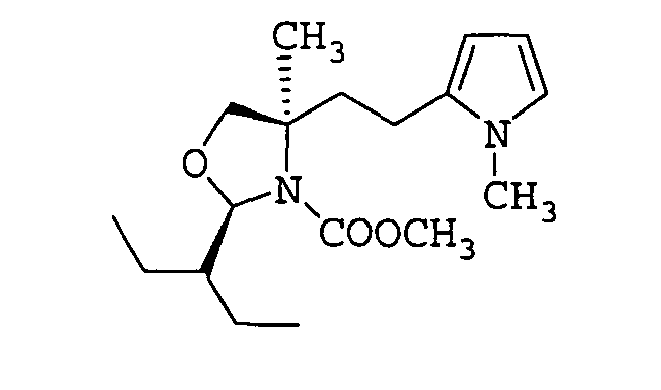
- Following the procedure mentioned in Example 4, a similar reaction was carried out using (2R,4S)-2-(2-ethylpropyl)-4-formyl-4-methyl-1,3-oxazolidine-3-carboxylic acid methyl ester (2.00 g, 8.2 mmol) synthesized according to the procedure described in Example 15 to afford the crude product of the title compound. The crude product thus obtained was purified by reverse phase chromatography (eluent: a mixed solvent of acetonitrile and water) to afford the pure title compound (2.04 g, yield: 77 %).
1H NMR (DMSO-d6, 400MHz): δ 0.85 (d, J=7.6Hz, 3H), 0.91 (d, J=7.6Hz, 3H), 1.15-1.50 (m, 7H), 1.85-2.14 (m, 3H), 2.44-2.54 (m, 2H), 3.48 (s, 3H), 3.56-3.61 (m, 4H), 3.94 (d, J=8.8Hz, 1H), 5.09 (d, J=4.4Hz, 1H), 5.69-5.73 (m, 1H), 5.83-5.86 (m, 1H), 6.56-6.60 (m, 1H).
MS (FAB): m/z 323 (M+H+), 148.
HRMS (ESI): calcd for C18H31N2O3 (M+H+): 323.2335. found: 323.2349. -

- Following the procedure mentioned in Example 9 (i), a similar reaction was carried out using (4S)-2-(2-ethylpropyl)-1,3-oxazolidine-4-carboxylic acid methyl ester (5.00 g, 24.8 mmol) synthesized according to the procedure described in Example 13(i) to afford the crude product of the title compound. The crude product thus obtained was purified by chromatography on a silica gel column (eluent: a mixed solvent of ethyl acetate and hexane) to afford the pure title compound (6.52 g, yield: 87 %).
1H NMR (CDCl3, 400MHz): δ 0.69 (t, J=7.6Hz, 3H), 0.75 (t, J=7.6Hz, 3H), 1.15-1.95 (m, 14H), 3.74 (s, 3H), 4.04-4.10 (m, 2H), 4.34-4.68 (m, 1H), 5.01-5.20 (m, 1H).
MS (FAB): m/z 302 (M+H+), 246, 146.
HRMS (ESI): calcd for C15H27NNaO5 (M+Na+): 324.1787. found: 324.1801. - Following the procedure mentioned in Example 1, a similar reaction was carried out using (2R,4S)-2-(2-ethylpropyl)-1,3-oxazolidine-3,4-dicarboxylic acid 3-t-butyl ester 4-methyl ester (4.00 g, 13.3 mmol) synthesized according to the procedure described in Step (i) to afford the crude product of the title compound. The crude product thus obtained was purified by chromatography on a silica gel column (eluent: a mixed solvent of ethyl acetate and hexane) to afford the pure title compound (3.35 g, yield: 80 %).
1H NMR (CDCl3, 400MHz): δ 0.75 (t, J=7.6Hz, 3H), 0.86 (t, J=7.6Hz, 3H), 1.02-2.02 (m, 17H), 3.59-3, 63 (m, 4H), 4.14 (d, J=8.3Hz, 1H), 5.13-5.27 (m, 1H).
MS (FAB): m/z 316 (M+H+), 216, 214.
HRMS (ESI): calcd for C16H29NNaO5 (M+Na+): 338.1943. found: 338.1960. -

- Following the procedure mentioned in Example 2, a similar reaction was carried out using (2R,4S)-2-(2-ethylpropyl)-4-methyl-1,3-oxazolidine-3,4-dicarboxylic acid 3-t-butyl ester 4-methyl ester (2.50 g, 8.0 mmol) synthesized according to the procedure described in Example 17 to afford the crude product of the title compound. The crude product thus obtained was purified by reverse phase chromatography (eluent: a mixed solvent of acetonitrile and water) to afford the pure title compound (2.17 g, yield: 95 %).
1H NMR (CDCl3, 400MHz): δ 0.89 (t, J=7.6Hz, 3H), 0.95 (t, J=7.6Hz, 3H), 1.14-2.04 (m, 17H), 3.50-3.79 (m, 4H), 5.18 (d, J=3.3Hz, 1H).
MS (FAB): m/z 288 (M+H+), 232, 132.
HRMS (ESI): calcd for C15H29NNaO4(M+Na+): 310.1994. found: 310.1992. -

- Following the procedure mentioned in Example 3, a similar reaction was carried out using (2R,4S)-2-(2-ethylpropyl)-4-hydroxymethyl-4-methyl-1,3-oxazolidine-3-carboxylic acid t-butyl ester (1.50 g, 5.2 mmol) synthesized according to the procedure described in Example 18 to afford the crude product of the title compound. The crude product thus obtained was purified by chromatography on a silica gel column (eluent: a mixed solvent of ethyl acetate and hexane) to afford the pure title compound (1.30 g, yield: 87 %).
1H NMR (CDCl3, 400MHz): δ 0.75 (t, J=7.6Hz, 3H), 0.84 (t, J=7.6Hz, 3H), 1.03-2.13 (m, 17H), 3.59 (d, J=9.0Hz, 1H), 4.02 (d, J=9.0Hz, 1H), 5.12-5.33 (m, 1H), 9.60 (s, 1H).
MS (FAB): m/z 286 (M+H+), 230, 130.
HRMS (ESI): calcd for C15H27NNaO4 (M+Na+): 308.1838. found: 308.1853. -

- Following the procedure mentioned in Example 4, a similar reaction was carried out using (2R,4S)-2-(2-ethylpropyl)-4-formyl-4-methyl-1,3-oxazolidine-3-carboxylic acid t-butyl ester (1.00 g, 3.5 mmol) synthesized according to the procedure described in Example 19 to afford the crude product of the title compound. The crude product thus obtained was purified by reverse phase chromatography (eluent: a mixed solvent of acetonitrile and water) to afford the pure title compound (1.01 g, yield: 79 %).
1H NMR (DMSO-d6, 400MHz): δ 0.83 (d, J=7.6Hz, 3H), 0.91 (d, J=7.6Hz, 3H), 1.10-1.48 (m, 16H), 1.80-2.03 (m, 3H), 2.45-2.53 (m, 2H), 3.48 (s, 3H), 3.56 (d, J=8.6Hz, 1H), 3.92 (d, J=8.6Hz, 1H), 5.04 (d, J=4.0Hz, 1H), 5.68-5.72 (m, 1H), 5.83-5.86 (m, 1H), 6.56-6.60 (m, 1H).
MS (FAB): m/z 365 (M+H+), 309, 148, 94.
HRMS (ESI): calcd for C21H37N2O3 (M+H+): 365.2804. found: 365.281. -

- To a suspension of triphenylphosphine (3.83 g, 14.6 mmol) in acetonitrile (17 mL) was added acetyl chloride (1.04 mL, 14.6 mmol) under ice-cooling with stirring. Subsequently, to the resulting mixture was added dropwise slowly a solution of 1-methyl-2-(pyrrolidin-1-ylmethyl)-1H-pyrrole (2.00 g, 12.2 mmol) synthesized by the procedure described in the literature (J. Am. Chem. Soc. 73, 4921 (1951)) in toluene (17 mL) below 5°C with stirring, and the resulting mixture was stirred under ice-cooling for 2 hours. After stirring, the precipitate formed was collected by filtration to afford the almost pure title compound (4.74 g, yield: 99 %).
1H NMR (DMSO-d6, 400MHz): δ 2.96 (s, 3H), 5.27 (d, 2H, JPH=13.5Hz), 5.59 (d, 1H, J=1.7Hz), 5.91 (dd, 1H, J=1.7, 1.7Hz), 6.69 (d, 1H, J=1.7Hz), 7.60-8.00 (m, 15H). 13C NMR (DMSO-d6, 100MHz): δ 20.5, 21.0, 33.1, 107.6, 107.6, 110.8, 110.9, 116.7, 116.8, 117.6, 118.5, 123.8, 123.8, 130.0, 130.1, 133.8, 133.9, 135.1, 135.1.
IR νmax (KBr): 3116, 3098, 3077, 3054, 3001, 2992, 2866, 2837, 2765, 1486, 1437, 1306, 1143, 1108, 998, 745, 736, 716, 692, 520, 505, 486 cm-1. - Additionally, following the procedure mentioned above, a similar reaction was carried out using 1-methyl-2-(N,N-dimethylaminomethyl)-1H-pyrrole, 1-methyl-2-(N,N-diethylaminomethyl)-1H-pyrrole and 1-methyl-2-(piperidin-1-ylmethyl)-1H-pyrrole as the starting materials instead of 1-methyl-2-(pyrrolidin-1-yhnethyl)-1H-pyrrole, and propionyl chloride or isobutyloyl chloride as the reagent instead of acetyl chloride to afford the title compound in the same yield.
-

- To a suspension of triphenylphosphine (4.92 g, 18.8 mmol) in acetonitrile (10 mL) was added acetyl chloride (1.34 mL, 18.8 mmol) at room temperature with stirring, and the resulting mixture was warmed to about 50°C. Subsequently, to the reaction mixture was added dropwise slowly a solution of 1-(4-methoxybenzyl)pyrrolidine (1.00 g, 5.23 mmol) in toluene (10 mL) below 60°C with stirring, and the resulting mixture was stirred at about 50°C for 72 hours. After cooling the reaction mixture to room temperature, water (20 mL) and n-hexane (10 mL) were added to the reaction mixture, and the resulting mixture was partitioned. To the aqueous layer separated were added successively water (10 mL) and sodium iodide (0.94 g, 6.28 mmol) with stirring, and the resulting mixture was stirred under ice-cooling for 1 hour. After stirring, the precipitate formed was collected by filtration to afford the almost pure title compound (2.31 g, yield: 87 %).
1H NMR (DMSO-d6, 400MHz): δ 3.70 (s, 3H), 5.14 (d, 2H, JPH=32.0Hz), 6.70-7.00 (m, 4H), 7.60-8.00 (m, 15H).
13C NMR (DMSO-d6, 100MHz): δ 27.2, 27.7, 55.1, 114.2, 114.2, 117.4, 118.3, 119.0, 119.0, 130.0, 130.1, 131.9, 132.0, 133.9, 134.0, 135.0, 135.0, 159.1, 159.1.
IR νmax (KBr): 3036, 3005, 2962, 2882, 2854, 2787, 1610, 1584, 1512, 1439, 1254, 1178, 1112, 1030, 836, 740, 719, 688, 510 cm-1. -

- To a suspension of triphenylphosphine (6.66 g, 25.5 mmol) in acetonitrile (10 mL) was added acetyl chloride (1.80 mL, 25.5 mmol) at room temperature with stirring, and the resulting mixture was warmed to about 50°C. Subsequently, to the reaction mixture was added dropwise slowly a solution of 2-(dimethylaminomethyl)thiophene (1.00 g, 7.08 mmol) in toluene (10 mL) below 60°C with stirring, and the resulting mixture was stirred at about 50°C for 75 hours. After cooling the reaction mixture to room temperature, water (20 mL) and n-hexane (10 mL) were added to the reaction mixture, and the resulting mixture was partitioned. To the aqueous layer separated were added successively water (10 mL) and sodium iodide (1.27 g, 8.50 mmol) with stirring, and the resulting mixture was stirred under ice-cooling for 1 hour. After stirring, the precipitate formed was collected by filtration to afford the almost pure title compound (2.94 g, yield: 85 %).
1H NMR (DMSO-d6, 400MHz): δ 5.51 (d, 2H, JPH=14.6Hz), 6.70-6.80 (m, 1H), 6.90-7.00 (m, 1H), 7.40-7.50 (m, 1H), 7.60-8.00 (m, 15H).
13C NMR (DMSO-d6, 100MHz): δ 23.7, 24.2, 117.3, 118.1, 127.3, 127.4, 127.9, 127.9, 128.3, 128.4, 130.1, 130.2, 130.4, 130.5, 133.9, 134.0, 135.2, 135.2.
IR νmax (KBr): 3065, 3046, 3004, 2986, 2867, 2829, 1585, 1484, 1435, 1161, 1109, 995, 860, 754, 742, 720, 690, 516, 498 cm-1. -
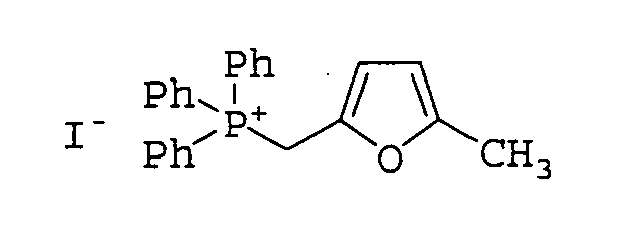
- To a suspension of triphenylphosphine (6.79 g, 25.9 mmol) in acetonitrile (10 mL) was added acetyl chloride (1.84 mL, 25.9 mmol) at room temperature with stirring, and the resulting mixture was warmed to about 50°C. Subsequently, to the reaction mixture was added dropwise slowly a solution of N,N,5-trimethylfurfurylamine (1.00 g, 7.18 mmol) in toluene (10 mL) below 60°C with stirring, and the resulting mixture was stirred at about 50°C for 72 hours. After cooling the reaction mixture to room temperature, water (20 mL) and n-hexane (10 mL) were added to the reaction mixture, and the resulting mixture was partitioned. To the aqueous layer separated were added successively water (10 mL) and sodium iodide (1.29 g, 8.61 mmol) with stirring, and the resulting mixture was stirred under ice-cooling for 1 hour. After stirring, the precipitate formed was collected by filtration to afford the almost pure title compound
(3.20 g, yield: 92 %).
1H NMR (DMSO-d6, 400MHz): δ 2.04 (s, 3H), 5.32 (d, 2H, JPH=14.5Hz), 5.95-6.05 (m, 2H), 7.60-8.00 (m, 15H).
13C NMR (DMSO-d6, 100MHz): δ 13.0, 22.7, 23.2, 107.3, 107.3, 112.8, 112.9, 117.5, 118.4, 130.0, 130.1, 133.8, 133.9, 135.1, 135.1, 139.5, 139.6, 152.6, 152.7.
IR νmax (KBr): 3050, 3007, 2988, 2871, 2832, 2770, 1715, 1611, 1586, 1561, 1484, 1437, 1143, 1111, 1023, 996, 943, 799, 745, 732, 689, 522, 504, 485 cm-1. - The present invention is useful for providing optically active 4,4-di-substituted oxazolidine derivatives and procedures for their preparation. The preparation procedures of the present invention have excellent advantages in the following respects, compared with the prior art: 1) increase in yield, 2) improvement in stereoselectivity, 3) extremely low-temperature reaction which is unsuitable for industrial large-scale synthesis is not necessary, and 4) column-chromatographic purification of intermediates is not needed in any step of these synthetic processes.
- Furthermore, the compounds having the general formula (Id), which are optically active 4,4-di-substituted oxazolidine derivatives encompassed in the present invention, are useful as the synthetic intermediates in the preparation of optically active α,α-di-substituted α-amino acid derivatives having an excellent glutamate receptor antagonistic action or optically active α,α-di-substituted amino alcohol derivatives having new immunosuppressive action.
- Additionally, according to the present invention, the substituted methylenephosphonium salt which is useful as a synthetic intermediate in the preparation of compounds having the general formula (Id) and various kinds of medicines can be obtained conveniently in a high yield.
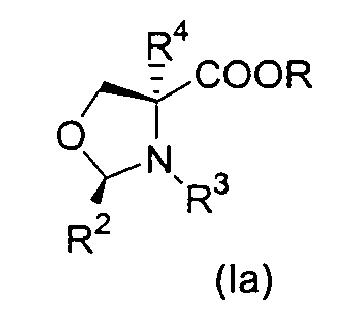 |
| Compound No. | R2 | R3 | R4 | R |
| 1 | iPr | Boc | Me | Me |
| 2 | iPr | Boc | Me | Et |
| 3 | iPr | Boc | Et | Me |
| 4 | iPr | Boc | Et | Et |
| 5 | iPr | Boc | Pr | Me |
| 6 | iPr | Boc | Pr | Et |
| 7 | iPr | Cbz | Me | Me |
| 8 | iPr | Cbz | Me | Et |
| 9 | iPr | Cbz | Et | Me |
| 10 | iPr | Cbz | Et | Et |
| 11 | iPr | Cbz | Pr | Me |
| 12 | iPr | Cbz | Pr | Et |
| 13 | iPr | Moc | Me | Me |
| 14 | iPr | Moc | Me | Et |
| 15 | iPr | Moc | Et | Me |
| 16 | iPr | Moc | Et | Et |
| 17 | iPr | Moc | Pr | Me |
| 18 | iPr | Moc | Pr | Et |
| 19 | iPr | Eoc | Me | Me |
| 20 | iPr | Eoc | Me | Et |
| 21 | iPr | Eoc | Et | Me |
| 22 | iPr | Eoc | Et | Et |
| 23 | iPr | Eoc | Pr | Me |
| 24 | iPr | Eoc | Pr | Et |
| 25 | iPr | Ac | Me | Me |
| 26 | iPr | Ac | Me | Et |
| 27 | iPr | Ac | Et | Me |
| 28 | iPr | Ac | Et | Et |
| 29 | iPr | Ac | Pr | Me |
| 30 | iPr | Ac | Pr | Et |
| 31 | iPr | PhOCO | Me | Me |
| 32 | iPr | PhOCO | Me | Et |
| 33 | iPr | PhOCO | Et | Me |
| 34 | iPr | PhOCO | Et | Et |
| 35 | iPr | PhOCO | Pr | Me |
| 36 | iPr | PhOCO | Pr | Et |
| 37 | iPr | Bzl | Me | Me |
| 38 | iPr | Bzl | Me | Et |
| 39 | iPr | Bzl | Et | Me |
| 40 | iPr | Bzl | Et | Et |
| 41 | iPr | Bzl | Pr | Me |
| 42 | iPr | Bzl | Pr | Et |
| 43 | tBu | Boc | Me | Me |
| 44 | tBu | Boc | Me | Et |
| 45 | tBu | Boc | Et | Me |
| 46 | tBu | Boc | Et | Et |
| 47 | tBu | Boc | Pr | Me |
| 48 | tBu | Boc | Pr | Et |
| 49 | tBu | Cbz | Me | Me |
| 50 | tBu | Cbz | Me | Et |
| 51 | tBu | Cbz | Et | Me |
| 52 | tBu | Cbz | Et | Et |
| 53 | tBu | Cbz | Pr | Me |
| 54 | tBu | Cbz | Pr | Et |
| 55 | tBu | Moc | Me | Me |
| 56 | tBu | Moc | Me | Et |
| 57 | tBu | Moc | Et | Me |
| 58 | tBu | Moc | Et | Et |
| 59 | tBu | Moc | Pr | Me |
| 60 | tBu | Moc | Pr | Et |
| 61 | tBu | Eoc | Me | Me |
| 62 | tBu | Eoc | Me | Et |
| 63 | tBu | Eoc | Et | Me |
| 64 | tBu | Eoc | Et | Et |
| 65 | tBu | Eoc | Pr | Me |
| 66 | tBu | Eoc | Pr | Et |
| 67 | tBu | Ac | Me | Me |
| 68 | tBu | Ac | Me | Et |
| 69 | tBu | Ac | Et | Me |
| 70 | tBu | Ac | Et | Et |
| 71 | tBu | Ac | Pr | Me |
| 72 | tBu | Ac | Pr | Et |
| 73 | tBu | PhOCO | Me | Me |
| 74 | tBu | PhOCO | Me | Et |
| 75 | tBu | PhOCO | Et | Me |
| 76 | tBu | PhOCO | Et | Et |
| 77 | tBu | PhOCO | Pr | Me |
| 78 | tBu | PhOCO | Pr | Et |
| 79 | tBu | Bzl | Me | Me |
| 80 | tBu | Bzl | Me | Et |
| 81 | tBu | Bzl | Et | Me |
| 82 | tBu | Bzl | Et | Et |
| 83 | tBu | Bzl | Pr | Me |
| 84 | tBu | Bzl | Pr | Et |
| 85 | Et2CH | Boc | Me | Me |
| 86 | Et2CH | Boc | Me | Et |
| 87 | Et2CH | Boc | Et | Me |
| 88 | Et2CH | Boc | Et | Et |
| 89 | Et2CH | Boc | Pr | Me |
| 90 | Et2CH | Boc | Pr | Et |
| 91 | Et2CH | Cbz | Me | Me |
| 92 | Et2CH | Cbz | Me | Et |
| 93 | Et2CH | Cbz | Et | Me |
| 94 | Et2CH | Cbz | Et | Et |
| 95 | Et2CH | Cbz | Pr | Me |
| 96 | Et2CH | Cbz | Pr | Et |
| 97 | Et2CH | Moc | Me | Me |
| 98 | Et2CH | Moc | Me | Et |
| 99 | Et2CH | Moc | Et | Me |
| 100 | Et2CH | Moc | Et | Et |
| 101 | Et2CH | Moc | Pr | Me |
| 102 | Et2CH | Moc | Pr | Et |
| 103 | Et2CH | Eoc | Me | Me |
| 104 | Et2CH | Eoc | Me | Et |
| 105 | Et2CH | Eoc | Et | Me |
| 106 | Et2CH | Eoc | Et | Et |
| 107 | Et2CH | Eoc | Pr | Me |
| 108 | Et2CH | Eoc | Pr | Et |
| 109 | Et2CH | Ac | Me | Me |
| 110 | Et2CH | Ac | Me | Et |
| 111 | Et2CH | Ac | Et | Me |
| 112 | Et2CH | Ac | Et | Et |
| 113 | Et2CH | Ac | Pr | Me |
| 114 | Et2CH | Ac | Pr | Et |
| 115 | Et2CH | PhOCO | Me | Me |
| 116 | Et2CH | PhOCO | Me | Et |
| 117 | Et2CH | PhOCO | Et | Me |
| 118 | Et2CH | PhOCO | Et | Et |
| 119 | Et2CH | PhOCO | Pr | Me |
| 120 | Et2CH | PhOCO | Pr | Et |
| 121 | Et2CH | Bzl | Me | Me |
| 122 | Et2CH | Bzl | Me | Et |
| 123 | Et2CH | Bzl | Et | Me |
| 124 | Et2CH | Bzl | Et | Et |
| 125 | Et2CH | Bzl | Pr | Me |
| 126 | Et2CH | Bzl | Pr | Et |
| 127 | Ph | Boc | Me | Me |
| 128 | Ph | Boc | Me | Et |
| 129 | Ph | Boc | Et | Me |
| 130 | Ph | Boc | Et | Et |
| 131 | Ph | Boc | Pr | Me |
| 132 | Ph | Boc | Pr | Et |
| 133 | Ph | Cbz | Me | Me |
| 134 | Ph | Cbz | Me | Et |
| 135 | Ph | Cbz | Et | Me |
| 136 | Ph | Cbz | Et | Et |
| 137 | Ph | Cbz | Pr | Me |
| 138 | Ph | Cbz | Pr | Et |
| 139 | Ph | Moc | Me | Me |
| 140 | Ph | Moc | Me | Et |
| 141 | Ph | Moc | Et | Me |
| 142 | Ph | Moc | Et | Et |
| 143 | Ph | Moc | Pr | Me |
| 144 | Ph | Moc | Pr | Et |
| 145 | Ph | Eoc | Me | Me |
| 146 | Ph | Eoc | Me | Et |
| 147 | Ph | Eoc | Et | Me |
| 148 | Ph | Eoc | Et | Et |
| 149 | Ph | Eoc | Pr | Me |
| 150 | Ph | Eoc | Pr | Et |
| 151 | Ph | Ac | Me | Me |
| 152 | Ph | Ac | Me | Et |
| 153 | Ph | Ac | Et | Me |
| 154 | Ph | Ac | Et | Et |
| 155 | Ph | Ac | Pr | Me |
| 156 | Ph | Ac | Pr | Et |
| 157 | Ph | PhOCO | Me | Me |
| 158 | Ph | PhOCO | Me | Et |
| 159 | Ph | PhOCO | Et | Me |
| 160 | Ph | PhOCO | Et | Et |
| 161 | Ph | PhOCO | Pr | Me |
| 162 | Ph | PhOCO | Pr | Et |
| 163 | Ph | Bzl | Me | Me |
| 164 | Ph | Bzl | Me | Et |
| 165 | Ph | Bzl | Et | Me |
| 166 | Ph | Bzl | Et | Et |
| 167 | Ph | Bzl | Pr | Me |
| 168 | Ph | Bzl | Pr. | Et |
| 169 | cHex | Boc | Me | Me |
| 170 | cHex | Boc | Me | Et |
| 171 | cHex | Boc | Et | Me |
| 172 | cHex | Boc | Et | Et |
| 173 | cHex | Boc | Pr | Me |
| 174 | cHex | Boc | Pr | Et |
| 175 | cHex | Cbz | Me | Me |
| 176 | cHex | Cbz | Me | Et |
| 177 | cHex | Cbz | Et | Me |
| 178 | cHex | Cbz | Et | Et |
| 179 | cHex | Cbz | Pr | Me |
| 180 | cHex | Cbz | Pr | Et |
| 181 | cHex | Moc | Me | Me |
| 182 | cHex | Moc | Me | Et |
| 183 | cHex | Moc | Et | Me |
| 184 | cHex | Moc | Et | Et |
| 185 | cHex | Moc | Pr | Me |
| 186 | cHex | Moc | Pr | Et |
| 187 | cHex | Eoc | Me | Me |
| 188 | cHex | Eoc | Me | Et |
| 189 | cHex | Eoc | Et | Me |
| 190 | cHex | Eoc- | Et | Et |
| 191 | cHex | Eoc | Pr | Me |
| 192 | cHex | Eoc | Pr | Et |
| 193 | cHex | Ac | Me | Me |
| 194 | cHex | Ac | Me | Et |
| 195 | cHex | Ac | Et | Me |
| 196 | cHex | Ac | Et | Et |
| 197 | cHex | Ac | Pr | Me |
| 198 | cHex | Ac | Pr | Et |
| 199 | cHex | PhOCO | Me | Me |
| 200 | cHex | PhOCO | Me | Et |
| 201 | cHex | PhOCO | Et | Me |
| 202 | cHex | PhOCO | Et | Et |
| 203 | cHex | PhOCO | Pr | Me |
| 204 | cHex | PhOCO | Pr | Et |
| 205 | cHex | Bzl | Me | Me |
| 206 | cHex | Bzl | Me | Et |
| 207 | cHex | Bzl | Et | Me |
| 208 | cHex | Bzl | Et | Et |
| 209 | cHex | Bzl | Pr | Me |
| 210 | cHex | Bzl | Pr | Et |
 |
| Compound No. | R2 | R3 | R4 |
| 1 | iPr | Boc | Me |
| 2 | iPr | Boc | Et |
| 3 | iPr | Boc | Pr |
| 4 | iPr | Cbz | Me |
| 5 | iPr | Cbz | Et |
| 6 | iPr | Cbz | Pr |
| 7 | iPr | Moc | Me |
| 8 | iPr | Moc | Et |
| 9 | iPr | Moc | Pr |
| 10 | iPr | Eoc | Me |
| 11 | iPr | Eoc | Et |
| 12 | iPr | Eoc | Pr |
| 13 | iPr | Ac | Me |
| 14 | iPr | Ac | Et |
| 15 | iPr | Ac | Pr |
| 16 | iPr | PhOCO | Me |
| 17 | iPr | PhOCO | Et |
| 18 | iPr | PhOCO | Pr |
| 19 | iPr | Bzl | Me |
| 20 | iPr | Bzl | Et |
| 21 | iPr | Bzl | Pr |
| 22 | tBu | Boc | Me |
| 23 | tBu | Boc | Et |
| 24 | tBu | Boc | Pr |
| 25 | tBu | Cbz | Me |
| 26 | tBu | Cbz | Et |
| 27 | tBu | Cbz | Pr |
| 28 | tBu | Moc | Me |
| 29 | tBu | Moc | Et |
| 30 | tBu | Moc | Pr |
| 31 | tBu | Eoc | Me |
| 32 | tBu | Eoc | Et |
| 33 | tBu | Eoc | Pr |
| 34 | tBu | Ac | Me |
| 35 | tBu | Ac | Et |
| 36 | tBu | Ac | Pr |
| 37 | tBu | PhOCO | Me |
| 38 | tBu | PhOCO | Et |
| 39 | tBu | PhOCO | Pr |
| 40 | tBu | Bzl | Me |
| 41 | tBu | Bzl | Et |
| 42 | tBu | Bzl | Pr |
| 43 | Et2CH | Boc | Me |
| 44 | Et2CH | Boc | Et |
| 45 | Et2CH | Boc | Pr |
| 46 | Et2CH | Cbz | Me |
| 47 | Et2CH | Cbz | Et |
| 48 | Et2CH | Cbz | Pr |
| 49 | Et2CH | Moc | Me |
| 50 | Et2CH | Moc | Et |
| 51 | Et2CH | Moc | Pr |
| 52 | Et2CH | Eoc | Me |
| 53 | Et2CH | Eoc | Et |
| 54 | Et2CH | Eoc | Pr |
| 55 | Et2CH | Ac | Me |
| 56 | Et2CH | Ac | Et |
| 57 | Et2CH | Ac | Pr |
| 58 | Et2CH | PhOCO | Me |
| 59 | Et2CH | PhOCO | Et |
| 60 | Et2CH | PhOCO | Pr |
| 61 | Et2CH | Bzl | Me |
| 62 | Et2CH | Bzl | Et |
| 63 | Et2CH | Bzl | Pr |
| 64 | Ph | Boc | Me |
| 65 | Ph | Boc | Et |
| 66 | Ph | Boc | Pr |
| 67 | Ph | Cbz | Me |
| 68 | Ph | Cbz | Et |
| 69 | Ph | Cbz | Pr |
| 70 | Ph | Moc | Me |
| 71 | Ph | Moc | Et |
| 72 | Ph | Moc | Pr |
| 73 | Ph | Eoc | Me |
| 74 | Ph | Eoc | Et |
| 75 | Ph | Eoc | Pr |
| 76 | Ph | Ac | Me |
| 77 | Ph | Ac | Et |
| 78 | Ph | Ac | Pr |
| 79 | Ph | PhOCO | Me |
| 80 | Ph | PhOCO | Et |
| 81 | Ph | PhOCO | Pr |
| 82 | Ph | Bzl | Me |
| 83 | Ph | Bzl | Et |
| 84 | Ph | Bzl | Pr |
| 85 | cHex | Boc | Me |
| 86 | cHex | Boc | Et |
| 87 | cHex | Boc | Pr |
| 88 | cHex | Cbz | Me |
| 89 | cHex | Cbz | Et |
| 90 | cHex | Cbz | Pr |
| 91 | cHex | Moc | Me |
| 92 | cHex | Moc | Et |
| 93 | cHex | Moc | Pr |
| 94 | cHex | Eoc | Me |
| 95 | cHex | Eoc | Et |
| 96 | cHex | Eoc | Pr |
| 97 | cHex | Ac | Me |
| 98 | cHex | Ac | Et |
| 99 | cHex | Ac | Pr |
| 100 | cHex | PhOCO | Me |
| 101 | cHex | PhOCO | Et |
| 102 | cHex | PhOCO | Pr |
| 103 | cHex | Bzl | Me |
| 104 | cHex | Bzl | Et |
| 105 | cHex | Bzl | Pr |
 |
| Compound No. | R2 | R3 | R4 | X | Y |
| 1 | iPr | Boc | Me | MeN | H |
| 2 | iPr | Boc | Me | MeN | Cl |
| 3 | iPr | Boc | Me | MeN | Br |
| 4 | iPr | Boc | Me | MeN | Oct |
| 5 | iPr | Boc | Me | MeN | HepO |
| 6 | iPr | Boc | Me | MeN | HepCO |
| 7 | iPr | Boc | Me | CHCH | Cl |
| 8 | iPr | Boc | Me | CHCH | Br |
| 9 | iPr | Boc | Me | CHCH | I |
| 10 | iPr | Boc | Me | CHCH | Oct |
| 11 | iPr | Boc | Me | CHCH | HepO |
| 12 | iPr | Boc | Me | CHCH | HepCO |
| 13 | iPr | Boc | Et | MeN | H |
| 14 | iPr | Boc | Et | MeN | Cl |
| 15 | iPr | Boc | Et | MeN | Br |
| 16 | iPr | Boc | Et | MeN | Oct |
| 17 | iPr | Boc | Et | MeN | HepO |
| 18 | iPr | Boc | Et | MeN | HepCO |
| 19 | iPr | Boc | Et | CHCH | Cl |
| 20 | iPr | Boc | Et | CHCH | Br |
| 21 | iPr | Boc | Et | CHCH | I |
| 22 | iPr | Boc | Et | CHCH | Oct |
| 23 | iPr | Boc | Et | CHCH | HepO |
| 24 | iPr | Boc | Et | CHCH | HepCO |
| 25 | iPr | Moc | Me | MeN | H |
| 26 | iPr | Moc | Me | MeN | Cl |
| 27 | iPr | Moc | Me | MeN | Br |
| 28 | iPr | Moc | Me | MeN | Oct |
| 29 | iPr | Moc | Me | MeN | HepO |
| 30 | iPr | Moc | Me | MeN | HepCO |
| 31 | iPr | Moc | Me | CHCH | Cl |
| 32 | iPr | Moc | Me | CHCH | Br |
| 33 | iPr | Moc | Me | CHCH | I |
| 34 | iPr | Moc | Me | CHCH | Oct |
| 35 | iPr | Moc | Me | CHCH | HepO |
| 36 | iPr | Moc | Me | CHCH | HepCO |
| 37 | iPr | Moc | Et | MeN | H |
| 38 | iPr | Moc | Et | MeN | Cl |
| 39 | iPr | Moc | Et | MeN | Br |
| 40 | iPr | Moc | Et | MeN | Oct |
| 41 | iPr | Moc | Et | MeN | HepO |
| 42 | iPr | Moc | Et | MeN | HepCO |
| 43 | iPr | Moc | Et | CHCH | Cl |
| 44 | iPr | Moc | Et | CHCH | Br |
| 45 | iPr | Moc | Et | CHCH | I |
| 46 | iPr | Moc | Et | CHCH | Oct |
| 47 | iPr | Moc | Et | CHCH | HepO |
| 48 | iPr | Moc | Et | CHCH | HepCO |
| 49 | iPr | PhOCO | Me | MeN | H |
| 50 | iPr | PhOCO | Me | MeN | Cl |
| 51 | iPr | PhOCO | Me | MeN | Br |
| 52 | iPr | PhOCO | Me | MeN | Oct |
| 53 | iPr | PhOCO | Me | MeN | HepO |
| 54 | iPr | PhOCO | Me | MeN | HepCO |
| 55 | iPr | PhOCO | Me | CHCH | Cl |
| 56 | iPr | PhOCO | Me | CHCH | Br |
| 57 | iPr | PhOCO | Me | CHCH | I |
| 58 | iPr | PhOCO | Me | CHCH | Oct |
| 59 | iPr | PhOCO | Me | CHCH | HepO |
| 60 | iPr | PhOCO | Me | CHCH | HepCO |
| 61 | iPr | PhOCO | Et | MeN | H |
| 62 | iPr | PhOCO | Et | MeN | Cl |
| 63 | iPr | PhOCO | Et | MeN | Br |
| 64 | iPr | PhOCO | Et | MeN | Oct |
| 65 | iPr | PhOCO | Et | MeN | HepO |
| 66 | iPr | PhOCO | Et | MeN | HepCO |
| 67 | iPr | PhOCO | Et | CHCH | Cl |
| 68 | iPr | PhOCO | Et | CHCH | Br |
| 69 | iPr | PhOCO | Et | CHCH | I |
| 70 | iPr | PhOCO | Et | CHCH | Oct |
| 71 | iPr | PhOCO | Et | CHCH | HepO |
| 72 | iPr | PhOCO | Et | CHCH | HepCO |
| 73 | tBu | Boc | Me | MeN | H |
| 74 | tBu | Boc | Me | MeN | Cl |
| 75 | tBu | Boc | Me | MeN | Br |
| 76 | tBu | Boc | Me | MeN | Oct |
| 77 | tBu | Boc | Me | MeN | HepO |
| 78 | tBu | Boc | Me | MeN | HepCO |
| 79 | tBu | Boc | Me | CHCH | Cl |
| 80 | tBu | Boc | Me | CHCH | Br |
| 81 | tBu | Boc | Me | CHCH | I |
| 82 | tBu | Boc | Me | CHCH | Oct |
| 83 | tBu | Boc | Me | CHCH | HepO |
| 84 | tBu | Boc | Me | CHCH | HepCO |
| 85 | tBu | Boc | Et | MeN | H |
| 86 | tBu | Boc | Et | MeN | Cl |
| 87 | tBu | Boc | Et | MeN | Br |
| 88 | tBu | Boc | Et | MeN | Oct |
| 89 | tBu | Boc | Et | MeN | HepO |
| 90 | tBu | Boc | Et | MeN | HepCO |
| 91 | tBu | Boc | Et | CHCH | Cl |
| 92 | tBu | Boc | Et | CHCH | Br |
| 93 | tBu | Boc | Et | CHCH | I |
| 94 | tBu | Boc | Et | CHCH | Oct |
| 95 | tBu | Boc | Et | CHCH | HepO |
| 96 | tBu | Boc | Et | CHCH | HepCO |
| 97 | tBu | Cbz | Me | MeN | H |
| 98 | tBu | Cbz | Me | MeN | Cl |
| 99 | tBu | Cbz | Me | MeN | Br |
| 100 | tBu | Cbz | Me | MeN | Oct |
| 101 | tBu | Cbz | Me | MeN | HepO |
| 102 | tBu | Cbz | Me | MeN | HepCO |
| 103 | tBu | Cbz | Me | CHCH | Cl |
| 104 | tBu | Cbz | Me | CHCH | Br |
| 105 | tBu | Cbz | Me | CHCH | I |
| 106 | tBu | Cbz | Me | CHCH | Oct |
| 107 | tBu | Cbz | Me | CHCH | HepO |
| 108 | tBu | Cbz | Me | CHCH | HepCO |
| 109 | tBu | Cbz | Et | MeN | H |
| 110 | tBu | Cbz | Et | MeN | Cl |
| 111 | tBu | Cbz | Et | MeN | Br |
| 112 | tBu | Cbz | Et | MeN | Oct |
| 113 | tBu | Cbz | Et | MeN | HepO |
| 114 | tBu | Cbz | Et | MeN | HepCO |
| 115 | tBu | Cbz | Et | CHCH | Cl |
| 116 | tBu | Cbz | Et | CHCH | Br |
| 117 | tBu | Cbz | Et | CHCH | I |
| 118 | tBu | Cbz | Et | CHCH | Oct |
| 119 | tBu | Cbz | Et | CHCH | HepO |
| 120 | tBu | Cbz | Et | CHCH | HepCO |
| 121 | tBu | Moc | Me | MeN | H |
| 122 | tBu | Moc | Me | MeN | Cl |
| 123 | tBu | Moc | Me | MeN | Br |
| 124 | tBu | Moc | Me | MeN | Oct |
| 125 | tBu | Moc | Me | MeN | HepO |
| 126 | tBu | Moc | Me | MeN | HepCO |
| 127 | tBu | Moc | Me | CHCH | Cl |
| 128 | tBu | Moc | Me | CHCH | Br |
| 129 | tBu | Moc | Me | CHCH | I |
| 130 | tBu | Moc | Me | CHCH | Oct |
| 131 | tBu | Moc | Me | CHCH | HepO |
| 132 | tBu | Moc | Me | CHCH | HepCO |
| 133 | tBu | Moc | Et | MeN | H |
| 134 | tBu | Moc | Et | MeN | Cl |
| 135 | tBu | Moc | Et | MeN | Br |
| 136 | tBu | Moc | Et | MeN | Oct |
| 137 | tBu | Moc | Et | MeN | HepO |
| 138 | tBu | Moc | Et | MeN | HepCO |
| 139 | tBu | Moc | Et | CHCH | Cl |
| 140 | tBu | Moc | Et | CHCH | Br |
| 141 | tBu | Moc | Et | CHCH | I |
| 142 | tBu | Moc | Et | CHCH | Oct |
| 143 | tBu | Moc | Et | CHCH | HepO |
| 144 | tBu | Moc | Et | CHCH | HepCO |
| 145 | tBu | Eoc | Me | MeN | H |
| 146 | tBu | Eoc | Me | MeN | Cl |
| 147 | tBu | Eoc | Me | MeN | Br |
| 148 | tBu | Eoc | Me | MeN | Oct |
| 149 | tBu | Eoc | Me | MeN | HepO |
| 150 | tBu | Eoc | Me | MeN | HepCO |
| 151 | tBu | Eoc | Me | CHCH | Cl |
| 152 | tBu | Eoc | Me | CHCH | Br |
| 153 | tBu | Eoc | Me | CHCH | I |
| 154 | tBu | Eoc | Me | CHCH | Oct |
| 155 | tBu | Eoc | Me | CHCH | HepO |
| 156 | tBu | Eoc | Me | CHCH HepCO | |
| 157 | tBu | Eoc | Et | MeN | H |
| 158 | tBu | Eoc | Et | MeN | Cl |
| 159 | tBu | Eoc | Et | MeN | Br |
| 160 | tBu | Eoc | Et | MeN | Oct |
| 161 | tBu | Eoc | Et | MeN | HepO |
| 162 | tBu | Eoc | Et | MeN | HepCO |
| 163 | tBu | Eoc | Et | CHCH | Cl |
| 164 | tBu | Eoc | Et | CHCH | Br |
| 165 | tBu | Eoc | Et | CHCH | I |
| 166 | tBu | Eoc | Et | CHCH | Oct |
| 167 | tBu | Eoc | Et | CHCH | HepO |
| 168 | tBu | Eoc | Et | CHCH | HepCO |
| 169 | tBu | PhOCO | Me | MeN | H |
| 170 | tBu | PhOCO | Me | MeN | Cl |
| 171 | tBu | PhOCO | Me | MeN | Br |
| 172 | tBu | PhOCO | Me | MeN | Oct |
| 173 | tBu | PhOCO | Me | MeN | HepO |
| 174 | tBu | PhOCO | Me | MeN | HepCO |
| 175 | tBu | PhOCO | Me | CHCH | Cl |
| 176 | tBu | PhOCO | Me | CHCH | Br |
| 177 | tBu | PhOCO | Me | CHCH | I |
| 178 | tBu | PhOCO | Me | CHCH | Oct |
| 179 | tBu | PhOCO | Me | CHCH | HepO |
| 180 | tBu | PhOCO | Me | CHCH | HepCO |
| 181 | tBu | PhOCO | Et | MeN | H |
| 182 | tBu | PhOCO | Et | MeN | Cl |
| 183 | tBu | PhOCO | Et | MeN | Br |
| 184 | tBu | PhOCO | Et | MeN | Oct |
| 185 | tBu | PhOCO | Et | MeN | HepO |
| 186 | tBu | PhOCO | Et | MeN | HepCO |
| 187 | tBu | PhOCO | Et | CHCH | Cl |
| 188 | tBu | PhOCO | Et | CHCH | Br |
| 189 | tBu | PhOCO | Et | CHCH | I |
| 190 | tBu | PhOCO | Et | CHCH | Oct |
| 191 | tBu | PhOCO | Et | CHCH | HepO |
| 192 | tBu | PhOCO | Et | CHCH | HepCO |
| 193 | tBu | Ac | Me | MeN | H |
| 194 | tBu | Ac | Me | MeN | Cl |
| 195 | tBu | Ac | Me | MeN | Br |
| 196 | tBu | Ac | Me | MeN | Oct |
| 197 | tBu | Ac | Me | MeN | HepO |
| 198 | tBu | Ac | Me | MeN | HepCO |
| 199 | tBu | Ac | Me | CHCH | Cl |
| 200 | tBu | Ac | Me | CHCH | Br |
| 201 | tBu | Ac | Me | CHCH | I |
| 202 | tBu | Ac | Me | CHCH | Oct |
| 203 | tBu | Ac | Me | CHCH | HepO |
| 204 | tBu | Ac | Me | CHCH | HepCO |
| 205 | tBu | Ac | Et | MeN | H |
| 206 | tBu | Ac | Et | MeN | Cl |
| 207 | tBu | Ac | Et | MeN | Br |
| 208 | tBu | Ac | Et | MeN | Oct |
| 209 | tBu | Ac | Et | MeN | HepO |
| 210 | tBu | Ac | Et | MeN | HepCO |
| 211 | tBu | Ac | Et | CHCH | Cl |
| 212 | tBu | Ac | Et | CHCH | Br |
| 213 | tBu | Ac | Et | CHCH | I |
| 214 | tBu | Ac | Et | CHCH | Oct |
| 215 | tBu | Ac | Et | CHCH | HepO |
| 216 | tBu | Ac | Et | CHCH | HepCO |
| 217 | tBu | Bzl | Me | MeN | H |
| 218 | tBu | Bzl | Me | MeN | Cl |
| 219 | tBu | Bzl | Me | MeN | Br |
| 220 | tBu | Bzl | Me | MeN | Oct |
| 221 | tBu | Bzl | Me | MeN | HepO |
| 222 | tBu | Bzl | Me | MeN | HepCO |
| 223 | tBu | Bzl | Me | CHCH | Cl |
| 224 | tBu | Bzl | Me | CHCH | Br |
| 225 | tBu | Bzl | Me | CHCH | I |
| 226 | tBu | Bzl | Me | CHCH | Oct |
| 227 | tBu | Bzl | Me | CHCH | HepO |
| 228 | tBu | Bzl | Me | CHCH | HepCO |
| 229 | tBu | Bzl | Et | MeN | H |
| 230 | tBu | Bzl | Et | MeN | Cl |
| 231 | tBu | Bzl | Et | MeN | Br |
| 232 | tBu | Bzl | Et | MeN | Oct |
| 233 | tBu | Bzl | Et | MeN | HepO |
| 234 | tBu | Bzl | Et | MeN | HepCO |
| 235 | tBu | Bzl | Et | CHCH | Cl |
| 236 | tBu | Bzl | Et | CHCH | Br |
| 237 | tBu | Bzl | Et | CHCH | I |
| 238 | tBu | Bzl | Et | CHCH | Oct |
| 239 | tBu | Bzl | Et | CHCH | HepO |
| 240 | tBu | Bzl | Et | CHCH | HepCO |
| 241 | Et2CH | Boc | Me | MeN | H |
| 242 | Et2CH | Boc | Me | MeN | Cl |
| 243 | Et2CH | Boc | Me | MeN | Br |
| 244 | Et2CH | Boc | Me | MeN | Oct |
| 245 | Et2CH | Boc | Me | MeN | HepO |
| 246 | Et2CH | Boc | Me | MeN | HepCO |
| 247 | Et2CH | Boc | Me | CHCH | Cl |
| 248 | Et2CH | Boc | Me | CHCH | Br |
| 249 | Et2CH | Boc | Me | CHCH | I |
| 250 | Et2CH | Boc | Me | CHCH | Oct |
| 251 | Et2CH | Boc | Me | CHCH | HepO |
| 252 | Et2CH | Boc | Me | CHCH | HepCO |
| 253 | Et2CH | Boc | Et | MeN | H |
| 254 | Et2CH | Boc | Et | MeN | Cl |
| 255 | Et2CH | Boc | Et | MeN | Br |
| 256 | Et2CH | Boc | Et | MeN | Oct |
| 257 | Et2CH | Boc | Et | MeN | HepO |
| 258 | Et2CH | Boc | Et | MeN | HepCO |
| 259 | Et2CH | Boc | Et | CHCH | Cl |
| 260 | Et2CH | Boc | Et | CHCH | Br |
| 261 | Et2CH | Boc | Et | CHCH | I |
| 262 | Et2CH | Boc | Et | CHCH | Oct |
| 263 | Et2CH | Boc | Et | CHCH | HepO |
| 264 | Et2CH | Boc | Et | CHCH | HepCO |
| 265 | Et2CH | Moc | Me | MeN | H |
| 266 | Et2CH | Moc | Me | MeN | Cl |
| 267 | Et2CH | Moc | Me | MeN | Br |
| 268 | Et2CH | Moc | Me | MeN | Oct |
| 269 | Et2CH | Moc | Me | MeN | HepO |
| 270 | Et2CH | Moc | Me | MeN | HepCO |
| 271 | Et2CH | Moc | Me | CHCH | Cl |
| 272 | Et2CH | Moc | Me | CHCH | Br |
| 273 | Et2CH | Moc | Me | CHCH | I |
| 274 | Et2CH | Moc | Me | CHCH | Oct |
| 275 | Et2CH | Moc | Me | CHCH | HepO |
| 276 | Et2CH | Moc | Me | CHCH | HepCO |
| 277 | Et2CH | Moc | Et | MeN | H |
| 278 | Et2CH | Moc | Et | MeN | Cl |
| 279 | Et2CH | Moc | Et | MeN | B |
| 280 | Et2CH | Moc | Et | MeN | Oct |
| 281 | Et2CH | Moc | Et | MeN | HepO |
| 282 | Et2CH | Moc | Et | MeN | HepCO |
| 283 | Et2CH | Moc | Et | CHCH | Cl |
| 284 | Et2CH | Moc | Et | CHCH | Br |
| 285 | Et2CH | Moc | Et | CHCH | I |
| 286 | Et2CH | Moc | Et | CHCH | Oct |
| 287 | Et2CH | Moc | Et | CHCH | HepO |
| 288 | Et2CH | Moc | Et | CHCH | HepCO |
| 289 | Et2CH | PhOCO | Me | MeN | H |
| 290 | Et2CH | PhOCO | Me | MeN | Cl |
| 291 | Et2CH | PhOCO | Me | MeN | Br |
| 292 | Et2CH | PhOCO | Me | MeN | Oct |
| 293 | Et2CH | PhOCO | Me | MeN | HepO |
| 294 | Et2CH | PhOCO | Me | MeN | HepCO |
| 295 | Et2CH | PhOCO | Me | CHCH | Cl |
| 296 | Et2CH | PhOCO | Me | CHCH | Br |
| 297 | Et2CH | PhOCO | Me | CHCH | I |
| 298 | Et2CH | PhOCO | Me | CHCH | Oct |
| 299 | Et2CH | PhOCO | Me | CHCH | HepO |
| 300 | Et2CH | PhOCO | Me | CHCH | HepCO |
| 301 | Et2CH | PhOCO | Et | MeN | H |
| 302 | Et2CH | PhOCO | Et | MeN | Cl |
| 303 | Et2CH | PhOCO | Et | MeN | Br |
| 304 | Et2CH | PhOCO | Et | MeN | Oct |
| 305 | Et2CH | PhOCO | Et | MeN | HepO |
| 306 | Et2CH | PhOCO | Et | MeN | HepCO |
| 307 | Et2CH | PhOCO | Et | CHCH | Cl |
| 308 | Et2CH | PhOCO | Et | CHCH | Br |
| 309 | Et2CH | PhOCO | Et | CHCH | I |
| 310 | Et2CH | PhOCO | Et | CHCH | Oct |
| 311 | Et2CH | PhOCO | Et | CHCH | HepO |
| 312 | Et2CH | PhOCO | Et | CHCH | HepCO |
| 313 | Ph | Boc | Me | MeN | H |
| 314 | Ph | Boc | Me | MeN | C1 |
| 315 | Ph | Boc | Me | MeN | Br |
| 316 | Ph | Boc | Me | MeN | Oct |
| 317 | Ph | Boc | Me | MeN | HepO |
| 318 | Ph | Boc | Me | MeN | HepCO |
| 319 | Ph | Boc | Me | CHCH | Cl |
| 320 | Ph | Boc | Me | CHCH | Br |
| 321 | Ph | Boc | Me | CHCH | I |
| 322 | Ph | Boc | Me | CHCH | Oct |
| 323 | Ph | Boc | Me | CHCH | HepO |
| 324 | Ph | Boc | Me | CHCH | HepCO |
| 325 | Ph | Boc | Et | MeN | H |
| 326 | Ph | Boc | Et | MeN | Cl |
| 327 | Ph | Boc | Et | MeN | Br |
| 328 | Ph | Boc | Et | MeN | Oct |
| 329 | Ph | Boc | Et | MeN | HepO |
| 330 | Ph | Boc | Et | MeN | HepCO |
| 331 | Ph | Boc | Et | CHCH | Cl |
| 332 | Ph | Boc | Et | CHCH | Br |
| 333 | Ph | Boc | Et | CHCH | I |
| 334 | Ph | Boc | Et | CHCH | Oct |
| 335 | Ph | Boc | Et | CHCH | HepO |
| 336 | Ph | Boc | Et | CHCH | HepCO |
| 337 | Ph | Moc | Me | MeN | H |
| 338 | Ph | _Moc | Me | MeN | Cl |
| 339 | Ph | Moc | Me | MeN | Br |
| 340 | Ph | Moc | Me | MeN | Oct |
| 341 | Ph | Moc | Me | MeN | HepO |
| 342 | Ph | Moc | Me | MeN | HepCO |
| 343 | Ph | Moc | Me | CHCH | Cl |
| 344 | Ph | Moc | Me | CHCH | Br |
| 345 | Ph | Moc | Me | CHCH | I |
| 346 | Ph | Moc | Me | CHCH | Oct |
| 347 | Ph | Moc | Me | CHCH | HepO |
| 348 | Ph | Moc | Me | CHCH | HepCO |
| 349 | Ph | Moc | Et | MeN | H |
| 350 | Ph | Moc | Et | MeN | Cl |
| 351 | Ph | Moc | Et | MeN | Br |
| 352 | Ph | Moc | Et | MeN | Oct |
| 353 | Ph | Moc | Et | MeN | HepO |
| 354 | Ph | Moc . | Et | MeN | HepCO |
| 355 | Ph | Moc | Et | CHCH | Cl |
| 356 | Ph | Moc | Et | CHCH | Br |
| 357 | Ph | Moc | Et | CHCH | I |
| 358 | Ph | Moc | Et | CHCH | Oct |
| 359 | Ph | Moc | Et | CHCH | HepO |
| 360 | Ph | Moc | Et | CHCH | HepCO |
| 361 | Ph | PhOCO | Me | MeN | H |
| 362 | Ph | PhOCO | Me | MeN | Cl |
| 363 | Ph | PhOCO | Me | MeN | Br |
| 364 | Ph | PhOCO | Me | MeN | Oct |
| 365 | Ph | PhOCO | Me | MeN | HepO |
| 366 | Ph | PhOCO | Me | MeN | HepCO |
| 367 | Ph | PhOCO | Me | CHCH | Cl |
| 368 | Ph | PhOCO | Me | CHCH | Br |
| 369 | Ph | PhOCO | Me | CHCH | I |
| 370 | Ph | PhOCO | Me | CHCH | Oct |
| 371 | Ph | PhOCO | Me | CHCH | HepO |
| 372 | Ph | PhOCO | Me | CHCH | HepCO |
| 373 | Ph | PhOCO | Et | MeN | H |
| 374 | Ph | PhOCO | Et | MeN | Cl |
| 375 | Ph | PhOCO | Et | MeN | Br |
| 376 | Ph | PhOCO | Et | MeN | Oct |
| 377 | Ph | PhOCO | Et | MeN | HepO |
| 378 | Ph | PhOCO | Et | MeN | HepCO |
| 379 | Ph | PhOCO | Et | CHCH | Cl |
| 380 | Ph | PhOCO | Et | CHCH | Br |
| 381 | Ph | PhOCO | Et | CHCH | I |
| 382 | Ph | PhOCO | Et | CHCH | Oct |
| 383 | Ph | PhOCO | Et | CHCH | HepO |
| 384 | Ph | PhOCO | Et | CHCH | HepCO |
Claims (39)
- An optically active 4,4-di-substituted oxazolidine derivative having the general formula (I)
 R1 represents a C1-C3 alkyl group which is substituted with one substituent selected from Substituent group A, a C2-C3 alkenyl group which is substituted with one substituent selected from Substituent group A, a halogenated methyl group, a hydroxymethyl group, a formyl group, a group of formula COOR or a phosphonium methyl group,R represents a C1-C6 alkyl group, a C2-C6 alkenyl group, a phenyl group or a benzyl group,R2 represents a C1-C6 alkyl group, a C3-C10 cycloalkyl group or a phenyl group,R3 represents a C2-C6 alkanoyl group, a C1-C6 alkyloxycarbonyl group, a benzoyl group, a phenyloxycarbonyl group or a benzyloxycarbonyl group,R4 represents a C1-C6 alkyl group or a C2-C6 alkenyl group,
Substituent group A represents a phenyl group which may optionally be substituted with from 1 to 3 substituents selected from the group consisting of a halogen atom, a cyano group, a phenyl group, a C1-C8 alkyl group, a C1-C8 alkoxy group and a C2-C8 alkanoyl group, a thienyl group, a N-methylpyrrolyl group, or a furanyl group]. - An optically active 4,4-di-substituted oxazolidine derivative having the general formula (I) according to Claim 1, wherein R1 represents a formyl group.
- An optically active 4,4-di-substituted oxazolidine derivative having the general formula (I) according to Claim 1, wherein R1 represents a hydroxymethyl group.
- An optically active 4,4-di-substituted oxazolidine derivative having the general formula (I) according to Claim 1, wherein R1 represents a group of formula COOR, and R represents a C1-C4 alkyl group, an allyl group, a phenyl group or a benzyl group.
- An optically active 4,4-di-substituted oxazolidine derivative having the general formula (I) according to Claim 1, wherein R1 represents a methoxycarbonyl group or an ethoxycarbonyl group.
- An optically active 4,4-di-substituted oxazolidine derivative having the general formula (I) according to Claim 1, wherein R1 represents an ethyl group or a vinyl group both of which are substituted with one substituent selected from the group consisting of a 4-bromophenyl group, a 4-iodophenyl group, a 4-octylphenyl group, a 4-heptyloxyphenyl group, a 4-octanoylphenyl group, a thienyl group and a N-methylpyrrolyl group.
- An optically active 4,4-di-substituted oxazolidine derivative having the general formula (I) according to Claim 1, wherein R1 represents an ethyl group or a vinyl group both of which are substituted with a N-methylpyrrolyl group.
- An optically active 4,4-di-substituted oxazolidine derivative having the general formula (I) according to any one claim selected from Claim 1 to Claim 7, wherein R2 represents an isopropyl group, a t-butyl group, a diethylmethyl group, a cyclohexyl group or an adamantyl group.
- An optically active 4,4-di-substituted oxazolidine derivative having the general formula (I) according to any one claim selected from Claim 1 to Claim 7, wherein R2 represents a t-butyl group.
- An optically active 4,4-di-substituted oxazolidine derivative having the general formula (I) according to any one claim selected from Claim 1 to Claim 9, wherein R3 represents an acetyl group, a methoxycarbonyl group, an ethoxycarbonyl group, a t-butoxycarbonyl group, a phenyloxycarbonyl group or a benzyloxycarbonyl group.
- An optically active 4,4-di-substituted oxazolidine derivative having the general formula (I) according to any one claim selected from Claim 1 to Claim 10, wherein R3 represents a methoxycarbonyl group.
- An optically active 4,4-di-substituted oxazolidine derivative having the general formula (I) according to any one claim selected from Claim 1 to Claim 11, wherein R4 represents a methyl group.
- Any one of the optically active 4,4-di-substituted oxazolidine derivatives having the general formula (I) according to Claim 1 selected from following compounds:2-t-butyl-4-methyl-1,3-oxazolidine-3,4-dicarboxylic acid 3-t-butyl ester 4-methyl ester,2-t-butyl-4-methyl-1,3-oxazolidine-3,4-dicarboxylic acid 3-benzyl ester 4-methyl ester,2-t-butyl-4-methyl-1,3-oxazolidine-3,4-dicarboxylic acid dimethyl ester,2-t-butyl-4-methyl-1,3-oxazolidine-3,4-dicarboxylic acid 3-ethyl ester 4-methyl ester,3-acetyl-2-t-butyl-4-methyl-1,3-oxazolidine-4-carboxylic acid methyl ester,2-t-butyl-4-methyl-1,3-oxazolidine-3,4-dicarboxylic acid 3-phenyl ester 4-methyl ester,3-benzoyl-2-t-butyl-4-methyl-1,3-oxazolidine-4-carboxylic acid methyl ester,2-t-butyl-4-hydroxymethyl-4-methyl-1,3-oxazolidine-3-carboxylic acid t-butyl ester,2-t-butyl-4-hydroxymethyl-4-methyl-1,3-oxazolidine-3-carboxylic acid benzyl ester,2-t-butyl-4-hydroxymethyl-4-methyl-1,3-oxazolidine-3-carboxylic acid methyl ester,2-t-butyl-4-hydroxymethyl-4-methyl-1,3-oxazolidine-3-carboxylic acid ethyl ester,(3-acetyl-2-t-butyl-4-methyl-1,3-oxazolidin-4-yl)methanol,2-t-butyl-4-hydroxymethyl-4-methyl-1,3-oxazolidine-3-carboxylic acid phenyl ester,(3-benzoyl-2-t-butyl-4-methyl-1,3-oxazolidin-4-yl)methanol,2-t-butyl-4-formyl-4-methyl-1,3-oxazolidine-3-carboxylic acid t-butyl ester,2-t-butyl-4-formyl-4-methyl-1,3-oxazolidine-3-carboxylic acid benzyl ester,2-t-butyl-4-formyl-4-methyl-1,3-oxazolidine-3-carboxylic acid methyl ester,2-t-butyl-4-formyl-4-methyl-1,3-oxazolidine-3-carboxylic acid ethyl ester,3-acetyl-2-t-butyl-4-methyl-1,3-oxazolidine-4-carbaldehyde,2-t-butyl-4-formyl-4-methyl-1,3-oxazolidine-3-carboxylic acid phenyl ester,3-benzoyl-2-t-butyl-4-methyl-1,3-oxazolidine-4-carbaldehyde,2-t-butyl-4-methyl-4-[2-(1-methyl-1H-pyrrol-2-yl)ethyl]-1,3-oxazolidine-3-carboxylic acid t-butyl ester,2-t-butyl-4-methyl-4-[2-(1-methyl-1H-pyrrol-2-yl)ethyl]-1,3-oxazolidine-3-carboxylic acid benzyl ester,2-t-butyl-4-methyl-4-[2-(1-methyl-1H-pyrrol-2-yl)ethyl]-1,3-oxazolidine-3-carboxylic acid methyl ester,2-t-butyl-4-methyl-4-[2-(1-methyl-1H-pyrrol-2-yl)ethyl]-1,3-oxazolidine-3-carboxylic acid phenyl ester,2-t-butyl-4-methyl-4-[2-(1-methyl-1H-pyrrol-2-yl)ethyl]-1,3-oxazolidine-3-carboxylic acid ethyl ester,3-acetyl-2-t-butyl-4-methyl-4-[2-(1-methyl-1H-pyrrol-2-yl)ethyl]-1,3-oxazolidine, and3-benzoyl-2-t-butyl-4-methyl-4-[2-(1-methyl-1H-pyrrol-2-yl)ethyl]-1,3-oxazolidine.
- A procedure for the preparation of a compound having the general formula (Ia) shown below by reacting a compound having the general formula (II) shown below with a compound having the general formula (III) in the presence of a base and a coordinating reagent in the presence or absence of a solvent,
 R represents a C1-C6 alkyl group, a C2-C6 alkenyl group, a phenyl group or a benzyl group,R2 represents a C1-C6 alkyl group, a C3-C10 cycloalkyl group or a phenyl group,R3 represents a C2-C6 alkanoyl group, a C1-C6 alkyloxycarbonyl group, a benzoyl group, a phenyloxycarbonyl group or a benzyloxycarbonyl group]
R4-Z (III)
[wherein,R4 represents a C1-C6 alkyl group or a C2-C6 alkenyl group,Z represents a halogen atom or a group having the general formula -O-S(O)2Rc, andRc represents a methoxyl group, a C1-C6 alkyl group which may optionally be substituted with from 1 to 3 halogen atoms or a phenyl group which may optionally be substituted with from 1 to 3 substituents selected from the group consisting of a halogen atom and a methyl group] R, R2, R3 and R4 have the same meanings as those indicated hereinbefore].
 - A procedure for the preparation of a compound having the general formula (Ia) according to Claim 14, wherein the halogen atom represents a bromine atom or an iodine atom.
- A procedure for the preparation of a compound having the general formula (Ia) according to any one claim selected from Claim 14 and Claim 15, wherein the coordinating reagent employed is one reagent or at least two reagents selected from the group consisting of DMPU, DMI, NMP, DMAc, DMF, DMSO, diglyme, triglyme and tetraglyme.
- A procedure for the preparation of a compound having the general formula (Ia) according to any one claim selected from Claim 14 and Claim 15, wherein the coordinating reagent employed is triglyme or tetraglyme.
- A procedure for the preparation of a compound having the general formula (Ia) according to any one claim selected from Claim 14 to Claim 17, wherein the base employed is one base or at least two bases selected from the group consisting of LHMDS, LDA, SHMDS, KHMDS and potassium t-butoxide.
- A procedure for the preparation of a compound having the general formula (Ia) according to any one claim selected from Claim 14 to Claim 17, wherein the base employed is potassium t-butoxide.
- A procedure for the preparation of a compound having the general formula (Ia) according to any one claim selected from Claim 14 to Claim 19, wherein the solvent employed is one solvent or at least two solvents selected from the group consisting of tetrahydrofuran, 1,3-dioxolane, 1,4-dioxane and 1,2-dimethoxyethane.
- A procedure for the preparation of a compound having the general formula (Ia) according to any one claim selected from Claim 14 to Claim 19, wherein the solvent employed is tetrahydrofuran or 1,2-dimethoxyethane.
- A procedure for the preparation of a compound having the general formula (Ia) according to any one claim selected from Claim 14 to Claim 21, wherein the reaction temperature is between -25°C and 10°C.
- A procedure for the preparation of a compound having the general formula (Ia) according to any one claim selected from Claim 14 to Claim 22, wherein the base is added to the resulting mixture prepared by addition of the coordinating reagent, the compound having the general formula (II) and the compound having the general formula (III) to the solvent.
- A procedure for the preparation a compound having the general formula (Ib) shown below by reacting a compound having the general formula (Ia) shown below with a reducing reagent in a solvent,
 R represents a C1-C6 alkyl group, a C2-C6 alkenyl group, a phenyl group or a benzyl group,R2 represents a C1-C6 alkyl group, a C3-C10 cycloalkyl group or a phenyl group,R3 represents a C2-C6 alkanoyl group, a C1-C6 alkyloxycarbonyl group, a benzoyl group, a phenyloxycarbonyl group or a benzyloxycarbonyl group, andR4 represents a C1-C6 alkyl group or a C2-C6 alkenyl group]
 R2, R3 and R4 have the same meanings as those indicated hereinbefore].
 - A procedure for the preparation of a compound having the general formula (Ib) according to Claim 24, wherein the reducing agent employed is a combination of potassium borohydride and lithium chloride.
- A procedure for the preparation a compound having the general formula (Ic) shown below by reacting a compound having the general formula (Ib) shown below with an oxidizing agent in a solvent,
 R2 represents a C1-C6 alkyl group, a C3-C10 cycloalkyl group or a phenyl group,R3 represents a C2-C6 alkanoyl group, a C1-C6 alkyloxycarbonyl group, a benzoyl group, a phenyloxycarbonyl group or a benzyloxycarbonyl group, andR4 represents a C1-C6 alkyl group or a C2-C6 alkenyl group]
 R2, R3 and R4 have the same meanings as those indicated hereinbefore].
 - A procedure for the preparation of a compound having the general formula (Ic) according to Claim 26, wherein the oxidizing agent employed is a combination of TEMPO, sodium bromide, sodium hypochloride and sodium hydrogencarbonate.
- A procedure for the preparation of a compound having the general formula (Ic) shown below by reacting a compound having the general formula (Ia) shown below with a reducing agent in a solvent,
 R represents a C1-C6 alkyl group, a C2-C6 alkenyl group, a phenyl group or a benzyl group,R2 represents a C1-C6 alkyl group, a C3-C10 cycloalkyl group or a phenyl group,R3 represents a C2-C6 alkanoyl group, a C1-C6 alkyloxycarbonyl group, a benzoyl group, a phenyloxycarbonyl group or a benzyloxycarbonyl group, andR4 represents a C1-C6 alkyl group or a C2-C6 alkenyl group]
 R2, R3 and R4 have the same meanings as those indicated hereinbefore].
 - A procedure for the preparation of a compound having the general formula (Ic) according to Claim 28, wherein the reducing agent employed is sodium bis(2-methoxyethoxy)aluminum hydride.
- A procedure for the preparation of a compound having the general formula (Id) shown below by conducting a condensation reaction between a compound having the general formula (Ic) shown below and a compound having the general formula (IV) shown below in the presence of a base in a solvent, followed by hydrogenating the product thus obtained above,
 R2 represents a C1-C6 alkyl group, a C3-C10 cycloalkyl group, or a phenyl group,R3 represents a C2-C6 alkanoyl group, a C1-C6 alkyloxycarbonyl group, a benzoyl group, a phenyloxycarbonyl group or a benzyloxycarbonyl group, andR4 represents a C1-C6 alkyl group or a C2-C6 alkenyl group]
 W represents a phosphonium salt or a phosphonic acid ester,X represents a vinylene group, a sulfur atom, a nitrogen atom substituted with a C1-C6 alkyl group, a nitrogen atom substituted with a silyl group, a nitrogen atom substituted with an acyl group or an oxygen atom, andY represents a hydrogen atom, a halogen atom, a cyano group, a C1-C8 alkyl group, a C1-C8 alkoxyl group or a C2-C8 alkanoyl group]
 R2, R3, R4, X and Y have the same meanings as those indicated hereinbefore].
 - A procedure for the preparation of a compound having the general formula (Id) according to Claim 30, wherein W is triphenylphosphonium iodide.
- A procedure for the preparation of a compound having the general formula (Id) according to Claim 30 or Claim 31, wherein the base employed is potassium t-butoxide.
- A procedure for the preparation of a compound having the general formula (IV') shown below which is characterized by reacting a compound having the general formula (IV") or a salt thereof with a compound having the general formula (A) in the presence of a compound having the general formula (B) in a solvent,
 R5 represents a C1-C6 alkyl group which may optionally be substituted with substituent(s) selected from Substituent group α or a 5- to 10-membered aromatic group which may optionally be substituted with substituent(s) selected from Substituent group α, or two R5 groups together with the nitrogen atom to which they are bound form a 4-to 8-membered nitrogen-containing heterocyclic group which may optionally be substituted with substituent(s) selected from Substituent group α,X represents a vinylene group, a sulfur atom, a nitrogen atom substituted with a C1-C6 alkyl group, a nitrogen atom substituted with a silyl group, a nitrogen atom substituted with an acyl group or an oxygen atom,Y represents a hydrogen atom, a halogen atom, a cyano group, a C1-C8 alkyl group, a C1-C8 alkoxyl group or a C2-C8 alkanoyl group, andSubstituent group α represents a halogen atom, a cyano group, a C1-C8 alkyl group, a C1-C8 alkoxyl group, a C1-C8 alkylthio group and an acyl group]
 R6 represents a C1-C6 alkyl group which may optionally be substituted with substituent(s) selected from Substituent group α, a C1-C6 alkoxyl group which may optionally be substituted with substituent(s) selected from Substituent group α, a 5- to 10-membered aromatic group which may optionally be substituted with substituent(s) selected from Substituent group α, or a 5- to 10-membered aromatic-oxy group which may optionally be substituted with substituent(s) selected from Substituent group α, and Substituent group α has the same meaning as that described above]
R7-V (B)
[wherein,R7 represents an acyl group,V represents a halogen atom or a group having the general formula -O-S(O)2Rc, andRc represents a methoxyl group, a C1-C6 alkyl group which may optionally be substituted with from 1 to 3 halogen atoms or a phenyl group which may optionally be substituted with from 1 to 3 substituents selected from the group consisting of a halogen atom and a methyl group]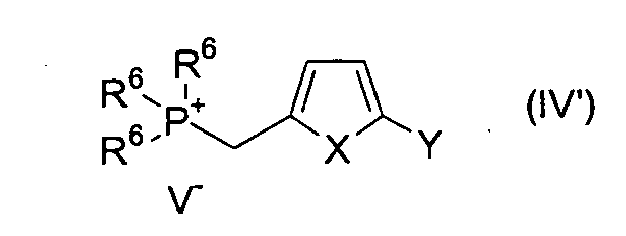 R6, V, X and Y have the same meanings as those described above].
 - A procedure for the preparation of a compound having the general formula (IV') according to Claim 33, wherein X represents a nitrogen atom substituted with a methyl group.
- A procedure for the preparation of a compound having the general formula (IV') according to Claim 33 or Claim 34, wherein Y represents a hydrogen atom, a C1-C6 alkyl group or a C1-C6 alkoxyl group.
- A procedure for the preparation of a compound having the general formula (IV') according to any one claim selected from Claim 33 to Claim 35, wherein R5 represents a C1-C6 alkyl group or two R5 groups together with the nitrogen atom to which they are bound form a pyrrolidine or piperidine group.
- A procedure for the preparation of a compound having the general formula (IV') according to any one claim selected from Claim 33 to Claim 36, wherein R6 represents a phenyl group.
- A procedure for the preparation of a compound having the general formula (IV') according to any one claim selected from Claim 33 to Claim 37, wherein R7 represents a C1-C6 alkylcarbonyl group.
- A procedure for the preparation of a compound having the general formula (Id) by condensing a compound having the general formula (IV'), which is prepared by reacting a compound having the general formula (IV") or a salt thereof with a compound having the general formula (A) in the presence of a compound having the general formula (B) in a solvent, with a compound of the general formula (Ic) in the presence of a base in a solvent, followed by hydrogenation of the product thus obtained;
 R5 represents a C1-C6 alkyl group which may optionally be substituted with substituent(s) selected from Substituent group α or a 5- to 10-membered aromatic group which may optionally be substituted with substituent(s) selected from Substituent group α, or two R5 groups together with the nitrogen atom to which they are bound form a 4-to 8-membered nitrogen-containing heterocyclic group which may optionally be substituted with substituent(s) selected from Substituent group α,X represents a vinylene group, a sulfur atom, a nitrogen atom substituted with a C1-C6 alkyl group, a nitrogen atom substituted with a silyl group, a nitrogen atom substituted with an acyl group or an oxygen atom,Y represents a hydrogen atom, a halogen atom, a cyano group, a C1-C8 alkyl group, a C1-C8 alkoxyl group or a C2-C8 alkanoyl group, andSubstituent group α represents a halogen atom, a cyano group, a C1-C8 alkyl group, a C1-C8 alkoxyl group, a C1-C8 alkylthio group and an acyl group]
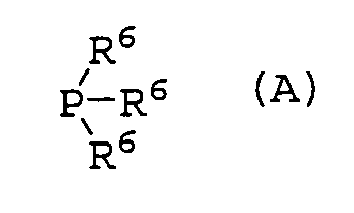 R6 represents a C1-C6-alkyl group which may optionally be substituted with substituent(s) selected from Substituent group α, a C1-C6 alkoxyl group which may optionally be substituted with substituent(s) selected from Substituent group α, a 5- to 10-membered aromatic group which may optionally be substituted with substituent(s) selected from Substituent group α, or a 5- to 10-membered aromatic-oxy group which may optionally be substituted with substituent(s) selected from Substituent group α, and Substituent group α has the same meaning as that described above]
R7-V (B)
[wherein,R7 represents an acyl group,V represents a halogen atom or a group having the general formula -O-S(O)2Rc, andRc represents a methoxyl group, a C1-C6 alkyl group which may optionally be substituted with from 1 to 3 halogen atoms or a phenyl group which may optionally be substituted with from 1 to 3 substituents selected from the group consisting of a halogen atom and a methyl group] R6, V, X and Y have the same meanings as those described above]
 R2 represents a C1-C6 alkyl group, a C3-C10 cycloalkyl group or a phenyl group,R3 represents a C2-C6 alkanoyl group, a C1-C6 alkyloxycarbonyl group, a benzoyl group, a phenyloxycarbonyl group or a benzyloxycarbonyl group, andR4 represents a C1-C6 alkyl group or a C2-C6 alkenyl group]
 R2, R3, R4, X and Y have the same meanings as those indicated hereinbefore].
Applications Claiming Priority (2)
| Application Number | Priority Date | Filing Date | Title |
|---|---|---|---|
| JP2004313183 | 2004-10-28 | ||
| PCT/JP2005/019678 WO2006046595A1 (en) | 2004-10-28 | 2005-10-26 | Optically active 4,4-disubstituted oxazolidine derivative and method for producing same |
Publications (2)
| Publication Number | Publication Date |
|---|---|
| EP1806344A1 true EP1806344A1 (en) | 2007-07-11 |
| EP1806344A4 EP1806344A4 (en) | 2012-02-01 |
Family
ID=36227836
Family Applications (1)
| Application Number | Title | Priority Date | Filing Date |
|---|---|---|---|
| EP05799393A Withdrawn EP1806344A4 (en) | 2004-10-28 | 2005-10-26 | Optically active 4,4-disubstituted oxazolidine derivative and method for producing same |
Country Status (10)
| Country | Link |
|---|---|
| US (1) | US7547790B2 (en) |
| EP (1) | EP1806344A4 (en) |
| JP (2) | JP5477983B2 (en) |
| KR (1) | KR101285483B1 (en) |
| CN (1) | CN101031552B (en) |
| BR (1) | BRPI0516173A (en) |
| CA (1) | CA2581415C (en) |
| IL (1) | IL182125A (en) |
| TW (1) | TWI362384B (en) |
| WO (1) | WO2006046595A1 (en) |
Cited By (1)
| Publication number | Priority date | Publication date | Assignee | Title |
|---|---|---|---|---|
| WO2014036623A1 (en) * | 2012-09-06 | 2014-03-13 | Universidade Federal De Minas Gerais - Ufmg | N‑substituted chiral aromatic oxazolidines, synthesis process, pharmaceutical composition and use |
Families Citing this family (1)
| Publication number | Priority date | Publication date | Assignee | Title |
|---|---|---|---|---|
| US8722714B2 (en) * | 2008-01-16 | 2014-05-13 | The Honk Kong University of Science and Technology | Oxazolidine derivatives as NMDA antagonists |
Family Cites Families (7)
| Publication number | Priority date | Publication date | Assignee | Title |
|---|---|---|---|---|
| EP0130795B1 (en) * | 1983-07-05 | 1988-11-23 | Pfizer Inc. | Carboxylic acid derivatives useful for inhibiting the degradation of cartilage |
| ZA854828B (en) * | 1984-07-27 | 1986-03-26 | Hoffmann La Roche | Phenyl nonatetraenoic acid derivatives |
| US5578593A (en) | 1992-12-11 | 1996-11-26 | Merck & Co., Inc. | Spiro piperidines and homologs promote release of growth hormone |
| IL107836A (en) * | 1992-12-11 | 1998-01-04 | Merck & Co Inc | Spiro piperidines and homologs, their preparation and pharmaceutical compositions containing them |
| RU2330839C2 (en) | 2002-01-11 | 2008-08-10 | Санкио Компани, Лимитед | Amino alcohol derivatives or phosphoric acid derivatives and pharmaceutical compositions containing specified derivatives |
| DE10317878A1 (en) * | 2003-04-17 | 2004-11-11 | Consortium für elektrochemische Industrie GmbH | Process for the preparation of alpha-methylated cysteine and serine derivatives |
| AU2005218555B2 (en) * | 2004-03-01 | 2008-01-03 | Board Of Regents, The University Of Texas System | Dimeric small molecule potentiators of apoptosis |
-
2005
- 2005-10-26 WO PCT/JP2005/019678 patent/WO2006046595A1/en not_active Ceased
- 2005-10-26 EP EP05799393A patent/EP1806344A4/en not_active Withdrawn
- 2005-10-26 BR BRPI0516173-8A patent/BRPI0516173A/en not_active IP Right Cessation
- 2005-10-26 CN CN2005800334302A patent/CN101031552B/en not_active Expired - Fee Related
- 2005-10-26 US US11/664,053 patent/US7547790B2/en not_active Expired - Fee Related
- 2005-10-26 CA CA2581415A patent/CA2581415C/en not_active Expired - Fee Related
- 2005-10-26 KR KR1020077009753A patent/KR101285483B1/en not_active Expired - Fee Related
- 2005-10-27 TW TW094137581A patent/TWI362384B/en not_active IP Right Cessation
-
2007
- 2007-03-22 IL IL182125A patent/IL182125A/en not_active IP Right Cessation
-
2012
- 2012-04-11 JP JP2012089931A patent/JP5477983B2/en not_active Expired - Fee Related
- 2012-04-11 JP JP2012089932A patent/JP5477984B2/en not_active Expired - Fee Related
Cited By (1)
| Publication number | Priority date | Publication date | Assignee | Title |
|---|---|---|---|---|
| WO2014036623A1 (en) * | 2012-09-06 | 2014-03-13 | Universidade Federal De Minas Gerais - Ufmg | N‑substituted chiral aromatic oxazolidines, synthesis process, pharmaceutical composition and use |
Also Published As
| Publication number | Publication date |
|---|---|
| CN101031552B (en) | 2010-11-10 |
| KR20070073836A (en) | 2007-07-10 |
| IL182125A (en) | 2012-02-29 |
| WO2006046595A1 (en) | 2006-05-04 |
| EP1806344A4 (en) | 2012-02-01 |
| TWI362384B (en) | 2012-04-21 |
| IL182125A0 (en) | 2007-07-24 |
| US20080108828A1 (en) | 2008-05-08 |
| TW200624425A (en) | 2006-07-16 |
| US7547790B2 (en) | 2009-06-16 |
| CA2581415A1 (en) | 2006-05-04 |
| KR101285483B1 (en) | 2013-07-12 |
| CN101031552A (en) | 2007-09-05 |
| JP2012188425A (en) | 2012-10-04 |
| JP5477984B2 (en) | 2014-04-23 |
| JP2012176954A (en) | 2012-09-13 |
| JP5477983B2 (en) | 2014-04-23 |
| CA2581415C (en) | 2011-10-04 |
| BRPI0516173A (en) | 2008-08-26 |
Similar Documents
| Publication | Publication Date | Title |
|---|---|---|
| WO2013097042A1 (en) | 2-((2s,3s,4r,5r)-5-((s)-3-amino-2-hydroxyprop-1-yl)-4-methoxy-3-(phenylsulfonylmethyl)tetrahydrofuran-2-yl)acetaldehyde derivatives and process for their preparation | |
| AU763963B2 (en) | Heterocyclic aminopyrrolidine derivatives as melatonergic agents | |
| EP1928820B1 (en) | A process for preparing ester oxazolidine compounds and their conversion to florfenicol | |
| JP5477984B2 (en) | Process for the production of optically active 4,4-disubstituted oxazolidine derivatives | |
| JP5024851B2 (en) | Optically active 4,4-disubstituted oxazolidine derivatives and process for producing the same | |
| HK1100777A (en) | Optically active 4,4-disubstituted oxazolidine derivative and method for producing same | |
| KR20000075623A (en) | Selective Epoxidation Process for Preparing Pharmaceutical Compounds | |
| JP6528251B2 (en) | Crystalline derivatives of (S) -1-((2R, 3R, 4S, 5S) -5-allyl-3-methoxy-4- (tosylmethyl) tetrahydrofuran-2-yl) -3-aminopropan-2-ol | |
| KR102756069B1 (en) | Nebivolol synthesis method and intermediate compound thereof | |
| JP4859461B2 (en) | Optically active halohydrin derivative and method for producing optically active epoxy alcohol derivative using the same | |
| US6063932A (en) | Process and intermediates for the preparation of oxazoline derivatives | |
| US5142066A (en) | Stereoselective process for the preparation of 2-amino-ethanol derivatives having a central analgesic activity and intermidiates thereof | |
| EP2686291B1 (en) | Process for preparing carboxylic acids | |
| US6150540A (en) | Versatile intermediate for annonaceous acetogenins | |
| JP3159518B2 (en) | Preparation of amino-substituted spiro compounds | |
| CA2407418A1 (en) | Novel heterocyclic compounds with anti-inflammatory activity | |
| JP5344287B2 (en) | Process for producing α-difluorohalomethylcarbonyl compound | |
| JP2002179665A (en) | Method for producing 2 (5H) -furanone derivative | |
| IL37118A (en) | Azetidin-2-one derivatives and their preparation | |
| IE49358B1 (en) | Carbamate derivatives of hydroxy prolines |
Legal Events
| Date | Code | Title | Description |
|---|---|---|---|
| PUAI | Public reference made under article 153(3) epc to a published international application that has entered the european phase |
Free format text: ORIGINAL CODE: 0009012 |
|
| 17P | Request for examination filed |
Effective date: 20070326 |
|
| AK | Designated contracting states |
Kind code of ref document: A1 Designated state(s): AT BE BG CH CY CZ DE DK EE ES FI FR GB GR HU IE IS IT LI LT LU LV MC NL PL PT RO SE SI SK TR |
|
| REG | Reference to a national code |
Ref country code: HK Ref legal event code: DE Ref document number: 1100777 Country of ref document: HK |
|
| DAX | Request for extension of the european patent (deleted) | ||
| RIC1 | Information provided on ipc code assigned before grant |
Ipc: C07D 413/06 20060101ALI20111219BHEP Ipc: C07D 263/06 20060101AFI20111219BHEP |
|
| A4 | Supplementary search report drawn up and despatched |
Effective date: 20120104 |
|
| 17Q | First examination report despatched |
Effective date: 20150618 |
|
| REG | Reference to a national code |
Ref country code: HK Ref legal event code: WD Ref document number: 1100777 Country of ref document: HK |
|
| STAA | Information on the status of an ep patent application or granted ep patent |
Free format text: STATUS: THE APPLICATION IS DEEMED TO BE WITHDRAWN |
|
| 18D | Application deemed to be withdrawn |
Effective date: 20170404 |