EP1805570B1 - Procedes permettant d'effectuer une meilleure verification de l'authenticite et de l'integrite de logiciels, dispositifs capables de mettre en oeuvre les procedes - Google Patents
Procedes permettant d'effectuer une meilleure verification de l'authenticite et de l'integrite de logiciels, dispositifs capables de mettre en oeuvre les procedes Download PDFInfo
- Publication number
- EP1805570B1 EP1805570B1 EP04769541A EP04769541A EP1805570B1 EP 1805570 B1 EP1805570 B1 EP 1805570B1 EP 04769541 A EP04769541 A EP 04769541A EP 04769541 A EP04769541 A EP 04769541A EP 1805570 B1 EP1805570 B1 EP 1805570B1
- Authority
- EP
- European Patent Office
- Prior art keywords
- content
- data object
- linkage
- originator
- access limited
- Prior art date
- Legal status (The legal status is an assumption and is not a legal conclusion. Google has not performed a legal analysis and makes no representation as to the accuracy of the status listed.)
- Expired - Lifetime
Links
Images




Classifications
-
- G—PHYSICS
- G06—COMPUTING OR CALCULATING; COUNTING
- G06F—ELECTRIC DIGITAL DATA PROCESSING
- G06F21/00—Security arrangements for protecting computers, components thereof, programs or data against unauthorised activity
- G06F21/10—Protecting distributed programs or content, e.g. vending or licensing of copyrighted material ; Digital rights management [DRM]
Definitions
- the present invention relates in general to the field of authenticity and integrity verification of arbitrary data content.
- the present invention relates to the field of software authenticity and integrity verification, especially to enable to prevent the installation and execution of software being modified by an unauthorized third party.
- DRM Digital right management
- digital right management technologies have been introduced to enable the employment of the Internet as a marketing medium while ensuring to observe usage rights claimed by the content owners.
- digital right management technologies address the authentication of the digital content, the authentication of the digital content source, the integrity of the digital content as well as the usage rights limitations and observance.
- the authentication and integrity of digital content is not only an integral part of digital rights management in the fundamental manner described above but supports also a business model, which is commonly known with gaming terminals and gaming consoles, respectively, representing typically processor-based terminals with controlled application execution functionality.
- the illustrated public key infrastructure includes exemplarily a certificate authority (CA) representing a trusted root certificate authority, a first vendor A, and a second vendor B, respectively.
- CA certificate authority
- the vendors A and B provide installation packages A and B, respectively, which installation packages may for instance enable a user to install corresponding vendor specific applications on a processor-based terminal or device.
- Each installation package includes the installation content (i.e. the installation content A and B, respectively) required for installing the vendor specific application, which installation code is signed by the vendor by the means of a code signature and a vendor specific certificate (i.e. a vendor A specific certificate and a vendor B specific certificate, respectively), which vendor specific certificate is signed by the certificate authority (CA).
- each of the certification authority (CA), the vendor A, and the vendor B is in possession of a public and private key pair.
- a pubic key is for public distribution
- a private key is a secret, which knowledge has to be kept by the owner.
- the asymmetry entails that the keys are separate but form an integrated key pair. Each key is one way, meaning that a key of the key pair used to encrypt information can not be used for decryption.
- the certification authority (CA) serves as trusted third party who creates certificates that consist of assertions on various attributes and binds them typically to their public key.
- a certificate is conventionally an electronic document attached to a public key by a trusted third party, which provides proof that the public key belongs to a legitimate owner and has been compromised.
- the vendors A and B obtain certificates from the certificate authority (CA) by transmitting its public keys to the CA and receiving corresponding certificates from the CA.
- Each vendor specific certificate includes a public key, certificate information and at least a digital signature of the certificate authority.
- the certificate information comprises identity information about the owner of the public key such as name, user identification and the like.
- a digital signature represents an electronic identification of an authority by the means of a public key algorithm, which purpose of the digital signature is to enable a recipient of any data signed with a digital signature to verify the integrity of the data and to identify the sender of the data.
- the at least one digital signature included in each vendor specific certificates enables the recipients of the certificates to verify identity of the certificate information and the identity of the certificate authority which has issued the certificate.
- the CA specific public key is required for verification.
- the code signature of the installation code serves analogously to enable verification of the installation code in view of its integrity and the identity of the signer. The verification of the code signature generated by the vendors requires the vendor specific public key.
- the authentication and integrity of the installation content is verified on the basis of the signed certificate and the signature included in the installation package.
- the application installation is operated on a processor-based device or terminal having stored the CA specific public key or being capable to obtain the CA specific public key.
- the digital signature of the vendor specific certificate issued and signed by the certificate authority is verified by the means of the CA specific public key available by the processor-based device running the installation procedure.
- the vendor specific public key and the certificate information are authenticated and any unauthorized or different manipulation can be excluded. This means, the vendor specific is now available on the processor-based device.
- the authentication and integrity is verified by verifying the validity of the code signature with the help of the authenticated vendor specific public key obtained from the vendor specific certificate.
- the installation content A is authenticated and its integrity is established, i.e. the installation content is validated as trusted code.
- the actual installation process may be initiated in the knowledge that the application resulting form the installation originates from the authenticated source defined in the certificate and the installation content is unchanged.
- the authenticity and integrity verification may be implemented in a specific separate verification instance operated on the processor-based device or may be included in the installation content in form of executable code forming a dedicated verification instance such as disclosed in US 2003 0156719 A1 .
- the object of the present invention resides in enabling an improved authenticity and integrity verification.
- the solution of the object is based on data objects being composed with the data content to be verified, which data objects include information for enabling authenticity and integrity verification, which objects are linked together by the help of linkage information, which prevents or at least hinders unauthorized party in modification on the data content.
- the linkage information serves to bind the data objects and information contained therein, respectively, to the data content to be verified.
- the linkage or bounding serves to bind / link an originator specific certificate to the data content. Consequently, an exchange of the certificate and signature as described above with the help of a compromised private key is prevented. This implies that also the data content (software) of other vendors cannot be modified with the help of compromised private key. The authenticity and integrity of the data content provided by the other vendors can be still guaranteed even in case of a compromised private key, as long as the linkage defined above is not broken.
- a method for improved authenticity and integrity verification of a content package comprises at least an originator specific certificate, an access limited data object and data content to be verified for authenticity and integrity.
- the originator specific certificate and the access limited data object are linked together via a first linkage information, which establishes a first linkage between the originator specific certificate and the access limited data object.
- the access limited data object and the data content are linked together via a second linkage information, which establishes a second linkage between the access limited data object and the data content.
- the first linkage information is extracted from the originator specific certificate and it is checked whether the first linkage information links to the access limited data object including corresponding first linkage information.
- a hash code is extracted from the access limited data object, which hash code serves as second linkage information.
- the extracted hash code is verified against a determined hash code by comparing the extracted and determined hash codes.
- the determined hash code is obtained on the basis of a hash algorithm, which is applied on the data content.
- the verifying includes verifying the second linkage; and verifying authenticity and integrity of the data content.
- content package is associated with a rights object, which contains a content encryption key.
- the access limited data object contains the hash code in an encrypted form, which encrypted form requires the content encryption key for recovering by decryption.
- the extraction of the hash code from the access limited data object comprises a decrypting of the hash code on the basis of the content encryption key.
- the content encryption key serves as a third linkage information, which establishes a third linkage between the rights object and the access limited data object.
- the checking of the availability of the associated rights object includes an identification of the associated rights object on the basis of association information being contained in the access limited data object and the rights object.
- the association information may be formed of an information relating to the content, a content identifier, an information relating to the originator, or an originator identifier.
- the originator specific certificate is tested against a trusted root certificate in order to ensure authenticity and integrity of the originator specific certificate.
- the rights object is digitally signed by the means of a signature. Hence, it is checked whether the signature of the rights object matched with a corresponding certificate.
- the corresponding certificate may be the originator specific certificate or a rights issuer specific certificate.
- the rights issuer entity issues the rights object.
- the first linkage information is represented by an information relating to an originator, or an originator identifier.
- the first linkage information is contained in both the originator specific certificate and the access limited data object.
- the content package is an installation package, which includes installation content representing the data content.
- the installation content enables an installation of an application on a processor-based device for being executed thereon.
- the content encryption key is verified to ensure that the content encryption key is applicable for decrypting the hash code.
- the verification can be based on a check sum information enables a verification of the decrypted hash code. In case a determined check information determined from the decrypted hash code and a check information for instance contained in the access limited data object match the content encryption key (CEK) is valid.
- a method for creating a content package enabling improved authenticity and integrity verification of the content package is provided.
- a data content to be verified for authenticity and integrity is provided and a hash code is obtained from the data content in accordance with a hash code algorithm.
- an originator specific certificate is provided.
- An access limited data object including the hash code and a first linkage information is generated.
- the first linkage information links the originator specific certificate and the access limited data object together.
- the first linkage information establishes a first linkage between the originator specific certificate and the access limited data object.
- the hash code serves as second linkage information, which second linkage information links the access limited data object and the data content together.
- the second linkage information establishes a second linkage between the access limited data object and the data content.
- the originator specific certificate, the access limited data object, and the data content are composed to form the content package for distribution.
- a rights object is created.
- the rights object contains a content encryption key, which is employed for encrypting the hash code, wherein the hash code is included in the access limited data object in an encrypted form.
- the content encryption key serves as a third linkage information, which establishes a third linkage between the rights object and the access limited data object.
- association information is included in the rights object, on the basis of which the rights object is identifiable.
- the association information includes an information relating to the content, a content identifier, an information relating to the originator, or an originator identifier.
- the rights object is digitally signed by inclusion of a signature.
- the first linkage information is an information relating to an originator, or an originator identifier.
- the first linkage information is contained in both the originator specific certificate and the access limited data object.
- the content package is an installation package, which includes installation content, which represents the data content.
- the installation content enables to install an application on a processor-based device for being executed thereon.
- the computer program product capable to improve authenticity and integrity verification of a content package.
- the computer program product comprises program code sections for carrying out the steps of the method according to an aforementioned embodiment of the invention, when the program is run on a controller, processor-based device, a computer, a terminal, a network device, a mobile terminal, or a mobile communication enabled terminal.
- an application specific integrated circuit may implement one or more instructions that are adapted to realize the aforementioned steps of the method of an aforementioned embodiment of the invention, i.e. equivalent with the aforementioned computer program product.
- a computer program product which comprises program code sections stored on a machine-readable medium for carrying out the steps of the method according to an aforementioned embodiment of the invention, when the computer program product is run on a controller, processor-based device, a computer, a terminal, a network device, a mobile terminal, or a mobile communication enabled terminal.
- a computer data signal embodied in a carrier wave and representing instructions is provided which when executed by a processor cause the steps of the method according to an aforementioned embodiment of the invention to be carried out.
- a verification apparatus for improved authenticity and integrity verification of a content package comprises at least an originator specific certificate, an access limited data object and data content to be verified for authenticity and integrity.
- the originator specific certificate and the access limited data object are linked together via a first linkage information, which establishes a first linkage between the originator specific certificate and the access limited data object.
- the access limited data object and the data content are linked together via a second linkage information, which establishes a second linkage between the access limited data object and the data content, a certificate parser is adapted to extract the first linkage information from the originator specific certificate.
- a DCF data object parser is adapted to extract the first linkage information and a hash code from the access limited data object.
- the hash code serves as second linkage information.
- a linkage verification module is adapted to compare the first linkage information, extracted for the originator specific certificate and the access limited data object, for linkage verification.
- a hash code generator is adapted to determine a hash code from the data content in accordance with a hash algorithm.
- a comparator is adapted to compare the hash codes extracted from the access limited data object and determined on the basis of the data content to enable verification of the second linkage and authenticity and integrity verification of the data content.
- the verification apparatus is implemented in a consumer electronic device and in particular a processor-based consumer electronic device.
- a generator apparatus for creating a content package enabling improved authenticity and integrity verification of the content package.
- a hash code generator is adapted to determine a hash code from a data content in accordance with a hash code algorithm.
- a DCF data object generator is adapted to create an access limited data object including the hash code and a first linkage information.
- the first linkage information links the originator specific certificate and the access limited data object together.
- the first linkage information establishes a first linkage between the originator specific certificate and the access limited data object.
- the hash code serves as second linkage information.
- the second linkage information links the access limited data object and the data content together.
- the second linkage information establishes a second linkage between the access limited data object and the data content.
- a package composer is adapted to compose an originator specific certificate, the access limited data object, and the data content to form the content package for distribution.
- the originator specific certificate is provided for inclusion.
- the generator apparatus is implemented in a sever system entity and in particular a processor-based server system entity.
- a system enabling content packages allowing improved authenticity and integrity verification comprises at least a generator module according to one of the aforementioned embodiments and a verification module according to one of the aforementioned embodiments.
- a signature within public key infrastructure systems is typically based on a one-way hash function.
- the one-way hash function accepts an input of arbitrary data and length and generates a so-called message digest with a bit-sequence fixed length.
- the hash function is selected such that, if input data is modified in any way, the message digests which are generated by applying the hash function to the original input data and the modified input data, respectively, differ from each other, preferably entirely. Consequently, a message digest is applicable for verification of the integrity of any digital data.
- a plaintext message digest would enable an unauthorized user to modify the digital data, from which the message digest has been derived, manipulate the original digital data and re-compute a new message digest on the basis of the modified digital data to feign integrity of the modified original data.
- message digest has to be secured, which is conventionally achieved by encrypting the message digest with a private key.
- the encrypted message digest is designated as signature.
- a recipient who wishes to verify the integrity of any data sequence, which is received in conjunction with a signature, decrypts the signature with the help of a public key, which forms in conjunction with the private key used for encryption of the message digest the asymmetric public encryption key pair, to obtain the message digest.
- the recipient determines itself the message digest of the received data sequence by applying the same hash function thereto and compares the message digest resulting from the decrypted signature and the self determined message digest.
- the deficiency of the conventional digital signature is fundamentally based on the missing linkage between signature and certificate, which allows to evade the authenticity and integrity verification.
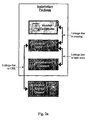
- Fig. 2a illustrates an installation package according to an embodiment of the present invention, which installation package comprises several included and accompanying object entities, which are linked with each other and by the means of which authenticity and integrity verification is operable.
- the installation package according to the illustrated embodiment of the invention includes a vendor specific certificate, a vendor specific DRM content format (DCF) data object and installation content. Additionally, the installation package is accompanied by a vendor rights object.
- the data objects illustrated in Fig. 2a are linked together to form dependency chained objects; i.e. the objects are linked together on the basis of information entities included in the objects.
- Fig. 2b which individual illustrations represent parts of the information included in the respective object entities.
- such a certificate comprises among others an owner or subject field, which contains an identification of the publisher of the certificate, who is herein the vendor identified by the means of a vendor identifier, preferably an unambiguous /unique vendor identifier.
- the content of the certificate is signed by the CA for authenticity and integrity proof.
- a certificate may include the following mandatory and optional entries:
- the certificate can be encoded according to various encoding standards, including for instance XML (extensible markup language) encoding and WBXML (wireless binary extensible markup language) encoding.
- XML extensible markup language
- WBXML wireless binary extensible markup language
- the vendor specific DRM content format (DCF) data object is structured in accordance with the Open Mobile Alliance (OMA) specifications, which define industry-wide interoperable mechanisms for developing applications and services that are deployed over wireless communication networks.
- OMA Digital Rights Management (DRM) enables distribution and consumption of digital content in a copy/usage-controlled manner.
- Fig. 2c illustrates a corresponding high-level overview of the DCF format.
- the DCF structure format defined a header with a brand number and version fields, designated as fixed DCF header, which is immediately followed by an OMA DRM container.
- the OMA DRM container includes a DCF headers box and a content object container.
- the DCF headers box also designated as OMA DRM headers, includes common headers, which in turn comprises information relating to the vendor and the content, which is included as protected content in the content object container.
- the common headers include among others following entries:
- the vendor specific DCF data object comprises in accordance with the present invention an issuer identification, i.e. herein the vendor identification, which is preferably part of the OMA DRM headers, and a hash code of the installation content, which is preferably contained in the content object.
- the content object should be encrypted by the means of a symmetric encryption key, which is herein designated as content encryption key (CEK), which is especially applicable in accordance with the AES symmetric encryption specified above.
- CEK content encryption key
- the rights issuer is an entity that assigns permissions and constraints to DRM content, especially vendor specific DRM content format (DCF) data object, and generates one or more rights object, especially the vendor specific rights object, which is required to access the protected content of the vendor specific DRM content format (DCF) data object.
- DCF vendor specific DRM content format
- a rights object is typically an XML encoded, likewise encoded or otherwise encoded document, which on the one hand expresses permissions and constraints associated with a piece of DRM content and which on the other hand contains information required for accessing, i.e. decrypting, the DRM content, which is encrypted for protection against unauthorized use.
- the DRM content is the protected content contained in the vendor specific DCF data object, where the protected content is represented by the encrypted hash code of the installation code.
- the vendor specific rights object contains identification information about the issuer, i.e. herein the issuer identification and vendor identification, respectively, and the content encryption key (CEK), which is required for decrypting the protected content of the vendor specific DCF data object.
- CEK content encryption key
- the vendor specific rights object is encrypted and signed by the vendor.
- the structure of the rights objects is based in accordance with the Open Mobile Alliance (OMA), especially the current Release 2 "Digital Rights Management” specification [DRM-v2], on the rights expression language (REL), which enables the definition of mobile rights profile in accordance with the "Open Digital Rights Language” (ODRL) standard.
- OMA Open Mobile Alliance
- REL rights expression language
- ODRL Open Digital Rights Language
- Rights are the collection of permissions and constraints defining under which circumstances access is granted to DRM content.
- the structure of the rights expression language enables the following functionality:
- Models are used to group rights elements according to their functionality, and thus enable concise definition of elements and their semantics. Different models can be used throughout the rights objects. A detailed description of the different models is out of the scope of the present invention. References should be given to the corresponding OMA specification. Nevertheless, a short introduction into the security model shall be given, which may relate to the vendor rights object as employed according to an embodiment of the present invention. Security issues constitute an important part of digital rights management systems. Especially, the security issues relate to following items:
- Enabling an authorized party to consume DRM content is similar to granting this party access to the confidential content.
- a party authorized to consume DRM content is let into the exclusive circle of parties deemed trustworthy enough to access the content.
- This concept is realized in by i) encrypting the content thus transforming it into DRM content, and ii) sharing the key(s) required to decrypt the DRM content only with those parties that are authorized to consume the content.
- DRM Content is protected by a symmetric algorithm (AES), i.e., the key used for decryption can be derived from the key used for encryption.
- AES symmetric algorithm
- CEK content encryption key
- CEK might also be used to wrap another (intermediate) key that in turn encrypts the content. Encrypting the content defers content confidentiality to controlling the confidentiality of the CEK. Now, the security of the DRM system relies on the control of the CEK that must be kept secret from all unauthorized parties.
- the CEK necessary to decrypt the DRM content is contained in the rights object in encrypted form.
- the dependency chain established between the objects comprises and accompanying the installation package can be understood.
- the vendor specific certificate and the vendor DCF data object containing the hash code of the installation content are linked together via name fields within both objects, which name fields contain a vendor identification identifying the vendor of the installation package.
- the corresponding field is designated above as subject entry, whereas, with reference to the vendor specific DCF data object, the corresponding field is designated above as issuer and issuer identification, respectively.
- the vendor specific DCF data object and the installation content are linked by the means of the hash code contained in the vendor specific DCF data object and determinable from the installation content by applying the corresponding hash function such as SHA-1 (Secure Hash Algorithm).
- the vendor specific DCF data object contains the hash code in encrypted from, which requires the CEK for decrypting.
- the CEK forms the linkage between the vendor specific DCF data object and the vendor specific rights object, which contains the CEK.
- the linkages between the various objects form an interdependency chain, which linkages are based on data and/or information contained or obtainable from two objects each.
- the hash code denotes in an equivalent manner a message digest of the installation content.
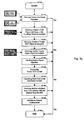
- Fig. 3a illustrates an authenticity and integrity verification of the installation package illustrated in Figs. 2a and 2b .
- Fig. 3a illustrates an operational sequence diagram for authenticity and integrity verification of an installation package according to an embodiment of the present invention.
- the operational sequence is illustrated on the basis of the installation package illustrated in Figs. 2a and 2b .
- the installation package may enable a user to install a particular application on his processor-based device, which installation of the application requires the installation content contained in the installation package.
- the installation as well as the authenticity and integrity verification may be operated by a distinct verification agent and verification agent, respectively.
- the verification agent and verification agent may be part of the installation package and operated at initiation of the installation process. Alternatively, the verification agent and/or the verification agent may be part of the operating system of the processor-based device.
- an operation S100 the installation of the installation package is initiated.
- authenticity and integrity verification is operated to ensure the installation of original unchanged installation content contained in the installation package, which in turn ensures the installation of an original unchanged application.
- the installation and hence the authenticity and integrity verification is operated on the processor-based device.
- the vendor specific certificate is checked in an operation S110.
- the integrity and authenticity of the vendor specific certificate is verified by the means of a root certificate of the certificate authority (CA), which has signed the vendor specific certificate.
- the CA certificate may be either stored on the device or may be obtainable by the device. In the first case, a secure storing of the CA certificate has to be considered to prevent unauthorized exchange of the CA certificate.
- the vendor specific certificate may contain a CA identification (issuer, issuer identification), a CA address information (issuer URL), and the like, which enable to obtain the CA certificate for verification.
- the signature of the vendor specific certificate is check with the public key of the CA as described above. In case of a valid signature, the integrity and authenticity of the content contained in the vendor specific certificate is assumed.
- the vendor identification (subject) is extracted from the authenticated vendor specific certificate, which links the vendor specific certificate to the vendor specific DCF data object. It is checked on the basis of the extracted vendor identifier in an operation S115 whether a corresponding DCF data object, i.e. a DCF data object which contains the vendor identifier, i.e. which originates from the vendor, is available. In case the vendor DCF data object is available, in a next operation S120, the vendor specific DCF data object is examined and it is checked whether the content part of the vendor specific DCF data object is encrypted.
- the invention herewith features an encryption of the vendor specific DCF data object and a system check whether the encryption is actually there.
- This aspect represents a deviation from the usual DRM implementation for security reasons.
- a system equipped with DRM can usually handle OMA DRM protected files, but can also process unprotected data. If a DRM protected file is converted into an unprotected by unauthorized access (hacking) the system generally does not take notice and processes the unprotected file.
- the encryption of the vendor specific DCF into encrypted format as requested by the invention and checked by the system ensures that the system recognizes the complete removal of DRM protection from an installation packet and may refuse execution of such an application. Thereby the presence of a rights object (license) is implicitely necessitated even if all files (data) are provided in the plain format.
- the detection of an encrypted content of the vendor specific DCF data object is followed by an operation S125, in which it is tested whether a corresponding vendor specific rights object.
- the corresponding vendor specific rights object can be identified on the basis of an issuer identification contained in the vendor specific rights object and it can be check whether the CEK contained in the vendor specific rights object matches such that decrypting of the hash code contained in the vendor specific DCF data object is possible; i.e. only the valid CEK enables the encryption of the hash code being included as protected content, i.e. encrypted with the CEK, in the vendor specific DCF data object.
- the signature included in the vendor specific DCF data object enables to verify the integrity and authenticity of the vendor specific DCF data object by the means of the vendor specific certificate, in an operation S130.
- the protected content included in the vendor specific DCF data object is decrypted to obtain the hash code included therein in an encrypted form.
- the decrypting is operable with the CEK, which is extracted from the corresponding vendor specific rights object.
- the hash code of the installation code is determined.
- the type of hash code algorithm used for determining the hash code of the installation content my be pre-defined or may be coded as an information within the vendor specific DCF data object or any other one of the objects involved in the present invention.
- the decrypted hash code and the determined / calculated hash code are compared with each other.
- the installation content is authenticated, i.e. the source of the installation content is identified as those identified by the vendor specific certificate, and the integrity of the installation content is guaranteed.
- the authenticity and integrity verification is completed and the installation process can be preceded with the actual installation of the application on the basis of the installation content.
- FIG. 3b an operational sequence relating to the composition and provision of the installation package according to an embodiment of the present invention is illustrated.
- the operational sequence of Fig. 3b may be operated by the vendor or by any other entity on behalf of the vendor or the originator of the application.
- the aim of the operational sequence in Fig. 3b is to provide an installation package in the form, for instance illustrated exemplarily in Fig. 2b , which enables to install an application on a processor-based device, at which the installation package is processed.
- the process for composing the installation package is started. Firstly in an operation S210, the installation content, which enables the installation of the application is provided or obtained.
- the installation content may for instance be provided by the originator of the application or the rights holder on the application.
- the hash code is determined from the installation content.
- the hash code is obtained by applying a hash code algorithm on the installation content, which application results in the desired hash code.
- a hash code algorithm is available; a suitable algorithm may be pre-defined and/or the hash code algorithm employed may be included as information into one of the objects within the installation package, which obtainment is the aim of the currently described operational sequence.
- a content encryption key is generated, provided, or obtained such that, in a following operation S225, the vendor specific DCF data object can be created.
- the vendor specific DCF data object may be structured in accordance with the description above, where the vendor specific DCF data object includes an issuer (creator) identity identifying the vendor, who has created the vendor specific DCF data object, and the hash code, which is included as protected content, which means that the hash code is encrypted by the means of the content encryption key (CEK) and a encryption algorithm such as the AES symmetric encryption algorithm.
- the corresponding vendor specific rights object is generated in an operation S230.
- the structure of the vendor specific rights object is described above in detail.
- the vendor specific rights object includes at least an issuer / creator identifier, herein the vendor identifier and the CEK employed for encrypting the hash code forming the protected content of the vendor specific DCF data object.
- the vendor specific rights object is signed by the generator / creator in order to authenticate the origin of the vendor specific rights object and to enable integrity verification thereof.
- the content encryption key which is employed for decrypting the encrypted hash code in order to obtain a plaintext hash code may be verified to ensure that the content encryption key (CEK) is a correct and valid key, respectively.
- the verification of the content encryption key (CEK) may be based on a verification of the decrypted hash code, of which a message digest is included in the vendor specific DCF data object.
- any other kind of check information may be included in the vendor specific DCF data object, which is suitable to be compared with check information determined from the (encrypted and plaintext, respectively) hash code on the basis of a pre-defined check algorithm.
- Both the vendor specific DCF data object and the vendor specific rights object may include a common content identifier, which identifies the association between the vendor specific DCF data object and the corresponding accompanying vendor specific rights object.
- the content identifier may be a unique content identifier such that the vendor specific DCF data object and the vendor specific rights object are assignable uniquely to each other.
- the associated vendor specific rights object may be identified on the basis of an association information, which can comprise any information being included in both the vendor specific rights object and the vendor specific DCF data object, which objects can be considered as a "key / lock object pair".
- the association information may likewise include information relating to the vendor, a vendor identifier, and the like.
- the installation package can be composed in an operation S235.
- the composed installation package includes a vendor specific certificate, the vendor specific DCF data object and the installation content.
- the way of obtaining a vendor specific certificate is described above in detail and reference thereto should be given herewith.
- the installation package and the vendor specific rights object are prepared for distribution, which may be for instance via any network such as the internet or a public land mobile network (PLMN) allowing for data communications.
- PLMN public land mobile network
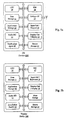
- Figs. 4a and 4b illustrate systems with entities involved in embodiments of the present invention.
- the first embodiment shown in Fig. 4a provides for a separate delivery path of the installation package and the vendor specific rights object, whereas the second embodiment shown in Fig. 4b provides for a common delivery path of the installation package and the vendor specific rights object.
- the vendor entity represents the central entity, which has access to the installation content, forms the installation package and the vendor specific rights object and provides the installation package and the vendor specific rights object for distribution.
- the vendor entity 100 which may be realized by a specific server system, is connected to a storage, which stores the installation content 110 for being processed.
- the vendor entity 100 operates a installation package toolkit 105, which is preferably a software program including code sections which when executed carry out the operations for composing the installation package, which is embodied exemplarily in Fig. 3b .
- the installation package toolkit 105 obtains the installation content 110 from the storage and composes the installation package on the basis thereof.
- the installation package requires a vendor specific certificate, which is obtained from a trusted certificate authority (CA) 300.
- the vendor entity 100 transmits its public key of a public / private key encryption pair to the CA 300, which generates a vendor specific certificate thereof, which certificate guaranties the authenticity of the public key and further information contained therein and the integrity of the certificate.
- the installation package 120 including the vendor specific certificate, the vendor specific DCF data object, and the installation content is transferred to a package server system 130, which finally provides the installation package for distribution, download etc.
- the vendor specific rights object required for the installation package is delivered via a separate path, i.e. the vendor specific rights object, which results from the creation of the installation package is transmitted to a rights issuer entity 200, which operates a rights object server system 220 for distributing the rights objects and especially the vendor specific rights object 210 stored thereon.
- the consumer electronics (CE) device 400 which is a processor-based device and on which the application should be installed by the means of the installation package, establishes for instance a communication connection to the package server system 130 and downloads the installation package.
- the vendor specific rights object is mandatory for processing the installation package.
- the vendor specific rights object is provided at the rights object server system 220. Different methodologies are applicable to enable to CE device 400 to get into possession of the vendor specific rights object.
- the package server system 130 may indicate to the rights object server system 220 the authorized download of installation package by the CE device 400 and release the corresponding vendor specific rights object for download by the CE device 400.
- the package server system 130 may indicate to the rights object server system 220 the authorized download of installation package by the CE device 400 and instruct the rights object server system 220 to transfer the corresponding vendor specific rights object to the CE device, which may or may not require interaction of the CE device 400.
- the package server system 130 may redirect the data communication connection between CE device 400 and package server system 130 to the rights object server system 220 to enable download of the vendor specific rights object in association with the installation package.
- the vendor specific rights object may be obtained afterwards the downloading of the installation package for instance during the processing of the installation package. Nevertheless, those methodologies are out of the scope of the present invention and reference should be given to the Download Architecture specification of the Open Mobile Alliance (OMA-Download-ARCH), included herewith.
- the CE device 400 is finally in possession of the installation package and the associated vendor specific rights object.
- a CA root certificate which may be obtained from the CA entity 300 and which may be pre-stored on the CE device 400
- the CE device 400 which operates for instance an verification agent is able to perform the authenticity and integrity verification, when the installation on the basis of the installation package is initiated, which procedure is embodied in Fig. 3a and described in detail with reference thereto.
- the simplified system includes the vendor entity 100, which also serve as the right issuer entity, the certificate authority (CA) 300, the package server system 130, which also serve as the rights object server system, and the CE device 400.
- the vendor and rights issuer entity 100 operates an installation package toolkit, which enables creating the installation package including the installation content 110, the vendor specific certificate, and the vendor specific DCF data object and the vendor specific rights object associated with the installation package.
- the installation content 110 is obtainable from a storage associated with the vendor entity 100 and the combined vendor and rights issuer entity 100, respectively.
- the vendor specific certificate is obtainable from the CA entity 300, which generates the vendor specific certificate on the basis of the public key of the vendor entity 100, which public key is part of a public / private encryption key pair.
- the resulting installation package 120 and the associated vendor specific rights object are transferred to the package server system 130, which delivers both the installation package 120 and the associated vendor specific rights object to the CE device 400 in a combined manner, for instance on a request for download originated from the CE device 400.
- FIGs. 5a and 5b block diagrams of an embodiment of the CE device 400 and an embodiment of the vendor entity 400 are depicted and briefly described in the following with reference thereto.
- the block diagram of Fig. 2a illustrates a principle structure design of a cellular terminal, which should exemplary represent any kind of CE device 400, in particular portable CE device 400, in the sense of the present invention. It shall be understood that the present invention is not limited to any specific kind of CE device 400.
- the illustrated cellular terminal comprises typically a central processing unit (CPU) 10, a data storage 11, an application storage 12, input/output means including audio input/output (I/O) means 13, a keypad with input controller (Ctrl) 14 and a display with display controller (Ctrl) 15.
- a cellular interface (1/F) 17 coupled to a cellular antenna provides for an over-the-air interface, which serves in conjunction with a subscriber identification module (SIM) 16 for cellular communications with a corresponding radio access network (RAN) of a public land mobile network (PLMN).
- SIM subscriber identification module
- RAN radio access network
- PLMN public land mobile network
- the cellular interface (I/F) 17 is arranged as a cellular transceiver to receive signals from the cellular antenna, decodes the signals, demodulates them and also reduces them to the base band frequency.
- the output of the cellular interface (I/F) 17 thus consists of a stream of data that may require further processing by the central processing unit (CPU) 10.
- the cellular interface (I/F) 17 arranged as a cellular transceiver also receives data from the central processing unit (CPU) 10, which are to be transmitted via the over-the-air interface to the radio access network (RAN). Therefore, the cellular interface (I/F) 17 encodes, modulates and up converts the signal to the radio frequency, which is to be used.
- the cellular antenna then transmits the resulting radio frequency signal to the corresponding radio access network (RAN) of the public land mobile network (PLMN).
- RAN radio access network
- the display and display controller (Ctrl) 15 are controlled by the central processing unit (CPU) 10 and provides information for the user typically by the means of a user interface.
- the keypad and keypad controller (Ctrl) 14 are provided to allow the user to input information.
- the information input via the keypad is supplied to the central processing unit (CPU) 10, which may be controlled in accordance with the input information.
- the audio input/output (I/O) means 13 includes at least a speaker for reproducing an audio signal and a microphone for recording an audio signal.
- the central processing unit (CPU) 10 may control the conversion of audio data to audio output signals and the conversion of audio input signals into audio data, where the audio data have a suitable format for cellular transmission.
- the CE device 400 may comprise a verification agent 20 and a secure storage 21.
- the verification agent which may alternatively be implemented as a digital rights management (DRM) agent, serves for processing the installation package in the above described manner; refer to Fig. 3a and the description referring thereto.
- the secure storage 21 may be applied for storing sensitive information or information, which has to be protected against any (unauthorized) modifications.
- the secure storage 21 may be particularly used to store the CA certificate, which is required for verification of the vendor specific certificate.
- the verification agent 20 which performs at least the authenticity and integrity verification in accordance with the present invention, is embodied as a functionality of the CE device 400, which means that the verification agent 20 is preferably a functionality of the operating system being operated on the CE device 400.
- Such an integrated verification agent may be advantageous in view of the code size of the installation package, which makes use thereof during verification.
- the verification agent 20 may be part of the installation package itself, which included executable code for performing the installation process of the application obtained from the installation content of the installation package and the verification process.
- Fig. 5b illustrates a block diagram of the operating environment employed by the vendor entity or any other entity for composing the installation package and the associating vendor specific rights object.
- the environment embodied in Fig. 5b shows a conventional computer system, which comprises a CPU 10, a data storage 11, an application storage 12 and input / output means in form of an audio input / output (I/O) means 13, an input controller connected to a keyboard 14 (and a mouse, not shown) and a display controller connected to a display 15.
- I/O audio input / output
- the computer system comprises conventionally also one or more mass storages 16, which may comprise one ' or more hard disk drives, one or more optical disk drives (such as CD-ROM drive, DVD drive both with reading and/or writing capabilities)
- mass storages 16 which may comprise one ' or more hard disk drives, one or more optical disk drives (such as CD-ROM drive, DVD drive both with reading and/or writing capabilities)
- Conventional computer system include one or more flexible data bus systems for connecting additional hardware thereto, especially a network interface card (NIC) 17.
- NIC network interface card
- the flexible concept of conventional computer systems allows several specific variations of the computer systems.
- the network interface card (NIC) 17 or any equivalent connects the embodied computer system to data communication networks, which may include for instance the wire-based Internet but also wireless and especially cellular networks (which access thereto may require additional network entities such as gateways).
- the processor-based computer system of the vendor entity 100 enables the carrying out of software including code sections.
- the computer system is designed to operate an installation package toolkit 22, which operation is described above in detail; refer to Fig. 3b and the description referring thereto.
- the secure storage 21 may be applied for storing sensitive information or information, which has to be protected against any (unauthorized) modifications.
- the secure storage 21 may be particularly used to store the private key of the vendor, the unprotected installation content, the vendor specific certificate, etc, which are required for the installation package composition procedure.
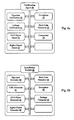
- Fig. 6a illustrates a block diagram of the verification agent 20 according to an embodiment of the present invention.
- the verification agent 20 illustrated herein is implemented to enable the method for authenticity and integrity verification of an installation package in accordance with an embodiment of the invention, where an exemplary method is illustrated with reference to Fig. 3a , where an exemplary installation package is illustrated with reference to Figs. 2a and 2b .
- Back reference to the Figs. 3a , 2a , and 2b will be given for detailed description of the illustrated block diagram of the verification agent 20.
- the illustrative verification agent 20 is composed of several modules, which may represent independent modules, code sections, application program interfaces (APIs), linkable library functions, classes and the like, which when executed on a processor-based device enable operations required for carrying out the method for authenticity and integrity verification according to an embodiment of the invention.
- the illustrated verification agent 20 comprises a signature verification module 30, a linkage verification module 31, a DCF object parser 32, a rights object parser 33, a decryption module 34 (or decryptor), a hash code generator 35, and a comparator 36.
- the signature verification module 30 is adapted to enable verification of the vendor certificate signature on the basis of the CA root certificate, which is described in detail with reference to operation S110 (cf. Fig. 3a ).
- the signature verification module 30 is further adapted to enable verification of the signature of the vendor specific rights object, which is preferably signed by the vendor, i.e. comprises a signature generated by the vendor with the help of its (vendor specific) private key.
- the vendor specific rights object may be signed by another entity, in particular the rights issuer entity.
- the verification of such a signature requires a corresponding certificate or at least a corresponding public key, which may require additionally a verification of the corresponding certificate or the corresponding public key of the signing entity, which verification may be performed in analogy to the verification of the vendor specific certificate.
- the linkage verification 31 is adapted to verify whether a vendor specific DCF data object and whether a vendor specific rights object is available. The verification of the availability of the vendor specific DCF data object is based on the linkage between vendor specific certificate and vendor specific DCF data object, whereas the verification of the availability of the vendor specific rights object is based on the association between the vendor specific DCF data object and the vendor specific rights object.
- the linkage verification 31 is further adapted to verify the linkage between the vendor specific DCF data object and the vendor specific rights object, which is based on the content encryption key (CEK), which enables a valid decryption of the hash code being contained as protected content in the vendor specific DCF data object, which protection is obtained by encrypting with the content encryption key (CEK).
- CEK content encryption key
- the DCF data object parser 32 and the rights object parser 33 are adapted to parse and extract the respective objects.
- the DCF data object parser 32 serves for extraction of the encrypted hash code from the vendor specific DCF data object and the extraction of the linkage information for linkage verification.
- the rights object parser 33 serves for extraction of the content encryption key, and, if required, the extraction of the association information as well as the signature.
- the decryption module 34 (or decryptor) enables the decryption of the encrypted hash code to obtain plaintext hash code.
- the hash code generator 35 implements a hash code algorithm, which is applicable on the installation content to obtain a hash code of the installation content.
- the comparator 36 is adapted for comparing the encrypted hash code originating from the vendor specific rights object and the generated hash code obtained from application of the hash code algorithm on the installation content. The result of the comparator represents finally the authenticity and integrity verification result. In case of matching hash codes, the authenticity and integrity verification is confirmed.
- Fig. 6b illustrates a block diagram of the installation package toolkit 22 according to an embodiment of the present invention.
- the installation package toolkit 22 illustrated herein is implemented to enable the method for creating an installation package enabling authenticity and integrity verification in accordance with an embodiment of the invention, where an exemplary method is illustrated with reference to Fig. 3b , where an exemplary installation package is illustrated with reference to Figs. 2a and 2b .
- Back reference to the Figs. 3b , 2a , and 2b will be given for detailed description of the illustrated block diagram of the installation package toolkit 22.
- the illustrative installation package toolkit 22 is composed of several modules, which may represent independent modules, code sections, application program interfaces (APIs), linkable library functions, classes and the like, which when executed on a processor-based device enable operations required for carrying out the method for creating an installation package enabling authenticity and integrity verification according to an embodiment of the invention.
- the illustrated installation package toolkit 22 comprises a signature generator 40, a CEK generator 41, a DCF data object generator 42, a rights object generator 43, a hash code generator 44, an encryption module 45 (or encryptor), and a package composer 46.
- the hash code generator 44 implements a hash code algorithm, which is applicable on the installation content to obtain a hash code of the installation content.
- the CEK generator in conjunction with the encryption module 45 (or encryptor) allows for encryption the hash code of the installation content with the content encryption key (CEK). Refer to operations S215 and S220 of Fig. 3b .
- the DCF data object generator 42 and the rights object generator 43 are adapted for generating the respective objects, which generation is described with reference to operations S225 and S230 of Fig. 3b .
- the DCF data object generator 42 serves to embed to encrypted hash code into the protected content of the vendor specific DCF data object and includes the information required for association.
- the rights object generator 43 generates the vendor specific rights object, which contains the content encryption key (CEK) for recovering the hash code from the vendor specific DCF data object and the linkage information, linking between the vendor specific certificate and the vendor specific DCF data object.
- CEK content encryption key
- the signature generator 40 enables to digitally sign the vendor specific rights object by including a signature therein.
- the signature generator 40 uses for generating the signature a corresponding public key, in particular the vendor specific punk key of the public / private encryption key pair of the vendor entity.
- the package composer 46 is adapted to finally compose, combine and form the installation package, respectively, an embodiment of which installation package is illustrated with reference to Figs. 2a and 2b .
Landscapes
- Engineering & Computer Science (AREA)
- Software Systems (AREA)
- Theoretical Computer Science (AREA)
- Multimedia (AREA)
- Technology Law (AREA)
- Computer Hardware Design (AREA)
- Computer Security & Cryptography (AREA)
- Physics & Mathematics (AREA)
- General Engineering & Computer Science (AREA)
- General Physics & Mathematics (AREA)
- Storage Device Security (AREA)
- Emergency Protection Circuit Devices (AREA)
Claims (26)
- Procédé mis en oeuvre dans un ordinateur, dans lequel un programme de contenu comprend au moins un certificat spécifique à un expéditeur, un objet fichier de données à accès limité et un contenu de données dont l'authenticité et l'intégrité doivent être vérifiées, dans lequel ledit certificat spécifique à un expéditeur et ledit objet fichier de données à accès limité sont liés l'un à l'autre par l'intermédiaire d'une première information de liaison, laquelle établit une première liaison entre ledit certificat spécifique à un expéditeur et ledit objet fichier de données à accès limité,
dans lequel ledit objet fichier de données à accès limité et ledit contenu de données sont liés l'un à l'autre par l'intermédiaire d'une deuxième information de liaison, laquelle établit une deuxième liaison entre ledit objet fichier de données à accès limité et ledit contenu de données, ledit procédé comportant les étapes ci-dessous consistant à :- extraire (SI15) ladite première information de liaison dudit certificat spécifique à un expéditeur, dans lequel ladite première information de liaison est au moins un des éléments suivants : une information relative à un expéditeur ou un identifiant d'expéditeur ;- vérifier (S115) si ladite première information de liaison est liée audit objet fichier de données à accès limité comportant la première information de liaison correspondante ;- extraire (S125, S135) un code de hachage à partir dudit objet fichier de données à accès limité, lequel code de hachage a la fonction d'une deuxième information de liaison ; et- vérifier (S 145) ledit code de hachage extrait par rapport à un code de hachage déterminé, lequel est déterminé sur la base dudit contenu de données et selon un algorithme de hachage, ladite étape de vérification comportant les étapes consistant à :- vérifier ladite deuxième liaison ; et- vérifier l'authenticité et l'intégrité dudit contenu de données. - Procédé selon la revendication 1, dans lequel ledit programme de contenu est associé à un objet de droits, lequel contient une clé de chiffrement de contenu,
dans lequel ledit objet fichier de données à accès limité contient ledit code de hachage dans une forme chiffrée nécessitant ladite clé de chiffrement de contenu pour réaliser un déchiffrement,
dans lequel ladite extraction dudit code de hachage à partir dudit objet fichier de données à accès limité comporte l'étape consistant à :- déchiffrer ledit code de hachage à l'aide de ladite clé de chiffrement de contenu. - Procédé selon la revendication 1 ou 2, dans lequel ladite clé de chiffrement de contenu a la fonction d'une troisième information de liaison, laquelle établit une troisième liaison entre ledit objet de droits et ledit objet fichier de données à accès limité.
- Procédé selon la revendication 2 ou 3, comportant les étapes consistant à :- vérifier si ledit objet de droits associé est disponible.
- Procédé selon la revendication 4, dans lequel ladite vérification de ladite disponibilité dudit objet de droits associé comporte l'étape consistant à :- identifier ledit objet de droits associé sur la base d'informations contenues dans ledit objet fichier de données à accès limité et dans ledit objet de droits, dans lequel lesdites informations contenues comprennent au moins un des éléments suivants : une information relative au contenu, un identifiant de contenu, une information relative à l'expéditeur, et un identifiant d'expéditeur.
- Procédé selon l'une quelconque des revendications précédentes, comportant l'étape consistant à :- vérifier ledit certificat spécifique à un expéditeur par rapport à un certificat racine de confiance afin de garantir l'authenticité et l'intégrité dudit certificat spécifique à un expéditeur.
- Procédé selon l'une quelconque des revendications 2 à 6, dans lequel ledit objet de droits est signé numériquement par le biais d'une signature,
ledit procédé comportant l'étape consistant à :- vérifier ladite signature dudit objet de droits avec un certificat correspondant comportant au moins l'un parmi un certificat spécifique à un expéditeur et un certificat spécifique à un émetteur de droits, lequel émetteur de droits émet ledit objet de droits. - Procédé selon l'une quelconque des revendications précédentes, dans lequel ladite première information de liaison est incluse à la fois dans ledit certificat spécifique à un expéditeur et dans ledit objet fichier de données à accès limité.
- Procédé selon l'une quelconque des revendications précédentes, dans lequel ledit programme de contenu est un programme d'installation comportant du contenu d'installation sous la forme dudit contenu de données, lequel contenu d'installation permet d'installer une application sur un dispositif à base de processeur laquelle est destinée à être exécutée sur ce dernier.
- Procédé selon l'une quelconque des revendications 2 à 9, comportant l'étape consistant à :- vérifier ladite clé de chiffrement de contenu afin de garantir que la clé de chiffrement de contenu est applicable en vue de déchiffrer ledit code de hachage.
- Procédé mis en oeuvre dans un ordinateur, comportant les étapes consistant à :- fournir (S210) un contenu de données dont l'authenticité et l'intégrité doivent être vérifiées ;- déterminer (S215) un code de hachage à partir dudit contenu de données selon un algorithme de code de hachage ;- fournir (S220) un certificat spécifique à un expéditeur ;- créer (S225) un objet fichier de données à accès limité comportant ledit code de hachage et une première information de liaison,- dans lequel ladite première information de liaison lie ledit certificat spécifique à un expéditeur et ledit objet fichier de données à accès limité l'un à l'autre et ladite première information de liaison établit une première liaison entre ledit certificat spécifique à un expéditeur et ledit objet fichier de données à accès limité, dans lequel ladite première information de liaison est au moins l'une parmi une information relative à un expéditeur ou un identifiant d'expéditeur,- dans lequel ledit code de hachage a la fonction d'une deuxième information de liaison, laquelle deuxième information de liaison lie ledit objet fichier de données à accès limité et ledit contenu de données l'un à l'autre et laquelle deuxième information de liaison établit une deuxième liaison entre ledit objet fichier de données à accès limité et ledit contenu de données ; et- composer (S235) ledit certificat spécifique à un expéditeur, ledit objet fichier de données à accès limité, et ledit contenu de données pour former un programme de contenu destiné à être distribué (S240).
- Procédé selon la revendication 11, comportant les étapes consistant à :- créer un objet de droits, lequel contient une clé de chiffrement de contenu,dans lequel ladite clé de chiffrement de contenu est employée pour chiffrer ledit code de hachage, dans lequel ledit code de hachage est inclus dans ledit objet fichier de données à accès limité sous une forme chiffrée.
- Procédé selon la revendication 11 ou 12, dans lequel ladite clé de chiffrement de contenu a la fonction d'une troisième information de liaison, laquelle établit une troisième liaison entre ledit objet de droits et ledit objet fichier de données à accès limité.
- Procédé selon la revendication 12 ou 13, comportant les étapes consistant à:- inclure des informations dans ledit objet de droits, sur la base desquelles ledit objet de droits est identifiable, dans lequel lesdites informations comportent au moins un des éléments suivants : une information relative au contenu, un identifiant de contenu, une information relative à l'expéditeur, et un identifiant d'expéditeur.
- Procédé selon l'une quelconque des revendications 12 à 14, comportant l'étape consistant à :- signer numériquement ledit objet de droits par le biais d'une signature.
- Procédé selon l'une quelconque des revendications 11 à 15, dans lequel ladite première information de liaison est incluse à la fois dans ledit certificat spécifique à un expéditeur et dans ledit objet fichier de données à accès limité.
- Procédé selon l'une quelconque des revendications 11 à 16, dans lequel ledit programme de contenu est un programme d'installation comportant du contenu d'installation sous la forme dudit contenu de données, lequel contenu d'installation permet d'installer une application sur un dispositif à base de processeur laquelle est destinée à être exécutée sur ce dernier.
- Produit - programme informatique comportant des sections de code de programme pour mettre en oeuvre les étapes selon l'une quelconque des revendications 1 à 17, lorsque lesdites sections de code de programme sont exécutées sur un contrôleur, sur un dispositif à base de processeur, sur un ordinateur, sur un dispositif à base de microprocesseur, sur un terminal, sur un dispositif de réseau, sur un terminal mobile ou sur un terminal adapté à des communications mobiles.
- Produit - programme informatique selon la revendication 18, dans lequel lesdites sections de code de programme sont stockées sur un support lisible par une machine.
- Produit - programme informatique selon la revendication 18, dans lequel lesdites sections de code de programme sont intégrées dans une onde porteuse.
- Produit - programme informatique selon la revendication 18, dans lequel lesdites sections de code de programme font partie dudit programme de contenu.
- Appareil de vérification, dans lequel un programme de contenu comporte au moins un certificat spécifique à un expéditeur, un objet fichier de données à accès limité et un contenu de données dont l'authenticité et l'intégrité doivent être vérifiées,
dans lequel ledit certificat spécifique à un expéditeur et ledit objet fichier de données à accès limité sont liés l'un à l'autre par l'intermédiaire d'une première information de liaison, laquelle établit une première liaison entre ledit certificat spécifique à un expéditeur et ledit objet fichier de données à accès limité ;
dans lequel ledit objet fichier de données à accès limité et ledit contenu de données sont liés l'un à l'autre par l'intermédiaire d'une deuxième information de liaison, laquelle établit une deuxième liaison entre ledit objet fichier de données à accès limité et ledit contenu de données ;
ledit appareil comportant :- un analyseur de certificat (37), lequel est apte à extraire la première information de liaison dudit certificat spécifique à un expéditeur, dans lequel ladite première information de liaison est au moins l'un des éléments parmi une information relative à un expéditeur ou un identifiant d'expéditeur ;- un analyseur d'objets de données de format de contenu de gestion des droits numériques (DRM) (32), lequel est apte à extraire ladite première information de liaison et un code de hachage dudit objet fichier de données à accès limité, lequel code de hachage a la fonction d'une deuxième information de liaison ;- un module de vérification de liaison (31), lequel est apte à comparer ladite première information de liaison, extraite à partir dudit certificat spécifique à un expéditeur et ledit objet fichier de données à accès limité, à des fins de vérification de liaison ;- un générateur de code de hachage (35), lequel est apte à déterminer un code de hachage à partir dudit contenu de données selon un algorithme de hachage ; et- un comparateur (36), lequel est apte à comparer lesdits codes de hachage extraits à partir dudit objet fichier de données à accès limité et auxdits codes de hachage déterminés sur la base dudit contenu de données, pour permettre la vérification de ladite deuxième liaison et une vérification d'authenticité et d'intégrité dudit contenu de données. - Appareil de vérification selon la revendication 22, dans lequel ledit appareil de vérification est mis en oeuvre dans un dispositif électronique grand public et en particulier dans un dispositif électronique grand public à base de processeur (400).
- Appareil générateur,
ledit appareil comportant :- un générateur de codes de hachage (44), lequel est apte à déterminer un code de hachage à partir d'un contenu de données selon un algorithme de code de hachage ;- un générateur d'objets de données de format de contenu de gestion des droits numériques (DRM) (42), lequel est apte à créer un objet fichier de données à accès limité comportant ledit code de hachage et une première information de liaison,- dans lequel ladite première information de liaison lie ledit certificat spécifique à un expéditeur et ledit objet fichier de données à accès limité l'un à l'autre et laquelle première information de liaison établit une première liaison entre ledit certificat spécifique à un expéditeur et ledit objet fichier de données à accès limité, dans lequel ladite première information de liaison est au moins un élément parmi une information relative à un expéditeur ou un identifiant d'expéditeur,- dans lequel ledit code de hachage a la fonction d'une deuxième information de liaison, laquelle deuxième information de liaison lie ledit objet fichier de données à accès limité et ledit contenu de données l'un à l'autre et laquelle deuxième information de liaison établit une deuxième liaison entre ledit objet fichier de données à accès limité et ledit contenu de données ; et- un composeur de programme (46), lequel est apte à composer un certificat spécifique à un expéditeur, ledit objet fichier de données à accès limité, et ledit contenu de données pour former un programme de contenu destiné à être distribué, où ledit certificat spécifique à un expéditeur est délivré en vue d'une inclusion. - Appareil générateur selon la revendication 24, dans lequel ledit appareil générateur est mis en oeuvre dans une entité de système de serveur et en particulier dans une entité de système de serveur à base de processeur (100).
- Système, comprenant au moins un appareil générateur et un appareil de vérification, où ledit appareil générateur est un appareil générateur selon l'une quelconque des revendications 24 à 25, et ledit appareil de vérification est un appareil de vérification selon l'une quelconque des revendications 22 à 23.
Applications Claiming Priority (1)
| Application Number | Priority Date | Filing Date | Title |
|---|---|---|---|
| PCT/IB2004/003217 WO2006038051A1 (fr) | 2004-10-04 | 2004-10-04 | Procedes permettant d'effectuer une meilleure verification de l'authenticite et de l'integrite de logiciels, dispositifs capables de mettre en oeuvre les procedes |
Publications (2)
| Publication Number | Publication Date |
|---|---|
| EP1805570A1 EP1805570A1 (fr) | 2007-07-11 |
| EP1805570B1 true EP1805570B1 (fr) | 2009-04-08 |
Family
ID=36142323
Family Applications (1)
| Application Number | Title | Priority Date | Filing Date |
|---|---|---|---|
| EP04769541A Expired - Lifetime EP1805570B1 (fr) | 2004-10-04 | 2004-10-04 | Procedes permettant d'effectuer une meilleure verification de l'authenticite et de l'integrite de logiciels, dispositifs capables de mettre en oeuvre les procedes |
Country Status (4)
| Country | Link |
|---|---|
| EP (1) | EP1805570B1 (fr) |
| AT (1) | ATE428147T1 (fr) |
| DE (1) | DE602004020522D1 (fr) |
| WO (1) | WO2006038051A1 (fr) |
Families Citing this family (3)
| Publication number | Priority date | Publication date | Assignee | Title |
|---|---|---|---|---|
| US8949797B2 (en) | 2010-04-16 | 2015-02-03 | International Business Machines Corporation | Optimizing performance of integrity monitoring |
| WO2014036021A1 (fr) * | 2012-08-28 | 2014-03-06 | Visa International Service Association | Inscription de service de dispositif sécurisé |
| CN106934272B (zh) * | 2017-02-09 | 2021-09-07 | 北京奇虎科技有限公司 | 一种应用信息的校验方法和装置 |
Family Cites Families (4)
| Publication number | Priority date | Publication date | Assignee | Title |
|---|---|---|---|---|
| US20020157002A1 (en) * | 2001-04-18 | 2002-10-24 | Messerges Thomas S. | System and method for secure and convenient management of digital electronic content |
| US20030084298A1 (en) * | 2001-10-25 | 2003-05-01 | Messerges Thomas S. | Method for efficient hashing of digital content |
| US7356147B2 (en) * | 2002-04-18 | 2008-04-08 | International Business Machines Corporation | Method, system and program product for attaching a title key to encrypted content for synchronized transmission to a recipient |
| JP2004157864A (ja) * | 2002-11-07 | 2004-06-03 | Canon Inc | コンテンツ配信システム |
-
2004
- 2004-10-04 AT AT04769541T patent/ATE428147T1/de not_active IP Right Cessation
- 2004-10-04 EP EP04769541A patent/EP1805570B1/fr not_active Expired - Lifetime
- 2004-10-04 DE DE602004020522T patent/DE602004020522D1/de not_active Expired - Lifetime
- 2004-10-04 WO PCT/IB2004/003217 patent/WO2006038051A1/fr not_active Ceased
Also Published As
| Publication number | Publication date |
|---|---|
| ATE428147T1 (de) | 2009-04-15 |
| DE602004020522D1 (de) | 2009-05-20 |
| EP1805570A1 (fr) | 2007-07-11 |
| WO2006038051A1 (fr) | 2006-04-13 |
Similar Documents
| Publication | Publication Date | Title |
|---|---|---|
| JP5357292B2 (ja) | デジタル著作権管理エンジンのシステムおよび方法 | |
| US8336105B2 (en) | Method and devices for the control of the usage of content | |
| US9626667B2 (en) | Digital rights management engine systems and methods | |
| AU2004200471B2 (en) | Publishing digital content within a defined universe such as an organization in accordance with a digital rights management (DRM) system | |
| CN1665184B (zh) | 使用灵活权限模板以获取数字内容的经签署的权限标签 | |
| US7224805B2 (en) | Consumption of content | |
| CN100535888C (zh) | 支持不同数字版权管理域之间内容交换的装置和方法 | |
| US20070204078A1 (en) | Digital rights management engine systems and methods | |
| US20080209231A1 (en) | Contents Encryption Method, System and Method for Providing Contents Through Network Using the Encryption Method | |
| EP1817687B1 (fr) | Dispositif et procede permettant l'echange de contenus entre differents domaines drm | |
| CN1503944A (zh) | 用于数字电子内容的安全和方便管理的系统和方法 | |
| US7552092B2 (en) | Program distribution method and system | |
| JPH1131130A (ja) | サービス提供装置 | |
| US7634816B2 (en) | Revocation information management | |
| CN101490686A (zh) | 数字权利管理的方法 | |
| EP1805570A1 (fr) | Procedes permettant d'effectuer une meilleure verification de l'authenticite et de l'integrite de logiciels, dispositifs capables de mettre en oeuvre les procedes | |
| JP2008529340A (ja) | 登録段階 | |
| MX2008005060A (en) | Methods for digital rights management |
Legal Events
| Date | Code | Title | Description |
|---|---|---|---|
| PUAI | Public reference made under article 153(3) epc to a published international application that has entered the european phase |
Free format text: ORIGINAL CODE: 0009012 |
|
| 17P | Request for examination filed |
Effective date: 20070312 |
|
| AK | Designated contracting states |
Kind code of ref document: A1 Designated state(s): AT BE BG CH CY CZ DE DK EE ES FI FR GB GR HU IE IT LI LU MC NL PL PT RO SE SI SK TR |
|
| 17Q | First examination report despatched |
Effective date: 20071127 |
|
| DAX | Request for extension of the european patent (deleted) | ||
| GRAP | Despatch of communication of intention to grant a patent |
Free format text: ORIGINAL CODE: EPIDOSNIGR1 |
|
| RIC1 | Information provided on ipc code assigned before grant |
Ipc: G06F 21/00 20060101AFI20080915BHEP |
|
| GRAS | Grant fee paid |
Free format text: ORIGINAL CODE: EPIDOSNIGR3 |
|
| GRAA | (expected) grant |
Free format text: ORIGINAL CODE: 0009210 |
|
| AK | Designated contracting states |
Kind code of ref document: B1 Designated state(s): AT BE BG CH CY CZ DE DK EE ES FI FR GB GR HU IE IT LI LU MC NL PL PT RO SE SI SK TR |
|
| REG | Reference to a national code |
Ref country code: GB Ref legal event code: FG4D |
|
| REG | Reference to a national code |
Ref country code: CH Ref legal event code: EP |
|
| REG | Reference to a national code |
Ref country code: IE Ref legal event code: FG4D |
|
| REF | Corresponds to: |
Ref document number: 602004020522 Country of ref document: DE Date of ref document: 20090520 Kind code of ref document: P |
|
| PG25 | Lapsed in a contracting state [announced via postgrant information from national office to epo] |
Ref country code: SI Free format text: LAPSE BECAUSE OF FAILURE TO SUBMIT A TRANSLATION OF THE DESCRIPTION OR TO PAY THE FEE WITHIN THE PRESCRIBED TIME-LIMIT Effective date: 20090408 |
|
| NLV1 | Nl: lapsed or annulled due to failure to fulfill the requirements of art. 29p and 29m of the patents act | ||
| PG25 | Lapsed in a contracting state [announced via postgrant information from national office to epo] |
Ref country code: ES Free format text: LAPSE BECAUSE OF FAILURE TO SUBMIT A TRANSLATION OF THE DESCRIPTION OR TO PAY THE FEE WITHIN THE PRESCRIBED TIME-LIMIT Effective date: 20090719 Ref country code: AT Free format text: LAPSE BECAUSE OF FAILURE TO SUBMIT A TRANSLATION OF THE DESCRIPTION OR TO PAY THE FEE WITHIN THE PRESCRIBED TIME-LIMIT Effective date: 20090408 Ref country code: PT Free format text: LAPSE BECAUSE OF FAILURE TO SUBMIT A TRANSLATION OF THE DESCRIPTION OR TO PAY THE FEE WITHIN THE PRESCRIBED TIME-LIMIT Effective date: 20090908 Ref country code: FI Free format text: LAPSE BECAUSE OF FAILURE TO SUBMIT A TRANSLATION OF THE DESCRIPTION OR TO PAY THE FEE WITHIN THE PRESCRIBED TIME-LIMIT Effective date: 20090408 |
|
| PG25 | Lapsed in a contracting state [announced via postgrant information from national office to epo] |
Ref country code: SE Free format text: LAPSE BECAUSE OF FAILURE TO SUBMIT A TRANSLATION OF THE DESCRIPTION OR TO PAY THE FEE WITHIN THE PRESCRIBED TIME-LIMIT Effective date: 20090708 Ref country code: NL Free format text: LAPSE BECAUSE OF FAILURE TO SUBMIT A TRANSLATION OF THE DESCRIPTION OR TO PAY THE FEE WITHIN THE PRESCRIBED TIME-LIMIT Effective date: 20090408 Ref country code: PL Free format text: LAPSE BECAUSE OF FAILURE TO SUBMIT A TRANSLATION OF THE DESCRIPTION OR TO PAY THE FEE WITHIN THE PRESCRIBED TIME-LIMIT Effective date: 20090408 |
|
| PG25 | Lapsed in a contracting state [announced via postgrant information from national office to epo] |
Ref country code: EE Free format text: LAPSE BECAUSE OF FAILURE TO SUBMIT A TRANSLATION OF THE DESCRIPTION OR TO PAY THE FEE WITHIN THE PRESCRIBED TIME-LIMIT Effective date: 20090408 Ref country code: DK Free format text: LAPSE BECAUSE OF FAILURE TO SUBMIT A TRANSLATION OF THE DESCRIPTION OR TO PAY THE FEE WITHIN THE PRESCRIBED TIME-LIMIT Effective date: 20090408 Ref country code: CZ Free format text: LAPSE BECAUSE OF FAILURE TO SUBMIT A TRANSLATION OF THE DESCRIPTION OR TO PAY THE FEE WITHIN THE PRESCRIBED TIME-LIMIT Effective date: 20090408 Ref country code: RO Free format text: LAPSE BECAUSE OF FAILURE TO SUBMIT A TRANSLATION OF THE DESCRIPTION OR TO PAY THE FEE WITHIN THE PRESCRIBED TIME-LIMIT Effective date: 20090408 |
|
| PLBE | No opposition filed within time limit |
Free format text: ORIGINAL CODE: 0009261 |
|
| STAA | Information on the status of an ep patent application or granted ep patent |
Free format text: STATUS: NO OPPOSITION FILED WITHIN TIME LIMIT |
|
| PG25 | Lapsed in a contracting state [announced via postgrant information from national office to epo] |
Ref country code: BE Free format text: LAPSE BECAUSE OF FAILURE TO SUBMIT A TRANSLATION OF THE DESCRIPTION OR TO PAY THE FEE WITHIN THE PRESCRIBED TIME-LIMIT Effective date: 20090408 Ref country code: SK Free format text: LAPSE BECAUSE OF FAILURE TO SUBMIT A TRANSLATION OF THE DESCRIPTION OR TO PAY THE FEE WITHIN THE PRESCRIBED TIME-LIMIT Effective date: 20090408 |
|
| 26N | No opposition filed |
Effective date: 20100111 |
|
| PG25 | Lapsed in a contracting state [announced via postgrant information from national office to epo] |
Ref country code: BG Free format text: LAPSE BECAUSE OF FAILURE TO SUBMIT A TRANSLATION OF THE DESCRIPTION OR TO PAY THE FEE WITHIN THE PRESCRIBED TIME-LIMIT Effective date: 20090708 |
|
| PG25 | Lapsed in a contracting state [announced via postgrant information from national office to epo] |
Ref country code: MC Free format text: LAPSE BECAUSE OF NON-PAYMENT OF DUE FEES Effective date: 20091031 |
|
| REG | Reference to a national code |
Ref country code: CH Ref legal event code: PL |
|
| REG | Reference to a national code |
Ref country code: FR Ref legal event code: ST Effective date: 20100630 |
|
| PG25 | Lapsed in a contracting state [announced via postgrant information from national office to epo] |
Ref country code: FR Free format text: LAPSE BECAUSE OF NON-PAYMENT OF DUE FEES Effective date: 20091102 |
|
| PG25 | Lapsed in a contracting state [announced via postgrant information from national office to epo] |
Ref country code: LI Free format text: LAPSE BECAUSE OF NON-PAYMENT OF DUE FEES Effective date: 20091031 Ref country code: IE Free format text: LAPSE BECAUSE OF NON-PAYMENT OF DUE FEES Effective date: 20091004 Ref country code: GR Free format text: LAPSE BECAUSE OF FAILURE TO SUBMIT A TRANSLATION OF THE DESCRIPTION OR TO PAY THE FEE WITHIN THE PRESCRIBED TIME-LIMIT Effective date: 20090709 Ref country code: CH Free format text: LAPSE BECAUSE OF NON-PAYMENT OF DUE FEES Effective date: 20091031 |
|
| PGFP | Annual fee paid to national office [announced via postgrant information from national office to epo] |
Ref country code: GB Payment date: 20100929 Year of fee payment: 7 |
|
| PGFP | Annual fee paid to national office [announced via postgrant information from national office to epo] |
Ref country code: DE Payment date: 20100929 Year of fee payment: 7 |
|
| PG25 | Lapsed in a contracting state [announced via postgrant information from national office to epo] |
Ref country code: IT Free format text: LAPSE BECAUSE OF FAILURE TO SUBMIT A TRANSLATION OF THE DESCRIPTION OR TO PAY THE FEE WITHIN THE PRESCRIBED TIME-LIMIT Effective date: 20090408 |
|
| PG25 | Lapsed in a contracting state [announced via postgrant information from national office to epo] |
Ref country code: LU Free format text: LAPSE BECAUSE OF NON-PAYMENT OF DUE FEES Effective date: 20091004 |
|
| PG25 | Lapsed in a contracting state [announced via postgrant information from national office to epo] |
Ref country code: HU Free format text: LAPSE BECAUSE OF FAILURE TO SUBMIT A TRANSLATION OF THE DESCRIPTION OR TO PAY THE FEE WITHIN THE PRESCRIBED TIME-LIMIT Effective date: 20091009 |
|
| PG25 | Lapsed in a contracting state [announced via postgrant information from national office to epo] |
Ref country code: TR Free format text: LAPSE BECAUSE OF FAILURE TO SUBMIT A TRANSLATION OF THE DESCRIPTION OR TO PAY THE FEE WITHIN THE PRESCRIBED TIME-LIMIT Effective date: 20090408 |
|
| PG25 | Lapsed in a contracting state [announced via postgrant information from national office to epo] |
Ref country code: CY Free format text: LAPSE BECAUSE OF FAILURE TO SUBMIT A TRANSLATION OF THE DESCRIPTION OR TO PAY THE FEE WITHIN THE PRESCRIBED TIME-LIMIT Effective date: 20090408 |
|
| GBPC | Gb: european patent ceased through non-payment of renewal fee |
Effective date: 20111004 |
|
| PG25 | Lapsed in a contracting state [announced via postgrant information from national office to epo] |
Ref country code: DE Free format text: LAPSE BECAUSE OF NON-PAYMENT OF DUE FEES Effective date: 20120501 |
|
| REG | Reference to a national code |
Ref country code: DE Ref legal event code: R119 Ref document number: 602004020522 Country of ref document: DE Effective date: 20120501 |
|
| PG25 | Lapsed in a contracting state [announced via postgrant information from national office to epo] |
Ref country code: GB Free format text: LAPSE BECAUSE OF NON-PAYMENT OF DUE FEES Effective date: 20111004 |