EP1803710A1 - Pyrimidine derivative condensed with non-aromatic ring - Google Patents
Pyrimidine derivative condensed with non-aromatic ring Download PDFInfo
- Publication number
- EP1803710A1 EP1803710A1 EP05793361A EP05793361A EP1803710A1 EP 1803710 A1 EP1803710 A1 EP 1803710A1 EP 05793361 A EP05793361 A EP 05793361A EP 05793361 A EP05793361 A EP 05793361A EP 1803710 A1 EP1803710 A1 EP 1803710A1
- Authority
- EP
- European Patent Office
- Prior art keywords
- pipe
- group
- optionally substituted
- dihydrothieno
- chloro
- Prior art date
- Legal status (The legal status is an assumption and is not a legal conclusion. Google has not performed a legal analysis and makes no representation as to the accuracy of the status listed.)
- Withdrawn
Links
- 0 *c(c(F)c1)cc(F)c1-c1nc(CS(C2)(=O)=O)c2c(*)n1 Chemical compound *c(c(F)c1)cc(F)c1-c1nc(CS(C2)(=O)=O)c2c(*)n1 0.000 description 5
- WAZGCDNHHXBQBD-UHFFFAOYSA-N CC1=C(C)N(CC2=C(C)CCCN2)CC1 Chemical compound CC1=C(C)N(CC2=C(C)CCCN2)CC1 WAZGCDNHHXBQBD-UHFFFAOYSA-N 0.000 description 1
- BQELCNSKEDBUPT-UHFFFAOYSA-N Clc1nc(C2CCC2)nc2c1CSC2 Chemical compound Clc1nc(C2CCC2)nc2c1CSC2 BQELCNSKEDBUPT-UHFFFAOYSA-N 0.000 description 1
- YYTAHPIHRFEWFZ-UHFFFAOYSA-N Fc(c(-c1nc(CSC2)c2c(Cl)n1)c1)cc(F)c1F Chemical compound Fc(c(-c1nc(CSC2)c2c(Cl)n1)c1)cc(F)c1F YYTAHPIHRFEWFZ-UHFFFAOYSA-N 0.000 description 1
- AUZGPYXAKFYZMQ-UHFFFAOYSA-N Fc1cc(-c2nc(CCC3)c3c(Cl)n2)cc(F)c1Br Chemical compound Fc1cc(-c2nc(CCC3)c3c(Cl)n2)cc(F)c1Br AUZGPYXAKFYZMQ-UHFFFAOYSA-N 0.000 description 1
- GACOMTFYVPOUIS-UHFFFAOYSA-O O=C(CC1)[NH2+]CCN1c1nc(C2CCCCC2)nc2c1C[SiH2]C2 Chemical compound O=C(CC1)[NH2+]CCN1c1nc(C2CCCCC2)nc2c1C[SiH2]C2 GACOMTFYVPOUIS-UHFFFAOYSA-O 0.000 description 1
- VEPYRVASEFTCOE-UHFFFAOYSA-N O=C1NC(c(c(F)c2)cc(F)c2Cl)=NC2=C1CSC2 Chemical compound O=C1NC(c(c(F)c2)cc(F)c2Cl)=NC2=C1CSC2 VEPYRVASEFTCOE-UHFFFAOYSA-N 0.000 description 1
Classifications
-
- C—CHEMISTRY; METALLURGY
- C07—ORGANIC CHEMISTRY
- C07D—HETEROCYCLIC COMPOUNDS
- C07D239/00—Heterocyclic compounds containing 1,3-diazine or hydrogenated 1,3-diazine rings
- C07D239/70—Heterocyclic compounds containing 1,3-diazine or hydrogenated 1,3-diazine rings condensed with carbocyclic rings or ring systems
-
- A—HUMAN NECESSITIES
- A61—MEDICAL OR VETERINARY SCIENCE; HYGIENE
- A61P—SPECIFIC THERAPEUTIC ACTIVITY OF CHEMICAL COMPOUNDS OR MEDICINAL PREPARATIONS
- A61P3/00—Drugs for disorders of the metabolism
-
- A—HUMAN NECESSITIES
- A61—MEDICAL OR VETERINARY SCIENCE; HYGIENE
- A61P—SPECIFIC THERAPEUTIC ACTIVITY OF CHEMICAL COMPOUNDS OR MEDICINAL PREPARATIONS
- A61P3/00—Drugs for disorders of the metabolism
- A61P3/04—Anorexiants; Antiobesity agents
-
- A—HUMAN NECESSITIES
- A61—MEDICAL OR VETERINARY SCIENCE; HYGIENE
- A61P—SPECIFIC THERAPEUTIC ACTIVITY OF CHEMICAL COMPOUNDS OR MEDICINAL PREPARATIONS
- A61P3/00—Drugs for disorders of the metabolism
- A61P3/08—Drugs for disorders of the metabolism for glucose homeostasis
-
- A—HUMAN NECESSITIES
- A61—MEDICAL OR VETERINARY SCIENCE; HYGIENE
- A61P—SPECIFIC THERAPEUTIC ACTIVITY OF CHEMICAL COMPOUNDS OR MEDICINAL PREPARATIONS
- A61P3/00—Drugs for disorders of the metabolism
- A61P3/08—Drugs for disorders of the metabolism for glucose homeostasis
- A61P3/10—Drugs for disorders of the metabolism for glucose homeostasis for hyperglycaemia, e.g. antidiabetics
-
- A—HUMAN NECESSITIES
- A61—MEDICAL OR VETERINARY SCIENCE; HYGIENE
- A61P—SPECIFIC THERAPEUTIC ACTIVITY OF CHEMICAL COMPOUNDS OR MEDICINAL PREPARATIONS
- A61P43/00—Drugs for specific purposes, not provided for in groups A61P1/00-A61P41/00
-
- A—HUMAN NECESSITIES
- A61—MEDICAL OR VETERINARY SCIENCE; HYGIENE
- A61P—SPECIFIC THERAPEUTIC ACTIVITY OF CHEMICAL COMPOUNDS OR MEDICINAL PREPARATIONS
- A61P5/00—Drugs for disorders of the endocrine system
- A61P5/48—Drugs for disorders of the endocrine system of the pancreatic hormones
-
- A—HUMAN NECESSITIES
- A61—MEDICAL OR VETERINARY SCIENCE; HYGIENE
- A61P—SPECIFIC THERAPEUTIC ACTIVITY OF CHEMICAL COMPOUNDS OR MEDICINAL PREPARATIONS
- A61P5/00—Drugs for disorders of the endocrine system
- A61P5/48—Drugs for disorders of the endocrine system of the pancreatic hormones
- A61P5/50—Drugs for disorders of the endocrine system of the pancreatic hormones for increasing or potentiating the activity of insulin
-
- C—CHEMISTRY; METALLURGY
- C07—ORGANIC CHEMISTRY
- C07D—HETEROCYCLIC COMPOUNDS
- C07D239/00—Heterocyclic compounds containing 1,3-diazine or hydrogenated 1,3-diazine rings
- C07D239/70—Heterocyclic compounds containing 1,3-diazine or hydrogenated 1,3-diazine rings condensed with carbocyclic rings or ring systems
- C07D239/72—Quinazolines; Hydrogenated quinazolines
- C07D239/86—Quinazolines; Hydrogenated quinazolines with hetero atoms directly attached in position 4
- C07D239/94—Nitrogen atoms
-
- C—CHEMISTRY; METALLURGY
- C07—ORGANIC CHEMISTRY
- C07D—HETEROCYCLIC COMPOUNDS
- C07D491/00—Heterocyclic compounds containing in the condensed ring system both one or more rings having oxygen atoms as the only ring hetero atoms and one or more rings having nitrogen atoms as the only ring hetero atoms, not provided for by groups C07D451/00 - C07D459/00, C07D463/00, C07D477/00 or C07D489/00
- C07D491/02—Heterocyclic compounds containing in the condensed ring system both one or more rings having oxygen atoms as the only ring hetero atoms and one or more rings having nitrogen atoms as the only ring hetero atoms, not provided for by groups C07D451/00 - C07D459/00, C07D463/00, C07D477/00 or C07D489/00 in which the condensed system contains two hetero rings
- C07D491/04—Ortho-condensed systems
- C07D491/044—Ortho-condensed systems with only one oxygen atom as ring hetero atom in the oxygen-containing ring
- C07D491/048—Ortho-condensed systems with only one oxygen atom as ring hetero atom in the oxygen-containing ring the oxygen-containing ring being five-membered
-
- C—CHEMISTRY; METALLURGY
- C07—ORGANIC CHEMISTRY
- C07D—HETEROCYCLIC COMPOUNDS
- C07D495/00—Heterocyclic compounds containing in the condensed system at least one hetero ring having sulfur atoms as the only ring hetero atoms
- C07D495/02—Heterocyclic compounds containing in the condensed system at least one hetero ring having sulfur atoms as the only ring hetero atoms in which the condensed system contains two hetero rings
- C07D495/04—Ortho-condensed systems
Definitions
- the present invention relates to new pyrimidine derivatives condensed with a non-aromatic ring or pharmaceutically acceptable salts thereof useful as drugs, particularly as insulin secretagogues or diabetic therapeutic agents, and a drug comprising these compounds as active ingredients.
- Diabetes is a disease with chronic hyperglycemia as a cardinal sign and develops by absolute or relative deficiency of insulin activity. Clinically, diabetes is roughly classified by the characteristics into insulin-dependent diabetes (referred to as “type 1 diabetes” hereinafter) and non-insulin-dependent diabetes (referred to as “type 2 diabetes” hereinafter). In type 2 diabetes, which accounts for approximately 90% of diabetic patients, decrease of insulin secretion from the pancreatic ⁇ -cells is one of major causes of the onset, and postprandial hyperglycemia caused by early disorder in insulin secretion is particularly recognized.
- type 1 diabetes insulin-dependent diabetes
- type 2 diabetes non-insulin-dependent diabetes
- sulfonylurea drug is the mainstream as the insulin secretagogue, but it is likely to cause hypoglycemia and known to cause secondary ineffectiveness due to pancreatic exhaustion following long-term administration.
- SU drug is effective to control blood glucose between meals, but has difficulty in suppressing postprandial hyperglycemia.
- Recent large-scale clinical trials have confirmed that remedying postprandial hyperglycemia is critical in controlling diabetic complications and diabetic development (Non-Patent Document 1).
- Non-Patent Documents 2 and 3 It is also reported that arteriosclerosis develops only during periods of the postprandial hyperglycemia and that the persistence of minor postprandial hyperglycemia increases mortality caused by cardiovascular disease or the like. This indicates that postprandial hyperglycemia is, even at minor levels, an independent risk factor of cardiovascular death. From the above background, attention has been paid to importance and necessity for medications against postprandial hyperglycemia. Hence, drugs having promoting activity on insulin secretion are considered to have an appropriate profile to remedy postprandial hyperglycemia and/or fasting blood glucose and to be useful for treating and preventing type 1 and type 2 diabetes.
- Patent Document 1 discloses cyclopentane-condensed pyrimidine derivatives as compounds with activity to increase cyclic guanosine monophosphate (cGMP) level by activation of soluble guanylate cyclase, and diabetes is included in examples of diseases or morbidity in which increase in cGMP level is desired or said compounds can be used for therapy and prevention thereof.
- cGMP cyclic guanosine monophosphate
- the document gives neither specific disclosure of the compounds of the present invention nor specific data indicating their applicability to diabetes therapy such as promoting activity on insulin secretion.
- Patent Document 2 discloses cyclohexane-condensed pyrimidine derivatives as compounds with activity to increase cyclic guanosine monophosphate (cGMP) level by activation of soluble guanylate cyclase, and diabetes is included in examples of diseases or morbidity in which increase in cGMP level is desired or said compounds can be used for therapy and prevention thereof.
- the document gives neither specific disclosure of the compounds of the present invention nor specific data indicating their applicability to diabetes therapy such as promoting activity on insulin secretion.
- Patent Document 3 discloses condensed pyrimidine derivatives as glycogen synthase kinase-3 (GSK-3) inhibitors and describes diabetes as an example of diseases for which these compounds are useful, that is, diseases caused by action of GSK-3.
- GSK-3 glycogen synthase kinase-3
- none of compounds of the present invention are specifically disclosed therein, and there are not disclosed specific data indicating applicability of said compounds to diabetes therapy such as promoting activity on insulin secretion, either.
- Patent Document 4 discloses thiophene-condensed pyrimidine derivatives substituted with a cyano group as phosphodiesterase 7 (PDE 7) inhibitors and describes type 1 and type 2 diabetes as examples of diseases that are expected to be improved by inhibition of PDE 7.
- PDE 7 phosphodiesterase 7
- Patent Document 5 discloses nitrogen-containing ring-condensed pyrimidine derivatives as compounds with bactericidal activity, but does not specifically disclose the compounds of the present invention. Neither description nor suggestion is given on applicability of said compounds to diabetes therapy including promotion of insulin secretion, either.
- Patent Document 6 discloses condensed pyrimidine derivatives as transforming growth factor-beta (TGF- ⁇ ) inhibitors, but does not specifically disclose the compounds of the present invention. The document gives neither description nor suggestion on applicability of said compounds to diabetes therapy including promotion of insulin secretion, either.
- Patent Document 7 discloses pyrimidine derivatives condensed with a sulfur-containing ring as ⁇ -adrenaline blockers, but the document neither specifically discloses the compounds of the present invention nor gives description or suggestion on applicability of said compounds to diabetes therapy including promotion of insulin secretion.
- Patent Document 8 discloses condensed pyrimidine derivatives as ion channel inhibitors, but does not specifically disclose the compounds of the present invention. It neither describes nor suggests that applicability of said compounds to diabetes therapy including promotion of insulin secretion.
- Non-Patent Documents 4 and 5 Pyrimidine derivatives condensed with a sulfur-containing ring are also known as intermediates in synthesis of C 60 derivatives.
- insulin secretagogues are useful for treating and preventing type 1 diabetes, type 2 diabetes, and insulin-resistant diseases, creation of further superior insulin secretagogues is earnestly desired.
- the present inventors earnestly studied compounds with promoting activity on insulin secretion, found that the pyrimidine derivatives condensed with a non-aromatic ring of the present invention have excellent effects of promoting insulin secretion, and completed the present invention.
- the present invention provides condensed pyrimidine derivatives represented by formula (I) or pharmaceutically acceptable salts thereof, a pharmaceutical composition containing these compounds as active ingredients, and a pharmaceutical composition serving as a therapeutic agent for type 1 diabetes, type 2 diabetes, and/or insulin-resistant diseases.
- formula (I) condensed pyrimidine derivatives represented by formula (I) or pharmaceutically acceptable salts thereof, a pharmaceutical composition containing these compounds as active ingredients, and a pharmaceutical composition serving as a therapeutic agent for type 1 diabetes, type 2 diabetes, and/or insulin-resistant diseases.
- A A ring selected from the group consisting of Group X 1 , Group X 2 , Group X 3 , and Group X 4 .
- the carbon atoms composing this ring are optionally substituted with one or more substituents selected from the group consisting of lower alkyl, -O-(lower alkyl), halogen atom, carboxyl, -CO 2 -(lower alkyl), and carbamoyl.
- the sulfur atom composing this ring may be oxidized.
- Group X 1 A group consisting of Group X 2 : A group consisting of Group X 3 : A group consisting of Group X 4 : A group consisting of -R 1 : A group selected from Groups (1) to (3) below
- a in formula (I) is preferably a ring selected from Group X 1 , and more preferably a ring selected from Group X 1 in which the sulfur atom composing the ring is oxidized.
- the ring selected from Group X 1 in which the sulfur atom composing the ring is oxidized specifically includes the following: More preferably it is the ring shown below:
- the condensed pyrimidine derivative represented by formula (I) is preferably a compound wherein A is a ring selected from Group X 1 (the sulfur atom composing the ring may be oxidized); more preferably the one wherein A is a ring selected from Group X 1 (the sulfur atom composing the ring may be oxidized) and R 1 is phenyl substituted with at least one halogen atom; further preferably the one wherein A is a ring selected from Group X 1 (the sulfur atom composing the ring may be oxidized) and R 1 is phenyl substituted with at least three halogen atoms; particularly preferably the one wherein A is a ring selected from Group X 1 (the sulfur atom composing the ring may be oxidized), R 1 is phenyl substituted with at least three halogen atoms, and R 2 is optionally substituted cyclic amino; and most preferably the one wherein A is a ring selected from Group X 1 (the sulfur
- Another embodiment of the condensed pyrimidine derivative represented by formula (I) is preferably a compound wherein A is a ring selected from Group X 1 (the sulfur atom composing the ring may be oxidized); more preferably the one wherein A is a ring selected from Group X 1 (the sulfur atom composing the ring may be oxidized) and R 1 is optionally substituted cyclobutyl or optionally substituted cyclopentyl; further preferably the one wherein A is a ring selected from Group X 1 (the sulfur atom composing the ring may be oxidized) and R 1 is optionally substituted cyclobutyl of optionally substituted cyclopentyl; particularly preferably the one wherein A is a ring selected from Group X 1 (the sulfur atom composing the ring may be oxidized), R 1 is optionally substituted cyclobutyl or optionally substituted cyclopentyl, and R 2 is optionally substituted cyclic amino; and most preferably the
- the compounds of the present invention have excellent activities in promoting insulin secretion and suppressing increase in blood glucose.
- the compounds of the present invention represented by formula (I), based on said activities are effective to treat and/or prevent type 1 diabetes, type 2 diabetes, and/or insulin-resistant diseases.
- Pharmacological action of the compounds of the present invention was confirmed by the following test examples.
- MIN6B1 cell which was a strain of mouse pancreatic ⁇ -cells, and glibenclamide, which was a commercially available insulin secretion secretagogue, as a reference compound.
- the assay procedure is given below.
- MIN6B1 cells were seeded on a 48-well plate at a concentration of 1x10 5 cells/well (0.25 ml) (The medium was prepared by adding FCS (fetal calf serum) to DMEM (Dulbecco's Modified Eagle Medium) containing 25 mM glucose such that the FCS concentration became 10%).
- FCS fetal calf serum
- DMEM Dulbecco's Modified Eagle Medium
- KRB-HEPES buffer Krebs-Ringer-bicarbonate-N-2-hydroxylethylpiperazine-N'-2-ethanesulfonic acid; 130 mM NaCl, 4.7 mM KCl, 1.2 mM KH 2 PO 4 , 1.2 mM MgCl 2 ⁇ 6H 2 O, 0.25 mM CaCl 2 ⁇ 2H 2 O, 2.5 mM NaHCO 3 , 0.5% BSA, and 10 mM N-2-hydroxyethylpiperazine-N'-2-ethanesulfonic acid (pH 7.4)) containing 2.8 mM glucose warmed to 37°C, 0.2 ml of said buffer was again added, and the cells were incubated at 37°C for 30 to 60 minutes.
- KRB-HEPES buffer Krebs-Ringer-bicarbonate-N-2-hydroxylethylpiperazine-N'-2-ethanesulfonic acid
- test compounds against hyperglycemia following glucose loading were examined using normal mice and nateglinide, a commercially available oral anti-hyperglycemic agent, as a reference compound.
- the assay procedure is given below. ICR mice (male, six weeks old) that had been preliminary bred for one week were fasted for 18 to 20 hours to use as test animals. Each test compound was dissolved in 0.5% methylcellulose solution and orally administered at 3 mg/kg (10 mg/kg for nateglinide) before glucose loading. Timing to administer the test compound was selected to be optimal for each test compound, which was 10 minutes before glucose loading for the compounds of the present invention or 30 minutes before glucose loading for nateglinide, which was a reference compound. The hypoglycemic rate (%) at 30 minutes after glucose loading was measured relative to the control group. The results are shown in Table 2.
- lower means a linear or branched carbon chain with 1 to 6 carbon atoms unless otherwise noted. Therefore, “lower alkyl” means a linear or branched C 1 -C 6 alkyl and specifically includes, for example, methyl, ethyl, propyl, isopropyl, butyl, isobutyl, sec-butyl, tert-butyl, pentyl, neopentyl, hexyl, and others. It is preferably a C 1 -C 3 alkyl, that is, methyl, ethyl, propyl, and isopropyl.
- “Lower alkenyl” means a linear or branched C 2 -C 6 alkenyl and specifically includes, for example, vinyl, allyl, butenyl, and others.
- “Lower alkynyl” means a linear or branched C 2 -C 6 alkynyl and specifically includes, for example, propargyl and others.
- “Lower alkylidene” means a linear or branched C 1 -C 6 alkylidene and specifically includes, for example, methylidene, ethylidene, propylidene, and others.
- “Halogen atom” means fluoro, chloro, bromo, or iodo. It is preferably fluoro, chloro, or bromo.
- Cyclic amino means a monovalent group derived from three- to eight-membered non-aromatic cyclic amine that contains at least one nitrogen atom and optionally contains one or more identical or different additional heteroatoms selected from the group consisting of nitrogen, oxygen, and sulfur, wherein the nitrogen atom necessarily present in said ring is the bonding site.
- the sulfur atom on the ring in said cyclic amino may be oxidized.
- Specific examples include monovalent groups derived from azetidine, pyrrolidine, piperidine, azepane, azocane, piperazine, homopiperazine, morpholine, oxazepane, thiomorpholine, thiazepane, and others.
- These rings may contain (an) unsaturated bond(s) in part of the ring, such as dihydropyrrole, tetrahydropyridine, tetrahydroazepine, imidazolidine, oxazolidine, dihydrooxazine, thiazolidine, dihydrothiazine, and others.
- These rings may be condensed with a cycloalkane moiety, such as decahydroquinoline, decahydroisoquinoline, and others.
- These rings may be condensed with a benzene ring, such as indoline, 1,2,3,4-tetrahydroquinoline, 1,2,3,4-tetrahydroisoquinoline, and others.
- These rings may be condensed with another cyclic amine moiety such as octahydroimidazo[1,5-a]pyrazine, octahydro[1,2-a]pyrazine, and others.
- These rings may be condensed with an aromatic heterocycle, such as 2,3,4,9-tetrahydro-1H- ⁇ -carboline, 4,5,6,7-tetrahydro-1H-pyrazolo[4,3-c]pyridine, 4,5,6,7-tetrahydro-2H-pyrazolo[4,3-c]pyridine, 5,6,7,8-tetrahydro-pyrido[4,3-d]pyrimidine, and others.
- These rings may be spiro-condensed with a non-aromatic heterocycle, such as 1,3,8-triazaspiro[4.5]decane, 1-oxa-8-azaspiro[4.5]decane, 1,4-dioxa-8-azaspiro[4.5]decane, 2,4-dioxa-9-azaspiro[5.5]undecane, 2,8-diazaspiro[4.5]decane, and others.
- These rings may be bridged cyclic amino, such as monovalent groups derived from 2,5-diazabicyclo[2.2.1]heptane, 2,5-diazabicyclo[2.2.2]octane, and others.
- Cycloalkyl means a three- to eight-membered carbocycle, which may be partially unsaturated. Specific examples include cyclopropyl, cyclopentyl, cyclohexyl, cyclooctyl, cyclobutenyl, cyclohexenyl, cyclooctadienyl, and others. These rings may be condensed with a benzene ring.
- Heteroaryl means a monovalent group derived from a five- to six-membered aromatic heterocycle containing one or more identical or different heteroatoms selected from the group consisting of nitrogen, oxygen, and sulfur.
- Specific examples include monovalent groups derived from pyrrole, pyridine, pyrazole, imidazole, pyridazine, pyrimidine, pyrazine, triazole, triazine, tetrazole, furan, thiophene, oxazole, thiazole, oxadiazole, thiadiazole, and others.
- These rings may be condensed with a benzene ring, such as indole, indazole, quinoline, and others, or may be partially hydrogenated, as tetrahydropyridine, tetrahydroazepine, dihydropyridine, indoline, and others.
- Non-aromatic heterocyclyl means a monovalent group derived from a five-to six-membered saturated heterocycle containing one or more identical or different heteroatoms selected from the group consisting of nitrogen, oxygen, and optionally oxidized sulfur. Specific examples include, in addition to the above cyclic amino, monovalent groups in which an atom other than the nitrogen atom in the above cyclic amino is the bonding site, and monovalent groups derived from tetrahydrofuran, tetrahydropyran, tetrahydrothiofuran, tetrahydrothiopyran, dioxolane, 1,3-dioxane, 1,4-dioxane, and others.
- Ring cyclic amino means a monovalent group in which two non-adjacent carbon atoms composing the ring in the above cyclic amino are bridged by methylene, ethylene, or trimethylene.
- any substituent commonly found as a substituent on said group may be present.
- One or more of these substituents may be present on each group.
- phenyl substituted with at least one halogen atom which may have (an) additional substituent(s)" represented by R 1 , "cyclopropyl, cyclobutyl, cyclopentyl, cyclohexyl, or cycloheptyl, each of which is optionally substituted” represented by R 1 , "optionally substituted cyclic amino” represented by R 2 , and "cycloalkyl, phenyl, heteroaryl, or non-aromatic heterocyclyl, each of which is optionally substituted” represented by R 21 or R 22 , allowable substituents include groups given in (a) to (h) below.
- R z represents lower alkyl optionally substituted with one or more groups selected from the group consisting of-OH, -O-(lower alkyl),-OCO-(lower alkyl), carboxyl, -CO 2 -(lower alkyl), -CO-(lower alkyl), carbamoyl optionally substituted with one or two lower alkyls, cyano, amino optionally substituted with one or two lower alkyls, phenyl, heteroaryl, cycloalkyl, non-aromatic heterocyclyl, and halogen atom.
- the compounds of the present invention represented by formula (I) may have (an) asymmetric carbon atom(s) depending on the substituents and optical isomers may exist based on this fact.
- the present invention encompasses all of mixtures and isolated compounds of these optical isomers.
- the compounds of the present invention may exist in a form of tautomers. Any separated tautomers and mixtures thereof are included in the present invention.
- the present invention also encompasses labeled species, that is, compounds in which one or more atoms in the compounds of the present invention are replaced by a radioactive isotope or non-radioactive isotope.
- the compounds of the present invention may form a salt, which is encompassed in the present invention so far as such salt is pharmaceutically acceptable.
- Said salts specifically include salts with an inorganic acid such as hydrochloric acid, hydrobromic acid, hydroiodic acid, sulfuric acid, nitric acid, and phosphoric acid; salts with an organic acid such as formic acid, acetic acid, propionic acid, oxalic acid, malonic acid, succinic acid, fumaric acid, maleic acid, lactic acid, malic acid, tartaric acid, citric acid, methanesulfonic acid, ethanesulfonic acid, benzenesulfonic acid, p-toluenesulfonic acid, aspartic acid, and glutamic acid; salts with an inorganic base containing a metal such as sodium, potassium, calcium, and magnesium; salts with an organic base such as methylamine, ethylamine, ethanolamine, lysine, and or
- the present invention encompasses various hydrates, solvates, and all crystal polymorphs of the compounds of the present invention and pharmaceutically acceptable salts thereof.
- the present invention encompasses all of so-called prodrugs, that is, compounds that are metabolized in vivo to be converted into the compounds represented by formula (I) or salts thereof.
- prodrugs As groups used for forming the prodrugs of the present invention, there may be mentioned groups described in Prog. Med., 5,2157-2161 (1985) and in " Development of Drugs," Vol. 7 "Molecular Design,” pp. 163-198, Hirokawa Shoten (1990 ).
- the compounds of the present invention and pharmaceutically acceptable salts thereof can be manufactured by applying various known synthetic methods utilizing characteristics based on the skeletal structure thereof or type of substituents. Typical preparation methods are illustrated below. They can be also manufactured according to the description in Reference Examples and Examples described hereinafter or by similar methods thereto. Depending on properties of functional groups, it is sometimes advantageous in manufacturing techniques that said functional group is replaced with an appropriate protective group, that is, group readily convertible to said functional group, in a stage of starting material or intermediate. The protective group is thereafter removed as needed to obtain desired compounds.
- Such functional groups include hydroxyl, carboxyl, amino, and others.
- Protective groups therefor include, for example, groups described in Greene and Wuts, "Protective Groups in Organic Synthesis (third edition)", which may be used as appropriate according to reaction conditions to be employed.
- the present preparation method is a method in which an aromatic ring-condensed pyrimidine derivative having a leaving group represented by formula (1a) is reacted With an amine derivative represented by formula (1b) to manufacture the compound of the present invention represented by general formula (I).
- the leaving group represented by Z in compound (1a) means a group that can be eliminated together with the hydrogen atom of the amino group in compound (1b) in a form of HZ under the reaction condition.
- Examples thereof include halogen atoms such as fluoro, chloro, bromo, and iodo, lower alkylsulfonyloxy groups such as methanesulfonyloxy, trihalomethanesulfonyloxy groups such as trifluoromethanesulfonyloxy, arylsulfonyloxy groups such as benzenesulfonyloxy and p-toluenesulfonyloxy, and others.
- halogen atoms such as fluoro, chloro, bromo, and iodo
- lower alkylsulfonyloxy groups such as methanesulfonyloxy
- trihalomethanesulfonyloxy groups such as trifluoromethanesulfonyloxy
- arylsulfonyloxy groups such as benzenesulfonyloxy and p-toluenesulfonyloxy,
- the reaction of compound (1a) with compound (1b) is conducted under normal or positive pressure in the absence of solvent or in an appropriate solvent.
- the solvent include aromatic hydrocarbons such as toluene and xylene; ketones such as methyl ethyl ketone and methyl isobutyl ketone; ethers such as ether, tetrahydrofuran (THF), dioxane, and diglyme; alcohols such as methanol (MeOH), ethanol (EtOH), and 2-propanol (iPrOH); acetonitrile, dimethylformamide (DMF), 1,3-dimethyl-2-imidazolidinone (DMI), dimethylsulfoxide (DMSO), water, and mixtures thereof.
- aromatic hydrocarbons such as toluene and xylene
- ketones such as methyl ethyl ketone and methyl isobutyl ketone
- ethers such as ether, tetrahydrofuran (
- the present reaction is preferably performed in the presence of a base, which specifically includes alkali carbonates such as sodium carbonate and potassium carbonate, alkali hydrogencarbonates such as sodium hydrogencarbonate and potassium hydrogencarbonate; tertiary amines such as triethylamine and diisopropylethylamine; and others. Excess amount of compound (1b) may be used to function as.a base.
- the reaction temperature is generally about 20°C to about 180°C, and preferably about 60°C to about 130°C, depending on the starting compounds, reaction conditions, and others.
- Compound (1a) can be synthesized, for example, by halogenating or sulfonylating a pyrimidinone or pyrimidinethione derivative represented by formula (1c) according to common procedures.
- Halogenation in the present reaction is carried out, for example, by reacting compound (1c) with a halogenating agent such as phosphorous oxychloride and phosphorous tribromide.
- Sulfonylation is carried out, for example, by reacting compound (1c) in which Y is an oxygen atom with a sulfonylating agent such as methanesulfonyl chloride, p-toluenesulfonyl chloride, trifluoromethanesulfonyl chloride, and trifluoromethanesulfonic anhydride.
- a sulfonylating agent such as methanesulfonyl chloride, p-toluenesulfonyl chloride, trifluoromethanesulfonyl chloride, and trifluoromethanesulfonic anhydride.
- Compound (1c) can be synthesized by a known method, for example, the methods described in J. Am. Chem. Soc., 74, 842 (1952 ), Chem. Ber., 95, 937 (1962 ), or J. Org. Chem., 29, 2887 (1964 ) or similar methods thereto.
- Compound (1b) is commercially available or can be synthesized by a known method.
- Some compounds of the present invention can be manufactured from another compound of the present invention manufactured by the above preparation method, methods described in Examples, methods obvious to those skilled in the art, or variation thereof, through procedures generally used by those skilled in the art such as alkylation, acylation, substitution reaction, oxidation, reduction, and hydrolysis, which are publicly known.
- the compounds of the present invention are purified for isolation as a free form or a salt after converting to a salt by known treatment. Isolation and purification are performed using common chemical operations such as extraction, concentration, evaporation, crystallization, filtration, recrystallization, and various chromatographic techniques.
- the compound of the present invention has an asymmetric carbon, there are optical isomers. Such optical isomers can be resolved by a common method such as fractional crystallization, in which an appropriate salt is recrystallized, and column chromatography.
- Optically active compounds can be also manufactured using appropriate optically active starting materials.
- the drugs of the present invention can be prepared by a common method using one or more compounds of the present invention and carriers for drugs, excipients, or other additives commonly used in preparation.
- Administration may be in either form of oral administration of tablets, pills, capsules, granules, powder, liquids, or the like, or parenteral administration of injections such as intravenous injection and intramuscular injection or suppositories, transnasal, transmucosal, or percutaneous administration, or the like.
- Solid compositions used for oral administration in the present invention include tablets, powder, granules, and others.
- one or more active substances are mixed with at least one inert diluent such as lactose, manitol, glucose, hydroxypropylcellulose, microcrystalline cellulose, starch, polyvinylpyrrolidone, and magnesium aluminometasilicate.
- inert diluents such as lactose, manitol, glucose, hydroxypropylcellulose, microcrystalline cellulose, starch, polyvinylpyrrolidone, and magnesium aluminometasilicate.
- Such compositions may contain, according to a common method, additives other than inert diluents, for example, lubricants such as magnesium stearate, disintegrating agents such as calcium cellulose glycolate, stabilizers, solubilizing agents, and others. Tablets or pills may be coated as needed with sugar coating or gastric soluble or enteric film such as sucrose, gelatin, hydroxypropylcellulose, and hydroxypropylmethylcellulose phthalate.
- Liquid compositions for oral administration include pharmaceutically acceptable emulsion, liquid, suspension, syrup, elixir, and others.
- the composition contains a common inert diluent, for example, purified water or ethanol (EtOH).
- EtOH purified water or ethanol
- Such composition may contain, besides inert diluents, adjuvants such as wetting agents and suspending agents, sweeteners, flavor, fragrances, and preservatives.
- Injections for parenteral administration contain sterile aqueous or non-aqueous solvent, suspension medium, or emulsifying medium.
- Aqueous solvent or suspension medium includes, for example, distilled water for injection and physiological saline.
- Non-aqueous solvent or suspension medium includes, for example, propylene glycol, polyethylene glycol, vegetable oils such as olive oil, alcohols such as EtOH and polysorbate 80 (Pharmacopoeia name), and others.
- Such compositions may further contain adjuvants such as preservatives, wetting agents, emulsifiers, dispersants, stabilizers, and solubilizing agents. These are sterilized, for example, by passing through a sterile bacteria filter, formulating with a bactericide, or radiation. These may be also used after manufacturing a sterile solid composition, which is dissolved in sterile water or a sterile solvent for injection prior to use.
- the proper dose per day in oral administration is generally about 0.0001 to 50 mg/kg of body weight, preferably about 0.001 to 10 mg/kg, and more preferably 0.01 to 1 mg/kg, which is administered once or dividedly into two to four times.
- the proper dose per day in intravenous administration is about 0.0001 to 1 mg/kg of body weight, and preferably about 0.001 to 0.1 mg/kg, which is administered once per day or dividedly into multiple times per day.
- the dose is properly determined in accordance with each case considering symptom, age, sex; and others.
- a chloroform-EtOH solution of 4-chloro-2,5-difluorobenzonitrile was saturated with hydrogen chloride by bubbling, stirred at ambient temperature for 16 hours, and then concentrated to yield an imidate, which was stirred together with ammonium carbonate in EtOH at ambient temperature for 3 days to yield 4-chloro-2,5-difluorobenzenecarboxamidine.
- N-(2-nitrobenzenesulfonyl)ethylenediamine, 2-chloroethanesulfonyl chloride, triethylamine, and methylene chloride was stirred at 0°C for 3 hours to yield N-(2- ⁇ [(2-chloroethyl)sulfonyl]amino ⁇ ethyl)-2-nitrobenzenesulfonamide.
- This compound was dissolved in acetonitrile, here were added cesium carbonate and tetrabutylammonium iodide, and the mixture was stirred at 80°C for 21 hours to yield 5-[(2-nitrophenyl)sulfonyl]-1,2,5-thiadiazepane 1,1-dioxide.
- This compound was dissolved in acetonitrile, here were added 4-methylbenzenethiol and potassium carbonate, and the mixture was stirred at 50°C for 21 hours to yield 1,2,5-thiadiazepane 1,1-dioxide.
- the filtrate was separately extracted with a mixture of EtOAc and THF, the organic phase obtained was dried over anhydrous magnesium sulfate, the solvent was distilled off under reduced pressure, and the solid obtained was combined with the former solid.
- the mixture was purified by silica-gel column chromatography (chloroform-MeOH) to yield 352 mg of 1- ⁇ 2-[2,5-difluoro-4-(methylthio)phenyl]-6,6-dioxido-5,7-dihydrothieno[3,4-d]pyrimidi n-4-yl ⁇ -1,4-diazepan-5-one.
- the organic phase obtained was washed with 10% aqueous citric acid, brine, saturated aqueous sodium bicarbonate, and brine in turn and dried over anhydrous magnesium sulfate, and the solvent was distilled off under reduced pressure.
- the residue obtained was purified by silica-gel column chromatography (chloroform-methanol) to yield 199 mg of solid.
- Aqueous sodium thiosulfate solution was added to the reaction mixture, and the precipitate was collected by filtration, washed with 50 ml of water and 50 ml of EtOAc-hexane (1:1), and dried under reduced pressure at 70°C to yield 244 mg of colorless solid.
- Precipitate was filtered, and the filtrate was evaporated under reduced pressure.
- the residue was dissolved in chloroform, washed with 5% aqueous citric acid solution and then water, and dried over anhydrous magnesium sulfate.
- the solvent was distilled off under reduced pressure, and 4M HCl-dioxane solution was added to the residue, the resultant solution was stirred, and then the solvent was distilled off under reduced pressure.
- To the residue was added saturated aqueous sodium bicarbonate solution, the aqueous solution was washed with chloroform, added 5% aqueous citric acid, and extracted with chloroform. The organic extract was washed with water, and the solvent was distilled off under reduced pressure.
- Example number (a line wherein only a numeral is given in the column of Ex means that the compound in said Example number is hydrochloride; whereas a line wherein a numeral is followed by slash (/) and "f" means that the compound in said Example number is a free form.)
- NMR data of compounds in some Examples are given in Tables 32 to 37 below. Symbols in Tables represent following meaning.
- NMR NMR data ( ⁇ (ppm) of peaks in 1 H-NMR measured using tetramethylsilane as an internal standard and DMSO-d 6 as a solvent unless specifically noted).
- NAM 1.35-1.55(2H,m), 1.70-1.90(2H,m),3.25-3,92(2H,m),3.70-3.85(1H,m),3.90-4.
- 05(2H,m) 4.52(2H,s), 4.70(2H,s), 5.30-6.20(1H,br), 7.76(1H,dd), 7.97(1H,dd).
- the compounds of the present invention exhibit excellent promoting activity on insulin secretion and preventive activity against hyperglycemia. Hence, the compounds of the present invention, based on these actions, are useful for treating and/or preventing insulin-dependent diabetes (type 1 diabetes), non-insulin-dependent diabetes (type 2 diabetes), insulin-resistant diseases, obesity, and the like.
Landscapes
- Organic Chemistry (AREA)
- Chemical & Material Sciences (AREA)
- Health & Medical Sciences (AREA)
- Diabetes (AREA)
- General Health & Medical Sciences (AREA)
- Animal Behavior & Ethology (AREA)
- Medicinal Chemistry (AREA)
- Nuclear Medicine, Radiotherapy & Molecular Imaging (AREA)
- Chemical Kinetics & Catalysis (AREA)
- Pharmacology & Pharmacy (AREA)
- Life Sciences & Earth Sciences (AREA)
- Bioinformatics & Cheminformatics (AREA)
- Engineering & Computer Science (AREA)
- Public Health (AREA)
- Veterinary Medicine (AREA)
- General Chemical & Material Sciences (AREA)
- Endocrinology (AREA)
- Hematology (AREA)
- Obesity (AREA)
- Emergency Medicine (AREA)
- Child & Adolescent Psychology (AREA)
- Pharmaceuticals Containing Other Organic And Inorganic Compounds (AREA)
- Nitrogen Condensed Heterocyclic Rings (AREA)
- Heterocyclic Carbon Compounds Containing A Hetero Ring Having Oxygen Or Sulfur (AREA)
- Nitrogen And Oxygen Or Sulfur-Condensed Heterocyclic Ring Systems (AREA)
- Plural Heterocyclic Compounds (AREA)
Abstract
Description
- The present invention relates to new pyrimidine derivatives condensed with a non-aromatic ring or pharmaceutically acceptable salts thereof useful as drugs, particularly as insulin secretagogues or diabetic therapeutic agents, and a drug comprising these compounds as active ingredients.
- Diabetes is a disease with chronic hyperglycemia as a cardinal sign and develops by absolute or relative deficiency of insulin activity. Clinically, diabetes is roughly classified by the characteristics into insulin-dependent diabetes (referred to as "type 1 diabetes" hereinafter) and non-insulin-dependent diabetes (referred to as "type 2 diabetes" hereinafter). In type 2 diabetes, which accounts for approximately 90% of diabetic patients, decrease of insulin secretion from the pancreatic β-cells is one of major causes of the onset, and postprandial hyperglycemia caused by early disorder in insulin secretion is particularly recognized. Presently, sulfonylurea drug (SU drug) is the mainstream as the insulin secretagogue, but it is likely to cause hypoglycemia and known to cause secondary ineffectiveness due to pancreatic exhaustion following long-term administration. Moreover, SU drug is effective to control blood glucose between meals, but has difficulty in suppressing postprandial hyperglycemia. Recent large-scale clinical trials have confirmed that remedying postprandial hyperglycemia is critical in controlling diabetic complications and diabetic development (Non-Patent Document 1). It is also reported that arteriosclerosis develops only during periods of the postprandial hyperglycemia and that the persistence of minor postprandial hyperglycemia increases mortality caused by cardiovascular disease or the like (Non-Patent Documents 2 and 3). This indicates that postprandial hyperglycemia is, even at minor levels, an independent risk factor of cardiovascular death. From the above background, attention has been paid to importance and necessity for medications against postprandial hyperglycemia. Hence, drugs having promoting activity on insulin secretion are considered to have an appropriate profile to remedy postprandial hyperglycemia and/or fasting blood glucose and to be useful for treating and preventing type 1 and type 2 diabetes.
-
WO 00/31047 -
WO 00/46214 -
WO 03/049739 -
WO 2004/065391 pamphlet (Patent Document 4) discloses thiophene-condensed pyrimidine derivatives substituted with a cyano group as phosphodiesterase 7 (PDE 7) inhibitors and describes type 1 and type 2 diabetes as examples of diseases that are expected to be improved by inhibition of PDE 7. However, neither compounds of the present invention are specifically disclosed, nor are specific data indicating their applicability to diabetes therapy such as promoting activity on insulin secretion. -
Japanese Patent Laid-Open Publication H4-224580 -
WO 2004/087056 pamphlet (Patent Document 6) discloses condensed pyrimidine derivatives as transforming growth factor-beta (TGF-β) inhibitors, but does not specifically disclose the compounds of the present invention. The document gives neither description nor suggestion on applicability of said compounds to diabetes therapy including promotion of insulin secretion, either. -
EP 0 276 057 (Patent Document 7) discloses pyrimidine derivatives condensed with a sulfur-containing ring as β-adrenaline blockers, but the document neither specifically discloses the compounds of the present invention nor gives description or suggestion on applicability of said compounds to diabetes therapy including promotion of insulin secretion. -
WO 2005/014558 (Patent Document 8) discloses condensed pyrimidine derivatives as ion channel inhibitors, but does not specifically disclose the compounds of the present invention. It neither describes nor suggests that applicability of said compounds to diabetes therapy including promotion of insulin secretion. - Pyrimidine derivatives condensed with a sulfur-containing ring are also known as intermediates in synthesis of C60 derivatives (Non-Patent Documents 4 and 5).
-
- Non-Patent Document 1: N. Engl. J. Med., 329, 977-986, 1993
- Non-Patent Document 2: Lancet, 354, 617, 1999
- Non-Patent Document 3: Brit. Med. J., 321, 405-413, 2000
- Non-Patent Document 4: Tetrahedron, 54(37), 11141-11150, 1998
- Non-Patent Document 5: Tetrahedron Letters, 38(14), 2557-2560, 1997
- Patent Document 1:
WO 00/31047 - Patent Document 2:
WO 00/46214 - Patent Document 3:
WO 03/049739 - Patent Document 4:
WO 2004/065391 - Patent Document 5:
Japanese Patent Laid-Open Publication H4-224580 - Patent Document 6:
WO 2004/087056 - Patent Document 7:
EP 0 276 057 - Patent Document 8:
WO 2005/014558 - As described above, since insulin secretagogues are useful for treating and preventing type 1 diabetes, type 2 diabetes, and insulin-resistant diseases, creation of further superior insulin secretagogues is earnestly desired.
- The present inventors earnestly studied compounds with promoting activity on insulin secretion, found that the pyrimidine derivatives condensed with a non-aromatic ring of the present invention have excellent effects of promoting insulin secretion, and completed the present invention.
- That is, the present invention provides condensed pyrimidine derivatives represented by formula (I) or pharmaceutically acceptable salts thereof, a pharmaceutical composition containing these compounds as active ingredients, and a pharmaceutical composition serving as a therapeutic agent for type 1 diabetes, type 2 diabetes, and/or insulin-resistant diseases.

A:
A ring selected from the group consisting of Group X1, Group X2, Group X3, and Group X4. The carbon atoms composing this ring are optionally substituted with one or more substituents selected from the group consisting of lower alkyl, -O-(lower alkyl), halogen atom, carboxyl, -CO2-(lower alkyl), and carbamoyl. The sulfur atom composing this ring may be oxidized.
Group X1: A group consisting of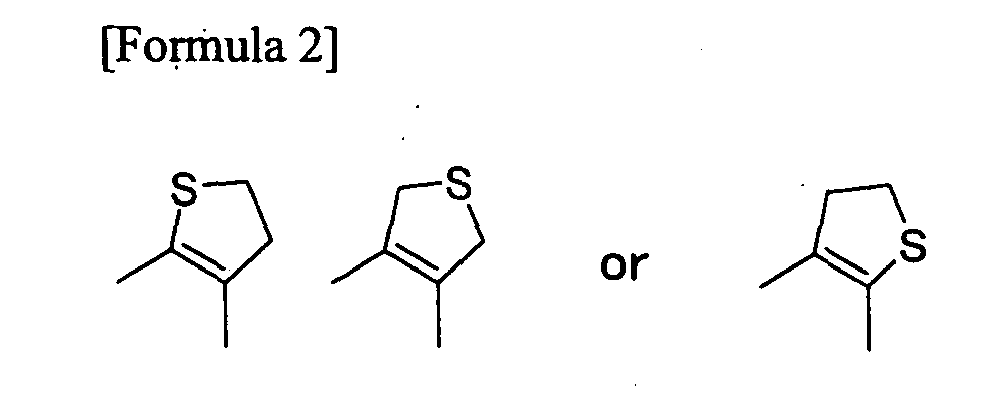


A group selected from Groups (1) to (3) below - (1) phenyl substituted with at least one halogen atom, which may have (an) additional substituent(s)
- (2) cyclopropyl, cyclobutyl, cyclopentyl, cyclohexyl, or cycloheptyl, each of which is optionally substituted
- (3) pyridyl, pyridazinyl, pyrimidinyl, pyrazinyl, pyrrolyl, thienyl, thiazolyl, oxazolyl, imidazolyl, isothiazolyl, isoxazolyl, pyrazolyl, or furyl substituted with at least one halogen atom. These rings are optionally substituted with one or more identical or different halogen atoms. These rings bond to the 2-position of the pyrimidine ring in formula (I) via a carbon atom composing said rings.
However, when A is a ring selected from Group X4, -R1 represents phenyl substituted with at least three halogen atoms. - A in formula (I) is preferably a ring selected from Group X1, and more preferably a ring selected from Group X1 in which the sulfur atom composing the ring is oxidized. The ring selected from Group X1 in which the sulfur atom composing the ring is oxidized specifically includes the following:


- R1 in formula (I) is preferably phenyl substituted with at least one halogen atom, and more preferably phenyl substituted with at least three halogen atoms. In another embodiment, R1 in formula (I) is preferably cyclopropyl, cyclobutyl, cyclopentyl, cyclohexyl, or cycloheptyl, each of which is optionally substituted; more preferably cyclobutyl or cyclopentyl, each of which is optionally substituted; and further preferably cyclobutyl or cyclopentyl.
- R2 in formula (I) is preferably optionally substituted cyclic amino; more preferably optionally substituted piperazinyl or optionally substituted piperidinyl; and further preferably optionally substituted piperidinyl.
- The condensed pyrimidine derivative represented by formula (I) is preferably a compound wherein A is a ring selected from Group X1 (the sulfur atom composing the ring may be oxidized); more preferably the one wherein A is a ring selected from Group X1 (the sulfur atom composing the ring may be oxidized) and R1 is phenyl substituted with at least one halogen atom; further preferably the one wherein A is a ring selected from Group X1 (the sulfur atom composing the ring may be oxidized) and R1 is phenyl substituted with at least three halogen atoms; particularly preferably the one wherein A is a ring selected from Group X1 (the sulfur atom composing the ring may be oxidized), R1 is phenyl substituted with at least three halogen atoms, and R2 is optionally substituted cyclic amino; and most preferably the one wherein A is a ring selected from Group X1 (the sulfur atom composing the ring may be oxidized), R1 is phenyl substituted with at least three halogen atoms, and R2 is optionally substituted piperazinyl or optionally substituted piperidinyl.
Another embodiment of the condensed pyrimidine derivative represented by formula (I) is preferably a compound wherein A is a ring selected from Group X1 (the sulfur atom composing the ring may be oxidized); more preferably the one wherein A is a ring selected from Group X1 (the sulfur atom composing the ring may be oxidized) and R1 is optionally substituted cyclobutyl or optionally substituted cyclopentyl; further preferably the one wherein A is a ring selected from Group X1 (the sulfur atom composing the ring may be oxidized) and R1 is optionally substituted cyclobutyl of optionally substituted cyclopentyl; particularly preferably the one wherein A is a ring selected from Group X1 (the sulfur atom composing the ring may be oxidized), R1 is optionally substituted cyclobutyl or optionally substituted cyclopentyl, and R2 is optionally substituted cyclic amino; and most preferably the one wherein A is a ring selected from Group X1 (the sulfur atom composing the ring may be oxidized), R1 is optionally substituted cyclobutyl or optionally substituted cyclopentyl, and R2 is optionally substituted piperazino or optionally substituted piperidino. - Particularly preferred compounds as the condensed pyrimidine derivative represented by formula (I) include
- 3-{4-[2-(4-chloro-2,5-difluorophenyl)-6,6-dioxido-5,7-dihydrothieno[3,4-d]pyrimidin-4 -yl]piperazin-1-yl}propanamide,
- 1-[2-(4-chloro-2,5-difluorophenyl)-6,6-dioidxo-5,7-dihydrothieno[3,4-d]pyrimidin-4-yl] -4-(3-hydroxypropyl)piperidin-4-ol,
- N-({[1-[2-(4-chloro-2,5-difluorophenyl)-6,6-dioxido-5,7-dihydrothieno[3,4-d]pyrimidin -4-yl]piperidin-4-yl}methyl)-2-hydxoxyacetamide,
- 3-{1-[2-(4-chloro-2,5-difluorophenyl)-6,6-dioxido-5,7-dihydrothieno[3,4-d]pyrimidin-4 -yl]piperidin-4-yl}propanamide,
- 3-({1-[2-(4-chloro-2,5-difluorophenyl)-6,6-dioxido-5,7-dihydrothieno[3,4-d]pyrimidin-4-yl]piperidin-4-yl}amino)propan-1-ol,
- 3-({1-[2-(4-chloro-2,5-difluorophenyl)-6,6-dioxido-5,7-dihydrothieno[3,4-d]pyrimidin-4-yl]piperidin-4-yl}amino)propionic acid,
- 4-[1-(2-cyclopentyl-6,6-dioxido-5,7-dihydrothieno[3,4-d]pyrimidin-4-yl)piperidin-4-yl] butyric acid,
- 4-[1-(2-cyclobutyl-6,6-dioxido-5,7-dihydrothieno[3,4-d]pyrimidm-4-yl)piperidin-4-yl]b utyric acid,
- 4-{1-[2-(4-chloro-2,5-difluorophenyl)-6,6-dioxido-5,7-dihydrothieno[3,4-d]pyrimidin-4 -yl]piperidin-4-yl}butyric acid, and pharmaceutically acceptable salts thereof.
- The compounds of the present invention have excellent activities in promoting insulin secretion and suppressing increase in blood glucose. Hence, the compounds of the present invention represented by formula (I), based on said activities, are effective to treat and/or prevent type 1 diabetes, type 2 diabetes, and/or insulin-resistant diseases.
Pharmacological action of the compounds of the present invention was confirmed by the following test examples. - In this assay, promoting activities on insulin secretion of the test compounds were studied using MIN6B1 cell, which was a strain of mouse pancreatic β-cells, and glibenclamide, which was a commercially available insulin secretion secretagogue, as a reference compound. The assay procedure is given below.
MIN6B1 cells were seeded on a 48-well plate at a concentration of 1x10⁵ cells/well (0.25 ml) (The medium was prepared by adding FCS (fetal calf serum) to DMEM (Dulbecco's Modified Eagle Medium) containing 25 mM glucose such that the FCS concentration became 10%). After two days, the medium was suctioned by an aspirator, each well was washed four times with 0.2 ml of KRB-HEPES buffer (Krebs-Ringer-bicarbonate-N-2-hydroxylethylpiperazine-N'-2-ethanesulfonic acid; 130 mM NaCl, 4.7 mM KCl, 1.2 mM KH2PO4, 1.2 mM MgCl2·6H2O, 0.25 mM CaCl2·2H2O, 2.5 mM NaHCO3, 0.5% BSA, and 10 mM N-2-hydroxyethylpiperazine-N'-2-ethanesulfonic acid (pH 7.4)) containing 2.8 mM glucose warmed to 37°C, 0.2 ml of said buffer was again added, and the cells were incubated at 37°C for 30 to 60 minutes. After the buffer was suctioned by an aspirator, 0.25 ml of a solution containing 10 µM of each test compound in KRB-HEPES containing 16.8 mM glucose was added to each well, and the cells were incubated at 37°C for 22 minutes. The samples were pipetted and diluted by 25 to 51 times, and the insulin concentrations were analyzed using an insulin assay kit (Rat Insulin [125I] Biotrak Assay System with Magnetic Separation; Amersham Bioscience K.K.). The test compounds were dissolved in 100% DMSO, and were added at the final concentration of 0.1%. The activity was expressed as a relative value, provided that insulin concentration for only DMSO was 100%. The results are shown in Table 1. -
[Table 1] Test Compound Promotion activity on insulin secretion, % Example 1 355 Example 112 242 Example 168 418 Example 269 212 Example 272 322 Example 283 375 Example 287 208 Example 288 253 Example 291 269 Example 331 308 Example 407 325 Glibenclamide 122 - In this assay, preventive activities of test compounds against hyperglycemia following glucose loading were examined using normal mice and nateglinide, a commercially available oral anti-hyperglycemic agent, as a reference compound. The assay procedure is given below.
ICR mice (male, six weeks old) that had been preliminary bred for one week were fasted for 18 to 20 hours to use as test animals. Each test compound was dissolved in 0.5% methylcellulose solution and orally administered at 3 mg/kg (10 mg/kg for nateglinide) before glucose loading. Timing to administer the test compound was selected to be optimal for each test compound, which was 10 minutes before glucose loading for the compounds of the present invention or 30 minutes before glucose loading for nateglinide, which was a reference compound. The hypoglycemic rate (%) at 30 minutes after glucose loading was measured relative to the control group. The results are shown in Table 2. -
[Table 2] Test compound Hypoglycemic rate, % Example 50 37 Example 460 30 Example 442 36 Nateglinide 26 - The compounds of the present invention are further described as follows.
In the present description, "lower" means a linear or branched carbon chain with 1 to 6 carbon atoms unless otherwise noted. Therefore, "lower alkyl" means a linear or branched C1-C6 alkyl and specifically includes, for example, methyl, ethyl, propyl, isopropyl, butyl, isobutyl, sec-butyl, tert-butyl, pentyl, neopentyl, hexyl, and others. It is preferably a C1-C3 alkyl, that is, methyl, ethyl, propyl, and isopropyl. "Lower alkenyl" means a linear or branched C2-C6 alkenyl and specifically includes, for example, vinyl, allyl, butenyl, and others. "Lower alkynyl" means a linear or branched C2-C6 alkynyl and specifically includes, for example, propargyl and others. "Lower alkylidene" means a linear or branched C1-C6 alkylidene and specifically includes, for example, methylidene, ethylidene, propylidene, and others.
"Halogen atom" means fluoro, chloro, bromo, or iodo. It is preferably fluoro, chloro, or bromo. - "Cyclic amino" means a monovalent group derived from three- to eight-membered non-aromatic cyclic amine that contains at least one nitrogen atom and optionally contains one or more identical or different additional heteroatoms selected from the group consisting of nitrogen, oxygen, and sulfur, wherein the nitrogen atom necessarily present in said ring is the bonding site. The sulfur atom on the ring in said cyclic amino may be oxidized. Specific examples include monovalent groups derived from azetidine, pyrrolidine, piperidine, azepane, azocane, piperazine, homopiperazine, morpholine, oxazepane, thiomorpholine, thiazepane, and others. These rings may contain (an) unsaturated bond(s) in part of the ring, such as dihydropyrrole, tetrahydropyridine, tetrahydroazepine, imidazolidine, oxazolidine, dihydrooxazine, thiazolidine, dihydrothiazine, and others. These rings may be condensed with a cycloalkane moiety, such as decahydroquinoline, decahydroisoquinoline, and others. These rings may be condensed with a benzene ring, such as indoline, 1,2,3,4-tetrahydroquinoline, 1,2,3,4-tetrahydroisoquinoline, and others. These rings may be condensed with another cyclic amine moiety such as octahydroimidazo[1,5-a]pyrazine, octahydro[1,2-a]pyrazine, and others. These rings may be condensed with an aromatic heterocycle, such as 2,3,4,9-tetrahydro-1H-β-carboline, 4,5,6,7-tetrahydro-1H-pyrazolo[4,3-c]pyridine, 4,5,6,7-tetrahydro-2H-pyrazolo[4,3-c]pyridine, 5,6,7,8-tetrahydro-pyrido[4,3-d]pyrimidine, and others. These rings may be spiro-condensed with a non-aromatic heterocycle, such as 1,3,8-triazaspiro[4.5]decane, 1-oxa-8-azaspiro[4.5]decane, 1,4-dioxa-8-azaspiro[4.5]decane, 2,4-dioxa-9-azaspiro[5.5]undecane, 2,8-diazaspiro[4.5]decane, and others. These rings may be bridged cyclic amino, such as monovalent groups derived from 2,5-diazabicyclo[2.2.1]heptane, 2,5-diazabicyclo[2.2.2]octane, and others.
- "Cycloalkyl" means a three- to eight-membered carbocycle, which may be partially unsaturated. Specific examples include cyclopropyl, cyclopentyl, cyclohexyl, cyclooctyl, cyclobutenyl, cyclohexenyl, cyclooctadienyl, and others. These rings may be condensed with a benzene ring.
"Heteroaryl" means a monovalent group derived from a five- to six-membered aromatic heterocycle containing one or more identical or different heteroatoms selected from the group consisting of nitrogen, oxygen, and sulfur. Specific examples include monovalent groups derived from pyrrole, pyridine, pyrazole, imidazole, pyridazine, pyrimidine, pyrazine, triazole, triazine, tetrazole, furan, thiophene, oxazole, thiazole, oxadiazole, thiadiazole, and others. These rings may be condensed with a benzene ring, such as indole, indazole, quinoline, and others, or may be partially hydrogenated, as tetrahydropyridine, tetrahydroazepine, dihydropyridine, indoline, and others.
"Non-aromatic heterocyclyl" means a monovalent group derived from a five-to six-membered saturated heterocycle containing one or more identical or different heteroatoms selected from the group consisting of nitrogen, oxygen, and optionally oxidized sulfur. Specific examples include, in addition to the above cyclic amino, monovalent groups in which an atom other than the nitrogen atom in the above cyclic amino is the bonding site, and monovalent groups derived from tetrahydrofuran, tetrahydropyran, tetrahydrothiofuran, tetrahydrothiopyran, dioxolane, 1,3-dioxane, 1,4-dioxane, and others. These rings may be bridged, such as 1-azabicyclo[2.2.1]heptane, quinuclidine, and others.
"Bridged cyclic amino" means a monovalent group in which two non-adjacent carbon atoms composing the ring in the above cyclic amino are bridged by methylene, ethylene, or trimethylene. - In "optionally substituted" or "substituted" group in the present specification, any substituent commonly found as a substituent on said group may be present. One or more of these substituents may be present on each group.
- In "phenyl substituted with at least one halogen atom, which may have (an) additional substituent(s)" represented by R1, "cyclopropyl, cyclobutyl, cyclopentyl, cyclohexyl, or cycloheptyl, each of which is optionally substituted" represented by R1, "optionally substituted cyclic amino" represented by R2, and "cycloalkyl, phenyl, heteroaryl, or non-aromatic heterocyclyl, each of which is optionally substituted" represented by R21 or R22, allowable substituents include groups given in (a) to (h) below. "Rz" represents lower alkyl optionally substituted with one or more groups selected from the group consisting of-OH, -O-(lower alkyl),-OCO-(lower alkyl), carboxyl, -CO2-(lower alkyl), -CO-(lower alkyl), carbamoyl optionally substituted with one or two lower alkyls, cyano, amino optionally substituted with one or two lower alkyls, phenyl, heteroaryl, cycloalkyl, non-aromatic heterocyclyl, and halogen atom.
- (a) Halogen atom;
- (b) -OH, -O-Rz, -O-phenyl, -OCO-Rz, -OCONH-Rz, and oxo (=O);
- (c) -SH, -S-Rz, -S-phenyl, -S-heteroaryl, -SO-Rz, -SO-phenyl, -SO-heteroaryl, -SO3H, -SO2-Rz, -SO2-phenyl optionally substituted with lower alkyl, -SO2-heteroaryl optionally substituted with lower alkyl, and sulfamoyl optionally substituted with one or two Rzs;
- (d) Amino optionally substituted with one or two Rzs, -NHCO-Rz, -NHCO-phenyl, NHCO2-Rz, NHCONH2, -NHCONH-Rz, -NHSO2-Rz, -NHSO2-phenyl, wherein the phenyl is optionally substituted with lower alkyl, -NHSO2NH2, and nitro;
- (e) -CHO, -CO-Rz, -CO2H, -CO2-Rz, carbamoyl optionally substituted with one or two Rzs, -CO-(cyclic amino) optionally substituted with -OH or oxo, -COCO-Rz, and cyano;
- (f) Phenyl or cycloalkyl each of which is optionally substituted with one or more groups selected from the group consisting of -OH, -O-(lower alkyl), oxo, -S-(lower alkyl), amino optionally substituted with one or two lower alkyls, cyclic amino, -CO2H, carbamoyl optionally substituted with one or two Rzs, halogen atom, and Rz;
- (g) Heteroaryl or non-aromatic heterocyclyl each of which is optionally substituted with -OH, -O-(lower alkyl), oxo, -S-(lower alkyl), amino optionally substituted with one or two lower alkyls, cyclic amino, -CO2H, carbamoyl optionally substituted with one or two Rzs, halogen atom, and Rz; and
- (h) Lower alkyl, lower alkenyl, or lower alkylidene each of which may be substituted with one or more groups selected from the substituents given in (a) to (g) above.
In "lower alkyl, lower alkenyl, lower alkynyl, or -O-(lower alkyl) each of which is optionally substituted" represented by R21 or R22, allowable substituents include the groups given in (a) to (g) above. - The compounds of the present invention represented by formula (I) may have (an) asymmetric carbon atom(s) depending on the substituents and optical isomers may exist based on this fact. The present invention encompasses all of mixtures and isolated compounds of these optical isomers. The compounds of the present invention may exist in a form of tautomers. Any separated tautomers and mixtures thereof are included in the present invention. The present invention also encompasses labeled species, that is, compounds in which one or more atoms in the compounds of the present invention are replaced by a radioactive isotope or non-radioactive isotope.
- The compounds of the present invention may form a salt, which is encompassed in the present invention so far as such salt is pharmaceutically acceptable. Said salts specifically include salts with an inorganic acid such as hydrochloric acid, hydrobromic acid, hydroiodic acid, sulfuric acid, nitric acid, and phosphoric acid; salts with an organic acid such as formic acid, acetic acid, propionic acid, oxalic acid, malonic acid, succinic acid, fumaric acid, maleic acid, lactic acid, malic acid, tartaric acid, citric acid, methanesulfonic acid, ethanesulfonic acid, benzenesulfonic acid, p-toluenesulfonic acid, aspartic acid, and glutamic acid; salts with an inorganic base containing a metal such as sodium, potassium, calcium, and magnesium; salts with an organic base such as methylamine, ethylamine, ethanolamine, lysine, and ornithine; ammonium salt, and others. Furthermore, the present invention encompasses various hydrates, solvates, and all crystal polymorphs of the compounds of the present invention and pharmaceutically acceptable salts thereof. The present invention encompasses all of so-called prodrugs, that is, compounds that are metabolized in vivo to be converted into the compounds represented by formula (I) or salts thereof. As groups used for forming the prodrugs of the present invention, there may be mentioned groups described in Prog. Med., 5,2157-2161 (1985) and in "Development of Drugs," Vol. 7 "Molecular Design," pp. 163-198, Hirokawa Shoten (1990).
- The compounds of the present invention and pharmaceutically acceptable salts thereof can be manufactured by applying various known synthetic methods utilizing characteristics based on the skeletal structure thereof or type of substituents. Typical preparation methods are illustrated below. They can be also manufactured according to the description in Reference Examples and Examples described hereinafter or by similar methods thereto. Depending on properties of functional groups, it is sometimes advantageous in manufacturing techniques that said functional group is replaced with an appropriate protective group, that is, group readily convertible to said functional group, in a stage of starting material or intermediate. The protective group is thereafter removed as needed to obtain desired compounds. Such functional groups include hydroxyl, carboxyl, amino, and others. Protective groups therefor include, for example, groups described in Greene and Wuts, "Protective Groups in Organic Synthesis (third edition)", which may be used as appropriate according to reaction conditions to be employed.
-

The present preparation method is a method in which an aromatic ring-condensed pyrimidine derivative having a leaving group represented by formula (1a) is reacted With an amine derivative represented by formula (1b) to manufacture the compound of the present invention represented by general formula (I).
The leaving group represented by Z in compound (1a) means a group that can be eliminated together with the hydrogen atom of the amino group in compound (1b) in a form of HZ under the reaction condition. Examples thereof include halogen atoms such as fluoro, chloro, bromo, and iodo, lower alkylsulfonyloxy groups such as methanesulfonyloxy, trihalomethanesulfonyloxy groups such as trifluoromethanesulfonyloxy, arylsulfonyloxy groups such as benzenesulfonyloxy and p-toluenesulfonyloxy, and others. - The reaction of compound (1a) with compound (1b) is conducted under normal or positive pressure in the absence of solvent or in an appropriate solvent.
Specific examples of the solvent include aromatic hydrocarbons such as toluene and xylene; ketones such as methyl ethyl ketone and methyl isobutyl ketone; ethers such as ether, tetrahydrofuran (THF), dioxane, and diglyme; alcohols such as methanol (MeOH), ethanol (EtOH), and 2-propanol (iPrOH); acetonitrile, dimethylformamide (DMF), 1,3-dimethyl-2-imidazolidinone (DMI), dimethylsulfoxide (DMSO), water, and mixtures thereof. The present reaction is preferably performed in the presence of a base, which specifically includes alkali carbonates such as sodium carbonate and potassium carbonate, alkali hydrogencarbonates such as sodium hydrogencarbonate and potassium hydrogencarbonate; tertiary amines such as triethylamine and diisopropylethylamine; and others. Excess amount of compound (1b) may be used to function as.a base. The reaction temperature is generally about 20°C to about 180°C, and preferably about 60°C to about 130°C, depending on the starting compounds, reaction conditions, and others. - Compound (1a) can be synthesized, for example, by halogenating or sulfonylating a pyrimidinone or pyrimidinethione derivative represented by formula (1c) according to common procedures.
Halogenation in the present reaction is carried out, for example, by reacting compound (1c) with a halogenating agent such as phosphorous oxychloride and phosphorous tribromide. Sulfonylation is carried out, for example, by reacting compound (1c) in which Y is an oxygen atom with a sulfonylating agent such as methanesulfonyl chloride, p-toluenesulfonyl chloride, trifluoromethanesulfonyl chloride, and trifluoromethanesulfonic anhydride. - Compound (1c) can be synthesized by a known method, for example, the methods described in J. Am. Chem. Soc., 74, 842 (1952), Chem. Ber., 95, 937 (1962), or J. Org. Chem., 29, 2887 (1964) or similar methods thereto. Compound (1b) is commercially available or can be synthesized by a known method.
Some compounds of the present invention can be manufactured from another compound of the present invention manufactured by the above preparation method, methods described in Examples, methods obvious to those skilled in the art, or variation thereof, through procedures generally used by those skilled in the art such as alkylation, acylation, substitution reaction, oxidation, reduction, and hydrolysis, which are publicly known. - The compounds of the present invention thus manufactured are purified for isolation as a free form or a salt after converting to a salt by known treatment. Isolation and purification are performed using common chemical operations such as extraction, concentration, evaporation, crystallization, filtration, recrystallization, and various chromatographic techniques.
When the compound of the present invention has an asymmetric carbon, there are optical isomers. Such optical isomers can be resolved by a common method such as fractional crystallization, in which an appropriate salt is recrystallized, and column chromatography. Optically active compounds can be also manufactured using appropriate optically active starting materials. - The drugs of the present invention can be prepared by a common method using one or more compounds of the present invention and carriers for drugs, excipients, or other additives commonly used in preparation. Administration may be in either form of oral administration of tablets, pills, capsules, granules, powder, liquids, or the like, or parenteral administration of injections such as intravenous injection and intramuscular injection or suppositories, transnasal, transmucosal, or percutaneous administration, or the like.
Solid compositions used for oral administration in the present invention include tablets, powder, granules, and others. In such solid compositions, one or more active substances are mixed with at least one inert diluent such as lactose, manitol, glucose, hydroxypropylcellulose, microcrystalline cellulose, starch, polyvinylpyrrolidone, and magnesium aluminometasilicate. Such compositions may contain, according to a common method, additives other than inert diluents, for example, lubricants such as magnesium stearate, disintegrating agents such as calcium cellulose glycolate, stabilizers, solubilizing agents, and others. Tablets or pills may be coated as needed with sugar coating or gastric soluble or enteric film such as sucrose, gelatin, hydroxypropylcellulose, and hydroxypropylmethylcellulose phthalate. - Liquid compositions for oral administration include pharmaceutically acceptable emulsion, liquid, suspension, syrup, elixir, and others. The composition contains a common inert diluent, for example, purified water or ethanol (EtOH). Such composition may contain, besides inert diluents, adjuvants such as wetting agents and suspending agents, sweeteners, flavor, fragrances, and preservatives.
Injections for parenteral administration contain sterile aqueous or non-aqueous solvent, suspension medium, or emulsifying medium. Aqueous solvent or suspension medium includes, for example, distilled water for injection and physiological saline. Non-aqueous solvent or suspension medium includes, for example, propylene glycol, polyethylene glycol, vegetable oils such as olive oil, alcohols such as EtOH and polysorbate 80 (Pharmacopoeia name), and others. Such compositions may further contain adjuvants such as preservatives, wetting agents, emulsifiers, dispersants, stabilizers, and solubilizing agents. These are sterilized, for example, by passing through a sterile bacteria filter, formulating with a bactericide, or radiation. These may be also used after manufacturing a sterile solid composition, which is dissolved in sterile water or a sterile solvent for injection prior to use. - The proper dose per day in oral administration is generally about 0.0001 to 50 mg/kg of body weight, preferably about 0.001 to 10 mg/kg, and more preferably 0.01 to 1 mg/kg, which is administered once or dividedly into two to four times. The proper dose per day in intravenous administration is about 0.0001 to 1 mg/kg of body weight, and preferably about 0.001 to 0.1 mg/kg, which is administered once per day or dividedly into multiple times per day. The dose is properly determined in accordance with each case considering symptom, age, sex; and others.
- The present invention is specifically described in accordance with Examples hereinafter, but not limited in any way by these Examples. Some starting compounds used in Examples are new substances and methods for manufacturing them from known substances are described as Reference Examples.
- A chloroform-EtOH solution of 4-chloro-2,5-difluorobenzonitrile was saturated with hydrogen chloride by bubbling, stirred at ambient temperature for 16 hours, and then concentrated to yield an imidate, which was stirred together with ammonium carbonate in EtOH at ambient temperature for 3 days to yield 4-chloro-2,5-difluorobenzenecarboxamidine.
- Compounds shown in Table 3 below were prepared similarly to Reference Example 1. Symbols in Table represent the following meaning (ditto hereinafter). Rf: Reference Example number
Data: Spectral data (MS: FAB-MS(M+H)+, MM: FAB-MS(M)+, MN: FAB-MS(M-H)-, ME: ES-MS(M+H)+, MF:ES-MS(M)+, MG: ES-MS(M)-, MH: ES-MS(M-H)-, MI: EI-MS(M+H)+, MJ: EI-MS(M)+, MA: APCI-MS(M+H)+)
Structure: Chemical structural formula
R, R1, R2: Substituents in general formula (Me; methyl, Et; ethyl, cPen; cyclopentyl, cHex; cyclohexyl, pyrr; pyrrolidin-1-yl, pipe; piperidin-1-yl, hPy; 1,2,3,6-tetrahydropyridin-1-yl, azep; azepan-1-yl, pipa; piperazin-1-yl, mor; morpholin-4-yl, hpipa; homopiperazin-1-yl, fur; furyl, Py; pyridyl, Pyox; 1-oxidopyridyl, tmor; thiomorpholin-4-yl, Ph; phenyl, Ms; methanesulfonyl, Boc; tert-butyloxycarbonyl, Ac; acetyl. di; di, tri; tri. The number preceding the substituent symbol represents the position of substitution and hence, for example, 4-(4-Py)-pipa means 4-pyridin-4-ylpiperazin-1-yl.) -
[Table 3] Rf Structure Data Rf Structure Data 1 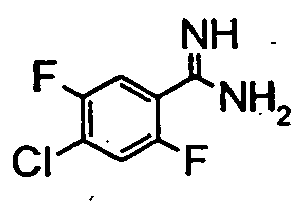
MS:191 1-1 
ME:175 1-2 
MJ:234,236 1-3 
176 [ES-MS(M+2H)+] 1-4 
MS:191 1-5 
MS:235 - A mixture of 2-chloroisonicotinonitrile, trimethylaluminum (1.01-M hexane solution), ammonium chloride, and toluene was heated under reflux with stirring for 14 hours to yield 2-chloropyidine-3-carboxamidine.
ME: 156 - A mixture of methyl 2,5-dichlorothiophene-3-caboxylate, trimethylaluminum (1.01-M hexane solution), ammonium chloride, and toluene was heated under reflux with stirring for 3 days to yield 2,5-dichlorothiophene-3-carboxamidine.
MF: 196 - A mixture of 4-chloro-2,5-difluorobenzenecarboxamidine, ethyl 4-oxotetrahydrothiophene-3-carboxylate, NaOMe, and MeOH was stirred at ambient temperature for 19 hours and then at 60°C for 5 hours to yield 2-(4-chloro-2,5-difluorophenyl)-5,7-dihydrothieno[3,4-d]pyrimidin-4(1H)-one.
- Compounds given in Tables 4 and 5 below were prepared similarly to Reference Example 4.
-
[Table 4] Rf Structure Data Rf Structure Data 4 
MS:301 4-1 
ME:285 4-2 
MF:346 4-3 
MS:285 4-4 
MS:301 4-5 
MN:343 4-6 
ME:223 4-7 
MG:304 4-8 
MH:264 4-9 
ME:267 4-10 
ME:283 4-11 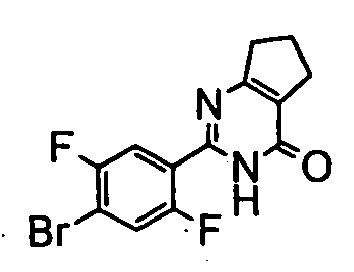
ME:327 4-12 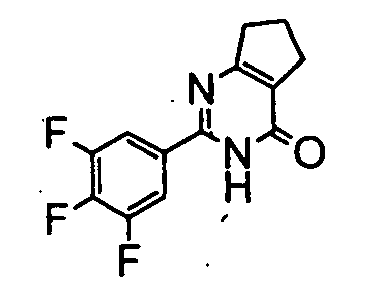
ME:267 4-13 
MS:283 -
[Table 5] Rf Structure Data Rf Structure Data 4-14 
MS:327 4-15 
MS:301 4-16 
4-17 
ME:285 4-18 
MS:384 4-19 
4-20 
- To a mixture of tert-butyl 2-(4-chloro-2,5-difluorophenyl)-4-oxo-3,5,6,7,-tetrahydro-4H-pyrrolo[3,4-d]pyrimidine-6-carboxylate, chloroform, and MeOH, 4M hydrogen chloride (HCl) in ethyl acetate (EtOAc) solution was added, and the resultant mixture was stirred at ambient temperature for 5 hours to yield
2-(4-chloro-2,5-difluorophenyl)-3,5,6,7-tetrahydro-4H-pyrrolo[3,4-d]pyrimidin-4-one hydrochloride.
MS: 284 - A mixture of 2-(4-chloro-2,5-difluorophenyl)-5,7-dihydrothieno[3,4-d]pyrimidin-4(1H)-one and phosphorous oxychloride was stirred at 90°C for 4 hours to yield 4-chloro-2-(4-chloro-2,5-difluorophenyl)-5,7-dihydrothieno[3,4-d]pyrimidine.
- Compounds given in Tables 6 and 7 below were prepared similarly to Reference Example 6.
-
[Table 6] Rf Structure Data Rf Structure Data 6 
MS:319 6-1 
MA:303 6-2 
MA:364 6-3 
MS:303 6-4 
MS:319 6-5 
MI:364 6-6 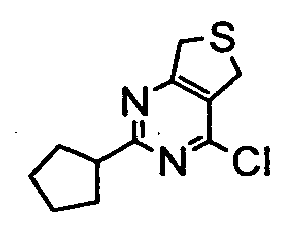
ME:241 6-7 
MS:323 6-8 
MS:284 6-9 
ME:285 6-10 
ME:301 6-11 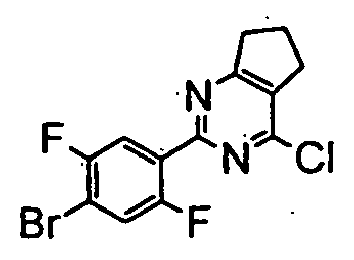
ME:345 6-12 
ME:285 6-13 
MS:301 -
[Table 7] Rf Structure Data Rf Structure Data 6-14 
MS:347 6-15 
ME:319 6-16 
MS:319 6-17 
MS:303 6-18 
6-19 
- A methylene chloride solution of 2-(4-chloro-2,5-difluorophenyl)-3,5,6,7-tetrahydro-4H-pyrrolo[3,4-d]pyrimidin-4-one hydrochloride, triethylamine, and methanesulfonyl chloride was stirred at ambient temperature for 3 hours to yield 2-(4-chloro-2,5-difluorophenyl)-6-(methylsulfonyl)-6,7-dihydro-5H-pyrrolo[3,4-d]pyri midin-4-yl methanesulfonate.
- Compounds given in Table 8 below were prepared similarly to Reference Example 7.
-
[Table 8] Rf Structure Data Rf Structure Data 7 
MS:440 7-1 
MS:462 - A mixture of 4-chloro-2-(4-chloro-2,5-difluorophenyl)-5,7-dihydrothieno[3,4-d]pyrimidine, m-chloroperbenzoic acid, and chloroform was stirred at ambient temperature for 1 hour to yield 4-chloro-2-(4-chloro-2,5-difluorophenyl)-5,7-dihydrothieno[3,4-d]pyrimidine 6,6-dioxide.
- Compounds given in Table 9 below were prepared similarly to Reference Example 8.
-
[Table 9] Rf Structure Data Rf Structure Data 8 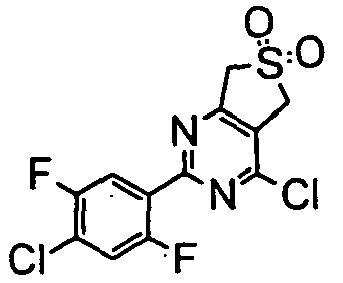
MS:351 8-1 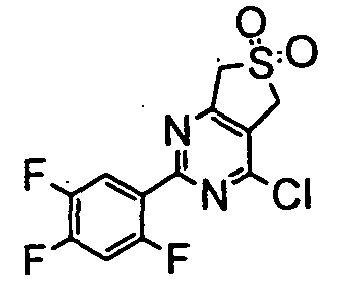
MS:335 8-2 
MM:396 8-3 
MS:335 8-4 
MS:351 8-5 
MS:397 8-6 
ME:273 8-7 
MG:354 8-8 
MH:314 8-9 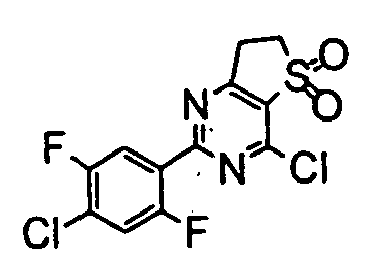
ME:351 8-10 
MS:245 8-11 
MJ:258 - A tert-butanol solution of N-methylmorpholine-N-oxide and osmium tetraoxide was added to a mixture of 1-benzyl-4-methyleneazepane hydrochloride and THF-water, and the resultant solution was stirred at ambient temperature for 24 hours and then treated with 4M HCl-EtOAc solution to yield 1-benzyl-4-(hydroxymethyl)azepan-4-ol hydrochloride. To an EtOH solution of 1-benzyl-4-(hydroxymethyl)azepan-4-ol hydrochloride obtained was added 10% palladium on activated carbon, and the suspension was stirred under hydrogen atmosphere at ambient temperature for 6 hours to yield 4-(hydroxymethyl)azepan-4-ol hydrochloride.
MS: 146 - Sodium hydride and 1-benzylazepan-3-one were added to a THF solution of ethyl diethoxyphosphorylacetate with ice-cooling, and the mixture was stirred at ambient temperature for 2 hours to yield a stereoisomeric mixture of ethyl (1-benylazepan-3-ylidene)acetate, which was treated with 4M HCl-EtOAc solution, followed by adding EtOH and 10% palladium on activated carbon and stirring under hydrogen atmosphere at ambient temperature for 15 hours to yield ethyl azepan-3-ylacetate hydrochloride.
MS:186 - A mixture of 1-tert-butoxycarbonylpiperidin-4-ol, sodium hydride, and DMF was stirred at ambient temperature for 5 minutes, here was added 2-chloro-N,N-dimethylethylamine, and the mixture was further stirred at ambient temperature for 30 minutes to yield 2-[(1-tert-butoxycarbonylpiperidin-4-yl)oxy]-N,N-dimethylethylamine, which was stirred together with 4M HCl-dioxane solution at ambient temperature for 7 hours to yield N,N-dimethyl-2-(piperidin-4-yloxy)ethylamine dihydrochloride.
MS: 273 - A mixture of 1-tert-butoxycarbonylpiperidin-4-ol, triethylamine, benzenesulfonyl chloride, and methylene chloride was stirred at ambient temperature for 2 days to yield 1-tert-butoxycarbonylpiperidin-4-yl benzenesulfonate. A mixture of 1-tert-butoxycarbonylpiperidin-4-yl benzenesulfonate obtained, diethyl malonate, 20% NaOEt-EtOH, and EtOH was heated under reflux with stirring for 22 hours to yield diethyl [1-(tert-butoxycarbonyl)piperidin-4-yl]malonate. A mixture of diethyl [1-(tert-butoxycarbonyl)piperidin-4-yl]malonate obtained, lithium borohydride, toluene, and THF was stirred at 60°C for 18 hours to yield 2-(1-tert-butoxycarbonylpiperidin-4-yl)propane-1,3-diol, which was stirred together with 4M HCl-dioxane solution in MeOH at ambient temperature for 1 hour to yield 2-piperidin-4-ylpropane-1,3-diol hydrochloride.
MS:160 - A mixture of (1-tert-butoxycarbonylpiperidine-4,4-diyl)dimethanol, 4M HCl-dioxane solution, and MeOH was stirred at ambient temperature for 2 hours to yield (piperidine-4,4-diyl)dimethanol hydrochloride.
MS: 146 - A mixture of 1-tert-butoxycarbonyl-4-(3-hydroxypropyl)piperidin-4-ol and 4M HCl-dioxane solution was stirred at ambient temperature for 3.5 hours to yield 4-(3-hydroxypropyl)piperidin-4-ol hydrochloride.
MS: 160 - A mixture of 1-tert-butoxycarbonylpiperidin-4-one and N,N-dimethylformamide dimethylacetal was heated under reflux with stirring for 6 hours to yield 1-tert-butoxycarbonyl-3-[(dimethylamino)methylene]piperidin-4-one. A mixture of 1-tert-butoxycarbonyl-3-[(dimethylamino)methylene]piperidin-4-one obtained, 2-hydrazinoethanol, and MeOH was heated under reflux with stirring for 2 hours to yield a mixture of 2-(5-tert-butoxycarbonyl-4,5,6,7-tetrahydro-2H-pyrazolo[4,3-c]pyridin-2-yl)ethanol and 2-(5-tert-butoxycarbonyl-4,5,6,7-tetrahydro-1H-pyrazolo[4,3-c]pyridin-1-yl)ethanol. A mixture of the compounds obtained, 4M HCl-EtOAc solution, and EtOH was stirred at ambient temperature for 2 hours to yield a mixture of 2-(4,5,6,7-tetrahydro-2H-pyrazolo[4,3-c]pyridin-2-yl)ethanol dihydrochloride and 2-(4,5,6,7-tetrahydro-1H-pyrazolo[4,3-c]pyridin-1-yl)ethanol dihydrochloride.
ME: 168 - A mixture of ethyl (2E)-(1-benzyl-3-methylpiperidin-4-ylidene)acetate, 1-chloroethyl chloroformate, and 1,2-dichloroethane was heated under reflux with stirring for 30 minutes and then concentrated under reduced pressure. The residue was dissolved in EtOH and the solution was heated under reflux with stirring for 10 minutes to yield ethyl (2E)-(3-methylpiperidin-4-ylidene)acetate.
MS: 184 - A mixture of 1-tert-butoxycarbonylpiperazine, 3-hydroxypropionic acid, 1-hydroxybenzotriazole (HOBt), 1-ethyl-3-(3-dimethylaminopropyl)carbodiimide hydrochloride (EDCI), and DMF was stirred at ambient temperature for 24 hours to yield 3-(4-tert-butoxycarbonylpirperazin-1-yl)-3-oxopropan-1-ol, which was stirred together with 4M HCl-dioxane solution and MeOH at ambient temperature for 16 hours to yield 3-oxo-3-piperazin-1-ylpropan-1-ol hydrochloride.
MS: 159 - A mixture of N-(2-nitrobenzenesulfonyl)ethylenediamine, 2-chloroethanesulfonyl chloride, triethylamine, and methylene chloride was stirred at 0°C for 3 hours to yield N-(2-{[(2-chloroethyl)sulfonyl]amino}ethyl)-2-nitrobenzenesulfonamide. This compound was dissolved in acetonitrile, here were added cesium carbonate and tetrabutylammonium iodide, and the mixture was stirred at 80°C for 21 hours to yield 5-[(2-nitrophenyl)sulfonyl]-1,2,5-thiadiazepane 1,1-dioxide. This compound was dissolved in acetonitrile, here were added 4-methylbenzenethiol and potassium carbonate, and the mixture was stirred at 50°C for 21 hours to yield 1,2,5-thiadiazepane 1,1-dioxide.
- A mixture of N-(2-nitrobenzenesulfonyl)ethylenediamine, 3-hydroxy-2,2-dimethylpropionic acid, EDCI, HOBt, methylene chloride, and DMF was stirred at ambient temperature for 4 hours to yield 3-hydroxy-2,2-dimethyl-N-(2-{[(2-nitrophenyl)sulfonyl]amino}ethyl)propanamide. A mixture of this compound, triphenylphosphine, a toluene solution of diethyl azodicarboxylate, and THF was stirred at 0°C for 15 hours to yield 6,6-dimethyl-1-[(2-nitrophenyl)sulfonyl]-1,4-diazepan-5-one. A mixture of this compound, 4-methylbenzenethiol, potassium carbonate, and acetonitrile was stirred at ambient temperature for 3 hours to yield 6,6-dimethyl-1,4-diazepan-5-one.
- A mixture of 410 mg of 4-chloro-2-(4-chloro-2,5-difluorophenyl)-5,7-dihydrothieno[3,4-d]pyrimidine 6,6-dioxide, 323 mg of (R)-3-methylpiperidinium (R)-mandelate, 0.60 ml of diisopropylethylamine, and 10 ml of acetonitrile was stirred at 70°C for 2 hours. To the reaction mixture was added 20 ml of water, the mixture was extracted with 20 ml of EtOAc. The organic phase obtained was washed with brine and dried over anhydrous magnesium sulfate, and the solvent was distilled off under reduced pressure. The residue obtained was purified by silica-gel column chromatography (hexane-EtOAc) to yield 0.40 g of solid. To this solid were added 4 ml of EtOH, 8 ml of EtOAc, and 0.5 ml of 4M HCl-EtOAc solution in turn, and the mixture was stirred at ambient temperature. The solvent was distilled off under reduced pressure, and 4 ml of EtOAc was added to the residue to precipitate white solid, which was collected by filtration to yield 188 mg of (R)-2-(4-chloro-2,5-difluorophenyl)-4-(3-methylpiperidin-l-yl)-5,7-dihydrothieno[3,4-d ]pyrimidine 6,6-dioxide hydrochloride.
- A mixture of 37.04 g ethyl 4-{1-[2-(4-chloro-2,5-difluorophenyl)-6,7-dihydro-5H-cyclopenta[d]pyrimidin-4-yl]pip eridin-4-yl}butanoate, 160 ml of 1M aqueous sodium hydroxide, and 400 ml of THF-EtOH (1:1) was stirred at ambient temperature for 4 hours. To the reaction mixture, 160 ml of 1M hydrochloric acid aqueous solution and 700 ml of water were added, and the mixture was extracted twice with chloroform. The organic phase obtained was dried over anhydrous magnesium sulfate, and the solvent was distilled off under reduced pressure. The solid obtained was dissolved in 300 ml of THF, 50 ml of 4M HCl-EtOAc solution was added, the solution was concentrated under reduced pressure, and the resultant solid was recrystallized from water-acetonitrile to yield 25.35 g of 4-{1-[2-(4-chloro-2,5-difluorophenyl)-6,7-dihydro-5H-cyclopenta[d]pyrimidin-4yl]pipe ridin-4-yl}butanoic acid hydrochloride.
- A mixture of 390 mg of ethyl {1-[2-(4-chloro-2,5-difluorophenyl)-6,6-dioxo-5,7-dihydrothieno[3,4-d]pyrimidin-4-yl] piperidin-4-ylidene}acetate, 10 ml of 6M hydrochloric acid aqueous solution, and 10 ml of THF was stirred at 90°C for 5.5 hours. The solvent was distilled off under reduced pressure, and the resultant solid was recrystallized from water-acetonitrile to yield 126 mg of {1-[2-(4-chloro-2,5-difluorophenyl)-6,6-dioxo-5,7-dihydroflieno[3,4-d]pyrimidin-4-yl] piperidin-4-ylidene}acetic acid hydrochloride.
- A mixture of 503 mg of 1-tert-butoxycarbonyl-4-[2-(4-chloro-2,5-difluorophenyl)-5,7-dihydrothieno[3,4-d]pyri midin-4-yl]piperazine, 2 ml ofMeOH, and 6 ml of 4M HCl-dioxane solution was stirred at ambient temperature for 1 hour. To the reaction mixture were added 15 ml of 1M aqueous sodium hydroxide and 2 ml of diethyl ether, and the precipitate was collected by filtration, washed with water and then diethyl ether, and dried under reduced pressure. The solid obtained was dissolved in 5 ml of MeOH, here was added 2 ml of 4M HCl-dioxane solution, and the solvent was then distilled off under reduced pressure. The residue obtained was washed with EtOH-EtOAc and dried under reduced pressure to yield 423 mg of 2-(4-chloro-2,5-difluorophenyl)-4-piperazin-1-yl-5,7-dihydrothieno[3,4-d]pyrimidine dihydrochloride.
- A mixture of 350 mg of 2-(4-chloro-2,5-difluorophenyl)-4-(piperazin-1-yl)-5,7-dihydrothieno[3,4-d]pyrimidine dihydrochloride, 72 mg of hydroxyacetic acid, 0.22 ml of triethylamine, 128 mg of HOBt, 182 mg of EDCI, and 10 ml of DMF was stirred at ambient temperature for 17 hours. To the reaction mixture 100 ml of water was added, and the precipitate was collected by filtration, washed with water, and dried under reduced pressure at 50°C. The solid obtained was dissolved in 15 ml of THF, here was added 2 ml of 4M HCl-dioxane solution, and the solution was concentrated under reduced pressure to yield solid, which was recrystallized from acetonitrile-ether to yield 315 mg of 2-{4-[2-(4-chloro-2,5-difluorophenyl)-5,7-dihydrotheino[3,4-d]pyrimidin-4-yl]piperazi n-1-yl}-2-oxoethanol hydrochloride.
- To a mixture of 364 mg of 2-(4-chloro-2,5-difluorophenyl)-4-(piperazin-1-yl)-5,7-dihydrothieno[3,4-d]pyrimidine dihydrochloride, 0.71 ml of diisopropylethylamine, and 10 ml of DMF, 0.08 ml of methanesulfonyl chloride was added, and the resultant mixture was stirred at ambient temperature for 19 hours. To the reaction mixture was added 100 ml of water, and the precipitate was collected by filtration, washed with water, and dried under reduced pressure at 50°C to yield 329 mg of faint brown solid. This solid was dissolved in 15 ml of THF, here was added 2 ml of 4M HCl-dioxane solution, and the solvent was distilled off under reduced pressure, the resultant residue was recrystallized from acetonitrile-water-ether to yield 314 mg of 2-(4-chloro-2,5-difluorophenyl)-4-[4-(methylsulfonyl)piperazin-1-yl]-5,7-dihydrothieno [3,4-d]pyrimidine hydrochloride.
- A mixture of 246 mg of [1-(2-cyclopentyl-6,6-dioxo-5,7-dihydrothieno[3,4-d]pyrimidin-4-yl)piperidin-4-yl]acet ic acid, 75 mg of ammonium carbonate, 0.11 g of HOBt, 0.16 g of EDCI, and 6 ml of DMF was stirred at ambient temperature for 3 days. The solvent was distilled off under reduced pressure, water was added to the residue, and the mixture was extracted with EtOAc. The organic phase obtained was washed with a saturated aqueous sodium bicarbonate and brine and dried over anhydrous magnesium sulfate, and the solvent was distilled off under reduced pressure. The residue obtained was purified by silica-gel column chromatography (chloroform-MeOH) to yield a foamy product. This product was dissolved in THF, here was added 4M HCl-dioxane solution, the solution was concentrated under reduced pressure, the residue was washed with ether to yield 184 mg of [1-(2-cyclopentyl-6,6-dioxo-5,7-dihydrothieno[3,4-d]pyrimidin-4-yl)piperidin-4-yl]acet amide hydrochloride.
- To a mixture of 500 mg of 1-[6,6-dioxido-2-(2,4,5-trifluorophenyl)-5,7-dihydrothieno[3,4-d]pyrimidin-4-yl]-1,4-di azepan-5-one and 5 ml of DMSO, 89 mg of sodium thiomethoxide was added, the mixture was stirred at ambient temperature for 1 hour, here was then added 21 mg of sodium thiomethoxide, and the mixture was stirred at ambient temperature for 30 minutes. To the reaction mixture was added 50 ml of water, and the precipitate was collected by filtration, washed with water, and dried under reduced pressure. The filtrate was separately extracted with a mixture of EtOAc and THF, the organic phase obtained was dried over anhydrous magnesium sulfate, the solvent was distilled off under reduced pressure, and the solid obtained was combined with the former solid. The mixture was purified by silica-gel column chromatography (chloroform-MeOH) to yield 352 mg of 1-{2-[2,5-difluoro-4-(methylthio)phenyl]-6,6-dioxido-5,7-dihydrothieno[3,4-d]pyrimidi n-4-yl}-1,4-diazepan-5-one.
- To a mixture of 300 mg of 1-[6,6-dioxido-2-(2,4,5-trifluorophenyl)-5,7-dihydrothieno[3,4-d]pyrimidin-4-yl]-1,4-di azepan-5-one and 6 ml of DMSO, 95 mg of potassium cyanide and 383 mg of 18-crown-6-ether were added, and the mixture was stirred at ambient temperature for 1 hour and then at 80°C for 1.5 hour. To the reaction mixture was added 30 ml of water, the product was extracted with EtOAc-THF mixed solvent. The organic phase obtained was washed with brine, dried over anhydrous magnesium sulfate, and evaporated under reduced pressure. The residue obtained was purified by silica-gel column chromatography (chloroform-MeOH) to yield 49 mg of solid, which was washed with acetonitrile-diethyl ether to yield 39 mg of 4-[6,6-dioxido-4-(5-oxo-1,4-diazepan-1-yl)-5,7-dihydrothieno[3,4-d]pyrimidin-2-yl]-2, 5-difluorobenzonitrile.
- To a mixture of 547 mg of ethyl 3-{1-[2-(4-chloro-2,5-difluorophenyl)-6,6-dioxido-5,7-dihydrothieno[3,4-d]pyrimidin-4 -yl]piperidin-4-yl}propionate, 5 ml of THF, and 5 ml of ethanol, was added 59 mg of lithium borohydride with ice-cooling, the resultant mixture was stirred at ambient temperature for 18 hours and then at 60°C for 3 days. To this mixture was added dropwise 20 ml of 1M hydrochloric acid aqueous solution with ice-cooling, the resultant mixture was stirred at ambient temperature for 10 minutes, and then 50 ml of 1M aqueous sodium hydroxide was added. The precipitate was collected by filtration, washed with water, dried under reduced pressure, and purified by silica-gel column chromatography (chloroform-MeOH) to yield 280 mg of solid. This solid was dissolved in THF, here was added 4M HCl-dioxane solution, the solution was concentrated under reduced pressure, and the resultant residue was recrystallized from acetonitrile-diethyl ether to yield 256 mg of 3-{1-[2-(4-chloro-2,5-difluorophenyl)-6,6-dioxido-5,7-dihydrothieno[3,4-d]pyrimidin-4 -yl}piperidin-4-yl}propan-1-ol hydrochloride.
- A mixture of 400 mg of 1-[2-(4-chloro-2,5-difluorophenyl)-6,6-dioxido,5,7-dihydrothieno[3,4-d]pyrimidin-4-yl] piperidin-4-one, 10 ml of methylene chloride, 65 µl of aminoethanol, and two drops of acetic acid was stirred at ambient temperature for 1 hour, here was then added 617 mg of sodium triacetoxyborohydride, and the mixture was stirred at ambient temperature for 3 hours. Saturated aqueous sodium bicarbonate was added to the reaction mixture, and the resultant mixture was extracted with chloroform-THF mixed solvent. The organic phase obtained was washed with brine and dried over anhydrous magnesium sulfate, and the solvent was distilled off under reduced pressure. The residue obtained was dissolved in THF-MeOH, here was added 4M HCl-dioxane solution, the solution was concentrated under reduced pressure, and the residue was recrystallized from EtOH-acetonitrile to yield 426 mg of 2-({1-[2-(4-chloro-2,5-difluorophenyl)-6,6-dioxido-5,7-dihydrothieno[3,4-d]pyrimidin-4-yl]piperidin-4-yl}amino)ethanol dihydrochloride.
- To a mixture of 200 mg of 8-[2-(4-chloro-2,5-difluorophenyl)-6,6-dioxido-5,7-dihydrothieno[3,4-d]pyrimidin-4-yl] -2,8-diazaspiro[4.5]decane dihydrochloride and 10 ml of acetonitrile, were added 263 mg of potassium carbonate, 6 mg of potassium iodide, and 89 µl of (2-bromoethoxy)(tert-butyl)dimethylsilane, and the mixture was stirred at 60°C for 3 days. Water was added to the mixture, and the resultant mixture was extracted with EtOAc. The organic phase obtained was washed with 10% aqueous citric acid, brine, saturated aqueous sodium bicarbonate, and brine in turn and dried over anhydrous magnesium sulfate, and the solvent was distilled off under reduced pressure. The residue obtained was purified by silica-gel column chromatography (chloroform-methanol) to yield 199 mg of solid. To this solid were added 5 ml of 4M HCl-dioxane a solution and 2 ml of methanol, the mixture was stirred at ambient temperature for 1 hour and then concentrated under reduced pressure, and the residue was recrystallized from EtOH-acetonitrile-diethyl ether to yield 169 mg of 2-{8-[2(4-chloro-2,5-difluorophenyl)-6,6-dioxido-5,7-dihydrothieno[3,4-d]pyrimidin-4-yl]-2,8-diazaspiro[4.5]decan-2-yl}ethanol dihydrochloride.
- To a mixture of 200 mg of (2Z)-3-{1-[2-(4-chloro-2,5-difluorophenyl)-6,6-dioxido-5,7-dihydrothieno[3,4-d]pyrimi din-4-yl]piperidin-4-yl}acrylic acid, 5 ml of THF, and 47 µl of 4-methylmorpholine, 1 ml of a THF solution containing 56 µl of isobutyl chloroformate was added dropwise at -10 to -15°C, the mixture was stirred at this temperature for 50 minutes, then here was added 25 mg of sodium borohydride, and the mixture was stirred at ambient temperature for 30 minutes. To the reaction mixture was added 3 ml of ethanol, and the resultant mixture was stirred at ambient temperature for 30 minutes, then water and 1M hydrochloric acid aqueous solution were added, and the mixture was stirred for 15 minutes. The reaction mixture was made alkaline by adding 1M aqueous sodium hydroxide aqueous solution and then extracted with EtOAc. The organic phase obtained was dried over anhydrous magnesium sulfate, and the solvent was distilled off under reduced pressure. The residue obtained was purified by silica-gel column chromatography (chloroform-MeOH) to yield 108 mg of solid. This solid was dissolved in THF, here was added 4M HCl-dioxane solution, the solution was concentrated under reduced pressure, and the residue was recrystallized from acetonitrile-diethyl ether to yield 62 mg of (2Z)-3-{ 1-[2-(4-chloro-2,5-difluorophenyl)-6,6-dioxido-5,7-dihydrothieno[3,4-d]pyrimi din-4-yl]piperidin-4-yl}prop-2-en-1-ol hydrochloride.
- A mixture of 264 mg of 2-(4-chloro-2,5-difluorophenyl)-4-(2,3,6,7-tetrahydro-1H-azepin-1-yl)-5,7-dihydrothien o[3,4-d]pyrimidine 6,6-dioxide, a few drops of 2.5-wt% tert-BuOH solution of osmium tetraoxide, 75 mg of N-methylmorpholine-N-oxide, 6 ml of THF, and 3 ml of water ,was stirred at ambient temperature for 4.5 hours. Aqueous sodium thiosulfate solution was added to the reaction mixture, and the precipitate was collected by filtration, washed with 50 ml of water and 50 ml of EtOAc-hexane (1:1), and dried under reduced pressure at 70°C to yield 244 mg of colorless solid. This solid was dissolved in THF, here was added 4M HCl-dioxane solution, the solvent was distilled off under reduced pressure, and the residue was washed with EtOH to yield 264 mg of (4R,5S)-1-[2-(4-chloro-2,5-difluorophenyl)-6,6-dioxido-5,7-dihydrothieno[3,4-d]pyrimi din-4-yl]azepan-4,5-diol hydrochloride.
- A mixture of 321 mg of 1-[2-(4-chloro-2,5-difluorophenyl)-6,6-dioxido-5,7-dihydrothieno[3,4-d]pyrimidin-4-yl] -1,4-diazepan-5-one and 10 ml of 5% sulfuric acid was stirred at 100°C for 27 hours. After the solvent was distilled off under reduced pressure, 10 ml of dioxane, 10 ml of saturated aqueous sodium bicarbonate solution, and 0.18 g of DIBOC (tert-butoxycarbonyl anhydride) were added in turn to the residue obtained, and the mixture was stirred at ambient temperature for 1 hour. Precipitate was filtered, and the filtrate was evaporated under reduced pressure. The residue was dissolved in chloroform, washed with 5% aqueous citric acid solution and then water, and dried over anhydrous magnesium sulfate. The solvent was distilled off under reduced pressure, and 4M HCl-dioxane solution was added to the residue, the resultant solution was stirred, and then the solvent was distilled off under reduced pressure. To the residue was added saturated aqueous sodium bicarbonate solution, the aqueous solution was washed with chloroform, added 5% aqueous citric acid, and extracted with chloroform. The organic extract was washed with water, and the solvent was distilled off under reduced pressure. The residue was dissolved in THF, here was added 4M HCl-dioxane solution, precipitate was collected by filtration to yield 92 mg of N-(2-aminoethyl)-N-[2-(4-chloro-2,5-difluorophenyl)-6,6-dioxido-5,7-dihydrothieno[3, 4-d]pyrimidin-4-yl]-β-alanine dihydrochloride as colorless solid.
- A mixture of 2.20 g of 2-{1-[2-(4-chloro-2,5-difluorophenyl)-6,6-dioxido-5,7-dihydrothieno[3,4-d]pyrimidin-4 -yl]piperidin-4-yl}acetamide and 20 ml of phosphorous oxychloride was stirred at 100°C for 30 minutes. Excess phosphorous oxychloride was distilled off under reduced pressure, saturated aqueous sodium bicarbonate solution and EtOAc were added to the residue. Precipitate was collected by filtration, washed with water and EtOAc, and dried under reduced pressure at 70°C to yield 1.69 g of faint brown solid. This solid was dissolved in THF-MeOH, here was added 4M HCl-dioxane solution, the solvent was distilled off under reduced pressure, and the residue was washed with acetonitrile to yield 81 mg of {1-[2-chloro-2,5-difluorophenyl]-6,6-dioxido-5,7-dihydrothieno[3,4-d]pyrimidin-4-yl}p iperidin-4-yl}acetonitrile hydrochloride as colorless solid.
- A mixture of 571 mg of 1-[2-(4-chloro-2,5-difluorophenyl)-6,6-dioxido-5,7-dihydrothieno[3,4-d]pyrimidin-4-yl] piperidin-4-ol, 0.30 g of 4-nitrophenyl chloroformate, 0.12 ml of pyridine, and 10 ml of methylene chloride was stirred at ambient temperature for 17 hours. Saturated aqueous ammonium chloride solution was added to the reaction mixture, and the mixture was extracted twice with chloroform. The organic phase was washed with brine, dried over anhydrous magnesium sulfate, and evaporated under reduced pressure to yield 894 mg of 1-[2-(4-chloro-2,5-difluorophenyl)-6,6-dioxido-5,7-dihydrothieno[3,4-d]pyrimidin-4-yl] piperidin-4-yl 4-nitrophenyl carbonate as light yellow solid.
A mixture of 300 mg of 1-[2-(4-chloro-2,5-difluorophenyl)-6,6-dioxido-5,7-dihydrothieno[3,4-d]pyrimidin-4-yl] piperidin-4-yl 4-nitrophenyl carbonate, 43 mg of 2-(methylamino)ethanol, and 5 ml of DMF was stirred at ambient temperature for 19.5 hours. Saturated aqueous sodium bicarbonate solution was added to the reaction mixture, the mixture was extracted twice with chloroform. The organic phase was washed with brine, dried over anhydrous magnesium sulfate, and evaporated under reduced pressure. The yellow oil obtained was dissolved in THF, here was added 4M HCl-dioxane solution, and the solution was concentrated under reduced pressure to give solid, which was recrystallized from acetonitrile-ether to yield 120 mg of 1-[2-(4-chloro-2,5-difluorophenyl)-6,6-dioxido-5,7-dihydrothieno[3,4-d]pyrimidin-4-yl] piperidin-4-yl (2-hydroxyethyl)methylcarbamate hydrochloride as colorless solid. - A mixture of 230 mg of 1-[2-(4-chloro-2,5-difluorophenyl)-6,6-dioxido-5,7-dihydrothieno[3,4-d]pyrimidin-4-yl] piperidin-4-one, 140 mg of ethyl 4-aminobutyrate hydrochloride, 0.1 ml of acetic acid, 5 ml of dichloroethane, and 5 ml of DMF was stirred at ambient temperature for 1 hour, here was then added 353 mg of sodium triacetoxyborohydride, and the mixture was stirred at ambient temperature for 19 hours. Saturated aqueous sodium bicarbonate solution was added to the reaction mixture, the mixture was extracted twice with chloroform, the organic phase was washed with brine and dried over anhydrous magnesium sulfate, and the solvent was distilled off under reduced pressure. The residue obtained was purified by silica-gel column chromatography (chloroform-MeOH) to yield 128 mg of ethyl 4-({1-[2-(4-chloro-2,5-difluorophenyl)-6,6-dioxido-5,7-dihydrothieno[3,4-d]pyrimidin-4-yl]piperidin-4-yl}amino)butanoate and 91 mg of 1-{1-[2-(4-chloro-2,5-difluorophenyl)-6,6-dioxido-5,7-dihydrothieno[3,4-d]pyrimidin-4 -yl]piperidin-4-yl}pyrrolidin-2-one. Recrystallization of the latter from EtOH gave 65 mg of 1-{1-[2-(4-chloro-2,5-difluorophenyl)-6,6-dioxido-5,7-dihydrothieno[3,4-d]pyrimidin-4 -yl]piperidin-4-yl}pyrrolidin-2-one as colorless solid.
- A mixture of 254 mg of 2-{1-[2-(4-chloro-2,5-difluorophenyl)-6,6-dioxido-5,7-dihydrothieno[3,4-d]pyrimidin-4 -yl]piperidin-4-yl}amino)ethanol, 103 mg of NaOMe, 0.2 ml of diethyl carbonate, and 5 ml of MeOH was stirred at 70°C for 46 hours. Water was added to the reaction mixture, and precipitate was collected by filtration, washed with water, and dried under reduced pressure at 70°C to yield 193 mg of solid. The solid obtained was dissolved in THF-MeOH, here was added 4M HCl-dioxane solution, and the solution was concentrated under reduced pressure. Recrystallization of the resultant solid from EtOH-acetonitrile-ether gave 172 mg of 3-{1-[2-(4-chloro-2,5-difluorophenyl)-6,6-dioxido-5,7-dihydrothieno[3,4-d]pyrimidin-4 -yl]piperidin-4-yl}-1,3-oxazolidin-2-one hydrochloride as light yellow solid.
- A mixture of 208 mg of 2-(4-chloro-2,5-difluorophenyl)-4-piperazin-1-yl-5,7-dihydrothieno[3,4-d]pyrimidine 6,6-dioxide dihydrochloride, 0.19 ml ofdiisopropylethylamine, 0.1 ml of ethyl isocyanate, and 5 ml of DMF was stirred at ambient temperature for 1 hour. Water was added to the reaction mixture, and precipitate was collected by filtration, washed with water, and dried under reduced pressure at 70°C to yield 193 mg of colorless solid. The solid obtained was dissolved in THF, here was added 4M HCl-dioxane solution, and the solution was concentrated under reduced pressure to yield solid, which was recrystallized from EtOH-acetonitrile to yield 159 mg of 4-[2-(4-chloro-2,5-difluorophenyl)-6,6-dioxido-5,7-dihydrothieno[3,4-d]pyrimidin-4-yl] -N-ethylpiperazine-1-carboxamide hydrochloride as colorless solid.
- In 5 ml of methylene chloride was dissolved 180 mg of trans-4-{[2-(4-chloro-2,5-difluoropherxyl)-6,6-dioxido-5,7-dihydrothieno[3,4-d]pyrimidi n-4-yl]amino}cyclohexanol, here was added 0.11 ml of DAST ((diethylamino)sulfur trifluoride) at -78°C, and the mixture was stirred for 3 hours. Saturated aqueous sodium bicarbonate solution was added to the reaction mixture, and the mixture was extracted twice with chloroform. The organic phase was washed with brine, dried over anhydrous magnesium sulfate, and evaporated under reduced pressure. The residue obtained was purified by silica-gel column chromatography (hexane-EtOAc) to yield 137 mg of colorless solid. This solid was dissolved in THF, here was added 4M HCl-dioxane solution, the solution was concentrated under reduced pressure, and the residue was washed with EtOH to yield 83 mg of 2-(4-chloro-2,5-difluorophenyl)-N-cyclohex-3-en-1-yl-5,7-dihydrothieno[3,4-d]pyrimid ine-4-amine 6,6-dioxide hydrochloride as colorless solid.
- A mixture of 600 mg of 4-chloro-2-(4-chloro-2,5-difluorophenyl)-5,7-dihydrothieno[3,4-d]pyrimidine 6,6-dioxide, 367 mg of 4-(3-hydroxypropyl)piperidin-4-ol hydrochloride, 0.90 ml of diisopropylethylamine, and 10 ml of acetonitrile was stirred at 70°C for 12 hours. To the reaction mixture, 20 ml of water was added, and the mixture was extracted with 30 ml of chloroform. The organic phase obtained was washed with brine and dried over anhydrous magnesium sulfate, and the solvent was distilled off under reduced pressure. To the residue obtained were added in turn 10 ml of EtOH and 2 ml of 4M HCl-dioxane solution, the solvent was distilled off under reduced pressure, EtOH and EtOAc were added to the residue, the resultant mixture was heated with stirring and then allowed to cool, and precipitate was separated by filtration. To the filtrate was added triethylamine, the solvent was distilled off under reduced pressure, and the residue was purified by silica-gel column chromatography (chloroform-MeOH) to yield 120 mg of an oil. To this oil were added in turn 10 ml of THF and 0.5 ml of 4M HCl-dioxane solution, and the solvent was distilled off under reduced pressure. The residue obtained was recrystallized from THF-diethyl ether to yield 64 mg of 3-{1-[2-(4-chloro-2,5-difluorophenyl)-6,6-dioxido-5,7-dihydrothieno[3,4-d]pyrimidin-4 -yl]-4-hydroxypiperidin-4-yl}propyl acetate hydrochloride.
- The compounds given in Tables 10 to 31 below were prepared using the above methods, methods obvious to those skilled in the art, or modified methods thereof. Chemical structures and spectral data of these compounds in Examples are shown in Tables. Symbols in Tables have the following meanings (ditto hereinafter). Ex: Example number (a line wherein only a numeral is given in the column of Ex means that the compound in said Example number is hydrochloride; whereas a line wherein a numeral is followed by slash (/) and "f" means that the compound in said Example number is a free form.)
-
[Table 10] 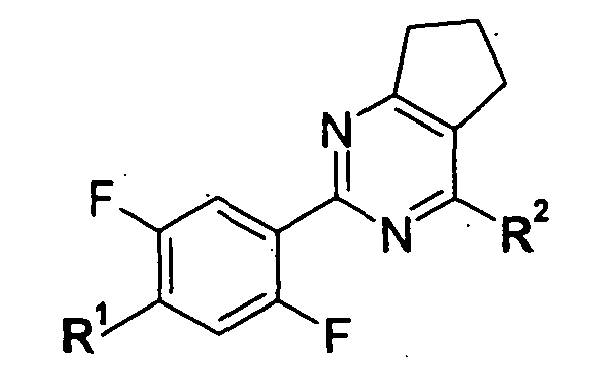
Ex R1 R2 Data 2 Cl 4-(HO2C(CH2)3)-pipe MS:436 23 F 4-(HO2CCH2)-pipe MS:392 24/f F 4-(EtO2CCH2)-pipe 25 F 4-(HO2C(CH2)2)-pipe MS:406 26/f F 4-(EtO2C(CH2)2)-pipe 27 F 4-(HO2C(CH2)3)-pipe MS:420 28/f F 4-(EtO2C(CH2)3)-pipe 29 F (S)-3-(HO2CCH2)-pipe MS:392 30/f F (S)-3-(EtO2CCH2)-pipe 31 F (S)-3-(HO2C(CH2)2)-pipe MS:406 32/f F (S)-3-(EtO2C(CH2)2)-pipe 33 F 4-(HO2CCH2)-hPy MS:390 34/f F 4-(EtO2CCH2)-hPy 35 Cl 4-(EtO2C)-azep MS:436 36 Cl 4-(HO2C)-azep MS:408 37 Cl (S)-3-(HO2C(CH2)2)-pipe MS:422 38/f Cl (S)-3-(EtO2C(CH2)2)-pipe MS:450 39 Cl (R)-3-(HO2C(CH2)2)-pipe MS:422 40/f Cl (R)-3-(EtO2C(CH2)2)-pipe MS:450 41 Cl 4-(HOCH2CO)-pipa MS:409 42 Cl 4-Ms-pipa MS:429 43 Cl 2-(HO2CCH2)-mor MS:410 44/f Cl 2-(EtO2CCH2)-mor 45 Cl 3-(HO2CCH2)-pipa MS:409 46/f Cl 3-(MeO2CCH2)-pipa 47 Cl 3-(HO2C(CH2)2)-pipe MS:422 48/f Cl 3-(MeO2C(CH2)2)-pipe 49 Cl mor MS:352 50 Cl pipe MS:350 -
[Table 11] 
Ex R1 R2 Data 51 Cl azep MS:364 52/f Cl 4-Me-pipe MS:364 53/f Cl 4-(EtO2C)-pipe MS:422 54 Cl 4-(HO2C)-pipe MS:394 55 Cl 4-(HOCH2)-pipe MS:380 56 Cl 4-(HO(CH2)2)-pipe MS:394 57 Cl 4-Ac-pipa MS:393 58 Cl 4-(HO(CH2)2)-pipa MS:395 59 Cl 4-(HO2C(CH2)2)-pipe MS:422 60 Cl 1,4-dioxa-8-azaspiro[4.5]decan-8-yl MS:408 61 Cl pipa MS:351 62/f Cl 4-Boc-pipa MS:451 63 Cl hpipa MS:365 64/f Cl 4-Boe-hpipa MS:465 65 Cl azocan-1-yl MS:378 66 Cl 4-(EtO2CCH2)-pipe MS:436 67 Cl 4-(H2NCO)-pipe MS:393 68 Cl 3-Me-pipe MS:364 69 Cl 4-(HO2CCH2)-pipe MS:408 70 Cl 5-oxo-hpipa MS:379 71 Cl (R)-3-(HO2CCH2)-pipe MS:408 72/f Cl (R)-3-(EtO2CCH2)-pipe MS:436 73 Cl (S)-3-(HO2CCH2)-pipe MS:408 74/f Cl (S)-3-(EtO2CCH2)-pipe MS:436 75 Cl 3-(HO2CCH2)-pipe MS:408 76/f Cl 3-(EtO2CCH2)-pipe MS:436 77 Cl 4-(HO2CCH2)-hPy MS:406 78/f Cl 4-(EtO2CCH2)-hPy MS:434 79 Cl (Z)-4-(carboxymethylene)-pipe MS:406 -
[Table 12] 
Ex R1 R2 Data 80/f Cl (Z)-4-(ethoxycarbonylmethylene)-pipe MS:434 81/f Cl 4-(F2HCCO)-pipa ME:429 82/f Cl 4-(2-fur-CO)-pipa ME:445 83/f Cl 4-((HO)(Et)(Me)CCO))-pipa ME:451 84/f Cl 4-(HO(CH2)2CO)-pipa ME:423 85/f Cl 4-(HOCH(Me)CH2CO)-pipa ME:437 86/f Cl 4-(5-OHC-2-fur-CO)-pipa ME:473 87/f Cl 4-(HOCH2C(Me)2CO)-pipa ME:451 88/f Cl 4-(EtOCH2CO)-pipa ME:437 89/f Cl 4-((HOCH2)2C(Me)CO)-pipa ME:467 90/f Cl 4-(CH3CO(CH2)2CO)-pipa ME:449 91/f Cl 4-(3-oxo-cPen-CO)-pipa ME:461 92/f Cl 4-(tetrahydrofuran-3-yl-CO)-pipa ME:449 93/f Cl 4-(EtO2CCH2CO)-pipa ME:465 94/f Cl 4-(3-oxo-cHex-CO)-pipa ME:475 95/f Cl 4-((5-oxopyrrolidin-2-yl)SCH2CO)-pipa ME:508 96/f Cl 4-(cyclopenten-4-yl-CO)-pipa ME:445 97/f Cl 4-(2-fur-CONHCH2CO)-pipa ME:502 98/f Cl 4-(EtO2d(CH2)3CO)-pipa ME:493 99/f Cl 4-((2,5-dioxoimidazolidin-4-yl)CH2CO)-pipa ME:491 100/f Cl 4-(3-H2N-pyrazin-2-yl-CO)-pipa ME:472 101/f Cl 4-(2-HO2C-cPen-CO)-pipa ME:491 102/f Cl 4-(2-HO2C-cHex-CO)-pipa ME:505 103/f Cl 4-(5-HO2C-2-fur-CH2NH)-pipe ME:489 104/f Cl 4-(3,5-diOH-Ph-CH2NH)-pipe ME:487 105/f Cl 4-(2-HO2C-Ph-CH2NH)-pipe ME:499 -
[Table 13] 
Ex R1 R2 Data 106/f Cl 4-(2-HO-3-MeO-Ph-CH2NH)-pipe ME:501 107/f Cl 4-(5-O2N-2-fur-CH2NH)-pipe ME:490 108/f Cl 4-(thiazol-2-yl-CH2NH)-pipe ME:462 109/f Cl 4-(4-Pyox-CH2NH)-pipe ME:472 110/f Cl 4-(quinolin-4-yl-CH2NH)-pipe ME:506 111/f Cl 4-(3-HO2C-4,5,6,7-tetrahydrobenzofuran-4-yl-NH)-pipe ME:529 112 Br mor MS:396 113 Br 4-(HO2CCH2)-pipe MS:452 114/f Br 4-(EtO2CCH2)-pipe 115 Br 4-(HO2C(CH2)2)-pipe MS:466 116/f Br 4-(EtO2C(CH2)2)-pipe 117 Br 4-(HO2C(CH2)3)-pipe MS:480 118/f Br 4-(EtO2C(CH2)3)-pipe 119 Br (S)-3-(HO2C(CH2)2)-pipe MS:466 120/f Br (S)-3-(EtO2C(CH2)2)-pipe 121 Br 4-(HO2CCH2)-hPy MS:450 122/f Br 4-(EtO2CCH2)-hPy 123 Br (S)-3-(HO2CCH2)-pipe MS:452 124/f Br (S)-3-(EtO2CCH2)-pipe -
[Table 14] 
Ex R1 R2 Data 125 F 4-(HO2CCH2)-pipe MS:392 126 F 4-(HO2C(CH2)2)-pipe MS:406 127 F 4-(HO2C(CH2)3)-pipe MS:420 128 F (S)-3-(HO2CCH2)-pipe MS:392 129 F 4-(HO2CCH2)-hPy MS:390 130 F (S)-3-(HO2C(CH2)2)-pipe MS:406 131 Cl 4-(HO2CCH2)-pipe MS:408 132 Cl 4-(HO2C(CH2)2)-pipe MS:422 133 Cl 4-(HO2C(CH2)3)-pipe MS:436 134 Cl (S)-3-(HO2CCH2)-pipe MS:408 135 Cl (S)-3-(HO2C(CH2)2)-pipe MS:422 136 Cl 4-(HO2CCH2)-hPy MS:406 137 Br 4-(HO2CCH2)-pipe ME:452 138/f Br 4-(EtO2CCH2)-pipe MS:480 139 Br 4-(HO2C(CH2)2)-pipe ME:466 140/f Br 4-(EtO2C(CH2)2)-pipe MS:494 141 Br 4-(HO2C(CH2)3)-pipe MF:481 142/f Br 4-(EtO2C(CH2)3)-pipe MS:508 143 Br (S)-3-(HO2CCH2)-pipe ME:452 144/f Br (S)-3-(EtO2CCH2)-pipe MS:480 145 Br (S)-3-(HO2C(CH2)2)-pipe ME:468 146/f Br (S)-3-(EtO2C(CH2)2)-pipe MS:494 147 Br 4-(HO2CCH2)-hPy MS:450 146/f Br 4-(EtO2CCH2)-hPy MS:478 -
[Table 15] 
Ex R1 R2 Data 4 Cl pipa ME:369 5 Cl 4-(HOCH2CO)-pipa MS:427 6 Cl 4-Ms-pipa MS:447 149 F 4-(HO2CCH2)-hPy MS:408 150/f F 4-(HO2CCH2)-pipe MS:410 151/f F 4-(HO2C(CH2)2)-pipe MS:424 152/f F 4-(HO2C(CH2)3)-pipe MS:438 153/f F (S)-3-(HO2C(CH2)2)-pipe MS:424 154 F (S)-3-(HO2CCH2)-pipe MS:410 155 Cl 4-(HO2C(CH2)2)-pipe MS:440 156 Cl 4-(HO2C(CH2)3)-pipe MS:454 157/f Cl 4-Boc-pipa MS:469 158 Cl hpipa ME:383 159/f Cl 4-Boc-hpipa MS:483 160 Cl 3-Me-pipe MS:382 161 Cl 2,3,6,7-tetrahydro-1H-azepin-1 -yl MS:380 162 Cl azep ME:382 163 Cl 4-(HO2C)-pipe MS:412 164/f Cl 4-(EtO2C)-pipe MS:440 165 Cl 5-oxo-hpipa MS:397 166 Cl 4-(HO2CCH2)-pipe MS:426 167/f Cl 4-(EtO2CCH2)-pipe MS:454 168 Cl pipe MS:368 169 Cl mor MS:370 170 Cl 4-HO-pipe MS:384 171 Cl 3-(HO2CCH2)-pipe MS:426 172/f Cl 3-(EtO2CCH2)-pipe ME:454 173 Cl 4-(HO2C)-azep MS:426 174/f Cl 4-(EtO2C)-azep MS:454 -
[Table 16] 
Ex R1 R2 Data 175 Cl (S)-3-(HO2C(CH2)2)-pipe MS:440 176/f Cl (S)-3-(EtO2C(CH2)2)-pipe MS:468 177 Cl (R)-3-HO2C(CH2)2-pipe MS:440 178/f Cl (R)-3-(EtO2C(CH2)2)-pipe MN:466 179 Cl 3-(HO2CCH2)-azep MS:440 180/f Cl 3-(EtO2CCH2)-azep MS:468 181 Cl 4-(HQ2CCH2)-hPy MS:424 182/f Cl 4-(EtO2CCH2)-hPy MS:452 183 Cl (S)-3-(HO2CCH2)-pipe MS:426 184/f Cl (S)-3-(EtO2CCH2)-pipe MS:454 185 Cl 2-(HO2CCH2)-mor MS:428 186/f Cl 2-(EtO2CCH2)-mor 187 Cl 4-Ac-pipa MS:411 188 Cl 4-(HO(CH2)2)-pipa MS:413 189 Cl 4-(H2NOCCH2)-pipe MS:425 190 Cl 4-(MeHNOCCH2)-pipe MS:439 191 Cl 4-(Me2NOCCH2)-pipe MS:453 192 Cl 4-(HO2CCH2)-pipa MS:427 193 Cl 4-(H2NOCCH2)-pipa MS:426 194 Cl 4-(MeHNOCCH2)-pipa MS:440 195 Br 4-(HO2CCH2)-hPy MM:469 196/f Br 4-(HO2CCH2)-pipe MM:471 197/f Br 4-(HO2C(CH2)2)-pipe MM:485 198/f Br 4-(HO2C(CH2)3)-pipe MM:499 199 Br (S)-3-(HO2CCH2)-pipe MS:471 200 Br (S)-3-(HO2C(CH2)2)-pipe MM:485 -
[Table 17] 
Ex R1 R2 Data 201 F 4-(HO2CCH2)-pipe MS:410 202 F 4-(HO2C(CH2)2)-pipe MS:424 203 F 4-(HO2C(CH2)3)-pipe MS:438 204 F (S)-3-(HO2CCH2)-pipe MS:410 205 F (S)-3-(HO2C(CH2)2)-pipe MS:424 206 F 4-(HO2CCH2)-hPy MS:408 207/f Cl 4-(HO2C(CH2)3)-pipe ME:454 208/f Cl 4-(EtO2C(CH2)3)-pipe 209 Cl 4-(carboxymethylene)-pipe MS:424 210/f Cl 4-(ethoxycarbonylmethylene)-pi pe MS:452 211 Br 4-(HO2C(CH2)3)-pipe ME:498 212/f Br 4-(EtO2C(CH2)3)-pipe MS:526 213 Br (S)-3-(HO2CCH2)-pipe ME:470 214/f Br (S)-3-(EtO2CCH2)-pipe MS:498 215 Br (S)-3-(HO2C(CH2)2)-pipe MF:485 216/f Br (S)-3-(EtO2C(CH2)2)-pipe MS:512 217 Br 4-(HO2CCH2)-hPy MS:468 218/f Br 4-(EtO2CCH2)-hPy MS:496 219 Br 4-(HO2CCH2)-pipe MS:470 220/f Br 4-(EtO2CCH2)-pipe MS:498 221/f Br 4-(HO2C(CH2)2)-pipe ME:486 222/f Br 4-(EtO2C(CH2)2)-pipe MS:512 -
[Table 18] 
Ex R1 R2 Data 1 Cl (R)-3-Me-pipe MS:414 3 Cl 4-(carboxymethylene)-pipe MS:456 8/f MeS- 5-oxo-hpipa ME:441 9/f cyano 5-oxo-hpipa ME:420 10 Cl 4-(HO(CH2)3)-pipe MS:458 11 Cl 4-(HO(CH2)2HN)-pipe MS:459 12 Cl 2-(HO(CH2)2)-2,8-diazaspiro [4.5]dec-8-yl MS:499 13 Cl (Z)-4-(HOCH2CH=CH)-pipe MS:456 14 Cl (4R,5S)-4,5-diOH-azep MI:446 15 Cl (H2N(CH2)2)(HO2C(CH2)2)N- MS:447 16 Cl 4-(cyano-CH2)-pipe MS:439 17 Cl 4-((HO(CH2)2)(Me)NOCO)-pipe MS:517 18/f Cl 4-(2-oxo-pyrr)-pipe MS:483 19 Cl . 4-(2-oxo-1,3-oxazolidin-3-yl)-pi pe MS:485 20 Cl 4-(EtHNOC)-pipa MS:472 21 Cl (cyclohexen-4-yl)NH- MS:412 22 Cl 4-OH-4-(AcO(CH2)3)-pipe MS:516 223 F 4-(HO(CH2)2CO)-pipa ME:457 224 F 4-(HOCH2CO)-hpipa ME:457 225 F 4-(HO(CH2)2)-hpipa MS:443 226 F 4-Ac-pipa ME:427 227 F 4-(4-Py)-pipa ME:462 228 F 4-pipe-pipe ME:467 229 F 4-(Me2NSO2)-pipa ME:492 230/f F 4-(HO2CCH2)-pipa MS:443 -
[Table 19] 
EX R1 R2 Data 231 F 4-(HOCH2CO)-pipa ME:443 232 F 5-oxo-hpipa ME:413 233 F 4-HO-pipe ME:400 234 F 4-(HOCH2)-pipe ME:414 235 F 4-(HO(CH2)2)-pipe MS:428 236 F 4-(HO(CH2)2)-pipa ME:429 237 F 5-oxo-1,4-diazocan-1-yl MS:427 238 F 4-OH-4-(HOCH2)-pipe MS:430 239 F 4-(HO2CCH2)-pipe MS:442 240 F 4-(HO(CH2)3)-pipe MS:442 241 F (4R,5S)-4,5-diOH-azep MN:428 242 F 4-(H2NOCCH2)-pipe MS:441 243 F 4-(MeHNOCCH2)-pipe MS:455 244/f F 4-(H2NOCCH2)-pipa MS:442 245 Cl (S)-3-(HO2CCH2)-pipe MS:458 246/f Cl (S)-3-(EtO2CCH2)-pipe 247 Cl 4-(HO2CCH2)-pipe MS:458 248/f Cl 4-(EtO2CCH2)-pipe 249 Cl HOCH2CH(OH)CH2NH- MS:406 250 Cl Me2CHCH2NH- MS:388 251/f Cl mor MS:402 252/f Cl 1,1-dioxo-tmor MS:450 253 Cl 5-oxo-hpipa MS:429 254 Cl 4-HO-pipe MS:416 255 Cl 4-(HOCH2)-pipe MS:430 256 Cl 4-(HO(CH2)2)-pipe MS:444 257 Cl 4-CHO(CH2)2)-pipa MS:445 -
[Table 20] 
Ex R1 R2 Data 258 Cl 4-(HO2C(CH2)2)-pipe MS:472 259/f Cl 4-(EtO2C(CH2)2)-pipe MS:500 260 Cl 4-(HO2CCH2)-hPy MS:456 261/f Cl 4-(EtO2CCH2)-hPy MS:484 262 Cl hpipa MS:415 263/f Cl 4-Boc-hpipa MS:515 264 Cl pipa MS:401 265/f Cl 4-Boc-pipa MS:501 266 Cl 4-(HOCH2CO)-pipa ME:459 267 Cl 4-(HO(CH2)2CO)-pipa ME:473 268 Cl 4-(HOCH2CO)-hpipa ME:473 269 Cl 4-(H2NCO(CH2)2)-pipa ME:472 270 Cl 4-(HO(CH2)2O(CH2)2)-pipa ME:489 271 Cl 4-((HOCH2)2CH)-pipe ME:474 272 Cl 4-(HO(CH2)3)-4-OH-pipe ME:474 273/f Cl 4-(ethoxycarbonylmethylene)-pipe MS:484 274 Cl 4-(3-iPr-1,2,4-oxadiazol-5-yl)-pipe MS:510 275 Cl 4-(2-PyS)-pipe MS:509 276/f Cl 3-F3C-5,6-dihydro[1,2,4]triazolo [4,3-a]pyrazin-7(8H)-yl MS:507 277 Cl 4-OH-4-(HOCH2)-pipe MS:446 278 Cl 1,4,6,7-tetrahydro-5H-imidazo [4,5-c]pyridin-5-yl MS:438 279 Cl (S)-3-(HO(CH2)2)-pipe MS:444 280 Cl 2,8-diazaspiro[4.5]dee-8-yl MS:455 -
[Table 21] 
Ex R1 R2 Data 281 Cl (S)-3-(H2NOCCH2)-pipe MS:457 282 Cl (S)-3-(MeHNOCCH2)-pipe MS:471 283 Cl 4-(H2NOC(CH2)2)-pipe MS:471 284 Cl (E)-4-(H2NOCCH=CH)-pipe MS:469 285 Cl (Z)-4-(H2NOCCH=CH)-pipe MS:469 286 Cl 2-(HOCH2OC)-2,8-diazaspiro [4.5]dec-8-yl MS:513 287 Cl 4-(HO(CH2)3HN)-pipe MS:473 288 Cl 4-(HO2C(CH2)2HN)-pipe MS:487 289 Cl (E)-4-(HO2CCH=CH)-pipe MS:470 290 Cl 2-Ac-2,8-diazaspiro[4.5]dec-8-yl MS:497 291 Cl 4-(HO2C(CH2)3)-pipe MS:486 292 Cl 4-(HO(CH2)4)-pipe MS:472 293 Cl (3R,4S)-3,4-diOH-pyrr MS:418 294 Cl (Z)-4-(HO2CCH=CH)-pipe MS:470 295 Cl 4-(MeHNOC(CH2)2)-pipe MS:485 296 Cl 4-(H2NOC(CH2)3)-pipe MS:485 297 Cl 4-(MeHNOC(CH2)3)-pipe MS:499 298 Cl (E)-4-(HOCH2CH=CH)-pipe MS:456 299 Cl 4-(iPrHNOCCH2)-pipa MS:500 300 Cl 4-(H2NOCCH2)-pipa MS:458 301 Cl 4-(MeHNOCCH2)-pipa MS:472 302 Cl 4-(Me2NOCCH2)-pipa MS:486 303 Cl (R)-4-(3-OH-pyrr)-pipe MS:485 304 Cl (S)-4-(3-OH-pyrr)-pipe MS:485 305 Cl (S)-4-(2-H2NOC-pyrr)-pipe ME:512 -
[Table 22] 
Ex R1 R2 Data 306 Cl (S)-4-(3-F-pyrr)-pipe MS:487 307 Cl (R)-4-(3-F-pyrr)-pipe MS:487 308/f Cl 5-oxo-1,4-diazocan-1-yl MS:443 309/f Cl 4-oxo-1,5-diazocan-1-yl MS:443 310/f Cl 5-oxo-6,6-diMe-hpipa MS:457 311/f Cl 3-oxo-pipa MI:415 312 Cl 4-HO2C-pipe MI:444 313 Cl 4-(Me2NOC)-pipe MS:471 314/f Cl 4-(H2NOC)-pipe MS:443 315 Cl 3-oxo-2,8-diazaspiro[4.5]dec-8-yl MS:469 316/f Cl 4-(HO(CH2)2)-5-oxo-hpipa MI:473 317/f Cl 4-(MeHNOC)-pipe MS:457 318/f Cl 4-(HO(CH2)2HNOC)-pipe MS:487 319 Cl 4-((HO(CH2)2)(Me)NOC)-pipe MS:501 320/f Cl 4-Me-5-oxo-hpipa MS:443 321 Cl 2,4,6,7-tetrahydro-5H-pyrazolo [4,3-c]pyridin-5-yl MS:438 322/f Cl 4-(AcHNCH2)-pipe MS:471 323 Cl 4-H2N-pipe MS:415 324 Cl 7,8-dihydropyrido[4,3-d] pyrimidin-6(5H)-yl MN:448 325/f Cl 1,1-dioxido-1,2,5-thiadiazepan-5-yl MI:465 326 Cl 4-(H2NOCCH2)-pipe MN:455 327 Cl 4-Me2N-pipe MS:443 328 Cl 4-(H2NCH2)-pipe MS:429 329 Cl (S)-3-OH-pyrr MS:402 330 Cl (R)-3-OH-pyrr MS:402 -
[Table 23] 
Ex R1 R2 Data 331 Cl 4-(HOCH2OCHNCH2)-pipe MS:487 332 Cl 4-(HO(CH2)3HNOC)-pipe MS:501 333 Cl 4-(HOCH2OCHN)-pipe MS:473 334 Cl 4-(H2NOCCH2)-hPy MS:455 335 Cl 4-(HO2C(CH2)3HNOC)-pipe MS:529 336 Cl 4-(HO2C(CH2)2HNOC)-pipe MS:515 337 Cl 4-OH-4-(HO2CC≡C)-pipe MS:484 338 Cl 4-(HO(CH2)2HNOCO)-pipe MS:503 339 Cl 4-(MeHNOCCH2)-pipe MS:471 340 Cl 4-(HO(CH2)2)-hPy MS:442 341 Cl (HO(CH2)2)NH- MI:376 342 Cl (3-Py(CH2)2)NH- MI:437 343 Cl trans-(4-OH-cHex)NH- MI:430 344 Cl (HO(CH2)2)(Me)N- MI:390 345 Cl (F(CH2)2)NH- MI:378 346 Cl 4-((HO(CH2)2)(Me)N)-pipe MS:473 347 Cl 4-(F(CH2)2NH)-pipe MS:461 348 Cl 4-(F3CCH2NH)-pipe MS:497 349 Cl 4-(pyrazol-1-yl)-pipe MS:466 350 Cl 4-(3-F3C-pyrazol-1-yl)-pipe MS:534 351 Cl 4-(2H-triazol-2-yl)-pipe MS:467 352 Cl 4-pyrr-pipe MS:469 353 Cl 4-(thiazol-2-yl)-pipa MS:484 354 Cl cis-3,4-diOH-pipe MS:432 355 Cl (3S)-4-((3-OH-pyrr)OC)-pipe MS:513 -
[Table 24] 
Ex R1 R2 Data 356 Cl (3R)-4-((3-OH-pyrr)OC)-pipe MS:513 357 Cl 4-(pyrazol-3-yl)-pipe MS:466 358 Cl 4-OH-4-nBu-pipe MS:472 359 Cl (1S,4S)-5-Boc-2,5-diazabicyclo [2.2.1]heptan-1-yl MS:513 360 Cl (1S,4S)-5-Ac-2,5-diazabicyclo [2.2.1]heptan-1-yl MS:455 361 Cl (1S,4S)-2,5-diazabicyclo [2.2.1]heptan-1-yl MS:413 362/f Cl 4-EtO2C-pipa MS:473 363 Cl 4-(EtO2CCH2)-pipe MS:486 364 Cl 4-(EtHNOCHNCH2)-pipe MS:500 365 Br 4-(HOCH2CO)-pipa ME:503,505 366 Br 4-(HO(CH2)2CO)-pipa ME:517,519 367 Br 4-(HOCH2CO)-hpipa ME:517,519 368 Br 5-oxo-hpipa ME:473,475 369 Br 4-HO-pipe ME:460,462 370 Br 4-(HOCH2)-pipe ME:474,476 371 Br 4-(HO(CH2)2)-pipe ME:488,490 372 Br 4-(HO(CH2)2)-pipa ME:489,491 373/f Br 5-oxo-1,4-diazocan-1-yl MI:488 374 MeS(O)- 5-oxo-hpipa ME:457 375/f MeS(O)2- 5-oxo-hpipa ME:473 -
[Table 25] 
Ex R1 R2 Data 376 F 4-HO-pipe MS:400 377/f F 4-(HOCH2)-pipe MS:414 378/f F 5-oxo-hpipa MS:413 379 F 4-(HO(CH2)2)-pipa MS:429 380/f F 4-(HO(CH2)2)-pipa MS:420 381 F 4-(HO(CH2)2)-pipe MS:428 382/f Cl 4-HO-pipe MS:416 383/f Cl 4-(HOCH2)-pipe MS:430 384 Cl 4-(HO(CH2)2)-pipe MS:444 385 Cl 5-oxo-hpipa MS:429 386 Cl 4-(HO(CH2)2)-pipa ME:445 387 Cl 4-(3-(HOCH2)-pipe)-pipe MF:513 388 Br 4-HO-pipe ME:460 389 Br 4-(HOCH2)-pipe ME:476 390 Br 4-(HO(CH2)2)-pipe ME:490 391 Br 5-oxo-hpipa ME:473 392 Br 4-(HO(CH2)2)-pipa ME:491 -
[Table 26] 
Ex R1 R2 Data 393 cPr pipe MS:294 394 cPr mor MS:296 395 cPr azep MS:308 396 cPen pipe MS:322 397 cPen mor MS:324 398 cPen azep MS:336 399 cPen 1,4-oxazepan-4-yl MS:338 400 cPen (4R,5S)-4,5-diOH-azep MS:368 401 cPen ((CH3)2CHCH2)NH- MS:310 402 cPen trans-(4-OH-cHex)NH- MS:352 403 cPen ((CH3)2CHCH2)(Me)N- MS:324 404 cPen cHex(Me)N- MS:350 405 cPen (HO(CH2)2)(Me)N- MS:312 406 cPr 4-(HO2C(CH2)3)-pipe MS:380 407 cPen 4-(HO2C(CH2)3)-pipe MS:408 408 cPr 4-(H2NOC(CH2)3)-pipe MS:379 409 cPen 4-(H2NOC(CH2)3)-pipe MS:407 410/f cPen 4-(HOCH2)-pipe MS:352 411 cPen 5-oxo-hpipa MS:351 412 cPen 4-(3-iPr-1,2,4-oxadiazol-5-yl)-pipe MS:432 413 cPen 4-(HO2CCH2)-pipe MS:380 414 cPen 4-(H2NOCCH2)-pipe MS:379 415 cPen 5-oxo-1,4-diazocan-1-yl MS:365 416 cPen 4-(HO(CH2)4)-pipe MS:394 417 cPen 4-(HO(CH2)3)-pipe MS:380 418 cPr 4-(HO(CH2)3)-pipe MS:352 419 cPr 4-(EtO2C(CH2)3)-pipe MS:408 420 cPr 4-(H2NOC(CH2)2)-pipe MS:365 -
[Table 27] 
Ex R1 R2 Data 421 cPr 1,4-oxazepan-4-yl MS:310 422 cPr 4-((HOCH2)2CH)-pipe MS:368 423 cPr 4-OH-4-(HOCH2)-pipe MS:340 424 cPr 4-OH-4-(HO(CH2)3)-pipe MS:368 425 cPr hPy MS:292 426 cPr pyrr MS:280 427 cPr 4-(HO(CH2)2)-pipa MS:339 428 cPr ((CH3)2CHCH2)NH- MS:282 429 cPr cHex(Me)N- MS:322 430 cBu 4-(EtO2C(CH2)3)-pipe MS:422 431 cBu 4-(H2NOC(CH2)2)-pipe MS:379 432 cBu 1,4-oxazepan-4-yl MS:324 433 cPen 4-(HO(CH2)2)-pipe MS:366 434 cPen 4-(EtO2C(CH2)2)-pipe MS:422 435 cPen 4-(H2NOC(CH2)2)-pipe MS:393 436 cPen 4-((HOCH2)2CH)-pipe MS:396 437 cPen 4-OH-4-(HOCH2)-pipe MS:368 438 cPen 4-OH-4-(HO(CH2)3)-pipe MS:396 439 cPr (R)-3-Me-pipe MS:308 440 cPr 4-(HO(CH2)4)-pipe MS:366 441 cPr 4-(HO2C(CH2)2)-pipe MS:366 442 cBu 4-(HO2C(CH2)3)-pipe MS:394 443 cBu 4-(HO2C(CH2)2)-pipe MS:380 444 cPen 4-(HO2C(CH2)2)-pipe MS:394 445 cBu 4-(HO(CH2)4)-pipe MS:380 446 cBu 4-(H2NOC(CH2)3)-pipe MS:393 447 cPr 1-oxa-8-azaspiro[4.5]dec-8-yl MS:350 448 cPr (S)-3-Me-pipe MS:308 -
[Table 28] 
Ex R1 R2 Data 449 cPr (S)-2-THF-CH2NH- MS:310 450 cPr (R)-2-THF-CH2NH- MS:310 451 cBu pipe MS:308 452 cPr 1,3-thiazolidin-3-yl MS:298 453 cBu 5-oxo-hpipa MS:337 454 cBu 4-(HOCH2)-pipe MS:338 455 cPr 5-oxo-hpipa MS:323 456 cPr 4-(HOCH2)-pipe MS:324 457 cPr 4-(HO(CH2)2)-pipe MS:338 458 2,5-diCl-3-the 4-(HOCH2)-pipe MS:434 459/f 2-Cl-4-Py 4-(HOCH2)-pipe MI:395 -
[Table 29] 
Ex R1 
R2 Data 7 cPen 
4-(H2NOCCH2)-pipe MS:379 460 2,5-diF-4-Cl-Ph 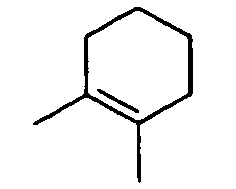
mor MS:366 461 2,5-diF-4-Cl-Ph 
mor ME:431 462 2,5-diF-4-Cl-Ph 
mor MS:370 463 2,5-diF-4-Cl-Ph 
mor MS:370 -
[Table 30] 
Ex R1 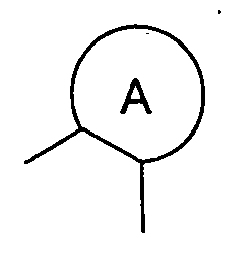
R2 Data 464 2,5-diF-4-Cl-Ph 
mor MS:354 465 2,5-diF-4-Cl-Ph 
4-HO-pipe MS:384 466 2,5-diF-4-Cl-Ph 
azep MS:365 467 2,5-diF-4-Cl-Ph 
4-(HO2CCH2)-pipe MS:426 468 2,5-diF-4-Cl-Ph 
4-(HO2CCH2)-pipe MS:458 469 2,5-diF-4-Cl-Ph 
4-(HO2CCH2)-hPy MS:424 -
[Table 31] 
Ex R1 
R2 Data 470/f 2,5-diF-4-Cl-Ph 
4-(EtO2CCH2)-hPy MS:452 471/f 2,5-diF-4-Cl-Ph 
4-(HOCH2)-pipe MS:430 472 cPen 
4-(HO2CCH2)-pipe MS:348 473/f cPen 
4-(HOCH2)-pipe MS:352 474 cPen 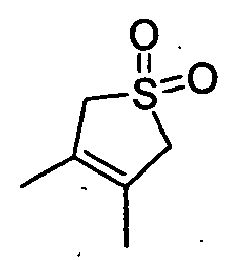
5-oxo-hpipa MS:351 475 cPen 
3-iPr-1,2,4-oxadiazol-5-yl MS:432 476 cPen 
4-(HO2CCH2)-pipe MS:380 - NMR data of compounds in some Examples are given in Tables 32 to 37 below.
Symbols in Tables represent following meaning.
NMR: NMR data (δ(ppm) of peaks in 1H-NMR measured using tetramethylsilane as an internal standard and DMSO-d6 as a solvent unless specifically noted). -
[Table 32] Ex Data 1 NMR:0.90(3H,d),1.14-1.26(1H,m),1.44-1.58(1H,m),1.60-1.84(3H,m),2.74(1H,dd),2.9 7-3.07(1H,m),4.08-4.22(2H,m),4.51(2H,s),4.69(2H,s),7.77(1H,dd),7.97(1H,dd). 2 NMR:1.10-1.28(4H,m),1.46-1.59(2H,m),1.59-1.72(1H,m),1.76-1.88(2H,m),2. 05-2.16(2H,m),2.17-2.25(2H,m),2.95-3.04(2H,m),3.07-3.25(4H,m),4.51-4.75 (2H,m),7.94(1H,dd),8.06(1H,dd). 3 NMR:2.40-2.48(2H,m),2.93-3.06(2H,m),3.68-3.82(4H,m),4.54(2H,s),4.76(2 H,s),5.74(1H,s),7.77(1H,dd),8.00(1H,dd). 6 NMR:2.90(3H,s),3.23(4H,dd),3.88(4H,dd),4.10-4.23(2H,m),4.33-4.45(2H,m), 6.25-7.50(1H,br),7.77(1H,dd),8.01(1H,dd). 11 NMR:1.55-1.75(2H,m),2.10-2.25(2H,m),2.90-3.20(4H,m),3.30-3.50(1H,m),3. 71(2H,t),4.30-4.45(2H,m);4.55(2H,s);4.73(2H,s),5.50-5.90(2H,br),7.78(1H,d d),8.00(1H,dd),9.05-9.30(2H,br). 14 NMR:1.70-1.84(2H,m),1.88-2.02(2H,m),3.54-3.82(6H,m),4.48(2H,s),4:74(2 H,s);7.72-7.80(1H,dd),7.92-8.01(1H,dd). 21 NMR:1.50-1.70(1H,m),1.90-2.02(1H,m),2.02-2.22(3H,m),2.34-2.46(1H,m),4. 15-4.30(1H,m),4.39(2H,s),4.51(2H,s),5.40-5.74(2H,m),7.40-7.52(1H,d),7.70-7.80(1H,dd),7.88-7.98(1H,dd). 31 NMR:1.26-1.34(1H,m),1.42-1.59(4H,m),1.77-1.82(2H,m),2.07-2.14(2H,m),2. 28-2.32(2H,m),2.97-3.25(6H,m),4.45-4.48(2H,m),7.83(1H,ddd),8.11(1H,dd d). 41 NMR:2.08(2H,quintet), 2.95(2H,t), 3.13(2H,t), 3.40-3.75(4H,m), 3.75-4.00(4H, m), 4.14(2H,s), 7.88(1H,dd), 8.04(1H,dd). 54 NMR:1.55-1.70(2H,m), 1.90-2.20(4H,m), 2.60-2.75(1H,m), 2.90-3.03(2H,m), 3. 05-3.20(2H,m), 3.25-3.40(2H,m), 4.40-4.60(2H,m), 7.93(2H,dd), 8.05(2H,dd). 79 NMR:2.02-2.16(2H,m), 2.44-2.52(2H,m), 2.93-3.06(4H,m), 3.14.3.21(2H,m), 3. 88-4.02(4H,m), 5.76(1H,s), 7.91(1H,dd), 8.06(1H,dd). 149 NMR:2.21-2.33(2H,m), 2.98-3.06(2H,m), 3.83-3.92(2H,m), 4.15-4.22(2H,m), 4. 26-4.35(2H,m), 4.43-4.50(2H,m), 5.58-5.65(1H,m), 7.65-7.77(1H,m), 8.00-8.13 (1H,m). 150 NMR:1:13-1.32(2H,m),1.70-1.82(2H,m),1.96-2.03(1H,m),2.14-2.21(2H,m),2. 95-3.10(2H,m),4.08-4.16(2H,m),4.31-4.38(2H,m),4.38-4.47(2H,m),7.55-7.67 (1H,m),7.91-8.05(1H,m). 152 NMR:1.03-1.30(4H,m),1.45-1.63(3H,m),1.66-1.80(2H,m),2.20(2H,t),2.91-3.0 5(2H,m),4.07-4.14(2H,m),4.30-4.38(2H,m),4.38-4.50(2H,m),7.50-7.68(1H, m),7.92-8.05(1H,m). 153 NMR:1.13-1.30(1H,m),1.36-1.60(4H,m),1.65-1.77(1H,m),1.77-1.92(1H,m),2. 29(2H,t),2.71-2.83(1H,m),2.95-3.08(1H,m),4.05-4.17(2H,m),4.24-4.44(4H, m),7.55-7.68(1H,m),7.93-8.06(1H,m),12.04(1H,s). -
[Table 33] Ex Data 154 NMR:1.24-1.40(1H,m), 1.44.1.62(1H,m), 1.66-1.79(1H,m), 1.79-1.88(1H,m), 1. 89-2.04(1H,m), 2.15-2.32(2H,m), 2.93-3.06(1H,m), 3.06-3.17(1H,m), 4.15-4.22 (2H,m), 4.30-4.50(4H,m), 7.66-7.77(1H,m), 8.00-8.12(1H,m). 166 NMR:1.18-1.30(2H,m), 1.74-1.80(2H,m), 1.96-2.08(1H,m), 2.18(2H,d), 3.02.3.1 1(2H,m), 4.15(2H,s), 4.37(2H,s), 4.43-4.49(2H,m), 7.77(1H,dd), 7.97(1H,dd) 181 NMR:2.22-2.30(2H,m), 3.01(2H,s), 3.85(2H,t), 4.12-4.18(2H,m), 4.26-4.30(2H, m), 4.44-4.48(2H,m), 5.62(1H,s), 7.79(1H,dd), 8.01(1H,dd). 183 NMR:1.26-1.40(1H,m), 1.46-1.62(1H,m), 1.68-2.02(3H,m), 2.17-2.30(2H,m), 2. 94-3.15(2H,m), 4.16-4.20(2H,m), 4.30-4.50(4H,m), 7.80(1H,dd), 8.00(1H,dd). 185 NMR:2.41(1H,dd), 2.57(1H,dd), 2.96(1H,dd), 3.15(1H,dt), 3.58(1H,dt), 3.75-5.0 0(9H,m), 7.75(1H,dd), 8.00(1H,dd). 192 NMR:2.90-4.00(6H,m), 4.19(4H,s), 4.30-4.70(3H,m), 4.70-5.90(4H,m), 7.78(1 H,dd), 8.04(1H,dd), 10.50-11.50(1H,br). 196 NMR:1.13-1.30(2H,m), 1.70-1.81(2H,m), 1.93-2.07(1H,m), 2.17(2H,d), 2.96-3.0 9(2H,m), 4.08-4.15(2H,m), 4.30-4.37(2H,m), 4.38-4.48(2H,m), 7.82(1H,dd), 7.9 1(1H,dd), 12.09(1H,s). 198 NMR:1.05-1.30(4H,m), 1.46-1.63(3H,m), 1.67-1.79(2H,m), 2.20(2H,t), 2.91-3.0 4(2H,m), 4.08.4.14(2H,m), 4.30.4.38(2H,m), 4.38-4.48(2H,m), 7.81(1H,dd), 7.9 1(1H,dd), 11.98(1H,s). 231 NMR:3.40-3.65(4H,m),3.65-3.85(4H,m),4.13(2H,s),4.55(2H,s),4.76(2H,s),7.6 7(1H,dt),8.05(1H,ddd). 232 NMR:2.60-2.75(2H,m),3.25-3.38(2H,m),3.70-3.90(4H,m),4.55(2H,s),4.71(2 H,s),7.50-7.80(2H,m),8.05(1H,ddd). 233 NMR:1.35-1.55(2H,m),1.75-1.95(2H,m),3.28-3.43(2H,m),3.70-3.85(1H,m),3. 90-4.10(2H,m),4.52(2H,s),4.70(2H,s),5.90-7.00(1H,br),7.67(1H,dt),8.02(1H,d dd). 234 NMR:1.10-1.35(2H,m),1.60-1.85(3H,m),2.95-3.14(2H,m),3.20-3.36(2H,m),4. 20-4.40(2H,m),4.52(2H,s),4.69(2H,s),6.20-7.50(1H,br),7.67(1H,dt),8.02(1H,d dd). 235 NMR:1.05-1.30(2H,m),1.30-1.45(2H,m),1.60-1.85(3H,m),2.90-3.10(2H,m),3. 46(2H,t),4.20-4.35(2H,m),4.50(2H,s),4.67(2H,s),4.75-5.10(1H,br),7.66(1H,d t),8.01(1H,ddd). 236 NMR:3.10-3.30(4H,m),3.50-3.70(4H,m),3.70-3.90(2H,m),4.30-4.46(2H,m),4. 60(2H,s),4.79(2H,s),4.50-5.50(1H,br),7:69(1H,dt),8.10(1H,ddd),10.80-11.20 (1H,br). 238 NMR:1.38-1.52(2H,m),1.58-1.70(2H,m),3.16-3.24(2H,m),3.30-3.42(2H,m),4. 00-4.16(2H,m),4.50(2H,s),4.69(2H,s),7.60-7.71(1H,m),7.95-8.07(1H,m). 241 NMR:1.70-1.84(2H,m),1.88-2.02(2H,m),3.54-3.82(6H,m),-4.49(2H,s),4.74(2 H,s),7.61-7.72(1H,m),7.95-8.06(1H,m). -
[Table 34] Ex Data 242 NMR:1.14-1.30(2H,m),1.66-1.82(2H,m),1.94-2.06.(3H,m),2.98-3.12(2H,m),4.20-4. 36(2H,m),4.52(2H,s),4.68(2H,s),7.50-7.80(1H,m),7.94-8.08(1H,m). 251 NMR:3.40-3.50(4H,m),3.60-3.75(4H,m),4.54(2H,s),4.74(2H,s),7.76(1H,dd),7.99(1 H,dd). 252 NMR:3.25-3.40(4H,m),3.95-4.15(4H,m),4.60(2H,s),4.78(2H,s),7.79(1H,dd),8.04(1 H,dd). 253 NMR:2.60-2.70(2H,m),3.25-3.40(2H,m),3.70-3.95(4H,m),4.55(2H,s),4.71(2H,s),7. 00-7.60(1H,br),7.60-7.72(1H,m),7.78(1H,dd),8.00(1H,dd). 254 NAM:1.35-1.55(2H,m), 1.70-1.90(2H,m),3.25-3,92(2H,m),3.70-3.85(1H,m),3.90-4. 05(2H,m), 4.52(2H,s), 4.70(2H,s), 5.30-6.20(1H,br), 7.76(1H,dd), 7.97(1H,dd). 255 NMR:1.10-1.30(2H,m), 1.60-1.81(3H,m), 2.90-3.10(2H,m), 3.28(2H,d), 3.20-3.34(2 H,m), 4.52(2H,s), 4.69(2H,s), 6.30-7.40(1H,br), 7.76(1H,dd), 7.97(1H,dd). 256 NMR:1.10-1.30(2H,m), 1.38(2H,q), 1.60-1.85(3H,m), 2.90-3.10(2H,m), 3.46(2H,t), 4. 20-4.35(2H,m), 4.51(2H,s), 4.68(2H,s), 5.00-6.00(1H,br), 7.76(1H,dd), 7.97(1H,dd). 257 NMR:3.00-3.30(4H,m), 3.45-3.75(4H,m), 3.75-3.90(2H,m), 4.30-4.50(2H,m), 4.60(2 H,s), 4.80(2H,s), 5.40-5.80(1H,br), 7.79(1H,dd), 8.05(1H,dd). 258 NMR:1.05-1.30(2H,m), 1.47(2H,q), 1.50-1.65(1H,m), 1.65-1.82(2H,m), 2.25(2H,t), 2. 90-3.10(2H,m), 4.20-4.40(2H,m), 4.51(2H,s), 4.68(2H,s), 7.76(1H,dd), 7.97(1H,dd). 262 NMR:2.00-2.20(2H,m), 3.00-3.22(2H,m), 3.22-3.35(2H,m), 3.74-3.84(2H,m), 3.95-4. 08(2H,m),4.55(2H,s),4.60-5.60(3H,m),7.78(1H,dd),8.01(1H,dd),9.20-9.50(2H,br). 264 NMR:3.05-3.30(4H,m),3.75-4.00(4H,m),4.59(2H,s),4.78(2H,s),5.00-6.00(1H,br),7. 79(1H,dd),8.04(1H,dd),9.50-9.75(2H,br). 266 NMR:3.40-3.65(4H,m),3:65-3.85(4H,m),4.13(2H,s),4.56(2H,s),4.76(2H,s),7.78(1 H,dd),8.01(1H,dd). 267 NMR:2.52(2H,t),3.50-4.20(11H,m),4.55(2H,s),4.76(2H,s),7.77(1H,dd),8.01(1H,d d). 268 NMR:1.70-1.94(2H,m),3.35-3.50(2H,m),3.52-3.65(1H,m),3.65-3.80(3H,m),3.80-3. 87(1H,m),3.87-3.95(1H,m),4.00(1H,s),4.08(1H,s),4.51(2H,d),4.73(2H,s),5.00-6.50 (1H,br),7.70-7.84(1H,m),7.99(1H,dd). 269 NMR:2.70(2H,t),3.00-3.22(2H,m),3.26-3.38(2H,m),3.44-3.54(2H,m),3.54-3.70(2H, m),4.30-4.50(2H,m),4.61(2H,s),4.80(2H,s),4.80-5.10(1H,br),7.00-7.20(1H,br),7.54 -7.74(1H,br),7.79(1H,dd),8.05(1H,dd),11.30-11.70(1H,br). 270 NMR:3.10-3.28(2H,m),3.28-3.40(2H,m),3.44-3.76(8H,m),3.80-3.92(2H,m),4.28-4. 50(2H,m),4.61(2H,s),4.80(2H,s),5.80-6.30(1H,br),7.79(1H,dd),8.05(1H,dd),11.30-11.70(1H,br). 271 NMR:1.25-1.44(3H,m),1.65-1.85(3H,m),2.97(2H,t),3.32-3.55(4H,m),4.25-4.42(2H, m),4.51(2H,s),4.70(2H,s),4.80.5.50(1H,br),7.76(1H,dd),7.96(1H,dd). 272 NMR:1.30.1.62(8H,m),3.30-3.45(4H,m),3.95-4.20(2H,m),4.51(2H,s),4.70(2H,s),4. 72-5.10(1H,br),7.76(1H,dd),7.96(1H,dd). -
[Table 35] Ex Data 277 NMR:1.35-1.52(2H,m),1.55-1.75(2H,m),3.28-3.45(2H,m),4.00-4.20(2H,m),4. 50(2H,s),4.69(2H,s),4.80-5.50(1H,br),7.76(1H,dd),7.97(1H,dd). 279 NMR:1.15-1.60(4H,m),1.60-1.90(3H,m),2.81(1H,dd),3.04(1H,dt),3.42-3.55(2 H,m),4.21(2H,dd),4.35-4.80(6H,m),7.76(1H,dd),7.98(1H,dd). 281 NMR:1.20-1.35(1H,m),1.45-1.60(1H,m),1.65-2.15(4H,m),2.86(1H,dd),3.04(1 H,dd),3.80-4.40(3H,m),4.49(1H,d),4.54(1H,d),4.68(2H,s),6.86(1H,s),7.34(1 H,s),7.76(1H,dd),7.98(1H,dd). 283 NMR:1.00-1.25(2H,m),1.30-1.65(3H,m),1.65-1.85(2H,m),2.00-2.15(2H,m),3. 01(2H,t),4.20-4.40(2H,m),4.51(2H,s),4.68(2H,s),4:90-6.00(1H,br),6.50-7.00(1 H,br), 7.00-7.50(1H,br), 7.76(1H,dd), 7.97(1H,dd). 284 NMR:1.25-1.50(2H,m), 1.70-1.88(2H,m), 2.20-2.40(1H,m), 3.11(2H,t), 4.20-4.4 0(2H,m), 4.52(2H,s), 4.70(2H,s), 4.80-5.30(1H,br), 5.87(1H,d), 6.59(1H,dd), 6.80 -7.10(1H,br), 7.20-7.50(1H,br), 7.77(1H,dd), 7.98(1H,dd). 285 NMR:1.25-1.45(2H,m), 1.65-1.78(2H,m), 3.08(2H,t), 3.65-3.80(1H,m), 4.20-4.4 0(2H,m), 4.51(2H,s), 4.69(2H,s), 4.60-5.30(1H,br), 5.70-5.85(2H,m), 6.80-7.20(1 H,br), 7.25-7.50(1H,br), 7.76(1H,dd), 7.97(1H,dd). 287 NMR:1.50-1.72(2H,m), 1.72-1.88(2H,m), 2.05-2.22(2H,m), 2.90-3.03(2H,m), 3. 03-3.18(2H,m), 3.30-3.45(1H,m), 3.49(2H,t), 4.18-4.50(4H,m), 4.55(2H,s), 4.73 (2H,s), 7.78(1H,dd), 7.99(1H,dd), 8.80-9.20(2H,br). 288 NMR:1.50-1.75(2H,m),2.09-2.22(2H,m),2.76(2H,t),3.00-3.22(4H,m),3.28-3.5 0(1H,m),4.28-4.44(2H,m),4.55(2H,s),4.74(2H,s),7.78(1H,dd),8.00(1H,dd),9.1 0-9.35(2H,br). 293 NMR:3.45-3.66(2H,m),3.66-4.00(2H,m),4.00-4.20(2H,m),4.48(2H,s),4.87(2 H,s),5.80-6.50(3H,br), 7.75(1H,dd), 7.97(1H,dd). 296 NMR:1.10-1.30(4H,m),1.40-1.64(3H,m),1.65-1.83(2H,m),2.03(2H,t),3.01(2H, t),4.20-4.40(2H,m),4.51(2H,s),4.68(2H,s),5.15-5.90(1H,br),6.50-6.85(1H,br), 7.00-7.45(1H,br),7.76(1H,dd),7.97(1H,dd). 300 NMR:3.20-3.80(6H,m),3.99(2H,s),4.20-4.55(2H,m),4.61(2H,s),4.79(2H,s),5.8 0-7.00(1H,br),7.71(1H,s),7.79(1H,dd),8.05(1H,dd),8.13(1H,s),10.40-11.20(1 H,br). 311 NMR:3.32(2H,s),3.80-3.90(2H,m),4.25(2H,s),4.55(2H,s),4.83(2H,s),7.74-7.82 (1H,dd),7.97-8.06(1H,dd),8.19(1H,br). 317 NMR:1.50-1.70(2H,m),1.70-1.82(2H,m),2.40-2.48(1H,m),2.57(3H,d),3.02-3:1 4(2H,m),4.20-4.35(2H,m),4.52(2H,s),4.70(2H,s),7.70-7.81(2H,m),7.92-8.02(1 H,dd). 318 NMR:1.52-1.68(2H,m),1.68-1.82(2H,m),2.95-3.15(5H,m),3.35-3.45(2H,m),4. 21-4.35(2H,m),4.52(2H,s),4.62-4.68(1H,t),4.68-4.72(2H,s),7.70-7.80(1H,dd), 7.80-7.88(1H,t),7.92-8.02(1H,dd). -
[Table 36] Ex Data 319 NMR:1.50-1.80(4H,m), 2.81(2H,s), 2.90-3.20(5H,m), 3.30-3.35(1H,t), 3.40-3.50(2H, m), 3.50.3.60(1H,m), 4.20-4.40(2H,m), 4.52(2H,s), 4.71(2H,s), 7.70-7.81(1H,dd), 7.9 0-8.03(1H,dd). 322 NMR:1.09-1.25(2H,m), 1.66-1.78(3H,m), 1.81(3H,s), 2.88-3.10(4H,m), 4.21-4.35(2 H,m), 4.51(2H,s), 4.68(2H,s), 7.70-7.80(1H,dd), 7.80-7.91(1H,t), 7.92-8.01(1H,dd). 323 NMR:1.46-1.68(2H,m), 1.92-2.10(2H,m), 3.06-3.22(2H,m), 3.26-3.44(1H,m), 4.23-4. 37(2H,m), 4.55(2H,s), 4.72(2H,s), 7.72-7.83(1H,dd), 7.93-8.05(1H,dd), 8.25(2H,br). 326 NMR:1.12-1.32(2H,m), 1.66-1.82(2H,m), 1.92-2.06(3H,m), 2.95-3.15(2H,m), 4.20-4. 36(2H,m), 4.52(2H,s), 4.69(2H,s), 7.70-7.82(1H,dd), 7.90-8.02(1H,dd). 330 NMR:1.83-2.02(2H,m), 3.54-3.90(4H,m), 4.32-4.39(1H,m), 4.39-4.47(1H,d), 4.49-4. 56(1H,d),4.89(2H,s),7.70-7.80(1H,dd),7.92-8.01(1H,dd). 331 NMR:0.95-1.20(2H,m),1.65-1.80(2H,m),1.80-1.97(1H,m),2.52-2.64(1H,m),2.82-3. 00(1H,m),3.36(2H,t),3.55-3.70(2H,m),4.00-4.12(2H,m),4.28-4.39(3H,m),4.51(2H, s),7.66(1H,t),7.70-7.80(1H,dd),7.90-8.00(1H,dd). 333 NMR:1.40-1.63(2H,m),1.70-1.87(2H,m),3.10-3:26(2H,m),3.90-4.00(1H,m),4.05-4. 15(1H,m),4.15-4.30(2H,m),4.53(2H,s),4.95-4.934.69(4H,m),7.65(1H,d),7.73-7.81 (1H,dd),7.93-8.03(1H,dd). 334 NMR:2.18-2.26(2H,m),2.80-2.85(2H,m),3.58-3.62(1H,m),3.72-3.80(2H,m),4.12-4. 20(2H,m),4.52(2H,s),4.77(2H,s),6.84(1H,br),7.32(1H,br),7.72-7.80(1H,dd),7.95-8.03(1H,dd). 341 NMR:2.08(1H,s),3.45-3.65(4H,m),4.40(2H,s),4.53(2H,s),7.70-7.80(1H,dd);7.80-8. 00(2H,m). 343 NMR:1.18-1.45(4H;m),1.80-2.00(4H,m),3.36-3.50(1H,m),3.89-4.02(1H,m),4.37(2 H,s),4.50(2H,s),7.02(1H,br),7.35-7.50(1H,d),7.72-7.81(1H,dd),7.90-8.00(1H,dd). 348 NMR:1.66-1.84(2H,m),2.16-2.30(2H,m),3.00-3.16(2H,m),3.42-3.60(1H,m),4.02-4. 18(2H,m),4.32-4.46(2H,m),4.56(2H,s),4.74(2H,s),6.86(1H,br),7.72-7.84(1H,dd),7. 94-8.06(1H,dd). 365 NMR:3.40-4.00(8H,m),4.14(2H,s),4.56(2H,s),4.76(2H,s),7.85(1H,dd),7.96(1H,d d). 366 NMR:2.52(2H,t),3.45-4.00(10H,m),4.55(2H,s),4.76(2H,s),7.86(1H,dd),7.96(1H,d d). 367 NMR:1.70-1.94(2H,m),3.35-3.52(2H,m),3.52-3.65(1H,m),3.65-3.80(3H,m),3.80-3. 87(1H,m),3.87.3.95(1H,m),4.00(1H,s),4.08(1H,s),4.51(2H,d),4.73(2H,s),4.7-5.30 (1H,br),7.80-7.90(1H,m),7.94(1H,dd). 368 NMR:2.58-2.70(2H,m),3.20-3.36(2H,m),3.65-3.90(4H,m),4.00-4.50(1H,br),4.55(2 H,s),4.70(2H,s),7.86(2H,dd),7.95(1H,dd). 369 NMR:1.35-1.55(2H,m),1.75-1.90(2H,m),3.30-3.43(2H,m),3.70-3:85(1H,m),3.90-4. 10(2H,m),4.52(2H,s),4.70(2H,s),6.50-7.50(1H,br),7.85(1H,dd),7.93(1H,dd). 370 NMR:1.10-1.30(2H,m),1.60-1.82(3H,m),2.90-3.12(2H,m),3.20-3.34(2H,m),4.20-4. 40(2H,m), 4.51(2H,s), 4.68(2H,s), 6.10-7.50(1H,br),7.85(1H,dd), 7.92(1H,dd). -
[Table 37] Ex Data 371 NMR:1.10-1.30(2H,m),1.30-1.46(2H,m),1.60-1.85(3H,m),2.90.3.10(2H,m),3.46(2 H,t),4.20-4.35(2H,m),4.52(2H,s),4.68(2H,s),6.50-7.50(1H,br),7.84(1H,dd),7.92(1 H,dd). 372 NMR:3.10-3.30(4H,m),3.50-3.70(4H,m),3.75-3.90(2H,m),4.30-4.46(2H,m),4.6.1(2 H,s),4.80(2H,s),5.50-6.50(1H,br),7.87(1H,dd),8.00(1H,dd),11.00-11.40(1H,br). 399 NMR:1.50-2.10(12H,m),3.22(1H,quintet),3.65(2H,t),3.76(2H,t),3.80-4.00(2H,m), 4.59(2H,s),4.77(2H,s). 407 NMR:1.05-1.30(4H,m),1.40-1.90(11H,m),1.90-2.10(2H,m),2.20(2H,t),3.00-3.26(3 H,m),3.50-4.50(3H,m),4.59(2H,s),4.71(2H,s). 421 NMR:1.04-1.22(4H,m),1.80-1.90(2H,m),2.10-2.21(1H,m),3.60-3.68(2H,m),3.70-3.76(2H,m),3.78-3.90(4H,m),4.59(2H,s),4.75(2H,s). 422 NMR:1.00-1.20(6H,m),1.25-1.40(3H,m),1.70-1.85(4H,m),2.05-2.15(1H,m),2.90-3,10(2H,m),3.32-3.52(4H,m),4.25-4.40(1H,m),4.56(2H,s),4.68(2H,s). 432 NMR:1.80-2.10(4H,m),2.20-2.45(4H,m),3.62-3.72(3H,m),3.76-3.84(2H,m),3.90-4.02(4H,m),4.61(2H,s),4.79(2H,s). 436 NMR:1.25-1.45(3H,m),1.55-1.90(9H,m),1.95-2.10(2H,m),3.00-3.17(2H,m),3.18-3.30(1H,m),3.30-3.50(4H,m),4.30-4.80(4H,m),4.62(2H,s),4.73(2H,s). 437 NMR:1.40-1.56(2H,m), 1.56-1.90.(9H,m),1.90.-2.0.8(2H,m.),3.14-3.26(3H,m),3.32-3.50(2H,m),3.90-4.55(3H,m),4.59(2H,s),4.73(2H,s). 442 NMR:1.10-1.30(4H,m),2.45-1.70(4H,m),1.75-1.95(4H,m),1.95-2.10(1H,m),2.15-2.40(6H,m),3.06-3.22(2H,m),3.58-3.72(1H,m),4.43(1H,br),4.59(2H,s),4.72(2H,s). 457 NMR:1.05-1.25(6H,m),1.31-1.40(2H,m),1.71-1.82(3H,m),2.10-2.20(1H,m),3.05-3.12(2H,t),3.40-3.50(2H,t),4.28-4.31(2H,m),4.58(2H,s),4.68(2H,s). 469 NMR:2.26(2H,brs),3.00(2H,brs),3.27-3.40(4H,m),3.81-3.83(2H,m),4.25(2H,brs), 5.64(1H,s),7.75(1H, dd),7.98(1H,dd). 471 NMR:1.02-1.04(2H,m)1.79-1:82(3H,m)3.16-3.41(6H,m),3.69(2H,dd),4.53(1H,d d),4.72(2H,m),7.79(1H,dd),8.03(1H,dd). - Chemical structures of other compounds of the present invention are given in Tables 38 and 39 below. These compounds are readily prepared using the above preparation methods, methods described in Examples, methods obvious to those skilled in the art, or modified methods thereof. Symbols in Tables represent the following meaning.
No: Compound number -
[Table 38] No Structure No Structure A1 
A2 
A3 
A4 
A5 
A6 
A7 
A8 
A9 
A10 
A11 
A12 
-
[Table 39] No Structure No Structure A13 
A14 
A15 
A16 
A17 
A18 
A19 
A20 
A21 
A22 
- The compounds of the present invention exhibit excellent promoting activity on insulin secretion and preventive activity against hyperglycemia. Hence, the compounds of the present invention, based on these actions, are useful for treating and/or preventing insulin-dependent diabetes (type 1 diabetes), non-insulin-dependent diabetes (type 2 diabetes), insulin-resistant diseases, obesity, and the like.
A group represented by formula (II) or optionally substituted cyclic amino

-R21, -R22:
They may be identical or different and each represent -H, lower alkyl, lower alkenyl, lower alkynyl, cycloalkyl, phenyl, heteroaryl, non-aromatic heterocyclyl, or -O-(lower alkyl), each of which is optionally substituted.)
However, when A is a ring selected from Group X2 or Group X3, -R2 represents optionally substituted cyclic amino.
2-(2-Fluorophenyl)-N,N-dimethyl-5,7-dihydrothieno[3,4-d]pyrimidine-4-amine and 2-cyclopropyl-4-piperazin-1-yl-5,7-dihydrothieno[3,4-d]pyrimidine are excluded.]
Claims (15)
- A condensed pyrimidine derivative represented by formula (I) or pharmaceutically acceptable salt thereof:

A represents a ring selected from the group consisting of Group X1, Group X2, Group X3, and Group X4, (a) carbon atom(s) composing said ring being optionally substituted, with one or more groups selected from the group consisting of lower alkyl, -O-(lower alkyl), halogen atom, carboxyl, -CO2-(lower alkyl), and carbamoyl, the sulfur atom composing said ring being optionally oxidized,
Group X1 consisting of:


 (1) phenyl substituted with at least one halogen atom, which may have (an) additional substituent(s),(2) cyclopropyl, cyclobutyl, cyclopentyl, cyclohexyl, or cycloheptyl, each of which is optionally substituted, and(3) pyridyl, pyridazinyl, pyrimidinyl, pyrazinyl, pyrrolyl, thienyl, thiazolyl, oxazolyl, imidazolyl, isothiazolyl, isoxazolyl, pyrazolyl, or furyl substituted with at least one halogen atom, each of which is optionally substituted with one or more identical or different halogen atoms, wherein the ring bonds to the 2-position of the pyrimidine ring in formula (I) at a carbon atom composing said ring,wherein R21 and R22 may be identical or different and each represents -H, lower alkyl, lower alkenyl, lower alkynyl, cycloalkyl, phenyl, heteroaryl, non-aromatic heterocyclyl, or -O-(lower alkyl), each of which is optionally substituted,
provided that when A is a ring selected from Group X4, R1 represents phenyl substituted with at least three halogen atoms; and
R2 represents a group represented by formula (II) or optionally substituted cyclic amino:
provided that when A is a ring selected from Group X2 or Group X3, R2 represents optionally substituted cyclic amino,
provided that
2-(2-fluorophenyl)-N,N-dimethyl-5,7-dihydrothieno[3,4-d]pyrimidine-4-amine and
2-cyclopropyl-4-piperazin-1-yl-5,7-dihydrothieno[3,4-d]pyrimidine are excluded. - The compound according to Claim 1, wherein A is a ring selected from Group X1.
- The compound according to Claim 2, wherein R1 is phenyl substituted with at least one halogen atom.
- The compound according to Claim 3, wherein R1 is phenyl substituted with at least three halogen atoms.
- The compound according to Claim 4, wherein R2 is optionally substituted cyclic amino.
- The compound according to Claim 5, wherein R2 is optionally substituted piperazinyl or optionally substituted piperidinyl.
- The compound according to Claim 2, wherein R1 is cyclopropyl, cyclobutyl, cyclopentyl, cyclohexyl, or cycloheptyl, each of which is optionally substituted.
- The compound according to Claim 7, wherein R1 is cyclobutyl or cyclopentyl, each of which is optionally substituted.
- The compound according to Claim 8, wherein R2 is optionally substituted cyclic amino.
- The compound according to Claim 9, wherein R2 is optionally substituted piperazinyl or optionally substituted piperidinyl.
- The compound according to Claim 1, selected from the group consisting of3-{4-[2-(4-chloro-2,5-difluorophenyl)-6,6-dioxido-5,7-dihydrothieno[3,4-d]pyrimidin-4 -yl]piperazin-1-yl}propanamide,1-[2-(4-chloro-2,5-difluorophenyl)-6,6-dioxido-5,7-dihydrothieno[3,4-d]pyrimidin-4-yl] -4-(3-hydroxypropyl)piperidin-4-ol,N-({1-[2-(4-chloro-2,5-difluorophenyl-6,6-dioxido-5,7-dihydrothieno[3,4-d]pyrimidin-4-yl)piperidin-4-yl]methyl}-2-hydroxyacetamide,3-{1-[2-(4-chloro-2,5-difluorophenyl)-6,6-dioxido-5,7-dihydrothieno[3,4-d]pyrimidin-4 -yl]piperidin-4-yl}propanamide,3-({1-[2-(4-chloro-2,5-difluorophenyl)-6,6-dioxido-5,7-dihydrothieno[3,4-d]pyrimidin-4-yl]piperidin-4-yl}amino)propan-1-ol,3-({1-[2-(4-chloro-2,5-difluorophenyl)-6,6-dioxido-5,7-dihydrothieno[3,4-d]pyrimidin-4-yl]piperidin-4-yl}amino)propionic acid,4-[1-(2-cyclopentyl-6,6-dioxido-5,7-dihydrothieno[3,4-d]pyrimidin-4-yl)piperidin-4-yl] butyric acid,4-[1-(2-cyclobutyl-6,6-dioxido-5,7-dihydrothiena[3,4-d]pyrimidin-4-yl)piperidin-4-yl]b utyric acid,4-{1-[2-(4-chloro-2,5-difluorophenyl)-6,6-dioxido-5,7-dihydrothieno[3,4-d]pyrimidin-4 -yl]piperidin-4-yl}butyric acid, and pharmaceutically acceptable salts thereof.
- A pharmaceutical composition comprising the compound according to Claim 1 as an active ingredient.
- The pharmaceutical composition according to Claim 12, as a therapeutic agent for insulin-dependent diabetes (type 1 diabetes), non-insulin-dependent diabetes (type 2 diabetes), insulin-resistant disease, or obesity.
- The pharmaceutical composition according to Claim 12, as an insulin secretagogue.
- The pharmaceutical composition according to Claim 12, as a hyperglycemic inhibitor.
Applications Claiming Priority (2)
| Application Number | Priority Date | Filing Date | Title |
|---|---|---|---|
| JP2004305374 | 2004-10-20 | ||
| PCT/JP2005/019000 WO2006043490A1 (en) | 2004-10-20 | 2005-10-17 | Pyrimidine derivative fused with nonaromatic ring |
Publications (2)
| Publication Number | Publication Date |
|---|---|
| EP1803710A1 true EP1803710A1 (en) | 2007-07-04 |
| EP1803710A4 EP1803710A4 (en) | 2009-08-26 |
Family
ID=36202906
Family Applications (1)
| Application Number | Title | Priority Date | Filing Date |
|---|---|---|---|
| EP05793361A Withdrawn EP1803710A4 (en) | 2004-10-20 | 2005-10-17 | CONDENSED PYRIMIDINE DERIVATIVE CONTAINING NON-AROMATIC CYCLE |
Country Status (15)
| Country | Link |
|---|---|
| US (1) | US7947690B2 (en) |
| EP (1) | EP1803710A4 (en) |
| JP (1) | JP4775767B2 (en) |
| KR (1) | KR20070084035A (en) |
| CN (1) | CN101044123B (en) |
| AU (1) | AU2005297743A1 (en) |
| BR (1) | BRPI0516237A (en) |
| CA (1) | CA2584666C (en) |
| IL (1) | IL182641A0 (en) |
| MX (1) | MX2007004769A (en) |
| NO (1) | NO20072542L (en) |
| RU (1) | RU2007118653A (en) |
| TW (1) | TW200621257A (en) |
| WO (1) | WO2006043490A1 (en) |
| ZA (1) | ZA200703947B (en) |
Cited By (7)
| Publication number | Priority date | Publication date | Assignee | Title |
|---|---|---|---|---|
| WO2009006567A3 (en) * | 2007-07-05 | 2009-03-19 | Array Biopharma Inc | Pyrimidyl cyclopentanes as akt protein kinase inhibitors |
| RU2486178C2 (en) * | 2007-07-05 | 2013-06-27 | Эррэй Биофарма Инк. | Pyrimidyl cyclopentanes as akt-protein kinase inhibitors |
| WO2014124860A1 (en) * | 2013-02-14 | 2014-08-21 | Boehringer Ingelheim International Gmbh | Specific pde4b-inhibitors for the treatment of diabetes mellitus |
| US8835434B2 (en) | 2008-01-09 | 2014-09-16 | Array Biopharma, Inc. | Hydroxylated pyrimidyl cyclopentanes as akt protein kinase inhibitors |
| US8853216B2 (en) | 2008-01-09 | 2014-10-07 | Array Biopharma, Inc. | Hydroxylated pyrimidyl cyclopentane as AKT protein kinase inhibitor |
| EP2818463A1 (en) * | 2010-08-26 | 2014-12-31 | Kowa Co., Ltd. | Production method of 1,4-diazepane derivatives |
| US9409886B2 (en) | 2007-07-05 | 2016-08-09 | Array Biopharma Inc. | Pyrimidyl cyclopentanes as AKT protein kinase inhibitors |
Families Citing this family (30)
| Publication number | Priority date | Publication date | Assignee | Title |
|---|---|---|---|---|
| ATE456836T1 (en) * | 1996-09-04 | 2010-02-15 | Intertrust Tech Corp | RELIABLE INFRASTRUCTURE SUPPORT SYSTEMS, METHODS AND TECHNIQUES FOR SECURE ELECTRONIC COMMERCIAL, ELECTRONIC TRANSACTIONS, TRADE PROCESS CONTROL AND AUTOMATION, DISTRIBUTED PROCESSING AND RIGHTS MANAGEMENT |
| RS20050532A (en) | 2003-01-14 | 2007-12-31 | Arena Pharmaceuticals Inc., | 1,2,3-trisubstituted aryl and heteroaryl derivatives as modulators of metabolism and the prpphylaxis and treatment of disorders related thereto such as diabetes and hyperglycemia |
| AR045047A1 (en) | 2003-07-11 | 2005-10-12 | Arena Pharm Inc | ARILO AND HETEROARILO DERIVATIVES TRISUSTITUIDOS AS MODULATORS OF METABOLISM AND PROFILAXIS AND TREATMENT OF DISORDERS RELATED TO THEMSELVES |
| CN101460495B (en) | 2006-03-31 | 2013-08-14 | 财团法人乙卯研究所 | Compound having heterocyclic ring |
| PE20071221A1 (en) | 2006-04-11 | 2007-12-14 | Arena Pharm Inc | GPR119 RECEPTOR AGONISTS IN METHODS TO INCREASE BONE MASS AND TO TREAT OSTEOPOROSIS AND OTHER CONDITIONS CHARACTERIZED BY LOW BONE MASS, AND COMBINED THERAPY RELATED TO THESE AGONISTS |
| NZ571110A (en) | 2006-04-11 | 2011-03-31 | Arena Pharm Inc | Methods of using GPR119 receptor to identify Glucose-dependent Insulinotropic Peptide (GIP) secretagogue compounds useful for increasing bone mass in an individual |
| WO2008006039A1 (en) | 2006-07-06 | 2008-01-10 | Array Biopharma Inc. | Dihydrothieno pyrimidines as akt protein kinase inhibitors |
| DE602007011628D1 (en) * | 2006-07-06 | 2011-02-10 | Array Biopharma Inc | DIHYDROFUROPYRIMIDINES AS ACT PROTEIN KINASE INHIBITORS |
| US8063050B2 (en) | 2006-07-06 | 2011-11-22 | Array Biopharma Inc. | Hydroxylated and methoxylated pyrimidyl cyclopentanes as AKT protein kinase inhibitors |
| RU2481336C2 (en) * | 2006-07-06 | 2013-05-10 | Эррэй Биофарма Инк. | Cyclopenta(d)pyrimidines as protein kinase akt inhibitors |
| US20100179173A1 (en) * | 2007-06-28 | 2010-07-15 | Daniel Guay | Substituted fused pyrimidines as antagonists of gpr105 activity |
| EP2146210A1 (en) | 2008-04-07 | 2010-01-20 | Arena Pharmaceuticals, Inc. | Methods of using A G protein-coupled receptor to identify peptide YY (PYY) secretagogues and compounds useful in the treatment of conditions modulated by PYY |
| US8163763B2 (en) * | 2008-07-31 | 2012-04-24 | Genentech, Inc. | Pyrimidine compounds, compositions and methods of use |
| EP2445346A4 (en) * | 2009-06-24 | 2012-12-05 | Genentech Inc | OXO-HETEROCYCLE FUSIONED PYRIMIDINE COMPOUNDS, COMPOSITIONS AND METHODS OF USE |
| US20110021515A1 (en) * | 2009-07-24 | 2011-01-27 | Takeda Pharmaceutical Company Limited | Dihyrofuropyrmindine compounds |
| CN102020657A (en) * | 2009-09-11 | 2011-04-20 | 上海艾力斯医药科技有限公司 | Condensed heteroaryl derivative, and preparation method and application thereof |
| ES2567168T3 (en) * | 2009-11-12 | 2016-04-20 | F. Hoffmann-La Roche Ag | N7-substituted purine and pyrazolopyrimidine compounds, compositions and methods of use |
| WO2011058027A2 (en) * | 2009-11-12 | 2011-05-19 | F. Hoffmann-La Roche Ag | N-9-substituted purine compounds, compositions and methods of use |
| CN103221410B (en) | 2010-09-22 | 2017-09-15 | 艾尼纳制药公司 | GPR119 receptor modulators and treatment of disorders associated therewith |
| WO2012099581A1 (en) | 2011-01-19 | 2012-07-26 | Takeda Pharmaceutical Company Limited | Dihydrofuropyrimidine compounds |
| FI2694072T4 (en) | 2011-04-01 | 2024-09-30 | Genentech Inc | Combination of akt inhibitor compound and abiraterone for use in therapeutic treatments |
| TR201815685T4 (en) | 2011-04-01 | 2018-11-21 | Genentech Inc | Combinations of act and mec inhibitory compounds for the treatment of cancer. |
| CN102875567B (en) * | 2011-07-15 | 2015-03-11 | 天津药物研究院 | Piperazine compound and preparation and usage thereof |
| TW201512189A (en) | 2013-04-16 | 2015-04-01 | Gruenenthal Chemie | Novel substituted condensed pyrimidine compounds |
| CA3002540C (en) | 2015-01-06 | 2023-11-07 | Arena Pharmaceuticals, Inc. | Use of (r)-2-(7-(4-cyclopentyl-3-(trifluoromethyl)benzyloxy)-1,2,3,4-tetrahydrocyclopenta[b]indol-3-yl)acetic acid for treating conditions related to the s1p1 receptor |
| JP6838744B2 (en) | 2015-06-22 | 2021-03-03 | アリーナ ファーマシューティカルズ, インコーポレイテッド | (R) -2- (7- (4-cyclopentyl-3- (trifluoromethyl) benzyloxy) -1,2,3,4-tetrahydrocyclopenta [b] indole-for use in S1P1 receptor-related disorders Crystalline L-arginine salt of 3-yl) acetic acid (Compound 1) |
| CN110520124A (en) | 2017-02-16 | 2019-11-29 | 艾尼纳制药公司 | For treating the Compounds and methods for of primary biliary cholangitis |
| EP3630769B1 (en) | 2017-05-22 | 2025-07-02 | Topadur Pharma AG | Novel dual mode of action soluble guanylate cyclase activators and phosphodiesterase inhibitors and uses thereof |
| JP7397011B2 (en) | 2018-06-06 | 2023-12-12 | アリーナ ファーマシューティカルズ, インコーポレイテッド | Methods of treating conditions associated with S1P1 receptors |
| WO2023150619A2 (en) * | 2022-02-02 | 2023-08-10 | The Katholieke Universiteit Leuven | Tetrahydropyridopyrimidines and related analogs for inhibiting yap/taz-tead |
Family Cites Families (16)
| Publication number | Priority date | Publication date | Assignee | Title |
|---|---|---|---|---|
| DE1470336A1 (en) * | 1962-07-04 | 1969-03-20 | Thomae Gmbh Dr K | Novel dihydrothieno- [3,4-d] pyrimidines and processes for their preparation |
| US4889856A (en) * | 1987-08-31 | 1989-12-26 | Merck & Co., Inc. | 7,8-dihydro-4-(1-pierazinyl)-6H-thiopyrano-[3,2-d] pyrimidines as β-blockers |
| US4871739A (en) | 1987-01-21 | 1989-10-03 | Merck & Co., Inc. | Substituted 6H-7,8-dihydrothiapyrano(3,2-D)-pyrimidines as hyopglycemic agents |
| EP0276057B1 (en) | 1987-01-21 | 1994-03-09 | Merck & Co. Inc. | Piperazinylpyrimidines as beta-adrenergic receptor blocking agents |
| JPH04224580A (en) | 1990-12-25 | 1992-08-13 | Nippon Soda Co Ltd | Pyrimidine derivative, production thereof and agricultural and horticultural fungicide |
| DE19853278A1 (en) | 1998-11-19 | 2000-05-25 | Aventis Pharma Gmbh | New 4-amino-2-aryl-cyclopentapyrimidine derivatives are activators of soluble guanylate cyclase, useful for treating or preventing e.g. thrombosis and restenosis |
| DE19904710A1 (en) | 1999-02-05 | 2000-08-10 | Aventis Pharma Gmbh | Substituted 4-amino-2-aryl-tetrahydroquinazolines, their preparation, their use and pharmaceutical compositions containing them |
| AU2001290912A1 (en) | 2000-09-15 | 2002-03-26 | Vertex Pharmaceuticals Incorporated | Pyrazole compounds useful as protein kinase inhibitors |
| CA2423981A1 (en) * | 2000-09-29 | 2003-03-28 | Kimiko Ichikawa | Thienopyrimidine compounds and salts thereof and process for the preparation of the same |
| ATE466581T1 (en) | 2001-12-07 | 2010-05-15 | Vertex Pharma | PYRIMIDINE-BASED COMPOUNDS AS GSK-3 INHIBITORS |
| US7423044B2 (en) * | 2002-09-05 | 2008-09-09 | Wyeth | Pyrimidine derivatives useful in the treatment of insulin resistance and hyperglycemia |
| ES2217956B1 (en) | 2003-01-23 | 2006-04-01 | Almirall Prodesfarma, S.A. | NEW DERIVATIVES OF 4-AMINOTIENE (2,3-D) PIRIMIDIN-6-CARBONITRILE. |
| JP4224580B2 (en) | 2003-02-28 | 2009-02-18 | 独立行政法人産業技術総合研究所 | Layered organosilica nanocomposite and method for producing the same |
| EP1608631A4 (en) | 2003-03-28 | 2008-08-20 | Scios Inc | Bi-cyclic pyrimidine inhibitors of tgf beta |
| EP1663994B1 (en) * | 2003-08-05 | 2012-03-07 | Vertex Pharmaceuticals Incorporated | Tetrahydroquinazoline compounds as inhibitors of voltage-gated ion channels |
| KR20070058602A (en) * | 2004-09-30 | 2007-06-08 | 티보텍 파마슈티칼즈 리미티드 | HCC inhibition bi-cyclic pyrimidine |
-
2005
- 2005-10-14 TW TW094135952A patent/TW200621257A/en unknown
- 2005-10-17 BR BRPI0516237-8A patent/BRPI0516237A/en not_active IP Right Cessation
- 2005-10-17 US US11/577,648 patent/US7947690B2/en not_active Expired - Fee Related
- 2005-10-17 MX MX2007004769A patent/MX2007004769A/en not_active Application Discontinuation
- 2005-10-17 CA CA2584666A patent/CA2584666C/en not_active Expired - Fee Related
- 2005-10-17 WO PCT/JP2005/019000 patent/WO2006043490A1/en not_active Ceased
- 2005-10-17 AU AU2005297743A patent/AU2005297743A1/en not_active Abandoned
- 2005-10-17 ZA ZA200703947A patent/ZA200703947B/en unknown
- 2005-10-17 CN CN2005800357323A patent/CN101044123B/en not_active Expired - Fee Related
- 2005-10-17 JP JP2006542955A patent/JP4775767B2/en not_active Expired - Fee Related
- 2005-10-17 RU RU2007118653/04A patent/RU2007118653A/en not_active Application Discontinuation
- 2005-10-17 EP EP05793361A patent/EP1803710A4/en not_active Withdrawn
- 2005-10-17 KR KR1020077010353A patent/KR20070084035A/en not_active Withdrawn
-
2007
- 2007-04-18 IL IL182641A patent/IL182641A0/en unknown
- 2007-05-18 NO NO20072542A patent/NO20072542L/en not_active Application Discontinuation
Cited By (15)
| Publication number | Priority date | Publication date | Assignee | Title |
|---|---|---|---|---|
| US8618097B2 (en) | 2007-07-05 | 2013-12-31 | Array Biopharma, Inc. | Pyrimidyl cyclopentanes as AKT protein kinase inhibitors |
| US9409886B2 (en) | 2007-07-05 | 2016-08-09 | Array Biopharma Inc. | Pyrimidyl cyclopentanes as AKT protein kinase inhibitors |
| CN101801955B (en) * | 2007-07-05 | 2013-05-08 | 阵列生物制药公司 | Pyrimidyl cyclopentanes as akt protein kinase inhibitors |
| RU2486178C2 (en) * | 2007-07-05 | 2013-06-27 | Эррэй Биофарма Инк. | Pyrimidyl cyclopentanes as akt-protein kinase inhibitors |
| AU2008272830B2 (en) * | 2007-07-05 | 2013-12-05 | Array Biopharma Inc. | Pyrimidyl cyclopentanes as AKT protein kinase inhibitors |
| AU2008272830B8 (en) * | 2007-07-05 | 2013-12-12 | Array Biopharma Inc. | Pyrimidyl cyclopentanes as AKT protein kinase inhibitors |
| KR20100044819A (en) * | 2007-07-05 | 2010-04-30 | 어레이 바이오파마 인크. | Pyrimidyl cyclopentanes as akt protein kinase inhibitors |
| WO2009006567A3 (en) * | 2007-07-05 | 2009-03-19 | Array Biopharma Inc | Pyrimidyl cyclopentanes as akt protein kinase inhibitors |
| KR101650956B1 (en) | 2007-07-05 | 2016-08-24 | 어레이 바이오파마 인크. | Pyrimidyl cyclopentanes as akt protein kinase inhibitors |
| CN103396409B (en) * | 2007-07-05 | 2015-03-11 | 阵列生物制药公司 | Pyrimidyl cyclopentanes as AKT protein kinase inhibitors |
| US8835434B2 (en) | 2008-01-09 | 2014-09-16 | Array Biopharma, Inc. | Hydroxylated pyrimidyl cyclopentanes as akt protein kinase inhibitors |
| US8853216B2 (en) | 2008-01-09 | 2014-10-07 | Array Biopharma, Inc. | Hydroxylated pyrimidyl cyclopentane as AKT protein kinase inhibitor |
| EP2818463A1 (en) * | 2010-08-26 | 2014-12-31 | Kowa Co., Ltd. | Production method of 1,4-diazepane derivatives |
| US9045460B2 (en) | 2010-08-26 | 2015-06-02 | Kowa Co., Ltd. | Production method for isoquinoline derivatives and salts thereof |
| WO2014124860A1 (en) * | 2013-02-14 | 2014-08-21 | Boehringer Ingelheim International Gmbh | Specific pde4b-inhibitors for the treatment of diabetes mellitus |
Also Published As
| Publication number | Publication date |
|---|---|
| CN101044123A (en) | 2007-09-26 |
| JPWO2006043490A1 (en) | 2008-05-22 |
| US7947690B2 (en) | 2011-05-24 |
| ZA200703947B (en) | 2008-08-27 |
| IL182641A0 (en) | 2007-07-24 |
| CN101044123B (en) | 2010-09-08 |
| EP1803710A4 (en) | 2009-08-26 |
| NO20072542L (en) | 2007-07-18 |
| KR20070084035A (en) | 2007-08-24 |
| TW200621257A (en) | 2006-07-01 |
| AU2005297743A1 (en) | 2006-04-27 |
| WO2006043490A1 (en) | 2006-04-27 |
| MX2007004769A (en) | 2007-06-25 |
| CA2584666A1 (en) | 2006-04-27 |
| CA2584666C (en) | 2011-12-06 |
| US20080070896A1 (en) | 2008-03-20 |
| BRPI0516237A (en) | 2008-08-26 |
| RU2007118653A (en) | 2008-11-27 |
| JP4775767B2 (en) | 2011-09-21 |
Similar Documents
| Publication | Publication Date | Title |
|---|---|---|
| CA2584666C (en) | Pyrimidine derivative condensed with a non-aromatic ring | |
| US11014913B2 (en) | Pyridazinones as PARP7 inhibitors | |
| US7557112B2 (en) | Aromatic-ring-fused pyrimidine derivative | |
| KR20230074486A (en) | Compounds as GLP-1R agonists | |
| CA3181898A1 (en) | Shp2 inhibitors, compositions and uses thereof | |
| US20220185816A1 (en) | Jak kinase inhibitor, preparation method for same, and applications thereof in field of medicine | |
| US11370796B2 (en) | Substituted pyrazoles as LRRK2 inhibitors | |
| CA2841458A1 (en) | Tricyclic heterocyclic compounds and jak inhibitors | |
| JP2012507512A (en) | Amyloid β modulator | |
| CN106608879A (en) | Protein kinase inhibitor and its preparation method and medical application | |
| CN116157122B (en) | Imidazolo[1,2-a]pyridine compounds and their therapeutic uses | |
| JP2004277337A (en) | Pyrazolo [1,5-a] pyrimidine derivatives | |
| JP2021524475A (en) | Aromatic heterocyclic compounds and their pharmaceutical compositions | |
| US20240246961A1 (en) | Autotaxin inhibitor compounds | |
| AU2022451580B2 (en) | Parp7 inhibitor and use thereof | |
| WO2021130723A1 (en) | Novel compounds suitable for the treatment of dyslipidemia | |
| WO2022130352A1 (en) | Novel compounds suitable for the treatment of dyslipidemia | |
| US20230226074A1 (en) | Methods of use for pyrimidines as ferroportin inhibitors | |
| US12202817B2 (en) | Cycloalkyl pyrimidines as ferroportin inhibitors | |
| JP2024544794A (en) | (S)-2-(2-methylazetidin-1-yl)pyrimidine derivatives and pharmaceutical compositions containing the same | |
| JP2023505702A (en) | Thienopyrimidine derivatives as LPA receptor 2 inhibitors | |
| RU2780103C1 (en) | Antiviral remedies for treatment and prevention of hiv infection | |
| RU2780101C2 (en) | Antiviral remedies for treatment and prevention of hiv infection | |
| HK40083035A (en) | Parp7 inhibitor and use thereof | |
| CA3160508A1 (en) | Substituted ((((6-benzylamino-5-fluoropyrimidin-4-yl)amino)methyl)-piperidin-1-yl)acetamide compounds active towards nuclear receptors |
Legal Events
| Date | Code | Title | Description |
|---|---|---|---|
| PUAI | Public reference made under article 153(3) epc to a published international application that has entered the european phase |
Free format text: ORIGINAL CODE: 0009012 |
|
| 17P | Request for examination filed |
Effective date: 20070420 |
|
| AK | Designated contracting states |
Kind code of ref document: A1 Designated state(s): AT BE BG CH CY CZ DE DK EE ES FI FR GB GR HU IE IS IT LI LT LU LV MC NL PL PT RO SE SI SK TR |
|
| DAX | Request for extension of the european patent (deleted) | ||
| A4 | Supplementary search report drawn up and despatched |
Effective date: 20090724 |
|
| RIC1 | Information provided on ipc code assigned before grant |
Ipc: C07D 487/04 20060101ALI20090720BHEP Ipc: C07D 491/048 20060101ALI20090720BHEP Ipc: C07D 401/04 20060101ALI20090720BHEP Ipc: A61P 3/10 20060101ALI20090720BHEP Ipc: A61K 31/5377 20060101ALI20090720BHEP Ipc: A61K 31/519 20060101ALI20090720BHEP Ipc: C07D 239/94 20060101ALI20090720BHEP Ipc: C07D 495/04 20060101ALI20090720BHEP Ipc: C07D 239/70 20060101AFI20060906BHEP Ipc: C07D 403/04 20060101ALI20090720BHEP Ipc: A61K 31/517 20060101ALI20090720BHEP Ipc: A61K 31/55 20060101ALI20090720BHEP Ipc: A61K 31/551 20060101ALI20090720BHEP |
|
| GRAP | Despatch of communication of intention to grant a patent |
Free format text: ORIGINAL CODE: EPIDOSNIGR1 |
|
| INTG | Intention to grant announced |
Effective date: 20130814 |
|
| STAA | Information on the status of an ep patent application or granted ep patent |
Free format text: STATUS: THE APPLICATION IS DEEMED TO BE WITHDRAWN |
|
| 18D | Application deemed to be withdrawn |
Effective date: 20140103 |