EP1801428A2 - Metallic local reinforcement for heavy loaded joints of composite components - Google Patents
Metallic local reinforcement for heavy loaded joints of composite components Download PDFInfo
- Publication number
- EP1801428A2 EP1801428A2 EP06381046A EP06381046A EP1801428A2 EP 1801428 A2 EP1801428 A2 EP 1801428A2 EP 06381046 A EP06381046 A EP 06381046A EP 06381046 A EP06381046 A EP 06381046A EP 1801428 A2 EP1801428 A2 EP 1801428A2
- Authority
- EP
- European Patent Office
- Prior art keywords
- joint
- parts
- joint area
- composite
- superimposed
- Prior art date
- Legal status (The legal status is an assumption and is not a legal conclusion. Google has not performed a legal analysis and makes no representation as to the accuracy of the status listed.)
- Granted
Links
Images

Classifications
-
- B—PERFORMING OPERATIONS; TRANSPORTING
- B29—WORKING OF PLASTICS; WORKING OF SUBSTANCES IN A PLASTIC STATE IN GENERAL
- B29C—SHAPING OR JOINING OF PLASTICS; SHAPING OF MATERIAL IN A PLASTIC STATE, NOT OTHERWISE PROVIDED FOR; AFTER-TREATMENT OF THE SHAPED PRODUCTS, e.g. REPAIRING
- B29C65/00—Joining or sealing of preformed parts, e.g. welding of plastics materials; Apparatus therefor
- B29C65/56—Joining or sealing of preformed parts, e.g. welding of plastics materials; Apparatus therefor using mechanical means or mechanical connections, e.g. form-fits
- B29C65/562—Joining or sealing of preformed parts, e.g. welding of plastics materials; Apparatus therefor using mechanical means or mechanical connections, e.g. form-fits using extra joining elements, i.e. which are not integral with the parts to be joined
-
- B—PERFORMING OPERATIONS; TRANSPORTING
- B32—LAYERED PRODUCTS
- B32B—LAYERED PRODUCTS, i.e. PRODUCTS BUILT-UP OF STRATA OF FLAT OR NON-FLAT, e.g. CELLULAR OR HONEYCOMB, FORM
- B32B15/00—Layered products comprising a layer of metal
- B32B15/14—Layered products comprising a layer of metal next to a fibrous or filamentary layer
-
- B—PERFORMING OPERATIONS; TRANSPORTING
- B29—WORKING OF PLASTICS; WORKING OF SUBSTANCES IN A PLASTIC STATE IN GENERAL
- B29C—SHAPING OR JOINING OF PLASTICS; SHAPING OF MATERIAL IN A PLASTIC STATE, NOT OTHERWISE PROVIDED FOR; AFTER-TREATMENT OF THE SHAPED PRODUCTS, e.g. REPAIRING
- B29C66/00—General aspects of processes or apparatus for joining preformed parts
- B29C66/01—General aspects dealing with the joint area or with the area to be joined
- B29C66/05—Particular design of joint configurations
- B29C66/10—Particular design of joint configurations particular design of the joint cross-sections
- B29C66/11—Joint cross-sections comprising a single joint-segment, i.e. one of the parts to be joined comprising a single joint-segment in the joint cross-section
- B29C66/112—Single lapped joints
- B29C66/1122—Single lap to lap joints, i.e. overlap joints
-
- B—PERFORMING OPERATIONS; TRANSPORTING
- B29—WORKING OF PLASTICS; WORKING OF SUBSTANCES IN A PLASTIC STATE IN GENERAL
- B29C—SHAPING OR JOINING OF PLASTICS; SHAPING OF MATERIAL IN A PLASTIC STATE, NOT OTHERWISE PROVIDED FOR; AFTER-TREATMENT OF THE SHAPED PRODUCTS, e.g. REPAIRING
- B29C66/00—General aspects of processes or apparatus for joining preformed parts
- B29C66/40—General aspects of joining substantially flat articles, e.g. plates, sheets or web-like materials; Making flat seams in tubular or hollow articles; Joining single elements to substantially flat surfaces
- B29C66/41—Joining substantially flat articles ; Making flat seams in tubular or hollow articles
- B29C66/43—Joining a relatively small portion of the surface of said articles
-
- B—PERFORMING OPERATIONS; TRANSPORTING
- B29—WORKING OF PLASTICS; WORKING OF SUBSTANCES IN A PLASTIC STATE IN GENERAL
- B29C—SHAPING OR JOINING OF PLASTICS; SHAPING OF MATERIAL IN A PLASTIC STATE, NOT OTHERWISE PROVIDED FOR; AFTER-TREATMENT OF THE SHAPED PRODUCTS, e.g. REPAIRING
- B29C66/00—General aspects of processes or apparatus for joining preformed parts
- B29C66/70—General aspects of processes or apparatus for joining preformed parts characterised by the composition, physical properties or the structure of the material of the parts to be joined; Joining with non-plastics material
- B29C66/72—General aspects of processes or apparatus for joining preformed parts characterised by the composition, physical properties or the structure of the material of the parts to be joined; Joining with non-plastics material characterised by the structure of the material of the parts to be joined
- B29C66/721—Fibre-reinforced materials
-
- B—PERFORMING OPERATIONS; TRANSPORTING
- B29—WORKING OF PLASTICS; WORKING OF SUBSTANCES IN A PLASTIC STATE IN GENERAL
- B29C—SHAPING OR JOINING OF PLASTICS; SHAPING OF MATERIAL IN A PLASTIC STATE, NOT OTHERWISE PROVIDED FOR; AFTER-TREATMENT OF THE SHAPED PRODUCTS, e.g. REPAIRING
- B29C66/00—General aspects of processes or apparatus for joining preformed parts
- B29C66/70—General aspects of processes or apparatus for joining preformed parts characterised by the composition, physical properties or the structure of the material of the parts to be joined; Joining with non-plastics material
- B29C66/72—General aspects of processes or apparatus for joining preformed parts characterised by the composition, physical properties or the structure of the material of the parts to be joined; Joining with non-plastics material characterised by the structure of the material of the parts to be joined
- B29C66/721—Fibre-reinforced materials
- B29C66/7212—Fibre-reinforced materials characterised by the composition of the fibres
-
- B—PERFORMING OPERATIONS; TRANSPORTING
- B32—LAYERED PRODUCTS
- B32B—LAYERED PRODUCTS, i.e. PRODUCTS BUILT-UP OF STRATA OF FLAT OR NON-FLAT, e.g. CELLULAR OR HONEYCOMB, FORM
- B32B15/00—Layered products comprising a layer of metal
- B32B15/04—Layered products comprising a layer of metal comprising metal as the main or only constituent of a layer, which is next to another layer of the same or of a different material
- B32B15/043—Layered products comprising a layer of metal comprising metal as the main or only constituent of a layer, which is next to another layer of the same or of a different material of metal
-
- B—PERFORMING OPERATIONS; TRANSPORTING
- B32—LAYERED PRODUCTS
- B32B—LAYERED PRODUCTS, i.e. PRODUCTS BUILT-UP OF STRATA OF FLAT OR NON-FLAT, e.g. CELLULAR OR HONEYCOMB, FORM
- B32B15/00—Layered products comprising a layer of metal
- B32B15/04—Layered products comprising a layer of metal comprising metal as the main or only constituent of a layer, which is next to another layer of the same or of a different material
- B32B15/08—Layered products comprising a layer of metal comprising metal as the main or only constituent of a layer, which is next to another layer of the same or of a different material of synthetic resin
-
- B—PERFORMING OPERATIONS; TRANSPORTING
- B29—WORKING OF PLASTICS; WORKING OF SUBSTANCES IN A PLASTIC STATE IN GENERAL
- B29C—SHAPING OR JOINING OF PLASTICS; SHAPING OF MATERIAL IN A PLASTIC STATE, NOT OTHERWISE PROVIDED FOR; AFTER-TREATMENT OF THE SHAPED PRODUCTS, e.g. REPAIRING
- B29C65/00—Joining or sealing of preformed parts, e.g. welding of plastics materials; Apparatus therefor
- B29C65/56—Joining or sealing of preformed parts, e.g. welding of plastics materials; Apparatus therefor using mechanical means or mechanical connections, e.g. form-fits
- B29C65/60—Riveting or staking
- B29C65/601—Riveting or staking using extra riveting elements, i.e. the rivets being non-integral with the parts to be joined
-
- B—PERFORMING OPERATIONS; TRANSPORTING
- B29—WORKING OF PLASTICS; WORKING OF SUBSTANCES IN A PLASTIC STATE IN GENERAL
- B29C—SHAPING OR JOINING OF PLASTICS; SHAPING OF MATERIAL IN A PLASTIC STATE, NOT OTHERWISE PROVIDED FOR; AFTER-TREATMENT OF THE SHAPED PRODUCTS, e.g. REPAIRING
- B29C66/00—General aspects of processes or apparatus for joining preformed parts
- B29C66/70—General aspects of processes or apparatus for joining preformed parts characterised by the composition, physical properties or the structure of the material of the parts to be joined; Joining with non-plastics material
- B29C66/72—General aspects of processes or apparatus for joining preformed parts characterised by the composition, physical properties or the structure of the material of the parts to be joined; Joining with non-plastics material characterised by the structure of the material of the parts to be joined
- B29C66/721—Fibre-reinforced materials
- B29C66/7214—Fibre-reinforced materials characterised by the length of the fibres
- B29C66/72141—Fibres of continuous length
-
- B—PERFORMING OPERATIONS; TRANSPORTING
- B29—WORKING OF PLASTICS; WORKING OF SUBSTANCES IN A PLASTIC STATE IN GENERAL
- B29C—SHAPING OR JOINING OF PLASTICS; SHAPING OF MATERIAL IN A PLASTIC STATE, NOT OTHERWISE PROVIDED FOR; AFTER-TREATMENT OF THE SHAPED PRODUCTS, e.g. REPAIRING
- B29C66/00—General aspects of processes or apparatus for joining preformed parts
- B29C66/70—General aspects of processes or apparatus for joining preformed parts characterised by the composition, physical properties or the structure of the material of the parts to be joined; Joining with non-plastics material
- B29C66/73—General aspects of processes or apparatus for joining preformed parts characterised by the composition, physical properties or the structure of the material of the parts to be joined; Joining with non-plastics material characterised by the intensive physical properties of the material of the parts to be joined, by the optical properties of the material of the parts to be joined, by the extensive physical properties of the parts to be joined, by the state of the material of the parts to be joined or by the material of the parts to be joined being a thermoplastic or a thermoset
- B29C66/739—General aspects of processes or apparatus for joining preformed parts characterised by the composition, physical properties or the structure of the material of the parts to be joined; Joining with non-plastics material characterised by the intensive physical properties of the material of the parts to be joined, by the optical properties of the material of the parts to be joined, by the extensive physical properties of the parts to be joined, by the state of the material of the parts to be joined or by the material of the parts to be joined being a thermoplastic or a thermoset characterised by the material of the parts to be joined being a thermoplastic or a thermoset
- B29C66/7392—General aspects of processes or apparatus for joining preformed parts characterised by the composition, physical properties or the structure of the material of the parts to be joined; Joining with non-plastics material characterised by the intensive physical properties of the material of the parts to be joined, by the optical properties of the material of the parts to be joined, by the extensive physical properties of the parts to be joined, by the state of the material of the parts to be joined or by the material of the parts to be joined being a thermoplastic or a thermoset characterised by the material of the parts to be joined being a thermoplastic or a thermoset characterised by the material of at least one of the parts being a thermoplastic
-
- B—PERFORMING OPERATIONS; TRANSPORTING
- B29—WORKING OF PLASTICS; WORKING OF SUBSTANCES IN A PLASTIC STATE IN GENERAL
- B29C—SHAPING OR JOINING OF PLASTICS; SHAPING OF MATERIAL IN A PLASTIC STATE, NOT OTHERWISE PROVIDED FOR; AFTER-TREATMENT OF THE SHAPED PRODUCTS, e.g. REPAIRING
- B29C66/00—General aspects of processes or apparatus for joining preformed parts
- B29C66/70—General aspects of processes or apparatus for joining preformed parts characterised by the composition, physical properties or the structure of the material of the parts to be joined; Joining with non-plastics material
- B29C66/73—General aspects of processes or apparatus for joining preformed parts characterised by the composition, physical properties or the structure of the material of the parts to be joined; Joining with non-plastics material characterised by the intensive physical properties of the material of the parts to be joined, by the optical properties of the material of the parts to be joined, by the extensive physical properties of the parts to be joined, by the state of the material of the parts to be joined or by the material of the parts to be joined being a thermoplastic or a thermoset
- B29C66/739—General aspects of processes or apparatus for joining preformed parts characterised by the composition, physical properties or the structure of the material of the parts to be joined; Joining with non-plastics material characterised by the intensive physical properties of the material of the parts to be joined, by the optical properties of the material of the parts to be joined, by the extensive physical properties of the parts to be joined, by the state of the material of the parts to be joined or by the material of the parts to be joined being a thermoplastic or a thermoset characterised by the material of the parts to be joined being a thermoplastic or a thermoset
- B29C66/7392—General aspects of processes or apparatus for joining preformed parts characterised by the composition, physical properties or the structure of the material of the parts to be joined; Joining with non-plastics material characterised by the intensive physical properties of the material of the parts to be joined, by the optical properties of the material of the parts to be joined, by the extensive physical properties of the parts to be joined, by the state of the material of the parts to be joined or by the material of the parts to be joined being a thermoplastic or a thermoset characterised by the material of the parts to be joined being a thermoplastic or a thermoset characterised by the material of at least one of the parts being a thermoplastic
- B29C66/73921—General aspects of processes or apparatus for joining preformed parts characterised by the composition, physical properties or the structure of the material of the parts to be joined; Joining with non-plastics material characterised by the intensive physical properties of the material of the parts to be joined, by the optical properties of the material of the parts to be joined, by the extensive physical properties of the parts to be joined, by the state of the material of the parts to be joined or by the material of the parts to be joined being a thermoplastic or a thermoset characterised by the material of the parts to be joined being a thermoplastic or a thermoset characterised by the material of at least one of the parts being a thermoplastic characterised by the materials of both parts being thermoplastics
-
- B—PERFORMING OPERATIONS; TRANSPORTING
- B29—WORKING OF PLASTICS; WORKING OF SUBSTANCES IN A PLASTIC STATE IN GENERAL
- B29C—SHAPING OR JOINING OF PLASTICS; SHAPING OF MATERIAL IN A PLASTIC STATE, NOT OTHERWISE PROVIDED FOR; AFTER-TREATMENT OF THE SHAPED PRODUCTS, e.g. REPAIRING
- B29C66/00—General aspects of processes or apparatus for joining preformed parts
- B29C66/70—General aspects of processes or apparatus for joining preformed parts characterised by the composition, physical properties or the structure of the material of the parts to be joined; Joining with non-plastics material
- B29C66/73—General aspects of processes or apparatus for joining preformed parts characterised by the composition, physical properties or the structure of the material of the parts to be joined; Joining with non-plastics material characterised by the intensive physical properties of the material of the parts to be joined, by the optical properties of the material of the parts to be joined, by the extensive physical properties of the parts to be joined, by the state of the material of the parts to be joined or by the material of the parts to be joined being a thermoplastic or a thermoset
- B29C66/739—General aspects of processes or apparatus for joining preformed parts characterised by the composition, physical properties or the structure of the material of the parts to be joined; Joining with non-plastics material characterised by the intensive physical properties of the material of the parts to be joined, by the optical properties of the material of the parts to be joined, by the extensive physical properties of the parts to be joined, by the state of the material of the parts to be joined or by the material of the parts to be joined being a thermoplastic or a thermoset characterised by the material of the parts to be joined being a thermoplastic or a thermoset
- B29C66/7394—General aspects of processes or apparatus for joining preformed parts characterised by the composition, physical properties or the structure of the material of the parts to be joined; Joining with non-plastics material characterised by the intensive physical properties of the material of the parts to be joined, by the optical properties of the material of the parts to be joined, by the extensive physical properties of the parts to be joined, by the state of the material of the parts to be joined or by the material of the parts to be joined being a thermoplastic or a thermoset characterised by the material of the parts to be joined being a thermoplastic or a thermoset characterised by the material of at least one of the parts being a thermoset
-
- B—PERFORMING OPERATIONS; TRANSPORTING
- B29—WORKING OF PLASTICS; WORKING OF SUBSTANCES IN A PLASTIC STATE IN GENERAL
- B29C—SHAPING OR JOINING OF PLASTICS; SHAPING OF MATERIAL IN A PLASTIC STATE, NOT OTHERWISE PROVIDED FOR; AFTER-TREATMENT OF THE SHAPED PRODUCTS, e.g. REPAIRING
- B29C66/00—General aspects of processes or apparatus for joining preformed parts
- B29C66/70—General aspects of processes or apparatus for joining preformed parts characterised by the composition, physical properties or the structure of the material of the parts to be joined; Joining with non-plastics material
- B29C66/73—General aspects of processes or apparatus for joining preformed parts characterised by the composition, physical properties or the structure of the material of the parts to be joined; Joining with non-plastics material characterised by the intensive physical properties of the material of the parts to be joined, by the optical properties of the material of the parts to be joined, by the extensive physical properties of the parts to be joined, by the state of the material of the parts to be joined or by the material of the parts to be joined being a thermoplastic or a thermoset
- B29C66/739—General aspects of processes or apparatus for joining preformed parts characterised by the composition, physical properties or the structure of the material of the parts to be joined; Joining with non-plastics material characterised by the intensive physical properties of the material of the parts to be joined, by the optical properties of the material of the parts to be joined, by the extensive physical properties of the parts to be joined, by the state of the material of the parts to be joined or by the material of the parts to be joined being a thermoplastic or a thermoset characterised by the material of the parts to be joined being a thermoplastic or a thermoset
- B29C66/7394—General aspects of processes or apparatus for joining preformed parts characterised by the composition, physical properties or the structure of the material of the parts to be joined; Joining with non-plastics material characterised by the intensive physical properties of the material of the parts to be joined, by the optical properties of the material of the parts to be joined, by the extensive physical properties of the parts to be joined, by the state of the material of the parts to be joined or by the material of the parts to be joined being a thermoplastic or a thermoset characterised by the material of the parts to be joined being a thermoplastic or a thermoset characterised by the material of at least one of the parts being a thermoset
- B29C66/73941—General aspects of processes or apparatus for joining preformed parts characterised by the composition, physical properties or the structure of the material of the parts to be joined; Joining with non-plastics material characterised by the intensive physical properties of the material of the parts to be joined, by the optical properties of the material of the parts to be joined, by the extensive physical properties of the parts to be joined, by the state of the material of the parts to be joined or by the material of the parts to be joined being a thermoplastic or a thermoset characterised by the material of the parts to be joined being a thermoplastic or a thermoset characterised by the material of at least one of the parts being a thermoset characterised by the materials of both parts being thermosets
-
- B—PERFORMING OPERATIONS; TRANSPORTING
- B29—WORKING OF PLASTICS; WORKING OF SUBSTANCES IN A PLASTIC STATE IN GENERAL
- B29K—INDEXING SCHEME ASSOCIATED WITH SUBCLASSES B29B, B29C OR B29D, RELATING TO MOULDING MATERIALS OR TO MATERIALS FOR MOULDS, REINFORCEMENTS, FILLERS OR PREFORMED PARTS, e.g. INSERTS
- B29K2307/00—Use of elements other than metals as reinforcement
-
- B—PERFORMING OPERATIONS; TRANSPORTING
- B29—WORKING OF PLASTICS; WORKING OF SUBSTANCES IN A PLASTIC STATE IN GENERAL
- B29L—INDEXING SCHEME ASSOCIATED WITH SUBCLASS B29C, RELATING TO PARTICULAR ARTICLES
- B29L2031/00—Other particular articles
- B29L2031/30—Vehicles, e.g. ships or aircraft, or body parts thereof
- B29L2031/3076—Aircrafts
-
- B—PERFORMING OPERATIONS; TRANSPORTING
- B29—WORKING OF PLASTICS; WORKING OF SUBSTANCES IN A PLASTIC STATE IN GENERAL
- B29L—INDEXING SCHEME ASSOCIATED WITH SUBCLASS B29C, RELATING TO PARTICULAR ARTICLES
- B29L2031/00—Other particular articles
- B29L2031/30—Vehicles, e.g. ships or aircraft, or body parts thereof
- B29L2031/3076—Aircrafts
- B29L2031/3082—Fuselages
-
- B—PERFORMING OPERATIONS; TRANSPORTING
- B29—WORKING OF PLASTICS; WORKING OF SUBSTANCES IN A PLASTIC STATE IN GENERAL
- B29L—INDEXING SCHEME ASSOCIATED WITH SUBCLASS B29C, RELATING TO PARTICULAR ARTICLES
- B29L2031/00—Other particular articles
- B29L2031/737—Articles provided with holes, e.g. grids, sieves
-
- B—PERFORMING OPERATIONS; TRANSPORTING
- B32—LAYERED PRODUCTS
- B32B—LAYERED PRODUCTS, i.e. PRODUCTS BUILT-UP OF STRATA OF FLAT OR NON-FLAT, e.g. CELLULAR OR HONEYCOMB, FORM
- B32B2260/00—Layered product comprising an impregnated, embedded, or bonded layer wherein the layer comprises an impregnation, embedding, or binder material
- B32B2260/02—Composition of the impregnated, bonded or embedded layer
- B32B2260/021—Fibrous or filamentary layer
-
- B—PERFORMING OPERATIONS; TRANSPORTING
- B32—LAYERED PRODUCTS
- B32B—LAYERED PRODUCTS, i.e. PRODUCTS BUILT-UP OF STRATA OF FLAT OR NON-FLAT, e.g. CELLULAR OR HONEYCOMB, FORM
- B32B2262/00—Composition or structural features of fibres which form a fibrous or filamentary layer or are present as additives
- B32B2262/10—Inorganic fibres
- B32B2262/106—Carbon fibres, e.g. graphite fibres
-
- B—PERFORMING OPERATIONS; TRANSPORTING
- B32—LAYERED PRODUCTS
- B32B—LAYERED PRODUCTS, i.e. PRODUCTS BUILT-UP OF STRATA OF FLAT OR NON-FLAT, e.g. CELLULAR OR HONEYCOMB, FORM
- B32B2305/00—Condition, form or state of the layers or laminate
- B32B2305/08—Reinforcements
-
- B—PERFORMING OPERATIONS; TRANSPORTING
- B32—LAYERED PRODUCTS
- B32B—LAYERED PRODUCTS, i.e. PRODUCTS BUILT-UP OF STRATA OF FLAT OR NON-FLAT, e.g. CELLULAR OR HONEYCOMB, FORM
- B32B2311/00—Metals, their alloys or their compounds
- B32B2311/18—Titanium
-
- F—MECHANICAL ENGINEERING; LIGHTING; HEATING; WEAPONS; BLASTING
- F16—ENGINEERING ELEMENTS AND UNITS; GENERAL MEASURES FOR PRODUCING AND MAINTAINING EFFECTIVE FUNCTIONING OF MACHINES OR INSTALLATIONS; THERMAL INSULATION IN GENERAL
- F16B—DEVICES FOR FASTENING OR SECURING CONSTRUCTIONAL ELEMENTS OR MACHINE PARTS TOGETHER, e.g. NAILS, BOLTS, CIRCLIPS, CLAMPS, CLIPS OR WEDGES; JOINTS OR JOINTING
- F16B5/00—Joining sheets or plates, e.g. panels, to one another or to strips or bars parallel to them
- F16B5/02—Joining sheets or plates, e.g. panels, to one another or to strips or bars parallel to them by means of fastening members using screw-thread
-
- Y—GENERAL TAGGING OF NEW TECHNOLOGICAL DEVELOPMENTS; GENERAL TAGGING OF CROSS-SECTIONAL TECHNOLOGIES SPANNING OVER SEVERAL SECTIONS OF THE IPC; TECHNICAL SUBJECTS COVERED BY FORMER USPC CROSS-REFERENCE ART COLLECTIONS [XRACs] AND DIGESTS
- Y10—TECHNICAL SUBJECTS COVERED BY FORMER USPC
- Y10T—TECHNICAL SUBJECTS COVERED BY FORMER US CLASSIFICATION
- Y10T428/00—Stock material or miscellaneous articles
- Y10T428/19—Sheets or webs edge spliced or joined
-
- Y—GENERAL TAGGING OF NEW TECHNOLOGICAL DEVELOPMENTS; GENERAL TAGGING OF CROSS-SECTIONAL TECHNOLOGIES SPANNING OVER SEVERAL SECTIONS OF THE IPC; TECHNICAL SUBJECTS COVERED BY FORMER USPC CROSS-REFERENCE ART COLLECTIONS [XRACs] AND DIGESTS
- Y10—TECHNICAL SUBJECTS COVERED BY FORMER USPC
- Y10T—TECHNICAL SUBJECTS COVERED BY FORMER US CLASSIFICATION
- Y10T428/00—Stock material or miscellaneous articles
- Y10T428/24—Structurally defined web or sheet [e.g., overall dimension, etc.]
- Y10T428/24008—Structurally defined web or sheet [e.g., overall dimension, etc.] including fastener for attaching to external surface
-
- Y—GENERAL TAGGING OF NEW TECHNOLOGICAL DEVELOPMENTS; GENERAL TAGGING OF CROSS-SECTIONAL TECHNOLOGIES SPANNING OVER SEVERAL SECTIONS OF THE IPC; TECHNICAL SUBJECTS COVERED BY FORMER USPC CROSS-REFERENCE ART COLLECTIONS [XRACs] AND DIGESTS
- Y10—TECHNICAL SUBJECTS COVERED BY FORMER USPC
- Y10T—TECHNICAL SUBJECTS COVERED BY FORMER US CLASSIFICATION
- Y10T428/00—Stock material or miscellaneous articles
- Y10T428/24—Structurally defined web or sheet [e.g., overall dimension, etc.]
- Y10T428/24008—Structurally defined web or sheet [e.g., overall dimension, etc.] including fastener for attaching to external surface
- Y10T428/24017—Hook or barb
-
- Y—GENERAL TAGGING OF NEW TECHNOLOGICAL DEVELOPMENTS; GENERAL TAGGING OF CROSS-SECTIONAL TECHNOLOGIES SPANNING OVER SEVERAL SECTIONS OF THE IPC; TECHNICAL SUBJECTS COVERED BY FORMER USPC CROSS-REFERENCE ART COLLECTIONS [XRACs] AND DIGESTS
- Y10—TECHNICAL SUBJECTS COVERED BY FORMER USPC
- Y10T—TECHNICAL SUBJECTS COVERED BY FORMER US CLASSIFICATION
- Y10T428/00—Stock material or miscellaneous articles
- Y10T428/24—Structurally defined web or sheet [e.g., overall dimension, etc.]
- Y10T428/24752—Laterally noncoextensive components
Definitions
- the present invention refers to a structural concept of hybrid joint consisting of metallic foils, sheets or plates locally embedded into a composite part.
- a preferred application of the hybrid reinforcement is to strengthen heavy loaded bolted joints, fittings or other complex three-dimensional parts of an aircraft.
- NASA-Langley Research Center performed investigations, also to be applied to a HSCT aircraft, with FML consisting of IM7 carbon tapes (polyamide thermoset resin) with Ti-15V-3Cr-3Al-3Sn foils. Different titanium surface treatments were examined (Report Ref. NASA-98-21 amas-wsj).
- Hybrid materials have been used in butt-joints of composite components.
- GB 1,081,154 published on August 31, 1967 discloses a butt-joint between adjacent ends of reinforced laminated synthetic resin sheet material, such as the ends of a sheet bent to the shape of a cylinder to produce a synthetic-resin silo, in which metal strips are embedded in the adjacent ends and are interconnected.
- hybrid materials have not been used as local reinforcement in heavy loaded lap joints on aircraft primary structures made of composite materials.
- a common practice to ensure proper load transfer on current aircraft primary composite structures' heavy loaded joints is to thicken the laminate with additional plies until the required strength is achieved. With this, thickness of the joint can be significantly increased, as thus the weight will do.
- Examples of heavy loaded joints of typical carbon fibre components could be mechanically fastened joints of spars to skin lifting surfaces, mid-box joints, joints of composite fuselage sections or fitting attachments.
- the present invention is intended to solve this drawback.
- the present invention proposes a mechanically fastened joint between two or more parts superimposed in the joint area, being made at least one of said parts of composite material, wherein said composite part has a metal reinforcement in the joint area and in which the plies of the full-composite area are continuous along the joint area so that the joint area thickness is increased in the thickness of said reinforcement.
- Said composite part may also include additional composite plies laid only in the joint area in addition to the metal reinforcement.
- the present invention embodies in particular a new application of metal on full composite parts as local reinforcement to reduce bolted joint structural weight and thickness for permanent or detachable joints.
- Internal Airbus Espa ⁇ a research has demonstrated that, on heavy loaded bolted joints, interleaving one or more foils, sheets or plates of metal, particularly titanium, into the composite part allow a local optimisation.
- the advantage is encountered whether the case is single or double lap shear joints, lugs or other fixing architectures. Such optimisation is traduced onto weight and thickness reduction of the joint, with subsequent eccentricity decrease what improves carbon composite joint performance.
- a basic characteristic of this invention is that carbon plies coming from the full-composite area are not interrupted along the reinforcement, ensuring a proper load transfer.
- Ti foils replace most or all additional CFRP lamina that would have been necessary to strengthen and thicken up the bolted joint on a full CFRP joint whether permanent or detachable as it is usual in aircraft architectures.
- some additional composite plies could be needed in addition to the Ti foils or plates.
- both parts 11, 13 are thickened in the joint area 15 with additional plies until the required strength is achieved resulting in a reinforced joint area 15.
- fastening means such as bolts (not shown) will be used through holes 19 drilled in each part 11, 13, 17 in the zones to be joined.
- all parts 21, 23; 21, 23, 25 have one titanium plate 33 embedded as reinforcement into the carbon fibre laminates.
- one of the parts is a composite lug 41 having a metal reinforcement of titanium foils 43.
- lugs made of composite materials currently in production attachment of Horizontal Tail Plane to Fuselage for example
- the use of metal reinforcements on such parts might allow major reductions in thickness, eccentricity and weight.
- the present invention includes any embodiment in which at least one of the parts being joined is a composite part with a metal reinforcement.
- interleaving the foils 31 or embedding the plates 33 in at least one of the parts being joined By interleaving the foils 31 or embedding the plates 33 in at least one of the parts being joined,'a thickness increase is created on the joint area 15.
- the eccentricity is notably reduced when comparing to the full CFRP reinforced joints shown in Figures 1 and 2. Therefore, interleaving foils 31 or plates 33 allow reducing the overall thickness of the joint, reducing thus the eccentricity (while improving composite performance) but also doing the structure more efficient, i.e., lighter.
- the joint is detachable, in particular for joint architectures such as joints of 2 parts at single-lap shear, joints of 3 parts at double-lap shear, joints of more than 3 parts and lugs.
- joint architectures such as joints of 2 parts at single-lap shear, joints of 3 parts at double-lap shear, joints of more than 3 parts and lugs.
- the amount of the titanium foils 31, 43 or titanium plates 33 in the reinforced part or parts will be set when sizing the parts during the design phase, whereas the thickness of the foils to be used will need a compromise between stress requirements, manufacturing restrictions and supplier availability always subjected to current design principles for this kind of reinforcements. Therefore, depending on the kind of part, manufacturing process and/or supplier, titanium foils or sheets ranging from tenths of a millimetre to plates of several millimetres could be used. With all these restrictions, additional composite plies for the reinforcement area could be needed together with the Ti foils in order to achieve the desired joint strength.
- thermoset resin Intermediate Modulus (IM) or High Strength (HS) carbon fibres impregnated with thermoset resin are the preferred materials for the composite parts 21, 23, 25, 41.
- TP thermoplastic
- BMI bismaleimide
- metals aluminium, steel, magnesium, etc.
- Titanium is the preferred material for the metal reinforcement. Ti sheets selected were pre-treated and delivered ready to be added to the composite parts.
- the reinforcement consisting on Titanium foils, sheets or plates is placed during the lamination, keeping internal Airbus rules for drop-offs for the transition from full CFRP to hybrid CFRP/Ti, whether it is performed by means of ATL, or FP machines, hand laid-up or other prepreg processing technology. Eventually, adhesive layers could or not be needed between the composite piles and the titanium foils, sheets or plates.
- Titanium foils, sheets or plates could also be used on parts manufactured by means of dry textile injection/infusion technologies (RTM, RFI, LRI, etc.), taking into account the specificities of those processes.
- RTM dry textile injection/infusion technologies
- Bolts, rivets or any kind of fastener are suitable means for mechanically fasten the joint.
Landscapes
- Engineering & Computer Science (AREA)
- Mechanical Engineering (AREA)
- Laminated Bodies (AREA)
- Connection Of Plates (AREA)
- Reinforced Plastic Materials (AREA)
Abstract
Description
- The present invention refers to a structural concept of hybrid joint consisting of metallic foils, sheets or plates locally embedded into a composite part.
- A preferred application of the hybrid reinforcement is to strengthen heavy loaded bolted joints, fittings or other complex three-dimensional parts of an aircraft.
- Modern history of hybrid Fibre/Metal materials starts on the early eighties: Delft University of Technology introduced ARALL (an Aramid/Aluminium Fibre Metal Laminate -FML-) in 1981. Later, Delft-TU together with Fokker Aerospace developed GLARE (Glass Fibre/Aluminium FML), solving structural limitations that prevented a wide use of ARALL. This has been shown with the introduction of GLARE as replacement of monolithic aluminium on some parts of the largest passenger aircraft program, the A380, in 2001.
- For other applications, different combinations of materials could be more suitable. In this context, Boeing research programs dealing with Titanium/CFRP (Carbon Fibre Reinforced Plastic) FML during the development of the High Speed Civil Transport (HSCT) is an example: sandwich material made of IM7/PIXA (thermoplastic resin) core with titanium facesheets as high temperature and fatigue resistant material. Also to be applied on the same HSCT program, The Boeing Company obtained in 1999 the patent
US 5,866,272 (Titanium-Polymer Hybrid Laminates), where a symmetric hybrid laminate consisting of a central honeycomb core with a number of titanium foils and carbon layers is described. - In parallel, NASA-Langley Research Center performed investigations, also to be applied to a HSCT aircraft, with FML consisting of IM7 carbon tapes (polyamide thermoset resin) with Ti-15V-3Cr-3Al-3Sn foils. Different titanium surface treatments were examined (Report Ref. NASA-98-21 amas-wsj).
- As example of a different application, the German Aerospace Centre (DLR - Deutches zentrum fur Luft und Raumfahrt) proposed in 2003 a concept for the transition of a full-CFRP part to a hybrid Ti/CFRP one by progressively replacing most of the carbon tapes by titanium foils in a certain patented manner called "Lamella Coupling System" (
WO00/56541, 28th September 2000 - A common issue with all fibre/metal materials is the required surface treatment to be applied to the metal to ensure a proper bonding to the composite or to the adhesive layer if exists. With new regulations, old and complex pollutant methods containing high levels of Volatile Organic Compounds (VOC) are no longer allowed. After a joint program involving the US Air Force, the US Navy, the US Army and US Industry Department under a SERDP (Strategic Environmental Research and Development Program) Project numbered PP-1113, the Boeing Company selected the so-called Boegel-EPII as the most promising low-VOC surface treatment technology for titanium bonding. This product is commercially available as AC™ - 130, from Advanced Chemistry & Technology, Garden Grove, CA.
- Hybrid materials have been used in butt-joints of composite components. For instance
GB 1,081,154 published on August 31, 1967 - However hybrid materials have not been used as local reinforcement in heavy loaded lap joints on aircraft primary structures made of composite materials. In this respect a common practice to ensure proper load transfer on current aircraft primary composite structures' heavy loaded joints is to thicken the laminate with additional plies until the required strength is achieved. With this, thickness of the joint can be significantly increased, as thus the weight will do. Examples of heavy loaded joints of typical carbon fibre components could be mechanically fastened joints of spars to skin lifting surfaces, mid-box joints, joints of composite fuselage sections or fitting attachments.
- The present invention is intended to solve this drawback.
- The present invention proposes a mechanically fastened joint between two or more parts superimposed in the joint area, being made at least one of said parts of composite material, wherein said composite part has a metal reinforcement in the joint area and in which the plies of the full-composite area are continuous along the joint area so that the joint area thickness is increased in the thickness of said reinforcement.
- Said composite part may also include additional composite plies laid only in the joint area in addition to the metal reinforcement.
- The present invention embodies in particular a new application of metal on full composite parts as local reinforcement to reduce bolted joint structural weight and thickness for permanent or detachable joints. Internal Airbus España research has demonstrated that, on heavy loaded bolted joints, interleaving one or more foils, sheets or plates of metal, particularly titanium, into the composite part allow a local optimisation. The advantage is encountered whether the case is single or double lap shear joints, lugs or other fixing architectures. Such optimisation is traduced onto weight and thickness reduction of the joint, with subsequent eccentricity decrease what improves carbon composite joint performance.
- A basic characteristic of this invention is that carbon plies coming from the full-composite area are not interrupted along the reinforcement, ensuring a proper load transfer. Ti foils replace most or all additional CFRP lamina that would have been necessary to strengthen and thicken up the bolted joint on a full CFRP joint whether permanent or detachable as it is usual in aircraft architectures. Eventually, depending on the detailed design, some additional composite plies could be needed in addition to the Ti foils or plates.
- Other characteristics and advantages of the present invention will be clear from the following detailed description of embodiments illustrative of its object in connection with the attached figures.
-
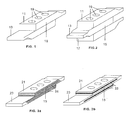
- Figure 1 shows a sketch of a typical full CFRP reinforcement on a bolted joint between two carbon fibre parts at single-lap shear.
- Figure 2 shows a sketch of a typical full CFRP reinforcement on a bolted joint at double-lap shear.
- Figure 3a shows a sketch of a bolted joint between two parts at single-lap shear reinforced with several titanium foils interleaved in both parts.
- Figure 3b shows a sketch of a bolted joint between two parts at single-lap shear reinforced with a titanium plate embedded in both parts.
- Figure 4a shows a sketch of a bolted joint between three parts at double-lap shear reinforced with several titanium foils interleaved in the three parts.
- Figure 4b shows a sketch of a bolted joint between three parts at double-lap shear reinforced with a titanium plate embedded in the three parts.
- Figures 5b and 5a show drawings of single lugs with and without titanium reinforcements.
- In known heavy loaded joints between two
composite parts 11, 13 (see Fig. 1) bothparts joint area 15 with additional plies until the required strength is achieved resulting in a reinforcedjoint area 15. - Similarly in heavy loaded joints between three
composite parts parts joint area 15 with additional plies until the required strength is achieved resulting in areinforced joint area 15. - In both cases fastening means such as bolts (not shown) will be used through
holes 19 drilled in eachpart - In a preferred embodiment of the invention shown in Figures 3a and 4a, all
parts titanium foils 31 interleaved as reinforcement into the carbon fibre laminates. - In another preferred embodiment of the invention shown in Figures 3b and 4b, all
parts titanium plate 33 embedded as reinforcement into the carbon fibre laminates. - In another preferred embodiment one of the parts is a
composite lug 41 having a metal reinforcement oftitanium foils 43. Typically, lugs made of composite materials currently in production (attachment of Horizontal Tail Plane to Fuselage for example) need a very thick section due to out-of-plane loading. The use of metal reinforcements on such parts might allow major reductions in thickness, eccentricity and weight. - Apart from the above-mentioned embodiments the present invention includes any embodiment in which at least one of the parts being joined is a composite part with a metal reinforcement.
- By interleaving the
foils 31 or embedding theplates 33 in at least one of the parts being joined,'a thickness increase is created on thejoint area 15. However, the eccentricity is notably reduced when comparing to the full CFRP reinforced joints shown in Figures 1 and 2. Therefore, interleavingfoils 31 orplates 33 allow reducing the overall thickness of the joint, reducing thus the eccentricity (while improving composite performance) but also doing the structure more efficient, i.e., lighter. - In another preferred embodiments the joint is detachable, in particular for joint architectures such as joints of 2 parts at single-lap shear, joints of 3 parts at double-lap shear, joints of more than 3 parts and lugs. As often occurs during aircraft lifetime, structures need being inspected for maintainability reasons and sometimes repaired or replaced if defects are encountered. The application of the invention here described is compatible with these maintainability/reparability aspects linked to the aircraft industry as structures using the invention can be taken apart.
- The amount of the
titanium foils titanium plates 33 in the reinforced part or parts will be set when sizing the parts during the design phase, whereas the thickness of the foils to be used will need a compromise between stress requirements, manufacturing restrictions and supplier availability always subjected to current design principles for this kind of reinforcements. Therefore, depending on the kind of part, manufacturing process and/or supplier, titanium foils or sheets ranging from tenths of a millimetre to plates of several millimetres could be used. With all these restrictions, additional composite plies for the reinforcement area could be needed together with the Ti foils in order to achieve the desired joint strength. - Intermediate Modulus (IM) or High Strength (HS) carbon fibres impregnated with thermoset resin are the preferred materials for the
composite parts - Titanium is the preferred material for the metal reinforcement. Ti sheets selected were pre-treated and delivered ready to be added to the composite parts.
- The reinforcement consisting on Titanium foils, sheets or plates is placed during the lamination, keeping internal Airbus rules for drop-offs for the transition from full CFRP to hybrid CFRP/Ti, whether it is performed by means of ATL, or FP machines, hand laid-up or other prepreg processing technology. Eventually, adhesive layers could or not be needed between the composite piles and the titanium foils, sheets or plates.
- Titanium foils, sheets or plates could also be used on parts manufactured by means of dry textile injection/infusion technologies (RTM, RFI, LRI, etc.), taking into account the specificities of those processes.
- Bolts, rivets or any kind of fastener are suitable means for mechanically fasten the joint.
- Modifications may be introduced in the preferred embodiment just set forth, which are comprised within the scope defined by the following claims.
Claims (12)
- A mechanically fastened joint between two or more parts (21, 23, 25, 41) superimposed in the joint area (15), at least one of said parts (21, 23, 25, 41) being made with plies of a composite material, characterized in that said at least one of said parts (21, 23, 25, 41) also comprises a metal reinforcement in the joint area (15) and its plies of composite material are continuous along the joint area (15) so that its thickness is increased in the joint area (15) in the thickness of said metal reinforcement.
- A mechanically fastened joint between two or more parts (21, 23, 25, 41) superimposed in the joint area (15) according to claim 1 characterised in that said at least one of said parts (21, 23, 25, 41) also comprises a composite reinforcement in the joint area (15) consisting of additional composite plies laid only in the joint area (15) increasing additionally the thickness of the joint area (15) in the thickness of said composite reinforcement.
- A mechanically fastened joint between two or more parts (21, 23, 25, 41) superimposed in the joint area (15) according to any of claims 1-2, characterized in that it comprises at least two parts (21, 23) made with plies of a composite material.
- A mechanically fastened joint between two or more parts (21, 23, 25, 41) superimposed in the joint area (15) according to any of claims 1-2, characterized in that it comprises at least three parts (21, 23, 25) made with plies of a composite material.
- A mechanically fastened joint between two or more parts (21, 23, 25, 41) superimposed in the joint area (15) according to any of claims 1-4, characterized in that one part (41) having a metal reinforcement has a lug shape in the joint area (15) and in that the joint fastening means comprise a fastening mean passing through the lug hole (45).
- A mechanically fastened joint between two or more parts (21, 23, 25, 41) superimposed in the joint area (15) according to any of claims 1-5, characterized in that the fastening means of the joint are permanent fastening means.
- A mechanically fastened joint between two or more parts (21, 23, 25, 41) superimposed in the joint area (15) according to any of claims 1-5, characterized in that the fastening means of the joint are detachable fastening means.
- A mechanically fastened joint between two or more parts (21, 23, 25, 41) superimposed in the joint area (15) according to any of claims 1-7, characterized in that said metal reinforcement consists of one or more metal foils or sheets (31) interleaved between the plies of the composite material.
- A mechanically fastened joint between two or more parts (21, 23, 25, 41) superimposed in the joint area (15) according to any of claim 1-7, characterized in that said metal reinforcement consist of one or more metal plates (33) embedded between two plies of the composite material.
- A mechanically fastened joint between two or more parts (21, 23, 25, 41) superimposed in the joint area (15) according to any of the preceding claims, characterized in that the composite parts are made of carbon fibres impregnated with thermoset resin.
- A mechanically fastened joint between two or more parts (21, 23, 25, 41) superimposed in the joint area (15) according to any of the preceding claims, characterized in that the metal reinforcement is made of titanium.
- A mechanically fastened joint between two or more parts (21, 23, 25, 41) superimposed in the joint area (15) according to any of the preceding claims, characterized in that the fastening means are bolts.
Priority Applications (1)
| Application Number | Priority Date | Filing Date | Title |
|---|---|---|---|
| EP06381046.9A EP1801428B1 (en) | 2005-12-21 | 2006-10-31 | Metallic local reinforcement for heavy loaded joints of composite components |
Applications Claiming Priority (2)
| Application Number | Priority Date | Filing Date | Title |
|---|---|---|---|
| EP05381062A EP1801427A1 (en) | 2005-12-21 | 2005-12-21 | Metallic local reinforcement for heavy loaded joints of composite components |
| EP06381046.9A EP1801428B1 (en) | 2005-12-21 | 2006-10-31 | Metallic local reinforcement for heavy loaded joints of composite components |
Publications (3)
| Publication Number | Publication Date |
|---|---|
| EP1801428A2 true EP1801428A2 (en) | 2007-06-27 |
| EP1801428A3 EP1801428A3 (en) | 2014-11-05 |
| EP1801428B1 EP1801428B1 (en) | 2017-05-31 |
Family
ID=36178120
Family Applications (2)
| Application Number | Title | Priority Date | Filing Date |
|---|---|---|---|
| EP05381062A Withdrawn EP1801427A1 (en) | 2005-12-21 | 2005-12-21 | Metallic local reinforcement for heavy loaded joints of composite components |
| EP06381046.9A Not-in-force EP1801428B1 (en) | 2005-12-21 | 2006-10-31 | Metallic local reinforcement for heavy loaded joints of composite components |
Family Applications Before (1)
| Application Number | Title | Priority Date | Filing Date |
|---|---|---|---|
| EP05381062A Withdrawn EP1801427A1 (en) | 2005-12-21 | 2005-12-21 | Metallic local reinforcement for heavy loaded joints of composite components |
Country Status (2)
| Country | Link |
|---|---|
| US (1) | US7678437B2 (en) |
| EP (2) | EP1801427A1 (en) |
Cited By (1)
| Publication number | Priority date | Publication date | Assignee | Title |
|---|---|---|---|---|
| EP4238758A1 (en) | 2022-03-04 | 2023-09-06 | Inegi - Instituto de Ciência e Inovação em Engenharia Mecânica e Engenharia Industrial | Reinforcement thermoplastic-based fibre-metal laminate composite frame and manufacturing method thereof |
Families Citing this family (17)
| Publication number | Priority date | Publication date | Assignee | Title |
|---|---|---|---|---|
| DE102007044748A1 (en) * | 2007-09-18 | 2009-03-26 | E.I.S. Aircraft Gmbh | lightweight construction element |
| DE102008042452A1 (en) | 2008-09-29 | 2010-04-08 | Airbus Deutschland Gmbh | Fiber composite for energy absorption in the event of a crash for an aircraft or spacecraft, fuselage structure section of an aircraft or spacecraft and aircraft or spacecraft |
| DE102009009491A1 (en) * | 2009-02-18 | 2010-09-09 | Airbus Deutschland Gmbh | Method for producing a shell body |
| GB0906953D0 (en) * | 2009-04-23 | 2009-06-03 | Airbus Uk Ltd | Composite structure |
| DE102009047671A1 (en) | 2009-12-08 | 2011-06-09 | Airbus Operations Gmbh | A method for bonding a fiber composite component to a structural component of an aircraft and spacecraft and a corresponding arrangement |
| US9522512B2 (en) | 2010-08-17 | 2016-12-20 | The Boeing Company | Methods for making composite structures having composite-to-metal joints |
| US8993084B2 (en) | 2010-08-17 | 2015-03-31 | The Boeing Company | Multi-layer metallic structure and composite-to-metal joint methods |
| DE102010035324A1 (en) | 2010-08-24 | 2012-03-01 | Deutsches Zentrum für Luft- und Raumfahrt e.V. | Hybrid laminated structural element useful in aerospace industry, comprises layers such as fiber composite material layers and metallic material layers, where each fiber composite layer has unidirectionally aligned fibers |
| JP5924934B2 (en) * | 2011-12-28 | 2016-05-25 | 三菱重工業株式会社 | Composite joint structure |
| US9120276B2 (en) * | 2012-07-25 | 2015-09-01 | The Boeing Company | Laminated composite bending and stiffening members with reinforcement by inter-laminar metal sheets |
| IL223443A (en) * | 2012-12-04 | 2014-06-30 | Elbit Systems Cyclone Ltd | Composite material structures with integral composite fittings and methods of manufacture |
| US9040138B2 (en) | 2013-04-29 | 2015-05-26 | General Electric Company | Composite article including composite to metal interlock and method of fabrication |
| US20180179990A1 (en) * | 2016-12-27 | 2018-06-28 | Orbital Atk, Inc. | Hybrid metal composite structures, rocket motors and multi-stage rocket motor assemblies including hybrid metal composite structures, and related methods |
| IL259149B (en) * | 2018-05-03 | 2022-09-01 | Israel Aerospace Ind Ltd | Structural elements made of composite materials |
| US10954891B2 (en) * | 2018-07-13 | 2021-03-23 | Northrop Grumman Innovation Systems, Inc. | Hybrid metal composite structures, joint structures, and related methods |
| US11231060B2 (en) | 2019-01-16 | 2022-01-25 | Bruce Daniel McFall | Hybrid tension/transverse compression structural joint |
| CN112389041A (en) * | 2020-11-27 | 2021-02-23 | 中科威禾科技(肇庆)有限公司 | Composite of resin laminated plate and metal plate and manufacturing method thereof |
Family Cites Families (5)
| Publication number | Priority date | Publication date | Assignee | Title |
|---|---|---|---|---|
| CH417226A (en) * | 1965-02-15 | 1966-07-15 | Metallwerk Ag | Non-positive butt joint for reinforced plastic laminates |
| US5866272A (en) * | 1996-01-11 | 1999-02-02 | The Boeing Company | Titanium-polymer hybrid laminates |
| DE19925953C1 (en) * | 1999-06-08 | 2000-09-07 | Deutsch Zentr Luft & Raumfahrt | Bolted connection transmitting transverse forces in laminated fibrous composite structures, includes resilient filler in bolt holes elongated as a function of their distance from center and further reinforced by local layers of metal sheet |
| JP4416900B2 (en) * | 2000-03-10 | 2010-02-17 | 富士重工業株式会社 | Composite panel and method for manufacturing the same |
| US6419189B1 (en) * | 2000-11-01 | 2002-07-16 | The Boeing Company | Hot ruddervator apparatus and method for an aerospacecraft |
-
2005
- 2005-12-21 EP EP05381062A patent/EP1801427A1/en not_active Withdrawn
-
2006
- 2006-10-31 EP EP06381046.9A patent/EP1801428B1/en not_active Not-in-force
- 2006-12-21 US US11/643,749 patent/US7678437B2/en not_active Expired - Fee Related
Cited By (1)
| Publication number | Priority date | Publication date | Assignee | Title |
|---|---|---|---|---|
| EP4238758A1 (en) | 2022-03-04 | 2023-09-06 | Inegi - Instituto de Ciência e Inovação em Engenharia Mecânica e Engenharia Industrial | Reinforcement thermoplastic-based fibre-metal laminate composite frame and manufacturing method thereof |
Also Published As
| Publication number | Publication date |
|---|---|
| EP1801427A1 (en) | 2007-06-27 |
| EP1801428B1 (en) | 2017-05-31 |
| US7678437B2 (en) | 2010-03-16 |
| EP1801428A3 (en) | 2014-11-05 |
| US20070154680A1 (en) | 2007-07-05 |
Similar Documents
| Publication | Publication Date | Title |
|---|---|---|
| EP1801428B1 (en) | Metallic local reinforcement for heavy loaded joints of composite components | |
| Alderliesten | On the development of hybrid material concepts for aircraft structures | |
| EP2406071B1 (en) | Composite structures employing quasi-isotropic laminates | |
| EP3293104B1 (en) | Open-channel stiffener | |
| US7575194B2 (en) | Apparatuses and methods for joining composite members and other structural members in aircraft wing boxes and other structures | |
| CN106184709B (en) | Composite structures with reduced area radius fillers and methods of forming the same | |
| EP2676787B1 (en) | Composite hat stiffener and methods of making the same | |
| EP2849932B1 (en) | Over-molding of load-bearing composite structures | |
| EP2301840A2 (en) | Integrated aircraft structure in composite material | |
| EP2492087B1 (en) | Composite structure comprising a first section, a second section and a curved corner. | |
| US9393651B2 (en) | Bonded patch having multiple zones of fracture toughness | |
| JP6251579B2 (en) | Box structure for supporting load and manufacturing method thereof | |
| EP2128018A1 (en) | Aircraft loading frame of composite material | |
| EP2650120B1 (en) | Multi-layer metallic structure | |
| WO2009048881A2 (en) | Composite bulkhead and skin construction | |
| US6514593B1 (en) | Mechanically locking Z-pins | |
| CA2547090A1 (en) | Sandwich panel and a method of producing a sandwich panel | |
| US9682519B2 (en) | Integral composite bushing system and method | |
| Hart-Smith | The design of repairable advanced composite structures | |
| Caglar et al. | A review of polymer composites and adhesives for aircraft landing gear applications | |
| EP2843020A1 (en) | Laminate for joining parts, and method and system for joining parts | |
| WO2005051624A2 (en) | A machinery link member | |
| Velicki et al. | Damage arrest design approach using stitched composites | |
| EP3248774A1 (en) | Fireproof polymer matrix composite structure | |
| EP1544099B1 (en) | Method of joining structural elements in an aircraft |
Legal Events
| Date | Code | Title | Description |
|---|---|---|---|
| PUAI | Public reference made under article 153(3) epc to a published international application that has entered the european phase |
Free format text: ORIGINAL CODE: 0009012 |
|
| AK | Designated contracting states |
Kind code of ref document: A2 Designated state(s): AT BE BG CH CY CZ DE DK EE ES FI FR GB GR HU IE IS IT LI LT LU LV MC NL PL PT RO SE SI SK TR |
|
| AX | Request for extension of the european patent |
Extension state: AL BA HR MK YU |
|
| 17P | Request for examination filed |
Effective date: 20071121 |
|
| RAP1 | Party data changed (applicant data changed or rights of an application transferred) |
Owner name: AIRBUS OPERATIONS S.L. |
|
| PUAL | Search report despatched |
Free format text: ORIGINAL CODE: 0009013 |
|
| AK | Designated contracting states |
Kind code of ref document: A3 Designated state(s): AT BE BG CH CY CZ DE DK EE ES FI FR GB GR HU IE IS IT LI LT LU LV MC NL PL PT RO SE SI SK TR |
|
| AX | Request for extension of the european patent |
Extension state: AL BA HR MK RS |
|
| RIC1 | Information provided on ipc code assigned before grant |
Ipc: B29K 307/04 20060101ALN20140929BHEP Ipc: B29K 705/00 20060101ALN20140929BHEP Ipc: B29K 101/10 20060101ALN20140929BHEP Ipc: B64C 1/00 20060101ALN20140929BHEP Ipc: B29C 65/56 20060101ALI20140929BHEP Ipc: B29K 309/08 20060101ALN20140929BHEP Ipc: B29L 31/30 20060101ALN20140929BHEP Ipc: B29K 101/12 20060101ALN20140929BHEP Ipc: F16B 5/00 20060101AFI20140929BHEP Ipc: B29K 307/02 20060101ALN20140929BHEP |
|
| AKX | Designation fees paid |
Designated state(s): AT BE BG CH CY CZ DE DK EE ES FI FR GB GR HU IE IS IT LI LT LU LV MC NL PL PT RO SE SI SK TR |
|
| AXX | Extension fees paid |
Extension state: RS Extension state: MK Extension state: HR Extension state: AL Extension state: BA |
|
| 17Q | First examination report despatched |
Effective date: 20160519 |
|
| GRAP | Despatch of communication of intention to grant a patent |
Free format text: ORIGINAL CODE: EPIDOSNIGR1 |
|
| RIC1 | Information provided on ipc code assigned before grant |
Ipc: F16B 5/00 20060101AFI20161125BHEP Ipc: B29K 705/00 20060101ALN20161125BHEP Ipc: B29L 31/30 20060101ALN20161125BHEP Ipc: B29K 101/12 20060101ALN20161125BHEP Ipc: B29C 65/56 20060101ALI20161125BHEP Ipc: B29K 101/10 20060101ALN20161125BHEP Ipc: B64C 1/00 20060101ALN20161125BHEP Ipc: B29K 307/02 20060101ALN20161125BHEP Ipc: B29K 309/08 20060101ALN20161125BHEP Ipc: B29K 307/04 20060101ALN20161125BHEP |
|
| INTG | Intention to grant announced |
Effective date: 20161214 |
|
| GRAS | Grant fee paid |
Free format text: ORIGINAL CODE: EPIDOSNIGR3 |
|
| GRAA | (expected) grant |
Free format text: ORIGINAL CODE: 0009210 |
|
| AK | Designated contracting states |
Kind code of ref document: B1 Designated state(s): AT BE BG CH CY CZ DE DK EE ES FI FR GB GR HU IE IS IT LI LT LU LV MC NL PL PT RO SE SI SK TR |
|
| REG | Reference to a national code |
Ref country code: CH Ref legal event code: EP Ref country code: GB Ref legal event code: FG4D |
|
| REG | Reference to a national code |
Ref country code: AT Ref legal event code: REF Ref document number: 897755 Country of ref document: AT Kind code of ref document: T Effective date: 20170615 |
|
| REG | Reference to a national code |
Ref country code: IE Ref legal event code: FG4D |
|
| REG | Reference to a national code |
Ref country code: DE Ref legal event code: R096 Ref document number: 602006052669 Country of ref document: DE |
|
| REG | Reference to a national code |
Ref country code: NL Ref legal event code: MP Effective date: 20170531 |
|
| REG | Reference to a national code |
Ref country code: LT Ref legal event code: MG4D |
|
| REG | Reference to a national code |
Ref country code: AT Ref legal event code: MK05 Ref document number: 897755 Country of ref document: AT Kind code of ref document: T Effective date: 20170531 |
|
| PG25 | Lapsed in a contracting state [announced via postgrant information from national office to epo] |
Ref country code: FI Free format text: LAPSE BECAUSE OF FAILURE TO SUBMIT A TRANSLATION OF THE DESCRIPTION OR TO PAY THE FEE WITHIN THE PRESCRIBED TIME-LIMIT Effective date: 20170531 Ref country code: AT Free format text: LAPSE BECAUSE OF FAILURE TO SUBMIT A TRANSLATION OF THE DESCRIPTION OR TO PAY THE FEE WITHIN THE PRESCRIBED TIME-LIMIT Effective date: 20170531 Ref country code: GR Free format text: LAPSE BECAUSE OF FAILURE TO SUBMIT A TRANSLATION OF THE DESCRIPTION OR TO PAY THE FEE WITHIN THE PRESCRIBED TIME-LIMIT Effective date: 20170901 Ref country code: ES Free format text: LAPSE BECAUSE OF FAILURE TO SUBMIT A TRANSLATION OF THE DESCRIPTION OR TO PAY THE FEE WITHIN THE PRESCRIBED TIME-LIMIT Effective date: 20170531 Ref country code: LT Free format text: LAPSE BECAUSE OF FAILURE TO SUBMIT A TRANSLATION OF THE DESCRIPTION OR TO PAY THE FEE WITHIN THE PRESCRIBED TIME-LIMIT Effective date: 20170531 |
|
| PG25 | Lapsed in a contracting state [announced via postgrant information from national office to epo] |
Ref country code: SE Free format text: LAPSE BECAUSE OF FAILURE TO SUBMIT A TRANSLATION OF THE DESCRIPTION OR TO PAY THE FEE WITHIN THE PRESCRIBED TIME-LIMIT Effective date: 20170531 Ref country code: NL Free format text: LAPSE BECAUSE OF FAILURE TO SUBMIT A TRANSLATION OF THE DESCRIPTION OR TO PAY THE FEE WITHIN THE PRESCRIBED TIME-LIMIT Effective date: 20170531 Ref country code: IS Free format text: LAPSE BECAUSE OF FAILURE TO SUBMIT A TRANSLATION OF THE DESCRIPTION OR TO PAY THE FEE WITHIN THE PRESCRIBED TIME-LIMIT Effective date: 20170930 Ref country code: LV Free format text: LAPSE BECAUSE OF FAILURE TO SUBMIT A TRANSLATION OF THE DESCRIPTION OR TO PAY THE FEE WITHIN THE PRESCRIBED TIME-LIMIT Effective date: 20170531 Ref country code: BG Free format text: LAPSE BECAUSE OF FAILURE TO SUBMIT A TRANSLATION OF THE DESCRIPTION OR TO PAY THE FEE WITHIN THE PRESCRIBED TIME-LIMIT Effective date: 20170831 |
|
| PG25 | Lapsed in a contracting state [announced via postgrant information from national office to epo] |
Ref country code: CZ Free format text: LAPSE BECAUSE OF FAILURE TO SUBMIT A TRANSLATION OF THE DESCRIPTION OR TO PAY THE FEE WITHIN THE PRESCRIBED TIME-LIMIT Effective date: 20170531 Ref country code: DK Free format text: LAPSE BECAUSE OF FAILURE TO SUBMIT A TRANSLATION OF THE DESCRIPTION OR TO PAY THE FEE WITHIN THE PRESCRIBED TIME-LIMIT Effective date: 20170531 Ref country code: RO Free format text: LAPSE BECAUSE OF FAILURE TO SUBMIT A TRANSLATION OF THE DESCRIPTION OR TO PAY THE FEE WITHIN THE PRESCRIBED TIME-LIMIT Effective date: 20170531 Ref country code: SK Free format text: LAPSE BECAUSE OF FAILURE TO SUBMIT A TRANSLATION OF THE DESCRIPTION OR TO PAY THE FEE WITHIN THE PRESCRIBED TIME-LIMIT Effective date: 20170531 Ref country code: EE Free format text: LAPSE BECAUSE OF FAILURE TO SUBMIT A TRANSLATION OF THE DESCRIPTION OR TO PAY THE FEE WITHIN THE PRESCRIBED TIME-LIMIT Effective date: 20170531 |
|
| PG25 | Lapsed in a contracting state [announced via postgrant information from national office to epo] |
Ref country code: IT Free format text: LAPSE BECAUSE OF FAILURE TO SUBMIT A TRANSLATION OF THE DESCRIPTION OR TO PAY THE FEE WITHIN THE PRESCRIBED TIME-LIMIT Effective date: 20170531 Ref country code: PL Free format text: LAPSE BECAUSE OF FAILURE TO SUBMIT A TRANSLATION OF THE DESCRIPTION OR TO PAY THE FEE WITHIN THE PRESCRIBED TIME-LIMIT Effective date: 20170531 |
|
| REG | Reference to a national code |
Ref country code: DE Ref legal event code: R097 Ref document number: 602006052669 Country of ref document: DE |
|
| PLBE | No opposition filed within time limit |
Free format text: ORIGINAL CODE: 0009261 |
|
| STAA | Information on the status of an ep patent application or granted ep patent |
Free format text: STATUS: NO OPPOSITION FILED WITHIN TIME LIMIT |
|
| REG | Reference to a national code |
Ref country code: DE Ref legal event code: R119 Ref document number: 602006052669 Country of ref document: DE |
|
| 26N | No opposition filed |
Effective date: 20180301 |
|
| PG25 | Lapsed in a contracting state [announced via postgrant information from national office to epo] |
Ref country code: SI Free format text: LAPSE BECAUSE OF FAILURE TO SUBMIT A TRANSLATION OF THE DESCRIPTION OR TO PAY THE FEE WITHIN THE PRESCRIBED TIME-LIMIT Effective date: 20170531 Ref country code: MC Free format text: LAPSE BECAUSE OF FAILURE TO SUBMIT A TRANSLATION OF THE DESCRIPTION OR TO PAY THE FEE WITHIN THE PRESCRIBED TIME-LIMIT Effective date: 20170531 |
|
| REG | Reference to a national code |
Ref country code: CH Ref legal event code: PL |
|
| GBPC | Gb: european patent ceased through non-payment of renewal fee |
Effective date: 20171031 |
|
| REG | Reference to a national code |
Ref country code: IE Ref legal event code: MM4A |
|
| REG | Reference to a national code |
Ref country code: FR Ref legal event code: ST Effective date: 20180629 |
|
| PG25 | Lapsed in a contracting state [announced via postgrant information from national office to epo] |
Ref country code: CH Free format text: LAPSE BECAUSE OF NON-PAYMENT OF DUE FEES Effective date: 20171031 Ref country code: GB Free format text: LAPSE BECAUSE OF NON-PAYMENT OF DUE FEES Effective date: 20171031 Ref country code: LI Free format text: LAPSE BECAUSE OF NON-PAYMENT OF DUE FEES Effective date: 20171031 Ref country code: DE Free format text: LAPSE BECAUSE OF NON-PAYMENT OF DUE FEES Effective date: 20180501 Ref country code: LU Free format text: LAPSE BECAUSE OF NON-PAYMENT OF DUE FEES Effective date: 20171031 |
|
| REG | Reference to a national code |
Ref country code: BE Ref legal event code: MM Effective date: 20171031 |
|
| PG25 | Lapsed in a contracting state [announced via postgrant information from national office to epo] |
Ref country code: BE Free format text: LAPSE BECAUSE OF NON-PAYMENT OF DUE FEES Effective date: 20171031 Ref country code: FR Free format text: LAPSE BECAUSE OF NON-PAYMENT OF DUE FEES Effective date: 20171031 |
|
| PG25 | Lapsed in a contracting state [announced via postgrant information from national office to epo] |
Ref country code: IE Free format text: LAPSE BECAUSE OF NON-PAYMENT OF DUE FEES Effective date: 20171031 |
|
| PG25 | Lapsed in a contracting state [announced via postgrant information from national office to epo] |
Ref country code: HU Free format text: LAPSE BECAUSE OF FAILURE TO SUBMIT A TRANSLATION OF THE DESCRIPTION OR TO PAY THE FEE WITHIN THE PRESCRIBED TIME-LIMIT; INVALID AB INITIO Effective date: 20061031 |
|
| PG25 | Lapsed in a contracting state [announced via postgrant information from national office to epo] |
Ref country code: CY Free format text: LAPSE BECAUSE OF NON-PAYMENT OF DUE FEES Effective date: 20170531 |
|
| PG25 | Lapsed in a contracting state [announced via postgrant information from national office to epo] |
Ref country code: TR Free format text: LAPSE BECAUSE OF FAILURE TO SUBMIT A TRANSLATION OF THE DESCRIPTION OR TO PAY THE FEE WITHIN THE PRESCRIBED TIME-LIMIT Effective date: 20170531 |
|
| PG25 | Lapsed in a contracting state [announced via postgrant information from national office to epo] |
Ref country code: PT Free format text: LAPSE BECAUSE OF FAILURE TO SUBMIT A TRANSLATION OF THE DESCRIPTION OR TO PAY THE FEE WITHIN THE PRESCRIBED TIME-LIMIT Effective date: 20170531 |