EP1801224A1 - Process for producing optically active 2-substituent-oxy-3-(4-substituent-oxyphenyl)propionic acid derivative - Google Patents
Process for producing optically active 2-substituent-oxy-3-(4-substituent-oxyphenyl)propionic acid derivative Download PDFInfo
- Publication number
- EP1801224A1 EP1801224A1 EP05768431A EP05768431A EP1801224A1 EP 1801224 A1 EP1801224 A1 EP 1801224A1 EP 05768431 A EP05768431 A EP 05768431A EP 05768431 A EP05768431 A EP 05768431A EP 1801224 A1 EP1801224 A1 EP 1801224A1
- Authority
- EP
- European Patent Office
- Prior art keywords
- substituent
- group
- propionic acid
- general formula
- reaction
- Prior art date
- Legal status (The legal status is an assumption and is not a legal conclusion. Google has not performed a legal analysis and makes no representation as to the accuracy of the status listed.)
- Withdrawn
Links
- 238000000034 method Methods 0.000 title claims abstract description 66
- 150000001875 compounds Chemical class 0.000 claims abstract description 102
- RTZKZFJDLAIYFH-UHFFFAOYSA-N Diethyl ether Chemical compound CCOCC RTZKZFJDLAIYFH-UHFFFAOYSA-N 0.000 claims abstract description 80
- 238000010511 deprotection reaction Methods 0.000 claims abstract description 46
- 108090000790 Enzymes Proteins 0.000 claims abstract description 41
- 102000004190 Enzymes Human genes 0.000 claims abstract description 41
- XBDQKXXYIPTUBI-UHFFFAOYSA-N dimethylselenoniopropionate Natural products CCC(O)=O XBDQKXXYIPTUBI-UHFFFAOYSA-N 0.000 claims abstract description 38
- 125000006239 protecting group Chemical group 0.000 claims abstract description 21
- 235000019260 propionic acid Nutrition 0.000 claims abstract description 20
- 125000002887 hydroxy group Chemical group [H]O* 0.000 claims abstract description 19
- IUVKMZGDUIUOCP-BTNSXGMBSA-N quinbolone Chemical compound O([C@H]1CC[C@H]2[C@H]3[C@@H]([C@]4(C=CC(=O)C=C4CC3)C)CC[C@@]21C)C1=CCCC1 IUVKMZGDUIUOCP-BTNSXGMBSA-N 0.000 claims abstract description 19
- 238000005804 alkylation reaction Methods 0.000 claims abstract description 15
- 238000005886 esterification reaction Methods 0.000 claims abstract description 15
- 125000003178 carboxy group Chemical group [H]OC(*)=O 0.000 claims abstract description 12
- 230000032050 esterification Effects 0.000 claims abstract description 12
- 150000005599 propionic acid derivatives Chemical class 0.000 claims abstract description 11
- 230000029936 alkylation Effects 0.000 claims abstract description 9
- 239000002904 solvent Substances 0.000 claims description 88
- WEVYAHXRMPXWCK-UHFFFAOYSA-N Acetonitrile Chemical compound CC#N WEVYAHXRMPXWCK-UHFFFAOYSA-N 0.000 claims description 36
- WYURNTSHIVDZCO-UHFFFAOYSA-N Tetrahydrofuran Chemical group C1CCOC1 WYURNTSHIVDZCO-UHFFFAOYSA-N 0.000 claims description 34
- 125000004432 carbon atom Chemical group C* 0.000 claims description 34
- 101710088194 Dehydrogenase Proteins 0.000 claims description 27
- 125000002496 methyl group Chemical group [H]C([H])([H])* 0.000 claims description 22
- -1 methoxyethoxymethyl group Chemical group 0.000 claims description 18
- 230000008030 elimination Effects 0.000 claims description 17
- 238000003379 elimination reaction Methods 0.000 claims description 17
- 125000004435 hydrogen atom Chemical group [H]* 0.000 claims description 17
- YLQBMQCUIZJEEH-UHFFFAOYSA-N tetrahydrofuran Natural products C=1C=COC=1 YLQBMQCUIZJEEH-UHFFFAOYSA-N 0.000 claims description 17
- 150000004716 alpha keto acids Chemical class 0.000 claims description 15
- 125000001495 ethyl group Chemical group [H]C([H])([H])C([H])([H])* 0.000 claims description 14
- 125000000999 tert-butyl group Chemical group [H]C([H])([H])C(*)(C([H])([H])[H])C([H])([H])[H] 0.000 claims description 12
- 125000000217 alkyl group Chemical group 0.000 claims description 11
- 125000003710 aryl alkyl group Chemical group 0.000 claims description 11
- 150000002825 nitriles Chemical class 0.000 claims description 11
- 150000001350 alkyl halides Chemical class 0.000 claims description 10
- 125000001449 isopropyl group Chemical group [H]C([H])([H])C([H])(*)C([H])([H])[H] 0.000 claims description 8
- 238000005809 transesterification reaction Methods 0.000 claims description 8
- 150000003151 propanoic acid esters Chemical class 0.000 claims description 7
- ZKHONZRTXGYJRA-UHFFFAOYSA-N 3-[4-[(2-methylpropan-2-yl)oxy]phenyl]-2-oxopropanoic acid Chemical compound CC(C)(C)OC1=CC=C(CC(=O)C(O)=O)C=C1 ZKHONZRTXGYJRA-UHFFFAOYSA-N 0.000 claims description 6
- 229930182843 D-Lactic acid Natural products 0.000 claims description 6
- JVTAAEKCZFNVCJ-UWTATZPHSA-N D-lactic acid Chemical compound C[C@@H](O)C(O)=O JVTAAEKCZFNVCJ-UWTATZPHSA-N 0.000 claims description 6
- 230000002152 alkylating effect Effects 0.000 claims description 6
- 125000003118 aryl group Chemical group 0.000 claims description 6
- 125000001797 benzyl group Chemical group [H]C1=C([H])C([H])=C(C([H])=C1[H])C([H])([H])* 0.000 claims description 6
- 229910052799 carbon Inorganic materials 0.000 claims description 6
- 229940022769 d- lactic acid Drugs 0.000 claims description 6
- 125000004184 methoxymethyl group Chemical group [H]C([H])([H])OC([H])([H])* 0.000 claims description 4
- 150000003839 salts Chemical class 0.000 claims description 4
- 125000003903 2-propenyl group Chemical group [H]C([*])([H])C([H])=C([H])[H] 0.000 claims description 3
- 230000003301 hydrolyzing effect Effects 0.000 claims description 3
- 125000001412 tetrahydropyranyl group Chemical group 0.000 claims description 3
- 125000003821 2-(trimethylsilyl)ethoxymethyl group Chemical group [H]C([H])([H])[Si](C([H])([H])[H])(C([H])([H])[H])C([H])([H])C(OC([H])([H])[*])([H])[H] 0.000 claims description 2
- 125000004092 methylthiomethyl group Chemical group [H]C([H])([H])SC([H])([H])* 0.000 claims description 2
- JVTAAEKCZFNVCJ-UHFFFAOYSA-N lactic acid Chemical compound CC(O)C(O)=O JVTAAEKCZFNVCJ-UHFFFAOYSA-N 0.000 claims 2
- QBYIENPQHBMVBV-HFEGYEGKSA-N (2R)-2-hydroxy-2-phenylacetic acid Chemical compound O[C@@H](C(O)=O)c1ccccc1.O[C@@H](C(O)=O)c1ccccc1 QBYIENPQHBMVBV-HFEGYEGKSA-N 0.000 claims 1
- LVRFTAZAXQPQHI-YFKPBYRVSA-N (S)-2-hydroxy-4-methylpentanoic acid Chemical compound CC(C)C[C@H](O)C(O)=O LVRFTAZAXQPQHI-YFKPBYRVSA-N 0.000 claims 1
- IWYDHOAUDWTVEP-UHFFFAOYSA-N R-2-phenyl-2-hydroxyacetic acid Natural products OC(=O)C(O)C1=CC=CC=C1 IWYDHOAUDWTVEP-UHFFFAOYSA-N 0.000 claims 1
- 125000004185 ester group Chemical group 0.000 claims 1
- 239000004310 lactic acid Substances 0.000 claims 1
- 235000014655 lactic acid Nutrition 0.000 claims 1
- 229960002510 mandelic acid Drugs 0.000 claims 1
- 230000015572 biosynthetic process Effects 0.000 abstract description 12
- 239000000543 intermediate Substances 0.000 abstract description 8
- 238000003786 synthesis reaction Methods 0.000 abstract description 5
- 238000006243 chemical reaction Methods 0.000 description 125
- XEKOWRVHYACXOJ-UHFFFAOYSA-N Ethyl acetate Chemical compound CCOC(C)=O XEKOWRVHYACXOJ-UHFFFAOYSA-N 0.000 description 75
- YXFVVABEGXRONW-UHFFFAOYSA-N Toluene Chemical compound CC1=CC=CC=C1 YXFVVABEGXRONW-UHFFFAOYSA-N 0.000 description 60
- VLKZOEOYAKHREP-UHFFFAOYSA-N n-Hexane Chemical compound CCCCCC VLKZOEOYAKHREP-UHFFFAOYSA-N 0.000 description 43
- VEXZGXHMUGYJMC-UHFFFAOYSA-N Hydrochloric acid Chemical compound Cl VEXZGXHMUGYJMC-UHFFFAOYSA-N 0.000 description 40
- ZMXDDKWLCZADIW-UHFFFAOYSA-N N,N-Dimethylformamide Chemical compound CN(C)C=O ZMXDDKWLCZADIW-UHFFFAOYSA-N 0.000 description 39
- HEMHJVSKTPXQMS-UHFFFAOYSA-M Sodium hydroxide Chemical compound [OH-].[Na+] HEMHJVSKTPXQMS-UHFFFAOYSA-M 0.000 description 36
- 239000000203 mixture Substances 0.000 description 35
- YMWUJEATGCHHMB-UHFFFAOYSA-N Dichloromethane Chemical compound ClCCl YMWUJEATGCHHMB-UHFFFAOYSA-N 0.000 description 33
- 239000007810 chemical reaction solvent Substances 0.000 description 33
- 239000000047 product Substances 0.000 description 32
- LFQSCWFLJHTTHZ-UHFFFAOYSA-N Ethanol Chemical compound CCO LFQSCWFLJHTTHZ-UHFFFAOYSA-N 0.000 description 31
- XLYOFNOQVPJJNP-UHFFFAOYSA-N water Substances O XLYOFNOQVPJJNP-UHFFFAOYSA-N 0.000 description 31
- 230000003287 optical effect Effects 0.000 description 26
- OKKJLVBELUTLKV-UHFFFAOYSA-N Methanol Chemical compound OC OKKJLVBELUTLKV-UHFFFAOYSA-N 0.000 description 24
- 239000002253 acid Substances 0.000 description 24
- 239000002585 base Substances 0.000 description 23
- 239000011541 reaction mixture Substances 0.000 description 22
- 238000000605 extraction Methods 0.000 description 19
- 239000000243 solution Substances 0.000 description 19
- 241000894007 species Species 0.000 description 19
- QTBSBXVTEAMEQO-UHFFFAOYSA-N Acetic acid Chemical compound CC(O)=O QTBSBXVTEAMEQO-UHFFFAOYSA-N 0.000 description 18
- HEDRZPFGACZZDS-MICDWDOJSA-N Trichloro(2H)methane Chemical compound [2H]C(Cl)(Cl)Cl HEDRZPFGACZZDS-MICDWDOJSA-N 0.000 description 18
- BDAGIHXWWSANSR-UHFFFAOYSA-N methanoic acid Natural products OC=O BDAGIHXWWSANSR-UHFFFAOYSA-N 0.000 description 16
- UHOVQNZJYSORNB-UHFFFAOYSA-N Benzene Chemical compound C1=CC=CC=C1 UHOVQNZJYSORNB-UHFFFAOYSA-N 0.000 description 15
- KFZMGEQAYNKOFK-UHFFFAOYSA-N Isopropanol Chemical compound CC(C)O KFZMGEQAYNKOFK-UHFFFAOYSA-N 0.000 description 15
- 238000004519 manufacturing process Methods 0.000 description 14
- NLXLAEXVIDQMFP-UHFFFAOYSA-N Ammonia chloride Chemical compound [NH4+].[Cl-] NLXLAEXVIDQMFP-UHFFFAOYSA-N 0.000 description 12
- 150000001732 carboxylic acid derivatives Chemical class 0.000 description 11
- 238000001816 cooling Methods 0.000 description 11
- 230000035484 reaction time Effects 0.000 description 11
- 229910000104 sodium hydride Inorganic materials 0.000 description 11
- 238000005160 1H NMR spectroscopy Methods 0.000 description 10
- HEDRZPFGACZZDS-UHFFFAOYSA-N Chloroform Chemical compound ClC(Cl)Cl HEDRZPFGACZZDS-UHFFFAOYSA-N 0.000 description 10
- IAZDPXIOMUYVGZ-UHFFFAOYSA-N Dimethylsulphoxide Chemical compound CS(C)=O IAZDPXIOMUYVGZ-UHFFFAOYSA-N 0.000 description 10
- JVTAAEKCZFNVCJ-REOHCLBHSA-N L-lactic acid Chemical compound C[C@H](O)C(O)=O JVTAAEKCZFNVCJ-REOHCLBHSA-N 0.000 description 10
- IMNFDUFMRHMDMM-UHFFFAOYSA-N N-Heptane Chemical compound CCCCCCC IMNFDUFMRHMDMM-UHFFFAOYSA-N 0.000 description 10
- OFBQJSOFQDEBGM-UHFFFAOYSA-N Pentane Chemical compound CCCCC OFBQJSOFQDEBGM-UHFFFAOYSA-N 0.000 description 10
- 239000005515 coenzyme Substances 0.000 description 10
- VZGDMQKNWNREIO-UHFFFAOYSA-N tetrachloromethane Chemical compound ClC(Cl)(Cl)Cl VZGDMQKNWNREIO-UHFFFAOYSA-N 0.000 description 10
- FVGFJAVRCMJGGQ-NSHDSACASA-N (2s)-2-hydroxy-3-[4-[(2-methylpropan-2-yl)oxy]phenyl]propanoic acid Chemical compound CC(C)(C)OC1=CC=C(C[C@H](O)C(O)=O)C=C1 FVGFJAVRCMJGGQ-NSHDSACASA-N 0.000 description 9
- KWYUFKZDYYNOTN-UHFFFAOYSA-M Potassium hydroxide Chemical compound [OH-].[K+] KWYUFKZDYYNOTN-UHFFFAOYSA-M 0.000 description 9
- 239000012153 distilled water Substances 0.000 description 9
- 238000004128 high performance liquid chromatography Methods 0.000 description 9
- INQOMBQAUSQDDS-UHFFFAOYSA-N iodomethane Chemical compound IC INQOMBQAUSQDDS-UHFFFAOYSA-N 0.000 description 9
- TVYJTAYRCDZSGG-ZDUSSCGKSA-N methyl (2s)-2-methoxy-3-[4-[(2-methylpropan-2-yl)oxy]phenyl]propanoate Chemical compound COC(=O)[C@@H](OC)CC1=CC=C(OC(C)(C)C)C=C1 TVYJTAYRCDZSGG-ZDUSSCGKSA-N 0.000 description 9
- 238000010898 silica gel chromatography Methods 0.000 description 9
- OSWFIVFLDKOXQC-UHFFFAOYSA-N 4-(3-methoxyphenyl)aniline Chemical compound COC1=CC=CC(C=2C=CC(N)=CC=2)=C1 OSWFIVFLDKOXQC-UHFFFAOYSA-N 0.000 description 8
- CSNNHWWHGAXBCP-UHFFFAOYSA-L Magnesium sulfate Chemical compound [Mg+2].[O-][S+2]([O-])([O-])[O-] CSNNHWWHGAXBCP-UHFFFAOYSA-L 0.000 description 8
- FXHOOIRPVKKKFG-UHFFFAOYSA-N N,N-Dimethylacetamide Chemical compound CN(C)C(C)=O FXHOOIRPVKKKFG-UHFFFAOYSA-N 0.000 description 8
- QAOWNCQODCNURD-UHFFFAOYSA-N Sulfuric acid Chemical compound OS(O)(=O)=O QAOWNCQODCNURD-UHFFFAOYSA-N 0.000 description 8
- GZUXJHMPEANEGY-UHFFFAOYSA-N bromomethane Chemical compound BrC GZUXJHMPEANEGY-UHFFFAOYSA-N 0.000 description 8
- 235000019253 formic acid Nutrition 0.000 description 8
- 239000010410 layer Substances 0.000 description 8
- 239000012046 mixed solvent Substances 0.000 description 8
- 229930027945 nicotinamide-adenine dinucleotide Natural products 0.000 description 8
- 238000003756 stirring Methods 0.000 description 8
- NMNCYLILNUMIGM-ZDUSSCGKSA-N (2s)-2-ethoxy-3-[4-[(2-methylpropan-2-yl)oxy]phenyl]propanoic acid Chemical compound CCO[C@H](C(O)=O)CC1=CC=C(OC(C)(C)C)C=C1 NMNCYLILNUMIGM-ZDUSSCGKSA-N 0.000 description 7
- KCMZPFGVEJYKHZ-LBPRGKRZSA-N (2s)-2-methoxy-3-[4-[(2-methylpropan-2-yl)oxy]phenyl]propanoic acid Chemical compound CO[C@H](C(O)=O)CC1=CC=C(OC(C)(C)C)C=C1 KCMZPFGVEJYKHZ-LBPRGKRZSA-N 0.000 description 7
- RYHBNJHYFVUHQT-UHFFFAOYSA-N 1,4-Dioxane Chemical compound C1COCCO1 RYHBNJHYFVUHQT-UHFFFAOYSA-N 0.000 description 7
- 108010050375 Glucose 1-Dehydrogenase Proteins 0.000 description 7
- 239000002168 alkylating agent Substances 0.000 description 7
- 229940100198 alkylating agent Drugs 0.000 description 7
- 238000004821 distillation Methods 0.000 description 7
- HVTICUPFWKNHNG-UHFFFAOYSA-N iodoethane Chemical compound CCI HVTICUPFWKNHNG-UHFFFAOYSA-N 0.000 description 7
- 238000001953 recrystallisation Methods 0.000 description 7
- 238000010992 reflux Methods 0.000 description 7
- OGJKUGGZOYNPSS-JTQLQIEISA-N (2s)-2-methoxy-3-(4-methoxyphenyl)propanoic acid Chemical compound CO[C@H](C(O)=O)CC1=CC=C(OC)C=C1 OGJKUGGZOYNPSS-JTQLQIEISA-N 0.000 description 6
- FVGFJAVRCMJGGQ-UHFFFAOYSA-N 2-hydroxy-3-[4-[(2-methylpropan-2-yl)oxy]phenyl]propanoic acid Chemical compound CC(C)(C)OC1=CC=C(CC(O)C(O)=O)C=C1 FVGFJAVRCMJGGQ-UHFFFAOYSA-N 0.000 description 6
- BZLVMXJERCGZMT-UHFFFAOYSA-N Methyl tert-butyl ether Chemical compound COC(C)(C)C BZLVMXJERCGZMT-UHFFFAOYSA-N 0.000 description 6
- XBDQKXXYIPTUBI-UHFFFAOYSA-M Propionate Chemical compound CCC([O-])=O XBDQKXXYIPTUBI-UHFFFAOYSA-M 0.000 description 6
- CDBYLPFSWZWCQE-UHFFFAOYSA-L Sodium Carbonate Chemical compound [Na+].[Na+].[O-]C([O-])=O CDBYLPFSWZWCQE-UHFFFAOYSA-L 0.000 description 6
- DTQVDTLACAAQTR-UHFFFAOYSA-N Trifluoroacetic acid Chemical compound OC(=O)C(F)(F)F DTQVDTLACAAQTR-UHFFFAOYSA-N 0.000 description 6
- XJLXINKUBYWONI-DQQFMEOOSA-N [[(2r,3r,4r,5r)-5-(6-aminopurin-9-yl)-3-hydroxy-4-phosphonooxyoxolan-2-yl]methoxy-hydroxyphosphoryl] [(2s,3r,4s,5s)-5-(3-carbamoylpyridin-1-ium-1-yl)-3,4-dihydroxyoxolan-2-yl]methyl phosphate Chemical compound NC(=O)C1=CC=C[N+]([C@@H]2[C@H]([C@@H](O)[C@H](COP([O-])(=O)OP(O)(=O)OC[C@@H]3[C@H]([C@@H](OP(O)(O)=O)[C@@H](O3)N3C4=NC=NC(N)=C4N=C3)O)O2)O)=C1 XJLXINKUBYWONI-DQQFMEOOSA-N 0.000 description 6
- 235000019270 ammonium chloride Nutrition 0.000 description 6
- 230000007062 hydrolysis Effects 0.000 description 6
- 238000006460 hydrolysis reaction Methods 0.000 description 6
- 238000002156 mixing Methods 0.000 description 6
- 239000008363 phosphate buffer Substances 0.000 description 6
- BWHMMNNQKKPAPP-UHFFFAOYSA-L potassium carbonate Chemical compound [K+].[K+].[O-]C([O-])=O BWHMMNNQKKPAPP-UHFFFAOYSA-L 0.000 description 6
- FVSKHRXBFJPNKK-UHFFFAOYSA-N propionitrile Chemical compound CCC#N FVSKHRXBFJPNKK-UHFFFAOYSA-N 0.000 description 6
- 238000000746 purification Methods 0.000 description 6
- 230000001172 regenerating effect Effects 0.000 description 6
- 229920006395 saturated elastomer Polymers 0.000 description 6
- 239000000758 substrate Substances 0.000 description 6
- 230000002194 synthesizing effect Effects 0.000 description 6
- JOXIMZWYDAKGHI-UHFFFAOYSA-N toluene-4-sulfonic acid Chemical compound CC1=CC=C(S(O)(=O)=O)C=C1 JOXIMZWYDAKGHI-UHFFFAOYSA-N 0.000 description 6
- UKDOTCFNLHHKOF-FGRDZWBJSA-N (z)-1-chloroprop-1-ene;(z)-1,2-dichloroethene Chemical group C\C=C/Cl.Cl\C=C/Cl UKDOTCFNLHHKOF-FGRDZWBJSA-N 0.000 description 5
- 239000004215 Carbon black (E152) Substances 0.000 description 5
- XDTMQSROBMDMFD-UHFFFAOYSA-N Cyclohexane Chemical compound C1CCCCC1 XDTMQSROBMDMFD-UHFFFAOYSA-N 0.000 description 5
- ZAFNJMIOTHYJRJ-UHFFFAOYSA-N Diisopropyl ether Chemical compound CC(C)OC(C)C ZAFNJMIOTHYJRJ-UHFFFAOYSA-N 0.000 description 5
- 241000193385 Geobacillus stearothermophilus Species 0.000 description 5
- CTQNGGLPUBDAKN-UHFFFAOYSA-N O-Xylene Chemical compound CC1=CC=CC=C1C CTQNGGLPUBDAKN-UHFFFAOYSA-N 0.000 description 5
- 230000002411 adverse Effects 0.000 description 5
- 150000001408 amides Chemical class 0.000 description 5
- 239000007864 aqueous solution Substances 0.000 description 5
- 150000004945 aromatic hydrocarbons Chemical class 0.000 description 5
- 238000009835 boiling Methods 0.000 description 5
- RDHPKYGYEGBMSE-UHFFFAOYSA-N bromoethane Chemical compound CCBr RDHPKYGYEGBMSE-UHFFFAOYSA-N 0.000 description 5
- 238000001514 detection method Methods 0.000 description 5
- VAYGXNSJCAHWJZ-UHFFFAOYSA-N dimethyl sulfate Chemical compound COS(=O)(=O)OC VAYGXNSJCAHWJZ-UHFFFAOYSA-N 0.000 description 5
- 150000002148 esters Chemical class 0.000 description 5
- 238000001914 filtration Methods 0.000 description 5
- 238000007710 freezing Methods 0.000 description 5
- 230000008014 freezing Effects 0.000 description 5
- 150000008282 halocarbons Chemical class 0.000 description 5
- 229930195733 hydrocarbon Natural products 0.000 description 5
- 150000002430 hydrocarbons Chemical class 0.000 description 5
- 230000005764 inhibitory process Effects 0.000 description 5
- 230000014759 maintenance of location Effects 0.000 description 5
- SPHNRPVLGIXPOF-LBPRGKRZSA-N methyl (2s)-2-hydroxy-3-[4-[(2-methylpropan-2-yl)oxy]phenyl]propanoate Chemical compound COC(=O)[C@@H](O)CC1=CC=C(OC(C)(C)C)C=C1 SPHNRPVLGIXPOF-LBPRGKRZSA-N 0.000 description 5
- GHMZMMYMVVQDNR-NSHDSACASA-N methyl (2s)-2-methoxy-3-(4-methoxyphenyl)propanoate Chemical compound COC(=O)[C@@H](OC)CC1=CC=C(OC)C=C1 GHMZMMYMVVQDNR-NSHDSACASA-N 0.000 description 5
- 238000006386 neutralization reaction Methods 0.000 description 5
- 239000003208 petroleum Substances 0.000 description 5
- 239000012071 phase Substances 0.000 description 5
- 238000007086 side reaction Methods 0.000 description 5
- WTPUGKCBXRINKQ-UHFFFAOYSA-M sodium;3-[4-[(2-methylpropan-2-yl)oxy]phenyl]-2-oxopropanoate Chemical compound [Na+].CC(C)(C)OC1=CC=C(CC(=O)C([O-])=O)C=C1 WTPUGKCBXRINKQ-UHFFFAOYSA-M 0.000 description 5
- 150000003462 sulfoxides Chemical class 0.000 description 5
- 150000003573 thiols Chemical class 0.000 description 5
- 239000008096 xylene Substances 0.000 description 5
- FJUACDARCVZYOJ-VIFPVBQESA-N (2s)-3-(4-hydroxyphenyl)-2-methoxypropanoic acid Chemical compound CO[C@H](C(O)=O)CC1=CC=C(O)C=C1 FJUACDARCVZYOJ-VIFPVBQESA-N 0.000 description 4
- MEKOFIRRDATTAG-UHFFFAOYSA-N 2,2,5,8-tetramethyl-3,4-dihydrochromen-6-ol Chemical compound C1CC(C)(C)OC2=C1C(C)=C(O)C=C2C MEKOFIRRDATTAG-UHFFFAOYSA-N 0.000 description 4
- AFVFQIVMOAPDHO-UHFFFAOYSA-N Methanesulfonic acid Chemical compound CS(O)(=O)=O AFVFQIVMOAPDHO-UHFFFAOYSA-N 0.000 description 4
- BAWFJGJZGIEFAR-NNYOXOHSSA-O NAD(+) Chemical compound NC(=O)C1=CC=C[N+]([C@H]2[C@@H]([C@H](O)[C@@H](COP(O)(=O)OP(O)(=O)OC[C@@H]3[C@H]([C@@H](O)[C@@H](O3)N3C4=NC=NC(N)=C4N=C3)O)O2)O)=C1 BAWFJGJZGIEFAR-NNYOXOHSSA-O 0.000 description 4
- WQDUMFSSJAZKTM-UHFFFAOYSA-N Sodium methoxide Chemical compound [Na+].[O-]C WQDUMFSSJAZKTM-UHFFFAOYSA-N 0.000 description 4
- KXKVLQRXCPHEJC-UHFFFAOYSA-N acetic acid trimethyl ester Natural products COC(C)=O KXKVLQRXCPHEJC-UHFFFAOYSA-N 0.000 description 4
- 239000003513 alkali Substances 0.000 description 4
- 229910052783 alkali metal Inorganic materials 0.000 description 4
- 229940111131 antiinflammatory and antirheumatic product propionic acid derivative Drugs 0.000 description 4
- CLQGCEMBZAXWAX-HNNXBMFYSA-N ethyl (2s)-2-ethoxy-3-[4-[(2-methylpropan-2-yl)oxy]phenyl]propanoate Chemical compound CCOC(=O)[C@@H](OCC)CC1=CC=C(OC(C)(C)C)C=C1 CLQGCEMBZAXWAX-HNNXBMFYSA-N 0.000 description 4
- 229910052943 magnesium sulfate Inorganic materials 0.000 description 4
- 235000019341 magnesium sulphate Nutrition 0.000 description 4
- 229940102396 methyl bromide Drugs 0.000 description 4
- 244000005700 microbiome Species 0.000 description 4
- BOPGDPNILDQYTO-NNYOXOHSSA-N nicotinamide-adenine dinucleotide Chemical compound C1=CCC(C(=O)N)=CN1[C@H]1[C@H](O)[C@H](O)[C@@H](COP(O)(=O)OP(O)(=O)OC[C@@H]2[C@H]([C@@H](O)[C@@H](O2)N2C3=NC=NC(N)=C3N=C2)O)O1 BOPGDPNILDQYTO-NNYOXOHSSA-N 0.000 description 4
- 238000006722 reduction reaction Methods 0.000 description 4
- WQZGKKKJIJFFOK-GASJEMHNSA-N Glucose Natural products OC[C@H]1OC(O)[C@H](O)[C@@H](O)[C@@H]1O WQZGKKKJIJFFOK-GASJEMHNSA-N 0.000 description 3
- WMFOQBRAJBCJND-UHFFFAOYSA-M Lithium hydroxide Chemical compound [Li+].[OH-] WMFOQBRAJBCJND-UHFFFAOYSA-M 0.000 description 3
- SECXISVLQFMRJM-UHFFFAOYSA-N N-Methylpyrrolidone Chemical compound CN1CCCC1=O SECXISVLQFMRJM-UHFFFAOYSA-N 0.000 description 3
- PMZURENOXWZQFD-UHFFFAOYSA-L Sodium Sulfate Chemical compound [Na+].[Na+].[O-]S([O-])(=O)=O PMZURENOXWZQFD-UHFFFAOYSA-L 0.000 description 3
- ZMANZCXQSJIPKH-UHFFFAOYSA-N Triethylamine Chemical compound CCN(CC)CC ZMANZCXQSJIPKH-UHFFFAOYSA-N 0.000 description 3
- 125000000113 cyclohexyl group Chemical group [H]C1([H])C([H])([H])C([H])([H])C([H])(*)C([H])([H])C1([H])[H] 0.000 description 3
- 239000002274 desiccant Substances 0.000 description 3
- DENRZWYUOJLTMF-UHFFFAOYSA-N diethyl sulfate Chemical compound CCOS(=O)(=O)OCC DENRZWYUOJLTMF-UHFFFAOYSA-N 0.000 description 3
- 229940008406 diethyl sulfate Drugs 0.000 description 3
- 239000000706 filtrate Substances 0.000 description 3
- 239000008103 glucose Substances 0.000 description 3
- 125000000959 isobutyl group Chemical group [H]C([H])([H])C([H])(C([H])([H])[H])C([H])([H])* 0.000 description 3
- 230000000813 microbial effect Effects 0.000 description 3
- 125000004108 n-butyl group Chemical group [H]C([H])([H])C([H])([H])C([H])([H])C([H])([H])* 0.000 description 3
- 125000004123 n-propyl group Chemical group [H]C([H])([H])C([H])([H])C([H])([H])* 0.000 description 3
- 239000012044 organic layer Substances 0.000 description 3
- 229910000027 potassium carbonate Inorganic materials 0.000 description 3
- 108090000623 proteins and genes Proteins 0.000 description 3
- 239000011734 sodium Substances 0.000 description 3
- 229910052708 sodium Inorganic materials 0.000 description 3
- 229910000029 sodium carbonate Inorganic materials 0.000 description 3
- 229910052938 sodium sulfate Inorganic materials 0.000 description 3
- 235000011152 sodium sulphate Nutrition 0.000 description 3
- 125000002023 trifluoromethyl group Chemical group FC(F)(F)* 0.000 description 3
- SYTBZMRGLBWNTM-SNVBAGLBSA-N (R)-flurbiprofen Chemical compound FC1=CC([C@H](C(O)=O)C)=CC=C1C1=CC=CC=C1 SYTBZMRGLBWNTM-SNVBAGLBSA-N 0.000 description 2
- IWYDHOAUDWTVEP-SSDOTTSWSA-N (R)-mandelic acid Chemical compound OC(=O)[C@H](O)C1=CC=CC=C1 IWYDHOAUDWTVEP-SSDOTTSWSA-N 0.000 description 2
- PPAQRXQTAMCHKR-UHFFFAOYSA-N 4-[(3-chlorophenyl)methylidene]-2-methyl-1,3-oxazol-5-one Chemical compound O=C1OC(C)=NC1=CC1=CC=CC(Cl)=C1 PPAQRXQTAMCHKR-UHFFFAOYSA-N 0.000 description 2
- OFQJXFSMXJITIP-UHFFFAOYSA-N 5-[[4-[(2-methylpropan-2-yl)oxy]phenyl]methylidene]imidazolidine-2,4-dione Chemical compound C1=CC(OC(C)(C)C)=CC=C1C=C1C(=O)NC(=O)N1 OFQJXFSMXJITIP-UHFFFAOYSA-N 0.000 description 2
- 241000194032 Enterococcus faecalis Species 0.000 description 2
- PLUBXMRUUVWRLT-UHFFFAOYSA-N Ethyl methanesulfonate Chemical compound CCOS(C)(=O)=O PLUBXMRUUVWRLT-UHFFFAOYSA-N 0.000 description 2
- 238000010268 HPLC based assay Methods 0.000 description 2
- OUYCCCASQSFEME-QMMMGPOBSA-N L-tyrosine Chemical compound OC(=O)[C@@H](N)CC1=CC=C(O)C=C1 OUYCCCASQSFEME-QMMMGPOBSA-N 0.000 description 2
- 241001134659 Lactobacillus curvatus Species 0.000 description 2
- 241000192130 Leuconostoc mesenteroides Species 0.000 description 2
- LSDPWZHWYPCBBB-UHFFFAOYSA-N Methanethiol Chemical compound SC LSDPWZHWYPCBBB-UHFFFAOYSA-N 0.000 description 2
- MZRVEZGGRBJDDB-UHFFFAOYSA-N N-Butyllithium Chemical compound [Li]CCCC MZRVEZGGRBJDDB-UHFFFAOYSA-N 0.000 description 2
- IOVCWXUNBOPUCH-UHFFFAOYSA-N Nitrous acid Chemical compound ON=O IOVCWXUNBOPUCH-UHFFFAOYSA-N 0.000 description 2
- BHHGXPLMPWCGHP-UHFFFAOYSA-N Phenethylamine Chemical compound NCCC1=CC=CC=C1 BHHGXPLMPWCGHP-UHFFFAOYSA-N 0.000 description 2
- JUJWROOIHBZHMG-UHFFFAOYSA-N Pyridine Chemical compound C1=CC=NC=C1 JUJWROOIHBZHMG-UHFFFAOYSA-N 0.000 description 2
- 241001149408 Rhodotorula graminis Species 0.000 description 2
- KEAYESYHFKHZAL-UHFFFAOYSA-N Sodium Chemical compound [Na] KEAYESYHFKHZAL-UHFFFAOYSA-N 0.000 description 2
- FAPWRFPIFSIZLT-UHFFFAOYSA-M Sodium chloride Chemical compound [Na+].[Cl-] FAPWRFPIFSIZLT-UHFFFAOYSA-M 0.000 description 2
- 241000282898 Sus scrofa Species 0.000 description 2
- 241000186675 Weissella confusa Species 0.000 description 2
- 230000002378 acidificating effect Effects 0.000 description 2
- 150000007513 acids Chemical class 0.000 description 2
- AGEZXYOZHKGVCM-UHFFFAOYSA-N benzyl bromide Chemical compound BrCC1=CC=CC=C1 AGEZXYOZHKGVCM-UHFFFAOYSA-N 0.000 description 2
- KCXMKQUNVWSEMD-UHFFFAOYSA-N benzyl chloride Chemical compound ClCC1=CC=CC=C1 KCXMKQUNVWSEMD-UHFFFAOYSA-N 0.000 description 2
- 229940073608 benzyl chloride Drugs 0.000 description 2
- 239000007853 buffer solution Substances 0.000 description 2
- 150000001734 carboxylic acid salts Chemical class 0.000 description 2
- HRYZWHHZPQKTII-UHFFFAOYSA-N chloroethane Chemical compound CCCl HRYZWHHZPQKTII-UHFFFAOYSA-N 0.000 description 2
- NEHMKBQYUWJMIP-UHFFFAOYSA-N chloromethane Chemical compound ClC NEHMKBQYUWJMIP-UHFFFAOYSA-N 0.000 description 2
- 239000012141 concentrate Substances 0.000 description 2
- 238000009833 condensation Methods 0.000 description 2
- 230000005494 condensation Effects 0.000 description 2
- 238000006731 degradation reaction Methods 0.000 description 2
- 239000003480 eluent Substances 0.000 description 2
- DNJIEGIFACGWOD-UHFFFAOYSA-N ethanethiol Chemical compound CCS DNJIEGIFACGWOD-UHFFFAOYSA-N 0.000 description 2
- NEJJCKFYYBEQRQ-UHFFFAOYSA-N ethyl 2-ethoxy-3-(4-hydroxyphenyl)propanoate Chemical compound CCOC(=O)C(OCC)CC1=CC=C(O)C=C1 NEJJCKFYYBEQRQ-UHFFFAOYSA-N 0.000 description 2
- 229960003750 ethyl chloride Drugs 0.000 description 2
- WJRBRSLFGCUECM-UHFFFAOYSA-N hydantoin Chemical compound O=C1CNC(=O)N1 WJRBRSLFGCUECM-UHFFFAOYSA-N 0.000 description 2
- 229940091173 hydantoin Drugs 0.000 description 2
- 150000007529 inorganic bases Chemical class 0.000 description 2
- 229910052500 inorganic mineral Inorganic materials 0.000 description 2
- ZCSHNCUQKCANBX-UHFFFAOYSA-N lithium diisopropylamide Chemical compound [Li+].CC(C)[N-]C(C)C ZCSHNCUQKCANBX-UHFFFAOYSA-N 0.000 description 2
- 229940098779 methanesulfonic acid Drugs 0.000 description 2
- VUQUOGPMUUJORT-UHFFFAOYSA-N methyl 4-methylbenzenesulfonate Chemical compound COS(=O)(=O)C1=CC=C(C)C=C1 VUQUOGPMUUJORT-UHFFFAOYSA-N 0.000 description 2
- MBABOKRGFJTBAE-UHFFFAOYSA-N methyl methanesulfonate Chemical compound COS(C)(=O)=O MBABOKRGFJTBAE-UHFFFAOYSA-N 0.000 description 2
- 235000010755 mineral Nutrition 0.000 description 2
- 239000011707 mineral Substances 0.000 description 2
- KZCOBXFFBQJQHH-UHFFFAOYSA-N octane-1-thiol Chemical compound CCCCCCCCS KZCOBXFFBQJQHH-UHFFFAOYSA-N 0.000 description 2
- 150000007524 organic acids Chemical class 0.000 description 2
- 235000005985 organic acids Nutrition 0.000 description 2
- 125000001997 phenyl group Chemical group [H]C1=C([H])C([H])=C(*)C([H])=C1[H] 0.000 description 2
- LPNYRYFBWFDTMA-UHFFFAOYSA-N potassium tert-butoxide Chemical compound [K+].CC(C)(C)[O-] LPNYRYFBWFDTMA-UHFFFAOYSA-N 0.000 description 2
- QDRKDTQENPPHOJ-UHFFFAOYSA-N sodium ethoxide Chemical compound [Na+].CC[O-] QDRKDTQENPPHOJ-UHFFFAOYSA-N 0.000 description 2
- 239000012312 sodium hydride Substances 0.000 description 2
- 239000000725 suspension Substances 0.000 description 2
- ONDSBJMLAHVLMI-UHFFFAOYSA-N trimethylsilyldiazomethane Chemical compound C[Si](C)(C)[CH-][N+]#N ONDSBJMLAHVLMI-UHFFFAOYSA-N 0.000 description 2
- GEDLJGYFEOYKEG-VIFPVBQESA-N (2s)-2-hydroxy-3-(4-methoxyphenyl)propanoic acid Chemical compound COC1=CC=C(C[C@H](O)C(O)=O)C=C1 GEDLJGYFEOYKEG-VIFPVBQESA-N 0.000 description 1
- UDTSPKADQGPZFS-VURMDHGXSA-N (5z)-5-benzylideneimidazolidine-2,4-dione Chemical compound N1C(=O)NC(=O)\C1=C\C1=CC=CC=C1 UDTSPKADQGPZFS-VURMDHGXSA-N 0.000 description 1
- IWYDHOAUDWTVEP-ZETCQYMHSA-N (S)-mandelic acid Chemical compound OC(=O)[C@@H](O)C1=CC=CC=C1 IWYDHOAUDWTVEP-ZETCQYMHSA-N 0.000 description 1
- HXKKHQJGJAFBHI-UHFFFAOYSA-N 1-aminopropan-2-ol Chemical compound CC(O)CN HXKKHQJGJAFBHI-UHFFFAOYSA-N 0.000 description 1
- NGNBDVOYPDDBFK-UHFFFAOYSA-N 2-[2,4-di(pentan-2-yl)phenoxy]acetyl chloride Chemical compound CCCC(C)C1=CC=C(OCC(Cl)=O)C(C(C)CCC)=C1 NGNBDVOYPDDBFK-UHFFFAOYSA-N 0.000 description 1
- RADJEIZOJZINJB-UHFFFAOYSA-N 2-hydroxy-3-(4-phenylmethoxyphenyl)propanoic acid Chemical compound C1=CC(CC(O)C(O)=O)=CC=C1OCC1=CC=CC=C1 RADJEIZOJZINJB-UHFFFAOYSA-N 0.000 description 1
- BMYNFMYTOJXKLE-UHFFFAOYSA-N 3-azaniumyl-2-hydroxypropanoate Chemical compound NCC(O)C(O)=O BMYNFMYTOJXKLE-UHFFFAOYSA-N 0.000 description 1
- ASNHGEVAWNWCRQ-UHFFFAOYSA-N 4-(hydroxymethyl)oxolane-2,3,4-triol Chemical compound OCC1(O)COC(O)C1O ASNHGEVAWNWCRQ-UHFFFAOYSA-N 0.000 description 1
- VWSFZYXXQDKXKQ-UHFFFAOYSA-N 4-[(2-methylpropan-2-yl)oxy]benzaldehyde Chemical compound CC(C)(C)OC1=CC=C(C=O)C=C1 VWSFZYXXQDKXKQ-UHFFFAOYSA-N 0.000 description 1
- 102100031126 6-phosphogluconolactonase Human genes 0.000 description 1
- 108010029731 6-phosphogluconolactonase Proteins 0.000 description 1
- 102000007698 Alcohol dehydrogenase Human genes 0.000 description 1
- 108010021809 Alcohol dehydrogenase Proteins 0.000 description 1
- 241001608472 Bifidobacterium longum Species 0.000 description 1
- 0 CC(C)(C)Oc1ccc(CC(**)[O-])cc1 Chemical compound CC(C)(C)Oc1ccc(CC(**)[O-])cc1 0.000 description 1
- 241000588724 Escherichia coli Species 0.000 description 1
- 108010018962 Glucosephosphate Dehydrogenase Proteins 0.000 description 1
- 108010020056 Hydrogenase Proteins 0.000 description 1
- DGAQECJNVWCQMB-PUAWFVPOSA-M Ilexoside XXIX Chemical compound C[C@@H]1CC[C@@]2(CC[C@@]3(C(=CC[C@H]4[C@]3(CC[C@@H]5[C@@]4(CC[C@@H](C5(C)C)OS(=O)(=O)[O-])C)C)[C@@H]2[C@]1(C)O)C)C(=O)O[C@H]6[C@@H]([C@H]([C@@H]([C@H](O6)CO)O)O)O.[Na+] DGAQECJNVWCQMB-PUAWFVPOSA-M 0.000 description 1
- 235000013960 Lactobacillus bulgaricus Nutrition 0.000 description 1
- 244000199866 Lactobacillus casei Species 0.000 description 1
- 235000013958 Lactobacillus casei Nutrition 0.000 description 1
- 241000186672 Lactobacillus delbrueckii subsp. bulgaricus Species 0.000 description 1
- 235000010727 Lactobacillus helveticus DSM 20075 Nutrition 0.000 description 1
- 241001616644 Lactobacillus helveticus DSM 20075 = CGMCC 1.1877 Species 0.000 description 1
- 241001134654 Lactobacillus leichmannii Species 0.000 description 1
- 241000186684 Lactobacillus pentosus Species 0.000 description 1
- 241000194041 Lactococcus lactis subsp. lactis Species 0.000 description 1
- 241000192132 Leuconostoc Species 0.000 description 1
- 241000192129 Leuconostoc lactis Species 0.000 description 1
- 239000002841 Lewis acid Substances 0.000 description 1
- RJUFJBKOKNCXHH-UHFFFAOYSA-N Methyl propionate Chemical compound CCC(=O)OC RJUFJBKOKNCXHH-UHFFFAOYSA-N 0.000 description 1
- GRYLNZFGIOXLOG-UHFFFAOYSA-N Nitric acid Chemical compound O[N+]([O-])=O GRYLNZFGIOXLOG-UHFFFAOYSA-N 0.000 description 1
- VYPSYNLAJGMNEJ-UHFFFAOYSA-N Silicium dioxide Chemical compound O=[Si]=O VYPSYNLAJGMNEJ-UHFFFAOYSA-N 0.000 description 1
- 241000191963 Staphylococcus epidermidis Species 0.000 description 1
- 235000014969 Streptococcus diacetilactis Nutrition 0.000 description 1
- 241000939276 Streptococcus equinus JB1 Species 0.000 description 1
- 241000868182 Thermus thermophilus HB8 Species 0.000 description 1
- 150000008065 acid anhydrides Chemical class 0.000 description 1
- 239000003377 acid catalyst Substances 0.000 description 1
- 230000003213 activating effect Effects 0.000 description 1
- 239000003905 agrochemical Chemical class 0.000 description 1
- 229910000102 alkali metal hydride Inorganic materials 0.000 description 1
- 150000008046 alkali metal hydrides Chemical class 0.000 description 1
- 150000001340 alkali metals Chemical class 0.000 description 1
- 229910052784 alkaline earth metal Inorganic materials 0.000 description 1
- 229940061720 alpha hydroxy acid Drugs 0.000 description 1
- 150000001280 alpha hydroxy acids Chemical class 0.000 description 1
- 150000001412 amines Chemical class 0.000 description 1
- 238000004458 analytical method Methods 0.000 description 1
- 239000008346 aqueous phase Substances 0.000 description 1
- WQZGKKKJIJFFOK-VFUOTHLCSA-N beta-D-glucose Chemical compound OC[C@H]1O[C@@H](O)[C@H](O)[C@@H](O)[C@@H]1O WQZGKKKJIJFFOK-VFUOTHLCSA-N 0.000 description 1
- 229940009291 bifidobacterium longum Drugs 0.000 description 1
- 229910052791 calcium Inorganic materials 0.000 description 1
- 239000011575 calcium Substances 0.000 description 1
- AXCZMVOFGPJBDE-UHFFFAOYSA-L calcium dihydroxide Chemical compound [OH-].[OH-].[Ca+2] AXCZMVOFGPJBDE-UHFFFAOYSA-L 0.000 description 1
- 239000000920 calcium hydroxide Substances 0.000 description 1
- 229910001861 calcium hydroxide Inorganic materials 0.000 description 1
- 239000003054 catalyst Substances 0.000 description 1
- 239000003795 chemical substances by application Substances 0.000 description 1
- NEHMKBQYUWJMIP-NJFSPNSNSA-N chloro(114C)methane Chemical compound [14CH3]Cl NEHMKBQYUWJMIP-NJFSPNSNSA-N 0.000 description 1
- 238000010960 commercial process Methods 0.000 description 1
- 239000012043 crude product Substances 0.000 description 1
- 238000001212 derivatisation Methods 0.000 description 1
- 230000000694 effects Effects 0.000 description 1
- 229940032049 enterococcus faecalis Drugs 0.000 description 1
- 238000010931 ester hydrolysis Methods 0.000 description 1
- VRZVPALEJCLXPR-UHFFFAOYSA-N ethyl 4-methylbenzenesulfonate Chemical compound CCOS(=O)(=O)C1=CC=C(C)C=C1 VRZVPALEJCLXPR-UHFFFAOYSA-N 0.000 description 1
- 235000013305 food Nutrition 0.000 description 1
- 150000004795 grignard reagents Chemical class 0.000 description 1
- 238000011835 investigation Methods 0.000 description 1
- OWFXIOWLTKNBAP-UHFFFAOYSA-N isoamyl nitrite Chemical compound CC(C)CCON=O OWFXIOWLTKNBAP-UHFFFAOYSA-N 0.000 description 1
- 229940017800 lactobacillus casei Drugs 0.000 description 1
- 229920000126 latex Polymers 0.000 description 1
- 150000007517 lewis acids Chemical class 0.000 description 1
- 229910052744 lithium Inorganic materials 0.000 description 1
- UBJFKNSINUCEAL-UHFFFAOYSA-N lithium;2-methylpropane Chemical compound [Li+].C[C-](C)C UBJFKNSINUCEAL-UHFFFAOYSA-N 0.000 description 1
- WGOPGODQLGJZGL-UHFFFAOYSA-N lithium;butane Chemical compound [Li+].CC[CH-]C WGOPGODQLGJZGL-UHFFFAOYSA-N 0.000 description 1
- 229910052749 magnesium Inorganic materials 0.000 description 1
- 239000011777 magnesium Substances 0.000 description 1
- CQRPUKWAZPZXTO-UHFFFAOYSA-M magnesium;2-methylpropane;chloride Chemical compound [Mg+2].[Cl-].C[C-](C)C CQRPUKWAZPZXTO-UHFFFAOYSA-M 0.000 description 1
- QUXHCILOWRXCEO-UHFFFAOYSA-M magnesium;butane;chloride Chemical compound [Mg+2].[Cl-].CCC[CH2-] QUXHCILOWRXCEO-UHFFFAOYSA-M 0.000 description 1
- YCCXQARVHOPWFJ-UHFFFAOYSA-M magnesium;ethane;chloride Chemical compound [Mg+2].[Cl-].[CH2-]C YCCXQARVHOPWFJ-UHFFFAOYSA-M 0.000 description 1
- 229940050176 methyl chloride Drugs 0.000 description 1
- 229940017219 methyl propionate Drugs 0.000 description 1
- AMLJWLYRONUCKO-UHFFFAOYSA-N n-(6-amino-5-iodopyridin-2-yl)acetamide Chemical compound CC(=O)NC1=CC=C(I)C(N)=N1 AMLJWLYRONUCKO-UHFFFAOYSA-N 0.000 description 1
- YKYONYBAUNKHLG-UHFFFAOYSA-N n-Propyl acetate Natural products CCCOC(C)=O YKYONYBAUNKHLG-UHFFFAOYSA-N 0.000 description 1
- 230000007935 neutral effect Effects 0.000 description 1
- 229910017604 nitric acid Inorganic materials 0.000 description 1
- 239000012074 organic phase Substances 0.000 description 1
- 150000002900 organolithium compounds Chemical class 0.000 description 1
- 238000010979 pH adjustment Methods 0.000 description 1
- 229940117803 phenethylamine Drugs 0.000 description 1
- 229910052700 potassium Inorganic materials 0.000 description 1
- 239000011591 potassium Substances 0.000 description 1
- 229910000105 potassium hydride Inorganic materials 0.000 description 1
- NTTOTNSKUYCDAV-UHFFFAOYSA-N potassium hydride Chemical compound [KH] NTTOTNSKUYCDAV-UHFFFAOYSA-N 0.000 description 1
- 239000002244 precipitate Substances 0.000 description 1
- 150000004672 propanoic acids Chemical class 0.000 description 1
- 229940090181 propyl acetate Drugs 0.000 description 1
- UMJSCPRVCHMLSP-UHFFFAOYSA-N pyridine Natural products COC1=CC=CN=C1 UMJSCPRVCHMLSP-UHFFFAOYSA-N 0.000 description 1
- 239000000376 reactant Substances 0.000 description 1
- 238000000926 separation method Methods 0.000 description 1
- 239000000741 silica gel Substances 0.000 description 1
- 229910002027 silica gel Inorganic materials 0.000 description 1
- ODZPKZBBUMBTMG-UHFFFAOYSA-N sodium amide Chemical compound [NH2-].[Na+] ODZPKZBBUMBTMG-UHFFFAOYSA-N 0.000 description 1
- 239000011780 sodium chloride Substances 0.000 description 1
- WBQTXTBONIWRGK-UHFFFAOYSA-N sodium;propan-2-olate Chemical compound [Na+].CC(C)[O-] WBQTXTBONIWRGK-UHFFFAOYSA-N 0.000 description 1
- 239000007858 starting material Substances 0.000 description 1
- 239000000126 substance Substances 0.000 description 1
- 125000001424 substituent group Chemical group 0.000 description 1
- 150000003459 sulfonic acid esters Chemical class 0.000 description 1
- XJDNKRIXUMDJCW-UHFFFAOYSA-J titanium tetrachloride Chemical compound Cl[Ti](Cl)(Cl)Cl XJDNKRIXUMDJCW-UHFFFAOYSA-J 0.000 description 1
- 229960004441 tyrosine Drugs 0.000 description 1
- NQPDZGIKBAWPEJ-UHFFFAOYSA-N valeric acid Chemical compound CCCCC(O)=O NQPDZGIKBAWPEJ-UHFFFAOYSA-N 0.000 description 1
- 238000005406 washing Methods 0.000 description 1
Classifications
-
- C—CHEMISTRY; METALLURGY
- C07—ORGANIC CHEMISTRY
- C07C—ACYCLIC OR CARBOCYCLIC COMPOUNDS
- C07C59/00—Compounds having carboxyl groups bound to acyclic carbon atoms and containing any of the groups OH, O—metal, —CHO, keto, ether, groups, groups, or groups
- C07C59/40—Unsaturated compounds
- C07C59/76—Unsaturated compounds containing keto groups
- C07C59/90—Unsaturated compounds containing keto groups containing singly bound oxygen-containing groups
-
- C—CHEMISTRY; METALLURGY
- C07—ORGANIC CHEMISTRY
- C07C—ACYCLIC OR CARBOCYCLIC COMPOUNDS
- C07C67/00—Preparation of carboxylic acid esters
- C07C67/10—Preparation of carboxylic acid esters by reacting carboxylic acids or symmetrical anhydrides with ester groups or with a carbon-halogen bond
- C07C67/11—Preparation of carboxylic acid esters by reacting carboxylic acids or symmetrical anhydrides with ester groups or with a carbon-halogen bond being mineral ester groups
-
- C—CHEMISTRY; METALLURGY
- C07—ORGANIC CHEMISTRY
- C07C—ACYCLIC OR CARBOCYCLIC COMPOUNDS
- C07C69/00—Esters of carboxylic acids; Esters of carbonic or haloformic acids
- C07C69/66—Esters of carboxylic acids having esterified carboxylic groups bound to acyclic carbon atoms and having any of the groups OH, O—metal, —CHO, keto, ether, acyloxy, groups, groups, or in the acid moiety
- C07C69/73—Esters of carboxylic acids having esterified carboxylic groups bound to acyclic carbon atoms and having any of the groups OH, O—metal, —CHO, keto, ether, acyloxy, groups, groups, or in the acid moiety of unsaturated acids
- C07C69/734—Ethers
-
- C—CHEMISTRY; METALLURGY
- C12—BIOCHEMISTRY; BEER; SPIRITS; WINE; VINEGAR; MICROBIOLOGY; ENZYMOLOGY; MUTATION OR GENETIC ENGINEERING
- C12P—FERMENTATION OR ENZYME-USING PROCESSES TO SYNTHESISE A DESIRED CHEMICAL COMPOUND OR COMPOSITION OR TO SEPARATE OPTICAL ISOMERS FROM A RACEMIC MIXTURE
- C12P7/00—Preparation of oxygen-containing organic compounds
- C12P7/40—Preparation of oxygen-containing organic compounds containing a carboxyl group including Peroxycarboxylic acids
- C12P7/42—Hydroxy-carboxylic acids
-
- C—CHEMISTRY; METALLURGY
- C12—BIOCHEMISTRY; BEER; SPIRITS; WINE; VINEGAR; MICROBIOLOGY; ENZYMOLOGY; MUTATION OR GENETIC ENGINEERING
- C12P—FERMENTATION OR ENZYME-USING PROCESSES TO SYNTHESISE A DESIRED CHEMICAL COMPOUND OR COMPOSITION OR TO SEPARATE OPTICAL ISOMERS FROM A RACEMIC MIXTURE
- C12P7/00—Preparation of oxygen-containing organic compounds
- C12P7/62—Carboxylic acid esters
-
- C—CHEMISTRY; METALLURGY
- C07—ORGANIC CHEMISTRY
- C07B—GENERAL METHODS OF ORGANIC CHEMISTRY; APPARATUS THEREFOR
- C07B2200/00—Indexing scheme relating to specific properties of organic compounds
- C07B2200/07—Optical isomers
-
- Y—GENERAL TAGGING OF NEW TECHNOLOGICAL DEVELOPMENTS; GENERAL TAGGING OF CROSS-SECTIONAL TECHNOLOGIES SPANNING OVER SEVERAL SECTIONS OF THE IPC; TECHNICAL SUBJECTS COVERED BY FORMER USPC CROSS-REFERENCE ART COLLECTIONS [XRACs] AND DIGESTS
- Y02—TECHNOLOGIES OR APPLICATIONS FOR MITIGATION OR ADAPTATION AGAINST CLIMATE CHANGE
- Y02P—CLIMATE CHANGE MITIGATION TECHNOLOGIES IN THE PRODUCTION OR PROCESSING OF GOODS
- Y02P20/00—Technologies relating to chemical industry
- Y02P20/50—Improvements relating to the production of bulk chemicals
- Y02P20/55—Design of synthesis routes, e.g. reducing the use of auxiliary or protecting groups
Definitions
- the present invention relates to a process for producing optically active 2-subsituent-oxy-3-(4-substituent-oxyphenyl)propionic acid derivatives, which are very useful as intermediates for the synthesis of medicinal compounds, agrochemical compounds and the like, and important intermediates therefor and to those important intermediates.
- the process (1) is not economically advantageous since the number of steps for synthesizing racemic ethyl 2-ethoxy-3-(4-hydroxyphenyl)propionate is large and the final step is an optical resolution step and therefore the yield is low and the productivity is also low.
- the process (2) is not economically advantageous since it includes a large number of steps for synthesizing the racemic form and involves an optical resolution step, so that the yield is low and the productivity is also low.
- the process (3) is not advantageous from the industrial viewpoint since it uses isoamyl nitrite, which needs caution in handling.
- the optical purity may possibly be lowered and, therefore, some or other means for improving the optical purity is required and, in addition, the process is low in yield. Furthermore the number of all steps is large and thus the process is not economically advantageous.
- the invention provides a process for producing an optically active 2-substituent-oxy-3-(4-substituent-oxyphenyl)propionic acid derivative represented by the general formula (3): (wherein * indicates an asymmetric carbon atom, R 10 represents a hydrogen atom or an ether type protective group represented by R 1 , R 2 represents an alkyl group containing 1 to 10 carbon atoms, which may optionally be substituted, or an aralkyl group containing 7 to 20 carbon atoms, which may optionally be substituted, R 3 represents a hydrogen atom, an alkyl group containing 1 to 10 carbon atoms, which may optionally be substituted, an aryl group containing 6 to 20 carbon atoms, which may optionally be substituted, or an aralkyl group containing 7 to 20 carbon atoms, which may optionally be substituted) which comprises stereoselectively reducing an 2-oxo-3-(4-substituent-oxyphenyl)propionic acid represented by the general formula
- the invention also provides a process for selectively producing an optically active 2-substituent-oxy-3-(4-substituent-oxyphenyl)propionic acid represented by the general formula (4): (wherein *, R 10 and R 2 are as defined above) which comprises selectively alkylating the hydroxyl group of an optically active 2-hydroxy-3-(4-substituent-oxyphenyl)propionic acid represented by the general formula (2) given above with an alkyl halide in an ether type solvent and/or a nitrile type solvent in the presence of a base, if necessary followed by elimination of R 1 (deprotection).
- the invention provides 2-oxo-3-(4-tert-butoxyphenyl)propionic acid represented by the general formula (7): and an optically active 2-substituent-oxy-3-(4-tert-butoxyphenyl)propionic acid derivative represented by the general formula (8) (wherein *, R 2 and R 3 are as defined above).
- optically active 2-substituent-oxy-3-(4-substituent-oxyphenyl)propionic acid derivatives or optically active 2-substituent-oxy-3-(4-hydroxyphenyl)propionic acid derivatives can be produced from 2-oxo-3-(4-substituent-oxyphenyl)propionic acids efficiently, in a simple and easy manner, and commercially advantageously.
- R 1 represents an ether type protective group, including, for example, methyl, tert-butyl, benzyl, allyl, methoxymethyl, methoxyethoxymethyl, tetrahydropyranyl, benzyloxymethyl, methylthiomethyl, 2-(trimethylsilyl)ethoxymethyl, and tert-butoxymethyl groups, etc.
- methyl, tert-butyl, benzyl, allyl and methoxymethyl groups are preferred, and tert-butyl group is more preferred, since protection and deprotection can be realized in an easy and inexpensive manner.
- * indicates that the carbon atom marked therewith is an asymmetric carbon atom.
- the compound represented by the formula (1) can be synthesized, for example, by subjecting the corresponding 4-substituent-oxybenzaldehyde to condensation with hydantoin to give the corresponding benzylidenehydantoin, followed by hydrolysis of the same.
- the enzyme to be used in carrying out the above reaction may be any of those enzymes capable of asymmetrically reducing the compound represented by the formula (1) among the enzymes effective in reducing ⁇ -keto acids to optically active ⁇ -hydroxy acids, namely ⁇ -keto acid reducing enzymes. Such enzymes can all be used in the above reaction.
- the ⁇ -keto acid reducing enzyme to be used in the practice of the invention may be of any origin; thus, it may be not only a microorganism-derived one but also an animal- or plant-derived one.
- the ⁇ -keto acid reducing enzyme to be used in the reaction may be a purified one having a high purity or microbial cells containing that enzyme or a product obtained by some or other treatment of microbial cells, for instance.
- a transformant derived from Escherichia coli for instance, by introduction of a gene coding for the ⁇ -keto acid reducing enzyme in question in which transformant the enzyme in question has been expressed at a high level, or a product obtained by some or other treatment of such transformant may also be used.
- the enzyme in question can be used in the reaction without depending on the purity thereof.
- L- or D-lactic acid dehydrogenase L- or D-hydroxyisocaproic acid dehydrogenase
- L- or D-mandelic acid dehydrogenase either one of L- or D-lactic acid dehydrogenase is preferably used in the reaction.
- L- or D-lactic acid dehydrogenase is preferably used in the reaction.
- These may be known enzymes or enzymes newly found out.
- L-lactic acid dehydrogenase are, for example, enzymes derived from the following microorganisms: LactobacillusplantarumWSOstrain ( Food Microbiology, 3, 93-99 (1986) ), Lactobacillus curvatus DSM20010 strain ( Arch. Microbiol., 112, 81-93 (1977) ), Lactococcus lactis subsp. lactis LM0230 strain ( J.
- D-lactic acid dehydrogenase are, for example, enzymes derived from the following microorganisms: Lactobacillus pentosus ATCC8041 strain ( J. Biol. Chem., 268, 12588-12594 (1991) ), Lactobacillus helveticus ATCC15009 strain ( Eur. J.Biochem., 208, 799-805 (1992) ), Lactobacillus leichmannii NCDO302 strain ( J. Gen. Microbiol., 62, 241-250 (1970 ), Lactobacillus confusus DSM20196 strain ( Eur. J. Appl. Microbiol. Biotechnol., 18, 75-85 (1983) ), Leuconostoc.
- L-hydroxyisocaproic acid dehydrogenase there may be mentioned, for example; Lactobacillus confusus DSM20196 strain-derived L-hydroxyisocaproic acid dehydrogenase ( Appl. Microbiol. Biotechnol., 19, 167-176 (1984) ).
- D-hydroxyisocaproic acid dehydrogenase are ones derived from Lactobacillus casei ssp. pseudoplantarum DSM20008 strain ( Appl. Microbiol. Biotechnol., 21, 7-15 (1985) ) and Lactobacillus delbrueckii subsp. bulgaricus NCIB11778 strain ( Eur. J. Biochem., 224, 439-446 (1994) ).
- L-mandelic acid dehydrogenase there may be mentioned, for example, Rhodotorula graminis ATCC20804 strain-derived one.
- D-mandelic acid dehydrogenase are, for example, enzymes derived from the following microorganisms: Enterococcus faecalis IAM10071.strain ( Appl. Environ. Microbiol., 68, 947-951 (2002) ), Streptococcus faecalis IFO1296 strain ( Agric. Biol. Chem., 50, 2621-2631 (1986) ), Lactobacillus curvatus DSM20019 strain ( Appl. Microbiol. Biotechnol., 28, 433-439 (1988) ) and Rhodotorula graminis KGX39, strain ( Biochem. J., 281, 211-218 (1992) ).
- the enzyme having coenzyme regenerating ability are hydrogenases, formic acid dehydrogenase alcohol dehydrogenase, glucose-6-phosphate dehydrogenase and glucose dehydrogenase.
- hydrogenases formic acid dehydrogenase alcohol dehydrogenase, glucose-6-phosphate dehydrogenase and glucose dehydrogenase.
- glucose dehydrogenase and formic acid dehydrogenase glucose dehydrogenase is particularly preferred.
- Such a reaction can be carried out by adding a coenzyme regenerating system to the asymmetric reduction reaction system.
- the reaction can be carried out efficiently without separately preparing an enzyme having coenzyme regenerating ability and adding the same to the reaction system.
- the absolute configuration of the compound (2) obtained by this reaction may be either S or R but compounds whose configuration is S are more preferred.
- R 2 represents an alkyl group containing 1 to 10 carbon atoms, which may optionally be substituted, or an aralkyl group containing 7 to 20 carbon atoms, which may optionally be substituted, and thus is, for example, methyl, ethyl, n-propyl, isopropyl, n-butyl, isobutyl, tert-butyl, cyclohexyl, trifluoromethyl or benzyl group; among them, methyl and ethyl groups are preferred.
- R 3 represents a hydrogen atom, an alkyl group containing 1 to 10 carbon atoms; which may optionally be substituted, an aryl group containing 6 to 20 carbon atoms, which may optionally be substituted, or an aralkyl group containing 7 to 20 carbon atoms, which may optionally be substituted, and thus is, for example, a hydrogen atom, methyl, ethyl, n-propyl, isopropyl, n-butyl, isobutyl, tert-butyl, cyclohexyl, trifluoromethyl, phenyl or benzyl group; among them, a:hydrogen atom, methyl, ethyl groups and isopropyl groups are preferred, and a hydrogen atom, methyl and ethyl are more preferred.
- R 10 is the same as the above-mentioned R 1 or represents a hydrogen atom. Among them, tert-butyl group and a hydrogen atom are preferred, and a hydrogen atom is particularly preferred.
- the symbol * is as mentioned hereinabove.
- the hydroxyl group of the compound (2) is alkylated.
- the carboxyl group of the compound (2) may be esterified according to need.
- the phrase "according to need” means that the esterification of the carboxyl group of the compound (2) may be carried out or may not be carried out according to the reaction conditions and the compound desired.
- the methods of carboxyl group esterification as described in Protective Groups in Organic Synthesis, 3rd ed., Theodora W. Greene and Peter G. M. Wuts, Ed., Wiley-Interscience: New York, 1999; 373-428 , for instance, can be used.
- the method comprising subjecting the carboxylic acid to condensation with an alcohol in the presence of an acid catalyst, the method comprising reacting the carboxylic acid with an alcohol in the presence of a condensing agent, the method comprising reacting the carboxylic acid with an alkyl halide in the presence of a base, and the method comprising activating the carboxylic acid as the acid chloride or a mixed acid anhydride and reacting the activated form with an alcohol.
- the method using an alkyl halide is preferred since the esterification can then be carried out under neutral or alkaline conditions.
- the reaction time for the reaction may vary depending on the acid or base etc. species used and the amount thereof, the reaction solvent species and the reaction temperature. When the reaction is carried out at a temperature of -20 to 80°C, the reaction time is generally about 1 to 24 hours.
- inorganic bases such as sodium hydroxide, sodium carbonate and potassium carbonate, alkali metal alkoxides such as sodium methoxide, sodium ethoxide, sodium isopropoxide and potassium tert-butoxide, alkali metal hydrides such as sodium hydride and potassium hydride, alkali metals such as metallic sodium, Grignard reagents such as tert-butylmagnesium chloride, n-butylmagnesium chloride and ethylmagnesium chloride, alkali metal amides such as lithium diisopropylamide and sodium amide, and organolithium compounds such as n-butyllithium, sec-butyllithium and tert-butyllithium. From the yield and economy viewpoint, sodium carbonate, sodium methoxide, sodium ethoxide, potassium tert-butoxide and sodium hydride are preferred among others.
- the alkylating agent to be used includes alkyl halides such as methyl iodide, ethyl iodide, methyl bromide, ethyl bromide, benzyl bromide, methyl chloride, ethyl chloride and benzyl chloride, sulfuric esters such as dimethyl sulfate and diethyl sulfate, and sulfonic esters such as methyl methanesulfonate, ethyl methanesulfonate, methyl p-toluenesulfonate, ethyl p-toluenesulfonate and methyl p-trifluoromethanesulfonate.
- alkyl halides such as methyl iodide, ethyl iodide, methyl bromide, ethyl bromide, benzyl bromide, methyl chloride, ethyl chlor
- methyl iodide, ethyl iodide, methyl bromide, ethyl bromide, benzyl bromide, benzyl chloride, methyl methanesulfonate, ethyl methanesulfonate, methyl p-toluenesulfonate, dimethyl sulfate and diethyl sulfate are preferred, and methyl iodide, ethyl iodide; dimethyl sulfate and diethyl sulfate are particularly preferred.
- the amount of the alkylating agent to be used is not particularly restricted but, generally, the reaction can be carried out using an amount thereof of not smaller than 1 mole equivalent relative to the compound (2).
- the alkylating agent is used preferably in an amount of not larger than 10.0 mole equivalents, more preferably not larger than 5.0 mole equivalents, still more preferably not larger than 4.0 mole equivalents.
- a solvent is used in the above reaction.
- the reaction solvent is not particularly restricted but may be any solvent incapable of adversely affecting the reaction.
- hydrocarbon type solvents such as pentane, hexane, heptane, cyclohexane and petroleum ether
- ester type solvents such as ethyl acetate, methyl acetate, propyl acetate and methyl propionate
- aromatic hydrocarbon type solvents such as toluene, benzene and xylene
- nitrile type solvents such as acetonitrile and propionitrile
- ether type solvents such as tert-butyl methyl ether, diethyl ether, diisopropyl ether, tetrahydrofuran and 1,4-dioxane
- amide type solvents such as N,N-dimethylformamide and N,N-dimethylacetamide
- sulfoxide type solvents such as dimethyl sul
- toluene, acetonitrile, tetrahydrofuran, 1,4-dioxane, N,N-dimethylformamide and N,N-dimethylacetamide, and mixtures of two or more of these are preferred, and tetrahydrofuran and N,N-dimethylformamide are particularly preferred.
- the mixing ratio is not particularly restricted.
- the reaction temperature in carrying out the reaction may vary depending on the base, alkylating agent and reaction solvent species employed. Generally, however, it is within the range of from the freezing point to the boiling point of the reaction solvent. For driving the reaction to completion in a short period of time, it is recommended that the reaction be carried out at an elevated temperature and, from the side reaction inhibition viewpoint, it is recommended that the reaction temperature be set at a low level. Generally, the reaction temperature is preferably within the range of -40 to 100°C, more preferably -20 to 80°C.
- the reaction time for the reaction may vary depending on the base, alkylating agent and reaction solvent species used and on the reaction temperature. When the reaction is carried out at a temperature of -20 to 80°C, the reaction time is generally about 1 to 40 hours.
- the protective group R 1 may be eliminated (for deprotection) according to need.
- the phrase "according to need” means that the protective group R 1 may be eliminated (for deprotection) or may not be eliminated according to the reaction conditions and the compound desired.
- the deprotection conditions may vary according to the protective group used.
- the protective group is methoxymethyl, methoxyethoxymethyl, tetrahydropyranyl, benzyloxymethyl, tert-butyl or methyl group
- the deprotection reaction can be effected using an acid.
- the deprotection reaction can be carried out using a thiol such as methanethiol, ethanethiol or octanethiol.
- the amount of the thiol to be used is not particularly restricted but, generally, the thiol is used in an amount of not smaller than 1 mole equivalent relative to the compound (3). Generally speaking from the economical viewpoint, that amount is preferably not larger than 10 mole equivalents, more preferably not larger than 3 mole equivalents.
- the reaction solvent for the deprotection reaction is not particularly restricted and may be any solvent incapable of adversely affecting the reaction.
- hydrocarbon type solvents such as pentane, hexane, heptane, cyclohexane and petroleum ether
- ester type solvents such as ethyl acetate and methyl acetate
- aromatic hydrocarbon type solvents such as toluene, benzene and xylene
- nitrile type solvents such as acetonitrile and propionitrile
- ether type solvents such as tert-butyl methyl ether, diethyl ether, diisopropyl ether, tetrahydrofuran and dioxane
- amide type solvents such as N, N-dimethylformamide, N,N-dimethylace.tamide and N-methylpyrrolidinone
- sulfoxide type solvents such as dimethyl sulfoxide, halogenated hydrocarbon type solvent
- the reaction temperature in the deprotection reaction may vary depending on the acid or thiol species used and the amount thereof and on the reaction solvent species used. Generally, it is within the freezing point to the boiling point of the reaction solvent used. For driving the reaction to completion in a short time, it is recommended that the reaction be carried out at an elevated temperature and, from the side reaction inhibition viewpoint, it is recommended that the reaction temperature be set at a low level. Generally, the reaction temperature is preferably within the range of 0 to 150°C, more preferably 20 to 120°C.
- the reaction time for the deprotection reaction may vary depending on the acid or thiol species used and the amount thereof, the reaction solvent species used and the reaction temperature. When the reaction is carried out,at a temperature of 20 to 120°C, the reaction time is generally about 1 to 24 hours.
- R 30 represents an alkyl group containing 1 to 10 carbon atoms, which may optionally be substituted, an aryl group containing 6 to 20 carbon atoms, which may optionally be substituted, or an aralkyl group containing 7 to 20 carbon atoms, which may optionally be substituted, including methyl, ethyl, n-propyl, isopropyl, n-butyl, isobutyl, tert-butyl, cyclohexyl, trifluoromethyl, phenyl and benzyl groups, and others. Among them, methyl, ethyl and isopropyl groups are preferred, and isopropyl group is particularly preferred.
- R 2 , R 10 and * are as defined above.
- the proportion of the compound (4) and/or (5) depends on the reaction conditions in the alkylation of the hydroxyl group of the compound (2).
- the compound (4) can be obtained highly selectively as a result of selective alkylation of the hydroxyl group as attained by carrying out the alkylation reaction in the presence of a base, using an ether type solvent and/or a nitrile type solvent as the reaction solvent and an alkyl halide as the alkylating agent.
- alkyl halide there may be mentioned, for example, such alkyl halides as methyl iodide, ethyl iodide, methyl bromide, ethyl bromide, methyl chloride and ethyl chloride. Among them, methyl iodide, ethyl iodide, methyl bromide and ethyl bromide are preferred.
- reaction solvent to be used in the above reaction mention may be made of ether type solvents such as tetrahydrofuran and 1, 4-dioxane and nitrile type solvents such as acetonitrile and propionitrile for selective synthesis of the compound (4) Among them, tetrahydrofuran and acetonitrile are preferred and, in particular, tetrahydrofuran is preferred, from the economical viewpoint. A mixed solvent composed of these may also be used.
- N,N-dimethylformamide and/or N,N-dimethylacetamide is used as the reaction solvent
- the formation of the compound (4) is inhibited no matter what other conditions are and, therefore, the compound (5) can be obtained highly selectively.
- N,N-dimethylformamide and/or N,N-dimethylacetamide is preferred.
- the mixing ratio is not particularly restricted.
- the base species and the amount thereof, the reaction temperature, reaction concentration and reaction time, the after-treatment method and the method of deprotection in case of deprotection, which are to be used or employed in carrying out this reaction are all the same as those in the above-mentioned reaction from the compound (2) to the compound (3).
- Those compounds of the formula (3) in which R 10 is tert-butyl group, namely optically.active 2-substituent-oxy-3-(4-tert-butoxyphenyl)propionic acid derivatives represented by the general formula (8): are novel compounds useful as intermediates for synthesizing medicinal compounds.
- R 2 , R 3 and * are as defined above.
- R 2 is preferably methyl or ethyl group
- R 3 is preferably a hydrogen atom or methyl, ethyl or isopropyl group, more preferably a hydrogen atom or methyl or ethyl group.
- the absolute configuration may be either S or R, those compounds whose configuration is S are preferred.
- this reaction is carried out in the presence of an acid or base. Either of the sets of reaction conditions may be employed.
- the acid to be used includes mineral acids such as hydrochloric acid, sulfuric acid and nitric acid, and organic acids such as acetic acid, trifluoroacetic acid, methanesulfonic acid and p-toluenesulfonic acid. Among them, hydrochloric acid and sulfuric acid are preferred from the economical viewpoint.
- the base to be used includes inorganic bases such as lithium hydroxide, sodium hydroxide, potassium hydroxide, calcium hydroxide, potassium carbonate and sodium carbonate. Among them, sodium hydroxide and potassium hydroxide are preferred from the economical viewpoint.
- the amount of the acid or base to be used is not particularly restricted but, generally, the reaction can be carried out using the acid or base in an amount of not smaller than 0.1 mole equivalent, relative to the compound (5).
- the acid or base is preferably used in an amount of not larger than 10.0 mole equivalents, more preferably not larger than 3.0 mole equivalents, still more preferably not larger than 1.5 mole equivalents.
- the reaction is carried out in most cases using the base in an amount of not smaller than 1.0 mole equivalent.
- the reaction solvent for this reaction is not particularly restricted and may be any solvent incapable of adversely affecting the reaction:
- hydrocarbon type solvents such as pentane, hexane, heptane, cyclohexane and petroleum ether
- aromatic hydrocarbon type solvents such as toluene, benzene and xylene
- nitrile type solvents such as acetonitrile and propionitrile
- ether type solvents such as tert-butyl methyl ether, diethyl ether, diisopropyl ether, tetrahydrofuran and dioxane
- amide type solvents such as N,N-dimethylformamide and N,N-dimethylacetamide
- sulfoxide type solvents such as dimethyl sulfoxide
- halogenated hydrocarbon type solvents such as methylene chloride, 1,2-dichloroethylene, chloroform and carbon tetrachloride, carboxylic acid type solvent
- solvents may also be used in the form of mixtures of two or more of them.
- water, methanol, ethanol and isopropanol or mixed solvents composed of two or more of them are preferred from the yield viewpoint.
- the mixing ratio is not particularly restricted.
- the concentration of the compound (5) in carrying out the reaction may vary depending on the reaction solvent used, the reaction can be carried out generally at a concentration of 1 to 50% by weight, preferably 5 to 30% by weight.
- the reaction temperature in carrying out the reaction may vary depending on the acid or base species used and the amount thereof and on the reaction solvent species. Generally, however, it is within the range of from the freezing point to the boiling of the reaction solvent. For driving the reaction to completion in a short time, it is recommended that the reaction be carried out at an elevated temperature and, from the side reaction inhibition viewpoint, it is recommended that the reaction temperature be set at a low level. Generally, the reaction temperature is preferably within the range of -40 to 100°C, more preferably -20 to 80°C.
- the reaction time for the reaction may vary depending on the acid or base species used and the amount thereof, the reaction solvent species and the reaction temperature. When the reaction is carried out at a temperature of -20 to 80°C, the reaction time is generally about 1 to 24 hours.
- an ordinary treatment process for recovering the product from the reaction mixture can be employed.
- water, hydrochloric acid or an aqueous alkali solution for instance, is added to the reaction mixture after completion of the reaction for neutralization, followed by an extraction procedure using an ordinary solvent such as ethyl acetate, diethyl ether, methylene chloride, toluene or hexane.
- an ordinary solvent such as ethyl acetate, diethyl ether, methylene chloride, toluene or hexane.
- the extraction is generally carried out under acidic conditions. Distilling off the reaction solvent and extraction solvent from the extract obtained under reduced pressure gives the desired product.
- the thus-obtained product may be subjected to an ordinary purification process such as silica gel chromatography, distillation and/or recrystallization to further increase the purity.
- the protective group R 10 may be eliminated (for deprotection) according to need.
- the deprotection can be carried out in the same manner as the above-mentioned deprotection by elimination of R 1 .
- the deprotection is carried out using an acid, the above-mentioned ester hydrolysis and the deprotection can also be carried out simultaneously.
- the deprotection by elimination of the protective group R 1 can be carried out at any time after the alkylation reaction of the hydroxyl group of the compound (2).
- the deprotection is carried out prior to the hydrolysis of the compound (5) but may also be carried out after the hydrolysis or simultaneously with the hydrolysis.
- the esterification of the compound (4) can be carried out in the same manner as in the esterification reaction of the carboxyl group in the compound (2) already described hereinabove.
- the protective group R 10 may be eliminated (for deprotection) according to need.
- the deprotection can be carried out in the same manner as the elimination (for deprotection) of R 1 described hereinabove.
- the deprotection can be effected simultaneously with the above-mentioned esterification reaction.
- the deprotection by elimination of the protective group R 1 (or R 10 ) can be carried out at any time after the alkylation reaction of the hydroxyl group of the compound (2).
- the deprotection is carried out prior to the esterification of the compound (4) but may also be carried out after the esterification or simultaneously with the esterification.
- the method of carrying out the transesterification of the compound (5) is not particularly restricted and the reaction can be carried out in the conventional manner.
- the method comprising adding such an acid as sulfuric acid or p-toluenesulfonic acid or such a Lewis acid as titanium tetrachloride to a mixture of an alcohol and the compound (5) and the method comprising adding a base such as sodium hydroxide or potassium carbonate to such mixture and, from the economical viewpoint, the method comprising adding an acid to the mixture of an alcohol and the compound (5) is preferred.
- the reaction solvent to be used in this reaction is not particularly restricted and may be any solvent incapable of adversely affecting the reaction.
- hydrocarbon type solvents such as pentane, hexane, heptane, cyclohexane and petroleum ether
- ester type solvents such as ethyl acetate and methyl acetate
- aromatic hydrocarbon type solvents such as toluene, benzene and xylene
- nitrile type solvents such as acetonitrile and propionitrile
- ether type solvents such as tert-butyl methyl ether, diethyl ether, diisopropyl ether, tetrahydrofuran and dioxane
- amide type solvents such as N,N-dimethylformamide and N,N-dimethylacetamide
- sulfoxide type solvents such as dimethyl sulfoxide
- halogenated hydrocarbon type solvents such as methylene chloride, 1,
- the concentration of the compound (5) in carrying out the reaction may vary depending on the reaction solvent used, the reaction can be carried out generally at a concentration of 1 to 50% by weight, preferably 5. to 30% by weight.
- the reaction temperature in carrying out the reaction may vary depending on the acid or base species used and the amount thereof and on the reaction solvent species used. Generally, however, it is within the range of from the freezing point to the boiling point of the reaction solvent. For driving the reaction to completion in a short period of time, it is recommended that the reaction be carried out at an elevated temperature and, from the side reaction inhibition viewpoint, it is recommended that the reaction temperature be set at a low level. Generally, the reaction temperature is preferably within the range of -40 to 100°C, more preferably -20 to 80°C.
- This reaction step may be carried out in one stage, or the compound (5) may be hydrolyzed to give the compound (4), which is to be esterified to give the compound (6) .
- the method of hydrolyzing the compound (5) and the method of esterifying the compound (4) are the same as those already mentioned hereinabove.
- an ordinary treatment process for recovering the product from the reaction mixture can be employed.
- water, hydrochloric acid or an aqueous alkali solution for instance, is added to the reaction mixture after completion of the reaction for neutralization, followed by an extraction procedure using an ordinary solvent such as ethyl acetate, diethyl ether, methylene chloride, toluene or hexane.
- an ordinary solvent such as ethyl acetate, diethyl ether, methylene chloride, toluene or hexane.
- Distilling off the reaction solvent and extraction solvent from the extract obtained under reduced pressure gives the desired product.
- the thus-obtained product may be subjected to an ordinary purification process such as silica gel chromatography, distillation and/or recrystallization to further increase the purity.
- the protective group R 10 may be eliminated (for deprotection) according to need.
- the deprotection can be carried out in the same manner as the elimination (for deprotection) of R 1 described hereinabove.
- the deprotection can be effected simultaneously with the above-mentioned transesterification reaction.
- the deprotection by elimination of the protective group R 1 (or R 10 ) can be carried out at any time after the alkylation reaction of the hydroxyl group of the compound (2).
- the deprotection is carried out prior to the transesterification of the compound (5) but may also be carried out after the transesterification or simultaneously with the transesterification.
- the carboxylic acid may occur in the form of a carboxylic acid salt.
- the carboxylic acid salt form there may be mentioned alkali metal carboxylates such as sodium carboxylate, potassium carboxylate and lithium carboxylate, and alkaline earth metal carboxylates such as magnesium carboxylate and calcium carboxylate. Among them, the sodium carboxylate form is preferred.
- the extract was analyzed under the HPLC conditions given below, and the mole conversion rate to 2-hydroxy-3-(4-tert-butoxyphenyl)propionic acid and the optical purity of the product 2-hydroxy-3-(4-tert-butoxyphenyl)propionic acid were determined. As a result, the mole conversion rate was 100%, and the absolute configuration of the 2-hydroxy-3-(4-tert-butoxyphenyl)propionic acid formed was S and the optical purity thereof was 99.8% ee.
- HPLC analysis conditions Column: CHIRALPAKAD-H (4.6 mm I.D.
- Glucose (23.5 g), 122,000 U of Bacillus stearothermophilus-derived L-lactic acid dehydrogenase (product of Sigma), 67, 500 U of glucose dehydrogenase (product of Amano Enzyme Inc.), 100 mg of NAD + and 15.0 g of the sodium 2-oxo-3-(4-tert-butoxyphenyl)propionate synthesized in Reference Example were added to 1.5 L of 100 mM phosphate buffer (pH 6.5), and the mixture was stirred at 30°C while adjusting the pH at 6.5 by adding a 5 N aqueous sodium hydroxide solution.
- HPLC assaying revealed the formation of methyl (S)-2-methoxy-3-(4-tert-butoxyphenyl)propionate (90.0 mg, yield 69%), methyl (S)-2-hydroxy-3-(4-tert-butoxyphenyl)propionate (23.7 mg, yield 18%) and (S)-2-methoxy-3-(4-tert-butoxyphenyl)propionic acid (0.4 mg, yield 0.3%).
Landscapes
- Organic Chemistry (AREA)
- Chemical & Material Sciences (AREA)
- Wood Science & Technology (AREA)
- Life Sciences & Earth Sciences (AREA)
- Engineering & Computer Science (AREA)
- Zoology (AREA)
- Biotechnology (AREA)
- Microbiology (AREA)
- General Chemical & Material Sciences (AREA)
- Chemical Kinetics & Catalysis (AREA)
- Health & Medical Sciences (AREA)
- Biochemistry (AREA)
- Bioinformatics & Cheminformatics (AREA)
- General Engineering & Computer Science (AREA)
- General Health & Medical Sciences (AREA)
- Genetics & Genomics (AREA)
- Organic Low-Molecular-Weight Compounds And Preparation Thereof (AREA)
- Preparation Of Compounds By Using Micro-Organisms (AREA)
Abstract
The present invention relates to a process for producing an optically active
2-substituent-oxy-3-(4-substituent-oxyphenyl)propionic acid derivative which comprises stereoselectively reducing an 2-oxo-3-(4-substituent-oxyphenyl)propionic acid by an enzyme and subjecting the thus-obtained optically active 2-hydroxy-3-(4'-substituent-oxyphenyl)propionic acid to esterification of the carboxyl group according to need, then to alkylation of the hydroxyl group and, if necessary, to deprotection of an ether type protective group. The present invention may make it possible to produce an optically active 2-subsituent-oxy-3-(4-substituent-oxyphenyl)propionic acid derivative, which is useful as intermediates for the synthesis of medicinal compounds, efficiently, in a simple and easy manner, and commercially advantageously.
2-substituent-oxy-3-(4-substituent-oxyphenyl)propionic acid derivative which comprises stereoselectively reducing an 2-oxo-3-(4-substituent-oxyphenyl)propionic acid by an enzyme and subjecting the thus-obtained optically active 2-hydroxy-3-(4'-substituent-oxyphenyl)propionic acid to esterification of the carboxyl group according to need, then to alkylation of the hydroxyl group and, if necessary, to deprotection of an ether type protective group. The present invention may make it possible to produce an optically active 2-subsituent-oxy-3-(4-substituent-oxyphenyl)propionic acid derivative, which is useful as intermediates for the synthesis of medicinal compounds, efficiently, in a simple and easy manner, and commercially advantageously.
Description
- The present invention relates to a process for producing optically active 2-subsituent-oxy-3-(4-substituent-oxyphenyl)propionic acid derivatives, which are very useful as intermediates for the synthesis of medicinal compounds, agrochemical compounds and the like, and important intermediates therefor and to those important intermediates.
- Known as the prior art processes for producing optically active 2-substituent-oxy-3-(4-substituent-oxyplienyl)p.ropionic acid derivatives are such processes as shown below.
- (1) The process comprising carrying out asymmetric hydrolysis by causing an enzyme to act on racemic ethyl -2-ethoxy-3-(4-hydroxyphenyl)propionate and separating the optically active form (Patent Document 1).
- (2) The process comprising causing optically active phenethylamine to act on racemic 2-hydroxy-3-(4-benzyloxyphenyl)propionic acid to give diastereomer salts, separating one optically active form by recrystallization and synthesizing optically active ethyl 2-ethoxy-3-(4-hydroxyphenyl)propionate via alkylation of the hydroxyl group and carboxyl group (Patent Document 2).
- (3) The process comprising using L-tyrosine as a starting material and synthesizing optically active ethyl 2-ethoxy-3-(4-hydroxyphenyl)propionate via the nitrous acid-induced degradation reaction (Patent Document 2).
- However, the process (1) is not economically advantageous since the number of steps for synthesizing racemic ethyl 2-ethoxy-3-(4-hydroxyphenyl)propionate is large and the final step is an optical resolution step and therefore the yield is low and the productivity is also low. Like the process (1), the process (2) is not economically advantageous since it includes a large number of steps for synthesizing the racemic form and involves an optical resolution step, so that the yield is low and the productivity is also low. The process (3) is not advantageous from the industrial viewpoint since it uses isoamyl nitrite, which needs caution in handling. Further, in the nitrous acid-induced degradation reaction, the optical purity may possibly be lowered and, therefore, some or other means for improving the optical purity is required and, in addition, the process is low in yield. Furthermore the number of all steps is large and thus the process is not economically advantageous.
- Thus, when considered as commercial processes, the prior art processes all have problems to be solved. Therefore, in view of the above-discussed state of the art, it is an object of the present invention to provide a process for producing optically active 2-substituent-oxy-3-(4-substituent-oxyphenyl)propionic acid derivatives which is efficient and economical and can be carried out suitably on a commercial scale, as well as important intermediates therefor.
- Patent Document 1:
WO 01/11073 - Patent Document 2:
WO 00/26200 - The present inventors made various investigations to accomplish such object as mentioned above and, as a result, they have now completed the present invention.
- Thus, the invention provides
a process for producing an optically active 2-substituent-oxy-3-(4-substituent-oxyphenyl)propionic acid derivative represented by the general formula (3):
which comprises stereoselectively reducing an 2-oxo-3-(4-substituent-oxyphenyl)propionic acid represented by the general formula (1):

- The invention also provides
a process for selectively producing an optically active 2-substituent-oxy-3-(4-substituent-oxyphenyl)propionic acid represented by the general formula (4):
which comprises selectively alkylating the hydroxyl group of an optically active 2-hydroxy-3-(4-substituent-oxyphenyl)propionic acid represented by the general formula (2) given above with an alkyl halide in an ether type solvent and/or a nitrile type solvent in the presence of a base, if necessary followed by elimination of R1 (deprotection). - Further, the invention provides
2-oxo-3-(4-tert-butoxyphenyl)propionic acid represented by the general formula (7):
2-substituent-oxy-3-(4-tert-butoxyphenyl)propionic acid derivative represented by the general formula (8)
- According to the present invention, which has the above-mentioned constitutions, optically active 2-substituent-oxy-3-(4-substituent-oxyphenyl)propionic acid derivatives or optically active
2-substituent-oxy-3-(4-hydroxyphenyl)propionic acid derivatives can be produced from
2-oxo-3-(4-substituent-oxyphenyl)propionic acids efficiently, in a simple and easy manner, and commercially advantageously. - In the following, the invention is described in detail.
- First, the step of producing an optically active 2-hydroxy-3-(4-substituent-oxyphenyl)propionic acid (2) represented by the general formula (2):


- In the above formulae (1) and (2), R1 represents an ether type protective group, including, for example, methyl, tert-butyl, benzyl, allyl, methoxymethyl, methoxyethoxymethyl, tetrahydropyranyl, benzyloxymethyl, methylthiomethyl, 2-(trimethylsilyl)ethoxymethyl, and tert-butoxymethyl groups, etc. Among them, methyl, tert-butyl, benzyl, allyl and methoxymethyl groups are preferred, and tert-butyl group is more preferred, since protection and deprotection can be realized in an easy and inexpensive manner. In the above formula (2), * indicates that the carbon atom marked therewith is an asymmetric carbon atom.
- The compound represented by the formula (1) can be synthesized, for example, by subjecting the corresponding 4-substituent-oxybenzaldehyde to condensation with hydantoin to give the corresponding benzylidenehydantoin, followed by hydrolysis of the same.
- The compound of the above formula (1) in which R1 is a tert-butyl group, namely 2-oxo-3-(4-tert-butoxyphenyl)propionic acid represented by the general formula (7):

- The enzyme to be used in carrying out the above reaction may be any of those enzymes capable of asymmetrically reducing the compound represented by the formula (1) among the enzymes effective in reducing α-keto acids to optically active α-hydroxy acids, namely α-keto acid reducing enzymes. Such enzymes can all be used in the above reaction.
- The α-keto acid reducing enzyme to be used in the practice of the invention may be of any origin; thus, it may be not only a microorganism-derived one but also an animal- or plant-derived one. The α-keto acid reducing enzyme to be used in the reaction may be a purified one having a high purity or microbial cells containing that enzyme or a product obtained by some or other treatment of microbial cells, for instance. Furthermore, a transformant derived from Escherichia coli, for instance, by introduction of a gene coding for the α-keto acid reducing enzyme in question in which transformant the enzyme in question has been expressed at a high level, or a product obtained by some or other treatment of such transformant may also be used. Thus, the enzyme in question can be used in the reaction without depending on the purity thereof.
- Some of α-keto acid reducing enzymes are available on the market and can be obtained with ease. It is also possible to obtain some known α-keto acid reducing enzyme and use the same in the reaction or newly search one and use the enzyme thus found.
- As the α-keto acid reducing enzyme, there may be mentioned, for example, L- or D-lactic acid dehydrogenase, L- or D-hydroxyisocaproic acid dehydrogenase, and L- or D-mandelic acid dehydrogenase, among others. Among these, either one of L- or D-lactic acid dehydrogenase is preferably used in the reaction. These may be known enzymes or enzymes newly found out.
- Known as the L-lactic acid dehydrogenase are, for example, enzymes derived from the following microorganisms: LactobacillusplantarumWSOstrain (Food Microbiology, 3, 93-99 (1986)), Lactobacillus curvatus DSM20010 strain (Arch. Microbiol., 112, 81-93 (1977)), Lactococcus lactis subsp. lactis LM0230 strain (J. Bacteriol., 174, 6956-6964 (1992)), Streptococcus bovis JB1 strain (Current Microbiology, 34, 367-373 (1997)), Bacillus stearothermophilus NCA1503 (ATCC29609) strain (Gene, 46, 47-55 (1986)), Bifidobacterium longum aM101-2 (Gene, 85, 161-168 (1989) ) and. Thermus thermophilus HB8 strain (Appl. Microbiol. Biotechnol., 40, 676-681 (1994), among others. Also usable are bovine-, swine-, chicken-, rabbit- or human-derived ones, among others; these can be obtained with ease.
- Known as the D-lactic acid dehydrogenase are, for example, enzymes derived from the following microorganisms: Lactobacillus pentosus ATCC8041 strain (J. Biol. Chem., 268, 12588-12594 (1991)), Lactobacillus helveticus ATCC15009 strain (Eur. J.Biochem., 208, 799-805 (1992)), Lactobacillus leichmannii NCDO302 strain (J. Gen. Microbiol., 62, 241-250 (1970), Lactobacillus confusus DSM20196 strain (Eur. J. Appl. Microbiol. Biotechnol., 18, 75-85 (1983)), Leuconostoc. mesenteroides subsp. cremoris 195 strain (Res. Microbiol., 146, 291-302 (1995)) , Leuconostoc lactis NCDO546 strain (Biochemie, 55, 104771056 (1973)) and Staphylococcus epidermidis (the enzyme derived therefrom is available from Sigma), among others.
- As the L-hydroxyisocaproic acid dehydrogenase, there may be mentioned, for example; Lactobacillus confusus DSM20196 strain-derived L-hydroxyisocaproic acid dehydrogenase (Appl. Microbiol. Biotechnol., 19, 167-176 (1984)).
- Known as the D-hydroxyisocaproic acid dehydrogenase are ones derived from Lactobacillus casei ssp. pseudoplantarum DSM20008 strain (Appl. Microbiol. Biotechnol., 21, 7-15 (1985)) and Lactobacillus delbrueckii subsp. bulgaricus NCIB11778 strain (Eur. J. Biochem., 224, 439-446 (1994)).
- As the L-mandelic acid dehydrogenase, there may be mentioned, for example, Rhodotorula graminis ATCC20804 strain-derived one.
- Known as the D-mandelic acid dehydrogenase are, for example, enzymes derived from the following microorganisms: Enterococcus faecalis IAM10071.strain (Appl. Environ. Microbiol., 68, 947-951 (2002)), Streptococcus faecalis IFO1296 strain (Agric. Biol. Chem., 50, 2621-2631 (1986)), Lactobacillus curvatus DSM20019 strain (Appl. Microbiol. Biotechnol., 28, 433-439 (1988)) and Rhodotorula graminis KGX39, strain (Biochem. J., 281, 211-218 (1992)).
- In cases where a compound represented by the formula (1) is to be stereoselectively reduced using an α-keto acid reducing enzyme, NADH or NADPH is required as a coenzyme. While the reaction can be carried out by adding a necessary amount of NADH or NADPH to the reaction system, it is possible to markedly reduce the amount of the expensive coenzyme to be used by carrying out the reaction using an enzyme having the ability to convert the oxidized coenzyme (NAD+ or NADP+) to the reduced form (NADH or NADPH) (hereinafter referred to as "coenzyme regenerating ability") together with the substrate or, in other words, by using a coenzyme regenerating system in combination with the α-keto acid reducing enzyme.
- Usable as the enzyme having coenzyme regenerating ability are hydrogenases, formic acid dehydrogenase alcohol dehydrogenase, glucose-6-phosphate dehydrogenase and glucose dehydrogenase. Preferably used are glucose dehydrogenase and formic acid dehydrogenase; glucose dehydrogenase is particularly preferred. Such a reaction can be carried out by adding a coenzyme regenerating system to the asymmetric reduction reaction system. Further, when a transformant as transformed with both a DNA coding for an α-keto acid reducing enzyme and a DNA coding for glucose dehydrogenase is used as a catalyst, the reaction can be carried out efficiently without separately preparing an enzyme having coenzyme regenerating ability and adding the same to the reaction system.
- The asymmetric reduction of a compound represented by the formula (1) given above using an α-keto acid reducing enzyme can be carried out in the following manner, without any particular restriction thereto.
- The compound of formula (1) is added to an appropriate buffer solution, for example 100 mM phosphate buffer, the α-keto acid reducing enzyme is added thereto together with NADH or NADPH in an amount at least equimolar to the substrate, and the reaction is allowed to proceed with stirring. Alternatively, the compound of formula (1), namely the substrate, is added to an appropriate buffer solution, an α-keto acid reducing enzyme, such a coenzyme as NAD+ or NADP+ and such a coenzyme regenerating system as mentioned above (e.g. glucose and glucose dehydrogenase, formic acid dehydrogenase and formic acid) are further added, and the reaction is allowed to proceed with stirring under pH adjustment.
- These reactions are carried out at a temperature of 5 to 80°C, preferably 10 to 60°C, more preferably 20 to 40°C. During the reaction, the pH of the reaction mixture is maintained at 3 to 10, preferably 4 to 9,_more preferably 5 to 8. The reaction can be carried out either batchwise or continuously. In the case of batchwise operation, the reaction substrate can be added at a charge concentration of 0.01 to 60 % (w/v) preferably 0.1 to 40%, more preferably 0.5 to 20%. During the reaction, the substrate, namely the compound represented by the formula (1), may be supplementarily added from time to time.
- The method of recovering the optically active compound (2) formed is not particularly restricted but when the reaction mixture with or without a separation process of microbial cells etc. is extracted with such a solvent as ethyl acetate, toluene, tert-butyl methyl ether, hexane or methylene chloride and the extract is purified by distillation and/or recrystallization or silica gel column chromatography, for instance, the optically active compound (2) can be easily obtained in a highly pure form.
- The absolute configuration of the compound (2) obtained by this reaction may be either S or R but compounds whose configuration is S are more preferred.
- Now, the step of producing an optically active 2-substituent-oxy-3-(4-substituent-oxyphenyl)propionic acid derivative represented by the general formula (3):
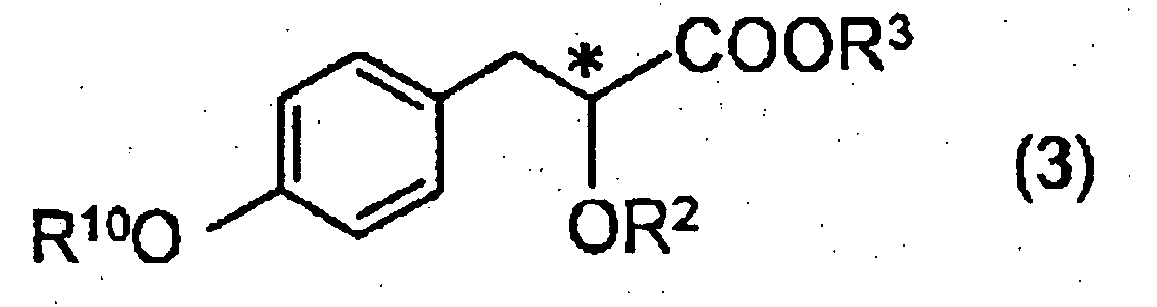
- First, the substituents in the compound to be synthesized in this step are described.
- In the compound (3) to be synthesized in this step, R2 represents an alkyl group containing 1 to 10 carbon atoms, which may optionally be substituted, or an aralkyl group containing 7 to 20 carbon atoms, which may optionally be substituted, and thus is, for example, methyl, ethyl, n-propyl, isopropyl, n-butyl, isobutyl, tert-butyl, cyclohexyl, trifluoromethyl or benzyl group; among them, methyl and ethyl groups are preferred.
- R3 represents a hydrogen atom, an alkyl group containing 1 to 10 carbon atoms; which may optionally be substituted, an aryl group containing 6 to 20 carbon atoms, which may optionally be substituted, or an aralkyl group containing 7 to 20 carbon atoms, which may optionally be substituted, and thus is, for example, a hydrogen atom, methyl, ethyl, n-propyl, isopropyl, n-butyl, isobutyl, tert-butyl, cyclohexyl, trifluoromethyl, phenyl or benzyl group; among them, a:hydrogen atom, methyl, ethyl groups and isopropyl groups are preferred, and a hydrogen atom, methyl and ethyl are more preferred.
- R10 is the same as the above-mentioned R1 or represents a hydrogen atom. Among them, tert-butyl group and a hydrogen atom are preferred, and a hydrogen atom is particularly preferred. The symbol * is as mentioned hereinabove.
- Now, the reaction step in question is described.
- In this reaction step, the hydroxyl group of the compound (2) is alkylated. Prior to the alkylation, the carboxyl group of the compound (2) may be esterified according to need. In this case, the phrase "according to need" means that the esterification of the carboxyl group of the compound (2) may be carried out or may not be carried out according to the reaction conditions and the compound desired. When the esterification is carried out, the methods of carboxyl group esterification as described in Protective Groups in Organic Synthesis, 3rd ed., Theodora W. Greene and Peter G. M. Wuts, Ed., Wiley-Interscience: New York, 1999; 373-428, for instance, can be used. As typical examples, there may be mentioned, for example, the method comprising subjecting the carboxylic acid to condensation with an alcohol in the presence of an acid catalyst, the method comprising reacting the carboxylic acid with an alcohol in the presence of a condensing agent, the method comprising reacting the carboxylic acid with an alkyl halide in the presence of a base, and the method comprising activating the carboxylic acid as the acid chloride or a mixed acid anhydride and reacting the activated form with an alcohol.
- In particular when the ether type protective group R1 in the compound (2) may possibly be decomposed under acidic conditions, the method using an alkyl halide is preferred since the esterification can then be carried out under neutral or alkaline conditions.
- The reaction solvent to be used in this esterification reaction is not particularly restricted and may be any solvent incapable of adversely affecting the reaction. Thus, for example, mention may be made of hydrocarbon type solvents such as pentane, hexane, heptane, cyclohexane and petroleum ether, ester type solvents such as ethyl acetate and methyl acetate, aromatic hydrocarbon type solvents such as toluene, benzene and xylene, nitrile type solvents such as acetonitrile and propionitrile, ether type solvents such as tert-butyl methyl ether, diethyl ether, diisopropyl ether, tetrahydrofuran and dioxane, amide type solvents such as N,N-dimethylformamide and N,N-dimethylacetamide, sulfoxide type solvents such as dimethyl sulfoxide, halogenated hydrocarbon type solvents such as methylene chloride, 1,2-dichloroethylene, chloroform and carbon tetrachloride, carboxylic acid type solvents such as acetic acid and formic acid, alcohol type solvents such as methanol, ethanol and isopropanol, and water. These solvents may also be used in the form of mixtures of two or more of them. When a mixed solvent is used, the mixing ratio is not particularly restricted.
- Although the concentration of the compound (2) in carrying out the reaction may vary depending on the reaction solvent used, the reaction can be carried out generally at a concentration of 1 to 50% by weight, preferably 5 to 30% by weight.
- The reaction temperature in carrying out the reaction may vary depending on the acid or base etc. species used and the amount thereof and on the reaction solvent species used. Generally, however, it is within the range of from the freezing point to the boiling point of the reaction solvent. For driving the reaction to completion in a short period of time, it is recommended that the reaction be carried out at an elevated temperature and, from the side reaction inhibition viewpoint, it is recommended that the reaction temperature be set at a low level. Generally, the reaction temperature is preferably within the range of 40 to 100°C, more preferably -20 to 80°C.
- The reaction time for the reaction may vary depending on the acid or base etc. species used and the amount thereof, the reaction solvent species and the reaction temperature. When the reaction is carried out at a temperature of -20 to 80°C, the reaction time is generally about 1 to 24 hours.
- As for the after-treatment following this reaction, an ordinary treatment process for recovering the product from the reaction mixture can be employed. For example, water, hydrochloric acid or an aqueous alkali solution, for instance, is added to the reaction mixture after completion of the reaction for neutralization, followed by an extraction procedure using an ordinary solvent such as ethyl acetate, diethyl ether, methylene chloride, toluene or hexane. Distilling off the reaction solvent and extraction solvent from the extract obtained under reduced pressure gives the desired product. If necessary, the thus-obtained product may be subjected to an ordinary purification process such as silica gel chromatography, distillation and/or recrystallization to further increase the purity.
- The alkylation reaction of the hydroxyl group of the compound (2) is now described. The alkylation of the hydroxyl group of the compound (2) can be carried out by causing an alkylating agent to act on the compound (2) in the presence of a base.
- As the base to be used, there may be mentioned inorganic bases such as sodium hydroxide, sodium carbonate and potassium carbonate, alkali metal alkoxides such as sodium methoxide, sodium ethoxide, sodium isopropoxide and potassium tert-butoxide, alkali metal hydrides such as sodium hydride and potassium hydride, alkali metals such as metallic sodium, Grignard reagents such as tert-butylmagnesium chloride, n-butylmagnesium chloride and ethylmagnesium chloride, alkali metal amides such as lithium diisopropylamide and sodium amide, and organolithium compounds such as n-butyllithium, sec-butyllithium and tert-butyllithium. From the yield and economy viewpoint, sodium carbonate, sodium methoxide, sodium ethoxide, potassium tert-butoxide and sodium hydride are preferred among others.
- The amount of the base to be used is not particularly restricted but, generally, the reaction can be carried out using the base in an amount of not smaller than 2 mole equivalents relative to the compound (2) or not smaller than 1 mole equivalent relative to the compound (2) in a salt form. Generally speaking from the economical viewpoint, the base is preferably used in an amount of not larger than 10.0 mole equivalents, more preferably not larger than 5.0 mole equivalents, still more preferably not larger than 4.0 mole equivalents.
- The alkylating agent to be used includes alkyl halides such as methyl iodide, ethyl iodide, methyl bromide, ethyl bromide, benzyl bromide, methyl chloride, ethyl chloride and benzyl chloride, sulfuric esters such as dimethyl sulfate and diethyl sulfate, and sulfonic esters such as methyl methanesulfonate, ethyl methanesulfonate, methyl p-toluenesulfonate, ethyl p-toluenesulfonate and methyl p-trifluoromethanesulfonate. From the yield and economy viewpoint, methyl iodide, ethyl iodide, methyl bromide, ethyl bromide, benzyl bromide, benzyl chloride, methyl methanesulfonate, ethyl methanesulfonate, methyl p-toluenesulfonate, dimethyl sulfate and diethyl sulfate are preferred, and methyl iodide, ethyl iodide; dimethyl sulfate and diethyl sulfate are particularly preferred.
- The amount of the alkylating agent to be used is not particularly restricted but, generally, the reaction can be carried out using an amount thereof of not smaller than 1 mole equivalent relative to the compound (2). Generally speaking from the economical viewpoint, the alkylating agent is used preferably in an amount of not larger than 10.0 mole equivalents, more preferably not larger than 5.0 mole equivalents, still more preferably not larger than 4.0 mole equivalents.
- Generally, a solvent is used in the above reaction. The reaction solvent is not particularly restricted but may be any solvent incapable of adversely affecting the reaction. Thus, mention may be made of hydrocarbon type solvents such as pentane, hexane, heptane, cyclohexane and petroleum ether, ester type solvents such as ethyl acetate, methyl acetate, propyl acetate and methyl propionate, aromatic hydrocarbon type solvents such as toluene, benzene and xylene, nitrile type solvents such as acetonitrile and propionitrile, ether type solvents such as tert-butyl methyl ether, diethyl ether, diisopropyl ether, tetrahydrofuran and 1,4-dioxane, amide type solvents such as N,N-dimethylformamide and N,N-dimethylacetamide, sulfoxide type solvents such as dimethyl sulfoxide, halogenated hydrocarbon type solvents such as methylene chloride, 1,2-dichloroethylene, chloroform and carbon tetrachloride, and amine type solvents such as pyridine and triethylamine. These solvents may also be used in the form of mixtures of two or more.
- From the reactant substrate solubility and yield viewpoint, toluene, acetonitrile, tetrahydrofuran, 1,4-dioxane, N,N-dimethylformamide and N,N-dimethylacetamide, and mixtures of two or more of these are preferred, and tetrahydrofuran and N,N-dimethylformamide are particularly preferred. In the case of use of a mixed solvent, the mixing ratio is not particularly restricted.
- Although the concentration of the compound (2) in carrying out the reaction may vary depending on the reaction solvent used, the reaction can be carried out generally at a concentration of 1 to 50% by weight, preferably 5 to 30% by weight.
- The reaction temperature in carrying out the reaction may vary depending on the base, alkylating agent and reaction solvent species employed. Generally, however, it is within the range of from the freezing point to the boiling point of the reaction solvent. For driving the reaction to completion in a short period of time, it is recommended that the reaction be carried out at an elevated temperature and, from the side reaction inhibition viewpoint, it is recommended that the reaction temperature be set at a low level. Generally, the reaction temperature is preferably within the range of -40 to 100°C, more preferably -20 to 80°C.
- The reaction time for the reaction may vary depending on the base, alkylating agent and reaction solvent species used and on the reaction temperature. When the reaction is carried out at a temperature of -20 to 80°C, the reaction time is generally about 1 to 40 hours.
- As for the after-treatment following this reaction, an ordinary treatment process for recovering the product from the reaction mixture can be employed. For example, water or hydrochloric acid, for instance, is added to the reaction mixture after completion of the reaction for neutralization, followed by an extraction procedure using an ordinary solvent such as ethyl acetate, diethyl ether, methylene chloride, toluene or hexane. Distilling off the reaction solvent and extraction solvent from the extract obtained under reduced pressure gives the desired product. If necessary, the thus-obtained product may be subjected to an ordinary purification process such as silica gel chromatography, distillation and/or recrystallization to further increase the purity.
- In this step, after alkylation of the hydroxyl group, the protective group R1 may be eliminated (for deprotection) according to need.
- Here, the phrase "according to need" means that the protective group R1 may be eliminated (for deprotection) or may not be eliminated according to the reaction conditions and the compound desired.
- The deprotection conditions may vary according to the protective group used. When the protective group is methoxymethyl, methoxyethoxymethyl, tetrahydropyranyl, benzyloxymethyl, tert-butyl or methyl group, the deprotection reaction can be effected using an acid.
- The acid to be used is not particularly restricted but includes mineral acids such as hydrochloric acid, hydrobromic acid and sulfuric acid, and organic acids such as trifluoroacetic acid, acetic acid, methanesulfonic acid and p-toluenesulfonic acid. Among them, hydrochloric acid is preferred from the economical viewpoint.
- When the protective group is methyl group, the deprotection reaction can be carried out using a thiol such as methanethiol, ethanethiol or octanethiol.
- The amount of the thiol to be used is not particularly restricted but, generally, the thiol is used in an amount of not smaller than 1 mole equivalent relative to the compound (3). Generally speaking from the economical viewpoint, that amount is preferably not larger than 10 mole equivalents, more preferably not larger than 3 mole equivalents.
- The reaction solvent for the deprotection reaction is not particularly restricted and may be any solvent incapable of adversely affecting the reaction. Thus, for example, mention may be made of hydrocarbon type solvents such as pentane, hexane, heptane, cyclohexane and petroleum ether, ester type solvents such as ethyl acetate and methyl acetate, aromatic hydrocarbon type solvents such as toluene, benzene and xylene, nitrile type solvents such as acetonitrile and propionitrile, ether type solvents such as tert-butyl methyl ether, diethyl ether, diisopropyl ether, tetrahydrofuran and dioxane, amide type solvents such as N, N-dimethylformamide, N,N-dimethylace.tamide and N-methylpyrrolidinone; sulfoxide type solvents such as dimethyl sulfoxide, halogenated hydrocarbon type solvents such as methylene chloride, 1,2-dichloroethylene, chloroform and carbon tetrachloride, carboxylic acid type solvents such as acetic acid and formic acid, alcohol type solvents such as methanol, ethanol and isopropanol, and water. These solvents may also be used in the form of mixtures of two or more of them. When a mixed solvent is used, the mixing ratio is not particularly restricted.
- Although the concentration of the compound (3) in carrying out the deprotection reaction may vary depending on the reaction solvent used, the reaction can be carried out generally at a concentration of 1 to 50% by weight, preferably 5 to 30% by weight.
- The reaction temperature in the deprotection reaction may vary depending on the acid or thiol species used and the amount thereof and on the reaction solvent species used. Generally, it is within the freezing point to the boiling point of the reaction solvent used. For driving the reaction to completion in a short time, it is recommended that the reaction be carried out at an elevated temperature and, from the side reaction inhibition viewpoint, it is recommended that the reaction temperature be set at a low level. Generally, the reaction temperature is preferably within the range of 0 to 150°C, more preferably 20 to 120°C.
- The reaction time for the deprotection reaction may vary depending on the acid or thiol species used and the amount thereof, the reaction solvent species used and the reaction temperature. When the reaction is carried out,at a temperature of 20 to 120°C, the reaction time is generally about 1 to 24 hours.
- After the deprotection reaction, an ordinary treatment process for recovering the product from the reaction mixture can be employed. For example, water or an aqueous alkali solution, for instance, is added to the reaction mixture after completion of the reaction for neutralization, followed by an extraction procedure using an ordinary solvent such as ethyl acetate, diethyl ether, methylene chloride, toluene or hexane. Distilling off the reaction solvent and extraction solvent from the extract obtained under reduced pressure gives the desired product. If necessary, the thus-obtained product may be subjected to an ordinary purification process such as silica gel chromatography, distillation and/or recrystallization to further increase the purity.
- When, in the reaction step from (2) to (3), the compound (2) is first esterified and then alkylated, a compound represented by the general formula (6):

- When the compound (2) is subjected to the above-mentioned alkylation reaction without preliminary esterification of the carboxyl group thereof, a compound represented by the general formula (4):


- In the compounds (4) and (5), R2, R10 and * are as defined above.
- In this case, the proportion of the compound (4) and/or (5) depends on the reaction conditions in the alkylation of the hydroxyl group of the compound (2).
- The present inventors found that the compound (4) can be obtained highly selectively as a result of selective alkylation of the hydroxyl group as attained by carrying out the alkylation reaction in the presence of a base, using an ether type solvent and/or a nitrile type solvent as the reaction solvent and an alkyl halide as the alkylating agent.
- As the alkyl halide, there may be mentioned, for example, such alkyl halides as methyl iodide, ethyl iodide, methyl bromide, ethyl bromide, methyl chloride and ethyl chloride. Among them, methyl iodide, ethyl iodide, methyl bromide and ethyl bromide are preferred.
- The amount of the alkyl halide to be used is not particularly restricted but, generally, the reaction can be carried out using the alkyl halide in an amount of not smaller than 1 mole equivalent relative to the compound (2). Generally speaking from the economical viewpoint, that amount is preferably not larger than 10.0 mole equivalents, more preferably not larger than 5.0 mole equivalents, still more preferably not larger than 4.0 mole equivalents.
- As for the reaction solvent to be used in the above reaction; mention may be made of ether type solvents such as tetrahydrofuran and 1, 4-dioxane and nitrile type solvents such as acetonitrile and propionitrile for selective synthesis of the compound (4) Among them, tetrahydrofuran and acetonitrile are preferred and, in particular, tetrahydrofuran is preferred, from the economical viewpoint. A mixed solvent composed of these may also be used.
- When, on the other hand, N,N-dimethylformamide and/or N,N-dimethylacetamide is used as the reaction solvent, the formation of the compound (4) is inhibited no matter what other conditions are and, therefore, the compound (5) can be obtained highly selectively. For selectively synthesizing the compound (5), N,N-dimethylformamide and/or N,N-dimethylacetamide is preferred. When a mixed solvent composed thereof is used, the mixing ratio is not particularly restricted.
- The base species and the amount thereof, the reaction temperature, reaction concentration and reaction time, the after-treatment method and the method of deprotection in case of deprotection, which are to be used or employed in carrying out this reaction are all the same as those in the above-mentioned reaction from the compound (2) to the compound (3).
- Those compounds of the formula (3) in which R10 is tert-butyl group, namely optically.active 2-substituent-oxy-3-(4-tert-butoxyphenyl)propionic acid derivatives represented by the general formula (8):
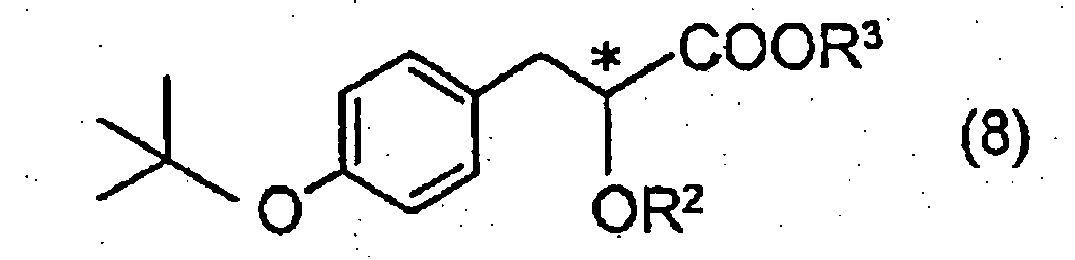
- Now, the step of producing the compound (4) by hydrolyzing the compound (5), if necessary followed by elimination of R10 (deprotection), is described.
- Generally, this reaction is carried out in the presence of an acid or base. Either of the sets of reaction conditions may be employed. The acid to be used includes mineral acids such as hydrochloric acid, sulfuric acid and nitric acid, and organic acids such as acetic acid, trifluoroacetic acid, methanesulfonic acid and p-toluenesulfonic acid. Among them, hydrochloric acid and sulfuric acid are preferred from the economical viewpoint.
- The base to be used includes inorganic bases such as lithium hydroxide, sodium hydroxide, potassium hydroxide, calcium hydroxide, potassium carbonate and sodium carbonate. Among them, sodium hydroxide and potassium hydroxide are preferred from the economical viewpoint.
- The amount of the acid or base to be used is not particularly restricted but, generally, the reaction can be carried out using the acid or base in an amount of not smaller than 0.1 mole equivalent, relative to the compound (5). Generally speaking from the economical viewpoint, the acid or base is preferably used in an amount of not larger than 10.0 mole equivalents, more preferably not larger than 3.0 mole equivalents, still more preferably not larger than 1.5 mole equivalents. In particular, when a base is used, the reaction is carried out in most cases using the base in an amount of not smaller than 1.0 mole equivalent.
- The reaction solvent for this reaction is not particularly restricted and may be any solvent incapable of adversely affecting the reaction: Thus, for example, mention may be made of hydrocarbon type solvents such as pentane, hexane, heptane, cyclohexane and petroleum ether, aromatic hydrocarbon type solvents such as toluene, benzene and xylene, nitrile type solvents such as acetonitrile and propionitrile, ether type solvents such as tert-butyl methyl ether, diethyl ether, diisopropyl ether, tetrahydrofuran and dioxane, amide type solvents such as N,N-dimethylformamide and N,N-dimethylacetamide, sulfoxide type solvents such as dimethyl sulfoxide, halogenated hydrocarbon type solvents such as methylene chloride, 1,2-dichloroethylene, chloroform and carbon tetrachloride, carboxylic acid type solvents such as acetic acid and formic acid, alcohol type solvents such as methanol, ethanol and isopropanol, and water. These solvents may also be used in the form of mixtures of two or more of them. Among them, water, methanol, ethanol and isopropanol or mixed solvents composed of two or more of them are preferred from the yield viewpoint. When a mixed solvent is used, the mixing ratio is not particularly restricted.
- Although the concentration of the compound (5) in carrying out the reaction may vary depending on the reaction solvent used, the reaction can be carried out generally at a concentration of 1 to 50% by weight, preferably 5 to 30% by weight.
- The reaction temperature in carrying out the reaction may vary depending on the acid or base species used and the amount thereof and on the reaction solvent species. Generally, however, it is within the range of from the freezing point to the boiling of the reaction solvent. For driving the reaction to completion in a short time, it is recommended that the reaction be carried out at an elevated temperature and, from the side reaction inhibition viewpoint, it is recommended that the reaction temperature be set at a low level. Generally, the reaction temperature is preferably within the range of -40 to 100°C, more preferably -20 to 80°C.
- The reaction time for the reaction may vary depending on the acid or base species used and the amount thereof, the reaction solvent species and the reaction temperature. When the reaction is carried out at a temperature of -20 to 80°C, the reaction time is generally about 1 to 24 hours.
- As for the after-treatment following this reaction, an ordinary treatment process for recovering the product from the reaction mixture can be employed. For example, water, hydrochloric acid or an aqueous alkali solution, for instance, is added to the reaction mixture after completion of the reaction for neutralization, followed by an extraction procedure using an ordinary solvent such as ethyl acetate, diethyl ether, methylene chloride, toluene or hexane. Since the product is a carboxylic acid, the extraction is generally carried out under acidic conditions. Distilling off the reaction solvent and extraction solvent from the extract obtained under reduced pressure gives the desired product. If necessary, the thus-obtained product may be subjected to an ordinary purification process such as silica gel chromatography, distillation and/or recrystallization to further increase the purity.
- In this step, the protective group R10 may be eliminated (for deprotection) according to need. The deprotection can be carried out in the same manner as the above-mentioned deprotection by elimination of R1. When the deprotection is carried out using an acid, the above-mentioned ester hydrolysis and the deprotection can also be carried out simultaneously. In cases where the compound (2) is converted to the compound (5) and the compound (5) is then converted to the compound (4) by hydrolysis, the deprotection by elimination of the protective group R1 (or R10) can be carried out at any time after the alkylation reaction of the hydroxyl group of the compound (2). Generally, the deprotection is carried out prior to the hydrolysis of the compound (5) but may also be carried out after the hydrolysis or simultaneously with the hydrolysis.
- Now, the step of etherifying the compound (4), if necessary followed by elimination (for deprotection) of R10 , to thereby produce the corresponding compound, namely optically active
2-substituent-oXy-3-(4-subsituent-oxyphenyl)propionic acid ester, represented by the general formula (6):
- The esterification of the compound (4) can be carried out in the same manner as in the esterification reaction of the carboxyl group in the compound (2) already described hereinabove.
- In this step, the protective group R10 may be eliminated (for deprotection) according to need. The deprotection can be carried out in the same manner as the elimination (for deprotection) of R1 described hereinabove. When an acid is used in the deprotection, the deprotection can be effected simultaneously with the above-mentioned esterification reaction. In cases where the compound (2) is converted to the compound (4) and the compound (4) is then esterified to give the compound (6), the deprotection by elimination of the protective group R1 (or R10) can be carried out at any time after the alkylation reaction of the hydroxyl group of the compound (2). Generally, the deprotection is carried out prior to the esterification of the compound (4) but may also be carried out after the esterification or simultaneously with the esterification.
- Now, the step of subjecting the optically active 2-substituent-oxy-3-(4-substituent-oxyphenyl)propionic acid ester (5) to transesterification, if necessary followed by elimination (for deprotection) of R10, to produce the corresponding optically active 2-substituent-oxy-3-(4-substituent-oxyphenyl)propionic acid ester (6) is described.
- The method of carrying out the transesterification of the compound (5) is not particularly restricted and the reaction can be carried out in the conventional manner. Thus, for example, there may be mentioned the method comprising adding such an acid as sulfuric acid or p-toluenesulfonic acid or such a Lewis acid as titanium tetrachloride to a mixture of an alcohol and the compound (5) and the method comprising adding a base such as sodium hydroxide or potassium carbonate to such mixture and, from the economical viewpoint, the method comprising adding an acid to the mixture of an alcohol and the compound (5) is preferred.
- The reaction solvent to be used in this reaction is not particularly restricted and may be any solvent incapable of adversely affecting the reaction. Thus, mention may be made of, for example, hydrocarbon type solvents such as pentane, hexane, heptane, cyclohexane and petroleum ether, ester type solvents such as ethyl acetate and methyl acetate, aromatic hydrocarbon type solvents such as toluene, benzene and xylene, nitrile type solvents such as acetonitrile and propionitrile, ether type solvents such as tert-butyl methyl ether, diethyl ether, diisopropyl ether, tetrahydrofuran and dioxane, amide type solvents such as N,N-dimethylformamide and N,N-dimethylacetamide, sulfoxide type solvents such as dimethyl sulfoxide, halogenated hydrocarbon type solvents such as methylene chloride, 1,2-dichloroethylene, chloroform and carbon tetrachloride, carboxylic acid type solvents such as acetic acid and formic acid, alcohol type solvents such as methanol, ethanol and isopropanol, and water. Among them, alcohol type solvents such as methanol, ethanol and isopropanol are preferred. These solvents may also be used in the form of mixtures of two or more of them. When a mixed solvent is used, the mixing ratio is not particularly restricted.
- Although the concentration of the compound (5) in carrying out the reaction may vary depending on the reaction solvent used, the reaction can be carried out generally at a concentration of 1 to 50% by weight, preferably 5. to 30% by weight.
- The reaction temperature in carrying out the reaction may vary depending on the acid or base species used and the amount thereof and on the reaction solvent species used. Generally, however, it is within the range of from the freezing point to the boiling point of the reaction solvent. For driving the reaction to completion in a short period of time, it is recommended that the reaction be carried out at an elevated temperature and, from the side reaction inhibition viewpoint, it is recommended that the reaction temperature be set at a low level. Generally, the reaction temperature is preferably within the range of -40 to 100°C, more preferably -20 to 80°C.
- The reaction time for the reaction may vary depending on the acid or base species used and the amount thereof, the reaction solvent species and the reaction temperature. When the reaction is carried out at a temperature of -20 to 80°C, the reaction time is generally about 1 to 24 hours.
- This reaction step may be carried out in one stage, or the compound (5) may be hydrolyzed to give the compound (4), which is to be esterified to give the compound (6) . The method of hydrolyzing the compound (5) and the method of esterifying the compound (4) are the same as those already mentioned hereinabove.
- As for the after-treatment following this reaction,an ordinary treatment process for recovering the product from the reaction mixture can be employed. For example, water, hydrochloric acid or an aqueous alkali solution, for instance, is added to the reaction mixture after completion of the reaction for neutralization, followed by an extraction procedure using an ordinary solvent such as ethyl acetate, diethyl ether, methylene chloride, toluene or hexane. Distilling off the reaction solvent and extraction solvent from the extract obtained under reduced pressure gives the desired product. If necessary, the thus-obtained product may be subjected to an ordinary purification process such as silica gel chromatography, distillation and/or recrystallization to further increase the purity.
- In this step, the protective group R10 may be eliminated (for deprotection) according to need. The deprotection can be carried out in the same manner as the elimination (for deprotection) of R1 described hereinabove. When an acid is used in the deprotection, the deprotection can be effected simultaneously with the above-mentioned transesterification reaction. In cases where the compound (2) is converted to the compound (5) and the compound (5) is then subjected to transesterification to give the compound (6), the deprotection by elimination of the protective group R1 (or R10) can be carried out at any time after the alkylation reaction of the hydroxyl group of the compound (2). Generally, the deprotection is carried out prior to the transesterification of the compound (5) but may also be carried out after the transesterification or simultaneously with the transesterification.
- When, in any step in the process of the invention, the compound is a carboxylic acid, the carboxylic acid may occur in the form of a carboxylic acid salt. As the carboxylic acid salt form, there may be mentioned alkali metal carboxylates such as sodium carboxylate, potassium carboxylate and lithium carboxylate, and alkaline earth metal carboxylates such as magnesium carboxylate and calcium carboxylate. Among them, the sodium carboxylate form is preferred.
- The following examples illustrate the present invention in further detail. These examples are, however, by no means limitative of the scope of the invention.
- A suspension of 4-tert-butoxybenzaldehyde (30.0 g, 168 mmol), hydantoin (33.73 g, 337 mmol, 2 eq.) and 1-amino-2-propanol (12.73 g, 168 mmol, 1 eq.) in distilled water (300 mL) was stirred under refluxing conditions for 4 hours. After cooling to room temperature; the precipitate was collected by filtration under reduced pressure to give 5-(4-tert-butoxybenzylidene)hydantoin (43.9 g, yield 98%).
- Then, a suspension of the 5-(4-tert-butoxybenzylidene)hydantoin (30.0 g, 115 mmol) synthesized in the above manner and NaOH (24.0 g, 576 mmol, 5 eq.) in distilled water (300 mL) was stirred under refluxing conditions for 4.5 hours. After cooling to room temperature, the pH was adjusted to 7. 94 using hydrochloric acid. NaCl (35.3 g, 600 mmol) was added, and the resulting mixture was further stirring at room temperature for 15 hours. The desired product that had precipitated was collected by filtration under reduced pressure, washed with methanol and dried under vacuum to give the desired product sodium
2-oxo-3-(4-tert-butoxyphenyl)propionate (25.9 g, yield 88%).
1H NMR (400 MHz, D2O/ppm): δ 1.19 (s, 9H), 3.92 (s, 2H), 6.91-6.94 (m, 2H), 7.04-7.06 (m, 2H). - Sodium 2-oxo-3-(4-tert-butoxyphenyl)propionate (10 mg) synthesized in the same manner as in Reference Example, 13 mg of glucose, 1 mg of NAD+, 5 U of glucose dehydrogenase (product of Amano Enzyme.Inc.) and 100 U of swine heart-derived L-lactic dehydrogenase (product of Sigma) were added to a test tube containing 1.0 ml of 200 mM phosphate buffer (pH 7), and the mixture was stirred at 30°C for 16 hours. Ethyl acetate (2 mL) and 10 µl of 6 N hydrochloric acid were added and, after thorough stirring, the organic phase was recovered as an extract. The extract was analyzed under the HPLC conditions given below, and the mole conversion rate to 2-hydroxy-3-(4-tert-butoxyphenyl)propionic acid and the optical purity of the product 2-hydroxy-3-(4-tert-butoxyphenyl)propionic acid were determined. As a result, the mole conversion rate was 100%, and the absolute configuration of the 2-hydroxy-3-(4-tert-butoxyphenyl)propionic acid formed was S and the optical purity thereof was 99.8% ee.
[HPLC analysis conditions]
Column: CHIRALPAKAD-H (4.6 mm I.D. x 250 mm) (product of DAICEL CHEMICAL INDUSTRIES, LTD.), column temperature: room temperature, mobile phase; n-hexane/ethanol/trifluoroacetic acid = 950/50/1, flow rate: 1 ml/min., detection wavelength: 230 nm, retention time: R-form - 15.6 minutes, S-form - 21.3 minutes. - The reaction procedure of Example 1 was followed in the same manner except that Bacillus stearothermophilus-derived L-lactic acid dehydrogenase (product of Sigma) or Leuconostoc mesenteroides-derived D-lactic acid dehydrogenase (product of Sigma) was used in lieu of swine heart-derived L-latic dehydrogenase (product of Sigma), followed by the same analytical procedure. As a result, when Bacillus stearothermophilus-derived L-lactic acid dehydrogenase was used, the mole conversion rate was 98%, the absolute configuration of the product 2-hydroxy-3-(4-tert-butoxyphenyl)propionic acid was S and the optical purity thereof was 99.8% ee. When Leuconostoc mesenteroides-derived D-lactic acid dehydrogenase was used, the mole conversion rate was 77%, the absolute configuration of the product 2-hydroxy-3-(4-tert-butoxyphenyl)propionic acid was R and the optical purity thereof was 99.5% ee.
- Glucose (23.5 g), 122,000 U of Bacillus stearothermophilus-derived L-lactic acid dehydrogenase (product of Sigma), 67, 500 U of glucose dehydrogenase (product of Amano Enzyme Inc.), 100 mg of NAD+ and 15.0 g of the sodium 2-oxo-3-(4-tert-butoxyphenyl)propionate synthesized in Reference Example were added to 1.5 L of 100 mM phosphate buffer (pH 6.5), and the mixture was stirred at 30°C while adjusting the pH at 6.5 by adding a 5 N aqueous sodium hydroxide solution. After 2 hours of the reaction procedure, 15.0 g of sodium 2-oxo-3-(4-tert-butoxyphenyl)propionate was further added, and the reaction was further carried out for 21 hours. After completion of the reaction, the reaction mixture was adjusted to pH 9.5 with a 6 N aqueous sodium hydroxide solution and then washed with ethyl acetate. The aqueous phase after washing was adjusted to pH 2.5 with 6 N hydrochloric acid and the product 2-hydroxy-3-(4-tert-butoxyphenyl)propionic acid was extracted with ethyl acetate. Removal of the solvent in the extract by distillation under reduced pressure gave 19.2 g of (S)-2-hydroxy-3-(4-tert-butoxyphenyl)propionic acid with an optical purity of 9.9.4% ee.
- A mixture of the (S)-2-hydroxy-3-(4-tert-butoxyphenyl)propionic acid (14.57 g, 61 mmol, optical purity 99.4% ee) synthesized in Example 4 and NaH (10.66 g, 244 mmol) in tetrahydrofuran (380 mL) was stirred under refluxing conditions for 3.5 hours. After lowering the temperature of the reaction mixture to 38°C, methyl iodide. (34.86 g, 244 mmol) was added, and the resulting mixture was further stirred for 29.5 hours. After cooling on an ice bath, 3 N hydrochloric acid (20 mL) and distilled water (25 mL) were added to terminate the reaction. The tetrahydrofuran was distilled off by concentration under reduced pressure, and the aqueous layer was washed with toluene. Toluene was added to the aqueous layer, the mixture was adjusted to pH 2.1 with 3 N hydrochloric acid (23 mL). After toluene extraction, the toluene layer was washed with distilled water and then concentrated under reduced pressure to give (S)-2-methoxy-3-(4-tert-butoxyphenyl)propionic acid (15.5 g, yield 100%, optical purity 99.4% ee) . 1H NMR (400 MHz, CDCl3/ppm): δ 1.33 (s, 9H), 2.94-2.99 (m, 1H), 3.08-3.13 (m, 1H), 3.39.(s, 3H), 3.95-4.00 (m, 1H), 6.90-6.96 (m, 2H), 7.12-7.14 (m, 2H).
- A mixture of the (S) -2-methoxy-3- (4-tert-butoxyphenyl) propionic acid (15.0 g, 60 mmol, optical purity 99.4% ee) synthesized in Example 5 and 3 N hydrochloric acid (290 mL) was stirred on an oil bath at 60°C for 2 hours. After ice cooling, the pH was adjusted to 2.0 with a 30% aqueous solution of NaOH, followed by extraction with ethyl acetate. Concentration of the extract under reduced pressure gave (S) -2-methoxy-3- (4-hydroxyphenyl) propionic acid (11.4 g, yield 97%, optical purity 99.4% ee).
- 1H NMR (400 MHz, CDCl3/ppm) : δ 2. 94-2. 99 (m, 1H), 3.05-3. 09 (m, 1H), 3.41 (s, 3H), 3.98-4.00 (m, 1H), 6.73-6.76 (m, 2H), 7.08-7.11 (m, 2H).
- NaH (69 mg, 1.73 mmol, 2.5 eq.) was added to a solution of (S)-2-hydroxy-3-(4-tert-butoxyphenyl)propionic acid (165.4 mg, 0.69 mmol, optical purity 99.6% ee) synthesized in the same manner as in Example 4 in dimethylformamide (3.5 mL) with ice cooling. After 10 minutes, the temperature was raised to room temperature and the mixture was then stirred at room temperature for 1 hour. Then, the mixture was stirred on a water bath at 50°C for 40 minutes and then cooled to -10°C, and methyl iodide (393.7 mg, 2.89 mmol, 4 eq.) was added dropwise. After 20 hours of stirring at -10°C, the reaction was terminated by adding a saturated aqueous solution of ammonium chloride (3.5 mL). After addition of 1 mL of distilled water, the mixture was adjusted to pH 9.52 with a 30% aqueous solution of sodium hydroxide. After extraction with toluene, the organic layer was dried over sodium sulfate. After removal of the drying agent by filtration under reduced pressure, the filtrate was concentrated under reduced pressure. The crude product obtained was purified by silica gel column chromatography (silica gel 10.23 g, eluent: hexane/ethyl acetate = 15/1), whereupon methyl
- 1H NMR (400 MHz, CDCl3/ppm): δ 1.33 (s, 9H), 2.96-2.98 (m, 1H), 3.34 (s, 3H), 3. 69 (s, 3H), 3.93-3.96 (m, 1H), 6. 89-6. 91 (m, 2H), 7.09-7.11 (m, 2H) .
- Column: OJ-RH (two columns used), column temperature: 30°C, mobile phase: phosphate buffer (pH 2) /acetonitrile = 6/4, flow rate: 0.5 ml/min., detection wavelength: 210 nm, retention time: R-form - 20.9 minutes, S-form - 21.8 minutes.
- A mixture of methyl (S)-2-methoxy-3-(4-tert-butoxyphenyl)propionate (83 mg, 0.31 mmol) synthesized in the same manner as in Example 7 and 3 N hydrochloric acid (1 mL) was stirred at room temperature for 17 hours and then at 60°C for 4 hours . HPLC assay of the reaction mixture revealed the formation of (S)-2-methoxy-3-(4-hydroxyphenyl)propionic acid (58.8 mg, yield 87%).
- NaH. (83.2 mg, 2.08 mmol, 4 eq.) was added to a solution of (S)-2-hydroxy-3-(4-tert-butoxyphenyl)propionic acid (188.3 mg, 0.52 mmol, optical purity 99.6% ee) synthesized in the same manner as in Example 2 in dimethylformamide (2.6 mL) at room temperature, and the mixture was then stirred at room temperature for 1 hour and, after temperature raising to 46°C, further stirred for 30 minutes. After cooling to-5°C, dimethyl sulfate. (267.7 mg, 2.08 mmol, 4 eq.) was added dropwise and after 21 hours of stirring at -5°C, a saturated aqueous ammonium chloride solution (2.6 mL) was added to terminate the reaction. After addition of 5 mL of distilled water, the reaction mixture was adjusted to pH 9.65 using a 30% aqueous solution of sodium hydroxide. After extraction with toluene, the organic layer was dried over sodium sulfate. After removal of the drying agent by filtration under reduced pressure, the filtrate was concentrated under reduced pressure, and the concentrate was subjected to HPLC analysis, which indicated the formation of methyl (S)-2-methoxy-3-(4-tert-butoxyphenyl)propionate (91.4 mg, yield 66%, optical purity 98.9% ee) and methyl (S)-2-hydroxy-3-(4-tert-butoxyphenyl)propionate (7.1 mg, yield 5.4%). The formation of (S)-2-methoxy-3-(4-tert-butoxyphenyl)propionic acid was not revealed.
- 1H NMR (400 MHz, CDCl3/ppm) : δ 1.33 (s, 9H), 2.69 (d, J = 6.35 Hz, 1H), 2.90-2.96 (m, 1H), 3.05-3.10 (m, 1H), 3.75 (s, 3H), 4.41-4.46 (m, 1H), 6.90-6.92 (m, 2H), 7.09-7.11 (m, 2H).
- Column: Hydrosphere, column temperature: 30°C, mobile phase: phosphate buffer (pH 2) /acetonitrile = 7/3, flow rate: 1 ml/min., detection wavelength: 210 nm, retention time: methyl (S)-2-methoxy-3-(4-tert-butoxyphenyl)propionate = 22.2 minutes, methyl.
- NaH (52 mg, 1.3 mmol, 2.5 eq.) was added to a solution of (S)-2-hydroxy-3-(4-tert-butoxyphenyl)propionic acid (124.8 mg, 0.52 mmol) synthesized in the same manner as in Example 4 in dimethylacetamide (2.6 mL) at room temperature. The mixture was then stirred at room temperature for 1 hour and, after temperature raising to 48°C, further stirred for 30 minutes. After cooling to -10°C, methyl iodide (295.2 mg, 2.08 mmol, 4 eq.) was added dropwise. After 20 hours of stirring at -10°C, a saturated aqueous ammonium chloride solution (2.6 mL) was added to terminate the reaction. After addition of 1.1 mL of distilled water, the reaction mixture was adjusted to pH 9.65 using a 30% aqueous solution of sodium hydroxide. After extraction with toluene, the organic layer was dried over sodium sulfate. The drying agent was removed by filtration under reduced pressure, the filtrate was concentrated under reduced pressure, and the concentrate was subjected to HPLC assaying, which revealed the formation of methyl (S)-2-methoxy-3-(4-tert-butoxyphenyl)propionate (103.0 mg, yield 79%). Neither methyl (S)-2-hydroxy-3-(4-tert-butoxyphenyl)propionate nor (S)-2-methoxy-3-(4-tert-butoxyphenyl)propionic acid was formed.
- A solution of (S)-2-hydroxy-3-(4-tert-butoXyphenyl)propionie acid (124.8 mg, 0.52 mmol) synthesized in the same manner as in Example 2 and dimethyl sulfate (267.7 mg, 2.08 mmol, 4 eq.) in tetrahydrofuran (2.6 mL) was added dropwise to a solution of NaH (52 mg, 1.3 mmol, 2.5 eq.) in tetrahydrofuran (1 mL) under refluxing conditions. The resulting mixture was then stirred under refluxing conditions for 3 hours. HPLC assaying revealed the formation of methyl (S)-2-methoxy-3-(4-tert-butoxyphenyl)propionate (90.0 mg, yield 69%), methyl (S)-2-hydroxy-3-(4-tert-butoxyphenyl)propionate (23.7 mg, yield 18%) and (S)-2-methoxy-3-(4-tert-butoxyphenyl)propionic acid (0.4 mg, yield 0.3%).
- NaH (100 mg, 2.5 mmol, 2.5 eq.) was added to a solution of (S) -2-hydroxy-3-(4-methoXyphenyl) propionic acid (196.2 mg, 1.0 mmol, optical purity 79.% ee) in dimethylformamide (5 mL) with ice cooling, and the mixture was then stirred at -10°C for 1.8 hours, then at room temperature for 0.75 hour and further at -10°C for 0.7 hour. At -10°C, methyl iodide (575.8 mg, 4.0 mmol, 4 eq.) was added, and the resulting mixture was further stirred at -10°C for 1.9 hours. A saturated aqueous ammonium chloride, solution (5 mL) was added to terminate the reaction. The reaction mixture was extracted with ethyl acetate, and the extract was concentrated under reduced pressure. Purification by silica gel column chromatography (eluent: hexane/ethyl acetate = 5/1) gave methyl
(S)-2-methoxy-3-(4-methoxyphenyl)propionate (91.2 mg, yield 41%, optical purity 79% ee). The aqueous layer was subjected to HPLC assaying and found to contain
(S)-2-methoxy-3-(4-methoxyphenyl)propionic acid (86.2 mg, yield 41%). - 1H NMR (400 MHz, CDCl3/ppm): δ 2.91-3.01 (m, 2H), 3.35 (s, 3H), 3.72 (s, 3H), 3. 79 (s, 3H), 3.90-3.96 (m, 1H), 6.81-6.84 (m, 2H), 7.12-7.14 (m, 2H).
- 1H NMR (400 MHz, CDCl3/ppm): δ 2.94-2.99 (m, 1H), 3.07-3.11 (m, 1H), 3.40 (s, 3H), 3.79 (s, 3H), 3.97-4.00 (m, 1H), 6.82-6.85 (m, 2H), 7.15-7.17 (m, 2H)
- Column: Lichrosphere, column temperature: 30°C, mobile phase: phosphate buffer (pH 2) /acetonitrile = 8/2) , flow rate: 1 ml/min., detection wavelength: 210 nm, retention time: 23.6 minutes.
- Column: OD-H (two columns used), column temperature: 30°C, mobile phase: n-hexane/2-propanol = 95/5, flow rate: 0.5 ml/min., detection wavelength: 210 nm, retention time: (R) -form - 20.9 minutes, (S)-form - 21.8 minutes.
- A solution of NaOH (1.06 g, 27.8 mmol, 1.2 eq.) in water (39.5 mL) as well as methanol (38 mL) was added to methyl (S)-2-methoxy-3-(4-methoxyphenyl) propionate (5.16 g, 2 3 mmol, optical purity 87% ee) synthesized in the same manner as in Example 12, with ice cooling. After 2.7 hours of stirring at room temperature, the reaction mixture was washed with toluene. The aqueous layer was adjusted to pH 2.02 by addition of hydrochloric acid and then extracted with ethyl acetate. Concentration under reduced pressure gave (S)-2-methoxy-3-(4-methoxyphenyl)propionic acid (4.63 g, yield 96%, optical purity 87% ee). The optical purity of the (S)-2-methoxy-3-(4-methoxyphenyl)propionic acid was determined after derivatization thereof to methyl (S)-2-methoxy-3-(4-methoxyphenyl)propionate using trimethylsilyldiazomethane.
1H NMR (400MHz, CDCl3/ppm): δ 2.94-2.99 (m, 1H), 3.06-3.11 (m, 3H), 3.40 (s, 3H), 3.79 (s, 3H), 3.97-4.00 (m, 1H), 6.82-6.85 (m, 2H), 7.13-7.17 (m, 2H). - A solution of the (S)-2-methoxy-3-(4-methoxyphenyl)propionic acid (525.5 mg, 2.5 mmol, optical purity 87% ee) synthesized in Example 13, KOH (632.1 mg, 11.3 mmol, 4.5 eq.) and octanethiol (1.28 g, 8.75 mmol, 3.5 eq.) in 1-methyl-2-pyrrolidone (2.6 mL) was stirred at 120°C for 46 hours. After addition of distilled water (2 mL), the mixture was cooled to room temperature and adjusted to pH 6. 9 with 4 N hydrochloric acid (1.8 mL) . After extraction with ethyl acetate, the ethyl acetate layer was washed with water. Concentration under reduced pressure gave (S)-2-methoxy-3-(4-hydroxyphenyl)propionic acid (451.3 mg, yield 92%, optical purity 87% ee).
- A mixture of (S)-2-hydroxy-3-(4-tert-butoxyphenyl)propionic acid (119.2 mg, 0.5 mmol) synthesized in the same manner as in Example 2, 55% NaH (87.9 mg, 2 mmol) and dimethylformamide (2.5 mL) was stirred at room temperature for 1 hour and then further at 50°C for 1 hour. After lowering the temperature of the reaction mixture to -15°C, ethyl iodide (329.8 mg, 2 mmol) was added, and the resulting mixture was further stirred for 23 hours. A saturated aqueous ammonium chloride solution and water were added thereto (pH 9.0) and the whole mixture was extracted with ethyl acetate. The extract was dried over magnesium sulfate, the solvent was distilled off under reduced pressure and the residue was purified by silica gel column chromatography to give ethyl (S)-2-ethoxy-3-(4-tert-butoxyphenyl)propionate (53.2 mg, yield 36%). The aqueous layer from the above extraction was adjusted to pH 1.9 by addition of 3 N hydrochloric acid, followed by extraction with ethyl acetate. The extract was dried over magnesium sulfate and the solvent was distilled off under reduced pressure to give (S)-2-ethoxy-3-(4-tert-butoxyphenyl)propionic acid (63.9 mg, yield 48%).
- 1H NMR (400 MHz, CDCl3/ppm) : δ 1.18 (t, 3H), 1.34 (s, 9H), 2.91-2.97 (m, 2H), 3.36-3.63 (m, 2H), 4.04 (m, 1H), 6.91-6.93 (m, 2H), 7.13-7.15 (m, 2H).
- 1H NMR.(400 MHz, CDCl3/ppm): δ 1.13-1.20 (m, 6H), 1.34 (s, 9H), 2.92-3.00 (d, 2H), 3.31-3.64 (m, 2H), 3.95-4.00 (m, 1H), 4.12-4.21 (q, 2H), 6:89-6.92 (m, 2H), 7.12-7.14 (m, 2H).
- A mixture of (S)-2-hydroxy-3-(4-tert-butoxyphenyl)propionic acid (238.8 mg, 1 mmol) synthesized in the same manner as in Example 2, 55% NaH (174.5 mg, 4 mmol) and tetrahydrofuran (6.3mL) was stirred under refluxing conditions for 4 hours. After lowering the temperature of the reaction mixture to 40°C, ethyl iodide (657 .1 mg, 4 mmol) was added and the whole mixture was further stirred for 22 hours. After ice cooling, 3 N hydrochloric acid and distilled water were added to terminate the reaction and make the pH 1.7. The resulting mixture was extracted with ethyl acetate, the extract was dried over magnesium sulfate, and the solvent was distilled off under reduced pressure to give (S)-2-ethoxy-3-(4-tert-butoxyphenyl)propionic acid (55.9 mg, yield 21%). The formation of ethyl (S)-2-ethoxy-3-(4-tert-butoxyphenyl)propionate was not observed in this reaction.
- A mixture of (S)-2-hydroxy-3-(4-tert-butoxyphenyl)propionic acid (119.1 mg, 0.5 mmol) synthesized in the same manner as in Example 2, 55% NaH (87.9 mg, 2 mmol) and tetrahydrofuran (3.2 mL) was stirred under refluxing conditions for 4 hours. After lowering the temperature of the reaction mixture to 40°C, ethyl bromide (155 µl, 2 mmol) was added and the whole mixture was further stirred for 22 hours. After ice cooling, a saturated aqueous ammonium chloride solution and water were added (pH9.0), and the resulting mixture was washed with ethyl acetate. The aqueous layer was adjusted to pH 2.0 with 3 N hydrochloric acid and extracted with ethyl acetate, the extract was dried over magnesium sulfate, and the solvent was distilled off under reduced pressure to give
(S)-2-ethoxy-3-(4-tert-butoxyphenyl)propionic acid (17.3 mg, yield 13%). The formation of ethyl
(S)-2-ethoxy-3-(4-tert-butoxyphenyl)propionate was not observed in this reaction.
Claims (22)
- A process for producing an optically active 2-.substituent-oxy-3-(4-substituent-oxyphenyl)propionic acid derivative represented by the general formula (3):

which comprises stereoselectively reducing an 2-oxo-3-(4-substituent-oxyphenyl)propionic acid represented by the general formula (1):

- The process according to Claim 1
which comprises alkylating the hydroxyl group of an optically active
2-hydroxy-3-(4-substituent-oxyphenyl)propionic acid represented by the general formula (2) given above in an ether type solvent and/or a nitrile type solvent in the presence of a base in order to produce an optically active
2-substituent-oxy-3-(4-substituent-oxyphenyl)propionic acid represented by the general formula (4):
- The process according to Claim 1
which comprises alkylating the hydroxyl group or the carboxyl group of an optically active
2-hydroxy-3- (4-substituent-oxyphenyl)propionic acid represented by the general formula (2) given above in order to produce an optically active
2-substituent-oxy-3-(4-subsituent-oxyphenyl)propionic acid ester represented by the general formula (5):
- The process according to Claim 1
which comprises esterifying the carboxyl group of an optically active
2-hydroxy-3-(4-substituent-oxyphenyl)propionic acid represented by the general formula (2) given above and then alkylating the hydroxyl group in order to produce an optically active
2-substituent-oxy-3-(4-subsituent-oxyphenyl)propionic acid ester represented by the general formula (6):
- A process for producing an optically active 2-substituent-oxy-3- (4-substituent-oxyphenyl) propionic acid represented by the general formula (4):

which comprises hydrolyzing the ester group of the compound represented by the general formula (5), which is obtained in the process according to Claim 3, if necessary followed by elimination of R10 (deprotection). - A process for producing an optically active 2-substituent-oxy-3-(4-subsituent-oxyphenyl)propionic acid ester represented by the general formula (6):

which comprises esterifying the compound represented by the general formula (4), which is obtained in the process according to Claim 2, if necessary followed by elimination of R10(deprotection) . - A process for producing an optically active 2-substituent-oxy-3-(4-subsituent-oxyphenyl)propionic acid ester represented by the general formula (6):

which comprises subjecting the compound represented by the general formula (5) given above, which is obtained in the process according to Claim 3, to transesterification, if necessary followed by elimination of R10 (deprotection). - The process according to any one of Claims 1 to 7
wherein the enzyme is an α-keto acid reducing enzyme. - The process according to any one of Claims 1 to 8
wherein the enzyme is an lactic acid dehydrogenase, hydroxyisocaproic acid dehydrogenase, or an mandelic acid dehydrogenase. - The process according to any one of Claims 1 to 7
wherein the enzyme is L- or D-lactic acid dehydrogenase. - A process for producing an optically active 2-substituent-oxy-3-(4-substituent-oxyphenyl)propionic acid represented by the general formula (4):

which comprises selectively alkylating the hydroxyl group of an optically active
2-hydroxy-3-(4-substituent-oxyphenyl)propionic acid represented by the general formula (2):
- The process according to any one of Claims 1 to 11
wherein R1 is methyl group, tert-butyl group, benzyl group, allyl group, methoxymethyl group, methoxyethoxymethyl group, tetrahydropyranyl group, benzyloxymethyl group, methylthiomethyl group, 2-(trimethylsilyl)ethoxymethyl group, or tert-butoxymethyl group. - The process according to any one of Claims 1 to 12
wherein R1 is tert-butyl group. - The process according to any one of Claims 1 to 13
wherein R2 is methyl group or ethyl group. - The process according to any one of Claims 1 to 14
wherein R10 is a hydrogen atom. - The process according to any one of Claims 1 to 15
wherein the absolute configuration of an optically active 2-hydroxy-3-(4-substituent-oxyphenyl)propionic acid represented by the general formula (2) given above is S. - The process according to any one of Claims 2, 6, and 11 to 15
wherein the ether type solvent and/or a nitrile type solvent is tetrahydrofuran and/or acetonitrile. - An 2-oxo-3-(4-tert-butoxyphenyl)propionic acid represented by the general formula (7):

- An optically active 2-substituent-oxy-3-(4-tert-butoxyphenyl)propionic acid derivative represented by the general formula (8)

- The compound according to Claim 19
wherein R2 is methyl group or ethyl group. - The compound according to Claim 19 or 20
wherein R3 is a hydrogen atom, methyl group, ethyl group or isopropyl group. - The compound according to any one of Claims 19 to 21 the absolute configuration of which is S.
Applications Claiming Priority (2)
| Application Number | Priority Date | Filing Date | Title |
|---|---|---|---|
| JP2004236154 | 2004-08-13 | ||
| PCT/JP2005/014290 WO2006016517A1 (en) | 2004-08-13 | 2005-08-04 | Process for producing optically active 2-substituent-oxy-3-(4-substituent-oxyphenyl)propionic acid derivative |
Publications (1)
| Publication Number | Publication Date |
|---|---|
| EP1801224A1 true EP1801224A1 (en) | 2007-06-27 |
Family
ID=35839288
Family Applications (1)
| Application Number | Title | Priority Date | Filing Date |
|---|---|---|---|
| EP05768431A Withdrawn EP1801224A1 (en) | 2004-08-13 | 2005-08-04 | Process for producing optically active 2-substituent-oxy-3-(4-substituent-oxyphenyl)propionic acid derivative |
Country Status (4)
| Country | Link |
|---|---|
| US (1) | US20090029429A1 (en) |
| EP (1) | EP1801224A1 (en) |
| JP (1) | JPWO2006016517A1 (en) |
| WO (1) | WO2006016517A1 (en) |
Family Cites Families (4)
| Publication number | Priority date | Publication date | Assignee | Title |
|---|---|---|---|---|
| CA1090354A (en) * | 1977-07-14 | 1980-11-25 | Miguel A. Ondetti | Carboxymethyl esters of mercaptopropanoic acids |
| AU2002215360A1 (en) * | 2000-10-17 | 2002-04-29 | Pcbu Services, Inc. | Production of alpha-hydroxy-carboxylic acids using a coupled enzyme system |
| WO2003053974A1 (en) * | 2001-12-21 | 2003-07-03 | Dr. Reddy's Laboratories Ltd. | Novel compounds and their use in medicine, process for their preparation and pharmaceutical compositions containing them |
| BRPI0411409A (en) * | 2003-06-06 | 2006-07-25 | Cadila Healthcare Ltd | process for the preparation of propanoic acid derivatives and process for the preparation of a compound having the formula (1a) |
-
2005
- 2005-08-04 JP JP2006531537A patent/JPWO2006016517A1/en active Pending
- 2005-08-04 US US11/573,602 patent/US20090029429A1/en not_active Abandoned
- 2005-08-04 WO PCT/JP2005/014290 patent/WO2006016517A1/en not_active Ceased
- 2005-08-04 EP EP05768431A patent/EP1801224A1/en not_active Withdrawn
Non-Patent Citations (1)
| Title |
|---|
| See references of WO2006016517A1 * |
Also Published As
| Publication number | Publication date |
|---|---|
| WO2006016517A1 (en) | 2006-02-16 |
| US20090029429A1 (en) | 2009-01-29 |
| JPWO2006016517A1 (en) | 2008-05-01 |
Similar Documents
| Publication | Publication Date | Title |
|---|---|---|
| EP2537825B1 (en) | Method for producing 1-amino-1-alkoxycarbonyl-2-vinylcyclopropane | |
| JPS61239899A (en) | Biotechnological production of optically active alpha-arylalkanoic acid | |
| JP2010280712A (en) | Process for producing optically active alcohol and carboxylic acid | |
| CN101045664B (en) | Method for the separation and purifiction | |
| JP2013223458A (en) | Method for manufacturing optically active triptycene derivative | |
| US20090029429A1 (en) | Process for Producing Optically Active 2-Substituent-Oxy-3-(4-Substituent-Oxyphenyl) Propionic Acid Derivative | |
| JP4962016B2 (en) | Method for producing sulfur-containing hydroxycarboxylic acid | |
| US20230220427A1 (en) | Processes related to formation of arylcyclopropyl carboxylic acids | |
| US6391597B1 (en) | Method for producing optically active 1-(4-t-butylphenyl)-5-oxo-3-pyrrolidine carboxylic acid and/or an enantiomeric ester thereof | |
| JP2009035508A (en) | Process for producing optically active carboxylic acid | |
| JP3129775B2 (en) | Method for producing optically active secondary alcohol compound | |
| US20050014818A1 (en) | Process for producing optically active chroman derivative and intermediate | |
| WO1996001892A1 (en) | Chiral synthesis of 2-hydroxy carboxylic acids with a dehydrogenase | |
| WO2014024886A1 (en) | Method for producing methyl jasmonate isomer composition having high epi-isomer content | |
| JP4536484B2 (en) | Process for producing optically active 2-hydroxy-5- (4-methoxyphenyl) -pentanoic acid ester | |
| JP2590517B2 (en) | Optically active benzene derivative and method for producing the same | |
| EP2069516B1 (en) | Specific hydrolysis of the n-unprotected (r) -ester of (3 ) -amin0-3-arylpr0pi0nic acid esters | |
| JP4789889B2 (en) | Method for producing (R) -2-alkylcyclopentanone | |
| JP5292824B2 (en) | Process for producing optically active ortho-substituted mandelic acid compound | |
| JPH11313695A (en) | Method for producing optically active 3,3,3-trifluoro-2-hydroxy-2-methylpropionic acid | |
| JP2000253890A (en) | Method for producing optically active alcohol compound | |
| JP2004350522A (en) | Process for producing optically active ester and / or optically active carboxylic acid | |
| JP2004180597A (en) | Method for producing optically active 3-hydroxypentanenitrile and 3-acyloxypentanenitrile | |
| JP2006021999A (en) | METHOD FOR PRODUCING OPTICALLY ACTIVE beta-AMINONITRILE COMPOUND AND ITS MIRROR IMAGE AMIDE COMPOUND | |
| EP2003211A2 (en) | Process for producing optically active (s)-7-hydroxy-6-methylheptane-2-one and precursor thereof |
Legal Events
| Date | Code | Title | Description |
|---|---|---|---|
| PUAI | Public reference made under article 153(3) epc to a published international application that has entered the european phase |
Free format text: ORIGINAL CODE: 0009012 |
|
| 17P | Request for examination filed |
Effective date: 20070308 |
|
| AK | Designated contracting states |
Kind code of ref document: A1 Designated state(s): CH DE GB LI |
|
| DAX | Request for extension of the european patent (deleted) | ||
| RBV | Designated contracting states (corrected) |
Designated state(s): CH DE GB LI |
|
| STAA | Information on the status of an ep patent application or granted ep patent |
Free format text: STATUS: THE APPLICATION HAS BEEN WITHDRAWN |
|
| 18W | Application withdrawn |
Effective date: 20080728 |