EP1798953A1 - Image processing apparatus, image processing method, image processing program, storage medium and computer data signal - Google Patents
Image processing apparatus, image processing method, image processing program, storage medium and computer data signal Download PDFInfo
- Publication number
- EP1798953A1 EP1798953A1 EP06016257A EP06016257A EP1798953A1 EP 1798953 A1 EP1798953 A1 EP 1798953A1 EP 06016257 A EP06016257 A EP 06016257A EP 06016257 A EP06016257 A EP 06016257A EP 1798953 A1 EP1798953 A1 EP 1798953A1
- Authority
- EP
- European Patent Office
- Prior art keywords
- image
- attribute
- region
- color conversion
- color
- Prior art date
- Legal status (The legal status is an assumption and is not a legal conclusion. Google has not performed a legal analysis and makes no representation as to the accuracy of the status listed.)
- Withdrawn
Links
Images



Classifications
-
- H—ELECTRICITY
- H04—ELECTRIC COMMUNICATION TECHNIQUE
- H04N—PICTORIAL COMMUNICATION, e.g. TELEVISION
- H04N9/00—Details of colour television systems
- H04N9/64—Circuits for processing colour signals
-
- H—ELECTRICITY
- H04—ELECTRIC COMMUNICATION TECHNIQUE
- H04N—PICTORIAL COMMUNICATION, e.g. TELEVISION
- H04N1/00—Scanning, transmission or reproduction of documents or the like, e.g. facsimile transmission; Details thereof
- H04N1/46—Colour picture communication systems
- H04N1/56—Processing of colour picture signals
- H04N1/60—Colour correction or control
- H04N1/6072—Colour correction or control adapting to different types of images, e.g. characters, graphs, black and white image portions
-
- H—ELECTRICITY
- H04—ELECTRIC COMMUNICATION TECHNIQUE
- H04N—PICTORIAL COMMUNICATION, e.g. TELEVISION
- H04N1/00—Scanning, transmission or reproduction of documents or the like, e.g. facsimile transmission; Details thereof
- H04N1/387—Composing, repositioning or otherwise geometrically modifying originals
Definitions
- the invention relates to an image processing technique of performing color conversion processing on an input image.
- Color conversion processing is performed on an image in various situations such as a situation that image processing is performed on a scanned-in image and a resulting processed image is output to a print engine in a copier.
- a method which uses a multi-dimensional look-up table with interpolation, is called "DLUT" (direct look-up table).
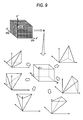
- Fig. 9 illustrates an exemplary color conversion method using a DLUT.
- the three-dimensional L*a*b* color space is divided in such a manner that each of the L*, a*, and b* axes is divided into a prescribed number of sections.
- the space is divided into cubes or rectangular parallelepipeds and their vertexes are called "lattice points.” Color conversion result values are held for the respective vertexes.
- CMYK values are held so as to correspond to the respective lattice points.
- each divisional cube or rectangular parallelepiped is further divided into six tetrahedrons as shown in Fig. 9.
- input values (L*, a*, b*) are judged on the basis of the input values (L*, a*, b*) themselves, and an interpolation operation is performed by using CMYK values corresponding to the four vertexes (lattice points) of the tetrahedron thus found.
- CMYK values corresponding to the four vertexes (lattice points) of the tetrahedron thus found.
- arbitrary input values (L*, a*, b*) can be converted into CMYK values.
- the above color conversion method using a DLUT can easily realize a nonlinear color conversion and hence can perform a color conversion with high accuracy. It also has an advantage that it can handle colors outside a color reproduction range in a unified manner.
- the processing speed is increased by implementing the color conversion method using a DLUT by hardware.
- this color conversion processing is implemented by software, an enormous processing time is necessary because of a very large number of accesses and a very large amount of calculation.
- the DLUT is of multiple dimensions, accessed addresses are not continuous and hence memory accesses consume a very long time. As such, the color conversion is processing which takes a very long time. Increase in the processing speed of the color conversion is therefore desired.
- an image is divided into text areas and pictorial areas and processing suitable for each area is performed (e.g., Japanese Patent No.3023374 ).
- processing suitable for each area e.g., Japanese Patent No.3023374
- attempts are being made that color conversions suitable for respective areas are performed by using different sets of color conversion parameters for the respective areas.
- color conversion processing is performed on a pixel-by-pixel basis, the amount of processing does not decrease even if processing suitable for each area is performed. The color conversion processing still consumes an enormous processing time.
- the invention has been made in the above circumstances, and provides an image processing apparatus and an image processing method, which can increase the processing speed of color conversion processing by decreasing the amount of processing required for the color conversion processing while suppressing reduction in color conversion accuracy.
- the invention also may provide an image processing program for causing a computer to perform the functions of such an image processing apparatus or to perform processing according to such an image processing method as well as a storage medium in which the image processing program is stored.
- an image processing apparatus performs color conversion processing on an input image.
- the image processing apparatus includes a reducing unit, a first color converting unit and an enlarging unit.
- the reducing unit reduces the input image.
- the first color converting unit performs color conversion on the image reduced by the reducing unit.
- the enlarging unit enlarges the image color-converted by the first color converting unit.
- the invention provides the following advantages. Color conversion processing is performed after an input image is reduced and the number of pixels is thereby decreased, and a resulting image is enlarged to restore a size or a resolution of the original image. Since the number of pixels to be subjected to the color conversion processing is decreased, the amount of processing can be reduced and the processing time can be shortened, that is, high-speed processing can be realized. Furthermore, an output image is generated from an image obtained by performing reduction, color conversion, and enlargement processing and an image obtained by performing a color conversion without reduction in accordance with the processing mode or the attribute (s) of the image or its regions. This makes it possible to perform color conversion processing suitable for each processing mode or the attribute (s) of an image or its regions, which in turn makes it possible to increase the processing speed of the color conversion processing while suppressing reduction of the color conversion accuracy from a required level.
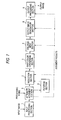
- Fig. 1 is a block diagram showing a first exemplary embodiment of the invention.
- reference numeral 1 denotes an input processing section; 2, a reduction section; 3, a first color conversion section; 4, an enlargement section; 5, an attribute judgment section; 6, a filtering section; 7, a second color conversion section; 8, an output image generation section; and 9, an output processing section.
- the input processing section 1 performs, on an input image, various kinds of image processing that should be performed before color conversion processing.
- the color spaces of the input image and an output image are arbitrary.
- the reduction section 2 reduces, at a prescribed reduction factor, an image received from the input processing section 1. If an intended output image size is smaller than the size of an image obtained by reducing the original image at the prescribed reduction factor, the image received from the input processing section 1 may be reduced into an image whose size is the same as the output image size.
- the first color conversion section 3 performs a color conversion on the reduced image received from the reduction section 2. If the input image color space and the output image color space are different from each other, the first color conversion section 3 also performs a color space conversion. In this exemplary embodiment, the first color conversion section 3 performs a color conversion on images for which importance is attached to the gradation performance rather than the resolution, such as pictorial images (e.g., photographs).
- the first color conversion section 3 can perform a highly accurate color conversion using a DLUT, for example. Since the image has been reduced by the reduction section 2, the number of pixels of the processing subject is much smaller than that of the original image and hence the amount of processing can be made much smaller than in the case where a color conversion is performed without image reduction. Therefore, the processing speed can be increased even if a highly accurate color conversion is performed.
- the enlargement section 4 enlarges a color-converted image received from the first color conversion section 3. Basically, the enlargement section 4 enlarges the color-converted image into an image whose size is the same as before the reduction by the reduction section 2.
- the invention is not limited to such a case. For example, if the output image size is larger than the pre-reduction image size, the enlargement processing may be performed so as to generate an image whose size is the same as the output image size.
- the attribute judgment section 5 judges attributes of respective regions of the input image and passes judgment results to the output image generation section 8 and the output processing section 9.
- the attribute judging method is arbitrary and may be a known method.
- the attribute judgment section 5 distinguishes between text/line-drawing portions and other portions.
- the filtering section 6 extracts edges from the input image and performs adaptive filtering on the input image. This is edge emphasis processing for increasing the image quality of the text/line-drawing portions. Also, the filtering section 6 may be omitted.
- the second color conversion section 7 performs a color conversion on a filtered image received from the filtering section 6. If the input image color space and the output image color space are different from each other, the second color conversion section 7 also performs a color space conversion. In this exemplary embodiment, the second color conversion section 7 performs a color conversion on images for which importance is attached to the resolution, such as text images and line-drawing images. Although the second color conversion section 7 may also be configured to use a DLUT or the like, the second color conversion section 7 is not required to perform a highly accurate color conversion because the gradation performance is not very important. Therefore, the second color conversion section 7 can employ a color conversionmethod that is smaller in the amount of calculation than a color conversion method, which is employed by the first color conversion section 3. The processing speed can be increased by simplifying the processing, for example, decreasing the number of reference data to simplify an interpolationmethod. Naturally, color conversion methods other than the method using a DLUT, such as a matrix conversion, may be used.
- the output image generation section 8 generates an output image from an enlarged image received from the enlargement section 4 and/or a color-converted image received form the second color conversion section 7. Which of the enlarged image received from the enlargement section 4 and the color-converted image received form the second color conversion section 7 should be selected can be determined on the basis of, for example, judgment results of the attribute judgment section 5, preset processing modes, and/or system resources situations. For example, an output image may be generated in the following manner.
- the color-converted image received form the second color conversion section 7 is selected for regions that have been judged to be text/line-drawing regions by the attribute judgment section 5 and the enlarged image received from the enlargement section 4 is selected for other regions, and an output image is formed by synthesizing the thus-selected portions.
- the processing modes may include a document mode and a color mode.
- An output image may be generated by selecting the color-converted image received form the second color conversion section 7 if the document mode is a text mode and selecting the enlarged image received from the enlargement section 4 if the document mode is a photograph mode.
- An output image may be generated by selecting the enlarged image received from the enlargement section 4 if the color mode is color and selecting a black-and-white-gradation-converted image received from the second color conversion section 7 or a filtered image produced by the filtering section 6 (no color conversion is performed by the second color conversion section 7) if the color mode is black and white.
- image switching may be made in accordance with a processing speed mode indicating whether importance is attached to the processing speed or the image quality.
- the enlarged image received from the enlargement section 4 may be selected in a speed priority mode in which importance is attached to the processing speed, and the color-converted image received form the second color conversion section 7 may be selected in an image quality priority mode in which importance is attached to the image quality.
- image switching may be made in a similar manner, that is, either image may be selected depending on whether importance is attached to the gradation performance or the resolution.
- the above processing modes and judgment results of the attribute judgment section 5 may be used in combination.
- One example is such that the enlarged image received from the enlargement section 4 is selected throughout the image in the speed priority mode and either image is selected on a region-by-region basis in accordance with the judgment results of the attribute judgment section 5 in the image quality priority mode.
- Another example is such that either image is selected on a region-by-region basis in accordance with the judgment results of the attribute judgment section 5 if the document mode is a text/photograph mixture mode and either image is selected throughout the image if the document mode is the text mode or the photograph mode.
- the judgment results of the attribute judgment section 5 may be combined with other processing modes in similar manners. Conversely, where image switching is performed in accordance with only the processing modes, the attribute judgment section 5 may be omitted.
- the output processing section 9 performs various kinds of image processing on an image produced by the color conversion processing. This processing may be performed in accordance with the judgment results of the attribute judgment section 5.
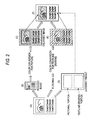
- Fig. 2 is an explanatory diagram showing a specific example of the operation of the first exemplary embodiment of the invention. A description will be made of a case that an image of Fig. 2(A) having a photograph in an upper portion and a text in a lower portion is subjected to both of the processing of the reduction section 2, the first color conversion section 3, and the enlargement section 4 and the processing of the filtering section 6 and the second color conversion section 7.
- the image of Fig. 2 (A) is processed by the input processing section 1 and then input to the reduction section 2 and the attribute judgment section 5.
- the reduction section 2 reduces the image of Fig. 2 (A) into a reduced image of Fig. 2(B).
- the first color conversion section 3 performs highly accurate color conversion processing for a picture, on the reduced image. Since the color conversion processing is performed on the reduced image, the color conversion processing can be performed at high speed.
- the enlargement section 4 enlarges a resulting image so as to restore the original size, whereby a color-converted and enlarged image of Fig. 2(C) is obtained.
- the attribute judgment section 5 judges, for each pixel or each set of plural pixels, an attribute of the image processed by the input processing section 1. Assume here that as shown in Fig. 2(D) the attribute judgment section 5 has judged that the upper photograph portion has a picture attribute and the lower text portion has a text/line-drawing attribute.
- the filtering section 6 performs the filtering on the image processed by the input processing section 1 to emphasize the edges of the image and then, the second color conversion section 7 performs the color conversion processing for a text/line drawing, on the filtered image.
- the color conversion processing for a text/line drawing is not required to be highly accurate and hence may be of a type that the amount of processing is small and enables high-speed processing.
- Fig. 2 (E) shows a color-converted image generated by the second color conversion section 7.
- the output image generation section 8 generates an output image in accordance with the judgment results of the attribute judgment section 5. Based on the judgment results shown in Fig. 2 (D), the output image generation section 8 selects the enlarged image of Fig. 2 (C) for the upper portion of the image and selects the color-converted image of Fig. 2(E) generated by the second color conversion section 7 for the lower portion of the image. As a result, the output image generation section 8 generates an output image of Fig. 2(F). The output image is processed by the output processing section 9 and then output.
- the photograph portion of the output image is lowered in resolution because it has been subjected to the reduction and enlargement, it is color-converted with high accuracy.
- the text portion is color-converted while the resolution is maintained.
- the total processing speed can be increased because the processing speed of each of the first color conversion section 3 and the second color conversion section 7 is higher than that of a conventional highly accurate color conversion without reduction.
- Fig. 3 is a block diagram showing an example of the attribute judgment section 5.
- reference numeral 11 denotes a first edge detection section and reference numeral 12 denotes a second edge detection section.
- this example employs a simple attribute judging method that uses the edge amount.
- the first edge detection section 11 detects an edge amount by means of a simple edge detection filter, for example.
- the first edge detection section 11 produces a judgment result "text attribute” if the edge amount is larger than a first threshold value, produces a judgment result "picture attribute” if the edge amount is smaller than a second threshold value, which is smaller than the first threshold value, and produces a judgment result "attribute unknown” in the other case.
- the first and second threshold values may be varied in accordance with the attribute judgment result of the preceding pixel. For example, only the first threshold value or both of the first and second threshold values are decreased if a judgment result "text attribute” is produced for the preceding pixel. This increases the probability that a judgment result "text attribute” is also produced for the subject pixel.
- the threshold values in the above manner can increase the number of pixels whose attributes are determined by the first edge detection section 11, which requires a small amount of processing, whereby the total amount of processing can be decreased and hence the total processing speed can be increased.
- the second edge detection section 12 judges attributes by more detailed processing than the first edge detection section 11, and can judge attributes by one or a combination of various methods. For example, even where the second edge detection section 12 uses an edge detection filter, it may employ a filter having a lager size than the first edge detection section 11. An attribute judgment, which uses an edge amount obtained in this case, may be made by comparing the edge amount with another prescribed threshold value. This threshold value may be weighted by using the edge amount obtained in the first edge detection section 11, more specifically, by the difference between the edge amount and the intermediate value of the first and second threshold values of the first edge detection section 11.
- a pixel (or a region consisting of plural pixels) that has been judged to be a text attribute pixel by the first edge detection section 11 or the second edge detection section 12 is subjected to filtering in the filtering section 6.
- Edge amounts obtained in the first edge detection section 11 of the attribute judgment section 5 may be used in the filtering.
- a result of a sum-of-products operation on the edge amounts and edge intensities obtained by an edge emphasis filter may be employed as a filtering result.
- the filtering may be switched in accordance with the judgment results of the attribute judgment section 5, in particular, whether a text attribute has been detected in the first edge detection section 11 or the second edge detection section 12 .
- filtering may be performed by a small-size emphasis filter if a text attribute has been detected in the first edge detection section 11, and by a large-size emphasis filter if a text attribute has been detected in the second edge detection section 12.
- the filtering method may be changed.
- Fig. 4 is a block diagram showing a second exemplary embodiment of the invention.
- Fig. 4 employs the same reference numerals as Fig. 1 and redundant descriptions will be omitted.
- the attribute judgment section 5 has a function of assigning portions of an image to the reduction section 2 and the filtering section 6 in accordance with judgment results of the attribute judgment section 5. Portions of an image may be assigned in accordance with processing modes rather than or in combination with image judgment results.
- the attribute judgment may be performed for each block that includes only one pixel or consists of two or more pixels (in the reduction section 2) .
- color conversion processing is performed by the first color conversion section 3 and the second color conversion section 7 for regions that will not be selected by the output image generation section 8.
- color conversion processing is performed by only one of the first color conversion section 3 and the second color conversion section 7. Therefore, the total processing time can be shortened and the total processing speed can be increased even in the case where, for example, the second color conversion section 7 performs color conversion processing that is relatively high in accuracy and hence requires a considerable processing time.
- Fig. 5 is a block diagram showing a modification of the second exemplary embodiment of the invention.
- Fig. 5 employs the same reference numerals as Fig. 4.
- This modification is such that the first color conversion section 3 also serves as the second color conversion section 7.
- the total processing speed can be increased by decreasing the number of pixels to be processed by the reduction section 2. Therefore, the processing speed for the entire image can be increased even if a highly accurate color conversion is performed on text/line-drawing portions that are required to be high in resolution.
- Employing the unified color conversion section 3 can simplify the configuration and reduce the memory capacity.
- Fig. 6 is a block diagram showing another modification of the second exemplary embodiment of the invention. This modification is such that data written in PDL (printer description language) are received as input image data.
- PDL printer description language
- the input processing section 1 interprets input image data that are written in PDL and judges attributes of respective drawing objects. Therefore, in this modification, the input processing section 1 also performs the function of the attribute judgment section 5. For example, if a PDL-judged attribute is a text attribute, data in that region are input to the filtering section 6 and then subjected to the color conversion processing of the second color conversion section 7. If a PDL-judged attribute is a picture attribute, data in that region are input to the reduction section 2 and then subjected to the color conversion processing of the first color conversion section 3. If PDL data include a raster image, the raster image may be subjected to area separation processing and then subjected to color conversion processing for a text or a picture.
- This configuration is effective in applying the invention to a printer or an apparatus having a printer function.
- Fig. 7 is a block diagram is a block diagram showing a third exemplary embodiment of the invention.
- Fig. 7 employs the same reference numerals as Fig. 1.
- the reduction factor of the reduction section 2 and the enlargement factor of the enlargement section 4 are variable. As the reduction factor of the reduction section 2 is set smaller, the number of pixels to be subjected to the color conversion processing of the first color conversion section 3 decreases and hence the processing speed can be increased. On the other hand, the resolution becomes lower. If the reduction factor is 100%, the same resolution can be obtained as obtained by conventional color conversion processing without reduction.
- the attribute judgment section 5 produces control information on the basis of attribute judgment results, a given processing mode, etc. and supplies it to the reduction section 2 and the enlargement section 4.
- the processing of the filtering section 6 is performed for regions that have been judged to be text/line-drawing regions.
- the reduction section 2 and the enlargement section 4 set a reduction factor and an enlargement factor, respectively, on the basis of the control information supplied from the attribute judgment section 5.
- the reduction section 2 performs reduction processing on the image also supplied from the attribute judgment section 5.
- the first color conversion section 3 performs color conversion processing on a reduced image or, if the reduction factor is 100%, the non-reduced image.
- the enlargement section 4 performs enlargement processing on a color-converted image (performs no processing if the enlargement factor is 100%) and outputs a resulting image.
- the amount of processing of the first color conversion section 3 can be reduced by decreasing the reduction factor and hence the total processing speed can be increased.
- the color conversion processing of the first color conversion section 3 may be performed by setting the reduction factor large (e.g., at 100%), in which case an image that is high in both resolution and gradation performance can be obtained.
- the third exemplary embodiment can increase the processing speed and suppress reduction in resolution to an extent desired.
- the reduction factor of the reduction section 2 and the enlargement factor of the enlargement section 4 are controlled, it is also possible to switch, for example, the reduction method of the reduction section 2 and the enlargement method of the enlargement section 4.
- the apparent resolution may be increased by employing an enlargement method suitable to attain a high resolution in the enlargement section 4 after color conversion processing has been performed on a reduced image.
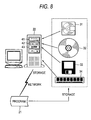
- Fig. 8 is an explanatory diagram of a computer program as an implementation of the functions of the image processing apparatus according to the invention or the image processing method according to the invention as well as exemplary storage media in which the computer program is stored.
- reference numeral 21 denotes a program; 22, a computer; 31, a magneto-optical disc; 32, an optical disc; 33, a magnetic disk; 34, a memory; 41, a magneto-optical disc drive; 42, an optical disc drive; and 43, a magnetic disk drive.
- the term "storage medium” means a medium which makes it possible to transmit the description contents of a program to a reading device as a hardware resource of a computer in the form of a signal corresponding to variation states of magnetic, optical, electrical, or like energy that are caused according to the description contents of the program.
- Examples of the storage medium are the magneto-optical disc 31, the optical disc 32 (including a CD and a DVD), the magnetic disk 33, and the memory 34 (including an IC card and a memory card).
- the storage medium is not limited to portable ones.
- the functions of image processing apparatus according to the invention can be performed or processing can be performed according to the image processing method according to the invention by storing the program 21 in one of those storage media in advance, mounting the storage medium in the magneto-optical disc drive 41, the optical disc drive 42, the magnetic disk drive 43, a memory slot (not shown), or an interface (not shown) of the computer 22, for example, and causing the computer 22 to read out the program 21.
- the functions of image processing apparatus can be performed or processing can be performed according to the image processing method by mounting or incorporating a storage medium in the computer 22 in advance, transferring the program 21 to the computer 22 over a network, for example, and storing the program 21 in the storage medium, and causing the computer 22 to run the program 21.
- all or part of the functions may be implemented by hardware.
Landscapes
- Engineering & Computer Science (AREA)
- Multimedia (AREA)
- Signal Processing (AREA)
- Image Processing (AREA)
- Facsimile Image Signal Circuits (AREA)
- Color Image Communication Systems (AREA)
- Editing Of Facsimile Originals (AREA)
Abstract
Description
- The invention relates to an image processing technique of performing color conversion processing on an input image.
- Color conversion processing is performed on an image in various situations such as a situation that image processing is performed on a scanned-in image and a resulting processed image is output to a print engine in a copier. Among conventional color conversion methods in copiers, a method, which uses a multi-dimensional look-up table with interpolation, is called "DLUT" (direct look-up table).
- Fig. 9 illustrates an exemplary color conversion method using a DLUT. In this example, the three-dimensional L*a*b* color space is divided in such a manner that each of the L*, a*, and b* axes is divided into a prescribed number of sections. The space is divided into cubes or rectangular parallelepipeds and their vertexes are called "lattice points." Color conversion result values are held for the respective vertexes. In the case of a conversion into the CMYK color space, for example, CMYK values are held so as to correspond to the respective lattice points.
- For interpolation operation, each divisional cube or rectangular parallelepiped is further divided into six tetrahedrons as shown in Fig. 9. To which tetrahedron input values (L*, a*, b*) belong are judged on the basis of the input values (L*, a*, b*) themselves, and an interpolation operation is performed by using CMYK values corresponding to the four vertexes (lattice points) of the tetrahedron thus found. In this manner, arbitrary input values (L*, a*, b*) can be converted into CMYK values.
- Allowing the lattice point values to be changed easily, the above color conversion method using a DLUT can easily realize a nonlinear color conversion and hence can perform a color conversion with high accuracy. It also has an advantage that it can handle colors outside a color reproduction range in a unified manner.
- Particularly in copiers, the processing speed is increased by implementing the color conversion method using a DLUT by hardware. However, with the recent increase in the resolution of images, the amount of processing required for this color conversion processing goes on increasing. On the other hand, where this color conversion processing is implemented by software, an enormous processing time is necessary because of a very large number of accesses and a very large amount of calculation. Furthermore, since the DLUT is of multiple dimensions, accessed addresses are not continuous and hence memory accesses consume a very long time. As such, the color conversion is processing which takes a very long time. Increase in the processing speed of the color conversion is therefore desired.
- In copiers, an image is divided into text areas and pictorial areas and processing suitable for each area is performed (e.g.,
Japanese Patent No.3023374 - The invention has been made in the above circumstances, and provides an image processing apparatus and an image processing method, which can increase the processing speed of color conversion processing by decreasing the amount of processing required for the color conversion processing while suppressing reduction in color conversion accuracy. The invention also may provide an image processing program for causing a computer to perform the functions of such an image processing apparatus or to perform processing according to such an image processing method as well as a storage medium in which the image processing program is stored.
- According to an aspect of the invention, an image processing apparatus performs color conversion processing on an input image. The image processing apparatus includes a reducing unit, a first color converting unit and an enlarging unit. The reducing unit reduces the input image. The first color converting unit performs color conversion on the image reduced by the reducing unit. The enlarging unit enlarges the image color-converted by the first color converting unit.
- The invention provides the following advantages. Color conversion processing is performed after an input image is reduced and the number of pixels is thereby decreased, and a resulting image is enlarged to restore a size or a resolution of the original image. Since the number of pixels to be subjected to the color conversion processing is decreased, the amount of processing can be reduced and the processing time can be shortened, that is, high-speed processing can be realized. Furthermore, an output image is generated from an image obtained by performing reduction, color conversion, and enlargement processing and an image obtained by performing a color conversion without reduction in accordance with the processing mode or the attribute (s) of the image or its regions. This makes it possible to perform color conversion processing suitable for each processing mode or the attribute (s) of an image or its regions, which in turn makes it possible to increase the processing speed of the color conversion processing while suppressing reduction of the color conversion accuracy from a required level.
- Exemplary embodiments of the invention will be described in detail based on the following figures, wherein:
- Fig. 1 is a block diagram showing a first exemplary embodiment of the invention;
- Fig. 2 is an explanatory diagram showing a specific example of the operation of the first exemplary embodiment of the invention;
- Fig. 3 is a block diagram showing an example of an attribute judgment section;
- Fig. 4 is a block diagram showing a second exemplary embodiment of the invention;
- Fig. 5 is a block diagram showing a modification of the second exemplary embodiment of the invention;
- Fig. 6 is a block diagram showing another modification of the second exemplary embodiment of the invention;
- Fig. 7 is a block diagram showing a third exemplary embodiment of the invention;
- Fig. 8 is an explanatory diagram showing a computer program as an implementation of the functions of the image processing apparatus according to the exemplary embodiments of the invention or the image processing method according to the exemplary embodiments of the invention as well as exemplary storage media in which the computer program is stored; and
- Fig. 9 illustrates an exemplary color conversion method using a DLUT.
- Fig. 1 is a block diagram showing a first exemplary embodiment of the invention. In Fig. 1,
reference numeral 1 denotes an input processing section; 2, a reduction section; 3, a first color conversion section; 4, an enlargement section; 5, an attribute judgment section; 6, a filtering section; 7, a second color conversion section; 8, an output image generation section; and 9, an output processing section. Theinput processing section 1 performs, on an input image, various kinds of image processing that should be performed before color conversion processing. The color spaces of the input image and an output image are arbitrary. - The
reduction section 2 reduces, at a prescribed reduction factor, an image received from theinput processing section 1. If an intended output image size is smaller than the size of an image obtained by reducing the original image at the prescribed reduction factor, the image received from theinput processing section 1 may be reduced into an image whose size is the same as the output image size. - The first
color conversion section 3 performs a color conversion on the reduced image received from thereduction section 2. If the input image color space and the output image color space are different from each other, the firstcolor conversion section 3 also performs a color space conversion. In this exemplary embodiment, the firstcolor conversion section 3 performs a color conversion on images for which importance is attached to the gradation performance rather than the resolution, such as pictorial images (e.g., photographs). The firstcolor conversion section 3 can perform a highly accurate color conversion using a DLUT, for example. Since the image has been reduced by thereduction section 2, the number of pixels of the processing subject is much smaller than that of the original image and hence the amount of processing can be made much smaller than in the case where a color conversion is performed without image reduction. Therefore, the processing speed can be increased even if a highly accurate color conversion is performed. - The
enlargement section 4 enlarges a color-converted image received from the firstcolor conversion section 3. Basically, theenlargement section 4 enlarges the color-converted image into an image whose size is the same as before the reduction by thereduction section 2. However, the invention is not limited to such a case. For example, if the output image size is larger than the pre-reduction image size, the enlargement processing may be performed so as to generate an image whose size is the same as the output image size. - The
attribute judgment section 5 judges attributes of respective regions of the input image and passes judgment results to the outputimage generation section 8 and theoutput processing section 9. The attribute judging method is arbitrary and may be a known method. Theattribute judgment section 5 distinguishes between text/line-drawing portions and other portions. - The
filtering section 6 extracts edges from the input image and performs adaptive filtering on the input image. This is edge emphasis processing for increasing the image quality of the text/line-drawing portions. Also, thefiltering section 6 may be omitted. - The second
color conversion section 7 performs a color conversion on a filtered image received from thefiltering section 6. If the input image color space and the output image color space are different from each other, the secondcolor conversion section 7 also performs a color space conversion. In this exemplary embodiment, the secondcolor conversion section 7 performs a color conversion on images for which importance is attached to the resolution, such as text images and line-drawing images. Although the secondcolor conversion section 7 may also be configured to use a DLUT or the like, the secondcolor conversion section 7 is not required to perform a highly accurate color conversion because the gradation performance is not very important. Therefore, the secondcolor conversion section 7 can employ a color conversionmethod that is smaller in the amount of calculation than a color conversion method, which is employed by the firstcolor conversion section 3. The processing speed can be increased by simplifying the processing, for example, decreasing the number of reference data to simplify an interpolationmethod. Naturally, color conversion methods other than the method using a DLUT, such as a matrix conversion, may be used. - The output
image generation section 8 generates an output image from an enlarged image received from theenlargement section 4 and/or a color-converted image received form the secondcolor conversion section 7. Which of the enlarged image received from theenlargement section 4 and the color-converted image received form the secondcolor conversion section 7 should be selected can be determined on the basis of, for example, judgment results of theattribute judgment section 5, preset processing modes, and/or system resources situations. For example, an output image may be generated in the following manner. The color-converted image received form the secondcolor conversion section 7 is selected for regions that have been judged to be text/line-drawing regions by theattribute judgment section 5 and the enlarged image received from theenlargement section 4 is selected for other regions, and an output image is formed by synthesizing the thus-selected portions. - For example, the processing modes may include a document mode and a color mode. An output image may be generated by selecting the color-converted image received form the second
color conversion section 7 if the document mode is a text mode and selecting the enlarged image received from theenlargement section 4 if the document mode is a photograph mode. An output image may be generated by selecting the enlarged image received from theenlargement section 4 if the color mode is color and selecting a black-and-white-gradation-converted image received from the secondcolor conversion section 7 or a filtered image produced by the filtering section 6 (no color conversion is performed by the second color conversion section 7) if the color mode is black and white. Furthermore, image switching may be made in accordance with a processing speed mode indicating whether importance is attached to the processing speed or the image quality. The enlarged image received from theenlargement section 4 may be selected in a speed priority mode in which importance is attached to the processing speed, and the color-converted image received form the secondcolor conversion section 7 may be selected in an image quality priority mode in which importance is attached to the image quality. Naturally, where another processing mode exists, image switching may be made in a similar manner, that is, either image may be selected depending on whether importance is attached to the gradation performance or the resolution. - Still further, the above processing modes and judgment results of the
attribute judgment section 5 may be used in combination. One example is such that the enlarged image received from theenlargement section 4 is selected throughout the image in the speed priority mode and either image is selected on a region-by-region basis in accordance with the judgment results of theattribute judgment section 5 in the image quality priority mode. Another example is such that either image is selected on a region-by-region basis in accordance with the judgment results of theattribute judgment section 5 if the document mode is a text/photograph mixture mode and either image is selected throughout the image if the document mode is the text mode or the photograph mode. The judgment results of theattribute judgment section 5 may be combined with other processing modes in similar manners. Conversely, where image switching is performed in accordance with only the processing modes, theattribute judgment section 5 may be omitted. - The
output processing section 9 performs various kinds of image processing on an image produced by the color conversion processing. This processing may be performed in accordance with the judgment results of theattribute judgment section 5. - Fig. 2 is an explanatory diagram showing a specific example of the operation of the first exemplary embodiment of the invention. A description will be made of a case that an image of Fig. 2(A) having a photograph in an upper portion and a text in a lower portion is subjected to both of the processing of the
reduction section 2, the firstcolor conversion section 3, and theenlargement section 4 and the processing of thefiltering section 6 and the secondcolor conversion section 7. - The image of Fig. 2 (A) is processed by the
input processing section 1 and then input to thereduction section 2 and theattribute judgment section 5. Thereduction section 2 reduces the image of Fig. 2 (A) into a reduced image of Fig. 2(B). The firstcolor conversion section 3 performs highly accurate color conversion processing for a picture, on the reduced image. Since the color conversion processing is performed on the reduced image, the color conversion processing can be performed at high speed. Then, theenlargement section 4 enlarges a resulting image so as to restore the original size, whereby a color-converted and enlarged image of Fig. 2(C) is obtained. - On the other hand, the
attribute judgment section 5 judges, for each pixel or each set of plural pixels, an attribute of the image processed by theinput processing section 1. Assume here that as shown in Fig. 2(D) theattribute judgment section 5 has judged that the upper photograph portion has a picture attribute and the lower text portion has a text/line-drawing attribute. - The
filtering section 6 performs the filtering on the image processed by theinput processing section 1 to emphasize the edges of the image and then, the secondcolor conversion section 7 performs the color conversion processing for a text/line drawing, on the filtered image. The color conversion processing for a text/line drawing is not required to be highly accurate and hence may be of a type that the amount of processing is small and enables high-speed processing. Fig. 2 (E) shows a color-converted image generated by the secondcolor conversion section 7. - The output
image generation section 8 generates an output image in accordance with the judgment results of theattribute judgment section 5. Based on the judgment results shown in Fig. 2 (D), the outputimage generation section 8 selects the enlarged image of Fig. 2 (C) for the upper portion of the image and selects the color-converted image of Fig. 2(E) generated by the secondcolor conversion section 7 for the lower portion of the image. As a result, the outputimage generation section 8 generates an output image of Fig. 2(F). The output image is processed by theoutput processing section 9 and then output. - As described above, whereas the photograph portion of the output image is lowered in resolution because it has been subjected to the reduction and enlargement, it is color-converted with high accuracy. The text portion is color-converted while the resolution is maintained. The total processing speed can be increased because the processing speed of each of the first
color conversion section 3 and the secondcolor conversion section 7 is higher than that of a conventional highly accurate color conversion without reduction. - In the configuration of Fig. 1, further increase in processing speed is possible in the
attribute judgment section 5 and thefiltering section 6. Fig. 3 is a block diagram showing an example of theattribute judgment section 5. In Fig. 3,reference numeral 11 denotes a first edge detection section andreference numeral 12 denotes a second edge detection section. Whereas various attribute judging methods are available, this example employs a simple attribute judging method that uses the edge amount. - The first
edge detection section 11 detects an edge amount by means of a simple edge detection filter, for example. The firstedge detection section 11 produces a judgment result "text attribute" if the edge amount is larger than a first threshold value, produces a judgment result "picture attribute" if the edge amount is smaller than a second threshold value, which is smaller than the first threshold value, and produces a judgment result "attribute unknown" in the other case. The first and second threshold values may be varied in accordance with the attribute judgment result of the preceding pixel. For example, only the first threshold value or both of the first and second threshold values are decreased if a judgment result "text attribute" is produced for the preceding pixel. This increases the probability that a judgment result "text attribute" is also produced for the subject pixel. For example, only the second threshold value or both of the first and second threshold values are increased if a judgment result "picture attribute" is produced for the preceding pixel. This increases the probability that a judgment result "picture attribute" is also produced for the subject pixel. Varying the threshold values in the above manner can increase the number of pixels whose attributes are determined by the firstedge detection section 11, which requires a small amount of processing, whereby the total amount of processing can be decreased and hence the total processing speed can be increased. - The second
edge detection section 12 judges attributes by more detailed processing than the firstedge detection section 11, and can judge attributes by one or a combination of various methods. For example, even where the secondedge detection section 12 uses an edge detection filter, it may employ a filter having a lager size than the firstedge detection section 11. An attribute judgment, which uses an edge amount obtained in this case, may be made by comparing the edge amount with another prescribed threshold value. This threshold value may be weighted by using the edge amount obtained in the firstedge detection section 11, more specifically, by the difference between the edge amount and the intermediate value of the first and second threshold values of the firstedge detection section 11. - A pixel (or a region consisting of plural pixels) that has been judged to be a text attribute pixel by the first
edge detection section 11 or the secondedge detection section 12 is subjected to filtering in thefiltering section 6. Edge amounts obtained in the firstedge detection section 11 of theattribute judgment section 5 may be used in the filtering. For example, a result of a sum-of-products operation on the edge amounts and edge intensities obtained by an edge emphasis filter may be employed as a filtering result. - Also in the
filtering section 6, the filtering may be switched in accordance with the judgment results of theattribute judgment section 5, in particular, whether a text attribute has been detected in the firstedge detection section 11 or the secondedge detection section 12 . For example, filtering may be performed bya small-size emphasis filter if a text attribute has been detected in the firstedge detection section 11, and by a large-size emphasis filter if a text attribute has been detected in the secondedge detection section 12. Naturally, the filtering method may be changed. With the above processing, if a text attribute has been detected in the firstedge detection section 11, the amount of processing of thefiltering section 6 can be reduced and hence the total amount of processing can be reduced. The total processing speed can thus be increased. - The configuration of the
attribute judgment section 5 shown in Fig. 3, the modification to the processing of thefiltering section 6, and other features can also be applied to the following exemplary embodiments in similar manners. - Fig. 4 is a block diagram showing a second exemplary embodiment of the invention. Fig. 4 employs the same reference numerals as Fig. 1 and redundant descriptions will be omitted. In this exemplary embodiment, the
attribute judgment section 5 has a function of assigning portions of an image to thereduction section 2 and thefiltering section 6 in accordance with judgment results of theattribute judgment section 5. Portions of an image may be assigned in accordance with processing modes rather than or in combination with image judgment results. The attribute judgment may be performed for each block that includes only one pixel or consists of two or more pixels (in the reduction section 2) . - In the exemplary embodiment of Fig. 1, color conversion processing is performed by the first
color conversion section 3 and the secondcolor conversion section 7 for regions that will not be selected by the outputimage generation section 8. In contrast, in the second exemplary embodiment, color conversion processing is performed by only one of the firstcolor conversion section 3 and the secondcolor conversion section 7. Therefore, the total processing time can be shortened and the total processing speed can be increased even in the case where, for example, the secondcolor conversion section 7 performs color conversion processing that is relatively high in accuracy and hence requires a considerable processing time. - Fig. 5 is a block diagram showing a modification of the second exemplary embodiment of the invention. Fig. 5 employs the same reference numerals as Fig. 4. This modification is such that the first
color conversion section 3 also serves as the secondcolor conversion section 7. As described above, the total processing speed can be increased by decreasing the number of pixels to be processed by thereduction section 2. Therefore, the processing speed for the entire image can be increased even if a highly accurate color conversion is performed on text/line-drawing portions that are required to be high in resolution. Employing the unifiedcolor conversion section 3 can simplify the configuration and reduce the memory capacity. - Fig. 6 is a block diagram showing another modification of the second exemplary embodiment of the invention. This modification is such that data written in PDL (printer description language) are received as input image data.
- The
input processing section 1 interprets input image data that are written in PDL and judges attributes of respective drawing objects. Therefore, in this modification, theinput processing section 1 also performs the function of theattribute judgment section 5. For example, if a PDL-judged attribute is a text attribute, data in that region are input to thefiltering section 6 and then subjected to the color conversion processing of the secondcolor conversion section 7. If a PDL-judged attribute is a picture attribute, data in that region are input to thereduction section 2 and then subjected to the color conversion processing of the firstcolor conversion section 3. If PDL data include a raster image, the raster image may be subjected to area separation processing and then subjected to color conversion processing for a text or a picture. - This configuration is effective in applying the invention to a printer or an apparatus having a printer function.
- Fig. 7 is a block diagram is a block diagram showing a third exemplary embodiment of the invention. Fig. 7 employs the same reference numerals as Fig. 1. In this exemplary embodiment, the reduction factor of the
reduction section 2 and the enlargement factor of theenlargement section 4 are variable. As the reduction factor of thereduction section 2 is set smaller, the number of pixels to be subjected to the color conversion processing of the firstcolor conversion section 3 decreases and hence the processing speed can be increased. On the other hand, the resolution becomes lower. If the reduction factor is 100%, the same resolution can be obtained as obtained by conventional color conversion processing without reduction. - The
attribute judgment section 5 produces control information on the basis of attribute judgment results, a given processing mode, etc. and supplies it to thereduction section 2 and theenlargement section 4. In this exemplary embodiment, the processing of thefiltering section 6 is performed for regions that have been judged to be text/line-drawing regions. - The
reduction section 2 and theenlargement section 4 set a reduction factor and an enlargement factor, respectively, on the basis of the control information supplied from theattribute judgment section 5. Thereduction section 2 performs reduction processing on the image also supplied from theattribute judgment section 5. The firstcolor conversion section 3 performs color conversion processing on a reduced image or, if the reduction factor is 100%, the non-reduced image. Theenlargement section 4 performs enlargement processing on a color-converted image (performs no processing if the enlargement factor is 100%) and outputs a resulting image. - With the above configuration, in a high-speed processing mode or for pictorial regions such as photograph regions, the amount of processing of the first
color conversion section 3 can be reduced by decreasing the reduction factor and hence the total processing speed can be increased. In an image quality priority mode or for text/line-drawing regions, the color conversion processing of the firstcolor conversion section 3 may be performed by setting the reduction factor large (e.g., at 100%), in which case an image that is high in both resolution and gradation performance can be obtained. - As described above, by controlling the reduction factor of the
reduction section 2 and the enlargement factor of theenlargement section 4, the third exemplary embodiment can increase the processing speed and suppress reduction in resolution to an extent desired. - Although in this exemplary embodiment the reduction factor of the
reduction section 2 and the enlargement factor of theenlargement section 4 are controlled, it is also possible to switch, for example, the reduction method of thereduction section 2 and the enlargement method of theenlargement section 4. For example, where a relatively high resolution is required, the apparent resolution may be increased by employing an enlargement method suitable to attain a high resolution in theenlargement section 4 after color conversion processing has been performed on a reduced image. - Fig. 8 is an explanatory diagram of a computer program as an implementation of the functions of the image processing apparatus according to the invention or the image processing method according to the invention as well as exemplary storage media in which the computer program is stored. In Fig. 8,
reference numeral 21 denotes a program; 22, a computer; 31, a magneto-optical disc; 32, an optical disc; 33, a magnetic disk; 34, a memory; 41, a magneto-optical disc drive; 42, an optical disc drive; and 43, a magnetic disk drive. - All or part of the configuration of each of the above-described embodiments and modifications can be realized by the
program 21 which can be run by a computer. Where it is realized by theprogram 21, theprogram 21, data used by theprogram 21, and other information can be stored in a computer-readable storage medium. The term "storage medium" means a medium which makes it possible to transmit the description contents of a program to a reading device as a hardware resource of a computer in the form of a signal corresponding to variation states of magnetic, optical, electrical, or like energy that are caused according to the description contents of the program. Examples of the storage medium are the magneto-optical disc 31, the optical disc 32 (including a CD and a DVD), themagnetic disk 33, and the memory 34 (including an IC card and a memory card). Naturally, the storage medium is not limited to portable ones. - The functions of image processing apparatus according to the invention can be performed or processing can be performed according to the image processing method according to the invention by storing the
program 21 in one of those storage media in advance, mounting the storage medium in the magneto-optical disc drive 41, the optical disc drive 42, the magnetic disk drive 43, a memory slot (not shown), or an interface (not shown) of thecomputer 22, for example, and causing thecomputer 22 to read out theprogram 21. The functions of image processing apparatus can be performed or processing can be performed according to the image processing method by mounting or incorporating a storage medium in thecomputer 22 in advance, transferring theprogram 21 to thecomputer 22 over a network, for example, and storing theprogram 21 in the storage medium, and causing thecomputer 22 to run theprogram 21. Naturally, all or part of the functions may be implemented by hardware.
Claims (38)
- An image processing apparatus for performing color conversion processing on an input image, the image processing apparatus comprising:a reducing unit that reduces the input image;a first color converting unit that performs color conversion on the image reduced by the reducing unit; andan enlarging unit that enlarges the image color-converted by the first color converting unit.
- The apparatus according to claim 1, further comprising:a second color converting unit that performs color conversion on the input image; andan output image generating unit that generates an output image based on at least one of the image enlarged by the enlarging unit and the image color-converted by the second color converting unit.
- The apparatus according to claim 2, wherein the second color converting unit performs the color conversion according to a color conversion method, which requires a less calculation amount than a color conversion method of the first color converting unit.
- The apparatus according to any one of claims 2 to 3, further comprising:a filtering unit that performs adaptive filtering on the input image, the adaptive filtering that emphasizes an edge contained in the input image, wherein:the second color converting unit performs the color conversion on the image filtered by the filtering unit.
- The apparatus according to any one of claims 2 to 4, further comprising:an attribute judging unit that judges an attribute of each region of the input image, wherein:the output image generating unit selects for each region either the image enlarged by the enlarging unit or the image color-converted by the second color converting unit in accordance with the attribute of the corresponding region judged by the attribute judging unit, to generate the output image.
- The apparatus according to claim 5, wherein the attribute judging unit detects an edge amount in the input image and judges the attribute of each region using the detected edge amount.
- The apparatus according to any one of claims 5 to 6, wherein:the attribute judging unit comprises:a first judging unit that judges the attribute of each region; anda second judging unit that judges an attribute of one region if the first judging unit cannot judge the attribute of the one region, and
judgment processing performed by the first judging unit is simpler than that performed by the second judging unit. - The apparatus according to claim 7, wherein:the first judging unit judges the attribute of each region using a first edge detection filter,the second judging unit judges the attribute of the one region using a second edge detection filter, anda size of the second detection filter is larger than that of the first detection filter.
- The apparatus according to claim 4, further comprising:an attribute judging unit that judges an attribute of each region of the input image, wherein:the output image generating unit selects for each region either the image enlarged by the enlarging unit or the image color-converted by the second color converting unit in accordance with the attribute of the corresponding region judged by the attribute judging unit, to generate the output image,the attribute judging unit comprises:a first judging unit that judges the attribute of each region; anda second judging unit that judges an attribute of one region if the first judging unit cannot judge the attribute of the one region,
judgment processing performed by the first judging unit is simpler than that performed by the second judging unit,
the filtering unit performs first filtering if the first judging unit of the attribute judging unit judges that the attribute of the one region is one, which requires the color conversion of the second color converting unit,
the filtering unit performs second filtering if the second judging unit judges that the attribute of the one region is one, which requires the color conversion of the second color converting unit, and
the second filtering involves a larger processing amount than the first filtering. - The apparatus according to claim 5, wherein:the input image is data written in printer description language, andthe attribute judging unit interprets the data written in the printer description language to judge the attribute of each region.
- The apparatus according to any one of claims 5 to 10, wherein:the output image generating unit selects the image color-converted by the second color converting unit, for a region, which the attribute judging unit judges as a text/line-drawing region, andthe output image generating unit selects the image enlarged by the enlarging unit, for a region, which the attribute judging unit judges as a photograph region.
- The apparatus according to any one of claims 2 to 11, wherein the output image generating unit selects either the image enlarged by the enlarging unit or the image color-converted by the second color converting unit in accordance with a processing mode, to generate the output image.
- The apparatus according to any one of claims 2 to 11, wherein the output image generating unit selects either the image enlarged by the enlarging unit or the image color-converted by the second color converting unit in accordance with a document mode, to generate the output image.
- The apparatus according to any one of claims 2 to 11, wherein the output image generating unit selects either the image enlarged by the enlarging unit or the image color-converted by the second color converting unit in accordance with a color mode, to generate the output image.
- The apparatus according to claim 4, wherein:the output image generating unit selects either the image enlarged by the enlarging unit or the image color-converted by the second color converting unit in accordance with a color mode, to generate the output image, andthe output image generating unit selects the image, which is filtered by the filtering unit and not subjected to the color conversion of the second color converting unit if the color mode is a black-and-white mode.
- The apparatus according to any one of claims 2 to 11, wherein the output image generating unit selects either the image enlarged by the enlarging unit or the image color-converted by the second color converting unit in accordance with a processing speed mode indicating whether priority is attached to the processing speed or the image quality, to generate the output image.
- The apparatus according to any one of claims 2 to 11, wherein the output image generating unit selects either the image enlarged by the enlarging unit or the image color-converted by the second color converting unit in accordance with system resource situations of the apparatus, to generate the output image
- The apparatus according to claim 1, wherein:the reducing unit changes a reducing algorithm or a reduction factor in accordance with a processing mode, andthe enlarging unit changes an enlarging algorithm or a enlargement factor in accordance with the processing mode.
- An image processing method for performing color conversion processing on an input image, the method comprising:reducing the input image;performing first color conversion on the reduced image; andenlarging the image subjected to the first color conversion.
- The method according to claim 19, further comprising:performing second color conversion on the input image; andgenerating an output image based on at least one of the enlarged image and the image subjected to the second color conversion.
- The method according to claim 20, wherein the second color conversion requires a less calculation amount than the first color conversion.
- The method according to any one of claims 20 to 21, further comprising:performing adaptive filtering on the input image, the adaptive filtering that emphasizes an edge contained in the input image, wherein:the second color conversion is performed on the image subjected to the adaptive filtering.
- The method according to any one of claims 20 to 22, further comprising:judging an attribute of each region of the input image, wherein:the generating of the output image comprises selecting for each region either the enlarged image or the image subjected to the second color conversion in accordance with the judged attribute of the corresponding region.
- The method according to claim 23, further comprising:detecting an edge amount in the input image, wherein:the attribute of each region is judged using the detected edge amount.
- The method according to any one of claims 23 to 24, wherein:the judging of the attribute of each region comprises:performing a first judgment processing on each region of the input image to judge the attribute of each region; andperforming a second judgment processing on one region to judge an attribute of the one region if the first judgment processing cannot judge the attribute of the one region, andthe first judgment processing is simpler than the second judgment processing.
- The method according to claim 25, wherein:the first judgment processing uses a first edge detection filter,the second judgment processing uses a second edge detection filter, anda size of the second edge detection filter is larger than that of the first edge detection filter.
- The method according to claim 22, further comprising:judging an attribute of each region of the input image, wherein:the generating of the output image comprises selecting for each region either the enlarged image or the image subjected to the second color conversion in accordance with the judged attribute of the corresponding region,the judging of the attribute of each region comprises:performing a first judgment processing on each region of the input image to judge the attribute of each region; andperforming a second judgment processing on one region to judge an attribute of the one region if the first judgment processing cannot judge the attribute of the one region,the first judgment processing is simpler than the second judgment processing,
the adaptive filtering comprises:performing first filtering if a result of the first judgment processing indicates that the attribute of the one region is one, which requires the second color conversion,performing second filtering if a result of the second judgment processing indicates that the attribute of the one region is one, which requires the second color conversion, andthe second filtering involves a larger processing amount than the first filtering. - The method according to claim 23, wherein:the input image is data written in printer description language, andthe judging of the attribute of each region comprises interpreting the data written in the printer description language to judge the attribute of each region.
- The method according to any one of claims 23 to 28, wherein:the selecting of either the enlarged image or the image subjected to the second color conversion comprises:selecting the image subjected to the second color conversion for a region, which a result of the judging indicates as a text/line-drawing region, andselecting the enlarged image for a region, which the result of the judging indicates as a photograph region.
- The method according to any one of claims 20 to 29, wherein the selecting of either the enlarged image or the image subj ected to the second color conversion comprises selecting either the image enlarged or the image subjected to the second color conversion in accordance with a processing mode.
- The method according to any one of claims 20 to 29, wherein the selecting of either the enlarged image or the image subjected to the second color conversion comprises selecting either the image or the image subjected to the second color conversion in accordance with a document mode.
- The method according to any one of claims 20 to 29, wherein the selecting of either the enlarged image or the image subj ected to the second color conversion comprises selecting either the image enlarged or the image subjected to the second color conversion in accordance with a color mode.
- The method according to claim 22, wherein:the generating of the output image comprises selecting either the enlarged image or the image subjected to the second color conversion in accordance with a color mode, andthe selecting selects the image, which is subjected to the adaptive filtering and not subjected to the second color conversion if the color mode is a black-and-white mode.
- The method according to any one of claims 20 to 29, wherein the generating of the output image comprises selecting either the enlarged image or the image subjected to the second color conversion in accordance with a processing speed mode of an apparatus which performs the color conversion processing, the processing speed mode indicating whether priority is attached to the processing speed or the image quality.
- The method according to any one of claims 20 to 29, wherein the generating of the output image comprises selecting either the enlarged image or the image subjected to the second color conversion in accordance with a system resource situations of an apparatus, which performs the conversion processing.
- The method according to any one of claim 19, wherein:the reducing changes a reducing algorithm or a reduction factor in accordance with a processing mode, andthe enlarging changes an enlarging algorithm or a enlargement factor in accordance with the processing mode.
- A program causing a computer to execute a process for performing color conversion processing on an input image, the process comprising:reducing the input image;performing first color conversion on the reduced image; andenlarging the image subjected to the first color conversion.
- A computer readable medium storing a program causing a computer to execute a process for performing color conversion processing on an input image, the process comprising:reducing the input image;performing first color conversion on the reduced image; andenlarging the image subjected to the first color conversion.
Applications Claiming Priority (1)
| Application Number | Priority Date | Filing Date | Title |
|---|---|---|---|
| JP2005364144A JP4623300B2 (en) | 2005-12-17 | 2005-12-17 | Image processing apparatus and image processing program |
Publications (1)
| Publication Number | Publication Date |
|---|---|
| EP1798953A1 true EP1798953A1 (en) | 2007-06-20 |
Family
ID=37649387
Family Applications (1)
| Application Number | Title | Priority Date | Filing Date |
|---|---|---|---|
| EP06016257A Withdrawn EP1798953A1 (en) | 2005-12-17 | 2006-08-03 | Image processing apparatus, image processing method, image processing program, storage medium and computer data signal |
Country Status (5)
| Country | Link |
|---|---|
| US (1) | US7710619B2 (en) |
| EP (1) | EP1798953A1 (en) |
| JP (1) | JP4623300B2 (en) |
| KR (1) | KR100816709B1 (en) |
| CN (1) | CN100477720C (en) |
Families Citing this family (14)
| Publication number | Priority date | Publication date | Assignee | Title |
|---|---|---|---|---|
| JP4612877B2 (en) * | 2005-08-10 | 2011-01-12 | キヤノン株式会社 | Image recording apparatus and control method and program for the apparatus |
| JP2008054147A (en) * | 2006-08-28 | 2008-03-06 | Fuji Xerox Co Ltd | Image processor and image processing program |
| JP4878572B2 (en) * | 2007-03-30 | 2012-02-15 | キヤノン株式会社 | Image processing apparatus and image processing method |
| JP4940110B2 (en) * | 2007-11-20 | 2012-05-30 | キヤノン株式会社 | Image processing apparatus, control method therefor, program, and printer |
| JP4968115B2 (en) * | 2008-03-04 | 2012-07-04 | 富士ゼロックス株式会社 | Image processing apparatus and program |
| JP5254739B2 (en) * | 2008-10-24 | 2013-08-07 | キヤノン株式会社 | Image forming apparatus and control method thereof |
| JP5241429B2 (en) * | 2008-10-24 | 2013-07-17 | キヤノン株式会社 | Image forming apparatus and control method thereof |
| JP5326912B2 (en) * | 2009-07-31 | 2013-10-30 | ブラザー工業株式会社 | Printing device, composite image data generation device, and composite image data generation program |
| JP5505366B2 (en) * | 2010-06-09 | 2014-05-28 | コニカミノルタ株式会社 | Profile set storage method, profile set storage program, profile set storage system, and color conversion processing apparatus |
| JP5699709B2 (en) * | 2011-03-16 | 2015-04-15 | セイコーエプソン株式会社 | Image processing device |
| JP5787147B2 (en) * | 2011-08-02 | 2015-09-30 | カシオ計算機株式会社 | Image processing apparatus, image processing method, and program |
| CN104662885B (en) * | 2012-09-27 | 2017-07-21 | 柯尼卡美能达株式会社 | Color conversion device, image forming device and color conversion method |
| EP3280126B1 (en) * | 2015-03-31 | 2020-04-22 | KYOCERA Document Solutions Inc. | Image processing apparatus and image forming apparatus |
| CN108198148B (en) * | 2017-12-07 | 2022-08-05 | 北京小米移动软件有限公司 | Method and device for image processing |
Citations (5)
| Publication number | Priority date | Publication date | Assignee | Title |
|---|---|---|---|---|
| EP0407213A2 (en) * | 1989-07-07 | 1991-01-09 | Kabushiki Kaisha Toshiba | Image processing apparatus |
| EP1377021A2 (en) * | 2002-06-26 | 2004-01-02 | Fuji Photo Film Co., Ltd. | Image data processing method, portable terminal apparatus, and computer program |
| US20040141205A1 (en) * | 2003-01-22 | 2004-07-22 | Toshiba Tec Kabushiki Kaisha | Image processing apparatus |
| US20050036156A1 (en) * | 1999-08-19 | 2005-02-17 | Kabushiki Kaisha Toshiba | Image forming apparatus and image forming method |
| US20050088697A1 (en) * | 2003-10-10 | 2005-04-28 | Kei Yasutomi | Image forming apparatus and image forming method |
Family Cites Families (31)
| Publication number | Priority date | Publication date | Assignee | Title |
|---|---|---|---|---|
| JPH0614685B2 (en) * | 1984-03-29 | 1994-02-23 | 株式会社東芝 | Image signal processor |
| US4668995A (en) * | 1985-04-12 | 1987-05-26 | International Business Machines Corporation | System for reproducing mixed images |
| JP2777202B2 (en) * | 1989-07-07 | 1998-07-16 | 株式会社東芝 | Image processing device |
| JP3399486B2 (en) * | 1993-06-30 | 2003-04-21 | 富士ゼロックス株式会社 | Color image processing apparatus and method |
| JPH09179973A (en) * | 1995-12-27 | 1997-07-11 | Canon Inc | Image processing apparatus and method |
| JP3246313B2 (en) * | 1996-01-19 | 2002-01-15 | 富士ゼロックス株式会社 | Color printing equipment |
| US6678072B1 (en) * | 1996-07-31 | 2004-01-13 | Canon Kabushiki Kaisha | Printer control apparatus and method |
| JP3957350B2 (en) * | 1997-01-14 | 2007-08-15 | 富士ゼロックス株式会社 | Color image forming apparatus |
| JPH10243210A (en) * | 1997-02-25 | 1998-09-11 | Canon Inc | Image processing apparatus and method |
| JPH11328391A (en) * | 1998-05-15 | 1999-11-30 | Canon Inc | Image processing apparatus and image processing method |
| US6233060B1 (en) * | 1998-09-23 | 2001-05-15 | Seiko Epson Corporation | Reduction of moiré in screened images using hierarchical edge detection and adaptive-length averaging filters |
| US6839151B1 (en) * | 2000-02-02 | 2005-01-04 | Zoran Corporation | System and method for color copy image processing |
| JP2002157108A (en) * | 2000-11-17 | 2002-05-31 | Canon Inc | Image processing method, recording medium, and image forming apparatus |
| US6909803B2 (en) * | 2000-12-22 | 2005-06-21 | Canon Kabushiki Kaisha | Text color detection for copier image processing |
| JP2002209103A (en) * | 2001-01-09 | 2002-07-26 | Minolta Co Ltd | Image processing device |
| US6784944B2 (en) * | 2001-06-19 | 2004-08-31 | Smartasic, Inc. | Motion adaptive noise reduction method and system |
| JP3888119B2 (en) * | 2001-10-11 | 2007-02-28 | 富士ゼロックス株式会社 | Image processing device |
| US6973213B2 (en) * | 2001-10-12 | 2005-12-06 | Xerox Corporation | Background-based image segmentation |
| JP2003153006A (en) * | 2001-11-16 | 2003-05-23 | Ricoh Co Ltd | Image processing device |
| US6592523B2 (en) * | 2001-11-21 | 2003-07-15 | Ge Medical Systems Global Technology Company, Llc | Computationally efficient noise reduction filter for enhancement of ultrasound images |
| JP2004007415A (en) * | 2002-03-14 | 2004-01-08 | Ricoh Co Ltd | Image processing apparatus, image processing method, and computer-executable program |
| JP4250470B2 (en) * | 2002-09-06 | 2009-04-08 | キヤノン株式会社 | Information processing apparatus, information processing method, and print control program |
| JP3956360B2 (en) * | 2002-09-30 | 2007-08-08 | 株式会社リコー | Imaging apparatus and image processing method |
| JP4192640B2 (en) * | 2003-03-19 | 2008-12-10 | セイコーエプソン株式会社 | Image processing apparatus and image processing method for performing processing while detecting edge in block |
| JP2005094740A (en) * | 2003-08-08 | 2005-04-07 | Ricoh Co Ltd | Image processing apparatus, image forming apparatus, and image processing method |
| JP4323885B2 (en) * | 2003-08-08 | 2009-09-02 | キヤノン株式会社 | Printing apparatus, printing control method, storage medium, and program |
| JP2005176036A (en) * | 2003-12-12 | 2005-06-30 | Canon Inc | Image processing method |
| JP2005277908A (en) * | 2004-03-25 | 2005-10-06 | Nec Access Technica Ltd | Image processor, image processing method thereof, and portable telephone with camera |
| US20060072819A1 (en) * | 2004-10-06 | 2006-04-06 | Kabushiki Kaisha Toshiba | Image forming apparatus and method |
| US7362470B2 (en) * | 2005-03-17 | 2008-04-22 | Kabushiki Kaisha Toshiba | Color image processing apparatus |
| JP4623301B2 (en) * | 2005-12-17 | 2011-02-02 | 富士ゼロックス株式会社 | Image processing apparatus and image processing program |
-
2005
- 2005-12-17 JP JP2005364144A patent/JP4623300B2/en not_active Expired - Fee Related
-
2006
- 2006-07-26 US US11/492,776 patent/US7710619B2/en not_active Expired - Fee Related
- 2006-08-03 EP EP06016257A patent/EP1798953A1/en not_active Withdrawn
- 2006-08-04 KR KR1020060073788A patent/KR100816709B1/en active Active
- 2006-08-16 CN CNB2006101157814A patent/CN100477720C/en not_active Expired - Fee Related
Patent Citations (5)
| Publication number | Priority date | Publication date | Assignee | Title |
|---|---|---|---|---|
| EP0407213A2 (en) * | 1989-07-07 | 1991-01-09 | Kabushiki Kaisha Toshiba | Image processing apparatus |
| US20050036156A1 (en) * | 1999-08-19 | 2005-02-17 | Kabushiki Kaisha Toshiba | Image forming apparatus and image forming method |
| EP1377021A2 (en) * | 2002-06-26 | 2004-01-02 | Fuji Photo Film Co., Ltd. | Image data processing method, portable terminal apparatus, and computer program |
| US20040141205A1 (en) * | 2003-01-22 | 2004-07-22 | Toshiba Tec Kabushiki Kaisha | Image processing apparatus |
| US20050088697A1 (en) * | 2003-10-10 | 2005-04-28 | Kei Yasutomi | Image forming apparatus and image forming method |
Also Published As
| Publication number | Publication date |
|---|---|
| CN100477720C (en) | 2009-04-08 |
| KR20070064540A (en) | 2007-06-21 |
| US7710619B2 (en) | 2010-05-04 |
| JP2007166560A (en) | 2007-06-28 |
| CN1984227A (en) | 2007-06-20 |
| US20070139674A1 (en) | 2007-06-21 |
| KR100816709B1 (en) | 2008-03-27 |
| JP4623300B2 (en) | 2011-02-02 |
Similar Documents
| Publication | Publication Date | Title |
|---|---|---|
| EP1798954A1 (en) | Image processing apparatus, image processing method, image processing program, storage medium and computer data signal | |
| JP3741090B2 (en) | Image processing device | |
| US20020122193A1 (en) | Color converting device emphasizing a contrast of output color data corresponding to a black character | |
| US7710619B2 (en) | Image processing apparatus and method that performs differential scaling on picture regions than on text and line regions to enhance speed while preserving quality | |
| JP2003087563A (en) | Image processing apparatus and control method thereof | |
| US20090284801A1 (en) | Image processing apparatus and image processing method | |
| JP2008193409A (en) | Image processing device | |
| US7916352B2 (en) | Image processing apparatus, image processing method, program, and recording medium | |
| US8395820B2 (en) | Image processing apparatus for printing in black coloring material based on attribute information | |
| US20020051230A1 (en) | Image processing apparatus, image processing method, and storage medium | |
| US9948824B2 (en) | Image compressing device, image forming apparatus, image compressing method, and recording medium | |
| JP4498233B2 (en) | Image processing apparatus and image processing method | |
| JP2015002443A (en) | Image processing apparatus and image processing method | |
| US20050012963A1 (en) | Image processing apparatus, image processing method, and computer product | |
| US10872216B2 (en) | Image output device, image output method, and output image data production method | |
| JP4659789B2 (en) | Image processing apparatus, image processing method, program, and recording medium | |
| JP2001199135A (en) | PRINT CONTROL DEVICE, PRINT CONTROL METHOD, AND STORAGE MEDIUM | |
| JP7689455B2 (en) | Image processing device, image processing method, and program | |
| JP2004194050A (en) | Image processing apparatus | |
| JP2019111677A (en) | Image processing device, image processing device control method, image forming device and program | |
| JP2000278506A (en) | Image processor | |
| JP3344255B2 (en) | Image information processing device | |
| JP2006254355A (en) | Image processing device | |
| JP2023111408A (en) | Image processing device and its control method and program | |
| JP2003037739A (en) | Data transfer control device, control method thereof, and control program |
Legal Events
| Date | Code | Title | Description |
|---|---|---|---|
| PUAI | Public reference made under article 153(3) epc to a published international application that has entered the european phase |
Free format text: ORIGINAL CODE: 0009012 |
|
| AK | Designated contracting states |
Kind code of ref document: A1 Designated state(s): AT BE BG CH CY CZ DE DK EE ES FI FR GB GR HU IE IS IT LI LT LU LV MC NL PL PT RO SE SI SK TR |
|
| AX | Request for extension of the european patent |
Extension state: AL BA HR MK YU |
|
| 17P | Request for examination filed |
Effective date: 20071217 |
|
| AKX | Designation fees paid |
Designated state(s): DE FR GB |
|
| RBV | Designated contracting states (corrected) |
Designated state(s): CZ DE FR GB |
|
| RBV | Designated contracting states (corrected) |
Designated state(s): DE FR GB |
|
| STAA | Information on the status of an ep patent application or granted ep patent |
Free format text: STATUS: THE APPLICATION IS DEEMED TO BE WITHDRAWN |
|
| 18D | Application deemed to be withdrawn |
Effective date: 20150303 |