EP1798247A1 - Resin molded article for laying rails and method for producing the same - Google Patents
Resin molded article for laying rails and method for producing the same Download PDFInfo
- Publication number
- EP1798247A1 EP1798247A1 EP06026209A EP06026209A EP1798247A1 EP 1798247 A1 EP1798247 A1 EP 1798247A1 EP 06026209 A EP06026209 A EP 06026209A EP 06026209 A EP06026209 A EP 06026209A EP 1798247 A1 EP1798247 A1 EP 1798247A1
- Authority
- EP
- European Patent Office
- Prior art keywords
- resin
- molded article
- polyol
- range
- resin molded
- Prior art date
- Legal status (The legal status is an assumption and is not a legal conclusion. Google has not performed a legal analysis and makes no representation as to the accuracy of the status listed.)
- Granted
Links
Images



Classifications
-
- C—CHEMISTRY; METALLURGY
- C08—ORGANIC MACROMOLECULAR COMPOUNDS; THEIR PREPARATION OR CHEMICAL WORKING-UP; COMPOSITIONS BASED THEREON
- C08J—WORKING-UP; GENERAL PROCESSES OF COMPOUNDING; AFTER-TREATMENT NOT COVERED BY SUBCLASSES C08B, C08C, C08F, C08G or C08H
- C08J5/00—Manufacture of articles or shaped materials containing macromolecular substances
- C08J5/04—Reinforcing macromolecular compounds with loose or coherent fibrous material
- C08J5/0405—Reinforcing macromolecular compounds with loose or coherent fibrous material with inorganic fibres
- C08J5/043—Reinforcing macromolecular compounds with loose or coherent fibrous material with inorganic fibres with glass fibres
-
- B—PERFORMING OPERATIONS; TRANSPORTING
- B32—LAYERED PRODUCTS
- B32B—LAYERED PRODUCTS, i.e. PRODUCTS BUILT-UP OF STRATA OF FLAT OR NON-FLAT, e.g. CELLULAR OR HONEYCOMB, FORM
- B32B27/00—Layered products comprising a layer of synthetic resin
- B32B27/04—Layered products comprising a layer of synthetic resin as impregnant, bonding, or embedding substance
-
- B—PERFORMING OPERATIONS; TRANSPORTING
- B32—LAYERED PRODUCTS
- B32B—LAYERED PRODUCTS, i.e. PRODUCTS BUILT-UP OF STRATA OF FLAT OR NON-FLAT, e.g. CELLULAR OR HONEYCOMB, FORM
- B32B27/00—Layered products comprising a layer of synthetic resin
- B32B27/06—Layered products comprising a layer of synthetic resin as the main or only constituent of a layer, which is next to another layer of the same or of a different material
- B32B27/08—Layered products comprising a layer of synthetic resin as the main or only constituent of a layer, which is next to another layer of the same or of a different material of synthetic resin
-
- B—PERFORMING OPERATIONS; TRANSPORTING
- B32—LAYERED PRODUCTS
- B32B—LAYERED PRODUCTS, i.e. PRODUCTS BUILT-UP OF STRATA OF FLAT OR NON-FLAT, e.g. CELLULAR OR HONEYCOMB, FORM
- B32B27/00—Layered products comprising a layer of synthetic resin
- B32B27/40—Layered products comprising a layer of synthetic resin comprising polyurethanes
-
- C—CHEMISTRY; METALLURGY
- C08—ORGANIC MACROMOLECULAR COMPOUNDS; THEIR PREPARATION OR CHEMICAL WORKING-UP; COMPOSITIONS BASED THEREON
- C08G—MACROMOLECULAR COMPOUNDS OBTAINED OTHERWISE THAN BY REACTIONS ONLY INVOLVING UNSATURATED CARBON-TO-CARBON BONDS
- C08G18/00—Polymeric products of isocyanates or isothiocyanates
- C08G18/06—Polymeric products of isocyanates or isothiocyanates with compounds having active hydrogen
- C08G18/28—Polymeric products of isocyanates or isothiocyanates with compounds having active hydrogen characterised by the compounds used containing active hydrogen
- C08G18/40—High-molecular-weight compounds
- C08G18/48—Polyethers
- C08G18/4804—Two or more polyethers of different physical or chemical nature
-
- C—CHEMISTRY; METALLURGY
- C08—ORGANIC MACROMOLECULAR COMPOUNDS; THEIR PREPARATION OR CHEMICAL WORKING-UP; COMPOSITIONS BASED THEREON
- C08K—Use of inorganic or non-macromolecular organic substances as compounding ingredients
- C08K7/00—Use of ingredients characterised by shape
- C08K7/02—Fibres or whiskers
-
- C—CHEMISTRY; METALLURGY
- C08—ORGANIC MACROMOLECULAR COMPOUNDS; THEIR PREPARATION OR CHEMICAL WORKING-UP; COMPOSITIONS BASED THEREON
- C08L—COMPOSITIONS OF MACROMOLECULAR COMPOUNDS
- C08L75/00—Compositions of polyureas or polyurethanes; Compositions of derivatives of such polymers
- C08L75/04—Polyurethanes
-
- B—PERFORMING OPERATIONS; TRANSPORTING
- B32—LAYERED PRODUCTS
- B32B—LAYERED PRODUCTS, i.e. PRODUCTS BUILT-UP OF STRATA OF FLAT OR NON-FLAT, e.g. CELLULAR OR HONEYCOMB, FORM
- B32B2260/00—Layered product comprising an impregnated, embedded, or bonded layer wherein the layer comprises an impregnation, embedding, or binder material
- B32B2260/02—Composition of the impregnated, bonded or embedded layer
- B32B2260/021—Fibrous or filamentary layer
-
- B—PERFORMING OPERATIONS; TRANSPORTING
- B32—LAYERED PRODUCTS
- B32B—LAYERED PRODUCTS, i.e. PRODUCTS BUILT-UP OF STRATA OF FLAT OR NON-FLAT, e.g. CELLULAR OR HONEYCOMB, FORM
- B32B2260/00—Layered product comprising an impregnated, embedded, or bonded layer wherein the layer comprises an impregnation, embedding, or binder material
- B32B2260/04—Impregnation, embedding, or binder material
- B32B2260/046—Synthetic resin
-
- B—PERFORMING OPERATIONS; TRANSPORTING
- B32—LAYERED PRODUCTS
- B32B—LAYERED PRODUCTS, i.e. PRODUCTS BUILT-UP OF STRATA OF FLAT OR NON-FLAT, e.g. CELLULAR OR HONEYCOMB, FORM
- B32B2262/00—Composition or structural features of fibres which form a fibrous or filamentary layer or are present as additives
- B32B2262/10—Inorganic fibres
- B32B2262/101—Glass fibres
-
- B—PERFORMING OPERATIONS; TRANSPORTING
- B32—LAYERED PRODUCTS
- B32B—LAYERED PRODUCTS, i.e. PRODUCTS BUILT-UP OF STRATA OF FLAT OR NON-FLAT, e.g. CELLULAR OR HONEYCOMB, FORM
- B32B2307/00—Properties of the layers or laminate
- B32B2307/50—Properties of the layers or laminate having particular mechanical properties
- B32B2307/56—Damping, energy absorption
-
- C—CHEMISTRY; METALLURGY
- C08—ORGANIC MACROMOLECULAR COMPOUNDS; THEIR PREPARATION OR CHEMICAL WORKING-UP; COMPOSITIONS BASED THEREON
- C08G—MACROMOLECULAR COMPOUNDS OBTAINED OTHERWISE THAN BY REACTIONS ONLY INVOLVING UNSATURATED CARBON-TO-CARBON BONDS
- C08G2110/00—Foam properties
- C08G2110/0083—Foam properties prepared using water as the sole blowing agent
-
- C—CHEMISTRY; METALLURGY
- C08—ORGANIC MACROMOLECULAR COMPOUNDS; THEIR PREPARATION OR CHEMICAL WORKING-UP; COMPOSITIONS BASED THEREON
- C08G—MACROMOLECULAR COMPOUNDS OBTAINED OTHERWISE THAN BY REACTIONS ONLY INVOLVING UNSATURATED CARBON-TO-CARBON BONDS
- C08G2190/00—Compositions for sealing or packing joints
-
- C—CHEMISTRY; METALLURGY
- C08—ORGANIC MACROMOLECULAR COMPOUNDS; THEIR PREPARATION OR CHEMICAL WORKING-UP; COMPOSITIONS BASED THEREON
- C08G—MACROMOLECULAR COMPOUNDS OBTAINED OTHERWISE THAN BY REACTIONS ONLY INVOLVING UNSATURATED CARBON-TO-CARBON BONDS
- C08G2350/00—Acoustic or vibration damping material
-
- C—CHEMISTRY; METALLURGY
- C08—ORGANIC MACROMOLECULAR COMPOUNDS; THEIR PREPARATION OR CHEMICAL WORKING-UP; COMPOSITIONS BASED THEREON
- C08J—WORKING-UP; GENERAL PROCESSES OF COMPOUNDING; AFTER-TREATMENT NOT COVERED BY SUBCLASSES C08B, C08C, C08F, C08G or C08H
- C08J2375/00—Characterised by the use of polyureas or polyurethanes; Derivatives of such polymers
- C08J2375/04—Polyurethanes
Definitions
- the present invention relates to a resin molded article for laying rails having high vibration damping capacity, and especially to a resin molded article for laying rails available for sleepers or a packing to be laid between sleepers and a support of the sleepers.
- Sleepers or a packing is laid on a railway track or the like. Sleepers are laid under rails to support rail loads with keeping the distance between two rails. Further, the packing is laid between rails and sleepers with adjusting height between sleepers and rails or between rails and iron girders and dampens vibration in train running by vibrational absorption by the packing.
- Patent Document 1 JP 2000-281745A
- An object of the present invention made in view of the problems and drawbacks described above is therefore to provide a molding for laying rails made of a polyurethane resin having an advanced vibration damping efficiency.
- a resin molded article for laying rails in an aspect of the present invention includes a polyurethane resin part obtained through reaction of a polyol and an isocyanate and a fiber part contained in the polyurethane resin part, the polyol having a hydroxyl value within a range of 80 to 350 mg KOH/g and a functionality within a range of 2.0 to 3.5, the polyol and the isocyanate being mixed at a mixing ratio within a range of 1 : 1.1 to 1 : 0.4.
- the present aspect is a resin molded article for laying rails consisting mainly of a polyurethane resin part obtained through reaction of a polyol and an isocyanate and containing therein a fiber part, the polyol having a hydroxyl value within a range of 80 to 350 mg KOH/g and a functionality within a range of 2.0 to 3.5, the polyol and the isocyanate being mixed at a mixing ratio within a range of 1 : 1.1 to 1 : 0.4, so that the polyurethane resin part is appropriately soft with a vibration damping capacity and appropriately hard with strength and durability.
- the above-mentioned polyurethane resin part may have a proportional limit compressive strength within a range of 1.0 to 3.0 MPa and a static spring constant within a range of 5 to 50 kN/mm.
- a static spring constant uses a test piece of 50 mm x 100 mm x 100 mm to show a value measured by "Orohoshiki” in “6.
- Seitekitokuseishiken Static property test)" in JIS K 6385 (Testing methods for rubber vibration isolators).
- This configuration enables compatibility between vibration damping capacity and strength and durability because the polyurethane resin part has a proportional limit compressive strength within a range of 1.0 to 3.0 MPa and a static spring constant within a range of 5 to 50 kN/mm.
- a resin molded article for laying rails in another aspect of the present invention includes a hard resin part and a soft resin part, wherein the hard and the soft resin parts form a laminated body arranged in laminae, and wherein the soft resin part consists essentially of a polyurethane resin molded article including (a) a polyurethane resin part obtained through reaction of a polyol and an isocyanate and (b) a fiber part contained in the polyurethane resin part, the polyol having a hydroxyl value within a range of 80 to 350 mg KOH/g and a functionality within a range of 2.0 to 3.5, and the polyol and the isocyanate being mixed at a mixing ratio within a range of 1 : 1.1 to 1 : 0.4.
- This configuration consists mainly of a hard resin part and a soft resin part, wherein the hard and the soft resin parts form a laminated body arranged in laminae, and wherein the soft resin part consists essentially of a polyurethane resin molded article including (a) a polyurethane resin part obtained through reaction of a polyol and an isocyanate and (b) a fiber part contained in the polyurethane resin part, so that the soft resin part lends vibration damping capacity and the hard resin part lends strength and durability.
- the vibration damping capacity is improved because the polyol has a hydroxyl value within a range of 80 to 350 mg KOH/g and a functionality within a range of 2.0 to 3.5, and the polyol and the isocyanate are mixed at a mixing ratio within a range of 1 : 1.1 to 1 : 0.4.
- the polyurethane resin part may have a proportional limit compressive strength within a range of 1.0 to 3.0 MPa and a static spring constant within a range of 5 to 50 kN/mm.
- This configuration enables compatibility between vibration damping capacity and strength and durability because the polyurethane resin part has a proportional limit compressive strength within a range of 1.0 to 3.0 MPa and a static spring constant within a range of 5 to 50 kN/mm.
- the fiber part may employ a glass long fiber oriented in a predetermined direction.
- a long fiber means a fiber having a length substantially equal to or longer than the length of the resin molded article.
- This configuration is especially excellent in strength because a glass long fiber is used in the fiber part and oriented in a predetermined direction.
- a method for producing the resin molded article for laying rails as described above includes the steps of a step of tying up at least one continuous glass long fiber in a bundle, a step of impregnating a bundle of glass long fiber with a liquid resin made from a polyol and an isocyanate, and a step of introducing the glass long fiber impregnated with the liquid resin into a mold, so as to harden the liquid resin to be cut in a predetermined length, so that the resin molded article for laying rails are continuously produced.
- This method is excellent in productivity because including a step of tying up at least one continuous glass long fiber in a bundle, a step of impregnating a bundle of glass long fiber with a liquid resin made from a polyol and an isocyanate, and a step of introducing the glass long fiber impregnated with the liquid resin into a mold, so as to harden the liquid resin to be cut in a predetermined length, so that the resin molded article for laying rails are continuously produced.
- the polyol has a hydroxyl value within a range of 80 to 350 mg KOH/g and a functionality within a range of 2.0 to 3.5, and the polyol and the isocyanate are mixed at a mixing ratio within a range of 1 : 1.1 to 1 : 0.4, so as to generate less deformation or cracks of the resin hardened in a mold.
- a method for producing the resin molded article for laying rails as described above includes the steps of a step of crushing the resin molded article containing a glass fiber so as to make crushed resin material and a step of filling the crushed resin material, the polyol, and the isocyanate into a mold, so as to harden in the mold.
- This method destroys once used or unneeded products, thereby being excellent in recycling efficiency because including a step of crushing the resin molded article containing a glass fiber so as to make crushed resin material and a step of filling the crushed resin material, the polyol, and the isocyanate into a mold, so as to harden in the mold.
- the resin molded article for laying rails in the present invention is excellent in vibration damping capacity and employed as a sleeper or packing.
- a resin molded article for laying rails 1 in the first embodiment of the present invention includes a polyurethane resin part 10 and a fiber part 23.
- the polyurethane part 10 is obtained through reaction of a polyol and an isocyanate, and the fiber part 23 occurs in a state found in the polyurethane resin part 10.
- the resin molded article 1 is of a rectangular column and used as a sleeper.
- a polyol used in polyurethane resin specifically uses a polyether polyol.
- a polyether polyol has a hydroxyl value of 240 mg KOH/g, which is within a range of 80 to 350 mg KOH/g. Further, a polyether polyol has a functionality (the number of functional groups) of 2.5, which is within a range of 2.0 to 3.5.
- polyester polyol or a phenol-modified polyol can be used as a polyol.
- Polymeric MDI is employed as an isocyanate used in the polyurethane resin.
- Polymeric MDI contains polyphenylene polymethylene polyisocyanate, which is referred to as a polynuclear material having more than two benzene rings in one molecule.
- Polymeric MDI is a combination of polyphenylene polymethylene polyisocyanate and methylene diphenyl isocyanate (hereinafter referred to as MDI).
- MDI has two benzene rings in one molecule and referred to as a binuclear material.
- a polyol in the manufacture of the polyurethane resin in the present invention has a hydroxyl value with a range of 80 to 350 mg KOH/g, which is lower than the value of one normally used in a rigid polyurethane. That makes the intervals between hydroxyls longer and reduces cross-linkages, thereby making the resin softer.
- rate of spring of the resin molded article 1 is reduced to be more deformable with the same load, so that vibration is absorbed. Further, vibrational energy (energy of motion) is converted to heat energy (dashpot efficiency), so that vibration is attenuated.
- a glass fiber is employed as a fiber of the resin molded article for laying rails 1.
- the glass fiber may be a long (continuous) fiber or may be a short (chopped) fiber. Further, the fiber may be oriented or may be unoriented. A fiber other than a glass fiber may be used.
- a polyol and an isocyanate are mixed to be reacted, so as to obtain the polyurethane resin.
- the resin molded article 1 allows a glass fiber to be present therein in reaction of a polyol and an isocyanate, so as to contain glass fiber after molding.
- the polyurethane resin part 10 in the present embodiment has a proportional limit compressive strength of 2.5 MPa, which is within a range of 1.0 to 3.0 MPa and a static spring constant of 45 kN/mm, which is within a range of 5 to 50 kN/mm.
- the polyurethane resin part 10 combines a high strength and a vibration damping efficiency.
- the urethane resin part 10 can be turned into a resin foam by foaming in molding. Further, an addition agent other than a fiber can be added.
- the resin molded article 1 is produced by means of a continuous molding line 50 as shown in Figs. 2 and 3.
- the continuous molding line 50 includes a fiber supply process 51, a resin impregnation process 52, a molding process 53, and a pickup section 55.
- the fiber part 23 is continuously supplied in such a manner as following toward the pickup process 55 from the fiber supply process 51, so as to be picked up by the pickup section 55, whereby the resulting molded article 41 rolls off.
- the processes proceed in a left-to-right fashion in Figs. 2 and 3 showing the continuous molding line 50.
- the fiber supply process 51 continuously supplies fibers to be turned into the fiber part 23, wherein long glass fibers are wound around a bobbin or the like to be let out therefrom and supplied. A plurality of long glass fibers are supplied in a bundle to the fiber supply process 51 and proceed to the resin impregnation process 52.
- the resin impregnation process 52 includes spraying nozzle 60, an impregnation roll 61, and pinch plates 62.
- a liquid resin solution is sprayed toward the fiber part 23 through the spraying nozzle 60, whereupon the fiber part 23 passes through the impregnation roll 61 and are pinched by the pinch plates 62 so as to evenly penetrate the resin solution through its entire portion.
- the molding process 53 has four endless belts 63, 64, 65, and 66, inside of which a molding passage 68 is formed.
- the endless belts 63, 64, 65, and 66 each have a flat surface, thereby forming a cross section of the molding passage 68 into a substantially rectangle, corresponding to a cross section of a resin locating part 20.
- the upper and lower endless belts 63 and 64 is wider than the right and left endless belts 65 and 66 and the cross section of the resin locating part 20 has a vertical width (thickness) longer than a horizontal width.
- the endless belts 63, 64, 65, and 66 are operated.
- a direction of movement and a moving speed inside the endless belts 63, 64, 65, and 66 in their operating equal to a direction of movement and a moving speed of the fiber part 23. Consequently, it is possible to reduce friction between the belts 63, 64, 65, and 66 and a resin in process of molding.
- the molding passage 68 formed by the belts 63, 64, 65, and 66 is heated enough to harden the resin solution.
- the resin solution impregnated in the fiber part 23 is hardened in the molding passage 68.
- the resin hardened by having passed through the molding passage 68 is picked up at the pickup section 55.
- the pickup section 55 has an upper belt 55a and a lower belt 55b, which operates in such a manner that the resin locating part 20 is sandwiched between the upper and the lower belts 55a and 55b.
- the resin is cut in a predetermined length by means of a cutter 40, whereupon a process such as surface finish is done to a cut molded article 42 to produce the resin molded article for laying rails 1.
- the polyol used in the resin molded article for laying rails 1 in the present embodiment has a hydroxyl value within a range of 80 to 350 mg KOH/g and a functionality within a range of 2.0 to 3.5. Therefore, the polyurethane resin of the resin molded article 1 has a certain level of hardness but rather softer than the conventional one, so as to endure internal pressure of foam formation. That avoids post-expansion and resulting deformation or cracks generated in molded articles, thereby steadily producing the articles. Further, articles molded in this way have high vibration damping capacity.
- the resin molded article for laying rails 1 is not a laminated body, but as shown in Figs. 4, 5, and 6, may be a laminated body with laminating after molding.
- a resin molded article for laying rails 2 in the second embodiment shown in Fig. 4 prepares a plurality of articles produced by the same material as the resin molded article 1 to be produced with the articles laminated.
- a resin molded article for laying rails 3 in the third embodiment shown in Fig. 5 prepares a soft resin part 30 produced by the same material as the resin molded article 1 and a hard resin part 31 harder than the soft resin part 30 with the soft resin part 30 and the hard resin part 31 laminated to make up the resin molded article.
- the resin molded article 3 is composed of a laminated combination of the soft resin part 30 and the hard resin part 31 put one on top of the other.
- the resin molded article for laying rails 1, 2, 3, and 3a shown in Figs. 4, 5, and 6, it is possible to change the number of a laminated body, and in this case, it is possible to laminate by producing a resin molded article having a necessary thickness.
- the resin molded article 3 uses the soft and hard resin parts 30 and 31, thereby improving vibration damping efficiency with high strength.
- the resin molded article for laying rails 1, 2, 3, and 3a described above uses a long fiber in the fiber part 23, but may be molded using a short fiber.
- a resin molded article for laying rails 4 in the fifth embodiment of the present invention shown in Fig. 7 has a polyurethane resin part 10 and a fiber part 23, which uses a short fiber, unlike the above-mentioned fiber part 23.
- the resin molded article 4 is produced by means of a molding tool such as a die. Specifically, a material is filled in a molding tool to be molded by compression and heating.
- the fiber part 23 uses a crushed body of a resin molded article having a glass fiber. Specifically, a molding article made of fiber-reinforced polyurethane resin is crushed, the crushed powdery body being filled in the above-mentioned molding tool. Thus, the fibers contained in the powdery body made by crushing are turned into the fiber part 23.
- a resin to be used after crushing and to which a glass fiber is added may be selected from any kind thereof, and thus, a waste material after long use or flake generated in producing may be reused.
- a material of a resin to be reused is preferably a polyurethane resin.
- the resin molded article 4 uses a crushed body of a molding article made of fiber reinforced polyurethane resin, achieving an excellent recycling efficiency.
- the above-mentioned resin to which a glass fiber is added may be crushed to a greater or lesser extent, that is, may be crushed so as to form grains having an average grain diameter of 1 mm or more or so as to form powder having an average grain diameter of less than 1 mm. In the case of grains having an average grain diameter of 1 mm or more, it is preferable to have the average grain diameter of less than 5 mm.
- a polyurethane resin can be foamed. Foaming reduces the specific gravity. The foaming ratio may be regulated according to usage.
- a method for molding the resin molded article 4 in the present embodiment is not especially limited, but as described below, may employ a method of molding individually using a predetermined mold.
- a polyol and an isocyanate to which a predetermined amount of a foaming agent or a catalyzer is added as needed, are mixed by a means such as a mixer, so as to prepare a liquid resin solution. Then, the resulting resin solution and a glass fiber are filled in the mold and subsequently foamed and hardened so as to be molded.
- a crushed resin is filled in a mold in molding, thereby readily molding.
- the compounding ratio of the resin solution and the crushed resin may be varied depending on a grain diameter of the crushed resin.
- the resin solution may be molded in a compressed state in hardening. This case stables the shape or the specific gravity of the molded polyurethane resin molded article.
- the resin molded article 4 molded as described above can be used as a member for use in a railway track, and specifically, as shown in Fig. 8, as packing attached to a portion where a sleeper 72 is supported.
- packing is a member used for adjusting a gap or damping vibration by interposing between rails and sleepers.
- the packing may be interposed when rails are laid, but may be interposed after laying rails.
- the interposition of the packing between rails and sleepers fills a gap between the sleepers and the rails generated by attrition or deformation of the sleepers or loosening of joints caused by the use of the rails.
- the resin molded article for laying rails 3 in the Example 1 was molded in the following way.
- Urethane resin solution U1 was prepared using two kinds of polyols. Specifically, 50 parts of polyol P1 (SBU Polyol 610J produced by Sumika Bayer Urethane, Co., Ltd.), 50 parts of polyol P2 (Sumiphen 1600U produced by Sumika Bayer Urethane, Co., Ltd.), 94 parts of isocyanate (Sumidur 44V20 produced by Sumika Bayer Urethane, Co., Ltd.), 1.0 part of a foam stabilizer (SRX 295 produced by Toray Silicon Co., Ltd.), 0.8 part of water as a foaming agent, and 0.2 part of an organotin catalyst (SCAT31A produced by Sankyo Organic Chemicals Co., Ltd.) were compounded. Then, the resulting mixture was treated with homogeneous dispersion using a mixer, so as to prepare the urethane resin solution U1.
- SBU Polyol 610J produced by Sumika Bayer Urethane, Co., Ltd.
- the polyol in the urethane resin solution U1 was a mixture composed of two kinds of polyols P1 and P2 and the mixed polyol to be used had a hydroxyl value of 316 mg KOH/g and a functionality of 2.9. NCO functional group was contained in the isocyanate by a ratio of 31 %.
- the urethane resin solution U1 was sprayed onto a bundle of glass fiber, and thereafter the glass fiber was impregnated with the urethane resin solution U1 by means of the pinch plates 62. Subsequently, the glass fiber impregnated with the urethane resin solution U1 passed through the molding passage 68 and was foamed and hardened, so as to mold a molded article S1 made from the urethane resin solution U1.
- the glass fiber used at this time had a yarn number count of 9200 tex.
- the foaming ratio of the resin was 2.5 and the specific gravity after molding was 0.74.
- the molded article S1 had a bending strength of 134 MPa, a bending Young's modulus of 7950 MPa, a vertical compressive strength of 53 MPa, a shear strength of 10 MPa, and a static spring constant of 48.5 kN/mm.
- urethane resin solution Uz was prepared to mold a molded article Sz made from the urethane resin solution Uz.
- the urethane resin solution Uz was compounded in the same way as the urethane resin solution U1 except that 100 parts of polyol P1 (SBU Polyol 610J produced by Sumika Bayer Urethane, Co., Ltd.) was used as a polyol to be used.
- the glass fiber used at this time had a yarn number count of 9200 tex and was contained in the entire molded article Sz by a ratio of 52 % by weight.
- the foaming ratio of the resin was 2.5 and the specific gravity after molding was 0.74.
- the molded article Sz had a bending strength of 142 MPa, a bending Young's modulus of 8100 MPa, a vertical compressive strength of 58 MPa, a shear strength of 10 MPa, and a static spring constant of 80.0 kN/mm.
- the molded article S1 and the molded article Sz were laminated in two layers with the molded article S1 at an upper side, thereby foaming the resin molded article 3 in the Example 1.
- the resin molded article for laying rails 3 in the Example 2 was molded in the following way.
- Urethane resin solution U2 was prepared using two kinds of polyols. Specifically, 20 parts of polyol P1 (SBU Polyol 610J produced by Sumika Bayer Urethane, Co., Ltd.), 80 parts of polyol P2 (Sumiphen 1600U produced by Sumika Bayer Urethane, Co., Ltd.), 64 parts of isocyanate (Sumidur 44V20 produced by Sumika Bayer Urethane, Co., Ltd.), 1.0 part of a foam stabilizer (SRX 295 produced by Toray Silicon Co., Ltd.), 0.8 part of water as a foaming agent, and 0.2 part of an organotin catalyst (SCAT31A produced by Sankyo Organic Chemicals Co., Ltd.) were compounded. Then, the resulting mixture was treated with homogeneous dispersion using a mixer, so as to prepare the urethane resin solution U2.
- SBU Polyol 610J produced by Sumika Bayer Urethane, Co., Ltd.
- the polyol in the urethane resin solution U2 was a mixture composed of two kinds of polyols P1 and P2 and the mixed polyol had a hydroxyl value of 190 mg KOH/g and a functionality of 2.5. NCO functional group was contained in the isocyanate by a ratio of 31%.
- the urethane resin solution U2 was sprayed onto a bundle of glass fiber, and thereafter the glass fiber was impregnated with the urethane resin solution U2 by means of the pinch plates 62. Subsequently, the glass fiber impregnated with the urethane resin solution U2 passed through the molding passage 68 and was foamed and hardened, so as to mold a molded article S2 made from the urethane resin solution U2.
- the glass fiber used at this time had a yarn number count of 9200 tex and was contained in the entire molded article S2 by a ratio of 51 % by weight.
- the foaming ratio of the resin was 2.0 and the specific gravity after molding was 0.9.
- the molded article S2 had a bending strength of 67 MPa, a bending Young's modulus of 3400 MPa, a vertical compressive strength of 15 MPa, a shear strength of 4.5 MPa, and a static spring constant of 12 kN/mm.
- the molded article S2 and the molded article Sz were laminated in two layers with the molded article S2 at an upper side, thereby foaming the resin molded article 3 in the Example 2.
- the resin molded article for laying rails 4 in the Example 3 was molded in the following way.
- the polyol used for this example is not the one used in the urethane resin solutions U1 or U2. Specifically, 100 parts of polyol P3 (SBU Polyol 0475 produced by Sumika Bayer Urethane, Co., Ltd.), 40 parts of isocyanate (Sumidur 44V20 produced by Sumika Bayer Urethane, Co., Ltd.), and 0.1 part of an organotin catalyst (SCAT31A produced by Sankyo Organic Chemicals Co., Ltd.) were compounded. Then, the resulting mixture was treated with homogeneous dispersion using a mixer, so as to prepare urethane resin solution U3.
- SBU Polyol 0475 produced by Sumika Bayer Urethane, Co., Ltd.
- isocyanate Sumidur 44V20 produced by Sumika Bayer Urethane, Co., Ltd.
- SCAT31A an organotin catalyst
- the polyol in the urethane resin solution U3 had a hydroxyl value of 85 mg KOH/g and a functionality of 2.2. NCO functional group was contained in the isocyanate by a ratio of 31 %.
- the crushed resin for use in the molded article S3 formed grains having a diameter within a range of 2 to 5 mm.
- the crushed resin and the urethane resin solution U3 were compounded at a compounding ratio of 60 : 40.
- the glass fiber used at this time was contained in the entire molded article S3 by a ratio of 51 % by weight.
- the molded article S3 had a bending strength of 67 MPa, a bending Young's modulus of 3400 MPa, a vertical compressive strength of 15 MPa, a shear strength of 4.5 MPa, and a static spring constant of 15 kN/mm.
- a molded article in the Comparative Example 1 was molded in the following way.
- a molded article Sz was molded using the urethane resin solution Uz so as to be employed as the molded article in the Comparative Example 1.
- the glass fiber used at this time had a yarn number count of 9200 tex.
- the foaming ratio of the resin was 2.5 and the specific gravity after molding was 0.74.
- Vibration damping capability was evaluated using an evaluating system 70 shown in Figs. 9 and 10.
- the evaluating system 70 had two simulated iron girders 71 each made of a wide flange beam, the interval between the two girders 71 being 1350 mm.
- a sleeper 72 to be evaluated was placed on the two girders 71 for evaluating.
- the sleeper 72 to be evaluated (the Examples 1 to 3 and the Comparative Example 1) was of a rectangular column with 140 mm x 200 mm x 1500 mm, wherein a thickness of each layer in the Examples 1 and 2 was half of the sleeper thickness.
- the Example 3, as shown in Fig. 10, uses the sleeper 72 used in the Comparative Example 1, with packings 74 that are the molded articles in the Example 3 placed at positions corresponding to the two girders 71.
- the packings 74 in the Example 3 each was of a rectangular plate with 30 mm x 200 mm x 500 mm.
- a steel sheet 73 was arranged on the sleeper 72 and at 150 mm inside in a longitudinal direction of the sleeper 72.
- Sensors 75 and 76 were arranged on the steel sheet 73 and the simulated iron girder 71, respectively, so as to detect the respective vibration.
- the evaluating system 70 had a vibration measuring instrument 77 and a personal computer 78, so that signals from the sensors 75 and 76 were inputted by the vibration measuring instrument 77 into the computer 78, whereby a calculating analysis was performed on the signals inputted from the vibration measuring instrument 77.
- each sleeper 72 in the Examples 1 to 3 and the Comparative Example 1 which was set on the simulated iron girders 71, the steel plate 73 was percussed with an impulse hammer 79 to generate vibration, and whereby a vibration damping capacity of each sleeper 72 was evaluated. Specifically, a vibration attenuation (an overall value of frequency response function) of each sleeper was checked.
Landscapes
- Chemical & Material Sciences (AREA)
- Chemical Kinetics & Catalysis (AREA)
- Organic Chemistry (AREA)
- Polymers & Plastics (AREA)
- Medicinal Chemistry (AREA)
- Health & Medical Sciences (AREA)
- Materials Engineering (AREA)
- Manufacturing & Machinery (AREA)
- Engineering & Computer Science (AREA)
- Inorganic Chemistry (AREA)
- Reinforced Plastic Materials (AREA)
- Laminated Bodies (AREA)
- Casting Or Compression Moulding Of Plastics Or The Like (AREA)
- Vibration Prevention Devices (AREA)
- Polyurethanes Or Polyureas (AREA)
- Railway Tracks (AREA)
- Escalators And Moving Walkways (AREA)
- Moulding By Coating Moulds (AREA)
Abstract
Description
- The present invention relates to a resin molded article for laying rails having high vibration damping capacity, and especially to a resin molded article for laying rails available for sleepers or a packing to be laid between sleepers and a support of the sleepers.
- Sleepers or a packing is laid on a railway track or the like. Sleepers are laid under rails to support rail loads with keeping the distance between two rails. Further, the packing is laid between rails and sleepers with adjusting height between sleepers and rails or between rails and iron girders and dampens vibration in train running by vibrational absorption by the packing.
- Such a packing uses various kinds of material such as a rubber depending on conditions for the use. The patent document 1 discloses the known art using a polyurethane resin molded article as the material.
Patent Document 1:JP 2000-281745A - In the patent document, it is difficult to combine vibration damping and a high strength. Further, continuous molding using a long fiber might cause deformation or cracks by post-expansion that is expansion caused by internal pressure of foam formation after rolling off a molding process in molding, resulting in difficulty in continuous molding.
- An object of the present invention made in view of the problems and drawbacks described above is therefore to provide a molding for laying rails made of a polyurethane resin having an advanced vibration damping efficiency.
- A resin molded article for laying rails in an aspect of the present invention includes a polyurethane resin part obtained through reaction of a polyol and an isocyanate and a fiber part contained in the polyurethane resin part, the polyol having a hydroxyl value within a range of 80 to 350 mg KOH/g and a functionality within a range of 2.0 to 3.5, the polyol and the isocyanate being mixed at a mixing ratio within a range of 1 : 1.1 to 1 : 0.4.
- The present aspect is a resin molded article for laying rails consisting mainly of a polyurethane resin part obtained through reaction of a polyol and an isocyanate and containing therein a fiber part, the polyol having a hydroxyl value within a range of 80 to 350 mg KOH/g and a functionality within a range of 2.0 to 3.5, the polyol and the isocyanate being mixed at a mixing ratio within a range of 1 : 1.1 to 1 : 0.4, so that the polyurethane resin part is appropriately soft with a vibration damping capacity and appropriately hard with strength and durability.
- The above-mentioned polyurethane resin part may have a proportional limit compressive strength within a range of 1.0 to 3.0 MPa and a static spring constant within a range of 5 to 50 kN/mm.
- Herein, a static spring constant uses a test piece of 50 mm x 100 mm x 100 mm to show a value measured by "Orohoshiki" in "6. Seitekitokuseishiken (Static property test)" in JIS K 6385 (Testing methods for rubber vibration isolators).
- This configuration enables compatibility between vibration damping capacity and strength and durability because the polyurethane resin part has a proportional limit compressive strength within a range of 1.0 to 3.0 MPa and a static spring constant within a range of 5 to 50 kN/mm.
- Further, a resin molded article for laying rails in another aspect of the present invention includes a hard resin part and a soft resin part, wherein the hard and the soft resin parts form a laminated body arranged in laminae, and wherein the soft resin part consists essentially of a polyurethane resin molded article including (a) a polyurethane resin part obtained through reaction of a polyol and an isocyanate and (b) a fiber part contained in the polyurethane resin part, the polyol having a hydroxyl value within a range of 80 to 350 mg KOH/g and a functionality within a range of 2.0 to 3.5, and the polyol and the isocyanate being mixed at a mixing ratio within a range of 1 : 1.1 to 1 : 0.4.
- This configuration consists mainly of a hard resin part and a soft resin part, wherein the hard and the soft resin parts form a laminated body arranged in laminae, and wherein the soft resin part consists essentially of a polyurethane resin molded article including (a) a polyurethane resin part obtained through reaction of a polyol and an isocyanate and (b) a fiber part contained in the polyurethane resin part, so that the soft resin part lends vibration damping capacity and the hard resin part lends strength and durability. Further, the vibration damping capacity is improved because the polyol has a hydroxyl value within a range of 80 to 350 mg KOH/g and a functionality within a range of 2.0 to 3.5, and the polyol and the isocyanate are mixed at a mixing ratio within a range of 1 : 1.1 to 1 : 0.4.
- Further, the polyurethane resin part may have a proportional limit compressive strength within a range of 1.0 to 3.0 MPa and a static spring constant within a range of 5 to 50 kN/mm.
- This configuration enables compatibility between vibration damping capacity and strength and durability because the polyurethane resin part has a proportional limit compressive strength within a range of 1.0 to 3.0 MPa and a static spring constant within a range of 5 to 50 kN/mm.
- Still further, the fiber part may employ a glass long fiber oriented in a predetermined direction. Herein, "a long fiber" means a fiber having a length substantially equal to or longer than the length of the resin molded article.
- This configuration is especially excellent in strength because a glass long fiber is used in the fiber part and oriented in a predetermined direction.
- A method for producing the resin molded article for laying rails as described above includes the steps of a step of tying up at least one continuous glass long fiber in a bundle, a step of impregnating a bundle of glass long fiber with a liquid resin made from a polyol and an isocyanate, and a step of introducing the glass long fiber impregnated with the liquid resin into a mold, so as to harden the liquid resin to be cut in a predetermined length, so that the resin molded article for laying rails are continuously produced.
- This method is excellent in productivity because including a step of tying up at least one continuous glass long fiber in a bundle, a step of impregnating a bundle of glass long fiber with a liquid resin made from a polyol and an isocyanate, and a step of introducing the glass long fiber impregnated with the liquid resin into a mold, so as to harden the liquid resin to be cut in a predetermined length, so that the resin molded article for laying rails are continuously produced. Further, the polyol has a hydroxyl value within a range of 80 to 350 mg KOH/g and a functionality within a range of 2.0 to 3.5, and the polyol and the isocyanate are mixed at a mixing ratio within a range of 1 : 1.1 to 1 : 0.4, so as to generate less deformation or cracks of the resin hardened in a mold.
- A method for producing the resin molded article for laying rails as described above includes the steps of a step of crushing the resin molded article containing a glass fiber so as to make crushed resin material and a step of filling the crushed resin material, the polyol, and the isocyanate into a mold, so as to harden in the mold.
- This method destroys once used or unneeded products, thereby being excellent in recycling efficiency because including a step of crushing the resin molded article containing a glass fiber so as to make crushed resin material and a step of filling the crushed resin material, the polyol, and the isocyanate into a mold, so as to harden in the mold.
- The resin molded article for laying rails in the present invention is excellent in vibration damping capacity and employed as a sleeper or packing.
-
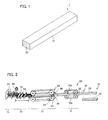
- Fig. 1 is a perspective view of a resin molded article for laying rails in the first embodiment of the present invention;
- Fig. 2 is a perspective view showing a continuous molding line of the resin molded article;
- Fig. 3 is a view showing the continuous molding line shown in Fig. 2;
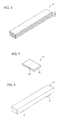
- Fig. 4 is a perspective view of a resin molded article for laying rails in the second embodiment of the present invention;
- Fig. 5 is a perspective view of a resin molded article for laying rails in the third embodiment of the present invention;
- Fig. 6 is a perspective view of a resin molded article for laying rails in the fourth embodiment of the present invention;
- Fig. 7 is a perspective view of a resin molded article for laying rails in the fifth embodiment of the present invention;
- Fig. 8 is a perspective view showing a usage state of the resin molded article for laying rails in the fifth embodiment of the present invention;
- Fig. 9 is a view showing an evaluating system; and
- Fig. 10 is a view showing an evaluating system.
- Now, preferred embodiments of the present invention will be described below, making reference to the accompanying drawings.
- Referring to Fig. 1, a resin molded article for laying rails 1 in the first embodiment of the present invention includes a
polyurethane resin part 10 and afiber part 23. Thepolyurethane part 10 is obtained through reaction of a polyol and an isocyanate, and thefiber part 23 occurs in a state found in thepolyurethane resin part 10. - The resin molded article 1 is of a rectangular column and used as a sleeper.
- A polyol used in polyurethane resin specifically uses a polyether polyol. A polyether polyol has a hydroxyl value of 240 mg KOH/g, which is within a range of 80 to 350 mg KOH/g. Further, a polyether polyol has a functionality (the number of functional groups) of 2.5, which is within a range of 2.0 to 3.5.
- Further, a polyester polyol or a phenol-modified polyol can be used as a polyol.
- Polymeric MDI is employed as an isocyanate used in the polyurethane resin. Polymeric MDI contains polyphenylene polymethylene polyisocyanate, which is referred to as a polynuclear material having more than two benzene rings in one molecule. Polymeric MDI is a combination of polyphenylene polymethylene polyisocyanate and methylene diphenyl isocyanate (hereinafter referred to as MDI). MDI has two benzene rings in one molecule and referred to as a binuclear material.
- A polyol in the manufacture of the polyurethane resin in the present invention has a hydroxyl value with a range of 80 to 350 mg KOH/g, which is lower than the value of one normally used in a rigid polyurethane. That makes the intervals between hydroxyls longer and reduces cross-linkages, thereby making the resin softer. Thus, rate of spring of the resin molded article 1 is reduced to be more deformable with the same load, so that vibration is absorbed. Further, vibrational energy (energy of motion) is converted to heat energy (dashpot efficiency), so that vibration is attenuated.
- A glass fiber is employed as a fiber of the resin molded article for laying rails 1. The glass fiber may be a long (continuous) fiber or may be a short (chopped) fiber. Further, the fiber may be oriented or may be unoriented. A fiber other than a glass fiber may be used.
- A polyol and an isocyanate are mixed to be reacted, so as to obtain the polyurethane resin. The resin molded article 1 allows a glass fiber to be present therein in reaction of a polyol and an isocyanate, so as to contain glass fiber after molding.
- The
polyurethane resin part 10 in the present embodiment has a proportional limit compressive strength of 2.5 MPa, which is within a range of 1.0 to 3.0 MPa and a static spring constant of 45 kN/mm, which is within a range of 5 to 50 kN/mm. Thus, thepolyurethane resin part 10 combines a high strength and a vibration damping efficiency. - Herein, these properties are verified by a test with a product molded by only the
polyurethane part 10 without containing thefiber part 23, though the description is omitted. - The
urethane resin part 10 can be turned into a resin foam by foaming in molding. Further, an addition agent other than a fiber can be added. - Next, a method for producing the resin molded article for laying rails 1 will be described below.
- The resin molded article 1 is produced by means of a
continuous molding line 50 as shown in Figs. 2 and 3. Thecontinuous molding line 50 includes afiber supply process 51, aresin impregnation process 52, amolding process 53, and apickup section 55. - The
fiber part 23 is continuously supplied in such a manner as following toward thepickup process 55 from thefiber supply process 51, so as to be picked up by thepickup section 55, whereby the resulting moldedarticle 41 rolls off. The processes proceed in a left-to-right fashion in Figs. 2 and 3 showing thecontinuous molding line 50. - The
fiber supply process 51 continuously supplies fibers to be turned into thefiber part 23, wherein long glass fibers are wound around a bobbin or the like to be let out therefrom and supplied. A plurality of long glass fibers are supplied in a bundle to thefiber supply process 51 and proceed to theresin impregnation process 52. - The
resin impregnation process 52 includes sprayingnozzle 60, animpregnation roll 61, andpinch plates 62. A liquid resin solution is sprayed toward thefiber part 23 through the sprayingnozzle 60, whereupon thefiber part 23 passes through theimpregnation roll 61 and are pinched by thepinch plates 62 so as to evenly penetrate the resin solution through its entire portion. - Then, the
fiber part 23 is supplied to themolding process 53. Themolding process 53 has fourendless belts molding passage 68 is formed. Theendless belts molding passage 68 into a substantially rectangle, corresponding to a cross section of aresin locating part 20. Further, the upper and lowerendless belts endless belts resin locating part 20 has a vertical width (thickness) longer than a horizontal width. - In molding, the
endless belts endless belts fiber part 23. Consequently, it is possible to reduce friction between thebelts - Further, the
molding passage 68 formed by thebelts fiber part 23 is hardened in themolding passage 68. The resin solution, to which a foaming agent is added, foams in hardening. - The resin hardened by having passed through the
molding passage 68 is picked up at thepickup section 55. Thepickup section 55 has anupper belt 55a and alower belt 55b, which operates in such a manner that theresin locating part 20 is sandwiched between the upper and thelower belts - Lastly, the resin is cut in a predetermined length by means of a
cutter 40, whereupon a process such as surface finish is done to a cut moldedarticle 42 to produce the resin molded article for laying rails 1. - The polyol used in the resin molded article for laying rails 1 in the present embodiment has a hydroxyl value within a range of 80 to 350 mg KOH/g and a functionality within a range of 2.0 to 3.5. Therefore, the polyurethane resin of the resin molded article 1 has a certain level of hardness but rather softer than the conventional one, so as to endure internal pressure of foam formation. That avoids post-expansion and resulting deformation or cracks generated in molded articles, thereby steadily producing the articles. Further, articles molded in this way have high vibration damping capacity.
- In the embodiment described above, the resin molded article for laying rails 1 is not a laminated body, but as shown in Figs. 4, 5, and 6, may be a laminated body with laminating after molding.
- Further, a resin molded article for laying
rails 2 in the second embodiment shown in Fig. 4 prepares a plurality of articles produced by the same material as the resin molded article 1 to be produced with the articles laminated. - Still further, a resin molded article for laying
rails 3 in the third embodiment shown in Fig. 5 prepares asoft resin part 30 produced by the same material as the resin molded article 1 and ahard resin part 31 harder than thesoft resin part 30 with thesoft resin part 30 and thehard resin part 31 laminated to make up the resin molded article. The resin moldedarticle 3 is composed of a laminated combination of thesoft resin part 30 and thehard resin part 31 put one on top of the other. - Yet further, it is possible to arrange
hard resin parts 31 top and bottom and asoft resin part 30 therebetween as shown in a resin molded article for layingrails 3a in the fourth embodiment shown in Fig. 6, laminating in such a manner that thehard resin parts 31 sandwich thesoft resin part 30 from top and bottom. - As the resin molded article for laying
rails article 3 uses the soft andhard resin parts - The resin molded article for laying
rails fiber part 23, but may be molded using a short fiber. - A resin molded article for laying
rails 4 in the fifth embodiment of the present invention shown in Fig. 7 has apolyurethane resin part 10 and afiber part 23, which uses a short fiber, unlike the above-mentionedfiber part 23. - Further, the resin molded
article 4 is produced by means of a molding tool such as a die. Specifically, a material is filled in a molding tool to be molded by compression and heating. - The
fiber part 23 uses a crushed body of a resin molded article having a glass fiber. Specifically, a molding article made of fiber-reinforced polyurethane resin is crushed, the crushed powdery body being filled in the above-mentioned molding tool. Thus, the fibers contained in the powdery body made by crushing are turned into thefiber part 23. - A resin to be used after crushing and to which a glass fiber is added may be selected from any kind thereof, and thus, a waste material after long use or flake generated in producing may be reused. In this case, a material of a resin to be reused is preferably a polyurethane resin. In this way, the resin molded
article 4 uses a crushed body of a molding article made of fiber reinforced polyurethane resin, achieving an excellent recycling efficiency. - The above-mentioned resin to which a glass fiber is added may be crushed to a greater or lesser extent, that is, may be crushed so as to form grains having an average grain diameter of 1 mm or more or so as to form powder having an average grain diameter of less than 1 mm. In the case of grains having an average grain diameter of 1 mm or more, it is preferable to have the average grain diameter of less than 5 mm.
- A polyurethane resin can be foamed. Foaming reduces the specific gravity. The foaming ratio may be regulated according to usage.
- A method for molding the resin molded
article 4 in the present embodiment is not especially limited, but as described below, may employ a method of molding individually using a predetermined mold. - Specifically, a polyol and an isocyanate, to which a predetermined amount of a foaming agent or a catalyzer is added as needed, are mixed by a means such as a mixer, so as to prepare a liquid resin solution. Then, the resulting resin solution and a glass fiber are filled in the mold and subsequently foamed and hardened so as to be molded.
- In the use of a waste resin to which a glass fiber is added, a crushed resin is filled in a mold in molding, thereby readily molding. The compounding ratio of the resin solution and the crushed resin may be varied depending on a grain diameter of the crushed resin.
- Further, in the case of molding using a mold, the resin solution may be molded in a compressed state in hardening. This case stables the shape or the specific gravity of the molded polyurethane resin molded article.
- The resin molded
article 4 molded as described above can be used as a member for use in a railway track, and specifically, as shown in Fig. 8, as packing attached to a portion where asleeper 72 is supported. - Herein, "packing" is a member used for adjusting a gap or damping vibration by interposing between rails and sleepers. The packing may be interposed when rails are laid, but may be interposed after laying rails. The interposition of the packing between rails and sleepers fills a gap between the sleepers and the rails generated by attrition or deformation of the sleepers or loosening of joints caused by the use of the rails.
- The resin molded article for laying
rails 3 in the Example 1 was molded in the following way. - Urethane resin solution U1 was prepared using two kinds of polyols. Specifically, 50 parts of polyol P1 (SBU Polyol 610J produced by Sumika Bayer Urethane, Co., Ltd.), 50 parts of polyol P2 (Sumiphen 1600U produced by Sumika Bayer Urethane, Co., Ltd.), 94 parts of isocyanate (Sumidur 44V20 produced by Sumika Bayer Urethane, Co., Ltd.), 1.0 part of a foam stabilizer (SRX 295 produced by Toray Silicon Co., Ltd.), 0.8 part of water as a foaming agent, and 0.2 part of an organotin catalyst (SCAT31A produced by Sankyo Organic Chemicals Co., Ltd.) were compounded. Then, the resulting mixture was treated with homogeneous dispersion using a mixer, so as to prepare the urethane resin solution U1.
- The polyol in the urethane resin solution U1 was a mixture composed of two kinds of polyols P1 and P2 and the mixed polyol to be used had a hydroxyl value of 316 mg KOH/g and a functionality of 2.9. NCO functional group was contained in the isocyanate by a ratio of 31 %.
- Next, the urethane resin solution U1 was sprayed onto a bundle of glass fiber, and thereafter the glass fiber was impregnated with the urethane resin solution U1 by means of the
pinch plates 62. Subsequently, the glass fiber impregnated with the urethane resin solution U1 passed through themolding passage 68 and was foamed and hardened, so as to mold a molded article S1 made from the urethane resin solution U1. - The glass fiber used at this time had a yarn number count of 9200 tex. The foaming ratio of the resin was 2.5 and the specific gravity after molding was 0.74.
- The molded article S1 had a bending strength of 134 MPa, a bending Young's modulus of 7950 MPa, a vertical compressive strength of 53 MPa, a shear strength of 10 MPa, and a static spring constant of 48.5 kN/mm.
- Separately from the urethane resin solution U1, urethane resin solution Uz was prepared to mold a molded article Sz made from the urethane resin solution Uz. The urethane resin solution Uz was compounded in the same way as the urethane resin solution U1 except that 100 parts of polyol P1 (SBU Polyol 610J produced by Sumika Bayer Urethane, Co., Ltd.) was used as a polyol to be used.
- The glass fiber used at this time had a yarn number count of 9200 tex and was contained in the entire molded article Sz by a ratio of 52 % by weight. The foaming ratio of the resin was 2.5 and the specific gravity after molding was 0.74.
- The molded article Sz had a bending strength of 142 MPa, a bending Young's modulus of 8100 MPa, a vertical compressive strength of 58 MPa, a shear strength of 10 MPa, and a static spring constant of 80.0 kN/mm.
- Then, the molded article S1 and the molded article Sz were laminated in two layers with the molded article S1 at an upper side, thereby foaming the resin molded
article 3 in the Example 1. - The resin molded article for laying
rails 3 in the Example 2 was molded in the following way. - Urethane resin solution U2 was prepared using two kinds of polyols. Specifically, 20 parts of polyol P1 (SBU Polyol 610J produced by Sumika Bayer Urethane, Co., Ltd.), 80 parts of polyol P2 (Sumiphen 1600U produced by Sumika Bayer Urethane, Co., Ltd.), 64 parts of isocyanate (Sumidur 44V20 produced by Sumika Bayer Urethane, Co., Ltd.), 1.0 part of a foam stabilizer (SRX 295 produced by Toray Silicon Co., Ltd.), 0.8 part of water as a foaming agent, and 0.2 part of an organotin catalyst (SCAT31A produced by Sankyo Organic Chemicals Co., Ltd.) were compounded. Then, the resulting mixture was treated with homogeneous dispersion using a mixer, so as to prepare the urethane resin solution U2.
- The polyol in the urethane resin solution U2 was a mixture composed of two kinds of polyols P1 and P2 and the mixed polyol had a hydroxyl value of 190 mg KOH/g and a functionality of 2.5. NCO functional group was contained in the isocyanate by a ratio of 31%.
- Next, the urethane resin solution U2 was sprayed onto a bundle of glass fiber, and thereafter the glass fiber was impregnated with the urethane resin solution U2 by means of the
pinch plates 62. Subsequently, the glass fiber impregnated with the urethane resin solution U2 passed through themolding passage 68 and was foamed and hardened, so as to mold a molded article S2 made from the urethane resin solution U2. - The glass fiber used at this time had a yarn number count of 9200 tex and was contained in the entire molded article S2 by a ratio of 51 % by weight. The foaming ratio of the resin was 2.0 and the specific gravity after molding was 0.9.
- The molded article S2 had a bending strength of 67 MPa, a bending Young's modulus of 3400 MPa, a vertical compressive strength of 15 MPa, a shear strength of 4.5 MPa, and a static spring constant of 12 kN/mm.
- Then, the molded article S2 and the molded article Sz were laminated in two layers with the molded article S2 at an upper side, thereby foaming the resin molded
article 3 in the Example 2. - The resin molded article for laying
rails 4 in the Example 3 was molded in the following way. - The polyol used for this example is not the one used in the urethane resin solutions U1 or U2. Specifically, 100 parts of polyol P3 (SBU Polyol 0475 produced by Sumika Bayer Urethane, Co., Ltd.), 40 parts of isocyanate (Sumidur 44V20 produced by Sumika Bayer Urethane, Co., Ltd.), and 0.1 part of an organotin catalyst (SCAT31A produced by Sankyo Organic Chemicals Co., Ltd.) were compounded. Then, the resulting mixture was treated with homogeneous dispersion using a mixer, so as to prepare urethane resin solution U3.
- The polyol in the urethane resin solution U3 had a hydroxyl value of 85 mg KOH/g and a functionality of 2.2. NCO functional group was contained in the isocyanate by a ratio of 31 %.
- Crushed polyurethane resin containing a glass fiber and the urethane resin solution U3 were filled into a molding tool and hardened to be molded, thereby molding a molded article S3. The specific gravity of S3 after molding was 0.9.
- The crushed resin for use in the molded article S3 formed grains having a diameter within a range of 2 to 5 mm. The crushed resin and the urethane resin solution U3 were compounded at a compounding ratio of 60 : 40. The glass fiber used at this time was contained in the entire molded article S3 by a ratio of 51 % by weight.
- The molded article S3 had a bending strength of 67 MPa, a bending Young's modulus of 3400 MPa, a vertical compressive strength of 15 MPa, a shear strength of 4.5 MPa, and a static spring constant of 15 kN/mm.
- A molded article in the Comparative Example 1 was molded in the following way.
- A molded article Sz was molded using the urethane resin solution Uz so as to be employed as the molded article in the Comparative Example 1.
- The glass fiber used at this time had a yarn number count of 9200 tex. The foaming ratio of the resin was 2.5 and the specific gravity after molding was 0.74.
- Vibration damping capability was evaluated using an evaluating
system 70 shown in Figs. 9 and 10. The evaluatingsystem 70 had twosimulated iron girders 71 each made of a wide flange beam, the interval between the twogirders 71 being 1350 mm. Asleeper 72 to be evaluated was placed on the twogirders 71 for evaluating. - The
sleeper 72 to be evaluated (the Examples 1 to 3 and the Comparative Example 1) was of a rectangular column with 140 mm x 200 mm x 1500 mm, wherein a thickness of each layer in the Examples 1 and 2 was half of the sleeper thickness. The Example 3, as shown in Fig. 10, uses thesleeper 72 used in the Comparative Example 1, withpackings 74 that are the molded articles in the Example 3 placed at positions corresponding to the twogirders 71. Thepackings 74 in the Example 3 each was of a rectangular plate with 30 mm x 200 mm x 500 mm. - A
steel sheet 73 was arranged on thesleeper 72 and at 150 mm inside in a longitudinal direction of thesleeper 72.Sensors steel sheet 73 and thesimulated iron girder 71, respectively, so as to detect the respective vibration. Further, the evaluatingsystem 70 had avibration measuring instrument 77 and apersonal computer 78, so that signals from thesensors vibration measuring instrument 77 into thecomputer 78, whereby a calculating analysis was performed on the signals inputted from thevibration measuring instrument 77. - Thereafter, as to each
sleeper 72 in the Examples 1 to 3 and the Comparative Example 1, which was set on thesimulated iron girders 71, thesteel plate 73 was percussed with animpulse hammer 79 to generate vibration, and whereby a vibration damping capacity of eachsleeper 72 was evaluated. Specifically, a vibration attenuation (an overall value of frequency response function) of each sleeper was checked. - As a result, a vibration attenuation was 7.2 dB in the comparative example 1, whereas it was 10.5 dB in the Example 1, 12.4 dB in the Example 2, and 10.2 dB in the Example 3. The Examples 1 to 3 had 3.0 to 5.2 dB of difference compared to the Comparative Example 1, thus confirming that they were effective in a vibration damping capacity.
Claims (7)
- A resin molded article for laying rails, comprising:a polyurethane resin part obtained through reaction of a polyol and an isocyanate; anda fiber part contained in the polyurethane resin part,the polyol having a hydroxyl value within a range of 80 to 350 mg KOH/g and a functionality within a range of 2.0 to 3.5,the polyol and the isocyanate being mixed at a mixing ratio within a range of 1 : 1.1 to 1 : 0.4.
- The resin molded article as defined in claim 1,
wherein the polyurethane resin part has a proportional limit compressive strength within a range of 1.0 to 3.0 MPa and a static spring constant within a range of 5 to 50 kN/mm. - A resin molded article for laying rails, comprising:a hard resin part, anda soft resin part,wherein the hard and the soft resin parts form a laminated body arranged in laminae, andwherein the soft resin part consists essentially of a polyurethane resin molded article comprising (a) a polyurethane resin part obtained through reaction of a polyol and an isocyanate and (b) a fiber part contained in the polyurethane resin part,the polyol having a hydroxyl value within a range of 80 to 350 mg KOH/g and a functionality within a range of 2.0 to 3.5, andthe polyol and the isocyanate being mixed at a mixing ratio within a range of 1 : 1.1 to 1 : 0.4.
- The resin molded article as defined in claim 3,
wherein the polyurethane resin part has a proportional limit compressive strength within a range of 1.0 to 3.0 MPa and a static spring constant within a range of 5 to 50 kN/mm. - The resin molded article as defined in one of claims 1 to 4,
wherein the fiber part employs a glass long fiber oriented in a predetermined direction. - A method for producing the resin molded article for laying rails as defined in claim 5, comprising the steps of:a step of tying up at least one continuous glass long fiber in a bundle;a step of impregnating a bundle of glass long fiber with a liquid resin made from a polyol and an isocyanate; anda step of introducing the glass long fiber impregnated with the liquid resin into a mold, so as to harden the liquid resin to be cut in a predetermined length,so that the resin molded article for laying rails are continuously produced.
- A method for producing the resin molded article for laying rails as defined in one of claims 1 to 4, comprising the steps of:a step of crushing the resin molded article containing a glass fiber so as to make crushed resin material; anda step of filling the crushed resin material, the polyol, and the isocyanate into a mold, so as to harden in the mold.
Applications Claiming Priority (1)
| Application Number | Priority Date | Filing Date | Title |
|---|---|---|---|
| JP2005364932A JP4860256B2 (en) | 2005-12-19 | 2005-12-19 | Resin molded body for rail laying |
Publications (2)
| Publication Number | Publication Date |
|---|---|
| EP1798247A1 true EP1798247A1 (en) | 2007-06-20 |
| EP1798247B1 EP1798247B1 (en) | 2011-09-21 |
Family
ID=37909483
Family Applications (1)
| Application Number | Title | Priority Date | Filing Date |
|---|---|---|---|
| EP06026209A Not-in-force EP1798247B1 (en) | 2005-12-19 | 2006-12-18 | Resin molded article for laying rails and method for producing the same |
Country Status (5)
| Country | Link |
|---|---|
| EP (1) | EP1798247B1 (en) |
| JP (1) | JP4860256B2 (en) |
| KR (1) | KR101275967B1 (en) |
| CN (1) | CN1995105B (en) |
| AT (1) | ATE525411T1 (en) |
Cited By (6)
| Publication number | Priority date | Publication date | Assignee | Title |
|---|---|---|---|---|
| CN101323701B (en) * | 2008-05-23 | 2010-06-23 | 南京林业大学 | Long glass fiber reinforced hard polyurethane synthetic material sleeper and method for preparing the same |
| JP2014508850A (en) * | 2011-03-25 | 2014-04-10 | バイエル・マテリアルサイエンス・リミテッド・ライアビリティ・カンパニー | Polyurethane composites produced by vacuum injection |
| EP3090871A1 (en) * | 2015-05-05 | 2016-11-09 | Sunrez Corp. | Fiber reinforced core |
| WO2018033042A1 (en) * | 2016-08-17 | 2018-02-22 | 中国铁道科学研究院铁道建筑研究所 | High-fiber-content fiber-reinforced rigid polyurethane foam composite panel and method for manufacturing same |
| CN113969554A (en) * | 2021-12-08 | 2022-01-25 | 杭州萧山金鹰交通设施有限公司 | Guardrail and manufacturing process thereof |
| EP4400536A4 (en) * | 2021-09-10 | 2025-10-29 | Sekisui Chemical Co Ltd | Curable resin material, resin molded body and method for producing a resin molded body |
Families Citing this family (5)
| Publication number | Priority date | Publication date | Assignee | Title |
|---|---|---|---|---|
| CN101942786B (en) * | 2010-08-25 | 2012-06-27 | 北京科聚化工新材料有限公司 | Rail tie plate and preparation method thereof |
| CN103497503B (en) * | 2013-09-27 | 2016-06-22 | 北京中铁润海科技有限公司 | A kind of lightweight compound sleeper and preparation method thereof |
| EP3851467A4 (en) * | 2018-09-14 | 2022-04-20 | Sekisui Chemical Co., Ltd. | CURING RESIN COMPOSITION, RESIN CAST BODY, AND METHOD FOR PRODUCING RESIN CAST BODY |
| KR102347857B1 (en) * | 2021-04-05 | 2022-01-07 | (주) 동양이화 | Preparation method of composite railway sleeper and composite railway sleeper preparaed thereby |
| CN115609959B (en) * | 2022-10-14 | 2025-06-24 | 洛阳双瑞橡塑科技有限公司 | Composite material sleeper and preparation method thereof |
Citations (5)
| Publication number | Priority date | Publication date | Assignee | Title |
|---|---|---|---|---|
| DE4015714A1 (en) * | 1990-05-16 | 1991-11-21 | Bayer Ag | Glass fibre-reinforced thermoplastic polyurethane foam - by injection moulding mixt. of GFR thermoplastic polyurethane and a blowing agent |
| DE4035610A1 (en) * | 1990-11-09 | 1992-05-14 | Basf Ag | METHOD FOR PRODUCING FIBER COMPOSITES |
| US5234975A (en) * | 1989-01-31 | 1993-08-10 | Nippon Polyurethane Industry Co., Ltd. | Composition superior in quick-curing for fiber-reinforced polyurethane resin |
| JP2000204267A (en) * | 1999-01-12 | 2000-07-25 | Sekisui Chem Co Ltd | Composite material, method for producing the same, and synthetic sleeper |
| JP2000281745A (en) * | 1999-03-31 | 2000-10-10 | Bando Chem Ind Ltd | Foamed polyurethane elastomer, anti-vibration material and railway pad |
Family Cites Families (10)
| Publication number | Priority date | Publication date | Assignee | Title |
|---|---|---|---|---|
| JP3117545B2 (en) * | 1992-07-21 | 2000-12-18 | 積水化学工業株式会社 | Anti-vibration sleepers |
| JPH1037102A (en) * | 1996-07-23 | 1998-02-10 | Torii Kasei Kk | Sleeper made of resin |
| JP2000085043A (en) * | 1998-09-14 | 2000-03-28 | Sekisui Chem Co Ltd | Synthetic resin laminates and sleepers |
| JP2000167966A (en) * | 1998-12-04 | 2000-06-20 | Sekisui Chem Co Ltd | Composite materials and sleepers |
| EP1277823B1 (en) * | 2000-04-14 | 2009-02-25 | Sekisui Chemical Co., Ltd. | Resin composition for vibration-damping material, vibration-damping material, and sound-insulating member |
| JP4031632B2 (en) * | 2001-10-31 | 2008-01-09 | 三菱重工業株式会社 | Manufacturing method of fiber reinforced plastic |
| JP2003206502A (en) * | 2001-11-07 | 2003-07-25 | Sekisui Chem Co Ltd | Railroad sleeper and method of manufacturing the same |
| CN1189498C (en) * | 2002-08-31 | 2005-02-16 | 海洋化工研究院 | Hard polyurethane casting material |
| JP2004358809A (en) * | 2003-06-04 | 2004-12-24 | Sekisui Chem Co Ltd | Resin molding |
| JP4456376B2 (en) * | 2004-02-12 | 2010-04-28 | ニチアス株式会社 | Polyol composition and glass fiber reinforced rigid polyurethane foam using the composition |
-
2005
- 2005-12-19 JP JP2005364932A patent/JP4860256B2/en not_active Expired - Lifetime
-
2006
- 2006-12-18 KR KR1020060129334A patent/KR101275967B1/en not_active Expired - Fee Related
- 2006-12-18 EP EP06026209A patent/EP1798247B1/en not_active Not-in-force
- 2006-12-18 AT AT06026209T patent/ATE525411T1/en active
- 2006-12-19 CN CN2006101718382A patent/CN1995105B/en not_active Expired - Fee Related
Patent Citations (5)
| Publication number | Priority date | Publication date | Assignee | Title |
|---|---|---|---|---|
| US5234975A (en) * | 1989-01-31 | 1993-08-10 | Nippon Polyurethane Industry Co., Ltd. | Composition superior in quick-curing for fiber-reinforced polyurethane resin |
| DE4015714A1 (en) * | 1990-05-16 | 1991-11-21 | Bayer Ag | Glass fibre-reinforced thermoplastic polyurethane foam - by injection moulding mixt. of GFR thermoplastic polyurethane and a blowing agent |
| DE4035610A1 (en) * | 1990-11-09 | 1992-05-14 | Basf Ag | METHOD FOR PRODUCING FIBER COMPOSITES |
| JP2000204267A (en) * | 1999-01-12 | 2000-07-25 | Sekisui Chem Co Ltd | Composite material, method for producing the same, and synthetic sleeper |
| JP2000281745A (en) * | 1999-03-31 | 2000-10-10 | Bando Chem Ind Ltd | Foamed polyurethane elastomer, anti-vibration material and railway pad |
Non-Patent Citations (2)
| Title |
|---|
| DATABASE WPI Week 200059, Derwent World Patents Index; AN 2000-614495, XP002430287 * |
| DATABASE WPI Week 200064, Derwent World Patents Index; AN 2000-661155, XP002430288 * |
Cited By (6)
| Publication number | Priority date | Publication date | Assignee | Title |
|---|---|---|---|---|
| CN101323701B (en) * | 2008-05-23 | 2010-06-23 | 南京林业大学 | Long glass fiber reinforced hard polyurethane synthetic material sleeper and method for preparing the same |
| JP2014508850A (en) * | 2011-03-25 | 2014-04-10 | バイエル・マテリアルサイエンス・リミテッド・ライアビリティ・カンパニー | Polyurethane composites produced by vacuum injection |
| EP3090871A1 (en) * | 2015-05-05 | 2016-11-09 | Sunrez Corp. | Fiber reinforced core |
| WO2018033042A1 (en) * | 2016-08-17 | 2018-02-22 | 中国铁道科学研究院铁道建筑研究所 | High-fiber-content fiber-reinforced rigid polyurethane foam composite panel and method for manufacturing same |
| EP4400536A4 (en) * | 2021-09-10 | 2025-10-29 | Sekisui Chemical Co Ltd | Curable resin material, resin molded body and method for producing a resin molded body |
| CN113969554A (en) * | 2021-12-08 | 2022-01-25 | 杭州萧山金鹰交通设施有限公司 | Guardrail and manufacturing process thereof |
Also Published As
| Publication number | Publication date |
|---|---|
| HK1105986A1 (en) | 2008-02-29 |
| EP1798247B1 (en) | 2011-09-21 |
| KR101275967B1 (en) | 2013-06-14 |
| CN1995105B (en) | 2011-05-04 |
| CN1995105A (en) | 2007-07-11 |
| JP2007169326A (en) | 2007-07-05 |
| JP4860256B2 (en) | 2012-01-25 |
| KR20070065230A (en) | 2007-06-22 |
| ATE525411T1 (en) | 2011-10-15 |
Similar Documents
| Publication | Publication Date | Title |
|---|---|---|
| EP1798247B1 (en) | Resin molded article for laying rails and method for producing the same | |
| RU2144546C1 (en) | New flexible polyurethane foams | |
| EP2651998B1 (en) | A polyurethane railway track bed, a preparing method and the usage thereof | |
| EP2203289B1 (en) | Process for the production of a foamed article | |
| KR101027296B1 (en) | Composite Structural Materials and Methods for Manufacturing the Same | |
| CA2653656C (en) | Composite panel | |
| JP2014237320A (en) | Foam laminate product and production method thereof | |
| WO2000050233A1 (en) | Composite material and synthetic sleeper using the composite material | |
| FI85962B (en) | GLASSFIBERBEKLAEDD SKUMISOLERSKIVA OCH SKUMNINGSFOERFARANDE FOER DESS FRAMSTAELLNING. | |
| KR20080077640A (en) | Load-supported composite panel | |
| US12089761B2 (en) | Under sleeper pad | |
| US7901765B2 (en) | Foam laminate product and process for production thereof | |
| EP0019748A1 (en) | Method of producing a fibre-reinforced resin foam and fibre-reinforced resin foam | |
| KR20090112288A (en) | Internal composite insulating walls and methods of manufacturing the same | |
| JP7417522B2 (en) | insulation box | |
| KR101002964B1 (en) | mat | |
| CN113717344A (en) | Two-dimensional orientation continuous glass fiber reinforced hard polyurethane foam plastic and preparation method thereof | |
| JPH0768685A (en) | Fibrous reinforcing material and its production | |
| HK1105986B (en) | A resin molded article for constructing a rail and a method for manufacturing the same | |
| KR20060043689A (en) | The manufacturing method of the fiber reinforced resin molded article, and the fiber reinforced resin molded article and synthetic resin sleeper obtained by this manufacturing method | |
| Schäfer et al. | Lightweight potential of 3D endless fiber reinforcement of polyurethane foam cores with spacer fabrics in hybrid sandwich structures with fiber reinforced thermoplastic facings | |
| JP6121159B2 (en) | Foamed polyurethane molded product reinforced with vegetable fiber and method for producing the same | |
| JP2000167966A (en) | Composite materials and sleepers | |
| JPH1158534A (en) | Method for producing fiber-reinforced urethane resin multilayer foam | |
| JPS63101436A (en) | Vehicle trimming material and its production |
Legal Events
| Date | Code | Title | Description |
|---|---|---|---|
| PUAI | Public reference made under article 153(3) epc to a published international application that has entered the european phase |
Free format text: ORIGINAL CODE: 0009012 |
|
| AK | Designated contracting states |
Kind code of ref document: A1 Designated state(s): AT BE BG CH CY CZ DE DK EE ES FI FR GB GR HU IE IS IT LI LT LU LV MC NL PL PT RO SE SI SK TR |
|
| AX | Request for extension of the european patent |
Extension state: AL BA HR MK YU |
|
| 17P | Request for examination filed |
Effective date: 20071004 |
|
| 17Q | First examination report despatched |
Effective date: 20071107 |
|
| AKX | Designation fees paid |
Designated state(s): AT BE BG CH CY CZ DE DK EE ES FI FR GB GR HU IE IS IT LI LT LU LV MC NL PL PT RO SE SI SK TR |
|
| GRAP | Despatch of communication of intention to grant a patent |
Free format text: ORIGINAL CODE: EPIDOSNIGR1 |
|
| GRAS | Grant fee paid |
Free format text: ORIGINAL CODE: EPIDOSNIGR3 |
|
| GRAA | (expected) grant |
Free format text: ORIGINAL CODE: 0009210 |
|
| AK | Designated contracting states |
Kind code of ref document: B1 Designated state(s): AT BE BG CH CY CZ DE DK EE ES FI FR GB GR HU IE IS IT LI LT LU LV MC NL PL PT RO SE SI SK TR |
|
| REG | Reference to a national code |
Ref country code: GB Ref legal event code: FG4D |
|
| REG | Reference to a national code |
Ref country code: CH Ref legal event code: EP |
|
| REG | Reference to a national code |
Ref country code: IE Ref legal event code: FG4D |
|
| REG | Reference to a national code |
Ref country code: DE Ref legal event code: R096 Ref document number: 602006024501 Country of ref document: DE Effective date: 20111117 |
|
| REG | Reference to a national code |
Ref country code: NL Ref legal event code: T3 |
|
| PG25 | Lapsed in a contracting state [announced via postgrant information from national office to epo] |
Ref country code: SE Free format text: LAPSE BECAUSE OF FAILURE TO SUBMIT A TRANSLATION OF THE DESCRIPTION OR TO PAY THE FEE WITHIN THE PRESCRIBED TIME-LIMIT Effective date: 20110921 Ref country code: FI Free format text: LAPSE BECAUSE OF FAILURE TO SUBMIT A TRANSLATION OF THE DESCRIPTION OR TO PAY THE FEE WITHIN THE PRESCRIBED TIME-LIMIT Effective date: 20110921 Ref country code: LT Free format text: LAPSE BECAUSE OF FAILURE TO SUBMIT A TRANSLATION OF THE DESCRIPTION OR TO PAY THE FEE WITHIN THE PRESCRIBED TIME-LIMIT Effective date: 20110921 |
|
| LTIE | Lt: invalidation of european patent or patent extension |
Effective date: 20110921 |
|
| PG25 | Lapsed in a contracting state [announced via postgrant information from national office to epo] |
Ref country code: CY Free format text: LAPSE BECAUSE OF FAILURE TO SUBMIT A TRANSLATION OF THE DESCRIPTION OR TO PAY THE FEE WITHIN THE PRESCRIBED TIME-LIMIT Effective date: 20110921 Ref country code: SI Free format text: LAPSE BECAUSE OF FAILURE TO SUBMIT A TRANSLATION OF THE DESCRIPTION OR TO PAY THE FEE WITHIN THE PRESCRIBED TIME-LIMIT Effective date: 20110921 Ref country code: GR Free format text: LAPSE BECAUSE OF FAILURE TO SUBMIT A TRANSLATION OF THE DESCRIPTION OR TO PAY THE FEE WITHIN THE PRESCRIBED TIME-LIMIT Effective date: 20111222 Ref country code: LV Free format text: LAPSE BECAUSE OF FAILURE TO SUBMIT A TRANSLATION OF THE DESCRIPTION OR TO PAY THE FEE WITHIN THE PRESCRIBED TIME-LIMIT Effective date: 20110921 |
|
| PG25 | Lapsed in a contracting state [announced via postgrant information from national office to epo] |
Ref country code: BE Free format text: LAPSE BECAUSE OF FAILURE TO SUBMIT A TRANSLATION OF THE DESCRIPTION OR TO PAY THE FEE WITHIN THE PRESCRIBED TIME-LIMIT Effective date: 20110921 |
|
| PG25 | Lapsed in a contracting state [announced via postgrant information from national office to epo] |
Ref country code: CZ Free format text: LAPSE BECAUSE OF FAILURE TO SUBMIT A TRANSLATION OF THE DESCRIPTION OR TO PAY THE FEE WITHIN THE PRESCRIBED TIME-LIMIT Effective date: 20110921 Ref country code: IS Free format text: LAPSE BECAUSE OF FAILURE TO SUBMIT A TRANSLATION OF THE DESCRIPTION OR TO PAY THE FEE WITHIN THE PRESCRIBED TIME-LIMIT Effective date: 20120121 Ref country code: SK Free format text: LAPSE BECAUSE OF FAILURE TO SUBMIT A TRANSLATION OF THE DESCRIPTION OR TO PAY THE FEE WITHIN THE PRESCRIBED TIME-LIMIT Effective date: 20110921 |
|
| PG25 | Lapsed in a contracting state [announced via postgrant information from national office to epo] |
Ref country code: RO Free format text: LAPSE BECAUSE OF FAILURE TO SUBMIT A TRANSLATION OF THE DESCRIPTION OR TO PAY THE FEE WITHIN THE PRESCRIBED TIME-LIMIT Effective date: 20110921 Ref country code: IT Free format text: LAPSE BECAUSE OF FAILURE TO SUBMIT A TRANSLATION OF THE DESCRIPTION OR TO PAY THE FEE WITHIN THE PRESCRIBED TIME-LIMIT Effective date: 20110921 Ref country code: PL Free format text: LAPSE BECAUSE OF FAILURE TO SUBMIT A TRANSLATION OF THE DESCRIPTION OR TO PAY THE FEE WITHIN THE PRESCRIBED TIME-LIMIT Effective date: 20110921 Ref country code: PT Free format text: LAPSE BECAUSE OF FAILURE TO SUBMIT A TRANSLATION OF THE DESCRIPTION OR TO PAY THE FEE WITHIN THE PRESCRIBED TIME-LIMIT Effective date: 20120123 Ref country code: EE Free format text: LAPSE BECAUSE OF FAILURE TO SUBMIT A TRANSLATION OF THE DESCRIPTION OR TO PAY THE FEE WITHIN THE PRESCRIBED TIME-LIMIT Effective date: 20110921 |
|
| PLBE | No opposition filed within time limit |
Free format text: ORIGINAL CODE: 0009261 |
|
| STAA | Information on the status of an ep patent application or granted ep patent |
Free format text: STATUS: NO OPPOSITION FILED WITHIN TIME LIMIT |
|
| PG25 | Lapsed in a contracting state [announced via postgrant information from national office to epo] |
Ref country code: MC Free format text: LAPSE BECAUSE OF NON-PAYMENT OF DUE FEES Effective date: 20111231 Ref country code: DK Free format text: LAPSE BECAUSE OF FAILURE TO SUBMIT A TRANSLATION OF THE DESCRIPTION OR TO PAY THE FEE WITHIN THE PRESCRIBED TIME-LIMIT Effective date: 20110921 |
|
| REG | Reference to a national code |
Ref country code: CH Ref legal event code: PL |
|
| 26N | No opposition filed |
Effective date: 20120622 |
|
| REG | Reference to a national code |
Ref country code: IE Ref legal event code: MM4A |
|
| REG | Reference to a national code |
Ref country code: DE Ref legal event code: R097 Ref document number: 602006024501 Country of ref document: DE Effective date: 20120622 |
|
| PG25 | Lapsed in a contracting state [announced via postgrant information from national office to epo] |
Ref country code: CH Free format text: LAPSE BECAUSE OF NON-PAYMENT OF DUE FEES Effective date: 20111231 Ref country code: LI Free format text: LAPSE BECAUSE OF NON-PAYMENT OF DUE FEES Effective date: 20111231 Ref country code: IE Free format text: LAPSE BECAUSE OF NON-PAYMENT OF DUE FEES Effective date: 20111218 |
|
| PG25 | Lapsed in a contracting state [announced via postgrant information from national office to epo] |
Ref country code: ES Free format text: LAPSE BECAUSE OF FAILURE TO SUBMIT A TRANSLATION OF THE DESCRIPTION OR TO PAY THE FEE WITHIN THE PRESCRIBED TIME-LIMIT Effective date: 20120101 |
|
| PG25 | Lapsed in a contracting state [announced via postgrant information from national office to epo] |
Ref country code: LU Free format text: LAPSE BECAUSE OF NON-PAYMENT OF DUE FEES Effective date: 20111218 |
|
| PG25 | Lapsed in a contracting state [announced via postgrant information from national office to epo] |
Ref country code: BG Free format text: LAPSE BECAUSE OF FAILURE TO SUBMIT A TRANSLATION OF THE DESCRIPTION OR TO PAY THE FEE WITHIN THE PRESCRIBED TIME-LIMIT Effective date: 20111221 |
|
| PG25 | Lapsed in a contracting state [announced via postgrant information from national office to epo] |
Ref country code: TR Free format text: LAPSE BECAUSE OF FAILURE TO SUBMIT A TRANSLATION OF THE DESCRIPTION OR TO PAY THE FEE WITHIN THE PRESCRIBED TIME-LIMIT Effective date: 20110921 |
|
| PG25 | Lapsed in a contracting state [announced via postgrant information from national office to epo] |
Ref country code: HU Free format text: LAPSE BECAUSE OF FAILURE TO SUBMIT A TRANSLATION OF THE DESCRIPTION OR TO PAY THE FEE WITHIN THE PRESCRIBED TIME-LIMIT Effective date: 20110921 |
|
| REG | Reference to a national code |
Ref country code: FR Ref legal event code: PLFP Year of fee payment: 10 |
|
| REG | Reference to a national code |
Ref country code: FR Ref legal event code: PLFP Year of fee payment: 11 |
|
| REG | Reference to a national code |
Ref country code: FR Ref legal event code: PLFP Year of fee payment: 12 |
|
| PGFP | Annual fee paid to national office [announced via postgrant information from national office to epo] |
Ref country code: NL Payment date: 20221114 Year of fee payment: 17 Ref country code: GB Payment date: 20221027 Year of fee payment: 17 Ref country code: FR Payment date: 20221110 Year of fee payment: 17 Ref country code: DE Payment date: 20220622 Year of fee payment: 17 Ref country code: AT Payment date: 20221125 Year of fee payment: 17 |
|
| P01 | Opt-out of the competence of the unified patent court (upc) registered |
Effective date: 20230522 |
|
| REG | Reference to a national code |
Ref country code: DE Ref legal event code: R119 Ref document number: 602006024501 Country of ref document: DE |
|
| REG | Reference to a national code |
Ref country code: NL Ref legal event code: MM Effective date: 20240101 |
|
| REG | Reference to a national code |
Ref country code: AT Ref legal event code: MM01 Ref document number: 525411 Country of ref document: AT Kind code of ref document: T Effective date: 20231218 |
|
| GBPC | Gb: european patent ceased through non-payment of renewal fee |
Effective date: 20231218 |
|
| PG25 | Lapsed in a contracting state [announced via postgrant information from national office to epo] |
Ref country code: NL Free format text: LAPSE BECAUSE OF NON-PAYMENT OF DUE FEES Effective date: 20240101 |
|
| PG25 | Lapsed in a contracting state [announced via postgrant information from national office to epo] |
Ref country code: NL Free format text: LAPSE BECAUSE OF NON-PAYMENT OF DUE FEES Effective date: 20240101 |
|
| PG25 | Lapsed in a contracting state [announced via postgrant information from national office to epo] |
Ref country code: DE Free format text: LAPSE BECAUSE OF NON-PAYMENT OF DUE FEES Effective date: 20240702 |
|
| PG25 | Lapsed in a contracting state [announced via postgrant information from national office to epo] |
Ref country code: GB Free format text: LAPSE BECAUSE OF NON-PAYMENT OF DUE FEES Effective date: 20231218 |
|
| PG25 | Lapsed in a contracting state [announced via postgrant information from national office to epo] |
Ref country code: FR Free format text: LAPSE BECAUSE OF NON-PAYMENT OF DUE FEES Effective date: 20231231 |
|
| PG25 | Lapsed in a contracting state [announced via postgrant information from national office to epo] |
Ref country code: AT Free format text: LAPSE BECAUSE OF NON-PAYMENT OF DUE FEES Effective date: 20231218 |
|
| PG25 | Lapsed in a contracting state [announced via postgrant information from national office to epo] |
Ref country code: GB Free format text: LAPSE BECAUSE OF NON-PAYMENT OF DUE FEES Effective date: 20231218 Ref country code: FR Free format text: LAPSE BECAUSE OF NON-PAYMENT OF DUE FEES Effective date: 20231231 Ref country code: DE Free format text: LAPSE BECAUSE OF NON-PAYMENT OF DUE FEES Effective date: 20240702 Ref country code: AT Free format text: LAPSE BECAUSE OF NON-PAYMENT OF DUE FEES Effective date: 20231218 |