EP1794988B1 - Initiating internet protocol (ip) communications in an ip communication system based on databases of contact information - Google Patents
Initiating internet protocol (ip) communications in an ip communication system based on databases of contact information Download PDFInfo
- Publication number
- EP1794988B1 EP1794988B1 EP05735184A EP05735184A EP1794988B1 EP 1794988 B1 EP1794988 B1 EP 1794988B1 EP 05735184 A EP05735184 A EP 05735184A EP 05735184 A EP05735184 A EP 05735184A EP 1794988 B1 EP1794988 B1 EP 1794988B1
- Authority
- EP
- European Patent Office
- Prior art keywords
- contact information
- communication
- database
- communication terminal
- incoming
- Prior art date
- Legal status (The legal status is an assumption and is not a legal conclusion. Google has not performed a legal analysis and makes no representation as to the accuracy of the status listed.)
- Ceased
Links
- 230000000977 initiatory effect Effects 0.000 title claims abstract description 9
- 238000000034 method Methods 0.000 claims abstract description 14
- 238000004590 computer program Methods 0.000 abstract description 3
- 230000001413 cellular effect Effects 0.000 description 7
- 238000010586 diagram Methods 0.000 description 7
- 230000006870 function Effects 0.000 description 4
- 230000001419 dependent effect Effects 0.000 description 1
- VZCCETWTMQHEPK-QNEBEIHSSA-N gamma-linolenic acid Chemical compound CCCCC\C=C/C\C=C/C\C=C/CCCCC(O)=O VZCCETWTMQHEPK-QNEBEIHSSA-N 0.000 description 1
- 238000004806 packaging method and process Methods 0.000 description 1
- 230000001755 vocal effect Effects 0.000 description 1
Images
Classifications
-
- H—ELECTRICITY
- H04—ELECTRIC COMMUNICATION TECHNIQUE
- H04L—TRANSMISSION OF DIGITAL INFORMATION, e.g. TELEGRAPHIC COMMUNICATION
- H04L61/00—Network arrangements, protocols or services for addressing or naming
- H04L61/45—Network directories; Name-to-address mapping
-
- H—ELECTRICITY
- H04—ELECTRIC COMMUNICATION TECHNIQUE
- H04L—TRANSMISSION OF DIGITAL INFORMATION, e.g. TELEGRAPHIC COMMUNICATION
- H04L61/00—Network arrangements, protocols or services for addressing or naming
- H04L61/45—Network directories; Name-to-address mapping
- H04L61/4535—Network directories; Name-to-address mapping using an address exchange platform which sets up a session between two nodes, e.g. rendezvous servers, session initiation protocols [SIP] registrars or H.323 gatekeepers
-
- H—ELECTRICITY
- H04—ELECTRIC COMMUNICATION TECHNIQUE
- H04L—TRANSMISSION OF DIGITAL INFORMATION, e.g. TELEGRAPHIC COMMUNICATION
- H04L61/00—Network arrangements, protocols or services for addressing or naming
- H04L61/45—Network directories; Name-to-address mapping
- H04L61/4552—Lookup mechanisms between a plurality of directories; Synchronisation of directories, e.g. metadirectories
-
- H—ELECTRICITY
- H04—ELECTRIC COMMUNICATION TECHNIQUE
- H04L—TRANSMISSION OF DIGITAL INFORMATION, e.g. TELEGRAPHIC COMMUNICATION
- H04L61/00—Network arrangements, protocols or services for addressing or naming
- H04L61/45—Network directories; Name-to-address mapping
- H04L61/4594—Address books, i.e. directories containing contact information about correspondents
-
- H—ELECTRICITY
- H04—ELECTRIC COMMUNICATION TECHNIQUE
- H04M—TELEPHONIC COMMUNICATION
- H04M1/00—Substation equipment, e.g. for use by subscribers
- H04M1/253—Telephone sets using digital voice transmission
- H04M1/2535—Telephone sets using digital voice transmission adapted for voice communication over an Internet Protocol [IP] network
-
- H—ELECTRICITY
- H04—ELECTRIC COMMUNICATION TECHNIQUE
- H04M—TELEPHONIC COMMUNICATION
- H04M1/00—Substation equipment, e.g. for use by subscribers
- H04M1/26—Devices for calling a subscriber
- H04M1/27—Devices whereby a plurality of signals may be stored simultaneously
- H04M1/274—Devices whereby a plurality of signals may be stored simultaneously with provision for storing more than one subscriber number at a time, e.g. using toothed disc
- H04M1/2745—Devices whereby a plurality of signals may be stored simultaneously with provision for storing more than one subscriber number at a time, e.g. using toothed disc using static electronic memories, e.g. chips
- H04M1/2753—Devices whereby a plurality of signals may be stored simultaneously with provision for storing more than one subscriber number at a time, e.g. using toothed disc using static electronic memories, e.g. chips providing data content
- H04M1/2757—Devices whereby a plurality of signals may be stored simultaneously with provision for storing more than one subscriber number at a time, e.g. using toothed disc using static electronic memories, e.g. chips providing data content by data transmission, e.g. downloading
-
- H—ELECTRICITY
- H04—ELECTRIC COMMUNICATION TECHNIQUE
- H04M—TELEPHONIC COMMUNICATION
- H04M1/00—Substation equipment, e.g. for use by subscribers
- H04M1/26—Devices for calling a subscriber
- H04M1/27—Devices whereby a plurality of signals may be stored simultaneously
- H04M1/274—Devices whereby a plurality of signals may be stored simultaneously with provision for storing more than one subscriber number at a time, e.g. using toothed disc
- H04M1/2745—Devices whereby a plurality of signals may be stored simultaneously with provision for storing more than one subscriber number at a time, e.g. using toothed disc using static electronic memories, e.g. chips
- H04M1/27467—Methods of retrieving data
- H04M1/2747—Scrolling on a display
-
- H—ELECTRICITY
- H04—ELECTRIC COMMUNICATION TECHNIQUE
- H04W—WIRELESS COMMUNICATION NETWORKS
- H04W76/00—Connection management
- H04W76/10—Connection setup
-
- H—ELECTRICITY
- H04—ELECTRIC COMMUNICATION TECHNIQUE
- H04W—WIRELESS COMMUNICATION NETWORKS
- H04W80/00—Wireless network protocols or protocol adaptations to wireless operation
Definitions
- the present invention generally relates to the field of telephony, and more particularly to apparatus, methods, and computer program products for initiating Internet protocol communications in an internet protocol communication system.
- VoIP Voice Over Internet Protocol
- PSTN Public Switched Telephone Network
- VoIP Voice Over Internet Protocol
- a conventional phone may now be connected to the Internet using an interface device that converts analog phone signals to digital signals that can be communicated as an Internet Protocol (IP) call through the Internet.
- IP Internet Protocol
- a phone call may thereby be communicated through the Internet to a VoIP service provider, who may convert the call back to an analog signal and connect the call through the PSTN local to the called phone.
- a computer or IP phone can also be used to initiate and receive IP calls through a VoIP service provider.
- a user can thereby dial a telephone number and have the call routed through the Internet, instead of, or in addition to, the PSTN.
- the present invention defines a method according to claim 1, a communication terminal according to claim 9 and a system according to claim 15. Specific embodiments are set forth in the dependent claims 2-8 and 10-14.
- Document EP-A-1 211 861 discloses a method, wherein a user of a mobile phone uses the mobile phone to contact an address book on the Internet to find the telephone number of a person he wants to call and to initiate a telephone connection.
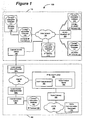
- FIG. 1 is a block diagram of an IP communication system that includes a plurality of contact information databases according to various embodiments of the present invention.
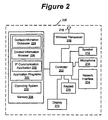
- Figure 2 is a block diagram of a communication terminal according to various embodiments of the present invention.
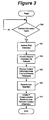
- Figure 3 is a flow chart illustrating operations for accessing a plurality of contact information databases in an IP communication system according to various embodiments of the present invention.
- Embodiments according to the present invention are described with reference to block diagrams and/or operational illustrations of communication terminals, methods, Internet Protocol systems, and computer program products. It is to be understood that each block of the block diagrams and/or operational illustrations, and combinations of blocks in the block diagrams and/or operational illustrations, can be implemented by radio frequency, analog and/or digital hardware, and/or program instructions. These program instructions may be provided to a controller, which may include one or more general purpose processors, special purpose processors, ASICs, and/or other programmable data processing apparatus, and which may reside within common or separate packaging. Accordingly, the instructions, which execute via the controller and/or other programmable data processing apparatus, create means for implementing the functions/acts specified in the block diagrams and/or operational block or blocks.
- the functions/acts noted in the blocks may occur out of the order noted in the operational illustrations.
- two blocks shown in succession may in fact be executed substantially concurrently or the blocks may sometimes be executed in the reverse order, depending upon the functionality/acts involved.
- FIG. 1 is a block diagram of an Internet Protocol (IP) communication system 100 according to various embodiments of the present invention.
- Local resources 110 of the IP communication system 100 include a computer IP terminal 112, an IP terminal 114, a wireless terminal 116, a cellular-wireless local area network (WLAN)/Bluetooth (ET) IP terminals 118, a WLAN/BT IP terminal 120, a data network 122, a WLAN/Bluetooth Access Point (AP), and an Internet access device 126.
- WLAN local area network
- AP WLAN/Bluetooth Access Point
- Other resources 150 which may be geographically distant from the local resources 110, include local access Internet providers 152a-b, Internet 154, an Internet access device 156, an IP terminal 158, an IP service provider 160 that can include a Voice-over-IP (VoIP) feature server 162 and a video feature server 164, a trunk gateway 166, a Public Switched Telephone Network (PSTN) 168, and PSTN communication equipment 170.
- VoIP Voice-over-IP
- PSTN Public Switched Telephone Network
- the IP terminals 112, 114, 118 and 120 can communicate with each other and the Internet access device 126 via the data network 122, which may be, for example, an Ethernet data network.
- the IP terminals 118 and 120 are configured to communicate through the WLAN-Bluetooth AP 124 using a WLAN and/or Bluetooth communication interface. Although the IP terminals 118 and 120 have been described as using a WLAN and/or Bluetooth communication interface for purposes of illustration, it is to be understood that the terminals 118 and 120 may communicate using any wireless communication protocol and interface in accordance with various embodiments of the present invention.
- the wireless terminal 116 is directly connected to the computer IP terminal 112, such as through a Universal Serial Bus (USB) connection, and may communicate through the computer IP terminal 112 and the data network 122.
- USB Universal Serial Bus
- the Internet access devices 126 and 156 may be, for example, a cable modem, a Digital Subscriber Line (DSL) modem, a WLAN connection, a dial-up modem, and/or a cellular data modem.
- the local access Internet providers 152a-b may be, for example, a local telephone company that provides access to the Internet 154 through a dial-up connection and/or through a DSL connection, a cable TV/communications company that provides a cable modem connection to the Internet 154, a WLAN AP hub operator, and/or a wireless operator that provides cellular data communications to the Internet 154 over a wireless interface.
- the IP terminal 118 and the wireless terminal 116 are each configured to initiate cellular phone communications via one or more cellular protocols, which can include, but are not limited to, Advanced Mobile Phone Service (AMPS), ANSI-136, Global Standard for Mobile (GSM) communication, General Packet Radio Service (GPRS), enhanced data rates for GSM evolution (EDGE), code division multiple access (CDMA), wideband-CDMA, CDMA2000, and Universal Mobile Telecommunications System (UMTS).
- AMPS Advanced Mobile Phone Service
- GSM Global Standard for Mobile
- GPRS General Packet Radio Service
- EDGE enhanced data rates for GSM evolution
- CDMA code division multiple access
- CDMA2000 Wideband-CDMA2000
- UMTS Universal Mobile Telecommunications System
- the terminals 112, 114, 116, 118, 120, and 158 are collectively referred to as communication terminals.
- a "communication terminal” includes, but is not limited to, a terminal that is configured to receive and/or transmit communication signals through a wireline connection, such as through a data network, and/or through a wireless connection, such as through a cellular network, WLAN, a Bluetooth network, and/or another wireless communication network.
- Examples of communication terminals include, but are not limited to, phones, desktop computers, laptop computers, palmtop computers, and personal digital assistants that are configured to receive and/or transmit communication signals.
- the IP terminals 112, 114, 118, 120, and 158 are configured to initiate, receive and establish an IP communication with another IP terminal, such as the IP terminal 158, and/or with PSTN communication equipment, such as the equipment 170, which may be a conventional Plain-Old-Telephone-System (POTS) phone.
- POTS Plain-Old-Telephone-System
- an "IP communication" can include, but is not limited to, a VoIP phone call (e.g., full-duplex call, half-duplex call, push-to-talk call), video communication, and/or message communication (e.g., instant message, email) that is established through the Internet 154 to another communication device.
- a subscriber may setup IP services by registering with the IP service provider 160 and being assigned one or more IP subscriber identifiers (e.g., IP telephone numbers).
- IP subscriber identifiers e.g., IP telephone numbers.
- the IP service provider 160 can then route IP communications based on a destination identifier (e.g., the IP telephone number to which an IP phone call is directed).
- IP terminal 114 may initiate an IP communication to a destination identifier through the Internet access device 126, the local access internet provider 152a, and the Internet 154 to the IP service provider 160.
- the IP communication may be a VoIP call, which can be serviced by the VoIP feature server 162, and/or it may be a video communication, which can be serviced by the video feature server 164, or an email or other IP communication which can be serviced by another feature server in the IP service provider 160.
- the IP service provider 160 via the feature server(s) 162 and 164, can route the IP communication, based on the destination identifier, to another communication terminal, such as to the IP terminal 158 and/or the PSTN communication equipment 170.
- IP service provider 160 may route the IP communication through the Internet 154, the local access Internet provider 152b and the Internet access device 156 to the IP terminal 158, and/or it may route the IP communication through the trunk gateway 166 and the PSTN 168 to the PSTN communication equipment 170.
- the IP terminal 114 may receive an IP communication that is initiated by one of the other IP terminals 112, 118, 120, and/or 158 and/or by the PSTN communication equipment 170, and which is serviced by the IP service provider 160.
- a contact information database may be within one or more of the terminals 112, 114, 116, 118, 120, and 158.
- each of the terminals 112, 114,116, 118, 120, and 158 includes within it a respective one of a plurality of contact information databases 113, 115, 117, 119, 121, and 159, which are illustrated with dashed lines to indicate that they may or may not be present in the illustrated terminal.
- the contact information database may include names and associated telephone numbers for individuals, business, or other entities.
- the contact information in one or more of databases 113, 115, 117, 119, 121, and 159 can be shared among one or more of the terminals 112, 114, 116, 118, 120, and 158, and can be used to make IP communications and/or may be associated with information received from an incoming IP communication. Accordingly, a terminal can access contact information that is locally within it, and it can access contact information via the data network 122 that is within another terminal or distributed among several other terminals.
- the IP terminal 114 can access contact information in the contact information database 115 within the IP terminal 114 along with contact information in the databases 113, 117, 119, 121, and/or 159, and can initiate an IP communication based on the accessed contact information.
- the IP terminal 114 may access the contact information database 117 via the computer IP terminal 112, which may serve as a communication interface to (information server for) the wireless terminal 116.
- the IP terminal 114 may access the contact information databases 119 and 121 via the WLAN-Bluetooth WP 124, and may access the contact information database 159 by transmitting a request (e.g., query) thereto through the Internet 154.
- the IP terminal 114 can sense a contact information query by a user, and can then search the contact information in the local database 115 and the contact information in, for example, the remote databases 113, 117, 119, 121, and/or 159 to attempt to locate a telephone number that corresponds to the contact information query. If the search identifies corresponding contact information, at least a portion of that corresponding contact information may be displayed at the IP terminal 114 to the user. The user may then initiate an IP communication based on the displayed contact information.
- a contact information query may correspond to a request for a group of contact information.
- a plurality of IP telephone numbers may be associated with each of the IP terminals 112,114,118,120, and/or 158.
- Each of the IP telephone numbers (or other IP subscriber identifiers) may also be associated with defined groups of contact information.
- one or more users of the IP terminal 114 may define and associate different groups of contact information with different ones of the associated IP telephone numbers. Accordingly, users of the IP terminal 114 may each develop their own customized listings of contact information and/or attributes that are used to search the databases 113,115,117,119,121, and/or 159 for contact information, and which are associated with different IP telephone numbers.
- the contact information query may then be an indication of for which of the different IP telephone numbers a query is to be performed.
- the IP telephone 114 may then obtain and display the associated list of contact information. A user may select among the displayed contact information to initiate an IP communication from the IP terminal 114 based thereon.
- Incoming IP communications can include source identification information that identifiers a source of the communication (e.g., caller identification information, message source identification information).
- a destination one of the terminals 112, 114, 116, 118, 120, and/or 158 for an incoming IP communication may determine whether the source identification information corresponds to contact information in one or more of the databases 113, 115, 117, 119, 121, and 159.
- the destination terminal may search one or more of the databases 113, 115, 117, 119, 121, and 159 to attempt to identify contact information that corresponds to source identification information received with an incoming IP communication.
- Identified contact information may be loaded into the destination terminal, where it may be added to a local database of contact information, and/or it may be displayed.
- the destination terminal may add at least a portion of the source identification information, a time of the incoming IP communication and/or a date of the incoming IP communication to one or more of the databases 113, 115, 117, 119, 121, and 159.
- source identification information of an incoming IP communication does not correspond to contact information in a database
- at least a portion of it may be added as a contact information entry to one or more databases.
- the destination terminal may generate an audible announcement that varies based on source identification information associated with an incoming IP communication.
- the destination terminal may determine whether, or what, contact information corresponds to the source identification information, and may vary its audible announcement by selecting among a plurality of audible announcements (e.g., verbal phrases, tones, songs, and/or other audible sequences), and/or by selectively playing or not playing an audible announcement based on the determination.
- a plurality of audible announcements e.g., verbal phrases, tones, songs, and/or other audible sequences
- Figure 1 illustrates an exemplary IP communication system 100
- the present invention is not limited to such a configuration, but is intended instead to encompass any configuration capable of carrying out the operations described herein.
- IP service provider 160 has been shown for illustration purposes, it will be understood that the IP communication system 100 would generally route IP communications to/from thousands of IP subscribers through numerous Internet providers and trunk gateways.
- the communication terminal 200 can include a controller 202 that communicates with a network interface 204, a wireless transceiver 206, a memory 208, a display 210, a speaker 212, a microphone 214, and a keypad 216 or other user input device.
- the network interface 204 can be configured to communicate data with the data network 122.
- the wireless transceiver 206 can be configured to communicate data through an antenna 218 over a wireless interface, such as with the WLAN-Bluetooth AP 124, and may be used to communicate with a cellular network.
- a wireless interface such as with the WLAN-Bluetooth AP 124
- These components may be conventional components such as those used in many conventional communication terminals but which can be configured to operate as described herein.
- the controller 202 can be any commercially available or custom microprocessor.
- the memory 208 is representative of the overall hierarchy of memory devices containing the software and data used to implement the functionality of the communication terminal 200.
- the memory 208 may include several categories of software and data used in the communication terminal 200: an operating system 220 and application programs 222.
- the operating system 220 may be any operating system suitable for operating a communication terminal, such a desktop computer, palmtop computer, and/or cellular mobile terminal, and may include, but not be limited to, Symbian, PaImOS, EPOC, Windows CE, Java, Windows95, Windows98, Windows2000 or WindowsXP, Unix or Linux.
- the application programs 222 are illustrative of the programs that implement the various features of the communication terminal 200 and include at least one application which supports operations as described herein.
- the application programs 222 can include a contact information database 224, a contact information browser 226, and an IP communication application 228.
- the contact information database 224 may be any application that is suitable for organizing contact information in a searchable format, and may include, for example, an Outlook application or other sophisticated relational application, or an application that simply maintains an ordered list of contacts.
- the controller 202 through the contact information database 224, can be configured to store, search for, and output contact information based on contact information queries and source identification information in an incoming communication.
- the controller 202, through the contact information database 224 may also be configured to synchronize at least some of the contact information in the contact information database 224 with one or more databases in other communication terminals.
- the controller 202 through the contact information browser 226, can be configured to initiate a search of the local contact information database 224 and/or remote database(s) of contact information through the network interface 204 and/or the wireless transceiver 206.
- the browser 226 may display for a user, through the display 210, a list of communication terminals that are available to be searched for contact information. The browser 226 may then selectively search the available communication terminals based on a user's selection and based on other search attributes that may be defined by a user (i.e., a contact information query).
- the list of available communication terminals may be developed based on a service discovery mechanism, such as based on a Session Initiation Protocol (SIP).
- SIP Session Initiation Protocol
- communication terminals may register with the browser 226, or with another communication terminal, which operates as a presence server, upon connection to the network 122 ( Figure 1 ).
- a communication terminal may register by, for example, sending a message to the presence server via a conventional protocol, such as using Session Initiation Protocol (SIP) Session for Instant Messaging and Presence Leveraging Extensions (SIMPLE).
- SIP Session Initiation Protocol
- SIMPLE Session for Instant Messaging and Presence Leveraging Extensions
- the browser 226 or other communication terminal may then publish a list of available communication terminals to the other connected communication terminals.
- the controller 202 through the IP communication application 228, can be configured to initiate and receive IP communications with other communication terminals, where the IP communications may include, for example, VoIP calls and video communications as described above.
- Figure 3 is a flow chart illustrating operations for accessing contact information from a first communication terminal in an IP communication system, such as from one of the IP terminals 112, 114, 118, 120, and 158 shown in Figure 1 .
- a contact information query is sensed.
- a first database of contact information within the first communication terminal is accessed, which may include searching the first database based on information from a user and/or obtaining a portion of, or a defined group of, the contact information.
- a second database of contact information which may be within a second communication terminal, is accessed via a network.
- Access of the second database may include searching the second database based on information from a user and obtaining a portion of, or a defined group of, the contact information. Access of one of the first and second databases may be selectively performed based on the results of the search of the other one of the first and second databases.
- contact information from the first and/or second databases is displayed to a user.
- the displayed contact information may be, for example, be one or more contact information entries that satisfy a defined search criteria.
- a user selection is received, and which may correspond to a selection of a contact information among a plurality of displayed contact information.
- an IP communication is initiated based on the user selected contact information.
Landscapes
- Engineering & Computer Science (AREA)
- Signal Processing (AREA)
- Computer Networks & Wireless Communication (AREA)
- Telephonic Communication Services (AREA)
- Computer And Data Communications (AREA)
- Telephone Function (AREA)
- Data Exchanges In Wide-Area Networks (AREA)
Applications Claiming Priority (2)
| Application Number | Priority Date | Filing Date | Title |
|---|---|---|---|
| US10/952,001 US20060075062A1 (en) | 2004-09-28 | 2004-09-28 | Initiating Internet Protocol (IP) communications in an IP communication system based on databases of contact information |
| PCT/US2005/012362 WO2006036206A1 (en) | 2004-09-28 | 2005-04-13 | Initiating internet protocol (ip) communications in an ip communication system based on databases of contact information |
Publications (2)
| Publication Number | Publication Date |
|---|---|
| EP1794988A1 EP1794988A1 (en) | 2007-06-13 |
| EP1794988B1 true EP1794988B1 (en) | 2009-09-02 |
Family
ID=34965713
Family Applications (1)
| Application Number | Title | Priority Date | Filing Date |
|---|---|---|---|
| EP05735184A Ceased EP1794988B1 (en) | 2004-09-28 | 2005-04-13 | Initiating internet protocol (ip) communications in an ip communication system based on databases of contact information |
Country Status (7)
| Country | Link |
|---|---|
| US (1) | US20060075062A1 (enExample) |
| EP (1) | EP1794988B1 (enExample) |
| JP (1) | JP2008515276A (enExample) |
| CN (1) | CN101076994B (enExample) |
| BR (1) | BRPI0516156A8 (enExample) |
| DE (1) | DE602005016437D1 (enExample) |
| WO (1) | WO2006036206A1 (enExample) |
Families Citing this family (10)
| Publication number | Priority date | Publication date | Assignee | Title |
|---|---|---|---|---|
| US20060233148A1 (en) * | 2005-04-18 | 2006-10-19 | Shi Zheng J | System and method of voice transmission from mobile data networks |
| EP1879360A1 (en) * | 2006-07-10 | 2008-01-16 | Sysopen Digia Oyj | Maintaining corporate contact information in mobile terminal |
| US20080137642A1 (en) * | 2006-12-08 | 2008-06-12 | Microsoft Corporation | Mobile device call to computing device |
| KR100847873B1 (ko) | 2006-12-19 | 2008-07-23 | 삼성전자주식회사 | Ip 네트워크에서의 호 설정 방법 및 그 단말 |
| US20080267167A1 (en) * | 2007-04-27 | 2008-10-30 | Apelqvist Johan | System and method for set up of an ip communication to the origin of a circuit switched call |
| US20080293448A1 (en) * | 2007-05-24 | 2008-11-27 | Sony Ericsson Mobile Communications Ab | Assisted lookup of contacting identifiers |
| US8165605B2 (en) * | 2008-10-30 | 2012-04-24 | Sony Mobile Communications Ab | Automatic detection of personal networks |
| CN101741873B (zh) * | 2008-11-19 | 2012-09-26 | 中兴通讯股份有限公司 | 一种终端名称的修改方法和融合业务系统 |
| CN102158817A (zh) * | 2010-12-14 | 2011-08-17 | 上海合合信息科技发展有限公司 | 通过网络获取他人联系信息的方法及系统 |
| FR2969454A1 (fr) * | 2010-12-17 | 2012-06-22 | France Telecom | Procede et systeme d'agregation de donnees collectives et personnelles presentees sur un terminal |
Family Cites Families (15)
| Publication number | Priority date | Publication date | Assignee | Title |
|---|---|---|---|---|
| JP3879801B2 (ja) * | 1998-10-08 | 2007-02-14 | 松下電器産業株式会社 | コードレス電話機 |
| JP4078022B2 (ja) * | 2000-09-06 | 2008-04-23 | 株式会社エヌ・ティ・ティ・ドコモ | ゲートウェイサーバ及び情報提供方法 |
| EP1211861A1 (en) * | 2000-12-04 | 2002-06-05 | Alcatel | Browser environment for accessing local and remote services on a phone |
| US20020149705A1 (en) * | 2001-04-12 | 2002-10-17 | Allen Paul G. | Contact list for a hybrid communicator/remote control |
| US20020156895A1 (en) * | 2001-04-20 | 2002-10-24 | Brown Michael T. | System and method for sharing contact information |
| US20020159574A1 (en) * | 2001-04-27 | 2002-10-31 | Scott Stogel | Automatic telephone directory apparatus and method of operation thereof |
| AUPR690701A0 (en) * | 2001-08-10 | 2001-08-30 | Redpoint Pty Ltd | A system and method for customising call alerts |
| US20030041030A1 (en) * | 2001-08-14 | 2003-02-27 | Carl Mansfield | System and method for a home network telephone universal phonebook |
| CN100428707C (zh) * | 2001-08-29 | 2008-10-22 | 华为技术有限公司 | 在全ip承载的电信网络中进行呼叫路由选择的方法 |
| US7265858B2 (en) * | 2001-10-03 | 2007-09-04 | Kabushiki Kaisha Toshiba | Method and system to access address books |
| US20040203835A1 (en) * | 2002-04-24 | 2004-10-14 | Kevin Trottier | Integrated telephony and television system |
| JP4117160B2 (ja) * | 2002-07-17 | 2008-07-16 | Necインフロンティア株式会社 | 内部情報共有システム、呼接続制御サーバ、ワイヤレスlan電話端末装置及びそれらの内部情報共有方法 |
| US6940954B1 (en) * | 2002-09-06 | 2005-09-06 | Cisco Technology, Inc. | Arrangement for retrieving recorded audio announcements from a messaging system for identification of a calling party |
| US7016673B2 (en) * | 2002-10-01 | 2006-03-21 | Interdigital Technology Corporation | Wireless communication method and system with controlled WTRU peer-to-peer communications |
| US7613472B2 (en) * | 2003-09-17 | 2009-11-03 | Sony Ericsson Mobile Communications Ab | System and method of sharing a contact list among mobile phones |
-
2004
- 2004-09-28 US US10/952,001 patent/US20060075062A1/en not_active Abandoned
-
2005
- 2005-04-13 WO PCT/US2005/012362 patent/WO2006036206A1/en not_active Ceased
- 2005-04-13 BR BRPI0516156A patent/BRPI0516156A8/pt not_active Application Discontinuation
- 2005-04-13 DE DE602005016437T patent/DE602005016437D1/de not_active Expired - Lifetime
- 2005-04-13 CN CN2005800326560A patent/CN101076994B/zh not_active Expired - Fee Related
- 2005-04-13 JP JP2007533451A patent/JP2008515276A/ja active Pending
- 2005-04-13 EP EP05735184A patent/EP1794988B1/en not_active Ceased
Also Published As
| Publication number | Publication date |
|---|---|
| JP2008515276A (ja) | 2008-05-08 |
| US20060075062A1 (en) | 2006-04-06 |
| BRPI0516156A8 (pt) | 2016-06-21 |
| DE602005016437D1 (de) | 2009-10-15 |
| EP1794988A1 (en) | 2007-06-13 |
| WO2006036206A1 (en) | 2006-04-06 |
| CN101076994B (zh) | 2010-09-29 |
| BRPI0516156A (pt) | 2008-08-26 |
| HK1115487A1 (en) | 2008-11-28 |
| CN101076994A (zh) | 2007-11-21 |
Similar Documents
| Publication | Publication Date | Title |
|---|---|---|
| US7966026B2 (en) | Method and system for delivery of a calling party's location | |
| KR100837985B1 (ko) | 무선 장치를 통해 개인용 목표 음성/오디오 웹 컨텐츠에접근하는 방법 및 장치 | |
| CN1386023A (zh) | 蜂窝电话及其基站 | |
| JP2004536499A (ja) | 通信装置における部分文字列入力による交信参照 | |
| JP2010532933A (ja) | 無線通信システムの中で発信者識別情報と氏名の表示を提供するシステム及び方法 | |
| US7783322B2 (en) | Mobile communication device with network selection and method for same | |
| US7130384B2 (en) | End user device supported emergency 9-1-1 function | |
| CN101018249A (zh) | 移动通信设备及其通话记录的显示方法 | |
| US7813723B2 (en) | Method and system for connecting a voice call using a domain name database | |
| US20060075062A1 (en) | Initiating Internet Protocol (IP) communications in an IP communication system based on databases of contact information | |
| EP2147542B1 (en) | Assisted lookup of contacting identifiers | |
| US7653381B2 (en) | Method for inputting and searching information about an object in a remote database | |
| US7333836B2 (en) | System and method for providing mobile device capability to a wireless network subscriber | |
| US8254893B2 (en) | System and method for automatically downloading and storing contact information to a personal communication device based on a geographical position of the personal communication device | |
| US20080273680A1 (en) | System and method for network communication using alternative identifiers | |
| US6754317B1 (en) | Telephony access using an email address | |
| EP1993270A1 (en) | System and method for automatically downloading and storing contact information to a personal communication device based on a geographical position of the personal communication device - yellow book for the phone | |
| US6996226B2 (en) | Communication system | |
| CN105681607B (zh) | 呼叫号码查询方法、装置及系统、移动终端 | |
| US20070140460A1 (en) | Directory service in communication networks | |
| JP2010516083A (ja) | 複数のネットワークで動作可能な電話装置により電話接続を行う方法 | |
| HK1115487B (en) | Method, communication terminal and system for initiating an ip communication in an ip communication system | |
| US20090296903A1 (en) | Method and System for Automatic Directory Entry for Telecommunications Devices | |
| JP4208076B2 (ja) | 構内交換システム | |
| US8107930B1 (en) | Method and system for initiating a communication session |
Legal Events
| Date | Code | Title | Description |
|---|---|---|---|
| PUAI | Public reference made under article 153(3) epc to a published international application that has entered the european phase |
Free format text: ORIGINAL CODE: 0009012 |
|
| 17P | Request for examination filed |
Effective date: 20070423 |
|
| AK | Designated contracting states |
Kind code of ref document: A1 Designated state(s): DE FR GB |
|
| RBV | Designated contracting states (corrected) |
Designated state(s): DE FR GB |
|
| DAX | Request for extension of the european patent (deleted) | ||
| GRAP | Despatch of communication of intention to grant a patent |
Free format text: ORIGINAL CODE: EPIDOSNIGR1 |
|
| GRAS | Grant fee paid |
Free format text: ORIGINAL CODE: EPIDOSNIGR3 |
|
| GRAA | (expected) grant |
Free format text: ORIGINAL CODE: 0009210 |
|
| AK | Designated contracting states |
Kind code of ref document: B1 Designated state(s): DE FR GB |
|
| REF | Corresponds to: |
Ref document number: 602005016437 Country of ref document: DE Date of ref document: 20091015 Kind code of ref document: P |
|
| PLBE | No opposition filed within time limit |
Free format text: ORIGINAL CODE: 0009261 |
|
| STAA | Information on the status of an ep patent application or granted ep patent |
Free format text: STATUS: NO OPPOSITION FILED WITHIN TIME LIMIT |
|
| 26N | No opposition filed |
Effective date: 20100603 |
|
| REG | Reference to a national code |
Ref country code: FR Ref legal event code: PLFP Year of fee payment: 11 |
|
| REG | Reference to a national code |
Ref country code: DE Ref legal event code: R082 Ref document number: 602005016437 Country of ref document: DE Representative=s name: HOFFMANN - EITLE PATENT- UND RECHTSANWAELTE PA, DE Ref country code: DE Ref legal event code: R081 Ref document number: 602005016437 Country of ref document: DE Owner name: SONY MOBILE COMMUNICATIONS AB, SE Free format text: FORMER OWNER: SONY ERICSSON MOBILE COMMUNICATIONS AB, LUND, SE Ref country code: DE Ref legal event code: R081 Ref document number: 602005016437 Country of ref document: DE Owner name: SNAPTRACK, INC., SAN DIEGO, US Free format text: FORMER OWNER: SONY ERICSSON MOBILE COMMUNICATIONS AB, LUND, SE |
|
| REG | Reference to a national code |
Ref country code: FR Ref legal event code: CD Owner name: SONY MOBILE COMMUNICATIONS AB Effective date: 20151026 |
|
| REG | Reference to a national code |
Ref country code: FR Ref legal event code: PLFP Year of fee payment: 12 |
|
| REG | Reference to a national code |
Ref country code: DE Ref legal event code: R082 Ref document number: 602005016437 Country of ref document: DE Representative=s name: HOFFMANN - EITLE PATENT- UND RECHTSANWAELTE PA, DE Ref country code: DE Ref legal event code: R081 Ref document number: 602005016437 Country of ref document: DE Owner name: SNAPTRACK, INC., SAN DIEGO, US Free format text: FORMER OWNER: SONY MOBILE COMMUNICATIONS AB, LUND, SE |
|
| REG | Reference to a national code |
Ref country code: FR Ref legal event code: TP Owner name: SNAPTRACK, INC., US Effective date: 20160912 |
|
| REG | Reference to a national code |
Ref country code: GB Ref legal event code: 732E Free format text: REGISTERED BETWEEN 20161208 AND 20161214 |
|
| REG | Reference to a national code |
Ref country code: FR Ref legal event code: PLFP Year of fee payment: 13 |
|
| REG | Reference to a national code |
Ref country code: FR Ref legal event code: PLFP Year of fee payment: 14 |
|
| PGFP | Annual fee paid to national office [announced via postgrant information from national office to epo] |
Ref country code: GB Payment date: 20200327 Year of fee payment: 16 |
|
| PGFP | Annual fee paid to national office [announced via postgrant information from national office to epo] |
Ref country code: FR Payment date: 20200320 Year of fee payment: 16 |
|
| PGFP | Annual fee paid to national office [announced via postgrant information from national office to epo] |
Ref country code: DE Payment date: 20200317 Year of fee payment: 16 |
|
| REG | Reference to a national code |
Ref country code: DE Ref legal event code: R119 Ref document number: 602005016437 Country of ref document: DE |
|
| REG | Reference to a national code |
Ref country code: DE Ref legal event code: R079 Ref document number: 602005016437 Country of ref document: DE Free format text: PREVIOUS MAIN CLASS: H04L0029120000 Ipc: H04L0067286900 |
|
| GBPC | Gb: european patent ceased through non-payment of renewal fee |
Effective date: 20210413 |
|
| PG25 | Lapsed in a contracting state [announced via postgrant information from national office to epo] |
Ref country code: DE Free format text: LAPSE BECAUSE OF NON-PAYMENT OF DUE FEES Effective date: 20211103 Ref country code: GB Free format text: LAPSE BECAUSE OF NON-PAYMENT OF DUE FEES Effective date: 20210413 Ref country code: FR Free format text: LAPSE BECAUSE OF NON-PAYMENT OF DUE FEES Effective date: 20210430 |