EP1793862B1 - A process for the preparation of a piroxicam: beta-cyclodextrin inclusion compound - Google Patents
A process for the preparation of a piroxicam: beta-cyclodextrin inclusion compound Download PDFInfo
- Publication number
- EP1793862B1 EP1793862B1 EP05774046A EP05774046A EP1793862B1 EP 1793862 B1 EP1793862 B1 EP 1793862B1 EP 05774046 A EP05774046 A EP 05774046A EP 05774046 A EP05774046 A EP 05774046A EP 1793862 B1 EP1793862 B1 EP 1793862B1
- Authority
- EP
- European Patent Office
- Prior art keywords
- piroxicam
- process according
- drying
- temperature
- comprised
- Prior art date
- Legal status (The legal status is an assumption and is not a legal conclusion. Google has not performed a legal analysis and makes no representation as to the accuracy of the status listed.)
- Expired - Lifetime
Links
Images


Classifications
-
- A—HUMAN NECESSITIES
- A61—MEDICAL OR VETERINARY SCIENCE; HYGIENE
- A61K—PREPARATIONS FOR MEDICAL, DENTAL OR TOILETRY PURPOSES
- A61K47/00—Medicinal preparations characterised by the non-active ingredients used, e.g. carriers or inert additives; Targeting or modifying agents chemically bound to the active ingredient
- A61K47/50—Medicinal preparations characterised by the non-active ingredients used, e.g. carriers or inert additives; Targeting or modifying agents chemically bound to the active ingredient the non-active ingredient being chemically bound to the active ingredient, e.g. polymer-drug conjugates
-
- B—PERFORMING OPERATIONS; TRANSPORTING
- B82—NANOTECHNOLOGY
- B82Y—SPECIFIC USES OR APPLICATIONS OF NANOSTRUCTURES; MEASUREMENT OR ANALYSIS OF NANOSTRUCTURES; MANUFACTURE OR TREATMENT OF NANOSTRUCTURES
- B82Y5/00—Nanobiotechnology or nanomedicine, e.g. protein engineering or drug delivery
-
- A—HUMAN NECESSITIES
- A61—MEDICAL OR VETERINARY SCIENCE; HYGIENE
- A61K—PREPARATIONS FOR MEDICAL, DENTAL OR TOILETRY PURPOSES
- A61K47/00—Medicinal preparations characterised by the non-active ingredients used, e.g. carriers or inert additives; Targeting or modifying agents chemically bound to the active ingredient
- A61K47/50—Medicinal preparations characterised by the non-active ingredients used, e.g. carriers or inert additives; Targeting or modifying agents chemically bound to the active ingredient the non-active ingredient being chemically bound to the active ingredient, e.g. polymer-drug conjugates
- A61K47/69—Medicinal preparations characterised by the non-active ingredients used, e.g. carriers or inert additives; Targeting or modifying agents chemically bound to the active ingredient the non-active ingredient being chemically bound to the active ingredient, e.g. polymer-drug conjugates the conjugate being characterised by physical or galenical forms, e.g. emulsion, particle, inclusion complex, stent or kit
- A61K47/6949—Medicinal preparations characterised by the non-active ingredients used, e.g. carriers or inert additives; Targeting or modifying agents chemically bound to the active ingredient the non-active ingredient being chemically bound to the active ingredient, e.g. polymer-drug conjugates the conjugate being characterised by physical or galenical forms, e.g. emulsion, particle, inclusion complex, stent or kit inclusion complexes, e.g. clathrates, cavitates or fullerenes
- A61K47/6951—Medicinal preparations characterised by the non-active ingredients used, e.g. carriers or inert additives; Targeting or modifying agents chemically bound to the active ingredient the non-active ingredient being chemically bound to the active ingredient, e.g. polymer-drug conjugates the conjugate being characterised by physical or galenical forms, e.g. emulsion, particle, inclusion complex, stent or kit inclusion complexes, e.g. clathrates, cavitates or fullerenes using cyclodextrin
-
- A—HUMAN NECESSITIES
- A61—MEDICAL OR VETERINARY SCIENCE; HYGIENE
- A61P—SPECIFIC THERAPEUTIC ACTIVITY OF CHEMICAL COMPOUNDS OR MEDICINAL PREPARATIONS
- A61P29/00—Non-central analgesic, antipyretic or antiinflammatory agents, e.g. antirheumatic agents; Non-steroidal antiinflammatory drugs [NSAID]
Definitions
- the present invention relates to a process for the preparation of an inclusion compound of piroxicam with ⁇ -cyclodextrin in a molar ratio of 1 to 2.5 by spray-drying, applicable on a pilot or industrial scale.
- the present invention is directed to a process for the preparation of 1:2.5 piroxicam: ⁇ -cyclodextrin inclusion compound provided with optimal physico-chemical characteristics as well as technological and biopharmaceutical properties for preparing solid pharmaceutical compositions for the oral administration.
- Piroxicam is a compound belonging to the class of the Non Steroidal Anti-Inflammatory Drugs (NSAIDs) widely applied in rheumatoid arthritis, osteoarthritis, acute pain in musculoskeletal disorders, post-operative and post-traumatic pain and dysmenorrhoea.
- NSAIDs Non Steroidal Anti-Inflammatory Drugs
- Piroxicam is poorly soluble in water (0.003% at pH 5, 37°C) and exhibits a low surface wettability (water contact angle 76°) and a high crystal lattice energy as demonstrated by its melting point (198-200°C).
- piroxicam molecule Since piroxicam molecule exhibits good membrane permeation characteristics, its low solubility is responsible for the slow dissolution rate in the gastro-intestinal fluids, which in turn results in slow absorption and delay in the onset of action.
- piroxicam The handling of piroxicam is complicated due to its possible tautomeric switches and polymorphism.
- Said molecule can indeed exist in two polymorphic forms ⁇ and ⁇ , which have the same intramolecular structure EZE (I) but different intra- and intermolecular hydrogen bond interactions and in the pseudopolymorph which is the hydrate of the zwitter-ionic form ZZZ, one of the possible resonance forms of which is represented by formula (II)
- Cyclodextrins are natural cyclic oligosaccharides having a torus-like macro-ring shape obtained by enzymatic degradation of starch.
- the three major cyclodextrins consist of 6( ⁇ ), 7( ⁇ ) or 8( ⁇ ) (1 ⁇ 4) D-glucopyranosidic units.
- ⁇ CD turned out to be the most useful for complexing piroxicam.
- solubilisation kinetic in water of piroxicam released from the inclusion complex with ⁇ -cyclodextrin in the preferred molar ratio of 1 to 2.5, is the fastest of any other piroxicam obtained through any technological modification of the crystalline form known so far.
- solubilisation kinetic we mean the time to reach the highest concentration of dissolved piroxicam after dispersion in water of the inclusion complex in the form of a powder.
- the 1:2.5 piroxicam: ⁇ -cyclodextrin inclusion complex (in the following 1:2.5 P ⁇ CD), having the molecular formula C 15 H 13 N 3 O 4 S*2.5 C 42 H 70 O 35 and a molecular weight of 3168.912, has been also referred to as CHF 1194.
- the 1:2.5 P ⁇ CD inclusion compound like piroxicam, exhibits anti-inflammatory, analgesic and antipyretic properties.
- analgesic drug it is indicated for the treatment of diseases such as dental pain, post-traumatic pain, headache and dysmenorrhoea. It is administered by oral route in the form of tablets or granules, preferably tablets.
- bioavailability of the active ingredient in terms of rate as well as of extent of absorption in the first two hours is significantly enhanced.
- the powdery raw material should be able to produce after dispersion in water a concentration of dissolved piroxicam equal to or higher than 0.4 g per 100 ml (0.4% w/v) within the first 15 minutes.
- the manufacturing process should be able to achieve the completeness of the inclusion reaction as well as the complete amorphization of the whole product.
- an amorphous active substance may incur the risk of crystallisation during storage due to the presence of residual water.
- the amorphous substance is formulated under the form of solid pharmaceutical preparations such as tablets, said crystallization can be responsible for phenomena such as swelling or loss of hardness of the tablets. Therefore it is also very important that the manufacturing process yields an amorphous substance wherein the amount of residual water is the lowest as possible and in the case of 1:2.5 P ⁇ CD equal to or lower than 5% w/w, preferably equal to or lower than 4% w/w.
- said process should provide a 1:2.5 P ⁇ CD able to produce, after dispersion of the powder in water, a concentration of dissolved piroxicam equal to or higher than 0.4 g per 100 ml (0.4% w/v) within the first 15 minutes.
- Cyclodextrin inclusion complexes can be prepared by reaction between the components in the solid state or semi-solid state or liquid state.
- the two components may be optionally screened to uniform particle size and thoroughly mixed whereafter they are ground in a high-energy mill with optional heating, screened and homogenized.
- the two components are kneaded in the presence of small amounts of a suitable solvent, and the resulting complex is oven dried, screened and homogenized.
- the complex formation in the liquid state is accomplished, in general terms, by dissolving the cyclodextrin and the drug in a suitable solvent and subsequently isolating the solid state complex by crystallization, evaporation, spray-drying or freeze-drying (lyophilization).
- freeze-drying and spray-drying are methods applicable on industrial scale.
- Freeze-drying is the process of removing water from a product by sublimation, i.e. at a product temperature that is lower than its eutectic temperature.
- WO 03/105906 the applicant described a process for the preparation of 1:2.5 P ⁇ CD by freeze-drying on an industrial scale wherein a diluted aqueous solution of two components, piroxicam and ⁇ -cyclodextrin is subjected, before drying, to a freezing process at a very high rate.
- thermolabile molecules such as piroxicam and ⁇ -cyclodextrin since it does not envision heating
- freeze-drying involves a rather length step of removing a large amount of water by sublimation.
- Spray-drying can constitute an alternative process of removing water from a product. It can be faster than freeze-drying but it requires heating so it could present some drawbacks when applied to potentially thermolabile molecules such as piroxicam and ⁇ -cyclodextrin.
- spray-drying is accomplished by atomizing a pre-heated solution (preferably an aqueous solution) into the drying chamber of the spray-drier apparatus where the small droplets are subjected to a stream of temperature-controlled hot gas and converted to powder particles.
- a powder/gas separator for example a cyclone, where it is further dried and collected.
- the parameters which can be adjusted for obtaining a powder with well defined characteristics are: i) the type of atomizing device; ii) the temperature of the inlet gas used to dry the sprayed material in the drying chamber (hereinafter referred to as inlet temperature); iii) the gas flow rate and iv) the flow rate of the feed solution (hereinafter the feed flow rate).
- inlet temperature the temperature of the inlet gas used to dry the sprayed material in the drying chamber
- the feed flow rate iv) the flow rate of the feed solution
- Another important parameter which affect the final moisture content of the powder is the temperature of the drying gas coming out from the spray-drying chamber (hereinafter referred to as outlet temperature).
- EP 153998 generically discloses that complexes of piroxicam and cyclodextrins in a molar ratio comprised between 1:1 and 1:10 can be prepared in different ways:
- EP 449167 discloses a process for preparing inclusion complexes of piroxicam with ⁇ -cyclodextrin characterized in that the two ingredients, both in powder form, are mixed together, then co-ground in a high-energy mill whose grinding chamber has been saturated with steam.
- the dissolution rate of tablets containing as active ingredient the 1:2.5 P ⁇ CD prepared according to the claimed process was compared with that of analogous pharmaceutical composition containing the same active ingredient obtained by different methods, including spray drying and with a piroxicam composition in the form of capsules available on the market. The conditions for obtaining the product by spray-drying are not reported.
- Pavlova A V et al (Analyt Lab 1995, 4, 87-91 ) concerns the analytical characterization of 1:2.5 P ⁇ CD inclusion complexes prepared in different ways. Among other methods, the inclusion complex was prepared by spray-drying but no conditions are reported.
- the dissolution rate of the tablets prepared with the spray-dried product was faster than that of the physical mixture and pure drug but, as it can be appreciated from Figure 6(A) only about 20% of the amount of piroxicam was released after 30 minutes.
- the outlet temperature is of 90°C or less.
- the 1:2.5 P ⁇ CD solid material to be utilised for the preparation of pharmaceutical formulations such as tablets should have a residual water equal to or lower than 5% w/w.
- Van Hees T et al Pharm Res 1999, 16, 1864-1870 deals with the application of supercritical carbon dioxide for the preparation of a 1:2.5 P ⁇ CD inclusion compound.
- 1:2.5 P ⁇ CD was also prepared using the lab scale apparatus "Niro mobile minorTM spray-dryer", by applying the following conditions: inlet temperature of 175°C, feed flow rate of 15 ml/min (i.e. 0.9 1/h) and spray pressure of 0.2-0.3 MPa (corresponding to 2-3 bar).
- the present invention is directed to a process for the preparation of a 1:2.5 piroxicam: ⁇ -cyclodextrin (1:2.5 P ⁇ CD) inclusion compound by spray-drying, said process comprising the following steps:
- the inlet temperature should be set to a value of at least 165°C and, after suitably adjusting other parameters such as the flow rate of the feed aqueous solution and the gas flow rate, the outlet temperature in the drying chamber should be equal to or higher than the critical value of 105°C.
- piroxicam By operating in the ranges of temperatures of the invention, piroxicam remains chemically stable and no significant degradation products of 1:2.5 P ⁇ CD were observed.
- Spray-drier apparatus in a wide variety of sizes and configurations can be used as currently supplied by commercially suppliers.
- the diagram in Figure 1 shows a schematic representation of a typical spray-drying apparatus.
- piroxicam and ⁇ -cyclodextrin in the 1:2.5 molar ratio and ammonium hydroxide are added to a tank containing water brought to a temperature higher than 60°C, preferably higher than 70°C, more preferably between 70°C and 80°C, then mixed until dissolution.
- concentration of piroxicam in water shall be of about 2% w/v and that of ⁇ -cyclodextrin shall be of about 17% w/v.
- ammonium hydroxide is added, preferably in a conc. of 28-30% w/w and in a 1:1 1 ratio w/w with respect to piroxicam.
- the hot solution is loaded with a fluid pump (1 in Figure 1 ) through an atomizing device (2) into the drying chamber (7) of the spray-drier.
- Example of the present invention a pressure atomizing device was used and the process parameters of the spray-dryer were adjusted accordingly, in order to achieve an outlet temperature comprised between 105°C and 130°C.
- the pressure atomizing device can consist of a single or a plurality of nozzles through which the solution is forced by the pump breaking up into droplets.
- a pressure atomizing device consisting of a single nozzle
- the pressure of the nozzle will be comprised between 10 and 350 bar, preferably between 20 and 200 bar.
- the nozzle shall have an internal diameter of 0.5 to 0.7 mm.
- the rotary (centrifugal) atomizing device for example, is a spinning disk assembly with radial or curved plates which rotates at high velocities, usually comprised between 15000 and 25000 r.p.m.
- the solution is delivered near the center and spreads between the two plates and is accelerated to high linear velocities before it is thrown off the disk in the form of droplets.
- the droplets meet a stream of hot gas and they loose their moisture very rapidly while still suspended in the drying gas. While no particular restrictions are placed on the gas used to dry the sprayed solution, it is advantageous to use air, nitrogen gas or an inert gas, preferably air, more preferably with a residual moisture content equal to or lower than 7000 p.p.m.
- the gas is electrically heated (5) and can be introduced via a suitable distributor (6).
- the heated gas stream may flow concurrently with the droplets, but it would also be possible to employ counter-current flow, cross-current flow, or other flow patterns.
- the inlet temperature in the drying chamber of the spray-drier will vary between 165°C and 200°C, more advantageously between 170°C and 200°C, preferably between 175°C and 195°C, more preferably between 178°C and 182°C.
- the outlet temperature in the drying chamber shall be comprised between 105°C and 130°C, preferably between 110°C and 120°C, even more preferably between 112°C and 115°C.
- the spray-drying process of the invention is carried out by applying a feed flow rate of at least 12 kg/h (approximately 12 1/h).
- the feed flow rate shall be comprised between 12 kg/h and 200 ton/h, preferably between 12 kg/h and 300 kg/h.
- the flow rate of the drying gas is of at least 80 Kg/h, preferably 100 Kg/h, more preferably 300 Kg/h, even more preferably of at least 600 kg/h.
- the gas flow rate shall be comprised between 600 kg/h and 30 ton/h.
- the difference between the inlet and the outlet temperatures is comprised between 45°C and 95°C, preferably between 65°C and 75°C.
- the powder is dried and separated from the moist gas in a cyclone (8) by centrifugal action.
- the centrifugal action is caused by the great increase in gas speed when the mixture of powder particles and gas enters into the cyclone.
- the dense powder particles are forced toward the cyclone walls and the product is collected under the cyclone on a vessel (9) through a discharging device such as a rotary valve.
- the lighter particles of moist gas are aspirated away by an aspirator (10) through the exhaust pipes.
- separation may be achieved by using a filter medium such as a membrane medium (bag filter), a sintered metal fiber filter, or the like.
- a filter medium such as a membrane medium (bag filter), a sintered metal fiber filter, or the like.
- piroxicam is completely present in the zwitter-ionic form and it can be characterized by its Raman spectrum, X-ray powder diffraction pattern and thermal behavior which are reported in the PCT application n. WO 03/105906 .
- the FT-Raman spectrum obtained by simply packing the powder into a cup, shows the following main peaks in the 1650-1000 cm -1 range (accuracy ⁇ 1 cm -1 ):
- the amount of residual water in the 1:2.5 P ⁇ CD obtainable by the process of the present invention can be determined by Karl-Fisher method and it should be equal or lower than 5% w/w, preferably equal to or lower than 4% w/w. Since 1:2.5 P ⁇ CD tends to absorb water, the determination should be carried out as soon as the product is obtained and in any case after protection from moisture ingress.
- the solubilisation kinetic of piroxicam from the 1:2.5 P ⁇ CD shall be determined according to the dispersed powder method reported in the following Example 2.
- the concentration of dissolved piroxicam within the first 15 minutes shall be equal to or higher than 0.4% w/v, preferably equal to or higher than 0.5% w/v.
- the 1:2.5 P ⁇ CD obtainable with the process of the invention can be advantageously used to prepare pharmaceutical compositions having analgesic, anti-inflammatory and anti-rheumatic activity, for the oral administration, preferably in the form of tablets, effervescent tablets or sachets for oral administration, more preferably in the form of tablets.
- the tablets for oral administration contain between 50 mg and 200 mg of the 1:2.5 P ⁇ CD complex per unit dose, preferably 95.6 mg or 191.2 mg (corresponding to 10 and 20 mg of piroxicam, respectively) in admixture with suitable excipients such as lactose, crospovidone, sodium starch glycolate, silica, starch and magnesium stearate.
- suitable excipients such as lactose, crospovidone, sodium starch glycolate, silica, starch and magnesium stearate.
- the 1:2.5 P ⁇ CD product in the form of free-flowing powder was collected under the cyclone through a rotary valve.
- the resulting product shows the thermal curve and the Raman spectrum reported respectively in Figures 2 and 3 , which are typical of a 1:2.5 P ⁇ CD wherein a complete inclusion complex reaction has occurred and piroxicam is present in the zwitter-ionic form.
- Powder X-ray analysis shows the diffused diffraction pattern typical of amorphous products. After HPLC analysis, no significant amount of degradation products of piroxicam was detected.
- the residual amount of water was 3.8% w/w as determined by Karl Fischer method.
- Example 2 Solubilisation kinetic of piroxicam from 1:2.5 P ⁇ CD prepared in the Example 1
- the solubilisation kinetic was determined according to the dispersed powder method.
Landscapes
- Health & Medical Sciences (AREA)
- Chemical & Material Sciences (AREA)
- Engineering & Computer Science (AREA)
- Medicinal Chemistry (AREA)
- Pharmacology & Pharmacy (AREA)
- Life Sciences & Earth Sciences (AREA)
- General Health & Medical Sciences (AREA)
- Bioinformatics & Cheminformatics (AREA)
- Public Health (AREA)
- Nanotechnology (AREA)
- Veterinary Medicine (AREA)
- Animal Behavior & Ethology (AREA)
- Epidemiology (AREA)
- Medical Informatics (AREA)
- Crystallography & Structural Chemistry (AREA)
- Molecular Biology (AREA)
- General Engineering & Computer Science (AREA)
- Biotechnology (AREA)
- Biophysics (AREA)
- Chemical Kinetics & Catalysis (AREA)
- General Chemical & Material Sciences (AREA)
- Rheumatology (AREA)
- Nuclear Medicine, Radiotherapy & Molecular Imaging (AREA)
- Organic Chemistry (AREA)
- Pain & Pain Management (AREA)
- Pharmaceuticals Containing Other Organic And Inorganic Compounds (AREA)
- Polysaccharides And Polysaccharide Derivatives (AREA)
- Medicinal Preparation (AREA)
- Plural Heterocyclic Compounds (AREA)
Abstract
Description
- The present invention relates to a process for the preparation of an inclusion compound of piroxicam with β-cyclodextrin in a molar ratio of 1 to 2.5 by spray-drying, applicable on a pilot or industrial scale.
- More particularly, the present invention is directed to a process for the preparation of 1:2.5 piroxicam:β-cyclodextrin inclusion compound provided with optimal physico-chemical characteristics as well as technological and biopharmaceutical properties for preparing solid pharmaceutical compositions for the oral administration.
- Piroxicam is a compound belonging to the class of the Non Steroidal Anti-Inflammatory Drugs (NSAIDs) widely applied in rheumatoid arthritis, osteoarthritis, acute pain in musculoskeletal disorders, post-operative and post-traumatic pain and dysmenorrhoea.
- Piroxicam is poorly soluble in water (0.003% at
pH 5, 37°C) and exhibits a low surface wettability (water contact angle 76°) and a high crystal lattice energy as demonstrated by its melting point (198-200°C). - Since piroxicam molecule exhibits good membrane permeation characteristics, its low solubility is responsible for the slow dissolution rate in the gastro-intestinal fluids, which in turn results in slow absorption and delay in the onset of action.
- Slow dissolution can also exacerbate local side effects associated to the drug (e.g. gastric irritation).
- The handling of piroxicam is complicated due to its possible tautomeric switches and polymorphism. Said molecule can indeed exist in two polymorphic forms α and β, which have the same intramolecular structure
EZE (I) but different intra- and intermolecular hydrogen bond interactions and in the pseudopolymorph which is the hydrate of the zwitter-ionic form ZZZ, one of the possible resonance forms of which is represented by formula (II)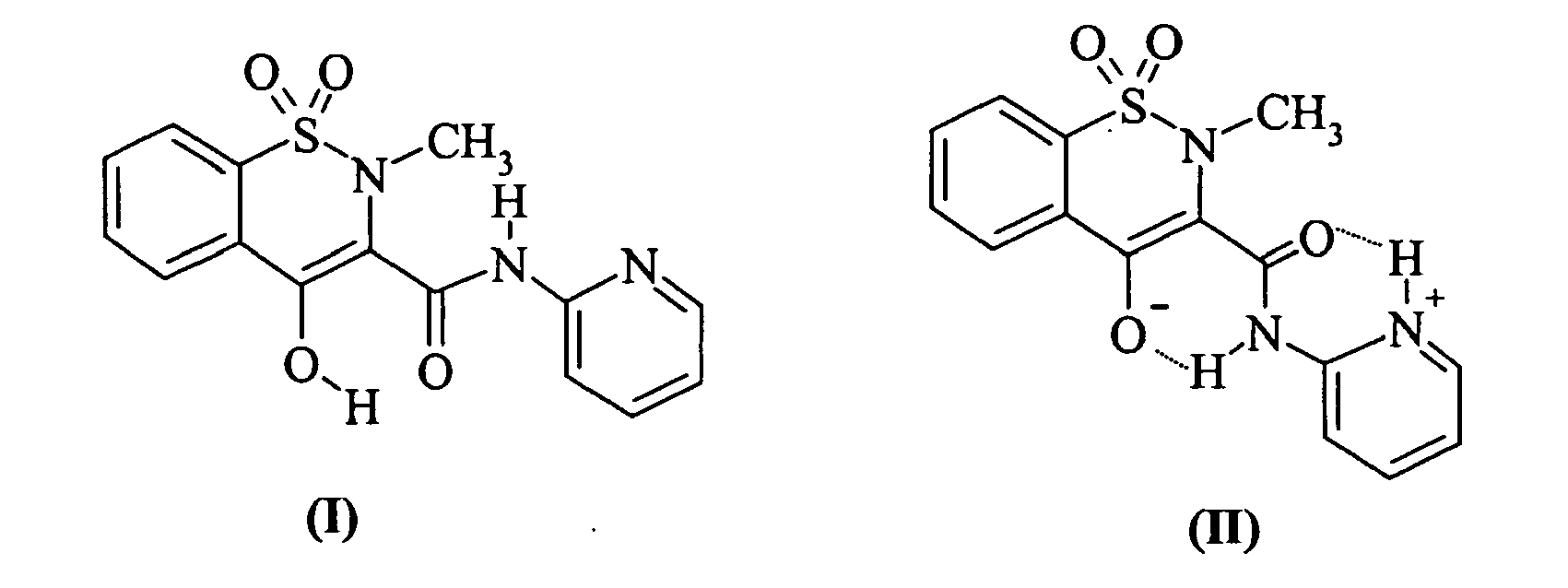
- An efficient method for overcoming the problems related to the low solubility of piroxicam relies on the preparation of inclusion complexes with cyclodextrins as claimed in
EP 153998 - Cyclodextrins (CDs) are natural cyclic oligosaccharides having a torus-like macro-ring shape obtained by enzymatic degradation of starch. The three major cyclodextrins consist of 6(α), 7(β) or 8(γ) (1→4) D-glucopyranosidic units. Among them, βCD turned out to be the most useful for complexing piroxicam.
- The solubilisation kinetic in water of piroxicam, released from the inclusion complex with β-cyclodextrin in the preferred molar ratio of 1 to 2.5, is the fastest of any other piroxicam obtained through any technological modification of the crystalline form known so far.
- For solubilisation kinetic we mean the time to reach the highest concentration of dissolved piroxicam after dispersion in water of the inclusion complex in the form of a powder.
- The 1:2.5 piroxicam:β-cyclodextrin inclusion complex (in the following 1:2.5 PβCD), having the molecular formula C15H13N3O4S*2.5 C42H70O35 and a molecular weight of 3168.912, has been also referred to as CHF 1194.
- The 1:2.5 PβCD inclusion compound, like piroxicam, exhibits anti-inflammatory, analgesic and antipyretic properties. As analgesic drug, it is indicated for the treatment of diseases such as dental pain, post-traumatic pain, headache and dysmenorrhoea. It is administered by oral route in the form of tablets or granules, preferably tablets.
- Pre-clinical and clinical studies have demonstrated that the oral absorption of piroxicam, from 1:2.5 PβCD tablets and granules is faster and more efficient than that from piroxicam capsules.
- In particular, the bioavailability of the active ingredient in terms of rate as well as of extent of absorption in the first two hours is significantly enhanced.
- As a consequence of the faster absorption the onset of action of piroxicam from the 1:2.5 βCD complex is more rapid making the product particularly effective as analgesic. It has been observed that to ensure the best performances in terms of dissolution rate and hence rapid absorption of piroxicam following the administration of 1:2.5 PβCD tablets, the powdery raw material should be able to produce after dispersion in water a concentration of dissolved piroxicam equal to or higher than 0.4 g per 100 ml (0.4% w/v) within the first 15 minutes.
- The successful results achieved with the use of cyclodextrins rely on the fact that, through complexation, it is possible to obtain a stable amorphous structure; since the amorphous form has a larger surface area and its lattice energy is much less than in crystals, both wettability and aqueous solubility of piroxicam are increased. Amorphous piroxicam as such is, indeed, a metastable form which crystallises within few hours. Moreover, it has also been demonstrated by Raman studies that piroxicam, in the β-cyclodextrin inclusion compound, assumes a zwitter-ionic structure with positive and negative charges delocalized similar to that of the hydrate pseudopolymorph (II). This structure is stabilized due to the chemical interaction with β-cyclodextrin via electrostatic and hydrogen bonds. The dipolar character of the zwitter-ionic structure improves the solubilisation kinetics and instant solubility of piroxicam.
- Since the solubilisation kinetic in water of piroxicam also depends on the intramolecular structure assumed by piroxicam in the 1:2.5 PβCD inclusion compound, the relevant manufacturing process should be able to achieve the complete conversion of piroxicam in the zwitter-ionic form.
- Moreover, the manufacturing process should be able to achieve the completeness of the inclusion reaction as well as the complete amorphization of the whole product.
- On the other hand, an amorphous active substance may incur the risk of crystallisation during storage due to the presence of residual water. Once the amorphous substance is formulated under the form of solid pharmaceutical preparations such as tablets, said crystallization can be responsible for phenomena such as swelling or loss of hardness of the tablets. Therefore it is also very important that the manufacturing process yields an amorphous substance wherein the amount of residual water is the lowest as possible and in the case of 1:2.5 PβCD equal to or lower than 5% w/w, preferably equal to or lower than 4% w/w.
- In summary, a manufacturing process suitable for the preparation of the 1:2.5 PβCD inclusion compound in the form of powder should be able to give rise to:
- i) no significant degradation of the two ingredient, i.e. piroxicam and β-cyclodextrin;
- ii) completeness of the inclusion reaction;
- iii) complete amorphization;
- iv) complete conversion of piroxicam into the zwitter-ionic form;
- v) an amount of residual water equal to or lower than 5% w/w, preferably equal to or lower than 4% w/w.
- Moreover said process should provide a 1:2.5 PβCD able to produce, after dispersion of the powder in water, a concentration of dissolved piroxicam equal to or higher than 0.4 g per 100 ml (0.4% w/v) within the first 15 minutes.
- As reported above, the latter characteristic, when 1:2.5 PβCD is utilised for the preparation of solid pharmaceutical formulations for oral administration, and in particular tablets, is of paramount importance for ensuring optimal performances in term of piroxicam dissolution rate.
- Cyclodextrin inclusion complexes can be prepared by reaction between the components in the solid state or semi-solid state or liquid state.
- In the solid state method, the two components may be optionally screened to uniform particle size and thoroughly mixed whereafter they are ground in a high-energy mill with optional heating, screened and homogenized.
- In the semi-solid state, the two components are kneaded in the presence of small amounts of a suitable solvent, and the resulting complex is oven dried, screened and homogenized.
- The complex formation in the liquid state is accomplished, in general terms, by dissolving the cyclodextrin and the drug in a suitable solvent and subsequently isolating the solid state complex by crystallization, evaporation, spray-drying or freeze-drying (lyophilization).
- In particular freeze-drying and spray-drying are methods applicable on industrial scale.
- Freeze-drying is the process of removing water from a product by sublimation, i.e. at a product temperature that is lower than its eutectic temperature.
- In
WO 03/105906 - Although it is very convenient for potentially thermolabile molecules such as piroxicam and β-cyclodextrin since it does not envision heating, freeze-drying involves a rather length step of removing a large amount of water by sublimation.
- Spray-drying can constitute an alternative process of removing water from a product. It can be faster than freeze-drying but it requires heating so it could present some drawbacks when applied to potentially thermolabile molecules such as piroxicam and β-cyclodextrin.
- Basically spray-drying is accomplished by atomizing a pre-heated solution (preferably an aqueous solution) into the drying chamber of the spray-drier apparatus where the small droplets are subjected to a stream of temperature-controlled hot gas and converted to powder particles. As the powder is discharged for the drying chamber, it is passed through a powder/gas separator, for example a cyclone, where it is further dried and collected.
- The parameters which can be adjusted for obtaining a powder with well defined characteristics are: i) the type of atomizing device; ii) the temperature of the inlet gas used to dry the sprayed material in the drying chamber (hereinafter referred to as inlet temperature); iii) the gas flow rate and iv) the flow rate of the feed solution (hereinafter the feed flow rate). Another important parameter which affect the final moisture content of the powder is the temperature of the drying gas coming out from the spray-drying chamber (hereinafter referred to as outlet temperature).
- The preparation of inclusion complexes of piroxicam with cyclodextrins by spray-drying on a lab scale is mentioned in several documents of the prior art. But the experimental conditions are not disclosed or, when disclosed, came out not suitable for preparing a 1:2.5 PβCD inclusion compound which fulfills the requirements previously illustrated.
-
EP 153998 - a) by crystallization from an aqueous or an organic/aqueous solution containing the two ingredients;
- b) by evaporation of a water/ammonia solution;
- c) by freeze-drying or atomization in air stream (spray drying) of a water/ammonia solution.
- All the examples refer to preparations of 1:2.5 PβCD on a lab scale (from milligram to grams). The conditions for obtaining the product by spray-drying are not reported.
-
EP 449167 EP 449167 - In Acerbi D et al (), a flow-chart showing the manufacturing process(es) for 1:2.5 PβCD is sketched. As far as spray-drying process is concerned, no conditions are reported except for the temperature of the βCD aqueous solution (65°C-70°C) before it is added to the apparatus. Moreover, as it can be appreciated from Figure 7 dealing with the solubilisation curves of piroxicam from complexes prepared with different methods, 1:2.5 PβCD obtained by spray-drying, after dispersion of the powder, gives rise to a maximum concentration of dissolved piroxicam of only about 0.03 g per 100 ml of water within the first five minutes (0.03% w/v).
- Pezoa R et al (Proceedings of the 6th International Conference on Pharmaceutical Technology, June, 2-4, 1992, Paris) reports the characterization of 1:1 PβCD complex obtained by freeze-drying and spray-drying methods. Experimental conditions are reported neither for freeze-drying nor for spray-drying. In the paper, it is generically stated that the dissolution profile of hard gelatine capsules containing the spray-dried complex shows a significant increase in the rate of dissolution but less than those containing the freeze-dried complex.
- Pavlova A V et al () concerns the analytical characterization of 1:2.5 PβCD inclusion complexes prepared in different ways. Among other methods, the inclusion complex was prepared by spray-drying but no conditions are reported.
- In Van Hees T et al (Proceeding of the Ninth International Symposium on Cyclodextrins, Kluwer, 1999, 211-214), a comparative study of the dissolution properties of inclusion complexes of piroxicam with β-cyclodextrin prepared by different methods is reported. Complexes were prepared by supercritical CO2, freeze-drying and spray-drying. The conditions for obtaining the product by spray-drying are not reported. The dissolution or solubilisation kinetic was determined on the spray-dried substance in a USP XXIII N. 2 dissolution apparatus using 500 ml of solutions at pH 1.2 and pH 6.8. Within the first 15 min, very low amounts of piroxicam, of about 30 mg and about 50 mg per 100 ml, were dissolved corresponding to concentrations of 0.03% and 0.05% w/v.
- In Kata M et al (Proceedings of the 10th International Cyclodextrin Symposium, Wacker, 2000, 629-634) inclusion compounds of piroxicam: β-cyclodextrin in four different molar ratios (2:1, 1:1, 1:2 and 1:3) were prepared by spray-drying using a lab scale apparatus (Niro Minor atomizer). The powder mixtures were dissolved in dimethylformamide and water and submitted to spray-drying under the following conditions: feed flow rate: 600 ml/h (i.e. 0.6 1/h), temperature of inlet air: 155°C; temperature of outlet air: 90°C; pressure: 3 atm (corresponding to about 3 bar).
- In Lin S-Y et al (Int J Pharm 1989, 56. 249-259) a 1:1 PβCD was prepared by spray-drying under the following conditions: inlet temperature: 145 ± 1°C, outlet temperature: 75± 1°C, drying (gas) flow rate: 0.37 m3/min (i.e. approximately 22 kg/h), atomizing air pressure: 1.0 kg/cm2 (i.e. approximately 1 bar), sample feeding speed (feed flow rate): 4.5 ml/min (i.e. 0.27 1/h). The product turned out to be amorphous. The dissolution rate of the tablets prepared with the spray-dried product, carried out using the USP XXI paddle dissolution method at a rotational speed of 50 r.p.m. and at a temperature of 37°C, was faster than that of the physical mixture and pure drug but, as it can be appreciated from Figure 6(A) only about 20% of the amount of piroxicam was released after 30 minutes.
- In Kata M and Lin S-Y processes, the outlet temperature is of 90°C or less.
- As reported on
page 4 of the present application, the 1:2.5 PβCD solid material to be utilised for the preparation of pharmaceutical formulations such as tablets should have a residual water equal to or lower than 5% w/w. - According to the findings of the applicant, outlet temperatures such as those reported in the above mentioned papers are too low for obtaining a product meeting said specification.
- Therefore both Kata M and Lin S-Y disclose conditions not suitable for preparing 1:2.5 PβCD which fulfills the requirements previously mentioned in terms of residual water and solubilisation kinetic.
- Van Hees T et deals with the application of supercritical carbon dioxide for the preparation of a 1:2.5 PβCD inclusion compound. For comparison 1:2.5 PβCD was also prepared using the lab scale apparatus "Niro mobile minor™ spray-dryer", by applying the following conditions: inlet temperature of 175°C, feed flow rate of 15 ml/min (i.e. 0.9 1/h) and spray pressure of 0.2-0.3 MPa (corresponding to 2-3 bar).
- In Table II, said spray-dried 1:2.5 PβCD turned out to include an amount of water of 4.4%. However, the paper is silent about the gas flow rate and the outlet temperature, that are parameters of paramount importance in order to obtain a 1:2.5 PβCD complex capable to ensure the desired solubilisation kinetic of piroxicam.
- In view of the prior art, it would be highly advantageous to provide a process for preparing 1:2.5 PβCD inclusion compound by spray-drying, applicable on a pilot or an industrial scale, said process being able to give rise to:
- i) no significant degradation of the two ingredient, i.e. piroxicam and β-cyclodextrin;
- ii) completeness of the inclusion reaction;
- iii) complete amorphization;
- iv) complete conversion of piroxicam into the zwitter-ionic form;
- v) an amount of residual water equal to or lower than 5% w/w, preferably equal to or lower than 4% w/w.
- Moreover it would be even more advantageous to provide a spray-drying process which yields a 1:2.5 PβCD inclusion compound able to produce, after dispersion of the powder in water, a concentration of dissolved piroxicam equal to or higher than 0.4 g per 100 ml (0.4% w/v) within the first 15 minutes.
- The present invention is directed to a process for the preparation of a 1:2.5 piroxicam:β-cyclodextrin (1:2.5 PβCD) inclusion compound by spray-drying, said process comprising the following steps:
- i. dissolving piroxicam and β-cyclodextrin in the 1 to 2.5 molar ratio in water brought to a temperature higher than 60°C in the presence of ammonium hydroxide;
- ii. feeding the resulting aqueous solution into the drying chamber of a spray-drier through an atomizing device to form droplets;
- iii. introducing a stream of pre-heated drying gas into the drying chamber to form powder particles;
- iv. further drying and separating the powder particles from the moist gas
- We have found that in order to obtain a 1:2.5 PβCD inclusion compound which fulfills the requirements mentioned before, it is necessary to strictly control both the inlet and the outlet temperatures in the drying chamber.
- In particular, we have found that by applying an inlet temperature higher than 200°C, it is not possible to achieve after dispersion of the 1:2.5 PβCD powder in water a concentration of dissolved piroxicam equal to or higher than 0.4 g per 100 ml within the first 15 minutes. On the other hand, we have also found that if the outlet temperature is lower than 105°C, it would not be possible to obtain a residual amount of water lower than 5% w/w. Therefore the inlet temperature should be set to a value of at least 165°C and, after suitably adjusting other parameters such as the flow rate of the feed aqueous solution and the gas flow rate, the outlet temperature in the drying chamber should be equal to or higher than the critical value of 105°C.
- By operating in the ranges of temperatures of the invention, piroxicam remains chemically stable and no significant degradation products of 1:2.5 PβCD were observed.
- The characteristics of the process of the invention for preparing 1:2.5 PβCD inclusion compound on a pilot or industrial scale by spray-drying will be more apparent from the following detailed description.
- For pilot or industrial scale, we mean the preparation of batches of at least 10 kg, preferably from 10 kg to 300 kg.
- Spray-drier apparatus in a wide variety of sizes and configurations can be used as currently supplied by commercially suppliers. The diagram in
Figure 1 shows a schematic representation of a typical spray-drying apparatus. - In a first step, piroxicam and β-cyclodextrin in the 1:2.5 molar ratio and ammonium hydroxide are added to a tank containing water brought to a temperature higher than 60°C, preferably higher than 70°C, more preferably between 70°C and 80°C, then mixed until dissolution. Advantageously the concentration of piroxicam in water shall be of about 2% w/v and that of β-cyclodextrin shall be of about 17% w/v. Advantageously concentrated ammonium hydroxide is added, preferably in a conc. of 28-30% w/w and in a 1:1 1 ratio w/w with respect to piroxicam.
- In a second step the hot solution is loaded with a fluid pump (1 in
Figure 1 ) through an atomizing device (2) into the drying chamber (7) of the spray-drier. - In the Example of the present invention, a pressure atomizing device was used and the process parameters of the spray-dryer were adjusted accordingly, in order to achieve an outlet temperature comprised between 105°C and 130°C.
- The pressure atomizing device can consist of a single or a plurality of nozzles through which the solution is forced by the pump breaking up into droplets. When a pressure atomizing device consisting of a single nozzle is used, advantageously the pressure of the nozzle will be comprised between 10 and 350 bar, preferably between 20 and 200 bar. Typically, the nozzle shall have an internal diameter of 0.5 to 0.7 mm.
- For the spraying process, other kinds of atomizing device such as a rotary (centrifugal) atomizing device or other suitable devices can be used. The person skilled in the art will adapt the various process conditions and parameters accordingly.
- The rotary (centrifugal) atomizing device, for example, is a spinning disk assembly with radial or curved plates which rotates at high velocities, usually comprised between 15000 and 25000 r.p.m. The solution is delivered near the center and spreads between the two plates and is accelerated to high linear velocities before it is thrown off the disk in the form of droplets.
- In the drying chamber, the droplets meet a stream of hot gas and they loose their moisture very rapidly while still suspended in the drying gas. While no particular restrictions are placed on the gas used to dry the sprayed solution, it is advantageous to use air, nitrogen gas or an inert gas, preferably air, more preferably with a residual moisture content equal to or lower than 7000 p.p.m. The gas is electrically heated (5) and can be introduced via a suitable distributor (6).
- The heated gas stream may flow concurrently with the droplets, but it would also be possible to employ counter-current flow, cross-current flow, or other flow patterns.
- Advantageously the inlet temperature in the drying chamber of the spray-drier will vary between 165°C and 200°C, more advantageously between 170°C and 200°C, preferably between 175°C and 195°C, more preferably between 178°C and 182°C.
- The outlet temperature in the drying chamber shall be comprised between 105°C and 130°C, preferably between 110°C and 120°C, even more preferably between 112°C and 115°C.
- In order to prepare an amount of inclusion complex of about 10 kg, the spray-drying process of the invention is carried out by applying a feed flow rate of at least 12 kg/h (approximately 12 1/h). For a higher amount, the feed flow rate shall be comprised between 12 kg/h and 200 ton/h, preferably between 12 kg/h and 300 kg/h.
- Analogously, the flow rate of the drying gas is of at least 80 Kg/h, preferably 100 Kg/h, more preferably 300 Kg/h, even more preferably of at least 600 kg/h.
- For higher amounts, the gas flow rate shall be comprised between 600 kg/h and 30 ton/h.
- Once defined the inlet and outlet temperature ranges provided by the present invention, the other process parameters shall be properly and mutually adjusted by the person skilled in the art on the basis of the size of the batch.
- In the example that follows, for a batch of about 10 kg of 1:2.5 PβCD, an inlet temperature of between 178°C and 182°C, a nozzle of 0.5 mm with a pressure of 21 bar, a feed flow of 12 kg/h (approximately 12 1/h) and a air flow rate of 600 kg/h are used in order to achieve the suitable outlet temperature of 112°C-115°C.
- Advantageously the difference between the inlet and the outlet temperatures is comprised between 45°C and 95°C, preferably between 65°C and 75°C.
- The powder is dried and separated from the moist gas in a cyclone (8) by centrifugal action. The centrifugal action is caused by the great increase in gas speed when the mixture of powder particles and gas enters into the cyclone. The dense powder particles are forced toward the cyclone walls and the product is collected under the cyclone on a vessel (9) through a discharging device such as a rotary valve. The lighter particles of moist gas are aspirated away by an aspirator (10) through the exhaust pipes.
- Alternatively, separation may be achieved by using a filter medium such as a membrane medium (bag filter), a sintered metal fiber filter, or the like.
- In the amorphous 1:2.5 PβCD inclusion compound obtainable by the process of the present invention piroxicam is completely present in the zwitter-ionic form and it can be characterized by its Raman spectrum, X-ray powder diffraction pattern and thermal behavior which are reported in the
PCT application n. WO 03/105906 - The FT-Raman spectrum, obtained by simply packing the powder into a cup, shows the following main peaks in the 1650-1000 cm-1 range (accuracy ± 1 cm-1):
- 1613 cm-1 (sh), 1593 (s), 1578 (sh), 1561 (w), 1525 (br), 1519 (br), 1464 (m), 1436 (m), 1394 (s), 1331 (brm)/1306 (sh), 1280 (w), 1260 (w), 1234 (w), 1217 (vw), 1186 (w), 1158(m), 1119 (m), 1083 (w), 1053 (w), 1036 (w), 992 (w), 947 (brw).
- Legend: sh = shoulder; s = strong; m = medium; w = weak; vw = very weak; br = broad, brm = broad medium, brw = broad weak.
- The amount of residual water in the 1:2.5 PβCD obtainable by the process of the present invention can be determined by Karl-Fisher method and it should be equal or lower than 5% w/w, preferably equal to or lower than 4% w/w. Since 1:2.5 PβCD tends to absorb water, the determination should be carried out as soon as the product is obtained and in any case after protection from moisture ingress.
- The solubilisation kinetic of piroxicam from the 1:2.5 PβCD shall be determined according to the dispersed powder method reported in the following Example 2.
- Advantageously, the concentration of dissolved piroxicam within the first 15 minutes shall be equal to or higher than 0.4% w/v, preferably equal to or higher than 0.5% w/v.
- The 1:2.5 PβCD obtainable with the process of the invention can be advantageously used to prepare pharmaceutical compositions having analgesic, anti-inflammatory and anti-rheumatic activity, for the oral administration, preferably in the form of tablets, effervescent tablets or sachets for oral administration, more preferably in the form of tablets.
- Advantageously the tablets for oral administration contain between 50 mg and 200 mg of the 1:2.5 PβCD complex per unit dose, preferably 95.6 mg or 191.2 mg (corresponding to 10 and 20 mg of piroxicam, respectively) in admixture with suitable excipients such as lactose, crospovidone, sodium starch glycolate, silica, starch and magnesium stearate.
- The following examples better illustrate the invention.
- About 50 litres of water was poured into a tank and heated up to a temperature of 73°C-75°C.
- 8.6 kg (7.57 moles) of β-cyclodextrin, 1 kg (3.02 moles) of piroxicam and 1 kg of 28% ammonium hydroxide were added in succession, and the mixture stirred for 30 min. The solution was filtered using a 55 µm filter and loaded into a spray dryer Niro. The following process parameters were used: nozzle diameter: 0.5 mm; nozzle pressure: 21 bar; air flow rate: 600 kg/h; feed flow rate: 12 kg/h (approximately 12 1/h); inlet temperature: 182°C; outlet temperature: 113°C.
- The 1:2.5 PβCD product in the form of free-flowing powder was collected under the cyclone through a rotary valve.
- The resulting product shows the thermal curve and the Raman spectrum reported respectively in
Figures 2 and3 , which are typical of a 1:2.5 PβCD wherein a complete inclusion complex reaction has occurred and piroxicam is present in the zwitter-ionic form. Powder X-ray analysis shows the diffused diffraction pattern typical of amorphous products. After HPLC analysis, no significant amount of degradation products of piroxicam was detected. - The residual amount of water was 3.8% w/w as determined by Karl Fischer method.
- The solubilisation kinetic was determined according to the dispersed powder method.
- In a dissolution test apparatus Sotax A76, 250 ml of water were introduced and the temperature was set at 37°C ± 0.5°C. Then, 20 g of PβCD as obtained in the Example 1, corresponding to about 2 g of piroxicam, was added and the resulting dispersion was maintained under stirring at 125 r.p.m. After 15 minutes, an aliquot of the solution was withdrawn and filtered. The concentration of dissolved piroxicam, measured by UV spectrophotometry, turned out to be 0.5 g per 100 ml, i.e. 0.5% w/v.
Claims (13)
- A process for the preparation of a 1:2.5 piroxicam:β-cyclodextrin inclusion compound comprising the following steps:i. dissolving piroxicam and b-cyclodextrin in 1 to 2.5 molar ratio in water brought to a temperature higher than 60°C in the presence of ammonium hydroxide;ii. feeding the resulting aqueous solution into the drying chamber of a spray-drier through an atomizing device to form droplets;iii. introducing a stream of drying gas into the drying chamber to form powder particles;iv. further drying and separating the powder particles from the moist gas;characterized in that in step iii) the temperature of the inlet drying gas (inlet temperature) is comprised between 165°C and 200°C and the feed flow rate of the solution in step ii) and the flow rate of the drying gas are suitably adjusted in such a way as that the temperature of the outlet drying gas (outlet temperature) is comprised between 105°C and 130°C.
- The process according to claim 1 wherein the feed flow rate of the solution of step ii) is of at least 12 kg/h.
- The process according to claim 1 or 2 wherein the flow rate of the drying gas is of at least 600 kg/h.
- The process according to any of claims 1 to 3, wherein the inlet temperature is comprised between 175°C and 195°C.
- The process according to claim 4, wherein the inlet temperature is comprised between 178°C and 182°C.
- The process according to any one of claims 1 to 5, wherein the outlet temperature is comprised between 110°C and 120°C.
- The process according to claim 6, wherein the outlet temperature is comprised between 112°C and 115°C.
- The process according to any of the claims 1 to 7 wherein the atomizing device is a rotary (centrifugal) atomizer.
- The process according to any of claims 1 to 7 wherein the atomizing device is a pressure atomizer.
- The process according to any of the preceding claims wherein the separation of the powder particles in step iv) is carried out in a cyclone by centrifugal action.
- The process according to claim 1 wherein the water is brought to a temperature higher than 70°C
- The process according to claim 1 wherein the water is brought to a temperature comprised between 70°C and 80°C.
- The process according to claim 1 wherein that the ammonium hydroxide in step i) is used in a concentration ranging from 28 to 30 % and in a 1:1 ratio (w/w) with respect to piroxicam.
Priority Applications (2)
| Application Number | Priority Date | Filing Date | Title |
|---|---|---|---|
| PL05774046T PL1793862T3 (en) | 2004-08-02 | 2005-07-26 | A process for the preparation of a piroxicam: beta-cyclodextrin inclusion compound |
| EP05774046A EP1793862B1 (en) | 2004-08-02 | 2005-07-26 | A process for the preparation of a piroxicam: beta-cyclodextrin inclusion compound |
Applications Claiming Priority (3)
| Application Number | Priority Date | Filing Date | Title |
|---|---|---|---|
| EP04018261 | 2004-08-02 | ||
| EP05774046A EP1793862B1 (en) | 2004-08-02 | 2005-07-26 | A process for the preparation of a piroxicam: beta-cyclodextrin inclusion compound |
| PCT/EP2005/008105 WO2006013039A2 (en) | 2004-08-02 | 2005-07-26 | A process for the preparation of a piroxicam: betacyclodextrin inclusion compound |
Publications (2)
| Publication Number | Publication Date |
|---|---|
| EP1793862A2 EP1793862A2 (en) | 2007-06-13 |
| EP1793862B1 true EP1793862B1 (en) | 2011-03-23 |
Family
ID=35502714
Family Applications (1)
| Application Number | Title | Priority Date | Filing Date |
|---|---|---|---|
| EP05774046A Expired - Lifetime EP1793862B1 (en) | 2004-08-02 | 2005-07-26 | A process for the preparation of a piroxicam: beta-cyclodextrin inclusion compound |
Country Status (17)
| Country | Link |
|---|---|
| US (1) | US20090012284A1 (en) |
| EP (1) | EP1793862B1 (en) |
| JP (1) | JP2008508332A (en) |
| KR (1) | KR20070038109A (en) |
| CN (1) | CN101123989B (en) |
| AT (1) | ATE502653T1 (en) |
| AU (1) | AU2005268972A1 (en) |
| DE (1) | DE602005027092D1 (en) |
| IL (1) | IL181101A0 (en) |
| MA (1) | MA28849B1 (en) |
| MX (1) | MX2007001237A (en) |
| NO (1) | NO20070669L (en) |
| PL (1) | PL1793862T3 (en) |
| PT (1) | PT1793862E (en) |
| TN (1) | TNSN07012A1 (en) |
| WO (1) | WO2006013039A2 (en) |
| ZA (1) | ZA200700946B (en) |
Cited By (1)
| Publication number | Priority date | Publication date | Assignee | Title |
|---|---|---|---|---|
| WO2013155586A1 (en) * | 2012-04-20 | 2013-10-24 | Universidade Federal De Minas Gerais - Ufmg | Process for preparing inclusion compounds enclosing cyclodextrins and drugs, using a continuous-flow system |
Families Citing this family (9)
| Publication number | Priority date | Publication date | Assignee | Title |
|---|---|---|---|---|
| CN101491529B (en) * | 2009-01-23 | 2011-04-06 | 上海微丸医药开发有限公司 | Preparation method of piroxicam belta-cyclodextrin inclusion compound micro-pill capsules |
| WO2014161131A1 (en) * | 2013-04-01 | 2014-10-09 | Arissa Pharma | PREPARING AMORPHOUS MELOXICAM-β-CYCLODEXTRIN INCLUSION COMPLEX VIA SPRAY DRYING PROCESS |
| ES2672472T3 (en) * | 2013-12-12 | 2018-06-14 | Synthon Bv | Pharmaceutical composition comprising amorphous ivabradine |
| WO2016193096A1 (en) * | 2015-05-29 | 2016-12-08 | Givaudan Sa | Spray drying |
| US20170056253A1 (en) * | 2015-08-28 | 2017-03-02 | Fitesa Nonwoven, Inc. | Absorbent Article Having A High Content Of Bio-Based Materials |
| LT3565602T (en) * | 2017-01-09 | 2021-06-25 | SciPharm S.à r.l. | NEW METHOD FOR THE PREPARATION OF WATER-SOLUBLE FORSKOLIN |
| JP2020533155A (en) * | 2017-09-21 | 2020-11-19 | ザ プロクター アンド ギャンブル カンパニーThe Procter & Gamble Company | Absorbent article |
| CN110575550A (en) * | 2019-08-13 | 2019-12-17 | 大梆(沈阳)动物保健有限公司 | Method for shielding bad smell of compound traditional Chinese medicine for livestock |
| CN112471565A (en) * | 2020-12-18 | 2021-03-12 | 鲁南制药集团股份有限公司 | Volatile oil spraying, grinding and clathrating equipment |
Family Cites Families (6)
| Publication number | Priority date | Publication date | Assignee | Title |
|---|---|---|---|---|
| IT1196033B (en) * | 1984-02-22 | 1988-11-10 | Chiesi Farma Spa | COMPOUND WITH ANTI-INFLAMMATORY ACTIVITY OBTAINED BY COMPLEXATION WITH BETA-CYCLODEXTRINE AND RELATED PHARMACEUTICAL FORMULATIONS |
| IT1204725B (en) * | 1987-06-17 | 1989-03-10 | Edmond Pharma Srl | DIPYRIDAMOL INCLUSION COMPLEXES WITH CYCLODESTRINE |
| US6582728B1 (en) * | 1992-07-08 | 2003-06-24 | Inhale Therapeutic Systems, Inc. | Spray drying of macromolecules to produce inhaleable dry powders |
| EP0687174B1 (en) * | 1993-03-05 | 2001-06-13 | Hexal Ag | Crystalline cyclodextrin inclusion complexes of ranitidine hydrochloride and process for their preparation |
| KR20030041577A (en) * | 2001-11-20 | 2003-05-27 | 디디에스텍주식회사 | Solid dispersions containing substituted cyclodextrin and insoluble drug and their preparations |
| WO2006011044A1 (en) * | 2004-07-22 | 2006-02-02 | Pfizer Products Inc. | Amorphous cyclodextrin compositions |
-
2005
- 2005-07-26 CN CN2005800256534A patent/CN101123989B/en not_active Expired - Fee Related
- 2005-07-26 US US11/659,020 patent/US20090012284A1/en not_active Abandoned
- 2005-07-26 PL PL05774046T patent/PL1793862T3/en unknown
- 2005-07-26 WO PCT/EP2005/008105 patent/WO2006013039A2/en not_active Ceased
- 2005-07-26 ZA ZA200700946A patent/ZA200700946B/en unknown
- 2005-07-26 AU AU2005268972A patent/AU2005268972A1/en not_active Abandoned
- 2005-07-26 EP EP05774046A patent/EP1793862B1/en not_active Expired - Lifetime
- 2005-07-26 DE DE602005027092T patent/DE602005027092D1/en not_active Expired - Lifetime
- 2005-07-26 KR KR1020077000995A patent/KR20070038109A/en not_active Withdrawn
- 2005-07-26 PT PT05774046T patent/PT1793862E/en unknown
- 2005-07-26 MX MX2007001237A patent/MX2007001237A/en unknown
- 2005-07-26 AT AT05774046T patent/ATE502653T1/en active
- 2005-07-26 JP JP2007524228A patent/JP2008508332A/en active Pending
-
2007
- 2007-01-16 TN TNP2007000012A patent/TNSN07012A1/en unknown
- 2007-01-31 NO NO20070669A patent/NO20070669L/en not_active Application Discontinuation
- 2007-02-01 IL IL181101A patent/IL181101A0/en unknown
- 2007-03-02 MA MA29734A patent/MA28849B1/en unknown
Non-Patent Citations (1)
| Title |
|---|
| VAN HEES T. ET AL: "Application of supercritical carbon dioxide for the preparation of a piroxicam-[beta]-cyclodextrin inclusion compound", PHARMACEUTICAL RESEARCH, vol. 16, no. 12, 1 December 1999 (1999-12-01), pages 1864 - 1870, XP001020308 * |
Cited By (1)
| Publication number | Priority date | Publication date | Assignee | Title |
|---|---|---|---|---|
| WO2013155586A1 (en) * | 2012-04-20 | 2013-10-24 | Universidade Federal De Minas Gerais - Ufmg | Process for preparing inclusion compounds enclosing cyclodextrins and drugs, using a continuous-flow system |
Also Published As
| Publication number | Publication date |
|---|---|
| AU2005268972A1 (en) | 2006-02-09 |
| CN101123989B (en) | 2010-12-15 |
| HK1116054A1 (en) | 2008-12-19 |
| TNSN07012A1 (en) | 2008-06-02 |
| NO20070669L (en) | 2007-05-02 |
| PL1793862T3 (en) | 2011-08-31 |
| JP2008508332A (en) | 2008-03-21 |
| US20090012284A1 (en) | 2009-01-08 |
| KR20070038109A (en) | 2007-04-09 |
| ZA200700946B (en) | 2008-06-25 |
| MX2007001237A (en) | 2007-04-18 |
| PT1793862E (en) | 2011-04-08 |
| DE602005027092D1 (en) | 2011-05-05 |
| ATE502653T1 (en) | 2011-04-15 |
| EP1793862A2 (en) | 2007-06-13 |
| WO2006013039A2 (en) | 2006-02-09 |
| MA28849B1 (en) | 2007-09-03 |
| IL181101A0 (en) | 2007-07-04 |
| WO2006013039A3 (en) | 2007-08-23 |
| CN101123989A (en) | 2008-02-13 |
Similar Documents
| Publication | Publication Date | Title |
|---|---|---|
| JP2823170B2 (en) | Carrier-supported drug with improved dissolution rate and method for producing the same | |
| WO2014161131A1 (en) | PREPARING AMORPHOUS MELOXICAM-β-CYCLODEXTRIN INCLUSION COMPLEX VIA SPRAY DRYING PROCESS | |
| JP2001513563A (en) | Pharmaceutical composition of meloxicam with improved solubility and bioavailability | |
| US20090012284A1 (en) | Process for the Preparation of a Piroxicam: Betacyclodextrin Inclusion Compound | |
| JPH10504351A (en) | Powdered hydroxypropyl-β-cyclodextrin composition and method for producing the same | |
| EP1513556B1 (en) | A process for the preparation of piroxicam: b-cyclodextrin inclusion compounds | |
| CN101780046B (en) | A kind of itraconazole composite powder and preparation method thereof | |
| Mustafa et al. | Interactions of cyclodextrins and their hydroxyl derivatives with etodolac: Solubility and dissolution enhancement | |
| CN100528236C (en) | Method for preparing inclusion compound of non-steroidal anti-inflammatory drug and beta-cyclodextrin through microwave treatment | |
| HK1116054B (en) | A process for the preparation of a piroxicam: betacyclodextrin inclusion compound | |
| HRP980155A2 (en) | Pharmaceutical compositions containing propanamine derivatives and cyclodextrin | |
| Mammucari et al. | Dense gas technology and cyclodextrins: State of the art and potential | |
| Moyano et al. | Evaluation of dissolution characteristics of oxazepam-2-hydroxypropyl-β-cyclodextrin binary systems | |
| Joudieh et al. | Nimesulide apparent solubility enhancement with natural cyclodextrins and their polymers | |
| EP2471516A2 (en) | Rhein or diacerein compositions | |
| JP2004531525A (en) | Complexes of anilide with cyclodextrin, their preparation and their use as medicaments, especially for the treatment of dyslipidemia | |
| WO1994002177A1 (en) | Method of preparation of inclusion compounds of nimesulide with cyclodextrins | |
| SHIRALASHETTI et al. | International Journal of Current Pharmaceutical Research | |
| Ginés et al. | Interaction of ibuproxam with γ-cyclodextrin in solution and in solid state | |
| Brzeczko et al. | Granulation of Poorly Water-Soluble Drugs | |
| HK1079992B (en) | Process for preparation of inclusion compounds between a non-steroidal anti-inflam-matory drug and betacyclodextrin by microwave treatment | |
| Khamkar et al. | Pharmaceutical Sciences | |
| HK1080720B (en) | A process for the preparation of piroxicam:b-cyclodextrin inclusion compounds |
Legal Events
| Date | Code | Title | Description |
|---|---|---|---|
| PUAI | Public reference made under article 153(3) epc to a published international application that has entered the european phase |
Free format text: ORIGINAL CODE: 0009012 |
|
| 17P | Request for examination filed |
Effective date: 20070301 |
|
| AK | Designated contracting states |
Kind code of ref document: A2 Designated state(s): AT BE BG CH CY CZ DE DK EE ES FI FR GB GR HU IE IS IT LI LT LU LV MC NL PL PT RO SE SI SK TR |
|
| AX | Request for extension of the european patent |
Extension state: AL BA HR MK YU |
|
| R17D | Deferred search report published (corrected) |
Effective date: 20070823 |
|
| 17Q | First examination report despatched |
Effective date: 20080827 |
|
| GRAP | Despatch of communication of intention to grant a patent |
Free format text: ORIGINAL CODE: EPIDOSNIGR1 |
|
| RTI1 | Title (correction) |
Free format text: A PROCESS FOR THE PREPARATION OF A PIROXICAM: BETA-CYCLODEXTRIN INCLUSION COMPOUND |
|
| GRAS | Grant fee paid |
Free format text: ORIGINAL CODE: EPIDOSNIGR3 |
|
| GRAA | (expected) grant |
Free format text: ORIGINAL CODE: 0009210 |
|
| AK | Designated contracting states |
Kind code of ref document: B1 Designated state(s): AT BE BG CH CY CZ DE DK EE ES FI FR GB GR HU IE IS IT LI LT LU LV MC NL PL PT RO SE SI SK TR |
|
| AX | Request for extension of the european patent |
Extension state: AL BA HR MK YU |
|
| REG | Reference to a national code |
Ref country code: GB Ref legal event code: FG4D |
|
| REG | Reference to a national code |
Ref country code: CH Ref legal event code: EP |
|
| REG | Reference to a national code |
Ref country code: PT Ref legal event code: SC4A Free format text: AVAILABILITY OF NATIONAL TRANSLATION Effective date: 20110401 |
|
| REG | Reference to a national code |
Ref country code: IE Ref legal event code: FG4D |
|
| REF | Corresponds to: |
Ref document number: 602005027092 Country of ref document: DE Date of ref document: 20110505 Kind code of ref document: P |
|
| REG | Reference to a national code |
Ref country code: DE Ref legal event code: R096 Ref document number: 602005027092 Country of ref document: DE Effective date: 20110505 |
|
| REG | Reference to a national code |
Ref country code: GR Ref legal event code: EP Ref document number: 20110400993 Country of ref document: GR Effective date: 20110513 |
|
| REG | Reference to a national code |
Ref country code: RO Ref legal event code: EPE |
|
| REG | Reference to a national code |
Ref country code: NL Ref legal event code: T3 |
|
| REG | Reference to a national code |
Ref country code: SE Ref legal event code: TRGR |
|
| PG25 | Lapsed in a contracting state [announced via postgrant information from national office to epo] |
Ref country code: LT Free format text: LAPSE BECAUSE OF FAILURE TO SUBMIT A TRANSLATION OF THE DESCRIPTION OR TO PAY THE FEE WITHIN THE PRESCRIBED TIME-LIMIT Effective date: 20110323 Ref country code: LV Free format text: LAPSE BECAUSE OF FAILURE TO SUBMIT A TRANSLATION OF THE DESCRIPTION OR TO PAY THE FEE WITHIN THE PRESCRIBED TIME-LIMIT Effective date: 20110323 |
|
| LTIE | Lt: invalidation of european patent or patent extension |
Effective date: 20110323 |
|
| PG25 | Lapsed in a contracting state [announced via postgrant information from national office to epo] |
Ref country code: SI Free format text: LAPSE BECAUSE OF FAILURE TO SUBMIT A TRANSLATION OF THE DESCRIPTION OR TO PAY THE FEE WITHIN THE PRESCRIBED TIME-LIMIT Effective date: 20110323 Ref country code: FI Free format text: LAPSE BECAUSE OF FAILURE TO SUBMIT A TRANSLATION OF THE DESCRIPTION OR TO PAY THE FEE WITHIN THE PRESCRIBED TIME-LIMIT Effective date: 20110323 Ref country code: CY Free format text: LAPSE BECAUSE OF FAILURE TO SUBMIT A TRANSLATION OF THE DESCRIPTION OR TO PAY THE FEE WITHIN THE PRESCRIBED TIME-LIMIT Effective date: 20110323 |
|
| REG | Reference to a national code |
Ref country code: PL Ref legal event code: T3 |
|
| REG | Reference to a national code |
Ref country code: SK Ref legal event code: T3 Ref document number: E 9520 Country of ref document: SK |
|
| PG25 | Lapsed in a contracting state [announced via postgrant information from national office to epo] |
Ref country code: EE Free format text: LAPSE BECAUSE OF FAILURE TO SUBMIT A TRANSLATION OF THE DESCRIPTION OR TO PAY THE FEE WITHIN THE PRESCRIBED TIME-LIMIT Effective date: 20110323 |
|
| PGFP | Annual fee paid to national office [announced via postgrant information from national office to epo] |
Ref country code: FR Payment date: 20110805 Year of fee payment: 7 Ref country code: BG Payment date: 20110726 Year of fee payment: 7 |
|
| REG | Reference to a national code |
Ref country code: HU Ref legal event code: AG4A Ref document number: E011605 Country of ref document: HU |
|
| PG25 | Lapsed in a contracting state [announced via postgrant information from national office to epo] |
Ref country code: ES Free format text: LAPSE BECAUSE OF FAILURE TO SUBMIT A TRANSLATION OF THE DESCRIPTION OR TO PAY THE FEE WITHIN THE PRESCRIBED TIME-LIMIT Effective date: 20110704 Ref country code: IS Free format text: LAPSE BECAUSE OF FAILURE TO SUBMIT A TRANSLATION OF THE DESCRIPTION OR TO PAY THE FEE WITHIN THE PRESCRIBED TIME-LIMIT Effective date: 20110723 |
|
| PGFP | Annual fee paid to national office [announced via postgrant information from national office to epo] |
Ref country code: CZ Payment date: 20110714 Year of fee payment: 7 Ref country code: AT Payment date: 20110705 Year of fee payment: 7 Ref country code: SE Payment date: 20110727 Year of fee payment: 7 Ref country code: PT Payment date: 20110707 Year of fee payment: 7 Ref country code: TR Payment date: 20110711 Year of fee payment: 7 Ref country code: GR Payment date: 20110726 Year of fee payment: 7 Ref country code: PL Payment date: 20110812 Year of fee payment: 7 Ref country code: HU Payment date: 20110712 Year of fee payment: 7 Ref country code: SK Payment date: 20110706 Year of fee payment: 7 Ref country code: RO Payment date: 20110711 Year of fee payment: 7 |
|
| PGFP | Annual fee paid to national office [announced via postgrant information from national office to epo] |
Ref country code: NL Payment date: 20110728 Year of fee payment: 7 Ref country code: IT Payment date: 20110722 Year of fee payment: 7 Ref country code: BE Payment date: 20110728 Year of fee payment: 7 |
|
| PLBE | No opposition filed within time limit |
Free format text: ORIGINAL CODE: 0009261 |
|
| STAA | Information on the status of an ep patent application or granted ep patent |
Free format text: STATUS: NO OPPOSITION FILED WITHIN TIME LIMIT |
|
| 26N | No opposition filed |
Effective date: 20111227 |
|
| PG25 | Lapsed in a contracting state [announced via postgrant information from national office to epo] |
Ref country code: DK Free format text: LAPSE BECAUSE OF FAILURE TO SUBMIT A TRANSLATION OF THE DESCRIPTION OR TO PAY THE FEE WITHIN THE PRESCRIBED TIME-LIMIT Effective date: 20110323 Ref country code: MC Free format text: LAPSE BECAUSE OF NON-PAYMENT OF DUE FEES Effective date: 20110731 |
|
| REG | Reference to a national code |
Ref country code: CH Ref legal event code: PL |
|
| GBPC | Gb: european patent ceased through non-payment of renewal fee |
Effective date: 20110726 |
|
| REG | Reference to a national code |
Ref country code: DE Ref legal event code: R097 Ref document number: 602005027092 Country of ref document: DE Effective date: 20111227 |
|
| REG | Reference to a national code |
Ref country code: IE Ref legal event code: MM4A |
|
| PG25 | Lapsed in a contracting state [announced via postgrant information from national office to epo] |
Ref country code: DE Free format text: LAPSE BECAUSE OF NON-PAYMENT OF DUE FEES Effective date: 20120201 Ref country code: LI Free format text: LAPSE BECAUSE OF NON-PAYMENT OF DUE FEES Effective date: 20110731 Ref country code: CH Free format text: LAPSE BECAUSE OF NON-PAYMENT OF DUE FEES Effective date: 20110731 |
|
| REG | Reference to a national code |
Ref country code: DE Ref legal event code: R119 Ref document number: 602005027092 Country of ref document: DE Effective date: 20120201 |
|
| PG25 | Lapsed in a contracting state [announced via postgrant information from national office to epo] |
Ref country code: GB Free format text: LAPSE BECAUSE OF NON-PAYMENT OF DUE FEES Effective date: 20110726 |
|
| PG25 | Lapsed in a contracting state [announced via postgrant information from national office to epo] |
Ref country code: IE Free format text: LAPSE BECAUSE OF NON-PAYMENT OF DUE FEES Effective date: 20110726 |
|
| BERE | Be: lapsed |
Owner name: CHIESI FARMACEUTICI S.P.A. Effective date: 20120731 |
|
| REG | Reference to a national code |
Ref country code: PT Ref legal event code: MM4A Free format text: LAPSE DUE TO NON-PAYMENT OF FEES Effective date: 20130128 |
|
| REG | Reference to a national code |
Ref country code: NL Ref legal event code: V1 Effective date: 20130201 |
|
| REG | Reference to a national code |
Ref country code: GR Ref legal event code: ML Ref document number: 20110400993 Country of ref document: GR Effective date: 20130104 |
|
| REG | Reference to a national code |
Ref country code: SE Ref legal event code: EUG |
|
| REG | Reference to a national code |
Ref country code: AT Ref legal event code: MM01 Ref document number: 502653 Country of ref document: AT Kind code of ref document: T Effective date: 20120726 |
|
| REG | Reference to a national code |
Ref country code: SK Ref legal event code: MM4A Ref document number: E 9520 Country of ref document: SK Effective date: 20120726 |
|
| REG | Reference to a national code |
Ref country code: FR Ref legal event code: ST Effective date: 20130329 |
|
| PG25 | Lapsed in a contracting state [announced via postgrant information from national office to epo] |
Ref country code: CZ Free format text: LAPSE BECAUSE OF NON-PAYMENT OF DUE FEES Effective date: 20120726 Ref country code: FR Free format text: LAPSE BECAUSE OF NON-PAYMENT OF DUE FEES Effective date: 20120731 Ref country code: SE Free format text: LAPSE BECAUSE OF NON-PAYMENT OF DUE FEES Effective date: 20120727 Ref country code: NL Free format text: LAPSE BECAUSE OF NON-PAYMENT OF DUE FEES Effective date: 20130201 Ref country code: HU Free format text: LAPSE BECAUSE OF NON-PAYMENT OF DUE FEES Effective date: 20120727 |
|
| PG25 | Lapsed in a contracting state [announced via postgrant information from national office to epo] |
Ref country code: PT Free format text: LAPSE BECAUSE OF NON-PAYMENT OF DUE FEES Effective date: 20130128 Ref country code: IT Free format text: LAPSE BECAUSE OF NON-PAYMENT OF DUE FEES Effective date: 20120726 Ref country code: LU Free format text: LAPSE BECAUSE OF NON-PAYMENT OF DUE FEES Effective date: 20110726 Ref country code: BE Free format text: LAPSE BECAUSE OF NON-PAYMENT OF DUE FEES Effective date: 20120731 Ref country code: GR Free format text: LAPSE BECAUSE OF NON-PAYMENT OF DUE FEES Effective date: 20130204 Ref country code: SK Free format text: LAPSE BECAUSE OF NON-PAYMENT OF DUE FEES Effective date: 20120726 |
|
| PG25 | Lapsed in a contracting state [announced via postgrant information from national office to epo] |
Ref country code: AT Free format text: LAPSE BECAUSE OF NON-PAYMENT OF DUE FEES Effective date: 20120726 |
|
| PG25 | Lapsed in a contracting state [announced via postgrant information from national office to epo] |
Ref country code: RO Free format text: LAPSE BECAUSE OF NON-PAYMENT OF DUE FEES Effective date: 20120726 |
|
| REG | Reference to a national code |
Ref country code: PL Ref legal event code: LAPE |
|
| PG25 | Lapsed in a contracting state [announced via postgrant information from national office to epo] |
Ref country code: PL Free format text: LAPSE BECAUSE OF NON-PAYMENT OF DUE FEES Effective date: 20120726 |
|
| PG25 | Lapsed in a contracting state [announced via postgrant information from national office to epo] |
Ref country code: TR Free format text: LAPSE BECAUSE OF NON-PAYMENT OF DUE FEES Effective date: 20120726 |
|
| PG25 | Lapsed in a contracting state [announced via postgrant information from national office to epo] |
Ref country code: BG Free format text: LAPSE BECAUSE OF NON-PAYMENT OF DUE FEES Effective date: 20120731 |