EP1792767A2 - Scaling of side-to-side torque bias to improve cornering in a programmable four wheel drive system - Google Patents
Scaling of side-to-side torque bias to improve cornering in a programmable four wheel drive system Download PDFInfo
- Publication number
- EP1792767A2 EP1792767A2 EP06024637A EP06024637A EP1792767A2 EP 1792767 A2 EP1792767 A2 EP 1792767A2 EP 06024637 A EP06024637 A EP 06024637A EP 06024637 A EP06024637 A EP 06024637A EP 1792767 A2 EP1792767 A2 EP 1792767A2
- Authority
- EP
- European Patent Office
- Prior art keywords
- drive torque
- vehicle
- bias
- torque
- wheels
- Prior art date
- Legal status (The legal status is an assumption and is not a legal conclusion. Google has not performed a legal analysis and makes no representation as to the accuracy of the status listed.)
- Granted
Links
Images
Classifications
-
- B—PERFORMING OPERATIONS; TRANSPORTING
- B60—VEHICLES IN GENERAL
- B60K—ARRANGEMENT OR MOUNTING OF PROPULSION UNITS OR OF TRANSMISSIONS IN VEHICLES; ARRANGEMENT OR MOUNTING OF PLURAL DIVERSE PRIME-MOVERS IN VEHICLES; AUXILIARY DRIVES FOR VEHICLES; INSTRUMENTATION OR DASHBOARDS FOR VEHICLES; ARRANGEMENTS IN CONNECTION WITH COOLING, AIR INTAKE, GAS EXHAUST OR FUEL SUPPLY OF PROPULSION UNITS IN VEHICLES
- B60K23/00—Arrangement or mounting of control devices for vehicle transmissions, or parts thereof, not otherwise provided for
- B60K23/04—Arrangement or mounting of control devices for vehicle transmissions, or parts thereof, not otherwise provided for for differential gearing
-
- B—PERFORMING OPERATIONS; TRANSPORTING
- B60—VEHICLES IN GENERAL
- B60K—ARRANGEMENT OR MOUNTING OF PROPULSION UNITS OR OF TRANSMISSIONS IN VEHICLES; ARRANGEMENT OR MOUNTING OF PLURAL DIVERSE PRIME-MOVERS IN VEHICLES; AUXILIARY DRIVES FOR VEHICLES; INSTRUMENTATION OR DASHBOARDS FOR VEHICLES; ARRANGEMENTS IN CONNECTION WITH COOLING, AIR INTAKE, GAS EXHAUST OR FUEL SUPPLY OF PROPULSION UNITS IN VEHICLES
- B60K23/00—Arrangement or mounting of control devices for vehicle transmissions, or parts thereof, not otherwise provided for
- B60K23/08—Arrangement or mounting of control devices for vehicle transmissions, or parts thereof, not otherwise provided for for changing number of driven wheels, for switching from driving one axle to driving two or more axles
- B60K23/0808—Arrangement or mounting of control devices for vehicle transmissions, or parts thereof, not otherwise provided for for changing number of driven wheels, for switching from driving one axle to driving two or more axles for varying torque distribution between driven axles, e.g. by transfer clutch
-
- B—PERFORMING OPERATIONS; TRANSPORTING
- B60—VEHICLES IN GENERAL
- B60T—VEHICLE BRAKE CONTROL SYSTEMS OR PARTS THEREOF; BRAKE CONTROL SYSTEMS OR PARTS THEREOF, IN GENERAL; ARRANGEMENT OF BRAKING ELEMENTS ON VEHICLES IN GENERAL; PORTABLE DEVICES FOR PREVENTING UNWANTED MOVEMENT OF VEHICLES; VEHICLE MODIFICATIONS TO FACILITATE COOLING OF BRAKES
- B60T8/00—Arrangements for adjusting wheel-braking force to meet varying vehicular or ground-surface conditions, e.g. limiting or varying distribution of braking force
- B60T8/17—Using electrical or electronic regulation means to control braking
- B60T8/1755—Brake regulation specially adapted to control the stability of the vehicle, e.g. taking into account yaw rate or transverse acceleration in a curve
-
- B—PERFORMING OPERATIONS; TRANSPORTING
- B60—VEHICLES IN GENERAL
- B60W—CONJOINT CONTROL OF VEHICLE SUB-UNITS OF DIFFERENT TYPE OR DIFFERENT FUNCTION; CONTROL SYSTEMS SPECIALLY ADAPTED FOR HYBRID VEHICLES; ROAD VEHICLE DRIVE CONTROL SYSTEMS FOR PURPOSES NOT RELATED TO THE CONTROL OF A PARTICULAR SUB-UNIT
- B60W30/00—Purposes of road vehicle drive control systems not related to the control of a particular sub-unit, e.g. of systems using conjoint control of vehicle sub-units
- B60W30/02—Control of vehicle driving stability
- B60W30/045—Improving turning performance
Definitions
- the present invention is generally directed toward a method for improving cornering performance in a four wheel drive vehicle by scaling the side-to-side drive torque bias in response to changes in total driveline torque.
- the present invention provides a method for improving cornering performance. From a given vehicle speed and lateral acceleration, in instances of a decrease in drive torque, individual wheel torque is shifted from inside wheels to outside wheels on a common axle to increase vehicle yaw forces and counteract an understeer phenomenon. Similarly, in instances of increasing drive torque, individual wheel torque is shifted from outside wheels to inside wheels on a common axle to reduce vehicle yaw forces and counteract an oversteer phenomenon.
- a scaling factor 0.0 to 1.0
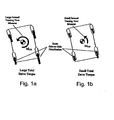
- Figs. 1a and 1b are schematic diagrams of a vehicle illustrating, in general, distribution of drive torque and turning behavior with respect to variations in total drive torque;
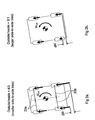
- Fig. 2a is a schematic diagram of a vehicle illustrating the turning behavior utilizing axle side-to-side bias to generate an inward turning moment in an instance of large total drive torque;
- Fig. 2b is a schematic diagram of a vehicle illustrating the turning behavior utilizing axle side-to-side bias to generate an inward turning moment in an instance of small total drive torque;
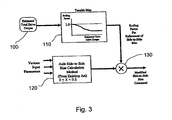
- Fig. 3 is a schematic representation of the integration of a side-to-side bias scaling factor depending on total estimated drive torque
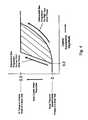
- Fig. 4 is a graphical representation of an alternative side-to-side bias scaling factor depending on measured vehicle lateral acceleration.
- the method according to the invention comprises the steps of estimating the total drive torque generated by the vehicle.
- the estimated total drive torque is then used to modify the side-to-side distribution of actual drive torque by using one or more scaling factors in addition to any other side-to-side torque distribution means already in place.
- Proper distribution of drive torque maintains a constant vehicle inward yaw moment and as a result produces predictable line trace performance. The method is described in greater detail below.
- the total drive torque of a vehicle varies during operation of the vehicle. Variations in total drive torque are caused by one or more of the following factors: operator torque demand, increased/decreased vehicle speed, traction requirements, braking requirements and other stability requirements. Factors such as traction requirements cause drive torque to be distributed differently amongst the vehicle's four wheels. Additionally, as previously stated, side-to-side distribution of torque between inside and outside wheels can, in part, be determined by the steering angle of the vehicle to provide increased traction. The turning of the vehicle also creates a measurable component of lateral acceleration.
- the side-to-side bias of drive torque must be large for small total drive torque outputs and small for large total drive torque outputs.
- a vehicle is shown turning to the left; and due to an asymmetric drive torque distribution of the total drive torque amount, a yawing moment M cg is generated.
- Large arrows on the vehicle wheels represent the magnitude of drive force applied at each wheel, respectively.
- the drive force at each wheel is related to each wheel's drive torque through the loaded radius of the tire/wheel assembly, thus, the arrows on the wheels are also representative of drive torque.
- the sum of the magnitudes of each individual arrow is equal to the total drive torque of the vehicle.
- the side-to-side bias of drive torque is represented by the size relationship of the arrows on the right and left sides of the vehicle on a common axle, namely the ratio of the length of the larger to the length of the smaller.
- FIG 2a which illustrates a side-to-side bias of 4:3
- the relative sizes of the arrows on the right and left wheels of the rear axle as explained below, also indicate the applied yaw moment created by the left-right drive torque difference and can be denoted by the quantity dM (assuming lateral tire force is not significantly influenced by the presence of these longitudinal driving forces).
- figure 2a also shows moment arms (20a, 20b) representing the perpendicular distance from the line of action of each wheel's drive force to the vehicle center of gravity.
- Moment arm 20a is the vehicle's front axle half-track width and is symmetric between the left and right side.
- Moment arm 20b is the vehicle's rear axle half-track width and is symmetric between the left and right side.
- the track width is the lateral distance between two tire contact patch center on a given axle.
- the side-to-side bias of the rear axle illustrated in Figure 2a is 4:3 and creates a defined yaw moment M cg .
- the quantity dM represents the difference in the two rear wheel drive torque values.
- the side-to-side bias of drive torque represented by arrows on the wheels of the rear axle is 2:1, which is larger than the ration of 4:3 shown in figure 2a.
- the applied yaw moment also depicted by the quantity M cg , is the same as that of Figure 2a since the arrow difference length of the two rear axle drive torques is also equal to dM.
- the side-to-side bias is larger than in Figure 2a, but the resulting yaw moment is the same. Because of the lower total drive torque represented by the sum of all arrow lengths (compared to Figure 2a), a larger side-to-side bias is needed to create the same yaw moment M cg .
- the larger side-to-side bias creates an equivalent yaw moment contribution and as a result the yaw moment is constant between the illustrated instances in Figure 2a and Figure 2b.
- step 120 existing state of the art calculates a side-to-side bias coefficient (X) based on various input parameters such as lateral acceleration (lateral G), vehicle speed and estimated driver intent.
- the range of the bias coefficient is between a value of 0 to 0.5.
- a value of 0 indicates no additional torque transfer to the outside wheel, or the two wheels on a given axle have the same intended torque.
- a value of 0.5 indicates that all the torque on a given axle is intended to be transferred to the outside wheel.
- step 100 an estimation of the total drive torque is made.
- a side-to-side bias scaling factor is taken from a stored table of pre-determined values.
- the bias scaling factor from operation 110 approaches 1.0 (meaning that there is no intended modification to the side-to-side bias coefficient calculated in operation 120), so that when multiplied by the result of operation 120 in operation 130, the end result is the side-to-side bias factor itself.
- the bias scaling factor reduces in magnitude such that when multiplied to the result of operation 120 in operation 130, the modified side-to-side bias command is smaller, indicating a smaller amount of torque transfer between the two wheels on a given axle.
- the side-to-side bias coefficient is scaled according to measured or calculated lateral acceleration of the vehicle.
- a threshold value preferably 0.2g
- side-to-side bias is increased to the outside wheel(s).
- the side-to-side bias to the outside wheel(s) can be increased quickly or gradually.
- the rate of increase will depend on the vehicle speed as well as the previously disclosed method for changing the side-to-side bias command depending on estimated total drive torque.
- the gradient of the rise is steep indicated by the label in Figure 4.
- the rate of increase is more gradual.
- the region in-between the two lines represents the total operational area of the side-to-side transfer. It may be noted that the gradient of either line (low total drive torque or high total drive torque) may also be scaled by vehicle speed or a variety of other operational parameters.
- the present invention provides a method for improving cornering performance. From a given vehicle speed and lateral acceleration, in instances of a decrease in drive torque, individual wheel torque is shifted from inside wheels to outside wheels to increase vehicle yaw forces and counteract the understeer phenomenon. Similarly, in instances of increasing drive torque, individual wheel torque is shifted from outside wheels to inside wheels on a common axle to reduce vehicle yaw forces and counteract the oversteer phenomenon. Actual implementation of side-to-side torque shifting is done using a correction factor multiplied by other factors within a general torque shift equation.
Landscapes
- Engineering & Computer Science (AREA)
- Transportation (AREA)
- Mechanical Engineering (AREA)
- Chemical & Material Sciences (AREA)
- Combustion & Propulsion (AREA)
- Arrangement And Driving Of Transmission Devices (AREA)
Abstract
Description
- The present invention is generally directed toward a method for improving cornering performance in a four wheel drive vehicle by scaling the side-to-side drive torque bias in response to changes in total driveline torque.
- In the area of electronic drive torque distribution control, it is possible to shift drive torque to various driven wheels in accordance with specific vehicle operational conditions and sensed driver needs. During cornering it is advantageous to send more drive torque to the outside wheel of a given drive axle to enhance the transient characteristics of the vehicle's turning behavior.
- During situations of combined acceleration and turning it can be particularly difficult to achieve consistent line trace performance when the drive torque is increased and/or decreased either by driver demand and or variations in system functioning. In an attempt to maintain consistent line trace while the drive torque is varied, it is important to maintain a relatively constant yawing moment from the distributed drive torque.
- In various state of the art driveline control systems, there is a consistently varying yaw moment from the drive torque at a given trimmed lateral acceleration. As the drive torque increases and/or decreases, the amount of yawing moment changes and the overall line trace is not maintained.
- Current practice is illustrated in figure 1. The drive torque distribution on a given axle (side-to-side distribution) is biased toward the outside wheel (as represented by different arrow sizes on the wheels) in order to provide enhanced traction and line trace capability. This side-to-side bias (or torque split) creates an "inward" turning moment on the vehicle body and helps to direct the vehicle inward in the turn as drive torque increases. As the total drive torque increases and/or decreases, and the side-to-side bias ratio does not change, the amount of inward yawing moment changes according to the delivered level of drive torque. Because of this behavior, perturbations in the line trace behavior occur. Starting from a quasi-equilibrium position at a prescribed lateral acceleration, as total drive torque is increased the inward yawing moment increases and the vehicle begins to "tighten its line". Conversely, starting from a quasi-equilibrium position at a prescribed lateral acceleration where there is an existing high level of drive torque and drive torque is lessened, the vehicle begins to "loosen its line" as the inward turning moment is released. Both situations cause noticeable and undesirable disturbances in the driving trajectory. A method and system that avoids these situations is desired.
- The present invention provides a method for improving cornering performance. From a given vehicle speed and lateral acceleration, in instances of a decrease in drive torque, individual wheel torque is shifted from inside wheels to outside wheels on a common axle to increase vehicle yaw forces and counteract an understeer phenomenon. Similarly, in instances of increasing drive torque, individual wheel torque is shifted from outside wheels to inside wheels on a common axle to reduce vehicle yaw forces and counteract an oversteer phenomenon. Actual implementation of side-to-side torque shifting is done using a scaling factor (0.0 to 1.0) multiplied by other factors within a general torque shift equation.
- These and further features of the invention will be apparent with reference to the following description and drawings, wherein:
- Figs. 1a and 1b are schematic diagrams of a vehicle illustrating, in general, distribution of drive torque and turning behavior with respect to variations in total drive torque;
- Fig. 2a is a schematic diagram of a vehicle illustrating the turning behavior utilizing axle side-to-side bias to generate an inward turning moment in an instance of large total drive torque;
- Fig. 2b is a schematic diagram of a vehicle illustrating the turning behavior utilizing axle side-to-side bias to generate an inward turning moment in an instance of small total drive torque;
- Fig. 3 is a schematic representation of the integration of a side-to-side bias scaling factor depending on total estimated drive torque; and
- Fig. 4 is a graphical representation of an alternative side-to-side bias scaling factor depending on measured vehicle lateral acceleration.
- The method according to the invention comprises the steps of estimating the total drive torque generated by the vehicle. The estimated total drive torque is then used to modify the side-to-side distribution of actual drive torque by using one or more scaling factors in addition to any other side-to-side torque distribution means already in place. Proper distribution of drive torque maintains a constant vehicle inward yaw moment and as a result produces predictable line trace performance. The method is described in greater detail below.
- As used in this description and in the appended claims, the following terms will have the definitions indicated thereafter:
- "drive torque" means torque generated by the vehicle engine and
- transmission and distributed between the four vehicle wheels;
- "total drive torque" means the sum of the drive torque applied to all four vehicle wheels;
- "inside wheels" mean the front and rear wheels on a common side of a vehicle that define a smaller radius during a vehicle turn;
- "outside wheels" mean the front and rear wheels on a common side of a vehicle that define a larger radius during a vehicle turn; and
- "side-to-side bias" means the ratio between the drive torque distributed to the inside wheels and the drive torque distributed to the outside wheels on a single axle of the vehicle.
- The total drive torque of a vehicle varies during operation of the vehicle. Variations in total drive torque are caused by one or more of the following factors: operator torque demand, increased/decreased vehicle speed, traction requirements, braking requirements and other stability requirements. Factors such as traction requirements cause drive torque to be distributed differently amongst the vehicle's four wheels. Additionally, as previously stated, side-to-side distribution of torque between inside and outside wheels can, in part, be determined by the steering angle of the vehicle to provide increased traction. The turning of the vehicle also creates a measurable component of lateral acceleration.
- In order to maintain similar levels of inward yawing moment for a given vehicle condition (i.e. speed and lateral acceleration), the side-to-side bias of drive torque must be large for small total drive torque outputs and small for large total drive torque outputs. Referring to figure 2a, a vehicle is shown turning to the left; and due to an asymmetric drive torque distribution of the total drive torque amount, a yawing moment Mcg is generated. Large arrows on the vehicle wheels represent the magnitude of drive force applied at each wheel, respectively. The drive force at each wheel is related to each wheel's drive torque through the loaded radius of the tire/wheel assembly, thus, the arrows on the wheels are also representative of drive torque. The sum of the magnitudes of each individual arrow is equal to the total drive torque of the vehicle.
- The side-to-side bias of drive torque is represented by the size relationship of the arrows on the right and left sides of the vehicle on a common axle, namely the ratio of the length of the larger to the length of the smaller. Referring again to figure 2a which illustrates a side-to-side bias of 4:3, the relative sizes of the arrows on the right and left wheels of the rear axle, as explained below, also indicate the applied yaw moment created by the left-right drive torque difference and can be denoted by the quantity dM (assuming lateral tire force is not significantly influenced by the presence of these longitudinal driving forces).
- To further illustrate the calculation of the applied yaw moment, figure 2a also shows moment arms (20a, 20b) representing the perpendicular distance from the line of action of each wheel's drive force to the vehicle center of gravity.
Moment arm 20a is the vehicle's front axle half-track width and is symmetric between the left and right side.Moment arm 20b is the vehicle's rear axle half-track width and is symmetric between the left and right side. The track width is the lateral distance between two tire contact patch center on a given axle. The moment generated about the vehicle center of gravity by the front axle wheel force components perpendicular to the moment arms, 20a on each side cancel each other because the applied forces at each front wheel are equal. On the rear axle the moment generated by the force component perpendicular to themoment arm 20b of the right wheel exceeds that generated by the force component perpendicular to themoment arm 20b of the left wheel by a factor that is equal to the length difference, dM, between the representative arrows shown on the rear axle. Thus, in comparing the ration of the lengths of the arrows, the side-to-side bias of the rear axle illustrated in Figure 2a is 4:3 and creates a defined yaw moment Mcg. The quantity dM represents the difference in the two rear wheel drive torque values. - Referring to Figure 2b, the side-to-side bias of drive torque represented by arrows on the wheels of the rear axle is 2:1, which is larger than the ration of 4:3 shown in figure 2a. However, the applied yaw moment, also depicted by the quantity Mcg, is the same as that of Figure 2a since the arrow difference length of the two rear axle drive torques is also equal to dM. The side-to-side bias is larger than in Figure 2a, but the resulting yaw moment is the same. Because of the lower total drive torque represented by the sum of all arrow lengths (compared to Figure 2a), a larger side-to-side bias is needed to create the same yaw moment Mcg. Thus, the larger side-to-side bias creates an equivalent yaw moment contribution and as a result the yaw moment is constant between the illustrated instances in Figure 2a and Figure 2b.
- It will be understood that additional yaw moment can be created by varying the side-to-side bias between wheels on the vehicle front axle. It will also be understood that in an instance where the vehicle is turning in an opposite direction, the side-to-side bias is reversed.
- Referring to Figure 3, integration of the side-to-side bias based on total drive torque with other vehicle side-to-side bias calculations in a programmable four wheel drive system is illustrated for a single vehicle axle. In
step 120, existing state of the art calculates a side-to-side bias coefficient (X) based on various input parameters such as lateral acceleration (lateral G), vehicle speed and estimated driver intent. The range of the bias coefficient is between a value of 0 to 0.5. A value of 0 indicates no additional torque transfer to the outside wheel, or the two wheels on a given axle have the same intended torque. A value of 0.5 indicates that all the torque on a given axle is intended to be transferred to the outside wheel. Instep 100 an estimation of the total drive torque is made. Instep 110, depending on the estimated total drive torque, a side-to-side bias scaling factor is taken from a stored table of pre-determined values. At small values of estimated total drive torque, the bias scaling factor fromoperation 110 approaches 1.0 (meaning that there is no intended modification to the side-to-side bias coefficient calculated in operation 120), so that when multiplied by the result ofoperation 120 inoperation 130, the end result is the side-to-side bias factor itself. As the estimated drive torque increases, the bias scaling factor reduces in magnitude such that when multiplied to the result ofoperation 120 inoperation 130, the modified side-to-side bias command is smaller, indicating a smaller amount of torque transfer between the two wheels on a given axle. Application of the modified side-to-side bias command to the programmable vehicle control system provides a condition where the yaw moment of the vehicle is maintained generally constant in a cornering situation with variable total drive torque and the vehicle does not tend to tack inward or outward. - Referring to figure 4, as an additional method of pictorially showing the effect of maintaining a consistent yaw moment, the side-to-side bias coefficient is scaled according to measured or calculated lateral acceleration of the vehicle. Once the lateral acceleration of the vehicle reaches a threshold value, preferably 0.2g, side-to-side bias is increased to the outside wheel(s). As lateral acceleration increases, the side-to-side bias to the outside wheel(s) can be increased quickly or gradually. The rate of increase will depend on the vehicle speed as well as the previously disclosed method for changing the side-to-side bias command depending on estimated total drive torque. For the case of low estimated total drive torque, the gradient of the rise is steep indicated by the label in Figure 4. For the case of high estimated total drive torque the rate of increase is more gradual. The region in-between the two lines represents the total operational area of the side-to-side transfer. It may be noted that the gradient of either line (low total drive torque or high total drive torque) may also be scaled by vehicle speed or a variety of other operational parameters.
- Although the invention has been shown and described with reference to certain preferred and alternate embodiments, the invention is not limited to these specific embodiments. Minor variations and insubstantial differences in the various combinations of materials and methods of application may occur to those of ordinary skill in the art while remaining within the scope of the invention as claimed and equivalents.
The present invention provides a method for improving cornering performance. From a given vehicle speed and lateral acceleration, in instances of a decrease in drive torque, individual wheel torque is shifted from inside wheels to outside wheels to increase vehicle yaw forces and counteract the understeer phenomenon. Similarly, in instances of increasing drive torque, individual wheel torque is shifted from outside wheels to inside wheels on a common axle to reduce vehicle yaw forces and counteract the oversteer phenomenon. Actual implementation of side-to-side torque shifting is done using a correction factor multiplied by other factors within a general torque shift equation.
Claims (8)
- A method of improving cornering performance in a vehicle comprising the steps of:estimating total vehicle drive torque;providing a side-to-side drive torque bias adjustment between wheels on a common axle based on the estimated total vehicle drive torque; andintegrating said side-to-side drive torque bias adjustment with other side-to-side bias adjustments within a programmable four wheel drive system.
- The method of improving cornering performance of claim 1, wherein when estimated total vehicle drive torque increases, the side-to-side bias adjustment decreases.
- The method of improving cornering performance of claim 1, wherein the vehicle is accelerating as well as cornering.
- The method of improving cornering performance of claim 1, wherein the vehicle has a constant speed and lateral acceleration.
- The method of improving cornering performance of claim 1, wherein said side-to-side bias adjustment between wheels on a common axle based on the estimated vehicle torque is provided as a scaling factor.
- The method of improving cornering performance of claim 1, wherein when estimated total vehicle torque decreases, the side-to-side bias adjustment increases.
- A method of improving cornering performance in a vehicle comprising the steps of:estimating the lateral acceleration of the vehicle;providing a side-to-side drive torque bias between wheels on a common axle based on the estimated lateral acceleration wherein when the estimated lateral acceleration increases, the side-to-side drive torque bias provides more drive force to an outside wheel on a given vehicle axle.
- The method of claim 7 wherein the change of side-to-side drive torque bias in relation to the increase of estimated lateral acceleration is referred to as a side-to-side bias progression rate and the bias progression rate is greater when an estimated total vehicle drive torque is high in comparison to a lower total vehicle drive torque wherein the progression rate is smaller.
Applications Claiming Priority (1)
| Application Number | Priority Date | Filing Date | Title |
|---|---|---|---|
| US11/293,964 US7455142B2 (en) | 2005-12-05 | 2005-12-05 | Scaling of side-to-side torque bias to improve cornering in a programmable four wheel drive system |
Publications (3)
| Publication Number | Publication Date |
|---|---|
| EP1792767A2 true EP1792767A2 (en) | 2007-06-06 |
| EP1792767A3 EP1792767A3 (en) | 2010-01-20 |
| EP1792767B1 EP1792767B1 (en) | 2013-04-03 |
Family
ID=37814304
Family Applications (1)
| Application Number | Title | Priority Date | Filing Date |
|---|---|---|---|
| EP06024637A Not-in-force EP1792767B1 (en) | 2005-12-05 | 2006-11-28 | Scaling of side-to-side torque bias to improve cornering in a programmable four wheel drive system |
Country Status (2)
| Country | Link |
|---|---|
| US (1) | US7455142B2 (en) |
| EP (1) | EP1792767B1 (en) |
Families Citing this family (17)
| Publication number | Priority date | Publication date | Assignee | Title |
|---|---|---|---|---|
| DE102006022391A1 (en) * | 2006-05-12 | 2007-11-15 | Robert Bosch Gmbh | Method and device for improving the ride comfort in a steering assistance system |
| US20090014226A1 (en) * | 2007-07-11 | 2009-01-15 | Gm Global Technology Operations, Inc. | Torque Differential Modification of a Non-Driven Axle |
| JP5038837B2 (en) * | 2007-10-01 | 2012-10-03 | 富士重工業株式会社 | Vehicle tuck-in prevention control device |
| US9145127B2 (en) * | 2008-12-26 | 2015-09-29 | Komatsu Ltd. | Traction control device |
| EP2374673B1 (en) | 2008-12-26 | 2013-08-21 | Komatsu Ltd. | Traction control device |
| JP5020388B2 (en) | 2009-01-08 | 2012-09-05 | 株式会社小松製作所 | Vehicle speed estimation device and traction control device |
| JP5027933B2 (en) | 2009-01-08 | 2012-09-19 | 株式会社小松製作所 | Traction control device |
| KR101360038B1 (en) * | 2011-07-28 | 2014-02-07 | 현대자동차주식회사 | Control method of vehicle using in-wheel motor |
| US8886410B2 (en) * | 2013-02-13 | 2014-11-11 | Honda Motor Co., Ltd. | Methods of controlling four-wheel steered vehicles |
| US9008915B2 (en) | 2013-02-13 | 2015-04-14 | Honda Motor Co., Ltd. | Four-wheel steered vehicle and torque distribution control methods for same |
| US9863777B2 (en) * | 2013-02-25 | 2018-01-09 | Ford Global Technologies, Llc | Method and apparatus for automatic estimated time of arrival calculation and provision |
| CN108200772A (en) * | 2016-09-09 | 2018-06-22 | 马自达汽车株式会社 | vehicle controls |
| CN108146436B (en) * | 2017-12-26 | 2023-10-27 | 北京汽车研究总院有限公司 | Method for controlling vehicle to run and vehicle |
| US10752288B2 (en) | 2018-04-20 | 2020-08-25 | Ford Global Technologies, Llc | Lateral motion control for cornering and regenerative braking energy capture |
| CN112026749B (en) * | 2020-08-03 | 2021-10-01 | 南京航空航天大学 | A Steer-by-Wire System Stability Control Method |
| US11628827B2 (en) * | 2021-01-19 | 2023-04-18 | Denso Ten Limited | Vehicle control device and control method |
| CN113085837A (en) * | 2021-04-30 | 2021-07-09 | 中国农业大学 | Vehicle active roll control method |
Family Cites Families (19)
| Publication number | Priority date | Publication date | Assignee | Title |
|---|---|---|---|---|
| US5453930A (en) * | 1991-02-08 | 1995-09-26 | Nissan Motor Co., Ltd. | Drive system for electric automobiles |
| JP3280392B2 (en) * | 1991-04-01 | 2002-05-13 | アイシン・エィ・ダブリュ株式会社 | Driving force control device for electric vehicle |
| US5417298A (en) * | 1993-07-07 | 1995-05-23 | Honda Giken Kohyo Kabushiki Kaisha | Torque distribution control apparatus for vehicle |
| JP3409439B2 (en) | 1994-06-17 | 2003-05-26 | 日産自動車株式会社 | Driving force distribution control system for left and right wheels and front and rear wheels |
| JP3268124B2 (en) | 1994-06-27 | 2002-03-25 | 富士重工業株式会社 | Vehicle torque distribution control device |
| JP3577375B2 (en) * | 1995-09-28 | 2004-10-13 | 富士重工業株式会社 | Traction control device for four-wheel drive vehicle |
| DE69724383T2 (en) | 1996-11-13 | 2004-06-24 | Honda Giken Kogyo K.K. | System for controlling the yaw moment in vehicles |
| JP3272617B2 (en) | 1996-11-13 | 2002-04-08 | 本田技研工業株式会社 | Vehicle yaw moment control device |
| JP3340038B2 (en) * | 1996-11-14 | 2002-10-28 | 本田技研工業株式会社 | Left and right wheel driving force distribution device |
| DE69935090T2 (en) * | 1998-06-09 | 2007-11-15 | Fuji Jukogyo K.K. | Torque distribution control system for a four-wheel drive vehicle |
| JP4082549B2 (en) | 2000-04-06 | 2008-04-30 | 本田技研工業株式会社 | Driving force control device for four-wheel drive vehicle |
| IT1320394B1 (en) | 2000-06-05 | 2003-11-26 | Fiat Ricerche | SYSTEM FOR THE ACTIVE CONTROL OF A DIFFERENTIAL OF A VEHICLE. |
| JP4456748B2 (en) * | 2000-10-27 | 2010-04-28 | 富士重工業株式会社 | Power distribution control device for four-wheel drive vehicles |
| US6487486B1 (en) | 2001-08-14 | 2002-11-26 | Daimlerchrysler Corporation | Automatic differential control logic |
| US6704622B2 (en) * | 2001-12-28 | 2004-03-09 | Visteon Global Technologies, Inc. | Vehicle stability control |
| US7175557B2 (en) * | 2003-02-21 | 2007-02-13 | Magna Powertrain Usa, Inc. | Torque vectoring device having an electric motor/brake actuator and friction clutch |
| US6909959B2 (en) * | 2003-03-07 | 2005-06-21 | Stephen James Hallowell | Torque distribution systems and methods for wheeled vehicles |
| US7085641B2 (en) * | 2004-11-01 | 2006-08-01 | Honda Motor Co., Ltd. | Ackerman angle correction in a steering system for a low speed turn |
| JP4553863B2 (en) * | 2006-05-08 | 2010-09-29 | 本田技研工業株式会社 | Vehicle drive torque estimation device, drive torque estimation method, and four-wheel drive vehicle |
-
2005
- 2005-12-05 US US11/293,964 patent/US7455142B2/en not_active Expired - Fee Related
-
2006
- 2006-11-28 EP EP06024637A patent/EP1792767B1/en not_active Not-in-force
Non-Patent Citations (1)
| Title |
|---|
| None |
Also Published As
| Publication number | Publication date |
|---|---|
| EP1792767A3 (en) | 2010-01-20 |
| US7455142B2 (en) | 2008-11-25 |
| US20070129872A1 (en) | 2007-06-07 |
| EP1792767B1 (en) | 2013-04-03 |
Similar Documents
| Publication | Publication Date | Title |
|---|---|---|
| US7455142B2 (en) | Scaling of side-to-side torque bias to improve cornering in a programmable four wheel drive system | |
| US8229642B2 (en) | Vehicle systems control for improving stability | |
| US6634451B2 (en) | Power distribution control system for a vehicle | |
| US8244432B2 (en) | Road-surface friction-coefficient estimating device | |
| CN102958735B (en) | Driving force distribution control device for four-wheel drive vehicles | |
| JP3272617B2 (en) | Vehicle yaw moment control device | |
| US20090018742A1 (en) | Device operable to control turning of vehicle | |
| US11541876B2 (en) | Electronic stability control method for vehicle | |
| KR102805124B1 (en) | Wheel slip control method for vehicle | |
| CN110435628B (en) | Automobile four-wheel drive control system and method | |
| US20150073678A1 (en) | Braking force control device | |
| JP2022189780A (en) | Control method of road vehicle having independent engine acting on wheels of same axle and relevant road vehicle | |
| JP4926776B2 (en) | Vehicle driving force control device | |
| KR101294057B1 (en) | Inclination controlling method using by torque vectoring system | |
| CN114889616A (en) | Driving slip ratio correction method considering steering characteristics | |
| JP2853474B2 (en) | Driving force distribution device for four-wheel drive vehicles | |
| US8788170B2 (en) | Left-right wheel drive force distribution control apparatus for a vehicle | |
| JP3272616B2 (en) | Vehicle yaw moment control device | |
| WO2012005265A1 (en) | Device for controlling torque distribution to left and right wheels on a vehicle | |
| JP5090664B2 (en) | Driving force control method for four-wheel drive vehicle | |
| JP2746002B2 (en) | Driving force distribution device for four-wheel drive vehicle with four-wheel steering device | |
| JP5090669B2 (en) | 4-wheel drive vehicle behavior stabilization control method | |
| JP2024018042A (en) | Vehicle torque distribution control method and vehicle torque distribution control device | |
| JPH10138784A (en) | Vehicle yaw moment control device | |
| WO2025134372A1 (en) | Driving support method and driving support device |
Legal Events
| Date | Code | Title | Description |
|---|---|---|---|
| PUAI | Public reference made under article 153(3) epc to a published international application that has entered the european phase |
Free format text: ORIGINAL CODE: 0009012 |
|
| 17P | Request for examination filed |
Effective date: 20061128 |
|
| AK | Designated contracting states |
Kind code of ref document: A2 Designated state(s): AT BE BG CH CY CZ DE DK EE ES FI FR GB GR HU IE IS IT LI LT LU LV MC NL PL PT RO SE SI SK TR |
|
| AX | Request for extension of the european patent |
Extension state: AL BA HR MK YU |
|
| PUAL | Search report despatched |
Free format text: ORIGINAL CODE: 0009013 |
|
| AK | Designated contracting states |
Kind code of ref document: A3 Designated state(s): AT BE BG CH CY CZ DE DK EE ES FI FR GB GR HU IE IS IT LI LT LU LV MC NL PL PT RO SE SI SK TR |
|
| AX | Request for extension of the european patent |
Extension state: AL BA HR MK RS |
|
| RIC1 | Information provided on ipc code assigned before grant |
Ipc: B60T 8/1755 20060101ALI20091216BHEP Ipc: B60K 23/08 20060101AFI20070315BHEP |
|
| 17Q | First examination report despatched |
Effective date: 20100630 |
|
| AKX | Designation fees paid |
Designated state(s): DE FR GB |
|
| GRAP | Despatch of communication of intention to grant a patent |
Free format text: ORIGINAL CODE: EPIDOSNIGR1 |
|
| GRAS | Grant fee paid |
Free format text: ORIGINAL CODE: EPIDOSNIGR3 |
|
| GRAA | (expected) grant |
Free format text: ORIGINAL CODE: 0009210 |
|
| AK | Designated contracting states |
Kind code of ref document: B1 Designated state(s): DE FR GB |
|
| REG | Reference to a national code |
Ref country code: GB Ref legal event code: FG4D |
|
| REG | Reference to a national code |
Ref country code: DE Ref legal event code: R096 Ref document number: 602006035399 Country of ref document: DE Effective date: 20130529 |
|
| PGFP | Annual fee paid to national office [announced via postgrant information from national office to epo] |
Ref country code: FR Payment date: 20131108 Year of fee payment: 8 Ref country code: GB Payment date: 20131127 Year of fee payment: 8 |
|
| PLBE | No opposition filed within time limit |
Free format text: ORIGINAL CODE: 0009261 |
|
| STAA | Information on the status of an ep patent application or granted ep patent |
Free format text: STATUS: NO OPPOSITION FILED WITHIN TIME LIMIT |
|
| 26N | No opposition filed |
Effective date: 20140106 |
|
| REG | Reference to a national code |
Ref country code: DE Ref legal event code: R097 Ref document number: 602006035399 Country of ref document: DE Effective date: 20140106 |
|
| GBPC | Gb: european patent ceased through non-payment of renewal fee |
Effective date: 20141128 |
|
| REG | Reference to a national code |
Ref country code: FR Ref legal event code: ST Effective date: 20150731 |
|
| PG25 | Lapsed in a contracting state [announced via postgrant information from national office to epo] |
Ref country code: GB Free format text: LAPSE BECAUSE OF NON-PAYMENT OF DUE FEES Effective date: 20141128 |
|
| PG25 | Lapsed in a contracting state [announced via postgrant information from national office to epo] |
Ref country code: FR Free format text: LAPSE BECAUSE OF NON-PAYMENT OF DUE FEES Effective date: 20141201 |
|
| PGFP | Annual fee paid to national office [announced via postgrant information from national office to epo] |
Ref country code: DE Payment date: 20191112 Year of fee payment: 14 |
|
| REG | Reference to a national code |
Ref country code: DE Ref legal event code: R119 Ref document number: 602006035399 Country of ref document: DE |
|
| PG25 | Lapsed in a contracting state [announced via postgrant information from national office to epo] |
Ref country code: DE Free format text: LAPSE BECAUSE OF NON-PAYMENT OF DUE FEES Effective date: 20210601 |