EP1791940B1 - Laundry treatment compositions - Google Patents
Laundry treatment compositions Download PDFInfo
- Publication number
- EP1791940B1 EP1791940B1 EP05771913A EP05771913A EP1791940B1 EP 1791940 B1 EP1791940 B1 EP 1791940B1 EP 05771913 A EP05771913 A EP 05771913A EP 05771913 A EP05771913 A EP 05771913A EP 1791940 B1 EP1791940 B1 EP 1791940B1
- Authority
- EP
- European Patent Office
- Prior art keywords
- group
- dye
- substituted
- dyes
- groups
- Prior art date
- Legal status (The legal status is an assumption and is not a legal conclusion. Google has not performed a legal analysis and makes no representation as to the accuracy of the status listed.)
- Expired - Lifetime
Links
- 0 CC1(C=CC(Nc2c(C(C3C=CC=CC3C3=O)=O)c3c(*)cc2)=CC=C1)[Rn] Chemical compound CC1(C=CC(Nc2c(C(C3C=CC=CC3C3=O)=O)c3c(*)cc2)=CC=C1)[Rn] 0.000 description 2
Classifications
-
- C—CHEMISTRY; METALLURGY
- C11—ANIMAL OR VEGETABLE OILS, FATS, FATTY SUBSTANCES OR WAXES; FATTY ACIDS THEREFROM; DETERGENTS; CANDLES
- C11D—DETERGENT COMPOSITIONS; USE OF SINGLE SUBSTANCES AS DETERGENTS; SOAP OR SOAP-MAKING; RESIN SOAPS; RECOVERY OF GLYCEROL
- C11D3/00—Other compounding ingredients of detergent compositions covered in group C11D1/00
- C11D3/40—Dyes ; Pigments
- C11D3/42—Brightening agents ; Blueing agents
-
- C—CHEMISTRY; METALLURGY
- C11—ANIMAL OR VEGETABLE OILS, FATS, FATTY SUBSTANCES OR WAXES; FATTY ACIDS THEREFROM; DETERGENTS; CANDLES
- C11D—DETERGENT COMPOSITIONS; USE OF SINGLE SUBSTANCES AS DETERGENTS; SOAP OR SOAP-MAKING; RESIN SOAPS; RECOVERY OF GLYCEROL
- C11D3/00—Other compounding ingredients of detergent compositions covered in group C11D1/00
- C11D3/40—Dyes ; Pigments
Definitions
- the present invention relates to laundry treatment compositions that comprise a dye.
- Garments comprising polyester fibres are ubiquitous. Many garments are white but over the lifetime of these garments the whiteness is dulled reducing the aesthetic value of the garment. There is a need to maintain the white appearance of such garments such that the aesthetic value is retained as long as possible. Such maintenance need also take into account mixed fibre garments such that any treatment is not overly selective to one type of fibre over another.
- Bleach, fluorescers and shading agents are used in modern wash processes to maintain whiteness.
- the fluorescers and shading agents that are currently available, do not deposit on polyester fibres of garments to a significant degree. All fibres may be subjected to a bleaching process but over time such treatment can lead to the garment taking a yellow hue.
- Hydrophobic dyes have been found to be substantive to polyester fibres under normal domestic wash conditions. At low levels this provides a shading whiteness benefit.
- the present invention provides a laundry treatment composition
- a laundry treatment composition comprising: between 0.0001 to 0.1 wt % of a hydrophobic dye for shading polyester; between 0.0001 to 0.1 wt % of one or more other dyes selected from cotton substantive shading dyes of the group consisting of: hydrolysed reactive dye; acid dye as defined in claim 1; and direct dye as defined in claim 1; and, between 2 to 60 wt % of a surfactant.
- the present invention provides a method of treating a textile, the method comprising the steps of:
- a "unit dose” as used herein is a particular amount of the laundry treatment composition used for a type of wash, conditioning or requisite treatment step.
- the unit dose may be in the form of a defined volume of powder, granules or tablet or unit dose detergent liquid.
- the other dye as for the hydrophobic dye, has a maximum extinction coefficient greater than 1000 L/mol/cm in the wavelength range of 400 to 750 nm. Tuning of levels of the respective dyes in the composition will be such that dye deposition to the polyester and cotton will be aesthetically matched. It is preferred that the dyes have a peak absorption wavelength of from 550nm to 650nm, preferably from 570nm to 630nm. A combination of dyes may be used which together have the visual effect on the human eye as a single dye having a peak absorption wavelength on polyester or cotton of from 550nm to 650nm, preferably from 570nm to 630nm.
- This may be provided, for example by mixing a red and green-blue dye to yield a blue or violet shade.
- a specific example for the acid dyes is a mixture of acid red 17 and acid black 1. The same spectral quantities are required for both the cotton and polyester substantive dyes.
- Hydrophobic dyes are defined as organic compounds with a maximum extinction coefficient greater than 1000 L/mol/cm in the wavelength range of 400 to 750 nm and that are uncharged in aqueous solution at a pH in the range from 7 to 11.
- the hydrophobic dyes are devoid of polar solubilizing groups. In particular the hydrophobic dye does not contain any sulphonic acid, carboxylic acid, or quaternary ammonium groups.
- the dye chromophore is preferably selected from the group comprising: azo; anthraquinone; phthalocyanine; and, triphenylmethane chromophores. Most preferred are azo and anthraquinone dye chromophores.
- hydrophobic dyes are found in the classes of solvent and disperse dyes.
- Shading of white garments may be done with any colour depending on consumer preference.
- Blue and Violet are particularly preferred shades and consequently preferred dyes or mixtures of dyes are ones that give a blue or violet shade on white polyester.
- suitable solvent and disperse dyes are available. However detailed toxicological studies have shown that a number of such dyes are possible carcinogens, for example disperse blue 1. Such dyes are not preferred. More suitable dyes may be selected from those solvent and disperse dyes used in cosmetics. For example as listed by the European Union in directive 76/768/EEC Annex IV part 1. For example disperse violet 27 and solvent violet 13.
- the hydrophobic dye is incorporated into a composition by dissolution in a surfactant slurry or by granulation using non-ionic surfactant to solubilize the dye.
- the reactive dyes may be considered to be made up of a chromophore which is linked to an anchoring moiety,
- the chromophore may be linked directly to the anchor or via a bridging group.
- the chromophore serves to provide a colour and the anchor to bind to a textile substrate.
- a marked advantage of reactive dyes over direct dyes is that their chemical structure is much simpler, their absorption bands are narrower and the dyeing/shading are brighter; industrial Dyes, K. Hunger ed. Wiley-VCH 2003 ISBN 3-527-30426-6 .
- mammalian contact with reactive dyes results in irritation and/or sensitisation of the respiratory tract and/or skin.
- wash conditions are not ideal for deposition of dyes because the efficiency of deposition is low.
- each individual anchor group of each reactive dyes is hydrolysed such that the most reactive group(s) of anchor groups of the dye is/are hydrolysed.
- hydrolysed reactive dye encompasses both fully and partially hydrolysed reactive dyes.
- the reactive dye may have more than one anchor. If the dye has more than one anchor, then each and every anchor, that contributes to irritation and/or sensitisation, needs to be hydrolysed to the extent discussed above.
- the hydrolysed dyes comprise a chromophore and an anchor that are covalently bound and may be represented in the following manner: chromophore-anchor.
- the hydrolysed reactive dye comprises a chromophore moiety covalently bound to an anchoring group, the anchoring group for binding to cotton, the anchoring group selected from the group consisting of: a heteroaromatic ring, preferably comprising a nitrogen heteroatom, having at least one -OH substituent covalently bound to the heteroaromatic ring, and
- anchor group is of the form: wherein:
- the chromophore is selected from the group consisting of: azo, anthraquinone, phthalocyanine, formazan and triphendioaxazine.
- hydrolysed reactive dyes are hydrolysed Reactive Red 2, hydrolysed Reactive Blue 4, hydrolysed Reactive Black 5, and hydrolysed Reactive Blue 19.
- the hydrolysed dye is used in combination with a direct dye.
- Preferred direct dyes are selected from the group comprising tris-azo direct blue dyes of the formula: where at least two of the A, B and C napthyl rings are subsituted by a sulphonate group, the C ring may be substituted at the 5 position by an NH 2 or NHPh group, X is a phenyl or napthyl ring substituted with upto 2 sulphonate groups and may be substituted at 2 position with a OH group and may also be substituted with an NH 2 or NHPh group,
- Most preferred direct dyes are selected from the group comprising bis-azo direct violet dyes of the formula: where Z is H or phenyl, the A ring is preferably substituted by a methyl and methoxy group at the positions indicated by arrows, the A ring may also be a naphthyl ring, the Y group is a phenyl or naphthyl ring, which is substituted by sulphonate group and may be mono or disubstituted by methyl groups.
- Preferred examples of these dyes are direct violet 5, 7, 9, 11, 31, and 51. Further preferred examples of these dyes are also direct blue 34, 70, 71, 72, 75, 78, 82, and 120.
- the laundry treatment composition in addition to the dye comprises the balance carriers and adjunct ingredients to 10O wt % of the composition.
- compositions may be, for example, surfactants, builders, foam agents, anti-foam agents, solvents, fluorescers, bleaching agents, and enzymes.
- surfactants for example, surfactants, builders, foam agents, anti-foam agents, solvents, fluorescers, bleaching agents, and enzymes.
- the use and amounts of these components are such that the composition performs depending upon economics, environmental factors and use of the composition.
- the composition may comprise a surfactant and optionally other conventional detergent ingredients.
- the composition may also comprise an enzymatic detergent composition which comprises from 0.1 to 50 wt %, based on the total detergent composition, of one or more surfactants.
- This surfactant system may in turn comprise 0 to 95 wt % of one or more anionic surfactants and 5 to 100 wt % of one or more nonionic surfactants.
- the surfactant system may additionally contain amphoteric or zwitterionic detergent compounds, but this in not normally desired owing to their relatively high cost.
- the enzymatic detergent composition according to the invention will generally be used as a dilution in water of about 0.05 to 2 wt%.
- the composition comprises between 2 to 60 wt % of a surfactant, most preferably 10 to 30 wt %.
- a surfactant most preferably 10 to 30 wt %.
- the nonionic and anionic surfactants of the surfactant system may be chosen from the surfactants described " Surface Active Agents” Vol. 1, by Schwartz & Perry, Interscience 1949 , Vol. 2 by Schwartz, Perry & Berch, Interscience 1958 , in the current edition of " McCutcheon's Emulsifiers and Detergents” published by Manufacturing Confectioners Company or in " Tenside-Taschenbuch", H. Stache, 2nd Edn., Carl Hauser Verlag, 1981 .
- Suitable nonionic detergent compounds which may be used include, in particular, the reaction products of compounds having a hydrophobic group and a reactive hydrogen atom, for example, aliphatic alcohols, acids, amides or alkyl phenols with alkylene oxides, especially ethylene oxide either alone or with propylene oxide.
- Specific nonionic detergent compounds are C 6 to C 22 alkyl phenol-ethylene oxide condensates, generally 5 to 25 EO, i.e. 5 to 25 units of ethylene oxide per molecule, and the condensation products of aliphatic C 8 to C 18 primary or secondary linear or branched alcohols with ethylene oxide, generally 5 to 40 EO.
- Suitable anionic detergent compounds which may be used are usually water-soluble alkali metal salts of organic sulphates and sulphonates having alkyl radicals containing from about 8 to about 22 carbon atoms, the term alkyl being used to include the alkyl portion of higher acyl radicals.
- suitable synthetic anionic detergent compounds are sodium and potassium alkyl sulphates, especially those obtained by sulphating higher C 8 to C 18 alcohols, produced for example from tallow or coconut oil, sodium and potassium alkyl C 9 to C 20 benzene sulphonates, particularly sodium linear secondary alkyl C 10 to C 15 benzene sulphonates; and sodium alkyl glyceryl ether sulphates, especially those ethers of the higher alcohols derived from tallow or coconut oil and synthetic alcohols derived from petroleum.
- the preferred anionic detergent compounds are sodium C 11 to C 15 alkyl benzene sulphonates and sodium C 12 to C 18 alkyl sulphates.
- surfactants such as those described in EP-A-328 177 (Unilever), which show resistance to salting-out, the alkyl polyglycoside surfactants described in EP-A-070 074 , and alkyl monoglycosides.
- Preferred surfactant systems are mixtures of anionic with nonionic detergent active materials, in particular the groups and examples of anionic and nonionic surfactants pointed out in EP-A-346 995 (Unilever).
- surfactant system that is a mixture of an alkali metal salt of a C 16 to C 18 primary alcohol sulphate together with a C 12 to C 15 primary alcohol 3 to 7 EO ethoxylate.
- the nonionic detergent is preferably present in amounts greater than 10%, e.g. 25 to 90 wt % of the surfactant system.
- Anionic surfactants can be present for example in amounts in the range from about 5% to about 40 wt % of the surfactant system.
- the present invention When the present invention is used as a fabric conditioner it needs to contain a cationic compound.
- the quaternary ammonium compound is a quaternary ammonium compound having at least one C 12 to C 22 alkyl chain.
- the quaternary ammonium compound has the following formula: in which R 1 is a C 12 to C 22 alkyl or alkenyl chain; R 2 , R 3 and R 4 are independently selected from C 1 to C 4 alkyl chains and X - is a compatible anion.
- R 1 is a C 12 to C 22 alkyl or alkenyl chain; R 2 , R 3 and R 4 are independently selected from C 1 to C 4 alkyl chains and X - is a compatible anion.
- a preferred compound of this type is the quaternary ammonium compound cetyl trimethyl quaternary ammonium bromide.
- a second class of materials for use with the present invention are the quaternary ammonium of the above structure in which R 1 and R 2 are independently selected from C 12 to C 22 alkyl or alkenyl chain; R 3 and R 4 are independently selected from C 1 to C 4 alkyl chains and X - is a compatible anion.
- the ratio of cationic to nonionic surfactant is from 1:100 to 50:50, more preferably 1:50 to 20:50.
- the cationic compound may be present from 0.02 wt % to 20 wt % of the total weight of the composition.
- the cationic compound may be present from 0.05 wt % to 15 wt %, a more preferred composition range is from 0.2 wt % to 5 wt %, and most preferably the composition range is from 0.4 wt % to 2.5 wt % of the total weight of the composition.
- the level of cationic surfactant is from 0.05 wt % to 10 wt % of the total weight of the composition.
- the cationic compound may be present from 0.2 wt % to 5 wt %, and most preferably from 0.4 wt % to 2.5 wt % of the total weight of the composition.
- the level of cationic surfactant is 0.05 wt % to 15 wt % of the total weight of the composition.
- a more preferred composition range is from 0.2 wt % to 10 wt %, and the most preferred composition range is from 0.9 wt % to 3.0 wt % of the total weight of the composition.
- the laundry treatment composition may comprise bleaching species.
- the bleaching species for example, may selected from perborate and percarbonate. These peroxyl species may be further enhanced by the use of an activator, for example, TAED or SNOBS.
- a transition metal catalyst may be used with the peroxyl species.
- a transition metal catalyst may also be used in the absence of peroxyl species where the bleaching is termed to be via atmospheric oxygen, see, for example WO02/48301 .
- Photobleaches including singlet oxygen photobleaches, may be used with the laundry treatment composition.
- a preferred photobleach is vitamin K3.
- the laundry treatment composition most preferably comprises a fluorescent agent(optical brightener).
- fluorescent agents are well known and many such fluorescent agents are available commercially. Usually, these fluorescent agents are supplied and used in the form of their alkali metal salts, for example, the sodium salts.
- the total amount of the fluorescent agent or agents used in laundry treatment composition is generally from 0.005 to 2 wt %, more preferably 0.01 to 0.1 wt %.
- Preferred classes of fluorescer are: Di-styryl biphenyl compounds, e.g. Tinopal (Trade Mark) CBS-X, Di-amine stilbene di-sulphonic acid compounds, e.g.
- Preferred fluorescers are: sodium 2 (4-styryl-3-sulfophenyl)-2H-napthol[1,2-d]trazole, disodium 4,4'-bis ⁇ [(4-anilino-6-(N methyl-N-2 hydroxyethyl) amino 1,3,5-triazin-2-yl)]amino ⁇ stilbene-2-2' disulfonate, disodium 4,4'-bis ⁇ [(4-anilino-6-morpholino-1,3,5-triazin-2-yl)]amino ⁇ stilbene-2-2' disulfonate, and disodium 4,4'-bis(2-sulfoslyryl)biphenyl.
- a stock solution of 1.8g/L of a base washing ponder in water was created.
- the washing powder contained 18% NaLAS, 73% salts (silicate, sodium tri-poly-phosphate, sulphate, carbonate), 3% minors including perborate, fluorescer and enzymes, remainder impurities and water.
- the solution was divided into 100ml aliquots and the solvent dyes added from the ethanol solutions to give approximately 5.8ppm solutions.
- 1 g of pure woven polyester fabric was added to each of the wash solutions and the solution then shaken for 30 minutes, rinsed and dried. From the colour of the fabric it was clear that dye had deposited to the fabric. To quantify this the colour was measured using a reflectance spectrometer and expresses as the deltaE value compared to a polyester washed analogously but without dye present.
- Example 2 To examine the sensitivity of deposition to formulation components the experiment of Example 2 was repeated, except different wash solutions were utilised as outlined below and 4.9ppm solvent violet 13 used in solution. In all experiments washes were also conducted without dye, the colour of the cloth compared using a reflectometer and expressed as deltaE. The results are shown below. Wash conditions deltaE 0.3g/L SDS surfactant 7.0 0.3g/L SDS surfactant + 3g/L 8.3 NaCl 0.3g/L SDS surfactant + 3g/L 4.7 NaCl + pH adjusted to 10.5 using NaOH 0.3g/L SDS surfactant + 3g/L 4.2 NaCl + 0.5g/L 7EO nonionic surfactant 1.6g/L surfactant 5.5
- Example 1 The experiments of Example 1 was repeated using different levels of solvent violet 13 and solvent black 3 and a wash time of 45 minutes. The results are shown below. The shading effect expresses as deltaE builds up approximately linearly with amount of dye in this range.
- Example 1 The experiments of Example 1 was repeated except 2.5 ppm solvent violet 13 was used and a liquor to cloth ratio of 30:1. After the wash the cloth was dried and the deltaE measured compared to cloth washed without dye. The process was the repeated 5 more times and the results shown below.
- the shading effect shading effect expresses as deltaE builds up approximately linearly with washes in this range. Wash number deltaE 1 0.7 2 1.5 3 1.9 4 2.1 5 2.5 6 3.1
- Example 1 The experiment of Example 1 was repeated except using a different selection and combination of dyes as shown in the table below.
- the cloth used was 1.4g of woven 50:50 polyester:cotton, washed in 100ml solution for 30 minutes. Polyester substantive and cotton substantive dyes may be used together to give bigger benefits.
- Ppm dye Solvent violet 13 Direct Violet 51 deltaE 0 0 0.1 1 0 1.1 1 0.06 2.9 0 0.06 2.0
Landscapes
- Chemical & Material Sciences (AREA)
- Life Sciences & Earth Sciences (AREA)
- Engineering & Computer Science (AREA)
- Chemical Kinetics & Catalysis (AREA)
- Oil, Petroleum & Natural Gas (AREA)
- Wood Science & Technology (AREA)
- Organic Chemistry (AREA)
- Detergent Compositions (AREA)
Description
- The present invention relates to laundry treatment compositions that comprise a dye.
- Garments comprising polyester fibres are ubiquitous. Many garments are white but over the lifetime of these garments the whiteness is dulled reducing the aesthetic value of the garment. There is a need to maintain the white appearance of such garments such that the aesthetic value is retained as long as possible. Such maintenance need also take into account mixed fibre garments such that any treatment is not overly selective to one type of fibre over another.
- Bleach, fluorescers and shading agents are used in modern wash processes to maintain whiteness. The fluorescers and shading agents that are currently available, do not deposit on polyester fibres of garments to a significant degree. All fibres may be subjected to a bleaching process but over time such treatment can lead to the garment taking a yellow hue.
- There is a need to provide technology that maintains and enhances the white appearance of polyester-cotton comprising garments.
- Hydrophobic dyes have been found to be substantive to polyester fibres under normal domestic wash conditions. At low levels this provides a shading whiteness benefit.
- In one aspect the present invention provides a laundry treatment composition comprising: between 0.0001 to 0.1 wt % of a hydrophobic dye for shading polyester; between 0.0001 to 0.1 wt % of one or more other dyes selected from cotton substantive shading dyes of the group consisting of: hydrolysed reactive dye; acid dye as defined in claim 1; and direct dye as defined in claim 1; and, between 2 to 60 wt % of a surfactant.
- In another aspect the present invention provides a method of treating a textile, the method comprising the steps of:
- (i) treating a textile with an aqueous solution of a hydrophobic dye, the aqueous solution comprising from 1 ppb to 5 ppm of the hydrophobic dye, from 1 ppb to 5 ppm of a second dye selected from the group consisting of: hydrolysed reactive dye; acid dye as defined in claim 1; and direct dye as defined in claim 1; and, from 0.2 g/L to 3 g/L of a surfactant; and, (ii) rinsing and drying the textile. Most preferably the hydrophobic dye is at a concentration in the range from 10 ppb to 500 ppb. It is preferred that the aqueous solution has an ionic strength from 0.001 to 0.5. The present invention also extends to the aqueous solution used in the method. The method is preferably applied to a textile that has been worn at least one and therefore is soiled.
- A "unit dose" as used herein is a particular amount of the laundry treatment composition used for a type of wash, conditioning or requisite treatment step. The unit dose may be in the form of a defined volume of powder, granules or tablet or unit dose detergent liquid.
- When a garment is of mixed fibre, i.e., polyester cotton, dyes that are substantive to each respective fibre are required because otherwise even whiteness across the fibre threads is not maintained.
- It is preferred that the other dye, as for the hydrophobic dye, has a maximum extinction coefficient greater than 1000 L/mol/cm in the wavelength range of 400 to 750 nm. Tuning of levels of the respective dyes in the composition will be such that dye deposition to the polyester and cotton will be aesthetically matched. It is preferred that the dyes have a peak absorption wavelength of from 550nm to 650nm, preferably from 570nm to 630nm. A combination of dyes may be used which together have the visual effect on the human eye as a single dye having a peak absorption wavelength on polyester or cotton of from 550nm to 650nm, preferably from 570nm to 630nm. This may be provided, for example by mixing a red and green-blue dye to yield a blue or violet shade. A specific example for the acid dyes is a mixture of acid red 17 and acid black 1. The same spectral quantities are required for both the cotton and polyester substantive dyes.
- Hydrophobic dyes are defined as organic compounds with a maximum extinction coefficient greater than 1000 L/mol/cm in the wavelength range of 400 to 750 nm and that are uncharged in aqueous solution at a pH in the range from 7 to 11. The hydrophobic dyes are devoid of polar solubilizing groups. In particular the hydrophobic dye does not contain any sulphonic acid, carboxylic acid, or quaternary ammonium groups. The dye chromophore is preferably selected from the group comprising: azo; anthraquinone; phthalocyanine; and, triphenylmethane chromophores. Most preferred are azo and anthraquinone dye chromophores.
- Many examples of hydrophobic dyes are found in the classes of solvent and disperse dyes.
- Shading of white garments may be done with any colour depending on consumer preference. Blue and Violet are particularly preferred shades and consequently preferred dyes or mixtures of dyes are ones that give a blue or violet shade on white polyester.
- A wide range of suitable solvent and disperse dyes are available. However detailed toxicological studies have shown that a number of such dyes are possible carcinogens, for example disperse blue 1. Such dyes are not preferred. More suitable dyes may be selected from those solvent and disperse dyes used in cosmetics. For example as listed by the European Union in directive 76/768/EEC Annex IV part 1. For example disperse violet 27 and solvent violet 13.
- It is most preferred that the hydrophobic dye is incorporated into a composition by dissolution in a surfactant slurry or by granulation using non-ionic surfactant to solubilize the dye.
- The reactive dyes may be considered to be made up of a chromophore which is linked to an anchoring moiety, The chromophore may be linked directly to the anchor or via a bridging group. The chromophore serves to provide a colour and the anchor to bind to a textile substrate.
- A marked advantage of reactive dyes over direct dyes is that their chemical structure is much simpler, their absorption bands are narrower and the dyeing/shading are brighter; industrial Dyes, K. Hunger ed. Wiley-VCH 2003 ISBN 3-527-30426-6. However, mammalian contact with reactive dyes results in irritation and/or sensitisation of the respiratory tract and/or skin. In addition, wash conditions are not ideal for deposition of dyes because the efficiency of deposition is low.
- With regard to reducing irritation and/or sensitisation, it is preferred that each individual anchor group of each reactive dyes is hydrolysed such that the most reactive group(s) of anchor groups of the dye is/are hydrolysed. In this regard, the term hydrolysed reactive dye encompasses both fully and partially hydrolysed reactive dyes.
- The reactive dye may have more than one anchor. If the dye has more than one anchor, then each and every anchor, that contributes to irritation and/or sensitisation, needs to be hydrolysed to the extent discussed above.
- The hydrolysed dyes comprise a chromophore and an anchor that are covalently bound and may be represented in the following manner: chromophore-anchor. The linking between the chromophore and an anchor are preferably provided by -NH-CO-, -NH-, NHCO-CH2CH2-, -NH-CO-, or -N=N-.
- Preferably the hydrolysed reactive dye comprises a chromophore moiety covalently bound to an anchoring group, the anchoring group for binding to cotton, the anchoring group selected from the group consisting of: a heteroaromatic ring, preferably comprising a nitrogen heteroatom, having at least one -OH substituent covalently bound to the heteroaromatic ring, and

- It is preferred that the anchor group is of the form:


- n takes a value between 1 and 3;
- X is selected from the group consisting of: -Cl, -F, NHR, a quaternary ammonium group, -OR and -OH;
- R is selected from: an aromatic group, benzyl, a C1-C6-alkyl; and, wherein at least one X is -OH. It is preferred that R is selected from napthyl, phenyl, and -CH3. Most preferably the anchor group is selected from the group consisting of:

- Preferably, the chromophore is selected from the group consisting of: azo, anthraquinone, phthalocyanine, formazan and triphendioaxazine.
- Preferably, the chromophore is linked to the hydrolysed anchor by a bridge selected from the group consisting of: - NH-CO-, -NH-, NHCO-CH2CH2-, -NH-CO-, and -N=N-.
- Most preferred hydrolysed reactive dyes are hydrolysed Reactive Red 2, hydrolysed Reactive Blue 4, hydrolysed Reactive Black 5, and hydrolysed Reactive Blue 19.
- The following are classes of acid dyes used in the present invention.
- The group comprising blue and violet acid dyes of structure

- The group comprising red acid dyes of structure

- The group of the following structures:

- the naphthyl is substituted by the two SO3- groups in one of the following selected orientations about ring: 7,8; 6,8; 5,8; 4,8; 3,8; 7,6; 7,5; 7,4; 7,3; 6,5; 6,4; 5,4; 5,3, and 4,3;
- B is an aryl group selected from phenyl and naphthyl, the aryl group substituted with a group independently selected from: one -NH2 group; one -NH-Ph group; one -N=N-C6H5; one -N=N-C10H7 group; one or more -OMe; and, one or more -Me. The group of the following structures:

- X is selected from the group consisting of -OH and -NH2;
- R is selected from the group consisting of -CH3 and -OCH3;
- n is an integer selected from 0, 1 2 and 3; and
- one of the rings A, B and C is substituted by one sulphonate group.
- The following are examples of preferred acid dyes that may be used with the present invention: acid black 24, acid blue 25, acid blue 29, acid black 1, acid blue 113, acid red 17, acid red 51, acid red 73, acid red 88, and acid red 87, acid red 91, acid red 92, acid red 94, and acid violet 17.
- The following are examples of direct dyes that may be used with the present invention. Preferably the hydrolysed dye is used in combination with a direct dye.
- Preferred direct dyes are selected from the group comprising tris-azo direct blue dyes of the formula:

- Most preferred direct dyes are selected from the group comprising bis-azo direct violet dyes of the formula:

- Preferred examples of these dyes are direct violet 5, 7, 9, 11, 31, and 51. Further preferred examples of these dyes are also direct blue 34, 70, 71, 72, 75, 78, 82, and 120.
- The laundry treatment composition in addition to the dye comprises the balance carriers and adjunct ingredients to 10O wt % of the composition.
- These may be, for example, surfactants, builders, foam agents, anti-foam agents, solvents, fluorescers, bleaching agents, and enzymes. The use and amounts of these components are such that the composition performs depending upon economics, environmental factors and use of the composition.
- The composition may comprise a surfactant and optionally other conventional detergent ingredients. The composition may also comprise an enzymatic detergent composition which comprises from 0.1 to 50 wt %, based on the total detergent composition, of one or more surfactants. This surfactant system may in turn comprise 0 to 95 wt % of one or more anionic surfactants and 5 to 100 wt % of one or more nonionic surfactants. The surfactant system may additionally contain amphoteric or zwitterionic detergent compounds, but this in not normally desired owing to their relatively high cost. The enzymatic detergent composition according to the invention will generally be used as a dilution in water of about 0.05 to 2 wt%.
- It is preferred that the composition comprises between 2 to 60 wt % of a surfactant, most preferably 10 to 30 wt %. In general, the nonionic and anionic surfactants of the surfactant system may be chosen from the surfactants described "Surface Active Agents" Vol. 1, by Schwartz & Perry, Interscience 1949, Vol. 2 by Schwartz, Perry & Berch, Interscience 1958, in the current edition of "McCutcheon's Emulsifiers and Detergents" published by Manufacturing Confectioners Company or in "Tenside-Taschenbuch", H. Stache, 2nd Edn., Carl Hauser Verlag, 1981.
- Suitable nonionic detergent compounds which may be used include, in particular, the reaction products of compounds having a hydrophobic group and a reactive hydrogen atom, for example, aliphatic alcohols, acids, amides or alkyl phenols with alkylene oxides, especially ethylene oxide either alone or with propylene oxide. Specific nonionic detergent compounds are C6 to C22 alkyl phenol-ethylene oxide condensates, generally 5 to 25 EO, i.e. 5 to 25 units of ethylene oxide per molecule, and the condensation products of aliphatic C8 to C18 primary or secondary linear or branched alcohols with ethylene oxide, generally 5 to 40 EO.
- Suitable anionic detergent compounds which may be used are usually water-soluble alkali metal salts of organic sulphates and sulphonates having alkyl radicals containing from about 8 to about 22 carbon atoms, the term alkyl being used to include the alkyl portion of higher acyl radicals. Examples of suitable synthetic anionic detergent compounds are sodium and potassium alkyl sulphates, especially those obtained by sulphating higher C8 to C18 alcohols, produced for example from tallow or coconut oil, sodium and potassium alkyl C9 to C20 benzene sulphonates, particularly sodium linear secondary alkyl C10 to C15 benzene sulphonates; and sodium alkyl glyceryl ether sulphates, especially those ethers of the higher alcohols derived from tallow or coconut oil and synthetic alcohols derived from petroleum. The preferred anionic detergent compounds are sodium C11 to C15 alkyl benzene sulphonates and sodium C12 to C18 alkyl sulphates. Also applicable are surfactants such as those described in
EP-A-328 177 EP-A-070 074 - Preferred surfactant systems are mixtures of anionic with nonionic detergent active materials, in particular the groups and examples of anionic and nonionic surfactants pointed out in
EP-A-346 995 - The nonionic detergent is preferably present in amounts greater than 10%, e.g. 25 to 90 wt % of the surfactant system. Anionic surfactants can be present for example in amounts in the range from about 5% to about 40 wt % of the surfactant system.
- When the present invention is used as a fabric conditioner it needs to contain a cationic compound.
- Most preferred are quaternary ammonium compounds.
- It is advantageous if the quaternary ammonium compound is a quaternary ammonium compound having at least one C12 to C22 alkyl chain.
- It is preferred if the quaternary ammonium compound has the following formula:

- A second class of materials for use with the present invention are the quaternary ammonium of the above structure in which R1 and R2 are independently selected from C12 to C22 alkyl or alkenyl chain; R3 and R4 are independently selected from C1 to C4 alkyl chains and X- is a compatible anion.
- A detergent composition according to claim 1 in which the ratio of (ii) cationic material to (iv) anionic surfactant is at least 2:1.
- Other suitable quaternary ammonium compounds are disclosed in
EP 0 239 910 (Proctor and Gamble). - It is preferred if the ratio of cationic to nonionic surfactant is from 1:100 to 50:50, more preferably 1:50 to 20:50.
- The cationic compound may be present from 0.02 wt % to 20 wt % of the total weight of the composition.
- Preferably the cationic compound may be present from 0.05 wt % to 15 wt %, a more preferred composition range is from 0.2 wt % to 5 wt %, and most preferably the composition range is from 0.4 wt % to 2.5 wt % of the total weight of the composition.
- If the product is a liquid it is preferred if the level of cationic surfactant is from 0.05 wt % to 10 wt % of the total weight of the composition. Preferably the cationic compound may be present from 0.2 wt % to 5 wt %, and most preferably from 0.4 wt % to 2.5 wt % of the total weight of the composition.
- If the product is a solid it is preferred if the level of cationic surfactant is 0.05 wt % to 15 wt % of the total weight of the composition. A more preferred composition range is from 0.2 wt % to 10 wt %, and the most preferred composition range is from 0.9 wt % to 3.0 wt % of the total weight of the composition.
- The laundry treatment composition may comprise bleaching species. The bleaching species, for example, may selected from perborate and percarbonate. These peroxyl species may be further enhanced by the use of an activator, for example, TAED or SNOBS. Alternatively or in addition to, a transition metal catalyst may used with the peroxyl species. A transition metal catalyst may also be used in the absence of peroxyl species where the bleaching is termed to be via atmospheric oxygen, see, for example
WO02/48301 - The laundry treatment composition most preferably comprises a fluorescent agent(optical brightener). Fluorescent agents are well known and many such fluorescent agents are available commercially. Usually, these fluorescent agents are supplied and used in the form of their alkali metal salts, for example, the sodium salts. The total amount of the fluorescent agent or agents used in laundry treatment composition is generally from 0.005 to 2 wt %, more preferably 0.01 to 0.1 wt %. Preferred classes of fluorescer are: Di-styryl biphenyl compounds, e.g. Tinopal (Trade Mark) CBS-X, Di-amine stilbene di-sulphonic acid compounds, e.g. Tinopal DMS pure Xtra and Blankophor (Trade Mark) HRH, and Pyrazoline compounds, e.g. Blankophor SN. Preferred fluorescers are: sodium 2 (4-styryl-3-sulfophenyl)-2H-napthol[1,2-d]trazole, disodium 4,4'-bis{[(4-anilino-6-(N methyl-N-2 hydroxyethyl) amino 1,3,5-triazin-2-yl)]amino}stilbene-2-2' disulfonate, disodium 4,4'-bis{[(4-anilino-6-morpholino-1,3,5-triazin-2-yl)]amino} stilbene-2-2' disulfonate, and disodium 4,4'-bis(2-sulfoslyryl)biphenyl.
- Examples 1 to 5 are outside the scope of the claims.
- Approximately 1000 ppm solutions of the dyes listed in the table below, were made in ethanol.
- A stock solution of 1.8g/L of a base washing ponder in water was created. The washing powder contained 18% NaLAS, 73% salts (silicate, sodium tri-poly-phosphate, sulphate, carbonate), 3% minors including perborate, fluorescer and enzymes, remainder impurities and water. The solution was divided into 100ml aliquots and the solvent dyes added from the ethanol solutions to give approximately 5.8ppm solutions. 1 g of pure woven polyester fabric was added to each of the wash solutions and the solution then shaken for 30 minutes, rinsed and dried. From the colour of the fabric it was clear that dye had deposited to the fabric. To quantify this the colour was measured using a reflectance spectrometer and expresses as the deltaE value compared to a polyester washed analogously but without dye present.
- The results are given below
Dye Dye - ppm in solution deltaE No dye (to indicate error level) 0 0.2 
5.8 0.7 
5.6 2.7 
5.9 2.2 
5.7 5.0 
5.8 10.6 
5.8 10.9 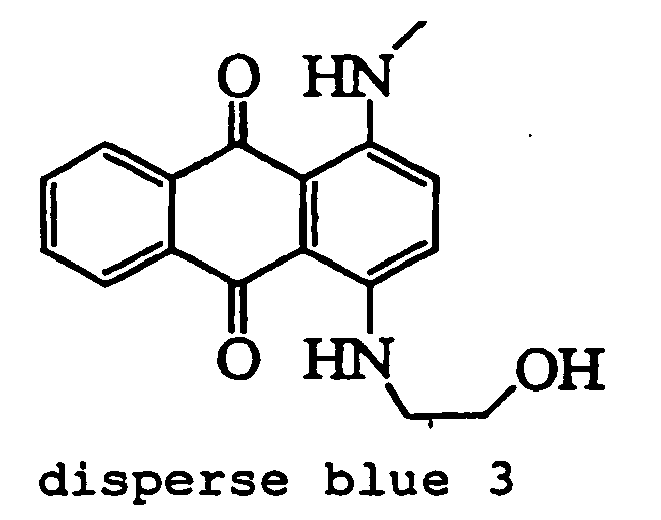
5.8 4.1 

5.8 4.8 - Experiment was repeated using polyester fleece fabric. The solvent dyes, solvent violet 13, solvent black 3, solvent red 24, solvent blue 35 and solvent blue 59 gave deltaE's of 6.2, 9.5, 15.8, 13.5 and 1.8 respectively. Again showing they all deposited to polyester fabric.
- To examine the sensitivity of deposition to formulation components the experiment of Example 2 was repeated, except different wash solutions were utilised as outlined below and 4.9ppm solvent violet 13 used in solution. In all experiments washes were also conducted without dye, the colour of the cloth compared using a reflectometer and expressed as deltaE. The results are shown below.
Wash conditions deltaE 0.3g/L SDS surfactant 7.0 0.3g/L SDS surfactant + 3g/L 8.3 NaCl 0.3g/L SDS surfactant + 3g/L 4.7 NaCl + pH adjusted to 10.5 using NaOH 0.3g/L SDS surfactant + 3g/L 4.2 NaCl + 0.5g/L 7EO nonionic surfactant 1.6g/L surfactant 5.5 - Dye was deposited to the polyester in all cases.
- The experiments of Example 1 was repeated using different levels of solvent violet 13 and solvent black 3 and a wash time of 45 minutes. The results are shown below. The shading effect expresses as deltaE builds up approximately linearly with amount of dye in this range.
Dye deltaE No dye 0.2 0.5 ppm solvent violet 13 0.5 2.0 ppm solvent violet 13 1.3 4.0 ppm solvent violet 13 3.3 0.9 ppm solvent black 3 1.0 1.9 ppm solvent black 3 2.0 - The experiments of Example 1 was repeated except 2.5 ppm solvent violet 13 was used and a liquor to cloth ratio of 30:1. After the wash the cloth was dried and the deltaE measured compared to cloth washed without dye. The process was the repeated 5 more times and the results shown below. The shading effect shading effect expresses as deltaE builds up approximately linearly with washes in this range.
Wash number deltaE 1 0.7 2 1.5 3 1.9 4 2.1 5 2.5 6 3.1 - This experiment in combination with Example 4 shows that very low levels of solvent violet 13 could be used in formulations and the shading effect allowed to build over a number of washes (5-40).
- The experiment of Example 1 was repeated except using a different selection and combination of dyes as shown in the table below. The cloth used was 1.4g of woven 50:50 polyester:cotton, washed in 100ml solution for 30 minutes. Polyester substantive and cotton substantive dyes may be used together to give bigger benefits.
Ppm dye Solvent violet 13 Direct Violet 51 deltaE 0 0 0.1 1 0 1.1 1 0.06 2.9 0 0.06 2.0
Claims (10)
- A laundry treatment composition comprising:between 0.0001 to 0.1 wt % of a hydrophobic dye for shading polyester;between 0.0001 to 0.1 wt % of one or more other dyes selected from cotton substantive shading dyes of the group consisting of: hydrolysed reactive dye; acid dye; and direct dye; and, between 2 to 60 wt % of a surfactant,wherein the acid dye is selected from a group consisting of:blue and violet acid dyes of structure
 red acid dyes of structure:
 acid dyes the following structures:
 the naphthyl is substituted by the two SO3- groups in one of the following selected orientations about ring: 7,8; 6,8; 5,8; 4,8; 3,8; 7,6; 7,5; 7,4; 7,3; 6,5; 6,4; 5,4; 5,3, and 4,3;B is an aryl group selected from phenyl and naphthyl, the aryl group substituted with a group independently selected from: one -NH2 group; one -NH-Ph group; one -N=N-C6H5; one - N=N-C10H7 group; one or more -OMe; and, one or more -Me;acid dyes of the following structures:
 X is selected from the group consisting of -OH and -NH2;R is selected from the group consisting of -CH3 and -OCH3;n is an integer selected from 0, 1 2 and 3; andone of the rings A, B and C is substituted by one sulphonate group; andwherein the direct dye is selected from the group consisting of: tris-azo direct blue dyes of the formula:
 bis-azo direct violet dyes of the formula:
- A laundry treatment composition according to claim 1, wherein the hydrophobic dye is an organic compounds with a maximum extinction coefficient greater than 1000 L/mol/cm in the wavelength range from 400 to 750 nm and uncharged in an aqueous solution having a pH in the range 7 to 11.
- A laundry treatment composition according to claim 2, wherein the hydrophobic dye has a maximum extinction coefficient in the wavelength range from 550 to 650 nm.
- A laundry treatment according to any preceding claim, wherein respective dyes individually substantive to cotton and polyester have respective peak absorption wavelength on cotton and polyester of from 550nm to 650nm.
- A laundry treatment according to claim 4, wherein the dye comprises a combination of dyes which together have the visual effect on the human eye as a single dye having a peak absorption wavelength on polyester and cotton of from 570nm to 630nm.
- A laundry treatment composition according to any preceding claim, wherein the chromophore of the hydrophobic dye is selected from the group consisting of: azo; and, anthraquinone, and the chromophore of the hydrolysed reactive dye is selected from the group consisting of: azo, anthraquinone, phthalocyanine, formazan and triphendioaxazine.
- A laundry treatment composition according to any preceding claim, wherein the hydrophobic dye is selected from: disperse blue 79, solvent black 3, solvent violet 13, solvent blue 59, solvent blue 35, solvent red 24, disperse red 1, disperse blue 3, and disperse blue 106.
- A laundry treatment composition according to any preceding claim, wherein the laundry treatment composition comprises from 0.005 to 2 wt % of a fluorescer.
- A method of treating a textile, the method comprising the steps of:(i) treating a textile with an aqueous solution of a hydrophobic dye, the aqueous solution comprising from 10 ppb to 1 ppm of the hydrophobic dye, from 10 ppb to 1 ppm of a second dye selected from the group consisting of: hydrolysed reactive dye; acid dye as defined in claim 1; and direct dye as defined in claim 1; and, from 0.2 g/L to 3 g/L of a surfactant; and,(ii) rinsing and drying the textile.
- A method of treating a textile according to claim 9, wherein the aqueous solution has an ionic strength from 0.001 to 0.5.
Priority Applications (1)
| Application Number | Priority Date | Filing Date | Title |
|---|---|---|---|
| PL05771913T PL1791940T3 (en) | 2004-09-23 | 2005-08-08 | Laundry treatment compositions |
Applications Claiming Priority (2)
| Application Number | Priority Date | Filing Date | Title |
|---|---|---|---|
| GBGB0421145.4A GB0421145D0 (en) | 2004-09-23 | 2004-09-23 | Laundry treatment compositions |
| PCT/EP2005/008629 WO2006032327A1 (en) | 2004-09-23 | 2005-08-08 | Laundry treatment compositions |
Publications (2)
| Publication Number | Publication Date |
|---|---|
| EP1791940A1 EP1791940A1 (en) | 2007-06-06 |
| EP1791940B1 true EP1791940B1 (en) | 2008-04-30 |
Family
ID=33397114
Family Applications (1)
| Application Number | Title | Priority Date | Filing Date |
|---|---|---|---|
| EP05771913A Expired - Lifetime EP1791940B1 (en) | 2004-09-23 | 2005-08-08 | Laundry treatment compositions |
Country Status (14)
| Country | Link |
|---|---|
| US (1) | US20080096789A1 (en) |
| EP (1) | EP1791940B1 (en) |
| CN (1) | CN101027383B (en) |
| AR (1) | AR050950A1 (en) |
| AT (1) | ATE393814T1 (en) |
| BR (2) | BRPI0515037B1 (en) |
| CA (1) | CA2575303A1 (en) |
| DE (1) | DE602005006428T2 (en) |
| ES (1) | ES2306191T3 (en) |
| GB (2) | GB0421145D0 (en) |
| MX (1) | MX2007003390A (en) |
| PL (1) | PL1791940T3 (en) |
| WO (1) | WO2006032327A1 (en) |
| ZA (1) | ZA200701619B (en) |
Families Citing this family (84)
| Publication number | Priority date | Publication date | Assignee | Title |
|---|---|---|---|---|
| CA2575589C (en) | 2004-09-23 | 2013-11-12 | Unilever Plc | Laundry treatment compositions comprising hydrophobic dyes |
| KR20080091339A (en) * | 2006-01-18 | 2008-10-10 | 시바 홀딩 인코포레이티드 | Processing method of fiber material |
| US20070191246A1 (en) | 2006-01-23 | 2007-08-16 | Sivik Mark R | Laundry care compositions with thiazolium dye |
| WO2007093303A1 (en) * | 2006-02-17 | 2007-08-23 | Unilever Plc | Laundry treatment compositions |
| JP2009527618A (en) * | 2006-08-10 | 2009-07-30 | ユニリーバー・ナームローゼ・ベンノートシヤープ | Shading composition |
| US7642282B2 (en) | 2007-01-19 | 2010-01-05 | Milliken & Company | Whitening agents for cellulosic substrates |
| US20080177089A1 (en) * | 2007-01-19 | 2008-07-24 | Eugene Steven Sadlowski | Novel whitening agents for cellulosic substrates |
| ES2372328T3 (en) * | 2007-01-26 | 2012-01-18 | Unilever N.V. | COMPOSITION OF MATIZED. |
| PL2188358T3 (en) * | 2007-09-08 | 2011-09-30 | Unilever Nv | Improvements relating to fabric conditioners |
| GB0717485D0 (en) | 2007-09-08 | 2007-10-17 | Unilever Plc | Improvements relating to fabric conditioners |
| BRPI0821869A2 (en) * | 2008-01-10 | 2015-07-28 | Unilever Nv | Fabric wash treatment composition and domestic method of treatment of fabrics |
| EP2169040B1 (en) | 2008-09-30 | 2012-04-11 | The Procter & Gamble Company | Liquid detergent compositions exhibiting two or multicolor effect |
| EP2169041A1 (en) | 2008-09-30 | 2010-03-31 | The Procter and Gamble Company | Liquid detergent compositions exhibiting two or multicolor effect |
| US8974546B2 (en) * | 2010-02-26 | 2015-03-10 | Whirlpool Corporation | Method for treating laundry in a clothes dryer |
| ES2617553T3 (en) * | 2010-10-14 | 2017-06-19 | Unilever N.V. | Laundry detergent particles |
| BR112013008992B1 (en) | 2010-10-14 | 2020-12-08 | Unilever N.V. | process for making coated detergent particles and process for coating extruded soluble surfactant particles |
| WO2012048947A1 (en) * | 2010-10-14 | 2012-04-19 | Unilever Plc | Laundry detergent particles |
| PL2627753T3 (en) * | 2010-10-14 | 2017-05-31 | Unilever N.V. | Laundry detergent particle |
| PH12013500624A1 (en) | 2010-10-14 | 2013-05-06 | Unilever Ip Holdings B V | Particulate detergent compositions comprising fluorescer |
| AU2011315791B2 (en) * | 2010-10-14 | 2014-03-06 | Unilever Plc | Laundry detergent particles |
| WO2012048950A1 (en) * | 2010-10-14 | 2012-04-19 | Unilever Plc | Laundry detergent particles |
| WO2012059363A1 (en) | 2010-11-01 | 2012-05-10 | Unilever Nv | A detergent composition having shading dyes and lipase |
| US8715368B2 (en) | 2010-11-12 | 2014-05-06 | The Procter & Gamble Company | Thiophene azo dyes and laundry care compositions containing the same |
| CN103562370B (en) | 2011-05-26 | 2016-08-17 | 荷兰联合利华有限公司 | laundry detergent composition |
| MX2013014021A (en) | 2011-06-03 | 2014-01-23 | Procter & Gamble | Laundry care compositions containing dyes. |
| US9163146B2 (en) | 2011-06-03 | 2015-10-20 | Milliken & Company | Thiophene azo carboxylate dyes and laundry care compositions containing the same |
| US20140371435A9 (en) | 2011-06-03 | 2014-12-18 | Eduardo Torres | Laundry Care Compositions Containing Thiophene Azo Dyes |
| US8888865B2 (en) | 2011-06-03 | 2014-11-18 | The Procter & Gamble Company | Thiophene azo carboxylate dyes and laundry care compositions containing the same |
| WO2013011071A1 (en) | 2011-07-21 | 2013-01-24 | Unilever Plc | Liquid laundry composition |
| DE102011080099A1 (en) | 2011-07-29 | 2013-01-31 | Henkel Ag & Co. Kgaa | Washing or cleaning agent with electrochemically activatable mediator compound |
| US9796952B2 (en) | 2012-09-25 | 2017-10-24 | The Procter & Gamble Company | Laundry care compositions with thiazolium dye |
| US9702074B2 (en) | 2013-03-15 | 2017-07-11 | Whirlpool Corporation | Methods and compositions for treating laundry items |
| US10011935B2 (en) | 2013-03-15 | 2018-07-03 | Whirlpool Corporation | Methods and compositions for treating laundry items |
| EP2899260A1 (en) | 2014-01-22 | 2015-07-29 | Unilever PLC | Process to manufacture a liquid detergent formulation |
| DE102014016675B4 (en) * | 2014-11-12 | 2022-02-24 | Brauns-Heitmann Gmbh & Co. Kg | Detergent composition, use thereof and detergent portion |
| EP3303535B1 (en) | 2015-05-27 | 2018-10-03 | Unilever PLC | Laundry detergent composition |
| BR112017025607B1 (en) | 2015-06-02 | 2022-08-30 | Unilever Ip Holdings B.V. | DETERGENT COMPOSITION FOR WASHING CLOTHES AND DOMESTIC FABRIC TREATMENT METHOD |
| BR112018006212B1 (en) | 2015-10-01 | 2022-04-12 | Unilever Ip Holdings B.V. | Powder detergent composition formed by phosphate-free carbonate and method of domestic treatment of a fabric |
| BR112018016129B1 (en) | 2016-02-17 | 2022-06-07 | Unilever Ip Holdings B.V. | Detergent composition for washing clothes and domestic method of treating a fabric |
| CN108603140B (en) | 2016-02-17 | 2020-09-08 | 荷兰联合利华有限公司 | whitening composition |
| AU2017267050B2 (en) | 2016-05-17 | 2020-03-05 | Unilever Global Ip Limited | Liquid laundry detergent compositions |
| ES2985315T3 (en) | 2016-05-17 | 2024-11-05 | Unilever Ip Holdings B V | Liquid detergent compositions for laundry |
| CN109790491B (en) | 2016-09-27 | 2021-02-23 | 荷兰联合利华有限公司 | Household washing method |
| CN109844083B (en) | 2016-10-18 | 2021-11-09 | 联合利华知识产权控股有限公司 | Whitening composition |
| EP3649221B8 (en) | 2017-07-07 | 2024-05-29 | Unilever IP Holdings B.V. | Laundry cleaning composition |
| WO2019008036A1 (en) | 2017-07-07 | 2019-01-10 | Unilever Plc | Whitening composition |
| EP3717616B1 (en) | 2017-11-30 | 2021-10-13 | Unilever IP Holdings B.V. | Detergent composition comprising protease |
| JP2021515820A (en) | 2018-02-23 | 2021-06-24 | ユニリーバー・ナームローゼ・ベンノートシヤープ | Molding detergent product composition containing aminopolycarboxylate |
| EP3775121B1 (en) | 2018-04-03 | 2021-11-17 | Unilever Global IP Limited | Dye granule |
| BR112020023123A2 (en) | 2018-05-17 | 2021-02-02 | Unilever N.V. | cleaning composition and domestic method to treat a fabric |
| EP3775127B1 (en) | 2018-05-17 | 2022-07-20 | Unilever IP Holdings B.V. | Cleaning composition |
| WO2020016097A1 (en) | 2018-07-17 | 2020-01-23 | Unilever Plc | Use of a rhamnolipid in a surfactant system |
| WO2020058024A1 (en) | 2018-09-17 | 2020-03-26 | Unilever Plc | Detergent composition |
| CN113056548B (en) | 2018-11-20 | 2023-05-02 | 联合利华知识产权控股有限公司 | Detergent composition |
| WO2020104158A1 (en) | 2018-11-20 | 2020-05-28 | Unilever Plc | Detergent composition |
| WO2020104155A1 (en) | 2018-11-20 | 2020-05-28 | Unilever Plc | Detergent composition |
| EP3884026B1 (en) | 2018-11-20 | 2024-06-26 | Unilever Global Ip Limited | Detergent composition |
| WO2020104156A1 (en) | 2018-11-20 | 2020-05-28 | Unilever Plc | Detergent composition |
| EP3750978A1 (en) | 2019-06-12 | 2020-12-16 | Unilever N.V. | Laundry detergent composition |
| EP3750979A1 (en) | 2019-06-12 | 2020-12-16 | Unilever N.V. | Use of laundry detergent composition |
| WO2020260038A1 (en) | 2019-06-28 | 2020-12-30 | Unilever Plc | Detergent composition |
| US20220372408A1 (en) | 2019-06-28 | 2022-11-24 | Conopco, Inc., D/B/A Unilever | Detergent composition |
| WO2020259947A1 (en) | 2019-06-28 | 2020-12-30 | Unilever Plc | Detergent composition |
| CN114008184B (en) | 2019-06-28 | 2024-12-06 | 联合利华知识产权控股有限公司 | Detergent composition |
| WO2020259948A1 (en) | 2019-06-28 | 2020-12-30 | Unilever Plc | Detergent composition |
| WO2020260006A1 (en) | 2019-06-28 | 2020-12-30 | Unilever Plc | Detergent compositions |
| EP4017956B1 (en) | 2019-08-21 | 2023-03-15 | Unilever IP Holdings B.V. | Detergent solid composition |
| CN114364776A (en) | 2019-09-02 | 2022-04-15 | 联合利华知识产权控股有限公司 | detergent composition |
| AR120142A1 (en) | 2019-10-07 | 2022-02-02 | Unilever Nv | DETERGENT COMPOSITION |
| BR112022018393A2 (en) | 2020-03-19 | 2022-11-08 | Unilever Ip Holdings B V | METHOD AND USE OF SAPONIN TO INHIBIT LIPASE ACTIVITY IN A DETERGENT COMPOSITION |
| WO2021185956A1 (en) | 2020-03-19 | 2021-09-23 | Unilever Ip Holdings B.V. | Detergent composition |
| CN115698246A (en) | 2020-06-08 | 2023-02-03 | 联合利华知识产权控股有限公司 | Methods for Improving Protease Activity |
| WO2022023250A1 (en) | 2020-07-27 | 2022-02-03 | Unilever Ip Holdings B.V. | Use of an enzyme and surfactant for inhibiting microorganisms |
| WO2022043138A1 (en) | 2020-08-28 | 2022-03-03 | Unilever Ip Holdings B.V. | Surfactant and detergent composition |
| EP4204526B1 (en) | 2020-08-28 | 2024-04-24 | Unilever IP Holdings B.V. | Surfactant and detergent composition |
| WO2022043042A1 (en) | 2020-08-28 | 2022-03-03 | Unilever Ip Holdings B.V. | Detergent composition |
| WO2022042977A1 (en) | 2020-08-28 | 2022-03-03 | Unilever Ip Holdings B.V. | Detergent composition |
| CN116018396B (en) | 2020-08-28 | 2024-11-12 | 联合利华知识产权控股有限公司 | Detergent composition |
| CN116583583B (en) | 2020-12-17 | 2026-02-13 | 联合利华知识产权控股有限公司 | Uses and cleaning compositions |
| WO2022128781A1 (en) | 2020-12-17 | 2022-06-23 | Unilever Ip Holdings B.V. | Cleaning composition |
| BR112023026713A2 (en) | 2021-06-24 | 2024-03-12 | Unilever Ip Holdings B V | UNIT DOSE CLEANING COMPOSITION |
| EP4405450B1 (en) | 2021-09-20 | 2025-01-29 | Unilever IP Holdings B.V. | Detergent composition |
| US20240327754A1 (en) | 2021-10-21 | 2024-10-03 | Conopco, Inc., D/B/A Unilever | Detergent compositions |
| WO2023144071A1 (en) | 2022-01-28 | 2023-08-03 | Unilever Ip Holdings B.V. | Laundry composition |
Family Cites Families (26)
| Publication number | Priority date | Publication date | Assignee | Title |
|---|---|---|---|---|
| US3186155A (en) * | 1957-11-22 | 1965-06-01 | Du Pont | Textile product of synthetic organic filaments having randomly varying twist along each filament |
| US3172723A (en) * | 1959-12-09 | 1965-03-09 | Filamentary material | |
| US3215486A (en) * | 1962-04-17 | 1965-11-02 | Toyo Spinning Co Ltd | Fixation of polypropylene fibers impregnated with dyestuffs and other treating agents |
| US3415904A (en) * | 1964-08-13 | 1968-12-10 | Sumitomo Chemical Co | Polyolefin composition comprising an amine treated ethylene/acrylic ester copolymer and a poly-alpha-olefin |
| US3584991A (en) * | 1966-09-30 | 1971-06-15 | Celanese Corp | Disperse dyeing of cellulose triacetate fiber blends |
| BE786772A (en) * | 1971-07-26 | 1973-01-26 | Dow Chemical Co | SYNTHETIC FIBERS AND METHOD FOR TREATING |
| US3755201A (en) * | 1971-07-26 | 1973-08-28 | Colgate Palmolive Co | Laundry product containing mixed dye bluing agents |
| CH1626071A4 (en) * | 1971-11-09 | 1974-03-15 | ||
| US3841831A (en) * | 1972-11-29 | 1974-10-15 | Cpc International Inc | Process for dyeing polyester fiber |
| US3958928A (en) * | 1975-05-05 | 1976-05-25 | Lever Brothers Company | Reduced-staining colorant system for liquid laundry detergents |
| US4197087A (en) * | 1975-12-29 | 1980-04-08 | Daido-Maruta Finishing Co. Ltd. | Liquid type dye preparations |
| US4283197A (en) * | 1979-03-29 | 1981-08-11 | Ciba-Geigy Corporation | Process for whitening polyester fibres by the exhaust method |
| US4454146A (en) * | 1982-05-14 | 1984-06-12 | Lever Brothers Company | Synergistic preservative compositions |
| US4494957A (en) * | 1982-05-17 | 1985-01-22 | Research Association Of Synethtic Dyestuffs | Dye compositions for polyester fibers |
| WO1985003959A1 (en) * | 1984-02-27 | 1985-09-12 | Robert Buchanan Wilson | Dye composition and method of use thereof for coloring thermoplastic materials |
| LU85564A1 (en) * | 1984-10-01 | 1986-06-11 | Oreal | NOVEL KERATINIC FIBER DYEING COMPOSITIONS CONTAINING AN AZO DYE, PROCESS FOR PREPARING THE SAME AND IMPLEMENTING SAID COMPOSITIONS FOR DYEING KERATINIC FIBERS |
| US5013361A (en) * | 1985-01-23 | 1991-05-07 | The Gillette Company | Ball-point writing instrument containing an aqueous ink composition |
| US4728453A (en) * | 1987-01-13 | 1988-03-01 | The Clorox Company | Timed-release bleach coated with an inorganic salt and an amine with reduced dye damage |
| US5049311A (en) * | 1987-02-20 | 1991-09-17 | Witco Corporation | Alkoxylated alkyl substituted phenol sulfonates compounds and compositions, the preparation thereof and their use in various applications |
| US4800037A (en) * | 1987-06-05 | 1989-01-24 | Lever Brothers Company | Process for making a heavy duty liquid detergent composition |
| US5631352A (en) * | 1994-06-20 | 1997-05-20 | Ciba-Geigy Corporation | Azodyes containing a bridge member based on diamino-substituted triazines |
| AU1143401A (en) * | 1999-10-29 | 2001-05-14 | Ciba Specialty Chemicals Holding Inc. | Process for the preparation of solutions of anionic organic compounds |
| EP1209281A3 (en) * | 2000-11-27 | 2003-08-27 | Carl Freudenberg KG | Dyed or printed nonwoven |
| US6521581B1 (en) * | 2001-12-14 | 2003-02-18 | Unilever Home & Personal Care Usa, Division Of Conopco, Inc. | Water-soluble package with multiple distinctly colored layers of liquid laundry detergent |
| GB0314210D0 (en) * | 2003-06-18 | 2003-07-23 | Unilever Plc | Laundry treatment compositions |
| BRPI0412669B1 (en) * | 2003-08-06 | 2015-11-24 | Ciba Sc Holding Ag | shading composition, granular and detergent formulations, and fabric softener composition |
-
2004
- 2004-09-23 GB GBGB0421145.4A patent/GB0421145D0/en not_active Ceased
- 2004-11-22 GB GBGB0425580.8A patent/GB0425580D0/en not_active Ceased
-
2005
- 2005-08-08 DE DE602005006428T patent/DE602005006428T2/en not_active Expired - Lifetime
- 2005-08-08 BR BRPI0515037-0A patent/BRPI0515037B1/en not_active IP Right Cessation
- 2005-08-08 CA CA002575303A patent/CA2575303A1/en not_active Withdrawn
- 2005-08-08 WO PCT/EP2005/008629 patent/WO2006032327A1/en not_active Ceased
- 2005-08-08 PL PL05771913T patent/PL1791940T3/en unknown
- 2005-08-08 MX MX2007003390A patent/MX2007003390A/en active IP Right Grant
- 2005-08-08 EP EP05771913A patent/EP1791940B1/en not_active Expired - Lifetime
- 2005-08-08 ES ES05771913T patent/ES2306191T3/en not_active Expired - Lifetime
- 2005-08-08 ZA ZA200701619A patent/ZA200701619B/en unknown
- 2005-08-08 AT AT05771913T patent/ATE393814T1/en not_active IP Right Cessation
- 2005-08-08 CN CN2005800314224A patent/CN101027383B/en not_active Expired - Lifetime
- 2005-08-08 US US11/663,575 patent/US20080096789A1/en not_active Abandoned
- 2005-09-05 BR BRPI0517852-5A patent/BRPI0517852A/en not_active Application Discontinuation
- 2005-09-26 AR ARP050103997A patent/AR050950A1/en active IP Right Grant
Also Published As
| Publication number | Publication date |
|---|---|
| ES2306191T3 (en) | 2008-11-01 |
| CN101027383A (en) | 2007-08-29 |
| US20080096789A1 (en) | 2008-04-24 |
| ZA200701619B (en) | 2008-07-30 |
| PL1791940T3 (en) | 2008-10-31 |
| BRPI0517852A (en) | 2008-10-21 |
| BRPI0515037A (en) | 2008-07-01 |
| DE602005006428T2 (en) | 2009-06-04 |
| GB0425580D0 (en) | 2004-12-22 |
| CA2575303A1 (en) | 2006-03-30 |
| ATE393814T1 (en) | 2008-05-15 |
| EP1791940A1 (en) | 2007-06-06 |
| BRPI0515037B1 (en) | 2015-06-30 |
| DE602005006428D1 (en) | 2008-06-12 |
| AR050950A1 (en) | 2006-12-06 |
| WO2006032327A1 (en) | 2006-03-30 |
| CN101027383B (en) | 2011-04-27 |
| MX2007003390A (en) | 2007-05-07 |
| GB0421145D0 (en) | 2004-10-27 |
Similar Documents
| Publication | Publication Date | Title |
|---|---|---|
| US20080096789A1 (en) | Laundry Treatment Composition | |
| US10106762B2 (en) | Treating a textile garment with a hydrophobic dye solution | |
| EP2009088B1 (en) | Laundry treatment compositions | |
| EP1945747B1 (en) | Shading composition | |
| EP1794274B1 (en) | Laundry treatment compositions | |
| EP2440645B1 (en) | Cationic dye polymers | |
| EP1984485B1 (en) | Laundry treatment compositions | |
| EP2227534B1 (en) | Shading composition | |
| WO2006021285A1 (en) | Shading dyes |
Legal Events
| Date | Code | Title | Description |
|---|---|---|---|
| PUAI | Public reference made under article 153(3) epc to a published international application that has entered the european phase |
Free format text: ORIGINAL CODE: 0009012 |
|
| 17P | Request for examination filed |
Effective date: 20070124 |
|
| AK | Designated contracting states |
Kind code of ref document: A1 Designated state(s): AT BE BG CH CY CZ DE DK EE ES FI FR GB GR HU IE IS IT LI LT LU LV MC NL PL PT RO SE SI SK TR |
|
| GRAP | Despatch of communication of intention to grant a patent |
Free format text: ORIGINAL CODE: EPIDOSNIGR1 |
|
| GRAC | Information related to communication of intention to grant a patent modified |
Free format text: ORIGINAL CODE: EPIDOSCIGR1 |
|
| DAX | Request for extension of the european patent (deleted) | ||
| GRAS | Grant fee paid |
Free format text: ORIGINAL CODE: EPIDOSNIGR3 |
|
| GRAA | (expected) grant |
Free format text: ORIGINAL CODE: 0009210 |
|
| AK | Designated contracting states |
Kind code of ref document: B1 Designated state(s): AT BE BG CH CY CZ DE DK EE ES FI FR GB GR HU IE IS IT LI LT LU LV MC NL PL PT RO SE SI SK TR |
|
| REG | Reference to a national code |
Ref country code: GB Ref legal event code: FG4D |
|
| REG | Reference to a national code |
Ref country code: CH Ref legal event code: EP |
|
| REG | Reference to a national code |
Ref country code: IE Ref legal event code: FG4D Free format text: LANGUAGE OF EP DOCUMENT: FRENCH |
|
| REF | Corresponds to: |
Ref document number: 602005006428 Country of ref document: DE Date of ref document: 20080612 Kind code of ref document: P |
|
| PG25 | Lapsed in a contracting state [announced via postgrant information from national office to epo] |
Ref country code: SI Free format text: LAPSE BECAUSE OF FAILURE TO SUBMIT A TRANSLATION OF THE DESCRIPTION OR TO PAY THE FEE WITHIN THE PRESCRIBED TIME-LIMIT Effective date: 20080430 |
|
| NLV1 | Nl: lapsed or annulled due to failure to fulfill the requirements of art. 29p and 29m of the patents act | ||
| PG25 | Lapsed in a contracting state [announced via postgrant information from national office to epo] |
Ref country code: PT Free format text: LAPSE BECAUSE OF FAILURE TO SUBMIT A TRANSLATION OF THE DESCRIPTION OR TO PAY THE FEE WITHIN THE PRESCRIBED TIME-LIMIT Effective date: 20080930 Ref country code: BG Free format text: LAPSE BECAUSE OF FAILURE TO SUBMIT A TRANSLATION OF THE DESCRIPTION OR TO PAY THE FEE WITHIN THE PRESCRIBED TIME-LIMIT Effective date: 20080730 Ref country code: NL Free format text: LAPSE BECAUSE OF FAILURE TO SUBMIT A TRANSLATION OF THE DESCRIPTION OR TO PAY THE FEE WITHIN THE PRESCRIBED TIME-LIMIT Effective date: 20080430 Ref country code: FI Free format text: LAPSE BECAUSE OF FAILURE TO SUBMIT A TRANSLATION OF THE DESCRIPTION OR TO PAY THE FEE WITHIN THE PRESCRIBED TIME-LIMIT Effective date: 20080430 |
|
| REG | Reference to a national code |
Ref country code: PL Ref legal event code: T3 |
|
| REG | Reference to a national code |
Ref country code: ES Ref legal event code: FG2A Ref document number: 2306191 Country of ref document: ES Kind code of ref document: T3 |
|
| PG25 | Lapsed in a contracting state [announced via postgrant information from national office to epo] |
Ref country code: LV Free format text: LAPSE BECAUSE OF FAILURE TO SUBMIT A TRANSLATION OF THE DESCRIPTION OR TO PAY THE FEE WITHIN THE PRESCRIBED TIME-LIMIT Effective date: 20080430 Ref country code: AT Free format text: LAPSE BECAUSE OF FAILURE TO SUBMIT A TRANSLATION OF THE DESCRIPTION OR TO PAY THE FEE WITHIN THE PRESCRIBED TIME-LIMIT Effective date: 20080430 |
|
| REG | Reference to a national code |
Ref country code: HU Ref legal event code: AG4A Ref document number: E003722 Country of ref document: HU |
|
| PG25 | Lapsed in a contracting state [announced via postgrant information from national office to epo] |
Ref country code: IS Free format text: LAPSE BECAUSE OF FAILURE TO SUBMIT A TRANSLATION OF THE DESCRIPTION OR TO PAY THE FEE WITHIN THE PRESCRIBED TIME-LIMIT Effective date: 20080830 |
|
| ET | Fr: translation filed | ||
| PG25 | Lapsed in a contracting state [announced via postgrant information from national office to epo] |
Ref country code: DK Free format text: LAPSE BECAUSE OF FAILURE TO SUBMIT A TRANSLATION OF THE DESCRIPTION OR TO PAY THE FEE WITHIN THE PRESCRIBED TIME-LIMIT Effective date: 20080430 Ref country code: LT Free format text: LAPSE BECAUSE OF FAILURE TO SUBMIT A TRANSLATION OF THE DESCRIPTION OR TO PAY THE FEE WITHIN THE PRESCRIBED TIME-LIMIT Effective date: 20080430 Ref country code: SE Free format text: LAPSE BECAUSE OF FAILURE TO SUBMIT A TRANSLATION OF THE DESCRIPTION OR TO PAY THE FEE WITHIN THE PRESCRIBED TIME-LIMIT Effective date: 20080731 Ref country code: CZ Free format text: LAPSE BECAUSE OF FAILURE TO SUBMIT A TRANSLATION OF THE DESCRIPTION OR TO PAY THE FEE WITHIN THE PRESCRIBED TIME-LIMIT Effective date: 20080430 |
|
| PG25 | Lapsed in a contracting state [announced via postgrant information from national office to epo] |
Ref country code: SK Free format text: LAPSE BECAUSE OF FAILURE TO SUBMIT A TRANSLATION OF THE DESCRIPTION OR TO PAY THE FEE WITHIN THE PRESCRIBED TIME-LIMIT Effective date: 20080430 Ref country code: RO Free format text: LAPSE BECAUSE OF FAILURE TO SUBMIT A TRANSLATION OF THE DESCRIPTION OR TO PAY THE FEE WITHIN THE PRESCRIBED TIME-LIMIT Effective date: 20080430 |
|
| PLBE | No opposition filed within time limit |
Free format text: ORIGINAL CODE: 0009261 |
|
| STAA | Information on the status of an ep patent application or granted ep patent |
Free format text: STATUS: NO OPPOSITION FILED WITHIN TIME LIMIT |
|
| PG25 | Lapsed in a contracting state [announced via postgrant information from national office to epo] |
Ref country code: MC Free format text: LAPSE BECAUSE OF NON-PAYMENT OF DUE FEES Effective date: 20080831 |
|
| 26N | No opposition filed |
Effective date: 20090202 |
|
| PG25 | Lapsed in a contracting state [announced via postgrant information from national office to epo] |
Ref country code: EE Free format text: LAPSE BECAUSE OF FAILURE TO SUBMIT A TRANSLATION OF THE DESCRIPTION OR TO PAY THE FEE WITHIN THE PRESCRIBED TIME-LIMIT Effective date: 20080430 |
|
| REG | Reference to a national code |
Ref country code: IE Ref legal event code: MM4A |
|
| PG25 | Lapsed in a contracting state [announced via postgrant information from national office to epo] |
Ref country code: IE Free format text: LAPSE BECAUSE OF NON-PAYMENT OF DUE FEES Effective date: 20080808 |
|
| REG | Reference to a national code |
Ref country code: CH Ref legal event code: PL |
|
| PG25 | Lapsed in a contracting state [announced via postgrant information from national office to epo] |
Ref country code: CH Free format text: LAPSE BECAUSE OF NON-PAYMENT OF DUE FEES Effective date: 20090831 Ref country code: LI Free format text: LAPSE BECAUSE OF NON-PAYMENT OF DUE FEES Effective date: 20090831 |
|
| PG25 | Lapsed in a contracting state [announced via postgrant information from national office to epo] |
Ref country code: CY Free format text: LAPSE BECAUSE OF FAILURE TO SUBMIT A TRANSLATION OF THE DESCRIPTION OR TO PAY THE FEE WITHIN THE PRESCRIBED TIME-LIMIT Effective date: 20080430 Ref country code: LU Free format text: LAPSE BECAUSE OF NON-PAYMENT OF DUE FEES Effective date: 20080808 |
|
| PG25 | Lapsed in a contracting state [announced via postgrant information from national office to epo] |
Ref country code: GR Free format text: LAPSE BECAUSE OF FAILURE TO SUBMIT A TRANSLATION OF THE DESCRIPTION OR TO PAY THE FEE WITHIN THE PRESCRIBED TIME-LIMIT Effective date: 20080731 |
|
| REG | Reference to a national code |
Ref country code: FR Ref legal event code: PLFP Year of fee payment: 12 |
|
| PGFP | Annual fee paid to national office [announced via postgrant information from national office to epo] |
Ref country code: IT Payment date: 20160823 Year of fee payment: 12 |
|
| PGFP | Annual fee paid to national office [announced via postgrant information from national office to epo] |
Ref country code: HU Payment date: 20160823 Year of fee payment: 12 |
|
| PGFP | Annual fee paid to national office [announced via postgrant information from national office to epo] |
Ref country code: PL Payment date: 20160729 Year of fee payment: 12 |
|
| REG | Reference to a national code |
Ref country code: FR Ref legal event code: PLFP Year of fee payment: 13 |
|
| PG25 | Lapsed in a contracting state [announced via postgrant information from national office to epo] |
Ref country code: HU Free format text: LAPSE BECAUSE OF NON-PAYMENT OF DUE FEES Effective date: 20170809 |
|
| REG | Reference to a national code |
Ref country code: FR Ref legal event code: PLFP Year of fee payment: 14 |
|
| PG25 | Lapsed in a contracting state [announced via postgrant information from national office to epo] |
Ref country code: IT Free format text: LAPSE BECAUSE OF NON-PAYMENT OF DUE FEES Effective date: 20170808 |
|
| PG25 | Lapsed in a contracting state [announced via postgrant information from national office to epo] |
Ref country code: PL Free format text: LAPSE BECAUSE OF NON-PAYMENT OF DUE FEES Effective date: 20170808 |
|
| REG | Reference to a national code |
Ref country code: BE Ref legal event code: PD Owner name: UNILEVER IP HOLDINGS B.V.; NL Free format text: DETAILS ASSIGNMENT: CHANGE OF OWNER(S), ASSIGNMENT; FORMER OWNER NAME: UNILEVER N.V. Effective date: 20210607 |
|
| REG | Reference to a national code |
Ref country code: DE Ref legal event code: R081 Ref document number: 602005006428 Country of ref document: DE Owner name: UNILEVER GLOBAL IP LIMITED, WIRRAL, GB Free format text: FORMER OWNER: UNILEVER N.V., ROTTERDAM, NL |
|
| REG | Reference to a national code |
Ref country code: ES Ref legal event code: PC2A Owner name: UNILEVER IP HOLDINGS B.V. Effective date: 20211117 |
|
| PGFP | Annual fee paid to national office [announced via postgrant information from national office to epo] |
Ref country code: DE Payment date: 20210819 Year of fee payment: 17 Ref country code: BE Payment date: 20210819 Year of fee payment: 17 |
|
| PGFP | Annual fee paid to national office [announced via postgrant information from national office to epo] |
Ref country code: ES Payment date: 20211025 Year of fee payment: 17 |
|
| REG | Reference to a national code |
Ref country code: GB Ref legal event code: 732E Free format text: REGISTERED BETWEEN 20220203 AND 20220209 |
|
| REG | Reference to a national code |
Ref country code: DE Ref legal event code: R119 Ref document number: 602005006428 Country of ref document: DE |
|
| REG | Reference to a national code |
Ref country code: BE Ref legal event code: MM Effective date: 20220831 |
|
| PG25 | Lapsed in a contracting state [announced via postgrant information from national office to epo] |
Ref country code: DE Free format text: LAPSE BECAUSE OF NON-PAYMENT OF DUE FEES Effective date: 20230301 |
|
| REG | Reference to a national code |
Ref country code: ES Ref legal event code: FD2A Effective date: 20230926 |
|
| PG25 | Lapsed in a contracting state [announced via postgrant information from national office to epo] |
Ref country code: BE Free format text: LAPSE BECAUSE OF NON-PAYMENT OF DUE FEES Effective date: 20220831 |
|
| PG25 | Lapsed in a contracting state [announced via postgrant information from national office to epo] |
Ref country code: ES Free format text: LAPSE BECAUSE OF NON-PAYMENT OF DUE FEES Effective date: 20220809 |
|
| PGFP | Annual fee paid to national office [announced via postgrant information from national office to epo] |
Ref country code: TR Payment date: 20230804 Year of fee payment: 19 |
|
| PGFP | Annual fee paid to national office [announced via postgrant information from national office to epo] |
Ref country code: GB Payment date: 20240823 Year of fee payment: 20 |
|
| PGFP | Annual fee paid to national office [announced via postgrant information from national office to epo] |
Ref country code: FR Payment date: 20240828 Year of fee payment: 20 |
|
| REG | Reference to a national code |
Ref country code: GB Ref legal event code: PE20 Expiry date: 20250807 |