EP1790930B1 - Method for the control and command of a kiln for the burning of lumped material and the relative kiln - Google Patents
Method for the control and command of a kiln for the burning of lumped material and the relative kiln Download PDFInfo
- Publication number
- EP1790930B1 EP1790930B1 EP05425847A EP05425847A EP1790930B1 EP 1790930 B1 EP1790930 B1 EP 1790930B1 EP 05425847 A EP05425847 A EP 05425847A EP 05425847 A EP05425847 A EP 05425847A EP 1790930 B1 EP1790930 B1 EP 1790930B1
- Authority
- EP
- European Patent Office
- Prior art keywords
- kiln
- control
- weighing
- command
- zone
- Prior art date
- Legal status (The legal status is an assumption and is not a legal conclusion. Google has not performed a legal analysis and makes no representation as to the accuracy of the status listed.)
- Expired - Lifetime
Links
Images


Classifications
-
- C—CHEMISTRY; METALLURGY
- C04—CEMENTS; CONCRETE; ARTIFICIAL STONE; CERAMICS; REFRACTORIES
- C04B—LIME, MAGNESIA; SLAG; CEMENTS; COMPOSITIONS THEREOF, e.g. MORTARS, CONCRETE OR LIKE BUILDING MATERIALS; ARTIFICIAL STONE; CERAMICS; REFRACTORIES; TREATMENT OF NATURAL STONE
- C04B7/00—Hydraulic cements
- C04B7/36—Manufacture of hydraulic cements in general
- C04B7/361—Condition or time responsive control in hydraulic cement manufacturing processes
-
- C—CHEMISTRY; METALLURGY
- C04—CEMENTS; CONCRETE; ARTIFICIAL STONE; CERAMICS; REFRACTORIES
- C04B—LIME, MAGNESIA; SLAG; CEMENTS; COMPOSITIONS THEREOF, e.g. MORTARS, CONCRETE OR LIKE BUILDING MATERIALS; ARTIFICIAL STONE; CERAMICS; REFRACTORIES; TREATMENT OF NATURAL STONE
- C04B2/00—Lime, magnesia or dolomite
- C04B2/10—Preheating, burning calcining or cooling
-
- F—MECHANICAL ENGINEERING; LIGHTING; HEATING; WEAPONS; BLASTING
- F27—FURNACES; KILNS; OVENS; RETORTS
- F27B—FURNACES, KILNS, OVENS OR RETORTS IN GENERAL; OPEN SINTERING OR LIKE APPARATUS
- F27B1/00—Shaft or like vertical or substantially vertical furnaces
- F27B1/10—Details, accessories or equipment specially adapted for furnaces of these types
- F27B1/26—Arrangements of controlling devices
-
- F—MECHANICAL ENGINEERING; LIGHTING; HEATING; WEAPONS; BLASTING
- F27—FURNACES; KILNS; OVENS; RETORTS
- F27D—DETAILS OR ACCESSORIES OF FURNACES, KILNS, OVENS OR RETORTS, IN SO FAR AS THEY ARE OF KINDS OCCURRING IN MORE THAN ONE KIND OF FURNACE
- F27D19/00—Arrangements of controlling devices
-
- F—MECHANICAL ENGINEERING; LIGHTING; HEATING; WEAPONS; BLASTING
- F27—FURNACES; KILNS; OVENS; RETORTS
- F27D—DETAILS OR ACCESSORIES OF FURNACES, KILNS, OVENS OR RETORTS, IN SO FAR AS THEY ARE OF KINDS OCCURRING IN MORE THAN ONE KIND OF FURNACE
- F27D21/00—Arrangement of monitoring devices; Arrangement of safety devices
- F27D21/0035—Devices for monitoring the weight of quantities added to the charge
Definitions
- the present invention refers to a method for the control and command of a kiln for the burning of lumped material.
- the invention is about a method of control and command of a kiln for the burning and the sintering of lumped material, such as limestone, dolomite and similar, that permits a deep control of the quantity and quality of the burnt material.
- the lime kilns always need better and better control systems to monitor the production quantity and moreover the products quality in order to produce lime with characteristics of purity and/or reactivity suitable to meet the different needs of the lime, paper, steel, chemical, minerals, sugar, bauxite, agricultural and building industries.
- the production of lime derives from the well known burning process (calcination) of natural limestone CaCO 3 to obtain lime CaO thanks to the reaction: CaCO 3 + heat -> CaO + CO 2
- shaft kilns with circular, semicircular, elliptical, square or rectangular section, a double shaft kiln, regenerative kiln or annular kiln.
- the limestone, dolomite or similar lumped materials are charged from the top of a kiln that extends along a longitudinal axis almost vertical.
- the material passes from the top to the bottom through a pre-heating zone, a calcination zone included between two or three levels of burners, a post-calcination zone, a cooling zone and a discharging zone of the calcined material.
- the quantity and quality of the lime that is obtained come from the different steps of treatment that the lumped material undergoes in the different zones inside the kiln. It is therefore important to check the operating conditions of the kiln in the best possible way in order to be able to effective operate in case of anomalies in the production process and to grant a constant quantity and quality of the final product.
- the problem at the basis of this invention is therefore in general that to provide a method of control and command a kiln for the burning of lumped materials that permits to check the quantity and the quality of the final product.
- a first object of the invention is that to provide a method of control and command of a kiln for the burning of lumped material.
- a second object of the invention is a kiln for the burning of lumped material that permits to check the production of the materials for the above mentioned fields.
- the basic idea of this invention is to design a method that permits to control in an easy, constant and automatic way the quantity and/or quality of the final product obtained from the burning of the lumped materials.
- the quantity of the burnt product can change a lot in a specific period of time in relation with the different conditions of the kiln, such as the charging of the material to be burnt, the residence time at the different treatment zones, the efficiency of the combustion reaction and others more.
- the quality of the final product can also appreciable vary according to the degree of burning of the raw materials.
- the material can be exposed to a not uniform thermal treatment along the whole path in the kiln, so that final products can be obtained with variable quantities of the components.
- some zones of the kiln can be influenced by the winds that cool down the external wall of the kiln. In this case, in this specific zone the combustion temperature may decrease, even a lot.
- the lime should have been subjected to a lower calcination process in the zone influenced by the wind compared to the other one. In other words, In the zone influenced by the winds the limestone material will have lost less components compared to the protected one. It is obvious that the lime coming from the zone of the kin influenced by the winds will have an higher weight compared to the opposite zone because the lime will contain an higher quantity of residual components (specifically higher quantity of CaCO 3 ).
- step c) In general, if the value of the step c) would be higher than the prefixed value for the comparison, a visual monitoring and/or an intervention for maintenance, correction directly on the kiln regulation shall be done.
- the visual intervention permits to control, especially in the burning zones, if there are evident structural anomalies. Consequently, it is possible to act in the exact part of the kiln where the anomaly has been observed and perform the necessary maintenance and/or correction/s.
- the step b) to collect a prefixed volume of burnt material can be made, for example, through volumetric means such as for example a volumetric table, well-known in the field, that will be described hereafter.
- the weighing step c) can be made through weighing means such as weighing scales, well-known in the field too.
- the step of sending an electrical or electro magnetic signal is carried out by sending, in a constant and automatic way, said signals to the control and command unit and subsequently herein elaborated into numerical values indicative of the weight of the burnt product collected by the collecting means.
- the step d) can so be realized by a unit of control and command such as an electronic processor, whose detailed description will follow, that compares the numerical values taken form the signals coming from the weighing means with pre-fixed numerical values depending from the needs or the requirements.
- the comparison permits to point out in addition to the accurate and real quantity of product discharged by the kiln also the variations - more or less important - indicating the degree of the burnt products.
- the measured weight, at the given volume would be higher than the pre-fixed numerical value it would mean that some limestone which is not burnt is in the product discharged by the kiln or, in other words, the final product still contains residual CO 2 - This check can be realized automatically thanks to the unit of control and command.
- the standard value of the lime can be fixed as density comprises between 0.7 and 0.9 ton/m 3 .
- the weight is controlled and the specific weight of the lime obtained by the calcination is therefore calculated. If the specific weight calculated is between the above range, it means that the lime is calcinated correctly. If the specific weight is higher than the above range, it means that the lime still contains residuals CO 2 or, in other words, a part of CaCO 3 has been not calcined and therefore something is wrong in the burning process.
- the method of the invention can include a step of transmitting signals to means for the fuel distribution and/or means for the comburent distribution to regulate the burning of the material inside the kiln.
- the signals are sent to burner beams comprising lances of fuel distribution and to injection conburent chambers coupled for each lance or group of lances.
- these signals can command control elements of the fuel or comburent supply, such as valves, at the level of each lance or group of lances and corresponding chambers.
- This further step permits to Influence on the calcination reaction through the combustion regulation, varying the quantity and the ratio between fuel and comburent
- the discharge and control device is actuated in two or more sections of the kiln correspondent to descendent calcining longitudinal portions for the lumped material.
- the discharge can be controlled at the same time in several portions of the kiln to check if the burning is homogeneous in the whole section of the kiln or if there are important variations.
- the above described method can be carried out at the level of each discharge.
- the method of the invention comprises also a step of control and command of the quantity of the pre-heated air fed to each lance or group of lances of the burner beams.
- the method can include also other control and command steps, for example of the regulation of the exhaust gas discharge in the upper portion of the kiln, of the circulation of the cooling fluids of the parts exposed to high heating and other conventional operations of a kiln for the burning of the lumped material.
- control and command steps for example of the regulation of the exhaust gas discharge in the upper portion of the kiln, of the circulation of the cooling fluids of the parts exposed to high heating and other conventional operations of a kiln for the burning of the lumped material.
- the advantage of this control and command is that to obtain an integrated system complete of supervision and regulation of all the kiln parameters in a combined and synergic way in order to maintain the optimal conditions of kiln operation.
- These additional steps of command and control can be realized with an integrated management system working with an electronic support such as the electronic device of the command and control unit.
- a kiln for the burning of lumped material is schematically represented with the number of reference 1.
- the kiln 1 includes:
- the kiln 1 can furthermore, include a control and command unit CCU (schematically represented in fig.3 ) connected to these weighing means 3 in order to receive the electric signals representing numerical values referred to the weight of the collected material by the collecting means and compare them with pre-fixed numerical values indicating the weight of the material.
- a control and command unit CCU (schematically represented in fig.3 ) connected to these weighing means 3 in order to receive the electric signals representing numerical values referred to the weight of the collected material by the collecting means and compare them with pre-fixed numerical values indicating the weight of the material.
- the kiln 1 can be any type of vertical kiln, as that one described in the introduction, for the burning of lumped material such as limestone or dolomite materials including, from the top to the bottom a charging zone 4, a pre-heating zone 6, a calcination zone 6, a post-calcination zone 7 (optional), a cooling zone 8 and a discharging zone 9.
- lumped material such as limestone or dolomite materials
- the charging zone 4 can be equipped with a loading opening 41, equipped with a conical plug of closing/ opening 42 for the passage of lumped material.
- the lumped material is distributed to the pre-heating zone 5 inside the kiln through one or more pant legs 43 that can divide in secondary pant legs and allow the uniform distribution of the material in each portion of the cross section of the kiln.
- the pre-heating zone 6 represents the zone where the materials are exposed at the rising hot exhaust gases produced in the combustion zone 6. In this way the material reaches the combustion or calcination zone already preheated and dried.
- the calcination zone 6 represents the zone where there is the calcination or the burning of the lumped materials thanks to the action of the burners 61 (schematically represented) located on two levels. In this zone the real burning of the materials take place.
- the burners 61 are incorporated in the burner beams cooled preferably by oil and are represented by lances (not shown), where a fuel flows inside that is mixed with the right quantity of comburent and ignited near the outlets of the burner beams.
- the post-calcination zone 7 represents a zone where the material remains for an extended period of time to let the burnt material reach the adequate characteristics of reactivity and CO 2 residual.
- the cooling zone 8 represents a zone where the transformed material is exposed to cold air coming from the bottom of the kiln.
- the discharging zone 9 represents a last zone of the kiln from where the finished product is automatically discharged through one or more conventional discharging hoppers 10 represented schematically in figures 1 and 2 .
- each discharging hopper 10 is coupled to a correspondent collecting means 2 of the burnt materials, such as conventional volumetric extraction means.
- the conventional volumetric extractor 2 is represented by a volumetric discharging table including a box element 21 opened in the upper part, in order to receive the burnt material failing from the discharging hopper 10, and on one side to permit the discharge of the material.
- the discharging takes place through a wall 22 opposite to the discharge side and moved by a piston 23 to push the material to this discharging side like a paddle. It is to be noticed that the moving of the piston takes place when the table is filled of material, i.e. when the prefixed volume is reached. It results that the discharging of the material is performed in an accurate and constant way, it means after having reached the prefixed volume.
- the weighing means 3 such as conventional weighing scales are located.
- the weighing means 3 receive the falling volume of material discharged by the collecting means 2 and record the weight of the collected material.
- the weighing means 3 after having detected the weight, discharge the material in a collecting hopper 11, that at the end is equipped with a conventional system of extraction to feed a conveyor belt 12.
- the control and command unit CCU can Include a conventional electronic processor with a memory where reference data are saved referred, for example, to a prefixed weight for each unit volume of material collected and discharged by the collecting means 2. Furthermore, the control and command unit CCU communicates with each weighing device 3 in order to receive electric or electromagnetic signals that, as above explained, are changed into numerical values by the processor, representative of the weight detected by each weighing device 3. The processor permits to compare the saved values with the values processed by the received signals in real time and automatically and signaling possible important variations.
- the kiln 1 of the invention advantageously permits an accurate control of the quantity of burnt material produced and, at the same time, a control of the quality of this material thanks to the combination of the weighing for a fixed volume.
- control and command unit CCU can be connected with the burners 61 in order to send the control signals to regulate the fuel and/or comburent flow and distribution in case that a weight variation of the material in the weighing means 3 is detected, as already explained.
- the control and command unit CCU takes a weight higher than the pre-fixed weighting value, a signal to the burners is given, in order to increase the heating through a controlling loop.
- the kiln is divided into several portions, as already explained before, is possible to detect weighing differences among these portions and command independently the burners so that the burning shall be uniform and an homogeneous product is obtained.
- the command and control unit can act on the burners located in this portion to increase its efficiency.
- it is possible to regulate burners of the different portions of the kiln In order to obtain at the same time final products with different characteristics, for example reactivity, depending from the different needs, with only one kiln.
- control and command unit can be connected with control means of the fuel and comburent distribution, such as valves, to each lance or group of lances housed inside the burner beams.
- control means of the fuel and comburent distribution such as valves
Landscapes
- Engineering & Computer Science (AREA)
- Chemical & Material Sciences (AREA)
- Ceramic Engineering (AREA)
- Mechanical Engineering (AREA)
- General Engineering & Computer Science (AREA)
- Materials Engineering (AREA)
- Organic Chemistry (AREA)
- Structural Engineering (AREA)
- Physics & Mathematics (AREA)
- Thermal Sciences (AREA)
- Furnace Details (AREA)
- Waste-Gas Treatment And Other Accessory Devices For Furnaces (AREA)
- Vertical, Hearth, Or Arc Furnaces (AREA)
Abstract
Description
- The present invention refers to a method for the control and command of a kiln for the burning of lumped material. In particular, the invention is about a method of control and command of a kiln for the burning and the sintering of lumped material, such as limestone, dolomite and similar, that permits a deep control of the quantity and quality of the burnt material.
- The lime kilns always need better and better control systems to monitor the production quantity and moreover the products quality in order to produce lime with characteristics of purity and/or reactivity suitable to meet the different needs of the lime, paper, steel, chemical, minerals, sugar, bauxite, agricultural and building industries.
- The production of lime derives from the well known burning process (calcination) of natural limestone CaCO3 to obtain lime CaO thanks to the reaction:
CaCO3 + heat -> CaO + CO2
Usually realized in shaft kilns with circular, semicircular, elliptical, square or rectangular section, a double shaft kiln, regenerative kiln or annular kiln. - In particular, the limestone, dolomite or similar lumped materials are charged from the top of a kiln that extends along a longitudinal axis almost vertical. The material passes from the top to the bottom through a pre-heating zone, a calcination zone included between two or three levels of burners, a post-calcination zone, a cooling zone and a discharging zone of the calcined material.
- Therefore, the quantity and quality of the lime that is obtained come from the different steps of treatment that the lumped material undergoes in the different zones inside the kiln. It is therefore important to check the operating conditions of the kiln in the best possible way in order to be able to effective operate in case of anomalies in the production process and to grant a constant quantity and quality of the final product.
- Nowadays, a method to control substantially automatically neither the final product quantity obtained nor the material quality does not exist.
- The problem at the basis of this invention is therefore in general that to provide a method of control and command a kiln for the burning of lumped materials that permits to check the quantity and the quality of the final product.
- This problem is solved by an automatic method of control and command of the burning product of a kiln for the burning of lumped materials as described in the enclosed main claim.
- A first object of the invention is that to provide a method of control and command of a kiln for the burning of lumped material.
- A second object of the invention is a kiln for the burning of lumped material that permits to check the production of the materials for the above mentioned fields.
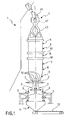
- Additional advantages and characteristics of this invention will be more evident with the following detailed description of the invention, given as a not-limitative example, with reference to the following figures, where:
-
Fig.1 represents a schematic view of a kiln for the burning of lumped material; -
Fig.2 represents a particular of the kiln infig.1 regarding the discharge zone; -
Fig.3 represents a block diagram of the operating control of the kiln infig.1 . - The basic idea of this invention is to design a method that permits to control in an easy, constant and automatic way the quantity and/or quality of the final product obtained from the burning of the lumped materials.
- In fact, it has been observed that the quantity of the burnt product can change a lot in a specific period of time in relation with the different conditions of the kiln, such as the charging of the material to be burnt, the residence time at the different treatment zones, the efficiency of the combustion reaction and others more. Furthermore, the quality of the final product can also appreciable vary according to the degree of burning of the raw materials.
- In particular, it has been observed that the material can be exposed to a not uniform thermal treatment along the whole path in the kiln, so that final products can be obtained with variable quantities of the components. For example, during the burning process of the limestone or dolomite materials for the production of lime, some zones of the kiln can be influenced by the winds that cool down the external wall of the kiln. In this case, in this specific zone the combustion temperature may decrease, even a lot. In comparison to the opposite zone not influenced by the winds. As consequence of this, the lime should have been subjected to a lower calcination process in the zone influenced by the wind compared to the other one. In other words, In the zone influenced by the winds the limestone material will have lost less components compared to the protected one. It is obvious that the lime coming from the zone of the kin influenced by the winds will have an higher weight compared to the opposite zone because the lime will contain an higher quantity of residual components (specifically higher quantity of CaCO3).
- On the basis of this observation, a method of control and command of a kiln for the burning of lumped materials that permits to monitor the quantity and the quality of this burning material has been designed.
- The method of control and command of the kiln for the burning of lumped materials according to this invention comprising the steps of:
- a) providing a kiln having at least two sections ending with a respective discharge;
- b) collecting of a prefixed volume unit of burnt material from each of the discharges;
- c) weighing of this prefixed volume unit of burnt material;
- d) sending an electric or electromagnetic signal to a control and command unit (CCU) indicating the weighing value for volume unit; and
- e) comparing of the weighing value for prefixed volume unit with a pre-established weight value for this prefixed volume unit.
- In general, if the value of the step c) would be higher than the prefixed value for the comparison, a visual monitoring and/or an intervention for maintenance, correction directly on the kiln regulation shall be done. The visual intervention permits to control, especially in the burning zones, if there are evident structural anomalies. Consequently, it is possible to act in the exact part of the kiln where the anomaly has been observed and perform the necessary maintenance and/or correction/s.
- In particular, the step b) to collect a prefixed volume of burnt material can be made, for example, through volumetric means such as for example a volumetric table, well-known in the field, that will be described hereafter.
- The weighing step c) can be made through weighing means such as weighing scales, well-known in the field too.
- The step of sending an electrical or electro magnetic signal is carried out by sending, in a constant and automatic way, said signals to the control and command unit and subsequently herein elaborated into numerical values indicative of the weight of the burnt product collected by the collecting means.
- The step d) can so be realized by a unit of control and command such as an electronic processor, whose detailed description will follow, that compares the numerical values taken form the signals coming from the weighing means with pre-fixed numerical values depending from the needs or the requirements. The comparison permits to point out in addition to the accurate and real quantity of product discharged by the kiln also the variations - more or less important - indicating the degree of the burnt products.
- If for example the measured weight, at the given volume, would be higher than the pre-fixed numerical value it would mean that some limestone which is not burnt is in the product discharged by the kiln or, in other words, the final product still contains residual CO2- This check can be realized automatically thanks to the unit of control and command.
- Furthermore, using the principle of correlation between the constant volume and the correspondent weight, it means density equal to weight by volume, is possible to evaluate the density of the burnt product. If the density remains substantially the same for every discharge of material, it means that the kiln works uniformly. In particular, if a density is prefixed, it is possible to control in a constant and automatic way, if the final product corresponds to what is prefixed or if there are some relevant changes so that an intervention on the functioning of the kiln is required.
- For example, in case when the kiln is used for the calcination, the standard value of the lime can be fixed as density comprises between 0.7 and 0.9 ton/m3. In this case, at the given discharged volume, the weight is controlled and the specific weight of the lime obtained by the calcination is therefore calculated. If the specific weight calculated is between the above range, it means that the lime is calcinated correctly. If the specific weight is higher than the above range, it means that the lime still contains residuals CO2 or, in other words, a part of CaCO3 has been not calcined and therefore something is wrong in the burning process.
- Advantageously, the method of the invention can include a step of transmitting signals to means for the fuel distribution and/or means for the comburent distribution to regulate the burning of the material inside the kiln. Preferably, the signals are sent to burner beams comprising lances of fuel distribution and to injection conburent chambers coupled for each lance or group of lances. In particular, these signals can command control elements of the fuel or comburent supply, such as valves, at the level of each lance or group of lances and corresponding chambers.
- This further step permits to Influence on the calcination reaction through the combustion regulation, varying the quantity and the ratio between fuel and comburent
- The discharge and control device is actuated in two or more sections of the kiln correspondent to descendent calcining longitudinal portions for the lumped material. In this way, the discharge can be controlled at the same time in several portions of the kiln to check if the burning is homogeneous in the whole section of the kiln or if there are important variations. For example, in case of a kiln with a transversal section divided into four parts eachone ending with a discharge, the above described method can be carried out at the level of each discharge. As a consequence of this an even more precise regulation of the material discharge and the kiln control and command can be done through an intervention in each zone of the kiln where a deviation of the prefixed quantity of the discharged material or of the quality of the lime produced should be noticed.
- Preferably, the method of the invention comprises also a step of control and command of the quantity of the pre-heated air fed to each lance or group of lances of the burner beams.
- It is to be noticed that the method can include also other control and command steps, for example of the regulation of the exhaust gas discharge in the upper portion of the kiln, of the circulation of the cooling fluids of the parts exposed to high heating and other conventional operations of a kiln for the burning of the lumped material. The advantage of this control and command is that to obtain an integrated system complete of supervision and regulation of all the kiln parameters in a combined and synergic way in order to maintain the optimal conditions of kiln operation. These additional steps of command and control can be realized with an integrated management system working with an electronic support such as the electronic device of the command and control unit.
- In accordance with the second object of the invention, with reference to the
fig. 1-3 , a kiln for the burning of lumped material will be now described. - In
figure 1 , a kiln for the burning of lumped material is schematically represented with the number of reference 1. The kiln 1 includes: - at least two sections ending with a respective discharge;
- means (2) for the collection of a pre-established fixed volume of the lumped material after the calcination from each of the discharges;
- means (3) for the weighing of the materials collected by these said collecting means;
- means for the comparison of the weighting value for prefixed volume unit with pre-established weight value for this prefixed volume unit.
- Preferably, the kiln 1 can furthermore, include a control and command unit CCU (schematically represented in
fig.3 ) connected to these weighingmeans 3 in order to receive the electric signals representing numerical values referred to the weight of the collected material by the collecting means and compare them with pre-fixed numerical values indicating the weight of the material. - The kiln 1 can be any type of vertical kiln, as that one described in the introduction, for the burning of lumped material such as limestone or dolomite materials including, from the top to the bottom a charging zone 4, a
pre-heating zone 6, acalcination zone 6, a post-calcination zone 7 (optional), a cooling zone 8 and a discharging zone 9. - The charging zone 4 can be equipped with a
loading opening 41, equipped with a conical plug of closing/opening 42 for the passage of lumped material. Preferably, under thegate 42, the lumped material is distributed to thepre-heating zone 5 inside the kiln through one ormore pant legs 43 that can divide in secondary pant legs and allow the uniform distribution of the material in each portion of the cross section of the kiln. - The pre-heating
zone 6 represents the zone where the materials are exposed at the rising hot exhaust gases produced in thecombustion zone 6. In this way the material reaches the combustion or calcination zone already preheated and dried. - The
calcination zone 6 represents the zone where there is the calcination or the burning of the lumped materials thanks to the action of the burners 61 (schematically represented) located on two levels. In this zone the real burning of the materials take place. In particular, theburners 61 are incorporated in the burner beams cooled preferably by oil and are represented by lances (not shown), where a fuel flows inside that is mixed with the right quantity of comburent and ignited near the outlets of the burner beams. - The post-calcination zone 7 represents a zone where the material remains for an extended period of time to let the burnt material reach the adequate characteristics of reactivity and CO2 residual.
- The cooling zone 8 represents a zone where the transformed material is exposed to cold air coming from the bottom of the kiln.
- The discharging zone 9 represents a last zone of the kiln from where the finished product is automatically discharged through one or more conventional discharging
hoppers 10 represented schematically infigures 1 and2 . - In particular, as better shown in
figure 2 , each discharginghopper 10 is coupled to a correspondent collecting means 2 of the burnt materials, such as conventional volumetric extraction means. Preferably, the conventionalvolumetric extractor 2 is represented by a volumetric discharging table including abox element 21 opened in the upper part, in order to receive the burnt material failing from the discharginghopper 10, and on one side to permit the discharge of the material. In particular, the discharging takes place through awall 22 opposite to the discharge side and moved by apiston 23 to push the material to this discharging side like a paddle. It is to be noticed that the moving of the piston takes place when the table is filled of material, i.e. when the prefixed volume is reached. It results that the discharging of the material is performed in an accurate and constant way, it means after having reached the prefixed volume. - In correspondence of the discharging side of the volumetric collecting means 2, the weighing
means 3, such as conventional weighing scales are located. The weighing means 3 receive the falling volume of material discharged by the collecting means 2 and record the weight of the collected material. - Finally, the weighing
means 3, after having detected the weight, discharge the material in acollecting hopper 11, that at the end is equipped with a conventional system of extraction to feed aconveyor belt 12. - The control and command unit CCU, schematically represented in
figure 3 , can Include a conventional electronic processor with a memory where reference data are saved referred, for example, to a prefixed weight for each unit volume of material collected and discharged by the collecting means 2. Furthermore, the control and command unit CCU communicates with each weighingdevice 3 in order to receive electric or electromagnetic signals that, as above explained, are changed into numerical values by the processor, representative of the weight detected by each weighingdevice 3. The processor permits to compare the saved values with the values processed by the received signals in real time and automatically and signaling possible important variations. - From the above description, it is clear that the kiln 1 of the invention, advantageously permits an accurate control of the quantity of burnt material produced and, at the same time, a control of the quality of this material thanks to the combination of the weighing for a fixed volume.
- Another advantage is given by the fact that the control and command unit CCU can be connected with the
burners 61 in order to send the control signals to regulate the fuel and/or comburent flow and distribution in case that a weight variation of the material in the weighingmeans 3 is detected, as already explained. In other words, If the control and command unit CCU takes a weight higher than the pre-fixed weighting value, a signal to the burners is given, in order to increase the heating through a controlling loop. Furthermore the kiln is divided into several portions, as already explained before, is possible to detect weighing differences among these portions and command independently the burners so that the burning shall be uniform and an homogeneous product is obtained. For example, as already described before, in case that a portion of the kiln is exposed to strong winds that cause a local cooling to the external shell with a consequent lower burning degree, the command and control unit can act on the burners located in this portion to increase its efficiency. Alternatively, it is possible to regulate burners of the different portions of the kiln In order to obtain at the same time final products with different characteristics, for example reactivity, depending from the different needs, with only one kiln. - Preferably, the control and command unit can be connected with control means of the fuel and comburent distribution, such as valves, to each lance or group of lances housed inside the burner beams. In this way, the fine tuning regulation of the combustion process can be performed for each burner beam, avoiding lack of efficiencies and waste of fuel.
Claims (19)
- Method for the control and the command of a kiln for the burning of lumped material includes the steps of:a) providing a kiln having at least two sections ending with a respective discharge;b) collecting of a prefixed volume unit of burnt material from each of the discharges;c) weighing of this prefixed volume unit of burnt material;d) sending an electric or electromagnetic signal to a control and command unit (CCU) indicating the weighing value for volume unit; ande) comparing of the weighing value for prefixed volume unit with a pre-established weight value for this prefixed volume unit.
- Method, according to the claim 1, where if the value detected in the step c) is higher than the prefixed value is made either a visual intervention to monitor the kiln and/or a maintenance of the kiln.
- Method, according to the claims 1 or 2, including also a step, where said control and command unit sends electric or electromagnetic signals to the distribution means of fuel and/or conburent distribution to regulate the burning of these materials after the step e) of comparison.
- Method, according to the claim 3, where this step is realized sending signals to regulation means of the fuel and comburent, such as the valves of said distribution means of fuel and/or comburent.
- Method, according to anyone of the above claims from 1 to 4, where the step b) is realized through volumetric collecting means such as volumetric tables.
- Method, according to anyone of the above claims from 1 to 5, where the step c) is realized through a weighing scale.
- Method, according to anyone of the above claims from 1 to 6, where the control and command unit (CCU) comprises an electronic processor that receives said signals from weighing means (3) and convert them into numerical values, representative of the weight of the burnt material to compare them with pre-established numerical values.
- Method, according to anyone of the above claims from 1 to 7, where this method is independently realized in one or more portions of the discharging zone of the burnt material.
- Kiln (1) for the burning of the lumped materials comprising:- at least two sections ending with a respective discharge;said kiln comprising for each discharge:- means (2) for the collection of a pre-established fixed volume of the lumped material after the calcination from each of the discharges;- means (3) for the weighing of the material collected by these said collecting means;- means for the comparison of the weighting value for prefixed volume unit with pre-established weight value for this prefixed volume unit.
- Kiln (1) according to the claim 9, wherein a control and command unit(CCU) is connected to these weighing means (3) in order to receive electric and electromagnetic signals representing numerical values referred to the weight of the material collected by the collecting means and compare them with pre-established numerical values indicative of the weight of these materials.
- Kiln (1) as per the claim 10, where this control and command unit (CCU) is connected also to the combustion means (61) in order to send signals of command to regulate the distribution of fuel and comburent inside the kiln.
- Kiln (1) according to the claim 11, where the said combustion means (61) are represented by burner beams comprising lances for the distribution of the fuel and contained in boxes for each or groups of lances for the conburent distribution.
- Kiln (1) according to the claim 12, where this control and command unit (CCU) sends signals to these means for the regulation of fuel and/or conburent of the said combustion means (61).
- Kiln (1) according to anyone of the claims 9-13, comprising from top to the bottom along an almost vertical axis a charging zone (4), a pre-heating zone (5), at least two combustion zones (6), a post-calcination (7), a cooling zone (8), a discharging zone (9).
- Kiln (1) according the claim 14, where the charging zone (4) includes a charging opening (41) equipped with an opening/closing conical plug (42) for the passage and the distribution of the lumped material in one or more pant legs (5) that distribute this material uniformly to the whole cross section of the kiln.
- Kiln (1) according to anyone of the claims 14 or 15, where the discharging zone (9) includes one or more discharging hoppers (10) coupled to these collecting means (2).
- Kiln (1) according to anyone of the claims from 9 to 16, where these collecting means (2) including a volumetric discharging table (21).
- Kiln (1) according to anyone of the claims from 9 to 17, where these weighing means (3) including weighing scales (31) located in correspondence of the said collecting means (2) in order to receive the falling burnt material.
- Kiln (1) according to anyone of the claims from 9 to 18, where the kiln is circular, semicircular, elliptical, square or rectangular section, a double shaft kiln, regenerative kiln or annular kiln.
Priority Applications (5)
| Application Number | Priority Date | Filing Date | Title |
|---|---|---|---|
| ES05425847T ES2362428T3 (en) | 2005-11-29 | 2005-11-29 | METHOD FOR THE CONTROL AND COMMAND OF AN OVEN FOR BURNED OF AGLOMERATED MATERIAL AND THE RELATIVE OVEN. |
| DE602005026830T DE602005026830D1 (en) | 2005-11-29 | 2005-11-29 | Method for controlling and controlling a furnace for firing lumpy material and the corresponding furnace |
| EP05425847A EP1790930B1 (en) | 2005-11-29 | 2005-11-29 | Method for the control and command of a kiln for the burning of lumped material and the relative kiln |
| AT05425847T ATE501410T1 (en) | 2005-11-29 | 2005-11-29 | METHOD FOR CHECKING AND CONTROLLING A FURNACE FOR FIRING PIECE MATERIAL AND THE CORRESPONDING FURNACE |
| CN200610150348.4A CN101012110B (en) | 2005-11-29 | 2006-10-30 | Method for the control and command of a kiln for the burning of lumped material and the relative kiln |
Applications Claiming Priority (1)
| Application Number | Priority Date | Filing Date | Title |
|---|---|---|---|
| EP05425847A EP1790930B1 (en) | 2005-11-29 | 2005-11-29 | Method for the control and command of a kiln for the burning of lumped material and the relative kiln |
Publications (2)
| Publication Number | Publication Date |
|---|---|
| EP1790930A1 EP1790930A1 (en) | 2007-05-30 |
| EP1790930B1 true EP1790930B1 (en) | 2011-03-09 |
Family
ID=36176215
Family Applications (1)
| Application Number | Title | Priority Date | Filing Date |
|---|---|---|---|
| EP05425847A Expired - Lifetime EP1790930B1 (en) | 2005-11-29 | 2005-11-29 | Method for the control and command of a kiln for the burning of lumped material and the relative kiln |
Country Status (5)
| Country | Link |
|---|---|
| EP (1) | EP1790930B1 (en) |
| CN (1) | CN101012110B (en) |
| AT (1) | ATE501410T1 (en) |
| DE (1) | DE602005026830D1 (en) |
| ES (1) | ES2362428T3 (en) |
Families Citing this family (1)
| Publication number | Priority date | Publication date | Assignee | Title |
|---|---|---|---|---|
| CN115993056A (en) * | 2023-01-09 | 2023-04-21 | 广西柳钢新材料科技有限公司 | The Method of Quick Fire Re-airing and Re-airing of Pulverized Coal Double-chamber Kiln |
Family Cites Families (1)
| Publication number | Priority date | Publication date | Assignee | Title |
|---|---|---|---|---|
| DE1571341B1 (en) * | 1966-12-24 | 1970-01-15 | Buderus Eisenwerk | Method for determining and / or controlling the degree of burning of an item to be burned |
-
2005
- 2005-11-29 AT AT05425847T patent/ATE501410T1/en not_active IP Right Cessation
- 2005-11-29 EP EP05425847A patent/EP1790930B1/en not_active Expired - Lifetime
- 2005-11-29 DE DE602005026830T patent/DE602005026830D1/en not_active Expired - Lifetime
- 2005-11-29 ES ES05425847T patent/ES2362428T3/en not_active Expired - Lifetime
-
2006
- 2006-10-30 CN CN200610150348.4A patent/CN101012110B/en not_active Expired - Fee Related
Also Published As
| Publication number | Publication date |
|---|---|
| ATE501410T1 (en) | 2011-03-15 |
| EP1790930A1 (en) | 2007-05-30 |
| CN101012110A (en) | 2007-08-08 |
| DE602005026830D1 (en) | 2011-04-21 |
| ES2362428T3 (en) | 2011-07-05 |
| CN101012110B (en) | 2012-12-05 |
Similar Documents
| Publication | Publication Date | Title |
|---|---|---|
| US4573908A (en) | Method and apparatus for producing white cement clinker | |
| CN102089071A (en) | Calcination method and facility | |
| CN109357539A (en) | Novel intelligent cement sinter leaching control system | |
| EP3749906B1 (en) | Calciner of a cement production system, and method for operating a calciner | |
| CN205011649U (en) | Novel environmental protection limekiln | |
| US4166421A (en) | Cyclonic furnace | |
| CA1226481A (en) | Process and apparatus for blowing carbon dust into an industrial furnace | |
| EP1790930A1 (en) | Method for the control and command of a kiln for the burning of lumped material and the relative kiln | |
| US4395179A (en) | Apparatus and method for charging material into a receptacle | |
| CN107879365A (en) | A kind of system and method that aluminum oxide is produced using desiliconization flyash sintering process | |
| CN109053000A (en) | A kind of beam-type limekiln | |
| KR100737417B1 (en) | Method for preparing quicklime in parallel firing furnace | |
| CN109592917A (en) | Energy-saving active lime terminal calcining kiln | |
| KR100887153B1 (en) | Prediction Method of Firing Rate According to Flue Gas Temperature Change in Rotary Kiln | |
| JP5733235B2 (en) | Cement production method | |
| JP2023122542A (en) | Method and apparatus for manufacturing raw material for blast furnace | |
| JP2023044955A (en) | Cement clinker manufacturing system, cement clinker manufacturing method, control device, and control method | |
| SU1624708A1 (en) | Method for controlling preparation of calcium carbide | |
| KR100994048B1 (en) | Calorie control device of vertical firing furnace | |
| CN209584013U (en) | Energy-saving active lime terminal calcining kiln | |
| KR100815802B1 (en) | How to control the loading density of rotary kiln | |
| Bay et al. | Dynamic control of the cement process with a digital computer system | |
| US4250774A (en) | Self-adjusting powder distributor | |
| KR20050015503A (en) | A method for cooling burn lime in shaft kiln | |
| Myllymäki et al. | Fuzzy logic control of a sintering plant |
Legal Events
| Date | Code | Title | Description |
|---|---|---|---|
| PUAI | Public reference made under article 153(3) epc to a published international application that has entered the european phase |
Free format text: ORIGINAL CODE: 0009012 |
|
| AK | Designated contracting states |
Kind code of ref document: A1 Designated state(s): AT BE BG CH CY CZ DE DK EE ES FI FR GB GR HU IE IS IT LI LT LU LV MC NL PL PT RO SE SI SK TR |
|
| AX | Request for extension of the european patent |
Extension state: AL BA HR MK YU |
|
| 17P | Request for examination filed |
Effective date: 20071129 |
|
| AKX | Designation fees paid |
Designated state(s): AT BE BG CH CY CZ DE DK EE ES FI FR GB GR HU IE IS IT LI LT LU LV MC NL PL PT RO SE SI SK TR |
|
| 17Q | First examination report despatched |
Effective date: 20080130 |
|
| GRAP | Despatch of communication of intention to grant a patent |
Free format text: ORIGINAL CODE: EPIDOSNIGR1 |
|
| GRAS | Grant fee paid |
Free format text: ORIGINAL CODE: EPIDOSNIGR3 |
|
| GRAA | (expected) grant |
Free format text: ORIGINAL CODE: 0009210 |
|
| AK | Designated contracting states |
Kind code of ref document: B1 Designated state(s): AT BE BG CH CY CZ DE DK EE ES FI FR GB GR HU IE IS IT LI LT LU LV MC NL PL PT RO SE SI SK TR |
|
| REG | Reference to a national code |
Ref country code: GB Ref legal event code: FG4D |
|
| REG | Reference to a national code |
Ref country code: CH Ref legal event code: EP |
|
| REG | Reference to a national code |
Ref country code: IE Ref legal event code: FG4D |
|
| REF | Corresponds to: |
Ref document number: 602005026830 Country of ref document: DE Date of ref document: 20110421 Kind code of ref document: P |
|
| REG | Reference to a national code |
Ref country code: DE Ref legal event code: R096 Ref document number: 602005026830 Country of ref document: DE Effective date: 20110421 |
|
| REG | Reference to a national code |
Ref country code: ES Ref legal event code: FG2A Ref document number: 2362428 Country of ref document: ES Kind code of ref document: T3 Effective date: 20110705 |
|
| REG | Reference to a national code |
Ref country code: NL Ref legal event code: VDEP Effective date: 20110309 |
|
| PG25 | Lapsed in a contracting state [announced via postgrant information from national office to epo] |
Ref country code: GR Free format text: LAPSE BECAUSE OF FAILURE TO SUBMIT A TRANSLATION OF THE DESCRIPTION OR TO PAY THE FEE WITHIN THE PRESCRIBED TIME-LIMIT Effective date: 20110610 Ref country code: LT Free format text: LAPSE BECAUSE OF FAILURE TO SUBMIT A TRANSLATION OF THE DESCRIPTION OR TO PAY THE FEE WITHIN THE PRESCRIBED TIME-LIMIT Effective date: 20110309 Ref country code: LV Free format text: LAPSE BECAUSE OF FAILURE TO SUBMIT A TRANSLATION OF THE DESCRIPTION OR TO PAY THE FEE WITHIN THE PRESCRIBED TIME-LIMIT Effective date: 20110309 Ref country code: SE Free format text: LAPSE BECAUSE OF FAILURE TO SUBMIT A TRANSLATION OF THE DESCRIPTION OR TO PAY THE FEE WITHIN THE PRESCRIBED TIME-LIMIT Effective date: 20110309 |
|
| LTIE | Lt: invalidation of european patent or patent extension |
Effective date: 20110309 |
|
| PG25 | Lapsed in a contracting state [announced via postgrant information from national office to epo] |
Ref country code: BG Free format text: LAPSE BECAUSE OF FAILURE TO SUBMIT A TRANSLATION OF THE DESCRIPTION OR TO PAY THE FEE WITHIN THE PRESCRIBED TIME-LIMIT Effective date: 20110609 Ref country code: CY Free format text: LAPSE BECAUSE OF FAILURE TO SUBMIT A TRANSLATION OF THE DESCRIPTION OR TO PAY THE FEE WITHIN THE PRESCRIBED TIME-LIMIT Effective date: 20110309 Ref country code: AT Free format text: LAPSE BECAUSE OF FAILURE TO SUBMIT A TRANSLATION OF THE DESCRIPTION OR TO PAY THE FEE WITHIN THE PRESCRIBED TIME-LIMIT Effective date: 20110309 Ref country code: FI Free format text: LAPSE BECAUSE OF FAILURE TO SUBMIT A TRANSLATION OF THE DESCRIPTION OR TO PAY THE FEE WITHIN THE PRESCRIBED TIME-LIMIT Effective date: 20110309 Ref country code: SI Free format text: LAPSE BECAUSE OF FAILURE TO SUBMIT A TRANSLATION OF THE DESCRIPTION OR TO PAY THE FEE WITHIN THE PRESCRIBED TIME-LIMIT Effective date: 20110309 Ref country code: NL Free format text: LAPSE BECAUSE OF FAILURE TO SUBMIT A TRANSLATION OF THE DESCRIPTION OR TO PAY THE FEE WITHIN THE PRESCRIBED TIME-LIMIT Effective date: 20110309 |
|
| PG25 | Lapsed in a contracting state [announced via postgrant information from national office to epo] |
Ref country code: BE Free format text: LAPSE BECAUSE OF FAILURE TO SUBMIT A TRANSLATION OF THE DESCRIPTION OR TO PAY THE FEE WITHIN THE PRESCRIBED TIME-LIMIT Effective date: 20110309 |
|
| PG25 | Lapsed in a contracting state [announced via postgrant information from national office to epo] |
Ref country code: PT Free format text: LAPSE BECAUSE OF FAILURE TO SUBMIT A TRANSLATION OF THE DESCRIPTION OR TO PAY THE FEE WITHIN THE PRESCRIBED TIME-LIMIT Effective date: 20110711 Ref country code: EE Free format text: LAPSE BECAUSE OF FAILURE TO SUBMIT A TRANSLATION OF THE DESCRIPTION OR TO PAY THE FEE WITHIN THE PRESCRIBED TIME-LIMIT Effective date: 20110309 |
|
| PG25 | Lapsed in a contracting state [announced via postgrant information from national office to epo] |
Ref country code: RO Free format text: LAPSE BECAUSE OF FAILURE TO SUBMIT A TRANSLATION OF THE DESCRIPTION OR TO PAY THE FEE WITHIN THE PRESCRIBED TIME-LIMIT Effective date: 20110309 Ref country code: IS Free format text: LAPSE BECAUSE OF FAILURE TO SUBMIT A TRANSLATION OF THE DESCRIPTION OR TO PAY THE FEE WITHIN THE PRESCRIBED TIME-LIMIT Effective date: 20110709 Ref country code: SK Free format text: LAPSE BECAUSE OF FAILURE TO SUBMIT A TRANSLATION OF THE DESCRIPTION OR TO PAY THE FEE WITHIN THE PRESCRIBED TIME-LIMIT Effective date: 20110309 Ref country code: CZ Free format text: LAPSE BECAUSE OF FAILURE TO SUBMIT A TRANSLATION OF THE DESCRIPTION OR TO PAY THE FEE WITHIN THE PRESCRIBED TIME-LIMIT Effective date: 20110309 |
|
| PLBE | No opposition filed within time limit |
Free format text: ORIGINAL CODE: 0009261 |
|
| STAA | Information on the status of an ep patent application or granted ep patent |
Free format text: STATUS: NO OPPOSITION FILED WITHIN TIME LIMIT |
|
| 26N | No opposition filed |
Effective date: 20111212 |
|
| PG25 | Lapsed in a contracting state [announced via postgrant information from national office to epo] |
Ref country code: DK Free format text: LAPSE BECAUSE OF FAILURE TO SUBMIT A TRANSLATION OF THE DESCRIPTION OR TO PAY THE FEE WITHIN THE PRESCRIBED TIME-LIMIT Effective date: 20110309 Ref country code: PL Free format text: LAPSE BECAUSE OF FAILURE TO SUBMIT A TRANSLATION OF THE DESCRIPTION OR TO PAY THE FEE WITHIN THE PRESCRIBED TIME-LIMIT Effective date: 20110309 |
|
| REG | Reference to a national code |
Ref country code: DE Ref legal event code: R097 Ref document number: 602005026830 Country of ref document: DE Effective date: 20111212 |
|
| PG25 | Lapsed in a contracting state [announced via postgrant information from national office to epo] |
Ref country code: MC Free format text: LAPSE BECAUSE OF NON-PAYMENT OF DUE FEES Effective date: 20111130 |
|
| REG | Reference to a national code |
Ref country code: CH Ref legal event code: PL |
|
| GBPC | Gb: european patent ceased through non-payment of renewal fee |
Effective date: 20111129 |
|
| PG25 | Lapsed in a contracting state [announced via postgrant information from national office to epo] |
Ref country code: CH Free format text: LAPSE BECAUSE OF NON-PAYMENT OF DUE FEES Effective date: 20111130 Ref country code: LI Free format text: LAPSE BECAUSE OF NON-PAYMENT OF DUE FEES Effective date: 20111130 |
|
| REG | Reference to a national code |
Ref country code: IE Ref legal event code: MM4A |
|
| PG25 | Lapsed in a contracting state [announced via postgrant information from national office to epo] |
Ref country code: GB Free format text: LAPSE BECAUSE OF NON-PAYMENT OF DUE FEES Effective date: 20111129 Ref country code: IE Free format text: LAPSE BECAUSE OF NON-PAYMENT OF DUE FEES Effective date: 20111129 |
|
| PG25 | Lapsed in a contracting state [announced via postgrant information from national office to epo] |
Ref country code: LU Free format text: LAPSE BECAUSE OF NON-PAYMENT OF DUE FEES Effective date: 20111129 |
|
| PG25 | Lapsed in a contracting state [announced via postgrant information from national office to epo] |
Ref country code: HU Free format text: LAPSE BECAUSE OF FAILURE TO SUBMIT A TRANSLATION OF THE DESCRIPTION OR TO PAY THE FEE WITHIN THE PRESCRIBED TIME-LIMIT Effective date: 20110309 |
|
| PGFP | Annual fee paid to national office [announced via postgrant information from national office to epo] |
Ref country code: TR Payment date: 20131129 Year of fee payment: 9 |
|
| REG | Reference to a national code |
Ref country code: ES Ref legal event code: PC2A Owner name: TERRUZZI FERCALX S.P.A. Effective date: 20140514 |
|
| REG | Reference to a national code |
Ref country code: DE Ref legal event code: R081 Ref document number: 602005026830 Country of ref document: DE Owner name: TERRUZZI FERCALX S.P.A., IT Free format text: FORMER OWNER: TRADING ENGINEERING TECHNOLOGIES LLC, LEWES, US Effective date: 20140414 |
|
| REG | Reference to a national code |
Ref country code: FR Ref legal event code: TP Owner name: TERRUZZI FERCALX S.P.A., IT Effective date: 20140613 |
|
| PGFP | Annual fee paid to national office [announced via postgrant information from national office to epo] |
Ref country code: ES Payment date: 20141215 Year of fee payment: 10 |
|
| PGFP | Annual fee paid to national office [announced via postgrant information from national office to epo] |
Ref country code: FR Payment date: 20141201 Year of fee payment: 10 |
|
| PGFP | Annual fee paid to national office [announced via postgrant information from national office to epo] |
Ref country code: IT Payment date: 20141201 Year of fee payment: 10 |
|
| PGFP | Annual fee paid to national office [announced via postgrant information from national office to epo] |
Ref country code: DE Payment date: 20150129 Year of fee payment: 10 |
|
| REG | Reference to a national code |
Ref country code: DE Ref legal event code: R119 Ref document number: 602005026830 Country of ref document: DE |
|
| PG25 | Lapsed in a contracting state [announced via postgrant information from national office to epo] |
Ref country code: IT Free format text: LAPSE BECAUSE OF NON-PAYMENT OF DUE FEES Effective date: 20151129 |
|
| REG | Reference to a national code |
Ref country code: FR Ref legal event code: ST Effective date: 20160729 |
|
| PG25 | Lapsed in a contracting state [announced via postgrant information from national office to epo] |
Ref country code: DE Free format text: LAPSE BECAUSE OF NON-PAYMENT OF DUE FEES Effective date: 20160601 |
|
| PG25 | Lapsed in a contracting state [announced via postgrant information from national office to epo] |
Ref country code: FR Free format text: LAPSE BECAUSE OF NON-PAYMENT OF DUE FEES Effective date: 20151130 |
|
| REG | Reference to a national code |
Ref country code: ES Ref legal event code: FD2A Effective date: 20161227 |
|
| PG25 | Lapsed in a contracting state [announced via postgrant information from national office to epo] |
Ref country code: ES Free format text: LAPSE BECAUSE OF NON-PAYMENT OF DUE FEES Effective date: 20151130 |
|
| PG25 | Lapsed in a contracting state [announced via postgrant information from national office to epo] |
Ref country code: TR Free format text: LAPSE BECAUSE OF NON-PAYMENT OF DUE FEES Effective date: 20141129 |