EP1788382A1 - Electrochemical residual chlorine measuring method and device with a doped diamond working electrode - Google Patents
Electrochemical residual chlorine measuring method and device with a doped diamond working electrode Download PDFInfo
- Publication number
- EP1788382A1 EP1788382A1 EP06024071A EP06024071A EP1788382A1 EP 1788382 A1 EP1788382 A1 EP 1788382A1 EP 06024071 A EP06024071 A EP 06024071A EP 06024071 A EP06024071 A EP 06024071A EP 1788382 A1 EP1788382 A1 EP 1788382A1
- Authority
- EP
- European Patent Office
- Prior art keywords
- electrode
- residual chlorine
- electrically conductive
- conductive diamond
- working electrode
- Prior art date
- Legal status (The legal status is an assumption and is not a legal conclusion. Google has not performed a legal analysis and makes no representation as to the accuracy of the status listed.)
- Withdrawn
Links
- 239000000460 chlorine Substances 0.000 title claims abstract description 92
- 229910052801 chlorine Inorganic materials 0.000 title claims abstract description 92
- ZAMOUSCENKQFHK-UHFFFAOYSA-N Chlorine atom Chemical compound [Cl] ZAMOUSCENKQFHK-UHFFFAOYSA-N 0.000 title claims abstract description 91
- 229910003460 diamond Inorganic materials 0.000 title claims abstract description 74
- 239000010432 diamond Substances 0.000 title claims abstract description 74
- 238000000034 method Methods 0.000 title claims abstract description 41
- 239000012488 sample solution Substances 0.000 claims abstract description 36
- 229910021607 Silver chloride Inorganic materials 0.000 claims abstract description 22
- HKZLPVFGJNLROG-UHFFFAOYSA-M silver monochloride Chemical compound [Cl-].[Ag+] HKZLPVFGJNLROG-UHFFFAOYSA-M 0.000 claims abstract description 22
- 229910052709 silver Inorganic materials 0.000 claims abstract description 20
- 239000004332 silver Substances 0.000 claims abstract description 20
- ZOXJGFHDIHLPTG-UHFFFAOYSA-N Boron Chemical compound [B] ZOXJGFHDIHLPTG-UHFFFAOYSA-N 0.000 claims abstract description 14
- 229910052796 boron Inorganic materials 0.000 claims abstract description 14
- IJGRMHOSHXDMSA-UHFFFAOYSA-N Atomic nitrogen Chemical compound N#N IJGRMHOSHXDMSA-UHFFFAOYSA-N 0.000 claims description 12
- 229910052795 boron group element Inorganic materials 0.000 claims description 10
- 229910052696 pnictogen Inorganic materials 0.000 claims description 10
- OAICVXFJPJFONN-UHFFFAOYSA-N Phosphorus Chemical compound [P] OAICVXFJPJFONN-UHFFFAOYSA-N 0.000 claims description 6
- 229910052757 nitrogen Inorganic materials 0.000 claims description 6
- 229910052698 phosphorus Inorganic materials 0.000 claims description 6
- 239000011574 phosphorus Substances 0.000 claims description 6
- 235000017168 chlorine Nutrition 0.000 description 79
- 238000007254 oxidation reaction Methods 0.000 description 12
- BASFCYQUMIYNBI-UHFFFAOYSA-N platinum Chemical compound [Pt] BASFCYQUMIYNBI-UHFFFAOYSA-N 0.000 description 9
- 239000003153 chemical reaction reagent Substances 0.000 description 7
- 238000005259 measurement Methods 0.000 description 7
- 230000003647 oxidation Effects 0.000 description 7
- 239000000243 solution Substances 0.000 description 7
- QAOWNCQODCNURD-UHFFFAOYSA-N Sulfuric acid Chemical compound OS(O)(=O)=O QAOWNCQODCNURD-UHFFFAOYSA-N 0.000 description 6
- 238000011088 calibration curve Methods 0.000 description 6
- 239000003792 electrolyte Substances 0.000 description 5
- 230000009467 reduction Effects 0.000 description 5
- 238000006722 reduction reaction Methods 0.000 description 5
- BAZAXWOYCMUHIX-UHFFFAOYSA-M sodium perchlorate Chemical compound [Na+].[O-]Cl(=O)(=O)=O BAZAXWOYCMUHIX-UHFFFAOYSA-M 0.000 description 5
- 229910001488 sodium perchlorate Inorganic materials 0.000 description 5
- 239000000758 substrate Substances 0.000 description 5
- QNGVNLMMEQUVQK-UHFFFAOYSA-N 4-n,4-n-diethylbenzene-1,4-diamine Chemical compound CCN(CC)C1=CC=C(N)C=C1 QNGVNLMMEQUVQK-UHFFFAOYSA-N 0.000 description 4
- UFHFLCQGNIYNRP-UHFFFAOYSA-N Hydrogen Chemical compound [H][H] UFHFLCQGNIYNRP-UHFFFAOYSA-N 0.000 description 4
- 229910052799 carbon Inorganic materials 0.000 description 4
- 125000001309 chloro group Chemical class Cl* 0.000 description 4
- 239000007772 electrode material Substances 0.000 description 4
- 239000001257 hydrogen Substances 0.000 description 4
- 229910052739 hydrogen Inorganic materials 0.000 description 4
- WQYVRQLZKVEZGA-UHFFFAOYSA-N hypochlorite Chemical compound Cl[O-] WQYVRQLZKVEZGA-UHFFFAOYSA-N 0.000 description 4
- 239000002699 waste material Substances 0.000 description 4
- NUIURNJTPRWVAP-UHFFFAOYSA-N 3,3'-Dimethylbenzidine Chemical compound C1=C(N)C(C)=CC(C=2C=C(C)C(N)=CC=2)=C1 NUIURNJTPRWVAP-UHFFFAOYSA-N 0.000 description 3
- OKTJSMMVPCPJKN-UHFFFAOYSA-N Carbon Chemical compound [C] OKTJSMMVPCPJKN-UHFFFAOYSA-N 0.000 description 3
- OKKJLVBELUTLKV-UHFFFAOYSA-N Methanol Chemical compound OC OKKJLVBELUTLKV-UHFFFAOYSA-N 0.000 description 3
- 238000003487 electrochemical reaction Methods 0.000 description 3
- 239000010408 film Substances 0.000 description 3
- 229910052697 platinum Inorganic materials 0.000 description 3
- CSCPPACGZOOCGX-UHFFFAOYSA-N Acetone Chemical compound CC(C)=O CSCPPACGZOOCGX-UHFFFAOYSA-N 0.000 description 2
- VEXZGXHMUGYJMC-UHFFFAOYSA-M Chloride anion Chemical compound [Cl-] VEXZGXHMUGYJMC-UHFFFAOYSA-M 0.000 description 2
- KDLHZDBZIXYQEI-UHFFFAOYSA-N Palladium Chemical compound [Pd] KDLHZDBZIXYQEI-UHFFFAOYSA-N 0.000 description 2
- XUIMIQQOPSSXEZ-UHFFFAOYSA-N Silicon Chemical compound [Si] XUIMIQQOPSSXEZ-UHFFFAOYSA-N 0.000 description 2
- QVGXLLKOCUKJST-UHFFFAOYSA-N atomic oxygen Chemical compound [O] QVGXLLKOCUKJST-UHFFFAOYSA-N 0.000 description 2
- 230000008859 change Effects 0.000 description 2
- 238000010586 diagram Methods 0.000 description 2
- JSYGRUBHOCKMGQ-UHFFFAOYSA-N dichloramine Chemical compound ClNCl JSYGRUBHOCKMGQ-UHFFFAOYSA-N 0.000 description 2
- 238000004401 flow injection analysis Methods 0.000 description 2
- 239000012530 fluid Substances 0.000 description 2
- QWPPOHNGKGFGJK-UHFFFAOYSA-N hypochlorous acid Chemical compound ClO QWPPOHNGKGFGJK-UHFFFAOYSA-N 0.000 description 2
- 239000007788 liquid Substances 0.000 description 2
- QSHDDOUJBYECFT-UHFFFAOYSA-N mercury Chemical compound [Hg] QSHDDOUJBYECFT-UHFFFAOYSA-N 0.000 description 2
- 229910052753 mercury Inorganic materials 0.000 description 2
- 239000011259 mixed solution Substances 0.000 description 2
- QEHKBHWEUPXBCW-UHFFFAOYSA-N nitrogen trichloride Chemical compound ClN(Cl)Cl QEHKBHWEUPXBCW-UHFFFAOYSA-N 0.000 description 2
- 239000001301 oxygen Substances 0.000 description 2
- 229910052760 oxygen Inorganic materials 0.000 description 2
- 239000008055 phosphate buffer solution Substances 0.000 description 2
- 230000035945 sensitivity Effects 0.000 description 2
- 229910052710 silicon Inorganic materials 0.000 description 2
- 239000010703 silicon Substances 0.000 description 2
- 238000003860 storage Methods 0.000 description 2
- 238000010408 sweeping Methods 0.000 description 2
- 239000010409 thin film Substances 0.000 description 2
- XOLBLPGZBRYERU-UHFFFAOYSA-N tin dioxide Chemical compound O=[Sn]=O XOLBLPGZBRYERU-UHFFFAOYSA-N 0.000 description 2
- 238000001075 voltammogram Methods 0.000 description 2
- QDHHCQZDFGDHMP-UHFFFAOYSA-N Chloramine Chemical group ClN QDHHCQZDFGDHMP-UHFFFAOYSA-N 0.000 description 1
- KZBUYRJDOAKODT-UHFFFAOYSA-N Chlorine Chemical compound ClCl KZBUYRJDOAKODT-UHFFFAOYSA-N 0.000 description 1
- 229910020080 NCl3 Inorganic materials 0.000 description 1
- 230000009471 action Effects 0.000 description 1
- 238000000137 annealing Methods 0.000 description 1
- 239000000872 buffer Substances 0.000 description 1
- 239000007853 buffer solution Substances 0.000 description 1
- 150000001721 carbon Chemical class 0.000 description 1
- 238000006243 chemical reaction Methods 0.000 description 1
- 238000007398 colorimetric assay Methods 0.000 description 1
- 238000004891 communication Methods 0.000 description 1
- 238000005260 corrosion Methods 0.000 description 1
- 230000007797 corrosion Effects 0.000 description 1
- 239000013078 crystal Substances 0.000 description 1
- 238000005520 cutting process Methods 0.000 description 1
- 238000002484 cyclic voltammetry Methods 0.000 description 1
- 230000001419 dependent effect Effects 0.000 description 1
- JKWMSGQKBLHBQQ-UHFFFAOYSA-N diboron trioxide Chemical compound O=BOB=O JKWMSGQKBLHBQQ-UHFFFAOYSA-N 0.000 description 1
- 230000000694 effects Effects 0.000 description 1
- 238000002848 electrochemical method Methods 0.000 description 1
- 230000005518 electrochemistry Effects 0.000 description 1
- 239000008151 electrolyte solution Substances 0.000 description 1
- 230000002708 enhancing effect Effects 0.000 description 1
- 230000006870 function Effects 0.000 description 1
- PCHJSUWPFVWCPO-UHFFFAOYSA-N gold Chemical compound [Au] PCHJSUWPFVWCPO-UHFFFAOYSA-N 0.000 description 1
- 229910052737 gold Inorganic materials 0.000 description 1
- 239000010931 gold Substances 0.000 description 1
- 238000010438 heat treatment Methods 0.000 description 1
- 150000002431 hydrogen Chemical class 0.000 description 1
- -1 hypochlorous acid ion Chemical class 0.000 description 1
- 239000012535 impurity Substances 0.000 description 1
- 238000004811 liquid chromatography Methods 0.000 description 1
- 238000004519 manufacturing process Methods 0.000 description 1
- 230000004048 modification Effects 0.000 description 1
- 238000012986 modification Methods 0.000 description 1
- 229910052763 palladium Inorganic materials 0.000 description 1
- 238000005268 plasma chemical vapour deposition Methods 0.000 description 1
- 238000009832 plasma treatment Methods 0.000 description 1
- 238000005498 polishing Methods 0.000 description 1
- 238000002360 preparation method Methods 0.000 description 1
- 238000006479 redox reaction Methods 0.000 description 1
- 239000000523 sample Substances 0.000 description 1
- 238000000926 separation method Methods 0.000 description 1
- 229910001220 stainless steel Inorganic materials 0.000 description 1
- 239000010935 stainless steel Substances 0.000 description 1
- 239000000126 substance Substances 0.000 description 1
- 238000004381 surface treatment Methods 0.000 description 1
- 238000011144 upstream manufacturing Methods 0.000 description 1
- 230000000007 visual effect Effects 0.000 description 1
- 238000004832 voltammetry Methods 0.000 description 1
- XLYOFNOQVPJJNP-UHFFFAOYSA-N water Substances O XLYOFNOQVPJJNP-UHFFFAOYSA-N 0.000 description 1
Images


Classifications
-
- G—PHYSICS
- G01—MEASURING; TESTING
- G01N—INVESTIGATING OR ANALYSING MATERIALS BY DETERMINING THEIR CHEMICAL OR PHYSICAL PROPERTIES
- G01N27/00—Investigating or analysing materials by the use of electric, electrochemical, or magnetic means
- G01N27/26—Investigating or analysing materials by the use of electric, electrochemical, or magnetic means by investigating electrochemical variables; by using electrolysis or electrophoresis
- G01N27/28—Electrolytic cell components
- G01N27/30—Electrodes, e.g. test electrodes; Half-cells
- G01N27/308—Electrodes, e.g. test electrodes; Half-cells at least partially made of carbon
-
- G—PHYSICS
- G01—MEASURING; TESTING
- G01N—INVESTIGATING OR ANALYSING MATERIALS BY DETERMINING THEIR CHEMICAL OR PHYSICAL PROPERTIES
- G01N27/00—Investigating or analysing materials by the use of electric, electrochemical, or magnetic means
- G01N27/26—Investigating or analysing materials by the use of electric, electrochemical, or magnetic means by investigating electrochemical variables; by using electrolysis or electrophoresis
- G01N27/403—Cells and electrode assemblies
- G01N27/404—Cells with anode, cathode and cell electrolyte on the same side of a permeable membrane which separates them from the sample fluid, e.g. Clark-type oxygen sensors
- G01N27/4045—Cells with anode, cathode and cell electrolyte on the same side of a permeable membrane which separates them from the sample fluid, e.g. Clark-type oxygen sensors for gases other than oxygen
-
- G—PHYSICS
- G01—MEASURING; TESTING
- G01N—INVESTIGATING OR ANALYSING MATERIALS BY DETERMINING THEIR CHEMICAL OR PHYSICAL PROPERTIES
- G01N33/00—Investigating or analysing materials by specific methods not covered by groups G01N1/00 - G01N31/00
- G01N33/0004—Gaseous mixtures, e.g. polluted air
- G01N33/0009—General constructional details of gas analysers, e.g. portable test equipment
- G01N33/0027—General constructional details of gas analysers, e.g. portable test equipment concerning the detector
- G01N33/0036—General constructional details of gas analysers, e.g. portable test equipment concerning the detector specially adapted to detect a particular component
- G01N33/0052—Gaseous halogens
Definitions
- the present invention relates to a residual chlorine measuring method and device and more particular to method and to a device for measuring a residual chlorine concentration using an electrochemical method.
- a measurer compares pinkish red color produced by reacting the residual chlorine with diethyl-p-phenylenediamine (DPD) with a color chart to determine the concentration of the residual chlorine.
- DPD diethyl-p-phenylenediamine
- the measurer compares yellow color produced by reacting the residual chlorine with a chloride solution of orthotolidine with the color chart to determine the concentration of the residual chlorine.
- the polarographic method using the electrode determines the concentration of the residual chlorine by a current between a counter electrode and a working electrode. Since this method does not require the reagent, the waste liquid treatment is not required, and furthermore, the residual chlorine is easily measured.
- Patent document 1 Japanese Examined Patent Publication No. 1980-17939
- the present invention has been developed to eliminate the above conventional problems described above easily. It is a main desired object of the present invention to provide an objective measured result without using a harmful reagent and furthermore and to correctly and easily measure the residual chlorine without being influenced by the potential window.
- a residual chlorine measuring method includes the steps of: bringing a counter electrode, a working electrode and a reference electrode into contact with a sample solution containing residual chlorine which is an object to be measured; applying a voltage between the counter electrode and the working electrode; and measuring a current value under the voltage to calculate a concentration of the residual chlorine, wherein the working electrode is an electrically conductive diamond electrode to which a group 13 element or a group 15 element is doped; the reference electrode is a silver/silver chloride electrode; and a current value is measured when a potential of the electrically conductive diamond electrode is set to +0,5 V to +1,5 V when compared to a potential of the silver/silver chloride electrode.
- the set of the potential of the electrically conductive diamond electrode to the silver/silver chloride electrode to +0,5 V to +1,5 V is based on that the peak of a current produced by an oxidation reaction of the residual chlorine is generated between +0,5 V and +1,5 V and the oxidation-reduction reaction of the residual chlorine is hardly produced less than +0,5 V.
- the residual chlorine means all available chlorines which remain in water, and includes two kinds, that is, free residual chlorine and bonding residual chlorine.
- the free residual chlorine is chlorine (Cl 2 ), hypochlorous acid (HClO) and hypochlorous acid ion (ClO - ).
- the bonding residual chlorine is monochloramine (NH 2 Cl), dichloramine (NHCl 2 ) and trichloramine (NCl 3 ).
- the residual chlorine measuring method can provide the objective measured result without using the harmful reagent. Also, since the electrically conductive diamond electrode to which the group 13 element or the group 15 element is doped has an advantageous character in which a potential window (an oxidation potential and an reduction potential are wide) is wide and a background current (a residual current) is lower than those of the other electrode materials, the concentration of the residual chlorine can be highly sensitively, highly precisely and easily measured. Furthermore, the potential of the electrically conductive diamond electrode to the silver/silver chloride electrode is changed only within the range of +0,5 V to +1,5V where the peak of the current due to the oxidation reaction of the residual chlorine is generated and it is not necessary to measure the potential less than +0,5 V. Thereby, it is possible to measure the concentration of the residual chlorine for a short time.
- the group 13 element or the group 15 element is preferably at least one kind of element selected from the group consisting of boron, nitrogen and phosphorus, and particularly preferably a boron-doped diamond electrode into which the boron is mixed.
- examples of the surface states of the above electrically conductive diamond electrode to which the boron is doped include a hydrogen-terminated surface state and an oxygen-terminated surface state, the hydrogen-terminated surface state is more preferable.
- the reason for this is the following. That is, in the electrically conductive diamond electrode oxygen-terminated, the oxidation potential corresponding to the detected peak current is at a higher potential side, and the peak current comes near the potential window, and thereby the sensitivity may be reduced. However, in the electrically conductive diamond electrode hydrogen-terminated, the oxidation potential corresponding to the detected peak current is at a lower potential side as compared with a case of using the electrically conductive diamond electrode oxygen-terminated and the peak current is separately detected from the potential window, thereby further enhancing the sensitivity.
- oxygen-terminating it is desirable to anodize the electrically conductive diamond electrode or subject the electrically conductive diamond electrode to oxygen plasma treatment to oxygen-terminate the electrically conductive diamond electrode.
- oxygen plasma treatment it is desirable to oxygen-terminate the electrically conductive diamond electrode.
- hydrogen-terminating the electrically conductive diamond electrode it is desirable to anneal (heat) the electrically conductive diamond electrode under a hydrogen atmosphere or cathodically reduce the electrically conductive diamond electrode to hydrogen-terminate the electrically conductive diamond electrode.
- the residual chlorine measuring method according to the present invention can be carried out by, for example, a measuring device having the following constitution. That is, a residual chlorine measuring device for measuring a residual chlorine concentration in a sample solution, including: a working electrode; a counter electrode; a reference electrode; a voltage applying part for applying a voltage to the working electrode and the counter electrode; a current measuring part for measuring a current value in the applied voltage; and an information processor for calculating a residual chlorine concentration based on a current measuring signal from the current measuring part, wherein the working electrode is an electrically conductive diamond electrode to which a group 13 element or a group 15 element is doped; the reference electrode is a silver/silver chloride electrode; and the information processor controls the potential of the electrically conductive diamond electrode to the silver/silver chloride electrode to +0,5 V to +1,5 V.
- a measuring device having the following constitution. That is, a residual chlorine measuring device for measuring a residual chlorine concentration in a sample solution, including: a working electrode; a counter
- the present invention can provide the objective measured result without using the harmful reagent.
- the electrically conductive diamond electrode to which the group 13 element or the group 15 element is doped has an advantageous character in which a potential window (an oxidation potential and an reduction potential are wide) is wide and a background current (a residual current) is lower than those of the other electrode materials, the concentration of the residual chlorine can be highly sensitively, highly precisely and easily measured.
- the potential of the electrically conductive diamond electrode to the silver/silver chloride electrode is changed only within the range of +0,5 V to + 1,5V where the peak of the current due to the oxidation reaction of the residual chlorine is generated and it is not necessary to measure the potential less than +0,5 V.
- a residual chlorine measuring device 1 is a batch-type electrochemistry measuring device which analyzes a sample solution L by dissolving an electrolyte in the sample solution L to produce an electrolyte solution and then by applying a voltage to the solution and performs voltammetry measurement for analyzing the solution L due to a triple electrode system.
- the basic constitution includes a working electrode 2, a reference electrode 3, a counter electrode 4, a potentiostat 5 for controlling the voltages of the working electrode 2, the reference electrode 3 and the counter electrode 4, and an information processor 6 for calculating, for example, the concentration of residual chlorine contained in the sample solution L based on a current and voltage obtained by the potentiostat 5.
- the sample solution L contains the residual chlorine which is the object to be measured, and the embodiment uses hypochlorite. Also, sodium perchlorate (NaClO 4 ) of 0,1 mol/l is used as the electrolyte.
- the working electrode 2 applies a voltage to the sample solution, and is a boron-doped diamond electrode to which conductivity is imparted by adding boron with high density. Also, the working electrode 2 is fixed by a holding member which is not shown so as to be immersed in the sample solution L accommodated in a measuring cell 7. The potential to the reference electrode 3 is swept between +0,5 V and +1,5 V by the information processor 6 to be described later.
- the boron-doped diamond electrode 1 to which boron is doped at high concentration has an advantageous character in which a potential window is wide (an oxidation potential and a reduction potential are wide) and a background current is lower than those of the other electrode materials. Also, the boron-doped diamond electrode 1 is excellent in chemical resistance, durability, electrical conductivity and corrosion resistance or the like.
- the boron-doped diamond electrode used in the present invention is produced by forming a diamond film on an upper surface of a silicon substrate by, for example, using a microwave plasma CVD method. Now, boron is doped as impurities in order to make the diamond film conductive.
- a specific manufacturing method is as follows.
- a silicon substrate (Si) is used as a substrate.
- a mixed solution of acetone (72 ml) and methanol (8 ml) is used as a carbon source.
- Boron oxide (B 2 O 3 ) (1,09 g) is dissolved in the mixed solution. After this carbon source is bubbled by hydrogen gas, the carbon source is introduced into a chamber where a film is formed at a substrate temperature of about 800°C.
- the addition amount of the boron to be mixed is suitably determined in the range capable of imparting conductivity to the diamond electrode 1, for example, the addition amount imparts the conductivity of about 1 ⁇ 10 -2 ⁇ cm to about 10 -6 ⁇ cm to the diamond electrode 1.
- the surface of the electrically conductive diamond electrode 1 thus formed is almost hydrogen-terminated in the "as grown” state (a surface treatment or the like is not then applied with a crystal grown on a substrate).
- the electrically conductive diamond electrode 1 in the "as grown" state is cathodically reduced by applying the voltage of -1,8 V to the electrically conductive diamond electrode 1 and by immersing in a sulfuric acid (H 2 SO 4 ) of 0,1 mol/l for 30 minutes to hydrogen-terminate the entire surface of the electrically conductive diamond electrode 1.
- a sulfuric acid H 2 SO 4
- the reference electrode 3 is used as the standard of the potential of the working electrode 2, and the present embodiment uses a silver/silver chloride electrode (Ag/AgCl electrode).
- the reference electrode 3 is fixed by a holding member which is not shown so as to be immersed in the sample solution L accommodated in the measuring cell 7.
- the counter electrode 4 makes a current flow in the working electrode 2 without trouble when setting the working electrode 2 to a potential, and is connected to the working electrode 2 in series.
- the present embodiment uses a platinum (Pt) electrode.
- the counter electrode 4 is also fixed by the holding member which is not shown so as to be immersed in the sample solution L accommodated in the measuring cell 7 as in the case of the reference electrode 3.
- the potentiostat 5 functions as a voltage applying part for applying the voltage to the working electrode 2, the reference electrode and the counter electrode 4, and a current measuring part for measuring a current value in the applied voltage.
- the potentiostat 5 is controlled by the information processor 6 to be described later.
- the potentiostat 5 receives voltage signals and current signals from the working electrode 2, the reference electrode 3 and the counter electrode 4, and controls these electrodes 2, 3, 4.
- the potentiostat 5 always adjusts a voltage applied between the working electrode 2 and the counter electrode 4, and controls a voltage of the working electrode 2 to the reference electrode 3.
- the potentiostat 5 scans at a rate of, for example, 100 mV/s while setting the potential of the working electrode 2 to the reference electrode 3 to +0,5 V to +1,5 V and detects a current value accompanying an oxidation reaction under the voltage.
- the information processor 6 controls the potentiostat 5, determines a current-voltage curve based on voltage signals and current signals from the potentiostat 5, and calculates the concentration of the residual chlorine contained in the sample solution L based on the current-voltage curve. Furthermore, the information processor 6 controls the potentiostat 5 so as to change the potential of the working electrode 2 to the reference electrode 3 at a rate of, for example, 100 mV/s while setting the potential to +0,5 V to +1,5 V when measuring the concentration of the residual chlorine.
- the information processor 6 has a CPU, an internal memory, an external storage such as a HDD, a communication interface such as a modem, a display, a mouse, and an input means such as a keyboard.
- the information processor 6 analyzes electric signals according to programs set in a predetermined region of the internal memory and the external storage or the like to detect of the residual chlorine and calculate the concentration thereof.
- the information processor 6 may be a generalized computer, and may be an exclusive use.
- FIGS. 2 and 3 show results obtained by measuring the residual chlorine contained in the sample solution L using the residual chlorine measuring device 1 according to the present embodiment.
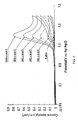
- FIG. 2 shows a current-voltage curve (voltammogram) obtained by measuring current values when linearly sweeping (100 mV/s) the potential of the working electrode 2 to the reference electrode 3 by the potentiostat 5 using the sample solutions L obtained by adjusting the concentration of the residual chlorine contained in the sample solutions L to 200 ⁇ mol/l, 400 ⁇ mol/l. 600 ⁇ mol/l, 800 ⁇ mol/l, 1000 ⁇ mol/l.
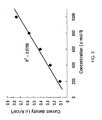
- FIG. 3 shows a calibration curve of concentrations and current values in peak potentials in the vicinity of +1,2 V based on the results obtained in FIG. 2.
- the calibration curve in which the concentration of the residual chlorine correlates with the current value well could be produced. Therefore, even a small amount (low concentration) of the residual chlorine can be correctly measured.
- the residual chlorine measuring device 1 can obtain an objective measured result without using a harmful reagent.
- the electrically conductive diamond electrode 2 to which the boron is doped has an advantageous character in which the potential window (the oxidation potential and the reduction potential are wide) is wide and the background current (a residual current) is lower than those of the other electrode materials, the concentration of the residual chlorine can be highly sensitively, highly precisely and easily measured.
- the potential of the electrically conductive diamond electrode 2 to the silver/silver chloride electrode 3 is changed only within the range of +0,5 V to +1,5V where the peak of the current due to the oxidation reaction of the residual chlorine is generated and it is not necessary to measure the potential less than +0,5 V. Thereby, it is possible to measure the concentration of the residual chlorine for a short time.
- the residual chlorine measuring device 1 performs a so-called flow injection analysis (FIA).
- FIA flow injection analysis
- the flow injection analysis produces continued flow controlled using a metering pump or the like, performs various reactions, a separation and a sample pouring or the like in this flow, and analyzes components contained in a solution using a detector provided with a flow cell provided at the end.
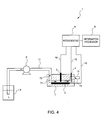
- the specific constitution of the device contains a flow cell 7 provided on a flow route of the sample solution L, the working electrode 2, the reference electrode 3 and the counter electrode 4 incorporated in the flow cell 7, the potentiostat 5 for controlling the voltages of the working electrode 2, the reference electrode 3 and the counter electrode 4, and an information processor 6 for calculating the concentration or the like of the residual chlorine in the sample solution L based on the current and the voltage obtained by the potentiostat 5.
- the sample solution L contains the residual chlorine which is the object to be measured, and the present embodiment uses hypochlorite. Also, sodium perchlorate (NaClO 4 ) of 0,01 mol/l is used as the electrolyte.
- the flow route is composed by a flow pipe 11 and the flow cell 7.
- the flow pipe 11 connects a solution tank 8 to an inflow port 72 of the flow cell 7, and connects an outflow port 73 of the flow cell 7 to a waste fluid tank (not shown).
- a pump 9 is provided on a feed pipe 11 provided at an upstream side of the flow cell 7.
- the flow cell 7 is constituted so that the electrically conductive diamond electrode 2, the reference electrode 3 and the counter electrode 4 are exposed in a flow passage 71 in which the sample solution L flows and can be brought into contact with the sample solution L.
- the diamond thin film of the electrically conductive diamond electrode 2 is exposed in the flow passage 71 and is brought into contact with the sample solution L.
- the sample solution L enters from the inflow port 72 of the flow passage 71, flows as shown by the arrow in FIG. 4, and reaches to the outflow port 73.
- An electrochemical reaction is generated in the sample solution L by applying a voltage between the working electrode 2 and the counter electrode 4.
- the pump 9 is provided on the flow pipe 11 between the solution tank 8 and the flow cell 7, and can supply the sample solution L to the flow cell 7 at a fixed speed.
- the pump 9 is a pump or the like for liquid chromatography.
- the sample solution L containing the residual chlorine which is the object to be measured is supplied to the flow cell 7 through the flow pipe 11 from the solution tank 8 by the pump 9.
- the electrochemical reaction is generated by applying the voltage between the working electrode 2 and the counter electrode 4 while the working electrode 2, reference electrode 3 and counter electrode 4 incorporated are brought into contact with the sample solution L in the flow cell 7.
- a current value (electric signals) produced by the electrochemical reaction is transmitted to the potentiostat 5, and the signals in each of the electrodes are controlled and detected.
- the signals detected by the potentiostat 5 are analyzed by the information processor 6, thereby detecting the residual chlorine and measuring the concentration thereof.
- the measured sample solution L is discharged out of the flow cell 7, and is accommodated in the waste fluid tank through the flow pipe 11.
- the voltage applied between the working electrode 2 and the counter electrode 4 in the present embodiment is set to the voltage producing the maximum current value or the vicinity thereof in view of measurement efficiency and accuracy. Specifically, since the voltage which produces the maximum current value of the residual chlorine is about 1,2 V, the voltage applied between the working electrode 2 and the counter electrode 4 is set to about 1,1 V.
- the voltage which imparts the maximum current value imparts the maximum current value by, for example, cyclic voltammetry (CV).
- the voltage which imparts the maximum current value can be also determined by a rotating electrode method or a micro electrode method. The rotating electrode method or the micro electrode method is advantageous since the methods can further eliminate possibility of an error of measurement due to measurement conditions or the like.
- FIGS. 5 and 6 show results obtained by measuring the residual chlorine contained in the sample solution using the residual chlorine measuring device 1 according to the present embodiment.
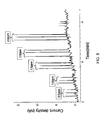
- FIG. 5 shows the time change of currents obtained by using the sample solutions L obtained by adjusting the concentration of the residual chlorine contained in the sample solution L to 0,5 ppm, 1,0 ppm, 1,5 ppm, 2,0 ppm, 2,5 ppm and measuring current values of the sample solutions L when setting the potential of the working electrode 2 to the reference electrode 3 to + 1,1 V by the potentiostat 5.
- FIG. 6 shows a calibration curve of concentration and current values when the applied voltage is +1.1 V based on the results obtained in FIG. 5. As shown in FIG. 6, the calibration curve in which the residual chlorine correlates a maximum current value well could be produced. Therefore, even a small amount (low concentration) of the residual chlorine can be correctly measured.
- the residual chlorine measuring device can measure the concentration of the residual chlorine in a lower concentration region than the first embodiment in addition to the effect of the first embodiment.
- the present invention is not limited to the embodiments.
- the residual chlorine measuring devices of the embodiments measure using the three-electrode method equipped with the counter electrode, the working electrode and the reference electrode
- the residual chlorine measuring device may be based on a two-electrode method provided with only the working electrode and the counter electrode. Since the three-electrode method can control the absolute value of the voltage applied between the working electrode and the counter electrode, the three-electrode method can measure highly precisely and highly sensitively.
- the two-electrode method uses only two electrodes, that is, the working electrode and the counter electrode, the constitution of the flow cell can be simplified and miniaturized.
- the measuring cell can be also chipped and disposed, and a simpler measurement can be performed.
- the electrically conductive diamond electrode may take the form of a micro electrode.
- the diamond electrode of the micro electrode form is obtained by sharply cutting the end of a thin line made of for example, Pt or the like, making the end sharper by electrolytic polishing and then forming a thin film of a conductive diamond on the end surface.
- the counter electrode is the platinum (Pt) electrode in the embodiments, for example, carbon, stainless steel, gold, diamond and SnO 2 or the like can be also used.
- the reference electrode is the silver/silver chloride electrode (Ag/AgCl electrode) in the embodiments, for example, a standard hydrogen electrode, a mercury/mercury chloride electrode, a hydrogen palladium electrode or the like can be also used.
- the surface of the electrically conductive diamond electrode is hydrogen-terminated in the embodiments, the electrically conductive diamond electrode oxygen-terminated may be used.
- the method for hydrogen-terminating the surface of the electrically conductive diamond electrode is not limited to the cathodic reduction treatment, and the other various methods such as a method for heating (annealing) at 700°C or more under a hydrogen atmosphere can be used.
- the electrically conductive diamond electrode can be anodized by applying the voltage of 3,0 V to the electrically conductive diamond electrode of the "as grown" state described above and by immersing the electrically conductive diamond electrode in a sulfuric acid (H 2 SO 4 ) of 0,1 mol/l for 30 minutes.
- a sulfuric acid H 2 SO 4
- the other various methods such as a treatment using oxygen plasma can be used.
- sodium perchlorate is used as an electrolyte which has a buffer action in each of the embodiments
- the electrolyte is not limited thereto, and, for example, a phosphate buffer solution (PBS) or the like used as a buffer solution can be also used.
- PBS phosphate buffer solution
- electrically conductive diamond electrode to which the boron is doped is used in the embodiments, an electrically conductive diamond electrode to which a group 13 element or a group 15 element such as nitrogen and phosphorus is doped may be used.
- a residual chlorine measuring method comprising steps of bringing a counter electrode 4, a working electrode 2 and a reference electrode 3 into contact with a sample solution L containing residual chlorine which is an object to be measured, applying a voltage between the counter electrode 4 and the working electrode 2, and measuring a current value under the voltage to calculate a concentration of the residual chlorine, wherein a working electrode 2 is used which is an electrically conductive diamond electrode to which a group 13 element or a group 15 element is doped, wherein a reference electrode 4 is used which is a silver/silver chloride electrode, and wherein a current value is measured when a potential of the electrically conductive diamond electrode is set to +0,5 V to +1,5 V when compared to a potential of the silver/silver chloride.
- a working electrode 2 may be used which is a electrically conductive diamond electrode to which at least one kind of element selected from the group consisting of boron, nitrogen and phosphorus is doped.
- An electrically conductive diamond electrode may be used having a surface which is hydrogen-terminated.
- An electrically conductive diamond electrode may be used having a surface which is oxygen-terminated.
- a residual chlorine measuring device for measuring a residual chlorine concentration in a sample solution L, comprising a working electrode 2, a counter electrode 4, a reference electrode 3, a voltage applying part 5 for applying a voltage to the working electrode 2 and the counter electrode 4, a current measuring part for measuring a current value in the applied voltage, and an information processor 6 for calculating a residual chlorine concentration based on a current measuring signal from the current measuring part, wherein the working electrode 2 is an electrically conductive diamond electrode to which a group 13 element or a group 15 element is doped, wherein the reference electrode 3 is a silver/silver chloride electrode, and wherein the information processor 6 controls the potential of the electrically conductive diamond electrode to the silver/silver chloride electrode to +0,5 V to +1,5 V.
- the working electrode 2 may be an electrically conductive diamond electrode to which at least one kind of element selected from the group consisting of boron, nitrogen and phosphorus is doped.
- a surface of the electrically conductive diamond electrode may be hydrogen-terminated.
- a surface of the electrically conductive diamond electrode may be oxygen-terminated.
Landscapes
- Chemical & Material Sciences (AREA)
- Life Sciences & Earth Sciences (AREA)
- Health & Medical Sciences (AREA)
- Physics & Mathematics (AREA)
- Chemical Kinetics & Catalysis (AREA)
- Electrochemistry (AREA)
- Molecular Biology (AREA)
- Analytical Chemistry (AREA)
- Biochemistry (AREA)
- General Health & Medical Sciences (AREA)
- General Physics & Mathematics (AREA)
- Immunology (AREA)
- Pathology (AREA)
- Investigating Or Analyzing Non-Biological Materials By The Use Of Chemical Means (AREA)
Abstract
Description
- The present invention relates to a residual chlorine measuring method and device and more particular to method and to a device for measuring a residual chlorine concentration using an electrochemical method.
- There has been a colorimetric assay method using a reagent such as a DPD method and an orthotolidine method and a polarographic method using an electrode as a method for measuring residual chlorine in a sample solution.
- In the DPD method, a measurer compares pinkish red color produced by reacting the residual chlorine with diethyl-p-phenylenediamine (DPD) with a color chart to determine the concentration of the residual chlorine. In the orthotolidine method, the measurer compares yellow color produced by reacting the residual chlorine with a chloride solution of orthotolidine with the color chart to determine the concentration of the residual chlorine.
- However, since these methods are based on the visual judgment of the measurer, there is a problem in that individual difference arises is in the measured value. There is also a problem in that waste liquid treatment is required after the measurement. Furthermore, there is also a problem in that the cost for the preparation of the reagent is high.
- On the other hand, the polarographic method using the electrode determines the concentration of the residual chlorine by a current between a counter electrode and a working electrode. Since this method does not require the reagent, the waste liquid treatment is not required, and furthermore, the residual chlorine is easily measured.
- However, since the conventional polarographic method uses a platinum electrode for the working electrode as shown in
Patent Reference 1, there is a problem in that an oxidation current peak of the residual chlorine appears only in the vicinity of the limit of a potential window, and overlaps the potential window, thereby disturbing the exact measurement.
Patent document 1:Japanese Examined Patent Publication No. 1980-17939 - Then, the present invention has been developed to eliminate the above conventional problems described above easily. It is a main desired object of the present invention to provide an objective measured result without using a harmful reagent and furthermore and to correctly and easily measure the residual chlorine without being influenced by the potential window.
- The object underlying the present invention is achieved by a chlorine measuring method according to
independent claim 1 and and by a chlorine measuring device according toindependent claim 5. Preffered embodiments are within the scope of the respective dependent claims. - That is, a residual chlorine measuring method according to the present invention, includes the steps of: bringing a counter electrode, a working electrode and a reference electrode into contact with a sample solution containing residual chlorine which is an object to be measured; applying a voltage between the counter electrode and the working electrode; and measuring a current value under the voltage to calculate a concentration of the residual chlorine, wherein the working electrode is an electrically conductive diamond electrode to which a group 13 element or a group 15 element is doped; the reference electrode is a silver/silver chloride electrode; and a current value is measured when a potential of the electrically conductive diamond electrode is set to +0,5 V to +1,5 V when compared to a potential of the silver/silver chloride electrode.
- Herein, the set of the potential of the electrically conductive diamond electrode to the silver/silver chloride electrode to +0,5 V to +1,5 V is based on that the peak of a current produced by an oxidation reaction of the residual chlorine is generated between +0,5 V and +1,5 V and the oxidation-reduction reaction of the residual chlorine is hardly produced less than +0,5 V.
- In the present invention, the residual chlorine means all available chlorines which remain in water, and includes two kinds, that is, free residual chlorine and bonding residual chlorine. The free residual chlorine is chlorine (Cl2), hypochlorous acid (HClO) and hypochlorous acid ion (ClO-). The bonding residual chlorine is monochloramine (NH2Cl), dichloramine (NHCl2) and trichloramine (NCl3).
- The residual chlorine measuring method can provide the objective measured result without using the harmful reagent. Also, since the electrically conductive diamond electrode to which the group 13 element or the group 15 element is doped has an advantageous character in which a potential window (an oxidation potential and an reduction potential are wide) is wide and a background current (a residual current) is lower than those of the other electrode materials, the concentration of the residual chlorine can be highly sensitively, highly precisely and easily measured. Furthermore, the potential of the electrically conductive diamond electrode to the silver/silver chloride electrode is changed only within the range of +0,5 V to +1,5V where the peak of the current due to the oxidation reaction of the residual chlorine is generated and it is not necessary to measure the potential less than +0,5 V. Thereby, it is possible to measure the concentration of the residual chlorine for a short time.
- The group 13 element or the group 15 element is preferably at least one kind of element selected from the group consisting of boron, nitrogen and phosphorus, and particularly preferably a boron-doped diamond electrode into which the boron is mixed.
- Although examples of the surface states of the above electrically conductive diamond electrode to which the boron is doped include a hydrogen-terminated surface state and an oxygen-terminated surface state, the hydrogen-terminated surface state is more preferable.
- The reason for this is the following. That is, in the electrically conductive diamond electrode oxygen-terminated, the oxidation potential corresponding to the detected peak current is at a higher potential side, and the peak current comes near the potential window, and thereby the sensitivity may be reduced. However, in the electrically conductive diamond electrode hydrogen-terminated, the oxidation potential corresponding to the detected peak current is at a lower potential side as compared with a case of using the electrically conductive diamond electrode oxygen-terminated and the peak current is separately detected from the potential window, thereby further enhancing the sensitivity.
- Also, as a specific method for oxygen-terminating, it is desirable to anodize the electrically conductive diamond electrode or subject the electrically conductive diamond electrode to oxygen plasma treatment to oxygen-terminate the electrically conductive diamond electrode. As a specific method for hydrogen-terminating the electrically conductive diamond electrode, it is desirable to anneal (heat) the electrically conductive diamond electrode under a hydrogen atmosphere or cathodically reduce the electrically conductive diamond electrode to hydrogen-terminate the electrically conductive diamond electrode.
- Also, the residual chlorine measuring method according to the present invention can be carried out by, for example, a measuring device having the following constitution. That is, a residual chlorine measuring device for measuring a residual chlorine concentration in a sample solution, including: a working electrode; a counter electrode; a reference electrode; a voltage applying part for applying a voltage to the working electrode and the counter electrode; a current measuring part for measuring a current value in the applied voltage; and an information processor for calculating a residual chlorine concentration based on a current measuring signal from the current measuring part, wherein the working electrode is an electrically conductive diamond electrode to which a group 13 element or a group 15 element is doped; the reference electrode is a silver/silver chloride electrode; and the information processor controls the potential of the electrically conductive diamond electrode to the silver/silver chloride electrode to +0,5 V to +1,5 V.
- Thus, the present invention can provide the objective measured result without using the harmful reagent.
- Also, since the electrically conductive diamond electrode to which the group 13 element or the group 15 element is doped has an advantageous character in which a potential window (an oxidation potential and an reduction potential are wide) is wide and a background current (a residual current) is lower than those of the other electrode materials, the concentration of the residual chlorine can be highly sensitively, highly precisely and easily measured.
- Furthermore, the potential of the electrically conductive diamond electrode to the silver/silver chloride electrode is changed only within the range of +0,5 V to + 1,5V where the peak of the current due to the oxidation reaction of the residual chlorine is generated and it is not necessary to measure the potential less than +0,5 V.
- Thereby, it is possible to measure the concentration of the residual chlorine for a short time.
-
- FIG. 1
- is a schematic constitution diagram of a residual chlorine measuring device according to a first embodiment of the present invention.
- FIG. 2
- is voltammogram for each of the concentrations of residual chlorines when linearly sweeping a potential of a working electrode between +0.5 V and +1.5 V in the embodiment.
- FIG. 3
- shows a calibration curve produced based on the current-voltage curve shown in FIG. 2.
- FIG. 4
- is a schematic constitution diagram of a residual chlorine measuring device according to a second embodiment of the present invention.
- FIG. 5
- shows a current value of each of the concentrations of residual chlorines when a potential of a working electrode is +1.1 V in the embodiment.
- FIG. 6
- shows a calibration curve produced based on the measured results shown in FIG. 5.
- Hereinafter, a first embodiment of a residual chlorine measuring device according to the present invention will be described referring to the drawings.
- A residual
chlorine measuring device 1 according to the present embodiment is a batch-type electrochemistry measuring device which analyzes a sample solution L by dissolving an electrolyte in the sample solution L to produce an electrolyte solution and then by applying a voltage to the solution and performs voltammetry measurement for analyzing the solution L due to a triple electrode system. As shown in FIG. 1, the basic constitution includes a workingelectrode 2, areference electrode 3, acounter electrode 4, apotentiostat 5 for controlling the voltages of the workingelectrode 2, thereference electrode 3 and thecounter electrode 4, and aninformation processor 6 for calculating, for example, the concentration of residual chlorine contained in the sample solution L based on a current and voltage obtained by thepotentiostat 5. - The sample solution L contains the residual chlorine which is the object to be measured, and the embodiment uses hypochlorite. Also, sodium perchlorate (NaClO4) of 0,1 mol/l is used as the electrolyte.
- The working
electrode 2 applies a voltage to the sample solution, and is a boron-doped diamond electrode to which conductivity is imparted by adding boron with high density. Also, the workingelectrode 2 is fixed by a holding member which is not shown so as to be immersed in the sample solution L accommodated in ameasuring cell 7. The potential to thereference electrode 3 is swept between +0,5 V and +1,5 V by theinformation processor 6 to be described later. The boron-dopeddiamond electrode 1 to which boron is doped at high concentration has an advantageous character in which a potential window is wide (an oxidation potential and a reduction potential are wide) and a background current is lower than those of the other electrode materials. Also, the boron-dopeddiamond electrode 1 is excellent in chemical resistance, durability, electrical conductivity and corrosion resistance or the like. - The boron-doped diamond electrode used in the present invention is produced by forming a diamond film on an upper surface of a silicon substrate by, for example, using a microwave plasma CVD method. Now, boron is doped as impurities in order to make the diamond film conductive. A specific manufacturing method is as follows.
- A silicon substrate (Si) is used as a substrate. A mixed solution of acetone (72 ml) and methanol (8 ml) is used as a carbon source. Boron oxide (B2O3) (1,09 g) is dissolved in the mixed solution. After this carbon source is bubbled by hydrogen gas, the carbon source is introduced into a chamber where a film is formed at a substrate temperature of about 800°C.
- Although the addition amount of the boron to be mixed is suitably determined in the range capable of imparting conductivity to the
diamond electrode 1, for example, the addition amount imparts the conductivity of about 1×10⁻² Ωcm to about 10-6 Ωcm to thediamond electrode 1. - The surface of the electrically
conductive diamond electrode 1 thus formed is almost hydrogen-terminated in the "as grown" state (a surface treatment or the like is not then applied with a crystal grown on a substrate). - Then, is the electrically
conductive diamond electrode 1 in the "as grown" state is cathodically reduced by applying the voltage of -1,8 V to the electricallyconductive diamond electrode 1 and by immersing in a sulfuric acid (H2SO4) of 0,1 mol/l for 30 minutes to hydrogen-terminate the entire surface of the electricallyconductive diamond electrode 1. - The
reference electrode 3 is used as the standard of the potential of the workingelectrode 2, and the present embodiment uses a silver/silver chloride electrode (Ag/AgCl electrode). Thereference electrode 3 is fixed by a holding member which is not shown so as to be immersed in the sample solution L accommodated in the measuringcell 7. - The
counter electrode 4 makes a current flow in the workingelectrode 2 without trouble when setting the workingelectrode 2 to a potential, and is connected to the workingelectrode 2 in series. The present embodiment uses a platinum (Pt) electrode. Thecounter electrode 4 is also fixed by the holding member which is not shown so as to be immersed in the sample solution L accommodated in the measuringcell 7 as in the case of thereference electrode 3. - The
potentiostat 5 functions as a voltage applying part for applying the voltage to the workingelectrode 2, the reference electrode and thecounter electrode 4, and a current measuring part for measuring a current value in the applied voltage. Thepotentiostat 5 is controlled by theinformation processor 6 to be described later. Thepotentiostat 5 receives voltage signals and current signals from the workingelectrode 2, thereference electrode 3 and thecounter electrode 4, and controls theseelectrodes potentiostat 5 always adjusts a voltage applied between the workingelectrode 2 and thecounter electrode 4, and controls a voltage of the workingelectrode 2 to thereference electrode 3. Specifically, thepotentiostat 5 scans at a rate of, for example, 100 mV/s while setting the potential of the workingelectrode 2 to thereference electrode 3 to +0,5 V to +1,5 V and detects a current value accompanying an oxidation reaction under the voltage. - The
information processor 6 controls thepotentiostat 5, determines a current-voltage curve based on voltage signals and current signals from thepotentiostat 5, and calculates the concentration of the residual chlorine contained in the sample solution L based on the current-voltage curve. Furthermore, theinformation processor 6 controls thepotentiostat 5 so as to change the potential of the workingelectrode 2 to thereference electrode 3 at a rate of, for example, 100 mV/s while setting the potential to +0,5 V to +1,5 V when measuring the concentration of the residual chlorine. Specifically, theinformation processor 6 has a CPU, an internal memory, an external storage such as a HDD, a communication interface such as a modem, a display, a mouse, and an input means such as a keyboard. Theinformation processor 6 analyzes electric signals according to programs set in a predetermined region of the internal memory and the external storage or the like to detect of the residual chlorine and calculate the concentration thereof. Theinformation processor 6 may be a generalized computer, and may be an exclusive use. - Next, FIGS. 2 and 3 show results obtained by measuring the residual chlorine contained in the sample solution L using the residual
chlorine measuring device 1 according to the present embodiment. - FIG. 2 shows a current-voltage curve (voltammogram) obtained by measuring current values when linearly sweeping (100 mV/s) the potential of the working
electrode 2 to thereference electrode 3 by thepotentiostat 5 using the sample solutions L obtained by adjusting the concentration of the residual chlorine contained in the sample solutions L to 200 µmol/l, 400 µmol/l. 600 µmol/l, 800 µmol/l, 1000 µmol/l. - FIG. 3 shows a calibration curve of concentrations and current values in peak potentials in the vicinity of +1,2 V based on the results obtained in FIG. 2. As shown in FIG. 3, the calibration curve in which the concentration of the residual chlorine correlates with the current value well could be produced. Therefore, even a small amount (low concentration) of the residual chlorine can be correctly measured.
- The residual
chlorine measuring device 1 according to the present embodiment thus constituted can obtain an objective measured result without using a harmful reagent. Also, since the electricallyconductive diamond electrode 2 to which the boron is doped has an advantageous character in which the potential window (the oxidation potential and the reduction potential are wide) is wide and the background current (a residual current) is lower than those of the other electrode materials, the concentration of the residual chlorine can be highly sensitively, highly precisely and easily measured. Furthermore, the potential of the electricallyconductive diamond electrode 2 to the silver/silver chloride electrode 3 is changed only within the range of +0,5 V to +1,5V where the peak of the current due to the oxidation reaction of the residual chlorine is generated and it is not necessary to measure the potential less than +0,5 V. Thereby, it is possible to measure the concentration of the residual chlorine for a short time. - Next, a second embodiment of the residual
chlorine measuring device 1 according to the present invention will be described referring to the drawings. Elements corresponding to the first embodiment are designated by the same numerals. - The residual
chlorine measuring device 1 according to the present embodiment performs a so-called flow injection analysis (FIA). - The flow injection analysis (FIA) produces continued flow controlled using a metering pump or the like, performs various reactions, a separation and a sample pouring or the like in this flow, and analyzes components contained in a solution using a detector provided with a flow cell provided at the end.
- As shown in FIG. 4, the specific constitution of the device contains a
flow cell 7 provided on a flow route of the sample solution L, the workingelectrode 2, thereference electrode 3 and thecounter electrode 4 incorporated in theflow cell 7, thepotentiostat 5 for controlling the voltages of the workingelectrode 2, thereference electrode 3 and thecounter electrode 4, and aninformation processor 6 for calculating the concentration or the like of the residual chlorine in the sample solution L based on the current and the voltage obtained by thepotentiostat 5. - The sample solution L contains the residual chlorine which is the object to be measured, and the present embodiment uses hypochlorite. Also, sodium perchlorate (NaClO4) of 0,01 mol/l is used as the electrolyte.
- The flow route is composed by a
flow pipe 11 and theflow cell 7. Theflow pipe 11 connects asolution tank 8 to aninflow port 72 of theflow cell 7, and connects anoutflow port 73 of theflow cell 7 to a waste fluid tank (not shown). Also, a pump 9 is provided on afeed pipe 11 provided at an upstream side of theflow cell 7. - The
flow cell 7 is constituted so that the electricallyconductive diamond electrode 2, thereference electrode 3 and thecounter electrode 4 are exposed in aflow passage 71 in which the sample solution L flows and can be brought into contact with the sample solution L. The diamond thin film of the electricallyconductive diamond electrode 2 is exposed in theflow passage 71 and is brought into contact with the sample solution L. The sample solution L enters from theinflow port 72 of theflow passage 71, flows as shown by the arrow in FIG. 4, and reaches to theoutflow port 73. An electrochemical reaction is generated in the sample solution L by applying a voltage between the workingelectrode 2 and thecounter electrode 4. - The pump 9 is provided on the
flow pipe 11 between thesolution tank 8 and theflow cell 7, and can supply the sample solution L to theflow cell 7 at a fixed speed. For example, the pump 9 is a pump or the like for liquid chromatography. - Next, the operation of the residual
chlorine measuring device 1 thus constituted will be described. - First, the sample solution L containing the residual chlorine which is the object to be measured is supplied to the
flow cell 7 through theflow pipe 11 from thesolution tank 8 by the pump 9. The electrochemical reaction is generated by applying the voltage between the workingelectrode 2 and thecounter electrode 4 while the workingelectrode 2,reference electrode 3 andcounter electrode 4 incorporated are brought into contact with the sample solution L in theflow cell 7. A current value (electric signals) produced by the electrochemical reaction is transmitted to thepotentiostat 5, and the signals in each of the electrodes are controlled and detected. The signals detected by thepotentiostat 5 are analyzed by theinformation processor 6, thereby detecting the residual chlorine and measuring the concentration thereof. The measured sample solution L is discharged out of theflow cell 7, and is accommodated in the waste fluid tank through theflow pipe 11. - Herein, the voltage applied between the working
electrode 2 and thecounter electrode 4 in the present embodiment is set to the voltage producing the maximum current value or the vicinity thereof in view of measurement efficiency and accuracy. Specifically, since the voltage which produces the maximum current value of the residual chlorine is about 1,2 V, the voltage applied between the workingelectrode 2 and thecounter electrode 4 is set to about 1,1 V. Herein, the voltage which imparts the maximum current value imparts the maximum current value by, for example, cyclic voltammetry (CV). The voltage which imparts the maximum current value can be also determined by a rotating electrode method or a micro electrode method. The rotating electrode method or the micro electrode method is advantageous since the methods can further eliminate possibility of an error of measurement due to measurement conditions or the like. - Next, FIGS. 5 and 6 show results obtained by measuring the residual chlorine contained in the sample solution using the residual
chlorine measuring device 1 according to the present embodiment. - FIG. 5 shows the time change of currents obtained by using the sample solutions L obtained by adjusting the concentration of the residual chlorine contained in the sample solution L to 0,5 ppm, 1,0 ppm, 1,5 ppm, 2,0 ppm, 2,5 ppm and measuring current values of the sample solutions L when setting the potential of the working
electrode 2 to thereference electrode 3 to + 1,1 V by thepotentiostat 5. - FIG. 6 shows a calibration curve of concentration and current values when the applied voltage is +1.1 V based on the results obtained in FIG. 5. As shown in FIG. 6, the calibration curve in which the residual chlorine correlates a maximum current value well could be produced. Therefore, even a small amount (low concentration) of the residual chlorine can be correctly measured.
- The residual chlorine measuring device according to the second embodiment thus constituted can measure the concentration of the residual chlorine in a lower concentration region than the first embodiment in addition to the effect of the first embodiment.
- The present invention is not limited to the embodiments.
- For example, although the residual chlorine measuring devices of the embodiments measure using the three-electrode method equipped with the counter electrode, the working electrode and the reference electrode, the residual chlorine measuring device may be based on a two-electrode method provided with only the working electrode and the counter electrode. Since the three-electrode method can control the absolute value of the voltage applied between the working electrode and the counter electrode, the three-electrode method can measure highly precisely and highly sensitively. However, since the two-electrode method uses only two electrodes, that is, the working electrode and the counter electrode, the constitution of the flow cell can be simplified and miniaturized. In addition, the measuring cell can be also chipped and disposed, and a simpler measurement can be performed.
- Also, in the embodiments, the electrically conductive diamond electrode may take the form of a micro electrode. Herein, the diamond electrode of the micro electrode form is obtained by sharply cutting the end of a thin line made of for example, Pt or the like, making the end sharper by electrolytic polishing and then forming a thin film of a conductive diamond on the end surface.
- Furthermore, although the counter electrode is the platinum (Pt) electrode in the embodiments, for example, carbon, stainless steel, gold, diamond and SnO2 or the like can be also used.
- In addition, although the reference electrode is the silver/silver chloride electrode (Ag/AgCl electrode) in the embodiments, for example, a standard hydrogen electrode, a mercury/mercury chloride electrode, a hydrogen palladium electrode or the like can be also used.
- In addition, although the surface of the electrically conductive diamond electrode is hydrogen-terminated in the embodiments, the electrically conductive diamond electrode oxygen-terminated may be used.
- The method for hydrogen-terminating the surface of the electrically conductive diamond electrode is not limited to the cathodic reduction treatment, and the other various methods such as a method for heating (annealing) at 700°C or more under a hydrogen atmosphere can be used.
- Also, as the method for oxygen-terminating the surface of the electrically conductive diamond electrode, the electrically conductive diamond electrode can be anodized by applying the voltage of 3,0 V to the electrically conductive diamond electrode of the "as grown" state described above and by immersing the electrically conductive diamond electrode in a sulfuric acid (H2SO4) of 0,1 mol/l for 30 minutes. Also, in addition, the other various methods such as a treatment using oxygen plasma can be used.
- Furthermore, in addition, although sodium perchlorate is used as an electrolyte which has a buffer action in each of the embodiments, the electrolyte is not limited thereto, and, for example, a phosphate buffer solution (PBS) or the like used as a buffer solution can be also used.
- Furthermore, in addition, although the electrically conductive diamond electrode to which the boron is doped is used in the embodiments, an electrically conductive diamond electrode to which a group 13 element or a group 15 element such as nitrogen and phosphorus is doped may be used.
- Aspects of the present invention may be further elucidated based on the following remarks:
- A residual chlorine measuring method is provided, comprising steps of bringing a
counter electrode 4, a workingelectrode 2 and areference electrode 3 into contact with a sample solution L containing residual chlorine which is an object to be measured, applying a voltage between thecounter electrode 4 and the workingelectrode 2, and measuring a current value under the voltage to calculate a concentration of the residual chlorine, wherein a workingelectrode 2 is used which is an electrically conductive diamond electrode to which a group 13 element or a group 15 element is doped, wherein areference electrode 4 is used which is a silver/silver chloride electrode, and wherein a current value is measured when a potential of the electrically conductive diamond electrode is set to +0,5 V to +1,5 V when compared to a potential of the silver/silver chloride. - A working
electrode 2 may be used which is a electrically conductive diamond electrode to which at least one kind of element selected from the group consisting of boron, nitrogen and phosphorus is doped. - An electrically conductive diamond electrode may be used having a surface which is hydrogen-terminated.
- An electrically conductive diamond electrode may be used having a surface which is oxygen-terminated.
- A residual chlorine measuring device is provided for measuring a residual chlorine concentration in a sample solution L, comprising a working
electrode 2, acounter electrode 4, areference electrode 3, avoltage applying part 5 for applying a voltage to the workingelectrode 2 and thecounter electrode 4, a current measuring part for measuring a current value in the applied voltage, and aninformation processor 6 for calculating a residual chlorine concentration based on a current measuring signal from the current measuring part, wherein the workingelectrode 2 is an electrically conductive diamond electrode to which a group 13 element or a group 15 element is doped, wherein thereference electrode 3 is a silver/silver chloride electrode, and wherein theinformation processor 6 controls the potential of the electrically conductive diamond electrode to the silver/silver chloride electrode to +0,5 V to +1,5 V. - The working
electrode 2 may be an electrically conductive diamond electrode to which at least one kind of element selected from the group consisting of boron, nitrogen and phosphorus is doped. - A surface of the electrically conductive diamond electrode may be hydrogen-terminated.
- A surface of the electrically conductive diamond electrode may be oxygen-terminated.
- In addition, a part or all of each of the embodiments or modification embodiments described above may be suitably combined. The present invention is not limited to each of the embodiments, and needless to say, various changes can be made within the scope of the present invention without departing the spirit.
Claims (8)
- Residual chlorine measuring method,
comprising the steps of:- bringing a counter electrode (4), a working electrode (2) and a reference electrode (3) into contact with a sample solution (L) containing residual chlorine which is an object to be measured,- applying a voltage between the counter electrode (4) and the working electrode (2), and- measuring a current value under the voltage to calculate a concentration of the residual chlorine,- wherein a working electrode (2) is used which is an electrically conductive diamond electrode to which a group 13 element or a group 15 element is doped,- wherein a reference electrode (4) is used which is a silver/silver chloride electrode, and- wherein a current value is measured when a potential of the electrically conductive diamond electrode is set to +0,5 V to +1,5 V when compared to a potential of the silver/silver chloride. - Residual chlorine measuring method according to claim 1,
wherein a working electrode (2) is used which is a electrically conductive diamond electrode to which at least one kind of element selected from the group consisting of boron, nitrogen and phosphorus is doped. - Residual chlorine measuring method according to claim 1 or 2,
wherein an electrically conductive diamond electrode is used having a surface which is hydrogen-terminated. - Residual chlorine measuring method according to claim 1 or 2,
wherein an electrically conductive diamond electrode is used having a surface which is oxygen-terminated. - Residual chlorine measuring device,
for measuring a residual chlorine concentration in a sample solution (L), comprising:- a working electrode (2),- a counter electrode (4),- a reference electrode (3),- a voltage applying part (5) for applying a voltage to the working electrode (2) and the counter electrode (4),- a current measuring part for measuring a current value in the applied voltage, and- an information processor (6) for calculating a residual chlorine concentration based on a current measuring signal from the current measuring part,- wherein the working electrode (2) is an electrically conductive diamond electrode to which a group 13 element or a group 15 element is doped,- wherein the reference electrode (3) is a silver/silver chloride electrode, and- wherein the information processor (6) controls the potential of the electrically conductive diamond electrode to the silver/silver chloride electrode to +0,5 V to +1,5 V. - Residual chlorine measuring device according to claim 5,
wherein the working electrode (2) is an electrically conductive diamond electrode to which at least one kind of element selected from the group consisting of boron, nitrogen and phosphorus is doped. - Residual chlorine measuring device according to claim 5 or 6,
wherein a surface of the electrically conductive diamond electrode is hydrogen-terminated. - Residual chlorine measuring device according to claim 5 or 6,
wherein a surface of the electrically conductive diamond electrode is oxygen-terminated.
Applications Claiming Priority (1)
| Application Number | Priority Date | Filing Date | Title |
|---|---|---|---|
| JP2005337769A JP4734097B2 (en) | 2005-11-22 | 2005-11-22 | Residual chlorine measuring method and residual chlorine measuring device |
Publications (1)
| Publication Number | Publication Date |
|---|---|
| EP1788382A1 true EP1788382A1 (en) | 2007-05-23 |
Family
ID=37704278
Family Applications (1)
| Application Number | Title | Priority Date | Filing Date |
|---|---|---|---|
| EP06024071A Withdrawn EP1788382A1 (en) | 2005-11-22 | 2006-11-20 | Electrochemical residual chlorine measuring method and device with a doped diamond working electrode |
Country Status (3)
| Country | Link |
|---|---|
| US (1) | US20070114137A1 (en) |
| EP (1) | EP1788382A1 (en) |
| JP (1) | JP4734097B2 (en) |
Cited By (4)
| Publication number | Priority date | Publication date | Assignee | Title |
|---|---|---|---|---|
| WO2009055093A1 (en) * | 2007-10-24 | 2009-04-30 | Ge Analytical Instruments, Inc. | Electrochemical methods for selective detection of free chlorine, monochloramine and dichloramine |
| WO2013124672A1 (en) * | 2012-02-22 | 2013-08-29 | Microarray Limited | Method of electochemical detection |
| GB2502516A (en) * | 2012-05-28 | 2013-12-04 | Process Instr Uk Ltd | Electrochemical sensor apparatus and method |
| EP3875950A1 (en) * | 2020-03-05 | 2021-09-08 | Carela GmbH | Determination of chlorate with an electrode and method and apparatus for calibrating the electrode |
Families Citing this family (20)
| Publication number | Priority date | Publication date | Assignee | Title |
|---|---|---|---|---|
| US20090278556A1 (en) * | 2006-01-26 | 2009-11-12 | Nanoselect, Inc. | Carbon Nanostructure Electrode Based Sensors: Devices, Processes and Uses Thereof |
| US8907384B2 (en) | 2006-01-26 | 2014-12-09 | Nanoselect, Inc. | CNT-based sensors: devices, processes and uses thereof |
| GB201012148D0 (en) * | 2010-07-20 | 2010-09-01 | Palintest Ltd | Method |
| JP5759442B2 (en) * | 2012-12-28 | 2015-08-05 | 株式会社堀場製作所 | Electrochemical analysis method, electrochemical analyzer and reagent set |
| JP6341704B2 (en) * | 2013-03-14 | 2018-06-13 | 地方独立行政法人東京都立産業技術研究センター | Chloride ion quantitative method, chloride ion quantitative device, and chlorine quantitative method |
| JP6814990B2 (en) * | 2016-01-28 | 2021-01-20 | 学校法人慶應義塾 | Residual chlorine measuring method and residual chlorine measuring device |
| JP6881018B2 (en) * | 2017-05-18 | 2021-06-02 | 横河電機株式会社 | pH sensor |
| EP3640637A4 (en) * | 2017-06-16 | 2021-03-10 | Keio University | RESIDUAL CHLORINE MEASUREMENT PROCESS AND RESIDUAL CHLORINE MEASURING APPARATUS |
| US11649182B2 (en) * | 2017-07-19 | 2023-05-16 | Buckman Laboratories International, Inc. | Method of regulating one or more component values in monochloramine production using real-time electrochemical sensing |
| JP7227714B2 (en) * | 2018-08-29 | 2023-02-22 | 株式会社 堀場アドバンスドテクノ | Electrochemical measurement device and its cleaning method |
| WO2020091033A1 (en) * | 2018-11-01 | 2020-05-07 | 学校法人慶應義塾 | Triple-pole electrode having electrically conductive diamond electrode as reference electrode, device, and electrochemical measuring method |
| US12216054B2 (en) | 2019-05-14 | 2025-02-04 | Hach Company | Method for measuring monochloramine with a thiocarbamate indicator and buffer |
| US11506605B2 (en) * | 2019-05-14 | 2022-11-22 | Hach Company | System for measuring monochloramine with a thiocarbamate indicator and iodide |
| US11422093B2 (en) * | 2019-06-06 | 2022-08-23 | Hach Company | Ultra low range free chlorine measurement |
| CN111474168A (en) * | 2020-03-05 | 2020-07-31 | 力合科技(湖南)股份有限公司 | Residual chlorine analysis method |
| CN111323456A (en) * | 2020-04-03 | 2020-06-23 | 成都万众壹芯生物科技有限公司 | Water quality testing devices, pipes, smart water purifiers and smart home appliances |
| US20210341418A1 (en) * | 2020-05-01 | 2021-11-04 | Hach Company | Detection of oxidant in seawater |
| CN116670330A (en) * | 2020-12-16 | 2023-08-29 | 哈希公司 | electrochemical digestion |
| JP7825622B2 (en) * | 2021-07-16 | 2026-03-06 | 株式会社 堀場アドバンスドテクノ | Electrochemical measurement device and electrochemical measurement method |
| CN114740065B (en) * | 2022-03-16 | 2024-05-03 | 杭州凯米斯物联传感科技有限公司 | MEMS residual chlorine electrode for detecting tap water |
Citations (4)
| Publication number | Priority date | Publication date | Assignee | Title |
|---|---|---|---|---|
| US3969209A (en) * | 1975-07-08 | 1976-07-13 | The United States Of America As Represented By The United States Energy Research And Development Administration | Automatic electrochemical ambient air monitor for chloride and chlorine |
| US6267866B1 (en) * | 1999-10-14 | 2001-07-31 | The United States Of America As Represented By The Secretary Of The Navy | Fabrication of a high surface area boron-doped diamond coated metal mesh for electrochemical applications |
| US6423193B1 (en) * | 1999-08-30 | 2002-07-23 | Case Western Reserve University | Nitrogen doped carbon electrodes |
| DE10144862A1 (en) * | 2001-09-12 | 2003-03-27 | Draegerwerk Ag | Electrochemical gas sensor comprises several electrodes including measuring electrode designed as thin layer made of doped diamond on porous substrate, electrolyte and gas-permeable membrane |
Family Cites Families (10)
| Publication number | Priority date | Publication date | Assignee | Title |
|---|---|---|---|---|
| JP4390345B2 (en) * | 1999-05-28 | 2009-12-24 | エレメントシックス株式会社 | Uric acid measurement method using anodized diamond thin film electrode, uric acid measuring sensor and uric acid measuring apparatus using diamond thin film electrode and anodized diamond thin film electrode |
| JP2001050924A (en) * | 1999-06-01 | 2001-02-23 | Akira Fujishima | Flow cell for electrochemical measurement and electrochemical measuring device |
| JP3390756B2 (en) * | 2001-03-26 | 2003-03-31 | 科学技術振興事業団 | Field effect transistor |
| JP4175002B2 (en) * | 2002-03-08 | 2008-11-05 | 栗田工業株式会社 | Oxidation / reducing agent injection rate control method |
| JP4101000B2 (en) * | 2002-08-28 | 2008-06-11 | 独立行政法人科学技術振興機構 | Free chlorine concentration measurement method |
| JP3703787B2 (en) * | 2002-09-11 | 2005-10-05 | 独立行政法人科学技術振興機構 | Method for measuring analyte concentration using conductive diamond electrode and apparatus therefor |
| US6673226B1 (en) * | 2002-12-20 | 2004-01-06 | Eci Technology | Voltammetric measurement of halide ion concentration |
| JP2005069692A (en) * | 2003-08-22 | 2005-03-17 | Tsutomu Nagaoka | Amino acid analyzer |
| US7144753B2 (en) * | 2003-11-25 | 2006-12-05 | Board Of Trustees Of Michigan State University | Boron-doped nanocrystalline diamond |
| US20070267291A1 (en) * | 2004-03-09 | 2007-11-22 | Hall Clive E | Electrochemical Sensor Comprising Diamond Particles |
-
2005
- 2005-11-22 JP JP2005337769A patent/JP4734097B2/en not_active Expired - Lifetime
-
2006
- 2006-11-20 EP EP06024071A patent/EP1788382A1/en not_active Withdrawn
- 2006-11-21 US US11/602,648 patent/US20070114137A1/en not_active Abandoned
Patent Citations (4)
| Publication number | Priority date | Publication date | Assignee | Title |
|---|---|---|---|---|
| US3969209A (en) * | 1975-07-08 | 1976-07-13 | The United States Of America As Represented By The United States Energy Research And Development Administration | Automatic electrochemical ambient air monitor for chloride and chlorine |
| US6423193B1 (en) * | 1999-08-30 | 2002-07-23 | Case Western Reserve University | Nitrogen doped carbon electrodes |
| US6267866B1 (en) * | 1999-10-14 | 2001-07-31 | The United States Of America As Represented By The Secretary Of The Navy | Fabrication of a high surface area boron-doped diamond coated metal mesh for electrochemical applications |
| DE10144862A1 (en) * | 2001-09-12 | 2003-03-27 | Draegerwerk Ag | Electrochemical gas sensor comprises several electrodes including measuring electrode designed as thin layer made of doped diamond on porous substrate, electrolyte and gas-permeable membrane |
Non-Patent Citations (3)
| Title |
|---|
| MULLER R ET AL: "Effect of surface quality on ion sensitivity of H-terminated diamond", DIAMOND AND RELATED MATERIALS, ELSEVIER SCIENCE PUBLISHERS, AMSTERDAM, NL, vol. 12, no. 3-7, March 2003 (2003-03-01), pages 554 - 559, XP004423716, ISSN: 0925-9635 * |
| SIMON N ET AL: "Effect of H and O termination on the charge transfer of moderately boron doped diamond electrodes", DIAMOND AND RELATED MATERIALS, ELSEVIER SCIENCE PUBLISHERS, AMSTERDAM, NL, vol. 14, no. 3-7, March 2005 (2005-03-01), pages 1179 - 1182, XP004857240, ISSN: 0925-9635 * |
| ZHANG Y ET AL: "Electrochemical characteristics of boron-doped, undoped and nitrogen-doped diamond films", DIAMOND AND RELATED MATERIALS, ELSEVIER SCIENCE PUBLISHERS, AMSTERDAM, NL, vol. 14, no. 2, February 2005 (2005-02-01), pages 213 - 219, XP004744556, ISSN: 0925-9635 * |
Cited By (5)
| Publication number | Priority date | Publication date | Assignee | Title |
|---|---|---|---|---|
| WO2009055093A1 (en) * | 2007-10-24 | 2009-04-30 | Ge Analytical Instruments, Inc. | Electrochemical methods for selective detection of free chlorine, monochloramine and dichloramine |
| WO2013124672A1 (en) * | 2012-02-22 | 2013-08-29 | Microarray Limited | Method of electochemical detection |
| GB2502516A (en) * | 2012-05-28 | 2013-12-04 | Process Instr Uk Ltd | Electrochemical sensor apparatus and method |
| GB2502516B (en) * | 2012-05-28 | 2014-11-26 | Process Instr Uk Ltd | Electrochemical sensor apparatus and electrochemical sensing method |
| EP3875950A1 (en) * | 2020-03-05 | 2021-09-08 | Carela GmbH | Determination of chlorate with an electrode and method and apparatus for calibrating the electrode |
Also Published As
| Publication number | Publication date |
|---|---|
| JP2007139725A (en) | 2007-06-07 |
| JP4734097B2 (en) | 2011-07-27 |
| US20070114137A1 (en) | 2007-05-24 |
Similar Documents
| Publication | Publication Date | Title |
|---|---|---|
| US20070114137A1 (en) | Residual chlorine measuring method and residual chlorine measuring device | |
| TWI830701B (en) | Residual chlorine measurement method and device, pH value measurement method and device, automatic diagnosis method of measurement machine and continuous measurement method | |
| US20160282293A1 (en) | Electrochemical sensor apparatus and electrochemical sensing method | |
| US20130313128A1 (en) | Electrochemical Sensor Apparatus and Electrochemical Sensing Method | |
| JP7272565B2 (en) | Triode electrode with conductive diamond electrode as reference electrode, apparatus and electrochemical measurement method | |
| US9625405B2 (en) | Ozone water concentration measurement apparatus and ozone water concentration measurement method | |
| EP2850422B1 (en) | Methods and apparatus for measuring the total organic content of aqueous streams | |
| EP2162736B1 (en) | System and method for electrochemical detection of silica species | |
| JP6814990B2 (en) | Residual chlorine measuring method and residual chlorine measuring device | |
| US5334295A (en) | Micro fuel-cell oxygen gas sensor | |
| CN108291890B (en) | Pulse potential gas sensor | |
| US4960497A (en) | Apparatus and method for minimizing the effect of an electrolyte's dissolved oxygen content in low range oxygen analyzers | |
| JP2020034408A (en) | Electrochemical measurement device and method for cleaning the same | |
| US5393392A (en) | Polarographic PPB oxygen gas sensor | |
| Myers et al. | Development of an automated on-line electrochemical chlorite ion sensor | |
| JP2004125668A (en) | Oxidation-reduction potential measuring instrument | |
| Hitchman et al. | Electrochemical methods | |
| Hauser | Electroanalytical methods |
Legal Events
| Date | Code | Title | Description |
|---|---|---|---|
| PUAI | Public reference made under article 153(3) epc to a published international application that has entered the european phase |
Free format text: ORIGINAL CODE: 0009012 |
|
| AK | Designated contracting states |
Kind code of ref document: A1 Designated state(s): AT BE BG CH CY CZ DE DK EE ES FI FR GB GR HU IE IS IT LI LT LU LV MC NL PL PT RO SE SI SK TR |
|
| AX | Request for extension of the european patent |
Extension state: AL BA HR MK YU |
|
| 17P | Request for examination filed |
Effective date: 20070912 |
|
| 17Q | First examination report despatched |
Effective date: 20071012 |
|
| AKX | Designation fees paid |
Designated state(s): AT BE BG CH CY CZ DE DK EE ES FI FR GB GR HU IE IS IT LI LT LU LV MC NL PL PT RO SE SI SK TR |
|
| STAA | Information on the status of an ep patent application or granted ep patent |
Free format text: STATUS: THE APPLICATION IS DEEMED TO BE WITHDRAWN |
|
| 18D | Application deemed to be withdrawn |
Effective date: 20110601 |