EP1787737A1 - Press molding system, press molding method, and computer program - Google Patents
Press molding system, press molding method, and computer program Download PDFInfo
- Publication number
- EP1787737A1 EP1787737A1 EP05782300A EP05782300A EP1787737A1 EP 1787737 A1 EP1787737 A1 EP 1787737A1 EP 05782300 A EP05782300 A EP 05782300A EP 05782300 A EP05782300 A EP 05782300A EP 1787737 A1 EP1787737 A1 EP 1787737A1
- Authority
- EP
- European Patent Office
- Prior art keywords
- press
- characteristic data
- material characteristic
- forming
- process condition
- Prior art date
- Legal status (The legal status is an assumption and is not a legal conclusion. Google has not performed a legal analysis and makes no representation as to the accuracy of the status listed.)
- Granted
Links
Images


Classifications
-
- B—PERFORMING OPERATIONS; TRANSPORTING
- B21—MECHANICAL METAL-WORKING WITHOUT ESSENTIALLY REMOVING MATERIAL; PUNCHING METAL
- B21D—WORKING OR PROCESSING OF SHEET METAL OR METAL TUBES, RODS OR PROFILES WITHOUT ESSENTIALLY REMOVING MATERIAL; PUNCHING METAL
- B21D22/00—Shaping without cutting, by stamping, spinning, or deep-drawing
- B21D22/20—Deep-drawing
- B21D22/28—Deep-drawing of cylindrical articles using consecutive dies
-
- B—PERFORMING OPERATIONS; TRANSPORTING
- B21—MECHANICAL METAL-WORKING WITHOUT ESSENTIALLY REMOVING MATERIAL; PUNCHING METAL
- B21D—WORKING OR PROCESSING OF SHEET METAL OR METAL TUBES, RODS OR PROFILES WITHOUT ESSENTIALLY REMOVING MATERIAL; PUNCHING METAL
- B21D24/00—Special deep-drawing arrangements in, or in connection with, presses
- B21D24/10—Devices controlling or operating blank holders independently, or in conjunction with dies
-
- B—PERFORMING OPERATIONS; TRANSPORTING
- B21—MECHANICAL METAL-WORKING WITHOUT ESSENTIALLY REMOVING MATERIAL; PUNCHING METAL
- B21D—WORKING OR PROCESSING OF SHEET METAL OR METAL TUBES, RODS OR PROFILES WITHOUT ESSENTIALLY REMOVING MATERIAL; PUNCHING METAL
- B21D22/00—Shaping without cutting, by stamping, spinning, or deep-drawing
-
- B—PERFORMING OPERATIONS; TRANSPORTING
- B23—MACHINE TOOLS; METAL-WORKING NOT OTHERWISE PROVIDED FOR
- B23Q—DETAILS, COMPONENTS, OR ACCESSORIES FOR MACHINE TOOLS, e.g. ARRANGEMENTS FOR COPYING OR CONTROLLING; MACHINE TOOLS IN GENERAL CHARACTERISED BY THE CONSTRUCTION OF PARTICULAR DETAILS OR COMPONENTS; COMBINATIONS OR ASSOCIATIONS OF METAL-WORKING MACHINES, NOT DIRECTED TO A PARTICULAR RESULT
- B23Q15/00—Automatic control or regulation of feed movement, cutting velocity or position of tool or work
-
- B—PERFORMING OPERATIONS; TRANSPORTING
- B30—PRESSES
- B30B—PRESSES IN GENERAL
- B30B15/00—Details of, or accessories for, presses; Auxiliary measures in connection with pressing
- B30B15/26—Program-control arrangements
Definitions
- the present invention relates to a press-forming system, a press-forming method, and a computer program, and in particular, belongs to an art suitable for use to press-form a material.
- an actual process is performed on a basis that adequate forming conditions, for example, such as a mold shape, a lubricating condition, a forming speed, a blank-holder force, temperatures of a mold and a material to be press-processed are defined in advance by each material by an experience, an experimental production, a simulation by a finite element method, or the like, when a deep-drawing process, a bending process, a cutting process, and so on by using a press-process device are performed for a metallic material.
- adequate forming conditions for example, such as a mold shape, a lubricating condition, a forming speed, a blank-holder force, temperatures of a mold and a material to be press-processed are defined in advance by each material by an experience, an experimental production, a simulation by a finite element method, or the like, when a deep-drawing process, a bending process, a cutting process, and so on by using a press-process device are performed for a metallic material.
- various metallic materials to be the material are a plate material, a pipe material, a bar material, a wire material, a granular material, and so on obtained from a row material and a scrap passing through multi processes such as a melting - a smelting - a molding - a rolling - a heat treatment - a secondary press-process. Consequently, it is inevitable that a certain degree of variation exists in a mechanical characteristic value of a formed product caused by a variation of process conditions resulting from a variation of chemical components, a nonuniformity of temperature, and so on.
- the poor forming may occur caused by environmental changes during the press-process, for example, such as a temperature change of a mold caused by a continuous press-process, an abrasion of the mold, changes of a temperature and a humidity of an atmosphere even if the mechanical characteristic value of the material is the same.
- Patent Document 1 An art performing a forming by controlling forming conditions in accordance with conditions of a material and a mold is disclosed in consideration of the above-stated problems (refer to Patent Document 1).
- a relation is asked in advance between a shape of a press material, mechanical properties and chemical properties of the press material, lamination characteristics such as a plating, and a physical quantity of a surface situation and so on such as oil quantity, and a blank-holder load capable of obtaining a predetermined press quality.
- An adequate blank-holder load is asked in accordance with an actual physical quantity from the relation between the predetermined physical quantity of the press material and the press-forming condition capable of obtaining the predetermined press quality, and an air pressure of an air cylinder is controlled so that a press-process is performed with the adequate blank-holder load.
- Patent Documents 2, 3 An art is disclosed in which press conditions are adjusted based on machine information and mold information unique to a press-process device (refer to Patent Documents 2, 3). Further, an art is disclosed in which a material to be processed is adjusted to be a predetermined bending angle in a bending press-process using a press brake (refer to Patent Documents 4, 5, 6).
- Patent Document 1 Japanese Patent Application Laid-open No. Hei 7-266100
- Patent Document 2 Japanese Patent Application Laid-open No. Hei 5-285700
- Patent Document 3 Japanese Patent Application Laid-open No. Hei 6-246499
- Patent Document 4 Japanese Patent Application Laid-open No. Hei 7-265957
- Patent Document 5 Japanese Patent Application Laid-open No. Hei 10-128451
- Patent Document 6 Japanese Patent Application Laid-open No. Hei 8-300048
- the present invention is made in consideration of the above-stated problems, and an object thereof is to enable a press-process better than the conventional manners.
- a computer for controlling a press machine is connected to a network.
- the computer for controlling the press machine receives detailed material characteristics of metallic materials which are conventionally difficult to obtain on demand from a server side computer via the network, and on the other hand, receives information relating a press environmental change and a press process shape which are conventionally difficult to obtain timely, from various measuring equipments provided at the press machine. Therefore, it is a system in which press-forming conditions adequate to variations of the material characteristics and the press environmental change are calculated as much as possible, the press machine is controlled based on the calculated press forming conditions, and good press-formed products can be obtained.
- a press forming system of the present invention having a press-forming apparatus press-forming a material, a user side computer performing instructions to the press-forming for the press-forming apparatus, and a server side computer connected to the user side computer via a network
- the server side computer includes: a material characteristic data transmission portion transmitting a material characteristic data representing characteristics of the material
- the user side computer includes: a material characteristic data receiving portion receiving the material characteristic data transmitted by the material characteristic data transmission portion
- the press-forming apparatus has a punch, a die, and a blank-holder, and includes: a process condition control portion press-forming the material with a process condition based on the material characteristic data received by the material characteristic data receiving portion.
- a press forming method of the present invention including the steps of: transmitting a material characteristic data representing material characteristics from a server side computer to a user side computer via a network; receiving the material characteristic data transmitted by the step of transmitting the material characteristic data by the user side computer, press-forming the material with a process condition based on the material characteristic data received by the step of receiving the material characteristic data.
- a computer program product of the present invention for designing circuit including the steps of: program code means for transmitting a material characteristic data representing material characteristics from a server side computer to a user side computer via a network; program code means for receiving the material characteristic data transmitted by the step of transmitting the material characteristic data by the user side computer; and program code means for controlling a press-forming device with a process condition based on the material characteristic data received by the step of receiving the material characteristic data.
- Fig. 1 shows an embodiment of the present invention, and is a view showing an example of a schematic configuration of a press-forming system.
- the press-forming system has a material characteristic data providing device (server side computer) 101, a press-forming device 102, a control device 103, a condition setting calculation device (user side computer) 104, a network 105, and a material characteristic database 106.
- the material characteristic data providing device 101 and the condition setting calculation device 104 are connected so as to be able to communicate with each other via the network 105.
- the material characteristic data providing device 101 is a unit to provide a material characteristic data representing characteristics of a material to be processed (material) which is press-processed by the press-forming device 102 to the condition setting calculation device 104 in accordance with a request from the condition setting calculation device 104, and for example, it is realized by a personal computer.
- a cold rolled high tensile strength steel sheet with a tensile strength of 590 [MPa], a sheet thickness of 1.4 [mm], a sheet surface size of 1000 [mm] ⁇ 500 [mm] is made to be the material to be processed, and such cold rolled high tensile strength steel sheets are packed by 100 sheets to be supplied to the press-forming system. Besides, production lot numbers are supplied to the packages.
- the material characteristic data of the cold rolled high tensile strength steel sheet for example, a combination of one kind or two or more kinds can be cited of the sheet thickness, a yield stress, the tensile strength, 0.2% proof stress, an elongation, an n-value, an r-value, a relational expression between a stress and a strain, a hardness, a temperature, a surface roughness, a friction coefficient, a lubricant film thickness, and so on.
- Fig. 2 is a block diagram showing a part of a functional configuration of the material characteristic data providing device 101.
- the material characteristic data providing device 101 has a material identification number receiving portion 101a, a material characteristic search portion 101b, a material characteristic data encryption portion 101c, a material characteristic data transmission portion 101d, and a billing portion 101e.
- the material identification number receiving portion 101a is to receive a material identification number transmitted from the condition setting calculation device 104 as described later. In the present embodiment, the material identification number is made to be the production lot number supplied to the package.
- the material characteristic search portion 101b searches the material characteristic data registered in correspondence with the material identification number from the material characteristic database 106 when the material identification number is received by the material identification number receiving portion 101a. As stated above, the material characteristic data are registered to the material characteristic database 106 by each material identification number.
- the material characteristic data encryption portion 101c encrypts the material characteristic data searched by the material characteristic search portion 101b.
- the material characteristic data transmission portion 101d transmits the encrypted material characteristic data to the condition setting calculation device 104.
- the billing portion 101e updates, for example, a transmission history file (client name, connection date and time, transmission data amount, and so on) each time when the material characteristic data is transmitted to the user side condition setting calculation device 104, aggregates the transmission history file periodically, and bills in accordance with a total communication amount.
- the condition setting calculation device 104 is to ask forming conditions (process conditions) of the material to be processed by using the material characteristic data transmitted from the material characteristic data providing device 101 as stated above, and it is realized by, for example, a personal computer.
- the control device 103 is to control operations of the press-forming device 102 and to monitor the operations of the press-forming device 102 in accordance with the forming conditions asked by the condition setting calculation device 104.
- the press-forming device 102 is to press-form the material to be processed based on the control by the control device 103.
- a press-forming apparatus is constituted by the press-forming device 102 and the control device 103 in the present embodiment.
- Fig. 3 is a view showing parts of configurations of the press-forming device 102, the control device 103, and the condition setting calculation device 104.
- the press-forming device 102 has a die 102a, a strain sensor 102b, a load cell 102c, a punch 102d, and a blank-holder 102e.
- the press-forming device 102 which is constituted such that a material to be processed 300 is press-processed along a forming surface of the punch 102d by driving the die 102a in a longitudinal direction, is adopted in the present embodiment.
- the strain sensor 102b is to detect a distortion of a mold constituted by the die 102a, the punch 102d, and so on.
- the load cell 102c is to detect a punch reaction force and so on.
- the blank-holder 102e is to prevent an occurrence of wrinkles when the material to be processed 300 is press-processed.
- members necessary for the press-process of the material to be processed 300 such as an air cylinder, a hydraulic cylinder, a heater, a hydraulic controller are provided at the press-forming device 102 in addition to the ones shown in Fig. 3.
- the control device 103 has a speed control device 103a, a blank-holder force control device 103b, a temperature control device 103c, a mold distortion measuring unit 103d, a punch reaction force measuring unit 103e, a mold temperature measuring unit 103f, a material to be processed deformation measuring unit 103g, a state quantity storage unit 103h, a control calculation unit 103i, and a state measuring unit 103j.
- the speed control device 103a is to control a forming speed defined by a drive speed and so on of the die 102a.
- the blank-holder force control device 103b is to control the blank-holder pressure (blank-holder force) provided by the blank holder 102e to the material to be processed 300.
- the temperature control device 103c is to control the temperature of the mold.
- the mold distortion measuring unit 103d is to measure a distortion of the mold by reading a detected value of the strain sensor 102b.
- the punch reaction force measuring unit 103e is to measure the punch reaction force by reading a detected value of the load cell 102c.
- the mold temperature measuring unit 103f is to measure the temperature of the mold and the material to be processed 300 by reading a detected value of a temperature sensor (thermocouple) attached to the die 102a, the punch 102d, and so on.
- the material to be processed deformation measuring unit 103g is to measure a degree of deformation of the material to be processed 300.
- the state measuring unit 103j is to measure the material to be processed 300 before a press-process to obtain a material characteristic measurement data.
- the material characteristic measurement data data based on a hardness, a surface roughness, a friction coefficient of the material to be processed 300 and so on can be cited.
- the state quantity storage unit 103h is to store a history of state quantity of the press-forming device 102 measured by the mold distortion measuring unit 103d, the punch reaction force measuring unit 103e, the mold temperature measuring unit 103f, the material to be processed deformation measuring unit 103g, the state measuring unit 103j as stated above.
- a process condition control means is constituted by the control device 103.
- the condition setting calculation device 104 has a forming condition input portion 104a, a material identification number input portion 104b, a material identification number transmission portion 104c, a material characteristic data receiving portion 104d, a material characteristic data decryption portion 104e, and a forming condition calculation portion 104f.
- the forming condition input portion 104a is to input and store basic forming conditions based on an operation of an operation portion by a user. In the present embodiment, the forming condition input portion 104a inputs the blank-holder force, the forming speed, the mold temperature, and so on as the basic forming conditions.
- the material identification number input portion 104b is to input the material identification number based on a user's operation for a material characteristic inquiry screen 401 as shown in Fig. 4A.
- the material identification number transmission portion 104c is to transmit the material identification number (production lot number) to the material characteristic data providing device 101 when a transmission button is pressed by the user after the material identification number (production lot number) is inputted for the material characteristic inquiry screen 401 shown in Fig. 4A.
- the material characteristic data receiving portion 104d is to receive an encrypted material characteristic data transmitted from the material characteristic data providing device 101 as a replay for the material identification number transmitted by the material identification number transmission portion 104c.
- the material characteristic data decryption portion 104e is to decrypt the encrypted material characteristic data to be used for a calculation of the forming conditions.
- a material characteristic receive screen 402 as shown in Fig. 4B is displayed on a monitor after the material characteristic data is received at the material characteristic data receiving portion 104d, and the material characteristic data is decrypted.
- the decrypted material characteristic data may be directly used for the calculation of the forming conditions without displaying on the monitor, to make the material characteristic data invisible for the user, and thereby, a reuse (unauthorized copy) of the material characteristic data can be prevented.
- the forming condition calculation portion 104f is to calculate the forming conditions in the press-forming device 102 by using the material characteristic data received by the material characteristic data receiving portion 104d, the state quantity of the press-forming device 102 stored in the state quantity storage unit 103h, and so on.
- the press-forming system waits until the material to be processed 300 is set to the press-forming device 102.
- the process goes to the step S2, and the material identification number input portion 104b of the condition setting calculation device 104 judges whether the material identification number is inputted and the transmission button is pressed or not based on the user's operation for the material characteristic inquiry screen 401 shown in Fig. 4A.
- the process goes to the step S3, and the material identification number transmission portion 104c of the condition setting calculation device 104 transmits the material identification number judged to be inputted at the step S2 to the material characteristic data providing device 101.
- the material identification number receiving portion 101a of the material characteristic data providing device 101 judges whether the material identification number transmitted at the step S3 is received or not.
- the process goes to the step S5, and the material characteristic search portion 101b of the material characteristic data providing device 101 obtains the material characteristic data corresponding to the material identification number judged to be received at the step S4 from the material characteristic database 106.
- the material characteristic data encryption portion 101c of the material characteristic data providing device 101 encrypts the material characteristic data searched at the step S5.
- the material characteristic data transmission portion 101d of the material characteristic data providing device 101 transmits the material characteristic data encrypted at the step S6 to the condition setting calculation device 104.
- the material characteristic data receiving portion 104d of the condition setting calculation device 104 judges whether the encrypted material characteristic data transmitted at the step S7 is received or not.
- the process goes to the step S9, and the material characteristic data decryption portion 104e of the condition setting calculation device 104 decrypts the material characteristic data.
- the material characteristic data receiving portion 104d stores the decrypted material characteristic data at the step S9.
- the forming condition input portion 104a of the condition setting calculation device 104 judges whether the basic forming conditions are inputted based on the user's operation or not. When the basic forming conditions are inputted as a result of this judgment, the process goes to the step S12, and the forming condition input portion 104a stores the basic forming conditions inputted at the step S11.
- the state measuring unit 103j of the control device 103 measures the hardness, the surface roughness, the friction coefficient, and so on of the material to be processed 300 which is set at the step S1, and stores the material characteristic measurement data based on the measured hardness, surface roughness, and friction coefficient of the material to be processed 300.
- the forming condition calculation portion 104f of the condition setting calculation device 104 reads the history of the state quantity of the press-forming device 102 stored in the state quantity storage unit 103h of the control device 103. At this time, the forming condition calculation portion 104f also reads the material characteristic measurement data stored at the step S13.
- the forming condition calculation portion 104f corrects the forming conditions of the press-forming device 102 based on the material characteristic data stored at the step S10, the basic forming conditions stored at the step S12, and the history of the state quantity of the press-forming device 102 and the material characteristic measurement data read at the step S14.
- an initial value "C0(i)" of the forming condition is corrected by using a following (expression 1).
- "C0'(i)” is the forming condition after the correction.
- T1(i, j)” is an influence function matrix representing a relation between a deviation of the material characteristic of the material to be processed 300 relative to a standard value, and a correction amount of the forming condition.
- P(j)” is an actual performance value of each material characteristic.
- P0(j) is the standard value of each material characteristic.
- M is the number of material characteristics.
- “L” is the number of setting values of the forming condition.
- the initial value "C0(i)" of the forming conditions may be constant during the forming, or changed during the forming.
- a setting value for a stroke amount of the punch 102d may be provided.
- the control calculation unit 103i reads the forming conditions of the press-forming device 102 corrected at the step S15, and outputs a control command based on the read forming conditions to the speed control device 103a, the blank-holder force control device 103b, and the temperature control device 103c.
- the speed control device 103a, the blank-holder force control device 103b, and the temperature control device 103c control the press-forming device 102 based on this control command. Accordingly, the press-process of the material to be processed 300 is started.
- the mold distortion measuring unit 103d, the punch reaction force measuring unit 103e, the mold temperature measuring unit 103f, and the material to be processed deformation measuring unit 103g measure the state quantity of the press-forming device 102 during the press-process.
- the forming condition calculation portion 104e judges whether a difference of the state quantity measured at the step S17 and a target state quantity defined in advance is within a tolerance range or not.
- the process goes to the step S19, and the control calculation unit 103i judges whether the press-process (forming) of the material to be processed 300 is completed or not, for example, based on the measured result of the material to be processed deformation measuring unit 103g.
- the process goes to the step S20, and the state quantity measured at the step S17 is stored in the state quantity storage unit 103h. The process then goes back to the step S1, and waits for an acceptance of the next material to be processed 300. On the other hand, when the press-process (forming) of the material to be processed 300 is not completed, the process goes back to the step S17, and the state quantity is measured again.
- the process goes to the step S21, and the forming condition calculation portion 104f corrects the forming condition. The process then goes back to the step S17, and the state quantity is measured again.
- the forming condition "CO' (i)" asked by the above-stated (expression 1) is corrected by using a following (expression 2).
- C(i) is a correction value of the forming condition.
- T2(i, k) is an influence function matrix representing a relation between a deviation of the measured various state quantities relative to a standard value and a correction amount of the forming condition.
- S(k) is the state quantity measured at the step S17.
- S0(k) is the standard value of the state quantity.
- N is the number of the state quantities.
- the actual measured value of the product quality is inputted to the press-forming device 102 as the instruction data, and for example, it is created and updated by using the learning function by the neural network.
- the constitution and the method of formulation of the state quantity are not limited to the above, and arbitrary settings are possible.
- the actual performance value and the standard value of the material characteristic are compared, the forming conditions such as the forming speed and the blank-holder pressure are corrected in accordance with the compared result, and the press-process of the material to be processed 300 is to be started with the corrected forming conditions. Therefore, it becomes possible to reduce the occurrences of cracks and wrinkles as much as possible, and to suppress influences of variable factors difficult to predict such as the variation of the material characteristics, the environmental change when the material to be processed 300 is press-processed. Accordingly, it becomes possible to obtain the adequate forming conditions, and to obtain good formed products.
- the material identification number (production lot number) is inputted by the operation of the operation portion such as a keyboard or a mouse provided at the condition setting calculation device 104, but the material identification number is not necessarily to be inputted as stated above.
- a barcode storing information relating to the production lot number is attached to the material to be processed 300, this information of the barcode is read by a barcode reader, the production lot number of the material to be processed 300 is discriminated from the read barcode information, and the discriminated production lot number is to be transmitted to the material characteristic data providing device 101.
- it can be constituted such that the production lot number stored in an IC tag, a disk recording medium such as a flexible disk and a magnetic optical disk is to be transmitted to the material characteristic data providing device 101.
- a cold rolled high tensile strength steel sheet with a tensile strength of 590 [MPa], a sheet thickness of 1.4 [mm], a size of a sheet surface of 1000 [mm] ⁇ 500 [mm] is made to be a material to be processed.
- the condition setting calculation device 104 receives actual performance values of the tensile strength, 0.2% proof stress, a total elongation, and the sheet thickness from the material characteristic data providing device 101 as the material characteristic data.
- setting values of the forming speed and the blank-holder pressure are corrected by each production lot by using the above-stated (expression 1) based on the actual performance values of the material characteristics before the press-process of the material to be processed 300 is performed.
- the influence function matrix "T1(i, j)" as shown in a (expression 6) are respectively substituted to the above-stated (expression 1), and then, the correction value "C0'(i)" of the forming conditions as in a following (expression 7) is obtained.
- the punch reaction force measuring unit 103e and the mold distortion measuring unit 103d respectively measure the punch reaction force and the mold distortion during the forming.
- the forming condition calculation portion 104f of the condition setting calculation device 104 sets the forming speed and the blank-holder pressure obtained by the above-stated (expression 7), and measured maximum value of the punch reaction force, and maximum value of the mold distortion, as the standard values of the state quantity.
- the forming condition calculation portion 104f sets the standard value "S0(k)" of the state quantity shown in the following.
- the forming condition calculation portion 104f calculates the forming condition "C(i)" by using the above-stated (expression 2), and outputs the calculated forming condition "C(i)” to the control calculation unit 103i of the control device 103.
- the control calculation unit 103i starts the press-process of the material to be processed 300 based on this forming condition "C(i)". After that, the maximum value of the punch reaction force and the maximum value of the mold distortion during the forming are measured every time when the press-process is performed, and the forming speed and the blank-holder pressure are corrected in accordance with the difference between the measured maximum value of the punch reaction force and maximum value of the mold distortion, and the set standard value.
- the forming condition calculation portion 104f substitutes the setting value "C0'(i)" of the forming condition shown in the (expression 7), the standard value “S0(k)” of the state quantity shown in the (expression 8), and the influence function matrix "T2(i, k)” shown in a following (expression 10) to the (expression 2), and obtains the correction value "C(i)” of the forming condition as shown in a following (expression 11).
- the influence function matrix "T2(i, k)" is to be set in advance.
- the punch reaction force and the mold distortion during the press-process are measured in addition to the material characteristic data received from the material characteristic data providing device 101, and the forming speed and the blank-holder pressure are corrected in accordance with the measured results. Therefore, it becomes possible to obtain the more adequate forming conditions of the material to be processed 300, and to obtain a better formed product.
- the forming speed and the blank-holder pressure are corrected every time when the press-process is performed, but they may be corrected by every plural press-processes.
- the maximum value of the punch reaction force and the maximum value of the mold distortion during the press-process are made to be the standard value "S0(k)" of the state quantity, but the standard value "S0(k)" of the state quantity can be set by totally judging from a time-series data of the punch reaction force and a time-series data of the mold distortion during the press-process. For example, values at plural points of the time-series data may be used to evaluate the standard value "S0(k)" of the state quantity.
- the press-process is performed without changing the forming speed and the blank-holder pressure shown in the (expression 11), but these values may be changed during the press-process in accordance with a punch stroke and so on.
- the condition setting calculation device 104 receives the actual performance values of the tensile strength, the 0.2% proof stress, the total elongation, and the sheet thickness from the material characteristic data providing device 101 as the material characteristic data also in the present example.
- the condition setting calculation device 104 inputs a material characteristic data which cannot be provided by the material characteristic data providing device 101, namely, the material characteristic data which cannot be known by an operator of the material characteristic data providing device 101, based on an operation by a user of the operation portion provided at the condition setting calculation device 104.
- a case is described as an example when an actual performance value of a lubricant film thickness is inputted as an example of such material characteristic data.
- the forming condition calculation portion 104f corrects the forming conditions such as the forming speed and the blank-holder pressure by using the (expression 1) based on the received material characteristic data and the inputted material characteristic data.
- the forming conditions are corrected by substituting the standard value "P0(j)" of the material characteristics shown in a following (expression 12), the influence function matrix "T1(i, j)” shown in a following (expression 13), and the actual performance value "P(j)" of the material characteristics defined from the above-stated material characteristic data to the (expression 1).
- the forming conditions are corrected with considering the material characteristic data which can be known only at the user side using the condition setting calculation device 104, in addition to the material characteristic data received from the material characteristic data providing device 101, and therefore, it is possible to suppress an influence of variable factors such as a lubricity between the mold and the material to be processed 300 and a surface property, in addition to the variation of the material characteristics and the environmental change. Accordingly, a more adequate forming condition can be obtained.
- the condition setting calculation device 104 receives the actual performance values of the tensile strength, the 0.2% proof stress, the total elongation, and the sheet thickness from the material characteristic data providing device 101 as the material characteristic data also in the present example.
- a representative value of the production lot (for example, the representative value of 100 sheets of materials to be processed 300) is received as the material characteristic data.
- condition setting calculation device 104 inputs the material characteristic data having a large variety depending on the material to be processed 300, based on the operation of the operation portion by the user provided at the condition setting calculation device 104.
- an actual performance value of Vickers hardness of the material to be processed 300 before the press-process is inputted as an example of such material characteristic data.
- the forming condition calculation portion 104f corrects the forming conditions such as the forming speed and the blank-holder pressure by using the (expression 1) based on the received material characteristic data and the inputted material characteristic data.
- the standard value "P0(j)" of the material characteristics shown in a following (expression 14), the influence function matrix "T1(i, j)” shown in a following (expression 15), and the actual performance value "P(j)” of the material characteristics defined from the above-stated material characteristic data are substituted to the (expression 1) to set the forming conditions.
- the material characteristic data which has a large effect on the press-process unless it is considered by each material to be processed 300 is measured at the user side separately, and the forming conditions are corrected with considering the measured material characteristic data. Therefore, it is possible to press-process the material to be processed 300 adequately even if the material characteristic data received from the material characteristic data providing device 101 is the representative value of the production lot.
- the condition setting calculation device 104 receives the actual performance values of the tensile strength, the 0.2% proof stress, the total elongation, and the sheet thickness from the material characteristic data providing device 101 as the material characteristic data also in the present example.
- the punch reaction force during the press-process exceeds a tolerance range
- the blank-holder pressure is adjusted so that the punch reaction force is within the tolerance range, and the press-process is continued with the adjusted bank-holder pressure.
- the standard value "P0(j)" of the material characteristics in the material to be processed 300 as in a following (expression 16), the actual performance value "P(j)” of the material characteristics as in a (expression 17), the standard value “C0(i)” of the forming conditions as in a (expression 18), and the influence function matrix "T1(i, j)" as shown in a (expression 19) are respectively substituted to the (expression 1), and the correction value "C0'(i)" of the forming conditions as in a following (expression 20) can be obtained.
- the press-process is started in accordance with the correction value "C0'(i)" of the forming conditions.
- the punch reaction force during the press-process is measured by using the punch reaction force measuring unit 103e as stated above, and the maximum value of the measured punch reaction force is stored in a recording medium provided at the condition setting calculation device 104 every time when the press-process is performed.
- the forming condition calculation portion 104f of the condition setting calculation device 104 judges whether a moving average value of 10 points of the punch reaction forces stored in the recording medium is within the tolerance range which is set in advance or not, and when it is not within the tolerance range, the blank-holder pressure is adjusted as stated above, and the press-process is continued.
- a moving average 703 of 10 points of a measured value 702 of the punch reaction force exceeds the tolerance range (450 [Ton] or more and 550 [Ton] or less) when the press.-processes are performed for approximately 50 times. Accordingly, a blank-holder pressure 701 is reduced from 150 [Ton] to 145 [Ton], and the press-process is continued to make the moving average 703 of the 10 points of the measured values 702 of the punch reaction force is within the tolerance range.
- the blank-holder pressure is adjusted so that the punch reaction force is within the tolerance range when the punch reaction force during the press-process exceeds the tolerance range, and the press-process is continued with the adjusted blank-holder pressure, in addition to the material characteristic data received from the material characteristic data providing device 101. Therefore, it becomes possible to reduce the occurrence of defective products further more, and to perform the press-process of the predetermined number of materials to be processed 300 more adequately.
- the blank-holder pressure is adjusted so that the punch reaction force is within the tolerance range, and the press-process is continued with the adjusted blank-holder pressure.
- at least any one of the blank-holder pressure, the forming speed, or the mold temperature may be adjusted so that the state quantity exceeding the tolerance range is within the tolerance range, when the state quantity of at least any one of the punch reaction force, the mold temperature, the mold distortion amount, the deformation amount of the material to be processed 300, or the temperature of the material to be processed 300 exceeds the tolerance range during the press-process.
- a current value and an actual performance value in the past of the state quantity such as the punch reaction force are compared, and process conditions such as the blank-holder pressure may be adjusted in accordance with the compared result.
- process conditions such as the blank-holder pressure may be adjusted in accordance with the compared result.
- the blank-holder pressure is adjusted so that the difference does not exceed the predetermined value.
- the moving average value of the 10 points of the state quantity of the punch reaction force and so on is to be judged whether it is within the tolerance range set in advance or not, but the moving average value of the state quantity within a predetermined time may be judged whether it is within the tolerance range set in advance or not.
- the condition setting calculation device 104 receives the actual performance values of the tensile strength, the 0.2% proof stress, the total elongation, and the sheet thickness from the material characteristic data providing device 101 as the material characteristic data also in the present example.
- the received material characteristic data is encrypted in the material characteristic data providing device 101, and the press-forming is performed in a procedure described in the first example after the material characteristic data is decrypted in the condition setting calculation device 104.
- the material characteristic data providing device 101 is managed by a material manufacturer, and a transmission history file (client name, connection date and time, amount of transmission data, and so on) is updated every time when the material characteristic data is transmitted to a customer using the condition setting calculation device 104.
- the transmission history file is periodically aggregated to bill in accordance with a total communication amount. Accordingly, it is possible for the customer to obtain accurate material characteristic data by each material while securing a confidentiality of the data. Therefore, it is not necessary for the operator to experientially correct the forming conditions each time, and an effect can be obtained in which a quality variation of the formed products is reduced. Besides, works to prepare a conventional paper-based mil sheet are drastically reduced for the material manufacturer by the encryption and the billing. In addition, effects of preventing reuses (unauthorized copy) of the material characteristic data, and further enabling to cover administrative and maintenance expense of this system can be obtained, while securing the confidentiality of the material characteristic data.
- the program codes of the software in themselves realize the functions of the embodiments, and therefore, the program codes in themselves, a means to provide the program codes to the computer, for example, a recording medium storing such program codes may constitute the present invention.
- a recording medium storing such program codes for example, a flexible disk, a hard disk, an optical disk, a magnetic optical disk, a CD-ROM, a magnetic tape, a non-volatile memory card, a ROM, and so on can be used.
- the program codes are included in the present invention when the program codes work together with an OS (operating system), other application software, or the like operating on the computer to thereby realize the functions of the embodiments, in addition to the case when the computer executes the provided program codes to thereby realize the functions of the embodiments.
- OS operating system
- other application software or the like operating on the computer
- a material is press-formed with process conditions based on material characteristic data transmitted from a server side computer to a user side computer via a network, and therefore, it becomes possible to define forming conditions with considering variations of the material characteristics. Accordingly, it becomes possible to obtain adequate forming conditions as much as possible, and to obtain good formed products.
Landscapes
- Engineering & Computer Science (AREA)
- Mechanical Engineering (AREA)
- Shaping Metal By Deep-Drawing, Or The Like (AREA)
- Blow-Moulding Or Thermoforming Of Plastics Or The Like (AREA)
- General Factory Administration (AREA)
- Control Of Presses (AREA)
Abstract
Description
- The present invention relates to a press-forming system, a press-forming method, and a computer program, and in particular, belongs to an art suitable for use to press-form a material.
- Conventionally, an actual process is performed on a basis that adequate forming conditions, for example, such as a mold shape, a lubricating condition, a forming speed, a blank-holder force, temperatures of a mold and a material to be press-processed are defined in advance by each material by an experience, an experimental production, a simulation by a finite element method, or the like, when a deep-drawing process, a bending process, a cutting process, and so on by using a press-process device are performed for a metallic material.
- On the other hand, various metallic materials to be the material are a plate material, a pipe material, a bar material, a wire material, a granular material, and so on obtained from a row material and a scrap passing through multi processes such as a melting - a smelting - a molding - a rolling - a heat treatment - a secondary press-process. Consequently, it is inevitable that a certain degree of variation exists in a mechanical characteristic value of a formed product caused by a variation of process conditions resulting from a variation of chemical components, a nonuniformity of temperature, and so on. Accordingly, there is a case when a poor forming may occur because formability is different by each portion of the material or a production lot, even if the adequate forming conditions are defined in advance as stated above. It goes without saying that a quality control in a material manufacturing process is performed more rigorously to avoid the poor forming. However, an excessive quality control may cause an increase of material cost, and it is not preferable.
- Besides, there is a case when the poor forming may occur caused by environmental changes during the press-process, for example, such as a temperature change of a mold caused by a continuous press-process, an abrasion of the mold, changes of a temperature and a humidity of an atmosphere even if the mechanical characteristic value of the material is the same.
- An art performing a forming by controlling forming conditions in accordance with conditions of a material and a mold is disclosed in consideration of the above-stated problems (refer to Patent Document 1). In such art, a relation is asked in advance between a shape of a press material, mechanical properties and chemical properties of the press material, lamination characteristics such as a plating, and a physical quantity of a surface situation and so on such as oil quantity, and a blank-holder load capable of obtaining a predetermined press quality. An adequate blank-holder load is asked in accordance with an actual physical quantity from the relation between the predetermined physical quantity of the press material and the press-forming condition capable of obtaining the predetermined press quality, and an air pressure of an air cylinder is controlled so that a press-process is performed with the adequate blank-holder load.
- Besides, an art is disclosed in which press conditions are adjusted based on machine information and mold information unique to a press-process device (refer to
Patent Documents 2, 3).
Further, an art is disclosed in which a material to be processed is adjusted to be a predetermined bending angle in a bending press-process using a press brake (refer to Patent Documents 4, 5, 6). - By the way, material characteristics and environments when the material to be processed is press-processed change momentarily.
However, it is extremely difficult to predict the above-stated variation of material characteristics, environmental changes when the material to be processed is press-processed beforehand, although it is disclosed that the blank-holder load is controlled based on the material characteristics, the information unique to the press-process device, and the mold information, in the above-statedPatent Documents 1 to 3. Besides, it is difficult to measure a complicated three-dimensional shape such as a drawing press-process and a cutting press-process on the moment, besides, the material to be press-processed during the press-process is engaged by the mold, and therefore, it is very difficult to measure a proper shape, although it is disclosed that the forming conditions are adjusted in accordance with a deformed state of the material to be press-processed during the press-process, in the above-stated Patent Documents 4 to 6.
As it can be seen from the above, there has been a problem that it is difficult to perform the press-process in good state in the conventional arts. - Patent Document 1:
Japanese Patent Application Laid-open No. Hei 7-266100
Patent Document 2:Japanese Patent Application Laid-open No. Hei 5-285700
Patent Document 3:Japanese Patent Application Laid-open No. Hei 6-246499
Patent Document 4:Japanese Patent Application Laid-open No. Hei 7-265957
Patent Document 5:Japanese Patent Application Laid-open No. Hei 10-128451
Patent Document 6:Japanese Patent Application Laid-open No. Hei 8-300048 - The present invention is made in consideration of the above-stated problems, and an object thereof is to enable a press-process better than the conventional manners.
- In a press-forming system according to the present invention, a computer for controlling a press machine is connected to a network. On one hand, the computer for controlling the press machine receives detailed material characteristics of metallic materials which are conventionally difficult to obtain on demand from a server side computer via the network, and on the other hand, receives information relating a press environmental change and a press process shape which are conventionally difficult to obtain timely, from various measuring equipments provided at the press machine. Therefore, it is a system in which press-forming conditions adequate to variations of the material characteristics and the press environmental change are calculated as much as possible, the press machine is controlled based on the calculated press forming conditions, and good press-formed products can be obtained.
A press forming system of the present invention having a press-forming apparatus press-forming a material, a user side computer performing instructions to the press-forming for the press-forming apparatus, and a server side computer connected to the user side computer via a network, wherein the server side computer includes: a material characteristic data transmission portion transmitting a material characteristic data representing characteristics of the material, wherein the user side computer includes: a material characteristic data receiving portion receiving the material characteristic data transmitted by the material characteristic data transmission portion, and wherein the press-forming apparatus has a punch, a die, and a blank-holder, and includes: a process condition control portion press-forming the material with a process condition based on the material characteristic data received by the material characteristic data receiving portion. - A press forming method of the present invention including the steps of: transmitting a material characteristic data representing material characteristics from a server side computer to a user side computer via a network; receiving the material characteristic data transmitted by the step of transmitting the material characteristic data by the user side computer, press-forming the material with a process condition based on the material characteristic data received by the step of receiving the material characteristic data.
- A computer program product of the present invention for designing circuit including the steps of: program code means for transmitting a material characteristic data representing material characteristics from a server side computer to a user side computer via a network; program code means for receiving the material characteristic data transmitted by the step of transmitting the material characteristic data by the user side computer; and program code means for controlling a press-forming device with a process condition based on the material characteristic data received by the step of receiving the material characteristic data.
-
- Fig. 1 shows an embodiment of the present invention, and is a view showing an example of a schematic configuration of a press-forming system;
- Fig. 2 shows the embodiment of the present invention, and is a block diagram showing a part of a functional configuration of a material characteristic data providing device;
- Fig. 3 shows the embodiment of the present invention, and is a view showing parts of configurations of a press-forming device, a control device, and a condition setting calculation device;
- Fig. 4A shows the embodiment of the present invention, and is a view showing an example of a material characteristic inquiry screen;
- Fig. 4B shows the embodiment of the present invention, and is a view showing an example of a material characteristic receive screen;
- Fig. 5 shows the embodiment of the present invention, and is a flow chart explaining an example of operations of the press-forming system;
- Fig. 6 shows the embodiment of the present invention, and is a flow chart explaining an example of operations of the press-forming system subsequent to Fig. 5; and
- Fig. 7 shows a fourth example of the present invention, and is a view showing an example of a relation between a measured value of a punch reaction force, a moving average of ten times of measured values of the punch reaction force, and a blank-holder pressure and the number of times of press-processes (the number of times of forming).
- Next, embodiments of the present invention are described with reference to the drawings. Fig. 1 shows an embodiment of the present invention, and is a view showing an example of a schematic configuration of a press-forming system.
In Fig. 1, the press-forming system has a material characteristic data providing device (server side computer) 101, a press-formingdevice 102, acontrol device 103, a condition setting calculation device (user side computer) 104, anetwork 105, and a materialcharacteristic database 106. As shown in Fig. 1, the material characteristicdata providing device 101 and the conditionsetting calculation device 104 are connected so as to be able to communicate with each other via thenetwork 105. - The material characteristic
data providing device 101 is a unit to provide a material characteristic data representing characteristics of a material to be processed (material) which is press-processed by the press-formingdevice 102 to the conditionsetting calculation device 104 in accordance with a request from the conditionsetting calculation device 104, and for example, it is realized by a personal computer. - Incidentally, in the present embodiment, a cold rolled high tensile strength steel sheet with a tensile strength of 590 [MPa], a sheet thickness of 1.4 [mm], a sheet surface size of 1000 [mm] × 500 [mm] is made to be the material to be processed, and such cold rolled high tensile strength steel sheets are packed by 100 sheets to be supplied to the press-forming system. Besides, production lot numbers are supplied to the packages. As the material characteristic data of the cold rolled high tensile strength steel sheet, for example, a combination of one kind or two or more kinds can be cited of the sheet thickness, a yield stress, the tensile strength, 0.2% proof stress, an elongation, an n-value, an r-value, a relational expression between a stress and a strain, a hardness, a temperature, a surface roughness, a friction coefficient, a lubricant film thickness, and so on.
- Fig. 2 is a block diagram showing a part of a functional configuration of the material characteristic
data providing device 101.
In Fig. 2, the material characteristicdata providing device 101 has a material identificationnumber receiving portion 101a, a materialcharacteristic search portion 101b, a material characteristicdata encryption portion 101c, a material characteristicdata transmission portion 101d, and abilling portion 101e.
The material identificationnumber receiving portion 101a is to receive a material identification number transmitted from the conditionsetting calculation device 104 as described later. In the present embodiment, the material identification number is made to be the production lot number supplied to the package. - The material
characteristic search portion 101b searches the material characteristic data registered in correspondence with the material identification number from the materialcharacteristic database 106 when the material identification number is received by the material identificationnumber receiving portion 101a. As stated above, the material characteristic data are registered to the materialcharacteristic database 106 by each material identification number.
The material characteristicdata encryption portion 101c encrypts the material characteristic data searched by the materialcharacteristic search portion 101b.
The material characteristicdata transmission portion 101d transmits the encrypted material characteristic data to the condition settingcalculation device 104.
Thebilling portion 101e updates, for example, a transmission history file (client name, connection date and time, transmission data amount, and so on) each time when the material characteristic data is transmitted to the user side condition settingcalculation device 104, aggregates the transmission history file periodically, and bills in accordance with a total communication amount. - The description is returned to Fig. 1. The condition setting
calculation device 104 is to ask forming conditions (process conditions) of the material to be processed by using the material characteristic data transmitted from the material characteristicdata providing device 101 as stated above, and it is realized by, for example, a personal computer.
Thecontrol device 103 is to control operations of the press-formingdevice 102 and to monitor the operations of the press-formingdevice 102 in accordance with the forming conditions asked by the condition settingcalculation device 104. The press-formingdevice 102 is to press-form the material to be processed based on the control by thecontrol device 103. As stated above, a press-forming apparatus is constituted by the press-formingdevice 102 and thecontrol device 103 in the present embodiment. - Fig. 3 is a view showing parts of configurations of the press-forming
device 102, thecontrol device 103, and the condition settingcalculation device 104.
In Fig. 3, the press-formingdevice 102 has adie 102a, astrain sensor 102b, aload cell 102c, apunch 102d, and a blank-holder 102e.
As shown in Fig. 3, the press-formingdevice 102 which is constituted such that a material to be processed 300 is press-processed along a forming surface of thepunch 102d by driving thedie 102a in a longitudinal direction, is adopted in the present embodiment. - The
strain sensor 102b is to detect a distortion of a mold constituted by thedie 102a, thepunch 102d, and so on. Theload cell 102c is to detect a punch reaction force and so on. The blank-holder 102e is to prevent an occurrence of wrinkles when the material to be processed 300 is press-processed.
Incidentally, it goes without saying that members necessary for the press-process of the material to be processed 300 such as an air cylinder, a hydraulic cylinder, a heater, a hydraulic controller are provided at the press-formingdevice 102 in addition to the ones shown in Fig. 3. - The
control device 103 has aspeed control device 103a, a blank-holderforce control device 103b, atemperature control device 103c, a molddistortion measuring unit 103d, a punch reactionforce measuring unit 103e, a moldtemperature measuring unit 103f, a material to be processeddeformation measuring unit 103g, a statequantity storage unit 103h, acontrol calculation unit 103i, and astate measuring unit 103j. - The
speed control device 103a is to control a forming speed defined by a drive speed and so on of thedie 102a. The blank-holderforce control device 103b is to control the blank-holder pressure (blank-holder force) provided by theblank holder 102e to the material to be processed 300. Thetemperature control device 103c is to control the temperature of the mold. - The mold
distortion measuring unit 103d is to measure a distortion of the mold by reading a detected value of thestrain sensor 102b. The punch reactionforce measuring unit 103e is to measure the punch reaction force by reading a detected value of theload cell 102c. The moldtemperature measuring unit 103f is to measure the temperature of the mold and the material to be processed 300 by reading a detected value of a temperature sensor (thermocouple) attached to thedie 102a, thepunch 102d, and so on. - The material to be processed
deformation measuring unit 103g is to measure a degree of deformation of the material to be processed 300. Thestate measuring unit 103j is to measure the material to be processed 300 before a press-process to obtain a material characteristic measurement data. As the material characteristic measurement data, data based on a hardness, a surface roughness, a friction coefficient of the material to be processed 300 and so on can be cited. - The state
quantity storage unit 103h is to store a history of state quantity of the press-formingdevice 102 measured by the molddistortion measuring unit 103d, the punch reactionforce measuring unit 103e, the moldtemperature measuring unit 103f, the material to be processeddeformation measuring unit 103g, thestate measuring unit 103j as stated above.
As stated above, in the present embodiment, a process condition control means is constituted by thecontrol device 103. - The condition setting
calculation device 104 has a formingcondition input portion 104a, a material identificationnumber input portion 104b, a material identificationnumber transmission portion 104c, a material characteristicdata receiving portion 104d, a material characteristicdata decryption portion 104e, and a formingcondition calculation portion 104f. - The forming
condition input portion 104a is to input and store basic forming conditions based on an operation of an operation portion by a user. In the present embodiment, the formingcondition input portion 104a inputs the blank-holder force, the forming speed, the mold temperature, and so on as the basic forming conditions.
The material identificationnumber input portion 104b is to input the material identification number based on a user's operation for a materialcharacteristic inquiry screen 401 as shown in Fig. 4A.
The material identificationnumber transmission portion 104c is to transmit the material identification number (production lot number) to the material characteristicdata providing device 101 when a transmission button is pressed by the user after the material identification number (production lot number) is inputted for the materialcharacteristic inquiry screen 401 shown in Fig. 4A. - The material characteristic
data receiving portion 104d is to receive an encrypted material characteristic data transmitted from the material characteristicdata providing device 101 as a replay for the material identification number transmitted by the material identificationnumber transmission portion 104c.
The material characteristicdata decryption portion 104e is to decrypt the encrypted material characteristic data to be used for a calculation of the forming conditions.
Incidentally, in the condition settingcalculation device 104 of the present embodiment, a material characteristic receivescreen 402 as shown in Fig. 4B is displayed on a monitor after the material characteristic data is received at the material characteristicdata receiving portion 104d, and the material characteristic data is decrypted. However, the decrypted material characteristic data may be directly used for the calculation of the forming conditions without displaying on the monitor, to make the material characteristic data invisible for the user, and thereby, a reuse (unauthorized copy) of the material characteristic data can be prevented. - The forming
condition calculation portion 104f is to calculate the forming conditions in the press-formingdevice 102 by using the material characteristic data received by the material characteristicdata receiving portion 104d, the state quantity of the press-formingdevice 102 stored in the statequantity storage unit 103h, and so on. - Next, an example of operations of the press-forming system of the present embodiment is described with reference to the flow charts in Fig. 5 and Fig. 6.
At first, at the step S1, the press-forming system waits until the material to be processed 300 is set to the press-formingdevice 102. When the material to be processed 300 is set to the press-formingdevice 102, the process goes to the step S2, and the material identificationnumber input portion 104b of the condition settingcalculation device 104 judges whether the material identification number is inputted and the transmission button is pressed or not based on the user's operation for the materialcharacteristic inquiry screen 401 shown in Fig. 4A. - When the material identification number is inputted and the transmission button is pressed as a result of the above judgment, the process goes to the step S3, and the material identification
number transmission portion 104c of the condition settingcalculation device 104 transmits the material identification number judged to be inputted at the step S2 to the material characteristicdata providing device 101.
Next, at the step S4, the material identificationnumber receiving portion 101a of the material characteristicdata providing device 101 judges whether the material identification number transmitted at the step S3 is received or not. - When the material identification number is received as a result of this judgment, the process goes to the step S5, and the material
characteristic search portion 101b of the material characteristicdata providing device 101 obtains the material characteristic data corresponding to the material identification number judged to be received at the step S4 from the materialcharacteristic database 106.
Next, at the step S6, the material characteristicdata encryption portion 101c of the material characteristicdata providing device 101 encrypts the material characteristic data searched at the step S5.
Next, at the step S7, the material characteristicdata transmission portion 101d of the material characteristicdata providing device 101 transmits the material characteristic data encrypted at the step S6 to the condition settingcalculation device 104.
Next, at the step S8, the material characteristicdata receiving portion 104d of the condition settingcalculation device 104 judges whether the encrypted material characteristic data transmitted at the step S7 is received or not. - When the material characteristic data is received as a result of this judgment, the process goes to the step S9, and the material characteristic
data decryption portion 104e of the condition settingcalculation device 104 decrypts the material characteristic data.
Next, at the step S10, the material characteristicdata receiving portion 104d stores the decrypted material characteristic data at the step S9.
Next, at the step S11, the formingcondition input portion 104a of the condition settingcalculation device 104 judges whether the basic forming conditions are inputted based on the user's operation or not. When the basic forming conditions are inputted as a result of this judgment, the process goes to the step S12, and the formingcondition input portion 104a stores the basic forming conditions inputted at the step S11. - Next, at the step S13, the
state measuring unit 103j of thecontrol device 103 measures the hardness, the surface roughness, the friction coefficient, and so on of the material to be processed 300 which is set at the step S1, and stores the material characteristic measurement data based on the measured hardness, surface roughness, and friction coefficient of the material to be processed 300.
Next, at the step S14, the formingcondition calculation portion 104f of the condition settingcalculation device 104 reads the history of the state quantity of the press-formingdevice 102 stored in the statequantity storage unit 103h of thecontrol device 103. At this time, the formingcondition calculation portion 104f also reads the material characteristic measurement data stored at the step S13. - Next, at the step S13, the forming
condition calculation portion 104f corrects the forming conditions of the press-formingdevice 102 based on the material characteristic data stored at the step S10, the basic forming conditions stored at the step S12, and the history of the state quantity of the press-formingdevice 102 and the material characteristic measurement data read at the step S14. - Concretely speaking, in the present embodiment, an initial value "C0(i)" of the forming condition is corrected by using a following (expression 1).

In the above-stated (expression 1), "C0'(i)" is the forming condition after the correction. "T1(i, j)" is an influence function matrix representing a relation between a deviation of the material characteristic of the material to be processed 300 relative to a standard value, and a correction amount of the forming condition. "P(j)" is an actual performance value of each material characteristic. "P0(j)" is the standard value of each material characteristic. "M" is the number of material characteristics. "L" is the number of setting values of the forming condition. - Here, the initial value "C0(i)" of the forming conditions may be constant during the forming, or changed during the forming. When it is changed during the forming, for example, a setting value for a stroke amount of the
punch 102d may be provided. - There is a method in which respective components of the influence function matrix "T1(i, j)" are asked from a change of an optimal forming condition (sensitivity analysis) relative to changes of various material characteristics, by using a forming simulation by a finite element method. Besides, there also is a method in which the respective components are asked statistically from a relation between a variation of the material characteristics and the forming conditions and product quality (crack, wrinkle, springback, surface distortion, and so on) in an actual mass production press. Further, there also is a method and so on in which an actual measured value of the product quality is inputted to the press-forming
device 102 as an instruction data, and for example, it is created and updated by using a learning function by a neural network. Incidentally, a constitution and a method of formulation of the material characteristic value and the forming condition are not limited to the above, and arbitrary settings are possible. - Next, at the step S16, the
control calculation unit 103i reads the forming conditions of the press-formingdevice 102 corrected at the step S15, and outputs a control command based on the read forming conditions to thespeed control device 103a, the blank-holderforce control device 103b, and thetemperature control device 103c. Thespeed control device 103a, the blank-holderforce control device 103b, and thetemperature control device 103c control the press-formingdevice 102 based on this control command. Accordingly, the press-process of the material to be processed 300 is started. - Next, at the step S17, the mold
distortion measuring unit 103d, the punch reactionforce measuring unit 103e, the moldtemperature measuring unit 103f, and the material to be processeddeformation measuring unit 103g measure the state quantity of the press-formingdevice 102 during the press-process.
Next, at the step S18, the formingcondition calculation portion 104e judges whether a difference of the state quantity measured at the step S17 and a target state quantity defined in advance is within a tolerance range or not. When the difference is within the tolerance range as a result of this judgment, the process goes to the step S19, and thecontrol calculation unit 103i judges whether the press-process (forming) of the material to be processed 300 is completed or not, for example, based on the measured result of the material to be processeddeformation measuring unit 103g. - When the press-process (forming) of the material to be processed 300 is completed as a result of this judgment, the process goes to the step S20, and the state quantity measured at the step S17 is stored in the state
quantity storage unit 103h. The process then goes back to the step S1, and waits for an acceptance of the next material to be processed 300. On the other hand, when the press-process (forming) of the material to be processed 300 is not completed, the process goes back to the step S17, and the state quantity is measured again. - When it is judged that the difference of the state quantity measured at the step S17 and the target state quantity defined in advance is not within the tolerance range at the above-stated step S18, the process goes to the step S21, and the forming
condition calculation portion 104f corrects the forming condition. The process then goes back to the step S17, and the state quantity is measured again. - Concretely speaking, in the present embodiment, the forming condition "CO' (i)" asked by the above-stated (expression 1) is corrected by using a following (expression 2).

In the above-stated (expression 2), "C(i)" is a correction value of the forming condition. "T2(i, k)" is an influence function matrix representing a relation between a deviation of the measured various state quantities relative to a standard value and a correction amount of the forming condition. "S(k)" is the state quantity measured at the step S17. "S0(k)" is the standard value of the state quantity. "N" is the number of the state quantities. - There is a method in which respective components of the influence function matrix "T2(i, k)" are asked from the change of the optimal forming condition (sensitivity analysis) relative to the changes of various material characteristics by using the forming simulation by the finite element method, as same as the respective components of the influence function matrix "T1(i, j)". Besides, there also is a method in which the respective components are asked statistically from the relation between the variation of the material characteristics and the forming condition and the product quality (crack, wrinkle, springback, surface distortion, and so on) in the actual mass production press. Further, there also is a method and so on in which the actual measured value of the product quality is inputted to the press-forming
device 102 as the instruction data, and for example, it is created and updated by using the learning function by the neural network. Incidentally, the constitution and the method of formulation of the state quantity are not limited to the above, and arbitrary settings are possible. - As stated above, in the present embodiment, the actual performance value and the standard value of the material characteristic are compared, the forming conditions such as the forming speed and the blank-holder pressure are corrected in accordance with the compared result, and the press-process of the material to be processed 300 is to be started with the corrected forming conditions. Therefore, it becomes possible to reduce the occurrences of cracks and wrinkles as much as possible, and to suppress influences of variable factors difficult to predict such as the variation of the material characteristics, the environmental change when the material to be processed 300 is press-processed. Accordingly, it becomes possible to obtain the adequate forming conditions, and to obtain good formed products.
- Incidentally, in the flow charts in Fig. 5 and Fig. 6, a case is described in which the forming conditions are corrected every time when one piece of material to be processed 300 is press-processed, but it is possible to correct the forming conditions by the production lot as a unit. In this case, for example, the process is to be transferred to the step S16 not to the step S1 after the process of the step S20 is completed in the flow chart in Fig. 6.
- Besides, in the present embodiment, the material identification number (production lot number) is inputted by the operation of the operation portion such as a keyboard or a mouse provided at the condition setting
calculation device 104, but the material identification number is not necessarily to be inputted as stated above. For example, a barcode storing information relating to the production lot number is attached to the material to be processed 300, this information of the barcode is read by a barcode reader, the production lot number of the material to be processed 300 is discriminated from the read barcode information, and the discriminated production lot number is to be transmitted to the material characteristicdata providing device 101.
Further, it can be constituted such that the production lot number stored in an IC tag, a disk recording medium such as a flexible disk and a magnetic optical disk is to be transmitted to the material characteristicdata providing device 101. - Next, a first example of the present embodiment is described.
In the present example, at first, a cold rolled high tensile strength steel sheet with a tensile strength of 590 [MPa], a sheet thickness of 1.4 [mm], a size of a sheet surface of 1000 [mm] × 500 [mm] is made to be a material to be processed.
Next, the condition settingcalculation device 104 receives actual performance values of the tensile strength, 0.2% proof stress, a total elongation, and the sheet thickness from the material characteristicdata providing device 101 as the material characteristic data.
Next, setting values of the forming speed and the blank-holder pressure are corrected by each production lot by using the above-stated (expression 1) based on the actual performance values of the material characteristics before the press-process of the material to be processed 300 is performed. Concretely speaking, for example, the standard value "P0(j)" of the material characteristics in the material to be processed 300 as in a following (expression 3), the actual performance value "P(j)" of the material characteristics as in a (expression 4), the standard value "C0(i)" of the forming conditions as in a (expression 5), and the influence function matrix "T1(i, j)" as shown in a (expression 6) are respectively substituted to the above-stated (expression 1), and then, the correction value "C0'(i)" of the forming conditions as in a following (expression 7) is obtained. -


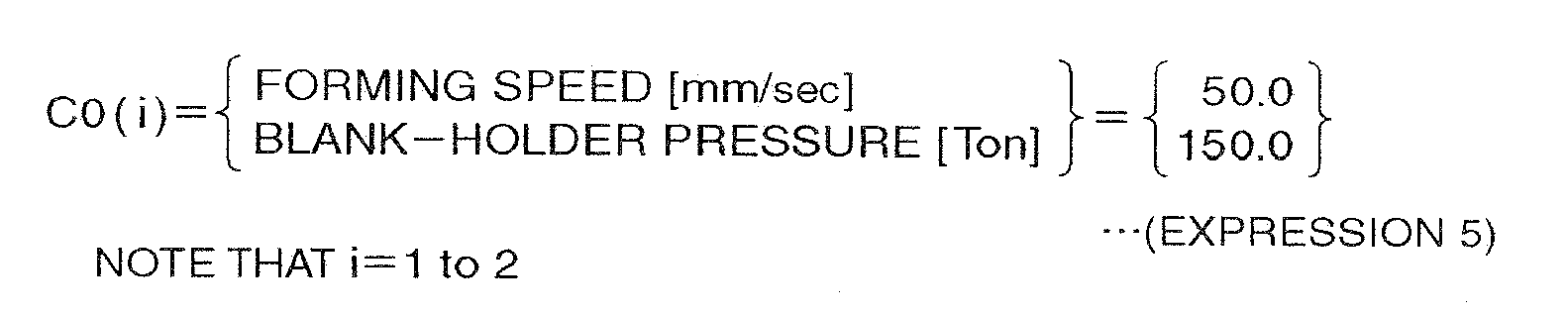


- Next, a test press is performed, and the punch reaction
force measuring unit 103e and the molddistortion measuring unit 103d respectively measure the punch reaction force and the mold distortion during the forming. After it is confirmed that the press-processed product obtained by performing the test press is a non-defective without any cracks, wrinkles, or the like, the formingcondition calculation portion 104f of the condition settingcalculation device 104 sets the forming speed and the blank-holder pressure obtained by the above-stated (expression 7), and measured maximum value of the punch reaction force, and maximum value of the mold distortion, as the standard values of the state quantity. In the example shown in the above-stated (expression 3) to (expression 7), the formingcondition calculation portion 104f sets the standard value "S0(k)" of the state quantity shown in the following. -

- The forming
condition calculation portion 104f calculates the forming condition "C(i)" by using the above-stated (expression 2), and outputs the calculated forming condition "C(i)" to thecontrol calculation unit 103i of thecontrol device 103. Thecontrol calculation unit 103i starts the press-process of the material to be processed 300 based on this forming condition "C(i)".
After that, the maximum value of the punch reaction force and the maximum value of the mold distortion during the forming are measured every time when the press-process is performed, and the forming speed and the blank-holder pressure are corrected in accordance with the difference between the measured maximum value of the punch reaction force and maximum value of the mold distortion, and the set standard value. - Concretely speaking, for example, when the measured value "S(k)" of the state quantity defined from the maximum value of the punch reaction force and the maximum value of the mold distortion during the forming becomes to be as shown in a following (expression 9), the forming
condition calculation portion 104f substitutes the setting value "C0'(i)" of the forming condition shown in the (expression 7), the standard value "S0(k)" of the state quantity shown in the (expression 8), and the influence function matrix "T2(i, k)" shown in a following (expression 10) to the (expression 2), and obtains the correction value "C(i)" of the forming condition as shown in a following (expression 11). Incidentally, in the above description, the influence function matrix "T2(i, k)" is to be set in advance. -


- As stated above, in the present example, the punch reaction force and the mold distortion during the press-process are measured in addition to the material characteristic data received from the material characteristic
data providing device 101, and the forming speed and the blank-holder pressure are corrected in accordance with the measured results. Therefore, it becomes possible to obtain the more adequate forming conditions of the material to be processed 300, and to obtain a better formed product. - Incidentally, in the present example, the forming speed and the blank-holder pressure are corrected every time when the press-process is performed, but they may be corrected by every plural press-processes. Besides, the maximum value of the punch reaction force and the maximum value of the mold distortion during the press-process are made to be the standard value "S0(k)" of the state quantity, but the standard value "S0(k)" of the state quantity can be set by totally judging from a time-series data of the punch reaction force and a time-series data of the mold distortion during the press-process. For example, values at plural points of the time-series data may be used to evaluate the standard value "S0(k)" of the state quantity.
- Further, in the present example, the press-process is performed without changing the forming speed and the blank-holder pressure shown in the (expression 11), but these values may be changed during the press-process in accordance with a punch stroke and so on.
- Next, a second example of the present embodiment is described.
As stated above, the condition settingcalculation device 104 receives the actual performance values of the tensile strength, the 0.2% proof stress, the total elongation, and the sheet thickness from the material characteristicdata providing device 101 as the material characteristic data also in the present example. In addition, in the present example, the condition settingcalculation device 104 inputs a material characteristic data which cannot be provided by the material characteristicdata providing device 101, namely, the material characteristic data which cannot be known by an operator of the material characteristicdata providing device 101, based on an operation by a user of the operation portion provided at the condition settingcalculation device 104. Incidentally, here, a case is described as an example when an actual performance value of a lubricant film thickness is inputted as an example of such material characteristic data. - The forming
condition calculation portion 104f corrects the forming conditions such as the forming speed and the blank-holder pressure by using the (expression 1) based on the received material characteristic data and the inputted material characteristic data.
Concretely speaking, for example, the forming conditions are corrected by substituting the standard value "P0(j)" of the material characteristics shown in a following (expression 12), the influence function matrix "T1(i, j)" shown in a following (expression 13), and the actual performance value "P(j)" of the material characteristics defined from the above-stated material characteristic data to the (expression 1). -


- As stated above, in the present example, the forming conditions are corrected with considering the material characteristic data which can be known only at the user side using the condition setting
calculation device 104, in addition to the material characteristic data received from the material characteristicdata providing device 101, and therefore, it is possible to suppress an influence of variable factors such as a lubricity between the mold and the material to be processed 300 and a surface property, in addition to the variation of the material characteristics and the environmental change. Accordingly, a more adequate forming condition can be obtained. - Next, a third example of the present embodiment is described.
As stated above, the condition settingcalculation device 104 receives the actual performance values of the tensile strength, the 0.2% proof stress, the total elongation, and the sheet thickness from the material characteristicdata providing device 101 as the material characteristic data also in the present example. However, in the present example, a representative value of the production lot (for example, the representative value of 100 sheets of materials to be processed 300) is received as the material characteristic data. - Besides, in the present example, the condition setting
calculation device 104 inputs the material characteristic data having a large variety depending on the material to be processed 300, based on the operation of the operation portion by the user provided at the condition settingcalculation device 104. In the present embodiment, an actual performance value of Vickers hardness of the material to be processed 300 before the press-process is inputted as an example of such material characteristic data. - The forming
condition calculation portion 104f corrects the forming conditions such as the forming speed and the blank-holder pressure by using the (expression 1) based on the received material characteristic data and the inputted material characteristic data.
Concretely speaking, for example, the standard value "P0(j)" of the material characteristics shown in a following (expression 14), the influence function matrix "T1(i, j)" shown in a following (expression 15), and the actual performance value "P(j)" of the material characteristics defined from the above-stated material characteristic data are substituted to the (expression 1) to set the forming conditions. -


- As stated above, in the present example, the material characteristic data which has a large effect on the press-process unless it is considered by each material to be processed 300, is measured at the user side separately, and the forming conditions are corrected with considering the measured material characteristic data. Therefore, it is possible to press-process the material to be processed 300 adequately even if the material characteristic data received from the material characteristic
data providing device 101 is the representative value of the production lot. - Next, a fourth example of the present embodiment is described.
As stated above, the condition settingcalculation device 104 receives the actual performance values of the tensile strength, the 0.2% proof stress, the total elongation, and the sheet thickness from the material characteristicdata providing device 101 as the material characteristic data also in the present example. In addition, in the present example, when the punch reaction force during the press-process exceeds a tolerance range, the blank-holder pressure is adjusted so that the punch reaction force is within the tolerance range, and the press-process is continued with the adjusted bank-holder pressure. - Concretely speaking, for example, the standard value "P0(j)" of the material characteristics in the material to be processed 300 as in a following (expression 16), the actual performance value "P(j)" of the material characteristics as in a (expression 17), the standard value "C0(i)" of the forming conditions as in a (expression 18), and the influence function matrix "T1(i, j)" as shown in a (expression 19) are respectively substituted to the (expression 1), and the correction value "C0'(i)" of the forming conditions as in a following (expression 20) can be obtained.
-


- The press-process is started in accordance with the correction value "C0'(i)" of the forming conditions. After the press-process is started, the punch reaction force during the press-process is measured by using the punch reaction
force measuring unit 103e as stated above, and the maximum value of the measured punch reaction force is stored in a recording medium provided at the condition settingcalculation device 104 every time when the press-process is performed.
The formingcondition calculation portion 104f of the condition settingcalculation device 104 judges whether a moving average value of 10 points of the punch reaction forces stored in the recording medium is within the tolerance range which is set in advance or not, and when it is not within the tolerance range, the blank-holder pressure is adjusted as stated above, and the press-process is continued. - In an example shown in Fig. 7, a moving
average 703 of 10 points of a measuredvalue 702 of the punch reaction force exceeds the tolerance range (450 [Ton] or more and 550 [Ton] or less) when the press.-processes are performed for approximately 50 times. Accordingly, a blank-holder pressure 701 is reduced from 150 [Ton] to 145 [Ton], and the press-process is continued to make the movingaverage 703 of the 10 points of the measuredvalues 702 of the punch reaction force is within the tolerance range. - Concretely speaking, for example, when the measured value "S(k)" of the state quantity defined from the maximum value of the punch reaction force becomes as in an (expression 21) shown in the following, the correction value "C0'(i)" of the forming conditions shown in the (expression 20), the influence function matrix "T2(i, k)" as in a following (expression 22), and the standard value "S0(k)" of the state quantity as in a following (expression 23) are substituted to the (expression 2), and the correction value "C(i)" of the forming conditions as in a following (expression 24) is obtained. Incidentally, in the above description, the influence function matrix "T2(i, k)" is to be set in advance.
-


- As stated above, in the present example, the blank-holder pressure is adjusted so that the punch reaction force is within the tolerance range when the punch reaction force during the press-process exceeds the tolerance range, and the press-process is continued with the adjusted blank-holder pressure, in addition to the material characteristic data received from the material characteristic
data providing device 101. Therefore, it becomes possible to reduce the occurrence of defective products further more, and to perform the press-process of the predetermined number of materials to be processed 300 more adequately. - Incidentally, in the present example, a case is described as an example when the blank-holder pressure is adjusted so that the punch reaction force is within the tolerance range, and the press-process is continued with the adjusted blank-holder pressure. However, it is not limited to the embodiment as stated above, and at least any one of the blank-holder pressure, the forming speed, or the mold temperature may be adjusted so that the state quantity exceeding the tolerance range is within the tolerance range, when the state quantity of at least any one of the punch reaction force, the mold temperature, the mold distortion amount, the deformation amount of the material to be processed 300, or the temperature of the material to be processed 300 exceeds the tolerance range during the press-process.
- Besides, a current value and an actual performance value in the past of the state quantity such as the punch reaction force are compared, and process conditions such as the blank-holder pressure may be adjusted in accordance with the compared result. Concretely speaking, for example, when a difference between the current value and the actual performance value in the past of the state quantity such as the punch reaction force exceeds a predetermined value, the blank-holder pressure is adjusted so that the difference does not exceed the predetermined value.
Further, the moving average value of the 10 points of the state quantity of the punch reaction force and so on is to be judged whether it is within the tolerance range set in advance or not, but the moving average value of the state quantity within a predetermined time may be judged whether it is within the tolerance range set in advance or not. - Next, a fifth example of the present embodiment is described.
As stated above, the condition settingcalculation device 104 receives the actual performance values of the tensile strength, the 0.2% proof stress, the total elongation, and the sheet thickness from the material characteristicdata providing device 101 as the material characteristic data also in the present example. However, in the present example, the received material characteristic data is encrypted in the material characteristicdata providing device 101, and the press-forming is performed in a procedure described in the first example after the material characteristic data is decrypted in the condition settingcalculation device 104. At this time, the material characteristicdata providing device 101 is managed by a material manufacturer, and a transmission history file (client name, connection date and time, amount of transmission data, and so on) is updated every time when the material characteristic data is transmitted to a customer using the condition settingcalculation device 104. The transmission history file is periodically aggregated to bill in accordance with a total communication amount. Accordingly, it is possible for the customer to obtain accurate material characteristic data by each material while securing a confidentiality of the data. Therefore, it is not necessary for the operator to experientially correct the forming conditions each time, and an effect can be obtained in which a quality variation of the formed products is reduced. Besides, works to prepare a conventional paper-based mil sheet are drastically reduced for the material manufacturer by the encryption and the billing. In addition, effects of preventing reuses (unauthorized copy) of the material characteristic data, and further enabling to cover administrative and maintenance expense of this system can be obtained, while securing the confidentiality of the material characteristic data. - Those supplying program codes of software to realize functions of the above-stated embodiments for a computer within an equipment or a system connected to various devices so as to operate the various devices to realize the functions of the above-stated embodiments, and implemented by operating the various devices in accordance with the programs stored in the computer (CPU or MPU) of the system or the equipment are also included in the range of the present invention.
- Besides, in this case, the program codes of the software in themselves realize the functions of the embodiments, and therefore, the program codes in themselves, a means to provide the program codes to the computer, for example, a recording medium storing such program codes may constitute the present invention. As the recording medium storing such program codes, for example, a flexible disk, a hard disk, an optical disk, a magnetic optical disk, a CD-ROM, a magnetic tape, a non-volatile memory card, a ROM, and so on can be used.
- Besides, it goes without saying that the program codes are included in the present invention when the program codes work together with an OS (operating system), other application software, or the like operating on the computer to thereby realize the functions of the embodiments, in addition to the case when the computer executes the provided program codes to thereby realize the functions of the embodiments.
- Further, it goes without saying that a case is also included in the present invention when the provided program codes are stored in a memory included in a function expansion board of the computer or a function expansion unit connected to the computer, and thereafter, a CPU and so on included in the function expansion board or the function expansion unit perform a part or all of the actual processes based on instructions of the program codes, and the functions of the embodiments are realized by the processes.
- According to the present invention, a material is press-formed with process conditions based on material characteristic data transmitted from a server side computer to a user side computer via a network, and therefore, it becomes possible to define forming conditions with considering variations of the material characteristics. Accordingly, it becomes possible to obtain adequate forming conditions as much as possible, and to obtain good formed products.
Claims (18)
- A press-forming system having a press-forming apparatus press-forming a material, a user side computer performing instructions to the press-forming for the press-forming apparatus, and a server side computer connected to the user side computer via a network,
wherein the server side computer comprises:a material characteristic data transmission portion transmitting a material characteristic data representing characteristics of the material,wherein the user side computer comprises:a material characteristic data receiving portion receiving the material characteristic data transmitted by said material characteristic data transmission portion, andwherein the press-forming apparatus has a punch, a die, and a blank-holder, and comprises:a process condition control portion press-forming the material with a process condition based on the material characteristic data received by said material characteristic data receiving portion. - The press-forming system according to claim 1,
wherein the user side computer further comprises:a process condition calculation portion calculating the process condition of the press-forming performed at the press-forming apparatus by using the material characteristic data received by said material characteristic data receiving portion, andwherein said process condition control portion press-forms the material with the process condition calculated by said process condition calculation portion. - The press-forming system according to claim 2,
wherein said process condition control portion controls at least any one of a moving speed of the punch or the die, a mold temperature, or a blank-holder force based on the process condition calculated by said process condition calculation portion. - The press-forming system according to claim 3,
wherein said process condition calculation portion calculates the process condition of at least any one of the moving speed of the punch or the die, the mold temperature, or the blank-holder force by using a state quantity while the material is press-formed, in which the state quantity is at least any one of a punch reaction force, the mold temperature, a mold distortion amount, a deformation amount of the material, or a temperature of the material, and
wherein said process condition control portion controls at least any one of the moving speed of the punch or the die, the mold temperature, or the blank-holder force based on the process condition calculated by said process condition calculation portion. - The press-forming system according to claim 4,
wherein the press-forming device further comprises:a measuring portion measuring the state quantity of at least any one of the punch reaction force, the mold temperature, the mold distortion amount, the deformation amount of the material, or the temperature of the material when the material is press-formed, andwherein said process condition calculation portion calculates the process condition of at least any one of the moving speed of the punch or the die, the mold temperature, or the blank-holder force by using the state quantity measured by said measuring portion. - The press-forming system according to claim 5,
wherein said process condition calculation portion calculates the process condition of at least any one of the moving speed of the punch or the die, the mold temperature, or the blank-holder force so that the state quantity exceeding a tolerance range is within the tolerance range when the state quantity measured by said measuring portion exceeds the tolerance range. - The press-forming system according to claim 5,
wherein the user side computer further comprises:a storage portion storing the state quantity measured by said measuring portion, andwherein said process condition calculation portion asks a moving average value of the state quantity within a time or of the number of times by using the state quantity stored in said storage portion, and calculates the process condition of at least any one of the moving speed of the punch or the die, the mold temperature, or the blank-holder force so that the asked moving average value is within the tolerance range. - The press-forming system according to claim 5,
wherein the user side computer further comprises:a storage portion storing the state quantity measured by said measuring portion, andwherein said process condition calculation portion compares a current state quantity measured by said measuring portion with a past state quantity stored in said storage portion, and calculates the process condition of at least any one of the moving speed of the punch or the die, the mold temperature, or the blank-holder force in accordance with the compared result. - The press-forming system according to claim 1,
wherein the user side computer further comprises:a second material characteristic data input portion inputting a second material characteristic data different from the material characteristic data received by said material characteristic data receiving portion, andwherein said process condition calculation portion calculates the process condition performed at the press-forming apparatus by using the second material characteristic data inputted by said second material characteristic data input portion. - The press-forming system according to claim 9,
wherein the second material characteristic data is a data obtained before the material is formed by the press-forming apparatus. - The press-forming system according to claim 9,
wherein the material characteristic data received by said material characteristic data receiving portion is a representative value of a production lot to which the material press-formed at the press-forming apparatus is belonging, and the second material characteristic data inputted by said second material characteristic data input portion is a value of the material press-formed at the press-forming apparatus as it is. - The press-forming system according to claim 1, further comprising:a material characteristic database storing a material identification number identifying the material press-formed at the press-forming apparatus and the material characteristic data in the material identified by the material identification number correspondingly, andwherein the user side computer further comprises:a material identification number input portion inputting the material identification number; anda material identification number transmission portion transmitting the material identification number inputted by said material identification number input portion,wherein the server side computer further comprises:a material identification number receiving portion receiving the material identification number transmitted by said material identification number transmission portion, andwherein said material characteristic data transmission portion transmits the material characteristic data stored in said material characteristic database in correspondence with the material identification number received by said material identification number receiving portion.
- The press-forming system according to claim 12,
wherein said material identification number input portion has at least any one of an operation element operated by a user, a first reading portion reading information of a barcode, a second reading portion reading information of an IC tag, or a third reading portion reading information of a disk recording medium. - The press-forming system according to claim 1,
wherein the material characteristic data includes at least one data relating a sheet thickness, a yield stress, 0.2% proof stress, a tensile strength, an elongation, an n-value, an r-value, a relational expression between a stress and a strain, a hardness, a temperature, a surface roughness, a friction coefficient, and a lubricant film thickness of the material. - The press-forming system according to claim 1,
wherein the server side computer further comprises:a data invisible portion in which the material characteristic data is made usable for said process condition calculation portion but invisible for a user when the material characteristic data is transmitted to the user side computer. - The press-forming system according to claim 1, further comprising:a billing portion billing in accordance with the transmission of the material characteristic data of the server side computer.
- A press-forming method, comprising the steps of:transmitting a material characteristic data representing material characteristics from a server side computer to a user side computer via a network;receiving the material characteristic data transmitted by said step of transmitting the material characteristic data by the user side computer,press-forming the material with a process condition based on the material characteristic data received by said step of receiving the material characteristic data.
- A computer program product for designing circuit comprising the steps of:program code means for transmitting a material characteristic data representing material characteristics from a server side computer to a user side computer via a network;program code means for receiving the material characteristic data transmitted by said step of transmitting the material characteristic data by the user side computer; andprogram code means for controlling a press-forming apparatus with a process condition based on the material characteristic data received by said step of receiving the material characteristic data.
Applications Claiming Priority (2)
| Application Number | Priority Date | Filing Date | Title |
|---|---|---|---|
| JP2004264434A JP2006075884A (en) | 2004-09-10 | 2004-09-10 | Press molding processing system, press molding processing method, and computer program |
| PCT/JP2005/016527 WO2006028175A1 (en) | 2004-09-10 | 2005-09-08 | Press molding system, press molding method, and computer program |
Publications (3)
| Publication Number | Publication Date |
|---|---|
| EP1787737A1 true EP1787737A1 (en) | 2007-05-23 |
| EP1787737A4 EP1787737A4 (en) | 2008-05-28 |
| EP1787737B1 EP1787737B1 (en) | 2019-01-16 |
Family
ID=36036456
Family Applications (1)
| Application Number | Title | Priority Date | Filing Date |
|---|---|---|---|
| EP05782300.7A Expired - Lifetime EP1787737B1 (en) | 2004-09-10 | 2005-09-08 | Press forming system, press forming method, and computer program product |
Country Status (13)
| Country | Link |
|---|---|
| US (2) | US7886564B2 (en) |
| EP (1) | EP1787737B1 (en) |
| JP (1) | JP2006075884A (en) |
| KR (2) | KR101067572B1 (en) |
| CN (1) | CN100551573C (en) |
| BR (1) | BRPI0515350B1 (en) |
| CA (1) | CA2580066C (en) |
| ES (1) | ES2717605T3 (en) |
| MX (2) | MX367067B (en) |
| RU (1) | RU2352423C2 (en) |
| TR (1) | TR201904522T4 (en) |
| TW (1) | TWI305157B (en) |
| WO (1) | WO2006028175A1 (en) |
Cited By (2)
| Publication number | Priority date | Publication date | Assignee | Title |
|---|---|---|---|---|
| DE102010035982A1 (en) * | 2010-09-01 | 2012-03-01 | Audi Ag | Press control method for manufacturing metal sheet component for door, involves defining action/rule strategy for process operation at optimum operating point determined based on received topology |
| US10022766B2 (en) | 2013-07-19 | 2018-07-17 | Jfe Steel Corporation | Press forming method and method of manufacturing press-formed part |
Families Citing this family (53)
| Publication number | Priority date | Publication date | Assignee | Title |
|---|---|---|---|---|
| JP4833531B2 (en) * | 2003-11-11 | 2011-12-07 | 新日本製鐵株式会社 | Press molding processing apparatus, press molding processing method, computer program, and recording medium |
| JP2006075884A (en) * | 2004-09-10 | 2006-03-23 | Nippon Steel Corp | Press molding processing system, press molding processing method, and computer program |
| CN103995927B (en) * | 2006-08-31 | 2017-01-04 | 新日铁住金株式会社 | Resilience countermeasure position specifying method and resilience countermeasure position specific device |
| AU2007315647B2 (en) * | 2006-10-31 | 2011-09-01 | Jfe Steel Corporation | Press forming method for metal sheet and frame part for automotive body manufactured thereby |
| JP4943284B2 (en) * | 2006-12-18 | 2012-05-30 | 新日本製鐵株式会社 | Thin plate press forming equipment |
| KR101139010B1 (en) * | 2007-05-09 | 2012-04-26 | 신닛뽄세이테쯔 카부시키카이샤 | Thin plate press molding device and thin plate press molding method |
| JP4383493B2 (en) * | 2007-08-17 | 2009-12-16 | 新日本製鐵株式会社 | Material information providing method and material information using method of high-tensile steel sheet with TS of 780 MPa or more |
| CN101439467B (en) * | 2007-11-23 | 2012-09-12 | 丁晓跃 | Metal bar section roll milling and processing equipment, and network control system thereof |
| US8464591B2 (en) | 2008-10-07 | 2013-06-18 | Nippon Steel & Sumitomo Metal Corporation | Method and apparatus for judging fracture of metal stamped product, program and computer-readable recording medium |
| CN101758382A (en) * | 2008-12-23 | 2010-06-30 | 上海和达汽车配件有限公司 | Vehicle reinforcing plate processing technique equipment and method thereof |
| JP5294082B2 (en) * | 2009-08-24 | 2013-09-18 | 新日鐵住金株式会社 | Bending limit strain measurement method, bending crack determination method, and bending crack determination program |
| US8359116B2 (en) * | 2009-09-11 | 2013-01-22 | Sap Ag | Production management system |
| WO2011101761A2 (en) * | 2010-02-08 | 2011-08-25 | Koninklijke Philips Electronics N.V. | Driver circuit for driving a load circuit |
| US20120227452A1 (en) * | 2011-03-07 | 2012-09-13 | Toyota Motor Engineering & Manufacturing North America, Inc. | Method and system for controlling the quality of a stamped part |
| JP2012218067A (en) * | 2011-04-14 | 2012-11-12 | Honda Motor Co Ltd | Press working method and press working apparatus |
| US9250050B2 (en) | 2011-10-21 | 2016-02-02 | Setpoint Systems, Inc. | Apparatus, system, and method for ammunition cartridge case annealing |
| US9157709B2 (en) | 2011-12-08 | 2015-10-13 | Setpoint Systems, Inc. | Apparatus, system, and method for manufacturing ammunition cartridge cases |
| EP2872955A4 (en) | 2012-07-10 | 2016-08-10 | Matitiahu Tiano | MODULAR SYSTEM FOR EVALUATING AND REAL-TIME CONTROL OF COMPLETE MACHINING PRODUCTION LINE PERFORMANCE CALCULATED FROM EACH WORKPIECE, TOOL AND MACHINE GIVEN |
| CN103317025B (en) * | 2013-06-28 | 2015-08-26 | 苏州唐氏机械制造有限公司 | A kind of intelligent pressure detection supercharging diel |
| CN103302186A (en) * | 2013-06-28 | 2013-09-18 | 苏州唐氏机械制造有限公司 | Intelligent pressure detection stamping die |
| CN103316997A (en) * | 2013-06-28 | 2013-09-25 | 苏州唐氏机械制造有限公司 | Intelligent blanking die with pressure detecting function |
| WO2015178267A1 (en) * | 2014-05-19 | 2015-11-26 | 新日鐵住金株式会社 | Press molding method and metal mold for press molding |
| DE112015002752T5 (en) * | 2014-06-11 | 2017-03-23 | Magna International Inc. | Implementation and communication of sheet metal simulations using a combination of factors |
| US20150363524A1 (en) * | 2014-06-16 | 2015-12-17 | Ford Global Technologies, Llc | Stress relief in a finite element simulation for springback compensation |
| JP5954380B2 (en) * | 2014-08-26 | 2016-07-20 | Jfeスチール株式会社 | Press molding method and manufacturing method of press molded parts |
| CN107249772B (en) * | 2015-01-26 | 2019-06-14 | 新日铁住金株式会社 | Method, device, and recording medium for estimating the area of occurrence or cause of surface shape defect |
| TWI555978B (en) * | 2015-05-29 | 2016-11-01 | Univ Nat Kaohsiung 1St Univ Sc | Stamping Forming Sheet Metal Formability Detection System and Method |
| CN105414245B (en) * | 2015-12-08 | 2017-12-12 | 珠海吉田精密塑料模具有限公司 | One kind experiment punching press intensity detection system |
| US11707783B2 (en) * | 2017-08-04 | 2023-07-25 | Sumitomo Electric Sintered Alloy, Ltd. | Manufacturing facility and manufacturing method of sintered product |
| DE102018102809B4 (en) * | 2018-02-08 | 2022-04-28 | Schuler Pressen Gmbh | Press and procedures for its operation |
| US10656629B2 (en) * | 2018-02-13 | 2020-05-19 | Ford Motor Company | Method and system for linking fixture alignment modifications with a workpiece |
| DE102018108575B4 (en) * | 2018-04-11 | 2024-09-19 | Thyssenkrupp Ag | Method for determining forming results of metal parts as well as device and system |
| EP3608737B1 (en) * | 2018-08-06 | 2022-11-16 | Siemens Aktiengesellschaft | Determining at least one reforming process indicator of a servo press |
| JP6683269B1 (en) * | 2019-02-01 | 2020-04-15 | Jfeスチール株式会社 | Method for identifying the part that causes the springback variation |
| JP7069418B2 (en) * | 2019-06-07 | 2022-05-17 | 三菱電機株式会社 | Mold management device, mold management method and mold management program |
| KR102069999B1 (en) * | 2019-06-26 | 2020-01-23 | 유한회사 제스텍 | Press apparatus for load measuring system |
| CN110405042B (en) * | 2019-09-03 | 2021-02-02 | 中国航空制造技术研究院 | Movable heating skin stretch forming equipment and stretch forming method |
| JP7261984B2 (en) * | 2019-09-18 | 2023-04-21 | パナソニックIpマネジメント株式会社 | punching equipment |
| KR102153068B1 (en) * | 2020-01-28 | 2020-09-07 | 이천희 | Press molding system having automatic moving apparatus |
| KR102153063B1 (en) * | 2020-01-28 | 2020-09-07 | 이천희 | Press molding system |
| TWI732655B (en) * | 2020-08-17 | 2021-07-01 | 財團法人金屬工業研究發展中心 | Method and system for optimizing metal stamping process parameters |
| TWI734641B (en) * | 2020-11-06 | 2021-07-21 | 財團法人金屬工業研究發展中心 | Method for predicting forging stage and system for designing forging using thereof |
| JP7543129B2 (en) * | 2020-12-28 | 2024-09-02 | 株式会社日立製作所 | Material processing method and process design computer and its program |
| JP7508009B2 (en) * | 2021-03-04 | 2024-07-01 | Jfeスチール株式会社 | Press line, press molding condition calculation method, and press molding condition calculation program |
| CN117015448A (en) * | 2021-03-04 | 2023-11-07 | 杰富意钢铁株式会社 | Stamping production line, stamping forming condition calculation method and stamping forming condition calculation program |
| CN113172931B (en) * | 2021-04-29 | 2021-11-30 | 南京晓庄学院 | Remote monitoring type intelligent control system and method for hydraulic single-row punching machine |
| DE102021124051A1 (en) * | 2021-09-17 | 2023-03-23 | Bayerische Motoren Werke Aktiengesellschaft | Process for operating a press, computer program and electronically readable data carrier |
| KR102461194B1 (en) * | 2021-09-17 | 2022-10-28 | 주명구 | Apparatus and method for intelligent controlling metalworking |
| JP7694486B2 (en) * | 2022-07-08 | 2025-06-18 | トヨタ自動車株式会社 | Device for predicting the rate of defective moldings |
| JP7890192B2 (en) * | 2022-12-26 | 2026-07-14 | 住友重機械工業株式会社 | Press management system, press management method, and press management program |
| CN116011770B (en) * | 2023-01-06 | 2024-02-20 | 北京国网富达科技发展有限责任公司 | Intelligent control-based production and manufacturing material preparation method and system |
| DE102023128854A1 (en) * | 2023-10-20 | 2025-04-24 | Bayerische Motoren Werke Aktiengesellschaft | Method for monitoring a forming process, computer program and electronically readable data carrier |
| CN118080671B (en) * | 2024-04-07 | 2025-02-21 | 沈阳欧施盾新材料科技有限公司 | Deep drawing forming method, device, equipment and medium for high-pressure gas cylinder |
Family Cites Families (32)
| Publication number | Priority date | Publication date | Assignee | Title |
|---|---|---|---|---|
| US128451A (en) * | 1872-07-02 | Improvement in firemen s caps | ||
| US3338373A (en) * | 1966-11-28 | 1967-08-29 | Samuel S Aidlin | Automatic apparatus for orienting and feeding bottles, and the like |
| SU1349851A1 (en) * | 1986-05-21 | 1987-11-07 | Ангарское Отделение Проектно-Конструкторского Института "Уралпроектмонтажавтоматика" | Automated set for multistation press forming |
| JPH01233019A (en) | 1988-03-11 | 1989-09-18 | Kobe Steel Ltd | Pressing method for metallic plate |
| JP3189476B2 (en) | 1993-03-01 | 2001-07-16 | トヨタ自動車株式会社 | Press working condition setting method and apparatus for press machine |
| JP2722936B2 (en) * | 1992-04-07 | 1998-03-09 | トヨタ自動車株式会社 | Automatic change device for wrinkle holding load of press machine |
| JP3269113B2 (en) | 1992-04-07 | 2002-03-25 | トヨタ自動車株式会社 | Press processing condition setting device for press machine |
| GB2265964B (en) * | 1992-04-07 | 1995-03-15 | Rolls Royce | Rotor balancing |
| EP0675419B1 (en) * | 1994-03-31 | 1999-05-26 | Toyota Jidosha Kabushiki Kaisha | Method and apparatus for optimizing press operating condition based on press operating environment and/or physical condition of blank |
| JPH07266100A (en) * | 1994-03-31 | 1995-10-17 | Toyota Motor Corp | Press processing condition setting method and device |
| JP3373075B2 (en) | 1995-03-06 | 2003-02-04 | 株式会社小松製作所 | Press brake |
| JP3431049B2 (en) | 1995-04-27 | 2003-07-28 | 株式会社小松製作所 | Bending machine |
| US5734843A (en) * | 1995-06-07 | 1998-03-31 | Advanced Micro Devices Inc. | Reverse data channel as a bandwidth modulator |
| US5864482A (en) * | 1996-05-06 | 1999-01-26 | Amadasoft America, Inc. | Apparatus and method for managing distributing design and manufacturing information throughout a sheet metal production facility |
| JPH1041896A (en) * | 1996-07-19 | 1998-02-13 | Sony Corp | Transmission / reception device and transmission / reception method |
| JP3394141B2 (en) * | 1996-10-29 | 2003-04-07 | 株式会社小松製作所 | Bending angle correction method and press brake using the same |
| JP3277366B2 (en) * | 1997-02-10 | 2002-04-22 | 株式会社神戸製鋼所 | Metal plate processing management system |
| JP3691973B2 (en) | 1997-02-10 | 2005-09-07 | 株式会社神戸製鋼所 | Metal plate |
| JP3338373B2 (en) * | 1998-06-05 | 2002-10-28 | 株式会社アマダ | Sheet metal processing integrated support system |
| JP2000066340A (en) | 1998-06-09 | 2000-03-03 | Fuji Photo Film Co Ltd | Production control method of photographic film cartridge |
| JP2002355737A (en) * | 1998-06-29 | 2002-12-10 | Amada Metrecs Co Ltd | Sheet metal data management system and storage medium storing sheet metal data management program |
| JP4077141B2 (en) | 2000-06-30 | 2008-04-16 | 株式会社東芝 | Design rule creation method, design rule creation system, and recording medium |
| JP2003011128A (en) | 2001-07-02 | 2003-01-15 | Futaba Corp | Press mold design method, press mold design apparatus, recording medium |
| JP2003036106A (en) | 2001-07-24 | 2003-02-07 | Sharp Corp | Manufacturing management method and manufacturing management device, distribution product, and manufacturing management program |
| KR20050099561A (en) | 2001-07-27 | 2005-10-13 | 신닛뽄세이테쯔 카부시키카이샤 | Information processing system for manufacturing building material, building material manufacturing method and facility, and building information circulating system |
| JP3939582B2 (en) | 2002-04-22 | 2007-07-04 | 株式会社神戸製鋼所 | Molding simulation method and apparent friction coefficient determination method applied to the method |
| US7266100B2 (en) * | 2002-11-01 | 2007-09-04 | Nokia Corporation | Session updating procedure for authentication, authorization and accounting |
| JP4629965B2 (en) | 2003-01-31 | 2011-02-09 | 新日本製鐵株式会社 | Thin plate press die apparatus and press molding method |
| US7265957B2 (en) * | 2004-06-18 | 2007-09-04 | Cooper Technologies Company | Restoring electrical load to distribution feeder circuits |
| JP2006075884A (en) * | 2004-09-10 | 2006-03-23 | Nippon Steel Corp | Press molding processing system, press molding processing method, and computer program |
| US7398129B2 (en) * | 2004-10-07 | 2008-07-08 | Amada Company, Limited | Representation of sheet metal part models |
| US7257460B2 (en) * | 2005-07-27 | 2007-08-14 | Ravinder Venugopal | Reconfigurable variable blank-holder force system and method for sheet metal stamping |
-
2004
- 2004-09-10 JP JP2004264434A patent/JP2006075884A/en active Pending
-
2005
- 2005-09-08 TR TR2019/04522T patent/TR201904522T4/en unknown
- 2005-09-08 CN CNB200580030322XA patent/CN100551573C/en not_active Expired - Lifetime
- 2005-09-08 US US11/575,059 patent/US7886564B2/en active Active
- 2005-09-08 CA CA2580066A patent/CA2580066C/en not_active Expired - Lifetime
- 2005-09-08 ES ES05782300T patent/ES2717605T3/en not_active Expired - Lifetime
- 2005-09-08 KR KR1020097016612A patent/KR101067572B1/en not_active Expired - Lifetime
- 2005-09-08 MX MX2014006610A patent/MX367067B/en unknown
- 2005-09-08 WO PCT/JP2005/016527 patent/WO2006028175A1/en not_active Ceased
- 2005-09-08 EP EP05782300.7A patent/EP1787737B1/en not_active Expired - Lifetime
- 2005-09-08 MX MX2007002652A patent/MX2007002652A/en active IP Right Grant
- 2005-09-08 KR KR1020077005536A patent/KR20070043033A/en not_active Ceased
- 2005-09-08 RU RU2007113172/02A patent/RU2352423C2/en active
- 2005-09-08 BR BRPI0515350-6A patent/BRPI0515350B1/en active IP Right Grant
- 2005-09-09 TW TW094131121A patent/TWI305157B/en not_active IP Right Cessation
-
2010
- 2010-12-27 US US12/979,203 patent/US8091395B2/en not_active Expired - Lifetime
Cited By (3)
| Publication number | Priority date | Publication date | Assignee | Title |
|---|---|---|---|---|
| DE102010035982A1 (en) * | 2010-09-01 | 2012-03-01 | Audi Ag | Press control method for manufacturing metal sheet component for door, involves defining action/rule strategy for process operation at optimum operating point determined based on received topology |
| DE102010035982B4 (en) * | 2010-09-01 | 2013-10-31 | Audi Ag | Method for press control in a deep drawing process for the production of sheet metal components, in particular of body components |
| US10022766B2 (en) | 2013-07-19 | 2018-07-17 | Jfe Steel Corporation | Press forming method and method of manufacturing press-formed part |
Also Published As
| Publication number | Publication date |
|---|---|
| TW200618884A (en) | 2006-06-16 |
| RU2007113172A (en) | 2008-10-20 |
| US8091395B2 (en) | 2012-01-10 |
| CA2580066C (en) | 2011-01-25 |
| MX2007002652A (en) | 2007-05-15 |
| ES2717605T3 (en) | 2019-06-24 |
| EP1787737A4 (en) | 2008-05-28 |
| KR20090089920A (en) | 2009-08-24 |
| KR101067572B1 (en) | 2011-09-27 |
| MX367067B (en) | 2019-08-02 |
| BRPI0515350A (en) | 2008-07-15 |
| CN100551573C (en) | 2009-10-21 |
| US20110094279A1 (en) | 2011-04-28 |
| CN101014428A (en) | 2007-08-08 |
| EP1787737B1 (en) | 2019-01-16 |
| KR20070043033A (en) | 2007-04-24 |
| TWI305157B (en) | 2009-01-11 |
| CA2580066A1 (en) | 2006-03-16 |
| BRPI0515350B1 (en) | 2018-07-10 |
| WO2006028175A1 (en) | 2006-03-16 |
| JP2006075884A (en) | 2006-03-23 |
| TR201904522T4 (en) | 2019-05-21 |
| RU2352423C2 (en) | 2009-04-20 |
| US20080092620A1 (en) | 2008-04-24 |
| US7886564B2 (en) | 2011-02-15 |
Similar Documents
| Publication | Publication Date | Title |
|---|---|---|
| EP1787737B1 (en) | Press forming system, press forming method, and computer program product | |
| EP1688196B1 (en) | Press forming device, press forming method, computer program, and recording medium | |
| Frohn-Sörensen et al. | 3D printed prototyping tools for flexible sheet metal drawing | |
| EP2136197A1 (en) | Breakage prediction method, calculation processing device, program, and recording medium | |
| JP4870200B2 (en) | Press molding processing system, press molding processing method, and computer program | |
| JP2008173686A (en) | Thin plate press forming equipment | |
| KR100299255B1 (en) | A control system for metal plate or sheet, a metal plate or sheet, a method for making data for processing metal plate or sheet and a memory medium to store program for making data for processing the same | |
| Abe et al. | Bending process for producing uniform angle distribution from ultra-high strength steel sheets having thickness distribution | |
| JP2009095877A (en) | Thin plate press forming apparatus and method | |
| JP2010115702A (en) | Press machine for adjusting press forming mold and method for adjusting mold | |
| MXPA06005001A (en) | Press forming device, press forming method, computer program, and recording medium | |
| da Silva et al. | A device for testing high strength metallic sheets undergoing cyclic forward and reverse tension–compression loads under plastic strain |
Legal Events
| Date | Code | Title | Description |
|---|---|---|---|
| PUAI | Public reference made under article 153(3) epc to a published international application that has entered the european phase |
Free format text: ORIGINAL CODE: 0009012 |
|
| 17P | Request for examination filed |
Effective date: 20070321 |
|
| AK | Designated contracting states |
Kind code of ref document: A1 Designated state(s): AT BE BG CH CY CZ DE DK EE ES FI FR GB GR HU IE IS IT LI LT LU LV MC NL PL PT RO SE SI SK TR |
|
| DAX | Request for extension of the european patent (deleted) | ||
| A4 | Supplementary search report drawn up and despatched |
Effective date: 20080502 |
|
| 17Q | First examination report despatched |
Effective date: 20080917 |
|
| RAP1 | Party data changed (applicant data changed or rights of an application transferred) |
Owner name: NIPPON STEEL & SUMITOMO METAL CORPORATION Owner name: ARCELOR FRANCE |
|
| RAP1 | Party data changed (applicant data changed or rights of an application transferred) |
Owner name: ARCELORMITTAL Owner name: NIPPON STEEL & SUMITOMO METAL CORPORATION |
|
| STAA | Information on the status of an ep patent application or granted ep patent |
Free format text: STATUS: EXAMINATION IS IN PROGRESS |
|
| REG | Reference to a national code |
Ref country code: DE Ref legal event code: R079 Ref document number: 602005055296 Country of ref document: DE Free format text: PREVIOUS MAIN CLASS: B21D0022280000 Ipc: B21D0024100000 |
|
| GRAP | Despatch of communication of intention to grant a patent |
Free format text: ORIGINAL CODE: EPIDOSNIGR1 |
|
| STAA | Information on the status of an ep patent application or granted ep patent |
Free format text: STATUS: GRANT OF PATENT IS INTENDED |
|
| INTG | Intention to grant announced |
Effective date: 20180803 |
|
| RIC1 | Information provided on ipc code assigned before grant |
Ipc: B21D 24/10 20060101AFI20180724BHEP |
|
| GRAS | Grant fee paid |
Free format text: ORIGINAL CODE: EPIDOSNIGR3 |
|
| GRAA | (expected) grant |
Free format text: ORIGINAL CODE: 0009210 |
|
| STAA | Information on the status of an ep patent application or granted ep patent |
Free format text: STATUS: THE PATENT HAS BEEN GRANTED |
|
| REG | Reference to a national code |
Ref country code: DE Ref legal event code: R081 Ref document number: 602005055296 Country of ref document: DE Owner name: NIPPON STEEL CORPORATION, JP Free format text: FORMER OWNERS: NIPPON STEEL CORP., TOKIO/TOKYO, JP; ARCELOR FRANCE, ST. DENIS, FR Ref country code: DE Ref legal event code: R081 Ref document number: 602005055296 Country of ref document: DE Owner name: ARCELORMITTAL, LU Free format text: FORMER OWNERS: NIPPON STEEL CORP., TOKIO/TOKYO, JP; ARCELOR FRANCE, ST. DENIS, FR |
|
| AK | Designated contracting states |
Kind code of ref document: B1 Designated state(s): AT BE BG CH CY CZ DE DK EE ES FI FR GB GR HU IE IS IT LI LT LU LV MC NL PL PT RO SE SI SK TR |
|
| REG | Reference to a national code |
Ref country code: GB Ref legal event code: FG4D |
|
| REG | Reference to a national code |
Ref country code: CH Ref legal event code: EP |
|
| REG | Reference to a national code |
Ref country code: IE Ref legal event code: FG4D |
|
| REG | Reference to a national code |
Ref country code: DE Ref legal event code: R096 Ref document number: 602005055296 Country of ref document: DE |
|
| REG | Reference to a national code |
Ref country code: AT Ref legal event code: REF Ref document number: 1089316 Country of ref document: AT Kind code of ref document: T Effective date: 20190215 |
|
| REG | Reference to a national code |
Ref country code: NL Ref legal event code: FP |
|
| REG | Reference to a national code |
Ref country code: DE Ref legal event code: R082 Ref document number: 602005055296 Country of ref document: DE Representative=s name: VOSSIUS & PARTNER PATENTANWAELTE RECHTSANWAELT, DE Ref country code: DE Ref legal event code: R081 Ref document number: 602005055296 Country of ref document: DE Owner name: ARCELORMITTAL, LU Free format text: FORMER OWNERS: ARCELORMITTAL, LUXEMBOURG, LU; NIPPON STEEL & SUMITOMO METAL CORPORATION, TOKYO, JP Ref country code: DE Ref legal event code: R081 Ref document number: 602005055296 Country of ref document: DE Owner name: NIPPON STEEL CORPORATION, JP Free format text: FORMER OWNERS: ARCELORMITTAL, LUXEMBOURG, LU; NIPPON STEEL & SUMITOMO METAL CORPORATION, TOKYO, JP |
|
| REG | Reference to a national code |
Ref country code: LT Ref legal event code: MG4D |
|
| REG | Reference to a national code |
Ref country code: ES Ref legal event code: FG2A Ref document number: 2717605 Country of ref document: ES Kind code of ref document: T3 Effective date: 20190624 |
|
| RAP2 | Party data changed (patent owner data changed or rights of a patent transferred) |
Owner name: NIPPON STEEL CORPORATION Owner name: ARCELORMITTAL |
|
| REG | Reference to a national code |
Ref country code: AT Ref legal event code: MK05 Ref document number: 1089316 Country of ref document: AT Kind code of ref document: T Effective date: 20190116 |
|
| PG25 | Lapsed in a contracting state [announced via postgrant information from national office to epo] |
Ref country code: FI Free format text: LAPSE BECAUSE OF FAILURE TO SUBMIT A TRANSLATION OF THE DESCRIPTION OR TO PAY THE FEE WITHIN THE PRESCRIBED TIME-LIMIT Effective date: 20190116 Ref country code: PT Free format text: LAPSE BECAUSE OF FAILURE TO SUBMIT A TRANSLATION OF THE DESCRIPTION OR TO PAY THE FEE WITHIN THE PRESCRIBED TIME-LIMIT Effective date: 20190516 Ref country code: LT Free format text: LAPSE BECAUSE OF FAILURE TO SUBMIT A TRANSLATION OF THE DESCRIPTION OR TO PAY THE FEE WITHIN THE PRESCRIBED TIME-LIMIT Effective date: 20190116 Ref country code: PL Free format text: LAPSE BECAUSE OF FAILURE TO SUBMIT A TRANSLATION OF THE DESCRIPTION OR TO PAY THE FEE WITHIN THE PRESCRIBED TIME-LIMIT Effective date: 20190116 Ref country code: SE Free format text: LAPSE BECAUSE OF FAILURE TO SUBMIT A TRANSLATION OF THE DESCRIPTION OR TO PAY THE FEE WITHIN THE PRESCRIBED TIME-LIMIT Effective date: 20190116 |
|
| PG25 | Lapsed in a contracting state [announced via postgrant information from national office to epo] |
Ref country code: LV Free format text: LAPSE BECAUSE OF FAILURE TO SUBMIT A TRANSLATION OF THE DESCRIPTION OR TO PAY THE FEE WITHIN THE PRESCRIBED TIME-LIMIT Effective date: 20190116 Ref country code: BG Free format text: LAPSE BECAUSE OF FAILURE TO SUBMIT A TRANSLATION OF THE DESCRIPTION OR TO PAY THE FEE WITHIN THE PRESCRIBED TIME-LIMIT Effective date: 20190416 Ref country code: GR Free format text: LAPSE BECAUSE OF FAILURE TO SUBMIT A TRANSLATION OF THE DESCRIPTION OR TO PAY THE FEE WITHIN THE PRESCRIBED TIME-LIMIT Effective date: 20190417 Ref country code: IS Free format text: LAPSE BECAUSE OF FAILURE TO SUBMIT A TRANSLATION OF THE DESCRIPTION OR TO PAY THE FEE WITHIN THE PRESCRIBED TIME-LIMIT Effective date: 20190516 |
|
| REG | Reference to a national code |
Ref country code: DE Ref legal event code: R097 Ref document number: 602005055296 Country of ref document: DE |
|
| PG25 | Lapsed in a contracting state [announced via postgrant information from national office to epo] |
Ref country code: AT Free format text: LAPSE BECAUSE OF FAILURE TO SUBMIT A TRANSLATION OF THE DESCRIPTION OR TO PAY THE FEE WITHIN THE PRESCRIBED TIME-LIMIT Effective date: 20190116 Ref country code: DK Free format text: LAPSE BECAUSE OF FAILURE TO SUBMIT A TRANSLATION OF THE DESCRIPTION OR TO PAY THE FEE WITHIN THE PRESCRIBED TIME-LIMIT Effective date: 20190116 Ref country code: RO Free format text: LAPSE BECAUSE OF FAILURE TO SUBMIT A TRANSLATION OF THE DESCRIPTION OR TO PAY THE FEE WITHIN THE PRESCRIBED TIME-LIMIT Effective date: 20190116 Ref country code: EE Free format text: LAPSE BECAUSE OF FAILURE TO SUBMIT A TRANSLATION OF THE DESCRIPTION OR TO PAY THE FEE WITHIN THE PRESCRIBED TIME-LIMIT Effective date: 20190116 Ref country code: SK Free format text: LAPSE BECAUSE OF FAILURE TO SUBMIT A TRANSLATION OF THE DESCRIPTION OR TO PAY THE FEE WITHIN THE PRESCRIBED TIME-LIMIT Effective date: 20190116 Ref country code: CZ Free format text: LAPSE BECAUSE OF FAILURE TO SUBMIT A TRANSLATION OF THE DESCRIPTION OR TO PAY THE FEE WITHIN THE PRESCRIBED TIME-LIMIT Effective date: 20190116 |
|
| PLBE | No opposition filed within time limit |
Free format text: ORIGINAL CODE: 0009261 |
|
| STAA | Information on the status of an ep patent application or granted ep patent |
Free format text: STATUS: NO OPPOSITION FILED WITHIN TIME LIMIT |
|
| 26N | No opposition filed |
Effective date: 20191017 |
|
| PG25 | Lapsed in a contracting state [announced via postgrant information from national office to epo] |
Ref country code: SI Free format text: LAPSE BECAUSE OF FAILURE TO SUBMIT A TRANSLATION OF THE DESCRIPTION OR TO PAY THE FEE WITHIN THE PRESCRIBED TIME-LIMIT Effective date: 20190116 |
|
| PG25 | Lapsed in a contracting state [announced via postgrant information from national office to epo] |
Ref country code: MC Free format text: LAPSE BECAUSE OF FAILURE TO SUBMIT A TRANSLATION OF THE DESCRIPTION OR TO PAY THE FEE WITHIN THE PRESCRIBED TIME-LIMIT Effective date: 20190116 |
|
| REG | Reference to a national code |
Ref country code: CH Ref legal event code: PL |
|
| PG25 | Lapsed in a contracting state [announced via postgrant information from national office to epo] |
Ref country code: LU Free format text: LAPSE BECAUSE OF NON-PAYMENT OF DUE FEES Effective date: 20190908 Ref country code: LI Free format text: LAPSE BECAUSE OF NON-PAYMENT OF DUE FEES Effective date: 20190930 Ref country code: IE Free format text: LAPSE BECAUSE OF NON-PAYMENT OF DUE FEES Effective date: 20190908 Ref country code: CH Free format text: LAPSE BECAUSE OF NON-PAYMENT OF DUE FEES Effective date: 20190930 |
|
| REG | Reference to a national code |
Ref country code: BE Ref legal event code: MM Effective date: 20190930 |
|
| PG25 | Lapsed in a contracting state [announced via postgrant information from national office to epo] |
Ref country code: BE Free format text: LAPSE BECAUSE OF NON-PAYMENT OF DUE FEES Effective date: 20190930 |
|
| PG25 | Lapsed in a contracting state [announced via postgrant information from national office to epo] |
Ref country code: CY Free format text: LAPSE BECAUSE OF FAILURE TO SUBMIT A TRANSLATION OF THE DESCRIPTION OR TO PAY THE FEE WITHIN THE PRESCRIBED TIME-LIMIT Effective date: 20190116 |
|
| PG25 | Lapsed in a contracting state [announced via postgrant information from national office to epo] |
Ref country code: HU Free format text: LAPSE BECAUSE OF FAILURE TO SUBMIT A TRANSLATION OF THE DESCRIPTION OR TO PAY THE FEE WITHIN THE PRESCRIBED TIME-LIMIT; INVALID AB INITIO Effective date: 20050908 |
|
| PGFP | Annual fee paid to national office [announced via postgrant information from national office to epo] |
Ref country code: NL Payment date: 20240816 Year of fee payment: 20 |
|
| PGFP | Annual fee paid to national office [announced via postgrant information from national office to epo] |
Ref country code: DE Payment date: 20240730 Year of fee payment: 20 |
|
| PGFP | Annual fee paid to national office [announced via postgrant information from national office to epo] |
Ref country code: GB Payment date: 20240801 Year of fee payment: 20 |
|
| PGFP | Annual fee paid to national office [announced via postgrant information from national office to epo] |
Ref country code: FR Payment date: 20240808 Year of fee payment: 20 |
|
| PGFP | Annual fee paid to national office [announced via postgrant information from national office to epo] |
Ref country code: IT Payment date: 20240812 Year of fee payment: 20 |
|
| PGFP | Annual fee paid to national office [announced via postgrant information from national office to epo] |
Ref country code: TR Payment date: 20240822 Year of fee payment: 20 |
|
| PGFP | Annual fee paid to national office [announced via postgrant information from national office to epo] |
Ref country code: ES Payment date: 20241001 Year of fee payment: 20 |
|
| REG | Reference to a national code |
Ref country code: DE Ref legal event code: R071 Ref document number: 602005055296 Country of ref document: DE |
|
| REG | Reference to a national code |
Ref country code: NL Ref legal event code: MK Effective date: 20250907 |
|
| REG | Reference to a national code |
Ref country code: ES Ref legal event code: FD2A Effective date: 20250926 |
|
| REG | Reference to a national code |
Ref country code: GB Ref legal event code: PE20 Expiry date: 20250907 |
|
| PG25 | Lapsed in a contracting state [announced via postgrant information from national office to epo] |
Ref country code: ES Free format text: LAPSE BECAUSE OF EXPIRATION OF PROTECTION Effective date: 20250909 |