EP1785192B1 - Durum wheat pasta with high dietary bran content and process for the production thereof - Google Patents
Durum wheat pasta with high dietary bran content and process for the production thereof Download PDFInfo
- Publication number
- EP1785192B1 EP1785192B1 EP05425791A EP05425791A EP1785192B1 EP 1785192 B1 EP1785192 B1 EP 1785192B1 EP 05425791 A EP05425791 A EP 05425791A EP 05425791 A EP05425791 A EP 05425791A EP 1785192 B1 EP1785192 B1 EP 1785192B1
- Authority
- EP
- European Patent Office
- Prior art keywords
- bran
- weight
- caryopses
- layers
- pasta
- Prior art date
- Legal status (The legal status is an assumption and is not a legal conclusion. Google has not performed a legal analysis and makes no representation as to the accuracy of the status listed.)
- Expired - Lifetime
Links
Images


Classifications
-
- A—HUMAN NECESSITIES
- A21—BAKING; EDIBLE DOUGHS
- A21D—TREATMENT OF FLOUR OR DOUGH FOR BAKING, e.g. BY ADDITION OF MATERIALS; BAKING; BAKERY PRODUCTS
- A21D13/00—Finished or partly finished bakery products
- A21D13/02—Products made from whole meal; Products containing bran or rough-ground grain
-
- A—HUMAN NECESSITIES
- A23—FOODS OR FOODSTUFFS; TREATMENT THEREOF, NOT COVERED BY OTHER CLASSES
- A23L—FOODS, FOODSTUFFS OR NON-ALCOHOLIC BEVERAGES, NOT OTHERWISE PROVIDED FOR; PREPARATION OR TREATMENT THEREOF
- A23L7/00—Cereal-derived products; Malt products; Preparation or treatment thereof
- A23L7/10—Cereal-derived products
- A23L7/109—Types of pasta, e.g. macaroni or noodles
-
- A—HUMAN NECESSITIES
- A23—FOODS OR FOODSTUFFS; TREATMENT THEREOF, NOT COVERED BY OTHER CLASSES
- A23L—FOODS, FOODSTUFFS OR NON-ALCOHOLIC BEVERAGES, NOT OTHERWISE PROVIDED FOR; PREPARATION OR TREATMENT THEREOF
- A23L7/00—Cereal-derived products; Malt products; Preparation or treatment thereof
- A23L7/10—Cereal-derived products
- A23L7/115—Cereal fibre products, e.g. bran, husk
-
- B—PERFORMING OPERATIONS; TRANSPORTING
- B02—CRUSHING, PULVERISING, OR DISINTEGRATING; PREPARATORY TREATMENT OF GRAIN FOR MILLING
- B02B—PREPARING GRAIN FOR MILLING; REFINING GRANULAR FRUIT TO COMMERCIAL PRODUCTS BY WORKING THE SURFACE
- B02B3/00—Hulling; Husking; Decorticating; Polishing; Removing the awns; Degerming
-
- Y—GENERAL TAGGING OF NEW TECHNOLOGICAL DEVELOPMENTS; GENERAL TAGGING OF CROSS-SECTIONAL TECHNOLOGIES SPANNING OVER SEVERAL SECTIONS OF THE IPC; TECHNICAL SUBJECTS COVERED BY FORMER USPC CROSS-REFERENCE ART COLLECTIONS [XRACs] AND DIGESTS
- Y02—TECHNOLOGIES OR APPLICATIONS FOR MITIGATION OR ADAPTATION AGAINST CLIMATE CHANGE
- Y02P—CLIMATE CHANGE MITIGATION TECHNOLOGIES IN THE PRODUCTION OR PROCESSING OF GOODS
- Y02P60/00—Technologies relating to agriculture, livestock or agroalimentary industries
- Y02P60/80—Food processing, e.g. use of renewable energies or variable speed drives in handling, conveying or stacking
- Y02P60/87—Re-use of by-products of food processing for fodder production
Definitions
- the present invention regards the food industry sector and in particular refers to a durum wheat pasta ( Triticum turgidum var. durum , Desf.) having a high dietary bran content, to a process for the production thereof, and to a durum wheat semolina having a high dietary fibre content used in such process.
- a durum wheat pasta Triticum turgidum var. durum , Desf.
- Cereals mainly wheat, rice, corn, barley, oat, rye
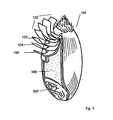
- Cereals are consumed across the world as staple food, because they are a primary source of carbohydrates thanks to the high starch content of the endosperm, which is situated in the central part of the caryopsis (see Fig. 1 ) and represents its major constituent.
- Fig. 1 the structure of the durum wheat caryopsis 101 is briefly reviewed. Going from the outside inwards, there are the following layers composing the bran: four cell layers (longitudinal, transverse, crossed and tubular) which together compose the coating of the fruit or pericarp 102 (3-6% in weight of the total weight of the caryopsis), and then testa 103, nucellar layer (or hyaline layer) 104 and aleurone 105, which together form the coat of the seed (1,2,3).
- the inner part is composed of the endosperm 105 and germ 107.
- the aleuronic layer which makes up 5-7% in weight of the total weight of the caryopsis, is composed of a layer of polygonal cells of large size in contact with the endosperm (1, 2).
- Semolina is the main product of the durum wheat milling process, the primary objective of which is the achievement of a final product with a high degree of purity (sifted). It is composed of the starchy, innermost parts of the caryopsis (endosperm) following separation from the outermost parts (the bran, which composes about 15% of the total content of the caryopsis, and the germ, which composes about 3%), traditionally intended for animal feed.
- a complex series of micro-nutrients are located in the bran, such as dietary fibres (insoluble and soluble), minerals, lipids, vitamins and a class of components known as "phytochemicals", having protective activity (anti-oxidant) in cell metabolism and in phenomena linked to ageing (8,9,10,11,12).
- the available whole grain products are penalised by a number of negative organoleptic elements including appearance (dark colour), texture (rough, heavy), a marked flavour often associated to the development of off-flavours over time (rancid, cardboard), which strongly limit their use.
- the whole grain flours thus obtained therefore contain bran which substantially originates from all layers of the caryopsis external to the endosperm.
- Semolina or cereal flour production processes which comprise a preliminary removal step of the outer layers of the caryopsis through process phases involving friction and abrasion, prior to the milling of the caryopses, have been known for many years.
- Patent applications EP 0 295 774 , EP 0 373 274 and WO 2004/028694 In this manner, about 75% of the bran is removed, and the subsequent steps of milling and separation from the residual bran are simplified and generally lead to improved semolina yields compared to those obtained with conventional processes.
- bran layers are collected, corresponding to as many steps of friction or abrasion carried out on the caryopses.
- the first is the richest in cellulosic fibres, since it corresponds to the outermost layers of the caryopsis whereas the latter is the richest in protein, since it contains the innermost bran layers, including part of the aleuronic layer.
- US 2005/0136174 discloses a process for producing an ultra-fine milled whole-grain wheat flour. This process comprises the steps of separating the wheat kernels into a fine fraction, comprising endosperm, and a coarse fraction, comprising bran and germ, and grinding the coarse fraction to a particle size distribution less than or equal to refined wheat flour to form an ultrafine-milled coarse fraction.
- bran and other dietary fibres available on the market contain bran which is composed in an undifferentiated manner by all of the outer layers of the caryopsis, possibly previously subjected to further milling treatments in order to reduce the size of the particles, and heat stabilisation treatments in order to forestall oxidative phenomena caused by enzymatic degradations.
- a durum wheat pasta with a high content of dietary fibre and preferably such as to be defined whole grain (on the basis of the Italian law, a pasta is defined as whole grain when it has an ash content comprised between 1.40 and 1.80% of the dry weight and a minimum protein content of 11.50% of the dry weight) but with organoleptic characteristics such that it results substantially comparable to those of a semolina pasta.
- a similar problem was solved by a durum wheat pasta containing bran having a total fibre content comprised between 30 and 36% in weight of the total weight of the bran and a protein content comprised between 15 and 19% in weight of the total weight of the bran.
- the pasta according to the invention has a bran content comprised between 5 and 30%, advantageously between 10 and 20%, in weight of its total weight (considering an average humidity content of 12%).
- the aforementioned bran mainly contains the aleuronic, nucellar and head layers of the original caryopses.
- the pasta according to the present invention is produced by means of a process which comprises the steps of:
- the aforementioned durum wheat semolina is obtained by the milling of the caryopses from which the bran coating has been substantially removed, and conveniently such milling step is carried out in the same facility in which the aforementioned process phases involving abrasion take place, continuously joining the flows of the durum wheat semolina and the aforementioned latter bran fraction.
- the aforementioned process phases involving abrasion are preferably carried out on caryopses which have been previously wetted with a quantity of water such as to bring their humidity content to at least 15% and then subjected to conditioning.
- the aforementioned wetting step of the caryopses is preferably carried out by subjecting the caryopses to intense vibrations of a frequency comprised between 50 and 300 Hz.
- the present invention moreover refers to a composition based on durum wheat semolina, characterised in that it contains a bran fraction having a total fibre content comprised between 30 and 36% in weight of the total weight of the bran fraction and a protein content comprised between 15 and 19% in weight of the total weight of the bran fraction.
- such composition based on durum wheat semolina has a bran content comprised between 5 and 30%, advantageously between 10 and 20%, in weight of its total weight.
- the aforementioned bran mainly contains the aleuronic, nucellar and testa layers of the original caryopses.
- durum wheat semolina composition according to the present invention is produced with the process according to annexed claims 13-15.
- the invention also regards bakery products containing a bran with a total fibre content comprised between 30 and 36% in weight of the total weight of the bran and a protein content comprised between 15 and 19% in weight on the total weight of the bran.
- durum wheat bran fraction may be utilised in the preparation of bakery products based both on durum wheat semolina and soft wheat flour (for example crackers, croissants, breadsticks etc.).
- durum wheat bran fraction may be utilised as obtained by the abrasion step of the process according to the invention, without additional heat stabilisation or other treatments and the final products therefrom obtained (pastas, bakery products) exhibit optimal organoleptic properties, which they maintain substantially unaltered throughout their shelf-life.
- Fig. 1 a durum wheat caryopsis is schematically illustrated.
- the process for the production of a composition based on durum wheat semolina involves the wheat caryopses 101 undergoing, prior to their rupture (milling), progressive removal of the bran layers, by subjecting the outer surface of the caryopses to the abrasive action of a plurality of decortication or abrasion machines 108a, 108b, 108c (for example 2 or 3), which a flow of wheat passes in series, one after the other (see Fig. 2 ).
- the decortication or abrasion machines 108a, 108b, 108c comprise a vertical axis rotating shaft, on which the abrasive Carborundum grindstones are mounted.
- machines for the decortication apt for use in the present process are provided in the applications EP 0 373 274 and EP 0 335 174 .
- One machine which is commercially available and useful in the present process is the machine model DECO 420R from T.A.E.. The wheat, upon entering the upper part of the machine, is pushed toward the outlet situated in the lower part.
- the wheat is forced to spread itself in the restricted space between the rotating grindstones and a metallic containment baffle, thus undergoing an abrasive action which causes the removal of the outermost bran layers, which are recovered in the form of powder by suction.
- This operation is repeated, for example, three consecutive times, thus permitting the progressive separation of increasingly internal bran layers.
- the most superficial bran layers are removed, with the second the intermediate layers and finally with the third passing the innermost layers, those nearest to the endosperm and essentially originating from the aleurone 105, nucellar 104 and testa 103 layers, are removed.
- the caryopses (101) exiting from the third abrasion machine 108c are fed into a conventional mill 109, in which they are ground, producing a flour S consisting essentially of endosperm.
- the decortication process is carried out twice, utilising the machines 108a and 108b, in the first passing mostly removing the layers outside the testa layer.
- the third bran fraction D is particularly desirable so as to be joined, during the milling process, with the aforementioned flour S consisting essentially of endosperm.
- Table 1 Component Unit Value Tolerance Humidity % 10,0 ⁇ 1,0 Proteins (N x 5,70) % p/p 17,0 ⁇ 2,0 Lipids % p/p 6,0 ⁇ 1,0 Ash % p/p 5,8 ⁇ 0,5 Phosphorus mg/100 g 1000 ⁇ 100 Magnesium mg/100 g 400 ⁇ 50 Calcium mg/100 g 100 ⁇ 20 Totale dietary fibre % p/p 34,0 ⁇ 4,0 Insolubile dietary fibre % p/p 32,0 ⁇ 4,0 Cellulose % p/p 8,0 ⁇ 2,0 Solubile dietary fibre % p/p 1,8 ⁇ 1,0 B-glucans % p/p 2,7 ⁇ 1,0 Vit.
- E tocopherol mg/100 g 3,0 ⁇ 0,5 Vit. B1 (thiamine) mg/ 100 g 1,0 ⁇ 0,5 Vit. B2 (riboflavin) mg/ 100 g 0,5 ⁇ 0,1 Vit. B6 (pyridoxine) mg/ 100 g 0,3 ⁇ 0,1 Folic acid ⁇ g/100 g 60 ⁇ 20 Niacin mg/100 g 20 ⁇ 10 Pantothenic acid mg/100 g 1,0 ⁇ 0,5 Phytic acid mg/g 45,0 ⁇ 5,0
- the third decortication fraction D is transported to a doser (for example of the screw-type), and the same is done for the flow of the product S obtained by the milling of the caryopsis from which the bran coating has been removed by the above described abrasion steps.
- the two dosers converge in a mixer 110, which provides an effective mixing in order to provide a food composition C based on durum wheat semolina according to the invention.
- the food composition C according to the invention is conveyed towards a sifting system in order to guarantee a uniform particle size and to remove any particles excessively large in size.
- the food composition based on durum wheat semolina proves to be particularly suitable for the production of finished products such as pastas and baked products, in which the maintenance of the nutritional benefits deriving from the presence of the bran components (fibre, minerals, lipids, vitamins, phytochemicals) is associated with organoleptic characteristics of greater quality compared to pastas obtained by the use of conventional bran, in terms of flavour, colour and structure, and surprisingly similar to those of products obtained with sifted flours, that is, completely free of bran.
- the bran components for example, minerals, lipids, vitamins, phytochemicals
- the organoleptic characteristics are indeed maintained substantially unaltered for the entire shelf-life of the finished product. This is remarkable, particularly considering the fact that the bran fraction of the food composition according to the invention, contrary to the consistent teachings of the prior art, does not undergo any heat stabilisation treatment.
- the bran obtained with conventional milling processes is indeed subject to deterioration (rancidity, cardboard taste) even after a short period of time, due to the triggering of oxidation reactions of the lipid components present in the bran, in which there may also be present germ parts, very rich in lipids (1,3,28).
- the heat treatment of the bran in addition to representing an additional cost, if done at excessively high temperatures may lead to a further darkening of the bran, the development of odd flavours (toasted, burnt) and the triggering of chemical degradation (by heat) due to the lipid part (28).
- the treatment does not permit blocking of the lipolytic enzymes.
- the particular stability to oxidation of the bran fraction of the food composition according to the present invention compared to the traditional bran may be due to the fact that it is obtained with a process which involves lower mechanical and thermal stress compared to those of the conventional processes.
- the bran fraction of the food composition and pasta according to the present invention has the additional advantage, compared to traditional bran, of supplying a greater quantity of important nutrients contained in the aleuronic layer (1,2,11,29). Also the appearance is improved, since it is less dark and more yellow, as instrumentally detectable (on the basis of the chromatic scale CIELAB L*a*b*), in comparison with pastas obtained by the use of conventional bran. This is due to the smaller quantity of pigmented components located in particular in the outermost layers of the bran coating, which are capable of causing a darkening of the final products, such as pasta.
- the texture of the food composition and pasta according to the present invention is more similar to that of a semolina pasta since a reduced discontinuity is noted in the texture (granulosity), lower than that exhibited by the pastas obtained by the use of conventional bran.
- the progressive application of the abrasive action ensured by the described decortication or abrasion machines, permits the isolation and the use of a more internal bran fraction and therefore, from a hygienic-sanitary standpoint, the first two decortication passings may be considered as an additional and significant extension of the selection and cleaning steps which constitute the initial part, upstream of any milling process.
- a first machine 108a of decortication or abrasion comprising a vertical axis rotating shaft on which abrasive Carborundum grindstones are mounted, thus obtaining the removal of the outermost bran layers, in the form of powder recovered by suction.
- Two subsequent passings of the caryopses exiting from the first decorticator 108a into two other respective decortication machines 108b and 108c caused the removal of the intermediate and inner bran layers, again in the powder form.
- the caryopses exiting from the third decorticator machine 108c were subjected to a dynamic air current cooling, prior to being fed to a conventional mill 109 for milling.
- the decorticated caryopses were milled according to the standard working modes for the milling of whole caryopses, obtaining in the end 85 kg of a flour S composed essentially of endosperm with an ash content of 0.77% in weight of the total weight and a protein content of 11.0% in weight of the total weight.
- the third powder exiting from the last decorticator 108c was a bran fraction D characterised by the composition shown in the following table 2.
- Table 2 Component Unit Value Humidity % 10,1 Proteins (N x 5,70) % p/p 17,5 Lipids % p/p 5,8 Ash % p/p 6,0 Phosphorus mg/100 g 1020 Magnesium mg/100 g 355 Calcium mg/100 g 108 Totale dietary fibre % p/p 33,8 Insolubile dietary fibre % p/p 31,9 Cellulose % p/p 7,9 Solubile dietary fibre % p/p 1,7 B-glucans % p/p 2,9 Vit.
- a durum whole wheat semolina was obtained having an ash content of 1.30% and a protein content of 11.6%.
- a whole grain pasta was prepared according to the present invention with the durum whole wheat semolina thus obtained, using it in the conventional production process of traditional durum wheat semolina pasta in place of the refined durum wheat semolina, by the traditional steps of kneading with water, forming by extrusion and drying to a humidity content of 12.0%.
- the pasta thus prepared was subjected to comparison with semolina pasta through the evaluation by 100 regular consumers of pasta (semantic differential and liking assessment test).
- the pasta according to the present invention obtained an appreciation (flavour, texture) equal to that of semolina-only pasta.
- appreciation was revealed for the overall flavour, for the texture and for the fragrance while the absence of acidic or bitter notes was confirmed.
- a shelf-life test was conducted in extreme storage conditions (35°C temperature and 70% relative humidity), so as to accelerate the processes of off-flavours formation.
- Pasta samples thus stored were periodically evaluated by a trained tasting panel, over a period of four months, during which time neither significant variations of the organoleptic properties nor development of off-flavours were detected.
- a first machine 108a of decortication or abrasion comprising a vertical axis rotating shaft on which abrasive Carborundum grindstones are mounted, arranged in such a manner as so to determine the removal of the outermost and intermediate bran layers (substantially up until the innermost layer of the pericarp), in the form of powder recovered by suction.
- a subsequent passing of the caryopses exiting from the first decorticator into a second decortication machine 108b caused the removal of the innermost bran layers, again in the powder form.
- the caryopses exiting the second decorticator machine 108b were subjected to a dynamic air current cooling, prior to being fed to a conventional mill 109 for milling.
- the decorticated caryopses were milled according to the standard working modes for the milling of whole caryopses, obtaining in the end 84 kg of a flour consisting essentially of endosperm with an ash content of 0.75% in weight of the total weight and a protein content of 11.8% in weight of the total weight.
- the powder exiting from the second decorticator was a bran fraction D characterised by the composition shown in table 3 below.
- Table 3 Componente Unit Value Humidity % 10,2 Proteins (N x 5,70) % p/p 17,3 Lipids % p/p 5,9 Ash % p/p 5,8 Phosphorus mg/100 g 1010 Magnesium mg/100 g 365 Calcium mg/100 g 110 Totale dietary fibre % p/p 34,8 Insolubile dietary fibre % p/p 32,9 Cellulose % p/p 8,0 Solubile dietary fibre % p/p 1,7 B-glucans % p/p 2,7 Vit.
Landscapes
- Life Sciences & Earth Sciences (AREA)
- Engineering & Computer Science (AREA)
- Food Science & Technology (AREA)
- Health & Medical Sciences (AREA)
- Nutrition Science (AREA)
- Chemical & Material Sciences (AREA)
- Polymers & Plastics (AREA)
- Noodles (AREA)
- Coloring Foods And Improving Nutritive Qualities (AREA)
- Cereal-Derived Products (AREA)
- Macromonomer-Based Addition Polymer (AREA)
Abstract
Description
- The present invention regards the food industry sector and in particular refers to a durum wheat pasta (Triticum turgidum var. durum, Desf.) having a high dietary bran content, to a process for the production thereof, and to a durum wheat semolina having a high dietary fibre content used in such process.
- Cereals (mainly wheat, rice, corn, barley, oat, rye) are consumed across the world as staple food, because they are a primary source of carbohydrates thanks to the high starch content of the endosperm, which is situated in the central part of the caryopsis (see
Fig. 1 ) and represents its major constituent. - With reference to
Fig. 1 , the structure of thedurum wheat caryopsis 101 is briefly reviewed. Going from the outside inwards, there are the following layers composing the bran: four cell layers (longitudinal, transverse, crossed and tubular) which together compose the coating of the fruit or pericarp 102 (3-6% in weight of the total weight of the caryopsis), and then testa 103, nucellar layer (or hyaline layer) 104 andaleurone 105, which together form the coat of the seed (1,2,3). The inner part is composed of theendosperm 105 andgerm 107. - The aleuronic layer, which makes up 5-7% in weight of the total weight of the caryopsis, is composed of a layer of polygonal cells of large size in contact with the endosperm (1, 2).
- Semolina is the main product of the durum wheat milling process, the primary objective of which is the achievement of a final product with a high degree of purity (sifted). It is composed of the starchy, innermost parts of the caryopsis (endosperm) following separation from the outermost parts (the bran, which composes about 15% of the total content of the caryopsis, and the germ, which composes about 3%), traditionally intended for animal feed.
- Based on this view, the modern process of industrial milling of durum wheat tends to maximise the efficiency of this separation through a series of many operations (milling, sifting) which permits the separation and removal of the bran from the parts of the endosperm which will make up the final semolina.
- During the last decade, the nutritional value of "whole grain" cereal flours , i.e. those including the greatest possible quantity of the starting components of the caryopsis (4,5), and therefore also the bran, has been progressively recognised (6,7) as a fundamental element of a healthy diet aimed at maintaining a good state of health for the human being.
- A complex series of micro-nutrients are located in the bran, such as dietary fibres (insoluble and soluble), minerals, lipids, vitamins and a class of components known as "phytochemicals", having protective activity (anti-oxidant) in cell metabolism and in phenomena linked to ageing (8,9,10,11,12). To date, there have been many studies and demonstrations of the beneficial effect of the daily consumption of whole grain products in relation to different types of pathologies (13-27).
- In spite of the better nutritional properties of whole grain flours, their consumption in the form of pasta and bakery products, and their appeal, is currently hampered by the perceived organoleptic difference compared to the corresponding finished products obtained from refined flours.
- The available whole grain products are penalised by a number of negative organoleptic elements including appearance (dark colour), texture (rough, heavy), a marked flavour often associated to the development of off-flavours over time (rancid, cardboard), which strongly limit their use.
- Because of this, the consumption of whole grain cereals in the form of whole grain pastas or bakery products, even though it is recognised as healthier, is associated to a sense of "dissatisfaction or punishment" from the organoleptic standpoint.
- Whole grain flours are conventionally produced in the manner described below.
- First, there is the breaking (milling) of the whole caryopses, followed by the separation by sifting of the generated fragments, which may be composed by the endosperm only or by parts of the endosperm together with bran and germ, which are sent to subsequent steps of milling and separation in order to free and separate as much as possible the parts of endosperm from the other components of the caryopsis. In the production of whole grain flour, one proceeds with a recovery of the endosperm parts, together with bran and/or actual bran fractions, which are pooled with the main flow of sifted flour.
- The whole grain flours thus obtained therefore contain bran which substantially originates from all layers of the caryopsis external to the endosperm.
- Semolina or cereal flour production processes which comprise a preliminary removal step of the outer layers of the caryopsis through process phases involving friction and abrasion, prior to the milling of the caryopses, have been known for many years. As examples please see the patent applications
EP 0 295 774 ,EP 0 373 274 andWO 2004/028694 . In this manner, about 75% of the bran is removed, and the subsequent steps of milling and separation from the residual bran are simplified and generally lead to improved semolina yields compared to those obtained with conventional processes. - With the aforementioned more recent processes, two or more bran layers are collected, corresponding to as many steps of friction or abrasion carried out on the caryopses. Of these parts, the first is the richest in cellulosic fibres, since it corresponds to the outermost layers of the caryopsis whereas the latter is the richest in protein, since it contains the innermost bran layers, including part of the aleuronic layer.
-
US 2005/0136174 discloses a process for producing an ultra-fine milled whole-grain wheat flour. This process comprises the steps of separating the wheat kernels into a fine fraction, comprising endosperm, and a coarse fraction, comprising bran and germ, and grinding the coarse fraction to a particle size distribution less than or equal to refined wheat flour to form an ultrafine-milled coarse fraction. - The actual whole grain semolinas, and those having a certain content of bran and other dietary fibres available on the market, even when they are obtained by means of one of the aforementioned processes, contain bran which is composed in an undifferentiated manner by all of the outer layers of the caryopsis, possibly previously subjected to further milling treatments in order to reduce the size of the particles, and heat stabilisation treatments in order to forestall oxidative phenomena caused by enzymatic degradations.
- Also such whole grain semolina, and above all the products derived from these (pasta shapes, baked products), suffer from the same drawbacks from the organoleptic standpoint highlighted above with reference to those obtained by conventional milling processes.
- The problem underlying the present invention was that of providing a durum wheat pasta with a high content of dietary fibre and preferably such as to be defined whole grain (on the basis of the Italian law, a pasta is defined as whole grain when it has an ash content comprised between 1.40 and 1.80% of the dry weight and a minimum protein content of 11.50% of the dry weight) but with organoleptic characteristics such that it results substantially comparable to those of a semolina pasta.
- A similar problem was solved by a durum wheat pasta containing bran having a total fibre content comprised between 30 and 36% in weight of the total weight of the bran and a protein content comprised between 15 and 19% in weight of the total weight of the bran.
- Preferably, the pasta according to the invention has a bran content comprised between 5 and 30%, advantageously between 10 and 20%, in weight of its total weight (considering an average humidity content of 12%).
- The aforementioned bran mainly contains the aleuronic, nucellar and head layers of the original caryopses.
- The pasta according to the present invention is produced by means of a process which comprises the steps of:
- subjecting durum wheat caryopses, having an endosperm and a germ enclosed within a multilayer bran coating, the innermost layers of which correspond to the aleurone, nucellar and testa layers, to subsequent process phases involving abrasion in order to substantially remove the bran coating, thereby obtaining various bran fractions, the latter of which originates predominantly from the removal of the aforementioned aleurone, nucellar and testa layers;
- adding said latter bran layer to a durum wheat semolina substantially free of bran, in such quantities as to obtain a mixture containing from 5 to 30% in weight of the total mixture weight of said bran layer;
- producing the pasta by means of conventional techniques, starting from the aforementioned mixture.
- Preferably, the aforementioned durum wheat semolina is obtained by the milling of the caryopses from which the bran coating has been substantially removed, and conveniently such milling step is carried out in the same facility in which the aforementioned process phases involving abrasion take place, continuously joining the flows of the durum wheat semolina and the aforementioned latter bran fraction.
- The aforementioned process phases involving abrasion are preferably carried out on caryopses which have been previously wetted with a quantity of water such as to bring their humidity content to at least 15% and then subjected to conditioning.
- The aforementioned wetting step of the caryopses is preferably carried out by subjecting the caryopses to intense vibrations of a frequency comprised between 50 and 300 Hz.
- The present invention moreover refers to a composition based on durum wheat semolina, characterised in that it contains a bran fraction having a total fibre content comprised between 30 and 36% in weight of the total weight of the bran fraction and a protein content comprised between 15 and 19% in weight of the total weight of the bran fraction.
- Preferably, such composition based on durum wheat semolina has a bran content comprised between 5 and 30%, advantageously between 10 and 20%, in weight of its total weight.
- The aforementioned bran mainly contains the aleuronic, nucellar and testa layers of the original caryopses.
- The durum wheat semolina composition according to the present invention is produced with the process according to annexed claims 13-15.
- In a further aspect, the invention also regards bakery products containing a bran with a total fibre content comprised between 30 and 36% in weight of the total weight of the bran and a protein content comprised between 15 and 19% in weight on the total weight of the bran.
- The aforementioned durum wheat bran fraction may be utilised in the preparation of bakery products based both on durum wheat semolina and soft wheat flour (for example crackers, croissants, breadsticks etc.).
- Such durum wheat bran fraction may be utilised as obtained by the abrasion step of the process according to the invention, without additional heat stabilisation or other treatments and the final products therefrom obtained (pastas, bakery products) exhibit optimal organoleptic properties, which they maintain substantially unaltered throughout their shelf-life.
- In
Fig. 1 a durum wheat caryopsis is schematically illustrated. -
Fig. 2 is a diagram of a plant for the production of a food composition according to the present invention, according to a first embodiment. -
Fig. 3 is a diagram of a plant for the production of a food composition according to the present invention, according to a second embodiment. - In accordance with an embodiment of the present invention, the process for the production of a composition based on durum wheat semolina according to the invention involves the
wheat caryopses 101 undergoing, prior to their rupture (milling), progressive removal of the bran layers, by subjecting the outer surface of the caryopses to the abrasive action of a plurality of decortication orabrasion machines Fig. 2 ). - The decortication or
abrasion machines applications EP 0 373 274 andEP 0 335 174 . One machine which is commercially available and useful in the present process is the machine model DECO 420R from T.A.E.. The wheat, upon entering the upper part of the machine, is pushed toward the outlet situated in the lower part. In this way, the wheat is forced to spread itself in the restricted space between the rotating grindstones and a metallic containment baffle, thus undergoing an abrasive action which causes the removal of the outermost bran layers, which are recovered in the form of powder by suction. - This operation is repeated, for example, three consecutive times, thus permitting the progressive separation of increasingly internal bran layers.
- With the first passing, the most superficial bran layers are removed, with the second the intermediate layers and finally with the third passing the innermost layers, those nearest to the endosperm and essentially originating from the
aleurone 105, nucellar 104 and testa 103 layers, are removed. - Finally, the caryopses (101) exiting from the third abrasion machine 108c are fed into a
conventional mill 109, in which they are ground, producing a flour S consisting essentially of endosperm. - According to an alternative embodiment, illustrated schematically in
Fig. 3 , the decortication process is carried out twice, utilising themachines - For its composition characteristics (high protein level, satisfactory content of fibre, minerals, lipids, vitamins and phytochemicals), the third bran fraction D is particularly desirable so as to be joined, during the milling process, with the aforementioned flour S consisting essentially of endosperm.
- An average typical composition of the third bran fraction D obtained by the process of the present invention is shown in the table 1, below.
Table 1 Component Unit Value Tolerance Humidity % 10,0 ± 1,0 Proteins (N x 5,70) % p/p 17,0 ± 2,0 Lipids % p/p 6,0 ± 1,0 Ash % p/p 5,8 ± 0,5 Phosphorus mg/100 g 1000 ± 100 Magnesium mg/100 g 400 ± 50 Calcium mg/100 g 100 ± 20 Totale dietary fibre % p/p 34,0 ± 4,0 Insolubile dietary fibre % p/p 32,0 ± 4,0 Cellulose % p/p 8,0 ± 2,0 Solubile dietary fibre % p/p 1,8 ± 1,0 B-glucans % p/ p 2,7 ± 1,0 Vit. E (tocopherol) mg/100 g 3,0 ± 0,5 Vit. B1 (thiamine) mg/ 100 g 1,0 ± 0,5 Vit. B2 (riboflavin) mg/ 100 g 0,5 ± 0,1 Vit. B6 (pyridoxine) mg/ 100 g 0,3 ± 0,1 Folic acid µg/100 g 60 ± 20 Niacin mg/100 g 20 ± 10 Pantothenic acid mg/100 g 1,0 ± 0,5 Phytic acid mg/g 45,0 ± 5,0 - The third decortication fraction D is transported to a doser (for example of the screw-type), and the same is done for the flow of the product S obtained by the milling of the caryopsis from which the bran coating has been removed by the above described abrasion steps. The two dosers converge in a
mixer 110, which provides an effective mixing in order to provide a food composition C based on durum wheat semolina according to the invention. - Through the mixing screw and immediately before final storage, the food composition C according to the invention is conveyed towards a sifting system in order to guarantee a uniform particle size and to remove any particles excessively large in size.
- The food composition based on durum wheat semolina thus obtained proves to be particularly suitable for the production of finished products such as pastas and baked products, in which the maintenance of the nutritional benefits deriving from the presence of the bran components (fibre, minerals, lipids, vitamins, phytochemicals) is associated with organoleptic characteristics of greater quality compared to pastas obtained by the use of conventional bran, in terms of flavour, colour and structure, and surprisingly similar to those of products obtained with sifted flours, that is, completely free of bran.
- The organoleptic characteristics (flavour in particular) are indeed maintained substantially unaltered for the entire shelf-life of the finished product. This is remarkable, particularly considering the fact that the bran fraction of the food composition according to the invention, contrary to the consistent teachings of the prior art, does not undergo any heat stabilisation treatment.
- The bran obtained with conventional milling processes is indeed subject to deterioration (rancidity, cardboard taste) even after a short period of time, due to the triggering of oxidation reactions of the lipid components present in the bran, in which there may also be present germ parts, very rich in lipids (1,3,28).
- Normally, in the bran obtained in the conventional manner, one tries to contain and prevent this phenomenon by destroying (inactivating) the responsible agents (lipolytic enzymes) through heat (heat treatment), in order to avoid the bran fractions triggering oxidation reactions over time and therefore the production of off-flavour, in the finished products in which they are utilised.
- The heat treatment of the bran, in addition to representing an additional cost, if done at excessively high temperatures may lead to a further darkening of the bran, the development of odd flavours (toasted, burnt) and the triggering of chemical degradation (by heat) due to the lipid part (28). On the other hand, by the use of excessively low temperatures, the treatment does not permit blocking of the lipolytic enzymes.
- Without wishing to be bound by theory, the particular stability to oxidation of the bran fraction of the food composition according to the present invention compared to the traditional bran may be due to the fact that it is obtained with a process which involves lower mechanical and thermal stress compared to those of the conventional processes.
- In addition to having the above mentioned advantages, the bran fraction of the food composition and pasta according to the present invention has the additional advantage, compared to traditional bran, of supplying a greater quantity of important nutrients contained in the aleuronic layer (1,2,11,29). Also the appearance is improved, since it is less dark and more yellow, as instrumentally detectable (on the basis of the chromatic scale CIELAB L*a*b*), in comparison with pastas obtained by the use of conventional bran. This is due to the smaller quantity of pigmented components located in particular in the outermost layers of the bran coating, which are capable of causing a darkening of the final products, such as pasta.
- Moreover, the texture of the food composition and pasta according to the present invention is more similar to that of a semolina pasta since a reduced discontinuity is noted in the texture (granulosity), lower than that exhibited by the pastas obtained by the use of conventional bran.
- Finally, the progressive application of the abrasive action, ensured by the described decortication or abrasion machines, permits the isolation and the use of a more internal bran fraction and therefore, from a hygienic-sanitary standpoint, the first two decortication passings may be considered as an additional and significant extension of the selection and cleaning steps which constitute the initial part, upstream of any milling process.
- The present invention will be further described by reference to two examples, provided here below for illustrative and non-limiting purposes.
- 115 kg of durum wheat previously subjected to conventional cleaning steps were wetted with a quantity of water such as to bring the humidity content of the caryopses to 16.5% and simultaneously subjected to the vibrational stresses caused by a Vibronet® machine, produced by Gräf GmbH & Co. KG, Lahnau, Germany (vibrational impulses of the duration of about 10 seconds at a frequency of 75 Hz). After a single conditioning of 5 hours, the caryopses were fed (see
Fig. 2 ) to afirst machine 108a of decortication or abrasion, comprising a vertical axis rotating shaft on which abrasive Carborundum grindstones are mounted, thus obtaining the removal of the outermost bran layers, in the form of powder recovered by suction. Two subsequent passings of the caryopses exiting from the first decorticator 108a into two otherrespective decortication machines 108b and 108c caused the removal of the intermediate and inner bran layers, again in the powder form. - The caryopses exiting from the third decorticator machine 108c were subjected to a dynamic air current cooling, prior to being fed to a
conventional mill 109 for milling. Here the decorticated caryopses were milled according to the standard working modes for the milling of whole caryopses, obtaining in the end 85 kg of a flour S composed essentially of endosperm with an ash content of 0.77% in weight of the total weight and a protein content of 11.0% in weight of the total weight. - The third powder exiting from the last decorticator 108c was a bran fraction D characterised by the composition shown in the following table 2.
Table 2 Component Unit Value Humidity % 10,1 Proteins (N x 5,70) % p/p 17,5 Lipids % p/p 5,8 Ash % p/p 6,0 Phosphorus mg/100 g 1020 Magnesium mg/100 g 355 Calcium mg/100 g 108 Totale dietary fibre % p/p 33,8 Insolubile dietary fibre % p/p 31,9 Cellulose % p/p 7,9 Solubile dietary fibre % p/p 1,7 B-glucans % p/ p 2,9 Vit. E (tocopherol) mg/ 100 g 3,1 Vit. B1 (thiamine) mg/100 g 0,9 Vit. B2 (riboflavin) mg/100 g 0,5 Vit. B6 (pyridoxine) mg/100 g 0,3 Folic acid µg/100 g 50 Niacin mg/100 g 22 Pantothenic acid mg/100 g 1,0 Phytic acid mg/g 42,5 - From the pooling of the aforementioned third bran fraction with the flour in a 1:9 weight ratio, a durum whole wheat semolina was obtained having an ash content of 1.30% and a protein content of 11.6%.
- A whole grain pasta was prepared according to the present invention with the durum whole wheat semolina thus obtained, using it in the conventional production process of traditional durum wheat semolina pasta in place of the refined durum wheat semolina, by the traditional steps of kneading with water, forming by extrusion and drying to a humidity content of 12.0%.
- The pasta thus prepared was subjected to comparison with semolina pasta through the evaluation by 100 regular consumers of pasta (semantic differential and liking assessment test). The pasta according to the present invention obtained an appreciation (flavour, texture) equal to that of semolina-only pasta. In particular, appreciation was revealed for the overall flavour, for the texture and for the fragrance while the absence of acidic or bitter notes was confirmed.
- A comparison between the pasta thus prepared and commercial pastas obtained with the use of conventional bran was carried out by subjecting such pastas to the judgement of 88 regular pasta consumers (sequential monadic test). The overall appreciation of the pasta thus prepared was significantly higher, in particular in terms of overall flavour, consistency, appearance and colour (both raw and cooked).
- A shelf-life test was conducted in extreme storage conditions (35°C temperature and 70% relative humidity), so as to accelerate the processes of off-flavours formation. Pasta samples thus stored were periodically evaluated by a trained tasting panel, over a period of four months, during which time neither significant variations of the organoleptic properties nor development of off-flavours were detected.
- 115 kg of durum wheat previously subjected to conventional cleaning steps was wetted with a quantity of water such as to bring the humidity content of the caryopses to 16.5% and simultaneously subjected to the vibrational stresses induced by a Vibronet® machine, (vibrational impulses of the duration of about 10 seconds and at a frequency of 75 Hz). After a single conditioning of 5 hours, the
caryopses 101 were fed (seeFig. 3 ) to afirst machine 108a of decortication or abrasion, comprising a vertical axis rotating shaft on which abrasive Carborundum grindstones are mounted, arranged in such a manner as so to determine the removal of the outermost and intermediate bran layers (substantially up until the innermost layer of the pericarp), in the form of powder recovered by suction. A subsequent passing of the caryopses exiting from the first decorticator into asecond decortication machine 108b caused the removal of the innermost bran layers, again in the powder form. - The caryopses exiting the
second decorticator machine 108b were subjected to a dynamic air current cooling, prior to being fed to aconventional mill 109 for milling. Here the decorticated caryopses were milled according to the standard working modes for the milling of whole caryopses, obtaining in the end 84 kg of a flour consisting essentially of endosperm with an ash content of 0.75% in weight of the total weight and a protein content of 11.8% in weight of the total weight. - The powder exiting from the second decorticator was a bran fraction D characterised by the composition shown in table 3 below.
Table 3 Componente Unit Value Humidity % 10,2 Proteins (N x 5,70) % p/p 17,3 Lipids % p/p 5,9 Ash % p/p 5,8 Phosphorus mg/100 g 1010 Magnesium mg/100 g 365 Calcium mg/100 g 110 Totale dietary fibre % p/p 34,8 Insolubile dietary fibre % p/p 32,9 Cellulose % p/p 8,0 Solubile dietary fibre % p/p 1,7 B-glucans % p/ p 2,7 Vit. E (tocopherol) mg/ 100 g 3,0 Vit. B1 (thiamine) mg/100 g 0,9 Vit. B2 (riboflavin) mg/100 g 0,5 Vit. B6 (pyridoxine) mg/100 g 0,3 Folic acid µg/100 g 51 Niacin mg/100 g 22 Pantothenic acid mg/100 g 1,0 Phytic acid mg/g 48,0 - From the pooling of the aforementioned second bran fraction D with the flour S in a 1:9 weight ratio, a durum whole wheat semolina was obtained having an ash content of 1.26% and a protein content of 12.4%.
-
- 1) Y. Pomeranz, Wheat chemistry and Technology, Volume I, 47-95,Ed. AACC, Thrid edition, 1988
- 2) Antoine C., Lullien-Pellerin V., Abecassis J., Rouau X. - Intéret nutritionnel de la couche à aleurone du grain de blé, Industries des céréales, n° 133, Juin/Juiflet ,4-10, 2003.
- 3) B. Godon, Bioconversion of Cereal Products, 1st Ed., Nov. 1993 Wiley-Vch, pp 18-19
- 4) Marquart L., Fulcher G., Slavin J. Whole grain and Health Past, Present, and Future. American Inst. of Baking Technical Bulletin, Volume XXV,
- 5) CFW. Whole Grain Definition. Cereal Food World, 45: 79, 2000
- 6) USDA/USDHHS. Nutrition and Your Heath: Dietary Guidelines for Americans, 5th ed. U.S. Department of Agriculture/U.S. Department of heath and Human Service. U.S. Government Printing Office, Home and Garden Bulletin No. 232, Washington, DC, May 2000
- 7) USDA/USDHHS. Dietary Guidelines for Americans 2005, January 12, 2005, www.healthierus.gov/dietaryguidelines
- 8) F. Esposito, G. Arlotti, A.M. Bonifati, A. Napolitano, D. Vitale, V. Fogliano , Antioxidant activity and dietary fibre in durum wheat bran by-products, Food Research International 38 , 1167-1173, 2005
- 9) L. Marquart, G. Fulcher, J. Slavin, Whole Grain and Health; Past, Present and Future, AIB Tech. Bul.,1-14, Vol. XXV,
- 10) E. Decker, G.Beecher, J. Slavin, H.E. Miller, L. Marquart, Whole Grain as a Source of Antioxidants, Cereal Foods World, 370-373, Vol. 47, NO8, September-October, 2002
- 11) M.Bartinik, T. Jakubczyk, Chemical Composition and the Nutritive Value of Wheat Bran World Rev. Nutr. Diet. Basel, Karger, 1998, vol. 60, pp 92 -131
- 12) C.E. Stauffer, Promise of Whole Grains, Bakers Production Manual, 12-24, May 2003
- 13) Rimm E.B., Ascerio A., Giovannucci E., Spiegelman D., Stampfer M.J., Willett W.C. Vegetable, fruit and cereal fiber intake and risk of coronary heart disease among men. Journal of the American Medical Association 275: 447- 451, 1996
- 14) Wolk A., Manson J.E., Stampfer M.J., Colditz G.A., Hu F.B., Speizer F.E., Hennerkens C.H., Willett W.C., Long-term intake of dietary fibre and decrease risk of coronary heart disease among women, JAMA, 1998-2004, 1999
- 15) Jacobs D.J., Meyer K.A:, Kushi L.H., Folsom A.R. Is whole grain intake associated with reduced total and cause specific death rates in older women? The Iowa Women's Health Study. Am. J. Public Health, 89 (3),1-8, 1999
- 16) Liu S.M., Stampfer M.J., Hu F.B., Giovannucci E., Rimm E., Manson J.E., Hennekens C.H. and Willett W.C., Whole-grain consumption and risk of coronary disease: results from the Nurses' Health Study. American Journal of Clinical Nutrition, 70, 412-419, 1999
- 17) Anderson J.W., Whole-grain intake and risk for coronary heart disease. In: Whole-Grain Foods in Heart and Disease(Marquat, Slavin and Fulcher, eds.), American Association of cereal Chemists, Inc., St. Paul, MN, 2002
- 18) Johnston L., Reynolds H.R., Patz M., Hunninnghake D.B., Schulz K., Westereng B.Cholesterol-lowering benefits of a whole grain oat ready-to-eat cereal. Nutrition in Clinical Care 1 (1), 6-12, 1998
- 19) Jenkins D., Wesson V., Wolever T.M., Jenkins A.L., Kalmusky J., Gidici S., Csima A., Josse R.G., Wong G.S. Whole meal versus whole grain breads: proportion of whole or cracked grain and the glycemic response. Br. Med. J. 297, 958-960, 1988
- 20) Pereira M.A., Jacobs D.R. Jr., Slattery M.L., Ruth k., Van Horn L., Hilner j., Kushi L.H., the association of whole grain intake and fasting insulin in a biracial cohort of young adults: The CARDIA Study. CVD Prevention, 1, 231-242, 1998
- 21) Ludwing D.S., Pereira M.A., Kroenke C.H., Hilner J.E., Van Horn L., Slattery M.L., Jacobs D.R., Jr. Dietary fibre, weight gain, and cardiovascular disease risk factors in young adults. JAMA, 1539-1546, 1999
- 22) Pereira M.A., Whole grain consumption and body weight regulation.In: Whole-Grain Foods in Heart and Disease(Marquat, Slavin and Fulcher, eds.), American Association of cereal Chemists, Inc., St. Paul, MN, 2002
- 23) Meyer K.A:, Kushi L.H., Jacobs Jr. D.R., Slavin J., Sellers T.A. and Folsom A.R. Carbohydrates, dietary fiber, and
- 24) Fung T.T., Hu F.B., Pereira M.A., Liu S., Stampfer M.J., Colditz G.A., Hennekens C.H. and Willett W.C. Whole -grain intake and the risk of
- 25) Jacobs D.R., Marquart L., Slavin J., and Kushi, L.H. Whole grain intake and cancer: an expanded review and meta-analysis. Nutrition and Cancer, 30, 85-89,1998
- 26) Jacobs D.J., Meyer K.A:, Kushi L.H., Folsom A.R. Is whole grain intake associated with reduced total and cause specific death rates in older women? The Iowa Women's Health Study. Am. J. Public Health, 89 (3),322-329, 1999
- 27) Jacobs D.J., Pereira M.A., Meyer K.A and Kushi L.H. Fiber from whole grains, but not refined grains, is inversely associated with all cause mortality in older women: The Iowa Women's Health Study. Journal of the American College of Nutrition, 19,326S-330S, 2000
- 28) T.Galliard, "Rancidity in Cereal Product",141-160, in J.C. Allen nd R.J. Hamilton "Rancidy of Food", Elsevier Applied Science, 2nd Ed., 1994
- 29) Buri R.C., von Reading W., Gavin M.H., Description and Characterization of Wheat Aleurone, Cereal Foods World, Vol. 49, 5, September-October, 74-282, 2004
Claims (17)
- Durum wheat pasta containing bran, characterised in that said bran has a total fibre content comprised between 30 and 36% in weight of the total weight of the bran and a protein content comprised between 15 and 19% in weight of the total weight of the bran.
- Pasta according to claim 1, having a bran content comprised between 5 and 30% in weight of the total weight of the pasta.
- Pasta according to claim 2, having a bran content comprised between 10 and 20% in weight of the total weight thereof.
- Pasta according to any one of the preceding claims, wherein said bran mainly comprises the following layers of the original caryopses: aleurone (105), nucellar (104) and testa (103) layers.
- Process for the production of pasta according to any one of the preceding claims, comprising the steps of:- subjecting durum wheat caryopses (101), having an endosperm (106) and a germ (107) enclosed in a multilayer bran coating, the innermost of which correspond to aleurone (105), nucellar (104) and testa (103) layers, to sequential abrasion process steps in order to substantially remove said bran coating, thereby obtaining different bran fractions, the latter of which (D) originates from the removal of the aforementioned aleurone, nucellar layer and testa layers;- adding said latter bran fraction (D) to a durum wheat semolina (S) substantially free of bran, in a quantity such as to obtain a mixture (C) containing from 5 to 30% in weight of the total weight of said mixture of said bran fraction (D);- producing said pasta by conventional techniques starting from said mixture (C).
- Process according to claim 5, wherein said durum wheat semolina (S) is obtained by the milling of said caryopses (101) from which said bran coating has been substantially removed.
- Process according to claim 6, wherein the milling of said caryopses (101) is carried out in the same plant in which the abrasion process phases are carried out and in which the flows of durum wheat semolina (S) obtained from the milling and of said latter bran fraction (D) are continuously pooled.
- Process according to any one of the claims from 5 to 7, wherein said abrasion process phases are carried out on caryopses (101) which have been previously wetted with a quantity of water such as to bring the humidity content thereof to at least 15% and then subjected to conditioning.
- Durum wheat semolina-based food composition containing bran, characterised in that said bran has a total fibre content comprised between 30 and 36% in weight of the total weight of the bran and a protein content comprised between 15 and 19% in weight of the total weight of the bran.
- Food composition according to claim 9, having a bran content comprised between 5 and 30% in weight of the total weight of the composition.
- Food composition according to claim 10, having a bran content comprised between 10 and 20% in weight of the total weight of the composition.
- Food composition according to any one of claims 9 to 11, wherein said bran mainly comprises the following layers of the original caryopses (101): aleurone (105), nucellar (104) and testa (103) layers.
- Process for the production of a food composition according to any one of claims 9 to 12, comprising the steps of:- subjecting durum wheat caryopses (101), having an endosperm (106) and a germ (107) enclosed in a multilayer bran coating, the innermost of which correspond to aleurone (105), nucellar (104) and testa (103) layers, to sequential abrasion process phases in order to substantially remove said bran coating, thereby obtaining different bran fractions, the latter of which (D) originates from the removal of the aforementioned aleurone, nucellar layer and testa layers;- adding said latter bran fraction (D) to a durum wheat semolina (S) substantially free of bran, in a quantity such as to obtain a mixture (C) containing from 5 to 30% in weight of the total weight of said mixture of said bran fraction (D).
- Process according to claim 13, wherein said durum wheat semolina (S) is obtained by the milling of said caryopses (101) from which the bran coating has been substantially removed.
- Process according to claim 14, wherein the milling of said caryopses (101) is carried out in the same plant in which the abrasion process phases are carried out and in which the flows of durum wheat semolina (S) obtained from the milling and of said latter bran fraction (D) are continuously pooled.
- Bakery product containing bran, characterised in that said bran has a total fibre content comprised between 30 and 36% in weight of the total weight of the bran and a protein content comprised between 15 and 19% in weight of the total weight of the bran.
- Bakery product according to claim 16, wherein said bran mainly comprises the following layers of the original caryopses (101): aleurone (105), nucellar (104) and testa (103) layers.
Priority Applications (12)
| Application Number | Priority Date | Filing Date | Title |
|---|---|---|---|
| PT05425791T PT1785192E (en) | 2005-11-11 | 2005-11-11 | Durum wheat pasta with high dietary bran content and process for the production thereof |
| SI200531125T SI1785192T1 (en) | 2005-11-11 | 2005-11-11 | Durum wheat pasta with high dietary bran content and process for the production thereof |
| ES05425791T ES2350968T3 (en) | 2005-11-11 | 2005-11-11 | HARD WHEAT PASTA WITH HIGH CONTENT IN DIETARY SAVINGS AND PROCEDURE FOR THE SAME PRODUCTION. |
| EP05425791A EP1785192B1 (en) | 2005-11-11 | 2005-11-11 | Durum wheat pasta with high dietary bran content and process for the production thereof |
| PL05425791T PL1785192T3 (en) | 2005-11-11 | 2005-11-11 | Durum wheat pasta with high dietary bran content and process for the production thereof |
| DE602005023318T DE602005023318D1 (en) | 2005-11-11 | 2005-11-11 | Durum wheat pasta with a high content of bran and its production |
| AT05425791T ATE479500T1 (en) | 2005-11-11 | 2005-11-11 | DURUM WHEAT PASTA WITH A HIGH BRAN CONTENT AND ITS PRODUCTION |
| DK05425791.0T DK1785192T3 (en) | 2005-11-11 | 2005-11-11 | Durum wheat paste with high content of bran, as well as process for making it |
| MXPA06013104A MXPA06013104A (en) | 2005-11-11 | 2006-11-10 | Hard wheat pasta with high alimentary bran content and process for the production thereof . |
| CA2567714A CA2567714C (en) | 2005-11-11 | 2006-11-10 | Hard wheat pasta with high alimentary bran content and process for the production thereof |
| US11/558,590 US8808782B2 (en) | 2005-11-11 | 2006-11-10 | Durum wheat pasta with high alimentary bran content and process for the production thereof |
| US13/414,469 US8771777B2 (en) | 2005-11-11 | 2012-03-07 | Durum wheat pasta with high alimentary bran content and process for the production thereof |
Applications Claiming Priority (1)
| Application Number | Priority Date | Filing Date | Title |
|---|---|---|---|
| EP05425791A EP1785192B1 (en) | 2005-11-11 | 2005-11-11 | Durum wheat pasta with high dietary bran content and process for the production thereof |
Publications (2)
| Publication Number | Publication Date |
|---|---|
| EP1785192A1 EP1785192A1 (en) | 2007-05-16 |
| EP1785192B1 true EP1785192B1 (en) | 2010-09-01 |
Family
ID=36228782
Family Applications (1)
| Application Number | Title | Priority Date | Filing Date |
|---|---|---|---|
| EP05425791A Expired - Lifetime EP1785192B1 (en) | 2005-11-11 | 2005-11-11 | Durum wheat pasta with high dietary bran content and process for the production thereof |
Country Status (11)
| Country | Link |
|---|---|
| US (2) | US8808782B2 (en) |
| EP (1) | EP1785192B1 (en) |
| AT (1) | ATE479500T1 (en) |
| CA (1) | CA2567714C (en) |
| DE (1) | DE602005023318D1 (en) |
| DK (1) | DK1785192T3 (en) |
| ES (1) | ES2350968T3 (en) |
| MX (1) | MXPA06013104A (en) |
| PL (1) | PL1785192T3 (en) |
| PT (1) | PT1785192E (en) |
| SI (1) | SI1785192T1 (en) |
Cited By (1)
| Publication number | Priority date | Publication date | Assignee | Title |
|---|---|---|---|---|
| AU2010233935B2 (en) * | 2009-03-31 | 2013-12-12 | International N&H Denmark Aps | Prevention of extract darkening and malodor formation during solubilization of plant cell wall material |
Families Citing this family (10)
| Publication number | Priority date | Publication date | Assignee | Title |
|---|---|---|---|---|
| EP2153735A1 (en) * | 2008-07-28 | 2010-02-17 | Nestec S.A. | Pasta composition for dehydrated food matrices |
| EP2241193A1 (en) * | 2009-04-17 | 2010-10-20 | Nestec S.A. | Wholegrain instant pasta |
| US20110003065A1 (en) | 2009-07-01 | 2011-01-06 | Buhler Ag | Method for pretreating grain before milling |
| CN102463159B (en) * | 2010-11-16 | 2015-03-25 | 徐蕴山 | Clean rice dregs formed by milling embryo and aleurone layers and production technology thereof |
| US8783588B2 (en) | 2011-11-10 | 2014-07-22 | Applied Milling Systems, Inc. | Recovery of aleurone-rich flour from bran |
| ITBO20120025A1 (en) * | 2012-01-20 | 2013-07-21 | Molini Pivetti Societa Per Azioni | PLANT AND DECORTICATION PROCEDURE FOR THE EXTRACTION OF ALEURONE AND FARINACEOUS PRODUCT OBTAINED FROM THIS PROCEDURE. |
| USD933934S1 (en) * | 2017-03-13 | 2021-10-26 | Barilla G. E R. Fratelli S.P.A. | Food product |
| CN114192212B (en) * | 2021-11-24 | 2023-09-22 | 江苏大学 | Nutritious wheat flour and production method thereof |
| IT202200011339A1 (en) | 2022-05-30 | 2023-11-30 | Barilla Flli G & R | Process for the production of wholemeal semolina |
| IT202300017016A1 (en) | 2023-08-09 | 2025-02-09 | Barilla Flli G & R | WHOLE WHEAT SEMOLINA AND FOOD PRODUCT OBTAINED FROM SUCH SEMOLINA |
Family Cites Families (10)
| Publication number | Priority date | Publication date | Assignee | Title |
|---|---|---|---|---|
| US3717480A (en) * | 1970-12-24 | 1973-02-20 | Milliat Freres Soc | Treatment of grain |
| SE450325B (en) * | 1983-02-23 | 1987-06-22 | Tricum Ab | FOOD FIBER PRODUCT BASED ON FOOD PARTS FROM FROZEN BY CERALIER |
| CA1321525C (en) | 1987-06-18 | 1993-08-24 | Joseph John Tkac | Process for use in milling flour |
| CA1313330C (en) | 1988-12-16 | 1993-02-02 | Joseph Tkac | Process for removing bran layers from wheat kernels |
| JPH0767540B2 (en) | 1988-03-31 | 1995-07-26 | 株式会社佐竹製作所 | Hard axis friction cutting type grain mill |
| US5395639A (en) * | 1992-10-23 | 1995-03-07 | Borden, Inc. | Milling procedure for the manufacture of alimentary paste and pasta products from whole grains |
| US6899907B1 (en) * | 2000-09-18 | 2005-05-31 | General Mills, Inc. | Bleach bran and bran products |
| ITMI20022066A1 (en) * | 2002-09-30 | 2004-04-01 | Barilla Alimentare Spa | PROCEDURE FOR THE PRODUCTION OF WHEAT FLOURS. |
| US7419694B2 (en) | 2003-12-17 | 2008-09-02 | Conagra Foods Food Ingredients Company, Inc. | Process for producing an ultrafine-milled whole-grain wheat flour and products thereof |
| US7258888B2 (en) * | 2004-05-11 | 2007-08-21 | General Mills Marketing, Inc. | Flour and dough compositions and related methods |
-
2005
- 2005-11-11 AT AT05425791T patent/ATE479500T1/en active
- 2005-11-11 PT PT05425791T patent/PT1785192E/en unknown
- 2005-11-11 DK DK05425791.0T patent/DK1785192T3/en active
- 2005-11-11 PL PL05425791T patent/PL1785192T3/en unknown
- 2005-11-11 EP EP05425791A patent/EP1785192B1/en not_active Expired - Lifetime
- 2005-11-11 DE DE602005023318T patent/DE602005023318D1/en not_active Expired - Lifetime
- 2005-11-11 ES ES05425791T patent/ES2350968T3/en not_active Expired - Lifetime
- 2005-11-11 SI SI200531125T patent/SI1785192T1/en unknown
-
2006
- 2006-11-10 MX MXPA06013104A patent/MXPA06013104A/en active IP Right Grant
- 2006-11-10 US US11/558,590 patent/US8808782B2/en active Active
- 2006-11-10 CA CA2567714A patent/CA2567714C/en active Active
-
2012
- 2012-03-07 US US13/414,469 patent/US8771777B2/en active Active
Cited By (1)
| Publication number | Priority date | Publication date | Assignee | Title |
|---|---|---|---|---|
| AU2010233935B2 (en) * | 2009-03-31 | 2013-12-12 | International N&H Denmark Aps | Prevention of extract darkening and malodor formation during solubilization of plant cell wall material |
Also Published As
| Publication number | Publication date |
|---|---|
| US8771777B2 (en) | 2014-07-08 |
| ATE479500T1 (en) | 2010-09-15 |
| SI1785192T1 (en) | 2011-01-31 |
| CA2567714A1 (en) | 2007-05-11 |
| MXPA06013104A (en) | 2008-10-09 |
| US20070122537A1 (en) | 2007-05-31 |
| DE602005023318D1 (en) | 2010-10-14 |
| PT1785192E (en) | 2010-12-03 |
| US20120225182A1 (en) | 2012-09-06 |
| EP1785192A1 (en) | 2007-05-16 |
| PL1785192T3 (en) | 2011-03-31 |
| US8808782B2 (en) | 2014-08-19 |
| ES2350968T3 (en) | 2011-01-28 |
| CA2567714C (en) | 2013-12-31 |
| DK1785192T3 (en) | 2011-01-03 |
Similar Documents
| Publication | Publication Date | Title |
|---|---|---|
| US8771777B2 (en) | Durum wheat pasta with high alimentary bran content and process for the production thereof | |
| US7425344B2 (en) | Process for producing a milled whole-grain wheat flour and products thereof | |
| CA2553287C (en) | A process for producing an ultrafine-milled whole-grain wheat flour and products thereof | |
| Anderson et al. | Corn dry milling: Processes, products, and applications | |
| Nelson | Wheat: its processing and utilization | |
| WO2011107760A2 (en) | High value edible products from bran, and method and apparatus for producing same | |
| Puramshetty et al. | Physical and milling properties | |
| Rao et al. | Sorghum | |
| US8043646B2 (en) | Soft wheat flour with high bran content, process for its production and bakery products containing it | |
| US20250325990A1 (en) | Process for the production of whole semolina | |
| Inamdar et al. | Wheat | |
| US2041129A (en) | Manufacture of cereal products | |
| Cauvain et al. | Dry milling of wheat and other cereals | |
| ACCEPTABILITY et al. | EFFECTS OF VARIETIES ON PHYSICAL AND FUNCTIONAL | |
| RU2285408C2 (en) | Multicomponent bakery mixture |
Legal Events
| Date | Code | Title | Description |
|---|---|---|---|
| PUAI | Public reference made under article 153(3) epc to a published international application that has entered the european phase |
Free format text: ORIGINAL CODE: 0009012 |
|
| AK | Designated contracting states |
Kind code of ref document: A1 Designated state(s): AT BE BG CH CY CZ DE DK EE ES FI FR GB GR HU IE IS IT LI LT LU LV MC NL PL PT RO SE SI SK TR |
|
| AX | Request for extension of the european patent |
Extension state: AL BA HR MK YU |
|
| 17P | Request for examination filed |
Effective date: 20071115 |
|
| 17Q | First examination report despatched |
Effective date: 20071227 |
|
| AKX | Designation fees paid |
Designated state(s): AT BE BG CH CY CZ DE DK EE ES FI FR GB GR HU IE IS IT LI LT LU LV MC NL PL PT RO SE SI SK TR |
|
| GRAP | Despatch of communication of intention to grant a patent |
Free format text: ORIGINAL CODE: EPIDOSNIGR1 |
|
| RTI1 | Title (correction) |
Free format text: DURUM WHEAT PASTA WITH HIGH DIETARY BRAN CONTENT AND PROCESS FOR THE PRODUCTION THEREOF |
|
| GRAS | Grant fee paid |
Free format text: ORIGINAL CODE: EPIDOSNIGR3 |
|
| RAP1 | Party data changed (applicant data changed or rights of an application transferred) |
Owner name: BARILLA G. E R. FRATELLI S.P.A. |
|
| GRAA | (expected) grant |
Free format text: ORIGINAL CODE: 0009210 |
|
| AK | Designated contracting states |
Kind code of ref document: B1 Designated state(s): AT BE BG CH CY CZ DE DK EE ES FI FR GB GR HU IE IS IT LI LT LU LV MC NL PL PT RO SE SI SK TR |
|
| REG | Reference to a national code |
Ref country code: GB Ref legal event code: FG4D |
|
| REG | Reference to a national code |
Ref country code: CH Ref legal event code: EP |
|
| REG | Reference to a national code |
Ref country code: IE Ref legal event code: FG4D |
|
| REF | Corresponds to: |
Ref document number: 602005023318 Country of ref document: DE Date of ref document: 20101014 Kind code of ref document: P |
|
| REG | Reference to a national code |
Ref country code: PT Ref legal event code: SC4A Free format text: AVAILABILITY OF NATIONAL TRANSLATION Effective date: 20101126 |
|
| REG | Reference to a national code |
Ref country code: NL Ref legal event code: T3 |
|
| REG | Reference to a national code |
Ref country code: SE Ref legal event code: TRGR |
|
| REG | Reference to a national code |
Ref country code: GR Ref legal event code: EP Ref document number: 20100402616 Country of ref document: GR |
|
| REG | Reference to a national code |
Ref country code: CH Ref legal event code: NV Representative=s name: ING. MARCO ZARDI C/O M. ZARDI & CO. S.A. |
|
| REG | Reference to a national code |
Ref country code: DK Ref legal event code: T3 |
|
| REG | Reference to a national code |
Ref country code: ES Ref legal event code: FG2A Effective date: 20110118 |
|
| PG25 | Lapsed in a contracting state [announced via postgrant information from national office to epo] |
Ref country code: LT Free format text: LAPSE BECAUSE OF FAILURE TO SUBMIT A TRANSLATION OF THE DESCRIPTION OR TO PAY THE FEE WITHIN THE PRESCRIBED TIME-LIMIT Effective date: 20100901 |
|
| LTIE | Lt: invalidation of european patent or patent extension |
Effective date: 20100901 |
|
| PG25 | Lapsed in a contracting state [announced via postgrant information from national office to epo] |
Ref country code: CY Free format text: LAPSE BECAUSE OF FAILURE TO SUBMIT A TRANSLATION OF THE DESCRIPTION OR TO PAY THE FEE WITHIN THE PRESCRIBED TIME-LIMIT Effective date: 20100901 |
|
| PG25 | Lapsed in a contracting state [announced via postgrant information from national office to epo] |
Ref country code: LV Free format text: LAPSE BECAUSE OF FAILURE TO SUBMIT A TRANSLATION OF THE DESCRIPTION OR TO PAY THE FEE WITHIN THE PRESCRIBED TIME-LIMIT Effective date: 20100901 |
|
| REG | Reference to a national code |
Ref country code: PL Ref legal event code: T3 |
|
| REG | Reference to a national code |
Ref country code: HU Ref legal event code: AG4A Ref document number: E009746 Country of ref document: HU |
|
| PG25 | Lapsed in a contracting state [announced via postgrant information from national office to epo] |
Ref country code: SK Free format text: LAPSE BECAUSE OF FAILURE TO SUBMIT A TRANSLATION OF THE DESCRIPTION OR TO PAY THE FEE WITHIN THE PRESCRIBED TIME-LIMIT Effective date: 20100901 Ref country code: EE Free format text: LAPSE BECAUSE OF FAILURE TO SUBMIT A TRANSLATION OF THE DESCRIPTION OR TO PAY THE FEE WITHIN THE PRESCRIBED TIME-LIMIT Effective date: 20100901 Ref country code: IS Free format text: LAPSE BECAUSE OF FAILURE TO SUBMIT A TRANSLATION OF THE DESCRIPTION OR TO PAY THE FEE WITHIN THE PRESCRIBED TIME-LIMIT Effective date: 20110101 Ref country code: RO Free format text: LAPSE BECAUSE OF FAILURE TO SUBMIT A TRANSLATION OF THE DESCRIPTION OR TO PAY THE FEE WITHIN THE PRESCRIBED TIME-LIMIT Effective date: 20100901 |
|
| PG25 | Lapsed in a contracting state [announced via postgrant information from national office to epo] |
Ref country code: MC Free format text: LAPSE BECAUSE OF NON-PAYMENT OF DUE FEES Effective date: 20101130 |
|
| PLBE | No opposition filed within time limit |
Free format text: ORIGINAL CODE: 0009261 |
|
| STAA | Information on the status of an ep patent application or granted ep patent |
Free format text: STATUS: NO OPPOSITION FILED WITHIN TIME LIMIT |
|
| 26N | No opposition filed |
Effective date: 20110606 |
|
| REG | Reference to a national code |
Ref country code: DE Ref legal event code: R097 Ref document number: 602005023318 Country of ref document: DE Effective date: 20110606 |
|
| PG25 | Lapsed in a contracting state [announced via postgrant information from national office to epo] |
Ref country code: BG Free format text: LAPSE BECAUSE OF FAILURE TO SUBMIT A TRANSLATION OF THE DESCRIPTION OR TO PAY THE FEE WITHIN THE PRESCRIBED TIME-LIMIT Effective date: 20100901 |
|
| PG25 | Lapsed in a contracting state [announced via postgrant information from national office to epo] |
Ref country code: TR Free format text: LAPSE BECAUSE OF FAILURE TO SUBMIT A TRANSLATION OF THE DESCRIPTION OR TO PAY THE FEE WITHIN THE PRESCRIBED TIME-LIMIT Effective date: 20100901 |
|
| PG25 | Lapsed in a contracting state [announced via postgrant information from national office to epo] |
Ref country code: BG Free format text: LAPSE BECAUSE OF FAILURE TO SUBMIT A TRANSLATION OF THE DESCRIPTION OR TO PAY THE FEE WITHIN THE PRESCRIBED TIME-LIMIT Effective date: 20101201 |
|
| REG | Reference to a national code |
Ref country code: FR Ref legal event code: PLFP Year of fee payment: 11 |
|
| REG | Reference to a national code |
Ref country code: FR Ref legal event code: PLFP Year of fee payment: 12 |
|
| REG | Reference to a national code |
Ref country code: FR Ref legal event code: PLFP Year of fee payment: 13 |
|
| REG | Reference to a national code |
Ref country code: FR Ref legal event code: PLFP Year of fee payment: 14 |
|
| PGFP | Annual fee paid to national office [announced via postgrant information from national office to epo] |
Ref country code: NL Payment date: 20241022 Year of fee payment: 20 |
|
| PGFP | Annual fee paid to national office [announced via postgrant information from national office to epo] |
Ref country code: LU Payment date: 20241022 Year of fee payment: 20 |
|
| PGFP | Annual fee paid to national office [announced via postgrant information from national office to epo] |
Ref country code: PT Payment date: 20241023 Year of fee payment: 20 |
|
| PGFP | Annual fee paid to national office [announced via postgrant information from national office to epo] |
Ref country code: HU Payment date: 20241114 Year of fee payment: 20 |
|
| PGFP | Annual fee paid to national office [announced via postgrant information from national office to epo] |
Ref country code: DE Payment date: 20241022 Year of fee payment: 20 |
|
| PGFP | Annual fee paid to national office [announced via postgrant information from national office to epo] |
Ref country code: DK Payment date: 20241022 Year of fee payment: 20 |
|
| PGFP | Annual fee paid to national office [announced via postgrant information from national office to epo] |
Ref country code: BE Payment date: 20241022 Year of fee payment: 20 Ref country code: FI Payment date: 20241022 Year of fee payment: 20 Ref country code: GR Payment date: 20241023 Year of fee payment: 20 Ref country code: PL Payment date: 20241028 Year of fee payment: 20 |
|
| PGFP | Annual fee paid to national office [announced via postgrant information from national office to epo] |
Ref country code: GB Payment date: 20241023 Year of fee payment: 20 |
|
| PGFP | Annual fee paid to national office [announced via postgrant information from national office to epo] |
Ref country code: FR Payment date: 20241022 Year of fee payment: 20 Ref country code: AT Payment date: 20241023 Year of fee payment: 20 |
|
| PGFP | Annual fee paid to national office [announced via postgrant information from national office to epo] |
Ref country code: IE Payment date: 20241023 Year of fee payment: 20 Ref country code: CZ Payment date: 20241029 Year of fee payment: 20 |
|
| PGFP | Annual fee paid to national office [announced via postgrant information from national office to epo] |
Ref country code: IT Payment date: 20241119 Year of fee payment: 20 Ref country code: ES Payment date: 20241202 Year of fee payment: 20 |
|
| PGFP | Annual fee paid to national office [announced via postgrant information from national office to epo] |
Ref country code: SE Payment date: 20241022 Year of fee payment: 20 |
|
| PGFP | Annual fee paid to national office [announced via postgrant information from national office to epo] |
Ref country code: CH Payment date: 20241201 Year of fee payment: 20 |
|
| PGFP | Annual fee paid to national office [announced via postgrant information from national office to epo] |
Ref country code: SI Payment date: 20241106 Year of fee payment: 20 |
|
| REG | Reference to a national code |
Ref country code: CH Ref legal event code: H14 Free format text: ST27 STATUS EVENT CODE: U-0-0-H10-H14 (AS PROVIDED BY THE NATIONAL OFFICE) Effective date: 20251111 Ref country code: DE Ref legal event code: R071 Ref document number: 602005023318 Country of ref document: DE |
|
| REG | Reference to a national code |
Ref country code: NL Ref legal event code: MK Effective date: 20251110 |
|
| REG | Reference to a national code |
Ref country code: DK Ref legal event code: EUP Expiry date: 20251111 |
|
| REG | Reference to a national code |
Ref country code: ES Ref legal event code: FD2A Effective date: 20251128 |
|
| REG | Reference to a national code |
Ref country code: GB Ref legal event code: PE20 Expiry date: 20251110 |
|
| PG25 | Lapsed in a contracting state [announced via postgrant information from national office to epo] |
Ref country code: PT Free format text: LAPSE BECAUSE OF EXPIRATION OF PROTECTION Effective date: 20251119 |
|
| REG | Reference to a national code |
Ref country code: BE Ref legal event code: MK Effective date: 20251111 |
|
| REG | Reference to a national code |
Ref country code: AT Ref legal event code: MK07 Ref document number: 479500 Country of ref document: AT Kind code of ref document: T Effective date: 20251111 |
|
| REG | Reference to a national code |
Ref country code: IE Ref legal event code: MK9A |
|
| PG25 | Lapsed in a contracting state [announced via postgrant information from national office to epo] |
Ref country code: IE Free format text: LAPSE BECAUSE OF EXPIRATION OF PROTECTION Effective date: 20251111 Ref country code: CZ Free format text: LAPSE BECAUSE OF EXPIRATION OF PROTECTION Effective date: 20251111 |
|
| PG25 | Lapsed in a contracting state [announced via postgrant information from national office to epo] |
Ref country code: ES Free format text: LAPSE BECAUSE OF EXPIRATION OF PROTECTION Effective date: 20251112 |