EP1783136A1 - Lipase inhibitor - Google Patents
Lipase inhibitor Download PDFInfo
- Publication number
- EP1783136A1 EP1783136A1 EP05780412A EP05780412A EP1783136A1 EP 1783136 A1 EP1783136 A1 EP 1783136A1 EP 05780412 A EP05780412 A EP 05780412A EP 05780412 A EP05780412 A EP 05780412A EP 1783136 A1 EP1783136 A1 EP 1783136A1
- Authority
- EP
- European Patent Office
- Prior art keywords
- lipase inhibitory
- gallic acid
- lipase
- inhibitory agent
- formula
- Prior art date
- Legal status (The legal status is an assumption and is not a legal conclusion. Google has not performed a legal analysis and makes no representation as to the accuracy of the status listed.)
- Withdrawn
Links
- 229940086609 Lipase inhibitor Drugs 0.000 title description 2
- 230000002401 inhibitory effect Effects 0.000 claims abstract description 55
- 102000004882 Lipase Human genes 0.000 claims abstract description 48
- 108090001060 Lipase Proteins 0.000 claims abstract description 48
- 239000004367 Lipase Substances 0.000 claims abstract description 48
- 235000019421 lipase Nutrition 0.000 claims abstract description 48
- 239000003795 chemical substances by application Substances 0.000 claims abstract description 33
- 150000001875 compounds Chemical class 0.000 claims abstract description 30
- 235000013305 food Nutrition 0.000 claims abstract description 29
- LNTHITQWFMADLM-UHFFFAOYSA-N gallic acid Chemical group OC(=O)C1=CC(O)=C(O)C(O)=C1 LNTHITQWFMADLM-UHFFFAOYSA-N 0.000 claims abstract description 28
- 235000013361 beverage Nutrition 0.000 claims abstract description 17
- 229920001301 Hexahydroxydiphenic acid Polymers 0.000 claims abstract description 9
- 238000010521 absorption reaction Methods 0.000 claims description 9
- 235000013402 health food Nutrition 0.000 claims description 4
- 239000008194 pharmaceutical composition Substances 0.000 claims description 3
- 235000014214 soft drink Nutrition 0.000 claims description 2
- 241001122767 Theaceae Species 0.000 claims 1
- 235000013367 dietary fats Nutrition 0.000 claims 1
- 239000003814 drug Substances 0.000 abstract description 12
- 229940079593 drug Drugs 0.000 abstract description 11
- LRBQNJMCXXYXIU-PPKXGCFTSA-N Chinese gallotannin Chemical compound OC1=C(O)C(O)=CC(C(=O)OC=2C(=C(O)C=C(C=2)C(=O)OC[C@@H]2[C@H]([C@H](OC(=O)C=3C=C(OC(=O)C=4C=C(O)C(O)=C(O)C=4)C(O)=C(O)C=3)[C@@H](OC(=O)C=3C=C(OC(=O)C=4C=C(O)C(O)=C(O)C=4)C(O)=C(O)C=3)[C@H](OC(=O)C=3C=C(OC(=O)C=4C=C(O)C(O)=C(O)C=4)C(O)=C(O)C=3)O2)OC(=O)C=2C=C(OC(=O)C=3C=C(O)C(O)=C(O)C=3)C(O)=C(O)C=2)O)=C1 LRBQNJMCXXYXIU-PPKXGCFTSA-N 0.000 abstract description 8
- 241001149004 Tellima grandiflora Species 0.000 abstract description 7
- 229920001968 ellagitannin Polymers 0.000 abstract description 6
- 229920002824 gallotannin Polymers 0.000 abstract description 5
- 235000013616 tea Nutrition 0.000 abstract description 5
- JMGCAHRKIVCLFW-UHFFFAOYSA-N 1-O-Galloylcastalagin Natural products Oc1cc(cc(O)c1O)C(=O)OC2C3OC(=O)c4c2c(O)c(O)c(O)c4c5c(O)c(O)c(O)c6c5C(=O)OC3C7OC(=O)c8cc(O)c(O)c(O)c8c9c(O)c(O)c(O)cc9C(=O)OCC7OC(=O)c%10cc(O)c(O)c(O)c6%10 JMGCAHRKIVCLFW-UHFFFAOYSA-N 0.000 abstract description 4
- NLDMNSXOCDLTTB-UHFFFAOYSA-N Heterophylliin A Natural products O1C2COC(=O)C3=CC(O)=C(O)C(O)=C3C3=C(O)C(O)=C(O)C=C3C(=O)OC2C(OC(=O)C=2C=C(O)C(O)=C(O)C=2)C(O)C1OC(=O)C1=CC(O)=C(O)C(O)=C1 NLDMNSXOCDLTTB-UHFFFAOYSA-N 0.000 abstract description 4
- JMGCAHRKIVCLFW-CNWXVVPTSA-N ellagitannin Chemical compound OC1=C(O)C(O)=CC(C(=O)O[C@H]2C3=C4C(=O)O[C@@H]2[C@@H]2[C@@H]5OC(=O)C6=CC(O)=C(O)C(O)=C6C6=C(O)C(O)=C(O)C=C6C(=O)OC[C@H]5OC(=O)C5=CC(O)=C(O)C(O)=C5C=5C(O)=C(O)C(O)=C(C=5C(=O)O2)C4=C(O)C(O)=C3O)=C1 JMGCAHRKIVCLFW-CNWXVVPTSA-N 0.000 abstract description 4
- 229940040461 lipase Drugs 0.000 description 38
- 235000016709 nutrition Nutrition 0.000 description 16
- 230000035764 nutrition Effects 0.000 description 16
- WEVYAHXRMPXWCK-UHFFFAOYSA-N Acetonitrile Chemical compound CC#N WEVYAHXRMPXWCK-UHFFFAOYSA-N 0.000 description 15
- 235000006468 Thea sinensis Nutrition 0.000 description 14
- 235000020333 oolong tea Nutrition 0.000 description 13
- CSCPPACGZOOCGX-UHFFFAOYSA-N Acetone Chemical compound CC(C)=O CSCPPACGZOOCGX-UHFFFAOYSA-N 0.000 description 12
- 230000000694 effects Effects 0.000 description 12
- 239000004480 active ingredient Substances 0.000 description 10
- OKKJLVBELUTLKV-UHFFFAOYSA-N Methanol Chemical compound OC OKKJLVBELUTLKV-UHFFFAOYSA-N 0.000 description 9
- XLYOFNOQVPJJNP-UHFFFAOYSA-N water Substances O XLYOFNOQVPJJNP-UHFFFAOYSA-N 0.000 description 9
- 208000008589 Obesity Diseases 0.000 description 8
- 235000020824 obesity Nutrition 0.000 description 8
- 241000196324 Embryophyta Species 0.000 description 7
- 244000269722 Thea sinensis Species 0.000 description 7
- 239000008280 blood Substances 0.000 description 7
- 210000004369 blood Anatomy 0.000 description 7
- 235000019197 fats Nutrition 0.000 description 7
- 229940074391 gallic acid Drugs 0.000 description 7
- 235000004515 gallic acid Nutrition 0.000 description 7
- GBMDVOWEEQVZKZ-UHFFFAOYSA-N methanol;hydrate Chemical compound O.OC GBMDVOWEEQVZKZ-UHFFFAOYSA-N 0.000 description 7
- 238000000034 method Methods 0.000 description 7
- UFTFJSFQGQCHQW-UHFFFAOYSA-N triformin Chemical compound O=COCC(OC=O)COC=O UFTFJSFQGQCHQW-UHFFFAOYSA-N 0.000 description 7
- HSHNITRMYYLLCV-UHFFFAOYSA-N 4-methylumbelliferone Chemical compound C1=C(O)C=CC2=C1OC(=O)C=C2C HSHNITRMYYLLCV-UHFFFAOYSA-N 0.000 description 6
- 235000005911 diet Nutrition 0.000 description 6
- YXZYFHXWEOAXLF-UGAZNADUSA-N [(2r,3s,4s,5r,6s)-4-hydroxy-3,5,6-tris[(3,4,5-trihydroxybenzoyl)oxy]oxan-2-yl]methyl 3,4,5-trihydroxybenzoate Chemical compound O([C@H]1[C@@H]([C@H]([C@H](OC(=O)C=2C=C(O)C(O)=C(O)C=2)O[C@@H]1COC(=O)C=1C=C(O)C(O)=C(O)C=1)OC(=O)C=1C=C(O)C(O)=C(O)C=1)O)C(=O)C1=CC(O)=C(O)C(O)=C1 YXZYFHXWEOAXLF-UGAZNADUSA-N 0.000 description 5
- 238000011156 evaluation Methods 0.000 description 5
- XELZGAJCZANUQH-UHFFFAOYSA-N methyl 1-acetylthieno[3,2-c]pyrazole-5-carboxylate Chemical compound CC(=O)N1N=CC2=C1C=C(C(=O)OC)S2 XELZGAJCZANUQH-UHFFFAOYSA-N 0.000 description 5
- 229920001864 tannin Polymers 0.000 description 5
- 235000018553 tannin Nutrition 0.000 description 5
- 239000001648 tannin Substances 0.000 description 5
- GDVRUDXLQBVIKP-HQHREHCSSA-N 1-O-galloyl-beta-D-glucose Chemical compound O[C@@H]1[C@@H](O)[C@H](O)[C@@H](CO)O[C@H]1OC(=O)C1=CC(O)=C(O)C(O)=C1 GDVRUDXLQBVIKP-HQHREHCSSA-N 0.000 description 4
- LFQSCWFLJHTTHZ-UHFFFAOYSA-N Ethanol Chemical compound CCO LFQSCWFLJHTTHZ-UHFFFAOYSA-N 0.000 description 4
- 102000019280 Pancreatic lipases Human genes 0.000 description 4
- 108050006759 Pancreatic lipases Proteins 0.000 description 4
- 229930190246 Tellimagrandin Natural products 0.000 description 4
- 230000003579 anti-obesity Effects 0.000 description 4
- 239000000872 buffer Substances 0.000 description 4
- 244000309464 bull Species 0.000 description 4
- 238000006243 chemical reaction Methods 0.000 description 4
- 230000000378 dietary effect Effects 0.000 description 4
- 208000037265 diseases, disorders, signs and symptoms Diseases 0.000 description 4
- 239000000284 extract Substances 0.000 description 4
- 150000002632 lipids Chemical class 0.000 description 4
- 238000005259 measurement Methods 0.000 description 4
- 229940116369 pancreatic lipase Drugs 0.000 description 4
- 150000008442 polyphenolic compounds Chemical class 0.000 description 4
- 235000013824 polyphenols Nutrition 0.000 description 4
- 238000000746 purification Methods 0.000 description 4
- 150000003626 triacylglycerols Chemical class 0.000 description 4
- IAZDPXIOMUYVGZ-UHFFFAOYSA-N Dimethylsulphoxide Chemical compound CS(C)=O IAZDPXIOMUYVGZ-UHFFFAOYSA-N 0.000 description 3
- XUZYVFYOPRXTRB-UHFFFAOYSA-N Tellimagrandin I Natural products OC1COC(=O)C2=CC(O)=C(O)C(O)=C2C2=C(O)C(O)=C(O)C=C2C(=O)OC1C(C(OC(=O)C=1C=C(O)C(O)=C(O)C=1)C=O)OC(=O)C1=CC(O)=C(O)C(O)=C1 XUZYVFYOPRXTRB-UHFFFAOYSA-N 0.000 description 3
- KRKNYBCHXYNGOX-UHFFFAOYSA-N citric acid Chemical compound OC(=O)CC(O)(C(O)=O)CC(O)=O KRKNYBCHXYNGOX-UHFFFAOYSA-N 0.000 description 3
- 201000010099 disease Diseases 0.000 description 3
- 230000035622 drinking Effects 0.000 description 3
- 235000021271 drinking Nutrition 0.000 description 3
- 238000010828 elution Methods 0.000 description 3
- 239000000796 flavoring agent Substances 0.000 description 3
- 235000019634 flavors Nutrition 0.000 description 3
- 235000009569 green tea Nutrition 0.000 description 3
- 235000012054 meals Nutrition 0.000 description 3
- 230000001737 promoting effect Effects 0.000 description 3
- 239000002904 solvent Substances 0.000 description 3
- FYIJLTSMNXUNLT-CXQFPWCTSA-N strictinin Chemical compound O([C@@H]1O[C@@H]2COC(=O)C3=CC(O)=C(O)C(O)=C3C3=C(O)C(O)=C(O)C=C3C(=O)O[C@H]2[C@H](O)[C@H]1O)C(=O)C1=CC(O)=C(O)C(O)=C1 FYIJLTSMNXUNLT-CXQFPWCTSA-N 0.000 description 3
- 239000000126 substance Substances 0.000 description 3
- LDPLFHGGZNSKDS-FTBFGRRBSA-N theogallin Chemical compound O[C@@H]1[C@H](O)C[C@@](O)(C(O)=O)C[C@H]1OC(=O)C1=CC(O)=C(O)C(O)=C1 LDPLFHGGZNSKDS-FTBFGRRBSA-N 0.000 description 3
- WMBWREPUVVBILR-WIYYLYMNSA-N (-)-Epigallocatechin-3-o-gallate Chemical compound O([C@@H]1CC2=C(O)C=C(C=C2O[C@@H]1C=1C=C(O)C(O)=C(O)C=1)O)C(=O)C1=CC(O)=C(O)C(O)=C1 WMBWREPUVVBILR-WIYYLYMNSA-N 0.000 description 2
- IJGRMHOSHXDMSA-UHFFFAOYSA-N Atomic nitrogen Chemical compound N#N IJGRMHOSHXDMSA-UHFFFAOYSA-N 0.000 description 2
- 241001343465 Camellia ptilophylla Species 0.000 description 2
- 206010012735 Diarrhoea Diseases 0.000 description 2
- 239000004278 EU approved seasoning Substances 0.000 description 2
- WMBWREPUVVBILR-UHFFFAOYSA-N GCG Natural products C=1C(O)=C(O)C(O)=CC=1C1OC2=CC(O)=CC(O)=C2CC1OC(=O)C1=CC(O)=C(O)C(O)=C1 WMBWREPUVVBILR-UHFFFAOYSA-N 0.000 description 2
- 240000001080 Grifola frondosa Species 0.000 description 2
- 235000007710 Grifola frondosa Nutrition 0.000 description 2
- 241000700159 Rattus Species 0.000 description 2
- FAPWRFPIFSIZLT-UHFFFAOYSA-M Sodium chloride Chemical compound [Na+].[Cl-] FAPWRFPIFSIZLT-UHFFFAOYSA-M 0.000 description 2
- JCGHAEBIBSEQAD-ANGOHYEVSA-N Tellimagrandin II Natural products O=C(O[C@@H]1[C@@H](OC(=O)c2cc(O)c(O)c(O)c2)O[C@@H]2[C@@H]([C@@H]1OC(=O)c1cc(O)c(O)c(O)c1)OC(=O)c1c(c(O)c(O)c(O)c1)-c1c(O)c(O)c(O)cc1C(=O)OC2)c1cc(O)c(O)c(O)c1 JCGHAEBIBSEQAD-ANGOHYEVSA-N 0.000 description 2
- 235000010724 Wisteria floribunda Nutrition 0.000 description 2
- 238000002835 absorbance Methods 0.000 description 2
- JAZBEHYOTPTENJ-JLNKQSITSA-N all-cis-5,8,11,14,17-icosapentaenoic acid Chemical compound CC\C=C/C\C=C/C\C=C/C\C=C/C\C=C/CCCC(O)=O JAZBEHYOTPTENJ-JLNKQSITSA-N 0.000 description 2
- MBMBGCFOFBJSGT-KUBAVDMBSA-N all-cis-docosa-4,7,10,13,16,19-hexaenoic acid Chemical compound CC\C=C/C\C=C/C\C=C/C\C=C/C\C=C/C\C=C/CCC(O)=O MBMBGCFOFBJSGT-KUBAVDMBSA-N 0.000 description 2
- 230000003078 antioxidant effect Effects 0.000 description 2
- 239000007853 buffer solution Substances 0.000 description 2
- RYYVLZVUVIJVGH-UHFFFAOYSA-N caffeine Chemical compound CN1C(=O)N(C)C(=O)C2=C1N=CN2C RYYVLZVUVIJVGH-UHFFFAOYSA-N 0.000 description 2
- 235000019577 caloric intake Nutrition 0.000 description 2
- HVYWMOMLDIMFJA-DPAQBDIFSA-N cholesterol Chemical compound C1C=C2C[C@@H](O)CC[C@]2(C)[C@@H]2[C@@H]1[C@@H]1CC[C@H]([C@H](C)CCCC(C)C)[C@@]1(C)CC2 HVYWMOMLDIMFJA-DPAQBDIFSA-N 0.000 description 2
- 235000009508 confectionery Nutrition 0.000 description 2
- 230000003247 decreasing effect Effects 0.000 description 2
- 230000037213 diet Effects 0.000 description 2
- 239000012153 distilled water Substances 0.000 description 2
- 235000015071 dressings Nutrition 0.000 description 2
- 229960005135 eicosapentaenoic acid Drugs 0.000 description 2
- JAZBEHYOTPTENJ-UHFFFAOYSA-N eicosapentaenoic acid Natural products CCC=CCC=CCC=CCC=CCC=CCCCC(O)=O JAZBEHYOTPTENJ-UHFFFAOYSA-N 0.000 description 2
- 235000020673 eicosapentaenoic acid Nutrition 0.000 description 2
- 229940030275 epigallocatechin gallate Drugs 0.000 description 2
- 235000011194 food seasoning agent Nutrition 0.000 description 2
- 235000019626 lipase activity Nutrition 0.000 description 2
- 239000000463 material Substances 0.000 description 2
- 238000012544 monitoring process Methods 0.000 description 2
- 238000011160 research Methods 0.000 description 2
- 239000000523 sample Substances 0.000 description 2
- 239000000243 solution Substances 0.000 description 2
- 239000000758 substrate Substances 0.000 description 2
- 231100000027 toxicology Toxicity 0.000 description 2
- 239000003643 water by type Substances 0.000 description 2
- XFZJEEAOWLFHDH-UHFFFAOYSA-N (2R,2'R,3R,3'R,4R)-3,3',4',5,7-Pentahydroxyflavan(48)-3,3',4',5,7-pentahydroxyflavan Natural products C=12OC(C=3C=C(O)C(O)=CC=3)C(O)CC2=C(O)C=C(O)C=1C(C1=C(O)C=C(O)C=C1O1)C(O)C1C1=CC=C(O)C(O)=C1 XFZJEEAOWLFHDH-UHFFFAOYSA-N 0.000 description 1
- WRIDQFICGBMAFQ-UHFFFAOYSA-N (E)-8-Octadecenoic acid Natural products CCCCCCCCCC=CCCCCCCC(O)=O WRIDQFICGBMAFQ-UHFFFAOYSA-N 0.000 description 1
- YXZYFHXWEOAXLF-UHFFFAOYSA-N 1,2,4,6-tetra-GA-Gle Natural products C=1C(O)=C(O)C(O)=CC=1C(=O)OCC1OC(OC(=O)C=2C=C(O)C(O)=C(O)C=2)C(OC(=O)C=2C=C(O)C(O)=C(O)C=2)C(O)C1OC(=O)C1=CC(O)=C(O)C(O)=C1 YXZYFHXWEOAXLF-UHFFFAOYSA-N 0.000 description 1
- QKNYBSVHEMOAJP-UHFFFAOYSA-N 2-amino-2-(hydroxymethyl)propane-1,3-diol;hydron;chloride Chemical compound Cl.OCC(N)(CO)CO QKNYBSVHEMOAJP-UHFFFAOYSA-N 0.000 description 1
- LQJBNNIYVWPHFW-UHFFFAOYSA-N 20:1omega9c fatty acid Natural products CCCCCCCCCCC=CCCCCCCCC(O)=O LQJBNNIYVWPHFW-UHFFFAOYSA-N 0.000 description 1
- LDPLFHGGZNSKDS-AQWVNGNSSA-N 3-O-Galloylquinic acid Natural products O=C(O[C@H]1[C@@H](O)[C@H](O)C[C@@](O)(C(=O)O)C1)c1cc(O)c(O)c(O)c1 LDPLFHGGZNSKDS-AQWVNGNSSA-N 0.000 description 1
- QSBYPNXLFMSGKH-UHFFFAOYSA-N 9-Heptadecensaeure Natural products CCCCCCCC=CCCCCCCCC(O)=O QSBYPNXLFMSGKH-UHFFFAOYSA-N 0.000 description 1
- 206010000087 Abdominal pain upper Diseases 0.000 description 1
- 235000001674 Agaricus brunnescens Nutrition 0.000 description 1
- 206010003210 Arteriosclerosis Diseases 0.000 description 1
- 235000000832 Ayote Nutrition 0.000 description 1
- UXVMQQNJUSDDNG-UHFFFAOYSA-L Calcium chloride Chemical compound [Cl-].[Cl-].[Ca+2] UXVMQQNJUSDDNG-UHFFFAOYSA-L 0.000 description 1
- 235000008534 Capsicum annuum var annuum Nutrition 0.000 description 1
- 240000008384 Capsicum annuum var. annuum Species 0.000 description 1
- 244000302899 Cassia mimosoides Species 0.000 description 1
- 235000014112 Cassia mimosoides Nutrition 0.000 description 1
- 240000007154 Coffea arabica Species 0.000 description 1
- 206010010774 Constipation Diseases 0.000 description 1
- 240000004244 Cucurbita moschata Species 0.000 description 1
- 235000009854 Cucurbita moschata Nutrition 0.000 description 1
- 235000009804 Cucurbita pepo subsp pepo Nutrition 0.000 description 1
- 102000004127 Cytokines Human genes 0.000 description 1
- 108090000695 Cytokines Proteins 0.000 description 1
- 102000004190 Enzymes Human genes 0.000 description 1
- 108090000790 Enzymes Proteins 0.000 description 1
- 206010017367 Frequent bowel movements Diseases 0.000 description 1
- 229920000296 Glucogallin Polymers 0.000 description 1
- 240000005979 Hordeum vulgare Species 0.000 description 1
- 235000007340 Hordeum vulgare Nutrition 0.000 description 1
- 208000031226 Hyperlipidaemia Diseases 0.000 description 1
- 206010020772 Hypertension Diseases 0.000 description 1
- LPHGQDQBBGAPDZ-UHFFFAOYSA-N Isocaffeine Natural products CN1C(=O)N(C)C(=O)C2=C1N(C)C=N2 LPHGQDQBBGAPDZ-UHFFFAOYSA-N 0.000 description 1
- 229940127470 Lipase Inhibitors Drugs 0.000 description 1
- ZPXSCAKFGYXMGA-UHFFFAOYSA-N Mazindol Chemical compound N12CCN=C2C2=CC=CC=C2C1(O)C1=CC=C(Cl)C=C1 ZPXSCAKFGYXMGA-UHFFFAOYSA-N 0.000 description 1
- 239000005642 Oleic acid Substances 0.000 description 1
- ZQPPMHVWECSIRJ-UHFFFAOYSA-N Oleic acid Natural products CCCCCCCCC=CCCCCCCCC(O)=O ZQPPMHVWECSIRJ-UHFFFAOYSA-N 0.000 description 1
- 240000007594 Oryza sativa Species 0.000 description 1
- 235000007164 Oryza sativa Nutrition 0.000 description 1
- 240000001462 Pleurotus ostreatus Species 0.000 description 1
- CWEZAWNPTYBADX-UHFFFAOYSA-N Procyanidin Natural products OC1C(OC2C(O)C(Oc3c2c(O)cc(O)c3C4C(O)C(Oc5cc(O)cc(O)c45)c6ccc(O)c(O)c6)c7ccc(O)c(O)c7)c8c(O)cc(O)cc8OC1c9ccc(O)c(O)c9 CWEZAWNPTYBADX-UHFFFAOYSA-N 0.000 description 1
- MOJZMWJRUKIQGL-FWCKPOPSSA-N Procyanidin C2 Natural products O[C@@H]1[C@@H](c2cc(O)c(O)cc2)Oc2c([C@H]3[C@H](O)[C@@H](c4cc(O)c(O)cc4)Oc4c3c(O)cc(O)c4)c(O)cc(O)c2[C@@H]1c1c(O)cc(O)c2c1O[C@@H]([C@H](O)C2)c1cc(O)c(O)cc1 MOJZMWJRUKIQGL-FWCKPOPSSA-N 0.000 description 1
- 241000545263 Salacia <hydroid> Species 0.000 description 1
- 241000264279 Sargassum fusiforme Species 0.000 description 1
- 240000004584 Tamarindus indica Species 0.000 description 1
- 235000004298 Tamarindus indica Nutrition 0.000 description 1
- VLVOZOYAJUACSG-UHFFFAOYSA-N Theogallin Natural products COc1cc(cc(OC)c1OC)C(=O)OC2CC(O)(CC(O)C2O)C(=O)O VLVOZOYAJUACSG-UHFFFAOYSA-N 0.000 description 1
- 206010043458 Thirst Diseases 0.000 description 1
- 206010047700 Vomiting Diseases 0.000 description 1
- 208000005946 Xerostomia Diseases 0.000 description 1
- 238000009825 accumulation Methods 0.000 description 1
- 239000002253 acid Substances 0.000 description 1
- 230000000844 anti-bacterial effect Effects 0.000 description 1
- 230000001093 anti-cancer Effects 0.000 description 1
- 239000002830 appetite depressant Substances 0.000 description 1
- 239000007864 aqueous solution Substances 0.000 description 1
- 208000011775 arteriosclerosis disease Diseases 0.000 description 1
- 235000019606 astringent taste Nutrition 0.000 description 1
- 235000013405 beer Nutrition 0.000 description 1
- GDVRUDXLQBVIKP-UHFFFAOYSA-N beta-D-glucogallin Natural products OC1C(O)C(O)C(CO)OC1OC(=O)C1=CC(O)=C(O)C(O)=C1 GDVRUDXLQBVIKP-UHFFFAOYSA-N 0.000 description 1
- 235000019658 bitter taste Nutrition 0.000 description 1
- 235000020279 black tea Nutrition 0.000 description 1
- 229960001948 caffeine Drugs 0.000 description 1
- VJEONQKOZGKCAK-UHFFFAOYSA-N caffeine Natural products CN1C(=O)N(C)C(=O)C2=C1C=CN2C VJEONQKOZGKCAK-UHFFFAOYSA-N 0.000 description 1
- 239000001110 calcium chloride Substances 0.000 description 1
- 229910001628 calcium chloride Inorganic materials 0.000 description 1
- 239000002775 capsule Substances 0.000 description 1
- 125000003178 carboxy group Chemical group [H]OC(*)=O 0.000 description 1
- 235000019219 chocolate Nutrition 0.000 description 1
- 235000012000 cholesterol Nutrition 0.000 description 1
- 235000016213 coffee Nutrition 0.000 description 1
- 235000013353 coffee beverage Nutrition 0.000 description 1
- 229940125904 compound 1 Drugs 0.000 description 1
- 229940125898 compound 5 Drugs 0.000 description 1
- 239000006071 cream Substances 0.000 description 1
- 235000013365 dairy product Nutrition 0.000 description 1
- 238000000354 decomposition reaction Methods 0.000 description 1
- 238000011161 development Methods 0.000 description 1
- 206010012601 diabetes mellitus Diseases 0.000 description 1
- 150000001982 diacylglycerols Chemical class 0.000 description 1
- 235000015872 dietary supplement Nutrition 0.000 description 1
- 230000029087 digestion Effects 0.000 description 1
- 208000035475 disorder Diseases 0.000 description 1
- 239000003651 drinking water Substances 0.000 description 1
- 235000020188 drinking water Nutrition 0.000 description 1
- 201000006549 dyspepsia Diseases 0.000 description 1
- 235000006694 eating habits Nutrition 0.000 description 1
- 230000002255 enzymatic effect Effects 0.000 description 1
- 238000006911 enzymatic reaction Methods 0.000 description 1
- 229940088598 enzyme Drugs 0.000 description 1
- SUAXOYITDJNGFM-UHFFFAOYSA-N euphormisin M3 Natural products C=1C(O)=C(O)C(O)=CC=1C(=O)OCC1OC(OC(=O)C=2C=C(O)C(O)=C(O)C=2)C(O)C(O)C1OC(=O)C1=CC(O)=C(O)C(O)=C1 SUAXOYITDJNGFM-UHFFFAOYSA-N 0.000 description 1
- 230000005284 excitation Effects 0.000 description 1
- 238000000605 extraction Methods 0.000 description 1
- 235000021323 fish oil Nutrition 0.000 description 1
- 229930003935 flavonoid Natural products 0.000 description 1
- 235000017173 flavonoids Nutrition 0.000 description 1
- 150000002215 flavonoids Chemical class 0.000 description 1
- HVQAJTFOCKOKIN-UHFFFAOYSA-N flavonol Natural products O1C2=CC=CC=C2C(=O)C(O)=C1C1=CC=CC=C1 HVQAJTFOCKOKIN-UHFFFAOYSA-N 0.000 description 1
- 150000002216 flavonol derivatives Chemical class 0.000 description 1
- 235000011957 flavonols Nutrition 0.000 description 1
- 210000001035 gastrointestinal tract Anatomy 0.000 description 1
- 102000018146 globin Human genes 0.000 description 1
- 108060003196 globin Proteins 0.000 description 1
- 229930182478 glucoside Natural products 0.000 description 1
- 150000008131 glucosides Chemical class 0.000 description 1
- 229930182470 glycoside Natural products 0.000 description 1
- 150000002338 glycosides Chemical class 0.000 description 1
- 239000008187 granular material Substances 0.000 description 1
- 229940087603 grape seed extract Drugs 0.000 description 1
- 235000002532 grape seed extract Nutrition 0.000 description 1
- 235000009200 high fat diet Nutrition 0.000 description 1
- 150000005165 hydroxybenzoic acids Chemical class 0.000 description 1
- 239000004615 ingredient Substances 0.000 description 1
- 230000005764 inhibitory process Effects 0.000 description 1
- QXJSBBXBKPUZAA-UHFFFAOYSA-N isooleic acid Natural products CCCCCCCC=CCCCCCCCCC(O)=O QXJSBBXBKPUZAA-UHFFFAOYSA-N 0.000 description 1
- 239000007788 liquid Substances 0.000 description 1
- 239000008176 lyophilized powder Substances 0.000 description 1
- 229910052757 nitrogen Inorganic materials 0.000 description 1
- -1 oleic acid ester Chemical class 0.000 description 1
- AHLBNYSZXLDEJQ-FWEHEUNISA-N orlistat Chemical compound CCCCCCCCCCC[C@H](OC(=O)[C@H](CC(C)C)NC=O)C[C@@H]1OC(=O)[C@H]1CCCCCC AHLBNYSZXLDEJQ-FWEHEUNISA-N 0.000 description 1
- 235000021485 packed food Nutrition 0.000 description 1
- 239000000843 powder Substances 0.000 description 1
- 229920002414 procyanidin Polymers 0.000 description 1
- HGVVOUNEGQIPMS-UHFFFAOYSA-N procyanidin Chemical compound O1C2=CC(O)=CC(O)=C2C(O)C(O)C1(C=1C=C(O)C(O)=CC=1)OC1CC2=C(O)C=C(O)C=C2OC1C1=CC=C(O)C(O)=C1 HGVVOUNEGQIPMS-UHFFFAOYSA-N 0.000 description 1
- 239000000047 product Substances 0.000 description 1
- 235000015136 pumpkin Nutrition 0.000 description 1
- 235000021067 refined food Nutrition 0.000 description 1
- 235000009566 rice Nutrition 0.000 description 1
- 235000019992 sake Nutrition 0.000 description 1
- 239000012488 sample solution Substances 0.000 description 1
- 210000002966 serum Anatomy 0.000 description 1
- 235000020083 shōchū Nutrition 0.000 description 1
- 239000011780 sodium chloride Substances 0.000 description 1
- 239000007787 solid Substances 0.000 description 1
- 235000015096 spirit Nutrition 0.000 description 1
- 235000011496 sports drink Nutrition 0.000 description 1
- 208000001162 steatorrhea Diseases 0.000 description 1
- FYIJLTSMNXUNLT-RXRHLBNPSA-N strictinin Natural products O=C(O[C@@H]1[C@@H](O)[C@H](O)[C@H]2OC(=O)c3c(c(O)c(O)c(O)c3)-c3c(O)c(O)c(O)cc3C(=O)OC[C@@H]2O1)c1cc(O)c(O)c(O)c1 FYIJLTSMNXUNLT-RXRHLBNPSA-N 0.000 description 1
- 235000000346 sugar Nutrition 0.000 description 1
- 150000008163 sugars Chemical group 0.000 description 1
- 239000013589 supplement Substances 0.000 description 1
- 239000003826 tablet Substances 0.000 description 1
- 238000012360 testing method Methods 0.000 description 1
- 229940126585 therapeutic drug Drugs 0.000 description 1
- DCXXMTOCNZCJGO-UHFFFAOYSA-N tristearoylglycerol Chemical compound CCCCCCCCCCCCCCCCCC(=O)OCC(OC(=O)CCCCCCCCCCCCCCCCC)COC(=O)CCCCCCCCCCCCCCCCC DCXXMTOCNZCJGO-UHFFFAOYSA-N 0.000 description 1
- 150000003648 triterpenes Chemical class 0.000 description 1
- 239000001717 vitis vinifera seed extract Substances 0.000 description 1
- 230000004580 weight loss Effects 0.000 description 1
- 235000015041 whisky Nutrition 0.000 description 1
- 235000014101 wine Nutrition 0.000 description 1
- 229940002552 xenical Drugs 0.000 description 1
Images

Classifications
-
- C—CHEMISTRY; METALLURGY
- C07—ORGANIC CHEMISTRY
- C07H—SUGARS; DERIVATIVES THEREOF; NUCLEOSIDES; NUCLEOTIDES; NUCLEIC ACIDS
- C07H13/00—Compounds containing saccharide radicals esterified by carbonic acid or derivatives thereof, or by organic acids, e.g. phosphonic acids
- C07H13/02—Compounds containing saccharide radicals esterified by carbonic acid or derivatives thereof, or by organic acids, e.g. phosphonic acids by carboxylic acids
- C07H13/08—Compounds containing saccharide radicals esterified by carbonic acid or derivatives thereof, or by organic acids, e.g. phosphonic acids by carboxylic acids having the esterifying carboxyl radicals directly attached to carbocyclic rings
-
- A—HUMAN NECESSITIES
- A61—MEDICAL OR VETERINARY SCIENCE; HYGIENE
- A61K—PREPARATIONS FOR MEDICAL, DENTAL OR TOILETRY PURPOSES
- A61K31/00—Medicinal preparations containing organic active ingredients
- A61K31/70—Carbohydrates; Sugars; Derivatives thereof
- A61K31/7024—Esters of saccharides
-
- A—HUMAN NECESSITIES
- A23—FOODS OR FOODSTUFFS; TREATMENT THEREOF, NOT COVERED BY OTHER CLASSES
- A23F—COFFEE; TEA; THEIR SUBSTITUTES; MANUFACTURE, PREPARATION, OR INFUSION THEREOF
- A23F3/00—Tea; Tea substitutes; Preparations thereof
- A23F3/16—Tea extraction; Tea extracts; Treating tea extract; Making instant tea
-
- A—HUMAN NECESSITIES
- A23—FOODS OR FOODSTUFFS; TREATMENT THEREOF, NOT COVERED BY OTHER CLASSES
- A23F—COFFEE; TEA; THEIR SUBSTITUTES; MANUFACTURE, PREPARATION, OR INFUSION THEREOF
- A23F3/00—Tea; Tea substitutes; Preparations thereof
- A23F3/16—Tea extraction; Tea extracts; Treating tea extract; Making instant tea
- A23F3/18—Extraction of water soluble tea constituents
-
- A—HUMAN NECESSITIES
- A23—FOODS OR FOODSTUFFS; TREATMENT THEREOF, NOT COVERED BY OTHER CLASSES
- A23F—COFFEE; TEA; THEIR SUBSTITUTES; MANUFACTURE, PREPARATION, OR INFUSION THEREOF
- A23F3/00—Tea; Tea substitutes; Preparations thereof
- A23F3/34—Tea substitutes, e.g. matè; Extracts or infusions thereof
-
- A—HUMAN NECESSITIES
- A23—FOODS OR FOODSTUFFS; TREATMENT THEREOF, NOT COVERED BY OTHER CLASSES
- A23L—FOODS, FOODSTUFFS OR NON-ALCOHOLIC BEVERAGES, NOT OTHERWISE PROVIDED FOR; PREPARATION OR TREATMENT THEREOF
- A23L33/00—Modifying nutritive qualities of foods; Dietetic products; Preparation or treatment thereof
- A23L33/10—Modifying nutritive qualities of foods; Dietetic products; Preparation or treatment thereof using additives
- A23L33/105—Plant extracts, their artificial duplicates or their derivatives
-
- A—HUMAN NECESSITIES
- A61—MEDICAL OR VETERINARY SCIENCE; HYGIENE
- A61P—SPECIFIC THERAPEUTIC ACTIVITY OF CHEMICAL COMPOUNDS OR MEDICINAL PREPARATIONS
- A61P3/00—Drugs for disorders of the metabolism
-
- A—HUMAN NECESSITIES
- A61—MEDICAL OR VETERINARY SCIENCE; HYGIENE
- A61P—SPECIFIC THERAPEUTIC ACTIVITY OF CHEMICAL COMPOUNDS OR MEDICINAL PREPARATIONS
- A61P3/00—Drugs for disorders of the metabolism
- A61P3/04—Anorexiants; Antiobesity agents
-
- A—HUMAN NECESSITIES
- A61—MEDICAL OR VETERINARY SCIENCE; HYGIENE
- A61P—SPECIFIC THERAPEUTIC ACTIVITY OF CHEMICAL COMPOUNDS OR MEDICINAL PREPARATIONS
- A61P43/00—Drugs for specific purposes, not provided for in groups A61P1/00-A61P41/00
-
- A—HUMAN NECESSITIES
- A23—FOODS OR FOODSTUFFS; TREATMENT THEREOF, NOT COVERED BY OTHER CLASSES
- A23V—INDEXING SCHEME RELATING TO FOODS, FOODSTUFFS OR NON-ALCOHOLIC BEVERAGES AND LACTIC OR PROPIONIC ACID BACTERIA USED IN FOODSTUFFS OR FOOD PREPARATION
- A23V2002/00—Food compositions, function of food ingredients or processes for food or foodstuffs
Definitions
- This invention provides lipase activity inhibitory agents comprising a gallotannin or ellagitannin component(s) isolated from tealeaves or Tellima grandiflora.
- Obesity is one of the most severe diseases in present day society, caused by excessive fat intake. Excessive fat intake causes not only obesity, but also contracting disorders such as diabetes, hyperlipidemia, hypertension and arteriosclerosis. In Japan, Mazindole (registered trademark), an anorectic drug, is only one therapeutic drug with official approval for treating obesity. However, this drug is reported to have side effects such as excessive thirst (mouth dryness), constipation, epigastric distress, nausea and vomiting [ Rinsyo Hyouka (Clinical evaluation), 1985; 13(2): 419-459 , Clinical evaluation, 1985; 13(2): 461-515 ].
- Xenical registered trademark
- this drug is also reported to have side effects such as fatty stool, increased stool frequency, soft stool, diarrhea and stomachache. Therefore, using this drug is sometimes accompanied by concerns about safety ( Lancet 1998; 352:67-172 ) .
- Lipase inhibitors derived from plants are also attracting attention in recent years.
- the polyphenols with lipase inhibitory activity for example: tannin from bark ( JP Shou 60-11912-B ); tannins, flavonoids and glucosides thereof from leguminous plant (Cassia mimosoides L.var.nomame Makino) ( JP Hei 8-259557-A ); epigallocatechin gallate which is the main component in green tea, and lipid-absorption-suppressing food containing the epigallocatechin gallate ( JP Hei 3-228664-A ); lipase inhibitory agent containing water extracts from green pepper, shimeji mushrooms, pumpkin, Grifola frondosa (maitake), Hizikia fusiforme, green tea, oolong tea, and others ( JP Hei 3-219872-A ); flaves and flavonols ( JP Hei 7-61927-A ); hydroxy
- lipase inhibitory agents from the plants mentioned above are not sufficiently effective. For instance, since they originate from natural sources, there is a problem in maintaining stable lipase inhibitory activity when the content of the active ingredient in the plant is not clearly known. Moreover, use of an inhibitory agent derived from plants with less preference will raise a flavor problem when used in foods and/or beverages.
- reports on lipid-improving effect of oolong tea are: significant decrease in blood triglyceride levels after drinking 1330 ml/day of commercial oolong tea for 6 weeks [ Nihon Eiyou Shokuryou Gakkai-shi (Journal of Japanese society of Nutrition and food science) 1991; 44(4): 251-259 ]; and oral administration of oolong tea (2 g x 4/day) for 6 consecutive weeks to 102 males and females with simple obesity resulted in more than 1 kg weight loss in 67% of the subjects and significant improvement in the subjects with high blood triglyceride levels after taking oolong tea [ Nihon Rinsho Eiyou Gakkai-shi (The Japanese Society of Clinical Nutrition Magazine) 1998; 20(1): 83-90 ].
- tea-derived tannins have been reported to have antioxidant activity ( Biosci. Biotechnol. Biochem. 2003; 67(2): 396-401 ), and plant-derived tannins, especially tellimagrandin, have been reported to have not only antioxidant activity ( Phytochemistry 1993; 33(3): 557-561 ) but also antibacterial properties ( Microbiol. Immunol. 2004; 48(1): 67-73 ), anticancer properties ( Toxicology Letters 2004; 147(2): 109-119 ); and to function as a cytokine release regulators ( JP 2004-510688-A ), etc.
- the present invention focuses on various polyphenol components contained in plants and provides lipase inhibitory agents comprising at least one of gallotannin and ellagitannin components isolated from tealeaves and Tellima grandiflora.
- the present invention also provides high preference foods and/or beverages, containing said lipase inhibitory agents, for reducing blood triglyceride levels and promoting health without raising a problem of flavor.
- the present invention further provides a pharmaceutical composition containing the lipase inhibitory agent which will suppress the absorption of dietary lipids and suppress the rise of triglycerides in blood.
- the present inventors found components from tealeaves and Tellima grandiflora which have a strong inhibitory effect on pancreatic lipase, an enzyme essential for fat absorption, and evaluated the lipase inhibitory activity of various polyphenols present therein, and ascertained that compounds having multiple gallic acid groups in their molecules have strong lipase inhibitory activity.
- lipase inhibitory agents of the present invention comprise as an active ingredient at least one of the compounds represented by formula I below:
- R 1 , R 2 and R 3 independently represent H or a gallic acid residue, and R 4 and R 5 represent H or a gallic acid residue, or R 4 and R 5 together form an HHDP group represented by the formula below:
- R 1 to R 5 represent a gallic acid residue or when all of R 1 , R 2 and R 3 are H, R 4 and R 5 together form a HHDP group.
- the gallic acid residue means the residue of gallic acid that has lost OH from its carboxyl group.
- Preferred active ingredients are compounds of formula I wherein at least three of R 1 to R 5 are not H.
- More preferred active ingredients are compounds of formula I wherein at least four of R 1 to R 5 are not H.
- Still more preferred active ingredients are compounds of formula I wherein any of R 1 to R 5 are not H, e.g., compounds wherein all of R 1 , R 2 and R 3 are gallic acid residue, and R 4 and R 5 together form the HHDP group (compound 8).
- lipase inhibitory agents of the present invention examples include those shown in Figure 1.
- the lipase inhibitory compound of the present invention may be used as a lipase inhibitory agent either alone, or with a solvent or with a solid carrier.
- the solvent or carrier is safe to use in foods or medicaments, considering its use in foods and/or beverages and/or medicamens mentioned below.
- the lipase inhibitory agent of the present invention can be used for various purposes, including, for example, experimental purposes, and as an active ingredient for preventing accumulation of triglycerides in foods and medicaments.
- the lipase inhibitory agent of the present invention has strong inhibitory activity against lipase, particularly pancreatic lipase. This inhibitory activity can be determined by the method specifically described in Example 1.
- the lipase inhibitory agent of the invention may be added to foods and/or beverages in order to prevent an undesirable rise in blood triglycerides that may accompany fat intake in the diet, and/or to decrease increased blood triglyceride levels.
- foods and/or beverages are those that are consumed daily, such as green tea, mugi-cha (barley tea), oolong tea, black tea, coffee, sports drinks, drinking water, seasonings and dressings.
- Such foods and/or beverages may be any of those taken usually, such as soft drinks, cocktails, beer, whisky, shochu (rough distilled spirits), wine, sake, seasonings, dressings, flavored rice, processed food, instant food, retort pouch food (specially packaged food that has been pre-heated and sterilized), chocolate, fresh cream, confectionery, dairy products (nyu-seihin), health foods, and supplements.
- the lipase inhibitory agent of the present invention is added to foods and/or to beverages to provide 0.1 mg to 10 g of active ingredient intake per meal.
- the lipase inhibitory agent of the present invention is derived from food, it is highly safe, and there is no practical upper limit to an amount which may be added to foods and/or to beverages.
- a pharmaceutical drug containing lipase inhibitory agent A pharmaceutical drug containing lipase inhibitory agent
- the lipase inhibitory agent of the present invention can also be used as an active ingredient in a drug for suppressing absorption of dietary lipids and preventing and/or decreasing an undesirable increase in blood triglyceride levels.
- Preferable drugs are those suitable for oral administration, such as drinks, tablets, capsules, granules, powders, candies and drops. Such drugs comprise the lipase inhibitory agent of the present invention in amounts of 0.1 mg to 10 g per dose.
- the lipase inhibitory ingredient is highly safe, the pharmaceutical drug of the present invention can be administered over a long period of time without any risk of side effects. Therefore, it may be taken daily for the purpose of preventing or treating obesity as a life-style disease.
- the present invention provides high preference foods and/or beverages for reducing triglyceride levels and for promoting health, without raising a problem of flavor.
- a lipase inhibitory agent containing at least one of gallotannin and ellagitannin components derived from tealeaves and Tellima grandiflora
- the present invention provides high preference foods and/or beverages for reducing triglyceride levels and for promoting health, without raising a problem of flavor.
- beverages enriched with an active ingredient obtained from tea are of significant use.
- enrichment of beverages with these components enables the provision of beverages having anti-obesity effects and which promote health.
- Figure 1 shows the chemical structural formulae of the compounds evaluated for lipase inhibitory activity in Example 5.
- Lipase activity measurement was carried out by using oleic acid ester of fluorescence 4-methylumbelliferone (4-UMO) as a substrate, and measuring the fluorescence of 4-methylumbelliferone produced by reaction.
- Inhibitory activity of the sample was determined as a sample amount which gives 50% of inhibition compared to the activity of control (distilled water) (IC 50 )( ⁇ M).
- Gallic acid (compound 1) was purchased from Nacalai Tesque Inc.
- Compounds 2, 3, 4 and 5 were purified from oolong tea by the method described in the article published by Hashimoto et al. (Chem. Pharm. Bull. 1989; 37(12): 3255-3563 , Chem. Pharm. Bull. 1989; 37(1): 77-85 ) (Example 2).
- 1,2,4,6-Tetragalloylglucose (compound 6) was purified from Camellia ptilophylla by the method of Example 3.
- Tellimagrandins (compounds 7, 8) were purified from Tellima grandiflora by the method of Example 4.
- Compound 4 was purified by the method described in the article Chem. Pharm. Bull. 1989; 37(1): 77-85 as follows. Oolong tea leaves were extracted with 80% acetone, after which acetone was removed. The extract was then fractionated with water, methanol and 50% acetone on Sephadex LH-20 (Pharmacia). The methanol eluate was eluted with water-methanol on MCI-gel CHP-20P (Mitsubishi Kasei Corp.), and then eluted with water-methanol on Bondapak C18 (Waters) and further eluted with ethanol on Sephadex LH-20 (Pharmacia) to give compound 4.
- This fraction (250 mg) was applied onto Develosil C30-UG-5 (20 mm x 250 mm, Nomura Chemical Co., Ltd.) and fractionated by elution with acetonitrile (linear gradient: 5 to 30%, 0.05% TFA, 5 ml/min, 180 min) while monitoring the absorbance at A280 nm.
- the fraction obtained was then applied onto YMC-Pak ODS (20 x 250 mm, YMC Co., Ltd.) and purified by elution with acetonitrile (linear gradient: 20 to 25%, 0.1% TFA, 6 ml/min, 60 min) to give 1,2,4,6-tetragalloylglucose (compound 6).
- This fraction was applied onto Develosil ODS-UG-5 (50 mm x 500 mm, Nomura Chemical Co., Ltd.) and fractionated by elution with acetonitrile (linear gradient: 5 to 25%, 0.05% TFA, 32 ml/min, 80 min) while monitoring the absorbance at A260 nm to give Tellimagrandin 1 and Tellimagrandin 2.
Landscapes
- Health & Medical Sciences (AREA)
- Life Sciences & Earth Sciences (AREA)
- Chemical & Material Sciences (AREA)
- Engineering & Computer Science (AREA)
- Polymers & Plastics (AREA)
- Food Science & Technology (AREA)
- General Health & Medical Sciences (AREA)
- Medicinal Chemistry (AREA)
- Pharmacology & Pharmacy (AREA)
- Veterinary Medicine (AREA)
- Animal Behavior & Ethology (AREA)
- Public Health (AREA)
- Organic Chemistry (AREA)
- Molecular Biology (AREA)
- General Chemical & Material Sciences (AREA)
- Epidemiology (AREA)
- Bioinformatics & Cheminformatics (AREA)
- Chemical Kinetics & Catalysis (AREA)
- Nuclear Medicine, Radiotherapy & Molecular Imaging (AREA)
- Obesity (AREA)
- Mycology (AREA)
- Nutrition Science (AREA)
- Botany (AREA)
- Hematology (AREA)
- Diabetes (AREA)
- Biochemistry (AREA)
- Child & Adolescent Psychology (AREA)
- Biotechnology (AREA)
- Genetics & Genomics (AREA)
- Pharmaceuticals Containing Other Organic And Inorganic Compounds (AREA)
- Medicines Containing Plant Substances (AREA)
- Coloring Foods And Improving Nutritive Qualities (AREA)
- Saccharide Compounds (AREA)
Abstract
The present invention provides lipase inhibitory agents comprising a gallotannin or ellagitannin component(s) isolated from teas or Tellima grandiflora as well as foods and beverages and medicines containing said inhibitory agents.
The present invention provides lipase inhibitory agents comprising at least one of compounds represented by formula I below:
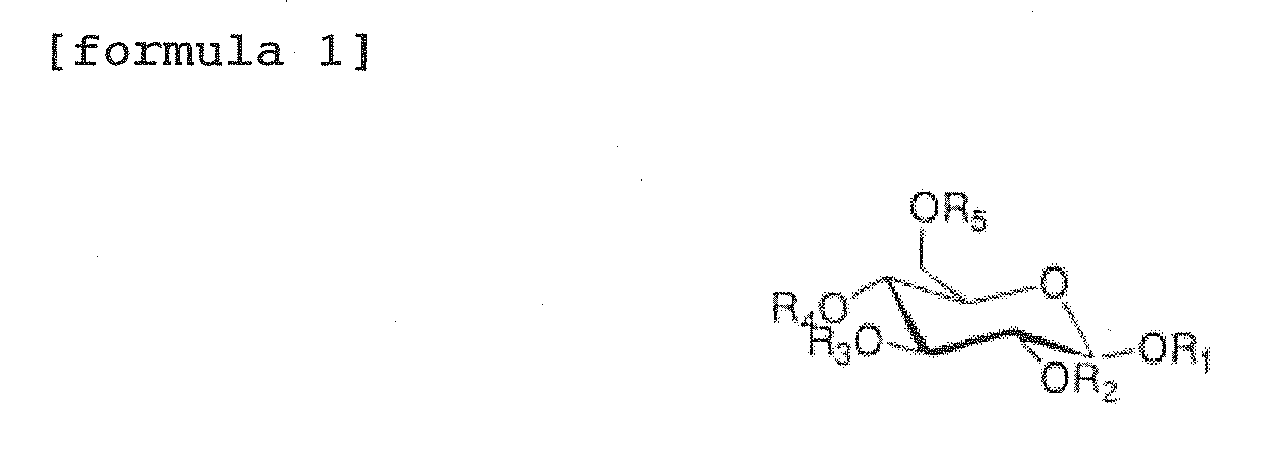
wherein R1, R 2 and R3 independently represent H or a gallic acid residue, and R4 and R5 represent H or a gallic acid residue, or R4 and R5 together form an HHDP group represented by the formula below:
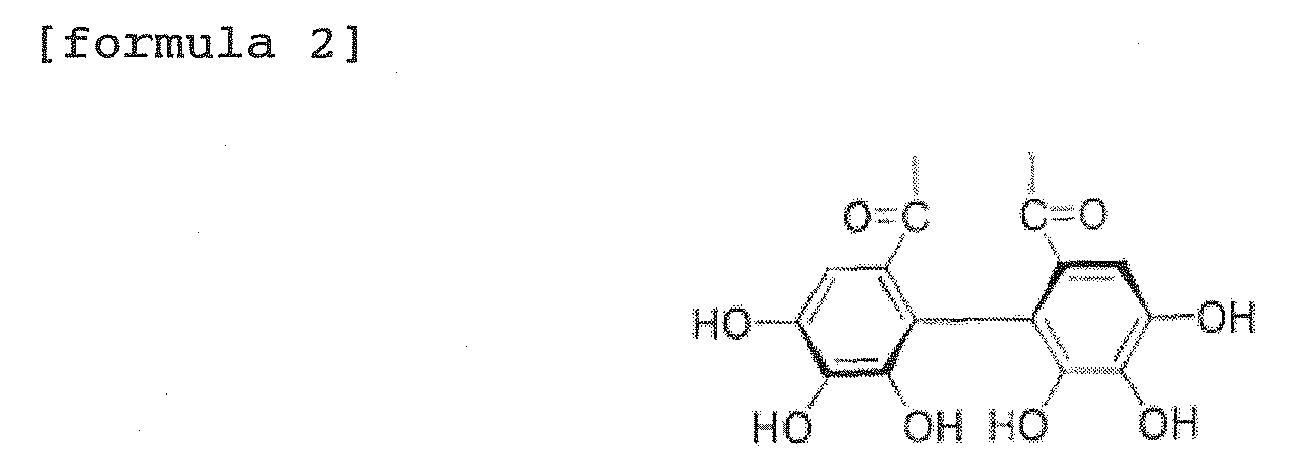
provided that at least two of R1 to R5 represent a gallic acid residue or when all of R1, R2 and R3 are H, R4 and R5 together form the HHDP group; as well as foods and beverages and medicines containing said lipase inhibitory agents.
Description
- This invention provides lipase activity inhibitory agents comprising a gallotannin or ellagitannin component(s) isolated from tealeaves or Tellima grandiflora.
- With the recent tendency toward westernized eating habits in Japan, intake of high fat diet continues to increase. According to a National Nutrition Survey in Japan (1999), among people over 60, it is reported that although their energy intake is decreasing every year, their fat energy ratio exceeds the reasonable proportion of 25%, and 50 to 60% of those people are recognized to have high triglyceride and cholesterol values [Summary of 1999 National Nutrition Survey in Japan by The Ministry of Health, Labor and Welfare, Rinsho Eiyo (Clinical nutrition) 2001; 98(5): 577-588].
- Obesity is one of the most severe diseases in present day society, caused by excessive fat intake. Excessive fat intake causes not only obesity, but also contracting disorders such as diabetes, hyperlipidemia, hypertension and arteriosclerosis. In Japan, Mazindole (registered trademark), an anorectic drug, is only one therapeutic drug with official approval for treating obesity. However, this drug is reported to have side effects such as excessive thirst (mouth dryness), constipation, epigastric distress, nausea and vomiting [ Rinsyo Hyouka (Clinical evaluation), 1985; 13(2): 419-459, Clinical evaluation, 1985; 13(2): 461-515]. Overseas, Xenical (registered trademark) as a lipase inhibitor which suppresses fat absorption in the gastrointestinal tract, is on market as an obesity treatment drug. However, this drug is also reported to have side effects such as fatty stool, increased stool frequency, soft stool, diarrhea and stomachache. Therefore, using this drug is sometimes accompanied by concerns about safety (Lancet 1998; 352:67-172) .
- To prevent obesity, it is advantageous to reduce the caloric intake by controlling diet. However, it requires careful guidance on nutrition, making it difficult to practice in daily life. Therefore, inhibiting absorption of dietary lipids in the body in a safe and healthy manner is practical and useful for treatment of obesity and related diseases and in promoting health.
- With these facts in mind, the development of "food for specified health uses" which is safe to use and is proven to be effective in treating humans is attracting a lot of attention. Food materials which inhibit increase of serum triglycerides after a meal, such as: a globin protein decomposition product that suppresses fat absorption by pancreatic lipase inhibitory activity [J. Nutr. 1988; 128: 56-60, Nihon Eiyou Shokuryou Gakkai-shi (Journal of Japanese society of Nutrition and Food Science) 1999; 52(2): 71-77, Kenkou Eiyou Shokuhin Kenkyu (Health food and nutrition food Research) 2002; 5(3): 131-144]; diacylglycerol with different digestion and absorption features compared to triacylglycerol (J. Am. Coll. Nutr. 2000; 19(6): 789-796, Clin. Chim. Acta. 2001; 11(2): 109-117); eicosapentaenoic acid (EPA) and docosahexanoic acid (DHA) purified from fish oil; are on market as foods for specified health use until now.
- Lipase inhibitors derived from plants are also attracting attention in recent years. Especially, as to the polyphenols with lipase inhibitory activity, for example: tannin from bark (
JP Shou 60-11912-B JP Hei 8-259557-A JP Hei 3-228664-A JP Hei 3-219872-A JP Hei 7-61927-A JP Hei 1-102022-A JP Hei 9-40689-A JP Hei 9-291039-A - However, reported lipase inhibitory agents from the plants mentioned above are not sufficiently effective. For instance, since they originate from natural sources, there is a problem in maintaining stable lipase inhibitory activity when the content of the active ingredient in the plant is not clearly known. Moreover, use of an inhibitory agent derived from plants with less preference will raise a flavor problem when used in foods and/or beverages. For example, reports on lipid-improving effect of oolong tea are: significant decrease in blood triglyceride levels after drinking 1330 ml/day of commercial oolong tea for 6 weeks [Nihon Eiyou Shokuryou Gakkai-shi (Journal of Japanese society of Nutrition and food science) 1991; 44(4): 251-259]; and oral administration of oolong tea (2
g x 4/day) for 6 consecutive weeks to 102 males and females with simple obesity resulted in more than 1 kg weight loss in 67% of the subjects and significant improvement in the subjects with high blood triglyceride levels after taking oolong tea [Nihon Rinsho Eiyou Gakkai-shi (The Japanese Society of Clinical Nutrition Magazine) 1998; 20(1): 83-90]. These reports show that although drinking a large quantity of oolong tea is recognized to be effective, it is difficult in daily life to continue drinking such large quantities of a drink such as oolong tea. Further, simply providing concentrated oolong tea is not an appropriate and a practical option, due to its strong bitterness and astringency and increased caffeine content. - On the other hand, tea-derived tannins have been reported to have antioxidant activity (Biosci. Biotechnol. Biochem. 2003; 67(2): 396-401), and plant-derived tannins, especially tellimagrandin, have been reported to have not only antioxidant activity (Phytochemistry 1993; 33(3): 557-561) but also antibacterial properties (Microbiol. Immunol. 2004; 48(1): 67-73), anticancer properties (Toxicology Letters 2004; 147(2): 109-119); and to function as a cytokine release regulators (
JP 2004-510688-A
Patent Documents - 1.
JP Shou 60-11912-B - 2.
JP Hei 8-259557-A - 3.
JP Hei 3-228664-A - 4.
JP Hei 3-219872-A - 5.
JP Hei 7-61927-A - 6.
JP Hei 1-102022-A - 7.
JP Hei 9-40689-A - 8.
JP Hei 9-291039-A - 9.
JP 2004-510688-A - 1. Summary of 1999 National Nutrition Survey in Japan by The Ministry of Health, Labor and Welfare
- 2. Rinsho Eiyo (Clinical nutrition) 2001; 98(5): 577-588
- 3. Rinsyo Hyouka (Clinical evaluation), 1985; 13(2): 419-459
- 4. Rinsyo Hyouka (Clinical evaluation), 1985; 13(2): 461-515
- 5. Lancet 1998; 352:67-172
- 6. J. Nutr. 1988; 128: 56-60
- 7. Nihon Eiyou Shokuryou Gakkai-shi (Journal of Japanese society of Nutrition and Food Science) 1999; 52(2): 71-77
- 8. Kenkou Eiyou Shokuhin Kenkyu (Health food and nutrition food Research) 2002; 5(3): 131-144
- 9. J. Am. Coll. Nutr. 2000; 19(6): 789-796
- 10. Clin. Chim. Acta. 2001; 11(2): 109-117
- 11.Nutrition 2003; vol.19, (10), 876-879
- 12.J. Nutr. 2002; 132, 1819-1824
- 13. Int. J. Obes. 1999; 23 98-105
- 14. Nihon Eiyou Shokuryou Gakkai-shi (Journal of Japanese society of Nutrition and food science) 1991; 44(4): 251-259
- 15. Nihon Rinsho Eiyou Gakkai-shi (The Japanese Society of Clinical Nutrition Magazine) 1998; 20(1): 83-90
- 16. Biosci. Biotechnol. Biochem. 2003; 67(2): 396-401
- 17. Phytochemistry 1993; 33(3): 557-561
- 18. Microbiol. Immunol. 2004; 48(1): 67-73
- 19. Toxicology Letters 2004; 147(2): 109-119
- The present invention focuses on various polyphenol components contained in plants and provides lipase inhibitory agents comprising at least one of gallotannin and ellagitannin components isolated from tealeaves and Tellima grandiflora.
- The present invention also provides high preference foods and/or beverages, containing said lipase inhibitory agents, for reducing blood triglyceride levels and promoting health without raising a problem of flavor.
- The present invention further provides a pharmaceutical composition containing the lipase inhibitory agent which will suppress the absorption of dietary lipids and suppress the rise of triglycerides in blood.
- As means for solving the stated problems, the present inventors found components from tealeaves and Tellima grandiflora which have a strong inhibitory effect on pancreatic lipase, an enzyme essential for fat absorption, and evaluated the lipase inhibitory activity of various polyphenols present therein, and ascertained that compounds having multiple gallic acid groups in their molecules have strong lipase inhibitory activity.
- More specifically, lipase inhibitory agents of the present invention comprise as an active ingredient at least one of the compounds represented by formula I below:
-

- wherein R1, R 2 and R3 independently represent H or a gallic acid residue, and R4 and R5 represent H or a gallic acid residue, or R4 and R5 together form an HHDP group represented by the formula below:
-

- provided that at least two of R1 to R5 represent a gallic acid residue or when all of R1, R2 and R3 are H, R4 and R5 together form a HHDP group. As used herein, the gallic acid residue means the residue of gallic acid that has lost OH from its carboxyl group.
- Preferred active ingredients are compounds of formula I wherein at least three of R1 to R5 are not H.
- More preferred active ingredients are compounds of formula I wherein at least four of R1 to R5 are not H.
- Still more preferred active ingredients are compounds of formula I wherein any of R1 to R5 are not H, e.g., compounds wherein all of R1, R2 and R3 are gallic acid residue, and R4 and R5 together form the HHDP group (compound 8).
- Examples of specific compounds contained in lipase inhibitory agents of the present invention include those shown in Figure 1.
- The lipase inhibitory compound of the present invention may be used as a lipase inhibitory agent either alone, or with a solvent or with a solid carrier. Preferably, the solvent or carrier is safe to use in foods or medicaments, considering its use in foods and/or beverages and/or medicamens mentioned below. The lipase inhibitory agent of the present invention can be used for various purposes, including, for example, experimental purposes, and as an active ingredient for preventing accumulation of triglycerides in foods and medicaments.
- The lipase inhibitory agent of the present invention has strong inhibitory activity against lipase, particularly pancreatic lipase. This inhibitory activity can be determined by the method specifically described in Example 1.
- The lipase inhibitory agent of the invention may be added to foods and/or beverages in order to prevent an undesirable rise in blood triglycerides that may accompany fat intake in the diet, and/or to decrease increased blood triglyceride levels. Preferable examples of foods and/or beverages are those that are consumed daily, such as green tea, mugi-cha (barley tea), oolong tea, black tea, coffee, sports drinks, drinking water, seasonings and dressings. However, such foods and/or beverages may be any of those taken usually, such as soft drinks, cocktails, beer, whisky, shochu (rough distilled spirits), wine, sake, seasonings, dressings, flavored rice, processed food, instant food, retort pouch food (specially packaged food that has been pre-heated and sterilized), chocolate, fresh cream, confectionery, dairy products (nyu-seihin), health foods, and supplements.
- The lipase inhibitory agent of the present invention is added to foods and/or to beverages to provide 0.1 mg to 10 g of active ingredient intake per meal. Provided that the lipase inhibitory agent of the present invention is derived from food, it is highly safe, and there is no practical upper limit to an amount which may be added to foods and/or to beverages.
- The lipase inhibitory agent of the present invention can also be used as an active ingredient in a drug for suppressing absorption of dietary lipids and preventing and/or decreasing an undesirable increase in blood triglyceride levels. Preferable drugs are those suitable for oral administration, such as drinks, tablets, capsules, granules, powders, candies and drops. Such drugs comprise the lipase inhibitory agent of the present invention in amounts of 0.1 mg to 10 g per dose. [00023] Since the lipase inhibitory ingredient is highly safe, the pharmaceutical drug of the present invention can be administered over a long period of time without any risk of side effects. Therefore, it may be taken daily for the purpose of preventing or treating obesity as a life-style disease.
- By adding a lipase inhibitory agent containing at least one of gallotannin and ellagitannin components derived from tealeaves and Tellima grandiflora, the present invention provides high preference foods and/or beverages for reducing triglyceride levels and for promoting health, without raising a problem of flavor. In order to inhibit absorption of dietary lipids, it is desirable to take the lipase inhibitory agent with a meal. Therefore, beverages enriched with an active ingredient obtained from tea are of significant use. Especially, enrichment of beverages with these components enables the provision of beverages having anti-obesity effects and which promote health.
- Figure 1 shows the chemical structural formulae of the compounds evaluated for lipase inhibitory activity in Example 5.
- Lipase activity measurement was carried out by using oleic acid ester of fluorescence 4-methylumbelliferone (4-UMO) as a substrate, and measuring the fluorescence of 4-methylumbelliferone produced by reaction.
- In the measurement, 13 mM Tris-HCl containing 150 mM NaCl and 1.36 mM CaCl2 was used as a buffer (pH 8.0). Substrate 4-UMO (Sigma) is prepared as 0.1 M solution in DMSO and diluted 1000 times with the buffer mentioned above. Similarly, lipase (porcine pancreatic lipase (Sigma)) is prepared as 400 U/ml solution in the buffer mentioned above and used in enzymatic measurement.
- 50 µl of 4-UMO buffer solution and 25 µl of distilled water (or sample solution) are placed in 96 well microplate and mixed at 25 degrees, followed by adding 25 µl of lipase buffer solution to start enzyme reaction. After 30 minutes of reaction, 100 µl of 0.1 M citric acid buffer (pH 4.2) was added to terminate the reaction, and fluorescence of 4-methylumbelliferone (excitation wavelength: 355 nm, fluorescence wavelength: 460 nm) produced by the reaction was measured with a fluorescence plate reader (Labsystems, Fluoroskan Asent CF).
- Inhibitory activity of the sample was determined as a sample amount which gives 50% of inhibition compared to the activity of control (distilled water) (IC50)(µM).
- Gallic acid (compound 1) was purchased from Nacalai Tesque Inc.
Compounds -
Compounds compounds compound 5. -
Compound 4 was purified by the method described in the article Chem. Pharm. Bull. 1989; 37(1): 77-85 as follows. Oolong tea leaves were extracted with 80% acetone, after which acetone was removed. The extract was then fractionated with water, methanol and 50% acetone on Sephadex LH-20 (Pharmacia). The methanol eluate was eluted with water-methanol on MCI-gel CHP-20P (Mitsubishi Kasei Corp.), and then eluted with water-methanol on Bondapak C18 (Waters) and further eluted with ethanol on Sephadex LH-20 (Pharmacia) to givecompound 4. - Dried leaves of Camellia ptilophylla (100 g) were extracted with 2000 ml of hot water (90°C) for 4 min and lyophilized, and the resulting material was purified as follows. 1% aqueous solution of the lyophilized powder was adsorbed to Sep-Pak C18 Cartridge (5 ml, Waters) and washed with water. The fraction eluted with acetonitrile was then lyophilized. This fraction (250 mg) was applied onto Develosil C30-UG-5 (20 mm x 250 mm, Nomura Chemical Co., Ltd.) and fractionated by elution with acetonitrile (linear gradient: 5 to 30%, 0.05% TFA, 5 ml/min, 180 min) while monitoring the absorbance at A280 nm. The fraction obtained was then applied onto YMC-Pak ODS (20 x 250 mm, YMC Co., Ltd.) and purified by elution with acetonitrile (linear gradient: 20 to 25%, 0.1% TFA, 6 ml/min, 60 min) to give 1,2,4,6-tetragalloylglucose (compound 6).
- Extraction and purification were performed according to Phytochemistry 1976; 15: 211-214 as follows. Leaves of Tellima grandiflora (100 g) were ground in liquid nitrogen and extracted with 1000 ml of 50% ethanol. The solvent was distilled off and then the residue was applied onto HP-20 (Mitsubishi Kasei Corp.) and washed with water. The fraction eluted with acetonitrile was then lyophilized. This fraction was applied onto Develosil ODS-UG-5 (50 mm x 500 mm, Nomura Chemical Co., Ltd.) and fractionated by elution with acetonitrile (linear gradient: 5 to 25%, 0.05% TFA, 32 ml/min, 80 min) while monitoring the absorbance at A260 nm to give
Tellimagrandin 1 andTellimagrandin 2. - Lipase inhibitory activities of gallocatechins and tellimagrandins (ellagitannins) derived from teas are shown in Table 1. To evaluate structure-activity correlation, IC50 values are expressed in µM. Chemical structural formulae of the compounds subjected to evaluation are shown in Figure 1.
- Among these tannins, compounds having three or more molecules of gallic acid attached to the sugars (
compounds 4, 6) and ellagitannins with HHDP group attached (compounds [0032] [Table 1] compound C50 (µM) Galli acid (1) >50 β-glucogallin (2) >50 theogallin (3) >50 1,4,6-tri-O-galloyl-D-glucose (4) 1.226 strictinin (5) 0.472 1,2,4,6-tetra-GA-Gle (6) 0.203 Tellimagrandin 1 (7) 0.127 Tellimagrandin2 (8) 0.074
Claims (9)
- A lipase inhibitory agent comprising at least one of the compounds represented by formula I below:


- The lipase inhibitory agent of claim 1 comprising a compound of formula I wherein at least three of R1 to R5 are not H.
- The lipase inhibitory agent of claim 1 comprising a compound of formula I wherein at least four of R1 to R5 are not H.
- The lipase inhibitory agent of claim 1 comprising a compound of formula I wherein any of R1 to R5 are not H.
- The lipase inhibitory agent of claim 1 comprising a compound of formula I wherein all of R1, R2 and R3 are a gallic acid residue, and R4 and R5 together form the HHDP group.
- A food or beverage containing the lipase inhibitory agent of any one of claims 1 to 5.
- The food or beverage of claim 6, which is selected from the group consisting of tea drinks, soft drinks and health foods.
- A pharmaceutical composition containing the lipase inhibitory agent of any one of claims 1 to 5.
- The pharmaceutical composition of claim 8 for inhibiting absorption of dietary fats.
Applications Claiming Priority (2)
| Application Number | Priority Date | Filing Date | Title |
|---|---|---|---|
| JP2004242666A JP2006056850A (en) | 2004-08-23 | 2004-08-23 | Lipase inhibitor |
| PCT/JP2005/015212 WO2006022227A1 (en) | 2004-08-23 | 2005-08-22 | Lipase inhibitor |
Publications (1)
| Publication Number | Publication Date |
|---|---|
| EP1783136A1 true EP1783136A1 (en) | 2007-05-09 |
Family
ID=35967439
Family Applications (1)
| Application Number | Title | Priority Date | Filing Date |
|---|---|---|---|
| EP05780412A Withdrawn EP1783136A1 (en) | 2004-08-23 | 2005-08-22 | Lipase inhibitor |
Country Status (7)
| Country | Link |
|---|---|
| US (2) | US20070254948A1 (en) |
| EP (1) | EP1783136A1 (en) |
| JP (1) | JP2006056850A (en) |
| KR (1) | KR20070053762A (en) |
| CN (1) | CN101006095A (en) |
| TW (1) | TW200616559A (en) |
| WO (1) | WO2006022227A1 (en) |
Families Citing this family (11)
| Publication number | Priority date | Publication date | Assignee | Title |
|---|---|---|---|---|
| JP2009102288A (en) * | 2007-10-19 | 2009-05-14 | Harunire Bio Kenkyusho:Kk | Fat accumulation inhibitor |
| WO2009064082A1 (en) * | 2007-11-13 | 2009-05-22 | Igsbio | Composition comprising galla rhois extract for prevention and treatment of obesity by means of autophagic mechanism |
| CN101318904B (en) * | 2008-07-04 | 2011-03-23 | 浙江大学 | 5-oxygen-benzoyl quinic acid compounds and medicament uses thereof |
| JP5528025B2 (en) * | 2008-08-22 | 2014-06-25 | 花王株式会社 | TG synthesis inhibitor |
| JP2010222276A (en) * | 2009-03-23 | 2010-10-07 | Kao Corp | Inhibitor of blood triglyceride level increase after meal |
| US8247003B2 (en) * | 2009-08-07 | 2012-08-21 | Muhammed Majeed | Protective compositions for dermal papilla cells |
| US20140128585A1 (en) * | 2011-07-07 | 2014-05-08 | Nagaoka Perfumery Co., Ltd. | Fructose absorption inhibitor |
| CN108451959B (en) * | 2015-06-10 | 2021-04-20 | 苏州禾研生物技术有限公司 | Application of galloylglucoside derivatives and pharmaceutical composition for treating hyperuricemia |
| US20190290671A1 (en) * | 2018-03-26 | 2019-09-26 | Muhammed Majeed | Hypolipidemic effects of compositions comprising beta-glucogallin |
| CN110354135A (en) * | 2019-07-26 | 2019-10-22 | 江苏省中国科学院植物研究所 | Application of 1,2,3,6-tetragalloylglucose ester in preparation of lipase inhibitor medicine or health food |
| CN111662868B (en) * | 2020-07-20 | 2021-03-30 | 北京达尔文细胞生物科技有限公司 | CXCR4 agonist and application thereof in-vitro culture of umbilical cord mesenchymal stem cells |
Family Cites Families (26)
| Publication number | Priority date | Publication date | Assignee | Title |
|---|---|---|---|---|
| IT1212825B (en) | 1983-06-15 | 1989-11-30 | Ates Componenti Elettron | MONOLITHICALLY INTEGRABLE VOLTAGE REGULATOR, FOR A LARGE FIELD OF USE, FOR AUTOMOTIVE APPLICATIONS. |
| JPH01102022A (en) | 1987-10-14 | 1989-04-19 | Advance Co Ltd | Prophylactic for fatness |
| JPH03219872A (en) | 1990-01-25 | 1991-09-27 | Meiji Seika Kaisha Ltd | Lipase inhibitor |
| JPH03228664A (en) | 1990-02-02 | 1991-10-09 | Meiji Seika Kaisha Ltd | Food having function of suppressing lipid digestion and absorption |
| JP2598873B2 (en) | 1993-08-25 | 1997-04-09 | 株式会社ロッテ | Lipase inhibitor and food and drink to which it is added |
| JP3532999B2 (en) | 1995-03-24 | 2004-05-31 | 株式会社ロッテ | Novel tannins and lipase inhibitors containing them as active ingredients |
| JP3828953B2 (en) | 1995-05-24 | 2006-10-04 | 日本製粉株式会社 | Lipase inhibitor |
| JPH09291039A (en) | 1995-12-26 | 1997-11-11 | Suntory Ltd | Antiobesity agent containing procyanidins as active ingredients |
| JPH09176019A (en) * | 1995-12-26 | 1997-07-08 | Suntory Ltd | Glycolytic and digestive enzyme inhibitors and pharmaceuticals and foods and drinks containing them |
| JPH11269075A (en) * | 1998-03-24 | 1999-10-05 | The Nikka Wisky Distilling Co Ltd | IgE-IgE receptor binding inhibitor |
| JP4380815B2 (en) * | 1998-08-26 | 2009-12-09 | 日本サプリメント株式会社 | α-Glucosidase inhibitor |
| JP4521894B2 (en) * | 1999-05-28 | 2010-08-11 | 明治乳業株式会社 | Matrix metalloproteinase inhibitor |
| EP1232169A1 (en) | 1999-11-19 | 2002-08-21 | The Penn State Research Foundation | Gallotannins and ellagitannins as regulators of cytokine release |
| JP4809980B2 (en) * | 2000-01-18 | 2011-11-09 | 長岡香料株式会社 | Anti-arteriosclerosis agent |
| JP2001226274A (en) * | 2000-02-09 | 2001-08-21 | Matsuura Yakugyo Kk | Lipase inhibitor |
| JP5354833B2 (en) * | 2000-03-10 | 2013-11-27 | 株式会社ヤクルト本社 | α-Amylase activity inhibitor |
| WO2002009734A1 (en) * | 2000-08-01 | 2002-02-07 | Oryza Oil & Fat Chemical Co.,Ltd. | Sugar absorption inhibitors and process for producing the same |
| JP2002275077A (en) * | 2001-01-11 | 2002-09-25 | Kanebo Ltd | Lipase inhibitor |
| JP2002255804A (en) * | 2001-03-02 | 2002-09-11 | Suntory Ltd | Composition comprising a hexaoxydiphenic acid derivative having an insulin-like action |
| JP4824886B2 (en) * | 2001-09-11 | 2011-11-30 | 長岡香料株式会社 | Fructose absorption inhibitor, composition, and food |
| JP4018435B2 (en) * | 2002-04-26 | 2007-12-05 | 株式会社 伊藤園 | STRICTININ RECOVERY METHOD, STRICTININ-CONTAINING METHOD, STRICTININ QUANTIFICATION |
| JP2003342185A (en) * | 2002-05-25 | 2003-12-03 | Bhn Kk | Lipase activity inhibitor |
| CN1668311A (en) * | 2002-07-24 | 2005-09-14 | 俄亥俄州立大学 | Method and composition for treating diabetes |
| WO2005000330A1 (en) * | 2003-05-28 | 2005-01-06 | Board Of Supervisors Of Louisiana State University And Agricultural And Mechanical College | Angiogenic agents from plant extracts, gallic acid, and derivatives |
| JP2005137210A (en) * | 2003-11-04 | 2005-06-02 | Hino Shokai:Kk | Composition comprising a preparation or extract of tea and long life grass |
| WO2005077384A1 (en) * | 2004-02-17 | 2005-08-25 | Suntory Limited | Lipase activity inhibitor containing high-molecular weight polyphenol fraction, tea extract and process for producing the same |
-
2004
- 2004-08-23 JP JP2004242666A patent/JP2006056850A/en active Pending
-
2005
- 2005-08-22 CN CNA2005800279095A patent/CN101006095A/en active Pending
- 2005-08-22 TW TW094128604A patent/TW200616559A/en unknown
- 2005-08-22 KR KR1020077006215A patent/KR20070053762A/en not_active Ceased
- 2005-08-22 EP EP05780412A patent/EP1783136A1/en not_active Withdrawn
- 2005-08-22 WO PCT/JP2005/015212 patent/WO2006022227A1/en not_active Ceased
- 2005-08-22 US US11/660,784 patent/US20070254948A1/en not_active Abandoned
-
2008
- 2008-09-30 US US12/285,144 patent/US7754695B2/en not_active Expired - Fee Related
Non-Patent Citations (1)
| Title |
|---|
| See references of WO2006022227A1 * |
Also Published As
| Publication number | Publication date |
|---|---|
| WO2006022227A1 (en) | 2006-03-02 |
| US20070254948A1 (en) | 2007-11-01 |
| KR20070053762A (en) | 2007-05-25 |
| US7754695B2 (en) | 2010-07-13 |
| US20090042812A1 (en) | 2009-02-12 |
| TW200616559A (en) | 2006-06-01 |
| JP2006056850A (en) | 2006-03-02 |
| CN101006095A (en) | 2007-07-25 |
Similar Documents
| Publication | Publication Date | Title |
|---|---|---|
| US7754695B2 (en) | Lipase inhibitors | |
| JP5498471B2 (en) | Lipase inhibitor | |
| US20120329862A1 (en) | Novel compound having inhibitory effect on lipase | |
| US7939559B2 (en) | Lipase inhibitors | |
| CN1980656B (en) | New pharmaceutical use of lipase inhibitor | |
| HK1103645B (en) | New pharmaceutical uses of the lipase inhibitor | |
| HK1103407A (en) | Lipase inhibitor | |
| HK1103643B (en) | Lipase inhibitor |
Legal Events
| Date | Code | Title | Description |
|---|---|---|---|
| PUAI | Public reference made under article 153(3) epc to a published international application that has entered the european phase |
Free format text: ORIGINAL CODE: 0009012 |
|
| 17P | Request for examination filed |
Effective date: 20070223 |
|
| AK | Designated contracting states |
Kind code of ref document: A1 Designated state(s): AT BE BG CH CY CZ DE DK EE ES FI FR GB GR HU IE IS IT LI LT LU LV MC NL PL PT RO SE SI SK TR |
|
| DAX | Request for extension of the european patent (deleted) | ||
| RAP1 | Party data changed (applicant data changed or rights of an application transferred) |
Owner name: SUNTORY HOLDINGS LIMITED |
|
| STAA | Information on the status of an ep patent application or granted ep patent |
Free format text: STATUS: THE APPLICATION HAS BEEN WITHDRAWN |
|
| 18W | Application withdrawn |
Effective date: 20120308 |