EP1781009A1 - Image Stitching For Mobile Electronic Devices - Google Patents
Image Stitching For Mobile Electronic Devices Download PDFInfo
- Publication number
- EP1781009A1 EP1781009A1 EP05109933A EP05109933A EP1781009A1 EP 1781009 A1 EP1781009 A1 EP 1781009A1 EP 05109933 A EP05109933 A EP 05109933A EP 05109933 A EP05109933 A EP 05109933A EP 1781009 A1 EP1781009 A1 EP 1781009A1
- Authority
- EP
- European Patent Office
- Prior art keywords
- image
- images
- file
- merged
- image files
- Prior art date
- Legal status (The legal status is an assumption and is not a legal conclusion. Google has not performed a legal analysis and makes no representation as to the accuracy of the status listed.)
- Granted
Links
Images



Classifications
-
- H—ELECTRICITY
- H04—ELECTRIC COMMUNICATION TECHNIQUE
- H04N—PICTORIAL COMMUNICATION, e.g. TELEVISION
- H04N1/00—Scanning, transmission or reproduction of documents or the like, e.g. facsimile transmission; Details thereof
- H04N1/32—Circuits or arrangements for control or supervision between transmitter and receiver or between image input and image output device, e.g. between a still-image camera and its memory or between a still-image camera and a printer device
- H04N1/32101—Display, printing, storage or transmission of additional information, e.g. ID code, date and time or title
- H04N1/32128—Display, printing, storage or transmission of additional information, e.g. ID code, date and time or title attached to the image data, e.g. file header, transmitted message header, information on the same page or in the same computer file as the image
-
- G—PHYSICS
- G06—COMPUTING OR CALCULATING; COUNTING
- G06T—IMAGE DATA PROCESSING OR GENERATION, IN GENERAL
- G06T11/00—Two-dimensional [2D] image generation
- G06T11/60—Creating or editing images; Combining images with text
-
- H—ELECTRICITY
- H04—ELECTRIC COMMUNICATION TECHNIQUE
- H04N—PICTORIAL COMMUNICATION, e.g. TELEVISION
- H04N2201/00—Indexing scheme relating to scanning, transmission or reproduction of documents or the like, and to details thereof
- H04N2201/32—Circuits or arrangements for control or supervision between transmitter and receiver or between image input and image output device, e.g. between a still-image camera and its memory or between a still-image camera and a printer device
- H04N2201/3201—Display, printing, storage or transmission of additional information, e.g. ID code, date and time or title
- H04N2201/3225—Display, printing, storage or transmission of additional information, e.g. ID code, date and time or title of data relating to an image, a page or a document
- H04N2201/3247—Data linking a set of images to one another, e.g. sequence, burst or continuous capture mode
-
- H—ELECTRICITY
- H04—ELECTRIC COMMUNICATION TECHNIQUE
- H04N—PICTORIAL COMMUNICATION, e.g. TELEVISION
- H04N2201/00—Indexing scheme relating to scanning, transmission or reproduction of documents or the like, and to details thereof
- H04N2201/32—Circuits or arrangements for control or supervision between transmitter and receiver or between image input and image output device, e.g. between a still-image camera and its memory or between a still-image camera and a printer device
- H04N2201/3201—Display, printing, storage or transmission of additional information, e.g. ID code, date and time or title
- H04N2201/3225—Display, printing, storage or transmission of additional information, e.g. ID code, date and time or title of data relating to an image, a page or a document
- H04N2201/325—Modified version of the image, e.g. part of the image, image reduced in size or resolution, thumbnail or screennail
Definitions
- the present application relates to preparing content for delivery to mobile electronic devices, and in particular to the preparation of content including image data to mobile electronic devices.
- the communications link between a wireless enabled mobile electronic device and a content source often includes a communications channel that has a delivery capacity that is less than that typically available between a stationary device and a content source. Additionally, mobile devices will often have on-board resources, such as memory for example, that are less than that of a stationary devices.
- a content delivery system and method that provides for improved efficiency in the delivery and use of content for mobile devices is desirable.
- Downloadable content such as Internet webpages and mobile device applications often make use of several small images that consume significant wireless network bandwidth to download as well as significant storage space on the mobile device.
- the present application describes methods, devices, and computer program products in which images from separate image files obtained from a content source are combined into a single image file for transmission over a communications channel and/or use on a mobile electronic device.
- the present application provides an automated method for modifying content for use on a mobile electronic device.
- the method includes (a) receiving content that includes (i) a plurality of content image files each including graphics information for generating an associated image and (ii) computer instructions including references to the plurality of image files for causing the associated images to be displayed on a display screen; (b) selecting from the content image files a plurality of image files that can be combined together to form a single image file that will have a smaller file size than the sum of the file sizes of the selected image files; (b) selecting from the content image files a plurality of image files and combining the selected image files into a single merged image that has a smaller file size than the sum of the file sizes of the selected image files; (c) amending the computer instructions to accommodate the merged image file; (d) providing the merged image file and the amended computer instructions to the mobile electronic device.
- the present application provides a wireless connector system for interfacing between a content source and a wireless network servicing a plurality of mobile electronic devices, the content source providing content including (i) a plurality of content image files each including graphics information for generating an associated image and (ii) computer instructions including references to the plurality of image files for causing the associated images to be displayed on a display screen.
- the wireless connector system includes a data conversion module implemented on a computer for converting content into a format for communication over the wireless network, the data conversion module including: (a) selection means for selecting from the content image files a plurality of image files that can be combined together to form a single image file that will have a smaller file size than the sum of the file sizes of the selected image files; (b) combining means for combining the selected image files into a single merged image file; and (c) amending means for amending the computer instructions to accommodate the merged image file.
- the wireless connector system is configured for sending the merged image file and the amended computer instructions over the wireless network to the mobile electronic device.
- the present application provides a computer program product having a computer-readable medium tangibly embodying computer executable instructions for instructions for modifying content for use on a mobile electronic device, the content including (i) a plurality of content image files each including graphics information for generating an associated image and (ii) computer instructions including references to the plurality of image files for causing the associated images to be displayed on a display screen.
- the computer executable instructions include executable instructions for: (a) selecting from the content image files a plurality of image files that can be combined together to form a single image file that will have a smaller file size than the sum of the file sizes of the selected image files; (b) combining the selected image files into a single merged image file; (c) amending the computer instructions to accommodate the merged image file; and (d) providing amended content including the merged image file and the amended computer instructions for transfer to the mobile electronic device.
- Figure 1 is a block diagram of a communications system to which embodiments may be applied;
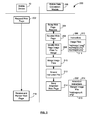
- Figure 2 is a block diagram showing a method for processing image and instruction files associated with a Webpage, according to example embodiments ;
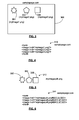
- Figure 3 shows an example of a simple webpage for explaining embodiments of the invention
- Figure 4 shows an example of an HTML file for displaying the simple webpage of Figure 3;
- Figure 5 shows a representation of a simple merged image for explaining embodiments of the invention
- Figure 6 shows a first example of a modified HTML file for displaying the simple webpage of Figure 3;
- Figure 7 shows a further example of a modified HTML file for displaying the simple webpage of Figure 3;
- Figure 8 shows an example of image information embedded in a merged image file for the simple webpage of Figure 3;
- Figure 9 shows a further example of a modified HTML file for displaying the simple webpage of Figure 3;
- Figure 10 shows a further example of a modified HTML file for displaying the simple webpage of Figure 3;
- Figure 11 shows examples of a further images for explanatory purposes
- Figure 12 shows a merged version of the images of Figure 11 for explanatory purposes
- Figure 13 is a block diagram showing a method for processing image and instruction files associated with an application, according to example embodiments ;
- Figure 14 is a block diagram showing an example of a method for identifying image files for merger and merging such files
- Figure 15 is a block diagram showing an example of a mobile electronic device that can be used in the communications system of Figure 1.
- the communication system 100 includes mobile electronic devices 10, a wireless network 110 for communicating with the mobile electronic devices 10, and a wireless network gateway 112 for interfacing with a wireless connector system 114 that is connected to a client network 117.
- the client network 117 may include a local area network, an intranet, the Internet, a direct connection, and combinations thereof, however in at least some example embodiments client network 117 will be an intranet for a corporation or organization.
- An application/content server 118 may be connected to the client network 117 and also to a further network such as a Wide Area Network (WAN) 120.
- WAN Wide Area Network
- the WAN 120 may connect with other networks, and the WAN 120 can in various embodiments include the Internet, a direct connection, a local area network (LAN), a wireless communication link, and any combinations thereof.
- Content providers such as web servers, may be connected to the WAN 120, an example of which is shown in Figure 1 as origin server 122.
- mobile electronic devices 10 are handheld two-way mobile communication devices 10 having at least data and possibly also voice communication capabilities.
- the devices 10 have the capability to communicate with other computer systems on the Internet.
- mobile electronic devices 10 may include, by way of non limiting example, data communication devices, multiple-mode communication devices configured for both data and voice communication, mobile telephones, mobile communication devices, PDAs enabled for wireless communications, and wireless modems operating in conjunction with computer systems.
- each of the mobile electronic devices 10 is configured to operate within the wireless network 110.
- Wireless mobile network 110 is, in an example embodiment, a wireless packet data network which provides radio coverage to mobile electronic devices 10, and could be a number of different types of network including by way of non-limiting example, Mobitex Radio Network, DataTAC , GSM (Global System for Mobile Communication), GPRS (General Packet Radio System), CDMA (Code Division Multiple Access), iDEN or various other third generation networks such as EDGE (Enhanced Data rates for GSM Evolution) or UMTS (Universal Mobile Telecommunications Systems).
- Mobitex Radio Network DataTAC
- GSM Global System for Mobile Communication
- GPRS General Packet Radio System
- CDMA Code Division Multiple Access
- iDEN Code Division Multiple Access
- EDGE Enhanced Data rates for GSM Evolution
- UMTS Universal Mobile Telecommunications Systems
- the wireless network gateway 112 provides translation and routing services between one or more wireless connector systems 114 and wireless networks 110 to facilitate communication between mobile devices 10 and devices connected, directly or indirectly, to wireless connector system 114.
- the wireless connector system 114 is a server that in at least some examples is located behind a firewall and provides access for mobile devices 10 to the devices connected, for example through intranet 117, to the wireless connecter system 114.
- the wireless connector system 114 includes a mobile data conversion module 116 that coverts content and information received from devices connected to wireless connector system 114 into a format more suitable for transmission over wireless network 110 to mobile electronic devices 10.
- the data conversion module 116 is implemented through computer program instructions that reside on a persistent storage on the wireless connector system 114, and which are executed by one or more microprocessors.
- the data conversion module 116 could be implemented on a separate computer than the wireless connector system 114.
- the data conversion module 116 provides HTTP connectivity between the wireless network 110 and devices and/or networks connected directly or indirectly to wireless connector system 114.
- the network 117, application/content server 118, WAN 120 and origin server 122 are collectively and/or individually or in various combinations a content source for the wireless connector system 114.
- the system shown in Figure 1 is but one possible configuration for a communications system on which embodiments of the invention may be implemented.
- content received by the data conversion module 116 that is destined for a mobile electronic device is converted into a format that is more suitable for transmission over a limited bandwidth communications channel available in wireless network 110.
- discrete images contained in Internet web pages are merged by the data conversion module 116 into a single image for download over the wireless network 110.
- images used in applications that are being loaded onto a mobile electronic device 10 are merged by the data conversion module 116 prior to loading onto the mobile electronic device 10.
- images with a relatively common dimension and/or color space may be merged into a single image having a size less than that of the cumulative sizes of the separate images.
- the overhead of the graphics header and color lookup information is required only once for the combined image, rather than for each separate image.
- compression used in common image file formats such as PNG (Portable Network Graphics), JPEG (Joint Photographic Experts Group) and GIF (Graphics Interchange Format) is improved in many cases when there is more image data in a particular file.
- the mobile data conversion module 116 is configured to analyse a set of images and select appropriate images to be "stitched" or combined together to reduce cumulative file size.
- the HTML (Hyper Text Markup Language) or other instructions used to represent the webpage are also modified by the mobile data conversion module 116 to reference a part of the stitched image in place of individual images.
- the application code referring to the individual images are similarly modified by the mobile data conversion module 116 to refer to a part of the stitched image in place of individual images.
- an XML (Extensible Markup Language) style sheet used to generate a graphical user interface for an application can be modified by the mobile data conversion module 116.
- Figure 2 provides a block diagram overview showing method 200 for processing of image and instruction files associated with a Webpage according to example embodiments of the invention.
- Method 200 will be described in the context of a non-limiting example with reference to Figures 3 and 5, which show a simple webpage and representation of a merged image file, respectively.
- a mobile electronic device 10 having a Web browser transmits a webpage request over wireless network 110.
- the requested webpage is "samplepage.com” 300, which includes three similar sized and similar color themed images, namely a star 302, a pentagon 304, and a square 306.
- the information needed for rendering the Webpage "samplepage.com” 300 will typically include an instruction file 310 and associated image files 311.
- the instruction file may be an HTML file which defines the structure and layout of a Web document by using a variety of tags and attributes, which in turn refer to image files.
- Figure 4 shows a very simple HTML source file 310 for generating the Webpage samplepage.com 300.
- the instruction file 310 references thee image files, namely myimage1.png which includes graphic information for rendering the star 302; myimage2.png which includes graphic information for rendering the pentagon 304; and myimage3.png which includes graphic information for rendering the square 306.
- myimage1.png which includes graphic information for rendering the star 302
- myimage2.png which includes graphic information for rendering the pentagon 304
- myimage3.png which includes graphic information for rendering the square 306.
- PNG graphics files are used in the present example, embodiments of the invention could also be used with different graphic file formats such as JPEG or GIF for example.
- the webpage request from mobile device 10 is routed through the wireless network 110 and wireless network gateway 112 to the data conversion module 116 of a wireless connector system 114.
- the data conversion module 116 relays the webpage request to the source of the web page.
- the webpage request may be routed through client network 117, application/content server 118, and Internet 210 to an origin server 122 on which the requested webpage resides.
- the application/content server 118 or another server connected to the data conversion module 116 through client network 117 could be the origin server.
- the data conversion module 116 receives the requested webpage, including the HTML file 310 and referenced image files myimage1.png, myimage2.png and myimage3.png from the content source.
- images are selected for merging into a larger image based on predetermined merger rules such that the image file defining the merged image will generally have a smaller file size than the sum of individual image files that define the individual images that are being merged.
- all images having a same or similar common dimension for example images having the same height in pixels are selected for merging and then any remaining images having the same width in pixels are selected for merging.
- the images do not need the same dimension, but require a similar dimension - for example images falling within a predetermined variance in height in pixels may be merged, and images falling within a predetermined variance in width in pixels may be merged.
- images are often saved in format that includes indexes into a color table or palette instead of raw color information.
- GIF and PNG files are typically saved in a paletted color image format
- JPEG files are full color image files. If several images having different colors are merged, then in some circumstances the resulting merged image file may have a larger file size than the sum of the individual images.
- image color is taken into consideration when selecting files for merger in that images having similar colors are selected for merger and images lacking a commonality of color within predetermined thresholds are rejected as merger candidates.
- a combination of characteristics are considered when selecting images for merger - for example, files having both a same or similar common dimension and a similar color scheme (within predetermined limits established for determining a similar color scheme) are selected for merging.
- the images selected for merging do not need to have common dimensions, but rather just be able to be combined together into a larger image that has a smaller resulting file size than the sum of the files of the individual images.
- Such a combination may be achieved simply by an automated repetitive trial and error process in which the size of the combined file is compared against the size of the individual files or by more involved algorithms.
- images having common sub-areas may be merged with the sub-areas overlapping.
- each of the images 302, 304 and 306 are 32 pixels wide and 32 pixels high and share a common colour palette. Accordingly, their respective image files myimage1.png, myimage2.png and myimage3.png are selected for merger by data conversion module 116.
- the use of a series of images having common dimensions and colors is relatively common on web pages - for example similar images may be used as headings or topic dividers throughout a webpage. Accordingly, combining images having a common dimension and/or similar color scheme will often result in a smaller cumulative file size for a webpage.
- step 210 once the image files for merger have been selected they are then merged by the data conversion module 116.
- images having the same height are merged into a single image in which the formerly separate images are arranged adjacent each other in a row.
- Figure 5 shows the merged image 312 that includes the star 302, pentagon 304 and square 306 image elements of the previously separate images arranged in a row that is 96 pixels wide and 32 pixels high.
- the graphic information for generating the merged image 312 is contained in merged image file myimagequilt.png, which, when header information and other file overhead is taken into account, has a total file size less than that of the separate image files myimage1.png, myimage2.png and myimage3.png.
- images of common width are merged into an image in which the formerly separate images are arranged adjacent each other in a column - for example, the images 302, 304 and 306 could alternatively be arranged in a column rather than a row.
- the images are merged in different merged image configurations - for example, rows and columns of images could be packed into a rectangular shaped image that includes an array of merged images.
- the webpage instructions that refer to the original individual images are automatically modified to by the data conversion module 16.
- the webpage source code could be modified by data conversion module 16.
- the data conversion module 116 keeps track of the relative location of the original images within the merged image and the image href attributes in the HTML source file are modified to indicate a portion of the merged image to be rendered at each location.
- Figure 6 shows a modified HTML source file 314 created by the mobile data conversion module 116 for the generating the webpage 300 (samplepage.com) from merged image file myimagequilt.png.
- the rectangular (X, Y) coordinates of the original images 302, 304 and 306 within the merged image 312 are specified so that the web browser at the mobile device 10 can extract the original images from the merged images.
- Such an embodiment requires that the web browser on the mobile device 10 be configured during a set up or updating process to recognize the appended coordinate data in the modified HTML file.
- images of a common height are always merged horizontally into a row, then only X coordinate information may be required in the coordinate data, and similarly in embodiments where images of a common width are always merged vertically into a column, then only Y coordinate information may be required in the coordinate data.
- a similar coordinate based modification method is to modify the webpage instruction file to use a custom image tag to indicate what region of the merged image to render, and in this regard, Figure 7 shows a further example of a modified HTML source file 316 for rendering the webpage 300 (samplepage.com) from the merged image file myimagequilt.png.
- the web browser on mobile device 10 is configured to recognize the custom tags.
- the merged image file could be a custom format having a predetermined file extension (eg..quilt"), with the merged image file having a name like "myimagequilt.quilt".
- the custom format could, for example, be the similar to a common format such as .png format, but include extra information in a custom header field identifying the locations of the individual images within the merged image.
- the image file myimagequilt.quilt may include in its header a table 318 of image information which contains an index of images, each referred to by an assigned identification ID 320 (#1, #2 and #3, corresponding to star 302, pentagon 304 and square 306 in the present example) that is mapped to a specific location (coordinates 322).
- the webpage source code is automatically amended by the data conversion module 116 to refer to the merged image file and the assigned ID's for the respective image.
- Figure 9 shows a further example of a modified HTML source file 324 for rendering the webpage 300 (samplepage.com) from the custom merged image file myimagequilt.quilt.
- the browser on the mobile device 10 is pre-configured, through a plug-in for example, to recognize the custom format.
- the HTML source file may be modified in step 312 to replace image element references with ⁇ object> or ⁇ embed> elements, and in this regard Figure 10 shows a further example of a modified HTML source file 326 for rendering the webpage 300 (samplepage.com) from the custom merged image file myimagequilt.quilt
- the amended webpage 300' (which includes the merged image file 313 and the amended instruction file 314) is then sent over the wireless network 110 to the requesting mobile device 10.
- Device 10 which then renders the webpage on its display screen according to the modified instructions.
- FIG. 11 shows two example images 330 and 332 associated with the image files "myimage4.png" and "myimage5.png".
- the image 330 has sub-regions 330A and 330B
- the image 332 has sub-regions 332A and 332B.
- the data conversion module 116 using a comparison algorithm determines that images 330 and 332 in a requested webpage have a common width (i.e.
- the conversion module merges images 330 and 332 by inverting sub-image 332A and attaching it to the end of the image 330, and cutting the data associated with common image sub-region 332B, forming merged image 334 which is described in merged graphic file "images4and5quit.png".
- the source code for the webpage is amended in step 212 so that previous references to image file "myimage4.png" refer to sub-regions 33A and 330B of the merged image 334 and previous references to image file “myimage5.png” refer to sub-regions 332A and 330B, rotated 180 degrees, of the merged image 334.
- the image combining methods of the present invention can also be applied to applications that are loaded onto a mobile device 10.
- Applications may be downloaded to the device 10 over wireless network 110, in which case it is desirable to minimize file size to reduce consumption of communications channel resources and device on-board memory.
- applications may be loaded onto the device 10 through wired link such as a docking station or a short range wireless link such as a wireless LAN having a higher bandwidth channel than network 110. In such cases, reduced file size is still desirable to limit consumption of on-board memory.
- a downloaded file is not an entire application, but rather a file or files used by an application on the device to generate visual images in a graphical user interface.
- the downloaded file could be a theme file that includes a number of image files and instructions, including for example, a style sheet that refers to the image files.
- the theme file can be used by an application on the device to generate a themed user interface.
- Figure 13 shows a method 400 used by data conversion module 116 when converting an application (including for example a theme file) according to example embodiments.
- Application conversion method 400 is similar to webpage conversion method 200 described above, and begins, as indicated in step 406, with the data conversion module 116 receiving from a source an application (or theme file) 450 destined for a mobile device 10.
- the application includes both a source code instructions 452 and image files 454 that are referenced in the instructions 452.
- instructions 452 could be in the form of an XML style sheet.
- the data conversion modules goes through steps of identifying image files for merger (step 408) and merging the identified image files (step 410) in a substantially identical manner to which image files are identified and merged in webpage conversion method 200 described above.
- the application instructions e.g. source code, (or style sheet in the case of a them file) is then automatically amended by the data conversion module 116, as indicated in step 412, to reference the appropriate sub-portions of the merged image file 458.
- the instructions are are amended so that references to the individual image files 454 are replaced with references to corresponding sub-regions of the merged image file - for example, using the coordinate system discussed above, a reference to "myimage1.png" is changed to "myimagequilt.png#(0,0,32,32)".
- further code could be added to the source code such that when the application requests an original image file "myimagel.png", the appropriate portion of the merged image is returned instead.
- the other instruction and/or image file modification techniques discussed above in the context of webpages could also be applied to applications.
- the amended application 450' (or theme file), including its amended instructions 456 and image file 458 is then sent to a mobile device 10 on which the application is implemented.
- the amended application 450' (or theme file) may be loaded on the device 10 in different ways in different embodiments, including for example through wireless network 110, through a sort range wireless network connection, or through a wired docking station link, among others.
- the presently described methods and systems are concerned with reducing data provided to a mobile device 10 in an automated setting.
- the modified content 300', 450' could include a plurality of merged image files, each of which includes a group of merged images.
- an iterative process of identifying suitable files for merging is carried out, as indicated by steps 504 to 518.
- the identified merger candidates are compared against each other to select a group of merger candidates having a similar common dimension - for example all images having a similar height (within a predetermined +/- tolerance) may be selected as potential merger candidates for a group.
- all images having a similar width may be selected as potential merger candidates for a group.
- histograms of the colors used in the group merger candidates are examined to determine if, from a color perspective, merging of the merger candidate images within the selected group is justified.
- a histogram of the image currently being evaluated is combined with a merged histogram of the images within the group that have already been merged.
- step 510 if the addition of the histogram of a current merger candidate within the group to the combined histogram results in a combined histogram exceeding the threshold, the merger candidate being evaluated is rejected from the selected group and placed back in the pool of possible merger candidates for possible inclusion in another selected group, and another merger candidate within the current group is evaluated.
- the image that is currently being evaluated is combined with the merged image file for the selected group to form a test merged image file (step 512).
- the images within the selected group are combined horizontally when the similar dimension within the group is height, and vertically when the similar dimension is width.
- the images are combined in a two dimensional array in some embodiments.
- all three combing methods are performed for a group, and the method that produces the test file having the smallest file size is selected.
- step 514 once the image that is currently being processed is added to the test file, a check is made to ensure that the size of the merged test file image including the currently processed image is less than the sum of the size of the merged image file not including the currently processed image and the sizes of the image file for the currently processed image (i.e. the sum of the whole is less than the sum of the parts).
- the size of the test file exceeds the threshold, then the image currently being processed is rejected from the group and placed back in the pool of possible merger candidates for possible inclusion in another selected group, and another merger candidate within the current group is evaluated.
- step 516 if the addition of the image currently being evaluated to the test file results in a file in which the size of the whole is less than the parts, then the image is added to a merged image file for the selected group.
- the coordinates of the image within the merged image file are tracked so that the instructions that referenced the image can be suitable amended.
- the processing steps 508-516 are carried out all image files in a selected group.
- all the image file merger candidates in a selected group i.e. those having a similar common dimension
- step 518 the another group of candidates is identified and the process continues until all image files that can be combined have been combined.
- steps 508 and 510 would typically be omitted in the processing of full color images (as opposed to paletted images).
- the device 10 includes a wireless communication subsystem 11 for two-way communications with wireless network 110.
- the device 10 includes a microprocessor 38 that controls the overall operation of the device.
- the microprocessor 38 interacts with communications subsystem 11 and also interacts with further device subsystems such as the display 22, flash memory 24, random access memory (RAM) 26, auxiliary input/output (I/O) subsystems 28 (which may include a thumb-wheel, for example), serial port 30 (which may include a USB port, for example), keyboard or keypad 32, speaker 34, microphone 36, a short-range communications subsystem 40, and any other device subsystems generally designated as 42.
- Operating system software 54 and various software applications 58 used by the microprocessor 38 are, in one example embodiment, stored in a persistent store such as flash memory 24 or similar storage element.
- Software applications 58 may include a wide range of applications, including an address book application, a messaging application, a calendar application, and/or a notepad application.
- One application included among applications 58 in web-enabled embodiments of device 10 is a web browser 60.
- Each software application 58 may include layout information defining the placement of particular fields in the user interface for the software application 58, such as text fields, input fields, etc.
- the operating system 54, specific device applications 58, or parts thereof may be temporarily loaded into a volatile store such as RAM 26. Received communication signals may also be stored to RAM 26.
- the microprocessor 38 in addition to its operating system functions, enables execution of software applications 58 (which can include software applications 450') on the device.
- software applications 58 which can include software applications 450'
- a predetermined set of applications 58 which control basic device operations, including at least data and voice communication applications for example, will normally be installed on the device 10 during manufacture.
- Further applications (for example applications 450') may also be loaded onto the device 10 through the network 110, an auxiliary I/O subsystem 28, serial port 30, short-range communications subsystem 40 or any other suitable subsystem 42, and installed by a user in the RAM 26 or a non-volatile store for execution by the microprocessor 38.
- Such flexibility in application installation increases the functionality of the device and may provide enhanced on-device functions, communication-related functions, or both.
- secure communication applications may enable electronic commerce functions and other such financial transactions to be performed using the device 10.
- a received signal such as a text message or webpage download will be processed by the communication subsystem 11 and input to the microprocessor 38, which will preferably further process the received signal for output to the display 22, or alternatively to an auxiliary I/O device 28.
- a user of device 10 may also compose data items such as email messages for example, using the keyboard 32 in conjunction with the display 22 and possibly an auxiliary I/O device 28. Such composed items may then be transmitted over a communication network through the communication subsystem 11.
- the serial port 30 could be a USB type port implemented in a personal digital assistant (PDA)-type communication device for which synchronization with a user's desktop computer (not shown) may be desirable.
- PDA personal digital assistant
- Such a port 30 would enable a user to set preferences through an external device or software application and would extend the capabilities of the device by providing for information or software downloads, including user interface information, to the device 10 other than through a wireless communication network.
- a short-range communications subsystem 40 is a further component which may provide for communication between the device 10 and different systems or devices, which need not necessarily be similar devices.
- the subsystem 40 may include an infrared device and associated circuits and components or a Bluetooth TM or IEEE 802.11 b/g communication module to provide for communication with similarly enabled systems and devices.
Landscapes
- Engineering & Computer Science (AREA)
- General Engineering & Computer Science (AREA)
- Multimedia (AREA)
- Signal Processing (AREA)
- Physics & Mathematics (AREA)
- General Physics & Mathematics (AREA)
- Theoretical Computer Science (AREA)
- Information Transfer Between Computers (AREA)
- Medicines Containing Plant Substances (AREA)
- Folding Of Thin Sheet-Like Materials, Special Discharging Devices, And Others (AREA)
- Dovetailed Work, And Nailing Machines And Stapling Machines For Wood (AREA)
Abstract
Description
- The present application relates to preparing content for delivery to mobile electronic devices, and in particular to the preparation of content including image data to mobile electronic devices.
- The communications link between a wireless enabled mobile electronic device and a content source often includes a communications channel that has a delivery capacity that is less than that typically available between a stationary device and a content source. Additionally, mobile devices will often have on-board resources, such as memory for example, that are less than that of a stationary devices.
- The use of mobile devices to wirelessly receive and view enriched content including images is expanding. However, content that has been created for wider bandwidth communications channels and memory rich devices can be cumbersome to receive and use in the limited bandwidth and limited memory environment of mobile communications.
- Accordingly, a content delivery system and method that provides for improved efficiency in the delivery and use of content for mobile devices is desirable.
- Downloadable content such as Internet webpages and mobile device applications often make use of several small images that consume significant wireless network bandwidth to download as well as significant storage space on the mobile device. Among other things, the present application describes methods, devices, and computer program products in which images from separate image files obtained from a content source are combined into a single image file for transmission over a communications channel and/or use on a mobile electronic device.
- In one aspect, the present application provides an automated method for modifying content for use on a mobile electronic device. The method includes (a) receiving content that includes (i) a plurality of content image files each including graphics information for generating an associated image and (ii) computer instructions including references to the plurality of image files for causing the associated images to be displayed on a display screen; (b) selecting from the content image files a plurality of image files that can be combined together to form a single image file that will have a smaller file size than the sum of the file sizes of the selected image files; (b) selecting from the content image files a plurality of image files and combining the selected image files into a single merged image that has a smaller file size than the sum of the file sizes of the selected image files; (c) amending the computer instructions to accommodate the merged image file; (d) providing the merged image file and the amended computer instructions to the mobile electronic device.
- In another aspect, the present application provides a wireless connector system for interfacing between a content source and a wireless network servicing a plurality of mobile electronic devices, the content source providing content including (i) a plurality of content image files each including graphics information for generating an associated image and (ii) computer instructions including references to the plurality of image files for causing the associated images to be displayed on a display screen. The wireless connector system includes a data conversion module implemented on a computer for converting content into a format for communication over the wireless network, the data conversion module including: (a) selection means for selecting from the content image files a plurality of image files that can be combined together to form a single image file that will have a smaller file size than the sum of the file sizes of the selected image files; (b) combining means for combining the selected image files into a single merged image file; and (c) amending means for amending the computer instructions to accommodate the merged image file. The wireless connector system is configured for sending the merged image file and the amended computer instructions over the wireless network to the mobile electronic device.
- In yet another aspect, the present application provides a computer program product having a computer-readable medium tangibly embodying computer executable instructions for instructions for modifying content for use on a mobile electronic device, the content including (i) a plurality of content image files each including graphics information for generating an associated image and (ii) computer instructions including references to the plurality of image files for causing the associated images to be displayed on a display screen. The computer executable instructions include executable instructions for: (a) selecting from the content image files a plurality of image files that can be combined together to form a single image file that will have a smaller file size than the sum of the file sizes of the selected image files; (b) combining the selected image files into a single merged image file; (c) amending the computer instructions to accommodate the merged image file; and (d) providing amended content including the merged image file and the amended computer instructions for transfer to the mobile electronic device.
- Embodiments will now be described, by way of example only, with reference to the attached Figures, wherein:
- Figure 1 is a block diagram of a communications system to which embodiments may be applied;
- Figure 2 is a block diagram showing a method for processing image and instruction files associated with a Webpage, according to example embodiments ;
- Figure 3 shows an example of a simple webpage for explaining embodiments of the invention;
- Figure 4 shows an example of an HTML file for displaying the simple webpage of Figure 3;
- Figure 5 shows a representation of a simple merged image for explaining embodiments of the invention;
- Figure 6 shows a first example of a modified HTML file for displaying the simple webpage of Figure 3;
- Figure 7 shows a further example of a modified HTML file for displaying the simple webpage of Figure 3;
- Figure 8 shows an example of image information embedded in a merged image file for the simple webpage of Figure 3;
- Figure 9 shows a further example of a modified HTML file for displaying the simple webpage of Figure 3;
- Figure 10 shows a further example of a modified HTML file for displaying the simple webpage of Figure 3;
- Figure 11 shows examples of a further images for explanatory purposes;
- Figure 12 shows a merged version of the images of Figure 11 for explanatory purposes;
- Figure 13 is a block diagram showing a method for processing image and instruction files associated with an application, according to example embodiments ;
- Figure 14 is a block diagram showing an example of a method for identifying image files for merger and merging such files;
- Figure 15 is a block diagram showing an example of a mobile electronic device that can be used in the communications system of Figure 1.
- Like reference numerals are used throughout the Figures to denote similar elements and features.
- Referring first to Figure 1, there is a block diagram of a
communication system 100 to which example embodiments of the present application may be applied. Thecommunication system 100 includes mobileelectronic devices 10, awireless network 110 for communicating with the mobileelectronic devices 10, and awireless network gateway 112 for interfacing with awireless connector system 114 that is connected to a client network 117. The client network 117 may include a local area network, an intranet, the Internet, a direct connection, and combinations thereof, however in at least some example embodiments client network 117 will be an intranet for a corporation or organization. An application/content server 118 may be connected to the client network 117 and also to a further network such as a Wide Area Network (WAN) 120. The WAN 120 may connect with other networks, and the WAN 120 can in various embodiments include the Internet, a direct connection, a local area network (LAN), a wireless communication link, and any combinations thereof. Content providers, such as web servers, may be connected to theWAN 120, an example of which is shown in Figure 1 asorigin server 122. - In one example embodiment, mobile
electronic devices 10 are handheld two-waymobile communication devices 10 having at least data and possibly also voice communication capabilities. In an example embodiment, thedevices 10 have the capability to communicate with other computer systems on the Internet. In various embodiments, mobileelectronic devices 10 may include, by way of non limiting example, data communication devices, multiple-mode communication devices configured for both data and voice communication, mobile telephones, mobile communication devices, PDAs enabled for wireless communications, and wireless modems operating in conjunction with computer systems. In the presently described embodiment, each of the mobileelectronic devices 10 is configured to operate within thewireless network 110. - Wireless
mobile network 110 is, in an example embodiment, a wireless packet data network which provides radio coverage to mobileelectronic devices 10, and could be a number of different types of network including by way of non-limiting example, Mobitex Radio Network, DataTAC , GSM (Global System for Mobile Communication), GPRS (General Packet Radio System), CDMA (Code Division Multiple Access), iDEN or various other third generation networks such as EDGE (Enhanced Data rates for GSM Evolution) or UMTS (Universal Mobile Telecommunications Systems). - The
wireless network gateway 112 provides translation and routing services between one or morewireless connector systems 114 andwireless networks 110 to facilitate communication betweenmobile devices 10 and devices connected, directly or indirectly, towireless connector system 114. Thewireless connector system 114 is a server that in at least some examples is located behind a firewall and provides access formobile devices 10 to the devices connected, for example through intranet 117, to thewireless connecter system 114. Thewireless connector system 114 includes a mobiledata conversion module 116 that coverts content and information received from devices connected towireless connector system 114 into a format more suitable for transmission overwireless network 110 to mobileelectronic devices 10. In at least one embodiment, thedata conversion module 116 is implemented through computer program instructions that reside on a persistent storage on thewireless connector system 114, and which are executed by one or more microprocessors. In some embodiments, thedata conversion module 116 could be implemented on a separate computer than thewireless connector system 114. In an example embodiment, thedata conversion module 116 provides HTTP connectivity between thewireless network 110 and devices and/or networks connected directly or indirectly towireless connector system 114. The network 117, application/content server 118, WAN 120 andorigin server 122 are collectively and/or individually or in various combinations a content source for thewireless connector system 114. The system shown in Figure 1 is but one possible configuration for a communications system on which embodiments of the invention may be implemented. - According to example embodiments of the invention, content received by the
data conversion module 116 that is destined for a mobile electronic device is converted into a format that is more suitable for transmission over a limited bandwidth communications channel available inwireless network 110. In at least some example embodiments discrete images contained in Internet web pages are merged by thedata conversion module 116 into a single image for download over thewireless network 110. In at least some example embodiments, images used in applications that are being loaded onto a mobileelectronic device 10 are merged by thedata conversion module 116 prior to loading onto the mobileelectronic device 10. In example embodiments, images with a relatively common dimension and/or color space may be merged into a single image having a size less than that of the cumulative sizes of the separate images. In the combined image, the overhead of the graphics header and color lookup information is required only once for the combined image, rather than for each separate image. In addition, the compression used in common image file formats such as PNG (Portable Network Graphics), JPEG (Joint Photographic Experts Group) and GIF (Graphics Interchange Format) is improved in many cases when there is more image data in a particular file. - As will be explained in greater detail below, the mobile
data conversion module 116 is configured to analyse a set of images and select appropriate images to be "stitched" or combined together to reduce cumulative file size. In the case of a webpage, the HTML (Hyper Text Markup Language) or other instructions used to represent the webpage are also modified by the mobiledata conversion module 116 to reference a part of the stitched image in place of individual images. In the case of a software application, the application code referring to the individual images are similarly modified by the mobiledata conversion module 116 to refer to a part of the stitched image in place of individual images. For example, an XML (Extensible Markup Language) style sheet used to generate a graphical user interface for an application can be modified by the mobiledata conversion module 116. - Figure 2 provides a block diagram
overview showing method 200 for processing of image and instruction files associated with a Webpage according to example embodiments of the invention.Method 200 will be described in the context of a non-limiting example with reference to Figures 3 and 5, which show a simple webpage and representation of a merged image file, respectively. In themethod 200, as indicated instep 202, a mobileelectronic device 10 having a Web browser transmits a webpage request overwireless network 110. - With reference to Figures 2 and 3, in the presently described example, the requested webpage is "samplepage.com" 300, which includes three similar sized and similar color themed images, namely a
star 302, apentagon 304, and a square 306. As known in the art, the information needed for rendering the Webpage "samplepage.com" 300 will typically include aninstruction file 310 and associated image files 311. The instruction file may be an HTML file which defines the structure and layout of a Web document by using a variety of tags and attributes, which in turn refer to image files. In the present example, Figure 4 shows a very simple HTML source file 310 for generating the Webpage samplepage.com 300. Theinstruction file 310 references thee image files, namely myimage1.png which includes graphic information for rendering thestar 302; myimage2.png which includes graphic information for rendering thepentagon 304; and myimage3.png which includes graphic information for rendering the square 306. Although PNG graphics files are used in the present example, embodiments of the invention could also be used with different graphic file formats such as JPEG or GIF for example. - Turning again to Figure 2, the webpage request from
mobile device 10 is routed through thewireless network 110 andwireless network gateway 112 to thedata conversion module 116 of awireless connector system 114. As indicated instep 204, thedata conversion module 116 relays the webpage request to the source of the web page. In one example, the webpage request may be routed through client network 117, application/content server 118, andInternet 210 to anorigin server 122 on which the requested webpage resides. In some examples, the application/content server 118 or another server connected to thedata conversion module 116 through client network 117 could be the origin server. As indicated instep 206, thedata conversion module 116 receives the requested webpage, including theHTML file 310 and referenced image files myimage1.png, myimage2.png and myimage3.png from the content source. - As indicated in
step 208, once thedata conversion module 116 receives the requested webpage it automatically identifies images within the subject webpage for merging. In example embodiments images are selected for merging into a larger image based on predetermined merger rules such that the image file defining the merged image will generally have a smaller file size than the sum of individual image files that define the individual images that are being merged. In one example embodiment, all images having a same or similar common dimension, for example images having the same height in pixels are selected for merging and then any remaining images having the same width in pixels are selected for merging. In some example embodiments, the images do not need the same dimension, but require a similar dimension - for example images falling within a predetermined variance in height in pixels may be merged, and images falling within a predetermined variance in width in pixels may be merged. - It will be understood by those skilled in the art that images are often saved in format that includes indexes into a color table or palette instead of raw color information. For example, GIF and PNG files are typically saved in a paletted color image format, whereas JPEG files are full color image files. If several images having different colors are merged, then in some circumstances the resulting merged image file may have a larger file size than the sum of the individual images. Thus, in some embodiments, image color is taken into consideration when selecting files for merger in that images having similar colors are selected for merger and images lacking a commonality of color within predetermined thresholds are rejected as merger candidates. In some example embodiments, a combination of characteristics are considered when selecting images for merger - for example, files having both a same or similar common dimension and a similar color scheme (within predetermined limits established for determining a similar color scheme) are selected for merging.
- In some example embodiments, the images selected for merging do not need to have common dimensions, but rather just be able to be combined together into a larger image that has a smaller resulting file size than the sum of the files of the individual images. Such a combination may be achieved simply by an automated repetitive trial and error process in which the size of the combined file is compared against the size of the individual files or by more involved algorithms. In some example embodiments as will be explained in greater detail below, images having common sub-areas may be merged with the sub-areas overlapping.
- In the
example webpage 300 of Figure 3, each of theimages data conversion module 116. The use of a series of images having common dimensions and colors is relatively common on web pages - for example similar images may be used as headings or topic dividers throughout a webpage. Accordingly, combining images having a common dimension and/or similar color scheme will often result in a smaller cumulative file size for a webpage. Similarly, applications often use similar colors and dimensions for visual images associated with the same skin or theme, and thus combining images having a common dimension and/or similar color scheme will often result in a smaller cumulative file size for an application. As indicated instep 210, once the image files for merger have been selected they are then merged by thedata conversion module 116. In one example embodiment, images having the same height are merged into a single image in which the formerly separate images are arranged adjacent each other in a row. By way of example, Figure 5 shows themerged image 312 that includes thestar 302,pentagon 304 and square 306 image elements of the previously separate images arranged in a row that is 96 pixels wide and 32 pixels high. The graphic information for generating themerged image 312 is contained in merged image file myimagequilt.png, which, when header information and other file overhead is taken into account, has a total file size less than that of the separate image files myimage1.png, myimage2.png and myimage3.png. In some embodiments, images of common width are merged into an image in which the formerly separate images are arranged adjacent each other in a column - for example, theimages - As indicated in
step 212 of Figure 2, in order to allow the merged images to be correctly displayed at the target mobile device, the webpage instructions that refer to the original individual images are automatically modified to by the data conversion module 16. There are a number of ways that the webpage source code could be modified by data conversion module 16. In one example embodiment, when merging the individual images thedata conversion module 116 keeps track of the relative location of the original images within the merged image and the image href attributes in the HTML source file are modified to indicate a portion of the merged image to be rendered at each location. By way of example, Figure 6 shows a modified HTML source file 314 created by the mobiledata conversion module 116 for the generating the webpage 300 (samplepage.com) from merged image file myimagequilt.png. In the modifiedfile 314, the rectangular (X, Y) coordinates of theoriginal images merged image 312 are specified so that the web browser at themobile device 10 can extract the original images from the merged images. Such an embodiment requires that the web browser on themobile device 10 be configured during a set up or updating process to recognize the appended coordinate data in the modified HTML file. In embodiments where images of a common height are always merged horizontally into a row, then only X coordinate information may be required in the coordinate data, and similarly in embodiments where images of a common width are always merged vertically into a column, then only Y coordinate information may be required in the coordinate data. - A similar coordinate based modification method is to modify the webpage instruction file to use a custom image tag to indicate what region of the merged image to render, and in this regard, Figure 7 shows a further example of a modified HTML source file 316 for rendering the webpage 300 (samplepage.com) from the merged image file myimagequilt.png. In such embodiment, the web browser on
mobile device 10 is configured to recognize the custom tags. - In yet another example embodiment, information specifying the location of the individual images within the merged image embedded within the merged image file itself when the merged file is created by the
data conversion module 116 instep 210. In such an embodiment, the merged image file could be a custom format having a predetermined file extension (eg.".quilt"), with the merged image file having a name like "myimagequilt.quilt". The custom format could, for example, be the similar to a common format such as .png format, but include extra information in a custom header field identifying the locations of the individual images within the merged image. By way of reference to Figure 8, the image file myimagequilt.quilt may include in its header a table 318 of image information which contains an index of images, each referred to by an assigned identification ID 320 (#1, #2 and #3, corresponding to star 302,pentagon 304 and square 306 in the present example) that is mapped to a specific location (coordinates 322). In such an example, instep 212, the webpage source code is automatically amended by thedata conversion module 116 to refer to the merged image file and the assigned ID's for the respective image. By way of example, Figure 9 shows a further example of a modified HTML source file 324 for rendering the webpage 300 (samplepage.com) from the custom merged image file myimagequilt.quilt. The browser on themobile device 10 is pre-configured, through a plug-in for example, to recognize the custom format. Alternatively, the HTML source file may be modified instep 312 to replace image element references with <object> or <embed> elements, and in this regard Figure 10 shows a further example of a modified HTML source file 326 for rendering the webpage 300 (samplepage.com) from the custom merged image file myimagequilt.quilt - Referring again to Figure 2, once the requested web page has been processed by the
data conversion module 116 to merge the image files and amend the webpage source code (instruction file), the amended webpage 300' (which includes themerged image file 313 and the amended instruction file 314) is then sent over thewireless network 110 to the requestingmobile device 10.Device 10 which then renders the webpage on its display screen according to the modified instructions. - Although a number of different examples have been described above in terms of image combing techniques, other combining methods are also possible. For example, in some cases images may have common sub-regions which are identified and then overlapped in the merged image in order to avoid duplication of graphics information common to the images. By way of example, Figure 11 shows two
example images image 330 hassub-regions image 332 hassub-regions identification step 208, thedata conversion module 116 using a comparison algorithm determines thatimages common sub-areas images image 330, and cutting the data associated withcommon image sub-region 332B, formingmerged image 334 which is described in merged graphic file "images4and5quit.png". The source code for the webpage is amended instep 212 so that previous references to image file "myimage4.png" refer tosub-regions 33A and 330B of themerged image 334 and previous references to image file "myimage5.png" refer tosub-regions merged image 334. - Thus, it will be appreciated by the example of Figures 11 and 12 that in some example embodiments identical regions of separate images that are to be merged can be identified and the images combined so that the image data for the common regions is only included once in the merged image. Additionally, in some example embodiments, images may be rotated or transformed in order to achieve efficient packing of the individual imaged into the merged image.
- As indicated above, the image combining methods of the present invention can also be applied to applications that are loaded onto a
mobile device 10. Applications may be downloaded to thedevice 10 overwireless network 110, in which case it is desirable to minimize file size to reduce consumption of communications channel resources and device on-board memory. Alternatively, in some embodiments, applications may be loaded onto thedevice 10 through wired link such as a docking station or a short range wireless link such as a wireless LAN having a higher bandwidth channel thannetwork 110. In such cases, reduced file size is still desirable to limit consumption of on-board memory. In some configurations, a downloaded file is not an entire application, but rather a file or files used by an application on the device to generate visual images in a graphical user interface. For example, the downloaded file could be a theme file that includes a number of image files and instructions, including for example, a style sheet that refers to the image files. The theme file can be used by an application on the device to generate a themed user interface. - Figure 13 shows a
method 400 used bydata conversion module 116 when converting an application (including for example a theme file) according to example embodiments.Application conversion method 400 is similar towebpage conversion method 200 described above, and begins, as indicated instep 406, with thedata conversion module 116 receiving from a source an application (or theme file) 450 destined for amobile device 10. The application includes both asource code instructions 452 and image files 454 that are referenced in theinstructions 452. In the case of a theme file,instructions 452 could be in the form of an XML style sheet. The data conversion modules goes through steps of identifying image files for merger (step 408) and merging the identified image files (step 410) in a substantially identical manner to which image files are identified and merged inwebpage conversion method 200 described above. The application instructions, e.g. source code, (or style sheet in the case of a them file) is then automatically amended by thedata conversion module 116, as indicated instep 412, to reference the appropriate sub-portions of themerged image file 458. In one example embodiment, the instructions are are amended so that references to the individual image files 454 are replaced with references to corresponding sub-regions of the merged image file - for example, using the coordinate system discussed above, a reference to "myimage1.png" is changed to "myimagequilt.png#(0,0,32,32)". Alternatively, further code could be added to the source code such that when the application requests an original image file "myimagel.png", the appropriate portion of the merged image is returned instead. Additionally, the other instruction and/or image file modification techniques discussed above in the context of webpages could also be applied to applications. - As indicated in
step 414, the amended application 450' (or theme file), including its amendedinstructions 456 andimage file 458 is then sent to amobile device 10 on which the application is implemented. As suggested above, the amended application 450' (or theme file) may be loaded on thedevice 10 in different ways in different embodiments, including for example throughwireless network 110, through a sort range wireless network connection, or through a wired docking station link, among others. - Thus, the presently described methods and systems are concerned with reducing data provided to a
mobile device 10 in an automated setting. In some embodiments, the modified content 300', 450' could include a plurality of merged image files, each of which includes a group of merged images. - Various example embodiments for identifying and merging image files have been discussed above. One example methodology that can be implemented by mobile
data conversion module 116 for merging and identifying image files insteps block 502 in Figure 14, all the image files that are referenced by an instruction set (which may, among other things, take the from of an HTML file defining a web page, source code for an application, or a XML style sheet) are identified as possible merger candidates. In some embodiments, one or more referenced image files may be excluded instep 502 as merger candidates based on predetermined conditions - for example, some image files may be known to be located already at the mobile device, and thus not required by the device. - Once all the image file merger candidates have been identified, an iterative process of identifying suitable files for merging is carried out, as indicated by
steps 504 to 518. As indicated instep 504, the identified merger candidates are compared against each other to select a group of merger candidates having a similar common dimension - for example all images having a similar height (within a predetermined +/- tolerance) may be selected as potential merger candidates for a group. Alternatively or additionally, all images having a similar width (within a predetermined +/- tolerance) may be selected as potential merger candidates for a group. Once a selected group of images having a same or similar common dimension has been identified the images within that group are evaluated one at a time and suitable files within the group merged as indicated at steps 506-516. In the case of images saved in a paletted color image format, as indicated insteps step 510, if the addition of the histogram of a current merger candidate within the group to the combined histogram results in a combined histogram exceeding the threshold, the merger candidate being evaluated is rejected from the selected group and placed back in the pool of possible merger candidates for possible inclusion in another selected group, and another merger candidate within the current group is evaluated. In the case where the merged histogram falls below the threshold size instep 510, the image that is currently being evaluated is combined with the merged image file for the selected group to form a test merged image file (step 512). In one example embodiment, the images within the selected group are combined horizontally when the similar dimension within the group is height, and vertically when the similar dimension is width. Alternatively, the images are combined in a two dimensional array in some embodiments. In some example embodiments, all three combing methods are performed for a group, and the method that produces the test file having the smallest file size is selected. - As indicated at
step 514, once the image that is currently being processed is added to the test file, a check is made to ensure that the size of the merged test file image including the currently processed image is less than the sum of the size of the merged image file not including the currently processed image and the sizes of the image file for the currently processed image (i.e. the sum of the whole is less than the sum of the parts). In the event that the size of the test file exceeds the threshold, then the image currently being processed is rejected from the group and placed back in the pool of possible merger candidates for possible inclusion in another selected group, and another merger candidate within the current group is evaluated. As indicated instep 516, if the addition of the image currently being evaluated to the test file results in a file in which the size of the whole is less than the parts, then the image is added to a merged image file for the selected group. The coordinates of the image within the merged image file are tracked so that the instructions that referenced the image can be suitable amended. As can be appreciated from Figure 14, the processing steps 508-516 are carried out all image files in a selected group. When all the image file merger candidates in a selected group (i.e. those having a similar common dimension) have been processed, then as indicated instep 518, the another group of candidates is identified and the process continues until all image files that can be combined have been combined. It will be appreciated that the process of Figures 5 can be varied in a number of ways. For example, steps 508 and 510 would typically be omitted in the processing of full color images (as opposed to paletted images). - An example of a mobile
electronic device 10 with which at least some embodiments of the invention may be used is shown in Figure 15. Thedevice 10 includes awireless communication subsystem 11 for two-way communications withwireless network 110. Thedevice 10 includes amicroprocessor 38 that controls the overall operation of the device. Themicroprocessor 38 interacts withcommunications subsystem 11 and also interacts with further device subsystems such as thedisplay 22,flash memory 24, random access memory (RAM) 26, auxiliary input/output (I/O) subsystems 28 (which may include a thumb-wheel, for example), serial port 30 (which may include a USB port, for example), keyboard orkeypad 32,speaker 34,microphone 36, a short-range communications subsystem 40, and any other device subsystems generally designated as 42. -
Operating system software 54 andvarious software applications 58 used by themicroprocessor 38 are, in one example embodiment, stored in a persistent store such asflash memory 24 or similar storage element.Software applications 58 may include a wide range of applications, including an address book application, a messaging application, a calendar application, and/or a notepad application. One application included amongapplications 58 in web-enabled embodiments ofdevice 10 is aweb browser 60. Eachsoftware application 58 may include layout information defining the placement of particular fields in the user interface for thesoftware application 58, such as text fields, input fields, etc. Those skilled in the art will appreciate that theoperating system 54,specific device applications 58, or parts thereof, may be temporarily loaded into a volatile store such asRAM 26. Received communication signals may also be stored toRAM 26. - The
microprocessor 38, in addition to its operating system functions, enables execution of software applications 58 (which can include software applications 450') on the device. A predetermined set ofapplications 58 which control basic device operations, including at least data and voice communication applications for example, will normally be installed on thedevice 10 during manufacture. Further applications (for example applications 450') may also be loaded onto thedevice 10 through thenetwork 110, an auxiliary I/O subsystem 28,serial port 30, short-range communications subsystem 40 or any othersuitable subsystem 42, and installed by a user in theRAM 26 or a non-volatile store for execution by themicroprocessor 38. Such flexibility in application installation increases the functionality of the device and may provide enhanced on-device functions, communication-related functions, or both. For example, secure communication applications may enable electronic commerce functions and other such financial transactions to be performed using thedevice 10. - In a data communication mode, a received signal such as a text message or webpage download will be processed by the
communication subsystem 11 and input to themicroprocessor 38, which will preferably further process the received signal for output to thedisplay 22, or alternatively to an auxiliary I/O device 28. A user ofdevice 10 may also compose data items such as email messages for example, using thekeyboard 32 in conjunction with thedisplay 22 and possibly an auxiliary I/O device 28. Such composed items may then be transmitted over a communication network through thecommunication subsystem 11. - The
serial port 30 could be a USB type port implemented in a personal digital assistant (PDA)-type communication device for which synchronization with a user's desktop computer (not shown) may be desirable. Such aport 30 would enable a user to set preferences through an external device or software application and would extend the capabilities of the device by providing for information or software downloads, including user interface information, to thedevice 10 other than through a wireless communication network. - A short-
range communications subsystem 40 is a further component which may provide for communication between thedevice 10 and different systems or devices, which need not necessarily be similar devices. For example, thesubsystem 40 may include an infrared device and associated circuits and components or a Bluetooth™ or IEEE 802.11 b/g communication module to provide for communication with similarly enabled systems and devices. - The above-described embodiments of the present application are intended to be examples only. Alterations, modifications and variations may be effected to the particular embodiments by those skilled in the art without departing from the scope of the application, which is defined by the claims appended hereto.
Claims (20)
- An automated method for modifying content for use on a mobile electronic device (10), comprising:receiving content (300, 450) that comprises (i) a plurality of content image files (311, 454) each comprising graphics information for generating an associated image and (ii) computer instructions (310, 452) comprising references to the plurality of image files for causing the associated images to be displayed on a display screen (22);selecting from the content image files (311, 454) a plurality of image files and combining the selected image files into a single merged image file (313, 458) that has a smaller file size than the sum of the file sizes of the selected image files;amending the computer instructions (310, 452) to accommodate the merged image file;providing the merged image file (313, 458) and the amended computer instructions (310,452) to the mobile electronic device (10).
- The method of claim 1 wherein in the selecting and combining step the images associated with the content image files (311,454) are analyzed to identify images having a same or similar common dimension, and the selected image files are those for which the associated images have been identified as having a same or similar common dimension.
- The method of claim 2 wherein the common dimension comprises a common x-axis image width in pixels or a common y-axis image height in pixels.
- The method of any one of claims 1 to 3 wherein in the selecting and combining step the images associated with the content image files are analyzed to identify images having a same or similar common dimension in pixels and having colour schemes falling within a predetermined similarity, and the selected image files are those for which the associated images have been identified as having a same or similar common dimension and colour schemes falling within a predetermined similarity.
- The method of any one of claims 1 to 4 wherein said selecting and combining step comprises combining the individual images associated with the selected image files into a merged image (312, 334) that comprises each of the individual images in sub-regions thereof, the merged image file (313, 458) comprising graphic information for generating the merged image.
- The method of claim 5 wherein the amending step comprises amending the computer instructions (310, 452) so that each reference to one of the selected image files is replaced with a reference to the merged image file (313,458) comprising information identifying the sub-region within the merged image (312, 334) that comprises the individual image associated with the selected image file.
- The method of claim 6 wherein the information identifying sub-regions comprises coordinate data.
- The method of claim 6 comprising assigning a unique image ID to each individual image in the merged image file and mapping each image ID to the sub-region in the merged image that comprises the individual image to which the image ID has been assigned, wherein the image ID's and mapping information are comprised in the merged image file; wherein the information identifying sub-regions comprises the unique ID's.
- The method of any one of claims 5 to 8 wherein individual images having a common height are merged into a row in the merged image.
- The method of claim 1 wherein said selecting and combing step comprises analyzing the images associated with the content image files to identify images having a common sub-region, and the selected image files comprise those for which the associated images have been identified as having a common sub-region; and combining the individual images associated with the selected image files into a merged image that comprises only a single occurrence of the common sub-region.
- The method of any one of claims 1 to 10 wherein the content comprises a webpage, the method comprising a step of receiving a request for the webpage from the mobile electronic device, the computer instructions comprising code for a browser to render the webpage and in the step of providing the merged image file and the amended computer instructions the merged image file and the amended computer instructions are sent to the mobile electronic device over a wireless network.
- The method of claim 11 comprising a step of relaying the request for the webpage received from the mobile electronic device to a content source.
- The method of claim 11 or claim 12 comprising an initialization step of configuring a browser on the mobile electronic device to process the amended computer instructions.
- The method of any one of claims 1 to 10 wherein the content comprises an application for the mobile electronic device (10).
- A wireless connector system (114) for interfacing between a content source (118,122) and a wireless network (110) servicing a plurality of mobile electronic devices (10), the content source (118,122) providing content (300, 450) comprising (i) a plurality of content image files (311, 454) each comprising graphics information for generating an associated image and (ii) computer instructions (310, 452) comprising references to the plurality of image files for causing the associated images to be displayed on a display screen (22), the wireless connector system comprising (114):a data conversion module (116) implemented on a computer for converting content into a format for communication over the wireless network, the data conversion module comprising:the wireless connector system (114) being configured for sending the merged image file (313, 458) and the amended computer instructions (314, 456) over the wireless network to the mobile electronic device (10).selection means for selecting from the content image files (311, 454) a plurality of image files that can be combined together to form a single image file that will have a smaller file size than the sum of the file sizes of the selected image files;combining means for combining the selected image files into a single merged image file (313, 458); andamending means for amending the computer instructions (310, 452) to accommodate the merged image file;
- The system of claim 15 wherein the selection means is configured to analyze the images associated with the content image files to identify images having a common dimension falling within a predetermined similarity in number of pixels, and the selected image files are those for which the associated images have been identified as having a common dimension.
- The system of claim 15 or claim 16 wherein the selection means is configured to analyze the images associated with the content image files to identify images having a common dimension falling within a predetermined similarity in number of pixels and having colour schemes falling within a predetermined similarity, and the selected image files are those for which the associated images have been identified as having a common dimension and colour schemes falling within a predetermined similarity.
- The system of any one of claims 15 to 17 wherein the combining means is configure to combine the individual images associated with the selected image files into a merged image that comprises each of the individual images in sub-regions thereof, the merged image file comprising graphic information for generating the merged image.
- The system of claim 18 wherein amending means is configured to amend the computer instructions so that each reference to one of the selected image files is replaced with a reference to the merged image file comprising information identifying the sub-region within the merged image that comprises the individual image associated with the selected image file.
- A computer program product having a computer-readable medium embodying computer executable instructions for modifying content (300, 450) for use on a mobile electronic device (10), the content comprising (i) a plurality of content image files (311, 454) each comprising graphics information for generating an associated image and (ii) computer instructions (310, 452) comprising references to the plurality of image files (311, 454) for causing the associated images to be displayed on a display screen; the computer executable instructions comprising executable instructions for implementing the method of any one of claims 1 to 14.
Priority Applications (4)
| Application Number | Priority Date | Filing Date | Title |
|---|---|---|---|
| EP05109933A EP1781009B1 (en) | 2005-10-25 | 2005-10-25 | Image Stitching For Mobile Electronic Devices |
| AT05109933T ATE401738T1 (en) | 2005-10-25 | 2005-10-25 | IMAGE STICKING FOR MOBILE ELECTRONIC DEVICES |
| DE602005008256T DE602005008256D1 (en) | 2005-10-25 | 2005-10-25 | Stapling images for mobile electronic devices |
| CA2566622A CA2566622C (en) | 2005-10-25 | 2006-10-25 | Image stitching for mobile electronic devices |
Applications Claiming Priority (1)
| Application Number | Priority Date | Filing Date | Title |
|---|---|---|---|
| EP05109933A EP1781009B1 (en) | 2005-10-25 | 2005-10-25 | Image Stitching For Mobile Electronic Devices |
Publications (2)
| Publication Number | Publication Date |
|---|---|
| EP1781009A1 true EP1781009A1 (en) | 2007-05-02 |
| EP1781009B1 EP1781009B1 (en) | 2008-07-16 |
Family
ID=36096242
Family Applications (1)
| Application Number | Title | Priority Date | Filing Date |
|---|---|---|---|
| EP05109933A Expired - Lifetime EP1781009B1 (en) | 2005-10-25 | 2005-10-25 | Image Stitching For Mobile Electronic Devices |
Country Status (4)
| Country | Link |
|---|---|
| EP (1) | EP1781009B1 (en) |
| AT (1) | ATE401738T1 (en) |
| CA (1) | CA2566622C (en) |
| DE (1) | DE602005008256D1 (en) |
Cited By (2)
| Publication number | Priority date | Publication date | Assignee | Title |
|---|---|---|---|---|
| CN114020362A (en) * | 2021-11-10 | 2022-02-08 | 中维国际工程设计有限公司 | Layer merging method, device, equipment and storage medium |
| CN115437631A (en) * | 2022-08-02 | 2022-12-06 | 广东职业技术学院 | Method, device and system for adjusting webpage theme tone |
Citations (1)
| Publication number | Priority date | Publication date | Assignee | Title |
|---|---|---|---|---|
| WO2004052035A1 (en) * | 2002-11-29 | 2004-06-17 | Youngkeun Jung | Method of compounded image generation and downloading for mobile phone |
-
2005
- 2005-10-25 DE DE602005008256T patent/DE602005008256D1/en not_active Expired - Lifetime
- 2005-10-25 AT AT05109933T patent/ATE401738T1/en not_active IP Right Cessation
- 2005-10-25 EP EP05109933A patent/EP1781009B1/en not_active Expired - Lifetime
-
2006
- 2006-10-25 CA CA2566622A patent/CA2566622C/en active Active
Patent Citations (1)
| Publication number | Priority date | Publication date | Assignee | Title |
|---|---|---|---|---|
| WO2004052035A1 (en) * | 2002-11-29 | 2004-06-17 | Youngkeun Jung | Method of compounded image generation and downloading for mobile phone |
Non-Patent Citations (5)
| Title |
|---|
| "CSS Sprites, Background Images and Website Optimization", FIFTYFOURELEVEN.COM, 13 May 2004 (2004-05-13), XP002378112, Retrieved from the Internet <URL:http://www.fiftyfoureleven.com/sandbox/weblog/2004/may/css-sprites-images-optimization/> [retrieved on 20060424] * |
| "Design Considerations", SAN DIEGO STATE UNIVERSITY WEB STYLE GUIDE, 2004, XP002378113, Retrieved from the Internet <URL:http://www.sa.sdsu.edu/communications/styleguide//general-1.html> [retrieved on 20060424] * |
| "Optimizing Web Graphics", WEBSITE OPTIMIZATION, 2003, XP002378111, Retrieved from the Internet <URL:http://www.websiteoptimization.com/speed/12/> [retrieved on 20060424] * |
| BUTLERBLOG, CHAD BUTLER?S WEBLOG: "Further Optimization of the W3C Validation Images", 13 June 2005 (2005-06-13), XP002378110, Retrieved from the Internet <URL:http://www.tradespotter.com/wp/?p=34> [retrieved on 20060424] * |
| ROSS SHANNON: "Logical Optimising", WWW.YOURHTMLSOURCE.COM, 2 February 2005 (2005-02-02), XP002378114, Retrieved from the Internet <URL:http://www.yourhtmlsource.com/optimisation/imageoptimisation.html> [retrieved on 20060424] * |
Cited By (2)
| Publication number | Priority date | Publication date | Assignee | Title |
|---|---|---|---|---|
| CN114020362A (en) * | 2021-11-10 | 2022-02-08 | 中维国际工程设计有限公司 | Layer merging method, device, equipment and storage medium |
| CN115437631A (en) * | 2022-08-02 | 2022-12-06 | 广东职业技术学院 | Method, device and system for adjusting webpage theme tone |
Also Published As
| Publication number | Publication date |
|---|---|
| ATE401738T1 (en) | 2008-08-15 |
| CA2566622C (en) | 2010-09-14 |
| DE602005008256D1 (en) | 2008-08-28 |
| EP1781009B1 (en) | 2008-07-16 |
| CA2566622A1 (en) | 2007-04-25 |
Similar Documents
| Publication | Publication Date | Title |
|---|---|---|
| US8584010B2 (en) | Image stitching for mobile electronic devices | |
| US8983949B2 (en) | Automatic display of web content to smaller display devices: improved summarization and navigation | |
| US9866612B2 (en) | Server-based browser system | |
| US10542123B2 (en) | System and method for generating and monitoring feedback of a published webpage as implemented on a remote client | |
| US9280523B2 (en) | System for conversion of website content | |
| US20090265611A1 (en) | Web page layout optimization using section importance | |
| US20120102392A1 (en) | Method for displaying a data set | |
| JP6736440B2 (en) | Device, method and program for providing document file generation service in cloud system | |
| WO2009124050A2 (en) | Flexible web page template building system and method | |
| US20170351713A1 (en) | Image processing systems and/or methods | |
| US20040034613A1 (en) | System and method for dynamically generating a style sheet | |
| CN113382083A (en) | Webpage screenshot method and device | |
| CA2566622C (en) | Image stitching for mobile electronic devices | |
| JP5125238B2 (en) | Document processing apparatus, document processing method, and document processing program | |
| US9280512B2 (en) | Computerized system and method for remote access to a computer program | |
| US20170270218A1 (en) | Mapping of Defined Regions Within a Webpage | |
| US20140195894A1 (en) | Method and system for continuous rendering of web content | |
| CN107423051A (en) | The collocation method and device of data | |
| JP7400505B2 (en) | Information processing device, information processing system, and information processing program | |
| CN114489895A (en) | Batch poster generation method, device, equipment and medium | |
| CN110427235A (en) | Application icon processing method, device, computer equipment and storage medium | |
| CN107977451B (en) | Method and device for adding dynamic content in display page and terminal equipment | |
| KR20140118646A (en) | Method, server and computer-readable recording media for providing web page | |
| CN114004211B (en) | Document template generation method, processing method, device, computer equipment and medium | |
| KR102028553B1 (en) | Method and computer readable recording media for synchronizing contents display format |
Legal Events
| Date | Code | Title | Description |
|---|---|---|---|
| PUAI | Public reference made under article 153(3) epc to a published international application that has entered the european phase |
Free format text: ORIGINAL CODE: 0009012 |
|
| 17P | Request for examination filed |
Effective date: 20051025 |
|
| AK | Designated contracting states |
Kind code of ref document: A1 Designated state(s): AT BE BG CH CY CZ DE DK EE ES FI FR GB GR HU IE IS IT LI LT LU LV MC NL PL PT RO SE SI SK TR |
|
| AX | Request for extension of the european patent |
Extension state: AL BA HR MK YU |
|
| GRAP | Despatch of communication of intention to grant a patent |
Free format text: ORIGINAL CODE: EPIDOSNIGR1 |
|
| AKX | Designation fees paid |
Designated state(s): AT BE BG CH CY CZ DE DK EE ES FI FR GB GR HU IE IS IT LI LT LU LV MC NL PL PT RO SE SI SK TR |
|
| AXX | Extension fees paid |
Extension state: MK Payment date: 20051025 Extension state: YU Payment date: 20051025 Extension state: AL Payment date: 20051025 Extension state: BA Payment date: 20051025 Extension state: HR Payment date: 20051025 |
|
| GRAS | Grant fee paid |
Free format text: ORIGINAL CODE: EPIDOSNIGR3 |
|
| GRAA | (expected) grant |
Free format text: ORIGINAL CODE: 0009210 |
|
| AK | Designated contracting states |
Kind code of ref document: B1 Designated state(s): AT BE BG CH CY CZ DE DK EE ES FI FR GB GR HU IE IS IT LI LT LU LV MC NL PL PT RO SE SI SK TR |
|
| AX | Request for extension of the european patent |
Extension state: AL BA HR MK YU |
|
| REG | Reference to a national code |
Ref country code: GB Ref legal event code: FG4D |
|
| REG | Reference to a national code |
Ref country code: CH Ref legal event code: EP |
|
| REF | Corresponds to: |
Ref document number: 602005008256 Country of ref document: DE Date of ref document: 20080828 Kind code of ref document: P |
|
| REG | Reference to a national code |
Ref country code: IE Ref legal event code: FG4D |
|
| NLV1 | Nl: lapsed or annulled due to failure to fulfill the requirements of art. 29p and 29m of the patents act | ||
| PG25 | Lapsed in a contracting state [announced via postgrant information from national office to epo] |
Ref country code: NL Free format text: LAPSE BECAUSE OF FAILURE TO SUBMIT A TRANSLATION OF THE DESCRIPTION OR TO PAY THE FEE WITHIN THE PRESCRIBED TIME-LIMIT Effective date: 20080716 Ref country code: LT Free format text: LAPSE BECAUSE OF FAILURE TO SUBMIT A TRANSLATION OF THE DESCRIPTION OR TO PAY THE FEE WITHIN THE PRESCRIBED TIME-LIMIT Effective date: 20080716 Ref country code: IS Free format text: LAPSE BECAUSE OF FAILURE TO SUBMIT A TRANSLATION OF THE DESCRIPTION OR TO PAY THE FEE WITHIN THE PRESCRIBED TIME-LIMIT Effective date: 20081116 |
|
| PG25 | Lapsed in a contracting state [announced via postgrant information from national office to epo] |
Ref country code: ES Free format text: LAPSE BECAUSE OF FAILURE TO SUBMIT A TRANSLATION OF THE DESCRIPTION OR TO PAY THE FEE WITHIN THE PRESCRIBED TIME-LIMIT Effective date: 20081027 Ref country code: PT Free format text: LAPSE BECAUSE OF FAILURE TO SUBMIT A TRANSLATION OF THE DESCRIPTION OR TO PAY THE FEE WITHIN THE PRESCRIBED TIME-LIMIT Effective date: 20081216 Ref country code: LV Free format text: LAPSE BECAUSE OF FAILURE TO SUBMIT A TRANSLATION OF THE DESCRIPTION OR TO PAY THE FEE WITHIN THE PRESCRIBED TIME-LIMIT Effective date: 20080716 Ref country code: FI Free format text: LAPSE BECAUSE OF FAILURE TO SUBMIT A TRANSLATION OF THE DESCRIPTION OR TO PAY THE FEE WITHIN THE PRESCRIBED TIME-LIMIT Effective date: 20080716 Ref country code: SI Free format text: LAPSE BECAUSE OF FAILURE TO SUBMIT A TRANSLATION OF THE DESCRIPTION OR TO PAY THE FEE WITHIN THE PRESCRIBED TIME-LIMIT Effective date: 20080716 Ref country code: AT Free format text: LAPSE BECAUSE OF FAILURE TO SUBMIT A TRANSLATION OF THE DESCRIPTION OR TO PAY THE FEE WITHIN THE PRESCRIBED TIME-LIMIT Effective date: 20080716 Ref country code: BG Free format text: LAPSE BECAUSE OF FAILURE TO SUBMIT A TRANSLATION OF THE DESCRIPTION OR TO PAY THE FEE WITHIN THE PRESCRIBED TIME-LIMIT Effective date: 20081016 |
|
| PG25 | Lapsed in a contracting state [announced via postgrant information from national office to epo] |
Ref country code: BE Free format text: LAPSE BECAUSE OF FAILURE TO SUBMIT A TRANSLATION OF THE DESCRIPTION OR TO PAY THE FEE WITHIN THE PRESCRIBED TIME-LIMIT Effective date: 20080716 |
|
| PG25 | Lapsed in a contracting state [announced via postgrant information from national office to epo] |
Ref country code: EE Free format text: LAPSE BECAUSE OF FAILURE TO SUBMIT A TRANSLATION OF THE DESCRIPTION OR TO PAY THE FEE WITHIN THE PRESCRIBED TIME-LIMIT Effective date: 20080716 Ref country code: DK Free format text: LAPSE BECAUSE OF FAILURE TO SUBMIT A TRANSLATION OF THE DESCRIPTION OR TO PAY THE FEE WITHIN THE PRESCRIBED TIME-LIMIT Effective date: 20080716 |
|
| PLBE | No opposition filed within time limit |
Free format text: ORIGINAL CODE: 0009261 |
|
| STAA | Information on the status of an ep patent application or granted ep patent |
Free format text: STATUS: NO OPPOSITION FILED WITHIN TIME LIMIT |
|
| PG25 | Lapsed in a contracting state [announced via postgrant information from national office to epo] |
Ref country code: SK Free format text: LAPSE BECAUSE OF FAILURE TO SUBMIT A TRANSLATION OF THE DESCRIPTION OR TO PAY THE FEE WITHIN THE PRESCRIBED TIME-LIMIT Effective date: 20080716 Ref country code: RO Free format text: LAPSE BECAUSE OF FAILURE TO SUBMIT A TRANSLATION OF THE DESCRIPTION OR TO PAY THE FEE WITHIN THE PRESCRIBED TIME-LIMIT Effective date: 20080716 Ref country code: CZ Free format text: LAPSE BECAUSE OF FAILURE TO SUBMIT A TRANSLATION OF THE DESCRIPTION OR TO PAY THE FEE WITHIN THE PRESCRIBED TIME-LIMIT Effective date: 20080716 Ref country code: MC Free format text: LAPSE BECAUSE OF NON-PAYMENT OF DUE FEES Effective date: 20081031 |
|
| 26N | No opposition filed |
Effective date: 20090417 |
|
| PG25 | Lapsed in a contracting state [announced via postgrant information from national office to epo] |
Ref country code: IT Free format text: LAPSE BECAUSE OF FAILURE TO SUBMIT A TRANSLATION OF THE DESCRIPTION OR TO PAY THE FEE WITHIN THE PRESCRIBED TIME-LIMIT Effective date: 20080716 |
|
| PG25 | Lapsed in a contracting state [announced via postgrant information from national office to epo] |
Ref country code: IE Free format text: LAPSE BECAUSE OF NON-PAYMENT OF DUE FEES Effective date: 20081025 |
|
| PG25 | Lapsed in a contracting state [announced via postgrant information from national office to epo] |
Ref country code: SE Free format text: LAPSE BECAUSE OF FAILURE TO SUBMIT A TRANSLATION OF THE DESCRIPTION OR TO PAY THE FEE WITHIN THE PRESCRIBED TIME-LIMIT Effective date: 20081016 |
|
| PG25 | Lapsed in a contracting state [announced via postgrant information from national office to epo] |
Ref country code: PL Free format text: LAPSE BECAUSE OF FAILURE TO SUBMIT A TRANSLATION OF THE DESCRIPTION OR TO PAY THE FEE WITHIN THE PRESCRIBED TIME-LIMIT Effective date: 20080716 |
|
| REG | Reference to a national code |
Ref country code: CH Ref legal event code: PL |
|
| PG25 | Lapsed in a contracting state [announced via postgrant information from national office to epo] |
Ref country code: HU Free format text: LAPSE BECAUSE OF FAILURE TO SUBMIT A TRANSLATION OF THE DESCRIPTION OR TO PAY THE FEE WITHIN THE PRESCRIBED TIME-LIMIT Effective date: 20090117 Ref country code: CY Free format text: LAPSE BECAUSE OF FAILURE TO SUBMIT A TRANSLATION OF THE DESCRIPTION OR TO PAY THE FEE WITHIN THE PRESCRIBED TIME-LIMIT Effective date: 20080716 Ref country code: LU Free format text: LAPSE BECAUSE OF NON-PAYMENT OF DUE FEES Effective date: 20081025 |
|
| PG25 | Lapsed in a contracting state [announced via postgrant information from national office to epo] |
Ref country code: TR Free format text: LAPSE BECAUSE OF FAILURE TO SUBMIT A TRANSLATION OF THE DESCRIPTION OR TO PAY THE FEE WITHIN THE PRESCRIBED TIME-LIMIT Effective date: 20080716 |
|
| PG25 | Lapsed in a contracting state [announced via postgrant information from national office to epo] |
Ref country code: GR Free format text: LAPSE BECAUSE OF FAILURE TO SUBMIT A TRANSLATION OF THE DESCRIPTION OR TO PAY THE FEE WITHIN THE PRESCRIBED TIME-LIMIT Effective date: 20081017 Ref country code: LI Free format text: LAPSE BECAUSE OF NON-PAYMENT OF DUE FEES Effective date: 20091031 Ref country code: CH Free format text: LAPSE BECAUSE OF NON-PAYMENT OF DUE FEES Effective date: 20091031 |
|
| REG | Reference to a national code |
Ref country code: DE Ref legal event code: R082 Ref document number: 602005008256 Country of ref document: DE Representative=s name: MERH-IP MATIAS ERNY REICHL HOFFMANN, DE |
|
| REG | Reference to a national code |
Ref country code: DE Ref legal event code: R082 Ref document number: 602005008256 Country of ref document: DE Representative=s name: MERH-IP MATIAS ERNY REICHL HOFFMANN, DE Effective date: 20140925 Ref country code: DE Ref legal event code: R081 Ref document number: 602005008256 Country of ref document: DE Owner name: BLACKBERRY LIMITED, WATERLOO, CA Free format text: FORMER OWNER: RESEARCH IN MOTION LTD., WATERLOO, ONTARIO, CA Effective date: 20140925 Ref country code: DE Ref legal event code: R082 Ref document number: 602005008256 Country of ref document: DE Representative=s name: MERH-IP MATIAS ERNY REICHL HOFFMANN PATENTANWA, DE Effective date: 20140925 |
|
| REG | Reference to a national code |
Ref country code: FR Ref legal event code: PLFP Year of fee payment: 11 |
|
| REG | Reference to a national code |
Ref country code: FR Ref legal event code: PLFP Year of fee payment: 12 |
|
| REG | Reference to a national code |
Ref country code: FR Ref legal event code: PLFP Year of fee payment: 13 |
|
| REG | Reference to a national code |
Ref country code: FR Ref legal event code: PLFP Year of fee payment: 14 |
|
| REG | Reference to a national code |
Ref country code: DE Ref legal event code: R082 Ref document number: 602005008256 Country of ref document: DE Ref country code: DE Ref legal event code: R081 Ref document number: 602005008256 Country of ref document: DE Owner name: MALIKIE INNOVATIONS LTD., IE Free format text: FORMER OWNER: BLACKBERRY LIMITED, WATERLOO, ONTARIO, CA |
|
| PGFP | Annual fee paid to national office [announced via postgrant information from national office to epo] |
Ref country code: DE Payment date: 20241029 Year of fee payment: 20 |
|
| PGFP | Annual fee paid to national office [announced via postgrant information from national office to epo] |
Ref country code: GB Payment date: 20241022 Year of fee payment: 20 |
|
| PGFP | Annual fee paid to national office [announced via postgrant information from national office to epo] |
Ref country code: FR Payment date: 20241025 Year of fee payment: 20 |
|
| REG | Reference to a national code |
Ref country code: DE Ref legal event code: R071 Ref document number: 602005008256 Country of ref document: DE |
|
| REG | Reference to a national code |
Ref country code: GB Ref legal event code: PE20 Expiry date: 20251024 |