EP1775296A1 - Alcohol oxidation catalyst and method of synthesizing the same - Google Patents
Alcohol oxidation catalyst and method of synthesizing the same Download PDFInfo
- Publication number
- EP1775296A1 EP1775296A1 EP05765126A EP05765126A EP1775296A1 EP 1775296 A1 EP1775296 A1 EP 1775296A1 EP 05765126 A EP05765126 A EP 05765126A EP 05765126 A EP05765126 A EP 05765126A EP 1775296 A1 EP1775296 A1 EP 1775296A1
- Authority
- EP
- European Patent Office
- Prior art keywords
- compound
- formula
- derivative
- group
- azaadamantan
- Prior art date
- Legal status (The legal status is an assumption and is not a legal conclusion. Google has not performed a legal analysis and makes no representation as to the accuracy of the status listed.)
- Withdrawn
Links
- 239000003054 catalyst Substances 0.000 title claims abstract description 63
- 238000007254 oxidation reaction Methods 0.000 title claims abstract description 60
- 230000003647 oxidation Effects 0.000 title claims abstract description 48
- 238000000034 method Methods 0.000 title claims description 58
- LFQSCWFLJHTTHZ-UHFFFAOYSA-N Ethanol Chemical compound CCO LFQSCWFLJHTTHZ-UHFFFAOYSA-N 0.000 title claims description 25
- 230000002194 synthesizing effect Effects 0.000 title claims description 12
- -1 bicyclic compound Chemical class 0.000 claims abstract description 73
- 150000001298 alcohols Chemical class 0.000 claims abstract description 22
- 238000007142 ring opening reaction Methods 0.000 claims abstract description 9
- 150000001875 compounds Chemical class 0.000 claims description 86
- 150000001412 amines Chemical class 0.000 claims description 29
- 230000008569 process Effects 0.000 claims description 28
- 230000001590 oxidative effect Effects 0.000 claims description 26
- 125000000217 alkyl group Chemical group 0.000 claims description 24
- 150000002923 oximes Chemical class 0.000 claims description 21
- 150000002894 organic compounds Chemical class 0.000 claims description 17
- 125000001118 alkylidene group Chemical group 0.000 claims description 7
- WENISBCJPGSITQ-UHFFFAOYSA-N 1-azatricyclo[3.3.1.13,7]decane Chemical group C1C(C2)CC3CC1CN2C3 WENISBCJPGSITQ-UHFFFAOYSA-N 0.000 claims description 6
- ZCYVEMRRCGMTRW-UHFFFAOYSA-N 7553-56-2 Chemical compound [I] ZCYVEMRRCGMTRW-UHFFFAOYSA-N 0.000 claims description 4
- 239000003795 chemical substances by application Substances 0.000 claims description 4
- 239000011630 iodine Substances 0.000 claims description 4
- 229910052740 iodine Inorganic materials 0.000 claims description 4
- 238000007363 ring formation reaction Methods 0.000 claims description 4
- 238000005831 deiodination reaction Methods 0.000 claims description 3
- 230000002378 acidificating effect Effects 0.000 claims description 2
- 230000029936 alkylation Effects 0.000 claims description 2
- 238000005804 alkylation reaction Methods 0.000 claims description 2
- 238000005984 hydrogenation reaction Methods 0.000 claims description 2
- 238000006243 chemical reaction Methods 0.000 abstract description 45
- GDOPTJXRTPNYNR-UHFFFAOYSA-N methyl-cyclopentane Natural products CC1CCCC1 GDOPTJXRTPNYNR-UHFFFAOYSA-N 0.000 abstract description 30
- ODUCDPQEXGNKDN-UHFFFAOYSA-N nitroxyl Chemical group O=N ODUCDPQEXGNKDN-UHFFFAOYSA-N 0.000 abstract description 16
- ORILYTVJVMAKLC-UHFFFAOYSA-N adamantane Chemical group C1C(C2)CC3CC1CC2C3 ORILYTVJVMAKLC-UHFFFAOYSA-N 0.000 abstract description 13
- 150000003333 secondary alcohols Chemical class 0.000 abstract description 13
- 150000003138 primary alcohols Chemical class 0.000 abstract description 10
- MOLCWHCSXCKHAP-UHFFFAOYSA-N adamantane-1,3-diol Chemical compound C1C(C2)CC3CC1(O)CC2(O)C3 MOLCWHCSXCKHAP-UHFFFAOYSA-N 0.000 abstract description 8
- 239000000463 material Substances 0.000 abstract description 4
- UFHFLCQGNIYNRP-UHFFFAOYSA-N Hydrogen Chemical compound [H][H] UFHFLCQGNIYNRP-UHFFFAOYSA-N 0.000 abstract description 3
- 239000001257 hydrogen Substances 0.000 abstract description 3
- 229910052739 hydrogen Inorganic materials 0.000 abstract description 3
- 239000000203 mixture Substances 0.000 description 36
- ORWXHNXGXZJPKA-UHFFFAOYSA-N C1C(C2)CC3CC2N(O)C1(C)C3 Chemical group C1C(C2)CC3CC2N(O)C1(C)C3 ORWXHNXGXZJPKA-UHFFFAOYSA-N 0.000 description 29
- 239000000243 solution Substances 0.000 description 26
- OKKJLVBELUTLKV-UHFFFAOYSA-N Methanol Chemical compound OC OKKJLVBELUTLKV-UHFFFAOYSA-N 0.000 description 21
- 125000001424 substituent group Chemical group 0.000 description 18
- 125000003118 aryl group Chemical group 0.000 description 17
- 239000002904 solvent Substances 0.000 description 16
- 239000007858 starting material Substances 0.000 description 16
- 239000007800 oxidant agent Substances 0.000 description 14
- XLYOFNOQVPJJNP-UHFFFAOYSA-N water Chemical compound O XLYOFNOQVPJJNP-UHFFFAOYSA-N 0.000 description 14
- YMWUJEATGCHHMB-UHFFFAOYSA-N Dichloromethane Chemical compound ClCCl YMWUJEATGCHHMB-UHFFFAOYSA-N 0.000 description 13
- 241000894007 species Species 0.000 description 13
- 125000000623 heterocyclic group Chemical group 0.000 description 12
- VEXZGXHMUGYJMC-UHFFFAOYSA-N Hydrochloric acid Chemical compound Cl VEXZGXHMUGYJMC-UHFFFAOYSA-N 0.000 description 11
- 238000003756 stirring Methods 0.000 description 11
- CSNNHWWHGAXBCP-UHFFFAOYSA-L Magnesium sulfate Chemical compound [Mg+2].[O-][S+2]([O-])([O-])[O-] CSNNHWWHGAXBCP-UHFFFAOYSA-L 0.000 description 10
- 239000000126 substance Substances 0.000 description 10
- 125000002887 hydroxy group Chemical group [H]O* 0.000 description 9
- WEVYAHXRMPXWCK-UHFFFAOYSA-N Acetonitrile Chemical compound CC#N WEVYAHXRMPXWCK-UHFFFAOYSA-N 0.000 description 8
- RTZKZFJDLAIYFH-UHFFFAOYSA-N Diethyl ether Chemical compound CCOCC RTZKZFJDLAIYFH-UHFFFAOYSA-N 0.000 description 8
- JUJWROOIHBZHMG-UHFFFAOYSA-N Pyridine Chemical compound C1=CC=NC=C1 JUJWROOIHBZHMG-UHFFFAOYSA-N 0.000 description 8
- WYURNTSHIVDZCO-UHFFFAOYSA-N Tetrahydrofuran Chemical compound C1CCOC1 WYURNTSHIVDZCO-UHFFFAOYSA-N 0.000 description 8
- VLLNJDMHDJRNFK-UHFFFAOYSA-N adamantan-1-ol Chemical compound C1C(C2)CC3CC2CC1(O)C3 VLLNJDMHDJRNFK-UHFFFAOYSA-N 0.000 description 8
- 125000006615 aromatic heterocyclic group Chemical group 0.000 description 8
- 238000001816 cooling Methods 0.000 description 8
- 125000002485 formyl group Chemical class [H]C(*)=O 0.000 description 8
- XEKOWRVHYACXOJ-UHFFFAOYSA-N Ethyl acetate Chemical compound CCOC(C)=O XEKOWRVHYACXOJ-UHFFFAOYSA-N 0.000 description 7
- 239000012044 organic layer Substances 0.000 description 7
- 238000003786 synthesis reaction Methods 0.000 description 7
- 238000011282 treatment Methods 0.000 description 7
- YYROPELSRYBVMQ-UHFFFAOYSA-N 4-toluenesulfonyl chloride Chemical compound CC1=CC=C(S(Cl)(=O)=O)C=C1 YYROPELSRYBVMQ-UHFFFAOYSA-N 0.000 description 6
- IAZDPXIOMUYVGZ-UHFFFAOYSA-N Dimethylsulphoxide Chemical compound CS(C)=O IAZDPXIOMUYVGZ-UHFFFAOYSA-N 0.000 description 6
- 239000003153 chemical reaction reagent Substances 0.000 description 6
- 150000002009 diols Chemical class 0.000 description 6
- 229910001385 heavy metal Inorganic materials 0.000 description 6
- 150000002576 ketones Chemical class 0.000 description 6
- JKQOBWVOAYFWKG-UHFFFAOYSA-N molybdenum trioxide Chemical compound O=[Mo](=O)=O JKQOBWVOAYFWKG-UHFFFAOYSA-N 0.000 description 6
- 239000011541 reaction mixture Substances 0.000 description 6
- 125000005346 substituted cycloalkyl group Chemical group 0.000 description 6
- 125000004169 (C1-C6) alkyl group Chemical group 0.000 description 5
- ZMXDDKWLCZADIW-UHFFFAOYSA-N N,N-Dimethylformamide Chemical compound CN(C)C=O ZMXDDKWLCZADIW-UHFFFAOYSA-N 0.000 description 5
- 230000015572 biosynthetic process Effects 0.000 description 5
- 239000012267 brine Substances 0.000 description 5
- 230000000694 effects Effects 0.000 description 5
- OAYLNYINCPYISS-UHFFFAOYSA-N ethyl acetate;hexane Chemical compound CCCCCC.CCOC(C)=O OAYLNYINCPYISS-UHFFFAOYSA-N 0.000 description 5
- 238000010348 incorporation Methods 0.000 description 5
- 229910052943 magnesium sulfate Inorganic materials 0.000 description 5
- 125000002496 methyl group Chemical group [H]C([H])([H])* 0.000 description 5
- 239000000376 reactant Substances 0.000 description 5
- 238000010898 silica gel chromatography Methods 0.000 description 5
- SUKJFIGYRHOWBL-UHFFFAOYSA-N sodium hypochlorite Chemical compound [Na+].Cl[O-] SUKJFIGYRHOWBL-UHFFFAOYSA-N 0.000 description 5
- HPALAKNZSZLMCH-UHFFFAOYSA-M sodium;chloride;hydrate Chemical compound O.[Na+].[Cl-] HPALAKNZSZLMCH-UHFFFAOYSA-M 0.000 description 5
- YEYBYPNZUQHDMO-UHFFFAOYSA-N 7-methylidenebicyclo[3.3.1]nonan-3-one Chemical compound C1C2CC(=C)CC1CC(=O)C2 YEYBYPNZUQHDMO-UHFFFAOYSA-N 0.000 description 4
- ZAMOUSCENKQFHK-UHFFFAOYSA-N Chlorine atom Chemical compound [Cl] ZAMOUSCENKQFHK-UHFFFAOYSA-N 0.000 description 4
- HEDRZPFGACZZDS-UHFFFAOYSA-N Chloroform Chemical compound ClC(Cl)Cl HEDRZPFGACZZDS-UHFFFAOYSA-N 0.000 description 4
- AVXURJPOCDRRFD-UHFFFAOYSA-N Hydroxylamine Chemical compound ON AVXURJPOCDRRFD-UHFFFAOYSA-N 0.000 description 4
- KFZMGEQAYNKOFK-UHFFFAOYSA-N Isopropanol Chemical compound CC(C)O KFZMGEQAYNKOFK-UHFFFAOYSA-N 0.000 description 4
- 229910010084 LiAlH4 Inorganic materials 0.000 description 4
- LQZMLBORDGWNPD-UHFFFAOYSA-N N-iodosuccinimide Chemical compound IN1C(=O)CCC1=O LQZMLBORDGWNPD-UHFFFAOYSA-N 0.000 description 4
- QTBSBXVTEAMEQO-UHFFFAOYSA-N acetic acid Substances CC(O)=O QTBSBXVTEAMEQO-UHFFFAOYSA-N 0.000 description 4
- 239000002253 acid Substances 0.000 description 4
- 125000003917 carbamoyl group Chemical group [H]N([H])C(*)=O 0.000 description 4
- 150000001728 carbonyl compounds Chemical class 0.000 description 4
- 150000001735 carboxylic acids Chemical class 0.000 description 4
- 230000003197 catalytic effect Effects 0.000 description 4
- 239000000460 chlorine Substances 0.000 description 4
- 229910052801 chlorine Inorganic materials 0.000 description 4
- 230000000052 comparative effect Effects 0.000 description 4
- 125000000753 cycloalkyl group Chemical group 0.000 description 4
- 238000000354 decomposition reaction Methods 0.000 description 4
- 125000001495 ethyl group Chemical group [H]C([H])([H])C([H])([H])* 0.000 description 4
- 125000005843 halogen group Chemical group 0.000 description 4
- XLYOFNOQVPJJNP-ZSJDYOACSA-N heavy water Substances [2H]O[2H] XLYOFNOQVPJJNP-ZSJDYOACSA-N 0.000 description 4
- 125000005842 heteroatom Chemical group 0.000 description 4
- 239000012280 lithium aluminium hydride Substances 0.000 description 4
- 125000002950 monocyclic group Chemical group 0.000 description 4
- BWHMMNNQKKPAPP-UHFFFAOYSA-L potassium carbonate Chemical compound [K+].[K+].[O-]C([O-])=O BWHMMNNQKKPAPP-UHFFFAOYSA-L 0.000 description 4
- 125000006239 protecting group Chemical group 0.000 description 4
- 238000000746 purification Methods 0.000 description 4
- UMJSCPRVCHMLSP-UHFFFAOYSA-N pyridine Natural products COC1=CC=CN=C1 UMJSCPRVCHMLSP-UHFFFAOYSA-N 0.000 description 4
- 230000035484 reaction time Effects 0.000 description 4
- 150000003839 salts Chemical class 0.000 description 4
- 239000012279 sodium borohydride Substances 0.000 description 4
- 229910000033 sodium borohydride Inorganic materials 0.000 description 4
- 238000012360 testing method Methods 0.000 description 4
- YLQBMQCUIZJEEH-UHFFFAOYSA-N tetrahydrofuran Natural products C=1C=COC=1 YLQBMQCUIZJEEH-UHFFFAOYSA-N 0.000 description 4
- 125000004916 (C1-C6) alkylcarbonyl group Chemical group 0.000 description 3
- UHOVQNZJYSORNB-UHFFFAOYSA-N Benzene Chemical compound C1=CC=CC=C1 UHOVQNZJYSORNB-UHFFFAOYSA-N 0.000 description 3
- WKBOTKDWSSQWDR-UHFFFAOYSA-N Bromine atom Chemical compound [Br] WKBOTKDWSSQWDR-UHFFFAOYSA-N 0.000 description 3
- KXDHJXZQYSOELW-UHFFFAOYSA-M Carbamate Chemical compound NC([O-])=O KXDHJXZQYSOELW-UHFFFAOYSA-M 0.000 description 3
- PXGOKWXKJXAPGV-UHFFFAOYSA-N Fluorine Chemical compound FF PXGOKWXKJXAPGV-UHFFFAOYSA-N 0.000 description 3
- 229910020350 Na2WO4 Inorganic materials 0.000 description 3
- 239000005708 Sodium hypochlorite Substances 0.000 description 3
- YXFVVABEGXRONW-UHFFFAOYSA-N Toluene Chemical compound CC1=CC=CC=C1 YXFVVABEGXRONW-UHFFFAOYSA-N 0.000 description 3
- ZMANZCXQSJIPKH-UHFFFAOYSA-N Triethylamine Chemical class CCN(CC)CC ZMANZCXQSJIPKH-UHFFFAOYSA-N 0.000 description 3
- 125000002777 acetyl group Chemical group [H]C([H])([H])C(*)=O 0.000 description 3
- 125000002252 acyl group Chemical group 0.000 description 3
- 230000002411 adverse Effects 0.000 description 3
- YLFIGGHWWPSIEG-UHFFFAOYSA-N aminoxyl Chemical compound [O]N YLFIGGHWWPSIEG-UHFFFAOYSA-N 0.000 description 3
- QVGXLLKOCUKJST-UHFFFAOYSA-N atomic oxygen Chemical compound [O] QVGXLLKOCUKJST-UHFFFAOYSA-N 0.000 description 3
- AITBHTAFQQYBHP-UHFFFAOYSA-N benzene;pyridine Chemical compound C1=CC=CC=C1.C1=CC=NC=C1 AITBHTAFQQYBHP-UHFFFAOYSA-N 0.000 description 3
- HSDAJNMJOMSNEV-UHFFFAOYSA-N benzyl chloroformate Chemical compound ClC(=O)OCC1=CC=CC=C1 HSDAJNMJOMSNEV-UHFFFAOYSA-N 0.000 description 3
- GDTBXPJZTBHREO-UHFFFAOYSA-N bromine Substances BrBr GDTBXPJZTBHREO-UHFFFAOYSA-N 0.000 description 3
- 229910052794 bromium Inorganic materials 0.000 description 3
- 125000002837 carbocyclic group Chemical group 0.000 description 3
- 125000004432 carbon atom Chemical group C* 0.000 description 3
- 230000007613 environmental effect Effects 0.000 description 3
- 239000011737 fluorine Substances 0.000 description 3
- 229910052731 fluorine Inorganic materials 0.000 description 3
- 125000001072 heteroaryl group Chemical group 0.000 description 3
- PNDPGZBMCMUPRI-UHFFFAOYSA-N iodine Chemical compound II PNDPGZBMCMUPRI-UHFFFAOYSA-N 0.000 description 3
- 125000001449 isopropyl group Chemical group [H]C([H])([H])C([H])(*)C([H])([H])[H] 0.000 description 3
- 230000004048 modification Effects 0.000 description 3
- 238000012986 modification Methods 0.000 description 3
- VLKZOEOYAKHREP-UHFFFAOYSA-N n-Hexane Chemical compound CCCCCC VLKZOEOYAKHREP-UHFFFAOYSA-N 0.000 description 3
- 125000000449 nitro group Chemical group [O-][N+](*)=O 0.000 description 3
- 239000001301 oxygen Substances 0.000 description 3
- 229910052760 oxygen Inorganic materials 0.000 description 3
- 125000001997 phenyl group Chemical group [H]C1=C([H])C([H])=C(*)C([H])=C1[H] 0.000 description 3
- 125000001501 propionyl group Chemical group O=C([*])C([H])([H])C([H])([H])[H] 0.000 description 3
- 125000001436 propyl group Chemical group [H]C([*])([H])C([H])([H])C([H])([H])[H] 0.000 description 3
- 238000001953 recrystallisation Methods 0.000 description 3
- 230000009467 reduction Effects 0.000 description 3
- 239000011369 resultant mixture Substances 0.000 description 3
- 125000002914 sec-butyl group Chemical group [H]C([H])([H])C([H])([H])C([H])(*)C([H])([H])[H] 0.000 description 3
- XMVONEAAOPAGAO-UHFFFAOYSA-N sodium tungstate Chemical compound [Na+].[Na+].[O-][W]([O-])(=O)=O XMVONEAAOPAGAO-UHFFFAOYSA-N 0.000 description 3
- 239000007787 solid Substances 0.000 description 3
- 125000000999 tert-butyl group Chemical group [H]C([H])([H])C(*)(C([H])([H])[H])C([H])([H])[H] 0.000 description 3
- 231100000331 toxic Toxicity 0.000 description 3
- 230000002588 toxic effect Effects 0.000 description 3
- 125000004454 (C1-C6) alkoxycarbonyl group Chemical group 0.000 description 2
- PGEWTKCHQFWQGW-UHFFFAOYSA-N C1C(C2)CC3CC2NC1(CI)C3 Chemical compound C1C(C2)CC3CC2NC1(CI)C3 PGEWTKCHQFWQGW-UHFFFAOYSA-N 0.000 description 2
- ANFBLKKERMLHED-UHFFFAOYSA-N C1C2(C)CC(C3)CC1CC3N2C(=O)OCC1=CC=CC=C1 Chemical compound C1C2(C)CC(C3)CC1CC3N2C(=O)OCC1=CC=CC=C1 ANFBLKKERMLHED-UHFFFAOYSA-N 0.000 description 2
- XTHFKEDIFFGKHM-UHFFFAOYSA-N Dimethoxyethane Chemical compound COCCOC XTHFKEDIFFGKHM-UHFFFAOYSA-N 0.000 description 2
- OAKJQQAXSVQMHS-UHFFFAOYSA-N Hydrazine Chemical compound NN OAKJQQAXSVQMHS-UHFFFAOYSA-N 0.000 description 2
- LRHPLDYGYMQRHN-UHFFFAOYSA-N N-Butanol Chemical compound CCCCO LRHPLDYGYMQRHN-UHFFFAOYSA-N 0.000 description 2
- IMNFDUFMRHMDMM-UHFFFAOYSA-N N-Heptane Chemical compound CCCCCCC IMNFDUFMRHMDMM-UHFFFAOYSA-N 0.000 description 2
- 229910019093 NaOCl Inorganic materials 0.000 description 2
- OFBQJSOFQDEBGM-UHFFFAOYSA-N Pentane Chemical compound CCCCC OFBQJSOFQDEBGM-UHFFFAOYSA-N 0.000 description 2
- VYPSYNLAJGMNEJ-UHFFFAOYSA-N Silicium dioxide Chemical compound O=[Si]=O VYPSYNLAJGMNEJ-UHFFFAOYSA-N 0.000 description 2
- CDBYLPFSWZWCQE-UHFFFAOYSA-L Sodium Carbonate Chemical compound [Na+].[Na+].[O-]C([O-])=O CDBYLPFSWZWCQE-UHFFFAOYSA-L 0.000 description 2
- UIIMBOGNXHQVGW-UHFFFAOYSA-M Sodium bicarbonate Chemical compound [Na+].OC([O-])=O UIIMBOGNXHQVGW-UHFFFAOYSA-M 0.000 description 2
- FAPWRFPIFSIZLT-UHFFFAOYSA-M Sodium chloride Chemical compound [Na+].[Cl-] FAPWRFPIFSIZLT-UHFFFAOYSA-M 0.000 description 2
- QQTVULAMCGLGLN-UHFFFAOYSA-N acetonitrile;tetrachloromethane;hydrate Chemical compound O.CC#N.ClC(Cl)(Cl)Cl QQTVULAMCGLGLN-UHFFFAOYSA-N 0.000 description 2
- 229910052783 alkali metal Inorganic materials 0.000 description 2
- 125000003342 alkenyl group Chemical group 0.000 description 2
- 125000003545 alkoxy group Chemical group 0.000 description 2
- 125000004453 alkoxycarbonyl group Chemical group 0.000 description 2
- AZDRQVAHHNSJOQ-UHFFFAOYSA-N alumane Chemical compound [AlH3] AZDRQVAHHNSJOQ-UHFFFAOYSA-N 0.000 description 2
- 125000003277 amino group Chemical group 0.000 description 2
- 239000007864 aqueous solution Substances 0.000 description 2
- 239000002585 base Substances 0.000 description 2
- 125000003236 benzoyl group Chemical group [H]C1=C([H])C([H])=C(C([H])=C1[H])C(*)=O 0.000 description 2
- 125000001584 benzyloxycarbonyl group Chemical group C(=O)(OCC1=CC=CC=C1)* 0.000 description 2
- 125000004063 butyryl group Chemical group O=C([*])C([H])([H])C([H])([H])C([H])([H])[H] 0.000 description 2
- 239000012230 colorless oil Substances 0.000 description 2
- 238000005516 engineering process Methods 0.000 description 2
- 150000002148 esters Chemical class 0.000 description 2
- 125000003754 ethoxycarbonyl group Chemical group C(=O)(OCC)* 0.000 description 2
- 238000002474 experimental method Methods 0.000 description 2
- 238000000605 extraction Methods 0.000 description 2
- 150000004677 hydrates Chemical class 0.000 description 2
- 238000011835 investigation Methods 0.000 description 2
- 150000002497 iodine compounds Chemical class 0.000 description 2
- 150000002500 ions Chemical class 0.000 description 2
- 125000000959 isobutyl group Chemical group [H]C([H])([H])C([H])(C([H])([H])[H])C([H])([H])* 0.000 description 2
- 239000004973 liquid crystal related substance Substances 0.000 description 2
- 238000004519 manufacturing process Methods 0.000 description 2
- 230000007246 mechanism Effects 0.000 description 2
- BDAGIHXWWSANSR-UHFFFAOYSA-N methanoic acid Natural products OC=O BDAGIHXWWSANSR-UHFFFAOYSA-N 0.000 description 2
- 125000001160 methoxycarbonyl group Chemical group [H]C([H])([H])OC(*)=O 0.000 description 2
- SKJOEJGDGZPPCA-UHFFFAOYSA-N n-(7-methylidene-3-bicyclo[3.3.1]nonanylidene)hydroxylamine Chemical compound C1C2CC(=C)CC1CC(=NO)C2 SKJOEJGDGZPPCA-UHFFFAOYSA-N 0.000 description 2
- 125000004108 n-butyl group Chemical group [H]C([H])([H])C([H])([H])C([H])([H])C([H])([H])* 0.000 description 2
- 231100000252 nontoxic Toxicity 0.000 description 2
- 230000003000 nontoxic effect Effects 0.000 description 2
- 239000002304 perfume Substances 0.000 description 2
- 239000003208 petroleum Substances 0.000 description 2
- 125000003367 polycyclic group Chemical group 0.000 description 2
- 229910000027 potassium carbonate Inorganic materials 0.000 description 2
- BDERNNFJNOPAEC-UHFFFAOYSA-N propan-1-ol Chemical compound CCCO BDERNNFJNOPAEC-UHFFFAOYSA-N 0.000 description 2
- 125000004076 pyridyl group Chemical group 0.000 description 2
- 238000010992 reflux Methods 0.000 description 2
- JQWHASGSAFIOCM-UHFFFAOYSA-M sodium periodate Chemical compound [Na+].[O-]I(=O)(=O)=O JQWHASGSAFIOCM-UHFFFAOYSA-M 0.000 description 2
- 239000012453 solvate Substances 0.000 description 2
- JRMUNVKIHCOMHV-UHFFFAOYSA-M tetrabutylammonium bromide Chemical compound [Br-].CCCC[N+](CCCC)(CCCC)CCCC JRMUNVKIHCOMHV-UHFFFAOYSA-M 0.000 description 2
- FPGGTKZVZWFYPV-UHFFFAOYSA-M tetrabutylammonium fluoride Chemical compound [F-].CCCC[N+](CCCC)(CCCC)CCCC FPGGTKZVZWFYPV-UHFFFAOYSA-M 0.000 description 2
- 229910052723 transition metal Inorganic materials 0.000 description 2
- 150000003624 transition metals Chemical class 0.000 description 2
- 125000002221 trityl group Chemical group [H]C1=C([H])C([H])=C([H])C([H])=C1C([*])(C1=C(C(=C(C(=C1[H])[H])[H])[H])[H])C1=C([H])C([H])=C([H])C([H])=C1[H] 0.000 description 2
- 230000007306 turnover Effects 0.000 description 2
- 125000004191 (C1-C6) alkoxy group Chemical group 0.000 description 1
- 125000004739 (C1-C6) alkylsulfonyl group Chemical group 0.000 description 1
- 125000006272 (C3-C7) cycloalkyl group Chemical group 0.000 description 1
- 125000004502 1,2,3-oxadiazolyl group Chemical group 0.000 description 1
- 125000004511 1,2,3-thiadiazolyl group Chemical group 0.000 description 1
- 125000001399 1,2,3-triazolyl group Chemical group N1N=NC(=C1)* 0.000 description 1
- 125000004504 1,2,4-oxadiazolyl group Chemical group 0.000 description 1
- 125000004514 1,2,4-thiadiazolyl group Chemical group 0.000 description 1
- 125000001376 1,2,4-triazolyl group Chemical group N1N=C(N=C1)* 0.000 description 1
- WSLDOOZREJYCGB-UHFFFAOYSA-N 1,2-Dichloroethane Chemical compound ClCCCl WSLDOOZREJYCGB-UHFFFAOYSA-N 0.000 description 1
- 125000001781 1,3,4-oxadiazolyl group Chemical group 0.000 description 1
- 125000004520 1,3,4-thiadiazolyl group Chemical group 0.000 description 1
- CYSGHNMQYZDMIA-UHFFFAOYSA-N 1,3-Dimethyl-2-imidazolidinon Chemical compound CN1CCN(C)C1=O CYSGHNMQYZDMIA-UHFFFAOYSA-N 0.000 description 1
- RYHBNJHYFVUHQT-UHFFFAOYSA-N 1,4-Dioxane Chemical compound C1COCCO1 RYHBNJHYFVUHQT-UHFFFAOYSA-N 0.000 description 1
- GGYVTHJIUNGKFZ-UHFFFAOYSA-N 1-methylpiperidin-2-one Chemical compound CN1CCCCC1=O GGYVTHJIUNGKFZ-UHFFFAOYSA-N 0.000 description 1
- 125000005955 1H-indazolyl group Chemical group 0.000 description 1
- MEKOFIRRDATTAG-UHFFFAOYSA-N 2,2,5,8-tetramethyl-3,4-dihydrochromen-6-ol Chemical compound C1CC(C)(C)OC2=C1C(C)=C(O)C=C2C MEKOFIRRDATTAG-UHFFFAOYSA-N 0.000 description 1
- BSKHPKMHTQYZBB-UHFFFAOYSA-N 2-methylpyridine Chemical class CC1=CC=CC=N1 BSKHPKMHTQYZBB-UHFFFAOYSA-N 0.000 description 1
- 125000001622 2-naphthyl group Chemical group [H]C1=C([H])C([H])=C2C([H])=C(*)C([H])=C([H])C2=C1[H] 0.000 description 1
- 125000003903 2-propenyl group Chemical group [H]C([*])([H])C([H])=C([H])[H] 0.000 description 1
- 125000001494 2-propynyl group Chemical group [H]C#CC([H])([H])* 0.000 description 1
- OSWFIVFLDKOXQC-UHFFFAOYSA-N 4-(3-methoxyphenyl)aniline Chemical compound COC1=CC=CC(C=2C=CC(N)=CC=2)=C1 OSWFIVFLDKOXQC-UHFFFAOYSA-N 0.000 description 1
- 125000006618 5- to 10-membered aromatic heterocyclic group Chemical group 0.000 description 1
- CSCPPACGZOOCGX-UHFFFAOYSA-N Acetone Chemical compound CC(C)=O CSCPPACGZOOCGX-UHFFFAOYSA-N 0.000 description 1
- DKPFZGUDAPQIHT-UHFFFAOYSA-N Butyl acetate Natural products CCCCOC(C)=O DKPFZGUDAPQIHT-UHFFFAOYSA-N 0.000 description 1
- 125000000882 C2-C6 alkenyl group Chemical group 0.000 description 1
- 125000003601 C2-C6 alkynyl group Chemical group 0.000 description 1
- 125000005915 C6-C14 aryl group Chemical group 0.000 description 1
- XBPCUCUWBYBCDP-UHFFFAOYSA-N Dicyclohexylamine Chemical class C1CCCCC1NC1CCCCC1 XBPCUCUWBYBCDP-UHFFFAOYSA-N 0.000 description 1
- ZAFNJMIOTHYJRJ-UHFFFAOYSA-N Diisopropyl ether Chemical compound CC(C)OC(C)C ZAFNJMIOTHYJRJ-UHFFFAOYSA-N 0.000 description 1
- IAZDPXIOMUYVGZ-WFGJKAKNSA-N Dimethyl sulfoxide Chemical class [2H]C([2H])([2H])S(=O)C([2H])([2H])[2H] IAZDPXIOMUYVGZ-WFGJKAKNSA-N 0.000 description 1
- CPELXLSAUQHCOX-UHFFFAOYSA-N Hydrogen bromide Chemical class Br CPELXLSAUQHCOX-UHFFFAOYSA-N 0.000 description 1
- 239000002841 Lewis acid Substances 0.000 description 1
- PWHULOQIROXLJO-UHFFFAOYSA-N Manganese Chemical compound [Mn] PWHULOQIROXLJO-UHFFFAOYSA-N 0.000 description 1
- BZLVMXJERCGZMT-UHFFFAOYSA-N Methyl tert-butyl ether Chemical compound COC(C)(C)C BZLVMXJERCGZMT-UHFFFAOYSA-N 0.000 description 1
- FXHOOIRPVKKKFG-UHFFFAOYSA-N N,N-Dimethylacetamide Chemical compound CN(C)C(C)=O FXHOOIRPVKKKFG-UHFFFAOYSA-N 0.000 description 1
- CTQNGGLPUBDAKN-UHFFFAOYSA-N O-Xylene Chemical compound CC1=CC=CC=C1C CTQNGGLPUBDAKN-UHFFFAOYSA-N 0.000 description 1
- CBENFWSGALASAD-UHFFFAOYSA-N Ozone Chemical compound [O-][O+]=O CBENFWSGALASAD-UHFFFAOYSA-N 0.000 description 1
- KDLHZDBZIXYQEI-UHFFFAOYSA-N Palladium on carbon Substances [Pd] KDLHZDBZIXYQEI-UHFFFAOYSA-N 0.000 description 1
- CWRVKFFCRWGWCS-UHFFFAOYSA-N Pentrazole Chemical compound C1CCCCC2=NN=NN21 CWRVKFFCRWGWCS-UHFFFAOYSA-N 0.000 description 1
- XBDQKXXYIPTUBI-UHFFFAOYSA-N Propionic acid Chemical class CCC(O)=O XBDQKXXYIPTUBI-UHFFFAOYSA-N 0.000 description 1
- 229910019891 RuCl3 Inorganic materials 0.000 description 1
- KJTLSVCANCCWHF-UHFFFAOYSA-N Ruthenium Chemical compound [Ru] KJTLSVCANCCWHF-UHFFFAOYSA-N 0.000 description 1
- NINIDFKCEFEMDL-UHFFFAOYSA-N Sulfur Chemical compound [S] NINIDFKCEFEMDL-UHFFFAOYSA-N 0.000 description 1
- GSEJCLTVZPLZKY-UHFFFAOYSA-N Triethanolamine Chemical class OCCN(CCO)CCO GSEJCLTVZPLZKY-UHFFFAOYSA-N 0.000 description 1
- DTQVDTLACAAQTR-UHFFFAOYSA-N Trifluoroacetic acid Chemical class OC(=O)C(F)(F)F DTQVDTLACAAQTR-UHFFFAOYSA-N 0.000 description 1
- 238000010521 absorption reaction Methods 0.000 description 1
- 125000004054 acenaphthylenyl group Chemical group C1(=CC2=CC=CC3=CC=CC1=C23)* 0.000 description 1
- 150000001242 acetic acid derivatives Chemical class 0.000 description 1
- 125000000641 acridinyl group Chemical group C1(=CC=CC2=NC3=CC=CC=C3C=C12)* 0.000 description 1
- 150000001338 aliphatic hydrocarbons Chemical class 0.000 description 1
- 229910052784 alkaline earth metal Inorganic materials 0.000 description 1
- 125000000304 alkynyl group Chemical group 0.000 description 1
- HSFWRNGVRCDJHI-UHFFFAOYSA-N alpha-acetylene Natural products C#C HSFWRNGVRCDJHI-UHFFFAOYSA-N 0.000 description 1
- 230000004075 alteration Effects 0.000 description 1
- 150000001408 amides Chemical class 0.000 description 1
- 125000006242 amine protecting group Chemical group 0.000 description 1
- 150000003863 ammonium salts Chemical class 0.000 description 1
- 150000001448 anilines Chemical class 0.000 description 1
- 150000001450 anions Chemical class 0.000 description 1
- 125000005428 anthryl group Chemical group [H]C1=C([H])C([H])=C2C([H])=C3C(*)=C([H])C([H])=C([H])C3=C([H])C2=C1[H] 0.000 description 1
- 150000004945 aromatic hydrocarbons Chemical class 0.000 description 1
- 125000005098 aryl alkoxy carbonyl group Chemical group 0.000 description 1
- 239000012298 atmosphere Substances 0.000 description 1
- 125000004429 atom Chemical group 0.000 description 1
- 125000003828 azulenyl group Chemical group 0.000 description 1
- JUHORIMYRDESRB-UHFFFAOYSA-N benzathine Chemical class C=1C=CC=CC=1CNCCNCC1=CC=CC=C1 JUHORIMYRDESRB-UHFFFAOYSA-N 0.000 description 1
- SRSXLGNVWSONIS-UHFFFAOYSA-N benzenesulfonic acid Chemical class OS(=O)(=O)C1=CC=CC=C1 SRSXLGNVWSONIS-UHFFFAOYSA-N 0.000 description 1
- 125000000499 benzofuranyl group Chemical group O1C(=CC2=C1C=CC=C2)* 0.000 description 1
- 125000004619 benzopyranyl group Chemical group O1C(C=CC2=C1C=CC=C2)* 0.000 description 1
- 125000001164 benzothiazolyl group Chemical group S1C(=NC2=C1C=CC=C2)* 0.000 description 1
- 125000004541 benzoxazolyl group Chemical group O1C(=NC2=C1C=CC=C2)* 0.000 description 1
- APSSOMQDSJGJTA-UHFFFAOYSA-N benzyl n-(3-methylidene-7-bicyclo[3.3.1]nonanyl)carbamate Chemical compound C1C(=C)CC(C2)CC1CC2NC(=O)OCC1=CC=CC=C1 APSSOMQDSJGJTA-UHFFFAOYSA-N 0.000 description 1
- 238000007664 blowing Methods 0.000 description 1
- 125000000484 butyl group Chemical group [H]C([*])([H])C([H])([H])C([H])([H])C([H])([H])[H] 0.000 description 1
- ZPFKRQXYKULZKP-UHFFFAOYSA-N butylidene Chemical group [CH2+]CC[CH-] ZPFKRQXYKULZKP-UHFFFAOYSA-N 0.000 description 1
- 159000000007 calcium salts Chemical class 0.000 description 1
- 125000003739 carbamimidoyl group Chemical group C(N)(=N)* 0.000 description 1
- 125000000609 carbazolyl group Chemical group C1(=CC=CC=2C3=CC=CC=C3NC12)* 0.000 description 1
- 125000001589 carboacyl group Chemical group 0.000 description 1
- 125000002915 carbonyl group Chemical group [*:2]C([*:1])=O 0.000 description 1
- 125000003178 carboxy group Chemical group [H]OC(*)=O 0.000 description 1
- 150000001793 charged compounds Chemical class 0.000 description 1
- 239000003638 chemical reducing agent Substances 0.000 description 1
- 239000013626 chemical specie Substances 0.000 description 1
- 238000004587 chromatography analysis Methods 0.000 description 1
- JOPOVCBBYLSVDA-UHFFFAOYSA-N chromium(6+) Chemical class [Cr+6] JOPOVCBBYLSVDA-UHFFFAOYSA-N 0.000 description 1
- 125000000259 cinnolinyl group Chemical group N1=NC(=CC2=CC=CC=C12)* 0.000 description 1
- 150000001860 citric acid derivatives Chemical class 0.000 description 1
- 238000003776 cleavage reaction Methods 0.000 description 1
- 238000012790 confirmation Methods 0.000 description 1
- 238000002425 crystallisation Methods 0.000 description 1
- 230000008025 crystallization Effects 0.000 description 1
- 125000004093 cyano group Chemical group *C#N 0.000 description 1
- 125000001995 cyclobutyl group Chemical group [H]C1([H])C([H])([H])C([H])(*)C1([H])[H] 0.000 description 1
- 125000000582 cycloheptyl group Chemical group [H]C1([H])C([H])([H])C([H])([H])C([H])([H])C([H])(*)C([H])([H])C1([H])[H] 0.000 description 1
- 125000000113 cyclohexyl group Chemical group [H]C1([H])C([H])([H])C([H])([H])C([H])(*)C([H])([H])C1([H])[H] 0.000 description 1
- 125000001511 cyclopentyl group Chemical group [H]C1([H])C([H])([H])C([H])([H])C([H])(*)C1([H])[H] 0.000 description 1
- 125000001559 cyclopropyl group Chemical group [H]C1([H])C([H])([H])C1([H])* 0.000 description 1
- 230000007423 decrease Effects 0.000 description 1
- 238000010511 deprotection reaction Methods 0.000 description 1
- 238000011161 development Methods 0.000 description 1
- ZBCBWPMODOFKDW-UHFFFAOYSA-N diethanolamine Chemical class OCCNCCO ZBCBWPMODOFKDW-UHFFFAOYSA-N 0.000 description 1
- 230000008034 disappearance Effects 0.000 description 1
- 238000001035 drying Methods 0.000 description 1
- 230000008030 elimination Effects 0.000 description 1
- 238000003379 elimination reaction Methods 0.000 description 1
- 150000002169 ethanolamines Chemical class 0.000 description 1
- 150000002170 ethers Chemical class 0.000 description 1
- 150000003947 ethylamines Chemical class 0.000 description 1
- 125000002534 ethynyl group Chemical group [H]C#C* 0.000 description 1
- 235000019253 formic acid Nutrition 0.000 description 1
- 150000004675 formic acid derivatives Chemical class 0.000 description 1
- 239000012634 fragment Substances 0.000 description 1
- VZCYOOQTPOCHFL-OWOJBTEDSA-L fumarate(2-) Chemical class [O-]C(=O)\C=C\C([O-])=O VZCYOOQTPOCHFL-OWOJBTEDSA-L 0.000 description 1
- 125000000524 functional group Chemical group 0.000 description 1
- 125000003838 furazanyl group Chemical group 0.000 description 1
- 125000002541 furyl group Chemical group 0.000 description 1
- 239000007789 gas Substances 0.000 description 1
- 150000004820 halides Chemical class 0.000 description 1
- 238000010438 heat treatment Methods 0.000 description 1
- GNOIPBMMFNIUFM-UHFFFAOYSA-N hexamethylphosphoric triamide Chemical compound CN(C)P(=O)(N(C)C)N(C)C GNOIPBMMFNIUFM-UHFFFAOYSA-N 0.000 description 1
- FUZZWVXGSFPDMH-UHFFFAOYSA-M hexanoate Chemical compound CCCCCC([O-])=O FUZZWVXGSFPDMH-UHFFFAOYSA-M 0.000 description 1
- 150000003840 hydrochlorides Chemical class 0.000 description 1
- 125000004435 hydrogen atom Chemical group [H]* 0.000 description 1
- 125000005946 imidazo[1,2-a]pyridyl group Chemical group 0.000 description 1
- 125000002883 imidazolyl group Chemical group 0.000 description 1
- 125000003406 indolizinyl group Chemical group C=1(C=CN2C=CC=CC12)* 0.000 description 1
- 125000001041 indolyl group Chemical group 0.000 description 1
- 150000007529 inorganic bases Chemical class 0.000 description 1
- 239000000543 intermediate Substances 0.000 description 1
- 238000003402 intramolecular cyclocondensation reaction Methods 0.000 description 1
- 239000012336 iodinating agent Substances 0.000 description 1
- 125000001977 isobenzofuranyl group Chemical group C=1(OC=C2C=CC=CC12)* 0.000 description 1
- 125000004491 isohexyl group Chemical group C(CCC(C)C)* 0.000 description 1
- 125000000904 isoindolyl group Chemical group C=1(NC=C2C=CC=CC12)* 0.000 description 1
- 125000001972 isopentyl group Chemical group [H]C([H])([H])C([H])(C([H])([H])[H])C([H])([H])C([H])([H])* 0.000 description 1
- 125000005956 isoquinolyl group Chemical group 0.000 description 1
- 125000001786 isothiazolyl group Chemical group 0.000 description 1
- 125000000842 isoxazolyl group Chemical group 0.000 description 1
- 150000007517 lewis acids Chemical class 0.000 description 1
- 159000000003 magnesium salts Chemical class 0.000 description 1
- 150000002688 maleic acid derivatives Chemical class 0.000 description 1
- 229910052748 manganese Inorganic materials 0.000 description 1
- 239000011572 manganese Substances 0.000 description 1
- 238000004949 mass spectrometry Methods 0.000 description 1
- AFCCDDWKHLHPDF-UHFFFAOYSA-M metam-sodium Chemical compound [Na+].CNC([S-])=S AFCCDDWKHLHPDF-UHFFFAOYSA-M 0.000 description 1
- AFVFQIVMOAPDHO-UHFFFAOYSA-M methanesulfonate group Chemical class CS(=O)(=O)[O-] AFVFQIVMOAPDHO-UHFFFAOYSA-M 0.000 description 1
- GBMDVOWEEQVZKZ-UHFFFAOYSA-N methanol;hydrate Chemical compound O.OC GBMDVOWEEQVZKZ-UHFFFAOYSA-N 0.000 description 1
- 150000003956 methylamines Chemical class 0.000 description 1
- 125000000325 methylidene group Chemical group [H]C([H])=* 0.000 description 1
- 150000007522 mineralic acids Chemical class 0.000 description 1
- 125000006518 morpholino carbonyl group Chemical group [H]C1([H])OC([H])([H])C([H])([H])N(C(*)=O)C1([H])[H] 0.000 description 1
- 125000001280 n-hexyl group Chemical group C(CCCCC)* 0.000 description 1
- 125000000740 n-pentyl group Chemical group [H]C([H])([H])C([H])([H])C([H])([H])C([H])([H])C([H])([H])* 0.000 description 1
- 125000004123 n-propyl group Chemical group [H]C([H])([H])C([H])([H])C([H])([H])* 0.000 description 1
- 125000001624 naphthyl group Chemical group 0.000 description 1
- 125000004593 naphthyridinyl group Chemical group N1=C(C=CC2=CC=CN=C12)* 0.000 description 1
- 125000001971 neopentyl group Chemical group [H]C([*])([H])C(C([H])([H])[H])(C([H])([H])[H])C([H])([H])[H] 0.000 description 1
- 125000004433 nitrogen atom Chemical group N* 0.000 description 1
- 125000000018 nitroso group Chemical group N(=O)* 0.000 description 1
- 230000003287 optical effect Effects 0.000 description 1
- 150000007524 organic acids Chemical class 0.000 description 1
- 235000005985 organic acids Nutrition 0.000 description 1
- 125000000962 organic group Chemical group 0.000 description 1
- 125000001181 organosilyl group Chemical group [SiH3]* 0.000 description 1
- 150000003891 oxalate salts Chemical class 0.000 description 1
- 125000002971 oxazolyl group Chemical group 0.000 description 1
- YJVFFLUZDVXJQI-UHFFFAOYSA-L palladium(ii) acetate Chemical compound [Pd+2].CC([O-])=O.CC([O-])=O YJVFFLUZDVXJQI-UHFFFAOYSA-L 0.000 description 1
- 229960005152 pentetrazol Drugs 0.000 description 1
- 125000001147 pentyl group Chemical group C(CCCC)* 0.000 description 1
- 150000002978 peroxides Chemical class 0.000 description 1
- 125000004934 phenanthridinyl group Chemical group C1(=CC=CC2=NC=C3C=CC=CC3=C12)* 0.000 description 1
- 125000004625 phenanthrolinyl group Chemical group N1=C(C=CC2=CC=C3C=CC=NC3=C12)* 0.000 description 1
- 125000005561 phenanthryl group Chemical group 0.000 description 1
- 125000001791 phenazinyl group Chemical group C1(=CC=CC2=NC3=CC=CC=C3N=C12)* 0.000 description 1
- 125000001484 phenothiazinyl group Chemical group C1(=CC=CC=2SC3=CC=CC=C3NC12)* 0.000 description 1
- 125000005954 phenoxathiinyl group Chemical group 0.000 description 1
- 125000001644 phenoxazinyl group Chemical group C1(=CC=CC=2OC3=CC=CC=C3NC12)* 0.000 description 1
- HKOOXMFOFWEVGF-UHFFFAOYSA-N phenylhydrazine Chemical compound NNC1=CC=CC=C1 HKOOXMFOFWEVGF-UHFFFAOYSA-N 0.000 description 1
- 229940067157 phenylhydrazine Drugs 0.000 description 1
- UYWQUFXKFGHYNT-UHFFFAOYSA-N phenylmethyl ester of formic acid Natural products O=COCC1=CC=CC=C1 UYWQUFXKFGHYNT-UHFFFAOYSA-N 0.000 description 1
- 125000003170 phenylsulfonyl group Chemical group C1(=CC=CC=C1)S(=O)(=O)* 0.000 description 1
- 125000004592 phthalazinyl group Chemical group C1(=NN=CC2=CC=CC=C12)* 0.000 description 1
- 125000000612 phthaloyl group Chemical group C(C=1C(C(=O)*)=CC=CC1)(=O)* 0.000 description 1
- 150000003053 piperidines Chemical class 0.000 description 1
- 159000000001 potassium salts Chemical class 0.000 description 1
- 238000001556 precipitation Methods 0.000 description 1
- 125000002572 propoxy group Chemical group [*]OC([H])([H])C(C([H])([H])[H])([H])[H] 0.000 description 1
- 125000001042 pteridinyl group Chemical group N1=C(N=CC2=NC=CN=C12)* 0.000 description 1
- 125000000561 purinyl group Chemical group N1=C(N=C2N=CNC2=C1)* 0.000 description 1
- 125000003373 pyrazinyl group Chemical group 0.000 description 1
- 125000003226 pyrazolyl group Chemical group 0.000 description 1
- 125000002098 pyridazinyl group Chemical group 0.000 description 1
- 150000003222 pyridines Chemical class 0.000 description 1
- 125000000714 pyrimidinyl group Chemical group 0.000 description 1
- 125000000168 pyrrolyl group Chemical group 0.000 description 1
- 125000002294 quinazolinyl group Chemical group N1=C(N=CC2=CC=CC=C12)* 0.000 description 1
- 125000005493 quinolyl group Chemical group 0.000 description 1
- 125000001567 quinoxalinyl group Chemical group N1=C(C=NC2=CC=CC=C12)* 0.000 description 1
- 125000006413 ring segment Chemical group 0.000 description 1
- 229910052707 ruthenium Inorganic materials 0.000 description 1
- YBCAZPLXEGKKFM-UHFFFAOYSA-K ruthenium(iii) chloride Chemical compound [Cl-].[Cl-].[Cl-].[Ru+3] YBCAZPLXEGKKFM-UHFFFAOYSA-K 0.000 description 1
- IJDNQMDRQITEOD-UHFFFAOYSA-N sec-butylidene Natural products CCCC IJDNQMDRQITEOD-UHFFFAOYSA-N 0.000 description 1
- 238000000926 separation method Methods 0.000 description 1
- 239000011734 sodium Substances 0.000 description 1
- 229910000030 sodium bicarbonate Inorganic materials 0.000 description 1
- 229910000029 sodium carbonate Inorganic materials 0.000 description 1
- 239000011780 sodium chloride Substances 0.000 description 1
- BEOOHQFXGBMRKU-UHFFFAOYSA-N sodium cyanoborohydride Chemical compound [Na+].[B-]C#N BEOOHQFXGBMRKU-UHFFFAOYSA-N 0.000 description 1
- 159000000000 sodium salts Chemical class 0.000 description 1
- AKHNMLFCWUSKQB-UHFFFAOYSA-L sodium thiosulfate Chemical compound [Na+].[Na+].[O-]S([O-])(=O)=S AKHNMLFCWUSKQB-UHFFFAOYSA-L 0.000 description 1
- 239000012321 sodium triacetoxyborohydride Substances 0.000 description 1
- 238000000638 solvent extraction Methods 0.000 description 1
- 238000010561 standard procedure Methods 0.000 description 1
- 238000006467 substitution reaction Methods 0.000 description 1
- 239000000758 substrate Substances 0.000 description 1
- 150000003890 succinate salts Chemical class 0.000 description 1
- 125000006296 sulfonyl amino group Chemical group [H]N(*)S(*)(=O)=O 0.000 description 1
- 125000000472 sulfonyl group Chemical group *S(*)(=O)=O 0.000 description 1
- 229910052717 sulfur Inorganic materials 0.000 description 1
- 239000011593 sulfur Substances 0.000 description 1
- 150000003467 sulfuric acid derivatives Chemical class 0.000 description 1
- 239000000725 suspension Substances 0.000 description 1
- 238000010189 synthetic method Methods 0.000 description 1
- 150000003892 tartrate salts Chemical class 0.000 description 1
- 125000005931 tert-butyloxycarbonyl group Chemical group [H]C([H])([H])C(OC(*)=O)(C([H])([H])[H])C([H])([H])[H] 0.000 description 1
- 125000003831 tetrazolyl group Chemical group 0.000 description 1
- 125000004627 thianthrenyl group Chemical group C1(=CC=CC=2SC3=CC=CC=C3SC12)* 0.000 description 1
- 125000000335 thiazolyl group Chemical group 0.000 description 1
- 125000001544 thienyl group Chemical group 0.000 description 1
- 238000004809 thin layer chromatography Methods 0.000 description 1
- 150000003573 thiols Chemical class 0.000 description 1
- JOXIMZWYDAKGHI-UHFFFAOYSA-N toluene-4-sulfonic acid Chemical class CC1=CC=C(S(O)(=O)=O)C=C1 JOXIMZWYDAKGHI-UHFFFAOYSA-N 0.000 description 1
- 125000004306 triazinyl group Chemical group 0.000 description 1
- GETQZCLCWQTVFV-UHFFFAOYSA-N trimethylamine Chemical class CN(C)C GETQZCLCWQTVFV-UHFFFAOYSA-N 0.000 description 1
- AQLJVWUFPCUVLO-UHFFFAOYSA-N urea hydrogen peroxide Chemical compound OO.NC(N)=O AQLJVWUFPCUVLO-UHFFFAOYSA-N 0.000 description 1
- 150000003682 vanadium compounds Chemical class 0.000 description 1
- 125000000391 vinyl group Chemical group [H]C([*])=C([H])[H] 0.000 description 1
- 229920002554 vinyl polymer Polymers 0.000 description 1
- 239000008096 xylene Substances 0.000 description 1
- 125000004933 β-carbolinyl group Chemical group C1(=NC=CC=2C3=CC=CC=C3NC12)* 0.000 description 1
Images
Classifications
-
- C—CHEMISTRY; METALLURGY
- C07—ORGANIC CHEMISTRY
- C07D—HETEROCYCLIC COMPOUNDS
- C07D471/00—Heterocyclic compounds containing nitrogen atoms as the only ring hetero atoms in the condensed system, at least one ring being a six-membered ring with one nitrogen atom, not provided for by groups C07D451/00 - C07D463/00
- C07D471/02—Heterocyclic compounds containing nitrogen atoms as the only ring hetero atoms in the condensed system, at least one ring being a six-membered ring with one nitrogen atom, not provided for by groups C07D451/00 - C07D463/00 in which the condensed system contains two hetero rings
- C07D471/08—Bridged systems
-
- B—PERFORMING OPERATIONS; TRANSPORTING
- B01—PHYSICAL OR CHEMICAL PROCESSES OR APPARATUS IN GENERAL
- B01J—CHEMICAL OR PHYSICAL PROCESSES, e.g. CATALYSIS OR COLLOID CHEMISTRY; THEIR RELEVANT APPARATUS
- B01J31/00—Catalysts comprising hydrides, coordination complexes or organic compounds
- B01J31/006—Catalysts comprising hydrides, coordination complexes or organic compounds comprising organic radicals, e.g. TEMPO
-
- B—PERFORMING OPERATIONS; TRANSPORTING
- B01—PHYSICAL OR CHEMICAL PROCESSES OR APPARATUS IN GENERAL
- B01J—CHEMICAL OR PHYSICAL PROCESSES, e.g. CATALYSIS OR COLLOID CHEMISTRY; THEIR RELEVANT APPARATUS
- B01J31/00—Catalysts comprising hydrides, coordination complexes or organic compounds
- B01J31/02—Catalysts comprising hydrides, coordination complexes or organic compounds containing organic compounds or metal hydrides
- B01J31/0234—Nitrogen-, phosphorus-, arsenic- or antimony-containing compounds
- B01J31/0235—Nitrogen containing compounds
-
- B—PERFORMING OPERATIONS; TRANSPORTING
- B01—PHYSICAL OR CHEMICAL PROCESSES OR APPARATUS IN GENERAL
- B01J—CHEMICAL OR PHYSICAL PROCESSES, e.g. CATALYSIS OR COLLOID CHEMISTRY; THEIR RELEVANT APPARATUS
- B01J31/00—Catalysts comprising hydrides, coordination complexes or organic compounds
- B01J31/02—Catalysts comprising hydrides, coordination complexes or organic compounds containing organic compounds or metal hydrides
- B01J31/0234—Nitrogen-, phosphorus-, arsenic- or antimony-containing compounds
- B01J31/0235—Nitrogen containing compounds
- B01J31/0237—Amines
-
- C—CHEMISTRY; METALLURGY
- C07—ORGANIC CHEMISTRY
- C07C—ACYCLIC OR CARBOCYCLIC COMPOUNDS
- C07C45/00—Preparation of compounds having >C = O groups bound only to carbon or hydrogen atoms; Preparation of chelates of such compounds
- C07C45/27—Preparation of compounds having >C = O groups bound only to carbon or hydrogen atoms; Preparation of chelates of such compounds by oxidation
- C07C45/29—Preparation of compounds having >C = O groups bound only to carbon or hydrogen atoms; Preparation of chelates of such compounds by oxidation of hydroxy groups
-
- B—PERFORMING OPERATIONS; TRANSPORTING
- B01—PHYSICAL OR CHEMICAL PROCESSES OR APPARATUS IN GENERAL
- B01J—CHEMICAL OR PHYSICAL PROCESSES, e.g. CATALYSIS OR COLLOID CHEMISTRY; THEIR RELEVANT APPARATUS
- B01J2231/00—Catalytic reactions performed with catalysts classified in B01J31/00
- B01J2231/70—Oxidation reactions, e.g. epoxidation, (di)hydroxylation, dehydrogenation and analogues
Definitions
- the present invention relates to an organic oxidation catalyst for the oxidation of alcohols, in particular such an organic catalyst that is very ecofriendly, and to a method of synthesizing the same. More particularly, the invention relates to the technology of nitroxyl radical-based selective oxidation of alcohols to aldehydes, ketones and carboxylic acids.
- Aldehydes, ketones, carboxylic acids, and derivatives thereof constitute one of the most important constructing block families in synthetic organic chemistry.
- a comprehensive compilation of methods for preparing them has made primary alcohols and secondary alcohols ideal starting materials for producing aldehydes, ketones and carboxylic acids.
- the oxidation of alcohols to carbonyl compounds is one of the most fundamental reactions in organic synthesis, and a number of excellent oxidizing agents and oxidation methods have so far been developed. In the art, the oxidation reactions of alcohols are carried out with oxidizing agents based on heavy metals such as transition metals.
- the conventional oxidizing agents include heavy metal reagents, such as chromium(VI) compounds and ruthenium, manganese and vanadium compounds, peroxides, activated dimethyl sulfoxide (DMSO), and hypervalent iodine compounds.
- heavy metal reagents such as chromium(VI) compounds and ruthenium, manganese and vanadium compounds, peroxides, activated dimethyl sulfoxide (DMSO), and hypervalent iodine compounds.
- TEMPO 2,2,6,6-tetramethylpiperidin-N-oxyl
- Non-Patent Document 2 Japanese Kokai (Laid-Open) Publication No. 2000-95862 ( JP, A, 2000-95862 )
- Patent Document 2 Japanese Patent Application No.
- Non-Patent Document 1 Golubev V. A. et al.: Izv. Akad. Nauk SSSR, Ser. Khim. 1965, p. 1927
- Non-Patent Document 2 Lidia D. L., et al.: J. Org. Chem. 2003, vol. 68, p. 4999
- Non-Patent Document 3 Miller R. A., et al.: Org. Lett. 2003, vol. 53, p. 285
- TEMPO widely utilized as an alcohol oxidation catalyst still has some problems. Although it is an excellent primary-selective oxidation catalyst for substrates in which a primary hydroxyl group and a secondary hydroxyl group coexist, TEMPO is not effective in oxidizing secondary alcohols having a sterically more complicated structure, hence is limited in catalyst performance. For example, TEMPO has a weak point in that the reaction yield markedly decreases in the case of secondary alcohols having a bulky steric structure. Further, a stability problem caused by the chemical structure of TEMPO is that it readily undergoes such decomposition as shown in Fig. 3 due to the chemical structure thereof.
- the present inventors have made extensive investigations in order to accomplish the above object. As a result, the inventors have paid attention to the oxoammonium ion species known as active species in oxidation. The inventors have then succeeded in realizing that an oxoammonium group should be incorporated into the adamantane skeleton.
- the inventors have also succeeded in realizing the following: it can be expected that by doing so, the hydrogen in the ⁇ -position be stabilized according to the Bredt's rule, the stability of the oxoammonium group be ensured, the steric hindrance in the vicinity of the active center be reduced as compared with TEMPO, a wide reaction field can be secured, the catalytic oxidation of alcohols having a sterically complicated structure can be carried out efficiently and, at the same time, a high level of stability from the chemical structure viewpoint can be provided owing to the adamantane skeleton.
- the present inventors have succeeded in synthesizing 1-alkyl-2-azaadamantan-N-oxyl species having a nitroxyl group (N-oxyl group) incorporated in the adamantane skeleton, in particular 1-methyl-2-azaadamantan-N-oxyl (hereinafter referred to also as "1-methyl-AZADO"), starting with 1-adamantanol.
- This compound has been found to serve as an organic catalyst low in environmental impacts, showing a higher catalytic turnover number for primary alcohols as compared with TEMPO, and further capable of also highly efficiently oxidizing secondary alcohols having a sterically complicated structure, which can hardly be oxidized with TEMPO.
- the inventors have succeeded in developing a technology of improving the operability and efficiency of synthetic methods and thereby improving overall yields.
- the present invention has been completed based on the above-mentioned findings and as a result of further investigations.
- the gist of the invention consists in the following:
- the present invention also provides techniques for producing, in a simple and easy manner and in high yields, an 1-alkyl-2-azaadamantan-2-oxyl compound, resulting from incorporation of a nitroxyl group into the adamantane skeleton, and serving as an organic oxidation catalyst for oxidizing alcohols.
- This invention provides mathods for producing a compound of the formula (1) given above, which comprises carrying out successively the first process consisting of steps: converting a key starting material, a bicyclo compound, as obtained via the Grob type ring opening reaction of 1,3-adamantanediol, to a corresponding oxime, then reducing the resultant oxime to a corresponding amine, treating the amine with carbobenzyloxy chloride to give a corresponding carbamate and treating the carbamate with 2N aqueous hydrochloric acid to form an azaadamantane compound and the second process consisting of steps: eliminating the carbamoyl group (deprotection) of the azaadamantane compound and oxidizing the resulting compound to give 1-methyl-2-azaadamantan-N-oxyl.
- the invention provides mathods for oxidizing organic compounds which comprises using an organic compound of the above formula (1) as an organic oxidation catalyst, and methods for oxidizing organic compounds which comprises using, as an oxidizing agent, an oxoammonium salt, prepared from a compound of the above formula (1) and chlorine.
- the invention provides an azaadamantan-N-oxyl compound of the formula (1) given hereinabove, or a derivative thereof, which serves as a catalyst for synthesizing organic compounds, in particular as an organic catalyst and oxidation catalyst, intermediates for the synthesis thereof (e.g. an azaadamantane compound of the formula (2) given hereinabove, or a derivative thereof, a bicyclo[3.3.1]-nonanyl-3-amine compound of the formula (3) given hereinabove, or a derivative thereof, and an iodinated compound or carbamate compound derived therefrom) as well as techniques for synthesizing and utilizing the same.
- an azaadamantane compound of the formula (2) given hereinabove, or a derivative thereof, a bicyclo[3.3.1]-nonanyl-3-amine compound of the formula (3) given hereinabove, or a derivative thereof, and an iodinated compound or carbamate compound derived therefrom as well as techniques for synthesizing and utilizing the same
- alkyl group is not particularly limited to, but may be any of those which are known in the relevant field of art as long as they can achieve the intended object; including, for example, lower alkyl groups.
- the "lower alkyl group” includes an alkyl group containing 1-5 carbon atoms, such as methyl, ethyl, propyl, isopropyl, n-butyl, isobutyl, sec-butyl, tert-butyl, and pentyl.
- the preferred lower alkyl group is methyl.
- the "alkylidene group” is not particularly limited to, but may be any of those which are known in the relevant field of art as long as they can achieve the intended object; including, for example, lower alkylidene groups.
- the "lower alkylidene group” includes an alkylidene group containing 1-5 carbon atoms, such as methylidene, ethylidene, propylidene, isopropylidene (1-methylethylidene), butylidene, and sec-butylidene.
- the preferred lower alkylidene group is methylidene.
- 1-alkyl-2-azaadamantan-N-oxyl compounds which are representatives of the azaadamantan-N-oxyl compounds of the formula (1) given hereinabove or derivatives thereof, are described more specifically, taking 1-methyl-2-azaadamantan-N-oxyl (1-methyl-AZADO) as an example. It is obvious to those skilled in the art that the description can be adopted in the same manner to other compounds or derivatives.
- the organic oxidation catalyst 1-methyl-AZADO according to the invention is an azaadamantan-N-oxyl type compound resulting from incorporation of a nitroxyl group into the adamantane skeleton, and the oxoammonium ion formed by oxidation of the nitroxyl group is a chemical species capable of rapidly oxidizing an alcohol to the corresponding aldehyde or ketone under mild conditions.
- the organic oxidation catalyst 1-methyl-AZADO according to the invention can form this oxoammonium ion stably on the adamantane skeleton.
- 1-Methyl-AZADO has a chemical structure represented by the following formula (4):
- 1-Methyl-AZADO occurs in the form of volatile red semicrystals showing a strong UV absorption at near 256 nm.
- the ⁇ -position hydrogen atom is stabilized by the Bredt's rule, the stability of the oxoammonium group is ensured, the steric hindrance is reduced as compared with TEMPO, and a wide range of reaction fields can thus be secured. Therefore, secondary alcohols having a sterically complicated structure, which can hardly be oxidized with TEMPO, can also be oxidized highly efficiently. Further, this compound is provided with a high level of chemical structure stability owing to the adamantane skeleton and the possibility of decomposition as found with TEMPO can be markedly reduced.
- 1,3-adamantanediol is prepared by hydroxyl group introduction into 1-adamantanol (5), and this resulting 1,3-adamantanediol is subjected to the Grob type ring opening reaction to form a bicyclo compound (6) (7-methylenebicyclo[3.3.1]-nonan-3-one), which is preferably used as a key starting material.
- the procedure can be done according to the disclosure in Muraoka, O. et al., Syn. Commun., 26:1555 (1996 ).
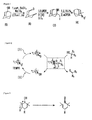
- the first process consisting of steps: converting this bicyclo compound to the corresponding oxime, then reducing the resultant oxime to the corresponding amine and treating the amine with iodine to produce an iodinated compound (7) (1-iodomethyl-2-azaadamantane) and the second process consisting of steps: deiodinating the iodine compound and then oxidizing the resulting compound to produce 1-methyl-AZADO (4) serially.
- the reduction treatment to give the amine mentioned above can be carried out referring to, for example, Ipaktschi, J. et al., Chem. Ber., 117:856 (1984 ).
- the oxidation treatment for the above-mentioned N-oxyl formation can be carried out referring to, for example, Rychnovsky, et al., J. Org. Chem., 61:119 (1996 ). These steps are shown in Fig. 1.
- the key material bicyclo compound is preferably prepared as follows:
- HONH 2 ⁇ HCl is added to a solution of the above-mentioned key material bicyclo compound in pyridine to give the corresponding oxime (first reaction)
- MoO 3 is added to a solution of this oxime in MeOH
- NaBH 4 is then added thereto with ice cooling and the resultant mixture is reacted at the same temperature for reduction to form the corresponding amine (second reaction)
- I 2 is added to a solution of this amine in CH 3 CN under protection against light and the resulting mixture is reacted at room temperature to give an iodinated compound (third reaction).
- LiAlH 4 is added to a solution of the iodinated compound (obtained in the first process) in THF at room temperature and the mixture is reacted with heating for deiodination to give the corresponding amine (first reaction).
- To a solution of this amine in H 2 O-MeO is added Na 2 WO 4 -2H 2 O at room temperature, and the mixture is stirred and then cooled with ice cooling, to which 30% H 2 O 2 is added dropwise, or organic cooxidizer mCPBA or the like is added. After stirring, the temperature is raised to room temperature to allow the reaction to proceed to give 1-methyl-AZADO (second reaction).
- the use of various aluminum hydride reagents in lieu of LiAlH 4 used in the first reaction can also give equivalent results.
- Fig. 4 is a chart illustrating the synthesis scheme of 1-methyl-2-azaadamantan-N-oxyl according to another embodiment of the invention. Described hereinbelow is this embodiment of the invention referring to the drawing.
- hydroxy group incorporation into 1-adamantanol gives 1,3-adamantanediol, which is then subjected to the Grob type cleavage reaction to form a bicyclo compound, preferably serving as the key starting material.
- 1-methyl-2-azaadamantan-N-oxyl is produced by carrying out successively the first process consisting of steps in which this bicyclo compound is converted to the corresponding oxime, the resultant oxime is then reduced to produce the corresponding amine, the resulting amine is further treated with carbobenzyloxy chloride to form the carbamate compound and the carbamate compound is treated with an aqueous 2N hydrochloric acid solution to produce an azaadamantane compound and the second process consisting of steps in which the carbamoyl group of the azaadamantane compound is deprotected and the resulting compound is oxidized to give 1-methyl-2-azaadamantan-N-oxyl.
- the amine-protecting group as used herein is not limited to, but may include a benzyloxycarbonyl group as described in examples, as well as any amino-protecting group, without any particular limitation.
- the conditions for intramolecular ring closure to azaadamantane are not limited to, but include those in the presence of hydrochloric acid, as well as any protic acid or Lewis acid without any particular limitation.
- 1-methyl-2-azaadamantan-N-oxyl can be produced in 7 steps in an overall yield of 46%, for instance, as a result of improvements in process operability.
- the 1-alkyl-2-azaadamantan-N-oxyl which is the organic nitroxyl radical of the invention, can convert primary and secondary alcohols to the corresponding carbonyl compounds with the combined use of an aqueous solution of sodium hypochlorite.
- the oxidation reaction can be carried out for giving the azaadamantan-N-oxyl compound of the formula (1), or a derivative thereof, from the azaadamantane compound of the formula (2), or a derivative thereof, according to the above-described techniques and under the above-described conditions or according to the techniques and under the conditions, disclosed herein.
- the oxidation is done by contacting with an oxidizing agent such as Na 2 WO 4 ⁇ 2H 2 O, H 2 O 2 , NaOCl or an organic cooxidizer and/or such various cooxidizers as those disclosed in Lidia D. L., et al.: J. Org. Chem. 2003, vol. 68, p. 4999 and Miller R.
- an appropriate solvent for example an alcohol solvent such as anhydrous or hydrous methanol, ethanol, propanol or isopropanol.
- This oxidation can also be carried out by blowing an oxygen-containing gas, ozone or an active oxygen species into the reaction mixture.
- the reaction can be carried out for obtaining the azaadamantane compound of the formula (2), or a derivative thereof, via intramolecular ring closing reaction of the bicyclo[3.3.1]nonanyl-3-amine compound of the formula (3), or a derivative thereof, for azaadamantane ring formation according to the above-described techniques and under the above-described conditions or according to the techniques and under the conditions, disclosed herein.
- the reaction can be accomplished via treatment with an iodinating agent such as I 2 or N-iodosuccinimide, subsequent treatment of the thus-formed iodinated compound with a reducing agent, including an alkali metal aluminum hydride such as LiAlH 4 , or by treatment with an amino-protecting group introducing agent, including a carbamating agent such as carbobenzyloxy chloride, followed by treatment with a protic acid such as hydrochloric acid, for instance.
- a reducing agent including an alkali metal aluminum hydride such as LiAlH 4
- an amino-protecting group introducing agent including a carbamating agent such as carbobenzyloxy chloride, followed by treatment with a protic acid such as hydrochloric acid, for instance.
- the compound disclosed herein may encompass free forms thereof, and further salts thereof, hydrates thereof, solvates thereof, or any of derivatives derived from functional groups occurring in the compound molecule.
- some of the compounds may exist in more than one tautomeric form.
- This invention extends to all toautomeric forms.
- the compounds of the present invention may also contain one or plural asymmetric carbon atoms and thus give rise to optical isomers such as (R)-and (S)-isomers, racemates, diastereoisomers and others.
- the present invention includes all such possible isomers, and their racemic and resolved, enantiomerically pure forms, as well as all mixture thereof.
- the compounds disclosed herein can be isolated, in certain cases, as hydrates, solvates with, for example, ethanol and the like, and a variety of crystalline substances.
- the salts of the compounds may preferably include acceptable or usable nontoxic or low toxic inorganic acid and organic acid salts and acceptable or usable nontoxic or low toxic inorganic base and organic base salts. Examples of such salts include salts with halogen atom-derived anions (e.g.
- alkali metal salts such as sodium salts and potassium salts, alkaline earth metal salts such as calcium salts and magnesium salts, aluminum salts, ammonium salts, methylamine salts, ethylamine salts, trimethylamine salts, triethylamine salts, aniline salts, pyridine salts, piperidine salts, picoline salts, ethanolamine salts, diethanolamine salts, triethanolamine salts, dicyclohexylamine salts, N,N'-dibenzylethylenedi
- the reactions described above can be carried out in the presence or absence of a solvent.
- the solvent used can be selected from those conventional solvents which do not adversely affect the reaction.
- Said solvents include aromatic hydrocarbons, aliphatic hydrocarbons, esters, ethers, aliphatic halogenated hydrocarbons, alcohols, amides, organic acids and water, among others.
- the preferred solvent as used herein is ethanol, propanol, isopropanol, n-butanol, ethyl acetate, butyl acetate, formic acid, acetic acid, hexamethylphosphoramide, dimethyl-imidazolidinone, acetonitrile, N,N-dimethylformamide (DMF), dimethylacetamide, N-methylpiperidone, dimethyl sulfoxide (DMSO), pyridine, chloroform, dichloromethane, 1,2-dichloroethane, methylene chloride, dioxane, acetonitrile, toluene, benzene, xylene, hexane, pentane, heptane, tetrahydrofuran (THF), diethyl ether, diisopropyl ether, tert-butyl methyl ether, 1,2-dimethoxyethane, methylene chloride and the like.
- the solvent may be one of these or an appropriate mixture of two or more of them, may be anhydrous or hydrous, and an appropriate one is to be selected for use.
- the reaction temperature is ranging from about -80°C to about 200°C, preferably from room temperature to about 150°C.
- the reaction time can be selected for the desired reaction to be complete; generally, the reaction is carried out for about 1 hour to about 40 hours.
- the amino-protecting group as can be used herein includes, for example, C 1-6 alkylcarbonyl (e.g. acetyl, propionyl, etc.), formyl, phenylcarbonyl, C 1-6 alkyloxycarbonyl (e.g. methoxycarbonyl, ethoxycarbonyl, tert-butoxycarbonyl, etc.), phenyloxycarbonyl (e.g. benzoxycarbonyl etc.), C 7-10 aralkyloxycarbonyl (e.g. benzyloxycarbonyl), trityl and phthaloyl, which may optionally have one or more substituents.
- C 1-6 alkylcarbonyl e.g. acetyl, propionyl, etc.
- formyl e.g. methoxycarbonyl, ethoxycarbonyl, tert-butoxycarbonyl, etc.
- phenyloxycarbonyl e.g.
- the substituent(s) on these may include halogen atoms (e.g. fluorine, chlorine, bromine, iodine, etc.), C 1-6 alkylcarbonyl (e.g. acetyl, propionyl, butyryl, etc.) and nitro, among others, and the number of substituents is about 1 to 3.
- the carboxyl-protecting group as can be used herein includes, for example, C 1-6 alkyl (e.g. methyl, ethyl, propyl, isopropyl, butyl, tert-butyl, etc.), phenyl, trityl and silyl, which may optionally have one or more substituents.
- the substituent(s) on these may include halogen atoms (e.g. fluorine, chlorine, bromine, iodine, etc.), C 1-6 alkylcarbonyl (e.g. acetyl, propionyl, butyryl, etc.), formyl and nitro, among others, and the number of substituents is about 1 to 3.
- halogen atoms e.g. fluorine, chlorine, bromine, iodine, etc.
- C 1-6 alkylcarbonyl e.g. acetyl, propionyl, butyryl, etc.
- formyl and nitro among others
- the methods of introducing and eliminating such protective groups include the methods known per se in the art or modifications thereof (e.g. the methods described in " Protective Groups in Organic Chemistry", J. F. W. McOmie et al., Plenum Press ; " Protective Groups in Organic Synthesis", 3rd Edition (Theodora W. Greene, Peter G.
- the elimination includes methods comprising reduction, treatments with an acid or base, ultraviolet light, hydrazine, phenylhydrazine, sodium N-methyldithiocarbamate, tetrabutylammonium fluoride or palladium acetate, and others.
- the reducing reagent may include, for example, sodium triacetoxyborohydride, sodium cyanoborohydride, sodium borohydride and others.
- the compounds disclosed herein can be appropriately isolated and purified, according to need, by any of the separation/purification means known in the art, for example concentration, vacuum concentration, solvent extraction, crystallization, recrystallization, solvent replacement and/or chromatography.
- the catalyst for synthesizing organic compounds according to the invention comprises at least an azaadamantan-N-oxyl compound of the formula (1) given hereinabove, or a derivative thereof, it is only required to contain a catalytically effective amount of the compound of formula (1), or a derivative thereof.
- the compound of formula (1), or a derivative thereof may be added to a mixture containing at least one or more reactant starting materials.
- the reactant starting material(s) may be added to a solvent containing at least the compound of formula (1), or a derivative thereof.
- the proportion of the compound of formula (1), or a derivative thereof, to the starting material organic compound is not particularly limited to, so long as the desired level of catalytic activity can be obtained, but the compound of formula (1), or a derivative thereof, can be used, for example, in a mole ratio of 1/100,000 to 1/1, preferably 1/10,000 to 2/3, more preferably 1/1,000 to 1/10.
- the catalyst of the invention may be added to the reaction mixture in the form of a mixture of the compound of formula (1), or a derivative thereof, with such an oxidizing agent as an aqueous sodium hypochlorite solution.
- the catalyst is useful typically in the oxidation reaction of organic compounds.
- the catalyst can be used in oxidizing an organic compound having at least a group sensitive to oxidation reaction.
- the organic compound may include, for example, those containing a hydroxyl group and/or a carbonyl group, among others, which can be found out by accessing the Chemical Abstracts database, for instance, and appropriate one(s) can be selected from those hit compounds.
- Typical organic compounds include, for example, alcohols, thiols, aldehydes, ketones, carboxylic acids and derivatives thereof (including acid halides, esters, etc.).
- the alcohol may include, for example, primary alcohols having the formula: A-CH 2 -OH and secondary alcohols having the formula: A-CH(OH)-B. They can be converted with an oxidizing agent, such as an aqueous solution of sodium hypochlorite, in the presence of said inventive catalyst to the corresponding carbonyl compounds.
- an oxidizing agent such as an aqueous solution of sodium hypochlorite, in the presence of said inventive catalyst to the corresponding carbonyl compounds.
- the oxidizing agent used herein includes those which can act in oxidizing the compound of the formula (2) given hereinabove, or a derivative thereof.
- substituents A and B are not particularly limited to, but may be any of those organic groups which do not adversely affect the reaction; including, for example, an alkyl group, which may be unsubstituted or optionally substituted, a cycloalkyl group, which may be unsubstituted or optionally substituted, or an aromatic homocyclic or heterocyclic group, which may be unsubstituted or optionally substituted.
- alkyl group in the "alkyl group, which may be unsubstituted or optionally substituted" as can be used herein for the substituents A and B includes C 1-6 alkyl groups, such as methyl, ethyl, n-propyl, isopropyl, n-butyl, isobutyl, sec-butyl, tert-butyl, n-pentyl, isopentyl, neopentyl, 1-methylpropyl, n-hexyl, isohexyl, 1,1-dimethylbutyl, 2,2-dimethylbutyl, 3,3-dimethylbutyl and 3,3-dimethylpropyl.
- C 1-6 alkyl groups such as methyl, ethyl, n-propyl, isopropyl, n-butyl, isobutyl, sec-butyl, tert-butyl, n-pentyl, isopent
- the substituent(s) on said alkyl group may include lower alkoxy groups (e.g. C 1-6 alkoxy groups such as methoxy, ethoxy, and propoxy), halogen atoms (e.g. fluorine, chlorine, bromine, iodine, etc.), lower alkyl groups (e.g. C 1-6 alkyl groups such as methyl, ethyl, and propyl), lower alkenyl groups (e.g. C 2-6 alkenyl groups such as vinyl, and allyl), lower alkynyl groups (e.g.
- lower alkoxy groups e.g. C 1-6 alkoxy groups such as methoxy, ethoxy, and propoxy
- halogen atoms e.g. fluorine, chlorine, bromine, iodine, etc.
- lower alkyl groups e.g. C 1-6 alkyl groups such as methyl, ethyl, and propyl
- lower alkenyl groups
- C 2-6 alkynyl groups such as ethynyl, and propargyl
- an unsubstituted or optionally substituted amino group an unsubstituted or optionally substituted hydroxyl group, an unsubstituted or optionally substituted sulfonyl group, an unsubstituted or optionally substituted sulfonylamino group, a cyano group, a nitro group, a nitroso group, an unsubstituted or optionally substituted amidino group, a carboxyl group, lower alkoxycarbonyl groups (e.g.
- C 1-6 alkoxycarbonyl groups such as methoxycarbonyl, and ethoxycarbonyl
- an unsubstituted or optionally substituted carbamoyl group e.g. a carbamoyl group, which may be unsubstituted or optionally substituted by a C 1-6 alkyl or acyl group (e.g.
- C 1-6 alkyl or acyl group may be unsubstituted or optionally substituted by a 5- or 6-membered monocyclic aromatic heterocyclyl group (e.g.
- the cycloalkyl group used in the "cycloalkyl group, which may optionally be substituted" for the substituents A and B includes, for example, C 3-7 cycloalkyl groups such as cyclopropyl, cyclobutyl, cyclopentyl, cyclohexyl and cycloheptyl.
- the substituent(s) on the cycloalkyl groups may include the same substituent species as mentioned above referring to the "alkyl group, which may be unsubstituted or optionally substituted", with the same number of said substituent species.
- aromatic homocyclic or heterocyclic group used in the "aromatic homocyclic or heterocyclic group, which may optionally be substituted" for the substituents A and B includes, for example, monocyclic or condensed polycyclic aromatic carbocyclic groups or monocyclic or condensed polycyclic heterocyclic groups.
- the preferable group used herein includes C 6-14 aromatic carbocyclic groups (aryl groups) or 5- to 14-membered aromatic heterocyclic groups (heteroaryl groups).
- the more preferred group includes C 6-10 aromatic carbocyclic groups (aryl groups) or 5- to 10-membered aromatic heterocyclic groups (heteroaryl groups) and still more preferably C 6 aromatic carbocyclic group (aryl group) or 5- or 6-membered aromatic heterocyclic groups (heteroaryl groups).
- aromatic homocyclic group are pentazol; C 6-14 aryl groups such as phenyl, naphthyl, anthryl, azulenyl, phenanthryl and acenaphthylenyl. Among them, phenyl, 1-napthyl, 2-naphthyl and the like are particularly preferred.
- aromatic heterocyclic group includes, for example, aromatic heterocyclic groups each containing at least one hetero atom (preferably 1 to 4, more preferably 1 or 2 hetero atoms), wherein said hetero atom(s) may be one to three (preferably 1 or 2) hetero atom species selected from inter alia oxygen, sulfur and nitrogen atoms, as a ring system-constituting atom(s) (ring atom(s)).
- aromatic heterocyclic group are 5- or 6-membered monocyclic aromatic heterocyclic groups such as, for example, furyl, thienyl, pyrrolyl, oxazolyl, isoxazolyl, thiazolyl, isothiazolyl, imidazolyl, pyrazolyl, 1,2,3-oxadiazolyl, 1,2,4-oxadiazolyl, 1,3,4-oxadiazolyl, furazanyl, 1,2,3-thiadiazolyl, 1,2,4-thiadiazolyl, 1,3,4-thiadiazolyl, 1,2,3-triazolyl, 1,2,4-triazolyl, tetrazolyl, pyridyl, pyridazinyl, pyrimidinyl, pyrazinyl and triazinyl as well as 8- to 12-membered condensed polycyclic aromatic heterocyclic groups such as, for example, benzofuranyl, isobenzo
- the preferable heterocyclic group used herein includes 5- or 6-membered monocyclic aromatic heterocyclic groups.
- the substituent(s) on the "aromatic homocyclic or heterocyclic group, which may optionally be substituted" may be protected, if necessary, in the conventional manner in organic chemical synthesis, without any particular limitation, unless the reaction is adversely affected; further, the protective group may be any one known in the relevant field of art.
- This oxidation reaction can be carried out employing those conditions which are known in the relevant field of art.
- the oxidation can be done via adding an oxidizing agent to a solution containing one or more reactant starting materials in the presence of an effective amount of the inventive catalyst, or adding an effective amount of the inventive catalyst to a solution containing one or more reactant starting materials followed by addition of an oxidizing agent.
- the oxidation reaction is generally carried out in a solvent.
- the solvent can be properly selected for use from among those mentioned hereinabove.
- the oxidation reaction conditions reactant starting material species and amounts thereof, catalyst amounts, oxidizing agent species and amounts thereof, solvent species and amounts thereof, reaction time, reaction temperature and stirring, can be suitably selected according to specific targets. If necessary, optimum or more preferred conditions may be selected by carrying out experiments.
- a starting material used herein was 1-adamantanol.
- 1-adamantanol 50.4 mmol
- CH 3 CN-CCl 4 -H 2 O (3:3:1 v/v) was added NaIO 4 (116 mmol) and RuC1 3 (0.5 mmol) stepwise, and the mixture was reacted with stirring at 60°C for 7 hours.
- the resultant reaction mixture was extracted and dried to give a crude diol product.
- This compound was subjected to mass spectrometry coupled with electron ionization under the following conditions: ion accelerating voltage, 3 kV; an ionization potential, 70 eV; and ionizing current, 300 ⁇ A, upon which it gave a molecular ion peak at m/z 166 and a base peak (100%) at m/z 93. In addition, it gave characteristic fragment ion peaks at m/z 79, 107, 134 and 149.
- the activities thereof as an oxidation catalyst were first checked with the primary alcohols shown in Table 1.
- the catalyst was used in each amount specified in Table 1 in CH 2 Cl 2 , and KBr (0.1 eq.), n-Bu 4 NBr (0.05 eq.) and NaCl (1.4 eq.) were further added, and the reaction was carried out under ice cooling. The reaction time was 20 minutes. After completion of the reaction, the percent yield of each product was determined. The percent yield was calculated by the formula: (actual yield, i.e., the amount of product)/(theoretical yield, i.e., calculated from the amount of consumed starting material) x 100 (%).
- 1-methyl-AZADO of the invention as a primary alcohol oxidation catalyst, showed a function equivalent to that of the conventional TEMPO and, in addition, gave a higher yield in a reduced catalyst amount (0.0001 eq.) compared to the conventional TEMPO, with a higher catalyst turnover number (TON), it is evident that 1-methyl-AZADO of the invention has good performance characteristics as an excellent oxidation catalyst in oxidizing the primary hydroxyl group (primary alcohols).
- the activities thereof as an oxidation catalyst were estimated in the same manner using various secondary alcohols specified in Tables 2 and 3.
- the catalyst amount was 0.01 eq. in CH 2 Cl 2 , and KBr (0.1 eq.), n-Bu 4 NBr (0.05 eq.) and NaOCl (1.4 eq.) were further added, and the reaction was carried out under ice cooling. The reaction time was 20 minutes. After completion of the reaction, the percent yield of each product was determined. The percent yield was calculated by the formula: (actual yield, i.e., the amount of product)/(theoretical yield, i.e., calculated from the amount of consumed starting material) x 100 (%).
- 1-methyl-AZADO is a catalyst useful as an oxidation catalyst not only for primary alcohols but also secondary alcohols.
- the inventive compounds have an oxoammonium group on the adamantane skeleton, the ⁇ -position hydrogen will be stabilized according to the Bredt's rule, the stability of the nitroxyl group will be ensured, the steric hindrance will be reduced as compared with the conventional oxidation catalyst TEMPO, and a wide reaction field will be secured. Therefore, they can highly efficiently oxidize not only primary alcohols but also those secondary alcohols having a sterically complicated structure which can hardly be oxidized with TEMPO.
- the 1-alkyl-2-azaadamantan-N-oxyl species of the invention can be applied in synthesizing functional organic compounds, typically medicinal chemicals, perfumes and liquid crystals.
Landscapes
- Chemical & Material Sciences (AREA)
- Organic Chemistry (AREA)
- Engineering & Computer Science (AREA)
- Materials Engineering (AREA)
- Chemical Kinetics & Catalysis (AREA)
- Organic Low-Molecular-Weight Compounds And Preparation Thereof (AREA)
- Catalysts (AREA)
- Nitrogen Condensed Heterocyclic Rings (AREA)
Abstract
Description
- The present invention relates to an organic oxidation catalyst for the oxidation of alcohols, in particular such an organic catalyst that is very ecofriendly, and to a method of synthesizing the same. More particularly, the invention relates to the technology of nitroxyl radical-based selective oxidation of alcohols to aldehydes, ketones and carboxylic acids.
- Aldehydes, ketones, carboxylic acids, and derivatives thereof (carbonyl compounds) constitute one of the most important constructing block families in synthetic organic chemistry. A comprehensive compilation of methods for preparing them has made primary alcohols and secondary alcohols ideal starting materials for producing aldehydes, ketones and carboxylic acids. The oxidation of alcohols to carbonyl compounds is one of the most fundamental reactions in organic synthesis, and a number of excellent oxidizing agents and oxidation methods have so far been developed. In the art, the oxidation reactions of alcohols are carried out with oxidizing agents based on heavy metals such as transition metals. The conventional oxidizing agents include heavy metal reagents, such as chromium(VI) compounds and ruthenium, manganese and vanadium compounds, peroxides, activated dimethyl sulfoxide (DMSO), and hypervalent iodine compounds.
- Since, however, it is a matter of concern that heavy metals such as transition metals may exert harmful influences on the environment and, further, since the oxidation reactions of alcohols are of importance, it has been desired that the efficiency of oxidation reactions of alcohols be further increased and the environment-friendliness thereof be improved. A disadvantageous feature of many oxidation reactions is that they are relatively hard to perform or the reagents are difficult to prepare or handle. In particular, heavy metal-containing reagents are in most cases highly toxic and very harmful to the environment. This is critically important when they are intended for industrial use.
- In recent years, 2,2,6,6-tetramethylpiperidin-N-oxyl (hereinafter referred to also as "TEMPO") has become widely utilized as an oxidation catalyst for alcohols in lieu of the conventional heavy metal-based oxidizing agents with the experiment described in Non-Patent
Document 1 as a turning point. The reaction mechanisms concerned are shown in Fig. 2. TEMPO is said to be an organic oxidizing agent of the low environmental load type as compared with heavy metals. In the initial stage of development, however, it was used together with such an organic cooxidizer as mCPBA. Thereafter, NaOC1, which is inexpensive, simple and easy to handle and, further, of the low environmental load type, was found to be an excellent cooxidizer, and TEMPO has since been used in combination with such cooxidizers. When, however, TEMPO is used as an oxidizing agent, those compounds which have an olefinic bond within the molecule undergo decomposition; therefore, attempts have been made to use various cooxidizers other than NaOC1 in combination with TEMPO, as shown inNon-Patent Document 2 and Non-PatentDocument 3, for instance.
[Patent Document 1]Japanese Kokai (Laid-Open) Publication No. 2000-95862 JP, A, 2000-95862
[Patent Document 2]Japanese Patent Application No. H06-69190
[Non-Patent Document 1] Golubev V. A. et al.: Izv. Akad. Nauk SSSR, Ser. Khim. 1965, p. 1927
[Non-Patent Document 2] Lidia D. L., et al.: J. Org. Chem. 2003, vol. 68, p. 4999
[Non-Patent Document 3] Miller R. A., et al.: Org. Lett. 2003, vol. 53, p. 285 - However, TEMPO widely utilized as an alcohol oxidation catalyst still has some problems. Although it is an excellent primary-selective oxidation catalyst for substrates in which a primary hydroxyl group and a secondary hydroxyl group coexist, TEMPO is not effective in oxidizing secondary alcohols having a sterically more complicated structure, hence is limited in catalyst performance. For example, TEMPO has a weak point in that the reaction yield markedly decreases in the case of secondary alcohols having a bulky steric structure. Further, a stability problem caused by the chemical structure of TEMPO is that it readily undergoes such decomposition as shown in Fig. 3 due to the chemical structure thereof.
- It is an object of the present invention to solve the above-discussed prior art problems and propose an organic oxidation catalyst for alcohols which is rich in stability from the chemical structure viewpoint and excellent in environment-friendliness and enables efficient oxidation as well as a method of synthesizing the same.
- The present inventors have made extensive investigations in order to accomplish the above object. As a result, the inventors have paid attention to the oxoammonium ion species known as active species in oxidation. The inventors have then succeeded in realizing that an oxoammonium group should be incorporated into the adamantane skeleton. The inventors have also succeeded in realizing the following: it can be expected that by doing so, the hydrogen in the α-position be stabilized according to the Bredt's rule, the stability of the oxoammonium group be ensured, the steric hindrance in the vicinity of the active center be reduced as compared with TEMPO, a wide reaction field can be secured, the catalytic oxidation of alcohols having a sterically complicated structure can be carried out efficiently and, at the same time, a high level of stability from the chemical structure viewpoint can be provided owing to the adamantane skeleton.
- The present inventors have succeeded in synthesizing 1-alkyl-2-azaadamantan-N-oxyl species having a nitroxyl group (N-oxyl group) incorporated in the adamantane skeleton, in particular 1-methyl-2-azaadamantan-N-oxyl (hereinafter referred to also as "1-methyl-AZADO"), starting with 1-adamantanol. This compound has been found to serve as an organic catalyst low in environmental impacts, showing a higher catalytic turnover number for primary alcohols as compared with TEMPO, and further capable of also highly efficiently oxidizing secondary alcohols having a sterically complicated structure, which can hardly be oxidized with TEMPO. Furthermore, the inventors have succeeded in developing a technology of improving the operability and efficiency of synthetic methods and thereby improving overall yields.
- The present invention has been completed based on the above-mentioned findings and as a result of further investigations. Thus, the gist of the invention consists in the following:
- (1) An azaadamantan-N-oxyl compound of the formula (1) :

- (2) A method of producing an azaadamantan-N-oxyl compound of the formula (1) given above, or a derivative thereof, which comprises at least the step of oxidizing an azaadamantane compound of the formula (2):

- (3) A method of producing an azaadamantan-N-oxyl compound of the formula (1) given above, or a derivative thereof, which comprises at least the steps of
subjecting a bicyclo[3.3.1]nonanyl-3-amine compound of the formula (3):
oxidizing the thus-obtained azaadamantane compound (2) or a derivative thereof. - (4) A method of producing an azaadamantan-N-oxyl compound of the formula (1) given above, or a derivative thereof, which comprises at least a process selected from the group consisting of the first process consisting of steps: converting a bicyclo compound obtained by the Grob type ring opening reaction of 1,3-adamanatnediol to a corresponding oxime, reducing the resultant oxime to a corresponding amine, and treating the amine with iodine to form a corresponding iodinated compound and the second process consisting of steps: deiodination of the iodinated compound, hydrogenation or alkylation and then oxidation of the resulting compound.
- (5) A method of producing an azaadamantan-N-oxyl compound of the formula (1) given above, or a derivative thereof, which comprises at least a process selected from the group consisting of the first process consisting of steps: converting a bicyclo compound obtained by the Grob type ring opening reaction of 1,3-adamanatnediol to a corresponding oxime, reducing the resultant oxime to a corresponding amine, and further treating the amine with a carbamating (carbamate forming) agent to form a corresponding carbamate compound and the second process consisting of steps: treating the carbamate compound under acidic conditions to form an azaadamantane skeleton, deprotecting the azaadamantane compound and oxidizing the resulting compound.
- (6) A catalyst for synthesizing organic compounds, which comprises an azaadamantan-N-oxyl compound of the formula (1) given above, or a derivative thereof.
- (7) A catalyst as set forth above under (6), wherein the catalyst is for oxidizing organic compounds.
- (8) A catalyst as set forth above under (6) or (7), wherein the organic compound is selected from alcohols.
- (9) A method of oxidizing alcohols, which comprises the step of oxidizing an alcohol in the presence of an azaadamantan-N-oxyl compound of the formula (1) given above, or a derivative thereof, to form a corresponding oxo compound.
- (10) An excellent, environment-conscious (environment friendly) alcohol oxidation catalyst that is an organic oxidation catalyst for oxidizing an alcohol, which comprises an effective amount of 1-methyl-2-azaadamantan-N-oxyl of the formula (4):

- (11) A method of producing an excellent, environment-conscious (environment friendly) organic oxidation catalyst, said method being synthesis of said organic oxidation catalyst for oxidizing an alcohol, which comprises carrying out the first process consisting of steps: converting a bicyclo compound (7-methylenebicyclo[3.3.1]nonan-3-one) as a key starting material, obtainable via the Grob type ring opening reaction of 1,3-adamantanediol, to a corresponding oxime, then reducing the resultant oxime to a corresponding amine and further treating the amine with iodine to form a corresponding iodinated compound (1-iodomethyl-2-azaadamantane) and the second process consisting of steps: deiodinating the iodinated compound and then oxidizing the resulting compound to give 1-methyl-2-azaadamantan-N-oxyl serially.
- (12) An azaadamantane compound of the formula (2):

- The present invention also provides techniques for producing, in a simple and easy manner and in high yields, an 1-alkyl-2-azaadamantan-2-oxyl compound, resulting from incorporation of a nitroxyl group into the adamantane skeleton, and serving as an organic oxidation catalyst for oxidizing alcohols. This invention provides mathods for producing a compound of the formula (1) given above, which comprises carrying out successively the first process consisting of steps: converting a key starting material, a bicyclo compound, as obtained via the Grob type ring opening reaction of 1,3-adamantanediol, to a corresponding oxime, then reducing the resultant oxime to a corresponding amine, treating the amine with carbobenzyloxy chloride to give a corresponding carbamate and treating the carbamate with 2N aqueous hydrochloric acid to form an azaadamantane compound and the second process consisting of steps: eliminating the carbamoyl group (deprotection) of the azaadamantane compound and oxidizing the resulting compound to give 1-methyl-2-azaadamantan-N-oxyl. The invention provides mathods for oxidizing organic compounds which comprises using an organic compound of the above formula (1) as an organic oxidation catalyst, and methods for oxidizing organic compounds which comprises using, as an oxidizing agent, an oxoammonium salt, prepared from a compound of the above formula (1) and chlorine.
- In accordance with the invention, not only alcohols having a relatively simple structure but also alcohols having a complicated steric configuration can be oxidized highly efficiently with a slight load (impact) on the environment, and the invention thus produces marked industrial effects. Further, according to the invention, such an effect is produced that, in the oxidation of alcohols relatively simple in structure, the products are obtained in high yields at lower catalyst usage levels as compared with the conventional catalysts. Further, according to the invention, such an effect is produced that the alcohol oxidation reaction, which is an essential chemical reaction in the manufacture of medicinal compounds, perfumes, liquid crystals and other organic functional substances, can be carried out highly efficiently while maintaining a high level of environment-friendliness.
- The above objects and other objects, characteristic features, advantages and aspects of the present invention will become readily apparent to those skilled in the art from the following disclosures. It should be understood, however, that the disclosures given herein, including the following best modes of carrying out the invention, examples and others are illustrating preferred embodiments of the invention and given only for the purpose of illustration. It will be obvious to those skilled in the art that a great number of variations, and/or alterations (modifications) of this invention may be made without departing from the spirit and scope thereof as disclosed herein based on knowledge obtainable from the disclosure in the following parts and other parts of the present specification. All the patent documents and other references cited herein for illustrative purposes are hereby incorporated by reference into the present disclosure.
-
- Fig. 1 is a scheme illustrating a preferred embodiment of the process for synthesizing 1-methyl-AZADO according to the invention.
- Fig. 2 is a scheme illustrating the reaction mechanisms in which TEMPO, a conventional alcohol oxidation catalyst, is involved.
- Fig. 3 is a scheme illustrating the decomposition of TEMPO.
- Fig. 4 is a scheme illustrating a process for synthesizing a 1-alkyl-2-azaadamantan-N-oxyl according to the invention in a simple and easy manner and in high yields.
- The invention provides an azaadamantan-N-oxyl compound of the formula (1) given hereinabove, or a derivative thereof, which serves as a catalyst for synthesizing organic compounds, in particular as an organic catalyst and oxidation catalyst, intermediates for the synthesis thereof (e.g. an azaadamantane compound of the formula (2) given hereinabove, or a derivative thereof, a bicyclo[3.3.1]-nonanyl-3-amine compound of the formula (3) given hereinabove, or a derivative thereof, and an iodinated compound or carbamate compound derived therefrom) as well as techniques for synthesizing and utilizing the same.
- For the substituents R and Ra herein, the "alkyl group" is not particularly limited to, but may be any of those which are known in the relevant field of art as long as they can achieve the intended object; including, for example, lower alkyl groups. The "lower alkyl group" includes an alkyl group containing 1-5 carbon atoms, such as methyl, ethyl, propyl, isopropyl, n-butyl, isobutyl, sec-butyl, tert-butyl, and pentyl. In particular, the preferred lower alkyl group is methyl.
- For the substituent Ra, the "alkylidene group" is not particularly limited to, but may be any of those which are known in the relevant field of art as long as they can achieve the intended object; including, for example, lower alkylidene groups. The "lower alkylidene group" includes an alkylidene group containing 1-5 carbon atoms, such as methylidene, ethylidene, propylidene, isopropylidene (1-methylethylidene), butylidene, and sec-butylidene. In particular, the preferred lower alkylidene group is methylidene.
- In the following, 1-alkyl-2-azaadamantan-N-oxyl compounds, which are representatives of the azaadamantan-N-oxyl compounds of the formula (1) given hereinabove or derivatives thereof, are described more specifically, taking 1-methyl-2-azaadamantan-N-oxyl (1-methyl-AZADO) as an example. It is obvious to those skilled in the art that the description can be adopted in the same manner to other compounds or derivatives.
- The organic oxidation catalyst 1-methyl-AZADO according to the invention is an azaadamantan-N-oxyl type compound resulting from incorporation of a nitroxyl group into the adamantane skeleton, and the oxoammonium ion formed by oxidation of the nitroxyl group is a chemical species capable of rapidly oxidizing an alcohol to the corresponding aldehyde or ketone under mild conditions. The organic oxidation catalyst 1-methyl-AZADO according to the invention can form this oxoammonium ion stably on the adamantane skeleton.
- 1-Methyl-AZADO has a chemical structure represented by the following formula (4):

- Now, a preferred synthesis of 1-methyl-AZADO is described as follows.
- In the present invention, 1,3-adamantanediol is prepared by hydroxyl group introduction into 1-adamantanol (5), and this resulting 1,3-adamantanediol is subjected to the Grob type ring opening reaction to form a bicyclo compound (6) (7-methylenebicyclo[3.3.1]-nonan-3-one), which is preferably used as a key starting material. Typically, the procedure can be done according to the disclosure in Muraoka, O. et al., Syn. Commun., 26:1555 (1996). In the present invention, it is preferable to perform the first process consisting of steps: converting this bicyclo compound to the corresponding oxime, then reducing the resultant oxime to the corresponding amine and treating the amine with iodine to produce an iodinated compound (7) (1-iodomethyl-2-azaadamantane) and the second process consisting of steps: deiodinating the iodine compound and then oxidizing the resulting compound to produce 1-methyl-AZADO (4) serially. The reduction treatment to give the amine mentioned above can be carried out referring to, for example, Ipaktschi, J. et al., Chem. Ber., 117:856 (1984). The oxidation treatment for the above-mentioned N-oxyl formation can be carried out referring to, for example, Rychnovsky, et al., J. Org. Chem., 61:119 (1996). These steps are shown in Fig. 1.
- The key material bicyclo compound is preferably prepared as follows:
- To a solution of 1-adamantanol in CH3CN-CCl4-H2C is added NaIO4 and RuCl3 successively and the mixture is reacted at 60°C for incorporation of a hydroxyl group into 1-adamantanol to give a diol (first reaction) and TsCl is then added to a solution of this diol in benzene-pyridine and the resultant mixture is reacted at 70°C (second reaction).
- In the first process according to the invention, HONH2·HCl is added to a solution of the above-mentioned key material bicyclo compound in pyridine to give the corresponding oxime (first reaction), MoO3 is added to a solution of this oxime in MeOH, NaBH4 is then added thereto with ice cooling and the resultant mixture is reacted at the same temperature for reduction to form the corresponding amine (second reaction), and I2 is added to a solution of this amine in CH3CN under protection against light and the resulting mixture is reacted at room temperature to give an iodinated compound (third reaction). In the first reaction, the use of HONH2 or such a reagent as HONH2-H2SO4, HONH2-CH3COOH or HONH2-H3PO4 in lieu of HONH2·HCl gives almost the same results. In the third reaction, N-iodosuccinimide may be used in lieu of I2.
- In the second process, LiAlH4 is added to a solution of the iodinated compound (obtained in the first process) in THF at room temperature and the mixture is reacted with heating for deiodination to give the corresponding amine (first reaction). To a solution of this amine in H2O-MeO is added Na2WO4-2H2O at room temperature, and the mixture is stirred and then cooled with ice cooling, to which 30% H2O2 is added dropwise, or organic cooxidizer mCPBA or the like is added. After stirring, the temperature is raised to room temperature to allow the reaction to proceed to give 1-methyl-AZADO (second reaction). The use of various aluminum hydride reagents in lieu of LiAlH4 used in the first reaction can also give equivalent results.
- These processes are performed serially to afford 1-methyl-AZADO capable of serving as an organic oxidation catalyst excellent in environment-friendliness.
- Fig. 4 is a chart illustrating the synthesis scheme of 1-methyl-2-azaadamantan-N-oxyl according to another embodiment of the invention. Described hereinbelow is this embodiment of the invention referring to the drawing.
- In accordance with the invention, it is preferable that hydroxy group incorporation into 1-adamantanol gives 1,3-adamantanediol, which is then subjected to the Grob type cleavage reaction to form a bicyclo compound, preferably serving as the key starting material. In accordance with the invention, 1-methyl-2-azaadamantan-N-oxyl is produced by carrying out successively the first process consisting of steps in which this bicyclo compound is converted to the corresponding oxime, the resultant oxime is then reduced to produce the corresponding amine, the resulting amine is further treated with carbobenzyloxy chloride to form the carbamate compound and the carbamate compound is treated with an aqueous 2N hydrochloric acid solution to produce an azaadamantane compound and the second process consisting of steps in which the carbamoyl group of the azaadamantane compound is deprotected and the resulting compound is oxidized to give 1-methyl-2-azaadamantan-N-oxyl. It is evident that the above description can be construed as teaching the production of any other azaadamantan-N-oxyl compound of the formula (1) given hereinabove, or a derivative thereof, in lieu of 1-methyl-2-azaadamantan-N-oxyl (1-methyl AZADO).
- The amine-protecting group as used herein is not limited to, but may include a benzyloxycarbonyl group as described in examples, as well as any amino-protecting group, without any particular limitation. The conditions for intramolecular ring closure to azaadamantane are not limited to, but include those in the presence of hydrochloric acid, as well as any protic acid or Lewis acid without any particular limitation.
- In the synthetic process according to this embodiment, 1-methyl-2-azaadamantan-N-oxyl can be produced in 7 steps in an overall yield of 46%, for instance, as a result of improvements in process operability.
- When used in a catalytic amount, the 1-alkyl-2-azaadamantan-N-oxyl, which is the organic nitroxyl radical of the invention, can convert primary and secondary alcohols to the corresponding carbonyl compounds with the combined use of an aqueous solution of sodium hypochlorite.
- The oxidation reaction can be carried out for giving the azaadamantan-N-oxyl compound of the formula (1), or a derivative thereof, from the azaadamantane compound of the formula (2), or a derivative thereof, according to the above-described techniques and under the above-described conditions or according to the techniques and under the conditions, disclosed herein. For example, the oxidation is done by contacting with an oxidizing agent such as Na2WO4·2H2O, H2O2, NaOCl or an organic cooxidizer and/or such various cooxidizers as those disclosed in Lidia D. L., et al.: J. Org. Chem. 2003, vol. 68, p. 4999 and Miller R. A., et al.: Org. Lett. 2003, vol. 53, p. 285, among others, in an appropriate solvent, for example an alcohol solvent such as anhydrous or hydrous methanol, ethanol, propanol or isopropanol. This oxidation can also be carried out by blowing an oxygen-containing gas, ozone or an active oxygen species into the reaction mixture.
- The reaction can be carried out for obtaining the azaadamantane compound of the formula (2), or a derivative thereof, via intramolecular ring closing reaction of the bicyclo[3.3.1]nonanyl-3-amine compound of the formula (3), or a derivative thereof, for azaadamantane ring formation according to the above-described techniques and under the above-described conditions or according to the techniques and under the conditions, disclosed herein. For example, the reaction can be accomplished via treatment with an iodinating agent such as I2 or N-iodosuccinimide, subsequent treatment of the thus-formed iodinated compound with a reducing agent, including an alkali metal aluminum hydride such as LiAlH4, or by treatment with an amino-protecting group introducing agent, including a carbamating agent such as carbobenzyloxy chloride, followed by treatment with a protic acid such as hydrochloric acid, for instance.
- The compound disclosed herein may encompass free forms thereof, and further salts thereof, hydrates thereof, solvates thereof, or any of derivatives derived from functional groups occurring in the compound molecule.
Among such compounds, some of the compounds may exist in more than one tautomeric form. This invention extends to all toautomeric forms. The compounds of the present invention may also contain one or plural asymmetric carbon atoms and thus give rise to optical isomers such as (R)-and (S)-isomers, racemates, diastereoisomers and others. The present invention includes all such possible isomers, and their racemic and resolved, enantiomerically pure forms, as well as all mixture thereof. The compounds disclosed herein can be isolated, in certain cases, as hydrates, solvates with, for example, ethanol and the like, and a variety of crystalline substances. The salts of the compounds may preferably include acceptable or usable nontoxic or low toxic inorganic acid and organic acid salts and acceptable or usable nontoxic or low toxic inorganic base and organic base salts. Examples of such salts include salts with halogen atom-derived anions (e.g. Cl-, Br-, I-, etc.), hydrochlorides, hydrobromides, sulfates, formates, acetates, propionates, fumarates, oxalates, maleates, citrates, succinates, tartrates, trifluoroacetates, methanesulfonates, benzenesulfonates, p-toluenesulfonates, etc.; alkali metal salts such as sodium salts and potassium salts, alkaline earth metal salts such as calcium salts and magnesium salts, aluminum salts, ammonium salts, methylamine salts, ethylamine salts, trimethylamine salts, triethylamine salts, aniline salts, pyridine salts, piperidine salts, picoline salts, ethanolamine salts, diethanolamine salts, triethanolamine salts, dicyclohexylamine salts, N,N'-dibenzylethylenediamine salts, etc. - The reactions described above can be carried out in the presence or absence of a solvent. When some reaction is carried out in the presence of a solvent, the solvent used can be selected from those conventional solvents which do not adversely affect the reaction. Said solvents include aromatic hydrocarbons, aliphatic hydrocarbons, esters, ethers, aliphatic halogenated hydrocarbons, alcohols, amides, organic acids and water, among others. The preferred solvent as used herein is ethanol, propanol, isopropanol, n-butanol, ethyl acetate, butyl acetate, formic acid, acetic acid, hexamethylphosphoramide, dimethyl-imidazolidinone, acetonitrile, N,N-dimethylformamide (DMF), dimethylacetamide, N-methylpiperidone, dimethyl sulfoxide (DMSO), pyridine, chloroform, dichloromethane, 1,2-dichloroethane, methylene chloride, dioxane, acetonitrile, toluene, benzene, xylene, hexane, pentane, heptane, tetrahydrofuran (THF), diethyl ether, diisopropyl ether, tert-butyl methyl ether, 1,2-dimethoxyethane, methylene chloride and the like. The solvent may be one of these or an appropriate mixture of two or more of them, may be anhydrous or hydrous, and an appropriate one is to be selected for use. The reaction temperature is ranging from about -80°C to about 200°C, preferably from room temperature to about 150°C. The reaction time can be selected for the desired reaction to be complete; generally, the reaction is carried out for about 1 hour to about 40 hours.
- The amino-protecting group as can be used herein includes, for example, C1-6 alkylcarbonyl (e.g. acetyl, propionyl, etc.), formyl, phenylcarbonyl, C1-6 alkyloxycarbonyl (e.g. methoxycarbonyl, ethoxycarbonyl, tert-butoxycarbonyl, etc.), phenyloxycarbonyl (e.g. benzoxycarbonyl etc.), C7-10 aralkyloxycarbonyl (e.g. benzyloxycarbonyl), trityl and phthaloyl, which may optionally have one or more substituents. The substituent(s) on these may include halogen atoms (e.g. fluorine, chlorine, bromine, iodine, etc.), C1-6 alkylcarbonyl (e.g. acetyl, propionyl, butyryl, etc.) and nitro, among others, and the number of substituents is about 1 to 3. The carboxyl-protecting group as can be used herein includes, for example, C1-6 alkyl (e.g. methyl, ethyl, propyl, isopropyl, butyl, tert-butyl, etc.), phenyl, trityl and silyl, which may optionally have one or more substituents. The substituent(s) on these may include halogen atoms (e.g. fluorine, chlorine, bromine, iodine, etc.), C1-6 alkylcarbonyl (e.g. acetyl, propionyl, butyryl, etc.), formyl and nitro, among others, and the number of substituents is about 1 to 3. The methods of introducing and eliminating such protective groups include the methods known per se in the art or modifications thereof (e.g. the methods described in "Protective Groups in Organic Chemistry", J. F. W. McOmie et al., Plenum Press; "Protective Groups in Organic Synthesis", 3rd Edition (Theodora W. Greene, Peter G. M. Wuts, John Wiley & Sons, Inc., ISBN:0-471-16019-9, April 1999)) . The elimination includes methods comprising reduction, treatments with an acid or base, ultraviolet light, hydrazine, phenylhydrazine, sodium N-methyldithiocarbamate, tetrabutylammonium fluoride or palladium acetate, and others.
- The reducing reagent may include, for example, sodium triacetoxyborohydride, sodium cyanoborohydride, sodium borohydride and others.
- The compounds disclosed herein can be appropriately isolated and purified, according to need, by any of the separation/purification means known in the art, for example concentration, vacuum concentration, solvent extraction, crystallization, recrystallization, solvent replacement and/or chromatography.
- The catalyst for synthesizing organic compounds according to the invention comprises at least an azaadamantan-N-oxyl compound of the formula (1) given hereinabove, or a derivative thereof, it is only required to contain a catalytically effective amount of the compound of formula (1), or a derivative thereof. In using it as a catalyst, the compound of formula (1), or a derivative thereof, may be added to a mixture containing at least one or more reactant starting materials. Alternatively, the reactant starting material(s) may be added to a solvent containing at least the compound of formula (1), or a derivative thereof. The proportion of the compound of formula (1), or a derivative thereof, to the starting material organic compound is not particularly limited to, so long as the desired level of catalytic activity can be obtained, but the compound of formula (1), or a derivative thereof, can be used, for example, in a mole ratio of 1/100,000 to 1/1, preferably 1/10,000 to 2/3, more preferably 1/1,000 to 1/10. The catalyst of the invention may be added to the reaction mixture in the form of a mixture of the compound of formula (1), or a derivative thereof, with such an oxidizing agent as an aqueous sodium hypochlorite solution. The catalyst is useful typically in the oxidation reaction of organic compounds. For example, the catalyst can be used in oxidizing an organic compound having at least a group sensitive to oxidation reaction. The group sensitive to oxidation reaction may include groups -OH, =O, etc. The organic compound may include, for example, those containing a hydroxyl group and/or a carbonyl group, among others, which can be found out by accessing the Chemical Abstracts database, for instance, and appropriate one(s) can be selected from those hit compounds. Typical organic compounds include, for example, alcohols, thiols, aldehydes, ketones, carboxylic acids and derivatives thereof (including acid halides, esters, etc.).
- The alcohol may include, for example, primary alcohols having the formula: A-CH2-OH and secondary alcohols having the formula: A-CH(OH)-B. They can be converted with an oxidizing agent, such as an aqueous solution of sodium hypochlorite, in the presence of said inventive catalyst to the corresponding carbonyl compounds. The oxidizing agent used herein includes those which can act in oxidizing the compound of the formula (2) given hereinabove, or a derivative thereof.
- The above substituents A and B are not particularly limited to, but may be any of those organic groups which do not adversely affect the reaction; including, for example, an alkyl group, which may be unsubstituted or optionally substituted, a cycloalkyl group, which may be unsubstituted or optionally substituted, or an aromatic homocyclic or heterocyclic group, which may be unsubstituted or optionally substituted. The alkyl group in the "alkyl group, which may be unsubstituted or optionally substituted" as can be used herein for the substituents A and B includes C1-6 alkyl groups, such as methyl, ethyl, n-propyl, isopropyl, n-butyl, isobutyl, sec-butyl, tert-butyl, n-pentyl, isopentyl, neopentyl, 1-methylpropyl, n-hexyl, isohexyl, 1,1-dimethylbutyl, 2,2-dimethylbutyl, 3,3-dimethylbutyl and 3,3-dimethylpropyl. Here, the substituent(s) on said alkyl group may include lower alkoxy groups (e.g. C1-6 alkoxy groups such as methoxy, ethoxy, and propoxy), halogen atoms (e.g. fluorine, chlorine, bromine, iodine, etc.), lower alkyl groups (e.g. C1-6 alkyl groups such as methyl, ethyl, and propyl), lower alkenyl groups (e.g. C2-6 alkenyl groups such as vinyl, and allyl), lower alkynyl groups (e.g. C2-6 alkynyl groups such as ethynyl, and propargyl), an unsubstituted or optionally substituted amino group, an unsubstituted or optionally substituted hydroxyl group, an unsubstituted or optionally substituted sulfonyl group, an unsubstituted or optionally substituted sulfonylamino group, a cyano group, a nitro group, a nitroso group, an unsubstituted or optionally substituted amidino group, a carboxyl group, lower alkoxycarbonyl groups (e.g. C1-6 alkoxycarbonyl groups such as methoxycarbonyl, and ethoxycarbonyl), an unsubstituted or optionally substituted carbamoyl group (e.g. a carbamoyl group, which may be unsubstituted or optionally substituted by a C1-6 alkyl or acyl group (e.g. formyl, C2-6 alkanoyl, benzoyl, nonhaloganated or optionally halogenated C1-6 alkoxycarbonyl, nonhaloganated or optionally halogenated C1-6 alkylsulfonyl, benzenesulfonyl, etc.) wherein said C1-6 alkyl or acyl group may be unsubstituted or optionally substituted by a 5- or 6-membered monocyclic aromatic heterocyclyl group (e.g. pyridinyl etc.), 1-aztidinylcarbonyl, 1-pyrrolidinylcarbonyl, piperidinocarbonyl, morpholinocarbonyl, 1-piperazinylcarbonyl, etc.), alkyl groups substituted by such an "optionally substituted cycloalkyl group" or "optionally substituted aromatic homocyclic or heterocyclic group" as will be mentioned hereinbelow, alkenyl groups substituted by such an "optionally substituted cycloalkyl group" or "optionally substituted aromatic homocyclic or heterocyclic group" as will be mentioned hereinbelow, alkoxy groups substituted by such an "optionally substituted cycloalkyl group" or "optionally substituted aromatic homocyclic or heterocyclic group" as will be mentioned hereinbelow, a hydroxyl group substituted by such an "optionally substituted cycloalkyl group" or "optionally substituted aromatic homocyclic or heterocyclic group" as will be mentioned hereinbelow, an amino group substituted by such an "optionally substituted cycloalkyl group" or "optionally substituted aromatic homocyclic or heterocyclic group" as will be mentioned hereinbelow, acyl groups substituted by such an "optionally substituted cycloalkyl group" or "optionally substituted aromatic homocyclic or heterocyclic group" as will be mentioned hereinbelow, and so forth, and one to three such optional substituents may be found at a site or sites allowing substitution.
- The cycloalkyl group used in the "cycloalkyl group, which may optionally be substituted" for the substituents A and B includes, for example, C3-7 cycloalkyl groups such as cyclopropyl, cyclobutyl, cyclopentyl, cyclohexyl and cycloheptyl. The substituent(s) on the cycloalkyl groups may include the same substituent species as mentioned above referring to the "alkyl group, which may be unsubstituted or optionally substituted", with the same number of said substituent species.
- The aromatic homocyclic or heterocyclic group used in the "aromatic homocyclic or heterocyclic group, which may optionally be substituted" for the substituents A and B includes, for example, monocyclic or condensed polycyclic aromatic carbocyclic groups or monocyclic or condensed polycyclic heterocyclic groups. The preferable group used herein includes C6-14 aromatic carbocyclic groups (aryl groups) or 5- to 14-membered aromatic heterocyclic groups (heteroaryl groups). The more preferred group includes C6-10 aromatic carbocyclic groups (aryl groups) or 5- to 10-membered aromatic heterocyclic groups (heteroaryl groups) and still more preferably C6 aromatic carbocyclic group (aryl group) or 5- or 6-membered aromatic heterocyclic groups (heteroaryl groups). Preferred specific examples of the "aromatic homocyclic group" are pentazol; C6-14 aryl groups such as phenyl, naphthyl, anthryl, azulenyl, phenanthryl and acenaphthylenyl. Among them, phenyl, 1-napthyl, 2-naphthyl and the like are particularly preferred. The "aromatic heterocyclic group" includes, for example, aromatic heterocyclic groups each containing at least one hetero atom (preferably 1 to 4, more preferably 1 or 2 hetero atoms), wherein said hetero atom(s) may be one to three (preferably 1 or 2) hetero atom species selected from inter alia oxygen, sulfur and nitrogen atoms, as a ring system-constituting atom(s) (ring atom(s)). Representatives of the "aromatic heterocyclic group" are 5- or 6-membered monocyclic aromatic heterocyclic groups such as, for example, furyl, thienyl, pyrrolyl, oxazolyl, isoxazolyl, thiazolyl, isothiazolyl, imidazolyl, pyrazolyl, 1,2,3-oxadiazolyl, 1,2,4-oxadiazolyl, 1,3,4-oxadiazolyl, furazanyl, 1,2,3-thiadiazolyl, 1,2,4-thiadiazolyl, 1,3,4-thiadiazolyl, 1,2,3-triazolyl, 1,2,4-triazolyl, tetrazolyl, pyridyl, pyridazinyl, pyrimidinyl, pyrazinyl and triazinyl as well as 8- to 12-membered condensed polycyclic aromatic heterocyclic groups such as, for example, benzofuranyl, isobenzofuranyl, benzo[b]thienyl, indolyl, isoindolyl, 1H-indazolyl, benzindazolyl, benzoxazolyl, 1,2-benzisoxazolyl, benzothiazolyl, benzopyranyl, 1,2-benzisothiazolyl, 1H-benzotriazolyl, quinolyl, isoquinolyl, cinnolinyl, quinazolinyl, quinoxalinyl, phthalazinyl, naphthyridinyl, purinyl, pteridinyl, carbazolyl, α-carbolinyl, β-carbolinyl, γ-carbolinyl, acridinyl, phenoxazinyl, phenothiazinyl, phenazinyl, phenoxathiinyl, thianthrenyl, phenanthridinyl, phenanthrolinyl, indolizinyl, pyrrolo[1,2-b]pyridazinyl, pyrazolo[1,5-a]pyridyl, imidazo[1,2-a]pyridyl, imidazo[1,5-a]pyridyl, imidazo[1,2-b]pyridazinyl, imidazo[1,2-a]pyrimidinyl, 1,2,4-triazolo[4,3-a]pyridyl and 1,2,4-triazolo[4,3-b]pyridazinyl. The preferable heterocyclic group used herein includes 5- or 6-membered monocyclic aromatic heterocyclic groups. The substituent(s) on the "aromatic homocyclic or heterocyclic group, which may optionally be substituted" may be protected, if necessary, in the conventional manner in organic chemical synthesis, without any particular limitation, unless the reaction is adversely affected; further, the protective group may be any one known in the relevant field of art.
- This oxidation reaction can be carried out employing those conditions which are known in the relevant field of art. For example, the oxidation can be done via adding an oxidizing agent to a solution containing one or more reactant starting materials in the presence of an effective amount of the inventive catalyst, or adding an effective amount of the inventive catalyst to a solution containing one or more reactant starting materials followed by addition of an oxidizing agent. The oxidation reaction is generally carried out in a solvent. The solvent can be properly selected for use from among those mentioned hereinabove. The oxidation reaction conditions: reactant starting material species and amounts thereof, catalyst amounts, oxidizing agent species and amounts thereof, solvent species and amounts thereof, reaction time, reaction temperature and stirring, can be suitably selected according to specific targets. If necessary, optimum or more preferred conditions may be selected by carrying out experiments.
- Details of the present invention are described by the following examples but such examples are provided only for illustrative purposes, and for referential embodiments of the present invention. These examples have been given herein for illustrating specific embodiments of the invention, but should not be construed as in any snse limiting the scope of the present invention disclosed herein. It should be understood in the present invention that various embodiments can be made or executed within the spirit, scope and concept disclosed herein. All the examples were carried out or can be carried out, unless otherwise disclosed herein specifically, by standard techniques which are well known and conventional to those skilled in the art.
- A starting material used herein was 1-adamantanol. To a solution (123 ml) of 1-adamantanol (50.4 mmol) in CH3CN-CCl4-H2O (3:3:1 v/v) was added NaIO4 (116 mmol) and RuC13 (0.5 mmol) stepwise, and the mixture was reacted with stirring at 60°C for 7 hours. The resultant reaction mixture was extracted and dried to give a crude diol product. Then, without further purification of this diol, TsCl (77 mmol) was added to a solution (150 ml) of the diol in benzene-pyridine (1:1 v/v), and the mixture was reacted with stirring at 70°C. After extraction and drying, the resultant residue afforded a bicyclo compound.
- Then, the resultant bicyclo compound was used as a key starting material. Thus, HONH2·HCl (50 mmol) was added to a pyridine solution (38 ml) of the bicyclo compound (25 mmol), and the mixture was reacted with stirring for 4 hours, then extracted, washed and dried. Thereafter, the resulting residue gave a corresponding oxime. To a MeOH solution (250 ml) of the oxime (25 mmol) obtained was added MoO3 (30 mmol), and the mixture was stirred for 10 minutes. Thereafter, ice-cooled NaBH4 (120 mmol) was added to the mixture, which was then reacted at the same temperature with stirring for 2 hours, then extracted and dried to give a crude amine product. To a CH3CN solution of the resultant crude amine was added I2 (25 mmol) while being protected from light, and the mixture was reacted with stirring at room temperature for 3 hours, then extracted, washed and dried. The resulting residue gave an iodinated compound.
- To a THF solution (60 ml) of the resultant iodinated compound (12 mmol) was then added LiAlH4 (14.5 mmol), and the mixture was heated under reflux for 30 minutes and, after ice cooling, a 30% NH3 solution was added. After stirring, the reaction mixture was filtered, the resultant solid was dissolved and subjected to amine precipitation to give a crude crystalline amine. To a H2O-MeOH solution (100 ml) of the resultant amine was added Na2WO4·2H2O (1.2 mmol) at room temperature. After confirmation that the reaction mixture was turbid, the mixture was ice-cooled, and treated with 30% H2O2 (51 mmol) dropwise. After stirring, the temperature was elevated to room temperature, and the mixture was reacted with further stirring, and evaporated to give a residue, which gave 1-methyl-AZADO. This compound was subjected to mass spectrometry coupled with electron ionization under the following conditions: ion accelerating voltage, 3 kV; an ionization potential, 70 eV; and ionizing current, 300 µA, upon which it gave a molecular ion peak at m/z 166 and a base peak (100%) at m/z 93. In addition, it gave characteristic fragment ion peaks at m/z 79, 107, 134 and 149.
- To a solution of 1-adamantanol (20 g, 131 mmol) in CH3CN-CCl4-H2O (120 ml, 3:3:1 v/v) was added stepwise NaI04 (67 g, 302 mmol) and RuC13 (540 mg, 1.3 mmol), and the resulting mixture was stirred vigorously at 60°C for 7 hours. To the mixture was then added stepwise 10% Na2S2O3 and aqueous NaHCO3, and the mixture was extracted with AcOEt. The organic layer was dried over MgSO4 and evaporated under reduced pressure to give a
crude 1,3-adamantanediol (2; 19.6 g). This compound was used in the next reaction step without purification. To a solution of thecrude diol 2 in benzene-pyridine (200 ml, 1:1 v/v) was added p-TsCl (56 g, 290 mmol), and the mixture was stirred at 70°C. After confirming that the reaction was completed, H2O was added and the resulting mixture was extracted with Et2O. The organic layer was washed with brine, dried over MgSO4, and evaporated under reduced pressure. The residue was subjected to silica gel column chromatography to give a white solid ketone, 7-methylenebicyclo[3.3.1]nonan-3-one (9.9 g, 66 mmol, 50%), obtained from the AcOEt-hexane (1:8 v/v) eluate fraction. Recrystallization of a portion thereof from petroleum ether gave colorless needles. - To a solution of 7-methylenebicyclo[3.3.1]nonan-3-one (3 g, 20 mmol) in pyridine (30 ml) was added HONH2-HC1 (2.8 g, 40 mmol), and the mixture was stirred for 4 hours. The solvent was distilled off under reduced pressure, and H2O was added to the residue, followed by extraction with AcOEt. The organic layer was washed with brine, dried over MgSO4, and evaporated under reduced pressure. The residue was subjected to silica gel column chromatography to give a white solid oxime, 7-methylenebicyclo[3.3.1]nonan-3-one oxime (3.3 g, 20 mmol, 100%), obtained from the AcOEt-hexane (1:6 v/v) eluate fraction. Recrystallization of a portion thereof from petroleum ether gave colorless prisms.
- To a solution of the thus-synthesized 7-methylenebicyclo[3.3.1]nonan-3-one oxime (5 g, 30.3 mmol) in methanol (300 ml) was added MoO3 (6.5 g, 45.5 mmol), and the mixture was stirred for 10 minutes under ice cooling, then admixed with NaBH4 (11.5 g, 303 mmol) portionwise, and stirred at the same temperature for 2 hours. To the mixture was added successively Et3N (6.3 ml, 45.5 mmol) and CbzCl (6.5 ml, 45.5 mmol) under ice cooling after verifying the disappearance of the starting material with TLC (thin layer chromatography), and the resultant mixture was stirred at the same temperature for 1 hour. After verifying the completion of the reaction, (CH3)2CO was added to the mixture which was then stirred for 10 minutes, filtered through Celite, and evaporated under reduced pressure. To the residue was added H2O and the mixture was extracted with AcOEt. The resultant organic layer was washed with brine, dried over MgSO4, and evaporated under reduced pressure. The residue was subjected to silica gel column chromatography to give benzyl (7-methylene-bicyclo[3.3.1]non-3-yl)carbamate (6.5 g, 22.7 mmol, 75%) as a colorless oil, obtained from the AcOEt-hexane (1:16 v/v) eluate fraction.
- To a solution of the above amine (10.8 g, 37.8 mmol) in methanol (38 ml) was added 2N HC1 (19 ml), and the mixture was heated under reflux for 1.5 hours. After completion of the reaction, the mixture was cooled to room temperature, and then evaporated under reduced pressure. To the residue was added H2O and the mixture was extracted with AcOEt, the organic layer was washed with brine and dried over MgSO4, and evaporated under reduced pressure. The residue was subjected to silica gel column chromatography to give N-benzyloxycarbonyl-1-methyl-2-azaadamantane (10.8 g, 37.8 mmol, 100%) as a colorless oil, obtained from the AcOEt-hexane (1:20 v/v) eluate fraction.
- To a solution of N-benzyloxycarbonyl-1-methyl-2-azaadamantane (120 mg, 0.42 mmol) in methanol (4.2 ml) was added 10% Pd-C (12 mg), and the mixture was stirred in a H2 atmosphere at room temperature for 2 hours. The reaction mixture was filtered through Celite, and evaporated under reduced pressure. To the residue was added aqueous Na2CO3, the mixture was extracted with CHC13, the organic layer was dried over K2CO3, and evaporated under reduced pressure to give a crude amine product (60 mg). This compound was used in the next reaction step without purification. To a solution of the crude amine in methanol (0.85 ml) was added Na2WO4·2H2O (69 mg, 0.21 mmol), and the mixture was stirred for 30 minutes. After verifying the suspension state of the mixture, urea hydrogen peroxide (157 mg, 1.68 mmol) was added under ice cooling. After stirring for 1 hour, the temperature was elevated slowly to room temperature, and the mixture was then stirred for additional 1 hour. After completion of the reaction, the solvent was distilled off under reduced pressure. To the residue was added H2O, the mixture was extracted with CHCl3, the organic layer was washed with brine, then dried over K2CO3, and evaporated under reduced pressure. The residue was subjected to silica gel column chromatography to give a red semisolid nitroxyl radical, 1-methyl-2-azaadamantan-N-oxyl (53 mg, 0.32 mmol, 76%), obtained from the AcOEt-hexane (1:4 v/v) eluate fraction.
- Using 1-methyl-AZADO thus-synthesized, the activities thereof as an oxidation catalyst were first checked with the primary alcohols shown in Table 1. As for the reaction conditions, the catalyst was used in each amount specified in Table 1 in CH2Cl2, and KBr (0.1 eq.), n-Bu4NBr (0.05 eq.) and NaCl (1.4 eq.) were further added, and the reaction was carried out under ice cooling. The reaction time was 20 minutes. After completion of the reaction, the percent yield of each product was determined. The percent yield was calculated by the formula: (actual yield, i.e., the amount of product)/(theoretical yield, i.e., calculated from the amount of consumed starting material) x 100 (%). For comparative examples, runs were carried out under the same reaction conditions using TEMPO, and each comparative yield was calculated. The results thus obtained are shown in Table 1.
Table 1 
Test No. Alcohol species Yield (%) Catalyst Equivalent Me-AZADO (Invention) TEMPO (Compar. Ex.) 1-1 
0.01 89 91 1-2 
0.01 97 97 1-3 0.001 95 96 1-4 0.0001 65 (TON=6500) 23 (TON=2300) - Since, when the catalyst amount was 0.01 eq., 1-methyl-AZADO of the invention, as a primary alcohol oxidation catalyst, showed a function equivalent to that of the conventional TEMPO and, in addition, gave a higher yield in a reduced catalyst amount (0.0001 eq.) compared to the conventional TEMPO, with a higher catalyst turnover number (TON), it is evident that 1-methyl-AZADO of the invention has good performance characteristics as an excellent oxidation catalyst in oxidizing the primary hydroxyl group (primary alcohols).
- Then, using 1-methyl-AZADO synthesized, the activities thereof as an oxidation catalyst were estimated in the same manner using various secondary alcohols specified in Tables 2 and 3. As for the reaction conditions, the catalyst amount was 0.01 eq. in CH2Cl2, and KBr (0.1 eq.), n-Bu4NBr (0.05 eq.) and NaOCl (1.4 eq.) were further added, and the reaction was carried out under ice cooling. The reaction time was 20 minutes. After completion of the reaction, the percent yield of each product was determined. The percent yield was calculated by the formula: (actual yield, i.e., the amount of product)/(theoretical yield, i.e., calculated from the amount of consumed starting material) x 100 (%). For comparative examples, runs were carried out under the same reaction conditions using TEMPO, and each comparative yield was calculated. The results thus obtained are shown in Tables 2 and 3.
Table 2 
Test No. Alcohol species Yield (%) Catalyst Me-AZADO (Invention) TEMPO (Compar. Ex.) 2-1 
84 83 2-2 
91 5 2-3 
99 16 2-4 
93 15 2-5 
100 8 2-6 
100 12 Table 3 Test No. Alcohol species Yield (%) Catalyst Me-AZADO (Invention) TEMPO (Compar. Ex.) 2-7 
99 84 2-8 
92 68 2-9 
89 0 2-10 
88 0 2-11 
91 5 - In the case of secondary alcohols having a relatively simple steric configuration (e.g. Test No. 2-1 and No. 2-7), the use of 1-methyl-AZADO of the invention as an oxidation catalyst and the use of TEMPO for comparison both gave target products in high yields. On the other hand, in the case of secondary alcohols having a sterically bulky, complicated structure, it was found that the use of 1-methyl-AZADO of the invention resulted in rapid oxidation, giving target products in high yields, whereas the use of TEMPO for comparison gave target products only in low yields.
- In view of such results, it is evident that 1-methyl-AZADO is a catalyst useful as an oxidation catalyst not only for primary alcohols but also secondary alcohols.
- An excellent, environment-conscious organic oxidation catalyst for alcohols, capable of more efficient oxidation, as well as methods of producing the same can be utilized.
- Use is made, as alcohol oxidation catalysts, of 1-alkyl-2-azaadamantan-N-oxyl species each synthesized from, as the key material, the bicyclo compound (obtained by the Grob type ring opening reaction of 1,3-adamantanediol), said bicyclo compound having a nitroxyl group incorporated in the adamantane skeleton. Since the inventive compounds have an oxoammonium group on the adamantane skeleton, the α-position hydrogen will be stabilized according to the Bredt's rule, the stability of the nitroxyl group will be ensured, the steric hindrance will be reduced as compared with the conventional oxidation catalyst TEMPO, and a wide reaction field will be secured. Therefore, they can highly efficiently oxidize not only primary alcohols but also those secondary alcohols having a sterically complicated structure which can hardly be oxidized with TEMPO.
- The 1-alkyl-2-azaadamantan-N-oxyl species of the invention can be applied in synthesizing functional organic compounds, typically medicinal chemicals, perfumes and liquid crystals.
- While the present invention has been described specifically in detail with reference to certain embodiments and examples thereof, it would be apparent that it is possible to practice it in other forms. In view of the above teachings, it will be understood that various modifications and variations are within the spirit and scope of the appended claims.
Claims (9)
- An azaadamantan-N-oxyl compound of the formula (1):

- A method of producing an azaadamantan-N-oxyl compound of the formula (1):


- A method of producing an azaadamantan-N-oxyl compound of the formula (1):

subjecting a bicyclo[3.3.1]nonanyl-3-amine compound of the formula (3):
oxidizing the resultant azaadamantane compound of the formula (2):
- A method of producing an azaadamantan-N-oxyl compound of the formula (1):

- A method of producing an azaadamantan-N-oxyl compound of the formula (1):

- A catalyst for synthesizing organic compounds, which comprises an azaadamantan-N-oxyl compound of the formula (1):

- A catalyst according to Claim 6, wherein the catalyst is for oxidizing organic compounds.
- A catalyst according to Claim 6 or 7, wherein the organic compound is selected from alcohols.
- A method of oxidizing alcohols, which comprises the step of oxidizing an alcohol in the presence of an azaadamantan-N-oxyl compound of the formula (1):

Applications Claiming Priority (3)
| Application Number | Priority Date | Filing Date | Title |
|---|---|---|---|
| JP2004187321 | 2004-06-25 | ||
| JP2005091433 | 2005-03-28 | ||
| PCT/JP2005/011646 WO2006001387A1 (en) | 2004-06-25 | 2005-06-24 | Alcohol oxidation catalyst and method of synthesizing the same |
Publications (2)
| Publication Number | Publication Date |
|---|---|
| EP1775296A1 true EP1775296A1 (en) | 2007-04-18 |
| EP1775296A4 EP1775296A4 (en) | 2009-06-03 |
Family
ID=35781830
Family Applications (1)
| Application Number | Title | Priority Date | Filing Date |
|---|---|---|---|
| EP05765126A Withdrawn EP1775296A4 (en) | 2004-06-25 | 2005-06-24 | Alcohol oxidation catalyst and method of synthesizing the same |
Country Status (4)
| Country | Link |
|---|---|
| US (1) | US20070232838A1 (en) |
| EP (1) | EP1775296A4 (en) |
| JP (1) | JP4809229B2 (en) |
| WO (1) | WO2006001387A1 (en) |
Cited By (8)
| Publication number | Priority date | Publication date | Assignee | Title |
|---|---|---|---|---|
| EP2221306A4 (en) * | 2007-11-20 | 2010-12-29 | Nissan Chemical Ind Ltd | PROCESS FOR PRODUCING 2-AZAADAMANTANE |
| CN102405221A (en) * | 2009-04-24 | 2012-04-04 | 日产化学工业株式会社 | Process for production of 2-azaadamantane compound from bicyclocarbamate compound |
| AU2008344471B2 (en) * | 2007-12-28 | 2012-12-20 | Nippon Paper Industries Co., Ltd. | Processes for producing cellulose nanofibers, cellulose oxidation catalysts and methods for oxidizing cellulose |
| WO2013005819A1 (en) * | 2011-07-01 | 2013-01-10 | R-Tech Ueno, Ltd. | Method for preparing a fatty acid derivative |
| WO2013005817A1 (en) | 2011-07-01 | 2013-01-10 | R-Tech Ueno, Ltd. | Method for preparing a fatty acid derivative |
| WO2013118118A1 (en) | 2012-02-06 | 2013-08-15 | Technion Research And Development Foundation Ltd. | Alpha-hydrogen substituted nitroxyls and derivatives thereof as catalysts |
| CN103319482A (en) * | 2012-03-19 | 2013-09-25 | 艾琪康医药科技(上海)有限公司 | Method for synthesizing 1-hydroxymethyl-2-aza adamantane and derivatives thereof |
| EP2594550A4 (en) * | 2010-07-16 | 2015-06-10 | Univ Tohoku | PROCESS FOR OXIDATION OF ALCOHOLS |
Families Citing this family (15)
| Publication number | Priority date | Publication date | Assignee | Title |
|---|---|---|---|---|
| JP4803074B2 (en) * | 2007-03-06 | 2011-10-26 | 日産化学工業株式会社 | Alcohol oxidation catalyst and synthesis method thereof |
| JP2009114143A (en) * | 2007-11-08 | 2009-05-28 | Nissan Chem Ind Ltd | Process for producing carboxylic acid from primary alcohol |
| JP5351417B2 (en) * | 2007-12-28 | 2013-11-27 | 日本製紙株式会社 | Cellulose oxidation method, cellulose oxidation catalyst, and cellulose nanofiber production method |
| JP4503674B2 (en) * | 2007-12-28 | 2010-07-14 | 日本製紙株式会社 | Method for producing cellulose nanofiber and oxidation catalyst for cellulose |
| WO2009145323A1 (en) * | 2008-05-30 | 2009-12-03 | 日産化学工業株式会社 | Method for oxidizing alcohol by using polycyclic compound |
| JP2012229163A (en) * | 2009-09-04 | 2012-11-22 | Nissan Chem Ind Ltd | 2-aza-adamantane compound |
| JP5716483B2 (en) * | 2011-03-28 | 2015-05-13 | セントラル硝子株式会社 | Method for producing 1,3-difluoroacetone |
| JP6225103B2 (en) * | 2012-02-24 | 2017-11-01 | 国立大学法人東北大学 | 9-azanoradamantane N-oxyl compound and method for producing the same, organic molecular oxidation catalyst using 9-azanoradamantane N-oxyl compound, and method for oxidizing alcohols |
| CN103319493B (en) * | 2012-03-19 | 2016-02-10 | 艾琪康医药科技(上海)有限公司 | A kind of method of synthesizing 1-methylol-3-hydrogen-2-oxa-diamantane and derivative thereof |
| WO2014003203A2 (en) | 2012-06-29 | 2014-01-03 | Nissan Chemical Industries, Ltd. | Method for producing stereoselective epoxyketone compound |
| GB201214826D0 (en) | 2012-08-20 | 2012-10-03 | Croda Int Plc | Oxidised cellulose |
| JP6054900B2 (en) * | 2014-03-04 | 2016-12-27 | 国立大学法人東北大学 | Alkoxyamine compound, alkoxyamine-type alcohol oxidation catalyst, and alcohol oxidation method using the same |
| WO2023151894A1 (en) | 2022-02-11 | 2023-08-17 | Henkel Ag & Co. Kgaa | Process for the synthesis of alpha-methylene-gamma-butyrolactone |
| CN119789911A (en) | 2022-08-29 | 2025-04-08 | 日产自动车株式会社 | Catalyst support, and catalyst for gas-phase oxidation of organic compound using the catalyst support and gas-phase oxidation method |
| WO2025095021A1 (en) * | 2023-10-30 | 2025-05-08 | 国立大学法人東北大学 | Tetrazene compound, tetrazene radical salt compound, tetrazene-type alcohol oxidation catalyst, tetrazene radical salt-type alcohol oxidation catalyst, and alcohol oxidation method using same |
Family Cites Families (2)
| Publication number | Priority date | Publication date | Assignee | Title |
|---|---|---|---|---|
| JPH0669190B2 (en) | 1985-01-24 | 1994-08-31 | ヤマハ株式会社 | Voice dial telephone system |
| JP2009114143A (en) * | 2007-11-08 | 2009-05-28 | Nissan Chem Ind Ltd | Process for producing carboxylic acid from primary alcohol |
-
2005
- 2005-06-24 EP EP05765126A patent/EP1775296A4/en not_active Withdrawn
- 2005-06-24 WO PCT/JP2005/011646 patent/WO2006001387A1/en not_active Ceased
- 2005-06-24 JP JP2006528637A patent/JP4809229B2/en not_active Expired - Fee Related
- 2005-06-24 US US11/570,756 patent/US20070232838A1/en not_active Abandoned
Non-Patent Citations (4)
| Title |
|---|
| BARRIGA S: "SYNLETT Spotlight 28: 2,2,6,6-Tetramethylpiperidin-1-oxyl (TEMPO)" SYNLETT, GEORG THIEME VERLAG, DE, vol. 2001, no. 4, 1 January 2001 (2001-01-01), page 563, XP009115102 ISSN: 0936-5214 * |
| BRAGD P L ET AL: "TEMPO-DERIVATIVES AS CATALYSTS IN THE OXIDATION OF PRIMARY ALCOHOL GROUPS IN CARBOHYDRATES" JOURNAL OF MOLECULAR CATALYSIS. A, CHEMICAL, ELSEVIER, AMSTERDAM, NL, vol. 170, no. 1/02, 14 May 2001 (2001-05-14), pages 35-42, XP001004642 ISSN: 1381-1169 * |
| IZUMI SHIBATA ET AL: "Nitroxide-mediated oxidation of cellulose using TEMPO derivatives: HPSEC and NMR analyses of the oxidized products" CELLULOSE, KLUWER ACADEMIC PUBLISHERS, DO, vol. 10, no. 4, 1 December 2003 (2003-12-01), pages 335-341, XP019234530 ISSN: 1572-882X * |
| See also references of WO2006001387A1 * |
Cited By (16)
| Publication number | Priority date | Publication date | Assignee | Title |
|---|---|---|---|---|
| EP2221306A4 (en) * | 2007-11-20 | 2010-12-29 | Nissan Chemical Ind Ltd | PROCESS FOR PRODUCING 2-AZAADAMANTANE |
| US8669367B2 (en) | 2007-11-20 | 2014-03-11 | Nissan Chemical Industries, Ltd. | Method for producing 2-azaadamantane |
| US8273889B2 (en) | 2007-11-20 | 2012-09-25 | Nissan Chemical Industries, Ltd. | Method for producing 2-azaadamantane |
| AU2008344471B2 (en) * | 2007-12-28 | 2012-12-20 | Nippon Paper Industries Co., Ltd. | Processes for producing cellulose nanofibers, cellulose oxidation catalysts and methods for oxidizing cellulose |
| EP2423212A4 (en) * | 2009-04-24 | 2013-06-12 | Nissan Chemical Ind Ltd | Process for production of 2-azaadamantane compound from bicyclocarbamate compound |
| CN102405221A (en) * | 2009-04-24 | 2012-04-04 | 日产化学工业株式会社 | Process for production of 2-azaadamantane compound from bicyclocarbamate compound |
| EP2594550A4 (en) * | 2010-07-16 | 2015-06-10 | Univ Tohoku | PROCESS FOR OXIDATION OF ALCOHOLS |
| WO2013005819A1 (en) * | 2011-07-01 | 2013-01-10 | R-Tech Ueno, Ltd. | Method for preparing a fatty acid derivative |
| WO2013005817A1 (en) | 2011-07-01 | 2013-01-10 | R-Tech Ueno, Ltd. | Method for preparing a fatty acid derivative |
| US9242950B2 (en) | 2011-07-01 | 2016-01-26 | R-Tech Ueno, Ltd. | Method for preparing a fatty acid derivative |
| CN103764639A (en) * | 2011-07-01 | 2014-04-30 | 株式会社·R-技术上野 | Method for preparing a fatty acid derivative |
| CN103764639B (en) * | 2011-07-01 | 2016-04-13 | 株式会社·R-技术上野 | For the preparation of the method for derivative of fatty acid |
| US9212158B2 (en) | 2011-07-01 | 2015-12-15 | R-Tech Ueno, Ltd. | Method for preparing a fatty acid derivative |
| WO2013118118A1 (en) | 2012-02-06 | 2013-08-15 | Technion Research And Development Foundation Ltd. | Alpha-hydrogen substituted nitroxyls and derivatives thereof as catalysts |
| CN103319482A (en) * | 2012-03-19 | 2013-09-25 | 艾琪康医药科技(上海)有限公司 | Method for synthesizing 1-hydroxymethyl-2-aza adamantane and derivatives thereof |
| CN103319482B (en) * | 2012-03-19 | 2015-06-10 | 艾琪康医药科技(上海)有限公司 | Method for synthesizing 1-hydroxymethyl-2-aza adamantane |
Also Published As
| Publication number | Publication date |
|---|---|
| JPWO2006001387A1 (en) | 2008-04-17 |
| EP1775296A4 (en) | 2009-06-03 |
| JP4809229B2 (en) | 2011-11-09 |
| WO2006001387A1 (en) | 2006-01-05 |
| US20070232838A1 (en) | 2007-10-04 |
Similar Documents
| Publication | Publication Date | Title |
|---|---|---|
| US20070232838A1 (en) | Alcohol Oxidation Catalyst and Method of Synthesizing the Same | |
| De Nooy et al. | On the use of stable organic nitroxyl radicals for the oxidation of primary and secondary alcohols | |
| US20080221331A1 (en) | Alcohol oxidation catalyst and its preparation process | |
| EP0569334B1 (en) | Process for preparing N-methoxy derivatives of 4-hydroxy-2,2,6,6-tetramethylpiperidine and 2,2,6,6-tetramethyl-4-piperidone | |
| JP2975665B2 (en) | 1,4-dideoxy-1,4-imino-D-mannitol derivative | |
| Setsune et al. | Synthesis and atropisomerism of meso-tetraarylporphyrins with mixed meso-aryl groups having ortho-substituents | |
| Gros et al. | Approaches to β-fused porphyrinoporphyrins: pyrrolo-and dipyrromethaneporphyrins | |
| Napoli et al. | Synthesis of [1-15N]-labeled 2'-deoxyinosine and 2'-deoxyadenosine | |
| Kumar et al. | Sulfated Zirconia-catalyzed One-pot Benign Synthesis of 3, 4-Dihydropyrimidin-2 (1 H)-ones under Microwave Irradiation | |
| Chand et al. | Glycal mediated synthesis of piperidine alkaloids: fagomine, 4-epi-fagomine, 2-deoxynojirimycin, and an advanced intermediate, iminoglycal | |
| Hügel et al. | Stereoselective Electrophilic Cyclizations of δ-Aminoalkenes Derived from Carbohydrates; Synthesis of Polyhydroxypiperidines | |
| JP4427113B2 (en) | Process for producing N-substituted-formylpolymethyleneimine | |
| US20060167313A1 (en) | Process for preparing encapsulated metalloporphyrin catalyst and process for oxidation of alcohols | |
| EP0495756B1 (en) | Process for the preparation of N,N-dihydrocarbylhydroxylamines | |
| KANEKO et al. | Addition of molecular fluorine to azlactones: general synthetic method of erythro-β-fluorinated α-amino acids | |
| Urban et al. | Synthesis of an optically active octahydro-2H-pyrido [1, 2-a] pyrazine based CNS agent | |
| Das et al. | Photoelectron transfer catalysed reactions of amines with α, β-unsaturated esters and acrylonitrile using different sensitizers | |
| JPWO2013191287A1 (en) | Alcohol oxidation catalyst and alcohol oxidation method using the same | |
| Chikashita et al. | Synthetic Application of Benzothiazole Ring System as an On-Off Type of Leaving Group. Synthesis of Ketones and Carboxylic Acid Derivatives from 2-(1-Substituted 1-Hydroxyalkyl)-and 2-(1-Hydroxyalkyl) benzothiazoles. | |
| Davis | Reduction of Carboxylic Acids to Aldehydes by Other Methods | |
| SK124199A3 (en) | 12,13-dihydroxy derivatives of tylozine | |
| Sampler | Some aspects of the chemistry of cyclic aminol ethers | |
| HU205075B (en) | Process for producing substituted vinyl pyridines | |
| CN121800729A (en) | C-H 3,3-difluoroallylation method for 1,2-dihydroquinoxaloline-2-one derivatives | |
| Belykh et al. | Catalytic Effect of Thioles in Oxidation of the Vinyl Group to Aldehyde in Chlorophyll a Derivatives |
Legal Events
| Date | Code | Title | Description |
|---|---|---|---|
| PUAI | Public reference made under article 153(3) epc to a published international application that has entered the european phase |
Free format text: ORIGINAL CODE: 0009012 |
|
| 17P | Request for examination filed |
Effective date: 20070116 |
|
| AK | Designated contracting states |
Kind code of ref document: A1 Designated state(s): CH DE GB LI |
|
| DAX | Request for extension of the european patent (deleted) | ||
| RBV | Designated contracting states (corrected) |
Designated state(s): CH DE GB LI |
|
| RAP1 | Party data changed (applicant data changed or rights of an application transferred) |
Owner name: NISSAN CHEMICAL INDUSTRIES, LTD. |
|
| A4 | Supplementary search report drawn up and despatched |
Effective date: 20090507 |
|
| 17Q | First examination report despatched |
Effective date: 20090915 |
|
| GRAP | Despatch of communication of intention to grant a patent |
Free format text: ORIGINAL CODE: EPIDOSNIGR1 |
|
| STAA | Information on the status of an ep patent application or granted ep patent |
Free format text: STATUS: THE APPLICATION IS DEEMED TO BE WITHDRAWN |
|
| 18D | Application deemed to be withdrawn |
Effective date: 20101008 |