EP1774857A1 - Cooking method particularly for snacks such as potato chips and the like, and machine for performing the method - Google Patents
Cooking method particularly for snacks such as potato chips and the like, and machine for performing the method Download PDFInfo
- Publication number
- EP1774857A1 EP1774857A1 EP06120369A EP06120369A EP1774857A1 EP 1774857 A1 EP1774857 A1 EP 1774857A1 EP 06120369 A EP06120369 A EP 06120369A EP 06120369 A EP06120369 A EP 06120369A EP 1774857 A1 EP1774857 A1 EP 1774857A1
- Authority
- EP
- European Patent Office
- Prior art keywords
- snacks
- drum
- granular medium
- snack
- machine according
- Prior art date
- Legal status (The legal status is an assumption and is not a legal conclusion. Google has not performed a legal analysis and makes no representation as to the accuracy of the status listed.)
- Withdrawn
Links
- 235000011888 snacks Nutrition 0.000 title claims abstract description 104
- 238000000034 method Methods 0.000 title claims abstract description 52
- 238000010411 cooking Methods 0.000 title claims abstract description 27
- 235000013606 potato chips Nutrition 0.000 title claims abstract description 15
- 150000003839 salts Chemical class 0.000 claims abstract description 47
- FAPWRFPIFSIZLT-UHFFFAOYSA-M Sodium chloride Chemical compound [Na+].[Cl-] FAPWRFPIFSIZLT-UHFFFAOYSA-M 0.000 claims description 10
- 238000009825 accumulation Methods 0.000 claims description 5
- 238000010438 heat treatment Methods 0.000 claims description 5
- 239000011780 sodium chloride Substances 0.000 claims description 5
- 230000014759 maintenance of location Effects 0.000 claims description 3
- 238000000926 separation method Methods 0.000 claims description 3
- 238000004806 packaging method and process Methods 0.000 claims description 2
- 230000003134 recirculating effect Effects 0.000 claims description 2
- 238000011084 recovery Methods 0.000 claims description 2
- 239000003205 fragrance Substances 0.000 abstract description 4
- 101100165177 Caenorhabditis elegans bath-15 gene Proteins 0.000 description 5
- 235000013305 food Nutrition 0.000 description 4
- 238000007654 immersion Methods 0.000 description 3
- 230000005540 biological transmission Effects 0.000 description 2
- 235000013339 cereals Nutrition 0.000 description 2
- 238000005516 engineering process Methods 0.000 description 2
- 230000000670 limiting effect Effects 0.000 description 2
- 241001465754 Metazoa Species 0.000 description 1
- 230000009471 action Effects 0.000 description 1
- 230000015572 biosynthetic process Effects 0.000 description 1
- 238000001816 cooling Methods 0.000 description 1
- 238000007599 discharging Methods 0.000 description 1
- 230000000694 effects Effects 0.000 description 1
- 239000003925 fat Substances 0.000 description 1
- 230000005484 gravity Effects 0.000 description 1
- 239000000463 material Substances 0.000 description 1
- 238000012986 modification Methods 0.000 description 1
- 230000004048 modification Effects 0.000 description 1
- 230000008569 process Effects 0.000 description 1
- 230000009467 reduction Effects 0.000 description 1
- 230000000630 rising effect Effects 0.000 description 1
- 238000009938 salting Methods 0.000 description 1
Images

Classifications
-
- A—HUMAN NECESSITIES
- A23—FOODS OR FOODSTUFFS; TREATMENT THEREOF, NOT COVERED BY OTHER CLASSES
- A23L—FOODS, FOODSTUFFS OR NON-ALCOHOLIC BEVERAGES, NOT OTHERWISE PROVIDED FOR; PREPARATION OR TREATMENT THEREOF
- A23L19/00—Products from fruits or vegetables; Preparation or treatment thereof
- A23L19/10—Products from fruits or vegetables; Preparation or treatment thereof of tuberous or like starch containing root crops
- A23L19/12—Products from fruits or vegetables; Preparation or treatment thereof of tuberous or like starch containing root crops of potatoes
- A23L19/18—Roasted or fried products, e.g. snacks or chips
-
- A—HUMAN NECESSITIES
- A23—FOODS OR FOODSTUFFS; TREATMENT THEREOF, NOT COVERED BY OTHER CLASSES
- A23L—FOODS, FOODSTUFFS OR NON-ALCOHOLIC BEVERAGES, NOT OTHERWISE PROVIDED FOR; PREPARATION OR TREATMENT THEREOF
- A23L5/00—Preparation or treatment of foods or foodstuffs, in general; Food or foodstuffs obtained thereby; Materials therefor
- A23L5/10—General methods of cooking foods, e.g. by roasting or frying
- A23L5/19—General methods of cooking foods, e.g. by roasting or frying using chemicals before or during cooking, e.g. liquid cooking media other than water or oil; Cooking using inert particles, e.g. fluidised bed cooking
-
- A—HUMAN NECESSITIES
- A23—FOODS OR FOODSTUFFS; TREATMENT THEREOF, NOT COVERED BY OTHER CLASSES
- A23L—FOODS, FOODSTUFFS OR NON-ALCOHOLIC BEVERAGES, NOT OTHERWISE PROVIDED FOR; PREPARATION OR TREATMENT THEREOF
- A23L7/00—Cereal-derived products; Malt products; Preparation or treatment thereof
- A23L7/10—Cereal-derived products
- A23L7/117—Flakes or other shapes of ready-to-eat type; Semi-finished or partly-finished products therefor
Definitions
- the present invention relates to a cooking method particularly for snacks such as potato chips and the like.
- the invention also relates to a machine for performing the method.
- snack cooking methods are substantially of two kinds: toasting or frying (and optional subsequent toasting).
- Toasting methods introduce the raw snack in a rotating drum provided with a spiral wall which is adapted to push the snacks introduced in the drum toward an outlet.
- the snacks inside the drum are injected with air heated at approximately 280°C.
- the drum by turning, overturns the snacks being processed, exposes their entire surface to the stream of hot air, and makes them advance inside it.
- This toasting method lasts approximately six minutes.
- the product undergoes one or more additional processes for flavoring it.
- the toasting method using hot air replaces cooking the snack by frying, i.e., by immersion in oil brought to a temperature of 190°C; frying is much faster, since it lasts between 10 and 30 seconds, depending on the size and thickness of the snack.
- the aim of the present invention is to provide a cooking method particularly for snacks such as potato chips and the like that solves the drawbacks revealed by known methods.
- an object of the present invention is to provide a method which allows to obtain snacks that are cooked more evenly, are lighter and are more friable than snacks produced with known types of hot air method.
- Another object of the present invention is to provide a method that is faster than toasting methods and therefore ensures higher productivity with respect to known types of method.
- Another object of the present invention is to provide a machine for cooking in particular snacks such as potato chips and the like that is simple and cheap.
- Another object of the present invention is to provide a cooking method particularly for snacks such as potato chips and the like and a machine for performing said method that can be produced cheaply with known systems and technologies.
- a machine for cooking particularly snacks such as potato chips and the like, in execution of a method as described above, is characterized in that it comprises:
- a machine for cooking particularly snacks such as potato chips and the like according to the invention is generally designated by the reference numeral 10.
- the cooking method according to the invention comprises the following operations:
- the granular medium is food-grade salt, with which a salt bath is provided.
- Such food-grade salt is sodium chloride (NaCl), preferably of the recrystallized type.
- the expansion time of the snack in the salt bath does not exceed one minute and the retention of a snack being processed within the salt bath can last even just 15 seconds.
- the expansion time is approximately one sixth of the time used with known toasting methods, which however produce an expansion of the snack that is often partial and uneven.
- Immersion in the salt bath leads to uniform transfer of the heat from the salt to the raw snack by contact with it, with consequent uniform cooking of the snack.
- Heat transmission facilitated also by the swiftness with which salt transfers the accumulated heat to a body in contact, occurs by conduction, without the mediation of air, therefore more rapidly and in such a way as to reach even the innermost layers of the snack, improving its expansion with respect to what occurs with known methods.
- the salt remains in its crystalline state and is replaced before it dissolves; in this way, the salt does not penetrate the snack being cooked and does not alter its salting, determined during the formation of the snack.
- This method according to the invention is therefore faster and capable of more uniform heat transmission to the snacks being processed, and is such as to improve the expansion of the snack.
- the method according to the invention is completed by a further toasting which follows the separation of the snack from the salt bath.
- the snack expanded in the salt bath receives toasting by means of a jet of hot air, which is adapted to brown the snack, further reducing its degree of moisture and increasing its friableness and fragrance.
- the moisture of the snack at the exit from the salt bath is approximately 3%, while after hot air toasting the moisture of the snack drops to 1%, improving the friableness of the snack.
- the hot air jet has a temperature of approximately 220°C.
- the method according to the invention does not use oil and therefore produces snacks that are less fatty than those obtained by frying and are at the same time cooked uniformly and deeply by way of the immersion in the salt bath.
- a machine 10 for cooking particularly snacks such as potato chips and the like in execution of the method described above, comprises first of all a mixing container, in which the raw snacks to be expanded are suitable to pass, being pushed by advancement means.
- the mixing container is constituted by a rotating drum 11, which has a substantially horizontal axis and the shaft 27 of which is supported by a frame 28, and is moved by a first motor drive 12.
- the advancement means are constituted by a spiral wall 13, which is arranged coaxially inside the drum 11 and is arranged so as to protrude radially from the internal surface 11a of the drum 11, with which it is rigidly coupled.
- said container there is an accumulation region for the granular medium, i.e., food salt, which is preheated to provide a salt bath suitable to receive the snacks to be toasted.
- the granular medium i.e., food salt
- the salt accumulation region is provided by the bottom 33 of the drum 11, where the word "bottom” designates the part of the drum 11 that at each instant lies closest to the ground.
- the machine comprises means for recovering and recirculating the salt for the salt bath, which are associated with means for heating said recovered salt.
- the salt bath 15 in which the snacks 16 are immersed is made to advance by the rotation of the drum 11 and of the spiral wall 13 rigidly coupled thereto from the input region 17 of the drum 11 toward the output region 18 for the expanded snacks 16.
- the separation means are constituted by a grille-like annular portion 19 of the drum 11, which acts as a screen, its holes distributed on its cylindrical surface allowing the salt to fall into an underlying collecting hopper 20 and retaining the snacks 16 in the drum 11; the snacks continue to be pushed by the rotation of the wall 13 toward the output region 18.
- the salt recovery and recirculation means comprise, in addition to the hopper 20, a screw feeder 21, which is actuated by a second motor drive 22.
- the screw feeder 21 draws from the bottom of the hopper 20, making the salt accumulated thereat rise to pour it into the drum 11 by means of a duct 23, which conveys the salt from an opening on the tubular jacket 24, in which the screw feeder 21 works, into the underlying region 17 for entering the drum 11.
- the opening on the tubular jacket 24 lies in the vicinity of the upper end 21 a of the screw feeder 21.
- the salt heating means are constituted by an interspace 29 of the tubular jacket 24 in which the screw feeder 21 turns and inside which the salt flows.
- Diathermic oil at approximately 220°C is made to flow in the interspace 29.
- the interspace 29 lies within the tubular jacket 24 between the bottom of the hopper 20 and the upper end 21 a of the screw feeder 21.
- the salt By rising within the tubular jacket 24 by virtue of the rotation of the screw feeder 21, the salt is heated to approximately 190°C and is introduced in the drum 11 at this temperature.
- Figure 1 also illustrates the openings 30 and 31 for feeding and discharging the diathermic oil of the interspace 29.
- the salt must be replaced periodically, since the gradual reduction of the dimensions of its grains increases the exchange surfaces, accelerating the cooling of the salt bath and therefore gradually reducing its efficiency.
- the region 17 for entering the drum 11 is formed by an input chute 25, which conveys the raw snacks 16, carried by external conveyance means, not shown, toward the inlet 11b of the drum 11, where they encounter the salt bath 15 at 190°C.
- the chute 25 in fact conveys toward the inlet 11b of the drum 11 also the salt at 190°C that falls from the upper end 21a of the screw feeder 21 through the duct 23.
- the salt bath 15 is then restored continuously by the action of the screw feeder 21 and of the heating interspace 29 that surrounds it.
- the means for introducing the snacks 16 are constituted by the chute 25.
- the output means are constituted by a second chute 26, on which the expanded snacks 16 fall from the output region 18 from the drum 11.
- the chute 26 conveys by gravity the expanded snacks 16 from retention within the salt bath toward packaging means, not shown for the sake of simplicity, or toward hot air toasting means, arranged in output from the drum 11.
- the hot air toasting means designated by the reference numeral 32 in Figure 1 and of a per se known type (for example of the rotary drum type), inject air at approximately 220°C onto the expanded snacks 16, so as to provide thereon a toasting which is adapted to decrease their degree of moisture to 1% and to give said snacks 16 a more appealing golden color in addition to improving their friableness and fragrance.
- the machine 10 according to the invention as described above allows to perform the method according to the invention.
- the machine 10 in fact allows to achieve the expansion of the snacks 16 without impregnating them with oil or toasting them unevenly and excessively, as occurs in toasting by means of hot air at 280°C.
- the snacks that exit from the machine 10 are therefore lighter and healthier than snacks obtained with known machines and have improved fragrance and friableness, imparted to them by toasting in hot air at 220°C.
- the method has much shorter execution times than methods for cooking by toasting (approximately one sixth) and very close to those of methods for cooking by frying.
- the exhausted salt i.e., the salt that can no longer be used for the salt bath 15 and is accordingly extracted from the machine 10
- the exhausted salt may be recycled completely as food for animals without any contraindication, since it is ordinary sodium chloride.
- the present invention provides a machine for performing such a method.
- the present invention provides a method according to the invention which allows to obtain snacks that are cooked more evenly and are lighter and more friable than snacks produced with known types of method for cooking by frying or toasting with hot air.
- the present invention provides a method which is faster and therefore ensures greater or equal productivity with respect to known types of method.
- the present invention provides a machine for cooking particularly snacks such as potato chips and the like that is simple and cheap.
- the present invention provides a cooking method particularly for snacks such as potato chips and the like and a machine for performing said method that can be obtained cheaply with known systems and technologies.
- the materials employed may be any according to requirements and to the state of the art.
Landscapes
- Chemical & Material Sciences (AREA)
- Health & Medical Sciences (AREA)
- Nutrition Science (AREA)
- Life Sciences & Earth Sciences (AREA)
- Engineering & Computer Science (AREA)
- Food Science & Technology (AREA)
- Polymers & Plastics (AREA)
- Chemical Kinetics & Catalysis (AREA)
- General Chemical & Material Sciences (AREA)
- Oil, Petroleum & Natural Gas (AREA)
- Preparation Of Fruits And Vegetables (AREA)
Abstract
A method for cooking, particularly for snacks such as potato chips and the like. The particularity of the method resides in that it comprises the following operations:
- preheating a granular medium, for example food-grade salt, bringing it to a temperature between 180°C and 210°C, and accumulating it so as to form a bath in which the raw snack is to be immersed;
- immersing the raw snack in the salt bath;
- keeping the snack in the salt bath for such a time as to allow its complete expansion;
- separating the snack from the salt.
- preheating a granular medium, for example food-grade salt, bringing it to a temperature between 180°C and 210°C, and accumulating it so as to form a bath in which the raw snack is to be immersed;
- immersing the raw snack in the salt bath;
- keeping the snack in the salt bath for such a time as to allow its complete expansion;
- separating the snack from the salt.
Cooking can be completed by a subsequent toasting operation, adapted to further reduce the moisture of the snack, improving its appearance and fragrance.
Description
- The present invention relates to a cooking method particularly for snacks such as potato chips and the like.
- The invention also relates to a machine for performing the method.
- Many kinds of snack are currently commercially widespread, and the ones obtained from cereals, tubers or similar foods, available in sealed packages in food stores and the like, in public concerns such as bars, canteens, pubs et cetera, are particularly noteworthy.
- Currently known snack cooking methods are substantially of two kinds: toasting or frying (and optional subsequent toasting).
- Toasting methods introduce the raw snack in a rotating drum provided with a spiral wall which is adapted to push the snacks introduced in the drum toward an outlet.
- The snacks inside the drum are injected with air heated at approximately 280°C.
- The drum, by turning, overturns the snacks being processed, exposes their entire surface to the stream of hot air, and makes them advance inside it.
- This toasting method lasts approximately six minutes.
- At the exit from the drum, the product undergoes one or more additional processes for flavoring it.
- The toasting method using hot air replaces cooking the snack by frying, i.e., by immersion in oil brought to a temperature of 190°C; frying is much faster, since it lasts between 10 and 30 seconds, depending on the size and thickness of the snack.
- However, it is known that cooking by frying in oil produces snacks which, no matter how thoroughly they are dried, still retain a certain amount of oil, which in addition to giving a greasy feeling to the snack (if not visually, certainly to the touch) carries fats and calories that are generally unwanted by the consumer.
- However, known methods for cooking by toasting in hot air, while being effective and appreciated, have some drawbacks.
- In addition to requiring a long cooking time (the six minutes mentioned earlier), these methods in fact do not ensure complete and balanced exposure of the snack to the hot air, producing snacks that have limited expansion, with external regions that are cooked unevenly or even burned in certain points.
- These burned or more cooked regions are hard to bite (cracker effect) and cause the snack to lose the added value that is its friableness, a quality which is particularly appreciated by consumers.
- The aim of the present invention is to provide a cooking method particularly for snacks such as potato chips and the like that solves the drawbacks revealed by known methods.
- Within this aim, an object of the present invention is to provide a method which allows to obtain snacks that are cooked more evenly, are lighter and are more friable than snacks produced with known types of hot air method.
- Another object of the present invention is to provide a method that is faster than toasting methods and therefore ensures higher productivity with respect to known types of method.
- Another object of the present invention is to provide a machine for cooking in particular snacks such as potato chips and the like that is simple and cheap.
- Another object of the present invention is to provide a cooking method particularly for snacks such as potato chips and the like and a machine for performing said method that can be produced cheaply with known systems and technologies.
- This aim and these and other objects, which will become better apparent hereinafter, are achieved by a cooking method particularly for snacks such as potato chips and the like, characterized in that it comprises the following operations:
- preheating a granular medium, bringing it to a temperature between 180°C and 210°C, and accumulating it so as to form a bath in which the raw snack is to be immersed;
- immersing the raw snack in said bath of said granular medium;
- keeping the snack in said granular medium for such a time as to allow its complete expansion;
- separating the snack from the granular medium.
- A machine for cooking particularly snacks such as potato chips and the like, in execution of a method as described above, is characterized in that it comprises:
- a mixing container, in which raw snacks are suitable to pass, pushed by feeder means;
- a region of accumulation of a preheated granular medium being defined in said container, said medium providing a bath suitable to receive the raw snacks;
- means for separating the expanded snacks from the granular medium;
- means for introducing the raw snacks in the container;
- means for the exit of the expanded snacks from the container.
- Further characteristics and advantages of the invention will become better apparent from the following detailed description of a preferred but not exclusive embodiment thereof, illustrated by way of non-limiting example in the accompanying drawings, wherein:
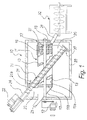
- Figure 1 is a schematic sectional view of a machine for performing a method according to the invention;
- Figure 2 is a sectional view of a detail of Figure 1.
- With reference to the figures, a machine for cooking particularly snacks such as potato chips and the like according to the invention is generally designated by the
reference numeral 10. - The cooking method according to the invention comprises the following operations:
- preheating a granular medium, bringing it to a temperature between 180°C and 210°C, and accumulating it so as to form a bath in which the raw snack is to be immersed;
- immersing the raw snack in said granular medium;
- keeping the snack in the granular medium for such a time as to allow its complete expansion;
- separating the snack from the granular medium.
- In the exemplary embodiment described here, the granular medium is food-grade salt, with which a salt bath is provided.
- Such food-grade salt is sodium chloride (NaCl), preferably of the recrystallized type.
- The expansion time of the snack in the salt bath does not exceed one minute and the retention of a snack being processed within the salt bath can last even just 15 seconds.
- It should be noted that this timing closely approximates the typical time interval of cooking by frying (between 10 and 60 seconds).
- Further, the expansion time is approximately one sixth of the time used with known toasting methods, which however produce an expansion of the snack that is often partial and uneven.
- Immersion in the salt bath leads to uniform transfer of the heat from the salt to the raw snack by contact with it, with consequent uniform cooking of the snack.
- Heat transmission, facilitated also by the swiftness with which salt transfers the accumulated heat to a body in contact, occurs by conduction, without the mediation of air, therefore more rapidly and in such a way as to reach even the innermost layers of the snack, improving its expansion with respect to what occurs with known methods.
- The salt remains in its crystalline state and is replaced before it dissolves; in this way, the salt does not penetrate the snack being cooked and does not alter its salting, determined during the formation of the snack.
- This method according to the invention is therefore faster and capable of more uniform heat transmission to the snacks being processed, and is such as to improve the expansion of the snack.
- The method according to the invention is completed by a further toasting which follows the separation of the snack from the salt bath.
- In this additional toasting, the snack expanded in the salt bath receives toasting by means of a jet of hot air, which is adapted to brown the snack, further reducing its degree of moisture and increasing its friableness and fragrance.
- The moisture of the snack at the exit from the salt bath is approximately 3%, while after hot air toasting the moisture of the snack drops to 1%, improving the friableness of the snack.
- The hot air jet has a temperature of approximately 220°C.
- The method according to the invention does not use oil and therefore produces snacks that are less fatty than those obtained by frying and are at the same time cooked uniformly and deeply by way of the immersion in the salt bath.
- A
machine 10 for cooking particularly snacks such as potato chips and the like, in execution of the method described above, comprises first of all a mixing container, in which the raw snacks to be expanded are suitable to pass, being pushed by advancement means. - The mixing container is constituted by a rotating
drum 11, which has a substantially horizontal axis and theshaft 27 of which is supported by aframe 28, and is moved by afirst motor drive 12. - The advancement means are constituted by a
spiral wall 13, which is arranged coaxially inside thedrum 11 and is arranged so as to protrude radially from theinternal surface 11a of thedrum 11, with which it is rigidly coupled. - In said container there is an accumulation region for the granular medium, i.e., food salt, which is preheated to provide a salt bath suitable to receive the snacks to be toasted.
- The salt accumulation region is provided by the
bottom 33 of thedrum 11, where the word "bottom" designates the part of thedrum 11 that at each instant lies closest to the ground. - There are also means for separating the expanded snacks from the salt bath, means for introducing the raw snacks in the container, and means for the exit of the expanded snacks from the mixing container.
- To further reduce the cost of the method, the machine comprises means for recovering and recirculating the salt for the salt bath, which are associated with means for heating said recovered salt.
- The
salt bath 15 in which thesnacks 16 are immersed is made to advance by the rotation of thedrum 11 and of thespiral wall 13 rigidly coupled thereto from theinput region 17 of thedrum 11 toward theoutput region 18 for the expandedsnacks 16. - Proximate to the
output region 18 and before it there are the means for separating the expandedsnacks 16 from thesalt bath 15. - The separation means are constituted by a grille-like
annular portion 19 of thedrum 11, which acts as a screen, its holes distributed on its cylindrical surface allowing the salt to fall into anunderlying collecting hopper 20 and retaining thesnacks 16 in thedrum 11; the snacks continue to be pushed by the rotation of thewall 13 toward theoutput region 18. - The salt recovery and recirculation means comprise, in addition to the
hopper 20, ascrew feeder 21, which is actuated by asecond motor drive 22. - The
screw feeder 21 draws from the bottom of thehopper 20, making the salt accumulated thereat rise to pour it into thedrum 11 by means of aduct 23, which conveys the salt from an opening on thetubular jacket 24, in which thescrew feeder 21 works, into theunderlying region 17 for entering thedrum 11. - The opening on the
tubular jacket 24 lies in the vicinity of theupper end 21 a of thescrew feeder 21. - The salt heating means are constituted by an
interspace 29 of thetubular jacket 24 in which thescrew feeder 21 turns and inside which the salt flows. - Diathermic oil at approximately 220°C is made to flow in the
interspace 29. - The
interspace 29 lies within thetubular jacket 24 between the bottom of thehopper 20 and theupper end 21 a of thescrew feeder 21. - By rising within the
tubular jacket 24 by virtue of the rotation of thescrew feeder 21, the salt is heated to approximately 190°C and is introduced in thedrum 11 at this temperature. - Figure 1 also illustrates the
openings interspace 29. - The salt must be replaced periodically, since the gradual reduction of the dimensions of its grains increases the exchange surfaces, accelerating the cooling of the salt bath and therefore gradually reducing its efficiency.
- The
region 17 for entering thedrum 11 is formed by aninput chute 25, which conveys theraw snacks 16, carried by external conveyance means, not shown, toward theinlet 11b of thedrum 11, where they encounter thesalt bath 15 at 190°C. - The
chute 25 in fact conveys toward theinlet 11b of thedrum 11 also the salt at 190°C that falls from theupper end 21a of thescrew feeder 21 through theduct 23. - The
salt bath 15 is then restored continuously by the action of thescrew feeder 21 and of theheating interspace 29 that surrounds it. - The means for introducing the
snacks 16 are constituted by thechute 25. - The output means are constituted by a
second chute 26, on which the expandedsnacks 16 fall from theoutput region 18 from thedrum 11. - The
chute 26 conveys by gravity the expandedsnacks 16 from retention within the salt bath toward packaging means, not shown for the sake of simplicity, or toward hot air toasting means, arranged in output from thedrum 11. - The hot air toasting means, designated by the
reference numeral 32 in Figure 1 and of a per se known type (for example of the rotary drum type), inject air at approximately 220°C onto the expandedsnacks 16, so as to provide thereon a toasting which is adapted to decrease their degree of moisture to 1% and to give said snacks 16 a more appealing golden color in addition to improving their friableness and fragrance. - The
machine 10 according to the invention as described above allows to perform the method according to the invention. - The
machine 10 in fact allows to achieve the expansion of thesnacks 16 without impregnating them with oil or toasting them unevenly and excessively, as occurs in toasting by means of hot air at 280°C. - The snacks that exit from the
machine 10 are therefore lighter and healthier than snacks obtained with known machines and have improved fragrance and friableness, imparted to them by toasting in hot air at 220°C. - The method has much shorter execution times than methods for cooking by toasting (approximately one sixth) and very close to those of methods for cooking by frying.
- Moreover, the exhausted salt, i.e., the salt that can no longer be used for the
salt bath 15 and is accordingly extracted from themachine 10, may be recycled completely as food for animals without any contraindication, since it is ordinary sodium chloride. - In practice it has been found that the invention thus described solves the problems noted in known methods for cooking by toasting or frying particularly for snacks such as potato chips and the like.
- In particular, the present invention provides a machine for performing such a method.
- Moreover, the present invention provides a method according to the invention which allows to obtain snacks that are cooked more evenly and are lighter and more friable than snacks produced with known types of method for cooking by frying or toasting with hot air.
- Furthermore, the present invention provides a method which is faster and therefore ensures greater or equal productivity with respect to known types of method.
- Still further, the present invention provides a machine for cooking particularly snacks such as potato chips and the like that is simple and cheap.
- Moreover, the present invention provides a cooking method particularly for snacks such as potato chips and the like and a machine for performing said method that can be obtained cheaply with known systems and technologies.
- The invention thus conceived is susceptible of numerous modifications and variations, all of which are within the scope of the appended claims; all the details may further be replaced with other technically equivalent elements.
- In practice, the materials employed, so long as they are compatible with the specific use, as well as the dimensions, may be any according to requirements and to the state of the art.
- The disclosures in
Italian Patent Application No. PD2005A000307 - Where technical features mentioned in any claim are followed by reference signs, those reference signs have been included for the sole purpose of increasing the intelligibility of the claims and accordingly such reference signs do not have any limiting effect on the interpretation of each element identified by way of example by such reference signs.
Claims (17)
- A method for cooking by toasting, particularly for snacks such as potato chips and the like, characterized in that it comprises the following operations:- preheating a granular medium, bringing it to a temperature between 180°C and 210°C, and accumulating it so as to form a bath in which the raw snack is to be immersed;- immersing the raw snack in said granular medium;- keeping the snack in said granular medium for such a time as to allow its complete expansion;- separating the snack from the granular medium.
- The method according to claim 1, characterized in that said retention time of the snack in the salt bath does not exceed one minute.
- The method according to the preceding claims, characterized in that the granular medium is salt of the food-grade type.
- The method according to claim 3, characterized in that said food-grade salt is preferably recrystallized sodium chloride (NaCl).
- The method according to one or more of the preceding claims, characterized in that after separation from the salt bath, the expanded snack is toasted by means of a jet of hot air, which is adapted to brown the snack, further reducing its degree of moisture and increasing its friableness.
- The method according to claim 5, characterized in that said jet of hot air has a temperature of approximately 220°C.
- A machine for cooking particularly snacks such as potato chips and the like, in execution of a method according to the preceding claims, characterized in that it comprises:- a mixing container, in which raw snacks are suitable to pass, pushed by advancement means;- a region of accumulation of a preheated granular medium being formed in said container, said medium providing a bath (15) adapted to receive the raw snacks;- means for separating the expanded snacks from the granular medium;- means for introducing the raw snacks in the container;- means for the exit of the expanded snacks from the container.
- The machine according to claim 7, characterized in that it comprises means for recovering and recirculating the granular medium, which are associated with heating means for said granular medium.
- The machine according to claims 7 and 8, characterized in that said mixing container is constituted by a rotating drum (11) whose axis is substantially horizontal and whose shaft (27) is supported by a frame (28) and is moved by a first motor drive (12).
- The machine according to one or more of the preceding claims, characterized in that said advancement means are constituted by a spiral wall (13), which is arranged coaxially within said drum (11) and is arranged so as to protrude radially from the internal surface (11a) of the drum (11) to which it is rigidly coupled.
- The machine according to one or more of claims 7 to 10, characterized in that said accumulation region for the granular medium is provided by the bottom (33) of the drum (11).
- The machine according to one or more of claims 7 to 11, characterized in that said means for separating the snacks from the granular medium are constituted by a grille-like annular portion (19) of the drum (11), the holes of which, distributed on its cylindrical surface, allow the granular medium to fall into an underlying collecting hopper (20) and retain the snacks (16) in the drum (11).
- The machine according to one or more of claims 7 to 12, characterized in that said recovery and recirculation means comprise said hopper (20) and a screw feeder (21), which is actuated by a second motor drive (22), said screw feeder (21) being adapted to draw the granular medium from the bottom of the hopper (20) and to make it rise within a tubular jacket (24) for containing the screw feeder (21) to transfer it into the drum (11) by means of a duct (23), which conveys it from an opening in the tubular jacket (24), in the underlying region (17) for entering the drum (11), said opening in the tubular jacket (24) being located in the vicinity of the upper end (21a) of the screw feeder (21).
- The machine according to one or more of claims 7 to 13, characterized in that said means for heating the granular medium are constituted by an interspace (29) of the tubular jacket (24) in which the screw feeder (21) rotates, diathermic oil at approximately 220°C flowing within said interspace (29), said interspace (29) being arranged within the tubular jacket (24) between the bottom of the hopper (20) and the upper end (21a) of the screw feeder (21).
- The machine according to one or more of claims 7 to 14, characterized in that said input means are constituted, at a region (17) for entering the drum (11), by an input chute (25), which conveys the raw snacks (16), carried by external conveyance means, toward the inlet (11b) of the drum (11), where they encounter the bath (15) of the granular medium, which has a temperature of approximately 190°C, said chute (25) being adapted to convey toward the inlet (11b) of the drum (11) also the granular medium at 190°C that falls from the upper end (21a) of the screw feeder (21) through the duct (23).
- The machine according to one or more of claims 7 to 15, characterized in that said exit means are constituted by a second chute (26), on which the expanded snacks (16) fall from the region (18) for exiting from the drum (11), said chute (26) being adapted to convey said expanded snacks (16) toward packaging means or toward hot air toasting means, arranged in output with respect to the drum (11).
- The machine according to one or more of claims 6 to 16, characterized in that it comprises hot air toasting means (32), which are arranged in output with respect to the drum (11) and are adapted to inject air at approximately 220°C onto the expanded snacks (16), so as to provide thereon a toasting which is suitable to reduce their degree of moisture to 1 %.
Applications Claiming Priority (1)
| Application Number | Priority Date | Filing Date | Title |
|---|---|---|---|
| IT000307A ITPD20050307A1 (en) | 2005-10-14 | 2005-10-14 | COOKING PROCEDURE PARTICULARLY FOR SNACKS TYPE OF POTATOES AND SIMILAR AND MACHINE TO IMPLEMENT THIS PROCEDURE |
Publications (1)
| Publication Number | Publication Date |
|---|---|
| EP1774857A1 true EP1774857A1 (en) | 2007-04-18 |
Family
ID=37684156
Family Applications (1)
| Application Number | Title | Priority Date | Filing Date |
|---|---|---|---|
| EP06120369A Withdrawn EP1774857A1 (en) | 2005-10-14 | 2006-09-08 | Cooking method particularly for snacks such as potato chips and the like, and machine for performing the method |
Country Status (2)
| Country | Link |
|---|---|
| EP (1) | EP1774857A1 (en) |
| IT (1) | ITPD20050307A1 (en) |
Cited By (4)
| Publication number | Priority date | Publication date | Assignee | Title |
|---|---|---|---|---|
| ITPD20120193A1 (en) * | 2012-06-14 | 2013-12-15 | Antonello Giuseppe | SNACK COOKING MACHINE TYPE OF POTATOES AND SIMILAR |
| US10159271B2 (en) | 2017-02-02 | 2018-12-25 | Frito-Lay North America, Inc. | Cooking snack foods |
| US10159272B2 (en) | 2017-02-02 | 2018-12-25 | Frito-Lay North America, Inc. | Cooking snack foods |
| IT202000017965A1 (en) * | 2020-07-24 | 2022-01-24 | Arco Srl | STRUCTURE OF MACHINE FOR COOKING SNACKS IN SALT BATH |
Citations (7)
| Publication number | Priority date | Publication date | Assignee | Title |
|---|---|---|---|---|
| GB888649A (en) * | 1960-06-07 | 1962-01-31 | Battelle Development Corp | Process for treating food and product resulting therefrom |
| GB986038A (en) * | 1962-05-31 | 1965-03-17 | Gen Mills Inc | Improvements in or relating to apparatus and methods of heating food products |
| US3555992A (en) * | 1968-10-31 | 1971-01-19 | Pillsbury Co | Apparatus for heating, cooling or puffing food products in a dry state |
| GB1577733A (en) * | 1977-05-09 | 1980-10-29 | United Biscuits Ltd | Salt bed cooking |
| US5445073A (en) * | 1992-04-14 | 1995-08-29 | Gilwood; William C. | Apparatus and process for cooking potatoes |
| WO1998023161A1 (en) * | 1996-11-25 | 1998-06-04 | International Machinery, Inc. | Preparing fat-free food product using hot air impingement |
| US5928694A (en) * | 1994-10-10 | 1999-07-27 | Ubert Gastrotechnik G.M.B.H. | Process for preparing foodstuffs in a hot air oven |
-
2005
- 2005-10-14 IT IT000307A patent/ITPD20050307A1/en unknown
-
2006
- 2006-09-08 EP EP06120369A patent/EP1774857A1/en not_active Withdrawn
Patent Citations (7)
| Publication number | Priority date | Publication date | Assignee | Title |
|---|---|---|---|---|
| GB888649A (en) * | 1960-06-07 | 1962-01-31 | Battelle Development Corp | Process for treating food and product resulting therefrom |
| GB986038A (en) * | 1962-05-31 | 1965-03-17 | Gen Mills Inc | Improvements in or relating to apparatus and methods of heating food products |
| US3555992A (en) * | 1968-10-31 | 1971-01-19 | Pillsbury Co | Apparatus for heating, cooling or puffing food products in a dry state |
| GB1577733A (en) * | 1977-05-09 | 1980-10-29 | United Biscuits Ltd | Salt bed cooking |
| US5445073A (en) * | 1992-04-14 | 1995-08-29 | Gilwood; William C. | Apparatus and process for cooking potatoes |
| US5928694A (en) * | 1994-10-10 | 1999-07-27 | Ubert Gastrotechnik G.M.B.H. | Process for preparing foodstuffs in a hot air oven |
| WO1998023161A1 (en) * | 1996-11-25 | 1998-06-04 | International Machinery, Inc. | Preparing fat-free food product using hot air impingement |
Cited By (5)
| Publication number | Priority date | Publication date | Assignee | Title |
|---|---|---|---|---|
| ITPD20120193A1 (en) * | 2012-06-14 | 2013-12-15 | Antonello Giuseppe | SNACK COOKING MACHINE TYPE OF POTATOES AND SIMILAR |
| US10159271B2 (en) | 2017-02-02 | 2018-12-25 | Frito-Lay North America, Inc. | Cooking snack foods |
| US10159272B2 (en) | 2017-02-02 | 2018-12-25 | Frito-Lay North America, Inc. | Cooking snack foods |
| IT202000017965A1 (en) * | 2020-07-24 | 2022-01-24 | Arco Srl | STRUCTURE OF MACHINE FOR COOKING SNACKS IN SALT BATH |
| WO2022018653A1 (en) * | 2020-07-24 | 2022-01-27 | Arco Srl | Structure of a machine for cooking snacks in a salt bath |
Also Published As
| Publication number | Publication date |
|---|---|
| ITPD20050307A1 (en) | 2007-04-15 |
Similar Documents
| Publication | Publication Date | Title |
|---|---|---|
| JP5595690B2 (en) | General purpose potato chip cooker | |
| US10631562B2 (en) | Continuous popcorn machines having variable heating profiles and associated systems and methods | |
| CN114982990B (en) | Leisure instant mushroom vegetarian meat product processing equipment and processing method | |
| KR101137914B1 (en) | Apparatus for forming seasoned rice cake | |
| CN108208632A (en) | A kind of fish ball production line | |
| JP6231938B2 (en) | Continuous roasting machine | |
| JP6999008B2 (en) | Fly processing equipment | |
| CN106616218A (en) | Method of copying tastes and cooking technology of chef dishes | |
| CN216533731U (en) | Full-automatic opening stir-frying device for pine nuts | |
| US3746546A (en) | Apparatus and process for puffing food products | |
| KR20230171130A (en) | Grain Nurungji manufacturing system | |
| CN212227597U (en) | Continuous drying device of chicken powder | |
| CN211298330U (en) | Gas type frying pan | |
| CN101438756A (en) | Compression type pea nut crisp candy and method for producing the same | |
| US3333966A (en) | Potato cooking and mashing | |
| JP3350493B2 (en) | Continuous steaming equipment | |
| CN222583595U (en) | Steam rice line | |
| KR20160057279A (en) | Manufacturing apparatus of rice cake | |
| JP2006311996A (en) | Automatic potato crisp fryer | |
| CN204047757U (en) | The fried equipment of one potato seed class | |
| CN112535258B (en) | Full-automatic continuous puffing system and control method | |
| CN109965249B (en) | System and method for preparing compound flavoring agent based on uniform and continuous temperature change | |
| JP2009240287A (en) | Steamed tea leaf-treating device | |
| CN213819812U (en) | Full-automatic bulking device | |
| JP2515760Y2 (en) | Continuous rice cooker |
Legal Events
| Date | Code | Title | Description |
|---|---|---|---|
| PUAI | Public reference made under article 153(3) epc to a published international application that has entered the european phase |
Free format text: ORIGINAL CODE: 0009012 |
|
| AK | Designated contracting states |
Kind code of ref document: A1 Designated state(s): AT BE BG CH CY CZ DE DK EE ES FI FR GB GR HU IE IS IT LI LT LU LV MC NL PL PT RO SE SI SK TR |
|
| AX | Request for extension of the european patent |
Extension state: AL BA HR MK YU |
|
| AKX | Designation fees paid | ||
| REG | Reference to a national code |
Ref country code: DE Ref legal event code: 8566 |
|
| STAA | Information on the status of an ep patent application or granted ep patent |
Free format text: STATUS: THE APPLICATION IS DEEMED TO BE WITHDRAWN |
|
| 18D | Application deemed to be withdrawn |
Effective date: 20071019 |