EP1772522A1 - Control of preservation by biomarkers - Google Patents
Control of preservation by biomarkers Download PDFInfo
- Publication number
- EP1772522A1 EP1772522A1 EP05077246A EP05077246A EP1772522A1 EP 1772522 A1 EP1772522 A1 EP 1772522A1 EP 05077246 A EP05077246 A EP 05077246A EP 05077246 A EP05077246 A EP 05077246A EP 1772522 A1 EP1772522 A1 EP 1772522A1
- Authority
- EP
- European Patent Office
- Prior art keywords
- spores
- rna
- heat
- preservation
- amplification
- Prior art date
- Legal status (The legal status is an assumption and is not a legal conclusion. Google has not performed a legal analysis and makes no representation as to the accuracy of the status listed.)
- Withdrawn
Links
- 238000004321 preservation Methods 0.000 title claims abstract description 25
- 239000000090 biomarker Substances 0.000 title claims description 4
- 108020004999 messenger RNA Proteins 0.000 claims abstract description 34
- 230000035899 viability Effects 0.000 claims abstract description 20
- 238000003556 assay Methods 0.000 claims abstract description 17
- 239000002773 nucleotide Substances 0.000 claims abstract description 9
- 125000003729 nucleotide group Chemical group 0.000 claims abstract description 9
- 210000004215 spore Anatomy 0.000 claims description 107
- 108091032973 (ribonucleotides)n+m Proteins 0.000 claims description 61
- 238000000034 method Methods 0.000 claims description 58
- 239000000523 sample Substances 0.000 claims description 27
- 238000011282 treatment Methods 0.000 claims description 22
- 108020004418 ribosomal RNA Proteins 0.000 claims description 20
- 238000010438 heat treatment Methods 0.000 claims description 18
- 230000015556 catabolic process Effects 0.000 claims description 16
- 238000006731 degradation reaction Methods 0.000 claims description 16
- 230000005855 radiation Effects 0.000 claims description 9
- 230000000813 microbial effect Effects 0.000 claims description 7
- 230000000694 effects Effects 0.000 claims description 5
- 210000004666 bacterial spore Anatomy 0.000 claims description 4
- 238000011109 contamination Methods 0.000 claims description 4
- 102100034343 Integrase Human genes 0.000 claims description 3
- 108010092799 RNA-directed DNA polymerase Proteins 0.000 claims description 3
- 230000001580 bacterial effect Effects 0.000 claims description 3
- 238000012300 Sequence Analysis Methods 0.000 claims description 2
- 235000013305 food Nutrition 0.000 abstract description 10
- 238000012360 testing method Methods 0.000 abstract description 5
- 230000002906 microbiologic effect Effects 0.000 abstract description 4
- 238000005259 measurement Methods 0.000 abstract 1
- 238000003199 nucleic acid amplification method Methods 0.000 description 34
- 230000003321 amplification Effects 0.000 description 33
- 244000005700 microbiome Species 0.000 description 26
- 239000000047 product Substances 0.000 description 17
- 238000001514 detection method Methods 0.000 description 16
- 108020004414 DNA Proteins 0.000 description 14
- 241000276408 Bacillus subtilis subsp. subtilis str. 168 Species 0.000 description 12
- 235000014469 Bacillus subtilis Nutrition 0.000 description 11
- 238000003753 real-time PCR Methods 0.000 description 9
- 238000003757 reverse transcription PCR Methods 0.000 description 8
- 230000004083 survival effect Effects 0.000 description 8
- 101100160222 Bacillus subtilis (strain 168) ykzE gene Proteins 0.000 description 7
- 230000007423 decrease Effects 0.000 description 7
- 210000001624 hip Anatomy 0.000 description 7
- 239000012634 fragment Substances 0.000 description 6
- 230000035784 germination Effects 0.000 description 6
- 241000894006 Bacteria Species 0.000 description 5
- 108091028043 Nucleic acid sequence Proteins 0.000 description 5
- 238000006243 chemical reaction Methods 0.000 description 5
- 238000005516 engineering process Methods 0.000 description 5
- 108090000623 proteins and genes Proteins 0.000 description 5
- 102000040650 (ribonucleotides)n+m Human genes 0.000 description 4
- 241000193830 Bacillus <bacterium> Species 0.000 description 4
- 241000193738 Bacillus anthracis Species 0.000 description 4
- 230000002457 bidirectional effect Effects 0.000 description 4
- 210000004027 cell Anatomy 0.000 description 4
- WJJMNDUMQPNECX-UHFFFAOYSA-N dipicolinic acid Chemical compound OC(=O)C1=CC=CC(C(O)=O)=N1 WJJMNDUMQPNECX-UHFFFAOYSA-N 0.000 description 4
- 239000000975 dye Substances 0.000 description 4
- 238000002474 experimental method Methods 0.000 description 4
- 238000009396 hybridization Methods 0.000 description 4
- 150000007523 nucleic acids Chemical group 0.000 description 4
- 230000008569 process Effects 0.000 description 4
- 210000001938 protoplast Anatomy 0.000 description 4
- 241000894007 species Species 0.000 description 4
- 238000013518 transcription Methods 0.000 description 4
- 230000035897 transcription Effects 0.000 description 4
- 241000006378 Bacillus cereus group Species 0.000 description 3
- 108091034117 Oligonucleotide Proteins 0.000 description 3
- 230000015572 biosynthetic process Effects 0.000 description 3
- 239000007795 chemical reaction product Substances 0.000 description 3
- 239000003795 chemical substances by application Substances 0.000 description 3
- 238000012258 culturing Methods 0.000 description 3
- 238000011161 development Methods 0.000 description 3
- 230000018109 developmental process Effects 0.000 description 3
- ZMMJGEGLRURXTF-UHFFFAOYSA-N ethidium bromide Chemical compound [Br-].C12=CC(N)=CC=C2C2=CC=C(N)C=C2[N+](CC)=C1C1=CC=CC=C1 ZMMJGEGLRURXTF-UHFFFAOYSA-N 0.000 description 3
- 229960005542 ethidium bromide Drugs 0.000 description 3
- 238000012544 monitoring process Methods 0.000 description 3
- 108020004707 nucleic acids Proteins 0.000 description 3
- 102000039446 nucleic acids Human genes 0.000 description 3
- 238000007747 plating Methods 0.000 description 3
- YBJHBAHKTGYVGT-ZKWXMUAHSA-N (+)-Biotin Chemical compound N1C(=O)N[C@@H]2[C@H](CCCCC(=O)O)SC[C@@H]21 YBJHBAHKTGYVGT-ZKWXMUAHSA-N 0.000 description 2
- 108020004465 16S ribosomal RNA Proteins 0.000 description 2
- DVLFYONBTKHTER-UHFFFAOYSA-N 3-(N-morpholino)propanesulfonic acid Chemical compound OS(=O)(=O)CCCN1CCOCC1 DVLFYONBTKHTER-UHFFFAOYSA-N 0.000 description 2
- NLXLAEXVIDQMFP-UHFFFAOYSA-N Ammonia chloride Chemical compound [NH4+].[Cl-] NLXLAEXVIDQMFP-UHFFFAOYSA-N 0.000 description 2
- 108091093088 Amplicon Proteins 0.000 description 2
- 244000063299 Bacillus subtilis Species 0.000 description 2
- 101100106030 Bacillus subtilis (strain 168) yfhD gene Proteins 0.000 description 2
- 101100544179 Bacillus subtilis (strain 168) yhcV gene Proteins 0.000 description 2
- 101100321045 Bacillus subtilis (strain 168) yqfX gene Proteins 0.000 description 2
- OKTJSMMVPCPJKN-UHFFFAOYSA-N Carbon Chemical compound [C] OKTJSMMVPCPJKN-UHFFFAOYSA-N 0.000 description 2
- 230000004544 DNA amplification Effects 0.000 description 2
- 238000001712 DNA sequencing Methods 0.000 description 2
- 108010014303 DNA-directed DNA polymerase Proteins 0.000 description 2
- 102000016928 DNA-directed DNA polymerase Human genes 0.000 description 2
- 102000004190 Enzymes Human genes 0.000 description 2
- 108090000790 Enzymes Proteins 0.000 description 2
- 239000007993 MOPS buffer Substances 0.000 description 2
- TWRXJAOTZQYOKJ-UHFFFAOYSA-L Magnesium chloride Chemical compound [Mg+2].[Cl-].[Cl-] TWRXJAOTZQYOKJ-UHFFFAOYSA-L 0.000 description 2
- 241001465754 Metazoa Species 0.000 description 2
- SEQKRHFRPICQDD-UHFFFAOYSA-N N-tris(hydroxymethyl)methylglycine Chemical compound OCC(CO)(CO)[NH2+]CC([O-])=O SEQKRHFRPICQDD-UHFFFAOYSA-N 0.000 description 2
- 238000002123 RNA extraction Methods 0.000 description 2
- 238000004458 analytical method Methods 0.000 description 2
- 239000002585 base Substances 0.000 description 2
- 239000011324 bead Substances 0.000 description 2
- 230000008901 benefit Effects 0.000 description 2
- 229910052799 carbon Inorganic materials 0.000 description 2
- 108091036078 conserved sequence Proteins 0.000 description 2
- 239000000356 contaminant Substances 0.000 description 2
- 230000007613 environmental effect Effects 0.000 description 2
- MHMNJMPURVTYEJ-UHFFFAOYSA-N fluorescein-5-isothiocyanate Chemical compound O1C(=O)C2=CC(N=C=S)=CC=C2C21C1=CC=C(O)C=C1OC1=CC(O)=CC=C21 MHMNJMPURVTYEJ-UHFFFAOYSA-N 0.000 description 2
- 238000001506 fluorescence spectroscopy Methods 0.000 description 2
- 239000000499 gel Substances 0.000 description 2
- 230000002068 genetic effect Effects 0.000 description 2
- DCAYPVUWAIABOU-UHFFFAOYSA-N hexadecane Chemical compound CCCCCCCCCCCCCCCC DCAYPVUWAIABOU-UHFFFAOYSA-N 0.000 description 2
- 230000002209 hydrophobic effect Effects 0.000 description 2
- 230000002779 inactivation Effects 0.000 description 2
- 238000010348 incorporation Methods 0.000 description 2
- 238000002955 isolation Methods 0.000 description 2
- 229920002521 macromolecule Polymers 0.000 description 2
- 239000000463 material Substances 0.000 description 2
- 239000012528 membrane Substances 0.000 description 2
- 238000002493 microarray Methods 0.000 description 2
- 101150020257 mltF gene Proteins 0.000 description 2
- 239000012071 phase Substances 0.000 description 2
- 238000003752 polymerase chain reaction Methods 0.000 description 2
- 238000006116 polymerization reaction Methods 0.000 description 2
- 230000009467 reduction Effects 0.000 description 2
- 230000035945 sensitivity Effects 0.000 description 2
- 238000011895 specific detection Methods 0.000 description 2
- 101150035715 sspN gene Proteins 0.000 description 2
- 238000004659 sterilization and disinfection Methods 0.000 description 2
- 239000000126 substance Substances 0.000 description 2
- 238000003786 synthesis reaction Methods 0.000 description 2
- -1 terbium (III) anion Chemical class 0.000 description 2
- GFISHBQNVWAVFU-UHFFFAOYSA-K terbium(iii) chloride Chemical compound Cl[Tb](Cl)Cl GFISHBQNVWAVFU-UHFFFAOYSA-K 0.000 description 2
- 238000005406 washing Methods 0.000 description 2
- XLYOFNOQVPJJNP-UHFFFAOYSA-N water Substances O XLYOFNOQVPJJNP-UHFFFAOYSA-N 0.000 description 2
- 229910019626 (NH4)6Mo7O24 Inorganic materials 0.000 description 1
- 101150098072 20 gene Proteins 0.000 description 1
- WOVKYSAHUYNSMH-RRKCRQDMSA-N 5-bromodeoxyuridine Chemical compound C1[C@H](O)[C@@H](CO)O[C@H]1N1C(=O)NC(=O)C(Br)=C1 WOVKYSAHUYNSMH-RRKCRQDMSA-N 0.000 description 1
- 229920001817 Agar Polymers 0.000 description 1
- IVRMZWNICZWHMI-UHFFFAOYSA-N Azide Chemical compound [N-]=[N+]=[N-] IVRMZWNICZWHMI-UHFFFAOYSA-N 0.000 description 1
- 101100221728 Bacillus subtilis (strain 168) coxA gene Proteins 0.000 description 1
- 101100096753 Bacillus subtilis (strain 168) sspJ gene Proteins 0.000 description 1
- 101100544175 Bacillus subtilis (strain 168) yhcQ gene Proteins 0.000 description 1
- 101100052827 Bacillus subtilis (strain 168) yhdB gene Proteins 0.000 description 1
- 101100160223 Bacillus subtilis (strain 168) ykzF gene Proteins 0.000 description 1
- 101100432746 Bacillus subtilis (strain 168) yozQ gene Proteins 0.000 description 1
- 101100214182 Bacillus subtilis (strain 168) ythQ gene Proteins 0.000 description 1
- 101100377111 Bacillus subtilis (strain 168) ytzC gene Proteins 0.000 description 1
- 241000193388 Bacillus thuringiensis Species 0.000 description 1
- OYPRJOBELJOOCE-UHFFFAOYSA-N Calcium Chemical compound [Ca] OYPRJOBELJOOCE-UHFFFAOYSA-N 0.000 description 1
- UXVMQQNJUSDDNG-UHFFFAOYSA-L Calcium chloride Chemical compound [Cl-].[Cl-].[Ca+2] UXVMQQNJUSDDNG-UHFFFAOYSA-L 0.000 description 1
- 239000004215 Carbon black (E152) Substances 0.000 description 1
- 229910021580 Cobalt(II) chloride Inorganic materials 0.000 description 1
- 230000006820 DNA synthesis Effects 0.000 description 1
- AHCYMLUZIRLXAA-SHYZEUOFSA-N Deoxyuridine 5'-triphosphate Chemical compound O1[C@H](COP(O)(=O)OP(O)(=O)OP(O)(O)=O)[C@@H](O)C[C@@H]1N1C(=O)NC(=O)C=C1 AHCYMLUZIRLXAA-SHYZEUOFSA-N 0.000 description 1
- SHIBSTMRCDJXLN-UHFFFAOYSA-N Digoxigenin Natural products C1CC(C2C(C3(C)CCC(O)CC3CC2)CC2O)(O)C2(C)C1C1=CC(=O)OC1 SHIBSTMRCDJXLN-UHFFFAOYSA-N 0.000 description 1
- 101100321892 Escherichia coli (strain K12) aaeA gene Proteins 0.000 description 1
- 101100147911 Escherichia coli (strain K12) rsmB gene Proteins 0.000 description 1
- QTANTQQOYSUMLC-UHFFFAOYSA-O Ethidium cation Chemical compound C12=CC(N)=CC=C2C2=CC=C(N)C=C2[N+](CC)=C1C1=CC=CC=C1 QTANTQQOYSUMLC-UHFFFAOYSA-O 0.000 description 1
- 241000654838 Exosporium Species 0.000 description 1
- 101100385557 Flavobacterium psychrophilum (strain ATCC 49511 / DSM 21280 / CIP 103535 / JIP02/86) ctaA gene Proteins 0.000 description 1
- 206010016952 Food poisoning Diseases 0.000 description 1
- 208000019331 Foodborne disease Diseases 0.000 description 1
- WQZGKKKJIJFFOK-GASJEMHNSA-N Glucose Natural products OC[C@H]1OC(O)[C@H](O)[C@@H](O)[C@@H]1O WQZGKKKJIJFFOK-GASJEMHNSA-N 0.000 description 1
- 241000238631 Hexapoda Species 0.000 description 1
- 101000879761 Homo sapiens Sarcospan Proteins 0.000 description 1
- 108010001336 Horseradish Peroxidase Proteins 0.000 description 1
- 229910021380 Manganese Chloride Inorganic materials 0.000 description 1
- GLFNIEUTAYBVOC-UHFFFAOYSA-L Manganese chloride Chemical compound Cl[Mn]Cl GLFNIEUTAYBVOC-UHFFFAOYSA-L 0.000 description 1
- MSFSPUZXLOGKHJ-UHFFFAOYSA-N Muraminsaeure Natural products OC(=O)C(C)OC1C(N)C(O)OC(CO)C1O MSFSPUZXLOGKHJ-UHFFFAOYSA-N 0.000 description 1
- 239000004677 Nylon Substances 0.000 description 1
- 238000012408 PCR amplification Methods 0.000 description 1
- 108010013639 Peptidoglycan Proteins 0.000 description 1
- 239000001888 Peptone Substances 0.000 description 1
- 108010080698 Peptones Proteins 0.000 description 1
- 108010066717 Q beta Replicase Proteins 0.000 description 1
- 239000013614 RNA sample Substances 0.000 description 1
- 108091028664 Ribonucleotide Proteins 0.000 description 1
- 108020001027 Ribosomal DNA Proteins 0.000 description 1
- 102100037329 Sarcospan Human genes 0.000 description 1
- FAPWRFPIFSIZLT-UHFFFAOYSA-M Sodium chloride Chemical compound [Na+].[Cl-] FAPWRFPIFSIZLT-UHFFFAOYSA-M 0.000 description 1
- 238000002105 Southern blotting Methods 0.000 description 1
- 108010090804 Streptavidin Proteins 0.000 description 1
- 208000037065 Subacute sclerosing leukoencephalitis Diseases 0.000 description 1
- 206010042297 Subacute sclerosing panencephalitis Diseases 0.000 description 1
- UZMAPBJVXOGOFT-UHFFFAOYSA-N Syringetin Natural products COC1=C(O)C(OC)=CC(C2=C(C(=O)C3=C(O)C=C(O)C=C3O2)O)=C1 UZMAPBJVXOGOFT-UHFFFAOYSA-N 0.000 description 1
- 229910052771 Terbium Inorganic materials 0.000 description 1
- 239000007997 Tricine buffer Substances 0.000 description 1
- 241000607479 Yersinia pestis Species 0.000 description 1
- 208000035472 Zoonoses Diseases 0.000 description 1
- DPKHZNPWBDQZCN-UHFFFAOYSA-N acridine orange free base Chemical compound C1=CC(N(C)C)=CC2=NC3=CC(N(C)C)=CC=C3C=C21 DPKHZNPWBDQZCN-UHFFFAOYSA-N 0.000 description 1
- 239000008272 agar Substances 0.000 description 1
- 239000011543 agarose gel Substances 0.000 description 1
- 238000000246 agarose gel electrophoresis Methods 0.000 description 1
- 125000003277 amino group Chemical group 0.000 description 1
- 229960001040 ammonium chloride Drugs 0.000 description 1
- 235000019270 ammonium chloride Nutrition 0.000 description 1
- 238000012197 amplification kit Methods 0.000 description 1
- 238000000137 annealing Methods 0.000 description 1
- 238000013459 approach Methods 0.000 description 1
- 239000008346 aqueous phase Substances 0.000 description 1
- 244000052616 bacterial pathogen Species 0.000 description 1
- DZBUGLKDJFMEHC-UHFFFAOYSA-N benzoquinolinylidene Natural products C1=CC=CC2=CC3=CC=CC=C3N=C21 DZBUGLKDJFMEHC-UHFFFAOYSA-N 0.000 description 1
- 102000005936 beta-Galactosidase Human genes 0.000 description 1
- 108010005774 beta-Galactosidase Proteins 0.000 description 1
- 238000004166 bioassay Methods 0.000 description 1
- 238000010170 biological method Methods 0.000 description 1
- 229960002685 biotin Drugs 0.000 description 1
- 235000020958 biotin Nutrition 0.000 description 1
- 239000011616 biotin Substances 0.000 description 1
- KGBXLFKZBHKPEV-UHFFFAOYSA-N boric acid Chemical compound OB(O)O KGBXLFKZBHKPEV-UHFFFAOYSA-N 0.000 description 1
- 239000011575 calcium Substances 0.000 description 1
- 229910052791 calcium Inorganic materials 0.000 description 1
- 239000001110 calcium chloride Substances 0.000 description 1
- 229910001628 calcium chloride Inorganic materials 0.000 description 1
- PNKVTDBACVNFDK-UHFFFAOYSA-N calcium;pyridine-2-carboxylic acid Chemical compound [Ca].OC(=O)C1=CC=CC=N1.OC(=O)C1=CC=CC=N1 PNKVTDBACVNFDK-UHFFFAOYSA-N 0.000 description 1
- 125000003178 carboxy group Chemical group [H]OC(*)=O 0.000 description 1
- 239000003153 chemical reaction reagent Substances 0.000 description 1
- 238000003776 cleavage reaction Methods 0.000 description 1
- 238000007621 cluster analysis Methods 0.000 description 1
- 230000001332 colony forming effect Effects 0.000 description 1
- 230000000295 complement effect Effects 0.000 description 1
- 239000002299 complementary DNA Substances 0.000 description 1
- 238000001816 cooling Methods 0.000 description 1
- ARUVKPQLZAKDPS-UHFFFAOYSA-L copper(II) sulfate Chemical compound [Cu+2].[O-][S+2]([O-])([O-])[O-] ARUVKPQLZAKDPS-UHFFFAOYSA-L 0.000 description 1
- 229910000366 copper(II) sulfate Inorganic materials 0.000 description 1
- 101150063222 ctaD gene Proteins 0.000 description 1
- 230000009089 cytolysis Effects 0.000 description 1
- 230000001419 dependent effect Effects 0.000 description 1
- 238000013461 design Methods 0.000 description 1
- 235000014113 dietary fatty acids Nutrition 0.000 description 1
- QONQRTHLHBTMGP-UHFFFAOYSA-N digitoxigenin Natural products CC12CCC(C3(CCC(O)CC3CC3)C)C3C11OC1CC2C1=CC(=O)OC1 QONQRTHLHBTMGP-UHFFFAOYSA-N 0.000 description 1
- SHIBSTMRCDJXLN-KCZCNTNESA-N digoxigenin Chemical compound C1([C@@H]2[C@@]3([C@@](CC2)(O)[C@H]2[C@@H]([C@@]4(C)CC[C@H](O)C[C@H]4CC2)C[C@H]3O)C)=CC(=O)OC1 SHIBSTMRCDJXLN-KCZCNTNESA-N 0.000 description 1
- KCFYHBSOLOXZIF-UHFFFAOYSA-N dihydrochrysin Natural products COC1=C(O)C(OC)=CC(C2OC3=CC(O)=CC(O)=C3C(=O)C2)=C1 KCFYHBSOLOXZIF-UHFFFAOYSA-N 0.000 description 1
- ZPWVASYFFYYZEW-UHFFFAOYSA-L dipotassium hydrogen phosphate Chemical compound [K+].[K+].OP([O-])([O-])=O ZPWVASYFFYYZEW-UHFFFAOYSA-L 0.000 description 1
- 229910000396 dipotassium phosphate Inorganic materials 0.000 description 1
- 238000006073 displacement reaction Methods 0.000 description 1
- 230000007515 enzymatic degradation Effects 0.000 description 1
- 230000005284 excitation Effects 0.000 description 1
- 239000000194 fatty acid Substances 0.000 description 1
- 229930195729 fatty acid Natural products 0.000 description 1
- 150000004665 fatty acids Chemical class 0.000 description 1
- 230000002349 favourable effect Effects 0.000 description 1
- GNBHRKFJIUUOQI-UHFFFAOYSA-N fluorescein Chemical compound O1C(=O)C2=CC=CC=C2C21C1=CC=C(O)C=C1OC1=CC(O)=CC=C21 GNBHRKFJIUUOQI-UHFFFAOYSA-N 0.000 description 1
- 239000007850 fluorescent dye Substances 0.000 description 1
- 238000009920 food preservation Methods 0.000 description 1
- 238000001502 gel electrophoresis Methods 0.000 description 1
- 238000011331 genomic analysis Methods 0.000 description 1
- 239000008103 glucose Substances 0.000 description 1
- 230000012010 growth Effects 0.000 description 1
- 230000036541 health Effects 0.000 description 1
- 229930195733 hydrocarbon Natural products 0.000 description 1
- 150000002430 hydrocarbons Chemical class 0.000 description 1
- 230000000977 initiatory effect Effects 0.000 description 1
- 238000007689 inspection Methods 0.000 description 1
- 238000009830 intercalation Methods 0.000 description 1
- BAUYGSIQEAFULO-UHFFFAOYSA-L iron(2+) sulfate (anhydrous) Chemical compound [Fe+2].[O-]S([O-])(=O)=O BAUYGSIQEAFULO-UHFFFAOYSA-L 0.000 description 1
- 229910000359 iron(II) sulfate Inorganic materials 0.000 description 1
- 239000010410 layer Substances 0.000 description 1
- 238000007834 ligase chain reaction Methods 0.000 description 1
- 244000144972 livestock Species 0.000 description 1
- 238000007403 mPCR Methods 0.000 description 1
- 229910001629 magnesium chloride Inorganic materials 0.000 description 1
- 239000011565 manganese chloride Substances 0.000 description 1
- 239000003550 marker Substances 0.000 description 1
- 230000004060 metabolic process Effects 0.000 description 1
- 238000010208 microarray analysis Methods 0.000 description 1
- 238000012986 modification Methods 0.000 description 1
- 230000004048 modification Effects 0.000 description 1
- IDSXLJLXYMLSJM-UHFFFAOYSA-N morpholine;propane-1-sulfonic acid Chemical compound C1COCCN1.CCCS(O)(=O)=O IDSXLJLXYMLSJM-UHFFFAOYSA-N 0.000 description 1
- 229920001778 nylon Polymers 0.000 description 1
- 229940124276 oligodeoxyribonucleotide Drugs 0.000 description 1
- 238000005192 partition Methods 0.000 description 1
- 238000009928 pasteurization Methods 0.000 description 1
- 238000009304 pastoral farming Methods 0.000 description 1
- 244000052769 pathogen Species 0.000 description 1
- 230000001717 pathogenic effect Effects 0.000 description 1
- 235000019319 peptone Nutrition 0.000 description 1
- 102000054765 polymorphisms of proteins Human genes 0.000 description 1
- OTYBMLCTZGSZBG-UHFFFAOYSA-L potassium sulfate Chemical compound [K+].[K+].[O-]S([O-])(=O)=O OTYBMLCTZGSZBG-UHFFFAOYSA-L 0.000 description 1
- 229910052939 potassium sulfate Inorganic materials 0.000 description 1
- 238000001556 precipitation Methods 0.000 description 1
- 238000012545 processing Methods 0.000 description 1
- 239000011241 protective layer Substances 0.000 description 1
- 210000004777 protein coat Anatomy 0.000 description 1
- 238000000746 purification Methods 0.000 description 1
- 238000004445 quantitative analysis Methods 0.000 description 1
- 238000012207 quantitative assay Methods 0.000 description 1
- 230000002285 radioactive effect Effects 0.000 description 1
- 239000011541 reaction mixture Substances 0.000 description 1
- 230000010076 replication Effects 0.000 description 1
- 238000011160 research Methods 0.000 description 1
- 238000010839 reverse transcription Methods 0.000 description 1
- 239000002336 ribonucleotide Substances 0.000 description 1
- 125000002652 ribonucleotide group Chemical group 0.000 description 1
- 210000004708 ribosome subunit Anatomy 0.000 description 1
- 229920002477 rna polymer Polymers 0.000 description 1
- 230000007017 scission Effects 0.000 description 1
- 238000013207 serial dilution Methods 0.000 description 1
- 238000000638 solvent extraction Methods 0.000 description 1
- 230000028070 sporulation Effects 0.000 description 1
- 101150014037 sspF gene Proteins 0.000 description 1
- 101150093727 sspO gene Proteins 0.000 description 1
- 101150033155 sspP gene Proteins 0.000 description 1
- 238000010186 staining Methods 0.000 description 1
- 239000004032 superbase Substances 0.000 description 1
- 150000007525 superbases Chemical class 0.000 description 1
- ANRHNWWPFJCPAZ-UHFFFAOYSA-M thionine Chemical compound [Cl-].C1=CC(N)=CC2=[S+]C3=CC(N)=CC=C3N=C21 ANRHNWWPFJCPAZ-UHFFFAOYSA-M 0.000 description 1
- 238000000954 titration curve Methods 0.000 description 1
- 230000002103 transcriptional effect Effects 0.000 description 1
- 239000002699 waste material Substances 0.000 description 1
- 238000004260 weight control Methods 0.000 description 1
- 101150023362 yhcN gene Proteins 0.000 description 1
- 101150045390 ymfJ gene Proteins 0.000 description 1
- 239000011592 zinc chloride Substances 0.000 description 1
- JIAARYAFYJHUJI-UHFFFAOYSA-L zinc dichloride Chemical compound [Cl-].[Cl-].[Zn+2] JIAARYAFYJHUJI-UHFFFAOYSA-L 0.000 description 1
- 206010048282 zoonosis Diseases 0.000 description 1
Images



Classifications
-
- C—CHEMISTRY; METALLURGY
- C12—BIOCHEMISTRY; BEER; SPIRITS; WINE; VINEGAR; MICROBIOLOGY; ENZYMOLOGY; MUTATION OR GENETIC ENGINEERING
- C12Q—MEASURING OR TESTING PROCESSES INVOLVING ENZYMES, NUCLEIC ACIDS OR MICROORGANISMS; COMPOSITIONS OR TEST PAPERS THEREFOR; PROCESSES OF PREPARING SUCH COMPOSITIONS; CONDITION-RESPONSIVE CONTROL IN MICROBIOLOGICAL OR ENZYMOLOGICAL PROCESSES
- C12Q1/00—Measuring or testing processes involving enzymes, nucleic acids or microorganisms; Compositions therefor; Processes of preparing such compositions
- C12Q1/68—Measuring or testing processes involving enzymes, nucleic acids or microorganisms; Compositions therefor; Processes of preparing such compositions involving nucleic acids
- C12Q1/6876—Nucleic acid products used in the analysis of nucleic acids, e.g. primers or probes
- C12Q1/6888—Nucleic acid products used in the analysis of nucleic acids, e.g. primers or probes for detection or identification of organisms
- C12Q1/689—Nucleic acid products used in the analysis of nucleic acids, e.g. primers or probes for detection or identification of organisms for bacteria
-
- C—CHEMISTRY; METALLURGY
- C12—BIOCHEMISTRY; BEER; SPIRITS; WINE; VINEGAR; MICROBIOLOGY; ENZYMOLOGY; MUTATION OR GENETIC ENGINEERING
- C12Q—MEASURING OR TESTING PROCESSES INVOLVING ENZYMES, NUCLEIC ACIDS OR MICROORGANISMS; COMPOSITIONS OR TEST PAPERS THEREFOR; PROCESSES OF PREPARING SUCH COMPOSITIONS; CONDITION-RESPONSIVE CONTROL IN MICROBIOLOGICAL OR ENZYMOLOGICAL PROCESSES
- C12Q1/00—Measuring or testing processes involving enzymes, nucleic acids or microorganisms; Compositions therefor; Processes of preparing such compositions
- C12Q1/02—Measuring or testing processes involving enzymes, nucleic acids or microorganisms; Compositions therefor; Processes of preparing such compositions involving viable microorganisms
- C12Q1/22—Testing for sterility conditions
-
- C—CHEMISTRY; METALLURGY
- C12—BIOCHEMISTRY; BEER; SPIRITS; WINE; VINEGAR; MICROBIOLOGY; ENZYMOLOGY; MUTATION OR GENETIC ENGINEERING
- C12Q—MEASURING OR TESTING PROCESSES INVOLVING ENZYMES, NUCLEIC ACIDS OR MICROORGANISMS; COMPOSITIONS OR TEST PAPERS THEREFOR; PROCESSES OF PREPARING SUCH COMPOSITIONS; CONDITION-RESPONSIVE CONTROL IN MICROBIOLOGICAL OR ENZYMOLOGICAL PROCESSES
- C12Q2600/00—Oligonucleotides characterized by their use
- C12Q2600/158—Expression markers
Definitions
- the invention lies in the field of microbiology, more particularly in the field of (food) preservation and testing of viability of microbiological spores.
- the worst case scenario in practice means that often more energy is used for the heat treatment than would have been necessary, because either the contamination was less than expected or the micro-organisms in the sample were more heat-sensitive than those on which the treatment was based.
- Each spore is composed of a protoplast, a protoplast membrane, cortex and three coat layers (Turnbill, 1996). This multilayered outer shell excludes macromolecules.
- An additional heat and chemical resistant component in the cortex, peptidoglycan, increases the spore's resiliency (Turnbill, 1996).
- Bacillus spores central protoplast contains dipicolinic acid, (DPA), the component necessary for high temperature tolerance (Turnbill, 1996).
- DPA dipicolinic acid
- Slieman et al. found that approximately 10 percent of a spore's dry weight is DPA. DPA exists as a calcium complex. Rosen et al.
- B. anthracis the agent of anthrax, is a zoonotic disease which primarily affects grazing animals and can also be a dangerous pathogen to humans.
- B . anthracis spores are known to survive along livestock trails in the United States causing frequent outbreaks in states from Texas to South Dakota (CDC, 2001).
- Members of the B. cereus group can cause food poisoning in humans and related forms (eg. B. thuringiensis) are used in biological control of insect pests.
- the protoplast is enveloped by the cortex, followed by three protein coats (Turnbill, 1996).
- members of the B. cereus group which includes, B. anthracis, have an additional protective layer, the outer-most exosporium.
- These multilayered outer structures which can make up half of the spore's weight, provide protection for the spores from chemical, physical and enzymatic degradation (Turnbill, 1996).
- Phenotypic identification relies on physiological profiling such as the Sherlock Microbial Identification System (MIDI Inc., Newark, DE), and BIOLOG, (Biolog, Inc., Hayward, CA).
- the MIDI system utilizes fatty acid analysis of the bacterium, and assigns a numerical value to the results, called a similarity index. This similarity index is then compared to an internal library which chooses the most similar identities for the microbes in question.
- BIOLOG is a cell-based test for utilization of carbon sources. It requires a 96-well plate with multiple carbon sources from which color changes are compared to a Biolog library to determine the identification of the bacterium.
- Fluorescence spectroscopy utilizes emission peaks to characterize spores. It is a sensitive technique because excitation is performed at a single wavelength. The resulting emission data are recorded at a longer wavelength. Bronk and Reinisch (1993) concluded that initial microbial identification could be generated using fluorescence spectroscopy. All spore assays are influenced by environmental contaminants (Kuske, et al., 1998, Balser, et al. 2002, Gamo et al. 1999) and each would benefit from isolation, concentration and purification.
- One technique that may aid in spore isolation and concentration from environmental samples is to use partitioning into hexadecane or some similar hydrophobic material whereby hydrophobic spores would partition into the hydrocarbon and hydrophilic spores would remain in the aqueous phase.
- spores are commonly more heat-resistant than the cells of the micro-organism, also because they do not require an active metabolism during the spore stage. Yet, on return of favourable conditions the spores can develop into colonizing micro-organisms and then are able to cause enormous healthrisks. Until now no genomics-based techniques have been developed to assay the amount and viability of spores after preservation treatment.
- the invention now provides for an easy and reliable assay to measure the viability and/or detoriation (e..g. by damaging) of spores during or after preservation treatment.
- the assay uses biomarkers, comprising RNAs, more especially ribosomal RNAs (rRNAs) and messenger RNAs (mRNAs). It has now been found that preservation treatments such as a heat treatment or pressure degrades these RNAs and also that the sensitivity towards degradation varies within these ribonucleotides Further, the invention provides for a system to type the spores, which are present as food contaminants.
- the invention provides a method to measure viability of heat, pressure or radiation treated bacterial spores comprising measuring the degree of degradation of RNA by said heat or radiation treatment in said spores, particularly wherein the RNA is either ribosomal RNA (rRNA), messenger RNA (mRNA) or both, more particularly wherein the treatment is heat treatment.
- rRNA ribosomal RNA
- mRNA messenger RNA
- Another embodiment of the invention is a method to assay the effect of heat preservation methods by performing a method as described above.
- the invention provides a method to assay bacterial contamination after heat or radiation preservation by performing a method according to the invention.
- the invention also provides a heat preservation method comprising
- Another embodiment of the present invention is formed by the use of RNA in microbial spores as a biomarker for viability.
- the invention provides a method for typing microbial spores comprising the steps of:
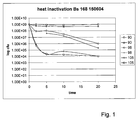
- Fig. 1 shows survival of B. subtilis 168 spores after heat treatment at the indicated temperatures during the time period depicted on the X-axis.
- the Y-axis indicates logarithmically the number of colony forming units (cfu).
- Fig. 2 shows a Bioanalyzer pseudogel of RNA isolated from B . subtilis 168 spores treated at three different temperatures (90 °C, 98 °C and 105 °C) each during four different time periods (2, 5, 10 and 20 minutes), indicating the integrity of the RNA.
- the left lane represents molecular weight control.
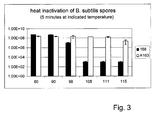
- Fig. 3 shows the results of survival counts of two B. subtilis strains (168 and A163) which have been heat treated at the indicated temperatures (X-axis) during a period of 5 minutes.
- Y-axis as in Fig. 1.
- Fig. 4 shows a Bioanalyzer pseudogel of RNA isolated from the spores. Treatments identical as in Fig. 3.
- Fig. 5 Shows a clusteranalysis of spore mRNAs (in duplo, indicated on the right) measured during germination. Red color indicates presence of transcript, green color indicates absence.
- Bs-2 coxA
- Bs-4 ykzE
- Bs-7 sspE
- Fig. 7 indicates survival of B. subtilis 168 spores after heat treatment at 98 °C for the indicated time periods (X-axis). Y-axis as in Fig. 1.
- Fig. 8 depicts the results of the quantitative analysis of degradation of spore rRNAs and mRNAs. The bars indicate the 10 log value of the decrease in RNA concentration measured in treated spores in comparison with untreated spores. Spores and treatment s in Fig. 7.
- spores contain ribosomal RNAs (more particularly the 16S and 23S rRNAs) and also mRNAs for about 20 gene products. The latter finding is surprising, since it was generally thought that only de novo transcription takes place in spores (during germination). This small group of mRNAs is generated during the last phase of sporulation and is in general rapidly degraded during germination. The function of these transcripts and why they are maintained in the spore is as of yet unclear. A list of the mRNAs that are found in spores is given in Table 1. Table 1: List of spore mRNA found in spores of B.
- both rRNA and mRNA enable using molecular biological techniques to study survival and/or heat resistance in spores during radiation and heat treatment (e.g. for preservation).
- One of the findings of this invention is that both rRNA and mRNA are being degraded during heat treatment, which degradation coincides with the loss of viability of the spores. Degradation predominantly depends on the type of micro-organism: in spores of a more heat resistant micro-organism the degradation of the RNA starts at higher temperatures. Thus, the degradation of RNA is an excellent parameter for determination of the viability and/or (sublethal) damage of the spores.
- RNA and/or determination of the length of the RNA fragments can now be used to assess the viability of spores in (food and other) samples. This is not only useful during development of preservation methods on basis of heat treatment, but these assays can also be applied in the regular testing of the condition of food samples, e.g. by the commodity inspection department.
- the presence of mRNA in spores can be used to generate assays for the identification and classification of spores in samples. It is envisaged that typical differences in nucleotide sequence or polymorphisms between species of bacteria can be used to type the spores. This would make redundant the time consuming culturing of the spores and typing of the resulting colonies.
- RNA of the spores has to be isolated from the sample.
- methods which are well known to a person skilled in the art can be used (e.g. Vaerewijck, M.J.M. et al. (2001) J. Appl. Microbiol. 91:1074-1084 ).
- spores are lysed and RNA is extracted using commonly known techniques.
- RNA isolation from spores can, for instance, be done through a commercially available kit, such as the BI0101-FASTRNA Pro Blue kit (QBIOGENE cat no 6025-050).
- the extracted sample can be treated further with a DNAse1, such as present in the TURBO DNA-free kit (AMBION, cat no 1907).
- RNA Determination of the length of the RNAs can be performed on normal gels, such as agarose gels, but it is also possible to analyse the integrity of the RNA on a bioanalyzer RNA chip, such as a RNA 6000 Nano LabChip (Agilent Technologies cat no 5065-4476) using a 2100 bioanalyzer (Agilent Technologies, cat no G2940CA).
- a bioanalyzer RNA chip such as a RNA 6000 Nano LabChip (Agilent Technologies cat no 5065-4476) using a 2100 bioanalyzer (Agilent Technologies, cat no G2940CA).
- the integrity of the isolated RNA samples is normally derived from the relative intensity of the bands for the ribosomal subunits (16S and 23S). When the RNA is intact the ratio between 23S and 16S is about 2:1. On RNA degradation this ratio shifts usually in favour of 16S RNA and increasingly RNA debris is found.
- RNA amplification kit such as Nucleic Acid Sequence Based Amplification (NASBA)
- NASBA Nucleic Acid Sequence Based Amplification
- Methods of the invention can in principle be performed by using any nucleic acid amplification method, such as the Polymerase Chain Reaction (PCR; Mullis 1987, U.S. Pat. No. 4,683,195 , 4,683,202 , en 4,800,159 ) or by using amplification reactions such as Ligase Chain Reaction (LCR; Barany 1991, Proc. Natl. Acad. Sci.
- PCR Polymerase Chain Reaction
- LCR Ligase Chain Reaction
- a Real Time-PCR or a semi-RT-PCR can be used for quantitative assays. All of these amplification techniques are known by the person skilled in the art, and application of those can be found in the Examples, hereunder.
- the detection of the amplification products can in principle be accomplished by any suitable method known in the art.
- the detection fragments may be directly stained or labelled with radioactive labels, antibodies, luminescent dyes, fluorescent dyes, or enzyme reagents.
- Direct DNA stains include for example intercalating dyes such as acridine orange, ethidium bromide, ethidium monoazide or Hoechst dyes.
- the DNA fragments may be detected by incorporation of labelled dNTP bases into the synthesized DNA fragments.
- Detection labels which may be associated with nucleotide bases include e.g. fluorescein, cyanine dye or BrdUrd.
- Amplification can be used to detect the integrity of the RNA sequences because amplification primers can be chosen in such a way that only (nearly) complete, i.e. not yet degraded sequences will be amplified.
- a suitable way to accomplish this is by choosing a forward amplification primer which corresponds with a sequence at the 5' end of the sequence which needs to be amplified. Consequently, the backward or reverse primer should be chosen to correspond with a sequence at the 3' end of the sequence to be amplified.
- primer refers to an oligonucleotide which is capable of annealing to the amplification target allowing a DNA polymerase to attach thereby serving as a point of initiation of DNA synthesis when placed under conditions in which synthesis of primer extension product which is complementary to a nucleic acid strand is induced, i.e., in the presence of nucleotides and an agent for polymerization such as DNA polymerase and at a suitable temperature and pH.
- the (amplification) primer is preferably single stranded for maximum efficiency in amplification.
- the primer is an oligodeoxy ribonucleotide.
- primer must be sufficiently long to prime the synthesis of extension products in the presence of the agent for polymerization.
- the exact lengths of the primers will depend on many factors, including temperature and source of primer.
- a "pair of bi-directional primers" as used herein refers to one forward and one reverse primer as commonly used in the art of DNA amplification such as in PCR amplification.
- primer sets should be chosen which recognise all possible present micro-organisms. This can be achieved by identifying conserved sequences, which are shared by all the micro-organisms. Since it is sometimes impossible to cover all micro-organisms with one and the same primer set, it is envisaged that more than one pair of bidirectional primers is needed to be present in de amplification reaction mixture to enable amplification of at least one sequence from all possibly present micro-organisms.
- the 16S and 23S rRNA are rich in stretches of conserved sequences.
- degenerated primers i.e. primers which do not or less suffer from any mismatches between the primer sequence and the target sequence on the gene to be amplified, thereby allowing for hybridisation of the primer to a target sequence with a lower homology.
- Another method to determine the viability and/or amount of damage to the spores is to assess for the ratio of intact DNA versus intact RNA.
- the spores also contain DNA, which has other temperature sensitivity than RNA.
- DNA which has other temperature sensitivity than RNA.
- a simple detection of the amounts of DNA and the amounts of RNA can then be used to determine viability and/or damage.
- Another embodiment of the present invention involves the detection of the reaction products obtained by the above described DNA amplification reaction.
- Amplification of the nucleotides sequences in the sample is especially indicated when the detection of nucleotides is used for typing the identity of the spores, i.e. the micro-organism which has generated the spores.
- Suitable detection procedures for use in the typing aspect of present invention may for example comprise immobilization of the amplicons (the amplified sequences) and probing the DNA sequences thereof by e.g. Southern blotting.
- Other formats may comprise an EIA format.
- the type-specific probes may comprise a label moiety such as a fluorophore, a chromophore, an enzyme or a radio-label, so as to facilitate monitoring of binding of the probes to the reaction product of the amplification reaction.
- labels are well-known to those skilled in the art and include, for example, fluorescein isothiocyanate (FITC), ⁇ -galactosidase, horseradish peroxidase, streptavidin, biotin, digoxigenin, 35 S or 125 I. Other examples will be apparent to those skilled in the art.
- a method of typing according to the invention is preferably performed by hybridisation of PCR products to type-specific probes immobilized to beads or RLB filters, such as recently described for e.g. a consensus PCR method ( van den Brule et al., 2002, J. Clin. Microbiol. 40, 779-787 ).
- RLB probes are preferably synthesized with a 5' amino group for subsequent immobilization on e.g. carboxyl-coated nylon membranes.
- the advantage of such a format is the ease of the system and its speed, thus allowing for high throughput sample processing.
- the various types of micro-organisms that occur in a sample to be tested may be detected by using a plurality of type-specific detection probes that, individually, bind only to the amplicon of one specific micro-organism.
- a method is provided for typing of the various micro-organisms. Typing can be done on the rRNA, but is preferably performed on the mRNA, since a lot more variation between the micro-organisms is present in said mRNA, which increases the possibility for generating specific probes.
- typing can also be achieved by amplification alone: then, instead of using a universal pair of bidirectional primers (or sets of bidirectional primers), specific primer sets can be used. If amplification products are formed on basis of such a specific amplification reaction a positive detection (and typing) is achieved. Again, on basis of the larger variability within the mRNAs, specific primer pairs are preferably designed on basis of unique mRNA sequences.
- multiplex amplification i.e. an amplification procedure which comprises multiple specific pairs of bidirectional primers directed to different mRNAs of different micro-organisms, is used. However, in such a system, care should be taken that each of the amplification reaction products is differently labelled to enable specific detection.
- the present invention can also be applied in other areas where heat and/or radiation and/or pressure are used for sterilisation (i.e. killing of micro-organisms).
- sterilisation i.e. killing of micro-organisms.
- An example of such an area is in the medical environment where surgical instruments, hospital consumables, such as bandages and surgical gloves, and also patient waste material require sterilisation.
- B. subtilis oligonucleotide library (Sigma-Genosys #BACLIB96) was spotted onto Corning GAPSII slides (Corning, #40003) according to standard protocols.
- Cy-labeled cDNA of spore RNA was made by direct incorporation of cy-labeled dUTP according to standard protocols.
- Hybridisation and washing of the micro-arrays was performed on an automated slide processor (Agilent) and scanning of the micro-array slides was done in an automated slide scanner (Agilent) according to the manufacturer's instructions.
- RNA isolation was performed as described in Example 2.
- the isolated RNA was subjected to reverse transcription PCR (RT PCR) using Ready-to-Go RT-PCR Beads (Amersham Biosciences #27-9266-01) according to the manufacturer's instructions. Template concentration was between 10 and 200 ng.
- the primers used (determining 9 of the 20 transcription products) are indicated in Table 2. Table 2.
- RT-PCR Primer sequences Gene Primer forward Primer reverse TLP TATCAGCAGCCTAATCCTG CGTTTTGTCTCGCTGCAG YHCV GAGTTCAGTTAAAGATAC ATACGAGTTCTGTTGACATC YFHD GGGCAGAAATCATATCC CGCTCTGTTGTCGGCTG YKZE AACCGTCATAGCAGAGAC TCAGGCTTGGTGACTTcc SSPN ATGGGAAACAACAAGAAAAAC TCGCCTTTTGTCTGCATG SSPE GCTAACTCAAATAACTTCAGC CAGCAGATTGGTTTTGCTG COXA GATACGCGCAATAACGGC ATATGTTCCGTCAGTTGCC YQFX GAAGGTGGCAAACGATTAC TGATGGACAAGGCTAAAGC Table 3.
- B. subtilis 168 spores were heat treated at 98 °C, the survival was measured by plating and culturing, and the spore RNA was isolated as described above. Reverse transcription of the spore RNA was performed using a RETROscript kit (Ambion, #1710) according to the manufacturer's instructions. Quantitative PCR was performed using a QuantiTect Multiplex PCR kit (Qiagen, #204543) on a 7500 Real-Time PCR System (Applied Biosystems). Primers and probes (see Table 2) were designed using the QuantiProbe Design Software (http://customassays.qiagen.com/design/inputsequences.asp ).
- Two primer-probe sets were used to study the effects on the rRNA (16S and 23S). Two primer-probe sets were directed against the ykzE and coxA spore transcripts. In this type of experiments, the number of amplification cycles (Ct) required to reach a certain threshold level, is used to calculate the original amount of template. A titration curve with genomic DNA was used to calibrate. A ten times reduction in template concentration appeared to increase the number of cycles necessary to reach the threshold by three. This calibration was used to interpret the differences in Ct values between the treated and untreated spores.
- Ct amplification cycles
- Fig. 7 shows the survival of heat treated spores according to the classical plating and culturing assay.
- Fig. 8 shows the results of the qPCR. It is clear that heat treatment results in a reduction of both the rRNAs and the mRNAs (which is in concordance with the earlier results on basis of gel electrophoresis). It also appears from this more sensitive qPCR that ykzE, which was deemed to be unresponsive in the RT-PCR assay, indeed degrades as a result of the heat treatment.
Landscapes
- Chemical & Material Sciences (AREA)
- Life Sciences & Earth Sciences (AREA)
- Organic Chemistry (AREA)
- Health & Medical Sciences (AREA)
- Proteomics, Peptides & Aminoacids (AREA)
- Wood Science & Technology (AREA)
- Engineering & Computer Science (AREA)
- Analytical Chemistry (AREA)
- Zoology (AREA)
- Bioinformatics & Cheminformatics (AREA)
- Physics & Mathematics (AREA)
- Immunology (AREA)
- Microbiology (AREA)
- Molecular Biology (AREA)
- Genetics & Genomics (AREA)
- General Health & Medical Sciences (AREA)
- Biotechnology (AREA)
- Biochemistry (AREA)
- Biophysics (AREA)
- General Engineering & Computer Science (AREA)
- Epidemiology (AREA)
- Public Health (AREA)
- Measuring Or Testing Involving Enzymes Or Micro-Organisms (AREA)
Abstract
The invention lies in the field of microbiology, more particularly in the field of (food) preservation and testing of viability of microbiological spores. It is shown that measurement of the integrity of both rRNA and mRNA in spores is an accurate indicator of viability. Nucleotide assays then form a significant improvement over the state of the art assays for viability.
Description
- The invention lies in the field of microbiology, more particularly in the field of (food) preservation and testing of viability of microbiological spores.
- Since the development of pasteurisation no real break-through has found place in the field of food preservation. The most common preservation process is heat treatment and the effectiveness of preservation is nowadays determined by a trial and error method. Thus, present preservation methods are directed to a 'worst case' scenario, in which the most infected sample is taken as standard for subsequent preservation treatments. One of the reasons for this is that a detailed insight in the process of preservation lacks: current methodologies are not capable of a reliable and quick assessment of the micro-organisms and their viability in relation to the preservation process. Hitherto, the inactivation of contaminating micro-organisms is measured indirectly: by determining the growth of surviving micro-organisms after heat treatment.
This method has two large disadvantages: - it is very time consuming (often results are only available after more than two days);
- if no survivors are measured, it cannot be determined whether the applied treatment was just barely sufficient or meant an overkill.
- The worst case scenario in practice means that often more energy is used for the heat treatment than would have been necessary, because either the contamination was less than expected or the micro-organisms in the sample were more heat-sensitive than those on which the treatment was based.
- Thus, there is a large need for rapid microbiological testing of (heat) treated samples to assess the quality and effect of the preservation treatment.
- In the last couple of years genomic techniques have enabled a relatively rapid and specific approach to microbiological assaying. With these techniques it is possible to detect even small amounts of (micro)organisms within a sample, and it has become possible to discriminate between micro-organisms on a species or subspecies level. However, especially in heat (or other stress) treated food, the most important safety challenge is not formed by surviving micro-organisms, but by the spores that most of the spore-forming micro-organisms form under unfavourable (stress) conditions. Spore-forming micro-organisms, such as Bacillus, determine for a major part the shelf-life of heat-preservation treated food. One spore is formed from one vegetative bacterium. Each spore is composed of a protoplast, a protoplast membrane, cortex and three coat layers (Turnbill, 1996). This multilayered outer shell excludes macromolecules. An additional heat and chemical resistant component in the cortex, peptidoglycan, increases the spore's resiliency (Turnbill, 1996). Bacillus spores central protoplast contains dipicolinic acid, (DPA), the component necessary for high temperature tolerance (Turnbill, 1996). Slieman et al. (2001) found that approximately 10 percent of a spore's dry weight is DPA. DPA exists as a calcium complex. Rosen et al. (1997) developed a terbium chloride assay to identify and quantify endospore concentrations utilizing this DPA-Ca++ complex. The reaction between the calcium dipicolinic acid complex and terbium chloride results in a terbium (III) anion. This terbium anion is photoluminescent when in the presence of the DPA-Ca++ complex and is easily recognized.
- Several species of Bacillus are important to human and animal health. B. anthracis, the agent of anthrax, is a zoonotic disease which primarily affects grazing animals and can also be a dangerous pathogen to humans. B. anthracis spores are known to survive along livestock trails in the United States causing frequent outbreaks in states from Texas to South Dakota (CDC, 2001). Members of the B. cereus group can cause food poisoning in humans and related forms (eg. B. thuringiensis) are used in biological control of insect pests.
- As mentioned above, the protoplast is enveloped by the cortex, followed by three protein coats (Turnbill, 1996). However, members of the B. cereus group, which includes, B. anthracis, have an additional protective layer, the outer-most exosporium. These multilayered outer structures, which can make up half of the spore's weight, provide protection for the spores from chemical, physical and enzymatic degradation (Turnbill, 1996).
- There are several reliable assays used to characterize and identify spores. Genetic identification relies on PCR- DNA sequencing to identify the species by their nucleotide sequences (Hansen,B., Leser,T., Hendriksen, N. 2001. Polymerase chain reaction assay for the detection of Bacillus cereus group cells. FEMS Microbiology Letters 202: 209-213.; Kolbert, C., Persing, D. 1999. Ribosomal DNA sequencing as a tool for identification of bacterial pathogens. Microbiology 2:299-305.). Phenotypic identification relies on physiological profiling such as the Sherlock Microbial Identification System (MIDI Inc., Newark, DE), and BIOLOG, (Biolog, Inc., Hayward, CA). The MIDI system utilizes fatty acid analysis of the bacterium, and assigns a numerical value to the results, called a similarity index. This similarity index is then compared to an internal library which chooses the most similar identities for the microbes in question. BIOLOG is a cell-based test for utilization of carbon sources. It requires a 96-well plate with multiple carbon sources from which color changes are compared to a Biolog library to determine the identification of the bacterium. Steady-state fluorescence is a powerful tool for distinguishing differences in molecules and macromolecules and the technique may prove useful in examining spores. Fluorescence spectroscopy utilizes emission peaks to characterize spores. It is a sensitive technique because excitation is performed at a single wavelength. The resulting emission data are recorded at a longer wavelength. Bronk and Reinisch (1993) concluded that initial microbial identification could be generated using fluorescence spectroscopy. All spore assays are influenced by environmental contaminants (Kuske, et al., 1998, Balser, et al. 2002, Gamo et al. 1999) and each would benefit from isolation, concentration and purification.
- One technique that may aid in spore isolation and concentration from environmental samples is to use partitioning into hexadecane or some similar hydrophobic material whereby hydrophobic spores would partition into the hydrocarbon and hydrophilic spores would remain in the aqueous phase.
- Thus spores are commonly more heat-resistant than the cells of the micro-organism, also because they do not require an active metabolism during the spore stage. Yet, on return of favourable conditions the spores can develop into colonizing micro-organisms and then are able to cause enormous healthrisks. Until now no genomics-based techniques have been developed to assay the amount and viability of spores after preservation treatment.
- The invention now provides for an easy and reliable assay to measure the viability and/or detoriation (e..g. by damaging) of spores during or after preservation treatment. The assay uses biomarkers, comprising RNAs, more especially ribosomal RNAs (rRNAs) and messenger RNAs (mRNAs). It has now been found that preservation treatments such as a heat treatment or pressure degrades these RNAs and also that the sensitivity towards degradation varies within these ribonucleotides Further, the invention provides for a system to type the spores, which are present as food contaminants.
- Thus, the invention provides a method to measure viability of heat, pressure or radiation treated bacterial spores comprising measuring the degree of degradation of RNA by said heat or radiation treatment in said spores, particularly wherein the RNA is either ribosomal RNA (rRNA), messenger RNA (mRNA) or both, more particularly wherein the treatment is heat treatment.
- Another embodiment of the invention is a method to assay the effect of heat preservation methods by performing a method as described above.
- Alternatively, the invention provides a method to assay bacterial contamination after heat or radiation preservation by performing a method according to the invention.
- The invention also provides a heat preservation method comprising
- a) maintaining a sample at a certain temperature for a certain time;
- b) performing a method according to the invention.
- Another embodiment of the present invention is formed by the use of RNA in microbial spores as a biomarker for viability.
- Further, the invention provides a method for typing microbial spores comprising the steps of:
- a) isolating the RNA form said spores;
- b) optionally translate the RNA to DNA by reverse transcriptase and/or amplify the RNA or DNA; and
- c) hybridising said RNA with type specific nucleotide probes or performing a sequence analysis of said RNA;
preferably wherein the RNA is mRNA. - Fig. 1 shows survival of
B. subtilis 168 spores after heat treatment at the indicated temperatures during the time period depicted on the X-axis. The Y-axis indicates logarithmically the number of colony forming units (cfu). - Fig. 2 shows a Bioanalyzer pseudogel of RNA isolated from
B . subtilis 168 spores treated at three different temperatures (90 °C, 98 °C and 105 °C) each during four different time periods (2, 5, 10 and 20 minutes), indicating the integrity of the RNA. The left lane represents molecular weight control. - Fig. 3 shows the results of survival counts of two B. subtilis strains (168 and A163) which have been heat treated at the indicated temperatures (X-axis) during a period of 5 minutes. Y-axis as in Fig. 1.
- Fig. 4 shows a Bioanalyzer pseudogel of RNA isolated from the spores. Treatments identical as in Fig. 3.
- Fig. 5 Shows a clusteranalysis of spore mRNAs (in duplo, indicated on the right) measured during germination. Red color indicates presence of transcript, green color indicates absence.
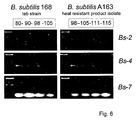
- Fig. 6 shows ethidium bromide stained gels of three PCR products (Bs-2 (=coxA), Bs-4 (=ykzE) and Bs-7 (=sspE) obtained through RT-PCR from the spore mRNA. In each panel the left lane shows the molecular weight marker.
- Fig. 7 indicates survival of
B. subtilis 168 spores after heat treatment at 98 °C for the indicated time periods (X-axis). Y-axis as in Fig. 1. - Fig. 8 depicts the results of the quantitative analysis of degradation of spore rRNAs and mRNAs. The bars indicate the 10log value of the decrease in RNA concentration measured in treated spores in comparison with untreated spores. Spores and treatment s in Fig. 7.
- The presence of messenger RNA is microbial spores has been disputed. Some old literature indicates that spores contain mRNAs (Aronson A.J., 1965, Mol. Biol. 13:92-104; Jeng Y.H. and Doi R.H., 1974, J. Bacteriol. 119:514-521), while other authors report an absence (Halvorson HO, Vary JC, Steinberg W., J, (1966). Developmental changes during the formation and breaking of the dormant state in bacteria. Annu Rev Microbiol 20:169-88; R. H. Doi and R. T. Igarashi (1964) RIBONUCLEIC ACIDS OF BACILLUS SUBTILIS SPORES AND SPORULATING CELLS. Bacteriol. February; 87(2): 323-328.). However, nowhere in the art identification of spores on basis of mRNA or other RNA sequences is taught.
- It has now appeared that spores contain ribosomal RNAs (more particularly the 16S and 23S rRNAs) and also mRNAs for about 20 gene products. The latter finding is surprising, since it was generally thought that only de novo transcription takes place in spores (during germination). This small group of mRNAs is generated during the last phase of sporulation and is in general rapidly degraded during germination. The function of these transcripts and why they are maintained in the spore is as of yet unclear. A list of the mRNAs that are found in spores is given in Table 1.
Table 1: List of spore mRNA found in spores of B. subtilis 168Gene Details Gene name BG14189 yozQ BG14179 sspN BG14174 sspJ BG13937 ytzC BG13861 ythQ BG13859 ythC BG13782 coxA BG13430 ymfJ BG13334 ykzF BG13333 ykzE BG13008 yhdB BG12879 yfhD BG11921 sspP BG11920 sspO BG11806 tlp BG11670 yqfX BG11600 yhcV BG11595 yhcQ BG11592 yhcN BG10789 sspE BG10108 sspF - The presence of both rRNA and mRNA enables using molecular biological techniques to study survival and/or heat resistance in spores during radiation and heat treatment (e.g. for preservation). One of the findings of this invention is that both rRNA and mRNA are being degraded during heat treatment, which degradation coincides with the loss of viability of the spores. Degradation predominantly depends on the type of micro-organism: in spores of a more heat resistant micro-organism the degradation of the RNA starts at higher temperatures. Thus, the degradation of RNA is an excellent parameter for determination of the viability and/or (sublethal) damage of the spores.
- Molecular biological assays for the detection of RNA and/or determination of the length of the RNA fragments can now be used to assess the viability of spores in (food and other) samples. This is not only useful during development of preservation methods on basis of heat treatment, but these assays can also be applied in the regular testing of the condition of food samples, e.g. by the commodity inspection department.
- Secondly, the presence of mRNA in spores can be used to generate assays for the identification and classification of spores in samples. It is envisaged that typical differences in nucleotide sequence or polymorphisms between species of bacteria can be used to type the spores. This would make redundant the time consuming culturing of the spores and typing of the resulting colonies.
- Typically, for the molecular biological methods of the invention, first the RNA of the spores has to be isolated from the sample. To enrich the sample for spores, methods which are well known to a person skilled in the art can be used (e.g. Vaerewijck, M.J.M. et al. (2001) J. Appl. Microbiol. 91:1074-1084). Then, spores are lysed and RNA is extracted using commonly known techniques. RNA isolation from spores can, for instance, be done through a commercially available kit, such as the BI0101-FASTRNA Pro Blue kit (QBIOGENE cat no 6025-050). To remove superfluous DNA from the RNA, the extracted sample can be treated further with a DNAse1, such as present in the TURBO DNA-free kit (AMBION, cat no 1907).
- Determination of the length of the RNAs can be performed on normal gels, such as agarose gels, but it is also possible to analyse the integrity of the RNA on a bioanalyzer RNA chip, such as a RNA 6000 Nano LabChip (Agilent Technologies cat no 5065-4476) using a 2100 bioanalyzer (Agilent Technologies, cat no G2940CA). The integrity of the isolated RNA samples is normally derived from the relative intensity of the bands for the ribosomal subunits (16S and 23S). When the RNA is intact the ratio between 23S and 16S is about 2:1. On RNA degradation this ratio shifts usually in favour of 16S RNA and increasingly RNA debris is found.
- In order to make detection easier the nucleotides in the sample can be amplified, e.g. through an RNA amplification kit, such as Nucleic Acid Sequence Based Amplification (NASBA),. Alternatively, it is also possible to convert the RNA into DNA by using a reverse transcriptase and then to amplify the DNA by PCR techniques. Methods of the invention can in principle be performed by using any nucleic acid amplification method, such as the Polymerase Chain Reaction (PCR;
Mullis 1987, U.S. Pat. No. 4,683,195 ,4,683,202 ,en 4,800,159 ) or by using amplification reactions such as Ligase Chain Reaction (LCR; Barany 1991, Proc. Natl. Acad. Sci. USA 88:189-193;EP Appl. No., 320,308 U.S. Pat. Nos. 5,270,184 ,en 5,455,166 ), Transcriptional Amplification System (TAS; Kwoh et al., Proc. Natl. Acad. Sci. USA 86:1173-1177), Q-Beta Replicase (Lizardi et al., 1988, Bio/Technology 6:1197), Rolling Circle Amplification (RCA;U.S. Pat. No. 5,871,921 ), Cleavage Fragment Length Polymorphism (U.S. Pat. No. 5,719,028 ), Isothermal and Chimeric Primer-initiated Amplification of Nucleic Acid (ICAN), Ramification-extension Amplification Method (RAM;U.S. Pat. Nos. 5,719,028 and5,942,391 ), LATE-PCR (Sanchez, J.A. et al (2004) PNAS USA 101:1933-1938) or other suitable methods for amplification of DNA. - For quantitative assays a Real Time-PCR or a semi-RT-PCR can be used. All of these amplification techniques are known by the person skilled in the art, and application of those can be found in the Examples, hereunder.
- The detection of the amplification products can in principle be accomplished by any suitable method known in the art. The detection fragments may be directly stained or labelled with radioactive labels, antibodies, luminescent dyes, fluorescent dyes, or enzyme reagents. Direct DNA stains include for example intercalating dyes such as acridine orange, ethidium bromide, ethidium monoazide or Hoechst dyes. Alternatively, the DNA fragments may be detected by incorporation of labelled dNTP bases into the synthesized DNA fragments. Detection labels which may be associated with nucleotide bases include e.g. fluorescein, cyanine dye or BrdUrd.
- Amplification can be used to detect the integrity of the RNA sequences because amplification primers can be chosen in such a way that only (nearly) complete, i.e. not yet degraded sequences will be amplified. A suitable way to accomplish this is by choosing a forward amplification primer which corresponds with a sequence at the 5' end of the sequence which needs to be amplified. Consequently, the backward or reverse primer should be chosen to correspond with a sequence at the 3' end of the sequence to be amplified. Only if forward and reverse primer anneal to one and the same (intact) RNA stretch amplification will occur; if the target sequence has been degraded by heat or radiation treatment a fragment will at the utmost only contain the recognition site for one of the set of primers and no amplification will take place.
- The term "primer" as used herein refers to an oligonucleotide which is capable of annealing to the amplification target allowing a DNA polymerase to attach thereby serving as a point of initiation of DNA synthesis when placed under conditions in which synthesis of primer extension product which is complementary to a nucleic acid strand is induced, i.e., in the presence of nucleotides and an agent for polymerization such as DNA polymerase and at a suitable temperature and pH. The (amplification) primer is preferably single stranded for maximum efficiency in amplification. Preferably, the primer is an oligodeoxy ribonucleotide. The primer must be sufficiently long to prime the synthesis of extension products in the presence of the agent for polymerization. The exact lengths of the primers will depend on many factors, including temperature and source of primer. A "pair of bi-directional primers" as used herein refers to one forward and one reverse primer as commonly used in the art of DNA amplification such as in PCR amplification.
- If the nucleotide sequences from the sample are subjected to amplification for the detection of RNA integrity, it is a prerequisite that from each micro-organism (i.e. from each spore) at least one sequence is amplified. Therefore, primer sets should be chosen which recognise all possible present micro-organisms. This can be achieved by identifying conserved sequences, which are shared by all the micro-organisms. Since it is sometimes impossible to cover all micro-organisms with one and the same primer set, it is envisaged that more than one pair of bidirectional primers is needed to be present in de amplification reaction mixture to enable amplification of at least one sequence from all possibly present micro-organisms. Luckily, the 16S and 23S rRNA are rich in stretches of conserved sequences. Alternatively, or in addition to that, it is also possible to use degenerated primers, i.e. primers which do not or less suffer from any mismatches between the primer sequence and the target sequence on the gene to be amplified, thereby allowing for hybridisation of the primer to a target sequence with a lower homology.
- Another method to determine the viability and/or amount of damage to the spores is to assess for the ratio of intact DNA versus intact RNA. As already mentioned in the introduction, the spores also contain DNA, which has other temperature sensitivity than RNA. In a control experiment it can be determined for a particular bacterial strain how the ratio of DNA:RNA develops when the spores are subjected to heat treatments, and at which ratio the spores are lethally damaged or lost their viability. A simple detection of the amounts of DNA and the amounts of RNA can then be used to determine viability and/or damage.
- Another embodiment of the present invention involves the detection of the reaction products obtained by the above described DNA amplification reaction. Amplification of the nucleotides sequences in the sample is especially indicated when the detection of nucleotides is used for typing the identity of the spores, i.e. the micro-organism which has generated the spores. Suitable detection procedures for use in the typing aspect of present invention may for example comprise immobilization of the amplicons (the amplified sequences) and probing the DNA sequences thereof by e.g. Southern blotting. Other formats may comprise an EIA format. To facilitate the detection of binding, the type-specific probes may comprise a label moiety such as a fluorophore, a chromophore, an enzyme or a radio-label, so as to facilitate monitoring of binding of the probes to the reaction product of the amplification reaction. Such labels are well-known to those skilled in the art and include, for example, fluorescein isothiocyanate (FITC), β-galactosidase, horseradish peroxidase, streptavidin, biotin, digoxigenin, 35S or 125I. Other examples will be apparent to those skilled in the art.
- Although other methods may be employed, a method of typing according to the invention is preferably performed by hybridisation of PCR products to type-specific probes immobilized to beads or RLB filters, such as recently described for e.g. a consensus PCR method (van den Brule et al., 2002, J. Clin. Microbiol. 40, 779-787). For this purpose RLB probes are preferably synthesized with a 5' amino group for subsequent immobilization on e.g. carboxyl-coated nylon membranes. The advantage of such a format is the ease of the system and its speed, thus allowing for high throughput sample processing.
- The various types of micro-organisms that occur in a sample to be tested may be detected by using a plurality of type-specific detection probes that, individually, bind only to the amplicon of one specific micro-organism. Thus, by amplifying the DNA sequence region between the two primer target regions as defined herein, followed by probing for the unique sequences of each individual micro-organism, a method is provided for typing of the various micro-organisms. Typing can be done on the rRNA, but is preferably performed on the mRNA, since a lot more variation between the micro-organisms is present in said mRNA, which increases the possibility for generating specific probes.
- Alternatively, typing can also be achieved by amplification alone: then, instead of using a universal pair of bidirectional primers (or sets of bidirectional primers), specific primer sets can be used. If amplification products are formed on basis of such a specific amplification reaction a positive detection (and typing) is achieved. Again, on basis of the larger variability within the mRNAs, specific primer pairs are preferably designed on basis of unique mRNA sequences. Advantageously, multiplex amplification, i.e. an amplification procedure which comprises multiple specific pairs of bidirectional primers directed to different mRNAs of different micro-organisms, is used. However, in such a system, care should be taken that each of the amplification reaction products is differently labelled to enable specific detection. Systems and labels for multiplex amplification and detection are known to a person skilled in the art, e.g. Hardenbol, P. et al. (2003) Nat. Biotechnol. 21:673-678; Baner, J., et al. (2003) Nucleic Acids Res. 31:e103; Alsmadi, O.A., et al. (2003) BMC Genomics 4:e21; Denef, et al., (2003) Environ. Microbiol. 5:933-943).
- Use of the methods of the invention can of course be found in the food-industry. Not only detection of contamination of actual foodstuffs can be performed through the methods of the invention, these methods also are a useful tool in the development of (new) preservation methods for different types of samples (predominantly food). The methods enable monitoring of preservation processes and quick feedback on the results thereof. Also, as a result of better preservation techniques, next to a decrease of product loss also savings of energy and water can be obtained.
- Besides the food industry, the present invention can also be applied in other areas where heat and/or radiation and/or pressure are used for sterilisation (i.e. killing of micro-organisms). An example of such an area is in the medical environment where surgical instruments, hospital consumables, such as bandages and surgical gloves, and also patient waste material require sterilisation.
- Spores of Bacillus subtilis 168 [Bacillus genetic stock center:
- http://www.bgsc.org/BGSCID:] were generated by culture in synthetic MOPS medium (1.32 mM K2HPO4, 0.4 mM MgCl2, 0.276 mM K2SO4, 0.01 mM FeSO4, 1.36 mM CaCl2, 80 mM MOPS (morpholinepropane sulfonic acid), 4 mM tricine, 3 nM (NH4)6Mo7O24, 0.4 µm H3BO3, 30 nM CoCl2, 10 nM CuSO4, 10 nM ZnCl2, 0.1 mM MnCl2, 20 mM glucose and 10 mM ammoniumchloride). The thus obtained spores were purified with 10 steps of washing with demineralised water at 4 °C. The purity of the spores was monitored with a phasecontrast microscope (>99% phase bright). Heat treatment of the spores was done according to Kooiman et al. ("The screw cap tube technique: A new and accurate technique for the determination of the wet heat resistance of bacterial spores". In: Spore Research, ed: Barker, A.N., Gould G.W. and Wolf, J., 1973, Academic Press, London, pp. 87-92). Survival was counted by plating serial dilutions of the samples in a peptone saline solution on TSA (tryptric soy agar, DIFCO, the Netherlands).
- Results are shown in Fig. 1. It appears that spores of
B. subtilis 168 were able to survive heat treatment of 90 °C, but that survival declines at temperatures of 98 °C and higher. - From the heat treated spores of Example 1 the RNA was isolated with a BIO101-FASTRNA Pro Blue kit (QBiogene #6025-050) according to the manufacturer's instructions, with the modification that the spores were processed 3
times 40 seconds in the FastPrep apparatus (QBiogene #6001-220) on setting 6 with 2 minutes of cooling on ice in between the lysis steps. After precipitation the RNA was treated with the TURBO DNA-free kit (AMBION #1907) according to the manufacturer's instructions. The integrity of the RNA was analysed on a RNA 6000 Nano LabChip (Agilent Technologies #5065-4476) with a 2100 bioanalyzer (Agilent Technologies #G2940CA). - At relatively low temperature treatments two clear bands are visible on the Bioanalyzer pseudogel, which indicate the presence of 16S and 23S rRNA, in a about 1:1.8 ratio (Fig. 2). The intensity of the bands becomes weaker at higher temperatures and/or longer treatment times. This coincides with the appearance of RNA material of low molecular weight.
- To investigate whether the degradation of RNA in the spores is dependent on the heat resistant properties of the spores, also the spores of a micro-organisms with a known higher heat resistance were tested. For this spores of the isolate B. subtilis A163 (Kort R, O'Brien AC, van Stokkum IH, Oomes SJ, Crielaard W, Hellingwerf KJ, Brul S. Assessment of heat resistance of bacterial spores from food product isolates by fluorescence monitoring of dipicolinic acid release. Appl Environ Microbiol. 2005 Jul;71(7):3556-64). were chosen. Spores were generated and heat treated in the same way as the
B . subtilis 168 spores of Example 1. The results are shown in Figs. 3 and 4. While the viability ofB. subtilis 168 spores decreases by 1 log after treatment at 98 °C for 5 minutes, there is no indication of loss of viability in B. subtilis A163 spores after this treatment. A comparable loss of viability in the latter spores only has been demonstrated at a temperature of 115 °C. The integrity of the rRNA fromB. subtilis 168 remained intact at 80°C, but degradation was observed at temperatures of 90 °C and higher (in concordance with the previous experiment). In contrast, the integrity of the RNA isolated from B. subtilis A163 appeared intact after treatments up to 98 °C. With the 105 °C treatment degradation of the RNA was observed, predominantly of the 23S rRNA. Increasing degradation was observed at higher temperatures. - Using microarray analysis germination of B. subtilis spores has been studied. Hereto, a B. subtilis oligonucleotide library (Sigma-Genosys #BACLIB96) was spotted onto Corning GAPSII slides (Corning, #40003) according to standard protocols. Cy-labeled cDNA of spore RNA was made by direct incorporation of cy-labeled dUTP according to standard protocols. Hybridisation and washing of the micro-arrays was performed on an automated slide processor (Agilent) and scanning of the micro-array slides was done in an automated slide scanner (Agilent) according to the manufacturer's instructions.
- This showed (see Fig. 5) that a small group of mRNA molecules was present (about 20), of which the majority rapidly disappears during germination. Only sspE appeared to be present during the whole germination period. According to the fluorescence intensities of the hybridisation signals of the spore mRNAs the level of transcription was relatively high.
- To determine the stability of mRNA after heat treatment the spores were generated and treated as described in Example 1. RNA isolation was performed as described in Example 2. The isolated RNA was subjected to reverse transcription PCR (RT PCR) using Ready-to-Go RT-PCR Beads (Amersham Biosciences #27-9266-01) according to the manufacturer's instructions. Template concentration was between 10 and 200 ng. The primers used (determining 9 of the 20 transcription products) are indicated in Table 2.
Table 2. RT-PCR Primer sequences Gene Primer forward Primer reverse TLP TATCAGCAGCCTAATCCTG CGTTTTGTCTCGCTGCAG YHCV GAGTTCAGTTAAAGATAC ATACGAGTTCTGTTGACATC YFHD GGGCAGAAATCATATCC CGCTCTGTTGTCGGCTG YKZE AACCGTCATAGCAGAGAC TCAGGCTTGGTGACTTcc SSPN ATGGGAAACAACAAGAAAAAC TCGCCTTTTGTCTGCATG SSPE GCTAACTCAAATAACTTCAGC CAGCAGATTGGTTTTGCTG COXA GATACGCGCAATAACGGC ATATGTTCCGTCAGTTGCC YQFX GAAGGTGGCAAACGATTAC TGATGGACAAGGCTAAAGC Table 3. qPCR Primer and probe sequences. The dashes indicate superbases added for stability of the probe/primer, see http://www1.qiagen.com/Products/Pcr/QuantiTect/CustomAssays.aspx for details Gene Name Forward Primer Reverse Primer FAM-labeled Probe ykzE 


coxA 


16s rRNA 


23s rRNA 


- Products were analysed with agarose gel electrophoresis using staining with ethidium bromide (Fig. 6). In
untreated B. subtilis 168 spores for all transcription products, except for Tlp, amplification products could be detected. In untreated B. subtilis A163 spores a clear amplification product was obtained with primers for coxA, ykzE, yhcV, yfhD, and yqfX. A weak signal was obtained with sspE primers and no product was formed using Tlp and sspN primers. Possibly these transcripts do not occur in spores of this B. subtilis strain, or the primersequences, which have been designed forB. subtilis 168 sequences, would not be suited for the A163 isolate. - In many cases in heat treated spores, a decrease in the amount of product was observed with increasing treatment temperatures (Fig. 6), which indicates degradation of mRNA. In spores of the A163 strain a similar decrease was observed, but starting at higher temperatures. For Bs-2 (the coxA transcript) no transcripts were detected in 168 spores at treatments temperatures of 98 °C and higher, while for A163 spores a decrease was only observed at temperatures of 115 °C. Bs-4 (ykzE) did not show a clear decrease in the amount of product, which may be an indication that this transcript is less sensitive to heat treatment. Alternatively, the effect could be caused by the quantitative character of the RT-PCR experiment. To investigate this further for a limited set of RNAs a quantitative PCR (qPCR) was performed.
-
B. subtilis 168 spores were heat treated at 98 °C, the survival was measured by plating and culturing, and the spore RNA was isolated as described above. Reverse transcription of the spore RNA was performed using a RETROscript kit (Ambion, #1710) according to the manufacturer's instructions. Quantitative PCR was performed using a QuantiTect Multiplex PCR kit (Qiagen, #204543) on a 7500 Real-Time PCR System (Applied Biosystems). Primers and probes (see Table 2) were designed using the QuantiProbe Design Software (http://customassays.qiagen.com/design/inputsequences.asp). Two primer-probe sets were used to study the effects on the rRNA (16S and 23S). Two primer-probe sets were directed against the ykzE and coxA spore transcripts. In this type of experiments, the number of amplification cycles (Ct) required to reach a certain threshold level, is used to calculate the original amount of template. A titration curve with genomic DNA was used to calibrate. A ten times reduction in template concentration appeared to increase the number of cycles necessary to reach the threshold by three. This calibration was used to interpret the differences in Ct values between the treated and untreated spores. - Fig. 7 shows the survival of heat treated spores according to the classical plating and culturing assay. Fig. 8 shows the results of the qPCR. It is clear that heat treatment results in a reduction of both the rRNAs and the mRNAs (which is in concordance with the earlier results on basis of gel electrophoresis). It also appears from this more sensitive qPCR that ykzE, which was deemed to be unresponsive in the RT-PCR assay, indeed degrades as a result of the heat treatment.
-


Claims (9)
- Method to measure viability of heat, pressure or radiation treated bacterial spores comprising measuring the degree of degradation of RNA by said heat, pressure or radiation treatment in said spores.
- Method according to claim 1,where in RNA is either ribosomal RNA (rRNA), messenger RNA (mRNA) or both
- Method according to claim 1 or 2, wherein the treatment is heat treatment
- Method to assay the effect of heat preservation methods by performing a method according to claim 1-3.
- Method to assay bacterial contamination after heat or radiation preservation by performing a method according to claim 1-3
- Heat preservation method comprisinga) maintaining a sample at a certain temperature for a certain time;b) performing a method according to claim 1-3.
- Use of RNA in microbial spores as a biomarker for viability.
- Method for typing microbial spores comprising the steps of:a) isolating the RNA form said spores;b) optionally translate the RNA to DNA by reverse transcriptase and/or amplify the RNA or DNA; andc) hybridising said RNA with type specific nucleotide probes or performing a sequence analysis of said RNA.
- Method according to claim 8, wherein the RNA is mRNA
Priority Applications (4)
| Application Number | Priority Date | Filing Date | Title |
|---|---|---|---|
| EP05077246A EP1772522A1 (en) | 2005-10-04 | 2005-10-04 | Control of preservation by biomarkers |
| US12/089,149 US20080299564A1 (en) | 2005-10-04 | 2006-08-04 | Control of Preservation By Biomarkers |
| EP06783879A EP1937836A1 (en) | 2005-10-04 | 2006-08-04 | Control of preservation by biomarkers |
| PCT/NL2006/000412 WO2007040385A1 (en) | 2005-10-04 | 2006-08-04 | Control of preservation by biomarkers |
Applications Claiming Priority (1)
| Application Number | Priority Date | Filing Date | Title |
|---|---|---|---|
| EP05077246A EP1772522A1 (en) | 2005-10-04 | 2005-10-04 | Control of preservation by biomarkers |
Publications (1)
| Publication Number | Publication Date |
|---|---|
| EP1772522A1 true EP1772522A1 (en) | 2007-04-11 |
Family
ID=35976744
Family Applications (2)
| Application Number | Title | Priority Date | Filing Date |
|---|---|---|---|
| EP05077246A Withdrawn EP1772522A1 (en) | 2005-10-04 | 2005-10-04 | Control of preservation by biomarkers |
| EP06783879A Withdrawn EP1937836A1 (en) | 2005-10-04 | 2006-08-04 | Control of preservation by biomarkers |
Family Applications After (1)
| Application Number | Title | Priority Date | Filing Date |
|---|---|---|---|
| EP06783879A Withdrawn EP1937836A1 (en) | 2005-10-04 | 2006-08-04 | Control of preservation by biomarkers |
Country Status (3)
| Country | Link |
|---|---|
| US (1) | US20080299564A1 (en) |
| EP (2) | EP1772522A1 (en) |
| WO (1) | WO2007040385A1 (en) |
Cited By (7)
| Publication number | Priority date | Publication date | Assignee | Title |
|---|---|---|---|---|
| FR2930949A1 (en) * | 2008-05-06 | 2009-11-13 | Suez Environnement Sa | Determining viability of pathogenic bacteria in medium, comprises PCR amplification of at least two target RNA, evaluating change in level of RNAs, and using relationship between levels of disappearance of persistent and labile target RNA |
| EP2198296A4 (en) * | 2007-09-05 | 2011-04-13 | Laurentian University | METHOD OF USING TUMOR RNA INTEGRITY TO MEASURE THE RESPONSE TO CHEMOTHERAPY IN PATIENTS WITH CANCER |
| US10385400B2 (en) | 2012-12-03 | 2019-08-20 | Rna Diagnostics Inc. | Methods and kits for monitoring response to radiation therapies in cancer |
| US10590463B2 (en) | 2011-08-10 | 2020-03-17 | RNA Disgnostics Inc. | Diagnostic methods and kits for monitoring response to chemotherapy in ovarian cancer |
| US10731222B2 (en) | 2013-10-04 | 2020-08-04 | Rna Diagnostics Inc. | RNA disruption assay for predicting survival |
| US11031096B2 (en) | 2012-04-24 | 2021-06-08 | Rna Diagnostics Inc. | Method for determining efficacy of chemotherapy treatment for a subject |
| US12633374B2 (en) | 2021-06-04 | 2026-05-19 | Rna Diagnostics Inc. | Method for determining efficacy of chemotherapy treatment for a subject |
Citations (2)
| Publication number | Priority date | Publication date | Assignee | Title |
|---|---|---|---|---|
| EP1099764A2 (en) * | 1999-11-10 | 2001-05-16 | Propper Manufacturing Co., Inc. | Sterilization indicator using DNA specific dyes |
| US20040106167A1 (en) * | 1999-05-03 | 2004-06-03 | Icf Technologies, Inc. | Methods for evaluating sterilization procedures using a biological indicator |
Family Cites Families (50)
| Publication number | Priority date | Publication date | Assignee | Title |
|---|---|---|---|---|
| US3672956A (en) * | 1970-01-30 | 1972-06-27 | Monsanto Co | Germination of spores |
| US4328203A (en) * | 1979-04-27 | 1982-05-04 | Battelle Development Corporation | Microbial insecticide |
| US5464773A (en) * | 1994-03-14 | 1995-11-07 | Amoco Corporation | Cell disrupting apparatus |
| US5795730A (en) * | 1995-02-15 | 1998-08-18 | Minnesota Mining And Manufacturing Company | Rapid read-out biological indicator |
| FR2734844B1 (en) * | 1995-06-02 | 1997-08-22 | Unir | PROCESS FOR EVIDENCE OF HEAT-RESISTANT MICROORGANISMS THAT CAN CONTAMINATE CERTAIN FOODSTUFFS |
| US5973137A (en) * | 1996-02-13 | 1999-10-26 | Gentra Systems, Inc. | Low pH RNA isolation reagents, method, and kit |
| US5928875A (en) * | 1998-05-27 | 1999-07-27 | Betzdearborn Inc. | Primers for the detection of spore forming bacteria |
| US5989824A (en) * | 1998-11-04 | 1999-11-23 | Mesosystems Technology, Inc. | Apparatus and method for lysing bacterial spores to facilitate their identification |
| US7326562B2 (en) * | 1999-05-03 | 2008-02-05 | Icf Technologies, Inc. | Biological indicator system to detect effectiveness of sterilization |
| JP2002542836A (en) * | 1999-05-03 | 2002-12-17 | アイシーエフ テクノロジーズ, インコーポレーテッド | Methods, compositions and kits for biological indicators of sterilization |
| US6942989B2 (en) * | 1999-05-03 | 2005-09-13 | Icf Technologies, Inc. | Methods, compositions and kits for biological indicator of sterilization |
| US6472155B1 (en) * | 1999-06-08 | 2002-10-29 | The Regents Of The University Of California | Species specific identification of spore-producing microbes using the gene sequence of small acid-soluble spore coat proteins for amplification based diagnostics |
| AU2001273009A1 (en) * | 2000-06-26 | 2002-01-08 | Maxygen, Inc. | Methods and compositions for developing spore display systems for medicinal and industrial applications |
| US20020150594A1 (en) * | 2000-06-26 | 2002-10-17 | Maxygen, Inc. | Methods and compositions for developing spore display systems for medicinal and industrial applications |
| US6855498B2 (en) * | 2000-09-21 | 2005-02-15 | U.S. Environmental Protection Agency | In-situ hybridization probes for the detection of microsporidial species |
| AU2002354838B2 (en) * | 2001-07-19 | 2007-11-29 | Infectio Diagnostic (I.D.I.) Inc. | Universal method and composition for the rapid lysis of cells for the release of nucleic acids and their detection |
| US20030215811A1 (en) * | 2002-05-17 | 2003-11-20 | Frank Schaefer | Detection of microsporidial species using a quantitative real-time PCR assay |
| FI20021325A0 (en) * | 2002-07-05 | 2002-07-05 | Valtion Teknillinen | Method and kit for determining the amount of individual polynucleotides |
| DE10242433A1 (en) * | 2002-09-11 | 2004-03-25 | Henkel Kgaa | Chip carrying probes for specific genes, useful for rapid monitoring of organism status, particularly during fermentation |
| US7303875B1 (en) * | 2002-10-10 | 2007-12-04 | Nanosys, Inc. | Nano-chem-FET based biosensors |
| AU2003277451A1 (en) * | 2002-10-18 | 2004-05-04 | Midwest Research Institute, Inc. | Method for quantitative end-point pcr |
| EP1572736A2 (en) * | 2002-12-10 | 2005-09-14 | Endocube SAS | Thap proteins as nuclear receptors for chemokines and roles in transcriptional regulation, cell proliferation and cell differentiation |
| EP1457573B1 (en) * | 2003-03-04 | 2006-06-21 | PamGene B.V. | Method for integrated nucleic acid integrity assessment and analysis |
| US20040197795A1 (en) * | 2003-03-31 | 2004-10-07 | Fen Huang | Method of inactivating ribonucleases at high temperature |
| DE10315581B4 (en) * | 2003-04-05 | 2007-06-28 | Agilent Technologies, Inc. (n.d.Ges.d.Staates Delaware), Palo Alto | Method for quality determination of RNA samples |
| EP1493816A1 (en) * | 2003-07-02 | 2005-01-05 | Friesland Brands B.V. | Methods and means for regulating gene expression |
| US20050026153A1 (en) * | 2003-07-31 | 2005-02-03 | Iannotti Claudia A. | Devices and methods for isolating RNA |
| US20050123952A1 (en) * | 2003-09-04 | 2005-06-09 | Griffey Richard H. | Methods of rapid detection and identification of bioagents using microRNA |
| FR2861085B1 (en) * | 2003-10-15 | 2006-01-27 | Bertin Technologies Sa | NUCLEIC ACID EXTRACTION METHOD AND APPLICATION THEREOF IN THE ANALYSIS OF THE MICROBIAL AIR POPULATION |
| DK1702059T3 (en) * | 2003-12-09 | 2013-03-04 | Novozymes Inc | Methods for the elimination and reduction of expression of genes in filamentous fungal strains |
| WO2005083078A1 (en) * | 2004-02-26 | 2005-09-09 | Thomsen Bioscience A/S | Method, chip, device and system for extraction of biological materials |
| WO2005090609A1 (en) * | 2004-03-18 | 2005-09-29 | Arcturus Bioscience, Inc. | Determination of rna quality |
| US7262047B2 (en) * | 2004-05-06 | 2007-08-28 | California Institute Of Technology | Bacillus pumilus SAFR-032 isolate |
| DE102004061664A1 (en) * | 2004-12-22 | 2006-07-06 | Henkel Kgaa | Nucleic acid-binding chips for the detection of phosphate deficiency states in the context of bioprocess control |
| AU2006243757B2 (en) * | 2005-05-03 | 2012-02-09 | Altheadx, Inc. | Compositions and methods for the analysis of degraded nucleic acids |
| US20060281110A1 (en) * | 2005-05-26 | 2006-12-14 | Michigan State University | Methods to identify antimicrobial compounds that interrupt ribosome biogenesis |
| JP4690787B2 (en) * | 2005-06-14 | 2011-06-01 | 株式会社日立製作所 | Microorganism detection chip, microorganism detection system, and microorganism detection method |
| WO2007011902A2 (en) * | 2005-07-15 | 2007-01-25 | Applera Corporation | Methods for rna profiling |
| DE102005042572A1 (en) * | 2005-09-08 | 2007-03-15 | Henkel Kgaa | Nucleic acid-binding chips for the detection of nitrogen deficiency states in the context of bioprocess control |
| WO2007035684A2 (en) * | 2005-09-16 | 2007-03-29 | Primera Biosystems, Inc. | Method for quantitative detection of short rna molecules |
| JP2008043332A (en) * | 2006-08-17 | 2008-02-28 | Panomics Inc | Quantitative determination of nucleic acid from tissue slide |
| US20080176755A1 (en) * | 2006-08-25 | 2008-07-24 | The Trustees Of Columbia University In The City Of New York, Office Of The General Counsel | Systems and methods for biodosimetry with biochip using gene expression signatures |
| US7602307B1 (en) * | 2006-11-13 | 2009-10-13 | Sandia Corporation | Portable modular detection system |
| EP2102613B1 (en) * | 2006-12-13 | 2012-08-22 | Genosmart Ltd. | Versatile thermal detection |
| JPWO2009057695A1 (en) * | 2007-10-30 | 2011-03-10 | オリンパス株式会社 | Method for detecting adenoma or cancer by genetic analysis |
| GB0803068D0 (en) * | 2008-02-20 | 2008-03-26 | Health Prot Agency | Cross-linked biological indicator |
| US7871764B1 (en) * | 2008-03-18 | 2011-01-18 | The United States Of America As Represented By The United States Department Of Energy | Universal nucleic acids sample preparation method for cells, spores and their mixture |
| US20110200992A1 (en) * | 2008-10-17 | 2011-08-18 | Sailaja Chandrapati | Biological Compositions, Articles and Methods for Monitoring Sterilization Processes |
| FR2939445B1 (en) * | 2008-12-10 | 2013-05-03 | Biomerieux Sa | AUTOMATED LYSE SYSTEM OF MICROORGANISMS PRESENT IN SAMPLE, NUCLEIC ACID EXTRACTION AND PURIFICATION OF MICROORGANISMS FOR ANALYSIS |
| WO2012122561A2 (en) * | 2011-03-10 | 2012-09-13 | California Institute Of Technology | Methods and systems for spores detection |
-
2005
- 2005-10-04 EP EP05077246A patent/EP1772522A1/en not_active Withdrawn
-
2006
- 2006-08-04 EP EP06783879A patent/EP1937836A1/en not_active Withdrawn
- 2006-08-04 US US12/089,149 patent/US20080299564A1/en not_active Abandoned
- 2006-08-04 WO PCT/NL2006/000412 patent/WO2007040385A1/en not_active Ceased
Patent Citations (2)
| Publication number | Priority date | Publication date | Assignee | Title |
|---|---|---|---|---|
| US20040106167A1 (en) * | 1999-05-03 | 2004-06-03 | Icf Technologies, Inc. | Methods for evaluating sterilization procedures using a biological indicator |
| EP1099764A2 (en) * | 1999-11-10 | 2001-05-16 | Propper Manufacturing Co., Inc. | Sterilization indicator using DNA specific dyes |
Cited By (7)
| Publication number | Priority date | Publication date | Assignee | Title |
|---|---|---|---|---|
| EP2198296A4 (en) * | 2007-09-05 | 2011-04-13 | Laurentian University | METHOD OF USING TUMOR RNA INTEGRITY TO MEASURE THE RESPONSE TO CHEMOTHERAPY IN PATIENTS WITH CANCER |
| FR2930949A1 (en) * | 2008-05-06 | 2009-11-13 | Suez Environnement Sa | Determining viability of pathogenic bacteria in medium, comprises PCR amplification of at least two target RNA, evaluating change in level of RNAs, and using relationship between levels of disappearance of persistent and labile target RNA |
| US10590463B2 (en) | 2011-08-10 | 2020-03-17 | RNA Disgnostics Inc. | Diagnostic methods and kits for monitoring response to chemotherapy in ovarian cancer |
| US11031096B2 (en) | 2012-04-24 | 2021-06-08 | Rna Diagnostics Inc. | Method for determining efficacy of chemotherapy treatment for a subject |
| US10385400B2 (en) | 2012-12-03 | 2019-08-20 | Rna Diagnostics Inc. | Methods and kits for monitoring response to radiation therapies in cancer |
| US10731222B2 (en) | 2013-10-04 | 2020-08-04 | Rna Diagnostics Inc. | RNA disruption assay for predicting survival |
| US12633374B2 (en) | 2021-06-04 | 2026-05-19 | Rna Diagnostics Inc. | Method for determining efficacy of chemotherapy treatment for a subject |
Also Published As
| Publication number | Publication date |
|---|---|
| WO2007040385A1 (en) | 2007-04-12 |
| US20080299564A1 (en) | 2008-12-04 |
| EP1937836A1 (en) | 2008-07-02 |
Similar Documents
| Publication | Publication Date | Title |
|---|---|---|
| Osek et al. | Listeria monocytogenes in foods—From culture identification to whole‐genome characteristics | |
| EP2419527B1 (en) | Method for the detection and characterization of a toxinogenic clostridium difficile strain | |
| JP2015039320A (en) | Simultaneous detection method of multiple bacteria and/or simultaneous quantitative method of multiple bacteria | |
| Frahm et al. | Application of 23S rDNA-targeted oligonucleotide probes specific for enterococci to water hygiene control | |
| Xiao et al. | Critical issues in detecting viable Listeria monocytogenes cells by real-time reverse transcriptase PCR | |
| Debruyne et al. | Comparative performance of different PCR assays for the identification of Campylobacter jejuni and Campylobacter coli | |
| Swaminathan et al. | Amplification methods for epidemiologic investigations of infectious diseases | |
| US20080299564A1 (en) | Control of Preservation By Biomarkers | |
| US20250034660A1 (en) | Methods and Compositions for Determining Salmonella Presence and Concentration Using PCR Primers of Varying Amplification Efficiencies | |
| JP7474065B2 (en) | Method for simultaneously detecting multiple bacteria causing spoilage and composition for simultaneously detecting multiple bacteria causing spoilage | |
| Baldy-Chudzik | Rep-PCR-a variant to RAPD or an independent technique of bacteria genotyping? A comparison of the typing properties of rep-PCR with other recognised methods of genotyping of microorganisms | |
| KR102040282B1 (en) | Method and kit for quantifying human genomic DNA using real-time PCR | |
| EP1273668A1 (en) | Nucleic acid primers of acid-fast bacterium and method of identifying acid-fast bacterium | |
| Lübeck et al. | PCR technology and applications to zoonotic food-borne bacterial pathogens | |
| JPWO2001068914A1 (en) | Nucleic acid primers for acidophilic bacteria and methods for identifying acidophilic bacteria | |
| KR20160135775A (en) | Method for detecting escherichia coli and carrier for dete detecting escherichia coli | |
| JP2009268413A (en) | Primer and method for detecting bacillus bacterium using the primer | |
| JP5243814B2 (en) | Bacteria genus-specific primer and bacterial detection method using the primer | |
| WO2013176136A1 (en) | Mycoplasma- and acholeplasma-detecting composition | |
| EP1994175A1 (en) | Solution pre-treatment for use in dna amplification reactions | |
| US7439022B2 (en) | Nucleic acids for detection of Listeria | |
| JP4242244B2 (en) | Oligonucleotide used for determination of spore aerobic bacteria, determination method and determination kit of spore aerobic bacteria using the same | |
| US20080026429A1 (en) | Solution pre-treatment | |
| KR20200122695A (en) | Composition for colorimetric isothermal detection comprising molecular beacon and uses thereof | |
| Cocolin | Significance of identifying microbial DNA in foods and raw materials without concomitant detection of respective viable populations |
Legal Events
| Date | Code | Title | Description |
|---|---|---|---|
| PUAI | Public reference made under article 153(3) epc to a published international application that has entered the european phase |
Free format text: ORIGINAL CODE: 0009012 |
|
| AK | Designated contracting states |
Kind code of ref document: A1 Designated state(s): AT BE BG CH CY CZ DE DK EE ES FI FR GB GR HU IE IS IT LI LT LU LV MC NL PL PT RO SE SI SK TR |
|
| AX | Request for extension of the european patent |
Extension state: AL BA HR MK YU |
|
| AKX | Designation fees paid | ||
| REG | Reference to a national code |
Ref country code: DE Ref legal event code: 8566 |
|
| STAA | Information on the status of an ep patent application or granted ep patent |
Free format text: STATUS: THE APPLICATION IS DEEMED TO BE WITHDRAWN |
|
| 18D | Application deemed to be withdrawn |
Effective date: 20071012 |