EP1767538A1 - Process for producing 1-oxacephalosporin-7alpha-methoxy-3-chloromethyl derivative - Google Patents
Process for producing 1-oxacephalosporin-7alpha-methoxy-3-chloromethyl derivative Download PDFInfo
- Publication number
- EP1767538A1 EP1767538A1 EP05734618A EP05734618A EP1767538A1 EP 1767538 A1 EP1767538 A1 EP 1767538A1 EP 05734618 A EP05734618 A EP 05734618A EP 05734618 A EP05734618 A EP 05734618A EP 1767538 A1 EP1767538 A1 EP 1767538A1
- Authority
- EP
- European Patent Office
- Prior art keywords
- compound
- formula
- reaction
- production method
- halogenating agent
- Prior art date
- Legal status (The legal status is an assumption and is not a legal conclusion. Google has not performed a legal analysis and makes no representation as to the accuracy of the status listed.)
- Granted
Links
- 0 C*[C@@](C(*1[C@]2N)O)C1OCC2=C Chemical compound C*[C@@](C(*1[C@]2N)O)C1OCC2=C 0.000 description 3
Classifications
-
- C—CHEMISTRY; METALLURGY
- C07—ORGANIC CHEMISTRY
- C07D—HETEROCYCLIC COMPOUNDS
- C07D505/00—Heterocyclic compounds containing 5-oxa-1-azabicyclo [4.2.0] octane ring systems, i.e. compounds containing a ring system of the formula:, e.g. oxacephalosporins; Such ring systems being further condensed, e.g. 2,3-condensed with an oxygen-, nitrogen- or sulfur-containing hetero ring
-
- Y—GENERAL TAGGING OF NEW TECHNOLOGICAL DEVELOPMENTS; GENERAL TAGGING OF CROSS-SECTIONAL TECHNOLOGIES SPANNING OVER SEVERAL SECTIONS OF THE IPC; TECHNICAL SUBJECTS COVERED BY FORMER USPC CROSS-REFERENCE ART COLLECTIONS [XRACs] AND DIGESTS
- Y02—TECHNOLOGIES OR APPLICATIONS FOR MITIGATION OR ADAPTATION AGAINST CLIMATE CHANGE
- Y02P—CLIMATE CHANGE MITIGATION TECHNOLOGIES IN THE PRODUCTION OR PROCESSING OF GOODS
- Y02P20/00—Technologies relating to chemical industry
- Y02P20/50—Improvements relating to the production of bulk chemicals
- Y02P20/55—Design of synthesis routes, e.g. reducing the use of auxiliary or protecting groups
Definitions
- the present invention relates to a method of producing an intermediate for synthesis of 1-oxacephalosporin which is useful as an antimicrobial.
- 1-oxacephalosporin-7 ⁇ -methoxy-3-chloromethyl derivative (hereinafter, also referred to as a 7 ⁇ -methoxy-3-chloromethyl compound)
- a production method thereof there is known a method wherein a 3-exomehylene compound which is a raw material is subjected to 7 ⁇ -methoxylation after addition of Cl 2 by light irradiation.
- light irradiation generally requires expensive optical, reaction equipment, and hence is not industrially advantageous.
- Non-patent document 1 describes the following reaction.
- Non-patent documents 2 and 3 describe the following method.
- Patent document 1 Japanese Unexamined Patent Publication JP-A 59-67289
- Non-patent document 2 Tetrahedron Letters Vol. 21, pp351-354, 1980
- Non-patent document 2 Kinki Kagaku Kogyo Kai (June 1988, P10 )
- Non patent document 3 Yakugaku Zasshi (111(2), P77, 1991 )
- the present invention it is possible to readily produce Compound (IV) which is 7 ⁇ -methoxy-3-halogenomethyl compound with high yield from Compound (I) which is 3-exomehylene compound.
- the reaction is preferably conducted by continuous reaction, more preferably by one-pot reaction.
- the one-pot reaction of the present invention requires no reaction stopping agent, and dispenses with operations such as concentration of reaction solution, extraction during the process, and solvent substitution, and hence is very advantageous as an industrial production method.
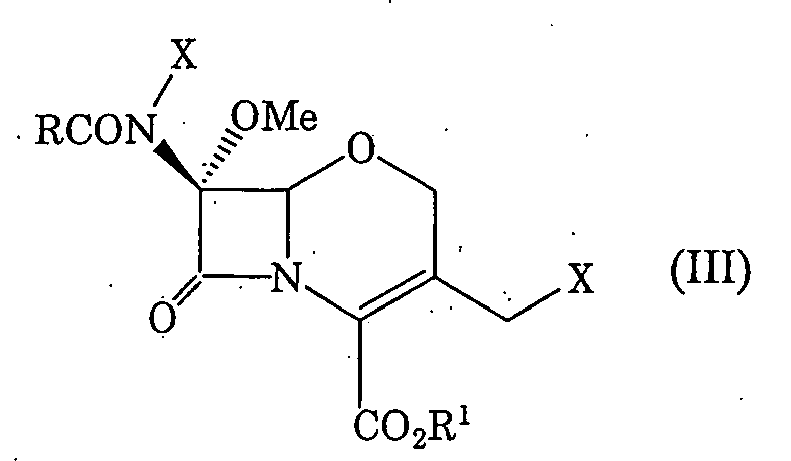
- the present invention provides Compound (III) which is a novel intermediate in such a production method.
- the present production method is applicable to industrial production of a variety of 7 ⁇ -methoxy-oxacephem compounds.
- Compound (I) shown by the formula: (wherein R represents an acyl residue; R 1 represents a carboxy protecting group) react with a halogenating agent in the presence of a base, in a solvent as desired, Compound (II) shown by the formula: (wherein R and R 1 are as defined above; X represents halogen) is synthesized.
- the base may be either an organic base or an inorganic base.
- aromatic amines preferably pyridine derivatives (e.g., pyridine, 4-dimethylaminopyridine, picoline (e.g., 2-picoline), lutidine (e.g., 2,6-lutidine), collidine (e.g., 2,4,6-collidine)) or aliphatic amines (e.g., trimethylamine, triethylamine, N,N-diisopropylethylamine, N-ethylmorpholine, N-methylpyrrolidine, N-methylpiperidine, N,N-dimethylaniline, 1,8-diazabicyclo [5.4.0]undeca-7-ene (DBU), 1,5-diazabicyclo [4.3.0]nona-5-ene (DBN)) are used.
- pyridine derivatives e.g., pyridine, 4-dimethylaminopyridine, picoline (e.g., 2-picoline), lutidine (e.
- aromatic amines especially, pyridine derivatives, in particular, pyridine, 2-picoline, 2,6-lutidine, 2,4,6-collidine are exemplified.
- a use amount of the base is about 1 to 5 mol equivalent, preferably about 1 to 1.5 mol equivalent, with respect to Compound (I). Addition of the base promotes the reaction, and has effects of keeping the reaction solution neutral by capturing hydrogen chloride generating as a byproduct, and preventing a starting material or a product from decomposing.
- the halogenating agent chlorine, bromine and the like are exemplified, with chlorine being preferred.
- a use amount of the halogenating agent is 3 mol equivalent or more, preferably 3 to 5 mol equivalent, more preferably 3 to 4 mol equivalent, and particularly preferably 3.1 to. 3.5 mol equivalent, with respect to Compound (I).
- 2 mol equivalent theoretically suffices as the use amount of the halogenating agent.
- reaction solvent various kinds of solvents can be used as far as they do not adversely influence on the reaction, and it is, for example, selected from methylene chloride, acetonitrile, ethyl acetate, toluene, chloroform, tetrahydrofuran, dimethyl formamide, dimethyl acetamide or mixed solvents thereof, but it is preferably methylene chloride.
- Reaction temperature is usually -20°C to 50°C, preferably -10°C to room temperature, and more preferably from 0°C to around room temperature.
- Reaction time is several hours to several tens hours, and preferably 2 to 3 hours.
- Compound (II) produced at the first step may be isolated first, however, the next step may be started in the form of its reaction solution without isolation process.
- the isolated Compound (II) or the reaction solution of the first step is added with MOMe (M represents alkaline metal; Me represents methyl) in the presence of a halogenating agent, to synthesize Compound (III) shown by the formula: (wherein R, R 1 , Me and X are as defined above).
- MOMe alkaline metal
- Me represents methyl
- halogenating agent those recited above are exemplified.
- the halogenating agent remaining after completion of the first step can desirably be diverted.
- a use amount of the halogenating agent is 1 mol equivalent or more, preferably about 1 to 2 mol equivalent, with respect to Compound (II).
- halogen forms a salt (MX, (X is halogen atom)) with alkaline metal derived from MOMe.
- M(alkaline metal) in the MOMe(Me is methyl) Li and Na are exemplified, however it is preferably Li.
- Mg(OMe) 2 or the like may be used as a methoxylating agent.
- a use amount of the MOMe is 4 mol equivalent or more, preferably about 4 to 6 mol equivalent, more preferably about 4.5 to 5.2 mol equivalent, with respect to Compound (II). In order to improve the yield of the second step, selection of a use ratio of the halogenating agent and the MOMe is important.
- the halogenating agent is used in an amount of preferably 3 to 4 mol equivalent, more preferably of 3.1 to 3.5 mol equivalent, with respect to Compound (I), and the MOMe is used in an amount of preferably about 4 to 6 mol equivalent, more preferably about 4.5 to 5.2 mol equivalent, with respect to Compound (II).
- MOMe is preferably added in the form of a methanol solution.
- the reaction solvent those recited above may be used as necessary.
- Reaction temperature is usually -70°C to -20°C, preferably -60°C to -30°C, more preferably -50°C to -40°C.
- Reaction time is several hours to several tens hours, preferably 2 to 3 hours.
- Compound (III) produced at the second step may be isolated first, however, the next step may be started in the form of its reaction solution without isolation process.
- Compound (III) is a novel compound and is an intermediate which is suited for the present production method.
- the isolated Compound (III) or the reaction solution from the second step is added with a reducing agent, to synthesize Compound (IV) shown by the formula: (wherein R, R 1 , Me and X are as defined above).
- a reducing agent various kinds of agents may be used insofar as they are capable of reducing N-Cl at 7-position of Compound (III) to NH, and examples include sodium sulfite, sodium thiosulfate, acidic sodium sulfite, dialkylsulfide (e.g., dimethylsulfide), and phosphines (e.g., tripmehylphosphine), with sodium sulfite or sodium thiosulfate being preferred.
- sodium sulfite it is added in the form of an aqueous solution of preferably about 1 to 10%, more preferably about 5 to 10%.
- a use amount of the reducing agent is about 1 to 10 mol equivalent, preferably about 1 to 6 mol equivalent, with respect to Compound (III).
- Reaction temperature is usually 0°C to 50°C, preferably 5°C to room temperature.
- Reaction time is several minutes to several hours, preferably 10 minutes to 1 hour. Since Compound (III) which is an intermediate synthesized in the second step is not deprotonated even in the presence of MOMe, it is stable because intramolecular cleavage in the ⁇ -lactam ring will not proceed.
- Compound (IV) which is the final product is isolated without exposure to a basic condition, such cleavage can be avoided.
- one feature of the present production method lies in generating first Compound (III) from Compound (II) by controlling the reaction condition, and as a result, generation of a byproduct is prevented, and the objective Compound (IV) is unexpectedly obtained with high yield (e.g., 75% or more, preferably 80% or more, more preferably 90% or more) even with the triple steps.
- acyl residue represented by R is commonly available in the field of cephalosporin chemistry, and various acyl residues can be used insofar as they are derived from acyl groups capable of bonding with 7-position amino group in an oxacephem backbone.
- acyl may be an acyl that forms 7-position side chain of an objective antibiotic compound, or may be an acyl serving as an amino protecting group in the course of synthesizing the same.
- an acyl residue derived from an amino protecting group is preferred, and examples of such acyl residue include optionally substituted phenyl or benzyl (substituent: lower alkyl (e.g., methyl, ethyl), halogen, nitro, lower alkoxy (e.g., methoxy)) or phenoxymethyl. Preferably, it is optionally substituted phenyl.
- the carboxy protecting group represented by R 1 includes carboxy protecting groups that are well-known in the art of cephalosporin chemistry as being attachable/detachable without causing any undesired change on other parts in the molecule.
- ester-forming alkyls having 1 to 8 carbons include ester-forming alkyls having 1 to 8 carbons (methyl, methoxymethyl, ethyl, ethoxyethyl; iodoethyl, propyl, isopropyl, butyl, isobutyl, ethoxyethyl, methylthioethyl, methane sulfonylethyl, trichloroethyl, t-butyl and the like), alkenyls having 3 to 8 carbons (propenyl, allyl, isopropenyl, hexenyl, phenylpropenyl, dimethylhexenyl and the like), aralkyls having 7 to 19 carbons (benzyl, methylbenzyl, dimethylbenzyl, methoxybenzyl, ethoxybenzyl, nitrobenzyl, aminobenzyl, benzhydryl, phenyle
- Aralkyls are preferred, and benzhydryl is more preferred.
- Compound (IV) that is obtainable in the present production method is useful as an intermediate for synthesis of oxacephem antibiotics.
- an objective 7 ⁇ -methoxy-oxacephem compound can be obtained by conducting on Compound (IV) appropriate combination of the re actions selected from: 1) side chain forming reaction at 3-position (e.g., nucleophilic reaction on 3-position methylene), 2) deacylation reaction at 7-position (e.g., deprotecting reaction at amino group), 3) side chain forming reaction at 7-position (e.g., acylation reaction on amino group), 4) deprotecting reaction at 4-position carboxy, 5) esterification reaction at 4-position carboxy, and 6) salt forming reaction.
- side chain forming reaction at 3-position e.g., nucleophilic reaction on 3-position methylene
- deacylation reaction at 7-position e.g., deprotecting reaction at amino group
Landscapes
- Chemical & Material Sciences (AREA)
- Organic Chemistry (AREA)
- Pharmaceuticals Containing Other Organic And Inorganic Compounds (AREA)
- Cephalosporin Compounds (AREA)
- Nitrogen And Oxygen Or Sulfur-Condensed Heterocyclic Ring Systems (AREA)
Abstract

(First step)
letting Compound (I) shown by Formula:

(Second step)
adding MOMe (M represents alkaline metal; Me represents methyl) in the presence of a halogenating agent after completion of the first step; and
(Third step)
adding a reducing agent after completion of the second step.
Description
- The present invention relates to a method of producing an intermediate for synthesis of 1-oxacephalosporin which is useful as an antimicrobial.
- As an important intermediate for industrially producing 1-oxacephalosporin such as latamoxef or flomoxef with high efficiency, 1-oxacephalosporin-7α-methoxy-3-chloromethyl derivative (hereinafter, also referred to as a 7α-methoxy-3-chloromethyl compound), is known. As a production method thereof, there is known a method wherein a 3-exomehylene compound which is a raw material is subjected to 7α-methoxylation after addition of Cl2 by light irradiation. However, light irradiation generally requires expensive optical, reaction equipment, and hence is not industrially advantageous. For example, Non-patent document 1 describes the following reaction.


[Patent document 1].Japanese Unexamined Patent Publication JP-A 59-67289
[Non-patent document 1] Tetrahedron Letters Vol. 21, pp351-354, 1980
[Non-patent document 2] Kinki Kagaku Kogyo Kai (June 1988, P10)
[Non patent document 3] Yakugaku Zasshi (111(2), P77, 1991) - Therefore, there is need of developing a production method that is simple because of avoidance of light irradiation reaction and preferably allows production of an objective product with high yield, as an industrial production method of 1-oxacephalosporin-7α-methoxy-3-chloromethyl derivative.
- As a result of diligent effort, inventors of the present invention found that 7α-methoxy-3-chloromethyl compound can be obtained with high yield without use of light irradiation reaction, by using a 3-exomehylene compound as a starting material, preferably through continuous reaction, more preferably through one-pot reaction, and accomplished the present invention.
- (1) A method of producing Compound (IV) shown by the formula:

- (First step)
letting Compound (I) shown by Formula:

- (Second step)
adding MOMe (M represents alkaline metal; Me represents methyl) in the presence of a halogenating agent after completion of the first step; and - (Third step)
adding a reducing agent after completion of the second step.
- (First step)
- (2) The method of producing Compound (IV) according to the above (1), the method comprising the steps of:
- (First step)
letting Compound (I) shown by the formula:

- (Second step)
adding MOMe (M represents alkaline metal; Me represents methyl) in the presence of a halogenating agent after completion of the first step, to synthesize Compound (III) shown by the formula:

- (Third step)
letting Compound (III) react with a reducing agent to synthesize Compound (IV) shown by the formula:
- (First step)
- (3) The production method according to the above (1) or (2), wherein the first to the third steps are conducted in a one-pot manner.
- (4) The production method according to any one of the above (1) to (3), wherein the base is an aromatic amine, and/or the halogenating agent is chlorine.
- (5) The production method according to any one of the above (1) to (4), wherein the MOMe is LiOMe.
- (6) The production method according to any one of the above (1) to (5), wherein the reducing agent is sodium thiosulfate or sodium sulfite.
- (7) The production method according to any one of the above (1) to (6), wherein R is optionally substituted phenyl, and R1 is benzhydryl.
- (8) The production method according to any one of the above (1) to (7), wherein 3 mol equivalent or more of chlorine is used as the halogenating agent, and 4 mol equivalent or more of LiOMe is used as the MOMe, with respect to Compound (I).
- (9) The production method according to the above (8), wherein 3 to 4 mol equivalent of chlorine is used as the halogenating agent and 4 to 6 mol equivalent of LiOMe is used as the MOMe, with respect to Compound (I).
- (10) The production method according to any one of the above (1) to (9), wherein reaction temperature of the first step is 0°C to 5°C, and reaction temperature of the second step is -40 to -60°C.
- (11) A method of producing Compound (IV) shown by the formula:

- letting Compound (II) shown by the formula:


- letting Compound (III) react with a reducing agent.
- letting Compound (II) shown by the formula:
- (12) A method of producing Compound (IV) shown by the formula:

- letting Compound (III) shown by the formula:

- letting Compound (III) shown by the formula:
- (13) Compound (III) shown by the formula:

- (14) A method of producing a 7α-methoxy-oxacephem compound wherein production of Compound (IV) by the method according to any one of the above (1) to (12) is followed by at least one reaction selected from: 1) side chain forming reaction at 3-position, 2) deacylation reaction at 7-position, 3) side chain forming reaction at 7-position, 4) deprotecting reaction at 4-position carboxy, 5) esterification reaction at 4-position carboxy, and 6) salt forming reaction.
- According to the present invention, it is possible to readily produce Compound (IV) which is 7α-methoxy-3-halogenomethyl compound with high yield from Compound (I) which is 3-exomehylene compound. The reaction is preferably conducted by continuous reaction, more preferably by one-pot reaction. Advantageously, the one-pot reaction of the present invention requires no reaction stopping agent, and dispenses with operations such as concentration of reaction solution, extraction during the process, and solvent substitution, and hence is very advantageous as an industrial production method. Also, the present invention provides Compound (III) which is a novel intermediate in such a production method. The present production method is applicable to industrial production of a variety of 7α-methoxy-oxacephem compounds.
- Now, production methods of Compound (IV) from (I) will be explained.
- By letting Compound (I) shown by the formula:

react with a halogenating agent in the presence of a base, in a solvent as desired, Compound (II) shown by the formula:
The base may be either an organic base or an inorganic base. As an organic base, aromatic amines, preferably pyridine derivatives (e.g., pyridine, 4-dimethylaminopyridine, picoline (e.g., 2-picoline), lutidine (e.g., 2,6-lutidine), collidine (e.g., 2,4,6-collidine)) or aliphatic amines (e.g., trimethylamine, triethylamine, N,N-diisopropylethylamine, N-ethylmorpholine, N-methylpyrrolidine, N-methylpiperidine, N,N-dimethylaniline, 1,8-diazabicyclo [5.4.0]undeca-7-ene (DBU), 1,5-diazabicyclo [4.3.0]nona-5-ene (DBN)) are used. Preferably, aromatic amines, especially, pyridine derivatives, in particular, pyridine, 2-picoline, 2,6-lutidine, 2,4,6-collidine are exemplified.
A use amount of the base is about 1 to 5 mol equivalent, preferably about 1 to 1.5 mol equivalent, with respect to Compound (I). Addition of the base promotes the reaction, and has effects of keeping the reaction solution neutral by capturing hydrogen chloride generating as a byproduct, and preventing a starting material or a product from decomposing.
As the halogenating agent, chlorine, bromine and the like are exemplified, with chlorine being preferred.
A use amount of the halogenating agent is 3 mol equivalent or more, preferably 3 to 5 mol equivalent, more preferably 3 to 4 mol equivalent, and particularly preferably 3.1 to. 3.5 mol equivalent, with respect to Compound (I). For the exclusive purpose of conversion from Compound (I) to Compound (II), 2 mol equivalent theoretically suffices as the use amount of the halogenating agent. In the present invention, however, it was also found that when the base is used in an amount exceeding the above range, remaining base efficiently allowed proceeding of the reaction of the second step. Therefore, when continuous reaction is executed in one pot system, for example, it is preferred to use the base in an amount exceeding the theoretical value. This is one feature of the present invention.
As the reaction solvent, various kinds of solvents can be used as far as they do not adversely influence on the reaction, and it is, for example, selected from methylene chloride, acetonitrile, ethyl acetate, toluene, chloroform, tetrahydrofuran, dimethyl formamide, dimethyl acetamide or mixed solvents thereof, but it is preferably methylene chloride.
Reaction temperature is usually -20°C to 50°C, preferably -10°C to room temperature, and more preferably from 0°C to around room temperature.
Reaction time is several hours to several tens hours, and preferably 2 to 3 hours.
Compound (II) produced at the first step may be isolated first, however, the next step may be started in the form of its reaction solution without isolation process. - After completion of the first step, the isolated Compound (II) or the reaction solution of the first step is added with MOMe (M represents alkaline metal; Me represents methyl) in the presence of a halogenating agent, to synthesize Compound (III) shown by the formula:


As the halogenating agent, those recited above are exemplified. When the reaction continues from the first step, as is previously described, the halogenating agent remaining after completion of the first step can desirably be diverted.
A use amount of the halogenating agent is 1 mol equivalent or more, preferably about 1 to 2 mol equivalent, with respect to Compound (II). After reaction, a part of halogen forms a salt (MX, (X is halogen atom)) with alkaline metal derived from MOMe.
As M(alkaline metal) in the MOMe(Me is methyl), Li and Na are exemplified, however it is preferably Li. As a methoxylating agent, Mg(OMe)2 or the like may be used.
A use amount of the MOMe is 4 mol equivalent or more, preferably about 4 to 6 mol equivalent, more preferably about 4.5 to 5.2 mol equivalent, with respect to Compound (II).
In order to improve the yield of the second step, selection of a use ratio of the halogenating agent and the MOMe is important. Especially when the second step continues from the first step, the halogenating agent is used in an amount of preferably 3 to 4 mol equivalent, more preferably of 3.1 to 3.5 mol equivalent, with respect to Compound (I), and the MOMe is used in an amount of preferably about 4 to 6 mol equivalent, more preferably about 4.5 to 5.2 mol equivalent, with respect to Compound (II).
MOMe is preferably added in the form of a methanol solution.
As the reaction solvent, those recited above may be used as necessary.
Reaction temperature is usually -70°C to -20°C, preferably -60°C to -30°C, more preferably -50°C to -40°C.
Reaction time is several hours to several tens hours, preferably 2 to 3 hours.
Compound (III) produced at the second step may be isolated first, however, the next step may be started in the form of its reaction solution without isolation process. Compound (III) is a novel compound and is an intermediate which is suited for the present production method. - After completion of the second step, the isolated Compound (III) or the reaction solution from the second step is added with a reducing agent, to synthesize Compound (IV) shown by the formula:

As the reducing agent, various kinds of agents may be used insofar as they are capable of reducing N-Cl at 7-position of Compound (III) to NH, and examples include sodium sulfite, sodium thiosulfate, acidic sodium sulfite, dialkylsulfide (e.g., dimethylsulfide), and phosphines (e.g., tripmehylphosphine), with sodium sulfite or sodium thiosulfate being preferred. In the case of sodium sulfite, it is added in the form of an aqueous solution of preferably about 1 to 10%, more preferably about 5 to 10%.
A use amount of the reducing agent is about 1 to 10 mol equivalent, preferably about 1 to 6 mol equivalent, with respect to Compound (III).
Reaction temperature is usually 0°C to 50°C, preferably 5°C to room temperature.
Reaction time is several minutes to several hours, preferably 10 minutes to 1 hour.
Since Compound (III) which is an intermediate synthesized in the second step is not deprotonated even in the presence of MOMe, it is stable because intramolecular cleavage in the β-lactam ring will not proceed. Further, since Compound (IV) which is the final product is isolated without exposure to a basic condition, such cleavage can be avoided. As described above, one feature of the present production method lies in generating first Compound (III) from Compound (II) by controlling the reaction condition, and as a result, generation of a byproduct is prevented, and the objective Compound (IV) is unexpectedly obtained with high yield (e.g., 75% or more, preferably 80% or more, more preferably 90% or more) even with the triple steps. - The, acyl residue represented by R is commonly available in the field of cephalosporin chemistry, and various acyl residues can be used insofar as they are derived from acyl groups capable of bonding with 7-position amino group in an oxacephem backbone. Such acyl may be an acyl that forms 7-position side chain of an objective antibiotic compound, or may be an acyl serving as an amino protecting group in the course of synthesizing the same. As the R, an acyl residue derived from an amino protecting group is preferred, and examples of such acyl residue include optionally substituted phenyl or benzyl (substituent: lower alkyl (e.g., methyl, ethyl), halogen, nitro, lower alkoxy (e.g., methoxy)) or phenoxymethyl. Preferably, it is optionally substituted phenyl.
The carboxy protecting group represented by R1 includes carboxy protecting groups that are well-known in the art of cephalosporin chemistry as being attachable/detachable without causing any undesired change on other parts in the molecule. Typical examples.include ester-forming alkyls having 1 to 8 carbons (methyl, methoxymethyl, ethyl, ethoxyethyl; iodoethyl, propyl, isopropyl, butyl, isobutyl, ethoxyethyl, methylthioethyl, methane sulfonylethyl, trichloroethyl, t-butyl and the like), alkenyls having 3 to 8 carbons (propenyl, allyl, isopropenyl, hexenyl, phenylpropenyl, dimethylhexenyl and the like), aralkyls having 7 to 19 carbons (benzyl, methylbenzyl, dimethylbenzyl, methoxybenzyl, ethoxybenzyl, nitrobenzyl, aminobenzyl, benzhydryl, phenylethyl, trityl, di-t-butyl hydroxybenzyl, phthalidyl, phenacyl and the like), aryls having 6 to 12 carbons (phenyl, toluyl, diisopropylphenyl, xylyl, trichlorophenyl, pentachlorophenyl, indanyl and the like), amino groups having 1 to 12 carbons (acetone oxime, acetophenone oxime, acetoaldoxime, groups that form an ester such as N-hydroxy succinic imide or N-hydroxy phthalimide), hydrocarbonated silyls having 3 to 12 carbons (trimethyl silyl, dimethylmethoxy silyl, t-butyldimethyl silyl and the like), and hydrocarbonated stannyl having 3 to 12 carbons (trimethyl stannyl and the like). Aralkyls are preferred, and benzhydryl is more preferred.
Compound (IV) that is obtainable in the present production method is useful as an intermediate for synthesis of oxacephem antibiotics. For example, according to procedures well known in the art, an objective 7α-methoxy-oxacephem compound can be obtained by conducting on Compound (IV) appropriate combination of the re actions selected from: 1) side chain forming reaction at 3-position (e.g., nucleophilic reaction on 3-position methylene), 2) deacylation reaction at 7-position (e.g., deprotecting reaction at amino group), 3) side chain forming reaction at 7-position (e.g., acylation reaction on amino group), 4) deprotecting reaction at 4-position carboxy, 5) esterification reaction at 4-position carboxy, and 6) salt forming reaction. -

Then, after stirring for 20 minutes at the same temperature, 157 mL (4.75 eq) of 10% LiOMe (lithium methoxide) solution in ethanol was added dropwise over 140 minutes at -40 to -50°C. Then a part of the reaction solution was take out, extracted with methylene chloride, and treated with aqueous hydrochloric acid, and aqueous sodium hydrogen carbonate, to isolate Compound 3.
Then after stirring for 5 minutes at the same temperature, 4.4 mL (1.02 eq) of acetic acid was added. The above reaction solution was added to 5.5% sodium sulfite solution in water (351 mL, 2.2 eq) over 20 minutes at 10°C, and then added with 13.4 mL (2.0 eq) of 35% hydrochloric acid. The methylene chloride layer was separated, washed with a diluted sodium bicarbonate aqueous solution, and dried over sodium sulfate, and then solvent was concentrated. Then methanol was added to allow precipitation of 7β-benzoyl-7α-methoxy-3-chloromethyl compound (Compound 4). After cooling on ice, Compound 4 was obtained through filtration. (Compound 4)
1H NMR (CDCl3) δ: 3.63 (3H, s, C7-OCH3), 4.50 (2H, s, C3'-H or C2-H), 4.55 (2H, s, C2-H or C3'-H), 5.25 (1H, s, C6-H), 7.00 (1H, s, CHPh2), 7.10-7.95 (16H, m, C6H5, NH) -

JP-A 52-133997
mp 88 to 89°C
1H NMR (CDCl3) δ: 3.63 (3H, s, C7-OCH3), 3.82 (3H, s, N-CH3), 4.28 (2H, s, C2-H), 4.65 (2H, s, C3'-H), 5.17 (1H, s, C6-H), 6.95 (1H, s, CHPh2), 7.20-8.00 (15H, aromatic-H)
According to the above method, the following Compound 6 is synthesized.
JP-A 59-139385 - According to the method of Example 1, for the case of R=tolyl, Compound (IV) is obtained from Compound (I) in high yield (R1=BH, X=Cl) by conducting reaction in similar manner, with the use of pyridine, 4-dimethylaminopyridine, picoline, lutidine, or collidine as a base.
- According to the method of Example 1, for the case of R=4-chlorophenyl, Compound (IV) is obtained from Compound (I) in high yield (R1=BH, X=Cl) by conducting reaction in similar manner with the use of pyridine, 4-diniethylaminopyridine, picoline, lutidine, or collidine as a base.
- According to the method of Example 1, for the case of R=phenoxymethyl, Compound (IV) is obtained from Compound (I) in high yield (R1=BH, X=Cl) by conducting reaction in similar manner with the use of pyridine, 4-dimethylamiriopyridine, picoline, lutidine, or collidine as a base.
- Through deacylation of a 7-position amino side chain moiety in Compound (IV) obtained by the method described in any one of Example 1 or Examples 3 to 5, 7β-amino-7-α-methoxy-3-chloromethyl-1-dethia-1-oxa-3-cephem-4-car boxylic acid diphenyl methyl ester can be obtained.
Claims (14)
- A method of producing Compound (IV) shown by the formula:
 (First step)
letting Compound (I) shown by Formula: (Second step)
adding MOMe (M represents alkaline metal; Me represents methyl) in the presence of a halogenating agent after completion of the first step; and(Third step)
adding a reducing agent after completion of the second step. - The method of producing Compound (IV) according to claim 1, the method comprising the steps of:(First step)
letting Compound (I) shown by the formula:
 (Second step)
adding MOMe (M represents alkaline metal; Me represents methyl) in the presence of a halogenating agent after completion of the first step, to synthesize Compound (III) shown by the formula: (Third step)
letting Compound (III) react with a reducing agent to synthesize Compound (IV) shown by the formula:
- The production method according to claim 1 or 2, wherein the first to the third steps are conducted in a one pot manner.
- The production method according to any one of claims 1 to 3, wherein the base is an aromatic amine, and/or the halogenating agent is chlorine.
- The production method according to any one of claims 1 to 4, wherein the MOMe is LiOMe.
- The production method according to any one of claims 1 to 5, wherein the reducing agent is sodium thiosulfate or sodium sulfite.
- The production method according to any one of claims 1 to 6, wherein R is optionally substituted phenyl, and R1 is benzhydryl.
- The production method according to any one of claims 1 to 7, wherein 3 mol equivalent or more of chlorine is used as the halogenating agent, and 4 mol equivalent or more of LiOMe is used as the MOMe, with respect to Compound (I).
- The production method according to claim 8, wherein 3 to 4 mol equivalent of chlorine is used as the halogenating agent and 4 to 6 mol equivalent of LiOMe is used as the MOMe, with respect to Compound (I).
- The production method according to any one of claims 1 to 9, wherein reaction temperature of the first step is 0°C to 5°C, and reaction temperature of the second step is -40 to -60°C.
- A method of producing Compound (IV) shown by the formula:
 letting Compound (II) shown by the formula:

 letting Compound (III) react with a reducing agent.
 - A method of producing Compound (IV) shown by the formula:
 letting Compound (III) shown by the formula:
- Compound (III) shown by the formula:

- A, method of producing a 7α-methoxy-oxacephem compound wherein production of Compound (IV) by the method according to any one claims 1 to 12 is followed by at least one reaction selected from: 1) side chain forming reaction at 3-position, 2) deacylation reaction at 7-position, 3) side chain forming reaction at 7-position, 4) deprotecting reaction at 4-position carboxy, 5) esterification reaction at 4-position carboxy, and 6) salt forming reaction.
Applications Claiming Priority (2)
| Application Number | Priority Date | Filing Date | Title |
|---|---|---|---|
| JP2004201578A JP3771566B2 (en) | 2004-07-08 | 2004-07-08 | Method for producing 1-oxacephalosporin-7α-methoxy-3-chloromethyl derivative |
| PCT/JP2005/007517 WO2006006290A1 (en) | 2004-07-08 | 2005-04-20 | PROCESS FOR PRODUCING 1-OXACEPHALOSPORIN-7α-METHOXY-3-CHLOROMETHYL DERIVATIVE |
Publications (3)
| Publication Number | Publication Date |
|---|---|
| EP1767538A1 true EP1767538A1 (en) | 2007-03-28 |
| EP1767538A4 EP1767538A4 (en) | 2010-04-28 |
| EP1767538B1 EP1767538B1 (en) | 2014-05-07 |
Family
ID=34792648
Family Applications (1)
| Application Number | Title | Priority Date | Filing Date |
|---|---|---|---|
| EP05734618.1A Expired - Lifetime EP1767538B1 (en) | 2004-07-08 | 2005-04-20 | Process for producing 1-oxacephalosporin-7alpha-methoxy-3-chloromethyl derivative |
Country Status (5)
| Country | Link |
|---|---|
| EP (1) | EP1767538B1 (en) |
| JP (1) | JP3771566B2 (en) |
| CN (1) | CN1980939B (en) |
| TW (1) | TWI302534B (en) |
| WO (1) | WO2006006290A1 (en) |
Families Citing this family (17)
| Publication number | Priority date | Publication date | Assignee | Title |
|---|---|---|---|---|
| CN103183686B (en) * | 2011-12-30 | 2016-06-29 | 浙江新和成股份有限公司 | The preparation method of 7 beta-amino-7 α-methoxyl group-3-cephem compounds |
| CN103183688B (en) * | 2011-12-30 | 2016-01-20 | 浙江新和成股份有限公司 | The preparation method of 7 β-amide group-7 α-methoxyl group-1-oxo-3-cephem compounds |
| CN104487445A (en) * | 2012-07-25 | 2015-04-01 | 第一药品株式会社 | Novel method for preparing 1-oxacephalosporin derivative |
| CN102952149B (en) * | 2012-11-09 | 2015-06-24 | 浙江新和成股份有限公司 | One-pot synthesis method of flomoxef intermediate |
| CN104610278A (en) * | 2015-01-09 | 2015-05-13 | 郑州大学 | Safety production method of oxacephem antibiotic intermediate sulfoxide ester |
| CN105037393B (en) * | 2015-06-24 | 2017-11-10 | 浙江永宁药业股份有限公司 | A kind of preparation method of Flomoxef Sodium |
| CN105399755B (en) * | 2015-11-03 | 2018-05-11 | 浙江永宁药业股份有限公司 | A kind of synthetic method of Flomoxef acid |
| CN106188097B (en) * | 2016-07-08 | 2018-01-05 | 郑州大学 | A kind of preparation method of 3 chloromethyl oxacephems antibiotic parent nucleus |
| CN106749335B (en) * | 2016-11-29 | 2019-02-12 | 浙江新和成股份有限公司 | A kind of preparation method and application of halogenated oxycephalosporins intermediate |
| CN107118224B (en) * | 2017-06-15 | 2019-09-17 | 浙江新和成股份有限公司 | A kind of preparation method of oxygen cephalosporin nucleus intermediate, its solvated compounds and preparation method thereof |
| KR102115644B1 (en) * | 2017-09-13 | 2020-05-27 | 주식회사 동도물산 | Method of manufacturing 7α-alkoxy oxacephem intermediate compound |
| CN109485660A (en) * | 2018-12-21 | 2019-03-19 | 齐鲁安替制药有限公司 | A kind of synthetic method of oxygen cephalosporin nucleus |
| CN110003242A (en) * | 2019-04-23 | 2019-07-12 | 山西千岫制药有限公司 | A kind of preparation method of Flomoxef acid contamination levels product |
| CN110003241A (en) * | 2019-04-23 | 2019-07-12 | 山西千岫制药有限公司 | A kind of preparation method of latamoxef parent nucleus |
| CN114805395B (en) * | 2022-04-27 | 2023-03-28 | 陕西友帮生物医药科技有限公司 | Preparation method of oxacephem parent nucleus intermediate |
| CN116496298A (en) * | 2023-05-04 | 2023-07-28 | 深圳六合六医疗器械有限公司 | One-pot method prepares the method for fluoxetal intermediate |
| CN116813644A (en) * | 2023-05-19 | 2023-09-29 | 广东立国制药有限公司 | Preparation method of flomoxef mother nucleus |
Family Cites Families (4)
| Publication number | Priority date | Publication date | Assignee | Title |
|---|---|---|---|---|
| JPS53101391A (en) * | 1977-02-15 | 1978-09-04 | Shionogi & Co Ltd | 1-oxadithiacephem compounds |
| US4604460A (en) * | 1977-02-15 | 1986-08-05 | Shionogi & Co., Ltd. | 1-oxadethiacepham compounds |
| JPS5967289A (en) * | 1982-10-08 | 1984-04-16 | Shionogi & Co Ltd | N-haloacylaminooxacepham derivative |
| JPS61246187A (en) * | 1985-09-05 | 1986-11-01 | Shionogi & Co Ltd | 1-oxadethiacepham compound |
-
2004
- 2004-07-08 JP JP2004201578A patent/JP3771566B2/en not_active Expired - Fee Related
-
2005
- 2005-04-20 CN CN2005800230055A patent/CN1980939B/en not_active Expired - Fee Related
- 2005-04-20 EP EP05734618.1A patent/EP1767538B1/en not_active Expired - Lifetime
- 2005-04-20 WO PCT/JP2005/007517 patent/WO2006006290A1/en not_active Ceased
- 2005-07-06 TW TW094122786A patent/TWI302534B/en not_active IP Right Cessation
Also Published As
| Publication number | Publication date |
|---|---|
| JP2005179336A (en) | 2005-07-07 |
| TWI302534B (en) | 2008-11-01 |
| CN1980939B (en) | 2012-05-30 |
| CN1980939A (en) | 2007-06-13 |
| WO2006006290A1 (en) | 2006-01-19 |
| EP1767538A4 (en) | 2010-04-28 |
| EP1767538B1 (en) | 2014-05-07 |
| TW200606167A (en) | 2006-02-16 |
| JP3771566B2 (en) | 2006-04-26 |
Similar Documents
| Publication | Publication Date | Title |
|---|---|---|
| EP1767538B1 (en) | Process for producing 1-oxacephalosporin-7alpha-methoxy-3-chloromethyl derivative | |
| EP3882236B1 (en) | Production method for 2,5-dicyano-3,6-dihalogenopyrazine | |
| EP3802515B1 (en) | Process for the preparation of apalutamide | |
| JP2003506425A (en) | Method for producing nitroxyalkyl ester of naproxen | |
| US5204458A (en) | Process for preparing cephem derivatives | |
| EP1132391B1 (en) | Process for the preparation of 3-sulfonyloxy-3-cephem compounds | |
| JP5209426B2 (en) | Method for producing 1,2,4-oxadiazole derivative | |
| KR100899325B1 (en) | Method for preparing 1-oxacephalosporin-7α-methoxy-3-chloromethyl derivative | |
| KR100242097B1 (en) | Preparation of 3-alkoxymethylcepem compound | |
| KR100317425B1 (en) | Halogenating agent and process for halogenating hydroxyl group | |
| EP0122002B1 (en) | Process for preparing azetidinone derivatives | |
| ES2283781T3 (en) | PROCEDURE TO PRODUCE A COMPOSITE OF 1,2,3-TRIAZOL. | |
| JPS60237061A (en) | Preparation of azetidinone derivative | |
| CN110914250B (en) | Novel process for synthesizing tilobaxib | |
| JP2661810B2 (en) | Method for producing 7-amino-3-chloromethyl-3-cephem derivative | |
| JPH10298152A (en) | Production of diazo compound | |
| JP3283959B2 (en) | D-biotin intermediate and method for producing the same | |
| JP2814286B2 (en) | Method for producing 2-exomethylene penum derivative | |
| CS196420B2 (en) | Method of producing 1-dethia-1-oxacephamderivatives | |
| WO2022114138A1 (en) | Method for producing amino acid derivative | |
| FR2505841A1 (en) | ALPHA-METHOXYCEPHEM DERIVATIVES AND PROCESS FOR THEIR PREPARATION | |
| JPH0517229B2 (en) | ||
| JP2005097154A (en) | Process for producing alkyl aryl ketone derivatives | |
| WO1996028453A1 (en) | Processes for the production of 2-isocephem derivatives | |
| JP2003313174A (en) | Method for producing 4-alkyl-thiazole |
Legal Events
| Date | Code | Title | Description |
|---|---|---|---|
| PUAI | Public reference made under article 153(3) epc to a published international application that has entered the european phase |
Free format text: ORIGINAL CODE: 0009012 |
|
| 17P | Request for examination filed |
Effective date: 20070202 |
|
| AK | Designated contracting states |
Kind code of ref document: A1 Designated state(s): AT BE BG CH CY CZ DE DK EE ES FI FR GB GR HU IE IS IT LI LT LU MC NL PL PT RO SE SI SK TR |
|
| DAX | Request for extension of the european patent (deleted) | ||
| A4 | Supplementary search report drawn up and despatched |
Effective date: 20100325 |
|
| 17Q | First examination report despatched |
Effective date: 20121113 |
|
| GRAP | Despatch of communication of intention to grant a patent |
Free format text: ORIGINAL CODE: EPIDOSNIGR1 |
|
| INTG | Intention to grant announced |
Effective date: 20130701 |
|
| GRAS | Grant fee paid |
Free format text: ORIGINAL CODE: EPIDOSNIGR3 |
|
| GRAP | Despatch of communication of intention to grant a patent |
Free format text: ORIGINAL CODE: EPIDOSNIGR1 |
|
| INTG | Intention to grant announced |
Effective date: 20140127 |
|
| GRAA | (expected) grant |
Free format text: ORIGINAL CODE: 0009210 |
|
| AK | Designated contracting states |
Kind code of ref document: B1 Designated state(s): AT BE BG CH CY CZ DE DK EE ES FI FR GB GR HU IE IS IT LI LT LU MC NL PL PT RO SE SI SK TR |
|
| REG | Reference to a national code |
Ref country code: GB Ref legal event code: FG4D |
|
| REG | Reference to a national code |
Ref country code: AT Ref legal event code: REF Ref document number: 666596 Country of ref document: AT Kind code of ref document: T Effective date: 20140515 |
|
| REG | Reference to a national code |
Ref country code: IE Ref legal event code: FG4D |
|
| REG | Reference to a national code |
Ref country code: DE Ref legal event code: R096 Ref document number: 602005043554 Country of ref document: DE Effective date: 20140618 |
|
| RAP2 | Party data changed (patent owner data changed or rights of a patent transferred) |
Owner name: SHIONOGI & CO., LTD. |
|
| REG | Reference to a national code |
Ref country code: NL Ref legal event code: VDEP Effective date: 20140507 |
|
| REG | Reference to a national code |
Ref country code: LT Ref legal event code: MG4D |
|
| PG25 | Lapsed in a contracting state [announced via postgrant information from national office to epo] |
Ref country code: GR Free format text: LAPSE BECAUSE OF FAILURE TO SUBMIT A TRANSLATION OF THE DESCRIPTION OR TO PAY THE FEE WITHIN THE PRESCRIBED TIME-LIMIT Effective date: 20140808 Ref country code: FI Free format text: LAPSE BECAUSE OF FAILURE TO SUBMIT A TRANSLATION OF THE DESCRIPTION OR TO PAY THE FEE WITHIN THE PRESCRIBED TIME-LIMIT Effective date: 20140507 Ref country code: IS Free format text: LAPSE BECAUSE OF FAILURE TO SUBMIT A TRANSLATION OF THE DESCRIPTION OR TO PAY THE FEE WITHIN THE PRESCRIBED TIME-LIMIT Effective date: 20140907 Ref country code: CY Free format text: LAPSE BECAUSE OF FAILURE TO SUBMIT A TRANSLATION OF THE DESCRIPTION OR TO PAY THE FEE WITHIN THE PRESCRIBED TIME-LIMIT Effective date: 20140507 Ref country code: LT Free format text: LAPSE BECAUSE OF FAILURE TO SUBMIT A TRANSLATION OF THE DESCRIPTION OR TO PAY THE FEE WITHIN THE PRESCRIBED TIME-LIMIT Effective date: 20140507 |
|
| PG25 | Lapsed in a contracting state [announced via postgrant information from national office to epo] |
Ref country code: ES Free format text: LAPSE BECAUSE OF FAILURE TO SUBMIT A TRANSLATION OF THE DESCRIPTION OR TO PAY THE FEE WITHIN THE PRESCRIBED TIME-LIMIT Effective date: 20140507 Ref country code: SE Free format text: LAPSE BECAUSE OF FAILURE TO SUBMIT A TRANSLATION OF THE DESCRIPTION OR TO PAY THE FEE WITHIN THE PRESCRIBED TIME-LIMIT Effective date: 20140507 Ref country code: PL Free format text: LAPSE BECAUSE OF FAILURE TO SUBMIT A TRANSLATION OF THE DESCRIPTION OR TO PAY THE FEE WITHIN THE PRESCRIBED TIME-LIMIT Effective date: 20140507 |
|
| PG25 | Lapsed in a contracting state [announced via postgrant information from national office to epo] |
Ref country code: PT Free format text: LAPSE BECAUSE OF FAILURE TO SUBMIT A TRANSLATION OF THE DESCRIPTION OR TO PAY THE FEE WITHIN THE PRESCRIBED TIME-LIMIT Effective date: 20140908 |
|
| PG25 | Lapsed in a contracting state [announced via postgrant information from national office to epo] |
Ref country code: EE Free format text: LAPSE BECAUSE OF FAILURE TO SUBMIT A TRANSLATION OF THE DESCRIPTION OR TO PAY THE FEE WITHIN THE PRESCRIBED TIME-LIMIT Effective date: 20140507 Ref country code: SK Free format text: LAPSE BECAUSE OF FAILURE TO SUBMIT A TRANSLATION OF THE DESCRIPTION OR TO PAY THE FEE WITHIN THE PRESCRIBED TIME-LIMIT Effective date: 20140507 Ref country code: DK Free format text: LAPSE BECAUSE OF FAILURE TO SUBMIT A TRANSLATION OF THE DESCRIPTION OR TO PAY THE FEE WITHIN THE PRESCRIBED TIME-LIMIT Effective date: 20140507 Ref country code: CZ Free format text: LAPSE BECAUSE OF FAILURE TO SUBMIT A TRANSLATION OF THE DESCRIPTION OR TO PAY THE FEE WITHIN THE PRESCRIBED TIME-LIMIT Effective date: 20140507 Ref country code: RO Free format text: LAPSE BECAUSE OF FAILURE TO SUBMIT A TRANSLATION OF THE DESCRIPTION OR TO PAY THE FEE WITHIN THE PRESCRIBED TIME-LIMIT Effective date: 20140507 Ref country code: BE Free format text: LAPSE BECAUSE OF FAILURE TO SUBMIT A TRANSLATION OF THE DESCRIPTION OR TO PAY THE FEE WITHIN THE PRESCRIBED TIME-LIMIT Effective date: 20140507 |
|
| REG | Reference to a national code |
Ref country code: DE Ref legal event code: R097 Ref document number: 602005043554 Country of ref document: DE |
|
| PG25 | Lapsed in a contracting state [announced via postgrant information from national office to epo] |
Ref country code: NL Free format text: LAPSE BECAUSE OF FAILURE TO SUBMIT A TRANSLATION OF THE DESCRIPTION OR TO PAY THE FEE WITHIN THE PRESCRIBED TIME-LIMIT Effective date: 20140507 |
|
| PLBE | No opposition filed within time limit |
Free format text: ORIGINAL CODE: 0009261 |
|
| STAA | Information on the status of an ep patent application or granted ep patent |
Free format text: STATUS: NO OPPOSITION FILED WITHIN TIME LIMIT |
|
| 26N | No opposition filed |
Effective date: 20150210 |
|
| REG | Reference to a national code |
Ref country code: DE Ref legal event code: R097 Ref document number: 602005043554 Country of ref document: DE Effective date: 20150210 |
|
| PG25 | Lapsed in a contracting state [announced via postgrant information from national office to epo] |
Ref country code: SI Free format text: LAPSE BECAUSE OF FAILURE TO SUBMIT A TRANSLATION OF THE DESCRIPTION OR TO PAY THE FEE WITHIN THE PRESCRIBED TIME-LIMIT Effective date: 20140507 |
|
| REG | Reference to a national code |
Ref country code: DE Ref legal event code: R119 Ref document number: 602005043554 Country of ref document: DE |
|
| PG25 | Lapsed in a contracting state [announced via postgrant information from national office to epo] |
Ref country code: MC Free format text: LAPSE BECAUSE OF FAILURE TO SUBMIT A TRANSLATION OF THE DESCRIPTION OR TO PAY THE FEE WITHIN THE PRESCRIBED TIME-LIMIT Effective date: 20140507 Ref country code: LU Free format text: LAPSE BECAUSE OF FAILURE TO SUBMIT A TRANSLATION OF THE DESCRIPTION OR TO PAY THE FEE WITHIN THE PRESCRIBED TIME-LIMIT Effective date: 20150420 |
|
| REG | Reference to a national code |
Ref country code: CH Ref legal event code: PL |
|
| GBPC | Gb: european patent ceased through non-payment of renewal fee |
Effective date: 20150420 |
|
| REG | Reference to a national code |
Ref country code: IE Ref legal event code: MM4A |
|
| PG25 | Lapsed in a contracting state [announced via postgrant information from national office to epo] |
Ref country code: DE Free format text: LAPSE BECAUSE OF NON-PAYMENT OF DUE FEES Effective date: 20151103 Ref country code: GB Free format text: LAPSE BECAUSE OF NON-PAYMENT OF DUE FEES Effective date: 20150420 Ref country code: LI Free format text: LAPSE BECAUSE OF NON-PAYMENT OF DUE FEES Effective date: 20150430 Ref country code: CH Free format text: LAPSE BECAUSE OF NON-PAYMENT OF DUE FEES Effective date: 20150430 |
|
| REG | Reference to a national code |
Ref country code: FR Ref legal event code: ST Effective date: 20151231 |
|
| PG25 | Lapsed in a contracting state [announced via postgrant information from national office to epo] |
Ref country code: FR Free format text: LAPSE BECAUSE OF NON-PAYMENT OF DUE FEES Effective date: 20150430 |
|
| PG25 | Lapsed in a contracting state [announced via postgrant information from national office to epo] |
Ref country code: IE Free format text: LAPSE BECAUSE OF NON-PAYMENT OF DUE FEES Effective date: 20150420 |
|
| PG25 | Lapsed in a contracting state [announced via postgrant information from national office to epo] |
Ref country code: HU Free format text: LAPSE BECAUSE OF FAILURE TO SUBMIT A TRANSLATION OF THE DESCRIPTION OR TO PAY THE FEE WITHIN THE PRESCRIBED TIME-LIMIT; INVALID AB INITIO Effective date: 20050420 Ref country code: BG Free format text: LAPSE BECAUSE OF FAILURE TO SUBMIT A TRANSLATION OF THE DESCRIPTION OR TO PAY THE FEE WITHIN THE PRESCRIBED TIME-LIMIT Effective date: 20140507 |
|
| PG25 | Lapsed in a contracting state [announced via postgrant information from national office to epo] |
Ref country code: TR Free format text: LAPSE BECAUSE OF FAILURE TO SUBMIT A TRANSLATION OF THE DESCRIPTION OR TO PAY THE FEE WITHIN THE PRESCRIBED TIME-LIMIT Effective date: 20140507 |
|
| PGFP | Annual fee paid to national office [announced via postgrant information from national office to epo] |
Ref country code: AT Payment date: 20170327 Year of fee payment: 13 Ref country code: IT Payment date: 20170420 Year of fee payment: 13 |
|
| REG | Reference to a national code |
Ref country code: AT Ref legal event code: MM01 Ref document number: 666596 Country of ref document: AT Kind code of ref document: T Effective date: 20180420 |
|
| PG25 | Lapsed in a contracting state [announced via postgrant information from national office to epo] |
Ref country code: AT Free format text: LAPSE BECAUSE OF NON-PAYMENT OF DUE FEES Effective date: 20180420 |
|
| PG25 | Lapsed in a contracting state [announced via postgrant information from national office to epo] |
Ref country code: IT Free format text: LAPSE BECAUSE OF NON-PAYMENT OF DUE FEES Effective date: 20180420 |