EP1764427A2 - Antibacterial fiber assembly and methods for production and use thereof - Google Patents
Antibacterial fiber assembly and methods for production and use thereof Download PDFInfo
- Publication number
- EP1764427A2 EP1764427A2 EP20060254771 EP06254771A EP1764427A2 EP 1764427 A2 EP1764427 A2 EP 1764427A2 EP 20060254771 EP20060254771 EP 20060254771 EP 06254771 A EP06254771 A EP 06254771A EP 1764427 A2 EP1764427 A2 EP 1764427A2
- Authority
- EP
- European Patent Office
- Prior art keywords
- fiber
- fiber assembly
- antibacterial
- assembly according
- antibacterial agent
- Prior art date
- Legal status (The legal status is an assumption and is not a legal conclusion. Google has not performed a legal analysis and makes no representation as to the accuracy of the status listed.)
- Withdrawn
Links
- 239000000835 fiber Substances 0.000 title claims abstract description 205
- 238000000034 method Methods 0.000 title claims description 33
- 238000004519 manufacturing process Methods 0.000 title claims description 20
- 230000000844 anti-bacterial effect Effects 0.000 title abstract description 48
- 239000003242 anti bacterial agent Substances 0.000 claims abstract description 53
- 239000000375 suspending agent Substances 0.000 claims abstract description 26
- 229920000098 polyolefin Polymers 0.000 claims abstract description 10
- 239000004372 Polyvinyl alcohol Substances 0.000 claims description 19
- 229920002451 polyvinyl alcohol Polymers 0.000 claims description 19
- 239000000463 material Substances 0.000 claims description 16
- XLYOFNOQVPJJNP-UHFFFAOYSA-N water Substances O XLYOFNOQVPJJNP-UHFFFAOYSA-N 0.000 claims description 15
- 239000004745 nonwoven fabric Substances 0.000 claims description 14
- 238000009987 spinning Methods 0.000 claims description 10
- 239000011230 binding agent Substances 0.000 claims description 7
- 239000005022 packaging material Substances 0.000 claims description 5
- 229920005992 thermoplastic resin Polymers 0.000 claims description 3
- 150000002484 inorganic compounds Chemical group 0.000 claims 1
- 229910010272 inorganic material Inorganic materials 0.000 claims 1
- 229940068984 polyvinyl alcohol Drugs 0.000 description 18
- 235000019422 polyvinyl alcohol Nutrition 0.000 description 18
- 230000003385 bacteriostatic effect Effects 0.000 description 14
- -1 filters Substances 0.000 description 13
- 239000000839 emulsion Substances 0.000 description 11
- 238000012360 testing method Methods 0.000 description 11
- 229920005989 resin Polymers 0.000 description 10
- 239000011347 resin Substances 0.000 description 10
- 238000011156 evaluation Methods 0.000 description 9
- 229920001903 high density polyethylene Polymers 0.000 description 8
- 239000004700 high-density polyethylene Substances 0.000 description 8
- 239000002994 raw material Substances 0.000 description 7
- 239000002904 solvent Substances 0.000 description 7
- 239000008399 tap water Substances 0.000 description 7
- 235000020679 tap water Nutrition 0.000 description 7
- XLOMVQKBTHCTTD-UHFFFAOYSA-N Zinc monoxide Chemical group [Zn]=O XLOMVQKBTHCTTD-UHFFFAOYSA-N 0.000 description 6
- 238000009826 distribution Methods 0.000 description 6
- 238000007654 immersion Methods 0.000 description 6
- 241000894006 Bacteria Species 0.000 description 5
- 239000004698 Polyethylene Substances 0.000 description 5
- 239000004743 Polypropylene Substances 0.000 description 5
- 230000000052 comparative effect Effects 0.000 description 5
- 239000000306 component Substances 0.000 description 5
- 238000005520 cutting process Methods 0.000 description 5
- HNPSIPDUKPIQMN-UHFFFAOYSA-N dioxosilane;oxo(oxoalumanyloxy)alumane Chemical compound O=[Si]=O.O=[Al]O[Al]=O HNPSIPDUKPIQMN-UHFFFAOYSA-N 0.000 description 5
- 239000000203 mixture Substances 0.000 description 5
- VLKZOEOYAKHREP-UHFFFAOYSA-N n-Hexane Chemical compound CCCCCC VLKZOEOYAKHREP-UHFFFAOYSA-N 0.000 description 5
- 229920000573 polyethylene Polymers 0.000 description 5
- 239000000243 solution Substances 0.000 description 5
- BQCADISMDOOEFD-UHFFFAOYSA-N Silver Chemical compound [Ag] BQCADISMDOOEFD-UHFFFAOYSA-N 0.000 description 4
- 229920001577 copolymer Polymers 0.000 description 4
- 230000000694 effects Effects 0.000 description 4
- 238000004806 packaging method and process Methods 0.000 description 4
- 229920000642 polymer Polymers 0.000 description 4
- 229910052709 silver Inorganic materials 0.000 description 4
- 239000004332 silver Substances 0.000 description 4
- 239000000126 substance Substances 0.000 description 4
- 239000004711 α-olefin Substances 0.000 description 4
- UHOVQNZJYSORNB-UHFFFAOYSA-N Benzene Chemical compound C1=CC=CC=C1 UHOVQNZJYSORNB-UHFFFAOYSA-N 0.000 description 3
- YMWUJEATGCHHMB-UHFFFAOYSA-N Dichloromethane Chemical compound ClCCl YMWUJEATGCHHMB-UHFFFAOYSA-N 0.000 description 3
- YXFVVABEGXRONW-UHFFFAOYSA-N Toluene Chemical compound CC1=CC=CC=C1 YXFVVABEGXRONW-UHFFFAOYSA-N 0.000 description 3
- 238000010009 beating Methods 0.000 description 3
- 125000004432 carbon atom Chemical group C* 0.000 description 3
- 239000003795 chemical substances by application Substances 0.000 description 3
- 229920001477 hydrophilic polymer Polymers 0.000 description 3
- 229910052751 metal Inorganic materials 0.000 description 3
- 239000002184 metal Substances 0.000 description 3
- 238000001000 micrograph Methods 0.000 description 3
- OFBQJSOFQDEBGM-UHFFFAOYSA-N n-pentane Natural products CCCCC OFBQJSOFQDEBGM-UHFFFAOYSA-N 0.000 description 3
- 239000003921 oil Substances 0.000 description 3
- 239000002245 particle Substances 0.000 description 3
- 229920001155 polypropylene Polymers 0.000 description 3
- 238000000746 purification Methods 0.000 description 3
- 238000007670 refining Methods 0.000 description 3
- 239000002002 slurry Substances 0.000 description 3
- 239000003381 stabilizer Substances 0.000 description 3
- 239000011787 zinc oxide Substances 0.000 description 3
- SMZOUWXMTYCWNB-UHFFFAOYSA-N 2-(2-methoxy-5-methylphenyl)ethanamine Chemical compound COC1=CC=C(C)C=C1CCN SMZOUWXMTYCWNB-UHFFFAOYSA-N 0.000 description 2
- NIXOWILDQLNWCW-UHFFFAOYSA-N 2-Propenoic acid Natural products OC(=O)C=C NIXOWILDQLNWCW-UHFFFAOYSA-N 0.000 description 2
- OKTJSMMVPCPJKN-UHFFFAOYSA-N Carbon Chemical compound [C] OKTJSMMVPCPJKN-UHFFFAOYSA-N 0.000 description 2
- HEDRZPFGACZZDS-UHFFFAOYSA-N Chloroform Chemical compound ClC(Cl)Cl HEDRZPFGACZZDS-UHFFFAOYSA-N 0.000 description 2
- QPLDLSVMHZLSFG-UHFFFAOYSA-N Copper oxide Chemical compound [Cu]=O QPLDLSVMHZLSFG-UHFFFAOYSA-N 0.000 description 2
- 239000005751 Copper oxide Substances 0.000 description 2
- IMNFDUFMRHMDMM-UHFFFAOYSA-N N-Heptane Chemical compound CCCCCCC IMNFDUFMRHMDMM-UHFFFAOYSA-N 0.000 description 2
- 241000191967 Staphylococcus aureus Species 0.000 description 2
- 238000002835 absorbance Methods 0.000 description 2
- 150000001732 carboxylic acid derivatives Chemical class 0.000 description 2
- 239000002131 composite material Substances 0.000 description 2
- 150000001875 compounds Chemical class 0.000 description 2
- 229910000431 copper oxide Inorganic materials 0.000 description 2
- 238000001035 drying Methods 0.000 description 2
- NBVXSUQYWXRMNV-UHFFFAOYSA-N fluoromethane Chemical compound FC NBVXSUQYWXRMNV-UHFFFAOYSA-N 0.000 description 2
- 235000013305 food Nutrition 0.000 description 2
- 239000001963 growth medium Substances 0.000 description 2
- 238000010438 heat treatment Methods 0.000 description 2
- 229920001519 homopolymer Polymers 0.000 description 2
- 230000001771 impaired effect Effects 0.000 description 2
- 238000011534 incubation Methods 0.000 description 2
- 239000007788 liquid Substances 0.000 description 2
- 238000002074 melt spinning Methods 0.000 description 2
- 239000012299 nitrogen atmosphere Substances 0.000 description 2
- 230000003287 optical effect Effects 0.000 description 2
- 230000000704 physical effect Effects 0.000 description 2
- 238000003825 pressing Methods 0.000 description 2
- 239000011342 resin composition Substances 0.000 description 2
- 125000006850 spacer group Chemical group 0.000 description 2
- 230000001954 sterilising effect Effects 0.000 description 2
- 238000003756 stirring Methods 0.000 description 2
- VZGDMQKNWNREIO-UHFFFAOYSA-N tetrachloromethane Chemical compound ClC(Cl)(Cl)Cl VZGDMQKNWNREIO-UHFFFAOYSA-N 0.000 description 2
- 239000004753 textile Substances 0.000 description 2
- 239000006200 vaporizer Substances 0.000 description 2
- JHPBZFOKBAGZBL-UHFFFAOYSA-N (3-hydroxy-2,2,4-trimethylpentyl) 2-methylprop-2-enoate Chemical compound CC(C)C(O)C(C)(C)COC(=O)C(C)=C JHPBZFOKBAGZBL-UHFFFAOYSA-N 0.000 description 1
- YHQXBTXEYZIYOV-UHFFFAOYSA-N 3-methylbut-1-ene Chemical compound CC(C)C=C YHQXBTXEYZIYOV-UHFFFAOYSA-N 0.000 description 1
- 229920002134 Carboxymethyl cellulose Polymers 0.000 description 1
- 229920000742 Cotton Polymers 0.000 description 1
- 229920000089 Cyclic olefin copolymer Polymers 0.000 description 1
- XDTMQSROBMDMFD-UHFFFAOYSA-N Cyclohexane Chemical compound C1CCCCC1 XDTMQSROBMDMFD-UHFFFAOYSA-N 0.000 description 1
- IMROMDMJAWUWLK-UHFFFAOYSA-N Ethenol Chemical compound OC=C IMROMDMJAWUWLK-UHFFFAOYSA-N 0.000 description 1
- 108010010803 Gelatin Proteins 0.000 description 1
- 241000238631 Hexapoda Species 0.000 description 1
- CERQOIWHTDAKMF-UHFFFAOYSA-N Methacrylic acid Chemical compound CC(=C)C(O)=O CERQOIWHTDAKMF-UHFFFAOYSA-N 0.000 description 1
- 239000002202 Polyethylene glycol Substances 0.000 description 1
- OFOBLEOULBTSOW-UHFFFAOYSA-N Propanedioic acid Natural products OC(=O)CC(O)=O OFOBLEOULBTSOW-UHFFFAOYSA-N 0.000 description 1
- VYPSYNLAJGMNEJ-UHFFFAOYSA-N Silicium dioxide Chemical compound O=[Si]=O VYPSYNLAJGMNEJ-UHFFFAOYSA-N 0.000 description 1
- 229920002472 Starch Polymers 0.000 description 1
- 241001122767 Theaceae Species 0.000 description 1
- GWEVSGVZZGPLCZ-UHFFFAOYSA-N Titan oxide Chemical compound O=[Ti]=O GWEVSGVZZGPLCZ-UHFFFAOYSA-N 0.000 description 1
- 229920001615 Tragacanth Polymers 0.000 description 1
- 239000004699 Ultra-high molecular weight polyethylene Substances 0.000 description 1
- XTXRWKRVRITETP-UHFFFAOYSA-N Vinyl acetate Chemical compound CC(=O)OC=C XTXRWKRVRITETP-UHFFFAOYSA-N 0.000 description 1
- 229910021536 Zeolite Inorganic materials 0.000 description 1
- 239000002250 absorbent Substances 0.000 description 1
- 230000002745 absorbent Effects 0.000 description 1
- 238000010521 absorption reaction Methods 0.000 description 1
- 238000000862 absorption spectrum Methods 0.000 description 1
- 239000004480 active ingredient Substances 0.000 description 1
- 230000002411 adverse Effects 0.000 description 1
- 150000001336 alkenes Chemical class 0.000 description 1
- 229910000323 aluminium silicate Inorganic materials 0.000 description 1
- 238000004458 analytical method Methods 0.000 description 1
- 239000003945 anionic surfactant Substances 0.000 description 1
- 239000003963 antioxidant agent Substances 0.000 description 1
- 230000003078 antioxidant effect Effects 0.000 description 1
- 239000002216 antistatic agent Substances 0.000 description 1
- 229910052586 apatite Inorganic materials 0.000 description 1
- 239000012736 aqueous medium Substances 0.000 description 1
- 125000003118 aryl group Chemical group 0.000 description 1
- 239000000305 astragalus gummifer gum Substances 0.000 description 1
- 239000012298 atmosphere Substances 0.000 description 1
- 235000013405 beer Nutrition 0.000 description 1
- 239000002981 blocking agent Substances 0.000 description 1
- 239000001273 butane Substances 0.000 description 1
- BRPQOXSCLDDYGP-UHFFFAOYSA-N calcium oxide Chemical compound [O-2].[Ca+2] BRPQOXSCLDDYGP-UHFFFAOYSA-N 0.000 description 1
- 239000000292 calcium oxide Substances 0.000 description 1
- ODINCKMPIJJUCX-UHFFFAOYSA-N calcium oxide Inorganic materials [Ca]=O ODINCKMPIJJUCX-UHFFFAOYSA-N 0.000 description 1
- 239000001506 calcium phosphate Substances 0.000 description 1
- 229910000389 calcium phosphate Inorganic materials 0.000 description 1
- 235000011010 calcium phosphates Nutrition 0.000 description 1
- 239000000378 calcium silicate Substances 0.000 description 1
- 229910052918 calcium silicate Inorganic materials 0.000 description 1
- OYACROKNLOSFPA-UHFFFAOYSA-N calcium;dioxido(oxo)silane Chemical compound [Ca+2].[O-][Si]([O-])=O OYACROKNLOSFPA-UHFFFAOYSA-N 0.000 description 1
- 238000004364 calculation method Methods 0.000 description 1
- 239000001768 carboxy methyl cellulose Substances 0.000 description 1
- 235000010948 carboxy methyl cellulose Nutrition 0.000 description 1
- 239000008112 carboxymethyl-cellulose Substances 0.000 description 1
- 239000003093 cationic surfactant Substances 0.000 description 1
- 239000004568 cement Substances 0.000 description 1
- 239000008358 core component Substances 0.000 description 1
- 230000003247 decreasing effect Effects 0.000 description 1
- 230000018044 dehydration Effects 0.000 description 1
- 238000006297 dehydration reaction Methods 0.000 description 1
- 238000010790 dilution Methods 0.000 description 1
- 239000012895 dilution Substances 0.000 description 1
- 239000002270 dispersing agent Substances 0.000 description 1
- 239000000975 dye Substances 0.000 description 1
- 239000000806 elastomer Substances 0.000 description 1
- 229920001971 elastomer Polymers 0.000 description 1
- 238000005516 engineering process Methods 0.000 description 1
- 229920005648 ethylene methacrylic acid copolymer Polymers 0.000 description 1
- 239000004744 fabric Substances 0.000 description 1
- 206010016256 fatigue Diseases 0.000 description 1
- 239000000945 filler Substances 0.000 description 1
- 238000001914 filtration Methods 0.000 description 1
- 239000003205 fragrance Substances 0.000 description 1
- 235000011389 fruit/vegetable juice Nutrition 0.000 description 1
- 239000008273 gelatin Substances 0.000 description 1
- 229920000159 gelatin Polymers 0.000 description 1
- 235000019322 gelatine Nutrition 0.000 description 1
- 235000011852 gelatine desserts Nutrition 0.000 description 1
- 239000011521 glass Substances 0.000 description 1
- 150000008282 halocarbons Chemical class 0.000 description 1
- 238000010191 image analysis Methods 0.000 description 1
- 238000004898 kneading Methods 0.000 description 1
- 229920000092 linear low density polyethylene Polymers 0.000 description 1
- 239000004707 linear low-density polyethylene Substances 0.000 description 1
- 229920001684 low density polyethylene Polymers 0.000 description 1
- 239000004702 low-density polyethylene Substances 0.000 description 1
- 239000000314 lubricant Substances 0.000 description 1
- 239000000395 magnesium oxide Substances 0.000 description 1
- CPLXHLVBOLITMK-UHFFFAOYSA-N magnesium oxide Inorganic materials [Mg]=O CPLXHLVBOLITMK-UHFFFAOYSA-N 0.000 description 1
- AXZKOIWUVFPNLO-UHFFFAOYSA-N magnesium;oxygen(2-) Chemical compound [O-2].[Mg+2] AXZKOIWUVFPNLO-UHFFFAOYSA-N 0.000 description 1
- VZCYOOQTPOCHFL-UPHRSURJSA-N maleic acid Chemical compound OC(=O)\C=C/C(O)=O VZCYOOQTPOCHFL-UPHRSURJSA-N 0.000 description 1
- 239000011976 maleic acid Substances 0.000 description 1
- 238000005259 measurement Methods 0.000 description 1
- 229920001179 medium density polyethylene Polymers 0.000 description 1
- 239000004701 medium-density polyethylene Substances 0.000 description 1
- 238000002844 melting Methods 0.000 description 1
- 230000008018 melting Effects 0.000 description 1
- 229920000609 methyl cellulose Polymers 0.000 description 1
- 239000001923 methylcellulose Substances 0.000 description 1
- 235000010981 methylcellulose Nutrition 0.000 description 1
- 239000011259 mixed solution Substances 0.000 description 1
- 239000000178 monomer Substances 0.000 description 1
- IJDNQMDRQITEOD-UHFFFAOYSA-N n-butane Chemical compound CCCC IJDNQMDRQITEOD-UHFFFAOYSA-N 0.000 description 1
- 239000002736 nonionic surfactant Substances 0.000 description 1
- 239000006916 nutrient agar Substances 0.000 description 1
- TVMXDCGIABBOFY-UHFFFAOYSA-N octane Chemical compound CCCCCCCC TVMXDCGIABBOFY-UHFFFAOYSA-N 0.000 description 1
- JRZJOMJEPLMPRA-UHFFFAOYSA-N olefin Natural products CCCCCCCC=C JRZJOMJEPLMPRA-UHFFFAOYSA-N 0.000 description 1
- TWNQGVIAIRXVLR-UHFFFAOYSA-N oxo(oxoalumanyloxy)alumane Chemical compound O=[Al]O[Al]=O TWNQGVIAIRXVLR-UHFFFAOYSA-N 0.000 description 1
- VSIIXMUUUJUKCM-UHFFFAOYSA-D pentacalcium;fluoride;triphosphate Chemical compound [F-].[Ca+2].[Ca+2].[Ca+2].[Ca+2].[Ca+2].[O-]P([O-])([O-])=O.[O-]P([O-])([O-])=O.[O-]P([O-])([O-])=O VSIIXMUUUJUKCM-UHFFFAOYSA-D 0.000 description 1
- YWAKXRMUMFPDSH-UHFFFAOYSA-N pentene Chemical compound CCCC=C YWAKXRMUMFPDSH-UHFFFAOYSA-N 0.000 description 1
- 150000002978 peroxides Chemical class 0.000 description 1
- 239000002504 physiological saline solution Substances 0.000 description 1
- 239000000049 pigment Substances 0.000 description 1
- 229920000058 polyacrylate Polymers 0.000 description 1
- 229920001083 polybutene Polymers 0.000 description 1
- 229920000728 polyester Polymers 0.000 description 1
- 229920001223 polyethylene glycol Polymers 0.000 description 1
- 238000006116 polymerization reaction Methods 0.000 description 1
- 235000010482 polyoxyethylene sorbitan monooleate Nutrition 0.000 description 1
- 229920001451 polypropylene glycol Polymers 0.000 description 1
- 229920000053 polysorbate 80 Polymers 0.000 description 1
- 229910052573 porcelain Inorganic materials 0.000 description 1
- 238000002360 preparation method Methods 0.000 description 1
- 238000007639 printing Methods 0.000 description 1
- 238000012545 processing Methods 0.000 description 1
- 238000011002 quantification Methods 0.000 description 1
- 238000011160 research Methods 0.000 description 1
- 150000003839 salts Chemical class 0.000 description 1
- 229930195734 saturated hydrocarbon Natural products 0.000 description 1
- 229910052814 silicon oxide Inorganic materials 0.000 description 1
- 239000012748 slip agent Substances 0.000 description 1
- 235000002639 sodium chloride Nutrition 0.000 description 1
- 239000006104 solid solution Substances 0.000 description 1
- 235000014347 soups Nutrition 0.000 description 1
- 239000008107 starch Substances 0.000 description 1
- 235000019698 starch Nutrition 0.000 description 1
- 238000004659 sterilization and disinfection Methods 0.000 description 1
- 239000004094 surface-active agent Substances 0.000 description 1
- 229920003002 synthetic resin Polymers 0.000 description 1
- 239000000057 synthetic resin Substances 0.000 description 1
- OGIDPMRJRNCKJF-UHFFFAOYSA-N titanium oxide Inorganic materials [Ti]=O OGIDPMRJRNCKJF-UHFFFAOYSA-N 0.000 description 1
- VZCYOOQTPOCHFL-UHFFFAOYSA-N trans-butenedioic acid Natural products OC(=O)C=CC(O)=O VZCYOOQTPOCHFL-UHFFFAOYSA-N 0.000 description 1
- QORWJWZARLRLPR-UHFFFAOYSA-H tricalcium bis(phosphate) Chemical compound [Ca+2].[Ca+2].[Ca+2].[O-]P([O-])([O-])=O.[O-]P([O-])([O-])=O QORWJWZARLRLPR-UHFFFAOYSA-H 0.000 description 1
- 229920000785 ultra high molecular weight polyethylene Polymers 0.000 description 1
- 239000011882 ultra-fine particle Substances 0.000 description 1
- 230000008016 vaporization Effects 0.000 description 1
- 239000001993 wax Substances 0.000 description 1
- 238000005303 weighing Methods 0.000 description 1
- 229910052724 xenon Inorganic materials 0.000 description 1
- FHNFHKCVQCLJFQ-UHFFFAOYSA-N xenon atom Chemical compound [Xe] FHNFHKCVQCLJFQ-UHFFFAOYSA-N 0.000 description 1
- 239000010457 zeolite Substances 0.000 description 1
- 229910000166 zirconium phosphate Inorganic materials 0.000 description 1
- LEHFSLREWWMLPU-UHFFFAOYSA-B zirconium(4+);tetraphosphate Chemical compound [Zr+4].[Zr+4].[Zr+4].[O-]P([O-])([O-])=O.[O-]P([O-])([O-])=O.[O-]P([O-])([O-])=O.[O-]P([O-])([O-])=O LEHFSLREWWMLPU-UHFFFAOYSA-B 0.000 description 1
Images
Classifications
-
- D—TEXTILES; PAPER
- D01—NATURAL OR MAN-MADE THREADS OR FIBRES; SPINNING
- D01F—CHEMICAL FEATURES IN THE MANUFACTURE OF ARTIFICIAL FILAMENTS, THREADS, FIBRES, BRISTLES OR RIBBONS; APPARATUS SPECIALLY ADAPTED FOR THE MANUFACTURE OF CARBON FILAMENTS
- D01F1/00—General methods for the manufacture of artificial filaments or the like
- D01F1/02—Addition of substances to the spinning solution or to the melt
- D01F1/10—Other agents for modifying properties
- D01F1/103—Agents inhibiting growth of microorganisms
-
- D—TEXTILES; PAPER
- D01—NATURAL OR MAN-MADE THREADS OR FIBRES; SPINNING
- D01F—CHEMICAL FEATURES IN THE MANUFACTURE OF ARTIFICIAL FILAMENTS, THREADS, FIBRES, BRISTLES OR RIBBONS; APPARATUS SPECIALLY ADAPTED FOR THE MANUFACTURE OF CARBON FILAMENTS
- D01F6/00—Monocomponent artificial filaments or the like of synthetic polymers; Manufacture thereof
- D01F6/02—Monocomponent artificial filaments or the like of synthetic polymers; Manufacture thereof from homopolymers obtained by reactions only involving carbon-to-carbon unsaturated bonds
- D01F6/04—Monocomponent artificial filaments or the like of synthetic polymers; Manufacture thereof from homopolymers obtained by reactions only involving carbon-to-carbon unsaturated bonds from polyolefins
-
- Y—GENERAL TAGGING OF NEW TECHNOLOGICAL DEVELOPMENTS; GENERAL TAGGING OF CROSS-SECTIONAL TECHNOLOGIES SPANNING OVER SEVERAL SECTIONS OF THE IPC; TECHNICAL SUBJECTS COVERED BY FORMER USPC CROSS-REFERENCE ART COLLECTIONS [XRACs] AND DIGESTS
- Y10—TECHNICAL SUBJECTS COVERED BY FORMER USPC
- Y10T—TECHNICAL SUBJECTS COVERED BY FORMER US CLASSIFICATION
- Y10T442/00—Fabric [woven, knitted, or nonwoven textile or cloth, etc.]
- Y10T442/20—Coated or impregnated woven, knit, or nonwoven fabric which is not [a] associated with another preformed layer or fiber layer or, [b] with respect to woven and knit, characterized, respectively, by a particular or differential weave or knit, wherein the coating or impregnation is neither a foamed material nor a free metal or alloy layer
- Y10T442/2525—Coating or impregnation functions biologically [e.g., insect repellent, antiseptic, insecticide, bactericide, etc.]
Definitions
- the present invention relates to an antibacterial fiber assembly and a production method and uses thereof. More particularly, the present invention relates to an antibacterial fiber assembly having a branched structure and comprising of a particular component.
- An antibacterial property is imparted to a non-woven fabric from the point of view of the hygiene issue and it is well known in Japanese Patent Laid-Open Publication No. 66108/1999 that a resin composition which can maintain the antibacterial property over a long period of time by using a combination of a compound which imparts the antibacterial agent and hydrophilicity to polyester may be obtained, however, when such resin composition is converted into a fiber, etc., they are inferior in flexibility. Pulp provided with the antibacterial property is also known in Japanese Patent Laid-Open Publication No. 278097/2003 , which is inferior in the durability of the antibacterial property. If there exists a non-woven fabric having both flexibility and durability, it is useful. In Japanese Patent Laid-Open Publication No.
- a non-woven fabric which is formed with a spunbond method combining a specific inorganic antibacterial agent and a surfactant, however the sustainable effect of the antibacterial property cannot be said to be sufficient.
- a non-woven fabric having specific range of a fiber length and fiber diameter and a large strength may be obtained by adding water to a polymer solution in the presence of polyvinyl alcohol, etc. and flashing the mixture.
- One aspect of the present invention relates to a fiber assembly principally comprising polyolefin, wherein said fiber contains an antibacterial agent and a suspending agent, and has a branched structure.
- the present invention relates to a fiber assembly principally comprising a polyolefin, wherein said fiber contains 0.1 to 30% by mass of an antibacterial agent and 0.1 to 5 % by mass of a suspending agent, and having an average fiber length of 0.05 to 50 mm and a branched structure.
- Another aspect of the present invention relates to a production method of a fiber assembly having a branched structure, wherein a thermoplastic resin solution is flashed in the presence of water, a suspending agent and an antibacterial agent.
- Another aspect of the present invention relates to non-woven fabric, filters, packaging materials, cards, sheets and labels, residential materials, hygienic materials and binder fiber as applications of the aforementioned fiber assembly.
- An antibacterial fiber assembly of the present invention has an excellent effect in that it has an excellent antibacterial property and the antibacterial effect is not lost even after a long period of use, and further, significantly has an industrial value because said fiber assembly may be formed and converted into a non-woven fabric form which may be used for applications such as filters, packaging materials, cards, sheets and labels, residential materials, hygienic materials, binder fiber, various volatilizers as well as various forming papers.
- a fiber in the fiber assembly of the present invention comprises principally a polyolefin and contains an antibacterial agent and a suspending agent.
- the polyolefin is preferably exemplified by a homopolymer of an ⁇ -olefin having 2 to 6 carbon atoms or a copolymer of mutual ⁇ -olefins having 2 to 6 carbon atoms; and further a copolymer of ⁇ -olefin having 2 to 6 carbon atoms with other copolymerizable olefin, an unsaturated carboxylic acid such as acrylic acid, methacrylic acid, etc., an acrylic ester, a methacrylic ester, vinyl acetate and the like; and furthermore a polymer obtained by graft reacting a homopolymer or a copolymer thereof with an unsaturated carboxylic acid monomer using a peroxide.
- a crystalline polymer and a copolymer of ethylene, propylene, 1-butene, 3-methyl-1-butene or 4-methyl-1-butene are a crystalline polymer and a copolymer of ethylene, propylene, 1-butene, 3-methyl-1-butene or 4-methyl-1-butene.
- low-density polyethylene linear low-density polyethylene and elastomer (ethylene- ⁇ -olefin copolymer), medium-density polyethylene, high-density polyethylene, ultra high molecular weight polyethylene, ethylene-methacrylic acid copolymer; maleic acid or acrylic acid modified-polyethylene, polypropylene, polybutene, poly(3-methylbutene), poly(4-methylbutene); and a mixture thereof.
- these polyolefins may be manufactured by any appropriate method.
- the inorganic antibacterial agent includes a silver-based inorganic antibacterial agent and a non-silver-based inorganic antibacterial agent.
- the silver-based inorganic antibacterial agent includes, for example, a silver-supported zeolite (aluminosilicate), silver-supported apatite (calcium phosphate), silver-supported glass (silicon oxide), silver-supported zirconium phosphate, silver-supported calcium silicate, etc.
- the non-silver-based inorganic antibacterial agent includes, for example, a compound whose active ingredient is zinc oxide, copper oxide, etc., especially a solid solution of aluminum oxide, calcium oxide, magnesium oxide, etc. with zinc oxide or copper oxide, or ultra-fine particles of zinc oxide, titanium oxide, etc.
- the particle size of the antibacterial agent is not specifically limited, it is preferable that the particle size D 50% is in the range of 0.05 to 3 ⁇ m from the point of view of the productivity and antibacterial effect of the fiber assembly, and more preferable 0.05 to 2 ⁇ m.
- D 50% is a value as measured by laser scattered light after being dispersed with ultrasonic wave for 5 minutes or more.
- the BET specific surface area of the antibacterial agent is not specifically limited, it is preferable that the BET specific surface area is in the range of 1 to 300 m 2 /g from the point of view of the antibacterial effect and its durability, and more preferably 10 to 150 m 2 /g.
- the content of the antibacterial agent in the fiber is in the range of 0.1 to 30% by mass, and preferably 0.3 to 10% by mass.
- the suspending agent reduces the interfacial tension of the fiber and improves the contact efficiency between bacteria and the antibacterial agent, thereby contributing to the improvement of the antibacterial effect.
- a hydrophilic polymer such as polyvinyl alcohol, polyethylene glycol, polypropylene glycol, polyacrylate salt, gelatin, tragacanth gum, starch, methylcellulose, carboxymethylcellulose, etc.
- the hydrophilic polymer may be used in combination with a common nonionic surfactant, cationic surfactant or anionic surfactant.
- a polyvinyl alcohol-based hydrophilic polymer is preferable and the polymerization degree of the polyvinyl alcohol is preferably in the range of 200 to 1000.
- the content of the suspending agent in the fiber is in the range of 0.1 to 5% by mass, and preferably 0.3 to 3% by mass.
- the fiber assembly obtained exhibits excellent antibacterial property and its durability.
- a fiber in the present invention may contain, in addition to the aforementioned antibacterial agent and suspending agent, other components insofar as the effect of the present invention is not impaired.
- other components there may be mentioned a conventionally known heat resistant stabilizer, weather resistance stabilizer, wide variety of stabilizers, antioxidant, dispersant, antistatic agent, slip agent, anti-blocking agent, anti-clouding agent, lubricating agent, dye, pigment, natural oil, synthetic oil, wax, filling agent, etc.
- a fiber in the present invention has an average value of the longest parts of the fiber (referred to as "an average fiber length" in the present description) of 0.05 to 50 mm, and preferably 0.05 to 10 mm, and especially preferably 0.1 to 5 mm.
- an average fiber length 0.05 to 50 mm, and preferably 0.05 to 10 mm, and especially preferably 0.1 to 5 mm.
- a diameter of a fiber in the present invention (hereinafter, referred to as "a fiber diameter”) has a minimum value of approximately 0.5 ⁇ m and a maximum value of approximately 50 ⁇ m.
- a fiber diameter When the fiber diameter falls within the aforementioned range, said fiber is readily converted into the fiber assembly which may be suitably used for various applications by taking advantage of the antibacterial property.
- a fiber length is measured as follows.
- a fiber length is measured by dispersing the fiber in water at a dilute concentration, exposing filaments of the fiber passing through the capillary to xenon lamp light to acquire image signals by a CCD (charge-coupled device) sensor and then performing image analysis. More specifically, fibers are dispersed in water at 0.02% by weight, and 12000 to 13000 filaments of the fiber are measured by using Automatic Fiber Analyzer manufactured by Metso Automation Inc. in Finland (product name: FiberLab-3.5). A fiber length is measured in the increment of 0. 05 mm and the measurement results of both the fiber length and the presence percentage (%) of the fiber corresponding to each fiber length are obtained.
- CCD charge-coupled device
- a fiber diameter is measured by observing each filament of the fiber with an optical microscope or an electron microscope. Specifically, the maximum and minimum values of the fiber diameter are measured as follows.
- the maximum value Filaments of fiber are observed under Digital HF Microscope VH8000 manufactured by Keyence Corporation at a magnification of 100 and 100 parts are randomly selected for parts of 10 ⁇ m or more of a diameter and then fiber diameters of the selected parts are measured. The maximum measured value is recorded as the maximum value.
- the minimum value Filaments of fiber are observed under Scanning Electron Microscope JSM6480 manufactured by JEOL Ltd. at a magnification of 3000 and 100 parts are randomly selected for parts of less than 10 ⁇ m of a diameter and then fiber diameters of the selected parts are measured. The minimum measured value is recorded as the minimum value.
- Fiber in the present invention has a branched structure.
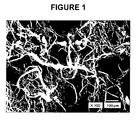
- the branched structure is exemplified by, for example, a configuration illustrated in Fig.1, wherein a fiber branches into more fine fibers and they are intertwined with each other. Branches of the fiber are confirmed by observing with an optical microscope or an electron microscope.
- Figure 1 is a micrograph of the fiber assembly having a branched structure of embodiment 1 described later observed under Digital HF Microscope VH8000 manufactured by Keyence Corporation at a magnification of 100.
- a fiber assembly having an average fiber length of 0. 05 to 50 mm and a branched structure comprises synthetic pulp which is known as one kind of non-woven fabric and may be manufactured by a flash-spinning method which is one method of manufacturing a non-woven fabric.
- a flash-spinning method is a process of manufacturing a non-woven fabric by vaporizing the solvent by decompressing the solvent containing the polymer dissolved at a high pressure and further cutting, beating and refining the fiber by a whirling blender, a disc refiner, etc. where necessary.
- a form of the fiber assembly of the present invention is not specifically limited but includes textile, knit, etc. in addition to a non-woven fabric.
- a weight per unit area of the fiber assembly of the present invention may be selected, where necessary, depending on the application.
- the fiber assembly of the present invention explained above is excellent in antibacterial property and its durability, especially excellent in durability of the antibacterial property against moisture.
- a method of manufacturing the fiber assembly of the present invention is a process of flashing a thermoplastic resin solution in the presence of water, a suspending agent and an antibacterial agent, and specifically it is preferable to adopt the following method.
- an emulsion is prepared by dissolving a raw material resin in a solvent that can dissolve the resin and adding to the resultant solution the aforementioned suspending agent, antibacterial agent and water.
- the raw material resin the aforementioned polyolefin is suitable.
- Solvent may be selected appropriately from those which dissolve raw material resin and are less likely to remain in the obtained fiber assembly when vaporized by flashing, including saturated hydrocarbon based solvents such as butane, pentane, hexane, heptane, octane, cyclohexane, etc.; aromatic based solvents such as benzene, toluene, etc.; halogenated hydrocarbons such as methylene chloride, chloroform, carbon tetrachloride, etc.; and the like.
- saturated hydrocarbon based solvents such as butane, pentane, hexane, heptane, octane, cyclohexane, etc.
- aromatic based solvents such as benzene, toluene, etc.
- halogenated hydrocarbons such as methylene chloride, chloroform, carbon tetrachloride, etc.; and the like.
- the amount of the added suspending agent is set to the amount by which the concentration of the suspending agent results in 0.1 to 5% by mass in the fiber.
- an added amount of polyvinyl alcohol as suspending agent is set to the amount by which the concentration of the suspending agent results in less than 0.1 % by mass, resultant instability of emulsion causes fiber thick and the maximum diameter of fiber results in 80 ⁇ m. And stable cutting of the fiber is prevented as the fiber is floated on the surface of a water and cannot be dispersed in the water.
- the suspending agent is added by adjusting accordingly, for example, adding somewhat excessively.
- a target of the amount of the added suspending agent is 0.1 to 10 parts by mass, based on 100 parts by mass of a raw material resin. The addition of the suspending agent enables to stabilize the emulsion as well as to perform stably the fiber cutting in the water after flashing.
- an amount of the added antibacterial agent is set to the amount by which the concentration of antibacterial agent results in 0.1 to 30% by mass in the fiber.
- the antibacterialagentisadded is 0.1 to 50 parts by mass, based on 100 parts by mass of the raw material resin.
- preferable amount of the added antibacterial agent varies with the application of the fiber assembly obtained.
- the amount of the added antibacterial agent is approximately 1 to 3 parts by mass, based on 100 parts by mass of the raw material resin.
- the amount of the added antibacterial agent is approximately 1 to 30 parts by mass, based on 100 parts by mass of the raw material resin.
- the emulsion obtained is heated to a temperature between 100 and 200°C, preferably between 130 and 150°C and compressed to a pressure between 0.1 and 5 MPa, preferably between 0.5 and 1.5MPa, and ejected (flashed) to a reduced pressure from a nozzle, whereby the solvent is simultaneously evaporated.
- the conditions of reduced pressure are 1 kPa to 95 kPa and the space to which the emulsion is ejected is filled with an inert atmosphere such as a nitrogen atmosphere, etc.
- pressure represents the absolute pressure
- Fiber of undefined length having a branched structure is obtained by flashing the emulsion as mentioned above.
- the fiber is processed to a desired length by cutting, beating and refining using a whirling blender, a disc refiner, etc.
- the resultant fiber may be opened as desired by a mixer, etc.
- a fiber assembly having a branched structure, especially a fiber assembly of the present invention may be preferably manufactured.
- a fiber assembly of the present invention has an excellent antibacterial property and has an excellent effect that the antibacterial effect is not impaired even after a long period of use, especially after a long period of use in the presence of moisture.
- Such fiber assembly may be suitably used by forming, for example, into a non-woven fabric for various applications including filters such as tea bag paper, coffee bag paper, soup package paper, air filter, mask, water purification filter, wine filter, beer filter, juice filter, etc.; packaging materials such as food packaging paper, deoxidizer packaging paper, medical packaging paper, insect resistant packaging paper, etc.; cards, sheets and labels such as wall paper, moisture-permeable and waterproof sheet, heat resistant board, fusuma paper, shoji paper, greeting card, pamphlet, business card, book cover, envelope, lamp shade, label paper, printing paper, posterpaper, etc.; residential materials such as trapping agent of cement particles, thixotropy imparting agent, etc.; hygienic materials such as top sheet and absorbent binder fiber of disposable diaper, napkin and sheet, binder fiber of disposable hand towel, wiper and tissue, oil blotting paper, sterilizing paper, etc.; vaporizer of steam vaporizer for humidifier, fragrance core, etc.; and binder fiber of food tray, writing materials
- the materials in the above applications may be composed of only a fiber assembly of the present invention, or other fibers may be combined with the fiber assembly of the present invention.
- the emulsion was flashed into a drummaintained in a nitrogen atmosphere at a pressure of 53 kPa via a nozzle having a diameter of 3 mm and a length of 20 mm mounted on the autoclave, and a fiber-like material was obtained.
- the slurry was beaten and refined in a 12-inch (30 cm) diameter disc-type refiner to obtain a fiber assembly dispersed in water.
- the dispersed fiber assembly was dried using a hot air circulation dryer at 50°C for 24 hours and the resultant fiber assembly was opened in a 2 L household mixer to obtain a flocculent fiber assembly.
- Figure 1 is a micrograph of the fiber assembly after drying observed under Digital HF Microscope VH8000 manufactured by Keyence Corporation at a magnification of 100.
- the fiber assembly had a fiber diameter distribution in which the minimum and maximum values were 1.1 ⁇ m and 38 ⁇ m, respectively, and a fiber length distribution ranging from 0.1 mm to 5 mm.
- the average fiber length was 1.21 mm.
- the content of the antibacterial agent in the fiber was 0.49% by mass and the content of polyvinyl alcohol in the fiber was 1.9% by mass.
- a bacteriostatic activity value was determined by JIS L1902 absorption method for emulsion of bacteria (test for antibacterial activity and efficacy approved by Japan Textile Evaluation Technology Council) and an antibacterial capability was evaluated.
- a film having a thickness of 1 mm is prepared by sandwiching a flocculent fiber assembly together with a metal spacer having a thickness of 1 mm between films made of a fluorocarbon resin under the conditions of a constant temperature of 25°C and a constant humidity of 50%, followed by fusing the fiber assembly by pressing at 180°C for 3 minutes.
- the film is cut into about 1 cm square pieces and 10 g thereof is put in a porcelain crucible. The pieces are burned in an electric furnace at 1100°C and the weight of the residue is weighed.
- the content of antibacterial agent in the fiber is determined by the following equation as a percentage.
- the content of antibacterial agent ( % ) ( Residue after burning ( g ) / 10 g ) ⁇ 100
- a film having a thickness of approximately 200 ⁇ m is prepared by sandwiching a flocculent fiber assembly together with a metal spacer having a thickness of 200 ⁇ m between films made of a fluorocarbon resin under the conditions of a constant temperature of 25°C and a constant humidity of 50%, followed by fusing the fiber assembly by pressing at 180°C for 3 minutes.
- Absorbance of the film at 1100 cm -1 is measured by an infrared absorption spectrum analyzer (FT/IR-400, manufactured by JASCO Corporation) The film thickness is measured in units of ⁇ m. Content of polyvinyl alcohol is determined from the measured film thickness ( ⁇ m) and the absorbance using Lambert-Beer's law.
- a polyethylene sample of the same form containing 2.0% of polyvinyl alcohol was prepared in advance and used as a standard sample.
- the standard sample was prepared by adding 2 parts by mass of polyvinyl alcohol to 98 parts by mass of polyethylene, followed by fusing and kneading.
- a fiber assembly was prepared by the same method as Embodiment 1 by changing the type of antibacterial agent described in Embodiment 1 to Novalon AG1100 manufactured by Toagosei Co. , Ltd.
- the obtained fiber assembly had a branched structure in fiber structure.
- the fiber assembly had a fiber diameter distribution in which the minimum and maximum values were 1.2 ⁇ m and 35 ⁇ m, respectively, and a fiber length distribution ranging from 0.1 mm to 5 mm.
- An average fiber length was 1.19 mm.
- a content of the antibacterial agent in the fiber was 0.46% by mass and a content of polyvinyl alcohol in the fiber was 1.9% by mass.
- the fiber assembly was evaluated for antibacterial property by the same method as Embodiment 1. The results are shown in Table 1.
- the sample of Embodiment 2 exhibited good bacteriostatic activity values both immediately after manufacturing and one day after immersion in tap water, and exhibited that the sample has durability of the antibacterial property as well as antibacterial property.
- a fiber assembly was prepared by the same method as Embodiment 1 by changing the amount of antibacterial agent added from 0. 6 part by mass to 0.1 part by mass and 30 parts by mass.
- the obtained fiber assembly had a branched structure in fiber structure and its evaluated physical property and antibacterial property are shown in Table 1.
- Table 1 As can be seen from Table 1, like the sample of embodiment 1, the samples of Embodiment 3 and 4 exhibited good bacteriostatic activity values both immediately after manufacturing and one day after immersion in tap water, and exhibited that the sample has durability of the antibacterial property as well as antibacterial property.
- the content of the antibacterial agent in the sheath side was calculated to be 0. 60% and the content of polyvinyl alcohol in the sheath side was calculated to be 2.0%.
- the short fiber was evaluated for antibacterial property by the same method as Embodiment 1. The results are shown in Table 1.
- a fiber assembly was prepared by the same method as Embodiment 1 without adding an antibacterial agent.
- the obtained fiber assembly had a branched structure in fiber structure.
- the fiber assembly had a fiber diameter distribution in which the minimum and maximum values were 1.1 ⁇ m and 34 ⁇ m, respectively, and a fiber length distribution from 0.1 mm to 5 mm.
- the average fiber length was 1.20 mm.
- the amount of polyvinyl alcohol in the fiber was 1.8% by mass.
- the fiber assembly was evaluated for antibacterial property by the same method as Embodiment 1 .
- the results are shown in Table 1 .
- a fiber assembly was prepared by the same method as Embodiment 1 by changing the type of antibacterial agent described in Embodiment 1 to Zeomic (SINANEN ZEOMIC (registered trade mark)).
- the obtained fiber assembly had a branched structure in fiber structure. Its evaluated physical property and antibacterial property are shown in Table 1. As can be seen from Table 1, the samples of Comparative Embodiment 3 exhibited poor antibacterial property.
- a fiber assembly of the present invention is suitable for non-woven fabric, filters, packaging materials, cards/sheets/labels, residential materials, hygienic materials, binder fiber, etc. because of the excellent antibacterial property and durability of the antibacterial property against moisture.
Landscapes
- Engineering & Computer Science (AREA)
- Chemical & Material Sciences (AREA)
- Chemical Kinetics & Catalysis (AREA)
- General Chemical & Material Sciences (AREA)
- Textile Engineering (AREA)
- Manufacturing & Machinery (AREA)
- Spinning Methods And Devices For Manufacturing Artificial Fibers (AREA)
- Nonwoven Fabrics (AREA)
- Body Washing Hand Wipes And Brushes (AREA)
- Sanitary Thin Papers (AREA)
- Wrappers (AREA)
- Filtering Materials (AREA)
- Agricultural Chemicals And Associated Chemicals (AREA)
- Artificial Filaments (AREA)
Abstract
The present invention pertains to a fiber assembly in which the durability of antibacterial property, especially the durability of antibacterial property against moisture is improved and, in particular, a fiber assembly principally comprising polyolefin, wherein said fiber contains an antibacterial agent and a suspending agent, and has a branched structure.
Description
- The present invention relates to an antibacterial fiber assembly and a production method and uses thereof. More particularly, the present invention relates to an antibacterial fiber assembly having a branched structure and comprising of a particular component.
- An antibacterial property is imparted to a non-woven fabric from the point of view of the hygiene issue and it is well known in
Japanese Patent Laid-Open Publication No. 66108/1999 Japanese Patent Laid-Open Publication No. 278097/2003 Japanese Patent Laid-Open Publication No. 21446/2005
Meanwhile, it is known inJapanese Patent Laid-Open Publication No. 44523/1973 - Patent document 1:
Japanese Patent Laid-Open Publication No. 166108/1999 - Patent document 2:
Japanese Patent Laid-Open Publication No. 278097/2003 - Patent document 3:
Japanese Patent Laid-Open Publication No. 21446/2005 - Patent document 4:
Japanese Patent Laid-Open Publication No. 44523/1973 - It is an object of the present invention to provide a fiber assembly in which the durability of the antibacterial property, especially the durability of the antibacterial property against moisture is improved.
- As a result of earnest studies to solve the aforementioned problems, the present inventors have found that a fiber assembly which has a specific structure and contains an antibacterial agent and a suspending agent may solve the aforementioned problems, and have completed the present invention.
- One aspect of the present invention relates to a fiber assembly principally comprising polyolefin, wherein said fiber contains an antibacterial agent and a suspending agent, and has a branched structure.
- In one embodiment, the present invention relates to a fiber assembly principally comprising a polyolefin, wherein said fiber contains 0.1 to 30% by mass of an antibacterial agent and 0.1 to 5 % by mass of a suspending agent, and having an average fiber length of 0.05 to 50 mm and a branched structure.
- Another aspect of the present invention relates to a production method of a fiber assembly having a branched structure, wherein a thermoplastic resin solution is flashed in the presence of water, a suspending agent and an antibacterial agent.
- Another aspect of the present invention relates to non-woven fabric, filters, packaging materials, cards, sheets and labels, residential materials, hygienic materials and binder fiber as applications of the aforementioned fiber assembly.
- An antibacterial fiber assembly of the present invention has an excellent effect in that it has an excellent antibacterial property and the antibacterial effect is not lost even after a long period of use, and further, significantly has an industrial value because said fiber assembly may be formed and converted into a non-woven fabric form which may be used for applications such as filters, packaging materials, cards, sheets and labels, residential materials, hygienic materials, binder fiber, various volatilizers as well as various forming papers.
-
- Figure 1 is a micrograph of a fiber assembly relating to Embodiment 1.
- Hereinafter, embodiments of the present invention will be explained.
- Firstly, a fiber assembly of the present invention is explained. A fiber in the fiber assembly of the present invention comprises principally a polyolefin and contains an antibacterial agent and a suspending agent.
- The polyolefin is preferably exemplified by a homopolymer of an α-olefin having 2 to 6 carbon atoms or a copolymer of mutual α-olefins having 2 to 6 carbon atoms; and further a copolymer of α-olefin having 2 to 6 carbon atoms with other copolymerizable olefin, an unsaturated carboxylic acid such as acrylic acid, methacrylic acid, etc., an acrylic ester, a methacrylic ester, vinyl acetate and the like; and furthermore a polymer obtained by graft reacting a homopolymer or a copolymer thereof with an unsaturated carboxylic acid monomer using a peroxide. Especially preferable examples are a crystalline polymer and a copolymer of ethylene, propylene, 1-butene, 3-methyl-1-butene or 4-methyl-1-butene. Specifically, there may be mentioned low-density polyethylene, linear low-density polyethylene and elastomer (ethylene-α-olefin copolymer), medium-density polyethylene, high-density polyethylene, ultra high molecular weight polyethylene, ethylene-methacrylic acid copolymer; maleic acid or acrylic acid modified-polyethylene, polypropylene, polybutene, poly(3-methylbutene), poly(4-methylbutene); and a mixture thereof. As is clear from the gist of the present invention, these polyolefins may be manufactured by any appropriate method.
- Although an antibacterial agent is not specifically limited if it is stable even under heating in manufacturing a fiber assembly, in general an inorganic antibacterial agent is readily used because it is stable against heating. The inorganic antibacterial agent includes a silver-based inorganic antibacterial agent and a non-silver-based inorganic antibacterial agent. The silver-based inorganic antibacterial agent includes, for example, a silver-supported zeolite (aluminosilicate), silver-supported apatite (calcium phosphate), silver-supported glass (silicon oxide), silver-supported zirconium phosphate, silver-supported calcium silicate, etc. The non-silver-based inorganic antibacterial agent includes, for example, a compound whose active ingredient is zinc oxide, copper oxide, etc., especially a solid solution of aluminum oxide, calcium oxide, magnesium oxide, etc. with zinc oxide or copper oxide, or ultra-fine particles of zinc oxide, titanium oxide, etc.
- Although the particle size of the antibacterial agent is not specifically limited, it is preferable that the particle size D50% is in the range of 0.05 to 3 µm from the point of view of the productivity and antibacterial effect of the fiber assembly, and more preferable 0.05 to 2 µm. Here, D50% is a value as measured by laser scattered light after being dispersed with ultrasonic wave for 5 minutes or more.
- Although the BET specific surface area of the antibacterial agent is not specifically limited, it is preferable that the BET specific surface area is in the range of 1 to 300 m2/g from the point of view of the antibacterial effect and its durability, and more preferably 10 to 150 m2/g.
- The content of the antibacterial agent in the fiber is in the range of 0.1 to 30% by mass, and preferably 0.3 to 10% by mass.
- It is considered that the suspending agent reduces the interfacial tension of the fiber and improves the contact efficiency between bacteria and the antibacterial agent, thereby contributing to the improvement of the antibacterial effect.
- As suspending agents, there may be used a hydrophilic polymer such as polyvinyl alcohol, polyethylene glycol, polypropylene glycol, polyacrylate salt, gelatin, tragacanth gum, starch, methylcellulose, carboxymethylcellulose, etc. In addition,the hydrophilic polymer may be used in combination with a common nonionic surfactant, cationic surfactant or anionic surfactant. Among them, from the point of view of the productivity and contribution to the antibacterial effect, etc., especially a polyvinyl alcohol-based hydrophilic polymer is preferable and the polymerization degree of the polyvinyl alcohol is preferably in the range of 200 to 1000.
- The content of the suspending agent in the fiber is in the range of 0.1 to 5% by mass, and preferably 0.3 to 3% by mass. When the contents of the antibacterial agent and suspending agent fall within the aforementioned range, the fiber assembly obtained exhibits excellent antibacterial property and its durability.
- A fiber in the present invention may contain, in addition to the aforementioned antibacterial agent and suspending agent, other components insofar as the effect of the present invention is not impaired. As other components, there may be mentioned a conventionally known heat resistant stabilizer, weather resistance stabilizer, wide variety of stabilizers, antioxidant, dispersant, antistatic agent, slip agent, anti-blocking agent, anti-clouding agent, lubricating agent, dye, pigment, natural oil, synthetic oil, wax, filling agent, etc.
- In one embodiment, a fiber in the present invention has an average value of the longest parts of the fiber (referred to as "an average fiber length" in the present description) of 0.05 to 50 mm, and preferably 0.05 to 10 mm, and especially preferably 0.1 to 5 mm. When the average fiber length falls within the aforementioned range, said fiber is readily converted into the fiber assembly which may be suitably used for various applications by taking advantage of the antibacterial property.
- Moreover, it is preferable that a diameter of a fiber in the present invention (hereinafter, referred to as "a fiber diameter") has a minimum value of approximately 0.5 µm and a maximum value of approximately 50 µm. When the fiber diameter falls within the aforementioned range, said fiber is readily converted into the fiber assembly which may be suitably used for various applications by taking advantage of the antibacterial property.
- Here, the methods of measuring the aforementioned average fiber length and fiber diameter will be explained.
- Using Automatic Fiber Analyzer manufactured by Metso Automation Inc. in Finland (product name: FiberLab-3.5), a fiber length for 12000 to 13000 filaments of the fiber was measured. Then an average fiber length is recorded as a value obtained by substituting the number average fiber length and the number of filaments of the fiber for each class which are classified in increments of a fiber length of 0.05 mm into the following equation :

- Ln: number average fiber length of each class (mm).
- Nn: number of filaments of the fiber for each class.
- L: measured fiber length of each fiber in one class.
- N: number of filaments of the fiber in one class.
- A fiber length is measured by dispersing the fiber in water at a dilute concentration, exposing filaments of the fiber passing through the capillary to xenon lamp light to acquire image signals by a CCD (charge-coupled device) sensor and then performing image analysis. More specifically, fibers are dispersed in water at 0.02% by weight, and 12000 to 13000 filaments of the fiber are measured by using Automatic Fiber Analyzer manufactured by Metso Automation Inc. in Finland (product name: FiberLab-3.5). A fiber length is measured in the increment of 0. 05 mm and the measurement results of both the fiber length and the presence percentage (%) of the fiber corresponding to each fiber length are obtained.
- A fiber diameter is measured by observing each filament of the fiber with an optical microscope or an electron microscope.
Specifically, the maximum and minimum values of the fiber diameter are measured as follows. - The maximum value: Filaments of fiber are observed under Digital HF Microscope VH8000 manufactured by Keyence Corporation at a magnification of 100 and 100 parts are randomly selected for parts of 10 µm or more of a diameter and then fiber diameters of the selected parts are measured. The maximum measured value is recorded as the maximum value.
- The minimum value: Filaments of fiber are observed under Scanning Electron Microscope JSM6480 manufactured by JEOL Ltd. at a magnification of 3000 and 100 parts are randomly selected for parts of less than 10 µm of a diameter and then fiber diameters of the selected parts are measured. The minimum measured value is recorded as the minimum value.
- Fiber in the present invention has a branched structure. The branched structure is exemplified by, for example, a configuration illustrated in Fig.1, wherein a fiber branches into more fine fibers and they are intertwined with each other. Branches of the fiber are confirmed by observing with an optical microscope or an electron microscope. Incidentally, Figure 1 is a micrograph of the fiber assembly having a branched structure of embodiment 1 described later observed under Digital HF Microscope VH8000 manufactured by Keyence Corporation at a magnification of 100.
- In the present invention, a fiber assembly having an average fiber length of 0. 05 to 50 mm and a branched structure comprises synthetic pulp which is known as one kind of non-woven fabric and may be manufactured by a flash-spinning method which is one method of manufacturing a non-woven fabric. A flash-spinning method is a process of manufacturing a non-woven fabric by vaporizing the solvent by decompressing the solvent containing the polymer dissolved at a high pressure and further cutting, beating and refining the fiber by a whirling blender, a disc refiner, etc. where necessary. Especially, when an emulsion prepared by dispersing a polyolefin solution in an aqueous medium in the presence of an antibacterial agent and a suspending agent is flashed, by using a method such as described in
Japanese Patent Laid-Open Publication No. 44523/1973 - A form of the fiber assembly of the present invention is not specifically limited but includes textile, knit, etc. in addition to a non-woven fabric.
- A weight per unit area of the fiber assembly of the present invention may be selected, where necessary, depending on the application.
- The fiber assembly of the present invention explained above is excellent in antibacterial property and its durability, especially excellent in durability of the antibacterial property against moisture.
- Next, one embodiment of methods of the present invention of manufacturing a fiber assembly is explained in detail.
- A method of manufacturing the fiber assembly of the present invention is a process of flashing a thermoplastic resin solution in the presence of water, a suspending agent and an antibacterial agent, and specifically it is preferable to adopt the following method.
- Firstly, an emulsion is prepared by dissolving a raw material resin in a solvent that can dissolve the resin and adding to the resultant solution the aforementioned suspending agent, antibacterial agent and water. As the raw material resin, the aforementioned polyolefin is suitable.
- Solvent may be selected appropriately from those which dissolve raw material resin and are less likely to remain in the obtained fiber assembly when vaporized by flashing, including saturated hydrocarbon based solvents such as butane, pentane, hexane, heptane, octane, cyclohexane, etc.; aromatic based solvents such as benzene, toluene, etc.; halogenated hydrocarbons such as methylene chloride, chloroform, carbon tetrachloride, etc.; and the like.
- It is preferable that the amount of the added suspending agent is set to the amount by which the concentration of the suspending agent results in 0.1 to 5% by mass in the fiber. When an added amount of polyvinyl alcohol as suspending agent is set to the amount by which the concentration of the suspending agent results in less than 0.1 % by mass, resultant instability of emulsion causes fiber thick and the maximum diameter of fiber results in 80 µm. And stable cutting of the fiber is prevented as the fiber is floated on the surface of a water and cannot be dispersed in the water. On the contrary when an amount of poly vinyl alcohol exceeds the concentration of 5 % by mass, a dehydration rate becomes very slow at a process of making a paper with a mixture of other fibers such as a natural pulp and this causes an adverse influence on an efficient product manufacture.
- In the manufacturing process, when an operation in which part of the added suspending agent is removed is performed, the suspending agent is added by adjusting accordingly, for example, adding somewhat excessively. A target of the amount of the added suspending agent is 0.1 to 10 parts by mass, based on 100 parts by mass of a raw material resin. The addition of the suspending agent enables to stabilize the emulsion as well as to perform stably the fiber cutting in the water after flashing.
- While, it is preferable that an amount of the added antibacterial agent is set to the amount by which the concentration of antibacterial agent results in 0.1 to 30% by mass in the fiber. In a manufacturing process, when an operation in which part of the added antibacterial agent is removed is performed, the antibacterialagentisadded byadjustingaccordingly,forexample, adding somewhat excessively. A target of the amount of the added antibacterial agent is 0.1 to 50 parts by mass, based on 100 parts by mass of the raw material resin.
- Further, preferable amount of the added antibacterial agent varies with the application of the fiber assembly obtained. For example, for a water purification filter which is used over a long period of time, the amount of the added antibacterial agent is approximately 1 to 3 parts by mass, based on 100 parts by mass of the raw material resin. Even for the same water purification filter, when it is mixed with other material such as activated carbon, it is preferable, in order to secure the absolute amount of the antibacterial agent in the filter, that the amount of the added antibacterial agent is approximately 1 to 30 parts by mass, based on 100 parts by mass of the raw material resin.
- Next, the emulsion obtained is heated to a temperature between 100 and 200°C, preferably between 130 and 150°C and compressed to a pressure between 0.1 and 5 MPa, preferably between 0.5 and 1.5MPa, and ejected (flashed) to a reduced pressure from a nozzle, whereby the solvent is simultaneously evaporated. It is preferable that the conditions of reduced pressure are 1 kPa to 95 kPa and the space to which the emulsion is ejected is filled with an inert atmosphere such as a nitrogen atmosphere, etc.
- Here, in the present description, pressure represents the absolute pressure.
- Fiber of undefined length having a branched structure is obtained by flashing the emulsion as mentioned above. However, it is preferable that the fiber is processed to a desired length by cutting, beating and refining using a whirling blender, a disc refiner, etc. In this case, it is preferable to perform the above cutting, beating and refining processing by preparing an aqueous slurry containing the fiber at the concentration of 0.5 to 5 g/l.
- After drying, the resultant fiber may be opened as desired by a mixer, etc.
- According to the method explained above, a fiber assembly having a branched structure, especially a fiber assembly of the present invention may be preferably manufactured.
- A fiber assembly of the present invention has an excellent antibacterial property and has an excellent effect that the antibacterial effect is not impaired even after a long period of use, especially after a long period of use in the presence of moisture.
- Such fiber assembly may be suitably used by forming, for example, into a non-woven fabric for various applications including filters such as tea bag paper, coffee bag paper, soup package paper, air filter, mask, water purification filter, wine filter, beer filter, juice filter, etc.; packaging materials such as food packaging paper, deoxidizer packaging paper, medical packaging paper, insect resistant packaging paper, etc.; cards, sheets and labels such as wall paper, moisture-permeable and waterproof sheet, heat resistant board, fusuma paper, shoji paper, greeting card, pamphlet, business card, book cover, envelope, lamp shade, label paper, printing paper, posterpaper, etc.; residential materials such as trapping agent of cement particles, thixotropy imparting agent, etc.; hygienic materials such as top sheet and absorbent binder fiber of disposable diaper, napkin and sheet, binder fiber of disposable hand towel, wiper and tissue, oil blotting paper, sterilizing paper, etc.; vaporizer of steam vaporizer for humidifier, fragrance core, etc.; and binder fiber of food tray, writing materials, buffer for large components, door panel of car, etc.
- Moreover, the materials in the above applications may be composed of only a fiber assembly of the present invention, or other fibers may be combined with the fiber assembly of the present invention.
- Hereinafter, the present invention will be explained more specifically with reference to embodiments, etc., but the range of the present invention is not restricted to these embodiments, etc.
- Into an 80 L autoclave equipped with a stirrer were charged 20 L of n-hexane (23°C), 20 L of water (23°C), 1 kg of polyethylene (Hizex 2200J, manufactured by Mitsui Chemicals, Inc.; melting point 135°C), 20 g of polyvinyl alcohol (Gohsenol NL-05, manufactured by Nippon Synthetic Chemical Industry Co., Ltd.) and 6 g of an antibacterial agent (Seabio Z-28, manufactured by Research Institute for Oceanochemistry). The liquid mixture was heated to 145°C with stirring. Stirring was continued for 30 minutes by maintaining the temperature at 145°C to obtain an emulsion.
- Then, the emulsion was flashed into a drummaintained in a nitrogen atmosphere at a pressure of 53 kPa via a nozzle having a diameter of 3 mm and a length of 20 mm mounted on the autoclave, and a fiber-like material was obtained.
- Next, after preparing an aqueous slurry containing the fiber-like material at a concentration of 10 g/L, the slurry was beaten and refined in a 12-inch (30 cm) diameter disc-type refiner to obtain a fiber assembly dispersed in water. The dispersed fiber assembly was dried using a hot air circulation dryer at 50°C for 24 hours and the resultant fiber assembly was opened in a 2 L household mixer to obtain a flocculent fiber assembly.
- The obtained fiber assembly had a branched structure in fiber structure as illustrated in Figure 1. Figure 1 is a micrograph of the fiber assembly after drying observed under Digital HF Microscope VH8000 manufactured by Keyence Corporation at a magnification of 100.
- The fiber assembly had a fiber diameter distribution in which the minimum and maximum values were 1.1 µm and 38 µm, respectively, and a fiber length distribution ranging from 0.1 mm to 5 mm. The average fiber length was 1.21 mm. The content of the antibacterial agent in the fiber was 0.49% by mass and the content of polyvinyl alcohol in the fiber was 1.9% by mass.
- For the flocculent fiber assembly prepared by the above method, a bacteriostatic activity value was determined by JIS L1902 absorption method for emulsion of bacteria (test for antibacterial activity and efficacy approved by Japan Textile Evaluation Technology Council) and an antibacterial capability was evaluated.
- (1) A preparation method of test sample used for the evaluation
Into a metal receptacle of 18 mm x 18 mm was placed 0.4 g of the flocculent fiber assembly, and the fiber assembly was uniformly spread, and compressed at a pressure of 63.7 MPa for 10 minutes to prepare a 18 mm-square test specimen weighing 0.4 g. - (2) Pretreatment of test samples
The test sample prepared by the above method was placed in a vial bottle and sterilization by high-pressure steam was performed at a temperature of 121°C and pressure of 103 kPa for 15 minutes in an autoclave. - (3) Culture test
The sterilized test sample placed in a vial bottle was inoculated uniformly as much as possible with 0.2 mL bacteria emulsion of a Staphylococcus aureus ATCC 6538P (Staphylococcus aureus) whose vial count was controlled to (1 ± 0.3) × 105 and was cultured at 37°C for 18 hours. To the culture medium was added 20 mL of physiological saline added with 0.2% of Tween 80 and the mixed solution was stirred to wash out the bacteria. A 10-fold dilution series of the washed-out bacteria was prepared and carried out pour culture with a nutrient agar culture medium at 37°C for 24 hours or more to count the number of colonies and determine the viable count. - (4) Calculation of test results
For a standard sample and the test samples, each of the above tests was performed to determine the bacteriostatic activity value from the following equation. A standard white cotton fabric described in JIS L0803 was used as a standard sample.
- B = Viable count after incubation for 18 hours in the presence of the standard sample.
- C = Viable count after incubation for 18 hours in the presence of the test sample.
- (5) Evaluation of durability
- Into a 20 L vessel equipped with a cover were charged 20 L of tap water and a flocculent antibacterial sample for evaluation prepared by the above (1) and the liquid mixture was vigorously shaken and allowed to settle for one day. The sample for evaluation was recovered by filtering through a mesh, and dried at 50°C for one day. The antibacterial evaluation was performed for such resultant samples in accordance with the description in the above items (2) to (4).
- The results are shown in Table 1. As can be seen from Table 1, the sample of Embodiment 1 exhibited good bacteriostatic activity values both immediately after manufacturing and one day after immersion in tap water, and exhibited that the sample has durability of the antibacterial property as well as antibacterial property.
- A film having a thickness of 1 mm is prepared by sandwiching a flocculent fiber assembly together with a metal spacer having a thickness of 1 mm between films made of a fluorocarbon resin under the conditions of a constant temperature of 25°C and a constant humidity of 50%, followed by fusing the fiber assembly by pressing at 180°C for 3 minutes. The film is cut into about 1 cm square pieces and 10 g thereof is put in a porcelain crucible.
The pieces are burned in an electric furnace at 1100°C and the weight of the residue is weighed. The content of antibacterial agent in the fiber is determined by the following equation as a percentage.
- A film having a thickness of approximately 200 µm is prepared by sandwiching a flocculent fiber assembly together with a metal spacer having a thickness of 200 µm between films made of a fluorocarbon resin under the conditions of a constant temperature of 25°C and a constant humidity of 50%, followed by fusing the fiber assembly by pressing at 180°C for 3 minutes. Absorbance of the film at 1100 cm-1 is measured by an infrared absorption spectrum analyzer (FT/IR-400, manufactured by JASCO Corporation) The film thickness is measured in units of µm. Content of polyvinyl alcohol is determined from the measured film thickness (µm) and the absorbance using Lambert-Beer's law.
- In addition, in determining the content, a polyethylene sample of the same form containing 2.0% of polyvinyl alcohol was prepared in advance and used as a standard sample. The standard sample was prepared by adding 2 parts by mass of polyvinyl alcohol to 98 parts by mass of polyethylene, followed by fusing and kneading.
- A fiber assembly was prepared by the same method as Embodiment 1 by changing the type of antibacterial agent described in Embodiment 1 to Novalon AG1100 manufactured by Toagosei Co. , Ltd.
- The obtained fiber assembly had a branched structure in fiber structure. The fiber assembly had a fiber diameter distribution in which the minimum and maximum values were 1.2 µm and 35 µm, respectively, and a fiber length distribution ranging from 0.1 mm to 5 mm. An average fiber length was 1.19 mm. A content of the antibacterial agent in the fiber was 0.46% by mass and a content of polyvinyl alcohol in the fiber was 1.9% by mass.
- The fiber assembly was evaluated for antibacterial property by the same method as Embodiment 1. The results are shown in Table 1.
- As can be seen from Table 1, like the sample of Embodiment 1, the sample of Embodiment 2 exhibited good bacteriostatic activity values both immediately after manufacturing and one day after immersion in tap water, and exhibited that the sample has durability of the antibacterial property as well as antibacterial property.
- A fiber assembly was prepared by the same method as Embodiment 1 by changing the amount of antibacterial agent added from 0. 6 part by mass to 0.1 part by mass and 30 parts by mass.
- The obtained fiber assembly had a branched structure in fiber structure and its evaluated physical property and antibacterial property are shown in Table 1. As can be seen from Table 1, like the sample of embodiment 1, the samples of Embodiment 3 and 4 exhibited good bacteriostatic activity values both immediately after manufacturing and one day after immersion in tap water, and exhibited that the sample has durability of the antibacterial property as well as antibacterial property.
- A core-sheath composite fiber having a core/sheath ratio = 50/50 was prepared by melt-spinning through a spinning nozzle, wherein the sheath component was composed of 100 parts by mass of polyethylene (Hizex 2200J, manufactured by Mitsui Chemicals, Inc. ) to which 0. 6 part by mass of an antibacterial agent Novalon AG1100 and 2 parts by mass of polyvinyl alcohol were admixed and the core component was composed of polypropylene (Hipol, manufactured by Mitsui Chemicals, Inc.). After preparing long fiber with 2 deniers by extending the composite fiber, it was cut into 5 mm long pieces to obtain short fiber with the fiber diameter of 25 µm without having a branched structure. A content of the antibacterial agent in the fiber was 0.30% and that of polyvinyl alcohol in the fiber was 1.0%.
- Using the above core/sheath ratio, the content of the antibacterial agent in the sheath side was calculated to be 0. 60% and the content of polyvinyl alcohol in the sheath side was calculated to be 2.0%.
- The short fiber was evaluated for antibacterial property by the same method as Embodiment 1. The results are shown in Table 1.
- It was found from Table 1 that the sample of Comparative Embodiment 1 exhibited a good bacteriostatic activity value immediately after manufacturing; however, the sample had a decreased bacteriostatic activity value one day after immersion in tap water and had no durability of the antibacterial property.
- A fiber assembly was prepared by the same method as Embodiment 1 without adding an antibacterial agent. The obtained fiber assembly had a branched structure in fiber structure. The fiber assembly had a fiber diameter distribution in which the minimum and maximum values were 1.1 µm and 34 µm, respectively, and a fiber length distribution from 0.1 mm to 5 mm. The average fiber length was 1.20 mm. The amount of polyvinyl alcohol in the fiber was 1.8% by mass.
- The fiber assembly was evaluated for antibacterial property by the same method as Embodiment 1 . The results are shown in Table 1 .
- It was found from Table 1 that the obtained fiber assembly has no antibacterial property.
- A fiber assembly was prepared by the same method as Embodiment 1 by changing the type of antibacterial agent described in Embodiment 1 to Zeomic (SINANEN ZEOMIC (registered trade mark)).
- The obtained fiber assembly had a branched structure in fiber structure. Its evaluated physical property and antibacterial property are shown in Table 1. As can be seen from Table 1, the samples of Comparative Embodiment 3 exhibited poor antibacterial property.
- A fiber assembly of the present invention is suitable for non-woven fabric, filters, packaging materials, cards/sheets/labels, residential materials, hygienic materials, binder fiber, etc. because of the excellent antibacterial property and durability of the antibacterial property against moisture.
Table 1 Emb. 1 Emb. 2 Emb. 3 Emb. 4 Comp. Emb. 1 Comp. Emb 2 Comp. Emb. 3 Synthetic resin 100 parts of HOPE 100 parts of HDPE 100 parts of DPE 100 parts of HDPE 100 parts of HDPE (sheath side) / 100 parts of PP (core side) 100 parts of HDPE 100 parts of HDPE Antibacterial agent 0.6 part of Seabio 0.6 part of Novalon 0.1 parts of Novalon 30 parts of Novalon 0.6 part of Novalon (in the sheath side) - 0.6 part of Zeomic Fiber spinning method Flash method Flash spinning method Flash spinning method Flash spinning method Melt spinning method Flash spinning method Flash spinning method Fiber structure Multi-branched Multi-branched Multi-branched Multi-branched branched structure Multi-branched Multi-branched Fiber diameter (µm) (minimum value) 1.1 1.2 1.2 1.2 25 1.1 1.2 Fiber diameter (µm) (maximum value) 38 35 35 35 25 34 35 Fiber length (mm) 0.1~5 0.1~5 0.1~5 0.1~5 5 0.1~5 0.1~5 Average fiber length (mm) 1.21 1.19 1.23 1.21 5 1.20 1.19 Content of antibacterial agent (%; analytical value) 0.49 0.46 0.098 25 0.30 - 0.28 (Ana. V.) / (Add. V.) * 100 81 76 98 64 46 Content of polyvinyl alcohol (%; analytical value) 1.9 1.9 1.9 1.9 1.0 1.8 1.9 Bacteriostatic activity value immediately after manufacturing more than 4.3 more than 4.3 2.3 more than 4.3 more than 4.3 1.3 2.0 Bacteriostatic activity evaluation immediately after manufacturing AA AA AA AA AA BB BB Bacteriostatic activity value one day after immersion in tap water more than 4.3 more than 4.3 2.3 more than 4.3 0.8 1.3 2.0 Bacteriostatic activity evaluation one day after immersion in tap water AA AA AA AA BB BB BB HDPE = high density polyethylene.
PP = polypropylene.
Ana. V. = Analytical valued of antibacterial agent content.
Add. V. = Amount of antibacterial agent added.
AA = good.
BB = poor.

Claims (14)
- A fiber assembly principally comprising polyolefin, wherein said fiber contains an antibacterial agent and a suspending agent, and has a branched structure.
- A fiber assembly according to claim 1 principally comprising polyolefin, wherein said fiber contains 0.1 to 30% by mass of an antibacterial agent and 0.1 to 5 % by mass of a suspending agent, and has an average fiber length of 0.05 to 50 mm and a branched structure.
- A fiber assembly according to claim 1 or claim 2, wherein said suspending agent is polyvinyl alcohol and said antibacterial agent is an inorganic compound.
- A fiber assembly according to any one of claims 1 to 3, wherein said fiber assembly is formed by a flash spinning method.
- A method of manufacturing a fiber assembly having a branched structure, wherein a thermoplastic resin solution is flashed in the presence of water, a suspending agent and an antibacterial agent.
- A non-woven fabric obtained by forming a fiber assembly according to any one of claims 1 to 4.
- A filter comprising a fiber assembly according to any one of claims 1 to 4.
- A packaging material comprising a fiber assembly according to any one of claims 1 to 4.
- A card comprising a fiber assembly according to any one of claims 1 to 4.
- A sheet comprising a fiber assembly according to any one of claims 1 to 4.
- A label comprising a fiber assembly according to any one of claims 1 to 4.
- A residential material comprising a fiber assembly according to any one of claims 1 to 4.
- A hygienic material comprising a fiber assembly according to any one of claims 1 to 4.
- A binder fiber comprising a fiber assembly according to any one of claims 1 to 4.
Applications Claiming Priority (1)
| Application Number | Priority Date | Filing Date | Title |
|---|---|---|---|
| JP2005264618A JP2007077519A (en) | 2005-09-13 | 2005-09-13 | Antimicrobial aggregate of fiber, method for producing the same and its application |
Publications (1)
| Publication Number | Publication Date |
|---|---|
| EP1764427A2 true EP1764427A2 (en) | 2007-03-21 |
Family
ID=37685062
Family Applications (1)
| Application Number | Title | Priority Date | Filing Date |
|---|---|---|---|
| EP20060254771 Withdrawn EP1764427A2 (en) | 2005-09-13 | 2006-09-13 | Antibacterial fiber assembly and methods for production and use thereof |
Country Status (3)
| Country | Link |
|---|---|
| US (1) | US20070059347A1 (en) |
| EP (1) | EP1764427A2 (en) |
| JP (1) | JP2007077519A (en) |
Families Citing this family (20)
| Publication number | Priority date | Publication date | Assignee | Title |
|---|---|---|---|---|
| JP2012091089A (en) * | 2010-10-25 | 2012-05-17 | Nippon Muki Co Ltd | Antibacterial filter |
| EP2837282A4 (en) | 2012-04-09 | 2015-11-25 | Mitsui Chemicals Inc | PLANT CULTURE MATERIAL AND PLANT CULTURE METHOD USING THE MATERIAL |
| EP2982239A4 (en) | 2013-04-03 | 2016-11-23 | Mitsui Chemicals Inc | PLANT CULTURE SYSTEM, CULTURE METHOD USING THE SAME, AND METHOD OF MANUFACTURING THE SAME |
| JP2014208318A (en) * | 2013-04-16 | 2014-11-06 | 東洋紡株式会社 | Antibacterial electret filter medium |
| JP2016198723A (en) * | 2015-04-10 | 2016-12-01 | 三井化学株式会社 | Liquid adsorbing material, and liquid adsorbing body obtained by using the material |
| CN105332078B (en) * | 2015-12-01 | 2018-01-02 | 东华大学 | A kind of antibacterial polyester fibre based on silver-loaded zirconium phosphate and preparation method thereof |
| CN105332087B (en) * | 2015-12-01 | 2017-06-30 | 东华大学 | A kind of Mesoporous zirconium phosphate loading nano silvery antibacterial polyester fibre and preparation method thereof |
| CN105332085B (en) * | 2015-12-01 | 2017-06-30 | 东华大学 | A kind of Mesoporous zirconium phosphate loading nano silvery anti-bacterial fibre and preparation method thereof |
| CN105332086B (en) * | 2015-12-01 | 2017-06-30 | 东华大学 | A kind of preparation method of Mesoporous zirconium phosphate loading nano silvery antibacterial polylactic acid fiber |
| CN105386147B (en) * | 2015-12-01 | 2017-06-30 | 东华大学 | A kind of Mesoporous zirconium phosphate loading nano silvery antibacterial Fypro and preparation method thereof |
| CN105332077B (en) * | 2015-12-01 | 2017-06-30 | 东华大学 | Mesoporous zirconium phosphate loading nano silvery antibacterial polyethylene alcohol fiber and preparation method thereof |
| CN105332082B (en) * | 2015-12-01 | 2017-12-22 | 东华大学 | A kind of antibacterial Fypro based on silver-loaded zirconium phosphate and preparation method thereof |
| JP7008450B2 (en) * | 2017-09-08 | 2022-02-10 | 三井化学株式会社 | Method for manufacturing powdered synthetic pulp |
| ES1208186Y (en) | 2018-02-20 | 2018-06-14 | Fita Juan Emilio Pastor | PERFECTED TEXTILE CLEANING PRODUCT |
| CN110294839A (en) * | 2019-06-29 | 2019-10-01 | 江苏鑫福纤维科技有限公司 | A method of the fiber polyester chip for textile processing |
| CN112877802B (en) * | 2019-11-29 | 2025-12-05 | 霍尼韦尔安全产品美国股份有限公司 | Antibacterial fibers |
| US20220080701A1 (en) * | 2020-09-12 | 2022-03-17 | Kwok Shing Thomas Wong | Biodegradable fabrics made from polylactic acid (pla) fibers and/or yarns and methods for making the same |
| CN112647359A (en) * | 2020-12-14 | 2021-04-13 | 台州市路桥瑞康家庭用品厂 | Antibacterial paper cup and production method thereof |
| CN115537959B (en) * | 2021-09-28 | 2023-05-05 | 江苏青昀新材料有限公司 | Composite material |
| CN116623367B (en) * | 2023-07-14 | 2023-09-22 | 江苏青昀新材料有限公司 | A flash evaporation material with low haze decay rate |
Family Cites Families (1)
| Publication number | Priority date | Publication date | Assignee | Title |
|---|---|---|---|---|
| BE789808A (en) * | 1971-10-12 | 1973-04-06 | Crown Zellerbach Int Inc | POLYOLEFIN PAPER PULP HAVING BETTER DRIPPING PROPERTIES AND PROCESS FOR PRODUCING IT |
-
2005
- 2005-09-13 JP JP2005264618A patent/JP2007077519A/en not_active Withdrawn
-
2006
- 2006-09-13 US US11/531,546 patent/US20070059347A1/en not_active Abandoned
- 2006-09-13 EP EP20060254771 patent/EP1764427A2/en not_active Withdrawn
Also Published As
| Publication number | Publication date |
|---|---|
| US20070059347A1 (en) | 2007-03-15 |
| JP2007077519A (en) | 2007-03-29 |
Similar Documents
| Publication | Publication Date | Title |
|---|---|---|
| US20070059347A1 (en) | Antibacterial fiber assembly and production method and uses thereof | |
| Bagde et al. | Mechanical, antibacterial and biodegradable properties of starch film containing bacteriocin immobilized crystalline nanocellulose | |
| Bendahou et al. | New nanocomposite design from zeolite and poly (lactic acid) | |
| DE69832617T2 (en) | MODIFIED POLYLACTIDE COMPOSITIONS, WATER-SENSITIVE, BIODEGRADABLE FILMS AND FIBERS OF POLYLACTIDES AND POLYVINYL ALCOHOL AND ITS MANUFACTURING PROCESSES | |
| EP2603623B1 (en) | Toughened polylactic acid fibers | |
| US5952433A (en) | Modified polyactide compositions and a reactive-extrusion process to make the same | |
| US10709807B2 (en) | Porous devices, kits, and methods for debridement | |
| US4833011A (en) | Synthetic pulp and absorbent comprising the same | |
| CN103069058B (en) | Modified polylactic acid fiber | |
| JP4676962B2 (en) | Nanofiber porous fiber sheet | |
| US4319956A (en) | Nonwoven web material for medical towels and the like | |
| DE69919838T2 (en) | SEALED AND STERILIZABLE PACKAGING MATERIAL | |
| KR20140123060A (en) | Modified polylactic acid fibers | |
| US20120009841A1 (en) | Polyethylene Fiber, Its Use And Process For Its Manufacture | |
| WO2013153267A1 (en) | Sterilizable and printable nonwoven packaging materials | |
| WO1997030090A1 (en) | Method for the preparation of a material with a high water and salt solutions absorbency | |
| JP7156761B2 (en) | Compositions or matrices for storage of bacteriophage | |
| JP2018204147A (en) | Composite of synthetic pulp and cellulose nanofiber, and method for producing the same | |
| WO2000012801A1 (en) | Nonwoven polyolefin fabrics having hydrophilicity | |
| EP4259880B1 (en) | Aqueous dispersion for improving barrier properties | |
| JP6591693B2 (en) | Liquid absorber and method for producing liquid absorber | |
| Lipsa et al. | Poly (vinyl alcohol)/poly (lactic acid) blends biodegradable films doped with colloidal silver | |
| JP2022164368A (en) | Antibacterial fiber material and production method thereof | |
| WO2016161533A1 (en) | Cellulose-based materials incorporating a copper-based biocidal agent | |
| JP3231117U (en) | Antibacterial long fiber non-woven fabric |
Legal Events
| Date | Code | Title | Description |
|---|---|---|---|
| PUAI | Public reference made under article 153(3) epc to a published international application that has entered the european phase |
Free format text: ORIGINAL CODE: 0009012 |
|
| AK | Designated contracting states |
Kind code of ref document: A2 Designated state(s): AT BE BG CH CY CZ DE DK EE ES FI FR GB GR HU IE IS IT LI LT LU LV MC NL PL PT RO SE SI SK TR |
|
| AX | Request for extension of the european patent |
Extension state: AL BA HR MK YU |
|
| STAA | Information on the status of an ep patent application or granted ep patent |
Free format text: STATUS: THE APPLICATION IS DEEMED TO BE WITHDRAWN |
|
| 18D | Application deemed to be withdrawn |
Effective date: 20100401 |