EP1762567A1 - Pyrazole derivatives for treating HIV - Google Patents
Pyrazole derivatives for treating HIV Download PDFInfo
- Publication number
- EP1762567A1 EP1762567A1 EP06126433A EP06126433A EP1762567A1 EP 1762567 A1 EP1762567 A1 EP 1762567A1 EP 06126433 A EP06126433 A EP 06126433A EP 06126433 A EP06126433 A EP 06126433A EP 1762567 A1 EP1762567 A1 EP 1762567A1
- Authority
- EP
- European Patent Office
- Prior art keywords
- pyrazol
- methyl
- oxy
- diethyl
- dichlorophenoxy
- Prior art date
- Legal status (The legal status is an assumption and is not a legal conclusion. Google has not performed a legal analysis and makes no representation as to the accuracy of the status listed.)
- Granted
Links
- 0 *C(C(C(*)=O)Cl)=O Chemical compound *C(C(C(*)=O)Cl)=O 0.000 description 17
- UHBGYFCCKRAEHA-UHFFFAOYSA-N Cc(cc1)ccc1C(N)=O Chemical compound Cc(cc1)ccc1C(N)=O UHBGYFCCKRAEHA-UHFFFAOYSA-N 0.000 description 2
- OKXWTILSPGNEBA-UHFFFAOYSA-N CCCc1ccc(C(F)(F)F)cc1 Chemical compound CCCc1ccc(C(F)(F)F)cc1 OKXWTILSPGNEBA-UHFFFAOYSA-N 0.000 description 1
- GXZSRCLTCYULLM-UHFFFAOYSA-N CCc([n](CC(C)O)nc1CC)c1Oc1cc(Cl)cc(Cl)c1 Chemical compound CCc([n](CC(C)O)nc1CC)c1Oc1cc(Cl)cc(Cl)c1 GXZSRCLTCYULLM-UHFFFAOYSA-N 0.000 description 1
- WHIHJIHBDBTVEQ-UHFFFAOYSA-N CCc([n](CCN)nc1CC)c1Oc1cc(Cl)cc(Cl)c1 Chemical compound CCc([n](CCN)nc1CC)c1Oc1cc(Cl)cc(Cl)c1 WHIHJIHBDBTVEQ-UHFFFAOYSA-N 0.000 description 1
- HYGAQDKRJPFEDE-UHFFFAOYSA-N CCc([n](CCO)nc1CC)c1Oc1cc(OC)cc(C#N)c1 Chemical compound CCc([n](CCO)nc1CC)c1Oc1cc(OC)cc(C#N)c1 HYGAQDKRJPFEDE-UHFFFAOYSA-N 0.000 description 1
- YRSNNEIJPUFZNE-UHFFFAOYSA-N CCc([n](CCOC)nc1CC)c1Oc1cc(Cl)cc(Cl)c1 Chemical compound CCc([n](CCOC)nc1CC)c1Oc1cc(Cl)cc(Cl)c1 YRSNNEIJPUFZNE-UHFFFAOYSA-N 0.000 description 1
- RXPZJHXNCSNNRT-UHFFFAOYSA-N CCc1n[nH]cc1Oc1cc(Cl)cc(Cl)c1 Chemical compound CCc1n[nH]cc1Oc1cc(Cl)cc(Cl)c1 RXPZJHXNCSNNRT-UHFFFAOYSA-N 0.000 description 1
- YQLFWJQYLADMPI-UHFFFAOYSA-N CCc1n[n](CCCOC2OCCCC2)c(CC=C)c1Oc1cc(C#N)cc(C#N)c1 Chemical compound CCc1n[n](CCCOC2OCCCC2)c(CC=C)c1Oc1cc(C#N)cc(C#N)c1 YQLFWJQYLADMPI-UHFFFAOYSA-N 0.000 description 1
- XYVIQJCGGIGHLX-UHFFFAOYSA-N CCc1n[n](CCN)c(COCC)c1Oc1cc(Cl)cc(C)c1 Chemical compound CCc1n[n](CCN)c(COCC)c1Oc1cc(Cl)cc(C)c1 XYVIQJCGGIGHLX-UHFFFAOYSA-N 0.000 description 1
- PAQKECDNXMUVOK-SSDOTTSWSA-N CN(CC1)CCC1[C@H](N)O Chemical compound CN(CC1)CCC1[C@H](N)O PAQKECDNXMUVOK-SSDOTTSWSA-N 0.000 description 1
- TYJMXMFZUFPWIK-UHFFFAOYSA-N CN1N=CC=CC1=O Chemical compound CN1N=CC=CC1=O TYJMXMFZUFPWIK-UHFFFAOYSA-N 0.000 description 1
- VJUDVVHGQMPPEI-UHFFFAOYSA-N CNCC1OCCC1 Chemical compound CNCC1OCCC1 VJUDVVHGQMPPEI-UHFFFAOYSA-N 0.000 description 1
- CAWHJQAVHZEVTJ-UHFFFAOYSA-N Cc1cnccn1 Chemical compound Cc1cnccn1 CAWHJQAVHZEVTJ-UHFFFAOYSA-N 0.000 description 1
- DKGMPXBTZVBXHV-UHFFFAOYSA-N Cc1n[n](CCO)c(CNCc(cc2)ccc2C#N)c1Oc1cc(Cl)cc(C#N)c1 Chemical compound Cc1n[n](CCO)c(CNCc(cc2)ccc2C#N)c1Oc1cc(Cl)cc(C#N)c1 DKGMPXBTZVBXHV-UHFFFAOYSA-N 0.000 description 1
- QHJTWTBZDNDQEC-UHFFFAOYSA-N N#Cc1ccc(CNCCO)cc1 Chemical compound N#Cc1ccc(CNCCO)cc1 QHJTWTBZDNDQEC-UHFFFAOYSA-N 0.000 description 1
Classifications
-
- C—CHEMISTRY; METALLURGY
- C07—ORGANIC CHEMISTRY
- C07D—HETEROCYCLIC COMPOUNDS
- C07D231/00—Heterocyclic compounds containing 1,2-diazole or hydrogenated 1,2-diazole rings
- C07D231/02—Heterocyclic compounds containing 1,2-diazole or hydrogenated 1,2-diazole rings not condensed with other rings
- C07D231/10—Heterocyclic compounds containing 1,2-diazole or hydrogenated 1,2-diazole rings not condensed with other rings having two or three double bonds between ring members or between ring members and non-ring members
- C07D231/12—Heterocyclic compounds containing 1,2-diazole or hydrogenated 1,2-diazole rings not condensed with other rings having two or three double bonds between ring members or between ring members and non-ring members with only hydrogen atoms, hydrocarbon or substituted hydrocarbon radicals, directly attached to ring carbon atoms
-
- A—HUMAN NECESSITIES
- A61—MEDICAL OR VETERINARY SCIENCE; HYGIENE
- A61P—SPECIFIC THERAPEUTIC ACTIVITY OF CHEMICAL COMPOUNDS OR MEDICINAL PREPARATIONS
- A61P31/00—Antiinfectives, i.e. antibiotics, antiseptics, chemotherapeutics
-
- A—HUMAN NECESSITIES
- A61—MEDICAL OR VETERINARY SCIENCE; HYGIENE
- A61P—SPECIFIC THERAPEUTIC ACTIVITY OF CHEMICAL COMPOUNDS OR MEDICINAL PREPARATIONS
- A61P31/00—Antiinfectives, i.e. antibiotics, antiseptics, chemotherapeutics
- A61P31/12—Antivirals
- A61P31/14—Antivirals for RNA viruses
- A61P31/18—Antivirals for RNA viruses for HIV
-
- A—HUMAN NECESSITIES
- A61—MEDICAL OR VETERINARY SCIENCE; HYGIENE
- A61P—SPECIFIC THERAPEUTIC ACTIVITY OF CHEMICAL COMPOUNDS OR MEDICINAL PREPARATIONS
- A61P37/00—Drugs for immunological or allergic disorders
- A61P37/02—Immunomodulators
-
- A—HUMAN NECESSITIES
- A61—MEDICAL OR VETERINARY SCIENCE; HYGIENE
- A61P—SPECIFIC THERAPEUTIC ACTIVITY OF CHEMICAL COMPOUNDS OR MEDICINAL PREPARATIONS
- A61P43/00—Drugs for specific purposes, not provided for in groups A61P1/00-A61P41/00
-
- C—CHEMISTRY; METALLURGY
- C07—ORGANIC CHEMISTRY
- C07D—HETEROCYCLIC COMPOUNDS
- C07D231/00—Heterocyclic compounds containing 1,2-diazole or hydrogenated 1,2-diazole rings
- C07D231/02—Heterocyclic compounds containing 1,2-diazole or hydrogenated 1,2-diazole rings not condensed with other rings
- C07D231/10—Heterocyclic compounds containing 1,2-diazole or hydrogenated 1,2-diazole rings not condensed with other rings having two or three double bonds between ring members or between ring members and non-ring members
- C07D231/14—Heterocyclic compounds containing 1,2-diazole or hydrogenated 1,2-diazole rings not condensed with other rings having two or three double bonds between ring members or between ring members and non-ring members with hetero atoms or with carbon atoms having three bonds to hetero atoms with at the most one bond to halogen, e.g. ester or nitrile radicals, directly attached to ring carbon atoms
- C07D231/18—One oxygen or sulfur atom
-
- C—CHEMISTRY; METALLURGY
- C07—ORGANIC CHEMISTRY
- C07D—HETEROCYCLIC COMPOUNDS
- C07D231/00—Heterocyclic compounds containing 1,2-diazole or hydrogenated 1,2-diazole rings
- C07D231/02—Heterocyclic compounds containing 1,2-diazole or hydrogenated 1,2-diazole rings not condensed with other rings
- C07D231/10—Heterocyclic compounds containing 1,2-diazole or hydrogenated 1,2-diazole rings not condensed with other rings having two or three double bonds between ring members or between ring members and non-ring members
- C07D231/14—Heterocyclic compounds containing 1,2-diazole or hydrogenated 1,2-diazole rings not condensed with other rings having two or three double bonds between ring members or between ring members and non-ring members with hetero atoms or with carbon atoms having three bonds to hetero atoms with at the most one bond to halogen, e.g. ester or nitrile radicals, directly attached to ring carbon atoms
- C07D231/18—One oxygen or sulfur atom
- C07D231/20—One oxygen atom attached in position 3 or 5
-
- C—CHEMISTRY; METALLURGY
- C07—ORGANIC CHEMISTRY
- C07D—HETEROCYCLIC COMPOUNDS
- C07D233/00—Heterocyclic compounds containing 1,3-diazole or hydrogenated 1,3-diazole rings, not condensed with other rings
- C07D233/54—Heterocyclic compounds containing 1,3-diazole or hydrogenated 1,3-diazole rings, not condensed with other rings having two double bonds between ring members or between ring members and non-ring members
- C07D233/56—Heterocyclic compounds containing 1,3-diazole or hydrogenated 1,3-diazole rings, not condensed with other rings having two double bonds between ring members or between ring members and non-ring members with only hydrogen atoms or radicals containing only hydrogen and carbon atoms, attached to ring carbon atoms
-
- C—CHEMISTRY; METALLURGY
- C07—ORGANIC CHEMISTRY
- C07D—HETEROCYCLIC COMPOUNDS
- C07D249/00—Heterocyclic compounds containing five-membered rings having three nitrogen atoms as the only ring hetero atoms
- C07D249/02—Heterocyclic compounds containing five-membered rings having three nitrogen atoms as the only ring hetero atoms not condensed with other rings
- C07D249/08—1,2,4-Triazoles; Hydrogenated 1,2,4-triazoles
-
- C—CHEMISTRY; METALLURGY
- C07—ORGANIC CHEMISTRY
- C07D—HETEROCYCLIC COMPOUNDS
- C07D401/00—Heterocyclic compounds containing two or more hetero rings, having nitrogen atoms as the only ring hetero atoms, at least one ring being a six-membered ring with only one nitrogen atom
- C07D401/02—Heterocyclic compounds containing two or more hetero rings, having nitrogen atoms as the only ring hetero atoms, at least one ring being a six-membered ring with only one nitrogen atom containing two hetero rings
- C07D401/06—Heterocyclic compounds containing two or more hetero rings, having nitrogen atoms as the only ring hetero atoms, at least one ring being a six-membered ring with only one nitrogen atom containing two hetero rings linked by a carbon chain containing only aliphatic carbon atoms
-
- C—CHEMISTRY; METALLURGY
- C07—ORGANIC CHEMISTRY
- C07D—HETEROCYCLIC COMPOUNDS
- C07D401/00—Heterocyclic compounds containing two or more hetero rings, having nitrogen atoms as the only ring hetero atoms, at least one ring being a six-membered ring with only one nitrogen atom
- C07D401/02—Heterocyclic compounds containing two or more hetero rings, having nitrogen atoms as the only ring hetero atoms, at least one ring being a six-membered ring with only one nitrogen atom containing two hetero rings
- C07D401/12—Heterocyclic compounds containing two or more hetero rings, having nitrogen atoms as the only ring hetero atoms, at least one ring being a six-membered ring with only one nitrogen atom containing two hetero rings linked by a chain containing hetero atoms as chain links
-
- C—CHEMISTRY; METALLURGY
- C07—ORGANIC CHEMISTRY
- C07D—HETEROCYCLIC COMPOUNDS
- C07D403/00—Heterocyclic compounds containing two or more hetero rings, having nitrogen atoms as the only ring hetero atoms, not provided for by group C07D401/00
- C07D403/02—Heterocyclic compounds containing two or more hetero rings, having nitrogen atoms as the only ring hetero atoms, not provided for by group C07D401/00 containing two hetero rings
- C07D403/04—Heterocyclic compounds containing two or more hetero rings, having nitrogen atoms as the only ring hetero atoms, not provided for by group C07D401/00 containing two hetero rings directly linked by a ring-member-to-ring-member bond
-
- C—CHEMISTRY; METALLURGY
- C07—ORGANIC CHEMISTRY
- C07D—HETEROCYCLIC COMPOUNDS
- C07D403/00—Heterocyclic compounds containing two or more hetero rings, having nitrogen atoms as the only ring hetero atoms, not provided for by group C07D401/00
- C07D403/02—Heterocyclic compounds containing two or more hetero rings, having nitrogen atoms as the only ring hetero atoms, not provided for by group C07D401/00 containing two hetero rings
- C07D403/06—Heterocyclic compounds containing two or more hetero rings, having nitrogen atoms as the only ring hetero atoms, not provided for by group C07D401/00 containing two hetero rings linked by a carbon chain containing only aliphatic carbon atoms
-
- C—CHEMISTRY; METALLURGY
- C07—ORGANIC CHEMISTRY
- C07D—HETEROCYCLIC COMPOUNDS
- C07D403/00—Heterocyclic compounds containing two or more hetero rings, having nitrogen atoms as the only ring hetero atoms, not provided for by group C07D401/00
- C07D403/02—Heterocyclic compounds containing two or more hetero rings, having nitrogen atoms as the only ring hetero atoms, not provided for by group C07D401/00 containing two hetero rings
- C07D403/12—Heterocyclic compounds containing two or more hetero rings, having nitrogen atoms as the only ring hetero atoms, not provided for by group C07D401/00 containing two hetero rings linked by a chain containing hetero atoms as chain links
-
- C—CHEMISTRY; METALLURGY
- C07—ORGANIC CHEMISTRY
- C07D—HETEROCYCLIC COMPOUNDS
- C07D405/00—Heterocyclic compounds containing both one or more hetero rings having oxygen atoms as the only ring hetero atoms, and one or more rings having nitrogen as the only ring hetero atom
- C07D405/02—Heterocyclic compounds containing both one or more hetero rings having oxygen atoms as the only ring hetero atoms, and one or more rings having nitrogen as the only ring hetero atom containing two hetero rings
- C07D405/12—Heterocyclic compounds containing both one or more hetero rings having oxygen atoms as the only ring hetero atoms, and one or more rings having nitrogen as the only ring hetero atom containing two hetero rings linked by a chain containing hetero atoms as chain links
-
- C—CHEMISTRY; METALLURGY
- C07—ORGANIC CHEMISTRY
- C07D—HETEROCYCLIC COMPOUNDS
- C07D413/00—Heterocyclic compounds containing two or more hetero rings, at least one ring having nitrogen and oxygen atoms as the only ring hetero atoms
- C07D413/02—Heterocyclic compounds containing two or more hetero rings, at least one ring having nitrogen and oxygen atoms as the only ring hetero atoms containing two hetero rings
- C07D413/06—Heterocyclic compounds containing two or more hetero rings, at least one ring having nitrogen and oxygen atoms as the only ring hetero atoms containing two hetero rings linked by a carbon chain containing only aliphatic carbon atoms
-
- C—CHEMISTRY; METALLURGY
- C07—ORGANIC CHEMISTRY
- C07D—HETEROCYCLIC COMPOUNDS
- C07D471/00—Heterocyclic compounds containing nitrogen atoms as the only ring hetero atoms in the condensed system, at least one ring being a six-membered ring with one nitrogen atom, not provided for by groups C07D451/00 - C07D463/00
- C07D471/02—Heterocyclic compounds containing nitrogen atoms as the only ring hetero atoms in the condensed system, at least one ring being a six-membered ring with one nitrogen atom, not provided for by groups C07D451/00 - C07D463/00 in which the condensed system contains two hetero rings
- C07D471/04—Ortho-condensed systems
Definitions
- This invention relates to pyrazole derivatives and to processes for the preparation thereof, intermediates used in their preparation of, compositions containing them and the uses of such derivatives.
- the compounds of the present invention bind to the enzyme reverse transcriptase and are modulators, especially inhibitors thereof.
- Reverse transcriptase is implicated in the infectious lifecycle of HIV, and compounds which interfere with the function of this enzyme have shown utility in the treatment of conditions including AIDS.
- modulators especially inhibitors, of HIV reverse transcriptase since the virus is able to mutate, becoming resistant to the effects of known modulators.
- the compounds of the present invention are useful in the treatment of a variety of disorders including those in which the inhibition of reverse transcriptase is implicated.
- Disorders of interest include those caused by Human Immunodificiency Virus (HIV) and genetically related retroviruses, such as HIV
- European patent application EP 0 786 455 A1 discloses a class of imidazole compounds which inhibit the growth of HIV.
- a class of N-phenylpyrazoles which act as reverse transcriptase inhibitors are disclosed in J. Med. Chem., 2000, 43, 1034 .
- Antiviral activity is ascribed to a class of N-(hydroxyethyl)pyrazole derivatives in US patent number 3,303,200 .
- R 1 is H, C 1 -C 6 alkyl, C 3 -C 7 cycloalkyl, phenyl, benzyl, halo, -CN, -OR 7 , -CO 2 R 10 , -CONR 5 R 10 , R 8 or R 9 , said C 1 -C 6 alkyl, C 3 -C 7 cycloalkyl, phenyl and benzyl being optionally substituted by halo, -CN, -OR 10 , S(O) x R 10 , -CO 2 R 10 , -CONR 5 R 10 , -OCONR 5 R 10 , -NR 5 CO 2 R 10 , -NR 10 R 11 , -NR 5 COR 10 , -SO 2 NR 5 R 10 , -NR 5 CONR 5 R 10 , -NR 5 SO 2 R
- alkyl means fluoro, chloro, bromo or iodo.
- alkyl, alkenyl, alkynyl, alkylene and alkoxy groups containing the requisite number of carbon atoms can be unbranched or branched chain. Examples of alkyl include methyl, ethyl, n-propyl, i-propyl, n-butyl, i-butyl, sec-butyl and t-butyl.
- alkenyl examples include ethenyl, propen-1-yl, propen-2-yl, propen-3-yl, 1-buten-1-yl, 1-buten-2-yl, 1-buten-3-yl, 1-buten-4-yl, 2-buten-1-yl, 2-buten-2-yl, 2-methylpropen-1-yl or 2-methylpropen-3-yl.
- alkynyl examples include ethynyl, propyn-1-yl, propyn-3-yl, 1-butyn-1-yl, 1-butyn-3-yl, 1-butyn-4-yl, 2-butyn-1-yl.
- alkylene examples include methylene, 1,1-ethylene, 1,2-ethylene, 1,1-propylene, 1,2-propylene, 2,2-propylene and 1,3-propylene.
- alkoxy examples include methoxy, ethoxy, n-propoxy, i-propoxy, n-butoxy, i-butoxy, sec-butoxy and t-butoxy.
- cycloalkyl examples include cyclopropyl, cyclobutyl, cyclopentyl, cyclohexyl and cycloheptyl.
- heterocyclic group R 8 or R 9 is attached to an oxygen, sulphur or nitrogen heteroatom the heterocyclic group R 8 or R 9 must be linked through a ring carbon atom. Further, where a heterocyclic group R 9 is attached to an oxygen, sulphur or nitrogen heteroatom the heterocyclic group R 9 must be linked through a ring carbon atom that is not adjacent to a ring heteratom.
- the pharmaceutically acceptable salts of the compounds of the formula (I) include the acid addition and the base salts thereof.
- Suitable acid addition salts are formed from acids which form non-toxic salts and examples are the hydrochloride, hydrobromide, hydroiodide, sulphate, bisulphate, nitrate, phosphate, hydrogen phosphate, acetate, maleate, fumarate, lactate, tartrate, citrate, gluconate, succinate, saccharate, benzoate, methanesulphonate, ethanesulphonate, benzenesulphonate, paratoluenesulphonate and pamoate salts.
- Suitable base salts are formed from bases which form non-toxic salts and examples are the sodium, potassium, aluminium, calcium, magnesium, zinc and diethanolamine salts.
- the pharmaceutically acceptable solvates of the compounds of the formula (I) include the hydrates thereof.
- the compounds of formula (I) may be modified to provide pharmaceutically acceptable derivatives thereof at any of the functional groups in the compounds. Examples of such derivatives are described in: Drugs of Today, Volume 19, Number 9, 1983, pp 499 - 538 ; Topics in Chemistry, Chapter 31, pp 306 - 316 ; and in " Design of Prodrugs" by H.
- a compound of the formula (I) may contain one or more asymmetric carbon atoms and therefore exist in two or more stereoisomeric forms.
- the present invention includes the individual stereoisomers of the compounds of the formula (I) together with, where appropriate, the individual tautomers thereof, and mixtures thereof.
- Separation of diastereoisomers may be achieved by conventional techniques, e.g. by fractional crystallisation, chromatography or high performance liquid chromatography (HPLC) of a stereoisomeric mixture of a compound of the formula (I) or a suitable salt or derivative thereof.
- HPLC high performance liquid chromatography
- An individual enantiomer of a compound of the formula (I) may also be prepared from a corresponding optically pure intermediate or by resolution, such as by HPLC of the corresponding racemate using a suitable chiral support or by fractional crystallisation of the diastereoisomeric salts formed by reaction of the corresponding racemate with a suitable optically active acid or base, as appropriate.
- R 1 when taken separately, is H, C 1 -C 6 alkyl, C 3 -C 7 cycloalkyl or -OR 7 , said C 1 -C 6 alkyl and C 3 -C 7 cycloalkyl being optionally substituted by halo, -CN, -OR 10 , S(O) x R 10 , -CO 2 R 10 , -CONR 5 R 10 , -OCONR 5 R 10 , -NR 5 CO 2 R 10 , -NR 10 R 11 , -NR 5 COR 10 , -SO 2 NR 5 R 10 , -NR 5 CONR 5 R 10 , -NR 5 SO 2 R 10 or R 10 .
- R 1 when taken separately, is H, C 1 -C 6 alkyl, C 3 -C 7 cycloalkyl or -OR 7 , said C 1 -C 6 alkyl being optionally substituted by halo, -OR 10 , -NR 10 R 11 , -NR 5 COR 10 or R 10 .
- R 1 when taken separately, is H, C 1 -C 4 alkyl, cyclopropyl, or -OCH 3 , said C 1 -C 4 alkyl being optionally substituted by bromo, -OH, -O(C 1 -C 2 alkyl), -NR 10 R 11 , -NHCOR 13 or R 10 .
- R 1 when taken separately, is H, -CH 3 , -CH 2 CH 3 , -CH(CH 3 ) 2 , -C(CH 3 ) 3 , cyclopropyl, -OCH 3 , -CH 2 OH, -CH 2 OCH 3 , -CH 2 OCH 2 CH 3 , -CH 2 Br, -CH 2 NH 2 , -CH 2 NHCH 3 , -CH 2 N(CH 3 ) 2 , -CH 2 NHCH 2 (cyclopropyl), -CH 2 NHCH 2 CH 2 OCH 3 , -CH 2 NHCH 2 CH 2 NHCOCH 3 , -CH 2 NHCO(4-cyanophenyl), -CH 2 NHCO(3-cyanophenyl), -CH 2 NHCH 2 (4-cyanophenyl), -CH 2 NHCH 2 (4-fluorophenyl), -CH 2 NHCH 2 (4-methoxy
- R 1 when taken separately, is, -CH 3 , -CH 2 CH 3 , cyclopropyl, -CH 2 NHCH 2 (4-cyanophenyl), -CH 2 NHCH 2 (4-fluorophenyl), -CH 2 NHCH 2 (4-methoxyphenyl), -CH 2 NHCH 2 (4-aminosulphonylphenyl) or -CH 2 NHCH 2 (4-aminocarbonylphenyl).
- R 1 and R 2 when taken together, represent unbranched C 3 -C 4 alkylene, optionally substituted by oxo, wherein one methylene group of said C 3 -C 4 alkylene is replaced by an oxygen atom or a nitrogen atom, said nitrogen atom being optionally substituted by R 10 .
- R 1 and R 2 when taken together, represent unbranched propylene wherein one methylene group is replaced by an oxygen atom or unbranched butylene wherein one methylene group is replaced by a nitrogen atom, said propylene and butylene being optionally substituted by oxo and said nitrogen atom being optionally substituted by R 10 .
- R 1 and R 2 when taken together, represent x -OCH 2 CH 2 - y , x -CONHCH 2 CH 2 - y , x -CH 2 NHCH 2 CH 2 - y , x -CH 2 N(CH 3 )CH 2 CH 2 - y , x -CH 2 N(4-cyanophenylmethyl)CH 2 CH 2 - y or x -CH 2 N(4-methoxyphenylmethyl)CH 2 CH 2 - y wherein 'x' represents the point of attachment to the carbon atom of the pyrazole ring and 'y' represents the point of attachment to the nitrogen atom of the pyrazole ring.
- R 3 is H or C 1 -C 6 alkyl, said C 1 -C 6 alkyl being optionally substituted by halo, -CN, -OR 5 , -CO 2 R 5 , -CONR 5 R 5 , -OCONR 5 R 5 , -NR 5 CO 2 R 5 , -NR 6 R 6 , -NR 5 COR 5 , -SO 2 NR 5 R 5 , -NR 5 CONR 5 R 5 , -NR 5 SO 2 R 5 , R 8 or R 9 .
- R 3 is H or C 1 -C 6 alkyl.
- R 3 is H or C 1 -C 4 alkyl.
- R 3 is H, -CH 3 , -CH 2 CH 3 , -CH(CH 3 ) 2 or -C(CH 3 ) 3 .
- R 3 is -CH 3 , -CH 2 CH 3 , -CH(CH 3 ) 2 or cyclopropyl.
- R 4 is phenyl optionally substituted by R 8 , halo, -CN, C 1 -C 6 alkyl, C 1 -C 6 haloalkyl, C 3 -C 7 cycloalkyl or C 1 -C 6 alkoxy.
- R 4 is phenyl substituted by R 8 , halo, -CN, C 1 -C 6 alkyl, C 1 -C 6 haloalkyl, C 3 -C 7 cycloalkyl or C 1 -C 6 alkoxy.
- R 4 is phenyl substituted by halo, -CN or C 1 -C 6 alkyl.
- R 4 is phenyl substituted by fluoro, chloro, -CN or methyl.
- R 4 is 3-cyanophenyl, 4-chlorophenyl, 3-chlorophenyl, 2-chlorophenyl, 3-fluorophenyl, 2-fluorophenyl, 3,5-dichlorophenyl, 2,6-dichlorophenyl, 2,3-dichlorophenyl, 2,4-dichlorophenyl, 3,4-dichlorophenyl, 2,5-dichlorophenyl, 2,6-difluorophenyl, 2,3-difluorophenyl, 3,5-difluorophenyl, 2,5-difluorophenyl, 3,5-dicyanophenyl, 3,5-dimethylphenyl, 4-fluoro-3-methylphenyl, 3-cyano-4-fluorophenyl, 3-cyano-5-fluorophenyl, 2-chloro-4-cyan
- R 4 is phenyl optionally substituted by R 8 , halo, -CN, C 1 -C 6 alkyl, C 1 -C 6 haloalkyl, C 3 -C 7 cycloalkyl, C 1 -C 6 alkoxy, -CONR 5 R 5 , OR 13 , So x R 6 , O-(C 1 -C 6 alkylene)-CONR 5 R 5 , O-(C 1 -C 6 alkylene)-NR 5 R 5 , or O-(C 1 -C 6 alkylene)-OR 6 ; or naphthyl.
- R 4 is phenyl substituted by R 8 , halo, -CN, C 1 -C 6 alkyl, C 1 -C 6 haloalkyl, C 3 -C 7 cycloalkyl, C 1 -C 6 alkoxy, -CONR 5 R 5 , OR 13 , So x R 6 , O-(C 1 -C 6 alkylene)-CONR 5 R 5 , O-(C 1 -C 6 alkylene)-NR 5 R 5 , or O-(C 1 -C 6 alkylene)-OR 6 .
- R 8 is pyrrolyl, imidazolyl, pyrazolyl, 1,2,3-triazolyl, 1,2,4-triazolyl, tetrazolyl, oxazolyl, isoxazolyl, thiazolyl, isothiazolyl, 1,2,4-oxadiazolyl, 1,3,4-oxadiazolyl, furanyl, thienyl, pyridinyl, pyridazinyl, pyrimidinyl or pyrazinyl, each being optionally substituted by halo, -CN, -COR 5 , -CONR 5 R 5 , -SO 2 NR 5 R 5 , -NR 5 SO 2 R 5 , -OR 5 , -NR 5 R 5 , -(C 1 -C 6 alkylene)-NR 5 R 5 , C 1 -C 6 alkyl, fluoro(C 1 -C 6 )alkyl or C 3
- R 8 is imidazolyl, pyrazolyl, 1,2,4-triazolyl, 1,2,4-oxadiazolyl, 1,3,4-oxadiazolyl, pyridinyl, pyrazinyl or pyrimidinyl, each being optionally substituted by halo, -CN, -COR 5 , -CONR 5 R 5 , -SO 2 NR 5 R 5 , -NR 5 SO 2 R 5 , -OR 5 , -NR 5 R 5 , -(C 1 -C 6 alkylene)-NR 5 R 5 , C 1 -C 6 alkyl, fluoro(C 1 -C 6 )alkyl or C 3 -C 7 cycloalkyl.
- R 8 is imidazolyl, pyrazolyl, 1,2,4-triazolyl, 1,2,4-oxadiazolyl, 1,3,4-oxadiazolyl, pyridinyl, pyrazinyl or pyrimidinyl, each being optionally substituted by -OR 5 , -NR 5 R 5 or C 1 -C 6 alkyl.
- R 8 is imidazolyl, pyrazolyl, 1,2,4-triazolyl, 1,2,4-oxadiazolyl, 1,3,4-oxadiazolyl, pyridinyl, pyrazinyl or pyrimidinyl, each being optionally substituted by -OH, -NH 2 or methyl.
- R 8 is pyrazol-1-yl, 2-methylimidazol-1-yl, 1,2,4-triazol-1-yl, 3-hydroxypyrazol-5-yl, 2-hydroxy-1,3,4-oxadiazol-5-yl, 2-amino-1,3,4-oxadiazol-5-yl, 5-hydroxy-1,2,4-oxadiazol-3-yl, 2-methyl-4-hydroxypyrimidin-6-yl, 2-amino-4-hydroxypyrimidin-6-yl, pyridin-3-yl, pyridin-2-yl or pyrazin-2-yl.
- R 9 is azetidinyl, tetrahydropyrrolyl, piperidinyl, azepinyl, oxetanyl, tetrahydrofuranyl, tetrahydropyranyl, oxepinyl, morpholinyl, piperazinyl or diazepinyl, each being optionally substituted by oxo, C 1 -C 6 alkyl, C 3 -C 7 cycloalkyl, -SO 2 R 5 , -CONR 5 R 5 , -COOR 5 , -CO-(C 1 -C 6 alkylene)-OR 5 or -COR 5 and optionally substituted on a carbon atom which is not adjacent to a heteroatom by halo, -OR 5 , -NR 5 R 5 , -NR 5 COR 5 , -NR 5 COOR 5 , -NR 5 CONR 5 R 5 , -NR 5 SO 2 R 5 or
- R 9 is azetidinyl, piperidinyl, tetrahydrofuranyl, piperazinyl or morpholinyl, each being optionally substituted by oxo, C 1 -C 6 alkyl, C 3 -C 7 cycloalkyl, -SO 2 R 5 , -CONR 5 R 5 , -COOR 5 , -CO-(C 1 -C 6 alkylene)-OR 5 or -COR 5 and optionally substituted on a carbon atom which is not adjacent to a heteroatom by halo, -OR 5 , -NR 5 R 5 , -NR 5 COR 5 , -NR 5 COOR 5 , -NR 5 CONR 5 R 5 , -NR 5 SO 2 R 5 or -CN.
- R 9 is azetidinyl, piperidinyl, tetrahydrofuranyl, piperazinyl or morpholinyl, each being optionally substituted by C 1 -C 6 alkyl, -SO 2 R 5 , -CONR 5 R 5 , -COOR 5 , -CO-(C 1 -C 6 alkylene)-OR 5 or -COR 5 and optionally substituted on a carbon atom which is not adjacent to a heteroatom by -OR 5 or -NR 5 COR 5 .
- R 9 is azetidinyl, piperidinyl, tetrahydrofuranyl, piperazinyl or morphoninyl, each being optionally substituted by -CH 3 , -SO 2 CH 3 , -CONH 2 , -COOCH 3 , -COCH 2 OCH 3 or -COCH 3 and optionally substituted on a carbon atom which is not adjacent to a heteroatom by -OCH 3 or -NHCOCH 3 .
- R 9 is 4-methoxypiperidin-1-yl, 4-aminocarbonylpiperidin-1-yl, 4-methylcarbonylaminopiperidin-1-yl, piperazin-1-yl, 4-methylpiperazin-1-yl, 4-methylcarbonylpiperazin-1-yl, 4-methoxymethylcarbonylpiperazin-1-yl, 4-methoxycarbonylpiperazin-1-yl, 4-methylsulphonylpiperazin-1-yl, morpholin-4-yl, tetrahydrofuran-2-yl, morpholin-3-yl, azetidin-3-yl or 1-methylazetidin-3-yl.
- R 10 is H, R 8 , R 9 , R 13 , C 1 -C 6 alkyl or -(C 1 -C 6 alkyl)-(C 3 -C 7 cycloalkyl), said C 1 -C 6 alkyl being optionally substituted by -OR 5 , -OR 13 , R 8 , R 9 , R 13 or -COR 13 .
- R 10 is H, R 8 , R 9 , R 13 , C 1 -C 6 alkyl or -(C 1 -C 6 alkyl)-(C 3 -C 7 cycloalkyl), said C 1 -C 6 alkyl being optionally substituted by -OR 5 or R 13 .
- R 10 is H, R 8 , R 9 , R 13 , -CH 3 , -CH 2 CH 3 or -CH 2 (cyclopropyl), said -CH 3 and -CH 2 CH 3 being optionally substituted by -OCH 3 or R 13 .
- R 10 is H, R 8 , R 9 , R 13 , -CH 3 , -CH 2 CH 3 , -CH 2 CH 2 OCH 3 , -CH 2 (cyclopropyl), 4-cyanophenylmethyl, 4-fluorophenylmethyl, 4-methoxyphenylmethyl, 4-aminosulphonylphenylmethyl or 4-aminocarbonylphenylmethyl.
- R 11 is H or C 1 -C 6 alkyl, said C 1 -C 6 alkyl being optionally substituted by -OR 5 , -NR 5 R 5 , -NR 5 COR 5 , -CONR 5 R 5 , R 8 or R 9 .
- R 11 is H or C 1 -C 6 alkyl, said C 1 -C 6 alkyl being optionally substituted by -OR 5 or -NR 5 COR 5 .
- R 11 is H, -CH 3 or -CH 2 CH 3 , said -CH 3 and -CH 2 CH 3 being optionally substituted by -OH or -NHCOCH 3 .
- R 11 is H, -CH 3 , -CH 2 CH 2 NHCOCH 3 or -CH 2 CH 2 OH.
- R 12 is C 1 -C 4 alkyl substituted by R 8 , R 9 , -OR 5 , -CONR 5 R 5 , -NR 5 COR 5 or -NR 5 R 5 .
- R 12 is C 1 -C 4 alkyl substituted by R 9 , -OR 5 , -NR 5 COR 5 or -NR 5 R 5 .
- R 12 is C 1 -C 2 alkyl substituted by tetrahydrofuranyl, -OCH 3 , -NHCOCH 3 or -NH 2 .
- R 12 is -CH 2 CH 2 NH 2 , -CH 2 CH 2 OCH 3 , tetrahydrofuran-2-ylmethyl, -CH 2 CH 2 NHCOCH 3 or -CH 2 OCH 3 .
- R 13 is phenyl substituted by halo, -CN, -COR 5 , -CONR 5 R 5 , -SO 2 NR 5 R 5 , -NR 5 SO 2 R 5 , -OR 5 , -NR 5 R 5 , -(C 1 -C 6 alkylene)-NR 5 R 5 , C 1 -C 6 alkyl, halo(C 1 -C 6 )alkyl or C 3 -C 7 cycloalkyl.
- R 13 is phenyl substituted by halo, -CN, -CONR 5 R 5 , -SO 2 NR 5 R 5 or -OR 5 .
- R 13 is phenyl substituted by fluoro, -CN, -CONH 2 , -SO 2 NH 2 or -OCH 3 .
- R 13 is 4-cyanophenyl, 3-cyanophenyl, 4-fluorophenyl, 4-methoxyphenyl, 4-aminocarbonylphenyl or 4-aminosulphonylphenyl.
- Preferred groups of compounds according to the invention include all combinations of the preferred definitions for individual substituents given above.
- Preferred individual compounds according to the invention include the Examples below, particularly Examples 117, 118, 119, 120, 122, 123, 124, 125, 126, 127 and 128, and the pharmaceutically acceptable salts and solvates thereof.
- All of the compounds of the formula (I) can be prepared by conventional routes such as the procedures described in the general methods presented below or by the specific methods described in the Examples section, or by similar methods thereto.
- the present invention also encompasses any one or more of these processes for preparing the compounds of formula (I), in addition to any novel intermediates used therein.
- R 1 , R 2 , R 3 and R 4 are as previously defined for a compound of the formula (I) unless otherwise stated.
- compounds of the formula (I) may be prepared by the condensation of a compound of the formula (II) with a compound of the formula H 2 NNHR 2 (V), or a salt or hydrate thereof, optionally in the presence of an acid or a base, the base preferably being a tertiary amine base such as triethylamine and the acid preferably being acetic acid.
- a solution of the compound of the formula (II) in a suitable solvent, such as ethanol is treated with the compound of the formula (V), or the salt or hydrate thereof, and, if used, the appropriate acid or base, at a temperature of from room temperature to the reflux temperature of the solvent. In a preferred procedure, the reaction mixture is heated under reflux.
- a compound of the formula (I) may be prepared by the condensation of a compound of the formula (VI) or (VII) with a compound of the formula (V), or a salt or hydrate thereof, optionally in the presence of an acid or a base, the base preferably being a tertiary amine base such as triethylamine and the acid preferably being acetic acid.
- a solution of the compound of the formula (VI) or (VII) in a suitable solvent, such as ethanol is treated with the compound of the formula (V), or the salt or hydrate thereof, and, if used, the appropriate acid or base, at a temperature of from room temperature to the reflux temperature of the solvent.
- the reaction mixture is heated under reflux.
- Compounds of the formula (VI) or (VII) are particularly suitable for the synthesis of compounds of the formula (I) in which R 1 or R 3 , respectively, is H.
- Compounds of the formula (VI) in which R 1 is H and L 1 is dimethylamino may be prepared by the reaction of a compound of the formula (VIII) with dimethylformamide dimethylacetal at an elevated temperature, preferably at about 100°C.
- Compounds of the formula (VII) in which R 1 is H and L 1 is dimethylamino may be prepared by the reaction of a compound of the formula (IX) under the same conditions.
- Other compounds of the formula (VI) or (VII) in which L 1 or L 2 is dimethylamino may be prepared analogously.
- a suitable base such as caesium carbonate
- the reaction mixture is heated, for example under reflux.
- a nucleophilic catalyst such as sodium iodide or tetrabutylammonium iodide may be added
- a solution of the compound of the formula (III) in a suitable solvent such as acetone is treated with a compound of the formula (XI) and a suitable base, such as potassium or caesium carbonate, and heated, preferably under reflux.
- a nucleophilic catalyst such as sodium iodide or tetrabutylammonium iodide may be added.
- Compounds of the formula (III) are either commercially available or may be prepared by the reaction of a compound of the formula (IV) with a chlorinating reagent.
- a cooled solution of the compound of the formula (IV) in a suitable solvent such as acetonitrile is treated first with tetrabutylammonium bromide and chlorotrimethylsilane and then dry dimethylsulphoxide.
- the compound of the formula (IV) is treated with sulphuryl chloride, optionally in the presence of a suitable solvent such as dichloromethane.
- compounds of the formula (I) in which R 1 is -OR 8 may be prepared by the reaction of a compound of the formula (XIII) with an alcohol of the formula R 8 OH (XXI) in the presence of a suitable palladium catalyst and carbon monoxide.
- a suitable palladium catalyst such as 1,1'-bis(diphenylphosphino)ferrocenepalladium(II)chloride
- the alcohol of the formula (XXI) and, optionally, a suitable solvent such as N,N-dimethylformamide is heated, preferably to about 50°C, under an atmosphere of carbon monoxide, preferably at a pressure of 345 kPa.
- Compounds of the formula (XIII) may be prepared by the derivatisation of a compound of the formula (XV).
- a suitable derivatising agent is phenyltriflamide.
- a solution of the compound of the formula (XV) and a suitable base preferably a trialkylamine base such as triethylamine, in a suitable solvent such as dichloromethane is treated with phenyltriflamide.
- Compound of the formula (XV) may be prepared by the reaction of a compound of the formula (XVII) with a compound of the formula (V), or a salt or hydrate thereof, optionally in the presence of an acid or a base, the base preferably being a tertiary amine base such as triethylamine and the acid preferably being acetic acid.
- a solution of the compound of the formula (XVII) in a suitable solvent, such as ethanol is treated with the compound of the formula (V), or the salt or hydrate thereof, and, if used, the appropriate acid or base, at a temperature of from room temperature to the reflux temperature of the solvent.
- the reaction mixture is heated under reflux.
- Compounds of the formula (XVII) may be prepared by the reaction of a compound of the formula (XIX) with a compound of the formula (XI).
- a solution of the compound of the formula (XVII) in a suitable solvent such as acetone is treated with a compound of the formula (XI) and a suitable base, such as potassium or caesium carbonate, and heated, preferably under reflux.
- a nucleophilic catalyst such as sodium iodide or tetrabutylammonium iodide may be added.
- Chloroketoesters of the formula (XIX) and (XX) are either commercially available or may be prepared by the chlorination of the corresponding ketoesters, for instance using sulphonyl chloride.
- compounds of the formula (I) in which R 1 or R 3 is -OR 8 may be prepared from compounds of the formula (XV) or (XVI), respectively, by reaction with a compound of the formula (XXI) under dehydrating conditions, e.g. using the Mitsunobu reaction.
- a solution of the compound of the formula (XV) or (XVI) in a suitable solvent, such as tetrahydrofuran is treated with diethylazodicarboxylate, triphenylphosphine and a compound of the formula (XXI).
- the compounds of the formula (I) can be administered alone but will generally be administered in admixture with a suitable pharmaceutical excipient, diluent or carrier selected with regard to the intended route of administration and standard pharmaceutical practice.
- the compounds of the formula (I) can be administered orally, buccally or sublingually in the form of tablets, capsules, multi-particulates, gels, films, ovules, elixirs, solutions or suspensions, which may contain flavouring or colouring agents, for immediate-, delayed-, modified-, sustained-, pulsed- or controlled-release applications.
- the compounds of the formula (I) may also be administered as fast-dispersing or fast-dissolving dosage forms or in the form of a high energy dispersion or as coated particles. Suitable formulations of the compounds of the formula (I) may be in coated or uncoated form, as desired.
- Such solid pharmaceutical compositions may contain excipients such as microcrystalline cellulose, lactose, sodium citrate, calcium carbonate, dibasic calcium phosphate, glycine and starch (preferably corn, potato or tapioca starch), disintegrants such as sodium starch glycollate, croscarmellose sodium and certain complex silicates, and granulation binders such as polyvinylpyrrolidone, hydroxypropylmethylcellulose (HPMC), hydroxypropylcellulose (HPC), sucrose, gelatin and acacia. Additionally, lubricating agents such as magnesium stearate, stearic acid, glyceryl behenate and talc may be included.
- excipients such as microcrystalline cellulose, lactose, sodium citrate, calcium carbonate, dibasic calcium phosphate, glycine and starch (preferably corn, potato or tapioca starch), disintegrants such as sodium starch glycollate, croscarmellose sodium and certain complex silicates, and
- a formulation of the tablet could typically contain from 0.01 mg to 500mg of active compound whilst tablet fill weights may range from 50mg to 1000mg.
- An example of a formulation for a 10mg tablet is illustrated below: Ingredient %w/w Compound of the formula (I) or salt 10.000* Lactose 64.125 Starch 21.375 Croscarmellose sodium 3.000 Magnesium Stearate 1.500 * Quantity adjusted in accordance with drug activity.
- the tablets are manufactured by a standard process, for example, direct compression or a wet or dry granulation process.
- the tablet cores may be coated with appropriate overcoats.
- Solid compositions of a similar type may also be employed as fillers in gelatin or HPMC capsules.
- Preferred excipients in this regard include lactose, starch, a cellulose, milk sugar or high molecular weight polyethylene glycols.
- the compounds of the formula (I) may be combined with various sweetening or flavouring agents, colouring matter or dyes, with emulsifying and/or suspending agents and with diluents such as water, ethanol, propylene glycol and glycerin, and combinations thereof.
- the compounds of the formula (I) can also be administered parenterally, for example, intravenously, intra-arterially, intraperitoneally, intrathecally, intraventricularly, intraurethrally, intrasternally, intracranially, intramuscularly or subcutaneously, or they may be administered by infusion or needleless injection techniques.
- parenteral administration they are best used in the form of a sterile aqueous solution which may contain other substances, for example, enough salts or glucose to make the solution isotonic with blood.
- the aqueous solutions should be suitably buffered (preferably to a pH of from 3 to 9), if necessary.
- the preparation of suitable parenteral formulations under sterile conditions is readily accomplished by standard pharmaceutical techniques well-known to those skilled in the art.
- the daily dosage level of the compounds of the formula (I) will usually be from 0.01 to 30 mg/kg, preferably from 0.01 to 5 mg/kg (in single or divided doses).
- tablets or capsules of the compound of the formula (I) may contain from 1 to 500 mg of active compound for administration singly or two or more at a time, as appropriate.
- the physician in any event will determine the actual dosage which will be most suitable for any individual patient and it will vary with the age, weight and response of the particular patient.
- the above dosages are exemplary of the average case. There can, of course, be individual instances where higher or lower dosage ranges are merited and such are within the scope of this invention.
- the skilled person will appreciate that, in the treatment of certain conditions the compounds of the formula (I) may be taken as a single dose as needed or desired.
- the compounds of formula (I) can also be administered intranasally or by inhalation and are conveniently delivered in the form of a dry powder inhaler or an aerosol spray presentation from a pressurised container, pump, spray, atomiser or nebuliser, with or without the use of a suitable propellant, e.g. dichlorodifluoromethane, trichlorofluoromethane, dichlorotetrafluoroethane, a hydrofluoroalkane such as 1,1,1,2-tetrafluoroethane (HFA 134A [trade mark]) or 1,1,1,2,3,3,3-heptafluoropropane (HFA 227EA [trade mark]), carbon dioxide or other suitable gas.
- a suitable propellant e.g. dichlorodifluoromethane, trichlorofluoromethane, dichlorotetrafluoroethane, a hydrofluoroalkane such as 1,1,1,2-tetraflu
- the dosage unit may be determined by providing a valve to deliver a metered amount.
- the pressurised container, pump, spray, atomiser or nebuliser may contain a solution or suspension of the active compound, e.g. using a mixture of ethanol and the propellant as the solvent, which may additionally contain a lubricant, e.g. sorbitan trioleate.
- Capsules and cartridges (made, for example, from gelatin) for use in an inhaler or insufflator may be formulated to contain a powder mix of a compound of the formula (I) and a suitable powder base such as lactose or starch.
- the compounds of the formula (I) can be administered in the form of a suppository or pessary, or they may be applied topically in the form of a gel, hydrogel, lotion, solution, cream, ointment or dusting powder.
- the compounds of the formula (I) may also be dermally or transdermally administered, for example, by the use of a skin patch. They may also be administered by the pulmonary or rectal routes.
- the compounds may also be administered by the ocular route.
- the compounds can be formulated as micronised suspensions in isotonic, pH adjusted, sterile saline, or, preferably, as solutions in isotonic, pH adjusted, sterile saline, optionally in combination with a preservative such as a benzylalkonium chloride.
- they may be formulated in an ointment such as petrolatum.
- the compounds of the formula (I) can be formulated as a suitable ointment containing the active compound suspended or dissolved in, for example, a mixture with one or more of the following: mineral oil, liquid petrolatum, white petrolatum, propylene glycol, polyoxyethylene polyoxypropylene compound, emulsifying wax and water.
- they can be formulated as a suitable lotion or cream, suspended or dissolved in, for example, a mixture of one or more of the following: mineral oil, sorbitan monostearate, a polyethylene glycol, liquid paraffin, polysorbate 60, cetyl esters wax, cetearyl alcohol, 2-octyldodecanol, benzyl alcohol and water.
- the compounds of the formula (I) may also be used in combination with a cyclodextrin.
- Cyclodextrins are known to form inclusion and non-inclusion complexes with drug molecules. Formation of a drug-cyclodextrin complex may modify the solubility, dissolution rate, bioavailability and/or stability property of a drug molecule. Drug-cyclodextrin complexes are generally useful for most dosage forms and administration routes.
- the cyclodextrin may be used as an auxiliary additive, e.g. as a carrier, diluent or solubiliser.
- Alpha-, beta- and gamma-cyclodextrins are most commonly used and suitable examples are described in WO-A-91/11172 , WO-A-94/02518 and WO-A-98/55148 .
- Oral administration is preferred.
- compositions containing a compound of the present invention comprising the co-administration of a compound of the present invention with one or more additional therapeutic agents, and compositions containing a compound of the present invention along with one or more additional therapeutic agents.
- a combination therapy is especially useful for the prevention and/or treatment of infection by HIV and related retroviruses which may evolve rapidly into strains resistant to any monotherapy.
- additional therapeutic agents may be desirable to treat diseases and conditions which result from or accompany the disease being treated with the compound of the present invention.
- Preferred combinations of the present invention include simultaneous or sequential treatment with a compound of the formula (I), as defined above, or a pharmaceutically acceptable salt thereof, and:
- the activity of the compounds of the invention as reverse transcriptase inhibitors and as agents for treating HIV infections may be measured using the following assays.
- the reverse transcriptase activity of the compounds of the invention may be assayed as following.
- RT purified recombinant HIV-1 reverse transcriptase
- EC EC
- 2.7.7.49 purified recombinant HIV-1 reverse transcriptase obtained by expression in Escherichia Coli
- a 96-well plate assay system was established for assaying a large number of samples using either the Poly(rA)-oligo(dT) Reverse Transcriptase [3H]-SPA enzyme assay system (Amersham NK9020) or the [3H]-flashplate enzyme assay system (NEN - SMP 103) and following the manufacturer's recommendations.
- the compounds were dissolved in 100% DMSO and diluted with the appropriate buffer to a 5% final DMSO concentration.
- the inhibitory activity was expressed in percent inhibition relative to the DMSO control.
- the concentration at which the compound inhibited the reverse transcriptase by 50% was expressed as the IC 50 of the compound.
- HIV-1 Anti-Human Immunodeficiency Virus
- the anti-HIV activity of selected Examples of the invention was assayed by the following procedures.
- TLC thin layer chromatography
- Hydroxylamine hydrochloride (1.1 g, 15.8mmol) and potassium carbonate (2.1 g, 15.2mmol) were added to a suspension of the nitrile (1 g, 3.1mmol) of Example 4 in a mixture of methanol (25ml) and water (10ml) which was then heated under reflux for 3 days. After cooling, the mixture was extracted with dichloromethane (2x250ml) and the combined organic layers were washed with brine (100ml), dried over magnesium sulphate, filtered and concentrated under reduced pressure to afford the product as a white solid (1.1g), m.p. 128-130°C.
- Methyl bromoacetate (984 ⁇ L, 10mmol) and then sodium hydride (60% dispersion in oil, 801 mg, 20.1 mmol) were added to a stirred solution of the pyrazole (2.6g, 9.12mmol) of Example 3 in dry N,N'-dimethylformamide (25ml) at 0°C under nitrogen. After stirring for 1 hour at 0°C ice-water (100ml) was added and the mixture was extracted with ether (3x50ml). The combined ether layers were dried over magnesium sulphate, filtered and concentrated under reduced pressure.
- Ethylchloroformate (0.30ml, 3.08mmol) was added to a stirred solution of the amidoxime of Example 8 (500mg, 1.39mmol) in pyridine (8ml) at 0°C under nitrogen and the resulting solution was stirred for 10 minutes.
- the mixture was concentrated under reduced pressure and the residue was dissolved in a mixture of water (4ml), tetrahydrofuran (4ml) and 1 M aqueous sodium hydroxide solution (2ml).
- the mixture was heated under reflux for 1 hour, cooled to room temperature and stirred for a further 2 days.
- the resulting solution was diluted with 2M aqueous hydrochloric acid (20ml) and extracted with ethyl acetate (2x5Oml).
- 1 H-NMR (400MHz, CDCl 3 ): ⁇ 1.06 (t, 3H), 1.18 (t, 3H), 2.44 (q, 2H), 2.52 (q, 2H), 3.92 (m, 2H), 4.24 (t, 2H), 6.79 (s, 2H), 6.99 (s, 1 H), 7.40 (m, 1 H), 7.82 (m, 1 H), 8.19 (m, 1 H), 8.52 (br s, 2H), 8.55 (m, 1 H).
- 1 H-NMR (400MHz, CDCl 3 ): ⁇ 0.99 (t, 3H), 1.09 (t,3H), 2.18 (s, 6H), 2.25 (q, 2H), 2.40 (q, 2H), 3.78 (br s, 1 H), 4.00 (m, 4H), 7.34 (s, 2H). 21 m/z [MH + ] 320.
- Osmium tetroxide (1.00ml of a 2.5% w/v solution in tert -butanol) was added dropwise to a stirred solution of the pyrazole of Example 64 (3.00g, 9.23mmol) and sodium periodate (4.93g, 23.1 mmol) in acetone (90ml) and water (30ml) at room temperature. A white precipitate formed after 5 minutes and the suspension was stirred for a further 3 hours. The solid was removed by filtration and the filtrate was concentrated under reduced pressure.
- the combined organic phases were washed with water (10ml) and brine (10ml), dried over magnesium sulphate, filtered and concentrated under reduced pressure to leave a brown oil.
- the oil was purified by flash column chromatography on silica gel eluting with dichloromethane to provide the intermediate (60mg) as a yellow oil.
- the oil was dissolved in dichloromethane (5ml) and 1-chloroethylchloroformate (20 ⁇ L, 0.182mmol) was added at room temperature under nitrogen. The mixture was heated under reflux for 4 hours, cooled to room temperature and concentrated under reduced pressure to leave a yellow oil.
- Osmium tetroxide (1.00ml of a 2.5% w/v solution in tert -butanol) was added dropwise to a stirred solution of the pyrazole of Example 64 (3.00g, 9.23mmol) and sodium periodate (4.93g, 23.1 mmol) in acetone (90ml) and water (30ml) at room temperature. A white precipitate formed after 5 minutes and the suspension was stirred for a further 3 hours. The solid was removed by filtration and the filtrate was concentrated under reduced pressure.
- reaction mixture was stirred at 0°C for 30 minutes and then stirred at room temperature for 30 minutes.
- the reaction was cooled to 0°C, further sodium hydride (60% dispersion in oil, 24mg, 0.600mmol) and 2-chloroethylamine hydrochloride (53mg, 0.455mmol) were added and the reaction was stirred for 1 hour.
- the reaction was quenched by the addition of water (5ml) and extracted with ether (10ml).
- the organic layer was washed with 2M aqueous hydrochloric acid (30ml).
- the acid was neutralised with solid sodium carbonate and extracted with ether (3x20ml).
- the combined ether layers were dried over magnesium sulphate, filtered and concentrated under reduced pressure.
- Example 60 The pyrazole of Example 60 (200mg, 0.829mmol) and 2-chloroethylamine hydrochloride (144mg, 1.24mmol) were heated as a melt at 150°C for 17 hours. After cooling the solid was dissolved in saturated aqueous sodium hydrogencarbonate (15ml) and extracted with dichloromethane (2x10ml). The combined organic phases were washed with 2M aqueous hydrochloric acid (20ml) and the aqueous layer was neutralised with solid sodium carbonate and extracted with dichloromethane (3x10ml). The combined organic phases were dried over magnesium sulphate, filtered and concentrated under reduced pressure to leave an orange gum.
- Example No. R LRMS (thermospray) Analytical Data 66 m/z [MH + ] 326.
- 1 H-NMR (300MHz, CDCl 3 ): ⁇ 0.09 (m, 2H), 0.49 (q, 2H), 0.90 (m, 1H), 2.34 (s, 3H), 2.47 (d, 2H), 3.73 (s, 2H), 6.82 (s, 2H), 7.03 (s, 1 H). 67 m/z [MH + ] 300.
- t-Butyl-1-piperazinecarboxylate (1.17g, 6.30mmol) was added in one portion to a stirred solution of the bromide of Preparation 18 (500mg, 1.40mmol) in isopropanol (20ml) at room temperature. The mixture was heated at 60°C for 1 hour, cooled to room temperature and concentrated under reduced pressure to leave a yellow oil. The oil was dissolved in dichloromethane (100ml) and the resulting solution was washed with 1 M aqueous sodium carbonate (20ml) and brine (20ml), dried over magnesium sulphate, filtered and concentrated under reduced pressure.
- the crude product was purified by flash column chromatography on silica gel eluting with dichloromethane:methanol:ammonia (95:4:1, by volume) to provide a yellow foam.
- the foam was dissolved in dichloromethane (10ml), the resulting solution was cooled to 0°C and trifluoroacetic acid (2ml) was added. The reaction was allowed to warm to room temperature and stirred for 24 hours.
- the mixture was diluted with dichloromethane (50ml), washed with 1 M aqueous sodium carbonate (20ml) and brine (20ml), dried over magnesium sulphate, filtered and concentrated under reduced pressure.
- Methanesulphonyl chloride (19 ⁇ l, 0.240mmol) was added dropwise to a stirred solution of the amine of Example 78 (80mg, 0.240mmol) and triethylamine (45 ⁇ L, 0.288mmol) in dichloromethane (3ml) at room temperature under nitrogen. The reaction was stirred for 30 minutes and then concentrated under reduced pressure to leave a yellow oil. The crude product was purified by flash column chromatography on silica gel eluting with dichloromethane and then dichloromethane:methanol:ammonia (95:4:1, by volume) to provide the title compound (65mg) as a white foam.
- N -Benzyl- N '-cyclohexylcarbodiimide polymer bound (624mg of 1.3mmol/g, 0.480mmol) was added in one portion to a stirred solution of methoxyacetic acid (37 ⁇ L, 0.480mmol) and the amine of Example 78 (80mg, 0.240mmol) in dichloromethane (5ml) at room temperature under nitrogen. The reaction was stirred for 1 hour and the polymer bound reagent was removed by filtration.
- Methyl chloroformate (19 ⁇ l, 0.240mmol) was added dropwise to a stirred solution of the amine of Example 78 (80mg, 0.240mmol) and triethylamine (45 ⁇ l, 0.288mmol) in dichloromethane (5ml) at room temperature under nitrogen. The reaction was stirred for 90 minutes and then concentrated under reduced pressure to leave a yellow oil. The crude product was purified by flash column chromatography on silica gel eluting with dichloromethane and then dichloromethane:methanol:ammonia (95:4:1, by volume) to provide the title compound (55mg) as a white foam.
- Triethylamine (125 ⁇ l, 0.860mmol) was added in one portion to a stirred suspension of 4-aminomethylbenzenesulphonamide hydrochloride (144mg, 0.590mmol) and the bromide of Preparation 18 (100mg, 0.270mmol) in isopropanol (5ml) at room temperature under nitrogen.
- the reaction was heated at 70°C for 1 hour and then cooled to room temperature.
- the mixture was concentrated under reduced pressure and the crude product was purified by flash column chromatography on silica gel eluting with dichloromethane and then dichloromethane:methanol:ammonia (90:9:1, by volume) to provide a foam.
- Tetrakis(triphenylphosphine)palladium 60mg was added in one portion to a stirred solution of the bromide of Preparation 8 (590mg, 1.56mmol) in methanol (20ml) and tetrahydrofuran (20ml) at room temperature. The mixture was heated at 80°C under an atmosphere of carbon monoxide (690kPa, 100psi) for 18 hours. The reaction was cooled to room temperature and concentrated under reduced pressure to leave a brown oil. The oil was dissolved in dichloromethane (100ml) and the resulting solution was washed with water (50ml), dried over magnesium sulphate, filtered and evaporated under reduced pressure.
- N -Acetylpiperazine (104mg, 0.810mmol) was added in one portion to a stirred solution of the bromide of Preparation 18 (100mg, 0.271 mmol) in isopropanol (5ml) at room temperature. The mixture was heated at 50°C for 1 hour, cooled to room temperature and concentrated under reduced pressure to leave a yellow oil. The crude product was purified by flash column chromatography on silica gel eluting with dichloromethane:methanol:ammonia (95:4:1, by volume) to provide the title compound (90mg) as a colourless oil.
- the amine of Preparation 20 (127mg, 0.870mmol) was added in one portion to a stirred solution of the bromide of Preparation 18 (100mg, 0.271 mmol) in isopropanol (5ml) at room temperature.
- the mixture was heated at 50°C for 12 hours, cooled to room temperature and concentrated under reduced pressure to leave a yellow oil.
- the oil was dissolved in 1 M hydrochloric acid and the aqueous solution was washed with ethyl acetate (10ml). Solid sodium carbonate was added until effervescence ceased and the mixture was extracted with ethyl acetate (3x20ml).
- the combined organic phases were dried over magnesium sulphate, filtered and concentrated under reduced pressure.
- the amine of Preparation 21 (153mg, 0.870mmol) was added in one portion to a stirred solution of the bromide of Preparation 18 (100mg, 0.271 mmol) in isopropanol (5ml) at room temperature.
- the mixture was heated at 50°C for 12 hours, cooled to room temperature and concentrated under reduced pressure to leave a yellow oil.
- the oil was dissolved in 1 M aqueous sodium hydroxide solution and the resulting solution was stirred at room temperature for 1 hour.
- the aqueous was extracted with ethyl acetate (3x20ml) and the combined organic phases were dried over magnesium sulphate, filtered and concentrated under reduced pressure.
- Tetrabutylammonium fluoride (0.58ml of a 1.0M solution in tetrahydrofuran, 0.580mmol) was added in one portion to a stirred solution of the amine of Preparation 22 (150mg, 0.290mmol) in dichloromethane (5ml) at room temperature. The reaction was stirred for 12 hours and concentrated under reduced pressure to leave a colourless oil. The crude product was purified by flash column chromatography on silica gel eluting with dichloromethane:methanol:ammonia (95:4:1, by volume) to provide the title compound (100mg) as a colourless oil.
- Tetrabutylammonium fluoride (0.28ml of a 1.0M solution in tetrahydrofuran, 0.280mmol) was added in one portion to a stirred solution of the pyrazole of Preparation 25 (60mg, 0.140mmol) in dichloromethane (5ml) at room temperature. The reaction was stirred for 12 hours and concentrated under reduced pressure to leave a colourless oil. The crude product was purified by flash column chromatography on silica gel eluting with pentane:ethyl acetate (20:80, by volume) to provide the title compound (30mg) as a white solid.
- Lithium diisopropylamide (18.0ml of a 1.5M solution in cyclohexane, 27.0mmol) was added dropwise to a stirred solution of the pyrazole of Preparation 26 (12.3g, 24.6mmol) in tetrahydrofuran (120ml) at -78°C under nitrogen. The reaction was stirred for 14 hours, slowly warming to room temperature, and cautiously quenched with saturated aqueous ammonium chloride solution (20ml). The mixture was concentrated under reduced pressure and the residue was dissolved in dichloromethane (200ml).
- the reaction was heated under reflux for 3 hours and further borane (2.00ml of a 1.0M solution in tetrahydrofuran, 2.00mmol) was added.
- the mixture was cooled to room temperature, 2M hydrochloric acid (10ml) was added and the mixture was heated under reflux for 1 hour.
- the mixture was cooled to room temperature and concentrated under reduced pressure.
- the residue was dissolved in dichloromethane (40ml), washed with 1 M aqueous potassium carbonate solution (30ml), dried over magnesium sulphate, filtered and concentrated under reduced pressure.
- Methyl iodide (11 ⁇ l, 0.176mmol) was added to a stirred solution of potassium carbonate (24mg, 0.176mmol) and the amine of Example 98 (50mg, 0.160mmol) in N,N -dimethylformamide (2ml) at room temperature under nitrogen. The reaction was stirred for 3 hours and then concentrated under reduced pressure. The residue was dissolved in ethyl acetate (20ml), washed with 1 M aqueous potassium carbonate solution (20ml), dried over magnesium sulphate, filtered and concentrated under reduced pressure.
- Example No. (Starting material)
- R LRMS thermospray) Analytical Data 104 (Example 140) m/z [MH + ] 380.
- Trifluoroacetic acid (1ml) was added to a stirred solution of the pyrazole of Example 139 (150mg, 0.28mmol) in dichloromethane (2ml) at room temperature under nitrogen. The reaction was stirred for 3 hours and the mixture was concentrated under reduced pressure. The residue was dissolved in dichloromethane (20ml) and the resulting solution was washed with 1 M aqueous potassium carbonate solution (30ml), dried over magnesium sulphate, filtered and concentrated under reduced pressure. The crude product was purified by flash chromatography on silica gel eluting with dichloromethane:methanol:ammonia (90:9:1, by volume) to provide the title compound (103mg) as a colourless oil.
- Trifluoroacetic acid (1ml) was added to a stirred solution of the pyrazole of Example 141 (122mg, 0.24mmol) in dichloromethane (2ml) at room temperature under nitrogen. The reaction was stirred for 3 hours and the mixture was concentrated under reduced pressure. The residue was dissolved in dichloromethane (50ml) and the resulting solution was washed with 1 M aqueous potassium carbonate solution (30ml), dried over magnesium sulphate, filtered and concentrated under reduced pressure. The crude product was purified by flash chromatography on silica gel eluting with dichloromethane:methanol:ammonia (90:9:1, by volume) to provide the title compound (64mg) as a colourless oil.
- Methyl hydrazine (250mg, 5.17mol) was added to a stirred solution of the ⁇ -diketone of Preparation 16 (1.00g, 3.97mmol) in glacial acetic acid (10ml) and the resulting solution was stirred at room temperature for 2 days. The mixture was concentrated under reduced pressure and the resulting orange oil was purified by flash column chromatography on silica gel eluting with pentane:ethyl acetate (50:50, by volume) to provide the title compound (500mg) as a white solid, m.p. 114-116°C.
- the amine of Preparation 55 (150mg, 0.800mmol) was added to a stirred solution of the pyrazole of Preparation 18 (100mg, 0.270mmol) and triethylamine (81mg, 0.800mmol) in isopropanol (10ml) and N,N -dimethylformamide (5ml) and the resulting solution was heated at 60°C for 3 hours. The mixture was concentrated under reduced pressure and the resulting brown oil was dissolved in ethyl acetate (20ml). The solution was washed with 1 M aqueous sodium carbonate solution (2x10ml) and brine (10ml), dried over magnesium sulphate, filtered and concentrated under reduced pressure.
- Example No. (Starting pyrazole No.) R LRMS Analytical Data 125 (Example 123) Me m/z [MH + ] 299.
- (electrospray) 1 H-NMR (400MHz, CDCl 3 ): ⁇ 1.10 (m, 6H), 2.34 (s, 3H), 2.39 (q, 2H), 2.43 (q, 2H), 3.17 (t, 2H), 4.04 (t, 2H), 6.91 (s, 1 H), 6.96 (s, 1 H), 7.09 (s, 1H).
- Example No. (Diketone No.) R R' LRMS Analytical Data 129 (Preparation 52) cycloPr Et m/z [MH + ] 279. (electrospray) 1 H-NMR (400MHz, CDCl 3 ): 0.73 (m, 2H), 0.81 (m, 2H), 1.16 (t, 3H), 1.58 (m, 1 H), 2.46 (q, 2H), 7.42 (s, 2H), 7.58 (s, 1 H). m.p. 136-141 °C.
- Paraformaldehyde (30mg, 0.330mmol) was added in one portion to a stirred solution of the pyrazole of Example 51 (120mg, 0.330mmol) in formic acid (2ml) at room temperature. The mixture was heated at 100°C for 5 hours, cooled to room temperature and concentrated under reduced pressure to leave a colourless oil. The oil was dissolved in ethyl acetate (50ml) and the resulting solution was washed with saturated aqueous sodium hydrogencarbonate (20ml), water (20ml) and brine (20ml), dried over magnesium sulphate, filtered and concentrated under reduced pressure.
- Example 137 The bromide of Example 137 (444mg, 0.900mmol) was added to a saturated solution of ammonia in isopropanol (25ml) and diisopropylethylamine (173 ⁇ l, 1.00mmol) at room temperature. The reaction was stirred for 5 hours and then concentrated under reduced pressure. The crude product was purified by flash chromatography on silica gel eluting with dichloromethane:methanol (95:5, by volume) to provide the title compound (359mg) as a white solid, m.p. 112-114°C.
- N -Acetylpiperazine (42mg, 0.330mmol) in N,N -dimethylformamide (1ml) was added to a stirred solution of the bromide of Example 137 (148mg, 0.300mmol) and diisopropylethylamine (57 ⁇ L, 0.330mmol) in N,N -dimethylformamide (2ml) at room temperature.
- the reaction was stirred for 5 hours and the mixture was concentrated under reduced pressure.
- a solution of the residue in dichloromethane (30ml) was washed with 1 M aqueous potassium carbonate solution (10ml), dried over magnesium sulphate, filtered and concentrated under reduced pressure.
- N -Acetylethylenediamine (153mg, 1.50mmol) in isopropanol (1ml) was added to a stirred solution of the bromide of Example 137 (148mg, 0.300mmol) and diisopropylethylamine (57 ⁇ l, 0.330mmol) in isopropanol (2ml) at room temperature.
- the reaction was stirred for 5 hours and the mixture was concentrated under reduced pressure.
- a solution of the residue in dichloromethane (50ml) was washed with 1 M aqueous potassium carbonate solution (20ml), dried over magnesium sulphate, filtered and concentrated under reduced pressure.
- N -Bromosuccinimide (340mg, 1.90mmol) was added to a stirred solution of the pyrazole of Example 112 (500mg, 1.90mmol) in carbon tetrachloride (10ml) and azobisisobutyronitrile (20mg) at room temperature under nitrogen. The reaction was heated under reflux for 1 hour, cooled to room temperature and concentrated under reduced pressure. The crude product was purified by flash column chromatography on silica gel eluting with pentane:ethyl acetate (80:20, by volume) to provide the title compound (340mg) as a white solid, m.p. 76-78°C.
- lron(III)chloride (9.30g, 57.5mmol) was added to a solution of the pyrazole from Example 147 (2.10g, 5.75mmol) in dichloromethane (90ml) under nitrogen at room temperature. After stirring for 20 minutes the mixture was diluted with dichloromethane (50ml), washed with water (100ml) then saturated aqueous sodium ethylenediaminetetraacetate solution (70ml), dried over magnesium sulphate and concentrated under reduced pressure. The residue was purified by flash chromatography on silica gel eluting with dichloromethane:methanol (98:2 changing to 95:5, by volume) to provide the title compound (1.2g) as a brown oil which solidified on standing.
- LRMS thermospray
- Iron(III)Chloride (217mg, 1.30mmol) was added to a solution of the pyrazole from Example 153 (50mg, 0.13mmol) in dichloromethane (5ml) under nitrogen at room temperature. After stirring for 30 minutes the mixture was diluted with dichloromethane (20ml), washed with water (100ml) then saturated aqueous sodium ethylenediaminetetraacetate solution (20ml), dried over magnesium sulphate and concentrated under reduced pressure. The residue was purified by flash chromatography on silica gel eluting with dichloromethane:methanol (98:2 changing to 95:5, by volume) to provide the title compound (20mg) as a white solid.
- Diphenylphosphorylazide (305mg, 1.10mmol) was dissolved in tetrahydrofuran (5ml) and added to a solution of the pyrazole from Example 157 (180mg, 0.55mmol), triphenylphosphine (291 mg, 1.10mmol) and diethylazodicarboxylate (193mg, 1.10mmol) in tetrahydrofuran (20ml) under nitrogen at room temperature. The reaction was stirred for 18 hours then triphenylphosphine (291 mg, 1.10mmol) was added, and the reaction was stirred for a further 18 hours. Water (180 ⁇ l, 10.0mmol) was then added and the reaction was stirred for 64 hours.
- the aqueous phase was extracted with dichloromethane (10ml) and the combined organic extracts were dried over magnesium sulphate, concentrated under reduced pressure and the residue was purified by flash chromatography on silica gel eluting with a solvent gradient of dichloromethane:methanol (100:0 changing to 93:7, by volume) to provide the title compound (241 mg) as a white foam.
- the mixture was diluted with water (50ml) and extracted with ethyl acetate (2x50ml). The combined organic extracts were washed with brine (30ml), dried over magnesium sulphate, concentrated under reduced pressure and the residue was purified by flash chromatography on silica gel eluting with pentane:cyclohexane (75:25, by volume) to provide a mixture of regioisomers (239mg).
- the regioisomers (239mg, 0.55mmol) and p-toluenesulphonic acid (10mg, 0.05mmol) were dissolved in methanol (5ml) and stirred under nitrogen at room temperature for 18 hours.
- Trichloroacetyl-isocyanate (46 ⁇ l, 0.38mmol) was added to a solution of the alcohol from Example 119 (100mg, 0.32mmol) dissolved in dichloromethane (3.2ml) under nitrogen at 0°C. After stirring for 2 hours the dichloromethane was removed under reduced pressure and methanol (1.6ml), water (1.6ml) and potassium carbonate (134mg, 0.96mmol) were added and the reaction was stirred for a further 2 hours. The methanol was removed under reduced pressure and the residue was extracted with dichloromethane (3x10ml).
- LRMS electrospray
- Formaldehyde (37% solution in water, 253 ⁇ l, 3.14mmol) was added to a solution of the pyrazole from Example 122 (440mg, 1.65mmol) in ethanol (5ml) and the reaction was stirred at 80°C for 18 hours. After cooling to room temperature the solvent was removed under reduced pressure and the residual yellow solid was partitioned between ethyl acetate (15ml) and water (10ml) and the organic phase was removed. The aqueous phase was washed with ethyl acetate (2x15ml) and the combined organic extracts were dried over magnesium sulphate and concentrated under reduced pressure to provide the title compound (490mg) as a white solid.
- LRMS thermospray
- the aqueous phase was extracted with dichloromethane (10ml) and the combined organic extracts were dried over magnesium sulphate, concentrated under reduced pressure and purified by flash chromatography on silica gel eluting with a solvent gradient of dichloromethane:methanol (100:0 changing to 93:7, by volume) to provide the title compound (56mg) as a white solid, m.p. 108-110°C.
- the aqueous phase was extracted with dichloromethane (10ml) and the combined organic extracts were dried over magnesium sulphate, concentrated under reduced pressure and purified by flash chromatography on silica gel eluting with a solvent gradient of dichloromethane:methanol (99:1 changing to 98:2, by volume) to provide the title compound (23mg) as a white solid, m.p. 120-122°C.
- the slurry was stirred for 4 hours at 45°C under nitrogen, concentrated under reduced pressure and the residue was dissolved in methanol.
- the solution was then passed through an SCX column eluting with methanol to remove impurities, then 2M methanolic ammonia solution to elute the product.
- the product was then purified by flash chromatography on alumina eluting with dichloromethane:methanol:0.88 ammonia (90:10:1, by volume) to provide the title compound (212mg) as an oil.
- the slurry was stirred for 4 hours at 45°C under nitrogen, concentrated under reduced pressure and the residue was dissolved in methanol.
- the solution was then passed through a polymer supported sulphonic acid column eluting with methanol to remove impurities, then 2M methanolic ammonia solution to elute the product.
- the product was then purified by flash chromatography on alumina eluting with dichloromethane:methanol:0.88 ammonia (90:10:1, by volume) to provide the title compound (60mg) as an oil.
- the protected alcohol from Preparation 93 (687mg, 1.65mmol) and p-toluene-sulphonic acid (32mg, 0.17mmol) were dissolved in methanol (16ml) and stirred under nitrogen at room temperature. After 4 hours a second portion of p-toluene-sulphonic acid (32mg, 0.17mmol) was added. After 18 hours the solvent was removed under reduced pressure and the residue was partitioned between saturated aqueous sodium bicarbonate solution (20ml) and dichloromethane (20ml).
- Wet alumina was prepared by adding water (1ml) to Brockman grade I alumina (5g). To a stirred solution of the sulphide from Example 250 (134mg, 0.40mmol) in dichloromethane (2ml) was added of wet alumina (400mg) followed by Oxone® (123mg, 0.4mmol) and the mixture was heated at reflux. After 1 hour a second portion of oxone (123mg, 0.40mmol) was added and the mixture was heated for a further 2 hours. After cooling to room temperature the reaction mixture was filtered and the resulting solids were washed with dichloromethane (20ml).
- the crude product mixture was purified by flash chromatography on a silica gel eluting with dichloromethane:methanol (98:2, by volume) to provide the title compound contaminated with meta-chloroperxoybenzoic acid.
- dichloromethane a solution of this crude product in dichloromethane at -78°C was added dimethylsulphoxide (30 ⁇ l, 0.4mmol). The cooling bath was removed and the mixture was stirred at room temperature for 15 minutes. The mixture was quenched by addition of 10% aqueous potassium carbonate solution (10ml) and the dichloromethane was evaporated. The remaining aqueous mixture was then extracted with diethyl ether (2x10ml) and ethyl acetate (10ml).
- the slurry was stirred for 48 hours at room temperature under nitrogen, concentrated under reduced pressure and the residue was dissolved in methanol.
- the solution was then passed through an SCX column eluting with methanol to remove impurities, then 2M ammonia in methanol solution to elute the product.
- the product was then purified by flash chromatography on silica gel eluting with dichloromethane:methanol (95:5) then dichloromethane:methanol:0.88 ammonia (90:10:1, by volume) to provide the title compound (67mg) as an oil.
- the slurry was stirred for 48 hours at room temperature under nitrogen, concentrated under reduced pressure and the residue was dissolved in methanol.
- the solution was then passed through an SCX column eluting with methanol to remove impurities, then 2M ammonia in methanol solution to elute the product.
- the product was then purified by flash chromatography on silica gel eluting with dichloromethane:methanol (95:5) then dichloromethane:methanol:0.880 ammonia (90:10:1, by volume) to provide the title compound (62mg) as an oil.
- the product was further purified by HPLC using a Phenomonex Luna C 18 150x21.2mm column eluting with a solvent gradient of 5:95 0.1 % aqueous trifluoroacetic acid in acetonitrile:acetonitrile (0-1min 80:20; 1-7min 80:20 changing to 0:100; 7-12min 0:100; 12-12.1min 0:100 changing to 80:20; 12.1-15min 80:20) to provide the title compound (38mg) as a white solid. Retention time 5.7minutes. LRMS (electrospray): m/z 422 (MH + )
- Example No. PA prep No. R Analytical Data 266 106 Me Retention time 4.8 minutes LRMS (electrospray): m/z [MH + ] 368 267 107 Et Retention time 5.3 minutes LRMS (electrospray): m/z [MH + ] 382 268 108 i Pr Retention time 5.7 minutes LRMS (electrospray): m/z 396 (MH + )
- the product was further purified by HPLC using a Phenomonex Luna C 8 (II) 10 ⁇ M 150x21.2mm column eluting with a solvent gradient of 5:95 0.1% aqueous trifluoroacetic acid in acetonitrile:acetonitrile (0-6min 95:5 changing to 0:100; 6-10min 0:100) to provide the title compound (65mg) as an off-white solid.
- the solution was washed with saturated aqueous sodium carbonate solution (20ml) and the aqueous component was separated and extracted with dichloromethane (20ml). The combined organic components were washed with brine (20ml), dried over magnesium sulphate and concentrated under reduced pressure.
- 3-Chloro-2,4-pentanedione (183 ⁇ L, 1.53mmol) was added to a stirred suspension of 3,5-dichlorophenol (250mg, 1.53mmol) and potassium carbonate (233mg, 1.69mmol) in acetone (7.7ml) at room temperature under nitrogen. The mixture was stirred for 30 minutes and then heated under reflux for 31 ⁇ 2 hours. After cooling, sodium iodide (230mg, 1.53mmol) was added and refluxing continued for a further 31 ⁇ 2 hours. After cooling again the mixture was diluted with water (5ml) and concentrated under reduced pressure in a fumehood (Caution: possible residual lachrymator) to remove acetone.
- the resulting red aqueous solution was diluted with 2M hydrochloric acid (5ml) and extracted with dichloromethane (3x10ml). The combined organic layers were washed with saturated aqueous sodium sulphite solution (10ml) and brine (10ml), dried over magnesium sulphate, filtered and evaporated under reduced pressure to leave a red oil (344mg).
- the crude product was purified by flash chromatography on silica gel eluting with pentane:ethyl acetate (20:1, by volume) to give the title compound (118mg) as a cream solid m.p. 91-92°C.
- Chlorotrimethylsilane (29.7ml, 0.234mol) was added dropwise to a stirred pale yellow solution of tetrabutylammonium bromide (1.26g, 3.9mmol) in dry acetonitrile (116ml) at room temperature under nitrogen.
- the resulting solution was cooled in ice and 3,5-heptanedione (10.6ml, 78.0mmol) and then dry dimethylsulphoxide (16.6ml, 0.234mol) were added dropwise over 5 minutes producing a yellow solution which was allowed to warm slowly to room temperature, with stirring, over 4 hours.
- the mixture was diluted with water (1litre), stirred for 10min and then extracted with ether (1x500ml, 2x250ml).
- Aqueous sodium hydroxide solution (1 N, 6.2ml, 6.2mmol) was added dropwise to a stirred solution of the ester (2g, 5.6mmol) of Example 9 in tetrahydrofuran (20ml) at 0°C. After 1 hour the solvent was removed under reduced pressure and aqueous hydrochloric acid (20ml) was added with vigorous stirring. The resulting white precipitate was collected by filtration, washed with ether (3x30ml) and dried in a vacuum pistol at 60°C/10mmHg to afford the title compound as a white solid (1.5g), m.p. 157-158°C.
- N -Bromosuccinimide (2.70g, 15.0mmol) was added to a stirred solution of the pyrazole of Preparation 7 (3.00g, 10.0mmol) in 1,1,1-trichloroethane (40ml) at room temperature under nitrogen.
- the reaction was heated at 80°C for 1 hour and then azobisisobutyronitrile (2mg) was added and the reaction mixture was heated for a further 3 hours.
- the reaction was cooled to room temperature and a solid removed by filtration. The filtrate was concentrated under reduced pressure and the resulting yellow oil was dissolved in ethyl acetate (100ml).
- Triethylamine (1.15ml, 8.29mmol) was added dropwise to a stirred solution of the alcohol of Preparation 10 (1.20g, 5.52mmol) and methanesulfonic anhydride (1.44g, 5.52mmol) in dichloromethane (50ml) at room temperature under nitrogen. The reaction was stirred for 1 hour and then poured onto water (50ml). The organic layer was separated, dried over magnesium sulphate, filtered and concentrated under reduced pressure. The crude product was purified by flash column chromatography on silica gel eluting with pentane:ethyl acetate (50:50, by volume) to provide the title compound (1.20g) as a colourless oil.
- tert -Butyldimethylsilyl chloride (8.14g, 54.0mmol) was added in one portion to a stirred solution of the pyrazole of Preparation 13 (14.3g, 45.0mmol) and imidazole (3.98g, 58.5mmol) in N,N -dimethylformamide (90ml) and the resulting solution was stirred at room temperature for 48 hours. The mixture was partitioned between ethyl acetate (100ml) and water (300ml). The organic layer was separated, dried over magnesium sulphate, filtered and concentrated under reduced pressure.
- Phenyltriflamide (3.70g, 10.5mmol) was added in one portion to a stirred solution of the pyrazole of Preparation 14 (4.10g, 9.50mmol) and triethylamine (1.60ml, 11.4mmol) in dichloromethane (20ml) at room temperature under nitrogen. The reaction was stirred for 2 hours and then poured onto water (50ml). The organic layer was separated, dried over magnesium sulphate, filtered and concentrated under reduced pressure. The crude product was purified by flash column chromatography on silica gel eluting with dichloromethane to provide the title compound (5.10g) as a purple oil.
- N -Bromosuccinimide (4.60g, 25.6mmol) was added to a stirred solution of the pyrazole of Preparation 17 (5.00g, 17.3mmol) in 1,1,1-trichloroethane (70ml) and azobisisobutyronitrile (20mg) at room temperature under nitrogen. The reaction was heated at 80°C for 3 hours and then cooled to room temperature. A second portion of N -bromosuccinimide (2.00g, 11.2mmol) was added and the reaction mixture was heated at 80°C for a further 4 hours.
- Chlorotrimethylsilane (26.8ml, 0.21 mol) was added dropwise to a stirred pale yellow solution of tetrabutylammonium bromide (1.13g, 3.50mmol) in dry acetonitrile (100ml) at room temperature under nitrogen.
- the resulting solution was cooled in ice and 5,5-dimethylhexane-2,4-dione (10.0g, 70.4mmol) and then dry dimethylsulphoxide (14.7ml, 0.21 mol) were added dropwise over 5 minutes producing a yellow solution which was allowed to warm slowly to room temperature with stirring over 3 hours.
- Chlorotrimethylsilane (13.4ml, 105mmol) was added dropwise to a stirred pale yellow solution of tetrabutylammonium iodide (566mg, 1.53mmol) in dry acetonitrile (100ml) at room temperature under nitrogen.
- the resulting solution was cooled in ice and 5-methylhexane-2,4-dione (4.50g, 35.1mmol) and then dry dimethylsulphoxide (7.47ml, 105mmol) were added dropwise over 5 minutes producing a yellow solution which was allowed to warm slowly to room temperature with stirring over 1 hour.
- Tetrabutylammonium bromide (566mg, 1.75mmol) was then added in one portion and the reaction was stirred at room temperature for 2 hours. The mixture was diluted with water (200ml), stirred for 10min and then extracted with ether (3x100ml). The combined ether layers were dried over magnesium sulphate, filtered and concentrated under reduced pressure to leave a yellow oil. The crude product was purified by flash column chromatography on silica gel eluting with pentane:ethyl acetate (98:2, by volume) to provide the title compound (2.00g) as a colourless oil.
Landscapes
- Organic Chemistry (AREA)
- Chemical & Material Sciences (AREA)
- Health & Medical Sciences (AREA)
- Life Sciences & Earth Sciences (AREA)
- General Health & Medical Sciences (AREA)
- Public Health (AREA)
- Medicinal Chemistry (AREA)
- Nuclear Medicine, Radiotherapy & Molecular Imaging (AREA)
- Chemical Kinetics & Catalysis (AREA)
- Pharmacology & Pharmacy (AREA)
- General Chemical & Material Sciences (AREA)
- Animal Behavior & Ethology (AREA)
- Veterinary Medicine (AREA)
- Immunology (AREA)
- Engineering & Computer Science (AREA)
- Bioinformatics & Cheminformatics (AREA)
- Virology (AREA)
- Communicable Diseases (AREA)
- Oncology (AREA)
- AIDS & HIV (AREA)
- Tropical Medicine & Parasitology (AREA)
- Molecular Biology (AREA)
- Pharmaceuticals Containing Other Organic And Inorganic Compounds (AREA)
- Plural Heterocyclic Compounds (AREA)
- Nitrogen Condensed Heterocyclic Rings (AREA)
- Nitrogen And Oxygen Or Sulfur-Condensed Heterocyclic Ring Systems (AREA)
Abstract

Description
- This invention relates to pyrazole derivatives and to processes for the preparation thereof, intermediates used in their preparation of, compositions containing them and the uses of such derivatives.
- The compounds of the present invention bind to the enzyme reverse transcriptase and are modulators, especially inhibitors thereof. Reverse transcriptase is implicated in the infectious lifecycle of HIV, and compounds which interfere with the function of this enzyme have shown utility in the treatment of conditions including AIDS. There is a constant need to provide new and better modulators, especially inhibitors, of HIV reverse transcriptase since the virus is able to mutate, becoming resistant to the effects of known modulators.
- The compounds of the present invention are useful in the treatment of a variety of disorders including those in which the inhibition of reverse transcriptase is implicated. Disorders of interest include those caused by Human Immunodificiency Virus (HIV) and genetically related retroviruses, such as
- Acquired Immune Deficiency Syndrome (AIDS).
-
European patent application EP 0 786 455 A1 discloses a class of imidazole compounds which inhibit the growth of HIV. A class of N-phenylpyrazoles which act as reverse transcriptase inhibitors are disclosed in J. Med. Chem., 2000, 43, 1034. Antiviral activity is ascribed to a class of N-(hydroxyethyl)pyrazole derivatives inUS patent number 3,303,200 . - According to the present invention there is provided a compound of the formula

R2 is H, C1-C6 alkyl, C3-C6 alkenyl, C3-C6 alkynyl, C3-C7 cycloalkyl, C3-C7 cycloalkenyl, phenyl, benzyl, R8 or R9, said C1-C6 alkyl, C3-C7 cycloalkyl, phenyl and benzyl being optionally substituted by halo, -OR5, -OR12, -CN, -CO2R7, -OCONR5R5, -CONR5R5, -C(=NR5)NR5OR5, -CONR5NR5R5, -NR6R6, -NR5R12, -NR5COR5, -NR5COR8, -NR5COR12, -NR5CO2R5, -NR5CONR5R5, -SO2NR5R5, -NR5SO2R5, -NR5SO2NR5R5, R8 or R9;
or, R1 and R2, when taken together, represent unbranched C3-C4 alkylene, optionally substituted by oxo, optionally wherein one methylene group of said C3-C4 alkylene is replaced by an oxygen atom or a nitrogen atom, said nitrogen atom being optionally substituted by R10;
R3 is H, C1-C6 alkyl, C3-C7 cycloalkyl, phenyl, benzyl, halo, -CN, -OR7, -CO2R5, -CONR5R5, R8 or R9, said C1-C6 alkyl, C3-C7 cycloalkyl, phenyl and benzyl being optionally substituted by halo, -CN, -OR5, -CO2R5, -CONR5R5, -OCONR5R5, -NR5CO2R5, -NR6R6, -NR5COR5, -SO2NR5R5, -NR5CONR5R5, -NR5SO2R5, R8 or R9;
R4 is phenyl, naphthyl or pyridyl, each being optionally substituted by R8, halo, - CN, C1-C6 alkyl, C1-C6 haloalkyl, C3-C7 cycloalkyl, C1-C6 alkoxy, -CONR5R5, OR13, SoxR6, O-(C1-C6 alkylene)-CONR5R5, O-(C1-C6 alkylene)-NR5R5, or O-(C1-C6 alkylene)-OR6;
each R5 is independently either H, C1-C6 alkyl or C3-C7 cycloalkyl or, when two R5 groups are attached to the same nitrogen atom, those two groups taken together with the nitrogen atom to which they are attached represent azetidinyl, pyrrolidinyl, piperidinyl, homopiperidinyl, piperazinyl, homopiperazinyl or morpholinyl, said azetidinyl, pyrrolidinyl, piperidinyl, homopiperidinyl, piperazinyl, homopiperazinyl and morpholinyl being optionally substituted by C1-C6 alkyl or C3-C7 cycloalkyl;
each R6 is independently either H, C1-C6 alkyl or C3-C7 cycloalkyl;
R7 is C1-C6 alkyl or C3-C7 cycloalkyl;
R8 is a five or six-membered, aromatic heterocyclic group containing (i) from 1 to 4 nitrogen heteroatom(s) or (ii) 1 or 2 nitrogen heteroatom(s) and 1 oxygen or 1 sulphur heteroatom or (iii) 1 or 2 oxygen or sulphur heteroatom(s), said heterocyclic group being optionally substituted by halo, oxo, -CN, -COR5, -CONR5R5, -SO2NR5R5, -NR5SO2R5, -OR5, -NR5R5, -(C1-C6 alkylene)-NR5R5, C1-C6 alkyl, fluoro(C1-C6)alkyl or C3-C7 cycloalkyl;
R9 is a four to seven-membered, saturated or partially unsaturated heterocyclic group containing (i) 1 or 2 nitrogen heteroatom(s) or (ii) 1 nitrogen heteroatom and 1 oxygen or 1 sulphur heteroatom or (iii) 1 oxygen or sulphur heteroatom, said heterocyclic group being optionally substituted by oxo, C1-C6 alkyl, C3-C7 cycloalkyl, -SO2R5, -CONR5R5, -COOR5, -CO-(C1-C6 alkylene)-OR5 or -COR5 and optionally substituted on a carbon atom which is not adjacent to a heteroatom by halo, -OR5, -NR5R5, -NR5COR5, -NR5COOR5, -NR5CONR5R5, -NR5SO2R5 or -CN;
R10 is H, R8, R9, R13, C1-C6 alkyl, C3-C7 cycloalkyl or -(C1-C6 alkyl)-(C3-C7 cycloalkyl), said C1-C6 alkyl and C3-C7 cycloalkyl being optionally substituted by -OR5, -OR13, R8, R9, R13 or -COR13;
R11 is H, C1-C6 alkyl or C3-C7 cycloalkyl, said C1-C6 alkyl and C3-C7 cycloalkyl being optionally substituted by -OR5, -NR5R5, -NR5COR5, -CONR5R5, R8 or R9;
R12 is C1-C6 alkyl substituted by R8, R9, -OR5, -CONR5R5, -NR5COR5 or -NR5R5;
R13 is phenyl optionally substituted by halo, -CN, -COR5, -CONR5R5, -SO2NR5R5, -NR5SO2R5, -OR5, -NR5R5, -(C1-C6 alkylene)-NR5R5, C1-C6 alkyl, halo(C1-C6)alkyl or C3-C7 cycloalkyl; and
x is 0, 1 or 2;
with the proviso that (a) when R1 and R3 are both phenyl, R2 is not methyl; and (b) when R1 is ethoxy and R3 is ethoxycarbonyl, R2 is not phenyl.
In the above definitions, halo means fluoro, chloro, bromo or iodo. Unless otherwise stated, alkyl, alkenyl, alkynyl, alkylene and alkoxy groups containing the requisite number of carbon atoms can be unbranched or branched chain. Examples of alkyl include methyl, ethyl, n-propyl, i-propyl, n-butyl, i-butyl, sec-butyl and t-butyl. Examples of alkenyl include ethenyl, propen-1-yl, propen-2-yl, propen-3-yl, 1-buten-1-yl, 1-buten-2-yl, 1-buten-3-yl, 1-buten-4-yl, 2-buten-1-yl, 2-buten-2-yl, 2-methylpropen-1-yl or 2-methylpropen-3-yl. Examples of alkynyl include ethynyl, propyn-1-yl, propyn-3-yl, 1-butyn-1-yl, 1-butyn-3-yl, 1-butyn-4-yl, 2-butyn-1-yl. Examples of alkylene include methylene, 1,1-ethylene, 1,2-ethylene, 1,1-propylene, 1,2-propylene, 2,2-propylene and 1,3-propylene. Examples of alkoxy include methoxy, ethoxy, n-propoxy, i-propoxy, n-butoxy, i-butoxy, sec-butoxy and t-butoxy. Examples of cycloalkyl include cyclopropyl, cyclobutyl, cyclopentyl, cyclohexyl and cycloheptyl. Where R1 and R2 are taken together, they form, along with the nitrogen atom and the carbon atom of the pyrazole ring to which they are attached, a 5- or 6-membered ring. Where a heterocyclic group R8 or R9 is attached to an oxygen, sulphur or nitrogen heteroatom the heterocyclic group R8 or R9 must be linked through a ring carbon atom. Further, where a heterocyclic group R9 is attached to an oxygen, sulphur or nitrogen heteroatom the heterocyclic group R9 must be linked through a ring carbon atom that is not adjacent to a ring heteratom. - The pharmaceutically acceptable salts of the compounds of the formula (I) include the acid addition and the base salts thereof.
- Suitable acid addition salts are formed from acids which form non-toxic salts and examples are the hydrochloride, hydrobromide, hydroiodide, sulphate, bisulphate, nitrate, phosphate, hydrogen phosphate, acetate, maleate, fumarate, lactate, tartrate, citrate, gluconate, succinate, saccharate, benzoate, methanesulphonate, ethanesulphonate, benzenesulphonate, paratoluenesulphonate and pamoate salts.
- Suitable base salts are formed from bases which form non-toxic salts and examples are the sodium, potassium, aluminium, calcium, magnesium, zinc and diethanolamine salts.
- For a review on suitable salts see Berge et al, J. Pharm. Sci., 66, 1-19, 1977.
- The pharmaceutically acceptable solvates of the compounds of the formula (I) include the hydrates thereof.
- Also included within the present scope of the compounds of the formula (I) are polymorphs thereof.
- The compounds of formula (I) may be modified to provide pharmaceutically acceptable derivatives thereof at any of the functional groups in the compounds. Examples of such derivatives are described in: Drugs of Today, Volume 19, Number 9, 1983, pp 499 - 538; Topics in Chemistry, Chapter 31, pp 306 - 316; and in "Design of Prodrugs" by H. Bundgaard, Elsevier, 1985, Chapter 1 (the disclosures in which documents are incorporated herein by reference) and include: esters, carbonate esters, hemi-esters, phosphate esters, nitro esters, sulfate esters, sulfoxides, amides, sulphonamides, carbamates, azo-compounds, phosphamides, glycosides, ethers, acetals and ketals.
- A compound of the formula (I) may contain one or more asymmetric carbon atoms and therefore exist in two or more stereoisomeric forms. The present invention includes the individual stereoisomers of the compounds of the formula (I) together with, where appropriate, the individual tautomers thereof, and mixtures thereof.
- Separation of diastereoisomers may be achieved by conventional techniques, e.g. by fractional crystallisation, chromatography or high performance liquid chromatography (HPLC) of a stereoisomeric mixture of a compound of the formula (I) or a suitable salt or derivative thereof. An individual enantiomer of a compound of the formula (I) may also be prepared from a corresponding optically pure intermediate or by resolution, such as by HPLC of the corresponding racemate using a suitable chiral support or by fractional crystallisation of the diastereoisomeric salts formed by reaction of the corresponding racemate with a suitable optically active acid or base, as appropriate.
- Preferably, R1, when taken separately, is H, C1-C6 alkyl, C3-C7 cycloalkyl or -OR7, said C1-C6 alkyl and C3-C7 cycloalkyl being optionally substituted by halo, -CN, -OR10, S(O)xR10, -CO2R10, -CONR5R10, -OCONR5R10, -NR5CO2R10, -NR10R11, -NR5COR10, -SO2NR5R10, -NR5CONR5R10, -NR5SO2R10 or R10.
Preferably, R1, when taken separately, is H, C1-C6 alkyl, C3-C7 cycloalkyl or -OR7, said C1-C6 alkyl being optionally substituted by halo, -OR10, -NR10R11, -NR5COR10 or R10.
Preferably, R1, when taken separately, is H, C1-C4 alkyl, cyclopropyl, or -OCH3, said C1-C4 alkyl being optionally substituted by bromo, -OH, -O(C1-C2 alkyl), -NR10R11, -NHCOR13 or R10.
Preferably, R1, when taken separately, is H, -CH3, -CH2CH3, -CH(CH3)2, -C(CH3)3, cyclopropyl, -OCH3, -CH2OH, -CH2OCH3, -CH2OCH2CH3, -CH2Br, -CH2NH2, -CH2NHCH3, -CH2N(CH3)2, -CH2NHCH2(cyclopropyl), -CH2NHCH2CH2OCH3, -CH2NHCH2CH2NHCOCH3, -CH2NHCO(4-cyanophenyl), -CH2NHCO(3-cyanophenyl), -CH2NHCH2(4-cyanophenyl), -CH2NHCH2(4-fluorophenyl), -CH2NHCH2(4-methoxyphenyl), -CH2NHCH2(4-aminosulphonylphenyl), -CH2NHCH2(4-aminocarbonylphenyl), -CH2NHCH2(pyrid-3-yl), -CH2N(CH3)(4-cyanophenylmethyl), -CH2N(CH2CH2OH)(4-cyanophenylmethyl), 4-methoxypiperidin-1-ylmethyl, 4-aminocarbonylpiperidin-1-ylmethyl, 4-methylcarbonylaminopipefidin-1-ylmethyl, piperazin-1-ylmethyl, 4-methylpiperazin-1-ylmethyl, 4-methylcarbonylpiperazin-1-ylmethyl, 4-methoxymethylcarbonylpiperazin-1-ylmethyl, 4-methoxycarbonylpiperazin-1-ylmethyl, 4-methylsulphonylpiperazin-1-ylmethyl, morpholin-4-ylmethyl, 2-methylimidazol-1-ylmethyl, pyrazol-1-ylmethyl or 1,2,4-triazol-1-ylmethyl. Preferably, R1, when taken separately, is, -CH3, -CH2CH3, cyclopropyl, -CH2NHCH2(4-cyanophenyl), -CH2NHCH2(4-fluorophenyl), -CH2NHCH2(4-methoxyphenyl), -CH2NHCH2(4-aminosulphonylphenyl) or -CH2NHCH2(4-aminocarbonylphenyl). - Preferably, R2, when taken separately, is H, C1-C6 alkyl, C3-C6 alkenyl or R9, said C1-C6 alkyl being optionally substituted by halo, -OR5, -OR12, -CN, -CO2R7, -OCONR5R5, -CONR5R5, -C(=NR5)NR5OR5, -CONR5NR5R5, -NR6R6, -NR5R12, -NR5COR5, -NR5COR8, -NR5COR12, -NR5CO2R5, -NR5CONR5R5, -SO2NR5R5, -NR5SO2R5, R8 or R9.
- Preferably, R2, when taken separately, is H, C1-C6 alkyl, C3-C6 alkenyl or R9, said C1-C6 alkyl being optionally substituted by -OR5, -OR12, -CN, -CO2R7, -CONR5R5, -C(=NR5)NR5OR5, -CONR5NR5R5, -NR6R6, -NR5R12, -NR5COR8, -NR5COR12, -NR5CO2R5, R8 or R9.
- Preferably, R2, when taken separately, is H, C1-C3 alkyl, propenyl or R9, said C1-C3 alkyl being optionally substituted by -OH, -OCH3, -OCH2CH2NH2, -CN, -CO2CH3, -CO2CH2CH3, -CONH2, -C(=NH)NHOH, -CONHNH2, -NH2, -NHCH3, -N(CH3)2, -NHCH2CH2NHCOCH3, -NHCH2CH2OCH3, -NHCH2R9, -NHCOR8, -NHCOCH2OCH3, -NHCO2C(CH3)3, R8 or R9.
- Preferably, R2, when taken separately, is H, methyl, -CH2CH=CH2, -CH2CN, -CH2OCH3, -CH2CONH2, -CH2CONHNH2, -CH2CO2CH3, -CH2CO2CH2CH3, -CH2C(=NH)NHOH, -CH2CH2OH, -CH2CH2OCH3, -CH2CH2NH2, -CH2CH2NHCOCH2OCH3, -CH2CH2NHCO2C(CH3)3, 2-(pyrid-2-ylcarbonylamino)eth-1-yl, 2-(pyrazin-2-ylcarbonylamino)eth-1-yl, -CH2CH2OCH2CH2NH2, -CH2CH2NHCH3, -CH2CH2N(CH3)2, -CH2CH2NHCH2CH2NHCOCH3, -CH2CH2NHCH2CH2OCH3, -CH2CH(OH)CH3, (3-hydroxypyrazol-5-yl)methyl, 2-hydroxy-1,3,4-oxadiazol-5-ylmethyl, 2-amino-1,3,4-oxadiazol-5-yl, 5-hydroxy-1,2,4-oxadiazol-3-ylmethyl, 6-hydroxy-2-methylpyrimidin-4-ylmethyl, 6-hydroxy-2-aminopyrimidin-4-ylmethyl, 2-(morpholin-4-yl)eth-1-yl, 2-(4-methylcarbonylpiperazin-1-yl)eth-1-yl, morpholin-3-ylmethyl, (2-(tetrahydrofuran-2-ylmethylamino)eth-1-yl, 1-methylazetidin-3-yl or azetidin-3-yl.
Preferably, R2, when taken separately, is H, -CH2CH2OH or -CH2CH2NH2, - Preferably, R1 and R2, when taken together, represent unbranched C3-C4 alkylene, optionally substituted by oxo, wherein one methylene group of said C3-C4 alkylene is replaced by an oxygen atom or a nitrogen atom, said nitrogen atom being optionally substituted by R10.
Preferably, R1 and R2, when taken together, represent unbranched propylene wherein one methylene group is replaced by an oxygen atom or unbranched butylene wherein one methylene group is replaced by a nitrogen atom, said propylene and butylene being optionally substituted by oxo and said nitrogen atom being optionally substituted by R10.
Preferably, R1 and R2, when taken together, represent x-OCH2CH2-y, x-CONHCH2CH2-y, x-CH2NHCH2CH2-y, x-CH2N(CH3)CH2CH2-y, x-CH2N(4-cyanophenylmethyl)CH2CH2-y or x-CH2N(4-methoxyphenylmethyl)CH2CH2-y wherein 'x' represents the point of attachment to the carbon atom of the pyrazole ring and 'y' represents the point of attachment to the nitrogen atom of the pyrazole ring. - Preferably, R3 is H or C1-C6 alkyl, said C1-C6 alkyl being optionally substituted by halo, -CN, -OR5, -CO2R5, -CONR5R5, -OCONR5R5, -NR5CO2R5, -NR6R6, -NR5COR5, -SO2NR5R5, -NR5CONR5R5, -NR5SO2R5, R8 or R9.
Preferably, R3 is H or C1-C6 alkyl.
Preferably, R3 is H or C1-C4 alkyl.
Preferably, R3 is H, -CH3, -CH2CH3, -CH(CH3)2 or -C(CH3)3.
Preferably, R3 is -CH3, -CH2CH3, -CH(CH3)2 or cyclopropyl. - Preferably, R4 is phenyl optionally substituted by R8, halo, -CN, C1-C6 alkyl, C1-C6 haloalkyl, C3-C7 cycloalkyl or C1-C6 alkoxy.
Preferably, R4 is phenyl substituted by R8, halo, -CN, C1-C6 alkyl, C1-C6 haloalkyl, C3-C7 cycloalkyl or C1-C6 alkoxy.
Preferably, R4 is phenyl substituted by halo, -CN or C1-C6 alkyl.
Preferably, R4 is phenyl substituted by fluoro, chloro, -CN or methyl.
Preferably, R4 is 3-cyanophenyl, 4-chlorophenyl, 3-chlorophenyl, 2-chlorophenyl, 3-fluorophenyl, 2-fluorophenyl, 3,5-dichlorophenyl, 2,6-dichlorophenyl, 2,3-dichlorophenyl, 2,4-dichlorophenyl, 3,4-dichlorophenyl, 2,5-dichlorophenyl, 2,6-difluorophenyl, 2,3-difluorophenyl, 3,5-difluorophenyl, 2,5-difluorophenyl, 3,5-dicyanophenyl, 3,5-dimethylphenyl, 4-fluoro-3-methylphenyl, 3-cyano-4-fluorophenyl, 3-cyano-5-fluorophenyl, 2-chloro-4-cyanophenyl, 3-chloro-5-cyanophenyl, 3-cyano-5-methylphenyl or 4-cyano-2,6-dimethylphenyl. Preferably, R4 is 3,5-dicyanophenyl, 3-cyano-5-fluorophenyl, 3-chloro-5-cyanophenyl or 3-cyano-5-methylphenyl. - Preferably, R4 is phenyl optionally substituted by R8, halo, -CN, C1-C6 alkyl, C1-C6 haloalkyl, C3-C7 cycloalkyl, C1-C6 alkoxy, -CONR5R5, OR13, SoxR6, O-(C1-C6 alkylene)-CONR5R5, O-(C1-C6 alkylene)-NR5R5, or O-(C1-C6 alkylene)-OR6; or naphthyl.
- Preferably, R4 is phenyl substituted by R8, halo, -CN, C1-C6 alkyl, C1-C6 haloalkyl, C3-C7 cycloalkyl, C1-C6 alkoxy, -CONR5R5, OR13, SoxR6, O-(C1-C6 alkylene)-CONR5R5, O-(C1-C6 alkylene)-NR5R5, or O-(C1-C6 alkylene)-OR6.
- Preferably, R8 is pyrrolyl, imidazolyl, pyrazolyl, 1,2,3-triazolyl, 1,2,4-triazolyl, tetrazolyl, oxazolyl, isoxazolyl, thiazolyl, isothiazolyl, 1,2,4-oxadiazolyl, 1,3,4-oxadiazolyl, furanyl, thienyl, pyridinyl, pyridazinyl, pyrimidinyl or pyrazinyl, each being optionally substituted by halo, -CN, -COR5, -CONR5R5, -SO2NR5R5, -NR5SO2R5, -OR5, -NR5R5, -(C1-C6 alkylene)-NR5R5, C1-C6 alkyl, fluoro(C1-C6)alkyl or C3-C7 cycloalkyl.
Preferably, R8 is imidazolyl, pyrazolyl, 1,2,4-triazolyl, 1,2,4-oxadiazolyl, 1,3,4-oxadiazolyl, pyridinyl, pyrazinyl or pyrimidinyl, each being optionally substituted by halo, -CN, -COR5, -CONR5R5, -SO2NR5R5, -NR5SO2R5, -OR5, -NR5R5, -(C1-C6 alkylene)-NR5R5, C1-C6 alkyl, fluoro(C1-C6)alkyl or C3-C7 cycloalkyl.
Preferably, R8 is imidazolyl, pyrazolyl, 1,2,4-triazolyl, 1,2,4-oxadiazolyl, 1,3,4-oxadiazolyl, pyridinyl, pyrazinyl or pyrimidinyl, each being optionally substituted by -OR5, -NR5R5 or C1-C6 alkyl.
Preferably, R8 is imidazolyl, pyrazolyl, 1,2,4-triazolyl, 1,2,4-oxadiazolyl, 1,3,4-oxadiazolyl, pyridinyl, pyrazinyl or pyrimidinyl, each being optionally substituted by -OH, -NH2 or methyl. - Preferably, R8 is pyrazol-1-yl, 2-methylimidazol-1-yl, 1,2,4-triazol-1-yl, 3-hydroxypyrazol-5-yl, 2-hydroxy-1,3,4-oxadiazol-5-yl, 2-amino-1,3,4-oxadiazol-5-yl, 5-hydroxy-1,2,4-oxadiazol-3-yl, 2-methyl-4-hydroxypyrimidin-6-yl, 2-amino-4-hydroxypyrimidin-6-yl, pyridin-3-yl, pyridin-2-yl or pyrazin-2-yl.
- Preferably, R9 is azetidinyl, tetrahydropyrrolyl, piperidinyl, azepinyl, oxetanyl, tetrahydrofuranyl, tetrahydropyranyl, oxepinyl, morpholinyl, piperazinyl or diazepinyl, each being optionally substituted by oxo, C1-C6 alkyl, C3-C7 cycloalkyl, -SO2R5, -CONR5R5, -COOR5, -CO-(C1-C6 alkylene)-OR5 or -COR5 and optionally substituted on a carbon atom which is not adjacent to a heteroatom by halo, -OR5, -NR5R5, -NR5COR5, -NR5COOR5, -NR5CONR5R5, -NR5SO2R5 or -CN. Preferably, R9 is azetidinyl, piperidinyl, tetrahydrofuranyl, piperazinyl or morpholinyl, each being optionally substituted by oxo, C1-C6 alkyl, C3-C7 cycloalkyl, -SO2R5, -CONR5R5, -COOR5, -CO-(C1-C6 alkylene)-OR5 or -COR5 and optionally substituted on a carbon atom which is not adjacent to a heteroatom by halo, -OR5, -NR5R5, -NR5COR5, -NR5COOR5, -NR5CONR5R5, -NR5SO2R5 or -CN.
- Preferably, R9 is azetidinyl, piperidinyl, tetrahydrofuranyl, piperazinyl or morpholinyl, each being optionally substituted by C1-C6 alkyl, -SO2R5, -CONR5R5, -COOR5, -CO-(C1-C6 alkylene)-OR5 or -COR5 and optionally substituted on a carbon atom which is not adjacent to a heteroatom by -OR5 or -NR5COR5.
Preferably, R9 is azetidinyl, piperidinyl, tetrahydrofuranyl, piperazinyl or morphoninyl, each being optionally substituted by -CH3, -SO2CH3, -CONH2, -COOCH3, -COCH2OCH3 or -COCH3 and optionally substituted on a carbon atom which is not adjacent to a heteroatom by -OCH3 or -NHCOCH3.
Preferably, R9 is 4-methoxypiperidin-1-yl, 4-aminocarbonylpiperidin-1-yl, 4-methylcarbonylaminopiperidin-1-yl, piperazin-1-yl, 4-methylpiperazin-1-yl, 4-methylcarbonylpiperazin-1-yl, 4-methoxymethylcarbonylpiperazin-1-yl, 4-methoxycarbonylpiperazin-1-yl, 4-methylsulphonylpiperazin-1-yl, morpholin-4-yl, tetrahydrofuran-2-yl, morpholin-3-yl, azetidin-3-yl or 1-methylazetidin-3-yl. - Preferably, R10 is H, R8, R9, R13, C1-C6 alkyl or -(C1-C6 alkyl)-(C3-C7 cycloalkyl), said C1-C6 alkyl being optionally substituted by -OR5, -OR13, R8, R9, R13 or -COR13.
Preferably, R10 is H, R8, R9, R13, C1-C6 alkyl or -(C1-C6 alkyl)-(C3-C7 cycloalkyl), said C1-C6 alkyl being optionally substituted by -OR5 or R13.
Preferably, R10 is H, R8, R9, R13, -CH3, -CH2CH3 or -CH2(cyclopropyl), said -CH3 and -CH2CH3 being optionally substituted by -OCH3 or R13.
Preferably, R10 is H, R8, R9, R13, -CH3, -CH2CH3, -CH2CH2OCH3, -CH2(cyclopropyl), 4-cyanophenylmethyl, 4-fluorophenylmethyl, 4-methoxyphenylmethyl, 4-aminosulphonylphenylmethyl or 4-aminocarbonylphenylmethyl. - Preferably, R11 is H or C1-C6 alkyl, said C1-C6 alkyl being optionally substituted by -OR5, -NR5R5, -NR5COR5, -CONR5R5, R8 or R9.
- Preferably, R11 is H or C1-C6 alkyl, said C1-C6 alkyl being optionally substituted by -OR5 or -NR5COR5.
- Preferably, R11 is H, -CH3 or -CH2CH3, said -CH3 and -CH2CH3 being optionally substituted by -OH or -NHCOCH3.
Preferably, R11 is H, -CH3, -CH2CH2NHCOCH3 or -CH2CH2OH. - Preferably, R12 is C1-C4 alkyl substituted by R8, R9, -OR5, -CONR5R5, -NR5COR5 or -NR5R5.
Preferably, R12 is C1-C4 alkyl substituted by R9, -OR5, -NR5COR5 or -NR5R5.
Preferably, R12 is C1-C2 alkyl substituted by tetrahydrofuranyl, -OCH3, -NHCOCH3 or -NH2.
Preferably, R12 is -CH2CH2NH2, -CH2CH2OCH3, tetrahydrofuran-2-ylmethyl, -CH2CH2NHCOCH3 or -CH2OCH3. - Preferably, R13 is phenyl substituted by halo, -CN, -COR5, -CONR5R5, -SO2NR5R5, -NR5SO2R5, -OR5, -NR5R5, -(C1-C6 alkylene)-NR5R5, C1-C6 alkyl, halo(C1-C6)alkyl or C3-C7 cycloalkyl.
Preferably, R13 is phenyl substituted by halo, -CN, -CONR5R5, -SO2NR5R5 or -OR5.
Preferably, R13 is phenyl substituted by fluoro, -CN, -CONH2, -SO2NH2 or -OCH3.
Preferably, R13 is 4-cyanophenyl, 3-cyanophenyl, 4-fluorophenyl, 4-methoxyphenyl, 4-aminocarbonylphenyl or 4-aminosulphonylphenyl. - Preferred groups of compounds according to the invention include all combinations of the preferred definitions for individual substituents given above.
- Also preferred according to the invention are the compounds of formula (I)

- R1 is H, C1-C6 alkyl, -OC1-C6 alkyl, -OC3-C7 cycloalkyl, said C1-C6 alkyl being optionally substituted by R15;
- R2 is H, C1-C3 alkyl, propenyl or C-linked R15, said C1-C3 alkyl being optionally substituted by -OH, -OCH3, -OCH2CH2NH2, -CN, -CO2CH3, -CONH2, - C(=NH)NH2, -CONHNH2, -NH2, -NHCH3, -N(CH3)2, -NHCH2CH2NHCOCH3, - NHCH2CH2OCH3, -NHCH2R15, -NHCOR15, -NHCOCH2OCH3, or R15
- R3 is C1-C6 alkyl;
- R4 is phenyl optionally substituted by halo, -CN, C1-C6 alkyl, C1-C6 haloalkyl, C3-C7 cycloalkyl or C1-C6 alkoxy; and
- R15 is azetidinyl, tetrahydrofuranyl, morpholinyl, piperazinyl, pyrazolyl, oxadiazolyl, pyridinyl or pyrimidinyl each being optionally substituted by -OH, - NH2, oxo or C1-C6 alkyl or -CO(C1-C6 alkyl).
- Preferred individual compounds according to the invention include the Examples below, particularly Examples 117, 118, 119, 120, 122, 123, 124, 125, 126, 127 and 128, and the pharmaceutically acceptable salts and solvates thereof.
- All of the compounds of the formula (I) can be prepared by conventional routes such as the procedures described in the general methods presented below or by the specific methods described in the Examples section, or by similar methods thereto. The present invention also encompasses any one or more of these processes for preparing the compounds of formula (I), in addition to any novel intermediates used therein.
- In the following general methods, R1, R2, R3 and R4 are as previously defined for a compound of the formula (I) unless otherwise stated.
- Except where either R1 or R3 is halo, -OR8 or -CN, compounds of the formula (I) may be prepared using the route shown in Scheme 1 that follows.
- In Scheme 1, compounds of the formula (I) may be prepared by the condensation of a compound of the formula (II) with a compound of the formula
H2NNHR2 (V),
or a salt or hydrate thereof, optionally in the presence of an acid or a base, the base preferably being a tertiary amine base such as triethylamine and the acid preferably being acetic acid. In a typical procedure, a solution of the compound of the formula (II) in a suitable solvent, such as ethanol, is treated with the compound of the formula (V), or the salt or hydrate thereof, and, if used, the appropriate acid or base, at a temperature of from room temperature to the reflux temperature of the solvent. In a preferred procedure, the reaction mixture is heated under reflux.
- Functional equivalents of compounds of the formula (II) may also be used in this reaction. These include compounds of the formula (VI) or (VII), in which L1 and L2, respectively, are each suitable leaving groups, preferably -N(C1-C6 alkyl)2, most preferably -N(CH3)2.

- Thus, a compound of the formula (I) may be prepared by the condensation of a compound of the formula (VI) or (VII) with a compound of the formula (V), or a salt or hydrate thereof, optionally in the presence of an acid or a base, the base preferably being a tertiary amine base such as triethylamine and the acid preferably being acetic acid. In a typical procedure, a solution of the compound of the formula (VI) or (VII) in a suitable solvent, such as ethanol, is treated with the compound of the formula (V), or the salt or hydrate thereof, and, if used, the appropriate acid or base, at a temperature of from room temperature to the reflux temperature of the solvent. In a preferred procedure, the reaction mixture is heated under reflux. Compounds of the formula (VI) or (VII) are particularly suitable for the synthesis of compounds of the formula (I) in which R1 or R3, respectively, is H.
- Compounds of the formula (VI) in which R1 is H and L1 is dimethylamino may be prepared by the reaction of a compound of the formula (VIII) with dimethylformamide dimethylacetal at an elevated temperature, preferably at about 100°C. Compounds of the formula (VII) in which R1 is H and L1 is dimethylamino may be prepared by the reaction of a compound of the formula (IX) under the same conditions. Other compounds of the formula (VI) or (VII) in which L1 or L2 is dimethylamino may be prepared analogously.

- Compounds of the formula (VIII) are either commercially available or may be prepared by the reaction of a compound of the formula
R3COCH2Br (X)
with a compound of the formula
R4OH (XI).
- In a typical procedure, a solution of the compound of the formula (XI) in a suitable solvent, such as acetone, is treated with a suitable base, such as caesium carbonate, and the compound of the formula (X). In a preferred procedure, the reaction mixture is heated, for example under reflux. Optionally, a nucleophilic catalyst such as sodium iodide or tetrabutylammonium iodide may be added
- Compounds of the formula (IX) are either commercially available or may be prepared from a compound of the formula
R1COCH2Br (XII)
and a compound of the formula (XI) in the same way that a compound of the formula (VIII) may be prepared from a compound of the formula (X). - Compounds of the formula (II) may be prepared by the reaction of a compound of the formula (III) with a compound of the formula (XI).
- In a typical procedure, a solution of the compound of the formula (III) in a suitable solvent such as acetone is treated with a compound of the formula (XI) and a suitable base, such as potassium or caesium carbonate, and heated, preferably under reflux. Optionally, a nucleophilic catalyst such as sodium iodide or tetrabutylammonium iodide may be added.
- Compounds of the formula (III) are either commercially available or may be prepared by the reaction of a compound of the formula (IV) with a chlorinating reagent. In a typical procedure, a cooled solution of the compound of the formula (IV) in a suitable solvent such as acetonitrile is treated first with tetrabutylammonium bromide and chlorotrimethylsilane and then dry dimethylsulphoxide. In another typical procedure, the compound of the formula (IV) is treated with sulphuryl chloride, optionally in the presence of a suitable solvent such as dichloromethane.
- Compounds of the formula (I) in which R1 or R3 is -OR8 may be prepared using the route shown in Scheme 2 that follows, in which Ra is C1-C6 alkyl and L3 is a suitable leaving group, preferably trifluoromethanesulphonate.
- In Scheme 2, compounds of the formula (I) in which R1 is -OR8 may be prepared by the reaction of a compound of the formula (XIII) with an alcohol of the formula
R8OH (XXI)
in the presence of a suitable palladium catalyst and carbon monoxide. In a typical procedure a mixture of the compound of the formula (XIII), a suitable palladium catalyst such as 1,1'-bis(diphenylphosphino)ferrocenepalladium(II)chloride, the alcohol of the formula (XXI) and, optionally, a suitable solvent such as N,N-dimethylformamide is heated, preferably to about 50°C, under an atmosphere of carbon monoxide, preferably at a pressure of 345 kPa.
- Compounds of the formula (XIII) may be prepared by the derivatisation of a compound of the formula (XV). In the case where L3 is trifluoromethanesulphonate a suitable derivatising agent is phenyltriflamide. In a typical procedure, where L3 is trifluoromethanesulphonate, a solution of the compound of the formula (XV) and a suitable base, preferably a trialkylamine base such as triethylamine, in a suitable solvent such as dichloromethane is treated with phenyltriflamide.
- Compound of the formula (XV) may be prepared by the reaction of a compound of the formula (XVII) with a compound of the formula (V), or a salt or hydrate thereof, optionally in the presence of an acid or a base, the base preferably being a tertiary amine base such as triethylamine and the acid preferably being acetic acid. In a typical procedure, a solution of the compound of the formula (XVII) in a suitable solvent, such as ethanol, is treated with the compound of the formula (V), or the salt or hydrate thereof, and, if used, the appropriate acid or base, at a temperature of from room temperature to the reflux temperature of the solvent. In a preferred procedure, the reaction mixture is heated under reflux.
- Compounds of the formula (XVII) may be prepared by the reaction of a compound of the formula (XIX) with a compound of the formula (XI). In a typical procedure, a solution of the compound of the formula (XVII) in a suitable solvent such as acetone is treated with a compound of the formula (XI) and a suitable base, such as potassium or caesium carbonate, and heated, preferably under reflux. Optionally, a nucleophilic catalyst such as sodium iodide or tetrabutylammonium iodide may be added.
- In Scheme 2, compounds of the formula (I) in which R3 is -OR8 may be prepared from a compound of the formula (XX) in the same way that a compound of the formula (I) in which R1 is -OR8 is prepared from a compound of the formula (XIX), as set out above, mutatis mutandis.
- Chloroketoesters of the formula (XIX) and (XX) are either commercially available or may be prepared by the chlorination of the corresponding ketoesters, for instance using sulphonyl chloride.
- Alternatively, compounds of the formula (I) in which R1 or R3 is -OR8 may be prepared from compounds of the formula (XV) or (XVI), respectively, by reaction with a compound of the formula (XXI) under dehydrating conditions, e.g. using the Mitsunobu reaction. In a typical procedure, a solution of the compound of the formula (XV) or (XVI) in a suitable solvent, such as tetrahydrofuran is treated with diethylazodicarboxylate, triphenylphosphine and a compound of the formula (XXI).
- Compounds of the formula (I) in which R1 or R3 is halo can be prepared by the reaction, respectively, of a compound of the formula (XV) or a compound of the formula (XVI) with a suitable halogenating agent. In a typical procedure, the compound of the formula (XV) or (XVI) is treated with POCl3, optionally in the presence of a suitable solvent such as dimethylformamide, to give a compound of the formula (I) in which R1 or R3, respectively, is chloro.
- It will be appreciated by those skilled in the art that, in many cases, compounds of the formula (I) may be converted into other compounds of the formula (I) by functional group transformations. For instance:
- (a) compounds of the formula (I) in which R2 is H may be converted into compounds of the formula (I) in which R2 is optionally substituted C1-C6 alkyl by reaction with an appropriate alkylating agent. In a typical procedure, a solution of a compound of the formula (I) in which R2 is H in a suitable solvent such as ethanol or N,N-dimethylformamide is treated with an alkyl bromide and a base such as sodium ethoxide or sodium hydride and heated at a temperature of from room temperature to the reflux temperature of the solvent. A preferred combination is N,N-dimethylformamide as the solvent, sodium hydride as the base and room temperature as the temperature. Examples of specific alkylating agents include bromoacetonitrile, ethyl 4-chloroacetoacetate, methyl bromoacetate and chloroethylamine hydrochloride. The use of further specific alkylating agents is illustrated by the Examples below;
- (b) compounds of the formula (I) in which R1, R2 or R3 contains an ester functionality may be reduced with a suitable reducing agent, such as lithium aluminium hydride, to give corresponding compounds of the formula (I) in which R1, R2 or R3 contains a hydroxy group. In a typical procedure, a solution of the compound of the formula (I), in which R1, R2 or R3 contains an ester group, in a suitable solvent, such as diethyl ether, is treated with lithium aluminium hydride, preferably with cooling to a temperature of from -78°C to 0°C;
- (c) compounds of the formula (I) in which R1, R2 or R3 are substituted by a heterocycle of the formula R6 may be prepared by standard heterocycle-forming reactions well known to the skilled man (see, for example, Advanced Organic Chemistry, 3rd Edition, by Gerry March or Comprehensive Heterocyclic Chemistry, A.R. Katritzky, C.W. Rees, E.F.V. Scriven, Volumes 1-11). For instance, compounds of the formula (I) in which R2 is (2-amino-6-hydroxypyrimidin-4-yl)methyl may be prepared by the sequential reaction of a compound of the formula (I) in which R2 is H with chloroacetoacetate and then guanidine hydrochloride. This and other similar heterocyle-forming reactions are illustrated by the Examples below; and
- (d) compounds of the formula (I) in which R1 or R3 is -CO2R5, wherein R5 is other than H, may be converted into compounds of the formula (I) in which R1 or R3, respectively, is -CO2H by hydrolysis. Typically the reaction will be carried out in a suitable solvent, such as aqueous ethanol, or aqueous 1,4-dioxan and in the presence of a base such as sodium hydroxide. Such an acid may be converted to a primary amide by reaction with ammonia and a suitable coupling agent, such as a carbodiimide, e.g. dicyclohexylcarbodiimide. Such a primary amide may then be converted into a nitrile by dehydration with a suitable dehydrating agent, such as phosphoryl chloride.
- (e) compounds of the formula (I) in which R1 or R3 is C1-C6 alkyl may be converted into the compounds of the formula (I) in which R1 or R3, respectively, is
C1-C6 alkyl substituted by halo (such as bromo), by halogenation, using a suitable halogenating agent. Conveniently the reaction is effected in the presence of a solvent, such as a haloalkane (e.g. dichloromethane) and at ambient temperature. Suitable halogenating agents include halogens (e.g. bromine) or N-halosuccinimides (e.g. N-bromsuccinimide).
Compounds of the formula (I) containing an -OH, -NH- or -NH2 group may be prepared by the deprotection of the corresponding compound bearing an -OP1, - NP1- or -NHP1 group, respectively, wherein the group P1 is a suitable protecting group. Examples of suitable protecting groups will be apparent to the skilled person [see, for instance, 'Protecting groups in Organic Synthesis (Second Edition)' by Theodora W. Green and Peter G. M. Wuts, 1991, John Wiley and Sons]. Such compounds bearing an -OP1, -NP1- or -NHP1 group may be prepared using the routes described above, mutatis mutandis. - Compounds of the formula (IV), (V) and (XXI) are either commercially available or easily prepared by methods well known to those skilled in the art.
- The compounds of the formula (I) can be administered alone but will generally be administered in admixture with a suitable pharmaceutical excipient, diluent or carrier selected with regard to the intended route of administration and standard pharmaceutical practice.
- For example, the compounds of the formula (I) can be administered orally, buccally or sublingually in the form of tablets, capsules, multi-particulates, gels, films, ovules, elixirs, solutions or suspensions, which may contain flavouring or colouring agents, for immediate-, delayed-, modified-, sustained-, pulsed- or controlled-release applications. The compounds of the formula (I) may also be administered as fast-dispersing or fast-dissolving dosage forms or in the form of a high energy dispersion or as coated particles. Suitable formulations of the compounds of the formula (I) may be in coated or uncoated form, as desired.
- Such solid pharmaceutical compositions, for example, tablets, may contain excipients such as microcrystalline cellulose, lactose, sodium citrate, calcium carbonate, dibasic calcium phosphate, glycine and starch (preferably corn, potato or tapioca starch), disintegrants such as sodium starch glycollate, croscarmellose sodium and certain complex silicates, and granulation binders such as polyvinylpyrrolidone, hydroxypropylmethylcellulose (HPMC), hydroxypropylcellulose (HPC), sucrose, gelatin and acacia. Additionally, lubricating agents such as magnesium stearate, stearic acid, glyceryl behenate and talc may be included.
- A formulation of the tablet could typically contain from 0.01 mg to 500mg of active compound whilst tablet fill weights may range from 50mg to 1000mg. An example of a formulation for a 10mg tablet is illustrated below:
Ingredient %w/w Compound of the formula (I) or salt 10.000* Lactose 64.125 Starch 21.375 Croscarmellose sodium 3.000 Magnesium Stearate 1.500 * Quantity adjusted in accordance with drug activity. - The tablets are manufactured by a standard process, for example, direct compression or a wet or dry granulation process. The tablet cores may be coated with appropriate overcoats.
- Solid compositions of a similar type may also be employed as fillers in gelatin or HPMC capsules. Preferred excipients in this regard include lactose, starch, a cellulose, milk sugar or high molecular weight polyethylene glycols. For aqueous suspensions and/or elixirs, the compounds of the formula (I) may be combined with various sweetening or flavouring agents, colouring matter or dyes, with emulsifying and/or suspending agents and with diluents such as water, ethanol, propylene glycol and glycerin, and combinations thereof.
- The compounds of the formula (I) can also be administered parenterally, for example, intravenously, intra-arterially, intraperitoneally, intrathecally, intraventricularly, intraurethrally, intrasternally, intracranially, intramuscularly or subcutaneously, or they may be administered by infusion or needleless injection techniques. For such parenteral administration they are best used in the form of a sterile aqueous solution which may contain other substances, for example, enough salts or glucose to make the solution isotonic with blood. The aqueous solutions should be suitably buffered (preferably to a pH of from 3 to 9), if necessary. The preparation of suitable parenteral formulations under sterile conditions is readily accomplished by standard pharmaceutical techniques well-known to those skilled in the art.
- For oral and parenteral administration to human patients, the daily dosage level of the compounds of the formula (I) will usually be from 0.01 to 30 mg/kg, preferably from 0.01 to 5 mg/kg (in single or divided doses).
- Thus tablets or capsules of the compound of the formula (I) may contain from 1 to 500 mg of active compound for administration singly or two or more at a time, as appropriate. The physician in any event will determine the actual dosage which will be most suitable for any individual patient and it will vary with the age, weight and response of the particular patient. The above dosages are exemplary of the average case. There can, of course, be individual instances where higher or lower dosage ranges are merited and such are within the scope of this invention. The skilled person will appreciate that, in the treatment of certain conditions the compounds of the formula (I) may be taken as a single dose as needed or desired.
- The compounds of formula (I) can also be administered intranasally or by inhalation and are conveniently delivered in the form of a dry powder inhaler or an aerosol spray presentation from a pressurised container, pump, spray, atomiser or nebuliser, with or without the use of a suitable propellant, e.g. dichlorodifluoromethane, trichlorofluoromethane, dichlorotetrafluoroethane, a hydrofluoroalkane such as 1,1,1,2-tetrafluoroethane (HFA 134A [trade mark]) or 1,1,1,2,3,3,3-heptafluoropropane (HFA 227EA [trade mark]), carbon dioxide or other suitable gas. In the case of a pressurised aerosol, the dosage unit may be determined by providing a valve to deliver a metered amount. The pressurised container, pump, spray, atomiser or nebuliser may contain a solution or suspension of the active compound, e.g. using a mixture of ethanol and the propellant as the solvent, which may additionally contain a lubricant, e.g. sorbitan trioleate. Capsules and cartridges (made, for example, from gelatin) for use in an inhaler or insufflator may be formulated to contain a powder mix of a compound of the formula (I) and a suitable powder base such as lactose or starch.
- Alternatively, the compounds of the formula (I) can be administered in the form of a suppository or pessary, or they may be applied topically in the form of a gel, hydrogel, lotion, solution, cream, ointment or dusting powder. The compounds of the formula (I) may also be dermally or transdermally administered, for example, by the use of a skin patch. They may also be administered by the pulmonary or rectal routes.
- They may also be administered by the ocular route. For ophthalmic use, the compounds can be formulated as micronised suspensions in isotonic, pH adjusted, sterile saline, or, preferably, as solutions in isotonic, pH adjusted, sterile saline, optionally in combination with a preservative such as a benzylalkonium chloride. Alternatively, they may be formulated in an ointment such as petrolatum.
- For application topically to the skin, the compounds of the formula (I) can be formulated as a suitable ointment containing the active compound suspended or dissolved in, for example, a mixture with one or more of the following: mineral oil, liquid petrolatum, white petrolatum, propylene glycol, polyoxyethylene polyoxypropylene compound, emulsifying wax and water. Alternatively, they can be formulated as a suitable lotion or cream, suspended or dissolved in, for example, a mixture of one or more of the following: mineral oil, sorbitan monostearate, a polyethylene glycol, liquid paraffin, polysorbate 60, cetyl esters wax, cetearyl alcohol, 2-octyldodecanol, benzyl alcohol and water.
- The compounds of the formula (I) may also be used in combination with a cyclodextrin. Cyclodextrins are known to form inclusion and non-inclusion complexes with drug molecules. Formation of a drug-cyclodextrin complex may modify the solubility, dissolution rate, bioavailability and/or stability property of a drug molecule. Drug-cyclodextrin complexes are generally useful for most dosage forms and administration routes. As an alternative to direct complexation with the drug the cyclodextrin may be used as an auxiliary additive, e.g. as a carrier, diluent or solubiliser. Alpha-, beta- and gamma-cyclodextrins are most commonly used and suitable examples are described in
WO-A-91/11172 WO-A-94/02518 WO-A-98/55148 - It is to be appreciated that all references herein to treatment include curative, palliative and prophylactic treatment.
- Oral administration is preferred.
- Included within the scope of the present invention are embodiments comprising the co-administration of a compound of the present invention with one or more additional therapeutic agents, and compositions containing a compound of the present invention along with one or more additional therapeutic agents. Such a combination therapy is especially useful for the prevention and/or treatment of infection by HIV and related retroviruses which may evolve rapidly into strains resistant to any monotherapy. Alternatively, additional therapeutic agents may be desirable to treat diseases and conditions which result from or accompany the disease being treated with the compound of the present invention. For example, in the treatment of an HIV or related retroviral infection, it may be desirable to additionally treat opportunistic infections, neoplasms and other conditions which occur as a result of the immuno-compromised state of the patient being treated.
- Preferred combinations of the present invention include simultaneous or sequential treatment with a compound of the formula (I), as defined above, or a pharmaceutically acceptable salt thereof, and:
- (a) one or more reverse transcriptase inhibitors such as zidovudine, didanosine, zalcitabine, stavudine, lamivudine, abacavir and adefovir;
- (b) one or more non-nucleoside reverse transcriptase inhibitors such as nevirapine, delavirdine and efavirenz;
- (c) one or more HIV protease inhibitors such as indanivir, ritonavir, saquinavir and nelfinavir;
- (d) one or more CCR5 antagonists such as TAK-779;
- (e) one or more CXCR4 antagonists such as AMD-3100;
- (f) one or more integrase inhibitors;
- (g) one or more inhibitors of viral fusion such as T-20;
- (h) one or more investigational drugs such as trizivir, KNI-272, amprenavir, GW-33908, FTC, PMPA, S-1153, MKC-442, MSC-204, MSH-372, DMP450, PNU-140690, ABT-378, KNI-764, DPC-083, TMC-120 or TMC-125; or
- (i) one or more antifungal or antibacterial agents such as fluconazole.
- The activity of the compounds of the invention as reverse transcriptase inhibitors and as agents for treating HIV infections may be measured using the following assays.
- The reverse transcriptase activity of the compounds of the invention may be assayed as following. Using the purified recombinant HIV-1 reverse transcriptase (RT, EC, 2.7.7.49) obtained by expression in Escherichia Coli, a 96-well plate assay system was established for assaying a large number of samples using either the Poly(rA)-oligo(dT) Reverse Transcriptase [3H]-SPA enzyme assay system (Amersham NK9020) or the [3H]-flashplate enzyme assay system (NEN - SMP 103) and following the manufacturer's recommendations. The compounds were dissolved in 100% DMSO and diluted with the appropriate buffer to a 5% final DMSO concentration. The inhibitory activity was expressed in percent inhibition relative to the DMSO control. The concentration at which the compound inhibited the reverse transcriptase by 50% was expressed as the IC50 of the compound. The compounds of examples 7, 20 and 51, when tested according to the above procedure, had IC50 values of, respectively, 39000, 3200 and 248 nanomolar.
- The anti-HIV activity of selected Examples of the invention was assayed by the following procedures.
- 1) SupT1 cells were cultured in an RPMI-1640 medium supplemented with 10% foetal calf serum and were split so that they were in growth phase on the day of use.
- 2) The compounds were dissolved in 100% DMSO and diluted with the above culture medium to predetermined concentrations and distributed in 20µl aliquots into a 96-well microtiter plate (0.1 % DMSO final concentration).
- 3) To prepare infected cells, 100µl of RF viruses (TCID50 of 107/ml) were added to 106 cells and incubated for 1 hour at 37°C. The cells were then washed twice in PBS and resuspended in the culture medium at a density of 2.2 x10⁵cells/ml. 180µl of these infected cells was transferred to wells of the 96 well plate containing the compounds.
- 4) The plate was incubated in a CO2 incubator at 37°C for 4 days. The cell survival rates were measured following the manufacturer's recommendations (CellTiter 96® AQueous Non-Radioactive Assay - Promega (cat no: G5430)). The concentration at which the compound inhibited the cytotoxic effect of the virus by 50% was expressed as the EC50.
- Thus the invention provides:
- (i) a compound of the formula (I) or a pharmaceutically acceptable salt, solvate or derivative thereof;
- (ii) a process for the preparation of a compound of the formula (I) or a pharmaceutically acceptable salt, solvate or derivative thereof;
- (iii) a pharmaceutical composition including a compound of the formula (I) or a pharmaceutically acceptable salt, solvate or derivative thereof, together with a pharmaceutically acceptable excipient, diluent or carrier;
- (iv) a compound of the formula (I) or a pharmaceutically acceptable salt, solvate or composition thereof, for use as a medicament;
- (v) a compound of the formula (I) or a pharmaceutically acceptable salt, solvate or composition thereof, for use as a reverse transcriptase inhibitor or modulator;
- (vi) a compound of the formula (I) or a pharmaceutically acceptable salt, solvate or composition thereof, for use in the treatment of an HIV, or genetically-related retroviral, infection or a resulting acquired immune deficiency syndrome (AIDS);
- (vii) the use of a compound of the formula (I) or of a pharmaceutically acceptable salt, solvate or composition thereof, for the manufacture of a medicament having reverse transcriptase inhibitory or modulating activity;
- (viii) the use of a compound of the formula (I) or of a pharmaceutically acceptable salt, solvate or composition thereof, for the manufacture of a medicament for the treatment of an HIV, or genetically-related retroviral, infection or a resulting acquired immune deficiency syndrome (AIDS);
- (ix) a method of treatment of a mammal, including a human being, with a reverse transcriptase inhibitor or modulator including treating said mammal with an effective amount of a compound of the formula (I) or with a pharmaceutically acceptable salt, solvate or composition thereof;
- (x) a method of treatment of a mammal, including a human being, to treat an HIV, or genetically-related retroviral, infection or a resulting acquired immune deficiency syndrome (AIDS) including treating said mammal with an effective amount of a compound of the formula (I) or with a pharmaceutically acceptable salt, solvate or composition thereof; and
- (xi) certain novel intermediates disclosed herein.
- The following Examples illustrate the preparation of the compounds of the formula (I). The synthesis of certain intermediates used therein are described in the Preparations section that follows the Examples.
- 1H Nuclear magnetic resonance (NMR) spectra were in all cases consistent with the proposed structures. Characteristic chemical shifts (δ) are given in parts-per-million downfield from tetramethylsilane using conventional abbreviations for designation of major peaks: e.g. s, singlet; d, doublet; t, triplet; q, quartet; m, multiplet; br, broad. The following abbreviations have been used: HRMS, high resolution mass spectrometry; hplc, high performance liquid chromatography; nOe, nuclear Overhauser effect; m.p., melting point; CDCl3, deuterochloroform; D6-DMSO, deuterodimethylsulphoxide; CD3OD, deuteromethanol. Where thin layer chromatography (TLC) has been used it refers to silica gel TLC using silica gel 60 F254 plates, Rf is the distance travelled by a compound divided by the distance travelled by the solvent front on a TLC plate.
-

1H-NMR (400MHz, CDCl3): δ = 2.08 (s, 3H), 2.10 (s, 3H), 3.30 (t, 1H), 4.06 (m, 4H), 6.79 (s, 2H), 7.01 (s, 1 H).
LRMS (thermospray): m/z [MH+] 301.
Microanalysis: Found: C, 51.76; H, 4.64; N, 9.20. C13H14Cl2N2O2 requires C, 51.85; H, 4.69; N, 9.30%. -

1H-NMR (400MHz, CDCl3): δ = 1.08 (t, 3H), 1.12 (t, 3H), 2.38 (q, 2H), 2.48 (q, 2H), 3.69 (br.s, 1 H), 4.02 (m, 4H), 6.76 (s, 2H), 6.97 (s, 1H).
LRMS (thermospray): m/z [MH+] 329. -

- A mixture of the chloroketone of Preparation 2 (5g, 30.8mmol), 3,5-dichlorophenol (5g, 30.8mmol), caesium carbonate (10g, 30.8mmol) and acetone (40ml) was heated under reflux for 18 hours. After cooling, a solid was removed by filtration and washed with dichloromethane (100ml). The combined filtrates were concentrated under reduced pressure. The crude product was dissolved in ethanol (20ml), hydrazine hydrate (1.5ml, 30.8mmol) was added and the mixture was heated at 60°C for 30 minutes under nitrogen. After cooling, the mixture was concentrated under reduced pressure and the residue was purified by flash chromatography on silica gel eluting with ether:pentane (1:1, by volume) to provide the title compound (5.5g) as a yellow oil which solidified on standing to leave a yellow solid, m.p. 114-115°C.
1H-NMR (300MHz, CDCl3): δ = 1.15 (6H, t), 2.48 (4H, q), 6.78 (2H, s), 6.95 (1H, s).
LRMS (thermospray): m/z [MH+] 285.
Microanalysis: Found: C, 54.93; H, 5.05; N, 9.94. C13H14Cl2N2O requires C, 54.75; H, 4.95; N, 9.82%. -
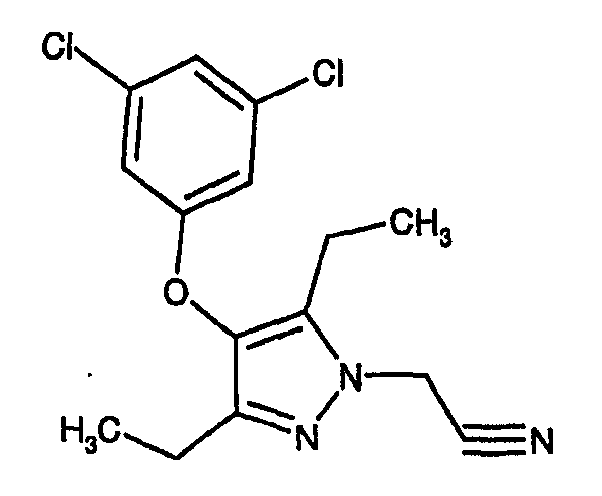
1H-NMR (400MHz, CDCl3): δ = 1.14 (6H, m), 2.38 (2H, q), 2.56 (2H, q), 4.92 (2H, s), 6.75 (2H, s), 7.00 (1 H, s).
Microanalysis: Found: C, 55.43; H, 4.69; N, 12.71. C15H15Cl2N3O requires C, 55.57; H, 4.60; N, 12.96%. -

- A mixture of the ester (120mg, 0.29mmol) of Preparation 3, hydrazine hydrate (16mg, 0.29mmol) and ethanol (5ml) was stirred and heated at 60°C for 2 hours under nitrogen. After cooling, the mixture was concentrated under reduced pressure and the resulting white solid was stirred in ethyl acetate and then collected by filtration to give the title compound (60mg) as a white solid, m.p. 142-144°C.
1H-NMR (400MHz, DMSO-d6): δ = 0.89 (3H, t). 0.99 (3H, t), 2.26 (2H, q), 2.45 (2H, q), 5.01 (2H, s), 5.19 (1 H, s), 6.88 (2H, s), 7.21 (1 H, s).
LRMS (electrospray): m/z [M-H+] 379.
Microanalysis: Found: C, 55.39; H, 4.72; N, 14.69. C17H18Cl2N4O2 requires C, 53.56; H, 4.76; N, 14.69%. -

- A mixture of the ester (140mg, 0.34mmol) of Preparation 3, acetamidine hydrochloride (95mg, 1.0mmol), sodium ethoxide (68mg, 1.0mmol) and ethanol (5ml) was stirred and heated at 70°C for 1 hour under nitrogen. After cooling, the mixture was concentrated under reduced pressure. The resulting oil was dissolved in dichloromethane (50ml), washed with water (20ml), dried over magnesium sulphate and concentrated under reduced pressure to leave the title compound as a white foam (100mg).
1H-NMR (300MHz, CDCl3): δ = 1.10 (3H, t), 1.19 (3H, t), 2.48 (7H, m), 5.08 (2H, s), 5.72 (1 H, s), 6.82 (2H, s), 7.03 (1 H, s).
LRMS (thermospray): m/z [MH+] 407. -

- A mixture of the ester (150mg, 0.365mmol) from Preparation 3 and guanidine hydrochloride (104mg, 1.08mmol) and sodium ethoxide (73mg, 1.08mmol) in ethanol (5ml) was stirred and heated at 70°C for 3 hours under nitrogen. After cooling the mixture was concentrated under reduced pressure and the resulting oil was dissolved in dichloromethane (50ml), washed with water (20ml), dried over magnesium sulphate and concentrated under reduced pressure. The crude product was purified by chromatography on silica gel eluting with dichloromethane:methanol:ammonia (90:10:1, by volume) to give the title compound as a white solid (30mg), m.p. 238-240°C.
1H-NMR (400MHz, DMSO-d6): δ = 0.91 (3H, t), 0.99 (3H, t), 2.29 (2H, q), 2.44 (2H, q), 4.75 (1 H, s), 4.81 (2H, s), 6.58 (2H, br.s), 6.87 (2H, s), 7.22 (1 H, s).
LRMS (thermospray): m/z [MH+] 408. -

1H-NMR (300MHz, CD3OD): δ = 1.10 (6H, m), 2.40 (2H, q), 2.60 (2H, q), 4.65 (2H, s), 6.90 (2H, s), 7.10 (1H, s).
LRMS (electrospray): m/z [MH+] 357. -

1H-NMR (400MHz, CDCl3): δ = 1.10 (6H, m), 2.44 (4H, m), 3.78 (3H, s), 4.80 (2H, s), 6.69 (2H, s), 6.99 (1 H, s).
LRMS (thermospray): m/z [MH+] 357. -

1H-NMR (300MHz, CDCL3): δ = 1.15 (6H, m), 2.50 (4H, m), 4.70 (2H, s), 5.50 (1 H, br. s), 6.21 (1 H, br. s), 6.78 (2H, s), 7.04 (1 H, s).
LRMS (thermospray): m/z [MH+] 342. -

1H-NMR (300MHz, CD3OD): δ = 1.10 (6H, m), 2.39 (2H, q), 2.55 (2H, q), 4.72 (2H, s), 6.93 (2H, s), 7.09 (1 H, s).
LRMS (electrospray): m/z [MH+] 357. -

1H-NMR (400MHz, CDCl3): δ = 1.10 (6H, m), 2.40 (2H, q), 2.55 (2H, q), 5.07 (2H, s), 6.76 (2H, s), 6.98 (1 H, s), 10.45 (1 H, br. s).
LRMS (electrospray): m/z [MH+] 383. -

1H-NMR (400MHz, CDCl3): δ = 1.09 (6H, m), 2.41 (2H, q), 2.52 (2H, q), 3.18 (2H, t), 4.02 (2H, t), 6.78 (2H, s), 6.99 (1 H, s).
LRMS (electrospray): m/z [MH+] 330.
Microanalysis: Found: C, 52.28; H, 5.70; N, 11.75. C15H19Cl2N3O.H2O requires C, 52.03; H, 6.11; N, 12.14%. -

1H-NMR (400MHz, CDCl3): δ = 1.14 (m, 6H), 2.56 (m, 4H), 5.06 (s, 2H), 6.75 (s, 2H), 7.03 (s, 1 H).
LRMS (electrospray): m/z [M-(H+)] 381. -

1H-NMR (400MHz, CDCl3): δ = 1.00 (m, 6H), 2.29 (m, 2H), 2.55 (m, 2H), 5.34 (s, 2H), 6.90 (s, 2H), 7.07 (s, 2H), 7.24 (s, 1H).
LRMS (electrospray): m/z [MH+] 382.
Microanalysis: Found: C, 49.82; H, 4.52; N, 17.81. C16H17Cl2N5O2.0.25H2O requires C, 49.69; H, 4.56; N, 18.11 %. -

1H-NMR (400MHz, CDCl3): δ = 1.08 (t, 3H), 1.18 (t, 3H), 2.42 (q, 2H), 2.52 (q, 2H), 3.39 (s, 3H), 3.75 (m, 2H), 3.90 (s, 2H), 4.13 (t, 2H), 6.79 (s, 2H), 6.99 (s, 1H), 7.21 (br s, 1H).
LRMS (electrospray): m/z [MH+] 400; [M-(H+)] 398.
Microanalysis: Found: C, 54.09; H, 5.79; N, 10.39. C18H23Cl2N3O3 requires C, 54.01; H, 5.79; N, 10.50%. - The compounds of the following tabulated Examples of the general formula:
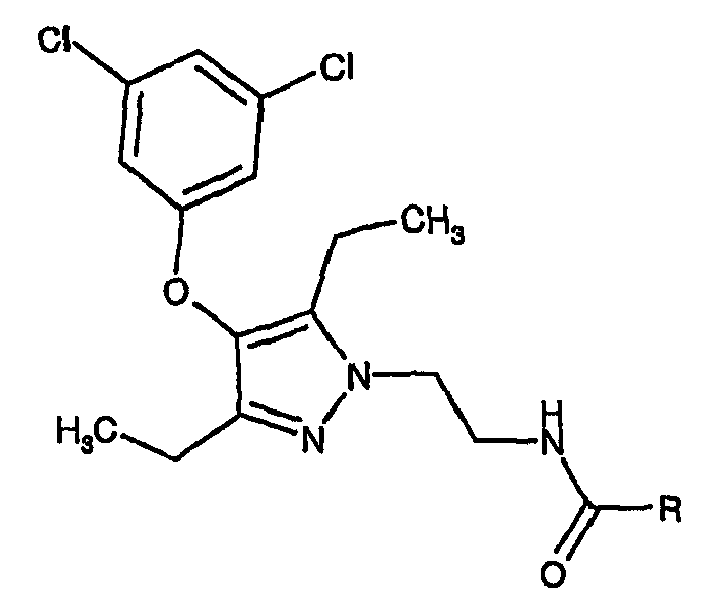
Example No. R LRMS (thermospray) Analytical Data 17 
m/z [MH+] 433 1H-NMR (400MHz, CDCl3): δ = 1.06 (t, 3H), 1.18 (t, 3H), 2.44 (q, 2H), 2.52 (q, 2H), 3.92 (m, 2H), 4.24 (t, 2H), 6.79 (s, 2H), 6.99 (s, 1 H), 7.40 (m, 1 H), 7.82 (m, 1 H), 8.19 (m, 1 H), 8.52 (br s, 2H), 8.55 (m, 1 H).
Microanalysis: Found: C, 57.01; H, 5.08; N, 11.94. C21H22Cl2N4O2 requires C, 58.21; H, 5.12; N, 12.03%.18 
m/z [MH+] 434 1H-NMR (400MHz, CDCl3): δ = 1.08 (t, 3H), 1.18 (t, 3H), 2.42 (q, 2H), 2.52 (q, 2H), 3.96 (m, 2H), 4.24 (t, 2H), 6.79 (s, 2H), 7.01 (s, 1 H), 8.22 (br s, 1H), 8.54 (d, 1 H), 8.78 (d, 1 H), 9.40 (s, 1H). -

1H-NMR (400MHz, CDCl3): δ = 1.10 (m, 6H), 2.40 (q, 2H), 2.50 (q, 2H), 3.68 (br s, 1 H), 4.07 (m, 4H), 7.12 (s, 1 H), 7.14 (d, 1H), 7.28 (d, 2H).
LRMS (electrospray): m/z [MH+] 286; [MNa+] 308. - The compounds of the following tabulated Examples of the general formula:

Example No. R4 LRMS (electrospray) Analytical Data 20 
m/z [MH+] 314. 1H-NMR (400MHz, CDCl3): δ = 0.99 (t, 3H), 1.09 (t,3H), 2.18 (s, 6H), 2.25 (q, 2H), 2.40 (q, 2H), 3.78 (br s, 1 H), 4.00 (m, 4H), 7.34 (s, 2H). 21 
m/z [MH+] 320. 1H-NMR (400MHz, CDCl3): δ = 1.10 (m, 6H), 2.40 (q, 2H), 2.53 (q, 2H), 3.56 (br s, 1 H), 4.04 (m, 2H), 4.08 (m, 2H), 6.80 (d, 1H), 7.44 (d, 1 H), 7.72 (s, 1 H).
Accurate Mass: Found: 320.1165 [MH+]; C16H18CIN3O2 requires 320.1161 [MH+].22 
m/z [MH+] 304. 1H-NMR (400MHz, CDCl3): δ = 1.10 (m, 6H), 2.39 (q, 2H), 2.50 (q, 2H), 4.60 (m, 4H), 7.05 (m, 1 H), 7.14 (m, 2H). 23 
m/z [MH+] 295. 1H-NMR (400MHz, CDCl3): δ = 1.09 (m, 6H), 2.41 (m, 2H), 2.51 (m, 2H), 3.78 (br s, 1 H), 4.06 (m, 4H), 6.81 (m, 2H), 7.21 (m, 2H). Microanalysis: Found: C, 60.88; H, 6.49; N, 9.40. C15H19ClN2O2 requires C, 61.12; H, 6.50; N, 9.50%. 24 
m/z [MH+] 295. 1H-NMR (400MHz, CDCl3): δ = 1.09 (t, 3H), 1.14 (t, 3H), 2.41, (q, 2H), 2.52 (q, 2H), 3.79 (br s, 1 H), 4.05 (m, 4H), 6.78 (d, 1 H), 6.88 (s, 1 H), 6.98 (d, 1 H), 7.19 (t, 1H). 25 
M/z [MH+] 295. 1H-NMR (400MHz, CDCl3): δ =1.08 (t, 3H), 1.15 (t, 3H), 2.44 (q, 2H), 2.54 (q, 2H), 4.02 (m, 2H), 4.09 (m, 2H), 6.69 (d, 1 H), 6.94 (t, 1 H), 7.10 (t, 1 H), 7.40 (d, 1 H). 26 
M/z [MH+] 329. 1H-NMR (400MHz, CDCl3): δ = 1.01 (t, 3H), 1.10 (t, 3H), 2.38 (q, 2H), 2.49 (q, 2H), 3.84 (br s, 1H), 3.99 (m, 4H), 7.01 (t, 1 H), 7.30 (d, 2H).
Accurate Mass: Found: 329.0822 [MH+]; C15H18Cl2N2O2 requires 329.0818 [MH+].27 
m/z [M-(H+)] 328. 1H-NMR (400MHz, CDCl3): δ = 1.09 (t, 3H), 1.14 (t, 3H), 2.41 (q, 2H), 2.51 (q, 2H), 4.03 (m, 2H), 4.07 (m, 2H), 6.60 (d, 1 H), 7.04 (t, 1 H), 7.10 (t, 1H). 28 
m/z [MH+] 329. 1H-NMR (400MHz, CDCl3): δ = 1.08 (t, 3H), 1.14 (t, 3H), 2.41 (q, 2H), 2.51 (q, 2H), 4.03 (m, 2H), 4.08 (m, 2H), 6.62 (d, 1 H), 7.09 (d, 1H).
Microanalysis: Found: C, 54.66; H, 5.54; N, 8.12. C15H18Cl2N2O2 requires C, 54.72; H, 5.51; N, 8.51%.29 
m/z [MH+] 279. 1H-NMR (400MHz, CDCl3): δ = 1.10 (t, 3H), 1.14 (t, 3H), 2.44 (q, 2H), 2.55 (q, 2H), 3.79 (br s, 1 H), 4.06 (m, 4H), 6.71 (m, 1 H), 6.98 (m, 2H), 7.12 (m, 1 H). 30 
m/z [MH+] 279. 1H-NMR (400MHz, CDCl3): δ = 1.09 (t, 3H), 1.12 (t, 3H), 2.43 (q, 2H), 2.52 (q, 2H), 3.78 (br s, 1 H), 4.04 (m, 4H), 6.59 (m, 1 H), 6.75 (m, 2H), 7.20 (m, 2H). 31 
m/z [MH+] 289. 1H-NMR (400MHz, CDCl3): δ = 1.10 (t, 3H), 1.17 (t, 3H), 2.25 (s, 6H), 2.42 (q, 2H), 2.52 (q, 2H), 3.90 (br s, 1H), 4.05 (m, 4H), 6.49 (s, 2H), 6.62 (s, 1H). 32 
m/z [MH+] 293. 1H-NMR (400MHz, CDCl3): δ = 1.09 (t, 3H), 1.14 (t, 3H), 2.22 (s, 3H), 2.42 (q, 2H), 2.31 (q, 2H), 3.83 (br s, 1 H), 4.03 (m, 4H), 6.60 (m, 1H), 6.70 (m, 1 H), 6.88 (m, 1 H). 33 
m/z [MH+] 329. 1H-NMR (400MHz, CDCl3): δ = 1.11 (t, 3H), 1.17 (t, 3H), 2.42 (q, 2H), 2.54 (q, 2H), 4.06 (m, 4H), 6.69 (s, 1 H), 6.94 (d, 1H), 7.34 (d, 1H).
Microanalysis: Found: C, 54.84; H, 5.67; N, 8.48. C15H18Cl2N2O2 requires C, 54.72; H, 5.51; N, 8.51%.34 
m/z [MH+] 297. 1H-NMR (400MHz, CDCl3): δ = 1.09 (3, 3H), 1.12 (t, 3H), 2.42 (q, 2H), 2.50 (q, 2H), 3.68 (br s, 1 H), 4.01 (m, 4H), 6.47 (m, 1H), 6.77 (m, 1 H), 6.86 (m, 1H).
Microanalysis: Found: C, 60.57; H, 6.23; N, 9.52. C15H18F2N2O2 requires C, 60.80; H, 6.12; N, 9.45%.35 
m/z [MH+] 329. 1H-NMR (400MHz, CDCl3): δ = 1.08 (t, 3H), 1.12 (t, 3H), 2.41 (q, 2H), 2.51 (q, 2H), 3.73 (br s, 1 H), 4.08 (m, 4H), 6.75 (d, 1 H), 6.98 (s, 1 H), 7.31 (d, 1 H).
Microanalysis: Found: C, 54.70; H, 5.54; N, 8.50. C15H18Cl2N2O2 requires C, 54.72; H, 5.51; N, 8.51%.36 
m/z [MH+] 297. 1H-NMR (400MHz, CDCl3): δ = 1.08 (t, 3H), 1.12 (t, 3H), 2.49 (q, 2H), 2.60 (q, 2H), 3.81 (br s, 1 H), 3.99 (m, 4H), 6.91 (m, 2H), 6.99 (m, 1 H). 37 
m/z [MH+] 297. 1H-NMR (400MHz, CDCl3): δ = 1.09 (t, 3H), 1.15 (t, 3H), 2.45 (q, 2H), 2.55 (q, 2H), 3.70 (br s, 1 H), 4.06 (m, 4H), 6.46 (m, 1 H), 6.62 (m, 1 H), 7.08 (m, 1H). 38 
m/z [MH+] 297. 1H-NMR (400MHz, CDCl3): δ = 1.08 (t, 3H), 1.14 (t, 3H), 2.41 (q, 2H), 2.53 (q, 2H), 3.72 (br s, 1 H), 4.05 (m, 4H), 6.43 (m, 3H). -
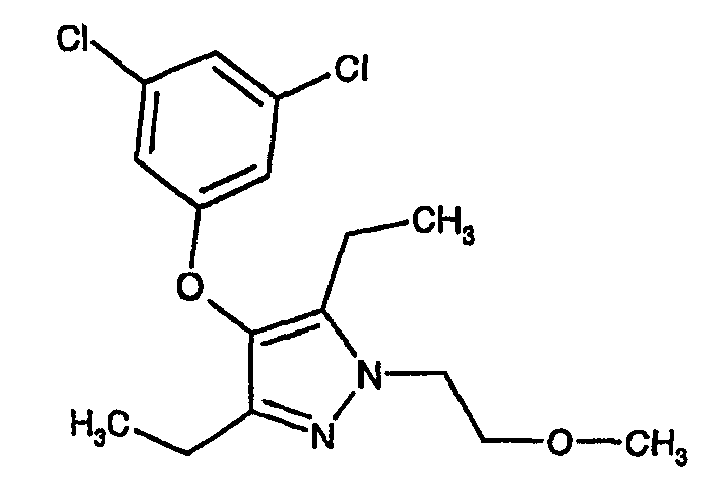
1H-NMR (300MHz, CDCl3): δ = 1.09 - 1.15 (m, 6H), 2.41 - 2.49 (q, 2H), 2.51 - 2.57 (q, 2H), 3.34 (s, 3H), 3.74 - 3.78 (t, 2H), 4.15 - 4.17 (t, 2H), 6.81 (s, 2H), 7.01 (s, 1 H).
LRMS (thermospray): m/z [MH+] 343.
Microanalysis: Found: C, 56.25; H, 5.94; N, 7.95. C16H20Cl2N2O2 requires C, 55.99; H, 5.87; N, 8.16%. - The compounds of the following tabulated Examples of the general formula:

Example No. R2 LRMS (thermospray) Analytical Data 40 
m/z [MH+] 329. 1H-NMR (300MHz, CDCl3): δ = 1.13 - 1.18 (m, 6H), 2.45 (q, 2H), 2.60 (q, 2H), 3.37 (s, 3H), 5.34 (s, 2H), 6.80 (s, 2H), 7.02 (s, 1H).
Microanalysis: Found: C, 54.72; H, 5.46; N, 8.40. C15H18Cl2N2O2 requires C, 54.72; H, 5.51; N, 8.51%.41 
m/z [MH+] 299. 1H-NMR (300MHz, CDCl3): δ = 1.15 (m, 6H), 2.48 (m, 4H), 3.79 (s, 3H), 6.82 (s, 2H), 7.01 (s, 1H).
Microanalysis: Found: C, 56.08; H, 5.37; N, 9.29. C14H16Cl2N2O requires C, 56.20; H, 5.39; N, 9.36%. -

1H-NMR (400MHz, CDCl3): δ = 1.23 (t, 3H), 2.66 (q, 2H), 6.87 (s, 2H), 7.02 (s, 1 H), 7.40 (s, 1 H).
LRMS (electrospray): m/z [MH+] 257; [M-(H+)] 255. -

1H-NMR (400MHz, CDCl3): δ = 1.06 (m, 6H), 2.12 (m, 8H), 2.75 (t, 2H), 3.64 (m, 4H), 4.04 (t, 2H), 6.73 (s, 2H), 6.95 (s, 1 H).
LRMS (thermospray): m/z [MH+] 398.
Microanalysis: Found: C, 57.18; H, 6.31; N, 10.36. C19H25Cl2N3O2 requires C, 57.29; H, 6.33; N, 10.55%. - The compounds of the following tabulated Examples of the general formula:

Example No. R LRMS (thermospray) Analytical Data 44 
m/z [MH+] 386. 1H-NMR (300MHz, CDCl3): δ = 1.09 - 1.17 (m, 6H), 2.40 - 2.47 (q, 2H), 2.50 - 2.56 (q, 2H), 2.80 - 2.82 (t, 2H), 3.07 - 3.11 (t,2H), 3.36 (s, 3H), 3.47 - 3.51 (t, 2H), 4.09 - 4.11 (t, 2H), 6.81 (s, 2H), 7.01 (s, 1H). 45 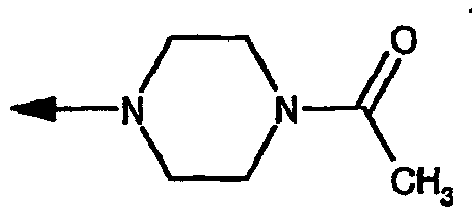
m/z [MH+] 439. 1H-NMR (400MHz, CDCl3): δ = 1.04 (m, 6H), 2.00 (s, 3H), 2.38 (m, 6H), 2.44 (q, 2H), 2.77 (q, 2H), 3.38 (m, 2H), 3.55 (m, 2H), 4.05 (m, 2H), 6.71 (s, 2H), 6.92 (s, 1 H). 46 
m/z [MH+] 356. 1H-NMR (400MHz, CDCl3): δ = 1.05 (m, 6H), 2.23 (s, 6H), 2.38 (q, 2H), 2.45 (q, 2H), 2,69 (m, 2H), 4.03 (m, 2H), 6.75 (s, 2H), 6.95 (s, 1 H). 47 
m/z [MH+] 413. 1H-NMR (400MHz, CDCl3): δ = 1.08 (m, 6H), 1.59 (br s, 1 H), 1.91 (s, 3H), 2.38 (q, 2H), 2.48 (q, 2H), 2.71 (m, 2H), 2.99 (m, 2H), 3.28 (m, 2H), 4.02 (m, 2H), 6.09 (br s, 1 H), 6.71 (s, 2H), 6.95 (s, 1 H).
Microanalysis: Found: C, 54.86; H, 6.32; N, 13.33.
C19H26Cl2N4O2 requires C, 55.21; H, 6.34; N, 13.55%. m.p. 69-70°C.48 
m/z [MH+] 342. 1H-NMR (400MHz, CDCl3): δ = 1.08 (m, 7H), 2.39 (m, 2H), 2.42 (s, 3H), 2.49 (q, 2H), 3.00 (m, 2H), 4.05 (m, 2H), 6.78 (s, 2H), 6.96 (s, 1H). 49 
m/z [MH+] 412. 1H-NMR (400MHz, CDCl3): δ = 1.05 (m, 6H), 1.49 (m, 1 H), 1.81 (m, 4H), 2.42 (q, 2H), 2.52 (q, 2H), 2.64 (m, 2H), 3.08 (t, 2H), 3.76 (m, 1 H), 3.79 (m, 1 H), 4.00 (m, 1 H), 6.78 (s, 2H), 6.98 (s, 1H).
Microanalysis: Found: C, 57.78; H, 6.68; N, 9.90. C20H27Cl2N3O2 requires C, 58.13; H, 6.61; N, 10.17%. -

1H-NMR (400MHz, CDCl3): δ=1.15 (m, 6H), 2.41 (q, 2H), 2.51 (q, 2H), 2.89 (m, 2H), 3.30 (m, 2H), 3.58 (m, 1 H), 3.78 (m, 2H), 3.87 (d, 2H), 6.88 (s, 2H), 7.00 (1 H, s).
LRMS (thermospray): m/z [MH+] 384. -

1H-NMR (400MHz, CDCl3): δ = 1.08 (t, 3H), 1.16 (t, 3H), 2.48 (m, 4H), 3.87 (t, 2H), 4.40 (t, 2H), 5.07 (q, 1 H), 6.79 (s, 2H), 7.01 (m, 1H).
LRMS (thermospray): m/z [MH+] 340. -

1H-NMR (400MHz, CDCl3): δ = 1.16 (t, 3H), 2.45 (q, 2H), 4.29 (t, 2H), 5.03 (t, 2H), 6.89 (s, 2H), 7.02 (s, 1 H).
LRMS (thermospray): m/z [MH+] 299. -

1H-NMR (300MHz, CDCl3): δ = 2.14 (s, 6H), 5.24 (br s, 1H), 6.81 (s, 2H), 7.02 (s, 1 H).
LRMS (thermospray): m/z [MH+] 257.
Microanalysis: Found: C, 49.58; H, 4.06; N, 11.05. C11H10Cl2N2O.0.4H2O requires C, 49.98; H, 4.12; N, 10.60%. -

1H-NMR (400MHz, CDCl3): δ = 1.05 (t, 3H), 1.10 (t, 3H), 1.21 (d, 2H), 2.40 (q, 2H), 2.47 (q, 2H), 3.79 (dd, 1 H), 3.97 (dd, 1 H), 4.24 (s, 1H), 6.76 (s, 2H), 6.98 (s, 1H).
LRMS (thermospray): m/z [MH+] 343. -

- The reaction mixture was stirred at 0°C for 30 minutes and then stirred at room temperature for 30 minutes. The reaction was cooled to 0°C, further sodium hydride (60% dispersion in oil, 24mg, 0.600mmol) and 2-chloroethylamine hydrochloride (53mg, 0.455mmol) were added and the reaction was stirred for 1 hour. The reaction was quenched by the addition of water (5ml) and extracted with ether (10ml). The organic layer was washed with 2M aqueous hydrochloric acid (30ml). The acid was neutralised with solid sodium carbonate and extracted with ether (3x20ml). The combined ether layers were dried over magnesium sulphate, filtered and concentrated under reduced pressure. The crude product was purified by flash column chromatography on silica gel eluting with dichloromethane:methanol:ammonia (95:4:1, by volume) to provide the title compound (21 mg) as a colourless oil.
1H-NMR (400MHz, CDCl3): δ = 1.19 (m, 6H), 2.42 (q, 2H), 2.58 (q, 2H), 2.80 (t, 2H), 3.38 (t, 2H), 3.81 (t, 2H), 4.18 (t, 2H), 6.78 (s, 2H), 7.02 (s, 1H).
LRMS (thermospray): m/z [MH+] 372. -

1H-NMR (400MHz, CDCl3): δ = 2.13 (s, 3H), 2.42 (m, 4H), 3.38 (s, 2H), 3.64 (m, 4H), 6.79 (s, 2H), 7.02 (s, 1H).
LRMS (thermospray): m/z [MH+] 342. -

1H-NMR (300MHz, CDCl3): δ = 2.14 (s, 3H), 2.35 (s, 3H), 4.89 (s, 2H), 6.68 (s, 2H), 6.78 (s, 1H), 6.82 (s, 1 H), 7.03 (s, 1H).
LRMS (thermospray): m/z [MH+] 337. -

1H-NMR (300MHz, CDCl3): δ = 1.13 (t, 3H), 2.41 (q, 2H), 3.44 (br s, 1 H), 3.94 (s, 3H), 4.23 (m, 4H), 6.87 (s, 2H), 7.09 (s, 1H).
LRMS (thermospray): m/z [MH+] 331. -

1H-NMR (300MHz, CDCl3): δ = 2.16 (s, 3H), 5.25 (s, 2H), 6.70 (s, 2H), 7.04 (s, 1H), 7.89 (s, 1H), 8.04 (s, 1 H).
LRMS (thermospray): m/z [MH+] 324. -

1H-NMR (400MHz, CDCl3): δ = 1.15 (t, 6H), 2.47 (q, 4H), 7.11 (m, 2H), 7.24 (d, 1 H), 7.35 (t, 1 H).
LRMS (thermospray): m/z [MH+] 242.
Microanalysis: Found: C, 69.03; H, 6.43; N, 17.20. C14H15N3O3.0.13H2O requires C, 69.02; H, 6.31; N, 17.25%. -

1H-NMR (400MHz, CDCl3): δ = 1.11 (m, 6H), 2.41 (q, 2H), 2.52 (q, 2H), 3.18 (t, 2H), 4.04 (t, 2H), 7.15 (m, 2H), 7.29 (d, 1 H), 7.38 (t, 1H).
LRMS (thermospray): m/z [MH+] 285. -

1H-NMR (400MHz, CDCl3): δ = 1.10 (t, 3H), 1.17 (t, 3H), 2.44 (q, 2H), 2.53 (q, 2H), 4.69 (s, 2H), 5.44 (br s, 1 H), 6.22 (br s, 1 H), 7.14 (m, 2H), 7.31 (d, 1 H), 7.40 (t, 1H).
LRMS (thermospray): m/z [MH+] 299.
Microanalysis: Found: C, 64.20; H, 6.12; N, 18.79. C16H18N4O2 requires C, 64.41; H, 6.08; N, 18.78%. -

1H-NMR (400MHz, CDCl3): δ = 1.08 (m, 6H), 1.25 (t, 3H), 2.40 (m, 4H), 4.20 (q, 2H), 4.77 (s, 2H), 7.12 (m, 2H), 7.23 (d, 1 H), 7.34 (t, 1H).
LRMS (thermospray): m/z [MH+] 328. -

1H-NMR (400MHz, CDCl3): δ = 1.11 (m, 6H), 2.46 (m, 4H), 4.65 (d, 2H), 5.04 (d, 1 H), 5.22 (d, 1 H), 5.99 (m, 1 H), 6.79 (s, 2H), 6.99 (s, 1H).
LRMS (thermospray): m/z [MH+] 325. -

1H-NMR (300MHz, CDCl3): δ = 2.13 (s, 3H), 3.68 (s, 2H), 3.71 (s, 2H), 3.80 (s, 3H), 6.83 (m, 4H), 7.03 (s, 1 H), 7.17 (m, 2H).
LRMS (thermospray): m/z [MH+] 392. - The compounds of the following tabulated Examples of the general formula:

Example No. R LRMS (thermospray) Analytical Data 66 
m/z [MH+] 326. 1H-NMR (300MHz, CDCl3): δ = 0.09 (m, 2H), 0.49 (q, 2H), 0.90 (m, 1H), 2.34 (s, 3H), 2.47 (d, 2H), 3.73 (s, 2H), 6.82 (s, 2H), 7.03 (s, 1 H). 67 
m/z [MH+] 300. 1H-NMR (400MHz, CDCl3): δ = 2.08 (s, 3H), 2.20 (s, 6H), 3.31 (s, 2H), 6.76 (s, 2H), 6.97 (s, 1H). 68 
m/z [MH+] 286. 1H-NMR (400MHz, CDCl3): δ = 2.12 (s, 3H), 2.42 (s, 3H), 3.65 (s, 2H), 6.80 (s, 2H), 7.02 (s, 1H). 69 
m/z [MH+] 355. 1H-NMR (400MHz, CDCl3): δ = 2.08 (s, 3H), 2.22 (s, 3H), 2.31 (m, 8H), 3.36 (s, 2H), 6.76 (s, 2H), 6.97 (s, 1H). 70 
m/z [MH+] 385. 1H-NMR (400MHz, CDCl3): δ = 1.50 (m, 2H), 1.60 (m, 2H), 1.90 (m, 4H), 2.41 (m, 2H), 3.25 (s, 2H), 3.75 (m, 2H), 5.52 (s, 1H), 5.80 (s, 1 H), 6.67 (s, 2H), 6.86 (s, 1 H). 71 
m/z [MH+] 330. 1H-NMR (400MHz, CDCl3): δ = 2.08 (s, 3H), 2.74 (m, 2H), 3.30 (s, 3H), 3.44 (m, 2H), 3.68 (s, 2H), 6.76 (s, 2H), 6.98 (s, 1H). 72 
m/z [MH+] 383. 1H-NMR (400MHz, CDCl3): δ = 2.02 (s, 3H), 2.10 (s, 3H), 2.38 (m, 4H), 3.34 (m, 2H), 3.38 (s, 2H), 3.51 (m, 2H), 6.76 (s, 2H), 6.98 (s, 1H). 73 
m/z [MH+] 357. 1H-NMR (400MHz, CDCl3): δ = 1.92 (s, 3H), 2.09 (s, 3H), 2.70 (m, 2H), 3.29 (m, 2H), 3.65 (s, 2H), 6.01 (s, 1H), 6.76 (s, 2H), 6.99 (s, 1 H). 74 
m/z [MH+] 397. 1H-NMR (400MHz, CDCl3): δ = 1.30 (m, 2H), 1.80 (m, 2H), 1.92 (s, 3H), 2.09 (m, 5H), 2.70 (m, 2H), 3.34 (s, 2H), 3.71 (m, 1H), 6.76 (s, 2H), 6.98 (s, 1H). 75 
m/z [MH+] 370. 1H-NMR (300MHz, CDCl3): δ = 1.60 (m, 2H), 1.80 (m, 2H), 2.13 (s, 3H), 2.20 (m, 2H), 2.71 (m, 2H), 3.22 (m, 1H), 3.33 (s, 3H), 3.39 (s, 2H), 6.81 (s, 2H), 7.03 (s, 1H). -

1H-NMR (400MHz, CDCl3): δ = 2.09 (s, 6H), 7.02 (m, 1H), 7.10 (m, 1H), 7.25 (m, 1 H).
LRMS (electrospray): m/z [MH+] 248.
Microanalysis: Found: C, 57.91; H, 4.03; N, 16.79. C12H10N3OCl requires C, 58.19; H, 4.07; N, 16.97%. -
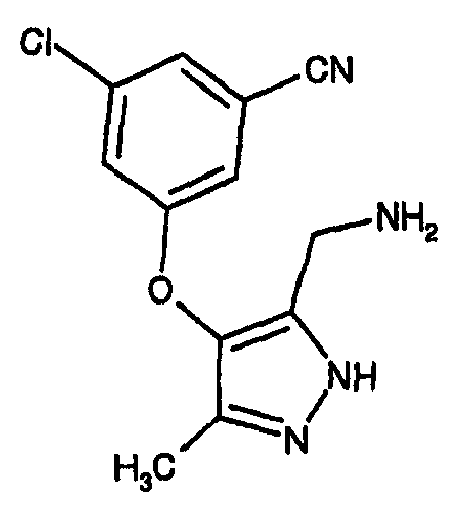
1H-NMR (300MHz, CDCl3): δ = 2.14 (s, 3H), 3.79 (s, 2H), 7.08 (1H, s), 7.16 (1 H, s), 7.31 (1 H, s).
LRMS (thermospray): m/z [MH+] 263. -

1H-NMR (300MHz, CDCl3): δ = 2.14 (s, 3H), 2.40 (m, 4H), 2.83 (m, 4H), 3.38 (s, 2H), 7.09 (s, 1 H), 7.16 (s, 1 H), 7.30 (s, 1H).
LRMS (thermospray): m/z [MH+] 332. -

1H-NMR (300MHz, CDCl3): δ = 2.15 (s, 3H), 3.69 (s, 2H), 3.84 (s, 2H), 7.06 (s, 1H), 7.15 (s, 1 H), 7.31 (s, 1 H), 7.38 (d, 2H), 7.60 (d, 2H).
LRMS (thermospray): m/z [MH+] 378. -

1H-NMR (400MHz, CDCl3): δ = 2.14 (s, 3H), 2.51 (m, 4H), 2.72 (s, 3H), 3.12 (m, 4H), 3.39 (s, 2H), 7.08 (m, 1 H), 7.13 (m, 1 H), 7.26 (s, 1H).
LRMS (thermospray): m/z [MH+] 410. -

1H-NMR (400MHz, CDCl3): δ = 2.11 (s, 3H), 2.38 (m, 4H), 3.37 (m, 7H), 3.51 (m, 2H), 4.04 (s, 2H), 7.04 (m, 1 H), 7.10 (m, 1 H), 7.26 (m, 1H).
LRMS (thermospray): m/z [MH+] 404. -

1H-NMR (400MHz, CDCl3): δ = 2.09 (s, 3H), 2.34 (m, 4H), 3.36 (m, 6H), 3.64 (s, 3H), 7.02 (m, 1 H), 7.10 (m, 1 H), 7.25 (m, 1H).
LRMS (thermospray): m/z [MH+] 390. -

1H-NMR (400MHz, CD3OD): δ = 2.06 (s, 3H), 3.27 (s, 2H), 3.62 (s, 2H), 3.79 (s, 2H), 7.17 (s, 1 H), 7.21 (s, 1 H), 7.40 (m, 3H), 7.77 (d, 2H).
LRMS (thermospray): m/z [MH+] 432. -

1H-NMR (400MHz, CDCl3): δ = 2.15 (s, 3H), 3.34 (s, 3H), 4.35 (s, 2H), 6.83 (s, 2H), 7.03 (s, 1 H).
LRMS (thermospray): m/z [MH+] 287. -

1H-NMR (400MHz, CDCl3): δ = 1.30 (s, 9H), 2.06 (s, 3H), 6.81 (s, 2H), 7.02 (s, 1H).
LRMS (thermospray): m/z [MH+] 299. -

1H-NMR (400MHz, CDCl3): δ = 1.18 (t, 3H), 2.11 (s, 3H), 2.53 (q, 2H), 6.79 (s, 2H), 7.01 (s, 1H).
LRMS (thermospray): m/z [MH+] 271. -

1H-NMR (400MHz, CDCl3): δ = 2.09 (s, 3H), 4.91 (d, 2H), 6.74 (s, 2H), 6.95 (s, 1 H), 6.98 (d, 1 H), 7.65 (d, 2H), 7.77 (d, 2H).
LRMS (thermospray): m/z [MNH4 +] 418. -
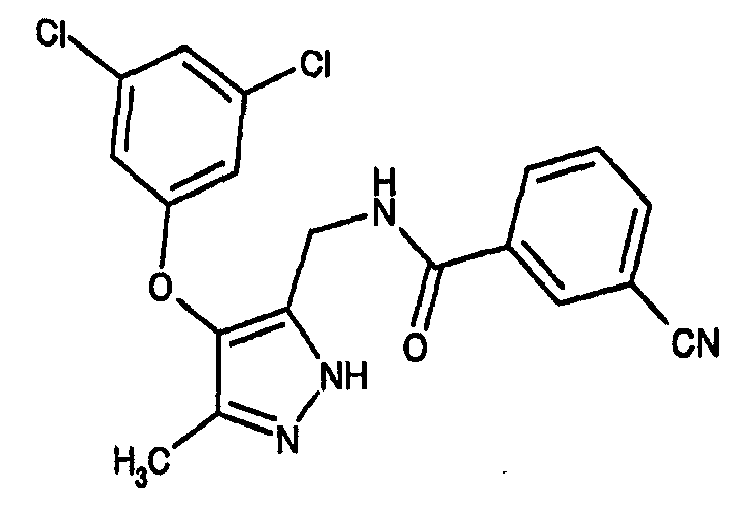
1H-NMR (400MHz, CDCl3): δ = 2.14 (s, 3H), 4.53 (d, 2H), 6.78 (s, 2H), 6.98 (m, 2H), 7.54 (dd, 1 H), 7.76 (d, 1 H), 7.95 (d, 1 H), 7.99 (s, 1H).
LRMS (thermospray): m/z [MH+] 401. -

1H-NMR (400MHz, CDCl3): δ = 2.09 (s, 3H), 3.66 (s, 2H), 3.74 (s, 2H), 6.75 (s, 2H), 6.97 (s, 1 H), 7.17 (m, 1 H), 7.55 (d, 1 H), 8.49 (m, 2H).
LRMS (electrospray): m/z [MH+] 363. -

1H-NMR (300MHz, CDCl3): δ = 2.08 (s, 3H), 2.16 (s, 3H), 2.43 (m, 4H), 3.42 (m, 4H), 3.55 (m, 2H), 7.08 (s, 1 H), 7.16 (s, 1 H), 7.31 (s, 1H).
LRMS (thermospray): m/z [MH+] 374. -

1H-NMR (300MHz, CDCl3): δ = 2.14 (s, 3H), 2.17 (s, 3H), 3.45 (s, 2H), 3.55 (s, 2H), 7.05 (s, 1 H), 7.14 (s, 1 H), 7.31 (m, 3H), 7.59 (d, 2H).
LRMS (thermospray): m/z [MH+] 392. -

1H-NMR (300MHz, CDCl3): δ = 2.14 (s, 3H), 2.71 (m, 2H), 3.50 (s, 1 H), 3.58 (s, 2H), 3.67 (m, 2H), 3.72 (s, 2H), 6.99 (s, 1 H), 7.09 (s, 1 H), 7.31 (s, 1 H), 7.41 (d, 2H), 7.58 (d, 2H).
LRMS (thermospray): m/z [MH+] 422. -

1H-NMR (300MHz, CDCl3): δ = 2.14 (s, 3H), 2.33 (s, 3H), 4.92 (s, 2H), 6.76 (s, 1H), 6.79 (s, 1 H), 6.86 (s, 1 H), 7.27 (s, 2H).
LRMS (thermospray): m/z [MH+] 328. -

1H-NMR (400MHz, CDCl3): δ = 2.07 (s, 3H), 3.65 (s, 2H), 3.76 (s, 2H), 3.96 (m, 2H), 4.24 (m, 2H), 6.76 (s, 2H), 7.02 (s, 1 H), 7.26 (m, 1 H), 7.59 (d, 1 H), 8.50 (m, 2H).
LRMS (thermospray): m/z [MH+] 407. -

1H-NMR (300MHz, CDCl3): δ = 1.21 (d, 6H), 2.09 (s, 3H), 2.90 (sept, 1 H), 7.40 (s, 2H), 7.60 (s, 1H).
LRMS (thermospray): m/z [MH+] 267. -

1H-NMR (400MHz, CDCl3): δ = 1.17 (d, 6H), 2.08 (s, 3H), 2.76 (sept, 1 H), 3.52 (m, 2H), 4.10 (m, 2H), 7.40 (s, 2H), 7.59 (s, 1 H).
LRMS (electrospray): m/z [MH+] 311.
Microanalysis: Found: C, 65.44; H, 5.87; N, 17.91. C17H18N4O2 requires C, 65.79; H, 5.85; N, 18.05%. -

1H-NMR (400MHz, D6 DMSO): δ = 1.08 (t, 3H), 2.44 (q, 2H), 3.60 (m, 2H), 4.24 (t, 2H), 7.00 (s, 2H), 7.26 (s, 1 H), 8.15 (s, 1H).
LRMS (thermospray): m/z [MNH4 +] 343.
Microanalysis: Found: C, 51.52; H, 3.98; N, 12.74. C14H31Cl2N3O2 requires C, 51.55; H, 4.02; N, 12.88%. -

1H-NMR (400MHz, CDCl3): δ = 1.10 (t, 3H), 2.42 (q, 2H), 3.24 (t, 2H), 3.80 (s, 2H), 4.05 (t, 2H), 6.76 (s, 2H), 6.95 (s, 1H).
LRMS (thermospray): m/z [MH+] 312.
Microanalysis: Found: C, 53.79; H, 4.88; N, 13.14. C14H15Cl2N3O requires C, 53.86; H, 4.84; N, 13.46%. -

1H-NMR (400MHz, CDCl3): δ = 1.11 (t, 3H), 2.42 (m, 5H), 2.84 (t, 2H), 3.37 (s, 2H), 4.11 (t, 2H), 6.77 (s, 2H), 6.98 (s, 1 H).
LRMS (thermospray): m/z [MH+] 326. -

1H-NMR (400MHz, CDCl3): δ = 1.13 (t, 3H), 2.44 (q, 2H), 2.92 (t, 2H), 3.42 (s, 2H), 3.71 (s, 2H), 4.13 (t, 2H), 6.74 (s, 2H), 6.97 (s, 1 H), 7.42 (d, 2H), 7.60 (d, 2H).
LRMS (thermospray): m/z [MH+] 427. -

1H-NMR (400MHz, CDCl3): δ = 1.13 (t, 3H), 2.45 (q, 2H), 2.92 (t, 2H), 3.44 (s, 2H), 3.60 (s, 2H), 3.80 (s, 3H), 4.10 (t, 2H), 6.77 (s, 2H), 6.85 (d, 2H), 7.00 (s, 1H), 7.23 (d, 2H).
LRMS (thermospray): m/z [MH+] 432. -

1H-NMR (400MHz, CDCl3): δ = 1.10 (t, 3H), 2.42 (q, 2H), 2.55 (s, 2H), 3.13 (t, 2H), 4.13 (t, 2H), 4.37 (s, 2H), 6.79 (s, 2H), 6.98 (s, 1H).
LRMS (thermospray): m/z [MH+] 330.
Microanalysis: Found: C, 50.61; H, 5.23; N, 12.31. C14H17Cl2N3O2 requires C, 50.92; H, 5.19; N, 12.73%. -

1H-NMR (400MHz, CDCl3): δ = 1.10 (m, 6H), 2.42 (q, 2H), 3.15 (t, 2H), 3.40 (q, 2H), 4.11 (t, 2H), 4.29 (s, 2H), 6.79 (s, 2H), 6.98 (s, 1H).
LRMS (thermospray): m/z [MH+] 358. - The compounds of the following tabulated Examples of the general formula:

Example No. (Starting material) R LRMS (thermospray) Analytical Data 104 (Example 140) 
m/z [MH+] 380. 1H-NMR (400MHz, CDCl3): δ = 1.10 (t, 3H), 2.40 (q, 2H), 2.97 (t, 2H), 4.15 (t, 2H), 5.20 (s, 2H), 6.16 (s, 1 H), 6.71 (d, 2H), 6.97 (s, 1H), 7.15 (s, 1H), 7.42 (s, 1H).
Microanalysis: Found: C, 52.78; H, 5.09; N, 17.86.
C17H19Cl2N5O.0.12CH2Cl2 requires C, 52.66; H, 4.97; N, 17.94%.105 (Example 142) 
m/z [MH+] 449. 1H-NMR (400MHz, CDCl3): δ = 1.10 (t, 3H), 2.42 (q, 2H), 3.11 (t, 2H), 3.55 (s, 2H), 3.60 (s, 2H), 3.75 (s, 3H), 4.07 (t, 2H), 6.73 (s, 2H), 6.79 (d, 2H), 6.97 (s, 1 H), 7.10 (d, 2H).
Microanalysis: Found: C, 56.88; H, 5.67; N, 11.88.
C22H26Cl2N4O2.0.23CH2Cl2 requires C, 56.94; H, 5.69; N, 11.95%.106 (Example 143) 
m/z [MH+] 444. 1H-NMR (400MHz, COCl3): δ = 1.10 (t, 3H), 2.41 (q, 2H), 3.15 (t, 2H), 3.60 (s, 2H), 3.74 (s, 2H), 4.10 (d, 2H), 6.73 (s, 2H), 6.97 (s, 1 H), 7.29 (d, 2H), 7.53 (d, 2H).
Microanalysis: Found: C, 57.53; H, 5.09; N, 15.05.
C22H23Cl2N5O.0.22CH2Cl2 requires C, 57.64; H, 5.10; N, 15.12%. -

1H-NMR (400MHz, CDCl3): δ = 1.11 (t, 3H), 2.05 (s, 3H), 2.32 (m, 4H), 2.42 (q, 2H), 3.13 (m, 2H), 3.33 (s, 2H), 3.34 (m, 2H), 3.52 (m, 2H), 4.15 (t, 2H), 6.73 (s, 2H), 6.97 (s, 1 H).
LRMS (thermospray): m/z [MH+] 440. -

1H-NMR (400MHz, CDCl3): δ = 1.15 (t, 3H), 1.95 (s, 3H), 2.45 (q, 2H), 2.69 (t, 2H), 3.20 (t, 2H), 3.27 (m, 2H), 3.65 (s, 2H), 4.15 (t, 2H), 6.31 (s, 1 H), 6.81 (s, 2H), 7.02 (s, 1 H).
LRMS (thermospray): m/z [MH+] 414. -
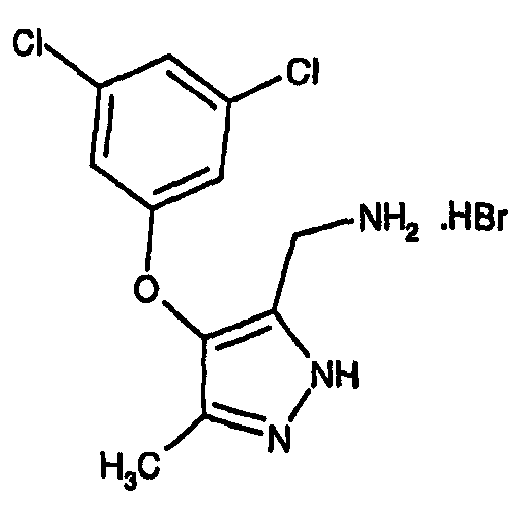
1H-NMR (400MHz, CDCl3): δ = 2.38 (s, 3H), 4.78 (s, 2H), 6.88 (s, 2H), 7.19 (s, 1H).
LRMS (thermospray): m/z [MH+] 272. -

1H-NMR (300MHz, CDCl3): δ = 2.17 (s, 3H), 3.67 (s, 2H), 3.73 (s, 2H), 6.81 (s, 2H), 6.99 (s, 2H), 7.02 (s, 1 H), 7.22 (s, 2H).
LRMS (electrospray): m/z [M-H+] 378. -

1H-NMR (300MHz, CDCl3): δ = 2.16 (s, 3H), 3.70 (s, 2H), 3.85 (s, 2H), 6.78 (s, 2H), 7.01 (s, 2H), 7.35 (d, 2H), 7.58 (d, 2H). - LRMS (electrospray): m/z [MH+] 387.
-

1H-NMR (300MHz, CDCl3): δ = 1.85 (s, 3H), 1.87 (s, 3H), 3.61 (s, 3H), 6.88 (s, 1H), 6.98 (s, 1 H), 7.11 (s, 1H).
LRMS (thermospray): m/z [MH+] 262.
Microanalysis: Found: C, 59.48; H, 4.60; N, 15.88. C13H12N3OCl requires C, 59.66; H, 4.62; N, 16.06%. -

1H-NMR (300MHz, CDCl3): δ = 2.03 (s, 3H), 3.66 (s, 2H), 3.79 (s, 2H), 3.84 (s, 3H), 7.02 (s, 1 H), 7.13 (s, 1 H), 7.31 (s, 1 H), 7.37 (d, 2H), 7.58 (d, 2H).
LRMS (thermospray): m/z [MH+] 392. -

1H-NMR (300MHz, CDCl3): δ = 2.04 (s, 3H), 2.12 (s, 3H), 3.24 (s, 1H), 4.08 (m, 4H), 7.03 (s, 1 H), 7.15 (s, 1 H), 7.28 (s, 1 H).
LRMS (thermospray): m/z [MH+] 292.
Microanalysis: Found: C, 57.40; H, 4.86; N, 14.14. C14H14N3O2Cl requires C, 57.69; H, 4.84; N, 14.40%. -

1H-NMR (300MHz, CDCl3): δ = 2.05 (s, 3H), 3.04 (s, 2H), 3.91 (s, 2H), 3.99 (t, 2H), 4.32 (m, 2H), 7.06 (s, 1 H), 7.11 (s, 1 H), 7.33 (s, 1 H), 7.46 (d, 2H), 7.62 (d, 2H).
LRMS (thermospray): m/z [MNa+] 444. -

1H-NMR (300MHz, CDCl3): δ = 2.16 (s, 3H), 3.68 (s, 2H), 3.82 (s, 2H), 7.05 (s, 1 H), 7.13 (s, 1 H), 7.28 (s, 1 H), 7.32 (d, 2H), 7.76 (d, 2H).
LRMS (electrospray): m/z [MH+] 396. - The compounds of the following tabulated Examples of the general formula:

Example No. (Diketone No.) R LRMS Analytical Data 117 (Preparation 43) F m/z [MH+] 303. (thermospray) 1H-NMR (300MHz, CDCl3): δ = 1.10 (m, 6H), 2.39 (q, 2H), 2.49 (q, 2H), 4.04 (m, 4H), 6.85 (dd, 1H), 6.99 (s, 1 H), 7.00 (dd, 1 H).
Microanalysis: Found: C, 62.96; H, 5.94; N, 13.75. C16H18N3O2F requires C, 63.35; H, 5.98; N, 13.85%.118 (Preparation 44) Me m/z [MH+] 300. (electrospray) 1H-NMR (400MHz, CDCl3): δ = 1.09 (t,3H), 1.12 (t, 3H), 2.34 (s, 3H), 2.39 (q, 2H), 2.50 (q, 2H), 3.70 (s, 1 H), 4.60 (m, 4H), 6.91 (s, 1 H), 6.97 (s, 1 H), 7.10 (s, 1H). 119 (Preparation 45) CN m/z [MH+] 311. (electrospray) 1H-NMR (400MHz, CDCl3): δ = 1.13 (m, 6H), 2.40 (q, 2H), 2.53 (q, 2H), 3.53 (m, 1H), 4.11 (m, 4H), 7.40 (s, 2H), 7.58 (s, 1 H).
Microanalysis: Found: C, 65.64; H, 5.84; N, 18.05.
C17H18N4O2 requires C, 65.79; H, 5.85; N, 18.05%. m.p. 120-121 °C.120 (Preparation 46) Cl m/z [MH+] 320. (thermospray) 1H-NMR (400MHz, CDCl3): δ = 1.08 (m, 6H), 2.39 (q, 2H), 2.50 (q, 2H), 4.01 (m, 2H), 4.08 (m, 2H), 7.03 (s, 1H), 7.13 (s, 1 H), 7.24 (s, 1H).
Microanalysis: Found: C, 59.67; H, 5.71; N, 12.99.
C16H18N3O2Cl requires C, 60.09; H, 5.67; N, 13.14%. - The compounds of the following tabulated Examples of the general formula:

Example No. (Diketone No.) R LRMS Analytical Data 121 (Preparation 43) F m/z [MH+] 260. (thermospray) 1H-NMR (400MHz, CDCl3): δ = 1.18 (t, 6H), 2.47 (q, 4H), 6.85 (dd, 1 H), 6.98 (s, 1 H), 7.01 (dd, 1H). 122 (Preparation 45) CN m/z [MH+] 267. (thermospray) 1H-NMR (400MHz, CDCl3): δ = 1.20 (6H, m), 2.47 (q, 4H), 7.39 (s, 2H), 7.59 (s, 1H). 123 (Preparation 44) Me m/z [MH+] 256. (electrospray) 1H-NMR (400MHz, CDCl3): δ = 1.17 (t, 6H), 2.34 (s, 3H), 2.48 (q, 4H), 6.92 (s, 1H), 6.96 (s, 1 H), 7.10 (s, 1 H). 124 (Preparation 46) Cl m/z [MH+] 276. (thermospray) 1H-NMR (400MHz, CDCl3): δ = 1.18 (t, 6H), 2.49 (q, 4H), 7.07 (s, 1 H), 7.13 (s, 1 H), 7.27 (s, 1H). - The compounds of the following tabulated Examples of the general formula:

Example No. (Starting pyrazole No.) R LRMS Analytical Data 125 (Example 123) Me m/z [MH+] 299. (electrospray) 1H-NMR (400MHz, CDCl3): δ = 1.10 (m, 6H), 2.34 (s, 3H), 2.39 (q, 2H), 2.43 (q, 2H), 3.17 (t, 2H), 4.04 (t, 2H), 6.91 (s, 1 H), 6.96 (s, 1 H), 7.09 (s, 1H). 126 (Example 124) Cl m/z [MH+] 319. (thermospray) 1H-NMR (400MHz, CDCl3): δ = 1.09 (m, 6H), 2.40 (q, 2H), 2.51 (q, 2H), 3.15 (m, 2H), 4.02 (m, 2H), 7.04 (s, 1 H), 7.12 (s, 1H), 7.28 (s, 1H). 127 (Example 122) CN m/z [MH+] 310. (thermospray) 1H-NMR (400MHz, CDCl3): δ = 1.09 (m, 6H), 2.38 (q, 2H), 2.50 (q, 2H), 3.15 (m, 2H), 4.03 (m, 2H), 7.39 (s, 2H), 7.57 (s, 1 H). 128 (Example 121) F m/z [MH+] 303. (thermospray) 1H-NMR (400MHz, CDCl3): δ = 1.06 (m, 6H), 2.37 (q, 2H), 2.48 (q, 2H), 3.13 (t, 2H), 4.03 (t, 2H), 6.84 (d, 1 H), 6.94 (s, 1 H), 6.97 (d, 1 H). - The compounds of the following tabulated Examples of the general formula:

Example No. (Diketone No.) R R' LRMS Analytical Data 129 (Preparation 52) cycloPr Et m/z [MH+] 279. (electrospray) 1H-NMR (400MHz, CDCl3): 0.73 (m, 2H), 0.81 (m, 2H), 1.16 (t, 3H), 1.58 (m, 1 H), 2.46 (q, 2H), 7.42 (s, 2H), 7.58 (s, 1 H). m.p. 136-141 °C. 130 (Preparation 53) tBu Me m/z [MH+] 281. (electrospray) 1H-NMR (300MHz, CDCl3): 1.21 (s, 9H), 1.94 (s, 3H), 7.34 (s, 2H), 7.56 (s, 1H). Microanalysis: Found: C, 68.18; H, 5.74; N, 19.72. C16H16N4O requires C, 68.55; H, 5.75; N, 19.99%. m.p. 61-63°C. 131 (Preparation 54) iPr Et m/z [MH+] 281. (electrospray) 1H-NMR (400MHz, CDCl3): 1.15 (m, 9H), 2.41 (q, 2H), 2.82 (m, 1 H), 7.36 (s, 2H), 7.58 (s, 1 H). m.p. 136-141 °C. -
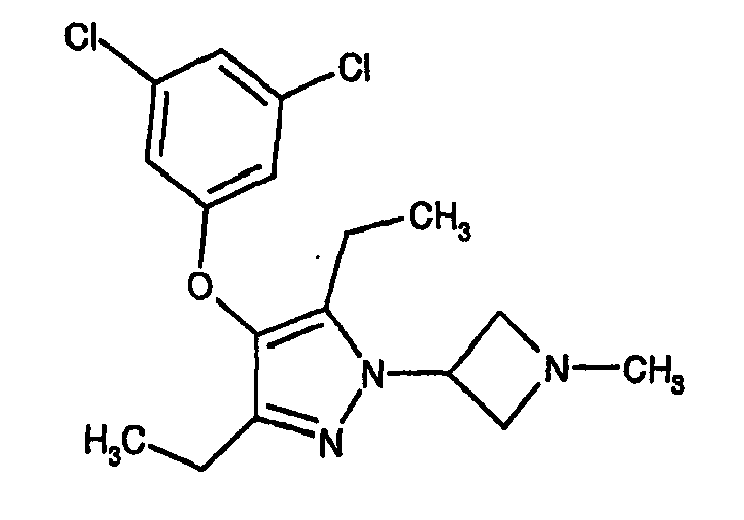
1H-NMR (300MHz, CDCl3): δ = 1.08 (t, 3H), 1.16 (t, 3H), 2.49 (m, 7H), 3.63 (m, 2H), 3.81 (m, 2H), 4.79 (m, 1H), 6.79 (s, 2H), 7.00 (s, 1H).
LRMS (thermospray): m/z [MH+] 354. -

1H-NMR (400MHz, CDCl3): δ = 1.16 (major, t, 3H), 1.16 (minor, t, 3H), 2.48 (major, q, 2H), 2.60 (minor, q, 2H), 3.13 (major, t, 2H), 3.19 (minor, t, 2H), 4.10 (major, t, 2H), 4.10 (minor, t, 2H), 6.85 (major, s, 2H), 6.85 (minor, s, 2H), 7.02 (major, s, 1 H), 7.02 (minor, s, 1H), 7.27 (major, s, 1H), 7.31 (minor, s, 1H).
LRMS (thermospray): m/z [MH+] 300. -

1H-NMR (400MHz, CDCl3): δ = 1.10 (t, 3H), 1.37 (s, 9H), 2.40 (q, 2H), 3.00 (s, 1H), 3.56 (m, 2H), 4.20 (t, 2H), 4.48 (d, 2H), 5.00 (m, 1H), 6.80 (s, 2H), 6.97 (s, 1H).
LRMS (thermospray): m/z [MH+] 430. -

1H-NMR (400MHz, CDCl3): δ=1.15 (m, 6H), 1.44 (s, 9H), 2.45 (q, 2H), 3.45 (q, 2H), 3.58 (m, 2H), 4.18 (m, 2H), 4.29 (s, 2H), 5.26 (m, 1 H), 6.92 (s, 2H), 7.00 (s, 1 H).
LRMS (electrospray): m/z [MNa+] 480. -

1H-NMR (400MHz, CDCl3): δ = 1.10 (t, 3H), 1.40 (s, 9H), 2.40 (q, 2H), 3.60 (m, 2H), 4.18 (t, 2H), 4.27 (s, 2H), 4.95 (s, 1 H), 6.82 (s, 2H), 7.00 (s, 1H).
LRMS (electrospray): m/z [MH+] 494.
Microanalysis: Found: C, 46.22; H, 4.89; N, 8.44. C19H24BrCl2N3O3 requires C, 46.27; H, 4.90; N, 8.52%. -

1H-NMR (400MHz, CDCl3): δ = 1.11 (t, 3H), 1.40 (s, 9H), 2.40 (q, 2H), 3.55 (m, 2H), 3.73 (s, 2H), 4.18 (t, 2H), 5.60 (s, 1H), 6.77 (s, 2H), 6.98 (s, 1H).
LRMS (thermospray): m/z [MH+] 429. -

1H-NMR (400MHz, CDCl3): δ = 1.15 (t, 3H), 1.42 (s, 9H), 2.06 (s, 3H), 2.44 (m, 6H), 3.32 (s, 2H), 3.47 (m, 2H), 3.60 (m, 2H), 3.65 (m, 2H), 4.23 (m, 2H), 5.89 (s, 1 H), 6.76 (s, 2H), 7.02 (s, 1 H).
LRMS (thermospray): m/z [MH+] 540. -

1H-NMR (400MHz, CDCl3): δ = 1.13 (t, 3H), 1.44 (s, 9H), 2.42 (q, 2H), 3.52 (m, 2H), 4.26 (t, 2H), 5.18 (s, 2H), 5.48 (s, 1 H), 6.16 (s, 1 H), 6.73 (s, 2H), 7.00 (s, 1 H), 7.18 (s, 1 H), 7.45 (s, 1 H).
LRMS (thermospray): m/z [MH+] 480. -

1H-NMR (400MHz, CDCl3): δ = 1.13 (t, 3H), 1.42 (s, 9H), 1.94 (d, 3H), 2.44 (q, 2H), 2.74 (m, 2H), 3.35 (m, 2H), 3.58 (m, 4H), 4.19 (m, 2H), 5.68 (s, 1 H), 6.77 (s, 2H), 7.00 (s, 1H), 7.65 (s, 1 H).
LRMS (thermospray): m/z [MH+] 514. -

1H-NMR (400MHz, CDCl3): δ = 1.10 (t, 3H), 1.40 (s, 9H), 2.42 (m, 2H), 3.55 (m, 5H), 3.66 (s, 2H), 3.77 (s, 2H), 4.15 (m, 2H), 6.11 (s, 1H), 6.74 (s, 2H), 6.80 (d, 2H), 7.00 (s, 1 H), 7.11 (d, 2H).
LRMS (thermospray): m/z [MH+] 549. -

1H-NMR (400MHz, CDCl3): δ = 1.10 (t, 3H), 1.35 (s, 9H), 2.40 (q, 2H), 3.55 (m, 2H), 3.58 (s, 2H), 3.76 (s, 2H), 4.16 (m, 2H), 5.45 (s, 1H), 6.73 (s, 2H), 6.98 (s, 1 H), 7.32 (d, 2H), 7.55 (d, 2H).
LRMS (thermospray): m/z [MH+] 544. -

1H-NMR (300MHz, CDCl3): δ = 2.03 (s, 3H), 3.45 (s, 3H), 4.32 (s, 2H), 7.12 (s, 1 H), 7.19 (s, 1H), 7.34 (s, 1 H).
LRMS (thermospray): m/z [MH+] 342. -
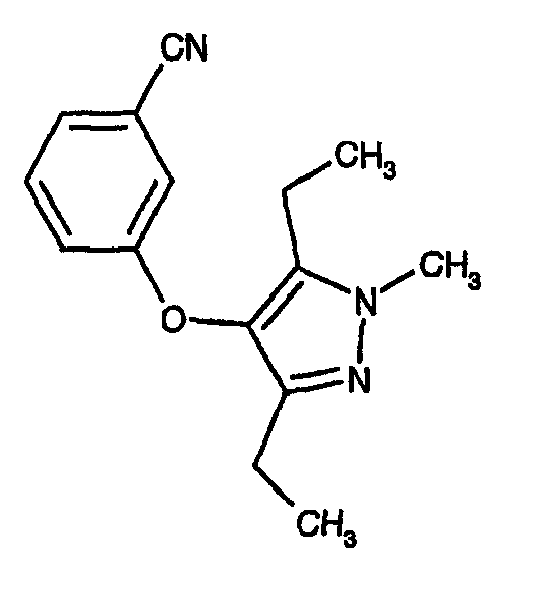
1H NMR (400MHz, CDCl3): δ = 1.09 (t, 3H), 1.12 (t, 3H), 2.41 (q, 2H), 2.50 (q, 2H), 3.77 (s, 3H), 7.12-7.38 (m, 4H).
LRMS (electrospray) : m/z [MH+] 256, [MNa+] 278.
Microanalysis: Found C, 70.15; H, 6.78; N, 16.42. C15H15N3O.0.08H2O requires C, 70.17; H, 6.74; N, 16.37%. -

1H NMR (400MHz, CDCl3): δ = 1.09 (t, 3H), 1.12 (t, 3H), 2.42 (q, 2H), 2.54 (q, 2H), 3.34 (s, 3H), 3.75 (t, 2H), 4.16 (t, 2H), 7.11-7.38 (m, 4H).
LRMS (electrospray): m/z [MH+] 300, [MNa+] 322.
Microanalysis: Found C, 68.21; H, 7.07; N, 14.04. C17H21N3O2 requires C, 67.85; H, 7.12; N, 14.09%. -

1H NMR (400MHz, CDCl3): δ = 1.13 (t, 3H), 2.41 (q, 2H), 2.67 (t, 2H), 3.62 (t, 2H), 4.48 (s, 2H), 6.79 (m, 1H), 6.98 (m, 2H), 7.24 (m, 5H).
LRMS (electrospray) : m/z [M-H+] 364.
Microanalysis: Found C, 66.96; H, 5.62; N, 11.25. C21H20N3O2F.0.60H2O requires C, 67.04; H, 5.68; N, 11.17%. -

1H NMR (400MHz, CDCl3): δ = 1.16 (t, 3H), 2.44 (q, 2H), 2.63 (t, 2H), 3.82 (t, 2H), 6.82 (m, 1H), 6.98 (m, 2H).
LRMS (electrospray) : m/z [MH+] 276.
Microanalysis: Found C, 60.69; H, 5.12; N, 15.08. C14H14N3O2F requires C, 61.08; H, 5.13; N, 15.26%. -

1H NMR (400MHz, CDCl3): δ = 1.18 (t, 3H), 2.49 (q, 2H), 2.98 (t, 2H), 4.21 (t, 2H), 6.82 (m, 3H), 6.99 (m, 2H), 7.56 (m, 2H).
LRMS (electrospray) : m/z [MH+] 377. - The preparations of the following tabulated Examples of the general formula

Example No. Starting Material Example No. R Analytical Data 1501 148 
1H NMR (400MHz, CDCl3): δ = 1.18 (t, 3H), 2.42 (s, 3H), 2.52 (q, 2H), 2.99 (t, 2H), 4.18 (t, 2H), 6.83 (m, 1 H), 6.99 (m, 4H), 8.04 (m, 1 H).
LRMS (thermospray) : m/z [MH+] 367.1511 148 
1H NMR (400MHz, CDCl3): δ = 1.19 (t, 3H), 2.50 (q, 2H), 2.98 (t, 2H), 4.22 (t, 2H), 6.85 (m, 1 H), 6.99 (m, 2H), 7.12 (m, 1 H), 7.18 (m, 1 H), 8.22 (m, 2H).
LRMS (thermospray) : m/z [MH+] 353.1521 148 
1H NMR (400MHz, CDCl3): δ = 1.20 (t, 3H), 2.53 (q, 2H), 2.98 (t, 2H), 4.19 (t, 2H), 4.85 (brs, 2H), 6.58 (m, 1 H), 6.83 (m, 2H), 6.99 (m, 2H), 7.63 (d, 1H).
LRMS (thermospray) : m/z [MH+] 368.1 These compounds were purified on silica gel eluting with a solvent gradient of cyclohexane:ethyl acetate (75:25 then 66:34 then 50:50, by volume) changing to ethyl acetate and finally ethyl acetate:methanol (90:10, by volume). -

1H NMR (400MHz, CDCl3): δ = 1.18 (t, 3H), 2.44 (q, 2H), 2.77 (t, 2H), 3.63 (t, 2H), 4.52 (s, 2H), 7.30 (m, 7H), 7.55 (s, 1H).
LRMS (electrospray) : m/z [MH+] 231, [MNa+] 253. -

1H NMR (400MHz, CDCl3): δ = 1.19 (t, 3H), 2.51 (q, 2H), 2.69 (t, 2H), 3.88 (t, 2H), 7.40 (s, 2H), 7.59 (s, 1H).
LRMS (electrospray) : m/z [MH+] 283. -

1H NMR (400MHz, CD3OD): δ = 1.99 (s, 3H), 3.85 (t, 2H), 4.02 (s, 2H), 4.32 (t, 2H), 7.22 (s, 1 H), 7.28 (s, 1 H), 7.47 (s, 1 H).
LRMS (thermospray) : m/z [MH+] 309.
Microanalysis: Found C, 53.32; H, 5.17; N, 16.38. C14H15ClN4O2.0.85CH3OH requires C, 53.40; H, 5.55; N, 16.77%. -

1H NMR (400MHz, CDCl3): δ = 1.21 (s, 9H), 1.96 (s, 3H), 4.66 (s, 2H), 5.04 (d, 1 H), 5.24 (d, 1 H), 5.98 (m, 1 H), 7.37 (s, 2H), 7.57 (s, 1 H).
LRMS (thermospray) : m/z [MH+] 322.
Microanalysis: Found C, 70.79; H, 6.29; N, 17.11. C19H20N4O.0.05CH2Cl2 requires C, 70.48; H, 6.24; N, 17.26%. -

1H NMR (400MHz, CDCl3): δ =1.17 (s, 9H), 1.98 (s, 3H), 3.67 (s, 1 H), 4.04 (m, 4H), 7.35 (s, 2H), 7.54 (s, 1 H).
LRMS (thermospray) : m/z [MH+] 325.
Microanalysis: Found C, 64.30; H, 6.10; N, 16.35. C18H20N4O2.0.20CH2Cl2 requires C, 64.04; H, 6.02; N, 16.41%. -

1H NMR (300MHz, CDCl3): δ = 1.22 (s, 9H), 1.78 (s, 2H), 2.03 (s, 3H), 3.18 (t, 2H), 4.05 (m, 2H), 7.38 (s, 2H), 7.58 (s, 1H).
LRMS (thermospray) : m/z [MH+] 324.
Microanalysis: Found C, 64.46; H, 6.48; N, 20.47. C18H21N5O.0.20CH2Cl2 requires C, 64.22; H, 6.34; N, 20.57%. -

1H NMR (400MHz, CDCl3): δ = 1.10 (m, 6H), 2.39 (q, 2H), 2.51 (q, 2H), 3.61 (brs, 1 H), 4.04 (m, 2H), 4.07 (m, 2H), 7.10 (s, 1 H), 7.52 (s, 1H), 7.60 (s, 1 H), 8.07 (s, 1H), 8.54 (s, 1 H).
LRMS (thermospray) : m/z [MH+] 353.
Microanalysis: Found C, 60.69; H, 5.83; N, 22.98. C18H20N6O2.0.08CH2Cl2 requires C, 60.46; H, 5.66; N, 23.40%. - The preparation of the following tabulated Examples of the general formula

Example No. (Starting Material Preparation No) R Analytical Data 160 (62) 
1H NMR (400MHz, CDCl3): δ = 1.10 (m, 6H), 2.39 (q, 2H), 2.52 (q, 2H), 3.62 (brs, 1 H), 4.02 (t, 2H), 4.08 (t, 2H), 6.44 (d, 2H), 7.14 (s, 1 H), 7.16 (s, 1 H), 7.25 (s, 1H), 7.49 (d, 2H). m.p. 169-170°C.
LRMS (thermospray) : m/z [MH+] 379.
Microanalysis: Found C, 65.68; H, 5.98; N, 14.31. C21H22N4O3.0.09CH2Cl2 requires C, 65.61; H, 5.79; N, 14.51%.1611 (62) 
1H NMR (400MHz, CDCl3): δ = 1.10 (m, 6H), 2.40 (q, 2H), 2.51 (q, 2H), 3.56 (t, 1 H), 4.04 (m, 2H), 4.07 (m, 2H), 7.20 (s, 1 H), 7.65 (s, 2H), 7.85 (s, 1H), 7.98 (s, 1 H).
LRMS (thermospray) : m/z [MH+] 353.
HRMS: [MH+] 353.1722. C18H20N6O2 requires 353.1720.1621 (62) 
1H NMR (400MHz, CDCl3): δ = 1.10 (m, 6H), 2.41 (q, 2H), 2.51 (q, 2H), 3.62 (t, 1 H), 4.04 (m, 2H), 4.07 (m, 2H), 7.08 (s, 1 H), 7.80 (s, 2H), 7.87 (s, 1H), 8.02 (s, 1 H).
LRMS (thermospray) : m/z [MH+] 353.
HRMS: [MH+] 353.1719. C18H20N6O2 requires 353.1720.1 Both of these compounds were isolated from a single reaction starting from 1,2,3-triazole with Example 161 being the most polar. -

1H NMR (400MHz, CDCl3): δ = 1.10 (m, 6H), 2.39 (q, 2H), 2.49 (q, 2H), 3.68 (brs, 1 H), 4.04 (m, 4H), 5.59 (brs, 1 H), 5.88 (brs, 1 H), 6.71 (d, 1 H), 7.11 (m, 2H).
LRMS (thermospray) : m/z [MH+] 322.
Microanalysis: Found C, 57.91; H, 6.32; N, 12.56. C16H20FN3O3.0.13CH2Cl2.0.12H2O requires C, 57.91; H, 6.18; N, 12.56%. -

Example No. (Starting Material Preparation No.) R Analytical Data 1641 (65) 
1H NMR (400MHz, CDCl3): δ = 1.13 (m, 6H), 2.44 (q, 2H), 2.54 (q, 2H), 3.65 (brs, 1 H), 4.07 (t, 2H), 4.11 (t, 2H), 6.51 (s, 1 H), 7.00 (s, 1 H), 7.56 (s, 1 H), 7.63 (s, 1 H), 7.74 (s, 1 H), 7.90 (s, 1H).
LRMS (electrospray) : m/z [MH+] 352, [MNa+] 374. HRMS: [MH+] Found 352.1770. C19H22N5O2 requires 352.1768.1651 (66) 
1H NMR (400MHz, CDCl3): δ = 1.10 (m, 6H), 2.40(q, 2H), 2.50 (q, 2H), , 4.00 (t, 2H), 4.06 (t, 2H), 6.24 (t, 1H), 6.60 (d, 1H), 7.18 (d, 2H), 7.24 (d, 1 H), 7.30 (s, 1H), 7.38 (t, 1H).
LRMS (electrospray) : m/z [MH+] 379, [MNa+] 401. HRMS: [MH+] Found 379.1766. C21H23N4O3 requires 379.1765
[MNa+] Found 401.1585. C21H22N4O3Na requires 401.1584.1661 (67) 
1H NMR (400MHz, CDCl3): δ = 1.10 (m, 6H), 2.41 (q, 2H), 2.51 (q, 2H), 4.01 (t, 2H), 4.06 (t, 2H), 7.07 (d, 1 H), 7.13 (s, 1 H), 7.22 (m, 1 H), 7.52 (s, 1 H), 7.65 (s, 1H), 7.88 (s, 1 H).
LRMS (electrospray) : m/z [MH+] 380, [MNa+] 402.
HRMS: [MH+] Found 380.1722. C20H22N5O3 requires 380.1717.1672 (68) 
1H NMR (400MHz, CDCl3): δ = 1.11 (m, 6H), 2.27 (s, 3H), 2.41 (q, 2H), 2.50 (q, 2H), 3.70 (s, 3H), 4.04 (t, 1 H), 4.08 (t, 2H), 5.64 (s, 1 H), 6.81 (s, 1 H), 6.91 (s, 1 H), 6.99 (s, 1 H).
LRMS (electrospray) : m/z [MH+] 396, [MNa+] 418.
HRMS: [MH+] Found 396.2027. C21H26N5O3 requires 396.2030.1 The eluent used for flash column chromatography purification of these compounds was dichloromethane:methanol (99:1 changing to 80:20, by volume).
2 The eluent used for flash column chromatography purification of this compound was dichloromethane:methanol (99:1 changing to 98:2, by volume). -

-

Least Polar Fraction (Example 168) - 34mg
1H NMR (400MHz, CDCl3): δ = 0.76 (m, 4H), 1.05 (t, 3H), 1.45 (m, 1H), 2.48 (q, 2H), 3.39 (brs, 1 H), 4.02 (m, 4H), 7.39 (s, 2H), 7.56 (s, 1 H).
LRMS (electrospray) : m/z [M-H+] 321.
Most Polar Fraction (Example 169) - 9mg
1H NMR (400MHz, CDCl3): δ = 0.62 (m, 2H), 0.78 (m, 2H), 1.18 (t, 3H), 1.46 (m, 1H), 2.38 (q, 2H), 3.42 (brs, 1 H), 4.02 (m, 2H), 4.21 (t, 2H), 7.38 (s, 2H), 7.57 (s, 1H).
LRMS (electrospray) : m/z [MH+] 323, [MH-] 321. -

The least polar isomer (isomer 1) (83mg, 0.20mmol) and p-toluene-sulphonic acid (4mg, 0.02mmol) were dissolved in methanol (5ml) and stirred under nitrogen at room temperature for 18 hours. The solvent was removed under reduced pressure and the residue was partitioned between water (30ml) and dichloromethane (30ml).The aqueous phase was extracted with dichloromethane (20ml) and the combined organic extracts were dried over magnesium sulphate, concentrated under reduced pressure and the residual oil was purified by flash chromatography on silica gel eluting with toluene:ethyl acetate (66:34, by volume) to provide the title compound (39mg) as an oil.
1H NMR (400MHz, CDCl3): δ = 1.05 (t, 3H), 1.14 (d, 6H), 2.44 (q, 2H), 2.68 (sept, 1 H), 3.77 (brs, 1 H), 4.06 (m, 4H), 7.38 (s, 2H), 7.58 (s, 1H).
LRMS (electrospray) : m/z [MH+] 325. -

1H NMR (400MHz, CDCl3): δ = 1.08 (t, 3H), 1.13 (d, 6H), 2.49 (q, 2H), 2.97 (sept, 1 H), 3.59 (t, 1 H), 4.06 (m, 4H), 7.37 (s, 2H), 7.57 (s, 1H).
LRMS (electrospray) : m/z [MH+] 325. -

1H NMR (400MHz, CDCl3): δ = 1.10 (m, 6H), 2.39 (q, 2H), 2.48 (q, 2H), 4.26 (m, 2H), 4.44 (m, 2H), 4.62 (brs, 2H), 7.41 (s, 2H), 7.58 (s, 1H).
LRMS (thermospray) : m/z [MH+] 354.
Microanalysis: Found C, 60.00; H, 5.55; N, 19.82. C18H19N5O3.0.23EtOAc requires C, 60.30; H, 5.67; N, 18.58%. -

1H NMR (400MHz, CDCl3): δ = 1.12 (m, 6H), 2.39 (q, 2H), 2.51 (q, 2H), 3.61 (m, 2H), 4.20 (m, 2H), 4.78 (s, 2H), 5.42 (s, 1 H), 7.40 (s, 2H), 7.59 (s, 1H).
Microanalysis: Found C, 50.33; H, 5.07; N, 20.60. C17H20N6O3S.0.95H2O requires C, 50.35; H, 5.44; N, 20.72%. -
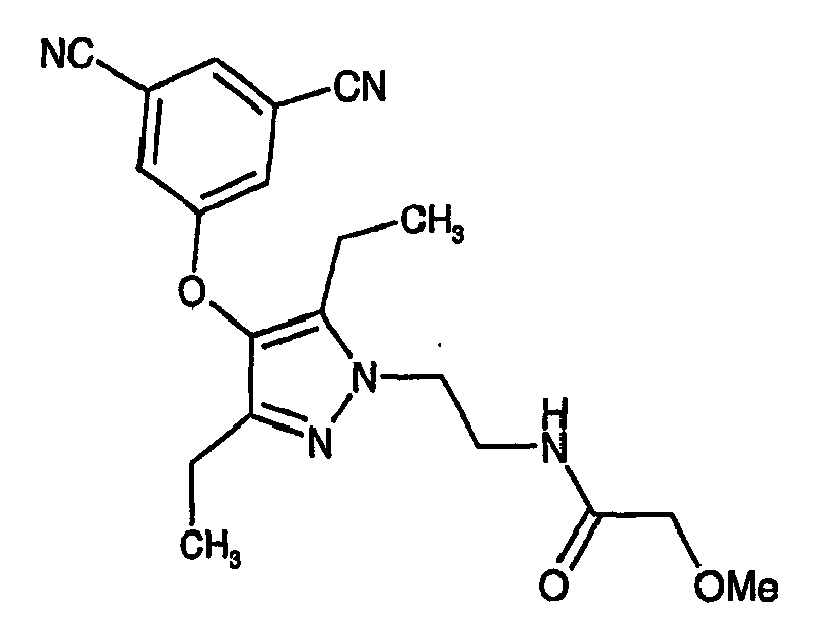
1H NMR (400MHz, CDCl3): δ = 1.11 (t, 3H), 1.16 (t, 3H), 2.38 (q, 2H), 2.47 (q, 2H), 3.41 (s, 3H), 3.77 (dd, 2H), 3.89 (s, 2H), 4.15 (m, 2H), 7.19 (brs, 1 H), 7.40 (s, 2H), 7.59 (s, 1 H).
LRMS (thermospray) : m/z [MH+] 382.
Microanalysis: Found C, 61.26; H, 6.18; N, 17.59. C20H23N6O3.0.60H2O requires C, 61.24; H, 6.22; N, 17.85%. -

1H NMR (400MHz, CDCl3): δ = 1.05 (t, 3H), 1.11 (t, 3H), 2.44 (m, 4H), 3.85 (m, 2H), 4.38 (m, 2H), 5.05 (m, 1 H), 7.37 (s, 2H), 7.56 (s, 1H).
LRMS (electrospray) : m/z [MH+] 322.
Microanalysis: Found C, 65.87; H, 5.94; N, 20.98. C18H19N5O.0.38H2O requires C, 65.87; H, 6.07; N, 21.04%. -

1H NMR (400MHz, CDCl3): δ = 1.11 (m, 6H), 2.04 (tt, 2H), 2.37 (q, 2H), 2.53 (q, 2H), 3.06 (t, 1 H), 3.69 (dt, 2H), 4.18 (t, 2H), 7.38 (s, 2H), 7.58 (s, 1H).
LRMS (electrospray) : m/z [MH+] 325, [MNa+] 347.
Microanalysis: Found C, 66.27; H, 6.27; N, 17.00. C18H20N4O2 requires C, 66.28; H, 6.24; N, 17.18%. -

1H NMR (400MHz, CDCl3): δ = 1.10 (m, 6H), 2.39 (q, 2H), 2.49 (q, 2H), 3.80 (s, 3H), 7.40 (s, 2H), 7.56 (s, 1 H).
LRMS (electrospray) : m/z [MH+] 281.
Microanalysis: Found C, 68.41; H, 5.71; N, 19.93. C16H16N4O requires C, 68.55; H, 5.75; N, 19.99%. -

Example No. (Starting Material Example No.) R Analytical Data 178 (122) 
1H NMR (400MHz, CDCl3): δ = 1.08 (t, 3H), 1.12 (t, 3H), 2.40 (q, 2H), 2.54 (q, 2H), 3.34 (s, 3H), 3.75 (t, 2H), 4.17 (t, 2H), 7.38 (s, 2H), 7.56 (s, 1 H).
LRMS (electrospray) : m/z [MH+] 325, [MNa+] 347.
Microanalysis: Found C, 65.73; H, 6.17; N, 17.08. C18H20N4O3.0.25H2O requires C, 65.74; H, 6.28; N, 17.04%.1791,2 (122) 
1H NMR (400MHz, CDCl3): δ = 1.10 (m, 6H), 1.98 (tt, 2H), 2.38 (q, 2H), 2.51 (q, 2H), 2.76 (t, 2H), 4.09 (t, 2H), 7.38 (s, 2H), 7.57 (s, 1 H).
LRMS (electrospray) : m/z [MH+] 324.
Microanalysis: Found C, 64.86; H, 6.51; N, 20.79. C18H21N5O.0.57H2O requires C, 64.79; H, 6.69; N, 20.99%.1803 (122) 
1H NMR (400MHz, CDCl3): δ = 1.09 (t, 3H), 1.14 (t, 3H), 2.41 (q, 2H), 2.47 (q, 2H), 3.79 (s, 3H), 4.82 (s, 2H), 7.40 (s, 2H), 7.57 (s, 1 H).
LRMS (electrospray) : m/z [MH+] 339.
Microanalysis: Found C, 63.58; H, 5.35; N, 16.35. C18H18N4O3.0.10H2O requires C, 63.56; H, 5.39; N, 16.47%.1 The two reagents were heated together as a melt at 160°C for 24 hours, and the reaction was worked up by partitioning between dichloromethane and saturated sodium bicarbonate solution, extracting the organic phase with 2M aqueous hydrochloric acid and basifying the aqueous phase with sodium carbonate. After extraction with dichloromethane the organic phase was dried and concentrated to give the crude product.
2 The eluent used for flash column chromatography purification of this compound was dichloromethane:methanol:0.88 ammonia (95:5:0.5 changing to 80:20:1, by volume).
3 The eluent used for flash column chromatography purification of this compound was pentane:ethyl acetate (75:25 changing to 66:34 then 50:50, by volume).
4 The hydrochloride salt of the starting alkyl halide was used. -

1H NMR (400MHz, CDCl3): δ = 1.10 (t, 3H), 1.15 (t, 3H), 2.44 (q, 2H), 2.54 (q, 2H), 4.69 (s, 2H), 5.55 (brs, 1 H), 6.22 (brs, 1 H), 7.38 (s, 2H), 7.59 (s, 1H).
LRMS (electrospray) : m/z [M-H+] 322.
Microanalysis: Found C, 68.41; H, 5.71; N, 19.93. C16H16N4O requires C, 68.55; H, 5.75; N, 19.99%. -

1H NMR (400MHz, CDCl3): δ = 1.13 (t, 3H), 1.14 (t, 3H), 2.39 (q, 2H), 2.61 (q, 2H), 5.49 (s, 2H), 5.68 (brs, 1 H), 7.40 (s, 2H), 7.56 (s, 1H).
LRMS (thermospray) : m/z [MH+] 267.
Microanalysis: Found C, 64.28; H, 5.52; N, 18.47. C16H16N4O2.0.15H2O requires C, 64.27; H, 5.49; N, 18.24%. -

1H NMR (400MHz, CD3OD): δ = 2.14 (s, 3H), 4.10 (s, 2H), 4.34 (s, 2H), 7.03 (m, 1 H), 7.10 (s, 1 H), 7.25 (m, 1 H), 7.54 (t, 1 H), 7.64 (d, 1 H), 7.92 (d, 1 H), 7.97 (s, 1H). - LRMS (electrospray) : m/z [MH+] 380.
- Microanalysis: Found C, 51.32; H, 3.91; N, 13.69. C20H18N5O2F.1.00CF3CO2H1.10H2O requires C, 51.49; H, 4.16; N, 13.65%.
- The preparation of the following tabulated Examples of the general formula

Ex. no. P prep. no. A prep. no. X R Analytical Data 1841 75 55 F 
1H NMR (400MHz, CDCl3): δ = 2.09 (s, 3H), 3.65 (s, 2H), 3.79 (s, 2H), 6.80 (d, 1 H), 6.93 (s, 1H), 6.97 (d, 1 H), 7.31 (d, 2H), 7.72 (d, 2H).
LRMS (thermospray) : m/z [MH+] 380.1851 76 55 CN 
m.p. 114-116°C
1H NMR (400MHz, CDCl3): δ = 2.08 (s, 3H), 3.62 (s, 2H), 3.77 (s, 2H), 7.34 (d, 2H), 7.55 (s, 1 H), 7.77 (d, 2H), 7.79 (s, 1 H).
LRMS (thermospray) : m/z [MH+] 387.1861 18 80 Cl 
m.p. 98-101°C
1H NMR (400MHz, CDCl3): δ = 2.04 (s, 3H), 3.62 (s, 2H), 3.74 (s, 2H), 6.97 (s, 1 H), 7.07 (s, 1 H), 7.20 (s, 1H), 7.22 (d, 1H), 7.29 (t, 1 H), 7.62 (s, 1H), 7.81 (s, 1 H).
LRMS (thermospray) : m/z [MH+] 396.
Microanalysis: Found C, 56.98; H, 4.58; N, 17.69.
C20H18CIN5O2.0.40CH2Cl2 requires C, 57.01; H, 4.41; N, 16.29%.1871, 2,3 77 55 Me 
1H NMR (400MHz, CDCl3): δ = 2.10 (s, 3H), 2.30 (s, 3H), 3.65 (s, 2H), 3.80 (s, 2H), 6.85 (s, 1 H), 6.95 (s, 1 H), 7.10 (s, 1 H), 7.30 (d, 2H), 7.70 (d, 2H).
LRMS (electrospray) : m/z [MH+] 376, [M-H+] 374.
Microanalysis: Found C, 65.59; H, 5.65; N, 18.19.
C21H21N5O2.0.50H2O requires C, 65.51; H, 5.77; N, 18.22%.1884 78 55 H 
1H NMR (400MHz, CD3OD): δ = 2.15 (s, 3H), 4.10 (s, 2H), 7.20 (m, 2H), 7.40 (m, 1 H), 7.50 (m, 1 H), 7.55 (d, 2H), 7.90 (d, 2H).
Microanalysis: Found C, 53.51; H, 4.13; N, 13.59. C20H19N5O2. 1.25 TFA requires C, 53.63; H, 4.05; N, 13.90%.1 No preparative HPLC was required for purification of this compound.
2 The eluent used for flash column chromatography purification of this compound was dichloromethane:methanol:0.88 ammonia (95:5:0.5 changing to 90:10:1, by volume).
3 The product was triturated with dichloromethane containing a trace of methanol - a solid crystallised out which was an impurity. This was filtered off and the filtrate was concentrated under reduced pressure and the residue was purified by flash chromatography eluting with dichloromethane:methanol:0.88 ammonia (90:10:1, by volume) to give the title compound.
4 The column used for preparative HPLC was a LUNA C18 10µm 150x21.2mm. -

1H NMR (400MHz, CDCl3): δ = 0.77 (m, 4H), 0.85 (m, 4H), 1.59 (m, 2H), 7.44 (s, 2H), 7.59 (s, 1 H).
LRMS (thermospray) : m/z [MH+] 291.
Microanalysis: Found C, 69.90; H, 4.85; N, 19.18. C17H14N4O.0.10H2O requires C, 69.90; H, 4.90; N, 19.18%. -

1H NMR (400MHz, CDCl3): δ = 0.67 (m, 2H), 0.80 (m, 4H), 0.85 (m, 2H), 1.52 (m, 2H), 3.39 (brs, 1 H), 4.05 (m, 2H), 4.22 (t, 2H), 7.42 (s, 2H), 7.58 (s, 1H).
LRMS (thermospray) : m/z [MH+] 355.
Microanalysis: Found C, 67.63; H, 5.55; N, 16.35. C19H18N4O2.0.17H2O requires C, 67.63; H, 5.48; N, 16.60%. -

1H NMR (400MHz, CDCl3): δ = 0.70 (m, 2H), 0.79 (m, 4H), 0.88 (m, 2H), 1.57 (m, 1 H), 1.66 (m, 1 H), 3.46 (t, 2H), 4.41 (t, 2H), 7.62 (s, 2H), 7.58 (s, 1H). -
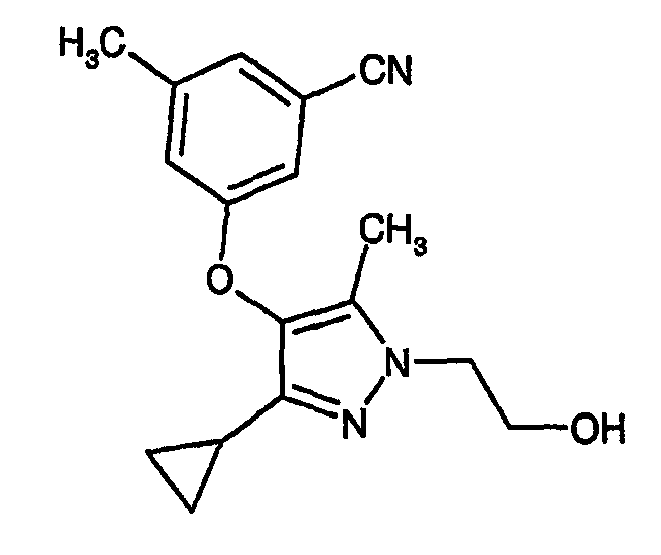
-

Least Polar Fraction (Example 192) - 419mg
1H NMR (400MHz, CDCl3): δ = 0.69 (m, 2H), 0.82 (m, 2H), 1.54 (m, 1 H), 2.00 (s, 3H), 2.35 (s, 3H), 3.46 (brs, 1H), 4.05 (t, 2H), 4.22 (t, 2H), 6.88 (s, 1H), 6.94 (s, 1H), 7.08 (s, 1 H).
LRMS (thermospray) : m/z [MH+] 298.
Microanalysis: Found C, 68.29; H, 6.51; N, 13.92. C17H19N3O2 requires C, 68.67; H, 6.44; N, 14.13%.
Most Polar Fraction (Example 193) - 201 mg
1H NMR (400MHz, CDCl3): δ = 0.75 (m, 4H), 1.58 (m, 1 H), 2.07 (s, 3H), 2.35 (s, 3H), 3.45 (brs, 1H), 4.00 (m, 4H), 6.92 (s, 1 H), 7.00 (s, 1 H), 7.10 (s, 1H).
LRMS (thermospray) : m/z [MH+] 298.
Microanalysis: Found C, 68.44; H, 6.49; N, 13.95. C17H19N3O2 requires C, 68.67; H, 6.44; N, 14.13%. -

1H NMR (400MHz, CDCl3): δ = 0.70 (m, 4H), 1.56 (m, 1 H), 2.06 (s, 3H), 2.30 (s, 3H), 3.10 (t, 2H), 3.97 (t, 2H), 6.87 (s, 1 H), 6.92 (s, 1 H), 7.05 (s, 1H).
LRMS (electrospray) : m/z [MH+] 297.
Microanalysis: Found C, 63.81; H, 6.51; N, 17.30. C17H20N4O.0.36CH2Cl2 requires C, 63.78; H, 6.39; N, 17.14%. -

1H NMR (400MHz, CDCl3): δ = 0.60 (m, 4H), 1.69 (m, 1 H), 2.09 (s, 3H), 2.34 (s, 3H), 6.95 (s, 1 H), 6.99 (s, 1 H), 7.10 (s, 1H).
LRMS (thermospray) : m/z [MH+] 254.
Microanalysis: Found C, 68.35; H, 6.13; N, 15.10. C15H15N3O.0.29EtOAc requires C, 68.72; H, 6.32; N, 14.88%. -
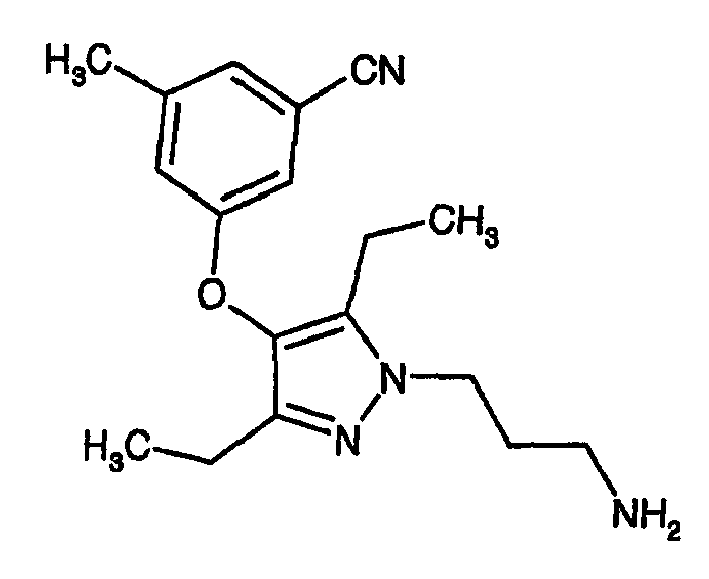
1H NMR (400MHz, CD3OD): δ = 1.05 (m, 6H), 2.07 (m, 2H), 2.37 (q, 2H), 2.53 (s, 3H), 2.57 (q, 2H), 2.99 (t, 2H), 4.15 (t, 2H), 4.38 (s, 2H), 6.89 (s, 1 H), 7.01 (s, 1 H), 7.19 (s, 1H).
LRMS (thermospray) : m/z [MH+] 313.
Microanalysis: Found C, 56.81; H, 6.57; N, 12.06. C22H30N4O7 requires C, 57.13; H, 6.54; N, 12.11%. -

1H NMR (400MHz, CDCl3): δ = 1.10 (m, 6H), 2.39 (q, 2H), 2.51 (q, 2H), 3.71 (brs, 1 H), 4.00 (s, 3H), 4.08 (m, 2H), 4.09 (m, 2H), 6.89 (s, 1 H), 6.99 (d, 1 H), 7.32 (d, 1H). LRMS (thermospray) : m/z [MH+] 316.
Microanalysis: Found C, 64.57; H, 6.73; N, 13.15, C17H21N3O3 requires C, 64.74; H, 6.71; N, 13.32%. - The preparation of the following tabulated Examples of the general formula

Example No. R Analytical Data 198 
1H NMR (400MHz, CDCl3): δ = 1.04 (m, 6H), 2.42 (q, 2H), 2.51 (q, 2H), 4.07 (m, 2H), 4.12 (m, 2H), 6.60 (d, 1 H), 7.25 (t, 1 H), 7.49 (d, 1 H), 7.53 (m, 2H), 7.82 (m, 1 H), 8.41 (m, 1 H).
LRMS (thermospray) : m/z [MH+] 311.199 
1H NMR (400MHz, CDCl3): δ = 1.19 (m, 6H), 2.48 (q, 2H), 2.51 (q, 2H), 4.03 (m, 2H), 4.10 (m, 2H), 7.06 (s, 1H), 7.22 (m, 1 H), 7.38 (t, 1 H), 7.42 (m, 1 H), 7.69 (d, 1 H), 7.79 (s, 1H), 7.80 (s, 1 H).
LRMS (thermospray) : m/z [MH+] 311.
Microanalysis: Found C, 72.16; H, 7.20; N, 8.95.
C19H22N2O2.0.10EtOAc requires C, 72.45; H, 7.19; N, 8.63%. -

1H NMR (400MHz, CDCl3): δ = 1.11 (m, 6H), 2.46 (q, 2H), 2.53 (q, 2H), 4.01 (t, 2H), 4.07 (t, 2H), 6.44 (s, 2H), 7.16 (s, 2H), 7.68 (s, 3H), 7.92 (s, 2H).
LRMS (electrospray) : m/z [MH+] 393, [MNa+] 415.
Microanalysis: Found C, 63.62; H, 6.11; N, 21.11. C21H24N6O2.0.06CH2Cl2 requires C, 63.63; H, 6.12; N, 21.14%. -

1H NMR (400MHz, CDCl3): δ = 1.14 (m, 6H), 2.46 (q, 2H), 2.55 (q, 2H), 4.06 (m, 2H), 4.09 (m, 2H), 6.47 (s, 1 H), 6.49 (s, 1 H), 7.09 (s, 1H), 7.12 (s, 1 H), 7.71 (s, 1H), 7.86 (s, 1H).
LRMS (electrospray) : m/z [MNa+] 367.
HRMS: [MH+] Found 345.1717. C18H22FN4O2 requires 345.1722. -

1H NMR (400MHz, CDCl3): δ = 1.09 (m, 6H), 2.40 (q, 2H), 2.49 (q, 2H), 3.78 (s, 3H), 4.04 (m, 2H), 4.08 (m, 2H), 6.66 (s, 1 H), 6.71 (s, 1 H), 6.79 (s, 1H).
LRMS (electrospray) : m/z [MH+] 316.
Microanalysis: Found C, 63.63; H, 6.76; N, 13.06. C17H21N3O3.0.08CH2Cl2 requires C, 63.68; H, 6.68; N, 13.04%. -

1H NMR (400MHz, CDCl3): δ = 1.12 (m, 6H), 2.43 (q, 2H), 2.54 (q, 2H), 3.21 (t, 2H), 4.07 (t, 2H), 6.43 (m, 3H).
Microanalysis: Found C, 59.78; H, 6.50; N, 14.35. C15H19F2N3O.0.26H2O requires C, 60.05; H, 6.56; N, 14.01%. -

1H NMR (400MHz, CDCl3): δ = 1.11 (m, 6H), 2.43 (q, 2H), 2.53 (q, 2H), 3.17 (t, 2H), 4.05 (t, 2H), 6.01 (brs, 1 H), 6.25 (brs, 1 H), 6.75 (d, 1 H), 7.16 (m, 2H).
HRMS: [MH+] Found 321.1718. C18H21FN4O2 requires 321.1722. -

1H NMR (400MHz, CDCl3): δ = 1.22 (d, 6H), 2.09 (s, 3H), 2.56 (s, 3H), 2.84 (m, 1 H), 6.91 (s, 1 H), 6.94 (s, 1H), 7.11 (s, 1H).
LRMS (thermospray) : m/z [MH+] 256. -

1H NMR (400MHz, CDCl3): δ = 1.18 (m, 6H), 2.06 (s, 3H), 2.35 (s, 3H), 2.79 (m, 1 H), 3.19 (m, 2H), 4.04 (m, 2H), 6.89 (s, 1 H), 6.97 (s, 1 H), 7.12 (s, 1H).
LRMS (electrospray) : m/z [MH+] 300. -

Retention time: 5.69 minutes.
LRMS (electrospray) : m/z [MH+] 434. -

1H NMR (400MHz, CDCl3): δ = 2.17 (s, 3H), 3.56 (s, 2H), 6.77 (s, 2H), 7.02 (s, 1 H).
LRMS (thermospray) : m/z [MH+] 282. -

Piperidine (3mg, 0.031 mmol) was treated with the standard solutions of the acid and coupling reagents (250µl of each) in a 96 well plate and the mixture was shaken for 14 hours at 80°C. The solvent was removed under reduced pressure and the mixture dissolved in dimethylsulphoxide (500µl) and purified by HPLC (Magellen C18(2) 150x10mm column; a gradient mobile phase was used, 5:95 (by volume) to 95:5 (by volume) acetonitrile: (0.1% trifluoroacetic acid in water).
Retention time: 4.7 minutes.
LRMS (electrospray) : m/z [MH+] 368. - The compounds of the following tabulated Examples of the general formula:

Example No. X HPLC retention times / min LRMS (electrospray) m/z [MH+] 210 
3.9 384 211 
5.5 459 212 
5.4 476 213 
5.3 458 214 
5.1 424 215 
5.3 458 216 
4.9 408 217 
5.2 404 -

2-Chlorobenzylamine (19mg, 0.13mmol) in a 96 well plate was treated with the solution of the bromide of Preparation 18 (500µl) and the mixture was shaken for 14 hours at 80°C. The solvent was removed under reduced pressure and the mixture dissolved in dimethylsulphoxide (500µl) and purified by HPLC (Magellen C8(2) 150x10mm column; a gradient mobile phase was used, 5:95 (by volume) to 95:5 (by volume) acetonitrile:(0.1 % trifluoroacetic acid in water).
Retention time: 5.3 minutes.
LRMS (electrospray) : m/z [MH+] 386. - The compounds of the following tabulated Examples of the general formula:

Example No. X HPLC retention times / min LRMS (electrospray) m/z [MH+] 219 
4.2 367 220 
4.1 366 221 
3.8 374 222 
3.2 353 223 
4.2 366 224 
3.7 334 225 
3.7 445 226 
4.1 366 227 
4.3 387 228 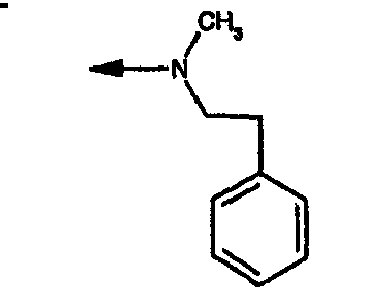
4.2 380 229 
3.6 328 230 
3.5 347 231 
4.3 387 232 
4.5 438 233 
3.8 353 234 
3.7 370 235 
4.1 370 236 
4.1 396 237 
4.1 352 238 
4.1 382 239 
4.4 420 240 
4.0 362 241 
4.1 382 242 
4.2 372 243 
3.2 353 244 
4.2 420 245 
4.4 421 246 
3.7 353 247 
4.4 421 248 
4.1 382 249 
4.1 382 -

1H NMR (400MHz, CDCl3): δ = 1.14 (m, 6H), 2.44 (q, 2H), 2.49 (s, 3H), 2.53 (q, 3H), 4.08 (m, 2H), 4.14 (m, 2H), 6.84 (s, 1 H), 7.00 (s, 1 H), 7.10 (s, 1H).
LRMS (electrospray) : m/z [MH+] 332.
Microanalysis: Found C, 61.36; H, 6.43; N, 12.55. C17H21N3O2S requires C, 61.61; H, 6.39; N, 12.68%. -

1H NMR (400MHz, CDCl3): δ =1.12 (m, 6H), 2.44 (q, 2H), 2.53 (q, 2H), 2.73 (s, 3H), 4.06 (m, 2H), 4.18 (m, 2H), 7.24 (s, 1 H), 7.45 (s, 1 H), 7.49 (s, 1H).
LRMS (electrospray) : m/z [M+Na+] 370. -

1H NMR (400MHz, CDCl3): δ = 1.10 (m, 6H), 2.39 (q, 2H), 2.51 (q, 2H), 3.06 (s, 3H), 4.05 (m, 2H), 4.10 (m, 2H), 7.39 (s, 1 H), 7.67 (s, 1 H), 7.84 (s, 1H).
LRMS (electrospray) : m/z [M+Na+] 385.
HRMS: [MH+] 364.1329. C18H20N6O2 requires 364.1326. -

1H NMR (400MHz, CDCl3): δ =1.13 (m, 6H), 2.43 (m, 8H), 2.52 (q, 2H), 2.85 (m, 2H), 3.81 (broad s, 1 H), 4.08 (m, 6H), 6.70 (s, 1 H), 6.78 (s, 1 H), 6.81 (s, 1H).
LRMS (APCI) : m/z [MH+] 373.
HRMS: [MH+] 373.2234. C20H29N4O3 requires 373.2234. - The compounds of the following tabulated Examples of the general formula:

Example No. PA prep No. R Analytical Data 254 95 CH2CH2NHMe 1H NMR (400MHz, CDCl3): δ = 1.13 (m, 6H), 2.42 (q, 2H), 2.53 (q, 2H), 2.59 (s, 3H), 3.12 (t, 2H), 4.05 (m, 2H), 4.09 (m, 2H), 4.16 (t, 2H), 6.75 (s, 1 H), 6.81 (s, 1 H), 6.82 (s, 1 H).
LRMS (APCI): m/z [MH+] 359
HRMS: [MH+] 359.2083. C19H27N4O3 requires 359.2078.255 96 CH2CONH2 1H NMR (400MHz, CDCl3): δ = 1.11 (m, 6H), 2.41 (q, 2H), 2.52 (q, 2H), 4.05 (t, 2H), 4.09 (t, 2H), 4.46 (s, 2H), 5.74 (broad s, 1 H), 6.42 (broad s, 1 H), 6.69 (s, 1 H), 6.85 (s, 2H).
LRMS (APCI): m/z 359 (MH+)256 97 CH2CH2OCH3 1H NMR (400MHz, CDCl3): δ = 1.12 (m, 6H), 2.42 (q, 2H), 2.51 (q, 2H), 3.44 (s, 3H), 3.73 (t, 2H), 4.09 (m, 6H), 6.71 (s, 1 H), 6.77 (s, 1H), 6.83 (s, 1H).
LRMS (electrospray): m/z 360 (MH+)
HRMS: [MH+] 360.1920. C19H26N3O4 requires 360.1918. -

1H NMR (400MHz, CDCl3): δ = 1.13 (m, 6H), 2.19 (broad s, 2H), 2.43 (q, 2H), 2.54 (q, 2H), 3.19 (t, 2H), 3.60 (s, 3H), 4.06 (t, 2H), 6.68 (s, 1H), 6.73 (s, 1H), 6.80 (s, 1 H).
LRMS (electrospray): m/z 315 (MH+)
HRMS: [MH+] 315.1819. C17H23N4O2 requires 315.1816. -

1H NMR (400MHz, CD3OD): δ = 1.15 (m, 6H), 2.46 (q, 2H), 2.63 (q, 2H), 3.13 (t, 2H), 4.13 (t, 2H), 6.54 (s, 1 H), 7.17 (s, 1 H), 7.69 (s, 1 H), 7.72 (s, 1 H), 7.82 (s, 1 H), 8.32 (s, 1 H).
LRMS (APCI): m/z 351 (MH+)
HRMS: [MH+] 351.1929. C19H22N4O2 requires 351.1928. -

1H NMR (400MHz, CDCl3): δ = 2.12 (s, 3H), 2.29 (s, 3H), 4.08 (s, 2H), 6.74 (s, 2H), 6.98 (s, 1H). - LRMS (electrospray): m/z 339 (MH+)
-

1H NMR (400MHz, CDCl3): δ = 2.19 (s, 3H), 2.45 (t, 1 H), 4.10 (m, 2H), 4.20 (m, 2H), 6.87 (d, 1 H), 6.96 (s, 1 H), 7.05 (d, 1 H).
LRMS (APCI): m/z 330 (MH+)
Microanalysis: Found C, 51.38; H, 3.52; N, 12.37. C14H11F4N3O2 requires C, 51.07; H, 3.37; N, 12.76%. -

1H NMR (400MHz, CDCl3): δ = 1.10 (m, 6H), 2.39 (q, 2H), 2.55 (q, 2H), 3.38 (s, 3H), 3.51 (m, 2H), 3.56 (m, 2H), 3.93 (t, 2H), 4.20 (t, 2H), 4.66 (s, 2H), 7.38 (s, 2H), 7.56 (s, 1 H).
LRMS (APCI): m/z 399 (MH+)
Microanalysis: Found C, 62.11; H, 6.67; N, 13.51. C21H26N4O4+0.43H2O requires C, 62.09; H, 6.67; N, 13.79%. -

1H NMR (400MHz, CDCl3): δ = 1.10 (m, 6H), 2.40 (q, 2H), 2.52 (q, 2H), 4.07 (m, 4H), 7.25 (s, 1 H), 7.60 (s, 1 H), 7.65 (s, 1 H).
LRMS (APCI): m/z 329 (MH+) -

1H NMR (400MHz, CDCl3): δ =1.21 (t, 3H), 1.51 (d, 3H), 2.54 (q, 2H), 4.89 (q, 1 H), 7.25 (s, 2H), 7.43 (s, 1 H). - LRMS (APCI): m/z 283 (MH+)
-

1H NMR (400MHz, CDCl3): δ =1.11 (t, 3H), 1.46 (d, 3H), 2.54 (q, 2H), 4.10 (q, 2H), 4.17 (q, 2H), 4.79 (q, 1 H), 7.44 (s, 2H), 7.57 (s, 1H). - LRMS (APCI): m/z 327 (MH+)
-

Retention time 5.7minutes.
LRMS (electrospray): m/z 422 (MH+) - The compounds of the following tabulated Examples of the general formula:

Example No. PA prep No. R Analytical Data 266 106 Me Retention time 4.8 minutes
LRMS (electrospray): m/z [MH+] 368267 107 Et Retention time 5.3 minutes
LRMS (electrospray): m/z [MH+] 382268 108 iPr Retention time 5.7 minutes
LRMS (electrospray): m/z 396 (MH+) -

1H NMR (400MHz, CD3OD): δ = 2.05 (s, 3H), 3.62 (s, 2H), 3.79 (s, 2H), 7.16 (m, 1 H), 7.18 (m, 1 H), 7.38 (s, 1 H), 8.15 (s, 1 H), 8.54 (s, 1 H), 8.84 (s, 1H).
LRMS (APCI): m/z 419 (M+Na+)
HRMS: [MH+] 397.1173. C19H18N6O2Cl requires 397.1175. -

Retention time: 3.40 minutes
1H NMR (400MHz, CD3OD): δ = 2.14 (s, 3H), 4.21 (s, 2H), 4.50 (s, 2H), 7.19 (s, 1 H), 7.27 (m, 1 H), 7.43 (m, 1 H), 7.48 (m, 1 H), 7.78 (m, 1 H), 8.68 (d, 1 H)
LRMS (electrospray): m/z 397 (MH-)
Microanalysis: Found C, 44.56; H, 3.41; N, 14.07. C19H17N6O2Cl+1.9.CF3CO2H requires C, 44.64; H, 3.11; N, 13.70%. -

1H NMR (400MHz, CDCl3): δ = 1.10 (m, 6H), 1.43 (s, 18H), 2.38 (q, 2H), 2.55 (q, 2H), 4.26 (m, 4H), 7.38 (s, 2H), 7.54 (s, 1H).
LRMS (electrospray): m/z 525 (MH+)
Microanalysis: Found C, 57.77; H, 7.38; N, 10.33. C25H35N4O5P+H2O requires C, 57.68; H, 7.16; N, 10.76%. -

Retention time: 2.31 minutes.
1H NMR (400MHz, CD3OD): δ = 1.09 (m, 6H), 2.35 (q, 2H), 2.61 (q, 2H), 4.28 (m, 4H), 7.55 (s, 2H), 7.79 (s, 1 H).
LRMS (APCI): m/z 391 (MH+)
Microanalysis: Found C, 50.99; H, 4.92; N, 14.06. C17H19N4O5P+0.5H2O requires C, 51.13; H, 5.05; N, 14.03%. -

1H NMR (400 MHz, CDCl3): δ = 1.22 (m, 6H), 2.70 (m, 4H), 4.12 (bs, 1 H), 4.59 (m, 2H), 4.75 (bs, 1 H), 7.66 (s, 1 H), 7.69 (m, 1 H), 7.72 (s, 1H).
Microanalysis: Found C, 50.29; H, 4.90; N, 13.48. C17H18N4O2.H2SO4 requires C, 49.99; H, 4.93; N, 13.72%. -

1H NMR (400 MHz, CDCl3): δ = 1.05-1.08 (m, 6H), 2.59 (q, 2H), 2.68 (q, 2H), 4.04 (t, 2H), 4.54 (t, 2H), 7.35-7.42 (m, 3H), 7.55 (s, 1 H), 7.64 (s, 1 H), 7.86 (d, 2H).
Microanalysis: Found C, 58.86; H, 5.13; N, 11.88. C23H24N4O5S requires C, 58.96; H, 5.16; N, 11.96%. -

1H NMR (400 MHz, DMSO-d6 ): δ = 1.00 (m, 6H), 2.24 (m, 5H), 2.49 (m, 2H), 4.00 (m, 2H), 7.11 (d, 2H), 7.45 (d, 2H), 7.73 (s, 2H), 8.09 (s, 1H).
Microanalysis: Found C, 59.64; H, 5.46; N, 11.60. C24H26N4O5S requires C, 59.74; H, 5.43; N, 11.61%. -

1H NMR (400 MHz, DMSO-d 6): δ =1.02 (m, 6H), 2.32 (q, 2H), 2.43 (s, 3H), 2.52 (m, 2H), 3.73 (m, 2H), 4.02 (m, 2H), 7.75 (s, 2H), 8.11 (s, 1 H).
Microanalysis: Found C, 53.20; H, 5.52; N, 13.68. C18H22N4O5S requires C, 53.19; H, 5.46; N, 13.78%. -

1H NMR (400 MHz, CD3OD): δ = 1.09 (m, 6H), 2.33 (s, 3H), 2.39 (q, 2H), 2.55 (q, 2H), 2.68 (s, 6H), 3.42 (t, 2H), 4.29 (t, 2H), 6.93 (s, 1 H), 7.06 (s, 1 H), 7.19 (s, 1H).
LRMS (thermospray): m/z [free base+H+] 299
Microanalysis: Found C, 45.83; H, 6.12; N, 11.27. C19H30N4O7S2.0.50H2O requires C, 45.68; H, 6.25; N, 11.21%. -

1H NMR (400 MHz, CD3OD): δ = 1.08 (m, 6H), 2.32 (s, 3H), 2.39 (q, 2H), 2.56 (q, 2H), 3.39 (m, 2H), 4.29 (m, 2H), 6.93 (s, 1 H), 7.05 (s, 1 H), 7.18 (s, 1H).
LRMS (thermospray): m/z [free base+H+] 299
Microanalysis: Found C, 51.26; H, 6.36; N, 14.08. C17H25N4O5P requires C, 51.51; H, 6.36; N, 14.14%. -

1H NMR (400 MHz, CD3OD): δ = 1.05-1.10 (m, 6H), 2.32 (s, 3H), 2.34-2.41 (m, 2H), 2.53-2.57 (m, 2H), 3.40 (m, 2H), 4.27 (m, 2H), 4.35 (s, 2H), 6.93 (s, 1 H), 7.05 (s, 1 H), 7.17 (s, 1H).
LRMS (electrospray): m/z [free base+H+] 299
Microanalysis: Found C, 54.80; H, 6.38; N, 12.11. C21H28N4O7.0.65H2O requires C, 54.81; H, 6.42; N, 12.10%. -

1H NMR (400 MHz, CD3OD): δ = 1.03-1.07 (m, 6H), 2.34 (s, 3H), 2.40 (q, 2H), 2.50 (s, 4H), 2.59 (q, 2H), 3.34 (t, 2H), 4.23 (t, 2H), 6.95 (s, 1 H), 7.06 (s, 1H), 7.22 (s, 1H).
LRMS (electrospray): m/z [free base+H+] 299
Microanalysis: Found C, 60.47; H, 6.77; N, 13.39. C21H28N4O5 requires C, 60.56; H, 6.78; N, 13.45%. -

1H NMR (400 MHz, CD3OD): δ = 1.04-1.07 (m, 6H), 2.35 (s, 3H), 2.40 (q, 2H), 2.58 (q, 2H), 2.73 (d, 2H), 2.80 (d, 2H), 3.42 (t, 2H), 4.30 (t, 2H), 6.95 (s, 1 H), 7.08 (s, 1H), 7.21 (s, 1 H).
LRMS (electrospray): m/z [free base+H+] 299
Microanalysis: Found C, 56.19; H, 6.20; N, 11.31. C23H30N4O8 requires C, 56.32; H, 6.16; N, 11.42%. -

1H-NMR (400MHz, CDCl3): δ = 1.13 (6H, m), 2.40 (2H, q), 2.53 (2H, q), 3.53 (1H, m), 4.11 (4H, m), 7.40 (2H, s), 7.58 (1 H, s).
LRMS (electrospray): m/z [MH+] 311.
Microanalysis: Found: C, 65.62; H, 5.85; N, 18.04. C17H18N4O2 requires C, 65.64; H, 5.84; N, 18.05%. -

1H-NMR (400MHz, CDCl3): δ = 1.16 (major, t, 3H), 1.16 (minor, t, 3H), 2.47 (major, q, 2H), 2.60 (minor, q, 2H), 3.13 (major, m, 2H), 3.13 (minor, m, 2H), 4.10 (major, m, 2H), 4.10 (minor, m, 2H), 4.24 (major, t, 2H), 4.24 (minor, t, 2H), 6.85 (major, s, 2H), 6.85 (minor, s, 2H), 7.02 (major, s, 1 H), 7.02 (minor, s, 1 H), 7.27 (major, s, 1 H), 7.31 (minor, s, 1H).
LRMS (thermospray): m/z [MH+] 300. - The following Preparations describe the preparation of certain intermediates used in the preceding Examples.
-

1H-NMR (400MHz, CDCl3): δ = 2.04 (s, 6H), 6.84 (s, 2H), 7.06 (s, 1H), 14.38 (br.s, 1 H)
LRMS (thermospray): m/z [MNH4 +] 278.
Microanalysis: Found: C, 50.43; H, 3.84. C11H10Cl2O3 requires C, 50.60; H, 3.86%. -

1H-NMR (400MHz, CDCl3): δ = 1.12 (t, 6H), 2.59 (q, 4H), 4.77 (s, 0.2H, diketone), 15.50 (s, 0.8H, enol).
LRMS (thermospray): m/z [MNH4 +] 180 for title compound and 214 for dichlorinated impurity. -

1H-NMR (300MHz, CDCl3): δ = 1.40 (6H, m), 1.26 (3H, t), 2.44 (4H, q), 3.47 (2H, s), 4.22 (2H, q), 4.96 (2H, s), 6.82 (2H, s), 7.02 (1 H, s).
LRMS (thermospray): m/z [MH+] 413.
Microanalysis: Found: C, 55.13; H, 5.34; N, 6.98. C15H15Cl2N3O requires C, 55.22; H, 5.37; N, 6.78%. -

1H-NMR (300MHz, CDCl3): δ = 1.13 (6H, m), 2.52 (2H, q), 2.60(2H, q), 5.03 (2H, s), 6.95 (2H, s), 7.14 (1 H, s).
LRMS (electrospray): m/z [M-H+] 341. -

1H-NMR (400MHz, CDCl3): δ = 1.13 (t, 3H), 2.60 (q, 2H), 4.58 (s, 2H), 6.78 (s, 2H), 7.01 (s, 1 H).
LRMS (thermospray): m/z [MNH4 +] 250. -

1H-NMR (400MHz, CDCl3): δ = 0.98 (t, 3H), 2.30 (br s, 2H), 2.94 (s, 6H), 6.77 (s, 2H), 6.95 (s, 1H), 7.24 (s, 1 H).
LRMS (thermospray): m/z [MNH4 +] 288. -

1H-NMR (300MHz, CDCl3): δ = 2.11 (s, 3H), 2.43 (s, 3H), 2.70 (s, 3H), 6.78 (s, 2H), 7.03 (s, 1 H). - LRMS (thermospray): m/z [MH+] 299.
-

1H-NMR (300MHz, CDCl3): δ = 2.10 (s, 3H), 2.73 (s, 3H), 4.73 (s, 2H), 6.86 (s, 2H), 7.11 (s, 1 H). - LRMS (thermospray): m/z [MH+] 379.
-

1H-NMR (400MHz, CDCl3): δ = 1.04 (t, 6H), 2.49 (q, 4H), 7.16 (m, 2H), 7.30 (d, 1H), 7.39 (t, 2H), 14.51 (s, 1 H).
LRMS (thermospray): m/z [MNH4 +] 263. -

1H-NMR (400MHz, CDCl3): δ = 1.48 (s, 9H), 2.05 (s, 1 H), 3.19 (br t, 1 H), 3.47 (td, 1 H), 3.60 (dd, 1 H), 3.87 (m, 6H).
LRMS (thermospray): m/z [MH+] 218. -

1H-NMR (400MHz, CDCl3): δ = 1.49 (s, 9H), 3.06 (s, 3H), 3.50 (td, 1H), 3.60 (dd, 1 H), 3.80 (m, 4H), 4.26 (br s, 1 H), 4.39 (m, 2H).
LRMS (thermospray): m/z [MNH4 +] 313. -

1H-NMR (300MHz, CDCl3): δ = 1.16 (t, 3H), 2.60 (m, 2H), 3.77 (s, 3H), 5.13 (s, 1 H), 6.84 (s, 2H), 7.10 (s, 1 H).
LRMS (thermospray): m/z [MNH4 +] 308. -

1H-NMR (400MHz, CDCl3): δ = 1.02 (t, 3H), 2.29 (m, 2H), 3.63 (m, 2H), 3.80 (m, 2H), 6.92 (s, 2H), 7.21 (s, 1 H).
LRMS (thermospray): m/z [MH+] 317.
Microanalysis: Found: C, 48.86; H, 4.44; N, 9.01. C13H14N2O3Cl2 requires C, 49.23; H, 4.45; N, 8.83%. -

1H-NMR (400MHz, CDCl3): δ = 0.15 (s, 6H), 0.94 (s, 9H), 1.16 (t, 3H), 2.45 (m, 2H), 3.94 (m, 4H), 6.85 (s, 2H), 6.97 (s, 1H).
LRMS (thermospray): m/z [MH+] 431.
Microanalysis: Found: C, 52.87; H, 6.52; N, 6.46. C19H28N2O3Cl2Si requires C, 52.90; H, 6.54; N, 6.49%. -

1H-NMR (300MHz, CDCl3): δ = 0.01 (s, 6H), 0.86 (s, 9H), 1.17 (t, 3H), 2.45 (q, 2H), 4.01 (m, 2H), 4.14 (m, 2H), 6.84 (s, 2H), 7.08 (s, 1H).
LRMS (thermospray): m/z [MH+] 563. -

1H-NMR (300MHz, CDCl3): δ = 2.04 (s, 6H), 7.13 (s, 1 H), 7.19 (s, 1 H), 7.35 (s, 1 H), 14.40 (s, 1 H). -

1H-NMR (400MHz, CDCl3): δ = 2.06 (s, 3H), 2.38 (s, 3H), 2.65 (s, 3H), 6.99 (m, 1H), 7.08 (m, 1H), 7.29 (m, 1H).
LRMS (thermospray): m/z [MH+] 290. -

1H-NMR (300MHz, CDCl3): δ = 2.10 (s, 3H), 2.74 (s, 3H), 4.73 (s, 2H), 7.12 (s, 1 H), 7.22 (s, 1H), 7.39 (s, 1 H). -

1H-NMR (400MHz, CDCl3): δ = 1.25 (s, 9H), 2.39 (s, 3H), 5.10 (s, 1 H).
LRMS (thermospray): m/z [MNH4 +] 194. -

1H-NMR (300MHz, CDCl3): δ = 1.46 (s, 1 H), 2.46 (s, 3H), 3.82 (s, 2H), 7.47 (d, 2H), 7.64 (d, 2H).
LRMS (electrospray): m/z [MH+] 147. -

1H-NMR (300MHz, CDCl3): δ = 1.84 (s, 2H), 2.84 (t, 2H), 3.68 (t, 2H), 3.89 (s, 2H), 7.45 (d, 2H), 7.65 (d, 2H).
LRMS (thermospray): m/z [MH+] 177. -

1H-NMR (400MHz, CDCl3): δ = 0.15 (s, 6H), 0.77 (s, 9H), 2.02 (s, 3H), 3.64 (s, 2H), 3.70 (s, 2H), 3.95 (t, 2H), 4.17 (t, 2H), 6.75 (s, 2H), 6.97 (s, 1 H), 7.15 (dd, 1 H), 7.53 (d, 1 H), 8.47 (m, 2H).
LRMS (thermospray): m/z [MH+] 521. -

1H-NMR (400MHz, CDCl3): δ = 1.15 (d, 6H), 2.29 (s, 3H), 3.25 (sept, 1H), 15.60 (s, 1 H).
LRMS (thermospray): m/z [MNH4 +] 180. -

1H-NMR (300MHz, CDCl3): δ = 1.08 (d, 6H), 2.02 (s, 3H), 2.24 (sept, 1H), 7.47 (s, 2H), 7.63 (s, 1 H), 14.71 (s, 1 H).
LRMS (electrospray): m/z [M-H+] 269. -

1H-NMR (400MHz, CDCl3): δ = 0.02 (s, 6H), 0.85 (s, 9H), 1.19 (d, 6H), 2.09 (s, 3H), 2.79 (sept, 1 H), 3.99 (m, 2H), 4.10 (m, 2H), 7.39 (s, 2H), 7.57 (s, 1H).
LRMS (electrospray): m/z [MH+] 425. -

1H-NMR (400MHz, CDCl3): δ = 1.15 (major, t, 3H), 1.15 (minor, t, 3H), 1.52 (major, s, 18H), 1.52 (minor, s, 18H), 2.47 (major, q, 2H), 2.56 (minor, q, 2H), 4.00 (major, t, 2H), 4.00 (minor, t, 2H), 4.24 (major, t, 2H), 4.24 (minor, t, 2H), 6.85 (major, s, 2H), 6.85 (minor, s, 2H), 7.00 (major, s, 1 H), 7.00 (minor, s, 1 H), 7.21 (major, s, 1 H), 7.25 (minor, s, 1 H).
LRMS (thermospray): m/z [MH+] 500.
Microanalysis: Found: C, 54.94; H, 6.26; N, 8.27. C23H31Cl2N3O5 requires C, 55.20; H, 6.24; N, 8.40%. -

1H-NMR (400MHz, CDCl3): δ = 0.09 (s, 6H), 0.78 (s, 9H), 2.01 (s, 3H), 2.05 (s, 3H), 3.88 (q, 2H), 4.02 (q, 2H), 6.76 (s, 2H), 6.88 (s, 1H).
LRMS (thermospray): m/z [MH+] 415. -

1H-NMR (300MHz, CDCl3): δ = 0.04 (s, 6H), 0.82 (s, 9H), 2.02 (s, 3H), 3.96 (m, 2H), 4.22 (m, 2H), 4.41 (s, 2H), 6.81 (s, 2H), 7.01 (s, 1H).
LRMS (thermospray): m/z [MH+] 495. -

1H-NMR (400MHz, CDCl3): δ = -0.02 (s, 6H), 0.82 (s, 9H), 2.02 (s, 3H), 2.12 (s, 3H), 3.97 (q, 2H), 4.06 (m, 2H), 7.02 (s, 1 H), 7.11 (s, 1 H), 7.24 (s, 1H).
LRMS (thermospray): m/z [MH+] 408.
Microanalysis: Found: C, 58.95; H, 6.96; N, 10.22. C20H28N3O2ClSi requires C, 59.13; H, 6.95; N, 10.35%. -

1H-NMR (300MHz, CDCl3): δ = -0.02 (s, 6H), 0.83 (s, 9H), 2.04 (s, 3H), 3.97 (q, 2H), 4.25 (m, 2H), 4.43 (s, 2H), 7.09 (s, 1 H), 7.18 (s, 1 H), 7.33 (s, 1H).
LRMS (thermospray): m/z [MH+] 486. -

1H-NMR (300MHz, CDCl3): δ = -0.23 (s, 6H), 0.62 (s, 9H), 1.22 (s, 2H), 1.82 (s, 3H), 2.56 (s, 2H), 3.78 (m, 2H), 4.02 (m, 2H), 6.85 (s, 1 H), 6.96 (s, 1 H), 7.06 (s, 1H). - LRMS (thermospray): m/z [MH+] 421.
-

1H-NMR (400MHz, CDCl3): δ = 3.77 (s, 3H), 6.82 (s, 1 H), 6.94 (s, 1 H), 7.09 (s, 1H). Microanalysis: Found: C, 37.94; H, 2.75. C7H6BrClO requires C, 37.96; H, 2.73%. -

1H-NMR (400MHz, CDCl3): δ = 3.84 (s, 3H), 6.82 (dd, 1 H), 6.95 (dd, 1 H), 6.96 (s, 1H).
LRMS (thermospray): m/z [MNH4 +] 169.
Microanalysis: Found: C, 63.46; H, 3.95; N, 9.14. C8H6NOF requires C, 63.58; H, 4.00; N, 9.27%. -

1H-NMR (300MHz, CDCl3): δ = 5.81 (s, 1 H), 6.80 (dd, 1 H), 6.94 (dd, 1 H), 6.95 (s, 1H).
Microanalysis: Found: C, 60.99; H, 3.01; N, 10.16. C7H4NOF requires C, 61.32; H, 2.94; N, 10.22%. -

1H-NMR (300MHz, CDCl3): δ = 3.82 (3H, s), 7.04 (s, 1 H), 7.12 (s, 1 H), 7.23 (s, 1H). - Microanalysis: Found: C, 57.50; H, 3.63; N, 8.16. C8H6NOCl requires C, 57.33; H, 3.61; N, 8.36%.
-

1H-NMR (400MHz, d 6DMSO): δ = 7.12 (m, 2H), 7.38 (s, 1 H), 10.65 (s, 1H).
Microanalysis: Found: C, 54.76; H, 2.81; N, 8.94. C7H4NOCl requires C, 54.75; H, 2.63; N, 9.12%. -

1H-NMR (300MHz, CDCl3): δ = 3.79 (s, 3H), 7.00 (s, 2H), 7.26 (s, 1H).
LRMS (thermospray): m/z [MH+] 266.
Microanalysis: Found: C, 31.56; H, 2.29. C7H6OBr2 requires C, 31.62; H, 2.27%. -

1H-NMR (300MHz, CDCl3): δ = 3.83 (3H, s), 7.31 (2H, s), 7.48 (1 H, s). -
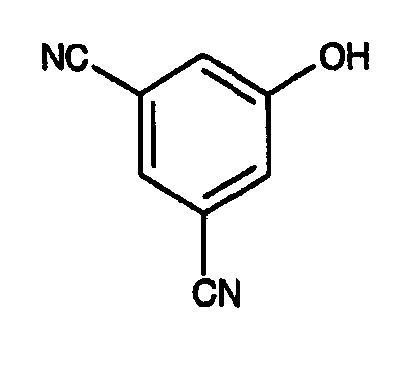
1H-NMR (400MHz, CDCl3): δ = 7.36 (m, 2H), 7.56 (m, 1H). -

1H-NMR (400MHz, CDCl3): δ = 2.35 (s, 3H), 3.80 (s, 3H), 6.60 (s, 1H), 6.68 (s, 1H), 6.73 (s, 1H). -

1H-NMR (400MHz, CDCl3): δ = 2.34 (s, 3H), 3.80 (s, 3H), 6.93 (s, 1 H), 6.94 (s, 1 H), 7.04 (s, 1 H). -
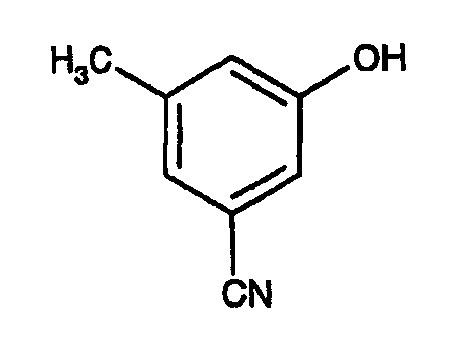
1H-NMR (400MHz, CDCl3): δ = 2.32 (s, 3H), 5.05 (s, 1 H), 6.88 (s, 1H), 6.90 (s, 1 H), 7.04 (s, 1 H). - The compounds of the following tabulated Preparations of the general formula:

Preparation No. (Phenol No.) R LRMS Analytical Data 43 (Phenol Preparation 34) F m/z [MNH4 +] 281. (thermospray) 1H-NMR (300MHz, CDCl3): δ = 1.05 (t, 6H), 2.27 (q, 4H), 6.89 (m, 1 H), 7.03 (s, 1 H), 7.04 (m, 1 H). 44 (Phenol Preparation 42) Me m/z [M-H+] 258. (electrospray) 1H-NMR (400MHz, CDCl3): δ = 1.09 (t, 6H), 2.32 (q, 4H), 2.37 (s, 3H), 6.96 (s, 1 H), 6.97 (s, 1 H), 7.15 (s, 1 H), 14.50 (s, 1 H). 45 (Phenol Preparation 39) CN m/z [M-H+] 269. (electrospray) 1H-NMR (300MHz, CDCl3): δ = 1.09 (m, 6H), 2.30 (m, 4H), 7.42 (s, 2H), 7.61 (s, 1 H), 14.56 (s, 1H). 46 (Phenol Preparation 36) Cl m/z [MH+] 280. (thermospray) 1H-NMR (400MHz, CDCl3): δ = 1.08 (m, 6H), 2.31 (q, 4H), 7.12 (s, 1 H), 7.19 (s, 1 H), 7.31 (s, 1H). -

1H-NMR (400MHz, CDCl3): keto and enol forms present with enol as major component; enol signals δ = 1.00 (m, 7H), 1.60 (m, 1H), 2.25 (m, 2H), 5.59 (s, 1 H), 15.62 (s, 1 H); keto signals δ = 1.00 (m, 7H), 2.01 (m, 1 H), 2.52 (m, 2H), 3.68 (s, 2H).
LRMS (electrospray): m/z [M-H+] 139.
Microanalysis: Found: C, 68.35; H, 8.72. C8H12O2 requires C, 68.55; H, 8.63%. - The compound of the following tabulated Preparation of the general formula:

Preparation No. R R' LRMS Analytical Data 48 iPr Et m/z [M-H+] 141. (electrospray) 1H-NMR (400MHz, CDCl3): keto and enol forms present with enol major δ = 1.12 (m, 18H, keto and enol), 2.32 (m, 4H, keto and enol), 2.49 (m, 2H, keto and enol), 3.61 (s, 2H, keto), 5.49 (s, 1H, enol), 15.52 (s, 1H, enol).
Microanalysis: Found: C, 67.22; H, 9.95. C8H14O2 requires C, 67.57; H, 9.92%. - The compounds of the following tabulated Preparations of the general formula:

Preparation No. (Diketone No.) R R' LRMS Analytical Data 49 (Preparation 47) cycloPr Et m/z [M-H+] 173. (electrospray) 1H-NMR (400MHz, CDCl3): 1.10 (m, 7H), 2.41 (m, 1 H), 2.61 (m, 2H), 15.90 (s, 1H). 50 (Commercially available diketone used) Me Et m/z [MNH4 +] 166. (thermospray) 1H-NMR (300MHz, CDCl3): 1.19 (m, 3H), 2.27 (s, 3H), 2.67 (q, 2H), 15.40 (s, 1 H). 51 (Preparation 48) iPr Et m/z [M-H+] 175. (electrospray) 1H-NMR (400MHz, CDCl3): 1.18 (m, 9H), 2.64 (q, 2H), 3.20 (m, 1 H), 15.80 (s, 1 H). - The compounds of the following tabulated Preparations of the general formula:

Preparation No. (Diketone No.) R R' LRMS Analytical Data 52 (Preparation 49) cycloPr Et m/z [M-H+] 282. (electrospray) 1H-NMR (400MHz, CDCl3): 0.93 (m, 2H), 1.12 (t, 3H), 1.21 (m, 2H), 1.78 (m, 1 H), 2.29 (q, 2H), 7.49 (s, 2H), 7.61 (s, 1 H), 14.87 (s, 1 H). 53 (Preparation 19) tBu Me m/z [MNH4 +] 301. (thermospray) 1H-NMR (400MHz, CDCl3): 1.08 (s, 9H), 1.84 (s, 3H), 7.30 (s, 1 H), 7.57 (s, 2H), 15.42 (s, 1H). 54 (Preparation 51) iPr Et m/z [M-H+] 283. (electrospray) 1H-NMR (400MHz, CDCl3): 1.03 (m, 9H), 2.23 (q, 2H), 2.58 (m, 1 H), 7.41 (s, 2H), 7.59 (s, 1 H), 14.63 (s, 1 H). -

1H-NMR (300MHz, CD3OD): δ = 3.85 (s, 2H), 7.43 (d, 2H), 7.82 (d, 2H).
LRMS (thermospray): m/z [MH+] 151. -

1H NMR (400MHz, CDCl3): δ = 1.12 (t, 3H), 2.59 (q, 2H), 3.49 (s, 2H). -

1H NMR (300MHz, CDCl3): δ = 2.67 (t, 2H), 3.89 (t, 2H), 4.58 (s, 2H), 7.18 (m, 5H). -
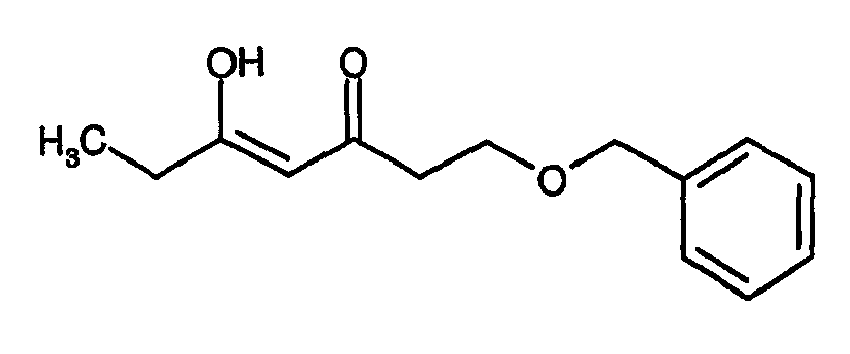
1H NMR (400MHz, CDCl3): δ =1.17 (t, 3H), 2.33 (q, 2H), 2.58 (t, 2H), 3.76 (t, 2H), 4.53 (s, 2H), 5.57 (s, 1 H), 7.13 (m, 5H).
LRMS (electrospray) : m/z [MNa+] 257.
Microanalysis: Found C, 71.77; H, 7.74. C14H18O3 requires C, 71.76; H, 7.69%. -

1H NMR (400MHz, CDCl3): δ = 1.17 (t, 3H), 2.62 (q, 2H), 2.96 (t, 2H), 3.79 (t, 2H), 4.57 (s, 2H), 7.12 (m, 5H), 15.49 (s, 1H).
LRMS (electrospray) : m/z [MNa+] 291. -

1H NMR (400MHz, CDCl3): δ= 1.08 (t, 3H), 2.31 (q, 2H), 2.59 (t, 2H), 3.75 (t, 2H), 4.45 (s, 2H), 6.92 (m, 1 H), 7.02 (m, 2H), 7.29 (m, 5H), 14.50 (s, 1H).
LRMS (electrospray) : m/z [MNa+] 392. -
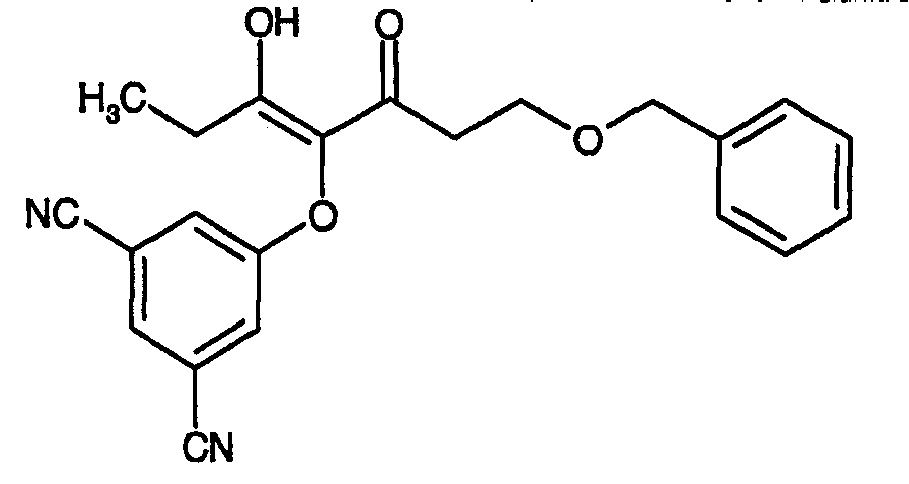
LRMS (thermospray) : m/z [MH+] 375. -

1H NMR (400MHz, CDCl3): δ = 0.03 (s, 6H), 0.84 (s, 9H), 1.10 (m, 6H), 2.42 (q, 2H), 2.56 (q, 2H), 4.00 (t, 2H), 4.09 (t, 2H), 6.86 (d, 1 H), 6.99 (m, 2H).
LRMS (thermospray) : m/z [MH+] 419.
Microanalysis: Found C, 62.73; H, 7.83; N, 9.75. C22H32FN3O2Si.0.06CH2Cl2 requires C, 62.68; H, 7.66; N, 9.94%. -

1H NMR (400MHz, CDCl3): δ = 1.08 (m, 6H), 1.52 (m, 6H), 2.39 (q, 2H), 2.54 (q, 2H), 3.45 (m, 1 H), 3.64 (m, 1 H), 3.75 (m, 1 H), 4.06 (m, 1 H), 4.17 (t, 2H), 4.51 (s, 1 H), 6.82 (d, 1H), 7.22 (m, 2H).
LRMS (thermospray) : m/z [MH+] 388. -

1H NMR (400MHz, CDCl3): δ = 1.12 (m, 6H), 1.56 (m, 6H), 2.44 (q, 2H), 2.59 (q, 2H), 3.48 (m, 1H), 3.69 (m, 1H), 3.79 (m, 1 H), 4.08 (m, 1H), 4.20 (t, 2H), 4.54 (s, 1 H), 6.72 (d, 1 H), 7.15 (m, 2H).
LRMS (thermospray) : m/z [MH+] 406.
Microanalysis: Found C, 60.57; H, 6.97; N, 9.97. C21H28FN3O4.0.08CH2Cl2.0.32H2O requires C, 60.57; H, 6.94; N, 10.05%. -

1H NMR (400MHz, CDCl3): δ = 1.13 (m, 6H), 1.58 (m, 6H), 2.44 (q, 2H), 2.60 (q, 2H), 3.49 (m, 1 H), 3.69 (m, 1 H), 3.80 (m, 1 H), 4.10 (m, 1 H), 4.21 (t, 2H), 4.55 (s, 1 H), 6.50 (s, 1 H), 6.98 (s, 1 H), 7.57 (s, 1 H), 7.63 (s, 1 H), 7.72 (s, 1 H), 7.89 (s, 1 H).
LRMS (thermospray): m/z [MH+] 436, [MNa+] 458.
HRMS: [MH+] Found 436.2352. C24H30N5O3 requires 436.2343
[MNa+] Found 458.2168. C24H29N5O3Na requires 458.2162. - The preparation of the following tabulated Preparations of the general formula

Preparation No. (Starting material preparation no.) R Analytical Data 66 (63) 
1H NMR (400MHz, CDCl3): δ = 1.13 (m, 6H), 1.63 (m, 6H), 2.44 (q, 2H), 2.60 (q, 2H), 3.46 (m, 1H), 3.67 (m, 1 H), 3.79 (m, 1 H), 4.08 (m, 1 H), 4.20 (t, 2H), 4.53 (s, 1 H), 6.26 (t, 1 H), 6.64 (d, 1 H), 7.17 (s, 1 H), 7.21 (s, 1 H), 7.34 (s, 1 H), 7.41 (t, 1 H).
LRMS (thermospray) : m/z [MH+] 463, [MNa+] 485.
HRMS: [MH+] Found 463.2353. C26H31N4O4 requires 463.2340
[MNa+] Found 485.2166. C26H30N4O4Na requires 485.2159.67 (63) 
1H NMR (400MHz, CDCl3): δ = 1.10 (m, 6H), 1.56 (m, 6H), 2.41 (q, 2H), 2.56 (q, 2H), 3.44 (m, 1 H), 3.64 (m, 1 H), 3.75 (m, 1 H), 4.05 (m, 1 H), 4.17 (t, 2H), 4.50 (s, 1 H), 7.00 (d, 1 H), 7.08 (s, 1 H), 7.20 (m, 1 H), 7.51 (s, 1 H), 7.64 (s, 1 H), 7.86 (s, 1 H).
LRMS (thermospray) : m/z [MH+] 464, [MNa+] 486.
HRMS: [MH+] Found 464.2297. C25H30N5O4 requires 464.2293
[MNa+] Found 486.2113. C25H29N5O4Na requires 486.2112.681 (63) 
1H NMR (400MHz, CDCl3): δ = 1.08 (m, 6H), 1.48 (m, 6H), 2.23 (s, 3H), 2.38 (q, 2H), 2.53 (q, 2H), 3.43 (m, 1 H), 3.63 (m, 1 H), 3.66 (s, 3H), 3.73 (m, 1 H), 4.04 (m, 1 H), 4.15 (t, 2H), 4.50 (s, 1 H), 5.59 (s, 1 H), 6.76 (s, 1 H), 6.88 (s, 1 H), 6.95 (s, 1 H).
LRMS (thermospray) : m/z [MH+] 480, [MNa+] 502.1 The eluent used for flash column chromatography purification of this compound was dichloromethane:methanol (99:1 changing to 95:5, by volume). -

1H NMR (400MHz, CDCl3): δ = 1.03-1.17 (m, 6H), 1.49 (s, 9H), 2.39-2.52 (m, 4H), 4.32 (m, 2H), 4.50 (m, 2H), 4.94 (m, 1 H), 7.38 (s, 2H), 7.56 (s, 1 H).
LRMS (thermospray) : m/z [MH+] 422, [MNa+] 444.
Microanalysis: Found C, 65.08; H, 6.49; N, 16.48. C23H27N5O3.0.18H2O requires C, 65.04; H, 6.49; N, 16.49%. -

1H NMR (400MHz, CDCl3): δ = 1.09 (m, 6H), 1.47-1.63 (m, 2H), 1.66-1.88 (m, 2H), 2.15 (dd, 2H), 2.38 (q, 2H), 2.53 (q, 2H), 3.37-3.55 (m, 2H), 3.75-3.90 (m, 2H), 4.11 (m, 2H), 4.56 (m, 1 H), 7.37 (s, 2H), 7.55 (s, 1H).
LRMS (electro) : m/z [MH+] 409, [MNa+] 421.
Microanalysis: Found C, 66.59; H, 6.91; N, 13.40. C23H28N4O3.0.36H2O requires C, 66.57; H, 6.98; N, 13.50%. -

1H NMR (400MHz, CDCl3): δ = 2.06 (s, 3H), 2.37 (s, 3H), 2.65 (s, 3H), 6.81 (d, 1H), 6.91 (s, 1 H), 7.04 (d, 1 H).
LRMS (thermospray) : m/z [MH+] 273.
Microanalysis: Found C, 61.62; H, 4.44; N, 15.09. C14H12N3O2F requires C, 61.53; H, 4.43; N, 15.38%. - The tabulated compounds of the general formula

Preparation no. (Starting material preparation no.) R' Analytical Data 72 (39) CN m.p. 204-206°C
1H NMR (400MHz, CDCl3): δ = 2.06 (s, 3H), 2.38 (s, 3H), 2.66 (s, 3H), 7.33 (s, 2H), 7.58 (s, 1H).
LRMS (thermospray) : m/z [MH+] 281.
Microanalysis: Found C, 63.30; H, 4.25; N, 19.59. C15H12N4O2.0.30H2O requires C, 63.06; H, 4.45; N, 19.61 %.731 (42) Me m.p. 152-154°C
1H NMR (400MHz, CDCl3): δ = 2.05 (s, 3H), 2.33 (s, 3H), 2.38 (s, 3H), 2.66 (s, 3H), 6.88 (s, 1 H), 6.91 (s, 1H), 7.12 (s, 1H).
LRMS (thermospray) : m/z [MH+] 270.
Microanalysis: Found C, 66.67; H, 5.71; N, 15.25.
C15H15N3O2 requires C, 66.9; H, 5.61; N, 15.60%.742 (Commercial) H m.p. 131-133°C
1H NMR (400MHz, CDCl3): δ = 2.13 (s, 3H), 2.40 (s, 3H), 2.70 (s, 3H), 7.15 (m, 2H), 7.35 (m, 1 H), 7.40 (m, 1 H).
LRMS (thermospray) : m/z [MH+] 278.
Microanalysis: Found C, 65.87; H, 5.11; N, 16.33.
C14H13N3O2 requires C, 65.87; H, 5.13; N, 14.46%.1 The product was purified by flash column chromatography on silica gel eluting with ethyl acetate:pentane (10:90, by volume).
2 The product was purified by flash column chromatography on silica gel eluting with ethyl acetate:pentane (10:90 changing to 20:80, by volume). -

1H NMR (400MHz, CDCl3): δ = 2.05 (s, 3H), 2.69 (s, 3H), 4.68 (s, 2H), 6.89 (d, 1H), 6.99 (s, 1H), 7.08 (d, 1H).
LRMS (thermospray) : m/z [M-BrH+] 272.
Microanalysis: Found C, 45.08; H, 3.14; N, 11.44. C14H11BrN3O2F.1.05H2O requires C, 45.31; H, 3.56; N, 11.32%. - The preparation of the following tabulated Preparations of the general formula

Preparation no. (Starting material preparation no.) R Analytical Data 76 (72) CN m.p. 132-134 °C
1H NMR (400MHz, CDCl3): δ = 2.06 (s, 3H), 2.66 (s, 3H), 4.67 (s, 2H), 7.40 (s, 2H), 7.63 (s, 1H).
Microanalysis: Found C, 47.65; H, 3.03; N, 14.79.
C15H11BrN4O2.0.93H2O requires C, 47.92; H, 3.45; N, 14.90%.771,2 (73) Me m.p. 107-109°C
1H NMR (400MHz, CDCl3): δ = 2.05 (s, 3H), 2.35 (s, 3H), 2.70 (s, 3H), 4.70 (s, 2H), 6.95 (s, 1 H), 6.99 (s, 1 H), 7.18 (s, 1 H).
Microanalysis: Found C, 50.34; H, 3.89; N, 11.58.
C15H14BrN3O2.0.40H2O requires C, 50.69; H, 4.20; N, 11.82%.781,3 (74) H m.p. 120-124°C
1H NMR (400MHz, CDCl3): δ = 2.05 (s, 3H), 2.70 (s, 3H), 4.75 (s, 2H), 7.20 (m, 2H), 7.45 (m, 1 H).
Microanalysis: Found C, 49.01; H, 3.47; N, 12.14.
C14H12BrN3O2.0.50H2O requires C, 49.00; H, 3.82; N, 12.24%.1 A further aliquot of 2,2'-azobisisobutyronitrile (30mg) was added to this reaction, and refluxing was continued for a further 2 hours.
2The product was purified by flash column chromatography on silica gel eluting with a solvent gradient of ethyl acetate:pentane (0:100 then 2:98 then 5:95 then 10:90 then 15:85 then 30:70, by volume).
3 The product was purified by flash column chromatography on silica gel eluting with ethyl acetate:pentane (10:90 changing to 20:80, by volume). -

1H NMR (400MHz, CD3OD): δ = 7.62 (m, 1 H), 7.86 (m, 1 H), 8.12 (m, 1 H), 8.18 (s, 1 H). -

1H NMR (400MHz, CD3OD): δ = 3.83 (s, 2H), 7.39 (dd, 1 H), 7.49 (d, 1 H), 7.73 (d, 1H), 7.81 (s, 1 H). -

WO98155438
1H NMR (400MHz, CDCl3): δ = 1.02 (m, 4H), 1.17 (m, 4H), 2.24 (m, 0.2H), 2.39 (m, 0.8H), 5.05 (s, 0.2H), 16.34 (s, 0.8H).
Microanalysis: Found C, 57.59; H, 5.89. C9H11ClO2.0.02CH2Cl2 requires C, 57.92; H, 5.94. -

1H NMR (400MHz, CDCl3): δ = 0.93 (m, 4H), 1.19 (m, 4H), 1.74 (m, 2H), 7.53 (s, 2H), 15.25 (s, 1H).
LRMS (electrospray) : m/z [M-H+] 293.
Microanalysis: Found C, 69.18; H, 4.82; N, 9.35. C17H14N2O3 requires C, 69.38; H, 4.79; N, 9.52%. -

1H NMR (400MHz, CDCl3): δ = 2.00 (s, 3H-enol), 2.30 (s, 3H-keto), 3.51 (s, 2H-keto), 5.02 (s, 1 H-enol). -

1H NMR (400MHz, CDCl3): δ = 0.83-0.95 (m, 2H), 1.06-1.10 (m, 2H), 1.54-1.63 (m, 1 H), 2.00 (s, 3H).
LRMS (electrospray) : m/z [MNa+] 149. -

1H NMR (400MHz, CDCl3): δ = 0.99-1.08 (m, 2H), 1.15-1.20 (m, 2H), 2.27 (s, 3H), 2.38-2.46 (m, 1 H).
LRMS (electrospray): m/z [M-H+] 159. -

1H NMR (400MHz, CDCl3): δ = 0.85 (m, 2H), 1.12 (m, 2H), 1.86 (m, 1 H), 1.94 (s, 3H), 2.35 (s, 3H), 6.99 (m, 2H), 7.10 (s, 1H).
LRMS (electrospray) : m/z [M-H+] 256. -
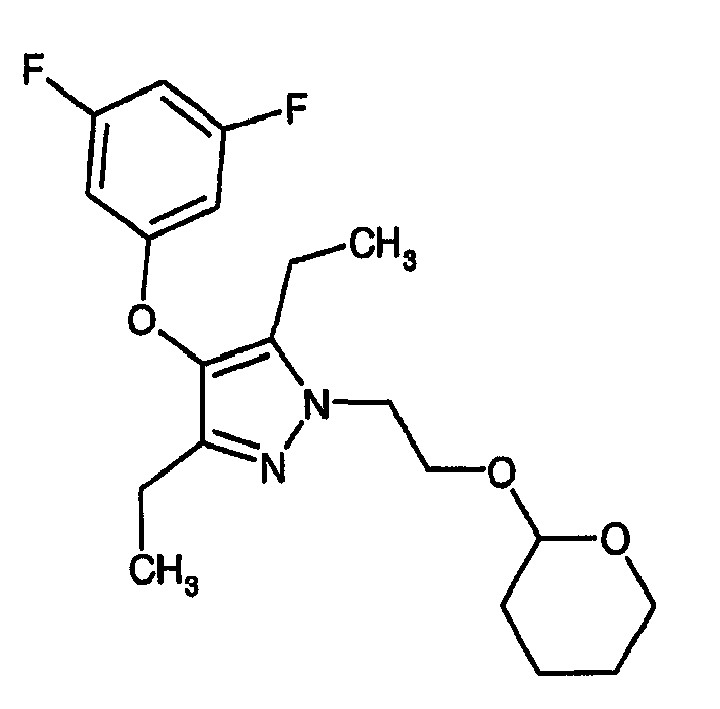
1H NMR (400MHz, CDCl3): δ = 1.09 (m, 6H), 1.57 (m, 6H), 2.40 (q, 2H), 2.55 (q, 2H), 3.44 (m, 1 H), 3.62 (m, 1 H), 3.73 (m, 1 H), 4.05 (m, 1 H), 4.16 (t, 2H), 4.50 (s, 1H), 6.39 (m, 3H).
LRMS (thermospray) : m/z [MH+] 381.
Microanalysis: Found C, 62.16; H, 6.92; N, 7.16. C20H26N2O3.0.09CH2Cl2 requires C, 62.18; H, 6.80; N,7.22%. -

-

Least Polar Product - Preparation 88 (254mg)
1H NMR (400MHz, CDCl3): δ = 1.11 (m, 6H), 1.50 (m, 6H), 2.46 (q, 2H), 2.58 (q, 2H), 3.43 (m, 1 H), 3.64 (m, 1 H), 3.75 (m, 1 H), 4.04 (m, 1 H), 4.18 (t, 2H), 4.50 (s, 1 H), 6.42 (s, 2H), 7.15 (s, 2H), 7.67 (s, 3H), 7.90 (s, 2H).
LRMS (electrospray) : m/z [MH+] 477, [MNa+] 499.
HRMS: [MH+] Found 477.2612. C26H33N6O3 requires 477.2609.
Most Polar Product - Preparation 89 (37.7mg)
1H NMR (400MHz, CDCl3): δ = 1.11 (m, 6H), 1.46 (m, 6H), 2.43 (q, 2H), 2.57 (q, 2H), 3.43 (m, 1 H), 3.64 (m, 1 H), 3.75 (m, 1 H), 4.05 (m, 1 H), 4.17 (t, 2H), 4.51 (s, 1 H), 6.42 (m, 2H), 7.07 (m, 2H), 7.66 (s, 1H), 7.82 (s, 1H).
LRMS (thermospray) : m/z [MH+] 429. -
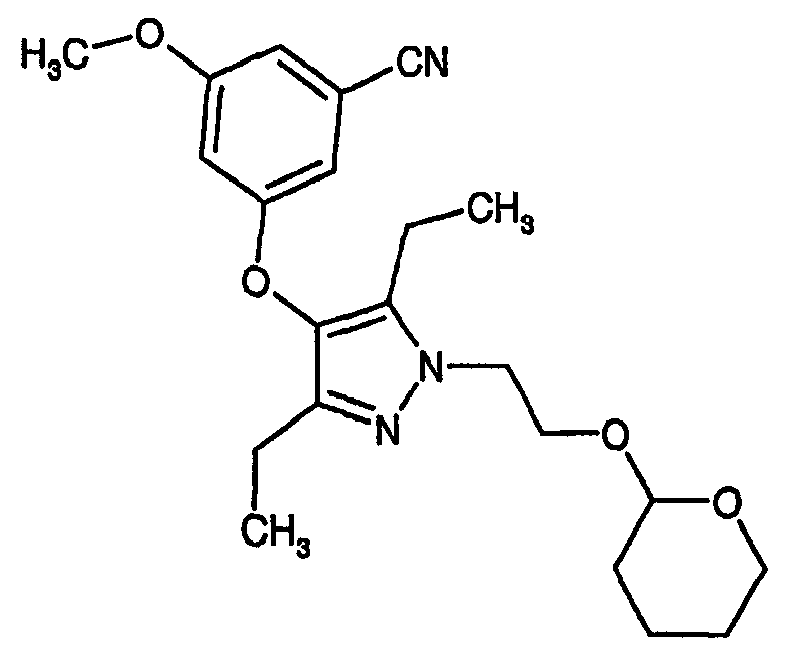
1H NMR (400MHz, CDCl3): δ = 1.09 (m, 6H), 1.49 (m, 6H), 2.41 (q, 2H), 2.55 (q, 2H), 3.46 (m, 1H), 3.66 (m, 1 H), 3.77 (m + s, 4H), 4.07 (m, 1 H), 4.19 (t, 2H), 4.52 (m, 1 H), 6.66 (s, 1 H), 6.69 (s, 1 H), 6.77 (s, 1H).
LRMS (thermospray) : m/z [MH+] 400.
Microanalysis: Found C, 65.59; H, 7.32; N, 10.42. C22H29N3O4.0.04CH2Cl2 requires C, 65.71; H, 7.28; N, 10.43%. -
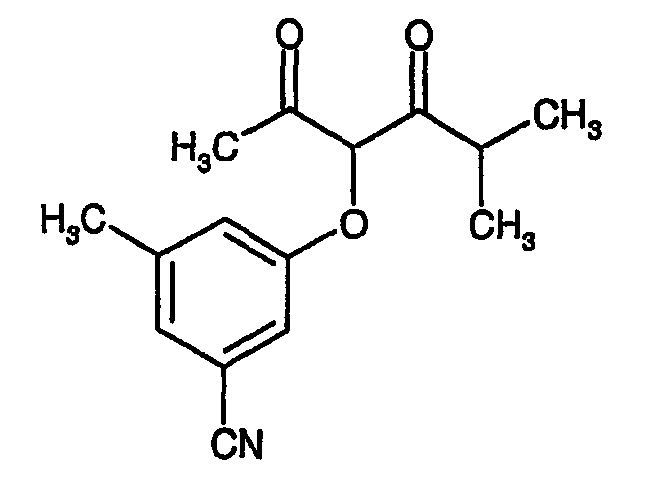
1H NMR (400MHz, CDCl3): δ = 1.10 (m, 6H), 2.09 (s, 3H), 2.42 (s, 3H), 2.69 (m, 1 H), 7.00 (s, 2H), 7.19 (s, 1H).
LRMS (thermospray) : m/z[MNH4 +] 277. -

1H NMR (400MHz, CD3OD): δ = 2.02 (s, 3H), 4.89 (s, 2H), 6.82 (s, 2H), 7.02 (s, 1 H).
LRMS (thermospray) : m/z [MH+] 303.
Microanalysis: Found C, 47.50; H, 3.50; N, 9.46. C12H10Cl2N2O3 requires C, 47.86; H, 3.35; N, 9.30%. -

1H NMR (400MHz, CDCl3): δ = 1.14 (m, 6H), 1.52 (m, 6H), 2.44 (q, 2H), 2.49 (s, 3H), 2.59 (q, 3H), 3.50 (m, 1 H), 3.70 (m, 1 H), 3.80 (m, 1 H), 4.10 (m, 1 H), 4.23 (m, 2H), 4.55 (m, 1 H), 6.82 (s, 1 H), 7.01 (s, 1H), 7.09 (s, 1H).
LRMS (APCI+): m/z [MH+] 416. -

1H NMR (400MHz, CDCl3): δ = 1.09 (m, 6H), 1.50 (m, 6H), 2.39 (q, 2H), 2.47 (s, 6H), 2.55 (q, 2H), 2.87 (m, 2H), 3.47 (m, 1 H), 3.67 (m, 1 H), 3.78 (m, 1 H), 4.05 (m, 1 H), 4.17 (m, 4H), 4.52 (m, 1 H), 6.70 (s, 2H), 6.79 (s, 1H).
LRMS (electrospray): m/z [MH+] 457.
HRMS: [MH+] 457.2810. C25H37N4O4 requires 457.2810. - The preparation of the following tabulated Preparations of the general formula

Preparation no. (Starting material preparation no) R Analytical Data 95 (63) CH2CH2 NHMe 1H NMR (400MHz, CDCl3): δ = 1.09 (m, 6H), 1.50 (m, 6H), 2.39 (q, 2H), 2.54 (m, 5H), 3.04 (t, 2H), 3.46 (m, 1 H), 3.66 (m, 1 H), 3.78 (m, 1 H), 4.05 (m, 1 H), 4.11 (t, 2H), 4.17 (t, 2H), 4.52 (s, 1 H), 6.70 (s, 2H), 6.81 (s, 1 H).
LRMS (electrospray): m/z [MH+] 443
HRMS: [MH+] 443.2654. C24H35N4O4 requires 443.2653.96 (63) CH2CONH2 1H NMR (400MHz, CDCl3): δ = 1.11 (m, 6H), 1.48 (m, 6H), 2.43 (q, 2H), 2.58 (q, 2H), 3.46 (m, 1H), 3.67 (m, 1H), 3.80 (m, 1 H), 4.08 (m, 1 H), 4.25 (m, 2H), 4.45 (s, 2H), 4.52 (m, 1 H), 5.54 (broad s, 1 H), 6.37 (broad s, 1 H), 6.72 (s, 1 H), 6.85 (s, 2H).
LRMS (electrospray): m/z 465 (MH+)
HRMS: [MH+] 443.2282. C23H31N4O5 requires 443.2289.97 (63) CH2CH2OCH3 1H NMR (400MHz, CDCl3): δ= 1.10 (m, 6H), 1.50 (m, 6H), 2.41 (q, 2H), 2.55 (q, 2H), 3.41 (s, 3H), 3.47 (m, 1 H), 3.70 (m, 3H), 3.79 (m, 1H), 4.06 (m, 3H), 4.20 (m, 2H), 4.52 (s, 1H), 6.70 (s, 2H), 6.79 (s, 1 H).
LRMS (electrospray): m/z 466 (MH+)
HRMS: [MH+] 443.2282. C24H34N3O5 requires 443.2289. -

1H NMR (400MHz, CDCl3): δ = 1.60 (m, 6H), 2.23 (s, 3H), 3.44 (m, 1 H), 3.60 (m, 1 H), 3.72 (m, 1 H), 4.04 (m, 1 H), 4.18 (m, 2H), 4.50 (broad s, 1H).
LRMS (electrospray): m/z [M-H+] 293. -

1H NMR (400MHz, CDCl3): δ = 1.61 (m, 6H), 2.18 (s, 3H), 3.48 (m, 1H), 3.64 (m, 1 H), 3.75 (m, 1H), 4.30 (t, 2H), 4.50 (broad s, 1 H), 6.85 (d, 1 H), 6.94 (s, 1 H), 7.05 (d, 1 H).
LRMS (electrospray): m/z [M-H+] 412. -

1H NMR (400MHz, CDCl3): δ = 1.10 (m, 6H), 2.40 (q, 2H), 2.55 (q, 2H), 3.36 (s, 3H), 3.50 (q, 2H), 3.59 (q, 2H), 3.94 (q, 2H), 4.20 (q, 2H), 4.64 (s, 2H), 7.30 (s, 1 H), 7.59 (s, 1H), 7.70 (s, 1H). -

1H NMR (400MHz, CDCl3): δ = 1.15 (t, 3H), 1.19 (t, 3H), 2.43 (q, 2H), 2.72 (s, 3H), 3.85 (q, 2H), 7.38 (s, 2H), 7.61 (s, 1H).
LRMS (electrospray): m/z 331 [M+Na+]. -

1H NMR (400MHz, CDCl3): δ = 1.10 (t, 3h), 2.00 (d, 3H), 2.70 (s, 3H), 2.80 (m, 2H), 4.95 (q, 1 H), 7.42 (s, 2H), 7.60 (s, 1H).
LRMS (electrospray): m/z 283 [MH+]. -

1H NMR (400MHz, CDCl3): δ = 1.11 (t, 3H), 1.45 (d, 3H), 1.65 (m, 6H), 2.59 (q, 2H), 3.50 (m, 1 H), 3.70 (m, 1 H), 3.81 (m, 1 H), 4.11 (m, 1 H), 4.25 (t, 2H), 4.56 (m, 1 H), 4.76 (m, 1H), 7.40 (s, 2H), 7.55 (s, 1H).
LRMS (electrospray): m/z 411 [MH+]. -

1H NMR (400MHz, CDCl3): δ = 1.11 (m, 6H), 2.42 (q, 2H), 2.58 (q, 2H), 3.41 (s, 3H), 3.59 (m, 4H), 3.95 (t, 2H), 4.17 (t, 2H), 4.61 (s, 2H), 4.77 (broad s, 2H), 7.38 (m, 1 H), 7.49 (m, 2H).
LRMS (electrospray): m/z 432 [MH+].
Microanalysis: Found C, 57.50; H, 6.71; N, 16.01. C21H26N4O4+0.4H2O requires C, 57.50; H, 6.85; N, 15.96%. -

1H NMR (400MHz, CDCl3): δ =1.14 (m, 6H), 2.46 (q, 2H), 2.59 (q, 2H), 3.39 (s, 3H), 3.53 (q, 2H), 3.59 (q, 2H), 3.95 (q, 2H), 4.29 (q, 2H), 4.68 (s, 2H), 7.34 (s, 1 H), 7.87 (s, 1H), 8.04 (s, 1 H).
LRMS (APCI): m/z 532 (MH+) - The preparation of the following tabulated Preparations of the general formula

Preparation no. R Analytical Data 106 Me 1H NMR (400MHz, CDCl3): δ = 1.14 (m, 6H), 2.46 (q, 2H), 2.59 (q, 2H), 2.67 (s, 3H), 3.39 (s, 3H), 3.55 (q, 2H), 3.59 (q, 2H), 3.95 (q, 2H), 4.22 (q, 2H), 4.68 (s, 2H), 7.27 (s, 1 H), 7.82 (s, 1H), 8.00 (s, 1 H).
LRMS (electrospray): m/z 478 [M+Na+]
Microanalysis: Found C, 59.91; H, 6.27; N, 15.38.
C23H29N5O5+0.3H2O requires C, 59.94; H, 6.475; N, 15.19%.107 Et 1H NMR (400MHz, CDCl3): δ=1.14 (m, 6H), 1.44 (t, 3H), 2.42 (q, 2H), 2.48 (q, 2H), 2.98 (q, 2H), 3.39 (s, 3H), 3.53 (q, 2H), 3.59 (q, 2H), 3.95 (q, 2H), 4.20 (q, 2H), 4.48 (s, 2H), 7.30 (s, 1 H), 7.84 (s, 1 H), 8.01 (s, 1H).
LRMS (electrospray): m/z 492 (M+Na+)108 lPr 1H NMR (400MHz, CDCl3): δ = 1.11 (m, 6H), 1.49 (d, 6H), 2.44 (q, 2H), 2.49 (q, 2H), 3.30 (sept, 1 H), 3.39 (s, 3H), 3.54 (m, 2H), 3.59 (m, 2H), 3.95 (t, 2H), 4.23 (t, 2H), 4.91 (s, 2H), 7.22 (m, 1 H), 7.83 (m, 1 H), 8.02 (m, 1H).
LRMS (electrospray): m/z 506 (M+Na+)
Microanalysis: Found C, 61.87; H, 6.76; N, 14.62.
C25H33N5O5 requires C, 62.10; H, 6.88; N, 14.48%. -

1H NMR (400MHz, CDCl3): δ =1.40 (m, 12H), 4.42 (m, 4H), 8.22 (s, 1 H), 8.71 (s, 1 H), 9.12 (s, 1 H).
LRMS (APCI): m/z 279 (M-H+) -

1H NMR (400MHz, (CD3)2SO): δ = 1.37 (s, 9H), 4.16 (d, 2H), 7.51 (m, 1H), 8.07 (s, 1 H), 8.50 (s, 1H), 8.88 (s, 1 H).
LRMS (APCI): m/z 251 (M-H+) -

1H NMR (400MHz, (CD3)2SO): δ = 4.11 (s, 2H), 7.5 (broad s), 7.59 (broad s), 8.14 (broad s), 8.31 (m, 1H), 8.72 (m, 1 H), 8.90 (m, 1H).
LRMS (electrospray): m/z 152 (MH+)
HRMS: [MH+] 152.0819. C7H10N3O requires 152.0818 -
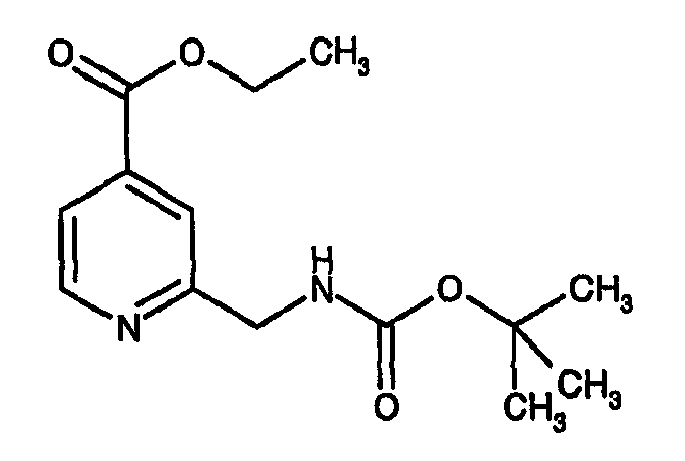
1H NMR (400MHz, CDCl3): δ = 1.38 (t, 3H), 1.45 (s, 9H), 4.38 (q, 2H), 4.50 (m, 2H), 5.50 (broad s, 1 H), 7.73 (d, 1 H), 7.81 (s, 1 H), 8.65 (d, 1H).
LRMS (electrospray): m/z 281 (MH+) -

1H NMR (400MHz, (CD3OD): δ = 1.43 (s, 9H), 4.36, (s, 2H), 7.68 (m, 1 H), 7.81 (s, 1 H), 8.47 (m, 1 H).
LRMS (electrospray): m/z 251 (M-H+)
HRMS: [MH+] 253.1179. C12H17N2O4 requires 253.1183 -

1H NMR (400MHz, D6-DMSO): δ = 1.39 (s, 9H), 4.25 (m, 2H), 7.44 (m, 1H), 7.61 (m, 1 H), 7.66 (broad s, 2H), 8.21 (broad s, 1 H), 8.59 (d, 1H).
LRMS (electrospray): m/z 250 (M-H+)
Microanalysis: Found C, 57.26; H, 6.86; N, 16.65. C12H17N3O3 requires C, 57.36; H, 6.82; N, 16.72%. -

1H NMR (400MHz, D6-DMSO) : δ = 2.1 (broad s, 1 H), 3.4 (broad s, 1 H), 3.85 (2H, s), 7.57 (m, 1 H), 7.60 (broad s, 1 H), 7.80 (m, 1 H), 8.16 (broad s, 1 H), 8.59 (m, 1 H). - LRMS (APCI): m/z 152 (MH+)
Claims (45)
- A compound of the formula (I)
 either R1 is H, C1-C6 alkyl, C3-C7 cycloalkyl, phenyl, benzyl, halo, -CN, -OR7, -CO2R10, -CONR5R10, R8 or R9, said C1-C6 alkyl, C3-C7 cycloalkyl, phenyl and benzyl being optionally substituted by halo, -CN, -OR10, S(O)xR10, -CO2R10, -CONR5R10, -OCONR5R10, -NR5CO2R10, -NR10R11, -NR5COR10, -SO2NR5R10, -NR6CONR5R10, -NR5SO2R10 or R10; andR2 is H, C1-C6 alkyl, C3-C6 alkenyl, C3-C6 alkynyl, C3-C7 cycloalkyl, C3-C7 cycloalkenyl, phenyl, benzyl, R8 or R9, said C1-C6 alkyl, C3-C7 cycloalkyl, phenyl and benzyl being optionally substituted by halo, -OR5, -OR12, -CN, -CO2R7, -OCONR5R5, -CONR5R5, -C(=NR5)NR5OR5, -CONR5NR5R5, -NR6R6, -NR5R12, -NR5COR5, -NR5COR8, -NR5COR12, -NR5CO2R5, -NR5CONR5R5, -SO2NR5R5, -NR5SO2R5, -NR5SO2NR5R5, R8 or R9;or, R1 and R2, when taken together, represent unbranched C3-C4 alkylene, optionally substituted by oxo, optionally wherein one methylene group of said C3-C4 alkylene is replaced by an oxygen atom or a nitrogen atom, said nitrogen atom being optionally substituted by R10;R3 is H, C1-C6 alkyl, C3-C7 cycloalkyl, phenyl, benzyl, halo, -CN, -OR7, -CO2R5, -CONR5R5, R8 or R9, said C1-C6 alkyl, C3-C7 cycloalkyl, phenyl and benzyl being optionally substituted by halo, -CN, -OR5, -CO2R5, -CONR5R5, -OCONR5R5, -NR5CO2R5, -NR6R6, -NR5COR5, -SO2NR5R5, -NR5CONR5R5, -NR5SO2R5, R8 or R9;R4 is phenyl, naphthyl or pyridyl, each being optionally substituted by R8, halo, -CN, C1-C6 alkyl, C1-C6 haloalkyl, C3-C7 cycloalkyl, C1-C6 alkoxy, -CONR5R5, OR13, SoxR6, O-(C1-C6 alkylene)-CONR5R5, O-(C1-C6 alkylene)-NR5R5, or O-(C1-C6 alkylene)-OR6;each R5 is independently either H, C1-C6 alkyl or C3-C7 cycloalkyl or, when two R5 groups are attached to the same nitrogen atom, those two groups taken together with the nitrogen atom to which they are attached represent azetidinyl, pyrrolidinyl, piperidinyl, homopiperidinyl, piperazinyl, homopiperazinyl or morpholinyl, said azetidinyl, pyrrolidinyl, piperidinyl, homopiperidinyl, piperazinyl, homopiperazinyl and morpholinyl being optionally substituted by C1-C6 alkyl or C3-C7 cycloalkyl;each R6 is independently either H, C1-C6 alkyl or C3-C7 cycloalkyl;R7 is C1-C6 alkyl or C3-C7 cycloalkyl;R8 is a five or six-membered, aromatic heterocyclic group containing (i) from 1 to 4 nitrogen heteroatom(s) or (ii) 1 or 2 nitrogen heteroatom(s) and 1 oxygen or 1 sulphur heteroatom or (iii) 1 or 2 oxygen or sulphur heteroatom(s), said heterocyclic group being optionally substituted by halo, oxo, -CN, -COR5, -CONR5R5, -SO2NR5R5, -NR5SO2R5, -OR5, -NR5R5, -(C1-C6 alkylene)-NR5R5, C1-C6 alkyl, fluoro(C1-C6)alkyl or C3-C7 cycloalkyl;R9 is a four to seven-membered, saturated or partially unsaturated heterocyclic group containing (i) 1 or 2 nitrogen heteroatom(s) or (ii) 1 nitrogen heteroatom and 1 oxygen or 1 sulphur heteroatom or (iii) 1 oxygen or sulphur heteroatom, said heterocyclic group being optionally substituted by oxo, C1-C6 alkyl, C3-C7 cycloalkyl, -SO2R5, -CONR5R5, -COOR5, -CO-(C1-C6 alkylene)-OR5 or -COR5 and optionally substituted on a carbon atom which is not adjacent to a heteroatom by halo, -OR5, -NR5R5, -NR5COR5, -NR5COOR5, -NR5CONR5R5, -NR5SO2R5 or -CN;R10 is H, R8, R9, R13, C1-C6 alkyl, C3-C7 cycloalkyl or -(C1-C6 alkyl)-(C3-C7 cycloalkyl), said C1-C6 alkyl and C3-C7 cycloalkyl being optionally substituted by -OR5, -OR13, R8, R9, R13 or -COR13;R11 is H, C1-C6 alkyl or C3-C7 cycloalkyl, said C1-C6 alkyl and C3-C7 cycloalkyl being optionally substituted by -OR5, -NR5R5, -NR5COR5, -CONR5R5, R8 or R9;R12 is C1-C6 alkyl substituted by R8, R9, -OR5, -CONR5R5, -NR5COR5 or -NR5R5;R13 is phenyl optionally substituted by halo, -CN, -COR5, -CONR5R5, -SO2NR5R5, -NR5SO2R5, -OR5, -NR5R5, -(C1-C6 alkylene)-NR5R5, C1-C6 alkyl, halo(C1-C6)alkyl or C3-C7 cycloalkyl; andx is 0, 1 or 2;with the proviso that (a) when R1 and R3 are both phenyl, R2 is not methyl; and (b) when R1 is ethoxy and R3 is ethoxycarbonyl, R2 is not phenyl.
 - A compound according to claim 1 wherein R1, when taken separately, is H, C1-C6 alkyl, C3-C7 cycloalkyl or -OR7, said C1-C6 alkyl and C3-C7 cycloalkyl being optionally substituted by halo, -CN, -OR10, S(O)xR10, -CO2R10, -CONR5R10, -OCONR5R10, -NR5CO2R10, -NR10R11, -NR5COR10, -SO2NR5R10, -NR5CONR5R10, -NR5SO2R10 or R10.
- A compound according to claim 1 or 2 wherein R1, when taken separately, is H, C1-C6 alkyl, C3-C7 cycloalkyl or -OR7, said C1-C6 alkyl being optionally substituted by halo, -OR10, -NR10R11, -NR5COR10 or R10.
- A compound according to any preceding claim wherein R2, when taken separately, is H, C1-C6 alkyl, C3-C6 alkenyl or R9, said C1-C6 alkyl being optionally substituted by halo, -OR5, -OR12, -CN, -CO2R7, -OCONR5R5, -CONR5R5, -C(=NR5)NR5OR5, -CONR5NR5R5, -NR6R6, -NR5R12, -NR5COR5, -NR5COR8, -NR5COR12, -NR5CO2R5, -NR6CONR5R5, -SO2NR5R5, -NR5SO2R5, R8 or R9.
- A compound according to any preceding claim wherein R2, when taken separately, is H, C1-C6 alkyl, C3-C6 alkenyl or R9, said C1-C6 alkyl being optionally substituted by -OR5, -OR12, -CN, -CO2R7, -CONR5R5, -C(=NR5)NR5OR5, -CONR5NR5R5, -NR6R6, -NR5R12, -NR5COR8, -NR5COR12, -NR5CO2R5, R8 or R9.
- A compound according to claim 1 wherein R1 and R2, when taken together, represent unbranched C3-C4 alkylene, optionally substituted by oxo, wherein one methylene group of said C3-C4 alkylene is replaced by an oxygen atom or a nitrogen atom, said nitrogen atom being optionally substituted by R10.
- A compound according to claims 1 or 6 wherein R1 and R2, when taken together, represent unbranched propylene wherein one methylene group is replaced by an oxygen atom or unbranched butylene wherein one methylene group is replaced by a nitrogen atom, said propylene and butylene being optionally substituted by oxo and said nitrogen atom being optionally substituted by R10.
- A compound according to any preceding claim wherein R3 is H or C1-C6 alkyl, said C1-C6 alkyl being optionally substituted by halo, -CN, -OR5, -CO2R5, -CONR6R5, -OCONR5R5, -NR5CO2R5, -NR6R6, -NR5COR5, -SO2NR5R5, -NR5CONR5R5, -NR5SO2R5, R8 or R9.
- A compound according to any preceding claim wherein R3 is H or C1-C6 alkyl.
- A compound according to any preceding claim wherein R4 is phenyl optionally substituted by R8, halo, -CN, C1-C6 alkyl, C1-C6 haloalkyl, C3-C7 cycloalkyl, C1-C6 alkoxy, -CONR5R5, OR13, SoxR6, O-(C1-C6 alkylene)-CONR5R5, O-(C1-C6 alkylene)-NR5R6, or O-(C1-C6 alkylene)-OR6; or naphthyl.
- A compound according to any preceding claim wherein R4 is phenyl substituted by R8, halo, -CN, C1-C6 alkyl, C1-C6 haloalkyl, C3-C7 cycloalkyl, C1-C6 alkoxy, -CONR5R5, OR13, SoxR6, O-(C1-C6 alkylene)-CONR5R5, O-(C1-C6 alkylone)-NR5R5, or O-(C1-C6 alkylone)-OR6.
- A compound according to any preceding claim wherein R4 is phenyl substituted by R8, halo, -CN, C1-C6 alkyl, C1-C6 haloalkyl, C3-C7 cycloalkyl or C1-C6 alkoxy.
- A compound according to any preceding claim wherein R4 is phenyl substituted by halo, -CN or C1-C6 alkyl.
- A compound according to any preceding claim wherein R8 is pyrrolyl, imidazolyl, pyrazolyl, 1,2,3-triazolyl, 1,2,4-triazolyl, tetrazolyl, oxazolyl, isoxazolyl, thiazolyl, isothiazolyl, 1,2,4-oxadiazolyl, 1,3,4-oxadiazolyl, furanyl, thienyl, pyridinyl, pyridazinyl, pyrimidinyl or pyrazinyl, each being optionally substituted by halo, -CN, -COR5, -CONR5R5, -SO2NR5R5, -NR5SO2R5, -OR5, -NR5R5, -(C1-C6 alkylene)-NR5R5, C1-C6 alkyl, fluoro(C1-C6)alkyl or C3-C7 cycloalkyl.
- A compound according to any preceding claim wherein R8 is imidazolyl, pyrazolyl, 1,2,4-triazolyl, 1,2,4-oxadiazolyl, 1,3,4-oxadiazolyl, pyridinyl, pyrazinyl or pyrimidinyl, each being optionally substituted by halo, -CN, -COR5, -CONR5R5, -SO2NR5R5, -NR5SO2R5, -OR5, -NR5R5, -(C1-C6 alkylene)-NR5R5, C1-C6 alkyl, fluoro(C1-C6)alkyl or C3-C7 cycloalkyl.
- A compound according to any preceding claim wherein R8 is imidazolyl, pyrazolyl, 1,2,4-triazolyl, 1,2,4-oxadiazolyl, 1,3,4-oxadiazolyl, pyridinyl, pyrazinyl or pyrimidinyl, each being optionally substituted by -OR5, -NR5R5 or C1-C6 alkyl.
- A compound according to any preceding claim wherein R9 is azetidinyl, tetrahydropyrrolyl, piperidinyl, azepinyl, oxetanyl, tetrahydrofuranyl, tetrahydropyranyl, oxepinyl, morpholinyl, piperazinyl or diazepinyl, each being optionally substituted by oxo, C1-C6 alkyl, C3-C7 cycloalkyl, -SO2R5, -CONR5R5, -COOR5, -CO-(C1-C6 alkylene)-OR6 or -COR5 and optionally substituted on a carbon atom which is not adjacent to a heteroatom by halo, -OR5, -NR5R5, -NR5COR5, -NR5COOR5, -NR5CONR5R5, -NR5SO2R5 or -CN.
- A compound according to any preceding claim wherein R9 is azetidinyl, piperidinyl, tetrahydrofuranyl, piperazinyl or morpholinyl, each being optionally substituted by oxo, C1-C6 alkyl, C3-C7 cycloalkyl, -SO2R5, -CONR5R5, -COOR5, -CO-(C1-C6 alkylene)-OR5 or -COR5 and optionally substituted on a carbon atom which is not adjacent to a heteroatom by halo, -OR5, -NR5R5, -NR5COR5, -NR5COOR5, -NR5CONR5R5, -NR5SO2R5 or -CN.
- A compound according to any preceding claim wherein R9 is azetidinyl, piperidinyl, tetrahydrofuranyl, piperazinyl or morpholinyl, each being optionally substituted by C1-C6 alkyl, -SO2R5, -CONR5R5, -COOR5, -CO-(C1-C6 alkylene)-OR5 or -COR5 and optionally substituted on a carbon atom which is not adjacent to a heteroatom by -OR5 or -NR5COR5.
- A compound according to any preceding claim wherein R10 is H, R8, R9, R13, C1-C6 alkyl or -(C1-C6 alkyl)-(C3-C7 cycloalkyl), said C1-C6 alkyl being optionally substituted by -OR5, -OR13, R8, R9, R13 or -COR13.
- A compound according to any preceding claim wherein R10 is H, R8, R9, R13, C1-C6 alkyl or -(C1-C6 alkyl)-(C3-C7 cycloalkyl), said C1-C6 alkyl being optionally substituted by -OR5 or R13.
- A compound according to any preceding claim wherein R11 is H or C1-C6 alkyl, said C1-C6 alkyl being optionally substituted by -OR5, -NR5R5, -NR5COR5, -CONR5R5, R8 or R9.
- A compound according to any preceding claim wherein R11 is H or C1-C6 alkyl, said C1-C6 alkyl being optionally substituted by -OR5 or -NR5COR5.
- A compound according to any preceding claim wherein R12 is C1-C4 alkyl substituted by R8, R9, -OR5, -CONR5R5, -NR5COR5 or -NR5R5.
- A compound according to any preceding claim wherein R12 is C1-C4 alkyl substituted by R9, -OR5, -NR5COR5 or -NR5R5.
- A compound according to any preceding claim wherein R13 is phenyl substituted by halo, -CN, -COR5, -CONR5R5, -SO2NR5R5, -NR5SO2R5, -OR5, -NR5R5, -(C1-C6 alkylene)-NR5R5, C1-C6 alkyl, halo(C1-C6)alkyl or C3-C7 cycloalkyl.
- A compound according to any preceding claim wherein R13 is phenyl substituted by halo, -CN, -CONR5R5, -SO2NR5R5 or -OR5.
- 2-[4-(3,5-Dichlorophonoxy)-3,5-dimethyl-1H-pyrazol-1-yl]ethanol;
2-[4-(3,5-Dichlorophenoxy)-3,5-diethyl-1H-pyrazol-1-yl]ethanol;
4-(3,5-Dichlorophenoxy)-3,5-diethyl-1 H-pyrazole;
[4-(3,5-Dichlorophenoxy)-3,5-diethyl-1H-pyrazol-1-yl]acetonitrile;
5-{[4-(3,5-Dichlorophenoxy)-3,5-diethyl-1H-pyrazol-1-yl]methyl}-1H-pyrazol-3-ol;
6-{[4-(3,5-Dichlorophenoxy)-3,5-diethyl-1H-pyrazol-1-yl]methyl}-2-methyl-4(3H)-pyrimidinone;
2-Amino-6-{[4-(3,5-dichlorophenoxy)-3,5-diethyl-1H-pyrazol-1-yl]methyl}-4(3H)-pyrimidinone;
2-[4-(3,5-Dichlorophenoxy)-3,5-diethyl-1H-pyrazol-1-yl]-N-hydroxyethanimidamide;
Methyl [4-(3,5-dichlorophenoxy)-3,5-diethyl-1H-pyrazol-1-yl]acetate;
2-[4-(3,5-Dichlorophenoxy)-3,5-diethyl-1H-pyrazol-1-yl]acetamide;
2-[4-(3,5-Dichlorophenoxy)-3,5-diothyl-1H-pyrazol-1-yl]acetohydrazide;
5-{[4-(3,5-Dichlorophenoxy)-3,5-diethyl-1H-pyrazol-1-yl]methyl}-1,3,4-oxadiazol-2(3H)-one;
2-[4-(3,5-Dichlorophonoxy)-3,5-diethyl-1H-pyrazol-1-yl]ethylamine;
3-{[4-(3,5-Dichlorophenoxy)-3,5-diethyl-1H-pyrazol-1-yl]methyl}-1,2,4-oxadiazol-5-ol;
5-{[4-(3,5-Dichlorophenoxy)-3,5-diethyl-1H-pyrazol-1-yl]methyl}-1,3,4-oxadiazol-2-amine;
N-{2-[4-(3,5-Dichlorophenoxy)-3,5-diethyl-1H-pyrazol-1-yl]ethyl}-2-methoxyacetamide;
N-{2-[4-(3,5-dichlorophenoxy)-3,5-diethyl-1H-pyrazol-1-yl]ethyl}-2-pyridinecarboxamide;
N-{2-[4-(3,5-dichlorophenoxy)-3,5-diethyl-1H-pyrazol-1-yl]ethyl}-2-pyrazinecarboxamide;
3-{[3,5-Diethyl-1-(2-hydroxyethyl)-1H-pyrazol-4-yl]oxy}benzonitrile;
4-{[3,5-diethyl-1-(2-hydroxyethyl)-1H-pyrazol-4-yl]oxy}-3,5-dimethylbenzonitrile;
3-chloro-4-{[3,5-diethyl-1-(2-hydroxyethyl)-1H-pyrazol-4-yl]oxy}benzonitrile;
5-{[3,5-diethyl-1-(2-hydroxyethyl)-1H-pyrazol-4-yl]oxy}-2-fluorobenzonitrile;
2-[4-(4-chlorophenoxy)-3,5-diethyl-1H-pyrazol-1-yl]ethanol;
2-[4-(3-chlorophenoxy)-3,5-diethyl-1H-pyrazol-1-yl]ethanol;
2-[4-(2-chlorophenoxy)-3,5-diethyl-1H-pyrazol-1-yl]ethanol;
2-[4-(2,6-dichlorophonoxy)-3,5-diethyl-1H-pyrazol-1-yl]ethanol;
2-[4-(2,3-dichlorophenoxy)-3,5-diethyl-1H-pyrazol-1-yl]ethanol;
2-[4-(2,4-dichlorophenoxy)-3,5-diethyl-1H-pyrazol-1-yl]ethanol;
2-[3,5-diethyl-4-(2-fluorophenoxy)-1H-pyrazol-1-yl]ethanol;
2-[3,5-diethyl-4-(3-fluorophenoxy)-1H-pyrazol-1-yl]ethanol;
2-[4-(3,5-dimethylphenoxy)-3,5-diethyl-1H-pyrazol-1-yl]ethanol;
2-[3,5-diethyl-4-(4-fluoro-3-methylphenoxy)-1H-pyrazol-1-yl]ethanol;
2-[4-(2,5-dichlorophenoxy)-3,5-diethyl-1H-pyrazol-1-yl]ethanol;
2-[4-(2,5-dichlorophenoxy)-3,5-diethyl-1H-pyrazol-1-yl]ethanol;
2-[4-(3,4-dichlorophenoxy)-3,5-diethyl-1H-pyrazol-1-yl]ethanol;
2-[4-(2,6-difluorophenoxy)-3,5-diethyl-1H-pyrazol-1-yl]ethanol;
2-[4-(2,5-difluorophenoxy)-3,5-diethyl-1H-pyrazol-1-yl]ethanol;
2-[4-(3,5-difluorophenoxy)-3,5-diethyl-1H-pyrazol-1-yl]ethanol;
4-(3,5-Dichlorophenoxy)-3,5-diethyl-1-(2-methoxyethyl)-1 H-pyrazole;
4-(3,5-dichlorophenoxy)-3,5-diethyl-1-(methoxymethyl)-1H-pyrazole;
4-(3,5-dichlorophenoxy)-3,5-diethyl-1-methyl-1H-pyrazole;
4-(3,5-Dichlorophenoxy)-3-ethyl-1H-pyrazole;
4-{2-[4-(3,5-Dichlorophenoxy)-3,5-diethyl-1H-pyrazol-1-yl]ethyl}morpholine;
N-{2-[4-(3,5-dichlorophenoxy)-3,5-diethyl-1H-pyrazol-1-yl]ethyl}-N-(2-methoxyethyl)amine;
1-(1-{2-[4-(3,5-dichlorophenoxy)-3,5-diethyl-1H-pyrazol-1-yl]ethyl}-4-piperidinyl)ethanone;
N-{2-[4-(3,5-dichlorophenoxy)-3,5-diethyl-1H-pyrazol-1-yl]ethyl}-N,N-dimethylamine;
N-[2-({2-[4-(3,5-dichlorophenoxy)-3,5-diethyl-1H-pyrazol-1-yl]ethyl}amino)ethyl]acetamide;
N-{2-[4-(3,5-dichlorophenoxy)-3,5-diethyl-1H-pyrazol-1-yl]ethyl}-N-methylamine;
N-{2-[4-(3,5-dichlorophenoxy)-3,5-diethyl-1H-pyrazol-1-yl]ethyl}-N-(tetrahydro-2-furanylmethyl)amine;
3-{[4-(3,5-Dichlorophenoxy)-3,5-diethyl-1H-pyrazol-1-yl]methyl}morpholine;
1-(3-Azetidinyl)-4-(3,5-dichlorophenoxy)-3,5-diethyl-1H-pyrazole;
7-(3,5-Dichlorophenoxy)-6-ethyl-2,3-dihydropyrazolo[5,1-b][1,3]oxazole;
4-(3,5-Dichlorophenoxy)-3,5-dimethyl-1H-pyrazole;
1-[4-(3,5-Dichlorophenoxy)-3,5-diethyl-1H-pyrazol-1-yl]-2-propanol;
2-{2-[4-(3,5-Dichlorophenxoy)-3,5-diethyl-1H-pyrazol-1-yl)ethoxy}ethanamine;
4-{[4-(3,5-Dichlorophenoxy)-3-methyl-1H-pyrazol-5-yl]methyl}morpholine;
4-(3,5-Dichlorophenoxy)-3-methyl-5-[(2-methyl-1H-imidazol-1-yl)methyl]-1H-pyrazole;
2-[4-(3,5-Dichlorophenoxy)-3-ethyl-5-methoxy-1H-pyrazol-1-yl]ethanol;
1-{[4-(3,5-Dichlorophenoxy)-3-methyl-1H-pyrazol-5-yl]methyl}-1H-1,2,4-triazole;
3-[(3,5-Diethyl-1 H-pyrazol-4-yl)oxy]benzonitrile;
3-{[1-(2-Aminoethyl)-3,5-diethyl-1H-pyrazol-4-yl]oxy}benzonitrile;
2-[4-(3-Cyanophenoxy)-3,5-diethyl-1H-pyrazol-1-yl]acetamide;
Ethyl [4-(3-cyanophenoxy)-3,5-diethyl-1H-pyrazol-1-yl]acetate;
1-Allyl-4-(3,5-dichlorophenoxy)-3,5-diethyl-1H-pyrazole;
N-{[4-(3,5-Dichlorophenoxy)-3-methyl-1H-pyrazol-5-yl]methyl}-N-(4-mothoxybenzyl)amine;
N-(cyclopropylmethyl)[4-(3,5-dichlorophenoxy)-3-methyl-1H-pyrazol-5-yl]methanamine;
[4-(3,5-dichlorophenoxy)-3-methyl-1 H-pyrazol-5-yl]-N,N-dimethylmethanamine;
[4-(3,5-dichlorophenoxy)-3-methyl-1H-pyrazol-5-yl]-N-methylmethanamine;
1-{[4-(3,5-dichlorophenoxy)-3-methyl-1H-pyrazol-5-yl]methyl}-4-methylpiperazine;
1-{[4-(3,5-dichlorophenoxy)-3-methyl-1H-pyrazol-5-yl]methyl}-4-piperidinecarboxamide;
N-{[4-(3,5-dichlorophenoxy)-3-methyl-1H-pyrazol-5-yl]methyl}-2-methoxyethanamine;
1-acetyl-4-{[4-(3,5-dichlorophenoxy)-3-methyl-1H-pyrazol-5-yl]methyl}piperazine;
N-[2-({[4-(3,5-dichlorophenoxy)-3-methyl-1H-pyrazol-5-yl]methyl}amino)ethyl]acetamide;
N-(1-{[4-(3,5-dichlorophenoxy)-3-methyl-1H-pyrazol-5-yl]methyl}-4-piperidinyl)acetamide;
1-{[4-(3,5-dichlorophenoxy)-3-methyl-1H-pyrazol-5-yl]methyl}-4-methoxypiperidine;
3-Chloro-5-[(3,5-dimethyl-1H-pyrazol-4-yl)oxy]benzonitrile;
3-{[5-(Aminomethyl)-3-methyl-1 H-pyrazol-4-yl]oxy}-5-chlorobenzonitrile;
3-Chloro-5-{[3-methyl-5-(1-piperazinylmethyl)-1H-pyrazol-4-yl]oxy}benzonitrile;
3-Chloro-5-[(5-{[(4-cyanobenzyl)amino]methyl}-3-methyl-1H-pyrazol-4-yl)oxy]benzonitrile;
3-Chloro-5-[(3-methyl-5-{[4-(methylsulfonyl)-1-piperazinyl]methyl}-1H-pyrazol-4-yl)oxy]benzonitrile;
3-Chloro-5-[(5-{[4-(methoxyacetyl)-1-piperazinyl]methyl}-3-methyl-1H-pyrazol-4-yl)oxy]benzonitrile;
Methyl 4-{[4-(3-chloro-5-cyanophenoxy)-3-methyl-1H-pyrazol-5-yl]methyl}-1-piperazinecarboxylate;
4-[({[4-(3-Chloro-5-cyanophenoxy)-3-methyl-1H-pyrazol-5-yl]methyl}amino)methyl]benzenesulfonamide;
4-(3,5-Dichlorophenoxy)-5-(methoxymethyl)-3-methyl-1H-pyrazole;
3-tert-Butyl-4-(3,5-dichlorophenoxy)-5-methyl-1H-pyrazole;
4-(3,5-Dichlorophenoxy)-3-ethyl-5-methyl-1 H-pyrazole;
4-Cyano-N-{[4-(3,5-dichlorophenoxy)-3-methyl-1H-pyrazol-5-yl]methyl}benzamide;
3-Cyano-N-{[4-(3,5-dichlorophenoxy)-3-methyl-1H-pyrazol-5-yl]methyl}benzamide;
N-{[4-(3,5-Dichlorophenoxy)-3-methyl-1H-pyrazol-5-yl]methyl}-N-(3-pyridinylmethyl)amine;
3-({5-[(4-Acetyl-1-piperazinyl)methyl]-3-methyl-1H-pyrazol-4-yl}oxy)-5-chlorobenzonitrile;
3-Chloro-5-[(5-{[(4-cyanobenzyl)(methyl)amino]methyl}-3-methyl-1H-pyrazol-4-yl)oxy]benzonitrile;
3-Chloro-5-[(5-{[(4-cyanobenzyl)(2-hydroxyethyl)amino]methyl}-3-methyl-1H-pyrazol-4-yl)oxy]benzonitrile;
3-Chloro-5-({3-methyl-5-[(2-methyl-1H-imidazol-1-yl)methyl]-1H-pyrazol-4-yl}oxy)benzonitrile;
2-(4-(3,5-Dichlorophenoxy)-3-methyl-5-{[(3-pyridinylmethyl)amino]methyl}-1H-pyrazol-1-yl)ethanol;
5-[(3-Isopropyl-5-methyl-1H-pyrazol-4-yl)oxy]isophthalonitrile;
5-{[1-(2-Hydroxyethyl)-3-isopropyl-5-methyl-1H-pyrazol-4-yl]oxy}isophthalonitrile;
3-(3,5-Dichlorophenoxy)-2-ethyl-6,7-dihydropyrazolo[1,5-a]pyrazin-4(5H)-one;
3-(3,5-Dichlorophenoxy)-2-ethyl-4,5,6,7-tetrahydropyrazolo[1,5-a]pyrazine;
3-(3,5-Dichlorophenoxy)-2-ethyl-5-methyl-4,5,6,7-tetrahydropyrazolo[1,5-a]pyrazine;
4-[(3-(3,5-Dichlorophenoxy)-2-ethyl-6,7-dihydropyrazolo[1,5-a]pyrazin-5(4H)-yl)methyl]benzonitrile;
3-(3,5-Dichlorophenoxy)-2-ethyl-5-(4-methoxybenzyl)-4,5,6,7-tetrahydropyrazolo[1,5-a]pyrazine;
[1-(2-Aminoethyl)-4-(3,5-dichlorophenoxy)-3-ethyl-1H-pyrazol-5-yl]methanol;
2-[4-(3,5-Dichlorophenoxy)-5-(ethoxymethyl)-3-ethyl-1H-pyrazol-1-yl]ethylamine;
2-[4-(3,5-dichlorophenoxy)-3-ethyl-5-(1H-pyrazol-1-ylmethyl)-1H-pyrazol-1-yl]ethylamine;
N-{[1-(2-aminoethyl)-4-(3,5-dichlorophenoxy)-3-ethyl-1H-pyrazol-5-yl]methyl}-N-(4-methoxybenzyl)amine;
4-[({[1-(2-aminoethyl)-4-(3,5-dichlorophenoxy)-3-ethyl-1H-pyrazol-5-yl]methyl}amino)methyl]benzonitrile;
2-[5-[(4-Acetyl-1-piperazinyl)methyl]-4-(3,5-dichlorophenoxy)-3-ethyl-1H-pyrazol-1-yl]ethylamine;
N-[2-({[1-(2-Aminoethyl)-4-(3,5-dichlorophenoxy)-3-ethyl-1H-pyrazol-5-yl]methyl}amino)ethyl]acetamide;
[4-(3,5-Dichlorophenoxy)-3-methyl-1H-pyrazol-5-yl]methanamine hydrobromide;
N-{[4-(3,5-Dichlorophenoxy)-3-methyl-1H-pyrazol-5-yl]methyl}-N-(4-fluorobenzyl)amine;
4-[({[4-(3,5-Dichlorophenoxy)-3-methyl-1H-pyrazol-5-yl]methyl}amino)methyl]benzonitrile;
3-Chloro-5-[(1,3,5-trimethyl-1H-pyrazol-4-yl)oxy]benzonitrile;
3-Chloro-5-[(5-{[(4-cyanobenzyl)amino]methyl}-1,3-dimethyl-1H-pyrazol-4-yl)oxy]benzonitrile;
3-Chloro-5-{[1-(2-hydroxyethyl)-3,5-dimethyl-1H-pyrazol-4-yl]oxy}benzonitrile;
3-Chloro-5-{[5-{[(4-cyanobenzyl)amino]methyl}-1-(2-hydroxyethyl)-3-methyl-1H-pyrazol-4-yl]oxy}benzonitrile;
4-[({[4-(3-Chloro-5-cyanophenoxy)-3-methyl-1H-pyrazol-5-yl]methyl}amino)methyl]benzamide;
3-{[3,5-diethyl-1-(2-hydroxyethyl)-1H-pyrazol-4-yl]oxy}-5-fluorobenzonitrile;
3-{[3,5-diethyl-1-(2-hydroxyethyl)-1H-pyrazol-4-yl]oxy}-5-methylbenzonitrile;
5-{[3,5-diethyl-1-(2-hydroxyethyl)-1H-pyrazol-4-yl]oxy}isophthalonitrile;
3-chloro-5-{[3,5-diethyl-1-(2-hydroxyethyl)-1H-pyrazol-4-yl]oxy}benzonitrile;
3-[(3,5-diethyl-1H-pyrazol-4-yl)oxy]-5-fluorobenzonitrile;
5-[(3,5-diethyl-1H-pyrazol-4-yl)oxy]isophthalonitrile;
3-[(3,5-diethyl-1H-pyrazol-4-yl)oxy]-5-methylbenzonitrile;
3-chloro-5-[(3,5-diethyl-1H-pyrazol-4-yl)oxy]benzonitrile;
3-{[1-(2-aminoethyl)-3,5-diethyl-1H-pyrazol-4-yl]oxy}-5-mothylbenzonitrile;
3-{[1-(2-aminoethyl)-3,5-diethyl-1H-pyrazol-4-yl]oxy}-5-chlorobenzonitrile;
5-{[1-(2-aminoethyl)-3,5-diethyl-1H-pyrazol-4-yl]oxy}isophthalonitrile;
3-{[1-(2-aminoethyl)-3,5-diethyl-1H-pyrazol-4-yl]oxy}-5-fluorobenzonitrile;
5-[(3-cyclopropyl-5-ethyl-1H-pyrazol-4-yl)oxy]isophthalonitrile;
5-[(3-tert-butyl-5-methyl-1H-pyrazol-4-yl)oxy]isophthalonitrile;
5-[(5-ethyl-3-isopropyl-1H-pyrazol-4-yl)oxy]isophthalonitrile;
4-(3,5-Dichlorophenoxy)-3,5-diethyl-1-(1-methyl-3-azetidinyl)-1H-pyrazole;
2-[4-(3,5-Dichlorophenoxy)-3-ethyl-1H-pyrazol-1-yl]ethylamine;
2-[4-(3,5-Dichlorophenoxy)-5-ethyl-1H-pyrazol-1-yl]ethylamine;
tert-Butyl 2-[4-(3,5-dichlorophenoxy)-3-ethyl-5-(hydroxymethyl)-1H-pyrazol-1-yl]ethylcarbamate;
tert-Butyl 2-[4-(3,5-dichlorophenoxy)-5-(ethoxymethyl)-3-ethyl-1H-pyrazol-1-yl]ethylcarbamate;
tert-Butyl 2-[5-(bromomethyl)-4-(3,5-dichlorophonoxy)-3-ethyl-1H-pyrazol-1-yl]ethylcarbamate;
tert-Butyl 2-[5-(aminomethyl)-4-(3,5-dichlorophenoxy)-3-ethyl-1H-pyrazol-1-yl]ethylcarbamate;
tert-Butyl 2-[5-[(4-acetyl-1-piperazinyl)methyl]-4-(3,5-dichlorophenoxy)-3-ethyl-1H-pyrazol-1-yl]ethylcarbamate;
tert-Butyl 2-[4-(3,5-dichlorophenoxy)-3-ethyl-5-(1H-pyrazol-1-ylmethyl)-1H-pyrazol-1-yl]ethylcarbamate;
tert-Butyl 2-[5-({[2-(acetylamino)ethyl]amino}methyl)-4-(3,5-dichlorophenoxy)-3-ethyl-1H-pyrazol-1-yl]ethylcarbamate;
tert-Butyl 2-(4-(3,5-dichlorophenoxy)-3-ethyl-5-{[(4-methoxybenzyl)amino]methyl}-1H-pyrazol-1-yl)ethylcarbamate;
tert-Butyl 2-[5-{[(4-cyanobenzyl)amino]methyl}-4-(3,5-dichlorophenoxy)-3-ethyl-1H-pyrazol-1-yl]ethylcarbamate;
3-{[5-(Bromomethyl)-1,3-dimethyl-1H-pyrazol-4-yl]oxy}-5-chlorobenzonitrile;
3-[(3,5-Diethyl-1-methyl-1H-pyrazol-4-yl)oxy]benzonitrile;
3-{[3,5-Diethyl-1-(2-methoxyethyl)-1H-pyrazol-4-yl]oxy}benzonitrile;
3-({5-[2-(Benzyloxy)ethyl]-3-ethyl-1H-pyrazol-4-yl}oxy)-5-fluorobenzonitrile;
3-{[3-Ethyl-5-(2-hydroxyethyl)-1H-pyrazol-4-yl]oxy}-5-fluorobenzonitrile;
3-({5-[2-(4-Cyanophenoxy)ethyl]-3-ethyl-1H-pyrazol-4-yl}oxy)-5-fluorobenzonitrile;
3-[(3-Ethyl-5-{2-[(2-methyl-3-pyridinyl)oxy]ethyl}-1H-pyrazol-4-yl)oxy]-5-fluorobenzonitrile;
3-({3-Ethyl-5-[2-(3-pyridinyloxy)ethyl]-1H-pyrazol-4-yl}oxy)-5-fluorobenzonitrile;
3-[(5-{2-[(2-Amino-3-pyridinyl)oxy]ethyl}-3-ethyl-1H-pyrazol-4-yl)oxy]-5-fluorobenzonitrile;
5-({5-[2-(benzyloxy)ethyl]-3-ethyl-1H-pyrazol-4-yl}oxy)isophthalonitrile;
5-{[3-Ethyl-5-(2-hydroxyethyl)-1H-pyrazol-4-yl]oxy}isophthalonitrile;
3-{[5-(Aminomethyl)-1-(2-hydroxyethyl)-3-methyl-1H-pyrazol-4-yl]oxy}-5-chlorobenzonitrile;
5-[(1-Allyl-3-tert-butyl-5-methyl-1H-pyrazol-4-yl)oxy]isophthalonitrile;
5-{[3-tert-Butyl-1-(2-hydroxyethyl)-5-methyl-1H-pyrazol-4-yl]oxy}isophthalonitrile;
5-{[1-(2-Aminoethyl)-3-tert-butyl-5-methyl-1H-pyrazol-4-yl]oxy}isophthalonitrile;
3-{[3,5-Diethyl-1-(2-hydroxyethyl)-1H-pyrazol-4-yl]oxy}-5-(1H-1,2,4-triazol-1-yl)benzonitrile;
3-{[3,5-diethyl-1-(2-hydroxyethyl)-1H-pyrazol-4-yl]oxy}-5-(4-oxo-1(4H)-pyridinyl)benzonitrile;
3-{[3,5-diethyl-1-(2-hydroxyethyl)-1H-pyrazol-4-yl]oxy}-5-(1H-1,2,3-triazol-1-yl)benzonitrile;
3-{[3,5-diethyl-1-(2-hydroxyethyl)-1H-pyrazol-4-yl]oxy}-5-(2H-1,2,3-triazol-2-yl)benzonitrile;
3-{[3,5-Diethyl-1-(2-hydroxyethyl)-1H-pyrazol-4-yl]oxy}-5-fluorobenzamide;
3-{[3,5-Diethyl-1-(2-hydroxyethyl)-1H-pyrazol-4-yl]oxy}-5-(1H-pyrazol-1-yl)benzamide;
3-{[3,5-Diethyl-1-(2-hydroxyethyl)-1H-pyrazol-4-yl]oxy}-5-(2-oxo-1(2H)-pyridinyl)benzamide;
3-{[3,5-Diethyl-1-(2-hydroxyethyl)-1H-pyrazol-4-yl]oxy}-5-(6-oxo-1(6H)-pyridazinyl)benzamide;
3-{[3,5-Diethyl-1-(2-hydroxyethyl)-1H-pyrazol-4-yl]oxy}-5-(2,3-dimethyl-5-oxo-2,5-dihydro-1H-pyrazol-1-yl)benzamide;
5-{[3-Cyclopropyl-5-othyl-1-(2-hydroxyethyl)-1H-pyrazol-4-yl]oxy}isophthalonitrile;
5-{[5-Cyclopropyl-3-ethyl-1-(2-hydroxyethyl)-1H-pyrazol-4-yl]oxy}isophthalonitrile;
5-{[5-Ethyl-1-(2-hydroxyethyl)-3-isopropyl-1H-pyrazol-4-yl]oxy}isophthalonitrile;
5-{[3-Ethyl-1-(2-hydroxyethyl)-5-isopropyl-1H-pyrazol-4-yl]oxy}isophthalonitrile;
2-[4-(3,5-Dicyanophenoxy)-3,5-diethyl-1H-pyrazol-1-yl]ethyl carbamate;
N-{2-[4-(3,5-Dicyanophenoxy)-3,5-diethyl-1H-pyrazol-1-yl]ethyl}sulfamide;
N-{2-[4-(3,5-Dicyanophenoxy)-3,5-diethyl-1H-pyrazol-1-yl]ethyl}-2-methoxyacetamide;
5-{[1-(3-Azetidinyl)-3,5-diethyl-1H-pyrazol-4-yl]oxy}isophthalonitrile;
5-{[3,5-Diethyl-1-(3-hydroxypropyl)-1H-pyrazol-4-yl]oxy}isophthalonitrile;
5-[(3,5-Diethyl-1-methyl-1H-pyrazol-4-yl)oxy]isophthalonitrile;
5-{[3,5-Diethyl-1-(2-methoxyethyl)-1H-pyrazol-4-yl]oxy}isophthalonitrile;
5-{[1-(3-Aminopropyl)-3,5-diethyl-1H-pyrazol-4-yl]oxy}isophthalonitrile;
methyl [4-(3,5-Dicyanophenoxy)-3,5-diethyl-1H-pyrazol-1-yl]acetate;
2-[4-(3,5-Dicyanophanoxy)-3,5-diethyl-1H-pyrazol-1-yl]acetamide;
5-{[3,5-Diethyl-1-(hydroxymethyl)-1H-pyrazol-4-yl]oxy}isophthalonitrile;
3-[({[4-(3-cyano-5-fluorophenoxy)-3-methyl-1H-pyrazol-5-yl]methyl}amino)methyl]benzamide;
4-[({[4-(3-Cyano-5-fluorophenoxy)-3-methyl-1H-pyrazol-5-yl]methyl}amino)methyl]benzamide;
4-[({[4-(3,5-Dicyanophenoxy)-3-methyl-1H-pyrazol-5-yl]methyl}amino)methyl]benzamide;
3-[({[4-(3-Chloro-5-cyanophenoxy)-3-methyl-1H-pyrazol-5-yl]methyl}amino)methyl]benzamide;
4-[({[4-(3-Cyano-5-methylphenoxy)-3-methyl-1H-pyrazol-5-yl]methyl}amino)methyl]benzamide;
4-[({[4-(3-Cyanophenoxy)-3-methyl-1H-pyrazol-5-yl]methyl}amino)methyl]benzamide;
5-[(3,5-Dicyclopropyl-1H-pyrazol-4-yl)oxy]isophthalonitrile;
5-{[3,5-Dicyclopropyl-1-(2-hydroxyethyl)-1H-pyrazol-4-yl]oxy}isophthalonitrile;
5-{[1-(2-Aminoethyl)-3,5-dicyclopropyl-1H-pyrazol-4-yl]oxy}isophthalonitrile;
3-{[3-cyclopropyl-1-(2-hydroxyethyl)-5-methyl-1H-pyrazol-4-yl]oxyl-5-methylbenzonitrile;
3-{[5-cyclopropyl-1-(2-hydroxyethyl)-3-methyl-1H-pyrazol-4-yl]oxy}-5-methylbenzonitrile;
3-[3-Cyclopropyl-1-(2-amino-ethyl)-5-methyl-1H-pyrazol-4-yloxy]-5-methyl-benzonitrile;
3-[(3-Cyclopropyl-5-methyl-1H-pyrazol-4-yl)oxy]-5-methylbenzonitrile;
3-{[1-(3-Aminopropyl)-3,5-diethyl-1H-pyrazol-4-yl]oxy}-5-methylbenzonitrile;
3-{[3,5-Diethyl-1-(2-hydroxyethyl)-1H-pyrazol-4-yl]oxy}-4-methoxybenzonitrile;
2-[3,5-Diethyl-4-(1-naphthyloxy)-1H-pyrazol-1-yl]ethanol;
2-[3,5-Diethyl-4-(2-naphthyloxy)-1H-pyrazol-1-yl]ethanol;
2-{4-[3,5-Di(1H-pyrazol-1-yl)phenoxy]-3,5-diethyl-1H-pyrazol-1-yl}ethanol;
2-{3,5-Diethyl-4-[3-fluoro-5-(1H-pyrazol-1-yl)phenoxy]-1H-pyrazol-1-yl}ethanol;
3-{[3,5-Diethyl-1-(2-hydroxyethyl)-1H-pyrazol-4-yl]oxy}-5-methoxybenzonitrile;
2-[4-(3,5-Difluorophenoxy)-3,5-diethyl-1H-pyrazol-1-yl]ethylamine;
3-{[1-(2-Aminoethyl)-3,5-diethyl-1H-pyrazol-4-yl]oxy}-5-fluorobenzamide;
3-[(3-Isopropyl-5-methyl-1H-pyrazol-4-yl)oxy]-5-methylbenzonitrile;
3-{[1-(2-Aminoethyl)-3-isopropyl-5-methyl-1H-pyrazol-4-yl]oxy}-5-methylbenzonitrile;
2-[4-(3,5-Dichlorophenoxy)-3,5-diethyl-1H-pyrazol-1-yl]-N-(2-pyridinylmethyl)acetamide;
[4-(3,5-Dichlorophenoxy)-3-methyl-1H-pyrazol-5-yl]acetonitrile;
1-{[4-(3,5-Dichlorophenoxy)-3-methyl-1H-pyrazol-5-yl]acetyl}piperldine;
(3R)-1-{[4-(3,5-Dichlorophenoxy)-3-methyl-1H-pyrazol-5-yl]acetyl}-3-piperidinol;
N-(2,4-Dichlorobenzyl)-2-[4-(3,5-dichlorophenoxy)-3-methyl-1H-pyrazol-5-yl]acetamide;
2-[4-(3,5-Dichlorophenoxy)-3-methyl-1H-pyrazol-5-yl]-N-(6-methyl-2-pyridinyl)acetamide;
2-[4-(3,5-Dichlorophenoxy)-3-methyl-1H-pyrazol-5-yl]-N-[4-(trifluoromethyl)benzyl]acetamide;
N-(3-Chlorobenzyl)-2-[4-(3,5-dichlorophenoxy)-3-methyl-1H-pyrazol-5-yl]acetamide;
2-[4-(3,5-Dichlorophenoxy)-3-methyl-1H-pyrazol-5-yl]-N-[2-(trifluoromethyl)benzyl]acetamide;
2-[4-(3,5-Dichlorophenoxy)-3-methyl-1H-pyrazol-5-yl]-N-(4-fluorobenzyl)acetamide;
N-Benzyl-2-[4-(3,5-dichlorophenoxy)-3-methyl-1H-pyrazol-5-yl]-N-methylacetamide;
3-chloro-5-[(5-{[(2-chlorobenzyl)amino]methyl}-3-methyl-1H-pyrazol-4-yl)oxy]benzonitrile;
3-({5-[(Benzylamino)methyl]-3-methyl-1H-pyrazol-4-yl}oxy)-5-chlorobenzonitrile;
3-[(5-{[Benzyl(methyl)amino]methyl}-3-methyl-1H-pyrazol-4-yl)oxy]-5-chlorobenzonitrile;
3-Chloro-5-{[5-({[(5-chloro-2-pyridinyl)methyl]amino}methyl)-3-methyl-1H-pyrazol-4-yl]oxy}benzonitrile;
3-Chloro-5-[(3-methyl-5-{[(4-pyridinylmethyl)amino]methyl}-1H-pyrazol-4-yl)oxy]benzonitrile;
3-Chloro-5-[(3-methyl-5-{[(4-methylbenzyl)amino]methyl}-1H-pyrazol-4-yl)oxy]benzonitrile;
3-Chloro-5-[(5-{[(3-methoxypropyl)amino]methyl}-3-methyl-1H-pyrazol-4-yl)oxy]benzonitrile;
4-[2-({[4-(3-Chloro-5-cyanophenoxy)-3-methyl-1H-pyrazol-5-yl]methyl}amino)ethyl]benzenesulfonamide;
3-Chloro-5-{[3-methyl-5-({[(1S)-1-phenylethyl]amino}methyl)-1H-pyrazol-4-yl]oxy}benzonitrile;
3-Chloro-5-[(5-{[(4-chlorobenzyl)amino]methyl}-3-methyl-1H-pyrazol-4-yl)oxy]benzonitrile;
3-Chloro-5-[(3-methyl-5-{[methyl(2-phenylethyl)amino]methyl}-1H-pyrazol-4-yl)oxy]benzonitrile;
3-Chloro-5-({3-methyl-5-[(1H-pyrazol-3-ylamino)methyl]-1H-pyrazol-4-yl}oxy)benzonitrile;
N-[2-({[4-(3-Chloro-5-cyanophenoxy)-3-methyl-1H-pyrazol-5-yl]methyl}amino)ethyl]acetamide;
3-Chloro-5-[(5-{[(3-chlorobenzyl)amino]methyl}-3-methyl-1H-pyrazol-4-yl)oxy]benzonitrile;
3-Chloro-5-{[5-({[3-fluoro-5-(trifluoromethyl)benzyl]amino}methyl)-3-methyl-1H-pyrazol-4-yl]oxy}benzonitrile;
3-Chloro-5-[(3-methyl-5-{[(6-methyl-2-pyrldinyl)amlno]methyl}-1H-pyrazol-4-yl)oxy]benzonitrile;
3-Chloro-5-[(5-{[(4-hydroxy-6-methyl-2-pyrimidinyl)amino]methyl}-3-methyl-1H-pyrazol-4-yl)oxy]benzonitrile;
3-Chloro-5-[(5-{[(4-fluorobenzyl)amino]methyl}-3-methyl-1H-pyrazol-4-yl)oxy]benzonitrile;
3-Chloro-5-{[5-({[(1R)-2-hydroxy-1-phenylethyl]amino}methyl)-3-methyl-1H-pyrazol-4-yl]oxy}benzonitrile;
3-({5-[(Benzylamino)methyl]-3-methyl-1H-pyrazol-4-yl}oxy)-5-chlorobanzonitrile;
3-Chloro-5-[(5-{[(3-methoxybenzyl)amino]methyl}-3-methyl-1H-pyrazol-4-yl)oxy]benzonitrile;
3-Chloro-5-{[3-methyl-5-({[4-(trifluoromethyl)benzyl]amino}methyl)-1H-pyrazol-4-yl]oxy}benzonitrile;
3-Chloro-5-{[5-({[(1R)-1-(hydroxymethyl)-2-methylpropyl]amino}methyl)-3-methyl-1 H-pyrazol-4-yl]oxy}benzonitrile;
3-Chloro-5-[(5-{[(2-methoxybenzyl)amino]methyl}-3-methyl-1H-pyrazol-4-yl)oxy]benzonitrile;
3-Chloro-5-{[3-methyl-5-({[2-(2-thienyl)ethyl]amino}methyl)-1H-pyrazol-4-yl]oxy}benzonitrile;
3-Chloro-5-[(3-methyl-5-{[(3-pyridinylmethyl)amino]methyl}-1H-pyrazol-4-yl)oxy]benzonitrile;
3-Chloro-5-{[3-methyl-5-({[2-(trifluoromethyl)benzyl]amino}methyl)-1H-pyrazol-4-yl]oxy}benzonitrile;
3-Chloro-5-[(5-{[(2,4-dichlorobenzyl)amino]methyl}-3-methyl-1H-pyrazol-4-yl)oxy]benzonitrile;
3-Chloro-5-[(3-methyl-5-{[(2-pyridinylmethyl)amino]methyl}-1H-pyrazol-4-yl)oxy]benzonitrile;
3-Chloro-5-[(5-{[(3,4-dichlorobenzyl)amino]methyl}-3-methyl-1H-pyrazol-4-yl)oxy]benzonitrile;
3-Chloro-5-[(3-methyl-5-{[(3-phenylpropyl)amino]methyl}-1H-pyrazol-4-yl)oxy]benzonitrile;
3-Chloro-5-[(5-{[(4-methoxybenzyl)amino]methyl}-3-methyl-1H-pyrazol-4-yl)oxy]benzonitrile;
3-{[3,5-Diethyl-1-(2-hydroxyethyl)-1H-pyrazol-4-yl]oxy}-5-(methylsulfanyl)benzonitrile;
3-{[3,5-Diethyl-1-(2-hydroxyethyl)-1H-pyrazol-4-yl]oxy}-5-(methylsulfinyl)benzonitrile;
3-{[3,5-Diethyl-1-(2-hydroxyethyl)-1H-pyrazol-4-yl]oxy}-5-(methylsulfonyl)benzonitrile;
3-{[3,5-Diethyl-1-(2-hydroxyethyl)-1H-pyrazol-4-yl]oxy}-5-[2-(dimethylamino)ethoxy]benzonitrile;
3-{[3,5-Diethyl-1-(2-hydroxyethyl)-1H-pyrazol-4-yl]oxy}-5-[2-(methylamino)ethoxy]benzonitrile;
2-(3-Cyano-5-{[3,5-diethyl-1-(2-hydroxyethyl)-1H-pyrazol-4-yl]oxy}phenoxy)acetamide;
3-{[3,5-Diethyl-1-(2-hydroxyethyl)-1H-pyrazol-4-yl]oxy}-5-(2-methoxyethoxy)benzonitrile;
3-{[1-(2-Aminoethyl)-3,5-diethyl-1H-pyrazol-4-yl]oxy}-5-methoxybenzonitrile;
3-{[1-(2-Aminoethyl)-3,5-diethyl-1H-pyrazol-4-yl]oxy}-5-(1H-pyrazol-1-yl)benzonitrile;
3,5-Dichlorophenyl-3-methyl-5-[(3-mathyl-1,2,4-oxadiazol-5-yl)methyl]-1H-pyrazol-4-yl ether;
3-Fluoro-5-{[1-(2-hydroxyethyl)-5-methyl-3-(trifluoromethyl)-1H-pyrazol-4-yl]oxy}benzonitrile;
5-[(3,5-Diethyl-1-{2-[(2-methoxyethoxy)methoxy]ethyl}-1H-pyrazol-4-yl)oxy]isophthalonitrile;
3-Cyano-5-{[3,5-diethyl-1-(2-hydroxyethyl)-1H-pyrazol-4-yl]oxy}benzamide;
5-{[5-Ethyl-3-(1-hydroxyethyl)-1H-pyrazol-4-yl]oxy}isophthalonitrile;
5-{[5-Ethyl-3-(1-hydroxyethyl)-1-(2-hydroxyethyl)-1H-pyrazol-4-yl]oxy}isophthalonitrile;
3-{[3,5-Diethyl-1-(2-hydroxyethyl)-1H-pyrazol-4-yl]oxy}-5-(5-trifluoromethyl-1,2,4-oxadiazol-3-yl)benzonitrile;
3-{[3,5-Diethyl-1-(2-hydroxyethyl)-1H-pyrazol-4-yl]oxy}-5-(5-methyl-1,2,4-oxadiazol-3-yl)benzonitrile;
3-{[3,5-Diethyl-1-(2-hydroxyethyl)-1H-pyrazol-4-yl]oxy}-5-(5-ethyl-1,2,4-oxadiazol-3-yl)benzonitrile;
3-{[3,5-Diethyl-1-(2-hydroxyethyl)-1H-pyrazol-4-yl]oxy}-5-(5-isopropyl-1,2,4-oxadiazol-3-yl)benzonitrile;
5-[({[4-(3-Chloro-5-cyanophenoxy)-3-methyl-1H-pyrazol-5-yl]methyl}amino)methyl]nicotinamide;
2-[({[4-(3-Chloro-5-cyanophanoxy)-3-methyl-1H-pyrazol-5-yl]methyl}amino)methyl]isonicotinamide;
Di(tert-butyl) 2-[4-(3,5-dicyanophanoxy)-3,5-diethyl-1H-pyrazol-1-yl]ethyl phosphate;
2-[4-(3,5-Dicyanophenoxy)-3,5-diethyl-1H-pyrazol-1-yl]ethyl dihydrogen phosphate;
5-{[3,5-Diethyl-1-(2-hydroxyethyl)-1H-pyrazol-4-yl]oxy}isophthalonitrile sulfate salt;
5-{[3,5-Diethyl-1-(2-hydroxyethyl)-1H-pyrazol-4-yl]oxy}isophthalonitrile ;
5-{[3,5-Diethyl-1-(2-hydroxyethyl)-1H-pyrazol-4-yl]oxy}isophthalonitrile tosylate salt;
5-{[3,5-Diethyl-1-(2-hydroxyethyl)-1H-pyrazol-4-yl]oxy}isophthalonitrile mesylate salt;
3-{[1-(2-Aminoethyl)-3,5-diethyl-1H-pyrazol-4-yl]oxy}-5-methylbenzonitrile bis-mesylate salt;
3-{[1-(2-Aminoethyl)-3,5-diethyl-1H-pyrazol-4-yl]oxy}-5-methylbenzonitrile phosphate salt;
3-{[1-(2-Aminoothyl)-3,5-diethyl-1H-pyrazol-4-yl]oxy}-5-methylbenzonitrile (L) tartrate salt;
3-{[1-(2-Aminoethyl)-3,5-diethyl-1H-pyrazol-4-yl]oxy}-5-methylbenzonitrile succinate salt;
3-{[1-(2-Aminoethyl)-3,5-diethyl-1H-pyrazol-4-yl]oxy}-5-methylbenzonitrile (L) citrate salt;
or a pharmaceutically acceptable salt, solvate or derivative thereof. - 3-{[3,5-diethyl-1-(2-hydroxyethyl)-1H-pyrazol-4-yl]oxy}-5-fluorobenzonitrile;
3-{[3,5-diethyl-1-(2-hydroxyethyl)-1H-pyrazol-4-yl]oxy}-5-methylbenzonitrile;
5-{[3,5-diethyl-1-(2-hydroxyethyl)-1H-pyrazol-4-yl]oxy}isophthalonitrile;
3-chloro-5-{[3,5-diethyl-1-(2-hydroxyethyl)-1H-pyrazol-4-yl]oxy}benzonitrile;
5-[(3,5-diethyl-1H-pyrazol-4-yl)oxy]isophthalonitrile;
3-[(3,5-diethyl-1H-pyrazol-4-yl)oxy]-5-methylbenzonitrile;
3-chloro-5-[(3,5-diethyl-1H-pyrazol-4-yl)oxy]benzonitrile;
3-{[1-(2-aminoethyl)-3,5-diethyl-1H-pyrazol-4-yl]oxy}-5-methylbenzonitrile;
3-{[1-(2-aminoethyl)-3,5-diethyl-1H-pyrazol-4-yl]oxy}-5-chlorobenzonitrile;
5-{[1-(2-aminoethyl)-3,5-diethyl-1H-pyrazol-4-yl]oxy}isophthalonitrile;
or a pharmaceutically acceptable salt, solvate or derivative thereof - A compound of the formula (I)
 R1 is H, C1-C6 alkyl, -OC1-C6 alkyl, -OC3-C7 cycloalkyl, said C1-C6 alkyl being optionally substituted by R15;R2 is H, C1-C3 alkyl, propenyl or C-linked R15, said C1-C3 alkyl being optionally substituted by -OH, -OCH3, -OCH2CH2NH2, -CN, -CO2CH3, -CONH2, -C(=NH)NH2, -CONHNH2, -NH2, -NHCH3, -N(CH3)2, -NHCH2CH2NHCOCH3, -NHCH2CH2OCH3, -NHCH2R15, -NHCOR15, -NHCOCH2OCH3, or R15R3 is C1-C6 alkyl;R4 is phenyl optionally substituted by halo, -CN, C1-C6 alkyl, C1-C6 haloalkyl, C3-C7 cycloalkyl or C1-C6 alkoxy; andR15 is azetidinyl, tetrahydrofuranyl, morpholinyl, piperazinyl, pyrazolyl, oxadiazolyl, pyridinyl or pyrimidinyl each being optionally substituted by -OH, -NH2, oxo or C1-C6 alkyl or -CO(C1-C6 alkyl).
 - A pharmaceutical composition including a compound of the formula (I) or a pharmaceutically acceptable salt, solvate or derivative thereof, according to any preceding claim, together with one or more pharmaceutically acceptable excipients, diluents or carriers.
- A pharmaceutical composition according to claim 31 including one or more additional therapeutic agents.
- A compound of the formula (I) or a pharmaceutically acceptable salt, solvate or derivative thereof according to any of claims 1 to 30, or a pharmaceutical composition according to claim 31 or 32, for use as a medicament.
- A compound of the formula (I) or a pharmaceutically acceptable salt, solvate or derivative thereof according to any of claims 1 to 30, or a pharmaceutical composition according to claim 31 or 32, for use as a reverse transcriptase inhibitor or modulator.
- A compound of the formula (I) or a pharmaceutically acceptable salt, solvate or derivative thereof according to any of claims 1 to 30, or a pharmaceutical composition according to claim 31 or 32, for use in the treatment of an HIV, or genetically-related retroviral, infection or a resulting acquired immune deficiency syndrome (AIDS).
- The use of a compound of the formula (I) or a pharmaceutically acceptable salt, solvate or derivative thereof according to any of claims 1 to 30, or a pharmaceutical composition according to claim 31 or 32, for the manufacture of a medicament having reverse transcriptase inhibitory or modulating activity.
- The use of a compound of the formula (I) or a pharmaceutically acceptable salt, solvate or derivative thereof according to any of claims 1 to 30, or a pharmaceutical composition according to claim 31 or 32, for the manufacture of a medicament for the treatment of an HIV, or genetically-related retroviral, Infection or a resulting acquired immune deficiency syndrome (AIDS).
- A process for preparing a compound of the formula (I) or a salt, solvate or pharmaceutically acceptable derivative thereof according to any of claims 1 to 30, which comprises:(A) except where either R1 or R3 is halo, -OR8 or -CN, condensation of a compound of the formula (II), (VI) or (VII)

H2NNHR2 (V)
or a salt or hydrate thereof;(B) for the preparation of a compound of the formula (I) in which R1 or R3 is -OR8, reaction of, respectively, a compound of the formulae (XIII) or (XIV)
R8OH (XXI)
in the presence of a suitable palladium catalyst and carbon monoxide;(C) for the preparation of a compound of the formula (I) in which R1 or R3 is -OR8, reaction of, respectively, a compound of the formulae (XV) or (XVI),
R8OH (XXI)
under dehydrating conditions; or(D) for the preparation of a compound of the formula (I) in which R1 or R3 is halo, reaction of, respectively, a compound of the formulae (XV) or (XVI) (E) interconversion of a compound of formula (I) into another compound of formula (I); or(F) deprotecting a protected derivative of compound of formula (I); and optionally converting a compound of formula (I) prepared by any one of processes (A) to (F) into pharmaceutically acceptable salt, solvate or derivative thereof.
 - A compound of the formulae (II), (VI), (VII), (XIII) or (XIV).
- A compound of formula (I) or a pharmaceutically acceptable salt, solvate or derivative thereof as defined in claim 1 in combination with one or more additional therapeutic agents.
- A combination according to claim 40 comprising a compound of formula (I) or a pharmaceutically acceptable salt thereof, wherein said additional therapeutic agent or agents are selected from:a. reverse transcriptase inhibitors;b. non-nucleoside reverse transcriptase inhibitors;c. HIV protease inhibitors;d. CCR5 antagonists;e. CXCR4 antagonists;f. integrase inhibitors;g. inhibitors of viral fusion; andh. antifungal or antibacterial agents.
- A combination according to claim 41 wherein said additional therapeutic agent or agents are selected from zidovudine, didanosine, zalcitabine, stavudine, lamivudine, abacavir, adefovir, nevirapine, delavirdine, efavirenz, indanivir, ritonavir, saquinavir, nelfinavir, TAK-779, AMD-3100, T-20 and fluconazole.
- A combination as defined in any one of claims 40 to 42 for use as a medicament.
- A combination as defined in any one of claims 40 to 42 for use in the treatment of infection by HIV or related retroviruses.
- Use of a combination as defined in any one of claims 40 to 42 for the manufacture of a medicament for simultaneous or sequential treatment of infection by HIV or a genetically-related retroviral infection.
Priority Applications (2)
| Application Number | Priority Date | Filing Date | Title |
|---|---|---|---|
| SI200230986T SI1762567T1 (en) | 2001-04-10 | 2002-04-04 | Pyrazole derivatives for treating HIV |
| CY20121100571T CY1113515T1 (en) | 2001-04-10 | 2012-06-27 | PYRAZOLI PRODUCERS FOR IV TREATMENT |
Applications Claiming Priority (3)
| Application Number | Priority Date | Filing Date | Title |
|---|---|---|---|
| GB0108999A GB0108999D0 (en) | 2001-04-10 | 2001-04-10 | Pyrazole derivatives |
| GB0127426A GB0127426D0 (en) | 2001-11-15 | 2001-11-15 | Pyrazole derivatives |
| EP02708600A EP1377556B1 (en) | 2001-04-10 | 2002-04-04 | Pyrazole derivatives for treating hiv |
Related Parent Applications (2)
| Application Number | Title | Priority Date | Filing Date |
|---|---|---|---|
| EP02708600A Division EP1377556B1 (en) | 2001-04-10 | 2002-04-04 | Pyrazole derivatives for treating hiv |
| EP02708600.8 Division | 2002-04-04 |
Publications (2)
| Publication Number | Publication Date |
|---|---|
| EP1762567A1 true EP1762567A1 (en) | 2007-03-14 |
| EP1762567B1 EP1762567B1 (en) | 2012-05-02 |
Family
ID=26245955
Family Applications (2)
| Application Number | Title | Priority Date | Filing Date |
|---|---|---|---|
| EP02708600A Expired - Lifetime EP1377556B1 (en) | 2001-04-10 | 2002-04-04 | Pyrazole derivatives for treating hiv |
| EP06126433A Expired - Lifetime EP1762567B1 (en) | 2001-04-10 | 2002-04-04 | Pyrazole derivatives for treating HIV |
Family Applications Before (1)
| Application Number | Title | Priority Date | Filing Date |
|---|---|---|---|
| EP02708600A Expired - Lifetime EP1377556B1 (en) | 2001-04-10 | 2002-04-04 | Pyrazole derivatives for treating hiv |
Country Status (42)
Families Citing this family (56)
| Publication number | Priority date | Publication date | Assignee | Title |
|---|---|---|---|---|
| SI1762567T1 (en) * | 2001-04-10 | 2012-08-31 | Pfizer | Pyrazole derivatives for treating HIV |
| AU2002360818A1 (en) * | 2001-12-28 | 2003-07-24 | Bayer Pharmaceuticals Corporation | 1h-pyrazolyl derivative compounds, for use in diseases associated with the 5-ht2c receptor |
| JP4228587B2 (en) * | 2002-05-22 | 2009-02-25 | 昭和電工株式会社 | Process for producing aminomethyl group-containing benzamide compound |
| GB0221477D0 (en) * | 2002-09-16 | 2002-10-23 | Pfizer Ltd | Chemical compounds |
| US20040132793A1 (en) * | 2002-09-16 | 2004-07-08 | Pfizer Inc. | Pyrazole derivatives |
| US6933312B2 (en) | 2002-10-07 | 2005-08-23 | Agouron Pharmaceuticals, Inc. | Pyrazole derivatives |
| GB0223232D0 (en) * | 2002-10-07 | 2002-11-13 | Pfizer Ltd | Chemical compounds |
| GB0223234D0 (en) * | 2002-10-07 | 2002-11-13 | Pfizer Ltd | Chemical compounds |
| TW200423930A (en) | 2003-02-18 | 2004-11-16 | Hoffmann La Roche | Non-nucleoside reverse transcriptase inhibitors |
| WO2004085406A1 (en) | 2003-03-24 | 2004-10-07 | F. Hoffmann-La Roche Ag | Benzyl-pyridazinons as reverse transcriptase inhibitors |
| WO2005013888A2 (en) * | 2003-05-14 | 2005-02-17 | Cytokinetics, Inc. | Compounds, compositions and methods |
| US7220772B2 (en) | 2003-09-05 | 2007-05-22 | Pfizer, Inc. | Pyrazole derivatives |
| US7102001B2 (en) * | 2003-12-12 | 2006-09-05 | Bristol-Myers Squibb Company | Process for preparing pyrrolotriazine |
| EA009902B1 (en) | 2004-02-13 | 2008-04-28 | УОРНЕР-ЛАМБЕРТ КОМПАНИ Эл-Эл-Си | Androgen receptor modulators |
| JP2007532621A (en) | 2004-04-13 | 2007-11-15 | ワーナー−ランバート カンパニー リミテッド ライアビリティー カンパニー | Androgen modulator |
| BRPI0509980A (en) | 2004-04-22 | 2007-10-16 | Warner Lambert Co | androgen modulators |
| AR048650A1 (en) * | 2004-05-04 | 2006-05-10 | Tibotec Pharm Ltd | DERIVATIVES OF (1,10B-DIHIDRO-2- (AMINOCARBONIL-PHENYL) -5H-PIRAZOLO [1,5 C] [1,3] BENZOXAZIN-5-IL) METHANONE PHENYL AS INHIBITORS OF HIV VIRAL REPLICATION |
| MXPA06015169A (en) | 2004-07-08 | 2007-08-21 | Warner Lambert Co | Androgen modulators. |
| CA2604218A1 (en) * | 2005-04-20 | 2006-10-26 | Pfizer Limited | Pyrazole derivatives as progesterone receptor antagonists |
| TW200724139A (en) | 2005-05-05 | 2007-07-01 | Warner Lambert Co | Androgen modulators |
| AR057455A1 (en) * | 2005-07-22 | 2007-12-05 | Merck & Co Inc | INHIBITORS OF HIV REVERSE TRANSCRIPTASE AND PHARMACEUTICAL COMPOSITION |
| PL1948615T3 (en) | 2005-11-08 | 2012-04-30 | Pfizer Ltd | Pyrazole derivatives useful for the treatment of gynaecological diseases |
| US7875636B2 (en) | 2006-04-12 | 2011-01-25 | Merck Sharp & Dohme Corp. | Pyridyl amide T-type calcium channel antagonists |
| DE602007013573D1 (en) | 2006-08-16 | 2011-05-12 | Hoffmann La Roche | NON-NUCLEOSIDIC REVERSE TRANSCRIPTASE INHIBITORS |
| US20080096950A1 (en) * | 2006-10-19 | 2008-04-24 | Karl Richard Gibson | Compounds Useful In Therapy |
| US9280685B2 (en) * | 2006-12-08 | 2016-03-08 | Johnnie R. Jackson | System and method for portable medical records |
| WO2008135824A1 (en) * | 2007-05-02 | 2008-11-13 | Pfizer Limited | Oxyalkylpyrazole compounds useful in therapy |
| WO2009000663A1 (en) | 2007-06-22 | 2008-12-31 | F. Hoffmann-La Roche Ag | Urea and carbamate derivatives as non-nucleoside reverse transcriptase inhibitors |
| KR20100072266A (en) | 2007-10-24 | 2010-06-30 | 머크 샤프 앤드 돔 코포레이션 | Heterocycle phenyl amide t-type calcium channel antagonists |
| CA2702126A1 (en) * | 2007-10-24 | 2009-04-30 | Merck Sharp & Dohme Corp. | Heterocycle amide t-type calcium channel antagonists |
| AU2008340422B2 (en) | 2007-12-21 | 2014-06-19 | F. Hoffmann-La Roche Ag | Heterocyclic antiviral compounds |
| EP3351249A1 (en) | 2010-01-27 | 2018-07-25 | VIIV Healthcare Company | Antiviral therapy |
| US20110282250A1 (en) * | 2010-04-13 | 2011-11-17 | Fung Gregory W | Methods and devices for treating atrial fibrillation |
| WO2012048113A2 (en) | 2010-10-07 | 2012-04-12 | The General Hospital Corporation | Biomarkers of cancer |
| US8637536B2 (en) * | 2010-12-06 | 2014-01-28 | Glaxo Group Limited | Pyrimidinone compounds for use in the treatment of diseases or conditions mediated by Lp-PLA2 |
| WO2013050873A1 (en) | 2011-10-07 | 2013-04-11 | Phivco Uk Limited | Process for the preparation of lersivirine |
| WO2013057593A1 (en) | 2011-10-07 | 2013-04-25 | Phivco Uk Limited | Process for the preparation of lersivirine |
| WO2013050884A1 (en) | 2011-10-07 | 2013-04-11 | Phivco Uk Limited | Process for the preparation of lersivirine |
| EP2716632A1 (en) * | 2012-10-05 | 2014-04-09 | Laboratoire Biodim | Inhibitors of viral replication, their process of preparation and their therapeutical uses |
| US9695127B2 (en) | 2012-11-08 | 2017-07-04 | University of Pittsburgh—of the Commonwealth System of Higher Education | Compounds for treating HIV and methods for using the compounds |
| US10026064B2 (en) | 2013-09-13 | 2018-07-17 | Microsoft Technology Licensing, Llc | Automatically recommending updates based on stored lifecycle information |
| JPWO2015060348A1 (en) * | 2013-10-23 | 2017-03-09 | 大日本住友製薬株式会社 | Condensed pyrazole derivatives |
| WO2015171392A1 (en) * | 2014-05-06 | 2015-11-12 | E. I. Du Pont De Nemours And Company | Fungicidal pyrazoles |
| EP3161159B1 (en) | 2014-06-25 | 2020-08-05 | The General Hospital Corporation | Targeting human satellite ii (hsatii) |
| JP6626885B2 (en) * | 2014-10-31 | 2019-12-25 | エフ.ホフマン−ラ ロシュ アーゲーF. Hoffmann−La Roche Aktiengesellschaft | New pyridinyloxy and phenyloxypyrazolyl compounds |
| US9925190B2 (en) | 2015-02-16 | 2018-03-27 | University of Pittsburgh—of the Commonwealth System of Higher Education | Small molecules targeting HIV-1 Nef |
| JOP20180092A1 (en) * | 2017-10-13 | 2019-04-13 | Gilead Sciences Inc | Hiv protease inhibitors |
| EP4317972A3 (en) | 2018-02-06 | 2024-03-13 | The General Hospital Corporation | Repeat rna as biomarkers of tumor immune response |
| KR102114389B1 (en) * | 2018-05-02 | 2020-05-25 | 이화여자대학교 산학협력단 | Novel sodium channel inhibitor compound, preparation method thereof, and pharmaceutical composition for prevention or treatment of sodium channel related diseases containing the same as an active ingredient |
| WO2020056564A1 (en) * | 2018-09-17 | 2020-03-26 | 南通纺织丝绸产业技术研究院 | Method for preparing 1,3-dicarbonyl compound based on metal hydride/palladium compound system |
| AU2019362242A1 (en) * | 2018-10-18 | 2021-05-27 | Nanjing Sanhome Pharmaceutical Co., Ltd. | Compound as TGF-β R1 inhibitor and application thereof |
| CN113527304B (en) * | 2020-04-17 | 2025-08-12 | 南京圣和药物研发有限公司 | Preparation method of quinoline TGF-beta 1 inhibitor |
| CN113527306B (en) * | 2020-04-17 | 2025-06-24 | 南京圣和药物研发有限公司 | Crystalline forms of quinoline TGF-β1 inhibitors |
| CN119487005A (en) | 2022-06-15 | 2025-02-18 | 日产化学株式会社 | Pyrazole compound, its manufacturing intermediate, and pest control agent |
| WO2024204842A1 (en) | 2023-03-31 | 2024-10-03 | 日産化学株式会社 | Pyrazole compound and harmful organism control agent |
| JPWO2025110227A1 (en) | 2023-11-22 | 2025-05-30 |
Citations (1)
| Publication number | Priority date | Publication date | Assignee | Title |
|---|---|---|---|---|
| US3963742A (en) * | 1974-07-12 | 1976-06-15 | American Cyanamid Company | 1,2-Dialkyl-3,4,5-trisubstituted pyrazolium salts as herbicidal agents |
Family Cites Families (18)
| Publication number | Priority date | Publication date | Assignee | Title |
|---|---|---|---|---|
| US3303200A (en) * | 1963-11-05 | 1967-02-07 | American Home Prod | Pyrazole-1-ethanol derivatives |
| US4009277A (en) * | 1975-01-17 | 1977-02-22 | American Cyanamid Company | 1,2-Dialkyl-3,4,5-trisubstituted pyrazolium salts as fungicidal agents |
| US4041046A (en) | 1975-06-06 | 1977-08-09 | American Cyanamid Company | 1,2-Dialkyl-3,4,5-trisubstituted pyrazole compounds |
| US4000301A (en) | 1975-11-14 | 1976-12-28 | American Cyanamid Company | Fungicidal use of 4-alkoxypyrazoles |
| KR0166088B1 (en) | 1990-01-23 | 1999-01-15 | . | Cyclodextrin derivatives with increased water solubility and uses thereof |
| US5376645A (en) | 1990-01-23 | 1994-12-27 | University Of Kansas | Derivatives of cyclodextrins exhibiting enhanced aqueous solubility and the use thereof |
| JPH0565237A (en) | 1991-09-10 | 1993-03-19 | Mitsubishi Heavy Ind Ltd | Energy supply method using methanol as medium |
| FR2682379B1 (en) | 1991-10-09 | 1994-02-11 | Rhone Poulenc Agrochimie | NEW FUNGICIDAL PHENYLPYRAZOLES. |
| WO1994022830A1 (en) | 1993-03-31 | 1994-10-13 | Smithkline Beecham Corporation | Chemical compounds |
| FR2707295A1 (en) | 1993-06-07 | 1995-01-13 | Rhone Poulenc Agrochimie | Pyrazole fungicides substituted at position 3 by a heterocycle. |
| DE69408950T2 (en) | 1993-12-14 | 1998-10-15 | Mitsubishi Chem Corp | N-pyrazolylcarbamate derivatives and fungicides for agriculture and horticulture which receive them as active components, production and intermediates |
| FR2722369B1 (en) | 1994-07-13 | 1998-07-10 | Rhone Poulenc Agrochimie | FUNGICIDAL COMPOSITIONS BASED ON 3-PHENYL-PYRAZOLES FOR THE TREATMENT OF PLANT MULTIPLICATION MATERIALS, NEW 3-PHENYL-PYRAZOLES DERIVATIVES AND THEIR FUNGICIDAL APPLICATIONS |
| BR9509024A (en) | 1994-09-26 | 1997-09-30 | Shionogi & Co | Imidazole derivatives |
| TW343232B (en) * | 1994-10-13 | 1998-10-21 | Chisso Corp | Difluorooxymethane derivative and liquid crystal composition |
| GB9711643D0 (en) | 1997-06-05 | 1997-07-30 | Janssen Pharmaceutica Nv | Glass thermoplastic systems |
| CA2408408C (en) * | 2000-05-12 | 2013-07-09 | Genzyme Corporation | Modulators of tnf- alpha signaling |
| GB0016787D0 (en) | 2000-07-07 | 2000-08-30 | Pfizer Ltd | Compounds useful in therapy |
| SI1762567T1 (en) * | 2001-04-10 | 2012-08-31 | Pfizer | Pyrazole derivatives for treating HIV |
-
2002
- 2002-04-04 SI SI200230986T patent/SI1762567T1/en unknown
- 2002-04-04 CN CNB028116259A patent/CN100408564C/en not_active Expired - Lifetime
- 2002-04-04 SK SK1244-2003A patent/SK287858B6/en unknown
- 2002-04-04 BR BRPI0208811-8 patent/BRPI0208811B8/en not_active IP Right Cessation
- 2002-04-04 KR KR1020037013352A patent/KR100569324B1/en not_active Expired - Fee Related
- 2002-04-04 ES ES06126433T patent/ES2385659T3/en not_active Expired - Lifetime
- 2002-04-04 HR HR20030783A patent/HRP20030783B1/en not_active IP Right Cessation
- 2002-04-04 SI SI200230529T patent/SI1377556T1/en unknown
- 2002-04-04 MX MXPA03009380A patent/MXPA03009380A/en active IP Right Grant
- 2002-04-04 AT AT02708600T patent/ATE358669T1/en active
- 2002-04-04 RS YUP-775/03A patent/RS51166B/en unknown
- 2002-04-04 EP EP02708600A patent/EP1377556B1/en not_active Expired - Lifetime
- 2002-04-04 NZ NZ529403A patent/NZ529403A/en not_active IP Right Cessation
- 2002-04-04 PT PT02708600T patent/PT1377556E/en unknown
- 2002-04-04 ES ES02708600T patent/ES2283532T3/en not_active Expired - Lifetime
- 2002-04-04 GE GE5299A patent/GEP20053619B/en unknown
- 2002-04-04 DE DE60219292T patent/DE60219292T2/en not_active Expired - Lifetime
- 2002-04-04 EP EP06126433A patent/EP1762567B1/en not_active Expired - Lifetime
- 2002-04-04 PL PL365026A patent/PL216985B1/en unknown
- 2002-04-04 OA OA1200300258A patent/OA12501A/en unknown
- 2002-04-04 AU AU2002242926A patent/AU2002242926B2/en not_active Expired
- 2002-04-04 CA CA002443449A patent/CA2443449C/en not_active Expired - Lifetime
- 2002-04-04 EA EA200300943A patent/EA007184B1/en not_active IP Right Cessation
- 2002-04-04 PL PL396946A patent/PL217224B1/en unknown
- 2002-04-04 DK DK06126433.9T patent/DK1762567T3/en active
- 2002-04-04 HU HU0303735A patent/HU229025B1/en unknown
- 2002-04-04 IL IL15787502A patent/IL157875A0/en unknown
- 2002-04-04 DK DK02708600T patent/DK1377556T3/en active
- 2002-04-04 WO PCT/IB2002/001234 patent/WO2002085860A1/en not_active Ceased
- 2002-04-04 CZ CZ2003-2676A patent/CZ305099B6/en not_active IP Right Cessation
- 2002-04-04 EE EEP200300497A patent/EE05400B1/en unknown
- 2002-04-04 PT PT06126433T patent/PT1762567E/en unknown
- 2002-04-04 AT AT06126433T patent/ATE556059T1/en active
- 2002-04-04 ME MEP-758/08A patent/ME00558A/en unknown
- 2002-04-04 PL PL398536A patent/PL217629B1/en unknown
- 2002-04-04 JP JP2002583387A patent/JP3806090B2/en not_active Expired - Lifetime
- 2002-04-05 US US10/118,512 patent/US7109228B2/en not_active Expired - Lifetime
- 2002-04-08 AR ARP020101281A patent/AR037319A1/en active IP Right Grant
- 2002-04-08 MY MYPI20021264A patent/MY146669A/en unknown
- 2002-04-09 UY UY27248A patent/UY27248A1/en not_active IP Right Cessation
- 2002-04-09 TW TW091107115A patent/TWI333488B/en not_active IP Right Cessation
- 2002-04-10 PA PA20028543601A patent/PA8543601A1/en unknown
- 2002-04-10 PE PE2002000297A patent/PE20021056A1/en active IP Right Grant
- 2002-04-10 DO DO2002000378A patent/DOP2002000378A/en unknown
-
2003
- 2003-09-04 IS IS6939A patent/IS2734B/en unknown
- 2003-09-09 CR CR7069A patent/CR7069A/en unknown
- 2003-09-11 IL IL157875A patent/IL157875A/en active IP Right Grant
- 2003-10-06 MA MA27336A patent/MA27009A1/en unknown
- 2003-10-08 BG BG108244A patent/BG66349B1/en unknown
- 2003-10-09 NO NO20034523A patent/NO326518B1/en not_active IP Right Cessation
-
2005
- 2005-06-20 US US11/157,340 patent/US7435728B2/en not_active Expired - Lifetime
-
2007
- 2007-05-10 CY CY20071100627T patent/CY1107626T1/en unknown
-
2008
- 2008-08-25 US US12/197,655 patent/US8063044B2/en not_active Expired - Fee Related
-
2010
- 2010-03-19 AR ARP100100890A patent/AR076259A2/en active IP Right Grant
-
2011
- 2011-10-07 US US13/269,278 patent/US20120029192A1/en not_active Abandoned
-
2012
- 2012-06-27 CY CY20121100571T patent/CY1113515T1/en unknown
Patent Citations (1)
| Publication number | Priority date | Publication date | Assignee | Title |
|---|---|---|---|---|
| US3963742A (en) * | 1974-07-12 | 1976-06-15 | American Cyanamid Company | 1,2-Dialkyl-3,4,5-trisubstituted pyrazolium salts as herbicidal agents |
Non-Patent Citations (8)
| Title |
|---|
| DRUGS OF TODAY, vol. 19, no. 9, 1983, pages 499 - 538 |
| GENIN M J ET AL: "NOVEL 1,5-DIPHENYLPYRAZOLE NONNUCLEOSIDE HIV-1 REVERSE TRANSCRIPTASE INHIBITORS WITH ENHANCED ACTIVITY VERSUS THE DELAVIRDINE-RESISTANT P236L MUTANT: LEAD IDENTIFICATION AND SAR OF 3- AND 4-SUBSTITUTED DERIVATIVES", JOURNAL OF MEDICINAL CHEMISTRY, AMERICAN CHEMICAL SOCIETY. WASHINGTON, US, vol. 43, 2000, pages 1034 - 1040, XP002178918, ISSN: 0022-2623 * |
| LIPINSKI ET AL: "Bronchodilator and antiulcer Phenoxypyrimidinones", JOURNAL OF MEDICINAL CHEMISTRY., vol. 23, 1980, AMERICAN CHEMICAL SOCIETY. WASHINGTON., US, pages 1026 - 1031, XP002201971, ISSN: 0022-2623 * |
| MUNCH; HAUSER: "Acylations of certain alpha-alkoxy and alpha-aryloxy ketones and esters", JOURNAL OF THE AMERICAN CHEMICAL SOCIETY., vol. 71, 1949, AMERICAN CHEMICAL SOCIETY, WASHINGTON, DC., US, pages 770 - 773, XP002201973, ISSN: 0002-7863 * |
| OLSEN ET AL: "Synthesis of functionalized aryloxy", JOURNAL OF ORGANIC CHEMISTRY., vol. 60, no. 19, 1995, AMERICAN CHEMICAL SOCIETY. EASTON., US, pages 6025 - 6031, XP002201975, ISSN: 0022-3263 * |
| ORAZIO ET AL: "Reaction of some 1,2-diaza-1,3-butadienes with activated methine compounds", JOURNAL OF ORGANIC CHEMISTRY., vol. 63, 1998, AMERICAN CHEMICAL SOCIETY. EASTON., US, pages 9880 - 9887, XP002201974, ISSN: 0022-3263 * |
| REGITZ; SCHÄFER: "Stabile enole von aplpha-[Aryl(alkyl)oxy]dibenzoylmethanen", LIEBIGS ANNALEN DER CHEMIE., vol. 7, 1981, VERLAG CHEMIE GMBH. WEINHEIM., DE, pages 1172 - 1185, XP002201972, ISSN: 0170-2041 * |
| SMODIS J ET AL: "The Synthesis and Transformations of Substituted 2-Hydroxy-3-dimethylaminopropenoates. The Preparation of Condensed 3-Hydroxypyran-2-ones", TETRAHEDRON, ELSEVIER SCIENCE PUBLISHERS, AMSTERDAM, NL, vol. 54, no. 33, 13 August 1998 (1998-08-13), pages 9799 - 9810, XP004127445, ISSN: 0040-4020 * |
Also Published As
Similar Documents
| Publication | Publication Date | Title |
|---|---|---|
| EP1377556B1 (en) | Pyrazole derivatives for treating hiv | |
| AU2002242926A1 (en) | Pyrazole derivatives for treating HIV | |
| EP1299361B1 (en) | Pyrazole derivatives | |
| EP1556359B1 (en) | Pyrazole derivatives and their use as therapeutic agents for hiv mediated diseases | |
| HK1063781B (en) | Pyrazole derivatives for treating hiv |
Legal Events
| Date | Code | Title | Description |
|---|---|---|---|
| PUAI | Public reference made under article 153(3) epc to a published international application that has entered the european phase |
Free format text: ORIGINAL CODE: 0009012 |
|
| AC | Divisional application: reference to earlier application |
Ref document number: 1377556 Country of ref document: EP Kind code of ref document: P |
|
| AK | Designated contracting states |
Kind code of ref document: A1 Designated state(s): AT BE CH CY DE DK ES FI FR GB GR IE IT LI LT LU LV MC NL PT SE TR |
|
| AX | Request for extension of the european patent |
Extension state: AL LT LV MK RO SI |
|
| 17P | Request for examination filed |
Effective date: 20070914 |
|
| AKX | Designation fees paid |
Designated state(s): AT BE CH CY DE DK ES FI FR GB GR IE IT LI LU MC NL PT SE TR |
|
| AXX | Extension fees paid |
Extension state: SI Payment date: 20070914 Extension state: AL Payment date: 20070914 Extension state: MK Payment date: 20070914 Extension state: LV Payment date: 20070914 Extension state: RO Payment date: 20070914 Extension state: LT Payment date: 20070914 |
|
| RAP1 | Party data changed (applicant data changed or rights of an application transferred) |
Owner name: PFIZER LIMITED Owner name: PFIZER, INC. |
|
| 17Q | First examination report despatched |
Effective date: 20100205 |
|
| GRAP | Despatch of communication of intention to grant a patent |
Free format text: ORIGINAL CODE: EPIDOSNIGR1 |
|
| GRAS | Grant fee paid |
Free format text: ORIGINAL CODE: EPIDOSNIGR3 |
|
| GRAA | (expected) grant |
Free format text: ORIGINAL CODE: 0009210 |
|
| AC | Divisional application: reference to earlier application |
Ref document number: 1377556 Country of ref document: EP Kind code of ref document: P |
|
| AK | Designated contracting states |
Kind code of ref document: B1 Designated state(s): AT BE CH CY DE DK ES FI FR GB GR IE IT LI LU MC NL PT SE TR |
|
| AX | Request for extension of the european patent |
Extension state: AL LT LV MK RO SI |
|
| REG | Reference to a national code |
Ref country code: GB Ref legal event code: FG4D |
|
| REG | Reference to a national code |
Ref country code: CH Ref legal event code: EP Ref country code: AT Ref legal event code: REF Ref document number: 556059 Country of ref document: AT Kind code of ref document: T Effective date: 20120515 |
|
| REG | Reference to a national code |
Ref country code: IE Ref legal event code: FG4D |
|
| REG | Reference to a national code |
Ref country code: CH Ref legal event code: NV Representative=s name: E. BLUM & CO. AG PATENT- UND MARKENANWAELTE VSP |
|
| REG | Reference to a national code |
Ref country code: SE Ref legal event code: TRGR |
|
| REG | Reference to a national code |
Ref country code: DE Ref legal event code: R096 Ref document number: 60242839 Country of ref document: DE Effective date: 20120621 |
|
| REG | Reference to a national code |
Ref country code: DK Ref legal event code: T3 |
|
| REG | Reference to a national code |
Ref country code: PT Ref legal event code: SC4A Free format text: AVAILABILITY OF NATIONAL TRANSLATION Effective date: 20120710 |
|
| REG | Reference to a national code |
Ref country code: NL Ref legal event code: T3 |
|
| REG | Reference to a national code |
Ref country code: ES Ref legal event code: FG2A Ref document number: 2385659 Country of ref document: ES Kind code of ref document: T3 Effective date: 20120727 |
|
| REG | Reference to a national code |
Ref country code: GR Ref legal event code: EP Ref document number: 20120401489 Country of ref document: GR Effective date: 20120713 |
|
| PLBE | No opposition filed within time limit |
Free format text: ORIGINAL CODE: 0009261 |
|
| STAA | Information on the status of an ep patent application or granted ep patent |
Free format text: STATUS: NO OPPOSITION FILED WITHIN TIME LIMIT |
|
| 26N | No opposition filed |
Effective date: 20130205 |
|
| REG | Reference to a national code |
Ref country code: DE Ref legal event code: R097 Ref document number: 60242839 Country of ref document: DE Effective date: 20130205 |
|
| REG | Reference to a national code |
Ref country code: FR Ref legal event code: PLFP Year of fee payment: 15 |
|
| REG | Reference to a national code |
Ref country code: FR Ref legal event code: PLFP Year of fee payment: 16 |
|
| REG | Reference to a national code |
Ref country code: FR Ref legal event code: PLFP Year of fee payment: 17 |
|
| PGFP | Annual fee paid to national office [announced via postgrant information from national office to epo] |
Ref country code: IE Payment date: 20210325 Year of fee payment: 20 Ref country code: IT Payment date: 20210323 Year of fee payment: 20 Ref country code: FI Payment date: 20210325 Year of fee payment: 20 Ref country code: CH Payment date: 20210326 Year of fee payment: 20 Ref country code: FR Payment date: 20210324 Year of fee payment: 20 Ref country code: PT Payment date: 20210325 Year of fee payment: 20 Ref country code: LU Payment date: 20210329 Year of fee payment: 20 Ref country code: NL Payment date: 20210329 Year of fee payment: 20 |
|
| PGFP | Annual fee paid to national office [announced via postgrant information from national office to epo] |
Ref country code: SE Payment date: 20210329 Year of fee payment: 20 Ref country code: TR Payment date: 20210325 Year of fee payment: 20 Ref country code: BE Payment date: 20210326 Year of fee payment: 20 Ref country code: GB Payment date: 20210324 Year of fee payment: 20 Ref country code: DK Payment date: 20210325 Year of fee payment: 20 |
|
| PGFP | Annual fee paid to national office [announced via postgrant information from national office to epo] |
Ref country code: GR Payment date: 20210406 Year of fee payment: 20 Ref country code: MC Payment date: 20210406 Year of fee payment: 20 Ref country code: DE Payment date: 20210323 Year of fee payment: 20 Ref country code: CY Payment date: 20210324 Year of fee payment: 20 |
|
| PGFP | Annual fee paid to national office [announced via postgrant information from national office to epo] |
Ref country code: ES Payment date: 20210503 Year of fee payment: 20 Ref country code: AT Payment date: 20210325 Year of fee payment: 20 |
|
| REG | Reference to a national code |
Ref country code: DE Ref legal event code: R071 Ref document number: 60242839 Country of ref document: DE |
|
| REG | Reference to a national code |
Ref country code: NL Ref legal event code: MK Effective date: 20220403 |
|
| REG | Reference to a national code |
Ref country code: DK Ref legal event code: EUP Expiry date: 20220404 |
|
| REG | Reference to a national code |
Ref country code: CH Ref legal event code: PL |
|
| REG | Reference to a national code |
Ref country code: BE Ref legal event code: MK Effective date: 20220404 |
|
| REG | Reference to a national code |
Ref country code: LT Ref legal event code: MM9A Effective date: 20220404 |
|
| REG | Reference to a national code |
Ref country code: GB Ref legal event code: PE20 Expiry date: 20220403 |
|
| REG | Reference to a national code |
Ref country code: FI Ref legal event code: MAE |
|
| REG | Reference to a national code |
Ref country code: AT Ref legal event code: MK07 Ref document number: 556059 Country of ref document: AT Kind code of ref document: T Effective date: 20220404 |
|
| REG | Reference to a national code |
Ref country code: IE Ref legal event code: MK9A |
|
| REG | Reference to a national code |
Ref country code: SE Ref legal event code: EUG |
|
| PG25 | Lapsed in a contracting state [announced via postgrant information from national office to epo] |
Ref country code: PT Free format text: LAPSE BECAUSE OF EXPIRATION OF PROTECTION Effective date: 20220412 Ref country code: IE Free format text: LAPSE BECAUSE OF EXPIRATION OF PROTECTION Effective date: 20220404 Ref country code: GB Free format text: LAPSE BECAUSE OF EXPIRATION OF PROTECTION Effective date: 20220403 |
|
| REG | Reference to a national code |
Ref country code: ES Ref legal event code: FD2A Effective date: 20220902 |
|
| PG25 | Lapsed in a contracting state [announced via postgrant information from national office to epo] |
Ref country code: ES Free format text: LAPSE BECAUSE OF EXPIRATION OF PROTECTION Effective date: 20220405 |