EP1762057B1 - Verfahren zum senden von cti-nachrichten mit variierenden verzögerungen - Google Patents
Verfahren zum senden von cti-nachrichten mit variierenden verzögerungen Download PDFInfo
- Publication number
- EP1762057B1 EP1762057B1 EP05740767.8A EP05740767A EP1762057B1 EP 1762057 B1 EP1762057 B1 EP 1762057B1 EP 05740767 A EP05740767 A EP 05740767A EP 1762057 B1 EP1762057 B1 EP 1762057B1
- Authority
- EP
- European Patent Office
- Prior art keywords
- messages
- cti
- sending
- sent
- message
- Prior art date
- Legal status (The legal status is an assumption and is not a legal conclusion. Google has not performed a legal analysis and makes no representation as to the accuracy of the status listed.)
- Expired - Lifetime
Links
Images


Classifications
-
- H—ELECTRICITY
- H04—ELECTRIC COMMUNICATION TECHNIQUE
- H04L—TRANSMISSION OF DIGITAL INFORMATION, e.g. TELEGRAPHIC COMMUNICATION
- H04L47/00—Traffic control in data switching networks
- H04L47/10—Flow control; Congestion control
- H04L47/19—Flow control; Congestion control at layers above the network layer
-
- H—ELECTRICITY
- H04—ELECTRIC COMMUNICATION TECHNIQUE
- H04L—TRANSMISSION OF DIGITAL INFORMATION, e.g. TELEGRAPHIC COMMUNICATION
- H04L47/00—Traffic control in data switching networks
- H04L47/10—Flow control; Congestion control
- H04L47/28—Flow control; Congestion control in relation to timing considerations
- H04L47/283—Flow control; Congestion control in relation to timing considerations in response to processing delays, e.g. caused by jitter or round trip time [RTT]
-
- H—ELECTRICITY
- H04—ELECTRIC COMMUNICATION TECHNIQUE
- H04M—TELEPHONIC COMMUNICATION
- H04M3/00—Automatic or semi-automatic exchanges
- H04M3/42—Systems providing special services or facilities to subscribers
- H04M3/42314—Systems providing special services or facilities to subscribers in private branch exchanges
- H04M3/42323—PBX's with CTI arrangements
Definitions
- the present invention relates to a method of sending CTI messages in a communications system.
- CTI Computer Telephony Integration
- CSTA Computer-Supported Telephony Application
- ECMA European Computer Manufactures Association
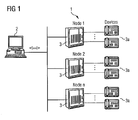
- FIG. 1 schematically illustrates a CTI communication system 1 comprising a server 2 linked to a plurality of nodes e.g. Private Branch Exchanges (PBXs) 3.
- PBXs Private Branch Exchanges
- Each PBX 3 supports a number of devices 3a, which may, for example, be system telephones, plain old telephones (POTs), cordless phones, network trunks or the like.
- CTI information is exchanged between servers and the communication nodes by means of CTI messages. These messages are normally encoded as defined in the CSTA Standard. Data is exchanged in such cases in both directions, whereby in some cases acknowledgements are sent for services, but in some cases they are transmitted unacknowledged.
- Messages from a server to a PBX are used for controlling devices and creating and controlling of calls.
- Messages from a PBX to a server are used to report device states and call states.
- CTI messages are layer 7 application messages.
- CTI messages are passed down from one layer to the next layer until transmitted in layer 1, the physical layer.
- CTI messages are received in layer 1 and passed up from one layer to the layer above until the application layer is reached.
- CSTA messages relevant to the individual applications may occur mixed over time in load situations.
- Typical CTI scenarios consist of one or more CSTA messages.
- a CTI scenario may involve a sequence of 'Makecall', 'Deflectcall', 'SetDisplay' and 'Answercall'. If two applications execute the same scenario simultaneuosly, messages may become mixed. The assignment of the messages is however always unique because corresponding identifications (Ids) are used. All messages pass through a queue because information can sometimes be produced more quickly than it can be exchanged.
- An example of queue of outgoing messages and incoming messages respectively from and to a server running an application on a first device and an application on a second device is illustrated in Figure 3 .
- Congestion in the queues is basically the result of increases in the response times. This effect is a technical necessity but is always undesirable from a user's point of view.
- the present invention aims to alleviate this problem.
- WO 01/01621 A2 discloses a method of avoiding congestion in the transmission of Internet web pages.
- US 6 587 875 B1 discloses a method in which the rate of sending data is varied to avoid saturation. However, they have no relevance to the field of CTI.
- a method of sending CTI messages in a communications system characterised by the steps of: assigning to each of a plurality of CTI messages a priority indicator selected from a plurality of different priority indicators, sending the plurality of CTI messages from a queue formed by the CTI messages such that the time interval between two messages sent from the queue depends upon the priority indicator assigned to the first of the two messages to be sent, whereby the time interval between messages being sent from the queue may vary.
- CTI messages exchanged between servers and clients are not all of equal importance. For example, Call Control messages must be acted upon promptly and are thus considered as being very time-critical messages. In contrast statistics messages need not be acted upon quickly and thus may be thought of as being non-time-critical messages.
- the timing of the forwarding of CTI messages is made dependent upon priorities assigned to the messages which indicate the time criticality of the messages.
- Such a priority is assigned to a message when the message is transferred to the transport layer. This frees the transport layer from having to logical interpret the messages. It only has to implement defined measures for a given priority.
- This priority is assigned to messages which generate barely any delay at the distant end. Thus any follow-up messages can be sent directly after these messages without any delay.
- Figure 4 schematically illustrates a queue 10 of CTI messages, for sending from a server to a particular PBX. For each PBX controlled by the server a separate queue would exist. Each message in the queue has been assigned a priority from the above list of priorities. The figure also illustrates the timing of the sending of the messages as determined by the priorities assigned to the messages.
- the first message 11 in the queue has "Priority Normal” and so following the sending of this message, a normal or standard wait time T N is allowed to elapse before the second message 12 is sent.
- the second message 12 also has “Priority Normal” and so following the sending of this message, the normal wait time T N elapses before the third message 13 is sent.
- the third message 13 has "Priority Halfdelay” meaning that following the sending of this message, the time delay before sending the fourth message 14 need only be a half of the standard wait time T N .
- the fifth message 15 has “Priority Noworkdelay” meaning that following the transmission of this message substantially no delay is applied before the sixth message 16 is sent.
- the sixth message 16 is another "Priority Normal” message and so following the sending of this message, the standard wait time T N is applied before the seventh message 17, also a "Priority Normal" message is sent.
- the eighth message 18 has "Priority Canbe delayed” and so the sending of this message is delayed until after the sending of the ninth message 19 and subsequently the tenth message 20 both of which are "Priority Normal" messages.
- the ninth message 19 is sent after a delay of T N following the sending of the eighth message 18
- the tenth message 20 is sent after a delay of T N following the sending of the ninth message 19
- the delayed eighth message 18 is sent after a delay of T N following the sending of the tenth message 20.
- Embodiments of the invention provide for an improved utilization of CTI links and a reduction in reaction times.
Landscapes
- Engineering & Computer Science (AREA)
- Signal Processing (AREA)
- Computer Networks & Wireless Communication (AREA)
- Telephonic Communication Services (AREA)
- Data Exchanges In Wide-Area Networks (AREA)
Claims (4)
- Verfahren zum Senden von CTI-Nachrichten in einem Kommunikationssystem, wobei das Verfahren gekennzeichnet ist durch die Schritte:- Das Zuordnen, zu jeder aus einer Vielzahl von CTI-Nachrichten (11-20), eines Prioritätsindikators ausgewählt aus einer Vielzahl von verschiedenen Prioritätsindikatoren, wobei die Prioritäten den CTI-Nachrichten (11-20) zugeordnet werden, wenn die CTI-Nachrichten auf eine Transportschicht in dem Kommunikationssystem übertragen werden,- Das Senden der Vielzahl von CTI-Nachrichten (11-20) von einer Warteschleife (10), gebildet von den CTI-Nachrichten (11-20), so dass das Zeitintervall (1; 2; 3) zwischen zwei Nachrichten (11-12; 13-14; 15-16), welche von der Warteschleife (10) versendet werden, abhängt von dem Prioritätsindikator, welcher zu der ersten (11; 13; 15) von den zwei Nachrichten (11-12; 13-14; 15-16), welche gesendet werden, zugeordnet ist, wobei das Zeitintervall (1; 2; 3) zwischen Nachrichten, die von der Warteschleife versendet werden, variieren kann.
- Verfahren gemäß Anspruch 1, wobei das Zeitintervall (1; 2; 3) zwischen den zwei Nachrichten (11-12; 13-14; 15-16), welche versendet werden, eines ist aus einer Standardzeitverzögerung für das System, einem Teil von der Standardzeitverzögerung oder im Wesentlichen Null-Zeitverzögerung, abhängig von der Priorität, welche der ersten von den zwei Nachrichten (11-12; 13-14; 15-16), welche versendet werden soll, zugeordnet ist.
- Verfahren gemäß Anspruch 1 oder 2, wobei eine Nachricht (18), welcher eine Priorität zugeordnet sein kann, welche anzeigt, dass das Senden dieser Nachricht bis nach dem Senden von später erzeugten Nachrichten (19, 20) verzögert sein kann.
- Vorrichtung, ausgebildet zum Durchführen des Verfahrens zum Senden von CTI-Nachrichten in einem Kommunikationssystem gemäß einem der Ansprüche 1 bis 3, umfassend:- Mittel zum Zuordnen, welches zu jeder von einer Vielzahl von CTI-Nachrichten (11-20) einen Prioritätsindikator, ausgewählt aus einer Vielzahl von verschiedenen Prioritätsindikatoren, zuordnet, wobei die Prioritäten zu den CTI-Nachrichten (11-20) zugeordnet werden, wenn die CTI-Nachrichten zu einer Transportschicht in dem Kommunikationssystem übertragen werden;- Ein Sendemittel zum Senden der Vielzahl von CTI-Nachrichten (11-20) von einer Warteschleife (10) gebildet von den CTI-Nachrichten (11-20), so dass das Zeitintervall (1; 2; 3) zwischen zwei Nachrichten (11-12; 13-14; 15-16), welche von der Warteschleife (10) versendet werden, abhängt von dem Prioritätsindikator, welcher der ersten (11; 13; 15) von den zwei Nachrichten (11-12; 13-14; 15-16), welche versendet werden soll, zugeordnet ist, wobei das Zeitintervall (1; 2; 3) zwischen Nachrichten, welche von der Warteschleife versendet werden, variieren kann.
Applications Claiming Priority (2)
| Application Number | Priority Date | Filing Date | Title |
|---|---|---|---|
| GB0414566A GB2416089A (en) | 2004-06-30 | 2004-06-30 | Sending cti messages in a communication system |
| PCT/EP2005/004643 WO2006002707A1 (en) | 2004-06-30 | 2005-04-29 | A method of sending cti messages with varying delays |
Publications (2)
| Publication Number | Publication Date |
|---|---|
| EP1762057A1 EP1762057A1 (de) | 2007-03-14 |
| EP1762057B1 true EP1762057B1 (de) | 2013-06-12 |
Family
ID=32843249
Family Applications (1)
| Application Number | Title | Priority Date | Filing Date |
|---|---|---|---|
| EP05740767.8A Expired - Lifetime EP1762057B1 (de) | 2004-06-30 | 2005-04-29 | Verfahren zum senden von cti-nachrichten mit variierenden verzögerungen |
Country Status (5)
| Country | Link |
|---|---|
| US (1) | US8713123B2 (de) |
| EP (1) | EP1762057B1 (de) |
| CN (1) | CN101002439B (de) |
| GB (1) | GB2416089A (de) |
| WO (1) | WO2006002707A1 (de) |
Families Citing this family (3)
| Publication number | Priority date | Publication date | Assignee | Title |
|---|---|---|---|---|
| DE102005019302A1 (de) | 2005-04-26 | 2006-11-16 | Toxogen Gmbh | Carrier zum Targeting von Nervenzellen |
| US20070071198A1 (en) * | 2005-07-18 | 2007-03-29 | M.G.S. Communication Ltd. | Apparatus and a method for applications of caller line identification signals |
| US8139565B2 (en) * | 2009-02-09 | 2012-03-20 | Zoltes, Inc. | Telecommunications system and method for connecting a CSTA client to several PBXS |
Family Cites Families (7)
| Publication number | Priority date | Publication date | Assignee | Title |
|---|---|---|---|---|
| US20010040887A1 (en) * | 1997-10-09 | 2001-11-15 | Yuri Shtivelman | Apparatus and methods enhancing call routing to and within call-centers |
| US6252855B1 (en) * | 1997-12-22 | 2001-06-26 | Cisco Technology, Inc. | Method and apparatus for identifying a maximum frame size to maintain delay at or below an acceptable level |
| EP0969647A1 (de) * | 1998-07-03 | 2000-01-05 | Alcatel | Schnittstelle zwischen einem Netzwerkschalter und einem CTI Server und Gerät zum anbieten von Dienstleistungen an Teilnehmer mit einer derartigen Schnittstelle |
| US6587875B1 (en) | 1999-04-30 | 2003-07-01 | Microsoft Corporation | Network protocol and associated methods for optimizing use of available bandwidth |
| AU5613900A (en) | 1999-06-30 | 2001-01-31 | Sun Microsystems, Inc. | Customizing web content based on network conditions |
| US7032025B2 (en) * | 2001-01-12 | 2006-04-18 | Soundstarts, Inc. | Method and apparatus for monitoring and transferring a client from a low priority access number to a higher priority access number during active internet and other WAN connection-sessions |
| US6947543B2 (en) * | 2002-01-03 | 2005-09-20 | Avaya Technology Corp. | Computer-telephony integration that uses features of an automatic call distribution system |
-
2004
- 2004-06-30 GB GB0414566A patent/GB2416089A/en not_active Withdrawn
-
2005
- 2005-04-29 CN CN2005800221802A patent/CN101002439B/zh not_active Expired - Fee Related
- 2005-04-29 WO PCT/EP2005/004643 patent/WO2006002707A1/en not_active Ceased
- 2005-04-29 US US11/630,187 patent/US8713123B2/en active Active
- 2005-04-29 EP EP05740767.8A patent/EP1762057B1/de not_active Expired - Lifetime
Also Published As
| Publication number | Publication date |
|---|---|
| EP1762057A1 (de) | 2007-03-14 |
| GB2416089A (en) | 2006-01-11 |
| GB0414566D0 (en) | 2004-08-04 |
| CN101002439B (zh) | 2011-08-24 |
| US20080205623A1 (en) | 2008-08-28 |
| WO2006002707A1 (en) | 2006-01-12 |
| CN101002439A (zh) | 2007-07-18 |
| US8713123B2 (en) | 2014-04-29 |
Similar Documents
| Publication | Publication Date | Title |
|---|---|---|
| JP3686337B2 (ja) | パケットデータネットワークおよび専用接続ネットワークを組み合わせた統合型テレフォニネットワーク | |
| KR101508389B1 (ko) | 통신네트워크에서 대역폭을 예약하는 방법 및 통신시스템 | |
| RU2483456C2 (ru) | Приемник/источник данных, устройство передачи данных, прибор обработки данных и передачи данных и оконечное устройство данных для сети с коммутацией линий связи и сети с коммутацией пакетов | |
| WO2000019677A3 (en) | Connection manager for telecommunications | |
| US8451721B2 (en) | Path-based adaptive prioritization and latency management | |
| US9807127B2 (en) | Method and apparatus for distributed compositional control of end-to-end media in IP networks | |
| WO2012131364A1 (en) | Telephone call processing method and apparatus | |
| JP3641410B2 (ja) | Ipパケットの優先制御方式 | |
| US7453803B1 (en) | Congestion control for packet communications | |
| JP2005518715A (ja) | サービス品質要求の相関 | |
| EP2117198A1 (de) | Umleitung von Verkehr bei einem Anruf durch Anwendungsschicht-Gateways (ALG) | |
| US7599399B1 (en) | Jitter buffer management | |
| US8713123B2 (en) | Method of sending CTI messages in a communication system | |
| US20040215812A1 (en) | Packet-drop tolerant method for transmitting time-critical data over ethernet | |
| JP5241705B2 (ja) | 制限された帯域上での通話管理 | |
| US7418084B2 (en) | Systems and methods for third-party call control | |
| Whitehead | GOCAP--one standardised overload control for next generation networks | |
| CN101622823A (zh) | 对网络地址转换学习操作的业务量进行节流 | |
| Gurbani et al. | Inhibitors for ubiquitous deployment of services in the next-generation network | |
| Kuramo et al. | Control TCP BBR Throughput in a Programmable Switch | |
| CN103997464B (zh) | 用于控制分组交换数据流中的实时连续数据的系统和方法 | |
| Guduru | Priority queuing strategy for self-overload control in SIP servers | |
| Wu et al. | Forwarding the balance between absolute and relative: a new differentiated services model for adaptive traffic | |
| WO2002045371A2 (en) | Method and apparatus for virtual connection | |
| Moggia et al. | Emergency telecommunication support for IP telephony |
Legal Events
| Date | Code | Title | Description |
|---|---|---|---|
| PUAI | Public reference made under article 153(3) epc to a published international application that has entered the european phase |
Free format text: ORIGINAL CODE: 0009012 |
|
| 17P | Request for examination filed |
Effective date: 20061213 |
|
| AK | Designated contracting states |
Kind code of ref document: A1 Designated state(s): DE FR GB IT SE |
|
| DAX | Request for extension of the european patent (deleted) | ||
| RBV | Designated contracting states (corrected) |
Designated state(s): DE FR GB IT SE |
|
| 17Q | First examination report despatched |
Effective date: 20090908 |
|
| RAP1 | Party data changed (applicant data changed or rights of an application transferred) |
Owner name: SIEMENS ENTERPRISE COMMUNICATIONS GMBH & CO. KG |
|
| RIC1 | Information provided on ipc code assigned before grant |
Ipc: H04L 12/56 20060101ALI20120927BHEP Ipc: H04M 3/42 20060101AFI20120927BHEP |
|
| GRAP | Despatch of communication of intention to grant a patent |
Free format text: ORIGINAL CODE: EPIDOSNIGR1 |
|
| GRAS | Grant fee paid |
Free format text: ORIGINAL CODE: EPIDOSNIGR3 |
|
| REG | Reference to a national code |
Ref country code: DE Ref legal event code: R079 Ref document number: 602005039967 Country of ref document: DE Free format text: PREVIOUS MAIN CLASS: H04L0012560000 Ipc: H04M0003420000 |
|
| GRAA | (expected) grant |
Free format text: ORIGINAL CODE: 0009210 |
|
| AK | Designated contracting states |
Kind code of ref document: B1 Designated state(s): DE FR GB IT SE |
|
| REG | Reference to a national code |
Ref country code: GB Ref legal event code: FG4D |
|
| RIC1 | Information provided on ipc code assigned before grant |
Ipc: H04M 3/42 20060101AFI20130507BHEP |
|
| REG | Reference to a national code |
Ref country code: DE Ref legal event code: R096 Ref document number: 602005039967 Country of ref document: DE Effective date: 20130801 |
|
| REG | Reference to a national code |
Ref country code: GB Ref legal event code: 746 Effective date: 20130917 |
|
| PG25 | Lapsed in a contracting state [announced via postgrant information from national office to epo] |
Ref country code: SE Free format text: LAPSE BECAUSE OF FAILURE TO SUBMIT A TRANSLATION OF THE DESCRIPTION OR TO PAY THE FEE WITHIN THE PRESCRIBED TIME-LIMIT Effective date: 20130612 |
|
| REG | Reference to a national code |
Ref country code: DE Ref legal event code: R082 Ref document number: 602005039967 Country of ref document: DE Representative=s name: FRITZSCHE PATENT, DE |
|
| RAP2 | Party data changed (patent owner data changed or rights of a patent transferred) |
Owner name: UNIFY GMBH & CO. KG |
|
| REG | Reference to a national code |
Ref country code: DE Ref legal event code: R082 Ref document number: 602005039967 Country of ref document: DE Representative=s name: FRITZSCHE PATENT, DE Effective date: 20131112 Ref country code: DE Ref legal event code: R081 Ref document number: 602005039967 Country of ref document: DE Owner name: UNIFY GMBH & CO. KG, DE Free format text: FORMER OWNER: SIEMENS AG, A GERMAN CORPORATION, 80333 MUENCHEN, DE Effective date: 20130612 Ref country code: DE Ref legal event code: R081 Ref document number: 602005039967 Country of ref document: DE Owner name: UNIFY GMBH & CO. KG, DE Free format text: FORMER OWNER: SIEMENS ENTERPRISE COMMUNICATIONS GMBH & CO. KG, 81379 MUENCHEN, DE Effective date: 20131112 Ref country code: DE Ref legal event code: R082 Ref document number: 602005039967 Country of ref document: DE Representative=s name: FRITZSCHE PATENTANWAELTE, DE Effective date: 20131112 |
|
| PLBE | No opposition filed within time limit |
Free format text: ORIGINAL CODE: 0009261 |
|
| STAA | Information on the status of an ep patent application or granted ep patent |
Free format text: STATUS: NO OPPOSITION FILED WITHIN TIME LIMIT |
|
| 26N | No opposition filed |
Effective date: 20140313 |
|
| REG | Reference to a national code |
Ref country code: DE Ref legal event code: R097 Ref document number: 602005039967 Country of ref document: DE Effective date: 20140313 |
|
| REG | Reference to a national code |
Ref country code: FR Ref legal event code: PLFP Year of fee payment: 12 |
|
| PGFP | Annual fee paid to national office [announced via postgrant information from national office to epo] |
Ref country code: IT Payment date: 20160422 Year of fee payment: 12 |
|
| REG | Reference to a national code |
Ref country code: DE Ref legal event code: R082 Ref document number: 602005039967 Country of ref document: DE Representative=s name: SCHAAFHAUSEN PATENTANWAELTE PARTNERSCHAFTSGESE, DE Ref country code: DE Ref legal event code: R082 Ref document number: 602005039967 Country of ref document: DE Representative=s name: FRITZSCHE PATENTANWAELTE, DE Ref country code: DE Ref legal event code: R081 Ref document number: 602005039967 Country of ref document: DE Owner name: UNIFY GMBH & CO. KG, DE Free format text: FORMER OWNER: UNIFY GMBH & CO. KG, 81379 MUENCHEN, DE |
|
| REG | Reference to a national code |
Ref country code: FR Ref legal event code: PLFP Year of fee payment: 13 |
|
| REG | Reference to a national code |
Ref country code: FR Ref legal event code: PLFP Year of fee payment: 14 |
|
| PG25 | Lapsed in a contracting state [announced via postgrant information from national office to epo] |
Ref country code: IT Free format text: LAPSE BECAUSE OF NON-PAYMENT OF DUE FEES Effective date: 20170429 |
|
| REG | Reference to a national code |
Ref country code: DE Ref legal event code: R082 Ref document number: 602005039967 Country of ref document: DE Representative=s name: SCHAAFHAUSEN PATENTANWAELTE PARTNERSCHAFTSGESE, DE |
|
| PGFP | Annual fee paid to national office [announced via postgrant information from national office to epo] |
Ref country code: GB Payment date: 20240307 Year of fee payment: 20 |
|
| PGFP | Annual fee paid to national office [announced via postgrant information from national office to epo] |
Ref country code: FR Payment date: 20240308 Year of fee payment: 20 |
|
| PGFP | Annual fee paid to national office [announced via postgrant information from national office to epo] |
Ref country code: DE Payment date: 20240306 Year of fee payment: 20 |
|
| REG | Reference to a national code |
Ref country code: DE Ref legal event code: R081 Ref document number: 602005039967 Country of ref document: DE Owner name: UNIFY BETEILIGUNGSVERWALTUNG GMBH & CO. KG, DE Free format text: FORMER OWNER: UNIFY GMBH & CO. KG, 80807 MUENCHEN, DE |
|
| REG | Reference to a national code |
Ref country code: DE Ref legal event code: R071 Ref document number: 602005039967 Country of ref document: DE |
|
| REG | Reference to a national code |
Ref country code: GB Ref legal event code: PE20 Expiry date: 20250428 |
|
| PG25 | Lapsed in a contracting state [announced via postgrant information from national office to epo] |
Ref country code: GB Free format text: LAPSE BECAUSE OF EXPIRATION OF PROTECTION Effective date: 20250428 |
|
| REG | Reference to a national code |
Ref country code: GB Ref legal event code: 732E Free format text: REGISTERED BETWEEN 20250828 AND 20250903 |
|
| REG | Reference to a national code |
Ref country code: GB Ref legal event code: 732E Free format text: REGISTERED BETWEEN 20251002 AND 20251008 |