EP1762057B1 - A method of sending cti messages with varying delays - Google Patents
A method of sending cti messages with varying delays Download PDFInfo
- Publication number
- EP1762057B1 EP1762057B1 EP05740767.8A EP05740767A EP1762057B1 EP 1762057 B1 EP1762057 B1 EP 1762057B1 EP 05740767 A EP05740767 A EP 05740767A EP 1762057 B1 EP1762057 B1 EP 1762057B1
- Authority
- EP
- European Patent Office
- Prior art keywords
- messages
- cti
- sending
- sent
- message
- Prior art date
- Legal status (The legal status is an assumption and is not a legal conclusion. Google has not performed a legal analysis and makes no representation as to the accuracy of the status listed.)
- Expired - Lifetime
Links
Images


Classifications
-
- H—ELECTRICITY
- H04—ELECTRIC COMMUNICATION TECHNIQUE
- H04L—TRANSMISSION OF DIGITAL INFORMATION, e.g. TELEGRAPHIC COMMUNICATION
- H04L47/00—Traffic control in data switching networks
- H04L47/10—Flow control; Congestion control
- H04L47/19—Flow control; Congestion control at layers above the network layer
-
- H—ELECTRICITY
- H04—ELECTRIC COMMUNICATION TECHNIQUE
- H04L—TRANSMISSION OF DIGITAL INFORMATION, e.g. TELEGRAPHIC COMMUNICATION
- H04L47/00—Traffic control in data switching networks
- H04L47/10—Flow control; Congestion control
- H04L47/28—Flow control; Congestion control in relation to timing considerations
- H04L47/283—Flow control; Congestion control in relation to timing considerations in response to processing delays, e.g. caused by jitter or round trip time [RTT]
-
- H—ELECTRICITY
- H04—ELECTRIC COMMUNICATION TECHNIQUE
- H04M—TELEPHONIC COMMUNICATION
- H04M3/00—Automatic or semi-automatic exchanges
- H04M3/42—Systems providing special services or facilities to subscribers
- H04M3/42314—Systems providing special services or facilities to subscribers in private branch exchanges
- H04M3/42323—PBX's with CTI arrangements
Definitions
- the present invention relates to a method of sending CTI messages in a communications system.
- CTI Computer Telephony Integration
- CSTA Computer-Supported Telephony Application
- ECMA European Computer Manufactures Association
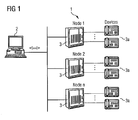
- FIG. 1 schematically illustrates a CTI communication system 1 comprising a server 2 linked to a plurality of nodes e.g. Private Branch Exchanges (PBXs) 3.
- PBXs Private Branch Exchanges
- Each PBX 3 supports a number of devices 3a, which may, for example, be system telephones, plain old telephones (POTs), cordless phones, network trunks or the like.
- CTI information is exchanged between servers and the communication nodes by means of CTI messages. These messages are normally encoded as defined in the CSTA Standard. Data is exchanged in such cases in both directions, whereby in some cases acknowledgements are sent for services, but in some cases they are transmitted unacknowledged.
- Messages from a server to a PBX are used for controlling devices and creating and controlling of calls.
- Messages from a PBX to a server are used to report device states and call states.
- CTI messages are layer 7 application messages.
- CTI messages are passed down from one layer to the next layer until transmitted in layer 1, the physical layer.
- CTI messages are received in layer 1 and passed up from one layer to the layer above until the application layer is reached.
- CSTA messages relevant to the individual applications may occur mixed over time in load situations.
- Typical CTI scenarios consist of one or more CSTA messages.
- a CTI scenario may involve a sequence of 'Makecall', 'Deflectcall', 'SetDisplay' and 'Answercall'. If two applications execute the same scenario simultaneuosly, messages may become mixed. The assignment of the messages is however always unique because corresponding identifications (Ids) are used. All messages pass through a queue because information can sometimes be produced more quickly than it can be exchanged.
- An example of queue of outgoing messages and incoming messages respectively from and to a server running an application on a first device and an application on a second device is illustrated in Figure 3 .
- Congestion in the queues is basically the result of increases in the response times. This effect is a technical necessity but is always undesirable from a user's point of view.
- the present invention aims to alleviate this problem.
- WO 01/01621 A2 discloses a method of avoiding congestion in the transmission of Internet web pages.
- US 6 587 875 B1 discloses a method in which the rate of sending data is varied to avoid saturation. However, they have no relevance to the field of CTI.
- a method of sending CTI messages in a communications system characterised by the steps of: assigning to each of a plurality of CTI messages a priority indicator selected from a plurality of different priority indicators, sending the plurality of CTI messages from a queue formed by the CTI messages such that the time interval between two messages sent from the queue depends upon the priority indicator assigned to the first of the two messages to be sent, whereby the time interval between messages being sent from the queue may vary.
- CTI messages exchanged between servers and clients are not all of equal importance. For example, Call Control messages must be acted upon promptly and are thus considered as being very time-critical messages. In contrast statistics messages need not be acted upon quickly and thus may be thought of as being non-time-critical messages.
- the timing of the forwarding of CTI messages is made dependent upon priorities assigned to the messages which indicate the time criticality of the messages.
- Such a priority is assigned to a message when the message is transferred to the transport layer. This frees the transport layer from having to logical interpret the messages. It only has to implement defined measures for a given priority.
- This priority is assigned to messages which generate barely any delay at the distant end. Thus any follow-up messages can be sent directly after these messages without any delay.
- Figure 4 schematically illustrates a queue 10 of CTI messages, for sending from a server to a particular PBX. For each PBX controlled by the server a separate queue would exist. Each message in the queue has been assigned a priority from the above list of priorities. The figure also illustrates the timing of the sending of the messages as determined by the priorities assigned to the messages.
- the first message 11 in the queue has "Priority Normal” and so following the sending of this message, a normal or standard wait time T N is allowed to elapse before the second message 12 is sent.
- the second message 12 also has “Priority Normal” and so following the sending of this message, the normal wait time T N elapses before the third message 13 is sent.
- the third message 13 has "Priority Halfdelay” meaning that following the sending of this message, the time delay before sending the fourth message 14 need only be a half of the standard wait time T N .
- the fifth message 15 has “Priority Noworkdelay” meaning that following the transmission of this message substantially no delay is applied before the sixth message 16 is sent.
- the sixth message 16 is another "Priority Normal” message and so following the sending of this message, the standard wait time T N is applied before the seventh message 17, also a "Priority Normal" message is sent.
- the eighth message 18 has "Priority Canbe delayed” and so the sending of this message is delayed until after the sending of the ninth message 19 and subsequently the tenth message 20 both of which are "Priority Normal" messages.
- the ninth message 19 is sent after a delay of T N following the sending of the eighth message 18
- the tenth message 20 is sent after a delay of T N following the sending of the ninth message 19
- the delayed eighth message 18 is sent after a delay of T N following the sending of the tenth message 20.
- Embodiments of the invention provide for an improved utilization of CTI links and a reduction in reaction times.
Landscapes
- Engineering & Computer Science (AREA)
- Signal Processing (AREA)
- Computer Networks & Wireless Communication (AREA)
- Telephonic Communication Services (AREA)
- Data Exchanges In Wide-Area Networks (AREA)
Description
- The present invention relates to a method of sending CTI messages in a communications system.
- Computer Telephony Integration (CTI) is the concept of interfacing and coordinating telephony services with computer systems. This technology has been available since the mid-1980s, but it has not been widely used until recently. This can be attributed to the development of new technologies, such as general-purpose computers and the defining of International standards for interconnecting telephone and computer systems. The Computer-Supported Telephony Application (CSTA) call modeling and protocol standards developed by the European Computer Manufactures Association (ECMA) has emerged as the dominant standard accepted in the market, defining the method switches use to process all types of calls.
-
Figure 1 schematically illustrates aCTI communication system 1 comprising aserver 2 linked to a plurality of nodes e.g. Private Branch Exchanges (PBXs) 3. Each PBX 3 supports a number ofdevices 3a, which may, for example, be system telephones, plain old telephones (POTs), cordless phones, network trunks or the like. In such current CTI communication systems, CTI information is exchanged between servers and the communication nodes by means of CTI messages. These messages are normally encoded as defined in the CSTA Standard. Data is exchanged in such cases in both directions, whereby in some cases acknowledgements are sent for services, but in some cases they are transmitted unacknowledged. Messages from a server to a PBX are used for controlling devices and creating and controlling of calls. Messages from a PBX to a server are used to report device states and call states. - For a better understanding of CTI messages reference is made to the Open Systems Interconnection (ISO/OSI) 7-layer Reference Model illustrated in
Figure 2 . CTI messages arelayer 7 application messages. At a transmitting device, starting at the application layer, CTI messages are passed down from one layer to the next layer until transmitted inlayer 1, the physical layer. At a receiving device, CTI messages are received inlayer 1 and passed up from one layer to the layer above until the application layer is reached. - If a server is operating a number of Client applications simultaneously, the CSTA messages relevant to the individual applications may occur mixed over time in load situations. Typical CTI scenarios consist of one or more CSTA messages. For example, a CTI scenario may involve a sequence of 'Makecall', 'Deflectcall', 'SetDisplay' and 'Answercall'. If two applications execute the same scenario simultaneuosly, messages may become mixed. The assignment of the messages is however always unique because corresponding identifications (Ids) are used. All messages pass through a queue because information can sometimes be produced more quickly than it can be exchanged. An example of queue of outgoing messages and incoming messages respectively from and to a server running an application on a first device and an application on a second device is illustrated in
Figure 3 . - As soon as high message loads occur, the messages build up in the queues, because on sending, a minimum time delay:must be maintained between consecutive messages. This minimum sending delay is necessary to give the receiving device enough time to process the desired actions. An additional flow control of these messages is undertaken in the lower layers by normal LAN and TCP/IP protocols.
- Congestion in the queues is basically the result of increases in the response times. This effect is a technical necessity but is always undesirable from a user's point of view.
- The present invention aims to alleviate this problem.
-
WO 01/01621 A2 US 6 587 875 B1 discloses a method in which the rate of sending data is varied to avoid saturation. However, they have no relevance to the field of CTI. - According to the present invention there is provided a method of sending CTI messages in a communications system, the method characterised by the steps of: assigning to each of a plurality of CTI messages a priority indicator selected from a plurality of different priority indicators, sending the plurality of CTI messages from a queue formed by the CTI messages such that the time interval between two messages sent from the queue depends upon the priority indicator assigned to the first of the two messages to be sent, whereby the time interval between messages being sent from the queue may vary.
- The above and further features of the invention are set forth with particularity in the appended claims and together with advantages thereof will become clearer from consideration of the following detailed description of an exemplary embodiment of the invention given with reference to the accompanying drawings, in which:
-
Figure 1 illustrates a CTI communications system; -
Figure 2 illustrates the ISO/OSI 7-layer Reference Model; -
Figure 3 illustrates a queue of outgoing and incoming CTI messages;
and have been described above, and furthermore; -
Figure 4 illustrates schematically a queue of CTI messages, priorities assigned to the message, and a timing sequence for sending the messages. - CTI messages exchanged between servers and clients are not all of equal importance. For example, Call Control messages must be acted upon promptly and are thus considered as being very time-critical messages. In contrast statistics messages need not be acted upon quickly and thus may be thought of as being non-time-critical messages.
- It is possible to distinguish between these messages on the basis of their logical content, but for the lower layers of the packet data transmission the content is transparent. This can and also should thus not be changed.
- In embodiments of the present embodiment the timing of the forwarding of CTI messages is made dependent upon priorities assigned to the messages which indicate the time criticality of the messages.
- Such a priority is assigned to a message when the message is transferred to the transport layer. This frees the transport layer from having to logical interpret the messages. It only has to implement defined measures for a given priority.
- In a preferred embodiment the following message priorities are used:
- Messages which are given this priority cause a load situation in the distant end which requires that a subsequent message is not sent before a defined period of time has elapsed. This is the method which was previously used for all messages.
- These messages cause a load situation in the distant end such that a delay of half the delay time to the subsequent message is sufficient.
- This priority is assigned to messages which generate barely any delay at the distant end. Thus any follow-up messages can be sent directly after these messages without any delay.
- Messages assigned this priority are so non-time-critical that they can even be sent after messages generated later in time in favor of faster reaction times.
-
Figure 4 schematically illustrates aqueue 10 of CTI messages, for sending from a server to a particular PBX. For each PBX controlled by the server a separate queue would exist. Each message in the queue has been assigned a priority from the above list of priorities. The figure also illustrates the timing of the sending of the messages as determined by the priorities assigned to the messages. - The
first message 11 in the queue has "Priority Normal" and so following the sending of this message, a normal or standard wait time TN is allowed to elapse before thesecond message 12 is sent. Thesecond message 12 also has "Priority Normal" and so following the sending of this message, the normal wait time TN elapses before thethird message 13 is sent. Thethird message 13 has "Priority Halfdelay" meaning that following the sending of this message, the time delay before sending thefourth message 14 need only be a half of the standard wait time TN. Thefifth message 15 has "Priority Noworkdelay" meaning that following the transmission of this message substantially no delay is applied before thesixth message 16 is sent. Thesixth message 16 is another "Priority Normal" message and so following the sending of this message, the standard wait time TN is applied before theseventh message 17, also a "Priority Normal" message is sent. - The
eighth message 18 has "Priority Canbe delayed" and so the sending of this message is delayed until after the sending of theninth message 19 and subsequently thetenth message 20 both of which are "Priority Normal" messages. Thus, theninth message 19 is sent after a delay of TN following the sending of theeighth message 18, thetenth message 20 is sent after a delay of TN following the sending of theninth message 19 and finally, the delayedeighth message 18 is sent after a delay of TN following the sending of thetenth message 20. - Embodiments of the invention provide for an improved utilization of CTI links and a reduction in reaction times.
- Having thus described the present invention by reference to a preferred embodiment it is to be well understood that the embodiment in question is exemplary only and that modifications and variations such as will occur to those possessed of appropriate knowledge and skills may be made without departure from the scope of the invention as set forth in the appended claims.
Claims (4)
- A method of sending CTI messages in a communications system, the method characterised by the steps of:- assigning to each of a plurality of CTI messages (11-20) a priority indicator selected from a plurality of different priority indicators, wherein the priorities are assigned to the CTI messages (11-20) when the CTI messages are transferred to a transport layer in the communications system,- sending the plurality of CTI messages (11-20) from a queue (10) formed by the CTI messages (11-20) such that the time interval (1; 2; 3) between two messages (11-12; 13-14; 15-16) being sent from the queue (10) depends upon the priority indicator assigned to the first (11; 13; 15) of the two messages (11-12; 13-14; 15-16) to be sent, whereby the time interval (1; 2; 3) between messages being sent from the queue may vary.
- Method according to claim 1 wherein the time interval (1; 2; 3) between the two messages (11-12; 13-14; 15-16) being sent is any of, a standard time delay for the system, a portion of the standard time delay or substantially zero time delay, depending upon the priority assigned to the first of the two messages (11-12; 13-14; 15-16) to be sent.
- Method according to claim 1 or 2, wherein a message (18) may be assigned a priority that indicates that that message may be delayed from sending until after the sending of later generated messages (19, 20).
- Apparatus arranged to implement the method of sending CTI messages in a communications system according to any of claims 1 to 3, comprising:- an assigning means assigning to each of a plurality of CTI messages (11-20) a priority indicator selected from a plurality of different priority indicators, wherein the priorities are assigned to the CTI messages (11-20) when the CTI messages are transferred to a transport layer in the communications system,- a sending means sending the plurality of CTI messages (11-20) from a queue (10) formed by the CTI messages (11-20) such that the time interval (1; 2; 3) between two messages (11-12; 13-14; 15-16) being sent from the queue (10) depends upon the priority indicator assigned to the first (11; 13; 15) of the two messages (11-12; 13-14; 15-16) to be sent, whereby the time interval (1; 2; 3) between messages being sent from the queue may vary.
Applications Claiming Priority (2)
| Application Number | Priority Date | Filing Date | Title |
|---|---|---|---|
| GB0414566A GB2416089A (en) | 2004-06-30 | 2004-06-30 | Sending cti messages in a communication system |
| PCT/EP2005/004643 WO2006002707A1 (en) | 2004-06-30 | 2005-04-29 | A method of sending cti messages with varying delays |
Publications (2)
| Publication Number | Publication Date |
|---|---|
| EP1762057A1 EP1762057A1 (en) | 2007-03-14 |
| EP1762057B1 true EP1762057B1 (en) | 2013-06-12 |
Family
ID=32843249
Family Applications (1)
| Application Number | Title | Priority Date | Filing Date |
|---|---|---|---|
| EP05740767.8A Expired - Lifetime EP1762057B1 (en) | 2004-06-30 | 2005-04-29 | A method of sending cti messages with varying delays |
Country Status (5)
| Country | Link |
|---|---|
| US (1) | US8713123B2 (en) |
| EP (1) | EP1762057B1 (en) |
| CN (1) | CN101002439B (en) |
| GB (1) | GB2416089A (en) |
| WO (1) | WO2006002707A1 (en) |
Families Citing this family (3)
| Publication number | Priority date | Publication date | Assignee | Title |
|---|---|---|---|---|
| DE102005019302A1 (en) | 2005-04-26 | 2006-11-16 | Toxogen Gmbh | Carrier for targeting nerve cells |
| US20070071198A1 (en) * | 2005-07-18 | 2007-03-29 | M.G.S. Communication Ltd. | Apparatus and a method for applications of caller line identification signals |
| US8139565B2 (en) * | 2009-02-09 | 2012-03-20 | Zoltes, Inc. | Telecommunications system and method for connecting a CSTA client to several PBXS |
Family Cites Families (7)
| Publication number | Priority date | Publication date | Assignee | Title |
|---|---|---|---|---|
| US20010040887A1 (en) * | 1997-10-09 | 2001-11-15 | Yuri Shtivelman | Apparatus and methods enhancing call routing to and within call-centers |
| US6252855B1 (en) * | 1997-12-22 | 2001-06-26 | Cisco Technology, Inc. | Method and apparatus for identifying a maximum frame size to maintain delay at or below an acceptable level |
| EP0969647A1 (en) * | 1998-07-03 | 2000-01-05 | Alcatel | Interface means between a network switch and a CTI server means and apparatus for providing a service to a customer including such an interface means |
| US6587875B1 (en) | 1999-04-30 | 2003-07-01 | Microsoft Corporation | Network protocol and associated methods for optimizing use of available bandwidth |
| AU5613900A (en) | 1999-06-30 | 2001-01-31 | Sun Microsystems, Inc. | Customizing web content based on network conditions |
| US7032025B2 (en) * | 2001-01-12 | 2006-04-18 | Soundstarts, Inc. | Method and apparatus for monitoring and transferring a client from a low priority access number to a higher priority access number during active internet and other WAN connection-sessions |
| US6947543B2 (en) * | 2002-01-03 | 2005-09-20 | Avaya Technology Corp. | Computer-telephony integration that uses features of an automatic call distribution system |
-
2004
- 2004-06-30 GB GB0414566A patent/GB2416089A/en not_active Withdrawn
-
2005
- 2005-04-29 CN CN2005800221802A patent/CN101002439B/en not_active Expired - Fee Related
- 2005-04-29 WO PCT/EP2005/004643 patent/WO2006002707A1/en not_active Ceased
- 2005-04-29 US US11/630,187 patent/US8713123B2/en active Active
- 2005-04-29 EP EP05740767.8A patent/EP1762057B1/en not_active Expired - Lifetime
Also Published As
| Publication number | Publication date |
|---|---|
| EP1762057A1 (en) | 2007-03-14 |
| GB2416089A (en) | 2006-01-11 |
| GB0414566D0 (en) | 2004-08-04 |
| CN101002439B (en) | 2011-08-24 |
| US20080205623A1 (en) | 2008-08-28 |
| WO2006002707A1 (en) | 2006-01-12 |
| CN101002439A (en) | 2007-07-18 |
| US8713123B2 (en) | 2014-04-29 |
Similar Documents
| Publication | Publication Date | Title |
|---|---|---|
| JP3686337B2 (en) | Integrated telephony network combining packet data network and dedicated connection network | |
| KR101508389B1 (en) | Method and communication system for reserving bandwidth in a communication network | |
| RU2483456C2 (en) | Data sink/data source, data transmission device, data processing and data transmission device and data terminal device for circuit-switched and packet-switched network | |
| WO2000019677A3 (en) | Connection manager for telecommunications | |
| US8451721B2 (en) | Path-based adaptive prioritization and latency management | |
| US9807127B2 (en) | Method and apparatus for distributed compositional control of end-to-end media in IP networks | |
| WO2012131364A1 (en) | Telephone call processing method and apparatus | |
| JP3641410B2 (en) | IP packet priority control method | |
| US7453803B1 (en) | Congestion control for packet communications | |
| JP2005518715A (en) | Correlating service quality requirements | |
| EP2117198A1 (en) | Mid-call redirection of traffic through application-layer gateways | |
| US7599399B1 (en) | Jitter buffer management | |
| US8713123B2 (en) | Method of sending CTI messages in a communication system | |
| US20040215812A1 (en) | Packet-drop tolerant method for transmitting time-critical data over ethernet | |
| JP5241705B2 (en) | Call management over limited bandwidth | |
| US7418084B2 (en) | Systems and methods for third-party call control | |
| Whitehead | GOCAP--one standardised overload control for next generation networks | |
| CN101622823A (en) | Methods and systems for per-session network address translation (nat) learning and firewall filtering in media gateway | |
| Gurbani et al. | Inhibitors for ubiquitous deployment of services in the next-generation network | |
| Kuramo et al. | Control TCP BBR Throughput in a Programmable Switch | |
| CN103997464B (en) | System and method for the real time continuous data in control packet switched traffic | |
| Guduru | Priority queuing strategy for self-overload control in SIP servers | |
| Wu et al. | Forwarding the balance between absolute and relative: a new differentiated services model for adaptive traffic | |
| WO2002045371A2 (en) | Method and apparatus for virtual connection | |
| Moggia et al. | Emergency telecommunication support for IP telephony |
Legal Events
| Date | Code | Title | Description |
|---|---|---|---|
| PUAI | Public reference made under article 153(3) epc to a published international application that has entered the european phase |
Free format text: ORIGINAL CODE: 0009012 |
|
| 17P | Request for examination filed |
Effective date: 20061213 |
|
| AK | Designated contracting states |
Kind code of ref document: A1 Designated state(s): DE FR GB IT SE |
|
| DAX | Request for extension of the european patent (deleted) | ||
| RBV | Designated contracting states (corrected) |
Designated state(s): DE FR GB IT SE |
|
| 17Q | First examination report despatched |
Effective date: 20090908 |
|
| RAP1 | Party data changed (applicant data changed or rights of an application transferred) |
Owner name: SIEMENS ENTERPRISE COMMUNICATIONS GMBH & CO. KG |
|
| RIC1 | Information provided on ipc code assigned before grant |
Ipc: H04L 12/56 20060101ALI20120927BHEP Ipc: H04M 3/42 20060101AFI20120927BHEP |
|
| GRAP | Despatch of communication of intention to grant a patent |
Free format text: ORIGINAL CODE: EPIDOSNIGR1 |
|
| GRAS | Grant fee paid |
Free format text: ORIGINAL CODE: EPIDOSNIGR3 |
|
| REG | Reference to a national code |
Ref country code: DE Ref legal event code: R079 Ref document number: 602005039967 Country of ref document: DE Free format text: PREVIOUS MAIN CLASS: H04L0012560000 Ipc: H04M0003420000 |
|
| GRAA | (expected) grant |
Free format text: ORIGINAL CODE: 0009210 |
|
| AK | Designated contracting states |
Kind code of ref document: B1 Designated state(s): DE FR GB IT SE |
|
| REG | Reference to a national code |
Ref country code: GB Ref legal event code: FG4D |
|
| RIC1 | Information provided on ipc code assigned before grant |
Ipc: H04M 3/42 20060101AFI20130507BHEP |
|
| REG | Reference to a national code |
Ref country code: DE Ref legal event code: R096 Ref document number: 602005039967 Country of ref document: DE Effective date: 20130801 |
|
| REG | Reference to a national code |
Ref country code: GB Ref legal event code: 746 Effective date: 20130917 |
|
| PG25 | Lapsed in a contracting state [announced via postgrant information from national office to epo] |
Ref country code: SE Free format text: LAPSE BECAUSE OF FAILURE TO SUBMIT A TRANSLATION OF THE DESCRIPTION OR TO PAY THE FEE WITHIN THE PRESCRIBED TIME-LIMIT Effective date: 20130612 |
|
| REG | Reference to a national code |
Ref country code: DE Ref legal event code: R082 Ref document number: 602005039967 Country of ref document: DE Representative=s name: FRITZSCHE PATENT, DE |
|
| RAP2 | Party data changed (patent owner data changed or rights of a patent transferred) |
Owner name: UNIFY GMBH & CO. KG |
|
| REG | Reference to a national code |
Ref country code: DE Ref legal event code: R082 Ref document number: 602005039967 Country of ref document: DE Representative=s name: FRITZSCHE PATENT, DE Effective date: 20131112 Ref country code: DE Ref legal event code: R081 Ref document number: 602005039967 Country of ref document: DE Owner name: UNIFY GMBH & CO. KG, DE Free format text: FORMER OWNER: SIEMENS AG, A GERMAN CORPORATION, 80333 MUENCHEN, DE Effective date: 20130612 Ref country code: DE Ref legal event code: R081 Ref document number: 602005039967 Country of ref document: DE Owner name: UNIFY GMBH & CO. KG, DE Free format text: FORMER OWNER: SIEMENS ENTERPRISE COMMUNICATIONS GMBH & CO. KG, 81379 MUENCHEN, DE Effective date: 20131112 Ref country code: DE Ref legal event code: R082 Ref document number: 602005039967 Country of ref document: DE Representative=s name: FRITZSCHE PATENTANWAELTE, DE Effective date: 20131112 |
|
| PLBE | No opposition filed within time limit |
Free format text: ORIGINAL CODE: 0009261 |
|
| STAA | Information on the status of an ep patent application or granted ep patent |
Free format text: STATUS: NO OPPOSITION FILED WITHIN TIME LIMIT |
|
| 26N | No opposition filed |
Effective date: 20140313 |
|
| REG | Reference to a national code |
Ref country code: DE Ref legal event code: R097 Ref document number: 602005039967 Country of ref document: DE Effective date: 20140313 |
|
| REG | Reference to a national code |
Ref country code: FR Ref legal event code: PLFP Year of fee payment: 12 |
|
| PGFP | Annual fee paid to national office [announced via postgrant information from national office to epo] |
Ref country code: IT Payment date: 20160422 Year of fee payment: 12 |
|
| REG | Reference to a national code |
Ref country code: DE Ref legal event code: R082 Ref document number: 602005039967 Country of ref document: DE Representative=s name: SCHAAFHAUSEN PATENTANWAELTE PARTNERSCHAFTSGESE, DE Ref country code: DE Ref legal event code: R082 Ref document number: 602005039967 Country of ref document: DE Representative=s name: FRITZSCHE PATENTANWAELTE, DE Ref country code: DE Ref legal event code: R081 Ref document number: 602005039967 Country of ref document: DE Owner name: UNIFY GMBH & CO. KG, DE Free format text: FORMER OWNER: UNIFY GMBH & CO. KG, 81379 MUENCHEN, DE |
|
| REG | Reference to a national code |
Ref country code: FR Ref legal event code: PLFP Year of fee payment: 13 |
|
| REG | Reference to a national code |
Ref country code: FR Ref legal event code: PLFP Year of fee payment: 14 |
|
| PG25 | Lapsed in a contracting state [announced via postgrant information from national office to epo] |
Ref country code: IT Free format text: LAPSE BECAUSE OF NON-PAYMENT OF DUE FEES Effective date: 20170429 |
|
| REG | Reference to a national code |
Ref country code: DE Ref legal event code: R082 Ref document number: 602005039967 Country of ref document: DE Representative=s name: SCHAAFHAUSEN PATENTANWAELTE PARTNERSCHAFTSGESE, DE |
|
| PGFP | Annual fee paid to national office [announced via postgrant information from national office to epo] |
Ref country code: GB Payment date: 20240307 Year of fee payment: 20 |
|
| PGFP | Annual fee paid to national office [announced via postgrant information from national office to epo] |
Ref country code: FR Payment date: 20240308 Year of fee payment: 20 |
|
| PGFP | Annual fee paid to national office [announced via postgrant information from national office to epo] |
Ref country code: DE Payment date: 20240306 Year of fee payment: 20 |
|
| REG | Reference to a national code |
Ref country code: DE Ref legal event code: R081 Ref document number: 602005039967 Country of ref document: DE Owner name: UNIFY BETEILIGUNGSVERWALTUNG GMBH & CO. KG, DE Free format text: FORMER OWNER: UNIFY GMBH & CO. KG, 80807 MUENCHEN, DE |
|
| REG | Reference to a national code |
Ref country code: DE Ref legal event code: R071 Ref document number: 602005039967 Country of ref document: DE |
|
| REG | Reference to a national code |
Ref country code: GB Ref legal event code: PE20 Expiry date: 20250428 |
|
| PG25 | Lapsed in a contracting state [announced via postgrant information from national office to epo] |
Ref country code: GB Free format text: LAPSE BECAUSE OF EXPIRATION OF PROTECTION Effective date: 20250428 |
|
| REG | Reference to a national code |
Ref country code: GB Ref legal event code: 732E Free format text: REGISTERED BETWEEN 20250828 AND 20250903 |
|
| REG | Reference to a national code |
Ref country code: GB Ref legal event code: 732E Free format text: REGISTERED BETWEEN 20251002 AND 20251008 |