EP1761858B1 - Verbesserte datentransfersteuerung mit zeitverzögerungsparametern - Google Patents
Verbesserte datentransfersteuerung mit zeitverzögerungsparametern Download PDFInfo
- Publication number
- EP1761858B1 EP1761858B1 EP05755586A EP05755586A EP1761858B1 EP 1761858 B1 EP1761858 B1 EP 1761858B1 EP 05755586 A EP05755586 A EP 05755586A EP 05755586 A EP05755586 A EP 05755586A EP 1761858 B1 EP1761858 B1 EP 1761858B1
- Authority
- EP
- European Patent Office
- Prior art keywords
- data
- controller
- transfer
- local
- byte
- Prior art date
- Legal status (The legal status is an assumption and is not a legal conclusion. Google has not performed a legal analysis and makes no representation as to the accuracy of the status listed.)
- Ceased
Links
Images





Classifications
-
- G—PHYSICS
- G06—COMPUTING OR CALCULATING; COUNTING
- G06F—ELECTRIC DIGITAL DATA PROCESSING
- G06F13/00—Interconnection of, or transfer of information or other signals between, memories, input/output devices or central processing units
- G06F13/14—Handling requests for interconnection or transfer
- G06F13/20—Handling requests for interconnection or transfer for access to input/output bus
- G06F13/28—Handling requests for interconnection or transfer for access to input/output bus using burst mode transfer, e.g. direct memory access DMA, cycle steal
Definitions
- the present invention concerns improvements relating to data transfer apparatus and more particularly, though not exclusively, to a method of and apparatus for efficiently processing a stream of multiple-source digital data received at a radio telecommunications base station, such as a mobile telecommunications base station, to remove distortion due to multi-path effects.
- the received signal is often subject to strong distortion due to multi-path effects i.e. signal reflections caused by interference in built-up urban areas, for example.
- Each multi-path is often known as a finger.
- Extracting data for each individual finger from the composite received signal is possible with knowledge of the associated phase delay. More specifically, the required data for each finger is a subset of the received data stream (which in turn is sub-sampled) with a different phase delay according to the different expected round trip delay of that particular multi-path between the sender and the receiver. These sub-sampled data sets need to be coherently summed by a subsequent processing phase to maximise the S/N (Signal to Noise) ratio of the received signal.
- phase delays Determining knowledge of these phase delays and thereafter using these to extract the relevant information regarding each finger is a non-trivial task. Nevertheless techniques are known for performing this processing. For example, the different phase delays can be determined by an earlier matched filter step (correlation) against a known sequence in each frame - which obtains the energy peaks - which in turn correspond to the strong multi-paths. This data provides the information required in order to control the subsequent received data processing.
- the present invention resides in the appreciation that there is a data processing bottleneck created by the requirement for carrying out flexible data processing, namely carrying out several different modes of data transfer (e.g. loading) from a single data stream 'on-the-fly'.
- the bottleneck concerns the multiple data fetches required by the processing elements for switching between the different transfer modes in carrying out the required data transfers within the short time period available.
- the solution to this bottle neck is to provide a programmable data movement controller which is flexible enough to carry out the desired multiple modes of data transfer with the minimum of reprogramming of the data controller, as data fetches are a costly overhead when transferring data 'on-the-fly'.
- a type of data movement controller known as a Direct Memory Address (DMA) controller is discussed in United States Patent Application Publication No. US 2002/0078270 A1 .
- DMA Direct Memory Address
- a data movement controller (known as the SDMC, or Secondary Data Movement Controller) for controlling the movement of data between a shared data store and a local data store in a bit-parallel, word-serial manner such that the data in the local data store can be used by a set of parallel data processing elements associated with the local data store in a bit-serial word-parallel manner
- the data movement controller comprising a set of data registers which, in use, are loaded with different data parameters to define a plurality of different types of data transfer between the shared data store and the set of processing elements associated with the local data store, the data parameters defining: a set of time delays for transferring portions of the data to predefined areas of the local data store for use with the set of parallel data processing elements and defining the types of data transfer that are to be carried out.
- the ability to program the way in which different processing tasks and delays will be carried out in effecting the data transfer means that the need for separate data accesses required to perform further tasks can be minimised. This in turn leads to a far more efficient system as the data bottleneck has been resolved. Also the ability to carry out more than one type of data transfer assists a programmer in being able to use the improved efficiency in different conditions and contexts. In this regard, one of the most efficient types of data transfer is made possible by the present invention, namely intercepting the data stream and carrying out multi-dropping of data. Multi-dropping of data is effected when the same block of data is copied to more than one data block without requiring a further data fetch operation.
- the plurality of data registers are preferably programmable, and each can be loaded with an offset value for specifying an individual time delay in effecting a data transfer between the shared data store and the local data store.
- the data movement controller preferably also comprises a plurality of data counters which, in use, are loaded with the offset values programmed into the data registers and subsequently decremented to a predetermined value to effect corresponding delays.
- the provision of a plurality of programmable data registers which act to load corresponding counters in the data movement controller means that the data transfer can be controlled completely by virtue of programming the data movement controller.
- the invention achieves efficiencies by enabling a stream of received data to be broadcast to a plurality of processors in a block.
- Such block data transfers under the control of the data movement controller do speed up the data transfer providing improved data processing efficiencies.
- the controller may further comprise executing means for executing an algorithm for determining the type of overall data transfer that is to be carried out.
- the algorithm provides simple rules for using the specified parameters to effect the data transfer efficiently. Knowledge of the algorithm advantageously enables a programmer to utilise the efficiencies possible with the present invention in many different conditions through software.
- the controller is preferably arranged to implement a plurality of types of data transfer selected from the group comprising: a simple sequential block mode transfer, a block reordering block mode transfer, a multi-cast block mode transfer and an overlapping block mode transfer.
- a simple sequential block mode transfer a block reordering block mode transfer
- a multi-cast block mode transfer a multi-cast block mode transfer
- an overlapping block mode transfer This provides a wide variety ways in which a constant data stream can be used by a plurality of processing elements without the need for requesting the data again.
- the controller can also be arranged, by virtue of the register values alone, to implement a sub-sampled block mode transfer. This enables data loading to occur which would normally require more programming and more memory data fetches in a parallel programming environment.
- the controller may further comprise a data byte aligner arranged to align bytes to be transferred into byte lanes and then to swap bytes between byte lines to change their sequential ordering. This also provides further flexibility in the data transfer and enables the data to be used by a local store such as that described in our co-pending International Patent Application number PCT/GB2005/000895 .
- the data byte aligner may be arranged to align the data bytes on any specified byte boundary and to do this according to the sample size specified in the data size registers. This facilitates easier and faster transfer of data to the local memory.
- the present invention is arranged to:
- an SDMC would have to be reprogrammed at each block boundary, adding considerably to the control overhead.
- the present invention allows the SDMC to be programmed once - albeit with more parameters - and the processing blocks now collect data from the data stream 'on-the-fly'.
- the present invention enables multi-dropping of data without the need to access the same data repeated from SDS - thereby lowering the SDS bandwidth requirements.
- the present invention extends to an apparatus for efficiently processing a stream of multiple-source digital data received at radio telecommunications base station to remove distortion due to multi-path effects, the apparatus comprising using a data controller as defined above to transfer data from a shared memory to a local memory for processing.
- a method of controlling the movement of data between a shared data store and a local data store in a bit-parallel, word-serial manner such that the data in the local data store can be used by a set of parallel data processing elements associated with the local data store in a bit-serial, word-parallel manner comprising: loading a set of data registers with different data parameters to define a plurality of different types of data transfer between the shared data store and the set of processing elements associated with the local data store; the data parameters defining a set of time delays for transferring portions of the data to predefined areas of the local data store for use with the set of parallel data processing elements and the types of data transfer that are to be carried out; and executing the desired transfer based on the stored parameters.
- the present aspect of the present invention extends to a method of efficiently processing a stream of multiple-source digital data received at radio telecommunications base station to remove distortion due to multi-path effects, the method comprising a method of transferring data from a shared memory to a local memory for processing as described above.
- a method of processing a distorted radio telecommunications signal transmitted by a source and received at a base station comprising: determining a plurality of phase delay times relating to multiple transmission paths between the source and base station; calculating a plurality of skew offset parameters from the corresponding phase delay times, the values of the plurality of skew offset parameters specifying the manner in which data is to be transferred to each of the blocks of processors, including the timing of each transfer; storing the received distorted radio communications signal as bytes of digital data in a shared data store, using the skew offset parameters to control the manner by which the bytes of digital data are transferred between the shared data store and a local data store for a plurality of blocks of parallel processors.
- the present embodiment is a directed to an improved SDMC (Secondary Data Movement Controller), which is used in conjunction with a known Aspex SIMD (Single Instruction Multiple Data) parallel processor to achieve the appropriate processing of a received distorted signal.
- SDMC Serial Data Movement Controller
- Aspex SIMD Single Instruction Multiple Data
- the Aspex parallel processor is based on the use of Associative Processing Elements (APEs) as has been described in co-pending international patent application number PCT/GB2005/000895 , which has been disclosed to the public. More specifically, the processor comprises 4096 APEs per chip with 256 APEs per block. It has an hierarchical memory structure with three elements: '
- the apparatus 10 comprises an Associative Processor array 12, which interfaces with a Content Addressable Memory 14 and a Primary Data Store (PDS) 16.
- PDS Primary Data Store
- the Associative Processor array 12 is a programmable, homogeneous and fault-tolerant SIMD parallel processor incorporating a string of identical processing units (APEs), a software-programmable intercommunication network, and a vector data buffer for fully-overlapped data I/O (not shown).
- APEs identical processing units
- the Associative Processor 12 is implemented as a bit-serial, word-parallel associative parallel processor in that all the APEs can simultaneously perform the same arithmetic, logical or relational operation in a bit-serial manner.
- As the architecture of the Associative Processor 12 has been disclosed and is known to the skilled addressee, it is not described further herein.
- the Content Addressable Memory 14 is in the form of an array which typically comprises 128 word rows, with each word being 64 bits wide.
- the Content Addressable Memory 14 may be considered to be the working registers of the Associative Processor array 12.
- the PDS 16 is an orthogonal-type memory which may be considered to be the local input-output data store of the Associative Processor 12.
- the PDS 16 interfaces with a Secondary Data Store (SDS) 18, such as RAM or other conventional memory subsystem, via a local ALbus (not shown) under the control of a SDMC (Secondary Data Movement Controller) 20.
- SDS Secondary Data Store
- the Content Addressable Memory 14 receives or returns data via the AGbus 22. Instructions received by the SDMC 20 cause it to implement software programmable operations directed to the transfer of data between the SDS 18 and the PDS 16 (as is described in greater detail later).
- SDT Secondary Data Transfer
- PDT Primary Data Transfer
- Both Primary and Secondary Data Transfers permit the transfer of data in four different modes: D8, D16, D32 and D64, where the D8 mode is the transfer of eight 8-bit data items, the D16 mode is the transfer of four 16-bit data items, the D32 mode is the transfer of two 32-bit data items, and the D64 mode is the transfer of one 64-bit data item.
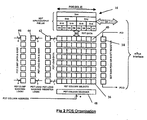
- the PDS 16 comprises a plurality of data memory cells 36 arranged in the form of a memory matrix having a plurality of rows and columns.
- the memory matrix comprises eight rows and eight columns, each row comprising a 64-bit data register 40.
- each data memory cell 36 comprises eight memory bit cells 50 (described later).
- the PDS 16 also includes an 8-bit SDT row pointer shift register 38 for determining a word row location in the memory matrix for a data item being transferred, each bit of the shift register 38 being associated with a particular word row (i.e. data register 40) of the memory matrix.
- the SDT row pointer shift register 38 is routed via the ALbus to facilitate modularity.
- the input PCI and output PCO of the SDT row pointer shift register 38 can be chained together to assemble modular IO configurations.
- the Primary Data Store 16 further includes an 8-bit PDT load data register 42, a PDT load data and mask register 44, a PDT dump data and mask register 46 and a PDT column decoder and selector register 48.
- the PDT load data register 42 is a shift register which is used in the transfer of data between the APEs 34 and the Primary Data Store 16.
- the PDT load data and mask register 44 is used to remove unwanted data bits when transferring data from the Primary Data Store 16 to the APEs 34
- the PDT dump data and mask register 46 is used to remove unwanted data bits when transferring data from the APEs 34 to the Primary Data Store 16.
- Each word row of the PDS memory matrix thus comprises a single 64-bit data register 40, a 1-bit SDT row pointer shift register 38, a 1-bit PDT load data register 42, a PDT load data and mask register 44, a PDT dump data and mask register 46.
- the SDMC 20 comprises a byte rotator 50, a data router 52, a byte aligner 54, a set of sixteen down counter registers 55 and a set of SDMC programmable function registers 56.
- Data movement between SDS 18 and PDS 16, via the SDMC 20 exploits the ability of the SDMC 20 to reorder byte lanes according to the specific requirements of the transfer.
- Data parameters 57 in the SDMC function registers 56 each control the delay applied to a block of data to be transferred (described later). Byte lane control is influenced by a dataSize parameter 59 (described later) in the SDMC function registers 56.
- the SDMC 20 always accesses the SDS 18 on a D64 boundary, but allows D64 items to be passed to and from the SDMC 20 effectively aligned on any byte boundary using a combination of data re-assembly to construct 128-bit words and byte rotation.
- the function of the SDMC 20 is to transfer bytes from the SDS 18 to the PDS 16 in such a way as to facilitate reordering and processing control and efficient processing of the data which contains distortions due to multi-path effects.
- the key to such processing is to account for the phase delays of each finger (multi-path).
- SDT Secondary Data Transfer
- Block b stores: InputData[ ⁇ b + 0] APE[b,0] InputData[ ⁇ b + 1] APE[b,1] InputData[ ⁇ b + 2] APE[b,2] InputData[ ⁇ b + 3] APE[b,3] . . . InputData[ ⁇ b + 255] APE[b,255] where ⁇ b is the offset (delay) of the start of input data being transferred from the SDS that is to be captured by block b.
- Each block has associated with it such a programmable down counter 55 provided in the SDMC 20, and each counter corresponds to one of the skew offset register 58 of the SDMC function registers 56.
- each down counter 55 is programmed with the delay value 57 for that block (i.e. ⁇ b1, ⁇ b2 to ⁇ bN, where N are the number of discrete blocks present in the chip), where the delay value has been taken from the corresponding Skew Offset register 58.
- the delay values 57 each relate to a single finger and have been determined previously as has been described elsewhere in this specification.
- Each down counter 55 is clocked each time a SDT read or write operation is performed. When the down counter reaches 55 zero (or a similarly predefined value), the associated block will be enabled to participate in read or write cycles.
- the value of the corresponding Skew Offset register 58 does not change during decrementing as it can be used in many different cycles of SDT before requiring to be changed by the programmer of the apparatus.
- FIG. 4 a series of D64 accesses from the SDS 18 is shown (e.g. B17-B10 indicates bytes 7 down to 0, from word 1; B27-B20 indicates bytes 7 down 0 from word 2, and so on).
- the byte rotator 50 is able to re-orient these words so that, for example, the D64 items have byte 4 as their MS (Most Significant) byte.
- the byte router 52 is simply used to route the present bytes to the appropriate block for processing and is not described further.
- the byte aligner 54 is able to undertake selective byte lane swapping in order to orient specific bytes to specific byte lanes.
- the byte lane reordering is performed as a function of the selected DataSize parameter in the SDMC function register. This is shown in Figure 5 , where the data size determines how bytes 0 to 7 are aligned.
- the byte lane alignment is achieved by selectively swapping pairs of byte lane groups. For example, if the data size is D32, then the two possible alignments for D32 transfers can interchange the D32 items within the D64 word.
- the byte lane numberings are the logical byte lanes after the byte rotation has been performed. They are not the byte lane numbers relative to the D64 memory word boundary.
- the SDMC Control and Status Registers 56 are now described in greater detail with reference to Figure 6 , which shows the different configuration registers 56 provided in the SDMC 20.
- the register set comprises sixteen SkewOffset registers 58 and two Skew Step registers 60.
- the SkewOffset registers 58 define the base offset address at which the given block will begin to participate in read or write transfers.
- the use of addresses as the delay values is a convenient way of facilitating the delay without further hardware. This is because the process of transferring data already involves sequentially running through the addresses of the data that is to be transferred.
- the provision of separate data counters 55 enables the decrementing of the offset values required for the delay not to effect the use of the values for further data capture.
- the SkewStep registers 60 have special functionality related to sub-sampling of the data stream coming from the SDS 18 which is described later.
- a row pointer (not shown) is initialised at the head of each 256-APE block and the skew counter (SkewCount) 55 for each block is loaded with the corresponding previously determined SDMC 'SkewOffset' parameter 57.
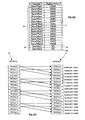
- a 4K data item overlapped transfer is required from the SDS 18 to the PDS 16, with a subset of the SDS memory data being loaded, it may be achieved by programming the Skew Offset registers 58 and Skew Step registers 60 as per shown in the table illustrated in Figure 10a . This results in the transfer of a subset of the available data in a simple repetitive broadcast fashion as illustrated in Figure 10b . The repetition in the counter values 57 is all that is required to replicate the same data for the data transfer. This is another advantage to using counter registers 55 of the present embodiment in the data transfer.
- block mode sub-sampling is now described. For the sake of clarity sub-sampling techniques are described in the context of a second embodiment. However, it is to be understood that sub-sampling is possible using the first embodiment through mere controlling of the programming of the SDMC function registers 56.
- FIG. 11 an SDT pathway for a second embodiment is shown.
- the SDT pathway is identical to that described in the first embodiment except for the provision of a local byte aligner 66 and the byte aligner of the SDMC being called a global byte aligner 56.
- the set of data counters 55 have been shown to be provided at the local byte aligner 66. This is symbolic of the fact that counters relate to data transfer delays associated with specific data blocks.
- the operation of the SDMC 20 and the local byte aligner 66 is now described.
- the support for flexible sub-sampling of the sample stream is achieved via control of the block SkewOffset registers 58 and the SkewStep1 and SkewStep2 registers 60.
- the SkewOffset settings are the initial values programmed into the SkewCount down counters (SkewOffset Registers 58).
- the block mode parameter registers In order to initialise a data transfer (sub-sampled or otherwise), the block mode parameter registers must be initialised as shown in the table of Figure 12 .
- the local byte aligner 66 enables data written to PDS locations to be locally byte swapped at each block boundary according to the LSB's (least significant bit's) of the current SkewCount value for the block in question. This gives a further level of control to the local processing elements which constitute a processing block and enables the programmer to more accurately control the procedure of data processing.
- the functionality of the local byte aligner 66 is distinct from that of the global byte aligner 56, which exhibits similar behaviour, but whose operation is global and defined by the dataSize and the LSBs of the SDSaddress of the item being transferred. This organisation is illustrated in Figure 11 .
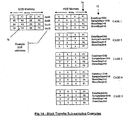
- FIG. 14 show a range of five different cases of sub-sampling examples (denoted here as CASE I to CASE 5).
- CASE I sub-sampling examples
- an example 70 of data residing in the SDS memory 18 is shown.
- the values of a set of parameters 72 of the SDMC 20 are also shown. Adjacent each set of parameter values 72, is shown a representation 74 of the resultant PDS memory store, having the resultant data transferred to it. From this it can be seen how the parameters effect the data transfer in a sub-sampling mode.
- PDS Primary Data Store
- Each Associative Processing Element comprises a 64-bit PDS data register, a 1-bit SDT row pointer shift register, a 1-bit PDT load data register and PDT conditional mask logic.
- the Secondary Data interface to the PDS 16 is known as the ASProCore Local bus (ALbus).
- the shift register 38 is routed via this bus interface to facilitate modularity. The ends of this shift register 38 are simply chained together to assemble modular IO configurations.
- SDT Secondary Data Transfers
- Normal secondary transfers comprise:
- D8 D16, D32 or D64 modes, which are defined as:
- packing modes may be selected independently of the size/alignment of the item defined at the ALbus interface.
- FIG. 3a to 3b show the effect of a single secondary transfer.
- the labelled fields of the selected memory words are transferred to/from the secondary interface in a single clock cycle.
Landscapes
- Engineering & Computer Science (AREA)
- Theoretical Computer Science (AREA)
- Physics & Mathematics (AREA)
- General Engineering & Computer Science (AREA)
- General Physics & Mathematics (AREA)
- Bus Control (AREA)
- Dc Digital Transmission (AREA)
- Mobile Radio Communication Systems (AREA)
- Paper (AREA)
- Electrophonic Musical Instruments (AREA)
- Transceivers (AREA)
- Fittings On The Vehicle Exterior For Carrying Loads, And Devices For Holding Or Mounting Articles (AREA)
Claims (23)
- Datenbewegungscontroller (20) zum Steuern der Bewegung von Daten zwischen einem gemeinsamen Datenspeicher (18) und einem lokalen Datenspeicher (16) auf bitparallele, wortserielle Weise, so dass die Daten in dem lokalen Datenspeicher durch eine Menge von mit dem lokalen Datenspeicher (16) assoziierten Paralleldatenverarbeitungselementen (12) auf bitserielle, wortparallele Weise verwendet werden können,
wobei der Datenbewegungscontroller (20) eine Menge von Datenregistern umfasst, die bei Benutzung mit verschiedenen Datenparametern geladen werden zum Definieren von mehreren verschiedenen Arten des Datentransfers zwischen dem gemeinsamen Datenspeicher (18) und der Menge von mit dem lokalen Datenspeicher (16) assoziierten Verarbeitungselementen (12),
wobei die Datenparameter Folgendes definieren: eine Menge von Zeitverzögerungen zum Transferieren von Abschnitten der Daten zu vorbestimmten Bereichen des lokalen Datenspeichers (16) zur Verwendung mit der Menge von Paralleldatenverarbeitungselementen (12) und Definieren der Arten von Datentransfer, die durchgeführt werden sollen. - Controller (20) nach Anspruch 1, wobei die Menge von Datenregistern programmierbar ist und jedes mit einem Offsetwert geladen werden kann zum Spezifizieren einer individuellen Zeitverzögerung beim Bewirken eines Datentransfers zwischen dem gemeinsamen Datenspeicher (18) und dem lokalen Datenspeicher (16).
- Controller (20) nach Anspruch 2, weiterhin umfassend mehrere Datenzähler, die bei Verwendung mit den in die Datenregister programmierten Offsetwerten geladen werden und danach auf einen vorbestimmten Wert dekrementiert werden, um entsprechende Verzögerungen zu bewirken.
- Controller (20) nach Anspruch 2 oder 3, wobei die mehreren Datenregister weiterhin ein erstes Schrittregister zum Speichern eines ersten Schrittwerts umfassen, wobei der erste Schrittwert die Größe eines auf die in den Datenregistern gespeicherten Offsetwerte anzuwendenden dekrementierenden Schritts definiert.
- Controller (20) nach Anspruch 4, wobei der erste Schrittwert durch die Größe der Daten der aus dem gemeinsamen Datenspeicher (18) abgerufenen Probe bestimmt wird.
- Controller (20) nach Anspruch 4 oder 5, wobei die Menge von Datenregistern weiterhin ein zweites Schrittregister umfasst zum Speichern eines zweiten Schrittwerts, wobei der zweite Schrittwert das Bestimmen der Weise, wie der Datentransfer zu bewirken ist, unterstützt.
- Controller (20) nach Anspruch 6, wobei der zweite Schrittwert eine Differenz zwischen aufeinander folgenden Offsetwerten minus dem ersten Schrittwert umfasst.
- Controller (20) nach einem vorhergehenden Anspruch, weiterhin umfassend Mittel zum Ausführen eines Algorithmus zum Bestimmen der Art von Gesamtdatentransfer, die ausgeführt werden soll.
- Controller (20) nach Anspruch 8 bei Abhängigkeit von Anspruch 6 oder 7, wobei der Art des auszuführenden Gesamtdatentransfers durch die Offsetwerte und den ersten und zweiten Schrittwert definiert wird.
- Controller (20) nach einem der vorhergehenden Ansprüche, wobei der Controller ausgelegt ist, mehrere Arten von Datentransfer zu implementieren ausgewählt aus der Gruppe umfassend: einen einfachen sequenziellen Block-Mode-Transfer, einen blockumordnenden Block-Mode-Transfer, einen Multicast-Block-Mode-Transfer und einen überlappenden Block-Mode-Transfer.
- Controller (20) nach einem vorhergehenden Anspruch, wobei der Controller ausgelegt ist, einen unterabgetasteten Block-Mode-Transfer zu implementieren.
- Controller (20) nach Anspruch 11 bei Abhängigkeit von Anspruch 5 oder Anspruch 6 bei Abhängigkeit von einem der Ansprüche 6 bis 10 bei Abhängigkeit von Anspruch 5, wobei der zweite Schrittwert die Weise bestimmt, wie die Datenunterabtastung ausgeführt werden soll, ohne eine weitere Datenholanweisung auszuführen.
- Controller (20) nach einem vorhergehenden Anspruch, wobei die Menge von Datenregistern ein Datengrößeregister umfasst zum Spezifizieren einer Größe der Datenprobe, die als unteilbare Einheit bei dem Datentransfer verarbeitet werden soll.
- Controller (20) nach einem der vorhergehenden Ansprüche, weiterhin umfassend einen Datenbyteausrichter, der ausgelegt ist, zu transferierende Bytes in Byte-Lanes auszurichten und dann Bytes zwischen Byteleitungen zu vertauschen, um ihre sequenzielle Reihenfolge zu ändern.
- Controller (20) nach Anspruch 14, wobei der Datenbyteausrichter ausgelegt ist, die Datenbytes auf einer beliebigen spezifizierten Bytegrenze auszurichten.
- Controller (20) nach Anspruch 14 bei Abhängigkeit von Anspruch 13, wobei der Datenbyteausrichter ausgelegt ist, die zu transferierenden Bytes von Daten gemäß der in den Datengrößeregistern spezifizierten Probegröße auszurichten.
- Controller (20) nach Anspruch 16, wobei der Datenbyteausrichter ausgelegt ist, die zu transferierenden Bytes von Daten gemäß den am wenigsten signifikanten Bits einer Adresse der transferierten Datenprobe auszurichten.
- Controller (20) nach einem der Ansprüche 14 bis 17, wobei der Byteausrichter einen globalen Byteausrichter umfasst, der ausgelegt ist, Bytes gemäß globalen Parametern auszurichten, die den Datentransfer und den gemeinsamen Datenspeicher betreffen.
- Controller (20) nach Anspruch 18, wobei der Byteausrichter einen lokalen Byteausrichter umfasst, der ausgelegt ist, Bytes gemäß lokalen Parametern auszurichten, die den lokalen Datenspeicher (16) betreffen.
- Controller (20) nach einem der vorhergehenden Ansprüche, weiterhin umfassend einen Bytedreher zum Drehen der Sequenz von zu dem lokalen Datenspeicher (16) zu transferierenden Datenbytes, wobei der Bytedreher ausgelegt ist, die Datenbytes zu einer beliebigen spezifizierten Datenbytegrenze zu drehen.
- Vorrichtung zum effizienten Verarbeiten eines Stroms von digitalen Daten von mehreren Quellen, die an einer Funktelekommunikationsbasisstation empfangen werden, um Verzerrung aufgrund von Mehrwegeeffekten zu entfernen, wobei die Vorrichtung die Verwendung eines Controllers (20) wie in einem vorhergehenden Anspruch definiert umfasst zum Transferieren von Daten von einem gemeinsamen Speicher zu einem lokalen Speicher zur Verarbeitung.
- Verfahren zum Steuern der Bewegung von Daten zwischen einem gemeinsamen Datenspeicher (18) und einem lokalen Datenspeicher (16) auf bitparallele, wortserielle Weise, so dass die Daten in dem lokalen Datenspeicher durch eine Menge von mit dem lokalen Datenspeicher (16) assoziierten Paralleldatenverarbeitungselementen (12) auf bitserielle, wortparallele Weise verwendet werden können, wobei das Verfahren Folgendes umfasst:Laden einer Menge von Datenregistern mit verschiedenen Datenparametern zum Definieren von mehreren verschiedenen Arten von Datentransfers zwischen dem gemeinsamen Datenspeicher (18) und der Menge von mit dem lokalen Datenspeicher (16) assoziierten Verarbeitungselementen (12), wobei die Datenparameter eine Menge von Zeitverzögerungen zum Transferieren von Abschnitten der Daten zu vorbestimmten Bereichen des lokalen Datenspeichers (16) zur Verwendung mit der Menge von Paralleldatenverarbeitungselementen (12) und die Arten von Datentransfer, die durchgeführt werden sollen, definieren.
- Verfahren zum effizienten Verarbeiten eines Stroms von digitalen Daten von mehreren Quellen, die an einer Funktelekommunikationsbasisstation empfangen werden, um Verzerrung aufgrund von Mehrwegeeffekten zu entfernen,
wobei das Verfahren das Transferieren von Daten von einem gemeinsamen Speicher zu einem lokalen Speicher zum Verarbeiten wie in Anspruch 22 dargelegt umfasst.
Applications Claiming Priority (2)
| Application Number | Priority Date | Filing Date | Title |
|---|---|---|---|
| GBGB0413700.6A GB0413700D0 (en) | 2004-06-18 | 2004-06-18 | Improvements relating to mobile communications handling apparatus |
| PCT/GB2005/002425 WO2005124565A2 (en) | 2004-06-18 | 2005-06-20 | Improved data movement controller with time delay parameters |
Publications (2)
| Publication Number | Publication Date |
|---|---|
| EP1761858A2 EP1761858A2 (de) | 2007-03-14 |
| EP1761858B1 true EP1761858B1 (de) | 2010-01-06 |
Family
ID=32750187
Family Applications (1)
| Application Number | Title | Priority Date | Filing Date |
|---|---|---|---|
| EP05755586A Ceased EP1761858B1 (de) | 2004-06-18 | 2005-06-20 | Verbesserte datentransfersteuerung mit zeitverzögerungsparametern |
Country Status (7)
| Country | Link |
|---|---|
| US (1) | US8929829B2 (de) |
| EP (1) | EP1761858B1 (de) |
| JP (1) | JP4885132B2 (de) |
| AT (1) | ATE454665T1 (de) |
| DE (1) | DE602005018775D1 (de) |
| GB (1) | GB0413700D0 (de) |
| WO (1) | WO2005124565A2 (de) |
Families Citing this family (2)
| Publication number | Priority date | Publication date | Assignee | Title |
|---|---|---|---|---|
| GB0616025D0 (en) * | 2006-08-11 | 2006-09-20 | Aspex Semiconductor Ltd | Improvements relating to direct data input/output interfaces |
| US7826813B2 (en) * | 2006-12-22 | 2010-11-02 | Orthosoft Inc. | Method and system for determining a time delay between transmission and reception of an RF signal in a noisy RF environment using frequency detection |
Family Cites Families (19)
| Publication number | Priority date | Publication date | Assignee | Title |
|---|---|---|---|---|
| US4658247A (en) | 1984-07-30 | 1987-04-14 | Cornell Research Foundation, Inc. | Pipelined, line buffered real-time color graphics display system |
| US4933846A (en) * | 1987-04-24 | 1990-06-12 | Network Systems Corporation | Network communications adapter with dual interleaved memory banks servicing multiple processors |
| US4858247A (en) * | 1988-01-19 | 1989-08-22 | Hooser Donald L | Cap shape supports |
| JP2603717B2 (ja) | 1989-03-09 | 1997-04-23 | 三菱電機株式会社 | サイクリックデータ伝送方法 |
| JP2658549B2 (ja) * | 1990-10-17 | 1997-09-30 | 日本電気株式会社 | マイクロコンピュータ |
| US5734926A (en) | 1992-07-15 | 1998-03-31 | Advanced Hardware Architectures | Direct memory access controller in an integrated circuit |
| US6026443A (en) | 1992-12-22 | 2000-02-15 | Sun Microsystems, Inc. | Multi-virtual DMA channels, multi-bandwidth groups, host based cellification and reassembly, and asynchronous transfer mode network interface |
| US6011798A (en) | 1997-08-15 | 2000-01-04 | Intel Corporation | Adaptive transmit rate control scheduler |
| US6052375A (en) | 1997-11-26 | 2000-04-18 | International Business Machines Corporation | High speed internetworking traffic scaler and shaper |
| US6029225A (en) | 1997-12-16 | 2000-02-22 | Hewlett-Packard Company | Cache bank conflict avoidance and cache collision avoidance |
| US6070194A (en) | 1997-12-17 | 2000-05-30 | Advanced Micro Devices, Inc. | Using an index and count mechanism to coordinate access to a shared resource by interactive devices |
| US6275877B1 (en) | 1998-10-27 | 2001-08-14 | James Duda | Memory access controller |
| US6393512B1 (en) | 1999-09-27 | 2002-05-21 | Ati International Srl | Circuit and method for detecting bank conflicts in accessing adjacent banks |
| GB0028354D0 (en) * | 2000-11-21 | 2001-01-03 | Aspex Technology Ltd | Improvements relating to memory addressing |
| US6820142B2 (en) * | 2000-12-14 | 2004-11-16 | International Business Machines Corporation | Token based DMA |
| US7190710B2 (en) * | 2001-06-08 | 2007-03-13 | Broadcom Corporation | Successive interference canceling for CMDA |
| US7042926B2 (en) * | 2001-11-21 | 2006-05-09 | Intel Corporation | Low complexity multiuser detector |
| AU2003248867A1 (en) | 2002-07-08 | 2004-01-23 | Globespanvirata Incorporated | System and method for packet transmission from fragmented buffer |
| US7068708B2 (en) * | 2002-12-13 | 2006-06-27 | Motorola, Inc. | Method and receiving unit for demodulating a multi-path signal |
-
2004
- 2004-06-18 GB GBGB0413700.6A patent/GB0413700D0/en not_active Ceased
-
2005
- 2005-06-20 DE DE602005018775T patent/DE602005018775D1/de not_active Expired - Lifetime
- 2005-06-20 JP JP2007516051A patent/JP4885132B2/ja not_active Expired - Fee Related
- 2005-06-20 WO PCT/GB2005/002425 patent/WO2005124565A2/en not_active Ceased
- 2005-06-20 AT AT05755586T patent/ATE454665T1/de not_active IP Right Cessation
- 2005-06-20 EP EP05755586A patent/EP1761858B1/de not_active Ceased
- 2005-06-20 US US11/629,293 patent/US8929829B2/en active Active
Also Published As
| Publication number | Publication date |
|---|---|
| EP1761858A2 (de) | 2007-03-14 |
| DE602005018775D1 (de) | 2010-02-25 |
| WO2005124565A2 (en) | 2005-12-29 |
| WO2005124565A3 (en) | 2006-04-27 |
| JP4885132B2 (ja) | 2012-02-29 |
| ATE454665T1 (de) | 2010-01-15 |
| US8929829B2 (en) | 2015-01-06 |
| JP2008503131A (ja) | 2008-01-31 |
| US20090197536A1 (en) | 2009-08-06 |
| GB0413700D0 (en) | 2004-07-21 |
Similar Documents
| Publication | Publication Date | Title |
|---|---|---|
| US5586256A (en) | Computer system using multidimensional addressing between multiple processors having independently addressable internal memory for efficient reordering and redistribution of data arrays between the processors | |
| AU2002303661B2 (en) | System and method for web server with a reconfigurable processor operating under single operation system image | |
| JP4386636B2 (ja) | プロセッサアーキテクチャ | |
| JP4241045B2 (ja) | プロセッサアーキテクチャ | |
| EP1083572A1 (de) | Dreitorige inhaltsadressierbare Speicheranordnung und Methoden ihrer Implementierung | |
| JPS62208158A (ja) | マルチプロセツサシステム | |
| US20210158068A1 (en) | Operation Circuit of Convolutional Neural Network | |
| WO2003044671A1 (en) | Ram-based range content addressable memory | |
| US7409528B2 (en) | Digital signal processing architecture with a wide memory bandwidth and a memory mapping method thereof | |
| US7260217B1 (en) | Speculative execution for data ciphering operations | |
| US7746350B1 (en) | Cryptographic computations on general purpose graphics processing units | |
| US8489825B2 (en) | Method of storing data, method of loading data and signal processor | |
| US20060155953A1 (en) | Method and apparatus for accessing multiple vector elements in parallel | |
| CN1005434B (zh) | 用于图形处理器的字块移位装置 | |
| US20060159103A1 (en) | Providing access to data shared by packet processing threads | |
| US8929829B2 (en) | Improvements relating to data transfer apparatus | |
| EP1733300B1 (de) | Verbesserungen im bezug auf orthogonal-datenspeicher | |
| Kondo et al. | Pseudo MIMD array processor—AAP2 | |
| US6795874B2 (en) | Direct memory accessing | |
| US5987564A (en) | Associative memory device | |
| US6901359B1 (en) | High speed software driven emulator comprised of a plurality of emulation processors with a method to allow high speed bulk read/write operation synchronous DRAM while refreshing the memory | |
| US20070162644A1 (en) | Data packing in A 32-bit DMA architecture | |
| JPH11110339A (ja) | Dmaコントローラ | |
| US6801209B1 (en) | Method and apparatus for storing data in a block-based memory arrangement | |
| JP2005534120A (ja) | 並列に複数のベクトル要素にアクセスするための装置及び方法 |
Legal Events
| Date | Code | Title | Description |
|---|---|---|---|
| PUAI | Public reference made under article 153(3) epc to a published international application that has entered the european phase |
Free format text: ORIGINAL CODE: 0009012 |
|
| 17P | Request for examination filed |
Effective date: 20070116 |
|
| AK | Designated contracting states |
Kind code of ref document: A2 Designated state(s): AT BE BG CH CY CZ DE DK EE ES FI FR GB GR HU IE IS IT LI LT LU MC NL PL PT RO SE SI SK TR |
|
| DAX | Request for extension of the european patent (deleted) | ||
| 17Q | First examination report despatched |
Effective date: 20071024 |
|
| GRAP | Despatch of communication of intention to grant a patent |
Free format text: ORIGINAL CODE: EPIDOSNIGR1 |
|
| GRAS | Grant fee paid |
Free format text: ORIGINAL CODE: EPIDOSNIGR3 |
|
| GRAA | (expected) grant |
Free format text: ORIGINAL CODE: 0009210 |
|
| AK | Designated contracting states |
Kind code of ref document: B1 Designated state(s): AT BE BG CH CY CZ DE DK EE ES FI FR GB GR HU IE IS IT LI LT LU MC NL PL PT RO SE SI SK TR |
|
| REG | Reference to a national code |
Ref country code: GB Ref legal event code: FG4D |
|
| REG | Reference to a national code |
Ref country code: CH Ref legal event code: EP |
|
| REG | Reference to a national code |
Ref country code: IE Ref legal event code: FG4D |
|
| REF | Corresponds to: |
Ref document number: 602005018775 Country of ref document: DE Date of ref document: 20100225 Kind code of ref document: P |
|
| REG | Reference to a national code |
Ref country code: NL Ref legal event code: VDEP Effective date: 20100106 |
|
| PG25 | Lapsed in a contracting state [announced via postgrant information from national office to epo] |
Ref country code: SI Free format text: LAPSE BECAUSE OF FAILURE TO SUBMIT A TRANSLATION OF THE DESCRIPTION OR TO PAY THE FEE WITHIN THE PRESCRIBED TIME-LIMIT Effective date: 20100106 |
|
| LTIE | Lt: invalidation of european patent or patent extension |
Effective date: 20100106 |
|
| PG25 | Lapsed in a contracting state [announced via postgrant information from national office to epo] |
Ref country code: AT Free format text: LAPSE BECAUSE OF FAILURE TO SUBMIT A TRANSLATION OF THE DESCRIPTION OR TO PAY THE FEE WITHIN THE PRESCRIBED TIME-LIMIT Effective date: 20100106 |
|
| PG25 | Lapsed in a contracting state [announced via postgrant information from national office to epo] |
Ref country code: LT Free format text: LAPSE BECAUSE OF FAILURE TO SUBMIT A TRANSLATION OF THE DESCRIPTION OR TO PAY THE FEE WITHIN THE PRESCRIBED TIME-LIMIT Effective date: 20100106 Ref country code: ES Free format text: LAPSE BECAUSE OF FAILURE TO SUBMIT A TRANSLATION OF THE DESCRIPTION OR TO PAY THE FEE WITHIN THE PRESCRIBED TIME-LIMIT Effective date: 20100417 Ref country code: NL Free format text: LAPSE BECAUSE OF FAILURE TO SUBMIT A TRANSLATION OF THE DESCRIPTION OR TO PAY THE FEE WITHIN THE PRESCRIBED TIME-LIMIT Effective date: 20100106 Ref country code: IS Free format text: LAPSE BECAUSE OF FAILURE TO SUBMIT A TRANSLATION OF THE DESCRIPTION OR TO PAY THE FEE WITHIN THE PRESCRIBED TIME-LIMIT Effective date: 20100506 Ref country code: PT Free format text: LAPSE BECAUSE OF FAILURE TO SUBMIT A TRANSLATION OF THE DESCRIPTION OR TO PAY THE FEE WITHIN THE PRESCRIBED TIME-LIMIT Effective date: 20100506 |
|
| PG25 | Lapsed in a contracting state [announced via postgrant information from national office to epo] |
Ref country code: PL Free format text: LAPSE BECAUSE OF FAILURE TO SUBMIT A TRANSLATION OF THE DESCRIPTION OR TO PAY THE FEE WITHIN THE PRESCRIBED TIME-LIMIT Effective date: 20100106 Ref country code: FI Free format text: LAPSE BECAUSE OF FAILURE TO SUBMIT A TRANSLATION OF THE DESCRIPTION OR TO PAY THE FEE WITHIN THE PRESCRIBED TIME-LIMIT Effective date: 20100106 |
|
| PG25 | Lapsed in a contracting state [announced via postgrant information from national office to epo] |
Ref country code: RO Free format text: LAPSE BECAUSE OF FAILURE TO SUBMIT A TRANSLATION OF THE DESCRIPTION OR TO PAY THE FEE WITHIN THE PRESCRIBED TIME-LIMIT Effective date: 20100106 Ref country code: CY Free format text: LAPSE BECAUSE OF FAILURE TO SUBMIT A TRANSLATION OF THE DESCRIPTION OR TO PAY THE FEE WITHIN THE PRESCRIBED TIME-LIMIT Effective date: 20100106 Ref country code: EE Free format text: LAPSE BECAUSE OF FAILURE TO SUBMIT A TRANSLATION OF THE DESCRIPTION OR TO PAY THE FEE WITHIN THE PRESCRIBED TIME-LIMIT Effective date: 20100106 Ref country code: BE Free format text: LAPSE BECAUSE OF FAILURE TO SUBMIT A TRANSLATION OF THE DESCRIPTION OR TO PAY THE FEE WITHIN THE PRESCRIBED TIME-LIMIT Effective date: 20100106 Ref country code: GR Free format text: LAPSE BECAUSE OF FAILURE TO SUBMIT A TRANSLATION OF THE DESCRIPTION OR TO PAY THE FEE WITHIN THE PRESCRIBED TIME-LIMIT Effective date: 20100407 Ref country code: SE Free format text: LAPSE BECAUSE OF FAILURE TO SUBMIT A TRANSLATION OF THE DESCRIPTION OR TO PAY THE FEE WITHIN THE PRESCRIBED TIME-LIMIT Effective date: 20100106 |
|
| PLBE | No opposition filed within time limit |
Free format text: ORIGINAL CODE: 0009261 |
|
| STAA | Information on the status of an ep patent application or granted ep patent |
Free format text: STATUS: NO OPPOSITION FILED WITHIN TIME LIMIT |
|
| PG25 | Lapsed in a contracting state [announced via postgrant information from national office to epo] |
Ref country code: BG Free format text: LAPSE BECAUSE OF FAILURE TO SUBMIT A TRANSLATION OF THE DESCRIPTION OR TO PAY THE FEE WITHIN THE PRESCRIBED TIME-LIMIT Effective date: 20100406 Ref country code: CZ Free format text: LAPSE BECAUSE OF FAILURE TO SUBMIT A TRANSLATION OF THE DESCRIPTION OR TO PAY THE FEE WITHIN THE PRESCRIBED TIME-LIMIT Effective date: 20100106 Ref country code: SK Free format text: LAPSE BECAUSE OF FAILURE TO SUBMIT A TRANSLATION OF THE DESCRIPTION OR TO PAY THE FEE WITHIN THE PRESCRIBED TIME-LIMIT Effective date: 20100106 |
|
| 26N | No opposition filed |
Effective date: 20101007 |
|
| PG25 | Lapsed in a contracting state [announced via postgrant information from national office to epo] |
Ref country code: MC Free format text: LAPSE BECAUSE OF NON-PAYMENT OF DUE FEES Effective date: 20100630 Ref country code: DK Free format text: LAPSE BECAUSE OF FAILURE TO SUBMIT A TRANSLATION OF THE DESCRIPTION OR TO PAY THE FEE WITHIN THE PRESCRIBED TIME-LIMIT Effective date: 20100106 |
|
| REG | Reference to a national code |
Ref country code: CH Ref legal event code: PL |
|
| PG25 | Lapsed in a contracting state [announced via postgrant information from national office to epo] |
Ref country code: IT Free format text: LAPSE BECAUSE OF FAILURE TO SUBMIT A TRANSLATION OF THE DESCRIPTION OR TO PAY THE FEE WITHIN THE PRESCRIBED TIME-LIMIT Effective date: 20100106 |
|
| PG25 | Lapsed in a contracting state [announced via postgrant information from national office to epo] |
Ref country code: CH Free format text: LAPSE BECAUSE OF NON-PAYMENT OF DUE FEES Effective date: 20100630 Ref country code: LI Free format text: LAPSE BECAUSE OF NON-PAYMENT OF DUE FEES Effective date: 20100630 Ref country code: IE Free format text: LAPSE BECAUSE OF NON-PAYMENT OF DUE FEES Effective date: 20100620 |
|
| PG25 | Lapsed in a contracting state [announced via postgrant information from national office to epo] |
Ref country code: HU Free format text: LAPSE BECAUSE OF FAILURE TO SUBMIT A TRANSLATION OF THE DESCRIPTION OR TO PAY THE FEE WITHIN THE PRESCRIBED TIME-LIMIT Effective date: 20100707 Ref country code: LU Free format text: LAPSE BECAUSE OF NON-PAYMENT OF DUE FEES Effective date: 20100620 |
|
| PG25 | Lapsed in a contracting state [announced via postgrant information from national office to epo] |
Ref country code: TR Free format text: LAPSE BECAUSE OF FAILURE TO SUBMIT A TRANSLATION OF THE DESCRIPTION OR TO PAY THE FEE WITHIN THE PRESCRIBED TIME-LIMIT Effective date: 20100106 |
|
| REG | Reference to a national code |
Ref country code: GB Ref legal event code: 732E Free format text: REGISTERED BETWEEN 20130110 AND 20130116 |
|
| REG | Reference to a national code |
Ref country code: FR Ref legal event code: TP Owner name: TELEFONAKTIEBOLAGET L M ERICSSON (PUBL), SE Effective date: 20130418 |
|
| REG | Reference to a national code |
Ref country code: DE Ref legal event code: R082 Ref document number: 602005018775 Country of ref document: DE Representative=s name: COHAUSZ & FLORACK PATENT- UND RECHTSANWAELTE P, DE |
|
| REG | Reference to a national code |
Ref country code: DE Ref legal event code: R081 Ref document number: 602005018775 Country of ref document: DE Owner name: TELEFONAKTIEBOLAGET L M ERICSSON (PUBL), SE Free format text: FORMER OWNER: ASPEX SEMICONDUCTOR LTD., HIGH WYCOMBE, GB Effective date: 20140311 Ref country code: DE Ref legal event code: R082 Ref document number: 602005018775 Country of ref document: DE Representative=s name: COHAUSZ & FLORACK PATENT- UND RECHTSANWAELTE P, DE Effective date: 20140311 Ref country code: DE Ref legal event code: R081 Ref document number: 602005018775 Country of ref document: DE Owner name: TELEFONAKTIEBOLAGET L M ERICSSON (PUBL), SE Free format text: FORMER OWNER: ASPEX SEMICONDUCTOR LTD., HIGH WYCOMBE, BUCKINGHAMSHIRE, GB Effective date: 20140311 |
|
| REG | Reference to a national code |
Ref country code: FR Ref legal event code: PLFP Year of fee payment: 12 |
|
| REG | Reference to a national code |
Ref country code: FR Ref legal event code: PLFP Year of fee payment: 13 |
|
| REG | Reference to a national code |
Ref country code: FR Ref legal event code: PLFP Year of fee payment: 14 |
|
| PGFP | Annual fee paid to national office [announced via postgrant information from national office to epo] |
Ref country code: FR Payment date: 20180626 Year of fee payment: 14 |
|
| PGFP | Annual fee paid to national office [announced via postgrant information from national office to epo] |
Ref country code: GB Payment date: 20180627 Year of fee payment: 14 Ref country code: DE Payment date: 20180627 Year of fee payment: 14 |
|
| REG | Reference to a national code |
Ref country code: DE Ref legal event code: R119 Ref document number: 602005018775 Country of ref document: DE |
|
| GBPC | Gb: european patent ceased through non-payment of renewal fee |
Effective date: 20190620 |
|
| PG25 | Lapsed in a contracting state [announced via postgrant information from national office to epo] |
Ref country code: GB Free format text: LAPSE BECAUSE OF NON-PAYMENT OF DUE FEES Effective date: 20190620 Ref country code: DE Free format text: LAPSE BECAUSE OF NON-PAYMENT OF DUE FEES Effective date: 20200101 |
|
| PG25 | Lapsed in a contracting state [announced via postgrant information from national office to epo] |
Ref country code: FR Free format text: LAPSE BECAUSE OF NON-PAYMENT OF DUE FEES Effective date: 20190630 |