EP1759998A1 - Packaging method and machine for producing sealed packages of pourable food products - Google Patents
Packaging method and machine for producing sealed packages of pourable food products Download PDFInfo
- Publication number
- EP1759998A1 EP1759998A1 EP05425608A EP05425608A EP1759998A1 EP 1759998 A1 EP1759998 A1 EP 1759998A1 EP 05425608 A EP05425608 A EP 05425608A EP 05425608 A EP05425608 A EP 05425608A EP 1759998 A1 EP1759998 A1 EP 1759998A1
- Authority
- EP
- European Patent Office
- Prior art keywords
- packaging material
- web
- labels
- packages
- forming
- Prior art date
- Legal status (The legal status is an assumption and is not a legal conclusion. Google has not performed a legal analysis and makes no representation as to the accuracy of the status listed.)
- Withdrawn
Links
- 238000000034 method Methods 0.000 title claims abstract description 25
- 235000013305 food Nutrition 0.000 title claims abstract description 24
- 238000004806 packaging method and process Methods 0.000 title claims description 10
- 239000005022 packaging material Substances 0.000 claims abstract description 44
- 238000007789 sealing Methods 0.000 claims description 15
- 230000001954 sterilising effect Effects 0.000 claims description 15
- 238000011144 upstream manufacturing Methods 0.000 claims description 4
- 239000000853 adhesive Substances 0.000 claims description 3
- 230000001070 adhesive effect Effects 0.000 claims description 3
- 239000000126 substance Substances 0.000 claims 1
- 239000003206 sterilizing agent Substances 0.000 description 6
- MHAJPDPJQMAIIY-UHFFFAOYSA-N Hydrogen peroxide Chemical compound OO MHAJPDPJQMAIIY-UHFFFAOYSA-N 0.000 description 5
- 238000001035 drying Methods 0.000 description 5
- 239000000463 material Substances 0.000 description 4
- 238000002372 labelling Methods 0.000 description 3
- 239000004033 plastic Substances 0.000 description 3
- 229920003023 plastic Polymers 0.000 description 3
- 238000005520 cutting process Methods 0.000 description 2
- 238000005034 decoration Methods 0.000 description 2
- 239000007788 liquid Substances 0.000 description 2
- 230000005855 radiation Effects 0.000 description 2
- 229920000219 Ethylene vinyl alcohol Polymers 0.000 description 1
- 235000007688 Lycopersicon esculentum Nutrition 0.000 description 1
- 239000004698 Polyethylene Substances 0.000 description 1
- 240000003768 Solanum lycopersicum Species 0.000 description 1
- 239000005030 aluminium foil Substances 0.000 description 1
- 230000004888 barrier function Effects 0.000 description 1
- 238000010586 diagram Methods 0.000 description 1
- UFRKOOWSQGXVKV-UHFFFAOYSA-N ethene;ethenol Chemical compound C=C.OC=C UFRKOOWSQGXVKV-UHFFFAOYSA-N 0.000 description 1
- 239000004715 ethylene vinyl alcohol Substances 0.000 description 1
- 239000002657 fibrous material Substances 0.000 description 1
- 239000000796 flavoring agent Substances 0.000 description 1
- 235000015203 fruit juice Nutrition 0.000 description 1
- 238000010438 heat treatment Methods 0.000 description 1
- QOSATHPSBFQAML-UHFFFAOYSA-N hydrogen peroxide;hydrate Chemical compound O.OO QOSATHPSBFQAML-UHFFFAOYSA-N 0.000 description 1
- 230000001771 impaired effect Effects 0.000 description 1
- 230000006698 induction Effects 0.000 description 1
- 239000004615 ingredient Substances 0.000 description 1
- 230000001678 irradiating effect Effects 0.000 description 1
- 235000020191 long-life milk Nutrition 0.000 description 1
- 238000004519 manufacturing process Methods 0.000 description 1
- 235000013336 milk Nutrition 0.000 description 1
- 239000008267 milk Substances 0.000 description 1
- 210000004080 milk Anatomy 0.000 description 1
- 230000010355 oscillation Effects 0.000 description 1
- 150000002978 peroxides Chemical class 0.000 description 1
- -1 polyethylene Polymers 0.000 description 1
- 229920000573 polyethylene Polymers 0.000 description 1
- 230000001681 protective effect Effects 0.000 description 1
- 235000015067 sauces Nutrition 0.000 description 1
- 239000007779 soft material Substances 0.000 description 1
- 238000004659 sterilization and disinfection Methods 0.000 description 1
- 238000003860 storage Methods 0.000 description 1
- XLYOFNOQVPJJNP-UHFFFAOYSA-N water Substances O XLYOFNOQVPJJNP-UHFFFAOYSA-N 0.000 description 1
- 235000014101 wine Nutrition 0.000 description 1
Images


Classifications
-
- B—PERFORMING OPERATIONS; TRANSPORTING
- B65—CONVEYING; PACKING; STORING; HANDLING THIN OR FILAMENTARY MATERIAL
- B65B—MACHINES, APPARATUS OR DEVICES FOR, OR METHODS OF, PACKAGING ARTICLES OR MATERIALS; UNPACKING
- B65B9/00—Enclosing successive articles, or quantities of material, e.g. liquids or semiliquids, in flat, folded, or tubular webs of flexible sheet material; Subdividing filled flexible tubes to form packages
- B65B9/10—Enclosing successive articles, or quantities of material, in preformed tubular webs, or in webs formed into tubes around filling nozzles, e.g. extruded tubular webs
- B65B9/20—Enclosing successive articles, or quantities of material, in preformed tubular webs, or in webs formed into tubes around filling nozzles, e.g. extruded tubular webs the webs being formed into tubes in situ around the filling nozzles
-
- B—PERFORMING OPERATIONS; TRANSPORTING
- B65—CONVEYING; PACKING; STORING; HANDLING THIN OR FILAMENTARY MATERIAL
- B65B—MACHINES, APPARATUS OR DEVICES FOR, OR METHODS OF, PACKAGING ARTICLES OR MATERIALS; UNPACKING
- B65B55/00—Preserving, protecting or purifying packages or package contents in association with packaging
- B65B55/02—Sterilising, e.g. of complete packages
- B65B55/04—Sterilising wrappers or receptacles prior to, or during, packaging
- B65B55/10—Sterilising wrappers or receptacles prior to, or during, packaging by liquids or gases
- B65B55/103—Sterilising flat or tubular webs
-
- B—PERFORMING OPERATIONS; TRANSPORTING
- B65—CONVEYING; PACKING; STORING; HANDLING THIN OR FILAMENTARY MATERIAL
- B65B—MACHINES, APPARATUS OR DEVICES FOR, OR METHODS OF, PACKAGING ARTICLES OR MATERIALS; UNPACKING
- B65B9/00—Enclosing successive articles, or quantities of material, e.g. liquids or semiliquids, in flat, folded, or tubular webs of flexible sheet material; Subdividing filled flexible tubes to form packages
- B65B9/10—Enclosing successive articles, or quantities of material, in preformed tubular webs, or in webs formed into tubes around filling nozzles, e.g. extruded tubular webs
- B65B9/20—Enclosing successive articles, or quantities of material, in preformed tubular webs, or in webs formed into tubes around filling nozzles, e.g. extruded tubular webs the webs being formed into tubes in situ around the filling nozzles
- B65B9/2056—Machines for packages of special type or form
-
- B—PERFORMING OPERATIONS; TRANSPORTING
- B65—CONVEYING; PACKING; STORING; HANDLING THIN OR FILAMENTARY MATERIAL
- B65D—CONTAINERS FOR STORAGE OR TRANSPORT OF ARTICLES OR MATERIALS, e.g. BAGS, BARRELS, BOTTLES, BOXES, CANS, CARTONS, CRATES, DRUMS, JARS, TANKS, HOPPERS, FORWARDING CONTAINERS; ACCESSORIES, CLOSURES, OR FITTINGS THEREFOR; PACKAGING ELEMENTS; PACKAGES
- B65D2203/00—Decoration means, markings, information elements, contents indicators
- B65D2203/02—Labels
Definitions
- the present invention relates to a method of producing sealed packages of pourable food products, and to a packaging machine implementing such a method.
- pourable food products such as fruit juice, pasteurized or UHT (ultra-high-temperature treated) milk, wine, tomato sauce, etc.
- UHT ultra-high-temperature treated milk
- wine tomato sauce
- etc. are sold in packages made of sterilized packaging material.
- Tetra Brik Aseptic registered trademark
- a typical example of this type of package is the parallelepiped-shaped package for liquid or pourable food products known as Tetra Brik Aseptic (registered trademark), which is made by folding and sealing laminated strip packaging material.
- the packaging material normally has a multilayer structure comprising a layer of fibrous material, e.g. paper, covered on both sides with layers of heat-seal plastic material, e.g. polyethylene.
- the packaging material comprises a layer of barrier material, e.g. defined by a sheet of aluminium foil or EVOH, which is superimposed on a layer of heat-seal plastic material, and is in turn covered with another layer of heat-seal plastic material eventually forming the inner face of the package contacting the food product.
- barrier material e.g. defined by a sheet of aluminium foil or EVOH
- the strip packaging material is normally supplied pre-printed with a series of equally spaced graphics or decorations on the portions eventually defining the outer surface of the packages.
- the decorations normally comprise both images and writing, e.g. indicating the brand and providing consumer information about the product and the manufacturer.
- packages of this sort are produced on fully automatic packaging machines, on which a continuous tube is formed from the web-fed packaging material. More specifically, the web of packaging material is unwound off a reel and fed through an aseptic chamber on the packaging machine, where it is sterilized, e.g. by applying a sterilizing agent such as hydrogen peroxide, which is subsequently evaporated by heating and/or subjecting the packaging material to radiation of appropriate wavelength and intensity; and the web so sterilized is maintained in a closed, sterile environment, and is folded into a cylinder and sealed longitudinally to form a continuous tube in known manner.
- a sterilizing agent such as hydrogen peroxide
- the tube of packaging material is fed in a vertical direction, is filled with the sterilized or sterile-processed food product, and is fed through a sealing device to form the individual packages. More specifically, in the sealing device, the tube is sealed along a number of equally spaced cross sections to form a continuous strip of pillow packs connected to one another by respective transverse sealing bands, i.e. extending perpendicularly to the traveling direction of the tube.
- the pillow packs are separated by cutting the relative transverse sealing bands, and are then conveyed to a folding station where they are folded mechanically to form respective finished, parallelepiped-shaped packages.
- labels are applied to complete the external configuration of the package.
- the labels may contain specific additional consumer information, such as recipes, sales promotion details, or the use of particular ingredients or flavourings.
- labels are applied to specific outer surface areas of the package with no printing, so that, using labels with different graphics, packages with different external configurations can be obtained as required.
- labels are used to cover bar codes of packages sold in groups as opposed to singly.
- the labels are normally applied by specific labelling devices as the packages are fed in an upright position along a conveyor belt.
- covering the bar codes with labels may prove extremely difficult, on account of the areas in which the bar codes are located normally being difficult to reach in the travelling position of the packages on the conveyor belt.
- the present invention also relates to a packaging machine for producing sealed packages of pourable food products, as claimed in Claim 8.
- Number 1 in Figure 1 indicates as a whole a pourable food product packaging machine for continuously producing aseptic sealed packages of a pourable food product (some examples of which are shown in Figures 2, 4, 6, 8, 10 and commented on below) from a web of packaging material 2 (hereinafter referred to simply as "web 2").
- Machine 1 comprises a sterilizing unit 3 for sterilizing web 2, and to which web 2 is fed off a reel (not shown) along a substantially horizontal path P 1 ; and a form-and-seal unit 4, in which web 2 is folded, sealed, and filled with the pourable food product to form the finished packages.
- Sterilizing unit 3 substantially comprises a U-shaped sterilizing bath 5 containing a liquid sterilizing agent, e.g. a solution of 30% hydrogen peroxide (H 2 O 2 ) and water, up to a predetermined level.
- Bath 5 is defined by a vertical input branch 6 and a vertical output branch 7, which have respective top openings 8 and 9 respectively defining the inlet and outlet by which web 2 is fed in and out of bath 5.
- Branches 6 and 7 are connected at the bottom by a bottom portion 11 of bath 5 housing a horizontal-axis guide roller 12.
- web 2 therefore describes a U-shaped path P 2 , the length of which is defined, as a function of the travelling speed of web 2, to ensure the packaging material remains long enough inside the sterilizing agent (e.g. 7 seconds).
- Bath 5 forms part of a known peroxide control circuit (not shown), and is maintained, in use, at a controlled temperature, e.g. of about 70°C.
- Machine 1 also comprises an aseptic chamber 15 having an inlet coincident with outlet 9 of bath 5.
- Aseptic chamber 15 is defined by a top portion 16 housing known drying means 17 for removing residual sterilizing agent from web 2, and by a vertical bottom portion or tower 18 parallel to bath 5 and in which web 2 is folded longitudinally into a cylinder and sealed to form a continuous cylindrical tube 20.
- Drying means 17 are shown only partly in Figure 1, by not being necessary to a clear understanding of the present invention, and, as shown, substantially comprise two idle drying rollers 21, which are covered with relatively soft material, have respective horizontal axes parallel to each other, are located close to the inlet of aseptic chamber 15, on opposite sides of web 2, and exert pressure on respective opposite faces of web 2 to squeeze the drops of sterilizing agent out and back into bath 5.
- Drying means 17 also comprise known air knives (not shown) located downstream from rollers 21 (in the travelling direction of web 2), i.e. over rollers 21, to direct hot-air jets onto web 2.
- Aseptic chamber 15 is maintained at a slightly higher pressure than the outside atmosphere, so that any leakage from the seals is outwards and not inwards of the chamber.
- the overpressure must be limited - in the order of a few mbars - to prevent excessive leakage of air contaminated by the sterilizing agent, which would pollute the working environment.
- Top portion 16 and tower 18 of aseptic chamber 15 also house direction rollers and guide members, indicated generically by 23, for folding web 2 into a cylinder and forming tube 20 of packaging material.
- tube 20 practically forms an extension of aseptic chamber 15, and is filled continuously downwards with the pourable food product by a feed conduit 24.
- tube 20 is fed along a vertical path P 3 parallel to branches 6 and 7 of bath 5, and through form-and-seal unit 4 to produce the individual packages.
- form-and-seal unit 4 - known and only shown schematically - comprises two or more pairs of jaws 25, which act cyclically on tube 20 to grip and seal it along equally spaced cross sections.
- the result of the above operation is a continuous strip (shown only partly) of pillow packs 26 joined to one another by transverse sealing bands 27, and which are subsequently separated by cutting sealing bands 27 in known manner not shown, and are folded mechanically by a downstream unit - also known and not shown - to form the finished packages.
- Machine 1 advantageously also comprises a device 30 operating upstream from sterilizing unit 3 and form-and-seal unit 4 to apply labels 31 directly onto web 2.
- labels 31 are preferably adhesive, and are supplied on a continuous strip 32, which is unwound off a reel 33, is fed between a number of direction rollers 34, and is rewound, without labels 31, onto a further reel 35.
- strip 32 of labels 31 is fed by rollers 34 along a path P 4 terminating, close to web 2, with a portion 36 incident with respect to web 2.
- rollers 34 diverts strip 32 roughly 180° towards reel 35, and the sharp change in direction is exploited to detach labels 31 from strip 32 and attach labels 31 to web 2.
- the adhesive used to fix labels 31 to web 2 must be resistant to the sterilization process through bath 5 containing hydrogen peroxide, and to the follow-up hot-air-jet drying process.
- web 2 as it travels along path P 1 and before reaching sterilizing unit 3 and form-and-seal unit 4, is fed past device 30 for applying labels 31.
- Labels 31 are fixed to predetermined areas of the portions of web 2 eventually forming the individual packages.
- Numbers 10, 10', 10'', 10''', 10'''' in Figures 2, 4, 6, 8, 10 indicate as a whole examples of known packages producible on machine 1.
- Numbers 100, 100', 100'', 100''', 100''', 100'''' in Figures 3, 5, 7, 9, 11 indicate the portions of web 2 from which packages 10, 10', 10'', 10''', 10'''' are formed respectively.
- portions 100, 100', 100'', 100''' and 100''''', A, A', A'', A''', A'''' indicate respective crease patterns, i.e. fold lines along which web 2 is folded as it is fed through form-and-seal unit 4, and B, B', B'', B''', B'''' indicate the areas in which labels 31 of various shapes and sizes are to be applied.
- any area of web portions 100, 100', 100'', 100''', 100'''', 100''' eventually forming respective finished packages 10, 10', 10'', 10''', 10'''' when formed and sealed is easily accessible and, above all, with the same positioning precision.
- the surface of web 2 to which labels 31 are applied is flat and even, unlike the panels of a normal finished package, the planes of which are affected by the pourable food product inside the package.
- Device 30 may easily be used to apply a number of labels 31 simultaneously to the same portion 100, 100', 100'', 100''', 100'''' of web 2, thus simplifying machine 1 as compared with known packaging machines.
- Correct positioning of labels 31 on web 2 may advantageously be controlled, for example, using a special graphic or contrasting colour in areas B, B', B'', B''', B'''' with no printing, so that, once labels 31 are applied, the graphic is partly visible on the label application side and detectable by a detecting device based, for example, on television cameras or photocells and indicated 40 in Figure 1.
- detecting device 40 may generate an error signal transmitted to a central control unit (not shown) of machine 1; and the package with the wrongly positioned label 31 may be rejected at the end of the form-and-seal operations.
- Detecting device 40 may advantageously be located downstream from sterilizing unit 3.
- correct positioning of labels 31 may also be controlled using as a reference the bar codes printed on web 2 or other references provided on web 2, such as those used to align the printed design on the finished package.
- sterilizing unit 3 may be a different type, e.g. for irradiating web 2 of packaging material with radiation of appropriate wavelength and intensity.
- Labels 31 may be heat sealed, as opposed to glued, to web 2 of packaging material, e.g. using known hotplate or induction heat sealing methods used to fix so-called pull-tabs to the strip packaging material, as described and illustrated in Patent Applications EP-B-1065145 and EP-B-149130 .
Landscapes
- Engineering & Computer Science (AREA)
- Mechanical Engineering (AREA)
- Containers And Plastic Fillers For Packaging (AREA)
Abstract
There is described a method of producing sealed packages (10, 10', 10'', 10''', 10'''') of pourable food products, the method including the steps of feeding a web (2) of packaging material, having a succession of preprinted graphics, along a predetermined path (P1, P2, P3); forming from the web (2) a number of sealed packages (10, 10', 10'', 10''', 10'''') filled with the pourable food product; and completing the external configuration of the packages (10, 10', 10'', 10''', 10'''') by applying labels (31) to the relative packaging material;
the labels (31) being applied to the web (2) of packaging material prior to the step of forming the packages (10, 10', 10'', 10''', 10''''). (Figure 1)
the labels (31) being applied to the web (2) of packaging material prior to the step of forming the packages (10, 10', 10'', 10''', 10''''). (Figure 1)
Description
- The present invention relates to a method of producing sealed packages of pourable food products, and to a packaging machine implementing such a method.
- As is known, many pourable food products, such as fruit juice, pasteurized or UHT (ultra-high-temperature treated) milk, wine, tomato sauce, etc., are sold in packages made of sterilized packaging material.
- A typical example of this type of package is the parallelepiped-shaped package for liquid or pourable food products known as Tetra Brik Aseptic (registered trademark), which is made by folding and sealing laminated strip packaging material.
- The packaging material normally has a multilayer structure comprising a layer of fibrous material, e.g. paper, covered on both sides with layers of heat-seal plastic material, e.g. polyethylene.
- In the case of aseptic packages for long-storage products, such as UHT milk, the packaging material comprises a layer of barrier material, e.g. defined by a sheet of aluminium foil or EVOH, which is superimposed on a layer of heat-seal plastic material, and is in turn covered with another layer of heat-seal plastic material eventually forming the inner face of the package contacting the food product.
- The strip packaging material is normally supplied pre-printed with a series of equally spaced graphics or decorations on the portions eventually defining the outer surface of the packages. The decorations normally comprise both images and writing, e.g. indicating the brand and providing consumer information about the product and the manufacturer.
- As is known, packages of this sort are produced on fully automatic packaging machines, on which a continuous tube is formed from the web-fed packaging material. More specifically, the web of packaging material is unwound off a reel and fed through an aseptic chamber on the packaging machine, where it is sterilized, e.g. by applying a sterilizing agent such as hydrogen peroxide, which is subsequently evaporated by heating and/or subjecting the packaging material to radiation of appropriate wavelength and intensity; and the web so sterilized is maintained in a closed, sterile environment, and is folded into a cylinder and sealed longitudinally to form a continuous tube in known manner.
- The tube of packaging material, practically forming an extension of the aseptic chamber, is fed in a vertical direction, is filled with the sterilized or sterile-processed food product, and is fed through a sealing device to form the individual packages. More specifically, in the sealing device, the tube is sealed along a number of equally spaced cross sections to form a continuous strip of pillow packs connected to one another by respective transverse sealing bands, i.e. extending perpendicularly to the traveling direction of the tube. The pillow packs are separated by cutting the relative transverse sealing bands, and are then conveyed to a folding station where they are folded mechanically to form respective finished, parallelepiped-shaped packages.
- Before being packed for delivery to retail outlets, the packages undergo a further operation, in which labels are applied to complete the external configuration of the package. The labels may contain specific additional consumer information, such as recipes, sales promotion details, or the use of particular ingredients or flavourings. Alternatively, labels are applied to specific outer surface areas of the package with no printing, so that, using labels with different graphics, packages with different external configurations can be obtained as required.
- In some cases, labels are used to cover bar codes of packages sold in groups as opposed to singly.
- The labels are normally applied by specific labelling devices as the packages are fed in an upright position along a conveyor belt.
- As a result, only certain areas of the package can be reached easily - normally the front and rear panels facing the opposite sides of the conveyor belt. The problem of access to the various outer surface areas of the finished package is even further compounded in the case of other than parallelepiped-shaped packages, such as substantially pyramid-shaped packages known by the trade name "Tetra Wedge" (registered trademark), or so-called "gable-top" packages known by the trade name "Tetra Rex" (registered trademark), or substantially parallelepiped-shaped packages with bevelled edges, known as "Tetra Prisma" and "Tetra Prisma Aseptic" (registered trademarks).
- In all these cases, covering the bar codes with labels, for example, may prove extremely difficult, on account of the areas in which the bar codes are located normally being difficult to reach in the travelling position of the packages on the conveyor belt.
- Moreover, applying more than one label per package obviously calls for a number of labelling devices, thus complicating the packaging machine and possibly resulting in interference, particularly at high production speeds, with the automation timing of the machine.
- Another point to bear in mind is that the outer surface of the finished package containing the pourable food product is practically never flat and even, thus making labelling even more difficult.
- Finally, label positioning precision is seriously impaired by the references on the packages being detected as the packages are conveyed on the conveyor belt, and therefore being subject to numerous variables, such as the speed of the belt, oscillation of the packages themselves, and friction on the belt.
- All these factors to some extent seriously impair label positioning flexibility and precision.
- It is an object of the present invention to provide a method of producing sealed packages of pourable food products, designed to provide a straightforward, low-cost solution to the above problems.
- According to the present invention, there is provided a method of producing sealed packages of pourable food products, as claimed in
Claim 1. - The present invention also relates to a packaging machine for producing sealed packages of pourable food products, as claimed in
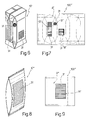
Claim 8. - A preferred, non-limiting embodiment of the present invention will be described by way of example with reference to the accompanying drawings, in which:
- Figure 1 shows a diagram of a packaging machine for producing sealed packages of pourable food products and implementing the method according to the present invention;
- Figure 2 shows a view in perspective of a first example of a package producible using the method according to the present invention;
- Figure 3 shows a front view of a repeatable-length portion of strip packaging material, from which to produce the Figure 2 package;
- Figure 4 shows a view in perspective of a second example of a package producible using the method according to the present invention;
- Figure 5 shows a front view of a repeatable-length portion of strip packaging material, from which to produce the Figure 4 package;
- Figure 6 shows a view in perspective of a third example of a package producible using the method according to the present invention;
- Figure 7 shows a front view of a repeatable-length portion of strip packaging material, from which to produce the Figure 6 package;
- Figure 8 shows a view in perspective of a fourth example of a package producible using the method according to the present invention;
- Figure 9 shows a front view of a repeatable-length portion of strip packaging material, from which to produce the Figure 8 package;
- Figure 10 shows a view in perspective of a fifth example of a package producible using the method according to the present invention;
- Figure 11 shows a front view of a repeatable-length portion of strip packaging material, from which to produce the Figure 10 package.
-
Number 1 in Figure 1 indicates as a whole a pourable food product packaging machine for continuously producing aseptic sealed packages of a pourable food product (some examples of which are shown in Figures 2, 4, 6, 8, 10 and commented on below) from a web of packaging material 2 (hereinafter referred to simply as "web 2"). -
Machine 1 comprises a sterilizingunit 3 for sterilizingweb 2, and to whichweb 2 is fed off a reel (not shown) along a substantially horizontal path P1; and a form-and-seal unit 4, in whichweb 2 is folded, sealed, and filled with the pourable food product to form the finished packages. - Sterilizing
unit 3 substantially comprises a U-shaped sterilizingbath 5 containing a liquid sterilizing agent, e.g. a solution of 30% hydrogen peroxide (H2O2) and water, up to a predetermined level.Bath 5 is defined by a vertical input branch 6 and a vertical output branch 7, which have respectivetop openings web 2 is fed in and out ofbath 5. Branches 6 and 7 are connected at the bottom by abottom portion 11 ofbath 5 housing a horizontal-axis guide roller 12. - Inside
bath 5,web 2 therefore describes a U-shaped path P2, the length of which is defined, as a function of the travelling speed ofweb 2, to ensure the packaging material remains long enough inside the sterilizing agent (e.g. 7 seconds). -
Bath 5 forms part of a known peroxide control circuit (not shown), and is maintained, in use, at a controlled temperature, e.g. of about 70°C. -
Machine 1 also comprises anaseptic chamber 15 having an inlet coincident withoutlet 9 ofbath 5.Aseptic chamber 15 is defined by atop portion 16 housing known drying means 17 for removing residual sterilizing agent fromweb 2, and by a vertical bottom portion ortower 18 parallel tobath 5 and in whichweb 2 is folded longitudinally into a cylinder and sealed to form a continuouscylindrical tube 20. -
Drying means 17 are shown only partly in Figure 1, by not being necessary to a clear understanding of the present invention, and, as shown, substantially comprise twoidle drying rollers 21, which are covered with relatively soft material, have respective horizontal axes parallel to each other, are located close to the inlet ofaseptic chamber 15, on opposite sides ofweb 2, and exert pressure on respective opposite faces ofweb 2 to squeeze the drops of sterilizing agent out and back intobath 5. - Drying means 17 also comprise known air knives (not shown) located downstream from rollers 21 (in the travelling direction of web 2), i.e. over
rollers 21, to direct hot-air jets ontoweb 2. -
Aseptic chamber 15 is maintained at a slightly higher pressure than the outside atmosphere, so that any leakage from the seals is outwards and not inwards of the chamber. The overpressure, however, must be limited - in the order of a few mbars - to prevent excessive leakage of air contaminated by the sterilizing agent, which would pollute the working environment. -
Top portion 16 andtower 18 ofaseptic chamber 15 also house direction rollers and guide members, indicated generically by 23, for foldingweb 2 into a cylinder and formingtube 20 of packaging material. - As shown in Figure 1,
tube 20 practically forms an extension ofaseptic chamber 15, and is filled continuously downwards with the pourable food product by afeed conduit 24. - More specifically,
tube 20 is fed along a vertical path P3 parallel to branches 6 and 7 ofbath 5, and through form-and-seal unit 4 to produce the individual packages. - More specifically, form-and-seal unit 4 - known and only shown schematically - comprises two or more pairs of
jaws 25, which act cyclically ontube 20 to grip and seal it along equally spaced cross sections. - The result of the above operation is a continuous strip (shown only partly) of pillow packs 26 joined to one another by transverse sealing bands 27, and which are subsequently separated by cutting sealing bands 27 in known manner not shown, and are folded mechanically by a downstream unit - also known and not shown - to form the finished packages.
-
Machine 1 advantageously also comprises adevice 30 operating upstream from sterilizingunit 3 and form-and-seal unit 4 to applylabels 31 directly ontoweb 2. - As shown in Figure 1,
labels 31 are preferably adhesive, and are supplied on acontinuous strip 32, which is unwound off areel 33, is fed between a number ofdirection rollers 34, and is rewound, withoutlabels 31, onto afurther reel 35. - More specifically,
strip 32 oflabels 31 is fed byrollers 34 along a path P4 terminating, close toweb 2, with aportion 36 incident with respect toweb 2. At the point of incidence, one ofrollers 34 divertsstrip 32 roughly 180° towardsreel 35, and the sharp change in direction is exploited to detachlabels 31 fromstrip 32 and attachlabels 31 toweb 2. - The adhesive used to fix
labels 31 toweb 2 must be resistant to the sterilization process throughbath 5 containing hydrogen peroxide, and to the follow-up hot-air-jet drying process. - In actual use,
web 2, as it travels along path P1 and before reaching sterilizingunit 3 and form-and-seal unit 4, is fedpast device 30 for applyinglabels 31. -
Labels 31 are fixed to predetermined areas of the portions ofweb 2 eventually forming the individual packages. -
Numbers 10, 10', 10'', 10''', 10'''' in Figures 2, 4, 6, 8, 10 indicate as a whole examples of known packages producible onmachine 1. -
Numbers 100, 100', 100'', 100''', 100'''' in Figures 3, 5, 7, 9, 11 indicate the portions ofweb 2 from which packages 10, 10', 10'', 10''', 10'''' are formed respectively. - As can be seen, on
portions 100, 100', 100'', 100''' and 100'''', A, A', A'', A''', A''' indicate respective crease patterns, i.e. fold lines along whichweb 2 is folded as it is fed through form-and-seal unit 4, and B, B', B'', B''', B'''' indicate the areas in which labels 31 of various shapes and sizes are to be applied. - As shown clearly, by fixing
labels 31 directly toweb 2, any area ofweb portions 100, 100', 100'', 100''', 100'''' eventually forming respectivefinished packages 10, 10', 10'', 10''', 10'''' when formed and sealed is easily accessible and, above all, with the same positioning precision. - Moreover, the surface of
web 2 to which labels 31 are applied is flat and even, unlike the panels of a normal finished package, the planes of which are affected by the pourable food product inside the package. -
Device 30 may easily be used to apply a number oflabels 31 simultaneously to thesame portion 100, 100', 100'', 100''', 100'''' ofweb 2, thus simplifyingmachine 1 as compared with known packaging machines. - Correct positioning of
labels 31 onweb 2 may advantageously be controlled, for example, using a special graphic or contrasting colour in areas B, B', B'', B''', B'''' with no printing, so that, once labels 31 are applied, the graphic is partly visible on the label application side and detectable by a detecting device based, for example, on television cameras or photocells and indicated 40 in Figure 1. - In the event of a wrongly positioned
label 31, detectingdevice 40 may generate an error signal transmitted to a central control unit (not shown) ofmachine 1; and the package with the wrongly positionedlabel 31 may be rejected at the end of the form-and-seal operations. - Detecting
device 40 may advantageously be located downstream from sterilizingunit 3. - In an alternative embodiment not shown, correct positioning of
labels 31 may also be controlled using as a reference the bar codes printed onweb 2 or other references provided onweb 2, such as those used to align the printed design on the finished package. - Clearly, changes may be made to
machine 1 and the method as described herein without, however, departing from the protective scope as defined in the accompanying Claims. - In particular, sterilizing
unit 3 may be a different type, e.g. for irradiatingweb 2 of packaging material with radiation of appropriate wavelength and intensity. -
Labels 31 may be heat sealed, as opposed to glued, toweb 2 of packaging material, e.g. using known hotplate or induction heat sealing methods used to fix so-called pull-tabs to the strip packaging material, as described and illustrated in Patent ApplicationsEP-B-1065145 andEP-B-149130
Claims (13)
- A method of producing sealed packages (10, 10', 10'', 10''', 10'''') of pourable food products, said method comprising the steps of:- feeding a web (2) of packaging material, having a succession of preprinted graphics, along a predetermined path (P1, P2, P3);- forming from said web (2) of packaging material a number of sealed packages (10, 10', 10'', 10''', 10'''') filled with said pourable food product; and- completing the external configuration of said packages (10, 10', 10'', 10''', 10'''') by applying labels (31) to the relative packaging material;characterized in that said labels (31) are applied to said web (2) of packaging material prior to said step of forming said packages (10, 10', 10'', 10''', 10'''').
- A method as claimed in Claim 1, wherein said labels (31) are applied to said web (2) of packaging material using an adhesive substance.
- A method as claimed in Claim 1, wherein said labels (31) are heat sealed to said web (2) of packaging material.
- A method as claimed in any one of the foregoing Claims, and comprising the further step of sterilizing said web (2) of packaging material prior to forming said packages (10, 10', 10'', 10''', 10''''); and wherein said labels (31) are applied to said web (2) of packaging material prior to the sterilizing step.
- A method as claimed in any one of the foregoing Claims, wherein said step of forming said packages (10, 10', 10'', 10''', 10'''') comprises the steps of:- folding and sealing said web (2) of packaging material to form a continuous tube (20);- filling said tube (20) of packaging material with said pourable food product; and- gripping and sealing said tube (20) of packaging material at equally spaced cross sections to form respective sealed packages (10, 10', 10'', 10''', 10'''').
- A method as claimed in any one of the foregoing Claims, and comprising the further steps of:- preprinting predetermined graphics in the areas (B, B', B'', B''', B'''') of said web (2) of packaging material to which respective said labels (31) are to be applied; and- detecting whether, after the respective said labels (31) are applied, the preprinted graphics are at least partly visible on the same side as the labels (31).
- A method as claimed in claim 6, including the step of controlling the correct positioning of said labels (31), wherein said step includes reading references provided on said web (2) for correctly aligning the printed design on the finished package.
- A method as claimed in Claim 6, wherein the detecting step is performed after said sterilizing step.
- A packaging machine (1) for producing sealed packages (10, 10', 10'', 10''', 10'''') of pourable food products from a web (2) of packaging material having a succession of preprinted graphics and fed along a predetermined path (P1, P2, P3), said machine (1) comprising:- forming and sealing means (4) for forming from said web (2) of packaging material a number of sealed packages (10, 10', 10'', 10''', 10'''') filled with said pourable food product; and- applying means (30) for applying respective labels (31) to the packaging material to complete the external configuration of said packages (10, 10', 10'', 10''', 10'''');characterized in that said applying means (30) are located upstream from said forming and sealing means (4) along said path (P1, P2, P3) to apply said labels (31) directly onto said web (2) of packaging material.
- A machine as claimed in Claim 9, and also comprising sterilizing means (3) located upstream from said forming and sealing means (4) along said path (P1, P2, P3) to sterilize said web (2) of packaging material prior to forming said packages (10, 10', 10'', 10''', 10''''); and wherein said applying means (30) are located upstream from said sterilizing means (3) along said path (P1, P2, P3).
- A machine as claimed in Claim 9 or 10, wherein said forming and sealing means (4) comprise:- means (23) for forming a continuous tube (20) from said web (2) of packaging material;- means (24) for filling said tube (20) of packaging material with said pourable food product; and- means (25) for gripping and sealing said tube (20) of packaging material at equally spaced cross sections to form respective said packages (10, 10', 10", 10''', 10'''').
- A machine as claimed in any one of Claims 9 to 11, for a web (2) of packaging material preprinted with predetermined graphics in areas (B, B', B'', B''', B''') to which respective said labels (31) are eventually applied, and also comprising detecting means (40) for detecting whether, after the respective said labels (31) are applied, the preprinted graphics are at least partly visible on the same side as the labels (31).
- A machine as claimed in Claim 12, wherein said detecting means (40) are located downstream from said sterilizing means (3) along said path (P1, P2, P3).
Priority Applications (1)
| Application Number | Priority Date | Filing Date | Title |
|---|---|---|---|
| EP05425608A EP1759998A1 (en) | 2005-08-30 | 2005-08-30 | Packaging method and machine for producing sealed packages of pourable food products |
Applications Claiming Priority (1)
| Application Number | Priority Date | Filing Date | Title |
|---|---|---|---|
| EP05425608A EP1759998A1 (en) | 2005-08-30 | 2005-08-30 | Packaging method and machine for producing sealed packages of pourable food products |
Publications (1)
| Publication Number | Publication Date |
|---|---|
| EP1759998A1 true EP1759998A1 (en) | 2007-03-07 |
Family
ID=35502519
Family Applications (1)
| Application Number | Title | Priority Date | Filing Date |
|---|---|---|---|
| EP05425608A Withdrawn EP1759998A1 (en) | 2005-08-30 | 2005-08-30 | Packaging method and machine for producing sealed packages of pourable food products |
Country Status (1)
| Country | Link |
|---|---|
| EP (1) | EP1759998A1 (en) |
Cited By (11)
| Publication number | Priority date | Publication date | Assignee | Title |
|---|---|---|---|---|
| WO2010116519A1 (en) * | 2009-04-10 | 2010-10-14 | オリヒロエンジニアリング株式会社 | Aseptic filling packaging machine and aseptic filling packaging method |
| EP2910482A1 (en) * | 2014-02-21 | 2015-08-26 | MULTIVAC Marking & Inspection GmbH & Co. KG | Form, fill and seal machine with labelling device |
| WO2015128794A1 (en) | 2014-02-28 | 2015-09-03 | G.D S.P.A. | Method for checking the position of an adhesive label on a sheet material |
| EP3081927A1 (en) * | 2015-04-17 | 2016-10-19 | Becton Dickinson Rowa Germany GmbH | Device for packaging loose medicament portions and method for the operation thereof |
| US10155603B2 (en) | 2015-04-17 | 2018-12-18 | Carefusion Germany 326 Gmbh | Apparatus for packaging individual medication doses and method for its operation |
| IT201900007201A1 (en) * | 2019-05-24 | 2020-11-24 | Gd Spa | Packaging machine for products for pourable food preparations |
| WO2020260190A3 (en) * | 2019-06-28 | 2021-03-11 | Tetra Laval Holdings & Finance S.A. | A method for removing excess of a sterilization agent from a web of carton-based packaging material and a system thereof |
| JP2021160728A (en) * | 2020-03-30 | 2021-10-11 | 株式会社フジシール | Method of manufacturing lidded triangular carton, and lidded triangular carton |
| EP3933234A1 (en) * | 2020-06-29 | 2022-01-05 | Tetra Laval Holdings & Finance S.A. | A valve for providing pulses of air |
| EP4368525A1 (en) * | 2022-11-10 | 2024-05-15 | Tetra Laval Holdings & Finance S.A. | Sterilization apparatus, packaging machine having a sterilization apparatus and a method for sterilizing |
| IT202300026286A1 (en) * | 2023-12-07 | 2025-06-07 | Tetra Laval Holdings & Finance | STERILIZATION APPARATUS FOR A PACKAGING MACHINE AND PACKAGING MACHINE FOR FORMING PACKAGES |
Citations (7)
| Publication number | Priority date | Publication date | Assignee | Title |
|---|---|---|---|---|
| GB1002932A (en) * | 1963-06-04 | 1965-09-02 | Tetra Pak Ab | A device for applying covering wafers, labels or the like to a continuously or intermittently advanced web of material |
| EP0149130B1 (en) | 1983-12-15 | 1987-06-03 | Ab Tetra Pak | A method for sealing an emptying opening and an arrangement for the realization of the method |
| GB2253385A (en) * | 1990-03-13 | 1992-09-09 | Osaka Sealing Label Print | A packaging machine incorporating a labelling device |
| US6041575A (en) * | 1998-11-03 | 2000-03-28 | Exact Packaging, Inc. | Method and apparatus for applying article to interior surface of flexible package |
| EP1050468A1 (en) * | 1999-05-03 | 2000-11-08 | Tetra Laval Holdings & Finance S.A. | Unit for sterilizing strip material on a packaging machine for packaging pourable food products, and packaging machine comprising such a unit |
| EP1375380A1 (en) * | 2002-06-24 | 2004-01-02 | Fuji Machinery Co., Ltd. | Form-fill sealing machines, resealable flexible packages and methods of manufacturing resealable flexible packages |
| EP1065145B1 (en) | 1999-06-30 | 2004-11-03 | Tetra Laval Holdings & Finance SA | Method and device for fitting pull-off tabs to pourable food product packaging material |
-
2005
- 2005-08-30 EP EP05425608A patent/EP1759998A1/en not_active Withdrawn
Patent Citations (7)
| Publication number | Priority date | Publication date | Assignee | Title |
|---|---|---|---|---|
| GB1002932A (en) * | 1963-06-04 | 1965-09-02 | Tetra Pak Ab | A device for applying covering wafers, labels or the like to a continuously or intermittently advanced web of material |
| EP0149130B1 (en) | 1983-12-15 | 1987-06-03 | Ab Tetra Pak | A method for sealing an emptying opening and an arrangement for the realization of the method |
| GB2253385A (en) * | 1990-03-13 | 1992-09-09 | Osaka Sealing Label Print | A packaging machine incorporating a labelling device |
| US6041575A (en) * | 1998-11-03 | 2000-03-28 | Exact Packaging, Inc. | Method and apparatus for applying article to interior surface of flexible package |
| EP1050468A1 (en) * | 1999-05-03 | 2000-11-08 | Tetra Laval Holdings & Finance S.A. | Unit for sterilizing strip material on a packaging machine for packaging pourable food products, and packaging machine comprising such a unit |
| EP1065145B1 (en) | 1999-06-30 | 2004-11-03 | Tetra Laval Holdings & Finance SA | Method and device for fitting pull-off tabs to pourable food product packaging material |
| EP1375380A1 (en) * | 2002-06-24 | 2004-01-02 | Fuji Machinery Co., Ltd. | Form-fill sealing machines, resealable flexible packages and methods of manufacturing resealable flexible packages |
Cited By (32)
| Publication number | Priority date | Publication date | Assignee | Title |
|---|---|---|---|---|
| US9371146B2 (en) | 2009-04-10 | 2016-06-21 | Orihiro Engineering Co., Ltd. | Aseptic filling packaging machine and aseptic filling packaging method |
| CN102387965A (en) * | 2009-04-10 | 2012-03-21 | 织宽工程株式会社 | Aseptic filling packaging machine and aseptic filling packaging method |
| CN102387965B (en) * | 2009-04-10 | 2013-07-17 | 织宽工程株式会社 | Aseptic filling packaging machine and aseptic filling packaging method |
| WO2010116519A1 (en) * | 2009-04-10 | 2010-10-14 | オリヒロエンジニアリング株式会社 | Aseptic filling packaging machine and aseptic filling packaging method |
| EP2910482A1 (en) * | 2014-02-21 | 2015-08-26 | MULTIVAC Marking & Inspection GmbH & Co. KG | Form, fill and seal machine with labelling device |
| CN104859907A (en) * | 2014-02-21 | 2015-08-26 | 莫迪维克检测有限公司 | Tubular Bag Forming Machine With Labeling Device |
| EP3110702B1 (en) * | 2014-02-28 | 2020-06-17 | G.D. S.p.A | Method for checking the position of an adhesive label on a sheet material |
| WO2015128794A1 (en) | 2014-02-28 | 2015-09-03 | G.D S.P.A. | Method for checking the position of an adhesive label on a sheet material |
| EP3081927A1 (en) * | 2015-04-17 | 2016-10-19 | Becton Dickinson Rowa Germany GmbH | Device for packaging loose medicament portions and method for the operation thereof |
| WO2016166187A1 (en) * | 2015-04-17 | 2016-10-20 | Becton Dickinson Rowa Germany Gmbh | Device for packaging individual medicament portions, and method for operating said device |
| CN107531352A (en) * | 2015-04-17 | 2018-01-02 | 贝克顿迪金森罗瓦德国有限公司 | Apparatus and method of operation for packaging individual pharmaceutical doses |
| US10155603B2 (en) | 2015-04-17 | 2018-12-18 | Carefusion Germany 326 Gmbh | Apparatus for packaging individual medication doses and method for its operation |
| CN107531352B (en) * | 2015-04-17 | 2019-10-29 | 贝克顿迪金森罗瓦德国有限公司 | Apparatus and method of operation for packaging individual pharmaceutical doses |
| US11059616B2 (en) | 2015-04-17 | 2021-07-13 | Carefusion Germany 326 Gmbh | Apparatus for packaging individual medication doses and method for its operation |
| IT201900007201A1 (en) * | 2019-05-24 | 2020-11-24 | Gd Spa | Packaging machine for products for pourable food preparations |
| EP3741690A1 (en) * | 2019-05-24 | 2020-11-25 | G.D. S.p.A | Packaging machine of products for pourable food preparations |
| EP3756693A3 (en) * | 2019-06-28 | 2021-05-19 | Tetra Laval Holdings & Finance S.A. | A method for removing excess of a sterilization agent from a web of carton-based packaging material and a system thereof |
| WO2020260190A3 (en) * | 2019-06-28 | 2021-03-11 | Tetra Laval Holdings & Finance S.A. | A method for removing excess of a sterilization agent from a web of carton-based packaging material and a system thereof |
| CN114051477B (en) * | 2019-06-28 | 2023-10-20 | 利乐拉瓦尔集团及财务有限公司 | Methods and systems for removing excess sterilant from rolls of carton-based packaging materials |
| CN114051477A (en) * | 2019-06-28 | 2022-02-15 | 利乐拉瓦尔集团及财务有限公司 | Method for removing excess sterilant from a web of carton-based packaging material and system therefor |
| JP2021160728A (en) * | 2020-03-30 | 2021-10-11 | 株式会社フジシール | Method of manufacturing lidded triangular carton, and lidded triangular carton |
| JP7408459B2 (en) | 2020-03-30 | 2024-01-05 | 株式会社フジシール | Method for manufacturing triangular pack with lid and triangular pack with lid |
| JP2023531657A (en) * | 2020-06-29 | 2023-07-25 | テトラ ラバル ホールディングス アンド ファイナンス エス エイ | A valve that supplies pulsed air |
| CN115917196A (en) * | 2020-06-29 | 2023-04-04 | 利乐拉瓦尔集团及财务有限公司 | A valve that provides air pulses |
| WO2022002579A1 (en) * | 2020-06-29 | 2022-01-06 | Tetra Laval Holdings & Finance S.A. | A valve for providing pulses of air |
| EP3933234A1 (en) * | 2020-06-29 | 2022-01-05 | Tetra Laval Holdings & Finance S.A. | A valve for providing pulses of air |
| US12297932B2 (en) | 2020-06-29 | 2025-05-13 | Tetra Laval Holdings & Finance S.A. | Valve for providing pulses of air |
| EP4368525A1 (en) * | 2022-11-10 | 2024-05-15 | Tetra Laval Holdings & Finance S.A. | Sterilization apparatus, packaging machine having a sterilization apparatus and a method for sterilizing |
| WO2024099924A1 (en) * | 2022-11-10 | 2024-05-16 | Tetra Laval Holdings & Finance S.A. | Sterilization apparatus, packaging machine having a sterilization apparatus and a method for sterilizing |
| IT202300026286A1 (en) * | 2023-12-07 | 2025-06-07 | Tetra Laval Holdings & Finance | STERILIZATION APPARATUS FOR A PACKAGING MACHINE AND PACKAGING MACHINE FOR FORMING PACKAGES |
| EP4566957A1 (en) * | 2023-12-07 | 2025-06-11 | Tetra Laval Holdings & Finance S.A. | Sterilization apparatus for a packaging machine and packaging machine for forming packages |
| WO2025119689A1 (en) * | 2023-12-07 | 2025-06-12 | Tetra Laval Holdings & Finance S.A. | Sterilization apparatus for a packaging machine and packaging machine for forming packages |
Similar Documents
| Publication | Publication Date | Title |
|---|---|---|
| US8099933B2 (en) | Process of manufacturing sealed packages containing a pourable food product and packaging equipment for performing such process | |
| US7823796B2 (en) | Method of transferring information from a plant for the production of packaging material to a filling machine, a method of providing a packaging material with information, as well as packaging material and the use thereof | |
| CN102227352A (en) | Method and device for manufacturing a strap pack and strap pack | |
| US7521075B2 (en) | Sheet material for producing packages of food products, and packages made of such material | |
| CN101426685A (en) | Unit and method for preparing an opening device for gluing to a respective sealed package of a pourable food product | |
| EP1474284B1 (en) | System and method for applying opening devices onto packages | |
| WO2011065884A1 (en) | A device and a method for improved folding of a container | |
| US20040259709A1 (en) | Packaging sheet material for packaging pourable food products | |
| CA2485075C (en) | Method and packaging machine for producing sealed packages of pourable food products from precut blanks of sheet packaging material | |
| ES2645422T3 (en) | A unit and a method for carrying out a first operation and a second operation in a band | |
| CN119497670A (en) | Digital printing device for packaging machine and packaging machine having the same | |
| WO1993012003A2 (en) | Packaging method and apparatus | |
| WO2024223418A1 (en) | Conveying apparatus, capping machine, packaging plant and method for conveying packages | |
| EP3075669B1 (en) | Machine and method for packaging pourable food products in sealed containers formed from a tube of packaging material | |
| EP3626438A1 (en) | Method and apparatus for applying an extraction element on a packaging material and packaging material | |
| IT202300025584A1 (en) | PACKAGING MACHINE CONFIGURED TO PRODUCE SEALED PACKAGES CONTAINING A POURABLE PRODUCT, REMOVABLE PRINTING KIT AND METHOD FOR PRODUCING PACKAGES CONTAINING A POURABLE PRODUCT | |
| HK1081159B (en) | Method and packaging machine for producing sealed packages of pourable food products from precut blanks of sheet packaging material |
Legal Events
| Date | Code | Title | Description |
|---|---|---|---|
| PUAI | Public reference made under article 153(3) epc to a published international application that has entered the european phase |
Free format text: ORIGINAL CODE: 0009012 |
|
| AK | Designated contracting states |
Kind code of ref document: A1 Designated state(s): AT BE BG CH CY CZ DE DK EE ES FI FR GB GR HU IE IS IT LI LT LU LV MC NL PL PT RO SE SI SK TR |
|
| AX | Request for extension of the european patent |
Extension state: AL BA HR MK YU |
|
| AKX | Designation fees paid | ||
| REG | Reference to a national code |
Ref country code: DE Ref legal event code: 8566 |
|
| STAA | Information on the status of an ep patent application or granted ep patent |
Free format text: STATUS: THE APPLICATION IS DEEMED TO BE WITHDRAWN |
|
| 18D | Application deemed to be withdrawn |
Effective date: 20071009 |