EP1759255B1 - System und verfahren für vertikale flugplanung - Google Patents
System und verfahren für vertikale flugplanung Download PDFInfo
- Publication number
- EP1759255B1 EP1759255B1 EP05857470.8A EP05857470A EP1759255B1 EP 1759255 B1 EP1759255 B1 EP 1759255B1 EP 05857470 A EP05857470 A EP 05857470A EP 1759255 B1 EP1759255 B1 EP 1759255B1
- Authority
- EP
- European Patent Office
- Prior art keywords
- flight plan
- vertical flight
- vertical
- specifying
- rules
- Prior art date
- Legal status (The legal status is an assumption and is not a legal conclusion. Google has not performed a legal analysis and makes no representation as to the accuracy of the status listed.)
- Expired - Lifetime
Links
Images




Classifications
-
- G—PHYSICS
- G05—CONTROLLING; REGULATING
- G05D—SYSTEMS FOR CONTROLLING OR REGULATING NON-ELECTRIC VARIABLES
- G05D1/00—Control of position, course, altitude or attitude of land, water, air or space vehicles, e.g. using automatic pilots
- G05D1/04—Control of altitude or depth
- G05D1/06—Rate of change of altitude or depth
- G05D1/0607—Rate of change of altitude or depth specially adapted for aircraft
Definitions
- the present invention relates generally to navigation control systems for aircraft. More specifically the present invention relates to a vertical flight planning and management system for use with aircraft.
- the performance prediction function in a flight management system uses equations of motion, aerodynamic and engine characteristics to simulate an intended flight plan. Using available data, the flight trajectory is computed from origin through destination. This flight plan must not, for example, violate any speed or altitude constraints or other such restrictions imposed by the Federal Aviation Administration (FAA), airline policies, or pilot entries. In well-known FMSs, computed waypoint arrival times and fuel status may be displayed to the pilot as an aid in evaluating various route options, monitoring progress, contingency planning, etc.
- FAM Federal Aviation Administration
- pilot entries In well-known FMSs, computed waypoint arrival times and fuel status may be displayed to the pilot as an aid in evaluating various route options, monitoring progress, contingency planning, etc.
- An FMS performs the task of flight planning by compiling a four-dimensional route, defined by a lateral flight plan (i.e., two of the four dimensions), a vertical flight plan and an elapsed time trajectory. These flight plans are compiled from stored navigation databases and flight-crew entries.
- the FMS performs the task of navigation by identifying aircraft position relative to fixed points on the surface of the earth.
- a lateral position, vertical position and elapsed time are computed by a combination of data from ground-based transponder radios, Global Positioning System, and aircraft motion sensors.
- the FMS performs the task of guidance by determining the appropriate altitude, speed, thrust, and heading required to fly the current leg of the flight plan.
- These targets are determined by a comparison of aircraft position (navigation) to the desired profile (flight planning) and may take into account temporary deviations from the flight plan due to weather, traffic, equipment failure or on-board emergencies.
- the autopilot controls pitch, roll, and yaw control surfaces and the throttle position, to instantaneously maintain the desired aircraft trajectory defined by FMS guidance.
- the vertical flight plan follows a fixed sequence of flight phases including: takeoff, climb, cruise (which may include one or more step climbs), descent (which may include options for early or late descent), and approach (which may include an optional "go around" for a missed approach). These discrete phases are shown in Figure 1 .
- a pilot usually enters specific vertical flight plan parameters associated with this fixed sequence, such as climb, cruise, and descent airspeeds, and cruise altitude.
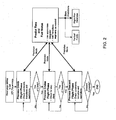
- Figure 2 depicts the classic method of performing calculations for an existing vertical trajectory model in an existing FMS.
- this series of calculations is tied to the notion of a fixed sequence of flight phases.
- the performance calculations review each of the various phases of the vertical flight plan (VFP) and check to ensure that flight is within the preset parameters. Calculations predict flight time and fuel consumption according to the flight plan.
- VFP vertical flight plan
- One problem with this structure is that any change or addition to the general structure of the vertical flight plan (e.g., multiple climb-cruise-descent phases), requires that all of the performance prediction logic be pulled apart and modified. Changes to the FMS in this manner have proven to be very time consuming and expensive.
- the resulting performance prediction function remains limited in the types of trajectories it is capable of supporting.
- cruise-climb refers to continuously climbing as fuel is burned to achieve optimum efficiency.
- ATC air traffic control
- FR 2689231 A discloses a method for presenting conventionally generated information to help the pilot manage the vertical trajectory.
- the vertical flight plan describes the vertical trajectory requirements of a flight. It defines how the aircraft will operate in the future.
- the vertical flight plan also describes how the performance predictions are to be performed.
- performance predictions with respect to the vertical flight plan are "hard-coded" in algorithms that implement trajectory predictions associated with lateral flight plans.
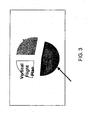
- the assumptions associated with the vertical aspects of the flight plan are, in accordance with the present invention, removed from the hard-coded algorithms and placed into a separate, modularized, vertical flight plan, as shown in Figure 3 .
- the vertical flight plan can be developed separately from the core performance prediction function, and the vertical flight plan can be modified and evolved to meet FAA or customer requirements without requiring difficult and expensive modification to the core performance prediction function.
- project specific data such as aircraft performance tables and economy speed schedules, can be separated from both the vertical flight plan and core performance predictions algorithms to minimize changes to these functions from aircraft to aircraft.
- the vertical flight plan is not based on the notion of flight phase. Rather, the vertical flight plan preferably represents any series of climb, cruise, or descent behaviors in any arbitrary order.
- the desired behavior for each segment can be specified using a general construct of rules and criteria as opposed to setting a few parameters in an otherwise fixed plan.
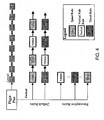
- rules relate at least to speed, vertical path, and thrust, as shown in Figure 4 , plus aircraft configuration rules such as flap and landing gear deployment, engine rating mode, and anti-ice mode.
- the logic conditions may be very general and may be based on flight time or any state of the aircraft or its subsystems (e.g., speed, altitude, rate-of-climb, retracting flaps, etc.).
- the vertical flight plan technique differs significantly from the well-known lateral flight plan in at least one important sense: while the lateral flight plan can be described sequentially, the vertical flight plan mode sequence need (indeed, typically, cannot) not be known prior to executing performance predictions. Accordingly, the rules and criteria of the present invention are better suited to perform vertical flight planning.
- a rule specifies a controlled variable (e.g., speed, thrust, vertical path, etc.) and instructions of when that control is to take place (e.g., initiation and termination criteria).
- a controlled variable e.g., speed, thrust, vertical path, etc.
- instructions of when that control is to take place e.g., initiation and termination criteria.
- speed 190 knots CAS until 1,500 feet AGL.
- a vertical flight plan has default (sequential) rules and preemptive (limit) rules.
- Rules can specify a default sequence of control actions, or commanded control modes, that occur one after another, for example, fly speed equals 290 knots CAS until speed equals 0.8 Mach, then fly speed equals 0.8 Mach.
- rules may be specified as limits that preempt the active target rules, for example, fly a speed equal to economy speed (table lookup on weight, etc.), but subject to a limit of speed less than or equal to 0.8 Mach. Rules also have initiation and termination criteria that describe when to turn them on and off.
- Rules describe both the primary vertical modes (e.g., speed, vertical path, and thrust) and aircraft configuration changes (e.g., bleeds, flaps, landing gear, cargo drop, antennae deployment, engine rating mode, etc.). Criteria specify events that change the state of a rule or cause other discrete actions to occur.
- a criterion may specify an event that changes the state of a rule or causes discrete action to occur.
- a criterion may further specify the state to which the rule should be changed.
- Sub-criteria related to a criterion describe logical conditions under which an event should occur.
- a criterion may also specify an additional rule to activate as well as an action to take when the criterion is met.
- each sub-criterion defines a logical comparison that is made, such as speed ⁇ 280 knots CAS, or altitude > 20,000 feet.
- the sub-criteria specify which variable or variables are to be compared, a value or function against which to compare, and a comparison type (e.g., equal, less than, greater than, less than or equal, greater than or equal, etc.).
- Multiple sub-criteria linked to a single criterion may be treated with an AND relationship such that they must all be satisfied before action is taken.
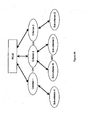
- Figure 5A shows an example of a rule with three termination criteria linked with an OR relationship. If any one of criteria 1, 2, or 3 is met, the rule is terminated. To determine whether a criterion is met, the associated sub-criterion or sub-criteria provide the aforementioned variable(s) for comparison.
- Criterion 1 and Criterion 3 include further single sub-criteria (A and D, respectively).
- Criterion 2 has associated with it two sub-criteria, B and C connected with an AND relationship. In order for Criterion 2 to be satisfied, both sub-criteria A and B must be satisfied.
- Each criterion may have many sub-criteria linked to it and Figure 5A should not be considered to suggest that only one or two sub-criteria may be associated with each criterion.
- criteria may primarily be used to control when the rules turn on and off, criteria can also exist on their own in the VFP.
- a stand-alone criterion would not likely control anything continuously, but instead would wait for its conditions to be met and subsequently perform a discrete action. Examples include: scratchpad messages, Automatic Dependent Surveillance (ADS) messages, fix info data, cargo drop, etc.
- ADS Automatic Dependent Surveillance
- an ADS request to output predicted aircraft state data e.g. time, fuel, speed, altitude, distance, flight path angle
- This criterion would stay active even if it evaluates to true.
- the rules and criteria mechanisms are preferably designed to be easily customizable.
- the numerical values used to specify rules and sub-criteria may be specified by constant values or by algorithms.
- Complex or project-specific algorithms for specifying control modes or event criteria may be handled by describing a project-specific algorithm in a callback function.
- a reference to the callback function is placed in the appropriate rule or criteria, so that the project-specific function will be called when the rule is active or the criterion is evaluated.
- the project-specific actions may be described in a callback function.
- a reference to the callback function may be placed on a criterion and the project-specific function/action will be called when the criterion is met.
- a generalized flight plan may be integrated segment by segment.
- a predictions processor determines, for example, which of the speed rules, vertical path rules, or thrust rules apply during the current segment. If multiple rules are active, then the highest priority or most constraining rule is preferably used.
- the rules and termination criteria can model or represent existing vertical trajectories, but in addition, they can also accommodate the new trajectory options previously described as well as completely new or later developed options.
- the output of the predictions processor is a set of active rules that tells the predictor the desired flight mode, and a set of criteria that tells the predictor when to stop.
- the predictor may then store the trajectory prediction results for access by other FMS subsystems.
- Figure 6 illustrates an exemplary climb trajectory in accordance with the present invention.
- a series of vertical path points 0-7 are set forth at the bottom of the figure and correspond to the several points on the altitude/range graph at the upper right of the figure.
- initial condition (IC) initial condition
- performance prediction is calculated based on the rules and criteria associated with each of those rules. For example, at vertical path point 4 it is determined that waypoint ABC has been attained and, accordingly, it is now possible to end speed and altitude constraints.
- Fig. 7 is a flow chart illustrating how the rules are processed to assist in controlling the aircraft and computing performance predictions.
- the process begins at step 110 and moves on to step 120 where a variable is set to cause the rule states to be later initialized at step 180.
- the processor begins the main loop through the rules in the vertical flight plan. Once the main loop is started, at step 140, targets and limits are cleared from previous passes through the main loop.
- a loop begins to review all of the rules.
- Rule details are extracted at step 160 and the state of each rule is analyzed at step 170. If the rule state needs to be initialized, then the rule state, along with predicted values of callback functions on rules and criteria are initialized. If step 170 is false, then the rule state is set to the predicted rule state at step 190.
- each rule is evaluated to determine if its state is ON, ARMED or OFF. If, at step 200, a rule is determined to be ON, the processor determines if the rule should be passed to the aircraft predictor at step 210. (The highest priority speed, vertical path, and thrust target rules, along with all limit rules are passed to the predictor.)
- the termination criteria for the rule that is ON is extracted and added to the active criteria list. If a rule is determined not to be ON, then it is analyzed to see if the rule is ARMED at step 230. If the rule is ARMED, then the initiation criteria are extracted at step 240 and added to the active criteria list on the aircraft predictor. At step 250, the processor determines if there are more rules to be analyzed and if so, the process for each additional rule begins again at step 150.
- step 260 it is determined whether at least two rules to control the aircraft have been found. If not, an exit flag is set at step 270 and the process moves to termination. If two rules are found at step 260, then the aircraft predictor is called to perform the predictions at step 280. The predictor evaluates the set of rules given to it and determines the appropriate method to use to integrate the aircraft equations of motion to predict the aircraft motion and it stops when one or more of the criteria given to it are met. A list of the detected criteria is then returned to the processor.
- control After control is returned to the processor, it determines what actions need to be taken associated with the detected criteria.
- a loop begins to review all detected criteria.
- the details of the detected criterion are extracted.
- the predictor determines if the criterion is related to the vertical flight plan.
- the processor sets the state of the rules associated with the criterion to the states specified in the criterion definition. If a specific criterion specifies a "Next Rule", then the state of that rule is set to ON. If the criterion specifies an action that needs to occur in the form of a process-satisfied criteria function, then that function is invoked.
- the aircraft states are written to an output point. If, at step 310, a criterion is found that is not owned by the vertical flight plan, the exit flag is set at step 330.
- the processor After taking the actions specified by the detected terminations and determining that it has reached the last detected term at step 340, the processor clears the rules and criteria from the aircraft at step 350. If the exit flag is not set at step 360, the processor returns to the start of the loop to re-evaluate the vertical flight plan. The processor reaches the end of the process at step 370 when a criterion is met that is not associated with the flight plan rules, i.e., a criterion that specifies an exit condition, e.g., reaching the destination.
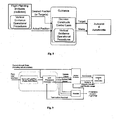
- Fig. 8 depicts a prior art flight system.
- the vertical guidance operational procedures are integrated with both the flight planning and guidance systems. With the operational procedures so intertwined with the rest of the system, changing guidance and planning criteria can be a daunting programming task requiring reprogramming of how the procedures interact with each of the systems.
- the rules may be easily altered and improved as time goes on without creating a need for modification of the prediction and guidance systems.
- Fig. 9 depicts how the vertical flight plan and associated processor of the present invention fit within an aircraft operating system, and also how the current system is more modular and adaptable than prior art systems.
- a user inputs rules into the database.
- the rules and the aircraft state are then fed into the processor to affect operation of the aircraft or, in a planning mode, the prediction of the flight path.
- the processor checks the aircraft state versus the rules and adjusts operation of target parameters such as thrust, vertical path, speed, etc. accordingly.
- the vertical guidance and prediction systems also provide feedback to the processor so that the processor knows when certain termination criteria have been met and thus knows that certain rules may be terminated or initiated.
- This vertical flight planning system provides a new and improved method for representing a vertical trajectory.
- the approach generalizes the types and characteristics of vertical trajectories that may be modeled in an FMS for the purposes of computing performance predictions.
- This vertical flight planning structure may represent the types of trajectories used today as well as modeling new types not currently capable of being modeled with today's FMSs.
- the present disclosure discusses embodiments of the present invention with respect to the vertical flight plan, one of ordinary skill in the art will appreciate that the same or similar principles as described herein could also be applied to manipulate or produce the lateral portion of a flight plan.
Landscapes
- Engineering & Computer Science (AREA)
- Aviation & Aerospace Engineering (AREA)
- Radar, Positioning & Navigation (AREA)
- Remote Sensing (AREA)
- Physics & Mathematics (AREA)
- General Physics & Mathematics (AREA)
- Automation & Control Theory (AREA)
- Traffic Control Systems (AREA)
- Navigation (AREA)
Claims (10)
- Verfahren zum Durchführen einer Leistungsvorhersage hinsichtlich eines vertikalen Flugplans eines Flugzeugs (320), Folgendes umfassend:Spezifizieren eines vertikalen Flugplans, welcher sequenzielle Regeln und begrenzende Regeln (130) umfasst, wobei die Regeln eine gesteuerte Variable mit dazugehörigen Initiations- und Terminierungskriterien spezifizieren, welche bestimmen, wann diese Steuerung erfolgen soll;Verarbeiten des vertikalen Flugplans für spezifizierte Zustandsdaten, um festzustellen, ob eine Regel aktiv, ein- oder ausgeschaltet wird; undVorhersagen einer zukünftigen Bewegung des Flugzeugs, welches gemäß dem vertikalen Flugplan (280) betrieben wird.
- Verfahren nach Anspruch 1, wobei Spezifizieren des vertikalen Flugplans ein Spezifizieren umfasst, wann der vertikale Flugplan ein Steigflugsegment bei Reisegeschwindigkeit umfasst.
- Verfahren nach Anspruch 1, wobei Spezifizieren des vertikalen Flugplans ein Spezifizieren umfasst, wann der vertikale Flugplan eine Lärmschutzmaßnahme umfasst.
- Verfahren nach Anspruch 1, wobei Spezifizieren des vertikalen Flugplans ein Spezifizieren umfasst, wann der vertikale Flugplan mehrere Steigflug-, Reiseflug- und Sinkflugsegmente umfasst.
- Verfahren nach Anspruch 1, wobei Spezifizieren des vertikalen Flugplans ein Spezifizieren umfasst, wann der vertikale Flugplan mehrere Zwangsbedingungen für eine Sollankunftszeit umfasst.
- Verfahren nach Anspruch 1, wobei Verarbeiten des vertikalen Flugplans für spezifizierte Zustandsdaten ein Spezifizieren mindestens eines Wertes aus Zeit, Brennstoff, Geschwindigkeit, Flughöhe, Entfernung und Flugbahnwinkel umfasst.
- Verfahren nach Anspruch 1, wobei Vorhersagen einer zukünftigen Bewegung ein Ausführen von Vorhersagen mit einem Vorhersageprozessor umfasst.
- Verfahren nach Anspruch 7, wobei Ausführen von Vorhersagen mit dem Vorhersageprozessor weiterhin ein Berechnen einer Flugzeit auf der Grundlage des vertikalen Flugplans umfasst.
- Verfahren nach Anspruch 7, wobei Ausführen von Vorhersagen mit dem Vorhersageprozessor weiterhin ein Vorhersagen eines Brennstoffverbrauchs auf der Grundlage des vertikalen Flugplans umfasst.
- Verfahren nach Anspruch 1, und weiterhin ein Steuern einer Bewegung des Flugzeugs gemäß dem Flugplan umfassend.
Applications Claiming Priority (2)
| Application Number | Priority Date | Filing Date | Title |
|---|---|---|---|
| US10/871,668 US7366591B2 (en) | 2004-06-21 | 2004-06-21 | System and method for vertical flight planning |
| PCT/US2005/021871 WO2006085952A1 (en) | 2004-06-21 | 2005-06-21 | System and method for vertical flight planning |
Publications (2)
| Publication Number | Publication Date |
|---|---|
| EP1759255A1 EP1759255A1 (de) | 2007-03-07 |
| EP1759255B1 true EP1759255B1 (de) | 2014-04-23 |
Family
ID=35481694
Family Applications (1)
| Application Number | Title | Priority Date | Filing Date |
|---|---|---|---|
| EP05857470.8A Expired - Lifetime EP1759255B1 (de) | 2004-06-21 | 2005-06-21 | System und verfahren für vertikale flugplanung |
Country Status (3)
| Country | Link |
|---|---|
| US (1) | US7366591B2 (de) |
| EP (1) | EP1759255B1 (de) |
| WO (1) | WO2006085952A1 (de) |
Cited By (1)
| Publication number | Priority date | Publication date | Assignee | Title |
|---|---|---|---|---|
| US10228692B2 (en) | 2017-03-27 | 2019-03-12 | Gulfstream Aerospace Corporation | Aircraft flight envelope protection and recovery autopilot |
Families Citing this family (62)
| Publication number | Priority date | Publication date | Assignee | Title |
|---|---|---|---|---|
| US7587278B2 (en) | 2002-05-15 | 2009-09-08 | Honeywell International Inc. | Ground operations and advanced runway awareness and advisory system |
| US8145367B2 (en) | 2001-03-06 | 2012-03-27 | Honeywell International Inc. | Closed airport surface alerting system |
| US7783393B2 (en) * | 2004-06-30 | 2010-08-24 | The Boeing Company | Enhanced vertical situation display |
| US7305304B2 (en) * | 2004-10-05 | 2007-12-04 | The Board Of Regents, University Of Oklahoma | Forecast decision system and method |
| US20060208943A1 (en) * | 2005-03-21 | 2006-09-21 | Sirf Technology, Inc. | Location tagging using post-processing |
| US7479925B2 (en) * | 2005-03-23 | 2009-01-20 | Honeywell International Inc. | Airport runway collision avoidance system and method |
| FR2894053B1 (fr) * | 2005-11-25 | 2007-12-28 | Thales Sa | Procede d'optimisation en cours de vol de la consommation en carburant d'un aeronef |
| FR2898673B1 (fr) * | 2006-03-14 | 2009-04-17 | Thales Sa | Procede d'aide a la navigation d'un aeronef avec une mise a jour du plan de vol |
| FR2900230B1 (fr) * | 2006-04-24 | 2008-07-04 | Airbus France Sas | Procede et dispositif d'aide au pilotage d'un aeronef lors d'une mission de recherche et de sauvetage. |
| FR2904448B1 (fr) * | 2006-07-31 | 2008-09-26 | Airbus France Sas | Procede et dispositif d'aide a la gestion de vols successifs d'un aeronef. |
| US7487039B2 (en) * | 2006-08-16 | 2009-02-03 | Honeywell International Inc. | System and method for generating flyable paths for an aircraft |
| FR2910124B1 (fr) * | 2006-12-15 | 2009-03-06 | Thales Sa | Procede de creation et de mise a jour d'un plan de vol atc en temps reel pour la prise en compte de consignes de vol et dispositif de mise en oeuvre |
| FR2916842B1 (fr) * | 2007-06-01 | 2010-02-26 | Thales Sa | Procede d'optimisation d'un plan de vol |
| US8131410B2 (en) * | 2007-06-15 | 2012-03-06 | The Boeing Company | Quiet climb crew interface |
| US9257047B2 (en) * | 2007-12-12 | 2016-02-09 | The Boeing Company | Computation of new aircraft trajectory using time factor |
| US9829341B1 (en) * | 2008-06-26 | 2017-11-28 | Rockwell Collins, Inc. | System and method for providing flight cues for the navigation function required time of arrival (RTA) |
| EP2151730A1 (de) * | 2008-08-05 | 2010-02-10 | The Boeing Company | Vierdimensionale Flugzeugnavigation |
| FR2935495B1 (fr) * | 2008-08-29 | 2010-09-10 | Thales Sa | Systeme et procede de calcul des predictions de vol par sections verticales |
| US8234058B1 (en) * | 2008-09-08 | 2012-07-31 | Rockwell Collins, Inc. | System, module, and method for generating procedure data used in an avionics system |
| US8386100B1 (en) * | 2009-06-16 | 2013-02-26 | The Boeing Company | Aircraft flight event data integration and visualization |
| US9330573B2 (en) * | 2009-06-25 | 2016-05-03 | Honeywell International Inc. | Automated decision aid tool for prompting a pilot to request a flight level change |
| US8321071B2 (en) * | 2009-07-31 | 2012-11-27 | Ge Aviation Systems, Llc | Method and system for vertical navigation using time-of-arrival control |
| FR2953302B1 (fr) * | 2009-11-27 | 2012-08-10 | Thales Sa | Procede de planification, de calcul de trajectoire, de predictions et de guidage pour le respect d'une contrainte de temps de passage d'un aeronef |
| US8412392B2 (en) * | 2010-02-24 | 2013-04-02 | Honeywell International Inc. | Methods and systems for displaying predicted downpath parameters in a vertical profile display |
| FR2956763B1 (fr) * | 2010-02-24 | 2016-01-29 | Airbus Operations Sas | Systeme embarque a bord d'un aeronef en lien avec un plan de vol |
| FR2956735B1 (fr) | 2010-02-24 | 2012-03-30 | Airbus Operations Sas | Systeme embarque d'evaluation de strategies de vol a bord d'un aeronef |
| US8271152B2 (en) * | 2010-03-10 | 2012-09-18 | Honeywell International Inc. | System and method for rendering an onboard aircraft display for use with in-trail procedures |
| US8417397B2 (en) | 2010-05-05 | 2013-04-09 | Honeywell International Inc. | Vertical profile display with variable display boundaries |
| US8406939B2 (en) * | 2010-09-03 | 2013-03-26 | Honeywell International Inc. | Systems and methods for RTA control of multi-segment flight plans with smooth transitions |
| US8818576B2 (en) * | 2010-09-30 | 2014-08-26 | The Boeing Company | Tailored arrivals allocation system trajectory predictor |
| US8700298B2 (en) | 2010-09-30 | 2014-04-15 | The Boeing Company | Tailored arrivals allocation system clearance generator |
| ITRM20110651A1 (it) * | 2010-12-20 | 2012-06-21 | Selex Sistemi Integrati Spa | Metodo di previsione rapida del profilo verticale della traiettoria per la gestione del traffico aereo, e relativo sistema atm. |
| US8494766B2 (en) * | 2011-01-07 | 2013-07-23 | Ge Aviation Systems, Llc | Flight management system with integrated tactical commands for use with an aircraft and method of operating same |
| FR2973526B1 (fr) * | 2011-03-29 | 2013-04-26 | Airbus Operations Sas | Procede et dispositif de gestion automatique du profil vertical d'un plan de vol d'un aeronef. |
| US20120265374A1 (en) * | 2011-04-15 | 2012-10-18 | Thomas Edward Yochum | Aircraft vertical trajectory optimization method |
| FR2983594B1 (fr) * | 2011-12-02 | 2014-09-26 | Thales Sa | Procede de gestion d'un plan de vol vertical |
| US8478513B1 (en) | 2012-01-20 | 2013-07-02 | Honeywell International Inc. | System and method for displaying degraded traffic data on an in-trail procedure (ITP) display |
| US8554394B2 (en) | 2012-02-28 | 2013-10-08 | Honeywell International Inc. | System and method for rendering an aircraft cockpit display for use with an in-trail procedure (ITP) |
| US8781649B2 (en) | 2012-03-19 | 2014-07-15 | Honeywell International Inc. | System and method for displaying in-trail procedure (ITP) opportunities on an aircraft cockpit display |
| FR2993063B1 (fr) * | 2012-07-05 | 2014-08-22 | Thales Sa | Procede d'aide a la navigation permettant de gerer une contrainte verticale de maniere anticipee |
| US10013236B2 (en) * | 2013-03-06 | 2018-07-03 | The Boeing Company | Real-time adaptive speed scheduler |
| US9177479B2 (en) | 2013-03-13 | 2015-11-03 | General Electric Company | System and method for determining aircraft operational parameters and enhancing aircraft operation |
| US9026275B1 (en) * | 2013-07-24 | 2015-05-05 | Shih-Yih Young | In-flight generation of RTA-compliant optimal profile descent paths |
| EP4163900A1 (de) * | 2014-07-18 | 2023-04-12 | The University Of Malta | Flugbahnoptimierungs- und -visualisierungswerkzeug |
| US9625261B2 (en) | 2014-09-04 | 2017-04-18 | Honeywell International Inc. | System and method for managing speed constraints during required time of arrival operations |
| US10144505B2 (en) * | 2015-05-18 | 2018-12-04 | The Boeing Company | Aircraft flight control using a required time of arrival index |
| US9916765B2 (en) * | 2015-11-04 | 2018-03-13 | Honeywell International Inc. | Aircraft systems and methods for providing landing approach alerts |
| FR3043456B1 (fr) * | 2015-11-05 | 2018-09-21 | Airbus Operations | Procede et dispositif pour generer une trajectoire verticale optimale destinee a etre suivie par un aeronef. |
| US10089886B2 (en) * | 2016-02-03 | 2018-10-02 | Honeywell International Inc. | Vehicle decision support system |
| FR3053779B1 (fr) * | 2016-07-07 | 2018-06-29 | Thales | Dispositif et methode de calcul de prediction de performance de navigation estimee |
| FR3053780B1 (fr) * | 2016-07-07 | 2018-07-06 | Thales | Dispositif et methode de calcul de prediction de performance de navigation requise |
| US10336469B2 (en) | 2016-09-30 | 2019-07-02 | Sony Interactive Entertainment Inc. | Unmanned aerial vehicle movement via environmental interactions |
| US10357709B2 (en) | 2016-09-30 | 2019-07-23 | Sony Interactive Entertainment Inc. | Unmanned aerial vehicle movement via environmental airflow |
| US10679511B2 (en) * | 2016-09-30 | 2020-06-09 | Sony Interactive Entertainment Inc. | Collision detection and avoidance |
| US10410320B2 (en) | 2016-09-30 | 2019-09-10 | Sony Interactive Entertainment Inc. | Course profiling and sharing |
| US10850838B2 (en) | 2016-09-30 | 2020-12-01 | Sony Interactive Entertainment Inc. | UAV battery form factor and insertion/ejection methodologies |
| US10416669B2 (en) | 2016-09-30 | 2019-09-17 | Sony Interactive Entertainment Inc. | Mechanical effects by way of software or real world engagement |
| US10377484B2 (en) | 2016-09-30 | 2019-08-13 | Sony Interactive Entertainment Inc. | UAV positional anchors |
| US10388170B2 (en) | 2017-08-14 | 2019-08-20 | Honeywell International Inc. | Speed-constrained flight management methods and systems |
| US11733712B2 (en) * | 2020-07-03 | 2023-08-22 | Honeywell International Inc. | Systems and methods for generating displays for noise abatement departure procedures |
| US11763684B2 (en) | 2020-10-28 | 2023-09-19 | Honeywell International Inc. | Systems and methods for vehicle operator and dispatcher interfacing |
| CN115858549B (zh) * | 2023-02-27 | 2023-05-05 | 西安索格亚航空科技有限公司 | 一种航空导航设备导航数据库和航线更新方法 |
Family Cites Families (8)
| Publication number | Priority date | Publication date | Assignee | Title |
|---|---|---|---|---|
| US5121325A (en) * | 1990-04-04 | 1992-06-09 | Smiths Industries Aerospace & Defense Systems, Inc. | Required time of arrival (RTA) control system |
| GB9111086D0 (en) * | 1991-05-22 | 1991-10-16 | Marconi Gec Ltd | Aircraft terrain and obstacle avoidance system |
| US5337982A (en) * | 1991-10-10 | 1994-08-16 | Honeywell Inc. | Apparatus and method for controlling the vertical profile of an aircraft |
| FR2689231B1 (fr) | 1992-03-26 | 1996-09-27 | Aerospatiale Ste Nat Indle | Procede et dispositif d'assistance au pilotage d'un aerodyne par la representation graphique du plan de vol vertical de cet aerodyne |
| FR2744525B1 (fr) * | 1996-02-02 | 1998-03-06 | Sextant Avionique | Procede et dispositif d'aide a la navigation aerienne |
| US6507782B1 (en) * | 2001-05-14 | 2003-01-14 | Honeywell International Inc. | Aircraft control system for reaching a waypoint at a required time of arrival |
| US6870490B2 (en) * | 2001-08-23 | 2005-03-22 | Honeywell International Inc. | Display of altitude and path capture trajectories |
| US20030093219A1 (en) * | 2001-09-20 | 2003-05-15 | Honeywell Inc. | Four-dimensional route planner |
-
2004
- 2004-06-21 US US10/871,668 patent/US7366591B2/en active Active
-
2005
- 2005-06-21 WO PCT/US2005/021871 patent/WO2006085952A1/en not_active Ceased
- 2005-06-21 EP EP05857470.8A patent/EP1759255B1/de not_active Expired - Lifetime
Cited By (3)
| Publication number | Priority date | Publication date | Assignee | Title |
|---|---|---|---|---|
| US10228692B2 (en) | 2017-03-27 | 2019-03-12 | Gulfstream Aerospace Corporation | Aircraft flight envelope protection and recovery autopilot |
| US10930164B2 (en) | 2017-03-27 | 2021-02-23 | Gulfstream Aerospace Corporation | Aircraft flight envelope protection and recovery autopilot |
| US11580865B2 (en) | 2017-03-27 | 2023-02-14 | Gulfstream Aerospace Corporation | Aircraft flight envelope protection and recovery autopilot |
Also Published As
| Publication number | Publication date |
|---|---|
| WO2006085952A1 (en) | 2006-08-17 |
| US20050283281A1 (en) | 2005-12-22 |
| US7366591B2 (en) | 2008-04-29 |
| EP1759255A1 (de) | 2007-03-07 |
Similar Documents
| Publication | Publication Date | Title |
|---|---|---|
| US7366591B2 (en) | System and method for vertical flight planning | |
| EP2040137B1 (de) | Vorhersage der Flugbahn eines Flugzeuges | |
| US12562069B2 (en) | Systems and methods providing assist-to-land and emergency land functions | |
| CN114355967B (zh) | 飞行器以及用于控制飞行器的方法和计算机辅助系统 | |
| EP3799010B1 (de) | System und verfahren zur flugzeugführung zur landebahn bei vollständigem triebwerksschubverlust | |
| US9852640B2 (en) | Method for creating and choosing a determinate piloting strategy for an aircraft | |
| US10126756B2 (en) | Method of adapting a segment of an aircraft trajectory with constant ground gradient segment according to at least one performance criterion | |
| US10041809B2 (en) | Aircraft intent processor | |
| EP2426567B1 (de) | Systeme und Verfahren zur RTA-Steuerung von Multisegmentflugplänen mit fliessenden Übergängen | |
| EP0999485B1 (de) | Begrenzungsverfahren für automatisches Steuern der Rollage mittels Schubänderung | |
| US8798813B2 (en) | Providing a description of aircraft intent | |
| EP2667275A1 (de) | Verfahren zur Bereitstellung einer Beschreibung der beabsichtigten Flugbahn eines Flugzeugs, durch Gliederung in Flugabschnitte mit optimierten Kennwerte | |
| US20170352281A1 (en) | Integrated management for airport terminal airspace | |
| EP2667274A1 (de) | Verfahren zur Bereitstellung einer Beschreibung der beabsichtigten Flugbahn eines Flugzeugs, durch Gliederung in Flugabschnitte | |
| FR2983594A1 (fr) | Procede de gestion d'un plan de vol vertical | |
| Strenzke et al. | Managing cockpit crew excess task load in military manned-unmanned teaming missions by dual-mode cognitive automation approaches | |
| Gunetti et al. | Simulation of a soar-based autonomous mission management system for unmanned aircraft | |
| US8332080B2 (en) | Method and device to assist in navigation in an airport sector | |
| Usach et al. | Reconfigurable mission plans for RPAS | |
| Gardi et al. | CNS+ A capabilities for the integration of unmanned aircraft in controlled airspace | |
| Atkins | Dynamic waypoint generation given reduced flight performance | |
| CN115116272B (zh) | 用于规划飞行器运行的方法、飞行器及其控制单元 | |
| Czerlitzki | The experimental flight management system: advanced functionality to comply with ATC constraints | |
| Krykhtine et al. | On-Board Cost Index Computation Through Fuzzy Logic | |
| Sherry | A New Conceptual Model |
Legal Events
| Date | Code | Title | Description |
|---|---|---|---|
| PUAI | Public reference made under article 153(3) epc to a published international application that has entered the european phase |
Free format text: ORIGINAL CODE: 0009012 |
|
| 17P | Request for examination filed |
Effective date: 20061211 |
|
| AK | Designated contracting states |
Kind code of ref document: A1 Designated state(s): AT BE BG CH CY CZ DE DK EE ES FI FR GB GR HU IE IS IT LI LT LU MC NL PL PT RO SE SI SK TR |
|
| AX | Request for extension of the european patent |
Extension state: AL BA HR LV MK YU |
|
| DAX | Request for extension of the european patent (deleted) | ||
| RBV | Designated contracting states (corrected) |
Designated state(s): DE FR GB |
|
| 17Q | First examination report despatched |
Effective date: 20090312 |
|
| GRAP | Despatch of communication of intention to grant a patent |
Free format text: ORIGINAL CODE: EPIDOSNIGR1 |
|
| INTG | Intention to grant announced |
Effective date: 20131211 |
|
| GRAS | Grant fee paid |
Free format text: ORIGINAL CODE: EPIDOSNIGR3 |
|
| GRAA | (expected) grant |
Free format text: ORIGINAL CODE: 0009210 |
|
| AK | Designated contracting states |
Kind code of ref document: B1 Designated state(s): DE FR GB |
|
| REG | Reference to a national code |
Ref country code: GB Ref legal event code: FG4D |
|
| REG | Reference to a national code |
Ref country code: DE Ref legal event code: R096 Ref document number: 602005043410 Country of ref document: DE Effective date: 20140528 |
|
| REG | Reference to a national code |
Ref country code: DE Ref legal event code: R097 Ref document number: 602005043410 Country of ref document: DE |
|
| PLBE | No opposition filed within time limit |
Free format text: ORIGINAL CODE: 0009261 |
|
| STAA | Information on the status of an ep patent application or granted ep patent |
Free format text: STATUS: NO OPPOSITION FILED WITHIN TIME LIMIT |
|
| 26N | No opposition filed |
Effective date: 20150126 |
|
| REG | Reference to a national code |
Ref country code: DE Ref legal event code: R097 Ref document number: 602005043410 Country of ref document: DE Effective date: 20150126 |
|
| REG | Reference to a national code |
Ref country code: FR Ref legal event code: PLFP Year of fee payment: 12 |
|
| REG | Reference to a national code |
Ref country code: FR Ref legal event code: PLFP Year of fee payment: 13 |
|
| REG | Reference to a national code |
Ref country code: FR Ref legal event code: PLFP Year of fee payment: 14 |
|
| PGFP | Annual fee paid to national office [announced via postgrant information from national office to epo] |
Ref country code: GB Payment date: 20190627 Year of fee payment: 15 |
|
| GBPC | Gb: european patent ceased through non-payment of renewal fee |
Effective date: 20200621 |
|
| PG25 | Lapsed in a contracting state [announced via postgrant information from national office to epo] |
Ref country code: GB Free format text: LAPSE BECAUSE OF NON-PAYMENT OF DUE FEES Effective date: 20200621 |
|
| PGFP | Annual fee paid to national office [announced via postgrant information from national office to epo] |
Ref country code: DE Payment date: 20210628 Year of fee payment: 17 |
|
| REG | Reference to a national code |
Ref country code: DE Ref legal event code: R119 Ref document number: 602005043410 Country of ref document: DE |
|
| PG25 | Lapsed in a contracting state [announced via postgrant information from national office to epo] |
Ref country code: DE Free format text: LAPSE BECAUSE OF NON-PAYMENT OF DUE FEES Effective date: 20230103 |
|
| P01 | Opt-out of the competence of the unified patent court (upc) registered |
Effective date: 20230525 |
|
| PGFP | Annual fee paid to national office [announced via postgrant information from national office to epo] |
Ref country code: FR Payment date: 20240625 Year of fee payment: 20 |