EP1757573A1 - Oxidation reaction of alcohol using hydrogen peroxide and tungsten catalyst - Google Patents
Oxidation reaction of alcohol using hydrogen peroxide and tungsten catalyst Download PDFInfo
- Publication number
- EP1757573A1 EP1757573A1 EP05738956A EP05738956A EP1757573A1 EP 1757573 A1 EP1757573 A1 EP 1757573A1 EP 05738956 A EP05738956 A EP 05738956A EP 05738956 A EP05738956 A EP 05738956A EP 1757573 A1 EP1757573 A1 EP 1757573A1
- Authority
- EP
- European Patent Office
- Prior art keywords
- reaction
- hydrogen peroxide
- compound
- alcohol
- mixed reagent
- Prior art date
- Legal status (The legal status is an assumption and is not a legal conclusion. Google has not performed a legal analysis and makes no representation as to the accuracy of the status listed.)
- Withdrawn
Links
- MHAJPDPJQMAIIY-UHFFFAOYSA-N Hydrogen peroxide Chemical compound OO MHAJPDPJQMAIIY-UHFFFAOYSA-N 0.000 title claims abstract description 62
- 239000003054 catalyst Substances 0.000 title claims abstract description 31
- WFKWXMTUELFFGS-UHFFFAOYSA-N tungsten Chemical compound [W] WFKWXMTUELFFGS-UHFFFAOYSA-N 0.000 title claims abstract description 29
- LFQSCWFLJHTTHZ-UHFFFAOYSA-N Ethanol Chemical compound CCO LFQSCWFLJHTTHZ-UHFFFAOYSA-N 0.000 title claims abstract description 28
- 229910052721 tungsten Inorganic materials 0.000 title claims abstract description 28
- 239000010937 tungsten Substances 0.000 title claims abstract description 28
- 238000007254 oxidation reaction Methods 0.000 title claims description 28
- 238000000034 method Methods 0.000 claims abstract description 68
- 239000003153 chemical reaction reagent Substances 0.000 claims abstract description 50
- 239000002904 solvent Substances 0.000 claims abstract description 35
- 150000001408 amides Chemical class 0.000 claims abstract description 16
- 230000001590 oxidative effect Effects 0.000 claims abstract description 11
- 238000006243 chemical reaction Methods 0.000 claims description 58
- 150000001875 compounds Chemical class 0.000 claims description 52
- NBIIXXVUZAFLBC-UHFFFAOYSA-N Phosphoric acid Chemical compound OP(O)(O)=O NBIIXXVUZAFLBC-UHFFFAOYSA-N 0.000 claims description 33
- 125000000217 alkyl group Chemical group 0.000 claims description 30
- 230000003647 oxidation Effects 0.000 claims description 27
- FXHOOIRPVKKKFG-UHFFFAOYSA-N N,N-Dimethylacetamide Chemical group CN(C)C(C)=O FXHOOIRPVKKKFG-UHFFFAOYSA-N 0.000 claims description 19
- 229910000147 aluminium phosphate Inorganic materials 0.000 claims description 16
- 239000000203 mixture Substances 0.000 claims description 12
- 150000003839 salts Chemical class 0.000 claims description 11
- 229910052739 hydrogen Inorganic materials 0.000 claims description 10
- 239000001257 hydrogen Substances 0.000 claims description 10
- 125000004435 hydrogen atom Chemical group [H]* 0.000 claims description 10
- 239000001488 sodium phosphate Substances 0.000 claims description 10
- BNIILDVGGAEEIG-UHFFFAOYSA-L disodium hydrogen phosphate Chemical compound [Na+].[Na+].OP([O-])([O-])=O BNIILDVGGAEEIG-UHFFFAOYSA-L 0.000 claims description 8
- 229910000397 disodium phosphate Inorganic materials 0.000 claims description 7
- CMPGARWFYBADJI-UHFFFAOYSA-L tungstic acid Chemical group O[W](O)(=O)=O CMPGARWFYBADJI-UHFFFAOYSA-L 0.000 claims description 7
- CBENFWSGALASAD-UHFFFAOYSA-N Ozone Chemical compound [O-][O+]=O CBENFWSGALASAD-UHFFFAOYSA-N 0.000 claims description 6
- 235000019800 disodium phosphate Nutrition 0.000 claims description 6
- 238000002955 isolation Methods 0.000 claims description 6
- XMVONEAAOPAGAO-UHFFFAOYSA-N sodium tungstate Chemical compound [Na+].[Na+].[O-][W]([O-])(=O)=O XMVONEAAOPAGAO-UHFFFAOYSA-N 0.000 claims description 6
- 229910000403 monosodium phosphate Inorganic materials 0.000 claims description 4
- 235000019799 monosodium phosphate Nutrition 0.000 claims description 4
- AJPJDKMHJJGVTQ-UHFFFAOYSA-M sodium dihydrogen phosphate Chemical compound [Na+].OP(O)([O-])=O AJPJDKMHJJGVTQ-UHFFFAOYSA-M 0.000 claims description 4
- YXFVVABEGXRONW-UHFFFAOYSA-N Toluene Chemical compound CC1=CC=CC=C1 YXFVVABEGXRONW-UHFFFAOYSA-N 0.000 description 24
- -1 alicyclic ketone Chemical class 0.000 description 23
- OKKJLVBELUTLKV-UHFFFAOYSA-N Methanol Chemical compound OC OKKJLVBELUTLKV-UHFFFAOYSA-N 0.000 description 12
- 125000003545 alkoxy group Chemical group 0.000 description 11
- OKTJSMMVPCPJKN-UHFFFAOYSA-N Carbon Chemical compound [C] OKTJSMMVPCPJKN-UHFFFAOYSA-N 0.000 description 10
- ZMXDDKWLCZADIW-UHFFFAOYSA-N N,N-Dimethylformamide Chemical compound CN(C)C=O ZMXDDKWLCZADIW-UHFFFAOYSA-N 0.000 description 10
- 229910052799 carbon Inorganic materials 0.000 description 10
- DGLRDKLJZLEJCY-UHFFFAOYSA-L disodium hydrogenphosphate dodecahydrate Chemical compound O.O.O.O.O.O.O.O.O.O.O.O.[Na+].[Na+].OP([O-])([O-])=O DGLRDKLJZLEJCY-UHFFFAOYSA-L 0.000 description 10
- QWMFKVNJIYNWII-UHFFFAOYSA-N 5-bromo-2-(2,5-dimethylpyrrol-1-yl)pyridine Chemical compound CC1=CC=C(C)N1C1=CC=C(Br)C=N1 QWMFKVNJIYNWII-UHFFFAOYSA-N 0.000 description 9
- WEVYAHXRMPXWCK-UHFFFAOYSA-N Acetonitrile Chemical compound CC#N WEVYAHXRMPXWCK-UHFFFAOYSA-N 0.000 description 9
- 125000003118 aryl group Chemical group 0.000 description 9
- CIWBSHSKHKDKBQ-JLAZNSOCSA-N Ascorbic acid Chemical compound OC[C@H](O)[C@H]1OC(=O)C(O)=C1O CIWBSHSKHKDKBQ-JLAZNSOCSA-N 0.000 description 8
- SECXISVLQFMRJM-UHFFFAOYSA-N N-Methylpyrrolidone Chemical compound CN1CCCC1=O SECXISVLQFMRJM-UHFFFAOYSA-N 0.000 description 8
- 239000008363 phosphate buffer Substances 0.000 description 8
- 239000007864 aqueous solution Substances 0.000 description 7
- 239000000758 substrate Substances 0.000 description 7
- YMWUJEATGCHHMB-UHFFFAOYSA-N Dichloromethane Chemical compound ClCCl YMWUJEATGCHHMB-UHFFFAOYSA-N 0.000 description 6
- 150000001298 alcohols Chemical class 0.000 description 6
- 238000009776 industrial production Methods 0.000 description 6
- SJWFXCIHNDVPSH-UHFFFAOYSA-N octan-2-ol Chemical compound CCCCCCC(C)O SJWFXCIHNDVPSH-UHFFFAOYSA-N 0.000 description 6
- 239000000243 solution Substances 0.000 description 6
- XLYOFNOQVPJJNP-UHFFFAOYSA-N water Substances O XLYOFNOQVPJJNP-UHFFFAOYSA-N 0.000 description 6
- 239000002253 acid Substances 0.000 description 5
- 125000002252 acyl group Chemical group 0.000 description 5
- 125000002485 formyl group Chemical class [H]C(*)=O 0.000 description 5
- 150000003138 primary alcohols Chemical class 0.000 description 5
- 150000003333 secondary alcohols Chemical class 0.000 description 5
- VBJGJHBYWREJQD-UHFFFAOYSA-M sodium;dihydrogen phosphate;dihydrate Chemical compound O.O.[Na+].OP(O)([O-])=O VBJGJHBYWREJQD-UHFFFAOYSA-M 0.000 description 5
- 239000000126 substance Substances 0.000 description 5
- PBYZMCDFOULPGH-UHFFFAOYSA-N tungstate Chemical compound [O-][W]([O-])(=O)=O PBYZMCDFOULPGH-UHFFFAOYSA-N 0.000 description 5
- ZPVFWPFBNIEHGJ-UHFFFAOYSA-N 2-octanone Chemical compound CCCCCCC(C)=O ZPVFWPFBNIEHGJ-UHFFFAOYSA-N 0.000 description 4
- 229940126062 Compound A Drugs 0.000 description 4
- XTHFKEDIFFGKHM-UHFFFAOYSA-N Dimethoxyethane Chemical compound COCCOC XTHFKEDIFFGKHM-UHFFFAOYSA-N 0.000 description 4
- NLDMNSXOCDLTTB-UHFFFAOYSA-N Heterophylliin A Natural products O1C2COC(=O)C3=CC(O)=C(O)C(O)=C3C3=C(O)C(O)=C(O)C=C3C(=O)OC2C(OC(=O)C=2C=C(O)C(O)=C(O)C=2)C(O)C1OC(=O)C1=CC(O)=C(O)C(O)=C1 NLDMNSXOCDLTTB-UHFFFAOYSA-N 0.000 description 4
- 239000002211 L-ascorbic acid Substances 0.000 description 4
- 235000000069 L-ascorbic acid Nutrition 0.000 description 4
- 229910019142 PO4 Inorganic materials 0.000 description 4
- HEDRZPFGACZZDS-MICDWDOJSA-N Trichloro(2H)methane Chemical compound [2H]C(Cl)(Cl)Cl HEDRZPFGACZZDS-MICDWDOJSA-N 0.000 description 4
- 229960005070 ascorbic acid Drugs 0.000 description 4
- 230000015572 biosynthetic process Effects 0.000 description 4
- 239000012267 brine Substances 0.000 description 4
- HPXRVTGHNJAIIH-UHFFFAOYSA-N cyclohexanol Chemical compound OC1CCCCC1 HPXRVTGHNJAIIH-UHFFFAOYSA-N 0.000 description 4
- JHIVVAPYMSGYDF-UHFFFAOYSA-N cyclohexanone Chemical compound O=C1CCCCC1 JHIVVAPYMSGYDF-UHFFFAOYSA-N 0.000 description 4
- 125000002887 hydroxy group Chemical group [H]O* 0.000 description 4
- 239000012044 organic layer Substances 0.000 description 4
- 239000010452 phosphate Substances 0.000 description 4
- NBIIXXVUZAFLBC-UHFFFAOYSA-K phosphate Chemical compound [O-]P([O-])([O-])=O NBIIXXVUZAFLBC-UHFFFAOYSA-K 0.000 description 4
- 238000011002 quantification Methods 0.000 description 4
- HPALAKNZSZLMCH-UHFFFAOYSA-M sodium;chloride;hydrate Chemical compound O.[Na+].[Cl-] HPALAKNZSZLMCH-UHFFFAOYSA-M 0.000 description 4
- 238000003786 synthesis reaction Methods 0.000 description 4
- MIJYXULNPSFWEK-GTOFXWBISA-N 3beta-hydroxyolean-12-en-28-oic acid Chemical compound C1C[C@H](O)C(C)(C)[C@@H]2CC[C@@]3(C)[C@]4(C)CC[C@@]5(C(O)=O)CCC(C)(C)C[C@H]5C4=CC[C@@H]3[C@]21C MIJYXULNPSFWEK-GTOFXWBISA-N 0.000 description 3
- JKLISIRFYWXLQG-UHFFFAOYSA-N Epioleonolsaeure Natural products C1CC(O)C(C)(C)C2CCC3(C)C4(C)CCC5(C(O)=O)CCC(C)(C)CC5C4CCC3C21C JKLISIRFYWXLQG-UHFFFAOYSA-N 0.000 description 3
- XEKOWRVHYACXOJ-UHFFFAOYSA-N Ethyl acetate Chemical compound CCOC(C)=O XEKOWRVHYACXOJ-UHFFFAOYSA-N 0.000 description 3
- KFZMGEQAYNKOFK-UHFFFAOYSA-N Isopropanol Chemical compound CC(C)O KFZMGEQAYNKOFK-UHFFFAOYSA-N 0.000 description 3
- LRHPLDYGYMQRHN-UHFFFAOYSA-N N-Butanol Chemical compound CCCCO LRHPLDYGYMQRHN-UHFFFAOYSA-N 0.000 description 3
- YBRJHZPWOMJYKQ-UHFFFAOYSA-N Oleanolic acid Natural products CC1(C)CC2C3=CCC4C5(C)CCC(O)C(C)(C)C5CCC4(C)C3(C)CCC2(C1)C(=O)O YBRJHZPWOMJYKQ-UHFFFAOYSA-N 0.000 description 3
- MIJYXULNPSFWEK-UHFFFAOYSA-N Oleanolinsaeure Natural products C1CC(O)C(C)(C)C2CCC3(C)C4(C)CCC5(C(O)=O)CCC(C)(C)CC5C4=CCC3C21C MIJYXULNPSFWEK-UHFFFAOYSA-N 0.000 description 3
- BTANRVKWQNVYAZ-UHFFFAOYSA-N butan-2-ol Chemical compound CCC(C)O BTANRVKWQNVYAZ-UHFFFAOYSA-N 0.000 description 3
- 125000003178 carboxy group Chemical group [H]OC(*)=O 0.000 description 3
- 150000001732 carboxylic acid derivatives Chemical class 0.000 description 3
- 230000000694 effects Effects 0.000 description 3
- 239000007789 gas Substances 0.000 description 3
- 238000004128 high performance liquid chromatography Methods 0.000 description 3
- 150000002576 ketones Chemical class 0.000 description 3
- 239000007788 liquid Substances 0.000 description 3
- VLKZOEOYAKHREP-UHFFFAOYSA-N n-Hexane Chemical compound CCCCCC VLKZOEOYAKHREP-UHFFFAOYSA-N 0.000 description 3
- 229940100243 oleanolic acid Drugs 0.000 description 3
- BDERNNFJNOPAEC-UHFFFAOYSA-N propan-1-ol Chemical compound CCCO BDERNNFJNOPAEC-UHFFFAOYSA-N 0.000 description 3
- HZLWUYJLOIAQFC-UHFFFAOYSA-N prosapogenin PS-A Natural products C12CC(C)(C)CCC2(C(O)=O)CCC(C2(CCC3C4(C)C)C)(C)C1=CCC2C3(C)CCC4OC1OCC(O)C(O)C1O HZLWUYJLOIAQFC-UHFFFAOYSA-N 0.000 description 3
- 125000001424 substituent group Chemical group 0.000 description 3
- WVGVTIMZQLYBLX-SXOOSYOQSA-N (4aS,6aR,6aR,6bR,8aR,12aR,14bS)-6a-(hydroxymethyl)-2,2,6b,9,9,12a-hexamethyl-10-oxo-3,4,5,6,6a,7,8,8a,11,12,13,14b-dodecahydro-1H-picene-4a-carboxylic acid Chemical compound C1CC(=O)C(C)(C)[C@@H]2CC[C@@]3(C)[C@]4(CO)CC[C@@]5(C(O)=O)CCC(C)(C)C[C@H]5C4=CC[C@@H]3[C@]21C WVGVTIMZQLYBLX-SXOOSYOQSA-N 0.000 description 2
- CYSGHNMQYZDMIA-UHFFFAOYSA-N 1,3-Dimethyl-2-imidazolidinon Chemical compound CN1CCN(C)C1=O CYSGHNMQYZDMIA-UHFFFAOYSA-N 0.000 description 2
- KBPLFHHGFOOTCA-UHFFFAOYSA-N 1-Octanol Chemical compound CCCCCCCCO KBPLFHHGFOOTCA-UHFFFAOYSA-N 0.000 description 2
- BBMCTIGTTCKYKF-UHFFFAOYSA-N 1-heptanol Chemical compound CCCCCCCO BBMCTIGTTCKYKF-UHFFFAOYSA-N 0.000 description 2
- RWLALWYNXFYRGW-UHFFFAOYSA-N 2-Ethyl-1,3-hexanediol Chemical compound CCCC(O)C(CC)CO RWLALWYNXFYRGW-UHFFFAOYSA-N 0.000 description 2
- CETWDUZRCINIHU-UHFFFAOYSA-N 2-heptanol Chemical compound CCCCCC(C)O CETWDUZRCINIHU-UHFFFAOYSA-N 0.000 description 2
- NGDNVOAEIVQRFH-UHFFFAOYSA-N 2-nonanol Chemical compound CCCCCCCC(C)O NGDNVOAEIVQRFH-UHFFFAOYSA-N 0.000 description 2
- WRMNZCZEMHIOCP-UHFFFAOYSA-N 2-phenylethanol Chemical compound OCCC1=CC=CC=C1 WRMNZCZEMHIOCP-UHFFFAOYSA-N 0.000 description 2
- GYSCXPVAKHVAAY-UHFFFAOYSA-N 3-Nonanol Chemical compound CCCCCCC(O)CC GYSCXPVAKHVAAY-UHFFFAOYSA-N 0.000 description 2
- MOMKYJPSVWEWPM-UHFFFAOYSA-N 4-(chloromethyl)-2-(4-methylphenyl)-1,3-thiazole Chemical compound C1=CC(C)=CC=C1C1=NC(CCl)=CS1 MOMKYJPSVWEWPM-UHFFFAOYSA-N 0.000 description 2
- YVBCULSIZWMTFY-UHFFFAOYSA-N 4-Heptanol Natural products CCCC(O)CCC YVBCULSIZWMTFY-UHFFFAOYSA-N 0.000 description 2
- CSCPPACGZOOCGX-UHFFFAOYSA-N Acetone Chemical compound CC(C)=O CSCPPACGZOOCGX-UHFFFAOYSA-N 0.000 description 2
- HEDRZPFGACZZDS-UHFFFAOYSA-N Chloroform Chemical compound ClC(Cl)Cl HEDRZPFGACZZDS-UHFFFAOYSA-N 0.000 description 2
- IAZDPXIOMUYVGZ-UHFFFAOYSA-N Dimethylsulphoxide Chemical compound CS(C)=O IAZDPXIOMUYVGZ-UHFFFAOYSA-N 0.000 description 2
- RZKSECIXORKHQS-UHFFFAOYSA-N Heptan-3-ol Chemical compound CCCCC(O)CC RZKSECIXORKHQS-UHFFFAOYSA-N 0.000 description 2
- DGAQECJNVWCQMB-PUAWFVPOSA-M Ilexoside XXIX Chemical compound C[C@@H]1CC[C@@]2(CC[C@@]3(C(=CC[C@H]4[C@]3(CC[C@@H]5[C@@]4(CC[C@@H](C5(C)C)OS(=O)(=O)[O-])C)C)[C@@H]2[C@]1(C)O)C)C(=O)O[C@H]6[C@@H]([C@H]([C@@H]([C@H](O6)CO)O)O)O.[Na+] DGAQECJNVWCQMB-PUAWFVPOSA-M 0.000 description 2
- AMQJEAYHLZJPGS-UHFFFAOYSA-N N-Pentanol Chemical compound CCCCCO AMQJEAYHLZJPGS-UHFFFAOYSA-N 0.000 description 2
- IXUOEGRSQCCEHB-UHFFFAOYSA-N Propyl-n-amyl-carbinol Natural products CCCCCC(O)CCC IXUOEGRSQCCEHB-UHFFFAOYSA-N 0.000 description 2
- QAOWNCQODCNURD-UHFFFAOYSA-N Sulfuric acid Chemical compound OS(O)(=O)=O QAOWNCQODCNURD-UHFFFAOYSA-N 0.000 description 2
- 125000004442 acylamino group Chemical group 0.000 description 2
- 125000004423 acyloxy group Chemical group 0.000 description 2
- WNLRTRBMVRJNCN-UHFFFAOYSA-N adipic acid Chemical compound OC(=O)CCCCC(O)=O WNLRTRBMVRJNCN-UHFFFAOYSA-N 0.000 description 2
- 230000002411 adverse Effects 0.000 description 2
- 125000002723 alicyclic group Chemical group 0.000 description 2
- 125000004453 alkoxycarbonyl group Chemical group 0.000 description 2
- 125000003282 alkyl amino group Chemical group 0.000 description 2
- 125000004390 alkyl sulfonyl group Chemical group 0.000 description 2
- 125000004414 alkyl thio group Chemical group 0.000 description 2
- 125000005129 aryl carbonyl group Chemical group 0.000 description 2
- 125000004104 aryloxy group Chemical group 0.000 description 2
- 239000006227 byproduct Substances 0.000 description 2
- 239000012295 chemical reaction liquid Substances 0.000 description 2
- 239000003638 chemical reducing agent Substances 0.000 description 2
- KRVSOGSZCMJSLX-UHFFFAOYSA-L chromic acid Substances O[Cr](O)(=O)=O KRVSOGSZCMJSLX-UHFFFAOYSA-L 0.000 description 2
- 229940125904 compound 1 Drugs 0.000 description 2
- 229940125782 compound 2 Drugs 0.000 description 2
- 229940125898 compound 5 Drugs 0.000 description 2
- 239000013078 crystal Substances 0.000 description 2
- 238000002425 crystallisation Methods 0.000 description 2
- 230000008025 crystallization Effects 0.000 description 2
- MWKFXSUHUHTGQN-UHFFFAOYSA-N decan-1-ol Chemical compound CCCCCCCCCCO MWKFXSUHUHTGQN-UHFFFAOYSA-N 0.000 description 2
- 230000007423 decrease Effects 0.000 description 2
- 238000011161 development Methods 0.000 description 2
- ZPWVASYFFYYZEW-UHFFFAOYSA-L dipotassium hydrogen phosphate Chemical compound [K+].[K+].OP([O-])([O-])=O ZPWVASYFFYYZEW-UHFFFAOYSA-L 0.000 description 2
- 208000037265 diseases, disorders, signs and symptoms Diseases 0.000 description 2
- 239000003814 drug Substances 0.000 description 2
- 238000004880 explosion Methods 0.000 description 2
- AWJWCTOOIBYHON-UHFFFAOYSA-N furo[3,4-b]pyrazine-5,7-dione Chemical compound C1=CN=C2C(=O)OC(=O)C2=N1 AWJWCTOOIBYHON-UHFFFAOYSA-N 0.000 description 2
- 229910052736 halogen Inorganic materials 0.000 description 2
- 150000002367 halogens Chemical class 0.000 description 2
- GNOIPBMMFNIUFM-UHFFFAOYSA-N hexamethylphosphoric triamide Chemical compound CN(C)P(=O)(N(C)C)N(C)C GNOIPBMMFNIUFM-UHFFFAOYSA-N 0.000 description 2
- ZSIAUFGUXNUGDI-UHFFFAOYSA-N hexan-1-ol Chemical compound CCCCCCO ZSIAUFGUXNUGDI-UHFFFAOYSA-N 0.000 description 2
- QNVRIHYSUZMSGM-UHFFFAOYSA-N hexan-2-ol Chemical compound CCCCC(C)O QNVRIHYSUZMSGM-UHFFFAOYSA-N 0.000 description 2
- ZOCHHNOQQHDWHG-UHFFFAOYSA-N hexan-3-ol Chemical compound CCCC(O)CC ZOCHHNOQQHDWHG-UHFFFAOYSA-N 0.000 description 2
- 125000004029 hydroxymethyl group Chemical group [H]OC([H])([H])* 0.000 description 2
- WQYVRQLZKVEZGA-UHFFFAOYSA-N hypochlorite Chemical compound Cl[O-] WQYVRQLZKVEZGA-UHFFFAOYSA-N 0.000 description 2
- NUJOXMJBOLGQSY-UHFFFAOYSA-N manganese dioxide Chemical compound O=[Mn]=O NUJOXMJBOLGQSY-UHFFFAOYSA-N 0.000 description 2
- 125000002496 methyl group Chemical group [H]C([H])([H])* 0.000 description 2
- 229910000402 monopotassium phosphate Inorganic materials 0.000 description 2
- 235000019796 monopotassium phosphate Nutrition 0.000 description 2
- 230000007935 neutral effect Effects 0.000 description 2
- ZWRUINPWMLAQRD-UHFFFAOYSA-N nonan-1-ol Chemical compound CCCCCCCCCO ZWRUINPWMLAQRD-UHFFFAOYSA-N 0.000 description 2
- NMRPBPVERJPACX-UHFFFAOYSA-N octan-3-ol Chemical compound CCCCCC(O)CC NMRPBPVERJPACX-UHFFFAOYSA-N 0.000 description 2
- 210000000056 organ Anatomy 0.000 description 2
- JYVLIDXNZAXMDK-UHFFFAOYSA-N pentan-2-ol Chemical compound CCCC(C)O JYVLIDXNZAXMDK-UHFFFAOYSA-N 0.000 description 2
- AQIXEPGDORPWBJ-UHFFFAOYSA-N pentan-3-ol Chemical compound CCC(O)CC AQIXEPGDORPWBJ-UHFFFAOYSA-N 0.000 description 2
- PJNZPQUBCPKICU-UHFFFAOYSA-N phosphoric acid;potassium Chemical compound [K].OP(O)(O)=O PJNZPQUBCPKICU-UHFFFAOYSA-N 0.000 description 2
- OQZCJRJRGMMSGK-UHFFFAOYSA-M potassium metaphosphate Chemical compound [K+].[O-]P(=O)=O OQZCJRJRGMMSGK-UHFFFAOYSA-M 0.000 description 2
- 238000000926 separation method Methods 0.000 description 2
- 239000011734 sodium Substances 0.000 description 2
- 229910052708 sodium Inorganic materials 0.000 description 2
- 235000019983 sodium metaphosphate Nutrition 0.000 description 2
- 239000001577 tetrasodium phosphonato phosphate Substances 0.000 description 2
- LWIHDJKSTIGBAC-UHFFFAOYSA-K tripotassium phosphate Chemical compound [K+].[K+].[K+].[O-]P([O-])([O-])=O LWIHDJKSTIGBAC-UHFFFAOYSA-K 0.000 description 2
- ADBMMSFXIFGNAX-MDAIVZGXSA-N (3beta)-3,27-dihydroxyolean-12-en-28-oic acid Chemical compound C1C[C@H](O)C(C)(C)[C@@H]2CC[C@@]3(C)[C@]4(CO)CC[C@@]5(C(O)=O)CCC(C)(C)C[C@H]5C4=CC[C@@H]3[C@]21C ADBMMSFXIFGNAX-MDAIVZGXSA-N 0.000 description 1
- RYHBNJHYFVUHQT-UHFFFAOYSA-N 1,4-Dioxane Chemical compound C1COCCO1 RYHBNJHYFVUHQT-UHFFFAOYSA-N 0.000 description 1
- 239000005968 1-Decanol Substances 0.000 description 1
- WAPNOHKVXSQRPX-UHFFFAOYSA-N 1-phenylethanol Chemical compound CC(O)C1=CC=CC=C1 WAPNOHKVXSQRPX-UHFFFAOYSA-N 0.000 description 1
- 238000001644 13C nuclear magnetic resonance spectroscopy Methods 0.000 description 1
- 238000005160 1H NMR spectroscopy Methods 0.000 description 1
- YBYIRNPNPLQARY-UHFFFAOYSA-N 1H-indene Natural products C1=CC=C2CC=CC2=C1 YBYIRNPNPLQARY-UHFFFAOYSA-N 0.000 description 1
- YQTCQNIPQMJNTI-UHFFFAOYSA-N 2,2-dimethylpropan-1-one Chemical group CC(C)(C)[C]=O YQTCQNIPQMJNTI-UHFFFAOYSA-N 0.000 description 1
- ACUZDYFTRHEKOS-SNVBAGLBSA-N 2-Decanol Natural products CCCCCCCC[C@@H](C)O ACUZDYFTRHEKOS-SNVBAGLBSA-N 0.000 description 1
- QNVRIHYSUZMSGM-LURJTMIESA-N 2-Hexanol Natural products CCCC[C@H](C)O QNVRIHYSUZMSGM-LURJTMIESA-N 0.000 description 1
- 125000003229 2-methylhexyl group Chemical group [H]C([H])([H])C([H])([H])C([H])([H])C([H])([H])C([H])(C([H])([H])[H])C([H])([H])* 0.000 description 1
- ITUPVOZAYWZFTF-UHFFFAOYSA-N 3-(hydroxymethyl)heptan-4-one Chemical compound CCCC(=O)C(CC)CO ITUPVOZAYWZFTF-UHFFFAOYSA-N 0.000 description 1
- NMRPBPVERJPACX-QMMMGPOBSA-N 3-Octanol Natural products CCCCC[C@@H](O)CC NMRPBPVERJPACX-QMMMGPOBSA-N 0.000 description 1
- DTDMYWXTWWFLGJ-JTQLQIEISA-N 4-Decanol Natural products CCCCCC[C@@H](O)CCC DTDMYWXTWWFLGJ-JTQLQIEISA-N 0.000 description 1
- IXUOEGRSQCCEHB-SECBINFHSA-N 4-Nonanol Natural products CCCCC[C@H](O)CCC IXUOEGRSQCCEHB-SECBINFHSA-N 0.000 description 1
- ZCYVEMRRCGMTRW-UHFFFAOYSA-N 7553-56-2 Chemical compound [I] ZCYVEMRRCGMTRW-UHFFFAOYSA-N 0.000 description 1
- QGZKDVFQNNGYKY-UHFFFAOYSA-O Ammonium Chemical compound [NH4+] QGZKDVFQNNGYKY-UHFFFAOYSA-O 0.000 description 1
- 238000006220 Baeyer-Villiger oxidation reaction Methods 0.000 description 1
- 206010048962 Brain oedema Diseases 0.000 description 1
- WKBOTKDWSSQWDR-UHFFFAOYSA-N Bromine atom Chemical compound [Br] WKBOTKDWSSQWDR-UHFFFAOYSA-N 0.000 description 1
- 0 CC(CC1)C(C)(C)CCCCC(CC=C(C2CC(C)(C)CC3)[C@@]4(C)CC[C@]23C(O*)=O)[C@@]14O Chemical compound CC(CC1)C(C)(C)CCCCC(CC=C(C2CC(C)(C)CC3)[C@@]4(C)CC[C@]23C(O*)=O)[C@@]14O 0.000 description 1
- OYPRJOBELJOOCE-UHFFFAOYSA-N Calcium Chemical compound [Ca] OYPRJOBELJOOCE-UHFFFAOYSA-N 0.000 description 1
- ZAMOUSCENKQFHK-UHFFFAOYSA-N Chlorine atom Chemical compound [Cl] ZAMOUSCENKQFHK-UHFFFAOYSA-N 0.000 description 1
- XDTMQSROBMDMFD-UHFFFAOYSA-N Cyclohexane Chemical compound C1CCCCC1 XDTMQSROBMDMFD-UHFFFAOYSA-N 0.000 description 1
- PXGOKWXKJXAPGV-UHFFFAOYSA-N Fluorine Chemical compound FF PXGOKWXKJXAPGV-UHFFFAOYSA-N 0.000 description 1
- 229910003893 H2WO4 Inorganic materials 0.000 description 1
- 206010020772 Hypertension Diseases 0.000 description 1
- 239000003810 Jones reagent Substances 0.000 description 1
- WHXSMMKQMYFTQS-UHFFFAOYSA-N Lithium Chemical compound [Li] WHXSMMKQMYFTQS-UHFFFAOYSA-N 0.000 description 1
- 229910020350 Na2WO4 Inorganic materials 0.000 description 1
- DYUQAZSOFZSPHD-UHFFFAOYSA-N Phenylpropanol Chemical compound CCC(O)C1=CC=CC=C1 DYUQAZSOFZSPHD-UHFFFAOYSA-N 0.000 description 1
- OAICVXFJPJFONN-UHFFFAOYSA-N Phosphorus Chemical compound [P] OAICVXFJPJFONN-UHFFFAOYSA-N 0.000 description 1
- 208000006011 Stroke Diseases 0.000 description 1
- UCKMPCXJQFINFW-UHFFFAOYSA-N Sulphide Chemical compound [S-2] UCKMPCXJQFINFW-UHFFFAOYSA-N 0.000 description 1
- 125000002777 acetyl group Chemical group [H]C([H])([H])C(*)=O 0.000 description 1
- 230000002378 acidificating effect Effects 0.000 description 1
- 125000003647 acryloyl group Chemical group O=C([*])C([H])=C([H])[H] 0.000 description 1
- 239000000654 additive Substances 0.000 description 1
- 230000000996 additive effect Effects 0.000 description 1
- 239000001361 adipic acid Substances 0.000 description 1
- 235000011037 adipic acid Nutrition 0.000 description 1
- 150000001336 alkenes Chemical class 0.000 description 1
- 125000004450 alkenylene group Chemical group 0.000 description 1
- 125000002947 alkylene group Chemical group 0.000 description 1
- XPNGNIFUDRPBFJ-UHFFFAOYSA-N alpha-methylbenzylalcohol Natural products CC1=CC=CC=C1CO XPNGNIFUDRPBFJ-UHFFFAOYSA-N 0.000 description 1
- LFVGISIMTYGQHF-UHFFFAOYSA-N ammonium dihydrogen phosphate Chemical compound [NH4+].OP(O)([O-])=O LFVGISIMTYGQHF-UHFFFAOYSA-N 0.000 description 1
- 229910000387 ammonium dihydrogen phosphate Inorganic materials 0.000 description 1
- APUPEJJSWDHEBO-UHFFFAOYSA-P ammonium molybdate Chemical compound [NH4+].[NH4+].[O-][Mo]([O-])(=O)=O APUPEJJSWDHEBO-UHFFFAOYSA-P 0.000 description 1
- 229940010552 ammonium molybdate Drugs 0.000 description 1
- 235000018660 ammonium molybdate Nutrition 0.000 description 1
- 239000011609 ammonium molybdate Substances 0.000 description 1
- 125000005428 anthryl group Chemical group [H]C1=C([H])C([H])=C2C([H])=C3C(*)=C([H])C([H])=C([H])C3=C([H])C2=C1[H] 0.000 description 1
- 125000003435 aroyl group Chemical group 0.000 description 1
- 208000006673 asthma Diseases 0.000 description 1
- SJPVUFMOBDBTHQ-UHFFFAOYSA-N barium(2+);dioxido(dioxo)tungsten Chemical compound [Ba+2].[O-][W]([O-])(=O)=O SJPVUFMOBDBTHQ-UHFFFAOYSA-N 0.000 description 1
- 125000003236 benzoyl group Chemical group [H]C1=C([H])C([H])=C(C([H])=C1[H])C(*)=O 0.000 description 1
- 125000001797 benzyl group Chemical group [H]C1=C([H])C([H])=C(C([H])=C1[H])C([H])([H])* 0.000 description 1
- 208000006752 brain edema Diseases 0.000 description 1
- 201000008247 brain infarction Diseases 0.000 description 1
- GDTBXPJZTBHREO-UHFFFAOYSA-N bromine Substances BrBr GDTBXPJZTBHREO-UHFFFAOYSA-N 0.000 description 1
- 229910052794 bromium Inorganic materials 0.000 description 1
- 239000000872 buffer Substances 0.000 description 1
- 125000004063 butyryl group Chemical group O=C([*])C([H])([H])C([H])([H])C([H])([H])[H] 0.000 description 1
- 239000011575 calcium Substances 0.000 description 1
- 229960005069 calcium Drugs 0.000 description 1
- 229910052791 calcium Inorganic materials 0.000 description 1
- YYRMJZQKEFZXMX-UHFFFAOYSA-L calcium bis(dihydrogenphosphate) Chemical compound [Ca+2].OP(O)([O-])=O.OP(O)([O-])=O YYRMJZQKEFZXMX-UHFFFAOYSA-L 0.000 description 1
- 229940062672 calcium dihydrogen phosphate Drugs 0.000 description 1
- 229910000389 calcium phosphate Inorganic materials 0.000 description 1
- 150000001721 carbon Chemical class 0.000 description 1
- 230000002490 cerebral effect Effects 0.000 description 1
- 206010008118 cerebral infarction Diseases 0.000 description 1
- 239000000460 chlorine Substances 0.000 description 1
- 229910052801 chlorine Inorganic materials 0.000 description 1
- OAIVIYSBZFEOIU-UHFFFAOYSA-N chloroform;propan-2-one Chemical compound CC(C)=O.ClC(Cl)Cl OAIVIYSBZFEOIU-UHFFFAOYSA-N 0.000 description 1
- KLNIPFWTZXANST-UHFFFAOYSA-N cobalt(2+) dioxido(dioxo)tungsten Chemical compound [Co+2].[O-][W]([O-])(=O)=O KLNIPFWTZXANST-UHFFFAOYSA-N 0.000 description 1
- 230000000052 comparative effect Effects 0.000 description 1
- 229940126214 compound 3 Drugs 0.000 description 1
- QCRFMSUKWRQZEM-UHFFFAOYSA-N cycloheptanol Chemical compound OC1CCCCCC1 QCRFMSUKWRQZEM-UHFFFAOYSA-N 0.000 description 1
- 125000006639 cyclohexyl carbonyl group Chemical group 0.000 description 1
- UDEKCKABZJKCKG-UHFFFAOYSA-N cyclononanol Chemical compound OC1CCCCCCCC1 UDEKCKABZJKCKG-UHFFFAOYSA-N 0.000 description 1
- FHADSMKORVFYOS-UHFFFAOYSA-N cyclooctanol Chemical compound OC1CCCCCCC1 FHADSMKORVFYOS-UHFFFAOYSA-N 0.000 description 1
- 125000006641 cyclooctyl carbonyl group Chemical group 0.000 description 1
- 125000006255 cyclopropyl carbonyl group Chemical group [H]C1([H])C([H])([H])C1([H])C(*)=O 0.000 description 1
- XAYGUHUYDMLJJV-UHFFFAOYSA-Z decaazanium;dioxido(dioxo)tungsten;hydron;trioxotungsten Chemical compound [H+].[H+].[NH4+].[NH4+].[NH4+].[NH4+].[NH4+].[NH4+].[NH4+].[NH4+].[NH4+].[NH4+].O=[W](=O)=O.O=[W](=O)=O.O=[W](=O)=O.O=[W](=O)=O.O=[W](=O)=O.O=[W](=O)=O.[O-][W]([O-])(=O)=O.[O-][W]([O-])(=O)=O.[O-][W]([O-])(=O)=O.[O-][W]([O-])(=O)=O.[O-][W]([O-])(=O)=O.[O-][W]([O-])(=O)=O XAYGUHUYDMLJJV-UHFFFAOYSA-Z 0.000 description 1
- ACUZDYFTRHEKOS-UHFFFAOYSA-N decan-2-ol Chemical compound CCCCCCCCC(C)O ACUZDYFTRHEKOS-UHFFFAOYSA-N 0.000 description 1
- ICEQLCZWZXUUIJ-UHFFFAOYSA-N decan-3-ol Chemical compound CCCCCCCC(O)CC ICEQLCZWZXUUIJ-UHFFFAOYSA-N 0.000 description 1
- DTDMYWXTWWFLGJ-UHFFFAOYSA-N decan-4-ol Chemical compound CCCCCCC(O)CCC DTDMYWXTWWFLGJ-UHFFFAOYSA-N 0.000 description 1
- SZMNDOUFZGODBR-UHFFFAOYSA-N decan-5-ol Chemical compound CCCCCC(O)CCCC SZMNDOUFZGODBR-UHFFFAOYSA-N 0.000 description 1
- MNNHAPBLZZVQHP-UHFFFAOYSA-N diammonium hydrogen phosphate Chemical compound [NH4+].[NH4+].OP([O-])([O-])=O MNNHAPBLZZVQHP-UHFFFAOYSA-N 0.000 description 1
- 229910000388 diammonium phosphate Inorganic materials 0.000 description 1
- 235000019838 diammonium phosphate Nutrition 0.000 description 1
- FDSGHYHRLSWSLQ-UHFFFAOYSA-N dichloromethane;propan-2-one Chemical compound ClCCl.CC(C)=O FDSGHYHRLSWSLQ-UHFFFAOYSA-N 0.000 description 1
- SBZXBUIDTXKZTM-UHFFFAOYSA-N diglyme Chemical compound COCCOCCOC SBZXBUIDTXKZTM-UHFFFAOYSA-N 0.000 description 1
- AAQNGTNRWPXMPB-UHFFFAOYSA-N dipotassium;dioxido(dioxo)tungsten Chemical compound [K+].[K+].[O-][W]([O-])(=O)=O AAQNGTNRWPXMPB-UHFFFAOYSA-N 0.000 description 1
- 201000010099 disease Diseases 0.000 description 1
- 235000019820 disodium diphosphate Nutrition 0.000 description 1
- GYQBBRRVRKFJRG-UHFFFAOYSA-L disodium pyrophosphate Chemical compound [Na+].[Na+].OP([O-])(=O)OP(O)([O-])=O GYQBBRRVRKFJRG-UHFFFAOYSA-L 0.000 description 1
- 208000035475 disorder Diseases 0.000 description 1
- 229940079593 drug Drugs 0.000 description 1
- 238000003912 environmental pollution Methods 0.000 description 1
- 238000006735 epoxidation reaction Methods 0.000 description 1
- 125000001495 ethyl group Chemical group [H]C([H])([H])C([H])([H])* 0.000 description 1
- 238000002474 experimental method Methods 0.000 description 1
- 238000000605 extraction Methods 0.000 description 1
- 238000001914 filtration Methods 0.000 description 1
- 229910052731 fluorine Inorganic materials 0.000 description 1
- 239000011737 fluorine Substances 0.000 description 1
- 150000008282 halocarbons Chemical class 0.000 description 1
- 125000003104 hexanoyl group Chemical group O=C([*])C([H])([H])C([H])([H])C([H])([H])C([H])([H])C([H])([H])[H] 0.000 description 1
- 125000004051 hexyl group Chemical group [H]C([H])([H])C([H])([H])C([H])([H])C([H])([H])C([H])([H])C([H])([H])* 0.000 description 1
- 239000012456 homogeneous solution Substances 0.000 description 1
- 150000004677 hydrates Chemical class 0.000 description 1
- 230000002209 hydrophobic effect Effects 0.000 description 1
- 125000003454 indenyl group Chemical group C1(C=CC2=CC=CC=C12)* 0.000 description 1
- 239000011630 iodine Substances 0.000 description 1
- 229910052740 iodine Inorganic materials 0.000 description 1
- 208000023589 ischemic disease Diseases 0.000 description 1
- 125000000959 isobutyl group Chemical group [H]C([H])([H])C([H])(C([H])([H])[H])C([H])([H])* 0.000 description 1
- 125000004491 isohexyl group Chemical group C(CCC(C)C)* 0.000 description 1
- 125000001972 isopentyl group Chemical group [H]C([H])([H])C([H])(C([H])([H])[H])C([H])([H])C([H])([H])* 0.000 description 1
- 125000001449 isopropyl group Chemical group [H]C([H])([H])C([H])(*)C([H])([H])[H] 0.000 description 1
- 208000017169 kidney disease Diseases 0.000 description 1
- 239000010410 layer Substances 0.000 description 1
- 229910052744 lithium Inorganic materials 0.000 description 1
- DJZHPOJZOWHJPP-UHFFFAOYSA-N magnesium;dioxido(dioxo)tungsten Chemical compound [Mg+2].[O-][W]([O-])(=O)=O DJZHPOJZOWHJPP-UHFFFAOYSA-N 0.000 description 1
- 238000004519 manufacturing process Methods 0.000 description 1
- 125000004184 methoxymethyl group Chemical group [H]C([H])([H])OC([H])([H])* 0.000 description 1
- GDOPTJXRTPNYNR-UHFFFAOYSA-N methyl-cyclopentane Natural products CC1CCCC1 GDOPTJXRTPNYNR-UHFFFAOYSA-N 0.000 description 1
- 125000004092 methylthiomethyl group Chemical group [H]C([H])([H])SC([H])([H])* 0.000 description 1
- 235000019837 monoammonium phosphate Nutrition 0.000 description 1
- 235000019691 monocalcium phosphate Nutrition 0.000 description 1
- ADBMMSFXIFGNAX-UHFFFAOYSA-N myricerol Natural products C1CC(O)C(C)(C)C2CCC3(C)C4(CO)CCC5(C(O)=O)CCC(C)(C)CC5C4=CCC3C21C ADBMMSFXIFGNAX-UHFFFAOYSA-N 0.000 description 1
- 125000004108 n-butyl group Chemical group [H]C([H])([H])C([H])([H])C([H])([H])C([H])([H])* 0.000 description 1
- QQZOPKMRPOGIEB-UHFFFAOYSA-N n-butyl methyl ketone Natural products CCCCC(C)=O QQZOPKMRPOGIEB-UHFFFAOYSA-N 0.000 description 1
- 125000003136 n-heptyl group Chemical group [H]C([H])([H])C([H])([H])C([H])([H])C([H])([H])C([H])([H])C([H])([H])C([H])([H])* 0.000 description 1
- 125000000740 n-pentyl group Chemical group [H]C([H])([H])C([H])([H])C([H])([H])C([H])([H])C([H])([H])* 0.000 description 1
- 125000004123 n-propyl group Chemical group [H]C([H])([H])C([H])([H])C([H])([H])* 0.000 description 1
- 125000001624 naphthyl group Chemical group 0.000 description 1
- 125000001971 neopentyl group Chemical group [H]C([*])([H])C(C([H])([H])[H])(C([H])([H])[H])C([H])([H])[H] 0.000 description 1
- FCBBRODPXVPZAH-UHFFFAOYSA-N nonan-5-ol Chemical compound CCCCC(O)CCCC FCBBRODPXVPZAH-UHFFFAOYSA-N 0.000 description 1
- 231100000956 nontoxicity Toxicity 0.000 description 1
- WOFPPJOZXUTRAU-UHFFFAOYSA-N octan-4-ol Chemical compound CCCCC(O)CCC WOFPPJOZXUTRAU-UHFFFAOYSA-N 0.000 description 1
- JRZJOMJEPLMPRA-UHFFFAOYSA-N olefin Natural products CCCCCCCC=C JRZJOMJEPLMPRA-UHFFFAOYSA-N 0.000 description 1
- 125000005561 phenanthryl group Chemical group 0.000 description 1
- 125000001997 phenyl group Chemical group [H]C1=C([H])C([H])=C(*)C([H])=C1[H] 0.000 description 1
- WVDDGKGOMKODPV-ZQBYOMGUSA-N phenyl(114C)methanol Chemical compound O[14CH2]C1=CC=CC=C1 WVDDGKGOMKODPV-ZQBYOMGUSA-N 0.000 description 1
- IYDGMDWEHDFVQI-UHFFFAOYSA-N phosphoric acid;trioxotungsten Chemical compound O=[W](=O)=O.O=[W](=O)=O.O=[W](=O)=O.O=[W](=O)=O.O=[W](=O)=O.O=[W](=O)=O.O=[W](=O)=O.O=[W](=O)=O.O=[W](=O)=O.O=[W](=O)=O.O=[W](=O)=O.O=[W](=O)=O.OP(O)(O)=O IYDGMDWEHDFVQI-UHFFFAOYSA-N 0.000 description 1
- 239000011574 phosphorus Substances 0.000 description 1
- 229910052698 phosphorus Inorganic materials 0.000 description 1
- 229940099402 potassium metaphosphate Drugs 0.000 description 1
- 235000019828 potassium polyphosphate Nutrition 0.000 description 1
- 125000002924 primary amino group Chemical group [H]N([H])* 0.000 description 1
- 239000000047 product Substances 0.000 description 1
- 125000001501 propionyl group Chemical group O=C([*])C([H])([H])C([H])([H])[H] 0.000 description 1
- 125000006239 protecting group Chemical group 0.000 description 1
- 230000036632 reaction speed Effects 0.000 description 1
- 238000012827 research and development Methods 0.000 description 1
- 238000005185 salting out Methods 0.000 description 1
- 125000002914 sec-butyl group Chemical group [H]C([H])([H])C([H])([H])C([H])(*)C([H])([H])[H] 0.000 description 1
- 238000010898 silica gel chromatography Methods 0.000 description 1
- CGFYHILWFSGVJS-UHFFFAOYSA-N silicic acid;trioxotungsten Chemical compound O[Si](O)(O)O.O=[W]1(=O)O[W](=O)(=O)O[W](=O)(=O)O1.O=[W]1(=O)O[W](=O)(=O)O[W](=O)(=O)O1.O=[W]1(=O)O[W](=O)(=O)O[W](=O)(=O)O1.O=[W]1(=O)O[W](=O)(=O)O[W](=O)(=O)O1 CGFYHILWFSGVJS-UHFFFAOYSA-N 0.000 description 1
- 235000015424 sodium Nutrition 0.000 description 1
- FQENQNTWSFEDLI-UHFFFAOYSA-J sodium diphosphate Chemical compound [Na+].[Na+].[Na+].[Na+].[O-]P([O-])(=O)OP([O-])([O-])=O FQENQNTWSFEDLI-UHFFFAOYSA-J 0.000 description 1
- GCLGEJMYGQKIIW-UHFFFAOYSA-H sodium hexametaphosphate Chemical compound [Na]OP1(=O)OP(=O)(O[Na])OP(=O)(O[Na])OP(=O)(O[Na])OP(=O)(O[Na])OP(=O)(O[Na])O1 GCLGEJMYGQKIIW-UHFFFAOYSA-H 0.000 description 1
- 235000019982 sodium hexametaphosphate Nutrition 0.000 description 1
- 235000019830 sodium polyphosphate Nutrition 0.000 description 1
- 229940048086 sodium pyrophosphate Drugs 0.000 description 1
- 235000019832 sodium triphosphate Nutrition 0.000 description 1
- 239000007787 solid Substances 0.000 description 1
- 238000006467 substitution reaction Methods 0.000 description 1
- 150000003462 sulfoxides Chemical class 0.000 description 1
- 125000000999 tert-butyl group Chemical group [H]C([H])([H])C(*)(C([H])([H])[H])C([H])([H])[H] 0.000 description 1
- 125000003718 tetrahydrofuranyl group Chemical group 0.000 description 1
- 125000001412 tetrahydropyranyl group Chemical group 0.000 description 1
- 125000004632 tetrahydrothiopyranyl group Chemical group S1C(CCCC1)* 0.000 description 1
- RYCLIXPGLDDLTM-UHFFFAOYSA-J tetrapotassium;phosphonato phosphate Chemical compound [K+].[K+].[K+].[K+].[O-]P([O-])(=O)OP([O-])([O-])=O RYCLIXPGLDDLTM-UHFFFAOYSA-J 0.000 description 1
- 235000019818 tetrasodium diphosphate Nutrition 0.000 description 1
- 230000001988 toxicity Effects 0.000 description 1
- 231100000419 toxicity Toxicity 0.000 description 1
- 235000019798 tripotassium phosphate Nutrition 0.000 description 1
- 229910000404 tripotassium phosphate Inorganic materials 0.000 description 1
- RYFMWSXOAZQYPI-UHFFFAOYSA-K trisodium phosphate Chemical compound [Na+].[Na+].[Na+].[O-]P([O-])([O-])=O RYFMWSXOAZQYPI-UHFFFAOYSA-K 0.000 description 1
- 229910000406 trisodium phosphate Inorganic materials 0.000 description 1
- 235000019801 trisodium phosphate Nutrition 0.000 description 1
- ASTWEMOBIXQPPV-UHFFFAOYSA-K trisodium;phosphate;dodecahydrate Chemical compound O.O.O.O.O.O.O.O.O.O.O.O.[Na+].[Na+].[Na+].[O-]P([O-])([O-])=O ASTWEMOBIXQPPV-UHFFFAOYSA-K 0.000 description 1
- 125000002221 trityl group Chemical group [H]C1=C([H])C([H])=C([H])C([H])=C1C([*])(C1=C(C(=C(C(=C1[H])[H])[H])[H])[H])C1=C([H])C([H])=C([H])C([H])=C1[H] 0.000 description 1
- 125000003774 valeryl group Chemical group O=C([*])C([H])([H])C([H])([H])C([H])([H])C([H])([H])[H] 0.000 description 1
Classifications
-
- C—CHEMISTRY; METALLURGY
- C07—ORGANIC CHEMISTRY
- C07C—ACYCLIC OR CARBOCYCLIC COMPOUNDS
- C07C45/00—Preparation of compounds having >C = O groups bound only to carbon or hydrogen atoms; Preparation of chelates of such compounds
- C07C45/27—Preparation of compounds having >C = O groups bound only to carbon or hydrogen atoms; Preparation of chelates of such compounds by oxidation
- C07C45/29—Preparation of compounds having >C = O groups bound only to carbon or hydrogen atoms; Preparation of chelates of such compounds by oxidation of hydroxy groups
- C07C45/294—Preparation of compounds having >C = O groups bound only to carbon or hydrogen atoms; Preparation of chelates of such compounds by oxidation of hydroxy groups with hydrogen peroxide
-
- C—CHEMISTRY; METALLURGY
- C07—ORGANIC CHEMISTRY
- C07J—STEROIDS
- C07J71/00—Steroids in which the cyclopenta(a)hydrophenanthrene skeleton is condensed with a heterocyclic ring
-
- C—CHEMISTRY; METALLURGY
- C07—ORGANIC CHEMISTRY
- C07J—STEROIDS
- C07J73/00—Steroids in which the cyclopenta[a]hydrophenanthrene skeleton has been modified by substitution of one or two carbon atoms by hetero atoms
Definitions
- the present invention relates to oxidation of alcohols with use of hydrogen peroxide and a tungsten catalyst.
- the present invention relates to a process of producing a ketooleanolic acid that can be an intermediate for synthesis of pharmaceuticals.
- Non-patent document 1 discloses oxidation of alcohols with use of hydrogen peroxide solution and a tungsten catalyst.
- a condition with a pH value of 3 or below is required, and it is disclosed that the reaction wherein pH value is 3. 2 gives a yield of 57%, and the reaction wherein pH value is 4.4 lowers gives the yield to be 27%.
- Non-patent document 2 discloses oxidation of an alcohol with use of hydrogen peroxide solution and peroxotungstate; however, it uses 90% hydrogen peroxide solution, so that it is unsuitable for mass synthesis because of the danger of explosion. It does not refer to use of any amide solvent or the pH value in the reaction conditions.
- Non-patent document 3 discloses oxidation of alcohols with use of hydrogen peroxide solution and sodium tungstate.
- Patent document 1 discloses a process of producing carboxylic acid by oxidizing an oily solution of alicyclic alcohol or an oily solution of alicyclic ketone in a non-homogeneous solution system with use of hydrogen peroxide solution and tungstic acid. However, this document also fails to refer to use of an amide solvent and the pH value in the reaction condition.
- Non-patent documents 4 to 7 and 10 disclose a process of epoxidation of olefin, a process of producing adipic acid from cyclohexane, cyclohexanol, or cyclohexanone, a process of producing sulfoxide or a sulfone compound from sulfide, a process of producing methylsulfinyl compound from a methylthio compound, or the like with use of hydrogen peroxide solution and a tungsten catalyst.
- Patent documents 2 to 4 disclose oxidation with use of hydrogen peroxide and tungstate under a neutral or basic condition.
- Patent documents 4 and 5 disclose that N,N-dimethylacetamide can be used in the oxidation with use of hydrogen peroxide solution and tungstate. However, none of these disclose oxidation of alcohols.
- Ketooleanolic acid represented by the formula (II): (wherein R 1 is hydrogen or lower alkyl) (hereafter referred to as compound (II)) is a compound that can be an intermediate of a compound represented by the formula (A) : (wherein R 2 is hydrogen or -R 3 -R 4 ; R 3 is -SO 3 -, -CH 2 COO-, -COCOO-, or -COR 5 COO- wherein R 5 represents alkylene having a carbon number of 1 to 6 or alkenylene having a carbon number of 2 to 6; and R 4 represents hydrogen or alkyl having a carbon number of 1 to 6) (hereafter referred to as compound A), or a pharmaceutically acceptable salt thereof.
- R 1 is hydrogen or lower alkyl
- compound (II)) is a compound that can be an intermediate of a compound represented by the formula (A) : (wherein R 2 is hydrogen or -R 3 -R 4 ; R 3 is -SO 3
- the compound A is known to be useful as a drug for treating various circulatory organ diseases (for example, high blood pressure, ischemic diseases, cerebral circulation disorders, renal disorders, circulation failure of various organs, asthma, stroke, brain infarction, brain edema, and others) (See patent documents 6 and 7), and the synthesis process of compound A is disclosed in patent documents 8, 9, non-patent documents 8 and 9, and others.
- various circulatory organ diseases for example, high blood pressure, ischemic diseases, cerebral circulation disorders, renal disorders, circulation failure of various organs, asthma, stroke, brain infarction, brain edema, and others.
- Patent document 8 and non-patent document 9 disclose a process of oxidizing oleanolic acid in chloroform-acetone or dichloromethane-acetone solvent with use of a Jones reagent; however, it necessitates use of an environmentally harmful reagent such as chromic acid, chloroform, dichloromethane or the like, so that it has not necessarily been a satisfactory process as an industrial production process.
- the present invention provides:
- oxidation of various alcohols can be allowed to proceed efficiently under an acidic to weakly basic condition.
- alcohol include primary alcohols and secondary alcohols.
- the reaction included in the "oxidation process of alcohol” in the present invention includes a process of obtaining ketone from a secondary alcohol, a process of obtaining carboxylic acid from a primary alcohol, and a process of obtaining aldehyde from a primary alcohol.
- the primary alcohol may be, for example, myricerone, saturated aliphatic primary alcohol (ethanol, 1-propanol, 1-butanol, 1-pentanol, 1-hexanol, 1-heptanol, 1-octanol, 1-nonanol, 1-decanol, or the like), benzyl alcohol, 2-phenylethanol, or the like.
- the secondary alcohol may be, for example, oleanolic acid, saturated aliphatic secondary alcohol (2-propanol, 2-butanol, 2-pentanol, 3-pentanol, 2-hexanol, 3-hexanol, 2-heptanol, 3-heptanol, 4-heptanol, 2-octanol, 3-octanol, 4-octanol, 2-nonanol, 3-nonanol, 4-nonanol, 5-nonanol, 2-decanol, 3-decanol, 4-decanol, 5-decanol, 2-ethyl-1,3-hexanediol, or the like), alicyclic alcohol (cyclohexanol, cycloheptanol, cyclooctanol, cyclononanol, or the like), 1-phenylethanol, 1-phenylpropanol, or the like.
- the reaction can be allowed to proceed by successively adding hydrogen peroxide and a tungsten catalyst to a solution containing a solvent and the substrate; however, the reaction can be allowed to proceed conveniently if hydrogen peroxide and a tungsten catalyst are mixed in advance to prepare a mixed reagent.
- hydrogen peroxide hydrogen peroxide solution may be used, and the concentration thereof is not particularly limited as long as it is of a degree that is typically used. The concentration is preferably 5 to 60 wt%, more preferably 8 to 35 wt% and more preferably 30 to 35 wt%. The upper limit of the amount of use of hydrogen peroxide is not particularly limited.
- the amount of use of hydrogen peroxide is typically 0.1 mol equivalent to 10 mol equivalent, preferably 0.1 mol equivalent to 5 mol equivalent, more preferably 0.5 mol equivalent to 3 mol equivalent and more preferably 1 mol equivalent to 2 mol equivalent, with respect to one mole of the substrate.
- the tungsten catalyst is not particularly limited as long as it is one that is generally used.
- the tungsten catalyst include tungstic acid, sodium tungstate, potassium tungstate, calcium tungstate, cobalt (II) tungstate, lead (II) tungstate, barium tungstate, magnesium tungstate, lithium tungstate, ammonium tungstate, ammonium metatungstate, ammonium paratungstate, phosphotungstic acid, silicotungstic acid, and hydrates thereof.
- tungstic acid or sodium tungstate, or a hydrate thereof is preferable.
- the amount of use of the tungsten catalyst is 0.001 mol equivalent to 0.3 mol equivalent, preferably 0.005 mol equivalent to 0.1 mol equivalent, more preferably 0.01 mol equivalent to 0.05 mol equivalent, as tungsten with respect to one mole of the substrate.
- the reaction can be allowed to proceed further suitably by carrying out the reaction in the presence of phosphoric acid or a salt thereof, or a hydrate thereof.
- the phosphoric acid or a salt thereof, or a hydrate thereof can be added either directly into the reaction system or to the above-mentioned mixed reagent.
- phosphate examples include, for example, ammonium dihydrogenphosphate, potassium dihydrogenphosphate, sodium dihydrogenphosphate (monosodium phosphate), calcium dihydrogenphosphate, disodium dihydrogenpyrophosphate, sodium metaphosphate, potassium metaphosphate, sodium hexametaphosphate, sodium metaphosphate, diammonium hydrogenphosphate, dipotassium hydrogenphosphate, disodium hydrogenphosphate (disodium phosphate), sodium polyphosphate, potassium polyphosphate, sodium tripolyphosphate, sodium tetrapolyphosphate, sodium pentapolyphosphate, potassium pyrophosphate, sodium pyrophosphate, tripotassium phosphate, trisodium phosphate, hydrate thereof, and a mixture of two or more kinds of them.
- it is a buffer consisting of disodium phosphate dodecahydrate, monosodium phosphate dihydrate and water, an aqueous solution of phosphoric acid, an aqueous solution of disodium phosphate, disodium phosphate dodecahydrate, trisodium phosphate dodecahydrate, potassium dihydrogenphosphate or dipotassium hydrogenphosphate.
- a buffer consisting of disodium phosphate dodecahydrate, monosodium phosphate dihydrate and water, an aqueous solution of phosphoric acid, an aqueous solution of disodium phosphate, disodium phosphate dodecahydrate, trisodium phosphate dodecahydrate, potassium dihydrogenphosphate or dipotassium hydrogenphosphate.
- the amount of the phosphoric acid or a salt thereof, or a hydrate thereof to be added into the reaction system or the mixed reagent differs depending on the concentration of hydrogen peroxide solution, the kind of the catalyst and phosphate, the pH value of the mixed reagent, and the like. For example, it maybe added in an amount of about 0.5 to 5 mol equivalent, preferably 0.7 to 4.5 mol equivalent, relative to one equivalent of the tungsten catalyst.
- the pH value of the mixed reagent prepared in advance is not particularly limited; however, it is preferable that the pH value is within a range from 1 to 9. When the pH value is out of this range, the oxidation does not proceed suitably, thereby giving adverse effects such as slowing of the reaction speed, decrease in the object compound yield, increase of the byproducts, and the like. Therefore, applicability as an industrial production process will be low.
- the lower limit of the pH value of the mixed reagent is preferably 2.5, more preferably 3, still more preferably 5, further still more preferably 6, and most preferably 6.5.
- the upper limit of the pH value of the mixed reagent is preferably 8.5, more preferably 8, and most preferably 7.5.
- the mixed reagent prepared in the above manner is added to an alcohol dissolved in an amide solvent and they are mixed.
- the "pH value in the reaction system before the start of reaction" in the present invention refers to the pH value at this time point.
- a preferable pH range in the reaction system before the start of reaction is similar to the pH value of the above-described mixed reagent.
- a mixture of the mixed reagent, the amide solvent, and the alcohol is allowed to react at about 40°C to 150°C for 10 minutes to 24 hours, preferably one hour to four hours, to obtain an oxidized object compound.
- amide solvent examples include 1,3-dimethyl-2-imidazolidinone, N,N-dimethylformamide, 1-methyl-2-pyrrolidone, N,N-dimethylacetamide, triamide hexamethylphosphate, and the like. Particularly, N,N-dimethylacetamide or 1-methyl-2-pyrrolidinone is preferable.
- the amount of the solvent is not particularly limited; however, about 1 ml to 10 ml, preferably 2 ml to 4 ml, may be used relative to one millimol equivalent of the substrate.
- the oxidation of myricerone which is a known compound may be raised.
- the process of obtaining the compound (II) from the above compound (I) may be raised.
- R 1 is hydrogen or lower alkyl
- the oxidation of myricerol which is a known compound may be raised.
- lower alkyl includes straight-chain and branched-chain alkyls having a carbon number of 1 to 8, and examples thereof include methyl, ethyl, n-propyl, isopropyl, n-butyl, isobutyl, sec-butyl, tert-butyl, n-pentyl, isopentyl, neopentyl, hexyl, isohexyl, n-heptyl, isoheptyl, n-octyl, isooctyl, and the like. Methyl is preferable.
- “Lower alkyl optionally having a substituent” is not particularly limited as long as it is lower alkyl substituted with a group that cannot be a hindrance to the process of the present invention.
- substituents include halogen, optionally protected hydroxy , lower alkoxy, carboxy, lower alkoxycarbonyl, arylcarbonyl, acyl, acyloxy, aryl, aryloxy, amino, lower alkylamino, acylamino, and the like.
- Lower alkyl substituted with hydroxy is preferable and hydroxymethyl is especially preferable.
- “Halogen” includes fluorine, chlorine, bromine, and iodine.
- Examples of the protective group of "optionally protected hydroxy” include aryl lower alkyl such as triphenylmethyl and benzyl, lower alkoxy(lower)alkyl such as methoxymethyl, 1-ethoxyethyl, 1-methyl-1-methoxyethyl and the like, lower alkoxy(lower)alkoxy(lower)alkylsuch as methoxyethoxymethyl and the like, lower alkylthio(lower)alkyl such as methylthiomethyl and the like, tetrahydropyranyl, tetrahydrothiopyranyl, tetrahydrofuranyl, tetrahydrothiofuranyl, aryl(lower)alkyloxy(lower)alkyl such as benzyloxymethyl and the like, lower alkylsulfonyl, p-toluenesulfonyl, and the like.
- aryl lower alkylsulfonyl such as triphen
- lower alkyl moiety of "lower alkoxy”, “lower alkoxycarbonyl", “lower alkylamino", "aryl(lower)alkyl", “lower alkoxy(lower)alkyl", “lower alkoxy(lower)alkoxy(lower)alkyl", “lower alkylthio(lower)alkyl", "aryl(lower)alkyloxy(lower)alkyl", and "lower alkylsulfonyl" is similar to the above-described "lower alkyl".
- Acyl includes straight-chain or branched chain-form aliphatic acyl having a carbon number of 1 to 6, preferably a carbon number of 1 to 4, cyclic aliphatic acyl having a carbon number of 4 to 9, preferably a carbon number of 4 to 7, and aroyl.
- acyl includes formyl, acetyl, propionyl, butyryl, isobutyryl, valeryl, pivaloyl, hexanoyl, acryloyl, propioloyl, methacryloyl, crotonoyl, cyclopropylcarbonyl, cyclohexylcarbonyl, cyclooctylcarbonyl, benzoyl, and the like.
- the acyl moiety of "acyloxy” and “acylamino” is similar to the above-described "acyl".
- Aryl includes phenyl, naphthyl, anthryl, phenanthryl, indenyl, and the like.
- the aryl moiety of the "arylcarbonyl”, “aryloxy”, “aryl(lower)alkyl” and “aryl(lower)alkyloxy(lower)alkyl” is also similar.
- the "group obtained by oxidation of the group” in R 8 includes formyl or carboxy, for example, when R 7 is hydroxymethyl, and includes formyl or alkyl having a carbon number of n-1 and substituted with carboxy when R 7 is alkyl having a carbon number of n (n is 2 or more) and substituted with hydroxy.
- Oxidations of the compound (I) were carried out with use of a mixed reagent (pH 1) made of hydrogen peroxide solution and a tungsten catalyst or a mixed reagent (pH 7) obtained by further adding phosphate to this. It was found out that, in the latter, the production of byproducts is restrained, and the amount of addition of hydrogen peroxide can be restrained to the stoichiometrical amount with respect to the substrate. Therefore, in the process of obtaining the compound (II) from the compound (I), it is preferable to add phosphoric acid or a salt thereof, or a hydrate thereof into the reaction system or into the mixed reagent in advance.
- the compound (II) obtained by the process of the present invention is subjected to a subsequent step after isolation by an ordinary method or without isolation, thereby to obtain the compound (III).
- the solvent is concentrated for the time being, if needed, from the solution (organic layer) containing the compound (II) obtained by the above-described process ; a suitable solvent and an alcohol (preferably methanol) are added; and the compound (II) is oxidized with use of ozone gas.
- ozone gas is introduced at -60°C to 0°C, preferably -50°C to -20°C, and the reaction is allowed to take place for 10 minutes to 24 hours, preferably 30 minutes to 5 hours.
- a reducing agent such as L-ascorbic acid and a solvent are added, if needed, and a suitable acid is added at 10°C to 50°C, preferably 30°C to 40°C for crystallization of the compound (III).
- alcohol preferably methanol
- the mixture is stirred for about 10 minutes to one hour, and filtration may be carried out to obtain a purified compound (III).
- the solvent is not particularly limited as long as it is one that is generally used. The same solvent as used in the previous step may be preferably used.
- the compound (III) can be obtained directly from the compound (II), however, a compound (IV) may be obtained from the compound (II) and, after it is isolated by an ordinary process, the compound (III) may be obtained.
- the compound (III) can be isolated by an ordinary process, however, in the case of using the compound as an intermediate for synthesis of the compound A, the object compound can be produced by the process disclosed in the patent document 7, the patent document 8, or the like without isolation.
- the process of the present invention has the following advantages, and is extremely useful as an industrial production process.
- Halogenated hydrocarbon such as dichloromethane or harmful solvents or reagents such as chromic acid and manganese dioxide are not used.
- Tungsten catalysts have no toxicity or little toxicity.
- the amount of discarded phosphorus can be reduced because the reaction proceeds with a catalyst amount of the tungsten catalyst, and the amount of use of phosphoric acid depends on the amount of use of the tungsten catalyst.
- Hydrogen peroxide solution of 5 to 40 wt% has a low danger of explosion.
- the non-patent document 1 discloses that the pH value of 3 or less is preferable; however, according to the present process, the reaction proceeds suitably even under a neutral condition.
- the process has an advantage in that it can be used for the oxidation of a substrate that is unstable to acid.
- the non-patent document 1 discloses reaction using no solvent or using toluene. It is difficult to apply a non-solvent reaction to oxidation of a solid substance.
- the solvent used in the process of the present invention particularly N,N-dimethylacetamide, can be applied also to a slightly soluble substance, so that the present process is a reaction having a high applicability.
- the reaction was continued at 90°C for 30 minutes, and the resultant was cooled to 45°C.
- 55 mL of toluene was allowed to flow into the resultant
- 55 mL of 5% brine containing 0.85 g of L-ascorbic acid was allowed to flow into the resultant and stirred while maintaining the temperature at 40°C or above.
- the resultant was concentrated to 17 g under reduced pressure, and 84 mL of DMA and 18 mL of methanol were allowed to flow into the resultant. Thereafter, the resultant was cooled to -40°C, and ozone gas was introduced.
- the aqueous layer was extracted three times with 100 mL of toluene, and all the organic layers were combined and concentrated under reduced pressure.
- the non-patent document 10 discloses that the Baeyer-Villiger reaction proceeds when 4.4 mol equivalent of hydrogen peroxide is used with respect to 1 mol of cyclohexanol.
- the above-mentioned reaction hardly proceeded, and ketone was obtained from a secondary alcohol in a good manner.
- the oxidation process of an alcohol of the present invention is a process that is suitable for industrial production because of being safe and having a high applicability.
Landscapes
- Chemical & Material Sciences (AREA)
- Organic Chemistry (AREA)
- Health & Medical Sciences (AREA)
- General Health & Medical Sciences (AREA)
- Organic Low-Molecular-Weight Compounds And Preparation Thereof (AREA)
- Catalysts (AREA)
- Low-Molecular Organic Synthesis Reactions Using Catalysts (AREA)
- Steroid Compounds (AREA)
Abstract
Description
- The present invention relates to oxidation of alcohols with use of hydrogen peroxide and a tungsten catalyst. In particular, the present invention relates to a process of producing a ketooleanolic acid that can be an intermediate for synthesis of pharmaceuticals.
- In recent years, in the industrial production processes of chemical substances, reactions that minimize the environmental pollution is regarded as being important. Oxidation of alcohols is one of the important chemical reactions, so that the development of reaction that has a high applicability and that does not give adverse effects to the environment is desired.
Non-patent document 1 discloses oxidation of alcohols with use of hydrogen peroxide solution and a tungsten catalyst. However, in order to allow the reaction to proceed smoothly, a condition with a pH value of 3 or below is required, and it is disclosed that the reaction wherein pH value is 3. 2 gives a yield of 57%, and the reaction wherein pH value is 4.4 lowers gives the yield to be 27%. Also, according to the process disclosed in the document, the reaction is carried out with no solvent or with use of toluene as a solvent. Therefore, it has been difficult to apply the reaction disclosed in the document to the oxidation of compounds that are unstable to acid or compounds that are insoluble to toluene.
Non-patent document 2 discloses oxidation of an alcohol with use of hydrogen peroxide solution and peroxotungstate; however, it uses 90% hydrogen peroxide solution, so that it is unsuitable for mass synthesis because of the danger of explosion. It does not refer to use of any amide solvent or the pH value in the reaction conditions.
Non-patent document 3 discloses oxidation of alcohols with use of hydrogen peroxide solution and sodium tungstate. However, it discloses that, when a tungsten catalyst is used, a pH value of 1.4 is preferable and, when the acidity lowers, the selectivity of reaction decreases considerably. Since a halogenated carbon solvent is used, it is not preferable also in view of the environment. It has a problem such as using 70% hydrogen peroxide solution that is highly dangerous.
Patent document 1 discloses a process of producing carboxylic acid by oxidizing an oily solution of alicyclic alcohol or an oily solution of alicyclic ketone in a non-homogeneous solution system with use of hydrogen peroxide solution and tungstic acid. However, this document also fails to refer to use of an amide solvent and the pH value in the reaction condition.
Non-patent documents 4 to 7 and 10 disclose a process of epoxidation of olefin, a process of producing adipic acid from cyclohexane, cyclohexanol, or cyclohexanone, a process of producing sulfoxide or a sulfone compound from sulfide, a process of producing methylsulfinyl compound from a methylthio compound, or the like with use of hydrogen peroxide solution and a tungsten catalyst.
Patent documents 2 to 4 disclose oxidation with use of hydrogen peroxide and tungstate under a neutral or basic condition. Patent documents 4 and 5 disclose that N,N-dimethylacetamide can be used in the oxidation with use of hydrogen peroxide solution and tungstate. However, none of these disclose oxidation of alcohols. - Ketooleanolic acid represented by the formula (II):

(hereafter referred to as compound (II)) is a compound that can be an intermediate of a compound represented by the formula (A) :

The compound A is known to be useful as a drug for treating various circulatory organ diseases (for example, high blood pressure, ischemic diseases, cerebral circulation disorders, renal disorders, circulation failure of various organs, asthma, stroke, brain infarction, brain edema, and others) (See patent documents 6 and 7), and the synthesis process of compound A is disclosed in patent documents 8, 9, non-patent documents 8 and 9, and others.
Patent document 8 and non-patent document 9 disclose a process of oxidizing oleanolic acid in chloroform-acetone or dichloromethane-acetone solvent with use of a Jones reagent; however, it necessitates use of an environmentally harmful reagent such as chromic acid, chloroform, dichloromethane or the like, so that it has not necessarily been a satisfactory process as an industrial production process. -
- Patent document 1 International Patent Publication
WO2004/011412 Pamphlet - Patent document 2 Japanese Patent Application Laid-Open (
JP-A) No. 60-132952 - Patent document 3 Japanese Patent Application Laid-Open (
JP-A) No. 63-190898 - Patent document 4 Japanese Patent Application Laid-Open (
JP-A) No. 2002-241631 - Patent document 5 Japanese Patent Application Laid-Open (
JP-A) No. 09-118687 - Patent document 6
International Patent Publication WO92/12991 - Patent document 7 Japanese Patent Application Laid-Open (
JP-A) No. 07-53484 - Patent document 8 Japanese Patent Application Laid-Open (
JP-A) No. 07-316188 - Patent document 9 International Patent Publication
WO2003/80643 - Non-patent document 1 Bulletin of Chemical Society of Japan, 1999, Vol. 72, p. 2287-2306
- Non-patent document 2 Journal of Organic Chemistry, 1979, Vol. 44, p. 921-924
- Non-patent document 3 Journal of Organic Chemistry, 1986, Vol. 51, p. 2661-2663
- Non-patent document 4 , Bulletin of Chemical Society of Japan 1997, Vol. 70, p. 905-915
- Non-patent document 5 Science, 1998, Vol. 281, p. 1646-1647
- Non-patent document 6 Tetrahedron, 2001, Vol. 57, p. 2469-2476
- Non-patent document 7 Journal of Organic Chemistry, 1983, Vol. 48, p. 3831-3833
- Non-patent document 8 Organic Process Research And Development, 1999, Vol. 3, p. 347-351
- Non-patent document 9 Journal of Organic Chemistry, 1997, Vol. 62, p. 960-966
- Non-patent document 10 Green Chemistry, 2003, Vol. 5, p. 373
- Development of an oxidation process of an alcohol being safe, having a high applicability, and being applicable to industrial production has been desired.
- The present invention provides:
- (1) A process of oxidizing alcohol characterized by reacting an alcohol with use of hydrogen peroxide and a tungsten catalyst in an amide solvent;
- (2) A process of oxidizing alcohol characterized by reacting an alcohol with use of a mixed reagent containing hydrogen peroxide and a tungsten catalyst in an amide solvent ;
- (3) The process of (2), wherein the mixed reagent further contains phosphoric acid, a salt or a hydrate thereof;
- (4) The process of (2) or (3), wherein the pH value of the mixed reagent or the pH value in the reaction system before the start of reaction is 2 or above;
- (5) The process of any one of (2) to (4), wherein the pH value of the mixed reagent or the pH value in the reaction system before the start of reaction is 5 or above;
- (6) The process of any one of (2) to (5), wherein the pH value of the mixed reagent or the pH value in the reaction system before the start of reaction is 8 or below;
- (7) The process of (1) characterized by allowing an alcohol to react in the presence of phosphoric acid, a salt or a hydrate thereof;
- (8) The process of any one of (1) to (7), wherein the tungsten catalyst is tungstic acid, sodium tungstate or a hydrate thereof;
- (9) The process of any one of (1) to (8), wherein the amide solvent is N,N-dimethylacetamide;
- (10) The process of any one of (3) to (9), wherein the phosphoric acid, a salt or a hydrate thereof is disodium phosphate, monosodium phosphate or a hydrate thereof, or a mixture thereof;
- (11) A process of producing a compound represented by the formula (II):


characterized by oxidizing a compound represented by the formula (I):
(hereafter referred to as compound (I)) with use of hydrogen peroxide and a tungsten catalyst in an amide solvent; and - (12) A process of producing a compound represented by the formula (III):

characterized in that the compound (II) obtained by the process of (11) is successively subjected to ozone oxidation without isolation; - (13) A process of producing a compound represented by the formula:

characterized by oxidizing a compound represented by the formula:
- (14) A process of producing a compound represented by the formula (III) of (12), characterized in that the compound represented by the formula (II') which is obtained by the process of (13) is successively subjected to ozone oxidation without isolation.
- According to the process of the present invention, oxidation of various alcohols can be allowed to proceed efficiently under an acidic to weakly basic condition.
- In the present invention, "alcohol" include primary alcohols and secondary alcohols.
The reaction included in the "oxidation process of alcohol" in the present invention includes a process of obtaining ketone from a secondary alcohol, a process of obtaining carboxylic acid from a primary alcohol, and a process of obtaining aldehyde from a primary alcohol.
The primary alcohol may be, for example, myricerone, saturated aliphatic primary alcohol (ethanol, 1-propanol, 1-butanol, 1-pentanol, 1-hexanol, 1-heptanol, 1-octanol, 1-nonanol, 1-decanol, or the like), benzyl alcohol, 2-phenylethanol, or the like.
The secondary alcohol may be, for example, oleanolic acid, saturated aliphatic secondary alcohol (2-propanol, 2-butanol, 2-pentanol, 3-pentanol, 2-hexanol, 3-hexanol, 2-heptanol, 3-heptanol, 4-heptanol, 2-octanol, 3-octanol, 4-octanol, 2-nonanol, 3-nonanol, 4-nonanol, 5-nonanol, 2-decanol, 3-decanol, 4-decanol, 5-decanol, 2-ethyl-1,3-hexanediol, or the like), alicyclic alcohol (cyclohexanol, cycloheptanol, cyclooctanol, cyclononanol, or the like), 1-phenylethanol, 1-phenylpropanol, or the like. - When a substrate is to be subjected to oxidation according to the process of the present invention, the reaction can be allowed to proceed by successively adding hydrogen peroxide and a tungsten catalyst to a solution containing a solvent and the substrate; however, the reaction can be allowed to proceed conveniently if hydrogen peroxide and a tungsten catalyst are mixed in advance to prepare a mixed reagent.
As hydrogen peroxide, hydrogen peroxide solution may be used, and the concentration thereof is not particularly limited as long as it is of a degree that is typically used. The concentration is preferably 5 to 60 wt%, more preferably 8 to 35 wt% and more preferably 30 to 35 wt%.
The upper limit of the amount of use of hydrogen peroxide is not particularly limited. The amount of use of hydrogen peroxide is typically 0.1 mol equivalent to 10 mol equivalent, preferably 0.1 mol equivalent to 5 mol equivalent, more preferably 0.5 mol equivalent to 3 mol equivalent and more preferably 1 mol equivalent to 2 mol equivalent, with respect to one mole of the substrate. - The tungsten catalyst is not particularly limited as long as it is one that is generally used. Examples of the tungsten catalyst include tungstic acid, sodium tungstate, potassium tungstate, calcium tungstate, cobalt (II) tungstate, lead (II) tungstate, barium tungstate, magnesium tungstate, lithium tungstate, ammonium tungstate, ammonium metatungstate, ammonium paratungstate, phosphotungstic acid, silicotungstic acid, and hydrates thereof. Particularly, tungstic acid or sodium tungstate, or a hydrate thereof is preferable.
The amount of use of the tungsten catalyst is 0.001 mol equivalent to 0.3 mol equivalent, preferably 0.005 mol equivalent to 0.1 mol equivalent, more preferably 0.01 mol equivalent to 0.05 mol equivalent, as tungsten with respect to one mole of the substrate. - In the process of the present invention, the reaction can be allowed to proceed further suitably by carrying out the reaction in the presence of phosphoric acid or a salt thereof, or a hydrate thereof. The phosphoric acid or a salt thereof, or a hydrate thereof can be added either directly into the reaction system or to the above-mentioned mixed reagent.
Examples of the phosphate include, for example, ammonium dihydrogenphosphate, potassium dihydrogenphosphate, sodium dihydrogenphosphate (monosodium phosphate), calcium dihydrogenphosphate, disodium dihydrogenpyrophosphate, sodium metaphosphate, potassium metaphosphate, sodium hexametaphosphate, sodium metaphosphate, diammonium hydrogenphosphate, dipotassium hydrogenphosphate, disodium hydrogenphosphate (disodium phosphate), sodium polyphosphate, potassium polyphosphate, sodium tripolyphosphate, sodium tetrapolyphosphate, sodium pentapolyphosphate, potassium pyrophosphate, sodium pyrophosphate, tripotassium phosphate, trisodium phosphate, hydrate thereof, and a mixture of two or more kinds of them. Preferably, it is a buffer consisting of disodium phosphate dodecahydrate, monosodium phosphate dihydrate and water, an aqueous solution of phosphoric acid, an aqueous solution of disodium phosphate, disodium phosphate dodecahydrate, trisodium phosphate dodecahydrate, potassium dihydrogenphosphate or dipotassium hydrogenphosphate.
These may be added as a phosphate, or alternatively an aqueous solution or a phosphate buffer may be prepared in advance and this may be added at the time of preparing a mixed reagent.
The amount of the phosphoric acid or a salt thereof, or a hydrate thereof to be added into the reaction system or the mixed reagent differs depending on the concentration of hydrogen peroxide solution, the kind of the catalyst and phosphate, the pH value of the mixed reagent, and the like. For example, it maybe added in an amount of about 0.5 to 5 mol equivalent, preferably 0.7 to 4.5 mol equivalent, relative to one equivalent of the tungsten catalyst. - The pH value of the mixed reagent prepared in advance is not particularly limited; however, it is preferable that the pH value is within a range from 1 to 9. When the pH value is out of this range, the oxidation does not proceed suitably, thereby giving adverse effects such as slowing of the reaction speed, decrease in the object compound yield, increase of the byproducts, and the like. Therefore, applicability as an industrial production process will be low.
The lower limit of the pH value of the mixed reagent is preferably 2.5, more preferably 3, still more preferably 5, further still more preferably 6, and most preferably 6.5.
The upper limit of the pH value of the mixed reagent is preferably 8.5, more preferably 8, and most preferably 7.5. - The mixed reagent prepared in the above manner is added to an alcohol dissolved in an amide solvent and they are mixed. The "pH value in the reaction system before the start of reaction" in the present invention refers to the pH value at this time point.
A preferable pH range in the reaction system before the start of reaction is similar to the pH value of the above-described mixed reagent.
A mixture of the mixed reagent, the amide solvent, and the alcohol is allowed to react at about 40°C to 150°C for 10 minutes to 24 hours, preferably one hour to four hours, to obtain an oxidized object compound.
Examples of the amide solvent include 1,3-dimethyl-2-imidazolidinone, N,N-dimethylformamide, 1-methyl-2-pyrrolidone, N,N-dimethylacetamide, triamide hexamethylphosphate, and the like. Particularly, N,N-dimethylacetamide or 1-methyl-2-pyrrolidinone is preferable.
The amount of the solvent is not particularly limited; however, about 1 ml to 10 ml, preferably 2 ml to 4 ml, may be used relative to one millimol equivalent of the substrate. - After the reaction is completed, extraction of the product with a hydrophobic solvent such as toluene, reduction of excessive hydrogen peroxide with a reducing agent such as L-ascorbic acid, and a salting-out operation with brine may be carried out by an ordinary method, if needed.
- As one preferable mode of the oxidation of obtaining carboxylic acid or aldehyde from a primary alcohol, the oxidation of myricerone which is a known compound may be raised.
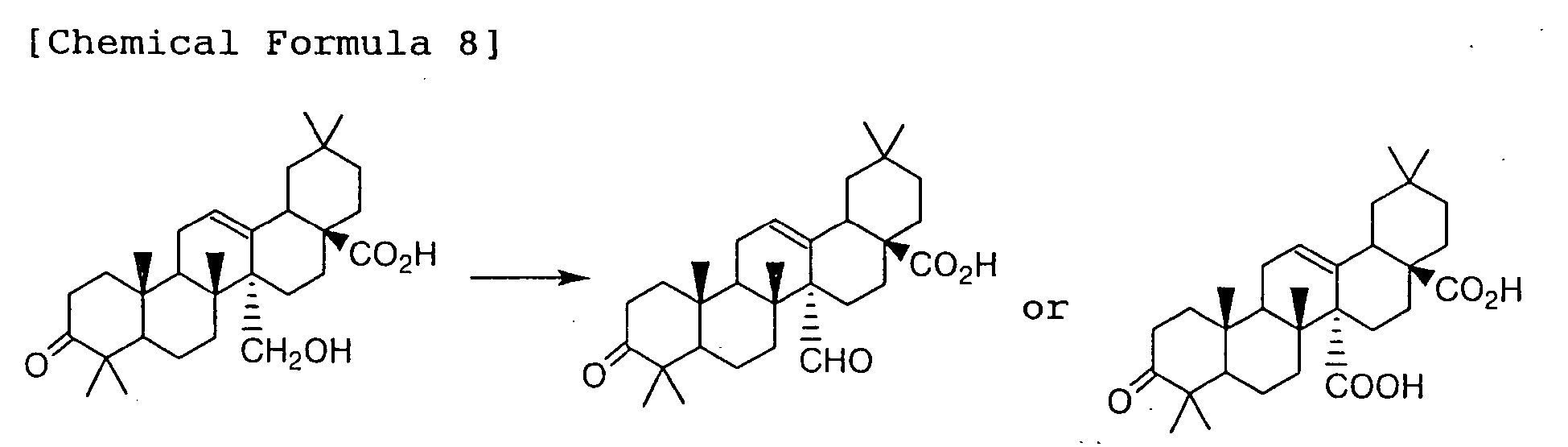
- As one mode of the reaction of obtaining ketone from a secondary alcohol, the process of obtaining the compound (II) from the above compound (I) may be raised.


- In the present specification, lower alkyl includes straight-chain and branched-chain alkyls having a carbon number of 1 to 8, and examples thereof include methyl, ethyl, n-propyl, isopropyl, n-butyl, isobutyl, sec-butyl, tert-butyl, n-pentyl, isopentyl, neopentyl, hexyl, isohexyl, n-heptyl, isoheptyl, n-octyl, isooctyl, and the like. Methyl is preferable.
"Lower alkyl optionally having a substituent" is not particularly limited as long as it is lower alkyl substituted with a group that cannot be a hindrance to the process of the present invention. Examples of the substituent include halogen, optionally protected hydroxy , lower alkoxy, carboxy, lower alkoxycarbonyl, arylcarbonyl, acyl, acyloxy, aryl, aryloxy, amino, lower alkylamino, acylamino, and the like. Lower alkyl substituted with hydroxy is preferable and hydroxymethyl is especially preferable. "Halogen" includes fluorine, chlorine, bromine, and iodine.
Examples of the protective group of "optionally protected hydroxy" include aryl lower alkyl such as triphenylmethyl and benzyl, lower alkoxy(lower)alkyl such as methoxymethyl, 1-ethoxyethyl, 1-methyl-1-methoxyethyl and the like, lower alkoxy(lower)alkoxy(lower)alkylsuch as methoxyethoxymethyl and the like, lower alkylthio(lower)alkyl such as methylthiomethyl and the like, tetrahydropyranyl, tetrahydrothiopyranyl, tetrahydrofuranyl, tetrahydrothiofuranyl, aryl(lower)alkyloxy(lower)alkyl such as benzyloxymethyl and the like, lower alkylsulfonyl, p-toluenesulfonyl, and the like.
The lower alkyl moiety of "lower alkoxy", "lower alkoxycarbonyl", "lower alkylamino", "aryl(lower)alkyl", "lower alkoxy(lower)alkyl", "lower alkoxy(lower)alkoxy(lower)alkyl", "lower alkylthio(lower)alkyl", "aryl(lower)alkyloxy(lower)alkyl", and "lower alkylsulfonyl" is similar to the above-described "lower alkyl".
"Acyl" includes straight-chain or branched chain-form aliphatic acyl having a carbon number of 1 to 6, preferably a carbon number of 1 to 4, cyclic aliphatic acyl having a carbon number of 4 to 9, preferably a carbon number of 4 to 7, and aroyl. Specifically, "acyl" includes formyl, acetyl, propionyl, butyryl, isobutyryl, valeryl, pivaloyl, hexanoyl, acryloyl, propioloyl, methacryloyl, crotonoyl, cyclopropylcarbonyl, cyclohexylcarbonyl, cyclooctylcarbonyl, benzoyl, and the like.
The acyl moiety of "acyloxy" and "acylamino" is similar to the above-described "acyl".
"Aryl" includes phenyl, naphthyl, anthryl, phenanthryl, indenyl, and the like. The aryl moiety of the "arylcarbonyl", "aryloxy", "aryl(lower)alkyl" and "aryl(lower)alkyloxy(lower)alkyl" is also similar.
The "group obtained by oxidation of the group" in R8 includes formyl or carboxy, for example, when R7 is hydroxymethyl, and includes formyl or alkyl having a carbon number of n-1 and substituted with carboxy when R7 is alkyl having a carbon number of n (n is 2 or more) and substituted with hydroxy. - Oxidations of the compound (I) were carried out with use of a mixed reagent (pH 1) made of hydrogen peroxide solution and a tungsten catalyst or a mixed reagent (pH 7) obtained by further adding phosphate to this. It was found out that, in the latter, the production of byproducts is restrained, and the amount of addition of hydrogen peroxide can be restrained to the stoichiometrical amount with respect to the substrate. Therefore, in the process of obtaining the compound (II) from the compound (I), it is preferable to add phosphoric acid or a salt thereof, or a hydrate thereof into the reaction system or into the mixed reagent in advance.
When dimethylsulfoxide, hypochlorite, or 2,2,6,6-tetramethyl-1-piperidinyloxy radical (TEMPO) is used as an oxidizing reagent to be used for oxidation of the compound (I), or when ammonium molybdate is used as a catalyst, undesired results have been obtained such as progression of by-reaction or stoppage of the reaction. Therefore, in the process of obtaining the compound (II) from the compound (I), use of hydrogen peroxide and a tungsten catalyst is one characteristic feature of the present invention. - The compound (II) obtained by the process of the present invention is subjected to a subsequent step after isolation by an ordinary method or without isolation, thereby to obtain the compound (III).
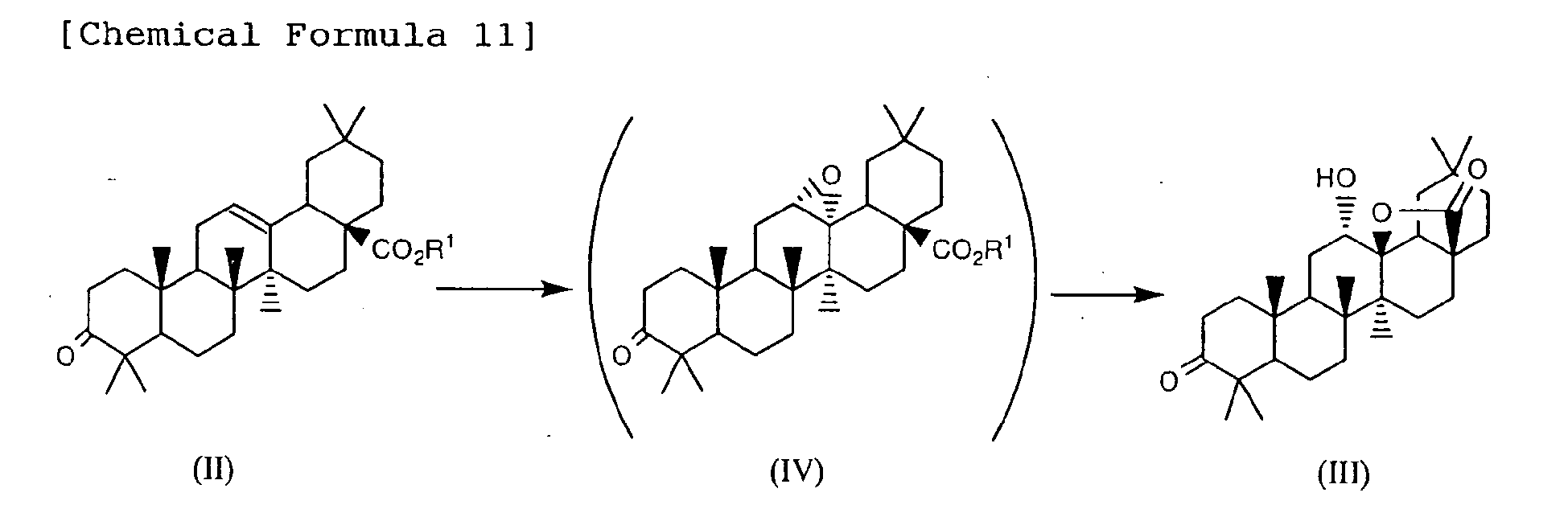
After the reaction is completed, a reducing agent such as L-ascorbic acid and a solvent are added, if needed, and a suitable acid is added at 10°C to 50°C, preferably 30°C to 40°C for crystallization of the compound (III). Subsequently, alcohol (preferably methanol) is added, the mixture is stirred for about 10 minutes to one hour, and filtration may be carried out to obtain a purified compound (III).
The solvent is not particularly limited as long as it is one that is generally used. The same solvent as used in the previous step may be preferably used. - The compound (III) can be obtained directly from the compound (II), however, a compound (IV) may be obtained from the compound (II) and, after it is isolated by an ordinary process, the compound (III) may be obtained.
The compound (III) can be isolated by an ordinary process, however, in the case of using the compound as an intermediate for synthesis of the compound A, the object compound can be produced by the process disclosed in the patent document 7, the patent document 8, or the like without isolation. - The process of the present invention has the following advantages, and is extremely useful as an industrial production process.
Halogenated hydrocarbon such as dichloromethane or harmful solvents or reagents such as chromic acid and manganese dioxide are not used.
Tungsten catalysts have no toxicity or little toxicity.
The amount of discarded phosphorus can be reduced because the reaction proceeds with a catalyst amount of the tungsten catalyst, and the amount of use of phosphoric acid depends on the amount of use of the tungsten catalyst.
Hydrogen peroxide solution of 5 to 40 wt% has a low danger of explosion.
The non-patent document 1 discloses that the pH value of 3 or less is preferable; however, according to the present process, the reaction proceeds suitably even under a neutral condition. Therefore, the process has an advantage in that it can be used for the oxidation of a substrate that is unstable to acid. Also, the non-patent document 1 discloses reaction using no solvent or using toluene. It is difficult to apply a non-solvent reaction to oxidation of a solid substance. The solvent used in the process of the present invention, particularly N,N-dimethylacetamide, can be applied also to a slightly soluble substance, so that the present process is a reaction having a high applicability. - Hereafter, Examples and Experimental Examples will be shown; however, these do not limit the scope of the present invention. In the Examples, the abbreviations each have the following meaning.
- DME: ethylene glycol dimethyl ether
- DMI: 1,3-dimethyl-2-imidazolidinone
- DMF: N,N-dimethylformamide
- NMP: 1-methyl-2-pyrrolidone
- DMA: N,N-dimethylacetamide
- HMPA: triamide hexamethylphosphate
-

The results are shown below.[TABLE 1] Solvent Reaction temperature (°C) 2-octanone yield (%)1) Examples DMI 90 40 DMF 90 50 NMP 90 73 DMA 90 74 HMPA 90 88 Comparative Examples diglyme 90 0 DME 85 0 dioxane 90 0 ethanol 78 1 acetonitrile 80 7 acetone 54 0 1) calculated by GC quantification -

Compound 4: 1H-NMR(500MHz, CDCl3), δ0.816(s,3H), 0.883(s,3H), 0.945(s,3H), 0.977(s,3H), 0.992(s,3H), 1.068(s,3H), 1.139(s,3H), 1.22(m,1H), 1.25(m,1H), 1.33(m,1H), 1.33(m,1H), 1.36(m,1H), 1.39(m,1H), 1.40(m,1H), 1.43(m,1H), 1.45(m,1H), 1.47(m,1H), 1.49(m,1H), 1.65(m,1H), 1.67(m,1H), 1.69(m,2H), 1.906(ddd, J= 13.3,7.2,5,1Hz,1H), 1.78(m,2H), 1.98(m,1H), 2.00(m,1H), 2.01(m,1H), 2.444(ddd, J=16.2,8.7,7.2Hz,1H), 2.465(ddd, J= 16.2,8.3,5.1Hz,1H), 3.197(t, J=1.8Hz,1H)
13C-NMR(500MHz,CDCl3) δ 16.80, 19.26, 21.252, 22.41, 22.59, 23.30, 24.21, 27.30, 29.21, 30.35, 32.62, 33.16, 33.20, 33.95, 34.00, 36.18, 37.92, 39.21, 40.28, 40.50, 42.74, 47.00, 47.58, 54.37, 63.64, 67.02, 183.15, 218.34 - Into 1.18 g of 35% hydrogen peroxide solution (12.0 mmol), 144 mg of disodium phosphate dodecahydrate (0.4 mmol) and 33 mg of sodium tungstate dihydrate (0.1 mmol) were dissolved to prepare a mixed reagent (pH 6.5). After 4.58 g of the compound 1 (10.0 mmol) was dissolved into 23 mL of N,N-dimethylacetamide, the resultant was heated to 90°C, and the above mixed reagent was added. After the reaction was continued at 90°C for four hours, 50 mL of toluene and 50 g of 5% brine were added for liquid separation. After the organic layer was separated, the resultant was concentrated under reduced pressure, and acetonitrile solution (25 mL of acetonitrile, 5 mL of water) was added to obtain the compound 2 as a white crystal. The yield was 4.12 g (90%).
- Into 0.38 g of 34.5% hydrogen peroxide (3.86 mmol), 0.16 mmol of tungstic acid or sodium tungstate dihydrate was dissolved, and 1.35 g of arbitrary 0.1 mol/L phosphate buffer was added to prepare a mixed reagent. After 1.5 g of oleanolic acid (3.28 mmol) was dissolved into 15.6 mL of N,N-dimethylacetamide, the resultant was heated to 90(C. The above mixed reagent was added, and the reaction was continued for 90 minutes while maintaining the temperature of 90(C to obtain the compound 2. The yield ratio was calculated by HPLC quantification.
[TABLE 2] Catalyst Mixed reagent pH Yield (%) Phosphate buffer H2WO4 1.92 96.36 aqueous solution of phosphoric acid 2.73 96.61 aqueous solution of disodium phosphate Na2WO4 5.40 96.84 aqueous solution of phosphoric acid 7.14 97.86 phosphate buffer (pH 6.77)* 8.06 98.14 aqueous solution of disodium phosphate *...phosphate buffer (0.34g of disodium phosphate dodecahydrate, 0.15 g of monosodium phosphate dihydrate, 18.9 ml of water) - Into 30% hydrogen peroxide solution (1.05 g, 9.36 mmol), 25 mg of sodium tungstate dihydrate (0.076 mmol) and 121 mg of disodium phosphate dodecahydrate (0.34 mmol) were dissolved to prepare a mixed reagent. The above mixed reagent and 1.0 g of 2-octanol were mixed with 18 mL of DMA, and the mixture was heated to 90°c. The reaction was continued for 3 hours to obtain an object compound. Also, experiments were carried out in a similar manner with use of a mixed reagent to which phosphoric acid has been added and a mixed reagent to which no phosphoric acid has been added. The results are shown below.
[TABLE 3] Mixed reagent pH Additive 1) 2-octanone yield (%)2) 1.0 H3PO4 92 5.4 - 74 6.5 Na2HPO4 · 12H2O 94 1) 4 mol equivalent/tungsten catalyst
2) calculated by GC quantification - Into 5.90 g of 35% hydrogen peroxide solution (60.0 mmol), 720 mg of disodium phosphate dodecahydrate (2.0 mmol) and 165 mg of sodium tungstate dihydrate (0.5 mmol) were dissolved to prepare a mixed reagent (pH 6.5). After 7.3 g of 2-ethyl-1,3-hexanediol (50.0 mmol) was dissolved into 100 mL of N,N-dimethylacetamide, the resultant was heated to 90°C, and the above mixed reagent was added. After the reaction was continued at 90°c for four hours, 100 mL of toluene and 100 g of 10% brine were added for liquid separation. The aqueous layer was extracted three times with 100 mL of toluene, and all the organic layers were combined and concentrated under reduced pressure. The concentrated liquid was separated and purified by silica gel chromatography (developing solvent hexane : ethyl acetate = 3 : 2) to obtain oily 2-ethyl-1-hydroxy-3-hexanone. The yield was 5.33 g (73%).
-

The yield was calculated by quantitating the reaction liquid by HPLC. The yield of the compound 6 was 30%, and the yield of the compound 7 was 57%. - After 10.5 mg of sodium tungstate dihydrate (0.032 mmol) was dissolved into 100 mg of 35% hydrogen peroxide solution (1.016 mmol), phosphate buffer (4.49 mg of disodium phosphate dodecahydrate (0.012 mmol), 1.98 mg of monosodium phosphate dihydrate (0.013 mmol), and 257 mg of water) was added to prepare a mixed reagent. The compound 5 (300 mg, 0. 635 mmol) was dissolved into 3.0 mL of DMA, and the mixture was heated to 40°C, followed by dropwise addition of the above mixed reagent. After the dropwise addition was completed, the reaction was continued at 40(C for 23 hours.
The yield ratio was calculated by quantitating the reaction liquid by HPLC. The yield ratio of the compound 6 was 68%, and the yield ratio of the compound 7 was 18%. - Into 4.34 g of 35% hydrogen peroxide solution (44.7 mmol), 95.76 mg of disodium phosphate dodecahydrate (0.3 mmol) and 101 mg of sodium tungstate dihydrate (0.4 mmol) were dissolved to prepare a mixed reagent (pH 6.3). After 1.00 g of cyclohexanol (10.0 mmol) was dissolved into 27 mL of N,N-dimethylacetamide, the resultant was heated to 90(C, and the above mixed reagent was added. The reaction was continued for ten hours to obtain cyclohexanone. The yield ratio was 96.2% (GC quantification).
The non-patent document 10 discloses that the Baeyer-Villiger reaction proceeds when 4.4 mol equivalent of hydrogen peroxide is used with respect to 1 mol of cyclohexanol. However, according to the process of the present invention, the above-mentioned reaction hardly proceeded, and ketone was obtained from a secondary alcohol in a good manner. - The oxidation process of an alcohol of the present invention is a process that is suitable for industrial production because of being safe and having a high applicability.
Claims (12)
- A process of oxidizing alcohol characterized by allowing an alcohol to react in an amide solvent with use of hydrogen peroxide and a tungsten catalyst.
- A process of oxidizing alcohol characterized by allowing an alcohol to react in an amide solvent with use of a mixed reagent containing hydrogen peroxide and a tungsten catalyst.
- The process of Claim 2, wherein the mixed reagent further contains phosphoric acid or a salt thereof, or a hydrate thereof.
- The process of Claim 2 or 3, wherein the pH value of the mixed reagent or the pH value in the reaction system before the start of reaction is 2 or above.
- The process of Claim 2 or 3, wherein the pH value of the mixed reagent or the pH value in the reaction system before the start of reaction is 5 or above.
- The process of any one of Claims 2 to 5, wherein the pH value of the mixed reagent or the pH value in the reaction system before the start of reaction is 8 or below.
- The process of Claim 1 characterized by allowing an alcohol to react in the presence of phosphoric acid or a salt thereof, or a hydrate thereof.
- The process of any one of Claims 1 to 7, wherein the tungsten catalyst is tungstic acid or sodium tungstate , or a hydrate thereof
- The process of any one of Claims 1 to 8, wherein the amide solvent is N,N-dimethylacetamide.
- The process of any one of Claims 3 to 9, wherein the phosphoric acid or a salt thereof, or a hydrate thereof is disodium phosphate, monosodium phosphate or a hydrate thereof, or a mixture thereof.
- A process of producing a compound represented by the formula (II):

characterized by oxidizing a compound represented by the formula (I):

in an amide solvent with use of hydrogen peroxide and a tungsten catalyst. - A process of producing a compound represented by the formula (III):

Applications Claiming Priority (2)
| Application Number | Priority Date | Filing Date | Title |
|---|---|---|---|
| JP2004144754 | 2004-05-14 | ||
| PCT/JP2005/008666 WO2005110958A1 (en) | 2004-05-14 | 2005-05-12 | Oxidation reaction of alcohol using hydrogen peroxide and tungsten catalyst |
Publications (2)
| Publication Number | Publication Date |
|---|---|
| EP1757573A1 true EP1757573A1 (en) | 2007-02-28 |
| EP1757573A4 EP1757573A4 (en) | 2008-05-07 |
Family
ID=35394107
Family Applications (1)
| Application Number | Title | Priority Date | Filing Date |
|---|---|---|---|
| EP05738956A Withdrawn EP1757573A4 (en) | 2004-05-14 | 2005-05-12 | Oxidation reaction of alcohol using hydrogen peroxide and tungsten catalyst |
Country Status (4)
| Country | Link |
|---|---|
| US (1) | US8017793B2 (en) |
| EP (1) | EP1757573A4 (en) |
| JP (1) | JP4827189B2 (en) |
| WO (1) | WO2005110958A1 (en) |
Families Citing this family (4)
| Publication number | Priority date | Publication date | Assignee | Title |
|---|---|---|---|---|
| JP5200428B2 (en) * | 2007-06-13 | 2013-06-05 | 宇部興産株式会社 | Method for producing tetrahydropyran-4-one |
| US9458354B2 (en) | 2010-10-06 | 2016-10-04 | Resinate Technologies, Inc. | Polyurethane dispersions and methods of making and using same |
| JP2014520008A (en) | 2011-06-10 | 2014-08-21 | フェリス、クリストファー、エム. | Transparent acrylic coating |
| CN108727178A (en) * | 2017-04-21 | 2018-11-02 | 南京理工大学 | The method that ammonium tungstate catalysis cyclohexanol prepares cyclohexanone |
Family Cites Families (12)
| Publication number | Priority date | Publication date | Assignee | Title |
|---|---|---|---|---|
| DE3343421A1 (en) | 1983-12-01 | 1985-06-13 | Hoechst Ag, 6230 Frankfurt | METHOD FOR PRODUCING 5-OXETHYLSULFONYL-2-AMINOPHENOL (ETHER) |
| IT1191849B (en) | 1986-01-16 | 1988-03-23 | Donegani Guido Ist | PROCEDURE FOR THE PREPARATION OF KETONES |
| HU198736B (en) | 1986-12-29 | 1989-11-28 | Gyogyszerkutato Intezet | Process for producing 16-dehydro-20-oxopregnane derivatives |
| DK0526642T3 (en) | 1991-01-29 | 1998-10-19 | Shionogi & Co | triterpene derivative |
| JPH09118687A (en) | 1991-06-19 | 1997-05-06 | Richter Gedeon V G Rt | Production of 17-alpha-hydroxy-20-oxopregnane, and its production intermediate |
| GB9305234D0 (en) * | 1993-03-13 | 1993-04-28 | Solvay Interox Ltd | Oxidation of alcohols |
| ES2116663T3 (en) | 1993-06-11 | 1998-07-16 | Shionogi & Co | INTERMEDIARY COMPOUNDS FOR THE PREPARATION OF ANTAGONIST TRITERPEN DERIVATIVES OF THE ENDOTHELIN RECEPTOR. |
| JP3453188B2 (en) | 1994-05-23 | 2003-10-06 | 塩野義製薬株式会社 | Method for producing oleanolic acid derivative |
| JP2002241631A (en) | 2001-02-14 | 2002-08-28 | Konica Corp | Method for producing methine dye |
| JP2003171333A (en) * | 2001-09-25 | 2003-06-20 | Sumitomo Chem Co Ltd | Method for producing ketones |
| CA2480096A1 (en) | 2002-03-22 | 2003-10-02 | Shionogi & Co., Ltd. | Process for producing triterpene derivatives |
| CN1313428C (en) | 2002-07-25 | 2007-05-02 | 独立行政法人产业技术综合研究所 | Method for producing carboxylic acid |
-
2005
- 2005-05-12 EP EP05738956A patent/EP1757573A4/en not_active Withdrawn
- 2005-05-12 US US11/596,280 patent/US8017793B2/en not_active Expired - Fee Related
- 2005-05-12 JP JP2006513545A patent/JP4827189B2/en not_active Expired - Fee Related
- 2005-05-12 WO PCT/JP2005/008666 patent/WO2005110958A1/en not_active Ceased
Non-Patent Citations (3)
| Title |
|---|
| KONOIKE, TOSHIRO ET AL: "Practical Partial Synthesis of Myriceric Acid A, an Endothelin Receptor Antagonist, from Oleanolic Acid" JOURNAL OF ORGANIC CHEMISTRY , 62(4), 960-966 CODEN: JOCEAH; ISSN: 0022-3263, 1997, XP002968888 * |
| SATO, KAZUHIKO ET AL: "Organic Solvent- and Halide-Free Oxidation of Alcohols with Aqueous Hydrogen Peroxide" JOURNAL OF THE AMERICAN CHEMICAL SOCIETY , 119(50), 12386-12387 CODEN: JACSAT; ISSN: 0002-7863, 1997, XP000726139 * |
| See also references of WO2005110958A1 * |
Also Published As
| Publication number | Publication date |
|---|---|
| EP1757573A4 (en) | 2008-05-07 |
| US8017793B2 (en) | 2011-09-13 |
| JPWO2005110958A1 (en) | 2008-03-21 |
| WO2005110958A1 (en) | 2005-11-24 |
| JP4827189B2 (en) | 2011-11-30 |
| US20080269509A1 (en) | 2008-10-30 |
Similar Documents
| Publication | Publication Date | Title |
|---|---|---|
| Hida et al. | Practical and versatile oxidation of alcohol using novel Na2WO4–H2O2 system under neutral conditions | |
| JPH05502232A (en) | Method for producing sclareolide | |
| US8017793B2 (en) | Oxidation of alcohol with use of hydrogen peroxide and tungsten catalyst | |
| EP0563358B1 (en) | 9-substituted bicyclo [3.3.0]octane derivatives, for use as txa2 antagonists | |
| DE2820863A1 (en) | 3-METHYL-5-HYDROXYALKYL-PHENOLS AND PRODUCTION OF VITAMIN E PRE-STAGES FROM THEM | |
| JPH0451538B2 (en) | ||
| US4452994A (en) | Process for isolating organic compounds and lithium salt complexes useful in said process | |
| JPS61282355A (en) | Manufacture of 4,4'-dinitrostilbene-2,2'-disulfonate | |
| CS212343B2 (en) | Method of oxidation of penicillines | |
| US4529811A (en) | Process for isolating organic compounds and lithium salt complexes useful in said process | |
| FR2804427A1 (en) | PROCESS FOR THE PREPARATION OF ALPHA-HALOGENATED KETONES | |
| JP5263468B2 (en) | Method for producing optically active sulfoxide compound using aluminum salalene complex catalyst | |
| JPS62252744A (en) | Production of aromatic dicarboxylic acid | |
| JP4045795B2 (en) | Method for producing 2,6-dichlorophenol compound | |
| JPH058691B2 (en) | ||
| US5283345A (en) | 1β,7,8-trihydroxy vitamin D2, 1∘,7,8-trihydroxy vitamin D3 and their derivatives and method of manufacturing these chemicals | |
| JP2894183B2 (en) | Purification method of optically active glutaric acid derivative | |
| JPH025745B2 (en) | ||
| JPH0460975B2 (en) | ||
| JP2501604B2 (en) | Process for producing cholesta-1,4,6-trien-3-ones | |
| KR100570279B1 (en) | Intermediates of coenzyme Qn and methods for preparing the intermediate | |
| JPH025744B2 (en) | ||
| JPWO2006077801A1 (en) | Method for producing myricelon derivative | |
| JP2003183245A (en) | Method for producing aryl sulfone | |
| JPS63303962A (en) | Isocarbacyclins and production thereof |
Legal Events
| Date | Code | Title | Description |
|---|---|---|---|
| PUAI | Public reference made under article 153(3) epc to a published international application that has entered the european phase |
Free format text: ORIGINAL CODE: 0009012 |
|
| 17P | Request for examination filed |
Effective date: 20061113 |
|
| AK | Designated contracting states |
Kind code of ref document: A1 Designated state(s): AT BE BG CH CY CZ DE DK EE ES FI FR GB GR HU IE IS IT LI LT LU MC NL PL PT RO SE SI SK TR |
|
| DAX | Request for extension of the european patent (deleted) | ||
| A4 | Supplementary search report drawn up and despatched |
Effective date: 20080404 |
|
| RIC1 | Information provided on ipc code assigned before grant |
Ipc: C07C 51/373 20060101ALI20080401BHEP Ipc: C07J 73/00 20060101ALI20080401BHEP Ipc: C07C 45/29 20060101AFI20051129BHEP Ipc: C07C 49/04 20060101ALI20080401BHEP Ipc: C07B 53/00 20060101ALI20080401BHEP Ipc: C07B 61/00 20060101ALI20080401BHEP Ipc: C07J 71/00 20060101ALI20080401BHEP Ipc: C07C 62/38 20060101ALI20080401BHEP Ipc: C07C 49/17 20060101ALI20080401BHEP |
|
| 17Q | First examination report despatched |
Effective date: 20130220 |
|
| STAA | Information on the status of an ep patent application or granted ep patent |
Free format text: STATUS: THE APPLICATION IS DEEMED TO BE WITHDRAWN |
|
| 18D | Application deemed to be withdrawn |
Effective date: 20130703 |