EP1754826A1 - Schaberklinge - Google Patents
Schaberklinge Download PDFInfo
- Publication number
- EP1754826A1 EP1754826A1 EP06115876A EP06115876A EP1754826A1 EP 1754826 A1 EP1754826 A1 EP 1754826A1 EP 06115876 A EP06115876 A EP 06115876A EP 06115876 A EP06115876 A EP 06115876A EP 1754826 A1 EP1754826 A1 EP 1754826A1
- Authority
- EP
- European Patent Office
- Prior art keywords
- scraper blade
- blade according
- lubricant
- matrix material
- embedded
- Prior art date
- Legal status (The legal status is an assumption and is not a legal conclusion. Google has not performed a legal analysis and makes no representation as to the accuracy of the status listed.)
- Granted
Links
- 239000011159 matrix material Substances 0.000 claims abstract description 56
- 239000010687 lubricating oil Substances 0.000 claims abstract description 32
- 239000000463 material Substances 0.000 claims abstract description 22
- 239000000314 lubricant Substances 0.000 claims description 48
- WSFSSNUMVMOOMR-UHFFFAOYSA-N Formaldehyde Chemical compound O=C WSFSSNUMVMOOMR-UHFFFAOYSA-N 0.000 claims description 12
- 239000007787 solid Substances 0.000 claims description 12
- 239000012765 fibrous filler Substances 0.000 claims description 7
- 229920005989 resin Polymers 0.000 claims description 7
- 239000011347 resin Substances 0.000 claims description 7
- 239000000945 filler Substances 0.000 claims description 6
- 229920002545 silicone oil Polymers 0.000 claims description 6
- OKTJSMMVPCPJKN-UHFFFAOYSA-N Carbon Chemical compound [C] OKTJSMMVPCPJKN-UHFFFAOYSA-N 0.000 claims description 5
- 239000007788 liquid Substances 0.000 claims description 5
- 239000010690 paraffinic oil Substances 0.000 claims description 5
- -1 polyethylene Polymers 0.000 claims description 5
- 239000012815 thermoplastic material Substances 0.000 claims description 5
- KXGFMDJXCMQABM-UHFFFAOYSA-N 2-methoxy-6-methylphenol Chemical compound [CH]OC1=CC=CC([CH])=C1O KXGFMDJXCMQABM-UHFFFAOYSA-N 0.000 claims description 4
- VTYYLEPIZMXCLO-UHFFFAOYSA-L Calcium carbonate Chemical compound [Ca+2].[O-]C([O-])=O VTYYLEPIZMXCLO-UHFFFAOYSA-L 0.000 claims description 4
- 239000004952 Polyamide Substances 0.000 claims description 4
- 239000003822 epoxy resin Substances 0.000 claims description 4
- 239000003921 oil Substances 0.000 claims description 4
- 235000019198 oils Nutrition 0.000 claims description 4
- 229920001568 phenolic resin Polymers 0.000 claims description 4
- 239000005011 phenolic resin Substances 0.000 claims description 4
- 229920002647 polyamide Polymers 0.000 claims description 4
- 229920000647 polyepoxide Polymers 0.000 claims description 4
- 229920002635 polyurethane Polymers 0.000 claims description 4
- 239000004814 polyurethane Substances 0.000 claims description 4
- 229920001169 thermoplastic Polymers 0.000 claims description 4
- 239000004416 thermosoftening plastic Substances 0.000 claims description 4
- 239000004760 aramid Substances 0.000 claims description 3
- 229910002804 graphite Inorganic materials 0.000 claims description 3
- 239000010439 graphite Substances 0.000 claims description 3
- 239000005995 Aluminium silicate Substances 0.000 claims description 2
- 229910052582 BN Inorganic materials 0.000 claims description 2
- PZNSFCLAULLKQX-UHFFFAOYSA-N Boron nitride Chemical compound N#B PZNSFCLAULLKQX-UHFFFAOYSA-N 0.000 claims description 2
- 244000043261 Hevea brasiliensis Species 0.000 claims description 2
- 239000004696 Poly ether ether ketone Substances 0.000 claims description 2
- 239000004698 Polyethylene Substances 0.000 claims description 2
- 239000004734 Polyphenylene sulfide Substances 0.000 claims description 2
- 239000004743 Polypropylene Substances 0.000 claims description 2
- PNEYBMLMFCGWSK-UHFFFAOYSA-N aluminium oxide Inorganic materials [O-2].[O-2].[O-2].[Al+3].[Al+3] PNEYBMLMFCGWSK-UHFFFAOYSA-N 0.000 claims description 2
- 235000012211 aluminium silicate Nutrition 0.000 claims description 2
- 239000010692 aromatic oil Substances 0.000 claims description 2
- 229920003235 aromatic polyamide Polymers 0.000 claims description 2
- 229910000019 calcium carbonate Inorganic materials 0.000 claims description 2
- 229910052799 carbon Inorganic materials 0.000 claims description 2
- 229920002678 cellulose Polymers 0.000 claims description 2
- 239000001913 cellulose Substances 0.000 claims description 2
- 150000002148 esters Chemical class 0.000 claims description 2
- 239000011521 glass Substances 0.000 claims description 2
- NLYAJNPCOHFWQQ-UHFFFAOYSA-N kaolin Chemical compound O.O.O=[Al]O[Si](=O)O[Si](=O)O[Al]=O NLYAJNPCOHFWQQ-UHFFFAOYSA-N 0.000 claims description 2
- 229910000476 molybdenum oxide Inorganic materials 0.000 claims description 2
- 229920003052 natural elastomer Polymers 0.000 claims description 2
- 229920001194 natural rubber Polymers 0.000 claims description 2
- PQQKPALAQIIWST-UHFFFAOYSA-N oxomolybdenum Chemical compound [Mo]=O PQQKPALAQIIWST-UHFFFAOYSA-N 0.000 claims description 2
- 229920000728 polyester Polymers 0.000 claims description 2
- 229920002530 polyetherether ketone Polymers 0.000 claims description 2
- 229920000573 polyethylene Polymers 0.000 claims description 2
- 239000002861 polymer material Substances 0.000 claims description 2
- 229920000069 polyphenylene sulfide Polymers 0.000 claims description 2
- 229920001155 polypropylene Polymers 0.000 claims description 2
- 239000004810 polytetrafluoroethylene Substances 0.000 claims description 2
- 229920001343 polytetrafluoroethylene Polymers 0.000 claims description 2
- LIVNPJMFVYWSIS-UHFFFAOYSA-N silicon monoxide Chemical class [Si-]#[O+] LIVNPJMFVYWSIS-UHFFFAOYSA-N 0.000 claims description 2
- 229910052814 silicon oxide Inorganic materials 0.000 claims description 2
- 229920003051 synthetic elastomer Polymers 0.000 claims description 2
- 239000005061 synthetic rubber Substances 0.000 claims description 2
- 229920000785 ultra high molecular weight polyethylene Polymers 0.000 claims description 2
- 235000015112 vegetable and seed oil Nutrition 0.000 claims description 2
- 239000008158 vegetable oil Substances 0.000 claims description 2
- 238000004519 manufacturing process Methods 0.000 abstract description 2
- 239000004606 Fillers/Extenders Substances 0.000 abstract 1
- 238000005461 lubrication Methods 0.000 description 7
- 230000001050 lubricating effect Effects 0.000 description 5
- 239000000123 paper Substances 0.000 description 3
- 229920000271 Kevlar® Polymers 0.000 description 2
- 230000006735 deficit Effects 0.000 description 2
- 239000000835 fiber Substances 0.000 description 2
- 239000004761 kevlar Substances 0.000 description 2
- 239000002245 particle Substances 0.000 description 2
- 239000000126 substance Substances 0.000 description 2
- 229920000049 Carbon (fiber) Polymers 0.000 description 1
- 238000005299 abrasion Methods 0.000 description 1
- 229920006231 aramid fiber Polymers 0.000 description 1
- 238000005452 bending Methods 0.000 description 1
- 239000004917 carbon fiber Substances 0.000 description 1
- 230000006378 damage Effects 0.000 description 1
- 230000007547 defect Effects 0.000 description 1
- 238000011161 development Methods 0.000 description 1
- 230000018109 developmental process Effects 0.000 description 1
- 230000000694 effects Effects 0.000 description 1
- LNEPOXFFQSENCJ-UHFFFAOYSA-N haloperidol Chemical compound C1CC(O)(C=2C=CC(Cl)=CC=2)CCN1CCCC(=O)C1=CC=C(F)C=C1 LNEPOXFFQSENCJ-UHFFFAOYSA-N 0.000 description 1
- 229910044991 metal oxide Inorganic materials 0.000 description 1
- 150000004706 metal oxides Chemical class 0.000 description 1
- VNWKTOKETHGBQD-UHFFFAOYSA-N methane Chemical group C VNWKTOKETHGBQD-UHFFFAOYSA-N 0.000 description 1
- 230000009149 molecular binding Effects 0.000 description 1
- 239000002105 nanoparticle Substances 0.000 description 1
- TWNQGVIAIRXVLR-UHFFFAOYSA-N oxo(oxoalumanyloxy)alumane Chemical compound O=[Al]O[Al]=O TWNQGVIAIRXVLR-UHFFFAOYSA-N 0.000 description 1
- 239000004014 plasticizer Substances 0.000 description 1
- 238000009827 uniform distribution Methods 0.000 description 1
Images

Classifications
-
- D—TEXTILES; PAPER
- D21—PAPER-MAKING; PRODUCTION OF CELLULOSE
- D21G—CALENDERS; ACCESSORIES FOR PAPER-MAKING MACHINES
- D21G3/00—Doctors
- D21G3/005—Doctor knifes
Definitions
- This invention relates to a doctor blade for beschaberung the lateral surface of a rotating roller, in particular in a machine for producing and / or further processing a material web, in particular a fibrous web, according to the preamble of patent claim 1.
- scraper systems are used to keep the outer surfaces of, for example, rolls arranged in web-processing machines, such as paper machines.
- a scraper blade is brought into tribological contact with the lateral surface of the roller. Due to the tribological contact between roller and doctor blade, both doctor blade material and material of the roll cover are removed.
- the known doctor systems are lubricated by a lubricating device through which the tribological system, a lubricant is supplied.
- the generic doctor blade has a matrix material comprehensive wear volume, which is at least in sections with the lateral surface of a rotating roller in tribological contact can be brought.
- a liquid lubricant in the matrix material of the wear volume releases the matrix material of the wear volume - which can happen, for example, if the lubrication fails due to the lubricant to be provided by the lubricating device or if it is too low - the liquid lubricant embedded in the matrix material is released.
- the liberated lubricant lubricates the tribological system doctor blade roller cover and prevents destroying the doctor blade and / or the roller cover.
- the lubricant is liquid, furthermore, a rapid and uniform distribution of the lubricant in the contact region between the wear volume of the doctor blade and the roller cover is achieved.
- a lubricant is to be understood as meaning a substance by means of which, when it is used, the friction coefficient of the tribological system is reduced to a doctor blade roller jacket in relation to the case in which this substance is not used.
- Doctor blades are generally at least partially formed of polymeric materials, in particular matrix materials embedded in the example. Fibrous or particulate fillers. By providing such matrix materials, a variety of properties of a doctor blade can be adjusted. Therefore, the matrix material of the wear volume preferably comprises a polymeric matrix material, wherein the at least one liquid lubricant is at least partially embedded in the polymeric matrix material.
- the polymeric matrix material in this case comprises, for example, alone or in combination: cyanester resin, phenolic resin, formaldehyde resin, thermoplastic material.
- the formaldehyde resin comprises an epoxy resin
- the thermoplastic material may comprise polyphenylene sulfide and / or polyetheretherketone.
- the doctor blade is made up of a plurality of layers arranged one above the other, wherein each of the layers decisively co-determines a specific property of the doctor blade.
- the matrix material of the wear volume comprises a plurality of layer-shaped material sections which are interconnected in layers to form a so-called "sandwich structure", wherein preferably one of the layered material sections, the polymeric matrix material with the at least one liquid and lubricant embedded therein.
- the liquid lubricant is at least partially dissolved in the polymeric matrix material, which, inter alia, ensures that the liquid lubricant is homogeneously mixed with the matrix material.
- the matrix material cavities for example, are formed in the sense of a bubble structure, which is filled with the lubricant.
- the at least one liquid lubricant may in this case comprise a non-reactive lubricant.
- a non-reactive lubricant may be mentioned by way of example alone or in combination: silicone oil, Esterweichmacher, aromatic oil, naphthenic oil, paraffinic oil, white oil, vegetable oil, BYKClean3700 ® from BYK-Gardner GmbH..
- the at least one liquid lubricant may further comprise a reactive lubricant.
- a reactive lubricant such as a lubricant to understand which is bonded at least by covalent molecule binding to at least one component of the matrix material, by way of example BYK-Silclean is to call 3700 ® from. BYK-Gardner GmbH, of reacted into anhydridischen epoxy resins.
- the at least one solid lubricant is particulate-shaped and in this case forms small lubricant depots.
- the solid lubricant may in this case comprise an inorganic lubricant and / or an organic lubricant.
- the inorganic lubricant may comprise, for example, alone or in combination MoS 2 , graphite, boron nitride, spherical inorganic lubricants such as anorg buckyballs, silicon oxides, alumina, kaolin, molybdenum oxide, calcium carbonate, especially if these particles in very small dimensions, for example. Under 1 mm, in particular present as nanoparticles.
- the organic lubricant may comprise a thermoplastic lubricant.
- a thermoplastic lubricant is preferably used alone or in combination: polyethylene (HD, LD, UHMW), polypropylene, polyamide, polyurethane, PTFE.
- At least one fibrous and / or at least one particulate non-lubricating filler is embedded in the wear volume.
- the at least one fibrous filler may comprise alone or in combination: glass, carbon, aramid, polyamide, polyester, cellulose.
- the at least one liquid lubricant dissolved in the polymeric matrix material may be provided that the fibrous filler is at least partially coated with the liquid lubricant.
- a wear volume with embedded liquid lubricant can be provided by a simple manner in the production of the doctor blade.
- the doctor blade preferably comprises an elastomeric polymer material.
- the elastomeric polymeric material may be part of the wear volume.
- the conceivable elastomeric polymeric material may comprise alone or in combination natural rubber, synthetic rubber, polyurethane.
- the liquid lubricant is embedded in the polymeric matrix material at a concentration in the range of 0.1-50% by weight, preferably 1-30% by weight, more preferably 5-15% by weight.
- the solid lubricant is embedded in the polymeric matrix material at a concentration in the range of 1-50% by weight, preferably in the range of 10-40% by weight.
- the scraper blade according to the invention for Beschabtation a roll surface in a machine for producing a material web or a machine for further processing a material web, in particular a fibrous web such as, for example, a paper, cardboard or tissue web use.
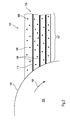
- FIG. 1 shows, in a sectioned illustration, a doctor blade 1 during the doctoring of the lateral surface 2 of a roller 4 rotating in the direction of rotation 3 in a paper machine.
- the doctor blade 1 has a wear volume 5, which is removed successively in the tribological contact with the lateral surface 2.
- the wear volume 5 of the doctor blade 1 comprises several layer-shaped material sections 6 to 8, which are connected to one another in layers.
- the uppermost layer 6 of the wear volume 5 in FIG. 1 comprises a polymeric matrix material 9 in which, according to the invention, a liquid lubricant is embedded.
- the liquid lubricant is dissolved in the polymeric matrix material 9.
- the polymeric matrix material 9 is a cyanester resin, wherein the liquid lubricant is a non-reactive lubricant such as, for example, silicone oil or ester plasticizer.
- a solid lubricant 10 embedded in the polymeric matrix material 9 is a solid lubricant 10, in the form of particulate MoS 2 having a concentration of 20% by weight.
- a layer is provided in the wear volume 5 by a fibrous filler 12 embedded in a polymeric matrix material 11.
- the polymeric matrix material 11 comprises an epoxy resin and the fibrous filler 12 is formed by a woven carbon fiber structure with the interwoven carbon fibers extending in the machine direction (MD direction) or in the cross machine direction (CD direction).
- the middle layer influences in particular the bending stiffness and the vibration behavior of the scraper blade 1 according to the invention.
- a polymeric matrix material 13 with particulate filler 14 embedded therein is provided in the wear volume 5.
- the polymeric matrix material 13 comprises, for example, a thermoplastic material, wherein the particulate filler 14 has abrasive properties, whereby it is possible to grind the contour of the doctored roll shell 2 during the Beschabtation.
- the particulate filler 14 in this case comprises, for example, a metal oxide such as, for example, aluminum oxide.
- FIG. 2 shows a further embodiment of a scraper blade 101 according to the invention in a section-wise representation during the doctoring of the lateral surface 102 of a roller 104 which rotates in a direction of rotation 103 and likewise is shown only in sections.
- the scraper blade 101 has a wear volume 107 comprising a polymeric matrix material 108.
- the polymeric matrix material 108 comprises a phenolic resin.
- a liquid lubricant is embedded in the matrix material 108 according to the invention.
- the liquid lubricant in the present embodiment of the invention comprises a paraffinic oil dissolved at a concentration of 10% by weight in the phenolic resin.
- the wear volume comprises only one layer-shaped material section 105 which comprises the polymeric matrix material with the at least one liquid and lubricant embedded therein.
- a solid lubricant 106 is embedded in the matrix material 108.
- the solid lubricant 106 in the present embodiment comprises particulate graphite.
- a fibrous filler 109 embedded in the matrix material 108 is a fibrous filler 109 in the form of MD-extending aramid fibers, such as Kevlar fibers.
- the Kevlar fibers 109 are coated with the liquid lubricant 110 (shown by dashed lines), which in this case is silicone oil.
- the liquid lubricant embedded in the polymeric matrix material 108 comprises a paraffinic oil and a silicone oil, the liquid lubricant being partially dissolved in the polymeric matrix material 108, namely the paraffinic oil, and partially not dissolved in the polymeric matrix material, namely the silicone oil.
Landscapes
- Paper (AREA)
- Compositions Of Macromolecular Compounds (AREA)
- Lubricants (AREA)
- Treatment Of Fiber Materials (AREA)
- Centrifugal Separators (AREA)
- Organic Low-Molecular-Weight Compounds And Preparation Thereof (AREA)
- Processing And Handling Of Plastics And Other Materials For Molding In General (AREA)
Abstract
Description
- Diese Erfindung betrifft eine Schaberklinge zur Beschaberung der Mantelfläche einer sich drehenden Walze insbesondere in einer Maschine zur Herstellung und / oder Weiterverarbeitung einer Materialbahn, insbesondere einer Faserstoffbahn, nach dem Oberbegriff des Patentanspruchs 1.
- Zur Reinhaltung der Mantelflächen von bspw. in bahnverarbeitenden Maschinen wie Papiermaschinen angeordneten Walzen werden Schabersysteme verwendet. Bei den bekannten Schabersystemen wird eine Schaberklinge in tribologischen Kontakt mit der Mantelfläche der Walze gebracht. Durch den tribologischen Kontakt zwischen Walze und Schaberklinge wird sowohl Schaberklingenmaterial als auch Material des Walzenbezugs abgetragen. Um den Verschleiß der Schaberklinge aber vor allem des Walzenbezugs so gering wie möglich zu halten, werden die bekannten Schabersysteme mittels einer Schmiereinrichtung geschmiert, durch welche dem tribologischen System ein Schmiermittel zugeführt wird.
- Fällt die Schmierung des tribologischen Systems Schaberklinge-Walzenbezug aufgrund eines Defekts der Schmiereinrichtung aus, so kommt es bei den bekannten Schabersystemen aufgrund der ohne Schmierung sehr hohen Reibung und der damit einhergehenden Wärmeentwicklung nach kürzester Zeit zur Zerstörung des Walzenmantels und / oder der Schaberklinge.
- Es ist die Aufgabe der vorliegenden Erfindung eine Schaberklinge vorzuschlagen, die derart gestaltet ist, dass eine Unterbrechung der Schmiermittelzufuhr nicht unmittelbar zur Zerstörung des Walzenmantels und / oder der Schaberklinge führt.
- Die Aufgabe wird mir den Merkmalen der Patentanspruchs 1 gelöst.
- Die gattungsgemäße Schaberklinge weist ein Matrixmaterial umfassendes Verschleißvolumen auf, welches zumindest abschnittweise mit der Mantelfläche einer sich drehenden Walze in tribologischen Kontakt bringbar ist.
- Bei der erfindungsgemäßen Schaberklinge ist darüber hinaus vorgesehen, dass in das Matrixmaterial zumindest abschnittweise zumindest ein flüssiger Schmierstoff eingebettet ist.
- Durch die Bereitstellung eines flüssigen Schmierstoffs im Matrixmaterial des Verschleißvolumens wird beim Abtrag des Matrixmaterials des Verschleißvolumens - was bspw. dann passieren kann, wenn die Schmierung durch das durch die Schmiereinrichtung bereitzustellende Schmiermittel ausbleibt oder zu gering ist - der im Matrixmaterial eingebettete flüssige Schmierstoff freigesetzt. Durch den freigesetzten Schmierstoff wird das tribologische System Schaberklinge-Walzenbezug geschmiert und ein Zerstören der Schaberklinge und / oder des Walzenbezugs wird verhindert.
- Dadurch, dass der Schmierstoff flüssig ist wird des weiteren eine schnelle und gleichmäßige Verteilung des Schmierstoffs im Kontaktbereich zwischen dem Verschleißvolumen der Schaberklinge und dem Walzenbezug erreicht.
- Bei Bereitstellung einer ausreichenden Quantität und / oder Qualität an Schmierstoff bei Abtrag des Matrixmaterials des Verschleißvolumens ist es sogar denkbar, dass auf eine wie oben beschriebene externe Schmierung des tribologischen Systems vollständig verzichtet wird.
- Unter einem Schmierstoff soll in diesem Zusammenhang ein Stoff verstanden werden, durch welchen bei seiner Verwendung der Reibungskoeffizient des tribologischen Systems Schaberklinge-Walzenmantel gegenüber dem Fall heruntergesetzt wird, in dem dieser Stoff nicht verwendet wird.
- Schaberklingen werden im Allgemeinen zumindest abschnittweise aus polymeren Materialien, insbesondere Matrixmaterialien in die bspw. faser- oder partikelförmige Füllstoffe eingebettet sind, gebildet. Durch die Bereitstellung von solchen Matrixmaterialien kann eine Vielzahl von Eigenschaften einer Schaberklinge eingestellt werden. Daher umfasst das Matrixmaterial des Verschleißvolumens vorzugsweise ein polymeres Matrixmaterial, wobei der zumindest eine flüssige Schmierstoff zumindest abschnittweise in das polymere Matrixmaterial eingebettet ist.
- Das polymere Matrixmaterial umfasst hierbei bspw. allein oder in Kombination: Cyanesterharz, Phenolharz, Formaldehydharz, thermoplastisches Material.
- Vorzugsweise umfasst das Formaldehydharz ein Epoxydharz, wobei das thermoplastische Material Polyphenylensulfid und / oder Polyetheretherketon umfassen kann.
- Um eine mehrere Eigenschaften einer Schaberklinge, wie bspw. Steifigkeit und dgl. unabhängig voneinander ausbilden zu können, kann vorgesehen sein, dass die Schaberklinge aus mehreren schichtweise übereinander angeordneten Lagen aufgebaut ist, wobei jede der Lagen eine spezifische Eigenschaft der Schaberklinge entscheidend mitbestimmt. Eine bevorzugte Ausgestaltung der Erfindung sieht deshalb vor, dass das Matrixmaterial des Verschleißvolumens mehrere lagenförmig ausgebildete Materialabschnitte umfasst, die schichtartig unter Ausbildung einer sog. "Sandwich-Struktur" miteinander verbunden sind, wobei vorzugsweise einer der lagenförmigen Materialabschnitte das polymere Matrixmaterial mit dem zumindest einen flüssigen und darin eingebetteten Schmierstoff umfasst.
- Vorzugsweise ist der flüssige Schmierstoff zumindest teilweise in dem polymeren Matrixmaterial gelöst, wodurch unter anderem gewährleistet wird, dass der flüssige Schmierstoff mit dem Matrixmaterial homogen durchmischt ist. Es ist aber auch denkbar, dass in dem Matrixmaterial Hohlräume bspw. im Sinne einer Bläschenstruktur gebildet werden, die mit dem Schmierstoff gefüllt ist.
- Der zumindest eine flüssige Schmierstoff kann hierbei einen nichtreaktiven Schmierstoff umfassen. Als nichtreaktive Schmierstoff sind beispielhaft allein oder in Kombination zu nennen: Silikonöl, Esterweichmacher, aromatisches Öl, naphthenisches Öl, parafinisches Öl, Weissöl, Pflanzenöl, BYKClean3700® der Fa. BYK- Gardner GmbH.
- Der zumindest eine flüssige Schmierstoff kann darüber hinaus einen reaktiven Schmierstoff umfassen. Unter reaktivem Schmierstoff ist ein solcher Schmierstoff zu verstehen, der zumindest durch eine kovalente Molekül- Bindung an zumindest eine Komponente des Matrixwerkstoffes gebunden ist, beispielhaft ist BYK-Silclean 3700® der Fa. BYK- Gardner GmbH zu nennen, der in anhydridischen Epoxidharzen einreagiert.
- Versuche der Anmelderin haben überraschenderweise gezeigt, dass der Reibungskoeffizient des Verschleißvolumens deutlich reduziert werden kann, wenn in das Material des Verschleißvolumens abschnittweise sowohl ein flüssiger als auch ein fester Schmierstoff eingebettet ist. Wie die Versuche gezeigt haben, kann bei der Kombination aus festem und flüssigem Schmierstoff in dem Material des Verschleißvolumens sogar vollständig auf eine externe Schmierung durch eine Schmiereinrichtung verzichtet werden. Hierbei wirkt die in das Material des Verschleißvolumens eingebettete fest-flüssig Schmierstoffkombination derart, dass der Walzenbezug nicht mit einer Schlichte von abradierten Schmierstoffpartikeln verschlossen wird, so dass bspw. keine Beeinträchtigung des Rauheitsprofils und damit eine Beeinträchtigung der Beschaberungswirkung eintritt.
- Vorzugsweise ist der zumindest eine feste Schmierstoff partikelförmig ausgebildet und bildet hierbei kleine Schmiermitteldepots. Der feste Schmierstoff kann hierbei einen anorganischen Schmierstoff und / oder einen organischen Schmierstoff umfassen.
- Der anorganische Schmierstoff kann bspw. allein oder in Kombination MoS2, Graphit, Bornitrid, sphärische anorganische Schmiermittel wie anorg Buckybälle, Silikonoxide, Aluminiumoxid, Kaolin, Molybdänoxid, Calciumcarbonat umfassen, insbesondere wenn diese Partikel in sehr kleinen Dimensionen bspw. unter 1 mm, insbesondere als Nanopartikel vorliegen.
- Des weiteren kann der organische Schmierstoff einen thermoplastischen Schmierstoff umfassen. Als organischer thermoplastischer Schmierstoff kommt vorzugsweise allein oder in Kombination in Betracht: Polyethylen (HD, LD, UHMW), Polypropylen, Polyamid, Polyurethan, PTFE.
- Um die Stabilität und / oder die Steifigkeit und / oder das Schwingungsverhalten und / oder das Abrasionsverhalten und dergleichen der Schaberklinge beeinflussen zu können ist vorzugsweise vorgesehen, dass in das Verschleißvolumen zumindest ein faserförmiger und / oder zumindest ein partikelförmiger nicht schmierender Füllstoff eingebettet ist.
- Der zumindest eine faserförmige Füllstoff kann hierbei allein oder in Kombination umfassen: Glas, Carbon, Aramid, Polyamid, Polyester, Cellulose.
- Alternativ oder zusätzlich der der zumindest ein flüssige Schmierstoff in dem polymeren Matrixmaterial gelöst ist kann vorgesehen sein, dass der faserförmige Füllstoff zumindest teilweise mit dem flüssigen Schmierstoff beschichtet ist. Hierdurch kann durch einfache Art und Weise bei der Herstellung der Schaberklinge ein Verschleißvolumen mit eingebettetem flüssigen Schmierstoff bereit gestellt werden.
- Des weiteren umfasst die Schaberklinge vorzugsweise ein elastomers polymeres Material. Das elastomere polymere Material kann hierbei Teil des Verschleißvolumens sein. Das denkbare elastomere polymere Material kann hierbei allein oder in Kombination natürlichen Kautschuk, synthetischen Kautschuk, Polyurethan umfassen.
- Vorzugsweise ist der flüssige Schmierstoff mit einer Konzentration im Bereich von 0,1 - 50 Gew.%, bevorzugt 1- 30 Gew.%, besonders bevorzugt 5-15 Gew.% in dem polymeren Matrixmaterial eingebettet.
- Nach einer weiteren bevorzugten Ausgestaltung der Erfindung ist der feste Schmierstoff mit einer Konzentration im Bereich von 1- 50 Gew.%, bevorzugt im Bereich von 10-40 Gew.% in dem polymeren Matrixmaterial eingebettet.
- Vorzugsweise findet die erfindungsgemäße Schaberklinge zur Beschaberung einer Walzenoberfläche in einer Maschine zur Herstellung einer Materialbahn oder einer Maschine zur Weiterverarbeitung eine Materialbahn, insbesondere einer Faserstoffbahn wie bspw. einer Papier-, Karton- oder Tissuebahn Verwendung.
- Nachfolgend wird die Erfindung durch zwei Ausführungsbeispiele anhand der folgenden schematischen und nicht maßstabsgetreuen Zeichnungen näher erläutert.
Es zeigen: - Fig. 1 eine erste Ausführungsform einer erfindungsgemäßen Schaberklinge,
- Fig. 2 eine zweite Ausführungsform einer erfindungsgemäßen Schaberklinge.
- Die Figur 1 zeigt in abschnittweiser Darstellung eine Schaberklinge 1 bei der Beschaberung der Mantelfläche 2 einer sich in Drehrichtung 3 drehenden Walze 4 in einer Papiermaschine.
- Die Schaberklinge 1 weist ein Verschleißvolumen 5 auf, das beim tribologischen Kontakt mit der Mantelfläche 2 sukzessive abgetragen wird.
- Das Verschleißvolumen 5 der Schaberklinge 1 umfasst mehrere lagenförmig ausgebildete Materialabschnitte 6 bis 8, die schichtartig miteinander verbunden sind.
- Die in der Figur 1 oberste Lage 6 des Verschleißvolumens 5 umfasst ein polymeres Matrixmaterial 9, in welches erfindungsgemäß ein flüssiger Schmierstoff eingebettet ist. Im vorliegenden Ausführungsbeispiel ist der flüssige Schmierstoff in dem polymeren Matrixmaterial 9 gelöst. Das polymere Matrixmaterial 9 ist hierbei ein Cyanesterharz, wobei der flüssige Schmierstoff ein nichtreaktiver Schmierstoff wie bspw. Silikonöl oder Esterweichmacher ist.
- Des weiteren ist in das polymere Matrixmaterial 9 ein fester Schmierstoff 10, in Form von partikelförmig ausgebildetem MoS2 mit einer Konzentration 20 Gew.% eingebettet.
- Durch die obere Lage 6 mit dem fest-flüssigen Schmierstoffsystem wird eine Notlaufeigenschaft der erfindungsgemäßen Schaberklinge bei Aussetzen der vorgesehenen externen Schmierung bereitgestellt, so dass im Ergebnis beim Ausbleiben dieser Schmierung das tribologische System Schaberklinge 1-Walzenmantel 2 nicht zerstört wird.
- Durch die mittlere Lage 7 wird im Verschleißvolumen 5 eine Lage durch einen in einem polymeren Matrixmaterial 11 eingebetteten faserförmigen Füllstoff 12 bereitgestellt. Das polymere Matrixmaterial 11 umfasst ein Epoxydharz und der faserförmige Füllstoff 12 wird durch eine gewobene Carbonfaserstruktur gebildet, wobei sich die miteinander verwobenen Carbonfasern in Maschinenrichtung (MD-Richtung) oder in Maschinenquerrichtung (CD-Richtung) erstrecken.
- Die mittlere Lage beeinflusst insbesondere die Biegesteifigkeit und das Schwingungsverhalten der erfindungsgemäßen Schaberklinge 1.
- Bei der in der Figur 1 unten angeordnete Lage 8 wird im Verschleißvolumen 5 ein polymeres Matrixmaterial 13 mit darin eingebettetem partikelförmigem Füllstoff 14 bereitgestellt. Das polymere Matrixmaterial 13 umfasst bspw. ein thermoplastisches Material wobei der partikelförmige Füllstoff 14 abrassive Eigenschaften aufweist, wodurch es möglich ist, die Kontur des beschaberten Walzenmantels 2 bei der Beschaberung zu schleifen. Der partikelförmige Füllstoff 14 umfasst hierbei bspw. ein Metalloxid wie bspw. Aluminiumoxid.
- Die Figur 2 zeigt eine weitere Ausführungsform einer erfindungsgemäßen Schaberklinge 101 in abschnittweiser Darstellung bei der Beschaberung der Mantelfläche 102 einer sich in eine Drehrichtung 103 drehenden und ebenfalls nur abschnittweise dargestellten Walze 104.
- Die Schaberklinge 101 weist ein polymeres Matrixmaterial 108 umfassendes Verschleißvolumen 107 auf. Das polymere Matrixmaterial 108 umfasst ein Phenolharz. In das Matrixmaterial 108 ist erfindungsgemäß ein flüssiger Schmierstoff eingebettet. Der flüssige Schmierstoff umfasst in der vorliegenden Ausgestaltung der Erfindung ein parafinisches Öl, welches mit einer Konzentration von 10 Gew.% in dem Phenolharz gelöst ist.
- Wie aus der Figur 2 zu erkennen ist, umfasst das Verschleißvolumen nur einen lagenförmig ausgebildete Materialabschnitt 105, der das polymere Matrixmaterial mit dem zumindest einen flüssigen und darin eingebetteten Schmierstoff umfasst.
- Des weiteren ist in das Matrixmaterial 108 ein fester Schmierstoff 106 eingebettet. Der feste Schmierstoff 106 umfasst im vorliegenden Ausführungsbeispiel partikelförmig ausgebildetes Graphit.
- Darüber hinaus ist in das Matrixmaterial 108 ein faserförmiger Füllstoff 109 in Form von sich in MD-Richtung erstreckenden Aramidfasern, wie bspw. Kevlar-Fasern, eingebettet.
- Zusätzlich zu dem im polymeren Matrixmaterial 108 gelösten flüssigen Schmierstoff sind die Kevlar-Fasern 109 mit dem flüssigen Schmierstoff 110 beschichtet (mit strichlierten Linien gezeichnet), der in diesem Fall Silikonöl ist. Somit umfasst der in das polymere Matrixmaterial 108 eingebettete flüssige Schmierstoff ein parafinisches Öl und ein Silikonöl, wobei der flüssige Schmierstoff teilweise in dem polymeren Matrixmaterial 108 gelöst ist, nämlich das parafinische Öl, und teilweise nicht in dem polymeren Matrixmaterial gelöst ist, nämlich das Silikonöl.
Claims (26)
- Schaberklinge mit einem ein Matrixmaterial umfassendes Verschleißvolumen, das zumindest abschnittweise mit der Mantelfläche einer sich drehenden Walze in tribologischen Kontakt bringbar ist,
dadurch gekennzeichnet,
dass in das Matrixmaterial zumindest abschnittweise ein flüssiger Schmierstoff eingebettet ist. - Schaberklinge nach Anspruch 1,
dadurch gekennzeichnet,
dass das Matrixmaterial ein polymeres Matrixmaterial umfasst. - Schaberklinge nach Anspruch 1 oder 2,
dadurch gekennzeichnet,
dass der flüssige Schmierstoff zumindest abschnittweise in das polymere Matrixmaterial eingebettet ist. - Schaberklinge nach einem der Ansprüche 1 bis 3,
dadurch gekennzeichnet,
dass das Verschleißvolumen mehrere lagenförmig ausgebildete Materialabschnitte umfasst, die schichtartig miteinander verbunden sind. - Schaberklinge nach Anspruch 4,
dadurch gekennzeichnet,
dass einer der lagenförmigen Materialabschnitte das polymere Matrixmaterial mit dem zumindest einen flüssigen und darin eingebetteten Schmierstoff umfasst. - Schaberklinge nach einem der Ansprüche 1 bis 5,
dadurch gekennzeichnet,
dass der flüssige Schmierstoff zumindest teilweise in dem Matrixmaterial, insbesondere in dem polymeren Matrixmaterial gelöst ist. - Schaberklinge nach einem der Ansprüche 1 bis 6,
dadurch gekennzeichnet,
dass der flüssige Schmierstoff einen nichtreaktiven Schmierstoff umfasst. - Schaberklinge nach Anspruch 7,
dadurch gekennzeichnet,
dass der nichtreaktive Schmierstoff allein oder in Kombination umfasst: Silikonöl, Esterweichmacher, aromatisches Öl, naphthenisches Öl, parafinisches Öl, Weissöl, Pflanzenöl, BYKClean3700. - Schaberklinge nach einem der Ansprüche 1 bis 6,
dadurch gekennzeichnet,
dass der flüssige Schmierstoff einen reaktiven Schmierstoff umfasst. - Schaberklinge nach einem der Ansprüche 1 bis 9,
dadurch gekennzeichnet,
dass in das Matrixmaterial zumindest abschnittweise ein fester Schmierstoff eingebettet ist. - Schaberklinge nach Anspruch 10,
dadurch gekennzeichnet,
dass der feste Schmierstoff zumindest teilweise partikelförmig ausgebildet ist. - Schaberklinge nach Anspruch 10 oder 11,
dadurch gekennzeichnet,
dass der feste Schmierstoff einen anorganischen Schmierstoff und / oder einen organischen Schmierstoff umfasst. - Schaberklinge nach Anspruch 12,
dadurch gekennzeichnet,
dass der anorganische Schmierstoff allein oder in Kombination umfasst: MoS2, Graphit, Bornitrid, sphärischen anorganischen Schmierstoff, wie anorg Buckybälle, Silikonoxide, Aluminiumoxid, Kaolin, Molybdänoxid, Calciumcarbonat. - Schaberklinge nach Anspruch 12,
dadurch gekennzeichnet,
dass der organische Schmierstoff einen thermoplastischen Schmierstoff umfasst. - Schaberklinge nach Anspruch 14,
dadurch gekennzeichnet,
dass der organische thermoplastische Schmierstoff allein oder in Kombination umfasst: Polyethylen (HD, LD, UHMW), Polypropylen, Polyamid, Polyurethan, PTFE. - Schaberklinge nach einem der Ansprüche 1 bis 15,
dadurch gekennzeichnet,
dass das polymere Matrixmaterial allein oder in Kombination umfasst: Cyanesterharz, Phenolharz, Formaldehydharz, thermoplastisches Material. - Schaberklinge nach Anspruch 16,
dadurch gekennzeichnet,
dass das Formaldehydharz Epoxydharz umfasst. - Schaberklinge nach Anspruch 16,
dadurch gekennzeichnet,
dass das thermoplastische Material Polyphenylensulfid und / oder Polyetheretherketon umfasst. - Schaberklinge nach einem der Ansprüche 1 bis 18,
dadurch gekennzeichnet,
dass in das Matrixmaterial ein faserförmigen und / oder ein partikelförmiger Füllstoff eingebettet ist. - Schaberklinge nach Anspruch 19,
dadurch gekennzeichnet,
dass der faserförmige Füllstoff allein oder in Kombination umfasst: Glas, Carbon, Aramid, Polyamid, Polyester, Cellulose. - Schaberklinge nach Anspruch 19 oder 20,
dadurch gekennzeichnet,
dass der faserförmige Füllstoff zumindest teilweise mit dem flüssigen Schmierstoff beschichtet ist. - Schaberklinge nach einem der Ansprüche 1 bis 21,
dadurch gekennzeichnet,
dass die Schaberklinge ein elastomers polymeres Material umfasst. - Schaberklinge nach Anspruch 22,
dadurch gekennzeichnet,
dass das elastomere polymere Material allein oder in Kombination umfasst: natürlichen Kautschuk, synthetischen Kautschuk, Polyurethan. - Schaberklinge nach einem der Ansprüche 1 bis 23,
dadurch gekennzeichnet,
dass der flüssige Schmierstoff mit einer Konzentration im Bereich von 0,1 - 50 Gew.%, bevorzugt 1- 30 Gew.%, besonders bevorzugt 5-15 Gew.% in dem polymeren Matrixmaterial eingebettet ist. - Schaberklinge nach einem der Ansprüche 9 bis 24,
dadurch gekennzeichnet,
dass der feste Schmierstoff mit einer Konzentration im Bereich von 1- 50 Gew.%, bevorzugt im Bereich 10-40 Gew.% in dem polymeren Matrixmaterial eingebettet ist. - Maschine zur Herstellung einer Materialbahn und / oder Maschine zur Weiterverarbeitung einer Materialbahn mit einer Schaberklinge nach einem der Ansprüche 1 bis 25.
Applications Claiming Priority (1)
| Application Number | Priority Date | Filing Date | Title |
|---|---|---|---|
| DE102005039018A DE102005039018A1 (de) | 2005-08-18 | 2005-08-18 | Schaberklinge |
Publications (2)
| Publication Number | Publication Date |
|---|---|
| EP1754826A1 true EP1754826A1 (de) | 2007-02-21 |
| EP1754826B1 EP1754826B1 (de) | 2010-10-06 |
Family
ID=37401037
Family Applications (1)
| Application Number | Title | Priority Date | Filing Date |
|---|---|---|---|
| EP06115876A Not-in-force EP1754826B1 (de) | 2005-08-18 | 2006-06-22 | Schaberklinge |
Country Status (4)
| Country | Link |
|---|---|
| EP (1) | EP1754826B1 (de) |
| AT (1) | ATE483854T1 (de) |
| DE (2) | DE102005039018A1 (de) |
| ES (1) | ES2352749T3 (de) |
Cited By (1)
| Publication number | Priority date | Publication date | Assignee | Title |
|---|---|---|---|---|
| WO2009135761A1 (de) * | 2008-05-06 | 2009-11-12 | Voith Patent Gmbh | Schaber |
Families Citing this family (2)
| Publication number | Priority date | Publication date | Assignee | Title |
|---|---|---|---|---|
| DE102011055187B4 (de) | 2011-11-09 | 2018-09-20 | V.I.T. Paptertec AG | Rakelwelle |
| DE102023100481A1 (de) | 2023-01-11 | 2024-07-11 | Clouth Sprenger Gmbh | Schaberklinge mit abgerundeter Kontaktspitze |
Citations (4)
| Publication number | Priority date | Publication date | Assignee | Title |
|---|---|---|---|---|
| US3014833A (en) | 1959-02-24 | 1961-12-26 | Kimberly Clark Co | Papermaking machine |
| US4549933A (en) * | 1983-07-05 | 1985-10-29 | Thermo Electron Corporation | Doctor blade with non-homogeneous stiffness properties |
| WO2002046526A1 (en) * | 2000-12-07 | 2002-06-13 | Swedev Aktiebolag | Doctor or coater blade and method in connection with its manufacturing |
| EP1295988A1 (de) * | 2001-09-19 | 2003-03-26 | Ichikawa Co.,Ltd. | Rakel |
-
2005
- 2005-08-18 DE DE102005039018A patent/DE102005039018A1/de not_active Withdrawn
-
2006
- 2006-06-22 DE DE502006008005T patent/DE502006008005D1/de active Active
- 2006-06-22 ES ES06115876T patent/ES2352749T3/es active Active
- 2006-06-22 AT AT06115876T patent/ATE483854T1/de active
- 2006-06-22 EP EP06115876A patent/EP1754826B1/de not_active Not-in-force
Patent Citations (4)
| Publication number | Priority date | Publication date | Assignee | Title |
|---|---|---|---|---|
| US3014833A (en) | 1959-02-24 | 1961-12-26 | Kimberly Clark Co | Papermaking machine |
| US4549933A (en) * | 1983-07-05 | 1985-10-29 | Thermo Electron Corporation | Doctor blade with non-homogeneous stiffness properties |
| WO2002046526A1 (en) * | 2000-12-07 | 2002-06-13 | Swedev Aktiebolag | Doctor or coater blade and method in connection with its manufacturing |
| EP1295988A1 (de) * | 2001-09-19 | 2003-03-26 | Ichikawa Co.,Ltd. | Rakel |
Cited By (1)
| Publication number | Priority date | Publication date | Assignee | Title |
|---|---|---|---|---|
| WO2009135761A1 (de) * | 2008-05-06 | 2009-11-12 | Voith Patent Gmbh | Schaber |
Also Published As
| Publication number | Publication date |
|---|---|
| ATE483854T1 (de) | 2010-10-15 |
| DE502006008005D1 (de) | 2010-11-18 |
| ES2352749T3 (es) | 2011-02-22 |
| DE102005039018A1 (de) | 2007-02-22 |
| EP1754826B1 (de) | 2010-10-06 |
Similar Documents
| Publication | Publication Date | Title |
|---|---|---|
| EP3652378B1 (de) | Pressmantel und dessen verwendung | |
| EP2841647A1 (de) | Presswalze mit walzenbezug aus polyurethan | |
| WO2015086555A1 (de) | Pressband und dessen verwendung sowie presswalze und schuhpresse | |
| EP1754826B1 (de) | Schaberklinge | |
| DE102007055902A1 (de) | Band für eine Maschine zur Herstellung von Bahnmaterial | |
| WO2010057734A1 (de) | Maschine zur herstellung und/oder behandlung einer faserstoffbahn | |
| DE102007044552A1 (de) | Transportband mit Randverstärkung | |
| DE102011080728A1 (de) | Pressband für Schuhpressvorrichtung | |
| DE102005002640A1 (de) | Schabereinrichtung | |
| DE102004057480A1 (de) | Walze für die Herstellung von Bahnmaterial, vorzugsweise Tissue-Material | |
| EP1754825A1 (de) | Schabervorrichtung für Papiermaschine | |
| DE10151485A1 (de) | Verfahren zur Herstellung eines Preßmantels einer Schuhpresse oder eines Preßwalzenbezuges | |
| WO2013107721A1 (de) | Walzenbezug enthaltend mineralischen füllstoff und polymerfüllstoff | |
| WO2006042571A1 (de) | Werkstoff, verfahren zur herstellung einer bauteilkomponente, lager und verwendung von werkstoffen in lagern im bauwesen | |
| DE102005030774A1 (de) | Papiermaschinenbespannung | |
| EP1748852B1 (de) | Rakelbett | |
| DE102015216503A1 (de) | Walzenbezug sowie Auftragswalze umfassend einen solchen | |
| DE102012205899A1 (de) | Walze für ein Streichaggregat | |
| DE102021124732B3 (de) | Radlager für ein Fahrzeug | |
| DE102016120649B4 (de) | Entwässerungsvorrichtung | |
| EP1956141B1 (de) | Walzenbezug mit reibungsverminderndem Füllstoff | |
| DE102005037162A1 (de) | Papiermaschinenband | |
| DE102007000846A1 (de) | Papiermaschinenwalze | |
| DE102010028917A1 (de) | Pressmantel für eine Schuhpresse | |
| DE102006040056A1 (de) | Transportband für eine Maschine zur Herstellung von Bahnmaterial, insbesondere Papier oder Karton |
Legal Events
| Date | Code | Title | Description |
|---|---|---|---|
| PUAI | Public reference made under article 153(3) epc to a published international application that has entered the european phase |
Free format text: ORIGINAL CODE: 0009012 |
|
| AK | Designated contracting states |
Kind code of ref document: A1 Designated state(s): AT BE BG CH CY CZ DE DK EE ES FI FR GB GR HU IE IS IT LI LT LU LV MC NL PL PT RO SE SI SK TR |
|
| AX | Request for extension of the european patent |
Extension state: AL BA HR MK YU |
|
| AKX | Designation fees paid | ||
| RBV | Designated contracting states (corrected) |
Designated state(s): AT BE BG CH CY CZ DE DK EE ES FI FR GB GR HU IE IS IT LI LT LU LV MC NL PL PT RO SE SI SK TR |
|
| 17P | Request for examination filed |
Effective date: 20071220 |
|
| 17Q | First examination report despatched |
Effective date: 20071114 |
|
| GRAP | Despatch of communication of intention to grant a patent |
Free format text: ORIGINAL CODE: EPIDOSNIGR1 |
|
| GRAS | Grant fee paid |
Free format text: ORIGINAL CODE: EPIDOSNIGR3 |
|
| GRAA | (expected) grant |
Free format text: ORIGINAL CODE: 0009210 |
|
| AK | Designated contracting states |
Kind code of ref document: B1 Designated state(s): AT BE BG CH CY CZ DE DK EE ES FI FR GB GR HU IE IS IT LI LT LU LV MC NL PL PT RO SE SI SK TR |
|
| REG | Reference to a national code |
Ref country code: GB Ref legal event code: FG4D Free format text: NOT ENGLISH |
|
| REG | Reference to a national code |
Ref country code: CH Ref legal event code: EP |
|
| REG | Reference to a national code |
Ref country code: IE Ref legal event code: FG4D Free format text: LANGUAGE OF EP DOCUMENT: GERMAN |
|
| REF | Corresponds to: |
Ref document number: 502006008005 Country of ref document: DE Date of ref document: 20101118 Kind code of ref document: P |
|
| REG | Reference to a national code |
Ref country code: SE Ref legal event code: TRGR |
|
| REG | Reference to a national code |
Ref country code: NL Ref legal event code: VDEP Effective date: 20101006 |
|
| REG | Reference to a national code |
Ref country code: ES Ref legal event code: FG2A Effective date: 20110210 |
|
| PG25 | Lapsed in a contracting state [announced via postgrant information from national office to epo] |
Ref country code: SI Free format text: LAPSE BECAUSE OF FAILURE TO SUBMIT A TRANSLATION OF THE DESCRIPTION OR TO PAY THE FEE WITHIN THE PRESCRIBED TIME-LIMIT Effective date: 20101006 |
|
| LTIE | Lt: invalidation of european patent or patent extension |
Effective date: 20101006 |
|
| REG | Reference to a national code |
Ref country code: IE Ref legal event code: FD4D |
|
| PG25 | Lapsed in a contracting state [announced via postgrant information from national office to epo] |
Ref country code: LT Free format text: LAPSE BECAUSE OF FAILURE TO SUBMIT A TRANSLATION OF THE DESCRIPTION OR TO PAY THE FEE WITHIN THE PRESCRIBED TIME-LIMIT Effective date: 20101006 |
|
| PG25 | Lapsed in a contracting state [announced via postgrant information from national office to epo] |
Ref country code: NL Free format text: LAPSE BECAUSE OF FAILURE TO SUBMIT A TRANSLATION OF THE DESCRIPTION OR TO PAY THE FEE WITHIN THE PRESCRIBED TIME-LIMIT Effective date: 20101006 Ref country code: PT Free format text: LAPSE BECAUSE OF FAILURE TO SUBMIT A TRANSLATION OF THE DESCRIPTION OR TO PAY THE FEE WITHIN THE PRESCRIBED TIME-LIMIT Effective date: 20110207 Ref country code: IS Free format text: LAPSE BECAUSE OF FAILURE TO SUBMIT A TRANSLATION OF THE DESCRIPTION OR TO PAY THE FEE WITHIN THE PRESCRIBED TIME-LIMIT Effective date: 20110206 Ref country code: BG Free format text: LAPSE BECAUSE OF FAILURE TO SUBMIT A TRANSLATION OF THE DESCRIPTION OR TO PAY THE FEE WITHIN THE PRESCRIBED TIME-LIMIT Effective date: 20110106 Ref country code: LV Free format text: LAPSE BECAUSE OF FAILURE TO SUBMIT A TRANSLATION OF THE DESCRIPTION OR TO PAY THE FEE WITHIN THE PRESCRIBED TIME-LIMIT Effective date: 20101006 |
|
| PG25 | Lapsed in a contracting state [announced via postgrant information from national office to epo] |
Ref country code: GR Free format text: LAPSE BECAUSE OF FAILURE TO SUBMIT A TRANSLATION OF THE DESCRIPTION OR TO PAY THE FEE WITHIN THE PRESCRIBED TIME-LIMIT Effective date: 20110107 |
|
| PG25 | Lapsed in a contracting state [announced via postgrant information from national office to epo] |
Ref country code: IE Free format text: LAPSE BECAUSE OF FAILURE TO SUBMIT A TRANSLATION OF THE DESCRIPTION OR TO PAY THE FEE WITHIN THE PRESCRIBED TIME-LIMIT Effective date: 20101006 Ref country code: EE Free format text: LAPSE BECAUSE OF FAILURE TO SUBMIT A TRANSLATION OF THE DESCRIPTION OR TO PAY THE FEE WITHIN THE PRESCRIBED TIME-LIMIT Effective date: 20101006 Ref country code: CZ Free format text: LAPSE BECAUSE OF FAILURE TO SUBMIT A TRANSLATION OF THE DESCRIPTION OR TO PAY THE FEE WITHIN THE PRESCRIBED TIME-LIMIT Effective date: 20101006 |
|
| PGFP | Annual fee paid to national office [announced via postgrant information from national office to epo] |
Ref country code: SE Payment date: 20110613 Year of fee payment: 6 Ref country code: ES Payment date: 20110624 Year of fee payment: 6 Ref country code: CH Payment date: 20110623 Year of fee payment: 6 |
|
| PLBE | No opposition filed within time limit |
Free format text: ORIGINAL CODE: 0009261 |
|
| STAA | Information on the status of an ep patent application or granted ep patent |
Free format text: STATUS: NO OPPOSITION FILED WITHIN TIME LIMIT |
|
| PG25 | Lapsed in a contracting state [announced via postgrant information from national office to epo] |
Ref country code: PL Free format text: LAPSE BECAUSE OF FAILURE TO SUBMIT A TRANSLATION OF THE DESCRIPTION OR TO PAY THE FEE WITHIN THE PRESCRIBED TIME-LIMIT Effective date: 20101006 Ref country code: DK Free format text: LAPSE BECAUSE OF FAILURE TO SUBMIT A TRANSLATION OF THE DESCRIPTION OR TO PAY THE FEE WITHIN THE PRESCRIBED TIME-LIMIT Effective date: 20101006 Ref country code: SK Free format text: LAPSE BECAUSE OF FAILURE TO SUBMIT A TRANSLATION OF THE DESCRIPTION OR TO PAY THE FEE WITHIN THE PRESCRIBED TIME-LIMIT Effective date: 20101006 Ref country code: RO Free format text: LAPSE BECAUSE OF FAILURE TO SUBMIT A TRANSLATION OF THE DESCRIPTION OR TO PAY THE FEE WITHIN THE PRESCRIBED TIME-LIMIT Effective date: 20101006 |
|
| PGFP | Annual fee paid to national office [announced via postgrant information from national office to epo] |
Ref country code: AT Payment date: 20110613 Year of fee payment: 6 Ref country code: FI Payment date: 20110613 Year of fee payment: 6 |
|
| 26N | No opposition filed |
Effective date: 20110707 |
|
| REG | Reference to a national code |
Ref country code: DE Ref legal event code: R097 Ref document number: 502006008005 Country of ref document: DE Effective date: 20110707 |
|
| PG25 | Lapsed in a contracting state [announced via postgrant information from national office to epo] |
Ref country code: IT Free format text: LAPSE BECAUSE OF FAILURE TO SUBMIT A TRANSLATION OF THE DESCRIPTION OR TO PAY THE FEE WITHIN THE PRESCRIBED TIME-LIMIT Effective date: 20101006 |
|
| BERE | Be: lapsed |
Owner name: VOITH PATENT G.M.B.H. Effective date: 20110630 |
|
| GBPC | Gb: european patent ceased through non-payment of renewal fee |
Effective date: 20110622 |
|
| REG | Reference to a national code |
Ref country code: FR Ref legal event code: ST Effective date: 20120229 |
|
| PG25 | Lapsed in a contracting state [announced via postgrant information from national office to epo] |
Ref country code: BE Free format text: LAPSE BECAUSE OF NON-PAYMENT OF DUE FEES Effective date: 20110630 |
|
| PG25 | Lapsed in a contracting state [announced via postgrant information from national office to epo] |
Ref country code: FR Free format text: LAPSE BECAUSE OF NON-PAYMENT OF DUE FEES Effective date: 20110630 |
|
| PG25 | Lapsed in a contracting state [announced via postgrant information from national office to epo] |
Ref country code: GB Free format text: LAPSE BECAUSE OF NON-PAYMENT OF DUE FEES Effective date: 20110622 |
|
| PGFP | Annual fee paid to national office [announced via postgrant information from national office to epo] |
Ref country code: DE Payment date: 20120622 Year of fee payment: 7 |
|
| REG | Reference to a national code |
Ref country code: SE Ref legal event code: EUG |
|
| PG25 | Lapsed in a contracting state [announced via postgrant information from national office to epo] |
Ref country code: FI Free format text: LAPSE BECAUSE OF NON-PAYMENT OF DUE FEES Effective date: 20120622 |
|
| REG | Reference to a national code |
Ref country code: CH Ref legal event code: PL |
|
| REG | Reference to a national code |
Ref country code: CH Ref legal event code: PL Ref country code: AT Ref legal event code: MM01 Ref document number: 483854 Country of ref document: AT Kind code of ref document: T Effective date: 20120622 |
|
| PG25 | Lapsed in a contracting state [announced via postgrant information from national office to epo] |
Ref country code: SE Free format text: LAPSE BECAUSE OF NON-PAYMENT OF DUE FEES Effective date: 20120623 |
|
| PG25 | Lapsed in a contracting state [announced via postgrant information from national office to epo] |
Ref country code: LI Free format text: LAPSE BECAUSE OF NON-PAYMENT OF DUE FEES Effective date: 20120630 Ref country code: MC Free format text: LAPSE BECAUSE OF NON-PAYMENT OF DUE FEES Effective date: 20110630 Ref country code: CH Free format text: LAPSE BECAUSE OF NON-PAYMENT OF DUE FEES Effective date: 20120630 |
|
| PG25 | Lapsed in a contracting state [announced via postgrant information from national office to epo] |
Ref country code: LU Free format text: LAPSE BECAUSE OF NON-PAYMENT OF DUE FEES Effective date: 20110622 Ref country code: CY Free format text: LAPSE BECAUSE OF FAILURE TO SUBMIT A TRANSLATION OF THE DESCRIPTION OR TO PAY THE FEE WITHIN THE PRESCRIBED TIME-LIMIT Effective date: 20101006 |
|
| PG25 | Lapsed in a contracting state [announced via postgrant information from national office to epo] |
Ref country code: AT Free format text: LAPSE BECAUSE OF NON-PAYMENT OF DUE FEES Effective date: 20120622 |
|
| PG25 | Lapsed in a contracting state [announced via postgrant information from national office to epo] |
Ref country code: TR Free format text: LAPSE BECAUSE OF FAILURE TO SUBMIT A TRANSLATION OF THE DESCRIPTION OR TO PAY THE FEE WITHIN THE PRESCRIBED TIME-LIMIT Effective date: 20101006 |
|
| REG | Reference to a national code |
Ref country code: ES Ref legal event code: FD2A Effective date: 20131022 |
|
| PG25 | Lapsed in a contracting state [announced via postgrant information from national office to epo] |
Ref country code: HU Free format text: LAPSE BECAUSE OF FAILURE TO SUBMIT A TRANSLATION OF THE DESCRIPTION OR TO PAY THE FEE WITHIN THE PRESCRIBED TIME-LIMIT Effective date: 20101006 |
|
| REG | Reference to a national code |
Ref country code: DE Ref legal event code: R119 Ref document number: 502006008005 Country of ref document: DE Effective date: 20140101 |
|
| PG25 | Lapsed in a contracting state [announced via postgrant information from national office to epo] |
Ref country code: DE Free format text: LAPSE BECAUSE OF NON-PAYMENT OF DUE FEES Effective date: 20140101 |
|
| PG25 | Lapsed in a contracting state [announced via postgrant information from national office to epo] |
Ref country code: ES Free format text: LAPSE BECAUSE OF NON-PAYMENT OF DUE FEES Effective date: 20120623 |