EP1753099A2 - Fluorescent tube attaching structure - Google Patents
Fluorescent tube attaching structure Download PDFInfo
- Publication number
- EP1753099A2 EP1753099A2 EP06254196A EP06254196A EP1753099A2 EP 1753099 A2 EP1753099 A2 EP 1753099A2 EP 06254196 A EP06254196 A EP 06254196A EP 06254196 A EP06254196 A EP 06254196A EP 1753099 A2 EP1753099 A2 EP 1753099A2
- Authority
- EP
- European Patent Office
- Prior art keywords
- pair
- fluorescent tube
- portions
- attaching
- pieces
- Prior art date
- Legal status (The legal status is an assumption and is not a legal conclusion. Google has not performed a legal analysis and makes no representation as to the accuracy of the status listed.)
- Granted
Links
Images




Classifications
-
- G—PHYSICS
- G02—OPTICS
- G02F—OPTICAL DEVICES OR ARRANGEMENTS FOR THE CONTROL OF LIGHT BY MODIFICATION OF THE OPTICAL PROPERTIES OF THE MEDIA OF THE ELEMENTS INVOLVED THEREIN; NON-LINEAR OPTICS; FREQUENCY-CHANGING OF LIGHT; OPTICAL LOGIC ELEMENTS; OPTICAL ANALOGUE/DIGITAL CONVERTERS
- G02F1/00—Devices or arrangements for the control of the intensity, colour, phase, polarisation or direction of light arriving from an independent light source, e.g. switching, gating or modulating; Non-linear optics
- G02F1/01—Devices or arrangements for the control of the intensity, colour, phase, polarisation or direction of light arriving from an independent light source, e.g. switching, gating or modulating; Non-linear optics for the control of the intensity, phase, polarisation or colour
- G02F1/13—Devices or arrangements for the control of the intensity, colour, phase, polarisation or direction of light arriving from an independent light source, e.g. switching, gating or modulating; Non-linear optics for the control of the intensity, phase, polarisation or colour based on liquid crystals, e.g. single liquid crystal display cells
- G02F1/133—Constructional arrangements; Operation of liquid crystal cells; Circuit arrangements
- G02F1/1333—Constructional arrangements; Manufacturing methods
- G02F1/1335—Structural association of cells with optical devices, e.g. polarisers or reflectors
-
- H—ELECTRICITY
- H01—ELECTRIC ELEMENTS
- H01R—ELECTRICALLY-CONDUCTIVE CONNECTIONS; STRUCTURAL ASSOCIATIONS OF A PLURALITY OF MUTUALLY-INSULATED ELECTRICAL CONNECTING ELEMENTS; COUPLING DEVICES; CURRENT COLLECTORS
- H01R33/00—Coupling devices specially adapted for supporting apparatus and having one part acting as a holder providing support and electrical connection via a counterpart which is structurally associated with the apparatus, e.g. lamp holders; Separate parts thereof
- H01R33/05—Two-pole devices
- H01R33/06—Two-pole devices with two current-carrying pins, blades or analogous contacts, having their axes parallel to each other
- H01R33/08—Two-pole devices with two current-carrying pins, blades or analogous contacts, having their axes parallel to each other for supporting tubular fluorescent lamp
- H01R33/0827—Two-pole devices with two current-carrying pins, blades or analogous contacts, having their axes parallel to each other for supporting tubular fluorescent lamp characterised by the contacts
-
- F—MECHANICAL ENGINEERING; LIGHTING; HEATING; WEAPONS; BLASTING
- F21—LIGHTING
- F21V—FUNCTIONAL FEATURES OR DETAILS OF LIGHTING DEVICES OR SYSTEMS THEREOF; STRUCTURAL COMBINATIONS OF LIGHTING DEVICES WITH OTHER ARTICLES, NOT OTHERWISE PROVIDED FOR
- F21V19/00—Fastening of light sources or lamp holders
-
- H—ELECTRICITY
- H01—ELECTRIC ELEMENTS
- H01J—ELECTRIC DISCHARGE TUBES OR DISCHARGE LAMPS
- H01J61/00—Gas-discharge or vapour-discharge lamps
- H01J61/70—Lamps with low-pressure unconstricted discharge having a cold pressure < 400 Torr
- H01J61/76—Lamps with low-pressure unconstricted discharge having a cold pressure < 400 Torr having a filling of permanent gas or gases only
- H01J61/78—Lamps with low-pressure unconstricted discharge having a cold pressure < 400 Torr having a filling of permanent gas or gases only with cold cathode; with cathode heated only by discharge, e.g. high-tension lamp for advertising
-
- H—ELECTRICITY
- H01—ELECTRIC ELEMENTS
- H01R—ELECTRICALLY-CONDUCTIVE CONNECTIONS; STRUCTURAL ASSOCIATIONS OF A PLURALITY OF MUTUALLY-INSULATED ELECTRICAL CONNECTING ELEMENTS; COUPLING DEVICES; CURRENT COLLECTORS
- H01R33/00—Coupling devices specially adapted for supporting apparatus and having one part acting as a holder providing support and electrical connection via a counterpart which is structurally associated with the apparatus, e.g. lamp holders; Separate parts thereof
- H01R33/74—Devices having four or more poles, e.g. holders for compact fluorescent lamps
- H01R33/76—Holders with sockets, clips, or analogous contacts adapted for axially-sliding engagement with parallely-arranged pins, blades, or analogous contacts on counterpart, e.g. electronic tube socket
- H01R33/7692—Holders with sockets, clips, or analogous contacts adapted for axially-sliding engagement with parallely-arranged pins, blades, or analogous contacts on counterpart, e.g. electronic tube socket for supporting a tubular fluorescent lamp
Definitions
- the present invention relates to a attaching structure for a long fluorescent tube.
- a connection fitting fixed to one end of an electric wire is soldered to a terminal (electrode) of a cold cathode fluorescent tube.
- the other end of the electric wire is connected to an inverter circuit via a connector. Electrical power from the inverter circuit is supplied to the cold cathode fluorescent tube via the connector and the electric wire.
- the cold cathode fluorescent tube has a thin shape with a diameter of several millimeters, and the terminal is even thinner than this, so that handling of the cold cathode fluorescent tube requires great care. Therefore, great labor is required for soldering.
- An object of the invention is to provide a fluorescent tube attaching structure which realizes easy and reliable electrical connection with a fluorescent tube.
- a preferred mode of the present invention provides a fluorescent tube attaching structure for attaching a fluorescent tube extending in a longitudinal direction and having a pair of end portions with respect to the longitudinal direction and an intermediate portion between the pair of end portions, where a terminal is provided on the respective end portions.
- the attaching structure includes a base, a holder which is supported by the base and holds the intermediate portion of the fluorescent tube while restraining radial movements of the fluorescent tube, and a pair of contacts which is supported by the base and to which the terminals of the pair of end portions of the fluorescent tube can be attached in an attaching direction corresponding to a radial direction of the fluorescent tube.
- Each of the pair of contacts includes a main body and a pair of elastic pieces extending from the main body and facing each other.
- the pair of elastic pieces have a pair of straight portions extending substantially straight in the attaching direction and facing each other, respectively. On the pair of straight portions, a pair of contact portions for clamping the corresponding terminal of the fluorescent tube therebetween are formed.
- the terminal of the fluorescent tube is elastically clamped.
- the contact portions come into contact with the terminal with a predetermined contact pressure, so that the contact and the terminal can be reliably electrically connected to each other.
- the contact and the terminal can be readily electrically connected to each other.
- the intermediate portion of the fluorescent tube in the longitudinal direction is supported by the holder, so that the load applied to the terminal of the end portion of the fluorescent tube can be reduced in comparison with the case of supporting only both ends of the fluorescent tube.
- the span for supporting the fluorescent tube can be stably reduced, and as a result, the fluorescent tube can be supported steadly. Therefore, the fluorescent tube does not vibrate.
- the pair of straight portions extend along the fluorescent tube attaching direction, and this provides the following advantage. That is, even if the holder and the fluorescent tube have variations in dimensional errors, the position of the terminal of the fluorescent tube in the attaching direction can be adjusted without applying an excessive force to the terminal of the fluorescent tube, by shifting the position of the terminal of the florescent tube along the straight portions. Thereby, the variations in dimensional errors are absorbed. The positional deviation between the fluorescent tube and the holder can be prevented as much as possible, and the fluorescent tube can be reliably held by the holder.
- Fig. 1 is a schematic sectional view showing a general construction of a liquid crystal display device having a fluorescent tube attaching structure according to an embodiment of the present invention.
- the liquid crystal display device 1 is used as, for example, a monitor of a television or a personal computer.
- the liquid crystal display device 1 includes a casing 2, a liquid crystal panel 3, a circuit board 4 disposed in the rear of the liquid crystal panel 3, a plurality of cold cathode fluorescent tubes 5 as fluorescent tubes, electrical connectors 6 (hereinafter, also referred to as connectors, simply), and an inverter circuit 7.
- the liquid crystal panel 3 is a non light-emitting display panel, and is attached to an opening on the front of the casing 2.
- a front face 3a of the liquid crystal panel 3 faces forward from the casing 2, and aback face 3b thereof faces rearward from the casing 2.
- the circuit board 4 is a plate-shaped member disposed substantially parallel to the liquid crystal panel 3 and fixed to the casing 2, and includes a first surface 4a facing the back face 3b of the liquid crystal panel 3 and a second surface 4b on the opposite side of the first surface 4a.
- the cold cathode fluorescent tubes 5 serve as a backlight of the liquid crystal panel 3, and are disposed between the back face 3b of the liquid crystal panel 3 and the first surface 4a of the circuit board 4.
- the number of the cold cathode fluorescent tubes 5 is, for example, 2 per 1 inch of the liquid crystal panel 3.
- a longitudinal direction L of the cold cathode fluorescent tubes 5 is in an direction X (corresponding to the left and right direction of the casing 2: direction perpendicular to the sheet surface in Fig. 1).
- the respective cold cathode fluorescent tubes 5 are spaced at a predetermined distance along a direction Y (corresponding to the up and down direction of the casing 2) .
- the cold cathode fluorescent tubes 5 are parallel to the back face 3b of the liquid crystal panel 3.
- the respective cold cathode fluorescent tubes 5 and the liquid crystal panel 3 are spaced at a predetermined distance from each other in a direction Z (corresponding to the front and rear direction of the casing 2).
- the respective cold cathode fluorescent tubes 5 irradiate the liquid crystal panel 3 with light from the rear side.
- the electrical connector 6 is for realizing electrical connection between the cold cathode fluorescent tube 5 and the circuit board 4 (and the inverter circuit 7).
- This connector 6 is attached to each of a pair of end portions of each cold cathode fluorescent tube 5 between the back face 3b of the liquid crystal panel 3 and the first surface 4a of the circuit board 4.
- the respective connectors 6 are attached to the circuit board 4.
- the inverter circuit 7 performs a function to supply driving power to the cold cathode fluorescent tubes 5, and is attached to the second surface 4b of the circuit board 4.
- the inverter circuit 7 and the respective cold cathode fluorescent tubes 5 are electrically connected to each other via the circuit board 4 and the corresponding connectors 6.
- Fig. 2 is an exploded perspective view of a main part of Fig. 2.
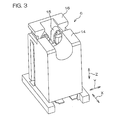
- Fig. 3 is a perspective view of the connector 6.
- the attaching structures for the respective cold cathode fluorescent tubes 5 are the same, so the attaching structure of one of the cold cathode fluorescent tubes 5 will be mainly described below.
- the cold cathode fluorescent tube 5 includes a cylindrical main body 8 extending straight along the Direction X, and an outer leads 10 and 10 (electrodes) as a pair of terminals provided on a pair of terminal portions 9 and 9 of the main body 8, respectively.
- the outer lead 10 as a terminals projects along the longitudinal direction L from the corresponding end portions 9 of the main body 8.
- the main body 8 is made of, for example, a glass member with a diameter of several millimeters to ten and several millimeters.
- the pair of outer leads 10 and 10 are metal shaft-like conductive members made of soft iron, etc., and are exposed in the direction X from the corresponding end portions 9.
- the outer leads 10 have a diameter of, for example, approximately 1 millimeter and a length of several millimeters.
- a clamping member 11 is provided for holding the cold cathode fluorescent tube 5 and supporting the weight of the cold cathode fluorescent tube 5.
- One or more of the clamping member 11 (in this embodiment, one) is provided for each cold cathode fluorescent tube 5.
- the number of clamping members 11 is properly determined according to the length of the cold cathode fluorescent tube 5.
- the clamping member 11 is disposed at a middle portion of the main body 8 of the cold cathode fluorescent tube 5 with respect to the Direction X.
- This clamping member 11 is, for example, a synthetic resin molding, and includes a support column 12 and an arced holder 13.
- the support column 12 is fixed to the first surface 4a of the circuit board 4 and extends in the Direction Z.
- the holder 13 holds the intermediate portion of the main body 8 of the cold cathode fluorescent tube 5 while restraining radial movements (Direction Y and Direction Z in Fig. 2) of the cold cathode fluorescent tube 5.
- This holder 13 is in an arced shape that can surround a portion slightly longer than the peripheral half of the main body 8 of the cold cathode fluorescent tube 5. At a part of the holder 13 in the peripheral direction, an opening 13a into which the main body 8 of the cold cathode fluorescent tube 5 is inserted is formed.
- the intermediate portion of the main body 8 of the cold cathode fluorescent tube 5 in the longitudinal direction L is inserted and held along a first direction D1 as an attaching direction of the cold cathode fluorescent tube 5 to the connectors 6.
- the opening 13a is open to a second direction D2 (corresponding to a removing direction of the cold cathode fluorescent tube 5 from the connectors 6) opposite the first direction D1.
- the connector 6 is provided on each of the pair of end portions 9 and 9 of the main body 8 of the cold cathode fluorescent tube 5.
- the constructions of the connectors 6 are the same, so that one of the connectors 6 will be mainly described below.
- the connector 6 has lengths of 10 to 15 millimeters in the X, Y, and Direction Zs, respectively, and includes a housing 14, a contact 15 held by this housing 14, and an operating member 16 for operating the contact 15.
- Fig. 4 is a perspective view of the housing 14.
- the housing 14 is an integrally molding made of a synthetic resin, and has a main body 17 and seating portions 18 extending from the main body 17.
- the main body 17 is generally shaped into a box.
- a through hole is formed at a place where the connector 6 is disposed, and through this through hole, the main body 17 projects from the first surface 4a to the back face 3b (see Fig. 1) of the liquid crystal panel 3.
- an introducing groove 19 having a U shape or a groove shape is formed at an end portion of the main body 17 with respect to the second direction D2.
- an introducing groove 19 having a U shape or a groove shape is formed into the introducing groove 19.
- a corresponding end portion 9 of the cold cathode fluorescent tube 5 is introduced into the introducing groove 19 .
- the endportion 9 of the cold cathode fluorescent tube 5 introduced into the introducing groove 19 is protected in a state of being surrounded by the inner surface of the introducing groove 19.
- an insertion recess 20 is provided at an end portion of the main body 17 with respect to the second direction D2.
- the outer lead 10 as the terminal of the cold cathode fluorescent tube 5 is inserted along the first direction D1 as the attaching direction.
- the insertion recess 20 is defined by a peripheral wall 21 and a bottom wall 22 and has a rectangular cross-section, and functions as a receiving cavity for receiving the outer lead 10.
- the peripheral wall 21 includes a pair of first side portions 23a and 23b facing each other in the Direction X and a pair of second side portions 24a and 24b facing each other in the Direction Y.
- the one first side portion 23a is adjacent to the introducing groove 19, and divides the introducing groove 19 and the insertion recess 20.
- the one first side portion 23a has a notched groove 25 formed at a central portion in the Direction Y. Through the notched groove 25, the corresponding outer lead 10 can be inserted.
- the bottom of the notched groove 25 functions as a stopper to prevent the outer lead 10 from being shifted although this is not shown. Namely, when the outer lead 10 tilts at a predetermined angle with respect to the housing 14, the outer lead 10 is received by the bottom of the notched groove 25, and as a result, the outer lead 10 is prevented from tilting more.
- the outer lead 10 tilts with respect to the housing 14 means at least one of a state that the entirety (the main body 8 and the outer lead 10) of the cold cathode fluorescent tube 5 tilts with respect to the housing 14 (circuit board 4) and a state that the main body 8 of the cold cathode fluorescent tube 5 does not tilt with respect to the housing 14 (parallel to the circuit board 4) and the outer lead 10 tilts with respect to the main body 8.
- the other first side portion 23b is provided with a guide portion 26 for guiding the operating member 16 along the first and second directions D1 and D2 (Direction Z).
- This guide portion 26 is of a convex shape disposed on the inner side surface of the other first side portion 23b, and extends in the Direction Z.
- through holes 27 are respectively formed.
- the respective through holes 27 extend along the Direction Z.
- first and second convex portions 53 and 58 described later of the operating member 16 are inserted.
- the seating portions 18 are a pair of flange portions provided on the end portions 17a of the main body 17 with respect to the first direction D1.
- the seating portions 18 are respectively disposed on the pair of end portions of the main portion 17 with respect to the direction Y and longitudinally extend in the Direction X.
- the respective seating portions 18 are in abutment with and received by the second surface 4b of the circuit board 4. Thereby, the position of the housing 14 with respect to the direction Z regarding the circuit board 14 is determined.
- Fig. 5 is a perspective view of the contact 15.
- Fig. 6 is a plan view of the connector 6 observed along the second direction D2.
- Fig. 7 is a sectional view along the VII-VII line of Fig. 6.
- Fig. 8 is a sectional view of a main part along the VIII-VIII line of Fig. 2, showing a state that the contact 15 is widened.
- Fig. 9 is a sectional view of the main part along the VIII-VIII line of Fig. 2, showing a state that the widening of the contact 15 is released.
- Fig. 10 is a sectional view along the X-X line of Fig. 8.
- Fig. 11 is a sectional view along the XI-XI line of Fig. 9.
- the contact 15 is a conductive member made of a metal, etc.
- the contact 15 is a sheet metal member.
- the contact 15 makes electrical connection to the outer lead 10 of the cold cathode fluorescent tube 5.
- electrical connection between the outer lead 10 and the circuit board 4 is realized.
- the contact 15 is symmetrical to the Direction Y, and has a main body 28, a lead 29, and a pair of elastic pieces 30 and 31 facing each other.
- the main body 28 longitudinally extends in the Direction Z, and has a U-shaped cross-section orthogonal to the Direction Z.
- the U-shaped paired portions facing each other are formed into flange portions 32.
- the section sandwiched by the flange portions 32 is defined as an intermediate portion 33.
- the main body 28 is press-fitted in and fixed to an insertion hole 34 formed in the main body 17 of the housing 14.
- the insertion hole 34 extends in the Direction Z to the insertion recess 20 from the end portion 17a in the second direction D2 of the main body 17 of the housing 14.
- the peripheral surface of the insertion hole 34 surrounds the main body 28 of the contact 15.
- a pair of engaging grooves 35 and 35 that engage respectively with the pair of flange portions 32 are formed on the peripheral surface of the insertion hole 34.
- the engaging grooves 35 extend in the Direction Z, and along the engaging grooves 35, the main body 28 of the contact 15 can be inserted.
- the main body 28 of the contact 15 is received by one end portion of the one first side portion 23a of the peripheral wall 21, and is positioned in the Direction Z with respect to the housing 14. It is allowed that the main body 28 of the contact 15 is not received by the one first side portion 23a of the peripheral wall 21 of the housing 14. In this case, according to the amount of insertion of the main body 28 into the insertion hole 34, the position of the contact 15 in the Direction Z is determined.
- the lead 29 comes into contact with the second surface 4b of the circuit board 4 and realizes electrical connection between the circuit board 4 and the contact 15.
- This lead 29 is provided on one end portion of the main body 28 and extends to one side of the Direction X from the main body 28.
- the lead 29 and the second surface 4b of the circuit board 4 are parallel to each other, and are in contact with each other.
- the lead 29 is soldered to the circuit board 4 and connected to the inverter circuit 7 via the circuit board 4.
- a metal reinforcing member 70 provided on the end portion 17a in the second direction D2 of the main body 17 of the housing 14 is fixed to the second surface 4b of the circuit board 4.
- the pair of elastic pieces 30 and 31 are electrically connected to the corresponding outer lead 10, respectively.
- the pair of elastic pieces 30 and 31 face each other in the Direction Y.
- the pair of elastic pieces 30 and 31 are disposed on the second direction D2 side with respect to the corresponding flange portions 32 and project to the insertion recess 20, and are almost entirely exposed to the insertion recess 20. It is also possible that only a part of the pair of elastic pieces 30 and 31 is exposed to the insertion recess 20.
- Each of the pair of elastic pieces 30 and 31 includes a first piece 36 extending along the second direction D2 and a second piece 37 that is folded back from a tip end portion 36b of the corresponding first piece 36 and extends along the first direction D1.
- a pair of the first pieces 36 are disposed relatively distant from each other in the Direction Y, and a pair of the second pieces 37 are disposed relatively close to each other.
- Each first piece 36 extends along the second direction D2 from the tip end portion in the second direction D2 of the corresponding flange portion 32, and penetrates the bottom wall 22 of the insertion recess 20 of the housing 14.
- the pair of elastic pieces 30 and 31 can be elastically made close or separated to or from each other around fulcrums at base end portions 36a of the respective first pieces 36. In a free state (with no external force applied), the first pieces 36 are arranged parallel to each other.
- an engaging portion 42 to engage with a widening operating portion 48 described later is provided at a tip end portion 36b of each first piece 36.
- Each engaging portion 42 is formed by a small piece projecting to one side of the Direction X from the tip end portion 36b of the corresponding first piece 36.
- each second piece 37 includes a folded back portion 38 continued to the tip end portion 36b of the corresponding first piece 36, a first narrowing portion 39, a straight portion 40 as a clamping portion for clamping the outer lead 10 in a predetermined direction (corresponding to a radial direction of the outer lead 10), a second narrowing portion 41, and a tip end portion 430.
- the straight portion 40 extends straight along the first direction D1.
- guide portions 43 for guiding the attaching of the outer lead 10 are respectively provided (only one guide portion 43 is shown in Fig. 5).
- the pair of guide portions 43 narrow their distance toward the first direction D1.
- the pair of first narrowing portions 39 are for preventing the corresponding outer lead 10 from improperly coming off in the second direction D2 from the pair of straight portions 40.
- the pair of first narrowing portions 39 are provided on the tip ends in the first direction D1 of the pair of folded back portions 38. In other words, they are provided on the opposite side of the first direction D1 with respect to the pair of straight portions 40.
- the distance between the pair of first narrowing portions 39 is made narrower than the distance between the pair of guide portions 43, and made narrower than the distance between the pair of straight portions 40.
- the distance between the pair of first narrowing portions 39 becomes narrower than the diameter of the outer lead 10.
- the pair of straight portions 40 are for allowing relative movements of the corresponding outer lead 10 in the first and second directions D1 and D2 (Direction Z) while realizing electrical connection between the corresponding outer lead 10 and the contact 15.
- the respective straight portions 40 are provided on the first direction D1 side with respect to the corresponding first narrowing portions 39.
- the respective straight portions 40 extend along the direction Z (first direction D1) in the free state, face each other and are parallel to each other.
- a portion in contact with the outer lead 10 forms a contact portion 44 between the back face 3b of the liquid crystal panel 3 and the first surface 4a (see Fig. 1) of the circuit board 4.
- the pair of contact portions 44 face each other in the Direction Y, and elastically clip the outer lead 10 therebetween.
- the pair of second narrowing portions 41 are for preventing the corresponding outer lead 10 from improperly coming off from the pair of straight portions 40 toward the first direction D1.
- the pair of second narrowing portions 41 are provided on the first direction D1 side with respect to the pair of straight portions 40.
- the distance between the pair of second narrowing portions 41 is set narrower than the distance between the pair of straight portions 40.
- the distance between the pair of second narrowing portions 41 becomes narrower than the diameter of the outer lead 10.
- the respective tip end portions 430 are provided on the first direction D1 side with respect to the corresponding second narrowing portions 41. These tip end portions 430 are for narrowing the distance between the pair of straight portions 40 by being pressed by the first pieces 36. Thereby, the force for clamping the outer lead 10 by the pair of straight portions 40 can be increased. In addition, lowering in the clamping force due to settling of the pair of elastic pieces 30 and 31 can be prevented.
- the pair of tip end portions 430 are in an inverted V shape when they are observed along the Direction X, and the distance therebetween expands toward the first direction D1.
- bent portions that are bent in directions of approaching each other are provided so as to smoothly engage with the corresponding first pieces 36.
- the operating member 16 is for performing operations of clamping the outer lead 10 and releasing this clamping by the pair of straight portions 40, and are relatively movably fitted in the insertion recess 20 of the housing 14 in the first and second directions D1 and D2.
- the operating member 16 at a widening position is illustrated, and in Fig. 9, the operating member 16 at a widening released position is illustrated.
- Fig. 12 is a perspective view of the operating member 16.
- the operating member 16 is a resin molding formed symmetrically with respect to the Direction Y.
- a section orthogonal to the Direction Z of the operating member 16 is in a groove shape.
- the operating member 16 has a pair of portions 45 and 46 facing each other at a distance in the Direction Y, a joint 47 that joins the pair of portions 45 and 46, and a pair of widening operating portions 48 provided on the joint 47.
- the pair of portions 45 and 46 are disposed on both sides of the pair of elastic pieces 30 and 31 in the insertion recess 20.
- the one portion 45 is disposed between the one elastic piece 30 and the other second side portion 24b of the peripheral wall 21.
- the other portion 46 is disposedbetween the other elastic piece 31 and the one second side portion 24a of the peripheral wall 21.
- the pair of portions 45 and 46 respectively longitudinally extend in the Direction Z.
- the tip ends on the second direction D2 side of outer side surfaces 49 of the pair of portions 45 and 46 project outward of the Direction Y with respect to a peripheral edge 50 of the opening of the insertion recess 20, and these projecting portions serve as knobs 51.
- An operator can operate the operating member 16 in the first and second directions D1 and D2 by pinching the knobs 51.
- portions where the knobs 51 are not provided are formed into straight portions 52 extending in the Direction Z.
- first convex portions 53 are provided on the respective straight portions 52.
- a pair of the first convex portions 53 are for preventing the operating member 16 from improperly coming off from the insertion recess 20, and are disposed on tip ends in the first direction D1 of the respective straight portions 52.
- the first convex portions 53 are fitted respectively in the corresponding through holes 27 of the peripheral wall 21, and they are received by the peripheral edges of the corresponding through holes 27 to prevent the operating member 16 from coming off from the insertion recess 20.
- each first convex portion 53 is formed into inclined shapes. Thereby, when the operating member 16 is fitted in the insertion recess 20, these inclined portions allow insertion of the respective first convex portions 53 into the corresponding through holes 27 while smoothly engaging with the peripheral edge 50 of the opening of the peripheral wall 21.
- the connector 6 is provided with first and second holding mechanisms 55 and 56.
- the first holding mechanism 55 holds the operating member 16 at the widening position shown in Fig. 8.
- the first holding mechanism 55 includes first concave portions 54 provided on the respective straight portions 52 of the operating member 16, and engaging portions 57 that are respectively provided on the pair of second side portions 24 of the peripheral wall 21 and engage with corresponding first concave portions 54.
- the first concave portion 54 is defined between the first convex portion 53 and second convex portion 58.
- the second convex portions 58 are provided on the respective straight portions 52 and arranged with the corresponding first convex portions 53 along the second direction D2.
- the engaging portions 57 include portions disposed on the second direction D2 side with respect to the through holes 27 on the pair of second side portions 24 of the peripheral wall 21, respectively, and are fitted in the first concave portions 54 when the operating member 16 is at the widening position shown in Fig. 8.
- the second holding mechanism 56 holds the operating member 16 at the widening released position shown in Fig. 9 and Fig. 11.
- the second holding mechanism 56 includes second concave portions 59 provided on the respective straight portions 52 of the operating member 16 and the engaging portions 57 that are provided on the pair of second side portions 24 of the peripheral wall 21, respectively, and engage with corresponding second concave portions 59.
- the engaging portions 57 formapart of the firstholdingmechanism 55 and a part of the second holding mechanism 56.
- the second concave portions 59 are defined between the second convex portions 58 and stepped portions 60 of the respective knobs 51 facing the peripheral wall 21 side.
- the engaging portions 57 are fitted in the second concave portions 59 when the operating member 16 is at the widening released position shown in Fig. 9.
- Inner side surfaces 61 of the pair of portions 45 and 46 face each other at a predetermined distance in the Direction Y and sandwich the pair of elastic pieces 30 and 31 of the contact 15. Tip ends in the second direction D2 of these inner side surfaces 61 of the pair of portions 45 and 46 are formed into inclined cam surfaces, and the distance therebetween narrows toward the second direction D2.
- pressurizing portions 62 are formed.
- a pair of the pressurizing portions 62 can pressurize pressurized portions 63 provided on the tip end portions 36b of the corresponding first pieces 36 of the pair of elastic pieces 30 and 31.
- the pair of pressurizing portions 62 come into contact with and pressurize the corresponding pressurized portions 63, thereby the distance between the pair of straight portions 40 is narrowed, and as a result, the force for clamping the outer lead 10 by these straight portions 40 can be increased. In addition, lowering in the clamping force due to settling of the pair of elastic pieces 30 and 31 can be prevented.
- the pair of pressurizing portions 62 come into contact with and pressurize corresponding pressurized portions 63 when the operating member 16 shifts from the widening position shown in Fig. 8 to the widening released position shown in Fig. 9 along the first direction D1.
- the forces for pressurizing the corresponding pressurized portions 63 in the first direction D1 are converted into forces in the Direction Y orthogonal to the first direction D1.
- the pair of elastic pieces 30 and 31 come close to each other.
- the joint 47 is formed into a plate shape, and joins one-side ends of the pair of portions 45 and 46 with respect to the direction X.
- a groove 64 extending in the Direction Z is formed, and is fitted in the guide portion 26 of the other first side portion 23b of the peripheral wall 21 as shown in Fig. 7.
- an external form of a cross-section of a portion where the knob 51 is not provided is cut along a direction orthogonal to the direction Z is generally identical with the shape of the peripheral edge 50 of the opening of the insertion recess 20 observed from the first direction D1.
- the insertion recess 20 serves as a guide groove for guiding the operating member 16 to the widening position and the widening released position along the first and second directions D1 and D2.
- a space 67 space between the pair of portions 45 and 46 in which the pair of elastic pieces 30 and 31 can be accommodated is defined.
- the tip end in the first direction D1 and the tip end in the second direction D2 of this space 67 are respectively open to the outside, and these open points are formed into a pair of open portions 68 and 69. Due to the open portion 68, the space 67 is open to the second direction D2, and this enables the space 67 to be observed from the outside. In addition, the corresponding outer lead 10 can be inserted into the space 67 through the open portion 68.
- the pair of widening operating portions 48 are formed by small pieces provided on the inner side surface 66 of the joint 47.
- the pair of widening operating portions 48 perform the function to widen the distance between the straight portions 40 of the pair of second pieces 37 via the pair of first pieces 36 by engaging with the corresponding engaging portions 42 of the pair of elastic members 30 and 31.
- the pair of widening operating portions 48 are arranged parallel in the Direction X, and are sandwiched between the pair of engaging portions 42.
- Each of the pair of widening operating portions 48 has a first inclined cam surface 71 provided on the tip end in the first direction D1 and a second inclined cam surface 72 provided on the tip end in the second direction D2.
- a pair of the first inclined cam surfaces 71 perform a function to widen the distance between the pair of engaging portions 42 when the operating member 16 is fitted in the insertion recess 20 along the first direction D1.
- the distance between the pair of inclined cam surfaces 71 narrows toward the first direction D1.
- the pair of first inclined cam surfaces 71 abut with the corresponding engaging portions 42 when the operating member 16 shifts toward the first direction D1. Thereby, the force of the operating member 16 to press the engaging portions 42 toward the first direction D1 is converted into forces in the Direction Y orthogonal to the first direction D1 (forces to widen the distance between the pair of engaging portions 42).
- the pair of second inclined cam surfaces 72 abut with the corresponding engaging portions 42 when the operating member 16 moves along the second direction D2 and shifts from the widening released position to the widening position, thereby performing the function to widen the distance between the pair of engaging portions 42.
- the distance between the pair of inclined cam surfaces 72 narrows toward the second direction D2.
- the pair of second inclined cam surfaces 72 abut with the corresponding engaging portions 42 when the operating member 16 shifts to the widening position. Thereby, the forces of the operating member 16 to press the engaging portions 42 toward the second direction D2 are converted into forces in the Direction Y orthogonal to the second direction D2 (forces to widen the distance between the pair of engaging portions 42).
- each widening operating portion 48 includes a first restraining portion 73.
- Each first restraining portion 73 is for restraining the first piece 36 of the corresponding elastic piece 30 or 31 from shifting in the Direction X (longitudinal direction L of the cold cathode fluorescent tube 5: direction along the axial direction of the outer lead 10) when the operating member 16 is at the widening released position.
- each first restraining portion 73 faces the base end portion 36a of the corresponding first piece 36 and restricts this corresponding first piece 36 from moving to one side (deep side of the sheet surface of Fig. 11) of the Direction X.
- each widening operating portion 48 includes a second restraining portion 74.
- Each second restraining portion 74 is for restraining the second piece 37 of the corresponding elastic member 30 or 31 from shifting in the Direction X (direction along the axial direction of the outer lead 10) when the operating member 16 is at the widening released position.
- each second restraining portion 74 faces the tip end portion 430 of the corresponding second piece 37, and restricts this corresponding second piece 37 from moving to one side (deep side of the sheet surface of Fig. 11) of the Direction X.
- the first side portion 23a of the peripheral wall 21 includes a third restraining portion 75.
- the third restraining portion 75 is for restraining the respective first pieces 36 of the pair of elastic pieces 30 and 31 from shifting in the Direction X (direction along the axial direction of the outer lead 10).
- the third restraining portion 75 faces the first pieces 36, and restricts these first pieces 36 from moving to the other side of the Direction X.
- the widening position of the operating member 16 is a position for widening the distance between the pair of straight portions 40 by the widening operating portions 48 so that the outer lead 10 can be inserted between the pair of straight portions 40 with no insertion force.
- the widening released position is a position for releasing this widening.
- the cold cathode fluorescent tube 5 (outer lead 10) is mounted as follows. Namely, first, the operating member 16 is held at the widening position shown in Fig. 10. The pair of widening operating portions 48 of the operating member 16 engage with the engaging portions 42 of the corresponding elastic members 30 and 31, and the distance between the pair of second pieces 37 is widened. At this time, the distance between the pair of straight portions 40 is made wider than the diameter of the outer lead 10, and the distance between the pair of first narrowing portions 39 is made wider than the diameter of the outer lead 10.
- the corresponding cold cathode fluorescent tube 5 is grasped by hand (not shown), etc., and the outer lead 10 of the cold cathode fluorescent tube 5 is made to face the operating member 16 in the Direction Z. Then, the cold cathode fluorescent tube 5 is moved toward the first direction D1 as the attaching direction and the middle portion of the cold cathode fluorescent tube 5 is fitted in the holder 13 of the clamping member 11. Thereby, the middle portion of the cold cathode fluorescent tube 5 is held by the clamping member 11, and the corresponding outer lead 10 of the cold cathode fluorescent tube 5 is moved into the insertion recess 20 as shown by the outline arrow and disposed between the pair of straight portions 40.
- the operating member 16 is moved toward the first direction D1 and shifted from the widening position shown in Fig. 10 to the widening released position shown in Fig. 11.
- the engagement of the pair of engaging portions 42 by the pair of widening operating portions 48 is released, and as a result, by the elastic forces of the pair of elastic pieces 30 and 31, the pair of straight portions 40 clip the corresponding outer lead 10 by the contact portions 44.
- electrical connection between the contact 15 and the corresponding outer lead 10 is realized.
- the distance between the pair of first and second narrowing portions 39 and 41 becomes narrower than the diameter of the corresponding outer lead 10.
- the pair of pressurizing portions 62 pressurize the corresponding pressurized portions 63 as shown by the arrow F1.
- these pressurized portions 63 are moved in the Direction Y so as to come close to each other.
- the distance between the pair of first pieces 36 is narrowed, and as a result, pressurizing forces act on the pair of second pieces 37 so as to narrow the distance between the straight portions 40.
- the force for clamping the corresponding outer lead 10 by the pair of straight portions 40 is increased.
- the base end portions 36a of the pair of first pieces 36 press the tip end portions 430 of the corresponding second pieces 37 as shown by the arrow F2.
- these tip ends 430 are moved in the Direction Y so as to come close to each other.
- the distance between the pair of tip end portions 430 is narrowed, and as a result, pressurizing forces act to narrow the distance between the pair of straight portions 40.
- the force for clamping the outer lead 10 by the pair of straight portions 40 is further increased.
- the operating member 16 is first shifted from the widening released position to the widening position along the second direction D2 as shown in Fig. 10.
- the second inclined cam surfaces 72 of the pair of widening operating portions 48 engage with corresponding engaging portions 42 and widen the distance between the pair of engaging portions 42, and accordingly, the distance between the pair of straight portions 40 is widened.
- the electrical connection between the pair of straight portions 40 and the corresponding outer lead 10 is released.
- the cold cathode fluorescent tube 5 is removed from the holder 13 of the clamping member 11 by grasping the cold cathode fluorescent tube 5 by hand, etc., and moved toward the second direction D2. Thereby, the corresponding outer lead 10 of the cold cathode fluorescent tube 5 passes between the pair of first narrowing portions 39 and between the pair of guide portions 43 from the pair of straight portions 40, and is then extracted from the insertion recess 20.
- the straight portions 40 of the pair of elastic pieces 30 and 31 come into contact with the corresponding outer lead 10 of the cold cathode tube 5 with a predetermined contact pressure by elastically clamping the outer lead 10.
- electrical connection between the contact 15 and the outer lead 10 can be reliably performed.
- the contact 15 and the corresponding outer lead 10 can be easily connected by a simple operation of moving the cold cathode fluorescent tube 5 toward the first direction D1 and inserting the outer lead 10 between the pair of straight portions 40.
- the position of the cold cathode fluorescent tube 5 can be adjusted and the variations in dimensional errors and the like can be absorbed by moving the outer lead 10 of the cold cathode fluorescent tube 5 clipped between the pair of straight portions 40 along the first direction D1.
- the flexibility of the second pieces 37 can be increased, and when the outer lead 10 is inserted between the straight portions 40, an excessive reactive force can be prevented from acting on the outer lead 10.
- the pair of first narrowing portions 39 can receive the outer lead 10. Thereby, the outer lead 10 can be prevented from improperly coming off from the pair of straight portions 40 toward the second direction D2.
- the guide portions 43 provided on each of the pair of elastic pieces 30 and 31 are formed so as to narrow the distance there between toward the first direction D1. Thereby, when the outer lead 10 is inserted between the pair of straight portions 40, the insertion of the outer lead 10 can be guided by the pair of guide portions 43. Therefore, the outer lead 10 can be more readily attached to the straight portions 40.
- the attaching direction of the cold cathode fluorescent tube 5 to the contact 15 and the attaching direction of the cold cathode fluorescent tube 5 to the holder 13 can be matched with each other. As a result, the cold cathode fluorescent tube 5 can be more readily attached.
- the present invention is not limited to the contents described in the embodiment given above.
- an external electrode fluorescent tube 5A can be used instead of the cold cathode fluorescent tube 5, as shown in Fig. 13.
- an electrode layer 10A as a terminal is covered on the respective peripheral surfaces of a pair of end portions 9A (only one end portion 9A is shown in Fig. 13) of the external electrode fluorescent tube 5A.
- the electrode layer 10A can be readily inserted between the pair of straight portions 40 with a slight force, and an excessive force can be prevented from acting on the electrode layer 10A. Therefore, the electrode layer 10A can be prevented from rubbing against and being damaged by the pair of elastic pieces 30 and 31.
- the tip end portions 430 of the respective second pieces 37 can be omitted. Furthermore, inclined cam surfaces similar to the first and second inclined cam surfaces 71 and 72 of the widening operating portions 48 can be provided on the engaging portions 42. In this case, on the widening operating portions 48, surfaces straight in the Direction Z can be provided instead of the first and second inclined cam surfaces 71 and 72.
- the pair of pressurizing portions 62 and the corresponding pair of pressurized portions 63 can be omitted. Furthermore, the pair of first narrowing portions 39 can be omitted, the pair of second narrowing portions 41 can be omitted, and the pair of guide portions 43 can be omitted. Either one of the pair of widening operating portions 48 can be omitted. Furthermore, inclined cam surfaces similar to the pressurizing portions 62 can be provided on the pressurized portions 63. In this case, the pressurizing portions 62 can be formed as surfaces straight in the Direction Z.
- a operating member 16A shown in Fig. 14 can be used instead of the operating member 16.
- the operating member 16A has an opening preventive portion 76 that prevents the space 67 between the pair of portions 45 and 46 from opening to the second direction D2.
- the opening preventive portion 76 is integrally formed with the pair of portions 45 and 46 by using a single member. This opening preventive portion 76 connects the tip end portions in the second direction D2 of the pair of portions 45 and 4 6 to each other. By providing the opening preventive portion 76, intrusion of foreign matter in the space 67 between the pair of portions 45 and 46 can be prevented.
- the space between the pair of portions 45 and 46 can be observed from the outside. It is also possible that the opening preventive portion 76 is separately formed from the pair of portions 45 and 46 and is joined thereto via a hinge mechanism. In this case, the space between the pair of portions 45 and 46 can be observed by opening the opening preventive portion 76.
- a contact 15A shown in Fig. 15 can be used instead of the contact 15.
- the first piece 36A On each of the pair of elastic pieces 30A and 31A, the first piece 36A itself is provided with an engaging portion 42A.
- parts of middle portions of the pair of first pieces 36A swell in directions to approach each other, and these swelling portions serve as the engaging portions 42A.
- the widening operating portions 48A are disposed on the inner sides of the corresponding elastic pieces 30A and 31A.
- a contact 15B shown in Fig. 16 can be used instead of the contact 15.
- Each of the pair of elastic pieces 30B and 31B includes a second piece 37B extending along the second direction D2, and a first piece 36B that is folded back from the tip end in the second direction D2 of the second piece 37B and extends along the first direction D1.
- a pair of the second pieces 37B are disposed relatively close to each other, and a pair of the first pieces 36B are disposed relatively distant from each other.
- straight portions 40 are disposed on the respective second pieces 37B.
- first restraining portion 73 can be omitted, the second restraining portion 74 can be omitted, and the third restraining portion 75 can be omitted.
- the number of clamping members 11 to be provided for one cold cathode fluorescent tube 5 can be two or more.
- the connector 6 can be applied to an edge light type liquid crystal display device.
- the connector of the present invention is used for connection to a shaft-like terminal of other than the fluorescent tube.
- it can be used for connection to a terminal of a multipole cable including a number of twisted wires.
- the diameter of the terminal becomes thick, so that a sufficient contact pressure with the contact must be secured. Therefore, the effect of using the connector of the present invention which can secure a sufficient contact pressure and can be attached to the contact with no insertion force is significant.
Landscapes
- Physics & Mathematics (AREA)
- Nonlinear Science (AREA)
- Mathematical Physics (AREA)
- Chemical & Material Sciences (AREA)
- Crystallography & Structural Chemistry (AREA)
- General Physics & Mathematics (AREA)
- Optics & Photonics (AREA)
- Engineering & Computer Science (AREA)
- General Engineering & Computer Science (AREA)
- Fastening Of Light Sources Or Lamp Holders (AREA)
- Connecting Device With Holders (AREA)
- Planar Illumination Modules (AREA)
Abstract
Description
- The present invention relates to a attaching structure for a long fluorescent tube.
- For example, as connecting structures for terminals of fluorescent tubes such as cold cathode fluorescent tubes to be used as a backlight of a liquid crystal display type television or monitor, the following
documents - Document 1:
Japanese Unexamined Patent Publication No. 2001-250605 (Date of publication: September 14, 2001 - Document 2:
Japanese Unexamined Patent Publication No. 2004-259645 (Date of publication: September 16, 2004 - In the
documents - However, in the
documents - Not only the case of the cold cathode fluorescent tube, but also cases using other fluorescent tubes such as an external electrode fluorescent tube have a similar problem.
- An object of the invention is to provide a fluorescent tube attaching structure which realizes easy and reliable electrical connection with a fluorescent tube.
- A preferred mode of the present invention provides a fluorescent tube attaching structure for attaching a fluorescent tube extending in a longitudinal direction and having a pair of end portions with respect to the longitudinal direction and an intermediate portion between the pair of end portions, where a terminal is provided on the respective end portions. The attaching structure includes a base, a holder which is supported by the base and holds the intermediate portion of the fluorescent tube while restraining radial movements of the fluorescent tube, and a pair of contacts which is supported by the base and to which the terminals of the pair of end portions of the fluorescent tube can be attached in an attaching direction corresponding to a radial direction of the fluorescent tube. Each of the pair of contacts includes a main body and a pair of elastic pieces extending from the main body and facing each other. The pair of elastic pieces have a pair of straight portions extending substantially straight in the attaching direction and facing each other, respectively. On the pair of straight portions, a pair of contact portions for clamping the corresponding terminal of the fluorescent tube therebetween are formed.
- According to this mode, between the contact portions of the straight portions of the pair of elastic pieces, the terminal of the fluorescent tube is elastically clamped. As a result, the contact portions come into contact with the terminal with a predetermined contact pressure, so that the contact and the terminal can be reliably electrically connected to each other.
- In addition, by a simple operation of inserting the terminal of the fluorescent tube between the pair of straight portions extending along the fluorescent tube attaching direction, the contact and the terminal can be readily electrically connected to each other.
- Furthermore, the intermediate portion of the fluorescent tube in the longitudinal direction is supported by the holder, so that the load applied to the terminal of the end portion of the fluorescent tube can be reduced in comparison with the case of supporting only both ends of the fluorescent tube. In addition, the span for supporting the fluorescent tube can be stably reduced, and as a result, the fluorescent tube can be supported steadly. Therefore, the fluorescent tube does not vibrate.
- In addition, the pair of straight portions extend along the fluorescent tube attaching direction, and this provides the following advantage. That is, even if the holder and the fluorescent tube have variations in dimensional errors, the position of the terminal of the fluorescent tube in the attaching direction can be adjusted without applying an excessive force to the terminal of the fluorescent tube, by shifting the position of the terminal of the florescent tube along the straight portions. Thereby, the variations in dimensional errors are absorbed. The positional deviation between the fluorescent tube and the holder can be prevented as much as possible, and the fluorescent tube can be reliably held by the holder.
-
- Fig. 1 is a schematic sectional view showing a general construction of a liquid crystal display device to which a fluorescent tube attaching structure according to an embodiment of the present invention is applied;
- Fig. 2 is an exploded perspective view of the fluorescent tube attaching structure;
- Fig. 3 is a perspective view of an electrical connector;
- Fig. 4 is a perspective view of a housing of the electrical connector;
- Fig. 5 is a perspective view of a contact;
- Fig. 6 is a plan view of the electrical connector observed along a second direction;
- Fig. 7 is a sectional view along the VII-VII line of Fig. 6;
- Fig. 8 is a partially broken perspective view including a cross-section along the VIII-VIII line of Fig. 2, showing a state where the contact is widened;
- Fig. 9 is a partially broken perspective view including the cross-section along the VIII-VIII line of Fig. 2, showing a state where the widening of the contact is released;
- Fig. 10 is a sectional view along the X-X line of Fig. 8;
- Fig. 11 is a sectional view along the XI-XI line of Fig. 9;
- Fig. 12 is a perspective view of an operating member;
- Fig. 13 is a perspective view of a main part of a fluorescent tube attaching structure according to another embodiment of the present invention;
- Fig. 14 is a perspective view of an operating member according to still another embodiment of the present invention;
- Fig. 15 is a sectional view of a main part of a fluorescent tube attaching structure according to still another embodiment of the present invention; and
- Fig. 16 is a sectional view of a main part of a contact according to still another embodiment of the present invention.
- A preferred embodiment of the present invention will be described with reference to the accompanying drawings.
- Fig. 1 is a schematic sectional view showing a general construction of a liquid crystal display device having a fluorescent tube attaching structure according to an embodiment of the present invention. Referring to Fig. 1, the liquid
crystal display device 1 is used as, for example, a monitor of a television or a personal computer. - The liquid
crystal display device 1 includes acasing 2, aliquid crystal panel 3, acircuit board 4 disposed in the rear of theliquid crystal panel 3, a plurality of cold cathodefluorescent tubes 5 as fluorescent tubes, electrical connectors 6 (hereinafter, also referred to as connectors, simply), and aninverter circuit 7. - The
liquid crystal panel 3 is a non light-emitting display panel, and is attached to an opening on the front of thecasing 2. Afront face 3a of theliquid crystal panel 3 faces forward from thecasing 2, and abackface 3b thereof faces rearward from thecasing 2. - The
circuit board 4 is a plate-shaped member disposed substantially parallel to theliquid crystal panel 3 and fixed to thecasing 2, and includes afirst surface 4a facing theback face 3b of theliquid crystal panel 3 and asecond surface 4b on the opposite side of thefirst surface 4a. - The cold cathode
fluorescent tubes 5 serve as a backlight of theliquid crystal panel 3, and are disposed between theback face 3b of theliquid crystal panel 3 and thefirst surface 4a of thecircuit board 4. The number of the cold cathodefluorescent tubes 5 is, for example, 2 per 1 inch of theliquid crystal panel 3. - As shown in Fig. 2, a longitudinal direction L of the cold cathode
fluorescent tubes 5 is in an direction X (corresponding to the left and right direction of the casing 2: direction perpendicular to the sheet surface in Fig. 1). Referring to Fig. 1, the respective cold cathodefluorescent tubes 5 are spaced at a predetermined distance along a direction Y (corresponding to the up and down direction of the casing 2) . The cold cathodefluorescent tubes 5 are parallel to theback face 3b of theliquid crystal panel 3. The respective cold cathodefluorescent tubes 5 and theliquid crystal panel 3 are spaced at a predetermined distance from each other in a direction Z (corresponding to the front and rear direction of the casing 2). The respective cold cathodefluorescent tubes 5 irradiate theliquid crystal panel 3 with light from the rear side. - The
electrical connector 6 is for realizing electrical connection between the coldcathode fluorescent tube 5 and the circuit board 4 (and the inverter circuit 7). Thisconnector 6 is attached to each of a pair of end portions of each coldcathode fluorescent tube 5 between theback face 3b of theliquid crystal panel 3 and thefirst surface 4a of thecircuit board 4. Therespective connectors 6 are attached to thecircuit board 4. - The
inverter circuit 7 performs a function to supply driving power to the coldcathode fluorescent tubes 5, and is attached to thesecond surface 4b of thecircuit board 4. Theinverter circuit 7 and the respective coldcathode fluorescent tubes 5 are electrically connected to each other via thecircuit board 4 and thecorresponding connectors 6. - Fig. 2 is an exploded perspective view of a main part of Fig. 2. Fig. 3 is a perspective view of the
connector 6. - The attaching structures for the respective cold
cathode fluorescent tubes 5 are the same, so the attaching structure of one of the coldcathode fluorescent tubes 5 will be mainly described below. - Referring to Fig. 2, the cold
cathode fluorescent tube 5 includes a cylindricalmain body 8 extending straight along the Direction X, and an outer leads 10 and 10 (electrodes) as a pair of terminals provided on a pair ofterminal portions main body 8, respectively. Theouter lead 10 as a terminals projects along the longitudinal direction L from thecorresponding end portions 9 of themain body 8. - The
main body 8 is made of, for example, a glass member with a diameter of several millimeters to ten and several millimeters. The pair ofouter leads corresponding end portions 9. The outer leads 10 have a diameter of, for example, approximately 1 millimeter and a length of several millimeters. - A clamping
member 11 is provided for holding the coldcathode fluorescent tube 5 and supporting the weight of the coldcathode fluorescent tube 5. One or more of the clamping member 11 (in this embodiment, one) is provided for each coldcathode fluorescent tube 5. The number of clampingmembers 11 is properly determined according to the length of the coldcathode fluorescent tube 5. The clampingmember 11 is disposed at a middle portion of themain body 8 of the coldcathode fluorescent tube 5 with respect to the Direction X. - This clamping
member 11 is, for example, a synthetic resin molding, and includes asupport column 12 and an arcedholder 13. Thesupport column 12 is fixed to thefirst surface 4a of thecircuit board 4 and extends in the Direction Z. Theholder 13 holds the intermediate portion of themain body 8 of the coldcathode fluorescent tube 5 while restraining radial movements (Direction Y and Direction Z in Fig. 2) of the coldcathode fluorescent tube 5. - This
holder 13 is in an arced shape that can surround a portion slightly longer than the peripheral half of themain body 8 of the coldcathode fluorescent tube 5. At a part of theholder 13 in the peripheral direction, anopening 13a into which themain body 8 of the coldcathode fluorescent tube 5 is inserted is formed. - Into the
opening 13a, the intermediate portion of themain body 8 of the coldcathode fluorescent tube 5 in the longitudinal direction L is inserted and held along a first direction D1 as an attaching direction of the coldcathode fluorescent tube 5 to theconnectors 6. Theopening 13a is open to a second direction D2 (corresponding to a removing direction of the coldcathode fluorescent tube 5 from the connectors 6) opposite the first direction D1. - As described above, the
connector 6 is provided on each of the pair ofend portions main body 8 of the coldcathode fluorescent tube 5. The constructions of theconnectors 6 are the same, so that one of theconnectors 6 will be mainly described below. - Referring to Fig. 3, the
connector 6 has lengths of 10 to 15 millimeters in the X, Y, and Direction Zs, respectively, and includes ahousing 14, acontact 15 held by thishousing 14, and an operatingmember 16 for operating thecontact 15. - Fig. 4 is a perspective view of the
housing 14. Referring to Fig. 2 and Fig. 4, thehousing 14 is an integrally molding made of a synthetic resin, and has amain body 17 andseating portions 18 extending from themain body 17. - The
main body 17 is generally shaped into a box. In thecircuit board 4, a through hole is formed at a place where theconnector 6 is disposed, and through this through hole, themain body 17 projects from thefirst surface 4a to theback face 3b (see Fig. 1) of theliquid crystal panel 3. - Referring to Fig. 2 and Fig. 4 again, at an end portion of the
main body 17 with respect to the second direction D2, an introducinggroove 19 having a U shape or a groove shape is formed. Into the introducinggroove 19, acorresponding end portion 9 of the coldcathode fluorescent tube 5 is introduced. Theendportion 9 of the coldcathode fluorescent tube 5 introduced into the introducinggroove 19 is protected in a state of being surrounded by the inner surface of the introducinggroove 19. - At an end portion of the
main body 17 with respect to the second direction D2, aninsertion recess 20 is provided. In theinsertion recess 20, theouter lead 10 as the terminal of the coldcathode fluorescent tube 5 is inserted along the first direction D1 as the attaching direction. - The
insertion recess 20 is defined by aperipheral wall 21 and abottom wall 22 and has a rectangular cross-section, and functions as a receiving cavity for receiving theouter lead 10. Theperipheral wall 21 includes a pair offirst side portions second side portions - The one
first side portion 23a is adjacent to the introducinggroove 19, and divides the introducinggroove 19 and theinsertion recess 20. The onefirst side portion 23a has a notchedgroove 25 formed at a central portion in the Direction Y. Through the notchedgroove 25, the correspondingouter lead 10 can be inserted. - The bottom of the notched
groove 25 functions as a stopper to prevent theouter lead 10 from being shifted although this is not shown. Namely, when theouter lead 10 tilts at a predetermined angle with respect to thehousing 14, theouter lead 10 is received by the bottom of the notchedgroove 25, and as a result, theouter lead 10 is prevented from tilting more. - The phrase "the
outer lead 10 tilts with respect to thehousing 14" means at least one of a state that the entirety (themain body 8 and the outer lead 10) of the coldcathode fluorescent tube 5 tilts with respect to the housing 14 (circuit board 4) and a state that themain body 8 of the coldcathode fluorescent tube 5 does not tilt with respect to the housing 14 (parallel to the circuit board 4) and theouter lead 10 tilts with respect to themain body 8. - The other
first side portion 23b is provided with aguide portion 26 for guiding the operatingmember 16 along the first and second directions D1 and D2 (Direction Z). Thisguide portion 26 is of a convex shape disposed on the inner side surface of the otherfirst side portion 23b, and extends in the Direction Z. - In the pair of
second side portions holes 27 are respectively formed. The respective throughholes 27 extend along the Direction Z. Into the throughholes 27, first and secondconvex portions member 16 are inserted. - The
seating portions 18 are a pair of flange portions provided on theend portions 17a of themain body 17 with respect to the first direction D1. Theseating portions 18 are respectively disposed on the pair of end portions of themain portion 17 with respect to the direction Y and longitudinally extend in the Direction X. Therespective seating portions 18 are in abutment with and received by thesecond surface 4b of thecircuit board 4. Thereby, the position of thehousing 14 with respect to the direction Z regarding thecircuit board 14 is determined. - Fig. 5 is a perspective view of the
contact 15. Fig. 6 is a plan view of theconnector 6 observed along the second direction D2. Fig. 7 is a sectional view along the VII-VII line of Fig. 6. Fig. 8 is a sectional view of a main part along the VIII-VIII line of Fig. 2, showing a state that thecontact 15 is widened. Fig. 9 is a sectional view of the main part along the VIII-VIII line of Fig. 2, showing a state that the widening of thecontact 15 is released. Fig. 10 is a sectional view along the X-X line of Fig. 8. Fig. 11 is a sectional view along the XI-XI line of Fig. 9. - Referring to Fig. 2 and Fig. 5, the
contact 15 is a conductive member made of a metal, etc. In particular, thecontact 15 is a sheet metal member. Thecontact 15 makes electrical connection to theouter lead 10 of the coldcathode fluorescent tube 5. By thecontact 15, electrical connection between theouter lead 10 and thecircuit board 4 is realized. - The
contact 15 is symmetrical to the Direction Y, and has amain body 28, alead 29, and a pair ofelastic pieces - The
main body 28 longitudinally extends in the Direction Z, and has a U-shaped cross-section orthogonal to the Direction Z. The U-shaped paired portions facing each other are formed intoflange portions 32. In themain body 28, the section sandwiched by theflange portions 32 is defined as anintermediate portion 33. - Referring to Fig. 6 and Fig. 7, the
main body 28 is press-fitted in and fixed to aninsertion hole 34 formed in themain body 17 of thehousing 14. Theinsertion hole 34 extends in the Direction Z to theinsertion recess 20 from theend portion 17a in the second direction D2 of themain body 17 of thehousing 14. The peripheral surface of theinsertion hole 34 surrounds themain body 28 of thecontact 15. - On the peripheral surface of the
insertion hole 34, a pair of engaginggrooves flange portions 32 are formed. The engaginggrooves 35 extend in the Direction Z, and along the engaginggrooves 35, themain body 28 of thecontact 15 can be inserted. - The
main body 28 of thecontact 15 is received by one end portion of the onefirst side portion 23a of theperipheral wall 21, and is positioned in the Direction Z with respect to thehousing 14. It is allowed that themain body 28 of thecontact 15 is not received by the onefirst side portion 23a of theperipheral wall 21 of thehousing 14. In this case, according to the amount of insertion of themain body 28 into theinsertion hole 34, the position of thecontact 15 in the Direction Z is determined. - Referring to Fig. 5 and Fig. 7, the
lead 29 comes into contact with thesecond surface 4b of thecircuit board 4 and realizes electrical connection between thecircuit board 4 and thecontact 15. Thislead 29 is provided on one end portion of themain body 28 and extends to one side of the Direction X from themain body 28. Thelead 29 and thesecond surface 4b of thecircuit board 4 are parallel to each other, and are in contact with each other. Thelead 29 is soldered to thecircuit board 4 and connected to theinverter circuit 7 via thecircuit board 4. Ametal reinforcing member 70 provided on theend portion 17a in the second direction D2 of themain body 17 of thehousing 14 is fixed to thesecond surface 4b of thecircuit board 4. - Referring to Fig. 2 and Fig. 8, the pair of
elastic pieces outer lead 10, respectively. The pair ofelastic pieces elastic pieces corresponding flange portions 32 and project to theinsertion recess 20, and are almost entirely exposed to theinsertion recess 20. It is also possible that only a part of the pair ofelastic pieces insertion recess 20. - Each of the pair of
elastic pieces first piece 36 extending along the second direction D2 and asecond piece 37 that is folded back from atip end portion 36b of the correspondingfirst piece 36 and extends along the first direction D1. A pair of thefirst pieces 36 are disposed relatively distant from each other in the Direction Y, and a pair of thesecond pieces 37 are disposed relatively close to each other. - Each
first piece 36 extends along the second direction D2 from the tip end portion in the second direction D2 of thecorresponding flange portion 32, and penetrates thebottom wall 22 of theinsertion recess 20 of thehousing 14. The pair ofelastic pieces base end portions 36a of the respectivefirst pieces 36. In a free state (with no external force applied), thefirst pieces 36 are arranged parallel to each other. At atip end portion 36b of eachfirst piece 36, an engagingportion 42 to engage with a wideningoperating portion 48 described later is provided. Each engagingportion 42 is formed by a small piece projecting to one side of the Direction X from thetip end portion 36b of the correspondingfirst piece 36. - Referring to Fig. 2 and Fig. 5, each
second piece 37 includes a folded backportion 38 continued to thetip end portion 36b of the correspondingfirst piece 36, afirst narrowing portion 39, astraight portion 40 as a clamping portion for clamping theouter lead 10 in a predetermined direction (corresponding to a radial direction of the outer lead 10), asecond narrowing portion 41, and atip end portion 430. Thestraight portion 40 extends straight along the first direction D1. - On one-side surfaces (outer side surfaces) of a pair of the folded back
portions 38, guideportions 43 for guiding the attaching of theouter lead 10 are respectively provided (only oneguide portion 43 is shown in Fig. 5). The pair ofguide portions 43 narrow their distance toward the first direction D1. - The pair of
first narrowing portions 39 are for preventing the correspondingouter lead 10 from improperly coming off in the second direction D2 from the pair ofstraight portions 40. The pair offirst narrowing portions 39 are provided on the tip ends in the first direction D1 of the pair of folded backportions 38. In other words, they are provided on the opposite side of the first direction D1 with respect to the pair ofstraight portions 40. - The distance between the pair of
first narrowing portions 39 is made narrower than the distance between the pair ofguide portions 43, and made narrower than the distance between the pair ofstraight portions 40. When the pair ofelastic pieces first narrowing portions 39 becomes narrower than the diameter of theouter lead 10. - The pair of
straight portions 40 are for allowing relative movements of the correspondingouter lead 10 in the first and second directions D1 and D2 (Direction Z) while realizing electrical connection between the correspondingouter lead 10 and thecontact 15. The respectivestraight portions 40 are provided on the first direction D1 side with respect to the corresponding first narrowingportions 39. The respectivestraight portions 40 extend along the direction Z (first direction D1) in the free state, face each other and are parallel to each other. - Referring to Fig. 11, in each
straight portion 40, a portion in contact with theouter lead 10 forms acontact portion 44 between theback face 3b of theliquid crystal panel 3 and thefirst surface 4a (see Fig. 1) of thecircuit board 4. The pair ofcontact portions 44 face each other in the Direction Y, and elastically clip theouter lead 10 therebetween. - Referring to Fig. 2 and Fig. 5 again, the pair of
second narrowing portions 41 are for preventing the correspondingouter lead 10 from improperly coming off from the pair ofstraight portions 40 toward the first direction D1. The pair ofsecond narrowing portions 41 are provided on the first direction D1 side with respect to the pair ofstraight portions 40. - The distance between the pair of
second narrowing portions 41 is set narrower than the distance between the pair ofstraight portions 40. When the pair ofelastic pieces second narrowing portions 41 becomes narrower than the diameter of theouter lead 10. - The respective
tip end portions 430 are provided on the first direction D1 side with respect to the correspondingsecond narrowing portions 41. Thesetip end portions 430 are for narrowing the distance between the pair ofstraight portions 40 by being pressed by thefirst pieces 36. Thereby, the force for clamping theouter lead 10 by the pair ofstraight portions 40 can be increased. In addition, lowering in the clamping force due to settling of the pair ofelastic pieces - The pair of
tip end portions 430 are in an inverted V shape when they are observed along the Direction X, and the distance therebetween expands toward the first direction D1. On the tip ends in the first direction D1 of the respectivetip end portions 430, bent portions that are bent in directions of approaching each other are provided so as to smoothly engage with the correspondingfirst pieces 36. - Referring to Fig. 2 and Fig. 8, the operating
member 16 is for performing operations of clamping theouter lead 10 and releasing this clamping by the pair ofstraight portions 40, and are relatively movably fitted in theinsertion recess 20 of thehousing 14 in the first and second directions D1 and D2. In Fig. 8, the operatingmember 16 at a widening position is illustrated, and in Fig. 9, the operatingmember 16 at a widening released position is illustrated. - Fig. 12 is a perspective view of the operating
member 16. Referring to Fig. 8 and Fig. 12, the operatingmember 16 is a resin molding formed symmetrically with respect to the Direction Y. A section orthogonal to the Direction Z of the operatingmember 16 is in a groove shape. - The operating
member 16 has a pair ofportions portions operating portions 48 provided on the joint 47. - The pair of
portions elastic pieces insertion recess 20. The oneportion 45 is disposed between the oneelastic piece 30 and the othersecond side portion 24b of theperipheral wall 21. Theother portion 46 is disposedbetween the otherelastic piece 31 and the onesecond side portion 24a of theperipheral wall 21. The pair ofportions - The tip ends on the second direction D2 side of outer side surfaces 49 of the pair of
portions 45 and 46 (only oneouter side surface 49 is shown in Fig. 8 and Fig. 12) project outward of the Direction Y with respect to aperipheral edge 50 of the opening of theinsertion recess 20, and these projecting portions serve asknobs 51. An operator can operate the operatingmember 16 in the first and second directions D1 and D2 by pinching theknobs 51. - In the pair of outer side surfaces 49, portions where the
knobs 51 are not provided are formed intostraight portions 52 extending in the Direction Z. On the respectivestraight portions 52, firstconvex portions 53 are provided. A pair of the firstconvex portions 53 are for preventing the operatingmember 16 from improperly coming off from theinsertion recess 20, and are disposed on tip ends in the first direction D1 of the respectivestraight portions 52. - The first
convex portions 53 are fitted respectively in the corresponding throughholes 27 of theperipheral wall 21, and they are received by the peripheral edges of the corresponding throughholes 27 to prevent the operatingmember 16 from coming off from theinsertion recess 20. - The tip end on the first direction D1 side of each first
convex portion 53 is formed into inclined shapes. Thereby, when the operatingmember 16 is fitted in theinsertion recess 20, these inclined portions allow insertion of the respective firstconvex portions 53 into the corresponding throughholes 27 while smoothly engaging with theperipheral edge 50 of the opening of theperipheral wall 21. - Referring to Fig. 8 and Fig. 9, the
connector 6 is provided with first andsecond holding mechanisms - The
first holding mechanism 55 holds the operatingmember 16 at the widening position shown in Fig. 8. Referring to Fig. 8 and Fig. 12, thefirst holding mechanism 55 includes firstconcave portions 54 provided on the respectivestraight portions 52 of the operatingmember 16, and engagingportions 57 that are respectively provided on the pair ofsecond side portions 24 of theperipheral wall 21 and engage with corresponding firstconcave portions 54. - The first
concave portion 54 is defined between the firstconvex portion 53 and secondconvex portion 58. The secondconvex portions 58 are provided on the respectivestraight portions 52 and arranged with the corresponding firstconvex portions 53 along the second direction D2. The engagingportions 57 include portions disposed on the second direction D2 side with respect to the throughholes 27 on the pair ofsecond side portions 24 of theperipheral wall 21, respectively, and are fitted in the firstconcave portions 54 when the operatingmember 16 is at the widening position shown in Fig. 8. - Referring to Fig. 9 and Fig. 12, the
second holding mechanism 56 holds the operatingmember 16 at the widening released position shown in Fig. 9 and Fig. 11. Thesecond holding mechanism 56 includes secondconcave portions 59 provided on the respectivestraight portions 52 of the operatingmember 16 and the engagingportions 57 that are provided on the pair ofsecond side portions 24 of theperipheral wall 21, respectively, and engage with corresponding secondconcave portions 59. Namely, the engagingportions 57 formapart of thefirstholdingmechanism 55 and a part of thesecond holding mechanism 56. - The second
concave portions 59 are defined between the secondconvex portions 58 and steppedportions 60 of therespective knobs 51 facing theperipheral wall 21 side. The engagingportions 57 are fitted in the secondconcave portions 59 when the operatingmember 16 is at the widening released position shown in Fig. 9. - Inner side surfaces 61 of the pair of
portions elastic pieces contact 15. Tip ends in the second direction D2 of these inner side surfaces 61 of the pair ofportions - By the inclined cam surfaces, pressurizing
portions 62 are formed. A pair of the pressurizingportions 62 can pressurizepressurized portions 63 provided on thetip end portions 36b of the correspondingfirst pieces 36 of the pair ofelastic pieces member 16 is at the widening released position shown in Fig. 9, the pair of pressurizingportions 62 come into contact with and pressurize the correspondingpressurized portions 63, thereby the distance between the pair ofstraight portions 40 is narrowed, and as a result, the force for clamping theouter lead 10 by thesestraight portions 40 can be increased. In addition, lowering in the clamping force due to settling of the pair ofelastic pieces - The pair of pressurizing
portions 62 come into contact with and pressurize correspondingpressurized portions 63 when the operatingmember 16 shifts from the widening position shown in Fig. 8 to the widening released position shown in Fig. 9 along the first direction D1. Thereby, the forces for pressurizing the correspondingpressurized portions 63 in the first direction D1 are converted into forces in the Direction Y orthogonal to the first direction D1. Thereby, the pair ofelastic pieces - The joint 47 is formed into a plate shape, and joins one-side ends of the pair of
portions outer side surface 65 of the joint 47, agroove 64 extending in the Direction Z is formed, and is fitted in theguide portion 26 of the otherfirst side portion 23b of theperipheral wall 21 as shown in Fig. 7. - Referring to Fig. 4 and Fig. 12, in the operating
member 16, an external form of a cross-section of a portion where theknob 51 is not provided is cut along a direction orthogonal to the direction Z is generally identical with the shape of theperipheral edge 50 of the opening of theinsertion recess 20 observed from the first direction D1. Thereby, theinsertion recess 20 serves as a guide groove for guiding the operatingmember 16 to the widening position and the widening released position along the first and second directions D1 and D2. - Referring to Fig. 8 and Fig. 12, by an
inner side surface 66 of the joint 47 and the inner side surfaces 61 of the pair ofportions portions 45 and 46) in which the pair ofelastic pieces - The tip end in the first direction D1 and the tip end in the second direction D2 of this
space 67 are respectively open to the outside, and these open points are formed into a pair ofopen portions open portion 68, thespace 67 is open to the second direction D2, and this enables thespace 67 to be observed from the outside. In addition, the correspondingouter lead 10 can be inserted into thespace 67 through theopen portion 68. - The pair of widening
operating portions 48 are formed by small pieces provided on theinner side surface 66 of the joint 47. The pair of wideningoperating portions 48 perform the function to widen the distance between thestraight portions 40 of the pair ofsecond pieces 37 via the pair offirst pieces 36 by engaging with the corresponding engagingportions 42 of the pair ofelastic members operating portions 48 are arranged parallel in the Direction X, and are sandwiched between the pair of engagingportions 42. - Each of the pair of widening
operating portions 48 has a firstinclined cam surface 71 provided on the tip end in the first direction D1 and a secondinclined cam surface 72 provided on the tip end in the second direction D2. - A pair of the first inclined cam surfaces 71 perform a function to widen the distance between the pair of engaging
portions 42 when the operatingmember 16 is fitted in theinsertion recess 20 along the first direction D1. The distance between the pair of inclined cam surfaces 71 narrows toward the first direction D1. - The pair of first inclined cam surfaces 71 abut with the corresponding engaging
portions 42 when the operatingmember 16 shifts toward the first direction D1. Thereby, the force of the operatingmember 16 to press the engagingportions 42 toward the first direction D1 is converted into forces in the Direction Y orthogonal to the first direction D1 (forces to widen the distance between the pair of engaging portions 42). - The pair of second inclined cam surfaces 72 abut with the corresponding engaging
portions 42 when the operatingmember 16 moves along the second direction D2 and shifts from the widening released position to the widening position, thereby performing the function to widen the distance between the pair of engagingportions 42. The distance between the pair of inclined cam surfaces 72 narrows toward the second direction D2. - The pair of second inclined cam surfaces 72 abut with the corresponding engaging
portions 42 when the operatingmember 16 shifts to the widening position. Thereby, the forces of the operatingmember 16 to press the engagingportions 42 toward the second direction D2 are converted into forces in the Direction Y orthogonal to the second direction D2 (forces to widen the distance between the pair of engaging portions 42). - Referring to Fig.11, each widening operating
portion 48 includes a first restrainingportion 73. Each first restrainingportion 73 is for restraining thefirst piece 36 of the correspondingelastic piece member 16 is at the widening released position. - When the operating
member 16 is at the widening released position shown in Fig. 11, each first restrainingportion 73 faces thebase end portion 36a of the correspondingfirst piece 36 and restricts this correspondingfirst piece 36 from moving to one side (deep side of the sheet surface of Fig. 11) of the Direction X. - In addition, each widening operating
portion 48 includes asecond restraining portion 74. Each second restrainingportion 74 is for restraining thesecond piece 37 of the correspondingelastic member member 16 is at the widening released position. - When the operating
member 16 is at the widening released position, each second restrainingportion 74 faces thetip end portion 430 of the correspondingsecond piece 37, and restricts this correspondingsecond piece 37 from moving to one side (deep side of the sheet surface of Fig. 11) of the Direction X. - Referring to Fig. 8, the
first side portion 23a of theperipheral wall 21 includes athird restraining portion 75. Thethird restraining portion 75 is for restraining the respectivefirst pieces 36 of the pair ofelastic pieces third restraining portion 75 faces thefirst pieces 36, and restricts thesefirst pieces 36 from moving to the other side of the Direction X. - Referring to Fig. 10 and Fig. 11, the widening position of the operating
member 16 is a position for widening the distance between the pair ofstraight portions 40 by the wideningoperating portions 48 so that theouter lead 10 can be inserted between the pair ofstraight portions 40 with no insertion force. The widening released position is a position for releasing this widening. - Referring to Fig. 10, in the liquid crystal display device having the above-described general construction, the cold cathode fluorescent tube 5 (outer lead 10) is mounted as follows. Namely, first, the operating
member 16 is held at the widening position shown in Fig. 10. The pair of wideningoperating portions 48 of the operatingmember 16 engage with the engagingportions 42 of the correspondingelastic members second pieces 37 is widened. At this time, the distance between the pair ofstraight portions 40 is made wider than the diameter of theouter lead 10, and the distance between the pair offirst narrowing portions 39 is made wider than the diameter of theouter lead 10. - In this state, as shown in Fig. 2 and Fig. 10, the corresponding cold
cathode fluorescent tube 5 is grasped by hand (not shown), etc., and theouter lead 10 of the coldcathode fluorescent tube 5 is made to face the operatingmember 16 in the Direction Z. Then, the coldcathode fluorescent tube 5 is moved toward the first direction D1 as the attaching direction and the middle portion of the coldcathode fluorescent tube 5 is fitted in theholder 13 of the clampingmember 11. Thereby, the middle portion of the coldcathode fluorescent tube 5 is held by the clampingmember 11, and the correspondingouter lead 10 of the coldcathode fluorescent tube 5 is moved into theinsertion recess 20 as shown by the outline arrow and disposed between the pair ofstraight portions 40. - Next, the operating
member 16 is moved toward the first direction D1 and shifted from the widening position shown in Fig. 10 to the widening released position shown in Fig. 11. Thereby, the engagement of the pair of engagingportions 42 by the pair of wideningoperating portions 48 is released, and as a result, by the elastic forces of the pair ofelastic pieces straight portions 40 clip the correspondingouter lead 10 by thecontact portions 44. Thereby, electrical connection between thecontact 15 and the correspondingouter lead 10 is realized. The distance between the pair of first andsecond narrowing portions outer lead 10. - In addition, by shifting the operating
member 16 to the widening released position, the pair of pressurizingportions 62 pressurize the correspondingpressurized portions 63 as shown by the arrow F1. Thereby, thesepressurized portions 63 are moved in the Direction Y so as to come close to each other. Thereby, the distance between the pair offirst pieces 36 is narrowed, and as a result, pressurizing forces act on the pair ofsecond pieces 37 so as to narrow the distance between thestraight portions 40. Thereby, the force for clamping the correspondingouter lead 10 by the pair ofstraight portions 40 is increased. - Furthermore, when the operating
member 16 shifts to the widening released position, thebase end portions 36a of the pair offirst pieces 36 press thetip end portions 430 of the correspondingsecond pieces 37 as shown by the arrow F2. Thereby, these tip ends 430 are moved in the Direction Y so as to come close to each other. Thereby, the distance between the pair oftip end portions 430 is narrowed, and as a result, pressurizing forces act to narrow the distance between the pair ofstraight portions 40. Thereby, the force for clamping theouter lead 10 by the pair ofstraight portions 40 is further increased. - On the other hand, in order to remove the
outer lead 10 from thecontact 15, the operatingmember 16 is first shifted from the widening released position to the widening position along the second direction D2 as shown in Fig. 10. When the operatingmember 16 is shifted to the widening position, the second inclined cam surfaces 72 of the pair of wideningoperating portions 48 engage with corresponding engagingportions 42 and widen the distance between the pair of engagingportions 42, and accordingly, the distance between the pair ofstraight portions 40 is widened. The electrical connection between the pair ofstraight portions 40 and the correspondingouter lead 10 is released. - Next, as shown in Fig. 2 and Fig. 10, the cold
cathode fluorescent tube 5 is removed from theholder 13 of the clampingmember 11 by grasping the coldcathode fluorescent tube 5 by hand, etc., and moved toward the second direction D2. Thereby, the correspondingouter lead 10 of the coldcathode fluorescent tube 5 passes between the pair offirst narrowing portions 39 and between the pair ofguide portions 43 from the pair ofstraight portions 40, and is then extracted from theinsertion recess 20. - As described above, according to this embodiment, the
straight portions 40 of the pair ofelastic pieces outer lead 10 of thecold cathode tube 5 with a predetermined contact pressure by elastically clamping theouter lead 10. Thereby, electrical connection between thecontact 15 and theouter lead 10 can be reliably performed. In addition, thecontact 15 and the correspondingouter lead 10 can be easily connected by a simple operation of moving the coldcathode fluorescent tube 5 toward the first direction D1 and inserting theouter lead 10 between the pair ofstraight portions 40. - Furthermore, by extending the pair of
straight portions 40 along the first direction D1 (Direction Z), for example, even if theholder 13 of the clampingmember 11 and the coldcathode fluorescent tube 5 have variations in dimensional errors and the like, the position of the coldcathode fluorescent tube 5 can be adjusted and the variations in dimensional errors and the like can be absorbed by moving theouter lead 10 of the coldcathode fluorescent tube 5 clipped between the pair ofstraight portions 40 along the first direction D1. - Therefore, positional deviation between the cold
cathode fluorescent tube 5 and theholder 13 can be prevented, and the coldcathode fluorescent tube 5 can be reliably received and held by theholder 13. An excessive force can be prevented from acting on the pair ofend portions 9 of the coldcathode fluorescent tube 5 because the coldcathode fluorescent tube 5 is prevented from being supported only by theend portions 9 of the coldcathode fluorescent tube 5. In addition, the supporting span of the coldcathode fluorescent tube 5 can be reliably shortened, so that the coldcathode fluorescent tube 5 can be prevented from vibrating. - Furthermore, by folding-back the
second pieces 37 of the pair ofelastic pieces tip end portions 36b of the correspondingfirst pieces 36 and extending thesecond pieces 37 along the first direction D1, the flexibility of thesecond pieces 37 can be increased, and when theouter lead 10 is inserted between thestraight portions 40, an excessive reactive force can be prevented from acting on theouter lead 10. - Furthermore, by providing the
first narrowing portion 39 on the pair ofelastic pieces outer lead 10 clipped between the pair ofstraight portions 40 moves toward the second direction D2, for example, the pair offirst narrowing portions 39 can receive theouter lead 10. Thereby, theouter lead 10 can be prevented from improperly coming off from the pair ofstraight portions 40 toward the second direction D2. - In addition, by providing the
second narrowing portion 41 on the pair ofelastic pieces outer lead 10 clipped between the pair ofstraight portions 40 moves toward the first direction D1, for example, thisouter lead 10 can be received by the pair ofsecond narrowing portions 41. Thereby, theouter lead 10 can be prevented from coming off from the pair ofstraight portions 40 toward the first direction D1. - Furthermore, the
guide portions 43 provided on each of the pair ofelastic pieces outer lead 10 is inserted between the pair ofstraight portions 40, the insertion of theouter lead 10 can be guided by the pair ofguide portions 43. Therefore, theouter lead 10 can be more readily attached to thestraight portions 40. - In addition, by arranging the opening direction of the
opening 13a of theholder 13 of the clampingmember 11 along the second direction D2, the attaching direction of the coldcathode fluorescent tube 5 to thecontact 15 and the attaching direction of the coldcathode fluorescent tube 5 to theholder 13 can be matched with each other. As a result, the coldcathode fluorescent tube 5 can be more readily attached. - The present invention is not limited to the contents described in the embodiment given above.
- For example, an external
electrode fluorescent tube 5A can be used instead of the coldcathode fluorescent tube 5, as shown in Fig. 13. In this case, anelectrode layer 10A as a terminal is covered on the respective peripheral surfaces of a pair ofend portions 9A (only oneend portion 9A is shown in Fig. 13) of the externalelectrode fluorescent tube 5A. - In this case, the
electrode layer 10A can be readily inserted between the pair ofstraight portions 40 with a slight force, and an excessive force can be prevented from acting on theelectrode layer 10A. Therefore, theelectrode layer 10A can be prevented from rubbing against and being damaged by the pair ofelastic pieces - The
tip end portions 430 of the respectivesecond pieces 37 can be omitted. Furthermore, inclined cam surfaces similar to the first and second inclined cam surfaces 71 and 72 of the wideningoperating portions 48 can be provided on the engagingportions 42. In this case, on the wideningoperating portions 48, surfaces straight in the Direction Z can be provided instead of the first and second inclined cam surfaces 71 and 72. - The pair of pressurizing
portions 62 and the corresponding pair ofpressurized portions 63 can be omitted. Furthermore, the pair offirst narrowing portions 39 can be omitted, the pair ofsecond narrowing portions 41 can be omitted, and the pair ofguide portions 43 can be omitted. Either one of the pair of wideningoperating portions 48 can be omitted. Furthermore, inclined cam surfaces similar to the pressurizingportions 62 can be provided on thepressurized portions 63. In this case, the pressurizingportions 62 can be formed as surfaces straight in the Direction Z. - In addition, instead of the operating
member 16, a operatingmember 16A shown in Fig. 14 can be used. The operatingmember 16A has an openingpreventive portion 76 that prevents thespace 67 between the pair ofportions - The opening
preventive portion 76 is integrally formed with the pair ofportions preventive portion 76 connects the tip end portions in the second direction D2 of the pair ofportions preventive portion 76, intrusion of foreign matter in thespace 67 between the pair ofportions - By forming the section of the opening
preventive portion 76 from a transparent material, the space between the pair ofportions preventive portion 76 is separately formed from the pair ofportions portions preventive portion 76. - Furthermore, a
contact 15A shown in Fig. 15 can be used instead of thecontact 15. On each of the pair ofelastic pieces first piece 36A itself is provided with an engagingportion 42A. In this case, parts of middle portions of the pair offirst pieces 36A swell in directions to approach each other, and these swelling portions serve as the engagingportions 42A. The wideningoperating portions 48A are disposed on the inner sides of the correspondingelastic pieces - A
contact 15B shown in Fig. 16 can be used instead of thecontact 15. Each of the pair ofelastic pieces second piece 37B extending along the second direction D2, and afirst piece 36B that is folded back from the tip end in the second direction D2 of thesecond piece 37B and extends along the first direction D1. A pair of thesecond pieces 37B are disposed relatively close to each other, and a pair of thefirst pieces 36B are disposed relatively distant from each other. On the respectivesecond pieces 37B,straight portions 40 are disposed. - Furthermore, the first restraining
portion 73 can be omitted, thesecond restraining portion 74 can be omitted, and the third restrainingportion 75 can be omitted. The number of clampingmembers 11 to be provided for one coldcathode fluorescent tube 5 can be two or more. Furthermore, theconnector 6 can be applied to an edge light type liquid crystal display device. - It is also possible that the connector of the present invention is used for connection to a shaft-like terminal of other than the fluorescent tube. For example, it can be used for connection to a terminal of a multipole cable including a number of twisted wires. In the case of the multipole cable, the diameter of the terminal becomes thick, so that a sufficient contact pressure with the contact must be secured. Therefore, the effect of using the connector of the present invention which can secure a sufficient contact pressure and can be attached to the contact with no insertion force is significant.
- The present invention is described in detail above based on a detailed embodiment, and those skilled in the art who understand the details of the description given above will readily conceive alterations, modifications, and equivalents thereof. Therefore, the scope of the present invention should be within the range of the claims and equivalents thereof.
- The present application corresponds to
Japanese Patent Application No. 2005-234795 submitted to the Japanese Patent Office on August 12, 2005
Claims (12)
- A fluorescent tube attaching structure for attaching a fluorescent tube (5; 5A) that extends in a longitudinal direction (L), has a pair of end portions (9; 9A) with respect to the longitudinal direction (L) and an intermediate portion between the pair of end portions (9; 9A) , and is provided with a terminal (10; 10A) on each of the end portions (9; 9A), comprising:a base (4);a holder (13) which is supported by the base (4) and holds the intermediate portion of the fluorescent tube (5; 5A) while restraining the fluorescent tube (5; 5A) from moving in a radial direction; anda pair of contacts (15; 15A; 15B) which are supported by the base (4) and to which the terminals (10; 10A) of the pair of end portions (9; 9A) of the fluorescent tube (5; 5A) are attachable in an attaching direction (D1) corresponding to the radial direction of the fluorescent tube (5; 5A), whereineach of the pair of contacts (15; 15A; 15B) includes a main body (28) and a pair of elastic pieces (30 and 31; 30A and 31A; 30B and 31B) extending from the main body (28) and facing each other,the pair of elastic pieces (30 and 31; 30A and 31A; 30B and 31B) have a pair of straight portions (40) extending substantially straight in the attaching direction (D1) and facing each other, respectively, andon the pair of straight portions (40), a pair of contact portions (44) for clamping the corresponding terminal (10; 10A) of the fluorescent tube (5; 5A) therebetween are formed, respectively.
- The fluorescent tube attaching structure according to Claim 1, wherein
each of the pair of elastic pieces (30 and 31; 30A and 31A; 30B and 31B) includes a first piece (36; 36A; 36B) extending in a direction (D2) opposite to the attaching direction (D1) and a second piece (37; 37B) that is folded back from a tip end of the first piece (36; 36A; 36B) and extends in the attaching direction (D1),
a distance between the second pieces (37; 37B) of the pair of elastic pieces (30 and 31; 30A and 31A; 30B and 31B) is made shorter than a distance between the first pieces (36; 36A; 36B) of the pair of elastic pieces (30 and 31; 30A and 31A; 30B and 31B), and
the pair of straight portions (40) are provided on the second pieces (37; 37B) of the pair of elastic pieces (30 and 31; 30A and 31A; 30B and 31B), rspectively. - The fluorescent tube attaching structure according to Claim 1 or 2, wherein
the pair of elastic pieces (30 and 31; 30A and 31A; 30B and 31B) have a pair of first narrowing portions (39), respectively,
a distance between the pair of the first narrowing portions (39) is made narrower than a distance between the pair of straight portions (40), and
each of the straight portions (40) is disposed on the attaching direction (D1) side with respect to the corresponding first narrowing portion (39). - The fluorescent tube attaching structure according to any one of Claims 1 through 3, wherein
the pair of elastic pieces (30 and 31; 30A and 31A; 30B and 31B) have a pair of second narrowing portions (41), respectively,
a distance between the pair of second narrowing portions
(41) is made narrower than the distance between the pair of straight portions (40), and
each of the straight portions (40) is disposed on the direction (D2) side opposite the attaching direction (D1) of the corresponding second narrowing portion (41). - The fluorescent tube attaching structure according to any one of Claims 2 through 4, wherein
the pair of second pieces (37; 37B) have a pair of folded-back portions (38) continued to tip ends of the first pieces (36; 36A; 36B), respectively,
the pair of folded-back portions (38) include a pair of guide portions (43) for guiding the attaching of the terminal (10; 10A), respectively, and
a distance between the pair of guide portions (43) narrows toward the attaching direction (D1). - The fluorescent tube attaching structure according to any one of Claims 1 through 5, wherein
the holder (13) is in a U-shape that forms an opening (13a) for inserting the fluorescent tube (5; 5A), and
an opening direction of the opening (13a) is a direction (D2) opposite the attaching direction (D1). - The fluorescent tube attaching structure according to any one of Claims 1 through 6, wherein
the fluorescent tube (5; 5A) includes a cold cathode fluorescent tube (5), and
the terminal (10; 10A) includes an outer lead (10) exposed from the end portion (9; 9A) of the cold cathode fluorescent tube (5). - The fluorescent tube attaching structure according to any one of Claims 1 through 6, wherein
the fluorescent tube (5; 5A) includes an external electrode fluorescent tube (5A), and
the terminal (10; 10A) includes an electrode layer (10A) coated on a peripheral surface of an end portion (9A) of the external electrode fluorescent tube (5A). - The fluorescent tube attaching structure according to any one of Claims 1 through 8, wherein
the base (4) includes a circuit board (4), and
each of the pair of contacts (15; 15A; 15B) is supported by a corresponding electrical connector (6) attached to the circuit board (4). - The fluorescent tube attaching structure according to Claim 9, wherein
the fluorescent tube (5; 5A) is used as a backlight facing a back face (3b) of a liquid crystal panel (3), and
the circuit board (4) is provided with an inverter circuit (7) for supplying electrical power to the fluorescent tube (5; 5A). - The fluorescent tube attaching structure according to Claim 10, wherein
each of the pair of contacts (15; 15A; 15B) includes a lead (29) connected to the inverter circuit (7). - The fluorescent tube attaching structure according to Claim 11, wherein
the circuit board (4) includes a first surface (4a) facing the back face (3b) of the liquid crystal panel (3) and a second surface (4b) opposite to the first surface (4a), and
the leads (29) are disposed along the second surface (4b) of the circuit board (4).
Applications Claiming Priority (1)
| Application Number | Priority Date | Filing Date | Title |
|---|---|---|---|
| JP2005234795A JP4621092B2 (en) | 2005-08-12 | 2005-08-12 | Fluorescent tube mounting structure |
Publications (3)
| Publication Number | Publication Date |
|---|---|
| EP1753099A2 true EP1753099A2 (en) | 2007-02-14 |
| EP1753099A3 EP1753099A3 (en) | 2009-11-11 |
| EP1753099B1 EP1753099B1 (en) | 2011-10-05 |
Family
ID=36992539
Family Applications (1)
| Application Number | Title | Priority Date | Filing Date |
|---|---|---|---|
| EP06254196A Ceased EP1753099B1 (en) | 2005-08-12 | 2006-08-09 | Fluorescent tube attaching structure |
Country Status (6)
| Country | Link |
|---|---|
| US (1) | US7699496B2 (en) |
| EP (1) | EP1753099B1 (en) |
| JP (1) | JP4621092B2 (en) |
| KR (1) | KR100790017B1 (en) |
| CN (1) | CN100553039C (en) |
| TW (1) | TWI383541B (en) |
Cited By (1)
| Publication number | Priority date | Publication date | Assignee | Title |
|---|---|---|---|---|
| EP3429030A1 (en) * | 2017-07-12 | 2019-01-16 | Molex, LLC | Electrical contact terminal |
Families Citing this family (21)
| Publication number | Priority date | Publication date | Assignee | Title |
|---|---|---|---|---|
| JP4509054B2 (en) * | 2006-03-20 | 2010-07-21 | 日本圧着端子製造株式会社 | Composite connector, holder used for composite connector, connection structure of fluorescent tube terminal to circuit board, and connection method of fluorescent tube terminal to circuit board |
| JP4291345B2 (en) * | 2006-09-01 | 2009-07-08 | ホシデン株式会社 | Connected device |
| US7806710B2 (en) * | 2007-02-27 | 2010-10-05 | Samsung Electronics Co., Ltd. | Lamp holding unit |
| JP5016367B2 (en) * | 2007-05-08 | 2012-09-05 | 日本端子株式会社 | Cold cathode tube connector and cold cathode tube mounting structure |
| JP2008300147A (en) * | 2007-05-30 | 2008-12-11 | Alps Electric Co Ltd | Connector for lamp and connector unit for lamp |
| KR101380305B1 (en) * | 2007-06-22 | 2014-04-03 | 삼성디스플레이 주식회사 | Backlight assembly |
| KR101334023B1 (en) * | 2007-08-17 | 2013-11-28 | 삼성디스플레이 주식회사 | Lamp socket, backlight assembly having the same and display device having the backlight assembly |
| TWI350931B (en) * | 2007-09-12 | 2011-10-21 | Au Optronics Corp | Backlight structure |
| TWI364603B (en) * | 2007-09-14 | 2012-05-21 | Chimei Innolux Corp | Backlight module and liquid crystal display device |
| JP2009076366A (en) * | 2007-09-21 | 2009-04-09 | Fujikura Ltd | Fluorescent tube fixing connector |
| JP5030770B2 (en) * | 2007-12-28 | 2012-09-19 | 日本圧着端子製造株式会社 | Electrical connector and liquid crystal display device |
| WO2009113205A1 (en) * | 2008-03-13 | 2009-09-17 | シャープ株式会社 | Lamp connector, backlight device, and liquid crystal display device |
| CA2716945C (en) * | 2008-06-12 | 2016-11-15 | Light Sources, Inc. | End cap, socket, and adaptors for use with a lamp |
| CN101737742B (en) * | 2008-11-10 | 2012-06-20 | 鸿富锦精密工业(深圳)有限公司 | Fixing device and flash lamp component provided with same |
| KR20100114727A (en) * | 2009-04-16 | 2010-10-26 | 삼성전자주식회사 | Lamp socket and display device having the same |
| CN201717490U (en) * | 2010-01-06 | 2011-01-19 | 富士康(昆山)电脑接插件有限公司 | Electric connector |
| WO2011092966A1 (en) * | 2010-01-29 | 2011-08-04 | シャープ株式会社 | Lighting device, display device, and television receiver device |
| CN201927740U (en) * | 2010-06-14 | 2011-08-10 | 富士康(昆山)电脑接插件有限公司 | Light tube connector |
| US20120038273A1 (en) * | 2010-07-30 | 2012-02-16 | Frederick Elvin | Fluorescent illumination device |
| CN103081255B (en) * | 2010-09-27 | 2015-06-24 | 东芝照明技术株式会社 | Socket and lighting device |
| JP6806580B2 (en) * | 2017-01-30 | 2021-01-06 | 日本航空電子工業株式会社 | Floating connector and electronics module |
Citations (5)
| Publication number | Priority date | Publication date | Assignee | Title |
|---|---|---|---|---|
| JPS63225482A (en) | 1986-10-24 | 1988-09-20 | 株式会社 ハイベック | Line form lamp device |
| US4928210A (en) | 1986-10-24 | 1990-05-22 | Kabushiki Kaisha Hybec | Linear lamp unit with contacts at both ends |
| JP2001250605A (en) | 2000-03-06 | 2001-09-14 | Japan Automat Mach Co Ltd | Cold cathode tube terminal and method for connecting electric wire to cold cathode tube electrode using the same |
| WO2004001282A2 (en) | 2002-06-25 | 2003-12-31 | Samsung Electronics Co., Ltd. | Lamp fixing holder and back light assembly having the same |
| JP2004259645A (en) | 2003-02-27 | 2004-09-16 | Sak:Kk | Wire connecting terminal for cold cathode tube |
Family Cites Families (27)
| Publication number | Priority date | Publication date | Assignee | Title |
|---|---|---|---|---|
| US1890680A (en) * | 1929-11-25 | 1932-12-13 | Harase Hanzaburo | Gas and vacuum tube electrode socket |
| US2441456A (en) * | 1945-01-22 | 1948-05-11 | Gen Electric | Lamp holder |
| US2729799A (en) * | 1954-10-29 | 1956-01-03 | Gen Electric | Fluorescent lampholder with quickconnect terminals |
| US3202959A (en) * | 1962-09-10 | 1965-08-24 | Amp Inc | Electrical connector and housing |
| US3851295A (en) * | 1973-03-12 | 1974-11-26 | Bruce Ind Inc | Self-locking lampholder |
| JPS58164191A (en) | 1982-03-24 | 1983-09-29 | 東芝ライテック株式会社 | Illumination controller |
| JPS6214684U (en) | 1985-07-09 | 1987-01-28 | ||
| DE3537601A1 (en) | 1985-10-23 | 1987-04-23 | Diehl Gmbh & Co | LAMP SOCKET FOR FLUORESCENT LAMPS |
| JPS63155587A (en) | 1986-12-18 | 1988-06-28 | 松下電器産業株式会社 | heating cooker |
| US5261831A (en) * | 1992-10-09 | 1993-11-16 | Gulton Industries, Inc. | Fluorescent lamp socket |
| JPH0736388U (en) * | 1993-12-10 | 1995-07-04 | 第一電装部品株式会社 | Support connection piece |
| JP3112228B2 (en) | 1994-06-17 | 2000-11-27 | 矢崎総業株式会社 | Short circuit member for terminal |
| JP3022193B2 (en) * | 1994-08-11 | 2000-03-15 | ウシオ電機株式会社 | Small fluorescent tube device |
| JP3118699B2 (en) | 1997-04-16 | 2000-12-18 | 日本航空電子工業株式会社 | Backlight socket for LCD |
| JP2001043715A (en) | 1999-07-30 | 2001-02-16 | Howa Bussan Kk | Planar lighting system |
| JP2001076529A (en) | 1999-09-01 | 2001-03-23 | Sharp Corp | Backlight power supply unit and backlight unit for liquid crystal display device using the same |
| JP3786403B2 (en) * | 2001-06-07 | 2006-06-14 | 日本航空電子工業株式会社 | Backlight assembly |
| FR2827433A1 (en) * | 2001-07-10 | 2003-01-17 | Koninkl Philips Electronics Nv | Discharge lamp feed connector having isolating body with introduction hole for body free end and ring conductor forward body crossing and free end glass body touching/assisting illumination. |
| KR100731304B1 (en) * | 2001-12-19 | 2007-06-21 | 삼성전자주식회사 | Cold cathode ray tube lamp, storage container having same and liquid crystal display having same |
| JP3569848B2 (en) | 2002-03-26 | 2004-09-29 | 日本航空電子工業株式会社 | Backlight connection structure for LCD panel |
| JP2004349040A (en) * | 2003-05-21 | 2004-12-09 | Nec Lcd Technologies Ltd | Backlight device and liquid crystal display device |
| JP4017588B2 (en) | 2003-11-27 | 2007-12-05 | Tdk株式会社 | Backlight unit |
| JP2005259370A (en) | 2004-03-09 | 2005-09-22 | Avenir Electronics International Co Ltd | Fluorescent tube connector device |
| JP4430993B2 (en) * | 2004-07-07 | 2010-03-10 | シャープ株式会社 | Backlight device and liquid crystal display device |
| JP2006244749A (en) | 2005-03-01 | 2006-09-14 | Avenir Electronics International Co Ltd | Connector for backlight |
| JP2006344602A (en) * | 2005-06-09 | 2006-12-21 | Samsung Electronics Co Ltd | Lamp, lamp holder, power supply module, backlight assembly having the same, and display device |
| JP4728065B2 (en) | 2005-08-12 | 2011-07-20 | 日本圧着端子製造株式会社 | Electrical connector and liquid crystal display device including the same |
-
2005
- 2005-08-12 JP JP2005234795A patent/JP4621092B2/en not_active Expired - Fee Related
-
2006
- 2006-08-08 CN CNB2006101068897A patent/CN100553039C/en not_active Expired - Fee Related
- 2006-08-09 US US11/500,925 patent/US7699496B2/en not_active Expired - Fee Related
- 2006-08-09 EP EP06254196A patent/EP1753099B1/en not_active Ceased
- 2006-08-11 TW TW095129601A patent/TWI383541B/en not_active IP Right Cessation
-
2007
- 2007-04-18 KR KR1020070038040A patent/KR100790017B1/en not_active Expired - Fee Related
Patent Citations (5)
| Publication number | Priority date | Publication date | Assignee | Title |
|---|---|---|---|---|
| JPS63225482A (en) | 1986-10-24 | 1988-09-20 | 株式会社 ハイベック | Line form lamp device |
| US4928210A (en) | 1986-10-24 | 1990-05-22 | Kabushiki Kaisha Hybec | Linear lamp unit with contacts at both ends |
| JP2001250605A (en) | 2000-03-06 | 2001-09-14 | Japan Automat Mach Co Ltd | Cold cathode tube terminal and method for connecting electric wire to cold cathode tube electrode using the same |
| WO2004001282A2 (en) | 2002-06-25 | 2003-12-31 | Samsung Electronics Co., Ltd. | Lamp fixing holder and back light assembly having the same |
| JP2004259645A (en) | 2003-02-27 | 2004-09-16 | Sak:Kk | Wire connecting terminal for cold cathode tube |
Cited By (2)
| Publication number | Priority date | Publication date | Assignee | Title |
|---|---|---|---|---|
| EP3429030A1 (en) * | 2017-07-12 | 2019-01-16 | Molex, LLC | Electrical contact terminal |
| CN109256631A (en) * | 2017-07-12 | 2019-01-22 | 莫列斯有限公司 | electric contact terminal |
Also Published As
| Publication number | Publication date |
|---|---|
| JP2007048716A (en) | 2007-02-22 |
| CN100553039C (en) | 2009-10-21 |
| US20070037427A1 (en) | 2007-02-15 |
| KR20070059021A (en) | 2007-06-11 |
| TWI383541B (en) | 2013-01-21 |
| US7699496B2 (en) | 2010-04-20 |
| KR100790017B1 (en) | 2008-01-02 |
| EP1753099A3 (en) | 2009-11-11 |
| EP1753099B1 (en) | 2011-10-05 |
| CN1913232A (en) | 2007-02-14 |
| TW200719539A (en) | 2007-05-16 |
| JP4621092B2 (en) | 2011-01-26 |
Similar Documents
| Publication | Publication Date | Title |
|---|---|---|
| US7344397B2 (en) | Electrical connector and liquid crystal display device | |
| EP1753099B1 (en) | Fluorescent tube attaching structure | |
| US7530828B2 (en) | Electrical connector and liquid crystal display device | |
| US7591695B2 (en) | Electric connector for interconnecting at least one fluorescent lamp and a circuit board and connection structure for same | |
| EP1919041A1 (en) | Lamp socket and display device having the same | |
| TW200818631A (en) | Connecting member and connector each having a slider adapted to displace contact portions | |
| US20070216017A1 (en) | Composite contact | |
| EP1760395B1 (en) | Fluorescent tube attaching structure | |
| KR20080041342A (en) | Lamp socket and backlight assembly having same | |
| JP4563975B2 (en) | Fluorescent tube mounting structure | |
| JP4563974B2 (en) | Electrical connector and liquid crystal display device including the same | |
| JP2007184293A (en) | How to install a fluorescent tube | |
| KR100887477B1 (en) | Electrical connectors and liquid crystal displays | |
| KR100843005B1 (en) | Mounting structure of fluorescent tube | |
| JP2007184294A (en) | Electrical connector | |
| JP4949163B2 (en) | Electrical connector and backlight device |
Legal Events
| Date | Code | Title | Description |
|---|---|---|---|
| PUAI | Public reference made under article 153(3) epc to a published international application that has entered the european phase |
Free format text: ORIGINAL CODE: 0009012 |
|
| AK | Designated contracting states |
Kind code of ref document: A2 Designated state(s): AT BE BG CH CY CZ DE DK EE ES FI FR GB GR HU IE IS IT LI LT LU LV MC NL PL PT RO SE SI SK TR |
|
| AX | Request for extension of the european patent |
Extension state: AL BA HR MK YU |
|
| PUAL | Search report despatched |
Free format text: ORIGINAL CODE: 0009013 |
|
| AK | Designated contracting states |
Kind code of ref document: A3 Designated state(s): AT BE BG CH CY CZ DE DK EE ES FI FR GB GR HU IE IS IT LI LT LU LV MC NL PL PT RO SE SI SK TR |
|
| AX | Request for extension of the european patent |
Extension state: AL BA HR MK RS |
|
| RIC1 | Information provided on ipc code assigned before grant |
Ipc: H01R 4/48 20060101ALI20091006BHEP Ipc: H01R 33/08 20060101AFI20060926BHEP |
|
| 17P | Request for examination filed |
Effective date: 20100326 |
|
| 17Q | First examination report despatched |
Effective date: 20100521 |
|
| AKX | Designation fees paid |
Designated state(s): GB |
|
| REG | Reference to a national code |
Ref country code: DE Ref legal event code: 8566 |
|
| GRAP | Despatch of communication of intention to grant a patent |
Free format text: ORIGINAL CODE: EPIDOSNIGR1 |
|
| GRAS | Grant fee paid |
Free format text: ORIGINAL CODE: EPIDOSNIGR3 |
|
| GRAA | (expected) grant |
Free format text: ORIGINAL CODE: 0009210 |
|
| AK | Designated contracting states |
Kind code of ref document: B1 Designated state(s): GB |
|
| REG | Reference to a national code |
Ref country code: GB Ref legal event code: FG4D |
|
| PLBE | No opposition filed within time limit |
Free format text: ORIGINAL CODE: 0009261 |
|
| STAA | Information on the status of an ep patent application or granted ep patent |
Free format text: STATUS: NO OPPOSITION FILED WITHIN TIME LIMIT |
|
| 26N | No opposition filed |
Effective date: 20120706 |
|
| PGFP | Annual fee paid to national office [announced via postgrant information from national office to epo] |
Ref country code: GB Payment date: 20120816 Year of fee payment: 7 |
|
| GBPC | Gb: european patent ceased through non-payment of renewal fee |
Effective date: 20130809 |
|
| PG25 | Lapsed in a contracting state [announced via postgrant information from national office to epo] |
Ref country code: GB Free format text: LAPSE BECAUSE OF NON-PAYMENT OF DUE FEES Effective date: 20130809 |