EP1751263B1 - Laundry treatment compositions - Google Patents
Laundry treatment compositions Download PDFInfo
- Publication number
- EP1751263B1 EP1751263B1 EP05758923A EP05758923A EP1751263B1 EP 1751263 B1 EP1751263 B1 EP 1751263B1 EP 05758923 A EP05758923 A EP 05758923A EP 05758923 A EP05758923 A EP 05758923A EP 1751263 B1 EP1751263 B1 EP 1751263B1
- Authority
- EP
- European Patent Office
- Prior art keywords
- composition
- polysaccharide
- groups
- linkages
- composition according
- Prior art date
- Legal status (The legal status is an assumption and is not a legal conclusion. Google has not performed a legal analysis and makes no representation as to the accuracy of the status listed.)
- Expired - Lifetime
Links
- 239000000203 mixture Substances 0.000 title claims description 176
- 150000004676 glycans Chemical class 0.000 claims description 94
- 229920001282 polysaccharide Polymers 0.000 claims description 86
- 239000005017 polysaccharide Substances 0.000 claims description 86
- 239000003795 chemical substances by application Substances 0.000 claims description 41
- 229920001296 polysiloxane Polymers 0.000 claims description 40
- 230000002209 hydrophobic effect Effects 0.000 claims description 34
- 229920000728 polyester Polymers 0.000 claims description 34
- 239000000839 emulsion Substances 0.000 claims description 33
- XLYOFNOQVPJJNP-UHFFFAOYSA-N water Substances O XLYOFNOQVPJJNP-UHFFFAOYSA-N 0.000 claims description 33
- 229920002678 cellulose Polymers 0.000 claims description 27
- 239000000758 substrate Substances 0.000 claims description 26
- 239000004094 surface-active agent Substances 0.000 claims description 24
- 239000001913 cellulose Substances 0.000 claims description 23
- 238000000151 deposition Methods 0.000 claims description 21
- 239000000126 substance Substances 0.000 claims description 19
- 150000002148 esters Chemical class 0.000 claims description 18
- 238000000034 method Methods 0.000 claims description 18
- 230000008901 benefit Effects 0.000 claims description 13
- 239000003995 emulsifying agent Substances 0.000 claims description 13
- 239000007788 liquid Substances 0.000 claims description 13
- 125000001424 substituent group Chemical group 0.000 claims description 12
- 239000002736 nonionic surfactant Substances 0.000 claims description 11
- QTBSBXVTEAMEQO-UHFFFAOYSA-M Acetate Chemical compound CC([O-])=O QTBSBXVTEAMEQO-UHFFFAOYSA-M 0.000 claims description 10
- 239000001257 hydrogen Substances 0.000 claims description 10
- 229910052739 hydrogen Inorganic materials 0.000 claims description 10
- 125000002496 methyl group Chemical group [H]C([H])([H])* 0.000 claims description 10
- 150000004804 polysaccharides Polymers 0.000 claims description 8
- 229920001503 Glucan Polymers 0.000 claims description 7
- 238000006467 substitution reaction Methods 0.000 claims description 7
- LUEWUZLMQUOBSB-FSKGGBMCSA-N (2s,3s,4s,5s,6r)-2-[(2r,3s,4r,5r,6s)-6-[(2r,3s,4r,5s,6s)-4,5-dihydroxy-2-(hydroxymethyl)-6-[(2r,4r,5s,6r)-4,5,6-trihydroxy-2-(hydroxymethyl)oxan-3-yl]oxyoxan-3-yl]oxy-4,5-dihydroxy-2-(hydroxymethyl)oxan-3-yl]oxy-6-(hydroxymethyl)oxane-3,4,5-triol Chemical compound O[C@H]1[C@@H](O)[C@H](O)[C@@H](CO)O[C@H]1O[C@@H]1[C@@H](CO)O[C@@H](O[C@@H]2[C@H](O[C@@H](OC3[C@H](O[C@@H](O)[C@@H](O)[C@H]3O)CO)[C@@H](O)[C@H]2O)CO)[C@H](O)[C@H]1O LUEWUZLMQUOBSB-FSKGGBMCSA-N 0.000 claims description 6
- RTZKZFJDLAIYFH-UHFFFAOYSA-N Diethyl ether Chemical compound CCOCC RTZKZFJDLAIYFH-UHFFFAOYSA-N 0.000 claims description 6
- 229930006000 Sucrose Natural products 0.000 claims description 6
- 229940046240 glucomannan Drugs 0.000 claims description 6
- 125000005647 linker group Chemical group 0.000 claims description 6
- 239000005720 sucrose Substances 0.000 claims description 6
- 229920000161 Locust bean gum Polymers 0.000 claims description 5
- 229920000057 Mannan Polymers 0.000 claims description 5
- 150000001412 amines Chemical class 0.000 claims description 5
- 150000002430 hydrocarbons Chemical class 0.000 claims description 5
- 239000000711 locust bean gum Substances 0.000 claims description 5
- 235000010420 locust bean gum Nutrition 0.000 claims description 5
- BVKZGUZCCUSVTD-UHFFFAOYSA-L Carbonate Chemical compound [O-]C([O-])=O BVKZGUZCCUSVTD-UHFFFAOYSA-L 0.000 claims description 4
- JOYRKODLDBILNP-UHFFFAOYSA-N Ethyl urethane Chemical compound CCOC(N)=O JOYRKODLDBILNP-UHFFFAOYSA-N 0.000 claims description 4
- JYEUMXHLPRZUAT-UHFFFAOYSA-N 1,2,3-triazine Chemical compound C1=CN=NN=C1 JYEUMXHLPRZUAT-UHFFFAOYSA-N 0.000 claims description 3
- 239000004215 Carbon black (E152) Substances 0.000 claims description 3
- 150000001408 amides Chemical class 0.000 claims description 3
- 239000012736 aqueous medium Substances 0.000 claims description 3
- 125000003178 carboxy group Chemical group [H]OC(*)=O 0.000 claims description 3
- 229930195733 hydrocarbon Natural products 0.000 claims description 3
- 239000002798 polar solvent Substances 0.000 claims description 3
- OMDQUFIYNPYJFM-XKDAHURESA-N (2r,3r,4s,5r,6s)-2-(hydroxymethyl)-6-[[(2r,3s,4r,5s,6r)-4,5,6-trihydroxy-3-[(2s,3s,4s,5s,6r)-3,4,5-trihydroxy-6-(hydroxymethyl)oxan-2-yl]oxyoxan-2-yl]methoxy]oxane-3,4,5-triol Chemical compound O[C@@H]1[C@@H](O)[C@@H](O)[C@@H](CO)O[C@@H]1OC[C@@H]1[C@@H](O[C@H]2[C@H]([C@@H](O)[C@H](O)[C@@H](CO)O2)O)[C@H](O)[C@H](O)[C@H](O)O1 OMDQUFIYNPYJFM-XKDAHURESA-N 0.000 claims description 2
- GUBGYTABKSRVRQ-CUHNMECISA-N D-Cellobiose Chemical compound O[C@@H]1[C@@H](O)[C@H](O)[C@@H](CO)O[C@H]1O[C@@H]1[C@@H](CO)OC(O)[C@H](O)[C@H]1O GUBGYTABKSRVRQ-CUHNMECISA-N 0.000 claims description 2
- WSFSSNUMVMOOMR-UHFFFAOYSA-N Formaldehyde Chemical compound O=C WSFSSNUMVMOOMR-UHFFFAOYSA-N 0.000 claims description 2
- WQZGKKKJIJFFOK-GASJEMHNSA-N Glucose Natural products OC[C@H]1OC(O)[C@H](O)[C@@H](O)[C@@H]1O WQZGKKKJIJFFOK-GASJEMHNSA-N 0.000 claims description 2
- 229920002907 Guar gum Polymers 0.000 claims description 2
- 240000004584 Tamarindus indica Species 0.000 claims description 2
- 235000004298 Tamarindus indica Nutrition 0.000 claims description 2
- 229920002000 Xyloglucan Polymers 0.000 claims description 2
- 239000008103 glucose Substances 0.000 claims description 2
- 239000000665 guar gum Substances 0.000 claims description 2
- 235000010417 guar gum Nutrition 0.000 claims description 2
- 229960002154 guar gum Drugs 0.000 claims description 2
- 229920001600 hydrophobic polymer Polymers 0.000 claims description 2
- 229920006294 polydialkylsiloxane Polymers 0.000 claims description 2
- 125000000999 tert-butyl group Chemical group [H]C([H])([H])C(*)(C([H])([H])[H])C([H])([H])[H] 0.000 claims description 2
- 125000000185 sucrose group Chemical group 0.000 claims 2
- 125000004435 hydrogen atom Chemical class [H]* 0.000 claims 1
- 125000000956 methoxy group Chemical group [H]C([H])([H])O* 0.000 claims 1
- 239000004744 fabric Substances 0.000 description 58
- 239000000463 material Substances 0.000 description 36
- -1 cyclic polyols Chemical class 0.000 description 33
- 150000001875 compounds Chemical class 0.000 description 32
- 239000007844 bleaching agent Substances 0.000 description 21
- WYURNTSHIVDZCO-UHFFFAOYSA-N Tetrahydrofuran Chemical compound C1CCOC1 WYURNTSHIVDZCO-UHFFFAOYSA-N 0.000 description 20
- 230000008021 deposition Effects 0.000 description 18
- 125000000217 alkyl group Chemical group 0.000 description 17
- 239000003599 detergent Substances 0.000 description 17
- 229920000642 polymer Polymers 0.000 description 16
- 235000014113 dietary fatty acids Nutrition 0.000 description 14
- 239000000194 fatty acid Substances 0.000 description 14
- 229930195729 fatty acid Natural products 0.000 description 14
- 239000000047 product Substances 0.000 description 14
- 125000002091 cationic group Chemical group 0.000 description 13
- 238000005406 washing Methods 0.000 description 13
- CSCPPACGZOOCGX-UHFFFAOYSA-N Acetone Chemical compound CC(C)=O CSCPPACGZOOCGX-UHFFFAOYSA-N 0.000 description 12
- 230000008859 change Effects 0.000 description 12
- 230000002708 enhancing effect Effects 0.000 description 12
- 150000004665 fatty acids Chemical class 0.000 description 12
- 125000002887 hydroxy group Chemical group [H]O* 0.000 description 11
- 239000000843 powder Substances 0.000 description 11
- IAYPIBMASNFSPL-UHFFFAOYSA-N Ethylene oxide Chemical group C1CO1 IAYPIBMASNFSPL-UHFFFAOYSA-N 0.000 description 10
- CDBYLPFSWZWCQE-UHFFFAOYSA-L Sodium Carbonate Chemical compound [Na+].[Na+].[O-]C([O-])=O CDBYLPFSWZWCQE-UHFFFAOYSA-L 0.000 description 10
- 150000001720 carbohydrates Chemical class 0.000 description 10
- 239000000243 solution Substances 0.000 description 10
- 239000003381 stabilizer Substances 0.000 description 10
- YLQBMQCUIZJEEH-UHFFFAOYSA-N tetrahydrofuran Natural products C=1C=COC=1 YLQBMQCUIZJEEH-UHFFFAOYSA-N 0.000 description 10
- 239000010457 zeolite Substances 0.000 description 10
- QTBSBXVTEAMEQO-UHFFFAOYSA-N Acetic acid Chemical group CC(O)=O QTBSBXVTEAMEQO-UHFFFAOYSA-N 0.000 description 9
- 125000003342 alkenyl group Chemical group 0.000 description 9
- HNPSIPDUKPIQMN-UHFFFAOYSA-N dioxosilane;oxo(oxoalumanyloxy)alumane Chemical compound O=[Si]=O.O=[Al]O[Al]=O HNPSIPDUKPIQMN-UHFFFAOYSA-N 0.000 description 9
- 239000004615 ingredient Substances 0.000 description 9
- 239000002243 precursor Substances 0.000 description 9
- 108091005804 Peptidases Proteins 0.000 description 8
- 229910021536 Zeolite Inorganic materials 0.000 description 8
- 230000008569 process Effects 0.000 description 8
- 125000001453 quaternary ammonium group Chemical group 0.000 description 8
- 239000000344 soap Substances 0.000 description 8
- 102000004190 Enzymes Human genes 0.000 description 7
- 108090000790 Enzymes Proteins 0.000 description 7
- 102000035195 Peptidases Human genes 0.000 description 7
- 239000004902 Softening Agent Substances 0.000 description 7
- 239000002253 acid Substances 0.000 description 7
- 229910052783 alkali metal Inorganic materials 0.000 description 7
- 125000002947 alkylene group Chemical group 0.000 description 7
- 229940088598 enzyme Drugs 0.000 description 7
- 238000006460 hydrolysis reaction Methods 0.000 description 7
- 241000894007 species Species 0.000 description 7
- IJGRMHOSHXDMSA-UHFFFAOYSA-N Atomic nitrogen Chemical compound N#N IJGRMHOSHXDMSA-UHFFFAOYSA-N 0.000 description 6
- PEDCQBHIVMGVHV-UHFFFAOYSA-N Glycerine Chemical compound OCC(O)CO PEDCQBHIVMGVHV-UHFFFAOYSA-N 0.000 description 6
- UFHFLCQGNIYNRP-UHFFFAOYSA-N Hydrogen Chemical compound [H][H] UFHFLCQGNIYNRP-UHFFFAOYSA-N 0.000 description 6
- PMZURENOXWZQFD-UHFFFAOYSA-L Sodium Sulfate Chemical compound [Na+].[Na+].[O-]S([O-])(=O)=O PMZURENOXWZQFD-UHFFFAOYSA-L 0.000 description 6
- 229910000323 aluminium silicate Inorganic materials 0.000 description 6
- 125000000129 anionic group Chemical group 0.000 description 6
- 230000003750 conditioning effect Effects 0.000 description 6
- 230000007062 hydrolysis Effects 0.000 description 6
- RAXXELZNTBOGNW-UHFFFAOYSA-N imidazole Natural products C1=CNC=N1 RAXXELZNTBOGNW-UHFFFAOYSA-N 0.000 description 6
- 238000003756 stirring Methods 0.000 description 6
- 125000004178 (C1-C4) alkyl group Chemical group 0.000 description 5
- 229920000742 Cotton Polymers 0.000 description 5
- 239000004365 Protease Substances 0.000 description 5
- 239000003945 anionic surfactant Substances 0.000 description 5
- 239000007864 aqueous solution Substances 0.000 description 5
- QVGXLLKOCUKJST-UHFFFAOYSA-N atomic oxygen Chemical compound [O] QVGXLLKOCUKJST-UHFFFAOYSA-N 0.000 description 5
- 239000003054 catalyst Substances 0.000 description 5
- 230000000694 effects Effects 0.000 description 5
- 238000005227 gel permeation chromatography Methods 0.000 description 5
- 238000010438 heat treatment Methods 0.000 description 5
- 239000001301 oxygen Substances 0.000 description 5
- 229910052760 oxygen Inorganic materials 0.000 description 5
- 125000000864 peroxy group Chemical group O(O*)* 0.000 description 5
- 230000002441 reversible effect Effects 0.000 description 5
- 229920006395 saturated elastomer Polymers 0.000 description 5
- 239000011734 sodium Substances 0.000 description 5
- 229910000029 sodium carbonate Inorganic materials 0.000 description 5
- DGAQECJNVWCQMB-PUAWFVPOSA-M Ilexoside XXIX Chemical compound C[C@@H]1CC[C@@]2(CC[C@@]3(C(=CC[C@H]4[C@]3(CC[C@@H]5[C@@]4(CC[C@@H](C5(C)C)OS(=O)(=O)[O-])C)C)[C@@H]2[C@]1(C)O)C)C(=O)O[C@H]6[C@@H]([C@H]([C@@H]([C@H](O6)CO)O)O)O.[Na+] DGAQECJNVWCQMB-PUAWFVPOSA-M 0.000 description 4
- 229910000503 Na-aluminosilicate Inorganic materials 0.000 description 4
- XBDQKXXYIPTUBI-UHFFFAOYSA-N Propionic acid Chemical compound CCC(O)=O XBDQKXXYIPTUBI-UHFFFAOYSA-N 0.000 description 4
- 239000004115 Sodium Silicate Substances 0.000 description 4
- UIIMBOGNXHQVGW-UHFFFAOYSA-M Sodium bicarbonate Chemical compound [Na+].OC([O-])=O UIIMBOGNXHQVGW-UHFFFAOYSA-M 0.000 description 4
- CZMRCDWAGMRECN-UGDNZRGBSA-N Sucrose Chemical compound O[C@H]1[C@H](O)[C@@H](CO)O[C@@]1(CO)O[C@@H]1[C@H](O)[C@@H](O)[C@H](O)[C@@H](CO)O1 CZMRCDWAGMRECN-UGDNZRGBSA-N 0.000 description 4
- 239000004480 active ingredient Substances 0.000 description 4
- 150000001340 alkali metals Chemical class 0.000 description 4
- 125000004432 carbon atom Chemical group C* 0.000 description 4
- PFKFTWBEEFSNDU-UHFFFAOYSA-N carbonyldiimidazole Chemical compound C1=CN=CN1C(=O)N1C=CN=C1 PFKFTWBEEFSNDU-UHFFFAOYSA-N 0.000 description 4
- 238000006243 chemical reaction Methods 0.000 description 4
- 239000004205 dimethyl polysiloxane Substances 0.000 description 4
- VTIIJXUACCWYHX-UHFFFAOYSA-L disodium;carboxylatooxy carbonate Chemical compound [Na+].[Na+].[O-]C(=O)OOC([O-])=O VTIIJXUACCWYHX-UHFFFAOYSA-L 0.000 description 4
- 230000010354 integration Effects 0.000 description 4
- KWGKDLIKAYFUFQ-UHFFFAOYSA-M lithium chloride Chemical compound [Li+].[Cl-] KWGKDLIKAYFUFQ-UHFFFAOYSA-M 0.000 description 4
- 229910052757 nitrogen Inorganic materials 0.000 description 4
- 150000004965 peroxy acids Chemical class 0.000 description 4
- 229920000435 poly(dimethylsiloxane) Polymers 0.000 description 4
- 238000002360 preparation method Methods 0.000 description 4
- 229910052708 sodium Inorganic materials 0.000 description 4
- 235000012217 sodium aluminium silicate Nutrition 0.000 description 4
- 229940045872 sodium percarbonate Drugs 0.000 description 4
- NTHWMYGWWRZVTN-UHFFFAOYSA-N sodium silicate Chemical compound [Na+].[Na+].[O-][Si]([O-])=O NTHWMYGWWRZVTN-UHFFFAOYSA-N 0.000 description 4
- 229910052911 sodium silicate Inorganic materials 0.000 description 4
- 239000007787 solid Substances 0.000 description 4
- 239000003760 tallow Substances 0.000 description 4
- LFQSCWFLJHTTHZ-UHFFFAOYSA-N Ethanol Chemical compound CCO LFQSCWFLJHTTHZ-UHFFFAOYSA-N 0.000 description 3
- MHAJPDPJQMAIIY-UHFFFAOYSA-N Hydrogen peroxide Chemical compound OO MHAJPDPJQMAIIY-UHFFFAOYSA-N 0.000 description 3
- MUBZPKHOEPUJKR-UHFFFAOYSA-N Oxalic acid Chemical compound OC(=O)C(O)=O MUBZPKHOEPUJKR-UHFFFAOYSA-N 0.000 description 3
- VYPSYNLAJGMNEJ-UHFFFAOYSA-N Silicium dioxide Chemical compound O=[Si]=O VYPSYNLAJGMNEJ-UHFFFAOYSA-N 0.000 description 3
- HEMHJVSKTPXQMS-UHFFFAOYSA-M Sodium hydroxide Chemical compound [OH-].[Na+] HEMHJVSKTPXQMS-UHFFFAOYSA-M 0.000 description 3
- 108010056079 Subtilisins Proteins 0.000 description 3
- 102000005158 Subtilisins Human genes 0.000 description 3
- YXFVVABEGXRONW-UHFFFAOYSA-N Toluene Chemical compound CC1=CC=CC=C1 YXFVVABEGXRONW-UHFFFAOYSA-N 0.000 description 3
- GSEJCLTVZPLZKY-UHFFFAOYSA-N Triethanolamine Chemical compound OCCN(CCO)CCO GSEJCLTVZPLZKY-UHFFFAOYSA-N 0.000 description 3
- NIXOWILDQLNWCW-UHFFFAOYSA-N acrylic acid group Chemical group C(C=C)(=O)O NIXOWILDQLNWCW-UHFFFAOYSA-N 0.000 description 3
- 239000004411 aluminium Substances 0.000 description 3
- 229910052782 aluminium Inorganic materials 0.000 description 3
- XAGFODPZIPBFFR-UHFFFAOYSA-N aluminium Chemical compound [Al] XAGFODPZIPBFFR-UHFFFAOYSA-N 0.000 description 3
- 230000015572 biosynthetic process Effects 0.000 description 3
- 238000004061 bleaching Methods 0.000 description 3
- 239000003093 cationic surfactant Substances 0.000 description 3
- KRKNYBCHXYNGOX-UHFFFAOYSA-N citric acid Chemical compound OC(=O)CC(O)(C(O)=O)CC(O)=O KRKNYBCHXYNGOX-UHFFFAOYSA-N 0.000 description 3
- 230000007423 decrease Effects 0.000 description 3
- 239000006185 dispersion Substances 0.000 description 3
- 238000009472 formulation Methods 0.000 description 3
- 125000002768 hydroxyalkyl group Chemical group 0.000 description 3
- 235000018102 proteins Nutrition 0.000 description 3
- 102000004169 proteins and genes Human genes 0.000 description 3
- 108090000623 proteins and genes Proteins 0.000 description 3
- 229940024999 proteolytic enzymes for treatment of wounds and ulcers Drugs 0.000 description 3
- 239000000523 sample Substances 0.000 description 3
- 239000002002 slurry Substances 0.000 description 3
- 229910052938 sodium sulfate Inorganic materials 0.000 description 3
- 235000011152 sodium sulphate Nutrition 0.000 description 3
- 239000003826 tablet Substances 0.000 description 3
- 239000004753 textile Substances 0.000 description 3
- 229910052723 transition metal Inorganic materials 0.000 description 3
- 150000003624 transition metals Chemical class 0.000 description 3
- 125000000391 vinyl group Chemical group [H]C([*])=C([H])[H] 0.000 description 3
- 229920002554 vinyl polymer Polymers 0.000 description 3
- 125000006656 (C2-C4) alkenyl group Chemical group 0.000 description 2
- RYHBNJHYFVUHQT-UHFFFAOYSA-N 1,4-Dioxane Chemical compound C1COCCO1 RYHBNJHYFVUHQT-UHFFFAOYSA-N 0.000 description 2
- 238000005160 1H NMR spectroscopy Methods 0.000 description 2
- NIXOWILDQLNWCW-UHFFFAOYSA-M Acrylate Chemical compound [O-]C(=O)C=C NIXOWILDQLNWCW-UHFFFAOYSA-M 0.000 description 2
- VTYYLEPIZMXCLO-UHFFFAOYSA-L Calcium carbonate Chemical compound [Ca+2].[O-]C([O-])=O VTYYLEPIZMXCLO-UHFFFAOYSA-L 0.000 description 2
- 108010059892 Cellulase Proteins 0.000 description 2
- IAZDPXIOMUYVGZ-UHFFFAOYSA-N Dimethylsulphoxide Chemical compound CS(C)=O IAZDPXIOMUYVGZ-UHFFFAOYSA-N 0.000 description 2
- KCXVZYZYPLLWCC-UHFFFAOYSA-N EDTA Chemical compound OC(=O)CN(CC(O)=O)CCN(CC(O)=O)CC(O)=O KCXVZYZYPLLWCC-UHFFFAOYSA-N 0.000 description 2
- FXHOOIRPVKKKFG-UHFFFAOYSA-N N,N-Dimethylacetamide Chemical compound CN(C)C(C)=O FXHOOIRPVKKKFG-UHFFFAOYSA-N 0.000 description 2
- KFSLWBXXFJQRDL-UHFFFAOYSA-N Peracetic acid Chemical compound CC(=O)OO KFSLWBXXFJQRDL-UHFFFAOYSA-N 0.000 description 2
- YGYAWVDWMABLBF-UHFFFAOYSA-N Phosgene Chemical compound ClC(Cl)=O YGYAWVDWMABLBF-UHFFFAOYSA-N 0.000 description 2
- LCTONWCANYUPML-UHFFFAOYSA-M Pyruvate Chemical compound CC(=O)C([O-])=O LCTONWCANYUPML-UHFFFAOYSA-M 0.000 description 2
- LCTONWCANYUPML-UHFFFAOYSA-N Pyruvic acid Chemical compound CC(=O)C(O)=O LCTONWCANYUPML-UHFFFAOYSA-N 0.000 description 2
- RAHZWNYVWXNFOC-UHFFFAOYSA-N Sulphur dioxide Chemical group O=S=O RAHZWNYVWXNFOC-UHFFFAOYSA-N 0.000 description 2
- 229920006243 acrylic copolymer Polymers 0.000 description 2
- 239000012190 activator Substances 0.000 description 2
- 238000013019 agitation Methods 0.000 description 2
- 125000003545 alkoxy group Chemical group 0.000 description 2
- 125000005529 alkyleneoxy group Chemical group 0.000 description 2
- 235000001014 amino acid Nutrition 0.000 description 2
- 150000001413 amino acids Chemical class 0.000 description 2
- 125000003277 amino group Chemical group 0.000 description 2
- 238000000149 argon plasma sintering Methods 0.000 description 2
- 125000000732 arylene group Chemical group 0.000 description 2
- 238000011088 calibration curve Methods 0.000 description 2
- 229920002301 cellulose acetate Polymers 0.000 description 2
- 150000001860 citric acid derivatives Chemical class 0.000 description 2
- 238000002288 cocrystallisation Methods 0.000 description 2
- IQDGSYLLQPDQDV-UHFFFAOYSA-N dimethylazanium;chloride Chemical compound Cl.CNC IQDGSYLLQPDQDV-UHFFFAOYSA-N 0.000 description 2
- 238000006073 displacement reaction Methods 0.000 description 2
- POULHZVOKOAJMA-UHFFFAOYSA-N dodecanoic acid Chemical compound CCCCCCCCCCCC(O)=O POULHZVOKOAJMA-UHFFFAOYSA-N 0.000 description 2
- 239000003480 eluent Substances 0.000 description 2
- 238000010828 elution Methods 0.000 description 2
- 230000032050 esterification Effects 0.000 description 2
- 238000005886 esterification reaction Methods 0.000 description 2
- 229940071106 ethylenediaminetetraacetate Drugs 0.000 description 2
- 238000000105 evaporative light scattering detection Methods 0.000 description 2
- 238000000605 extraction Methods 0.000 description 2
- 150000002191 fatty alcohols Chemical class 0.000 description 2
- 239000000499 gel Substances 0.000 description 2
- 239000008187 granular material Substances 0.000 description 2
- 150000002431 hydrogen Chemical class 0.000 description 2
- 238000010348 incorporation Methods 0.000 description 2
- 238000005342 ion exchange Methods 0.000 description 2
- JVTAAEKCZFNVCJ-UHFFFAOYSA-N lactic acid Chemical compound CC(O)C(O)=O JVTAAEKCZFNVCJ-UHFFFAOYSA-N 0.000 description 2
- 238000004519 manufacturing process Methods 0.000 description 2
- GTCAXTIRRLKXRU-UHFFFAOYSA-N methyl carbamate Chemical compound COC(N)=O GTCAXTIRRLKXRU-UHFFFAOYSA-N 0.000 description 2
- 239000003921 oil Substances 0.000 description 2
- 125000001997 phenyl group Chemical group [H]C1=C([H])C([H])=C(*)C([H])=C1[H] 0.000 description 2
- 125000000843 phenylene group Chemical group C1(=C(C=CC=C1)*)* 0.000 description 2
- BASFCYQUMIYNBI-UHFFFAOYSA-N platinum Chemical compound [Pt] BASFCYQUMIYNBI-UHFFFAOYSA-N 0.000 description 2
- 229920000058 polyacrylate Polymers 0.000 description 2
- 229920005646 polycarboxylate Polymers 0.000 description 2
- 229920005996 polystyrene-poly(ethylene-butylene)-polystyrene Polymers 0.000 description 2
- 239000002244 precipitate Substances 0.000 description 2
- 150000003138 primary alcohols Chemical class 0.000 description 2
- UMSVPCYSAUKCAZ-UHFFFAOYSA-N propane;hydrochloride Chemical compound Cl.CCC UMSVPCYSAUKCAZ-UHFFFAOYSA-N 0.000 description 2
- 239000011253 protective coating Substances 0.000 description 2
- 229940076788 pyruvate Drugs 0.000 description 2
- 150000003856 quaternary ammonium compounds Chemical class 0.000 description 2
- 150000003254 radicals Chemical class 0.000 description 2
- 230000002829 reductive effect Effects 0.000 description 2
- 229960001860 salicylate Drugs 0.000 description 2
- YGSDEFSMJLZEOE-UHFFFAOYSA-M salicylate Chemical compound OC1=CC=CC=C1C([O-])=O YGSDEFSMJLZEOE-UHFFFAOYSA-M 0.000 description 2
- 150000003839 salts Chemical class 0.000 description 2
- 229910052710 silicon Inorganic materials 0.000 description 2
- 239000010703 silicon Substances 0.000 description 2
- 229910000030 sodium bicarbonate Inorganic materials 0.000 description 2
- 235000017557 sodium bicarbonate Nutrition 0.000 description 2
- 239000001509 sodium citrate Substances 0.000 description 2
- QSKQNALVHFTOQX-UHFFFAOYSA-M sodium nonanoyloxybenzenesulfonate Chemical compound [Na+].CCCCCCCCC(=O)OC1=CC=CC=C1S([O-])(=O)=O QSKQNALVHFTOQX-UHFFFAOYSA-M 0.000 description 2
- 159000000000 sodium salts Chemical class 0.000 description 2
- 239000002904 solvent Substances 0.000 description 2
- 238000001179 sorption measurement Methods 0.000 description 2
- 229910001220 stainless steel Inorganic materials 0.000 description 2
- 239000010935 stainless steel Substances 0.000 description 2
- 239000000725 suspension Substances 0.000 description 2
- 238000003786 synthesis reaction Methods 0.000 description 2
- VZCYOOQTPOCHFL-UHFFFAOYSA-N trans-butenedioic acid Natural products OC(=O)C=CC(O)=O VZCYOOQTPOCHFL-UHFFFAOYSA-N 0.000 description 2
- 230000007704 transition Effects 0.000 description 2
- HRXKRNGNAMMEHJ-UHFFFAOYSA-K trisodium citrate Chemical compound [Na+].[Na+].[Na+].[O-]C(=O)CC(O)(CC([O-])=O)C([O-])=O HRXKRNGNAMMEHJ-UHFFFAOYSA-K 0.000 description 2
- 229940038773 trisodium citrate Drugs 0.000 description 2
- 238000002525 ultrasonication Methods 0.000 description 2
- 238000005303 weighing Methods 0.000 description 2
- WRIDQFICGBMAFQ-UHFFFAOYSA-N (E)-8-Octadecenoic acid Natural products CCCCCCCCCC=CCCCCCCC(O)=O WRIDQFICGBMAFQ-UHFFFAOYSA-N 0.000 description 1
- 0 *C(N(C=CN=C)I)=O Chemical compound *C(N(C=CN=C)I)=O 0.000 description 1
- WSLDOOZREJYCGB-UHFFFAOYSA-N 1,2-Dichloroethane Chemical compound ClCCCl WSLDOOZREJYCGB-UHFFFAOYSA-N 0.000 description 1
- QLAJNZSPVITUCQ-UHFFFAOYSA-N 1,3,2-dioxathietane 2,2-dioxide Chemical compound O=S1(=O)OCO1 QLAJNZSPVITUCQ-UHFFFAOYSA-N 0.000 description 1
- CFPOJWPDQWJEMO-UHFFFAOYSA-N 2-(1,2-dicarboxyethoxy)butanedioic acid Chemical class OC(=O)CC(C(O)=O)OC(C(O)=O)CC(O)=O CFPOJWPDQWJEMO-UHFFFAOYSA-N 0.000 description 1
- OZZQHCBFUVFZGT-UHFFFAOYSA-N 2-(2-hydroxypropanoyloxy)propanoic acid Chemical compound CC(O)C(=O)OC(C)C(O)=O OZZQHCBFUVFZGT-UHFFFAOYSA-N 0.000 description 1
- LVVZBNKWTVZSIU-UHFFFAOYSA-N 2-(carboxymethoxy)propanedioic acid Chemical class OC(=O)COC(C(O)=O)C(O)=O LVVZBNKWTVZSIU-UHFFFAOYSA-N 0.000 description 1
- LQJBNNIYVWPHFW-UHFFFAOYSA-N 20:1omega9c fatty acid Natural products CCCCCCCCCCC=CCCCCCCCC(O)=O LQJBNNIYVWPHFW-UHFFFAOYSA-N 0.000 description 1
- GWYFCOCPABKNJV-UHFFFAOYSA-M 3-Methylbutanoic acid Natural products CC(C)CC([O-])=O GWYFCOCPABKNJV-UHFFFAOYSA-M 0.000 description 1
- JBNHKYQZNSPSOR-UHFFFAOYSA-N 4-(carboxymethylperoxy)-4-oxobutanoic acid Chemical class OC(=O)CCC(=O)OOCC(O)=O JBNHKYQZNSPSOR-UHFFFAOYSA-N 0.000 description 1
- XSVSPKKXQGNHMD-UHFFFAOYSA-N 5-bromo-3-methyl-1,2-thiazole Chemical compound CC=1C=C(Br)SN=1 XSVSPKKXQGNHMD-UHFFFAOYSA-N 0.000 description 1
- UZJGVXSQDRSSHU-UHFFFAOYSA-N 6-(1,3-dioxoisoindol-2-yl)hexaneperoxoic acid Chemical group C1=CC=C2C(=O)N(CCCCCC(=O)OO)C(=O)C2=C1 UZJGVXSQDRSSHU-UHFFFAOYSA-N 0.000 description 1
- QSBYPNXLFMSGKH-UHFFFAOYSA-N 9-Heptadecensaeure Natural products CCCCCCCC=CCCCCCCCC(O)=O QSBYPNXLFMSGKH-UHFFFAOYSA-N 0.000 description 1
- NLXLAEXVIDQMFP-UHFFFAOYSA-N Ammonia chloride Chemical compound [NH4+].[Cl-] NLXLAEXVIDQMFP-UHFFFAOYSA-N 0.000 description 1
- 102000013142 Amylases Human genes 0.000 description 1
- 108010065511 Amylases Proteins 0.000 description 1
- 241000193830 Bacillus <bacterium> Species 0.000 description 1
- 241000194108 Bacillus licheniformis Species 0.000 description 1
- 235000014469 Bacillus subtilis Nutrition 0.000 description 1
- GAWIXWVDTYZWAW-UHFFFAOYSA-N C[CH]O Chemical group C[CH]O GAWIXWVDTYZWAW-UHFFFAOYSA-N 0.000 description 1
- BHPQYMZQTOCNFJ-UHFFFAOYSA-N Calcium cation Chemical group [Ca+2] BHPQYMZQTOCNFJ-UHFFFAOYSA-N 0.000 description 1
- 102000005701 Calcium-Binding Proteins Human genes 0.000 description 1
- 108010045403 Calcium-Binding Proteins Proteins 0.000 description 1
- KXDHJXZQYSOELW-UHFFFAOYSA-M Carbamate Chemical compound NC([O-])=O KXDHJXZQYSOELW-UHFFFAOYSA-M 0.000 description 1
- 108010084185 Cellulases Proteins 0.000 description 1
- 102000005575 Cellulases Human genes 0.000 description 1
- VEXZGXHMUGYJMC-UHFFFAOYSA-M Chloride anion Chemical compound [Cl-] VEXZGXHMUGYJMC-UHFFFAOYSA-M 0.000 description 1
- RKWGIWYCVPQPMF-UHFFFAOYSA-N Chloropropamide Chemical compound CCCNC(=O)NS(=O)(=O)C1=CC=C(Cl)C=C1 RKWGIWYCVPQPMF-UHFFFAOYSA-N 0.000 description 1
- OCUCCJIRFHNWBP-IYEMJOQQSA-L Copper gluconate Chemical class [Cu+2].OC[C@@H](O)[C@@H](O)[C@H](O)[C@@H](O)C([O-])=O.OC[C@@H](O)[C@@H](O)[C@H](O)[C@@H](O)C([O-])=O OCUCCJIRFHNWBP-IYEMJOQQSA-L 0.000 description 1
- RGHNJXZEOKUKBD-SQOUGZDYSA-M D-gluconate Chemical compound OC[C@@H](O)[C@@H](O)[C@H](O)[C@@H](O)C([O-])=O RGHNJXZEOKUKBD-SQOUGZDYSA-M 0.000 description 1
- FEWJPZIEWOKRBE-JCYAYHJZSA-N Dextrotartaric acid Chemical compound OC(=O)[C@H](O)[C@@H](O)C(O)=O FEWJPZIEWOKRBE-JCYAYHJZSA-N 0.000 description 1
- 241000854350 Enicospilus group Species 0.000 description 1
- PIICEJLVQHRZGT-UHFFFAOYSA-N Ethylenediamine Chemical compound NCCN PIICEJLVQHRZGT-UHFFFAOYSA-N 0.000 description 1
- BDAGIHXWWSANSR-UHFFFAOYSA-M Formate Chemical compound [O-]C=O BDAGIHXWWSANSR-UHFFFAOYSA-M 0.000 description 1
- 241000295146 Gallionellaceae Species 0.000 description 1
- AEMRFAOFKBGASW-UHFFFAOYSA-M Glycolate Chemical compound OCC([O-])=O AEMRFAOFKBGASW-UHFFFAOYSA-M 0.000 description 1
- JVTAAEKCZFNVCJ-UHFFFAOYSA-M Lactate Chemical compound CC(O)C([O-])=O JVTAAEKCZFNVCJ-UHFFFAOYSA-M 0.000 description 1
- 239000004166 Lanolin Substances 0.000 description 1
- 239000005639 Lauric acid Substances 0.000 description 1
- 102000004882 Lipase Human genes 0.000 description 1
- 108090001060 Lipase Proteins 0.000 description 1
- 239000004367 Lipase Substances 0.000 description 1
- 239000000232 Lipid Bilayer Substances 0.000 description 1
- 241001465754 Metazoa Species 0.000 description 1
- AFVFQIVMOAPDHO-UHFFFAOYSA-M Methanesulfonate Chemical compound CS([O-])(=O)=O AFVFQIVMOAPDHO-UHFFFAOYSA-M 0.000 description 1
- KWYHDKDOAIKMQN-UHFFFAOYSA-N N,N,N',N'-tetramethylethylenediamine Chemical compound CN(C)CCN(C)C KWYHDKDOAIKMQN-UHFFFAOYSA-N 0.000 description 1
- JYXGIOKAKDAARW-UHFFFAOYSA-N N-(2-hydroxyethyl)iminodiacetic acid Chemical class OCCN(CC(O)=O)CC(O)=O JYXGIOKAKDAARW-UHFFFAOYSA-N 0.000 description 1
- KKCBUQHMOMHUOY-UHFFFAOYSA-N Na2O Inorganic materials [O-2].[Na+].[Na+] KKCBUQHMOMHUOY-UHFFFAOYSA-N 0.000 description 1
- 239000005642 Oleic acid Substances 0.000 description 1
- ZQPPMHVWECSIRJ-UHFFFAOYSA-N Oleic acid Natural products CCCCCCCCC=CCCCCCCCC(O)=O ZQPPMHVWECSIRJ-UHFFFAOYSA-N 0.000 description 1
- 108090000854 Oxidoreductases Proteins 0.000 description 1
- 102000004316 Oxidoreductases Human genes 0.000 description 1
- 229910019142 PO4 Inorganic materials 0.000 description 1
- SCKXCAADGDQQCS-UHFFFAOYSA-N Performic acid Chemical compound OOC=O SCKXCAADGDQQCS-UHFFFAOYSA-N 0.000 description 1
- 108700020962 Peroxidase Proteins 0.000 description 1
- 102000003992 Peroxidases Human genes 0.000 description 1
- 239000004698 Polyethylene Substances 0.000 description 1
- 102100037486 Reverse transcriptase/ribonuclease H Human genes 0.000 description 1
- 240000004808 Saccharomyces cerevisiae Species 0.000 description 1
- ULUAUXLGCMPNKK-UHFFFAOYSA-N Sulfobutanedioic acid Chemical class OC(=O)CC(C(O)=O)S(O)(=O)=O ULUAUXLGCMPNKK-UHFFFAOYSA-N 0.000 description 1
- BGRWYDHXPHLNKA-UHFFFAOYSA-N Tetraacetylethylenediamine Chemical compound CC(=O)N(C(C)=O)CCN(C(C)=O)C(C)=O BGRWYDHXPHLNKA-UHFFFAOYSA-N 0.000 description 1
- DTQVDTLACAAQTR-UHFFFAOYSA-M Trifluoroacetate Chemical compound [O-]C(=O)C(F)(F)F DTQVDTLACAAQTR-UHFFFAOYSA-M 0.000 description 1
- 150000001242 acetic acid derivatives Chemical class 0.000 description 1
- 125000000218 acetic acid group Chemical group C(C)(=O)* 0.000 description 1
- OSWRVYBYIGOAEZ-UHFFFAOYSA-N acetic acid;2-hydroxypropanoic acid Chemical compound CC(O)=O.CC(O)C(O)=O OSWRVYBYIGOAEZ-UHFFFAOYSA-N 0.000 description 1
- UVRBQUBMJULHPV-UHFFFAOYSA-N acetic acid;2-hydroxypropanoic acid;2-oxopropanoic acid Chemical compound CC(O)=O.CC(O)C(O)=O.CC(=O)C(O)=O UVRBQUBMJULHPV-UHFFFAOYSA-N 0.000 description 1
- KVRGDVMQISBTKV-UHFFFAOYSA-N acetic acid;oxalic acid Chemical compound CC(O)=O.OC(=O)C(O)=O KVRGDVMQISBTKV-UHFFFAOYSA-N 0.000 description 1
- 150000008065 acid anhydrides Chemical class 0.000 description 1
- 150000007513 acids Chemical class 0.000 description 1
- 230000009471 action Effects 0.000 description 1
- 125000001931 aliphatic group Chemical group 0.000 description 1
- 125000004450 alkenylene group Chemical group 0.000 description 1
- 150000003973 alkyl amines Chemical group 0.000 description 1
- PNEYBMLMFCGWSK-UHFFFAOYSA-N aluminium oxide Inorganic materials [O-2].[O-2].[O-2].[Al+3].[Al+3] PNEYBMLMFCGWSK-UHFFFAOYSA-N 0.000 description 1
- ANBBXQWFNXMHLD-UHFFFAOYSA-N aluminum;sodium;oxygen(2-) Chemical compound [O-2].[O-2].[Na+].[Al+3] ANBBXQWFNXMHLD-UHFFFAOYSA-N 0.000 description 1
- 239000002280 amphoteric surfactant Substances 0.000 description 1
- 235000019418 amylase Nutrition 0.000 description 1
- 229940025131 amylases Drugs 0.000 description 1
- 125000003118 aryl group Chemical group 0.000 description 1
- 235000003704 aspartic acid Nutrition 0.000 description 1
- JXLHNMVSKXFWAO-UHFFFAOYSA-N azane;7-fluoro-2,1,3-benzoxadiazole-4-sulfonic acid Chemical compound N.OS(=O)(=O)C1=CC=C(F)C2=NON=C12 JXLHNMVSKXFWAO-UHFFFAOYSA-N 0.000 description 1
- 230000001580 bacterial effect Effects 0.000 description 1
- WPYMKLBDIGXBTP-UHFFFAOYSA-N benzoic acid Chemical compound OC(=O)C1=CC=CC=C1 WPYMKLBDIGXBTP-UHFFFAOYSA-N 0.000 description 1
- YGNKHWMAUBDLJR-UHFFFAOYSA-N benzoic acid;2-oxopropanoic acid Chemical compound CC(=O)C(O)=O.OC(=O)C1=CC=CC=C1 YGNKHWMAUBDLJR-UHFFFAOYSA-N 0.000 description 1
- 238000010504 bond cleavage reaction Methods 0.000 description 1
- 238000005282 brightening Methods 0.000 description 1
- 239000011575 calcium Substances 0.000 description 1
- 229910000019 calcium carbonate Inorganic materials 0.000 description 1
- 229910001424 calcium ion Inorganic materials 0.000 description 1
- 229910052799 carbon Inorganic materials 0.000 description 1
- 125000002915 carbonyl group Chemical group [*:2]C([*:1])=O 0.000 description 1
- 150000001244 carboxylic acid anhydrides Chemical class 0.000 description 1
- 150000001733 carboxylic acid esters Chemical class 0.000 description 1
- 125000000271 carboxylic acid salt group Chemical group 0.000 description 1
- 150000001767 cationic compounds Chemical class 0.000 description 1
- 239000004665 cationic fabric softener Substances 0.000 description 1
- 150000001768 cations Chemical class 0.000 description 1
- 229940106157 cellulase Drugs 0.000 description 1
- FOCAUTSVDIKZOP-UHFFFAOYSA-N chloroacetic acid Chemical compound OC(=O)CCl FOCAUTSVDIKZOP-UHFFFAOYSA-N 0.000 description 1
- 229940114081 cinnamate Drugs 0.000 description 1
- 238000004140 cleaning Methods 0.000 description 1
- 229910052681 coesite Inorganic materials 0.000 description 1
- 239000007859 condensation product Substances 0.000 description 1
- 229920001577 copolymer Polymers 0.000 description 1
- 229910052593 corundum Inorganic materials 0.000 description 1
- 239000002537 cosmetic Substances 0.000 description 1
- 229910052906 cristobalite Inorganic materials 0.000 description 1
- LDHQCZJRKDOVOX-NSCUHMNNSA-N crotonic acid Chemical compound C\C=C\C(O)=O LDHQCZJRKDOVOX-NSCUHMNNSA-N 0.000 description 1
- 239000002178 crystalline material Substances 0.000 description 1
- 238000002425 crystallisation Methods 0.000 description 1
- MGNCLNQXLYJVJD-UHFFFAOYSA-N cyanuric chloride Chemical compound ClC1=NC(Cl)=NC(Cl)=N1 MGNCLNQXLYJVJD-UHFFFAOYSA-N 0.000 description 1
- 238000000280 densification Methods 0.000 description 1
- 238000001514 detection method Methods 0.000 description 1
- 238000000113 differential scanning calorimetry Methods 0.000 description 1
- 239000003085 diluting agent Substances 0.000 description 1
- REZZEXDLIUJMMS-UHFFFAOYSA-M dimethyldioctadecylammonium chloride Chemical compound [Cl-].CCCCCCCCCCCCCCCCCC[N+](C)(C)CCCCCCCCCCCCCCCCCC REZZEXDLIUJMMS-UHFFFAOYSA-M 0.000 description 1
- XPPKVPWEQAFLFU-UHFFFAOYSA-J diphosphate(4-) Chemical compound [O-]P([O-])(=O)OP([O-])([O-])=O XPPKVPWEQAFLFU-UHFFFAOYSA-J 0.000 description 1
- 235000011180 diphosphates Nutrition 0.000 description 1
- 238000004090 dissolution Methods 0.000 description 1
- 239000004664 distearyldimethylammonium chloride (DHTDMAC) Substances 0.000 description 1
- NOPFSRXAKWQILS-UHFFFAOYSA-N docosan-1-ol Chemical compound CCCCCCCCCCCCCCCCCCCCCCO NOPFSRXAKWQILS-UHFFFAOYSA-N 0.000 description 1
- 238000007580 dry-mixing Methods 0.000 description 1
- 238000001035 drying Methods 0.000 description 1
- 239000000975 dye Substances 0.000 description 1
- 230000009881 electrostatic interaction Effects 0.000 description 1
- 238000004945 emulsification Methods 0.000 description 1
- 230000001804 emulsifying effect Effects 0.000 description 1
- 230000007613 environmental effect Effects 0.000 description 1
- HWJHWSBFPPPIPD-UHFFFAOYSA-N ethoxyethane;propan-2-one Chemical compound CC(C)=O.CCOCC HWJHWSBFPPPIPD-UHFFFAOYSA-N 0.000 description 1
- 239000000706 filtrate Substances 0.000 description 1
- 235000013305 food Nutrition 0.000 description 1
- 229940044170 formate Drugs 0.000 description 1
- 229930182830 galactose Natural products 0.000 description 1
- 229940083124 ganglion-blocking antiadrenergic secondary and tertiary amines Drugs 0.000 description 1
- 229940050410 gluconate Drugs 0.000 description 1
- 235000013922 glutamic acid Nutrition 0.000 description 1
- 238000005469 granulation Methods 0.000 description 1
- 230000003179 granulation Effects 0.000 description 1
- 125000001475 halogen functional group Chemical group 0.000 description 1
- 125000005842 heteroatom Chemical group 0.000 description 1
- 150000002402 hexoses Chemical class 0.000 description 1
- 150000001261 hydroxy acids Chemical class 0.000 description 1
- 150000002462 imidazolines Chemical class 0.000 description 1
- 230000006872 improvement Effects 0.000 description 1
- 229910010272 inorganic material Inorganic materials 0.000 description 1
- 239000011147 inorganic material Substances 0.000 description 1
- 229910052816 inorganic phosphate Inorganic materials 0.000 description 1
- 230000003993 interaction Effects 0.000 description 1
- 150000008040 ionic compounds Chemical class 0.000 description 1
- QXJSBBXBKPUZAA-UHFFFAOYSA-N isooleic acid Natural products CCCCCCCC=CCCCCCCCCC(O)=O QXJSBBXBKPUZAA-UHFFFAOYSA-N 0.000 description 1
- GWYFCOCPABKNJV-UHFFFAOYSA-N isovaleric acid Chemical compound CC(C)CC(O)=O GWYFCOCPABKNJV-UHFFFAOYSA-N 0.000 description 1
- 239000004310 lactic acid Substances 0.000 description 1
- 235000014655 lactic acid Nutrition 0.000 description 1
- 229940039717 lanolin Drugs 0.000 description 1
- 235000019388 lanolin Nutrition 0.000 description 1
- 239000000787 lecithin Substances 0.000 description 1
- 235000010445 lecithin Nutrition 0.000 description 1
- 230000000670 limiting effect Effects 0.000 description 1
- 235000019421 lipase Nutrition 0.000 description 1
- VZCYOOQTPOCHFL-UPHRSURJSA-N maleic acid Chemical compound OC(=O)\C=C/C(O)=O VZCYOOQTPOCHFL-UPHRSURJSA-N 0.000 description 1
- 235000011090 malic acid Nutrition 0.000 description 1
- 238000002844 melting Methods 0.000 description 1
- 230000008018 melting Effects 0.000 description 1
- 108010003855 mesentericopeptidase Proteins 0.000 description 1
- 108010020132 microbial serine proteinases Proteins 0.000 description 1
- 238000002156 mixing Methods 0.000 description 1
- JRZJOMJEPLMPRA-UHFFFAOYSA-N olefin Natural products CCCCCCCC=C JRZJOMJEPLMPRA-UHFFFAOYSA-N 0.000 description 1
- ZQPPMHVWECSIRJ-KTKRTIGZSA-N oleic acid Chemical compound CCCCCCCC\C=C/CCCCCCCC(O)=O ZQPPMHVWECSIRJ-KTKRTIGZSA-N 0.000 description 1
- 150000007524 organic acids Chemical class 0.000 description 1
- 235000005985 organic acids Nutrition 0.000 description 1
- 239000011368 organic material Substances 0.000 description 1
- 150000001451 organic peroxides Chemical class 0.000 description 1
- 150000004967 organic peroxy acids Chemical class 0.000 description 1
- 235000006408 oxalic acid Nutrition 0.000 description 1
- 125000004430 oxygen atom Chemical group O* 0.000 description 1
- 229940055076 parasympathomimetics choline ester Drugs 0.000 description 1
- 230000036961 partial effect Effects 0.000 description 1
- 239000006072 paste Substances 0.000 description 1
- 125000001805 pentosyl group Chemical group 0.000 description 1
- 125000005342 perphosphate group Chemical group 0.000 description 1
- JRKICGRDRMAZLK-UHFFFAOYSA-L persulfate group Chemical group S(=O)(=O)([O-])OOS(=O)(=O)[O-] JRKICGRDRMAZLK-UHFFFAOYSA-L 0.000 description 1
- NBIIXXVUZAFLBC-UHFFFAOYSA-K phosphate Chemical compound [O-]P([O-])([O-])=O NBIIXXVUZAFLBC-UHFFFAOYSA-K 0.000 description 1
- 239000010452 phosphate Substances 0.000 description 1
- 150000003904 phospholipids Chemical class 0.000 description 1
- XYFCBTPGUUZFHI-UHFFFAOYSA-O phosphonium Chemical compound [PH4+] XYFCBTPGUUZFHI-UHFFFAOYSA-O 0.000 description 1
- 229910052697 platinum Inorganic materials 0.000 description 1
- 229920000768 polyamine Chemical group 0.000 description 1
- 229920005862 polyol Polymers 0.000 description 1
- 150000003141 primary amines Chemical class 0.000 description 1
- 102000004196 processed proteins & peptides Human genes 0.000 description 1
- 108090000765 processed proteins & peptides Proteins 0.000 description 1
- 235000019260 propionic acid Nutrition 0.000 description 1
- 229940107700 pyruvic acid Drugs 0.000 description 1
- 150000003242 quaternary ammonium salts Chemical class 0.000 description 1
- IUVKMZGDUIUOCP-BTNSXGMBSA-N quinbolone Chemical compound O([C@H]1CC[C@H]2[C@H]3[C@@H]([C@]4(C=CC(=O)C=C4CC3)C)CC[C@@]21C)C1=CCCC1 IUVKMZGDUIUOCP-BTNSXGMBSA-N 0.000 description 1
- 239000000376 reactant Substances 0.000 description 1
- 230000009467 reduction Effects 0.000 description 1
- 238000010992 reflux Methods 0.000 description 1
- 150000004671 saturated fatty acids Chemical class 0.000 description 1
- 235000003441 saturated fatty acids Nutrition 0.000 description 1
- 150000003333 secondary alcohols Chemical class 0.000 description 1
- 150000004760 silicates Chemical class 0.000 description 1
- 239000000377 silicon dioxide Substances 0.000 description 1
- 125000005373 siloxane group Chemical group [SiH2](O*)* 0.000 description 1
- 238000002791 soaking Methods 0.000 description 1
- 229910001388 sodium aluminate Inorganic materials 0.000 description 1
- 239000000429 sodium aluminium silicate Substances 0.000 description 1
- URGAHOPLAPQHLN-UHFFFAOYSA-N sodium aluminosilicate Chemical compound [Na+].[Al+3].[O-][Si]([O-])=O.[O-][Si]([O-])=O URGAHOPLAPQHLN-UHFFFAOYSA-N 0.000 description 1
- NVIFVTYDZMXWGX-UHFFFAOYSA-N sodium metaborate Chemical compound [Na+].[O-]B=O NVIFVTYDZMXWGX-UHFFFAOYSA-N 0.000 description 1
- 235000019832 sodium triphosphate Nutrition 0.000 description 1
- IBDSNZLUHYKHQP-UHFFFAOYSA-N sodium;3-oxidodioxaborirane;tetrahydrate Chemical compound O.O.O.O.[Na+].[O-]B1OO1 IBDSNZLUHYKHQP-UHFFFAOYSA-N 0.000 description 1
- 239000002689 soil Substances 0.000 description 1
- 239000011973 solid acid Substances 0.000 description 1
- 125000006850 spacer group Chemical group 0.000 description 1
- 238000001694 spray drying Methods 0.000 description 1
- 238000005507 spraying Methods 0.000 description 1
- 229910052682 stishovite Inorganic materials 0.000 description 1
- 238000003860 storage Methods 0.000 description 1
- 239000001384 succinic acid Substances 0.000 description 1
- 235000011044 succinic acid Nutrition 0.000 description 1
- 150000003900 succinic acid esters Chemical class 0.000 description 1
- QAOWNCQODCNURD-UHFFFAOYSA-L sulfate group Chemical group S(=O)(=O)([O-])[O-] QAOWNCQODCNURD-UHFFFAOYSA-L 0.000 description 1
- BDHFUVZGWQCTTF-UHFFFAOYSA-N sulfonic acid Chemical compound OS(=O)=O BDHFUVZGWQCTTF-UHFFFAOYSA-N 0.000 description 1
- 235000002906 tartaric acid Nutrition 0.000 description 1
- 229940095064 tartrate Drugs 0.000 description 1
- WBYWAXJHAXSJNI-VOTSOKGWSA-M trans-cinnamate Chemical compound [O-]C(=O)\C=C\C1=CC=CC=C1 WBYWAXJHAXSJNI-VOTSOKGWSA-M 0.000 description 1
- ILJSQTXMGCGYMG-UHFFFAOYSA-N triacetic acid Chemical compound CC(=O)CC(=O)CC(O)=O ILJSQTXMGCGYMG-UHFFFAOYSA-N 0.000 description 1
- 229910052905 tridymite Inorganic materials 0.000 description 1
- 150000005691 triesters Chemical class 0.000 description 1
- UNXRWKVEANCORM-UHFFFAOYSA-I triphosphate(5-) Chemical compound [O-]P([O-])(=O)OP([O-])(=O)OP([O-])([O-])=O UNXRWKVEANCORM-UHFFFAOYSA-I 0.000 description 1
- RYFMWSXOAZQYPI-UHFFFAOYSA-K trisodium phosphate Chemical compound [Na+].[Na+].[Na+].[O-]P([O-])([O-])=O RYFMWSXOAZQYPI-UHFFFAOYSA-K 0.000 description 1
- AQLJVWUFPCUVLO-UHFFFAOYSA-N urea hydrogen peroxide Chemical compound OO.NC(N)=O AQLJVWUFPCUVLO-UHFFFAOYSA-N 0.000 description 1
- 235000013311 vegetables Nutrition 0.000 description 1
- 239000008096 xylene Substances 0.000 description 1
- 229910001845 yogo sapphire Inorganic materials 0.000 description 1
- 239000002888 zwitterionic surfactant Substances 0.000 description 1
Classifications
-
- C—CHEMISTRY; METALLURGY
- C11—ANIMAL OR VEGETABLE OILS, FATS, FATTY SUBSTANCES OR WAXES; FATTY ACIDS THEREFROM; DETERGENTS; CANDLES
- C11D—DETERGENT COMPOSITIONS; USE OF SINGLE SUBSTANCES AS DETERGENTS; SOAP OR SOAP-MAKING; RESIN SOAPS; RECOVERY OF GLYCEROL
- C11D3/00—Other compounding ingredients of detergent compositions covered in group C11D1/00
- C11D3/16—Organic compounds
- C11D3/20—Organic compounds containing oxygen
- C11D3/22—Carbohydrates or derivatives thereof
- C11D3/222—Natural or synthetic polysaccharides, e.g. cellulose, starch, gum, alginic acid or cyclodextrin
-
- C—CHEMISTRY; METALLURGY
- C11—ANIMAL OR VEGETABLE OILS, FATS, FATTY SUBSTANCES OR WAXES; FATTY ACIDS THEREFROM; DETERGENTS; CANDLES
- C11D—DETERGENT COMPOSITIONS; USE OF SINGLE SUBSTANCES AS DETERGENTS; SOAP OR SOAP-MAKING; RESIN SOAPS; RECOVERY OF GLYCEROL
- C11D3/00—Other compounding ingredients of detergent compositions covered in group C11D1/00
- C11D3/0005—Other compounding ingredients characterised by their effect
- C11D3/001—Softening compositions
Definitions
- the present invention relates to compositions comprising modified polysaccharides and sugar polyesters. These compositions are suitable, for example, for use as laundry treatment compositions or as components thereof. Laundry treatment compositions containing compositions according to the invention, provide softening benefits to fabric.
- the invention further relates to a method of depositing a sugar polyester from solution or dispersion, onto a substrate by means of such a composition.
- compositions which are capable of imparting softening to substrates such as fabric, hair and skin are well known in the art. To date, silicones and related compounds are widely used as softening agents.
- silicone has a number of inherent disadvantages associated with it, hence the need exists for new softening compounds that don't have the disadvantages of silicones.
- WO-A-00/18861 provides a water-soluble or water-dispersible polysaccharide which comprises: a deposition enhancing part (the polymeric backbone - which in the case of cellulose shows self-recognition properties) and a benefit agent group, which may be a softening agent, attached to the deposition enhancing part by a hydrolytically stable bond.
- a deposition enhancing part the polymeric backbone - which in the case of cellulose shows self-recognition properties
- a benefit agent group which may be a softening agent, attached to the deposition enhancing part by a hydrolytically stable bond.
- a preferred material is cellulose mono acetate (CMA). This molecule has an affinity for cotton due to the self-recognition properties of cellulose and is soluble due to the presence of acetate groups.
- the acetate groups hydrolyse in aqueous solution causing the deposited cellulose to remain on a cellulosic substrate.
- Manufacture of CMA involves excessive esterification of the -OH groups of the cellulose and then hydrolysis of some of the esters to attain the desired degree of esterification.
- GB 0123380 discloses a laundry treatment composition comprising a composition similar to that of GB 0121148 in combination with a non-covalently bonded silicone which is, for example, emulsified in the same composition. This enables relatively large quantities of silicone to be deposited without an excessive on-cost for the formulator. '
- WO 98/16538 discloses fabric softening compositions comprising cyclic polyols or reduced saccharides.
- compositions comprising a water-soluble or dispersible polysaccharide having a hydrophobic agent bonded thereto by a hydrolytically stable bond and a sugar polyester give benefits of improved biodegradability, lower cost and less hydrophobing without any loss of softening benefit.
- composition comprising:
- a second aspect of the invention provides a laundry treatment composition
- a laundry treatment composition comprising: from 1 to 60 % by weight of the total composition of a surfactant, and from 0.001 to 25 % by weight of the total composition of an emulsion comprising (a) a water-soluble or dispersible polysaccharide selected from the group consisting of poly-glucan, polymannan, gluco-mannan and mixtures thereof, said polysaccharide having a hydrophobic agent bonded thereto by a hydrolytically stable bond, and (b) a sugar polyester.
- a method for depositing a sugar polyester onto a substrate comprising, contacting in an aqueous medium, the substrate and a composition according to the first aspect of the invention.
- a fourth aspect of the invention provides a use of composition according to the first aspect of the invention in a laundry treatment composition to provide a softening benefit to a substrate.
- the invention further provides emulsions comprising compositions according to the first aspect as a dispersed phase. Ideally, these emulsions may be dried or otherwise encapsulated, to provide a dispersible form of the compositions of the invention.
- the dispersible form can comprise an adjunct, preferably a granulate, suitable for inclusion in a laundry composition.
- Fully formulated laundry compositions according to the present invention preferably contain a surfactant (which may be nonionic, anionic, cationic, or a mixture of some or all thereof).
- a surfactant which may be nonionic, anionic, cationic, or a mixture of some or all thereof.
- the surfactant is a detersive surfactant, more preferably an anionic or nonionic surfactant or a mixture thereof.
- the level of the modified polysaccharide (i.e. the polysaccharide with hydrophobic agent bonded thereto) and SPE in a fully formulated composition will be from 0.001 to 25 percent (%) by weight of the fully formulated composition.
- the composition of the present invention comprises a polysaccharide which is water-soluble or water-dispersible in nature and which has a hydrophobic agent, which is attached to the polysaccharide by a hydrolytically stable bond, and which in a preferred embodiment is a silicone.
- the composition further comprises a sugar polyester (SPE).
- SPE sugar polyester
- the SPE may or may not be chemically bonded to the polysaccharide. Furthermore, some of the SPE may be chemically bonded to the polysaccharide, whilst some is not.
- modified polysaccharide means the polysaccharide having the hydrophobic agent bonded thereto.
- the water-soluble or dispersable polysaccharide is a ⁇ - 1,4 -linked polysaccharide having an affinity for cellulose.
- the polysaccharide may be hydrolysable or non-hydrolysable.
- hydrolysable polysaccharide is meant that the polysaccharide contains a deposition enhancing group which undergoes a chemical change under conditions (including temperature) of use to increase the affinity of the polysaccharide for a substrate.
- these conditions can include elevated pH and/or temperatures above ambient.
- non-hydrolysable polysaccharide is meant that the polysaccharide does not contain such a deposition enhancing group.
- an increase in the affinity of the polysaccharide for a substrate (such as a textile fabric) upon a chemical change is meant that at some time during the treatment process, the amount of material that has been deposited is greater when the chemical change is occurring or has occurred, compared to when the chemical change has not occurred and is not occurring, or is occurring more slowly, the comparison being made with all conditions being equal except for that change in the conditions which is necessary to affect the rate of chemical change.
- water-soluble as used herein, is meant is that the material forms an isotropic solution on addition to water or another aqueous solution.
- water-dispersible as used herein, is meant is that the material forms a finely divided suspension on addition to water or another aqueous solution.
- Deposition onto a substrate includes deposition by adsorption, co-crystallisation, entrapment and/or adhesion.
- the polysaccharide may be straight or branched. Many naturally occurring polysaccharides have at least some degree of branching, or at any rate at least some saccharide rings are in the form of pendant side groups on a main polysaccharide backbone.
- a polysaccharide comprises a plurality of saccharide rings which have pendant hydroxyl groups.
- these hydroxyl groups are independently substituted by, or replaced with, one or more other substituents, at least one being a hydrophobic agent.
- the hydrophobic agent is a silicone chain.
- the "average degree of substitution" for a given class of substituent means the average number of substituents of that class per saccharide ring for the totality of polysaccharide molecules in the sample and is determined for all saccharide rings.
- deposition enhancing group is meant a group which undergoes a chemical change under conditions of use to increase the affinity of the polysaccharide for a substrate.
- the deposition enhancing group is attached to the polysaccharide agent group by means of a chemical bond.
- the average degree of substitution of these pendant groups which undergo the chemical change is preferably from 0.1 to 3 (e.g. from 0.3 to 3), more preferably from 0.1 to 1 (e.g. from 0.3 to 1).
- the chemical change which causes the increased substrate affinity is preferably caused by hydrolysis, perhydrolysis or bond-cleavage, optionally catalysed by an enzyme or another catalyst. Hydrolysis of substituent ester-linked groups is typical.
- ester linkage is meant that the hydrogen of an -OH group, present on the polysaccharide backbone, has been replaced by a substituent such as R'-CO-, R'SO 2 - etc to form a carboxylic acid ester, sulphonic acid ester (as appropriate) etc together with the remnant oxygen attached to the saccharide ring.
- the group R' may for example contain a heteroatom, e.g. as an -NH- group attached to the carbonyl, sulphonyl etc group, so that the linkage as a whole could be regarded as a urethane etc linkage.
- ester linkage is still to be construed as encompassing these structures.
- the deposition enhancing groups have the general formula (I):- -OR where the oxygen is the remnant oxygen from the -OH group attached to the saccharide ring, and where the R groups are independently selected from groups of formulae:-
- R groups may optionally have one or more structures, for example as hereinbefore described.
- one or more R groups may simply be hydrogen or an alkyl group.
- Preferred groups which undergo the chemical change may for example be independently selected from one or more of acetate, propanoate, trifluroacetate, 2-(2-hydroxy-1-oxopropoxy) propanoate, lactate, glycolate, pyruvate, crotonate, isovalerate cinnamate, formate, salicylate, carbamate, methylcarbamate, benzoate, gluconate, methanesulphonate, toluene, sulphonate, groups and hemiester groups of fumaric, malonic, itaconic, oxalic, maleic, succinic, tartaric, aspartic, glutamic, and malic acids.
- Particularly preferred such groups are the monoacetate, hemisuccinate, and 2-(2-hydroxy-1-oxopropoxy)propanoate.
- the term "monoacetate” is used herein to denote those acetates with the degree of substitution of less than 1 and greater than 0.4 on a cellulose or other ⁇ -1,4 polysaccharide backbone.
- Cellulose esters of hydroxyacids can be obtained using the acid anhydride in acetic acid solution at 20-30°C and in any case below 50°C. When the product has dissolved the liquid is poured into water (b.p. 316,160). Tri-esters can be converted to secondary products as with the triacetate. Glycollic and lactic ester are most common.
- Cellulose glycollate may also be obtained from cellulose chloracetate ( GB-A-320 842 ) by treating 100 parts with 32 parts of NaOH in alcohol added in small portions.
- An alternative method of preparing cellulose esters consists in the partial displacement of the acid radical in a cellulose ester by treatment with another acid of higher ionisation constant ( FR-A-702 116 ).
- the ester is heated at about 100°C with the acid which, preferably, should be a solvent for the ester.
- the acid which, preferably, should be a solvent for the ester.
- cellulose acetate-oxalate, tartrate, maleate, pyruvate, salicylate and phenylglycollate have been obtained, and from cellulose tribenzoate a cellulose benzoate-pyruvate.
- a cellulose acetate-lactate or acetate-glycollate could be made in this way also.
- cellulose acetate (10 g.) in dioxan (75 ml.) containing oxalic acid (10 g.) is heated at 100°C for 2 hours under reflux.
- esters are prepared by variations of this process.
- a simple ester of cellulose e.g. the acetate, is dissolved in a mixture of two (or three) organic acids, each of which has an ionisation constant greater than that of acetic acid (1.82 x 10 -5 ).
- suitable solvents such as propionic acid, dioxan and ethylene dichloride are used. If a mixed cellulose ester is treated with an acid this should have an ionisation constant greater than that of either of the acids already in combination.
- a cellulose acetate-lactate-pyruvate is prepared from cellulose acetate, 40 per cent. acetyl (100 g.), in a bath of 125 ml. pyruvic acid and 125 ml. of 85 per cent. lactic acid by heating at 100°C for 18 hours. The product is soluble in water and is precipitated and washed with ether-acetone. M.p. 230-250°C.
- pendant groups of other types may optionally be present, i.e. groups which do not confer a softening benefit and which do not undergo a chemical change to enhance substrate affinity.
- groups which are, or contain one or more free carboxylic acid/salt and/or sulphonic acid/salt and/or sulphate groups are, or contain one or more free carboxylic acid/salt and/or sulphonic acid/salt and/or sulphate groups.
- solubility enhancing substituents include carboxyl, sulphonyl, hydroxyl,' (poly)ethyleneoxy- and/or (poly)propyleneoxy-containing groups, as well as amine groups.
- the other pendant groups preferably comprise from 0% to 65%, more preferably from 0% to 10% of the total number of pendant groups.
- the water-solubilising groups could comprise from 0% to 100% of those other groups but preferably from 0% to 20%, more preferably from 0% to 10%, still more preferably from 0% to 5% of the total number of other pendant groups.
- a preferred group of polysaccharides (locust bean gum, for example) have pendant galactose or other sugar residues which make them effectively more water dispersible/soluble than unmodified cellulose, but which are not hydrolysed from the backbone under conditions of use.
- the polysaccharide has a backbone comprising ⁇ 1-4 linkages. It is a poly-glucan, poly-mannan, or gluco-mannan or mixtures thereof and preferably a galacto-mannan or xylo-glucan or mixtures thereof.
- a particularly preferred group of polysaccharides is Locust Bean Gum, Tamarind xyloglucan, and guar gum or mixtures thereof.
- the polysaccharide is cellulose monoacetate.
- the sugar polyester (SPE) The sugar polyester (SPE)
- composition of the invention further comprises a sugar polyester (SPE).
- SPE sugar polyester
- the SPE may or may not be chemically bonded to the polysaccharide.
- the SPE is not chemically bonded to the polysaccharide.
- some of the SPE is chemically bonded to the polysaccharide, whilst some is not.
- chemically bonded is meant the SPE is attached by a chemical bond (such as a covalent bond or an ionic bond) to the polysaccharide.
- That sugar polyester which is not chemically bonded to the polysaccharide may be bonded thereto by a physical bond (such as hydrogen bonds, van der waal forces, hydrophobic interactions, electrostatic interactions, etc).
- the ratio of sugar polyester which is bonded to the polysaccharide by a chemical bond to that sugar polyester which is not bonded by a chemical bond is in the range of from 1:1000 to 1:1 and preferably from 1:200 to 1:4.
- the sugar polyester is preferably selected from the group consisting of sucrose polyesters, glucose polyesters and cellobiose polyesters, and is most preferably a sucrose polyester.
- the ratio of the polysaccharide with the hydrophobic agent bonded thereto to the SPE is in the range of from 1:200 to 1:5 and most preferably from around 1:20 to 1:8 parts by weight of the composition.
- Deposition of SPE onto a substrate includes deposition by adsorption, co-crystallisation, entrapment and/or adhesion.
- the hydrophobic agent is one that renders the material more surface active than the polysaccharide alone.
- surface active is meant that the material tends to accumulate at oil/water interfaces and lower their surface tension.
- the hydrophobicity should not be so great as to prevent the dissolution or dispersion of the polysaccharide in water.
- the hydrophobic agent is preferably selected from the group consisting of silicone, hydrocarbon and hydrophobic polymer. In one embodiment the hydrophobic agent is a silicone.
- the hydrophobic agent is attached to the polysaccharide by a stable bond. That means that the bonding of the hydrophobic agent should be sufficiently stable so as not to undergo hydrolysis during processing or on storage prior to use or in the environment of the treatment process for the duration of that process. For example, in laundry cleaning applications, the bond between the hydrophobic agent and polysaccharide should be sufficiently stable so that it does not undergo hydrolysis in the wash liquor, at the wash temperature, before the SPE has been deposited onto the fabric.
- the bond between the hydrophobic agent and the polysaccharide is such that the decay rate constant (k d ) of the material in an aqueous solution at 0.01 wt% of the material together with 0.1 wt% of anionic surfactant at a temperature of 40°C at a pH of 10.5 is such that k d ⁇ 10 - 3 ⁇ s - 1 .
- the hydrophobic agent is a silicone selected from polydialkyl siloxanes, amine derivatives thereof, and mixtures thereof wherein the silicone comprises silicone chains.
- silicone chain means a polysiloxane or derivative thereof.
- the number average molecular weight (M n ) of the polysaccharide backbone may typically be in the range of 1,000 to 600,000, for example 2,000 to 400,000, e.g. as measured using GPC with multiple-angle, laser-scattering detection.
- the average degree of substitution for the silicone chains on the polysaccharide backbone is from 0.00001 to 0.5, more preferably 0.0001 to 0.5, still more preferably from 0.001 to 0.1 and even more preferably from 0.001 to 0.05.
- Preferred silicone chains suitable for this use are those of formula: wherein L is absent or is a linking group and one or two of substituents G 1 -G 3 is a methyl group, the remainder being selected from groups of formula the -Si(CH 3 ) 2 O- groups and the -Si(CH 3 0)(G 4 )- groups being arranged in random or block fashion, but preferably random.
- n is from 5 to 1000, preferably from 10 to 200 and m is from 0 to 100, preferably from 0 to 20, for example from 1 to 20.
- G 4 is selected from groups of formula:
- Silicone chains as hydrophobic agent are preferably attached via a linking group "-L-".
- This linking group is the residue of the reactants used to form the bond between the hydrophobic agent and the polysaccharide.
- silicone chains as hydrophobic agent, one or more hydroxyl groups on the polysaccharide are reacted with a reactive group attached to the silicone chain, or the hydroxyl group(s) in question is/are converted to another group capable of reaction with a reactive group attached to the silicone chain.
- hydroxyl groups these may be the original hydroxyl group of the polysaccharide. However, either of a pair of these mutually reactive groups may be present on the polysaccharide and the other attached to the silicone chain, or vice versa, the reaction chemistry being chosen appropriately.
- PSC polysaccharide chain with or without deposition enhancing group(s) and/or other substituent(s) already attached.
- SXC refers to the group:- as defined above.
- Preferred linking groups -L- are selected from the following, wherein preferably, the left hand end of the group depicted is connected to the saccharide ring either direct or via the residual oxygen of one of the original saccharide -OH groups and the right hand end is connected to the moiety -Si(G 1 G 2 G 3 ).
- the configuration as written is PSC-L-SXC.
- the reverse configuration SXC-L-PSC is also within the ambit of this definition and this is also mentioned where appropriate.
- preferred linking groups -L- are selected from amide, ester, ether, urethane, triazine, carbonate, amine and ester-alkylene linkages.
- a preferred amide linkage is: where G 6 and G 7 are each optionally present and are independently selected spacer groups, e.g. selected from C 1-14 alkylene groups, arylene, C 1-4 alkoxylene, a residue of an oligo- or poly-ethylene oxide moiety, C 1-4 alkylamine or a polyamine groups and G 8 is hydrogen or C 1-4 alkyl.
- This linkage can be formed by reacting wherein G 7 and G 8 are as hereinbefore defined and G 9 is hydrogen or C 1-4 alkyl; with a compound of formula: wherein G 11 is hydroxy, a group with active ester functionality halo, or a leaving group suitable for neucleophilie displacement such as imidazole or an imidazole-containing group and wherein G 6 is hereinbefore defined above, or -CO-G 11 is replaced by a cyclic acid anhydride. Active ester synthesis is described in M.Bodanszky, "The Peptides", Vol.1, Academic Press Inc., 1975, pp105 ff .
- the reverse configuration linkage may be formed by reacting wherein G 12 is a ring-opened carboxylic acid anhydride, phenylene, or a group of formula and G 11 is as hereinbefore defined; with the group of formula where G 6 and G 8 are as hereinbefore defined.
- a preferred ester linkage has the formula wherein G 6 and G 7 are as hereinbefore defined, G 6 optionally being absent.
- This may be formed by reacting wherein G 11 and G 12 are as hereinbefore defined with SXC-G 6 -OH wherein G 6 is as hereinbefore defined.
- the reverse ester linkage formation may be formed by reacting PSC-G 7 -OH (i.e. the polysacharide with optional G 7 and at least one residual -OH group) with wherein G 6 and G 11 are as hereinbefore defined, or -CO-G 11 may be replaced by a cyclic anhydride.
- PSC-G 7 -OH i.e. the polysacharide with optional G 7 and at least one residual -OH group
- G 6 and G 11 are as hereinbefore defined
- -CO-G 11 may be replaced by a cyclic anhydride.
- Preferred ether linkages have the formula -G 6 -O-G 7 - wherein G 6 and G 7 are as hereinbefore defined, optionally one being absent.
- This linkage may be formed by reacting PSC-G 6 -OH with wherein G 15 is C 1-4 alkylene and G 6 is optionally absent and is as hereinbefore defined.
- a preferred urethane linkage is wherein G 6 and G 7 are as hereinbefore defined, G 6 optionally being absent (preferably absent in the configuration PSC-L-SXC) PSC-G 6 -OH with SXC-G 7 -NCO wherein G 6 and G 7 are as hereinbefore defined, G 6 optionally being absent (preferably absent in the configuration PSC-L-SXC).
- the latter compound is made by reacting SXC-G 7 -NH 2 (wherein G 7 is as hereinbefore defined) with phosgene.
- Another route is to react PSC-G 6 -OH wherein G 6 is as hereinbefore defined with carbonyl dimidazole to form and react that product with SXC G 7 -NH 2 wherein G 7 is as hereinbefore defined.
- Preferred triazine linkages have the formula wherein G 6 and G 7 are as hereinbefore defined, G 6 optionally being absent.
- linkages may be formed by reacting SXC-G 7 -OH or SXC-G 7 -NH 2 wherein G 7 is as hereinbefore defined with cyanuic chloride and then with PSC-G 6 -OH wherein G 6 is as hereinbefore defined but may be absent; or (reverse -L-) by reacting PSC-G 7 -OH with cyanuric chloride (when G 7 is as hereinbefore defined) and then with SXC-G 6 -OH or SXC-G 6 -NH 2
- Preferred carbonate linkages have the formula wherein G 6 is as hereinbefore defined.
- This linkage may be formed by reacting PSC -OH with SXC G 6 -OH in the presence of carbonyl dimidazole or phosgene
- Preferred amine linkages have the formula wherein G 6 , G 7 , G 8 , G 9 and G 15 are as hereinbefore defined.
- This linkage may be formed by reacting wherein G 6 -G 9 are hereinbefore defined; with wherein. G 15 is as hereinbefore defined.
- Preferred ester-alkylene linkages have the formula wherein G 7 is as hereinbefore defined.
- compositions according to the present invention can be provided in the form of an emulsion for use in laundry or other fabric treatment compositions.
- the emulsion comprises the polysaccharide having the hydrophobic agent bonded thereto and the sugar polyester, as the dispersed phase.
- the emulsions must contain another liquid component as well as the SPE, preferably a polar solvent, such as water.
- the emulsion has typically from 30 to 99.9%, preferably from 40 to 99% of the other liquid component, preferably a polar solvent, most preferably water.
- Low water emulsions may be for example 30 to 60% water, preferably 40 to 55% water.
- High water emulsions may be for example 60 to 99.9% water, preferably 80 to 99% water.
- Moderate water emulsions may be for example 55 to 80% water.
- the emulsion may contain an emulsifying agent, preferably an emulsifying surfactant for the modified polysaccharide/SPE.
- an emulsifying agent preferably an emulsifying surfactant for the modified polysaccharide/SPE.
- the modified polysaccharide is itself an emulsifying agent. In a further preferred case it is the sole emulsifying agent.
- the emulsifying agent is especially one or more surfactants, for example, selected from any class, sub class or specific surfactant(s) disclosed herein in any context.
- the emulsifying agent most preferably comprises or consists of a non-ionic surfactant. Additionally or alternatively, one or more s'elected additional surfactants from anionic, cationic, zwitterionic and amphoteric surfactants may be incorporated in or used as the emulsifying agent.
- Suitable non-ionic surfactants include the (poly)-alkoxylated analogues of saturated or unsaturated fatty alcohols, for example, having from 8 to 22, preferably from 9 to 18, more preferably from 10 to 15 carbon atoms on average in the hydrocarbon chain thereof and preferably on average from 3 to 11, more preferably from 4 to 9 alkyleneoxy groups.
- the alkyleneoxy groups are independently selected from ethyleneoxy, propyleneoxy and butylenoxy, especially ethyleneoxy and propylenoxy, or solely ethyleneoxy groups and alkyl polyglucosides as disclosed in EP 0 495 176 .
- the (poly)alkoxylated analogues of saturated or unsaturated fatty alcohols have a hydrophilic-lipophilic balance (HLB) of between 8 to 18.
- HLB hydrophilic-lipophilic balance
- R is a linear or branched, saturated or unsaturated aliphatic alkyl radical having 8 to 18 carbon atoms or mixtures thereof
- alkylpolyglucosides include Glucopon TM .
- the weight ratio of modified polysaccharide to emulsifying agent is from 1:30 to 100:1, preferably 1:5 to 10:1. It should be noted that the modified polysaccharide is frequently not a pure material due to incomplete conversion and the ratio of the material as made to the emulsifying agent is typically around 3:1.
- the weight ratio of SPE to emulsifying agent is from 100:1 to 2:1, preferably from 60:1 to 5:1, more preferably around 33:1 (where the modified polysaccharide is not the sole emulsifying agent).
- the emulsion is prepared by mixing the modified polysaccharide and the SPE, other liquid component (e.g. water) and preferably, also an emulsifying agent, such as a surfactant, especially a non-ionic surfactant, e.g. in a high shear mixer.
- a surfactant especially a non-ionic surfactant
- the modified polysaccharide and SPE composition may be incorporated by admixture with other components of a laundry treatment composition.
- composition comprising the modified polysaccharide with SPE is preferably incorporated into laundry compositions as an ingredient to be incorporated in the laundry treatment composition.
- Such a composition may optionally also comprise only a diluent (which may comprise solid and/or liquid) and/or also it may comprise an active ingredient.
- composition of the invention is typically included in said laundry compositions at levels of from 0.001 % to 10 %, preferably from 0.005 % to 5 %, most preferably from 0.01% to 3 % by weight of the total laundry composition.
- typical inclusion levels of the emulsion in the laundry treatment composition are from 0.01 % to 40 %, more preferably from 0.001 % to 30 %, even more preferably from 0.1 % to 20 %, especially from 1 % to 10 % by weight of the total composition.
- the active ingredient in the compositions is preferably a surface active agent or a fabric conditioning agent. More than one active ingredient may be included. For some applications a mixture of active ingredients may be used.
- compositions of the invention may be in any suitable physical form e.g. a solid such as a powder or granules, a tablet, a solid bar, a paste, gel or liquid, especially, an aqueous based liquid.
- a solid such as a powder or granules, a tablet, a solid bar, a paste, gel or liquid, especially, an aqueous based liquid.
- the compositions may be used in laundry compositions, especially in liquid, powder or tablet laundry composition.
- compositions of the present invention are preferably laundry compositions, especially main wash (fabric washing) compositions or rinse-added softening compositions.
- Laundry compositions according to the invention may contain at least one further component.
- the main wash compositions may include a fabric softening agent and rinse-added fabric softening compositions may include surface-active compounds, particularly non-ionic surface-active compounds, if appropriate.
- the detergent compositions of the invention may contain a surface-active compound (surfactant) which may be chosen from soap and non-soap anionic, cationic, non-ionic, amphoteric and zwitterionic surface-active compounds and mixtures thereof.
- surfactant may be chosen from soap and non-soap anionic, cationic, non-ionic, amphoteric and zwitterionic surface-active compounds and mixtures thereof.
- surface-active compound surfactant
- surfactant may be chosen from soap and non-soap anionic, cationic, non-ionic, amphoteric and zwitterionic surface-active compounds and mixtures thereof.
- the preferred detergent-active compounds that can be used are soaps and synthetic non-soap anionic and non-ionic compounds.
- compositions of the invention may contain linear alkylbenzene sulphonate, particularly linear alkylbenzene sulphonates having an alkyl chain length of C 8 -C 15 . It is preferred if the level of linear alkylbenzene sulphonate is from 0 wt % to 30 wt %, more preferably 1 wt % to 25 wt %, most preferably from 2 wt % to 15 wt %, by weight of the total composition.
- compositions of the invention may contain other anionic surfactants in amounts additional to the percentages quoted above.
- Suitable anionic surfactants are well-known to those skilled in the art. Examples include primary and secondary alkyl sulphates, particularly C 8 -C 15 primary alkyl sulphates; alkyl ether sulphates; olefin sulphonates; alkyl xylene sulphonates; dialkyl sulphosuccinates; and fatty acid ester sulphonates.
- Sodium salts are generally preferred.
- compositions of the invention may also contain non-ionic surfactant.
- Nonionic surfactants that may be used include the primary and secondary alcohol ethoxylates, especially the C 8 -C 20 aliphatic alcohols ethoxylated with an average of from 1 to 20 moles of ethylene oxide per mole of alcohol, and more especially the C 10 -C 15 primary and secondary aliphatic alcohols ethoxylated with an average of from 1 to 10 moles of ethylene oxide'per mole of alcohol.
- Non-ethoxylated nonionic surfactants include alkyl-polyglycosides, glycerol monoethers, and polyhydroxyamides (glucamide).
- the level of nonionic surfactant is from 0 wt% to 30 wt%, preferably from 1 wt% to 25 wt%, most preferably from 2 wt% to 15 wt%, by weight of the total composition.
- any conventional fabric conditioning agent may also be used in the compositions of the present invention.
- the conditioning agents may be cationic or non-ionic.
- the conventional fabric conditioning compound is to be employed in a main wash detergent composition comprising the polysaccharides of the present invention
- the conventional fabric conditioning compound will typically be non-ionic.
- the non-polysaccharide conditioner will typically be cationic. These may for example be used in amounts from 0.5% to 35%, preferably from 1% to 30% more preferably from 3% to 25% by weight of the composition.
- Suitable cationic fabric softening compounds are substantially water-insoluble quaternary ammonium materials comprising a single alkyl or alkenyl long chain having an average chain length greater than or equal to C 20 or, more preferably, compounds comprising a polar head group and two alkyl or alkenyl chains having an average chain length greater than or equal to C 14 .
- the fabric softening compounds have two long chain alkyl or alkenyl chains each having an average chain length greater than or equal to C 16 . Most preferably at least 50% of the long chain alkyl or alkenyl groups have a chain length of C 18 or above. It is preferred if the long chain alkyl or alkenyl groups of the fabric softening compound are predominantly linear.
- Quaternary ammonium compounds having two long-chain aliphatic groups for example, distearyldimethyl ammonium chloride and di(hardened tallow alkyl) dimethyl ammonium chloride, are widely used in commercially available rinse conditioner compositions.
- Other examples of these cationic compounds are to be found in " Surfactants Science Series" volume 34 ed. Richmond 1990 , volume 37 ed. Rubingh 1991 and volume 53 eds. Cross and Singer 1994, Marcel Dekker Inc. New York ".
- the fabric softening compounds are preferably compounds that provide excellent softening, and are characterised by a chain melting L ⁇ to L ⁇ transition temperature greater than 25°C, preferably greater than 35°C, most preferably greater than 45°C.
- This L ⁇ to L ⁇ transition can be measured by differential scanning calorimetry as defined in " Handbook of Lipid Bilayers", D Marsh, CRC Press, Boca Raton, Florida, 1990 (pages 137 and 337 ).
- Substantially water-insoluble fabric softening compounds are defined as fabric softening compounds having a solubility of less than 1 x 10 -3 wt % in demineralised water at 20°C.
- the fabric softening compounds have a solubility of less than 1 x 10 -4 wt%, more preferably from less than 1 x 10 -8 to 1 x 10 -6 wt%.
- cationic fabric softening compounds that are water-insoluble quaternary ammonium materials having two C 12-22 alkyl or alkenyl groups connected to the molecule via at least one ester link, preferably two ester links.
- An especially preferred ester-linked quaternary ammonium material can be represented by the formula: wherein each R 5 group is independently selected from C 1-4 alkyl or hydroxyalkyl groups or C 2-4 alkenyl groups; each R 6 group is independently selected from C 8-28 alkyl or alkenyl groups; and wherein R 7 is a linear or branched alkylene group of 1 to 5 carbon atoms, T is and p is 0 or is an integer from 1 to 5.
- Di(tallowoxyloxyethyl) dimethyl ammonium chloride and/or its hardened tallow analogue is an especially preferred compound of this formula.
- a second preferred type of quaternary ammonium material can be represented by the formula: wherein R 5 , p and R 6 are as defined above.
- a third preferred type of quaternary ammonium material are those derived from triethanolamine (hereinafter referred to as 'TEA quats') as described in for example US 3915867 and represented by formula: (TOCH 2 CH 2 ) 3 N+(R 9 ) wherein T is H or (R 8 -CO-) where R 8 group is independently selected from C 8-28 alkyl or alkenyl groups and R 9 is C 1-4 alkyl or hydroxyalkyl groups or C 2-4 alkenyl groups.
- T is H or (R 8 -CO-)
- R 8 group is independently selected from C 8-28 alkyl or alkenyl groups and R 9 is C 1-4 alkyl or hydroxyalkyl groups or C 2-4 alkenyl groups.
- TEA quats examples include Rewoquat WE18 and Rewoquat WE20, both partially unsaturated (ex. WITCO), Tetranyl AOT-1, fully saturated (ex. KAO) and Stepantex VP 85, fully saturated (ex. Stepan).
- the quaternary ammonium material is biologically biodegradable.
- Preferred materials of this class such as 1,2-bis(hardened tallowoyloxy)-3-trimethylammonium propane chloride and their methods of preparation are, for example, described in US 4 137 180 (Lever Brothers Co).
- these materials comprise small amounts of the corresponding monoester as described in US 4 137 180 , for example, 1-hardened tallowoyloxy-2-hydroxy-3-trimethylammonium propane chloride.
- cationic softening agents are alkyl pyridinium salts and substituted imidazoline species. Also useful are primary, secondary and tertiary amines and the condensation products of fatty acids with alkylpolyamines.
- compositions may alternatively or additionally contain water-soluble cationic fabric softeners, as described in GB 2 039 556B (Unilever).
- compositions may comprise a cationic fabric softening compound and an oil, for example as disclosed in EP-A-0829531 .
- compositions may alternatively or additionally contain nonionic fabric softening agents such as lanolin and derivatives thereof.
- Lecithins and other phospholipids are also suitable softening compounds.
- nonionic stabilising agent may be present.
- Suitable nonionic stabilising agents may be present such as linear C 8 to C 22 alcohols alkoxylated with 10 to 20 moles of alkylene oxide, C 10 to C 20 alcohols, or mixtures thereof.
- Other stabilising agents include the deflocculating polymers as described in EP 0415698A2 and EP 0458599 B1 .
- the nonionic stabilising agent is a linear C 8 to C 22 alcohol alkoxylated with 10 to 20 moles of alkylene oxide.
- the level of nonionic stabiliser is within the range from 0.1 to 10% by weight, more preferably from 0.5 to 5% by weight, most preferably from 1 to 4% by weight of the composition.
- the mole ratio of the quaternary ammonium compound and/or other cationic softening agent to the nonionic stabilising agent is suitably within the range from 40:1 to about 1:1, preferably within the range from 18:1 to about 3:1.
- the composition can also contain fatty acids, for example C 8 to C 24 alkyl or alkenyl monocarboxylic acids or polymers thereof.
- fatty acids for example C 8 to C 24 alkyl or alkenyl monocarboxylic acids or polymers thereof.
- saturated fatty acids are used, in particular, hardened tallow C 16 to C 18 fatty acids.
- the fatty acid is non-saponified, more preferably the fatty acid is free, for example oleic acid, lauric acid or tallow fatty acid.
- the level of fatty acid material is preferably more than 0.1% by weight, more preferably more than 0.2% by weight of the total composition.
- Concentrated compositions may comprise from 0.5 to 20% by weight of fatty acid, more preferably 1% to 10% by weight of the total composition.
- the weight ratio of quaternary ammonium material or other cationic softening agent to fatty acid material is preferably from 10:1 to 1:10.
- Cationic surfactants which can be used in main-wash compositions for fabrics.
- Cationic surfactants that may be used include quaternary ammonium salts of the general formula R 1 R 2 R 3 R 4 N + X wherein the R groups are long or short hydrocarbon chains, typically alkyl, hydroxyalkyl or ethoxylated alkyl groups, and X is a counter-ion (for example, compounds in which R 1 is a C 8 -C 22 alkyl group, preferably a C 8 -C 10 or C 12 -C 14 alkyl group, R 2 is a methyl group, and R 3 and R 4 , which may be the same or different, are methyl or hydroxyethyl groups); and cationic esters (for example, choline esters).
- surfactant surface-active compound
- amount present will depend on the intended use of the detergent composition.
- surfactant systems may be chosen, as is well known to the skilled formulator, for hand-washing products and for products intended for use in different types of washing machine.
- the total amount of surfactant present will also depend on the intended end use and may be as high as 60 wt%, for example, in a composition for washing fabrics by hand. In compositions for machine washing of fabrics, an amount of from 5 to 40 % by weight of the total composition is generally appropriate. Typically the compositions will comprise at least 2 % surfactant e.g. from 2 to 60 %, preferably from 15 to 40 % most preferably from 25 to 35 % by weight of the total composition.
- Detergent compositions suitable for use in most automatic fabric washing machines generally contain anionic non-soap surfactant, or non-ionic surfactant, or combinations of the two in any suitable ratio, optionally together with soap.
- compositions of the invention when used as main wash fabric washing compositions, will generally also contain one or more detergency builders.
- the total amount of detergency builder in the compositions will typically range from 5 to 80 wt%, preferably from 10 to 60 wt% based on the total composition.
- Inorganic builders that may be present include sodium carbonate, if desired in combination with a crystallisation seed for calcium carbonate, as disclosed in GB 1 437 950 (Unilever); crystalline and amorphous aluminosilicates, for example, zeolites as disclosed in GB 1 473 201 (Henkel ), amorphous aluminosilicates as disclosed in GB 1 473 202 (Henkel ) and mixed crystalline/amorphous aluminosilicates as disclosed in GB 1 470 250 (Procter & Gamble ); and layered silicates as disclosed in EP 164 514B (Hoechst ).
- Inorganic phosphate builders for example, sodium orthophosphate, pyrophosphate and tripolyphosphate are also suitable for use with this invention.
- compositions of the invention preferably contain an alkali metal, preferably sodium, aluminosilicate builder.
- Sodium-aluminosilicates may generally be incorporated in amounts of from 10 to 70% by weight (anhydrous basis), preferably from 25 to 50 wt%.
- the alkali metal aluminosilicate may be either crystalline or amorphous or mixtures thereof, having the general formula: 0.8-1.5 Na 2 O. Al 2 O 3 . 0.8-6 SiO 2
- the preferred sodium aluminosilicates contain 1.5-3.5 SiO 2 units (in the formula above). Both the amorphous and the crystalline materials can be prepared readily by reaction between sodium silicate and sodium aluminate, as amply described in the literature. Suitable crystalline sodium aluminosilicate ion-exchange detergency builders are described, for example, in GB 1 429 143 (Procter & Gamble ). The preferred sodium aluminosilicates of this type are the well-known commercially available zeolites A and X, and mixtures thereof.
- the zeolite may be the commercially available zeolite 4A now widely used in laundry detergent powders.
- the zeolite builder incorporated in the compositions of the invention is maximum aluminium zeolite P (zeolite MAP) as described and claimed in EP 384 070A (Unilever).
- Zeolite MAP is defined as an alkali metal aluminosilicate of the zeolite P type having a silicon to aluminium weight ratio not exceeding 1.33, preferably within the range of from 0.90 to 1.33, and more preferably within the range of from 0.90 to 1.20.
- zeolite MAP having a silicon to aluminium weight ratio not exceeding 1.07, more preferably about 1.00.
- the calcium binding capacity of zeolite MAP is generally at least 150 mg CaO per g of anhydrous material.
- Organic builders that may be present include polycarboxylate polymers such as polyacrylates, acrylic/maleic copolymers, and acrylic phosphinates; monomeric polycarboxylates such as citrates, gluconates, oxydisuccinates, glycerol mono-, di and trisuccinates, carboxymethyloxy succinates, carboxymethyloxymalonates, dipicolinates, hydroxyethyliminodiacetates, alkyl- and alkenylmalonates and succinates; and sulphonated fatty acid salts. This list is not intended to be exhaustive.
- polycarboxylate polymers such as polyacrylates, acrylic/maleic copolymers, and acrylic phosphinates
- monomeric polycarboxylates such as citrates, gluconates, oxydisuccinates, glycerol mono-, di and trisuccinates, carboxymethyloxy succinates, carboxymethyloxymalonates, dipicolinates, hydroxyethy
- Especially preferred organic builders are citrates, suitably used in amounts of from 5 to 30 wt%, preferably from 10 to 25 wt%; and acrylic polymers, more especially acrylic/maleic copolymers, suitably used in amounts of from 0.5 to 15 wt%, preferably from 1 to 10 wt%.
- Builders both inorganic and organic, are preferably present in alkali metal salt, especially sodium salt, form.
- compositions according to the invention may also suitably contain a bleach system.
- Fabric washing compositions may desirably contain peroxy bleach compounds, for example, inorganic persalts or organic peroxyacids, capable of yielding hydrogen peroxide in aqueous solution.
- Suitable peroxy bleach compounds include organic peroxides such as urea peroxide, and inorganic persalts such as the alkali metal perborates, percarbonates, perphosphates, persilicates and persulphates.
- organic peroxides such as urea peroxide
- inorganic persalts such as the alkali metal perborates, percarbonates, perphosphates, persilicates and persulphates.
- Preferred inorganic persalts are sodium perborate monohydrate and tetrahydrate, and sodium percarbonate.
- sodium percarbonate having a protective coating against destabilisation by moisture Especially preferred is sodium percarbonate having a protective coating against destabilisation by moisture.
- Sodium percarbonate having a protective coating comprising sodium metaborate and sodium silicate is disclosed in GB 2 123 044B (Kao ).
- the peroxy bleach compound is suitably present in an amount of from 0.1 to 35 wt%, preferably from 0.5 to 25 wt%.
- the peroxy bleach compound may be used in conjunction with a bleach activator (bleach precursor) to improve bleaching action at low wash temperatures.
- the bleach precursor is suitably present in an amount of from 0.1 to 8 wt%, preferably from 0.5 to 5 wt%.
- Preferred bleach precursors are peroxycarboxylic acid precursors, more especially peracetic acid precursors and pernoanoic acid precursors.
- Especially preferred bleach precursors suitable for use in the present invention are N,N,N',N',-tetracetyl ethylenediamine (TAED) and sodium nonanoyloxybenzene sulphonate (SNOBS).
- TAED N,N,N',N',-tetracetyl ethylenediamine
- SNOBS sodium nonanoyloxybenzene sulphonate
- the novel quaternary ammonium and phosphonium bleach precursors disclosed in US 4 751 015 and US 4 818 426 (Lever Brothers Company) and EP 402 971A (Unilever), and the cationic bleach precursors disclosed in EP 284 292A and EP 303 520A (Kao ) are also of interest.
- the bleach system can be either supplemented with or replaced by a peroxyacid.
- peracids can be found in US 4 686 063 and US 5 397 501 (Unilever).
- a preferred example is the imido peroxycarboxylic class of peracids described in EP A 325 288 , EP A 349 940 , DE 382 3172 and EP 325 289 .
- a particularly preferred example is phthalimido peroxy caproic acid (PAP).
- PAP phthalimido peroxy caproic acid
- Such peracids are suitably present at 0.1 - 12%, preferably 0.5 - 10%.
- a bleach stabiliser may also be present.
- Suitable bleach stabilisers include ethylenediamine tetra-acetate (EDTA), the polyphosphonates such as Dequest (Trade Mark) and non-phosphate stabilisers such as EDDS (ethylene diamine di-succinic acid). These bleach stabilisers are also useful for stain removal especially in products containing low levels of bleaching species or no bleaching species.
- An especially preferred bleach system comprises a peroxy bleach compound (preferably sodium percarbonate optionally together with a bleach activator), and a transition metal bleach catalyst as described and claimed in EP 458 397A , EP 458 398A and EP 509 787A (Unilever).
- a peroxy bleach compound preferably sodium percarbonate optionally together with a bleach activator
- a transition metal bleach catalyst as described and claimed in EP 458 397A , EP 458 398A and EP 509 787A (Unilever).
- Bleach systems may comprise transition metal catalyst systems such as those disclosed in WO9965905 ; WO0012667 ; WO0012808 ; WO0029537 , and, WO0060045 . These catalyst systems have the advantage that they require no added peroxyl compounds and can work, directly or indirectly, using atmospheric oxygen.
- compositions according to the invention may also contain one or more enzyme(s).
- Suitable enzymes include the proteases, amylases, cellulases, oxidases, peroxidases and lipases usable for incorporation in detergent compositions.
- Preferred proteolytic enzymes are, catalytically active protein materials which degrade or alter protein types of stains when present as in fabric stains in a hydrolysis reaction. They may be of any suitable origin, such as vegetable, animal, bacterial or yeast origin.
- proteolytic enzymes or proteases of various qualities and origins and having activity in various pH ranges of from 4-12 are available and can be used in the instant invention.
- suitable proteolytic enzymes are the subtilisins which are obtained from particular strains of B. Subtilis B. licheniformis, such as the commercially available subtilisins Maxatase (Trade Mark), as supplied by Genencor International N.V., Delft, Holland, and Alcalase (Trade Mark), as supplied by Novozymes Industri A/S, Copenhagen, Denmark.
- protease obtained from a strain of Bacillus having maximum activity throughout the pH range of 8-12, being commercially available, e.g. from Novozymes Industri A/S under the registered trade-names Esperase (Trade Mark) and Savinase (Trade-Mark).
- Esperase Trade Mark
- Savinase Trade-Mark
- Other commercial proteases are Kazusase (Trade Mark obtainable from Showa-Denko of Japan), Optimase (Trade Mark from Miles Kali-Chemie, Hannover, West Germany), and Superase (Trade Mark obtainable from Pfizer of U.S.A.).
- Detergency enzymes are commonly employed in granular form in amounts of from about 0.1 to about 3.0 wt%. However, any suitable physical form of enzyme may be used.
- non-cellulose polysaccharides and cellulase enzymes are particularly useful, as these enzymes exhibit reduced activity against this class of polysaccharides, as compared to their activity against cellulose.
- Cellulase is known to be useful and is used in laundry products for de-fuzzing and colour brightening.
- compositions of the invention may contain alkali metal (preferably sodium) carbonate, in order to increase detergency and ease processing.
- alkali metal preferably sodium
- Sodium carbonate may suitably be present in amounts ranging from 1 to 60 wt%, preferably from 2 to 40 wt%.
- compositions containing little or no sodium carbonate are also within the scope of the invention.
- Powder flow may be improved by the incorporation of a small amount of a powder structurant, for example, a fatty acid (or fatty acid soap), a sugar, an acrylate or acrylate/maleate copolymer, or sodium silicate.
- a powder structurant for example, a fatty acid (or fatty acid soap), a sugar, an acrylate or acrylate/maleate copolymer, or sodium silicate.
- a powder structurant for example, a fatty acid (or fatty acid soap), a sugar, an acrylate or acrylate/maleate copolymer, or sodium silicate.
- fatty acid soap suitably present in an amount of from 1 to 5 wt%.
- detergent compositions of the invention include sodium silicate; anti-redeposition agents such as cellulosic polymers; soil release polymers; inorganic salts such as sodium sulphate; or lather boosters as appropriate; dyes; coloured speckles; fluorescers and decoupling polymers. This list is not intended to be exhaustive. However, many of these ingredients will be better delivered as benefit agent groups in materials according to the first aspect of the invention.
- the detergent composition when diluted in the wash liquor will typically give a pH of the wash liquor from 7 to 10.5 for a main wash detergent.
- Particulate detergent compositions are suitably prepared by spray-drying a slurry of compatible heat-insensitive ingredients, and then spraying on or post-dosing those ingredients unsuitable for processing via the slurry.
- the skilled detergent formulator will have no difficulty in deciding which ingredients should be included in the slurry and which should not.
- Particulate detergent compositions of the invention preferably have a bulk density of at least 400 g/l, more preferably at least 500 g/l. Especially preferred compositions have bulk densities of at least 650 g/litre, more preferably at least 700 g/litre.
- Such powders may be prepared either by post-tower densification of spray-dried powder, or by wholly non-tower methods such as dry mixing and granulation; in both cases a high-speed mixer/granulator may advantageously be used. Processes using high-speed mixer/granulators are disclosed; for example, in EP 340 013A , EP 367 339A , EP 390 251A and EP 420 317A (Unilever).
- Liquid detergent compositions can be prepared by admixing the essential and optional ingredients thereof in any desired order to provide compositions containing components in the requisite concentrations.
- Liquid compositions according to the present invention can also be in compact form which means it will contain a lower level of water compared to a conventional liquid detergent.
- Product forms include powders, liquids, gels, tablets, any of which are optionally incorporated in a water-soluble or water dispersible sachet.
- the means for manufacturing any of the product forms are well known in the art. If the composition comprising the modified polysaccharide and SPE is to be incorporated in a powder (optionally the powder to be tableted), and whether or not pre-emulsified, it is optionally included in a separate granular component, e.g. also containing a water soluble organic or inorganic material, or in encapsulated form.
- the substrate may be any substrate onto which it is desirable to deposit SPE and which is subjected to treatment such as a washing or rinsing process.
- the substrate may be a textile fabric. It has been found that particular good results are achieved when using a natural fabric substrate such as cotton, or fabric blends containing cotton.
- the treatment of the substrate with the material of the invention can be made by any suitable method such as washing, soaking or rinsing of the substrate.
- the treatment will involve a washing or rinsing method such as treatment in the main wash or rinse cycle of a washing machine and involves contacting the substrate with an aqueous medium comprising the material of the invention.
- Monocarboxydecyl terminated polydimethylsiloxane (PDMS) source (Molecular weight 5,000: 1.5 g, 0.23 mmols) was dispersed in dimethylacetamide (10 cm 3 ) by vigorous stirring under nitrogen. Carbonyldiimidazole (37 mg, 0.23 mmols) was then added and the dispersion heated with stirring to 70°C under nitrogen for two hours. A solution of cellulose monoacetate (DS 0.58; 1 g, 5.3 mmol equivalents based on primary hydroxyl groups) in dimethylacetamide (10 cm 3 ) was then added and stirring and heating was continued for a further 20 hours. Following this time the mixture was filtered and the filtrate added to vigorously stirred acetone to give a white precipitate.
- PDMS Monocarboxydecyl terminated polydimethylsiloxane
- Lithium chloride (27 g) was dissolved in anhydrous dimethyl sulfoxide (300 cm 3 ) with heating (150°C) and stirring under nitrogen. Once the lithium chloride was dissolved the solution was cooled to 120 °C before slowly adding locust bean gum (3.5 g) over a period of 20 minutes with vigorous stirring.
- Emulsions were prepared as using the formulations shown in Table 1.
- Table 1 Ingredient Parts Example 3
- Example 4 Control 3/4 Polymer A 36 0 0 Polymer B 0 36 0 ER-290* 360 360 360
- Water 10000 10000 10000 * ER-290 is an sucrose tetra erucate Ryoto TM sugar ester from Mitsubishi-Kagaku Foods Corporation
- Polymer A or B was weighed into a bottle along with 10 cm 3 of water. This mixture was agitated using an ultrasonic probe (Soniprobe TM ) at half power until no undissolved polymer was visible (2-3 minutes). The ER-290 was then added to the bottle. The mixture was further agitated with the ultrasonic probe (1 minute at setting 6 followed by 2 x 1 minute at setting 8) to produce the emulsion. The same process was used to produce the control emulsion but no polymer was used.
- Example 5 Treatment of Fabrics with Detergent composition containing emulsion Example 3
- Wash liquors were prepared by adding 2.84 g of the formulations given in Table 2 to 150 cm 3 of water.
- Table 2 Ingredient Quantity / %
- Example 5 Control 5A Sodium LAS spray-dried 100 % 17.6 17.6 Nonionic 7EO, branched 17.6 17.6 Trisodium citrate 3.1 3.1 Sodium carbonate 5.1 5.1 Sodium Bicarbonate 0.9 0.9 Sodium sulphate 19.3 19.3 Emulsion Example 3 36.5 0.0 Emulsion Control 3 ⁇ 4 0.0 36.5
- the quantity of SPE deposited onto the fabrics during the wash was then determined as follows. Each fabric piece was cut into three and the individual pieces weighed. Each fabric piece was added to a bottle containing 50 cm 3 of tetrahydrofuran (THF) and the deposited SPE extracted with the aid of ultrasonication for five minutes. The amount of SPE extracted was determined by gel permeation chromatography (GPC) using a PLgel 3 ⁇ m 100 ⁇ column with THF eluent and an evaporative light scattering detector ELS 1000 light scattering detector.
- GPC gel permeation chromatography
- Example 6 Treatment of Fabrics with Detergent composition containing Emulsion Example 4
- Wash liquors were prepared by adding 2.84 g of the formulations given in Table 4 to 150 cm 3 of water.
- Table 4 Ingredient Quantity / % Example 6 Control 6A Sodium LAS spray-dried 100 % 17.6 17.6 Nonionic 7EO, branched 17.6 17.6 Trisodium citrate 3.1 3.1 Sodium carbonate 5.1 5.1 Sodium Bicarbonate 0.9 0.9 Sodium sulphate 19.3 19.3 Emulsion Example 4 36.5 0.0 Emulsion Control 3 ⁇ 4 0.0 36.5
- the wash liquors were placed in separate pots of a Rotawash TM Colour Fastness Tester (ex SDL, UK and as described in ISO 105) at ambient temperature. To each pot was added a piece of white 100% cotton terry towelling weighing 18 g along with 25 stainless steel balls. The pots were sealed and then washed for 45 minutes with end over end agitation at 40 rpm. At the end of the wash period, the liquor was decanted from each of the pots, which were then refilled with 250 cm 3 of water, resealed, replaced in the Rotawash and washed for a further ten minutes. The rinse liquor was decanted from the pots, the cloths gently squeezed by hand to remove excess water and the fabrics dried flat overnight under ambient conditions. Each condition was run in duplicate.
- the quantity of SPE deposited onto the fabrics during the wash was then determined as follows. Each fabric piece was cut into four and the individual pieces weighed. Each fabric piece was added to a bottle containing 50 cm 3 of tetrahydrofuran (THF) and the deposited SPE extracted with the aid of ultrasonication for five minutes. The amount of SPE extracted was determined by gel permeation chromatography (GPC) using a PLgel 3 ⁇ m 100 ⁇ column with THF eluent and an evaporative light scattering detector ELS 1000 light scattering detector.
- GPC gel permeation chromatography
Landscapes
- Chemical & Material Sciences (AREA)
- Life Sciences & Earth Sciences (AREA)
- Health & Medical Sciences (AREA)
- Engineering & Computer Science (AREA)
- Chemical Kinetics & Catalysis (AREA)
- Oil, Petroleum & Natural Gas (AREA)
- Wood Science & Technology (AREA)
- Organic Chemistry (AREA)
- Molecular Biology (AREA)
- Emergency Medicine (AREA)
- Detergent Compositions (AREA)
- Treatments For Attaching Organic Compounds To Fibrous Goods (AREA)
Description
- The present invention relates to compositions comprising modified polysaccharides and sugar polyesters. These compositions are suitable, for example, for use as laundry treatment compositions or as components thereof. Laundry treatment compositions containing compositions according to the invention, provide softening benefits to fabric. The invention further relates to a method of depositing a sugar polyester from solution or dispersion, onto a substrate by means of such a composition.
- Compositions which are capable of imparting softening to substrates such as fabric, hair and skin are well known in the art. To date, silicones and related compounds are widely used as softening agents.
- However, despite its excellent softening properties, silicone has a number of inherent disadvantages associated with it, hence the need exists for new softening compounds that don't have the disadvantages of silicones.
- In the context of laundry products, the low biodegradable nature of silicone is a notable disadvantage and one which increases in significance as environmental legislation continues to get tougher. Therefore, to find alternatives to silicone which are more biodegradable is a widely sought after goal. Another problem often encountered when using silicones as softeners in laundry is that although they increase the soft feel of a fabric they decrease the fabric's absorbency. A decrease in the absorbency properties of a fabric means,that its ability to take up water decreases - this is particularly problematic for towels and is strongly disliked by the consumer. Further, cost reduction is an ever present goal across the industry and cheaper alternatives to silicones as softeners are thus sought after.
- The improvement of these aspects without a consequential loss in softening capability is clearly desirable.
-
WO-A-00/18861 - Our UK patent application no.
GB 0121148 - While the molecules of
GB 0121148 - Our UK patent application no
GB 0123380 GB 0121148 - Our co-pending patent application,
GB 0313900 -
WO 98/16538 - It has now surprisingly been found that compositions comprising a water-soluble or dispersible polysaccharide having a hydrophobic agent bonded thereto by a hydrolytically stable bond and a sugar polyester give benefits of improved biodegradability, lower cost and less hydrophobing without any loss of softening benefit.
- According to a first aspect of the invention, there is provided a composition comprising:
- (a) a water-soluble or dispersible polysaccharide having a hydrophobic agent bonded thereto by a hydrolytically stable bond and
- (b) a sugar polyester (SPE),
- A second aspect of the invention provides a laundry treatment composition comprising: from 1 to 60 % by weight of the total composition of a surfactant, and from 0.001 to 25 % by weight of the total composition of an emulsion comprising (a) a water-soluble or dispersible polysaccharide selected from the group consisting of poly-glucan, polymannan, gluco-mannan and mixtures thereof, said polysaccharide having a hydrophobic agent bonded thereto by a hydrolytically stable bond, and (b) a sugar polyester.
- According to a third aspect of the invention, there is provided a method for depositing a sugar polyester onto a substrate, the method comprising, contacting in an aqueous medium, the substrate and a composition according to the first aspect of the invention.
- A fourth aspect of the invention provides a use of composition according to the first aspect of the invention in a laundry treatment composition to provide a softening benefit to a substrate.
- The invention further provides emulsions comprising compositions according to the first aspect as a dispersed phase. Ideally, these emulsions may be dried or otherwise encapsulated, to provide a dispersible form of the compositions of the invention. The dispersible form can comprise an adjunct, preferably a granulate, suitable for inclusion in a laundry composition.
- Fully formulated laundry compositions according to the present invention preferably contain a surfactant (which may be nonionic, anionic, cationic, or a mixture of some or all thereof). Preferably the surfactant is a detersive surfactant, more preferably an anionic or nonionic surfactant or a mixture thereof.
- Typically, the level of the modified polysaccharide (i.e. the polysaccharide with hydrophobic agent bonded thereto) and SPE in a fully formulated composition will be from 0.001 to 25 percent (%) by weight of the fully formulated composition.
- As set out above, the composition of the present invention comprises a polysaccharide which is water-soluble or water-dispersible in nature and which has a hydrophobic agent, which is attached to the polysaccharide by a hydrolytically stable bond, and which in a preferred embodiment is a silicone. The composition further comprises a sugar polyester (SPE). The SPE may or may not be chemically bonded to the polysaccharide. Furthermore, some of the SPE may be chemically bonded to the polysaccharide, whilst some is not.
- The invention will be described below in respect of various embodiments.
- For the sake of clarity, the term "modified polysaccharide" as used herein means the polysaccharide having the hydrophobic agent bonded thereto.
- The water-soluble or dispersable polysaccharide is a β-1,4-linked polysaccharide having an affinity for cellulose.
- The polysaccharide may be hydrolysable or non-hydrolysable.
- By hydrolysable polysaccharide is meant that the polysaccharide contains a deposition enhancing group which undergoes a chemical change under conditions (including temperature) of use to increase the affinity of the polysaccharide for a substrate. In those embodiments of the invention intended for aqueous treatment of substrates, such as in a wash liquor, these conditions can include elevated pH and/or temperatures above ambient. By non-hydrolysable polysaccharide is meant that the polysaccharide does not contain such a deposition enhancing group.
- By an increase in the affinity of the polysaccharide for a substrate (such as a textile fabric) upon a chemical change, is meant that at some time during the treatment process, the amount of material that has been deposited is greater when the chemical change is occurring or has occurred, compared to when the chemical change has not occurred and is not occurring, or is occurring more slowly, the comparison being made with all conditions being equal except for that change in the conditions which is necessary to affect the rate of chemical change.
- By water-soluble, as used herein, is meant is that the material forms an isotropic solution on addition to water or another aqueous solution.
- By water-dispersible, as used herein, is meant is that the material forms a finely divided suspension on addition to water or another aqueous solution.
- Deposition onto a substrate includes deposition by adsorption, co-crystallisation, entrapment and/or adhesion.
- The polysaccharide may be straight or branched. Many naturally occurring polysaccharides have at least some degree of branching, or at any rate at least some saccharide rings are in the form of pendant side groups on a main polysaccharide backbone.
- A polysaccharide comprises a plurality of saccharide rings which have pendant hydroxyl groups. In the preferred polysaccharides of the present invention, at least some of these hydroxyl groups are independently substituted by, or replaced with, one or more other substituents, at least one being a hydrophobic agent. In our preferred class of materials the hydrophobic agent is a silicone chain. The "average degree of substitution" for a given class of substituent means the average number of substituents of that class per saccharide ring for the totality of polysaccharide molecules in the sample and is determined for all saccharide rings.
- By deposition enhancing group is meant a group which undergoes a chemical change under conditions of use to increase the affinity of the polysaccharide for a substrate. The deposition enhancing group is attached to the polysaccharide agent group by means of a chemical bond.
- The average degree of substitution of these pendant groups which undergo the chemical change is preferably from 0.1 to 3 (e.g. from 0.3 to 3), more preferably from 0.1 to 1 (e.g. from 0.3 to 1).
- The chemical change which causes the increased substrate affinity is preferably caused by hydrolysis, perhydrolysis or bond-cleavage, optionally catalysed by an enzyme or another catalyst. Hydrolysis of substituent ester-linked groups is typical.
- By ester linkage is meant that the hydrogen of an -OH group, present on the polysaccharide backbone, has been replaced by a substituent such as R'-CO-, R'SO2- etc to form a carboxylic acid ester, sulphonic acid ester (as appropriate) etc together with the remnant oxygen attached to the saccharide ring. In some cases, the group R' may for example contain a heteroatom, e.g. as an -NH- group attached to the carbonyl, sulphonyl etc group, so that the linkage as a whole could be regarded as a urethane etc linkage. However, the term ester linkage is still to be construed as encompassing these structures. Thus, the deposition enhancing groups have the general formula (I):-
-OR
where the oxygen is the remnant oxygen from the -OH group attached to the saccharide ring, and
where the R groups are independently selected from groups of formulae:-


- wherein each R1 is independently selected from C1-20 (preferably C1-6) alkyl, C2-20 (preferably C2-6) alkenyl (e.g. vinyl) and C5-7 aryl (e.g. phenyl) any of which is optionally substituted by one or more substituents independently selected from C1-4 alkyl, C1-12 (preferably C1-4) alkoxy, hydroxyl, vinyl and phenyl groups;
- each R2 is independently selected from hydrogen and groups R1 as hereinbefore defined;
- R3 is a bond or is selected from C1-4 alkylene, C2-4 alkenylene and C5-7 arylene (e.g. phenylene) groups, the carbon atoms in any of these being optionally substituted by one or more substituents independently selected from C1-12 (preferably C1-4) alkoxy, vinyl, hydroxyl, halo and amine groups;
- each R4 is independently selected from hydrogen, counter cations such as alkali metal (preferably Na) or


- groups R which together with the oxygen atom forming the linkage to the respective saccharide ring forms an ester or hemi-ester group of a tricarboxylic- or higher polycarboxylic- or other complex acid such as citric acid, an amino acid, a synthetic amino acid analogue or a protein;
- Some of the R groups may optionally have one or more structures, for example as hereinbefore described. For example, one or more R groups may simply be hydrogen or an alkyl group.
- Preferred groups which undergo the chemical change may for example be independently selected from one or more of acetate, propanoate, trifluroacetate, 2-(2-hydroxy-1-oxopropoxy) propanoate, lactate, glycolate, pyruvate, crotonate, isovalerate cinnamate, formate, salicylate, carbamate, methylcarbamate, benzoate, gluconate, methanesulphonate, toluene, sulphonate, groups and hemiester groups of fumaric, malonic, itaconic, oxalic, maleic, succinic, tartaric, aspartic, glutamic, and malic acids.
- Particularly preferred such groups are the monoacetate, hemisuccinate, and 2-(2-hydroxy-1-oxopropoxy)propanoate. The term "monoacetate" is used herein to denote those acetates with the degree of substitution of less than 1 and greater than 0.4 on a cellulose or other β-1,4 polysaccharide backbone.
- Cellulose esters of hydroxyacids can be obtained using the acid anhydride in acetic acid solution at 20-30°C and in any case below 50°C. When the product has dissolved the liquid is poured into water (b.p. 316,160). Tri-esters can be converted to secondary products as with the triacetate. Glycollic and lactic ester are most common.
- Cellulose glycollate may also be obtained from cellulose chloracetate (
GB-A-320 842 - An alternative method of preparing cellulose esters consists in the partial displacement of the acid radical in a cellulose ester by treatment with another acid of higher ionisation constant (
FR-A-702 116 - Multiple esters are prepared by variations of this process. A simple ester of cellulose, e.g. the acetate, is dissolved in a mixture of two (or three) organic acids, each of which has an ionisation constant greater than that of acetic acid (1.82 x 10⁻⁵). With solid acids suitable solvents such as propionic acid, dioxan and ethylene dichloride are used. If a mixed cellulose ester is treated with an acid this should have an ionisation constant greater than that of either of the acids already in combination.
- A cellulose acetate-lactate-pyruvate is prepared from cellulose acetate, 40 per cent. acetyl (100 g.), in a bath of 125 ml. pyruvic acid and 125 ml. of 85 per cent. lactic acid by heating at 100°C for 18 hours. The product is soluble in water and is precipitated and washed with ether-acetone. M.p. 230-250°C.
- As well as the hydrophobic agent and optional deposition enhancing groups, pendant groups of other types may optionally be present, i.e. groups which do not confer a softening benefit and which do not undergo a chemical change to enhance substrate affinity. Within that class of other groups is the sub-class of groups for enhancing the solubility of the material (e.g. groups which are, or contain one or more free carboxylic acid/salt and/or sulphonic acid/salt and/or sulphate groups).
- Examples of solubility enhancing substituents include carboxyl, sulphonyl, hydroxyl,' (poly)ethyleneoxy- and/or (poly)propyleneoxy-containing groups, as well as amine groups.
- The other pendant groups preferably comprise from 0% to 65%, more preferably from 0% to 10% of the total number of pendant groups. The water-solubilising groups could comprise from 0% to 100% of those other groups but preferably from 0% to 20%, more preferably from 0% to 10%, still more preferably from 0% to 5% of the total number of other pendant groups.
- A preferred group of polysaccharides (locust bean gum, for example) have pendant galactose or other sugar residues which make them effectively more water dispersible/soluble than unmodified cellulose, but which are not hydrolysed from the backbone under conditions of use.
- The polysaccharide has a backbone comprising β1-4 linkages. It is a poly-glucan, poly-mannan, or gluco-mannan or mixtures thereof and preferably a galacto-mannan or xylo-glucan or mixtures thereof. A particularly preferred group of polysaccharides is Locust Bean Gum, Tamarind xyloglucan, and guar gum or mixtures thereof. In a further preferred embodiment the polysaccharide is cellulose monoacetate.
- The composition of the invention further comprises a sugar polyester (SPE). The SPE may or may not be chemically bonded to the polysaccharide. Preferably, the SPE is not chemically bonded to the polysaccharide. In a further embodiment, some of the SPE is chemically bonded to the polysaccharide, whilst some is not.
- By chemically bonded is meant the SPE is attached by a chemical bond (such as a covalent bond or an ionic bond) to the polysaccharide.
- That sugar polyester which is not chemically bonded to the polysaccharide may be bonded thereto by a physical bond (such as hydrogen bonds, van der waal forces, hydrophobic interactions, electrostatic interactions, etc).
- In the embodiment of the invention where some SPE is bonded to the polysaccharide by a chemical bond and some is not, the ratio of sugar polyester which is bonded to the polysaccharide by a chemical bond to that sugar polyester which is not bonded by a chemical bond is in the range of from 1:1000 to 1:1 and preferably from 1:200 to 1:4.
- The sugar polyester is preferably selected from the group consisting of sucrose polyesters, glucose polyesters and cellobiose polyesters, and is most preferably a sucrose polyester.
- Preferably, the ratio of the polysaccharide with the hydrophobic agent bonded thereto to the SPE is in the range of from 1:200 to 1:5 and most preferably from around 1:20 to 1:8 parts by weight of the composition.
- Deposition of SPE onto a substrate includes deposition by adsorption, co-crystallisation, entrapment and/or adhesion.
- The hydrophobic agent is one that renders the material more surface active than the polysaccharide alone. By surface active is meant that the material tends to accumulate at oil/water interfaces and lower their surface tension.
- The hydrophobicity should not be so great as to prevent the dissolution or dispersion of the polysaccharide in water.
- The hydrophobic agent is preferably selected from the group consisting of silicone, hydrocarbon and hydrophobic polymer. In one embodiment the hydrophobic agent is a silicone.
- The hydrophobic agent is attached to the polysaccharide by a stable bond. That means that the bonding of the hydrophobic agent should be sufficiently stable so as not to undergo hydrolysis during processing or on storage prior to use or in the environment of the treatment process for the duration of that process. For example, in laundry cleaning applications, the bond between the hydrophobic agent and polysaccharide should be sufficiently stable so that it does not undergo hydrolysis in the wash liquor, at the wash temperature, before the SPE has been deposited onto the fabric.
- Preferably, the bond between the hydrophobic agent and the polysaccharide is such that the decay rate constant (kd) of the material in an aqueous solution at 0.01 wt% of the material together with 0.1 wt% of anionic surfactant at a temperature of 40°C at a pH of 10.5 is such that

- In a preferred embodiment the hydrophobic agent is a silicone selected from polydialkyl siloxanes, amine derivatives thereof, and mixtures thereof wherein the silicone comprises silicone chains.
- As used herein the term "silicone chain" means a polysiloxane or derivative thereof.
- The number average molecular weight (Mn) of the polysaccharide backbone may typically be in the range of 1,000 to 600,000, for example 2,000 to 400,000, e.g. as measured using GPC with multiple-angle, laser-scattering detection.
- Preferably, the average degree of substitution for the silicone chains on the polysaccharide backbone is from 0.00001 to 0.5, more preferably 0.0001 to 0.5, still more preferably from 0.001 to 0.1 and even more preferably from 0.001 to 0.05.
- Preferred silicone chains suitable for this use are those of formula:


wherein n is from 5 to 1000, preferably from 10 to 200 and m is from 0 to 100, preferably from 0 to 20, for example from 1 to 20. - G4 is selected from groups of formula:
- -(CH2)P-CH3, where p is from 1 to 18
- -(CH2)q-NH-(CH2)r,-NH2 where q and r are independently from 1 to 3
- -(CH2)s-NH2, where s is from 1 to 3

- -(CH2)u-COOH, where u is from 1 to 10,

- -(CH2 CH2O)w-(CH2)x H, where w is from 1 to 150, preferably from 10 to 20 and x is from 0 to 10;
- and G5 is independently selected from hydrogen, groups defined above for G4, -OH, -CH3 and -C(CH3)3.
- Silicone chains as hydrophobic agent are preferably attached via a linking group "-L-". This linking group is the residue of the reactants used to form the bond between the hydrophobic agent and the polysaccharide.
- For silicone chains as hydrophobic agent, one or more hydroxyl groups on the polysaccharide are reacted with a reactive group attached to the silicone chain, or the hydroxyl group(s) in question is/are converted to another group capable of reaction with a reactive group attached to the silicone chain.
- Listed below, are suitable mutually reactive groups. In the case of hydroxyl groups, these may be the original hydroxyl group of the polysaccharide. However, either of a pair of these mutually reactive groups may be present on the polysaccharide and the other attached to the silicone chain, or vice versa, the reaction chemistry being chosen appropriately.
- In the following description, for convenience, "PSC" refers to the polysaccharide chain with or without deposition enhancing group(s) and/or other substituent(s) already attached. "SXC" refers to the group:-

- Preferred linking groups -L- are selected from the following, wherein preferably, the left hand end of the group depicted is connected to the saccharide ring either direct or via the residual oxygen of one of the original saccharide -OH groups and the right hand end is connected to the moiety -Si(G1G2G3). Thus, the configuration as written is PSC-L-SXC. However, the reverse configuration SXC-L-PSC is also within the ambit of this definition and this is also mentioned where appropriate.
- preferred linking groups -L- are selected from amide, ester, ether, urethane, triazine, carbonate, amine and ester-alkylene linkages.
- A preferred amide linkage is:

G8 is hydrogen or C1-4 alkyl. - This linkage can be formed by reacting

with a compound of formula:
- The reverse configuration linkage may be formed by reacting

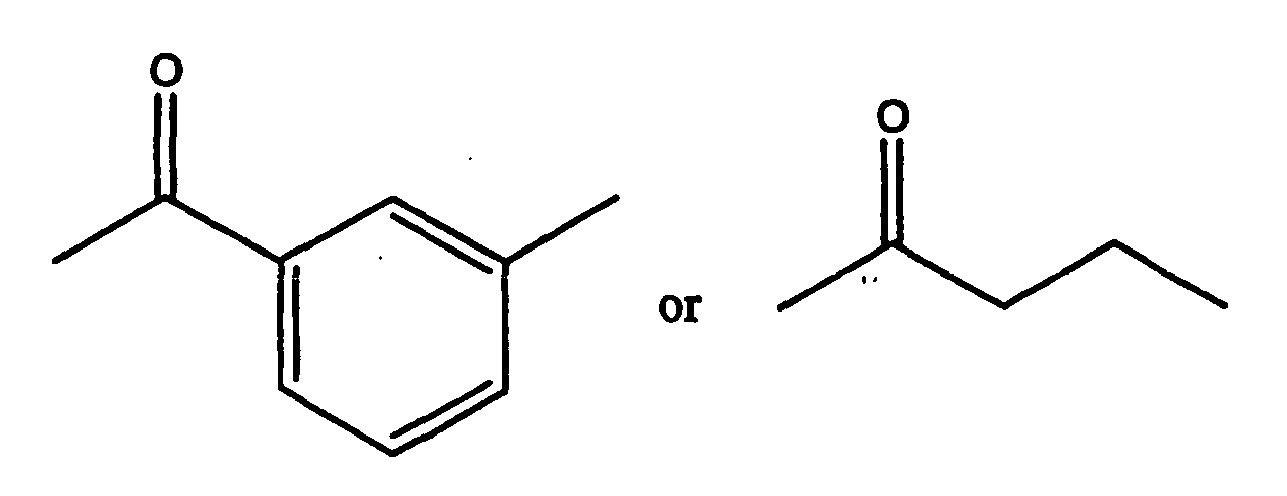
with the group of formula
- A preferred ester linkage has the formula

- This may be formed by reacting

SXC-G6-OH
wherein G6 is as hereinbefore defined. - The reverse ester linkage formation may be formed by reacting
PSC-G7-OH
(i.e. the polysacharide with optional G7 and at least one residual -OH group)
with
- Preferred ether linkages have the formula
-G6-O-G7-
wherein G6 and G7 are as hereinbefore defined, optionally one being absent. - This linkage may be formed by reacting
PSC-G6-OH
with
- A preferred urethane linkage is
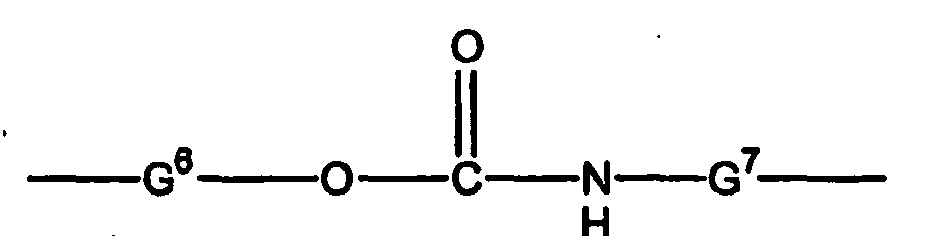
PSC-G6-OH
with
SXC-G7-NCO
wherein G6 and G7 are as hereinbefore defined, G6 optionally being absent (preferably absent in the configuration PSC-L-SXC). - The reverse configuration is also possible but the simplest arrangement is PSC-L-SXC and wherein G6 is absent. Also most common is when G7 is alkylene.
- The latter compound is made by reacting
SXC-G7-NH2
(wherein G7 is as hereinbefore defined) with phosgene. - Another route is to react
PSC-G6-OH
wherein G6 is as hereinbefore defined with carbonyl dimidazole to form
SXC G7 -NH2
wherein G7 is as hereinbefore defined. - Preferred triazine linkages have the formula
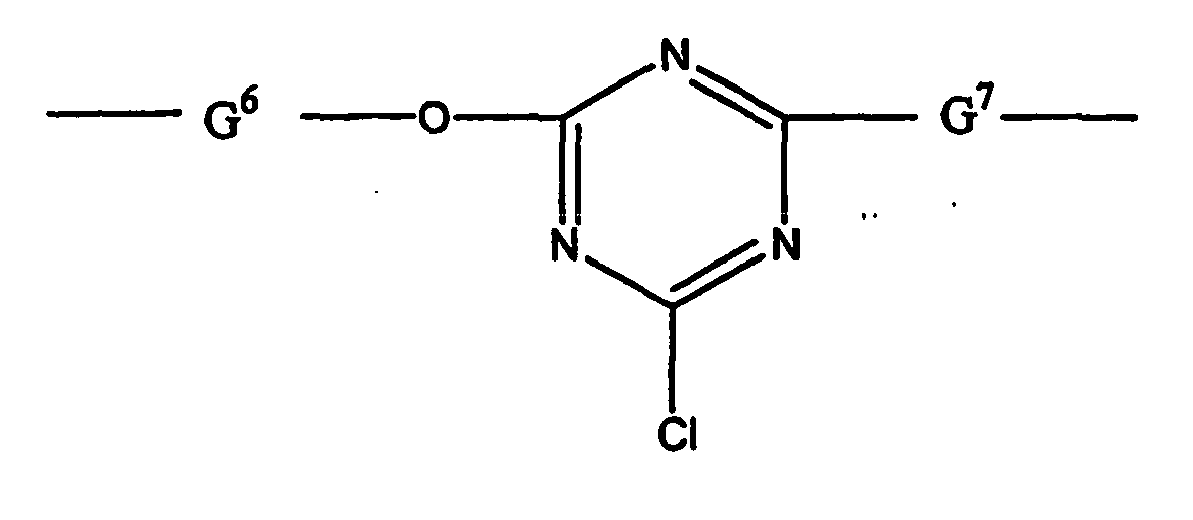
- These linkages may be formed by reacting
SXC-G7 -OH
or
SXC-G7-NH2
wherein G7 is as hereinbefore defined with cyanuic chloride and then with
PSC-G6-OH
wherein G6 is as hereinbefore defined but may be absent;
or (reverse -L-) by reacting
PSC-G7-OH
with cyanuric chloride (when G7 is as hereinbefore defined) and then with
SXC-G6-OH
or
SXC-G6-NH2
- Preferred carbonate linkages have the formula

- This linkage may be formed by reacting
PSC -OH
with SXC G6-OH
in the presence of carbonyl dimidazole or phosgene - Preferred amine linkages have the formula

- This linkage may be formed by reacting

with
- Preferred ester-alkylene linkages have the formula

- These linkages may be prepared by reacting
PSC-OH
with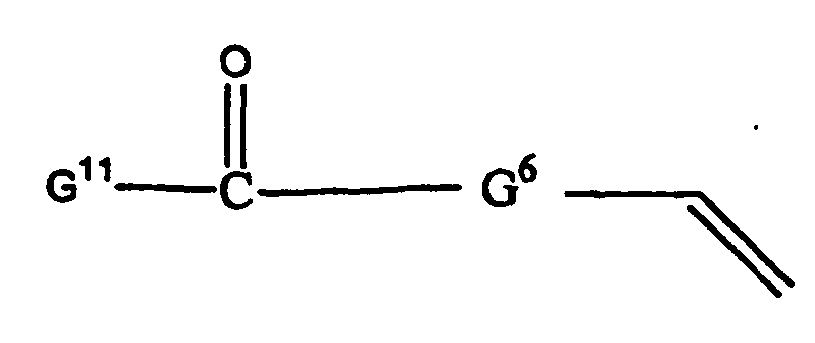
- Compositions according to the present invention can be provided in the form of an emulsion for use in laundry or other fabric treatment compositions.
- In a preferred embodiment, the emulsion comprises the polysaccharide having the hydrophobic agent bonded thereto and the sugar polyester, as the dispersed phase.
- The emulsions must contain another liquid component as well as the SPE, preferably a polar solvent, such as water. The emulsion has typically from 30 to 99.9%, preferably from 40 to 99% of the other liquid component, preferably a polar solvent, most preferably water. Low water emulsions may be for example 30 to 60% water, preferably 40 to 55% water. High water emulsions may be for example 60 to 99.9% water, preferably 80 to 99% water. Moderate water emulsions may be for example 55 to 80% water.
- The emulsion may contain an emulsifying agent, preferably an emulsifying surfactant for the modified polysaccharide/SPE. In preferred cases, the modified polysaccharide is itself an emulsifying agent. In a further preferred case it is the sole emulsifying agent.
- The emulsifying agent is especially one or more surfactants, for example, selected from any class, sub class or specific surfactant(s) disclosed herein in any context.
- The emulsifying agent most preferably comprises or consists of a non-ionic surfactant. Additionally or alternatively, one or more s'elected additional surfactants from anionic, cationic, zwitterionic and amphoteric surfactants may be incorporated in or used as the emulsifying agent.
- Suitable non-ionic surfactants include the (poly)-alkoxylated analogues of saturated or unsaturated fatty alcohols, for example, having from 8 to 22, preferably from 9 to 18, more preferably from 10 to 15 carbon atoms on average in the hydrocarbon chain thereof and preferably on average from 3 to 11, more preferably from 4 to 9 alkyleneoxy groups. Most preferably, the alkyleneoxy groups are independently selected from ethyleneoxy, propyleneoxy and butylenoxy, especially ethyleneoxy and propylenoxy, or solely ethyleneoxy groups and alkyl polyglucosides as disclosed in
EP 0 495 176 . - Preferably, the (poly)alkoxylated analogues of saturated or unsaturated fatty alcohols, have a hydrophilic-lipophilic balance (HLB) of between 8 to 18.
- The HLB of a polyethoxylated primary alcohol nonionic surfactant can be calculated by

where - MW (EO) = the molecular weight of the hydrophilic part (based on the average number of EO groups)
- MW(TOT) = the molecular weight of the whole surfactant (based on the average chain length of the hydrocarbon chain)
- This is the classical HLB calculation according to Griffin (J. Soc. Cosmetic Chemists, 5 (1954) 249-256).
- For analogous nonionics with a mix of ethyleneoxy (EO), propylenoxy (PO) and/or butyleneoxy (BO) hydrophilic groups, the following formula can be used;

- Preferably, the alkyl polyglucosides may have the following formula;
R-O-Zn
in which R is a linear or branched, saturated or unsaturated aliphatic alkyl radical having 8 to 18 carbon atoms or mixtures thereof, and Zn is a polyglycosyl radical with n=1.0 to 1.4 hexose or pentose units or mixtures. Preferred examples of alkylpolyglucosides include Glucopon™. - In a composition of a component (especially an emulsion) to be incorporated in a laundry treatment composition as a whole, the weight ratio of modified polysaccharide to emulsifying agent (other than the modified polysaccharide itself) is from 1:30 to 100:1, preferably 1:5 to 10:1. It should be noted that the modified polysaccharide is frequently not a pure material due to incomplete conversion and the ratio of the material as made to the emulsifying agent is typically around 3:1.
- Further, in any such composition (especially emulsion components) the weight ratio of SPE to emulsifying agent is from 100:1 to 2:1, preferably from 60:1 to 5:1, more preferably around 33:1 (where the modified polysaccharide is not the sole emulsifying agent).
- When in the form of an emulsion, the emulsion is prepared by mixing the modified polysaccharide and the SPE, other liquid component (e.g. water) and preferably, also an emulsifying agent, such as a surfactant, especially a non-ionic surfactant, e.g. in a high shear mixer.
- Whether or not pre-emulsified, the modified polysaccharide and SPE composition may be incorporated by admixture with other components of a laundry treatment composition.
- A particularly preferred embodiment of the invention subsists in a laundry treatment composition comprising:
- a) from 1 to 60 % by weight of the total composition of a surfactant, and
- b) from 0.001 to 25 % by weight of the total composition of a mixture (preferably an emulsion) comprising a water-soluble or dispersible polysaccharide selected from the group consisting of poly-glucan, poly-mannan, gluco-mannan and mixtures thereof, said polysaccharide having a hydrophobic agent (which may be a silicone) bonded thereto by a hydrolytically stable bond and a sugar polyester.
- The composition comprising the modified polysaccharide with SPE is preferably incorporated into laundry compositions as an ingredient to be incorporated in the laundry treatment composition. Such a composition (whether an emulsion or not) may optionally also comprise only a diluent (which may comprise solid and/or liquid) and/or also it may comprise an active ingredient.
- The composition of the invention is typically included in said laundry compositions at levels of from 0.001 % to 10 %, preferably from 0.005 % to 5 %, most preferably from 0.01% to 3 % by weight of the total laundry composition.
- If an emulsion is employed, typical inclusion levels of the emulsion in the laundry treatment composition are from 0.01 % to 40 %, more preferably from 0.001 % to 30 %, even more preferably from 0.1 % to 20 %, especially from 1 % to 10 % by weight of the total composition.
- The active ingredient in the compositions is preferably a surface active agent or a fabric conditioning agent. More than one active ingredient may be included. For some applications a mixture of active ingredients may be used.
- The compositions of the invention may be in any suitable physical form e.g. a solid such as a powder or granules, a tablet, a solid bar, a paste, gel or liquid, especially, an aqueous based liquid. In particular the compositions may be used in laundry compositions, especially in liquid, powder or tablet laundry composition.
- The compositions of the present invention are preferably laundry compositions, especially main wash (fabric washing) compositions or rinse-added softening compositions. Laundry compositions according to the invention may contain at least one further component. The main wash compositions may include a fabric softening agent and rinse-added fabric softening compositions may include surface-active compounds, particularly non-ionic surface-active compounds, if appropriate.
- The detergent compositions of the invention may contain a surface-active compound (surfactant) which may be chosen from soap and non-soap anionic, cationic, non-ionic, amphoteric and zwitterionic surface-active compounds and mixtures thereof. Many suitable surface-active compounds are available and are fully described in the literature, for example, in "Surface-Active Agents and Detergents", Volumes I and II, by Schwartz, Perry and Berch.
- The preferred detergent-active compounds that can be used are soaps and synthetic non-soap anionic and non-ionic compounds.
- The compositions of the invention may contain linear alkylbenzene sulphonate, particularly linear alkylbenzene sulphonates having an alkyl chain length of C8-C15. It is preferred if the level of linear alkylbenzene sulphonate is from 0 wt % to 30 wt %, more preferably 1 wt % to 25 wt %, most preferably from 2 wt % to 15 wt %, by weight of the total composition.
- The compositions of the invention may contain other anionic surfactants in amounts additional to the percentages quoted above. Suitable anionic surfactants are well-known to those skilled in the art. Examples include primary and secondary alkyl sulphates, particularly C8-C15 primary alkyl sulphates; alkyl ether sulphates; olefin sulphonates; alkyl xylene sulphonates; dialkyl sulphosuccinates; and fatty acid ester sulphonates. Sodium salts are generally preferred.
- The compositions of the invention may also contain non-ionic surfactant. Nonionic surfactants that may be used include the primary and secondary alcohol ethoxylates, especially the C8-C20 aliphatic alcohols ethoxylated with an average of from 1 to 20 moles of ethylene oxide per mole of alcohol, and more especially the C10-C15 primary and secondary aliphatic alcohols ethoxylated with an average of from 1 to 10 moles of ethylene oxide'per mole of alcohol. Non-ethoxylated nonionic surfactants include alkyl-polyglycosides, glycerol monoethers, and polyhydroxyamides (glucamide).
- It is preferred if the level of nonionic surfactant is from 0 wt% to 30 wt%, preferably from 1 wt% to 25 wt%, most preferably from 2 wt% to 15 wt%, by weight of the total composition.
- Although the preferred embodiments of the present invention include those in which the hydrophobic agent bonded to the polysaccharide is a conditioning and or softening species, any conventional fabric conditioning agent may also be used in the compositions of the present invention. The conditioning agents may be cationic or non-ionic.
- If the conventional fabric conditioning compound is to be employed in a main wash detergent composition comprising the polysaccharides of the present invention, the conventional fabric conditioning compound will typically be non-ionic. For use in the rinse phase, the non-polysaccharide conditioner will typically be cationic. These may for example be used in amounts from 0.5% to 35%, preferably from 1% to 30% more preferably from 3% to 25% by weight of the composition.
- Suitable cationic fabric softening compounds are substantially water-insoluble quaternary ammonium materials comprising a single alkyl or alkenyl long chain having an average chain length greater than or equal to C20 or, more preferably, compounds comprising a polar head group and two alkyl or alkenyl chains having an average chain length greater than or equal to C14. Preferably the fabric softening compounds have two long chain alkyl or alkenyl chains each having an average chain length greater than or equal to C16. Most preferably at least 50% of the long chain alkyl or alkenyl groups have a chain length of C18 or above. It is preferred if the long chain alkyl or alkenyl groups of the fabric softening compound are predominantly linear.
- Quaternary ammonium compounds having two long-chain aliphatic groups, for example, distearyldimethyl ammonium chloride and di(hardened tallow alkyl) dimethyl ammonium chloride, are widely used in commercially available rinse conditioner compositions. Other examples of these cationic compounds are to be found in "Surfactants Science Series" volume 34 ed. Richmond 1990, volume 37 ed. Rubingh 1991 and volume 53 eds. Cross and Singer 1994, Marcel Dekker Inc. New York".
- Any of the conventional types of such compounds may be used in the compositions of the present invention.
- The fabric softening compounds are preferably compounds that provide excellent softening, and are characterised by a chain melting Lβ to Lα transition temperature greater than 25°C, preferably greater than 35°C, most preferably greater than 45°C. This Lβ to Lα transition can be measured by differential scanning calorimetry as defined in "Handbook of Lipid Bilayers", D Marsh, CRC Press, Boca Raton, Florida, 1990 (pages 137 and 337).
- Substantially water-insoluble fabric softening compounds are defined as fabric softening compounds having a solubility of less than 1 x 10⁻³ wt % in demineralised water at 20°C. Preferably the fabric softening compounds have a solubility of less than 1 x 10⁻⁴ wt%, more preferably from less than 1 x 10⁻⁸ to 1 x 10⁻⁶ wt%.
- Especially preferred are cationic fabric softening compounds that are water-insoluble quaternary ammonium materials having two C12-22 alkyl or alkenyl groups connected to the molecule via at least one ester link, preferably two ester links. An especially preferred ester-linked quaternary ammonium material can be represented by the formula:


- Di(tallowoxyloxyethyl) dimethyl ammonium chloride and/or its hardened tallow analogue is an especially preferred compound of this formula.
- A second preferred type of quaternary ammonium material can be represented by the formula:

- A third preferred type of quaternary ammonium material are those derived from triethanolamine (hereinafter referred to as 'TEA quats') as described in for example
US 3915867 and represented by formula:
(TOCH2CH2)3N+(R9)
wherein T is H or (R8-CO-) where R8 group is independently selected from C8-28 alkyl or alkenyl groups and R9 is C1-4 alkyl or hydroxyalkyl groups or C2-4 alkenyl groups. For example N-methyl-N,N,N-triethanolamine ditallowester or dihardened-tallowester quaternary ammonium chloride or methosulphate. Examples of commercially available TEA quats include Rewoquat WE18 and Rewoquat WE20, both partially unsaturated (ex. WITCO), Tetranyl AOT-1, fully saturated (ex. KAO) and Stepantex VP 85, fully saturated (ex. Stepan). - It is advantageous if the quaternary ammonium material is biologically biodegradable.
- Preferred materials of this class such as 1,2-bis(hardened tallowoyloxy)-3-trimethylammonium propane chloride and their methods of preparation are, for example, described in
US 4 137 180 (Lever Brothers Co). Preferably these materials comprise small amounts of the corresponding monoester as described inUS 4 137 180 , for example, 1-hardened tallowoyloxy-2-hydroxy-3-trimethylammonium propane chloride. - Other useful cationic softening agents are alkyl pyridinium salts and substituted imidazoline species. Also useful are primary, secondary and tertiary amines and the condensation products of fatty acids with alkylpolyamines.
- The compositions may alternatively or additionally contain water-soluble cationic fabric softeners, as described in
GB 2 039 556B - The compositions may comprise a cationic fabric softening compound and an oil, for example as disclosed in
EP-A-0829531 . - The compositions may alternatively or additionally contain nonionic fabric softening agents such as lanolin and derivatives thereof.
- Lecithins and other phospholipids are also suitable softening compounds.
- In fabric softening compositions nonionic stabilising agent may be present. Suitable nonionic stabilising agents may be present such as linear C8 to C22 alcohols alkoxylated with 10 to 20 moles of alkylene oxide, C10 to C20 alcohols, or mixtures thereof. Other stabilising agents include the deflocculating polymers as described in
EP 0415698A2 andEP 0458599 B1 . - Advantageously the nonionic stabilising agent is a linear C8 to C22 alcohol alkoxylated with 10 to 20 moles of alkylene oxide. Preferably, the level of nonionic stabiliser is within the range from 0.1 to 10% by weight, more preferably from 0.5 to 5% by weight, most preferably from 1 to 4% by weight of the composition. The mole ratio of the quaternary ammonium compound and/or other cationic softening agent to the nonionic stabilising agent is suitably within the range from 40:1 to about 1:1, preferably within the range from 18:1 to about 3:1.
- The composition can also contain fatty acids, for example C8 to C24 alkyl or alkenyl monocarboxylic acids or polymers thereof. Preferably saturated fatty acids are used, in particular, hardened tallow C16 to C18 fatty acids. Preferably the fatty acid is non-saponified, more preferably the fatty acid is free, for example oleic acid, lauric acid or tallow fatty acid. The level of fatty acid material is preferably more than 0.1% by weight, more preferably more than 0.2% by weight of the total composition. Concentrated compositions may comprise from 0.5 to 20% by weight of fatty acid, more preferably 1% to 10% by weight of the total composition. The weight ratio of quaternary ammonium material or other cationic softening agent to fatty acid material is preferably from 10:1 to 1:10.
- It is also possible to include certain mono-alkyl cationic surfactants which can be used in main-wash compositions for fabrics. Cationic surfactants that may be used include quaternary ammonium salts of the general formula R1R2R3R4N+ X wherein the R groups are long or short hydrocarbon chains, typically alkyl, hydroxyalkyl or ethoxylated alkyl groups, and X is a counter-ion (for example, compounds in which R1 is a C8-C22 alkyl group, preferably a C8-C10 or C12-C14 alkyl group, R2 is a methyl group, and R3 and R4, which may be the same or different, are methyl or hydroxyethyl groups); and cationic esters (for example, choline esters).
- The choice of surface-active compound (surfactant), and the amount present, will depend on the intended use of the detergent composition. In fabric washing compositions, different surfactant systems may be chosen, as is well known to the skilled formulator, for hand-washing products and for products intended for use in different types of washing machine.
- The total amount of surfactant present will also depend on the intended end use and may be as high as 60 wt%, for example, in a composition for washing fabrics by hand. In compositions for machine washing of fabrics, an amount of from 5 to 40 % by weight of the total composition is generally appropriate. Typically the compositions will comprise at least 2 % surfactant e.g. from 2 to 60 %, preferably from 15 to 40 % most preferably from 25 to 35 % by weight of the total composition.
- Detergent compositions suitable for use in most automatic fabric washing machines generally contain anionic non-soap surfactant, or non-ionic surfactant, or combinations of the two in any suitable ratio, optionally together with soap.
- The compositions of the invention, when used as main wash fabric washing compositions, will generally also contain one or more detergency builders. The total amount of detergency builder in the compositions will typically range from 5 to 80 wt%, preferably from 10 to 60 wt% based on the total composition.
- Inorganic builders that may be present include sodium carbonate, if desired in combination with a crystallisation seed for calcium carbonate, as disclosed in
GB 1 437 950 GB 1 473 201 (Henkel GB 1 473 202 (Henkel GB 1 470 250 (Procter & Gamble EP 164 514B (Hoechst - The compositions of the invention preferably contain an alkali metal, preferably sodium, aluminosilicate builder. Sodium-aluminosilicates may generally be incorporated in amounts of from 10 to 70% by weight (anhydrous basis), preferably from 25 to 50 wt%.
- The alkali metal aluminosilicate may be either crystalline or amorphous or mixtures thereof, having the general formula: 0.8-1.5 Na2O. Al2O3. 0.8-6 SiO2
- These materials contain some bound water and are required to have a calcium ion exchange capacity of at least 50 mg Ca0/g. The preferred sodium aluminosilicates contain 1.5-3.5 SiO2 units (in the formula above). Both the amorphous and the crystalline materials can be prepared readily by reaction between sodium silicate and sodium aluminate, as amply described in the literature. Suitable crystalline sodium aluminosilicate ion-exchange detergency builders are described, for example, in
GB 1 429 143 (Procter & Gamble - The zeolite may be the commercially available zeolite 4A now widely used in laundry detergent powders. However, according to a preferred embodiment of the invention, the zeolite builder incorporated in the compositions of the invention is maximum aluminium zeolite P (zeolite MAP) as described and claimed in
EP 384 070A - Especially preferred is zeolite MAP having a silicon to aluminium weight ratio not exceeding 1.07, more preferably about 1.00. The calcium binding capacity of zeolite MAP is generally at least 150 mg CaO per g of anhydrous material.
- Organic builders that may be present include polycarboxylate polymers such as polyacrylates, acrylic/maleic copolymers, and acrylic phosphinates; monomeric polycarboxylates such as citrates, gluconates, oxydisuccinates, glycerol mono-, di and trisuccinates, carboxymethyloxy succinates, carboxymethyloxymalonates, dipicolinates, hydroxyethyliminodiacetates, alkyl- and alkenylmalonates and succinates; and sulphonated fatty acid salts. This list is not intended to be exhaustive.
- Especially preferred organic builders are citrates, suitably used in amounts of from 5 to 30 wt%, preferably from 10 to 25 wt%; and acrylic polymers, more especially acrylic/maleic copolymers, suitably used in amounts of from 0.5 to 15 wt%, preferably from 1 to 10 wt%.
- Builders, both inorganic and organic, are preferably present in alkali metal salt, especially sodium salt, form.
- Compositions according to the invention may also suitably contain a bleach system. Fabric washing compositions may desirably contain peroxy bleach compounds, for example, inorganic persalts or organic peroxyacids, capable of yielding hydrogen peroxide in aqueous solution.
- Suitable peroxy bleach compounds include organic peroxides such as urea peroxide, and inorganic persalts such as the alkali metal perborates, percarbonates, perphosphates, persilicates and persulphates. Preferred inorganic persalts are sodium perborate monohydrate and tetrahydrate, and sodium percarbonate.
- Especially preferred is sodium percarbonate having a protective coating against destabilisation by moisture. Sodium percarbonate having a protective coating comprising sodium metaborate and sodium silicate is disclosed in
GB 2 123 044B (Kao - The peroxy bleach compound is suitably present in an amount of from 0.1 to 35 wt%, preferably from 0.5 to 25 wt%. The peroxy bleach compound may be used in conjunction with a bleach activator (bleach precursor) to improve bleaching action at low wash temperatures. The bleach precursor is suitably present in an amount of from 0.1 to 8 wt%, preferably from 0.5 to 5 wt%.
- Preferred bleach precursors are peroxycarboxylic acid precursors, more especially peracetic acid precursors and pernoanoic acid precursors. Especially preferred bleach precursors suitable for use in the present invention are N,N,N',N',-tetracetyl ethylenediamine (TAED) and sodium nonanoyloxybenzene sulphonate (SNOBS). The novel quaternary ammonium and phosphonium bleach precursors disclosed in
US 4 751 015 andUS 4 818 426 (Lever Brothers Company) andEP 402 971A EP 284 292A EP 303 520A (Kao - The bleach system can be either supplemented with or replaced by a peroxyacid. examples of such peracids can be found in
US 4 686 063 andUS 5 397 501 (Unilever). A preferred example is the imido peroxycarboxylic class of peracids described inEP A 325 288 EP A 349 940 DE 382 3172 andEP 325 289 - A bleach stabiliser (transition metal sequestacant) may also be present. Suitable bleach stabilisers include ethylenediamine tetra-acetate (EDTA), the polyphosphonates such as Dequest (Trade Mark) and non-phosphate stabilisers such as EDDS (ethylene diamine di-succinic acid). These bleach stabilisers are also useful for stain removal especially in products containing low levels of bleaching species or no bleaching species.
- An especially preferred bleach system comprises a peroxy bleach compound (preferably sodium percarbonate optionally together with a bleach activator), and a transition metal bleach catalyst as described and claimed in
EP 458 397A EP 458 398A EP 509 787A - Bleach systems may comprise transition metal catalyst systems such as those disclosed in
WO9965905 WO0012667 WO0012808 WO0029537 WO0060045 - The compositions according to the invention may also contain one or more enzyme(s). Suitable enzymes include the proteases, amylases, cellulases, oxidases, peroxidases and lipases usable for incorporation in detergent compositions.
- Preferred proteolytic enzymes (proteases) are, catalytically active protein materials which degrade or alter protein types of stains when present as in fabric stains in a hydrolysis reaction. They may be of any suitable origin, such as vegetable, animal, bacterial or yeast origin.
- Proteolytic enzymes or proteases of various qualities and origins and having activity in various pH ranges of from 4-12 are available and can be used in the instant invention. Examples of suitable proteolytic enzymes are the subtilisins which are obtained from particular strains of B. Subtilis B. licheniformis, such as the commercially available subtilisins Maxatase (Trade Mark), as supplied by Genencor International N.V., Delft, Holland, and Alcalase (Trade Mark), as supplied by Novozymes Industri A/S, Copenhagen, Denmark.
- Particularly suitable is a protease obtained from a strain of Bacillus having maximum activity throughout the pH range of 8-12, being commercially available, e.g. from Novozymes Industri A/S under the registered trade-names Esperase (Trade Mark) and Savinase (Trade-Mark). The preparation of these and analogous enzymes is described in
GB 1 243 785 - Detergency enzymes are commonly employed in granular form in amounts of from about 0.1 to about 3.0 wt%. However, any suitable physical form of enzyme may be used.
- The combination of non-cellulose polysaccharides and cellulase enzymes is particularly useful, as these enzymes exhibit reduced activity against this class of polysaccharides, as compared to their activity against cellulose. Cellulase is known to be useful and is used in laundry products for de-fuzzing and colour brightening.
- The compositions of the invention may contain alkali metal (preferably sodium) carbonate, in order to increase detergency and ease processing. Sodium carbonate may suitably be present in amounts ranging from 1 to 60 wt%, preferably from 2 to 40 wt%. However, compositions containing little or no sodium carbonate are also within the scope of the invention.
- Powder flow may be improved by the incorporation of a small amount of a powder structurant, for example, a fatty acid (or fatty acid soap), a sugar, an acrylate or acrylate/maleate copolymer, or sodium silicate. One preferred powder structurant is fatty acid soap, suitably present in an amount of from 1 to 5 wt%.
- Other materials that may be present in detergent compositions of the invention include sodium silicate; anti-redeposition agents such as cellulosic polymers; soil release polymers; inorganic salts such as sodium sulphate; or lather boosters as appropriate; dyes; coloured speckles; fluorescers and decoupling polymers. This list is not intended to be exhaustive. However, many of these ingredients will be better delivered as benefit agent groups in materials according to the first aspect of the invention.
- The detergent composition when diluted in the wash liquor (during a typical wash cycle) will typically give a pH of the wash liquor from 7 to 10.5 for a main wash detergent.
- Particulate detergent compositions are suitably prepared by spray-drying a slurry of compatible heat-insensitive ingredients, and then spraying on or post-dosing those ingredients unsuitable for processing via the slurry. The skilled detergent formulator will have no difficulty in deciding which ingredients should be included in the slurry and which should not.
- Particulate detergent compositions of the invention preferably have a bulk density of at least 400 g/l, more preferably at least 500 g/l. Especially preferred compositions have bulk densities of at least 650 g/litre, more preferably at least 700 g/litre.
- Such powders may be prepared either by post-tower densification of spray-dried powder, or by wholly non-tower methods such as dry mixing and granulation; in both cases a high-speed mixer/granulator may advantageously be used. Processes using high-speed mixer/granulators are disclosed; for example, in
EP 340 013A EP 367 339A EP 390 251A EP 420 317A - Liquid detergent compositions can be prepared by admixing the essential and optional ingredients thereof in any desired order to provide compositions containing components in the requisite concentrations. Liquid compositions according to the present invention can also be in compact form which means it will contain a lower level of water compared to a conventional liquid detergent.
- Product forms include powders, liquids, gels, tablets, any of which are optionally incorporated in a water-soluble or water dispersible sachet. The means for manufacturing any of the product forms are well known in the art. If the composition comprising the modified polysaccharide and SPE is to be incorporated in a powder (optionally the powder to be tableted), and whether or not pre-emulsified, it is optionally included in a separate granular component, e.g. also containing a water soluble organic or inorganic material, or in encapsulated form.
- The substrate may be any substrate onto which it is desirable to deposit SPE and which is subjected to treatment such as a washing or rinsing process.
- In particular, the substrate may be a textile fabric. It has been found that particular good results are achieved when using a natural fabric substrate such as cotton, or fabric blends containing cotton.
- The treatment of the substrate with the material of the invention can be made by any suitable method such as washing, soaking or rinsing of the substrate.
- Typically the treatment will involve a washing or rinsing method such as treatment in the main wash or rinse cycle of a washing machine and involves contacting the substrate with an aqueous medium comprising the material of the invention.
- The present invention will now be explained in more detail by reference to the following non-limiting examples.
- In the following examples where percentages are mentioned, this is to be understood as percentage by weight. In the following tables where the values do not add up to 100 these are to be understood as parts by weight.
- Monocarboxydecyl terminated polydimethylsiloxane (PDMS) source (Molecular weight 5,000: 1.5 g, 0.23 mmols) was dispersed in dimethylacetamide (10 cm3) by vigorous stirring under nitrogen. Carbonyldiimidazole (37 mg, 0.23 mmols) was then added and the dispersion heated with stirring to 70°C under nitrogen for two hours. A solution of cellulose monoacetate (DS 0.58; 1 g, 5.3 mmol equivalents based on primary hydroxyl groups) in dimethylacetamide (10 cm3) was then added and stirring and heating was continued for a further 20 hours. Following this time the mixture was filtered and the filtrate added to vigorously stirred acetone to give a white precipitate. This precipitate was filtered off, washed with acetone and dried under vacuum to give a white polymer (1.01 g). From the 1H NMR of the polymer (after hydrolysis with 20% DC1 in D2O for two hours at 80°C) and normalising the integration of the anomeric protons to unity and the acetate group to 0.58 the integration of the Si-CH3 group (at 0.0 ppm) gives an overall degree of substitution (DS) of siloxane groups of 0.0015. This material is hereinafter referred to as "Polymer A".
- Lithium chloride (27 g) was dissolved in anhydrous dimethyl sulfoxide (300 cm3) with heating (150°C) and stirring under nitrogen. Once the lithium chloride was dissolved the solution was cooled to 120 °C before slowly adding locust bean gum (3.5 g) over a period of 20 minutes with vigorous stirring.
- The viscous solution thus obtained was then further cooled to 70 °C and carbonyl diimidazole (54 mg, 0.5 mmols) was added and stirring and heating was continued for a further two hours. Diaminopropyl terminated polydimethylsiloxane (3,000 mwt, 1 g, 0.33 mmols) was then added and the solution stirred with heating for 18 hours.
- The solution was cooled to room temperature before adding drop-wise to vigorously stirred acetone (3 litres) to precipitate the polymer. The suspension was centrifuged to isolate the product which was then washed with acetone (2 x 200 cm3) before drying under vacuum (40°C) overnight to give an off-white solid (3.1 g).
- From the 1H NMR of the hydrolysed product (heated to 1 hour at 70°C in 20% DCl/D2O) the degree of substitution of PDMS groups to sugar units was found to be 5.3 x 10⁻⁴. This material is hereinafter referred to as "Polymer B".
- Emulsions were prepared as using the formulations shown in Table 1.
Table 1 Ingredient Parts Example 3 Example 4 Control 3/4 Polymer A 36 0 0 Polymer B 0 36 0 ER-290* 360 360 360 Water 10000 10000 10000 * ER-290 is an sucrose tetra erucate Ryoto™ sugar ester from Mitsubishi-Kagaku Foods Corporation - Polymer A or B was weighed into a bottle along with 10 cm3 of water. This mixture was agitated using an ultrasonic probe (Soniprobe™) at half power until no undissolved polymer was visible (2-3 minutes). The ER-290 was then added to the bottle. The mixture was further agitated with the ultrasonic probe (1 minute at setting 6 followed by 2 x 1 minute at setting 8) to produce the emulsion. The same process was used to produce the control emulsion but no polymer was used.
- Wash liquors were prepared by adding 2.84 g of the formulations given in Table 2 to 150 cm3 of water.
Table 2 Ingredient Quantity / % Example 5 Control 5A Sodium LAS spray-dried 100 % 17.6 17.6 Nonionic 7EO, branched 17.6 17.6 Trisodium citrate 3.1 3.1 Sodium carbonate 5.1 5.1 Sodium Bicarbonate 0.9 0.9 Sodium sulphate 19.3 19.3 Emulsion Example 3 36.5 0.0 Emulsion Control ¾ 0.0 36.5 - The wash liquors were placed in separate pots of a Rotawash™ Colour Fastness Tester (ex SDL, UK and as described in ISO 105) that had been preheated to 40°C. To each pot was added a piece of white 100% cotton terry towelling weighing 18 g along with 25 stainless steel balls. The pots were sealed and then washed for 45 minutes with end over end agitation at 40 rpm. At the end of the wash period, the liquor was decanted from each of the pots, which were then refilled with 250 cm3 of water, resealed, replaced in the Rotawash and washed for a further ten minutes. This rinse step was repeated one more time after which, the rinse liquor was decanted from the pots, the cloths gently squeezed by hand to remove excess water and the fabrics dried flat overnight under ambient conditions. Each condition was run in duplicate.
- The quantity of SPE deposited onto the fabrics during the wash was then determined as follows. Each fabric piece was cut into three and the individual pieces weighed. Each fabric piece was added to a bottle containing 50 cm3 of tetrahydrofuran (THF) and the deposited SPE extracted with the aid of ultrasonication for five minutes. The amount of SPE extracted was determined by gel permeation chromatography (GPC) using a PLgel 3µm 100Å column with THF eluent and an evaporative light scattering detector ELS 1000 light scattering detector. The area under the elution peak for the SPE was calculated by integration of the trace and this area was used to calculate the concentration of SPE in the THF solution from the extraction by comparison to a calibration curve produced using SPE in THF standards. The results from the three portions of cloth were used to calculate an average value for the amount of SPE deposited on the fabric expressed as milligrams of SPE deposited per gram of fabric. These results are tabulated below in Table 3.
Table 3 SPE deposited / Mg per g of fabric Example 5 0.133 ± 0.033 Control 5A 0.075 ± 0.012 - It will be seen that deposition of SPE onto fabric was dramatically increased from the composition in accordance with the invention.
- Wash liquors were prepared by adding 2.84 g of the formulations given in Table 4 to 150 cm3 of water.
Table 4 Ingredient Quantity / % Example 6 Control 6A Sodium LAS spray-dried 100 % 17.6 17.6 Nonionic 7EO, branched 17.6 17.6 Trisodium citrate 3.1 3.1 Sodium carbonate 5.1 5.1 Sodium Bicarbonate 0.9 0.9 Sodium sulphate 19.3 19.3 Emulsion Example 4 36.5 0.0 Emulsion Control ¾ 0.0 36.5 - The wash liquors were placed in separate pots of a Rotawash ™ Colour Fastness Tester (ex SDL, UK and as described in ISO 105) at ambient temperature. To each pot was added a piece of white 100% cotton terry towelling weighing 18 g along with 25 stainless steel balls. The pots were sealed and then washed for 45 minutes with end over end agitation at 40 rpm. At the end of the wash period, the liquor was decanted from each of the pots, which were then refilled with 250 cm3 of water, resealed, replaced in the Rotawash and washed for a further ten minutes. The rinse liquor was decanted from the pots, the cloths gently squeezed by hand to remove excess water and the fabrics dried flat overnight under ambient conditions. Each condition was run in duplicate.
- The quantity of SPE deposited onto the fabrics during the wash was then determined as follows. Each fabric piece was cut into four and the individual pieces weighed. Each fabric piece was added to a bottle containing 50 cm3 of tetrahydrofuran (THF) and the deposited SPE extracted with the aid of ultrasonication for five minutes. The amount of SPE extracted was determined by gel permeation chromatography (GPC) using a PLgel 3µm 100Å column with THF eluent and an evaporative light scattering detector ELS 1000 light scattering detector. The area under the elution peak for the SPE was calculated by integration of the trace and this area was used to calculate the concentration of SPE in the THF solution from the extraction by comparison to a calibration curve produced using SPE in THF standards. The results from the three portions of cloth were used to calculate an average value for the amount of SPE deposited on the fabric expressed as milligrams of SPE deposited per gram of fabric. These results are given below in Table 5.
Table 5 SPE deposited / Mg per g of fabric Example 5 0.205 ± 0.037 Control 5A 0.143 ± 0.026 - It will be seen that deposition of SPE onto fabric was greatly increased from the composition in accordance with the invention.
Claims (24)
- A composition comprising:(a) a water-soluble or dispersible polysaccharide having a hydrophobic agent bonded thereto by a hydrolytically stable bond and(b) a sugar polyester (SPE).wherein the polysaccharide has a backbone comprising β1-4 linkages, and wherein the polysaccharide backbone is a poly-glucan, poly-mannan, gluco-mannan or a mixture thereof.
- A composition according to claim 1 wherein the polysaccharide is a galacto-mannan, xylo-glucan or a mixture thereof.
- A composition according to claim 2 wherein the polysaccharide is locust bean gum, tamarind xyloglucan, guar gum or mixture thereof.
- A composition according to claim 1 wherein the polysaccharide is cellulose monoacetate.
- A composition according to any previous claim wherein the hydrophobic agent is selected from the group consisting of silicone, hydrocarbon and hydrophobic polymer.
- A composition according to any previous claim wherein the sugar polyester is selected from the group consisting of sucrose polyesters, glucose polyesters and cellobiose polyesters.
- A composition according to claim 6 wherein the sugar polyester is a sucrose polyester.
- A composition according to any previous claim wherein some of the sugar polyester is bonded to the polysaccharide by a chemical bond.
- A composition according to claim 8, wherein the ratio of sugar polyester which is bonded to the polysaccharide by a chemical bond to that sugar polyester which is not bonded by a chemical bond is in the range of from 1:1000 to 1:1, preferably from 1:200 to 1:4.
- A composition according to any previous claim wherein the ratio of the polysaccharide with hydrophobic agent bonded thereto to the sugar polyester is in the range of from 1:200 to 1:5 parts by weight, preferably from 1:20 to 1:8 parts by weight of the composition.
- A composition as claimed in any previous claim comprising the polysaccharide having the hydrophobic agent bonded thereto and the sugar polyester, as the dispersed phase of an emulsion.
- A composition as claimed in claim 11 further comprising an emulsifying agent.
- A composition as claimed in claim 12 wherein the emulsifying agent comprises a non-ionic surfactant.
- A composition as claimed in any of claims 11-13 wherein the emulsion is from 30 to 99.9%, preferably from 40 to 99% of another liquid component, preferably a polar solvent, most preferably water.
- A composition as claimed in any previous claim wherein the hydrophobic agent is a silicons selected from polydialkyl siloxanes, amine derivatives thereof, and mixtures thereof wherein the silicone comprises silicone chains.
- A composition as claimed in claim 15, wherein the average degree of substitution of the silicone chain (s) on the polysaccharide is from 0.00001 to 0.5, preferably 0.0001 to 0.5, more preferably from 0.001 to 0.1 and even more preferably from 0.001 to 0.05.
- A composition as claimed in claim 16, wherein the silicone chain(s) in the polysaccharide is or are independently selected from those of formula:


wherein n is from 5 to 1000, preferably from 10 to 200 and m is from 0 to 100, preferably from 0 to 20, for example from 1 to 20.
G4 is selected from groups of formula:
-(CH2)p-CH3, where p is from 1 to 18
-(CH2)q-NH-(CH2)r-NH2 where q and r are independently from 1 to 3
-(CH2)s-NH2, where s is from 1 to 3
-(CH2)u-COOH, where u is from 1 to 10,
-(CH2 CH2O)w-(CH2)x H, where w is from 1 to 150, preferably from 10 to 20 and x is from 0 to 10;
and G5 is independently selected from hydrogen, groups defined above for G4, -OH, -CH3 and -C(CH3)3. - A composition as claimed in claim 17, where L is selected from amide linkages, ester linkages, ether linkages, urethane linkages, triazine linkages, carbonate linkages, amine linkages and ester-alkylene linkages.
- A laundry treatment composition comprising a composition as claimed in any preceding claim and at least one further component.
- A laundry treatment composition as claimed in claim 19, wherein the further component comprises a surfactant.
- A laundry treatment composition comprising: from 1 to 60 % by weight of the total composition of a surfactant, and from 0.001 to 25 % by weight of the total composition of an emulsion comprising (a) a water-soluble or dispersible polysaccharide selected from the group consisting of poly-glucan, poly-mannan, gluco-mannan and mixtures thereof, said polysaccharide having a hydrophobic agent bonded thereto by a hydrolytically stable bond, and (b) a sugar polyester.
- A laundry treatment composition according to claim 21 wherein the hydrophobic agent is silicone.
- A method for depositing a sugar polyester onto a substrate, the method comprising, contacting in an aqueous medium, the substrate and a composition according to any previous claim.
- Use of a composition as claimed in any one of claims 1 to 22 in a laundry treatment composition to provide a softening benefit to a substrate.
Applications Claiming Priority (2)
| Application Number | Priority Date | Filing Date | Title |
|---|---|---|---|
| GBGB0411995.4A GB0411995D0 (en) | 2004-05-28 | 2004-05-28 | Laundry treatment compositions |
| PCT/EP2005/005121 WO2005118761A1 (en) | 2004-05-28 | 2005-05-06 | Laundry treatment compositions |
Publications (2)
| Publication Number | Publication Date |
|---|---|
| EP1751263A1 EP1751263A1 (en) | 2007-02-14 |
| EP1751263B1 true EP1751263B1 (en) | 2008-07-09 |
Family
ID=32671258
Family Applications (1)
| Application Number | Title | Priority Date | Filing Date |
|---|---|---|---|
| EP05758923A Expired - Lifetime EP1751263B1 (en) | 2004-05-28 | 2005-05-06 | Laundry treatment compositions |
Country Status (10)
| Country | Link |
|---|---|
| US (1) | US20050267008A1 (en) |
| EP (1) | EP1751263B1 (en) |
| AR (1) | AR048977A1 (en) |
| AT (1) | ATE400634T1 (en) |
| BR (1) | BRPI0511574B1 (en) |
| DE (1) | DE602005008046D1 (en) |
| ES (1) | ES2309773T3 (en) |
| GB (1) | GB0411995D0 (en) |
| WO (1) | WO2005118761A1 (en) |
| ZA (1) | ZA200609873B (en) |
Families Citing this family (14)
| Publication number | Priority date | Publication date | Assignee | Title |
|---|---|---|---|---|
| GB0412854D0 (en) * | 2004-06-09 | 2004-07-14 | Unilever Plc | Fabric care composition |
| GB0514147D0 (en) * | 2005-07-11 | 2005-08-17 | Unilever Plc | Laundry treatment compositions |
| US9321873B2 (en) | 2005-07-21 | 2016-04-26 | Akzo Nobel N.V. | Hybrid copolymer compositions for personal care applications |
| US8674021B2 (en) | 2006-07-21 | 2014-03-18 | Akzo Nobel N.V. | Sulfonated graft copolymers |
| US8841246B2 (en) | 2011-08-05 | 2014-09-23 | Ecolab Usa Inc. | Cleaning composition containing a polysaccharide hybrid polymer composition and methods of improving drainage |
| US8853144B2 (en) | 2011-08-05 | 2014-10-07 | Ecolab Usa Inc. | Cleaning composition containing a polysaccharide graft polymer composition and methods of improving drainage |
| US8679366B2 (en) | 2011-08-05 | 2014-03-25 | Ecolab Usa Inc. | Cleaning composition containing a polysaccharide graft polymer composition and methods of controlling hard water scale |
| US8636918B2 (en) | 2011-08-05 | 2014-01-28 | Ecolab Usa Inc. | Cleaning composition containing a polysaccharide hybrid polymer composition and methods of controlling hard water scale |
| MX2014005094A (en) | 2011-11-04 | 2014-08-08 | Akzo Nobel Chemicals Int Bv | Hybrid dendrite copolymers, compositions thereof and methods for producing the same. |
| JP2014532792A (en) | 2011-11-04 | 2014-12-08 | アクゾ ノーベル ケミカルズ インターナショナル ベスローテン フエンノートシャップAkzo Nobel Chemicals International B.V. | Grafted dendritic copolymer and method for producing the same |
| US8945314B2 (en) | 2012-07-30 | 2015-02-03 | Ecolab Usa Inc. | Biodegradable stability binding agent for a solid detergent |
| US9365805B2 (en) | 2014-05-15 | 2016-06-14 | Ecolab Usa Inc. | Bio-based pot and pan pre-soak |
| EP3212752B1 (en) * | 2014-10-27 | 2021-12-01 | Unilever IP Holdings B.V. | Laundry composition ingredients |
| AU2017376773B2 (en) | 2016-12-16 | 2021-08-19 | Nutrition & Biosciences USA 4, Inc. | Amphiphilic polysaccharide derivatives and compositions comprising same |
Family Cites Families (6)
| Publication number | Priority date | Publication date | Assignee | Title |
|---|---|---|---|---|
| ATE264903T1 (en) * | 1996-09-19 | 2004-05-15 | Procter & Gamble | FABRIC SOFTENER WITH IMPROVED PERFORMANCE |
| WO1998016538A1 (en) * | 1996-10-16 | 1998-04-23 | Unilever Plc | Fabric softening composition |
| GB2360791A (en) * | 2000-03-29 | 2001-10-03 | Unilever Plc | Softening treatment for fabrics |
| GB0121148D0 (en) * | 2001-08-31 | 2001-10-24 | Unilever Plc | Polymers and their use |
| GB0213263D0 (en) * | 2002-06-10 | 2002-07-17 | Unilever Plc | Improvements relating to fabric detergent compositions |
| GB0313900D0 (en) * | 2003-06-16 | 2003-07-23 | Unilever Plc | Laundry treatment compositions |
-
2004
- 2004-05-28 GB GBGB0411995.4A patent/GB0411995D0/en not_active Ceased
-
2005
- 2005-05-06 ES ES05758923T patent/ES2309773T3/en not_active Expired - Lifetime
- 2005-05-06 EP EP05758923A patent/EP1751263B1/en not_active Expired - Lifetime
- 2005-05-06 AT AT05758923T patent/ATE400634T1/en not_active IP Right Cessation
- 2005-05-06 WO PCT/EP2005/005121 patent/WO2005118761A1/en not_active Ceased
- 2005-05-06 ZA ZA200609873A patent/ZA200609873B/en unknown
- 2005-05-06 DE DE602005008046T patent/DE602005008046D1/en not_active Expired - Lifetime
- 2005-05-06 BR BRPI0511574A patent/BRPI0511574B1/en not_active IP Right Cessation
- 2005-05-26 US US11/137,865 patent/US20050267008A1/en not_active Abandoned
- 2005-05-27 AR ARP050102181A patent/AR048977A1/en not_active Application Discontinuation
Also Published As
| Publication number | Publication date |
|---|---|
| BRPI0511574A (en) | 2008-01-02 |
| ES2309773T3 (en) | 2008-12-16 |
| WO2005118761A1 (en) | 2005-12-15 |
| GB0411995D0 (en) | 2004-06-30 |
| EP1751263A1 (en) | 2007-02-14 |
| US20050267008A1 (en) | 2005-12-01 |
| ZA200609873B (en) | 2010-08-25 |
| BRPI0511574B1 (en) | 2017-03-28 |
| AR048977A1 (en) | 2006-06-14 |
| ATE400634T1 (en) | 2008-07-15 |
| DE602005008046D1 (en) | 2008-08-21 |
Similar Documents
| Publication | Publication Date | Title |
|---|---|---|
| US20050267008A1 (en) | Laundry treatment compositions | |
| EP1425307B1 (en) | Polymers and their use | |
| EP1432759B1 (en) | Laundry treatment compositions | |
| AU2002333459A1 (en) | Polymers and their use | |
| AU2002333460A1 (en) | Laundry treatment compositions | |
| EP1633838B1 (en) | Laundry treatment compositions | |
| EP1567628B1 (en) | Laundry treatment compositions | |
| EP1902121B1 (en) | Laundry treatment compositions | |
| EP1567629B1 (en) | Laundry treatment compositions and components therefor | |
| BRPI0518274B1 (en) | system and method for inspecting and sorting molded containers |
Legal Events
| Date | Code | Title | Description |
|---|---|---|---|
| PUAI | Public reference made under article 153(3) epc to a published international application that has entered the european phase |
Free format text: ORIGINAL CODE: 0009012 |
|
| 17P | Request for examination filed |
Effective date: 20061103 |
|
| AK | Designated contracting states |
Kind code of ref document: A1 Designated state(s): AT BE BG CH CY CZ DE DK EE ES FI FR GB GR HU IE IS IT LI LT LU MC NL PL PT RO SE SI SK TR |
|
| GRAP | Despatch of communication of intention to grant a patent |
Free format text: ORIGINAL CODE: EPIDOSNIGR1 |
|
| GRAS | Grant fee paid |
Free format text: ORIGINAL CODE: EPIDOSNIGR3 |
|
| DAX | Request for extension of the european patent (deleted) | ||
| GRAA | (expected) grant |
Free format text: ORIGINAL CODE: 0009210 |
|
| AK | Designated contracting states |
Kind code of ref document: B1 Designated state(s): AT BE BG CH CY CZ DE DK EE ES FI FR GB GR HU IE IS IT LI LT LU MC NL PL PT RO SE SI SK TR |
|
| REG | Reference to a national code |
Ref country code: GB Ref legal event code: FG4D |
|
| REG | Reference to a national code |
Ref country code: CH Ref legal event code: EP |
|
| REF | Corresponds to: |
Ref document number: 602005008046 Country of ref document: DE Date of ref document: 20080821 Kind code of ref document: P |
|
| REG | Reference to a national code |
Ref country code: IE Ref legal event code: FG4D |
|
| REG | Reference to a national code |
Ref country code: ES Ref legal event code: FG2A Ref document number: 2309773 Country of ref document: ES Kind code of ref document: T3 |
|
| NLV1 | Nl: lapsed or annulled due to failure to fulfill the requirements of art. 29p and 29m of the patents act | ||
| PG25 | Lapsed in a contracting state [announced via postgrant information from national office to epo] |
Ref country code: NL Free format text: LAPSE BECAUSE OF FAILURE TO SUBMIT A TRANSLATION OF THE DESCRIPTION OR TO PAY THE FEE WITHIN THE PRESCRIBED TIME-LIMIT Effective date: 20080709 Ref country code: IS Free format text: LAPSE BECAUSE OF FAILURE TO SUBMIT A TRANSLATION OF THE DESCRIPTION OR TO PAY THE FEE WITHIN THE PRESCRIBED TIME-LIMIT Effective date: 20081109 Ref country code: LT Free format text: LAPSE BECAUSE OF FAILURE TO SUBMIT A TRANSLATION OF THE DESCRIPTION OR TO PAY THE FEE WITHIN THE PRESCRIBED TIME-LIMIT Effective date: 20080709 |
|
| PG25 | Lapsed in a contracting state [announced via postgrant information from national office to epo] |
Ref country code: PT Free format text: LAPSE BECAUSE OF FAILURE TO SUBMIT A TRANSLATION OF THE DESCRIPTION OR TO PAY THE FEE WITHIN THE PRESCRIBED TIME-LIMIT Effective date: 20081209 Ref country code: FI Free format text: LAPSE BECAUSE OF FAILURE TO SUBMIT A TRANSLATION OF THE DESCRIPTION OR TO PAY THE FEE WITHIN THE PRESCRIBED TIME-LIMIT Effective date: 20080709 Ref country code: SI Free format text: LAPSE BECAUSE OF FAILURE TO SUBMIT A TRANSLATION OF THE DESCRIPTION OR TO PAY THE FEE WITHIN THE PRESCRIBED TIME-LIMIT Effective date: 20080709 Ref country code: AT Free format text: LAPSE BECAUSE OF FAILURE TO SUBMIT A TRANSLATION OF THE DESCRIPTION OR TO PAY THE FEE WITHIN THE PRESCRIBED TIME-LIMIT Effective date: 20080709 Ref country code: BG Free format text: LAPSE BECAUSE OF FAILURE TO SUBMIT A TRANSLATION OF THE DESCRIPTION OR TO PAY THE FEE WITHIN THE PRESCRIBED TIME-LIMIT Effective date: 20081009 |
|
| PG25 | Lapsed in a contracting state [announced via postgrant information from national office to epo] |
Ref country code: BE Free format text: LAPSE BECAUSE OF FAILURE TO SUBMIT A TRANSLATION OF THE DESCRIPTION OR TO PAY THE FEE WITHIN THE PRESCRIBED TIME-LIMIT Effective date: 20080709 |
|
| PG25 | Lapsed in a contracting state [announced via postgrant information from national office to epo] |
Ref country code: EE Free format text: LAPSE BECAUSE OF FAILURE TO SUBMIT A TRANSLATION OF THE DESCRIPTION OR TO PAY THE FEE WITHIN THE PRESCRIBED TIME-LIMIT Effective date: 20080709 Ref country code: DK Free format text: LAPSE BECAUSE OF FAILURE TO SUBMIT A TRANSLATION OF THE DESCRIPTION OR TO PAY THE FEE WITHIN THE PRESCRIBED TIME-LIMIT Effective date: 20080709 |
|
| PLBE | No opposition filed within time limit |
Free format text: ORIGINAL CODE: 0009261 |
|
| STAA | Information on the status of an ep patent application or granted ep patent |
Free format text: STATUS: NO OPPOSITION FILED WITHIN TIME LIMIT |
|
| PG25 | Lapsed in a contracting state [announced via postgrant information from national office to epo] |
Ref country code: CZ Free format text: LAPSE BECAUSE OF FAILURE TO SUBMIT A TRANSLATION OF THE DESCRIPTION OR TO PAY THE FEE WITHIN THE PRESCRIBED TIME-LIMIT Effective date: 20080709 Ref country code: SK Free format text: LAPSE BECAUSE OF FAILURE TO SUBMIT A TRANSLATION OF THE DESCRIPTION OR TO PAY THE FEE WITHIN THE PRESCRIBED TIME-LIMIT Effective date: 20080709 Ref country code: RO Free format text: LAPSE BECAUSE OF FAILURE TO SUBMIT A TRANSLATION OF THE DESCRIPTION OR TO PAY THE FEE WITHIN THE PRESCRIBED TIME-LIMIT Effective date: 20080709 |
|
| 26N | No opposition filed |
Effective date: 20090414 |
|
| PG25 | Lapsed in a contracting state [announced via postgrant information from national office to epo] |
Ref country code: MC Free format text: LAPSE BECAUSE OF NON-PAYMENT OF DUE FEES Effective date: 20090531 |
|
| REG | Reference to a national code |
Ref country code: CH Ref legal event code: PL |
|
| PG25 | Lapsed in a contracting state [announced via postgrant information from national office to epo] |
Ref country code: SE Free format text: LAPSE BECAUSE OF FAILURE TO SUBMIT A TRANSLATION OF THE DESCRIPTION OR TO PAY THE FEE WITHIN THE PRESCRIBED TIME-LIMIT Effective date: 20081009 Ref country code: LI Free format text: LAPSE BECAUSE OF NON-PAYMENT OF DUE FEES Effective date: 20090531 Ref country code: CH Free format text: LAPSE BECAUSE OF NON-PAYMENT OF DUE FEES Effective date: 20090531 |
|
| PG25 | Lapsed in a contracting state [announced via postgrant information from national office to epo] |
Ref country code: IE Free format text: LAPSE BECAUSE OF NON-PAYMENT OF DUE FEES Effective date: 20090506 |
|
| PG25 | Lapsed in a contracting state [announced via postgrant information from national office to epo] |
Ref country code: PL Free format text: LAPSE BECAUSE OF FAILURE TO SUBMIT A TRANSLATION OF THE DESCRIPTION OR TO PAY THE FEE WITHIN THE PRESCRIBED TIME-LIMIT Effective date: 20080709 |
|
| PG25 | Lapsed in a contracting state [announced via postgrant information from national office to epo] |
Ref country code: GR Free format text: LAPSE BECAUSE OF FAILURE TO SUBMIT A TRANSLATION OF THE DESCRIPTION OR TO PAY THE FEE WITHIN THE PRESCRIBED TIME-LIMIT Effective date: 20081010 |
|
| PG25 | Lapsed in a contracting state [announced via postgrant information from national office to epo] |
Ref country code: LU Free format text: LAPSE BECAUSE OF NON-PAYMENT OF DUE FEES Effective date: 20090506 |
|
| PG25 | Lapsed in a contracting state [announced via postgrant information from national office to epo] |
Ref country code: HU Free format text: LAPSE BECAUSE OF FAILURE TO SUBMIT A TRANSLATION OF THE DESCRIPTION OR TO PAY THE FEE WITHIN THE PRESCRIBED TIME-LIMIT Effective date: 20090110 |
|
| PG25 | Lapsed in a contracting state [announced via postgrant information from national office to epo] |
Ref country code: TR Free format text: LAPSE BECAUSE OF FAILURE TO SUBMIT A TRANSLATION OF THE DESCRIPTION OR TO PAY THE FEE WITHIN THE PRESCRIBED TIME-LIMIT Effective date: 20080709 |
|
| PG25 | Lapsed in a contracting state [announced via postgrant information from national office to epo] |
Ref country code: CY Free format text: LAPSE BECAUSE OF FAILURE TO SUBMIT A TRANSLATION OF THE DESCRIPTION OR TO PAY THE FEE WITHIN THE PRESCRIBED TIME-LIMIT Effective date: 20080709 |
|
| REG | Reference to a national code |
Ref country code: FR Ref legal event code: PLFP Year of fee payment: 12 |
|
| PGFP | Annual fee paid to national office [announced via postgrant information from national office to epo] |
Ref country code: GB Payment date: 20160520 Year of fee payment: 12 Ref country code: ES Payment date: 20160512 Year of fee payment: 12 Ref country code: DE Payment date: 20160520 Year of fee payment: 12 |
|
| PGFP | Annual fee paid to national office [announced via postgrant information from national office to epo] |
Ref country code: IT Payment date: 20160525 Year of fee payment: 12 Ref country code: FR Payment date: 20160520 Year of fee payment: 12 |
|
| REG | Reference to a national code |
Ref country code: DE Ref legal event code: R119 Ref document number: 602005008046 Country of ref document: DE |
|
| GBPC | Gb: european patent ceased through non-payment of renewal fee |
Effective date: 20170506 |
|
| REG | Reference to a national code |
Ref country code: FR Ref legal event code: ST Effective date: 20180131 |
|
| PG25 | Lapsed in a contracting state [announced via postgrant information from national office to epo] |
Ref country code: GB Free format text: LAPSE BECAUSE OF NON-PAYMENT OF DUE FEES Effective date: 20170506 Ref country code: DE Free format text: LAPSE BECAUSE OF NON-PAYMENT OF DUE FEES Effective date: 20171201 |
|
| PG25 | Lapsed in a contracting state [announced via postgrant information from national office to epo] |
Ref country code: FR Free format text: LAPSE BECAUSE OF NON-PAYMENT OF DUE FEES Effective date: 20170531 Ref country code: IT Free format text: LAPSE BECAUSE OF NON-PAYMENT OF DUE FEES Effective date: 20170506 |
|
| REG | Reference to a national code |
Ref country code: ES Ref legal event code: FD2A Effective date: 20180706 |
|
| PG25 | Lapsed in a contracting state [announced via postgrant information from national office to epo] |
Ref country code: ES Free format text: LAPSE BECAUSE OF NON-PAYMENT OF DUE FEES Effective date: 20170507 |