EP1749566A2 - Amine N-Oxide based surfactants - Google Patents
Amine N-Oxide based surfactants Download PDFInfo
- Publication number
- EP1749566A2 EP1749566A2 EP06016023A EP06016023A EP1749566A2 EP 1749566 A2 EP1749566 A2 EP 1749566A2 EP 06016023 A EP06016023 A EP 06016023A EP 06016023 A EP06016023 A EP 06016023A EP 1749566 A2 EP1749566 A2 EP 1749566A2
- Authority
- EP
- European Patent Office
- Prior art keywords
- composition according
- formula
- integer
- water
- composition
- Prior art date
- Legal status (The legal status is an assumption and is not a legal conclusion. Google has not performed a legal analysis and makes no representation as to the accuracy of the status listed.)
- Withdrawn
Links
- XDBPIOVYRWUKFP-ALCCZGGFSA-N CCC(C)/C=N\C Chemical compound CCC(C)/C=N\C XDBPIOVYRWUKFP-ALCCZGGFSA-N 0.000 description 1
Images

Classifications
-
- C—CHEMISTRY; METALLURGY
- C09—DYES; PAINTS; POLISHES; NATURAL RESINS; ADHESIVES; COMPOSITIONS NOT OTHERWISE PROVIDED FOR; APPLICATIONS OF MATERIALS NOT OTHERWISE PROVIDED FOR
- C09K—MATERIALS FOR MISCELLANEOUS APPLICATIONS, NOT PROVIDED FOR ELSEWHERE
- C09K23/00—Use of substances as emulsifying, wetting, dispersing, or foam-producing agents
- C09K23/18—Quaternary ammonium compounds
-
- B—PERFORMING OPERATIONS; TRANSPORTING
- B41—PRINTING; LINING MACHINES; TYPEWRITERS; STAMPS
- B41N—PRINTING PLATES OR FOILS; MATERIALS FOR SURFACES USED IN PRINTING MACHINES FOR PRINTING, INKING, DAMPING, OR THE LIKE; PREPARING SUCH SURFACES FOR USE AND CONSERVING THEM
- B41N3/00—Preparing for use and conserving printing surfaces
- B41N3/08—Damping; Neutralising or similar differentiation treatments for lithographic printing formes; Gumming or finishing solutions, fountain solutions, correction or deletion fluids, or on-press development
-
- C—CHEMISTRY; METALLURGY
- C09—DYES; PAINTS; POLISHES; NATURAL RESINS; ADHESIVES; COMPOSITIONS NOT OTHERWISE PROVIDED FOR; APPLICATIONS OF MATERIALS NOT OTHERWISE PROVIDED FOR
- C09D—COATING COMPOSITIONS, e.g. PAINTS, VARNISHES OR LACQUERS; FILLING PASTES; CHEMICAL PAINT OR INK REMOVERS; INKS; CORRECTING FLUIDS; WOODSTAINS; PASTES OR SOLIDS FOR COLOURING OR PRINTING; USE OF MATERIALS THEREFOR
- C09D11/00—Inks
- C09D11/02—Printing inks
- C09D11/03—Printing inks characterised by features other than the chemical nature of the binder
-
- C—CHEMISTRY; METALLURGY
- C09—DYES; PAINTS; POLISHES; NATURAL RESINS; ADHESIVES; COMPOSITIONS NOT OTHERWISE PROVIDED FOR; APPLICATIONS OF MATERIALS NOT OTHERWISE PROVIDED FOR
- C09D—COATING COMPOSITIONS, e.g. PAINTS, VARNISHES OR LACQUERS; FILLING PASTES; CHEMICAL PAINT OR INK REMOVERS; INKS; CORRECTING FLUIDS; WOODSTAINS; PASTES OR SOLIDS FOR COLOURING OR PRINTING; USE OF MATERIALS THEREFOR
- C09D7/00—Features of coating compositions, not provided for in group C09D5/00; Processes for incorporating ingredients in coating compositions
- C09D7/40—Additives
- C09D7/47—Levelling agents
-
- C—CHEMISTRY; METALLURGY
- C09—DYES; PAINTS; POLISHES; NATURAL RESINS; ADHESIVES; COMPOSITIONS NOT OTHERWISE PROVIDED FOR; APPLICATIONS OF MATERIALS NOT OTHERWISE PROVIDED FOR
- C09K—MATERIALS FOR MISCELLANEOUS APPLICATIONS, NOT PROVIDED FOR ELSEWHERE
- C09K23/00—Use of substances as emulsifying, wetting, dispersing, or foam-producing agents
-
- C—CHEMISTRY; METALLURGY
- C09—DYES; PAINTS; POLISHES; NATURAL RESINS; ADHESIVES; COMPOSITIONS NOT OTHERWISE PROVIDED FOR; APPLICATIONS OF MATERIALS NOT OTHERWISE PROVIDED FOR
- C09K—MATERIALS FOR MISCELLANEOUS APPLICATIONS, NOT PROVIDED FOR ELSEWHERE
- C09K23/00—Use of substances as emulsifying, wetting, dispersing, or foam-producing agents
- C09K23/16—Amines or polyamines
-
- C—CHEMISTRY; METALLURGY
- C09—DYES; PAINTS; POLISHES; NATURAL RESINS; ADHESIVES; COMPOSITIONS NOT OTHERWISE PROVIDED FOR; APPLICATIONS OF MATERIALS NOT OTHERWISE PROVIDED FOR
- C09K—MATERIALS FOR MISCELLANEOUS APPLICATIONS, NOT PROVIDED FOR ELSEWHERE
- C09K8/00—Compositions for drilling of boreholes or wells; Compositions for treating boreholes or wells, e.g. for completion or for remedial operations
- C09K8/02—Well-drilling compositions
- C09K8/03—Specific additives for general use in well-drilling compositions
- C09K8/035—Organic additives
-
- C—CHEMISTRY; METALLURGY
- C09—DYES; PAINTS; POLISHES; NATURAL RESINS; ADHESIVES; COMPOSITIONS NOT OTHERWISE PROVIDED FOR; APPLICATIONS OF MATERIALS NOT OTHERWISE PROVIDED FOR
- C09K—MATERIALS FOR MISCELLANEOUS APPLICATIONS, NOT PROVIDED FOR ELSEWHERE
- C09K8/00—Compositions for drilling of boreholes or wells; Compositions for treating boreholes or wells, e.g. for completion or for remedial operations
- C09K8/58—Compositions for enhanced recovery methods for obtaining hydrocarbons, i.e. for improving the mobility of the oil, e.g. displacing fluids
- C09K8/584—Compositions for enhanced recovery methods for obtaining hydrocarbons, i.e. for improving the mobility of the oil, e.g. displacing fluids characterised by the use of specific surfactants
-
- C—CHEMISTRY; METALLURGY
- C09—DYES; PAINTS; POLISHES; NATURAL RESINS; ADHESIVES; COMPOSITIONS NOT OTHERWISE PROVIDED FOR; APPLICATIONS OF MATERIALS NOT OTHERWISE PROVIDED FOR
- C09K—MATERIALS FOR MISCELLANEOUS APPLICATIONS, NOT PROVIDED FOR ELSEWHERE
- C09K8/00—Compositions for drilling of boreholes or wells; Compositions for treating boreholes or wells, e.g. for completion or for remedial operations
- C09K8/60—Compositions for stimulating production by acting on the underground formation
- C09K8/602—Compositions for stimulating production by acting on the underground formation containing surfactants
-
- C—CHEMISTRY; METALLURGY
- C10—PETROLEUM, GAS OR COKE INDUSTRIES; TECHNICAL GASES CONTAINING CARBON MONOXIDE; FUELS; LUBRICANTS; PEAT
- C10L—FUELS NOT OTHERWISE PROVIDED FOR; NATURAL GAS; SYNTHETIC NATURAL GAS OBTAINED BY PROCESSES NOT COVERED BY SUBCLASSES C10G OR C10K; LIQUIFIED PETROLEUM GAS; USE OF ADDITIVES TO FUELS OR FIRES; FIRE-LIGHTERS
- C10L1/00—Liquid carbonaceous fuels
- C10L1/10—Liquid carbonaceous fuels containing additives
- C10L1/14—Organic compounds
- C10L1/22—Organic compounds containing nitrogen
- C10L1/23—Organic compounds containing nitrogen containing at least one nitrogen-to-oxygen bond, e.g. nitro-compounds, nitrates, nitrites
-
- C—CHEMISTRY; METALLURGY
- C10—PETROLEUM, GAS OR COKE INDUSTRIES; TECHNICAL GASES CONTAINING CARBON MONOXIDE; FUELS; LUBRICANTS; PEAT
- C10M—LUBRICATING COMPOSITIONS; USE OF CHEMICAL SUBSTANCES EITHER ALONE OR AS LUBRICATING INGREDIENTS IN A LUBRICATING COMPOSITION
- C10M133/00—Lubricating compositions characterised by the additive being an organic non-macromolecular compound containing nitrogen
- C10M133/02—Lubricating compositions characterised by the additive being an organic non-macromolecular compound containing nitrogen having a carbon chain of less than 30 atoms
- C10M133/30—Lubricating compositions characterised by the additive being an organic non-macromolecular compound containing nitrogen having a carbon chain of less than 30 atoms containing a nitrogen-to-oxygen bond
-
- C—CHEMISTRY; METALLURGY
- C11—ANIMAL OR VEGETABLE OILS, FATS, FATTY SUBSTANCES OR WAXES; FATTY ACIDS THEREFROM; DETERGENTS; CANDLES
- C11D—DETERGENT COMPOSITIONS; USE OF SINGLE SUBSTANCES AS DETERGENTS; SOAP OR SOAP-MAKING; RESIN SOAPS; RECOVERY OF GLYCEROL
- C11D1/00—Detergent compositions based essentially on surface-active compounds; Use of these compounds as a detergent
- C11D1/66—Non-ionic compounds
- C11D1/75—Amino oxides
-
- C—CHEMISTRY; METALLURGY
- C08—ORGANIC MACROMOLECULAR COMPOUNDS; THEIR PREPARATION OR CHEMICAL WORKING-UP; COMPOSITIONS BASED THEREON
- C08K—Use of inorganic or non-macromolecular organic substances as compounding ingredients
- C08K5/00—Use of organic ingredients
- C08K5/16—Nitrogen-containing compounds
- C08K5/17—Amines; Quaternary ammonium compounds
-
- C—CHEMISTRY; METALLURGY
- C10—PETROLEUM, GAS OR COKE INDUSTRIES; TECHNICAL GASES CONTAINING CARBON MONOXIDE; FUELS; LUBRICANTS; PEAT
- C10M—LUBRICATING COMPOSITIONS; USE OF CHEMICAL SUBSTANCES EITHER ALONE OR AS LUBRICATING INGREDIENTS IN A LUBRICATING COMPOSITION
- C10M2215/00—Organic non-macromolecular compounds containing nitrogen as ingredients in lubricant Compositions
- C10M2215/20—Containing nitrogen-to-oxygen bonds
-
- C—CHEMISTRY; METALLURGY
- C10—PETROLEUM, GAS OR COKE INDUSTRIES; TECHNICAL GASES CONTAINING CARBON MONOXIDE; FUELS; LUBRICANTS; PEAT
- C10N—INDEXING SCHEME ASSOCIATED WITH SUBCLASS C10M RELATING TO LUBRICATING COMPOSITIONS
- C10N2030/00—Specified physical or chemical properties which is improved by the additive characterising the lubricating composition, e.g. multifunctional additives
- C10N2030/04—Detergent property or dispersant property
-
- C—CHEMISTRY; METALLURGY
- C10—PETROLEUM, GAS OR COKE INDUSTRIES; TECHNICAL GASES CONTAINING CARBON MONOXIDE; FUELS; LUBRICANTS; PEAT
- C10N—INDEXING SCHEME ASSOCIATED WITH SUBCLASS C10M RELATING TO LUBRICATING COMPOSITIONS
- C10N2030/00—Specified physical or chemical properties which is improved by the additive characterising the lubricating composition, e.g. multifunctional additives
- C10N2030/24—Emulsion properties
Definitions
- This invention relates to surfactant compositions, and more particularly to surfactants having amine oxide functionality.
- the ability to reduce the surface tension of water is of great importance in the application of water-based formulations because decreased surface tension translates to enhanced substrate wetting during use.
- water-based compositions requiring good wetting include coatings, inks, adhesives, fountain solutions for lithographic printing, cleaning compositions, metalworking fluids, agricultural formulations, electronics cleaning and semiconductor processing compositions, personal care products, and formulations for textile processing and oilfield applications.
- Surface tension reduction in water-based systems is generally achieved through the addition of surfactants, resulting in enhanced surface coverage, fewer defects, and more uniform distribution.
- Equilibrium surface tension (EST) is important when the system is at rest, while dynamic surface tension (DST) provides a measure of the ability of a surfactant to reduce surface tension and provide wetting under high speed application conditions.
- foaming characteristics of a surfactant are also important because they can help define applications for which the surfactant might be suitable. For example, foam can be desirable for applications such as ore flotation and cleaning. On the other hand, in coatings, graphic arts and adhesive applications, foam is undesirable because it can complicate application and lead to defect formation. Thus foaming characteristics are frequently an important performance parameter.
- the invention provides a composition including one or more compounds according to formula (I)
- R 1 is methyl, ethyl, or 1-propyl
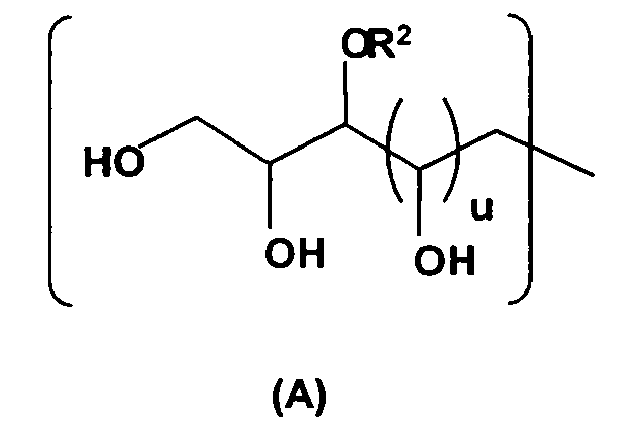
- R is a C4-C20 aryl, alkaryl, aralkyl, cyclic, alicyclic, or secondary, branched or bicyclic alkyl group, or a polyhydroxyalkyl group according to formula (A) wherein u is an integer from 0 to 2 and R 2 is H, ⁇ -D-glucopyranosyl, ⁇ -D-pyranosyl, or ⁇ -D-galactopyranosyl.
- the group Z is a linking group selected from the group consisting of 4,4'-methylenebis(cyclohexyl); CH 2 (CH 2 ) n ⁇ N + O-R 1 -CH 2 (CH 2 ) o ⁇ p , where p is an integer from 1 to 10 and n and o are each independently integers from 1 to 5; (CH 2 ) r [O(CH 2 ) s ] t O(CH 2 ) q , where s is an integer from 2 to 4, t is an integer from 0 to 2, and r and q are each individually 2 or 3; (CH 2 ) m , where m is an integer from 2 to 6; and isophorone residue (B)
- the invention provides a method for reducing surface tension in a formulation, including adding to the formulation an effective amount of one or more compounds according to formula (I) as shown above sufficient to reduce an equilibrium surface tension of the formulation to a value less than 52 mN/m.
- FIG. 1 shows dynamic surface tension of an exemplary surfactant of this invention after aging in sodium hypochlorite.
- the present invention relates to surfactant compositions that are capable of effectively reducing the dynamic and/or equilibrium surface tension of aqueous systems, and/or affecting foaming performance of such systems.
- the compositions include one or more compounds according to formula (I) wherein R 1 is methyl, ethyl, or 1-propyl; R is a C4-C20 aryl, alkaryl, aralkyl, cyclic, alicyclic, or secondary, branched or bicyclic alkyl group, or a polyhydroxyalkyl group according to formula (A) wherein u is an integer from 0 to 2 and R 2 is H, ⁇ -D-glucopyranosyl, ⁇ -D-pyranosyl, or ⁇ -D-galactopyranosyl; and Z is a linking group selected from the group consisting of 4,4'-methylenebis(cyclohexyl); CH 2 (CH 2 ) n ⁇ N + O-R 1 -CH 2 (CH 2
- p is an integer from 1 to 10 and n and o are each independently integers from 1 to 5; (CH 2 ) r [O(CH 2 ) s ] t O(CH 2 ) q , where s is an integer from 2 to 4, t is an integer from 0 to 2, and r and q are each individually 2 or 3; (CH 2 ) m , where m is an integer from 2 to 6; and isophorone residue (B).
- R 1 will be methyl, and s will commonly be 2.
- Z will be CH 2 (CH 2 ) n ⁇ N + O-R 1 -CH 2 (CH 2 ) o ⁇ p , and typically p will be 1 or 2 and n and o will independently be 1 or 2. Usually, m will be 2 or 3.
- Suitable exemplary R groups include, 2-butyl, isobutyl, 2-pentyl, 3-pentyl, isopentyl, neopentyl, 3-methylbut-2-yl, 2-hexyl, 3-hexyl, 2-methylpent-1-yl, isohexyl, 4-methylpent-2-yl, 4-methylpent-3-yl, 2-methylhex-1-yl, 5-methylhex-2-yl, 2-nonbornyl, 2-heptyl, 3-heptyl, 4-heptyl, 2-octyl, 3-octyl, 4-octyl, 2-ethylhex-1-yl, 2-bornyl, 3,5-dimethyloct-1-yl, 3,7-dimethyloct-1-yl, 3-methyl-10-ethyldodeo-1-yl, cyclohexyl, cyclohexylmethyl, benzyl, pinyl, pinylmethyl
- Compounds according to formula (I) may be prepared by any method known in the synthetic organic chemical art. For example, they may be prepared by reductive alkylation of a bis secondary amine according to formula (II) to form a bis tertiary amine according to formula (III), followed by oxidation, for example with hydrogen peroxide.
- the bis secondary amines of formula (II) may for example be prepared according to known procedures such as reported in U.S. Pat. Nos. 4,126,640 ; 5,939,476 ; and 6,190,733 ; JP 62,074,814 ; and Casellin et al., Tetrahedron: Asymmetry, vol. 14, 2003, pp 1451-1454 , or modifications thereof.
- the linking group Z is (CH 2 ) r [O(CH 2 ) s ] t O(CH 2 ) q
- the precursor amines may for example be prepared by the methods disclosed in U.S. Pat. No. 6,492,559 to Lassila et al .
- the precursor amines may be made as described in U.S. Pat. No. 6,288,151 to Lassila et al.
- R is a polyhydroxylalkyl group according to formula (A) above
- compounds according to formula (III) may be obtained by any suitable procedure, for example that reported by J. M. Prestman, et. al. Langmuir, 13, 6857-6860 (1997) .
- any of a variety of polyhydroxyalkyl groups may be incorporated, they most typically will be derived from the open-chain forms of reducing sugars, for example glucose.
- Exemplary polyhydroxyalkyl groups are derived from glucose; i.e., they are 1-deoxyglucityl groups.
- suitable polyhydroxyalkyl groups may be derived from any of the group of reducing sugars consisting of glucose, fructose, maltose, lactose, galactose, mannose, and xylose.
- the reducing sugar will be an aldose, although ketoses may also be used, and both monosaccharides and disaccharides may be used, with convenient sources of the latter including high dextrose corn syrup, high fructose corn syrup, and high maltose corn syrup.
- Other useful polyhydroxyalkyl groups may be derived from glyceraldehydes.
- R is a polyhydroxyalkyl group derived from glucose; i.e. the group is 1-deoxyglucityl. In this case, u is 2 and R 2 is hydrogen.
- Compounds according to formula (I) typically have good oxidative stability, making them of particular potential use in applications such as certain cleaning and metal treatment applications, textile and paper processing, as well as other industrial and household applications where bleaches, peroxides, and/or strong oxidizing agents are used where strong oxidizing conditions may exist.
- the compounds may be dispersed in formulations that contain oxidizing agents including but not limited to hypochlorite, hydrogen peroxide, organic or inorganic peroxides or hydroperoxides, halogens, or nitric acid, and the compounds of formula (I) may show substantial resistance to oxidative degradation in such environments.
- compositions according to the invention may include, in addition to one or more compounds of formula (I), a variety of other ingredients adapted to complement their utility in any of a number of applications.
- the performance properties of such products may be optimized for a specific application by appropriate selection of the basic structure of the surfactant from formula (I), and by suitable choices of substituents. Such optimization is routine, and within the ability of the person of ordinary skill in the art in the particular application area.
- these variables yields compounds which may be useful as emulsifiers or detergents, wetting agents, foaming agents, defoamers, rheology modifiers or associative thickeners, dispersants, and the like.
- these compounds may be useful in applications such as coatings, inks, adhesives, agricultural formulations, fountain solutions, photoresist strippers and developers, shampoos, bodywashes, detergents, and other cleaning compositions.
- the compounds may also find use in oil-field exploration, development, and production applications such as enhanced oil recovery, fracturing and stimulation processes, and drilling and cementing operations, and may also be useful in various wet-processing textile operations, such as dyeing of fibers and fiber scouring and kier boiling.
- water-based water-based
- aqueous aqueous medium
- aqueous carrier aqueous carrier
- the terms “water-based”, “waterborne”, “aqueous”, or “aqueous medium”, or “aqueous carrier” as used herein refer to systems in which the solvent or liquid dispersing medium comprises at least 50 wt% water, preferably at least 90 wt%, and more preferably at least 95 wt% water.
- the dispersing medium may consist essentially of water, i.e., it may have no added solvents.
- compounds according to formula (I) may be used in a wide range of formulations that include a second component, such that the application of the second component benefits from the surface active properties provided by the formula (I) material.
- a second component such that the application of the second component benefits from the surface active properties provided by the formula (I) material.
- components of a pre- or post-preparation synthesis reaction mixture for preparation of the compounds according to formula (I) may be present, these do not count as part of the second component for purposes of this invention.
- Such components might for example include simple salts, solvents, catalysts, organic precursors, reagents, side products, and byproducts related to the preparation of the compound of formula (I), and these are not part of the second component.
- the amount by weight of the second component in a formulation will be greater than that of the compound(s) of formula (I).
- Formulations containing compounds according to formula (I) according to the invention are typically constructed so as to be fluid at 25°C. They are typically aqueous, but they need not be.
- the second component may consist of one or more materials selected from the group consisting of mineral acids, formic acid, acetic acid, tetramethylammonium hydroxide, nonvolatile organic materials, nonvolatile inorganic materials, and mixtures of these.
- nonvolatile means that the indicated material either cannot boil, or it boils at a temperature of at least 150°C at a pressure of 760 Torr.
- typical volatile solvents may be included in the formulation, they do not constitute a part of the second component.
- Such volatile solvents, or water, or a combination of these may in some embodiments be part of a third component of the formulation.
- the second and third components in combination constitute between 0.1 and 99.9 wt% of the formulation.
- Formulations according to the invention may include ready-to-use formulations, or concentrates. Either of these may be further diluted in use.
- concentration of the one or more compounds of formula (I) in a composition according to the invention may vary over a wide range. Typically it will be between 0.001 and 45 wt% of the formulation, although in some cases the amount may be as low as 0.00001 wt%. In many cases compositions at the higher end of this concentration range will be diluted during or before use in the intended application, although this is not required in all applications.
- the invention provides aqueous compositions comprising such compounds, wherein the surfactant provides good wetting properties when used in a surfactant effective amount.
- the amount of surfactant that is effective to provide enhanced wetting properties of a water-based, organic compound containing composition may range from 0.00001 to 5 wt%, preferably from 0.0001 to 3 wt%, and most preferably from 0.001 to 3 wt%, based on total weight of the formulation.
- the surfactant when used in an aqueous formulation, will be used in an amount that reduces the equilibrium surface tension to less than about 52 mN/m, and the amount required to do this is generally at most 5 wt% and more commonly at most 1%. However, other amounts may be used to achieve other surface tension values. The most favorable amount will vary from one application to another, depending upon the amount and type of other species present in the formulation that are capable of affecting foam properties and wetting performance, for example latex polymers.
- a typical aqueous-based coating formulation that includes the surfactants of the invention may include a composition as shown below dispersed in an aqueous medium, with the composition typically constituting 30 to 80% of the total aqueous formulation: Typical Aqueous-Based Coating Formulation 0 to 50 wt% Pigment Dispersant/Grind Resin 0 to 80 wt% Coloring Pigments/Extender Pigments/Anti-Corrosive Pigments/Other Pigment Types 5 to 99.9 wt% Water-Borne/Water-Dispersible/Water-Soluble Resins 0 to 30 wt% Slip Additives/Antimicrobials/Processing Aids/Defoamers 0 to 50 wt% Coalescing or Other Solvents 0.01 to 10 wt% Surfactant/Wetting/Flow and Leveling Agents, other than Compound of Formula (I) 0.001 to 5 wt% Compound(s) of Formula (I)
- a typical water-based ink composition that includes the surfactants of the invention may include a composition as shown below dispersed in an aqueous medium, with the composition (excluding the coalescing solvent) typically constituting 20 to 60% of the total aqueous formulation:
- a typical water-based agricultural composition that includes the surfactants of the invention may include a composition as shown below dispersed in an aqueous medium, with the composition typically constituting 0.01 to 80% of the total aqueous formulation: Typical Aqueous-Based Agricultural Composition 0.1-50 wt% Pesticide or Plant Growth Modifying Agent 0.01 to 10 wt% Surfactants, other than Compound(s) of Formula (I) 0 to 5 wt% Dyes 0 to 20 wt% Thickeners/Stabilizers/Co-surfactants/Gel Inhibitors/Defoamers 0 to 25 wt% Antifreeze agent (e.g. ethylene glycol or propylene glycol) 0.001 to 5 wt% Compound(s) of Formula (I)
- a typical fountain solution composition for planographic printing that includes the surfactants of the invention may include the following components: Typical Fountain Solution for Planographic Printing 0.05 to 10 wt% Film forming, water soluble macromolecule 1 to 25 wt% C2-C12 Alcohol, glycol, or polyol (water soluble, or soluble due to use of a co-solvent) 0.01 to 20 wt% Water soluble organic acid, inorganic acid, or a salt of these 30 to 98.9wt% Water 0.001 to 5 wt% Compound(s) of Formula (I)
- a typical hard surface cleaner that includes the surfactants of the invention may include the following components: Typical Hard Surface Cleaner 0 to 25 wt% * Anionic surfactant 0 to 25 wt% * Cationic surfactant 0 to 25 wt% * Nonionic surfactant (e.g. alcohol alkoxylates, etc.) 0 to 20 wt% Chelating agent (EDTA, citrate, tartrate, etc.) 0 to 20 wt% * Solvent (Glycol ether, lower alcohols, etc.) 0.001 to 25 wt% Compound(s) of Formula (I) 0 to 2 wt% Dye, fragrance, preservative, etc. 0 to 40 wt% * Alkali metal hydroxide Balance to 100 wt% Water, and optionally other ingredients * To total, in combination, between 0.1 and 99 wt%.
- Typical Hard Surface Cleaner 0 to 25 wt% * Anionic surfactant 0 to 25 wt% * C
- a typical water-based photoresist developer or electronic cleaning composition that includes the surfactants of the invention may include the following components: Typical Aqueous-Based Photoresist Developer Composition 0.1 to 3 wt% Tetramethylammonium hydroxide 0 to 4 wt% Phenolic resin 92.5 to 99.9 wt% Water 0.001 to 5 wt% Compound(s) of Formula (I)
- a typical metalworking fluid that includes the surfactants of the invention may include the following components: Typical Synthetic Metalworking Fluid Formulation 2.5 to 10 wt% Block copolymer or other emulsifying agent 10 to 25 wt% Alkanolamine 2 to 10 wt% Organic monoacid 0 to 5 wt% Organic diacid 40 to 84.4 wt% Water 1 to 5 wt% Biocide 0.001 to 5 wt% Compound(s) of Formula (I)
- Surfactants are also used in a wide variety of products in the areas of personal care and household and industrial cleaning.
- the surfactants of the present invention may be used in any of these formulations to provide one or more benefits, with the exact structure of the surfactant compound depending upon the specific performance features required for a particular application.
- Typical formulations used in these markets are described in Louis Ho Tan Tai's book, Formulating Detergents and Personal Care Products: A Complete Guide to Product Development (Champaign, IL: AOCS Press, 2000 ) as well as in other books, literature, product formularies, etc. familiar to those skilled in the art.
- a few representative example formulations are described here as illustrations.
- a rinse aid for use in household automatic dishwashing or in industrial and institutional warewashing may have the ingredients described below.
- Typical Rinse Aid Formulation Compound(s) of Formula (I) 0.001 to 45 wt%
- Nonionic surfactant other than a compound of Formula (I) e.g. alkoxylated alcohol(s), alkoxylated block copolymers, etc.
- Hydrotrope e.g. sodium xylenesulfonate, sodium toluenesulfonate, anionic surfactant(s), amphoteric surfactant(s), etc.
- 0 to 10 wt% Isopropyl alcohol or ethyl alcohol 0 to 10 wt% Chelant (e.g.
- anionic surfactants 0.1 to 30 wt% 0.1 to 50 wt% Builder/co-builder (zeolites, sodium carbonate, phosphates, etc.) 25 to 50 wt% 25 to 60 wt% Bleach and bleach activator (perborates, etc.) 0 to 25 wt% 0 to 25 wt% Other Additives (fragrance, enzymes, hydrotropes, etc.) 0 to 7 wt% 1 to 10 wt% Fillers (sodium sulfate, etc.) 5 to 35 wt% 0 to 12 wt% Typical Aqueous Liquid Laundry Detergent Formulation Material Amount by Weight in Conventional Formulation Amount by Weight in Concentrated Formulation Compound(s) of Formula (I) 0.001 to 25 wt% 0.001 to 30 wt% Detergent surfactant(s) (e.g.
- anionic surfactants 0 to 35 wt% 0 to 65 wt% Builder/co-builder (citrate, tartrate, etc.) 3 to 30 wt% 0 to 36 wt%
- Additives fragments, dyes, etc.
- 0.1 to 5 wt% 1 to 5 wt% Water and other solvents e.g. lower alcohols
- Typical Non-Aqueous Laundry Detergent Formulation Material Amount by Weight Compound(s) of Formula (I) 0.001 to 30 wt%
- Detergent surfactant(s) e.g.
- anionic surfactants alcohol alkoxylates, amine oxides, etc.
- Builder/co-builder zeolites, sodium carbonate, phosphates, citrate or tartrate salts, etc.
- Bleach and bleach activator perborates, etc.
- Anti-redeposition aids sodium carboxymethylcellulose, etc.
- Other Additives fragment, enzymes, etc.
- Polyalkylene glycol 0 to 50 wt% Typical 2-Part Industrial and Institutional Laundry Formulation Amount by Weight of Material in Each Pack Pack A Compound(s) of Formula (I) 0.001 to 20 wt% Detergent surfactant(s) (e.g.
- anionic surfactants 0 to 20 wt% Antiredeposition aids (sodium carboxymethylcellulose, etc.) 0.01 to 2 wt% Water, and optionally other ingredients Balance to 100 wt% Pack B Sodium silicate 5 to 10 wt% Sodium metasilicate 0 to 30 wt% Tetrapotassium pyrophosphate 0 to 10 wt% potassium hydroxide 0 to 35 wt% potassium carbonate 0 to 15 wt% Water, and optionally other ingredients Balance to 100 wt% Mix Ratio Pack A:Pack B 1:2 to 1:4 Typical Shampoo or Liquid Body Wash Formulation Material Amount by Weight Compound(s) of Formula (I) 0.001 to 5 wt% Anionic surfactant(s) (e.g.
- Amphoteric cosurfactant(s) e.g. cocoamidopropyl betaine, etc.
- Nonionic surfactant other than a compound of Formula (I) e.g. alcohol alkoxylates, sorbitan esters, alkyl glucosides, etc.
- Cationic polymers e.g.
- Polyquaternium, etc. 0 to 5 wt%
- Additives fragment, dyes, oils, opacifiers, preservatives, chelants, hydrotropes, etc.
- Polymeric thickeners e.g. polyacrylate, etc.
- Conditioning oils e.g. sunflower oil, petrolatum, etc.
- Citric acid 0 to 2 wt%
- Ammonium chloride or sodium chloride 0 to 3 wt% Humectants (e.g.
- Cationic surfactant(s) e.g. cetrimonium chloride, etc.
- Anionic surfactants e.g. TEA-dodecylbenzenesulfonate, etc.
- Silicones e.g. dimethicone, dimethiconal, etc.
- Cationic polymers e.g.
- polyquaternium, etc. 0 to 10 wt%
- Additives fragment, dyes, oils, opacifiers, preservatives, chelants, hydrotropes, etc.
- Thickening polymers e.g. hydroxyethylcellulose, polyacrylates, etc.
- Potassium, ammonium or sodium chloride 0 to 5 wt% Humectant (e.g.
- octyl methoxycinnamate azobenzone, homosalate, octyl salicylate, oxybenzone, octocrylene, butyl methoxydibenzoylmethane, octyl triazone, etc.
- Esters and emollients e.g. dimethicone, methylparaben, propylparaben, polysorbates, etc.
- Thickening polymers e.g.
- Additives fragment, dyes, oils, opacifiers, preservatives, chelants, etc.
- Solvent/hydrotropes e.g. propylene glycol, benzyl alcohol, dicapryl ether, etc.
- Triethanolamine 0 to 5 wt% Water, and optionally other ingredients Balance to 100 wt%
- Cement admixtures may be of any of several types, including superplasticizing, plasticizing, accelerating, set retarding, air entraining, water-resisting, corrosion inhibiting, and other types. Such admixtures are used to control the workability, settling and end properties (strength, impermeability, durability and frost/deicing salt resistance, etc.) of cementitious products like concretes, mortars, etc.
- the admixtures are usually provided as aqueous solutions and they can be added to the cementitious system at some point during its formulation.
- Surfactants of this invention may provide wetting, foam control, flow and leveling, water reduction, corrosion inhibition, high ionic strength tolerance and compatibility, and other benefits when used in such systems.
- Surfactants of this invention used alone or as a component in formulations, may provide surface tension reduction, foam control, and improved wetting in a variety of applications within the Oil and Gas industry. These may include, for example, formulations for the following uses.
- the surfactants may be used in formulations for dispersion of clays and drill cuttings, ROP (rate of penetration) enhancement, emulsification and de-emulsification, surface wetting and surface tension reduction, shale stabilization, and enhancement of hydration or dissolution of solid additives.
- ROP rate of penetration
- uses may include formulations for spacers, cement dispersion, de-air entraining and defoaming, cement retardation, fracturing fluids, stimulation of coal bed methane, surface or interfacial tension reduction, oil/water wetting, and cleaning fluids.
- uses may include rig wash formulations, defoaming of crude, water flooding/injection, defoaming for acid gas sweetening, oil/water separation, enhanced oil recovery, and inhibition or dispersion of asphaltenes, hydrates, scale and waxes.
- Exemplary fluids for drilling, completing, cementing, stimulating, fracturing, acidizing, or working over, or other treating of subterranean wells, or for enhancing production from an oil- or gas-bearing formation or treating the produced oil or gas typically include from 0.05 to 10 wt% of a surfactant of this invention in a fluid containing water and/or an organic liquid, which typically constitutes from 5 to 99.85 wt% of the fluid.
- the organic liquid is typically a petroleum product, although it need not be, and may for example include crude oil or any of the drilling mud base oils described below.
- Water may be from a freshwater, sea water, or brine source, or it may be provided by inclusion of an aqueous mineral acid such as hydrochloric acid, hydrofluoric acid, sulfuric acid, etc.
- Fluids for such applications usually also include between 0.1 and 80 wt% in total of one or more ingredients selected from weighting agents, viscosifiers, dispersants, drilling mud base oils, emulsifiers, soluble salts, cements, proppants, mineral acids, organic acids, biocides, defoamers, demulsifiers, corrosion inhibitors, friction reducers, gas hydrate inhibitors, hydrogen sulfide removal or control additives, asphaltene control additives, paraffin control additives, and scale control additives.
- weighting agents viscosifiers, dispersants, drilling mud base oils, emulsifiers, soluble salts, cements, proppants, mineral acids, organic acids, biocides, defoamers, demulsifiers, corrosion inhibitors, friction
- Weighting agents barium sulfate, hematite, and ilmenite.
- Viscosifiers clays (e.g. bentonite, attapulgite), water-soluble polymers (e.g. xanthan gum, guar, polysaccharides, modified polysaccharides), organophilic clays, and oil-soluble polymers.
- clays e.g. bentonite, attapulgite
- water-soluble polymers e.g. xanthan gum, guar, polysaccharides, modified polysaccharides), organophilic clays, and oil-soluble polymers.
- Dispersants naphthalene sulfonates, sulfonated melamine formaldehyde resins.
- Drilling mud base oils diesel, mineral oil, olefinic oils, paraffinic oils, and esters.
- Emulsifiers fatty acids, fatty amides, anionic surfactants, and nonionic alkoxylated surfactants.
- Soluble salts (e.g. for specific gravity adjustment, shale stabilization, or osmotic pressure control): NaCl, NaBr, KCI, KBr, CaCl 2 , CaBr 2 , ZnCl 2 , ZnBr 2 , sodium formate, potassium formate, and cesium formate.
- Surfactants cationic surfactants, amphoteric surfactants, alkyl glucosides, phosphate esters, and fluorosurfactants.
- Proppants ceramics, sintered bauxite, sand, and resin-coated sand.
- Organic Acids formic acid, acetic acid, citric acid.
- compositions may find application, when used in combination with the surfactants of this invention, in a variety of oilfield applications.
- compositions may be injected into a well or added to the stream of oil or gas produced by the well, all according to methods well known in the art.
- Water-based drilling muds weighting agents, viscosifiers, and dispersants.
- Oil-based drilling muds base oil, emulsifier, and viscosifier.
- Completion fluids soluble salts for specific gravity adjustment.
- Cement Formulations the cements themselves, in combination with dispersants.
- Spacers weighting agents and surfactants.
- Acidizing fluids surfactants and one or both of mineral acids and organic acids.
- Fracturing fluids viscosifiers, proppants, and surfactants.
- Fluids for stimulating or enhancing production from a gas or oil bearing formation may contain ingredients similar to those found in fracturing fluids, except for proppants.
- fluids for treating oil or gas produced in the above ways may include one or more of biocides, defoamers, demulsifiers, corrosion inhibitors, friction reducers, gas hydrate inhibitors, hydrogen sulfide removal or control additives, asphaltene control additives, paraffin control additives, and scale control additives.
- Compounds according to formula (I) may have utility in preventing or slowing the formation of gas hydrates in petroleum-bearing formations or during transport of crude petroleums, where lower hydrocarbons such as methane, ethane, propane, n-butane, and iso- butane are commonly found. Water is also typically present in such formations and, under conditions of elevated pressure and reduced temperature, mixtures of the water and lower hydrocarbons tend to form clathrate hydrates. Such hydrates are water crystals that have formed a cage structure around a guest molecule such as the lower hydrocarbon.
- ethane can form gas hydrates with water at temperatures below 4°C; at a pressure of 3 MPa, it can form gas hydrates with water at temperatures below 14°C.
- Temperatures and pressures such as these are commonly encountered in many environments in which natural gas and crude petroleum are produced and transported. The resulting hydrates frequently cause pipeline blockages due to growth and agglomeration of crystals inside pipes, conduits, valves, and other equipment, resulting in reduced flow and even equipment damage.
- Compounds according to formula (I) may be used to reduce the nucleation, growth, and/or agglomeration of gas hydrates by including them in petroleum streams, thereby minimizing unscheduled shutdowns, maintenance and repair.
- the amount of compound of formula used for such an application may vary over a wide range, and may depend inter alia upon the relative proportions of the various lower hydrocarbons present in the crude petroleum, the temperature and pressure conditions to which the petroleum will be exposed, and the amount of water present.
- An appropriate amount for any given situation can easily be determined by routine experimentation, but typically the amount will be at least about 0.05 wt% relative to the amount of water present, more typically at least about 0.1 wt%, and most typically at least about 0.3 wt%. While there need be no upper limit to the amount of compound of formula (I) used, it may be most economical to limit it to at most about 5 wt% relative to water and typically at most 2 wt% relative to water.
- the pressure throughout the reaction was maintained constant by the admission of hydrogen from a 1-gallon ballast on demand by a dome regulator.
- the reaction mixture was concentrated in vacuo and used without further purification.
- To 24.5g of PMEDA/EH2 in 25mL of methanol was added 28.1g of 30% hydrogen peroxide.
- the reaction mixture was allowed to stir for 7 days at ambient temperature, at which point an aqueous suspension of platinum black was added slowly to effect decomposition according to the excess hydrogen peroxide.
- the reaction mixture was then filtered through CELITE diatomaceous earth and concentrated at 40°C and 1 torr to give 28.2g of PMEDA/EH2 oxide containing 8.1 wt% water by Karl Fischer (KF) titration.
- KF Karl Fischer
- the pressure throughout the reaction was maintained constant by the admission of hydrogen from a 1-gallon ballast on demand by a dome regulator.
- the reaction mixture was concentrated at 190°C and 0.53 mbar (0.4 torr) to give 168.7g of a clear viscous oil. This material was used without further purification.
- To 4.1g of PMPACM/MIBK2 in 20mL of methanol was added 9.2g of 30% hydrogen peroxide.
- the reaction mixture was allowed to stir for 2 days at ambient temperature, at which point an aqueous suspension of platinum black was added slowly to effect decomposition according to the excess hydrogen peroxide.
- reaction mixture was then filtered through CELITE diatomaceous earth and concentrated at 40°C and 1.3 mbar (1 torr) to give 4.6g of PMPACM/MIBK2 oxide containing 3.5 wt% water by KF titration.
- the structure was confirmed by 13 C NMR.
- the pressure throughout the reaction was maintained constant by the admission of hydrogen from a 1-gallon ballast on demand by a dome regulator.
- the reaction mixture was concentrated in vacuo and then distilled at 155°C and 6.7 mbar (5 torr) to give 28.7g of a clear liquid whose structure was confirmed by GC-MS and 13 C NMR.
- To 28g of PMDETA/MIBK2 in 100mL of methanol was added 56.3g of 30% hydrogen peroxide.
- the reaction mixture was allowed to stir for 2 days at ambient temperature, at which point an aqueous suspension of platinum black was added slowly to effect decomposition according to the excess hydrogen peroxide.
- reaction mixture was then filtered through CELITE diatomaceous earth and concentrated at 40°C and 1.3 mbar (1 torr) to give 31.8g of PMDETA/MIBK2 oxide containing 7.1 wt% water by KF titration.
- the structure was confirmed by 13 C NMR.
- the pressure throughout the reaction was maintained constant by the admission of hydrogen from a 1-gallon ballast on demand by a dome regulator.
- the reaction mixture was concentrated in vacuo to give 9.5g of a white solid whose structure was confirmed by GC-MS and 13 C NMR. This material was used without further purification.
- To 9.3g of PMEDA/camphor2 in 75mL of ethanol was added 27.5g of 30% hydrogen peroxide.
- the reaction mixture was allowed to stir for 7 days at ambient temperature, at which point an aqueous suspension of platinum black was added slowly to effect decomposition according to the excess hydrogen peroxide.
- reaction mixture was then filtered through CELITE diatomaceous earth and concentrated at 40°C and 1.3 mbar (1 torr) to give 9.4g of PMEDA/camphor2 oxide containing 4.1 wt% water by KF titration.
- the structure was confirmed by GC-MS and 13 C NMR.
- Dynamic surface tensions were determined using a Kruss BP-2 Bubble Pressure Tensiometer by the maximum bubble pressure method, as described in Langmuir 1986, 2, 428-432, at a rate of 6 bubble/sec. Pseudo-equilibrium surface tensions (p-EST) were similarly measured, but at a rate of 0.1 bubble/sec. Table 1. Surface Tensions of Amine Oxide Solutions (0.1 wt%) Example EST p-EST DST Example 5.
- Example 9 Oxide PMDETA/MIBK2 64.5 (water) 68.6 (water) 69.7 (water) 54.5 (6% bleach) 72.9 (6% bleach) 74.0 (6% bleach) 52.1 (5% NaCl) 70.1 (5% NaCl) 71.5 (5% NaCl)
- Table 1 shows the ability of these materials to reduce the surface tension of water, 5% aqueous NaCl solutions, and nominally 6% sodium hypochlorite bleach solution. All of the oxides show some efficacy in reducing surface tension, particularly with regard to equilibrium surface tension as measured by the Wilhelmy plate method.
- FIG. 1 shows the results of an experiment designed to evaluate the stability of an exemplary surfactant of this invention, PMEDA/EH2 amine oxide, in a solution of sodium hypochlorite (laundry bleach) by measuring the dynamic surface tension by the maximum bubble pressure technique. Although there is some initial loss in surface tension reducing ability, the surface tension is stable after 2 days and the material is still effective at reducing surface tension.
- PMEDA/EH2 amine oxide sodium hypochlorite
- Foam stabilities in various aqueous media were assessed by manually shaking 50 mL of a 0.1 wt % aqueous solution of each of several surfactants of this invention in a 200-mL bottle for five seconds, and recording the time for the foam to dissipate. The results are shown in Table 2. Table 2. Foam Dissipation of Amine Oxide Solutions Foam Dissipation Time (seconds) Surfactant 6% Bleach Ultrapure Water 5% NaCl PMDETA/MIBK2 Oxide 15 5 12 PMEDA/EH2 Oxide 6 4 13 PMDETA/MIAK2 Oxide 21 6 18 PMPACM/MIBK2 Oxide 10 3 ---- PMEDA/MIAK2 Oxide 3 6 ----
- amine oxide surfactants have a great propensity to foam.
- a 0.1wt% solution of dodecyldimethylamine oxide when submitted to the same protocol as the polyamine oxides, generated foam that had still not dissipated after 5 minutes.
- the data in the above Examples demonstrate that the compounds of this invention effectively reduce equilibrium surface tension, as well as dynamic surface tension, of aqueous solutions and serve to affect the foam properties of aqueous solutions.
- the demonstrated low equilibrium surface tension values may enhance the ability of formulations containing these compounds to wet out a given surface.
- the demonstrated low dynamic surface tension values provide information about the performance of a surfactant at conditions ranging from close to equilibrium (0.1 bubbles/sec) through high surface creation rates or dynamic conditions (10-20 bubbles/sec).
- high surface creation rates are relevant to rapid processes such as spray or roller-applied coating, high speed printing operations, or the rapid application of an agricultural product or a cleaner. While applications such as coatings, inks, and adhesives require low foam or foam that dissipates quickly, other applications such as cleaning or floatation require a controlled amount of foam to be present and to persist.
- the invention provides novel surfactants with properties that are suitable for use in a wide range of industrial and commercial applications.
- Such applications include water-based coatings, inks, adhesives, agricultural formulations, aqueous and non-aqueous cleaning compositions, personal care applications, and formulations for textile processing and oilfield applications.
Landscapes
- Chemical & Material Sciences (AREA)
- Organic Chemistry (AREA)
- Engineering & Computer Science (AREA)
- Materials Engineering (AREA)
- Life Sciences & Earth Sciences (AREA)
- Oil, Petroleum & Natural Gas (AREA)
- Chemical Kinetics & Catalysis (AREA)
- General Chemical & Material Sciences (AREA)
- General Life Sciences & Earth Sciences (AREA)
- Wood Science & Technology (AREA)
- Detergent Compositions (AREA)
- Organic Low-Molecular-Weight Compounds And Preparation Thereof (AREA)
- Emulsifying, Dispersing, Foam-Producing Or Wetting Agents (AREA)
Abstract
Surfactant compositions contain one or more compounds according to formula (1)

wherein R1 is methyl, ethyl, or 1-propyl; R is a C4-C20 aryl, alkaryl, aralkyl, cyclic, alicyclic, or secondary, branched or bicyclic alkyl group, or a polyhydroxyalkyl group according to formula (A)
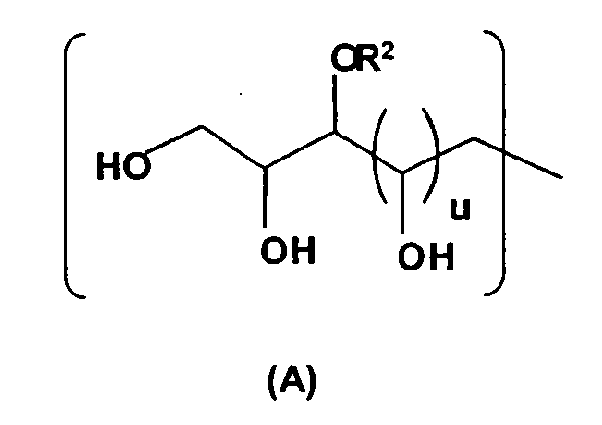
wherein u is an integer from 0 to 2 and R2 is H, α-D-glucopyranosyl, β-D-pyranosyl, or β-D-galactopyranosyl; and Z is a linking group selected from the group consisting of 4,4'-methylenebis(cyclohexyl); CH2(CH2)n{N+O-R1-CH2(CH2)o}p, where p is an integer from 1 to 10 and n and o are each independently integers from 1 to 5; (CH2)r[O(CH2)s]tO(CH2)q, where s is an integer from 2 to 4, t is an integer from 0 to 2, and r and q are each individually 2 or 3; (CH2)m, where m is an integer from 2 to 6; and isophorone residue (B)
Description
- This invention relates to surfactant compositions, and more particularly to surfactants having amine oxide functionality.
- The ability to reduce the surface tension of water is of great importance in the application of water-based formulations because decreased surface tension translates to enhanced substrate wetting during use. Examples of water-based compositions requiring good wetting include coatings, inks, adhesives, fountain solutions for lithographic printing, cleaning compositions, metalworking fluids, agricultural formulations, electronics cleaning and semiconductor processing compositions, personal care products, and formulations for textile processing and oilfield applications. Surface tension reduction in water-based systems is generally achieved through the addition of surfactants, resulting in enhanced surface coverage, fewer defects, and more uniform distribution. Equilibrium surface tension (EST) is important when the system is at rest, while dynamic surface tension (DST) provides a measure of the ability of a surfactant to reduce surface tension and provide wetting under high speed application conditions.
- The importance of the ability of a surfactant to achieve low surface tension at low use levels, the ability to affect foaming performance, and the surfactant's ability to provide efficient emulsification and solubilization are all of considerable industrial importance, as is well-appreciated in the art. And, although equilibrium surface tension reduction efficiency is important for some applications, other applications may require both equilibrium and dynamic surface tension reduction.
- The foaming characteristics of a surfactant are also important because they can help define applications for which the surfactant might be suitable. For example, foam can be desirable for applications such as ore flotation and cleaning. On the other hand, in coatings, graphic arts and adhesive applications, foam is undesirable because it can complicate application and lead to defect formation. Thus foaming characteristics are frequently an important performance parameter.
- The wide variety of applications for which surfactants are used, and the resultant variation in performance requirements, results in a need for a correspondingly large number of surfactants adapted to these various performance demands, and a need for suitable methods for making them.
- In one aspect, the invention provides a composition including one or more compounds according to formula (I)


- In another aspect, the invention provides a method for reducing surface tension in a formulation, including adding to the formulation an effective amount of one or more compounds according to formula (I) as shown above sufficient to reduce an equilibrium surface tension of the formulation to a value less than 52 mN/m.
- FIG. 1 shows dynamic surface tension of an exemplary surfactant of this invention after aging in sodium hypochlorite.
- The present invention relates to surfactant compositions that are capable of effectively reducing the dynamic and/or equilibrium surface tension of aqueous systems, and/or affecting foaming performance of such systems. The compositions include one or more compounds according to formula (I)


- Compounds according to formula (I) may be prepared by any method known in the synthetic organic chemical art. For example, they may be prepared by reductive alkylation of a bis secondary amine according to formula (II) to form a bis tertiary amine according to formula (III), followed by oxidation, for example with hydrogen peroxide.

- The bis secondary amines of formula (II) may for example be prepared according to known procedures such as reported in
U.S. Pat. Nos. 4,126,640 ;5,939,476 ; and6,190,733 ;JP 62,074,814 U.S. Pat. No. 6,492,559 to Lassila et al . If Z is CH2(CH2)n{N+O-R1-CH2(CH2)o}p, the precursor amines may be made as described inU.S. Pat. No. 6,288,151 to Lassila et al. - In the case where R is a polyhydroxylalkyl group according to formula (A) above, compounds according to formula (III) may be obtained by any suitable procedure, for example that reported by J. M. Prestman, et. al. Langmuir, 13, 6857-6860 (1997). Although any of a variety of polyhydroxyalkyl groups may be incorporated, they most typically will be derived from the open-chain forms of reducing sugars, for example glucose. Exemplary polyhydroxyalkyl groups are derived from glucose; i.e., they are 1-deoxyglucityl groups. In general, suitable polyhydroxyalkyl groups may be derived from any of the group of reducing sugars consisting of glucose, fructose, maltose, lactose, galactose, mannose, and xylose. Typically, the reducing sugar will be an aldose, although ketoses may also be used, and both monosaccharides and disaccharides may be used, with convenient sources of the latter including high dextrose corn syrup, high fructose corn syrup, and high maltose corn syrup. Other useful polyhydroxyalkyl groups may be derived from glyceraldehydes. In some embodiments, R is a polyhydroxyalkyl group derived from glucose; i.e. the group is 1-deoxyglucityl. In this case, u is 2 and R2 is hydrogen.
- Compounds according to formula (I) typically have good oxidative stability, making them of particular potential use in applications such as certain cleaning and metal treatment applications, textile and paper processing, as well as other industrial and household applications where bleaches, peroxides, and/or strong oxidizing agents are used where strong oxidizing conditions may exist. In such environments, the compounds may be dispersed in formulations that contain oxidizing agents including but not limited to hypochlorite, hydrogen peroxide, organic or inorganic peroxides or hydroperoxides, halogens, or nitric acid, and the compounds of formula (I) may show substantial resistance to oxidative degradation in such environments. They also typically show low levels of foaming, a desirable trait in applications such as certain Industrial & Institutional and household cleaning applications like hard surface cleaning, metal and metal parts cleaning, semi-conductor cleaning and processing, textile and paper processing, coatings, and adhesives and graphic arts applications. More generally, compositions according to the invention may include, in addition to one or more compounds of formula (I), a variety of other ingredients adapted to complement their utility in any of a number of applications. The performance properties of such products may be optimized for a specific application by appropriate selection of the basic structure of the surfactant from formula (I), and by suitable choices of substituents. Such optimization is routine, and within the ability of the person of ordinary skill in the art in the particular application area. Thus manipulation of these variables yields compounds which may be useful as emulsifiers or detergents, wetting agents, foaming agents, defoamers, rheology modifiers or associative thickeners, dispersants, and the like. As such, these compounds may be useful in applications such as coatings, inks, adhesives, agricultural formulations, fountain solutions, photoresist strippers and developers, shampoos, bodywashes, detergents, and other cleaning compositions. The compounds may also find use in oil-field exploration, development, and production applications such as enhanced oil recovery, fracturing and stimulation processes, and drilling and cementing operations, and may also be useful in various wet-processing textile operations, such as dyeing of fibers and fiber scouring and kier boiling. The general formulation principles governing each of these applications are well known in the respective arts, and a detailed description of the numerous application areas and methods for incorporating the compounds of this invention into such formulations is not necessary to their effective incorporation therein. However, as an indication of the wide scope of possible uses for compounds according to the invention, exemplary but nonlimiting formulations are set forth below for a number of application areas.
- The terms "water-based", "waterborne", "aqueous", or "aqueous medium", or "aqueous carrier" as used herein refer to systems in which the solvent or liquid dispersing medium comprises at least 50 wt% water, preferably at least 90 wt%, and more preferably at least 95 wt% water. The dispersing medium may consist essentially of water, i.e., it may have no added solvents.
- In broad terms, compounds according to formula (I) may be used in a wide range of formulations that include a second component, such that the application of the second component benefits from the surface active properties provided by the formula (I) material. It is to be understood that, although components of a pre- or post-preparation synthesis reaction mixture for preparation of the compounds according to formula (I) may be present, these do not count as part of the second component for purposes of this invention. Such components might for example include simple salts, solvents, catalysts, organic precursors, reagents, side products, and byproducts related to the preparation of the compound of formula (I), and these are not part of the second component. Typically, but not necessarily, the amount by weight of the second component in a formulation will be greater than that of the compound(s) of formula (I).
- Formulations containing compounds according to formula (I) according to the invention are typically constructed so as to be fluid at 25°C. They are typically aqueous, but they need not be. The second component may consist of one or more materials selected from the group consisting of mineral acids, formic acid, acetic acid, tetramethylammonium hydroxide, nonvolatile organic materials, nonvolatile inorganic materials, and mixtures of these. As used herein, the term "nonvolatile" means that the indicated material either cannot boil, or it boils at a temperature of at least 150°C at a pressure of 760 Torr. Thus, although typical volatile solvents may be included in the formulation, they do not constitute a part of the second component. Such volatile solvents, or water, or a combination of these, may in some embodiments be part of a third component of the formulation. Typically, the second and third components in combination constitute between 0.1 and 99.9 wt% of the formulation.
- Typical non-limiting examples of nonvolatile materials are given in the exemplary formulations provided hereinafter. Formulations according to the invention may include ready-to-use formulations, or concentrates. Either of these may be further diluted in use. Thus the concentration of the one or more compounds of formula (I) in a composition according to the invention may vary over a wide range. Typically it will be between 0.001 and 45 wt% of the formulation, although in some cases the amount may be as low as 0.00001 wt%. In many cases compositions at the higher end of this concentration range will be diluted during or before use in the intended application, although this is not required in all applications.
- By using compounds of formula (I), it is possible to reduce surface tension in a waterborne composition or an industrial process. Thus the invention provides aqueous compositions comprising such compounds, wherein the surfactant provides good wetting properties when used in a surfactant effective amount. For example, the amount of surfactant that is effective to provide enhanced wetting properties of a water-based, organic compound containing composition may range from 0.00001 to 5 wt%, preferably from 0.0001 to 3 wt%, and most preferably from 0.001 to 3 wt%, based on total weight of the formulation. Typically, when used in an aqueous formulation, the surfactant will be used in an amount that reduces the equilibrium surface tension to less than about 52 mN/m, and the amount required to do this is generally at most 5 wt% and more commonly at most 1%. However, other amounts may be used to achieve other surface tension values. The most favorable amount will vary from one application to another, depending upon the amount and type of other species present in the formulation that are capable of affecting foam properties and wetting performance, for example latex polymers.
- In the following typical aqueous-based compositions containing compounds of formula (I), a skilled worker in the relevant art will use sufficient amounts of the indicated components within the stated ranges to afford 100 wt% of components in the compositions.
- A typical aqueous-based coating formulation that includes the surfactants of the invention may include a composition as shown below dispersed in an aqueous medium, with the composition typically constituting 30 to 80% of the total aqueous formulation:
Typical Aqueous-Based Coating Formulation 0 to 50 wt% Pigment Dispersant/ Grind Resin 0 to 80 wt% Coloring Pigments/Extender Pigments/Anti-Corrosive Pigments/ Other Pigment Types 5 to 99.9 wt% Water-Borne/Water-Dispersible/Water- Soluble Resins 0 to 30 wt% Slip Additives/Antimicrobials/Processing Aids/ Defoamers 0 to 50 wt% Coalescing or Other Solvents 0.01 to 10 wt% Surfactant/Wetting/Flow and Leveling Agents, other than Compound of Formula (I) 0.001 to 5 wt% Compound(s) of Formula (I) - A typical water-based ink composition that includes the surfactants of the invention may include a composition as shown below dispersed in an aqueous medium, with the composition (excluding the coalescing solvent) typically constituting 20 to 60% of the total aqueous formulation:
Typical Aqueous-Based Ink Composition 1-50 wt% Pigment 0 to 50 wt% Pigment Dispersant/ Grind Resin 0 to 50 wt% Clay base in appropriate resin solution vehicle 5 to 99.9 wt% Water-borne/water-dispersible/water- soluble resins 0 to 30 wt% Coalescing Solvents 0.01 to 10 wt% Surfactant/Wetting Agents, other than Compound(s) of Formula (I) 0.01 to 10 wt% Processing Aids/Defoamers/Solubilizing Agents 0.001 to 5 wt% Compound(s) of Formula (I) - A typical water-based agricultural composition that includes the surfactants of the invention may include a composition as shown below dispersed in an aqueous medium, with the composition typically constituting 0.01 to 80% of the total aqueous formulation:
Typical Aqueous-Based Agricultural Composition 0.1-50 wt% Pesticide or Plant Growth Modifying Agent 0.01 to 10 wt% Surfactants, other than Compound(s) of Formula (I) 0 to 5 wt% Dyes 0 to 20 wt% Thickeners/Stabilizers/Co-surfactants/Gel Inhibitors/ Defoamers 0 to 25 wt% Antifreeze agent (e.g. ethylene glycol or propylene glycol) 0.001 to 5 wt% Compound(s) of Formula (I) - A typical fountain solution composition for planographic printing that includes the surfactants of the invention may include the following components:
Typical Fountain Solution for Planographic Printing 0.05 to 10 wt% Film forming, water soluble macromolecule 1 to 25 wt% C2-C12 Alcohol, glycol, or polyol (water soluble, or soluble due to use of a co-solvent) 0.01 to 20 wt% Water soluble organic acid, inorganic acid, or a salt of these 30 to 98.9wt% Water 0.001 to 5 wt% Compound(s) of Formula (I) - A typical hard surface cleaner that includes the surfactants of the invention may include the following components:
Typical Hard Surface Cleaner 0 to 25 wt% * Anionic surfactant 0 to 25 wt% * Cationic surfactant 0 to 25 wt% * Nonionic surfactant (e.g. alcohol alkoxylates, etc.) 0 to 20 wt% Chelating agent (EDTA, citrate, tartrate, etc.) 0 to 20 wt% * Solvent (Glycol ether, lower alcohols, etc.) 0.001 to 25 wt% Compound(s) of Formula (I) 0 to 2 wt% Dye, fragrance, preservative, etc. 0 to 40 wt% * Alkali metal hydroxide Balance to 100 wt% Water, and optionally other ingredients * To total, in combination, between 0.1 and 99 wt%. - A typical water-based photoresist developer or electronic cleaning composition that includes the surfactants of the invention may include the following components:
Typical Aqueous-Based Photoresist Developer Composition 0.1 to 3 wt % Tetramethylammonium hydroxide 0 to 4 wt% Phenolic resin 92.5 to 99.9 wt% Water 0.001 to 5 wt% Compound(s) of Formula (I) - A typical metalworking fluid that includes the surfactants of the invention may include the following components:
Typical Synthetic Metalworking Fluid Formulation 2.5 to 10 wt% Block copolymer or other emulsifying agent 10 to 25 wt% Alkanolamine 2 to 10 wt% Organic monoacid 0 to 5 wt% Organic diacid 40 to 84.4 wt% Water 1 to 5 wt% Biocide 0.001 to 5 wt% Compound(s) of Formula (I) - Surfactants are also used in a wide variety of products in the areas of personal care and household and industrial cleaning. The surfactants of the present invention may be used in any of these formulations to provide one or more benefits, with the exact structure of the surfactant compound depending upon the specific performance features required for a particular application. Typical formulations used in these markets are described in Louis Ho Tan Tai's book, Formulating Detergents and Personal Care Products: A Complete Guide to Product Development (Champaign, IL: AOCS Press, 2000) as well as in other books, literature, product formularies, etc. familiar to those skilled in the art. A few representative example formulations are described here as illustrations. For example, a rinse aid for use in household automatic dishwashing or in industrial and institutional warewashing may have the ingredients described below.
Typical Rinse Aid Formulation Compound(s) of Formula (I) 0.001 to 45 wt% Nonionic surfactant other than a compound of Formula (I) (e.g. alkoxylated alcohol(s), alkoxylated block copolymers, etc.) 0 to 45 wt% Hydrotrope (e.g. sodium xylenesulfonate, sodium toluenesulfonate, anionic surfactant(s), amphoteric surfactant(s), etc.) 0 to 10 wt% Isopropyl alcohol or ethyl alcohol 0 to 10 wt% Chelant (e.g. citric acid, etc.) 5 to 20 wt% Water, and optionally other ingredients Balance to 100 wt% Typical Powdered Laundry Detergent Formulation Material Amount by Weight in Conventional Formulation Amount by Weight in Concentrated Formulation Compound(s) of Formula (I) 0.001 to 5 wt% 0.001 to 15 wt% Detergent surfactant(s) (e.g. anionic surfactants, alcohol alkoxylates, etc.) 0.1 to 30 wt% 0.1 to 50 wt% Builder/co-builder (zeolites, sodium carbonate, phosphates, etc.) 25 to 50 wt% 25 to 60 wt% Bleach and bleach activator (perborates, etc.) 0 to 25 wt% 0 to 25 wt% Other Additives (fragrance, enzymes, hydrotropes, etc.) 0 to 7 wt% 1 to 10 wt% Fillers (sodium sulfate, etc.) 5 to 35 wt% 0 to 12 wt% Typical Aqueous Liquid Laundry Detergent Formulation Material Amount by Weight in Conventional Formulation Amount by Weight in Concentrated Formulation Compound(s) of Formula (I) 0.001 to 25 wt% 0.001 to 30 wt% Detergent surfactant(s) (e.g. anionic surfactants, alcohol alkoxylates, etc.) 0 to 35 wt% 0 to 65 wt% Builder/co-builder (citrate, tartrate, etc.) 3 to 30 wt% 0 to 36 wt% Other Additives (fragrances, dyes, etc.) 0.1 to 5 wt% 1 to 5 wt% Water and other solvents (e.g. lower alcohols) 5 to 75 wt% 1 to 56 wt% Typical Non-Aqueous Laundry Detergent Formulation Material Amount by Weight Compound(s) of Formula (I) 0.001 to 30 wt% Detergent surfactant(s) (e.g. anionic surfactants, alcohol alkoxylates, amine oxides, etc.) 0.1 to 42 wt% Builder/co-builder (zeolites, sodium carbonate, phosphates, citrate or tartrate salts, etc.) 25 to 60 wt% Bleach and bleach activator (perborates, etc.) 0 to 20 wt% Anti-redeposition aids (sodium carboxymethylcellulose, etc.) 0.5 to 5 wt% Other Additives (fragrance, enzymes, etc.) 0 to 5 wt% Polyalkylene glycol 0 to 50 wt% Typical 2-Part Industrial and Institutional Laundry Formulation Amount by Weight of Material in Each Pack Pack A Compound(s) of Formula (I) 0.001 to 20 wt% Detergent surfactant(s) (e.g. anionic surfactants, alcohol alkoxylates, etc.) 0 to 20 wt% Antiredeposition aids (sodium carboxymethylcellulose, etc.) 0.01 to 2 wt% Water, and optionally other ingredients Balance to 100 wt% Pack B Sodium silicate 5 to 10 wt% Sodium metasilicate 0 to 30 wt% Tetrapotassium pyrophosphate 0 to 10 wt% potassium hydroxide 0 to 35 wt% potassium carbonate 0 to 15 wt% Water, and optionally other ingredients Balance to 100 wt% Mix Ratio Pack A:Pack B 1:2 to 1:4 Typical Shampoo or Liquid Body Wash Formulation Material Amount by Weight Compound(s) of Formula (I) 0.001 to 5 wt% Anionic surfactant(s) (e.g. sodium or ammonium lauryl sulfate, sodium or ammonium lauryl sulfate, etc.) 0.1 to 30 wt% Amphoteric cosurfactant(s) (e.g. cocoamidopropyl betaine, etc.) 0 to 20 wt% Nonionic surfactant other than a compound of Formula (I) (e.g. alcohol alkoxylates, sorbitan esters, alkyl glucosides, etc.) 0 to 20 wt% Cationic polymers (e.g. polyquaternium, etc.) 0 to 5 wt% Other Additives (fragrance, dyes, oils, opacifiers, preservatives, chelants, hydrotropes, etc.) 0 to 15 wt% Polymeric thickeners (e.g. polyacrylate, etc.) 0 to 2 wt% Conditioning oils (e.g. sunflower oil, petrolatum, etc.) 0 to 10 wt% Citric acid 0 to 2 wt% Ammonium chloride or sodium chloride 0 to 3 wt% Humectants (e.g. propylene glycol, glycerin, etc.) 0 to 15 wt% Glycol distearate 0 to 5 wt% Cocoamide (i.e. cocoamide MEA, cocoamide MIPA, PEG-5 cocoamide, etc.) 0 to 10 wt% Dimethicone 0 to 5 wt% Behenyl alcohol 0 to 5 wt% Water, and optionally other ingredients Balance to 100 wt% Typical Hair Conditioner Formulation Material Amount by Weight Compound(s) of Formula (I) 0.001 to 10 wt% Nonionic surfactant other than a compound of Formula (I), and/or fatty alcohol(s) (e.g. stearyl alcohol, etc.) 0.1 to 10 wt% Cationic surfactant(s) (e.g. cetrimonium chloride, etc.) 0 to 10 wt% Anionic surfactants (e.g. TEA-dodecylbenzenesulfonate, etc.) 0 to 5 wt% Silicones (e.g. dimethicone, dimethiconal, etc.) 0 to 5 wt% Cationic polymers (e.g. polyquaternium, etc.) 0 to 10 wt% Other Additives (fragrance, dyes, oils, opacifiers, preservatives, chelants, hydrotropes, etc.) 0 to 10 wt% Thickening polymers (e.g. hydroxyethylcellulose, polyacrylates, etc.) 0 to 5 wt% Potassium, ammonium or sodium chloride 0 to 5 wt% Humectant (e.g. propylene glycol, etc.) 0 to 5 wt% Panthenol 0 to 2 wt% Water, and optionally other ingredients Balance to 100 wt% ***Typical Aqueous Sunscreen Formulation Material Amount by Weight Compound(s) of Formula (I) 0.001 to 30 wt% Polyethylene glycol (e.g. PEG-8, etc.) 0 to 30 wt% Active sunscreen agents (e.g. octyl methoxycinnamate, azobenzone, homosalate, octyl salicylate, oxybenzone, octocrylene, butyl methoxydibenzoylmethane, octyl triazone, etc.) 1 to 30 wt% Esters and emollients (e.g. dimethicone, methylparaben, propylparaben, polysorbates, etc.) 0 to 20 wt% Thickening polymers (e.g. acrylates/C10-30 alkyl acrylate crosspolymer, PVP/hexadecene copolymer, etc.) 0 to 20 wt% Other Additives (fragrance, dyes, oils, opacifiers, preservatives, chelants, etc.) 0 to 15 wt% Solvent/hydrotropes (e.g. propylene glycol, benzyl alcohol, dicapryl ether, etc.) 0 to 20 wt% Triethanolamine 0 to 5 wt% Water, and optionally other ingredients Balance to 100 wt% - Cement admixtures may be of any of several types, including superplasticizing, plasticizing, accelerating, set retarding, air entraining, water-resisting, corrosion inhibiting, and other types. Such admixtures are used to control the workability, settling and end properties (strength, impermeability, durability and frost/deicing salt resistance, etc.) of cementitious products like concretes, mortars, etc. The admixtures are usually provided as aqueous solutions and they can be added to the cementitious system at some point during its formulation. Surfactants of this invention may provide wetting, foam control, flow and leveling, water reduction, corrosion inhibition, high ionic strength tolerance and compatibility, and other benefits when used in such systems.
-
Material Amount by Weight Relative to Cement Weight Compound(s) of Formula (I) 0.001 to 5 wt% Solubilizing agents (solvent, hydrotropes, amines, etc.) * 0 to 10 wt% Polymers and/or oligomers (e.g. lignosulfonates, sulfonated melamine formaldehyde condensates, polycarboxylates, styrene-maleic anhydride oligomers, copolymers and their derivatives, etc.) * 0 to 5 wt% Functional Additives (defoamers, air entraining or detraining agents, pH control additives, corrosion inhibitors, set retarders, accelerators, preservatives, etc.) * 0 to 5 wt% Water 40 to 75% * To total, in combination, between 0.1 and 20 wt%. - Surfactants of this invention, used alone or as a component in formulations, may provide surface tension reduction, foam control, and improved wetting in a variety of applications within the Oil and Gas industry. These may include, for example, formulations for the following uses.
- In drilling applications, the surfactants may be used in formulations for dispersion of clays and drill cuttings, ROP (rate of penetration) enhancement, emulsification and de-emulsification, surface wetting and surface tension reduction, shale stabilization, and enhancement of hydration or dissolution of solid additives.
- In cementing, stimulation and workover applications, uses may include formulations for spacers, cement dispersion, de-air entraining and defoaming, cement retardation, fracturing fluids, stimulation of coal bed methane, surface or interfacial tension reduction, oil/water wetting, and cleaning fluids.
- In oil and gas production, uses may include rig wash formulations, defoaming of crude, water flooding/injection, defoaming for acid gas sweetening, oil/water separation, enhanced oil recovery, and inhibition or dispersion of asphaltenes, hydrates, scale and waxes.
- Exemplary fluids for drilling, completing, cementing, stimulating, fracturing, acidizing, or working over, or other treating of subterranean wells, or for enhancing production from an oil- or gas-bearing formation or treating the produced oil or gas, typically include from 0.05 to 10 wt% of a surfactant of this invention in a fluid containing water and/or an organic liquid, which typically constitutes from 5 to 99.85 wt% of the fluid. The organic liquid is typically a petroleum product, although it need not be, and may for example include crude oil or any of the drilling mud base oils described below. If water is included, it may be from a freshwater, sea water, or brine source, or it may be provided by inclusion of an aqueous mineral acid such as hydrochloric acid, hydrofluoric acid, sulfuric acid, etc. Fluids for such applications usually also include between 0.1 and 80 wt% in total of one or more ingredients selected from weighting agents, viscosifiers, dispersants, drilling mud base oils, emulsifiers, soluble salts, cements, proppants, mineral acids, organic acids, biocides, defoamers, demulsifiers, corrosion inhibitors, friction reducers, gas hydrate inhibitors, hydrogen sulfide removal or control additives, asphaltene control additives, paraffin control additives, and scale control additives. A variety of specific materials are known in the art for performing these functions. Suitable nonlimiting examples of some of these materials follow, and others will be apparent to those of skill in the art.
- Weighting agents: barium sulfate, hematite, and ilmenite.
- Viscosifiers: clays (e.g. bentonite, attapulgite), water-soluble polymers (e.g. xanthan gum, guar, polysaccharides, modified polysaccharides), organophilic clays, and oil-soluble polymers.
- Dispersants: naphthalene sulfonates, sulfonated melamine formaldehyde resins.
- Drilling mud base oils: diesel, mineral oil, olefinic oils, paraffinic oils, and esters.
- Emulsifiers: fatty acids, fatty amides, anionic surfactants, and nonionic alkoxylated surfactants.
- Soluble salts (e.g. for specific gravity adjustment, shale stabilization, or osmotic pressure control): NaCl, NaBr, KCI, KBr, CaCl2, CaBr2, ZnCl2, ZnBr2, sodium formate, potassium formate, and cesium formate.
- Other Surfactants: cationic surfactants, amphoteric surfactants, alkyl glucosides, phosphate esters, and fluorosurfactants.
- Proppants: ceramics, sintered bauxite, sand, and resin-coated sand.
- Organic Acids: formic acid, acetic acid, citric acid.
- Mineral acids: hydrochloric acid and hydrofluoric acid.
- The foregoing classes of materials may find application, when used in combination with the surfactants of this invention, in a variety of oilfield applications. Depending upon the exact application and desired effect, compositions may be injected into a well or added to the stream of oil or gas produced by the well, all according to methods well known in the art.
- Typical applications, and the ingredients commonly (although not necessarily) used in making formulations for these purposes, are shown immediately below. Other ingredients may also be present. It will be understood that each of these formulations will also contain a surfactant according to the invention.
- Water-based drilling muds: weighting agents, viscosifiers, and dispersants.
- Oil-based drilling muds: base oil, emulsifier, and viscosifier.
- Completion fluids: soluble salts for specific gravity adjustment.
- Cement Formulations: the cements themselves, in combination with dispersants.
- Spacers: weighting agents and surfactants.
- Acidizing fluids: surfactants and one or both of mineral acids and organic acids.
- Fracturing fluids: viscosifiers, proppants, and surfactants.
- Fluids for stimulating or enhancing production from a gas or oil bearing formation, may contain ingredients similar to those found in fracturing fluids, except for proppants. Finally, fluids for treating oil or gas produced in the above ways may include one or more of biocides, defoamers, demulsifiers, corrosion inhibitors, friction reducers, gas hydrate inhibitors, hydrogen sulfide removal or control additives, asphaltene control additives, paraffin control additives, and scale control additives.
- Compounds according to formula (I) may have utility in preventing or slowing the formation of gas hydrates in petroleum-bearing formations or during transport of crude petroleums, where lower hydrocarbons such as methane, ethane, propane, n-butane, and iso- butane are commonly found. Water is also typically present in such formations and, under conditions of elevated pressure and reduced temperature, mixtures of the water and lower hydrocarbons tend to form clathrate hydrates. Such hydrates are water crystals that have formed a cage structure around a guest molecule such as the lower hydrocarbon. For example, at a pressure of about 1 MPa, ethane can form gas hydrates with water at temperatures below 4°C; at a pressure of 3 MPa, it can form gas hydrates with water at temperatures below 14°C. Temperatures and pressures such as these are commonly encountered in many environments in which natural gas and crude petroleum are produced and transported. The resulting hydrates frequently cause pipeline blockages due to growth and agglomeration of crystals inside pipes, conduits, valves, and other equipment, resulting in reduced flow and even equipment damage.
- Compounds according to formula (I) may be used to reduce the nucleation, growth, and/or agglomeration of gas hydrates by including them in petroleum streams, thereby minimizing unscheduled shutdowns, maintenance and repair. The amount of compound of formula used for such an application may vary over a wide range, and may depend inter alia upon the relative proportions of the various lower hydrocarbons present in the crude petroleum, the temperature and pressure conditions to which the petroleum will be exposed, and the amount of water present. An appropriate amount for any given situation can easily be determined by routine experimentation, but typically the amount will be at least about 0.05 wt% relative to the amount of water present, more typically at least about 0.1 wt%, and most typically at least about 0.3 wt%. While there need be no upper limit to the amount of compound of formula (I) used, it may be most economical to limit it to at most about 5 wt% relative to water and typically at most 2 wt% relative to water.
- As will be appreciated in light of the foregoing discussion, the compounds of this invention may find utility in a wide variety of applications. The present invention is further illustrated by the following examples, which are presented for purposes of demonstrating, but not limiting, the methods and compositions of this invention.
- In the following Examples, compounds according to invention are named with acronyms derived from the starting materials used in their preparation. The letters PM indicate permethyl. Referring to formula (I), EDA indicates a Z group derived from ethylenediamine, DETA indicates diethylenetriamine, and PACM indicates 4,4'-methylenebis(cyclohexyl amine). The letters EH indicate that the R groups were derived from 2-ethylhexanal, MIBK indicates methyl isobutyl ketone, and MIAK indicates methyl isoamyl ketone.
-

-

-

-

- Equilibrium surface tensions (EST) were determined using a Kruss K-12 tensiometer with a platinum Wilhelmy plate, maintaining the temperature at 25 ± 1°C by means of a constant temperature circulating bath. The results reported are averages of 10 measurements over a 10-minute period, and have a standard deviation of less than 0.1 dyne/cm.
- Dynamic surface tensions (DST) were determined using a Kruss BP-2 Bubble Pressure Tensiometer by the maximum bubble pressure method, as described in
Langmuir 1986, 2, 428-432, at a rate of 6 bubble/sec. Pseudo-equilibrium surface tensions (p-EST) were similarly measured, but at a rate of 0.1 bubble/sec.Table 1. Surface Tensions of Amine Oxide Solutions (0.1 wt%) Example EST p-EST DST Example 5. PMEDA/EH2 Oxide 28.0 (water) 31.3 (water) 38.8 (water) 31.4 (6% bleach) 45.8 (6% bleach) 50.5 (6% bleach) 26.5 (5% NaCl) 29.1 (5% NaCl) 35.4 (5% NaCl) Example 6. Oxide PMEDA/MIAK2 53.9 (water) 59.5 (water) 61.7 (water) 52.8 (6% bleach) 59.4 (6% bleach) 61.2 (6% bleach) Example 7. Oxide PMDETA/MIAK2 45.5 (water) 62.2 (water) 64.8 (water) 47.3 (6% bleach) 64.8 (6% bleach) 66.5 (6% bleach) 48.2 (5% NaCl) 63.1 (5% NaCl) 66.0 (5% NaCl) Example 8. Oxide PMPACM/MIBK2 55.7 (water) 56.7 (water) 58.3 (water) 38.9 (6% bleach) 46.2 (6% bleach) 51.4 (6% bleach) Example 9. Oxide PMDETA/MIBK2 64.5 (water) 68.6 (water) 69.7 (water) 54.5 (6% bleach) 72.9 (6% bleach) 74.0 (6% bleach) 52.1 (5% NaCl) 70.1 (5% NaCl) 71.5 (5% NaCl) Example 10. Oxide PMEDA/camphor2 50.2 (water) 59.2 (water) 62.9 (water) - Table 1 shows the ability of these materials to reduce the surface tension of water, 5% aqueous NaCl solutions, and nominally 6% sodium hypochlorite bleach solution. All of the oxides show some efficacy in reducing surface tension, particularly with regard to equilibrium surface tension as measured by the Wilhelmy plate method.
- FIG. 1 shows the results of an experiment designed to evaluate the stability of an exemplary surfactant of this invention, PMEDA/EH2 amine oxide, in a solution of sodium hypochlorite (laundry bleach) by measuring the dynamic surface tension by the maximum bubble pressure technique. Although there is some initial loss in surface tension reducing ability, the surface tension is stable after 2 days and the material is still effective at reducing surface tension.
- Foam stabilities in various aqueous media were assessed by manually shaking 50 mL of a 0.1 wt % aqueous solution of each of several surfactants of this invention in a 200-mL bottle for five seconds, and recording the time for the foam to dissipate. The results are shown in Table 2.
Table 2. Foam Dissipation of Amine Oxide Solutions Foam Dissipation Time (seconds) Surfactant 6% Bleach Ultrapure Water 5% NaCl PMDETA/MIBK2 Oxide 15 5 12 PMEDA/ EH2 Oxide 6 4 13 PMDETA/MIAK2 Oxide 21 6 18 PMPACM/ MIBK2 Oxide 10 3 ---- PMEDA/MIAK2 Oxide 3 6 ---- - Many previously known amine oxide surfactants have a great propensity to foam. As an example, a 0.1wt% solution of dodecyldimethylamine oxide, when submitted to the same protocol as the polyamine oxides, generated foam that had still not dissipated after 5 minutes.
- The data in the above Examples demonstrate that the compounds of this invention effectively reduce equilibrium surface tension, as well as dynamic surface tension, of aqueous solutions and serve to affect the foam properties of aqueous solutions. The demonstrated low equilibrium surface tension values may enhance the ability of formulations containing these compounds to wet out a given surface. The demonstrated low dynamic surface tension values provide information about the performance of a surfactant at conditions ranging from close to equilibrium (0.1 bubbles/sec) through high surface creation rates or dynamic conditions (10-20 bubbles/sec). In a practical sense, high surface creation rates are relevant to rapid processes such as spray or roller-applied coating, high speed printing operations, or the rapid application of an agricultural product or a cleaner. While applications such as coatings, inks, and adhesives require low foam or foam that dissipates quickly, other applications such as cleaning or floatation require a controlled amount of foam to be present and to persist.
- As described in the foregoing discussions, the invention provides novel surfactants with properties that are suitable for use in a wide range of industrial and commercial applications. Such applications include water-based coatings, inks, adhesives, agricultural formulations, aqueous and non-aqueous cleaning compositions, personal care applications, and formulations for textile processing and oilfield applications.
- Although the invention is illustrated and described herein with reference to specific embodiments, it is not intended that the subjoined claims be limited to the details shown. Rather, it is expected that various modifications may be made in these details by those skilled in the art, which modifications may still be within the spirit and scope of the claimed subject matter and it is intended that these claims be construed accordingly.
Claims (28)
- A composition comprising one or more compounds according to formula (I)


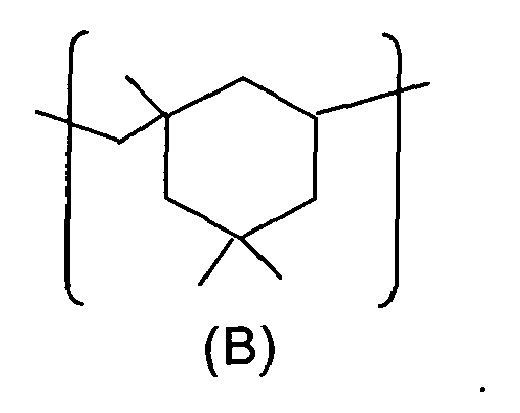
- The composition according to claim 1, wherein each R1 is methyl.
- The composition according to claim 1, wherein each R is a branched or bicyclic alkyl group.
- The composition according to claim 1, wherein each R is 2-ethylhex-1-yl.
- The composition according to claim 1, wherein each R is 4-methylpent-2-yl.
- The composition according to claim 1, wherein each R is 5-methylhex-2-yl.
- The composition according to claim 1, wherein each R is a polyhydroxyalkyl group according to formula (A).
- The composition according to claim 7, wherein the polyhydroxyalkyl group is 1-deoxyglucityl.
- The composition according to claim 1, wherein Z is (CH2)2.
- The composition according to claim 9, wherein each R1 is methyl.
- The composition according to claim 1, wherein Z is 4,4'-methylenebis(cyclohexyl).
- The composition according to claim 11, wherein each R1 is methyl.
- The composition according to claim 1, wherein Z is CH2(CH2)n{N+O-R1-CH2(CH2)o}p.
- The composition according to claim 13, wherein each R1 is methyl.
- The composition according to claim 13, wherein n, o, and p are all 1.
- The composition according to claim 15, wherein each R1 is methyl.
- The composition according to claim 1, further comprising an oxidizing agent.
- The composition according to claim 1, wherein the one or more compounds according to formula (I) constitute a first component, the composition further comprising a second component consisting of one or more materials selected from the group consisting of mineral acids, formic acid, acetic acid, tetramethylammonium hydroxide, nonvolatile organic materials, nonvolatile inorganic materials, and mixtures of these, said second component not including any component of a pre- or post-preparation synthesis reaction mixture for preparation of any of the one or more compounds according to formula (I), wherein the composition is fluid at 25°C.
- The composition according to claim 18, wherein the second component is present in a greater amount by weight than the first component.
- The composition according to claim 19, the composition further comprising an aqueous carrier.
- The composition according to claim 18, wherein the one or more compounds according to formula (I) comprises a compound wherein each R is 2-ethylhex-1-yl.
- The composition according to claim 18, wherein the one or more compounds according to formula (I) comprises a compound wherein each R is 4-methylpent-2-yl.
- The composition according to claim 18, wherein the one or more compounds according to formula (I) comprises a compound wherein each R is 5-methylhex-2-yl.
- The composition according to claim 18, wherein the one or more compounds according to formula (I) comprises a compound wherein Z is (CH2)2.
- The composition according to claim 18, wherein the one or more compounds according to formula (I) comprises a compound wherein Z is CH2(CH2)n{N+O-R1-CH2(CH2)o}p and wherein n, o, and p are all 1.
- A method for reducing surface tension in a formulation, comprising adding to the formulation an effective amount of one or more compounds according to formula (I) sufficient to reduce an equilibrium surface tension of the formulation to a value less than 52 mN/m


- The method according to claim 26, wherein the formulation is aqueous.
- The method of claim 27 wherein the formulation comprises oxidizing agents.
Applications Claiming Priority (1)
| Application Number | Priority Date | Filing Date | Title |
|---|---|---|---|
| US11/197,887 US20070031370A1 (en) | 2005-08-04 | 2005-08-04 | Amine N-oxide based surfactants |
Publications (1)
| Publication Number | Publication Date |
|---|---|
| EP1749566A2 true EP1749566A2 (en) | 2007-02-07 |
Family
ID=37343673
Family Applications (1)
| Application Number | Title | Priority Date | Filing Date |
|---|---|---|---|
| EP06016023A Withdrawn EP1749566A2 (en) | 2005-08-04 | 2006-08-01 | Amine N-Oxide based surfactants |
Country Status (4)
| Country | Link |
|---|---|
| US (1) | US20070031370A1 (en) |
| EP (1) | EP1749566A2 (en) |
| JP (1) | JP2007039693A (en) |
| CN (1) | CN1919436A (en) |
Cited By (4)
| Publication number | Priority date | Publication date | Assignee | Title |
|---|---|---|---|---|
| WO2013053770A1 (en) * | 2011-10-11 | 2013-04-18 | Eco Inhibitors As | Method of inhibiting the formation of gas hydrates using amine oxides |
| US9382192B2 (en) | 2012-02-14 | 2016-07-05 | Dow Global Technologies Llc | Nonionic surfactant compositions |
| US10399064B2 (en) | 2012-03-27 | 2019-09-03 | Dow Global Technologies Llc | Rhenium recovery from used reductive amination catalysts |
| CN114867820A (en) * | 2019-11-06 | 2022-08-05 | 先进湿润技术私人有限公司 | Novel wetting compositions |
Families Citing this family (8)
| Publication number | Priority date | Publication date | Assignee | Title |
|---|---|---|---|---|
| CN100496692C (en) * | 2007-06-21 | 2009-06-10 | 北京服装学院 | Glycosyl quaternary ammonium salt cation surfactant, preparation method and application |
| JP5927803B2 (en) * | 2011-08-05 | 2016-06-01 | 三浦工業株式会社 | Surfactant composition |
| MX368309B (en) * | 2014-12-11 | 2019-09-26 | Mexicano Inst Petrol | Hydroxypropyl betaine based zwitterionic geminal liquids, obtaining process and use as wettability modifiers with inhibitory/dispersants properties of asphaltenes. |
| US20170151157A1 (en) * | 2015-11-27 | 2017-06-01 | L'oreal | Clear volumizing shampoo containing styling and conditioning polymers and filoxane (aptes-aminopropyl triethoxysilane) |
| WO2020102269A1 (en) * | 2018-11-13 | 2020-05-22 | Ecolab Usa Inc. | Gas hydrate inhibition using methanol foam composition |
| CN109721511A (en) * | 2019-01-21 | 2019-05-07 | 北京工商大学 | A kind of preparation method of the Shuangzi amine oxide of the ethyl of ester group containing alkyl |
| CA3086132A1 (en) * | 2019-07-07 | 2021-01-07 | Chevron U.S.A. Inc. | Compositions and methods for foam stimulation |
| JP7432185B2 (en) * | 2020-01-08 | 2024-02-16 | 株式会社ニイタカ | gemini type compound |
Citations (5)
| Publication number | Priority date | Publication date | Assignee | Title |
|---|---|---|---|---|
| US4126640A (en) | 1977-08-01 | 1978-11-21 | General Mills Chemicals, Inc. | N-alkyl polyamines and curing of epoxy resins therewith |
| JPS6274814A (en) | 1985-09-27 | 1987-04-06 | Sanko Kaihatsu Kagaku Kenkyusho:Kk | Prevention for contamination of white rubber belt |
| US5939476A (en) | 1997-11-12 | 1999-08-17 | Air Products And Chemicals, Inc. | Surface tension reduction with alkylated polyamines |
| US6190733B1 (en) | 1998-03-20 | 2001-02-20 | Air Products And Chemicals, Inc. | Alkylated aminoether surfactants |
| US6288151B1 (en) | 1999-10-14 | 2001-09-11 | Air Products And Chemicals, Inc. | Alkylated aminoalkyl cyclic urea surfactants |
Family Cites Families (5)
| Publication number | Priority date | Publication date | Assignee | Title |
|---|---|---|---|---|
| NL286808A (en) * | 1961-12-21 | |||
| US3531526A (en) * | 1966-12-21 | 1970-09-29 | Procter & Gamble | Diamine dioxide detergent compounds |
| DE1901535A1 (en) * | 1969-01-14 | 1970-08-13 | Henkel & Cie Gmbh | Process for the preparation of alkylene glycol esters |
| GR74545B (en) * | 1980-11-28 | 1984-06-29 | Procter & Gamble | |
| US20030096722A1 (en) * | 2000-04-14 | 2003-05-22 | The Procter & Gamble Company | Process of cleaning and/or disinfecting a hard surface with a composition comprising a biguanide antimicrobial agent |
-
2005
- 2005-08-04 US US11/197,887 patent/US20070031370A1/en not_active Abandoned
-
2006
- 2006-08-01 EP EP06016023A patent/EP1749566A2/en not_active Withdrawn
- 2006-08-03 JP JP2006212058A patent/JP2007039693A/en not_active Withdrawn
- 2006-08-04 CN CNA2006101077006A patent/CN1919436A/en active Pending
Patent Citations (6)
| Publication number | Priority date | Publication date | Assignee | Title |
|---|---|---|---|---|
| US4126640A (en) | 1977-08-01 | 1978-11-21 | General Mills Chemicals, Inc. | N-alkyl polyamines and curing of epoxy resins therewith |
| JPS6274814A (en) | 1985-09-27 | 1987-04-06 | Sanko Kaihatsu Kagaku Kenkyusho:Kk | Prevention for contamination of white rubber belt |
| US5939476A (en) | 1997-11-12 | 1999-08-17 | Air Products And Chemicals, Inc. | Surface tension reduction with alkylated polyamines |
| US6190733B1 (en) | 1998-03-20 | 2001-02-20 | Air Products And Chemicals, Inc. | Alkylated aminoether surfactants |
| US6492559B1 (en) | 1998-03-20 | 2002-12-10 | Air Products And Chemicals, Inc. | Alkylated aminoether surfactants |
| US6288151B1 (en) | 1999-10-14 | 2001-09-11 | Air Products And Chemicals, Inc. | Alkylated aminoalkyl cyclic urea surfactants |
Non-Patent Citations (3)
| Title |
|---|
| CASELLIN, TETRAHEDRON : ASYMMETRY, vol. 14, 2003, pages 1451 - 1454 |
| J. M. PRESTMAN, LANGMUIR, vol. 13, 1997, pages 6857 - 6860 |
| LOUIS HO TAN TAI'S: "FORMULATING DETERGENTS AND PERSONAL CARE PRODUCTS: A COMPLETE GUIDE TO PRODUCT DEVELOPMENT", 2000, AOCS PRESS |
Cited By (4)
| Publication number | Priority date | Publication date | Assignee | Title |
|---|---|---|---|---|
| WO2013053770A1 (en) * | 2011-10-11 | 2013-04-18 | Eco Inhibitors As | Method of inhibiting the formation of gas hydrates using amine oxides |
| US9382192B2 (en) | 2012-02-14 | 2016-07-05 | Dow Global Technologies Llc | Nonionic surfactant compositions |
| US10399064B2 (en) | 2012-03-27 | 2019-09-03 | Dow Global Technologies Llc | Rhenium recovery from used reductive amination catalysts |
| CN114867820A (en) * | 2019-11-06 | 2022-08-05 | 先进湿润技术私人有限公司 | Novel wetting compositions |
Also Published As
| Publication number | Publication date |
|---|---|
| US20070031370A1 (en) | 2007-02-08 |
| CN1919436A (en) | 2007-02-28 |
| JP2007039693A (en) | 2007-02-15 |
Similar Documents
| Publication | Publication Date | Title |
|---|---|---|
| EP1676831B1 (en) | N,N-dialkylpolyhydroxyalkylamines | |
| US7279447B2 (en) | Subterranean well and oil or gas stream treatment with bis(3-alkoxyalkan-2-ol) sulfides, sulfones, and sulfoxides: new surface active agents | |
| EP2246407B1 (en) | 2-Hydroxy-3-alkoxypropyl sulfides, sulfones, and sulfoxides: new surface active agents | |
| US20070031370A1 (en) | Amine N-oxide based surfactants | |
| US20060013780A1 (en) | N,N'-dialkyl derivatives of polyhydroxyalkyl alkylenediamines | |
| MXPA02006942A (en) | Alkyl glycidyl ether-capped polyamine foam control agents. | |
| EP1457481A1 (en) | Gemini glycidyl ether adducts of polyhydroxyalkyl alkylenediamines | |
| US7049472B2 (en) | Bis(3-alkoxyalkan-2-OL) sulfides, sulfones, and sulfoxides: new surface active agents | |
| US20060293397A1 (en) | Surfactants derived from phenolic aldehydes | |
| KR100840955B1 (en) | Amine N-oxide surfactant |
Legal Events
| Date | Code | Title | Description |
|---|---|---|---|
| PUAI | Public reference made under article 153(3) epc to a published international application that has entered the european phase |
Free format text: ORIGINAL CODE: 0009012 |
|
| AK | Designated contracting states |
Kind code of ref document: A2 Designated state(s): AT BE BG CH CY CZ DE DK EE ES FI FR GB GR HU IE IS IT LI LT LU LV MC NL PL PT RO SE SI SK TR |
|
| AX | Request for extension of the european patent |
Extension state: AL BA HR MK YU |
|
| STAA | Information on the status of an ep patent application or granted ep patent |
Free format text: STATUS: THE APPLICATION IS DEEMED TO BE WITHDRAWN |
|
| 18D | Application deemed to be withdrawn |
Effective date: 20100302 |