EP1748385A2 - Method and device for generating a sequence of images of reduced size - Google Patents
Method and device for generating a sequence of images of reduced size Download PDFInfo
- Publication number
- EP1748385A2 EP1748385A2 EP06117768A EP06117768A EP1748385A2 EP 1748385 A2 EP1748385 A2 EP 1748385A2 EP 06117768 A EP06117768 A EP 06117768A EP 06117768 A EP06117768 A EP 06117768A EP 1748385 A2 EP1748385 A2 EP 1748385A2
- Authority
- EP
- European Patent Office
- Prior art keywords
- window
- image
- sequence
- source image
- pixel
- Prior art date
- Legal status (The legal status is an assumption and is not a legal conclusion. Google has not performed a legal analysis and makes no representation as to the accuracy of the status listed.)
- Withdrawn
Links
Images


Classifications
-
- G—PHYSICS
- G06—COMPUTING OR CALCULATING; COUNTING
- G06T—IMAGE DATA PROCESSING OR GENERATION, IN GENERAL
- G06T3/00—Geometric image transformations in the plane of the image
- G06T3/04—Context-preserving transformations, e.g. by using an importance map
-
- G—PHYSICS
- G06—COMPUTING OR CALCULATING; COUNTING
- G06T—IMAGE DATA PROCESSING OR GENERATION, IN GENERAL
- G06T2207/00—Indexing scheme for image analysis or image enhancement
- G06T2207/20—Special algorithmic details
- G06T2207/20172—Image enhancement details
- G06T2207/20192—Edge enhancement; Edge preservation
Definitions
- the invention concerns a method and a device for generating, from a first sequence of images, called source sequence, a second sequence of images of reduced size, called reduced sequence, based on information characterizing the perceptual relevancy of pixels or groups of pixels within the images of the source sequence.
- the invention relates to the generation of a reduced sequence from a source sequence. Indeed, when browsing among a large amount of image sequences, it may be interesting to select a sequence at a glance. To this aim the generation of reduced sequences may be of interest.
- a reduced sequence is a sequence that has a smaller size than the source sequence from which it is generated. For example, in a context of sequence browsing, the selection of a sequence of images among various sequences may be eased and accelerated by displaying several reduced sequences on a given reproduction device (e.g. displaying a mosaic of reduced sequences on a TV set display).
- a classical method for generating a reduced sequence consists in down sampling the images of the source sequence. In this case, if the reduction of the size is too strong, the most important parts of the reduced sequence become very small which degrades the user viewing experience.
- the invention aims at improving the user viewing experience by generating a reduced sequence by taking into account perceptual relevancy of pixels or groups of pixels, called regions hereinafter, within the images of the source sequence from which the reduced sequence is generated.
- the invention relates to a method for generating from a sequence of at least one source image, called source sequence, a sequence of at least one reduced image, called reduced sequence, the at least one reduced image having a size smaller or equal to the size of the at least one source image, the at least one reduced image being generated by extracting from the at least one source image at least one image part delimited in the source image by an extraction window.
- the extraction window is defined by the following steps of:
- the step for defining the initial extraction window comprises the following steps of:
- the extraction window is translated to be fully included into the source image.
- step c) for defining the initial extraction window consists in the following four successive steps:
- the method is applied successively on the images of the sequence. Preferentially, if the distance between the most conspicuous pixels of a first image and of a second image following the first image is below a predefined threshold, the preliminary window in the second image is centered on the pixel located at the same position as the most conspicuous pixel in the first image.
- the step for defining the initial extraction window comprises the following steps of:
- a perceptual interest value is a saliency value.
- the invention also relates to a method for generating a combined reduced sequence of several images.
- a first reduced sequence of images is generated from a source sequence and a second reduced sequence of images is generated by downsampling the source sequence, the combined reduced sequence being generated from the first reduced sequence of images by replacing a predefined number of consecutive images of the first reduced sequence by corresponding images of the second reduced sequence.
- the invention relates to a method for generating a reduced sequence of images from a source sequence of images based on side information relating to the perceptual relevancy of pixels within the images of the source sequence. It may also be used for generating a single reduced image from a single source image.
- the side information may be provided by external means for example within data files. It may also be provided by the following method consisting in determining a perceptual relevancy value for each pixel in each image of the source sequence.
- the perceptual relevancy value associated to each pixel may be a saliency value.
- a saliency map is associated to each source image.
- a saliency map s is a two dimensional topographic representation of conspicuity of the image.
- the saliency map is thus providing a saliency value s(i,j) per pixel (where (i,j) denotes the pixel coordinates) that characterizes its perceptual relevancy. The higher the s(i,j) value is, the more relevant the pixel of coordinates (i,j) is.
- a saliency map for a given image may be obtained by the method described in EP 1 544 792 application and in the article by O. Le Meur et al. entitled "From low level perception to high level perception, a coherent approach for visual attention modeling" and published in the proceedings of SPIE Human Vision and Electronic Imaging IX (HVEl'04), San Jose, CA, (B. Rogowitz, T. N.
- the method comprises 4 steps referenced 10, 11, 12 and 13 on figure 1.
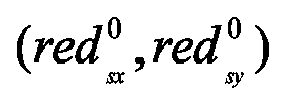
- the step 10 comprises a first sub-step consisting in positioning a preliminary window 20 of size red sx 0 , red sy 0 in the source image 2 centered on the pixel 21 of coordinates i max and j max whose saliency value within the source image 2 is the highest, i.e. the current most conspicuous pixel.
- This window delimits an image part in the source image 2.
- the words window and image part are equally used to designate the image part delimited by said window.
- the preliminary window 20 has to be positioned such that it is fully included in the source image 2.
- cor x i max - red sx 0 2
- cor y j max - red sy 0 2
- the step 11 consists in first computing a saliency value associated to the preliminary window 20, possibly translated, denoted by SM reduced .
- SM reduced is compared to the saliency value SM image associated to the source image 2
- the ratio ⁇ is close to 0, i.e. if ⁇ is lower than a second predefined threshold referenced T 2 on figure 1 (e.g.
- the most conspicuous pixel 21 is probably an aberrant or impulsive point since the preliminary window 20 does not include any sufficiently salient region. Consequently, the pixel with the highest saliency value just inferior to the saliency value associated to the current most conspicuous pixel 21 is identified. The new most conspicuous pixel becoming the current most conspicuous pixel, the steps 10 and 11 are applied again with it. If ⁇ is higher than the second predefined threshold, then the step 12 is applied directly.
- the step 12 consists in dynamically adapting the size of the preliminary window 20 to the image content by an iterative approach in order to generate an initial extraction window referenced 22 on figure 2.
- the size of the regions of high perceptual interest may vary from one image to another (e.g. in the case of a zoom or several regions of interest within the image).
- This adaptation is driven by the value ⁇ computed at step 11. If ⁇ is close to 1, if ⁇ is higher than a first predefined threshold (e.g. if ⁇ ⁇ 0.8) then the size of the preliminary window 20 is not adapted since the saliency value associated to the preliminary window 20 is high enough. In this case, the initial extraction window 22 is set equal to the preliminary window 20, i.e.
- the initial extraction window 22 is defined by identifying the preliminary window 20 with the initial extraction window 22. If ⁇ is not close to 1, if ⁇ is lower than the first predefined threshold, then the size of the preliminary window 20 is iteratively increased.
- a window called current window, is defined (i.e. initialized) by identifying the preliminary window 20 with the current window.
- the step 13 consists in generating the reduced image by extracting the image part of the source image delimited by the initial extraction window 22.
- the first pixel of the reduced image corresponds to the top left pixel of the initial extraction window 22.
- the step 12 is followed by a step 12' which consists in displacing the initial extraction window 22, also called W E in the sequel, to a new position in order to generate a displaced extraction window 23.
- This is achieved by computing the gravity center GC of the initial extraction window 22.
- the coefficients associated to the pixels in order to compute the gravity center are the perceptual interest values of the pixels (e.g. saliency values).
- the step 10 is advantageously modified such that the center of the window of size red sx 0 , red sy 0 in the current source image 2 is positioned on a pixel of coordinates I max cur and J max cur which may be different from the most conspicuous pixel 21.
- I max cur and J max cur are calculated in order to ensure a temporal coherency of the sequence by avoiding that the spatial location of the preliminary window 20 in the source image drastically changes from one source image to the next source image.
- more than one window is used to generate the reduced image.
- the steps 10, 11, 12 and 13 are replaced by the following steps.
- a first window 70 is positioned in the source image 2 so that its center is located on the first most conspicuous pixel of the source image 2, i.e. whose saliency value within the source image 2 is the highest.
- the reduced image is generated by extracting the image part of the source image 2 which is delimited by the first window 70. If ⁇ is not close to 1, i.e. lower than the fifth predefined threshold, a second window 71 is positioned in the source image 2 so that its center is located on the second most conspicuous pixel of the source image 2, i.e. the most conspicuous pixel of the source image 2 whose saliency value is just lower than the saliency value of the first most conspicuous pixel.
- the saliency value SM reduced_ 71 associated to the second window 71 is computed.
- the image part extracted from the source image 2 to generate the reduced image corresponds to the smaller window 7 that comprises the first and the second windows 70 and 71. If the ratio ⁇ 1 is not close to 1 then a third window is positioned in the source image 2 so that its center is located on the third most conspicuous pixel of the source image 2, i.e. the most conspicuous pixel of the source image 2 whose saliency value is just lower than the saliency value of the second most conspicuous pixel. The ratio between the sum of the three saliency values associated to the three windows and the saliency value SM image is compared to 1.
- the image part extracted from the source image 2 to generate the reduced image corresponds to the smaller window that comprises the three windows. If it is not close to 1 then the process of positioning new windows is repeated until the ratio between the sum of saliency values associated to each positioned window and SM image is close to 1.
- a new window is positioned in the source image 2 so that its center is located on the most conspicuous pixel (k) whose saliency value is just lower than the saliency value of the previous most conspicuous pixel (k-1).
- the reduced image is then generated by extracting the image part from the source image 2 delimited by the smaller window that comprises all the positioned windows. Preferentially before computing their saliency values, the windows are translated to be fully included into the source image and/or displaced according to step 12'.
- steps 10, 11, and 12 are replaced by the following step which consists in positioning the initial extraction window 22 by identifying in the image source 2 the pixels whose saliency values are higher than a fourth predefined threshold.
- the initial extraction window 22 is thus defined by its top left corner and its bottom right corner.
- the pixel with the lowest ordinate is set as the top left corner of the initial extraction window 22.
- the pixel with the highest ordinate is the bottom right corner of the initial extraction window 22.
- the step 13 is then applied in order to generate the reduced image by extracting the image part of the source image delimited by the initial extraction window 22.
- the first pixel of the reduced image corresponds to the top left pixel of the initial extraction window 22.
- the step 13 is advantageously followed by the following step which consists in generating a combined reduced sequence by switching between the reduced sequence according to the invention, called first reduced sequence, and the source sequence reduced according to a classical method, called second reduced sequence.
- a classical method refers to a method that simply downsamples the images of the source sequence to generate the reduced sequence. This combined reduced sequence should improve the viewer understanding of the scene by providing him with the global scene (e.g. downsampled version of the source images).
- the switching step is driven by the value of ⁇ . To this aim the ratio ⁇ is computed for the current image. If the value ⁇ is not close to 1 the classically reduced video (i.e.
- the down sampled source images is transmitted during ⁇ seconds as depicted on figure 6.
- the ⁇ value may be set by the users.
- This switching may also be automatically driven in order to give a global sketch of the scene by switching between both reduced sequences regularly for example every ⁇ seconds or for example by replacing every ⁇ seconds a given number of pictures of first reduced sequence by corresponding pictures of the second reduced sequence.
- regions of interest may be handled by dividing the reduced images into several (e.g. four sub-images) parts, each part containing either the source sequence or one of the most conspicuous regions (i.e. higher saliency values).
- the parts corresponding to the most conspicuous regions are determined by the four following successive steps :
Landscapes
- Physics & Mathematics (AREA)
- General Physics & Mathematics (AREA)
- Engineering & Computer Science (AREA)
- Theoretical Computer Science (AREA)
- Image Processing (AREA)
- Editing Of Facsimile Originals (AREA)
Abstract
Description
- The invention concerns a method and a device for generating, from a first sequence of images, called source sequence, a second sequence of images of reduced size, called reduced sequence, based on information characterizing the perceptual relevancy of pixels or groups of pixels within the images of the source sequence.
- The invention relates to the generation of a reduced sequence from a source sequence. Indeed, when browsing among a large amount of image sequences, it may be interesting to select a sequence at a glance. To this aim the generation of reduced sequences may be of interest. A reduced sequence is a sequence that has a smaller size than the source sequence from which it is generated. For example, in a context of sequence browsing, the selection of a sequence of images among various sequences may be eased and accelerated by displaying several reduced sequences on a given reproduction device (e.g. displaying a mosaic of reduced sequences on a TV set display). A classical method for generating a reduced sequence consists in down sampling the images of the source sequence. In this case, if the reduction of the size is too strong, the most important parts of the reduced sequence become very small which degrades the user viewing experience.
- The invention aims at improving the user viewing experience by generating a reduced sequence by taking into account perceptual relevancy of pixels or groups of pixels, called regions hereinafter, within the images of the source sequence from which the reduced sequence is generated.
- The invention relates to a method for generating from a sequence of at least one source image, called source sequence, a sequence of at least one reduced image, called reduced sequence, the at least one reduced image having a size smaller or equal to the size of the at least one source image, the at least one reduced image being generated by extracting from the at least one source image at least one image part delimited in the source image by an extraction window. The extraction window is defined by the following steps of:
- defining an initial extraction window on the basis of perceptual interest values of the pixels of the at least one source image; and
- displacing the initial extraction window so that the initial extraction window after displacement is centered on the perceptual relevancy gravity center of the initial extraction window before displacement, the initial extraction window after displacement being identified with the extraction window.
- According to a first embodiment, the step for defining the initial extraction window comprises the following steps of:
- a) positioning a preliminary window in the source image centered on the pixel of the source image with the highest perceptual interest, called current most conspicuous pixel;
- b) computing a current ratio between a perceptual interest value associated to the preliminary window and a perceptual interest value associated to the source image; and
- c) if the current ratio is lower than a first predefined threshold defining the initial extraction window by adapting the size of the preliminary window so that the perceptual interest value associated to the initial extraction window is higher than the perceptual interest value associated to the preliminary window else defining the initial extraction window by identifying the preliminary window with the initial extraction window.
- Preferentially, if after the step for displacing the initial extraction window, the extraction window is not fully included into the source image, the extraction window is translated to be fully included into the source image.
- According to a specific characteristic, the perceptual relevancy gravity center coordinates iGC and jGC are computed as follows:

where: - (ip,jp) are the coordinates of a pixel p of the extraction window WE ;
- s(ip,jp) is a perceptual relevancy value associated to the pixel p.
- Advantageously, the step c) for defining the initial extraction window consists in the following four successive steps:
- initializing a window, called current window, with the preliminary window;
- increasing the height of the current window by a first increment and the width of the current window by a second increment;
- computing a new ratio between a perceptual interest value associated to the current window and a perceptual interest value associated to the source image, the current ratio becoming the previous ratio and the new ratio becoming the current ratio;
- if the difference between the current ratio and the previous ratio is lower than a second predefined threshold defining the initial extraction window by identifying the current window with the initial extraction window, else returning to the increasing step.
- According to a specific embodiment, the sequence comprising at least two images, the method is applied successively on the images of the sequence. Preferentially, if the distance between the most conspicuous pixels of a first image and of a second image following the first image is below a predefined threshold, the preliminary window in the second image is centered on the pixel located at the same position as the most conspicuous pixel in the first image.
- According to a second embodiment, the step for defining the initial extraction window comprises the following steps of:
- a) positioning a current window in the source image centered on the pixel of the source image with the highest perceptual interest, called current most conspicuous pixel;
- b) computing a current ratio between the sum of perceptual interest values associated to each window positioned in the source image and a perceptual interest value associated to the source image;
- c) if the current ratio is lower than a third predefined threshold:
- identifying the pixel, called new most conspicuous pixel, of the source image with the highest perceptual interest value just lower than the perceptual interest value of the current most conspicuous pixel;
- positioning a new window in the source image centered on the new most conspicuous pixel, the new most conspicuous pixel becoming the current most conspicuous pixel and the new window becoming the current window;
- return to step b;
else defining the initial extraction window by identifying the smaller window comprising all the positioned windows with the initial extraction window.
- Preferentially, a perceptual interest value is a saliency value.
- The invention also relates to a method for generating a combined reduced sequence of several images. To this aim, a first reduced sequence of images is generated from a source sequence and a second reduced sequence of images is generated by downsampling the source sequence, the combined reduced sequence being generated from the first reduced sequence of images by replacing a predefined number of consecutive images of the first reduced sequence by corresponding images of the second reduced sequence.
- Other features and advantages of the invention will appear with the following description of some of its embodiments, this description being made in connection with the drawings in which:
- Figure 1 depicts the general flowchart of the method according to the invention;
- Figure 2 depicts several positions of a window in the source image at different step of the method of the invention;
- Figure 3 depicts how a window is translated in order to be fully included in a source image (vertical positive translation);
- Figure 4 depicts how the window is translated in order to be fully included in a source image (vertical negative translation);
- Figure 5 depicts how a window is translated in order to be fully included in a source image (vertical and horizontal positive translation);
- Figure 6 depicts the evolution of a saliency ratio;
- Figure 7 depicts generation of a reduced image from two windows ;
- The invention relates to a method for generating a reduced sequence of images from a source sequence of images based on side information relating to the perceptual relevancy of pixels within the images of the source sequence. It may also be used for generating a single reduced image from a single source image. The side information may be provided by external means for example within data files. It may also be provided by the following method consisting in determining a perceptual relevancy value for each pixel in each image of the source sequence. The perceptual relevancy value associated to each pixel may be a saliency value. In this case, a saliency map is associated to each source image. A saliency map s is a two dimensional topographic representation of conspicuity of the image. This map is normalized for example between 0 and 255. The saliency map is thus providing a saliency value s(i,j) per pixel (where (i,j) denotes the pixel coordinates) that characterizes its perceptual relevancy. The higher the s(i,j) value is, the more relevant the pixel of coordinates (i,j) is. A saliency map for a given image may be obtained by the method described in
EP 1 544 792 application and in the article by O. Le Meur et al. entitled "From low level perception to high level perception, a coherent approach for visual attention modeling" and published in the proceedings of SPIE Human Vision and Electronic Imaging IX (HVEl'04), San Jose, CA, (B. Rogowitz, T. N. Pappas Ed.), January 2004. The article by O. Le Meur et al. entitled "Performance assessment of a visual attention system entirely based on a human vision modeling" and published in the proceedings of ICIP in October 2004 explained also the saliency model. This method comprising the following steps : - projection of the image according to the luminance component if the image is a single color image and according to the luminance component and to the chrominance components if the image is a color image;
- perceptual sub-bands decomposition of the projected components in the frequency domain according to a visibility threshold of a human eye; the sub-bands are obtained by carving up the frequency domain both in spatial radial frequency and orientation; each resulting sub-band may be regarded as the neural image corresponding to a population of visual cells tuned to a range of spatial frequency and a particular orientation;
- extraction of salient elements of the sub-bands related to the luminance component and related to the chrominance components, i.e. the most important information from the sub-band;
- contour enhancement of the salient elements in each sub-band related to the luminance and chrominance components;
- calculation of a saliency map for the luminance component from the enhanced contours of the salient elements of each sub-band related to the luminance component;
- calculation of a saliency map for each chrominance components from the enhanced contours of the salient elements of each sub-band related to the chrominance components;
- creation of the saliency map as a function of the saliency maps obtained for each sub-band.
- For sake of clarity the steps of the method are described for a single source image but may be applied in parallel or successively on each image of a source sequence in order to generate a reduced sequence.
The following notations are used hereinafter: - A source image, i.e. an image of the source sequence, has a size denoted by (origsx,origsy ), where origsx is the width and origsy is the height of the image;
-


-


- The saliency value associated to an image, an image part or a window is the sum of the saliency values associated to each pixel of the image, the image part or the window respectively.
- According to a first embodiment, the method comprises 4 steps referenced 10, 11, 12 and 13 on figure 1. In reference to figures 1 and 2, the
step 10 comprises a first sub-step consisting in positioning apreliminary window 20 of size
source image 2 centered on thepixel 21 of coordinates imax and jmax whose saliency value within thesource image 2 is the highest, i.e. the current most conspicuous pixel. This window delimits an image part in thesource image 2. In the sequel, the words window and image part are equally used to designate the image part delimited by said window. Preferentially, thepreliminary window 20 has to be positioned such that it is fully included in thesource image 2. Thus thestep 10 possibly comprises a second sub-step consisting in translating thepreliminary window 20 in order that it is fully included in thesource image 2. If

preliminary window 20 is fully included in thesource image 2 and it has not to be translated. The coordinates (corx, cory ) of the top left corner of the window are computed as follows :

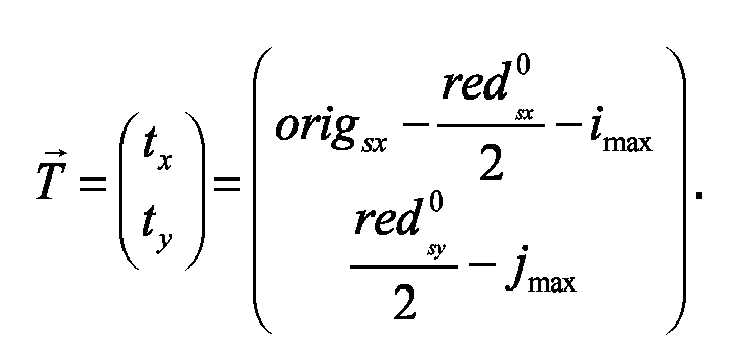
If thepreliminary window 20 is not fully included in thesource image 2, it has to be translated by a vector
pixel 21 of coordinates (i max,j max). In this case, the coordinates of the top left corner of the translatedpreliminary window 20 are computed as follows:

Depending on the values of i max and j max several cases occur. If thepreliminary window 20 is out of the limits of thesource image 2 in one direction, either horizontal or vertical direction, then: - if


- if


- if


- if


- if


- if


- if


- if


- The
step 11 consists in first computing a saliency value associated to thepreliminary window 20, possibly translated, denoted by SMreduced. In order to estimate the perceptual interest of thepreliminary window 20, SMreduced is compared to the saliency value SMimage associated to thesource image 2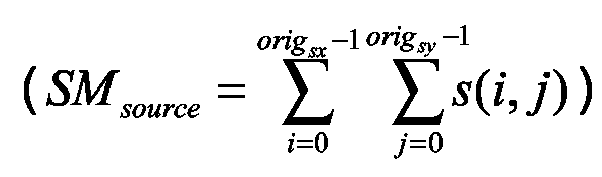

conspicuous pixel 21 is probably an aberrant or impulsive point since thepreliminary window 20 does not include any sufficiently salient region. Consequently, the pixel with the highest saliency value just inferior to the saliency value associated to the current mostconspicuous pixel 21 is identified. The new most conspicuous pixel becoming the current most conspicuous pixel, thesteps step 12 is applied directly. - The
step 12 consists in dynamically adapting the size of thepreliminary window 20 to the image content by an iterative approach in order to generate an initial extraction window referenced 22 on figure 2. Indeed, the size of the regions of high perceptual interest may vary from one image to another (e.g. in the case of a zoom or several regions of interest within the image). This adaptation is driven by the value Ψ computed atstep 11. If Ψ is close to 1, if Ψ is higher than a first predefined threshold (e.g. if Ψ ≥ 0.8) then the size of thepreliminary window 20 is not adapted since the saliency value associated to thepreliminary window 20 is high enough. In this case, theinitial extraction window 22 is set equal to thepreliminary window 20, i.e. theinitial extraction window 22 is defined by identifying thepreliminary window 20 with theinitial extraction window 22. If Ψ is not close to 1, if Ψ is lower than the first predefined threshold, then the size of thepreliminary window 20 is iteratively increased. First, a window, called current window, is defined (i.e. initialized) by identifying thepreliminary window 20 with the current window. At iteration k, the size of the current window is increased from


where: - δ x and δ y are arbitrarily set values; and
- k is an integer number which represents the number of iterations.
- The
step 13 consists in generating the reduced image by extracting the image part of the source image delimited by theinitial extraction window 22. The first pixel of the reduced image corresponds to the top left pixel of theinitial extraction window 22. - According to a preferred embodiment, the
step 12 is followed by a step 12' which consists in displacing theinitial extraction window 22, also called WE in the sequel, to a new position in order to generate a displacedextraction window 23. This is achieved by computing the gravity center GC of theinitial extraction window 22. The coefficients associated to the pixels in order to compute the gravity center are the perceptual interest values of the pixels (e.g. saliency values). Therefore the coordinates (iGC, jGC ) of the gravity center GC are computed as follows:
where: - (ip,jp) are the coordinates of a pixel p of the extraction window WE; and
- s(ip,jp) is the perceptual relevancy value (e.g. saliency value) associated to the pixel p.
- In the case of a source sequence of at least two images, the
step 10 is advantageously modified such that the center of the window of size
current source image 2 is positioned on a pixel of coordinates

conspicuous pixel 21.

preliminary window 20 in the source image drastically changes from one source image to the next source image. To this aim, the displacement d between two most conspicuous pixels (i.e. pixels of highest saliency values) in two consecutive source images is computed by the following formula:
where: -

-

- According to a preferred embodiment, more than one window is used to generate the reduced image. In this case, the
steps first window 70 is positioned in thesource image 2 so that its center is located on the first most conspicuous pixel of thesource image 2, i.e. whose saliency value within thesource image 2 is the highest. The saliency value SM reduced_70 associated to thefirst window 70 and the saliency value SMimage associated to thesource image 2 are computed. If the ratio
source image 2 which is delimited by thefirst window 70. If Ψ is not close to 1, i.e. lower than the fifth predefined threshold, asecond window 71 is positioned in thesource image 2 so that its center is located on the second most conspicuous pixel of thesource image 2, i.e. the most conspicuous pixel of thesource image 2 whose saliency value is just lower than the saliency value of the first most conspicuous pixel. The saliency value SM reduced_71 associated to thesecond window 71 is computed. If the ratio between
source image 2 to generate the reduced image corresponds to thesmaller window 7 that comprises the first and thesecond windows source image 2 so that its center is located on the third most conspicuous pixel of thesource image 2, i.e. the most conspicuous pixel of thesource image 2 whose saliency value is just lower than the saliency value of the second most conspicuous pixel. The ratio between the sum of the three saliency values associated to the three windows and the saliency value SMimage is compared to 1. If it is close to 1, then the image part extracted from thesource image 2 to generate the reduced image corresponds to the smaller window that comprises the three windows. If it is not close to 1 then the process of positioning new windows is repeated until the ratio between the sum of saliency values associated to each positioned window and SMimage is close to 1. Thus, at each iteration k, a new window is positioned in thesource image 2 so that its center is located on the most conspicuous pixel (k) whose saliency value is just lower than the saliency value of the previous most conspicuous pixel (k-1).
The reduced image is then generated by extracting the image part from thesource image 2 delimited by the smaller window that comprises all the positioned windows. Preferentially before computing their saliency values, the windows are translated to be fully included into the source image and/or displaced according to step 12'. - According to another embodiment, steps 10, 11, and 12 are replaced by the following step which consists in positioning the
initial extraction window 22 by identifying in theimage source 2 the pixels whose saliency values are higher than a fourth predefined threshold. Theinitial extraction window 22 is thus defined by its top left corner and its bottom right corner. Among the identified pixels whose abscissa is the lowest, the pixel with the lowest ordinate is set as the top left corner of theinitial extraction window 22. Among the identified pixels whose abscissa is the highest, the pixel with the highest ordinate is the bottom right corner of theinitial extraction window 22. - The
step 13 is then applied in order to generate the reduced image by extracting the image part of the source image delimited by theinitial extraction window 22. The first pixel of the reduced image corresponds to the top left pixel of theinitial extraction window 22. - According to a specific embodiment, in the case of a source sequence of more than one image, the
step 13 is advantageously followed by the following step which consists in generating a combined reduced sequence by switching between the reduced sequence according to the invention, called first reduced sequence, and the source sequence reduced according to a classical method, called second reduced sequence. A classical method refers to a method that simply downsamples the images of the source sequence to generate the reduced sequence. This combined reduced sequence should improve the viewer understanding of the scene by providing him with the global scene (e.g. downsampled version of the source images). The switching step is driven by the value of Ψ. To this aim the ratio Ψ is computed for the current image. If the value Ψ is not close to 1 the classically reduced video (i.e. the down sampled source images) is transmitted during Δ seconds as depicted on figure 6. The Δ value may be set by the users. This switching may also be automatically driven in order to give a global sketch of the scene by switching between both reduced sequences regularly for example every Δ seconds or for example by replacing every Δ seconds a given number of pictures of first reduced sequence by corresponding pictures of the second reduced sequence. - According to a particular embodiment, several regions of interest may be handled by dividing the reduced images into several (e.g. four sub-images) parts, each part containing either the source sequence or one of the most conspicuous regions (i.e. higher saliency values).
The parts corresponding to the most conspicuous regions are determined by the four following successive steps : - Identifying the most conspicuous pixel in the source image which is not an inhibited pixel;
- Extracting from the image source an image part of size

- Inhibiting the most conspicuous pixel corresponding to the extracted image part;
- Returning to the identifying step until a predefined number of image parts have been extracted.
- Obviously, the invention is not limited to the embodiments described above. The skilled person may combine all these embodiments. Information other than saliency values or saliency maps can be used as side information provided it characterizes the perceptual relevancy of pixels or groups of pixels.
- Some of the advantages to build reduced sequence centered on the most important regions (i.e. in other words the advantage to drive the reduction by perceptual interest of regions within the images) are listed below:
- decrease the selection time (to ease the browsing),
- comprehend the sequence at a glance,
- give a reliable summary of the source sequence,
- allows the transmission of many sequence over restricted bandwidth channels without losing the most useful information.
- The different embodiments may offer some of the advantages among those listed below:
- deal with the large amount of multimedia content (e.g. more than one region of high perceptual interest may be handled) by using an adaptive size computation of the reduced frame or by using more than one window;
- offer a simple way to reposition the reduced window in the source frame using the gravity center of the window;
- offer good temporal coherency;
- allows a global understanding of the scene is also necessary.


For a large displacement, i.e. if d>ThMove, the temporal coherency is threatened. The value ThMove depends on the size of the


Claims (10)
- Method for generating from a sequence of at least one source image, called source sequence, a sequence of at least one reduced image, called reduced sequence, said at least one reduced image having a size smaller or equal to the size of said at least one source image, said at least one reduced image being generated by extracting from said at least one source image at least one image part delimited in said source image by an extraction window (23) characterized in that said extraction window (23) is defined by the following steps of:- defining an initial extraction window (22) on the basis of perceptual interest values of the pixels of said at least one source image; and- displacing said initial extraction window (22) so that said initial extraction window (22) after displacement is centered on the perceptual relevancy gravity center of said initial extraction window (22) before displacement, said initial extraction window (22) after displacement being identified with said extraction window (23).
- Method according to claim 1, characterized in that the step for defining said initial extraction window (22) comprises the following steps of:a) positioning (10) a preliminary window (20) in said source image centered on the pixel of said source image with the highest perceptual interest, called current most conspicuous pixel;b) computing (11) a current ratio between a perceptual interest value associated to said preliminary window (20) and a perceptual interest value associated to said source image; andc) if said current ratio is lower than a first predefined threshold defining said initial extraction window (22) by adapting (12) the size of said preliminary window (20) so that the perceptual interest value associated to said initial extraction window (22) is higher than the perceptual interest value associated to said preliminary window (20) else defining said initial extraction window (22) by identifying the preliminary window (20) with said initial extraction window (22).
- Method according to claim 1 or 2, characterized in that, if after the step for displacing said initial extraction window (22), said extraction window (23) is not fully included into said source image, said extraction window (23) is translated to be fully included into said source image.
- Method according to any of claim 1 to 3, characterized in that the perceptual relevancy gravity center coordinates iGC and jGC are computed as follows:

where:- (ip,jp) are the coordinates of a pixel p of said extraction window WE (22);- s(ip,jp) is a perceptual relevancy value associated to the pixel p. - Method according to any of claims 2 to 4, characterized in that the step c) for defining said initial extraction window (22) consists in the following four successive steps:• initializing a window, called current window, with said preliminary window (20);• increasing (12) the height of the current window (20) by a first increment and the width of the current window (20) by a second increment;• computing a new ratio between a perceptual interest value associated to said current window and a perceptual interest value associated to said source image, the current ratio becoming the previous ratio and the new ratio becoming the current ratio;• if the difference between the current ratio and the previous ratio is lower than a second predefined threshold defining said initial extraction window (22) by identifying said current window with said initial extraction window (22), else returning to the increasing step (12).
- Method according to any of claims 1 to 5, wherein the sequence comprising at least two images, the method is applied successively on the images of the sequence.
- Method according to any of claim 2 to 6, wherein if the distance between the most conspicuous pixels of a first image and of a second image following said first image is below a predefined threshold, the preliminary window (20) in said second image is centered on the pixel located at the same position as the most conspicuous pixel in said first image.
- Method according to claim 1, characterized in that the step for defining said initial extraction window (22) comprises the following steps of:a) positioning a current window in said source image centered on the pixel of said source image with the highest perceptual interest, called current most conspicuous pixel;b) computing a current ratio between the sum of perceptual interest values associated to each window positioned in said source image and a perceptual interest value associated to said source image;c) if said current ratio is lower than a third predefined threshold:• identifying the pixel, called new most conspicuous pixel, of said source image with the highest perceptual interest value just lower than the perceptual interest value of said current most conspicuous pixel;• positioning a new window in the source image centered on said new most conspicuous pixel, the new most conspicuous pixel becoming the current most conspicuous pixel and the new window becoming the current window;• return to step b;else defining said initial extraction window (22) by identifying the smaller window comprising all said positioned windows with said initial extraction window (22).
- Method according to any of claims 1 to 8, characterized in that a perceptual interest value is a saliency value.
- Method for generating a combined reduced sequence of several images, characterized in that a first reduced sequence of images is generated from a source sequence according to the method of any of claims 1, 2, or 8 and a second reduced sequence of images is generated by downsampling said source sequence, the combined reduced sequence being generated from the first reduced sequence of images by replacing a predefined number of consecutive images of said first reduced sequence by corresponding images of said second reduced sequence.
Priority Applications (1)
| Application Number | Priority Date | Filing Date | Title |
|---|---|---|---|
| EP06117768A EP1748385A3 (en) | 2005-07-28 | 2006-07-25 | Method and device for generating a sequence of images of reduced size |
Applications Claiming Priority (3)
| Application Number | Priority Date | Filing Date | Title |
|---|---|---|---|
| EP05291615 | 2005-07-28 | ||
| EP05291938A EP1764736A1 (en) | 2005-09-19 | 2005-09-19 | Method and device for image cropping |
| EP06117768A EP1748385A3 (en) | 2005-07-28 | 2006-07-25 | Method and device for generating a sequence of images of reduced size |
Publications (2)
| Publication Number | Publication Date |
|---|---|
| EP1748385A2 true EP1748385A2 (en) | 2007-01-31 |
| EP1748385A3 EP1748385A3 (en) | 2009-12-09 |
Family
ID=37401200
Family Applications (1)
| Application Number | Title | Priority Date | Filing Date |
|---|---|---|---|
| EP06117768A Withdrawn EP1748385A3 (en) | 2005-07-28 | 2006-07-25 | Method and device for generating a sequence of images of reduced size |
Country Status (1)
| Country | Link |
|---|---|
| EP (1) | EP1748385A3 (en) |
Cited By (9)
| Publication number | Priority date | Publication date | Assignee | Title |
|---|---|---|---|---|
| WO2009003885A3 (en) * | 2007-06-29 | 2009-03-26 | Thomson Licensing | Video indexing method, and video indexing device |
| EP2071511A1 (en) | 2007-12-13 | 2009-06-17 | Thomson Licensing | Method and device for generating a sequence of images of reduced size |
| FR2925705A1 (en) * | 2007-12-20 | 2009-06-26 | Thomson Licensing Sas | IMAGE CAPTURE ASSISTING DEVICE |
| EP2249307A1 (en) | 2009-05-05 | 2010-11-10 | Thomson Licensing | Method for image reframing |
| US8009921B2 (en) | 2008-02-19 | 2011-08-30 | Xerox Corporation | Context dependent intelligent thumbnail images |
| EP2549754A1 (en) | 2011-07-19 | 2013-01-23 | Thomson Licensing | Method and apparatus for reframing and encoding an original video signal |
| FR2983996A1 (en) * | 2012-06-11 | 2013-06-14 | Thomson Licensing | DEVICE AND METHOD FOR DISPLAYING AN IMAGE |
| US8537409B2 (en) | 2008-10-13 | 2013-09-17 | Xerox Corporation | Image summarization by a learning approach |
| US9478044B2 (en) | 2013-03-28 | 2016-10-25 | Thomson Licensing | Method and apparatus of creating a perceptual harmony map |
Family Cites Families (1)
| Publication number | Priority date | Publication date | Assignee | Title |
|---|---|---|---|---|
| US6654507B2 (en) * | 2000-12-14 | 2003-11-25 | Eastman Kodak Company | Automatically producing an image of a portion of a photographic image |
-
2006
- 2006-07-25 EP EP06117768A patent/EP1748385A3/en not_active Withdrawn
Cited By (14)
| Publication number | Priority date | Publication date | Assignee | Title |
|---|---|---|---|---|
| WO2009003885A3 (en) * | 2007-06-29 | 2009-03-26 | Thomson Licensing | Video indexing method, and video indexing device |
| EP2071511A1 (en) | 2007-12-13 | 2009-06-17 | Thomson Licensing | Method and device for generating a sequence of images of reduced size |
| FR2925705A1 (en) * | 2007-12-20 | 2009-06-26 | Thomson Licensing Sas | IMAGE CAPTURE ASSISTING DEVICE |
| WO2009080639A3 (en) * | 2007-12-20 | 2009-10-01 | Thomson Licensing | Device for helping the capture of images |
| US8009921B2 (en) | 2008-02-19 | 2011-08-30 | Xerox Corporation | Context dependent intelligent thumbnail images |
| US8537409B2 (en) | 2008-10-13 | 2013-09-17 | Xerox Corporation | Image summarization by a learning approach |
| EP2249307A1 (en) | 2009-05-05 | 2010-11-10 | Thomson Licensing | Method for image reframing |
| EP2549754A1 (en) | 2011-07-19 | 2013-01-23 | Thomson Licensing | Method and apparatus for reframing and encoding an original video signal |
| WO2013010751A1 (en) | 2011-07-19 | 2013-01-24 | Thomson Licensing | Method and apparatus for reframing and encoding a video signal |
| US20140153651A1 (en) * | 2011-07-19 | 2014-06-05 | Thomson Licensing | Method and apparatus for reframing and encoding a video signal |
| US9641795B2 (en) | 2011-07-19 | 2017-05-02 | Thomson Licensing Dtv | Method and apparatus for reframing and encoding a video signal |
| CN103688538B (en) * | 2011-07-19 | 2017-05-31 | 汤姆逊许可公司 | Method and apparatus for reconstructing and encoding a video signal |
| FR2983996A1 (en) * | 2012-06-11 | 2013-06-14 | Thomson Licensing | DEVICE AND METHOD FOR DISPLAYING AN IMAGE |
| US9478044B2 (en) | 2013-03-28 | 2016-10-25 | Thomson Licensing | Method and apparatus of creating a perceptual harmony map |
Also Published As
| Publication number | Publication date |
|---|---|
| EP1748385A3 (en) | 2009-12-09 |
Similar Documents
| Publication | Publication Date | Title |
|---|---|---|
| US7983502B2 (en) | Viewing wide angle images using dynamic tone mapping | |
| US8861836B2 (en) | Methods and systems for 2D to 3D conversion from a portrait image | |
| EP2074586B1 (en) | Image enhancement | |
| US20230116893A1 (en) | Video depth estimation based on temporal attention | |
| US20250390993A1 (en) | Method and apparatus for generating super night scene image, and electronic device and storage medium | |
| CA2430591C (en) | Techniques and systems for developing high-resolution imagery | |
| EP1826721B1 (en) | Calculating motion data from a sequence of multi-resolution images | |
| US20070025643A1 (en) | Method and device for generating a sequence of images of reduced size | |
| US20080118179A1 (en) | Method of and apparatus for eliminating image noise | |
| Kovacevic et al. | Deinterlacing by successive approximation | |
| US7599568B2 (en) | Image processing method, apparatus, and program | |
| US10412374B2 (en) | Image processing apparatus and image processing method for imaging an image by utilization of a pseudo image | |
| US20140320534A1 (en) | Image processing apparatus, and image processing method | |
| US8565513B2 (en) | Image processing method for providing depth information and image processing system using the same | |
| US9743062B2 (en) | Method and device for retargeting a 3D content | |
| US7724959B2 (en) | Determining regions of interest in photographs and images | |
| CN107636728B (en) | Method and apparatus for determining a depth map for an image | |
| EP2018626B1 (en) | Up-scaling | |
| US7848567B2 (en) | Determining regions of interest in synthetic images | |
| CN101048803A (en) | Disparity map | |
| CN105075264A (en) | Enhance motion pictures with precise motion information | |
| EP1042919B1 (en) | Static image generation method and device | |
| EP1748385A2 (en) | Method and device for generating a sequence of images of reduced size | |
| CN115965531A (en) | Model training method, image generation method, device, equipment and storage medium | |
| EP1764736A1 (en) | Method and device for image cropping |
Legal Events
| Date | Code | Title | Description |
|---|---|---|---|
| PUAI | Public reference made under article 153(3) epc to a published international application that has entered the european phase |
Free format text: ORIGINAL CODE: 0009012 |
|
| AK | Designated contracting states |
Kind code of ref document: A2 Designated state(s): AT BE BG CH CY CZ DE DK EE ES FI FR GB GR HU IE IS IT LI LT LU LV MC NL PL PT RO SE SI SK TR |
|
| AX | Request for extension of the european patent |
Extension state: AL BA HR MK YU |
|
| PUAL | Search report despatched |
Free format text: ORIGINAL CODE: 0009013 |
|
| AK | Designated contracting states |
Kind code of ref document: A3 Designated state(s): AT BE BG CH CY CZ DE DK EE ES FI FR GB GR HU IE IS IT LI LT LU LV MC NL PL PT RO SE SI SK TR |
|
| AX | Request for extension of the european patent |
Extension state: AL BA HR MK RS |
|
| RAP1 | Party data changed (applicant data changed or rights of an application transferred) |
Owner name: THOMSON LICENSING |
|
| AKY | No designation fees paid | ||
| REG | Reference to a national code |
Ref country code: DE Ref legal event code: 8566 |
|
| STAA | Information on the status of an ep patent application or granted ep patent |
Free format text: STATUS: THE APPLICATION IS DEEMED TO BE WITHDRAWN |
|
| 18D | Application deemed to be withdrawn |
Effective date: 20100610 |