EP1747952A1 - Airbag device - Google Patents
Airbag device Download PDFInfo
- Publication number
- EP1747952A1 EP1747952A1 EP06013372A EP06013372A EP1747952A1 EP 1747952 A1 EP1747952 A1 EP 1747952A1 EP 06013372 A EP06013372 A EP 06013372A EP 06013372 A EP06013372 A EP 06013372A EP 1747952 A1 EP1747952 A1 EP 1747952A1
- Authority
- EP
- European Patent Office
- Prior art keywords
- airbag
- folded
- passenger
- section
- airbag section
- Prior art date
- Legal status (The legal status is an assumption and is not a legal conclusion. Google has not performed a legal analysis and makes no representation as to the accuracy of the status listed.)
- Withdrawn
Links
- 238000000034 method Methods 0.000 abstract description 8
- 239000004744 fabric Substances 0.000 description 17
- 230000001012 protector Effects 0.000 description 15
- 210000000038 chest Anatomy 0.000 description 13
- 230000002093 peripheral effect Effects 0.000 description 11
- 238000003780 insertion Methods 0.000 description 5
- 230000037431 insertion Effects 0.000 description 5
- 238000009958 sewing Methods 0.000 description 5
- 210000001562 sternum Anatomy 0.000 description 5
- 230000003014 reinforcing effect Effects 0.000 description 2
- 238000009434 installation Methods 0.000 description 1
- 230000001105 regulatory effect Effects 0.000 description 1
- 230000000717 retained effect Effects 0.000 description 1
- 238000004804 winding Methods 0.000 description 1
Images







Classifications
-
- B—PERFORMING OPERATIONS; TRANSPORTING
- B60—VEHICLES IN GENERAL
- B60R—VEHICLES, VEHICLE FITTINGS, OR VEHICLE PARTS, NOT OTHERWISE PROVIDED FOR
- B60R21/00—Arrangements or fittings on vehicles for protecting or preventing injuries to occupants or pedestrians in case of accidents or other traffic risks
- B60R21/02—Occupant safety arrangements or fittings, e.g. crash pads
- B60R21/16—Inflatable occupant restraints or confinements designed to inflate upon impact or impending impact, e.g. air bags
- B60R21/23—Inflatable members
- B60R21/231—Inflatable members characterised by their shape, construction or spatial configuration
- B60R21/233—Inflatable members characterised by their shape, construction or spatial configuration comprising a plurality of individual compartments; comprising two or more bag-like members, one within the other
-
- B—PERFORMING OPERATIONS; TRANSPORTING
- B60—VEHICLES IN GENERAL
- B60R—VEHICLES, VEHICLE FITTINGS, OR VEHICLE PARTS, NOT OTHERWISE PROVIDED FOR
- B60R21/00—Arrangements or fittings on vehicles for protecting or preventing injuries to occupants or pedestrians in case of accidents or other traffic risks
- B60R21/02—Occupant safety arrangements or fittings, e.g. crash pads
- B60R21/16—Inflatable occupant restraints or confinements designed to inflate upon impact or impending impact, e.g. air bags
- B60R21/23—Inflatable members
- B60R21/231—Inflatable members characterised by their shape, construction or spatial configuration
- B60R21/2334—Expansion control features
- B60R21/2338—Tethers
-
- B—PERFORMING OPERATIONS; TRANSPORTING
- B60—VEHICLES IN GENERAL
- B60R—VEHICLES, VEHICLE FITTINGS, OR VEHICLE PARTS, NOT OTHERWISE PROVIDED FOR
- B60R21/00—Arrangements or fittings on vehicles for protecting or preventing injuries to occupants or pedestrians in case of accidents or other traffic risks
- B60R2021/003—Arrangements or fittings on vehicles for protecting or preventing injuries to occupants or pedestrians in case of accidents or other traffic risks characterised by occupant or pedestian
- B60R2021/0039—Body parts of the occupant or pedestrian affected by the accident
- B60R2021/0044—Chest
-
- B—PERFORMING OPERATIONS; TRANSPORTING
- B60—VEHICLES IN GENERAL
- B60R—VEHICLES, VEHICLE FITTINGS, OR VEHICLE PARTS, NOT OTHERWISE PROVIDED FOR
- B60R21/00—Arrangements or fittings on vehicles for protecting or preventing injuries to occupants or pedestrians in case of accidents or other traffic risks
- B60R21/02—Occupant safety arrangements or fittings, e.g. crash pads
- B60R21/16—Inflatable occupant restraints or confinements designed to inflate upon impact or impending impact, e.g. air bags
- B60R21/23—Inflatable members
- B60R21/231—Inflatable members characterised by their shape, construction or spatial configuration
- B60R21/2334—Expansion control features
- B60R21/2338—Tethers
- B60R2021/23382—Internal tether means
-
- B—PERFORMING OPERATIONS; TRANSPORTING
- B60—VEHICLES IN GENERAL
- B60R—VEHICLES, VEHICLE FITTINGS, OR VEHICLE PARTS, NOT OTHERWISE PROVIDED FOR
- B60R21/00—Arrangements or fittings on vehicles for protecting or preventing injuries to occupants or pedestrians in case of accidents or other traffic risks
- B60R21/02—Occupant safety arrangements or fittings, e.g. crash pads
- B60R21/16—Inflatable occupant restraints or confinements designed to inflate upon impact or impending impact, e.g. air bags
- B60R21/23—Inflatable members
- B60R21/231—Inflatable members characterised by their shape, construction or spatial configuration
- B60R21/2334—Expansion control features
- B60R21/2338—Tethers
- B60R2021/23386—External tether means
-
- B—PERFORMING OPERATIONS; TRANSPORTING
- B60—VEHICLES IN GENERAL
- B60R—VEHICLES, VEHICLE FITTINGS, OR VEHICLE PARTS, NOT OTHERWISE PROVIDED FOR
- B60R21/00—Arrangements or fittings on vehicles for protecting or preventing injuries to occupants or pedestrians in case of accidents or other traffic risks
- B60R21/02—Occupant safety arrangements or fittings, e.g. crash pads
- B60R21/16—Inflatable occupant restraints or confinements designed to inflate upon impact or impending impact, e.g. air bags
- B60R21/23—Inflatable members
- B60R21/237—Inflatable members characterised by the way they are folded
Definitions
- the present invention relates to an airbag device including an airbag that is inflated at the time of a vehicle collision to receive a passenger, and more specifically, it relates to an airbag device including an airbag having a left airbag section and a right airbag section that are inflated on the right and left, respectively, in front of a passenger.
- Patent Document 1 JP-A-2004-268903 discloses an airbag for receiving a passenger at the time of a vehicle collision and a folding method thereof in which the airbag has a left airbag section and a right airbag section that are inflated on the right and left, respectively, in front of a passenger and is adapted to be inflated by an inflator common to the airbag sections.
- the left airbag section and the right airbag section are not connected to each other, and middle portions of the airbag sections in the fore-and-aft direction thereof are connected by a connecting part.
- portions of the airbag sections closer to their leading ends than the connecting part are folded along vertical folding lines, respectively, so as to be primary folded bodies, and then, the primary folded bodies are folded to be smaller.
- This airbag is folded and accommodated within a case and covered with a cover.
- the inflator gas generator
- the airbag is inflated toward the front of a passenger while pushing the cover open.
- the object of the present invention is to provide an airbag device made by folding an airbag having a left airbag section and a right airbag section with a folding method different from that disclosed in JP-A-2004-268903 .
- An airbag device includes a folded airbag, a case accommodating the airbag, and an inflator for inflating the airbag.
- the airbag on a leading-end side is inflated in a direction away from a base-end side of the airbag by gas discharged from the inflator disposed on the base-end side.
- the airbag includes a base end part having a gas introducing port that receives gas from the inflator, a left airbag section that is connected to the base end part and inflated on the left in front of a passenger, and a right airbag section that is connected to the base end part and inflated on the right in front of the passenger.
- the airbag is made by primarily folding the left airbag section and the right airbag section to form primary folded bodies that are elongated in forward and rearward directions, by secondarily folding the primary folded bodies so as to have a reduced longitudinal width to form a secondary folded body, and then by folding the base end part. A portion of the base end part on the side opposite to the passenger is pulled out in a direction opposite to the passenger farther than the secondary folded body and folded.
- the airbag device according to Claim 2 is an airbag device according to Claim 1 in which a portion of the base end part on the passenger side is pulled out toward the passenger from the secondary folded body and folded, and in which the pulled-out distance in the direction opposite to the passenger is larger than the pulled-out distance toward the passenger.
- the airbag device according to Claim 3 is an airbag device according to Claim 1 or 2 in which the left airbag section and the right airbag section have leading ends non-connected to each other, whereby a space to be opened toward the passenger is formed between the leading ends of the left airbag section and the right airbag section when inflated, and in which middle portions of the left airbag section and the right airbag section in their inflation direction are connected to each other by a connecting part.
- the gas from the inflator is introduced into the base end part of the airbag through the gas introducing port to inflate the base end part first.
- the gas is introduced into the left airbag section and the right airbag section to inflate them.
- the inflated left airbag section receives the left chest of a passenger and the inflated right airbag section receives the right chest of the passenger.
- Hard and strong ribs exist in the left and right chests. The airbag receives and absorbs an impact on the passenger through the ribs.
- the airbag in a state in which the airbag is inflated, if the spacing between the front most ends of the left airbag section and the right airbag section is 150 to 450 mm, the inflated left airbag section directly faces a central region of the left chest, and the inflated right airbag section directly faces a central region of the right chest. As a result, the region of the ribs of the upper half of the passenger's body is reliably and securely received by the airbag.
- the airbag is made by primarily folding the left airbag section and the right airbag section to form primary folded bodies that are elongated in forward and rearward directions, by secondarily folding the primary folded bodies so as to have a reduced longitudinal width to form a secondary folded body, and then by folding the base end part. A portion of the base end part opposite to the passenger is pulled out and folded in a direction opposite to the passenger farther than the secondary folded body.
- the base end part when the base end part is inflated, the base end part expands greatly on the side opposite to the passenger farther than the secondary folded body. Thereby, the secondary folded body is pushed out toward the passenger by the inflated base end part so that the left airbag section and the right airbag section are smoothly deployed toward the passenger.
- a portion of the base end part on the passenger side is pulled out a bit toward the passenger from the secondary folded body and folded.
- the portion of the base end part on the passenger side is inflated so as to support the portion of the secondary folded body on the passenger side from the bottom.
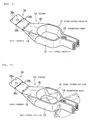
- Fig. 1 is a perspective view of an airbag according to an embodiment of the invention
- Fig. 2 is a horizontal sectional view of the airbag of Fig. 1
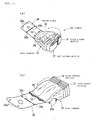
- Fig. 3 is an exploded perspective view showing the structure of panels of the airbag of Fig. 1
- Fig. 4 is an exploded perspective view in the course of sewing the airbag.
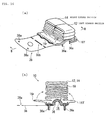
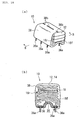
- Figs. 5 to 18 are explanatory views showing the process of folding the airbag of Fig.1.
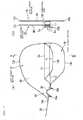
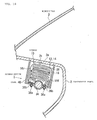
- Fig. 19 is a longitudinal sectional view of an airbag device including the folded airbag of Fig. 1; and
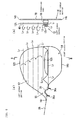
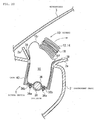
- Fig. 20 is a longitudinal sectional view the airbag of the airbag device of Fig. 19 when being inflated.
- FIG. 5 shows a state of the airbag before being folded
- Figs. 6 to 17 show states of the airbag while being folded
- Fig. 18 shows a state of the airbag when being completely folded.
- Figs. 5(a), 6(a), 7(a), 8(a), 9(a) and 10(a) are side views of the airbag
- Figs. 5(b), 6(b), 7(b), 8(b), 9(b) and 10(b) are sectional views taken along the lines B-B in Figs. 5(a), 6(a), 7(a), 8(a), 9(a) and 10(a).
- FIGs. 11 to 13 and 14(a) are perspective views as seen from the leading side of the airbag (the passenger side), and Figs. 14(b) and Figs. 15(a), 16(a), 17(a) and 18(a) are perspective views as seen from the base end (rear end) of the airbag.
- Figs. 15(b), 16(b), 17(b) and 18(b) are sectional views taken along the lines B-B of Figs. 15(a), 16(a), 17(a) and 18(a).
- An airbag 10 includes a left airbag section 12 that is inflated on the front left side of a passenger, a right airbag section 14 that is inflated on the front right side of the passenger, and a base chamber 16 that communicates one end of the left airbag section 12 with one end of the right airbag section 14.
- the base chamber 16 is the base side of the airbag 10. Accordingly, the left airbag section 12 and the right airbag section 14 are respectively inflated in a direction away from the base chamber 16.
- a space 13 (Fig. 2) is formed between a front most end of the left bag 12 and a front most end of the right bag 14 without a bridging member such as a tie panel therebetween.
- the space 13 is opened toward the passenger (toward the upper side in Fig. 2).
- the spacing between a front most end of the left airbag section 12 and a front most end of the right airbag section 14 be 150 to 450 mm, particularly, 170 to 430 mm.
- the horizontal distance from one of the front most ends to a deepest portion of the space 13 be 280 to 480 mm, particularly, 310 to 450 mm.
- the airbag sections 12 and 14 are connected to each other by a connecting band 18.
- the connecting band 18 comprises a left half of connecting band 18L and a right half of connecting band 18R.
- Width-regulating tethers 20L and 20R (forming a tether belt or strap) that extend in the right-and-left direction are stretched within the airbag sections 12 and 14, respectively.
- the structure of the tethers 20L and 20R will be described later.
- each panel means the leading side of the airbag 10 in the inflation direction and the rear side means the base side of the airbag in the inflation direction.
- the airbag 10 comprises a total of four panels, i.e., an inside panel 50, a left outside panel 60, a right outside panel 70, and a base panel 80. Each of the left and right halves of connecting band 18L and 18R is connected to the side panel 50.
- the inside panel 50 is substantially gourd-shape elongated panel.
- a left side 50L and a right side 50R are formed by folding the inside panel 50 into two in the middle thereof.
- the left side 50L constitutes the inner face of the left airbag section 12
- the right side 50R constitutes the inner face of the right airbag section 14.
- the entire peripheral edge of the inside panel 50 comprises a lower edge 56, a leading edge 51 and an upper edge 52 of the left side 50L, an upper edge 53 which lies in the vicinity of a folded-back portion constituting the deepest portion between valleys of the airbag, an upper edge 54, a leading edge 55 and a lower edge 58 of the right side 50R, and a lower edge 57 which lies in the vicinity of the folded-back portion.
- the entire peripheral edge of the left outside panel 60 comprises a leading edge 61, an upper edge 62, a straight rear edge 63, and a lower edge 64 (here, reference numeral 64 is not shown).
- the entire peripheral edge of the right outside panel 70 comprises a leading edge 71, an upper edge 72, a straight rear edge 73, and a lower edge 74.
- the base panel 80 has a left lateral face 80A, a bottom face 80B, a right lateral face 80C, a left flap 80D constituting a top left side, a right flap 80E constituting a top right side.
- the base panel 80 is folded in such a manner that the lateral faces 80A and 80C form a substantially triangular shapes.
- the face of the base panel 80 that faces the leading side of the airbag is opened.
- the entire peripheral edge of the base panel 80 comprises facing edges 81 and 82 between substantially rectangular flaps 80D and 80E, front edges 83 and 84 (flap front edges) of the flaps 80D and 80E, rear edges 85 and 86 of the flaps 80D and 80E, a rear edge 87 facing the rear edges 85 and 86, front edges 88 and 89 (lateral front edges) of the lateral faces 80A and 80C, and a bottom front edge 80f that connects the lateral front edges 88 and 89 with each other.
- the bottom face 80B of the base panel 80 is provided with a gas introducing port 90.
- a frame-like reinforcing cloth 91 is overlapped and sewn to the gas introducing port 90 so as to surround it.
- the gas introducing port 90 is rectangular, and has bolt insertion holes 92 formed in the vicinity of its four corners.
- the rear edge 63 of the left outside panel 60 and the rear edge 73 of the right outside edge 70 are sewn to the lateral front edges 88 and 89, respectively, in a state where the base panel 80 is spread flat.
- the facing edges 81 and 82 of the flaps 80D and 80E of the base panel 80 are sewn together. This brings the panels 60, 70 and 80 into the state shown in Fig. 4.
- "S" in Fig. 4 indicates sewing seams.
- the left outside panel 60 is caused to face the left side 50L of the inside panel 50, and the leading edges 51 and 61, the upper edges 52 and 62 and the lower edges 56 and 64 are sewn together, respectively.
- the right outside panel 70 is caused to face the right side 50R of the inside panel 50, and the leading edges 55 and 71, the upper edges 54 and 72 and the lower edges 58 and 74 are sewn together, respectively.
- the flap front edges 83 and 84 of the base panel 80 are sewn to the upper edge 53 in the vicinity of the folded-back portion of the inside panel 50, and the bottom front edge 80f of the base panel 80 is sewn to the lower edge 57 in the vicinity of the folded-back portion.
- each of the width-regulating tethers 20L and 20R comprises a pair of tether halves 21 and 22.
- the one tether half 21 has one end sewn on the inner face of the inside panel 50.
- the other tether half 22 has one end sewn on the inner face of each of the outside panels 60 and 70.
- Reference numeral 23 represents reinforcing cloths that are disposed across the outside panels 60 and 70 from the one ends of the tether halves 22 and are sewn together therewith.
- the tether half 21 attached to the left side 50L and the other end of the tether half 22 attached to the left outside panel 60 are sewn together, and the tether half 21 attached to the right side 50R and the other end of the tether half 22 attached to the right outside panel 70 are sewn together.
- the left side 50L and the left outside panel 60 are connected to each other by the tether 20L
- the right side 50R and the right outside panel 70 are connected to each other by the tether 20R, thereby regulating the width of the left airbag section 12 and the right airbag section 14 when they are inflated.
- the airbag 10 (shown in Fig. 1) becomes to be an inside-out state, that is, to expose a sewing thread to the surface of the airbag.
- the flap rear edges 85 and 86 and the rear edge 87 of the base panel 80 are not yet sewn together, but they form an opening M in this state.
- an inflator 34 (see Figs. 19 and 20) is disposed within the base chamber 16 through the gas introducing port 90 at the bottom of the base chamber 16.
- the inflator 34 is rod-shaped, and disposed such that the longitudinal direction is the width direction (the right-and-left direction) of a vehicle.
- Reference numeral 36 represents a fixing plate as a fixture to fix the bottom face of the base chamber 16 and the inflator 34 to an airbag mounting face of the accommodating case 40 (the bottom face of an accommodating case 40 in this embodiment) (see Figs. 19 and 20).
- the fixing plate 36 has C-shaped bands (reference numerals are omitted) fitted on peripheral sides of the inflator 34 at the longitudinal opposite ends, flanges (reference numerals are omitted) that extend along the bottom face of the base chamber 16 (and the airbag mounting face of the case 40) from both ends of the C-shaped bands, and stud bolts 36a protruding downwardly from the flanges, respectively.
- each flange is provided with a pawl (reference numeral is omitted) to lock the fixing plate 36 to a peripheral edge of the gas introducing port 90, and the peripheral edge of the gas introducing port 90 is provided with a locking hole (reference numeral is omitted) for the pawl.
- the fixing plate 36 Prior to folding of the airbag 10 that has been completely sewn, the fixing plate 36 is introduced into the base chamber 16 from the gas introducing port 90, and attached to the peripheral edge of the gas introducing port 90. At this time, the flanges of the fixing plate overlap peripheral edge of the gas introducing port 90 while the stud bolts 36a are inserted into the insertion holes 92, respectively, and the pawl of the flanges are hooked to the locking holes, respectively, thereby fixing the fixing plate 36.
- the stud bolts 36a extend to the outside of the airbag 10 through the insertion holes 92.
- Reference numeral 36b in Figs. 19 and 20 represent nuts fitted around the stud bolts 36a, respectively.
- a protector cloth 38 is connected to a rear end of the base chamber 16 to wrap a folded body of the airbag 10.
- the protector cloth 38 is a band-like panel that extends rearwardly from the rear end of the base chamber 16.
- a base end of the protector cloth is sewn on the outer face of the airbag at the peripheral edge of the gas introducing port 90.
- the base end of the protector cloth 38 is provided with an opening (not shown) overlapping the gas introducing port 90, and holes (not shown) overlapping the pawl locking holes and the stud bolts 92, respectively.
- the inflator 34 is disposed within the base chamber 16 through the opening of the protector cloth 38 and the gas introducing port 90.
- the stud bolts 36a extend to the outside of the airbag 10 through the bottom face of the base chamber 16 and the protector cloth 38.
- Insertion holes 38a for the stud bolts 36a are bored in a leading end of the protector cloth 38.
- the protector cloth 38 is adapted to be ruptured when it receives a predetermined tension or more in its extending direction suffered.
- perforated slits 38b are formed in the extending middle portion of the protector cloth 38 so as to run in a direction intersecting the extending direction of the cloth.
- the airbag 10 is folded and accommodated within the case 40 along with the inflator 34, and the accommodated airbag is fixed to the airbag mounting face by the nuts 36b and the bolts 36a of the fixing plate 36, thereby forming an airbag device 1.
- the airbag device 1 is for a front passenger seat of a vehicle that is installed on the back of an instrument panel 2 in front of the front passenger seat.
- a portion of the instrument panel 2 that covers the case 40 servers as a door 2a that is pushed and torn open toward the interior of the vehicle by the airbag 10 when the airbag 10 is inflated.
- Reference numeral 2b in Fig. 19 represents a tear line that induces the tearing of the door 2a.
- case 40 is mounted with a lid (case member) adapted to be pushed and torn open by the airbag 10 when the airbag 10 is inflated and the instrument panel 2 is provided with an opening for installation of the airbag device 1 so that the airbag device 1 is covered with the lid in installing the airbag device 1 into the opening.
- a lid case member
- a windshield 3 exists above the instrument panel 2.
- the windshield inclines upward and rearward from an end of the instrument panel 2 on the front side of the vehicle.
- the left airbag section 12 and the right airbag section 14 are spread flat such that their respective left and right lateral faces (the left side 50L and the left outside panel 60 or the right side 50R and the right outside panel 70) overlap each other. Then, as shown in Figs. 5 to 11, the left airbag section 12 and the right airbag section 14 are respectively folded so as to have a reduced vertical width, resulting in primary folded bodies that are elongated in forward and rearward directions.
- a portion of the left airbag section 12 (lower airbag section) that is lower than the connecting band 18 (the connecting band between the left airbag section 12 and the right airbag section 14) is folded back upwardly along a folding line L 1 that connects a lower edge of the connecting band 18 and a lower edge of the fixing plate 36 at the front end, and is overlapped with the left outside panel 60.
- a portion closer to the lower edge 12b than the folding line L 2 is folded back downwardly along a folding line L 2 that extends parallel to the folding line L 1 with a predetermined spacing on the lower edge 12b side (on the upper side) of the folding line L 1 so that the portion is overlapped with the outside (the side opposite to the remaining right airbag section 14).
- the position of the folding line L 2 is determined, for example, by placing a ruler or a plate, etc. having a predetermined width along the folding line L 1 .
- the following folding lines L 3 to L 7 are also determined by placing a ruler or a plate, etc. having a predetermined width along a previous folding line.
- the portion that protrudes downwardly from the folding line L 1 is folded back upwardly after the second folding.
- a portion closer to the lower edge 12b than the folding line L 3 is folded back upwardly so as to be overlapped with the outside along a folding line L 3 that extends parallel to the folding line L 2 with a predetermined spacing (in this embodiment, the spacing that is narrower than the spacing between the folding line L 2 and the folding line L 1 ) on the lower edge 12b side (on the lower side) of the folding line L 2 .
- a portion of the left airbag section 12 (an upper airbag section) closer to an upper edge 12t than the connecting band 18 is folded back toward the left outside panel 60 sequentially along folding lines L 4 , L 5 , ⁇ , (only folding lines up to L 7 are shown in Fig. 8) that extend parallel to the folding line L 1 by a predetermined width downwardly from the upper edge 12t, resulting in an elongated folded roll.
- the spacing of the folding lines L 4 to L 7 is set such that, when the upper folded roll reaches a portion near an upper portion of the lower folded body as shown in Fig. 9, its vertical width becomes approximately equal to the vertical width of the lower folded body.
- the upper folded roll is folded back downwardly along a line L 8 , that is located between the folded roll and the lower folded body and extends parallel to the line L 1 , so as to be overlapped with the outside of the lower folded body.
- the roll folding may be performed, for example, by winding the upper airbag section around a predetermined width of a band-like plate from the upper edge 12t.
- the upper airbag section may be wound around a band-like plate and roll-folded.
- the resulting folded roll may be overlapped with the outside of the lower folded body.
- the band-like plate may be then pulled out of the folded roll.
- the right airbag section 14 is also primarily folded through the process similar to the left airbag section 12.
- Fig. 11 shows that the primary folding of the left airbag section 12 and the right airbag section 14 has been completed.
- reference numerals 14b and 14t represent a lower edge and an upper edge, respectively, of the right airbag section 14.
- the vertical width of the primary folded bodies of the left airbag section 12 and the right airbag section 14 is set in accordance with the width of the case 40 to receive the airbag 10.
- the primary folding method and the secondary folding method of the left airbag section 12 and the right airbag section 14 are not limited to the above description.
- the base panel 80 is flattened so that the base chamber 16 becomes a so-called "beaten state," and the secondary folded body of the left airbag section 12 and the right airbag section 14 is placed on the flattened base panel.
- the base chamber 16 and the secondary folded body overlap the fixing plate 36.
- Fig. 14 shows a state of the base panel 80 before being flattened
- Fig. 15 shows a state of the base panel 80 while being flattened
- Fig. 16 shows a state of the base panel after being flattened.
- the base panel 80 When the rear end 16r is pulled rearwardly, the base panel 80 remains loosened between the rear end 16r and the flap front edges 83 and 84 (flaps 80D and 80E) even if a portion between the rear end 16r and the rear edge of the gas introducing port 90 is stretched without looseness. Consequently, in this embodiment, as shown in Fig. 16(b), the middle portions of the flaps 80D and 80E are introduced into the space below the secondary folded body by the loosened distance so that the portion pulled out rearwardly of the secondary folded body extends flatly.
- the flaps 80D and 80E may be folded in a zigzag pattern and overlapped with the rear end 16r, for example, by chucking out the middle portions of the straps 80D and 80E rearwardly by the loosened distance.
- the base chamber 16 is also pulled out forwardly by pulling a front end 16f of the base chamber 16 forward as indicated by the arrow F.
- the length of the base panel 80 from the rear edge of the gas introducing port 90 to the flap front edges 83 and 84 is larger than the length of the base panel 80 from the front edge of the gas introducing port 90 to the bottom front edge 80f, the length of the base chamber 16 that is pulled out forward (in the F-direction) becomes larger than the length of the base chamber 16 that is pulled out rearwardly (in the R-direction). It should be noted herein that pull-out of the front end 16f toward a passenger may be omitted.
- the left lateral face 80A and the right lateral face 80C of the panel 80 are respectively folded into the space below the secondary folded body.
- the pulled-out portions of the base chamber 16 closer to the rear end 16r and the front end 16f are respectively folded back upwardly and overlapped with the rear lateral faces (the side opposite to a passenger) and the front lateral face (the passenger side) of the secondary folded body.
- the protector cloth 38 is pulled forwardly around the folded body of the airbag 10 such that it is covered on the folded body. Then, the stud bolts 36a extending from the bottom of the base chamber 16 are inserted through the insertion holes 38a, respectively, of the protector cloth 38 at its leading end, and thereby the protector cloth 38 is caught by the stud bolts 36a. As a result, the folded body of the airbag 10 is wrapped (retained in shape) by the protector cloth 38, completing the folding of the airbag 10.
- the position of the first fold is determined to be uniform. Also, the folding in the primary folding after the first folding can be performed parallel to the first folding line L 1 which serves as a reference line.
- the inflator 34 operates to discharge gas. As a result, gas is discharged into the base chamber 16 from the inflator 34. The gas from the inflator 34 flows into the left airbag section 12 and the right airbag section 14 from the base chamber 16. Then, this gas causes the left airbag section 12 and the right airbag section 14 to inflate on the left and right sides, respectively, in front of a passenger.
- the protector cloth 38 is ruptured along the slits 38b due to the inflation pressure of the airbag 10, thereby releasing the folds of the airbag 10.
- the base chamber 16 is inflated, which in turn pushes the secondary folded body of the left airbag section 12 and the right airbag section 14 out of the case 40 while pushing the door 2a of the inflator open.
- the portion of the base chamber 16 closer to its rear end 16r is pulled out rearwardly and overlapped with the rear lateral face of the secondary folded body.
- the base chamber 16 is inflated, as shown in Fig. 20, the rear end 16r swells greatly on the rear side (vehicle front side) of the secondary folded body.
- the secondary folded body is pushed out by the inflated rear end 16r so that the left airbag section 12 and the right airbag section 14 are smoothly deployed toward the passenger.
- the portion of the base chamber 16 closer to its front end 16f is also pulled out forwardly, as shown in the drawing, the portion of the base member closer to the front end 16f is inflated so as to support the secondary folded body on the front bottom of the secondary folded body.
- the left airbag section 12 and the right airbag section 14 are inflated to the left and right, respectively, in front of a passenger, whereby the left airbag section 12 receives the left chest of a passenger and the right airbag section 14 receives the right chest of the passenger.
- Hard and strong ribs exist in the left and right chests.
- the left airbag section 12 and the right airbag section 14 receive and absorb an impact on the passenger through the ribs.
- the space 13 exists between the leading ends of the inflated left and right airbag sections 12 and 14 so that the breastbones in the center of the passenger's chest faces the space 13.
- the spacing between the front most ends of the left airbag section 12 and the right airbag section 14 is set to 150 to 450 mm.
- the inflated left airbag section 12 directly faces a central region of the left chest
- the inflated left airbag section 14 directly faces a central region of the right chest.
- the airbag 10 comprises four panels including the inside panel 50, the left outside panel 60, the right outside panel 70, and the base panel 80.
- the panel structure of the airbag of the invention is not limited thereto.
- each of the outside panels 60 and 70 and the base panel 80, which are separately provided, may be sewn together, thereby forming an outer peripheral surface of the airbag from the left airbag section 12 to the right airbag section 14.
- each of the outside panels and the base panel are fabricated as one (continuous) panel from the beginning.
- the above embodiment illustrates an application of the invention for a front passenger airbag device of automobiles.
- the invention is naturally applicable not only to airbag devices for passengers other than the front passenger but also to airbag devices for receiving passengers of highspeed mobile objects other than the automobile.
Landscapes
- Engineering & Computer Science (AREA)
- Mechanical Engineering (AREA)
- Air Bags (AREA)
Abstract
Description
- The present invention relates to an airbag device including an airbag that is inflated at the time of a vehicle collision to receive a passenger, and more specifically, it relates to an airbag device including an airbag having a left airbag section and a right airbag section that are inflated on the right and left, respectively, in front of a passenger.
-
JP-A-2004-268903 - In the above publication, portions of the airbag sections closer to their leading ends than the connecting part are folded along vertical folding lines, respectively, so as to be primary folded bodies, and then, the primary folded bodies are folded to be smaller.
- This airbag is folded and accommodated within a case and covered with a cover. When the inflator (gas generator) begins to discharge gas at the time of a vehicle collision, the airbag is inflated toward the front of a passenger while pushing the cover open.
- Accordingly, the object of the present invention is to provide an airbag device made by folding an airbag having a left airbag section and a right airbag section with a folding method different from that disclosed in
JP-A-2004-268903 - An airbag device according to
Claim 1 includes a folded airbag, a case accommodating the airbag, and an inflator for inflating the airbag. The airbag on a leading-end side is inflated in a direction away from a base-end side of the airbag by gas discharged from the inflator disposed on the base-end side. The airbag includes a base end part having a gas introducing port that receives gas from the inflator, a left airbag section that is connected to the base end part and inflated on the left in front of a passenger, and a right airbag section that is connected to the base end part and inflated on the right in front of the passenger. The airbag is made by primarily folding the left airbag section and the right airbag section to form primary folded bodies that are elongated in forward and rearward directions, by secondarily folding the primary folded bodies so as to have a reduced longitudinal width to form a secondary folded body, and then by folding the base end part. A portion of the base end part on the side opposite to the passenger is pulled out in a direction opposite to the passenger farther than the secondary folded body and folded. - The airbag device according to
Claim 2 is an airbag device according toClaim 1 in which a portion of the base end part on the passenger side is pulled out toward the passenger from the secondary folded body and folded, and in which the pulled-out distance in the direction opposite to the passenger is larger than the pulled-out distance toward the passenger. - The airbag device according to
Claim 3 is an airbag device according toClaim - In the airbag device according to the invention, when the inflator operates to inflate the airbag, the gas from the inflator is introduced into the base end part of the airbag through the gas introducing port to inflate the base end part first. Next, the gas is introduced into the left airbag section and the right airbag section to inflate them. The inflated left airbag section receives the left chest of a passenger and the inflated right airbag section receives the right chest of the passenger. Hard and strong ribs exist in the left and right chests. The airbag receives and absorbs an impact on the passenger through the ribs.
- Further, in the invention, in a state in which the airbag is inflated, if the spacing between the front most ends of the left airbag section and the right airbag section is 150 to 450 mm, the inflated left airbag section directly faces a central region of the left chest, and the inflated right airbag section directly faces a central region of the right chest. As a result, the region of the ribs of the upper half of the passenger's body is reliably and securely received by the airbag.
- In the invention, the airbag is made by primarily folding the left airbag section and the right airbag section to form primary folded bodies that are elongated in forward and rearward directions, by secondarily folding the primary folded bodies so as to have a reduced longitudinal width to form a secondary folded body, and then by folding the base end part. A portion of the base end part opposite to the passenger is pulled out and folded in a direction opposite to the passenger farther than the secondary folded body.
- Therefore, when the base end part is inflated, the base end part expands greatly on the side opposite to the passenger farther than the secondary folded body. Thereby, the secondary folded body is pushed out toward the passenger by the inflated base end part so that the left airbag section and the right airbag section are smoothly deployed toward the passenger.
- As defined in
Claim 2, a portion of the base end part on the passenger side is pulled out a bit toward the passenger from the secondary folded body and folded. As a result, when the base end part is inflated, the portion of the base end part on the passenger side is inflated so as to support the portion of the secondary folded body on the passenger side from the bottom. - In an aspect of
Claim 3, when the airbag has been inflated, a space exists between the leading ends of the left airbag section and the right airbag section. If the passenger's body rushes into the airbag, the breastbone region of the chest does not receive reaction force too much from the airbag. As a result, a burden on the breastbones becomes small. - Further, in the aspect of
Claim 3, middle portions of the left airbag section and the right airbag section in the inflation direction are connected to each other. As a result, since the left and right airbag sections pull each other in the course of inflating the airbag, the left and right airbag sections are inflated almost equally. - Hereinafter, an embodiment of the invention will be described with reference to the accompanying drawings.
- Fig. 1 is a perspective view of an airbag according to an embodiment of the invention;
Fig. 2 is a horizontal sectional view of the airbag of Fig. 1;
Fig. 3 is an exploded perspective view showing the structure of panels of the airbag of Fig. 1;
Fig. 4 is an exploded perspective view in the course of sewing the airbag.
Figs. 5 to 18 are explanatory views showing the process of folding the airbag of Fig.1.
Fig. 19 is a longitudinal sectional view of an airbag device including the folded airbag of Fig. 1; and
Fig. 20 is a longitudinal sectional view the airbag of the airbag device of Fig. 19 when being inflated. - In addition, Fig. 5 shows a state of the airbag before being folded, Figs. 6 to 17 show states of the airbag while being folded, and Fig. 18 shows a state of the airbag when being completely folded. In Figs. 5 to 10, Figs. 5(a), 6(a), 7(a), 8(a), 9(a) and 10(a) are side views of the airbag, and Figs. 5(b), 6(b), 7(b), 8(b), 9(b) and 10(b) are sectional views taken along the lines B-B in Figs. 5(a), 6(a), 7(a), 8(a), 9(a) and 10(a). Figs. 11 to 13 and 14(a) are perspective views as seen from the leading side of the airbag (the passenger side), and Figs. 14(b) and Figs. 15(a), 16(a), 17(a) and 18(a) are perspective views as seen from the base end (rear end) of the airbag. Figs. 15(b), 16(b), 17(b) and 18(b) are sectional views taken along the lines B-B of Figs. 15(a), 16(a), 17(a) and 18(a).
- An
airbag 10 includes aleft airbag section 12 that is inflated on the front left side of a passenger, aright airbag section 14 that is inflated on the front right side of the passenger, and abase chamber 16 that communicates one end of theleft airbag section 12 with one end of theright airbag section 14. Thebase chamber 16 is the base side of theairbag 10. Accordingly, theleft airbag section 12 and theright airbag section 14 are respectively inflated in a direction away from thebase chamber 16. - When the
airbag 10 is inflated, a space 13 (Fig. 2) is formed between a front most end of theleft bag 12 and a front most end of theright bag 14 without a bridging member such as a tie panel therebetween. Thespace 13 is opened toward the passenger (toward the upper side in Fig. 2). - When the
airbag 10 is completely inflated, it is preferable that the spacing between a front most end of theleft airbag section 12 and a front most end of theright airbag section 14 be 150 to 450 mm, particularly, 170 to 430 mm. - It is also preferable that the horizontal distance from one of the front most ends to a deepest portion of the
space 13 be 280 to 480 mm, particularly, 310 to 450 mm. In a middle portion between the front most end to the deepest portion, theairbag sections band 18. In this embodiment, the connectingband 18 comprises a left half of connectingband 18L and a right half of connectingband 18R. - The outer faces of the left and
right airbag sections vent holes 15. Width-regulatingtethers airbag sections tethers - The panel structure, etc. of the
airbag 10 will be described below. In the following description, the front side (leading side) of each panel means the leading side of theairbag 10 in the inflation direction and the rear side means the base side of the airbag in the inflation direction. - The
airbag 10 comprises a total of four panels, i.e., aninside panel 50, a leftoutside panel 60, a rightoutside panel 70, and abase panel 80. Each of the left and right halves of connectingband side panel 50. - The
inside panel 50 is substantially gourd-shape elongated panel. Aleft side 50L and aright side 50R are formed by folding theinside panel 50 into two in the middle thereof. In theinside panel 50, theleft side 50L constitutes the inner face of theleft airbag section 12, and theright side 50R constitutes the inner face of theright airbag section 14. The entire peripheral edge of theinside panel 50 comprises alower edge 56, a leadingedge 51 and anupper edge 52 of theleft side 50L, anupper edge 53 which lies in the vicinity of a folded-back portion constituting the deepest portion between valleys of the airbag, anupper edge 54, a leadingedge 55 and alower edge 58 of theright side 50R, and alower edge 57 which lies in the vicinity of the folded-back portion. - The entire peripheral edge of the left
outside panel 60 comprises a leadingedge 61, anupper edge 62, a straightrear edge 63, and a lower edge 64 (here, reference numeral 64 is not shown). The entire peripheral edge of the rightoutside panel 70 comprises aleading edge 71, anupper edge 72, a straightrear edge 73, and alower edge 74. - The
base panel 80 has a leftlateral face 80A, abottom face 80B, a rightlateral face 80C, aleft flap 80D constituting a top left side, aright flap 80E constituting a top right side. Thebase panel 80 is folded in such a manner that the lateral faces 80A and 80C form a substantially triangular shapes. The face of thebase panel 80 that faces the leading side of the airbag is opened. - The entire peripheral edge of the
base panel 80 comprises facingedges rectangular flaps flaps flaps rear edge 87 facing therear edges front edge 80f that connects the lateral front edges 88 and 89 with each other. - In addition, as shown in Fig. 2, the
bottom face 80B of thebase panel 80 is provided with agas introducing port 90. A frame-like reinforcingcloth 91 is overlapped and sewn to thegas introducing port 90 so as to surround it. Thegas introducing port 90 is rectangular, and has bolt insertion holes 92 formed in the vicinity of its four corners. - In making the
airbag 10, first, therear edge 63 of the leftoutside panel 60 and therear edge 73 of the rightoutside edge 70 are sewn to the lateral front edges 88 and 89, respectively, in a state where thebase panel 80 is spread flat. Next, the facing edges 81 and 82 of theflaps base panel 80 are sewn together. This brings thepanels - Next, as shown in Fig. 4, the left
outside panel 60 is caused to face theleft side 50L of theinside panel 50, and theleading edges upper edges lower edges 56 and 64 are sewn together, respectively. The rightoutside panel 70 is caused to face theright side 50R of theinside panel 50, and theleading edges upper edges lower edges base panel 80 are sewn to theupper edge 53 in the vicinity of the folded-back portion of theinside panel 50, and the bottomfront edge 80f of thebase panel 80 is sewn to thelower edge 57 in the vicinity of the folded-back portion. - In this embodiment, each of the width-regulating
tethers tether half 21 has one end sewn on the inner face of theinside panel 50. Theother tether half 22 has one end sewn on the inner face of each of theoutside panels Reference numeral 23 represents reinforcing cloths that are disposed across theoutside panels - Next, the
tether half 21 attached to theleft side 50L and the other end of thetether half 22 attached to the leftoutside panel 60 are sewn together, and thetether half 21 attached to theright side 50R and the other end of thetether half 22 attached to the rightoutside panel 70 are sewn together. - By sewing the other ends of the tether halves 21 and 22 together, the
left side 50L and the leftoutside panel 60 are connected to each other by thetether 20L, and theright side 50R and the rightoutside panel 70 are connected to each other by thetether 20R, thereby regulating the width of theleft airbag section 12 and theright airbag section 14 when they are inflated. - By thus sewing, the airbag 10 (shown in Fig. 1) becomes to be an inside-out state, that is, to expose a sewing thread to the surface of the airbag. As shown in Fig. 4, the flap rear edges 85 and 86 and the
rear edge 87 of thebase panel 80 are not yet sewn together, but they form an opening M in this state. - Consequently, the airbag is inverted through the opening M. Next, the opening M is sewn and the left and right halves of connecting
band airbag 10 in Fig. 1. - In this embodiment, an inflator 34 (see Figs. 19 and 20) is disposed within the
base chamber 16 through thegas introducing port 90 at the bottom of thebase chamber 16. In this embodiment, theinflator 34 is rod-shaped, and disposed such that the longitudinal direction is the width direction (the right-and-left direction) of a vehicle.Reference numeral 36 represents a fixing plate as a fixture to fix the bottom face of thebase chamber 16 and the inflator 34 to an airbag mounting face of the accommodating case 40 (the bottom face of anaccommodating case 40 in this embodiment) (see Figs. 19 and 20). - As shown in Fig. 1 and Figs. 15(b), 16(b), 17(b) and 18(b), the fixing
plate 36 has C-shaped bands (reference numerals are omitted) fitted on peripheral sides of the inflator 34 at the longitudinal opposite ends, flanges (reference numerals are omitted) that extend along the bottom face of the base chamber 16 (and the airbag mounting face of the case 40) from both ends of the C-shaped bands, andstud bolts 36a protruding downwardly from the flanges, respectively. In addition, each flange is provided with a pawl (reference numeral is omitted) to lock the fixingplate 36 to a peripheral edge of thegas introducing port 90, and the peripheral edge of thegas introducing port 90 is provided with a locking hole (reference numeral is omitted) for the pawl. - Prior to folding of the
airbag 10 that has been completely sewn, the fixingplate 36 is introduced into thebase chamber 16 from thegas introducing port 90, and attached to the peripheral edge of thegas introducing port 90. At this time, the flanges of the fixing plate overlap peripheral edge of thegas introducing port 90 while thestud bolts 36a are inserted into the insertion holes 92, respectively, and the pawl of the flanges are hooked to the locking holes, respectively, thereby fixing the fixingplate 36. Thestud bolts 36a extend to the outside of theairbag 10 through the insertion holes 92. - By fastening the fixing
plate 36 to the airbag mounting face of thecase 40 with thestud bolts 36a, the bottom face of thebase chamber 16 and the inflator 34 are fixed to the airbag mounting face.Reference numeral 36b in Figs. 19 and 20 represent nuts fitted around thestud bolts 36a, respectively. - In this embodiment, a
protector cloth 38 is connected to a rear end of thebase chamber 16 to wrap a folded body of theairbag 10. In this embodiment, theprotector cloth 38 is a band-like panel that extends rearwardly from the rear end of thebase chamber 16. A base end of the protector cloth is sewn on the outer face of the airbag at the peripheral edge of thegas introducing port 90. - In addition, the base end of the
protector cloth 38 is provided with an opening (not shown) overlapping thegas introducing port 90, and holes (not shown) overlapping the pawl locking holes and thestud bolts 92, respectively. The inflator 34 is disposed within thebase chamber 16 through the opening of theprotector cloth 38 and thegas introducing port 90. Thestud bolts 36a extend to the outside of theairbag 10 through the bottom face of thebase chamber 16 and theprotector cloth 38. -
Insertion holes 38a for thestud bolts 36a are bored in a leading end of theprotector cloth 38. - The
protector cloth 38 is adapted to be ruptured when it receives a predetermined tension or more in its extending direction suffered. Specifically, perforatedslits 38b are formed in the extending middle portion of theprotector cloth 38 so as to run in a direction intersecting the extending direction of the cloth. When theprotector cloth 38 receives a predetermined tension or more, it is torn and ruptured along theslits 38b. - The
airbag 10 is folded and accommodated within thecase 40 along with the inflator 34, and the accommodated airbag is fixed to the airbag mounting face by the nuts 36b and thebolts 36a of the fixingplate 36, thereby forming anairbag device 1. - In addition, in this embodiment, the
airbag device 1 is for a front passenger seat of a vehicle that is installed on the back of aninstrument panel 2 in front of the front passenger seat. A portion of theinstrument panel 2 that covers thecase 40 servers as adoor 2a that is pushed and torn open toward the interior of the vehicle by theairbag 10 when theairbag 10 is inflated.Reference numeral 2b in Fig. 19 represents a tear line that induces the tearing of thedoor 2a. - It should be noted herein that a structure may be employed in which the
case 40 is mounted with a lid (case member) adapted to be pushed and torn open by theairbag 10 when theairbag 10 is inflated and theinstrument panel 2 is provided with an opening for installation of theairbag device 1 so that theairbag device 1 is covered with the lid in installing theairbag device 1 into the opening. - As shown in Fig. 19, a
windshield 3 exists above theinstrument panel 2. The windshield inclines upward and rearward from an end of theinstrument panel 2 on the front side of the vehicle. - Next, the process of folding the
airbag 10 will be described with reference to Figs. 5 to 18. - In folding the
airbag 10, first, theleft airbag section 12 and theright airbag section 14 are spread flat such that their respective left and right lateral faces (theleft side 50L and the leftoutside panel 60 or theright side 50R and the right outside panel 70) overlap each other. Then, as shown in Figs. 5 to 11, theleft airbag section 12 and theright airbag section 14 are respectively folded so as to have a reduced vertical width, resulting in primary folded bodies that are elongated in forward and rearward directions. - In the primary folded bodies, in this embodiment, first as shown in Figs. 5 and 6, a portion of the left airbag section 12 (lower airbag section) that is lower than the connecting band 18 (the connecting band between the
left airbag section 12 and the right airbag section 14) is folded back upwardly along a folding line L1 that connects a lower edge of the connectingband 18 and a lower edge of the fixingplate 36 at the front end, and is overlapped with the leftoutside panel 60. - Next, as shown in Figs. 6 and 7, a portion closer to the
lower edge 12b than the folding line L2 is folded back downwardly along a folding line L2 that extends parallel to the folding line L1 with a predetermined spacing on thelower edge 12b side (on the upper side) of the folding line L1 so that the portion is overlapped with the outside (the side opposite to the remaining right airbag section 14). At this time, the position of the folding line L2 is determined, for example, by placing a ruler or a plate, etc. having a predetermined width along the folding line L1. Similar to this, the following folding lines L3 to L7 are also determined by placing a ruler or a plate, etc. having a predetermined width along a previous folding line. - Next, as shown in Figs. 7 and 8, the portion that protrudes downwardly from the folding line L1 is folded back upwardly after the second folding. At this time, a portion closer to the
lower edge 12b than the folding line L3 is folded back upwardly so as to be overlapped with the outside along a folding line L3 that extends parallel to the folding line L2 with a predetermined spacing (in this embodiment, the spacing that is narrower than the spacing between the folding line L2 and the folding line L1) on thelower edge 12b side (on the lower side) of the folding line L2. - Next, as shown in Figs. 8 to 9, a portion of the left airbag section 12 (an upper airbag section) closer to an
upper edge 12t than the connectingband 18 is folded back toward the leftoutside panel 60 sequentially along folding lines L4, L5, ···, (only folding lines up to L7 are shown in Fig. 8) that extend parallel to the folding line L1 by a predetermined width downwardly from theupper edge 12t, resulting in an elongated folded roll. In this embodiment, the spacing of the folding lines L4 to L7 is set such that, when the upper folded roll reaches a portion near an upper portion of the lower folded body as shown in Fig. 9, its vertical width becomes approximately equal to the vertical width of the lower folded body. - Thereafter, as shown in Figs. 9 and 10, the upper folded roll is folded back downwardly along a line L8, that is located between the folded roll and the lower folded body and extends parallel to the line L1, so as to be overlapped with the outside of the lower folded body.
- In addition, the roll folding may be performed, for example, by winding the upper airbag section around a predetermined width of a band-like plate from the
upper edge 12t. In this case, the upper airbag section may be wound around a band-like plate and roll-folded. The resulting folded roll may be overlapped with the outside of the lower folded body. The band-like plate may be then pulled out of the folded roll. Thus, the folding work of the upper airbag section can be efficiently performed. - The
right airbag section 14 is also primarily folded through the process similar to theleft airbag section 12. Fig. 11 shows that the primary folding of theleft airbag section 12 and theright airbag section 14 has been completed. In addition, in Figs. 5 to 10,reference numerals right airbag section 14. - The vertical width of the primary folded bodies of the
left airbag section 12 and theright airbag section 14 is set in accordance with the width of thecase 40 to receive theairbag 10. - Next, as shown in Figs. 12 and 13, in the primary folded bodies of the
left airbag section 12 and theright airbag section 14 that are long in forward and rearward directions, portions closer to the leading ends of the primary folded bodies than the connectingband 18 are separated from each other to the right and left in the shape of open legs, and portions closer to rear ends of the primary folded bodies than the connectingband 18 are folded in a accordion fashion (in a zigzag fashion) so as to have a reduced longitudinal width. Next, as shown in Figs. 13 and 14, the portions of theairbag sections band 18 are folded back to the front of the connectingband 18 along the vertical folding lines L9 and L10, respectively, that are located in the middle of the portions closer to the leading ends. As a result, a secondary folded body shown in Fig. 13 is formed. - The primary folding method and the secondary folding method of the
left airbag section 12 and theright airbag section 14 are not limited to the above description. - Next, as shown in Figs. 14 to 16, the
base panel 80 is flattened so that thebase chamber 16 becomes a so-called "beaten state," and the secondary folded body of theleft airbag section 12 and theright airbag section 14 is placed on the flattened base panel. As a result, as shown in Fig. 16(b), thebase chamber 16 and the secondary folded body overlap the fixingplate 36. Fig. 14 shows a state of thebase panel 80 before being flattened, Fig. 15 shows a state of thebase panel 80 while being flattened, and Fig. 16 shows a state of the base panel after being flattened. - When the
base panel 80 is flattened, as shown in Fig. 15(b), the portion between thefront edges flaps gas introducing port 90 of thebase panel 80 are loosened. As indicated by the arrow R in Fig. 15(b), arear end 16r of thebase chamber 16 is pulled rearwardly, and thebase chamber 16 is pulled out rearwardly by the loosened distance. - When the
rear end 16r is pulled rearwardly, thebase panel 80 remains loosened between therear end 16r and the flap front edges 83 and 84 (flaps rear end 16r and the rear edge of thegas introducing port 90 is stretched without looseness. Consequently, in this embodiment, as shown in Fig. 16(b), the middle portions of theflaps flaps rear end 16r, for example, by chucking out the middle portions of thestraps - In addition, since looseness is also caused in the portion between the bottom
front edge 80f and the front edge of thegas introducing port 90 of thebase chamber 16, thebase chamber 16 is also pulled out forwardly by pulling afront end 16f of thebase chamber 16 forward as indicated by the arrow F. In this case, since the length of thebase panel 80 from the rear edge of thegas introducing port 90 to the flap front edges 83 and 84 is larger than the length of thebase panel 80 from the front edge of thegas introducing port 90 to the bottomfront edge 80f, the length of thebase chamber 16 that is pulled out forward (in the F-direction) becomes larger than the length of thebase chamber 16 that is pulled out rearwardly (in the R-direction). It should be noted herein that pull-out of thefront end 16f toward a passenger may be omitted. - When the
base panel 80 is flattened, looseness is also caused in the leftlateral face 80A and the rightlateral face 80C of thepanel 80. In this embodiment, the leftlateral face 80A and the rightlateral face 80C are respectively folded into the space below the secondary folded body. - Thereafter, the pulled-out portions of the
base chamber 16 closer to therear end 16r and thefront end 16f are respectively folded back upwardly and overlapped with the rear lateral faces (the side opposite to a passenger) and the front lateral face (the passenger side) of the secondary folded body. - Thereafter, as shown in Figs. 17 and 18, the
protector cloth 38 is pulled forwardly around the folded body of theairbag 10 such that it is covered on the folded body. Then, thestud bolts 36a extending from the bottom of thebase chamber 16 are inserted through theinsertion holes 38a, respectively, of theprotector cloth 38 at its leading end, and thereby theprotector cloth 38 is caught by thestud bolts 36a. As a result, the folded body of theairbag 10 is wrapped (retained in shape) by theprotector cloth 38, completing the folding of theairbag 10. - In this embodiment, as described above, since a first folding is performed along the folding line L1 which connects the lower edge of the connecting
band 18 with the lower edge of the fixingplate 36 at its front end when theleft airbag section 12 and theright airbag section 14 are primarily folded, the position of the first fold is determined to be uniform. Also, the folding in the primary folding after the first folding can be performed parallel to the first folding line L1 which serves as a reference line. - If a vehicle equipped with the
airbag device 1 encounters an emergency situation, theinflator 34 operates to discharge gas. As a result, gas is discharged into thebase chamber 16 from theinflator 34. The gas from the inflator 34 flows into theleft airbag section 12 and theright airbag section 14 from thebase chamber 16. Then, this gas causes theleft airbag section 12 and theright airbag section 14 to inflate on the left and right sides, respectively, in front of a passenger. - When the
airbag 10 begins to be inflated, theprotector cloth 38 is ruptured along theslits 38b due to the inflation pressure of theairbag 10, thereby releasing the folds of theairbag 10. Next, thebase chamber 16 is inflated, which in turn pushes the secondary folded body of theleft airbag section 12 and theright airbag section 14 out of thecase 40 while pushing thedoor 2a of the inflator open. - In the
airbag device 1, when thebase chamber 16 is folded, the portion of thebase chamber 16 closer to itsrear end 16r is pulled out rearwardly and overlapped with the rear lateral face of the secondary folded body. Thus, when thebase chamber 16 is inflated, as shown in Fig. 20, therear end 16r swells greatly on the rear side (vehicle front side) of the secondary folded body. Thereby, the secondary folded body is pushed out by the inflatedrear end 16r so that theleft airbag section 12 and theright airbag section 14 are smoothly deployed toward the passenger. - In this embodiment, since the portion of the
base chamber 16 closer to itsfront end 16f is also pulled out forwardly, as shown in the drawing, the portion of the base member closer to thefront end 16f is inflated so as to support the secondary folded body on the front bottom of the secondary folded body. - Thereafter, the
left airbag section 12 and theright airbag section 14 are inflated to the left and right, respectively, in front of a passenger, whereby theleft airbag section 12 receives the left chest of a passenger and theright airbag section 14 receives the right chest of the passenger. Hard and strong ribs exist in the left and right chests. Theleft airbag section 12 and theright airbag section 14 receive and absorb an impact on the passenger through the ribs. Also, thespace 13 exists between the leading ends of the inflated left andright airbag sections space 13. Thus, if the passenger's body rushes into theairbag 10, the breastbone region of the chest does not receive reaction force too much from theairbag 10. As a result, a burden on the breastbones becomes small. - In this embodiment, in a state in which the
airbag 10 is inflated, the spacing between the front most ends of theleft airbag section 12 and theright airbag section 14 is set to 150 to 450 mm. Thus, the inflatedleft airbag section 12 directly faces a central region of the left chest, and the inflatedleft airbag section 14 directly faces a central region of the right chest. As a result, the region of the ribs of the upper half of the passenger's body is reliably and securely received by theairbag 10. - The above embodiment is just an example, and the invention is not limited to the above embodiment.
- In the above embodiment, the
airbag 10 comprises four panels including theinside panel 50, the leftoutside panel 60, the rightoutside panel 70, and thebase panel 80. However, the panel structure of the airbag of the invention is not limited thereto. For example, in the above embodiment, each of theoutside panels base panel 80, which are separately provided, may be sewn together, thereby forming an outer peripheral surface of the airbag from theleft airbag section 12 to theright airbag section 14. Otherwise, each of the outside panels and the base panel are fabricated as one (continuous) panel from the beginning. - The above embodiment illustrates an application of the invention for a front passenger airbag device of automobiles. However, the invention is naturally applicable not only to airbag devices for passengers other than the front passenger but also to airbag devices for receiving passengers of highspeed mobile objects other than the automobile.
Claims (3)
- An airbag device comprising a folded airbag, a case accommodating the airbag, and an inflator for inflating the airbag, the airbag on a leading-end side being inflated in a direction away from a base-end side of the airbag by gas discharged from the inflator disposed on the base-end side,
the airbag including a base end part having a gas introducing port that receives gas from the inflator, a left airbag section that is connected to the base end part and inflated on the left in front of a passenger, and a right airbag section that is connected to the base end part and inflated on the right in front of the passenger,
wherein the airbag is made by primarily folding the left airbag section and the right airbag section to form primary folded bodies that are elongated in forward and rearward directions, then secondarily folding the primary folded bodies so as to have a reduced longitudinal width to form a secondary folded body, and thereafter folding the base end part, and
a portion of the base end part on the side opposite to the passenger is pulled out in a direction opposite to the passenger farther than the secondary folded body and folded. - The airbag device according to Claim 1,
wherein a portion of the base end part on the passenger side is pulled out toward the passenger from than the secondary folded body and folded, and
the pulled-out distance in the direction opposite to the passenger is larger than the pulled-out distance toward the passenger. - The airbag device according to Claim 1 or 2,
wherein the left airbag section and the right airbag section have leading ends non-connected to each other, whereby a space to be opened toward the passenger is formed between the leading ends of the left airbag section and the right airbag section when inflated, and
middle portions of the left airbag section and the right airbag section in their inflation direction are connected to each other by a connecting part.
Applications Claiming Priority (1)
| Application Number | Priority Date | Filing Date | Title |
|---|---|---|---|
| JP2005214520A JP2007030614A (en) | 2005-07-25 | 2005-07-25 | Airbag device |
Publications (1)
| Publication Number | Publication Date |
|---|---|
| EP1747952A1 true EP1747952A1 (en) | 2007-01-31 |
Family
ID=37192417
Family Applications (1)
| Application Number | Title | Priority Date | Filing Date |
|---|---|---|---|
| EP06013372A Withdrawn EP1747952A1 (en) | 2005-07-25 | 2006-06-28 | Airbag device |
Country Status (4)
| Country | Link |
|---|---|
| US (1) | US20070018438A1 (en) |
| EP (1) | EP1747952A1 (en) |
| JP (1) | JP2007030614A (en) |
| CN (1) | CN1903619A (en) |
Families Citing this family (12)
| Publication number | Priority date | Publication date | Assignee | Title |
|---|---|---|---|---|
| JP2007030615A (en) * | 2005-07-25 | 2007-02-08 | Takata Corp | Airbag device |
| JP4235197B2 (en) | 2005-09-26 | 2009-03-11 | トヨタ自動車株式会社 | Passenger seat airbag device and method for folding passenger seat airbag |
| US7980592B2 (en) * | 2006-05-11 | 2011-07-19 | Trw Vehicle Safety Systems Inc. | Bi-lobular air bag |
| US7712769B2 (en) * | 2006-09-13 | 2010-05-11 | Takata Corporation | Airbag device |
| CN101516686B (en) * | 2006-09-22 | 2012-08-08 | 奥托立夫开发公司 | Airbag manufacturing method and airbag |
| JP5376836B2 (en) * | 2008-05-30 | 2013-12-25 | タカタ株式会社 | Airbag device for passenger seat |
| US7862073B2 (en) | 2008-06-05 | 2011-01-04 | Gm Global Technology Operations, Inc. | Split top air bag assembly |
| US8172260B2 (en) * | 2008-07-14 | 2012-05-08 | Trw Vehicle Safety Systems Inc. | Bi-lobular air bag |
| JP5493586B2 (en) * | 2009-08-19 | 2014-05-14 | タカタ株式会社 | How to fold an airbag |
| JP5534512B2 (en) | 2010-03-31 | 2014-07-02 | タカタ株式会社 | Air bag, air bag device, and steering device |
| JP5712913B2 (en) * | 2011-12-15 | 2015-05-07 | タカタ株式会社 | Passenger seat airbag, passenger seat airbag apparatus and vehicle |
| KR102731808B1 (en) * | 2019-09-27 | 2024-11-19 | 현대모비스 주식회사 | Folding method of side air bag apparatus and side air bag apparatus |
Citations (3)
| Publication number | Priority date | Publication date | Assignee | Title |
|---|---|---|---|---|
| DE19860804A1 (en) * | 1998-12-30 | 2000-07-06 | Volkswagen Ag | Driver's airbag arrangement in motor vehicle has folded driver's airbag(s) built into dashboard for filling by gas generator and unfoldable in front of driver via airbag outlet opening |
| US20040160041A1 (en) * | 2003-02-18 | 2004-08-19 | Takata Corporation | Airbag device and airbag |
| JP2004268903A (en) | 2003-02-18 | 2004-09-30 | Takata Corp | Air bag device and air bag |
Family Cites Families (7)
| Publication number | Priority date | Publication date | Assignee | Title |
|---|---|---|---|---|
| DE19733143A1 (en) * | 1996-08-02 | 1998-02-05 | Denso Corp | Air bag unit for vehicles |
| JPH11321511A (en) * | 1998-05-11 | 1999-11-24 | Takata Kk | Air bag for front passenger seat and folding method therefor |
| JP4635293B2 (en) * | 2000-04-07 | 2011-02-23 | タカタ株式会社 | Airbag device |
| JP4274742B2 (en) * | 2002-05-22 | 2009-06-10 | タカタ株式会社 | Air bag and air bag device |
| US6834886B2 (en) * | 2003-02-18 | 2004-12-28 | Takata Corporation | Airbag device |
| JP4595499B2 (en) * | 2004-03-23 | 2010-12-08 | タカタ株式会社 | Airbag device and airbag folding method |
| US7712769B2 (en) * | 2006-09-13 | 2010-05-11 | Takata Corporation | Airbag device |
-
2005
- 2005-07-25 JP JP2005214520A patent/JP2007030614A/en not_active Withdrawn
-
2006
- 2006-06-28 EP EP06013372A patent/EP1747952A1/en not_active Withdrawn
- 2006-07-25 US US11/459,802 patent/US20070018438A1/en not_active Abandoned
- 2006-07-25 CN CNA2006101057962A patent/CN1903619A/en active Pending
Patent Citations (3)
| Publication number | Priority date | Publication date | Assignee | Title |
|---|---|---|---|---|
| DE19860804A1 (en) * | 1998-12-30 | 2000-07-06 | Volkswagen Ag | Driver's airbag arrangement in motor vehicle has folded driver's airbag(s) built into dashboard for filling by gas generator and unfoldable in front of driver via airbag outlet opening |
| US20040160041A1 (en) * | 2003-02-18 | 2004-08-19 | Takata Corporation | Airbag device and airbag |
| JP2004268903A (en) | 2003-02-18 | 2004-09-30 | Takata Corp | Air bag device and air bag |
Also Published As
| Publication number | Publication date |
|---|---|
| JP2007030614A (en) | 2007-02-08 |
| US20070018438A1 (en) | 2007-01-25 |
| CN1903619A (en) | 2007-01-31 |
Similar Documents
| Publication | Publication Date | Title |
|---|---|---|
| EP1749708B1 (en) | Airbag device | |
| EP1749709B1 (en) | Airbag device | |
| US7712769B2 (en) | Airbag device | |
| US7549671B2 (en) | Knee-protecting airbag apparatus | |
| US7770925B2 (en) | Airbag protection flap | |
| JP4595499B2 (en) | Airbag device and airbag folding method | |
| US8308188B2 (en) | Passenger airbag apparatus | |
| JP5366444B2 (en) | Airbag device for passenger seat | |
| JP4267876B2 (en) | Head protection airbag device | |
| CN101253075A (en) | Passenger Seat Safety Airbag | |
| EP1747952A1 (en) | Airbag device | |
| EP1759936B1 (en) | Driver's leg protection apparatus | |
| JP2009035055A (en) | Airbag and airbag device | |
| EP1747948B1 (en) | Airbag device comprising folded airbag wrapped by a sheet | |
| US6736422B2 (en) | Head-protecting bag device | |
| JP4407548B2 (en) | Pedestrian airbag device | |
| JP4244863B2 (en) | Passenger airbag | |
| JP4396492B2 (en) | Airbag device for steering wheel | |
| US8100432B2 (en) | Air-bag with gas deflector | |
| JP6206310B2 (en) | Vehicle seat back | |
| JP3915643B2 (en) | Head protection airbag device | |
| JP3750578B2 (en) | Airbag device for passenger seat | |
| JP2007022319A (en) | Head protection airbag device | |
| JP2019010989A (en) | Head protection airbag device |
Legal Events
| Date | Code | Title | Description |
|---|---|---|---|
| PUAI | Public reference made under article 153(3) epc to a published international application that has entered the european phase |
Free format text: ORIGINAL CODE: 0009012 |
|
| AK | Designated contracting states |
Kind code of ref document: A1 Designated state(s): AT BE BG CH CY CZ DE DK EE ES FI FR GB GR HU IE IS IT LI LT LU LV MC NL PL PT RO SE SI SK TR |
|
| AX | Request for extension of the european patent |
Extension state: AL BA HR MK YU |
|
| 17P | Request for examination filed |
Effective date: 20070629 |
|
| AKX | Designation fees paid |
Designated state(s): DE FR GB SE |
|
| 17Q | First examination report despatched |
Effective date: 20071220 |
|
| GRAP | Despatch of communication of intention to grant a patent |
Free format text: ORIGINAL CODE: EPIDOSNIGR1 |
|
| STAA | Information on the status of an ep patent application or granted ep patent |
Free format text: STATUS: THE APPLICATION IS DEEMED TO BE WITHDRAWN |
|
| 18D | Application deemed to be withdrawn |
Effective date: 20091028 |